Friday September 25th 2026 Established 1905 27 Brickdam, Stabroek, Georgetown, Guyana Year 121, No. 37
112th World Day of Migrants and Refugees
(OSV News) — The world must no longer look at the plight of migrants, especially children, as a problem to be managed or quantified, but as a call to protect human rights and dignity, Pope Leo XIV said. “Minors are the most vulnerable group within the global movements of migration. They are concrete faces, who have unique stories, and call on our conscience,” the pope wrote in his message for the Sept. 27 celebration of the World Day of Migrants and Refugees. “We cannot remain indifferent, nor can we become accustomed to such suffering,” he wrote. (please turn to page 3)
Migrant Support Office visits Bartica - p2 World Day of Migrants and Refugees Prayer - p3 A Christian Perspective on Social Issues - p4 Sunday Scripture - p5 Over 250,000 children in Haiti trapped in the grip of malnutrition - p6 Hundreds of children to pray the Rosary for Peace with Pope Leo on October 1 - p7 Faith in the Eye of the Storm: Celebrating the Season of Creation in the Caribbean - p8 Children’s Page - p9 Faith in Practice Week 33 - p11 A Monk’s Tale – Br. Paschal’s vocation story - p13 Marian Academy observes World Peace Day - p14 Saint of the Week - p14
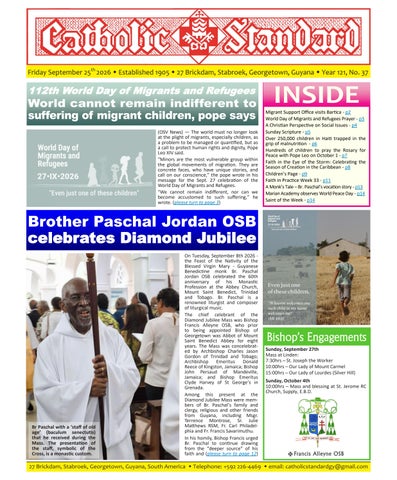
celebrates Diamond Jubilee
Br Paschal with a ‘staff of old age’ (baculum senectutis) that he received during the Mass. The presentation of the staff, symbolic of the Cross, is a monastic custom.
On Tuesday, September 8th 2026 the Feast of the Nativity of the Blessed Virgin Mary - Guyanese Benedictine monk Br. Paschal Jordan OSB celebrated the 60th anniversary of his Monastic Profession at the Abbey Church, Mount Saint Benedict, Trinidad and Tobago. Br. Paschal is a renowned liturgist and composer of liturgical music. The chief celebrant of the Diamond Jubilee Mass was Bishop Francis Alleyne OSB, who prior to being appointed Bishop of Georgetown was Abbot of Mount Saint Benedict Abbey for eight years. The Mass was concelebrated by Archbishop Charles Jason Gordon of Trinidad and Tobago; Archbishop Emeritus Donald Reece of Kingston, Jamaica; Bishop John Persaud of Mandeville, Jamaica; and Bishop Emeritus Clyde Harvey of St George’s in Grenada. Among this present at the Diamond Jubilee Mass were members of Br. Paschal’s family and clergy, religious and other friends from Guyana, including Msgr. Terrence Montrose, Sr. Julie Matthews RSM, Fr. Carl Philadelphia and Fr. Francis Savarimuthu. In his homily, Bishop Francis urged Br. Paschal to continue drawing from the “deeper source” of his faith and (please turn to page 12)
Bishop’s Engagements Sunday, September 27th Mass at Linden: 7:30hrs – St. Joseph the Worker 10:00hrs – Our Lady of Mount Carmel 15:00hrs – Our Lady of Lourdes (Silver Hill) Sunday, October 4th 10:00hrs – Mass and blessing at St. Jerome RC Church, Supply, E.B.D.
Francis Alleyne OSB
CATHOLIC STANDARD Friday, September 25th 2026
Page 2
Migrant Support Office visits Bartica
On Thursday September 10th, the Migrant Support Office visited Bartica, Region 7, Essequibo, Guyana, where the team met with migrants and members of the local Guyanese community.
During the workshop, important topics such as preventive healthcare, healthy habits and proper nutrition were discussed, encouraging participants to make informed choices for healthier lives.
The workshop was supported by Br. Rigoberto Martínez, SJ, and Fr. Santiago Lantigua, SJ.❖ (Adapted from Catholic Media Guyana FB )
Kurukabaru bids farewell Br. Rigoberto Martínez SJ
Year of St. Francis Jubilee Prayer Saint Francis, our brother, you who eight hundred years ago went to meet Sister Death as a man at peace, intercede for us before the Lord. You recognized true peace in the Crucifix of San Damiano, teach us to seek in Him the source of all reconciliation that breaks down every wall. You who, unarmed, crossed the lines of war and misunderstanding, give us the courage to build bridges where the world raises up boundaries.
In this time afflicted by conflict and division, intercede for us so that we may become peacemakers: unarmed and disarming witnesses of the peace that comes from Christ. Amen - Pope Leo XIV
The community of Kurukabaru, North Pakaraimas, Region 8, Essequibo, Guyana recently bid farewell to Bro. Rigoberto Martínez,
SJ, offering their prayers and best wishes as he leaves Guyana to continue his regency in Cuba.
Bro. Rigoberto arrived in Guyana in 2025 and served in the North Pakaraimas, accompanying and assisting communities throughout the region. He also supported the Migrant Support Office in several of its outreach activities across the country, sharing his time and service with migrants and local communities. As he begins this new chapter of his Jesuit formation and ministry, we thank Bro. Rigoberto for his dedicated service to the people of Guyana and pray that God will continue to guide and strengthen him on his journey. Farewell and God’s blessings, Bro. Rigo! ❖
CATHOLIC STANDARD Friday, September 25th 2026
World cannot remain indifferent to suffering of migrant children, pope says (From Front Page)
Children from Central America are seen at a migrant camp in Reynosa, Mexico, April 1, 2022. The World Day of Migrants and Refugees will be observed Sept. 27. (CNS photo/Veronica G. Cardenas, Reuters) Pope Leo’s message, which focused on the theme, “Even just one of these children,” was released by the Vatican Aug. 14. In his message, the pope lamented the increasing number of children and adolescents forced to flee their homes due to “war, poverty, violence, environmental disasters and other tragedies.”
Children’s dignity is trampled The suffering of migrant children, Pope Leo noted, doesn’t end with their relocation, as the majority have endured the loss of family and friends due to violence or separation and are often “exposed to extreme and traumatic conditions.” “To this already appalling situation are added further tragedies: deaths along migration routes, trafficking and exploitation, the recruitment of minors for use in armed conflicts, sexual violence, forced marriages, and the atrocities they have suffered or witnessed during their travels. Their dignity is trampled upon in countless ways,” the pope wrote. According to UNHCR, the U.N. refugee agency, an estimated 45 million children were among the people forcibly displaced worldwide at the end of 2025. Forced displacement can result from “persecution, conflict, violence, human rights violations or events seriously disturbing public order,” UNHCR states. Citing UNHCR data, UNICEF USA said on June 17, 2026, that “while children represent 29 percent of the global population, they comprise 38 percent of the total 117.8 million forcibly displaced people in the world.”
‘The cry of displaced children rises to God today’ In his message, the pope also praised the witness of individuals, families, institutions and ecclesial communities who bring the “light of solidarity” amid the darkness experienced by child migrants. Their commitment, he added, shows “that love can overcome indifference.” Noting that migrant children are “more easily ignored,” especially because they lack adults who can protect and support them, Pope Leo called on their countries of origin to “remove the causes that compel them to flee” while also calling on countries of destination to offer protection and welcome. “The cry of displaced children rises to God today, just as did the cry heard in the Book of Exodus: ‘I have observed the misery of my people who are in
Egypt; I have heard their cry on account of their taskmasters. Indeed, I know their sufferings, and I have come down to deliver them,'” he wrote. “God hears their cry and, in order to bring about liberation, he forcefully appeals to the conscience and action of each one of us, just as he did with Moses,” the pope added. The pope also called on society to see the reality of displaced children and young people and to overcome “that detachment which reduces the human person to a statistic that does not directly concern us.”
Need to prioritize the protection of every child and adolescent For Christians, migrant children serve as a call to “transform welcoming from an abstract concept into a stable
pastoral practice.” “We cannot simply delegate this task to institutes or associations endowed with a particular charism,” the pope wrote. “Before the concrete faces that confront us in daily life, the entire Christian community is called to regard these children as its own sons and daughters, and to engage with the concrete story of each one of them.” For other faiths and religious traditions, he continued, creating supportive environments for migrant children and youth can become “fertile ground for a concrete interreligious dialogue” and decrease the risk of those who wish to take advantage of their vulnerability. “Faith communities are called to create spaces in which every boy and every girl is respected and valued in his or her own cultural identity, thereby preventing the risk of radicalization by extremist groups. Ultimately, to protect a child is to safeguard the divine image imprinted within him or her,” he wrote. Pope Leo also called on civil institutions to prioritize the protection of every child and adolescent’s dignity and the “prevention of the trauma caused by separation.” “An urgent change of perspective is needed: the focus of the debate must shift from the mere management of migration to the full and immediate protection of human rights,” the pope wrote. ❖
Page 3
World Day of Migrants and Refugees September 27th 2026
PRAYER OF THE DAY God of Mercy, Father of children and the poor, Your Son Jesus became man, embracing the frailty and misery of the little ones. You who saw Your Son, in the innocence of childhood, walk the paths of exile in Egypt, know the suffering of children without a home or a future due to the lack of love from adults. Have mercy on young migrants and on those wandering the paths of exile. Have compassion, and awaken Your ineffable tenderness in the hearts of the powerful of this world. Reach out to and accompany every child on a journey without hope for tomorrow; console, comfort, and save those who trust in Your power to be delivered from their suffering. Convert hearts, awaken charity, and grant that each of us may be attentive to the tears and cries of young migrants seeking help. Amen
CATHOLIC STANDARD Friday, September 25th 2026
A Christian Perspective on Social Issues In times of plenty, why the hungry, empty, lonely, By GHK Lall unhappy? It is a time of plenty in Guyana. It is a time of the many hungry in Guyana. It is a time of broad bands of brothers and sisters who are empty, lonely, and unhappy. How can this be so, especially at a time like this? Why does it have to be so, when there is so much? When every Guyanese can have a small share of his or her God-given wealth, enough to satisfy needs, enough to live a life of dignity. Few are the countries that are the equivalent of Guyanese when the issue, the calculation, is of which place is more blessed, has more wealth. Many are the countries where citizens are starving and lacking. Because they have far fewer assets, little in the way of natural resources. This is understood, the pain recognized, due to those national conditions. But the same cannot, should not, and must not apply to Guyana, which has so much. Therefore, there shouldn’t be one person hungry. Not one child in need. Nor one family distressed about how the bills are going to be paid. Bills that are failing behind. Bills that are mounting up. The facts must be faced. Gently not aggressively, but no less assertively. What has been allocated (and there have been those) is not enough,
doesn’t make the grade. Helps, it must be said, but still leaves a world of hurts and needs untouched. By no means can it be said that the masses in Guyana are living a luxurious life. The rent is always overhead. The landlord’s coming a time of dread. Needs pile up and so do the bills. When food is in a state of constant short supply, then that says all that has to be said. In a country that the world looks at, and cannot stop talking about, hunger must qualify as a tragedy. Again and again, there must be returning to this point and highlighting it. The priorities have been wrong. At the least, there has been too much of a heavy tilt in favor of woodworks and steelworks, other such works, while desperately needed human works have suffered. The human works that fill the hand of the poor and the weak and the needy are most needed. Of what use are grand new structures, when the ordinary worker, the solitary pensioner, the distraught mother (or father) cannot take advantage of them? Because they lack power in their purses and pockets. Guyana makes all the headlines. Yet there are so many Guyanese trapped on the breadlines, the soup kitchen lines, the poverty lines. The Bible is abundant in God’s care for the poor, and Jesus’s recognition of the vulnerable. The widows. The lost. The sick. The left behind. The imprisoned and the wretched. Recall that commanding and binding passage from MT 25: that I now paraphrase to emphasize tis message. I was hungry…I was thirsty…I was sickly…I was lonely… I was in captivity… Now where are those with all the power and provisions in their hands? Those ingredients that could make a difference. When spread across Guyana thoughtfully, when distributed
cleanly. It rises to the level of a sin that so many are so hungry, so consumed by anxiety on how they are going to manage? How they are going to make it, and survive. Who is there that cares? If no one else does, then we Christians should. When no one else steps forward, then we as Roman Catholics who know the Church’s teachings about the poor and justice for them, must. We must, if only to live scripture. If only to express and represent the love of God. Almighty God has been merciful beyond measure to this country of ours called Guyana. We are called to mercy, too. If we don’t have in our hands to give, then let’s give of our hearts. We speak, we write, we struggle for better for those who are without. It’s what Jesus would do.❖
Page 4
Prayer for our Priests
Gracious and loving God, we thank your for the gift of our priests. Through them, we experience your presence in the sacraments. Help our priests to be strong in their vocation. Set their souls on fire with love for your people. Grant them the wisdom, understanding, and strength they need to follow in the footsteps of Jesus. Inspire them with the vision of your Kingdom. Give them the words they need to spread the Gospel. Allow them to experience joy in their ministry. Help them to become instruments of your divine grace. We ask this through Jesus Christ, who lives and reigns as our Eternal Priest. Amen
CATHOLIC STANDARD Friday, September 25th 2026
FIRST READING: Ezekiel 18:25-28 When the sinner renounces sin, he shall certainly live. The word of the Lord was addressed to me as follows: You object, “What the Lord does is unjust”. Listen, you House of Israel: is what I do unjust? Is it not what you do that is unjust? When the upright man renounces his integrity to commit sin and dies because of this, he dies because of the evil that he himself has committed. When the sinner renounces sin to become law-abiding and honest, he deserves to live. He has chosen to renounce all his previous sins; he shall certainly live; he shall not die. RESPONSORIAL PSALM: Psalm 25:4-9 Response: Remember your mercy, Lord. 1. Lord, make me know your ways. Lord, teach me your paths. Make me walk in your truth, and teach me: for you are God my saviour. Response 2. Remember your mercy, Lord, and the love you have shown from of old. Do not remember the sins of my youth. In your love remember me, because of your goodness, O Lord. Response 3. The Lord is good and upright. He shows the path to those who stray, he guides the humble in the right path; he teaches his way to the poor. Response
St. Paul offers a formula for living the way we are supposed to live as Christians in the Second Reading. Paul writes, “Do nothing out of selfishness
Page 5
and gave him the name which is above all other names so that all beings in the heavens, on earth and in the underworld, should bend the knee at the name of Jesus and that every tongue should acclaim Jesus Christ as Lord, to the glory of God the Father.
SECOND READING: Phil. 2:1-11 In your minds you must be the same as Christ Jesus. If our life in Christ means anything to you, if love can persuade at all, or the Spirit that we have in common, or any tenderness and sympathy, then be united in your convictions and united in your love, with a common purpose and a common mind. That is the one thing which would make me completely happy. There must be no competition among you, no conceit; but everybody is to be self-effacing. Always consider the other person to
be better than yourself, So that nobody thinks of his own interests first but everybody thinks of other s people’s interests instead. In your minds you must be the same as Christ Jesus: His state was divine, yet he did not cling to his equality with God but emptied himself to assume the condition of a slave, and became as men are; and being as all men are, he was humbler yet, even to accepting death, death on a cross. But God raised him high
or out of vainglory; rather, humbly regard others as more important than yourselves.” Doing that is a challenge for most all of us. Yet, that is one of the secrets to being a good steward and living as Christ wants us to live. To truly live that way requires a dramatic conversion. All of us know people who are so self-centered that they often are not even aware that they are totally unwilling to compromise or to even recognize the value of
those around them. Achieving this kind of self awareness, of what kind of a person we are, is a significant step on our faith and life journeys. Screenwriter and playwright William Nicholson once wrote, “God does not necessarily want us to be happy. He wants us to be lovable, worthy of love, able to be loved by Him. What makes people hard to love? It is called selfishness. Selfish people are hard to
GOSPEL Matthew 21:28-32 He thought better of it and went. Tax collectors and prostitutes are making their way into the kingdom of God before you. Jesus said to the chief priests and the elders of the people: ‘What is your opinion? A man had two sons. He went and said to the first, “My boy, you go and work in the vineyard today”. He answered, “I will not go”, but afterwards thought better of it and went. The man then went and said the same thing to the second who answered, “Certainly, sir”, but did not go. Which of the two did the father’s will?’ ‘The first’ they said. Jesus said to them, ‘I tell you solemnly, tax collectors and prostitutes are making their way into the kingdom of God before you. For John came to you, a pattern of true righteousness, but you did not believe him, and yet the tax collectors and prostitutes did. Even after seeing that, you refused to think better of it and believe in him. ❖
love, because so little love comes out of them.” That is our challenge, to love others in such a way that we become lovable as well. Christ told us over and over that the secret to being His disciple and the secret to being a good steward is to “Love your neighbour.” That is how to be the kind of person Paul calls us to be as well.❖ [http://www.catholicsteward.com/blog/ ]
CATHOLIC STANDARD Friday, September 25th 2026
Page 6
Gospel trapped in the grip of malnutrition Reflection
How much should a person’s word be worth? It should mean everything but we all know that it is easy to say something, to make a promise or a commitment with our words but quite another thing to keep them with our actions. This is especially true where religion is concerned. It is so easy to say “yes” to God and to observe this promise in some way that doesn’t cost much, such as going through the motions of praying, paying and obeying those in charge. But in matters of religion, when we are building up a relationship with God, our word means everything. When we say “yes” it must mean “yes”. If we have said “no” we can always change our minds later and be accepted by our merciful and compassionate God. In fact, with all that the Gospels demand of us, we say “no” many times. What really matters is if having said “no” we come to regret this decision, feel sorry and make the effort to change our position to a “yes”, and mean it.
Words and promises – we hear them so many times a day. In fact we too are quick to make promises from time to time. But the only way we can show the truth of our words is by the actions that give life to those words. We can become sceptical about people who make promises, feeling that these are sure to be broken, but we never recognise the surprising moments when someone makes an about turn and keeps a promise after initially breaking it. It must be disappointing when people from whom we expect much fail to live up to their promises but we must thank God for those who have been humble enough to turn around after the initial “no”. Being humble is not being weak and cowardly. Although being humble goes against the values of the world, it is a requirement for the Christian. ❖ [From: Journeying with the Word of God, The Religious Education Department, Diocese of Georgetown, Guyana ]
Children return to school as the 2026-2027 academic year begins in Port-au-Prince
(Vatican News) - Haiti is plunging into an abyss of violence and deprivation that threatens to wipe out an entire generation. The latest alert issued jointly by United Nations agencies — including UNICEF, the FAO, and the World Food Programme — paints a terrifying picture: an estimated 254,000 children aged 6 to 59 months are expected to suffer from acute malnutrition. Among them, approximately 94,000 are already afflicted by the most severe and lethal form of the condition (severe acute malnutrition) — a state that wastes away the bodies of the youngest and shuts down vital functions without immediate therapeutic intervention. This biological catastrophe is not the result of an unpredictable natural disaster, but the direct and inhumane outcome of an all-out war waged in the streets by criminal gangs; these groups are holding the exhausted population hostage and strangling supply lines to the capital, Port-au-Prince, and the surrounding provinces.
An unprecedented collapse This tragedy is unfolding against the backdrop of an unprecedented institutional and social collapse. Repeated violence by criminal gangs has turned daily life in the Caribbean nation into a hell of shootings, kidnappings, and
extortion, driving the number of internally displaced persons to a record high of nearly 1.5 million — about half of whom are children. Entire families have been forced to flee their homes repeatedly, abandoning their meagre means of survival to seek refuge in makeshift centres that are overcrowded and lack basic sanitation. In neighbourhoods emblematic of decay and neglect, such as Cité Soleil and the nearby municipality of Cabaret, the situation has deteriorated to a "critical" level (Level 4 out of 5 on the Integrated Food Security Phase Classification scale for acute malnutrition). This means that in the hardest-hit areas, nearly one in 13 children has been reduced to skin and bones due to severe wasting, in a region where even finding a piece of bread or a glass of clean water has become an unaffordable luxury.
fire or the risk of systematic rape — a tactic used by gangs to subjugate communities. Due to rampant insecurity, even longstanding humanitarian organizations like Doctors Without Borders have been forced to suspend operations at crucial facilities—such as the maternity ward at the Cité Soleil hospital — leaving thousands of pregnant women and newborns without any form of basic medical care. The few hospitals that remain open operate under a state of constant siege, perpetually short on generator fuel and lacking the therapeutic milk rations needed to save the most critical patients. Food shortages have caused the prices of basic necessities to skyrocket to levels unaffordable for a population where more than half of the citizens live below the extreme poverty line. Exacerbating this already dire situation is a resurgence of cholera; the disease finds fertile ground in bodies weakened by hunger and in the total absence of clean water networks, turning a readily treatable illness into a swift death sentence for thousands of children.
A cry for help to the world The international community is witnessing this agony with an inertia that agencies on the ground describe as “unacceptable.” The cry for help rising from Haiti is not merely a request for financial resources, but a desperate appeal for the restoration of the rule of law and the creation of safe humanitarian corridors to allow for food distribution before it is too late. Behind the coldness of statistics and projections for the coming months lies the face of a million children trapped in neighbourhoods of concrete and corrugated iron, deprived of the right to play, to education, and to life itself.❖
Rampant insecurity The mechanism by which organized crime creates famine is surgical and ruthless. By controlling key roadways, armed groups block food-laden trucks, loot markets, and prevent the arrival of international humanitarian aid. Mothers cannot reach health centres to have their children treated because traveling even a few hundred meters means exposing themselves to sniper
Subscribe to the Catholic Standard it’s free! Message us giving your name & number at +592 701-7639. Send us an email at catholicstandardgy@gmail.com under the heading CS Subscription, and include your name.❖
Catholic Standard For 121 years, the Catholic Standard has been sharing the Gospel of Jesus Christ. Now reaching 10,000+ followers on Catholic Media Guyana Facebook plus going straight to your inbox and WhatsApp, our vibrant weekly e-paper is a trusted source which delivers informative and inspiring stories from across the diocese and around the world. Want to promote your business or event? Advertise with us! Call 675-4542 or email catholicstandardgy@gmail.com ❖
CATHOLIC STANDARD Friday, September 25th 2026
Hundreds of children to pray the Rosary
(Vatican News) - On October 1, between 700 and 1,000 children from parishes and schools in Rome will gather together with Pope Leo XIV in the Vatican Gardens to mark the start of the “One Million Children Praying the Rosary” initiative promoted by Aid to the Church in Need (ACN). That evening at 5pm in the Lourdes Grotto in the Vatican, the children and the Pope will pray in spiritual union with children, families, schools, and Christian communities across the globe, according to a press release by ACN. For more than two decades, the Pontifical Foundation ACN has held this initiative. However, for the first time ever, the “One Million Children Praying the Rosary” will last an entire week from October 1-7, offering communities, families, and schools the chance to choose the day that best fits them. All the while, each community will be united in their prayers for peace and unity. The Feast of Our Lady of the Rosary, October 7, marks the culmination of the week. Local initiatives united in prayer The Vatican is not the only place where the campaign will be lived out. All across the globe — from
the indigenous communities in the Bolivian Amazon to churches in Sudan, Zimbabwe, Mozambique, Sierra Leone, and a number of other places impacted by war, poverty, or instability — will join in the prayer campaign. Several parishes and schools in Sudan will participate in the initiative. Across the Atlantic Ocean, children in the Tsimané community in the Bolivian Amazon have already begun praying the Rosary in Tsimané and Spanish. In the Archdiocese of Bulawayo, Zimbabwe, St. Christopher’s Parish will bring children together on October 4 to join in prayer for peace. Back in South America, Radio Pa’i Puku in Paraguay will broadcast live children praying the Rosary at San Eugenio de Mazenod parish. Praying for a wounded world This year’s initiative is inspired by a message Our Lady gave to the young visionaries in Fatima, Portugal: “In the end, my Immaculate Heart will triumph.” In an invitation to participants, Cardinal Kurt Koch, President of ACN International and Prefect of the Dicastery for Promoting Christian Unity, highlighted how the Immaculate Heart of Mary represents a life completely open
to the Holy Spirit and he placed Mary as an example of faith, prayer, and love. Particularly in today’s world marked by violence, persecution, poverty, and instability, this initiative is important. The image of children praying in various languages, from different countries, and living distinct cultures serves as a simple yet universal symbol of trust and hope. From one country to the whole world The “One Million Children Praying the Rosary” initiative began in Venezuela in 2005 and has become a worldwide prayer network with children, families, parishes, schools, and Church groups on every continent. One of Italian saint Padre Pio of Pietrelcina's quotes helped inspire the initiative: “When one million children pray the Rosary, the world will change.” However, the call to prayer is not limited to children. Aid to the Church in Need urges everyone — parents, teachers, priests, religious, catechists, and families — to join in the campaign. If it is impossible to pray an entire Rosary, ACN stresses, even faithfully praying a single decade joins this global prayer chain.❖
Page 7
Journeying with the Word of God
MAKING THE WORD OF GOD YOUR OWN Step 1: Look at today’s Readings prayerfully. 1st Reading: The prophet Ezekiel is trying to convince his listeners that they are responsible for the choices they make, whether for life or for death. 2nd Reading: Paul puts before the Christians of Philippi an ideal they are to follow in their life together as disciples of Jesus. Gospel: The parable of the two sons is a reminder to us that we are to be doers of the Word and not merely people who know how to say the right words.
Step 2: Applying the values of the Readings to your daily life. 1. In what way do the requirements of being a Christian go against the values of the world? 2. In the First Reading the prophet Ezekiel talks about personal responsibility. In what way is each of us personally responsible for our actions? 3. As human beings and as Christians, why is it important that we make sure there is no difference between what we say and what we do? 4. Paul suggests that we should “always consider the other person to be better than yourself.” What would be the consequences of thinking this way?
Step 3: Accepting the message of God’s
Word in your life of faith.
It would have been the best thing if the son in the parable had immediately and willingly carried out his father’s wish. The parable teaches us that promises can never take the place of performance, that fine words can never be a substitute for fine deeds. In the final analysis, we should judge a person, not by a single act, but by the person’s whole life.
Step 4: Something to think & pray about 1. We have been given free will by God to choose whether to say “yes” or “no”. Jesus invites us to enter into relationship with him but the final choice is ours. However, we must remember that there are consequences to every choice we make and we have to live with them. They also affect those around us. We must therefore be sure we use our free will wisely in making life’s choices. 2. Recall a time in your life when you changed directions, when you turned from doing wrong and began to do the right thing. How did it make you feel?❖ [From: Journeying with the Word of God, The Religious Education Department, Diocese of Georgetown, Guyana ]
CATHOLIC STANDARD Friday, September 25th 2026
Page 8
Faith in the Eye of the Storm: Celebrating
By Fr. Donald Chambers From September 1st, the World Day of Prayer for the Care of Creation, to October 4th, the Feast of St. Francis of Assisi, the Universal Church observes the Season of Creation. It is a time designated by Pope Francis to celebrate the magnificent beauty of God’s handiwork, give thanks for the earth that sustains us, and renew our commitment to its stewardship. Yet for us in the Caribbean, this global celebration arrives with a profound paradox. September also ushers in the unwelcome peak of the Atlantic hurricane season. We enter this sacred season with our eyes on the Atlantic, monitoring tropical waves and praying that the warming waters of our beautiful Caribbean Sea do not give rise to our destruction. The historical frequency of hurricanes in September is deeply etched in our regional consciousness. We remember the September giants: Gilbert in 1988, Floyd in 1999, Maria in 2017, and Dorian in 2019. These hurricanes are shared traumas, marking lives lost, homes destroyed, and economies set back by decades. Today, anxiety is compounded by scientific consensus. As global temperatures rise due to human activity, our oceans absorb much of this excess heat. The result is warmer seas that act as high-octane fuel for tropical cyclones, leading to a terrifying increase in the frequency of
catastrophic Category 5 hurricanes. In this context, the Season of Creation offers the Caribbean a unique experience of solidarity. Knowing that the Universal Church is praying for the care of our common home precisely when it is most vulnerable makes us feel seen and supported. But how do we, living on the front lines of the climate crisis, celebrate this season meaningfully? The answer lies in recognising that our vulnerability is a theological reality as much as a geographical one. In his encyclical Laudato Si', Pope Francis urgently reminds us that "the cry of the earth and the cry of the poor" are one and the same. The Caribbean islands are a living testament to this truth. We contribute minimally to global greenhouse gas emissions driving climate change, yet we bear a disproportionate burden of its wrath. The Antilles Episcopal Conference (AEC) eloquently addressed this in their pastoral letter, The Eye of the Hurricane. The bishops reflect on our collective trauma and highlight the Caribbean people’s profound resilience. They challenge us to find God’s presence not only in the calm but also in the storm’s chaos, and to recognise that our faith demands an active response to the changing climate. Recently, the International Theological Commission (ITC) emphasised in its document Caring for Our Common
Home the need for an "ecological conversion." For Caribbean Catholics, surviving the storm is not enough; we are called to a profound internal shift in how we relate to the Earth, moving from a mindset of domination and consumption to one of sacred stewardship. Facilitating this ecological conversion requires us to move beyond reflection into practical, lived reality within our parishes. This Season of Creation must be celebrated both in the sanctuary and in the streets. Liturgically, we can adapt our worship to reflect our reality. Parishes might consider hosting an outdoor "Mass of Creation," allowing the congregation to worship among the very elements they are called to protect. We could bless biodegradable plastic bags for storing vital documents ahead of hurricanes. Inviting parishioners to bring their hurricane supplies, such as radios, torches, and water, for blessing can transform disaster preparedness from an act of anxiety into an act of faithful stewardship and community love. Furthermore, hosting a Service of Lament and Hope can provide a much-needed spiritual space to grieve the lingering losses of past hurricanes, such as Melissa or Maria, while praying for future protection. Beyond the liturgy, ecological conversion requires concrete action. This season is an ideal time for parishes to conduct "carbon and waste audits"
and make firm commitments to phase out single-use plastics at church events. We can prioritise climate justice education by hosting postMass seminars to break down Laudato Si' and the AEC Pastoral Letter, ensuring all parishioners understand the Church's teachings on climate change. At the community level, youth groups can conduct vulnerability mapping to identify elderly or disabled residents within parish boundaries who would require physical assistance to board up homes or evacuate. Finally, organising parish-wide days of service focused on coastal restoration, such as planting mangroves or cleaning beaches and gullies, beautifully combines ecological care with natural disaster mitigation. For the Caribbean, the Season of Creation is a matter of survival, a test of faith, and a call to action. As the winds blow and the seas churn, let us root ourselves firmly in our call to protect this fragile, beautiful island home that God has entrusted to us. ❖ Fr. Donald Chambers of the Archdiocese of Kingston, Jamaica is the General Secretary of the Antilles Episcopal Conference.
CATHOLIC STANDARD Friday, September 25th 2026
Dear Boys and Girls, In today’s Gospel reading, Jesus tells a story to show how different people obey what God has called them to do. In Jesus' parable of the two sons, the father asked both sons to go and work in his vineyard. One son answered, "No," but went and worked. The other son answered "yes" did not go. In telling the story, Jesus wanted us to realize that what we do is more important than what we say we will do. Jesus wants us to answer, "Yes," when he tells us to "Love one another," but what he really wants is for us to love one another! Jesus wants us to answer, "Yes," when he says, "Follow me," but what he really wants is for us to follow him! Isn't it the kind of child you want to be? Father, sometimes we say, "Yes," but our actions say, "No." Help us to be faithful to do what you have called us to do. In Jesus' name we pray. Amen. ❖
The Parable of the Two Sons Matthew 21:28-30 [ NFC - Sources: sdc.me.uk , catholickidsbulletin.com, sermons4kids.com , salfordliturgy.org.uk, young-catholics.com, thewordthisweek.net & thekidsbulletin.com ]
Page 9
CATHOLIC STANDARD Friday, September 25th 2026
Page 10
CATHOLIC STANDARD Friday, September 25th 2026
Page 11
Faith in Practice: Living and Knowing our Faith
The Seven Deadly Sins and Healing Virtues | Part 5
Gluttony and Temperance
Fr. Joel Thompson SJ “So, whether you eat or drink, or whatever you do, do everything for the glory of God.” (1 Corinthians 10:31) “We eat to live, not live to eat.” I’m not quite sure where I heard those words as a child, but they always resurface whenever I am tempted to overeat. Food is a gift from God. It nourishes us, brings families together, and gives us reason to celebrate. Jesus shared meals with others, and some of his most important encounters took place around a table. Enjoying a good meal is not a sin. Neither is feeling hungry, taking pleasure in food, or having a second serving. Gluttony begins when our appetite becomes disordered. A disordered appetite is when we habitually seek more than we need, cannot easily say “enough,” or become so concerned with our own enjoyment that we forget the needs of others.
What is Gluttony?
The Catechism lists gluttony among the capital/deadly sins (CCC 1866). If I feel entitled to have whatever I want whenever I want it, I may grow impatient when I have to wait, ungrateful for what I receive, or unwilling to share. These are some habits that grow from gluttony. Is gluttony only about food? Food and drink are its clearest expressions, including excessive drinking of alcohol. The wider spiritual problem is an appetite without limits. We can recognize a similar pattern when we consume entertainment, social media, shop, or scroll through our phones long after the enjoyment has passed. These are not all gluttony in the strict sense. They do, however, invite us to reflect on whether we are choosing freely or have become addicted to always wanting more.
Gluttony and Alcohol
Gluttony also concerns what we drink. In Guyana, we know the damage
excessive drinking does. Alcohol abuse strains relationships, leads to harsh words or violence and puts lives at risk on the road. Do I know when to stop? Can I enjoy a gathering without drinking? Am I using alcohol to avoid a problem I need to face? For someone struggling with dependence, the answer usually requires more than a personal promise to drink less. Asking for help from family, friends or a health professional is an act of courage. We should
support that person’s recovery rather than shame them. Scripture warns us about letting appetite rule our lives. Proverbs cautions against excessive eating and drinking (Proverbs 23:20–21). St Paul speaks of people whose “god is their stomach” (Philippians 3:19). He is not condemning the body or the pleasure of eating but is warning against making appetite our master. Jesus also tells the parable of a rich man who stores up his harvest and plans to “eat, drink, be merry.” His mistake is not that he has food or wants to enjoy it. He thinks only of himself and his own future, with no thought for God or anyone else (Luke 12:16–21). This brings us to food waste. In many homes, we cook far more than we can eat, leave food forgotten in the fridge, and then throw it away. Restaurants may serve portions so large that much of the meal goes into the bin. At the same time, families struggle to put food on the table. Pope Francis reminds us in Laudato Si’ that throwing away food is like taking it from the table of the poor (LS 50). He is asking us to see food as more than a product we paid for. Someone grew it, transported it, prepared it, and used the earth’s resources to bring it to our table. Wastefulness reveals how easily we take those gifts for granted.
Temperance
The virtue that helps us resist gluttony is temperance. Temperance moderates our attraction to pleasure and helps us use created goods with balance (CCC 1809). Balance means not too much or
too little. Temperance does not mean disliking food or alcohol. It helps us enjoy a meal without needing to have everything we desire. It gives us the freedom to stop when we have had enough and to think of those who do not have enough. Temperance means we should be honest about how much we drink and whether alcohol is affecting our judgment, relationships, work, or care for others. For those who are not satisfied with a drink or two, it is better to not drink at all.
Practicing Temperance
How might we practice it? We can begin by taking a sensible portion of food and returning for more if we are still hungry. We can plan meals, use leftovers, and be realistic about how much food an event needs. At a restaurant, we can order what we expect to eat and take home what we cannot finish, where possible. We can also make a habit of sharing food with those who need it. These are small decisions that can shape our character. Fasting can help us grow in temperance, too. It teaches us that we do not have to satisfy every desire immediately. Fasting should also make us more attentive to those who do not get to choose when they will eat again. If denying ourselves a meal never opens our hearts to the hungry, we have missed something important. The next time we sit down to eat, perhaps we can pause to thank God for the food, the people who helped provide it, and those with whom we share it. ❖
CATHOLIC STANDARD Friday, September 25th 2026
Page 12
Br. Paschal Jordan celebrates Diamond Jubilee (From P1)
Br. Paschal signs his Chart of Renewal on the altar and use his gifts to strengthen the learned in theory but had to be lived Church and Caribbean community. through forgiveness, service and Reflecting on Br Paschal’s six decades compassion. of monastic life, Bishop Francis He then connected this to Br Paschal’s connected his vocation to the Gospel six decades of monastic life, particulargenealogy of Jesus and the idea of a ly his contribution through music and people drawing life from a deeper liturgy. Bishop Francis said Br Paschal’s spiritual source. gifts had helped make the Church’s Turning to Mary and Elizabeth, Bishop teachings more accessible while Francis highlighted their meeting affirming Caribbean identity. during difficult circumstances and the “The love of Caribbean, you know positive nature of their conversation. your music has brought that together He said the two women could have and made much more accessible… focused on their troubles, but instead what we read in Scripture, what we their exchange was one of blessing, believe and what our faith teaches faith, and hope. For Bishop Francis, and affirming it in who we are as a this was also connected to the monas- Caribbean people and a Caribbean tic tradition and the importance of the people with its own rich heritage.” conversations Christians have with one He concluded by describing Br Paschal another. as having played “a huge instrumental He noted that Br Paschal was renew- part” in facilitating this expression of ing his vows, including the vow of con- faith and culture. version which he linked to the idea of Br. Paschal then renewed his monastic conversation. “This vow was… is about vows. In his renewal, he stated that on a conversation. It’s like the Elizabeth September 8th 2026, he once again and Mary…they have a conversation vowed and promised “stability, monasthat is uplifting, that is life-giving, that tic conversion and obedience” accordjust is very affirmative and hopeful ing to the Rule of St Benedict and the and confident. Those kinds of conver- constitutions of the Benedictine sations we keep, but in our tradition, Congregation. in the monastic tradition, we make a Bishop Francis then blessed a ‘staff vow to it,” Bishop Francis said. of old age’ (baculum senectutis) – Bishop Francis referred to St Bene- symbolic of the cross - and presented dict’s understanding of community, it to Br. Paschal. The presentation of saying Christianity could not simply be the staff is a monastic custom.❖
Bishop Francis blesses a ‘staff of old age’ (baculum senectutis) – a symbol of the cross - and presents it to Br. Paschal
CATHOLIC STANDARD Friday, September 25th 2026
Page 13
A Monk’s Tale – Br. Paschal’s vocation story Guyanese Benedictine monk Br. Paschal Jordan OSB celebrated the 60th anniversary of his Monastic Profession on Tuesday September 8th 2026. Br. Paschal - a renowned liturgist and composer of liturgical music - was born Edward Fitzgerald (“Gerry”) Jordan on June 21st 1944. In celebration of the Diamond Jubilee of his Monastic Profession, the Catholic Standard asked Br. Paschal to share his vocation story:
A MONK’S TALE
“Ut in Omnibus Glorificetur Deus” “That in all things, God may be glorified” (1 Peter 4:11) By the age of seventeen, I knew that I wanted to be a monk. This was not a sudden decision, but rather a gentle coming together of elements and circumstances in my life, that made it clear that this is where the Lord wanted me to be… First, there was family: father, Alphonso Jordan, a much loved and respected Primary School Headmaster: strong, loving, wise; mother: Edna Jordan, nee Elcock, a gifted musician and teacher of piano and music theory: funny, loving, tender. Neville, elder brother: kind and generous and focused (as a teenager, working on his mathematics on Christmas Day, while I guzzled sorrel and black cake!!!); Sheila: kindest of the kind ‘big-sister’, surviving daughter of my father’s best friend, Uncle Willie, and adopted by my parents when her own parents died.
Sunday 06 September 1964: Day of Novitiate. Left to right: Bro. Louis; Fr. Odo (Assistant Novice Master); Bro. Dennis, Bro. Paschal, Fr. Hugh (Novice Master) Bro. Cyril, Bro. Noel, Bro. Pius, Bro. Mark, Bro. Columba, Bro. Sebastian, Bro. Stephen. The back cowl without the big sleeves was worn by the novices and simple professed. The sleeves were sewn in when one made solemn profession.
Family in Guyana, 05th August 1969: 30th wedding anniversary of my parents, Alphonso and Edna Jordan. Note the clerical collar that was mandatory at the time for wear outside the monastery. Around age 16, at home with my parents.
Age 19: Winning the Adult Championship Cup at the Music Festival, April 1964. Then, Saint Stanislaus College: atmosphere of serious study, faith, sports and friendships: I am still in close touch with classmates David Applewhaite, Lennox “Buntin” Coppin, Gordon Harry, George Jardim, Mike James and Monty Williams, SJ, who began the journey with me in September 1956 – 70 years ago. There was Ben Parrott, SJ, who introduced me to the early monastic writings of Thomas Merton - Elected Silence, Waters of Siloe – and who took me to the Public Free Library and showed me where to find the rest in the series. Then there was Charlie Byrne, SJ: Latin teacher, elocution coach, mentor, spiritual father and friend, the fragrance of whose life still resonates deeply… Then there were the Ursulines, at whose convent I served Mass, and received, with a knowing look, a book about the Benedictines from the Sacristan, Mother Ignatius Fitzgerald; and where I first experienced the singing the Liturgy of the Hours – still my great delight after sixty-two years in monastic life.
Then, Our Lady of Fatima Parish, just around the corner from where I lived in Regent Road, Bourda: the Scarboro Fathers made a deep impression on us, youngsters. The rich prayer life, the outreach to the poor, the sick and the disadvantaged, the Youth Club which produced such happy young adults, committed to the Lord, to his Church and to each other. And, sports again: St. Stanislaus College had biennial sports meetings with the Benedictine Abbey School in Trinidad & Tobago: so, even though I was not a good enough all-rounder to compete in Trinidad, yet when the team came to Guyana, I met the Monks: Fr. Cuthbert van de Sande, Bro. Vincent Roberts; and later Fr. Chrysostom Lee Sing and Guyanese Bro. Camillus (Ivan) Culley (from Plaisance) and Fr. Hildebrand (Kevin) Greene from 38 Croal Street (where Japarts Building is now). These were “Aha!” moments. So I settled down to tell Jesus what was in my heart, and to ask him whether this was what he wanted of me… and I made the 30-day prayer to St. Jude, asking for the grace of a monastic vocation… I entered the Abbey of Our Lady of Exile, in Trinidad & Tobago on Monday 17th August 1964. Bishop Richard Lester Guilly, SJ: Remember that all this took place in the late 1950s and early 1960s, when the idea of local vocations to priesthood and religious life was catching fire, and here was I, discerning a monastic vocation that would take me outside of Guyana… I had to have an interview with Bishop Guilly and was dreading he would deny permission. His words to me are forever etched in my heart and mind: ‘Do not be afraid. Every vocation serves the Church.’ And, not only did he give his blessing, but, as the Second Vatican Council progressed – remember that the Vatican Council was in progress when I entered in August 1964 - we at the Monastery received bulletins from the Council via Fides International; and we discovered that Bishop Guilly, SJ – Scottish Jesuit,
Solemn Profession of Monastic Vows 08 Sep 1966 Diocesan Bishop in what was called ‘Mission Territory’, had made an intervention at the Council on behalf of the monastic and contemplative life!!! What a breadth of vision of the Church! And so, as I gather up all these elements described above, I am grateful to God and to all these who helped lay the foundation of my Benedictine vocation, and have a sense that the old adage, ‘Grace builds on nature’, may well be true in my regard. Fidelity to the Lord and to the Benedictine vows of stability, conversion of life and obedience are still a lifelong work-in-progress – not without struggle and suffering; but the Lord has given a deep peace and a sense of the ‘rightness’ of his gift of the Benedictine vocation to me. In particular, I sense that the great gift of the Monastic Life is attentiveness to the Lord in prayer, work, hospitality and community life: think of the early Christian Community as related in Acts chapters 2 and 4. And, in my case, the gift of friendship, and in circles wider than just the monastery! Wonderful! May I ask you, readers, to pray for my conversion and final perseverance. And, if any of you, (young) men or women, reading these lines, recognizes an answering impulse in your heart, perhaps God will do for you what he has done for me – draw you to his Heart in love and to this particular way of expressing your Christian vocation! Our male monastery is just a hop-over from Guyana to Trinidad; and our sister Monastery of Benedictine Nuns in just another hop-over away to St. Lucia! Paschal Jordan, OSB The Abbey, Mount St. Benedict, Trinidad & Tobago.❖
CATHOLIC STANDARD Friday, September 25th 2026
Page 14
Marian Academy Observes Saint of the Week
September 30th
St Jerome (c. 340 – 30 September 420 ) Marian Academy observed World Peace Day on Monday, September 21, under the theme, “Invest in Peace: For Everyone, Everywhere, Every Day.” The ceremony brought together students, teachers and special guests for a meaningful reflection on their shared responsibility to promote peace, kindness and care for creation. The programme began with the lighting of the Peace Candle by the Environmental Club, followed by prayer, songs and an introduction to the significance of World Peace Day. Hon. Steven Jacobs, Minister within the Ministry of Culture, Youth and Sport, encouraged the students to recognise the importance of peace, not only in Guyana but throughout the world. He reminded them that overcoming many of society’s daily challenges requires a commitment to peaceful living, kindness and unity. He urged the students to invest in acts of
kindness and to help create an environment of love and harmony. Ms. Yuquing Zhou, Head of the United Nations Resident Coordinator’s Office in Guyana, invited the students to reflect on what peace means to them. She explained that, although peace may be understood differently by each person, it involves learning to live and work together. She reminded the students that they are ambassadors for peace and encouraged them to make a daily commitment to building a better world. His Lordship Bishop Francis Alleyne, OSB reflected on the vision of the Prophet Isaiah in Chapter 2, in which the people journey to the mountain of the Lord to learn God’s ways and walk in His paths. Bishop Francis encouraged the Marian Academy community to continue journeying towards God and becoming instruments of peace in the wider society. Ms. Hamilton of the Environmental
Protection Agency, highlighted the important relationship between peace and care for the environment. She reminded the students that everyone has a responsibility to consider the effects of their actions and to practice a duty of care for one another and for creation. Ms. Hamilton encouraged them to become “architects of peace” through responsible choices. Among the highlights of the ceremony was the presentation of peace posters by pupils of Nursery One and Two and Grades One and Two, accompanied by the song Lord, Make Us Instruments of Peace. The Environmental Club also presented a Peace Tree, while those gathered observed one minute of silence, followed by the ringing of the Peace Bell. The ceremony concluded with the attendees making a commitment to promote peace every day.❖ (Catholic Media Guyana FB)
Saint Jerome was born in Dalmatia in 340. He studied in Rome and was baptised; he became secretary to Pope Damasus I, when he set about translating the Bible into Latin and promoting the monastic life. He settled in Bethlehem where he trained others in Scriptural studies and died in 420 at the age of 80. Known mostly for his translation of the Scriptures into Latin, Saint Jerome was also an inspiring writer of letters and commentaries. He was known to have had a bad temper, yet he was a man of prayer and penance. A combination of conflicting qualities, Saint Jerome stands out as one of the four great Doctors of the Latin Church. ❖ [www.franciscanmedia.org & www.salfordliturgy.org.uk ]