Friday August 28th 2026 Established 1905 27 Brickdam, Stabroek, Georgetown, Guyana Year 121, No. 33
World Day of Prayer for the Care of Creation 2026
, heal Earth, pope says (OSV News) — The social and ecological devastation wrought by war represents not just a political failure, but a moral crisis rooted in a divided heart in need of conversion, Pope Leo XIV said. Violence, injustice and environmental damage are not just “the result of flawed systems or structures; it is ‘a symptom of the deeper dichotomy that is rooted in humanity itself,'” the pope said in his message for the 2026 World Day of Prayer for Creation, which will be celebrated Sept. 1. “The wounds of war and the degradation of the earth, then, are profoundly linked to the condition of the human heart,” Pope Leo wrote. “The conflicts that torment humanity are in many ways the outward expression of interior discord and division. When the heart is distorted, relationships suffer, and the structures we build begin to reflect that disorder.” The World Day of Prayer for Creation marks the start of the ecumenical “Season of Creation,” which concludes Oct. 4, the feast day of St. Francis of Assisi, patron saint of ecology. (please turn to page 3)
Fr. Mike Martínez SJ meets with New Amsterdam youths - p2 Pope Leo to celebrate Mass for the Care of Creation at Castel Gandolfo - p3 A Christian Perspective on Social Issues - p4 Sunday Scripture - p5 The Vatican’s medieval vegetable garden is now fully organic - p6 Dolly Parton’s life of faith - p7 Pope prays for dead, missing following catastrophic mudslides, floods in Nepal - p8 Children’s Page - p9 Faith in Practice Week 29 - p11 Hottest July on record globally: 'The climate alarm is blazing' - p12 Tomics - p13 St Pius X church celebrates 65th Feast Day - p14
September 1
Bishop’s Engagements Sunday August 30th 6:30hrs – Mass at St. Angela Merici, Parfaite Harmonie 7:30hrs – Mass at Our Lady of the Annunciation, Malgre Tout 10:00hrs- Mass at Our Lady of the Assumption, Hague Wednesday September 2nd 8:30hrs – Mass at Marian Academy
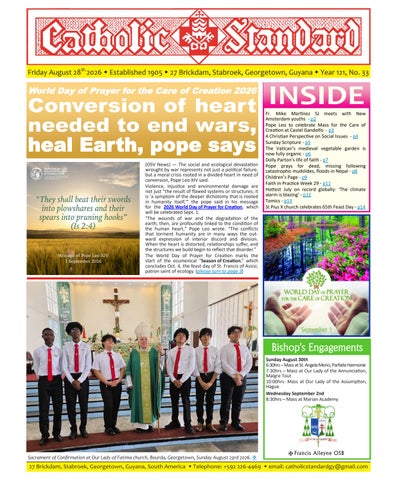
Sacrament of Confirmation at Our Lady of Fatima church, Bourda, Georgetown, Sunday August 23rd 2026. ❖
Francis Alleyne OSB
CATHOLIC STANDARD Friday, August 28th 2026
Page 2
with New Amsterdam youths
Year of St. Francis Jubilee Prayer Saint Francis, our brother, you who eight hundred years ago went to meet Sister Death as a man at peace, intercede for us before the Lord. You recognized true peace in the Crucifix of San Damiano, teach us to seek in Him the source of all reconciliation that breaks down every wall. You who, unarmed, crossed the lines of war and misunderstanding, give us the courage to build bridges where the world raises up boundaries.
In this time afflicted by conflict and division, intercede for us so that we may become peacemakers: unarmed and disarming witnesses of the peace that comes from Christ. Amen - Pope Leo XIV
On Saturday August 22nd, Fr. Mike Martínez SJ - Delegate for Vocation Discernment Ministry for the Jesuits in the Caribbean - met with the young people of the Church of the Ascension, New Amsterdam, Berbice. Also present was Parish Priest and Vocations & Youth Coordinator for the Jesuits in Guyana, Fr. Amar Bage SJ. During his interaction with the young people, Fr. Mike reflected on John 10:10: “I came that they may have life, and have it abundantly.” He reminded them that Jesus desires each of us to live a life filled with meaning, purpose and love, a life in which we recognise and cherish the people God has placed around us. Focusing on the Sacred Heart of Jesus and the image of Christ’s pierced hands, Fr. Mike asked why the Sacred Heart is shown on fire. He explained that the flame represents Christ’s burning love for humanity. Although Jesus experienced pain, His suffering was not without purpose; it became a source of love, healing and salvation. This sense of purpose, Fr. Mike shared, is what brings peace to the Sacred Heart of Jesus. He also reminded the young people that listening to God’s voice is a journey: 1. God approaches us, and we must allow Him into our lives. 2. We allow him to.
3. God provides the beat, our life and its experiences. 4. We begin “rhyming more than before” by making the best of the life we have been given. 5. The Holy Spirit inspires and guides us. 6. God writes the lyrics. (He directs our lives)
7. Heaven written with the pen, so that our lives can help reveal His reign and build His Kingdom. Through this creative reflection, Fr. Mike encouraged the young people to remain open to God’s voice and allow Him to transform every experience, even their pain, into a life of purpose.❖ (Adapted from Catholic Media Guyana FB)
CATHOLIC STANDARD Friday, August 28th 2026
Pope Leo to celebrate Mass for the Care of Creation at Castel Gandolfo hosted several events with the Pontiff this summer, including a concert and a lunch with marginalized people.
The beginning of the Season of Creation
Pope Leo XIV feeds fish at a pond in the Pontifical Gardens of Castel Gandolfo, Italy, Sept. 5, 2025. The Vatican released Pope Leo’s message for the World Day of Prayer for the Care of Creation which will be celebrated Sept. 1.(CNS photo/Lola Gomez) (Aleteia) - For the second time in his pontificate, Pope Leo XIV will celebrate an open-air Mass “for the Care of Creation.” The liturgy is scheduled for Tuesday, September 1, 2026, at 6:30 p.m. at Castel Gandolfo, the Holy See announced on August 25. This event is part of the Catholic Church’s traditional World Day of Prayer for the Care of Creation.
Just as he did last summer (on July 9, 2025), the Holy Father will preside over the celebration in the gardens of the papal summer residence, located about 18 miles south of Rome. He will celebrate the Mass in the shadow of a large statue of the Virgin Mary displayed near a small pond. This green space is part of the Holy See’s ecological laboratory, Borgo Laudato Si'. The venue
During the Mass, which will be broadcast by Vatican Media, Pope Leo XIV will use the “Mass for the Care of Creation” formulary. The Vatican added this specific liturgy into the Roman Missal—the official book containing the prayers and instructions for celebrating Mass—in 2025. The 267th pope will be joined by officials from the Dicastery for Promoting Integral Human Development and staff from the Laudato Si’ Higher Education Center, which manages the Borgo. September 1 marks the ecumenical World Day of Prayer for the Care of Creation. It also ushers in the “Season of Creation,” a period dedicated to ecological commitment that concludes on October 4, the feast of St. Francis of Assisi.❖
Conversion of heart needed to end wars, heal Earth (From P1) The theme for 2026 is “They shall beat their swords into plowshares and their spears into pruning hooks,” based on the verse from the book of Isaiah. The Vatican said June 2 that the celebration’s theme “highlights the connection between armed conflict and environmental degradation.” “The title — a passage in which Isaiah prophesies the transformation of weapons into agricultural tools — is an explicit invitation to prioritize development and sustainability over violence and destruction,” the Vatican said.
“War leaves wounds that extend far beyond the battlefield. It claims lives, tears families apart and forces millions to flee their homes, thereby deepening fear, injustice and division,” he wrote. “War also leaves behind social and ecological destruction that endures for generations.” Armed conflicts, coupled with environmental degradation, he added, create a “vicious cycle” that “destroys ecosystems, contaminates essential resources, such as air and water, and undermines food security,” thus creating further conflicts.
Conflict and environmental degradation Need for a renewal create ‘vicious cycle’ of hearts In his message, Pope Leo said the world is “witnessing many crises and much human suffering” as well as the accelerating “disruption to the harmonious balance of creation.” “These phenomena are not unrelated; they are a single plea for healing and peace arising from a wounded world,” he said. Reflecting on the day’s theme, the pope said that although Isaiah spoke of a time when nations transform “what destroys life into what sustains it,” in today’s world, “we too often witness the very opposite, as efforts continue to be directed toward violence and war.”
The pope noted that war not only creates wounds that damage individual people and communities, but also the bonds of the human family, revealing “a deeper failure to live in God’s image and likeness, to respect life and to care for the earth entrusted to us.” “This is not only a political failure, but also a moral and spiritual one,” Pope Leo wrote. “Rooted in distorted desires and the misuse of human freedom and power, war stands as a counter-witness to the Gospel of peace.” The building of a peaceful society, he continued, requires not just a reform of structures but also a renewal of hearts that are facing
“an ethical and cultural crisis,” evidenced by the desire “for domination, the pursuit of immediate profit, and the inability to recognize the God-given dignity of each human person.” Isaiah’s prophetic call to “beat swords into plowshares” is a call for both individuals and nations to “transform harm into life,” not just through external changes, but through a return to God “who will reorder our desires, heal our wounds and help us grow in virtue,” he wrote. Pope Leo warned that without an “inner transformation, peace will remain fragile and short-lived.” “But where hearts are renewed, new possibilities begin to open. What has been used for destruction can be redirected toward life, toward the care of the poor, the nourishment of the hungry, and the safeguarding of creation,” he wrote. “The true tools for building peace are not weapons of destruction; instead, they are truth, dialogue, patience, goodness, justice, mercy, understanding, care and love. These flow from hearts shaped by the Gospel and sustained by God’s grace. Only these qualities possess the power to transform individuals, renew communities and heal the wounds of our world,” the pope wrote. ❖
Page 3
CATHOLIC STANDARD Friday, August 28th 2026
A Christian Perspective on Social Issues
By GHK Lall
MV Barima a month later Part 2
Lit candles are seen during the Evening of Prayer held at St. Ignatius Church, Central Rupununi, Region 9, for the victims of the MV Barima tragedy, Friday July 24th 2026.
The families are on their own. Many of the dead are also on their own, down in the depths. Salvaging the boat and its cargo of bodies were once a priority. Now there is some distancing from that promise. Some families are trying to figure out how they will get past their grieving. The how to get by. The primary, often the sole, breadwinner is gone, not ever coming back home. There is silence. While men work at how to keep this tragedy out of sight and out of mind. They have done a good job so far. Will they succeed in their efforts to maintain silence over this tragedy (and all of its mysteries), while keeping a safe distance? Should silence and distance, with an emphasis on hands off and clean hands, own the day when 100 Guyanese died in murky waters and murkier circumstances, then grimness is what could cloak most matters of significance going forward. For then what level of concern would there be for one dead, and not by the hand of a violent peer. But by hands that hold much power, and have much backing. Silence has its place. It is most out of place in the present time, and amid current events, many of which give rise to controversy. The MV Barima going to the bottom qualifies for that category of differences and disputes. The more the families hear, the more they know, they more they are comforted. Not canned statements. No hollow presentations that lack sincerity. People are hurting. They need something to lean on, anything on which they could pin their hopes. Justice will be pursued and served. It is served to the satisfaction of the bereaved. It is of justice with substance. A fair accounting; with fair and bold pinpointing of responsibility. Who failed at their duty? It is not the crew of the MV Barima, but many over their heads, then still higher. Those with big positions and impressive
sounding titles. Say whatever pleases, but this one fact cannot be rid of easily. In a country that is the talk of the world, with money to burn (and there has been those procurement bonfires), to put poor people on that boat and send it out into the sea must rate as nothing short of an unpardonable offense. Anyone in a decision-making capacity that tries to distance from that ends up in one place. A narrower frame, with back to the wall, all eyes fixed, and nowhere to go. There is no one on whom responsibility can be pinned. Yet there are a few. Highly placed, they are. Distancing is futile. I listen to the slippery language. Too many who had plenty of authority turned their backs on a tragedy counting down the clock to its beginning. I write not of that usual scapegoat, the bureaucracy. I go beyond its members. No one should have a single speck of doubt at those I am looking at, and on whom I affix the fullest responsibility for the MV Barima tragedy.
When certain top jobs are sought diligently, fought for ferociously, then everything that is part of that territory has to be accepted as belonging. No matter how punishing. Both the good and the bad, the unprecedented and the unwelcomed, must be taken ownership of, as part of the territory. I see, hear, and read of, distancing. It is somebody else’s bag. No! it isn’t. Not with all of the millions wasted. Not with so much happening. Yet nothing could be done about a deathtrap that snuffed the life out of an unknown number of Guyanese, and left many in a deep state of mourning Silence and distancing have become too commonplace in Guyana. The MV Barima tragedy didn’t occur in a vacuum. There are those with blood on their hands. They must answer. I remind them. Call on them to take the dignified step. Honor the dead. Just this once for the people’s sake.❖
Page 4
Prayer for our Priests
Gracious and loving God, we thank your for the gift of our priests. Through them, we experience your presence in the sacraments. Help our priests to be strong in their vocation. Set their souls on fire with love for your people. Grant them the wisdom, understanding, and strength they need to follow in the footsteps of Jesus. Inspire them with the vision of your Kingdom. Give them the words they need to spread the Gospel. Allow them to experience joy in their ministry. Help them to become instruments of your divine grace. We ask this through Jesus Christ, who lives and reigns as our Eternal Priest. Amen
CATHOLIC STANDARD Friday, August 28th 2026
Page 5
First Reading Jeremiah 20:7-9 The word of the Lord has meant insult for me You have seduced me, Lord, and I have let myself be seduced; you have overpowered me: you were the stronger. I am a daily laughing-stock, everybody’s butt. Each time I speak the word, I have to howl and proclaim: ‘Violence and ruin!’ The word of the Lord has meant for me insult, derision, all day long. I used to say, ‘I will not think about him, I will not speak in his name any more. Then there seemed to be a fire burning in my heart, imprisoned in my bones. The effort to restrain it wearied me, I could not bear it. Responsorial Psalm Psalm 62 Resp: For you my soul is thirsting, O Lord my God. 1. O God, you are my God, for you I long; for you my soul is thirsting. My body pines for you like a dry, weary land without water. Response 2. So I gaze on you in the sanctuary to see your strength and your glory. For your love is better than life, my lips will speak your praise. Response 3. So I will bless you all my life, in your name I will lift up my hands. My soul shall be filled as with a banquet, my mouth shall praise you with joy. Response 4. For you have been my help; in the shadow of your wings I rejoice. My soul clings to you; your right hand holds me fast. Response
Second Reading Romans 12:1-2 Offering your living bodies as a holy sacrifice. Think of God’s mercy, my brothers, and worship him, I beg you, in a way that is worthy of thinking beings, by offering your living bodies as a holy sacrifice, truly pleasing to God. Do not model
In our Gospel passage, from Matthew, Jesus poses a question to the
yourselves on the behaviour of the world around you, but let your behaviour change, modelled by your new mind. This is the only way to discover the will of God and know what is good, what it is that God wants, what is the perfect thing to do. Gospel Acclamation Eph 1: 17.18 Alleluia, alleluia! May the Father of our Lord Jesus Christ enlighten the eyes of our mind, so that we can see what hope his call holds for us. Alleluia! Gospel Matthew 16:21-27 If anyone wants to be a follower of mine, let him renounce himself Jesus began to make it clear to his disciples that he was destined to go to Jerusalem and suffer grievously at the hands of the elders and chief
disciples: “Who do people say that the Son of Man is?” And they offer varying responses. Then, Jesus gets personal with them. “But who do you say that I am?” Peter gets the answer right: “You are the Christ, the Son of the living God.” Jesus is getting personal with us today. He poses the same question to each of us who call ourselves His stewards and modern-day
priests and scribes, to be put to death and to be raised up on the third day. Then, taking him aside, Peter started to remonstrate with him. ‘Heaven preserve you, Lord;’ he said ‘this must not happen to you’. But he turned and said to Peter, ‘Get behind me, Satan! You are an obstacle in my path, because the way you think is not God’s way but man’s.’ Then Jesus said to his disciples, ‘If anyone wants to be a follower of mine, let him renounce himself and take up his cross and follow me. For anyone who wants to save his life will lose it; but anyone who loses his life for my sake will find it. What, then, will a man gain if he wins the whole world and ruins his life? Or what has a man to offer in exchange for his life? ‘For the Son of Man is going to come in the glory of his Father with his angels, and, when he does, he will reward each one according to his behaviour. ❖
disciples. But do our lives truly reflect this? If we really believe that Christ is the Son of God, sent to save us from our sins and lead us to Heaven, then we must say so, not just with words but with our actions. Do my ambitions and priorities in life say that Christ is my Saviour and I am His disciple? Does my budget, my family life, my entertainment say so?
The gifts and blessings God has given us — our time, our talents, our material possessions — are meant to be used in a manner that says "Christ is my Saviour and I am His disciple." The most eloquent praise we can offer Him is a life lived in grateful response to His unfathomable love. This is the beauty and power of a stewardship way of life. ❖ [www.catholicsteward.com/blog/ ]
CATHOLIC STANDARD Friday, August 28th 2026
Page 6
Gospel Vatican’s medieval vegetable Reflection
Jesus tells his disciples: “Unless you take up your cross and follow me you cannot be my disciple.” Our cross does not in the true sense refer to our little sicknesses, a difficult relationship, the wayward child, the demanding boss at work, the irritating neighbour. Such problematic situations come to us in spite of all we do. The cross Jesus talks about, however, comes into our lives because of the choices we make in our attempts at building our relationship with Jesus. In this sense the cross we are to take up is something we choose as we make decisions based on our relationship with Jesus. This will seem strange if our sense of religion is something that only offers comfort and serves to console. Such a religion is more of a crutch to lean on in times of weakness and fear. And so in times of comfort and security it can be put aside until needed or followed in a lukewarm manner. Such a religion asks little of us.
Our faith should constantly challenge and stretch us to our limits so that we are always setting newer and higher standards for ourselves. It is true that our faith is sometimes the best support we can have in times of hopelessness and difficulties. But it has to be a lot more. It can also be a positive force. It is there to lean on in times of sadness and weakness and to help us fly in times of joy and strength. In other words, our religion must not only appeal to our weaknesses but also to our strengths. One can have a religion of devotions (set prayers to Jesus, Mary, the saints, etc.) that is respectable and offers no risk or strain. It is more often than not centred on self and is a religion of comfort. There is also a religion of commitment which offers constant challenge and is a religion of risk and unselfishness. The question is whether it is possible to follow a religion that offers both devotion and commitment in equal doses. ❖ [From: Journeying with the Word of God, The Religious Education Department,
(Aleteia) - Inside the Vatican Gardens, next to the Mater Ecclesiae monastery where Benedict XVI spent his last years, there is a vegetable garden of about 400 square meters (0.1 acres) divided into four cultivation zones. It has been producing food for the papal table since the 13th century. As Vatican News reported, it is now fully organic. The garden traces its origins to Pope Nicholas III Orsini, who transferred the papal residence from the Lateran to the Vatican between 1277 and 1280 and immediately commissioned the creation of a fruit garden and a viridarium (ornamental garden) within the new walls. Eight centuries later, the same plot is still producing food. The transition to fully organic management means production follows the natural rhythms of the soil and the seasons. Certified pelletized fertilizer, selected according to the season and the needs of each plant, has replaced the manure previously brought from the Pontifical Villas at Castel Gandolfo. Crop rotation preserves soil fertility. Agronomic practices keep pests below damaging levels. Every intervention requiring authorization is recorded in a
field notebook. Irrigation remains entirely manual. The daily care falls to Gilberto Bianchi, a gardener who has worked in the Vatican Gardens for more than two decades, assisted by young co-workers to whom he is gradually passing on his accumulated knowledge — small everyday gestures preserved in the same way that knowledge passed from monastery to monastery in earlier centuries. The contemplative nuns of the Mater Ecclesiae community indicate which crops are needed, taking into account the season and what the land can offer at any given moment. The cultivation calendar follows the seasons closely. Current crops include fresh garlic, basil, chili peppers — among them a Peruvian variety of particular intensity — tomatoes, aubergines, courgettes, citrus fruits, and pumpkins. This year, the sisters requested the planting of the first kiwi plants. Part of the harvest has long been donated to charitable organizations, among them the Casa Dono di Maria. The change aligns explicitly with Laudato Si' and with the position Leo XIV expressed last November when
Subscribe to the Catholic Standard it’s free! Message us giving your name & number at +592 701-7639. Send us an email at catholicstandardgy@gmail.com under the heading CS Subscription, and include your name.❖
addressing Italian agronomists and forestry professionals. “The earth is not a possession, but a gift,” the Pope said. “Those who cultivate it with respect and wisdom participate in God’s creative work.” The monastery next to the garden has its own layered history. Built between 1992 and 1994 on the initiative of John Paul II to house a rotating contemplative community dedicated to prayer for the pope, it became Benedict XVI’s private residence after his resignation in 2013 until his death in 2022. Benedict was known to walk through the garden regularly during his moments of prayer and study. In 2023 it returned to its original function as a monastery for contemplative nuns. The organic garden is a small thing — 400 square meters, tended by one experienced gardener and a handful of collaborators, producing seasonal vegetables for a monastery and a papal table. It is also a concrete expression of the stewardship the Catholic tradition has always understood to be part of the human vocation: to cultivate the earth with care, and to give back what is taken. ❖
Catholic Standard For 121 years, the Catholic Standard has been sharing the Gospel of Jesus Christ. Now reaching 10,000+ followers on Catholic Media Guyana Facebook plus going straight to your inbox and WhatsApp, our vibrant weekly e-paper is a trusted source which delivers informative and inspiring stories from across the diocese and around the world. Want to promote your business or event? Advertise with us! Call 675-4542 or email catholicstandardgy@gmail.com ❖
CATHOLIC STANDARD Friday, August 28th 2026
Page 7
Journeying with the Word of God
MAKING THE WORD OF GOD YOUR OWN Step 1: Look at today’s Readings prayerfully. American country music star Dolly Parton performs on the Pyramid Stage at Worthy Farm in Somerset, England, during the Glastonbury Festival June 29, 2014. The iconic singer-songwriter-actress, whose glittering country music stardom was matched by her pop fame and popular parallel careers in film and TV, died Aug. 25, 2026, at age 80, after a brief battle with cancer. (OSV News photo/Cathal McNaughton, Reuters) (OSV News) — The nearly 1,000 asked to help, and quietly swung Nine years later, Parton received a Christopher Award for her 2020 songs Dolly Parton recorded into action. during her long career covered a Without fanfare, Parton donated holiday special, “Christmas on the wide range of topics. She not only $1 million for vaccine research at Square,” a modern-day retelling dealt with the humiliation of pov- Vanderbilt University Medical of Charles Dickens’ 1843 novella erty, harassment in a dead-end Center. Her friend, Dr. Naji Abum- “A Christmas Carol.” In what job and romantic rivalry, she also rad, told her that a vaccine could would be her final role, Parton felt at home with such explicitly be near. Her contribution estab- played — unsurprisingly — a Christian numbers as 1989’s “He’s lished the Dolly Parton Covid-19 rhinestone-festooned angel. Alive” and “There Was Jesus,” Research Fund, which was largely Writing in January on the released 30 years later. responsible for the development occasion of Parton’s 80th birthday, Rita Buettner, a columnist for In fact, Parton — who died at 80 of the Moderna vaccine. the Catholic Review — the Archdifrom cancer on Aug. 25 at her Mainstream success home in Nashville, Tennessee — Parton had long since built a ocese of Baltimore’s news outlet spent a lifetime comfortably secure career in country music — described her reaction to the steeped in biblical teaching. And when, in 1977, she took a big leap recently released re-recording of her faith found expression in con- with “Here You Come Again,” Parton’s 1977 song “Light of a crete ways that benefited millions which became her first crossover Clear Blue Morning.” around the world. pop hit. She became a national “I was struck by the beauty of this Brassy and flamboyant on stage, personality as a result, and her gift from Dolly. It’s a song of hope and comfort and strength at a in private life she was quietly fame never dimmed. focused and never preachy. She Three years later, Parton took to time when we can all use more of preferred to lead by example, the big screen, starring with Jane that. It’s also a song of faith.” investing her wealth and fame in Fonda and Lily Tomlin in the pop- Buettner went on to praise the philanthropy with a particular ular workplace comedy “9 to 5.” way Parton “clearly lives and interest in the vulnerable. The trio played put-upon secre- demonstrates faith. She has faith Philanthropy from early years taries subject to the tyranny of a in humanity, faith in a greater Even in childhood, Parton — one lecherous boss (Dabney Cole- purpose, faith in God, faith in the of 12 children — knew firsthand man). Parton wrote and recorded future. I know Dolly isn’t Catholic. how illiteracy trapped people in the movie’s theme song — which But we are Christians, and we are believers, and we are both trying misery. Because her father Rob- was also well-received. ert, an East Tennessee farmer, Dollywood, a theme park in her to live each day taking one more could neither read nor write, his home state’s Pigeon Forge, was step on the way to heaven — we work opportunities were severely another of Parton’s successful hope.” limited. ventures. It provided a considera- “She doesn’t always say it directBut Parton also knew how early in ble boost to the local economy in ly,” Buettner continued. “She life the problem of illiteracy could an area many would have consid- doesn’t have to. It comes through be ameliorated. With that in ered too remote for an entertain- in her music — as she uses the mind, in 1995 she founded Imagi- ment destination on such a large gifts God has given her to give the world a little more light, a little nation Library, which mails free scale. more beauty, a little more joy.” age-appropriate books to children Spiritual lessons under 5. Successful from the out- Parton’s reliance on spiritual “Dolly’s songs help others feel set, Imagination Library currently themes — as well as her tendency less alone,” Buettner concluded. “She brings us along on life’s helps 3 million kids each month. to go in unexpected directions — journey, so we know that we are Another difficulty that affected was a constant. In 2012, she Parton as a youngster was the starred opposite Queen Latifah in not the only ones experiencing widespread fear of contracting the film “Joyful Noise” which sorrow or challenge or darkness polio. In 2020, as the COVID-19 charted the rivalry between two or love.” ❖ pandemic began to sow a similar members of a small-town Georgia terror across the globe, she was church choir.
1st Reading: Jeremiah finds that even though God’s Word brings him nothing but insults, he is unable to stop speaking it to the people. 2nd Reading: Paul urges the Christians in Rome not to live by the standards of the people around them. Gospel: Jesus tells of his suffering and death and warns his disciples that they too must be prepared to suffer.
Step 2: Applying the values of the Readings to your daily life. 1. It is said that our happiness does not lie in doing our own thing or what we feel like doing, but in doing what we have to do. What do you think this means? 2. Jesus tells Peter, “… the way you think is not God’s way but man’s.” When have you been guilty of thinking in the same manner? 3. What do you think it means to renounce yourself and to take up your cross in order to follow Jesus? 4. Based on today’s Gospel passage, do you think that the cost of discipleship is too great? How can you save your life by losing it?
Step 3: Accepting the message of God’s
Word in your life of faith.
Christ calls for commitment from his disciples. There must be nothing lukewarm about his followers. And even if being a follower of Jesus does not ever demand that we make life-threatening decisions, we still have to be prepared to die to self, to our pride, our selfishness, our lust for pleasure and power, our materialism, in order for the real self to be born.
Step 4: Something to think & pray about 1. Last Sunday, we read of Peter’s great declaration of faith when he said, “You are the Christ, the Son of the living God.” Today we see him at a low point in faith as he tries to stop Jesus from going to the cross. Great faith one moment, struggling with faith the next. Do you think this is the story of every believer? Is it your story too? 2. Jesus talks about dying to yourself so that you may live. This means changing the old self, experiencing conversion from the negative aspects of your life, like selfishness, pride, hatred of others because of their race, or religion and so on. What is there in your own life that you have to die to in order to live the life of a disciple? How can you go about making the changes that true conversion calls for?❖ [From: Journeying with the Word of God, The Religious Education Department, Diocese of Georgetown, Guyana ]
CATHOLIC STANDARD Friday, August 28th 2026
Page 8
catastrophic mudslides, floods in Nepal
A drone view shows mud covering properties at Trishuli in Nepal's Nuwakot district Aug. 27, 2026, following devastating floods. Massive flash floods in a border area of Nepal and China killed at least 160 people and left hundreds of tourists, workers and others missing after suddenly sweeping through communities and halting travel in some areas Aug. 26. Experts said a glacial collapse caused the disaster in the warming Himalayan region. (OSV News photo/Navesh Chitrakar, Reuters) (OSV News) — Pope Leo XIV expressed event was caused by a 5.2 magnitude “It was terrible. A flood coming from As of Aug. 27, more than 1,300 people his sadness by the devastation glacial collapse. the mountains, and directed violently are missing in Nepal and Tibet, more wrought by a glacial collapse in the The disaster was a grim confirmation towards the valley, overwhelmed than a hundred of whom were visiting Nepal-China border, causing a deadly of warnings given earlier this year everything: people, homes, bridges, Mount Kailash, a pilgrimage site wave of floods and mudslides that regarding the effects of climate change structures. Villages, markets, and sacred to several Eastern religions, killed 168 people with hundreds more on nearby glaciers. roads were swept away. It is a serious including Hinduism and Buddhism, AP feared dead. wound for the nation,” Father Bogati reported. In March, researchers from the In a telegram sent on the pope’s International Centre for Integrated told Fides. “There are Nepalese, but also foreignbehalf Aug. 27, Cardinal Pietro Parolin, Mountain Development (ICIMOD) Father Bogati told Fides he was ers and tourists who were in these Vatican secretary of state, expressed released a report revealing that “shocked” and offered prayers for the areas on an excursion: it is a pilgrimthe pontiff’s condolences upon learn- glaciers across the Himalayas were dead, the missing, and “those suffer- age route to Mansarovar, a sacred ing “of the loss of life and devastation melting at an accelerating rate and ing because of this catastrophe.” Hindu site that is also a trail for hikers caused by the flash floods in Nepal.” warned that concrete action was “We have about 25 Catholic families in and trekkers,” Father Bogati explained. “Commending the souls of the needed to avoid further disasters to the disaster area; they appear to be The priest told Fides this was “the deceased to the clemency of the communities in the area. safe, but we are very worried about second time a disaster of this kind has Almighty, His Holiness sends heartfelt “This isn’t a distant problem; it’s a them,” he said. “We entrust them to occurred in that area, but this time it sympathies to the bereaved, together crisis unfolding in real-time, with new God, we pray for their safety, and we is of enormous proportions.” with the assurance of his spiritual disasters every summer and will do everything we can to help He also said the local Church’s Caritas closeness to those affected by this monsoon,” said Pema Gyamtsho, the them.” office was launching an appeal tragedy,” Cardinal Parolin wrote. director general of ICIMOD. “The fact “to partners around the world” for “Likewise offering prayers for the that ice loss rates have doubled this More than 1,000 missing, assistance. emergency personnel engaged in the century should shock us all into action.” including foreigners “We will do our part,” Father Bogati ongoing rescue efforts, he invokes The apostolic administrator of Nepal said. upon all divine assistance and protec- ‘The worst disaster in the also said that a priest of the vicariate, Catholic Relief Services (CRS), the U.S. tion,” he added. Father James Britto, was stranded Catholic Church’s international aid country’s history’ In an interview with the Vatican’s mis- after “he had gone to celebrate Mass agency, said it was closely monitoring Effects of climate change sionary news agency, Fides, published on the other side of the river and was According to The Associated Press, the Aug. 27, Father Silas Krishna Bogati, stranded.” According to Father Bogati, the situation in Nepal and announced was “coordinating with Caritas U.S. Geological Survey initially report- the apostolic administrator of Nepal, the bridge the priest had crossed was it Nepal and local partners to assess ed an earthquake 41 miles north of called the catastrophic event as “the swept away by the floods. urgent needs and determine how best Kathmandu Aug. 26. However, further worst disaster in the country’s history.” to support affected communities.”❖ analysis revealed that the seismic
CATHOLIC STANDARD Friday, August 28th 2026
Dear Boys and Girls, We hope that you enjoyed your August holidays and are now excited to start the new School Year! In today's Gospel Reading, Jesus was talking to his disciples and he said to his them, “Whoever wants to be my disciple must deny themselves and take up their cross and follow me” What kind of cross do you suppose Jesus is talking about? Is it a cross on a necklace or a T-shirt with a cross on it? If putting a cross on a necklace around your neck or wearing a T-Shirt with a cross on it was what Jesus meant, then being his disciple would be pretty easy, wouldn't it? Do you think that is what Jesus meant when he said anyone who wanted to be his disciple had to take up their cross and follow him? To understand what Jesus meant, we need to understand what "taking up his cross" meant to Jesus. The apostle Paul wrote that Jesus, even though he was God, gave up his divine privilege and became a servant. He came to earth as a man and became totally obedient to God, even to the point that he was willing to die on a cross. That's what taking up his cross meant to Jesus. Please don't think that it is wrong to wear a necklace or a T-Shirt with a cross on it. We wear those things to remind us of the cross where Jesus suffered and died. But we must always remember that the cross is more than a pretty piece of jewellery or a cool T-Shirt. Taking up our cross means following Jesus is not always easy. It means that he must be more important to us than anything else in our life. Heavenly Father, we are thankful that Jesus was willing to take up his cross and die for our sins. As his disciples, help us to take our cross and, forsaking all else, follow him. In Jesus' name we pray. Amen.❖
[ NFC - Sources: sdc.me.uk , catholickidsbulletin.com, sermons4kids.com , salfordliturgy.org.uk, young-catholics.com, thewordthisweek.net & thekidsbulletin.com ]
Page 9
CATHOLIC STANDARD Friday, August 28th 2026
Page 10
CATHOLIC STANDARD Friday, August 28th 2026
Page 11
Faith in Practice: Living and Knowing our Faith The Seven Deadly Sins and Healing Virtues Pride and Humility (Part 1) determine good and evil for ourselves and thinking we don’t need God, Church, nor anyone else.
Fr. Joel Thompson SJ Pride goes before destruction, and a haughty spirit before a fall (Proverbs 16:18) Over the next few weeks, we will explore the seven capital or deadly sins and the virtues that oppose them. Our aim is to recognize how these vices lead to other sins and how, with God’s grace, the corresponding virtues can help us grow in holiness. We begin with pride and humility.
Pride is dangerous because it hides our need for healing. Pride convinces us that we have no reason to kneel before God. How can I repent if I am perfect and never wrong? How can I receive mercy if I admit no need? Pride affects our relationships. Before God it becomes ingratitude; before others, superiority or rivalry and within us, the exhausting need to protect a false image.
What are Capital Sins and Virtues? The seven capital sins are pride, avarice or greed, envy, wrath (anger), lust, gluttony and sloth. “Capital” comes from caput, meaning “head.” They are root tendencies that generate other sins and vices (Catechism of the Catholic Church, 1866). They are called “deadly” because, when allowed to become habits, they wound our love of God and neighbour and lead towards other sins. A virtue is the opposite kind of habit. The Catechism defines it as “an habitual and firm disposition to do the good” (CCC 1803). By repeatedly choosing the good, assisted by God’s grace, goodness becomes part of our character and we become more Christlike.
Sinful Pride The nursery rhyme character Humpty Dumpty always comes to mind when I think about pride and the fall that comes after it. Prideful people think that they are above others (even God) and so they are always right (my way is best), judgmental, and seldom open to correction. Parents and teachers encourage us to take pride in our work and to be proud of who we are to foster confidence and excellence. However, Christianity calls pride one of the seven deadly sins. Is it wrong to feel pleased when we have done something well? Sinful pride is not healthy self-respect or being pleased when we have done something well. Pride becomes sinful when we make ourselves the centre of everything and self-gratification becomes the measure of everything we do. Prideful people tend to help others only to appear virtuous and receive praise. Or sometimes, someone may succeed with a job or promotion and then act as though the achievement were entirely his or her own, forgetting God’s gifts, refusing to acknowledge those who helped, and looking down on those who have achieved less. Prideful people are not grateful and only seek praise. They look for importance without service and freedom without God. Scripture tells us that “the beginning of human pride is forsaking the Lord and withdrawing our heart from our maker” (Sirach 10:12). Pride appears when we cannot apologize, refuse correction, resent being overlooked, take all the credit, or
Can we take pride in Ourselves and Our Work? consider ourselves spiritually superior Church’s tradition recognizes pride at to everyone else by constantly judging them.
Why is Pride called the Sin of the Angels? The Catechism teaches that Satan and the other demons were created good but became evil through their own free choice. Their fall consisted in rejecting God and his reign (CCC 391–392). The
the root of this rebellion through attempts to take God’s place. The same temptation appears in Genesis: “You will be like God” (Genesis 3:5). Humanity’s first sin was not a desire to become holy even though God created us for communion with him. It was choosing self over God and wanting greatness “without God” (CCC 398). Pride appears in our desire to
Yes, if by “pride” we mean satisfaction, self-respect or gratitude for something good. Humility does not mean pretending that we have no gifts or denying our achievements or allowing others to degrade us. Saint Paul says , “By the grace of God I am what I am,” while recognizing that God’s grace worked with him (1 Corinthians 15:10). A healthy pride recognizes that God has given us gifts, and we should develop and use them well. Sinful pride tells us that our gifts make us self-sufficient or superior. Humility means acknowledging that our gifts are real but received; therefore, we should use them gratefully in service.
Humility If pride is an elevation of ourselves on the great wall of self-centeredness, humility is lowering ourselves from that wall and being rooted in our identity as creatures and children of God. It means seeing ourselves truthfully as we are: as creatures, sinners, disciples and beloved children of God. For example, Mary does not deny her blessedness. She declares that the Almighty has done great things for her (Luke 1:48–49). Her greatness and gratitude belong together. Jesus is humility’s perfect model. Though truly divine, he emptied himself, took the form of a servant and humbled himself in obedience (Philippians 2:6–8). Christian humility frees us from the need to dominate, impress or receive applause. The Catechism calls humility “the foundation of prayer” (CCC 2559). It opens us to receive grace, admit wrong, learn from others and serve without needing recognition. We cultivate humility when we thank God for our abilities, acknowledge those who helped us, accept correction, rejoice in another’s success, perform good deeds unseen, examine our conscience honestly and approach Confession sincerely. Jesus says that “Everyone who exalts himself will be humbled, but the one who humbles himself will be exalted” (Luke 14:11). “Who stands at the centre of my life?” Pride says me, while humility says God. ❖
CATHOLIC STANDARD Friday, August 28th 2026
Page 12
Hottest July on record globally:
A firefighter carries a water hose as smoke emanates from burnt vegetation during operations against a wildfire at the Hautes Fagnes (High Fens) nature reserve near Baelen, Belgium, August 2026 (AFP or licensors) (Vatican News) - The summer of 2026 has been marked by heatwave after heatwave. According to the US National Oceanic and Atmospheric Administration (NOAA), this July was the hottest on record globally since 1850 – tying only with July 2024 . Across the world, people and societies suffered the consequences of this spike. In Japan, temperatures soar as the country endures its longest 40°C (104° F) streak ever recorded. People are under extreme heat and hospitals and power systems face the threat of collapse as the temperature inches towards 49°C (120°F) in North Africa. Europe faced its second warmest July, which in turn had devastating effects. In France, over 7,300 people died as a result of the record number of high temperature days since the middle of June, according to an analysis by AFP. Western Europe recorded its hottest start to summer with repeated heatwaves in June and July, leading to droughts and wildfires. Belgium, Spain, France, Greece and Italy were among the nations that battled fires in these months. By the end of the century, a study reports that wildfires are projected to burn 39% more of Europe, even if the best-case situation takes place to
prevent the planet from heating. That figure can only change if serious action is taken to better manage the fires.
From small fires to blazing infernos This 2026 fire season across Europe is becoming the third worst on record, following 2025 and 2022, as data published by the European Forest Fire Information Service explains. The rise in hot, dry, and windy weather has led to small fires becoming blazing infernos as carbon pollution increases the temperature. Researchers report that the worst-case scenario sees the global heating hit 3.6C higher than pre-industrial levels. If that happens, the area that would burn would almost triple. While bettering fire management can help limit the rise in temperatures by more than 70%, studies show improvements will not completely eliminate them. Ecosystem researcher at the Potsdam Institute for Climate Impact Research (PIK) and lead author of a study, Maik Billing, explained that if “we go on a path of high emissions … we still see strong increases in burnt area. Fire management cannot replace climate mitigation.”
Leave coal, gas, oil behind “The climate alarm is blazing from every direction”, UN Climate Change Executive Secretary, Simon Stiell, warned in a statement on July 28. He explained the world is facing climatedriven disasters, which have reached “nightmare proportions, as the costs of humanity’s addiction to burning coal, oil and gas keep spiraling upwards.” The call to change was made years ago, but the shift to concrete action – from fossil fuels to clean energy and a focus on protecting forests and oceans – is not happening fast enough. Fires, droughts, high temperatures, etc. are no longer theories but the “lived reality for billions in a world getting rapidly hotter,” the Executive Secretary continued, stressing a clear answer: “Leave coal, oil and gas behind faster, scale up renewables, and protect people where the impacts are already hitting hardest.” Yet, hope remains. As Pope Francis urged in his 2015 encyclical, Laudato si’, there is still time to address and remedy the climate change situation. “Humanity still has the ability to work together in building our common home . . . Truly, much can be done! (paragraph 13)”
To mark the 10th anniversary of the publication of this document, Pope Leo XIV addressed participants in the “Raising Hope” Conference held in Castel Gandolfo in October 2025. He reiterated the words of his predecessor, calling on the global family to work together to “seek a sustainable and integral development”. “Everyone in society, through nongovernmental organizations and advocacy groups, must put pressure on governments to develop and implement more rigorous regulations, procedures and controls. Citizens need to take an active role in political decisionmaking at national, regional and local levels. Only then will it be possible to mitigate the damage done to the environment.” Now, more than ever, the issues outlined in Laudato si are relevant and are in need of immediate attention.❖
CATHOLIC STANDARD Friday, August 28th 2026
Page 13
CATHOLIC STANDARD Friday, August 28th 2026
St Pius X Church celebrates 65th Feast Day
Page 14
Saint of the Week
September 5th
Saint Teresa of Calcutta
The Sapphire Jubilee celebrations of St. Pius X Church, West La Penitence, Georgetown, continued last Sunday August 23rd with the 65th Anniversary Feast Day Mass and Parish Outing held at the Marudi Creek Resort. On April 12th of this year, the parish had celebrated the 65th anniversary of the laying of the cornerstone. The day started as parishioners, joined by some parishioners of St. Pius X’s sister parishes Our Lady of the Mount and Holy Spirit, assembled at St. Pius X church for a prayer by Fr. Carl Philadelphia, Parish Priest of the South Georgetown
Cluster, before boarding buses for the trip to the Marudi Creek Resort, located off the Linden/ Soesdyke highway. On arrival at Marudi Creek, the congregation gathered under the main benab for the Feast Day Mass, celebrated by Fr. Carl. After mass, parishioners shared lunch, and spent the rest of the day joyfully swimming in the creek, playing games, communing with nature and enjoying fellowship with each other. St. Pius X parish had previously held parish outings to Marudi
Creek in July 2018 and November 2014. St. Pius X church was built in 1961, seven years after Pope St. Pius X was canonised. The St. Pius X community existed before the church was built, with mass being celebrated in the St. Pius X School in the late 1950’s. The church was inaugurated by Bishop Richard Lester Guilly SJ on Sunday, September 3rd 1961, which at that time was the Feast Day of its Patron Saint Pius X. Since 1969, St. Pius X's feast day is celebrated on August 21st.❖
Gonxha (Agnes) Bojaxhiu was born on August 26th 1910 to Albanian parents in what is now Skopje, Macedonia. At age 18 she entered the Loreto Sisters of Dublin. In 1929 she was sent to the Loreto novitiate in Darjeeling, India. There she chose the name Teresa and prepared for a life of service. She was assigned to a high school for girls in Kolkata, where she taught the daughters of the wealthy. But she could not escape the realities around her—the poverty, the suffering, the overwhelming numbers of destitute people. In 1946 Sister Teresa heard “a call within a call” - to leave the convent and help the poor while living among them. After receiving permission to leave Loreto, establish a new religious community and undertake her new work, she took a nursing course for several months. She returned to Kolkata, where she lived in the slums and opened a school for poor children. Dressed in a white sari and sandals she soon began getting to know her neighbours— especially the poor and sick—and getting to know their needs through visits. Volunteers who came to join her in the work became the core of the Missionaries of Charity. Others helped by donating food, clothing, supplies, the use of buildings. In 1952 the city of Kolkata gave Mother Teresa a former hostel, which became a home for the dying and the destitute. As the order expanded, services were also offered to orphans, abandoned children, alcoholics, the aging, and street people. For the next four decades Mother Teresa worked tirelessly on behalf of the poor. In 1979 she was awarded the Nobel Peace Prize. She died on September 5th, 1997 and was canonised on September 4th 2016. ❖