Friday August 21st 2026 Established 1905 27 Brickdam, Stabroek, Georgetown, Guyana Year 121, No. 32
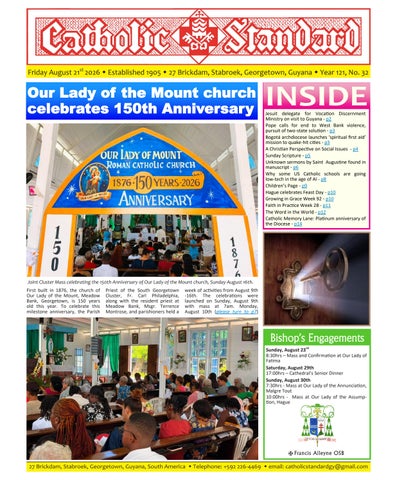
Our Lady of the Mount church celebrates 150th Anniversary
Jesuit delegate for Vocation Discernment Ministry on visit to Guyana - p2 Pope calls for end to West Bank violence, pursuit of two-state solution - p3 Bogotá archdiocese launches ‘spiritual first aid’ mission to quake-hit cities - p3 A Christian Perspective on Social Issues - p4 Sunday Scripture - p5 Unknown sermons by Saint Augustine found in manuscript - p6 Why some US Catholic schools are going low-tech in the age of AI - p8 Children’s Page - p9 Hague celebrates Feast Day - p10 Growing in Grace Week 92 - p10 Faith in Practice Week 28 - p11 The Word in the World - p12 Catholic Memory Lane: Platinum anniversary of the Diocese - p14
Joint Cluster Mass celebrating the 150th Anniversary of Our Lady of the Mount church, Sunday August 16th. First built in 1876, the church of Our Lady of the Mount, Meadow Bank, Georgetown, is 150 years old this year. To celebrate this milestone anniversary, the Parish
Priest of the South Georgetown Cluster, Fr. Carl Philadelphia, along with the resident priest at Meadow Bank, Msgr. Terrence Montrose, and parishioners held a
week of activities from August 9th -16th. The celebrations were launched on Sunday, August 9th with mass at 7am. Monday, August 10th (please turn to p7)
Bishop’s Engagements Sunday, August 23rd 8:30hrs – Mass and Confirmation at Our Lady of Fatima Saturday, August 29th 17:00hrs – Cathedral’s Senior Dinner Sunday, August 30th 7:30hrs - Mass at Our Lady of the Annunciation, Malgre Tout 10:00hrs - Mass at Our Lady of the Assumption, Hague
Francis Alleyne OSB
CATHOLIC STANDARD Friday, August 21st 2026
Page 2
Jesuit Delegate for Vocation
Fr. Mike Martínez SJ raps to the boys of St. John Bosco about using one’s gifts to glorify God, Thursday August 20th
Year of St. Francis Jubilee Prayer Saint Francis, our brother, you who eight hundred years ago went to meet Sister Death as a man at peace, intercede for us before the Lord. You recognized true peace in the Crucifix of San Damiano, teach us to seek in Him the source of all reconciliation that breaks down every wall. You who, unarmed, crossed the lines of war and misunderstanding, give us the courage to build bridges where the world raises up boundaries.
In this time afflicted by conflict and division, intercede for us so that we may become peacemakers: unarmed and disarming witnesses of the peace that comes from Christ. Amen - Pope Leo XIV
We welcome Fr. Mike Martínez, SJ, Delegate for Vocation Discernment Ministry for the Jesuits of the Caribbean. Fr. Mike arrived in Guyana on August 18th and will be here up to September 3rd, visiting communities along the Coast and in the Interior. On Wednesday August 19th, Fr. Mike interacted with the young people of St. Joseph, Husband of Mary, Little Diamond, EBD. On Thursday August 20, he spent time with the children of St. John Bosco Orphanage, speaking about the importance of loving Christ and one another. He reminded them of Jesus’ words: “No one has greater love than this, to lay down one’s life for one’s friends” (John 15:13). Fr. Mike, who is also a rapper, performed an original piece, reminding the children that we can use our unique gifts to praise and glorify God.
Over the weekend, Fr. Mike will travel to Berbice, where he will continue meeting with young people. He will then journey to St. Joseph Mission, Kurukabaru, Region Eight, for “A Day with the Holy Spirit” and other youth activities.
We warmly welcome Fr. Mike to Guyana and pray that his visit will inspire many young people to deepen their love for Christ and remain open to God’s call in their lives.❖ (Adapted from Catholic Media Guyana)
CATHOLIC STANDARD Friday, August 21st 2026
Page 3
violence, pursuit of two-state solution (OSV News) — Warning against increased violence in the West Bank, Pope Leo XIV urged world leaders to decisively pursue an independent Palestinian state alongside Israel. “I renew my appeal for an end to the ongoing violence against the Palestinian civilian population in the West Bank, and I urgently call on the international community to work toward advancing the two-state solution, for a just and lasting peace,” the pope said Aug. 16 after praying the Angelus with pilgrims gathered outside the papal residence in Castel Gandolfo. The pope’s appeal came amid reports of violent attacks by Israeli settlers, including in Taybeh, one of the last remaining Christian villages in the West Bank. According to a report by Reuters, Israel’s military closed access to Taybeh from non-residents due to attacks on Palestinians by Israeli settlers.
Enabling conditions for settler violence Although Israel said the military’s presence was to protect Palestinian residents, a U.N. inquiry released in June accused the country’s armed forces of enabling settler violence in the West Bank. Israeli authorities, the report stated, “have consistently acknowledged settler violence as a problem, while promoting structural conditions that enable it,” including settlement expansions, infrastructure, protection of settlers and reinforcing “the widespread impunity for attacks.”
In an interview with Vatican News published Aug. 10, Father Bashar Fawadleh, parish priest of Christ the Redeemer Church in Taybeh, said the continued violence by settlers was “a deliberate strategy of harassment designed to create a climate of fear and pressure Palestinian families into leaving their land.” Lamenting that Christians in Taybeh “feel forgotten,” Father Fawadleh urged Catholics to “speak out about the situation here” and “to talk about these Christian brothers and sisters who are living in terror.” The priest urged Pope Leo “to intervene for this last Christian village in the West Bank, so that these settler attacks cease and the occupation of our land stops. We simply want to live in peace, with justice and dignity.”
‘This situation can contaminate our hearts’ Cardinal Pierbattista Pizzaballa, the Latin Patriarch of Jerusalem, visited Taybeh Aug. 15 and celebrated Mass on the Feast of the Assumption at Christ the Redeemer Church, where he reassured the Catholic Church’s commitment to the village. “We will continue to do everything within our power to preserve the ecclesial presence here, at every level throughout the Holy Land,” Cardinal Pizzaballa said. The cardinal encouraged Christians to learn from Mary and to not to fall into despair “because this situation can contaminate our hearts.”
Pope Leo XIV greets people around noon in Piazza della Liberta in Castel Gandolfo near Rome Aug. 16, 2026. After leading the Angelus prayer, the pope decried the violence in the West Bank and called on the international community to "work toward advancing the two-state solution." (OSV News photo/Simone Risoluti, Vatican Media) “But we want to remain a community that gives birth to life, without giving up or abandoning our rights, our right to life. So be courageous. Do not be afraid,” he said.
‘Two-state solution’ Pope Leo’s call for a two-state solution echoed the appeal he made to members of the Vatican diplomatic corps early this year. “The Holy See is especially attentive to any diplomatic initiative that seeks to guarantee to the Palestinians in the
Gaza Strip a future of lasting peace and justice in their own land, as well as to the entire Palestinian people and the entire Israeli people,” the pope said Jan. 9. “In particular, the two-state solution remains the institutional perspective for meeting the legitimate aspirations for both peoples; yet sadly, there has been an increase in violence in the West Bank against the Palestinian civilian population, which has the right to live in peace in its own land,” he said.❖
‘spiritual first aid’ mission to quake-hit cities mission was the first of several planned in the coming months. “We will pay close attention to the lessons learned during this first outreach, so we can organize others this year or in different emergencies requiring our humanitarian and pastoral service,” the cardinal said. “May the Lord rebuild us all from the heart, and may the Virgin Mary accompany us with her Motherly love to guide the path of hope after the earthquake.”
Strongest quake in a decade
A drone view of a neighborhood with collapsed buildings in Pereira, Colombia Aug. 17, 2026, following a 7.4 magnitude earthquake. (OSV News photo/Juan Felipe Leon, Reuters)
(OSV News) — Dozens of clergy from the Archdiocese of Bogotá embarked on a five-day pastoral mission to cities in Colombia devastated by the Aug. 10 earthquake. According to the archdiocese, a group of 80 priests and deacons, led by
Cardinal Luis José Rueda Aparicio of Bogotá, as well as his auxiliary bishops, left by bus Aug. 18 “on a mission of ‘Spiritual First Aid’ to urban and rural parishes affected by the earthquake.” Addressing the priests before departing, Cardinal Rueda said the
In an update posted to X Aug. 19, Colombia’s National Unit for Disaster Risk Management, known as UNGRD), said the death toll from the 7.4magnitude quake had risen to 319 people, while 260 remain missing and 4,469 injured. An estimated 151,995 homes were damaged, while 30,803 were destroyed and 302 buildings collapsed, the UNGRD reported. According to Colombia’s Geological Service, the quake’s epicenter was in the northwestern department of
Chocó, and the intense magnitude made it “the strongest earthquake felt in Colombia in the last decade.” The Archdiocese of Bogotá said the cardinal, bishops, and priests participating in the “Spiritual First Aid” mission will divide into six groups and visit the hardest-hit cities, including Cartago, Pereira, Cali, Palmira, Buenaventura, and Buga. The Aug. 18-22 mission “aims to accompany local parish priests and their lay faithful through closeness, listening, and prayer, while also offering the Sacrament of Reconciliation amidst pain and devastation to consolidate the Church as a ‘meeting point,'” the archdiocese said. The priests were also advised to travel light “so as not to generate any economic burden for the host communities,” it added. After returning from the mission, the priests will host a day of prayer for the parishes they visited in their respective church communities.❖
CATHOLIC STANDARD Friday, August 21st 2026
A Christian Perspective on Social Issues
By GHK Lall
MV Barima a month later Part 1
The night of Saturday, July 18, 2026 and the early hours of the agonizing Sunday that followed are now dates etched into the memory and history of Guyanese. The first hours brought the first pieces of news of a tragedy about which none had a clue that it was really one. And as big as it eventually turned out to be. In the rush of events since that poignant July 18th, there is so much pain that doesn’t ease. So many questions for which no one can offer the type of convincing answers needed at this time. From several indicators, I gather that the MV Barima disaster is already water under the bridge. Notwithstanding about 100 lives lost, and so much responsibility for this tragedy still sidestepped from top to bottom, the emphasis now is about moving on, and about separating from a time of terrible loss of life. From one section of official Guyana, there is the sense that the less said about the MV Barima tragedy, the better. Unsaid publicly is ‘nothing can bring them back.’ I will say what I said publicly more than once: negligence and arrogance contributed in so small way to the death of that boat and the departure of unknown scores of lives. Guyanese have lost partners. Families have lost mothers, or fathers, or children. Communities have lost neighbors. A country is in splinters. Still, there is a level of nonchalanceperhaps, even contempt for the dead [and the living]-at different levels of official Guyana. I fear that the MV Barima tragedy will peter out like a death on some lonely country road. Some tears and some handwringing, and before the last mournful hymn could be sung, the seats of prominence are already empty. For sure, there has been a show of sympathy. It seems to be more of a formality. Just get it over and done with; move on to the next juicy moneymaking project. Life has been
cheapened. But it shouldn’t be to this extent, and this quickly, if at all. The MV Barima has become a nuisance and hindrance for some at high elevations. Spin works for some of the grieving. In the hearts of others, there is anger and disgust. If this is this scant degree of interest now, a short month later, then not much that is inspiring should be expected in the days ahead. For example, there is a Commission of Inquiry (COI) in motion. It can’t seem to get off the mark. What will the families that lost loved ones get from this COI? What quality of inquiry will the people of this country get in the midst of a tragedy that has no owner, has no source? The clarity of contributory facts and circumstances, along with names and faces? Or, an exercise in blandness, the veiled, and the guarded? In other words, a whitewash and a coverup? I do not know at this time.
But time will reveal. Nothing that is hidden stays hidden forever. It is a sad state in which this country finds itself. Truth has drowned, and the search for it is cursory. Everyone knows their lines, have their marching orders. No one dares to step out of line. If I have to make a call at this early moment, I anticipate the pro forma COI that stays away from troublesome areas, that avoids rocking any boats (a disturbing but fitting reference), and that delivers what circles around responsibility for the tragedy. Or what leads the families and other Guyanese to believe that they have been taken for a ride. Victimized, yet again. This is how callous the reactions have been from the early hours of July 18. This is what has continued, with mostly official commitment to silence and distance. Those are the themes planned for next week.❖
WANTED – PART-TIME BABYSITTER To assist in taking care of a newborn baby. Hours are 8am – 4:30pm from Thursday to Saturday. Must be well spoken, honest and presentable. Any nursing qualifications or child care experience would be an asset. Preference will be given to persons residing on the East Bank of Demerara
ATTRACTIVE SALARY OFFERED CALL: 660-9136 between the hours of 9am to 3pm
Page 4
Prayer for our Priests
Gracious and loving God, we thank your for the gift of our priests. Through them, we experience your presence in the sacraments. Help our priests to be strong in their vocation. Set their souls on fire with love for your people. Grant them the wisdom, understanding, and strength they need to follow in the footsteps of Jesus. Inspire them with the vision of your Kingdom. Give them the words they need to spread the Gospel. Allow them to experience joy in their ministry. Help them to become instruments of your divine grace. We ask this through Jesus Christ, who lives and reigns as our Eternal Priest. Amen
CATHOLIC STANDARD Friday, August 21st 2026
First Reading Isaiah 22:19-23 I place the key of the House of David upon his shoulder. Thus says the Lord of hosts to Shebna, the master of the palace: I dismiss you from your office, I remove you from your post, and the same day I call on my servant Eliakim son of Hilkiah. invest him with your robe, gird him with your sash, entrust him with your authority; and he shall be a father to the inhabitants of Jerusalem and to the House of Judah. I place the key of the House of David on his shoulder; should he open, no one shall close, should he close, no one shall open. I drive him like a peg into a firm place; he will become a throne of glory for his father’s house.
Gospel Matthew 16:13-20 You are Peter, and I will give you the keys of the kingdom of heaven. When Jesus came to the region of Caesarea Philippi he put this question to his disciples, ‘Who do people say the Son of Man is?’ And they said, ‘Some say he is John the Baptist, some Elijah, and others Jeremiah or one of the prophets’. ‘But you,’ he said ‘who do you say I am?’ Then Simon Peter spoke up, ‘You are the Christ,’ he said ‘the Son of the living God’. Jesus replied, ‘Simon son of Jonah, you are a happy man! Because it was not flesh and blood that revealed this to you but my Father in heaven. So I now say to you: You are Peter and on this rock I will build my Church. And the gates of the underworld can never hold out against it. I will give you the keys of the kingdom of heaven: whatever you bind on earth shall be considered bound in heaven; whatever you loose on earth shall be considered loosed in heaven.’ Then he gave the disciples strict orders not to tell anyone that he was the Christ.❖
Responsorial Psalm Psalm 137 Response: Your love, O Lord, is eternal, discard not the work of your hands. 1. I thank you, Lord, with all my heart, you have heard the words of my mouth. Before the angels I will bless you. I will adore before your holy temple. Response 2. I thank you for your faithfulness and love which excel all we ever knew of you. On the day I called, you answered; you increased the strength of my soul. Response 3. The Lord is high though he looks on the lowly and the haughty he knows from afar Your love, O Lord, is eternal, discard not the work of your hands. Response
In our Gospel passage, from Matthew, Jesus poses a question to the disciples: “Who do people say that
Page 5
Second Reading Romans 11:33-36 All that exists comes from him; all is by him and for him. How rich are the depths of God – how deep his wisdom and knowledge – and how impossible to penetrate his motives or understand his methods! Who could ever know the mind of the Lord? Who could ever be his counsellor? Who could ever give him anything or lend him anything? All that exists comes from him; all is by him and for him. To him be glory for ever! Amen.
Gospel Acclamation 2 Cor 5:19 Alleluia, alleluia! God in Christ was reconciling the world to himself and he has entrusted to us the news that they are reconciled. Alleluia!
the Son of Man is?” And they offer varying responses. Then, Jesus gets personal with them. “But who do you say that I am?” Peter gets the answer right: “You are the Christ, the Son of the living God.” Jesus is getting personal with us today. He poses the same question to each of us who call ourselves His stewards and modern-day disciples. But do our lives truly reflect
this? If we really believe that Christ is the Son of God, sent to save us from our sins and lead us to Heaven, then we must say so, not just with words but with our actions. Do my ambitions and priorities in life say that Christ is my Saviour and I am His disciple? Does my budget, my family life, my entertainment say so? The gifts and blessings God has given us — our time, our talents, our
or Mt 16:16 Alleluia, alleluia! You are Peter and on this rock I will build my Church. And the gates of the underworld can never hold out against it. Alleluia
material possessions — are meant to be used in a manner that says "Christ is my Saviour and I am His disciple." The most eloquent praise we can offer Him is a life lived in grateful response to His unfathomable love. This is the beauty and power of a stewardship way of life.❖ [www.catholicsteward.com/blog/ ]
CATHOLIC STANDARD Friday, August 21st 2026
Page 6
Gospel Unknown sermons by Saint Reflection
The question Jesus raised with the disciples was a very serious one. It is the main question of all the Gospels and it concerns the identity of Jesus. No doubt it was a question on the minds of everyone who had heard of him, listened to him and seen his works: “Who really is this man, Jesus?” Therefore, the question to his disciples is also very relevant to us today: “And you, who do you say I am?” It is important for us to come up with our own answers. No doubt we can all repeat the official answers. But if we can put it into our own words, we will be stating our own beliefs and values as Christians. The crucial question for each of us is this: Who is Christ for me? Is he the Son of the living God for me? And if so, how does this belief affect the way I live in his world?
Today’s Gospel shows us that the position of Peter as the first head of the people of God here on earth, was not something invented by the Church. It went back to the very beginning, to the mind and will of Jesus himself. Interestingly, it was the same Peter who said, “You are the Christ, the Son of the living God” later said, “I do not know the man.” It tells us that there was a division within Peter just as there is a division within each of us. Just as Peter was able to be brave one moment and a coward the next, so could we also be. There is no doubt that there is good in those with whom we come into contact. We must therefore always try to find that which is good in everyone with whom we come into contact. Our lives as Christians must therefore involve trying to bring out all that is good in others and in ourselves just as Jesus did with Peter. ❖ [From: Journeying with the Word of God, The Religious Education Department, Diocese of Georgetown, Guyana ]
This is a 17th-century painting of St. Augustine by artist Philippe de Champaigne. The saint lived in the years A.D. 354-430 and is considered a Church father and doctor of the Church. (OSV News photo/Public Domain, Los Angeles County Museum of Art) (CathNews) - Two previously unknown sermons by St Augustine have been identified in a 12th-century manuscript preserved in Poland, giving scholars a rare new window into the mind of one of Christianity’s greatest theologians. Source: OSV News. The discovery was made at the diocesan library in Pelplin in northern Poland after nearly two years of research by scholars from Germany and Austria. The sermons, to be published in a critical edition by the end of 2026, address Saul’s encounter with the Medium of Endor in the Book of Samuel. The manuscript had long been catalogued in the library’s collection, but no one had studied it in depth before the recent collaboration with scholars from Germany and Austria, Fr Jan Walkusz, director of the library, said. “Only the recent research by scholars from Bad Doberan, Würzburg and Vienna showed that the manuscript contains two previously unknown sermons by the Bishop of Hippo,” Fr
Walkusz said. The story began with a phone call. “In 2024 I was approached by Paul Nebauer from Bad Doberan … who had found a medieval manuscript with sermons attributed to Augustine in the diocesan library of Pelplin,” Christian Tornau, a Latin scholar and professor at Julius-Maximilians-Universität Würzburg, said. “He asked me for help with the identification and translation of the texts,” Professor Tornau said. Mr Nebauer, a member of the Bad Doberan Monastery Association, has spent years tracing medieval manuscripts from the former Cistercian abbey. Its library was destroyed during the Thirty Years’ War in the 17th century. During research visits to Pelplin in 2024 and 2025, Mr Nebauer identified six manuscripts that clearly originated from Bad Doberan. One volume immediately drew his attention. Mr Nebauer “found the text very unusual — words like that from St Augustine,” he said. Recognising that the manuscript required expert
Subscribe to the Catholic Standard it’s free! Message us giving your name & number at +592 701-7639. Send us an email at catholicstandardgy@gmail.com under the heading CS Subscription, and include your name.❖
The first page of a 12th-century manuscript preserved at the diocesan library in Pelplin, Poland, containing St. Augustine’s sermon “Sermo de muliere forti” (“A Sermon on a Strong Woman”) is seen in an undated photo. Scholars recently identified two previously unknown sermons by the patron saint of theologians in the manuscript. (OSV News photo/ courtesy Paul Nebauer) analysis, he contacted Professor Tornau. The 12th-century manuscript was copied at Bad Doberan, possibly from a now-lost manuscript at Amelungsborn Abbey. Fr Walkusz said the manuscript reached Pelplin through the Cistercian monks. When monks from Bad Doberan established a daughter abbey in Pelplin in the 13th century, “it was customary for Cistercians to equip the new community with the necessary liturgical and theological books,” he said. “That is how this volume containing St Augustine’s sermons, together with other manuscripts from Bad Doberan, came to Pelplin.” Of the six sermons preserved in the manuscript, four were already known to scholars, while two had never been identified. ❖
Catholic Standard For 121 years, the Catholic Standard has been sharing the Gospel of Jesus Christ. Now reaching 10,000+ followers on Catholic Media Guyana Facebook plus going straight to your inbox and WhatsApp, our vibrant weekly e-paper is a trusted source which delivers informative and inspiring stories from across the diocese and around the world. Want to promote your business or event? Advertise with us! Call 675-4542 or email catholicstandardgy@gmail.com ❖
CATHOLIC STANDARD Friday, August 21st 2026
Page 7
Journeying with 150th Anniversary (From Front Page) the Word of God was the 51st anniversary of Msgr. Montrose’s ordination to the priesthood. This was observed with the celebration of mass, followed by a Cocktail Reception and the presentation of a history of the Parish. On Tuesday 11th, a dinner was given for the Senior Citizens of Meadow Bank, while on Wednesday 12th, a Charismatic Prayer Meeting was held. On Thursday 13th, a dinner of appreciation was held to honour donors and benefactors who have generously given to the parish, and Friday 14th saw the holding of a Karaoke and Fish Fry. The week of celebrations culminated on Sunday, August 16th with a combined Cluster mass at 8am which saw parishioners of St. Pius X and Holy Spirit join those of Our Lady of the Mount. The mass was celebrated by Bishop Francis Alleyne OSB, along with Msgr. Montrose and Fr. Philadelphia. Below is a history of the church presented on August 10th:
MAKING THE WORD OF GOD YOUR OWN Step 1: Look at today’s Readings prayerfully. 1st Reading: The Lord replaces a community leader with another who is assured of God’s support and help in carrying out his duties. 2nd Reading: Paul helps us to think about the deep mystery of God and to remember our own utter inadequacy in understanding God’s ways. Gospel: Everyone who hears of Jesus must sooner or later decide who Jesus is. This passage describes Peter who recognises Jesus as the Christ.
History of Our Lady of the Mount church Portuguese from the island of Madeira first came to British Guiana in 1835 as indentured immigrants. By the late 19th century, more than 30,000 Portuguese immigrants had settled in the then British colony, with many in the fishing village of Meadow Bank. Being far from home, these indentured immigrants wanted to recreate the religious practices they were accustomed to in their homeland here at Meadow Bank. Fr. Benedict Shembri SJ (from Malta), then resident at Meadow Bank, sought and got permission from the Apostolic Vicar – now called Apostolic Administrator, Bishop Etheridge, and erected a church which was completed in 1876. The patroness chosen for this church was Our Lady of the Mount, who is also the patroness of Madeira. Incidentally the architect was also a Jesuit priest – Fr. Scoles. The church was a devout place of worship where the Portuguese could attend and fulfill both their spiritual and religious heritage. Some feasts that were observed yearly with great ceremony at Our Lady of the Mount church were the Feast of Saint Peter, the Feast of St. John the Baptist and the Feast of the Holy Ghost. On the feast of St. Peter, a boat of St. Peter was built and was lifted by six men along the procession path to the church. They marched down the street
Step 2: Applying the values of the Readings to your daily life. 1. Imagine Jesus asking you the question: “And you, who do you say that I am?” What would be your answer? 2. Jesus called the future leader of his Church a ‘rock’. Why do you think Jesus used this image with regards to Peter? 3. Discipleship demands accepting being a rock for others, being dependable, reliable, someone solid to lean on. In time of crisis, what kind of image do you present to others? 4. Reflect on how Peter’s history of being a man of great strength and glaring weaknesses is your story too?
Step 3: Accepting the message of God’s
Word in your life of faith.
to music and cheers from the crowd along the road. According to some reports, the Feast of the Holy Ghost was the biggest celebration. The event would commence on Easter Sunday and would be carried out by promoters. This group of promoters would solicit money to feed the poor. During the feast itself, beggars were fed at a school in the village and were given clothes, a pair of shoes, a basket filled with food and a towel. Another custom maintained to this day is the lighting up of the tombs of loved ones by relatives of the deceased after
the evening mass on the Solemnity of All Souls – November 2nd. Sadly, the church building was destroyed by fire in 1932. It was however rebuilt – this being our present-day church building. Although Meadow Bank is not the same as it was back then, we can still connect with the St. Peter’s Feast Day Ritual with the fish market at the head of the street. We are grateful to be a part of this community and are happy to know how much history this church has and how much more it will create.❖ (Photos: Catholic Media Guyana)
It is important to note that the symbol of Peter’s office is not the sword but a set of keys. Keys are used to open and shut. Opening the door to God is the first work of all Church leaders. The binding and loosing we read about in the Gospel are not limited to Peter alone. It is a task that the whole community shares.
Step 4: Something to think & pray about 1. Thank God for: - those in your life you can trust and rely on; - our parish family, those we can depend on in difficult times. 2. Pray for: - all those who feel afraid, who have been battered by the waves of hunger, unemployment and ignorance, that they may find comfort and help by clinging to the rock of the Church. 3.Reflect on how you are (or can be) a rock to those with whom you come into contact. ❖ [From: Journeying with the Word of God, The Religious Education Department, Diocese of Georgetown, Guyana ]
CATHOLIC STANDARD Friday, August 21st 2026
Page 8
Why some US Catholic schools are going low-tech in the age of AI (OSV News) — During the coronavirus pandemic, laptops allowed Holy Family School in Dale City, Virginia, to continue educating children even when distance or illness got in the way. But as the years went by, the educators began to see the drawbacks of the 1:1 device program. “Kids would gravitate toward using the Chromebook more as a tool for entertainment and distraction than for work,” said Jay Jesse, assistant principal. Last year, the parochial school stopped providing digital devices to students, instead offering occasional computer time through shared computer carts. “We’ve found kids have actually learned more, they are retaining more,” he said. “I think we learn better from human beings than we do from machines.” Apart from classical or Montessori schools, technology use, including 1:1 device programs, is commonplace in U.S. Catholic schools. But as more and more studies come out showing the harms of heavy tech use in the classroom and beyond, some schools are starting to pull back.
Effects of excessive screen time in children Laptops haven’t raised test scores, but they can do significant damage to a child’s well-being, said Dan Guernsey, a professor of education at Ave Maria University in Florida. The U.S. Surgeon General reported this year that excessive screen time is linked to poor educational and health outcomes in school-aged children. “In classroom settings, multitasking with digital media interfered with attention and concentration and negatively affected grades, test scores, recall, and reading,” the report noted. Research also predicts that by 2050 almost 40% of children will be myopic, or nearsighted, due to screen-based activities. Pope Leo XIV warns about the overuse of technology in schools in his recent papal encyclical, “Magnifica Humanitas.” Technology provides lots of information quickly, but true education requires not only information but the exercise of research, reflection and discernment, he writes. “Education … is a long journey requiring patience,” the encyclical notes. “Schools are not called to follow the pace of the digital world, but to offer that which the digital sphere by itself cannot provide, namely a shared time for learning and developing trustworthy relationships.” This summer, the Erie Catholic School System announced that students in kindergarten through fifth grade will no longer participate in the 1:1 take-home Chromebook program. Instead, students in the five Pennsylvania schools will have access to technology through shared classroom technology carts and dedicated technology instruction. “While schools across the country continue reevaluating the role of technology in elementary education, the Erie Catholic School System is proud to be among the early adopters in our region taking intentional steps to
reduce negative impacts of technology use for our youngest learners,” said Travis Washko, the school system’s president, in a June 20 press release. “Technology remains an important tool in education, and our students will continue developing the digital literacy skills necessary for future success,” added John Schroeck, the system’s vice president of educational technology, in the same press release. “But students benefit most from hands-on learning, direct interaction with teachers and classmates, creativity, movement, discussion, and opportunities to focus without constant screen engagement.”
A greater focus on the fundamentals When the educational technology boom first started a dozen or so years ago, Marian High School in Mishawaka, Indiana, decided to take a more measured approach to tech and eschew a 1:1 device policy, said Mark Kirzeder, a science teacher and IT director who then served as principal. At the time, some parents wanted to see more technology integrated into the curriculum. But now, parents express a desire for fewer devices and a greater focus on the fundamentals. “What once was maybe a marketing difficulty for us has actually become a marketing cornerstone,” said Kirzeder. “Our enrollment has grown over the past five years from 720 to 840 (students). So I would say based on what I’m seeing in the community, this is what many parents want.” Regina Pacis Academy, a preschool-toeighth-grade independent Catholic school in Norwalk, Connecticut, was founded as a tech-free classical school. Instead of smartboards, devices and a computer lab, the academy has chalkboards, textbooks and a well-stocked library, said Kimberly Quatela, its principal. “Our founders understood that paper and pencils, good books, well-formed teachers and great discussion are what have been proven to strengthen memory and build deep comprehension,” she said. In the age of artificial intelligence, teachers never have to wonder if their students have copied and pasted an answer from ChatGPT, she said. All their work is handwritten. Quatela chuckled when asked if she thought her students would fall behind their peers in this technological age. “Whether it’s typing or writing an email, kids pick those skills up very quickly,” she said. But after years in a no-tech environment, Regina Pacis students have acquired a skill that’s more difficult to come by: a firm foundation in interpersonal skills. To Quatela, that’s more valuable by far. “They can look someone in the eye, articulate their views, and engage in dialogue and debate,” she said. “Nothing can replace human interaction. Nothing can replace the relationship.”❖
Students are seen in a Jan. 22, 2026, photo, playing a ring toss game in the classroom at Regina Pacis Academy in Norwalk, Conn. Regina Pacis Academy, a preschool-to-eighth-grade independent Catholic school, was founded as a tech-free classical school. Instead of smartboards, devices and a computer lab, the academy has chalkboards, textbooks and a well-stocked library, said Kimberly Quatela, its principal. (OSV News photo/courtesy Regina Pacis Academy)
US Bishops launch prayer and action initiative against (Vatican News) - The US Conference of Catholic Bishops’ (USCCB) Committee on Pro-Life Activities is inviting Catholics to join a focused effort of prayer and action against the spread of abortion pills, starting on August 18 and lasting until October. “Every abortion involves the death of a child and harm to the mother. Now with easier access to abortion pills, the abortion rate is tragically climbing, along with increased health risks,” said Archbishop Paul Coakley, USCCB President, and Bishop Daniel Thomas, Chairman of the Conference’s Pro-Life committee, in a joint invitation released on August 18. The invitation includes a prayer in English and Spanish that can be said for the intercession of St. Joseph, Defender of Life. It also encourages Catholics visit the USCCB’s Respect Life Prayer and Action website, where they can learn about the danger of abortion pills and send messages to pharmacies and pharmaceutical companies that are involved. The initiative was launched in order to overlap with the Respect Life Month, which is observed every October by the
Catholic Church in the United States.
A system that leaves women vulnerable “The Food and Drug Administration has enabled a nationwide mail-order abortion industry by allowing abortion pills to be prescribed in telehealth appointments and sold both at neighborhood pharmacies and online, circumventing state laws that protect life in the womb,” the Bishops’ invitation explains. “This leaves women vulnerable to suffering an abortion alone at home, without any medical supervision. It also sets up additional opportunities for exploitation by violent partners or human traffickers.” In May, the US Supreme Court extended an order that temporarily continues to allow for abortion pills to be prescribed through telemedicine and sent by mail, as a legal dispute over this issue takes place in a lower court. According to the Centers for Disease Control and Prevention (CDC), the U.S. federal public health agency, in 2022, 58% of US abortions involved pills.❖
CATHOLIC STANDARD Friday, August 21st 2026
Colour in the boxes without a star (*) to find out what Peter replied Dear Girls and Boys, In today’s Gospel reading, Jesus challenges his disciples with the question "Who do you say that I am?" Simon Peter, the spokesman of the group, replies, "You are the Messiah, the Son of the living God." As soon as Simon confesses this deep faith, Jesus changes his name to Peter, which means "rock." Peter is to be the firm foundation on which Jesus will build his Church. Jesus also gives him the symbolic "keys of the kingdom of heaven." Peter would have the authority of leadership in the Church after Jesus' ascension. Today, the Pope with the bishops, the successors of Peter and the apostles, exercise that same authority. ❖
Prayer Key We are praying for all those people who have positions of leadership and authority in our world, such as the Pope, the Bishops and Priests, the President of our country, Head-teachers, Teachers, and Parents.
[ NFC - Sources: sdc.me.uk , catholickidsbulletin.com, sermons4kids.com , salfordliturgy.org.uk, young-catholics.com, thewordthisweek.net & thekidsbulletin.com ]
Page 9
CATHOLIC STANDARD Friday, August 21st 2026
Hague celebrates Feast Day
Page 10
By Renika Anand
Small Joys and Little Pleasures
On Sunday August 16th, Our Lady of the Assumption church, Hague, West Coast
Demerara celebrated their feast day with mass. The mass was celebrated by
Fr. Ronald Fernandes SJ and Fr. Francis Savarimuthu.❖
Our Lady of Fatima Confirmation Retreat
Last Saturday, August 15th, the six Confirmation candidates of Our Lady of Fatima church wrapped up their retreat
with Ms. Shondel, Bishop Francis Alleyne OSB, and Fr. K.P. George SJ, diving into prayer and reflection to ask:
Who is God calling me to be? Please keep them in your prayers! (Adapted from Our Lady of Fatima Church – Guyana FB) ❖
Mary Anne Radmancher, an author and artist once said “It is of the small joys and little pleasures that the greatest of our days are built.” Growth is often about creating extraordinary days from the ordinary knowledge and transient emotions we experience. It is the art of building a good person with the memories we make each day. This means that in order for us to grow into good people, we must actively make it our responsibility to create moments of emotional depth and meaning in our lives. We must allow ourselves to take a break and simply experience the small joys and little pleasures. Our world is filled with constant beauty and majesty. Every day, every celebration and every happiness is a gift that God has given for us to experience with all of our hearts. So, as we learn to grow and navigate through life, let us remember that the most important pieces of fulfillment can in fact come from the simplest of things. We only need to remember to notice the joy and beauty in these things. The Lord has done it this very day; let us rejoice today and be glad.—Psalm 118:24 ❖
CATHOLIC STANDARD Friday, August 21st 2026
Page 11
Faith in Practice: Living and Knowing our Faith
Confirmation still serve a purpose? Fr. Joel Thompson SJ I am sure you have heard this joke before. A church had bats living in its roof. After several failed attempts to remove them, the priest announced that he had solved the problem. “What was the solution?’ someone asked. “I had them confirmed,” he replied, “and I have not seen them in church since!” For many Catholics, Confirmation marks the end of religious practice instead of the beginning of a more mature Christian life. After the classes and celebration, some disappear. Should we simply accept this? Why should we continue celebrating this sacrament?
Baptism, Confirmation and the Eucharist are called the sacraments of Christian initiation because together they lay the spiritual foundation for our lives. Through them, we are born into Christ, strengthened by the Holy Spirit and nourished for lifelong discipleship and mission. “Initiation” does not mean that Christian formation is finished; it means that this sacramental foundation has been laid. Confirmation strengthens the grace received in baptism. Through the laying on of hands and anointing with sacred chrism, the bishop says: “Be sealed with the Gift of the Holy Spirit.” Who are we and who do we belong to? Seals are placed on important documents to show their origin and authenticity. To be sealed with the Holy Spirit means that God marks us permanently as belonging to Christ and strengthens us to represent him in the world. Confirmation identifies who we are and gives us a mission: we are Christ’s witnesses. When we were baptized as infants, our parents, godparents, and the Christian community promised to raise us in the Catholic faith. During Confirmation, young people ordinarily renew those baptismal promises and personally say: This is my faith; I choose to live it. That personal yes is important. However, Confirmation is more than approving a decision made for us by our parents. Baptismal grace does not need our later approval in order to become effective (CCC 1308). God is the principal actor. We do not simply confirm
our faith; God confirms and strengthens us in the faith received at Baptism.
Why Confirmation? Before his Ascension, Jesus promised: “You will receive power when the Holy Spirit has come upon you; and you will be my witnesses” (Acts 1:8). At Pentecost, frightened disciples became courageous proclaimers of the Gospel. Confirmation gives us a special share in this Pentecostal grace
so that we can live and witness to our faith publicly. At Confirmation, the Holy Spirit strengthens us with seven gifts: wisdom, understanding, right judgment, courage, knowledge, reverence, wonder and awe (See CCC 1299). These gifts help us to live as disciples of Jesus and to serve others with courage, love, and faith. The traditional list comes from Isaiah 11:2–3,
which describes the Spirit of the Lord resting upon the promised Messiah. Courage, for example, strengthens us to do what is right when faith is unpopular or we face peer pressure. It is always worth remembering that the sacraments are not magic. Grace is a gift that must be received and used. Some approach Confirmation because their parents force them, or friends are doing it. Others incorrectly see it as graduation from catechism.
The key question is not, “Was I confirmed?” It is: “Is the grace of my Confirmation making a difference in my life, or did I just go through the motions?”
How do I live my Confirmation? Confirmation is a sacrament of witness and responsibility. It calls us
to be unashamed of Christ. We witness when we worship faithfully each Sunday, speak truth, resist gossip and corruption, defend the mistreated, serve the poor and allow faith to shape our conduct at home, school, work and online. The confirmed Catholic also takes responsibility for the Church’s mission. We sometimes ask, “Why doesn’t the priest say or do something?” or “Why doesn’t the Church say something?” The Church is not only the priest or bishop. We are the Church. Confirmation strengthens every baptized person to take his or her proper place in Christ’s Body. Instead of only asking what the Church is doing for us, we should also ask what the Holy Spirit is calling us to do for the Church and the world. August, observed in our diocese as Youth Month and marked internationally by International Youth Day on 12 August, is a fitting time to remember the gift of youth to the Church. Pope Francis told young people in Christus Vivit, 178: “You are the now of God”. The energy, creativity, questions, digital skills and concern of youth for justice are gifts the Church needs now. Young Catholics can serve in liturgy, music, catechesis, media, outreach and parish planning. Adults must make room, offer mentorship and entrust them with meaningful responsibility. Drawing on Galatians 5:22–23, the Church traditionally names twelve fruits of the Holy Spirit: charity, joy, peace, patience, kindness, goodness, generosity, gentleness, faithfulness, modesty, self-control and chastity (CCC 1832). Even if we felt nothing dramatic on the day of our Confirmation, the seal remains. Saint Paul urges Timothy to “rekindle” or “fan into flame the gift of God” within him (2 Timothy 1:6). Through prayer, the Eucharist, Reconciliation, service and courageous witness, the grace received can be stirred into flame again. Why, then, did I get confirmed? I was confirmed so that the Holy Spirit might strengthen me to belong more deeply to Christ, take responsibility for my faith, become an active member of his Church and bear witness to him in the world. Confirmation was not my graduation. It was my commissioning. ❖
CATHOLIC STANDARD Friday, August 21st 2026
Page 12
The Word in the World: The hardest parable to take seriously BY MIKE JAMES On Wednesday of this past week, in the gospel reading from St Matthew Jesus tells his followers that “The Kingdom of heaven is like a landowner who went out at dawn to hire laborers for his vineyard (our equivalent might be his sugarcane plantation ).” He goes to the local equivalent of Stabroek Market at 6 am, agrees with people looking for work to pay them the going minimum day wage and sends them off to the plantation. He is still short of labourers and returns several times during the day to hire more unemployed until at 5 pm he despatches still unemployed to work the last hour of day so at least they can take something home to feed the hungry children. At sunset, he tells the foreman to pay a day’s wages to each worker starting with the last to be employed. When it was the turn of the 6am workers to receive a day’s pay, Matthew quotes Jesus: And on receiving it they grumbled against the landowner, saying, ‘These
last ones worked only one hour, and you have made them equal to us, who bore the day's burden and the heat.' He said to one of them in reply, 'My friend, I am not cheating you. Did you not agree with me for the usual daily wage? Take what is yours and go. What if I wish to give this last one the same as you? Or am I not free to do as I wish with my own money? Are you envious because I am generous?' Bible scholars and businesspeople alike agree that to apply Jesus’ parable literally to real life is outrageously unacceptable. Any plantation owner, or any businessperson in general who is willing to pay employees who work for just one hour a day, or whose output is just 10%, the same as those who work 100%, is going to bankrupt in a very short time. God can be generous if He wants. But organised labour world never accept this as fair employment practice. Children of unproductive parents don’t deserve to go to bed on satisfied stomachs. Jesus’s parable in practice is bad economics, at the individual level, family level, national level, world level.
Many church people would add that this parable is also bad spirituality. They like the parable of the talents. The servant who used and traded their ten talents to produce ten more was praised and promoted by their master. The one who hid their talent in the ground and returned it to the Master on his return was rightly condemned and punished. Unless we work hard for God, we will not be pleasing to him and he will punish us when He returns. Unless and until we do something good for God, we will not be pleasing to Him God’s love is something we have to earn. But God is not a plantation owner. We are not his employees, even less are we his indentured servants or slaves working to earn our freedom. God’s love is not something we have to earn. If our own children had that view they would believe that unless and until they earn their parents love, they are of no value. One the contrary, we love them because they are our children. Period. We are God’s children, Jesus reminds us, and he loves us and is generous to
all of us, last and first, equally because we are his Children. Commenting on this parable at his Public Audience in St Peter’s Square on 25 June last year, Pope Leo XIV told the gathered thousands of pilgrims that the labourers who worked all day “cannot see the beauty of the gesture of the landowner, who was not unjust, but simply generous; who looked not only at merit, but also at need. God wants to give his Kingdom, that is, full, eternal and happy life, to everyone. And this is what Jesus does with us: he does not establish rankings; he gives all of himself to those who open their hearts to him.” Jesus in his parable also reminds us that there is no first or last , early or late, in His Kingdom. God loves all of us unconditionally and doesn’t love anyone more than any other. But if we still cling to the notion that some Christians (including the BIG ME) are ahead of others because of our good works Jesus concludes his parable with some even harder words. “Thus, the last will be first, and the first will be last.”❖
AI must serve common good, not dominate
Pope Leo meets with participants of the XVII Annual Meeting of International Catholic Legislators Network at the Vatican Aug. 21, 2026. (Matteo Pernaselci, Vatican Media)
(OSV News) — Pope Leo XIV called on Catholic legislators to establish oversight of artificial intelligence so that technology serves the common good rather than eroding human dignity. “The world does not need an artificial intelligence that diminishes humanity; rather, it needs human intelligence enlightened by wisdom, political authority guided by conscience and technological innovation directed by charity,” the pope told members of the International Catholic Legislators Network Aug. 21. “Only then will artificial intelligence become not a rival to humanity but a servant of the common good,” he said. According to its website, the ICLN, which was founded in 2010, seeks to provide “Christians in public office with faith formation, expert education and a global network of peers and friends” to encourage leadership “that
is committed to the dignity of every human being.” The group held its annual meeting Aug. 20-23 in Rome to discuss the theme, “Human Dignity and Artificial Intelligence: Challenges, Chances and Control.” Reflecting on the meeting’s theme, the pope said its focus on artificial intelligence was an “opportunity to reflect upon one of the defining questions of our age.” “The extraordinary progress of artificial intelligence is opening horizons that previous generations could scarcely have imagined,” he said. “Yet every technological achievement also confronts humanity with a moral question: not merely what can we do, but what ought we to do?” Citing his encyclical on safeguarding the human person in the age of artificial intelligence, “Magnifica Humanitas” (“Magnificent Humanity”),
Pope Leo said humanity is facing “a decisive choice.” Humanity, he said, can either “be tempted to construct a new Tower of Babel, where power, efficiency and control obscure the face of the human person; or we can build a civilization in which technology serves the integral development of every person.” The pope told the Catholic legislators that their vocation places them “at the heart of this challenge” and that the Church’s social teaching can help them discern whether technology helps people “become more fraternal and responsible toward themselves and toward one another.” “Sound legislation should encourage scientific and technological creativity while safeguarding fundamental human rights and freedoms,” he said. “It should protect users from exploitation, preserve personal privacy, ensure transparency in the use of emerging technologies and guarantee that they strengthen democratic institutions.”
‘The ancient domination’
temptation
to
Independent oversight and legal frameworks, the pope continued, are necessary guardrails for artificial intelligence that help ensure “that no single ideology or interest dictates the values embedded in artificial intelligence systems.” Nevertheless, he added, AI’s rapid development “risks creating new forms of technological dependence, with poorer nations increasingly reliant on wealthier ones.” Pope Leo warned that such developments “reveal a new face of the
ancient temptation to domination and mastery without service.” “We must remain vigilant in this regard, lest innovation become another vehicle for ideological or economic colonialism,” he said. “Sadly, we are presented with a subtle form of domination when algorithms decide who is seen and who remains invisible, when digital platforms shape public discourse without accountability, and when the dignity of workers is subordinated to the optimization of systems.”
Family at the heart of legislation For this reason, the Catholic Church proposes “the civilization of love” as a response to the “culture of power,” which would govern artificial intelligence through “charity, compassion and responsibility.” The family, the pope said, is at the heart of this response as the first place one learns “trust before calculation, generosity before competition, dialogue before division, and love before power.” Pope Leo encouraged the group of Catholic lawmakers to promote policies that “strengthen marriage and families,” as well as support parents in “their educational mission and enable young people to look to the future with confidence.” “Artificial intelligence must never be allowed to erode this primary cell of society — whether by reducing persons and relationships to data and simulations, by flooding young minds with content that distorts desire, or by economic models that make family life economically precarious,” he said.❖
CATHOLIC STANDARD Friday, August 21st 2026
Page 13
Apply now at https://marianacademy.spencercx.com/apply/sixth-form
CATHOLIC STANDARD Friday, August 21st 2026
Page 14
Saint of the Week By Francis Canzius
Platinum anniversary of the Diocese An important anniversary of our Diocese passed quietly last month. It was the 70th anniversary of the inauguration of the Diocese of Georgetown and the installation of the first Bishop of Georgetown. Sunday July 22nd 1956 saw the inauguration of the “Diocese of Georgetown” at the Cathedral on Brickdam. The ceremony was attended by the Governor of British Guiana, Sir Patrick Renison and lady Renison. The huge congregation of Catholics from all over the country including Priests and Nuns, gathered to hear the Diocese proclaimed by “Papal Bull” and to witness the solemn enthronement of His Lordship Bishop Guilly as its first Bishop. After a long procession from the Sacristy, the Service began with the hymn to the Holy Spirit followed by the reading of the Papal Bull to inaugurate the Diocese. Fr. Robert Chadwick SJ as Chancellor of the Diocese then handed the document to Fr. Sydney Boase SJ who read it first in Latin then English. The words of Pope Pius XII were heard advancing “the Vicariate Apostolic of British Guiana to the dignity of a Diocese, to be called in future that of Georgetown”. Next was read a letter from Archbishop Raimondi, the Papal Delegate to the West Indies, and giving effect to the provisions of the Papal Bull. This was followed with Bishop Guilly who took the oath of Fidelity to the Holy Father and to the Holy See before taking possession of his Diocese. After presenting him with the Crozier Bishop Guilly was escorted by Fr. Peter Mc Caffrey SJ and Bishop George Weld SJ to the Bishop’s Throne (Cathedra) on the north side of the Sanctuary. The allegiance of the clergy then followed. Bishop Guilly then addressed the congregation for the first time as Bishop of Georgetown. The ceremony closed with solemn Benediction after which Bishop Guilly consecrated the Diocese to the Sacred Heart of Jesus and the Immaculate Heart of Mary.❖
August 28 - St. Augustine of Hippo Bishop Richard Lester Guilly SJ addresses the congregation during the inauguration of the Diocese of Georgetown at the Cathedral of the Immaculate Conception, Brickdam, Georgetown, on Sunday July 22nd 1956.
Bishop Richard Lester Guilly SJ receives the Crozier as Bishop of Georgetown from Fr. Peter Mc Caffrey SJ.
Augustine was born in North Africa in 354 AD. A Christian at 33, a priest at 36, a bishop at 41: Many people are familiar with the biographical sketch of Augustine of Hippo, sinner turned saint. But really to get to know the man is a rewarding experience. There quickly surfaces the intensity with which he lived his life, whether his path led away from or toward God. The tears of his mother, the instructions of Ambrose and, most of all, God himself speaking to him in the Scriptures redirected Augustine’s love of life to a life of love. Having been so deeply immersed in creaturepride of life in his early days and having drunk deeply of its bitter dregs, it is not surprising that Augustine should have turned, with a holy fierceness, against the many demon-thrusts rampant in his day. His times were truly decadent— politically, socially, morally. He was both feared and loved, like the Master. The perennial criticism leveled against him: a fundamental rigorism. In his day, he providentially fulfilled the office of prophet. Like Jeremiah and other greats, he was hard-pressed but could not keep quiet. “I say to myself, I will not mention him,/I will speak in his name no more./But then it becomes like fire burning in my heart,/imprisoned in my bones;/I grow weary holding it in,/I cannot endure it” (Jeremiah 20:9).❖ [http://www.americancatholic.org ]