Friday August 7th 2026 Established 1905 27 Brickdam, Stabroek, Georgetown, Guyana Year 121, No. 30
to "Fan the Flame" as
Vatican calls for dioceses to assess their implementation of synodality - p2 A Christian Perspective on Social Issues - p4 Sunday Scripture - p5 Urban planning must address homelessness to promote human dignity, Vatican says - p6 Pope Leo XIV warns prayer is disappearing from Christian families - p7 Israeli strikes cast doubt on White House peace plan as Catholic leaders call for prayers - p8 Children’s Page - p9 Growing in Grace Week 91 - p10 Faith in Practice Week 26 - p11 Organisers unveil hymn for World Youth Day 2027 - p14
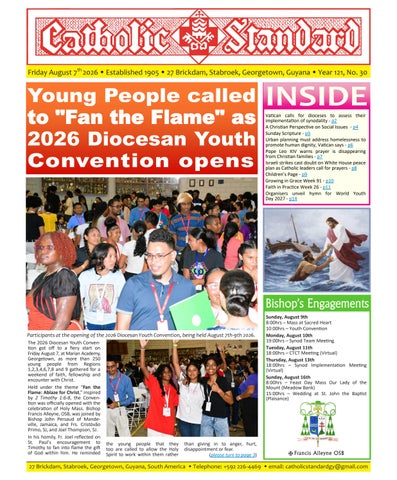
Bishop’s Engagements Participants at the opening of the 2026 Diocesan Youth Convention, being held August 7th-9th 2026. The 2026 Diocesan Youth Convention got off to a fiery start on Friday August 7, at Marian Academy, Georgetown, as more than 250 young people from Regions 1,2,3,4,6,7,8 and 9 gathered for a weekend of faith, fellowship and encounter with Christ. Held under the theme “Fan the Flame: Ablaze for Christ,” inspired by 2 Timothy 1:6-8, the Convention was officially opened with the celebration of Holy Mass. Bishop Francis Alleyne, OSB, was joined by Bishop John Persaud of Mandeville, Jamaica, and Frs. Cristóvão Primo, SJ, and Joel Thompson, SJ. In his homily, Fr. Joel reflected on St. Paul’s encouragement to Timothy to fan into flame the gift of God within him. He reminded
the young people that they too are called to allow the Holy Spirit to work within them rather
than giving in to anger, hurt, disappointment or fear. (please turn to page 3)
Sunday, August 9th 8:00hrs – Mass at Sacred Heart 10:00hrs – Youth Convention Monday, August 10th 19:00hrs – Synod Team Meeting Tuesday, August 11th 18:00hrs – CTCT Meeting (Virtual) Thursday, August 13th 18:00hrs – Synod Implementation Meeting (Virtual) Sunday, August 16th 8:00hrs – Feast Day Mass Our Lady of the Mount (Meadow Bank) 15:00hrs – Wedding at St. John the Baptist (Plaisance)
Francis Alleyne OSB
CATHOLIC STANDARD Friday, August 7th 2026
Page 2
Vatican calls for dioceses to
Year of St. Francis Jubilee Prayer
(EWTN News) - Ahead of the 2028 ecclesial assembly for the Synod on Synodality, the Vatican has called on dioceses to provide an assessment of their implementation of synodality. The General Secretariat of the Synod published the document “Recollecting” on July 27, providing diocesan synodal teams with a resource to draft their reflections on their progress since the diocesan phase began in October 2021. In the accompanying press release, Cardinal Mario Grech, secretarygeneral of the synod, explained that the notes are intended to help local Churches “recollect” their synodal journey with gratitude.
Participants of the Synod on Synodality in the Paul VI Audience Hall. ( Daniel Ibáñez)
“Evaluation is not a technical exercise but an experience of gratitude and truth,” Grech said. “Recollecting means recognizing what the Lord has brought to maturity in the journey of our communities and allowing ourselves to be guided towards the next steps.” The recollecting phase is part of the 2028 preparation for synodal teams and will culminate in a broader reflection during the first half of 2027. Each diocese is to prepare two documents around that time: a narrative report and a letter to the other Churches. The document “Recollecting” called
for discussions about the challenges facing synodality at the local level, including resistance. “Particular attention should be given to the difficulties encountered, resistance to renewal, obstacles that have hindered the journey, unsuccessful attempts and questions that remain open,” the document stated. The recollecting phase of the synod’s implementation path is one of four preparatory stages before the ecclesial assembly in 2028. The other three are “Interpreting” in the second half of 2027, “Orienting” in the first four months of 2028, and “Celebrating” in October 2028.❖
Saint Francis, our brother, you who eight hundred years ago went to meet Sister Death as a man at peace, intercede for us before the Lord. You recognized true peace in the Crucifix of San Damiano, teach us to seek in Him the source of all reconciliation that breaks down every wall. You who, unarmed, crossed the lines of war and misunderstanding, give us the courage to build bridges where the world raises up boundaries.
In this time afflicted by conflict and division, intercede for us so that we may become peacemakers: unarmed and disarming witnesses of the peace that comes from Christ. Amen - Pope Leo XIV First Holy Communion at Our Lady of Fatima church, Bourda, Georgetown, on Sunday July 19th 2026. ❖
CATHOLIC STANDARD Friday, August 7th 2026
Page 3
L-R: Fr. Cristóvão Primo SJ, Bishop Francis Alleyne OSB, Bishop John Persaud and Fr. Joel Thompson SJ celebrate the Opening Mass of the 2026 Diocesan Youth Convention at Marian Academy on Friday August 7th 2026.
Drawing on the Gospel account of the Road to Emmaus, he encouraged participants to remember that Jesus walks with them even in moments of sadness, disappointment and sin. Just as Jesus listened to the disciples, opened the Scriptures and broke bread with them, Christ desires to
accompany them on their own journey. Fr. Joel urged the young people not to allow the Convention to be only a temporary “bright spark,” but to keep the flame of faith alive through Mass, prayer and living their faith each day. Like coals that remain hot when kept together, he encouraged them to
remain close to Christ and to one another. During his opening remarks, Bishop Francis Alleyne, OSB, encouraged the young people to recognize and use the gifts God has given them, reminding them that they are valued members of the Church and have an important role to play in its life and mission. Diocesan Youth Coordinator Mrs. Angela Abraham-Parks welcomed the participants and encouraged them to make the most of the weekend. She said the Convention was designed to help young people encounter Christ, strengthen friendships, grow in their Catholic faith, deepen their prayer lives and listen more closely to God, especially through Eucharistic Adoration. She also invited them to connect with the Diocesan Youth Ministry Team and share how youth ministry can continue to be strengthened in their parishes and communities.
The opening day set the tone for a weekend centered on renewing the faith of young Catholics and encouraging them to become witnesses of Christ within their homes, parishes, schools and communities. As the Convention continues, the call to every participant remains clear: keep fanning the flame, live the faith and become ablaze for Christ. Saturday August 8th features a presentation by Archbishop Charles Jason Gordon of Trinidad & Tobago, an outreach activity and a Reconciliation Service. The Convention will conclude on Sunday August 9th with a procession from the sea wall, a presentation by Bishop John Persaud, the closing Mass, and a Concert and Camp Fire.❖ (Adapted from Catholic Media Guyana Facebook)
CATHOLIC STANDARD Friday, August 7th 2026
A Christian Perspective on Social Issues Marian Academy at the NGSA: a symphony in the By GHK Lall superb From perfection to as close as perfection can be; and all in a single year. A score of Guyana’s National Grade Six Assessment (NGSA) students making the improbable a reality. From all across Guyana, they sat, they scored, and they soared; 20 of them. They made us proud. From the Marian Academy, this year’s cohort of 63 NGSA students outdid themselves. They outdid expectations. They also outdid the competition. They made the Marian Academy family prouder than usual. Now, I invite Guyanese from all walks to absorb these numbers. The national pass rate in Math was a steadily improving 59.80 percent. The Marian students’ math pass rate was an unworldly 95.40 percent. In English, the national pass rate was a healthy 73 percent. At Marian, the pass rate was a stellar 96.84 percent level. It was the same for Science Marian at 95.74 percent, a high bar; the national level at 65.38 percent, improving all the time, getting there. Social Studies saw Marian students achieving a 94.58 percent pass rate, indicating considerable concentration and much absorption. The national average was 65.28 percent, a tidy climb with much effort manifested. The overall pass rate for the school was 95.69 percent. By any standards, it has to be seen as a platinum performance; ranking extremely well with the school’s performance in the last four years. By any measurement, however analyzed, these results have to represent a coherent and comprehensive display of dedication and aptitude, of a very rarified caliber. It is opportune, to switch now from the overall institutional scorecard to that of individual students. Vir Narine fought his way into a place at the coveted Queen’s College with a total score of 99.87 percent. Cheslea Bunbury, Rafael Brayhwaite, and Aanya Wintz made into the over 99 percent ranks at 99.49 percent, 99.29 percent, and 99.29 percent respectively and cruised into The Bishop’s High School, another premier institution of secondary level learning in Guyana. It boggles the mind that with such outstanding scores, all over 99 percent, these three students did not get into prestigious
Queen’s College. The competition is that tight. The margin of success that slender, and almost invisibly so. The difference for entering one school as opposed to another that precariously delicate. Almost intolerable to contemplate, very demanding to manage. Eight Marian students finished above 98.50 percent overall. They secured spots at St Stanislaus, St Rose’s High, and St Joseph High. For a moment I thought that, given the names of those schools, these eight students are about to enter seminaries. This is today; that was another era. I owe a duty to these eight students to mention each one of them by name. They have earned the right to public accolade. Vihaan Kissoon (98.91 percent); Ella Fernandes (98.90 percent); Juan Diego Perdomo (also 98.90 percent); Joel Rambiriche (98.89 percent); Nitin Chainani (98.68 percent); Cattleya Melendez (98.54 percent); Sariah Samaroo (98.54 percent); and Aiden Tinnie (98.52 percent). I am tired. How I wish that I could name them all! But 50 more names would send even a trooper like me off the deep end. My regrets that the honor had to be
passed by. It is my pleasure, though, to note a couple of names (Senor Perdomo and Senorita Melendez) that have a distinctive Spanish lineage. It is heartening to note that what sounds like the children of migrants-maybe from Cuba, maybe from Venezuela-could find a home in Guyana and flourish here. It would be inspiring if Guyanese have a couple of medical professionals in the making (perhaps a good handful more) from this Marian Academy batch of highfliers. The 2025-2026 NGSA record of the Marian Academy speaks to the industry of students. It highlights the role of teachers and parents. It pronounces favorably upon a nurturing environment. It points to the hand of God extending grace to those specifically identified, as well as those that I wish I could have paid homage to, for their strenuous and unflagging efforts. It has been said that education is the key to Guyana’s future. The kingdom inches closer, looks plausible, even possible. This has been a special pleasure. I thank God for all these children and those who made these results possible.❖
Page 4
Prayer for our Priests
Gracious and loving God, we thank your for the gift of our priests. Through them, we experience your presence in the sacraments. Help our priests to be strong in their vocation. Set their souls on fire with love for your people. Grant them the wisdom, understanding, and strength they need to follow in the footsteps of Jesus. Inspire them with the vision of your Kingdom. Give them the words they need to spread the Gospel. Allow them to experience joy in their ministry. Help them to become instruments of your divine grace. We ask this through Jesus Christ, who lives and reigns as our Eternal Priest. Amen
‘Growth is the only evidence of life.’ Saint John Henry Newman (1801-1890)
CATHOLIC STANDARD Friday, August 7th 2026
First Reading 1 Kings 19:9. 11-13 Stand on the mountain before the Lord. When Elijah reached Horeb, the mountain of God, he went into the cave and spent the night in it. Then the word of the Lord came to him saying, ‘What are you doing here, Elijah?’ Then he was told, ‘Go out and stand on the mountain before the Lord. Then the Lord himself went by. There came a mighty wind, so strong it tore the mountains and shattered the rocks before the Lord. But the Lord was not in the wind. After the wind came an earthquake. But the Lord was not in the earthquake. After the earthquake came a fire. But the Lord was not in the fire. And after the fire there came the sound of a gentle breeze. And when Elijah heard this, he covered his face with his cloak and went out and stood at the entrance of the cave.
made to them. They are descended from the patriarchs and from their flesh and blood came Christ who is above all, God for ever blessed! Amen. Gospel Acclamation Lk 19: 38 Alleluia, alleluia! Blessings on the King who comes, in the name of the Lord! Peace in heave and glory in the highest heavens! Alleluia! Or Ps 129: 5 Alleluia, alleluia! My Soul is waiting on the Lord, I count on his word Alleluia!.
Responsorial Psalm Psalm 84 Response: Let us see, O Lord, your mercy and give us your saving help. 1. I will hear what the Lord God has to say, a voice that speaks of peace. His help is near for those who fear him and his glory will dwell in our land. Response 2. Mercy and faithfulness have met; justice and peace have embraced. Faithfulness shall spring from the earth and justice look down from heaven. Response 3. The Lord will make us prosper and our earth shall yield its fruit. Justice shall march before him and peace shall follow his steps. Response 4. Let the peoples praise you, O God; let all the peoples praise you. O God, be gracious and bless us and let your face shed its light upon us. Response Second Reading Romans 9:1-5 I would willingly be condemned and be cut off from Christ if it could help my brothers.
Stewardship spirituality invites us to surrender control of our lives to God in grateful recognition of the simple fact that all we have is a gift from Him.
Page 5
What I want to say now is no pretence; I say it in union with Christ – it is the truth – my conscience in union with the Holy Spirit assures me of it too. What I want to say is this: my sorrow is so great, my mental anguish so endless, I would willingly be condemned and be cut off from Christ if it could help my brothers of Israel, my own flesh and blood. They were adopted as sons, they were given the glory and the covenants; the Law and the ritual were drawn up for them, and the promises were
Today’s readings illustrate what amazing things can happen when we fully invite God to take charge of our lives by embracing the stewardship way of life. When we take our eyes off God, we fail to see that all we have is a gift from Him. We lose trust in the Lord and we do not make our lives a grateful response to Him. Peter makes this mistake in our Gospel passage from Matthew. Jesus
Gospel Matthew 14:22-33 Tell me to come to you across the water. Jesus made the disciples get into the boat and go on ahead to the other side while he would send the crowds away. After sending the crowds away he went up into the hills by himself to pray. When evening came, he was there alone, while the boat, by now far out on the lake, was battling with a heavy sea, for there was a head-wind. In the fourth watch of the night he went towards them, walking on the lake, and when the disciples saw him walking on the lake they were terrified. ‘It is a ghost’ they said, and cried out in fear. But at once Jesus called out to them, saying, ‘Courage! It is I! Do not be afraid.’ lt was Peter who answered. ‘Lord,’ he said ‘if it is you, tell me to come to you across the water.’ ‘Come’ said Jesus. Then Peter got out of the boat and started walking towards Jesus across the water, but as soon as he felt the force of the wind, he took fright and began to sink. ‘Lord! Save me!’ he cried. Jesus put out his hand at once and held him. ‘Man of little faith,’ he said ‘why did you doubt?’ And as they got into the boat the wind dropped. The men in the boat bowed down before him and said, ‘Truly, you are the Son of God’. ❖
sends the disciples in a boat ahead of Him to the other side of the shore. Later that evening, Jesus casually strolls up to the boat, walking on the sea. He invites Peter to join Him. As Peter begins to walk on the water, he momentarily takes his eyes off Jesus to notice the strong wind surrounding them. With that, he sinks. But what if Peter had not taken his eyes off Christ? What a grand adventure he could have experienced
walking on the sea with Jesus! When we take our eyes off Christ, the many blessings He has given us, and the loving way He treats us, we sink, too. When we embrace the stewardship way of life — letting go of a tight hold over our money, time and talents — our lives become a grand adventure, rooted firmly and gratefully in the God Who always cares for us. ❖ [www.catholicsteward.com/blog/ ]
CATHOLIC STANDARD Friday, August 7th 2026
Page 6
Gospel homelessness to promote human Reflection dignity, Vatican's UN mission says
We can look at the Gospel story as telling us something deeper, as being symbolic. The boat represents the Church, the wind and the waves stand for persecution that the early Christians faced. Jesus was not with them; he was with the Father. However, in their hour of need he makes his presence felt among them, calming their fears and bringing them peace. Understood in this way, the Gospel story makes a great deal of sense to us today. The early Christians were people of faith but when they faced abuse and oppression, they felt that the Lord had abandoned them and so their faith would begin to grow dim. However, when they discovered that even though the Lord was not physically with them, he was still there to offer his support, encouragement and help. Their faith was restored and they were able to face their trials and dangers.
Faith is a relationship that must always be growing and deepening. This relationship changes our attitudes, our way of thinking, our priorities, our habits, the way we relate with others, the choices we make in life. The Gospel story shows the power of faith. It shows us what Jesus always does for his people when the winds are strong and they are in danger of being blown away by the storms of life. To those with faith, Jesus is not just someone in the past. He is the Son of God, who is present with us and who supports us when things are too much for us. We only have to believe that Christ is with us and will calm the storms in our lives. ❖ [From: Journeying with the Word of God, The Religious Education Department, Diocese of Georgetown, Guyana ]
(Vatican News) ─ Homelessness must be addressed to create sustainable cities that enable every person to flourish and contribute to the common good, the Holy See's Permanent Observer Mission to the United Nations said July 28. "The persistence of homelessness should trouble the conscience of the international community," the mission said in a message issued for the United Nations' 2026 high-level meeting on the world body's New Urban Agenda. "Everybody deserves a place to call home, where they can build relationships, nurture family life, and participate fully in their community," the message said. "Housing should therefore be viewed not just as a commodity or financial asset, but as a cornerstone of society at the service of the common good." The New Urban Agenda is a global roadmap for sustainable inclusive, and resilient urban development, according to the United Nations. Approved at the U.N. Habitat III conference in Quito, Ecuador, on Oct. 20, 2016, and endorsed by the U.N. General Assembly, it provides guiding principles for managing cities through 2036. The highlevel meeting celebrated the 10th anniversary of the agenda's adoption. "When cities are shaped by solidarity, inclusion and care for those most in need, they become more than mere places of residence and of work; they become places of encounter, fraternity and hope," the Holy See mission said in its message. It quoted Pope Leo XIV’s encyclical "Magnifica Humanitas," on safeguarding the human person in the time of artificial intelligence, to underline how "development is truly human when it places people at the center." "This principle should guide the implementation of the New Urban Agenda in the decade ahead," the Holy See mission emphasized. "Not having a home means more than just lacking shelter; it means being deprived of security, stability, privacy, and a sense of belonging," it explained in
People walk past a person lying on the pavement along a street in London on July 28, 2026. its message. "Homelessness undermines the ability to exercise many fundamental human rights and often traps individuals and families in cycles of exclusion and poverty." Homelessness is an "affront to human dignity," it said. The Holy See mission encouraged cities and countries to invest more "in affordable and adequate housing, as well as integrated social services," and address the root causes of homelessness, such "as poverty, unemployment, drug addiction, mental health issues, family breakdown, displacement and conflict." This must be done through "meaningful participation of local communities, civil society, faith-based organizations" and those who have experienced homelessness themselves, it said. The mission also noted the importance of pushing for housing policies that promote an integrated approach that takes into consideration the "strong links between education, employment, housing and health." "This will also
Subscribe to the Catholic Standard it’s free! Message us giving your name & number at +592 701-7639. Send us an email at catholicstandardgy@gmail.com under the heading CS Subscription, and include your name.❖
help to prevent exclusion and segregation," it pointed out. The Holy See mission also emphasized the importance of "renewed international solidarity" through international cooperation, technology transfer, capacity building and adequate financing, especially to help least developed countries that struggle with rapid urbanization. "Urban development cannot be measured solely by the height of its buildings or the strength of its economy," the mission said, "but above all by its ability to enable every person to flourish by participating fully in society and contributing to the common good." Every city is a community of people, each endowed with its God givendignity, it said. "The true measure of a sustainable city lies in how it treats all its members, and, consequently, in its capacity to address multiple forms of poverty, persistent inequalities and environmental degradation."❖
Catholic Standard For 121 years, the Catholic Standard has been sharing the Gospel of Jesus Christ. Now reaching 10,000+ followers on Catholic Media Guyana Facebook plus going straight to your inbox and WhatsApp, our vibrant weekly e-paper is a trusted source which delivers informative and inspiring stories from across the diocese and around the world. Want to promote your business or event? Advertise with us! Call 675-4542 or email catholicstandardgy@gmail.com ❖
CATHOLIC STANDARD Friday, August 7th 2026
Page 7
Pope Leo warns prayer is disap- Journeying with pearing the Word of God
MAKING THE WORD OF GOD YOUR OWN Step 1: Look at today’s Readings prayerfully. Pope Leo XIV greets pilgrims before the General Audience, Wednesday, August 5 (@VATICAN MEDIA) (EWTN News) - Pope Leo XIV lamented Wednesday that prayer is no longer being passed on in many Christian families and urged the faithful to rediscover it as a fundamental dimension of human life. “In our time, in contexts dominated by an efficiency-driven and consumerist mindset, prayer may seem pointless and trivial,” the pope said during his Aug. 5 general audience. “In a world where science and technology claim to provide all the answers, praying may appear to be a form of escapism,” he continued. Leo resumed his weekly public audience after suspending most of his official schedule during the traditional July summer break. Because of Rome’s high summer temperatures, the audience was held inside St. Peter’s Basilica. Continuing his catechetical series on the Second Vatican Council, the pope focused on the ecclesial dimension of liturgical prayer as presented in the conciliar constitution Sacrosanctum Concilium. He warned that prayer is increasingly misunderstood, including within Christian homes. “Furthermore, even in many Christian families, the tradition of prayer is no longer passed on, whilst many people risk confusing it with just another technique, of a psychological nature aimed at personal well-being,” he said. “Prayer, however, as a fundamental dimension of our humanity, is worth rediscovering in its true form.”
Leo said Sacrosanctum Concilium took this need seriously. He recalled the words of St. Paul VI when the constitution became the first document promulgated by the Second Vatican Council on Dec. 4, 1963. “God comes first; prayer is our primary duty; the liturgy is the primary source of the divine life communicated to us, the primary school of our spiritual life,” Paul VI said at the time. Leo explained that the word “prayer” in the constitution refers to the liturgy as a whole. This understanding, he said, proved decisive in guiding the liturgical reform and placing the active participation of the faithful at its center. “The liturgy is presented first and foremost as the place of encounter, of God’s initiative in drawing near to humanity in his Son, ‘the Word made flesh, anointed by the Holy Spirit,’” the pope said. The faithful respond “through Christ, with Christ and in Christ, in the unity of the Holy Spirit,” he continued, through “the very prayer which Christ himself, together with his body, addresses to the Father.”
The importance of the Liturgy of the Hours Leo recalled Paul VI’s desire that the Liturgy of the Hours — the Church’s daily public prayer, which is inseparable from the Eucharist — would permeate, enliven, and guide all Christian prayer.
“For this desire to be fulfilled, the Liturgy of the Hours needs to be more fully embraced and lived out in the daily lives of the baptized and of the communities,” Leo said. The pope described the Eucharist and the Liturgy of the Hours as “the breath of the life of the Church,” through which the Holy Spirit circulates throughout the body of Christ. He said the Liturgy of the Hours sanctifies the different moments of ordinary life. “Bound to the Eucharist, whose light it prolongs, the Liturgy of the Hours sanctifies the time of our daily lives: In the morning, we begin the day with faith and gratitude; at midday, we ask for the strength to remain faithful amidst our labors; in the evening, once our work is done, vespers accompany the moment of sunset; at night, we fall asleep entrusting ourselves to God’s peace,” he said. “Each hour is an act of hope: During our earthly pilgrimage, we keep watch, awaiting with the whole Church the glorious return of the Lord.” The Liturgy of the Hours can also serve as a practical school for those learning how to pray, the pope said, particularly people preparing to enter the Catholic Church. “To the many people who wish to learn to pray, especially catechumens, it can offer the path and the school of Christian prayer,” he said.❖
1st Reading: Wind, earthquake and fire are Old Testament symbols of the presence of God. Elijah, however, found God in a different way. 2nd Reading: Paul tells us of the pain and sorrow he suffers because his fellow Jews refused to accept Jesus as the long-awaited Messiah. Gospel: When the disciples are caught in the high winds and rough waves, Jesus comes to them and calms their fears. He brings them peace.
Step 2: Applying the values of the Readings to your daily life. 1. Elijah was told to go out and “stand before the Lord”. In what way are we being told to do the same today? What do you think is expected of you when you stand before the Lord? 2. Do you expect to find God only in simple, quiet moments, in the “gentle breeze” of life or do you expect to find God wherever you are, especially when the storms of life are battering you? 3. Can you make a connection between Paul’s pain for his beloved people with the pain we, as parents, relatives or friends, feel for our loved ones when they go astray? 4. Are there moments in your life when you would have loved to hear the words: “Courage! It is I! Do not be afraid.” Is there anything stopping you from hearing those wonderful words?
Step 3: Accepting the message of God’s
Word in your life of faith.
Faith in God doesn’t save us from the hardship of life. It, however, gives us the strength to face those hardships. The person who has faith has a source of strength and inspiration, especially when trouble strikes. It is generally in moments of difficulty, when the storms of life strike, that we find it natural to turn to God. But as believers, we must learn to turn to God at all times.
Step 4: Something to think & pray about 1. Fear is real for many of us. Some of our fears centre on security, like having enough money to live on or losing our job. We fear for our personal safety because of increased crime and violence in society. We fear those in power who have authority over us and can make life difficult. We may even fear God. Fear is always the enemy because we cannot live without it. What do you fear most in life? 2. Make a promise to be the calm water and the gentle breeze for someone who is facing the storms of life and is in need of peace and quiet. ❖ [From: Journeying with the Word of God, The Religious Education Department, Diocese of Georgetown, Guyana ]
CATHOLIC STANDARD Friday, August 7th 2026
Page 8
peace plan as Catholic leaders call for prayers
The sun sets over Gaza, as seen from the Israeli side of the border, Aug. 2, 2026. In an Aug. 3, 2026, statement, Bishop A. Elias Zaidan, chair of the U.S. Conference of Catholic Bishops' Committee on International Justice and Peace, said he was “heartened by news of an agreement which aims at the disarmament of Hamas and Israel’s military withdrawal from the Strip, and I call for intense prayers for the success of these negotiations.” (OSV News photo/Amir Cohen, Reuters) WASHINGTON (OSV News) — Further Israeli strikes in Gaza cast doubt on the White House’s peace plan for the Gaza Strip, a University of Notre Dame scholar told OSV News. The strikes came soon after Trump announced a new “milestone” toward implementing the White House’s 20point peace plan, which prompted renewed calls for prayers for peace from Catholic leaders. Mary Ellen O’Connell, a professor at Notre Dame Law School who specializes in international law and conflict resolution, told OSV News Aug. 5, “There is no peace now in Gaza, and there has been no peace since President Trump announced a ceasefire in October 2025.” “Instead, Israel has slowed the pace of its air attacks in general. The attacks have increased again, and slowed, but never stopped,” she said. “On Sunday, Israeli attacks killed an estimated 18 Palestinians. That is not peace. Israeli ground troops have pulled back from some positions but not to the positions agreed.”
Trump pushes historical ‘critical step’ for peace Trump said in a July 30 statement that
the Board of Peace’s agreement for the complete disarmament of Hamas and Israel’s withdrawal from the territory was a “critical step” towards implementing the remaining provisions of the White House’s 20-point peace plan, which Israel and Hamas signed in October 2025. “The agreement will be carried out in carefully structured phases,” Trump said. “As disarmament is completed, Israeli forces will withdraw, and the International Stabilization Force will work with a new Palestinian police force to take responsibility for Gaza being safe for its residents and its neighbors.” However, in the days following Trump’s announcement, Israel carried out airstrikes in Gaza, resulting in the deaths of more than two dozen Palestinians, Palestinian health officials said. Israeli Prime Minister Benjamin Netanyahu said Aug. 4 that Israel will not withdraw from its current lines in Gaza unless and until Hamas has completely disarmed. “Israel has remained adamant that until it is satisfied that Hamas has disarmed completely, it will not fulfill its side of the Trump plan, including to
stop attacks. The 20-point plan specifies that Israel is to halt military operations, then Hamas will disarm per a process overseen by Palestinians appointed to run Gaza,” O’Connell said. Asked if that marks a significant break between Trump and Netanyahu, who have long been allies, O’Connell said, “Israel did contradict President Trump directly, but President Trump is unpredictable. Israel’s defiance may have no impact on him.”
USCCB appeal for ‘intense prayers’ for negotiations Previously, in an Aug. 3 statement, Bishop A. Elias Zaidan, chair of the U.S. Conference of Catholic Bishops‘ Committee on International Justice and Peace, said he was “heartened by news of an agreement which aims at the disarmament of Hamas and Israel’s military withdrawal from the Strip, and I call for intense prayers for the success of these negotiations.” If implemented, he argued, the agreement had the “potential of finally providing the Palestinian people with a ‘credible political path that achieves self-determination and Statehood.’ This would be a major milestone.”
Bishop Zaidan said he called “on the United States, Israel, and the international community to facilitate greater amounts of humanitarian and development assistance to the Strip.” “This should include restoring educational opportunities for children and youths, jobs, and clean water. Alleviating the suffering of the Gazan people is not only a vital moral imperative but is also necessary for the consolidation of peace in the Holy Land and the entire region,” he said. “Conscious of the extreme challenges inherent in this ongoing peace process, let us entrust the hearts and minds of the negotiators to the maternal care of Our Lady of Wisdom, that she may illumine and enliven their efforts to finally achieve peace in those sacred lands.” Pope Leo XIV has consistently called for peace in the region. O’Connell said that Trump “is in a position to make great strides toward peace in four wars if he uses all of his leverage to end Israeli attacks on Gaza; ends the unlawful war on Iran; pressures the United Arab Emirates to end its involvement in Sudan’s Civil War, and immediately provides Patriot missiles to Ukraine.”❖
CATHOLIC STANDARD Friday, August 7th 2026
Dear Girls and Boys, Today’s Gospel takes place just after Jesus fed five thousand people with just five loaves of bread and two fish. After he had finished feeding the five thousand, Jesus told his disciples to get into their boat and go to the other side of the lake while he went up into the mountains to be alone and to pray. While the disciples were going to the other side of the lake in their boat, the wind came up and the water began to get rough. The disciples became afraid that their boat would sink and they would be drowned. Then they looked, and they saw Jesus coming toward them and he was walking on the water. When Peter saw Jesus, he became excited and he said to him, "Lord, if that's really you, let me walk to you on the water. Jesus answered Peter and said, "Come." Well Peter climbed over the side of the boat and started walking on the water to Jesus. Then he began to look around, he felt the strong winds and saw the waves and he became afraid and started to sink. He cried out to Jesus, "Help, save me!" Jesus reached out his hand and saved Peter and he said to him, "Oh, you of little faith, why did you doubt?" As long as Peter kept his eyes on Jesus, he was walking on the water, but when he took his eyes off of Jesus, he began to sink. As we go through life, there will be some storms. We will encounter some pretty rough water. As long as we keep our eyes upon Jesus and put our trust in him, we will be okay. But when we take our eyes off of Jesus and put our confidence in our own ability, we will surely sink! Dear Jesus, when the storms of life come against us, help us to keep our eyes on you and to put our trust in you. Amen. ❖
[ NFC - Sources: sdc.me.uk , catholickidsbulletin.com, sermons4kids.com , salfordliturgy.org.uk, young-catholics.com, thewordthisweek.net & thekidsbulletin.com ]
Page 9
CATHOLIC STANDARD Friday, August 7th 2026
Page 10
By Renika Anand
Saving Graces Participants in the Diocesan Youth Convention came from across Guyana, with many travelling long distances to get to Georgetown. In the photo at left, youths from Monkey Mountain in Reg. 8 prepare to board the plane to GT. At top are participants from New Amsterdam, Berbice, while in the photo below, youths from Reg. 9 are about to embark on the 14-hour drive from Lethem to Georgetown ❖
Ron Kaufman, an American Author, once said “If you want to be the best, find the best in others.” Our eyes are naturally drawn towards the light. We are often transfixed by the sight of the bright sun, even when it has the potential to harm us. We are moved by the dancing beauty of burning flames, even when they are consuming the world around it with dangerous ferocity. Yet, when it comes to perceiving the people who share the world with us, this instinct seems to fail us. Our eyes are not drawn to their brightest parts, but towards their darkest ones. We tend to fixate on the cracks and fissures - their faults and flaws. Soon, we may forget that there are bright parts at all! It is natural for individuals to have flaws. At the same time, it is also natural for persons to have extraordinarily marvellous qualities that we often forget to notice. Unfortunately, when we forget to see the saving graces of the people around us, we also forget to have the grace to notice that every person is worth saving and loving, no matter how different they are from us. Above all, love each other deeply, because love covers over a multitude of sins.- 1 Peter 4:8❖
CATHOLIC STANDARD Friday, August 7th 2026
Page 11
Faith in Practice: Living and Knowing our Faith
A Samaritan Church: Charity, Justice and Structures of Sin Catholic Social Teaching | Part 2
Fr. Joel Thompson SJ Last week, I emphasized that faith needs to go beyond Sunday Worship. The Eucharist sends us out to serve others and seek the common good. What should we do when suffering appears? Jesus answers with the parable of the Good Samaritan (Luke 10:25-37).
Pass or Respond? A man is attacked, robbed and abandoned beside the road. A priest and a Levite see him but pass by silently. They are not concerned about his suffering. The Samaritan also sees him but allows the sight to touch his heart. He treats his wounds, takes him to an inn and pays for his care. Jesus then says, “Go and do likewise” (Lk 10:37). The Samaritan allows another’s suffering to interrupt his journey and cost him. He crosses not only the road, but also barriers of religion, ethnicity and prejudice. The wounded man is not “one of his own,” yet he recognizes him as a neighbour, a fellow human being. Christians are called to do the same. A common temptation is to ignore suffering and pass by. Worse yet, to take out a phone and record rather than help, as so many bystanders do at accidents these days. Are we losing our humanity? Why watch, when you can help? A Samaritan Church notices the wounded, draws near, listens and responds. We do not first ask whether someone deserves help, belongs to our parish or shares our opinions. A Samaritan Church recognizes Christ in the hungry, homeless, sick, imprisoned, abused and forgotten. It refuses to pass on the other side.
leaving the dangerous road unchanged. The search for justice must not be used as an excuse not to help the person before us. Christian love both tends wounds and works to prevent them. The Catechism quotes Saint John Chrysostom: “Not to enable the poor to share in our goods is to steal from them and deprive them of life” (CCC 2446). Helping the poor is not just generosity since the goods of creation are intended for everyone.
Charity and Justice Sinful Systems Charity and justice are not identical. What is the difference? Charity responds to the person suffering before us with food, clothing, medicine or immediate help. Justice asks why that person is hungry, homeless, unsafe or excluded, and what must change. Charity gives a food hamper while justice asks whether salaries and prices allow families to eat. Charity helps someone reach a hospital while justice asks whether communities have reliable transport and healthcare. Charity comforts families after a disaster while justice seeks investigation, accountability and reforms that prevent another tragedy. Repeated acts of charity are no substitute for correcting injustice. Charity without justice may keep treating the same wounds while
We often think of sin as an individual choice. However, repeated personal sins can become accepted habits, institutional practices and unjust systems. Bribery (e.g. when stopped by the police or doing business in Guyana) becomes “how things are done.” Careless work becomes normal. Rules are enforced against the poor but ignored for the powerful. Certain communities repeatedly receive poorer services. Racism influences whom we trust, employ or consider important. Eventually, injustice continues automatically. St John Paul II called these realities “structures of sin.” Pope Leo XIV explains that inequality can be produced by “structures, mechanisms and economic and cultural systems,” not only
by individual wrongdoing (Magnifica Humanitas, 79). Such structures are created and maintained by choices, including silence, indifference and the desire to protect our own advantage. Changing them requires both personal and social conversion. Replacing one dishonest person achieves little if the system rewards dishonesty. We cannot demand honest institutions while offering bribes, seeking favors or excusing corruption when it benefits us.
Conscience How do we become more socially conscious? A useful Catholic method is to see, judge and act. First, see. Notice who is suffering and who is missing from important conversations. Listen to people whose experiences differ from the majority. For example, the poor, hinterland communities, rural families, persons with disabilities, prisoners and neglected young people. Let us not assume that we understand their lives. Read beyond headlines and party propaganda. Second, judge. Bring what we see before God and examine it through Scripture and Catholic teaching. We should ask whether human dignity is being respected and who benefits or bears the burden. Are those affected included in decisions? Does this serve
the common good? What will it mean for future generations and creation? Third, act. A parish might visit prisoners, support struggling families or identify elderly people living alone. It might also study a recurring local problem, listen to those affected and approach the responsible authorities. We can attend community meetings, write public officials, support NGOs, report wrongdoing safely and vote according to conscience rather than race, party loyalty or favours. Our daily work is also part of this mission. An honest and responsible public servant, teacher, nurse, contractor, police officer, businessperson or journalist can improve many lives. Competence and honesty are Christian virtues. So are simple living and refusing to benefit from another person’s exploitation. Which wounds have I learned to step around? Whose suffering have I decided is not my concern? How might my comfort or silence depend upon an unjust arrangement? At every Mass or Service, we receive the Body of Christ so that we may become the Body of Christ in the world. A Samaritan Church does not only speak about love. It crosses the road, tends to those suffering and challenges injustice no matter the cost. To each of us, Jesus says, “Go and do likewise.” (Luke 10:37).❖
CATHOLIC STANDARD Friday, August 7th 2026
Page 12
CATHOLIC STANDARD Friday, August 7th 2026
Page 13
CATHOLIC STANDARD Friday, August 7th 2026
Organisers unveil hymn for World Youth Day 2027
Page 14
Saint of the Week
A scene from the video for the World Youth Day 2027 theme song (YouTube) (CathNews) - With just one year to go before 2027 World Youth Day in Seoul, its official theme song has been unveiled: Confidite, Ego Vici Mundum, or “Take courage! I have overcome the world”. Source: Vatican News. The hymn will set the tone for this upcoming international gathering of Catholic youth, who will gather in Seoul from August 3 to 8, 2027. Confidite, Ego Vici Mundum takes up the theme chosen for WYD 2027: “Take courage! I have overcome the world,” a verse from John’s Gospel (16:33). An international hymn, the song is performed in several languages, including Korean, English, French, Spanish, Portuguese, and Italian. The song opens with this invitation: “Come follow me, sleeping heart, wake up and walk”. Two
versions have been recorded, the first in a more classical style, featuring a choir and orchestra, while the second is a remixed pop version. One aim of this song is to offer a foretaste of the event. Above all, however, it will serve as the permanent soundtrack for participants as they prepare for the gathering. Each World Youth Day has its corresponding melody, carrying with it a wealth of memories for the participants. The hymn is the result of an open contest to create an original composition based on the WYD27 theme. The initiative was a success, drawing 434 submissions, including 294 from abroad. The selected song was then submitted for approval to the Holy See’s
Dicastery for Laity, Family and Life. The theme song was composed by Korean musician Francis Jiyoon Kim, who gave it the flavour of his country and culture. Sung largely in Korean, the vocals blend with local traditional instruments in a contemporary arrangement. The music video showcases the landscapes and iconic sights of Seoul, offering a first glimpse of what awaits participants next year. More than 30 years after Manila in 1995, this WYD will be only the second held in Asia. It marks the first time the event has been hosted in a country where Catholics are a minority. In South Korea, Catholics represent about 12 per cent of the population, in a society marked by significant religious pluralism.❖
August 14th St. Maximilian Mary Kolbe (1894 - 1941 )
Saint Maximilian Mary Kolbe was born in Poland in 1894 and became a Franciscan in 1910. He was arrested by the invading German forces in 1939 and sentenced to heavy labour in the extermination camp at Auschwitz. When a married man with children was one of ten men chosen to be executed because a prisoner had escaped, Maximilian volunteered to take his place. In the “block of death” they were ordered to strip naked, and their slow starvation began in darkness. But there was no screaming—the prisoners sang. By the eve of the Assumption four were left alive. The jailer came to finish Kolbe off as he sat in a corner praying: he was killed by lethal injection on August 14th 1941. He was canonised in 1982 in the presence of the man whose life he saved. Comment: Father Kolbe’s death was not a sudden, last minute act of heroism. His whole life had been a preparation. His holiness was a limitless, passionate desire to convert the whole world to God.❖