
Pope Leo XIV to publish encyclical
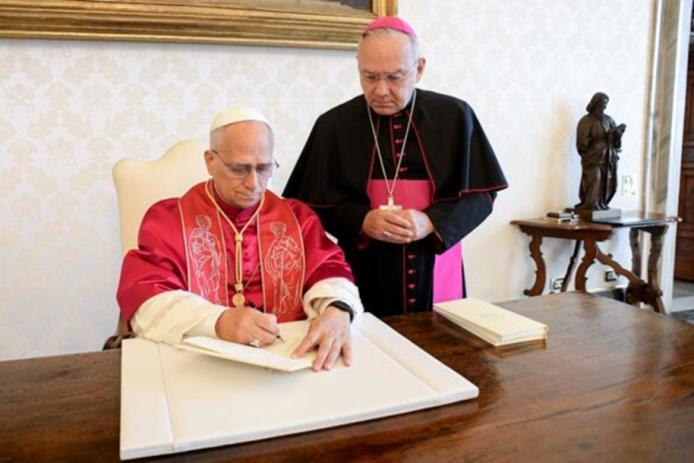
Pope Leo XIV signs his first apostolic exhortation, "Dilexi Te" ("I Have Loved You"), in the library of the Apostolic Palace at the Vatican Oct. 4, 2025. His first encyclical, "Magnifica Humanitas," addressing artificial intelligence and the protection of human dignity, will be published May 25, 2026, the Vatican announced May 18. (CNS photo/Vatican Media)
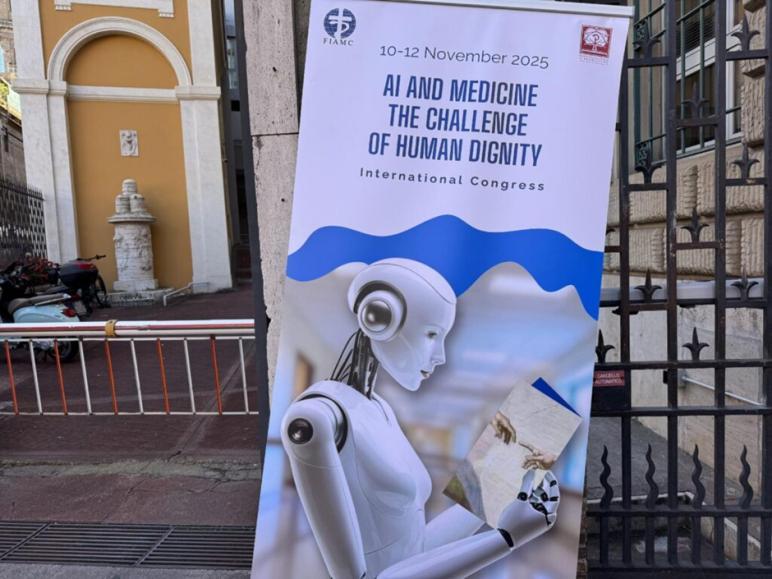
VATICAN CITY (OSV News) Pope Leo XIV’s first encyclical, “Magnifica Humanitas,” will be published May 25, addressing artificial intelligence and the protection of human dignity, the Vatican has announced.
The encyclical, the title of which is Latin for “Magnificent Humanity,”
was signed by the pope on May 15, the 135th anniversary of “Rerum Novarum,” Pope Leo XIII’s foundational 1891 social encyclical on labor and capital written during the first Industrial Revolution.
In an unprecedented first, Pope Leo XIV will be present in person
at the Vatican press conference to mark the publication of the social encyclical, along with a tech founder from one of the world’s fastest growing AI companies. Anthropic co-founder, theologian, cardinals to speak at panel for encyclical’sMay25release
Christopher Olah, co-founder of the artificial intelligence company Anthropic, which developed the AI large language model (LLM) named Claude, will speak on a panel presenting the document at the Vatican’s Synod Hall on May 25 at 11:30 a.m local time.
Also joining the panel will be Anna Rowlands, a British theologian specializing in Catholic social teaching who helped organize the Synod on Synodality, and Léocadie Lushombo, a professor of theological ethics at the Jesuit School of Theology at Santa Clara University. Cardinal Víctor Manuel Fernández, prefect of the Dicastery for the Doctrine of the Faith, and Cardinal Michael Czerny, prefect of the Dicastery for Integral Human Development,
Care for peace is care for life, says Pope Leo at startof Laudato Si’ Week - p2
Independence Day Prayer - p2
Interfaith peace march in Jerusalem counters risingviolence and division - p3
AChristianPerspective on Social Issues - p4
Sunday Scripture - p5
Pope laments that after Confirmation, many youngpeople ‘disappear from the parish’ - p6
Walking together: Caribbean bishops encounter synodality in Rome - p7
As Ebola epidemic spreads, Uganda postpones
Martyrs Day celebrations - p8
Children’s Page - p9
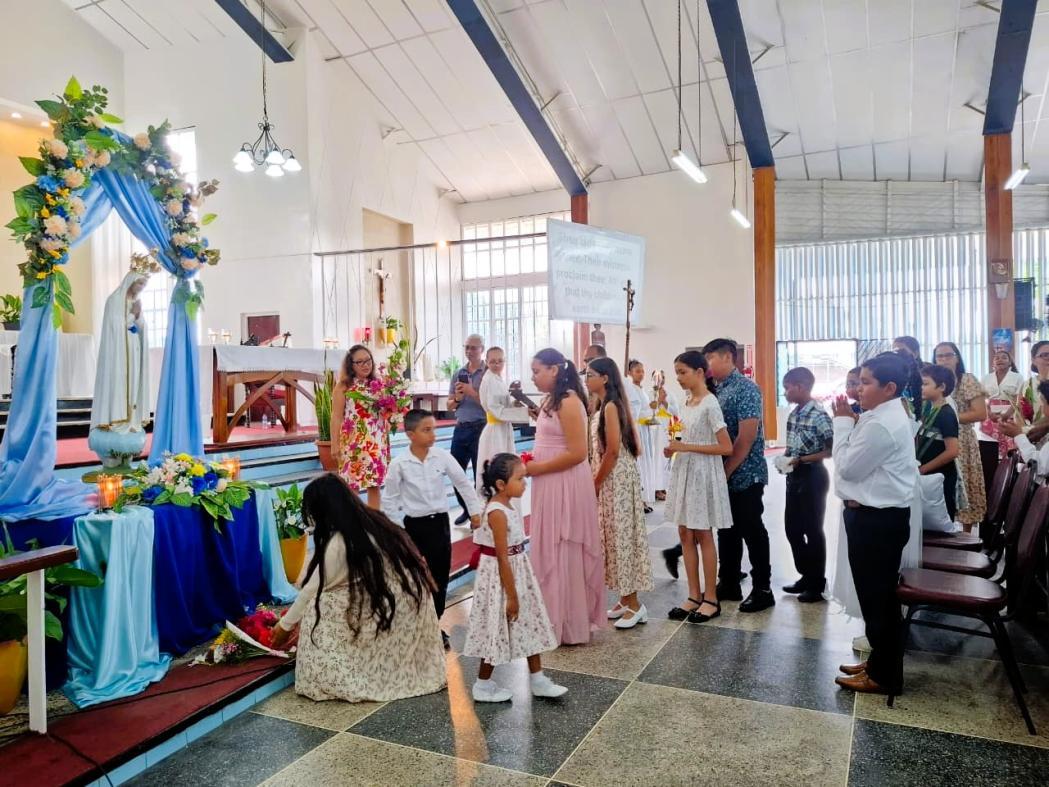
Crowningof Our Lady 2026 - p10
Faith in Practice Week 15 - p11
Independence Memory Lane 3 - p14
Engagements
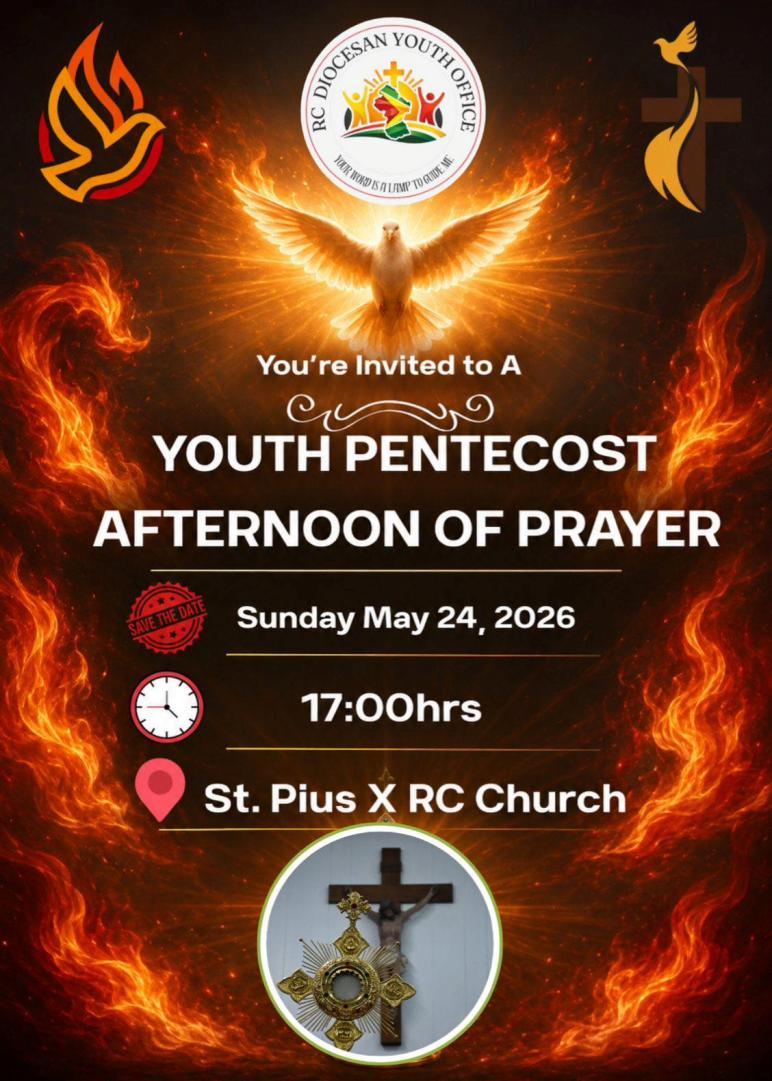
Sunday May 24th
Feast of Pentecost
07:30hrs – Mass at Cathedral (Sacrament of Confirmation)
11:00hrs - Mass at Our Lady of Fatima (Sacramentof Confirmation)
Mon. May 25th
06:30hrs –Mass at Ursuline Convent
Tuesday May 26th 10:00hrs – Synod Session 14:00hrs – Meet with Jesuitvisitors
Sun. June 7th 8:00hrs–Mass at Sacred Heart
‘From
Hope to Action’
May 17 – May 24
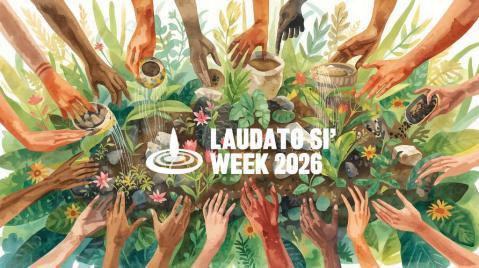
Each year, the global Church unites to celebrate Laudato Si’ Week an annual moment of prayer, reflection, and concrete action inspired by Laudato Si’ by Pope Francis.
In 2026, from May 17–24, Catholics across continents will once again respond together not just with words, but with action.
WhatisLaudatoSi’ Week?
Laudato Si’ Week is a global celebration commemorating the publication of Laudato Si’, the encyclical that calls humanity to care for our common home and embrace integral ecology.
It is more than an anniversary. It is a renewed invitation to:
• Praydeeply
• Reflect honestly
• Actconcretely
Every parish, school, university, hospital, movement, religious community, family, and individual is invited to participate.
Hope in Action
In a world facing ecological crisis and social fragmentation, hope is not passive optimism — it is a decision to act, and during Laudato Si’ Week 2026, Catholics around the world are invited to transform that hope into concrete steps for our common home, inspired by Laudato Si’ and lived through the global movement of the Laudato Si’ Action Platform.
The Core Invitation: Take One ConcreteAction
The invitation is intentionally simple: Choose one action. Make it count during this week.
That action might be:
• Reducing energy use in your institution
• Hosting a prayer service or dialogue
• Reviewing purchasing practices
• Beginning a long-term sustainability commitment
• Caring for a local ecosystem
• Engaging youth in ecological leadership
The power is not in perfection. The power is in participation ❖ [laudatosimovement.org]
Pope Leo at start of Laudato Si’ Week
(Vatican News) - As he prayed the Regina Caeli on Sunday, Pope Leo XIV recalled that Laudato Si’ Week runs from May 17 to24.
The annual event celebrates the anniversary of Pope Francis’ encyclical on care for our common home, inviting all people to move from hope to action.
The Pope encouraged the members of the Laudato Si’ Movement and all
those who work for an integral ecology to renewtheir commitment. He made reference to St. Francis of Assisi’s love for creatures and his message of peace, as the Church marks 800 years since the saint’s death.
“In thisJubilee Year of Saint Francis of Assisi, let us remember his message of peace with God, with our brothers and sisters, and with all creatures,” he said.
The Pope lamented that wars have caused progress in the field of care for creation to slow greatly in recent years.
Finally, Pope Leo XIV pointed to the inherent link between care for peace andcare for life.
“I encourage the members of the Laudato Si’ Movement and all those who work for an integral ecology to renew their commitment,” he said. “Care for peace is care for life.”❖
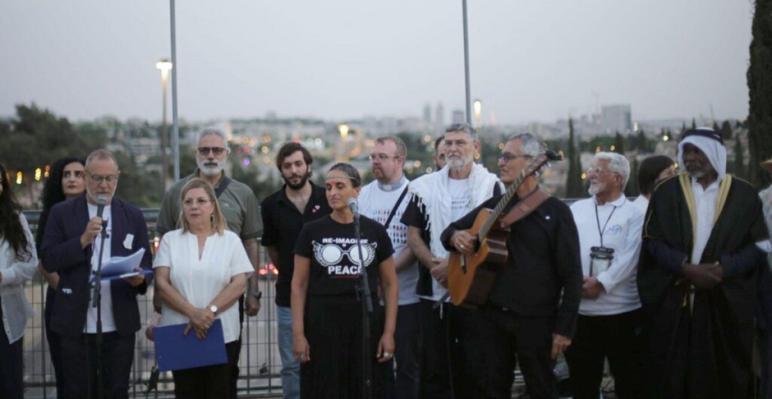
Interfaith peace march in Jerusalem counters rising violence and division
Curious Israeli shopkeepers who had come out of their shops to ask about the march congratulated them for the initiative, and a few cars honked their horns in support as the group made its way from the YMCA to the Old City’s JaffaGate.
Participating with his parishioners for the fourth year, Father Piotr Zelazko, a Polish priest who serves as the patriarchal vicar for the St. James Vicariate for the Hebrew-speaking Catholics in Israel, said the march was a part of who he is. He led his choir in song, greeting the march with “We Shall Overcome” as they arrived atJaffa Gate.
was “a continuing escalation in Israeli terrorism in the West Bank.” Several other Palestinians had been injured as well, the group said.
Human rights and activist groups
Human rights and activist groups and Palestinians have reported a sharp increase in both the number and severity of settler attacks against Palestinians since Oct. 7, 2023, after the Hamas attack on southern Israel communities, which left 1,200 people deadand 250kidnapped.
JERUSALEM (OSV News) Holding placards calling for “justice,” “trust” and “peace,” religious leaders led hundreds of peace activists, Jews, Muslims, Christians and Druze in a march in Jerusalem May 18, days after thousands of Israeli ultra-nationalists chanting racist slogans clashed with Palestinian residents in the Old City during the annual Jerusalem Day’s Flag Parade.
In its fourth year, the interfaith march of the Forum for Human Rights is organized by religious organizations as an alternative to the nationalist Flag March, which has become increasingly violent with mainly young settlers marching through the Muslim Quarter under heavy police presence and physically and verbally harassing the few Palestinian residents who have not locked their shops or remained at home.
They also attack journalists and Israelileft wing activists who come to protect andaccompanyPalestinianresidents.
Jerusalem Day commemorates the reunification of Jerusalem during the 1967 war, bringing Jordanian-held East Jerusalem under Israeli control together with West Jerusalem.
‘Deep commitment to sanctity of life’
“We march this evening out of a deep commitment to the sanctity of life. To the sanctity of every human life. To the ability to see an entire world within every woman, man and child,” said Rabbi Amichai Lau-Lavie, co-chair of the Board of Rabbis for Human Rights, one of the march organizers, at the opening of the march in the courtyard of the historic YMCA building just outside theOldCity.
“Precisely in these days when it is so easy to become accustomed to pain, to fear and to the language that divides us, we seek to remind ourselves and those around us that life precedes every conflict, and that preserving our humanity is a spiritual, moral and courageousact.
” Women religious, priests and rabbis gathered on the grounds of the YMCA alongside young people with piercings, families and ultra-Orthodox Jews during the opening ceremony, which included a prayer asking for God’s mercy sung in Aramaic by Jerusalem Christian residentNadeenFanous.
“It is hard to hear the discussions that keep us apart,” Fanous told OSV News after her performance. “Being here as part of the movement of love and friendship we leave behind the hate, injustice and division. If we don’t see each other, we can’t work for the vision each of us has. We must build a common vision.”
Sister Monica Dullmann, a German Sister of St. Joseph of the Apparition, who has lived in Jerusalem for decades said she was happy to see so many people marching for “peace, friendship and trust.”
‘Have always believed peace is possible
’
“I believe in peace and justice, and it is nice to be together with others who feel the same way and together we will be stronger,” she said. “I have always believed peace is possible and I still believe it.
”
To see the Flag Parade May 14 was “sad and racist,” said Lilach Friedland, 37, from Jerusalem as she sat on the lawn of the YMCA, where she was seeing “buds of peace” and a “big light andhope,” she said.
Avraham, 33, and Shlomit Kelman, 33, who are Orthodox Jews, said they brought their two young sons to participate in the march as a way of showing them how a shared life in Jerusalem andIsrael is possible.
“We are all upset about what is happening in the country and all the violence that is happening, so we are here in solidarity with other people of different religions and nationalities. It is exciting to be in a place where we can publicly march together and show our solidarity,” said Avraham. “It is the contradiction of Jerusalem. There is so much love and hatred (at the same time), but it shows there can be another way that can bring people together andcelebrate ourdifferences.”
Massacres of Syrian Druze by Bedouin militia
Nadia Attallah, 62, a Druzeactivist from northern Israel said she came to Jerusalem for the interfaith march because she believes in peace between religions and wanted to bring attention also to the massacres of Syrian Druze by Bedouin militia, which took place in 2025 in Suwayda.
“Peace is the only way,” she said.
Prayers for peace ‘must not stop,’ or there will be no peace’
“If we stop praying for peace there will be no peace,” he said. “When religions walk together, peace will walk with them. Some people say Middle East religions cause the problems. I would rather seek the solution in loving God, in loving each other. When you get to know other people, when you see the other, you are no longer strangers.”
Truthfully, he said, though called the City of Peace, Jerusalem has always been a place of conflict, with constant threats and tensions.
“We want to end this. Thisinitiative is a little step to finish the conflict,” he said.
The march came just days after a Palestinian teenager was killed by Israeli fire May 13 after settlers reportedly stormed through three West Bank villages, according to Israeli human rightsactivists.
According to a release by the Jordan Valley Activists group, which provides protective presence for Palestinian shepherding communities in the Jordan Valley, Yousef Ali Yousef Ka’abna, 16, was shot by Israeli soldiers during a settler rampage in the West Bank villages of Ramon, Sinjil and Jiljilya north of Ramallah.
Israel soldiers and border police offers
In a Hebrew-language statement posted on X, the IDF spokesman said the Israeli soldiers and border police officers had been dispatched to the area of Jiljilya following a report of “several Israeli civilians” entering the village in search of a livestock herd they claimed had been stolen from them by the Palestinians.
“Upon arriving at the scene, the IDF and Border Police forces acted to remove all Israeli civilians from the village, prevent friction in the area, and recover the livestock. Several suspects in the livestock theft were arrested by the forces and transferred to the Judea and Samaria District Police for further handling,” the post said.
The IDF said it was aware of “claims that several suspects were wounded and one person was killed by the forces’ gunfire” and the incident was underinvestigation.
In a statement, the Jordan Valley Activists, or JVA, said the recent attack
Settler attacks have also increased in intensity in the Christian West Bank village of Taybeh, Christ the Redeemer’s parish priest, Father Bashar Fawadleh, told OSV News particularly following the establishment of a new settlement outpost on village land.
“This has been accompanied by repeated attacks against Palestinian workers in the stone crusher and cement factory area, including forcibly expelling them and preventing access to their workplaces, in clear violation of the residents’ right to work and move safely,” he said.
Residents are also facing ongoing restrictions through the repeated closure of roads and the eastern military barrier of Taybeh, severely impacting freedom of movement and disruptingdaily life, headded.
Attacks on eastern region’s only water source
Attacks have also extended to the Ein Samia area, which serves as the only water source for the eastern region, Father Fawadleh said, and threaten residents’ access to water and essential services. These actions “further deepen the humanitarian and economic pressures faced by the local population,” he said, and in the absence of effective protection or accountability residents are increasingly feeling insecure in their own village, threatening their ability to remain safe on their land.
JVA said that at least some of the Palestinian families in the recent attack had already been displaced from their homes following the outbreak of the Israel-Hamas war in Gaza on Oct. 7, 2023.
In its coverage of the events, CNN noted that Ka’abna was the 14th Palestinian killed in settler violence since the start of 2026, and broadcasted videos showing a settler with a gun running toward Palestinians and injured people being placed into a Palestinianambulance.
In a May 8 report, the United Nations said at least nine Palestinians have been killed by Israeli settlers later identified as reservists in 2026. Settlers from illegal outposts in the Jordan Valley accompanied by soldiers have also prevented Palestinian shepherds from grazing their herds on their privately owned land and two Bedouin shepherds who have been living on Latin Patriarchate land have been issued demolition orders for their small concrete-block and tarphomes.❖
Rabbi Amichai Lau-Lavie, co-chair of the Board of Rabbis for Human Rights, one of the organizers of an interfaith peace march in Jerusalem, speaks at the opening of the march in the courtyard of the historic YMCA building just outside the Old City May 18, 2026. (OSV News photo/ courtesy Jacob Lazarus)
A Christian Perspective on Social Issues
By GHK Lall
Going up, coming down
Last week, it was Ascension Sunday. Jesus going up (“he was taken up… and a cloud received him”) to heaven to take his seat at the right hand of the One who sent him to fulfill his great salvific work. This week, it is Pentecost Sunday. The Holy Spirit coming down and introducing a miraculously new dimension to the servants of the Lord. The words of Jesus ring clear as a bell: “I am with you always” and ‘I will send a Comforter, a Counselor…’ Jesus true to his mission. Jesus true to his word. It was a rough time for the disciples and other believers in those first days after Jesus left. The enemies of Jesus, of God’s saving work, were not letting up, not giving the small circle of Jesus’s followers any space to operate. They needed a boost to strengthen the early energies that were then taking hold, gathering steam. The outpouring of the Holy Spirit on that first Pentecost could not have been timelier. For those
who may have been wavering, the Holy Spirit and the manifestation of its powerful presence had to be a source of great uplift. Just the kind of divine intervention in their lives that they needed to aid in the great evangelizing work that was ahead of them. If there were any in their midst who needed proof of who they were obeying, whose work was in front of them, that first Pentecost had to be it. Jesus promised to help, that they would never be on their own. Jesus delivered, and this was almost on the heels of his going up to heaven on the Day of Ascension.
Few are the people who want to hear the Word of God in this, our own, time. Even among the faithful, those baptized in the name of the Lord, the temperature can be lukewarm, at times. The pews tell the story. Where are the believers? It seems that, as it was on that first Pentecost Sunday, as if worshippers are speaking in different languages. The content can be hurtful, the tones leave no room for error. The end result of the frequent wrangling and competing to have voice heard is that the Holy Spirit is blocked from entering sacred places, and deep in the places of our hearts.
What can we do when the Holy Spirit is not with us? How effective is our serving, our ministering, when the grace that is needed is not coming? There is much to learn from the record of Jesus. He was in frequent communication with his Father in heaven. He worked diligently to
partner with God Almighty, and through inviting and welcoming the Holy Spirit to give him strength, to guide him past all the forces lined up against him. They were many and they were not without weapons or significant resources. Yet, he prevailed against them all. Yes, his standard should inspire humbling of ourselves, and opening ourselves, to the grace of the Holy Spirit coming down upon us, and soothing the restless human spirit inside.
His adversaries thought that they got him when he was nailed to the cross. It was the end of one chapter in the grand plan of God, with another one then beginning. Jesus was the launchpad. The Holy Spirit is the fuel that keeps Christians going. Picking up the cross in today demanding undertaking. For the genuinely committed, every help that can be had is welcomed, is never less than valuable. Who are we by ourselves, left to our own devices? How unconquerable of resolve we can be when the gift of the Holy Spirit is received from God. We can neither fail nor fall. Falter temporarily, yes. Fall, no; Jesus would not allow that to happen to his devoted sheep.
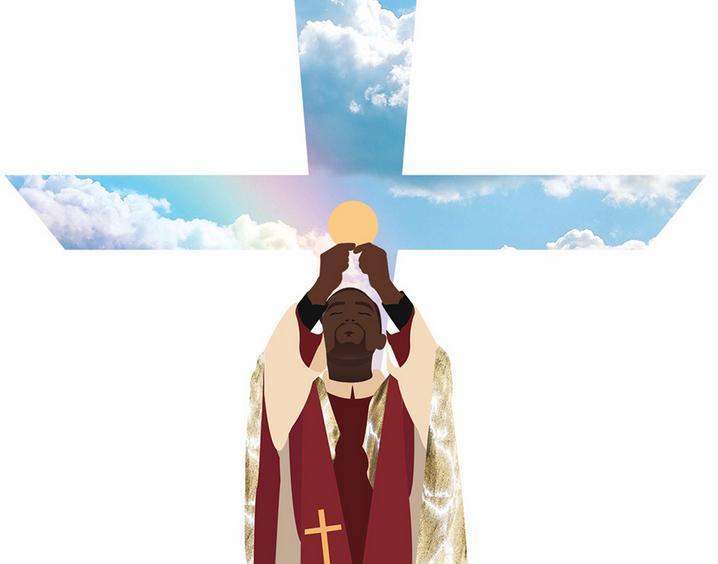
Amid challenges and trials, therefore, the state of mind in all believers must be that Jesus will not abandon when there is truth and light in us. Let us pray that the Holy Spirit will come to lead and teach, to counsel and carry each of us, especially when the times are too much.❖
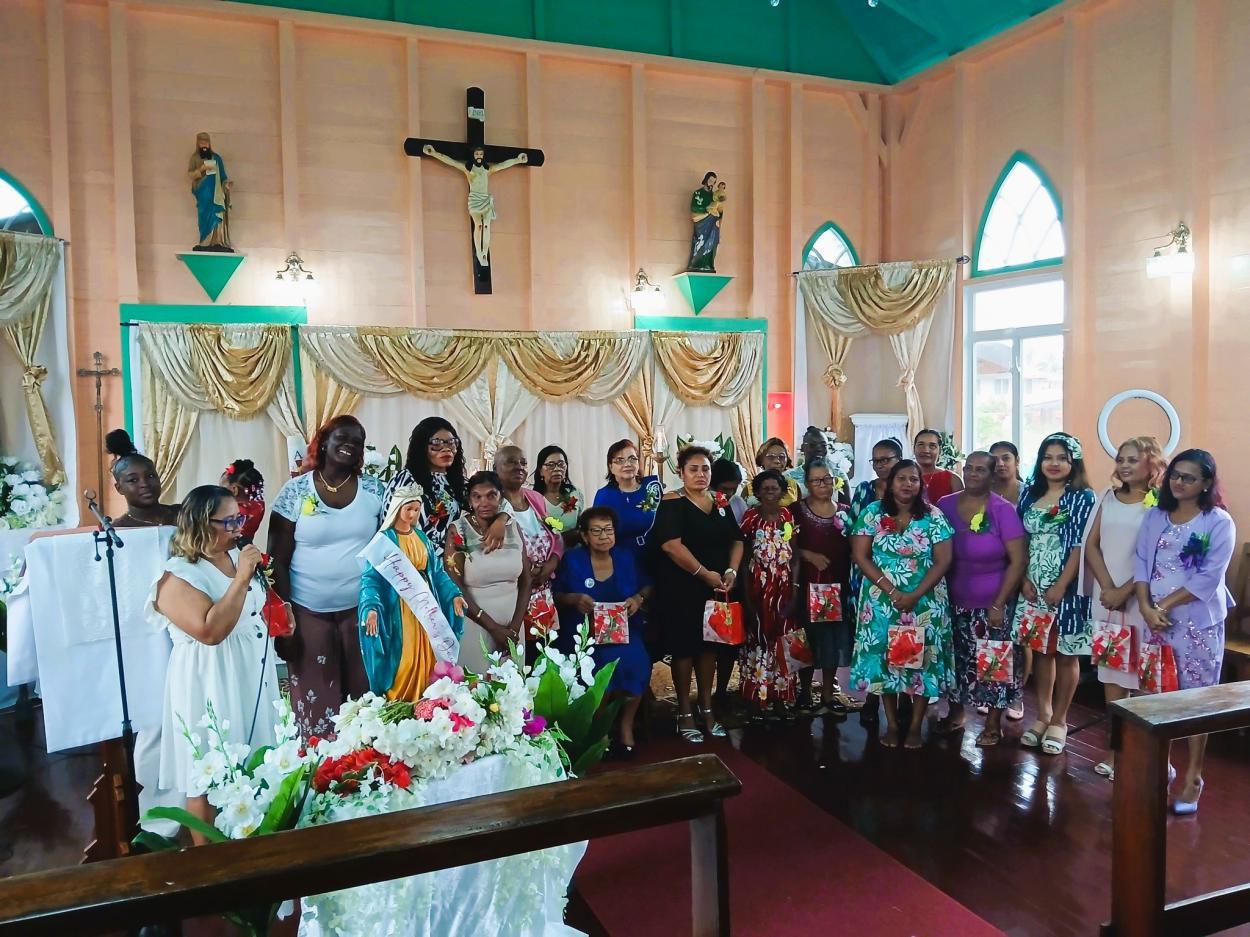
Gracious and loving God, we thank your for the gift of our priests.
Through them, we experience your presence in the sacraments.
Help our priests to be strong in their vocation.
Set their souls on fire with love for your people.
Grant them the wisdom, understanding, and strength they need to follow in the footsteps of Jesus. Inspire them with the vision of your Kingdom.
Give them the words they need to spread the Gospel.
Allow them to experience joy in their ministry.
Help them to become instruments of your divine grace.
We ask this through Jesus Christ, who lives and reigns as our EternalPriest. Amen
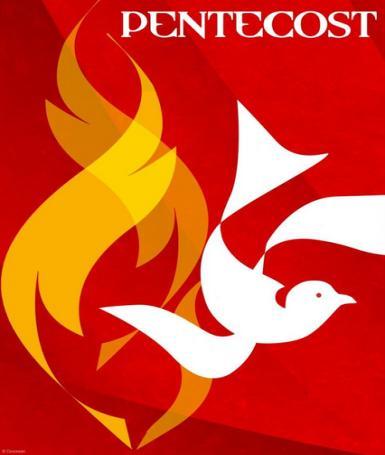

Mother’s Day at St. Joachim's Church, Springlands, Corriverton, Berbice, Sunday May


FIRST READING: Acts 2:1-11
They were all filled with the Holy Spirit, and began to speak.
When Pentecost day came round, they had all met in one room, when suddenly they heard what sounded like a powerful wind from heaven, the noise of which filled the entire house in which they were sitting; and something appeared to them that seemed like tongues of fire; these separated and came to rest on the head of each of them. They were all filled with the Holy Spirit, and began to speak foreign languages as the Spirit gave them the gift of speech.
Now there were devout men living in Jerusalem from every nation under heaven, and at this sound they all assembled, each one bewildered to hear these men speaking his own language. They were amazed and astonished. ‘Surely’ they said ‘all these men speaking are Galileans? How does it happen that each of us hears them in his own native language? Parthians, Medes and Elamites; people from Mesopotamia, Judaea and Cappadocia, Pontus and Asia, Phrygia and Pamphylia, Egypt and the parts of Libya round Cyrene; as well as visitors from Rome- Jews and proselytes alike-Cretans and Arabs; we hear them preaching in our own language about the marvels of God.’
RESPONSORIAL PSALM: Psalm 103:1,24,29-31,34
Response: Send forth your Spirit, O Lord, andrenewthefaceoftheearth.
1. Bless the Lord,my soul! Lord God, how great you are, How many are your works, 0 Lord! The earth is full of your riches. Response
2. You take back your spirit, they die, returning to the dustfrom which they came. You send forth your spirit, they are created; and you renew the face of the earth. Response
3. May the glory of the Lord last for ever! May the Lord rejoice in his works! May my thoughts be pleasingto him. I find my joy in the Lord. Response
SECOND READING: 1 Corinthians 12:3-7; 12-13
In the one Spirit we were all baptised. No one can say, “Jesus is Lord” unless he is under the influence of the Holy Spirit.
Today we reach the finale of the Easter season with the celebration of the great Feast of Pentecost. Reflecting on today’s readings inspires a sense of awe as we consider the mighty power of the Holy Spirit at work giving birth to and sustaining our Church. Just as
There is a variety of gifts but always the same Spirit; there are all sorts of service to be done, but always to the same Lord; working in all sorts of different ways in different people, it is the same God who is working in all of them. The particular way in which the Spirit is given to each person is for a good purpose.
Just as a human body, though it is made up of many parts, is a single unit because all these parts, though many, make one body, so it is with Christ. In the one Spirit we were all baptised, Jews as well as Greeks, slaves as well as citizens, and one Spirit was given to us all to drink.
SEQUENCE
Holy Spirit, Lord of light, From the clear celestial height Thy pure beaming radiance give.
awesome the same Spirit is calling to us this day to take up our part in the Church’s saving work.
In the first reading, from Acts, we see the creative genius of the Holy Spirit moving through the newly confirmed Apostles “who began to speak in different tongues as the Spirit enabled them to proclaim.” The large crowd, gathered from all over the world were “amazed” and “astounded” that each one could understand the Apostles speakingin their own language.
Come, thou Father of the poor, Come with treasures which endure; Come, thou light of all that live! Thou, of all consolers best, Thou, the soul’s delightful guest, Dost refreshing peace bestow; Thou in toil art comfort sweet; Pleasant coolness in the heat; Solace in the midst of woe.
Light immortal, light divine, Visit thou these hearts of thine, And our inmost being fill:
If thou take thy grace away, Nothing pure in man will stay; All his good is turned to ill.
Heal our wounds, our strength renew; On our dryness pour thy dew; Wash the stains of guilt away: Bend the stubborn heart and will; Melt the frozen, warm the chill; Guide the steps that go astray.
Thou, on us who evermore Thee confess and thee adore, With thy sevenfold gifts descend: Give us comfort when we die; Give us life with thee on high; Give us joys that never end
GOSPEL: John 20:19-23
As the Father sent me, so am I sending you: receive the Holy Spirit.
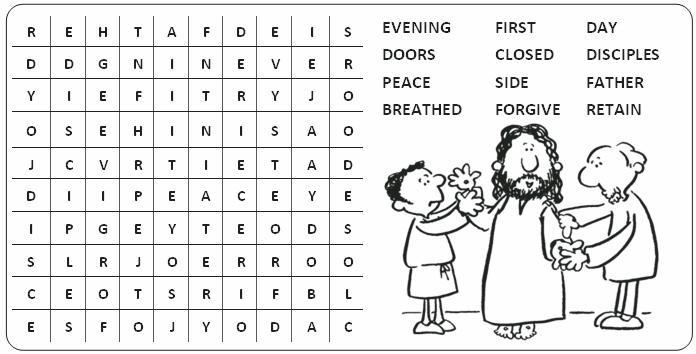
In the evening of that same day, the first day of the week, the doors were closed in the room where the disciples were, for fear of the Jews. Jesus came and stood among them. He said to them, "Peace be with you," and showed them his hands and his side. The disciples were filled with joy when they saw the Lord,and he said to them again, “Peace be with you.
As the Father sent me, so am I sendingyou,” After sayingthis he breathed on them and said: “Receive the Holy Spirit.
For those whose sins you forgive, they are forgiven; for those whose sins you retain, they are retained.” ❖
Each one of us, young and old alike, is personally called today by the Holy Spirit into the same mission as that of the first Apostles to advance the Kingdom of God in our corner of the world. Just as He did on that Pentecost day, the Holy Spirit speaks to us in our “own language” to give us the Good News of the Gospel and urge us to share it. We can think of our own language as the particular gifts, talents and passions we possess. We experience the presence of the Holy Spirit through them and we are meant
put them to the work in grateful service of the Kingdomof God. When we consider the stewardship way of life we are called to live, we often focus on the challenges it poses. Surrendering ourselves to God is indeed a challenging way to live. But it leads to a life that is exciting, creative and deeply rewarding. Stewardship allows us to experience life as a great adventure because it is a life guided and directed by the very source of power and creativity the Holy Spirit! ❖ [www.catholicsteward.com/blog/ ]
Gospel Reflection
When the Holy Spirit empowered the apostles, they changed from a group of timid and scared men and women. They came out from hiding in the upper room with energy, passion, enthusiasm to courageously take on the mission Jesus had left with them. From today’s First Reading, we get the impression that the changes in them happened suddenly. The group of frightened men and women became courageous right after the Holy Spirit came upon them. We must understand, though, that for us, change is hardly ever a sudden or overnight experience. It is a gradual process, full of starts and stops, with much forward and backward movement. For this reason, conversion, in a spiritual sense, can be (and often is) a lifelong process. And thisis the way it must be.One of the greatest dangers facing the Christian is the feeling of contentment that all is well with his or her spiritual life. Such a belief leads to complacency and a barren lifestyle, with no commitment or challenge. For this reason conversion can never be complete. We struggle with it as longas weare alive.
A seed spouts and grows into a plant when the conditions are right for it to do so. With the right soil, water and sunlight, it will come to life. The new life comes from within the seed. The soil, water and sunlight only create the conditions for it to happen. They awaken what is already in the seed and bring it out. If there was no life in the seed, no amount of good soil or water and sunlight will make it grow. Many times we too need to come to life, to be renewed. The Holy Spirit is our soil, water and sunlight. With the Spirit’s help, we can live and grow. But to benefit from the Spirit’s action, we have to respond. Making the right response is not always simple because it is not easy letting go of old attitudes and habits. Those who resist change or who make an empty show of it, are left unawakened and live their entire lives without realising their potential as disciples. ❖
[From:
with the Word of God, The Religious Education Department, Diocese of Georgetown, Guyana ]
Pope Leo urges perseverance in the faith,
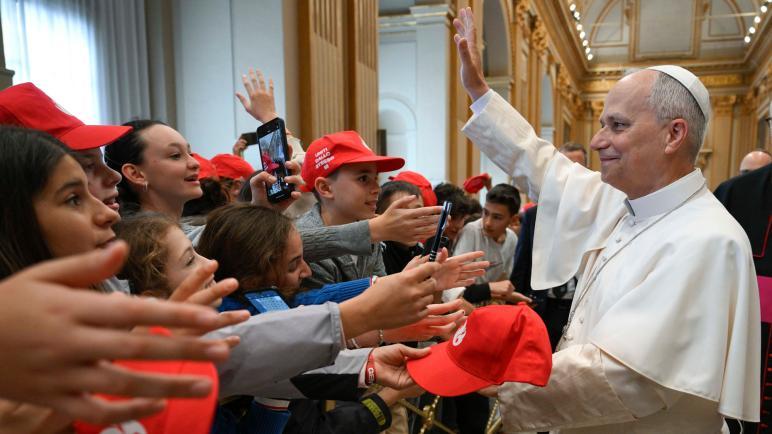
(EWTN News) - Pope Leo XIV lamented that after being confirmed, many young people no longer attend church. He asked those awaiting confirmation to “pay special attention” to one of the gifts of the Holy Spirit, perseverance. The pope met on Saturday, May 16, with those awaiting confirmation from the Archdiocese of Genoa, Italy. In an impromptu message, the Holy Father said that “one of the greatest joys of a bishop is celebrating confirmations, because it is truly a gift of the Holy
Dear Editor,
Our Lady, the Most Holy Virgin Mary, appeared to three child shepherds, JACINTA, LUCIA and FRANCISCO at FATIMA in Portugal on the 13th of May, 1917. These children were from deeply Christian families where they were brought up and educated in the love of God and the fulfillment of His Commandments.
The following is an account of the first Apparition of Our Lady by Sister Lucia, one of the three shepherd children whom Our Lady appeared to at Fatima:


Spirit.”
“It is truly beautiful to receive this sacrament, for the fullness of the Holy Spirit gives us this enthusiasm, this strength, this ability to follow Jesus Christ, to always say ‘yes’ to the Lord, to have no fear of following him with courage, and to live out our faith in a world that so often seeks to draw us away fromJesus,” he told them.
After recalling the significance of the solemnity of Pentecost to be
celebrated on Sunday, May 24 the pope lamented a sad reality: “At times, when the bishop administers confirmation, the gift of the Holy Spirit, the children are never seen again! They disappear from the parish.”
“Don’t forget what you have experienced during this time, including the joy of coming to Rome to celebrate together, to pray together. And may this joy live on in your hearts as you continue to be faithful disciples of Jesus Christ,” Pope Leo urged.
He also invited young people to “persevere in the faith, to return to the parish there are so many activities, so many opportunities but above all in the life of faith, because Jesus Christ wants to walk with you, with each one of you, and with all of you in community, which is so important.
”
“We do not live out our faith alone; we live it together. And forming these relationships of friendship and community is a way of living with perseverance as disciples of Jesus,” he added.
Finally, he called upon those to be confirmed to make a promise to the Lord: “that you truly desire to continue being his friends, his disciples, and his missionaries, and that you desire to persevere in the faith. So, I leave you with these words,” he concluded.❖
Our Lady of Fatima
May 13th, 1917 – While playing with Jacinta and Francisco on the hilltop in the Cova da Iria, making a little stone wall around a bush-like clump called moita, suddenly we saw a flash of lightning. “There is a flash of lightning”, I said to my cousins, “a thunderstorm may come on, it would be better for us to go home.” “Oh yes, of course,” they said. And we began to descend the hill driving the sheep along towards the road. When we reached a large holm-oak half way down the slope, the light flashed again. Then we beheld a beautiful lady dressed all in white, poised over a holm-oak sapling very near to us. She was more brilliant than the sun, radiating a sparking light.

Struck with amazement, we halted before this vision. We were so near that we were bathed in the light that radiated from Her person to a distance of about three feet. Then the Lady said, “Do not be afraid, I will do you no harm.” “Where are you from?” I asked. “I am from Heaven.” “What do you want of me?” “I came to ask you to come here for six successive months, on the 13th day at the same hour. Later, I will tell you what I want. And I will return here yet a seventh time.” “Go then, for you will have much to suffer, but the grace of God will comfort you.” “Say the Rosary every day in order to obtain peace for the world.
Leon Jeetlall
For 121 years, the Catholic Standard has been sharing the Gospel of Jesus Christ.
Now reaching 10,000+ followers on Catholic Media Guyana Facebook plus going straight to your inbox and WhatsApp, our vibrant weekly e-paper is a trusted source which delivers informative and inspiringstories from across the diocese and around the world.
Want to promote your business or event? Advertise with us! Call 675-4542 or email catholicstandardgy@gmail.com ❖
Pope Leo XIV meets with those awaiting confirmation from the Archdiocese of Genoa, Italy, on Saturday, May 16, 2026, at the Vatican. | Credit: Vatican Media
Journeying
Walking together
By Fr. Donald Chambers
When the bishops of the Antilles Episcopal Conference (AEC) journeyed to Rome for their ad limina visit in late April 2026, they entered not merely a series of formal meetings but a lived experience of what synodality lookslike whentaken seriously.
Across encounters with Vatican dicasteries or departments and with Pope Leo XIV himself, a consistent pattern emerged: conversations marked by listening, mutual respect, and a shared search for the voice of the Spirit.
From the outset, the tone was markedly synodal. At the Secretariat of the Synod, the meeting began with a contemplative check-in with the bishops, setting the stage for an exchange rooted in attentiveness to God and to one another. What followed was not a one-way presentation but a dialogue in which Cardinal Mario Grech, his team and the bishops listened and learned together.
This synodal style permeated every encounter. Whether discussing clergy formation, evangelisation, safeguarding of minors, or interreligious dialogue, the approach remained consistent, attentive listening, honest naming of tensions, and a willingness to dwell with complexity rather than rush to quick solutions. As Archbishop Charles Jason Gordon wrote (CS, May 8), the audience with Pope Leo XIV embodied this spirit most vividly. After formal remarks, the Holy Father opened a free and fraternal conversation.
His reflections on the interior life of bishops, the fragility of family life, and the importance of Catholic education were not abstract directives but invitations to deeper discernment. The encounter became a lived expression of a Church that
listens rather than speaks.
Beyond the style of engagement, several themes emerged consistently, offering insight into the Church’s direction. A central insight was that synodality is demanding. It cannot be reduced to structures or documents but requires ongoingconversion.
At the Synod Secretariat, it was emphasised that what is needed is not more texts but sustained practice. While the AEC has made notable progress, especially among bishops, the journey remains uneven.
Some clergy have yet to fully embrace this way of being Church, highlighting that synodality is still beinglearned.
Across the dicasteries, diversity emerged as both a challenge and a gift. The Caribbean’s cultural complexity, shaped by African, European, and Asian influences, was recognised as a unique contribution to the Universal Church. Similarly, the growing presence of missionaries from Africa and Asia brought both opportunities and tensions, particularly around culture and collaboration. The message was clear. Unity does not require uniformity. Synodality invites the Church to hold differences together in communion, discerning the Spirit within diversity.
A recurring concern was the erosion of traditional structures for transmitting the faith, especially family life and Catholic education. At the Dicastery for the Doctrine of the Faith, this was reframed as a need to recover the kerygma how can we find new ways of proclaiming a living relationship with Jesus Christ? Faith is not primarily passed on through instruction but through the encounter with Jesus Christ within a faith community. This insight aligns closely with the synodal vision a Church that
forms disciples through relationships of belonging and shared experience.
Several dialogues highlighted the importance of engaging with the concrete realities shaping Caribbean life. Issues such as migration, political instability, and the enduring, painful legacy of slavery surfacedrepeatedly.
At the Dicastery for Promoting Integral Human Development, bishops raised the complex question of reparations for the Transatlantic Slave Trade and the long dark shadow of the plantation economy.
Journeying with the Word of God
MAKING THE WORD OF GOD YOUR OWN
The Dicastery’s response emphasised that discernment is rooted in our local experience, which is accompanied but not dictated by the Universal Church. This approach reflects a deeper synodal instinct that the Church must listen seriously to the voices of history and the wounds of its people.
Perhaps the most far-reaching theme was recognising synodality as a form of “social prophecy.” In a world marked by division, authoritarian tendencies, and polarisation, the Church’s commitment to listening and shared discernment offers a countercultural witness.
At the Synod Secretariat, this was expressed clearly. Synodality is not only an internal ecclesial method but also a contribution to the “humanisation of society”. In this light, the Caribbean Church, shaped by diversity and resilience, has much to offer the wider world.
The ad limina visit ended not with final answers, but with a renewed sense of a journey. Across the various encounters, one message stood out: the Church is still learning what it means to be synodal.
For the bishops of the AEC, the ad limina affirmed both the challenges and the promise of this path. Synodality requires patience, humility, and courage. It asks the Church to listen more deeply, to discern more carefully, and to act together rather than alone.
What unfolded in Rome was more than a series of meetings. It was a glimpse of a Church in transition, one that is slowly, and sometimes imperfectly, learning to “walk together”.❖
Fr. Donald Chambers of the Archdiocese of Kingston, Jamaica, is the General Secretary of the Antilles Episcopal Conference.
Step 1: Lookattoday’sReadingsprayerfully.
1st Reading: This passage from the Acts of the Apostles describes the descent of the Holy Spirit on the apostles and the effect it had on them.
2nd Reading: Paul points out that the Holy Spirit gives different gifts to different people, but always for the good of God’s People, the Church.
Gospel: The Risen Jesus appears to his disciples and gives them the gift of the Holy Spirit. So begins the missionof the Church.
Step 2: ApplyingthevaluesoftheReadings toyourdailylife.
1.Do you feel a sense of empowerment in your life? Does your relationship with Jesus make you feel this way? What do you feel empowered to do?
2.It is not easy to get rid of old habits and attitudes as we journey along the road of conversion. What are the old habits and attitudes you feel you need to get rid of?
3.Pentecost is called the “birthday of the Church”. In the light of the First Reading, why is this title suitable?
4.It is said that the gift of the Holy Spirit is not a gift to be kept to oneself. What do you think of this statement?
Step 3: Accepting the message of God’s Wordinyourlifeoffaith
The Holy Spirit working in our lives empowers us to speak a new language to the world. It is the language of peace instead of war, of co-operation and not competition, of forgiveness rather than revenge, of tolerance instead of prejudice, of hope instead of despair, of unity instead of division, of love rather than hate. And we must start somewhere, even if it is in our own family at first.
Step 4: Somethingtothink&prayabout 1.For most of us, conversion is a slow growth process. Conversion doesn’t happen overnight, at the snap of a finger. It is a constant renewal of self, a striving towards the light of Jesus. There are too many distractions in life to make our journey of conversion a simple matter. Reflect on your own conversion journey. How has it been for you? What obstacles have you encountered (or is encountering) along the way? Do you sometimes feel imprisoned by fear, doubt, hopelessness and habits of sin? ❖
[From: Journeying with the Word of God, The Religious Education Department, Diocese of Georgetown, Guyana ]
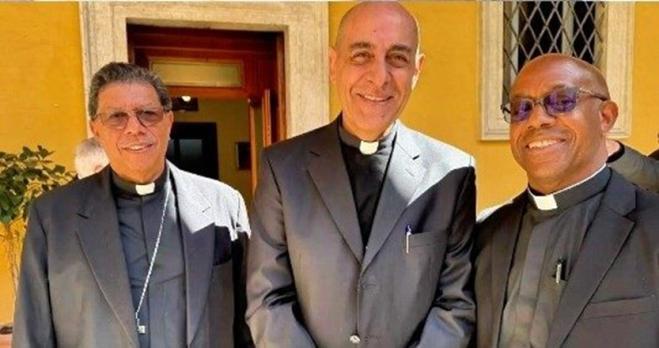
Archbishop Charles Jason Gordon of Trinidad & Tobago (left) and Fr. Don Chambers (right) with Cardinal Víctor Manuel Fernández, Prefect of The Dicastery for the Doctrine of the Faith
As Ebola epidemic spreads, Uganda postpones Martyrs Day celebrations
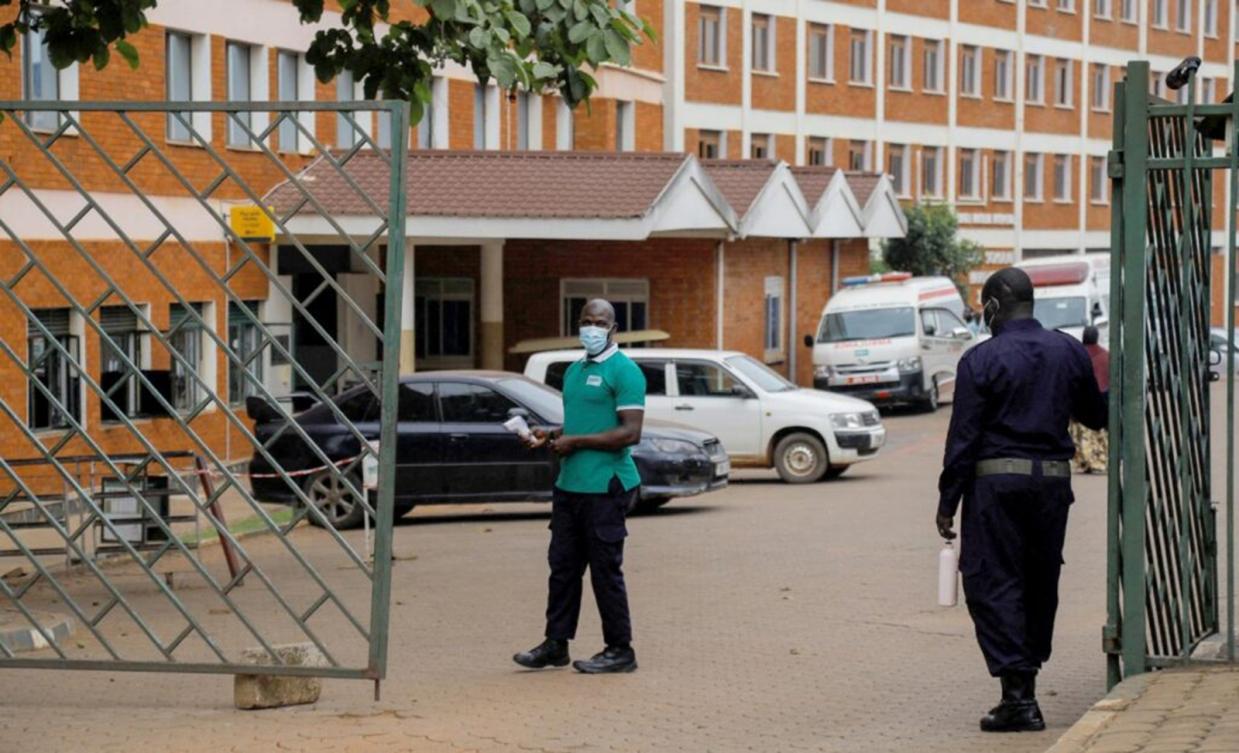
(OSV News) Catholic bishops in Uganda have urged the people to remain calm after the government postponed the annual Martyrs Day celebrations, following an Ebola outbreak in the East African region.
The epidemic caused by Bundibugyo virus one of the several that cause the disease in humans has hit Congo and Uganda.
By May 20, at least 139 people had died out of the suspected 600 cases in Congo. Of the 600 suspected cases, the WHO said 51 had been confirmed in the country’s northern provinces of Ituri and North Kivu.
An American doctor who contracted Ebola in Congo has been flown to Germany for treatment, along with his wife and four children. Peter Stafford, a surgeon and leader of the Christian missionary group Serge, operated on a patient with Ebola not knowing the patient was infected and before the outbreak was detected, The Guardian reported.
Impact felt in Catholic community
But as the disease spreads, its impact is being felt among the Catholic community in Africa, as it forces the postponement of the Uganda Martyrs Day celebration. The event, marked every year on June 3 at Namugongo Shrine near Kampala, the capital, is one of the most important in the African Catholic and Christian calendars.
Millions of pilgrims travel for the event, with thousands walking long distances to the shrine, but now those who had started the journey this year have been urged to turn back.
Bishop Joseph Anthony Zziwa of Kiyinda- Mityana, president of the Ugandan bishops’ conference, urged the people to remain calm, prayerful, united and hopeful following the postponement.
“The witness of the Uganda Martyrs continues to inspire the Church and the nation, reminding us that true faith is lived daily through love, sacrifice, truth and fidelity to God,” said the bishop in a May 18 statement.
Diocesan celebrations of Martyrs Day urged
Bishop Zziwa encouraged the faithful to celebrate the day in parishes, following the guidance of the diocesan bishop and relevant government authorities, while stressing the commemoration as a profound witness of faith, courage, fidelity to Christ and “steadfast commitment to Christian values.”
“Let us join in prayer for our nation, health workers and all those affected by the circumstances that necessitated the postponement,” said the bishop. Earlier, the nation’s President Yoweri Museveni had announced the postponement of observances to a later date, reportedly after consultations with the national epidemic response task force and religious leaders.
Concentrated in overcrowded region
Since then, reports indicate that the epidemic is concentrated in the region characterized by severe overcrowding and intense population movement. It is in Ituri where an American doctor contracted Ebola.
Archbishop Marcel Utembi Tapa of Kisangani, Congo, said the people, especially those in Ituri province, were afraid of the virus, fearing that many in Mongwalu and Bunia towns were infected.
“As a church, we are calling on the government and the international community to step up efforts and work together to stop the epidemic,” Archbishop Tapa told OSV News.
The archbishop said he was pleased that the government was giving attention to the epidemic and some help was coming from outside. He urged the affected countries to work together against the epidemic.
“May God help his people,” said the archbishop.
CRS mobilizing to support communities
“This decision was made because Uganda receives thousands of pilgrims annually from Eastern Congo, which is currently experiencing an Ebola outbreak. To safeguard everyone’s lives, it is essential that this important event be postponed,” said the president on May 17.
“I encourage those who had begun their journey to return home, continue observing the precautionary measures, report anyone who is sick, and encourage those who are ill to seek medical care.”
Latest outbreak is 17th since 1976
The latest outbreak is the 17th since 1976 when Ebola was discovered in Congo. The most common clinical signs of the disease are fever, headaches and vomiting.
The current disease is caused by the Bundibugyo strain, which was identified in 2007 and is considered rarer, and there is no approved vaccine or specific treatmentfor it.
The Congolese Ministry of Public Health officially declared the new outbreak May 15. The World Health Organization May 17 further declared it a public health emergency of international concern, but said it had not reached pandemic levels.
According to an overview from the Provincial Health Division in Ituri, Congo, the first case was reported in late March in a town located some 50 miles from Bunia, the provincial capital of Ituri.
Meanwhile, Catholic Relief Services, the U.S. Church’s overseas relief and development agency, said it was rapidly mobilizing to support communities and limit further spread of the virus.
“It started slowly, but it is spreading quickly,” said Rafaramalala Volanarisoa, CRS’ head of office in Congo in May 20. “The fear is that there are many more unidentified cases. At the same time, health workers lack the equipment needed to protect themselves and care for patients.”
CRS is leveraging partnerships with local church networks in Ituri and North Kivu, including local Caritas branches, to reach communities in remote and high-risk areas, where trust is critical.
“The Catholic Church is deeply rooted” in Congo, said Volanarisoa. “Forty-five percent of health centers here are run by the Catholic Church. They can reach the remote villages, and people trust them. Those connections are going to be key to resolving this crisis.”
Amid fear and increased misinformation, the organization is supporting community awareness and education, and delivering lifesaving information andearly Eboladetection. ❖
Workers stand guard at the gate of the Kibuli Muslim Hospital in Kampala, Uganda, May 16, 2026, where a Congolese man died of the Ebola Bundibugyo virus. (OSV News photo/Abubaker Lubowa, Reuters)
Dear Girls andBoys,
Think of a balloon before it is blown upwhat does it need to look and act like a balloon? You are right - it needs to be filled with air! Before a balloon can fulfill its purpose, someone must breathe some life into it.
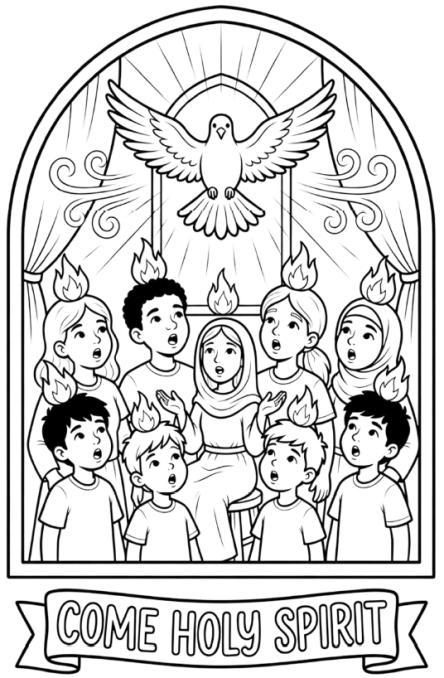
A balloon can help us to learn something about the church. Today is a very special day. It is a day we call Pentecost. Do you know what happened on that the day of Pentecost? It was the day that God sent his Holy Spirit to breathe life into His church so that the church would be all that God intended for it to be. Before God sent his Holy Spirit, the church was lifeless - like a balloon before it is blown up. The church was not witnessing and telling people about Jesus. After the Holy Spirit breathed life into the church, people began telling everyone they saw about Jesus. It didn't even matter if they spoke the same language. They told everyone about Jesus and they understood. Thousands of people were added to the church. The church became alive and was doing the thingsGodhad commanded.
Rememberthat just as a balloon needs to be filled to be what it was intended to be, we need the Holy Spirit to fill us so that we can be all thatGod wantsus tobe.
We thank you, Lord God, for sending your Holy Spirit. We thank you for breathing life into the church and we thank you for giving your spirit to all who believe. In Jesus' name we pray, Amen. ❖
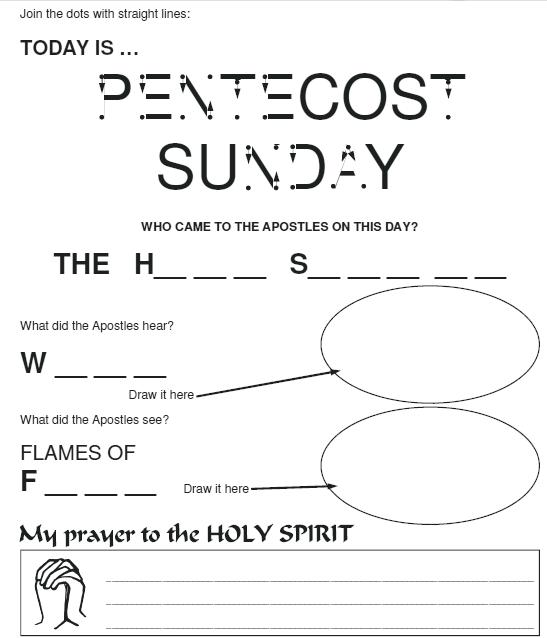
Unscramble each word and then place the numbered letters in the numbered boxes at the bottom to reveal the answer.
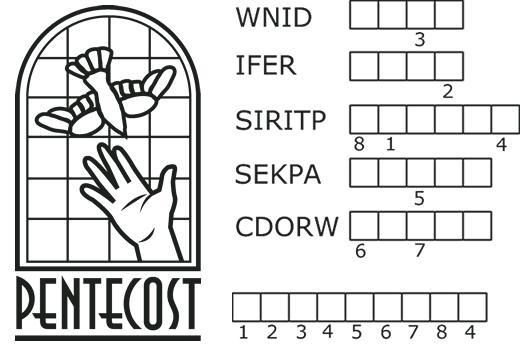
1. A sound like the blowing of a violent _______ came from heaven.
2. They saw what seemed to be tongues of ______.
3. All of them were filled with the Holy _______.
4. They began to ______ in other tongues as the Spirit enabled them.
5. Peter stood up and spoke to the ______ of people.
Answer: All of these events took place on the day of ___________.
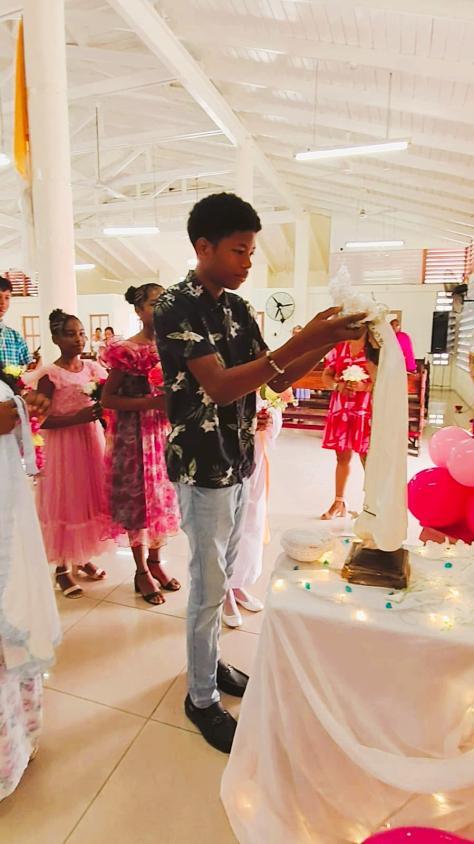
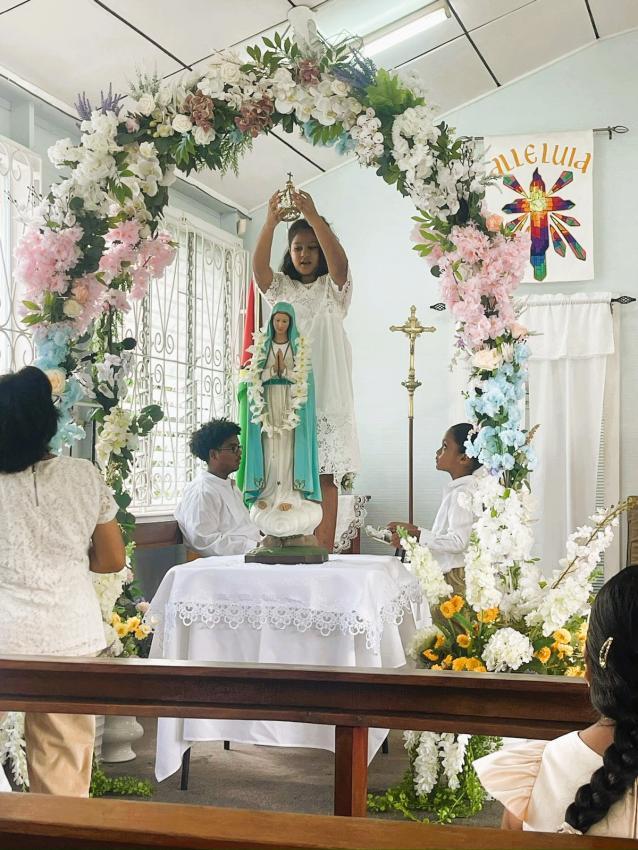
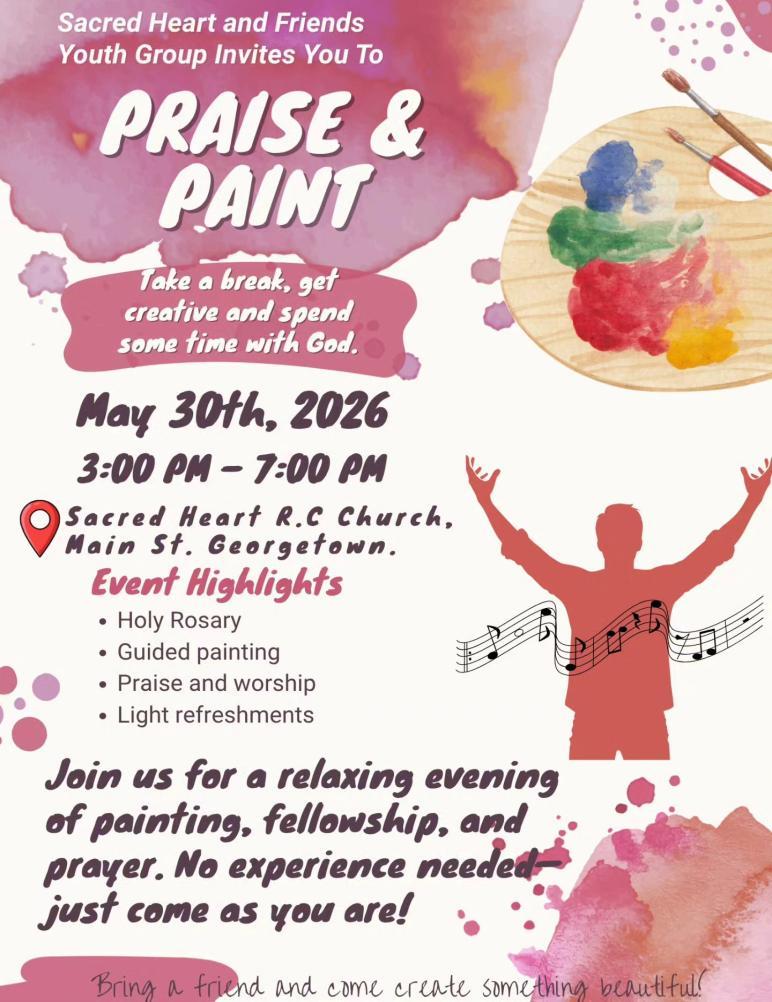
Crowning of Our Lady 2026
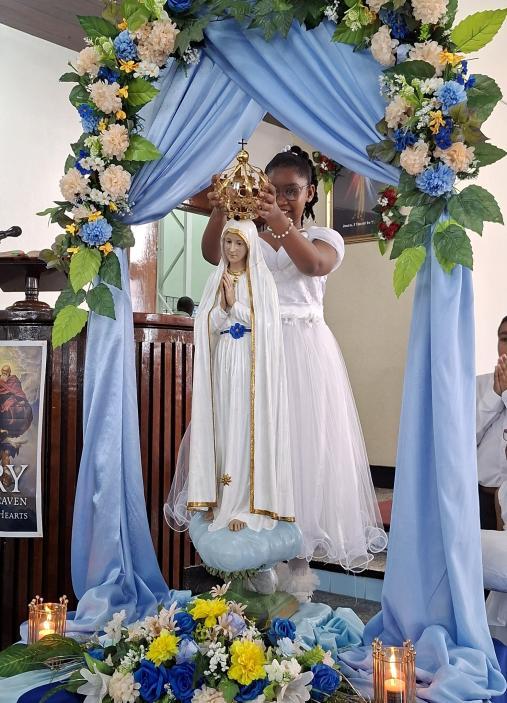
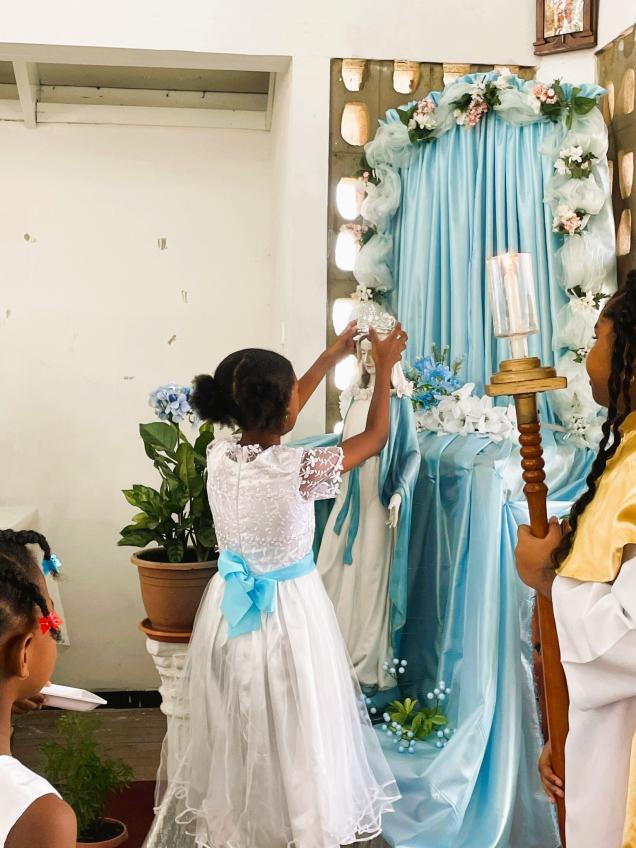
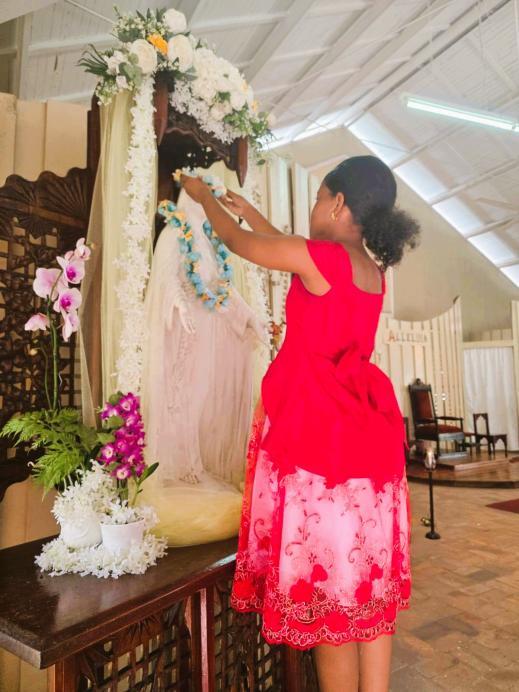
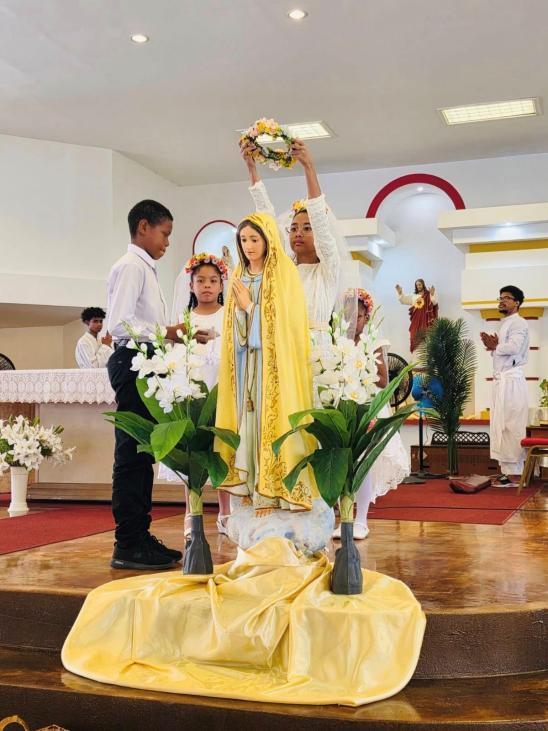
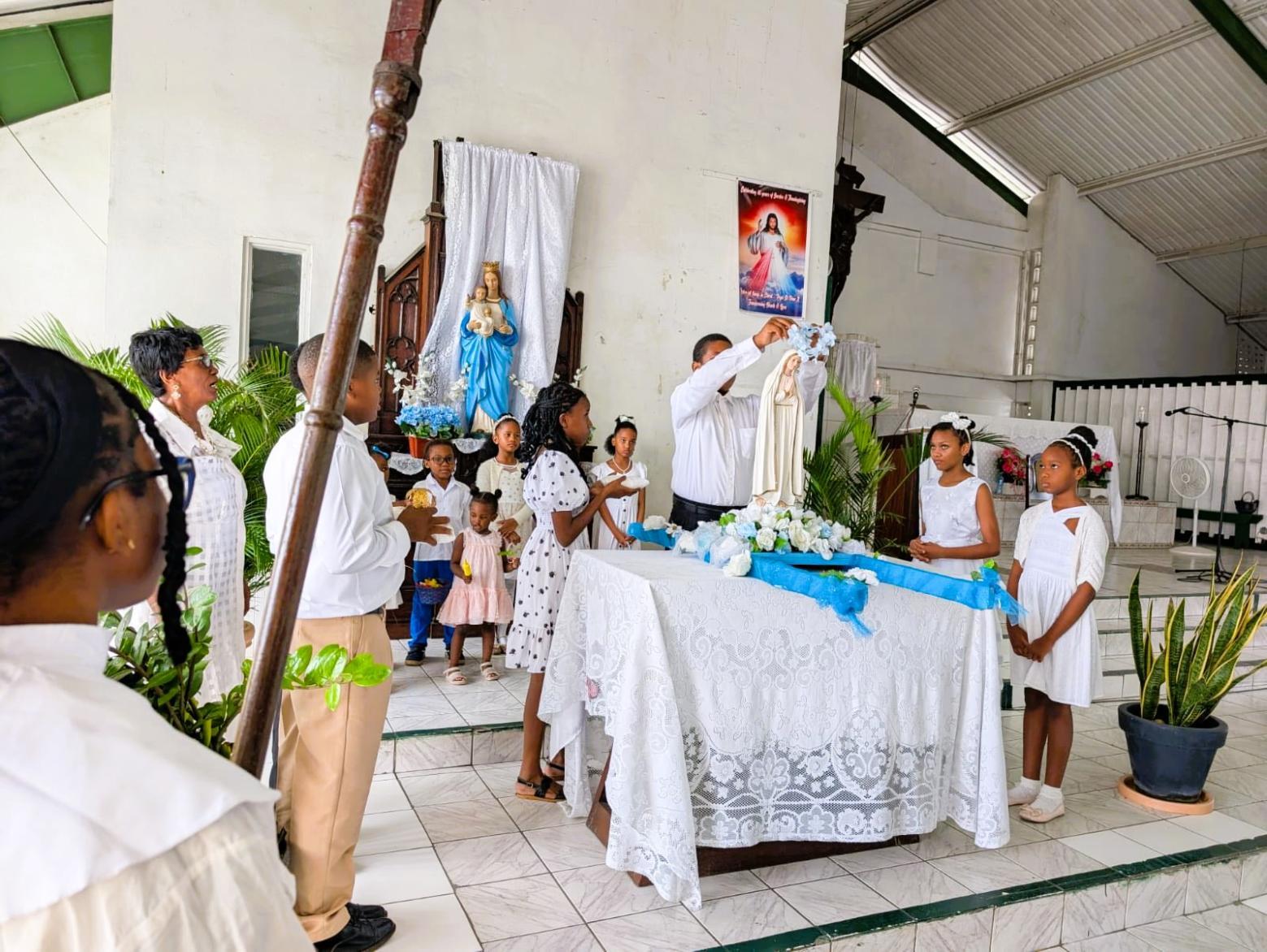
Holy Spirit
St. Teresa Sacred Heart
Fatima
St Pius X
Holy Rosary Bartica
Living Integral Ecology: Hearing the Cry of the Earth and the Poor
Fr Joel Thompson SJ
One of the top issues that this generation cares about is climate change This is also something that the Church is also very passionate and vocal about.
Every year, from May 17th to May 24th, the Catholic Church celebrates Laudato Si’ Week. This annual observance marks the anniversary of Pope Francis’s landmark encyclical, Laudato Si’: On Care for Our Common Home (May 24th, 2015). Concluding just ahead of World Environment Day on June 5th, this week serves as a timely reminder for Catholics to reflect deeplyonour careforcreation. In this letter, Pope Francis reminds us that the earth and all it contains are deliberate gifts from God. This is revealed in sacred scripture: “God saw all that he had made, and it was very good” (Genesis 1:31). The world is not a blank slate for unrestricted exploitation, but a beautiful masterpiece which reflects its Creator. As the Catechism notes, “The beauty of creation reflects the infinite beauty of the Creator” (CCC 341), and each creature possesses its ownparticular goodness.
Facing the Reality of Our Common Home
What prompted this urgent letter? Pope Francis looked honestly at the realities threatening our planet. The general scientific agreement is undeniable: our common home is gradually warming, and atmospheric carbon levels are rising. Climate data from NASA and NOAA confirms that the last few years have been the warmest on record in human history, with 2024 breaking global temperature records, closely followed by 2023 and 2025 (you can check this for yourself with a Google search!).
Much of this rapid warming is driven by the excessive exploration and consumption of fossil fuels like oil. The Intergovernmental Panel on Climate Change (IPCC) continues to warn that we operate within a closing window. Unless we change our direction within

Hear both the cry of the earth and the cry of the poor Laudato Si’, 49
the next 10 years, we will lock in the most devastating, irreversible effects of climate change (e.g. droughts, floods, forest fires etc.)
What is Integral Ecology?
What makes the Church’s approach uniquely powerful is the concept of integral ecology. Pope Francis insisted that social and environmental crises are not separate but deeply connected: “We are faced not with two separate crises, one environmental and the other social, but rather with one complex crisis which is both social and environmental" (Laudato Si’, 139).
The crisis stems from us humans forgetting our true nature as creatures. A creature acknowledges dependency, protecting and caring for its home rather than harming it. What kind of creature would burn down its home intentionally? An integral ecology helps us to see that caring for the poor goes hand-in-hand with caring for the planet.
Human life is essentially relational, grounded in harmonies with God, neighbor, self, and the earth. Pope Francis beautifully suggests that the earth itself is a suffering neighbor: “This sister now cries out to us because of the damage we have inflicted on her” (Laudato Si’, 2). Have
you ever thought of the planet as a neighbor requiring your love?
Living Integral Ecology
Living out this calling requires an “ecological conversion” which is shown in our daily, humble choices. Here are a few suggestions:
1.Resisting Overconsumption: The Global Footprint Network reports that human demand currently uses the equivalent of 1.7 Earths annually. Earth Overshoot Day marks the date we exhaust what the planet can regenerate in a year. We must embrace Christian simplicity, consuming only what we need, not shop till you drop.
2.Rejecting the “Pile of Filth”: Pope Francis sharply observed that “the earth, our home, is beginning to look more and more like an immense pile of filth” (Laudato Si’, 21). We can stop this by eliminating litter, recycling, limiting single-use plastics, using reusable shopping bags, carpooling, and carrying a refillable water bottle.
3.Promoting a Just Green Transition: While oil has historically driven development, true care and responsibility means recognizing its ecological limits. Yes, economies need energy, but do we need so much? We must support a transition
toward renewables (solar, wind, water) and recognize when resources are better kept in the ground. Solar farms in some interior locations in Guyana are a very good step in this direction.
4.Confronting “Ecological Sin”: Harming the environment is a moral failingagainst God’s design. The Catechism explicitly notes that our “dominion” (a better word is care) over inanimate and other living beings granted by the Creator is not absolute; it is limited by concern for the quality of life of our neighbor, including generations to come” (CCC 2415).
With much of Guyana’s coastal zone sitting below sea level, how does a developing population adapt to a slow -moving, rising tsunami caused by global emissions?
Furthermore, intensive gold and mineral mining operations in the interior threaten to destroy pristine forests, pollute life-giving rivers with mercury, and disrupt the food supplies of indigenous communities. These extraction projects promise quick wealth, but at what human and spiritual cost? If the energy and money spent on mining was spent on agricultural enterprises, the possibilities would be beautiful. Despite adaptation measures, climate change still threatens the food supply and security of Guyanese, especially those in the hinterland.
Conclusion: An Ethic of Care
True solutions cannot rely on false technological or financial fixes. Pope Francis reminds that “the external deserts in the world are growing, because the internal deserts have become so vast.” (Laudato Si’ 217).
The environmental crisis is a spiritual crisis. An ethic of care for creation calls us to live simply, make wise choices, and help keep Guyana clean, green and beautiful for generations to come. As we prepare to celebrate world environment day, let us fiercely care for our common home.❖


Pope to publish encyclical on AI May 25 (From
take part in the press conference. Pope Leo XIV and Cardinal Pietro Parolin,the Vatican Secretary of State, will give speeches at the end of the press conference.
Pope Leo XIV has expressed interest in the issue of artificial intelligence and the dignity of work since the first week of his pontificate, telling the College of Cardinals days after his election in May 2025 that he took his papal name partly in honor of Pope Leo XIII, whose landmark encyclical “Rerum Novarum” has shaped the Church’s social teachingfor more than a century.
“In our own day, the Church offers to everyone the treasury of her social teaching in response to another industrial revolution and to developments in the field of artificial intelligence that pose new challenges for the defense of human dignity, justice and labor,” Pope Leo XIV said two days after his election.
Front Page)
not replace them. The pope has also warned priests not to use chatbots to write their homilies and expressed concern for AI’s potential effect on children’s “intellectual and neurological development.”
“Use AI in such a way that if it disappeared tomorrow, you would still know how to think” PopeLeoXIV
Artificial intelligence is a reoccurringtopicforPopeLeo
The first American pope and a former mathematics major, Pope Leo has returned to the subject of AI again and again in speeches, messages and interviews in his first year, leading Time magazine to include him on its 2025 list of the world’s most influential people in artificial intelligence, with the magazine describing him as a spiritual counterweight to Silicon Valley.
Pope Leo has addressed the issue of AI in venues ranging from a sports stadium packed with teenagers, whom he told to use AI “in such a way that if it disappeared tomorrow, you would still know how to think,” to a gathering of legislators from 68 countries, where he insisted that artificial intelligence is a tool meant to serve human beings,
The pope’s 2026 message for the 60th World Day of Social Communications, published in January, has been his most robust document on AI and protecting human dignity to date. In the papal message, he underlined that “our faces and voices are unique, distinctive features of every person” that reveal “a person’s own unrepeatable identity” and that by “simulating human voices and faces, wisdom and knowledge, consciousness and responsibility, empathy and friendship,” AI systems “encroach upon the deepest level of communication, that of human relationships.” Pope Leo also warned that AI systems “have increasingly taken control of the production of texts, music and videos,” putting “much of the human creative industry at risk of being dismantled and replaced with the label ‘Powered by AI,’ turning people into passive consumers of unthought thoughts and anonymous products without ownership or love.”
“The ability to access vast amounts of data and information should not be confused with the ability to derive meaning and value from it. The latter requires a willingness to confront the mystery and core questions of our existence,” Pope Leo said in a December speech to participants in an AI conference.
“It will therefore be essential to teach young people to use these tools with their own intelligence, ensuring that they open themselves to the search for truth.”❖

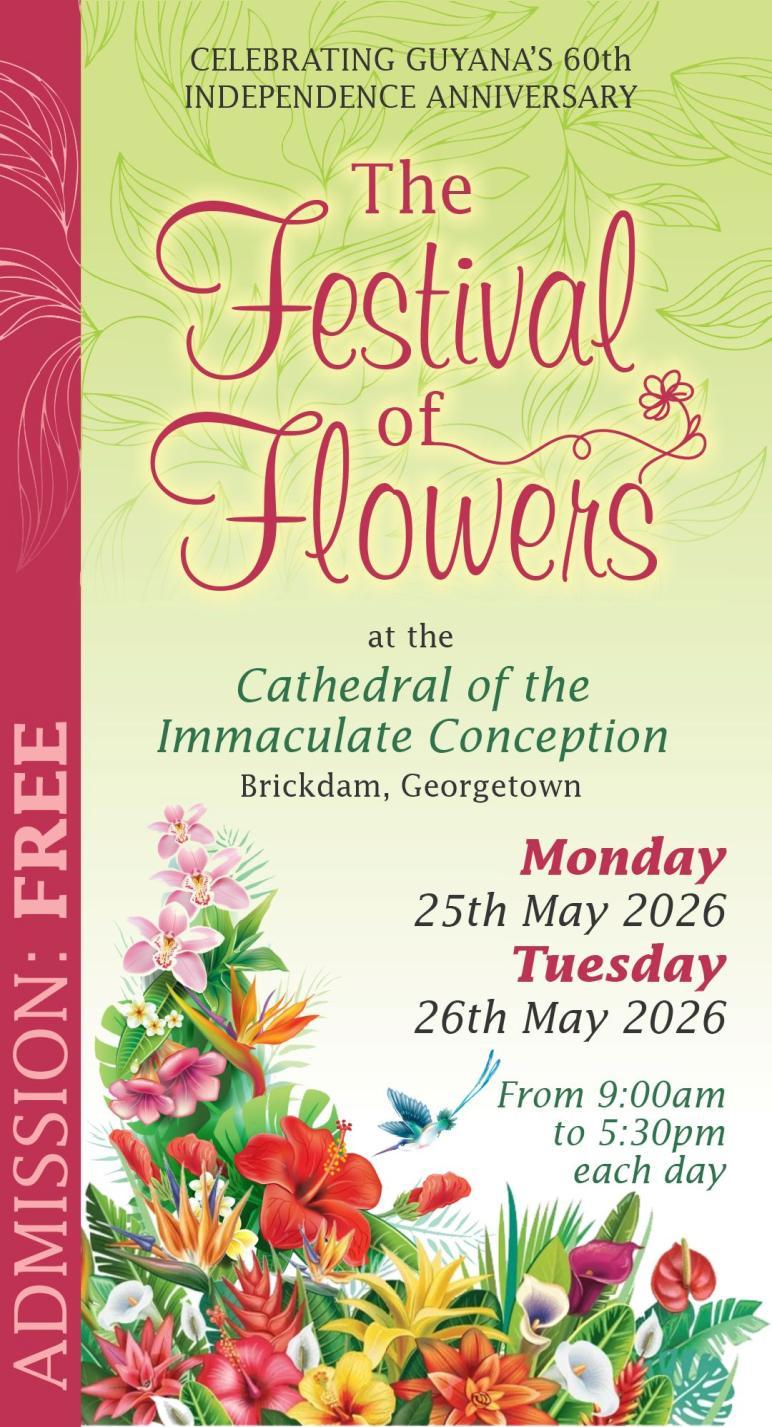
be on display at the
Last December, the Cathedral of the Immaculate Conception observed the 100th anniversary of it opening. The Holy Father Pope Leo XIV sent his Apostolic Blessing to Cathedral Administrator Fr. Joel Rathna and the Cathedral Parish on that significant event. The document, which was received in early January, will be on display at the Festival of Flowers, being held at the Cathedral to celebrate Guyana’s Diamond Jubilee of Independence. The Festival of Flowers is open to the public on Monday 25th and Tuesday
26th May from 9:00am to 5:00pm each day.
All are invited to view the floral displays throughout the Cathedral and spend some time enjoying the music played by various Musicians.
The last Festival of Flowers was held at the Cathedral eleven years ago to mark the centenary of the laying of the foundation of the Cathedral. This event is only held to mark significant milestones in history. ❖
Independence Memory Lane Saint of the Week
By Francis Canzius Papal delegate attends Independence Celebrations
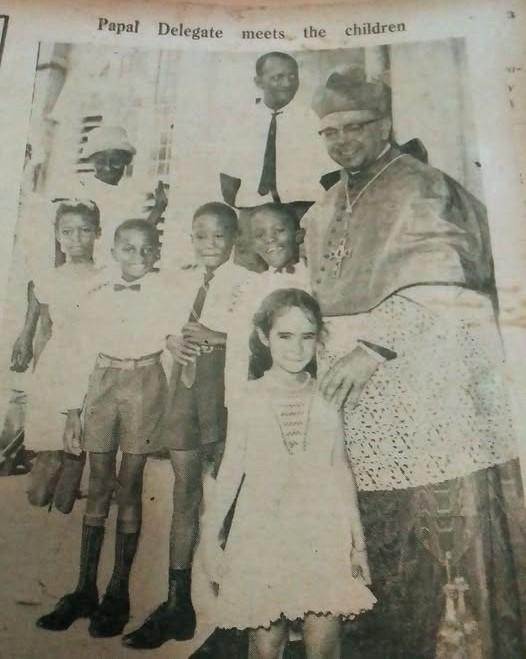
The representative of the Holy See spent a week in Guyana taking part in the celebrations and visiting various Catholic Institutions. As Papal Nuncio to El Salvador, Archbishop Bruno Tropighani was Pope Paul VI’s representative at the Independence celebrations. Among the events he attended with Bishop Guilly was the flag raisingceremony at the National Park. He was welcomed at the Cathedral on Monday the 23rd of May 1966 with twelve Priests and Bishop Guilly waiting in the sanctuary. A welcome address was given by Bishop Guilly to which the Archbishop replied. This was followed by Solemn Benediction after which Archbishop Tropighani met many of the Faithful present. This was followed by a reception at the Ursuline Convent to which several heads of other denominations were invited.
The Archbishop stayed at the Brickdam Presbytery. The Government provided a Guard at the Presbytery twenty four hours every day and provided a chauffeur-driven car with police escort.
The photo shows Archbishop Tropighani meeting children outside the Cathedral. ❖
May 26th: Saint Philip Neri
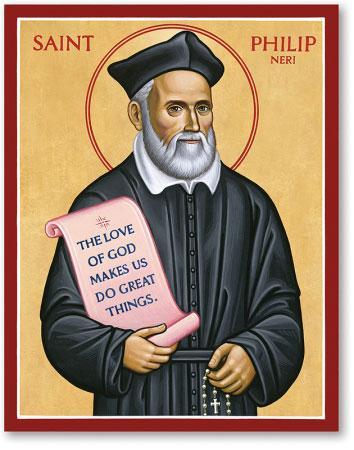
Renowned for his prayerfulness and sense of fun and humour, Philip was born in Florence, Italy in 1515. Philip’s appealing personality was winning him friends from all levels of society, from beggars to cardinals. He gathered a community of friends to look after the sick, which eventually became the Oratory.
At the urging of his confessor, Philip was ordained a priest and soon became an outstanding confessor himself, gifted with the knack of piercing the pretenses and illusions of others, though always in a charitable manner and often with a joke. He arranged talks, discussions, and prayers for his penitents in a room above the church. He sometimes led “excursions” to other churches, often with music and a picnic on the way.❖
[franciscanmedia.org & salfordliturgy.org.uk ]