
ANNA LAPWOOD
The organ superstar and Trust Ambassador on joyful music-making and mental health
We discover why Evensong is flourishing abroad
We talk to the teenagers who love singing in choirs THE MAGAZINE OF CATHEDRAL MUSIC TRUST // SPRING 2026 //
YOUTH SPEAK
CHOIRS IN EUROPE MOVING TRIBUTE
Why Herbert Howells composed a piece for John F Kennedy

just £30 a year A Cathedral Music Trust Friendship is the perfect gift for a choral and organ music lover. Give someone special the chance to delve deeper into the heart of cathedral music. Buy now at: www.cathedralmusictrust.org.uk/friends or for further information please email katy.ashman@cathedralmusictrust.org.uk
CATHEDRAL MUSIC TRUST
Royal Patron
HRH The Duchess of Gloucester
President
Harry Christophers CBE Ambassadors
Alexander Armstrong, Anna Lapwood MBE Board of Trustees
Jonathan Macdonald (Chair), Daniel Benton, James Gurling OBE, David Hill MBE, Stuart Laing, Giverny McAndry, Heather Morgan, Isobel Pinder, Gavin Ralston, Graham Robinson, Simon Toyne, Rosie Woodall
CEO
Jonathan Mayes
Programmes Director
Cathy Dew
Programmes Manager
Anna Elliss
Development Director
Leila Alexander
Development Officer
Katy Ashman
Volunteer & Events Coordinator
Hannah Capstick
Digital & Communications Manager
Laura Cottrell
Director of Finance & Resources
Dan Bishop
Finance Officer
Amanda Welsh
Cathedral Music Trust is extremely grateful to our team of volunteers across the UK who give many hours of their time each year to support the work we do.
Cathedral Music Trust 27 Old Gloucester Street London WC1N 3AX info@cathedralmusictrust.org.uk 020 3151 6096 (office hours) www.cathedralmusictrust.org.uk
Registered Charity Number 1187769

CATHEDRAL MUSIC MAGAZINE
Editor Rebecca Franks editor@cathedralmusictrust.org.uk
Designer Jo Craig
Production Manager Kyri Apostolou
Cathedral Music is published for Cathedral Music Trust by Mark Allen Group twice a year, in May and November. Spring 2026
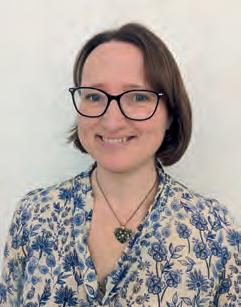
AFROM THE EDITOR
nna Lapwood MBE became one of the Ambassadors for Cathedral Music Trust in 2022, joining Alexander Armstrong, and it was a delight to talk to her for this issue of Cathedral Music (p30). She has recently embarked on a new chapter in her career, bidding farewell to her job as music director of Pembroke College Choir in Cambridge to focus on her meteoric rise as an organist. With sell-out concerts and a social media following in the millions, Lapwood has made the organ a popular hit. But it hasn’t always been easy, she tells me, and performance anxiety almost made her walk away from the instrument at one point. Taking on an unofficial pastoral role for her university students was another challenge, proving both a privilege and profound responsibility that many a choral leader will recognise.
In fact, we dive deeper into the myriad skills now so often demanded of music directors on p36, sharing new research by Cathedral Music Trust into what training is currently on offer. And if the job can sometimes feel overwhelming, then turn to our panel of teenagers from around the country for a dose of inspiration, as they share why they love singing in cathedral choirs so much (p32).
Our theme this issue of how singing and music-making can positively impact wellbeing feeds into our exploration of Howells’s Take him, Earth, for cherishing, a feature inspired by reflections first shared in a sermon by the Revd Canon Emma Davies of Leicester Cathedral and now with Cathedral Music readers. This beautiful anthem was written to commemorate the assassination of John F Kennedy but became a vessel for the composer’s private grief for the death of his son. As Davies writes, ‘Howells creates music that expresses deeper truth beyond simple meaning’, perfectly summing up the power of this artform.
Elsewhere, we have a splendid selection of new organ and choral CDs in our reviews section, write-ups of the latest sheet music and books, plus of course all the latest news from the cathedral music sector. I hope you enjoy the issue.
Rebecca Franks, Editor of Cathedral Music
The views expressed in articles are those of the contributor and do not necessarily represent any official policy of Cathedral Music Trust.
Advertisements are printed in good faith, and their inclusion does not imply endorsement by the Trust; all communications regarding advertising should be addressed to info@cathedralmusictrust.org.uk.
Every effort has been made to determine copyright on illustrations used; we apologise for any mistakes we have made. The Editor will be glad to correct any omissions.
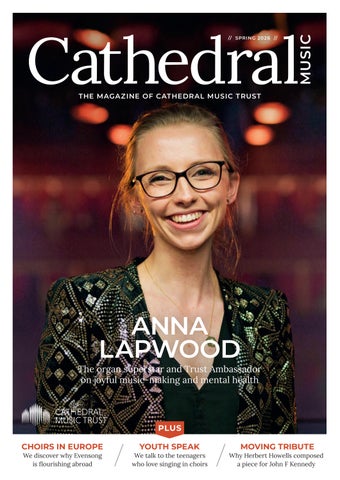
Front cover: Anna Lapwood (Photo: Andy Paradise)
Back cover: St Paul’s Cathedral, London (Photo: Adobe Stock)
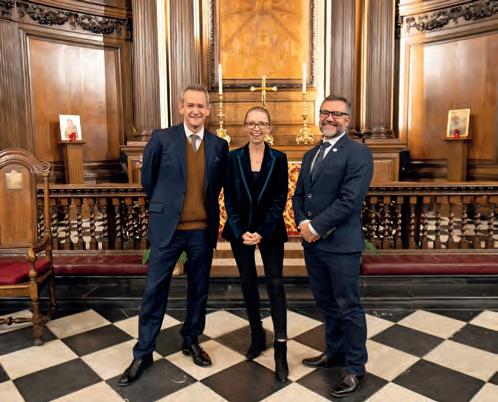
28 Anna Lapwood MBE
The superstar organist and Cathedral Music Trust Ambassador talks to Rebecca Franks about the highs and lows of life as a cathedral musician
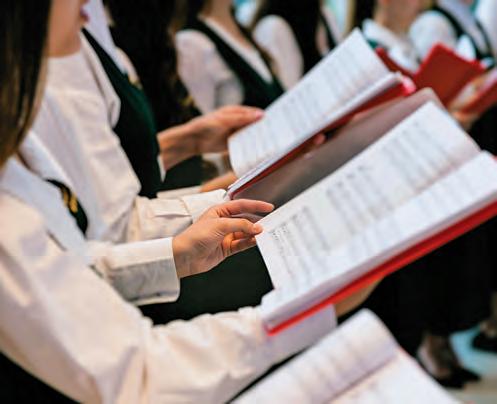
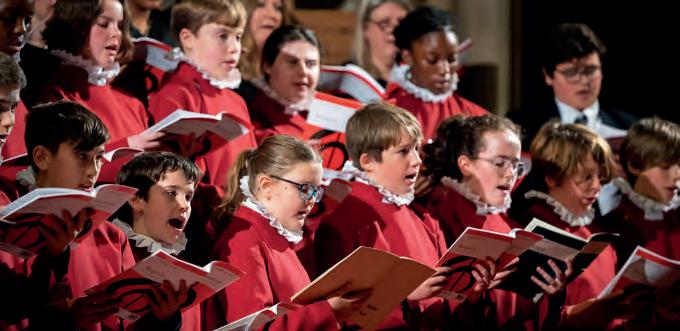
32 Singing together
We speak to the next generation of young musicians about the wellbeing benefits of taking part in a choir as a teenager
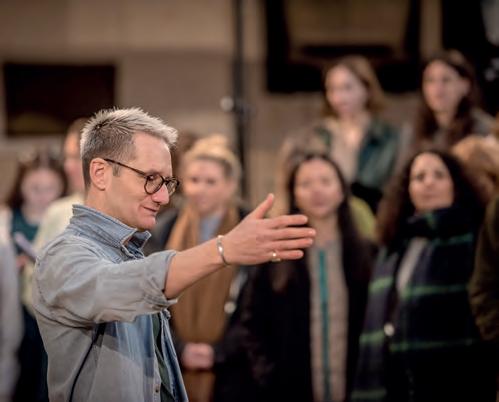
35 Professional training
Cathy Dew shares new research by Cathedral Music Trust around training opportunities available for multi-tasking cathedral musicians
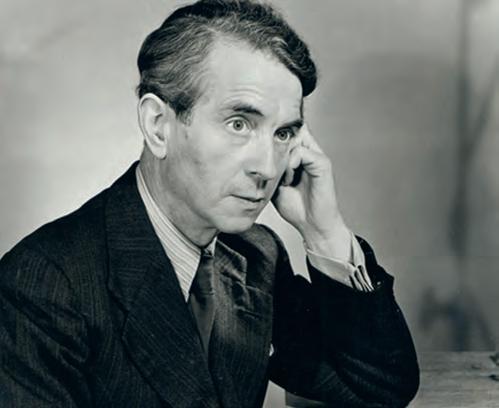
38 A private grief
Herbert Howells’s Take him, Earth, for cherishing was written for a public memorial but, as Jeremy Pound discovers, a personal tragedy lay behind it
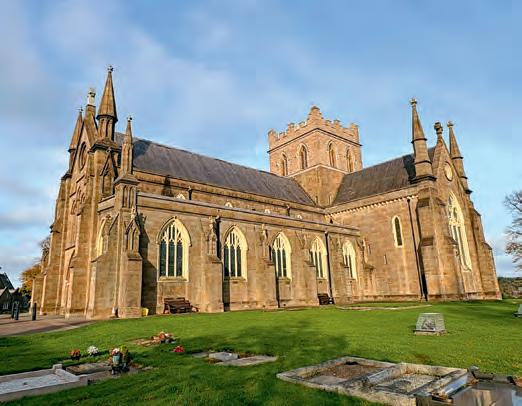
Geoffrey Webber reports as a group of choir directors pays tribute to the Victorian composer by performing all his music in the cities he worked in
From the Editor
Rebecca Franks welcomes you to this issue 6 News
The latest developments and stories from across the world of church and cathedral music
19
People & Places
We congratulate those taking on exciting new roles in cathedrals around the UK
21
Events
Join a Cathedral Music Trust gathering near you
22 Success
Stories
We hear from the latest recipients of Cathedral Music Trust Awards about their work
50
Reviews
Recent releases of choral and organ music reviewed, plus a round-up of the latest scores and books
66
Q&A
We meet Arnold Wills, Cathedral Music Trust Local Ambassador and Chair of the Wells Cathedral Chorister Trust 42 Charles Wood centenary
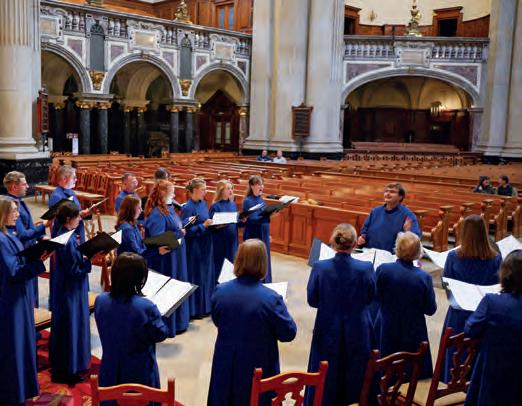
International Evensong
Femke Colborne explores the growing number of choirs bringing the British choral tradition to churches around the Continent
NEWS & PREVIEWS

BBC LAUNCHES NEW SINGING EDUCATION INITIATIVE WITH JACOB COLLIER
The BBC has launched a major new education initiative aimed at 11-14 year olds. Called ‘Get Singing’, and available through BBC education hub BBC Bitesize, the scheme provides teachers and vocal leaders with resources to support collective singing.
Works to feature among the resources include an arrangement of Something Heavy by Jacob Collier –ambassador and advocate for the programme – while those already available at launch include live more & love more by Cat Burns (arranged by Hannah King) and Piping Down the Valleys Wild by Bob Chilcott. Other pieces will follow over a three-year
period, along with live performances and workshops for young people, and CPD (continuing professional development) for both teachers and vocal leaders.
Other video resources include physical and vocal warm-up exercises, written guidance notes, scores and backing tracks.
The targeted age group was specifically chosen as, even though music, and singing in particular, is prevalent in primary education, research has revealed a drop off in collective singing once pupils move to secondary school. The programme is the biggest musical education initiative by the BBC since it
launched Ten Pieces in 2014, which offered learning resources around a specially chosen set of pieces.
‘Music holds the power to transform a life. It transformed mine!’ says Collier. ‘Experiencing music from within, by singing in a choir as a child, taught me so much more than just music. I learned listening, teamwork, courage, empathy, control, humour, leadership, confidence … and so much more. Looking back to those formative years, I recognise that it was those musical moments in my early life that ultimately shaped so much of the person I was to become and forged my attitude towards life.’
Antoine
Doyen
NATIONAL CAMPAIGN CALLS TO SAFEGUARD CHORAL HERITAGE THROUGH UNESCO RECOGNITION
After significant consultation with organisations and individuals across the sector, Cathedral Music Trust is leading a national campaign calling on the UK government to safeguard English sacred choral music by recognising it with UNESCO Living Heritage status. The Department for Culture, Media and Sport is
compiling a national inventory of UK Living Heritage (also known as Intangible Cultural Heritage, ICH) to include traditions and ways of life that have historically not been well represented in official lists or processes, yet celebrate the ‘everyday’ culture of local communities. An open letter to the
Secretary of State has now surpassed 1,870 signatures in support of the campaign. The Trust says recognition would ‘celebrate the cultural and educational value of choral music, reinforce its community role, and help safeguard its future in an era of shifting values and financial challenge.’
Harry Christophers CBE, president of the Trust, says: ‘Our sacred choral tradition is second to none. It is the envy of the world and is a tradition that has been going for well over 500 years. The music from those days sounds as modern as anything written today, and to gain UNESCO Living Heritage recognition would ensure that the music, both written in the past and the present, continues to be celebrated and sustained for centuries to come, alongside the many choirs, organists, directors of music and all who make this world-class tradition possible in their pursuit of excellence.’
Sign up to our newsletter and keep up to date with the campaign at cathedralmusictrust.org.uk
Parish choirs receive funding boost thanks to new project by the Royal School of Church Music
More than 200 church choirs, aimed at inspiring a new generation of children and young people to explore faith through singing choral music, are to be launched. The Church of England will invest £400,000 in The Choir Project, to be run in partnership with the Royal School of Church Music (RSCM). It hopes to engage children and young people with their local church choirs amid renewed interest in sacred church music.
Currently, 57 per cent of local church choirs don’t have any children in them. The Choir Project hopes to spark a revival of local parish choir membership, drawing on research that suggests young people are more likely to remain active in faith communities when
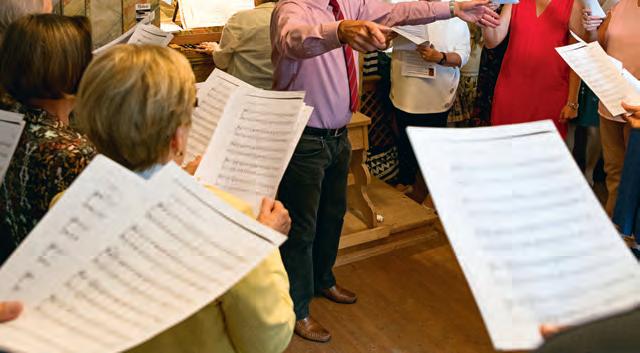
they are given meaningful roles, intergenerational relationships and opportunities for leadership. The three-year plan will see the training of 300 new leaders and engagement of 500 volunteers to tutor the choirs, and includes
training for clergy, ordinands and music leaders, tailored parish support, advocacy and communications and monitoring and learning. The RSCM hopes to engage 2,400 young people as new active Christians.
Adobe Stock
IN BRIEF…
Two women have finished a two-year pilgrimage of every cathedral in England. Clare Slator and Dorothy Gray started their journey with York Minster and ended with Ripon Cathedral. They used the pilgrimage to raise awareness for the Jeel Scholarship Fund for Palestinian students. Slator estimated they have raised approximately £2,000 for young people living in a West Bank orphanage, allowing them to go to university. The pair visited 44 places of worship, which included all 42 Anglican cathedrals in England as well as Westminster Abbey and Peel Cathedral on the Isle of Man.
As his extraordinary 3,000mile cycling pilgrimage nears completion, Cathedral Music Trust CEO Jonathan Mayes continues to shine a light on world-class music, visiting more than 125 choirs and choral foundations across England and Wales, many in receipt of financial support from the Trust. The pilgrimage celebrates both the richness of cathedral music and the communities that keep it alive, raising vital funds for cathedral music along the way.
The Royal College of Organists is launching three new qualifications in choral directing, aiming to recognise and support directors in different contexts throughout their careers. The qualifications include the Colleague Diploma in Choral Directing (CChD), Associateship Diploma in Choral Directing (AChD) and the Fellowship Diploma in Choral Directing (FChD).
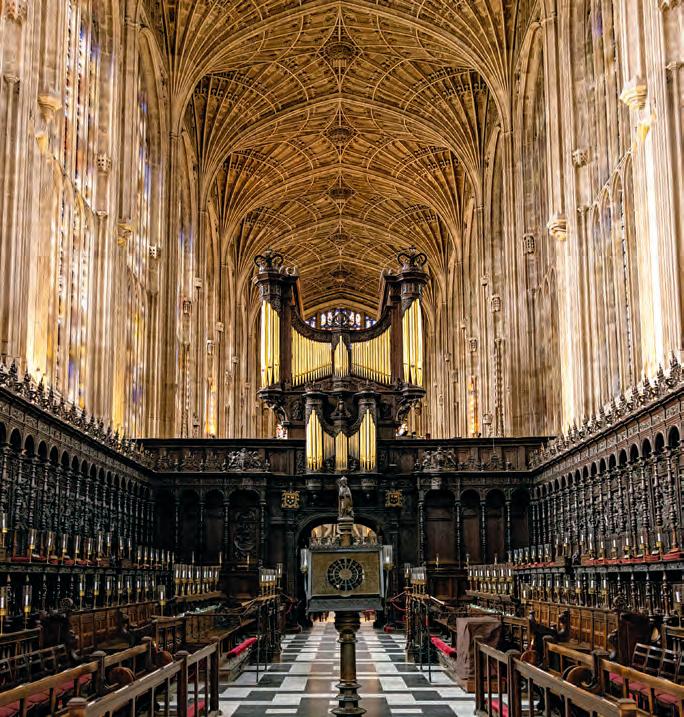
KING’S COLLEGE, CAMBRIDGE TO FORM FIRST ALL-FEMALE CHOIR
An all-female ensemble is set to be launched by King’s College, Cambridge, for the first time in the college’s history. According to the university newspaper Varsity, one of the responsibilities of the newly appointed Assistant Director of Music – Australian conductor and composer Owen Elsley – will be ‘to pursue the development of an all-female chamber group’.
This ensemble will be the college’s third official choir, alongside the world-famous Choir of King’s College, which was established in 1441, and the mixed-voice King’s Voices, founded in 1997.
The original choir has only accepted men and boys since its inception, a position that has attracted debate in recent years as other choral foundations and cathedrals move to mixed-voice choirs. Music Director Daniel Hyde told The Times, ‘It doesn’t mean I
don’t support all the amazing places doing great work for girls. This isn’t a zero-sum game. The existence of King’s doesn’t take anything away from the many wonderful opportunities for girls elsewhere.’
Some see the creation of this new group as a step forward. Evelyn Nagy, an alto in King’s Voices, welcomed the news: ‘The men get their own choir – it’s about time the women do too! The creation of the new choir is definitely a good thing’.
Others have expressed disappointment. Lucy Gabb, cofounder of King’s Women and Marginalised Genders Choir, criticised the decision: ‘Ultimately, women and girls must be allowed into King’s College Choir, and it’s really disappointing that, rather than making real change, King’s is continuing to uphold elitist, selective traditions with the creation of this new choir’.
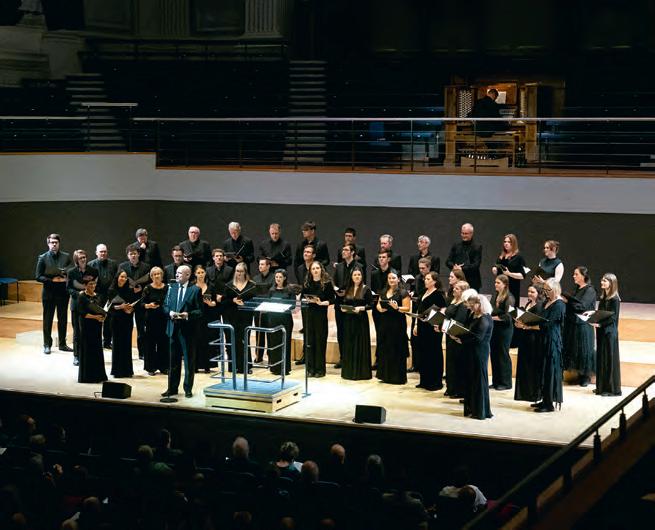
Ex Cathedra announces new artistic director
Ex Cathedra has appointed James Burton as its new Artistic Director following the upcoming retirement of founder Jeffrey Skidmore in autumn 2027.
Having debuted with Ex Cathedra in October 2025, Burton will join the choir as Artistic Director designate in Spring 2026. The British-born conductor and composer has returned to the UK after eight seasons as Choral Director of the Boston Symphony Orchestra and conductor of the Tanglewood Festival Chorus, and four years as director of orchestral activities at Boston University College of Fine Arts.
Speaking about this appointment, Burton said: ‘Ex Cathedra represents so much that I feel passionate
about as a musician: not only its striving for excellence, but also the way it cultivates the power of singing to inspire people across its community.’
The 2026-27 season will be Skidmore’s 57th and final season as
Artistic Director and Conductor, after which he will become Founder and Conductor Emeritus. A series of concerts, which launched in February 2026, will celebrate Skidmore’s long tenure with the group.
NATIONAL YOUTH CHOIR ANNOUNCES NEW EMERGING PROFESSIONAL ARTISTS
National Youth Choir (NYC) has announced its 2026 Emerging Professional Artists, including four choral leaders and four composers. The scheme, which has been running for 10 years, is a fully funded training
programme for early-career choral professionals. This year, the previous NYC ‘fellow’ and ‘conductor’ professional artists will be replaced by the new choral leaders. The programme aims to address
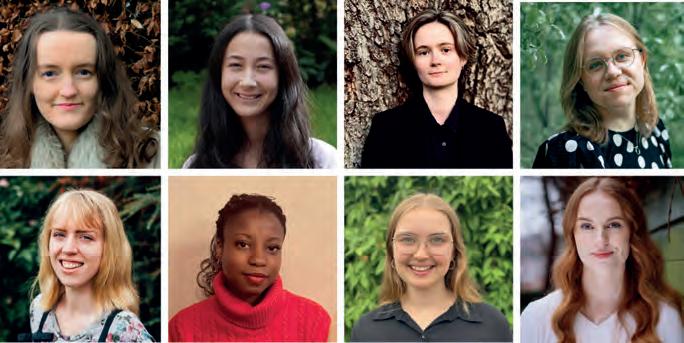
inequalities in the music industry by creating professional development pathways for those who are underrepresented in choral music.
For 2026, Evie Atkin, Maki Gajic Murata, Mary Offer and Emma Pascoe will be the NYC’s composers mentored by Joanna Marsh, while Gorgey Bennett, Anna Beresford, Sheena Riyike Jibowu and Hattie Twigger-Ross have been named as its choral leaders.
Lucy Hollins, Creative Director of NYC says: ‘At National Youth Choir, we believe that all young people should have the opportunity to experience the life-changing power of singing together, and we are committed to developing the pipeline of choral musicians who will enable this to happen.’
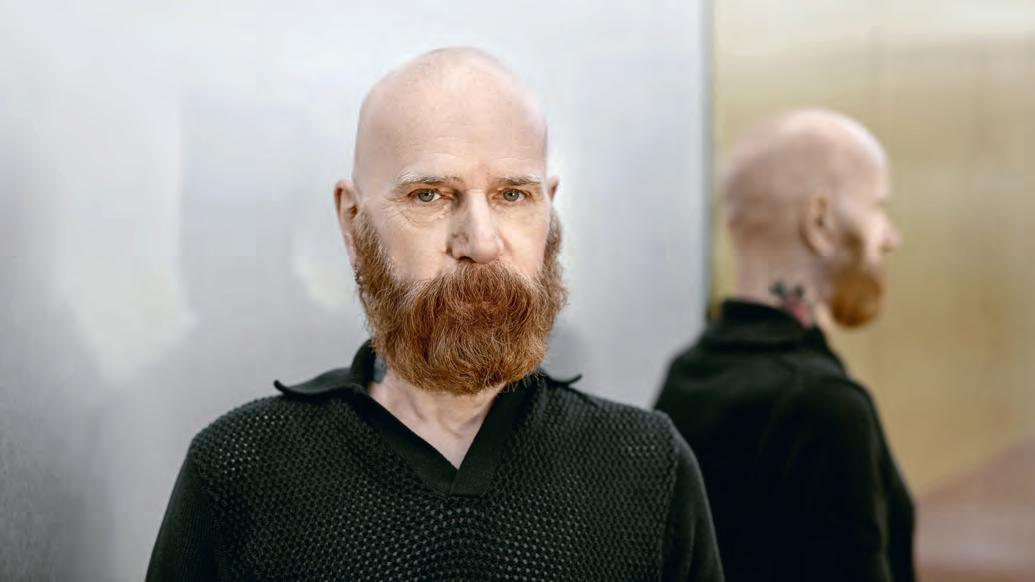
RCO ANNOUNCES 2026 MEDAL RECIPIENTS
The Royal College of Organists has recognised three musicians with its highest honour, The RCO Medal. The Medal of the Royal College of Organists recognises achievement and contribution to organ and choral music through performance, teaching, scholarship, composition, organ-building, conducting, administration and philanthropy.
Professor Bine Bryndorf, Organist of Roskilde Cathedral in Denmark
and custodian of the historic Raphaelis organ, is awarded in recognition of distinguished achievement in organ performance and pedagogy; composer Gabriel Jackson (pictured above) has been recognised for his distinguished achievement in organ and choral composition; and conductor, composer and organist Paul Spicer has been awarded for distinguished achievement in choral conducting
and pedagogy, and scholarship.
The RCO President Sarah MacDonald says: ‘Our 2026 honorands represent exceptional accomplishment in performance, composition, and education, and their influence is felt throughout the musical world.’
This year’s recipients were awarded at the College’s conferment ceremony at Southwark Cathedral on 7 March 2026.
Diocese of Leeds and RCO launch new organ tutor for beginners
The Diocese of Leeds Keyboard Studies Programme and the Royal College of Organists (RCO) have launched a new tutor book aimed at introducing primary-age children to the organ.
Developed with funding from the Vinehill Trust, Fingers and Feet: A Journey to the Organ Bench is designed for young beginners, including those with no previous keyboard experience. The book will also be available as a free PDF on the RCO’s new website, First Stop!, alongside 34
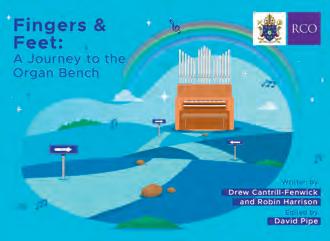
accompanying tutorial videos.
The material was written by organists Drew Cantrill-Fenwick and Dr Robin Harrison and edited by David Pipe, organ tutor for the Diocese of Leeds. It takes learners
to approximately ABRSM Grade 3 level, focusing on the development of technique, musical understanding and confidence.
Editor David Pipe says: ‘We wanted to create a tutor that feels genuinely welcoming –something that says to a complete beginner: “Yes, this instrument is for you”… The organ can seem intimidating at first glance, but it shouldn’t be.’
Fingers and Feet: A Journey to the Organ Bench is available for sale, and as a free download, on the First Stop! website.
Reinis Hofmanis
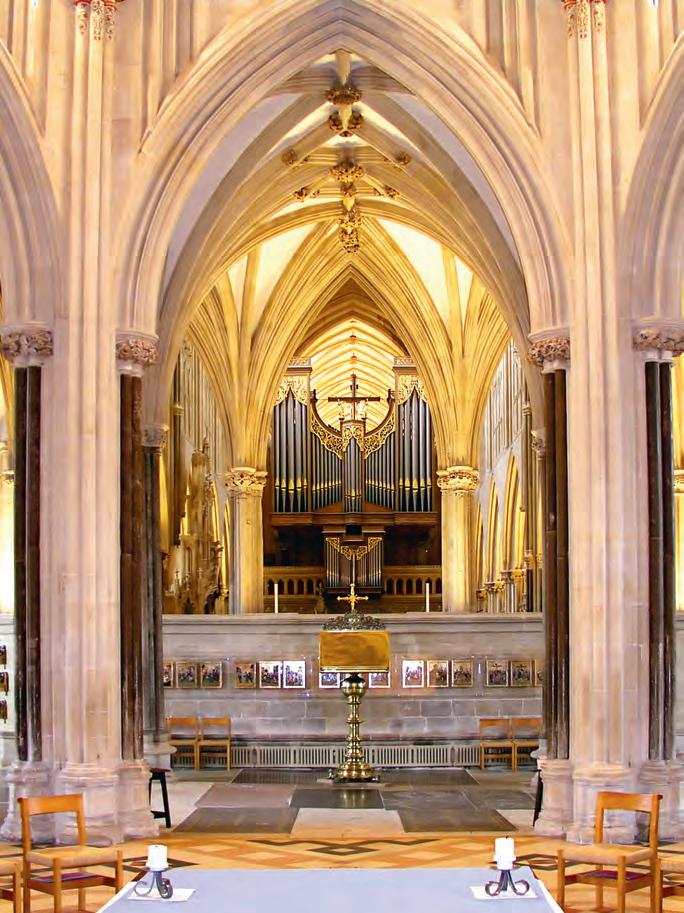
WELLS CATHEDRAL TO REFURBISH ITS GRAND ORGAN
Wells Cathedral has announced the major refurbishment of its historic Grand Organ. The refurbishment, which began in January, will include the removal and repair of all 5,000 of the organ’s pipes, and an overhaul of its console, pedals and stops.
The decision to commence this massive project comes after organists at the Cathedral had been forced to use their skills to cover up, creatively, the instrument’s shortcomings when performing during services and recitals.
The initial funding for this project has come from a donation of nearly £2 million from The Friends of Wells
Cathedral’s Grand Organ Appeal, but with the two-year project having an estimated total of £3 million, fundraising is still ongoing.
The Very Reverend Toby Wright, Dean of Wells, says: ‘music has carried both the beauty of holiness and the joy of human hearts within these walls. The Grand Organ is not merely an instrument, but the living breath of Wells, binding past, present, and future together in song. So of course, we are excited and relieved to begin this critical project, and we are hugely grateful for the generosity of everyone who has made this start possible.’
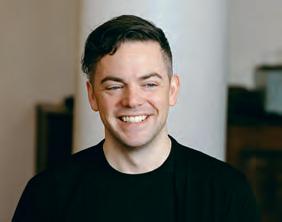
CHRIST CHURCH, OXFORD APPOINTS NICO MUHLY
Nico Muhly has taken up a post as the first Composer in Residence at Christ Church, University of Oxford. The launch of this collaboration coincides with the Cathedral Choir’s 500th anniversary celebrations. Over the coming years, Muhly will build a collection of works. The first commission – With Harte and Hande, a carol based on the 16th York Mystery Play, Herod and the Magi – was heard this January during a service for Epiphany. The next piece is a cantata, to be premiered at an anniversary concert this summer then toured internationally.
Muhly says: ‘I hope that the body of work I provide, consisting of works ranging from large-scale compositions to smaller pieces, will offer a musical throughline through daily worship and the church year, voicing the heartbeat of the musical traditions championed in this place for five centuries.’
Muhly will also be working with the musicians at Christ Church Cathedral School and with undergraduate students, and Peter Holder, Organist and Director of Music says: ‘The energy and inspiration that Nico will bring to us, not just in his music, but in coaching our musicians across the Foundation, gives us much to look forward to.’
Heidi Solander
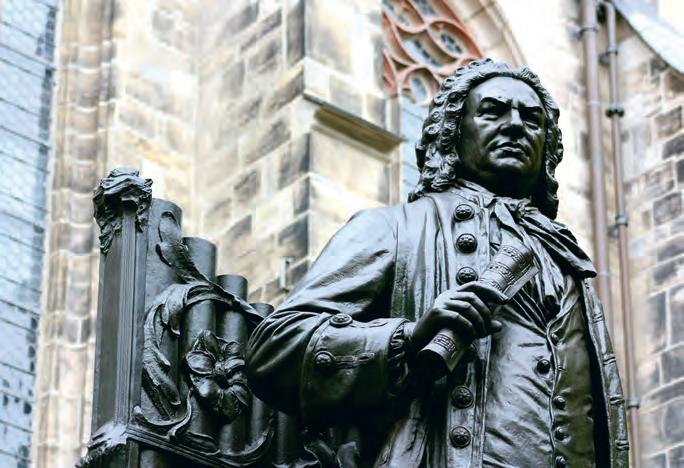
TWO NEW JS BACH WORKS ADDED TO CATALOGUE
Johann Sebastian Bach has been identified as the composer of two organ pieces discovered 30 years ago in the Royal Library of Belgium. The two solo works, written when he was a teenager, have been added to the official catalogue, the Bach-WerkeVerzeichnis, in Leipzig, Germany, after being identified by Peter Wollny, Director of the Leipzig Bach
Archive. The manuscripts were copied by one of Bach’s pupils, Salomon Guenther John, but it wasn’t until the discovery of a job application by him, found by Wollny’s colleague, Dr Bernd Koska, that Wollny was able to reconstruct John’s life story and find documents proving he was the copyist. ‘I searched for a long time for the missing piece of the puzzle to identify the compositions – now the whole picture is clear,’ Wollny told The Times.
The pieces are a Ciacona in D minor (BWV 1178) and Ciacona in G minor (BWV 1179), written when Bach was a teenager working as teacher in Arnstadt. They were performed for the first time in Germany in 320 years in November 2025 at the St Thomas Church in Leipzig, where Bach is buried and worked for 27 years. ‘I am convinced that organists worldwide will be very grateful for this virtuoso, lively new repertoire and will perform it regularly in future,’ said Ton Koopman, organist and head of the Bach Archive.
THREE CHOIRS FESTIVAL ANNOUNCES GLOUCESTER PROGRAMME
Artists from around the world will flock to the city of Gloucester and its Cathedral for the annual Three Choirs Festival this summer. The Festival has announced a programme featuring eight days (25 July-1 August) of evening concerts, daytime recitals, talks, family activities and free open rehearsals in and around Gloucester Cathedral. The festival, which has been running for over 300 years, moves between the cathedrals of Hereford, Worcester and Gloucester each year. This year’s line-up is set to include VOCES8, Ex Cathedra, and La Serenissima, alongside the Festival Chorus and Youth Choir. Plus the Three Choirs Festival’s popular Come and Sing days return, giving the public a chance to take part.
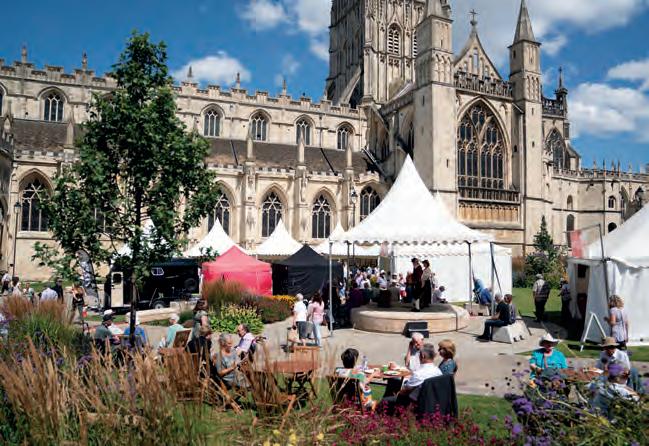
A major highlight of 2026 will be the installation of a new cathedral organ, due to be unveiled in June. This landmark occasion will be celebrated in a series of festival
performances, including Poulenc’s Organ Concerto, and a recital given by the young French virtuoso Thomas Ospital. Find out more at: 3choirs.org
Michael Whitefoot
Bradford Cathedral Director of Music takes on fundraising hiking challenge
The Organist and Director of Music of Bradford Cathedral has trekked the 42-mile Yorkshire Heritage Way in just 48 hours, raising funds for Bradford Cathedral Choir. Setting off from Ripon
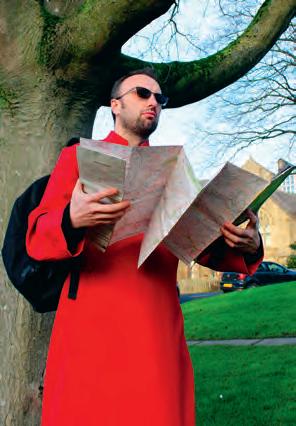
Cathedral on 12 March and ending at his home cathedral in Bradford, Geoffrey Woollatt followed the route up hill and down dale, taking in two UNESCO world heritage sites (Saltaire, and Fountains Abbey and Studley Royal) on the way.
Before embarking on his intrepid adventure, Woollatt said: ‘I am looking forward to my challenge of a trek – but I will be packing blister plasters! ‘Upkeep costs of the Cathedral alone are £2,850 a day, so raising funds for the Choir is vital. The forthcoming summer Choir Tour is an important event in the Choir’s calendar and a wonderful opportunity for our choristers, so making sure that they are all able to go is very important to us. That’s why I’m putting my boots on and heading out for a 42-mile trek!’.
RARE WALTON AUTOGRAPH SCORE SOLD AT AUCTION
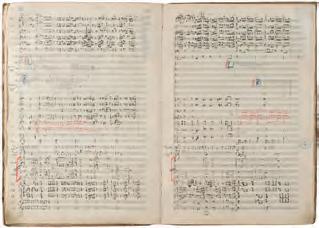
The only extant autograph manuscript of William Walton’s 1931 work Belshazzar’s Feast has been sold for £20,000 to an anonymous British buyer by rare books and manuscript specialists Dominic Winter Auctioneers. The auction was held on 28 January in Cirencester.
The score is a ‘working copy’, having been used during the 1930s and 1940s as a hire copy. It has heavy blue and red pencil markings which, according to the auctioneers, are probably in the hand of conductor Malcolm Sargent. There are many additions and amendments in the composer’s hand as well.
Belshazzar’s Feast depicts the downfall of the last neo-Babylonian king, Belshazzar, whose story was lifted from the bible for this piece by Osbert Sitwell. First performed at the Leeds Festival on 8 October 1931,
with Sargent conducting a line-up featuring the baritone Dennis Noble, the London Symphony Orchestra and the Leeds Festival Chorus, the cantata became Walton’s most iconic and celebrated master work.
Director of Dominic Winter Auctioneers Chris Albury says: ‘This is a unique moment for any admirer of Walton’s music… Belshazzar’s Feast is a cornerstone of British choral literature, and access to a full score of this quality is exceedingly rare.’
IN BRIEF…
Cathedral Music Trust has appointed three new trustees to its board and two new members to its Programmes Committee. Rosie Woodall, Daniel Benton and Graham Robinson have been appointed to its board, and Alison Bertlin CBE and Frances Godden have joined as Programmes Committee members. Jonathan Macdonald, Chair of Trustees, says: ‘These new appointments signal a new period of growth for the Trust, enhancing our Board and Programmes Committee with deep musical and professional expertise.’
The King’s Singers have appointed Joseph Edwards and Peter Hicks as new members following their first openly advertised auditions. Edwards will succeed Christopher Bruerton as the vocal group’s First Baritone in May, while Hicks will replace Patrick Dunachie as First Countertenor later in the year, in September, marking a new chapter for the ensemble, which was founded in 1968.
Arnold Wills, Chair of the Wells Cathedral Chorister Trust (WCCT) and local ambassador of Cathedral Music Trust has been awarded the prestigious High Sheriff Award by Janet Montgomery, the High Sheriff of Somerset. The award recognises individuals who go above and beyond in service to their local communities. Presenting the honour, Montgomery praised Wills’ leadership, passion and commitment, noting that the success of the WCCT is a direct reflection of his dedication and vision. He speaks to us in this issue (see p66).
Geoffrey Woollatt
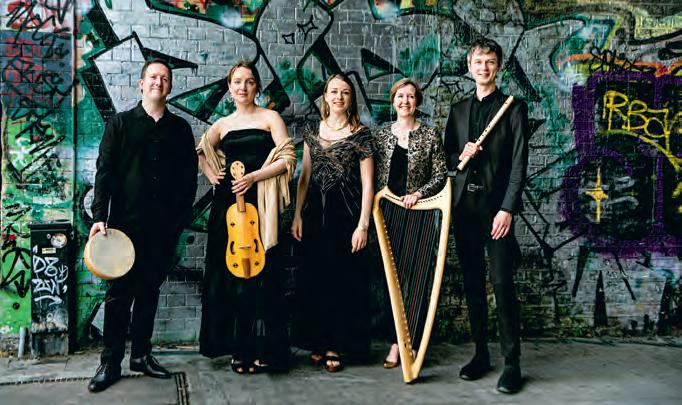
LONDON’S OLDEST PARISH CHURCH APPOINTS ‘MEDIEVAL ENSEMBLE IN RESIDENCE’
Founded in 1123 by the courtier, visionary and monk Rahere, St Bartholomew the Great is London’s oldest surviving parish church. Now the medieval church
has appointed its first medieval ensemble in residence. Rune took up its position at the start of 2026 and will give a series of concerts across the year, exploring themes including
the morality, religious fervour, dreams and obsessions of medieval Europe. The five-member group – featuring soprano Angela Hicks, tenor Daniel Thomson, Daniel Scott on recorder and portative organ, Jean Kelly on harp and May Robertson on vielle and voice – formed after meeting at Medieval Carols at St Bartholomew the Great and has since taken part in the Brighton Early Music Festival’s young artist scheme.
‘St Bartholomew the Great is one of the most beautiful church spaces in London. To become Medieval Ensemble in Residence in this stunning over-900-year-old church is both a privilege and an inspiration,’ says Thomson. ‘This residency allows us to explore medieval music not as a museum artefact, but as something living, intertwined with storytelling, belief and human experience. We are hugely grateful to St Bart’s for supporting us to grow our audience and explore medieval music in a medieval space.’
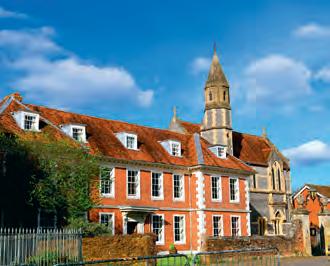
Church Music Society and the Royal School of Church Music join forces for publishing partnership
The Royal School of Church Music (RSCM) and Church Music Society (CMS) have formed a new publishing partnership. As a result, the RSCM will now be the exclusive publisher for all CMS titles.
The Church Music Society was founded in 1906 to promote the use of church music of the highest quality for the diverse needs of the Christian church, particularly through publishing works which are not otherwise available. The RSCM is a national charity enabling the flourishing of church music.
The CMS catalogue begins in the Renaissance era, embraces the Baroque (including wokrs by Blow, Purcell, Green and Boyce), the 19th century (including Wesley and Parry) and extends
to the present day, with recent pieces by Judith Bingham, Francis Jackson and Jonathan Harvey. The catalogue also includes the Hugh Allen/Robert Bridges’ arrangement of JS Bach’s Jesu, joy of man’s desiring, Howells’s Magnificat and Nunc Dimittis in B minor and Mass in the Dorian Mode and Leighton’s Communion Service in D and Second Service.
Chairman, Professor Patrick Russill KSG says: ‘The partnership with the RSCM is the start of an exciting new chapter in the CMS’s history and mission, enabling the Society to draw on the RSCM’s unrivalled expertise in church music publishing. The RSCM’s online shop will ensure that all the Society’s publications are immediately available. The partnership will also allow both organisations to coordinate their complementary publishing policies, while maintaining their editorial independence and particular characteristics, to the benefit of church music globally.’
The complete catalogue can be viewed at the RSCM Music Shop: https://www.rscmshop.com/ features/church-music-society
Ben Tomlin
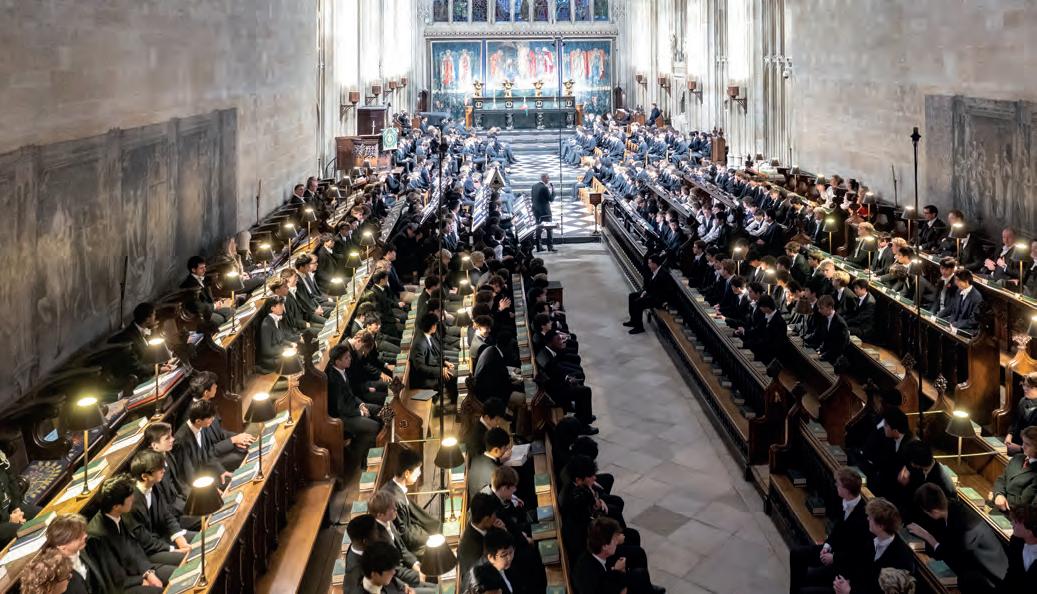
HUNDREDS GATHER TO RECORD HYMNS AT ETON
Aremarkable musical initiative has been brought to life within the historic walls of Eton College Chapel, where centuries-old choral traditions lie at the heart of daily worship and community life.
750 boys from Years 11, 12 and 13 have gathered together to record their favourite hymns as part of a project called ‘Eton Hymnal’. Led by students Monty H. and Felix W. alongside Tim Johnson, Precentor and Director of Music, the aim was simple but powerful: to capture the authentic sound of chapel - robust, communal and deeply meaningful –as it’s truly experienced by students.
‘Chapel is definitely one of the highlights of being an Etonian. Hundreds of boys singing a hymn that is very much alive. There’s something inherently magical about singing in chapel with your friends to start the day. It isn’t really about the music itself, but about the shared sense of belonging it creates,’ say Monty and Felix.
Rather than producing a studio performance, this project celebrates
the living sound of hymns sung by the boys themselves during regular chapel services, the same melodies generations of Etonians have grown up with and cherished throughout their school lives.
Eton College Chapel itself has a long history as a place where music and worship intertwine with congregational singing and choral music, playing a central role in daily services that bring hundreds of boys together in a shared spiritual and musical experience.
What makes this project special is its purpose: the boys have generously chosen to donate all proceeds from the recordings to Cathedral Music Trust. We are hugely grateful to them for linking their musical endeavour to this vital cause, demonstrating how young voices can amplify the message of safeguarding cathedral music, bridging centuries-old tradition with contemporary expression.
The Eton Hymnal is more than a recording project: it is a joyful, living testament to the power of communal song, and a meaningful contribution
to sustaining cathedral music for generations to come
The boys came up with the idea in January 2025. The plan involved creating a bespoke website for the project and liaising between different parts of the school. Over one week, the boys recorded the hymns during regular chapel service times, supported by the College Chapel Choir, college organist Christopher Allsop and directed by Tim Johnson.
‘One of the most enjoyable parts was the recording itself. Hearing the hymns sung with such energy and commitment by the boys in Chapel was incredible, especially knowing that these were the same sounds generations of Etonians would recognise. Seeing our idea finally become a reality after months of planning was also hugely satisfying,’ say Monty and Felix.
The hymns, which are available for download from etonhymnal.co.uk, including Dear Lord and Father of mankind; Guide me, O thou great Redeemer; I vow to thee, my country; Jerusalem and the Libera me from Fauré’s Requiem.
Eton College
Two worlds of music, one magazine
A new swallow’s nest organ from Metzler Orgelbau reinterprets a documented instrument
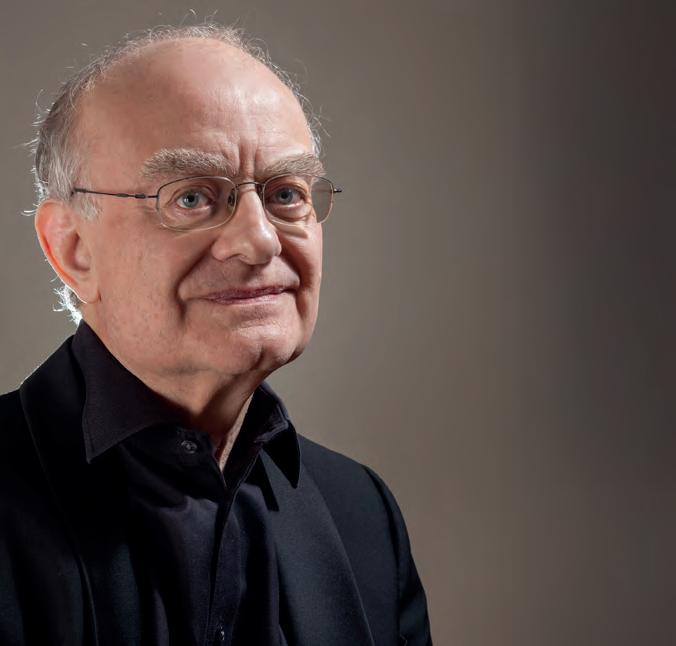
JOHN RUTTER
Celebrating the composer at 80


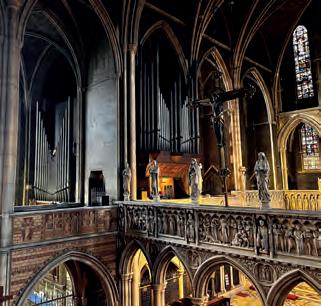
Preparing
Choir & Organ shines a global spotlight on two distinctive fields of creativity, celebrating inventiveness and excellence in all their forms. We aim to inspire our readers through giving a platform to conductors, organists, composers, and choirs of every kind; and showcasing the imaginative craft of pipe organ building across the centuries, critiquing new organs and tackling ethics in restoring historic instruments.
OBITUARIES
MARTIN NEARY (1940-2025)
Martin Neary was one of the most influential and entrepreneurial musical figures of his generation of cathedral organists. He was deeply invested in the Anglican Choral Tradition, having been a chorister at the Chapel Royal, organ scholar at Gonville and Caius College, Cambridge, Assistant Organist and subsequently Organist at St Margaret’s, Westminster, Organist of Winchester Cathedral and Westminster Abbey. He had a lifelong interest in contemporary music and maintained particularly close relationships with composers John Tavener and Jonathan Harvey.
Martin Gerard James Neary was born on 28 March 1940; at the age of eight he gained a place as a chorister in the choir of the Chapel Royal. This was a formative experience for him, particularly singing in the Coronation of Queen Elizabeth II in 1953 in
Westminster Abbey. After attending the City of London School, he was awarded an organ scholarship to Gonville and Caius College.
In 1963 he was appointed Assistant Organist of St Margaret’s, Westminster, and in 1965 he was made Organist in succession to Herbert Dawson. During this time, he met Penny Warren, daughter of Sir Brian Warren and Dame Josephine Barnes; they were married in St Margaret’s in 1967. In 1972, Martin was appointed to Winchester Cathedral at the age of 32. History has proved how enlightened his appointment was, as he brought relative youth, energy, enthusiasm and ambition to the cathedral. His appointment to Westminster Abbey in 1987 came as no surprise. Listening to the choir during his time, the boys’ sound, in particular, was very impressive and overall standards were
HUMPHREY BURTON (1931-2025)
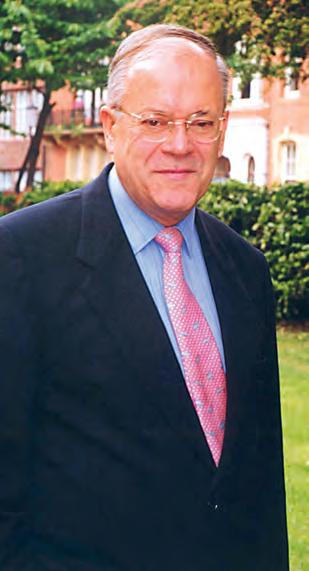
Sir Humphrey Burton, the influential classical music broadcaster, has died at the age of 94.
Born in Wiltshire, Burton was best known for presenting the BBC’s arts programmes In Performance and Omnibus during the 1970s and 1980s, bringing classical music to a television audience.
Burton founded the BBC’s Young Musician of the Year competition, launching the careers of many performers. He also hosted numerous programmes on BBC Radio 3 and Classic FM. During his career spanning more than six decades, Burton interviewed leading composers and musicians including Francis Poulenc, Count Basie, Oscar Hammerstein and
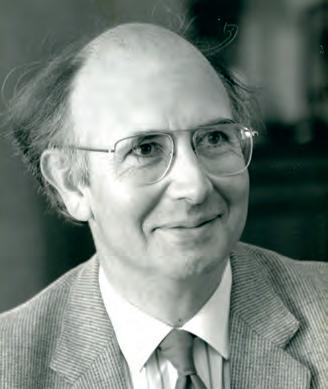
unquestionably high. The untimely death of Diana, Princess of Wales in 1997 meant organising a funeral in six days. Few had heard of Tavener’s Song for Athene, which was sung as her coffin was borne out by the pallbearers. Neary was appointed LVO in the 1998 Honours List.
Neary was devoted to his family. He leaves his wife, Penny, three children and six grandchildren.
DAVID HILL
Glenn Gould in the 1950s and 60s. He was also the official biographer of the composer and conductor Leonard Bernstein.
Burton’s influence was reflected in two Emmy awards, for his documentary Bernstein on Beethoven: A Celebration in Vienna, and for the two-part special Celebrating Gershwin In 2020, Burton was knighted for services to classical music and the arts.
In a statement, his family said: ‘He was deeply loved by his children and grandchildren, and his commitment to spreading the joy of classical music was so inspiring… He will be missed beyond words. We take comfort in knowing he is now at peace’.
GEORGIA KEELEY
Neary family
JOHN BERTALOT (1931-2026)
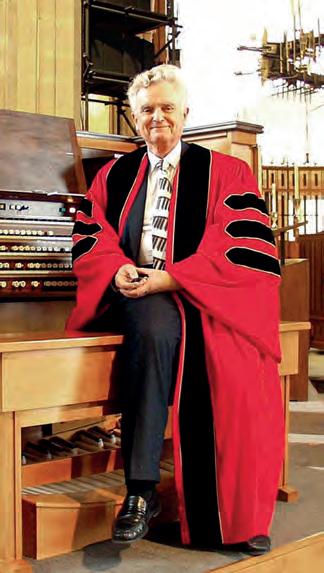
John Bertalot, the organist and choral director who transformed Blackburn Cathedral Choir, has died, aged 94. Born in Kent, he grew up in Shoreham-by-Sea in Sussex, where he sang as a chorister in the choir of St Mary’s Church, and also took up the organ. He later won organ scholarships to the Royal College of Music in London and Lincoln College, Oxford. After transferring to be organ scholar at Corpus Christi College, Cambridge, he studied with Boris Ord and Patrick Hadley. Upon graduation, Bertalot was appointed to St Matthew’s Church in Northampton, and in 1964 he took up post as Director of Music and Organist at Blackburn Cathedral, where, according to
ANDREW CARTER (1940-2026)
Andrew Carter, the acclaimed British composer whose catalogue of more than 250 works became a cornerstone of the international choral repertoire, has died aged 86. From large-scale scores such as Benedicite to the enduring Christmas favourite A maiden most gentle, Carter’s music is performed by choirs around the world.
Born in Leicester in 1939 into a family of tower and handbell ringers, Carter was immersed in the choral tradition from an early age. He read music at the University of Leeds before joining York Minster Choir as a bass Songman, where he sang daily services for seven years, deepening his lifelong commitment to church music.
For a decade he served as Director of Music at the Bar Convent Grammar School. In 1965 he founded the Chapter House Choir at York Minster, an ensemble that achieved
national recognition, including awards in the BBC’s Let the People Sing competition. Many of his early carols, folksong arrangements and popular pieces were written for this choir and for his Gallery Choir at the Bar Convent.
Awarded a Winston Churchill Fellowship in 1981, Carter studied choral techniques and repertoire in Scandinavia, broadening his artistic outlook and shaping his subsequent compositional voice. A founding committee member of the Association of British Choral Directors, he remained a tireless advocate for choral music.
After a year in New Zealand directing Auckland’s Dorian Choir and other ensembles, he returned to York, where his compositional career flourished. Works including Benedicite, Horizons, Musick’s Jubilee, Te Deum and Maryland Magnificat were performed internationally. His acclaimed recording Andrew Carter’s
the Cathedral, ‘he built the Cathedral Choir to national and international distinction’. He helped raise money to install a new organ, founded the Blackburn Bach Choir (now the Renaissance Singers) and raised musical standards. Bertalot toured the world as an organist, visiting South Africa four times, and led nine choral courses in the US – where, in 1983, he became Director of Music at Trinity Episcopalian Church in Princeton. He returned to England in 1998, and was appointed Organist Emeritus at Blackburn. Bertalot was the author of four acclaimed books about choral direction and sight-singing. He died on 21 February 2026.
REBECCA FRANKS
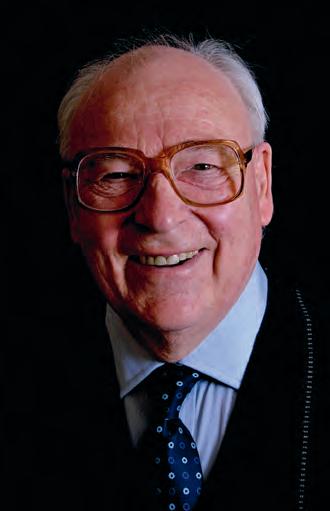
Christmas Carols, made with organist John Scott, was named one of BBC Music Magazine’s ‘ten best ever’ Christmas CDs in 2007. Carter died peacefully on 5 January 2026 in York. GEORGIA KEELEY
PEOPLE & PLACES
We offer our congratulations to the following people, who are on the move
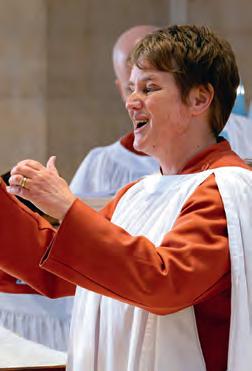
Katherine Dienes-Williams has been announced as the new Director of Music of Winchester Cathedral. The New Zealand-born organist, conductor and composer will take up the post in September 2026, leaving her current position as Organist and Master of the Choristers at Guildford Cathedral.
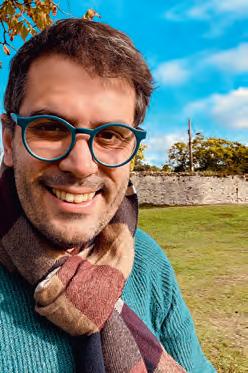
George Richford takes up a post as Diocesan Head of Liturgical Music for Portsmouth and Director of Music at St John’s Cathedral, Portsmouth. He joins Portsmouth from his current position as deputy director at Great St Bart’s in the City of London and honorary director of the Convivium Singers.
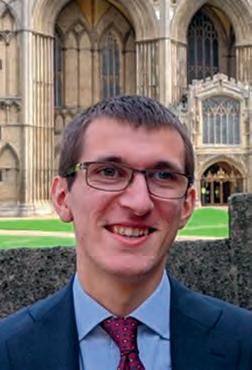
Chris Strange was recently announced as the new Director of Music at Peterborough Cathedral, having served as Acting Director of Music for the past year. He has extensive experience in choral music and musical leadership, having previously held positions at York Minster and Chelmsford Cathedral.
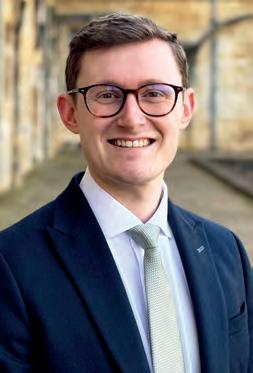
Alexander Turner wil take on a newlyexpanded role as Associate Choral Director at Christ Church Cathedral, Oxford, where he will support Organist and Director of Music, Peter Holder. This follows the appointment of Helen Smee last August to take up a new role as Director of Music at Southwark Cathedral.
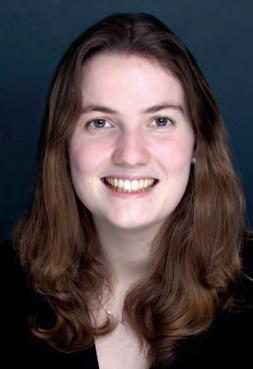
Susannah Hill will become Director of the Cathedral Singers at Christ Church Cathedral, Oxford following Hilary Punnett’s appointment as Assistant Director of Music at St Paul’s Cathedral in London last summer. Hill is currently enrolled on the MMus in Choral Conducting at the Royal Academy of Music.
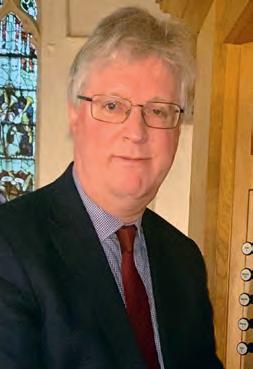
Andrew Reid is now in position as Director of Music at Hereford Cathedral, replacing Geraint Bowen who has retired. Currently Director of Music at Little St Mary’s Church in Cambridge, Reid will also hold the positions of Conductor of Hereford Choral Society, and Artistic Director of the Hereford Three Choirs Festival.
The Dean and Canons of Christ Church
Onur
Pindar




EVENTS
Join us for a Cathedral Music Trust event near you
A NEW SONG?
13 MAY, 12–7PM | HOLY SEPULCHRE, LONDON
What is the future of music in the Church in a fast-changing world? What drives someone to compose and where do they start? How do new works connect with us, the listener, and support worship? Do musical excellence and the Church’s 1,000-year musical heritage still matter?
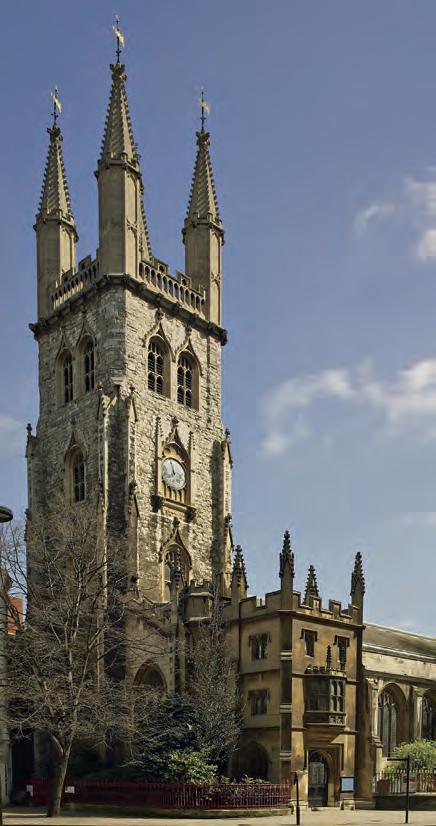
On 13 May, Cathedral Music Trust and the London Festival of Contemporary Church Music (running 8–17 May) join forces for a landmark day of new music, reflection and discussion at the beautiful Wren church of Holy Sepulchre – the ‘National Musicians’ Church’.
Join us, together with a host of renowned musicians and thinkers, for a day that celebrates the great British choral tradition, which has given us music of unparalleled beauty and touched so many across the centuries.
A New Song? will unveil new choral works whilst asking searching questions about the future of church music and its place within a changing cultural landscape. Our expert panel will discuss – and seek solutions to –the greatest challenges facing this tradition: the collapse of hundreds of parish church choirs and the near-disbandment of many cathedral choirs. We will also explore new challenges, opportunities for composers, musicians, and all who
value our musical heritage and wish to safeguard and revitalise it for future generations.
THE DAY INCLUDES:
Concert of new works from the LFCCM’s flagship Call for Scores programme – (LFCCM Festival Choir)
Tour of the beautiful 1666 Wren church and its Musicians’ Chapel Roundtable conversation with a panel of composers and other specialists including:
Sir John Rutter
Dame Judith Weir
Gabriel Jackson
Andrew Carwood MBE
Open rehearsal (Evensong)
Evensong with contemporary repertoire (Choir of Holy Sepulchre)
World premieres from the LFCCM’s Call for Scores scheme
Professional choirs – two top-flight professional choirs
Tea/coffee on arrival and between events
Drinks reception
Whether you are a parishioner, music-lover, composer, musician, member of clergy, educator, student – or simply someone who values our sacred musical heritage – this day offers a rare opportunity for thoughtful engagement and shared reflection, and new music. We warmly invite you to join us on 13 May at Holy Sepulchre and add your voice to the future of music in the life of the Church. £45 day tickets
Book tickets at

AWARD RECIPIENTS
IN SUPPORT OF EXCELLENCE
As a Friend or Patron of Cathedral Music Trust, your generosity allows us to grant financial support to the music-making of cathedrals and churches in the UK and Ireland. In 2025 the Trust made 27 awards totalling £470,000; some of last year’s recipients discuss their impact
By GEORGIA KEELEY AND HOLLY BAKER
Sheffield Cathedral was awarded £30,000 to support the Cathedral Voices after-school programme
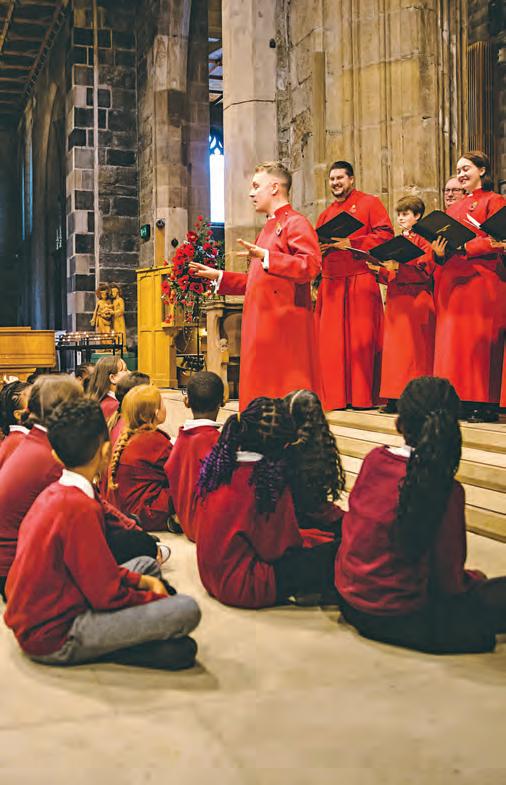
After controversially disbanding its choir in 2020, Sheffield Cathedral embarked on a mission ‘to create a Music Department and Choir ready for the exciting future of the mixed urban community in which we live and work’. An important part of that transformation is the new Cathedral Voices programme, which is headed by Director of Music Tom Daggett (who previously founded a successful music programme at St Paul’s Cathedral).
‘We have reimagined what being a cathedral chorister can be like for children,’ says Daggett. ‘While so many cathedrals have residential choir schools, or schools very close by, we draw children from all over Sheffield, which means what we’ve designed in Cathedral Voices is a programme which caters for as many family needs as possible, and we have a huge breadth of families as a result.’
There are currently 20 children taking part in the programme, with increasing interest. The cathedral has partnered with three state-funded primary schools, teaching up to 1,000 children a week, and is open to all for
SHEFFIELD CATHERDRAL
John Anderson
auditions. Children from as far as the town of Penistone, 14 miles away, take part.
The £30,000 grant from the Trust supports the employment of a chaperone who, with performance experience on the West End, understands the pressures associated with any kind of high-level music making where commitment and resilience are needed. This has been fundamental in taking care of the children ‘on the days when we all feel a little bit weary and slightly less enthusiastic.’
The grant also enables two singers to support the choir: baritone Andrew Randall, who sings at Opera North, and soprano Elspeth Piggott, who has sung professionally with ensembles including the Monteverdi Choir, The Sixteen and BBC Singers.
In rehearsal, the choir practises vocal exercises and learns music theory alongside psalms, anthems and canticles. Daggett is proud of what the future holds for the children, who sang their first seasonal services at Christmas and will sing at their first Holy Week this year. ‘I think what I’ve designed the programme to do is to give them a musical language which will last their
lives. It’s consistent, it’s rigorous, it’s careful and it’s kind,’ says Daggett.
The cathedral also feeds the children three times a week, catered by the Archer Project, the Cathedral’s homeless initiative, which aims to provide homeless people with work and purpose. The project trains people with experience of street homelessness, helping them gain kitchen skills alongside volunteers and a professional chef, paying for their services as they cater for others, including the choir, each day. The children get to share a hot meal together at a family table setting, where Daggett says ‘there’s lively conversation and we’re teaching them table manners and all sorts of skills of how to serve one another in polite and safe ways. They’re learning human skills above and beyond just the musical ones.’
Ultimately, the Cathedral Voices programme takes a fresh approach, opening choral singing to a wider demographic across Sheffield and enabling a range of families to benefit. ‘It’s very much a sort of Henderson’s relish, if you like. There’s a strong Sheffield flavour to what we’re doing,’ says Daggett.
▷
Holy Trinity, Guildford was awarded £6,000 through the Church Choir Award to support a changing voices programme
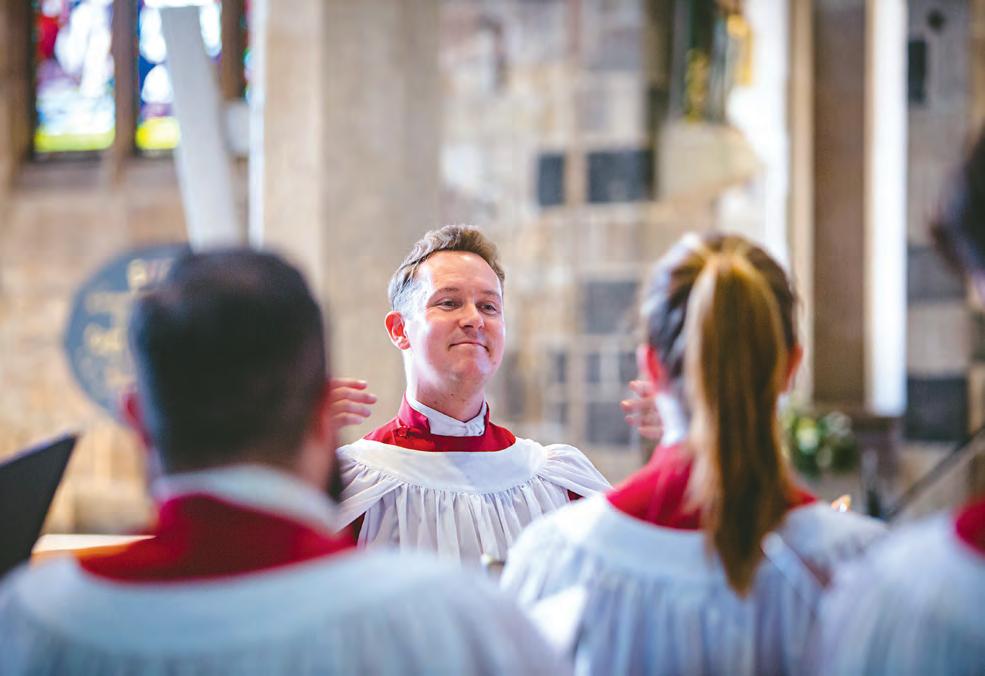
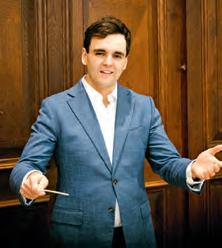
Holy Trinity Church in Guildford has a strong choir. But Nick Graham, Director of Music (pictured above), was facing the problem of maintaining the attendance of children across Year 8 and 9 age groups. ‘It was proving a bit difficult to convince them to stay and get them to make that commitment – to go over the line of trying out tenor or bass or alto,’ he says.
Holy Trinity decided to take a different tack, so that boys whose voices were changing could feel that ‘they’re on a journey to somewhere rather than using the oldfashioned term of breaking.’ Graham also found that around this age girls begin to lose their confidence and don’t want to sing as much. Graham and Assistant Choral Director Elliot Mercer, designed the changing voices programme to support both boys and girls through this unsettling period.
The Church Choir Award has allowed them to take the necessary time and find the capacity to provide this support. Graham and
Mercer, alongside their two vocal coaches, completed training with an expert on changing voices, Jenevora Williams. Using this knowledge, they can now host bespoke sessions, getting the children used to singing more complex music. Participants will also be given the opportunity to enter the Royal College of Church Music’s Bronze award, equipping them with skills to set them up for success, and to ‘look forward to doing those challenging things rather than being scared’.
This fear of change and the shyness that Graham has identified in the girls are what the choir is ultimately trying to overcome with the changing voices programme. The social aspect is a vital part of this. ‘We’re trying to create a little community of the changing voices. It’s all about trying to make it seem not like they’re leaving their younger friends, but they’re gaining some more friends!’
By reframing voice change as a progression rather than an ending, the programme aims to give young people confidence in a moment where they might otherwise drift away. For Holy Trinity Church, the changing voices initiative is about ensuring every singer feels supported, valued and excited about where their voice is headed next.
HOLY TRINITY, GUILDFORD Jane
St Wulfram’s Church, Grantham, was awarded £29,500 to support an internship training scheme for an early career musician
The parish church of St Wulfram’s in Grantham is using its grant through the Cathedral Music Support Programme to contribute to an internship scheme, which enables early career church musicians to learn their craft and work in a church music department,’ explains Dr Tim Williams, Director of Music. ‘It could be a musician in any field involved in the scheme, but the focus is on choral conducting.’
The scheme is for graduate musicians. ‘There is no specified age limit,’ Williams explains. ‘Last year we had three interns in the music department, all of whom were either graduate musicians or on gap years. This year we have two interns. The one who’s funded by the Cathedral Music Trust is a graduate musician and is looking to carry on postgraduate studies. And we have one mature intern currently as well.’
The interns are involved in rehearsals and services during the week, focusing on technique and skill but also the interpersonal side to choral directing: how you give feedback to a choir and how you respond to the sound coming at you. ‘It’s been an added layer to what we do, and it’s changed my role quite significantly because the focus has to be not just the choir, but on mentoring and enabling different aspects of people’s growth
in musical leadership,’ explains Williams. ‘As they begin, I help them learn to conduct, starting with simple pieces and then moving to more complex. On a Sunday in the service, or a Friday when the youth class sings Evensong, they might direct part of that service. Then we’d have a meeting earlier the next week to talk through how it went, and develop skills further.’
The success of the scheme is already evident: the three participants from last year learnt to conduct to an advanced level. One of them is now studying music at university and another is teaching music in schools and freelancing as a choral conductor. ‘They all developed quite significant skills in directing the choir in that time and formed a good rapport with all sections of the choir.’
‘I would also say there’s an advantage for the choir as well because they get used to different styles of direction. For example, for a student conductor, they really must watch to follow what’s happening. I think it’s increased the professionalism of how the choir responds to direction,’ adds Williams. ‘We hope the intern scheme will generate a number of people who’ve been through this system and then still be associated with St Wulfram’s. We want to create a network of musicians that we have helped train who might then help us.’
Ultimately Williams describes St Wulfram’s as ‘a safe space to be able to try things out.’ He continues: ‘We provide a framework in which it’s possible for interns to learn skills and gain good experience with an established choir.’
ST WULFRAM’S CHURCH
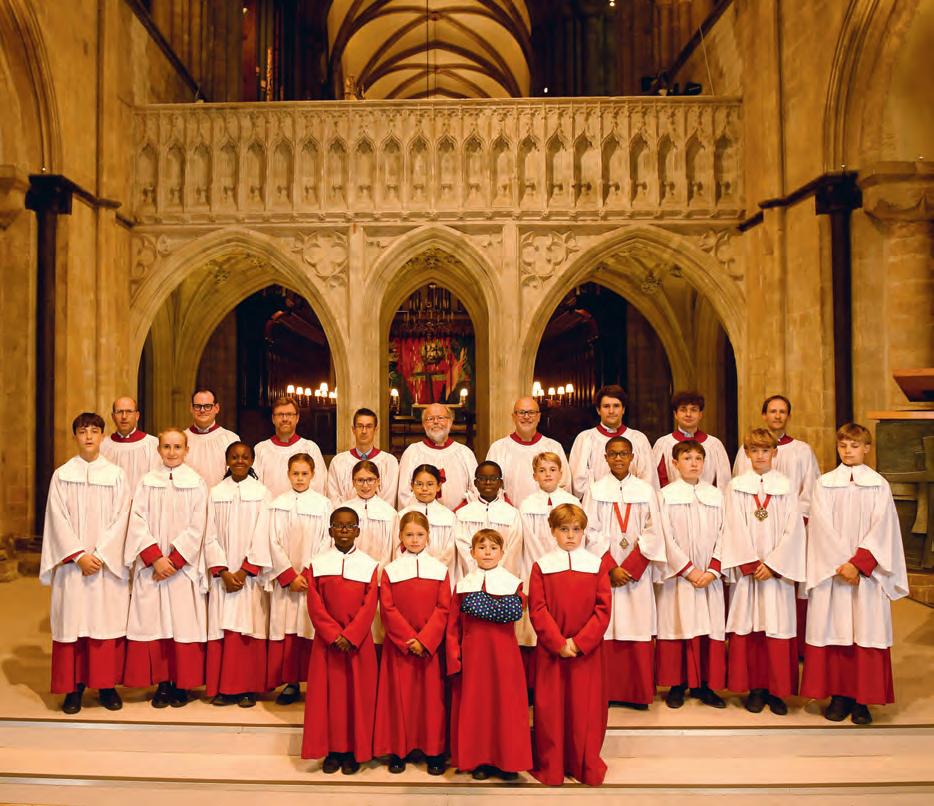
Chichester Cathedral was awarded £17,000 to support a vocal health and coaching programme for choristers and Lay Vicars
The choir at Chichester plays a huge part in the Cathedral’s worship. And that brings with it a busy schedule. With eight choral services a week, the choir spends a total of 18 hours singing and rehearsing. Charles Harrison, Organist at Chichester Cathedral, explains: ‘A lot of that time is devoted just to preparing the music that we have to sing. The volume of repertoire that we cover is quite significant and therefore the time for purely technical work is limited.’
With this quantity of singing, maintaining the vocal health of choristers and Lay Vicars
is important, so they’re using the £17,000 grant from the Cathedral Music Support Programme to run a vocal health programme. The choristers have their own tutor as do the Lay Vicars. In addition to individual sessions with the group’s respective tutors, they aim to organise an annual group workshop as well.
For the choristers, the tutor is opera singer Marcia Bellamy, who is also the mother of a former chorister at Chichester. ‘She has that particular insight into a chorister’s work, and she has an appreciation of what the choruses do, and how much time they spend singing,’ Harrison says. ‘I think that’s so important because the work of a chorister is very distinctive, and it’s quite different from lots of other kinds of singing in its intensity and its regularity. So, to have a teacher who actually really appreciates the work of
CHICHESTER
choristers and values the music-making of cathedral choirs is really helpful to us.’
The lessons for the choristers are entirely devoted to technique, and the difference they make to the choir is already being heard, even the day after the choristers have had their lessons. ‘If Marcia has spotted little technical insecurities creeping in, she is so good at fixing them quickly and encouraging the choristers to think about their singing in new ways,’ says Harrison.
The Lay Vicars have a different set of requirements, and so the focus of lessons is tailored to them. For starters, they’re not full-time singers and many have full-time jobs outside the choir as well. Two of the current Lay Vicar line-up are schoolteachers, a role which puts its own stresses and strains on the voice. As Harrison explains: ‘It’s quite easy for little habits to accumulate. So, rather than teaching them technique from fresh, they are being reminded of the basics and keeping those problems under review.
‘Singing is difficult, because you can’t see the vocal equipment. It’s a little bit more mysterious than, say, violin technique or piano technique. And it takes an expert to be able to listen to a voice and to observe a singer and to be able to diagnose technical questions that can be improved.’ Harrison also always keeps in mind that the Lay Vicars
dedicate their valuable free time to the choir. ‘We meet them where they are,’ he says. ‘We’re not expecting that they will be next year’s members of the Tallis Scholars, but they are highly committed and loyal.’
When asked about the future of music at Chichester Cathedral, Harrison says: ‘I’m very much hoping that we will go on tour. Chichester was recently twinned with the German city of Speyer. We hope, as part of that twinning relationship, to go and sing in their magnificent Romanesque cathedral and elsewhere in that part of Germany. Also, we would like to record. It’s about three years since we were last able to make a recording so we hope there will be more of that in the future.’
Harrison concludes: ‘I’m just so thrilled and grateful that Cathedral Music Trust has recognised the value of these projects. The music here is quite an expensive operation. Funds are limited and sometimes we do have to make difficult choices about how we spend the money available to us, but this has allowed us to continue and expand on something which we think is really important.’
For more information on the Trust’s grant programmes and on recipients of awards, visit www.cathedralmusictrust.org.uk/programmes
Russell Sach
ORGAN SUPERSTAR
Cathedral Music Ambassador, choral conductor and organist
Anna
Lapwood MBE talks about the biggest decision of her career, beating performance anxiety and planning an arena tour
By REBECCA FRANKS
Anna Lapwood MBE faced the hardest decision of her life last year. ‘It’s one that I had been building up to for quite some time,’ the organist and choral conductor tells me over Zoom during a rare week at home, ‘I’ve been clinging on desperately for as long as I could, but I was being split between two musical worlds and full-time jobs. It was taking its toll on me. I’d reached the upper limit of what I could do. If I wanted to continue growing, I had to choose.’
And so she did. Lapwood stepped down from her post as Director of Music at Pembroke College in Cambridge, where she had made history as the youngest person to hold such a post at an Oxbridge college. Over the course of a decade, she led the chapel choir, set up an acclaimed girls’ choir, released five albums, and set up and ran the Cambridge Organ Experience for Girls. Instead, she decided to channel all her energies into a flourishing career as a concert organist, which has seen her become the Royal Albert Hall’s first official organist and attract millions of social media followers on Instagram and TikTok. ‘I swung in both directions many times for which one I should aim for. But I realised touring full time is such a uniquely tiring and physically demanding thing. At the moment I have the energy for it, but I won’t forever. Hopefully I will come back to choral conducting, which requires lots of energy but of a slightly different kind, at some point in my future.’
Six months into her new life, Lapwood is already reaping the benefits. While she misses her choir ‘hugely – I think about them basically every day and have their names
written into my scores’, Lapwood has found that her organ playing is changing. ‘I’m playing for between eight and 12 or 13 hours every day,’ she says. ‘I never would have time to write the Lord of the Rings organ symphony [her latest transcription] or to learn the Jongen Symphonie concertante, which I’ve been doing with orchestra for the first time. It’s technically demanding and it’s taken a lot of time and practice to get it ready for those performances. I wouldn’t have been able to do that last year. It was a really hard choice, but also one that I felt was right.’
Lapwood’s life as a musician has been one of constant evolution. She grew up singing in a church choir where her father was a vicar, then a school chapel choir where he was chaplain. ‘I didn’t really know about the choral world until I went to be an organ scholar at Oxford, and that was my first real encounter with it.’ She became the first female organ scholar at Magdalen College –and it was a baptism of fire. ‘I had never accompanied a choir on the organ before, and I was suddenly doing it every day for eight services a week. I just didn’t know any of the repertoire and I was so out of my depth,’ she recalls. She often tells a particular story to illustrate that point. ‘I was sent in the middle of the rehearsal to get the psalters for the choir. But I had no idea what they were. I was running around the song school looking for something to do with salt.’ That first term was, she says, ‘really tough, I made a lot of mistakes and embarrassed myself many times. I basically decided to quit and wrote my resignation letter.’
Cue her ‘Stanley Tucci Devil Wears Prada moment’, as Lapwood calls it, referencing the
moment the main character, Andy, is pulled up for her lack of effort as assistant to the exacting editor of fashion magazine Runway (based on Anna Wintour at Vogue) . ‘I thought, am I really trying or am I deigning to do it?’ Lapwood says. She vowed to practise for eight hours a day and do everything she could to be as good as possible, and then see what happened. ‘Sure enough, things started to get better. It was incredibly hard work, I didn’t sleep much over the course of three years, but it made me fall in love with the organ and choral world.’
The experience shaped her and opened her eyes to cathedral music. ‘I realised what an amazing musical world it is,’ she says, ‘how it provides this framework for young people that can see them all the way through their childhood and teenage years to set them up with this understanding of music at such a
high level. They’re treated, in a lovely way, like professional musicians.’ When the opportunity to become an Ambassador for Cathedral Music Trust came up in 2022, saying yes was a no-brainer. ‘I wanted to be involved with the Trust to help people see what an important educational tool cathedral music is and to help make that accessible to as many people as possible.’
That was Lapwood’s ethos at Pembroke College too, where she saw firsthand the wellbeing benefits of singing in a choir. ‘It provides a natural community where I hope people feel safe and able to express through music whatever emotions they’re going through,’ she says. ‘Music has that wonderful quality of bringing out whatever emotion you’re feeling and laying it bare and soothing it. The collegiate choir experience is such a unique thing. They spend so much time
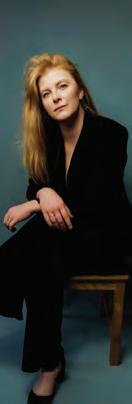
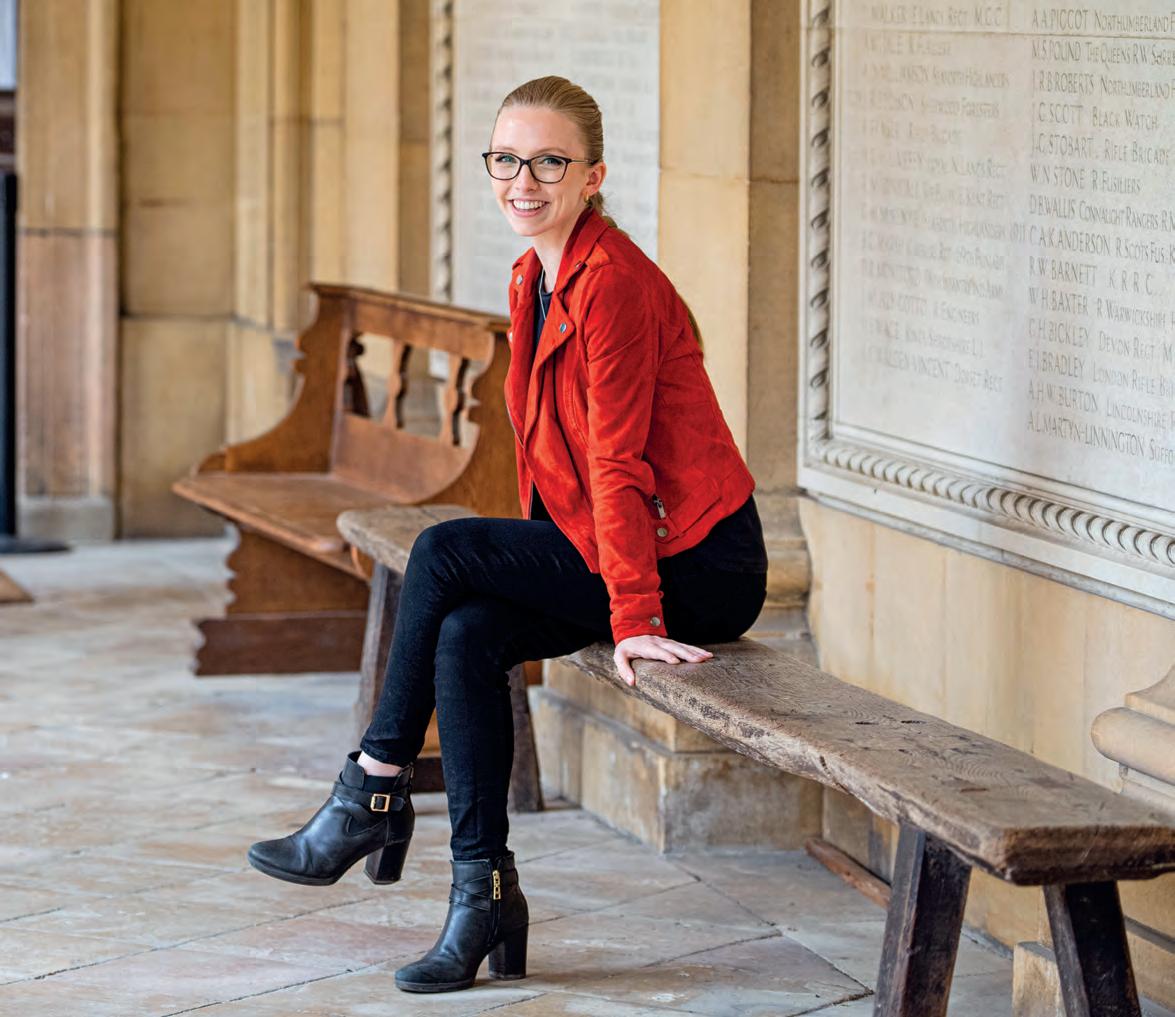
ABOVE Organist and choral conductor
Anna Lapwood became a Cathedral Music Trust ambassador in 2022
Charlotte Levy
together, and even the act of breathing together to sing creates this sense of oneness with the group. It’s a very special thing.’
The flipside of creating a space of emotional vulnerability, is that the singers, in this case, of university student age, came to Lapwood with their worries. That’s surely familiar to many a music director, in cathedrals and churches around the country. Their role is as much pastoral as musical.
‘One of the challenges is that at the moment a lot of that seems to sit on the director of music’s shoulders. My pastoral responsibilities increased hugely in my last few years at Pembroke, and I saw it as a privilege but also something that was quite hard and I hadn’t really had training for,’ says Lapwood. ‘The college was very good at supporting me through it, but there was a time when I had people sitting in my office almost every day who were finding things challenging.’
As a result, Lapwood feels ‘we could be providing more support for leaders in how to deal with mental health situations.’ The fear around getting it wrong is, she says huge, because of the serious implications. ‘I think inevitably when you’re in a leadership role and working with a choir where you are asking people to be emotionally vulnerable, you’re going to become the person people feel they can go to. Providing leaders with the support that they need through that process is really important.’
Performance anxiety was, at one point, Lapwood’s own personal mental-health challenge. There were moments her nerves were so bad she considered giving up the organ. ‘I found it so scary,’ she says. However,
‘Inevitably when you are in a leadership role and working with a choir, you’re going to become the person people feel they can go to’
now she loves being on stage, and her tangible enthusiasm for everything she plays lights up her performances. She still believes the constant critical evaluation is an ‘inherently weird’ part of being of performer, but a piece of advice she was given helped shift her mindset.
‘I had been going on stage expecting 100 per cent of myself every day, and I was disappointed most days, because the moment you make one tiny mistake, you think I haven’t given 100 per cent,’ she says. ‘A singing teacher said people have to learn to be happy with their 60 per cent and make sure that’s good enough. It was literally the most transformational piece of advice I’d ever heard. It’s easier said than done, but since I’ve started saying it, my average percentage is actually a huge amount higher – probably 90 to 100 – because I’ve given myself permission to take risks and to be human, to be free and spontaneous when I play.’
Alongside, Lapwood gave herself permission to perform the repertoire she adores the most, based around her vivid transcriptions of film scores. ‘It feels right for me and now when I go back to the standard repertoire, I approach it with this core of positivity around my performing experiences and this trust of myself at the organ,’ she says. It’s paid off – and this year she’s giving over 85 concerts, embarking on her first tour of Australia, returning to the US, and doing a mixture of orchestral and solo recitals. Each outing requires a two or three-day stay in a place. ‘I do eight hours minimum of registering the organ the day before, another six on the day, and that’s just because that’s how much time it takes to set up the sounds
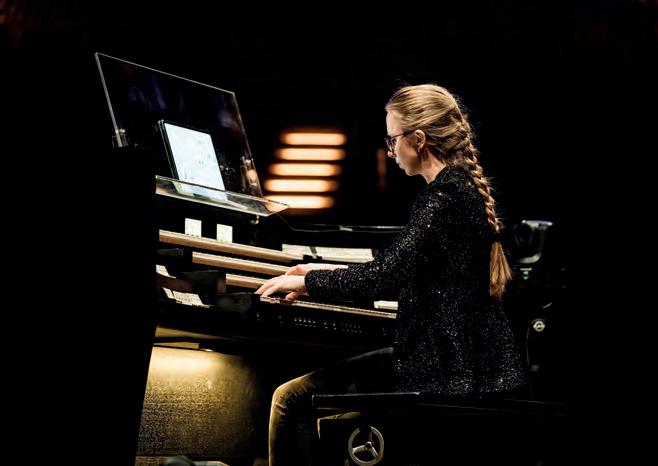
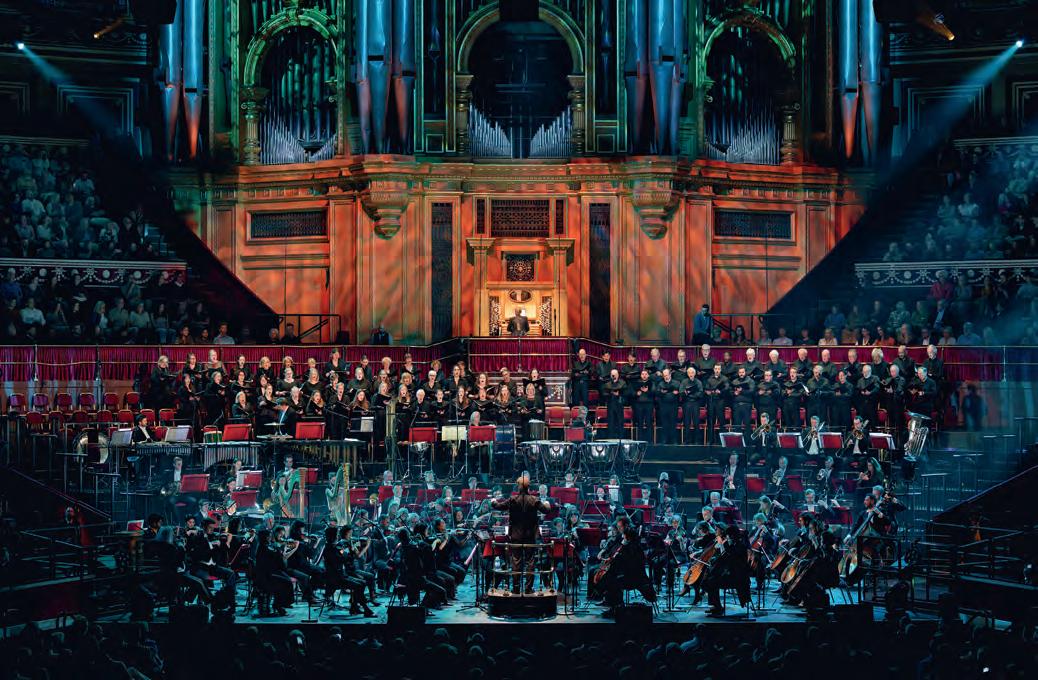
ABOVE Anna Lapwood at the organ of the Elbphilharmonie Hamburg in Germany
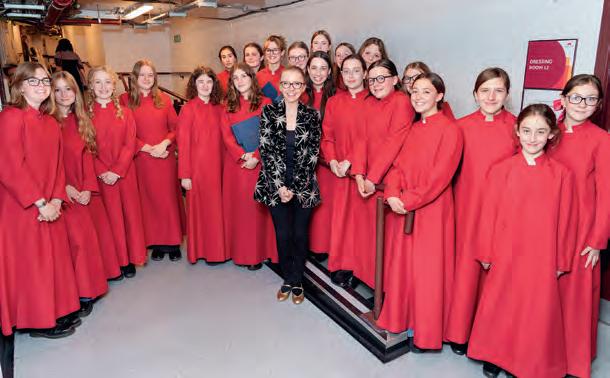
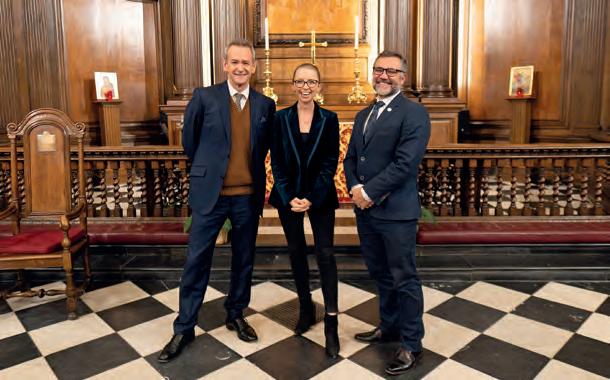
RIGHT Anna Lapwood backstage with the girls’ choir of Pembroke College Cambridge (top); and (below) with Cathedral Music Trust ambassador Alexander Armstrong and CEO Jonathan Mayes
you want and make it feel natural to play,’ she explains.
One new addition for this year is using her new touring organ, as an alternative for venues that don’t have built in organs. ‘I’m hoping to take people on an organ crawl over the course of the concert using my Hauptwerk [software] system, which means I can play the first couple of pieces from the organ of Rotterdam, the second couple of pieces from Salisbury and so on,’ she says. ‘I can show people the differences between the pipe organs in one concert setting.’
And over the next couple of years she has a big ambition in her sights: ‘I really want to do an arena tour and to look at what that might look like as an organist. The Royal Albert Hall has taught me a lot about different kinds of shows. I did a Christmas show there as a soloist with an orchestra, and that was a really fun experience in thinking about how to create an engaging show as opposed to a concert,’ she says. ‘We had a couple who got engaged on stage. We had this 14-year-old soloist singing ‘All I Want for Christmas’, and one of my former choristers getting up as a surprise to conduct ‘O Come All Ye Faithful’. Trying to think about how that could translate into an arena setting is something I’m really excited about.’
Andy Paradise
SOUNDS LIKE TEEN SPIRIT
What are the wellbeing benefits of joining a choir as a teenager? We speak to enthusiastic young musicians from around the country to find out what they love about choral singing
By REBECCA FRANKS
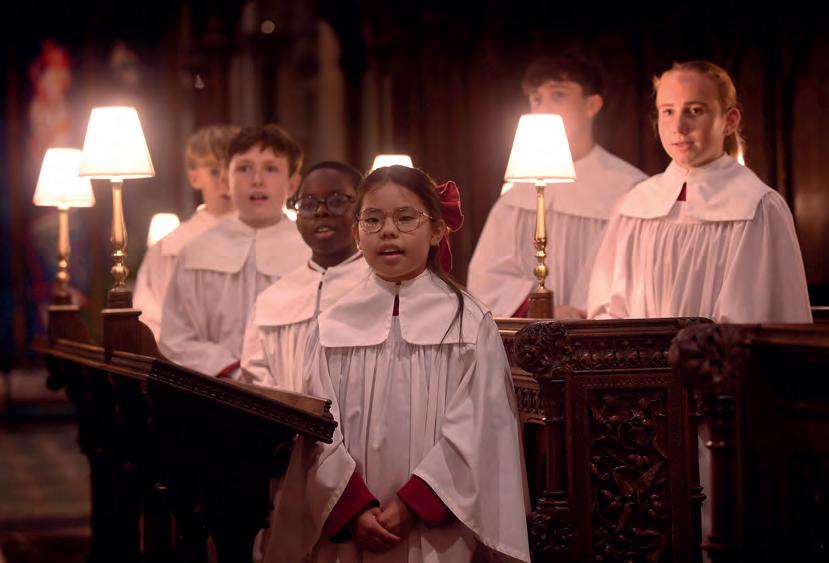
The myriad ways in which singing in a choir enriches the wellbeing of its members, whether that’s through making friends, finding community, reducing stress or offering an expressive outlet, have been increasingly recognised and backed up by academic research in recent years. Choirs have a particularly valuable role to play in the
lives of teenagers, which is why Cathedral Music Trust is fundraising for a new initiative to introduce more teenagers to the joys of choral music. We’ve spoken to teenagers from cathedrals across the UK to find out exactly what they love about being in a choir, from broadening musical horizons, gaining life skills to the thrill of live performance.
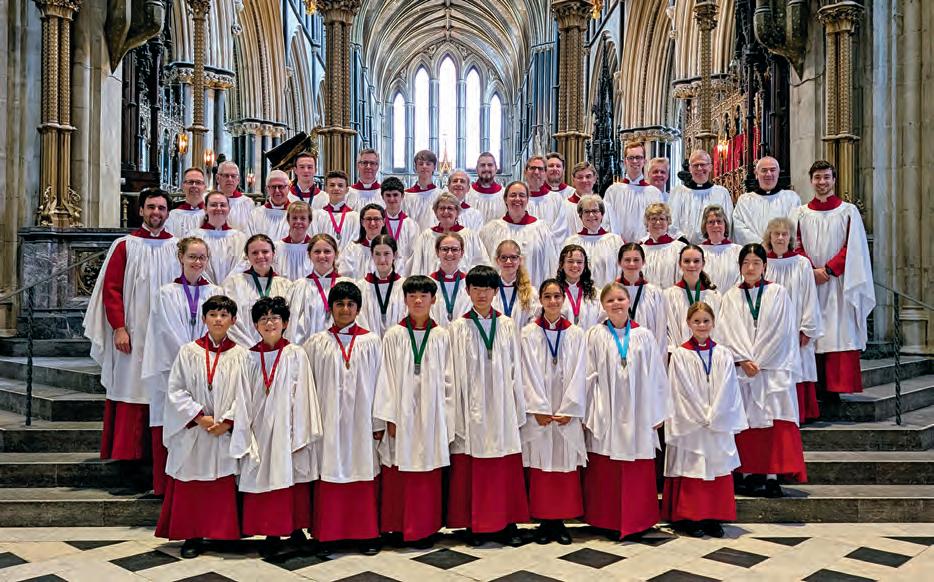
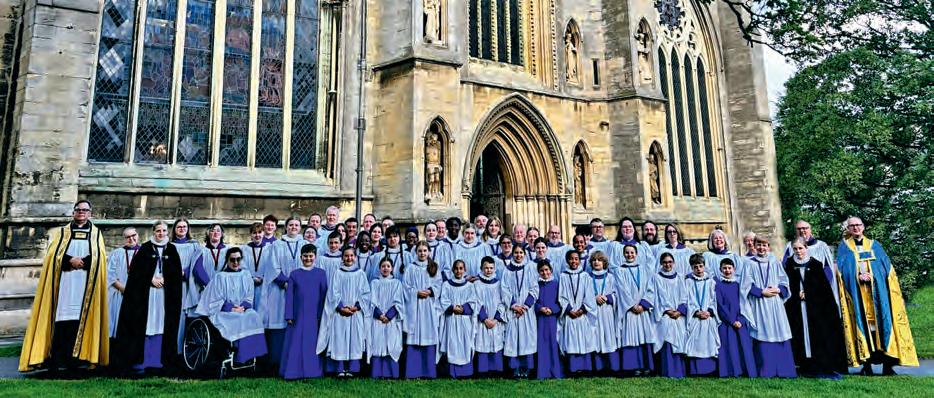
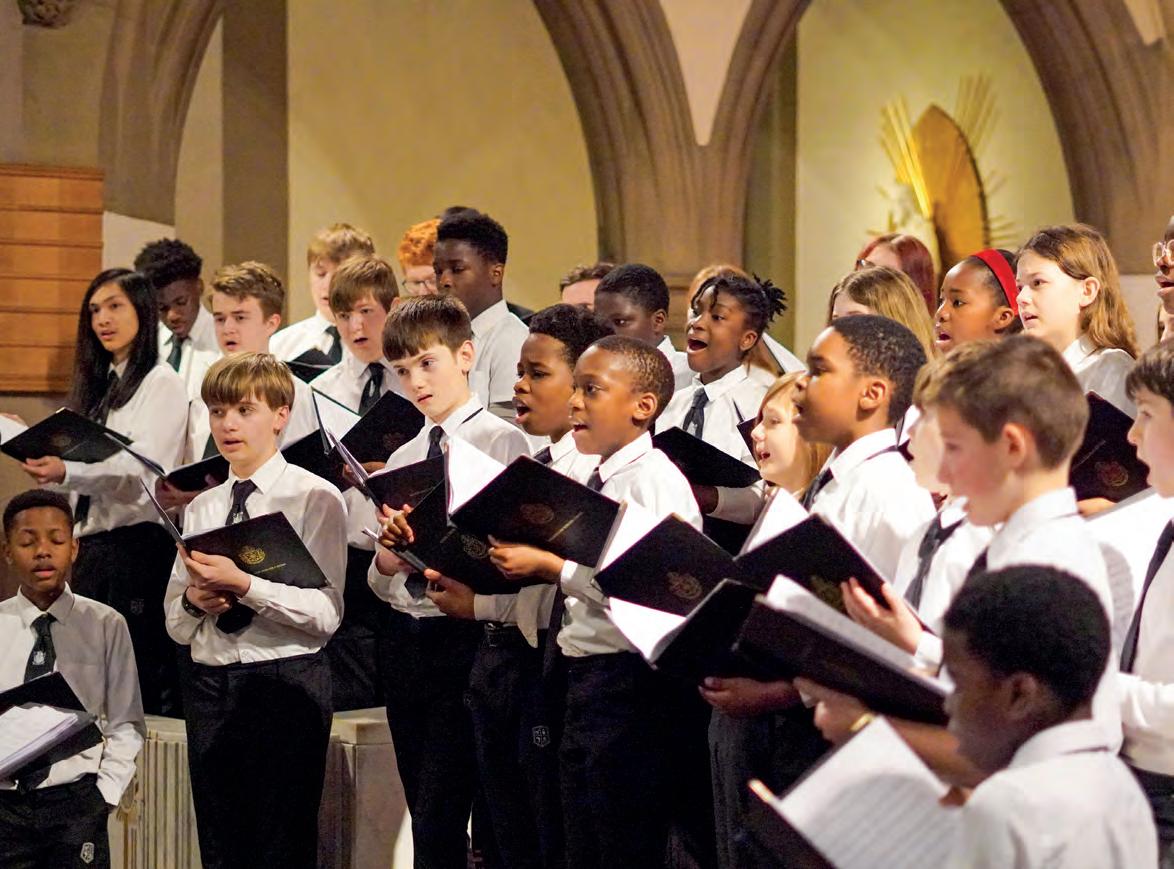
ABOVE Bradford Catholic Youth Choir

ENE Leeds Cathedral Senior Girls Choir
I am currently in Year 10 and in my third year of singing with the choir. I would recommend choral singing to others because of the fantastic opportunities it gives and the substantial knowledge you can gain from the participation and rehearsal sessions. There is also a real sense of community and friendship within the choir.
Attending the choir teaches you skills that not only enable you to become a better singer, but also ones you can use in later life that aren’t related to singing. For example, the commitment required for choir is extensive and a great way to introduce some of the practices needed for adult life. Our numerous BBC Radio 3 and 4 recordings and broadcasts, as well as other performances and concerts, teach me about working under pressure; skills I apply frequently in my life and which certainly wouldn’t be as developed as they are had I not joined the choir.
Unlike most of the other choristers, I didn’t sing in the Cathedral Junior Choirs so I definitely started singing a lot more after I joined the choir. I also became more aware of different types of music and started listening to classical and choral pieces. I already loved music, but now I can’t imagine my life without it, and I can’t go without crediting the choir for this.
Other opportunities, such as workshops, concerts and residentials with The Sixteen and Gabrieli ROAR have also really enabled me to learn more about the technical side of singing. The process of learning how to make different sounds and texts come alive using emotion, among other techniques, particularly interests me. Working and singing with an orchestra has become one of my favourite things to do, and I love the buzz and atmosphere that comes with concert nights and performances.
The lessons learned, the opportunities available and the overall benefit to my wellbeing make choir exciting, fun and extremely worthwhile.
NADYA
Derby Cathedral Choir
I have been singing at Derby Cathedral for six years. I had never studied music so joining the choir was a catalyst for pursuing music
more seriously. As a result, my passion for music has grown and grown. Singing makes me feel present, grounded and everything falls away. It does not matter if I have a diffcult day, as singing makes me forget about it for a moment. I feel both tired and refreshed when we finish and often it puts everything into perspective. My family has designed our schedule so that choir fits seamlessly into the week.
I enjoy spending time with my friends doing what we collectively love. We are a team and I love that we are working together to create beautiful music that touches so many people. I love all the pieces we get to sing and the pieces we get to learn from composers from an array of eras in history. We will be singing Byrd one day and switch to Rutter on another day, then Elgar after that. The styles are wonderfully different and exceedingly beautiful in their own ways. I love all the pieces we sing but some of my favourites are Handel’s Hallelujah Chorus, Nova! Nova! by Iain Farrington, Parry’s I was Glad, Stabat Mater by Pergolesi and Walton’s The Twelve. I would highly recommend joining a choir to anyone who, like me, loves music and loves working as a team.
NATHANIEL
Liverpool Metropolitan Cathedral Choir
Being part of a choir is one of the most rewarding activities you can choose to do. It offers the opportunity to understand music at an advanced level and helps you discover talents you may never have realised you possessed. It can also open up potential career paths in singing and allows you to perform and develop alongside singers of a very high standard.
Having experienced the benefits of choral singing firsthand for around seven years, I can confidently say that the musical knowledge and life skills gained through choir participation are invaluable. When you are accepted into a choir such as the Liverpool Metropolitan Cathedral Choir, you are trained to read and perform choral music to a professional standard – arguably one of the most demanding forms of music to master. Once you develop these skills, you gain the ability to sing almost any style of music, with endless possibilities ahead. Furthermore, performing music that has been rehearsed over the course of a week or more provides a deep sense of achievement and personal growth. You recognise your ▷
Sammie
Rosie
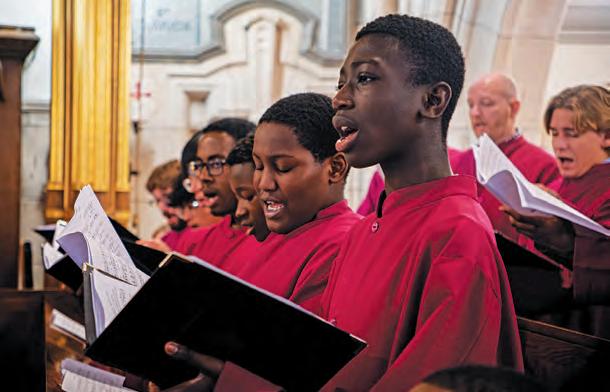
‘It’s so enjoyable to create music with a group of people knowing that you all have a shared goal’
progress as a musician and gain confidence in your abilities. This feeling is shared by all who commit to their role within the choir, as well as to the teamwork and discipline required to perform at such a high level.
My favourite music to sing in the choir comes from the Romantic period – an era which, in my opinion, saw music reach its full expressive potential. Works such as Gabriel Fauré’s Requiem and Louis Vierne’s Messe solennelle exemplify the emotional depth and richness of this period. Alongside this, I also greatly enjoy the music of Wolfgang Amadeus Mozart, in particular his Requiem Mass which has left a lasting impression on me and has firmly established itself as the greatest piece of music I have ever sung.
Overall, despite the time-consuming nature of choir participation and the high level of dedication and commitment it demands, the choir has fitted seamlessly into my life. The discipline it requires has not been a burden but a rewarding challenge that continues to shape me both as a musician and as an individual.

ABOVE Cathedral choirs have long been an essential part of the UK’s
ANNIE
Guildford Cathedral Choir
Choral singing makes me feel in awe of the sound we create with our individual voices, when they come together to make something bigger and different entirely. My favourite thing about singing in a choir is the friends you make. You spend so much time with each other, from rehearsals to performances, as well as the fact that we all have a passion for
something we form by working together. Being in a choir is like a family ranging from the youngest choristers to the most mature voices producing a wonderful, harmonious sound. I joined Guildford Cathedral Choir in Year 5, after I began to take singing lessons when I was in Year 3.
Singing in a choir is an integral part of my regular routine and fits seamlessly alongside everything else I need to get done. It’s most definitely an anchor in my life, as I always look forward to choir and it gives me a break from academics. Some people might say three times a week is a lot of work, however I would say it’s not work if you enjoy it. There is a huge variety of music we sing as choristers, ranging from Renaissance to living composers. But if I were to choose, I would have to say my favourite genres of music to sing are plainsong, Romantic works and some MacMillan. I would wholeheartedly recommend choral singing to anyone. It’s so enjoyable to create music with a group of people knowing that you all have a shared goal.
BEN Norwich Cathedral Choir
I have been singing in a choir since I became a chorister aged eight. Since then, choral singing has been a fixed part of my life. I have found that singing with a group of people, whether you know them well or not, provides a feeling unlike any other. As well as this, I enjoy singing in choirs such as one at school, as it has provided me with friendships that I am sure will last.
When my voice changed and I was no longer a treble, I was unsure whether I would continue to sing. But I persisted through the voice cracks and have since taken greater pleasure singing in the back row rather than the front. My favourite pieces have always been the ‘showstoppers’. I have particularly fond memories of Britten’s Rejoice in the Lamb and all of the trickery it entails. I would recommend singing in a choir to anyone and everyone because it allows one to switch off and join in a community, all while singing some brilliant music. What more could you ask for?
Support Cathedral Music Trust’s Teenage Choral Pathways Programme and make a one-off donation at: cathedralmusictrust.org.uk/support/donation Large or small, every donation makes a difference
CAREER CONFIDENCE
Cathedral musicians need to draw on a growing array of skills, covering everything from conducting to marketing. We explore what professional training opportunities are available in the sector
By CATHY DEW
Acathedral musician’s work is rarely done. Once the hymn books are closed and the final Amen has been sung, a wealth of activities take place ‘beyond the stalls’. Alongside their longstanding duties of training the choir, conducting services and playing the organ, cathedral musicians have a dizzying catalogue of responsibilities. In the wider community, they direct multiple singing groups of all ages and abilities, spearhead community engagement programmes, lead chorister recruitment workshops and teach music in schools – where expert cathedral musicians introduce children to a world of choral singing that might otherwise remain closed to them.
The work is equally diverse within cathedral spaces, where many music departments
facilitate participation across all stages of life. Babies, toddlers and their caregivers are welcomed into family singing groups. The youngest school-age children acquire a first taste of choral music through junior choirs. As children grow, a choristership can offer wonderful musical experiences, but if that path isn’t for them, voluntary choirs and singing clubs can provide a welcoming alternative. Teenagers can find their voice in youth choirs, while students might spend a gap year or complement their university studies as choral or organ scholars. Adults can join cathedral chamber choirs, and some groups, such as those at Rochester Cathedral, bring companionship and creative expression to people living with dementia.
Inevitably, this panoply of musical activity creates a raft of associated tasks, such as
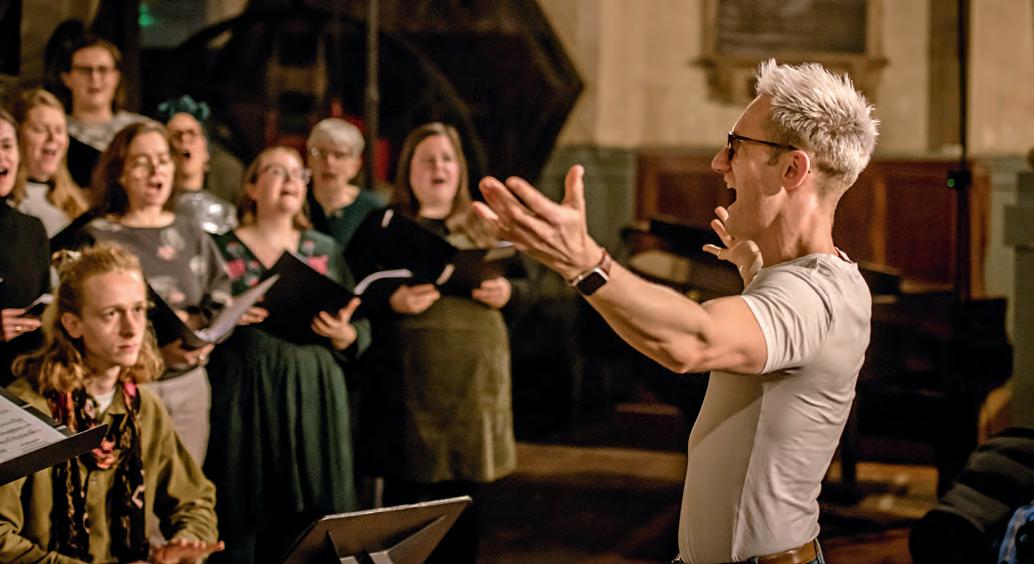
BELOW Choral leader
Charles BéquignonMacDougall in action
BELOW The Sixteen’s Sounds Sublime choral festival supports choral leaders alongside their Genesis Sixteen scheme
administration, communication, time- and people management, safeguarding and pastoral care, team leadership, budgeting, fundraising, marketing and publicity. Cathedral musicians should be forgiven for feeling, at times, a little daunted.
At Cathedral Music Trust, we welcome and celebrate the enormous contribution cathedral music departments make to their communities but also recognise that our wonderful musicians’ wellbeing and job satisfaction relies on them having the right tools and resources that enable them to rise to every new challenge with confidence.
The Trust’s objectives include supporting the extraordinary musicians employed in the sector, so we have been keen to understand how professionals have developed the skills they need and how we can best support both their continued development and the training of leaders of the future. In order to achieve this, Cathedral Music Trust has spent the last few months undertaking two parallel pieces of research. The first is a survey inviting cathedral musicians to tell us how they learned their craft and to highlight areas in which they would appreciate further development. The second is a ‘mapping exercise’ of the landscape of training opportunities already available. Together, these will help identify gaps in provision and explore how access to development opportunities might be strengthened.
The survey revealed an impressive array of qualifications and experience. It will come as
no surprise to learn that the cathedral music sector is blessed with many extremely talented and highly qualified individuals. It also taught us that musicians’ formal training has often been quite narrowly focused. The ‘traditional’ route – from choristership, sometimes via a music scholarship at an independent school, to university and an organ scholarship at a cathedral or collegiate foundation – prepares musicians well for a role that primarily comprised high-calibre organ playing and choral directing, but it does not necessarily embrace the full gamut of skills they are likely to need for a position in a cathedral music department today. Nor is this the only route into a cathedral music career. Many musicians enter the sector through other pathways that reflect the changing landscape and diversity of musical education. The Trust has learnt that continuing professional development (CPD) has not always been available, and many sector professionals have developed their broader skillset by learning ‘as they go along.’ Cathedral musicians whose work takes them into the wider community, for example, find they need skills to inspire those who may have little or no prior singing experience and to teach songs quickly and effectively to large groups who cannot read music. Musicians working as classroom teachers need an understanding of pedagogy and the music curriculum, as well as behaviour management techniques. As the sector’s understanding of the importance of vocal health has
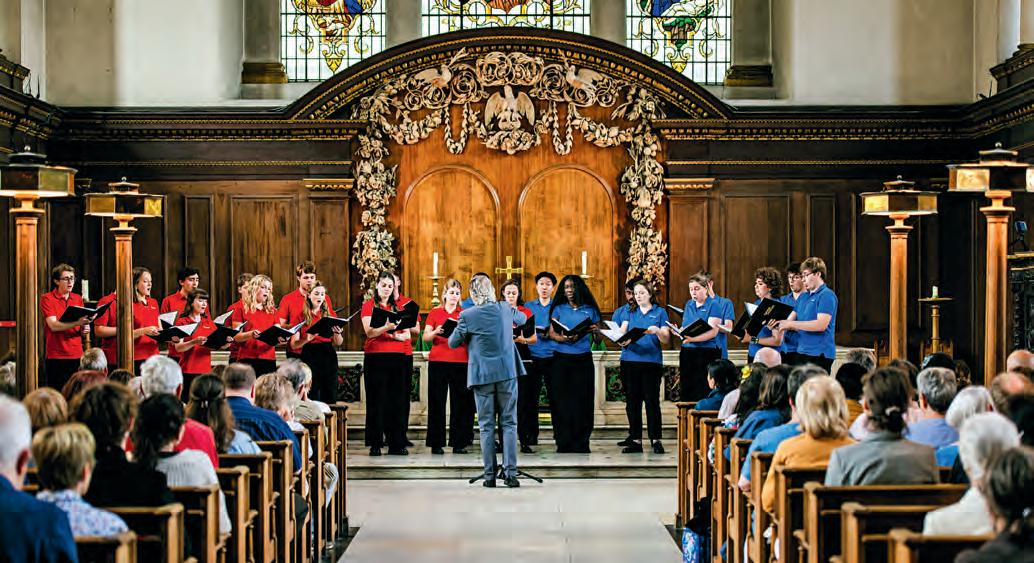
developed, so has the need for training in this area, both for singers and choral directors.
Our mapping exercise, carried out in collaboration with sector partners, has helped us better understand the formal and informal training opportunities available to musicians at the beginning of their careers and those seeking to develop their practice.
Many undergraduate courses in universities and music colleges now include helpful training in community music-making. Those looking for postgraduate qualifications could consider choral conducting courses such as that offered by the Royal Academy of Music, which prepares students for many styles of choral leadership. The Royal College of Organists has recently launched a new suite of accredited diplomas in choral direction, supported by online learning materials, which provide a vehicle by which skills can be formally recognised.
Other organisations, such as the Association of British Choral Directors, Sing for Pleasure and the British Kodály Academy, offer shorter courses that can fit around professional or academic commitments and The Guildhall School of Music and Drama’s Ignite programme delivers training in management and leadership from a musical perspective. While these courses are not all formally accredited, they are rigorously designed and delivered by experienced choral leaders.
Several organisations offer apprentice-type training. Genesis Sixteen, for example, includes opportunities for choral directors alongside its development programme for singers. The Rodolfus Choral Foundation, the RSCM and Gabrieli Roar give aspiring music leaders a chance to develop conducting skills while helping out with administrative tasks and pastoral care. The National Schools Singing Programme gives CPD to all its choral directors and Cathedral Music Trust provides specialist training for leaders of Small Sounds, its early years programme.
Over the last few months, in my position as Cathedral Music Trust’s Programmes Director, I have had the pleasure of observing some training in action. I spent a particularly enjoyable day attending ABRSM Voices’ Level One training in Choral Leadership, delivered by tenor, vocal coach and choral director Charles Béquignon-MacDougall. The three levels of the programme are taught over separate days; participants may attend all three or enter at the level most suitable for them. Beginning with the ingredients of healthy vocal technique, BéquignonMacDougall took us through the essentials of
Online training such as The Maestro Online offers a wide range of resources that can be accessed in bite-sized chunks
leading an effective warm-up, the principles to follow when teaching a song, the basics of choral conducting, and repertoire choices for different ages and stages. The day was expertly delivered, with much laughter along the way. Béquignon-MacDougall created a non-judgemental space for participants to practise and make mistakes, providing an ideal environment for aspiring choral leaders to develop skills in a variety of contexts.
As might be expected in our digital age, online training is also available. The Maestro Online, the brainchild of organist and educator Robin Harrison, offers a wide range of resources that can be accessed in bitesized chunks around a busy schedule. I dipped into an informative course, ‘Conducting with love,’ led by Ralph Allwood, which uses interviews and videos of Allwood’s own choral directing to teach gestures and techniques to engage and develop a choir.
Our research has shown that, although a variety of training pathways do exist, so do challenges in accessing them. The greatest include finding the funds to finance training and the time to fit it in. Cathedral Music Trust is beginning to explore how it might help, for example, through supporting investment in training through its grant-making programmes, signposting to other sources of provision and funding and helping providers tailor courses that can fit around cathedral musicians’ unique and busy schedules.
The research is ongoing, and we would welcome conversations with individuals and organisations offering training in choral leadership and the associated skills required. Cathedral Music Trust is under no illusion that this is something we could or should be approaching alone. We are very keen to partner with other organisations in supporting current and future cathedral musicians to develop the skills they need to deliver the world-class excellence for which they are so greatly admired.
ABOVE
Robin Harrison
Robin Harrison, founder of The Maestro Online
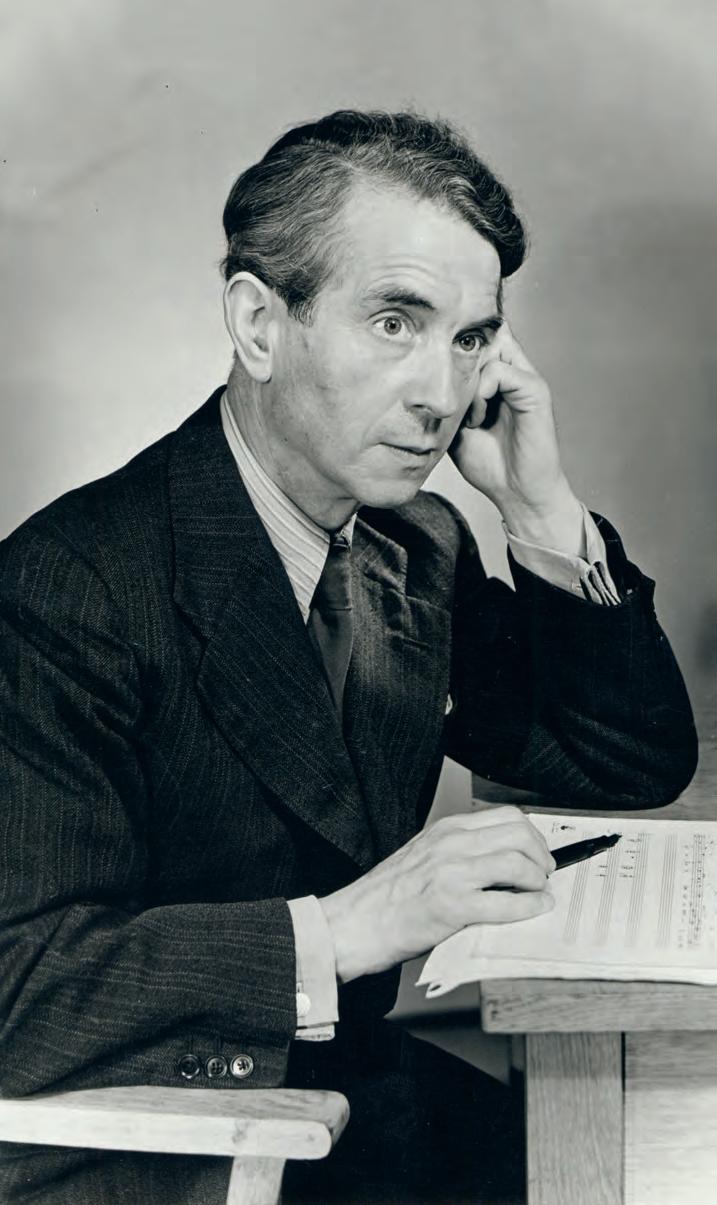
A PRIVATE MEMORIAL
Herbert Howells composed the anthem
Take him, Earth, for cherishing after the assassination of US president John F Kennedy, but a far more personal tragedy may lie behind it
By JEREMY POUND
S‘he was born in November, 1963, The day Aldous Huxley died…’ begins Sheryl Crow in her 1995 chart hit ‘Run Baby Run’. One of pop’s canniest wordsmiths, Crow is being cute with her historical references here. The American author was not the most famous person to die on the day in question. Nor, in fact, was his British counterpart CS Lewis. Friday 22 November 1963 will instead be forever remembered for the assassination of US president John F Kennedy.
As the shockwaves reverberated, among the musicians to pay tribute was conductor and composer Leonard Bernstein, who three days later led the New York Philharmonic in a special performance of Mahler’s Resurrection Symphony No. 2. ‘I know of no musician in this country who did not love John F Kennedy,’ wrote Bernstein. ‘We loved him for the honor in which he held art, in which he held every creative impulse of the human mind, whether it was expressed in words, or notes, or paints, or mathematical symbols.’ Another composer who would soon find himself being asked to reflect on that dark and dramatic event was Herbert Howells. ‘Within the year following the tragic death of President Kennedy in Texas, plans were made for a dual American-Canadian Memorial Service to be held in Washington,’ Howells later recalled. ‘I was asked to compose an a cappella work for the commemoration. The text was mine to choose, Biblical or other.’
The outcome would be Howells’s unaccompanied Motet on the Death of President Kennedy, sung by the Choir of St George’s Cathedral, Kingston, Ontario, Canada, at Washington’s National Gallery of Art on the first anniversary of the assassination. On the face of it, Howells may have seemed a slightly leftfield candidate for such a commission. Unlike Benjamin Britten, who had moved to the US for three years in the early 1940s – and, coincidentally, whose 50th birthday fell on the very day of Kennedy’s death – the Gloucestershire-born Howells, now in his early 70s, had always had his feet planted firmly on British soil, whether as a member of staff at the Royal College of Music in London or as organist at St John’s College Cambridge. Moreover, many of his best known works had been written for performance in ecclesiastical buildings, festivals and other events specifically within the UK (including the anthem Behold, O God our Defender for
‘Howells’s daughter Ursula suggested that the best way to address his grief would be to pay some sort of tribute to his son Michael through music’
the Coronation of Queen Elizabeth II in 1953). However, as a composer of perfectly pitched liturgical music – not least his settings of the Magnificat and Nunc Dimittis for, say, King’s College, Cambridge, and Gloucester and St Paul’s cathedrals, all of which suit the buildings for which they were written to a tee – Howells’s standing was second to none. Nor did he keep himself entirely aloof from the wider world around him. As Paul Spicer sets out in his 1998 biography of the composer, in the months leading up to Kennedy’s assassination, Howells’s diaries show a continuing disquiet over the disturbing developments of the Cold War and, in particular, the growing Russian nuclear threat. For him, the election of Kennedy in 1960 was a rare ray of hope, and the president’s death just three years later is known to have affected him deeply.
But it was, perhaps, another tragedy that Howells still had in mind while setting to work on Motet on the Death of President Kennedy. And for that, we have to turn the clock back 28 years to the final days of summer, 1935.
Howells’s diary for Tuesday 3 September 1935, records how his nine-year-old son Michael spent most of the day happily mowing lawns while on holiday in Gloucestershire. That evening, however,
Michael complained of feeling unwell and was packed off to bed. The following morning saw no improvement, and by Thursday he was deemed unwell enough to be rushed off to a nursing home in London. Howells’s diary for Friday 6 September reads: ‘Nursing home at 8.45 – Dr H at 9am. With M most of the morning – lunch with Scotts. M again at 2.30. Grave change. Mrs Fisher came – Mick worse always. Dr H 7pm. Hope, then despair. Dr Brunton. Dr Fisher… Mick died at 10.10pm.’
Howells initially responded to the loss of his beloved boy, from a very virulent form of polio, partly by making almost daily visits to Michael’s grave in the Gloucestershire village of Twigworth, partly by entering into something of a creative stasis, at first composing nothing, then doing so with little enthusiasm. Finally, it was his daughter Ursula who suggested that the best way to address his grief would be to pay some sort of tribute to Michael through music. Howells took up her idea, and the Hymnus Paradisi, his masterpiece for soloists, choir and orchestra, was the eventual outcome – only for the composer to then tuck the work away in a drawer, unheard, until being persuaded to allow it to be performed at the Three Choirs Festival in 1950.
Initially earmarked by Howells as the
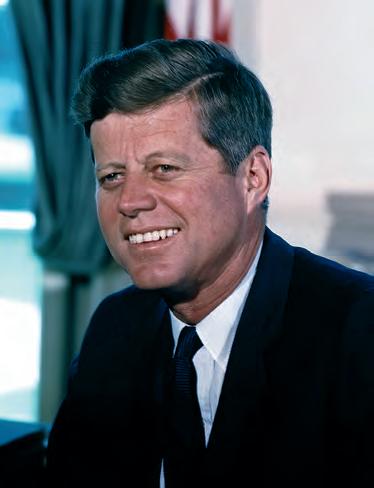
BELOW Washington’s National Gallery of Art where Howells’s anthem to John F Kennedy was first performed
LEFT The British composer Herbert Howells working on a score in July 1947
words for the Hymnus Paradisi was the Hymnus circa Exequias Defuncti (Hymn for the Burial of the Dead) by the fourthcentury Roman Christian poet Prudentius. As things panned out, the composer turned elsewhere for his texts, though he did retain one line from deep within the 43-stanza poem as an inscription on top of the score: ‘Nunc suscipe, terra, fovendum, gremioque hunc concipe molli’. Howells would continue to read Prudentius’s poem for comfort as the years passed, and it was that very line that, in a translation by the poet Helen Waddell, he would return to begin his Motet on the
A BRIDGE TO HEAVEN
Death of President Kennedy: ‘Take him, Earth, for cherishing, to thy tender breast receive him’. Today, the anthem is invariably known as Take him, Earth, for cherishing Two years earlier, when commissioned to mark the 450th anniversary of the foundation of St John’s College, Cambridge in 1961, Howells, setting another translation by Waddell, had laid his emotions bare in his A Sequence for St Michael, which opens with two anguished cries of ‘Michael!’. Take him, Earth, for cherishing is altogether more restrained and reflective. Beginning with the voices in chant-like unison –
The Revd Canon Emma Davies of Leicester Cathedral explored Howells’s genius in a recent sermon
If you travel to Glasgow, turn left and head for the sea, you’ll come to Largs where a ten-minute ferry ride followed by a short bus trip will take you to Millport on the Isle of Great Cumbrae. There, in the trees above the town you’ll see the slender spire of the Cathedral of the Isles, in the Anglican Diocese of Argyll and the Isles.
It was in that precious gem of a building that I first sang the anthem Take him, Earth, for cherishing by Herbert Howells.
I remember practising it for some hours, unfamiliar notes gradually taking shape and becoming music; and in the process forming a group of relative strangers into a choir.
There’s nothing quite like this process: learning to breathe as one, to blend vowels as well as notes, to find the unique sound that a group of voices can make, to bring something to life, collectively, every voice needed, the whole always greater than the sum of its parts.
Howells’s music is exquisite, haunting, gorgeous, devastating; expressing by turns sorrow, despair, hope, faith. Over the hours we practised, this music entered not just my ears but got under my skin, settled in my soul. This is still one of my favourite pieces of choral music.
Howells writes so brilliantly for voices, expansive in range and dynamic detail but never too angular or impossible to sing. But not many choirs will have such a piece in their repertoire. For this is highly complex writing, demanding a musical maturity and vocal accomplishment which is brought about only by many years of practice and performance. Some sections divide into eight parts, a double choir.
In the Cathedral of the Isles I think we only just managed two on a part – but this anthem asks for larger forces really to ensure parts are not exposed and the music has the fullness it needs.
We are therefore, particularly grateful for the grant of £27k we have received from Cathedral Music Trust to pay for more professional back-row singers for the next two years. ‘Back-row’ singers are the lower parts – alto, tenor, bass. Being able to engage more experienced singers allows Chris [Ouvry-Johns, Leicester Cathedral’s Director of Music] to include more demanding pieces such as this in the repertoire. This in turn provides a wider musical diet and experience for our young songmen who have served their time as boy trebles and are now learning to find their adult voices; and for the Boys, Junior Girls and Senior Girls.
This is not just about providing a great musical education. Singing in a choir develops a whole range of other skills useful in life –collaboration, confidence, commitment, cognitive function and communication skills. It helps connect people together and contribute to good wellbeing which is so important in a world where so many people are struggling with poor mental health. What we give to our choristers here is an extraordinary gift which will stay with them throughout their entire lives; some may pursue a career in music as a result of singing here.
Music has the ability to transcend the everyday; to transport us to an altogether more vibrant, sacred plane. Singing, especially, I think does this: the whole of our being becomes an instrument, creating sound that blends with that of the others around us; and sung words bring meaning to life. I would not be standing here today telling of the reality of God as an ordained minister were it not for my experience from a young age, singing in choirs, and church choirs in particular.
The words of ‘Take him earth’ are from an ancient hymn in response to death. They are in part liturgical words, committing the body of one who has died to the earth. This
BELOW Leicester
Cathedral’s Revd Canon Emma Davies and the Cathedral of the Isles in Millport, Great Cumbrae
Klajban
Michal
a quintessentially Howells effect – the ten-minute anthem does have its occasional outbursts, but these rapidly subside, and all is couched in the composer’s highly distinctive harmonic language.
That opening passage is in a mournful B minor, but thereafter the work never really settles in one key. Until, that is, the very end where, with a final ‘Take him, Earth, for cherishing’, we land on a restful, comforting chord of B major. Maybe, through his famous lament for such a public figure, Howells had somehow come closer to peace with the loss of his own son.

anthem was composed for the memorial service of John F Kennedy, but these are words that could be used for any human being. These are also words of life and of faith.
Howells takes these words and creates music that expresses deeper truth beyond simple meaning: quiet unison lines speaking almost a numbness, an acceptance; harmonies that seem to howl and rage with grief; pleading cries thrown to the wind; haunting harmonic shifts that throw us off balance… then towards the end, the almost inaudible sounding of a pedal note in the bass line, as the opening words are repeated a final time, insistent, cutting through the chaos, like the quiet voice of God present and persisting under, through, beyond everything.
And as the piece ends gorgeously grounded and settling into lush B major on the final ‘cherishing’, I know that for me, the chasm between earth and heaven is bridged. Something of heaven is here.
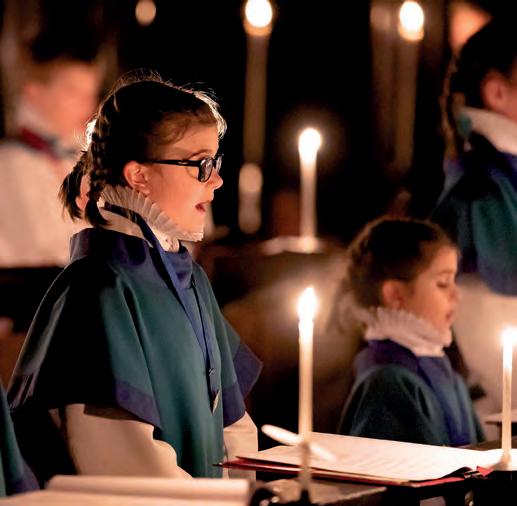
THE SIBTHORP CIRCLE
The Sibthorp Circle, named in honour of our Founder Revd. Ronald Sibthorp, recognises and brings together the generous individuals who have pledged to remember Cathedral Music Trust with a gift in their Will.
We give thanks to those who have remembered the Trust in this way.
Michael Antcliff
The Revd Sarah Bourne
David Bridges
Margaret Bridges
Michael Cooke
Eric Cox
Stephen Crookes
Dr Mark Fenton
Robert Frier
Clarendon Gritten
Rodney Gritten
Julian Hardwick
Edward Hart
Rosemary Hart
Tom Hoffman MBE
J M I Holmes
Sheila Kemp
Dr James Lancelot
Robin Lee
Jonathan Macdonald
Kate MacLean
Roddie MacLean
Professor Andrew Morrisson
Dr Claire Morrisson
Iain Nisbet
Martin Owen
John Pettifer
Marc Starling
David Williamson
Margaret Williamson
And several anonymous supporters
For further information or to join The Sibthorp Circle contact:
Leila Alexander
T: 0203 151 6096
E: leila.alexander@cathedralmusictrust.org.uk
www.cathedralmusictrust.org.uk
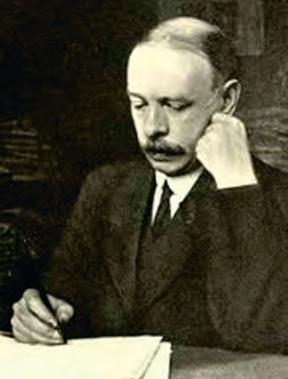
AN ENDURING LEGACY
To mark the centenary of the death of Charles Wood, a group of choir directors are performing all of his music in the cities in which he lived and worked
By GEOFFREY WEBBER
While the Ascension Parish Burial Ground might not be one of Cambridge’s most common tourist attractions, it is worthy of a visit. This hidden Victorian cemetery, just outside the city centre, is the final resting place of a number of famous people, including the philosopher Ludwig Wittgenstein, five members of Charles Darwin’s family and three Nobel Prize winners. It’s also where the composer Charles Wood was buried one hundred years ago, dying just two years after his friend and fellow Anglo-Irishman Charles Stanford.
Stanford came from Dublin and Wood from Armagh, with both composers spending most of their lives in Cambridge and London, working at neighbouring Cambridge Colleges (Trinity and Gonville & Caius) and at the Royal College of Music (RCM) in London, where Wood began his career as a pupil of Stanford, 14 years his senior. Stanford was Professor of Music at Cambridge until his death in 1924, when Wood succeeded him but sadly only for two years. The next professor, the musicologist Edward Dent, was taught by them both, and wrote regarding Wood that ‘As a teacher of composition he was surpassed only by Stanford himself’ but that ‘as a teacher of counterpoint and fugue he [Wood] was unequalled.’
Few would deny the greater brilliance and originality of Stanford as a composer over Wood, but we continue to be drawn to the latter’s quietly powerful and finely crafted church music, whether written in his personal style, as perhaps best exemplified by the anthem Expectans expectavi, or when he draws upon ancient chant and hymns, as in his hymn-anthems such as O thou sweetest source of gladness. Moreover, his interest in reviving old hymns and carols has left an indelible mark on church music, most notably
with his harmonisations of Ding dong! Merrily on high and This joyful Eastertide.
To mark Wood’s 2026 centenary, a group of music directors in Armagh, Cambridge and London have decided to perform between them ‘all’ of Wood’s surviving church music during 2026 in the cities where he lived and worked (see box overleaf).
Wood’s father, also called Charles, was a tenor lay-clerk at St Patrick’s in Armagh, and Wood became a chorister there. His earliest sacred works date from his teenage years in Armagh and his time as a pupil at the RCM from 1883 onwards. Wood moved to Cambridge as a student at the new Selwyn College in 1888 but only stayed there for five terms before Caius College secured his services as organ scholar. Wood wrote a few pieces specifically for Caius, but his more ambitious works were keenly welcomed by another neighbouring college, King’s, with its greater musical expectations and resources. Indeed, his most substantial sacred work, The Passion of our Lord according to St Mark was commissioned in 1920 by the Dean of King’s, Eric Milner-White, who much appreciated Wood’s historical and liturgical sensitivities. Wood’s teaching at the RCM frequently brought him to London, though he rarely stayed in the city. He may well have valued the beauty of the new Holy Trinity church built in 1901, nearly opposite the college in Prince Consort Road, but the only London church for which Wood specifically composed was another new building, the Roman Catholic Cathedral in Westminster, completed in 1903. Wood may well have got to know the first Director of Music there, RR Terry, during his early years in Cambridge when Terry sang at King’s College.
Establishing exactly what might constitute ‘all’ of Wood’s surviving church music is not
ABOVE Armagh-born composer Charles Wood who died one hundred years ago
straightforward. Wood appears not to have placed undue effort in securing the publication of his music, and several wellknown sacred works, such as the Evening Service in E flat No. 2, were not published until after his death, when his executors, much aided by Wood’s widow Charlotte Wills-Sandford, tried hard to get much of his varied compositional output music published.
Today, a substantial quantity of Wood’s manuscripts, in varying states of completeness, reside in the library at Gonville & Caius (along with some letters by Charlotte). Editions are being prepared this year of some of the works that survive in an apparently finished or almost completed state, many of which will be made available by the Church Music Society (CMS), either in printed form (via its new publishers, the RSCM) or as downloads on its website.
The project in Armagh, Cambridge and London aims to perform this ‘new’ material alongside all of the published works. It will not attempt to include all the hymn and carol arrangements, and neither will it be liturgically possible to perform all of the contents of the Communion settings, but nevertheless, the project plans to cover as much as proves feasible during the year.
The one ‘incomplete’ work to be published this year will be a Magnificat and Nunc dimittis in A flat for SATB and organ. Many of the surviving unpublished service settings are rather routine, but this one contains some fine writing. It survives in an incomplete neat
copy, along with some sketches, and the author of the first complete book on Charles Wood, Ian Copley, wrote in The music of Charles Wood – a critical study (Thames Publishing, 1978) that ‘a reconstruction of the work should be perfectly feasible.’ This has now been accomplished, and the canticles will soon receive their first performance and be broadcast on BBC Radio 3.
The other new editions being issued by the CMS this year are an early anthem and a Latin Nunc dimittis. O Lord, rebuke me not is a short but imposing work in eight parts composed by Wood when a pupil of Stanford at the RCM in 1885, around the time he also composed his first string quartet and a piano concerto. Wood composed two settings of the Nunc dimittis in Latin for use at Compline at Westminster Cathedral; the B flat setting is already published by the CMS, but this year a new edition of the A minor setting will also be released, edited by Professor Jeremy Dibble, whose major new study The Life and Music of Charles Wood is due for publication by Boydell Press in May.
The choir directors involved in this project aim to perform a share of Wood’s complete repertoire throughout the year, including his less well-known service music comprising several settings of the Communion Service and the Morning Canticles as well as 25 settings of the Evening Canticles. There are almost 40 anthems, for which Wood selected a fascinating range of generally non-biblical texts. While the spark of inspiration inevitably ▷
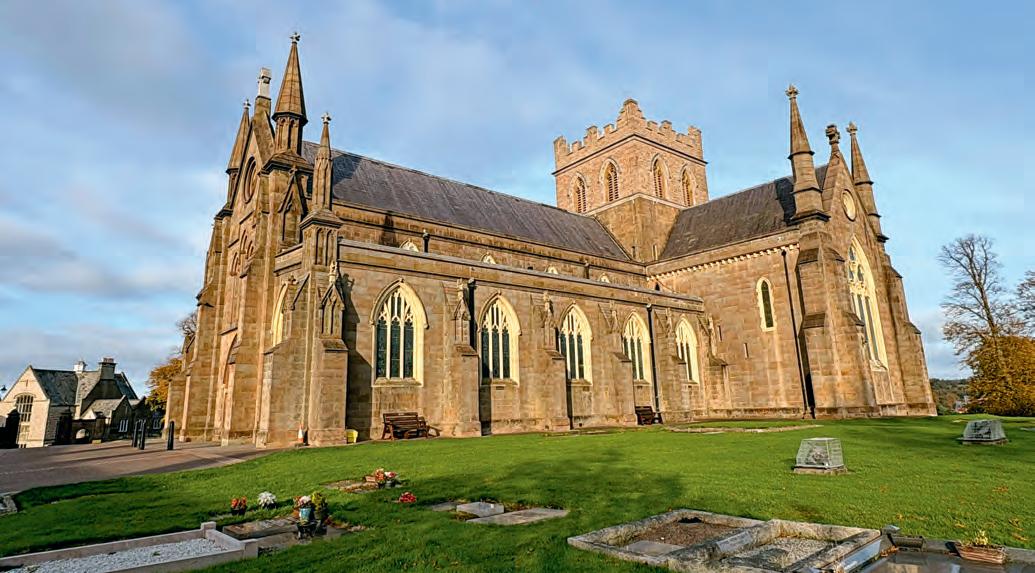
BELOW St Patrick’s Cathedral in Armagh where Charles Wood was a chorister
waxes and wanes across the repertoire, Wood’s supreme technical mastery is always apparent, and his concise service style in particular shows his awareness of the general need for liturgical brevity.
The choir at St Patrick’s C.o.I. Cathedral in Armagh performed his Missa Sancti Patricii on 15 March and the early anthem O Lord, rebuke me not will be performed during the Charles Wood Festival in August. Other early items will be sung by the Selwyn College choir. Since Matins is a relatively rare service these days, it is fitting that one institution involved sings the service regularly, the Royal Hospital, Chelsea. Its choir will perform Wood’s music on 12 July, the actual anniversary of his death.
The most significant performances planned for the year by the participating choirs (see box above) feature both established classics, such as the Evening Service for double choir in F, composed for King’s College, and ‘new’ items such as the anthem O Lord, rebuke me not, being sung in Armagh, and the Nunc dimittis in A minor being performed at Westminster Cathedral in June on the eve of Wood’s birthday.
The Three Choirs Festival at Gloucester will also be marking the centenary. Wood was invited to conduct the first performance of the rousing Palm Sunday anthem Glory and honour and laud at the Gloucester Festival in 1925, and he was due to conduct the Eastertide anthem ‘Tis the Day of Resurrection at the Hereford Festival in 1927, but died some months before. The festival
LISTEN TO THE COMPLETE WOOD
*broadcast on BBC Radio 3 and available on BBC Sounds
PAST EVENTS
SUNDAY 15 MARCH
St Patrick’s C.o.I Cathedral, Armagh Missa Sancti Patricii
SUNDAY 22 MARCH
Hampstead Parish Church, London
The Passion of our Lord according to St Mark
*SUNDAY 5 APRIL, EASTER SUNDAY King’s College, Cambridge Evening Service in F (Coll. Regale)
*WEDNESDAY 23 APRIL
Selwyn College, Cambridge
This is the day that the Lord hath made
UPCOMING EVENTS
SUNDAY 21 JUNE, 4PM
Westminster Cathedral Nunc dimittis in A minor
SUNDAY 12 JULY
(CENTENARY OF WOOD’S DEATH), CHORAL MATINS, 11AM The Royal Hospital, Chelsea
MEET THE CHOIR DIRECTORS
Stephen Timpany (St Patrick’s C.o.I. Cathedral, Armagh)
David Hill (The Charles Wood Festival and Summer School, Armagh)
Sarah MacDonald (Selwyn College, Cambridge)
Matthew Martin (Gonville & Caius College, Cambridge)
Daniel Hyde (King’s College, Cambridge)
William Vann (The Royal Hospital, Chelsea)
Simon Johnson (Westminster Cathedral)
Gavin Roberts & Patrick Allies (Holy Trinity, Prince Consort Road)
Geoffrey Webber (The Parish Church of St-John-at-Hampstead)
will feature other works by Wood including his ‘Highgate’ string quartet. For choirs wishing to mark the anniversary themselves, many of the published works are available in reprints now available from the RSCM along with the newly published editions from the CMS, and some further material is available on their website (church-music.org.uk).
Finally, in relation to music of our own time, Philip Moore has composed an anthem based on the music of Charles Wood, his hymn-tune ‘Armagh’. This forms the basis of Moore’s 2013 anthem It Were My Soul’s Desire, set to an Old Irish text translated by Eleanor Hull, who was also partly responsible for the text of Be thou my vision, usually sung to the Irish melody ‘Slane’. The anthem will also be published this year by the CMS, and has already been recorded by the Charles Wood Singers (on Regent Records).
(live-streamed) Te Deum in C minor; Benedictus in A flat
*JULY EXACT DATE TBC Gonville & Caius College, Cambridge at HTPCR/ Hampstead Evensong Service in A flat
*WEDNESDAY 29 JULY, GLOUCESTER CATHEDRAL, CHORAL EVENSONG, 3PM
The Three Choirs Festival in Gloucester ’Tis the day of resurrection
*WEDNESDAY 9 SEPTEMBER, CHORAL EVENSONG, 3PM
The Charles Wood Festival and Summer School, Armagh O Lord, rebuke me not; plus Phillip Moore: The soul’s desire
WEDNESDAY 18 NOVEMBER, 11AM Westminster Cathedral Haec dies: the combined choirs of St Paul’s Cathedral, Westminster Abbey and Westminster Cathedral
EVENSONG ABROAD
The cathedral choral tradition has flourished in Britain over the centuries, and now it is also thriving across the Continent. We embark on a tour around Europe to find out more
By FEMKE COLBORNE
With its distinctive green dome and giant organ, prominent pulpit for preaching and visitor materials showing the red and white Luther rose, the Berliner Dom (Berlin Cathedral) is a major symbol of German Protestantism. Yet for one Saturday every month, the cathedral becomes a vessel for a different religious tradition: Choral Evensong, complete with a robed choir.
Decked in blue cassocks and white surplices, the English Choir Berlin lines up in the sanctuary before processing into the church and standing in two rows in front of the altar. After a short introduction from the minister in German, the choir then sings a full traditional Evensong, complete with introit, Preces and Responses, psalms, a Magnificat and Nunc Dimittis, a hymn and an anthem. One reading is in English and another in German, to cater for all visitors.
Founded in 2013 by American musician Kathleen Bird, the English Choir Berlin has been singing Choral Evensong regularly at the Berliner Dom since late 2015, with a repertoire modelled on that of English cathedral choirs. It is one of a growing number of choirs in continental Europe putting their own spin on the British choral tradition, with northern Europe – especially Germany and the Netherlands – leading the way.
Born into a family of church musicians, Bird studied piano and organ in the United States and Germany before embarking on a musical career spanning both countries. Raised a Methodist, she had her first experience of Choral Evensong when a friend invited her to come along to a service at an Episcopal church in Baltimore, and later she sang in a Moritz Hengelhaupt
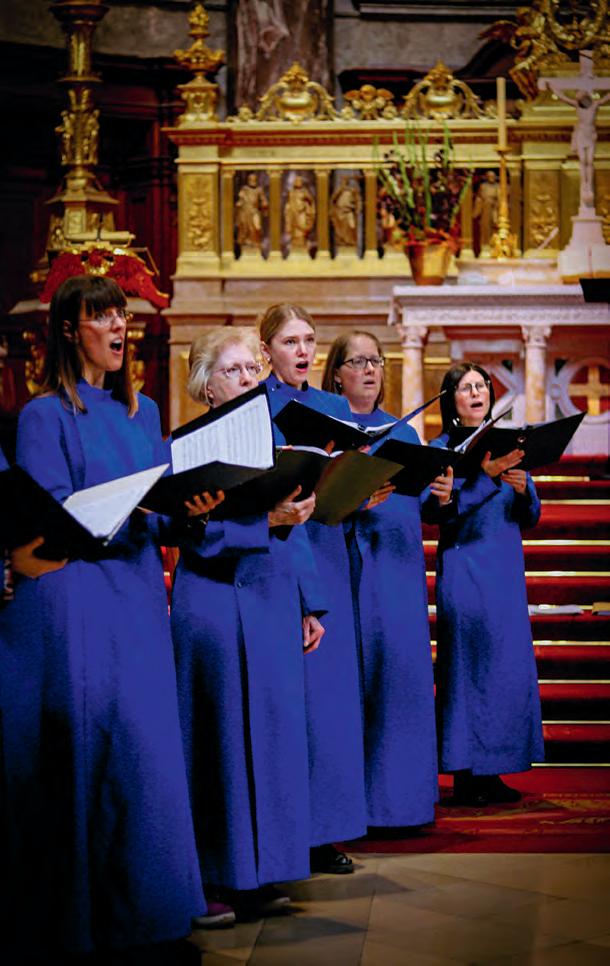
The English Choir Berlin in Germany
‘Quite a lot of people who come to Geneva have a vague choral background, so it’s like a home from home’
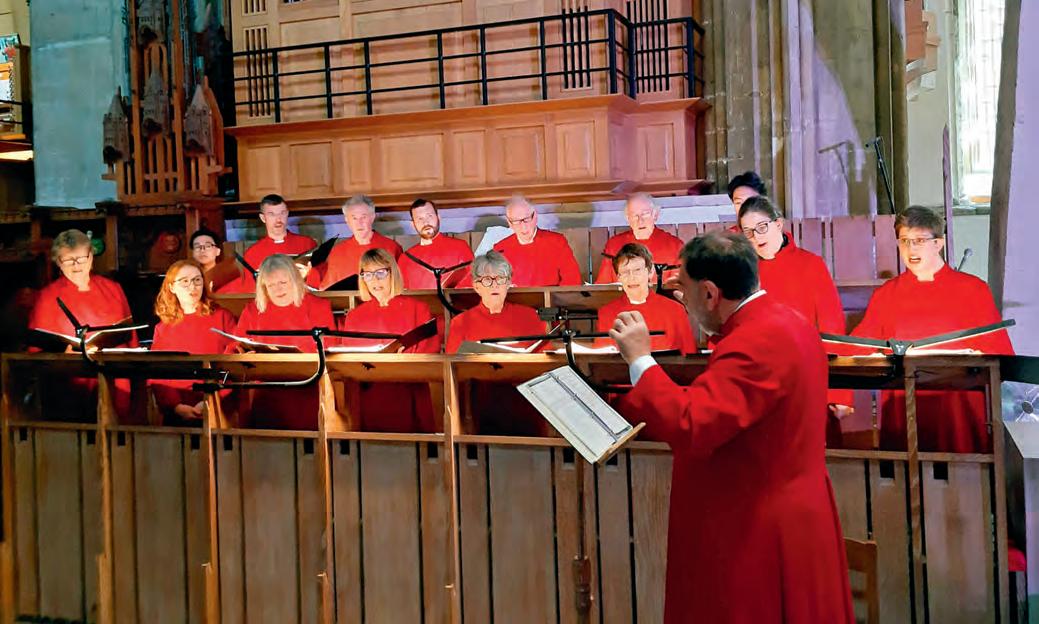
professional choir at an Episcopal church in Boston in the US.
After ten years living on a sailing boat, Bird and her husband decided to settle in Berlin – partly because of the city’s rich musical tradition: the world-class orchestras, chamber music scene and professional radio choirs. But something was missing. ‘When I came to Berlin, I thought, who is doing Choral Evensong here? Anybody? Not really,’ Bird says. The choir at the British Embassy performed occasional Evensong services, but there was nothing regular. ‘So I thought, well, I want to start my own choir that will sing the rich repertoire of the Anglican cathedrals, including Choral Evensong.’
These days, the English Choir Berlin consists of around three dozen singers, many of whom have sung in cathedrals or colleges and some of whom have sung professionally. Members from the UK, the US and Germany each make up around a quarter of the choir, while the remaining quarter come from a broad range of countries including Ireland, Finland, Poland, Ukraine, Russia, Hong Kong, New Zealand and Australia.
On top of its regular Choral Evensong services at the Dom, the choir also performs in other churches in Berlin and around Germany, including the Schlosskirche in Wittenberg, where Martin Luther is said to have nailed his 95 theses to the door. The ensemble has also embarked on several
international tours, including trips to Paris, Rome, Edinburgh and a four-day residency at Westminster Abbey in 2022.
German soprano Jessica Krüger, 30, studying for a PhD in law, says she loves the ‘variety’ of English choral music. ‘You have Renaissance stuff and you have modern stuff and you can put it all together nicely,’ she says. ‘And I like that it’s a smaller choir and that you don’t rehearse for half a year. You have one or two rehearsals and then you just have to sing. I like that speed of doing things.’
Bird retired as director of the choir in 2024, and the group is now led by William Peart, 29, a British organist, early keyboardist and conductor, based in Leipzig. Having grown up with church music in the UK but later moved to Germany, Peart says he was ‘very surprised’ when he first came across the English Choir Berlin during his studies.
‘I was especially surprised to find out that this choir actually performs at the cathedral, because in a lot of places in Europe, when choirs are given the opportunity to perform Choral Evensong, it’s not in quite such illustrious surroundings,’ he says.
But the format has thrived at the Berliner Dom, with Choral Evensong services regularly attracting a large German crowd as well as expats and tourists. ‘The cathedral are very, very happy with our work and want to encourage it as much as possible,’ Peart says. ‘It attracts its own very unique
Holy Trinity
Choir
ABOVE The choir of Holy Trinity in Geneva, Switzerland
audience that perhaps wouldn’t come to other services – perhaps even tourists that come to Berlin for the weekend, who want to come along and experience choral music in an absolutely stunning building.’
The English Choir Berlin is one example of the growing presence of traditional cathedral-style choirs in parts of Europe outside the UK. This trend has been especially notable in the Netherlands in recent years, with groups such as the Anglican Singers Amsterdam, which performs Choral Evensong and other English choral repertoire across the country, the New Sion Choir for English Church Music in Diepenveen and ensembles like Schola Davidica Choir in Utrecht, which hosts a monthly Choral Evensong in the Nicolaïkerk.
But it can also be seen in other countries, with prominent choirs in France, Spain, Italy and central Europe as well as Scandinavia. Many of these choirs have sprung from the Episcopal tradition, such as the choir of the American Cathedral in Paris and the New Chamber Singers based at All Saints’ Anglican Church in Rome.
Others, like the choir at Holy Trinity Church in Geneva, are part of the Church of England’s diocese in Europe. The choir of around 30 singers has a busy schedule, performing a congregational Eucharist every Sunday, Choral Evensong twice a month and a choral Eucharist once a month, as well as matins and compline services four times a year and special services at Easter and Christmas. The group’s Christmas Eve carol service has become so popular that it has been transferred from Holy Trinity to Geneva Cathedral, which has capacity of around 800.
Membership of the choir reflects Geneva’s eclectic population, with the city being home to several high-profile international organisations and branches of multinational companies. ‘Quite a lot of people who come to Geneva have a vague choral background, so it’s like a home from home,’ says music director Mark Charles, 63, who has run the choir since 2017. ‘When you come to a place where everything is new, it’s good to put roots down in something you’re familiar with.’
Recent members of the choir have come from Japan, South Korea, China, India, Australia, the US, Canada, Ghana and the breadth of Europe. ‘We even have the ambassador to Switzerland and the United Nations of Papua New Guinea,’ says Charles, who has also introduced an organ scholarship programme in Geneva drawing scholars from countries including the US, Japan, Mexico and Italy.
Further afield, St Edmund’s Church in Oslo, Norway has had a musical programme since it was founded in the late 1800s, but it was not until the church got an organ in the 1970s that a robed choir began to sing traditional formats like Choral Evensong. Nowadays, the choir consists of around 15 singers from countries including India, Nigeria, the UK, the US, Canada, Japan and Finland as well as Norway. As well as singing every Sunday, they perform Choral Evensong between two and four times a year.
The choir’s services are well attended by Norwegians who appreciate the choral tradition alongside their country’s own musical heritage, according to organist and choir master John Chapman. ‘There are many active choirs in Norway, which are efficiently run, and of an impressive level,’ he says. ‘However, there is no tradition within the church or Norway which is at all comparable to the Church of England.’
Many Norwegians are drawn to British traditions more widely, Chapman says. ‘Across the world people see the UK as potentially world leaders in upholding tradition, with our royal family, state occasions, remembrance, traditional schools and universities, etc, and it may be that the church is part of this.’
But for him, Choral Evensong has a special appeal beyond mere tradition. ‘Evensong is particularly spiritual, and the music written for it is some of the best choral music. There has been very little change over time in what constitutes an Evensong, and whilst the world changes outside the church walls, this special service helps to focus us on something other than our own busy lives. It reminds us that we are small pieces in something which is much bigger.’
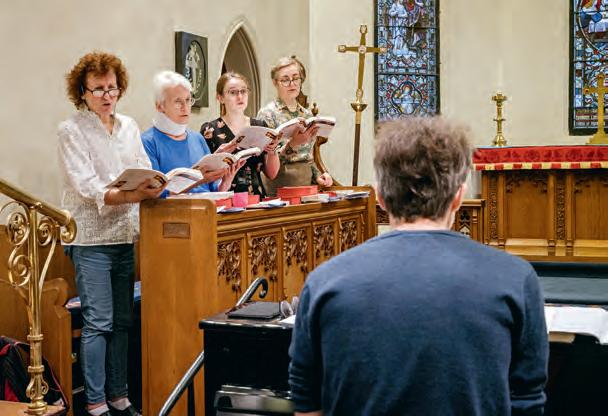
John Glazebrook
BELOW The choir of St Edmund’s in Oslo, Norway
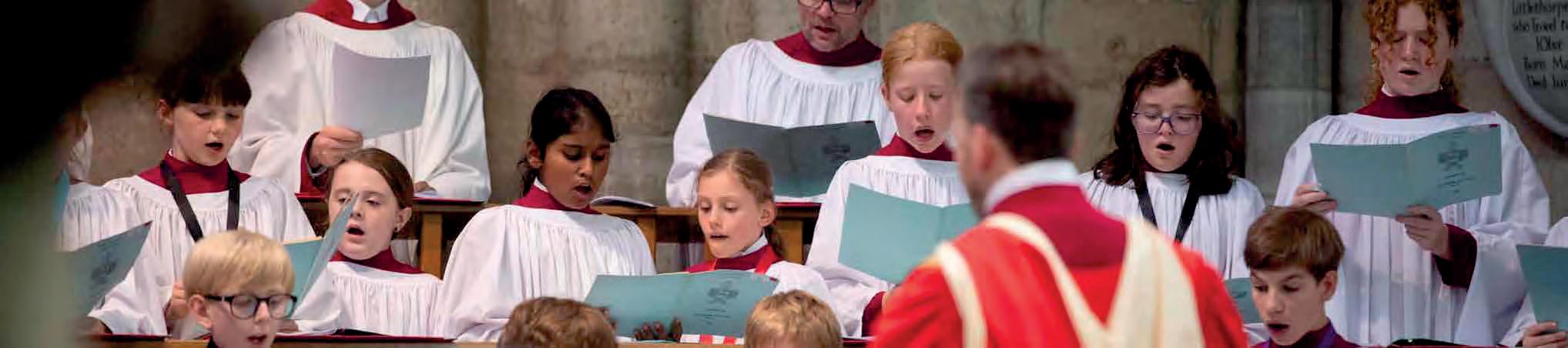
THANK YOU TO OUR SUPPORTERS
JUBILATE PATRONS
Richard Creed
Lady Sarah Gough
Julian Hardwick
Jonathan Macdonald
Iain Nisbet
Matthew Westerman
Michael Wilson
GOLD PATRONS
Alan Ainsworth
Ros and Peter Allwood
Anthony Biddle
Margaret Davis OBE
Colin Dudgeon
Dr Michael Emery
Stephen Emery
Richard Gabbertas
Jason Groves and Charles Owen
Douglas Henn-Macrae
Tom Hoffman MBE
Philip Johnson
Julian Kelly
Nicholas Parry MBE
Dr John Penniston
Dr Isobel Pinder
Gavin Ralston
Graham Robinson
Shauna and Michael Salomon
Abigail Sargent
Philip Shirtcliff
David Tilly
Dr Christopher White
Susan Williams
John Wilsher
Anne Wilson
SILVER PATRONS
Ralph Allwood
Andrew Fairhead
Sooty Asquith
John Bain
Richard Baker
Susan Balgarnie
Ann Bartleet
Malcolm Beer
Anthony Bowles
David Bridges
Nathalia Britt-Bird
Nigel Brown
Lady Hilary Browne-Wilkinson
Stephen Buckle
Lindsey Cooper
Kieran Cooper
Lady Curtis
Hilary Davies
Dr Monty Denneau
David Doggett
Martin J Donnelly
Jean and Jeremy Duerden
Kathleen Duncan
Thomas Edwards
Martin Eldred
John Ellis
Professor Alison Firth
Henrietta Fraser
Roma Haigh
Dr Philippa Hall
Kent Harries
Robert Harris
Peter Hignett
Alan Hodgetts
Dr Julian Holloway
Elizabeth Iles
Susan and David King
Jonathan Lancashire
Mark Lawrence
Diana Lazenby McLaren
Bridget le Huray
Janet Linington
Rosalind and Philip Lund
Sarah MacDonald
Jonathan Mayes
James Mcandrew
John Mitchell
Andrew Nethsingha
Fiona Olson
Neil Page
Joanna and Howard Page
Katharine and John Parsons
Anna Phillips
Oliver Piper
Nigel Press
Melvyn Roffe
John Rootes
Keith Ross
John Saunders
Professor John Saunders
Robert Scott
Jill Shepherd
Morgan Simes
Moyra Skenfield
Gordon Slater
Mike Smyth MBE
Margaret and Patrick Stables
Clive Stirling
The Revd Canon David Stone
William F. Tell
Antony Timmins
The Revd Paul Towns
Rob Uittenbosch
Michael Ward
Simon Webb
David White
Pam and Nigel Whitling
Jo Windsor
Brenda Wright
BRONZE PATRONS
Professor Joan Adams
Dr Nigel Allan
Nicholas Allan
Dr Simon Anderson
Stefan Anderson
Dr William Apedaile
Dr Jonathan Arnold
Michael Ash
Keith Ashton
Rosemary and Stewart Aylward
Nigel Bailey
Liz Baird
Nigel Bairstow
Isabel Bangs
The Revd Canon Philip Banks
Jean Barber
Michael Barker
Martin Bartlett
Thomas Bartlett
David Bawtree
Professor John Belcher
Christopher Bell
Sonia Bell
Christopher Benson
Kathryn Bishop CBE
Robert Blackman MBE
Dr Judith Blezzard
David Blumlein
Stephen Blurton
Sue Bonnie
Philip Booth
Joan and Michael Bosworth
Roger Boulton and Ruth Dunlop
Stephen Bourne
Paul Bradburn
Christopher Brewer
Josephine Briggs
Elizabeth Briggs
Alison Brimelow
Christopher Britton
Jack Brook
June Brown
Susan Brown
Richard Browne
George Bullen
Elaine Burbidge
Catherine Burgess
Jill Burrows
Andrew J Butt
Sir Ian Byatt
Dr Michael Callender
Ian Cannock
The Revd Canon Keith Pagan
Corinda and John Carnelley
Joseph Cassells
Simon Chadwick
Dr Adrian Chapman
Alexander Chartres
Angela Chatfield
Thomas Child
Dr Jeroen Chorus
Katy Christopher
Fiona Chryssides
James Clark
Dr Malcolm Clarke
Rosemary Clemence
Hugh Cobbe
Sheila Coles
David Cook
Peter Cook
Janet Cooke
Christopher Copson
Eric Cox
Beryl Cox
Eiluned Crozier-Cole
Graham Curtis
Howard Curtis
Christopher Dainty
Patricia Dale
Margaret Dale
The Rt Revd Edward Darling
Michael Davidson
Christopher Davies
Christopher Daws
Trevor Dawson
Dr David Day
Timothy Day
Simon Deller
Nigel Dick
Graham Dickinson
Christopher Donnan
Margaret Dorken
Geoffrey Dowling
Nicholas Drew
Brian Duckett
The Revd Peter Dunbar
Dr John Earis
Peter Eddy
Vivian Eddy
Faye Edwardes
Colin Edwards
The Revd John Ellis
Shirley Ellis
Sir Peter and Lady Ellwood
Gareth Eve
Anthony Fage
Dr Robin Field
Alèxe Finlay
David Fishwick
Giles Fletcher
Robert J Flute
Rosemary Foster
Professor Brian Foster
Martin Franklin
Abbot Redwood Fryxell
Jonathan Gainey-Brown
Andrew Gardner
Jonathan Gibbs
Martin Graham
Harry Grayson
Catrin Griffiths
Clarendon and Rodney Gritten
Michael Guest
David Haigh
Martin Haldane
Nicholas Hale
Michael Hall
Muriel Hamilton-Glover
Stuart Hancox
Jacqueline Harkin
Philip Harman
Cynthia and Gerald Harris
Clare Heath
Gerald Heather
Brenda Heaton
John Higgins
Peter Higgins
Dr David Hiley and Deidre
Sellars
Dr and Mrs David Hill MBE
Diana Hodgson
Patrick Hodson
John Hogan
Dr Michael Holland
Denise and Michael Hopkins
Anthony Hopkinson
Dr Don Horisberger
Mark Horsley
Dr Robert Horton
Nicholas Houghton
Patsy Huddy

Elizabeth, Simon and Michael
Hughes
Josephine Humphries
Janet Hunt
Robert Inches
Robin James
Isabel and Patrick Jeffers
Mark Johnson
Peter Johnson
Graham Jones
Robert Jones
Christopher Joseph
Stuart Keen
Robin Kellow
Diana Kendrick
Sally Kentfield
Professor David Kimbell
Dr Christopher Kimberley
Adam King
Margaret Kingman
Anna Kingsmill-Vellacott
Rosemary Kirkman
John Kirvan
Perry Kitchen
Dr Robert Knowles
Professor Simone Krüger
Bridge
Catherine Lamb
Leonard Lamb
Janey and Barrie Lambie
Stephen Lamont
Sir Stephen Lamport GCVO DL
Scirard Lancelyn Green
Susan Lane
Edith Laprun
The Very Revd Jonathan Lean
Claude Lee
Richard Line
Sarah and Timothy Ling
Richard Link
Raymund Livesey
Keith Long
Katharine Lovering
Beryl Lowe
Crista Lyon
Dr Douglas MacDonald
Joe Mace
Andrew Maddocks
Sarah and Richard Malins
Gillian Mapley
Hilary Markland
Richard Marshall
Gill Mason
Alan Mathewson
Michael Matthews
John Maxwell-Jones
Anthony McClaran
Martyn McClelland
Anne McDonald
Neil Medland
The Revd Gordon Melvin
Andrew Menzies
Colin Menzies
Andrew Millinchip
Michael Minta
Stephen Mollett
Mark Molony
David Monger
Stephen Montgomery
Nicolas Moodie
Christopher Moore
Linda Moore
Heather Morgan
Margaret Morris
Professor Andrew Morrisson
David Moss
The Revd Canon James Mustard
Penelope and Paul Naylor
Jill Neal
Dr Martin Neary
The Revd Kimonie Nicholls
Dulcie Noble
Timothy Noon
Brian Ollett
Patricia Orton
Bruce Parker
The Revd Denis Parry
Jean Partington
Brian Pearson
Dr Anne Peebles Brown
The Revd Canon Jeremy
Pemberton
Roger Pengelly
Narayana Picton
Judith Power
Michael Powles
Philip Price
Susan Prickett
Ian Provost
Brigadier Neville Pughe
Jennifer Railton
The Ven John Rawlings
Robert Read
Richard Redding
Jane Regan
Andrew Revans
Giles Richards
Julian Royals
Nigel Salisbury
David Salter
Dee and Drew Salvest
Hilda Scarth
Clare Scott
Richard Seaton
Carol Seymour-Newton
Keith Simpson
Andrew Sims
Isobel Skelhorn
Doreen Sladdin
Thirza Sloan
Dr Peter Smail
Margaret Sproule
The Right Revd and Mrs
Stancliffe
John Stanley
Margaret Stephen
David Stephenson
Anthony Stone
Ivo Swinnen
Richard Tanner
Ian Thompson
Margaret Thompson
Michael Thompson
Janet Thompson
John Thorne
Graham Thorpe
Clive Tibbits
Janet and David Tiley
Christopher Town
Dr Bernard Trafford
Monica Trenchard
Adam Tunnicliffe
John Turner
Gordon Tyerman
Peter van Son
Tom Venner
Mark Venning
Margaret and Richard Vincent
Catherine and Nicholas Walker
Colin Walker
Amelia and Henry Wallace
John Wallace
Laura Wallace
Susan and Clive Watkis
Dr and Mrs Watts
Eric Wayman
Ian Westley
The Revd Dr Rowan Williams
Dr R B Williams MBE
Susie Williams
Margaret and David Williamson
Arnold Wills
David Wilson
John Winpenny
Nigel Wissett-Warner
Professor Martin Woodward
Diana Woolley
Christine Wright
Janet Yerbury
And several anonymous Patrons and Friends.


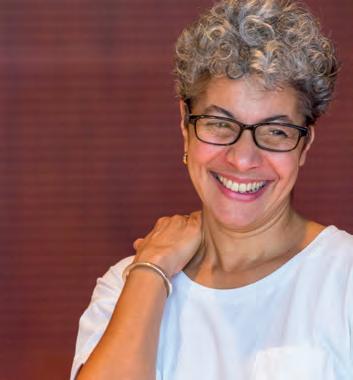
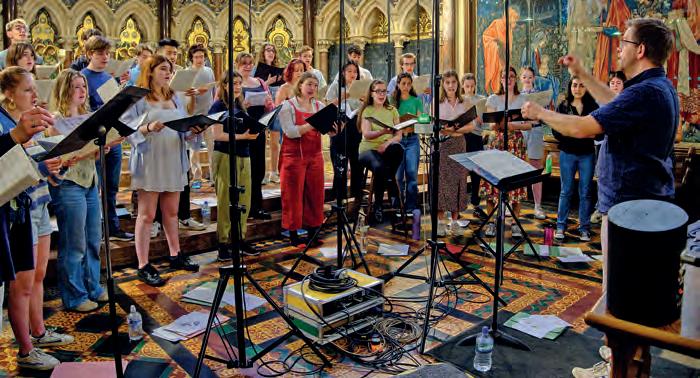
Douglas
Bret
David Ponsford
Philip
Clare
Rebecca Tavener
Ben Ealovega
CDS
JS Bach: Die Kunst der Fuge (‘The Art of Fugue’), BWV 1080
Robert Costin (organ)
First Hand Records FHR191
Bach’s Art of Fugue is not for the faint-hearted. Robert Costin proves to be a performer with the intellect needed here, but also with emotional depth and technical finesse. He registers section by section: 1-3 with flutes, 4 and 5 with principals, 6 much bolder with reeds
and mutations, 7 and 8 principals again, 9 with sparkling flutes, 10 just the Hw 8-foot flute, which has a wonderful limpid clarity, 11 principal chorus, and then the unfinished 14 flutes once again, and ending in mid-air just as Bach left it. This restraint works wonderfully well, and the clarity of the counterpoint is excellent. The choral Vor deinen Tron is quiet and intense, the chorale line on a single Principal. Then in the huge six-part Ricercar from the Musical Offering we begin to hear the Metzler organ of Trinity College, Cambridge being let loose, and Costin gradually increases the registration until the final pleno (full organ) complete with manual and pedal reeds. Costin makes every line of this complex counterpoint tell in a hugely enjoyable recording.
DOUGLAS HOLLICK*
Nicolaus Bruhns: The Complete Organ Works; Vincent Lübeck: Ich ruff zu dir
Herr Jesu Christ
Nicolas Haigh (organ)
Raven OAR-198
The organ here is St Thomas Church’s Taylor & Boody instrument originally of 1996, and with a Brustwerk added in 2015. Tuned to an unequal temperament of Kellner, this is a lovely and suitable instrument, well recorded in a spacious acoustic. Bruhns was a violinist as much as an organist,
ORGAN CD s
St Thomas Church, Fifth Avenue, New York – home to a Taylor & Boody organ

and Haigh mentions Mattheson’s account of Bruhns playing his violin and accompanying himself with his feet on the organ pedals. The central section of the ‘Nun komm’ Choral Fantasia with two intertwined upper parts is sensitively played and registered here, and I know from trying it with a Baroque violinist that the two solo lines are perfectly placed to double stop on the violin. The toccatas use a fine and suitable variety of registrations, but I would have liked a little more sense of spontaneous virtuosity, as the original improvisations must have had. The music theorist Mattheson suggests that in the stylus phantasticus the ‘meter takes a holiday’ and that sense of jeopardy needs to be stronger in the free sections. It is very good to have the impressive large-scale Lübeck chorale fantasia as well. Fine playing by Haigh, and a shame not to record more, perhaps the lovely Hanff chorales would have connected both in place and period. Maybe part of a further disc from Haigh and this organ?
DOUGLAS HOLLICK*
Jean Guillou: Organ Works, Vol. 2 – Colours And Shadows
Zuzana Ferjenčiková (organ)
Aeolus AE1501
Jean Guillou had a particular affinity with Mozart’s music and his recordings and arrangements aimed to give the music fresh appeal to audiences via the organ. In this double SACD album, Zuzana Ferjenčiková explores this fascination, placing Guillou’s arrangements of Mozart alongside his own works. The first disc is recorded on the Kleuker organ which Guillou designed in the 1970s. This is the perfect vehicle for works like Jeux d’orgues, Op. 34 – an exploration of various organ stops and combinations. Ferjenčiková, a student of Guillou and leading
authority on his compositions, includes ten unpublished additions to this kaleidoscopic demonstration of a remarkable instrument. In many ways, this helps listeners to understand Guillou’s musical philosophy: he saw different organ sounds as diverse characters, and in his (and his interpretations of others’) music the musical discourse is played out like actors on a stage. This can already be observed in the 18 Variations, Op. 3 (an early work owing more to Guillou’s own teacher Dupré) but in a much more developed form in his last composition Macbeth, le Lai de l’Ombre, Op. 84, recorded here for the first time. Here is Guillou’s ideal: writing incidental music for a production of a Shakespeare tragedy. The Gonzales organ in Lille Cathedral is a good choice for this and the other more poetic pieces: Ballade ossianique No. 2, Op. 23 and Säya ou l’Oiseau bleu, Op. 50. This is a wonderful exploration of Guillou’s unique musical language and Ferjenčiková is a brilliant advocate.
RUPERT GOUGH*
Zuzana Ferjenčiková, a former student and brilliant advocate of Jean Guillou
Britt Schier
IN THE SPOTLIGHT
Langlais: Organ Works, Vol. 3
Giorgio Benati, Fausto Caporali, Alessandro Perin (organists) Brilliant Classics 96362 (5 CDs)
With this third release of the complete Jean Langlais organ works we have reached the halfway stage. As with the two previous sets, there is music from all periods of his life on six different Italian organs. His magnum opus, the Five Meditations on the Apocalypse (1972-74) in many ways marks the summit of his achievement: running for over 50 minutes and closely indebted to the mature organ works of his great friend Olivier Messiaen, it brings a set of passages from the Book of Revelation in graphic and terrifying music: I think of Bosch and El Greco. Calmer echoes also find a voice especially in No. 4, (aptly described as a prayer of luminous mysticism). It is no coincidence that Langlais was at the time beset by serious health issues. Langlais never forgot his early teacher Charles Tournemire (his predecessor as organist at the Basilique de Sainte Clotilde). In Memoriam (1985) is another extended Gregorian improvisation imitative of Tournemire’s Triple Choral. The early four Postludes (1950: long out of print) are striking examples of his early virtuosic style. In the Symphony No. 2 (1977) Langlais pays homage to Webern’s austere and laconic language in a work barely six minutes long.
Really charming are the Noëls Avec Variations (1979) where he uses several well-known French carols and imbues them with a thoroughly contemporary flavour. He was also fond of the folksongs of his native Brittany, many of which he revived and paraphrased in simple vocal arrangements. Prélude et Allegro (1983) is yet another example of Langlais’s extended virtuoso concert idiom: this time a Welsh Arts commission for a piece with original themes lasting 20 minutes. His earliest work, the brief Prélude et Fugue (1927) shows a 20-year old’s versatility already well developed. There are two excellent extended suites: Poèmes Évangéliques (1932) comprises three portraits from Jesus’s early life and Huit Pièces Modales (1956), composed during an American tour: each brief, concise and approachable. One of his most famous works, Hymne d’actions de grâces (based on the Te Deum) is one of three pieces originally intended to form part of a competition in 1935 which was cancelled. Fortunately all the pieces were published. This collection also features some real rarities: Offrande à Marie (1971) dates from a time when Langlais felt the church and the musical world were facing huge challenges and he asserts his faith in an extended set of six meditations on the Virgin Mary, whose consoling presence provided him with great comfort. From near the end of his life there is a set of four tributes Contrastes (1988), two of which are to friends he had known for many years and one to his copyist Yves Castagnet. Suite Française (1948), another extended set of ten pieces, has
gained popularity on account of ‘Nazard’ and ‘Arabesque sur les flutes’. Langlais adopts an epigrammatic approach to achieve contrast and variety. In the Suite Baroque (1973), Langlais re-adopts the style of Pachelbel, Couperin and other French masters of that period. For the 300th anniversary of the birth of JS Bach he wrote a set of six pieces, based on the four B-A-C-H notes that have inspired so many other composers. They are short pieces comprising a unifying theme in small miniatures rather than grandiose Liszt, Reger or Karg-Elert.
Once again there are many shorter pieces filling in the corners. Moonlight Scherzo (1990: one of his very last works based on ‘Au Clair de Lune’ which also incorporates the B-A-C-H motif). Prélude on ‘Coronation’; (1963) explores an impressive range of sonorities in four minutes: Essai (Trial) (1961), another pedagogical work, shows he was not averse to avant-garde experimentation and Sonate en Trio (1967) is yet another tribute to Bach. This five-CD box set is a splendid addition to a growing encyclopaedia of music of immense quality and variety: the organs used by this very industrious team of performers and the very high production standards alone suffice to give an enthusiastic welcome to this budget-priced release of over six hours of music. Each volume so far has been released annually, therefore we can reasonably expect the series to complete in the next couple of years, which will be an achievement worthy of celebration.
BRET JOHNSON
Florence Price: Organ Works
Tom Winpenny (organ)
Naxos 8559956
Florence Price (1887-1953) achieved distinction both as an organist and composer at a time when black people were denied opportunity at all levels of society during the post-reconstruction era in the USA. Born in Arkansas she studied at the New England Conservatory of Music in Boston. She experienced increasing discrimination in her home state in the 1920s and following relocation to the more liberal Chicago she found openings as an organist, piano teacher and accompanist for silent films. She showed an early affinity with the French Romantic organ tradition when as a 17-year-old student she gave a performance of Alexandre Guilmant’s First Organ Sonata in the presence of the composer. This was at a time when American organ music had yet to find a distinctive voice of its own and Price, through her exposure to the Chicago music scene, was able to assimilate the broadening outlook taking root there in the early 1930s.
Price’s organ music draws on her experience as a cinema organist: however there are larger and more profound works which pay homage to Bach and American folksong. Although a lifelong presbyterian, there is little evidence that church music influenced her organ pieces. She was a composer who nearly fell into total oblivion were it not for the discovery of a huge number of scores in an abandoned house near Chicago nearly 20 years ago which precipitated a revival and several recordings of major works. The organ music offers a vivid illustration of the new developments in American music at that time. The ever-industrious Tom Winpenny
plays the organ of the Saalkirche Ingelheim, an instrument designed and built in the US in 1930 by Ernest Martin Skinner and rebuilt and updated in 2013 by Klais Orgelbau in Bonn, Germany. This is an album worthy of exploration.
BRET JOHNSON
Saint-Sulpice: Works by Widor, Dupré, Grunenwald & Roth Karol Mossakowski (organ) Aeolus AE11491
The young Polish-born but Pariseducated Karol Mossakowski was appointed titular organist of SaintSulpice in February 2023. He is therefore in an excellent position to have recorded this disc of music by former organists of the church: Marcel Dupré, Charles-Marie Widor, Jean-Jacques Grunenwald and Daniel Roth.
For the previous Saint-Sulpice, Guillaume-Gabriel Nivers and Louis-Nicolas Clérambault were the organists, but for the new church, built in the mid-18th century, François-Henri Clicquot constructed in 1781 a five-manual 64-stop organ. It was this instrument that CavailléColl rebuilt, while retaining many elements of the old organ to produce a synthesis of both historic and modern features of French organ building. Therefore, the organ today is able to evoke the sound worlds of at least three centuries.
Mossakowski has now an enviable command over this enormous organ, and he plays at ideal tempi to capture the cavernous acoustical ambience of the building, while projecting the improvisational fluency and the vitality of the music.
Dupré’s Trois Préludes et Fugues, Op. 7 (1912) combine clarity with appropriate drama in rhythmicallycontrolled but exciting
interpretations, while in Widor’s Trois Nouvelles Pièces, Op. 87 (1934) he captures some of the subtle colours of the organ.
Inevitably, the harmonic language becomes more complex in Grunenwald’s pan-tonal Diptyque liturgique (1956) and the plainchantbased Jubilate Deo, and Daniel Roth’s Fantaisie fuguée sur Regina Cæli (2007) is a fitting conclusion to this evocative CD, combining subtle, imaginative and brilliant effects from this wonderfully symphonic organ, which is truly eclectic in its combination of Classic and Romantic styles.
DAVID PONSFORD*
Expectations
Alexander Ffinch (organ)
Divine Art DDX21147
This is Alexander Ffinch’s third album of transcriptions and original organ works and the theme here –Expectations – refers to the period in winter when we look to the new year ahead. So, the music largely takes us from Halloween, with Saint-Saëns’s Danse macabre and Guilmant’s Marche Funèbre et Chant Séraphique, through the Dupré Variations Sur un Noël to Fanny Mendelssohn’s Das Jahr
The fine-toned organ at Cheltenham College was originally built by Norman & Beard in 1897 and most recently restored by Harrison & Harrison in 2017, overseen by Ffinch who has been the organist at the College since 2004. Ffinch delivers an exemplary recital. There are lesser-known gems to enjoy here too – Ffinch’s own transcriptions are particularly effective, including a clever arrangement of David Bowie’s Life on Mars?
RUPERT GOUGH*
CHORAL CD s
Eleanor Daley: Requiem and other choral works
The Choir of Royal Holloway / Rupert Gough
Signum Classics SIGCD961
Marking Canadian composer Eleanor Daley’s 70th birthday in 2025, this CD devoted to her sacred music is a fine tribute from the excellent Choir of Royal Holloway under director Rupert Gough. The main work is Daley’s 1993 award-winning Requiem, consoling, expressive and, ultimately, cathartic. Daley’s hallmark sensitivity to the setting of texts is much in evidence in this unconventional work of mourning, which uses parts of the Latin liturgy as well as Psalm 130, words from the Book of Revelation and the Anglican Burial Service. Among the shorter independent choral works is Grandmother moon, itself a haunting postlude to the Requiem. Gough draws the best from his choral forces, shaping their well-focused tone, diction and ideal balance to the service of Daley’s art. An exceptional disc.
PHILIP REED*
Orlando Gibbons: At the Chapel Royal
The Choir of HM Chapel Royal Hampton Court Palace / The English Cornett & Sackbut Ensemble / Carl Jackson Resonus Classics RES10375
In a programme exploring Gibbons’s sacred output, from verse and full anthems to instrumental works, plus the complete Second Service, the sensitive collaboration with brass is both musically interesting and historically appropriate. An engaging exuberance notwithstanding, the singing is uneven, with moments of rocky tuning, poor blend and loss of vocal ‘line’. It’s full of character, but some egocentric lower voices distract. Questions of pitch and voice allocation arise: suffice it to say that the sound of toiling in the lowest vocal reaches is either excitingly gnarly or discomforting, depending on your ears. This is not to suggest, however, that it may be an invalid evocation of Chapel Royal performance in the early 17th century, and the recording has commendable immediacy.
REBECCA TAVENER*
Marc’Antonio Ingegneri: Motets for the Liturgical Year, Vol. 5
The Choir of Girton College, Cambridge / Gareth Wilson; The Western Wyndes / Jeremy West Toccata Classics TOCC0767
A devotional atmosphere elevates these premiere recordings of Marc’Antonio Ingegneri, lovingly moulded by director Gareth Wilson, editor of all the works, who has immersed his young singers in both the music and its spiritual context. The tenderly sung Alma Redemptoris Mater following the fireworks of Canite tuba, shows how intensity can ameliorate technical immaturity. The Western Wyndes provide excellent brassy support in a generously forgiving acoustic that is evocative of Italian sacred architecture.
REBECCA TAVENER*
Darius Lim: Songs of Dreams Voices of Singapore Choral Society Naxos 8579154
Darius Lim is Singapore’s one-man choral music engine. Barely 40, this inexhaustible conductor, composer, and pianist founded the Voices of Singapore Choral Society (VOS), which, with 1,500 members in more than 30 ensembles, has handily become the country’s largest singing organisation. As the liner notes remind us, Singapore is still a young nation – just 60, as of the past year. Thus, Songs of Dreams – all Lim’s compositions, all conducted by Lim – can reasonably lay claim to being the first commercially released album of all Singaporean choral music, performed by Singaporean artists and ensembles (in this case, all VOS choirs).
The liner notes describe the album as reflective of ‘the vibrant story of Singapore.’ But Songs of Dreams often feels less like an account of the nation’s choral scene than it is a portrait of a highly influential voice within it. That hobbles the release somewhat: by album’s end, Lim’s musical idiom – harmonically conventional and structurally predictable, with the occasional folky flourish and stomp-clap interjections – feels as though it’s run its course. One can imagine a more varied and effective release which included other composers.
One of the album’s strongest pillars is the VOS Children’s Choir, which performs impressively all over this release. Likewise, Lim’s compositional creativity sounds most unbridled when writing for young singers. From his imaginative Echoes of the Lost World to the whimsical The Glass Slipper and A Puppet’s Dream, there are riches ▷

here for talented youth ensembles everywhere to explore.
HANNAH EDGAR*
Johann Daniel Pucklitz: Cantatas and Masses
Goldberg Baroque Ensemble / Goldberg Vocal Ensemble / Andrzej Szadejko
MDG MDG90223736
The Gdansk musical goldmine, aka the manuscript collection housed in the city library, continues to supply the irrepressible Andrzej Szadejko as he champions worthy Baroque unknowns. Here’s Volume One (two Lutheran Masses and five cantatas) of Szadejko’s project to record all Pucklitz’s sacred works: music of great skill and invention, rich with melody, expression and
counterpoint, virtuosic, rococo and galant. Considerable demands are made and delivered from a team of fine soloists in sprightly, elegant, balletically poised and persuasive performances of this often surprisingly original material. One might wish occasionally for greater nourishment of choral sound, but they evince exemplary discipline and the instrumentalists are outstanding.
REBECCA TAVENER*
The Choir of Royal Holloway / Andrew Dewar (organ) / Rupert Gough
Convivium CR111
Lux Stellarum (Light of the Stars) is a short requiem for choir and organ, originally written for Zach Ullery,
Andrew Dewar and the choir of the American Cathedral, Paris and lasting just 28 minutes. Based on plainsong melodies throughout, it interpolates biblical passages about stars and the universe with the Requiem, Kyrie, Sanctus, Agnus Dei and In Paradisum, a poem called ‘Stars’ by Marjorie Pickthall which forms a movement in itself, and a few lines from John Donne’s ‘Bring us, O Lord God’, adapted by Eric Milner-White.
The ethereal opening calls to mind the Vaughan Williams G minor Mass, sprinkled with stardust from the organ’s flutier pipes and grounded in earth by its bass resonances. The Requiem aeternam text leads into a setting of ‘Seek him that maketh the seven stars’ that is an obvious reference to Jonathan Dove’s, and ‘Hear thou thy servants when they call’, which follows on from the Kyrie, has a similar echo of Bairstow. I’ll leave listeners to find their own musical references in the remaining four movements. The result is charming (though that’s not quite the word for the unexpected but appropriately French-style organ
Oliver Tarney: Lux Stellarum
Saraswati veena player
Nirmala Rajasekar who features on Divine Light
ReyMash
PhotoGraphy
postlude) and effective if slightly disconcerting – the work would certainly make a very moving Requiem for a lover of choral music who couldn’t decide which famous setting they wanted to be performed at their funeral, and the performance is flawless.
CLARE STEVENS
Arise my love: Music for the Break of Day
The Choir of Magdalen College, Oxford / Mark Williams
CORO COR16216
From Sheppard, Tallis and Amner to Stainer, Dyson, Britten, Leighton, Jackson, Weir and more, 500 years of music shine from this captivating album, an uplifting and authentic celebration of British sacred choral music, in many moods from the mystical to the muscular. The trebles are wonderful and occasional undercooked sounds from the lower voices merely a reminder that this is also a celebration of youth expanding its potential on a musical journey. Stand-out tracks include Finzi’s Welcome, sweet and sacred feast (at the heart of the programme in more ways than one); Whitbourn’s Arise my love; Walton’s Jubilate Deo; and the glittering Ecce beatam lucem by Jonathan Dove. From exposed polyphony to contemporary harmonic challenges, is there any style they can’t master?
REBECCA TAVENER*
Divine Light: The Living Indian Choral Tradition
Somerville College Choir, Oxford / Nirmala Rajasekar (Saraswati Veena) / V. Srinivasan (Mridangam) / Will Dawes
Resonus Classics RES10365
Somerville, Oxford has a USP among Oxbridge colleges in its nondenominational chapel and its foundation in 1879 with the aim of promoting radical openness –welcoming women, nonconformists, secularists, scientists, and early Indian scholars, including Cornelia Sorabji (India’s first female High Court advocate), Catherine Duleep Singh (who helped Jewish families escape the Nazis), and Indira Gandhi (India’s first female Prime Minister). Today it supports over 50 Indian scholars through the Oxford India Centre for Sustainable Development. So there is a clear rationale for the repertoire chosen for this fascinating recording, reflecting a longestablished but little-known Indian choral tradition and its ideals of unity in diversity. Settings of texts from Hindi secular poetry, excerpts from the Upanishads, and Enlightenment philosophers are juxtaposed with works based on ‘Gitanjali’ and ‘The Gardener’ by Rabindranath Tagore. Composers come from both Indian and Western traditions.
Somerville Choir’s technical virtuosity makes a big impact with the first short piece, Tuttarana, a Tarana or vocal extemporisation by Reena Esmail (b1983), inspired by both the sound of Indian classical drumming and Western techniques. The flexibility of their sound, its warmth and its wide dynamic range is demonstrated in the following contrasting, much more Westernstyle piece, a Kyrie by Victor Paranjoti (1906-1967), founder of a choral society in Bombay. Western idioms dominate a lot of the repertoire – I particularly liked a plainsong-style setting of Tagore’s ‘Gitanjali’ by Craig Hella Johnson (b1962).
The soundworld changes with Shruthi Rajasekar (b1996)’s substantial Light Eternal, which includes improvisations on the
Saraswati Veena, a type of lute, by Nirmala Rajasekar. Vocal agility and range of tone are to the fore again in the concluding Six Seasons by Vanraj Bhatia (1927–2021) which skilfully intertwine Hindustani raga with Western harmony in settings of Hindi poetry.
CLARE STEVENS
This Air | This Earth: Works by Don Macdonald and Melissa Dunphy
Chor Leoni / Erick Lichte
Digital-only release
In this release, treacle is a feature, not a bug. The low-voiced, Vancouver-based Chor Leoni and Artistic Director Erick Lichte bring together two substantial, multimovement commissions on this shapely, dotingly performed recording: Don Macdonald’s High Flight and Melissa Dunphy’s The Things We Leave Behind. Both are harmonically nonconfrontational, but to specific ends. High Flight sets poetry by John Gillespie Magee Jr, a Royal Canadian Air Force pilot who died in an aviation accident in 1941. A hypersentimental cello-piano duet (Jonathan Lo and Tina Chang) introduces Magee’s most idealistic poems. But as Magee and his poetry mature, his dazzled, romantic descriptions of flight give way to soberer musings on mortality and war. Macdonald’s settings likewise become sparser, more haunted, more percussive. The cycle still ends on a consoling note via the titular High Flight, Magee’s most famous poem, precisely because it preserves his youthful idealism. I expect The Things We Leave Behind to find more repeat performances – it’s more general, less maudlin and a bit more rangy. Herself an amateur archaeologist, Dunphy
examines discarded everyday objects and the stories behind them in her eight-movement work. She goes full country-blues Americana in a movement about Dave the Potter, a real enslaved ceramist whose works are now coveted by art museums. The consciously antique harp (Vivian Chen) and saxophone (Julia Nolan) writing in ‘Last Will and Testament’ sounds like a gigue from a century even more distant than its 18thcentury text.
The Latin ‘in saecula saeculorum’–‘unto the ages of ages’ – is threaded throughout the text, becoming a motto for the eternally layered history we tread upon daily. That text is not only well-set but well-written, much of it by Dunphy herself. She elicits a delicious contrast between the darker content of ‘The Doll’ and ‘The Engagement’ and their saccharine musical settings. Between
them, Dunphy’s sombre, strikingly everyday text to ‘The Things He’d Leave Behind’ – a partner movement of sorts to ‘Last Will and Testament’ – registers starkly.
HANNAH EDGAR*
Head Space: Candlelight Works by White, Gibbons, Thorvaldsdottir, Bingham, Pärt, Cage, Parsons, Grieg; plus plainchant
The King’s Singers
Signum Classics SIGCD950
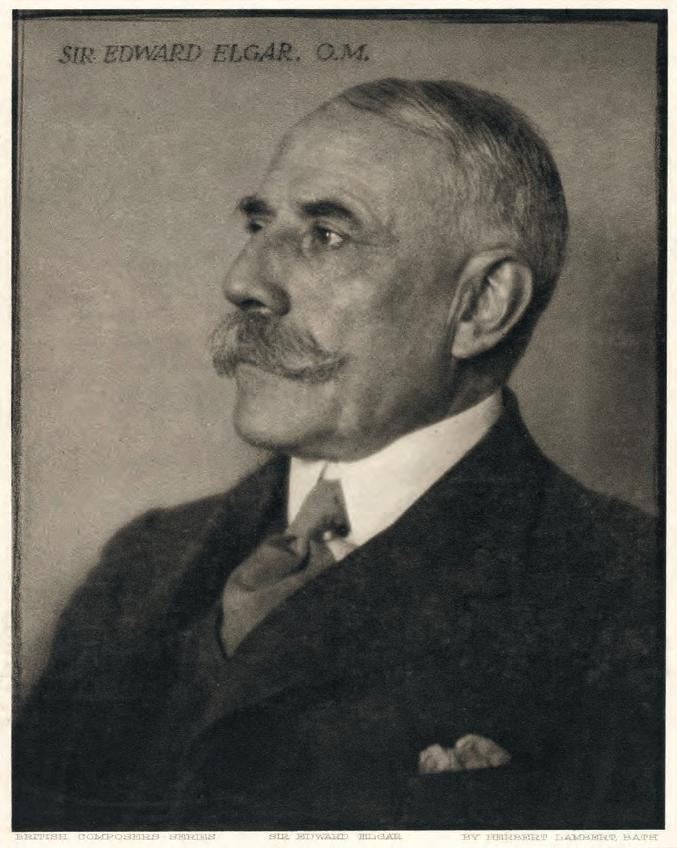
Can we believe it, The King’s Singers (in various iterations) have been purveying their distinctive brand of close-miked euphony since as long ago as 1968, and their aficionados will need no encouragement from me to buy this, the first in a projected series (number unspecified) of ‘Head Space’ CDs, exploring ‘the connection between music and calmness’ –indeed, they will probably already have done so.
As might be expected, we have a preponderance of slow, quiet music, (plainsong, Parsons, White, Pärt, etc) often with rather static harmony and drones, which I suppose is the point of a ‘calmness CD’, but which left me wishing for the contrast of at least a few more dynamic pieces. And we even have John Cage’s silent 4’33”, for which the (uncredited) liner notes assure us: ‘the six of us were standing in candlelight, at nighttime in an otherwise empty church, close to our microphones as the audio was captured’. Oh well, I suppose at least it increases the CD’s running time from a rather parsimonious 45 minutes by a few minutes.
Four Orlando Gibbons ‘Songs’ (which we know now as hymn tunes) are included in wordless renditions, and it must have seemed a good idea on paper to allow the distinguished cornettist Jeremy West to improvise over two of these – an idea surely borrowed from Jan Garbarek and the Hilliard Ensemble’s million-seller ‘Officium’ (now over 30 years ago)but to my ears, by no means as successful a collaboration here.
There is one really excellent offering, however: Judith Bingham’s Ave Virgo Sanctissima –a wonderfully involving piece with great contrasts of texture and harmony, which amply demonstrates what this prodigiously talented group is capable of: great musicality, sensitive balance and, one need hardly add, immaculate intonation – in short, a quite stunning performance, in which the voices seem allowed to bloom a little more than in many of the other rather cool items. If only there were more tracks of this musical interest.
MARK BELLIS
The choral music of Edward Elgar is celebrated on a new release by SOMM Recordings
Light out of Darkness: Choral Music by Elgar Chapel Choir of the Royal Hospital Chelsea / Callum Knox (organ) / William Vann
SOMM Recordings SOMMCD 0714
Released to celebrate the 75th anniversary of the Elgar Society, which has supported the release, this CD in part presents fascinating examples of Elgar’s early musical development, particularly in relation to his Roman Catholic faith.
With no formal conservatoire training, Elgar was very much someone who was self-taught, playing the organ at St George’s Roman Catholic Church, Worcester, and providing liturgical choral settings as required. Compositions such as his many settings of O Salutaris Hostia (three of which feature on this recording) and the unaccompanied setting of the Stabat mater date from these years and neatly fit into William Vann’s programme.
More substantial items include a pair of choruses from the early concert-hall oratorio The Light of Life and the prologue from the substantial oratorio of 1903, The Apostles. Nor does Vann exclude Elgar’s secular choral music, including familiar examples from the composer’s years of mastery, notably his setting of Shelley’s ‘Ode to the West Wind’ (one of 4 Part Songs, Op. 53) . He even gives us the composer’s version of the National Anthem, for three voices, chorus and organ. The entire programme is performed by the professional voices of the Chapel Choir of the Royal Hospital Chelsea with commitment and confidence. This is a welcome release that adds to our appreciation of Elgar.
PHILIP REED*
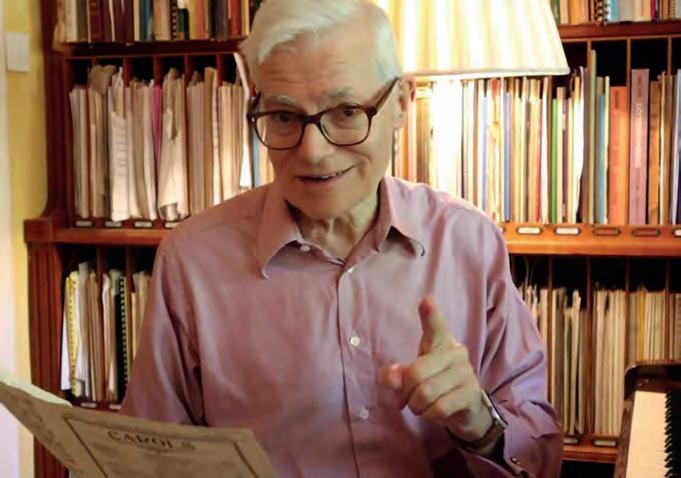
Mater, Ora Filium: Choral music by Bax and Villette
The Rodolfus Choir / Christopher Hughes (organ) / Ralph Allwood Signum Classic – digital only re-release
This is an interesting release from Ralph Allwood and the Rodolfus Choir which he founded in 1984, but by no means a recent one – the original recording came out 33 years ago in 1993. Now we have a re-release but only as a digital download, not in CD format. It juxtaposes music by Sir Arnold Bax (1883-1953) and Pierre Villette (1926-1998) and makes for a very satisfying and thoughtfully devised programme.
Of the half a dozen Bax pieces, This Worldes Joie (1922) has well-realised contrasts, its chromaticism well-tuned, while the Magnificat (not the standard words, in places) originally for voice and piano (1906) but later arranged for SATB (1949) inhabits his earlier, Edwardian style - its disparate and potentially rather fragmentary sections effectively linked with
judicious pacing and balance.
The highlight however is his magnum opus, Mater, Ora Filium (1921). One really never tires of its breathtaking complexity, and the choir rises with brilliant virtuosity to its hair-raising demands – for instance top C for the sopranos sustained over many bars - and Bax’s formidable semiquaver runs are negotiated with plenty of youthful energy and commitment.
Pierre Villette is very much in the French tradition with his distinctively exotic added-note harmonies and there is much to enjoy here. Hymne à la Vierge (1954) one of his most famous pieces, is simply and very nicely done, and it is good to have a slightly more substantial piece, the sixpart Attende Domine (1983) written for Dr Donald Hunt – one of Villette’s champions in this country – and the choir of Worcester Cathedral – its challenging, angular melodies well-projected.
Overall, these are delightfully youthful, fresh-sounding performances, recorded in the thankful acoustic of Eton College Chapel, but a word of warning: the download comes with absolutely no programme notes, just track titles, so as regards background information of any sort, you’re on your own.
MARK BELLIS
Conductor Ralph Allwood, founder of The Rodolfus Choir
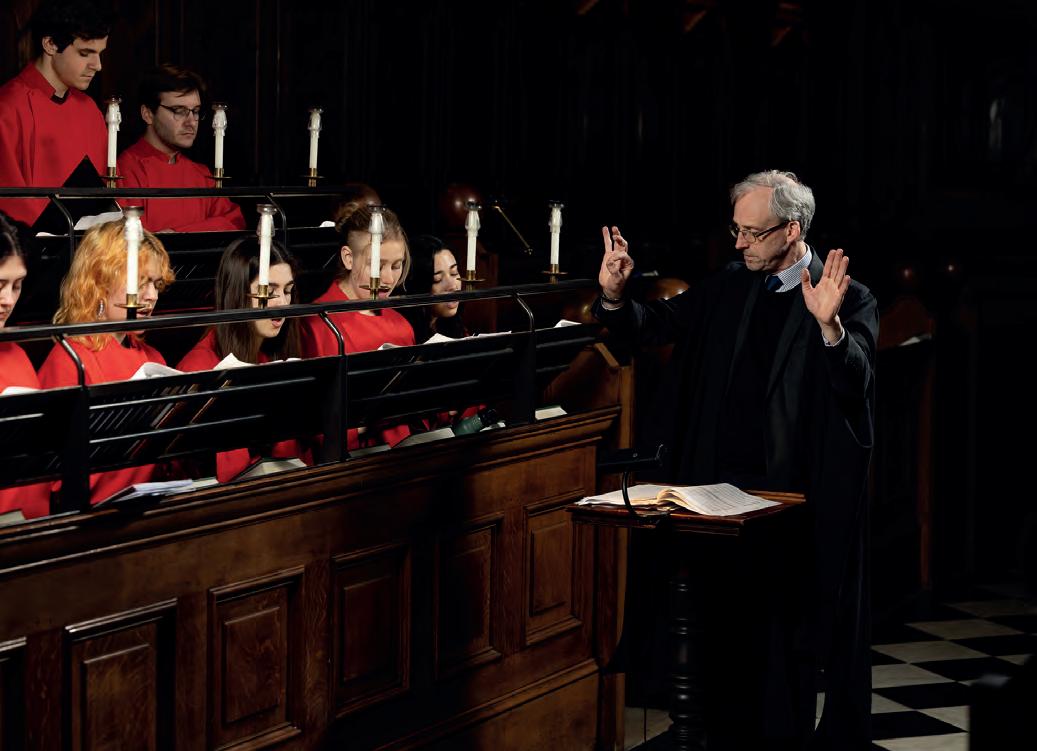
O Maria, virgo pia
The Choir of Oriel College, Oxford / The Tippet Quartet / Alexander Pott (organ) / Grace Davidson (soprano) / Craig Ogden (guitar) / David Maw Convivium Records, CR115
King Edward II founded Oriel College, Oxford in 1326 and this is a very attractive celebration of its 700th anniversary from its choir conducted by Director of Music, Professor David Maw, recorded in the generous acoustic of Keble College Chapel. The enterprising programme features works connected with the college, either via texts or music, and there is nothing which might be called standard repertoire, but the choir
sounds first rate throughout, particularly the sopranos who have a wonderfully fresh, vibrant tone.
One notable alumnus was the musicologist Edmund Fellowes (1870-1951) who was at the forefront of the revival of all-but-forgotten Tudor composers, but I found it difficult to warm to either his Benedictus in D or his BMus ‘exercise’, Hymn of the Third Choir of Angelicals (1895), a cantata in four movements for choir, organ and strings (the Tippett Quartet - fine) to words by John Henry Newman, one of the best-known figures associated with Oriel where he was Chaplain from 1826-31 and 1833-1835. Though admittedly, the second of the cantata’s four movements, a long solo, is quite beautifully sung by guest soprano Grace Davidson.
Indeed all the ‘guests’ on this recording are quite outstanding: for instance, in Solitude (2019), a most effective setting of a poem by Newman (again) for choir and guitar by James Whitbourn (1963-2024), we
have the luxury of one of our finest guitarists, Craig Ogden, resulting in a predictably excellent collaboration with this impressive choir. Other enjoyable items are David Briggs’s 2013 setting of Hail Gladdening Light (trans. John Keble – an Oriel Fellow) - an unaccompanied double choir homage to the famous Wood setting, though significantly more complex - very well sung. And Judith Bingham’s rewarding Oriel Service (2017) is always involving and very musically realised by both choir and organ (Alexander Pott –excellent throughout).
Finally, Maw’s own Magnificat features a highly florid solo soprano part throughout, stunningly sung by Davidson, contrasting with the choir’s insistent chanting – a fascinating, dramatic and haunting setting. Many congratulations to Oriel College on its significant milestone and to its musicians, who are clearly going from strength to strength.
MARK BELLIS
makelightwork.com, Mike Cooter
Professor David Maw conducting the Choir of Oriel College, Oxford
Four standout releases from Convivium Records


This recording pairs sacred music from the sixteenth and twenty-first centuries. It sets a madrigal and a mass opening by Philippe de Monte beside rare works from the same era. These are joined by pieces by composers such as Cheryl Frances-Hoad, Cecilia McDowall, Melissa Dunphy, Rosa Elliott and Kerry Andrew.
Both life-a rming and spiritually re ective, The Breath of Life is Matthew Coleridge’s radiant successor to his Requiem.
Conceived as a work of joy, vitality and rhythm, this vibrant cantata for choir and orchestra explores human wonder, nature and the divine through texts ranging from psalms and hymns, to mystics and scientists.
This album celebrates the musical heritage of University College, Durham. It brings together works by Edward Bairstow and Francis Jackson, a new piece by Ben Rowarth, and the first full recording of Amy Beach’s Four Canticles Music of faith and renewal honours alumnus David Knowles, and Durham’s lasting choral tradition.
This album brings together secular choral works by American composer Dan Locklair, known for lyrical harmony and close attention to text. Drawing on poems by many writers, the music explores love and loss, nature and freedom, quiet thought and major events - all with a voice that is deeply rooted in American culture.

CHORAL SELECTION
New scores include Dominique Le Gendre’s first foray into church music and modern partsongs by Lucy Walker; plus Percy Grainger’s collected choral works offer great fun
By RUPERT GOUGH
Two new a cappella masses have come my way recently. Charlotte Baskerville’s Mass for the Maker of Heaven and Earth (SATB; Encore; ISMN 9790900253026) is a tightly disciplined setting using motifs taken from a plainchant Credo. It is refreshing to see simple, yet effective, four-part writing incorporating many elements of polyphony. The two opposing motifs, representing heaven and earth, are stated at the outset, and it is only at the conclusion of the Agnus Dei that these two elements are unified into four-part harmony.
The Missa brevis (SATB with divisions and solos; Schott; ISMN 9790220140037) was composed in 2024 by Dominique Le Gendre following a commission from Canterbury Cathedral. Born and raised in Trinidad and Tobago, Le Gendre has had a hugely successful career in London composing music particularly for opera, theatre and the big screen. I am fairly confident that this must be Le Gendre’s first foray into writing church music. She took inspiration from Pope Francis’s 2015 encyclical Laudato Si – a profound invitation to everyone on the planet to care for our common home. The work is therefore subtitled: ‘In praise of the unsung who quietly labour for the good of all creatures, humankind and our planet earth’. The Kyrie is quite polyphonic, or at least there is quite urgent repetition of repeated musical fragments. The Gloria has more harmonic moments of reflection before a suitably rousing conclusion. The Sanctus and Benedictus are also more harmonically driven with simple but effective harmonic invention. The Agnus Dei, like the Kyrie, makes
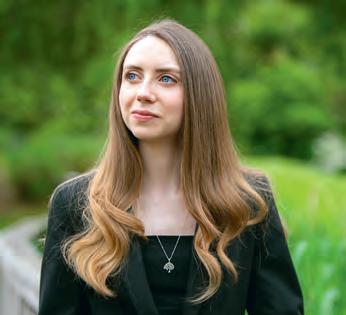
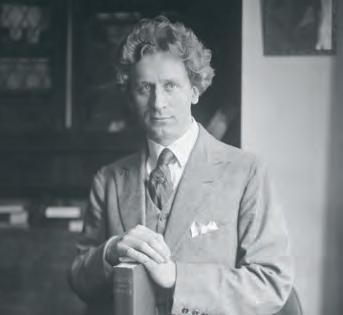
much use of lyrical solo phrases before a peaceful conclusion. Despite some divisi and the solo passages, there is nothing too demanding here with well-crafted voice leading.
In my column last issue I wrote about Mark Buller’s 2023 Mass in Exile. I was therefore immediately interested to receive his new Requiem in the Light (SATB (div) & string quintet; Schirmer; ECS9469) which can be viewed as a companion piece. This is no liturgical Requiem mass but draws inspiration from old forms to deliver a 21st-century message evident with titles like ‘Lacrimosa for the Murdered’. Leah Lax’s libretto is gritty too with lines like ‘O shattered earth, Dear tired earth, receptacle of our poisons and our rage’ and yet there is a haunting beauty in Buller’s music, which delivers a clear message of light and peace. The rhythmic complexity is mainly in the string writing with effective textures created from only five string parts. The choral parts are engaging and, surely, rewarding to sing. The final movement Requiem (Agnus Dei) brands life as ‘a requiem for an unfinished song’. A short and powerful work that could easily help
build a more contemporary narrative in a concert programme.
With Holy Week in mind, Mark Howe’s The Passion According to John (SATB, soloists, handbells, congregation; Morning Star) may prove to be useful for those looking to get away from more traditional Good Friday Passion settings. The text is adapted from the New Revised Standard Version Bible and calls on two soloists as Narrators alongside the usual additional roles including Jesus and Pilate. The modern chant idiom for these solo parts has some interesting passages where two voices sometimes recite together, occasionally breaking away from the unison into dissonance. The interjections of the crowd are adapted from William Byrd’s Turbarum Voces. These simple three-part settings allow either a unison TB or SA part against the remaining two parts. Traditional hymns are interpolated for the congregation to sing with the final hymn ‘Sunset to sunrise changes now’ (to the old American folk hymn Kedron) given to the choir. Handbells are indicated at the start of each passage to establish pitch, however this could be omitted. Howe
ABOVE Lucy Walker, composer of Bird Raptures, and the Australian-born composer Percy Grainger, a collection of whose choral works have been published by Schott
Helena Marion Photography, Library of Congress
provides a clever and practical way to get everyone engaged in the Passion Gospel.
And finally, to secular song. I am delighted to see Schott publishing a Collected Choral Works SATB (div); Schott; ISMN 9790220139895) of Percy Grainger. Grainger was a troubled, yet brilliant soul and left a considerable output of music, albeit in a state that required much unravelling. Famous for his ‘elastic scoring’, Grainger left so many versions of his music, some with an eccentric array of accompanying instruments, that often made it difficult for the uninitiated to navigate through the catalogue.
David Wordsworth has sensitively edited the music and words to create practical performing editions of nine contrasting choral gems. There are a couple of lesser-known original works alongside folk song arrangements which include the firm favourites Brigg Fair and the Irish Tune from Country Derry. Those with accompaniments have been carefully arranged to be played on harmonium or piano, some with four hands. Much fun to be had here for singers and audiences alike.
The last word goes to a new set of three modern partsongs by Lucy Walker: Bird Raptures (SATB (div), soprano solo; Boosey & Hawkes; ISMN 9790060152597). Here are three setting of poems by Rossetti, Teasdale and Coleridge which can be performed as a set or individually.
The modal writing of The Nightingale evokes traditional folksong with brief solo passages for soprano and tenor voices. Twilight takes a more evocative tone where the repeated words 'calling' give way to a wordless choral refrain of rich eight-part harmony. There is a wonderfully playful finale with And my Love loves me! which brilliantly captures the innocent joy in Coleridge’s ‘Answer to a child’s question’.
RUPERT GOUGH
Rupert Gough is Director of Choral Music and College Organist at Royal Holloway, as well as Organist and Director of Music at Saint Bartholomew the Great. He is also a published composer, arranger and editor.
Drapers’ Hall, Coventry
Thursday 17 & Friday 18 September
This two-day conference will include papers given by current cathedral music researchers, keynote speeches by leading authorities in the field, and an after-dinner speech by choral conductor and music educator, Suzi Digby.
Book tickets online at: www.cathedralmusictrust.org.uk
By phone (credit/debit card) on 020 3151 6096 during office hours (9am-4pm Mon-Fri)

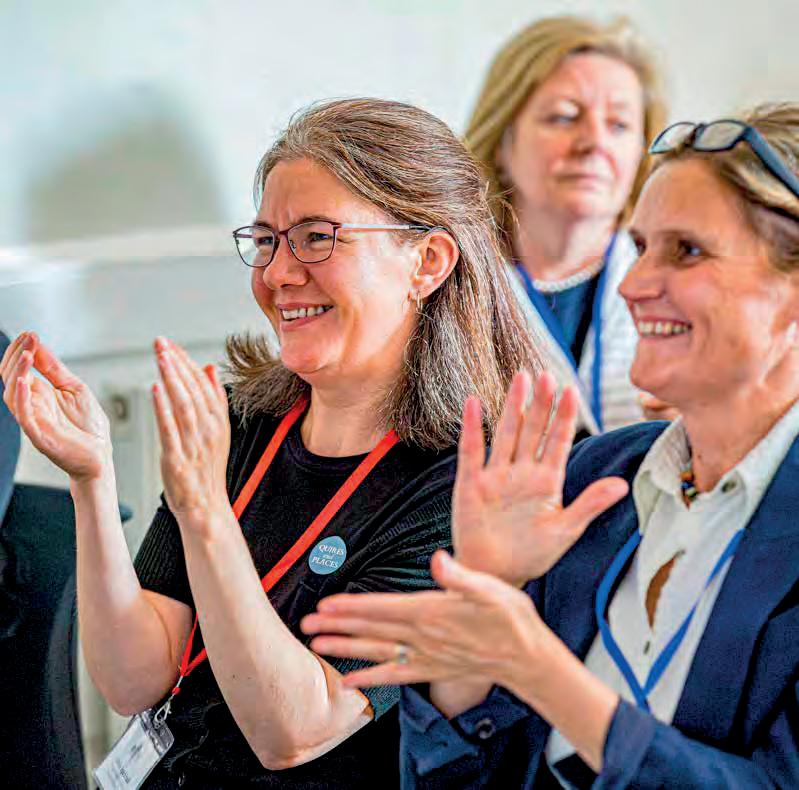
BOOKS
“Not Half Bad”: A Lifetime of Musical Development and Other Stories
Harry Bramma
Oxford Folio Publications, 2025
ISBN 9781068766114
Paperback 357 pages, RRP £23.10
Harry Bramma brings us an affectionate and candid set of recollections of the huge range of activities he undertook and the
people he worked with during his long life in the intimate community of church music. What comes over most strongly is his enthusiasm and commitment, the product of an untiring work ethic and a willingness to embark on unglamorous tasks to help others and further the cause of music. This included supporting musicians less talented than himself, giving impetus to organ building projects and undertaking many acts of kindness and generosity to friends and colleagues.
Bramma was born into a Yorkshire family, and his musical talent carried him to an organ scholarship at Oxford and major appointments including Assistant Organist at Worcester Cathedral, Organist of Southwark Cathedral and Director of the Royal School of Church Music. Amid this amazing array of achievements, he is also content to relate how he was often on the
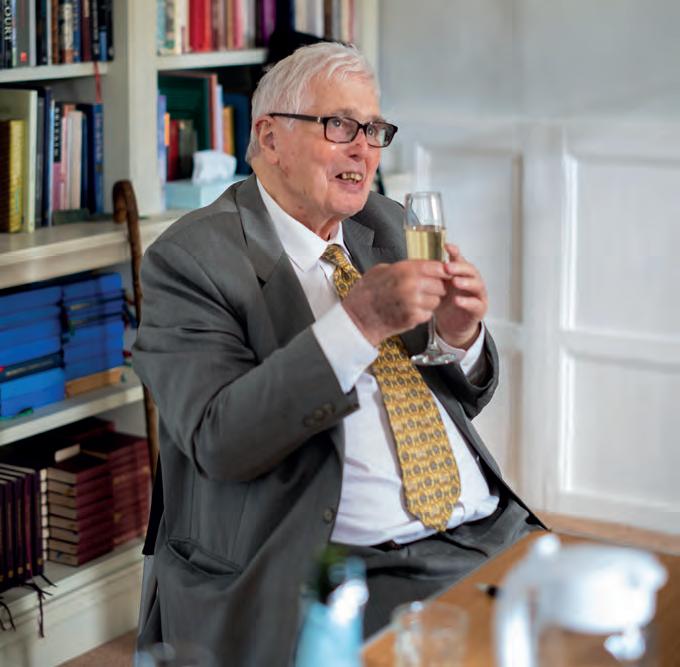
shortlist but never secured the job. He doesn’t seek to invoke false modesty by denying that his background cast him as an outsider in the cathedral music world of the 1950s. Rather, his talent and quiet dedication together with good humour and example carried him to the highest realms of achievement in his chosen vocation.
Bramma relates how he came close to offering himself for ordination. He provides us with many portraits of musicians and organists he worked with and is never afraid to admit that sometimes concerts and performances in which he took part could go wrong. It is a fascinating personal memoir and window on a period which has seen a major revival of interest in cathedral music, all related with good humour by someone who has loved every minute of it.
BRET JOHNSON
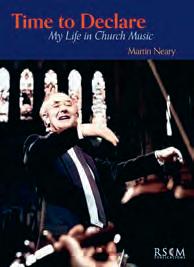
Time to Declare: My Life in Church Music
Martin Neary RSCM Press, 2025
ISBN 9780854023585
Hardback 320 pages, RRP £25.00
Martin Neary’s autobiography had been in print for less than two months when he died in September 2025 from complications arising from Parkinson’s disease (see obituary on p17; how fortunate that he was able to complete this very readable account of a life devoted to
Harry Bramma, composer, organist and former director of the RSCM
church music. As the conductor Stephen Layton, a former chorister under Neary at Winchester Cathedral, points out in his affectionate Preface to the book, the author’s love for the music shone through everything he did, drove his quest for excellence and was passed on to his young singers.
Born in Hackney at the start of the Second World War, Neary was a true Londoner. As a boy he sang at Holy Trinity Brompton before successfully auditioning to become a chorister of the Chapel Royal, St James’s Palace. His long association with significant royal occasions began when the choir sang at the christening of Prince Charles at Buckingham Palace and continued with the memorable experience of taking part in the coronation of Queen Elizabeth II. Neary attributes his choice of career in large part to the caring attitude to the choristers of Harry Gabb, organist of the Chapel Royal at the time. His initial intention, however, was to become a priest, and he spent his first two years as an organ scholar at Gonville and Caius College, Cambridge, studying theology before switching to music. He came second to Susan Landale in the inaugural St Albans Organ Competition. Neary found the experience of hearing the jury and fellow competitors play inspirational; with no expectation of getting through to the final, he went back to Cambridge to play for a wedding and in those pre-mobile phone days, it was only when he returned to St Albans to hear the final that he discovered he was actually in it.
Working as Assistant and then Director of Music at St Margaret’s, Westminster, in the late 1960s provided entertaining anecdotes about accompanying other choirs, encounters with Prime Minister Edward Heath, also an organist and occasional conductor, and other politicians. Neary admits that his appointment to Winchester in 1972 having never worked in a cathedral music department was unusual and it is interesting to read how he prepared for the role and adjusted to life outside the capital.
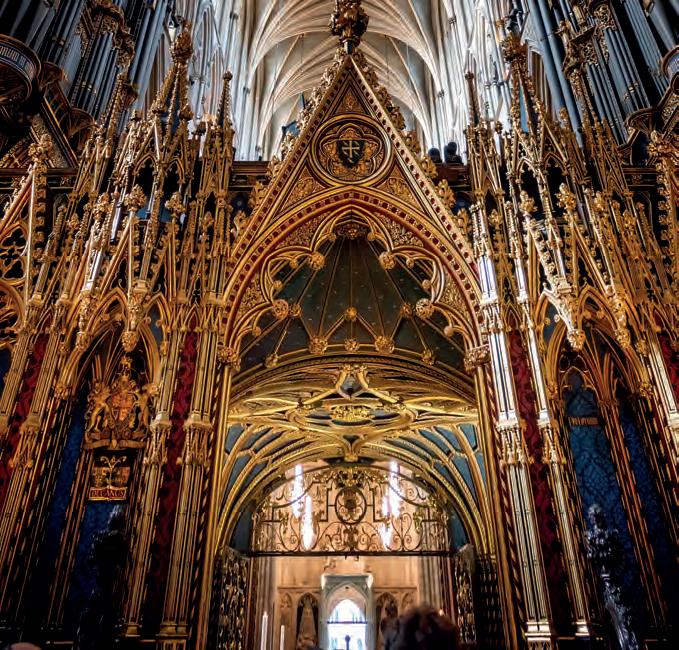
It was at Winchester that Neary was able to explore his interest in contemporary music, building particularly strong relationships with Jonathan Harvey and John Tavener. He also introduced more Baroque repertoire. Before his arrival none of the three cathedral choirs had ever performed a Bach motet.
In 1988 Neary returned to London as Organist and Master of the Choristers at Westminster Abbey, where his realisation that musical ingredients for the funeral service for Diana, Princess of Wales would need to reflect both her personality and the shock at her loss felt around the world, as well as following royal tradition, proved to be shrewd and transformational. He recalls many details of the preparations, including Bernie Taupin faxing over the new lyrics that Elton John would sing to turn ‘Candle in the Wind’ into ‘Goodbye, England’s Rose’.
Neary deals as frankly and transparently as one could expect with the traumatic experience of being suspended from his post at the Abbey when Dean Wesley Carr launched an investigation into the financial arrangements regarding the
Abbey musicians’ recordings and outside engagements, which had been managed independently by Neary and his wife Penny. They decided to appeal against Carr’s eventual decision to dismiss them in order to prove their honesty and integrity… with mixed results, as ‘Counsel for the Dean and Chapter acknowledged that this was not a question of honesty’. They lost the case on the grounds they had been guilty of a lack of openness about the music department’s accounts.
It was a sad end to a distinguished tenure, but as the many tributes paid to Neary since his death make clear, he continued to work as a conductor and organist for almost three decades afterwards, notably as the founding director of the RSCM’s Millennium Youth Choir. His love for his family and pride in their achievements is a running theme alongside his own musical memories. And when the going got tough in the organ loft or chapter house, Neary was always able to find solace in the passion for cricket which provided him with the subtitle for his memoir.
CLARE STEVENS
The organ of Westminster Abbey, where Neary was Director of Music
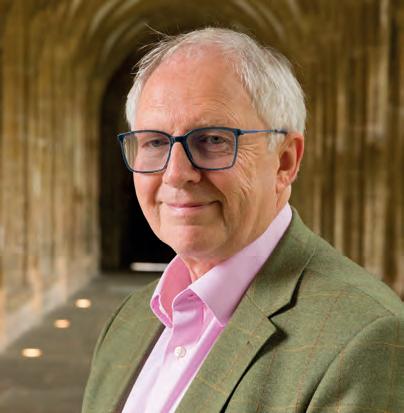
You were recently awarded a prestigious High Sheriff Award for your work as Chair of the Wells Cathedral Chorister Trust. Congratulations! Could you tell me about your role?
I was asked to become Chair of the Trust in 2019, when I was just retiring after a career in financial services. I wanted a challenge and a purpose, and the role gives me a way to raise the awareness of these talented children, and to create opportunities for them that they might not otherwise have. In addition to fundraising events, we have the annual Britten Ceremony of Carols and an annual celebration Evensong. Not long after becoming Chair, I was approached to become a local Ambassador for the Cathedral Music Trust and I’m in awe of all that the Trust achieves. We had a successful national gathering in Wells in 2023.
What makes musical life at Wells Cathedral special?
There have been choristers at Wells Cathedral since 909 and the school is a magnificent, specialist music school, founded entirely to educate choristers. They gather in the morning at 7.45am and process across to the cathedral down the famous Vicars’ Close, which is the longest continually inhabited street in Europe. The choristers rehearse in the cathedral every morning, and there’s a natural rhythm to the day with Evensong at 5.15pm. These days, the
ARNOLD WILLS
‘I became a chorister at Peterborough Cathedral when I was eight and sang there until I was just 15, and it gave me a fabulous grounding in musicianship’
Interview by REBECCA FRANKS
children have a varied education and are encouraged to take part in sports and other clubs, not just singing.
How did you get into singing?
I was fortunate to have a great musical education at a good primary school and was encouraged by the school and my mother to apply to be a chorister at Peterborough Cathedral. I auditioned for Stanley Vann, which was daunting, but he was also reassuring and encouraging. I became a chorister when I was eight and sang there until I was just 15 – it gave me a fabulous grounding in musicianship. I learned the piano under Barry Ferguson, who was the Assistant Master of Music at the time and went on to learn the organ at the cathedral. It was a very happy time. We had a couple of European tours, which most cathedrals didn’t do in those days as it wasn’t so long after the Second World War ended. But we were welcomed with open arms in France, Belgium and Germany. That was a marvellous experience.
Your professional life took you into the financial world. How did music fit alongside your career?
I was professionally employed for five years as a school master teaching maths and music before I moved into financial services, but I have spent a lot of time as an amateur musician. As a child and young adult, I used to go to the St Endellion Festival, and the conductor Richard Hickox encouraged me to
join the London Symphony Chorus, which I did. I sang with them for several years and that was great fun. When in the financial world, I moved to Canterbury where I continued as a singer and organist. I married Julie in 1989 and we have four children, who are all musical. The financial world and music go well together.
What pieces would you pick to introduce someone to choral music? I would take them to any cathedral for Choral Evensong and introduce them to the psalms. Stanley Vann and the Peterborough Cathedral Choir had a fine reputation for psalm singing, probably the best of any cathedral then. John Betjeman, who used to come up on the train from London specially for Evensong, described the psalms then at Peterborough as ‘matchless’.
Do you have a favourite cathedral? Notwithstanding beautiful Wells, a Gothic cathedral that I’ve come to love very much since living in Somerset, Peterborough has to be my favourite. It was founded as a monastic community in 654, [construction on the cathedral began in 1118], and it has the most magnificent painted wooden ceiling, the largest of its age in Europe. Mary, Queen of Scots was buried there in 1587 until she was reinterred in 1612 in Westminster Abbey but Katherine of Aragon is still buried there. It’s a very special place. I can still smell the limestone.
Bill Bradshaw