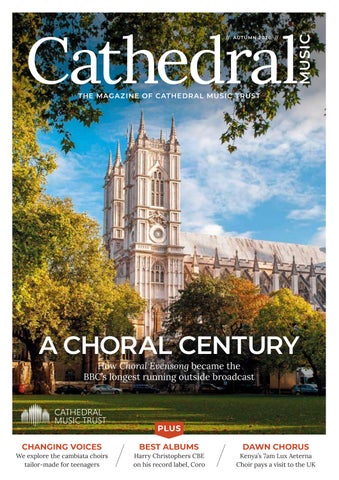
// AUTUMN 2026 //
THE MAGAZ INE OF CATHEDRAL MUSIC T RUST
A CHORAL CENTURY How Choral Evensong became the BBC’s longest running outside broadcast
PLUS CHANGING VOICES
We explore the cambiata choirs tailor-made for teenagers
BEST ALBUMS
Harry Christophers CBE on his record label, Coro
DAWN CHORUS
Kenya’s 7am Lux Aeterna Choir pays a visit to the UK
Christmas cards that make a difference Each card you send spreads festive cheer and shares our story, raising awareness of Cathedral Music and multiplying the impact of your gift.
This year, we are delighted to be working with London-based illustrator Rosie Brooks, whose traditional pen and ink and watercolour illustrations feature across our five Christmas card designs. With a background in both music and illustration, her artwork brings together storytelling, atmosphere and imagination.
Every pack of Christmas cards you buy helps raise essential funds for Cathedral Music Trust. Unlike most high street cards, your purchase goes directly towards our mission to transform lives through the power of cathedral music. Your support helps choirs, musicians and music departments build on their achievements, explore new possibilities and continue their inspiring work through music. Shop online at: www.cathedralmusictrust.org.uk
Contact us at: info@cathedralmusictrust.org.uk | 27 Old Gloucester Street, London, WC1N 3AX | 020 3151 6096 Registered in England as a charitable incorporated organisation. Registered charity number 1187769
WELCOME
CAT H EDR A L MU S IC TR U ST Royal Patron HRH The Duchess of Gloucester
FROM THE
President Harry Christophers CBE
EDITOR
Ambassadors Alexander Armstrong, Anna Lapwood MBE Board of Trustees Jonathan Macdonald (Chair), Daniel Benton, James Gurling OBE, David Hill MBE, Stuart Laing, Giverny McAndry, Heather Morgan, Isobel Pinder, Gavin Ralston, Graham Robinson, Simon Toyne, Rosie Woodall CEO Jonathan Mayes Programmes Director Cathy Dew Programmes Manager Shaun Turnbull Development Director Leila Alexander Development Officer Katy Ashman Volunteer & Events Coordinator Hannah Capstick Digital & Communications Manager Laura Cottrell Director of Finance & Resources Dan Bishop Finance Officer Amanda Welsh Cathedral Music Trust is extremely grateful to our team of volunteers across the UK who give many hours of their time each year to support the work we do. Cathedral Music Trust 27 Old Gloucester Street London WC1N 3AX info@cathedralmusictrust.org.uk 020 3151 6096 (office hours) www.cathedralmusictrust.org.uk Registered Charity Number 1187769
CAT H E DR A L MU S IC MAG A Z IN E Editor Rebecca Franks editor@cathedralmusictrust.org.uk Designer Jo Craig Production Manager Kyri Apostolou Cathedral Music is published for Cathedral Music Trust by Mark Allen Group twice a year, in May and November. Autumn 2026
I
f I wanted to introduce someone to the splendours of the cathedral music tradition, I would undoubtedly suggest attending Choral Evensong. Not only is this evening service a perfect length for a contemplative pause at the end of the day, but, from introit to anthem, its format showcases a rich variety of music. Of course, it might not always be possible to go to a cathedral in person, but for a century now, there has been another option, thanks to the BBC. Ever since a 1926 broadcast from Westminster Abbey, the BBC has been beaming Choral Evensong to listeners at home from around the country. Remarkably, it is the longest running outside broadcast in the world. At Cathedral Music, we couldn’t let such a landmark anniversary pass by without a celebration, so I was delighted when the person who knows the history and life of the programme better than anyone, its current producer Ben Collingwood, agreed to write about Choral Evensong for us (p28). Living traditions require constant renewal, and a new milestone was added to the wider history of Evensong in the UK this summer. At the culmination of its first international tour, the 7am Lux Aeterna Choir became, it’s thought, the first African choir to sing Evensong at Westminster Abbey. Our writer went along to find out more (p45). Elsewhere, do explore our usual spread of news, appointments and reviews, but first charge your glasses as there are more milestones to mark. As Cathedral Music Trust marks its 70th anniversary, we’ve taken a look back over the past seven decades of its National and Local Gatherings. Plus composer Errollyn Wallen CBE shares insights, in our Q&A (p66), into her new introit for Exeter Cathedral, commissioned by the Trust in partnership with Tom Hoffman MBE through his charitable trust. Then, in a celebratory double, President of the Trust Harry Christophers CBE shares some of his favourite albums produced by his record label, Coro, which marks its 25th anniversary this year (p38). And finally, we are delighted to introduce a new regular item, turning a spotlight on the incredible volunteers without whom the Trust’s work would not be possible (p21). Rebecca Franks, Editor of Cathedral Music
The views expressed in articles are those of the contributor and do not necessarily represent any official policy of Cathedral Music Trust. Advertisements are printed in good faith, and their inclusion does not imply endorsement by the Trust; all communications regarding advertising should be addressed to info@cathedralmusictrust.org.uk. Every effort has been made to determine copyright on illustrations used; we apologise for any mistakes we have made. The Editor will be glad to correct any omissions. Front cover: Westminster Abbey (Photo: Adobe Stock) Back cover: Cathedral Music Trust Christmas card illustration (Image: Rosie Brooks)
www.cathedralmusictrust.org.uk 3
CONTENTS
CONTENTS
BBC
IN THIS ISSUE …
28 BBC Choral Evensong
35 Cambiata Choirs
32 The Eton Hymnal
38 Harry Christophers CBE
What happens when your singing voice changes during adolescence? Clare Stevens explores the choirs designed to support teenagers
Marco Borggreve
BBC Producer Ben Collingwood traces the history of the world’s longest running outside broadcast as it marks its centenary
We meet the teenagers who channelled their love of congregational hymn singing into a recording to raise money for Cathedral Music Trust
4
The Sixteen’s founder and Trust president set up his own record label 25 years ago. Here he shares with us his favourite Coro recordings Cathedral Music Autumn 2026
REGULARS 3 From the Editor Tewkesbury Abbey | Rosemary Downey
Rebecca Franks welcomes you to this new issue
6 News
The latest developments and stories from across the world of church and cathedral music
19 People & Places 42 Social network
We celebrate Cathedral Music Trust’s National and Local Gatherings, which have brought cathedral music fans together for 70 years
We congratulate those taking on exciting new roles in cathedrals around the UK
20 Events
Join a Cathedral Music Trust gathering near you
21 Volunteers
Meet some of Cathedral Music Trust’s incredible volunteers
22 Success Stories
We hear from the latest recipients of Cathedral Music Trust Awards about their good work
50 Reviews
Recent releases of choral and organ music reviewed, plus a round-up of the latest scores and books
45 Dawn chorus
Lucy Hicks Beach meets the 7am Lux Aeterna Choir from Kenya to hear about its first UK tour, meeting Sir John Rutter and singing at Westminster Abbey
66 Q&A
We meet Errollyn Wallen CBE, Master of the King’s Music
www.cathedralmusictrust.org.uk 5
NEWS
NEWS • PREVIEWS • PEOPLE • EVENTS
Adobe Stock
NEWS & PREVIEWS
MAGDALEN COLLEGE CHOIR TO ADMIT GIRL CHORISTERS FOR THE FIRST TIME
F
or the first time since its founding in 1480, Magdalen College Choir in Oxford will be open to girl choristers. Admissions will be from September 2027, with the cohort expected to be fully mixed by 2031. Until now the renowned collegiate choir, perhaps best known for singing to welcome dawn from Magdalen Tower on May Morning, has only included boy choristers, who study at Magdalen College School, alongside adult Academical Clerks. The landmark change springs from Magdalen College School’s planned transition to being co-educational from 2027. In order to integrate girls into the musical life of the chapel, choristerships will be extended on an 6
equal basis to both girls and boys aged between 8 and 13, and the number of chorister positions will expand from 16 to 18. The college will also extend its bursary scheme to cover these new numbers, which pays 60 per cent of a chorister’s school fees, alongside a new bursary fund to pay up to 100 per cent of fees for choristers whose families need additional financial support. President of the college, Dinah Rose KC, said: ‘From 2027, Magdalen College Choir will be open to all talented young singers, regardless of their sex or the financial means of their family.’ Mark Williams, Informator Choristarium (Musical Director) and Organist at the College said that they
had been impressed by the introduction of girl choristers at similar institutions, such as St John’s College, Cambridge. The College has received advice and support from ‘colleagues across the choral world’ in making this decision. Williams believes the introduction of girl choristers will enhance the nature of the choir. ‘Our first female organ scholar, Anna Lapwood, came to Magdalen in 2013 and has gone on to a highly successful career,’ he says. ‘The introduction of women altos as Academical Clerks a few years ago brought a new and valuable element to both our sound and our community, and I am confident that girl choristers will enhance and enrich our choir family in many ways.’ Cathedral Music Autumn 2026
Roland Mander
CATHEDRAL MUSIC TRUST ANNOUNCES LATEST AWARDS Cathedral Music Trust has announced its latest round of awards, totalling £438,995 to support music in 27 Anglican and Roman
Catholic cathedrals and churches. Twenty-one new recipients received funding through the Cathedral Music Support Programme
(CMSP), which builds partnerships with cathedrals and other choral foundations across the UK, developing work aligned with Cathedral Music Trust’s objectives in three areas: pathways to music; training and development; and supporting the workforce. This year, funding provided by the Edington Festival contributes to the award made by Truro Cathedral. The Church Choir Award, run in partnership with the Royal School of Church Music, also awarded £30,000 to six church choirs to enhance their work through innovative and exciting projects. Cathedral Music Trust has spent seven decades investing in the people, places and partnerships that enable this unique tradition to thrive. These awards continue that commitment, supporting projects that will benefit communities both in and beyond the stalls.
Adobe Stock
Cathedral Music Trust commissions Errollyn Wallen CBE Supporter of the Trust, Tom Hoffman MBE, through his charitable trust, has established an endowment which will fund, every two to three years and in perpetuity, a new anthem for cathedral, church and chapel choirs, to be composed by a distinguished contemporary composer. These commissions are being arranged in partnership with Cathedral Music Trust. Errollyn Wallen CBE, Master of the King’s Music, has been commissioned to write the first composition for the Choir of Exeter Cathedral. This introit, based on Psalm 96, ‘O sing to the Lord a new song’ (see Q&A, p66), was premiered during a National Gathering at Exeter Cathedral Evensong on 10 October, marking seven decades since the organisation was founded in June 1956 as the Friends of Cathedral Music. One of the UK’s most celebrated composers, Wallen
was appointed Master of the King’s Music in 2024, becoming the first Black woman to hold the role. Her extensive body of work spans opera, orchestral, choral and chamber music, and she has written for major ensembles and
institutions around the world. This new commission for Exeter extends her work in the cathedral choral tradition, which includes pieces for Westminster Abbey, King’s College, Cambridge and Christ Church, Oxford.
www.cathedralmusictrust.org.uk 7
▷
Adobe Stock
THREE CHOIRS FESTIVAL ANNOUNCES ITS 2027 WORCESTER PROGRAMME The 2027 edition of the Three Choirs Festival will open with Britten’s War Requiem, performed by the Festival Chorus, Philharmonia (the resident orchestra since 2012), soprano Elizabeth Watts, tenor Pete Hoare and baritone David Stout. The Festival Chorus and Philharmonia will close the festival with Elgar’s The Light of Life, written specifically for the Three Choirs Festival and premiered in Worcester with Elgar himself conducting in 1896.
Highlights of the programme, overseen by Artistic Director of the Worcester Three Choirs Festival, Samuel Hudson, include Beethoven’s Missa Solemnis, in the year marking the bicentenary of his death; Handel’s Four Coronation Anthems, celebrating 300 years since their premiere; and Vaughan Williams’s A Sea Symphony, with soloists Roderick Williams and Anita Watson. Also featured is Portraits of a Mind by Worcester-based composer
Ian Venables, performed by pianist Misha Kaploukhii and tenor Gwilym Bowen. Committed to expanding the British choral repertoire, the festival will spotlight new works and premieres. These include the festival’s Associate Composer Gavin Higgins’s His Salt Skin, performed by the BBC National Orchestra of Wales; the world premiere of a festival commission by Dobrinka Tabakova; and the first public performance of a new realisation of Elgar’s Piano Concerto by David Owen Norris. Elsewhere, I Fagiolini will perform Purcell’s Dido and Aeneas, while there will be a recital from organist Nathan Laube. An Evensong featuring the RSCM Youth Choir will also celebrate the Royal School of Church Music’s centenary. Speaking about the programme, Ben Cooper, Worcester Chair of the Three Choirs Festival, said: ‘I’m often asked how I’m excited about “yet another festival”. Well, this programme encapsulates it perfectly, with reassuring well-known classical favourites alongside the new and exciting. Other than the fabulous week-long programme, we also start our community work in schools in January. So here’s to the next exciting Festival!’
The Three Choirs Festival has announced Grace-Evangeline Mason as its next Associate Composer. Her tenure will last from 2027 to 2029. Mason, whose orchestral work The Imagined Forest opened the 2024 festival in Worcester, will be the second composer to take up the residency, which spans three editions of the Three Choirs Festival. She joins Gavin Higgins, who this year became the inaugural Associate Composer and wrote a new Magnificat and Nunc Dimittis for the Festival.
8
Mason is a British composer of orchestral, chamber, choral, electronic and operatic music. Named the ‘Face to Watch’ for classical music in The Times in 2020, Mason says, ‘Growing up in the West
Midlands and knowing the incredible legacy of the Festival, particularly its long and rich history of hosting the premieres of so many important works by composers that I greatly admire, it feels very special to be able to deepen my relationship with the Festival in this way.’ The Three Choirs Festival has launched its major composer development programme in order to deepen its historical ties with living composers and to enrich long-term creative collaboration in the lead-up to its 300th anniversary in 2028.
Cathedral Music Autumn 2026
Grace-Evangeline Mason
THREE CHOIRS FESTIVAL NAMES GRACE-EVANGELINE MASON AS ASSOCIATE COMPOSER
The Sixteen establishes London home at St James’s Piccadilly Handel’s Messiah, new choral commissions, regular choral Evensongs, educational work within the parish, and continued support for Sounds Sublime, The Sixteen’s annual choral festival. ‘Never before has The Sixteen had a London home and where better than a church which, over the years, has come to be known as “the artist’s church”,’ says The Sixteen’s founder Harry Christophers CBE. The partnership coincides with preparations for St James’s major restoration programme. During the church’s closure from 2027 for restoration works, activities will temporarily relocate to St Pancras Church on Euston Road before returning to St James’s.
TallWall Media
The Sixteen announced a major new five-year partnership in June with St James’s Piccadilly and the Genesis Foundation, establishing the renowned ensemble’s first permanent London home. The Sixteen becomes the first professional choir in residence at the historic Wren church, strengthening a relationship that has developed through a series of performances and creative projects since 2019. The partnership aims to combine artistic excellence with accessibility, creating a longterm centre for choral music in the heart of London. Planned activity includes annual performances of
BBC SINGERS MOVE TO KING’S COLLEGE LONDON CHAPEL The BBC Singers has moved its rehearsals to King’s College London where it is using the College Chapel on the Strand as a temporary home, before moving to the East Bank on the Queen Elizabeth Olympic Park. The space serves as a base for rehearsals and recording sessions following the choir’s move from Maida Vale studios. The BBC choir shares the chapel with the Choir of King’s College London and the Chaplaincy, offering future collaboration opportunities with the King’s choir.
Jonathan Manners, Director of the BBC Singers, says: ‘As we move from Maida Vale Studios and await our new home at East Bank on the Queen Elizabeth Olympic Park, I’m delighted the BBC Singers will be relocating to King’s College London. The chapel will be an ideal space for the BBC Singers to make music. This move enhances the many exciting creative collaborations of the group, and we look forward to working with students and staff at KCL on a variety of projects whilst we are based within the university.’
IN BRIEF… Gonville & Caius College is holding a day conference on Saturday 31 October to mark the centenary of the death of composer Charles Wood (1866-1926), former Precentor and Director of College Music at Gonville and Caius College, Cambridge and later Professor of Music at Cambridge University. The October conference will begin with a keynote address by Jeremy Dibble (Emeritus Professor of Music at Durham University). The programme will end with a service of Choral Evensong including items of Wood’s church music sung by the Gonville & Caius College Choir. Details are available on the college website at www.cai.cam.ac.uk Hereford Cathedral School, The King’s School, Gloucester and The King’s School, Worcester have joined forces to form the Three Choirs Schools Group. The new initiative aims to generate ‘enhanced academic, pastoral and cocurricular opportunities’ for students, and ‘deeper professional collaboration’ for teaching staff. Comprised of three of the country’s oldest cathedral schools, the group will present ‘joint enrichment events, challenge days and musical collaborations’ for a total of 2,660 students aged 2-18. Staff will benefit from shared subject networks, training and curriculum development. The new partnership builds on existing close relationships between the three schools based on their geographical connection, shared cathedral heritage and strong musical and choral traditions.
www.cathedralmusictrust.org.uk 9
▷
Scotland launches British Sign Language (BSL) choir pioneering approaches that enable deaf and hearing musicians to work together at the highest level. His work has transformed perceptions of how music can be experienced and shared, particularly through the development of integrated signing choirs. Whittaker said: ‘Having worked with NYCOS for several years, I’m delighted that they want to set up this choir and promote inclusion and the beauty of sign language. I’m pretty certain this is the first such national BSL choir anywhere – hooray!’
accompanied by guitar and bodhrán, while the NYCOS BSL Youth Choir delivered the work in British Sign Language. King Charles III, Patron of the National Deaf Association, was present at the performance. BSL played a central role in the ceremony, reflecting the Scottish Parliament’s commitment to accessibility and inclusion. Led by Paul Whittaker OBE, one of the UK’s leading figures in accessible music-making, the choir comprises young people aged 14-18 who use BSL. A deaf performer, Whittaker has spent decades
Adobe Stock
The National Youth Choir of Scotland (NYCOS) has launched what is believed to be Scotland’s first youth British Sign Language (BSL) choir. The newly formed NYCOS BSL Youth Choir performed this summer at the Opening Ceremony of Scottish Parliament, a civic event bringing together political leaders and representatives from across Scottish society. Conducted by Mark Evans, the NYCOS Edinburgh choir performed Sarah Quartel’s The Beat of a Different Drum,
EQUITY CALLS FOR FAIRER TREATMENT OF PROFESSIONAL CHURCH SINGERS Trade union Equity has launched a code of practice aimed at improving working conditions for professional singers in UK cathedrals, churches and synagogues. Produced by the union’s Liturgical Singers Network, the Liturgical Singers Code of Practice calls for clearer fees, appropriate rest breaks and improved health and safety provision for singers engaged in liturgical choirs. It has been circulated to institutions that employ 10
professional singers, with Tim Parsons, Director of Music at Wells Cathedral, among those offering early support. The code follows feedback from singers about conditions across the profession, including unpaid cancellations, late payments, inadequate rest facilities and travel costs. A particular focus is placed on remuneration. The code of practice recommends that fees should be agreed in advance, with clear
arrangements for cancellations, and should reflect the demands of the engagement. Weddings and commercial concerts, for example, should attract higher fees than regular services. For cathedral and church choirs, the guidance also highlights the importance of ensuring the basic working conditions. For instance, singers should have access to clean toilets, drinking water and a warm space in which to rest between services. Institutions are encouraged to consider exposure to excessive noise and unsuitable temperatures. The code also addresses the use of choral scholarships as a route into the profession. Posts advertised as scholarships or professional development opportunities should, it says, provide a genuine educational benefit, including singing lessons and meaningful support and feedback from experienced professional musicians. ‘The code celebrates and builds on best practice where it already exists, while also sending a clear signal to engagers about what dignity at work should look like for singers in this area of the profession,’ says Matthew Minter, a member of Equity’s Liturgical Singers Network. ‘I hope it will empower members in their own negotiations.’ Cathedral Music Autumn 2026
Soprano Virginia Taylor Grabovsky has joined the leading British a cappella vocal ensemble VOCES8, replacing Eleonora Poignant. Grabovsky’s first concert with VOCES8 was in Québec, Canada this summer as part of a North American tour, and was followed by concerts at the Petworth and Three Choirs Festivals, and the VOCES8 International Summer School and Festival 2026 at Milton Abbey in Dorset. ‘Ever since I was a young chorister, VOCES8 has been one of my biggest musical inspirations. Joining the group now feels truly surreal,’ says Grabovsky. ‘I’m incredibly grateful and so excited for this opportunity, and I can’t wait to step into this next chapter of my life. I’ve always dreamed of making music with artists who inspire me not only musically, but personally as well, and I truly can’t imagine a better group to do that with. I’m especially looking forward to connecting with audiences around the world and sharing the joy that music has given me throughout my life.’ Co-founder and Artistic Director of VOCES8 and The VOCES8 Foundation, Barnaby Smith says, ‘We are absolutely delighted that Virginia will be joining the group. From the very first phrase she sang in her audition, we were immediately moved by the beauty, honesty, and innate musicianship of her singing.’
Abigail Spiker
VOCES8 ANNOUNCES NEW SOPRANO
Olivia Da Costa
RODOLFUS CHOIR APPOINT ELINOR COOPER Elinor Cooper has been appointed the next Principal Conductor of the Rodolfus Choir, taking up the role at the start of the 2026-27 season. The Rodolfus Choir is the flagship youth choir of the Rodolfus Choral Foundation, which brings together singers aged 16-23 for residential choral courses. Set up in 1980 by Ralph Allwood, its mission is ‘to offer professional, high quality choral singing opportunities and to share the wonderful choral repertoire with diverse audiences across the UK and beyond.’ Over the past 45 years, more than 10,000 people have sung with Rodolfus. Cooper studied at the University of Bristol and the Royal Welsh College of Music. She is Musical Director of the
Bristol University Singers and previously spent seven years as Assistant Conductor of Bristol Youth Choirs. She is also a member of the Celestia choir and has appeared as a soprano soloist and ensemble singer with groups including London Voices and
the Carice Singers. She is an alumna of the National Youth Chamber Choir of Great Britain and The Sixteen’s Genesis Sixteen training programme. In a statement, the Rodolfus Choir said: ‘We are delighted to announce the appointment of Elinor Cooper as Principal Conductor … Elinor has previously held the position of Assistant Conductor with the choir since 2021.’ Peter Davis is now the Assistant Director of the choir. As Principal Conductor, Cooper will oversee a range of projects each season, including concerts, choral evensongs, recordings, broadcasts and workshops. This summer, she visited the Rodolfus choral choruses to meet the summer’s singers.
www.cathedralmusictrust.org.uk 11
▷
IN BRIEF…
David Price is celebrating 30 years at Portsmouth Cathedral this year, where he is Organist and Master of the Choristers. When the cathedral marked this anniversary in July at a celebratory weekend, it also launched its Choral Music Permanent Endowment, a fund which will support the cathedral’s choirs, scholarships, work with young people, and the care of the historic organ. It aims to raise £2 million by 2030, and launched with £219,600 from legacies and a pledge. During his tenure, Price has raised the profile of Portsmouth Cathedral’s music, and was a pioneer of the trend to establish choral scholar programmes in cathedrals. Portsmouth boasts three cathedral choirs involving boy and girl choristers, a choir of mixed adults, and a dedicated team of Lay Clerks and Choral Scholars.
12
Ben Wright
Cathedral Music Trust has commissioned a collection of Christmas cards for 2026, by Rosie Brooks, with one of the designs featuring on this issue’s back cover. Brooks is a London-based illustrator working in traditional pen and ink, and watercolour. She holds a BA in Music from Durham University and a Master’s in Children’s Book Illustration from Ruskin School in Cambridge, and specialises in music in her illustration work. She has worked with leading names including Oxford University Press, Classic FM, Scottish Chamber Orchestra, Comic Relief and Royal Ballet and Opera. For more details about the Trust Christmas cards visit www. cathedralmusictrust.org.uk
KING’S BIRTHDAY HONOURS RECOGNISE LEADING FIGURES IN CHORAL MUSIC Several prominent figures from the UK’s classical music community have been recognised in His Majesty The King’s Birthday Honours. This year, conductor Paul McCreesh has received a CBE in recognition of his leadership of the Gabrieli Consort and Players, and Gabrieli Roar, one of the UK’s largest youth choral singing programmes. ‘It is particularly pleasing that the citation for this award acknowledges my commitment to music education, which is an essential part of my artistic identity,’ says McCreesh. ‘I have been privileged to work alongside outstanding teachers – all
too often the unsung heroes of the musical world – and have been thrilled to make music with so many wonderful young people.’ Composer Roxanna Panufnik is made an OBE for services to music and charity. One of Britain’s most frequently performed contemporary composers, Panufnik’s output spans opera, orchestral, choral and chamber works, and often focuses on uniting cultures, faiths and communities. She was commissioned by the King to compose a Sanctus for choir and organ for his coronation in 2023, and the piece was later performed at the BBC Proms. Cathedral Music Autumn 2026
RUTH GIPPS CANTATA SET FOR PREMIERE RECORDING
Amy Bebbington
A new illustrated book that takes readers on a journey from the Netherlands to England’s cathedrals is set to be published in English translation this autumn. The Boy Who Lost His Voice follows the quest of a young boy from Delft to rediscover his singing voice, which disappears one day. ‘His quest leads him through some of England’s most beautiful historic cities and cathedrals. From Tynemouth, Newcastle, York, Canterbury, Tenby, London, Oxford, Lincoln, Gloucester, Hereford and Ledbury to Worcester, Willem follows a trail of music, history and architecture,’ explains Ellen van Schoten, the book’s
xx
Ellen van Schoten
All-female vocal ensemble Corra Sound has recorded Ruth Gipps’s Goblin Market cantata for the first time, to be released in 2027 on Convivium Records. It follows the same group’s live performance of the piece in July 2026, only the second time it has been performed in 70 years. Gipps is one of the UK’s leading 20th-century composers, but her choral writing has long been overlooked. Inspired by Christina Rosetti’s iconic poem, this cantata explores themes of temptation, sisterhood and female solidarity. ‘Gipps was prodigiously gifted and fearlessly determined and yet her impact on British music as both conductor and composer is still yet to be fully realised,’ said musicologist Dr Leah Broad. ‘This vital project by Corra Sound is a much-needed step towards redressing some of this historical imbalance and bringing to light an important work in our musical heritage.’ Corra Sound has also launched a crowdfunding campaign to support the production costs of this project, inviting the public to help bring this work to a global audience. Gipps’s daughter-in-law, Dr Victoria Rowe, said: ‘We are so grateful to Corra Sound for their vital role in preserving and championing Gipps’s musical legacy, ensuring she finally gets the recognition she deserves.’
ENGLISH CATHEDRALS INSPIRE NEW FICTION author-illustrator. ‘Time and again, he is drawn to the great cathedrals, believing that if his singing voice can be found anywhere, it will be beneath soaring vaults, among ancient stones, and within spaces shaped by centuries of sacred music. ‘Yet Willem’s journey becomes about far more than recovering the ability to sing. Along the way, he discovers what his voice truly means to him. Music and song are revealed not merely as talents or hobbies, but as an essential part of his identity.’ The Boy Who Lost His Voice will be published by Atmosphere Press in late October 2026
RSCM announces honorary awards Each year the Royal School of Church Music Council confers Honorary Awards on those who have made outstanding contributions to church music. This year’s awards were presented at the RSCM’s annual Celebration Day in Salisbury Cathedral. The scope of these awards includes those who make contributions at international levels, but also those who give faithful service in a much more local setting. Recipients of these awards come from around the world and across the traditions of church music, all reflecting the RSCM’s commitment to enabling the flourishing of church music in a diverse set of communities and local settings. Adrian Lucas and Walden Moore have been made Fellows of the RSCM. Formerly Director of Music at Worcester Cathedral, since 2016 and until recently, Lucas has been Director of the RSCM Youth Choir, Chief Examiner and Head of Choral Studies 2016-21. Moore was Director of Music at Trinty Church on the Green in New Haven, Connecticut for 40 years, until June 2024, and has lectured in church music at Yale University since 2007. Tom Daggett, Carleton Etherington, David Fawcett, Canon David Halls, Richard Lea and Peter Watts have all been named Associates of the RSCM, while Thomas Allain Chapman, Ben Collingwood, William Lupton, Alan and Tracey Reed, Michael Smith and Phil Taylor have all become Honorary Members. The Nicholson Award has gone to John Granger, Terence Holt, Mark Keith, Elizabeth Trenchard and Glenis Westbury.
www.cathedralmusictrust.org.uk 13
▷
Liam McArdle
TINGSHUO YANG WINS NORTHERN IRELAND INTERNATIONAL ORGAN COMPETITION 2026 Organist Tingshuo Yang has won the 2026 Northern Ireland International Organ Competition (NIIOC) and the John Pilling Trust First Prize of £4,000, which includes the Winner’s Trophy awarded by Neiland and Creane Organ Builders; a $100 Leupold Foundation Gift Certificate for a one-time purchase from the
Leupold Edition website and the inaugural Dunleath Scholarship of £1,000 introduced for this 14th edition of the competition, as well as five public international recitals. Speaking aout his success, Yang said: ‘I am absolutely delighted to have won the Northern Ireland International Organ Competition! It
showed that my hard work over the past few years has started to pay off, and I am grateful to my teachers and mentors for their guidance.’ Born in China in 2004, Yang is a pianist, organist and composer, currently studying for a Master of Music at the Juilliard School. 18-year-old Abigail Crafton from the US won the second prize in the senior category of the competition, the David McElderry Memorial Award of £1,000, with Anton Matters, 20, from Germany, receiving the third prize of £500. The Bach Prize of £300, a $100 Leupold Foundation Gift Certificate for a one-time purchase of Bach organ works from the Leupold Editions website and a Bach Corner Recital at the St Albans International Organ Festival 2027 went to 20-yearold Michael Chesters from the UK. The NIIOC jury was chaired by South African-born organist and educator Liesbeth Schlumberger, Peter Holder, Organist of Christ Church, Oxford, as well as conductor and organist David Hill, who is a patron of NIIOC and has been on the jury every year since its inception. The competition took place in St Patrick’s Church of Ireland Cathedral, Armagh, in August 2026.
The inaugural UK Choir of the Year Competition, a new national competition for amateur choirs, has been launched with a fundraising concert at Cadogan Hall hosted by Dr Ranj Singh. It featured performances from The Adam Street Singers, Citi London Choir, Lewisham & Greenwich NHS Choir and The Choir with No Name. The competition is the brainchild of Lucy Mitchell, a classically trained musician and dialogue editor who realised there was a need for a competition that celebrates musical excellence, inclusivity and the joy of choral singing. Preliminary video auditions will be adjudicated by conductor Tori Longdon and musical theatre performer Lauren Samuels. Finalist choirs will receive feedback both on their audition submissions and their live performances, as well as professionally filmed footage of their performance
14
at the live finals. The competition will culminate on 10 April 2027 at Milton Court in London, judged by composer Will Todd, conductor and vocal specialist Dan Ludford-Thomas, conductor and gospel specialist Karen Gibson MBE and West End performer Alice Fearn.
Cathedral Music Autumn 2026
UK Choir of the Year
Inaugural UK Choir of the Year competition launches
Harmonia Mundi and the Monteverdi Choir & Orchestras (MCO) have announced a new long-term recording partnership, launching with three recordings that reflect the ensemble’s ongoing collaborations with conductors Pablo Heras‐Casado, Jakob Lehmann and Christophe Rousset. Each season, the MCO perform with a small number of specialist conductors, each focusing on a particular area of repertoire. These artistic partnerships between the MCO musicians and conductors will now be reflected in the recordings issued by Harmonia Mundi and SDG. Christophe Rousset will focus on Handel and his recording of Messiah, recorded during last year’s
European tour, which will launch the partnership in October 2026. This autumn Rousset will conduct the Monteverdi Choir and the English Baroque Soloists in a European and South American tour of Handel’s Theodora, which will be recorded at the Schwarzman Centre in Oxford. MCO will also work with Rossini specialist Jakob Lehmann, a composer new to MCO and relatively unexplored on period instruments. The initial releases with Lehmann are of Rossini’s sacred works with the Stabat Mater recorded last year and the Petite Messe Solennelle later this year. The Messa di Gloria will follow, before turning to his operas in due course.
Athanael Mergui
MONTEVERDI CHOIR & ORCHESTRAS AND HARMONIA MUNDI JOIN FORCES
Pablo Heras-Casado will bring his expertise in period instrument performance of 19th-century German repertoire to a series of recordings, beginning with Schubert in time for the anniversary in 2028. Repertoire to be toured and recorded includes Schubert’s Mass in E flat, his Symphony No. 9 and the incidental music from Rosamunde.
Monika Tomiczek
UNHEARD HERITAGE & RESONUS CLASSICS LAUNCH RECORDING INITIATIVE A new recording initiative dedicated to rediscovering extraordinary but overlooked music has been launched, founded by writer and broadcaster Dr Leah Broad, who will programme each album and share the composers’ life stories with every recording. Unheard Heritage will record forgotten historical pieces, combining music with academic research and aiming to bring these recordings to new audiences. Broad is joined by three other collaborators, each also holding a doctorate in historical musicology: conductor John Andrews as Artistic Director, pianist Samantha Ege as Performance Lead, and Adam Binks, Managing Director of Resonus Classics, as the Partner Label. To date, Unheard Heritage has released three albums: of Avril Coleridge-Taylor, Ethel Smyth
and Grace Williams. Future releases include recordings of Doreen Carwithen with pianist Alexandra Dariescu and Manchester Camerata, as well as choral works by Ina Boyle and Elizabeth Maconchy with St Martin’s Voices. Unheard Heritage places particular focus on women composers. Their music remains dramatically under-represented in today’s concert programming. Partly, this is a practical issue,
because of limited recordings, scant biographical information available about historical women, and scores often being hard to access. Unheard Heritage’s recordings and associated biographical material help rebalance the repertoire by giving promoters and performers the information they need to programme women’s work themselves. Broad said: ‘Recovering historical music isn’t just about the notes — it’s about how we listen to them. Unheard Heritage combines recording with research and storytelling, to bring composers’ whole life stories out of the archives. I’m thrilled to be working on this project with such incredible collaborators, whose rich expertise in this repertoire shapes how we record and present our composers. There is some phenomenal music out there to discover!’
www.cathedralmusictrust.org.uk 15
SAVE 25% ON GIFT SUBSCRIPTIONS METZLER ORGELBAU
gaz ine Two wo rlds of mu sic, one machoiran dorgan.com Winter 2025
UK £6.95
A new swallow’s nest organ from Metzler Orgelbau reinterprets a documented instrument of 1528
SIR JOHN RUTTER
www.international-piano.com
No. 108 • Spring 2026
INSIDE OF 6 PAGES
E FRE SHEET MUSIC
AND MUSICIA CELEBRATING THE PIANO’S MUSIC
NS
Celebrating the composer at 80
IMOGEN THE FINEST CHRISTMAS ALBUMS OF 2025
COOPER
On late Beethoven and the culmination of a glorious career
Summer 2025
THE OPERA LOVER’S ESSENTIAL
GUIDE
NATALYA PLUS
ROMANIW
£6.95
on record Frank Bridge’s Piano Sonata: its history n Melodies’ Alexander Malofeev on his album ‘Forgotte
Raising the bar in Die Walküre
01_IP0126_Spring_Cover A_Imogen
Tracing the American organ-building aesthetic
IMOGEN HOLST
Exploring her choral music and carol writing
ST JOHN’S CAMBRIDGE
Preparing for Christmas with repertoire old and new
Marc Scorca
The outgoing CEO of Opera America reflects on his 30 year career
Fauré’s Pénélope
A new production at Bayerische Staatsoper of Fauré’s only opera
PLUS
• Opera UCT – Cape Town’s opera school producing world-class talent • Streetwise Opera – the team behind the homelessness initiative
Live Reviews from Opera North, Magdeburg , Wiener Staatsoper and more • Worldwide
£6.95
VOYAGE OF DISCOVERY
26/02/2026 14:16
Cooper tttT.indd 1
opera guide
Visit www.magsubscriptions.com/xmas or call 0800 137 201 (UK) | + 44 (0)1722 716997 (Overseas)
Music titles Christmas advert 2026 (for Cathedral Trust)_210x297mm.indd 1
24/06/2026 12:54
NEWS
PEOPLE & PLACES Kirth Bobb Washington and National Cathedral
James Davy took up a post as Ipswich Minster’s Organist and Assistant Director of Music earlier this year. He has previously been organist at Durham, Winchester, Blackburn, and St Albans, as well as Director of Music at Chelmsford Cathedral and at St Mary’s, Woodbridge.
St Paul’s Cathedral
Graham Lacdao
Tom Winpenny joins All Saints Margaret Street as Assistant Director of Music. He has worked for over 15 years as Assistant Master of the Music and Director of the Girls Choir at St Albans Cathedral. He was also previously Sub-Organist at St Paul’s Cathedral.
St Paul’s Cathedral has named Jeremy Ng as its Organ Scholar for 2026/27. Ng is currently Acting Assistant Director of Music at Hampton Court Palace’s HM Chapel Royal, and in his second year of a Masters at the Royal Academy of Music. He is an active recitalist.
James Gough
Kerry Bell
Dr Carol Williams has been appointed as Hull City Hall Organist, succeeding John Scott Whitely. Her transatlantic move will provide Williams with her second post as a Civic Organist, following her tenure in San Diego, where she remains Civic Organist Emerita.
Dr Jared Johnson has become Director of Music and Canon-Elect at Washington National Cathedral in Washington DC in the US, having assumed his post this summer. Johnson previously acted as Canon Director of Music at Grace Cathedral in San Francisco.
James Gough joins St John the Evangelist, Upper Norwood as Assistant Organist. He has been Assistant Organist at Southwark Cathedral since 2021. He also teaches at the Royal College of Music, Westminster School and Westminster Abbey Choir School.
Aoife Kelly
Hexham Abbey and Catherine Perkins
Hexham Abbey has announced the appointment of organist and composer Matthew Kelley as Director of Music from September 2026, succeeding Michael Haynes. Kelley has held the role of the Abbey’s Assistant Director of Music since April 2025.
James Davy’
We offer our congratulations to the following people, who are on the move
Barney Silverstone has been appointed Assistant Director of Music at St Michael’s Cornhill in London. A recent graduate of the Royal College of Music, he is currently Organ Scholar at St Marylebone Parish Church and Organ Fellow at Sinfonia Smith Square.
www.cathedralmusictrust.org.uk 17
OBI TUA RI E S
T
he organist and composer Harry Bramma has died at the age of 89. Educated at Bradford Grammar School, where he studied organ with Melville Cook, organist of Leeds Parish Church, Bramma then studied theology and music at Oxford University as Organ Scholar of Pembroke College. He graduated in 1958 and subsequently embarked on a teaching career before moving into cathedral music. He was Assistant Organist at Worcester Cathedral from 1963, also becoming Director of Music at the King’s School, Worcester in 1965. Bramma’s students at the King’s
School included Nicholas Cleobury, Stephen Cleobury, Jonathan Darlington, Jonathan Nott, Adrian Partington and Geoffrey Webber. He became Organist and Director of Music at Southwark Cathedral in 1976, directed the Royal School of Church Music from 1989 to 1998, and subsequently served as Director of Music at All Saints, Margaret Street from 1989-2004. ‘His talent and quiet dedication together with good humour and example carried him to the highest realms of achievement in his chosen vocation,’ wrote Bret Johnson in the spring 2026 issue of Cathedral Music, in a review of Bramma’s memoir Not Half Bad,
RSCM
HARRY BRAMMA (1936-2026)
published last year by the RSCM. In his Choir & Organ review of the memoir, William McVicker said: ‘The lovable, father-like figure of Harry Bramma is surely unique in the organ world. He may even represent the last bastion of Edwardian Romanticism’. H AT T I E B UT T E R WO RT H
T
he Assistant Organist at King’s College, Cambridge has died at the age of 25. Born in Suffolk, Cole studied at Ipswich School, where he was a music scholar. He also attended the Royal Academy of Music Junior Department, where he studied organ with Anne Marsden Thomas, conducting with Alexander Walker and continuo playing with Debbie Diamond. Following a gap year organ
scholarship at Wells Cathedral, Cole went to Trinity College, Cambridge as Organ Scholar in 2019. While at Trinity, he played on a number of notable recordings with the College Choir and former Director of Music, Stephen Layton. ‘We have lost a musician of rare talent,’ says Layton, ‘a scholar with wide-ranging interests, and a friend.’ A five-star review of the college’s recording of Durufle’s Requiem
in Choir & Organ singled out Cole, who, it said, ‘played with great sensitivity and an ear for its [the organ’s] many colours.’ Upon graduation Cole spent a year as Assistant Organist at Gonville and Caius College , Cambridge before taking up his position at King’s in September 2024. He played for two Festivals of Nine Lessons and Carols services and was due to leave King’s this summer having recently been appointed to assistantships at St Paul’s Knightsbridge and St Michael’s Cornhill in London. Outside music, Cole had a keen in a wide variety of literature, philosophy, and history. He also loved the theatre, and art galleries. ‘The entire College community has felt this loss keenly, particularly the Choir and Chapel teams’ said King’s College Provost Gillian Tett. ‘Our thoughts are with his family and loved ones at this sad time’. H AT T I E B UT T E R WO RT H
18
Cathedral Music Autumn 2026
Leon Hargreaves
HARRISON COLE (2000-2026)
DAVID LIDDLE (1960-2026)
valuable WT Best Organ Scholarship of the Worshipful Company of Musicians. For most of his adult life he was organist of St Barnabas, Pimlico, and he recently completed a book on the organists of that church. He also organised the organ recitals at Alexandra Palace for a while. The Daily Telegraph reported on a recital in Bath Abbey: ‘David Liddle brought an audience of 600 to its feet straining at the leash to show its appreciation.’
Liddle travelled to the US and France, and gave many recitals in the UK. His own compositions are in the French school. He advocated becoming fluent in Braille, as the best way to learn music thoroughly and precisely. Liddle was normally accompanied by a guide dog and when asked if the dogs were musical, he answered: ‘Crane, my first dog, was happy to curl up and go to sleep when I played; that showed resignation, rather than enjoyment. Ross, my next dog, was less patient.’ After recitals, Liddle had one gripe: ‘When there is a queue of people waiting to say “hello”, inevitably someone will collar you and tell endless stories; being blind, you cannot catch the eye of the person behind, so you are held in a vice from which you can’t easily break away!’ We have lost a distinguished musician, an inspiration to all of us who were touched by his artistry. J O N AT H A N R E N N E RT
ORPHA OCHSE (1925-2026)
T
he American organist, teacher and scholar has died at the age of 100, the month before her 101st birthday. An important figure in the organ world in the US, Ochse’s legacy includes several important books. The History of the Organ in the United States was first published in 1975, followed two decades later by Organists and Organ-playing in 19th-Century France and Belgium. In 2001, she wrote about a key American organ building company in Austin Organs, while she turned her attention to Schoenstein and Co. Organs in 2008. Born in Missouri, Ochse studied at the Eastman School of Music in Rochester with Harold Gleason, obtaining her PhD in 1953. The school awarded her an Alumni
Achievement award in 2006. Her career included 12 years as Director of Music at the First Congregational Church in Pasadena and 15 years as Lecturer in Music at the California Institute for Technology. In 1969, she joined the faculty of Whittier College in California, where she taught until her retirement in 1987. ‘As a teacher, she enabled her students to achieve more than we ever thought we could,’ said Dr Jeanette Wong, in a tribute by Whittier College. Her first class with Ochse was in 1978. ‘She held us to high standards and provided opportunities to enjoy the challenge. She created community in her classes, allowing us to develop skills beyond the subject being taught.’ As well as carving out a highly
Whittier College
Peter Wicker
T
he organist and composer David Liddle has died after years of ill health. He became blind at the age of 12, learned to read Braille, and studied the organ with Michael Campbell at the Worcester College for the Blind. He was advised to contact Felix Aprahamian (the impresario and friend of many French musicians), and Aprahamian arranged for Liddle to have lessons in Paris with the blind French organist André Marchal. This led to meetings with Langlais, Fleury and Messiaen. When Marchal died, he bequeathed one of his house organs to Liddle. It found its way to Aprahamian’s house in London, and an extension was built to accommodate it. Liddle secured himself a place at St John’s College, Cambridge, and became Assisting Organ Scholar at King’s College (where David Briggs was a friend). Back in London, he won the top prize as an FRCO candidate (the Limpus Prize), as well as the
respected career as a performer and educator, Ochse composed organ music, including Prelude and Two Fugues for Flute and Organ. She also built her own pipe organ. The Organ Historical Society elected her a lifetime member. REBECCA FRANKS
www.cathedralmusictrust.org.uk 19
EVENTS Join us for a Cathedral Music Trust gathering near you
Adobe Stock
Laut pores endit as dolest pliqui dolest, quoditius verferum ad estisque
31 O CTO B E R 2026
Southwell Minster Join a special gathering at Southwell Minster on Saturday 31 October. Discover this hidden gem through guided tours, including the worldfamous 13th-century Leaves of Southwell carvings. Enjoy an exclusive musical performance in the State Chamber, Evensong with the Lay Clerks and round off with a curated wine tasting. 2 5 & 26 F E B R UA RY 2027
Cathedral Music Trust Conference Following its success in 2024, we are delighted to announce the return of the annual Cathedral Music Trust
conference, bringing the sector together for two days of discussion and shared learning. ‘The Impact of Cathedral Music on Educational Outcomes’ conference will take place at Drapers’ Hall in Coventry, on 25 and 26 February 2027. It brings together educators, researchers, musicians and policymakers to explore the contribution of cathedral music to education and lifelong learning. Keynote speakers include Simon Toyne (from the David Ross Education Trust), Dr Rebecca Berkley (University of Reading), Andrew Carwood MBE and William Bruce (both from St Paul’s Cathedral), and James McEvoy-
Stevenson (United Learning), alongside researchers and practitioners sharing new evidence and perspectives. On 25 February, delegates will enjoy Evensong sung by the joint choirs of Coventry Cathedral and Holy Trinity Church, followed by drinks, dinner and an after-dinner speaker (TBC). The conference reflects Cathedral Music Trust’s commitment to exploring the impact of cathedral music and supporting its long-term future. Book tickets online at cathedralmusictrust.org.uk or by calling our team on +44(0)203 151 6096
SAVE THE DATE 19 Nov 2026 Patrons’ Evensong / 24 Jan 2027 Joint event with the Prayer Book Society / 7 Feb 2027 Durham Local Gathering / 25 & 26 Feb 2027 Cathedral Music Trust Conference / 13 March 2027 Chelmsford Cathedral / 18 April 2027 Newcastle Cathedral / 23-25 April 2027 Chester & St Asaph National Gathering / 1-5 Oct 2027 Northern Ireland National Gathering / 5-7 May 2028 Gloucester National Gathering
20
Cathedral Music Autumn 2026
VOLUNTEERS Meet some of Cathedral Music Trust’s volunteers
Its astonishing musicality leaves one slightly breathless with admiration, and it is quite exquisitely composed. Strongly recommended.
D R M A RK B E L L I S Location Colchester, Essex Role Regional Coordinator for the South & East of England, and Local Ambassador for Chelmsford
Why do you enjoy volunteering? It gives me huge satisfaction to play a small part in encouraging financial and moral support for cathedral music departments, and it certainly gives one pause for thought that some of them would simply not be able to continue in the same way or to such a high level without our help. It really is enabling a centuries-old tradition not only to continue but to strengthen and to thrive. What has been your favourite volunteering moment? This would have to be facilitating a successful whole-day event at St Bartholomew the Great in the City of London in November 2024, which was our first ever joint event with the Prayer Book Society. Over 120 supporters attended Mattins sung by their professional choir and Evensong, together with an organ recital. There were no fewer than three talks, including from former Future Leader, Tom Allery, on music in the City churches. A really memorable day! What’s your favourite piece of music? I have just been conducting my visiting choir for a week at Wells Cathedral and we sang Francis Jackson’s Evening Service in G Minor.
What is your favourite cathedral? Well, this would have to be the one in Durham, where I spent three years at University College doing an MMus, later a PhD, in Composition – an astonishing privilege. The cathedral is a truly wonderful building – in Sir Walter Scott’s words: ‘Half church of God, half castle ‘gainst the Scot’. The organist at that time was Richard Lloyd and his young assistant (and former Trust Chair) was Alan Thurlow, prior to Alan’s 28 years as organist at Chichester. The choir was excellent, with three choral services every Sunday and during the week, Richard would never allow a Silent Day. It was a wonderful place to be.
E DIE TU N N IC L IF F E Location Durham Role Local Ambassador for Durham
Why do you enjoy volunteering? As one of the youngest members of Cathedral Music Trust, volunteering with the Trust is something I would highly recommend to people of all ages who love and cherish the choral tradition. I have been volunteering for just over a year now as Durham’s Local Ambassador. Being a university
student in Durham, I have had the unique ability to be heavily involved with both the choral scene within the university and within Durham Cathedral. On multiple occasions I have been able to combine the two and educate my fellow students about the work of the Trust. I urge other young people to think about volunteering to be able to get as many people involved in the Trust as possible, especially the younger generation of aspiring singers. What has been your favourite volunteering moment? As a student hoping to have a career in choral and classical singing, it has been truly inspiring to meet so many other Trust volunteers who have devoted themselves to maintaining the choral tradition. This tradition has and will continue to provide life-changing opportunities to people of all ages. A particularly inspiring highlight for me so far was witnessing the Trust’s CEO Jonathan Mayes complete the last stop of his extraordinary cycle pilgrimage [visiting over 125 choirs in England and Wales in just 50 days of cycling] in Durham. What’s your favourite piece of music? It is difficult to pick one choral piece that I favour above the rest, but a piece which never fails to fill me with joyful nostalgia is Ireland’s Greater Love, a piece I sang countless times as a chorister. What is your favourite cathedral? Having been a chorister under the late Ian Keatley, Southwark Cathedral is certainly the place I hold the most dearly to my heart. However, my experience as a choral scholar at Temple Church was a brilliant and educational pivot into professional singing for which I will forever be grateful.
www.cathedralmusictrust.org.uk 21
CATHEDRAL MUSIC TRUST
AWA R D R E C I PI E N TS
IN SUPPORT OF EXCELLENCE As a Friend or Patron of Cathedral Music Trust, your generosity allows us to grant financial support to the music-making of cathedrals and churches in the UK and Ireland. In 2025, the Trust made 27 awards totalling £470,000; some of last year’s recipients discuss their impact
Chapel Royal
THE CHAPEL ROYAL
By H O L LY B A K E R , C A T H Y D E W A N D G E O R G I A K E E L E Y
The Chapel Royal at Hampton Court Palace was awarded £30,000 to support the expansion of the Songstars programme and the development of leadership skills for the Chapel musicians and staff
22
The tradition of English choral music at the Chapel Royal, Hampton Court Palace is preserved and protected by its Choral Foundation, which was set up in 2011. The charity also works to make people aware that the Chapel Royal is available for everyone to use, from all backgrounds and of all ages. With that in mind, four years ago the Foundation embarked on a community music project, called Songstars, supporting excellence in music-making in local schools. ‘We decided to work in Hounslow,’ says Sarah Rennix, Songstars Programme Lead at the Choral Foundation. ‘We discovered it’s an area that needed more support with its music education in schools as there are a lot of funding cuts.’ While some primary schools might have a specialist music teacher, a choir and even some instrumental groups, many don’t, explains Rennix. ‘Basically, classroom teachers are left to lead singing and music without any training. And that’s an issue across the whole of the country.’ This is where Songstars comes in. The programme is designed to train classroom teachers in musicianship and singing leadership skills and to leave a legacy of those skills in the primary school. Rennix explains: ‘Our leader Isobel Chesman goes in every week. Eventually she will start bringing in the classroom teacher to lead parts of the session. They eventually get to the point where the teacher will conduct a piece in our final concert. 180 children from three schools took
Cathedral Music Autumn 2026
Chapel Royal
part in a big finale concert in June in the palace. The schools are working towards that outcome, but we also hope they will keep up their singing after we’ve left. At this point, we’ve worked with over 10 schools and probably near on 1,000 students.’ Getting 180 eight-year-olds singing is no small task and Chesman is extremely in demand. The Foundation’s long-term solution is to ensure that the Gentlemen of the Chapel and the sopranos who sing with the choir become the regular musical leaders of the programme in the future. ‘And that’s what the Cathedral Music Trust Award is specifically supporting,’ Rennix says. ‘It’s a workforce development scheme that upskills the chapel musicians. Our wonderful singers are incredible musicians, but they may not have had the opportunity before to go into schools and learn how to lead outreach work.’ Next year the Songstars programme is developing a partnership with the Associated Board of the Royal Schools of Music (ABRSM) to deliver a choral leadership training scheme for teachers, Chapel Royal musicians and staff. ‘We’ll be offering an accredited course in choral leadership as well as weekly mentoring,’ says Rennix.
A B O V E The Choral The Songstars programme doesn’t just Foundation at the focus on the musical education of the Chapel Royal, Hampton children though. As Rennix explains: ‘We’re Court Palace has been uniquely placed in that we have a historical running the Songstars palace as our setting. The project offers programme together with local primary special visits and educational workshops that schools in Hounslow support other areas of their curriculum as well as music. So it’s a really special project for the children. It’s something we hope they’ll remember, but we also hope it will encourage them to explore other types of music and to feel that the palace is somewhere that is welcoming to them as well.’ In terms of ambition for the future of the project, Rennix concludes: ‘Overall, the hope is that in our surrounding area and boroughs, we will be able to improve the standard of music-making, the confidence of teachers, and to challenge young people to really develop their musical skills. And we’d like to work with more schools. ‘If we can train up our chapel musicians, it means the programme will be brought into the chapel itself and the congregation will be more engaged and also the chapel staff will be fully engaged so it’s not just an arm of it, it’s actually integral to what the chapel does musically.’ ▷
www.cathedralmusictrust.org.uk 23
GLOUCESTER CATHEDRAL
Gloucester Cathedral
Gloucester Cathedral was awarded £30,000 to make the existing Assistant Conductor role full-time in order to lead an outreach programme Gloucester Cathedral’s ‘Singing Academy’ is an umbrella term for a range of projects and initiatives to give young people the opportunity to be involved in the cathedral’s musical tradition. As Nia Llewelyn Jones, the Assistant Conductor explains, it’s about ‘young children and teenagers in schools finding their voices for the first time, and building confidence and musical skills to equip these young people for the future.’ The grant has allowed Gloucester Cathedral to expand these projects, including relaunching two voluntary choirs: the St Benedict’s Singers, an upper voices choir for Years 4-9, and the Trinity Singers, an SATB choir for Years 9-12. As Jones says, ‘What this means is that there is a choir singing Evensong every single day here, which is a benefit for the cathedral community.’ These choirs also provide opportunities for young people who don’t want to or can’t commit to a choristership. ‘I find it quite moving,’ says Jones, ‘all these people come here of their own volition and commit to singing each week.’
24
In addition, Gloucester has a Cathedral Junior Choir, with 35 members running from reception to Year 6. The aim is to inspire the children to enjoy singing and develop strong musical foundations. ‘They now have their own children’s service, which we run twice a term on a Saturday morning,’ says Jones. ‘It’s all child-led, so they lead not only the singing, the prayers and the readings, but they also have a real investment in the kind of music that we’re singing at those. We’ve seen lots of people opt in to come to that service to bring their children and be part of the community. So, it’s a musical thing, but it’s a community thing as well.’ The Singing Academy also has a number of community initiatives including an intergenerational project called ‘Shining Together’ at Candlemas. The youngest members of the junior choir partnered with St Oswald’s Retirement Village and went in to sing with the residents. ‘It was really moving and inspiring,’ says Jones. The Cathedral Music Trust award has meant the cathedral can offer its schoolsbased projects to more schools each year. ‘We go and visit three or four primary schools per term, and work quite intensively with them over a few weeks, then they come together for a big performance at the cathedral. In some of these schools, the teachers are really keen to start building a choir, but they might not have the confidence or skills to be able to do that. This project is about providing them with practical rehearsal techniques and gives them confidence to be able to start something new or perhaps continue the work with our support.’ The Academy runs the Teenage Voices Project, which focuses on secondary schools, and a partnership programme, which sees the cathedral partner with a local primary school, finding the best way to bring musicmaking into the school’s life. ‘What we did in the first instance there was establish a choir,’ Jones explains. ‘A lot of those children might not be able to commit to coming to the cathedral once a week but by going to the school and doing it all within the school day, we remove the barriers to them participating.’ Jones concludes: ‘We are so grateful for the grant because, if you come to the cathedral on any one given day, you can see the impact of it, which I think is a really powerful thing.’
Cathedral Music Autumn 2026
Simon Richardson
Tim Burke, the Director of the Chorus of Royal Northern Sinfonia, has conducted for the Royal Ballet and Opera, Scottish Opera, Welsh National Opera and Opera North. While it may be a smaller stage, his current project at St Gabriel’s Church in Heaton, Newcastle, could have the biggest impact. St Gabriel’s is using a Cathedral Music Trust Church Choir Award to fund a choral scholarship scheme. The scholars take part in the adult choir, developing their own singing technique as both choral singers and leaders. The scholarships were advertised at universities and to school leavers who might be heading to Newcastle, Northumbria or Durham Universities. Interested candidates attended informal and friendly auditions. This year’s scholars, soprano Storm and baritone Geoff, both share a real interest in nurturing younger musicians and have aspirations to work with children. That ‘really clicked’ with what St Gabriel’s is trying to achieve. Burke recognises that the years are gone where members of the congregation could dedicate themselves to singing in the church choir every service. So he introduced a ‘no strings attached’ approach: ‘People fill in a Google form, and they just tell us the dates that they can do. They’re very welcome whether they can do one day in two months or four days a month, or all of them.’ Storm and Geoff are the anchors that keep the choir structure grounded: ‘The DNA of it is that you have a different set of people at each service,’ says Burke. ‘So having the choral scholars gives us those points of stability. They are always there, and whoever else comes wraps around that.’ The church also runs an after-school singing club and a Sunday School-type singing programme for young children, both of which are supported by the choral scholars. When Burke himself was a young singer in Kingston Parish Church, he recalls rehearsals on three nights a week. ‘You learn by osmosis because you’re singing all the time,’ he says. Realising that the children didn’t get to sing in that regular way anymore, he began using the Royal School of Church Music’s ‘Voice for Life’ scheme.
Now, the children come out of the service into the vestry and open their Voice for Life books where they left off last time, working their way up through the levels. The scheme teaches them to read sheet music, and Storm and Geoff facilitate two or three groups at different levels. ‘This has revolutionised the way we’re delivering and everybody is advancing at a great pace,’ says Burke. On top of developing their own singing techniques and providing support for the entire church-singing ecology, the scholars are also learning how to be leaders. Each month, both scholars choose a piece of music they want to conduct, and Burke hands over the choir to them. He gives thoughts and feedback, allowing them to develop as conductors. As Burke points out, there are many churches in the North-East with aspirations to have a choir but a major deficit of people to come and make that happen. Music leaders are the difference between having a choir or not,’ he says. St Gabriel’s is keeping the momentum going across the next year. They’re currently working on a music heritage project, getting people to remember their time singing in St Gabriel’s choirs, operatic or chamber music societies in the 1960s. ‘I think the scholarships have really contributed to the confidence that the community has… Having that kind of message of support and belief from Cathedral Music Trust has really helped to validate what we’re doing. I think it’s amazing how much that psychologically contributes to people’s drive to keep building.’ ▷
ST GABRIEL’S CHURCH
St Gabriel’s Church in Heaton, Newcastle was awarded £6,500 with the Church Choir Award
www.cathedralmusictrust.org.uk 25
Croydon Minster
LAY CLERKS
Lay clerks in four places of worship were supported by grants in 2025
A B O V E Croydon Minster, which has one of the largest and most diverse church music departments in the UK R I G H T From top to bottom: Leicester Cathedral Choir; Worcester Cathedral’s sopranos, and St Mary’s Cathedral, Middlesborough
26
Lay clerks play a vital part in the cathedral music ‘ecosystem,’ providing musical scaffolding for choristers and role models for scholars. In 2025, Cathedral Music Trust made grants to support lay clerks in four places of worship. We spoke to their Directors of Music about the grants’ impact. At St Mary’s Cathedral, Middlesbrough, the grant has funded the inclusion of professional lay clerks for the first time, three of whom sing services alongside volunteers and choral scholars. ‘Our volunteer altos,’ says Steven Maxson, ‘are just delighted. The lay clerk stands between them and provides invaluable support.’ The lay clerks have increased variety at Vespers. ‘Before, the Vespers Choir sang one choral service a month. It’s now possible to include choral music more often.’ Support from the lay clerks has also contributed to more ambitious repertoire for the choristers. ‘Last Sunday, we sang Byrd’s
Sacerdotes Domini,’ Maxson says. ‘I tried that in my first year here, but the back row struggled. Now, the choristers can experience it because the back row can do it well.’ This is a sentiment echoed by Chris Ouvry-Johns at Leicester Cathedral. The grant has allowed the Cathedral to double the number of lay clerks singing alongside the scholars and teenagers from three to six. Ouvry-Johns explains how additional voices have broadened the repertoire: ‘I’ve often found myself thinking, “I know the top line could do this, but I’m not sure we’d manage it with the back row.” And now, I have the confidence to include it.’ A ‘benchmark piece’ has been Howells’s Take him, earth, for cherishing. ‘We sang that for the reinterment of Richard III [in 2015], but it slipped out of the repertoire. We were able to bring it back for the anniversary in 2025 and continue singing it. ‘We did a St John Passion on our own for the first time in March. We plan to repeat this regularly and grow audience numbers so that when we don’t have Trust funding, we can inch closer to breaking even. One of our sixth-formers brought ten friends to hear
Cathedral Music Autumn 2026
For more information on the Trust’s grant programmes and on recipients of awards, visit www.cathedralmusictrust.org.uk/programmes
Matt Short Photography Worcester Cathedral St Mary’s, Middlesborough
him sing and that introduced them to Bach for the first time. Perhaps now they’ll go off to university with a greater interest in cathedral music.’ Financing the back row was a challenge that hit Croydon Minster with the closure of the Old Palace School in July 2025, whose decade-long partnership had funded one service a week. ‘When the school closed,’ says Justin Miller, ‘it jeopardised the repertoire of our girls’ choir weekday service, which is important, because the girls can sing anything; they’re absolutely brilliant at the moment.’ Cathedral Music Trust’s grant replaces lost support, buying the Minster time to secure alternative funding. Worcester Cathedral’s grant facilitated several new posts, in the shape of soprano lay clerks. Director of Music, Samuel Hudson explains: ‘The choristers are singing the same amount as before, but are combined into a mixed front row, which gave us a Saturday each week to try something different.’ For Hudson, this offered more than a chance to welcome former choristers or scholars into the choir: ‘Part of it, for me, is to give opportunities to sopranos who haven’t been in cathedral music before, so the emphasis during recruitment was less on cathedral experience and more on professional singing. ‘There’s been widespread praise of the opportunities, which further address the gender balance of the choir. The congregation has enjoyed the services sung by the adult sopranos, too. ‘It’s meant we can vary the repertoire. Rather than asking the sopranos to sing music the choristers already know, I’ve found other things that play to their particular strengths.’ And have the adult sopranos joined forces with the trebles? ‘Yes, once,’ says Hudson, ‘for the Christmas concert. I thought, “Yes, let’s have everybody!” And it was great! When you have people who are used to ensemble singing, they know how to fit in.’ Hudson is confident that the soprano lay clerks are here to stay: ‘I definitely want to keep it going. It’s wonderful for the Cathedral and for the singers alike.’
www.cathedralmusictrust.org.uk 27
FEATURE
SOUND OF A CENTURY This year marks the 100th anniversary of the BBC’s Choral Evensong, the world’s longest running outside broadcast programme. Time to raise a toast!
Adobe Stock
By B E N C O L L I N G W O O D
28
Cathedral Music Autumn 2026
I
t was the year of the births of Elizabeth II, Miles Davis and Marilyn Monroe; it saw the premiere of Puccini’s opera Turandot, the publication of AA Milne’s book Winnie-thePooh, and the General Strike which brought the UK to a standstill. And at 3pm on Thursday 7 October of the same year, a group of singers gathered inside Westminster Abbey to make broadcasting history. The year was 1926, and the service being broadcast by the BBC nationally for the very first time was Choral Evensong. It means that this year – like another famous BBC institution, Sir David Attenborough – the longest running outside broadcast in the world celebrates its 100th birthday! Choral Evensong isn’t quite the longest running radio programme in the world, as that honour belongs to The Week’s Good Cause, which began on 24 January 1926, and eventually became what is now called the Radio 4 Appeal. The Radio Times listing for that first broadcast in 1926 simply says ‘Evensong relayed from Westminster Abbey’. No details are included in that particular publication about the music, but we do know from other sources that the service was sung by just the Abbey’s lay clerks – in other words, without the choristers – and that the repertoire included William Byrd’s fauxbourdon canticles, and William Boyce’s O Sing unto the Lord was sung as the anthem. The Director of Music for the broadcast was Sir Sydney Nicholson, and while most choirs at the time sang without a conductor, he – together with the Dean and Chapter – would have been responsible for liaising with the BBC about the planning and content of the service. Interestingly, Nicholson left the Abbey in 1928 to continue his work with the Royal School of Church Music which he had recently founded, and which celebrates its centenary year in 2027. The choice of the Abbey was not accidental. Westminster was conveniently located near to the BBC studios at their then headquarters in Marconi House on the Strand, about a mile away, which made broadcast connectivity easier, given the relatively limited technology available at the time. Choral Evensong became the first outside broadcast to have a regular place in the schedule of the BBC, itself then just four years old. Such was the rapid change of pace in the BBC’s earliest technological capabilities – both in terms of the ability of microphones to capture sound, and the methods of radio ▷
L E F T Westminster Abbey, where the BBC broadcast its first Choral Evensong, in 1926
www.cathedralmusictrust.org.uk 29
A B O V E St Paul’s Cathedral, pictured in 1942. Choral Evensong was first broadcast from St Paul’s in 1936
30
transmission – that the 1926 service from Westminster Abbey came just over three years after the Corporation’s very first outside broadcast – a live relay of Mozart’s opera The Magic Flute from the Royal Opera House in Covent Garden in January 1923. For the first few years Choral Evensong was broadcast from Westminster Abbey every single Thursday, and included the full choir of both boy choristers and lay clerks, initially under the direction of Nicholson, and then his successor Sir Ernest Bullock. On 16 January 1934 York Minster broadcast for the first time, under Edward Bairstow – who was organist there from 1913 until his death in 1946. We know what the Minster choir sang on that occasion, because for the very first time the repertoire was listed in the Radio Times, with Stanford’s Magnificat and Nunc dimittis in F and Crotch’s Lo! Star-led chiefs as the anthem. After a short while, the then Director of Religious Programmes at the BBC, Rev Frederick Iremonger, was apparently unhappy with the standard of music at York and made those feelings clear to Bairstow. He was supported by the conductor Sir Adrian Boult, who is said to have reported on a particular occasion where a performance of a Te Deum by Charles Wood was not up to broadcast standards. According to Francis Jackson’s biography of Bairstow, he was very offended but had to take note, otherwise the BBC would have stopped broadcasting from the Minster altogether. Back in London, a new Harrison & Harrison organ was to be installed at Westminster Abbey for the 1937 Coronation, and so in July 1936 St Paul’s Cathedral took over from the Abbey, with broadcasts from York on
BBC
‘Choral Evensong broadcasts continued during the Second World War, but the locations weren’t published for security reasons’ Tuesdays, and St Paul’s on Wednesdays – a pattern that continued right up until the outbreak of the Second World War. This is the first time that Choral Evensong was broadcast on a Wednesday, and an explanation for this change was outlined in the Radio Times, together with a picture of St Paul’s, although no information is listed about the repertoire. It says: ‘Since the dismantling of the organ at Westminster Abbey, the BBC has received many requests from listeners to broadcast a weekday Evensong from St Paul’s Cathedral. The Dean and Chapter of St Paul’s were approached and have expressed their willingness that one of their weekday afternoon services should be broadcast; and, until further notice, a service will be broadcast every Wednesday from 4.00-4.50 p.m. in the National Programme, beginning with today.’ Broadcasts continued during the Second World War, but the locations of those services weren’t published for security reasons – it simply said ‘from a Northern Cathedral’, or ‘from a college chapel’. The range of venues had broadened in 1942, with places such as King’s College Cambridge and New College Oxford being added to the schedule, and the majority of broadcasts until 1945 came from the chapels of those two Colleges. Although, during the War the medieval stained-glass windows were removed from King’s Chapel, and the windows boarded up, so the acoustic changed dramatically. In 1967 the BBC Home Service – which had been broadcasting Choral Evensong since the beginning of the Second World War – became BBC Radio 4, and owing to a ‘reorganisation of broadcasting procedures’ in Cathedral Music Autumn 2026
BBC were keen, but the Dean and Chapter would only agree to do so if all of the services during the week were broadcast. The BBC wouldn’t commit to that so in the end no services at all were broadcast as part of the Festival that year. The BBC’s first research engineer, Captain West, had been involved in the 1925 Three Choirs Festival broadcasts, and had previously been in charge of several historical broadcasts, including the famous recording of Beatrice Harrison playing the cello with nightingales in her garden in May 1924. West had a real interest in acoustics, but there seemed to be some reluctance to broadcast regularly from Cathedrals which, like Gloucester, were very reverberant. Had they gone ahead, the services from Gloucester would have acted as a useful trial for national broadcasts from very resonant spaces. A number of discussions had already taken place internally within the BBC about the possibility of national broadcasts of Choral Evensong, but nothing materialised. In view of that, the BBC’s provincial stations were given opportunities to broadcast services of particular interest in their own areas, which could potentially also be relayed nationally – an arrangement that stayed in place until October 1926. Since the programme began on the BBC a century ago, the changes to it have been remarkably small: it’s moved from the Home Service, to Radio 4, and to Radio 3; the range of venues has continued to broaden, now including school chapels and youth choirs; and the repertoire has grown as new liturgical works have been composed for the service. But at its heart, a very simple service devised by Thomas Cranmer almost 500 years ago, has been enjoyed by millions of listeners on the BBC for the last 100 years.
B E L O W A BBC broadcasting vehicle and producer outside Gloucester Cathedral
BBC
April 1970 Choral Evensong was removed from the BBC schedules completely. Following over 2,500 letters of complaint from listeners, it was reinstated on Wednesday 1 July 1970, where it found its current home on Radio 3. The biggest change since then came in March of the following year, when Choral Evensong was broadcast in stereo (rather than mono) for the first time – on that occasion, from Gloucester Cathedral. Unfortunately, most of the recordings from the early part of the programme’s history are no longer in the BBC archives. It seems likely that the earliest services probably weren’t recorded, and the majority from the 1960s onwards were mistakenly disposed of by the BBC owing to an ‘administrative error’ in the 1990s. A large number of recordings have been preserved by the Archive of Recorded Church Music. Many of these were recorded directly from the radio, rather than by the BBC on location, so the sound quality varies. There have been a number of significant moments in the programme’s more recent history: on 24 March 1993 the service was broadcast for the first time with girl – rather than boy – choristers from Salisbury Cathedral; on 11 September 2002 Choral Evensong was broadcast live from Trinity Church, Wall Street in New York City to mark the first anniversary of the 9/11 attacks; and on 29 July 2020 the service became the first programme to broadcast live choral singing since the Covid pandemic, with a month-long residency at St Martin-inthe-Fields in London. But the national broadcasts from 1926 don’t tell the whole story. On Sunday 16 March 1924 Choral Evensong was broadcast for the very first time on 5WA Cardiff, Wales’s first BBC radio station, the service on that occasion coming live from Llandaff Cathedral. In October of the following year it was broadcast from Worcester Cathedral for the first time; St Anne’s Cathedral, Belfast a week later, and Bristol Cathedral in March 1925. However, these services were broadcast from transmitters in only a few regions, so only available locally, rather than nationally. In September 1925, the BBC broadcast two concerts nationally from the Three Choirs Festival in Gloucester. In recent years, the Festival’s archivist, Simon Carpenter, has discovered that in discussions with the BBC, Herbert Brewer – who was organist of Gloucester Cathedral at the time – had suggested that the opening service of the Festival that year could be broadcast. The
www.cathedralmusictrust.org.uk 31
FEATURE
ALL TOGETHER NOW Inspired by their love of congregational hymn singing at Eton College, two enterprising students set up a recording project, raising money for Cathedral Music Trust in the process. We speak to them to find out more By R E B E C C A F R A N K S
32
Cathedral Music Autumn 2026
J
What role does choral music play in your daily life? Felix (F): For me, it’s definitely a routine. It’s a good way to start the day, singing hymns every morning with your friends, trying to sing louder than the person next to you, as Mr Johnson would say. I think it puts you in a good frame of mind for the day ahead. Monty (M): It’s a great way to start the day but it’s also a good way to calm down, especially during exam periods. I remember during my GCSEs I would still go to chapel on the day of my exams to clear my mind for 10 or 20 minutes and to get ready. The main college chapel is such an incredible space. Why did you decide to set up Eton Hymnal? M: We were looking back on our time at the school, and we realised that singing hymns in chapel has definitely been a highlight. It’s something that old boys miss when they move on to the next chapter, so we wanted to create this website with some of the most popular hymns to bring back fond memories, but also for the wider public to enjoy. F: Also it’s for the parents as well. My parents live in Germany and never had the opportunity to come over for the services, and so they were always wondering how chapel was. What was the recording experience like? F: It was quite a long process. We initially put forward the idea last year in April, and along the way there were a few logistical obstacles. For example, we had to work out when we were going to record. Fortunately, we were able to record in the regular chapel slots, which didn’t disrupt the school rhythm too much, and also maximized attendance. We managed to build a website together, even though we weren’t very experienced in that. It took a lot of long hours.
Eton College
ust imagine the stirring sound of 750 boys singing hymns together. That’s what’s been captured on Eton Hymnal, a project masterminded by two teenagers, Monty and Felix, in their final year at Eton College. Their recordings, available digitally on a bespoke website, feature five favourite school hymns: ‘Jerusalem’, ‘I vow to thee, my country’, the ‘Libera me’ from Fauré’s Requiem, ‘Dear Lord and Father of Mankind’ and ‘Guide me, O thou great Redeemer’. They have already raised over £1,000 for Cathedral Music Trust so we caught up with them, and Director of Music Tim Johnson, to find out more about their singing lives.
Tim Johnson (TJ): That was one of the challenges when we first met. The boys came to me and said they had this idea of recording hymns and selling them for charity, and I said, well, that’s a really noble thought, but unfortunately, it’s very difficult to find a way of monetising recordings in this day and age. It’s hard to raise lots of money from streaming; and how many of your friends own CD players? I said, good idea, boys, but I’m not sure it’s going to work. Then the boys came back the following day and said, ‘Sir, we think there’s a way of doing this, and what’s more we’ve started building it!’ So that was a wonderful moment.
L E F T Eton students Monty and Felix who founded Eton Hymnal A B O V E Recording in the main college chapel at Eton
Is there a moment that’s stayed with you? M: The week leading up to the actual recordings and bringing it all together. Also launching the product: testing, double-testing, making sure there wouldn’t be ways to get around the pay system. It was exciting. Lots of people asking us when the music would be launched as they were looking forward to hearing their singing on a recording. F: The enthusiasm and atmosphere on the recording days were really quite remarkable. Why was it important for you to get the raw, robust sound of the singers rather than something more polished? M: It’s a remarkable feeling to sing all together – so many boys singing a hymn which they love, all at once and as loudly as possible. Somehow it works and sounds good. I think you can hear the enthusiasm. If you search online for a recording of, say, ‘Jerusalem,’ other versions don’t quite capture the same atmosphere as the one in the College Chapel with 750 boys singing their ▷
www.cathedralmusictrust.org.uk 33
‘The key message is unity and togetherness... even if they might not be the best singers, at least they’re giving it a shot’ hearts out – not musically perfect but definitely full of passion.
B E L O W Director of Music at Eton College, Tim Johnson
Does singing in chapel help you cope with the pressures of school life? F: Yes. It’s just a place you can go and forget all about the outside pressure. M: Listening back to the hymns as well is just a good break from work in general. Sometimes I’ll have them on loop and I listen to them while studying. TJ: One of the unusual things is that the boys aren’t in the choir [the Eton College Chapel Choir] so this has come from them and from their love of congregational hymn singing. It was wonderful when they came forward. And you also get to hear congregational psalms which is very unusual. Hundreds of boys singing Anglican chant.
Have you noticed any ways that singing helps with your studies? M: I guess with reading and memory, as you’ve got the hymn book in front of you, and you read the lines briefly, but then sing them without reading. F: There’s this unique sense of unity among the boys in the congregation when we’re singing. Not everyone at Eton will play sport or do drama or be engaged in those activities, but everyone goes to chapel. It’s a really nice way to connect with everyone with diverse interests across the school, who you might not otherwise feel connected to. TJ: The habit is really good. The endorphins you get from it. We were singing ‘Mine eyes have seen the glory’ from the ‘Battle Hymn of the Republic’ this morning, and I encouraged them to sing out, and you could just see the smiles on their face. It was really cathartic. And the communal teams sing these hymns on the way back on the bus from their sports fixtures. They’ll be belting them out. It’s such a large school and every boy is into different things, but we do this one thing together. It’s about the collective. What do you hope people will take from Eton Hymnal? M: The key message is unity and togetherness. I feel like everyone is giving it their all, and even if they might not be the best singers, at least they’re giving it a shot. Will there be a follow-up? TJ: We need to discuss that! I had a congregational practice this morning, and the boys were singing their hearts out, so I said to them, well, if it’s going to be this good, we’ll make another recording next year, so perhaps there will be a Volume Two. It’s been interesting to see what a motivating factor it’s been for the other boys. The congregational singing in the hymns ‘Jerusalem’ and ‘I vow to thee my country’ has always been good but what’s interesting now is the singing of the other hymns is better as a result of the recording. It’s been very motivating.
Eton College
For more information about the project and to purchase the recordings, visit: etonhymnal.co.uk 34
Cathedral Music Autumn 2026
Jane Stevenson
FEATURE
CHANGING VOICES When young singers enter their teenage years, their voices go through a period of change. We find out how cambiata choirs – specialised vocal groups for adolescents – help support them through this transition By C L A R E S T E V E N S
‘A
n unwanted double bar line in their life’ is how Timothy Popple describes the end of a child’s time as a boy or girl chorister in a cathedral or parish church choir, in his recent book Evensong: Notes from the Choir. That time may arrive prematurely for a boy who can no longer sing the treble lines; or it may be dictated by the calendar, and the end of the academic year when he or she no longer fits whatever age criteria have been set for the relevant foundation’s choristers. In the past, this emotional wrench and the mental dislocation of an empty diary where rehearsals and services used to be was just something that former choristers were expected to accept. They were encouraged to relish the freedom to explore different interests or spend more time practising a musical instrument. Parish choirs might accommodate their teenage former choristers, literally making space for them on the back row, even though their contribution
to the music would be extremely limited for a A B O V E Holy Trinity year or two as they worked out how to sing in Choir, Guildford where they have set up a a different register and read a different clef. ‘Changing Voices For cathedral choristers, their valedictory Programme’ service was likely to mean departure for good, unless they returned several years later as a choral scholar or lay clerk. In recent decades, however, many cathedrals and parish churches have been taking steps to bridge this gap. St Albans Cathedral, for example, caters for teenage voices with its SATB youth choir for singers in school years 9-13, which has weekly early-evening rehearsals and regularly sings a monthly service of Choral Compline in the Cathedral, in addition to occasional services of Evensong and other special events. It is directed by Dewi Rees, the cathedral’s Assistant Director of Music and Partnerships. ‘Our youth choir is a popular onwards choir for former choristers, but we also welcome young people who haven’t been choristers,’ he says. ‘We support them with ▷
www.cathedralmusictrust.org.uk 35
‘How much knowledge and understanding do we have of the way that voices (and the humans they are part of ) function, grow and remain healthy?’
Chester Cathedral
B E L O W Chester Cathedral Cambiata Choir launched in September 2025
36
appropriate repertoire, musical opportunities, and a flexible approach to parts and range while their voices (boys’ and girls’) develop in adolescence.’ That awareness of the specific needs of changing voices is a characteristic of this sort of choir, often described as a ‘cambiata choir’, a term coined by US music educationalist Irvin Cooper, who realised that adolescent boys could sing through their voice change if specific music was created for their unique ranges and voice types during this period. Cooper’s work was developed by John Cooksey in the US and Martin Ashley in the UK and has been put into practice by secular youth choirs and male voice choirs keen to recruit younger members, with composers such as Alan Bullard and Tom Cunningham creating new repertoire designed to encourage boys to keep singing by performing music that suits their capabilities. It might be written in several parts, each of which cover a quite narrow but overlapping pitch range, so that voices are not strained or over-stretched at this important point in their development. Olivia Sparkhall, formerly Cathedral Music Trust’s Programmes Manager, is well known as a composer and editor, particularly for her work on the Multitude of Voyces anthologies of sacred music by women. She is also a choral conductor, singing teacher and author of A Young Person’s Guide to Vocal Health, an engaging handbook aimed at helping teenagers to understand how the changes that happen to their bodies as they go
through puberty relate to changes they may experience in their voices. ‘The larynx (voice box) changes in size and shape,’ she writes. ‘The vocal folds become longer and the muscles around it grow too… The range (the number of notes you can sing) might become narrower for a bit, and the voice quality (how the voice sounds) will also change.’ She goes on to explain in more detail how the changes in boys’ and girls’ voices differ, and how girls’ voices may be affected by their menstrual cycle, tiring more easily than usual, sounding hoarse or unfocused. Pitching accurately or singing high notes quietly may be difficult for a few days. In the past this would rarely have been acknowledged by choir directors; now, Sparkhall suggests, girls may find it helpful to use a period tracker app on their phone to predict when hormones are likely to have an adverse affect on their voice, so that they can be prepared and learn how to cope. Most importantly, they need to be aware that experiencing a range of symptoms, or none, is perfectly normal; and in a youth choir, such issues can be catered for without embarrassment or pressure. A grant from the Trust enabled Chester Cathedral to launch a cambiata choir in September 2025. ‘Four former boy choristers sing in it. They rehearse once a week and have been involved in singing some three services of choral evensong each term,’ says Chester’s organist and master of the choristers, Philip Rushforth. ‘They have taken part in our recent Christmas and summer concerts, and contributed much to the overall sound of the choir. It is obvious how much enjoyment they get from it, and we hope that some might become choral scholars in the future. ‘We hope that as the Cambiata Choir becomes more established, we will be able to broaden its appeal to boys who have not been choristers. Some of the current choristers are excited by its existence because it gives them something to look forward to once their voices change.’ Bradford Catholic Youth Choir (BCYC) is another recipient of a Trust grant targeted at work with this age group. It funds the presence of an additional choral director who attends rehearsals to support young singers Cathedral Music Autumn 2026
Diocese of Leeds Music
through key vocal transitions, lead break-out sectionals for those moving from junior to senior choirs, and has founded two changing voices groups for teenage singers. ‘The Blessed Christopher Wharton Catholic Academy Trust in Bradford is one of two diocesan education trusts that buy in the singing programme for all their schools, and our choir directors will know every child going from the feeder primary schools into the high schools,’ explains Tom Leech, Director of the Schools Singing Programme for the whole diocese of Leeds, including Bradford. ‘Those children will have received a really good basic training in musicianship, whether they realise it or not, and will have encountered singing, with high expectations of achievement, engagement, enthusiasm and fun. The sessions my colleagues run in Year 7 will be age-appropriate and musically demanding, but also familiar, which can be very comforting when they are finding their feet in a new school.’ The programme also provides appropriate guidance, social space and musical opportunities for teenagers, boys and girls, as their voices develop through puberty. Many will go on to sing in the cathedral choir, but others will become music leaders or role models in their parish churches, which for the diocese is just as important. One Anglican parish church which has received support from the Trust for its work supporting young singers is Holy Trinity, Guildford, where services are sung by varied combinations of girl choristers, boy choristers, teenage voices, and adult singers. Choristerships include singing lessons; from Year 9, older boys have bespoke vocal coaching to develop their new, lower voices, while older girls are challenged to develop their voices through complex upper voice repertoire. The teenagers regularly join forces as the Holy Trinity Youth Choir, while also singing with adults and younger choristers on occasion. Most of the Trust funding contributed to planning time with his colleagues for its new ‘Changing Voices Programme’, explains Director of Music Nick Graham, himself a former Holy Trinity chorister. ‘I remember finding it hard, going from being head chorister and singing big solos, everybody knowing me, to struggling to sing an octave and being just another member of the back row. We have around 60 under-18s in our choirs at the moment, but we were finding that some very good singers were leaving at around Year 8. We wanted to work out why
and find a way of encouraging them to continue. Sometimes it was because their voices changed at a time that didn’t align with their friends’. The programme has a social strand as well as musicianship and vocal strands, helping the young people to manage the transition by joining the youth choir for an occasional rehearsal or service while they are still in Year 8, buddying up with an older singer so they get to know them and it feels less scary. Extra snacks at rehearsals, ice cream and a ‘graduation’ certificate are also involved. The Holy Trinity team has benefitted from advice from singing teacher and vocal consultant Jenevora Williams. Commenting on how teenage singers, both boys and girls, have increasingly become part of cathedral music foundations since the 1990s, she says this has meant that music staff need to have expertise in guiding them through the vocal changes that come with adolescence. ‘The question is – what does this expertise look like? How much knowledge and understanding do we have of the way that voices (and the humans they are part of) function, grow, and remain healthy? How far does our expertise extend – are we considering the psychological challenges of identity and inclusion that will always be part of adolescent growth, are we considering the social environment of both the choir and school and family support? ‘The answer is that there is always more to learn and find out, partly because there is plenty that nobody knows yet! Some places are embracing this and doing a wonderful job to extend their practice and knowledge. I would encourage all people working with young singers to keep studying and to remain curious. There is plenty of opportunity for this, I promise you that the journey will be fascinating.’
A B O V E Bradford Catholic Youth Choir
www.cathedralmusictrust.org.uk 37
FEATURE
A PIONEERING PILGRIMAGE This year marks 25 years since The Sixteen, one of the world’s leading choral ensembles, set up its groundbreaking independent record label, Coro. We sat down with its founder and conductor, Harry Christophers CBE, to celebrate Coro’s landmark recordings By F R E Y A P A R R
D
uring the 1990s, The Sixteen had an exclusive contract with Collins Classics, riding high on a booming classical record industry. But in 1996, everything changed. The label was bought out and folded a few years later, leaving Harry Christophers’s leading choral ensemble without a home. ‘Our amazing back catalogue was in danger of being sold off for a pound a CD, with chocolate-box covers and no notes,’ says Christophers. Thanks to a generous loan, The Sixteen was able to buy back its Collins catalogue to launch its own label, Coro. ‘Lots of people thought we were raving mad,’ Christophers says. ‘The classical record industry was in decline; it was a big financial risk.’ The idea coincided with the launch of the Choral Pilgrimage, The Sixteen’s annual UK tour. ‘We set out to record it, film it – essentially doing exactly what pop groups do with their tours.’ The gamble paid off. ‘We were masters of our own destiny.’ To date, Coro has released over 200 albums, featuring both The Sixteen and other notable artists. To celebrate the label’s silver anniversary, Harry Christophers (HC) shares with us his standout recordings.
THE VOICE OF THE TURTLE DOVE (2014) COR16119
HC: This album was music taken from our 2014 Choral Pilgrimage, which we recorded at St Alban’s in Holborn. It’s a venue with such a full, resonant acoustic that just suits this music so well. The piece that stands out to me on this album is John Sheppard’s Libera nos, a seven-part motet 38
that I came to know when I was a student at Oxford University. Sheppard composed it while he too was at Magdalen College, serving as ‘Informator Choristarum’ (Master of the Choristers). This motet was tied to the college’s daily routine, sung twice a day. I think it still serves that purpose well and would happily listen to it at the beginning and end of each day – it’s just lovely. I take a lot of care over programming. You need to be conscious of the audience you’re performing to. You can’t be challenging them all the time, but it’s nice to be able to take pieces people haven’t heard to a wider audience. Sometimes it doesn’t always work with the transition between keys, and you may have to make adjustments, but I always try and give a sense of flow. One of the disappointments with the digital age is that we’ve slightly lost the experience of listening to an album in full. That said, these things always come full circle. Later this year, we’re bringing out our first vinyl.
JS BACH: MASSES (2022) COR16194
Because the Lutheran masses are small in scale, I just used eight singers and a small orchestra. People often forget that The Sixteen has a period orchestra. I once asked them if they wanted to perform on their own, but they said no. The instrumentalists can perform in that way with other orchestras, but with The Sixteen, they want to play with the singers. You can hear their relationship in concert and on CD – they know exactly what each other is doing at all times. Cathedral Music Autumn 2026
Johnny Millar
Mark Brown has produced 90 per cent of the CDs I’ve worked on over my career. I met him in 1989 when we recorded Poulenc in Snape Maltings, and he’s been our engineer ever since. He doesn’t just pick the mics up – he understands the nuance of the repertoire, the venue and the set-up. The balance he’s able to achieve within about 20 minutes is amazing. He just knows us and our sound so well.
PURCELL: ROYAL WELCOME SONGS FOR KING JAMES II (2017) COR16151
Purcell had a short life, but he lived through quite a few monarchs. I wanted to showcase the breadth of his output within the span of just one monarch’s reign. Imagine if the Master of the King’s Music today had to write a welcome ode every time the monarch returned from holiday – that’s what Purcell had to do. But what’s fascinating is that some of his librettos are pretty crass! We performed them in the round, so the singers were facing the instrumentalists and
there was a real feeling of chamber music being made together. These Welcome Odes just make you smile.
A B O V E Harry Christophers and The Sixteen
HANDEL: SAUL (2012) COR16103
My biggest regret regarding the current state of the record industry is that we would need to raise about £150,000 to record another major Handel oratorio. We are so lucky that through the years of Coro we have been able to re-release Israel in Egypt, and have re-recorded the Messiah. This recording features so many people who have had connections with The Sixteen in more ways than one. Christopher Purves performs the titular role here – he came into the choir right out of Cambridge and stayed for about 10 years before he decided to see what it was like to step onto the opera stage. Joélle Harvey makes her recording debut here, and I first came across her in Boston, where I served as artistic director of the Handel and Haydn Society for 13 years. She’s now been starring at Glyndebourne for several seasons. ▷
www.cathedralmusictrust.org.uk 39
A B O V E Coro record label’s founder Harry Christophers
MONTEVERDI: MESSA A QUATTRO VOCI ET SALMI OF 1650, VOLUME 1 (2016) COR16142
So many groups have recorded the Vespers, but we also did the Messa. It’s really beautiful – this is volume one of a three-volume set. There’s a track called ‘Laetatus sum’, which includes the likes of soprano Grace Davidson and tenor Jeremy Budd. I’d love to know what drug Monteverdi had been taking that night – or how much Chianti he’d been drinking – because it’s so wacky.
A WATCHFUL GAZE (2023) COR16195
We commissioned Dobrinka Tabakova to create two new works in English for our 2023 Choral Pilgrimage. Both have already entered the canon of a lot of other ensembles now. Composers don’t have to be of faith to write sacred music, but I think they need a spiritual side to their personality, and Dobrinka has that in abundance. The Byrd pieces on this record are incredible. Because he was a reticent Catholic, his Latin motets show his longing for Rome and his religion while living during the Protestant Reformation, a time when practising Catholicism was illegal. His Ne irascaris, Domine is so relevant today with all that’s going on in Ukraine and the Middle East. Among the desolation and destruction, there’s a sense that there could be hope. Historically, albums were always composer-led. Paul McCreesh broke the 40
Johnny Millar
‘Composers don’t have to be of faith to write sacred music, but I think they need a spiritual side to their personality’ mould with the Gabrieli Consort’s 1990 album, A Venetian Coronation 1595. We also use a theme-led programme in our Choral Pilgrimages, but these themes are vague, rather than being too prescriptive. The recordings are more like concept albums. We recorded it at All Hallows Church in Gospel Oak, probably our favourite church to record in. The road it sits on used to be a rat run for cars, but it now has traffic calming measures and has been transformed – it’s got the most fabulous acoustic.
JAMES MACMILLAN: STABAT MATER (2017) COR16150
The Genesis Foundation commissioned James MacMillan to write this for The Sixteen and the Britten Sinfonia, and we’ve performed it so many times over the years. We premiered it at the Barbican in 2016, later performed it at the Sistine Chapel, and recorded it at St Augustine’s in Kilburn, London. It’s a brilliant venue for anything with orchestra – we did Saul there as well. Over the years, there have been many new versions of the Stabat Mater, but nothing as long as this. It’s just the most immense piece at around an hour long and is an absolute masterpiece. You feel as though you’re there, witnessing people pleading for Christ’s blood, feeling the heat of the sun on you. Your stomach is just in knots by the end. We’re so lucky to have had an ongoing collaboration with James over the years, ever since we first commissioned him in 2001. For details of releases and upcoming concerts, visit cororecords.com and thesixteen.com Cathedral Music Autumn 2026
Get your classroom singing with The Sixteen! Ignite: Digital Schools is a set of free resources designed specifically for primary and secondary schools, allowing students the opportunity to sing virtually with The Sixteen. Featuring specially commissioned pieces by Bob Chilcott, Lucy Walker and Will Todd, each resource pack includes line-by-line learning guides, performance videos, backing tracks and teaching activities alongside the repertoire. Whether you’re working with a choir, a whole class, or even the whole school, these resources are designed to help you get the music off the page and into the room. Signup for free at thesixteen.com/ignite-digital-schools
Give the Gift of
FRIENDSHIP Give someone special the chance to delve deeper into the heart of cathedral music, gift them a Cathedral Music Trust ‘Friendship’. The perfect gift for a choral and organ music lover. For further information please email katy.ashman@cathedralmusictrust.org.uk Buy online via our website at www.cathedralmusictrust.org.uk/friends
From just £30 a year
or scan the QR code
Rosemary Downey
FEATURE
COMMUNITY NOTES Over the past 70 years, hundreds of people have attended the National and Local Gatherings put on by Cathedral Music Trust. Our Volunteer and Events Coordinator reveals what makes them tick By H A N N A H C A P S T I C K
I A B O V E Attendees of a Cathedral Music Trust Gathering at Tewkesbury Abbey
42
n May 2025, I went to my first National Gathering with Cathedral Music Trust – the ‘Northern’ National Gathering, expertly organised by Jean Duerden. Being less than a month into my new role as Volunteer & Events Coordinator, I had no small amount of trepidation, but what a welcome I found. Over 100 supporters, staff and volunteers gathered in Newcastle Cathedral for an exquisite weekend of shared music and
exploration, from organ recitals to orchestral concerts. We were even treated to Abba’s ‘Thank you for the music!’ by the Clerks of Newcastle Cathedral over a glass of wine at dinner. What struck me most wasn’t just the extraordinary quality of the music, or the awe of the historical sites we visited, but the strength of the community that surrounds cathedral music and in turn supports the work of the Trust. To receive such a warm Cathedral Music Autumn 2026
Rosemary Downey
Tony Harvey, a founder member of the B E L O W A visit in Friends of Cathedral Music, and we enjoyed it 2025 to St Mary’s Episcopal Cathedral so much that we attended as many in Edinburgh gatherings as we could from that time onwards. We felt like a family with a common interest in cathedral music.’ When a vacancy to organise the National Gatherings came up in 2002, Harvey encouraged Smith to volunteer. ‘As I had just retired from full-time work as a headmaster, I agreed to take it on. 14 years later, I had organised 42 gatherings in 85 cathedrals.’ After handing on the organising baton, Smith has continued to attend gatherings: ‘Long may they continue!’ Both Smith and Duerden have fond memories of the gatherings over the years. ‘I particularly remember going to Brecon in 2005, when we had a demonstration of violin-making,’ says Smith. ‘In 2008 we visited six different cathedrals in Northern Ireland, and in 2011 we ended in the beautiful setting of Kirkwall Cathedral in Orkney. We had a ▷
Adobe Stock
welcome at both the places we visited, to meet and speak with so many wonderful people, and to play my small part in supporting the community around cathedral music is an extraordinary privilege, and one of the greatest joys of my role. Twelve months later, in the Trust’s 70th anniversary year, I find myself reflecting on the history of our events, the people who have made them happen, and the hundreds of attendees who have flocked to all ends of the country (and even to Europe) to share in the love of cathedral music. Our Gatherings stretch throughout our 70-year history, starting from 1958 when the charity was known as the Friends of Cathedral Music and then more recently since 2020 as Cathedral Music Trust. Community remains constant throughout this history. In 2003, nearly 100 supporters of the Friends of Cathedral Music gathered in Exeter for a weekend featuring a Devon cream tea, Evensong, Compline, Mattins, and Eucharist and a guided tour to the grave of composer SS Wesley. This autumn, 23 years later, we returned to Exeter. In 2006, we visited Newcastle, Hexham, and Durham in the autumn, and Canterbury in the spring – a pairing we returned to in 2025, with over 100 attendees. At the heart of these events has always been our incredible team of volunteer National Gatherings Managers, without whom none of this would be possible – Tony Harvey, Brian Basham, Colin Brookes, Peter Smith, Rosemary Downey, and most recently, Jean Duerden. ‘I just love planning gatherings and organising each element. I am one of the sad people that loves spreadsheets!’ says Duerden. ‘About a year before the National Gathering, I visit the chosen cathedral to get to know everyone who will be involved, to look round the building and local area. The programme will involve a dinner on Saturday night, so we need to find a venue for that, and a speaker or entertainment. There’s lots to plan, but it is lovely to meet everyone involved with music in the cathedrals.’ Duerden’s predecessor, Peter Smith, agrees. ‘I first attended a National Gathering in the 1980s with my wife. It was organised by
www.cathedralmusictrust.org.uk 43
A B O V E A dinner at a Cathedral Music Trust Gathering in Bangor and Llandudno in Wales
44
lovely cruise down the river Fal in 2013, and almost 100 members made the journey abroad to the Netherlands in 2015.’ The high spots for Durden have been ‘singing in the Long Hall at Ingastone Hall; the Band of the Prince of Wales playing for us in Brecon after the recital by talented pupils at Christ College; the magical tours at Salisbury Cathedral up high looking down into the cathedral; the amazing concert at Hexham Abbey with such enthusiastic singers; the choristers at Evensong at Durham Cathedral; the candlelit pilgrimage at Canterbury Cathedral; and so many more.’ Our Local Gatherings also offer wonderful opportunities for musical explorations. My first visit to the ‘darling seat’ of Edinburgh was for our 2025 Local Gathering at St Mary’s Episcopal Cathedral. A guided tour of the Phoebe Anna Traquair paintings in the song school was a breathtaking experience. St Mary’s has had a choir since 1879, and the afternoon mapped much of church music history, with Evensong featuring Anerio, Martin Neary, Wesley, and the organ recital showcasing composers from Mendelssohn to Cecilia McDowall. Sitting in a historic building hearing music by a contemporary composer performed by a remarkable young organist (Imogen Morgan) is a reminder our tradition is very much a living one. Looking to the future, I am extremely excited for what our events programme has
Rosemary Downey
‘Supporting the growth and development of our community of loyal, like-minded supporters will remain at the core of our events programme’ in store. We have many upcoming Local Gatherings in 2027 – Durham (February 2027), Chelmsford (March 2027) and Newcastle (April 2027) among them. The next two years already hold much excitement, whether that be through our continued partnerships with other likeminded organisations, our National Gatherings in Chester & St Asaph (April 2027), Northern Ireland (October 2027), or Gloucester (May 2028), or through exploring exciting new formats and particularly working to engage with young people in the sector. What will continue to remain at the core of our events programme is supporting the growth and development of our community of loyal supporters, and continuing to spread the word of Cathedral Music Trust’s work in ensuring everyone has the opportunity to access to high-quality, well-resourced cathedral music. If you have a fond memory of a Gathering, photographs, or any other memorabilia or anecdotes, please reach out to our Volunteer and Events Coordinator at hannah.capstick@ cathedralmusictrust.org.uk. We hope to see many of you again at our upcoming Gatherings, or if you are new to our events, we hope to welcome you to one soon. For details of upcoming events turn to p20 or visit www.cathedralmusictrust.org.uk/events Cathedral Music Autumn 2026
FEATURE
DAWN CHORUS Nairobi’s 7am Lux Aeterna Choir toured the UK this summer and became the first African choir to sing Evensong at Westminster Abbey. We chat to them about early rising, praise music and Sir John Rutter By L U C Y H I C K S B E A C H
O
this is their first visit to the UK and, for some, B E L O W The 7am Choir in Westminster Abbey, their first time in Europe. It is also a historic the concluding moment. Ben Sheward, a verger who has performance of its worked at Westminster for nearly 30 years, first international tour notes that, to his knowledge, the 7am Lux Aeterna Choir is the first African choir to have sung Evensong at the Abbey. ‘We come to represent not just our country, but the whole continent of Africa,’ explains Mwangi. ‘Just singing an African piece at Westminster Abbey, it’s a fantastic thing to do.’ The 7am Lux Aeterna Choir takes its name – perhaps it’s no surprise to learn – from the 7am Sunday service at All Saints’ Cathedral, which was established in 1917 and is the ▷
7am Choir
n the final day of their inaugural international tour, members of the 7am Lux Aeterna Choir gather in St Margaret’s, the parish church in the grounds of Westminster Abbey. There is a buzz in the room as the singers prepare for their final service, with some practising psalms in small groups and the choir’s director, Anthony Mwangi, working on the tuning of the tenor section. This Evensong is the culmination of weeks of anticipation and planning as well as a packed programme of services and performances around the UK. For many in the choir, which is based in Nairobi, Kenya,
www.cathedralmusictrust.org.uk 45
‘I hope this is a flagship for more international tours... We are learning new things every day, and I hope we can take what we have learned onwards’ choir’s home base. ‘7am is a statement,’ explains Mwangi, who joined the choir’s leadership in 2017. ‘It’s now a figure and a signature in the cathedral. If you want good music, please wake up early.’ His ethos clearly has appeal. From a small gathering of 50 people, the congregation for the one-hour service has now grown to around 600 worshippers. The choir also gives concerts – more than 300 to date, around the country – and its most recent performance in Nairobi drew in approximately 2,500 audience members. The choir’s repertoire reflects the breadth of its members’ musical interests, moving between Anglican choral music and music from Kenya and across Africa, including ‘praise and worship’ or ‘praise and adoration’ music, a genre of contemporary religious music that is increasingly popular in Kenya. Yet for all its musical ambition, the 7am Choir is not primarily made up of professional musicians. Its more than 60 singers are bankers, teachers, doctors, engineers and others who spend their working weeks in entirely different worlds, coming together in their spare time because they love to sing. Even Mwangi majored in electrical engineering before considering a career in music. Esther, a banker who joined the choir in 2019, had grown up singing in choirs. As an adult, she was drawn to the sound of the 7am Choir and the quality of music at All Saints’ Cathedral, where there around a dozen choirs, but it took her some time to take the plunge and to join. ‘I had joined a previous choir at 9.30am, then I loved how the 7am one seemed. It’s the most vibrant vibe,’ she explains. ‘At first you think it’s too early in the morning – you have to be in church at 6am to warm up. I kept thinking, “Oh my God, they’re tiring”. But once I sang with them, that was it. I was hooked. It’s good music. It makes it easy to wake up because you’re singing with people who love singing well.’ The choir acts both as a chance for keen musicians to serve their church and find a sense of joy within their working week. ‘My Monday to Friday sucks, basically,’ Esther says, laughing, ‘But music brings everything. 46
You feel the world is right again … I love, love being with this choir.’ That sense of belonging is central to the choir’s identity. Mwangi is keen that its members should gain more from the choir than simply musical experience. ‘I want them to have a blast, not just as musicians, but honestly, as people,’ he says. His ambition is not simply to make better singers, but to develop a group of people who carry the choir’s sense of purpose into their everyday lives. ‘If 60 people go and distribute themselves wherever they are in their lives, and the world is a better place,’ says Mwangi, ‘then why don’t you?’ For him, music is the means rather than the end: ‘We’re not making musicians – we are making the world a better place.’ That sense of purpose has underlined the 7am Choir’s first international tour, which took in ten cities across 11 days. The group was, explains the British High Commission in Kenya on its social media account, ‘waved off in Nairobi by British High Commissioner Matt Baugh and welcomed in London by HE Ambassador Maurice Makoloo’. First stop was St Paul’s Knightsbridge, where the service included the traditional Xhosa song ‘Indodana’. The tour continued around England to Great St Mary’s Church, Cambridge. From there, The 7am Choir headed to St Michael’s Parish Church in Macclesfield via a morning off at the National Football Museum, Manchester Cathedral and Old Trafford in Manchester. Between Evensong services at Southwell Minster and Lichfield Cathedral, the singers paid a school in Nottingham a visit, and they also found time to give an evening concert at the Royal Birmingham Conservatoire. After a day off exploring Chatsworth House, the Choir sang morning Eucharist as well as Evensong at Coventry Cathedral. Bringing the tour full circle, the 7am Choir arrived back in London for Evensong at Westminster Abbey, where the music list included Harwood’s Magnificat in A flat, Hyslop’s Nunc dimittis and Mendelssohn’s How lovely are the messengers. Singing in some of the UK’s most celebrated cathedrals and churches was both Cathedral Music Autumn 2026
7am Choir
thrilling and deeply symbolic. Westminster Abbey, for instance, represents the historic centre of the Anglican tradition that reached Kenya through British colonialsim and missionary activity. To stand in that space as a Kenyan choir, bringing African music into the Abbey, was a powerful moment in the context of the two countries’ history. Throughout the tour there were plenty of unexpected highlights. One saw the 7am Lux Aeterna Choir visit BBC Broadcasting House, where a group of around 40 singers performed on the emblematic piazza, before a smaller group joined broadcaster Petroc Trelawny in the studio on BBC Radio 3’s drive-time show, In Tune. During the live programme the choir performed various pieces including ‘Lord in Your Presence,’ a hymn from the Salvation Army; ‘Enda Nasi’ which means ‘Go with us’ by Kenyan composer Reuben Kigame; and the South African song ‘Ndikhokhele bawo’ – which translates to ‘Lead me, O Father’ – arranged by Michael Barrett. They concluded with a version of Toto’s pop-rock hit ‘Africa’. Another standout was meeting the composer John Rutter when the choir was rehearsing before Evensong at Great St Mary’s Church in Cambridge. ‘Oh, my goodness, I’ll never forget the moment’, says Esther. ‘It was a surprise. We actually didn’t know he was going to show up. We got to sing one of his pieces [Look at the
World] and he loved it so much!’ The tour has also made clear what it takes to move a choir of more than 60 people across continents. For the 7am Choir, an international tour was a significant financial undertaking, requiring singers to raise and organise money for travel and accommodation. The tour was two years in the making. Funding remains one of the biggest challenges facing the choir, says Mwangi. But the support they received in Kenya helped to turn the tour from an ambition into a reality. Mwangi explains that people prayed for the singers before they left and even came to see them off, contributing to the effort in different ways. The experience has also given Mwangi a clearer idea of what he wants to do next. ‘I hope this is a flagship for more international tours,’ says Mwangi, whose ambition is to create more opportunities for the choir’s singers to perform, learn and collaborate beyond Kenya. The singers have returned home full of fresh inspiration and ideas. During the tour, they encountered repertoire, including chant, techniques and cathedral acoustics that pushed them outside their usual practice, all of which can enrich the choir’s musical life. The Abbey might have been the final service of the tour, but it is far from the end of the 7am Choir’s international ambitions. Set your alarm clocks now.
A B O V E The highlight for the 7am Choir was meeting composer John Rutter at Great St Mary’s Church in Cambridge
www.cathedralmusictrust.org.uk 47
THANK YOU TO OUR SUPPORTERS JUBILATE PATRONS Nathalia Britt-Bird Nigel Brown Lady Hilary Browne-Wilkinson Stephen Buckle Lindsey Cooper Kieran Cooper Lady Curtis Hilary Davies Dr Monty Denneau GOLD PATRONS Martin J Donnelly Ros and Peter Allwood Jean and Jeremy Duerden Anthony Biddle Richard Duncan Margaret Davis OBE Thomas Edwards Neil Dennis Martin Eldred Colin Dudgeon John Ellis Dr Michael Emery Professor Alison Firth Stephen Emery Henrietta Fraser Richard Gabbertas Roma Haigh Lady Sarah Gough Dr Philippa Hall Jason Groves and Charles Owen Kent Harries Douglas Henn-Macrae Robert Harris Tom Hoffman MBE Peter Hignett Philip Johnson Alan Hodgetts Julian Kelly Dr Julian Holloway Richard Morse Revd Dr Ruth Howlett-Shipley Fiona Olson Elizabeth Iles Nicholas Parry MBE Susan and David King Brian Pearson Stuart Laing Dr John Penniston Jonathan Lancashire Dr Isobel Pinder Mark Lawrence Gavin Ralston Diana Lazenby McLaren Graham Robinson Bridget le Huray Shauna and Michael Salomon Janet Linington Abigail Sargent Rosalind and Philip Lund Fiona and David Saunderson Sarah MacDonald Philip Shirtcliff Jonathan Mayes David Tilly James Mcandrew Dr Christopher White John Mitchell David White Andrew Nethsingha Susan Williams John Wilsher Neil Page Anne Wilson Joanna and Howard Page Katharine and John Parsons SILVER PATRONS Anna Phillips Oliver Piper Ralph Allwood Nigel Press Andrew Fairhead Melvyn Roffe Sooty Asquith John Rootes John Bain Richard Baker Keith Ross Susan Balgarnie John Saunders Ann Bartleet Professor John Saunders Malcolm Beer Robert Scott Sue Bonnie Jill Shepherd Anthony Bowles Morgan Simes David Bridges Moyra Skenfield Alan Ainsworth Richard Creed Julian Hardwick Jonathan Macdonald Iain Nisbet Matthew Westerman Michael Wilson
Gordon Slater Margaret and Patrick Stables Clive Stirling The Revd Canon David Stone William F. Tell Antony Timmins The Revd Paul Towns Rob Uittenbosch Michael Ward Simon Webb Pam and Nigel Whitling Jo Windsor Brenda Wright
Elaine and Roger Burbidge Catherine Burgess Jill Burrows Andrew J Butt Sir Ian Byatt Dr Michael Callender Ian Cannock The Revd Canon Keith Pagan Corinda and John Carnelley Joseph Cassells Simon Chadwick Alexander Chartres Angela Chatfield Thomas Child Jenny and Ben Chishick BRONZE PATRONS Dr Jeroen Chorus Katy Christopher Professor Joan Adams Fiona Chryssides Dr Nigel Allan James Clark Nicholas Allan Dr Malcolm Clarke Dr Simon Anderson Rosemary Clemence Stefan Anderson Hugh Cobbe Dr William Apedaile Sheila Coles Dr Jonathan Arnold David Cook Michael Ash Peter Cook Keith Ashton Janet Cooke Rosemary and Stewart Aylward Christopher Copson Nigel Bailey Eric Cox Liz Baird Beryl Cox Nigel Bairstow Eiluned Crozier-Cole Isabel Bangs Graham Curtis The Revd Canon Philip Banks Howard Curtis Michael Barker Christopher Dainty Martin Bartlett Patricia Dale Thomas Bartlett Margaret Dale Ann and David Bawtree The Rt Revd Edward Darling Professor John Belcher Michael Davidson Christopher Bell Christopher Davies Sonia Bell Christopher Daws Christopher Benson Trevor Dawson Kathryn Bishop CBE Dr David Day Robert Blackman MBE Timothy Day Dr Judith Blezzard Simon Deller David Blumlein Nigel Dick Stephen Blurton Graham Dickinson Philip Booth Norman Digance MBE Joan and Michael Bosworth Christopher Donnan Roger Boulton and Ruth Dunlop Margaret Dorken Stephen Bourne Geoffrey Dowling Christopher Brewer Nicholas Drew Josephine Briggs Brian Duckett Elizabeth Briggs The Revd Peter Dunbar Christopher Britton Dr John Earis Jack Brook Peter Eddy June Brown Vivian Eddy Susan Brown Colin Edwards Richard Browne The Revd John Ellis George Bullen Shirley Ellis
Coventry Cathedral
Sir Peter and Lady Ellwood Gareth Eve Anthony Fage Dr Robin Field Alèxe Finlay David Fishwick Giles Fletcher Robert J Flute Rosemary Foster Professor Brian Foster Martin Franklin Abbot Redwood Fryxell Jonathan Gainey-Brown Andrew Gardner Jonathan Gibbs Martin Graham Harry Grayson Scirard Green Catrin Griffiths Clarendon and Rodney Gritten Michael Guest David Haigh Martin Haldane Nicholas Hale Michael Hall Muriel Hamilton-Glover Michael Hancocks Stuart Hancox Jacqueline Harkin Philip Harman Cynthia and Gerald Harris Dr John Hart Sally Harvey Clare Heath Gerald Heather Brenda Heaton Julie Henry John Higgins Peter Higgins Dr David Hiley and Deirdre Sellars Dr and Mrs David Hill MBE Diana Hodgson Patrick Hodson John Hogan Dr Michael Holland Denise and Michael Hopkins Anthony Hopkinson Dr Don Horisberger Mark Horsley Dr Robert Horton Nicholas Houghton Patsy Huddy Elizabeth, Simon and Michael Hughes Jake Humbles Josephine Humphries Janet Hunt
Robert Inches Dr Peter Ingle Robin James Isabel and Patrick Jeffers Mark Johnson Peter Johnson Graham Jones Robert Jones Christopher Joseph Stuart Keen Robin Kellow Diana Kendrick Sally Kentfield Professor David Kimbell Dr Christopher Kimberley Adam King Margaret Kingman Anna Kingsmill-Vellacott Rosemary Kirkman John Kirvan Perry Kitchen Dr Robert Knowles Professor Simone Krüger Bridge Catherine Lamb Leonard Lamb Janey and Barrie Lambie Stephen Lamont Sir Stephen Lamport GCVO DL Susan Lane Edith Laprun The Very Revd Jonathan Lean Claude Lee Richard Line Sarah and Timothy Ling Richard Link Raymund Livesey Keith Long Katharine Lovering Beryl Lowe Crista Lyon Dr Douglas MacDonald Joe Mace Andrew Maddocks Sarah and Richard Malins Gillian Mapley Hilary Markland Richard Marshall Gill Mason Alan Mathewson Michael Matthews John Maxwell-Jones Anthony McClaran Martyn McClelland Anne McDonald Neil Medland The Revd Gordon Melvin Andrew Menzies
If you are interested in becoming a Friend or Patron of Cathedral Music Trust, please visit www.cathedralmusictrust.org.uk or call +44 (0) 20 3151 6096
Colin Menzies Andrew Millinchip Michael Minta Stephen Mollett Mark Molony David Monger Stephen Montgomery Nicolas Moodie Christopher Moore Linda Moore Heather Morgan Margaret Morris Professor Andrew Morrisson David Moss The Revd Canon James Mustard Penelope and Paul Naylor Jill Neal The Revd Kimonie Nicholls Dulcie Noble Timothy Noon Brian Ollett Patricia Orton The Revd Denis Parry Jean Partington Rick Paulsen Dr Anne Peebles Brown The Revd Canon Jeremy Pemberton Roger Pengelly Helen Perkins Narayana Picton Judith Power Michael Powles Philip Price Susan Prickett Ian Provost Brigadier Neville Pughe Jennifer Railton The Ven John Rawlings Robert Read Richard Redding Jane Regan Andrew Revans Giles Richards Julian Royals Nigel Salisbury David Salter Dee and Drew Salvest Hilda Scarth Clare Scott Richard Seaton Carol Seymour-Newton Keith Simpson Andrew Sims Isobel Skelhorn Doreen Sladdin Thirza Sloan Dr Peter Smail
Margaret Sproule The Right Revd and Mrs Stancliffe John Stanley Margaret Stephen David Stephenson Anthony Stone Ivo Swinnen Richard Tanner Ian Thompson Margaret Thompson Michael Thompson Janet Thompson John Thorne Graham Thorpe Clive Tibbits Janet and David Tiley Christopher Town Dr Bernard Trafford Monica Trenchard Adam Tunnicliffe John Turner Gordon Tyerman Peter van Son Tom Venner Mark Venning Margaret and Richard Vincent Catherine and Nicholas Walker Amelia and Henry Wallace John Wallace Laura Wallace Susan and Clive Watkis Dr and Mrs Watts Eric Wayman Ian Westley The Revd Dr Rowan Williams Dr R B Williams MBE Susie Williams Margaret and David Williamson Arnold Wills David Wilson John Winpenny Nigel Wissett-Warner Professor Martin Woodward Diana Woolley Christine Wright Janet Yerbury
And several anonymous Patrons and Friends.
REVIEWS CDS • BOOKS • SHEET MUSIC
Adobe Stock
RE VIEWS
Kenn Box
Worcester Cathedral
Kinga Karpati & Daniel Zarewicz
REVIEWS
50
ORGAN CDS
51
CHORAL CDS
53
CHRISTMAS CDS
62
BOOKS
63
SHEET MUSIC
64
Reviewers Mark Bellis Chris Bragg Alexandra Coghlan Hannah Edgar Rebecca Franks Rupert Gough Bret Johnson Brian Morton Philip Reed Clare Stevens Andrew Stewart Rebecca Tavener
Reviews marked * were previously published in Choir & Organ and ** in Gramophone
Cathedral Music Autumn 2026
CDS ORG A N C D s
Alvarez: Organ works Tom Winpenny (org)
Willowhayne Records WHR 101 (2 CDs)
Geoffrey Alvarez (b1961) is a BritishNicaraguan composer living and working in Sunderland. He has written a number of operas and instrumental works as well as some substantial organ pieces recorded here. One of them is St Paul’s Shipwreck (2012): a very dramatic organ symphony in one continuous 35-minute movement. The composer acknowledges the influence of Messiaen, but I think there are broader strands and I was reminded of Kenneth Leighton, Alan Ridout and Malcolm Williamson, all accomplished writers for the instrument. The evidence of these
influences indicates a breadth of vision and a love of drama very much on display in the symphony. The Maltese composer Charles Camilleri (1931-2009) is also an inspiration behind the piece: Malta being, of course, the site of Paul’s shipwreck. By contrast the much shorter Ave Maria (2020) is a gentle lullaby whose chiming ostinati bring to mind some of the quieter moments in Messiaen’s L’Ascension. The largest piece is another organ symphony, titled Citrinitas (2015). This work is again in one continuous movement of nearly 45 minutes. The composer refers to various medieval and alchemical influences, and one can detect primitivist Dante-like elements. Sustaining these elements for a long period can be challenging and while not an obvious popular recital choice I found the striking originality of this music quite compelling. The short Transfiguration (1977, rev. 2015) also foreshadows the path some of Alvarez’s later music was to take. This double CD is another feather in the cap for the ever-enterprising organist Tom Winpenny and his last major solo album on the superb instrument in St Albans Cathedral
Adobe Stock
St Albans Cathedral, where organist Tom Winpenny recorded his Alvarez recital
before he departed in 2024. The performances are as immaculate as ever and open yet another window on a new realm of organ literature worthy of exploration. BRET JOHNSON
Balbastre: Livre de Dijon – French organ music from the Golden Age David Ponsford (org)
Nimbus Alliance NI 6466
Claude Balbastre (1724-99) may be mostly remembered for his arrangements of noëls which were certainly more flamboyant than those from a generation earlier – indeed he was at one point barred from playing noëls by the archbishop because he drew too large a crowd and caused unacceptable disorder. Following impeccable research, David Ponsford presents an early unpublished livre d’orgue dated 1749, just before Balbastre left Dijon for Paris. There are interesting concert pieces here, particularly the fourmovement Concerto which owes more to Handel than the French tradition. Ponsford is to be highly commended for bringing this music back to life with such joie de vivre combined with exceptionally detailed sleeve notes. The Dijon organ still retains some of its 18th-century origins, including the grand 32’ manual chorus. Although tamed by equal temperament there are still wonderfully colourful registrations to enjoy. RUPERT GOUGH*
www.cathedralmusictrust.org.uk 51
▷
REVIEWS
Skafidas (sop), Ashley Vance (sop), Katherine Suzanne Weber (mez), Hendricks Chapel Choir of Syracuse University (José Calvar, dir)
Organist Anne Laver showcases music by Natalie Draper
Grove Miller
Acis Productions LLC 2026
Mendelssohn: Organ sonatas Samuel Bristow (org)
First Hand Records FHR 180
Samuel Bristow, Assistant Director of Music at Chelmsford, has something of a history with Mendelssohn. In 2021, when he was Organ Scholar at St Paul’s Cathedral, he performed a series of recitals featuring pretty much all the extant Mendelssohn organ works, (which he rather brilliantly called a ‘Mendel-thon’). Here we have a performer who is hugely experienced, enthusiastic and very thoughtful in his approach. The CD is a welcome celebration of the 30th anniversary of the organs of Chelmsford Cathedral (1995) ‘organs’ plural, because the cathedral is unique in having two. Both by Mander, they can (for the most part) be played as one: the main, 40-stop organ on the newly constructed West Gallery (inspired by the mid-19th century organs of Gray & Davison) and a smaller, 24-stop Chancel Organ incorporating pipework from Great St Andrew’s, Cambridge (Holdich & Hill, 1844). Both instruments are eminently suited to this repertoire. Commendably, Bristow takes us on a comprehensive tour of these 52
instruments, aiming to use virtually all the stops on both organs with carefully organised and decidedly colourful registrations. I very much enjoyed the extremes of dramatic contrast here. There are vivid and exciting Allegro movements (Sonatas Nos 1 and 4), although occasionally an over-emphatic pedal (while undeniably thrilling) threatens to cover some of the complex, dazzling figuration in the manuals (the latter admittedly thrown off with great panache and virtuosity). But there are also exquisite, quiet ‘Song Without Words’ movements, eg the slow movements of Sonatas Nos 2, 4 and 5. The latter, with its ‘pizzicato’ pedal is utterly charming. And the shadow of Bach is never far away with fugues and even, in Sonata No. 6, variations on a chorale, culminating in a toccata - all newly minted in Romantic style, of course. In short, a very refreshing survey of these well-known sonatas from an extremely talented performer. MARK BELLIS
Natalie Draper only turned to composing for organ in the last five years but, with encouragement from Anne Laver, she asserts herself well with the instrument and a distinctive voice emerges through the pieces on this album. Her post-minimalist style is captivating for being on the one hand experimental and, on the other, engaging and perhaps even grounded in the energy of folk music. The title track Interlaced ably demonstrates Draper’s ability to blur the boundaries between the sounds of different instruments and the sounds within an organ itself. The enchanting four Pattern Dances rely on effects possible with old mechanical action organs. The titles, including Tiptoe and Spin, reveal that these were pieces written with choreographed dance in mind. To conclude, Draper weaves an entreating tapestry of sound to set Yeat’s poem Cloths of Heaven for choir, organ and soloists. RUPERT GOUGH*
Sonority: works by Hollins, Dupré et al Jan Liebermann (org)
Regent Records REGCD601
Interlaced: Music for organ, et al Anne Laver (org), WIllian Knuth (vln), Heather Buchman (trb), Katerina
This debut CD by 19-year-old Jan Liebermann focuses largely on 20th-century French repertoire. The Trois Préludes et Fugues, Op. 36 (1938) by Marcel Dupré are works in the composer’s mature style and are much less familiar than the youthful set he wrote in 1912 (which includes the famous one in B major). The complex harmonies and contrapuntal brilliance of these later pieces are dazzling and Liebermann Cathedral Music Autumn 2026
brings out in full the intricate textures with stunningly precise articulation. He has played both sets (Op. 7 and 36) entirely from memory. The Suite Op. 5 by Duruflé draws freely on the impressionistic elements found in the music of Debussy and Ravel (especially in the middle movement ‘Sicilienne’) but also on the idioms of his teachers Dukas and Tournemire. The sombre ‘Prelude’ with its cortege-like slow procession builds to an intense climax before subsiding into a gentle reprise of the opening. The final ‘Toccata’ is a sustained and often stormy avalanche of semiquavers (the B minor key underlining an austere mood not usually found in toccatas). Liebermann’s performance is again marked by faultless and precise articulation: he enables us to hear the detail with great clarity through the immense wash of notes. The remainder of the disc is taken up with Moto ostinato from Petr Eben’s impressive suite Sunday Music, the restful Air on a G string of JS Bach and the ever popular and exuberant Concert Overture No. 3 by Alfred Hollins who enjoyed fame as a concert pianist (and later organist) in the early years of the 20th century. Remarkable playing by a very talented young man who has a promising career ahead of him. He makes the very most of Salisbury Cathedral’s superb Willis organ as remodelled by Harrison & Harrison in 2020. Highly recommended.
Orazio Benevoli’s life and works, long consigned to scholarly footnotes, are at last receiving the attention they surely deserve thanks to Robert Hollingworth and I Fagiolini. The final release in their groundbreaking Benevoli Project, like its two predecessors, underlines the qualities that secured the composer’s appointment as maestro of the Cappella Giulia, the papal choir of St Peter’s in Rome. I Fagiolini’s solo vocal ensemble owns the tonal heft, precision and expressive range that Benevoli’s magnificent polychoral masses demand. The ‘Little Beans’ and their founder-director apply deep lessons learned from past encounters with Benevoli and a wide range of 17thcentury Italian sacred music in making world premiere recordings of these two masses, the first for Easter, the second for Pentecost. The ensemble’s pure intonation and exemplary diction are matched by their thrilling expressive intensity: listen to the close of the Gloria from the Missa Dum complerentur for a masterclass in how to convey ecstasy without sacrificing flawless accuracy. In these compelling performances, Benevoli’s sumptuous mix of chordal homophony, intricate polyphony and beguiling cadential flourishes offers a lavish foretaste of the sounds of heaven.
(‘Wind-band Mass’) is more notable for its flashes of inventive brilliance than for its scoring, strikingly so in the arresting power that marks the choir’s first ‘Kyrie’ and the chant-like setting of ‘et mortuos cujus regni’ in the Et resurrexit. Haydn channels his reverence for the eucharistic text into a personal statement of faith, by turns dramatic and reflective, lofty and humble. Its overarching grandeur is thrown into relief here by its paring with the artless simplicity of the Missa brevis Sancti Joannis de Deo, written for the Brothers Hospitalers of St John of God in 1775. Les Arts Florissants and William Christie, no strangers to Haydn, revel in the Harmoniemesse’s myriad tone colours and textural contrasts. Listen to the joy generated by choir and soloists as they navigate the ‘Quoniam’, set to a blend of counterpoint and declamatory unisons, or the telling details of phrasing and dynamics that grace the opening of the Benedictus. Both compositions, one expansive, the other brevis, are delivered with a collective conviction befitting the sacrament of the Lord’s Supper. A N D R EW ST EWA RT
Organist Jan Liebermann dazzles on disc
A N D R EW ST EWA RT
BRET JOHNSON
C HO RA L CD s
Haydn: Harmoniemesse & Missa brevis Sancti Joannis de Deo Les Arts Florissants / William Christie
Benevoli: Missae Angelus Domini & Dum complerentur I Fagiolini / Robert Hollingworth Coro COR16219
Haydn’s final large-scale work, composed in 1802, gained its enduring nickname for its inclusion of an ensemble of wind instruments, or harmonie in the German terminology. The Harmoniemesse
Max Lautenschläger, Berlin
Harmonia Mundi HAF8905413
www.cathedralmusictrust.org.uk 53
▷
REVIEWS
Howells: Partsongs Mira Ensemble, Nick Salwey (pf) / Tom Edney (dir) Somm Recordings SOMMCD 0725
Somm has done such valuable work for many 20th-century British composers over the years and this new release adds to its credit tally considerably. Howells’s fascination with vocal music is well known, whether through choral-orchestral works or solo songs. Less well known are his many partsongs, especially for upper voices and piano, which is the raison d’être of the present recording. With one exception, the 28 tracks are all first recordings, a fact which tells its own story. All are given idiomatic accounts from the eight voices of the Mira Ensemble in this repertoryplugging CD that will hopefully encourage others to investigate this charming repertoire. Admittedly, listening to the CD straight through does emphasise a certain monotony to Howells’s material, especially in the textures, but dip in for 15 minutes at a time across the hour’s programme and there are many hidden treasures to be revealed. PHILIP REED*
Finzi: Requiem da Camera and Other Choral Works The Choir of Trinity College, Cambridge / Steven Grahl; Hilary Cronin (sop), Gwilym Bowen (ten) Florian Störtz (bar), Augustine Cox and Thomas Simpson (organ) Hyperion CDA68487
54
Listening to more than one work by Gerald Finzi in succession usually feels to me a little like eating too many chocolates, however delicious, but this trio of substantial choral works proved easily digestible in one sitting. All were originally written with orchestral accompaniment, but the title work was transcribed for organ by Francis Jackson and the other two pieces, For Cecilia and In terra pax, by Robert Gower. Finzi’s setting of an Ode by Edmund Blunden, written for a Royal Albert Hall performance on St Cecilia’s Day in 1947, opens the album with a majestic organ introduction featuring brilliantly spicy trumpets. The first chorus section seems overly complicated and one can hear why the work is not as well known as odes to the patron saint of music by the likes of Purcell, Britten and Howells; but the more declamatory second stanza with exchanges between the tenor soloist and chorus is very effective and the ode has a fabulously luminous conclusion from all. Et in terra pax had a five-year gestation spanning Finzi’s time in hospital being treated for Hodgkin’s Disease, although he did manage to conduct the premiere of the full orchestral version at the Three Choirs Festival in Gloucester a few months before his death. It is given a beautiful performance here, as is the much earlier secular Requiem da camera, written in the shadow of the First World War and setting texts by Masefield, Hardy and Wilfred Wilson Gibson. It was never performed in the composer’s lifetime. This is the first album by the Choir of Trinity College, Cambridge to be directed by its new music director Steven Grahl, a fine companion to the anthology of short pieces by Finzi released in 2019 under the direction of his predecessor Stephen Layton. The three soloists are superb and the college’s organ scholars make skilful use of the Harrison & Harrison organ in the Temple Church, London, where the recording took place. CLARE STEVENS
Moore: Cathedral music St Albans Cathedral Choir / Andrew Lucas (dir); Tom Winpenny and Oliver Morrell (org) First Hand Records FHR170
Philip Moore (b1943) was Master of the Music at York Minster from 1983-2008. This CD, recorded to mark Andrew Lucas’s retirement from St Albans Cathedral features some highlights of Philip Moore’s extraordinary catalogue of choral works and includes a number of first recordings. All wisdom cometh from the Lord (1980) is one of his finest compositions, featuring many of the hallmarks of his art including plainchant, animated and syncopated rhythms and a deeply evocative baritone solo. He has that rare ability to build up controlled tension to a thrilling climax, as in Emmanuel (2004) often quoting familiar hymn melodies as the climax subsides (in this case, Of the Father’s heart begotten), its versicle and responsorial format reflecting the interplay between soloist and choir. This is also found in Lo God is here (1997) where verses of Psalm 84 are heard in plainchant mode before the whole choir takes over in a rich and growing threnody before gently retreating once more into responsorial plainchant. Fauxbourdon settings (like the Benedictus heard here) feature in his catalogue, their simple modality placing them within easy reach of amateur choirs. In We praise and glorify Thee Moore uses brass instruments to lend a festive Waltonlike effect to a motet written for the enthronement of Archbishop John Habgood at York in 1983. For the re-dedication of the roof and vault of York Minster following the disastrous fire in 1984, Philip Moore wrote a joyous setting of the Cathedral Music Autumn 2026
Benedicite (1988) in which he also employs brass and percussion. The CD includes the first recording of Dialogues (2017) in a more angular and dissonant style, resonant of one of his early mentors during his time as Assistant Organist at Canterbury Cathedral, Alan Ridout (1934-96). Moore continues to compose avidly, including at least 15 settings of the Evening Canticles. His reputation has grown immeasurably in recent years and his recorded output is increasing rapidly. This latest album of his cathedral music is a most welcome addition. BRET JOHNSON
Finzi: Three Sacred Anthems The Choir of Robinson College, Cambridge, Ben Cole (org) / Will Sims (dir) | Convivium Records CR 131
This very short CD showcases the work of Will Sims and his choir at Robinson College, Cambridge, via three anthems by Gerald Finzi. God is Gone Up is probably the most well-known of those from Finzi’s Op. 27 set and here receives a reading that matches the composer’s apposite word-setting. This provides the sandwich-filling between My Lovely One and Welcome Sweet and Sacred Feast, both of which receive here an injection of new life in string arrangements by Peter Hayward, played by Cambridge musicians from Robinson College and the university’s wider musical community. The arrangements should be welcomed as they are very much in the spirit of Finzi and expand the repertoire for choral directors looking to schedule pieces with string accompaniment. All is done with assurance and commitment. PHILIP REED*
Through the Powerful Darkness: choral and organ music of Kenneth Leighton The Saint Thomas Choir of Men and Boys, Fifth Avenue, New York / Jeremy Filsell (dir) Signum Classics SIGCD975
This really is quite special: a Kenneth Leighton ‘double album’ (download only, no CD) from Jeremy Filsell and the choir of St Thomas, Fifth Avenue in New York, recorded before his departure as Director of Music there in 2025. The programme is a mouthwatering treat from beginning to end: yes, we have one or two old favourites – for instance, Leighton’s Collegium Magdalenae Oxoniense is given a terrific, forthright performance. But the joy of this release is its many rarities, and they are all fascinating works. The most substantial works are three of Leighton’s masses - who knew that he composed as many as 11 settings? – which include one of his final works, the Missa Christi. Setting the words of the American Prayer Book, it was composed for Indianapolis in 1988, the year Leighton died aged 58. Its dynamic, discordant Gloria contrasts with an exquisite, hushed Agnus Dei, and its extreme vocal challenges for the choir are brilliantly negotiated in a really stunning performance. We then have the Missa Sancti Thomae (1962, for Canterbury) – again, hugely demanding for the choir throughout, but what a great performance. There is a typically energetic Gloria with some effective solo work, although here the movement is transferred from Leighton’s preferred placing of it at the end to its usual place after the Kyrie. The lilting melodies of the Sanctus and Benedictus seem to evoke those of the Second Service,
while in the exquisite Agnus Dei – suddenly unaccompanied at times – the St Thomas Choir’s sensitive blend is evident, the boys totally secure (as throughout) on their high G (‘peace’) with immaculate tuning. A delight. The third mass here is the Missa de Gloria (1980, for Dublin). This is entirely for solo organ, and at seven movements and 35 minutes, it is Leighton’s most substantial work for the instrument. Based on the Sarum plainsong for Easter Day, the style is quite improvisatory and, as brilliantly played with a breathtaking variety of registrations and vivid colours by Jeremy Filsell, it comes across as a really significant work, and quite a journey for both listener and performer. One minor irritation: the tracks of the organ mass are interleaved with those of the Missa Sancti Thomae, so that, for instance, the Credo of the choral mass is immediately followed by that of the organ mass, when presenting the two masses separately might have been preferable. Of the rarities, I enjoyed Set me as a seal, which is the hauntingly beautiful closing chorale of his cantata Columba mea (1978) for unaccompanied choir with treble and tenor soloists. It sounds lovely. Also interesting are the challenging Three Psalms (1968) for unaccompanied lower voices and the five-movement cantata Sequence for All Saints (1978, for Wakefield, where Leighton had been a chorister) the latter ending with a congregational hymn, in both of which the choir displays huge commitment. Overall, these are ‘big’ performances in every way: the stupendous 2018 Dobson organ (with excellent accompanists Nicolas Haigh and Maks Adach), the forthright, muscular choral sound, and the huge, resonant acoustic of St Thomas are all brilliantly captured without sacrificing exceptionally clear choral and organ detail. In short, this is very strongly recommended. In fact, I’d say it’s an essential purchase. MARK BELLIS
www.cathedralmusictrust.org.uk 55
▷
REVIEWS
The Tallis Scholars | Hugo Glendinning
The Tallis Scholars soar in large-scale choral works by the everinventive Nico Muhly
Gabriel Jackson: Rigwreck The Crossing / Donald Nally (dir) Navona Records NV6854
Gabriel Jackson has been an important figure on the British choral scene for several decades now, and it’s easy to see why. His output is prolific and his musical style engaging and approachable for audiences and singers alike. Words are always significant for Jackson whose vocal works are guided by the text’s meaning and structure. Poetry interests Jackson, and not always the most obvious: this new CD comprises settings of a wide range of poets and tackles major themes such as the ecological reckoning of the album’s title work through to the problems of gun violence and longing. It’s a terrific sequence of five pieces – According to Seneca, Yes, I am your angel, Rigwreck, Self56
portrait in Charleston, Orlando, and Darest thou now O soul? (famously set by Vaughan Williams as his Toward the Unknown Region) – all of which were composed especially for Donald Nally and the well-drilled vocalists of The Crossing over the course of just over a decade. On the evidence of this recording, Jackson has been captivated by The Crossing under Nally: they deliver authentic readings which in turn can captivate us. One major caveat, however: the album comes with no liner notes and, more seriously, no texts – for those you need to visit the Navona Records website. PHILIP REED*
Nico Muhly: No Resting Place The Tallis Scholars / Peter Phillips (dir) Linn CKD790
The Tallis Scholars launches a new partnership with the Linn label with something a little different: an album of large-scale choral works by Nico Muhly – almost all composed for the group themselves. It’s a serious – and seriously impressive – catalogue. There’s no doubt that former chorister Muhly not only understands his forces but is excited and energised by their expressive potential, which he tests and teases to wonderfully contrasting effects. There’s something almost Spem-like about the pulsing waves of sonic light emanating from A Glorious Creature. Ten voices give Muhly space to expand and contract, jumping off from Thomas Traherne’s ecstatic vision of the sun in a work that alternates densely polyphonic episodes – voices fanning out in echoing concentric circles – with chorale-like moments of unity. There’s similar radiance in the tiny Prosperitie – a birthday ‘toast’ for Phillips, set for the same forces. There’s spiritual longing, built up in lulling layers of semitones – tugging close then releasing – in the Psalm 63 setting Marrow, and sustained musical storytelling Cathedral Music Autumn 2026
in Rough Notes, setting two diary entries by Captain Scott. Most interesting, perhaps, is No Resting Place, Muhly’s take on the Lamentations of Jeremiah. We get the traditional texts and architecture – the Hebrew letters, set melismatically, that open each new verse – but added to these are verbatim statements from members and descendants of the Windrush generation. Biblical abstractions of isolation, destruction, conflict and alienation now cluster around our own recent history, and Muhly leans into this play of distance, supplying music of foreground, first-person drama and emotion for these, while the framing Latin text finds a more distant harmonic and narrative abstraction. ‘BETH’, with its solo upper-voices verse section ‘Plorans ploravit’, is surely one of the most ravishing and emotive passages Muhly has written. The Tallis Scholars don’t share The Sixteen’s anonymising unity and beauty of sound in this repertoire. We hear individual voices, husk on tone, swoop on arrival. Elsewhere we might think of these as imperfections but here it humanises music that brings its own distance and abstraction: a marriage of earthly and spiritual that seems the natural counterweight to the Palestrina, the Tallis, the Josquin where they began. A L EXA N D R A CO G H L A N * *
Nico Muhly: With Eys Lift Up The Choir of Magdalen College, Oxford / Mark Williams (dir) Coro COR16220
Is Nico Muhly the most prolific composer in choral music? In addition to The Tallis Scholars’ No Resting Place, the American musician features in another all-Muhly, almost-all-premieres recording –
this time by Mark Williams and The Choir of Magdalen College, Oxford. But With Eys Lift Up is a very different proposition to No Resting Place. Where that was an exercise in contrasts, this collaboration is a more consciously cohesive body of music, whose works are interwoven with shared ideas, quotations, mirrored techniques and textures: a cycle spanning not just the church year but the weekly rhythms of the Anglican collegiate liturgy. Muhly knows his space and singers well, and that understanding translates into works that showcase the fresh, ingenuous quality, sometimes just a little rough, of Magdalen’s boy choristers. There are no disembodied King’s cherubs here, just real boys whose Brittenish directness and energy is less harnessed than gently guided by Williams. They fling themselves full-tilt at the Magnificat, delighting similarly in the pulsing waves of sound that open the Gloria of the Missa brevis. The resonant intimacy of Magdalen’s acoustic – glowing but clear – is exploited in textures that tend to the muted and mystical. We get a lot of gleaming organ tracery as a backdrop to sustained choral lines or chords, as well as techniques that often nod to Magdalen’s – and England’s – choral heritage As ever with Muhly you’ll need repeat listens (and probably a score) to catch the details, jokes and references embedded in works that are impeccably and thoughtfully constructed. Yet there’s too much similarity here for individual works to make their mark. The lowervoices miniature Thi goyng out offers a welcome textural change, as well as the denser, darker colour of Holy Week setting A Great Stone. At the other extreme it’s hard to surpass the pealing Babel-chatter of the opening to This other spring (‘Shake off thy sloth’) – joyful and urgent – or the unexpectedly forthright, dancing Alma redemptoris mater, reflecting 15th-century words rather than the polished Latin original. A L EXA N D R A CO G H L A N * *
Joby Talbot Sunstone Conspirare / Craig Hella Johnson Divine Art DDX 21150
Joby Talbot is no stranger to epic choral pieces. His acclaimed Path of Miracles of 2006 charted the Catholic pilgrimage route to Santiago, carrying its listeners on a spiritual journey. Here, for his latest large-scale choral work, Talbot turns to a landmark work of Mexican literature, Octavio Paz’s Piedro del sol. The result is an immersive meditation rather than a pilgrimage, but still undeniably spiritual in effect, offering a rich dreamscape of sounds to match its surreal text. Inspired by the Aztec calendar stone, Paz’s poem is circular in structure, with its 584 lines matching the period of the planet Venus’s orbit. Talbot sets around two-thirds of it, marshalling it into 19 continuous movements, grouped in three sections subtitled ‘Creation’, ‘Despair’ and ‘Salvation’. Yes, he offers a forward journey, in which image, sound and emotion unfold almost in waves, but he also, as becomes clear with the return of the opening sentence at the end, carries us full-circle. Talbot’s idiom manages to be both subtle and bold at once, filled with beautiful sonorities yet unafraid of choppier rhythms, while he makes full use of the choir’s expressive possibilities, from exposed solo voices to overwhelming tutti outpourings. The optional marimba adds earthy colour, an instrument that sounds at once ancient and modern. Path of Miracles has become a showpiece for its commissioning choir, Tenebrae; Piedro del Sol could well do the same for its commissioners, Conspirare, who perform it wonderfully here. REBECCA FRANKS
www.cathedralmusictrust.org.uk 57
▷
REVIEWS
Peteris Vasks: Songs of my heart Latvian Radio Choir / Sigvards Klava Ondine ODE 1505-2
Vasks’s early life was shaped by the shadow of late Stalinism and his immersion in church music, influences that coloured everything he wrote. The secular music is shot through with sacred and liturgical echoes, the sacred pieces with a thoroughgoing naturalism that is perfectly captured by Sigvards Kļava and his superb choir. The two longer sequences, Love Songs and Six Songs, are conceived and performed with an instinctive
Luminatus / David Bray
continuity of tone and presence, while something like the 1995 Pater Noster and the very recent Angele Dei sound like the spontaneous expressions of a faith community. The happiest possible way to celebrate the composer’s 80th birthday, but also, implicitly, the 105th anniversary of the Latvian republic’s recognition.
Convivium Records CR121
A Light Has Dawned takes its name from the final track on the album, by the New Zealand composer Rosa Elliott. Her piece does, indeed, take us from darkness to light, in a controlled musical sunrise, beautifully sung here by Luminatus. Hers is the final piece in a sequence turned over to contemporary female composers, whose music is juxtaposed with pieces by Renaissance male composers. Intellectually, it’s an interesting programming idea. Stylistically, the two halves don’t entirely cohere (or contrast), even if Cheryl Frances-Hoad’s Latin grace, Benedictus benedicat, blending 16th and 21st-century elements, provides a smart bridge between the two. We hear more of her music in a lively carol Lordings Listen to Our Lay. Cecilia McDowall displays her characteristic sensitivity to the human voice in Prayer, which is both luminous and fluid, finding Luminatus at its best – a real highlight of the album. Melissa Dunphy’s At Water’s Edge wrings expression out of its suspensions, emotion out of its text adapted from Psalm 137, telling of the Biblical exile of Jewish people. Kerry Andrew’s Stella Matutina is an effectively atmospheric setting of 7th or 8th century St Bede. For the Renaissance portion of the album, the cornerstone is Philippe de Monte’s Missa Anchor che col partire, and a selection of rarities by composers including Cipriano de Rore, Francesco Stivori, Tiburtio Massaino and Ipoolito Baccusi. Luminatus and its conductor David Bray perform everything with care and commitment.
BRIAN MORTON*
A Light Has Dawned: Renaissance and contemporary choral works
Conspirare premieres Joby Talbot’s Sunstone, an epic choral piece setting Mexican poetry
Kenn Box
REBECCA FRANKS
58
Cathedral Music Autumn 2026
Choral Contemplations: Sacred Introits & Motets Phoenix Consort / Adam Whitmore Convivium Records CR130
I must admit I knew nothing before about The School of Philosophy and Educational Science, its associated St James Schools, London (established in 1975) and the school’s Music Group founded by Leon MacLaren, but this CD presents a survey of nine composers associated with those organisations. None are particularly well-known, except perhaps Adrian Green, who is the managing director of this record label, Convivium Records. Full marks for enterprising programming, yet still these 19 short, largely unaccompanied introits and motets (some very short indeed) leave one wishing for the contrast of at least a few longer offerings. Also, many of the pieces are at a slow tempo, and the compositional styles are generally rather traditional, often tied to an unchanging modal scheme. It’s all perfectly pleasant, but not especially challenging. However, I enjoyed Ask, seek, knock by Derek Saunders, with a lovely soprano solo from Edie Tunnicliffe, and The Absorbeat and Every good gift, which are both by Adrian Green. The former is a longer piece than many of the other tracks and the latter, including a nice bass solo from Will Pate, is more wide-ranging harmonically. Indeed, no fewer than seven of the 18 choral singers contribute effective solos. The performances throughout, from the Phoenix Consort, a newish Durham-based choir conducted by Adam Whitmore, seem exemplary. The are fresh-sounding, with careful balance and sensitive musicality, and it is all very well recorded in the thankful acoustic of St John’s, Upper Norwood, in London. One really could not make a better case for these works, and I hope this hugely talented young choir will go on to greater things, perhaps offering us some more substantial, demanding repertoire in their future releases. MARK BELLIS
Earthly Solace: Eton Choirbook Reconstructions II Selene / Daniel Gilchrist CRD 3569
Episodically marvellous, but lacking the cohesion of its predecessor, Heavenly Light, this second set of reconstructions from the Eton Choirbook moves away from the work of Robert Wylkynson to explore intriguing musical torsos by John Sygar and William Brygeman (the only known works by either) and partworks by William Cornyshe and Walter Lambe. There are secular/ceremonial pieces here, marking the life and passing of Henry VII’s son Arthur. Details of the process of reconstruction – musical texts that are half a millennium old – are almost as absorbing as the brilliant singing, but the interest here is perhaps inevitably more specialised than was the case with volume one. BRIAN MORTON*
Coruscating with freshness, spontaneity, virtuosity and playfulness, the singers and players (flute, recorder, cornetto, shawm, dulcian, trumpet, sackbut, vielle, lute, salterio and organ) produce spellbinding, kaleidoscopic impressions, wearing their scholarship lightly and joyously. Sacred and secular works, from Landini’s sonorous Chosi pensoso to the spooky then effervescent Kyrie ‘Rondello’ from the Vatican manuscript Urbinates latini, and from love songs to an Estampie on speed, they own this music. Glowing with communication and infectious joie de vivre, this is an essential album for both afficionado and neophyte. R E B E CCA TAVE N E R *
R E B E CCA TAVE N E R *
Sing, my soul, his wondrous love: sacred choral music by Sarah MacDonald The Chapel Choir of Selwyn College, Cambridge / Sarah MacDonald (dir); Adam Field (org) Regent REGCD588
Flamboyance: the sound of change music of the flamboyant era Sollazzo Ensemble / Anna Danilevskaia (dir) Passacaille PAS1159
The final phase of ‘flamboyant’ Gothic architecture inspired this album of 14th-century music exploring the ‘wildfire spread of new musical ideas’ in works by Cicona, Du Fay, Landini, Perugia and others.
This is a very personal album, recorded by Sarah MacDonald’s college choir in the spacious acoustic of Ely Cathedral, where she directs the girl choristers, and where her former organ scholar from Selwyn, Adam Field, now sub-organist at Bath Abbey, enhances the choral performances with expert accompaniments on the Hill/Harrison organ. The repertoire is satisfyingly varied in style and includes commissions for several North American choirs with which MacDonald has been associated over the years, as well as a beautiful five-verse carol, Love has come, for the Fairhaven Singers of Cambridge, and an intriguing set of three anthems for the choirs of ▷
www.cathedralmusictrust.org.uk 59
REVIEWS
CLARE STEVENS
This Place: selected choral works Imperial College Chamber Choir / Patrick Allies (dir) Convivium CR127-DB
A lively setting of the famous Locus Iste text by Derri Lewis, using the two Latin words and their English translation, gives this programme its 60
Sarah MacDonald directs a very personal album of her own music in the spacious acoustic of Ely Cathedral
Regent Records
L’Academie de Musique et d’Arts Sacrés in Brittany, where the brief specified that each piece had to work for unison trebles with organ, with an added alto/second treble part, and for full SATB with a limited tenor range to enable the youngest tenors to sing it. Of course there are pieces written for Selwyn too, including a delightful Grace which concludes the album, and a set of carefully chosen Funeral Sentences composed for the funeral of the former Master of the college, Sir David Harrison, who appointed MacDonald to her current role as Director of Music. A highlight is the Christmas sequence of three RS Thomas settings written for the cathedral in MacDonald’s home town of Victoria, British Columbia; the first, Like the snow in winter, is an exquisite gem. A Missa Brevis for St Cecilia’s Day, MacDonald’s own birthday, also stands out. The performances by the Selwyn Choir are exemplary, with a youthful, well-blended sound. My immediate reaction to this album was that I really want to sing this music, especially the opening title track, Sing, my soul, a hymnanthem which has a complex, bitter-sweet composition history bound up with friendship, with loss and with the pandemic experience, but transcends all that to become a wonderful addition to the church music library.
title and its theme. The primary references are within each piece, with the idea of place interpreted both literally and metaphorically in terms of the home, the embrace of a lover, or a sense of spiritual respite and peace. But the whole album also acknowledges the chamber choir’s position within Imperial College, London, and the musical home that its members find in the choir. There’s a lovely sense of spaciousness in pieces such as James Erb’s arrangement of Shenandoah, and the choir has a very youthful yet supremely confident, warm and colourful sound; tenors and basses are particularly impressive throughout. But the singers can do tender too, as in Stephen Paulus’s setting of Michael Dennis Browne’s The Road Home (which includes a
lump-in-the-throat-inducing soprano solo by Catherine James), Herbert Howells’s There is a little door, and Jake Runestad’s meditation on grief Let My Love Be Heard. A highlight, new to me, is the opening track, Peter Tranchell’s touching The Dog That Sat, setting a newspaper report about an abandoned dog. The funeral text Lux Aeterna is set by choir member Pallav Bagchi, a student of aeronautical engineering, and Sibelius’s Finlandia is imaginatively arranged by choir director Patrick Allies. The repertoire has an international flavour and an attractive blurring of the boundaries between sacred and secular, classical and popular. A cracker of an album. CLARE STEVENS
Cathedral Music Autumn 2026
Love discovering something new? Four standout releases from Convivium Records This album brings together sacred choral works by composers united by a shared philosophical and theological outlook, offering a sequence that explores stillness, meaning, and the deeper resonance of text through music. Drawn together by a love of music, of philosophy, and of the Christian tradition, their approach is shaped in part by the teaching of Leon MacLaren, a self-taught polymath whose search in pursuit of life’s deeper questions informed a distinctive understanding of sound, listening, and creativity.
This recording pairs sacred music from the 16th and 21st centuries. It sets a madrigal and a mass opening by Philippe de Monte beside rare works from the same era. These are joined by pieces by composers such as Cheryl Frances-Hoad, Cecilia McDowall, Melissa Dunphy, Rosa Elliott and Kerry Andrew.
Choral Reflections is Edmund Jolliffe’s first full choral album, performed by the Nonsuch Singers under Tom Bullard. It features expressive anthems, radiant carols, and the seven-movement Sleep Cycle, highlighting his lyricism and harmonic richness, beautifully rendered by an ensemble with a close connection to his music.
Imperial College Chamber Choir and conductor Patrick Allies present This Place, a beautifully curated programme of choral works about home, belonging, refuge, love, respite, and peace. The theme reflects both the repertoire and the musical home that its members find in the choir and at Imperial College London.
Download audio files or order your CD with free shipping at www.conviviumrecords.co.uk UK distribution by
CMT 2026 Jul - 03.indd 1
14/07/2026 11:35:21
REVIEWS
CHRISTMAS SELECTION From 17th-century feasts to 21st-century eco-carols, this year's round-up of seasonal albums features a rich and varied line-up of musical delights By C L A R E S T E V E N S
W
Ben Reason
e first head to a Christmas Eve party in mid-17th-century London in Hey for Christmas! (Delphian DCD34347), featuring the nine singers of Siglo de Oro and the Scottish early instrumental ensemble the Spinacino Consort, directed by Patrick Allies. A lavish feast awaits, accompanied by an equally lavish programme of sacred and secular music for the 12 days of the festive season. Family and guests are invited to join in with popular songs by the likes of Richard Smert, Thomas Hamond and Thomas Ravenscroft; the more skilled musicians perform virtuosic works by Byrd, and a solo soprano sings a long Irish folk song with a simple viol accompaniment. Recorded in Salisbury Medieval Hall, this programme has a delightfully domestic feel. The King’s Singers Live at Christmas (Signum SIGCD1000) was made during a public performance at London’s Temple Church, using the different spaces of the building to create the appropriate ambience for each piece, and it captures the individual voices of the singers in a
62
very natural and intimate way. The first half of the sequence has a medieval feel, inspired by the ancient Advent O Antiphons, and includes settings by composers as far back as Francisco Guerrero (1528–1599), as well as modern responses by Bob Chilcott, Arvo Pärt and James MacMillan. The second half of the album takes the listener firmly from Advent into Christmas, not forgetting its secular side – a new arrangement by the group’s long-term collaborator Jim Clements of Wham!’s ‘Last Christmas’ is hugely effective. A lovely palate cleanser between choral albums is Noël in the Musiikkitalo (Toccata Classics TOCN 0048), a recital by the Finnish concert organist Jan Lehtola, the first recording to be made on the Rieger instrument in the main auditorium of Helsinki’s Music Centre. Inaugurated in January 2024, it is currently the world’s largest modern concert-hall organ. Lehtola shows it off with a stunning programme of Christmas variations, all rooted in the old French ‘Noël tradition. He opens with Naji Hakim’s Fantaisie sur Adeste fidèles, spectacular and very 20th-century in character; Grünenwald’s sinuous Variations brèves sur un noël du XVIe siècle are followed by music by Gaston Litaize that brings out the instrument’s warmth and the liquid beauty of its flute stops. Substantial sets by Langlais (Op. 204) and Dupré (Op. 20) are real showstoppers, and at the heart of the programme is the first recording of Martin Stacey’s 2025 Variations on the Ukrainian Carol of the Bells. The Choir of Bath Abbey takes us Beyond the Manger (Nimbus CRD CRD3566) with an interesting
selection of repertoire, much of it reflecting the Welsh heritage of the choir’s director, Huw Williams, and including several pieces new to me. The large team of girl choristers includes several very fine soloists, and they cope well with some complex pieces by the likes of Roderick Williams, Judith Bingham, Jan Sandström and John Gardner, with sterling support from the Abbey’s lay clerks. Jeffrey Howard provides organ and piano accompaniment, and credit is also due to harpist Nia Evans and percussionist Jeremy Little. The Royal Birmingham Conservatoire Chamber Choir, directed by Julian Wilkins, is developing its own traditions, one of which is leading the Christmas festivities by candlelight in the Capability Brown chapel of Compton Verney, Warwickshire. The Twelve Days of Christmas (Convivium CR136) presents a selection of pieces recently performed at these events, recorded in the Bradshaw Hall on their own campus. The repertoire is drawn from many centuries and countries and includes a mix of well-known and less familiar works; the result is a beautiful programme, very well sung. Highlights include Villette’s Hymne à la Vierge and two of Poulenc’s Christmas motets, O Magnum mysterium and Hodie Christus natus est, all beautifully sung; Errollyn Wallen’s Road to Refuge; and The Unexpected Early Hour by Reena Esmail, described as ‘an interfaith eco-carol that traces an epiphany journey through dark woods on the winter solstice, incorporating a classic Hindustani raga and celebrating the return of light’. Cathedral Music Autumn 2026
BOOKS
Christmas Carols: An English Enchantment John Potter Yale University Press ISBN 9780300282337
Hardback 336 pages RRP £18.99
How exactly would you define a Christmas carol? Once you’ve added hymns, drinking songs and passages from oratorios and cantatas – not to mention some texts with several different tunes and others with no surviving tunes at all – the question becomes a little more complex than you might think. That John Potter here manages to round up this diverse and wayward rabble and order them into a harmonious and coherent account is no small achievement. Potter’s focus here is not so much a detailed stave-by-stave analysis of carols themselves, but a history of the important figures – archivists, scholars, translators, folk collectors, arrangers, compilers et al – who over the centuries have helped to ensure the carol’s position at the heart of England’s Christmas tradition. Though his main narrative runs from the antiquarians earnestly doing their bit to preserve what they saw as a fragile oral tradition in the early 19th century up to the success and influence of David Willcocks and John Rutter’s Carols for Choirs series in recent times, he also makes diversions further back in time and further afield geographically to outline remarkably varied array of sources that make up today’s familiar festive repertoire.
Everything has clearly been exceptionally thoroughly researched and the names and places come thick and fast, but never does it descend into mere cataloguing. Throughout, we are kept entertained by amusing descriptions and anecdotes – such as the Sussex carollers who would accompany their singing with a dead horse’s head, controlling its jaw movements in sync with a piece of cord, or the two eminent scholars who fell out over a cheese sandwich – plus wry observations from the author himself. In fact, right from the very first page, where Potter reveals that, as a King’s College Cambridge chorister in 1960, he got to sing the famous opening solo at the annual Nine Lessons and Carols broadcast by way of a swap deal with another boy – ‘you give me “Once in Royal’, I’ll let you have my Bach solo’ – I was sure I was going to enjoy his company over the following 300 or so pages. I wasn’t wrong. JEREMY POUND
The Oxford Book of Organ Music by Black Composers Anthony Williams (ed) Oxford University Press
ISBN 9780193573192 RRP £29.95
OUP’s latest anthology is a substantial and varied volume, containing some fascinating music that will be unfamiliar to many players. The editor’s interest in this significant body of repertoire was sparked by personal associations with John W Work III, one of the composers included in the volume,
and this circumstance prompts some touching – and sobering – reflections on the political and professional conditions prevailing when much of the repertoire was composed. The decision to include substantial biographies for each composer was a good one, allowing the extraordinary range of musical distinction represented here to be fully understood. It also offers some remarkable perspectives on social change; for example, one composer (George Walker, the first Black composer to win a Pulitzer Prize) stands only a generation away from enslaved relations. Most composers here were born in the USA and a smaller number in Africa (specifically, Nigeria); the UK (Coleridge-Taylor) and Belize (Errolyn Wallen) are represented by one composer each. Williams has done an admirable job of unearthing music well off the beaten track, and four works here are published for the first time. There is contemporary music too, supplied by four composers. The balance between secular and sacred, and between traditional and contemporary idioms, is judiciously managed. There are toccatas and impromptus, preludes and fantasias, and reflective character sketches; dance of various kinds inspires a concise triptych by Sharon Willis. Spirituals inform a number of the other works, and there’s one intriguing exploration of a Lutheran chorale. Most works are of relatively brief duration, as is usually the case with such compilations. This is a significant and thoughtfully compiled collection, offering to players of every level of experience an introduction to repertoire which deserves wider recognition; it represents a timely and welcome stimulus for further investigation of a rich and rewarding oeuvre. STEPHEN FARR*
www.cathedralmusictrust.org.uk 63
REVIEWS
CHORAL SELECTION New scores include Canticle settings by Joanna Forbes L’Estrange, Ben Ponniah and Lucy Walker; plus a contemporary classic by Taylor Scott Davis By R U P E R T G O U G H
Toriature moloriore exceatet laborro voloria ectatumquo berferum voluptiae vollacc ulparum hari
N
ew term, new Canticles – there is a glut of new Canticles on the scene particularly from RSCM Publications. Joanna Forbes L’Estrange’s King’s College Service has entered the repertoire of many choirs, so I was interested to see two new settings: the San Diego Service (SATB, organ; RSCM RES175) and the St John’s Service (SATB with divisions; RSCM RES176). The simpler San Diego Service starts with a soprano solo marked ‘With childlike innocence’ but this simplicity develops through a number of key changes ensuring interest in all vocal parts while contained in relatively simple means. The St John’s Service is very different: the Magnificat, largely in 6/8 and E minor throughout, displays more of L’Estrange’s roots in The Swingles with the entirely a cappella writing. Where the Magnificat is more soprano led, the 64
Nunc Dimittis features a simple baritone solo. All the melodic material is cleverly derived from the plainchant Ut queant laxis. Another composer who enjoys their jazz is Ben Ponniah although here the harmony is kept quite simple in the Maida Vale Service (SATB with divisions, organ; RSCM RES173). Although composed for the BBC Singers, it is clearly written for broad appeal and is quite straightforward, with only a few divisions in the upper parts. The layout is very much like Howells’s Collegium Regale with significant portions of the Magnificat for upper voices and a tenor solo at the start of the Nunc Dimittis. Composer Lucy Walker’s residency at St Martin-in-the-Fields brings us the St Martin’s Service (SATB with divisions, organ; RSCM RES172). There is a natural fluidity to this setting with a rippling undercurrent from the organ underpinning some
delightful melodies before developing into a setting that feels fully steeped in the ever-evolving British tradition of Canticle setting. A relative newcomer to the publishing world, Ad Fontes (based at Buckfast Abbey) are presenting smart editions of various pieces that can be heard on their record label. Jack Oades’s Sicut cervus (SATB with divisions; Ad Fontes AFP007) was the winner of the Millennium Composition Competition held by Buckfast Abbey in 2018 to celebrate 1,000 years since its foundation. This is a powerful work, and rather Brucknerian in its economy of form. At just under seven minutes, Oades squeezes plenty of emotion from this short psalm text giving us a fine alternative to the familiar Palestrina setting. Don’t be put off by the divisi – it is only in the final cadence. A very pleasant discovery is David Davies’s Gloria (Messe basse) (SSA, organ: Ad Fontes AFP 010). This Cathedral Music Autumn 2026
Regent CM Jul 26.2.qxp_Layout 1 26/06/2026 17:34 Page 1
setting, composed for the choristers of Exeter Cathedral, was to fill a gap where other settings (like the Fauré Messe basse) contain no Gloria. This setting is much more charismatic than any Fauré, led by an organ part where the harmonic flute rises and falls through the texture. Three-part choral writing is interspersed by vocal solos and there are snippets of Marian chant to be found. With the influence of modern French harmony, and the quotations of Salve Regina popping up, it is hard not to think of the Castagnet Messe Salve Regina. However, this is not derivative by any means, and I really hope Davies decides to complete this Messe basse in his own style. Anyone who has enjoyed the music of Taylor Scott Davis recorded by VOCES8 this year will be pleased to see the publication of Requiem (SATB with divisions, full orchestra; alternative chamber version: organ, brass quintet, solo cello, harp, percussion, timpani; EC Schirmer ECS9464). There is much that is quite traditional in form with an Introit & Kyrie, Lacrimosa, Sanctus, Agnus Dei and In Paradisum, but, like many recent settings, a moment of reflection with a secular poem is inserted. As the composer asserts, a modern secular text can build a bridge between the timeless Latin words of the Requiem Mass and our own understanding of grief and mortality. So, the penultimate movement sets Siegfried Sassoon’s funeral poem Idyll. Unlike much of Sassoon’s dark writing, this delivers the message of hope and dreams that forms a great prelude to the truly ethereal In Paradisum. There is a fine line between being touchingly poignant and simply too saccharine and in this work, Davis shows real depth. Dreamy vocal lines combined with imaginative instrumentation gives us a work with potential to be a 21st-century classic.
L E F T Taylor Scott Davis and Ben Ponniah
REGENT RECORDS
New Releases
REGCD588
REGCD592
REGCD601
RUPERT GOUGH Rupert Gough is Director of Choral Music and College Organist at Royal Holloway, as well as Organist and Director of Music at Saint Bartholomew the Great. He is also a published composer, arranger and editor
REGENT RECORDS PO Box 528,Wolverhampton, WV3 9YW regentrecords.com (secure online ordering). Retail distribution by RSK Entertainment Ltd, rskentertainment.co.uk. Available in the USA from the Organ Historical Society ohscatalog.org. Scan QR code to sign up to our mailing list.
Q&A
E RROL LYN WAL L E N C B E
Paul Tucker
‘The magnificent choral tradition we have created over centuries must never die – it is a cornerstone of communal singing, which reaches into every aspect of our society’ Interview by G E O R G I A K E E L E Y
Master of the King’s Music since 2024, Errollyn Wallen CBE is one of the UK’s leading composers. Her oeuvre includes symphonies, ballets and operas as well as chamber and vocal music. In partnership with supporter Tom Hoffmann’s charitable trust, Cathedral Music Trust has commissioned Wallen to write an introit, premiered at Exeter Cathedral this autumn (see News, p7). Her opera, A Christmas Miracle, based on an unrealised idea by Britten for a community opera, will be premiered at Orford Church on 20 and 21 November by Mahogany Opera and Britten Pears Arts. Can you introduce your new choral piece commissioned by Cathedral Music Trust? My new work is an introit for unaccompanied SATB voices, premiered by Exeter Cathedral Choir on 10 October 2026, as part of the Trust’s Autumn National Gathering. The words are taken from Psalm 96 (‘O Sing to the Lord a New Song’). I hope that listeners will feel the warmth, joy and vitality I have tried to convey in this piece. 66
What makes a composition feel successful to you? I always feel that, however how hard I might work on a piece of music, it need not shout its cleverness or struggle. A composition feels successful to me when it is clear and emotionally honest. A great work often has a sense of inevitability without being predictable. Do you have a favourite cathedral? I do love St Magnus Cathedral in Kirkwall, Orkney. It was founded in 1137 and is beloved by the people of Orkney and anyone who visits feels a sense of warmth and welcome, as well as mystery. After its premiere in November at Orford Church, Suffolk, I will be taking my new community opera, A Christmas Miracle, to St Magnus on 4 and 5 December. A Christmas Miracle tells the Nativity story, with the music being set to the medieval Chester Mystery Plays. Children and adults from Orkney (including my very own postie!) are very excited to be taking part, whether that’s making costumes or singing. The congregation and audience also joins in through the
singing of Christmas carols – everyone has something to do. What piece would you recommend to someone discovering choral music for the first time? As a teenager I was obsessed with JS Bach’s Magnificat (BWV 243). The music is so full of joy and I would always be dancing along to it – it’s one of my favourite works! What are your hopes for the future of choral music? I hope that every school will have a choir and that every child will sing some of the great choral repertoire – every day! The magnificent choral tradition we have created over centuries must never die – it is a cornerstone of communal singing, which reaches into every aspect of our society. I have been so fortunate to have worked with all kinds of choirs – from children’s choirs, amateur choirs, to university, church and cathedral choirs. So many of our greatest musicians started their musical journey through singing. We must treasure and protect our astonishing inheritance. Cathedral Music Autumn 2026
New generations are discovering the beauty, depth and majesty of the BCP, many through Cathedral services and Choral Evensong. In addition to promoting Prayer Book services across the country, the Society runs many national, local and online events including an Annual Conference. Join us and help keep this wonderful tradition thriving in our churches.
Image © Carlisle Choir
For more than 50 years the Prayer Book Society has been working to keep the Book of Common Prayer at the heart of the Church of England.
THE SIBTHORP CIRCLE The Sibthorp Circle, named in honour of our Founder Revd. Ronald Sibthorp, recognises and brings together the generous individuals who have pledged to remember Cathedral Music Trust with a gift in their Will. We give thanks to those who have remembered the Trust in this way. Michael Antcliffe The Revd Sarah Bourne David Bridges Margaret Ann Bridges Michael Cooke Eric Merton Cox Stephen Crookes Dr Mark Fenton Robert Frier Clarendon Gritten Rodney Gritten Julian Hardwick Edward Hart Rosemary Hart Tom Hoffman MBE Jane Holmes Sheila Kemp
Dr James Lancelot Robin Lee Jonathan Macdonald Kate MacLean Roddie MacLean Prof Andrew Morrisson Dr Claire Morrisson Iain Nisbet Martin Owen John Pettifer Marc Starling Margaret Williamson David Williamson And several anonymous supporters
For further information or to join The Sibthorp Circle contact: T: 0203 151 6096 E: info@cathedralmusictrust.org.uk
www.pbs.org.uk Follow us on social media
Registered Charity No. 1099295.
www.cathedralmusictrust.org.uk
Illustration: Rosie Brooks