SEPtEmBEr 2026
www.CatholicPost.co.uk
Edition 57
When love needs first aid
page 2
God of Our Senses
page 6
Kindness is King
page 11
St Hildegard of Bingen Feast day: 17 September
Fund Living Before Legalising Dying cbcew.org.uk
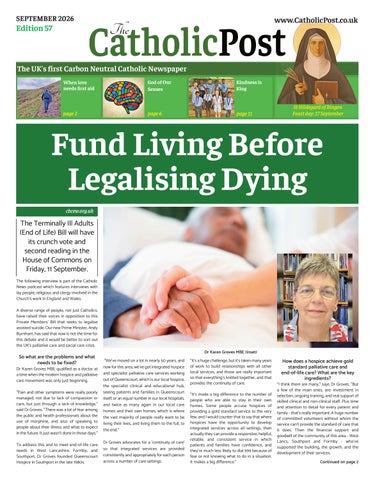
The Terminally Ill Adults (End of Life) Bill will have its crunch vote and second reading in the House of Commons on Friday, 11 September. The following interview is part of the Catholic News podcast which features interviews with lay people, religious and clergy involved in the Church's work in England and Wales. A diverse range of people, not just Catholics, have raised their voices in opposition to this Private Members' Bill that seeks to legalise assisted suicide. Our new Prime Minister, Andy Burnham, has said that now is not the time for this debate and it would be better to sort out the UK's palliative care and social care crisis. Dr Karen Groves MBE (Inset)
So what are the problems and what needs to be fixed? Dr Karen Groves MBE qualified as a doctor at a time when the modern hospice and palliative care movement was only just beginning. "Pain and other symptoms were really poorly managed, not due to lack of compassion or care, but just through a lack of knowledge," said Dr Groves. "There was a lot of fear among the public and health professionals about the use of morphine, and also of speaking to people about their illness and what to expect in the future. It just wasn't done in those days." To address this and to meet end-of-life care needs in West Lancashire, Formby, and Southport, Dr Groves founded Queenscourt Hospice in Southport in the late 1980s.
"We've moved on a lot in nearly 50 years, and now for this area, we've got integrated hospice and specialist palliative care services working out of Queenscourt, which is our local hospice, the specialist clinical and educational hub, seeing patients and families in Queenscourt itself, or an equal number in our local hospitals, and twice as many again in our local care homes and their own homes, which is where the vast majority of people really want to be living their lives, and living them to the full, to the end." Dr Groves advocates for a 'continuity of care' so that integrated services are provided consistently and appropriately for each person across a number of care settings.
“It's a huge challenge, but it's taken many years of work to build relationships with all other local services, and those are really important so that everything's knitted together, and that provides the continuity of care. "It's made a big difference to the number of people who are able to stay in their own homes. Some people accuse hospices of providing a gold standard service to the very few, and I would counter that to say that where hospices have the opportunity to develop integrated services across all settings, then actually they can provide a responsive, helpful, reliable, and consistent service in which patients and families have confidence, and they're much less likely to dial 999 because of fear or not knowing what to do in a situation. It makes a big difference."
How does a hospice achieve gold standard palliative care and end-of-life care? What are the key ingredients? “I think there are many," says Dr Groves. "But a few of the main ones, are: investment in selection, ongoing training, and real support of skilled clinical and non-clinical staff. Plus time and attention to detail for every patient and family - that's really important. A huge number of committed volunteers without whom the service can't provide the standard of care that it does. Then the financial support and goodwill of the community of this area - West Lancs, Southport and Formby - who've supported the building, the growth, and the development of their services. Continued on page 2