OCTOBEr 2026
www.CatholicPost.co.uk
Edition 58
LifeTeen Summer Camp
TikTok Priest
God of Our Senses
page 4
page 9
page 12
St. John Henry Newman October 9th
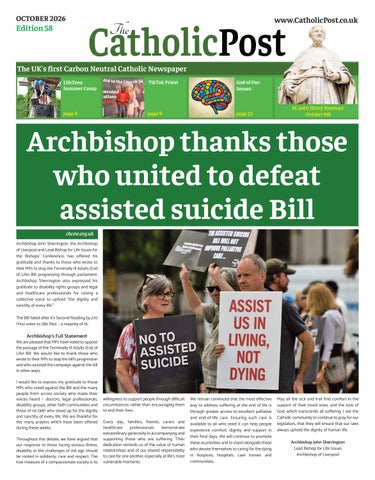
Archbishop thanks those who united to defeat assisted suicide Bill cbcew.org.uk Archbishop John Sherrington, the Archbishop of Liverpool and Lead Bishop for Life Issues for the Bishops’ Conference, has offered his gratitude and thanks to those who wrote to their MPs to stop the Terminally Ill Adults (End of Life) Bill progressing through parliament. Archbishop Sherrington also expressed his gratitude to disability rights groups and legal and healthcare professionals for raising a collective voice to uphold “the dignity and sanctity of every life.” The Bill failed after it’s Second Reading by 270 (Yes) votes to 286 (No) – a majority of 16.
Archbishop’s Full Statement We are pleased that MPs have voted to oppose the passage of the Terminally Ill Adults (End of Life) Bill. We would like to thank those who wrote to their MPs to stop the bill’s progression and who assisted the campaign against the bill in other ways. I would like to express my gratitude to those MPs who voted against the Bill and the many people from across society who made their voices heard – doctors, legal professionals, disability groups, other faith communities and those of no faith who stood up for the dignity and sanctity of every life. We are thankful for the many prayers which have been offered during these weeks. Throughout this debate, we have argued that our response to those facing serious illness, disability or the challenges of old age should be rooted in solidarity, care and respect. The true measure of a compassionate society is its
willingness to support people through difficult circumstances rather than encouraging them to end their lives. Every day, families, friends, carers and healthcare professionals demonstrate extraordinary generosity in accompanying and supporting those who are suffering. Their dedication reminds us of the value of human relationships and of our shared responsibility to care for one another, especially at life’s most vulnerable moments.
We remain convinced that the most effective way to address suffering at the end of life is through greater access to excellent palliative and end-of-life care. Ensuring such care is available to all who need it can help people experience comfort, dignity and support in their final days. We will continue to promote these as priorities and to stand alongside those who devote themselves to caring for the dying in hospices, hospitals, care homes and communities.
May all the sick and frail find comfort in the support of their loved ones, and the love of God, which transcends all suffering. I ask the Catholic community to continue to pray for our legislators, that they will ensure that our laws always uphold the dignity of human life. Archbishop John Sherrington Lead Bishop for Life Issues Archbishop of Liverpool
Page 2. The Catholic Post. October 2026.
CONTACT US: The Catholic Post is published by its owners CathCom Ltd and is wholly independent of and separate from any previous newspaper. The Catholic Post is published on the last Sunday of the month previous to publication date.
EDITOR: Nick Layton email: editor@catholicpost.co.uk
ADVERTISING: CathCom Ltd. 01440 730399 ads@cathcom.org
DESIGN & LAYOUT: David Lodge, davidl@cathcom.org
PUBLISHED BY:
Artificial Intelligence will provide 'an explosion of creativity, but brakes are needed' vaticannews.va As the Vatican hosted a conference exploring how technology is changing art, culture, and the human mind, organisers reflect on the need for prudence when approaching the creative boost that artificial intelligence offers humanity.
CathCom Ltd. N2 Blois Meadow Business Centre, Blois Road, Steeple Bumpstead, Haverhill, Suffolk CB9 7BN 01440 730399
ARTICLES TO: The Catholic Post email: editor@catholicpost.co.uk or
According to Dmitry Volkov, artificial intelligence is like a car: it enables extraordinary acceleration, but when we develop a fine car, especially a racing car, “we must pay close attention to creating highly effective and reliable brakes to prevent it from crashing into walls."
davidl@cathcom.org Please send articles for publication by email, supplying any photos separate to the text. We welcome contributions. Here are answers to some basic questions about writing for The Catholic Post How long should articles be? Usually it seems to work out best if contributors simply say what they have to say and let us worry about finding a spot for
The philosopher, technology entrepreneur, and founder of the International Centre for Consciousness Studies (ICCS) uses this image to summarise the possibilities offered by the technology that is transforming our time. The ICCS' third annual conference is examining it in depth and asking the necessary and sometimes uncomfortable-questions needed to analyse AI's impact on humanity.
it in the paper. What is the submission procedure? Please send as a Word file attached to an e-mail. To submit articles for publication, send to editor@catholicpost.co.uk Charts, graphs, and photos should be submitted as separate PDFs. Electronic photos should not be embedded or pasted
The conference brought together philosophers, neuroscientists and leading international figures in artificial intelligence to discuss whether AI can truly be creative. For now, according to Volkov, one thing is certain: AI can help human beings become more creative.
into a Word document as this reduces their quality. Photographs and Illustrations Photographs and Illustrations should be supplied electronically as high resolution
“I think it will stimulate human creativity," he says. “Obviously, however, there are many 'buts,' many things of which we need to be aware."
JPEG (*.JPG) files). Photographs and illustrations should be sent in colour with a resolution of 300 dpi and a minimum size of 100 mm x 100 mm when printed (approx. 1200 pixels wide onscreen). Computer print-outs are not acceptable. Screen captures are not ideal as they are usually not very high Parental permission should be sought before submitting photographs of minors. Source information DW = Diocesan Website. ICN = Independent Catholic News Views expressed in The Catholic Post are not necessarily those of the editor
Hence the need to remain conscious and to develop those "brakes" without which accidents are inevitable. Pietro Perconti, a philosopher and co-founder of the ICCS, believes that it is not “unreasonable to speak of artificial creativity." “Naturally, a long series of caveats must be adopted; we must be very prudent," he says. “The type of creativity produced by machines is not the same kind of creativity that we are accustomed to considering as such. It is a different type of creativity that can be appreciated as a kind of collective endeavour, rather than as the product of the genius of an individual artist, as we typically tend to understand it in the West."
Last date for copy is the LAST DAY of the month prior to publication.
Volkov recalls that “for many years, producing a video, making a film or creating a cartoon
Image: Vatican Media was something that only a very small number of people could actually do." Indeed, it required learning how to draw and how to animate images on a computer, whereas AI has now enabled thousands of people to create their own films or cartoons in short, to express themselves. The philosopher warns, however, that a byproduct of what he calls an "explosion of creativity" is the emergence of deepfakes: manipulations of photographs, videos or images that cause harm to people. Artificial intelligence also tends to please the user, a tendency described as "sycophantic." “Sycophantic behaviour," Volkov warns, "sometimes leads a person to receive rewards for their narcissism and for ideas that are not sufficiently grounded. This is an important characteristic of which we must be aware." It is a machine behaviour that can be mitigated: “The new models currently available are actually much more independent and autonomous." At this point, it is legitimate to ask whether AI is conscious or could become conscious. Volkov's position is rather nuanced: “In philosophy, we have a specific technical term for defining consciousness: we call it ‘qualia’." The term qualia, the plural of the Latin quale, refers to the qualitative aspects of conscious experiences. They correspond to “a particular sensation, a subjective sensation, something that is experienced at this very moment. For example," he explains, “seeing red. If I see red, it seems to me that I am seeing red; I am convinced that I am seeing red. This is one of the simple and basic qualia."
Continuing his explanation, the philosopher reaches this personal conclusion: "I think the studies are still at too early a stage. In general, however, I believe that human beings are mechanistic systems and that we will also see similar phenomena in computers. Therefore, at some point, we will be able to see conscious AI and will have to learn how to manage it." As Perconti explains, the Vatican session has an ambitious objective: “To try to understand whether it is possible, and whether it makes sense, to imagine relationships between human beings and artificial companionsfriendships, relationships involving assistance, and romantic relationships." The intellectuals gathered at the Vatican are asking to what extent these relationships might be productive and to what extent, instead, they should concern us. In their discussions, they are keeping in mind the message of Pope Leo XIV's Magnifica Humanitas: “What the Encyclical says-namely, that people must be at the centre-is not merely a religious requirement; it is a human requirement." Perconti explains that they are guided precisely by “the central point of the Encyclical: pay attention to human beings; people are the most important thing." “Since our world is becoming a world of digital relationships, how is it possible to take this central humanistic concern into account in a world that is meanwhile becoming increasingly digitalised?" he asks. According to the philosopher, education is the answer: “People need to be educated in their relationships with artificial intelligence, and this essentially means undertaking a public process of education."
Freedom watchers set the downtrodden free rcdea.org.uk
Freedom Watchers in East Anglia train to spot and report modern slavery
Unsurprisingly, given how many slaves live among us, these volunteers have found people who were clearly being exploited. Observant, caring Freedom Watchers helped by calling the Modern Slavery Helpline on 08000 121 700 and reporting what they had seen. Ten highly vulnerable people have been given the chance of liberty by Freedom Watchers, simply through their raised awareness and willingness to lift a finger to help. That may not be a large number, but imagine the impact on the life of each person freed.
During the summer, a vulnerable woman was identified by a Freedom Watcher in one of our cities and reported to the Modern Slavery Helpline. It seemed that the woman was being cuckooed, that is, exploited by criminals who take over vulnerable people’s homes for illegal purposes such as drug dealing. The practice typically involves the coercion, manipulation and exploitation of the victim. The Modern Slavery Helpline assesses calls and passes referrals on to the police or another appropriate agency. These calls often lead to the rescues of oppressed and downtrodden people that are reported in the media.
The greater the number of Freedom Watchers, the greater the number of enslaved people being found. As Pope Leo XIV put it in Dilexi Te: “The act of rescuing someone from slavery… is seen as an extension of Christ’s redemptive sacrifice.” To raise further awareness, a free to attend conference on modern slavery is being held in Newmarket on Saturday 6 February. People may attend in person or, if they are unable to do so, watch via a livestream. A link will be available nearer the time on the Diocesan Modern Slavery webpages, which also provide more details about the conference and relevant contact information.
UK government introduces Bill removing rules preventing Catholic PM from 'carrying out full constitutional duties' indcatholicnews.com Under the first Catholic Prime Minister, Andy Burnham, the UK Government has introduced the Repeal Bill to remove the historic religious restrictions which prevents a Roman Catholic or Jewish Prime Minister from carrying out the full constitutional duties of their office. This new legislation will mean Roman Catholic and Jewish Prime Ministers can provide advice on Church of England appointments to the King. The Bill will end archaic restrictions that prevent the Prime Minister exercising the full extent of their constitutional responsibilities. Changes announced will remove archaic legislation which prevents a Prime Minister of the Roman Catholic or Jewish faith from
Trust, Prayer Changes Things
Whilst the main work of Crown of Thorns is in the promotion of the Holy Rosary for peace in our troubled world, this summer has been particularly busy for us in sorting donated items to send on to needy dioceses in poorer lands. Items from this summer’s donations to diocesan parishes, hospitals and schools are ready to ship to Harare Archdiocese, Zimbabwe. Alongside this and our excessively hot summer and supporting duties, we have got a little behind in office correspondence. We would like to apologise if we have not managed to thank or answer everyone personally through this time. We are most grateful to all for their support.
Since the launch of a Modern Slavery Abolition Initiative in the Diocese two years ago, approaching 50 people have begun to learn how to spot and safely report people who are being enslaved, writes Simon John, co-lead of the initiative. Modern slavery is often hidden in plain sight in our countryside, towns and cities. We call the volunteers “Freedom Watchers” simply because, as they go about their everyday lives, they watch out for the thousands of souls in our Diocese who have no freedom.
The Catholic Post. October 2026. Page 3.
exercising their full constitutional responsibilities of advising the monarch on Church Appointments. As principal adviser to the Monarch, providing advice on appointments to the Church of England is a part of the Prime Minister's role. Amendments were brought into law in the late 18th and early 19th centuries to remove restrictions on Catholic and Jewish people in public life. However, the restrictions on Church appointments were left in place, and that is what The Church Appointments (Repeal of Discriminatory Provision) Bill will remove. Up until recently these restrictions had no practical effect as there has not been a Roman Catholic or Jewish Prime Minister, and these restrictions do not apply to people of other faiths or of no faith.
This short, targeted Bill will modernise the law to enable the Prime Minister, and any future Jewish or Roman Catholic Prime Minister to carry out the complete functions of their office. In the interim, the Prime Minister has transferred the responsibility to the Lord Chancellor to ensure that Church appointments can continue. This Bill is crucial in ensuring that all Prime Ministers can discharge this responsibility regardless of their personal religious beliefs.
In the news there are many issues which may leave us feeling fearful. Yet, rather than becoming overwhelmed at what we read, we can have the joy that comes from trusting that it is our prayers that can change all things. We are able to have hope, knowing that God will hear us, that He waits for our prayers and will act. Pray the Rosary. Trust in God. Daily Prayer: Lord, help me through the lonely hours to believe the sun will rise… And that the dawn will come on silent feet before my trusting eyes. Help me through the troubled hours To feel your presence near, To realise the storm will pass And that the skies will clear. Help me through the hours of doubt, To keep my faith and trust And give me strength to know your will To do the things I must… Then help me through the shining hours So I’ll be mindful of The fact that all life’s finest things Are mine through Your great love. (J K McManus) www.crownofthorns.org.uk. Email: office@crownofthorns.org.uk
‘With Every Breath’: young Catholics encounter Christ at LifeTeen Summer Camp
Page 4. The Catholic Post. October 2026.
kenelmyouthtrust.org.uk More than 200 young people, parish youth leaders and young adult volunteers from across the Archdiocese of Birmingham and beyond gathered at Alton Castle recently for the annual LifeTeen Summer Camp which brought together adventure, friendship, formation and a deep encounter with Christ.
Powerful periods of Eucharistic Adoration were a particular feature of the week, providing moments of stillness and prayer amid the energy of camp. With the Blessed Sacrament exposed, young people were invited simply to be present with Jesus, bringing their hopes, questions and lives before Him.
Organised by the Kenelm Youth Trust (KYT), the five-day camp welcomed young people aged 12–18 from Catholic parishes across the country, alongside a committed team of young adult volunteers and an experienced leadership team.
Alongside the spiritual and theological programme, campers enjoyed an extensive range of outdoor activities, including biking, trekking and archery. There were also day trips to Flip Out in Stoke and Alton Towers, giving the young people opportunities to relax, have fun and strengthen the friendships developed throughout the week.
Taking place from Sunday 16 August until Thursday 20 August, the camp combined outdoor adventure with prayer, theological formation and the Sacraments, creating an environment where young people could discover that faith is not something separate from everyday life, but something that touches every aspect of it.
The camp’s young adult volunteer team played a crucial role in creating the community to welcome and lead the participants. Volunteers arrived three days before the young people, giving them time to prepare together and receive training in safeguarding, evangelisation and theology.
This year’s theme, ‘With Every Breath’, focused on the person and work of the Holy Spirit, inviting young people to consider how the Spirit is active in their lives and how they might respond to His invitation. Each day included Mass, opportunities for the Sacrament of Reconciliation and times of prayer and Eucharistic Adoration, alongside formation talks and small-group discussions. The young people were given space to ask questions, explore their faith and consider what it means to live as a disciple of Jesus Christ.
Investing in young leaders
Their formation was rooted in the camp’s ‘With Every Breath’ theme, equipping the volunteers not simply to supervise activities but to accompany the young people in their faith and help create an environment in which they could encounter Christ. The formation was ably lead by Matt Franklin who joined us from California. Matt was joining the camp for the second year having first been with the team in the summer of 2025 and this year he was joined by his 21 year old son, Andrew who led worship for the week.
Summer Camp Leader Beccy Roseman said: “It is such a privilege to be able to host the LifeTeen Summer Camp at Alton Castle. It has grown every year since the first camp fifteen years ago, and it is incredible to see how this community continues to grow and develop. “One of the things I am particularly proud of is the commitment of our young adult volunteer team. They arrive early before the young people, some taking annual leave to prepare, pray and receive training. “These young adults are not simply helping to run a camp. They are investing in the lives of the young people entrusted to them. They
model what it means to live a faith that is joyful, generous and outward-looking, and they create a community in which our young people can feel welcomed, known and loved. “I am also proud that the camp is inclusive of young people from different backgrounds. They come from different parishes and have different experiences of faith, but for this week they find a home together. They can have fun, ask difficult questions, pray together, receive the Sacraments and discover that they are part of something much bigger than themselves. Continued on next page
The Catholic Post. October 2026. Page 5.
Historic Thetford Church Celebrates Bicentenary Ray, a parish youth leader from Birmingham said he came expecting a week where the young people would be impacted but found something more. “At the start of the week I hoped our young people would be transformed and people who have been before told me this was the case. However, I was not expecting that I would be transformed also. I cannot thank the team here enough”.
Encountering Christ in community For the young people, the combination of faith and community has made a lasting impression. Thabani, 18, from Birmingham, said: “Summer Camp has been eye-opening. I was able to go deeper than in my normal life. All the people get to know each other and all the age ranges are able to mix and share with each other. I would and have recommended it to anyone aged 11–18.” For Francis, 17, from Wolverhampton, the week has been particularly significant spiritually: “This week has been spiritually transformative. I have been able to encounter Christ and get to know my friends better. It is a place where I have been able to see Christ in others.” And for Isla, 13, who has attended the camp three times, the experience has become an important part of her life: “Summer Camp is one of the best experiences. Previously I have celebrated my birthday on camp and I wouldn’t change it.” The camp takes place at Alton Castle, a historic Catholic retreat centre overlooking
the Churnet Valley. A castle was standing on the site by 1176, while the present buildings include 19th-century work associated with the Catholic architect Augustus Welby Pugin. The site has been used as a retreat centre for young people since 1996. Today, its ancient walls provide the setting for a very different kind of gathering: young people encountering the living Christ through the Eucharist, the Sacrament of Reconciliation, prayer, friendship and the beauty and challenge of the outdoors.
rcdea.org.uk
For the Kenelm Youth Trust, this combination is at the heart of its mission.
St Mary’s Catholic Church in Thetford is celebrating its bicentenary with a year of events marking 200 years of Catholic faith and worship in the town.
KYT is the youth service of the Archdiocese of Birmingham, working with parishes, schools and young people to create opportunities for them to encounter Christ, grow in faith and become missionary disciples.
Built in 1826, St Mary’s is the oldest Catholic church in continuous use in the Diocese of East Anglia. Its bicentenary year also coincides with the 50th anniversary of the Diocese.
As the young people return to their parishes, they take with them more than memories of Alton Towers, archery, biking and late-night laughter. They leave with friendships strengthened, questions explored and, for many, a renewed awareness of the presence of the Holy Spirit in their lives.
The church was built during a period when Catholics in England still faced significant social, political and legal restrictions. Funded by Thetford resident George Gardiner, its construction represented an important act of faith and courage at a challenging time for the Catholic community. The circumstances in which it was built also help to explain the church’s understated design.
The challenge of ‘With Every Breath’ is now to take that encounter beyond Alton Castle, allowing every breath, every conversation, every decision and every act of service to become an opportunity to live with the Holy Spirit and share the joy of the Gospel.
Bicentenary celebrations began with a special Jubilee Mass on July 5, celebrated by Bishop Peter Collins and parish priest Fr Andrew Eburne. A programme of ecclesiastical, historical and social events are continuing throughout the year, giving parishioners and the wider
community an opportunity to celebrate the church’s past while looking ahead to its third century. As part of the national Heritage Open Days, St Mary’s welcomed visitors on Saturday September 19, and Sunday September 20. Visitors were be able to explore the church and learn more about its history and continuing pastoral mission in Thetford. Other events planned during the bicentenary year include an exhibition, history talks, a concert, community presentations, a parish mission day, the creation of a rosary garden and a pilgrimage, alongside a number of special liturgical celebrations. Fr Andrew said, “This jubilee is a very special celebration for the parish. With its understated design, this church is so little known by Thetford residents that we want to take every opportunity to showcase our beautiful church and tell people our story. Thetford was such an extremely important Christian centre in East Anglia and we are a reminder of that heritage. Our parish today brings together so many different communities who have found their home in Thetford. It is such a joy!”
Page 6. The Catholic Post. October 2026.
Pope Leo XIV meets with Bishops associated with the Focolare Movement on September 9, 2026 (@Vatican Media)
Emphasis on individual freedom makes us less free to be ourselves vaticannews.va
Pope Leo XIV tellsBishops associated with the Focolare Movement that our modern emphasis on individual freedom can in reality make us less free to be ourselves Pope Leo XIV met recently with Bishops associated with the Focolare Movement, formally known as the Work of Mary, founded in Italy in 1943 by Chiara Lubich. In his address, the Pope said the Bishops’ encounter expresses their collegial affection as friends of the Focolare Movement, noting that they hail from various countries and social situations. Pope Leo praised their focus on “Giving Witness to Unity,” saying the theme of unity is dear to his heart. “In an age sadly marked by increasing polarisation,” he said, “our Lord enabled [Chiara Lubich] to give witness to both the sense and service of unity, thus becoming a sign for her own and future generations.” The Church continues to bear this task, added the Pope, saying he recalls the “prejudice, racism, religious intolerance, and even violence” that the Bishops face in their countries. In the West, he noted, the formerly-stable networks of family, friendship, and community are succumbing to deep fragmentation.
For all your advertising requirements please contact Nick on 01440 730399 or email: nick@cathcom.org
As societies become more marked by individualism, freedom is increasingly presented as “absolute autonomy,” so that people may pursue happiness “without any moral, natural, or even human limits.”
“And yet we observe a paradox,” said Pope Leo. “For all the emphasis on individual freedom, people today frequently feel less free to be their genuine selves or follow their highest ideals, out of a hidden fear of being judged or of not fitting in.” This loss of openness to others worsens our sense of disunity and indeed takes away our happiness, which the Pope said we find only in communion with the Triune God. “In revealing the heart of the Father, Christ shows us the deepest meaning of our existence, of our relationships, and the path to happiness,” he said. “Through the gift of the Spirit, we have become children of God, sharers in the divine life”. By embracing our communion as children of God in Christ, we take part in the Church’s mystery of communion and act as a sign of leaven and unity in our world. In conclusion, Pope Leo XIV invited the Bishops associated with the Focolare Movement to bear witness to “this longed-for unity of the human family.” “The answer to the sad divisions that plague our world,” he said, “lies not in forming more committees or launching more projects, but in going back to the source of our unity in the Holy Trinity. Devin Watkins
The Catholic Post. October 2026. Page 7
Waking up on Sunday Morning Fr David OMalley It’s Sunday morning, you are at Mass, sitting in the same bench as usual. You’ve just enjoyed or endured a long sermon. Then suddenly you have to stand up only to realise you’ve missed the Creed, the intercessions and the offertory. You are tempted to tell your spouse that you were having a mystical experience, but somehow you knew that wouldn’t wash. Anyway, you tell yourself that the most important part of the Mass is still to come, you haven’t really missed much. Or have you? Well, you missed the reassurance in the Apostle’s Creed that God is around, that Jesus put on DNA to come close to us. That same Jesus lived, worked, enjoyed life and he suffered rather than deny his belonging to his Father. If you stayed awake long enough, the next thing you would have heard is that even death itself could not break his relationship with the Father because it is an eternal bond and it is into that eternal bond that you and I have been baptised. Knowing that with your head is relatively simple, believing it in the heart is another thing altogether. Believing in that bond will give you strength when you are ill, or depressed, when people let you down or when the world seems chaotic. It’s a belief that might even keep you awake in church. Such belief brings resilience in the face of fear, integrity in challenges and a deepening sense of belonging to God. Saying that out loud in the Creed, shoulder to shoulder with others adds solidarity and further depth to your life and the choices you have to make. But you missed all that, sleepy head! If you had woken up then, you would have heard the intercessions read by lay people from the lectern. These are the official prayers of the whole church across the world. Usually, they pray for the church and its leaders to be faithful to the Gospel and then they move on to other needs. Later the petitions ask us to pray for the effects of famine, disasters, illness, wars and worldwide issues that usually leave us feeling helpless. But, as baptised children of God, we are not helpless because God is with us. That gives us hope and resilience to respond with the little faith and resources we have and to decide how we are called to make a difference. It may mean bringing up our family to live with generosity and with a conscience, Or it may mean operating with integrity in our work, in our language and in all relationships. Like the widow’s mite, we may have little influence in the world, but we do have some influence in our own local world. The intercessions then move on to more current concerns. Some of them are in this edition. You will read an article on AI and the increasing threat it might carry among its
Image: Justin Joseph many benefits. Everyone seems concerned about how it might rob us of our humanity and yet we are also intrigued by the possibilities for development that it promises. Praying about this in church helps us to put AI into a wider setting of trust in God. AI will almost certainly lead us into another version of the dying and rising pattern that underlies all creation and is seen in its fullness in the life of Jesus. AI may lead to unemployment, to even more destructive wars, to dehumanisation and many unforeseen horrors. There may be huge suffering, but the Creed reassures us that God is with us and that, in time, even AI will give way to the deeper, life-giving patterns of cross and resurrection. The article on the Brothers of Charity is the context for all the intercessions that encourage us to build community and put the poor at the centre of our parish life. The Brothers are living publicly what all baptised Christians live in their family and work life. This important and prophetic work by the Brothers, and indeed all Christian communities, uncovers a heresy that blights all western societies. The heresy is this: that we are all individuals, isolated beings, factors of production and free to do as we want, when we want. Consumerism and wealth have combined to create the myth that we are all soloists when in fact humanity
is a choir with many voices that need to harmonise. That is why I cannot close my heart or my ears to members of my own family, thinking that what I do does not affect them. Also, can I spend money liberally when others are in dire need? In paragraph 23 of Populorum Progressio, Pope Paul VI points out that when we are making a gift to the poor, we are giving them back what they deserve to live on. Not to do so is theft.1 The sense of Gospel solidarity operating beneath the rim of consciousness, creates less space for an individualism that becomes self-centred and cold-hearted. These are the hidden attitudes that break down family life and undermine kindness. The intercessions you missed are the antidote to that view because they aim to embrace the whole world and we promise by our response to do what we can to help. We all need to wake up to those challenges even on a sleepy Sunday morning! It’s even more amazing that you didn’t wake up when the children processed in from the back of the church as part of the offertory. They were chatting and waving the posters they made, but you didn’t stir, you must have been very tired! But you can’t be blamed, it probably took all your energy to get to church at all. The children were part of the offering we all made, along with the bread and wine for the
Eucharist. It’s easier to involve children in the church when they are embedded in family church going. It’s not so easy when teen hormones and independence explode into family life. That is why it’s important to applaud the work of ‘Life Teen’ described elsewhere in this edition. The movement is eucharistcentred and focused on relational trust so that it overcomes the individualism of our western culture and focuses on the mystery of Easter in each of our lives. Birmingham Archdiocese is doing a tremendous job in promoting this programme here in the UK. These young people are the Catholic leaders of the future and, if we cannot hand the faith on to them and let them develop it in an AI and consumerist world our church will turn into a curious museum in the decades ahead. On the other hand, stay awake, support and guide the young in leading our church and then AI, assisted dying, and individualism will eventually give way to the Gospel. But stay awake at all times, praying that you may have the strength to escape all these things that are going to happen and stand with confidence before the Son of Man. (Luke 21.36) 1
Pope Paul was quoting St Ambrose but also St John Chrysostom. The exact quote is found in The Catholic Catechism number 2446.
Vocation: Grace and Mission
Page 8. The Catholic Post. October 2026.
Deacon Michael O’Donnell
Inside the Missionaries of Charity Brothers' life of service In 1950, Mother Teresa of Calcutta founded the Missionaries of Charity Sisters whose mission was service to the poor. They did this in India but within twenty years they were becoming present in many countries throughout the world including Britain The sisters came to Glasgow in 1986 and established a presence in Pollok. Here, I became involved with them as a co-worker. The Sisters were involved in soup-kitchens through serving those living in hostels or, indeed, living on the streets. Today, the sisters are still doing this whilst also serving people in the area they live through prayer group, parish work and hospital visiting.
formation of the brothers. As part of this, he took the name Br Andrew. Immediately he oversaw their development as a Religious Community. Within a few years they were present in countries throughout Asia, the Americas, Africa, and in Europe where today they are present in England, France, and Romania. The community of brothers came to Manchester in 1984. I had first met a couple of brothers at a youth co-workers retreat in 1990 and remember saying I must visit you soon. Well, better late than never!
I witnessed this in their opening their home to guests for a meal; involving local youths in gardening and other projects where they can engage in crafts, jam making, woodworking and other creative and recreational activities, thus taking pride in their work and skills; doing informal mentoring in local schools; doing outreach to homeless people and those living and begging on the streets; visiting the elderly and housebound; arranging the adjacent woodland for activities and prayer reflections at liturgical seasons; being involved with prison chaplaincy, and support for ex-prisoners and people in addiction and recovery; and longterm support and friendship for Travellers and their families in the neighbourhood. Brother Andrew
To brother New Community In 1963, Mother Teresa had realised men too had the vocation to serve thus she set up the beginnings of the Missionaries of Charity Brothers. It was not until 1965 when Fr Ian Travers-Ball, a Jesuit priest from Australia who was in Calcutta, now known as Kolkata, was asked by Mother Teresa to take over the foundation and
Recently, I visited and stayed for a few days. The Community of five brothers live in a former presbytery in an area where poverty in its many forms is present. Here, they are, as Mother Teresa said, ‘Carriers of God’s love’. They do this through living the Gospel in sharing the everyday lives of their neighbours, in their joys and sorrows. As brothers their charism is ‘to brother’.
Daily they attend the local parish Church where they receive nourishment through the grace of the Eucharist. Personally, I felt humbled by their warm welcome, by their simple way of living, and by their spirituality.
Vocation It is clear the brothers find in ordinary life a meeting place with Jesus. As St. Charles de Foucauld wrote ‘It is only necessary to live among people, sharing the human condition and being present to them in love’. A brother’s vocation is ‘living the life of Nazareth … the hidden life of Jesus of Nazareth’. On Vocations Sunday we often hear the bishops and priests asking us to pray that more men answer the call of God to the
priesthood and be shepherds of the flock. Yet rarely do, I hear ‘Let us pray for more men to answer the call of God to be Brothers and servants to God’s people’. In 2023, the late Pope Francis chose the theme for Vocations Sunday as ‘Vocation: Grace and Mission’. He said, ‘our common vocation is to give ourselves in love’. People live their baptism in several ways, that is as laity, religious, or ordained as all have a role within, which is, the ‘vocational symphony’. Here, each of us have a contribution to give in living the gospel. In Manchester, it is clear the Missionaries of Charity Brothers are contributing to the symphony. May the music continue. Deacon Michael O’Donnell (Archdiocese of Glasgow)
Tik Tok priest’s message to Scottish youth
The Catholic Post. October 2026. Page 9.
indcatholicnews.com
A priest with 1.8 million TikTok followers has urged young people not to ignore the persecution faced by Christians around the world
"But I'm not going into their world to be part of that world. I'm going into their world to bring them the awareness of Jesus. "All the songs we dance to are Jesus songs. They remind us that Jesus is Light - he's the Life, the Way and the Truth."
Father James Anyaegbu, who hosted Aid to the Church in Need's Scottish Youth Rally in Hamilton on 8th September, encouraged around 700 pupils to be aware of the challenges faced by Christians in countries including Nigeria, India and Ukraine, and to stand in solidarity with those suffering for their faith.
Born in Nigeria, Fr James was ordained in 2013 and worked in two parishes in the city of Aba in the south-eastern Abia State before moving to Scotland in 2015. Now based in the Highlands, he has become an unlikely social media star, attracting millions of views with videos that combine faith, humour, music and dancing.
Following the event in Hamilton, South Lanarkshire, he told the Catholic charity: "Whatever is happening to one affects everybody, because we are one humanity."
At the youth rally, pupils joined him on stage for songs, dances and selfies between presentations highlighting the plight of persecuted Christians.
For Fr James, the rally provided an opportunity to raise awareness of the situation facing Christians in his native Nigeria and elsewhere. "It's an amazing event for me if I'm able to lend my voice for people to know what's going on, especially in Nigeria and other places where Christians are persecuted," he said.
Fr James said the enthusiasm generated by the music was about much more than entertainment.
"Faith is one of the greatest gifts God has given us and young people need to know that and hold on to it."
“Events like this call young people in Scotland to be aware of what's going on, especially in places like Africa, India and Ukraine. "We need to be aware of it and speak out because you never know when it's going to creep into where you are today. We are relatively in peace, but we need to be aware of those who are facing persecution."
"The reason behind the dancing is the joy of the Lord," he said. "Young people spend their time on social media. When they come out and see a Catholic priest entering their world, they get excited.
He added: "I love their excitement too. When I see them excited about coming onto the stage, I get excited and give glory to God."
He said that persecution has been part of Christianity since its earliest days, suggesting that stories of believers suffering for their Faith can inspire others to ask deeper questions about religion.
October Saint
A Life Guided by Conscience St. John Henry Newman On October 9th, the Church celebrates St. John Henry Newman, one of the most compelling converts and thinkers in modern Catholic history. Born in London in 1801, Newman began his religious life as a celebrated Anglican priest and Oxford scholar, a leading voice in the Oxford Movement that sought to recover the Catholic roots of the Church of England. Yet his relentless pursuit of truth led him somewhere unexpected: after years of prayerful, painstaking study into the early Church Fathers, he became convinced that the fullness of Christian truth resided in the Roman Catholic Church. In 1845, at great personal cost — the loss of friendships, reputation, and his Oxford position — he was received into the Catholic Church. Newman's genius lay in his insistence that faith and reason are not enemies but companions. His writings on the
development of doctrine, the role of conscience, and the nature of a university education remain foundational, studied by theologians and educators alike. He later became a cardinal, and Pope St. John Paul II described him as a figure whose ‘life and work’ could be called a “pilgrimage of grace and truth." Perhaps his most enduring gift is his famous motto, Cor ad cor loquitur — "Heart speaks to heart." It captures his conviction that genuine faith is never merely intellectual assent, but a personal encounter, a quiet inner dialogue between the believer and God.
“When people hear that for the sake of Christ people are being persecuted, they become inquisitive," he said. "They ask, 'Who is Jesus? Why are people persecuting others because of Jesus?' "I have seen many people led to Faith because they heard about persecuted Christians elsewhere." Fr James said awareness remained critical not only for those suffering discrimination and violence but also for governments and organisations able to help them. "We keep talking about it, first for the liberation of those who are persecuted, secondly so awareness can be created, especially among governments who can help, and thirdly for the increase of faith," he said. Thanking organisers, teachers and pupils gathered at the rally, he ended with a message of hope. "God is not done with them yet. God is just starting," he said. "And to the persecuted Christians, we are with you. We are journeying with you. What's touching you is touching us. We are doing everything to show you our solidarity." Nathalie Raffray
Canonised in 2019, Newman stands as a patron for anyone wrestling honestly with difficult questions of faith. His life reminds us that following conscience — even when it demands sacrifice, even when the path is unclear — is itself an act of profound courage and trust in God's providence.
To see Fr James on Tik Tok scan the QR code.:
Page 10. The Catholic Post. October 2026.
Thousands take part in March For Life 2026
Subscribe to AuguST 2026
www.CatholicPost.co.uk
Edition 56
JULY 2026
www.CatholicPost.co.uk
Edition 55
We are made for the infinite!
page 6
Seafarers’ Sunday
page 11
Fr Stephen Wang appointed as new Bishop of Arundel and Brighton
Building a dementia friendly parish
page 13
page 3
St Thomas the Apostle: 3rd July
page 9
Reflections on My First Year as a Permanent Deacon
page 14
SEPtEmBEr 2026
Edition 57
Pope Leo XIV presents "Magnifica Humanitas" as the Church’s response to the challenges posed by artificial intelligence, calling for AI to be “disarmed” from logics of domination, exclusion and war when Drawing parallels with Rerum Novarum, impact of the Pope Leo XIII highlighted the lives, the Industrial Revolution on people’s to place Pope urges the global community of human technological progress at the service good. dignity, solidarity and the common encyclical, At the presentation of his first social XIV appealed Magnifica Humanitas, Pope Leo firmly at for artificial intelligence to be placed against the service of humanity, warning exclusion technologies that foster domination, and war.
Pope Leo XIV promulgates the
encyclical "Magnifica Humanitas"
When love needs first aid
God of Our Senses
Kindness is King
page 2
page 6
page 11
St Hildegard of Bingen Feast day: 17 September
Fund Living Before Legalising Dying
Image: Vatican Media but also to build a more just
technologies, Technology and moral responsibility future together. Humanitas He explained that Magnifica longstanding support listening to scientists, Recalling the Church’s in the Synod emerged from extensive the Pope said every alone” Addressing participants gathered political leaders and for nuclear disarmament, “No one rebuilds cbcew.org.uk encyclical, the engineers, educators, power must be Hall for the presentation of the about the future of great technological on his years as a missionary in Peru, technological families concerned and public Reflecting caused Pope described the current the same time, he said accompanied by moral discernment Pope Leo XIV recalled the devastation point” younger generations. At revolution as an “epochal turning saying he voices” regarding accountability. by torrential rains and floods in 2017, by he had heard “very troubling comparable to the upheaval confronted far more systems and algorithms learned there that rebuilding involves Revolution. autonomous weapons Pope Leo XIII during the Industrial healthcare, “In a similar sense, artificial intelligence now capable of denying access to than restoring physical structures. based on unjust and demands to be ‘disarmed,’ freed from logics many employment or security domination, “Artificial intelligence already touches trust, and that turn it into an instrument of decisions that prejudiced data. “It means repairing bonds, restoring areas of our lives and affects he said, exclusion or death,” he said. noting that reawakening hope in the future,” shape human coexistence, he said, of discernment, the Pope how war is From that process that “no one rebuilds alone.” it is also “dramatically changing to “keep adding clearly in the said, came a conviction expressed Quoting Saint Paul’s exhortation waged.” needs to be warned of encyclical: “artificial intelligence awake” (1 Thess 5:6), the Holy Father then turned to the biblical figure Pope The whenever disarmed.” of Jerusalem, that peace itself is endangered The following interview rebuilding is partthe of walls the Catholic A new “Rerum Novarum” moment critical sense Nehemiah for the as a model technology weakens humanity’s Leo XIII’s News podcast image interviews which thefeatures with presenting Drawing a direct parallel with Pope the forcefulness of the phrase, digitalinage. Novarum, Acknowledging and moral vigilance. of the lay people, religious and clergy involved the construction ethical landmark 1891 encyclical Rerum said the gravity of the present is likewise Pope Leo XIV today Church's work in England and Church Wales. the of said XIV Leo Pope words capable task before of the age moment requires Yet the Pope stressed that the Continued on Page 4 called to interpret the “new things” consciences and indicating paths dangerous dignity of the “awakening A diverse range of people, not just Catholics, humanity is not merely to restrain in the light of the Gospel and the forward for humanity.” have raised their voices in opposition to this human person. Private Members' Bill that seeks to legalise assisted suicide. Our new Prime Minister, Andy Burnham, has said that now is not the time for this debate and it would be better to sort out the UK's palliative care and social care crisis.
dioceseofsalford.org.u
The Terminally Ill Adults (End of Life) Bill will have its crunch vote and
k
Salford Cathedral has reopened its doors following a three-year programme of restoration, renewal and refurbishment that has transformed the cathedral
second reading in the House of Commons on Friday, 11 September.
So what are the problems and what needs to be fixed? Dr Karen Groves MBE qualified as a doctor at a time when the modern hospice and palliative care movement was only just beginning. "Pain and other symptoms were really poorly managed, not due to lack of compassion or care, but just through a lack of knowledge," said Dr Groves. "There was a lot of fear among the public and health professionals about the use of morphine, and also of speaking to people about their illness and what to expect in the future. It just wasn't done in those days." To address this and to meet end-of-life care needs in West Lancashire, Formby, and Southport, Dr Groves founded Queenscourt Hospice in Southport in the late 1980s.
indcatholicnews.com
St Monica - August 27th
Celebrating the Comp Transformative Cathe letion of a dral Restoration www.CatholicPost.co.uk
humanitas’ Pope Leo presents 'Magnifica calling for disarmament of AI vaticannews.va
Priest braves heatwave on 108-mile walk
The Cathedral Church of St John the Evangelist welcomed worshippers and visitors back on Saturday 4 July, when a weekend of celebrations began to mark the completion of this significant project. Having served as the spiritual heart of the diocese for more than 175 years, the cathedral required extensive restoration to address
longstanding repairs to its stonework and infrastructure while ensuring it could continue to meet the needs of a growing community.
bringing renewed colour, vibrancy and beauty scheme, restored statues, to this sacred space. renewed interior decoration, the repositioning of key liturgical features, and a new Alongside restoring glass entrance on Chapel the cathedral’s heritage, Street designed to the project has also offer a visible sense invested in its future. of welcome in the heart Improved facilities, of the city. increased flexibility, enhanced accessibility and a strong We are grateful to commitment to sustainability Purcell Architects and to help ensure Simpsons the cathedral can continue of York for their to serve the people expertise throughout the project. of the diocese for generations Their specialist to come. knowledge of heritage conservation has enabled the careful restoration of the cathedral’s historic character while incorporating modern standards and technology to support its future mission.
A key element of the project has been the While much of the work focused restoration of many of the cathedral’s historic on essential repairs to the fabric of features, including the building, visitors the reinstatement will of notice original decorative a remarkable transformation schemes and the throughout the cathedral. conservation of stained-glass windows, Improvements include new energy-efficient exterior lighting
Continued on page
2
Dr Karen Groves MBE (Inset) "We've moved on a lot in nearly 50 years, and now for this area, we've got integrated hospice and specialist palliative care services working out of Queenscourt, which is our local hospice, the specialist clinical and educational hub, seeing patients and families in Queenscourt itself, or an equal number in our local hospitals, and twice as many again in our local care homes and their own homes, which is where the vast majority of people really want to be living their lives, and living them to the full, to the end." Dr Groves advocates for a 'continuity of care' so that integrated services are provided consistently and appropriately for each person across a number of care settings.
“It's a huge challenge, but it's taken many years of work to build relationships with all other local services, and those are really important so that everything's knitted together, and that provides the continuity of care. "It's made a big difference to the number of people who are able to stay in their own homes. Some people accuse hospices of providing a gold standard service to the very few, and I would counter that to say that where hospices have the opportunity to develop integrated services across all settings, then actually they can provide a responsive, helpful, reliable, and consistent service in which patients and families have confidence, and they're much less likely to dial 999 because of fear or not knowing what to do in a situation. It makes a big difference."
How does a hospice achieve gold standard palliative care and end-of-life care? What are the key ingredients? “I think there are many," says Dr Groves. "But a few of the main ones, are: investment in selection, ongoing training, and real support of skilled clinical and non-clinical staff. Plus time and attention to detail for every patient and family - that's really important. A huge number of committed volunteers without whom the service can't provide the standard of care that it does. Then the financial support and goodwill of the community of this area - West Lancs, Southport and Formby - who've supported the building, the growth, and the development of their services. Continued on page 2
For ALL of your Parishioners
100 copies: £15.00 per month* (15p per copy) 200 copies: £29.00 per month* (14.5p per copy) 300 copies: £41.00 per month* (14p per copy)
For some of your Parishioners 50 copies: £12.00 per month* (24p per copy) 10 copies: £9.00 per month* (90p per copy)
Individual Subscriptions 1 Copy delivered by Post: £4.00 per month*
Online Subscriptions 1 Online Copy via Email £3.00 per month* *20% Discount for ALL ongoing subscriptions paid by card. All prices include delivery
www.catholicpost.co.uk For all your advertising requirements please contact Nick on 01440 730399 nick@cathcom.org
An estimated 7,000 campaigners, including several large youth groups, took part in the annual March for Life in London recently Campaigners met for prayers in several places of worship including St Andrews CoE church Holborn, the Emmanuel Centre and an Orthodox Moleben in St Johns Gardens before the march and rally in Parliament Square. Archbishop Richard Moth celebrated the Mass for Life at Westminster Cathedral, with 14 other bishops. (Archbishop John Wilson, Bishop Peter Collins, Bishop Frank Dougan, Bishop Paul Hendricks, Bishop David Evans, Bishop Bosco MacDonald, Bishop Patrick McKinney, Bishop John Keenan, Bishop Tim Menezes, Bishop Paul Swarbrick, Bishop David Waller, Monsignor Keith Newton, Bishop Kenneth Nowakowski, Bishop Paul Mason and Bishop John Arnold.) A small group of noisy masked protesters caused some disruption during the Mass but were soon removed. A message from the Pope read out to the congregation reminded the faithful that the
protection of the right to life is the "indispensable foundation for all other human rights and societal progress." Bishop Frank Dougan of Galloway gave the homily. He quoted Pope Francis' words in Amoris Laetitia: "Each child has a place in God's heart from all eternity. Once he or she is conceived, the Creator's eternal dream comes true." During his reflection Archbishop Richard Moth focused on the sacredness and God-given dignity of every human life from conception to natural death. He emphasised that for Catholics, defending life must begin not with anger or hostility, but with prayer, compassion, courage, and faith. This sentiment was echoed by Southwark Archbishop John Wilson, who summarised the core purpose of the gathering: "Human life matters, every life matters, from conception to natural death". The liturgy served as a prayer for the lawmakers preparing to vote on legislation regarding assisted suicide, urging them to uphold human dignity and protect the most vulnerable. After the Mass the crowds headed into Victoria Street marching to the Emmanuel Centre in Westminster and on to Parliament Square for a closing rally.
The stage in front of the Houses of Parliament featured keynote speakers, personal testimonies, and prayers focused around this year's theme: 'Abortion hurts the family'. Isabel Vaughan-Spruce: co-director of March for Life UK addressed the crowd regarding the UK's current abortion laws, specifically criticising rules that permit late-term procedures. Ben Thatcher, one of the lead organisers of the event spoke about the rally's overarching theme and historical abortion data in the UK. Amrita and her daughter shared a personal testimony on stage alongside her healthy baby girl. Archbishop John Wilson gave an address emphasising the core religious message of the day, stating: "Human life matters, every life matters, from conception to natural death." Bishop Patrick McKinney from Nottingham, gave a heartfelt speech regarding faith, victory, and the future of the pro-life movement. Bishop John Keenan who had traveled with a large contingent from Glasgow also addressed the rally. A vocal crowd of several hundred pro-choice activists trade unionists and healthcare workers held a small counter protest under the Millicent Fawcett statue in the Square. Jo Siedlecka
Is the ‘People’s Emergency Briefing’ on your agenda?
The Catholic Post. October 2026. Page 11.
October is dedicated as the Month of the dioceseofbrentwood.net
Parishes across the Diocese are being encouraged to screen a documentary film on the nature and climate crisis The National Emergency Briefing is a nonpolitical UK initiative that has brought together leading experts to explain the urgency of the climate and nature crisis and to call for a coordinated national response. The 50-minute documentary film, The People’s Emergency Briefing, helps communities understand the scale of the challenge and what action is needed. It is based on an event held in Westminster Methodist Hall last November which saw an invited audience of 1,200 politicians and leaders from business, culture, faith, sport and media hear from 10 of the UK’s leading
Holy rosary
experts. Chaired by Professor Mike BernersLee, they gave a concise, high-level and unfiltered briefing on the interconnected crisis – including threats to food supply, health and national security. With footage from the event plus reactions from the public and some familiar faces, the film presents the national implications of climate and nature breakdown – with credible, positive responses – in an accessible account designed for community screenings. It is intended that each one be followed by a structured discussion to allow people to process what they have heard and find ways to engage positively around solutions in their community. It aims to support a parliamentary call for a televised briefing and educate people of the full scale of the crisis and show what the response needs to be. The initiative has the support of the National Trust, the RSPB, faith groups, the Royal Meteorological Society, the Royal Society of Biology and more. Bishop John Arnold, lead Bishop for Environment for the Bishops’ Conference of England and Wales, has
A time to meditate on the lives of Jesus and Mary through prayer
endorsed the film, along with other faith leaders. He says: “I welcome this resource in the hope that churches are encouraged to screen the People’s Emergency Briefing, and feel able to unite with others and participate in much needed action to care for creation.” Caritas Diocese of Brentwood director Sian Thomas-Cullinan commented: “Hosting screenings of this documentary in Catholic parishes is a natural fit, as the Church has a vital role in responding to crises, fostering community dialogue and encouraging care for our common home.” She is encouraging parishes to consider screening the film in the run up to the Season of Creation (1 September4 October).
£1.80 provides a child with a meal every weekday for a month
Donate now at www.reachfoundationuk.org Your money goes a long way! Reach Foundation UK - charity no: 1171521
Page 12. The Catholic Post. October 2026.
God of Our Senses: Faith comes from Hearing God of Our Senses comes from the website godwhospeaks.uk - a Bishops' Conference and Bible Society initiative to encourage all Catholics to deepen their love of the Bible.
godwhospeaks.uk
What do the Bible and neuroscience say about hearing? An exploration of the physical and spiritual sense of hearing Welcome to an exploration of the physical and spiritual sense of hearing. As we travel through this sense, let’s keep the words of the Apostle Paul ringing in our ears, “Faith comes from hearing, and hearing through the word of Christ.” (Romans 10:17). In this well-known quotation, Paul emphasises the close connection between hearing, faith and understanding; the main themes of this article. For the majority of our history, the physiology of hearing has been a complete mystery revealed relatively recently through scientific discoveries. We can now successfully treat hearing disorders and protect our ears through evidence-informed care plans. Hearing, together with speech, our signature ability, we communicate, form relationships, engage socially and share experiences. What we perceive through hearing is radically affected by numerous brain processes such as emotion, memory, attention and language development. For Christians, the scientific exploration of hearing opens up another aspect of God’s creation, hidden from our forebears but available to us now. As such, our physical sense of hearing is a precious gift from God and one that He uses extensively both as a metaphor in Scripture and to inform our spiritual sense of hearing.
Knowing God One way that we gather knowledge is through sensory experiences using hearing, vision, touch, taste, smell and other physical senses. All these individual sensations are processed by the brain to generate ideas and perceptions about the world. As Christians we know God through His works and words as in, “The heavens declare the glory of God.” (Psalm 19) and Paul’s wonderful paradox that God’s invisible nature has “been clearly seen, being understood from what has been made.” (Romans 1:20) We use sight when reading Scripture, hearing when listening to the Word spoken, and touch, taste and smell to engage with the sacraments. God uses all sensory channels to communicate with us.
intuition, an inner grace able to perceive God’s reality beyond our physical senses. As Paul said, “the eyes of your heart may be enlightened” (Ephesians 1:18) and John talks of the Spirit of Truth guiding believers (John 16:13) beyond mere sensory input. Learning through our senses or through intuition is highly individual. A major part of knowing is testimony from trusted reliable witnesses and communities. When I read a research paper in neuroscience, I can’t repeat the study to prove its validity. Instead, I look at the authors’ names, their institutions, the research question, data and findings. The paper is peer-reviewed and critiqued by specialists. Everyone involved is part of a trusted reliable community. Even so, I still contextualise the findings with my own knowledge gained from reading other papers and my own research. Likewise, faith is informed by reliable direct witnesses such as the Apostles, “we proclaim to you what we have seen and heard.” (1 John 1). In addition are the Church’s creeds, liturgy and teaching, the lives of Saints and those holy and good people in our everyday lives who inspire and feed our faith, as well as our own lived experience of discipleship, prayer and service. An excellent example of hearing being only the first step to understanding is Philip and the Ethiopian eunuch (Acts 8:26–40). The eunuch reads Isaiah aloud; Philip asks, “Do you understand what you are reading?” He replies, “How can I, unless someone explains it to me?” The text is read and heard but needs to be explained. Just as the brain must process sound through memory, emotion, reasoning and language centres to yield understanding and meaning, active spiritual listening to the heard Word through teaching, exegesis, meditation, and catechism guides us to understanding and obedience. I can personally attest to generations of students at my lectures who thought they could gain knowledge merely by listening passively and absorbing content through osmosis! Now we know about the physiological processes involved in hearing, let’s use this to inspire and strengthen our spiritual senses. Here are some examples.
Hearing – simplicity hides complexity
The ultimate physical sensory experience is the incarnation; Jesus as a visible, tangible revelation. As (1) John says, “What we have heard…seen with our eyes…looked at and have touched…we proclaim.” So, just as our physical sensory signals are gathered together and processed by the brain, our spiritual senses are interpreted by faith.
Hearing appears to be such a simple sensation. Someone speaks; we listen and can understand them while they’re talking. This apparent simplicity conceals a highly complex process that requires numerous moving parts to work precisely, in sequence and extremely rapidly. The immediacy of this sense has been vital for our very survival.
While God is revealed through nature, Christians believe that we are born with innate divine awareness and purpose. This is spiritual
Of all the senses mentioned in the Bible, sight is referenced most often with hearing coming a very close second. Whenever Scripture wants
to emphasise a response or obedience, hearing is the sense of choice; “Hear, O Israel: The Lord our God is one Lord.” (Deuteronomy 6:4) From pre-Biblical times to the mid-19th century, how hearing worked remained a mystery, a spiritual attribute. Even if anyone wanted to investigate hearing, they didn’t have the know-how or tools required. As scientific thought and anatomical techniques advanced, a more accurate and deeper understanding of hearing emerged, helped by the introduction of the microscope to visualise the tiny components of the middle and inner ear. Later, the electron microscope revealed the even smaller subcellular components involved in hearing including the hair cells, the sensory receptors for hearing. The introduction of electrophysiological techniques demonstrated how the ear converted sound waves into electrical impulses and disorders involving hearing and speech led to the discovery of specialised brain areas involved in producing and understanding speech and other noises. The anatomy and physiology of hearing is known to relatively few in the population and God of Our Senses aims to make this knowledge more accessible, available and relevant to the Christian faith. But what added value has the scientific perspective to offer Christians?
and amniotic fluid so words and music are not heard clearly, yet the developing baby can detect rhythm, pitch, tone and cadence. Later in pregnancy, the baby’s hearing has developed sufficiently to detect voices especially the repeated voice of the mother and to pick up melody and emotional tones of speech. Although the unborn baby has no idea about the outside world and the meaning of speech, there is no better way to herald the child for entry to its new home than saying prayers aloud to the new life, reading aloud from the Bible, singing and reciting the rosary out loud. As the prophet Isaiah declared, “Before I was born the Lord called me; from my mother’s womb He has spoken my name.” (Isaiah 49:1)
One answer lies in depth of understanding. As a young child, I remember asking my father why Bible stories are constantly re-told in Mass, complaining that we heard a particular story many times before. He patiently explained that we might have heard it before but our understanding gets deeper each time we hear it. We are not the exact same person we were even yesterday. Time and experience shape us physically and spiritually. These changes may be imperceptibly small day-today but they are changes nonetheless.
Although precise foetal development was not understood at the time of the Bible, the Scriptures focus on spiritual preparation and the child’s future purpose in the outside world. When a pregnant Mary visits her pregnant cousin Elizabeth, the future John the Baptist “leaped in her womb” with joy at hearing Mary’s voice. John experienced a spiritual and physical reaction to an external event preparing him for his future role as a herald of Christ.
So, each time we come across the same reading, the words have not changed but we have. It’s an opportunity to grow and peel away more layers to access a deeper understanding. Indeed, the Bible instructs us to continually deepen our faith. Peter instructs that “Believers must grow in grace.” (2 Peter 3:18), that we must “move past basic spiritual teachings.” (Hebrews 6:1), and “Actively build up your faith.” (Jude 1:20). Knowing about the amazing way hearing works only adds wonder and awe to faith.
Physiologically, hearing activates a chain of events which starts with someone speaking out loud. Speech produces sound waves which enter the outer ear, vibrate the eardrum, are amplified by the tiny middle-ear bones, travel as fluid waves in the cochlea, bend sensitive hair cells on the basilar membrane, generate electrical signals which travel to the brain where they are interpreted as meaningful sounds.
A chain reaction
Hearing – an introduction to the world Science has shown that hearing is one of our first senses to develop in the womb. Indeed, it’s through hearing that the unborn baby is introduced to its future home. The baby hears the voices of its mother, father and others, hears music and a variety of environmental sounds long before it makes its entrance into the world. The sounds heard inside the womb are of course heavily muffled by the mother’s body
This multi-step journey offers a rich analogy of spiritual hearing in Scripture. Paul describes a sequence: Christ’s message is spoken, it’s initially heard by His followers, they are sent to spread the message, the Word is preached, more people hear, and faith arises and spreads. After the Word is heard, it still needs processing through proclamation, attentiveness, reflection, and obedience before it bears fruit. Hearing appears simple only because it is highly processed. Likewise, Christ’s message appears simple but is deep and challenging inviting us to explore its depths and grow in faith. Continued on next page
The Catholic Post. October 2026. Page 13.
audiology”—examining what might be blocking or distorting their ability to hear God, and seeking healing through repentance, prayer and community.
The call Many of us have voice-activated digital devices in our homes. These devices appear dormant when not being used yet they are constantly listening out for their name to be called and to spring into action when a request made of them. An analogy could be made of our lives, where we’re busy doing what we do but constantly listening and yearning for God to call our names and spring into action to carry out His Word.
Adaptation A feature of hearing, and indeed all our senses, is adaptation. The senses developed to react to events – or stimuli – in our environment. If stimuli remain unchanged and are nonthreatening, we soon ignore them. People who, say, live near a busy road or near water can’t hear the sound of cars or splashing water after a while. As a child, I’m sure my parents adapted to my constant hassling and became desensitised. Adaptation and desensitisation are useful mechanisms which allocate the brain’s valuable processing power to events that need focus. Sadly, we can become desensitised to important messages, say about world poverty or climate change when bombarded with information. The Bible warns us against desensitising to God’s word. Jesus quotes Isaiah to describe people whose spiritual senses have become unresponsive: “For this people’s heart has grown dull, and with their ears they can barely hear, and their eyes they have closed…” (Matthew 13:15). The New Testament warns that persistently ignoring truth leads to a conscience that is “seared” (1 Timothy 4:2), meaning it loses all sensitivity and feeling completely. If your senses become dulled, try recalibrating them. When Elijah sought God in 1 Kings 19:1112, God was not in the roaring wind, the earthquake, or the fire. Instead, He spoke in a “still small voice”. To hear a whisper, the human ear must block loud, competing background noises.
Attention Adaptation is linked closely with another characteristic of hearing called attention. The passage, “He who has an ear, let him hear what the Spirit says …” (Revelation 2:7) indicates that it’s not enough to have an ear and the ability to hear, you also attentiveness. Talking with a friend in a noisy place requires filtering out all unwanted noise to hear them. Thankfully, our hearing is attuned to the frequencies of speech, but we use other attention strategies such as facing the person or cupping our ears. But most of the filtering occurs in the brain which chooses what to hear. The brain attends to the most important signals. Spiritually, just listening to Scripture is a start but is not enough; the meaning or message must be attended to and allowed to reach the heart. In the well-known parable of the sower (Matthew 13), the seed, i.e. the Word, falls
equally on all the types of soil. Only the most receptive leads to deep rooting and fruit. Where it doesn’t take root, attention and priority are given to other, more worldly matters that choke the Word. The problem is not absence of sound but misdirected attention. Scripture describes a similar spiritual attentiveness to the word of God. When Jesus said, “My sheep hear My voice.” (John 10) the sheep recognise and follow His voice and not strangers. We must pick out Christ’s voice from the ambient noise around us created by societal distractions and internal doubt. A good illustration of distractions comes from Luke (10:38-42) where Mary sits at Jesus’ feet and listens, and Martha is distracted by household tasks. Both can hear Jesus’ voice but only Mary is attending. The brain has a remarkably good ability to attend to one voice amid background noise. When listening to the readings at Mass, it is easy to lose focus because of poor reading, poor acoustics or noisy children. In these cases, follow the readings in a Missal or Mass app on your phone. Listening and reading reinforce each other.
Deafness Hearing, being a complex system, is inherently vulnerable to failure. Hearing loss is a serious disability as it affects communication, social connection, and identity. The ways hearing can be reduced or lost are legion. The eardrum or middle-ear bones could be damaged; the sensitive hair cells of the inner ear might have died due to excessive noise or the nerves carrying audio signals to the brain could be damaged. For hearing to work, a near flawless and instantaneous processing of sound waves must occur. Something simple, such as excessive ear wax, could attenuate eardrum function. So even if the rest of the system is intact and able to work optimally, blockage of the incoming sound waves would compromise the rest of the system. In the Bible, spiritual deafness is a recurring theme. Isaiah describes people who “have ears but do not hear” (Isaiah 6:9–10), a phrase echoed by Jesus when He explains why some do not grasp His parables. God tells Ezekiel
that whether the people listen or fail to listen, they will know a prophet has been among them (Ezekiel 2:5–7), highlighting stubborn resistance rather than sensory incapacity. The miracles around curing deafness have parallels with spiritual deafness; when cured they believe. As wax or infection can physically block sound waves, so distraction, sin, or cynicism can block God’s word from reaching the inner “auditory cortex” of the soul. As damaged hair cells can distort sound or make certain frequencies inaudible, so repeated resistance to God can blunt sensitivity to particular aspects of his call (e.g. justice, mercy). Christians who understand the vulnerabilities of physical hearing may take more seriously the need for regular “spiritual
Professor Stephen Gomez grew up in London and attended the O.M.I. Sacred Heart Church in Kilburn. After graduating from King’s College, he worked in neuropathology at the Institute of Neurology then lectured and researched in neuroscience in Bristol, his current home. Since his early 20s, he served as a parish catechist primarily in Confirmation and he authored The Survival Guide to Confirmation and In the Spirit. He is now retired but spends his time making neuroscience accessible in public talks and bringing together science and religion. His book, God of Our Senses, published in June 2026 explores the science behind five of our physical senses and links them to our spiritual senses.
The Fool’s Pilgrimage
Page 14. The Catholic Post. October 2026.
The Adventures of a roaming Catholic in Seville Dan Sobey There are some places we visit simply because we fancy a holiday. And then there are places that, for reasons we don’t entirely understand, seem to call us. Seville felt a little like that for me. We only had three nights there — another of our little citybreak adventures — but sometimes you don’t need weeks in a place for it to leave its mark. Sometimes a few days is enough, and for me, Seville had another curious connection.
Family Somewhere back in the twists and turns of the old family tree is the name Maese, my great grandfather hailed from this region of Spain, Jose Maese, who had the Seville Orange Company. Maese— a name with Spanish roots and an intriguing meaning:
Master Now, as someone who has spent most of my life practising martial arts and eventually reached the slightly grand-sounding title of Master, this amused me. Perhaps it was destiny. Perhaps it was ancestral memory. Or perhaps it was simply another excuse for me to wander around Spain eating tapas and pretending it was a pilgrimage. But it did get me thinking about that word: Master. And, more importantly, what it actually means to achieve mastery. We often associate mastery with power. Mastering a skill or attaining a level of academic education. Mastering an opponent, mastering profession, mastering other people.
a
History is filled with kings, emperors, generals and rulers who became masters of enormous territories and millions of people. And Seville has certainly witnessed its share of power. Empires have risen and fallen here, cultures have collided, blended and replaced one another. Christian, Muslim and Jewish influences remain woven into the architecture, streets and soul of the city. But wandering those beautiful orange-treelined streets, another thought kept returning to me. There is an old saying attributed to Lao Tzu: “Mastering others is strength. Mastering yourself is true power.” That feels much closer to the sort of mastery I’m interested in these days.
Because mastering somebody else may require strength. But mastering yourself? Your temper, your ego, your fear, your appetites, your prejudices, your need to always be right, your desire to control everything around you. That requires an entirely different kind of strength. Perhaps the greatest kingdom we will ever be asked to govern is the few inches between our ears. And perhaps that is why Seville's grandeur made such an impression on me. Because grandeur is everywhere. The churches are extraordinary. Gold, paintings, statues, carvings, altars, columns stretching upwards. Centuries of art, faith, money, devotion and human endeavour piled one upon another. And then, of course, there is Seville Cathedral. It is enormous. Almost overwhelmingly so. You step inside and instinctively look up, craning your neck. Which, I suppose, was partly the point. For centuries our churches and cathedrals were designed to lift the human gaze beyond the ordinary world and towards God. And it works. You feel small. But I also find something slightly complicated about these enormous religious buildings. They are undeniably magnificent. They represent extraordinary craftsmanship, sacrifice, faith and devotion. But sometimes the sheer grandness of it all can almost become a distraction. There is so much to look at that it can become difficult simply to be. And that was why one of my favourite moments in Seville was Mass. Because Mass wasn't celebrated amidst the full theatrical grandeur of the cathedral. It was tucked away in a quieter, more ordinary part. Suddenly everything felt smaller. Simpler, more intimate. The tourists disappeared. The cameras disappeared. The spectacle disappeared and there we were. A small collection of ordinary human beings, different nationalities, different lives, different worries, different stories. Gathered around the same altar and I loved that.
Because beneath all the gold and grandeur, that is what the Church actually is.
transcendence and self-mastery…we remain wonderfully, inconveniently human.
People, not buildings, not statues, or priceless artwork, people. A community gathering together around something greater than themselves. Perhaps holiness doesn't always shout.
Sometimes the soul wants to soar while the body just wants a siesta and maybe that's okay.
Sometimes it whispers, sometimes God is easier to encounter in the small chapel than beneath the enormous dome., sometimes we find the sacred not by looking higher.....but by becoming quieter. Of course, not every spiritual revelation in Seville occurred inside a cathedral, some occurred beneath the orange trees. Seville is famous for them. Hundreds of orange trees line its streets and squares, adding flashes of green and orange against the warm stone buildings. Beautiful, romantic, very Spanish. There was only one problem, my nose absolutely hated them, my hay fever went berserk. So, in what seemed like a sensible act of selfmastery, I reached for an antihistamine. Unfortunately, I hadn't paid enough attention to which antihistamine I'd taken. It was the drowsy variety. And for the rest of the day, rather than gracefully roaming the ancient streets of Seville like some enlightened Catholic pilgrim contemplating the mysteries of existence…I felt like I was walking through mud. Heavy legs, heavy head, half asleep. Lisa disappearing into the distance while the Spanish Master shuffled along behind her desperately trying to keep his eyes open. Perhaps there was a lesson in that too. For all our aspirations towards enlightenment,
The more I think about it, the more I realise that mastery isn't perfection. It isn't reaching some mystical point where nothing bothers us anymore. It isn't becoming emotionless, fearless or permanently peaceful. True mastery is probably much more ordinary. It is noticing when anger rises — and deciding what to do with it. Feeling fear — but not automatically obeying it. Recognising our ego when it demands attention. Knowing when to speak, knowing when to remain silent, knowing when to push forward and knowing when to surrender. My martial arts journey has taught me that. My faith teaches me the same thing from another direction. The strongest fighter isn't necessarily the one who can defeat everyone else and the most spiritual person isn't necessarily the one standing beneath the grandest altar. Both paths eventually lead inward. Know yourself, discipline yourself, forgive yourself, give yourself and perhaps, eventually… transcend yourself. Maybe that is the real meaning of becoming a master. As we wandered beneath Seville's orange trees, through little alleyways and enormous squares, past bars, churches, cafés and centuries of history, I wondered about those ancestors whose lives somehow flowed into mine. Continued on next page
The Catholic Post. October 2026. Page 15.
Did my Spanish forebearers wonder the same thing? Did they walk streets like these? Did they look upon churches like these? Did old Maese attain mastery? I'll probably never know. But perhaps heritage isn't only about proving precisely where our ancestors stood. Maybe it's about recognising that we are the latest chapter in a story that began long before us. They had their journey, their struggles, their loves, their mistakes, their faith, their fears, their pilgrimage. And now we have ours. I may carry something of their blood, I may carry the Maese name somewhere in my family story. I may even carry the title Master. But their story isn't mine to repeat, mine is still being written, step by step, city by city, Mass by Mass, mistake by mistake, antihistamine by unfortunate antihistamine. And perhaps the old Maese name has less to do with being a master and more to do with spending a lifetime learning what mastery really means, because that is what this Fool's Pilgrimage keeps teaching me. We travel across the world looking at monuments built by people who attempted to master kingdoms, nations and empires. Eventually they all disappeared.
The kingdoms changed, the rulers died, the empires crumbled, yet the quieter challenge remains for every generation: Can I master myself? Can I become a little kinder? A little wiser? A little less controlled by fear and ego? Can I learn when to fight and when to surrender? Can I appreciate grandeur without needing grandeur myself? Can I find God not
Pray with the Pope
only in the magnificent cathedral…but in the quiet chapel? In my family? In a stranger? In an orange tree? Even in the slightly drugged-up pilgrim staggering sleepily beneath it? Maybe that is Maese. Maybe that is mastery. Not power over others. But wisdom within ourselves.
And so the Fool keeps walking. Not yet a master. Still very much an apprentice, perhaps wise enough, finally, to realise that I always will be. The pilgrimage continues… Namaste
For the Care of Water In the name of the Father, and of the Son, and of the Holy Spirit. Amen. Lord of Life, You have given us the gift of water, source of fruitfulness, freshness, and hope. It quenches thirst, nourishes the earth, and heals wounds. We thank You, because it is also a symbol of your grace and love that renews us through Baptism. Today we ask You to teach us to safeguard it with gratitude, justice, and responsibility. Forgive us for turning it into a commodity, forgetting that it is a universal gift, a right without borders, meant for all your children.
For resources on how to Pray with the Pope, either on your own or in groups, use this QR code.
Water is a sacred gift that sustains life. We see a sign of God's generosity in water. It quenches our thirst and makes the earth fertile. In Baptism, it becomes a symbol of his renewing grace. Taking care of water is also a form of safeguarding life and of recognising that this resource belongs to everyone, without distinction. In his prayer intention for September, Pope Leo invites us to pray that water be protected so that we might learn to appreciate it with gratitude, justice, and moderation, and so that we might know how to defend the right of every brother and sister to have equal access to drinkable water.
We see with pain so many brothers and sisters who lack clean water, who walk for miles to find it, who become ill due to its scarcity. May your Spirit make us pilgrims of the essential, able to live with simplicity, denouncing waste and pollution, defending the right of every brother and sister to drink without fear and without inequality. May our care for water be a sign of love for the Creator and a commitment to the lives of the poor, educating new generations to value and protect the Earth's resources. Amen.
Page 16. The Catholic Post. October 2026.
16. European city, home to 17 and his flock (6) 17. Needs no round to be showing below aver age scores to get a clerical job (6) 19 Fool, over a very large port, Paul steered away from (5) 21 Motif of the egoist? (5) QUICK Across 1 Teutonic (broadly) (6) 4 Twelve divisions of Israelites, from the sons of Jacob (6) 9 City of New York state, on the shores of Lake Erie (7) 10 Novelists Evelyn or Auberon? (5) 11 Musical piece accompanying a stage drama or comedy (5) 12. Eldest son of Levi (7) 13. RC clergy in the mantle of the Dominican order (11). 18 Uto-Aztecan American of the Great Plains (7) 20. Additional; surplus (5) 22 Major river of Pakistan (5) 23 Cloth or leather overshoes or leggings (7) 24. Formal denial or doubt of any defined doctrine of the RC Church (6) 25 Ecuadorean (broadly), for example (6) QUICK Down 1 Town where the Tabernacle was kept and where Solomon worshipped (6) 2 Weapon with a long barrel which features spiralling grooves for accuracy (5) 3 Language presumed spoken by Christ (7) 5 Oarsman or woman (5) 6 Prussian general, Britain's ally at Waterloo (7) 7 Statue with the body of a lion and the head of a man (6)
8
OT book, alternative title in some Bibles being 'Canticles' (4,2,5) 14 Lover of the priestess Hero in Greek myth (7) 15 Peninsula of south-west Europe (7)
16 17 19 21
Local church community (6) Beneficed member of the clergy (6) Port of Mysia visited by Paul (5) Topic: melody (5)
SOLUTION Across: 1 German, 4 Tribes, 9 Buffalo, 10 Waugh, 11 Opera, 12 Gershon, 13 Blackfriars, 18 Arapaho, 20 Extra, 22 Indus, 23 Gaiters, 24 Heresy, 25 Andean. Down: 1 Gibeon, 2 Rifle, 3 Aramaic, 5 Rower, 6 Blucher, 7 Sphinx, 8 Song of Songs, 14 Leander, 15 Iberian, 16 Parish, 17 Parson, 19 Assos, 21 Theme.
CRYPTIC Across 1 European language that's not totally suitable (6) 4 Israelite divisions baptiser created without Father's backing (6) 9 Kind of 11 gets to look arch here in New York (7) 10 Laugh head off reading alternative Welsh writer (5) 11 Long term work on the Metropolitan, maybe (5) 12 Levi's boy is among Rangers honourees (7) 13. One in the habit of going to a particular London station (11) 18 Native American, a Margaret Mitchell character, Pennsylvania allowed in (7) 20 Bye, say, after painting flipping divorcee (5) 22 Attempt to resign from work to expose Pakistani water feature (5) 23 Spats as Tiger scratched (7) 24 Variant doctrine being something inadmissible in court, advocate's opening is dismissed (6) 25 Swift is one in pursuit of a name for the mountain man (6) CRYPTIC Down 1 Judge's key changes make a Benjaminite town (6) 2 Ransack Winchester, for one (5) 3 Bend a month in the Sorbonne to absorb old speech (7) 5 One of eight, the one that boasts, his head's gone (5) 6 Prussian's oddly uncharitable seeing poor Anita depart (7) 7 Inscrutable Egyptian's wrecked ship and an indefinite number get cross (6) 8 Solomon's greatest hit, this book? (4,2,5) 14 Hero's love is torn between Adele and Erica (7) 15. Russian secret policeman's at home about one – that's out of Lisbon (7)