NOVEMBER 2026
www.CatholicPost.co.uk
Edition 59
A golden age of Catholic Youth Ministry?
Finding alternatives to the death penalty
God of Our Senses
page 3
page 8
page 12
St Leo the Great – 10th November
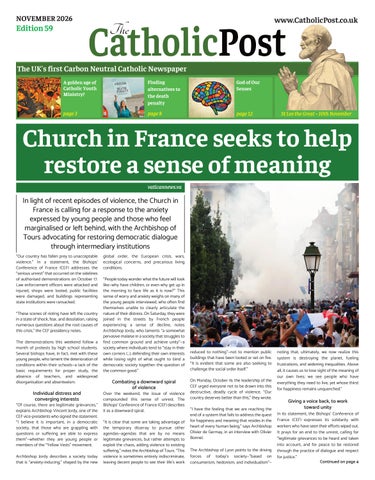
Church in France seeks to help restore a sense of meaning vaticannews.va
In light of recent episodes of violence, the Church in France is calling for a response to the anxiety expressed by young people and those who feel marginalised or left behind, with the Archbishop of Tours advocating for restoring democratic dialogue through intermediary institutions “Our country has fallen prey to unacceptable violence.” In a statement, the Bishops’ Conference of France (CEF) addresses the “serious unrest” that occurred on the sidelines of authorised demonstrations on October 17. Law enforcement officers were attacked and injured, shops were looted, public facilities were damaged, and buildings representing state institutions were ransacked. “These scenes of rioting have left the country in a state of shock, fear, and desolation, raising numerous questions about the root causes of this crisis,” the CEF presidency notes. The demonstrations this weekend follow a month of protests by high school students. Several bishops have, in fact, met with these young people, who lament the deterioration of conditions within their schools—a lack of the basic requirements for proper study, the absence of teachers, and widespread disorganisation and absenteeism.
Individual distress and converging interests “Of course, there are legitimate grievances,” explains Archbishop Vincent Jordy, one of the CEF vice-presidents who signed the statement. “I believe it is important, in a democratic society, that those who are grappling with questions or suffering are able to express them”—whether they are young people or members of the “Yellow Vests” movement. Archbishop Jordy describes a society today that is “anxiety-inducing,” shaped by the new
global order, the European crisis, wars, ecological concerns, and precarious living conditions. “People today wonder what the future will look like—why have children, or even why get up in the morning to face life as it is now?” This sense of worry and anxiety weighs on many of the young people interviewed, who often find themselves unable to clearly articulate the nature of their distress. On Saturday, they were joined in the streets by French people experiencing a sense of decline, notes Archbishop Jordy, who laments “a somewhat pervasive malaise in a society that struggles to find common ground and achieve unity”—a society where individuals tend to “stay in their own corners (…), defending their own interests while losing sight of what ought to bind a democratic society together: the question of the common good.”
Combating a downward spiral of violence Over the weekend, the issue of violence compounded this sense of unrest. The Bishops’ Conference of France (CEF) describes it as a downward spiral. “It is clear that some are taking advantage of the temporary disarray to pursue other agendas—agendas that are by no means legitimate grievances, but rather attempts to exploit the chaos, adding violence to existing suffering,” notes the Archbishop of Tours. “This violence is sometimes entirely indiscriminate, leaving decent people to see their life’s work
reduced to nothing”—not to mention public buildings that have been looted or set on fire. “It is evident that some are also seeking to challenge the social order itself.” On Monday, October 19, the leadership of the CEF urged everyone not to be drawn into this destructive, deadly cycle of violence. “Our country deserves better than this,” they wrote. “I have the feeling that we are reaching the end of a system that fails to address the quest for happiness and meaning that resides in the heart of every human being,” says Archbishop Olivier de Germay, in an interview with Olivier Bonnel. The Archbishop of Lyon points to the driving forces of today’s society—”based on consumerism, hedonism, and individualism”—
noting that, ultimately, we now realize this system is destroying the planet, fueling frustrations, and widening inequalities. Above all, it causes us to lose sight of the meaning of our own lives; we see people who have everything they need to live, yet whose thirst for happiness remains unquenched.”
Giving a voice back, to work toward unity In its statement, the Bishops’ Conference of France (CEF) expresses its solidarity with workers who have seen their efforts wiped out. It prays for an end to the unrest, calling for “legitimate grievances to be heard and taken into account, and for peace to be restored through the practice of dialogue and respect for justice.” Continued on page 4
Page 2. The Catholic Post. November 2026.
CONTACT US: The Catholic Post is published by its owners CathCom Ltd and is wholly independent of and separate from any previous newspaper. The Catholic Post is published on the last Sunday of the month previous to
Foxglove lessons for marriage Deacon Roger Carr-Jones
publication date.
EDITOR: Nick Layton email: editor@catholicpost.co.uk
ADVERTISING: CathCom Ltd. 01440 730399 ads@cathcom.org
DESIGN & LAYOUT: David Lodge, davidl@cathcom.org
PUBLISHED BY: CathCom Ltd. N2 Blois Meadow Business Centre, Blois Road, Steeple Bumpstead, Haverhill, Suffolk CB9 7BN 01440 730399
ARTICLES TO: The Catholic Post email: editor@catholicpost.co.uk or davidl@cathcom.org Please send articles for publication by email, supplying any photos separate to the text. We welcome contributions.
Gardens are places where innocence and temptation meet, a thought that returned to me while revisiting Scripture and re-reading Agatha Christie this summer Christie’s moral universe is full of plants that appear harmless, even beautiful, yet conceal real danger. One of the most striking, and one surprisingly apt for marriage, is the foxglove. Tall, elegant and lovely, it needs careful handling as its flowers contain digitalis, a potent poison. The foxgloves are those things in the relationship that are attractive on the surface, yet capable of harming if left unattended.
Here are answers to some basic questions about writing for The Catholic Post How long should articles be? Usually it seems to work out best if contributors simply say what they have to say and let us worry about finding a spot for it in the paper. What is the submission procedure? Please send as a Word file attached to an e-mail. To submit articles for publication, send to editor@catholicpost.co.uk Charts, graphs, and photos should be submitted as separate PDFs. Electronic photos should not be embedded or pasted into a Word document as this reduces their quality. Photographs and Illustrations Photographs and Illustrations should be supplied electronically as high resolution JPEG (*.JPG) files). Photographs and illustrations should be sent in colour with a resolution of 300 dpi and a minimum size of 100 mm x 100 mm when printed (approx. 1200 pixels wide on-
Marriage is akin to cultivating a garden, where we begin with good and hopeful planting schemes: love, promise, grace. Yet even the best�planned marital garden encounters foxglove misunderstandings: moments that are beautiful on the surface, yet quietly dangerous underneath. These include seemingly attractive miscommunications that avoid a problem, unspoken assumptions, avoidance to hide discomfort, and misread intentions, where issues are not addressed. These moments may appear small or even charming, yet they slowly choke communication and trust, just as foxglove’s elegance conceals digitalis within its lovely bells. Perhaps we have noticed relational patterns that need clear plant identifiers: old wounds left unhealed, habits that poison the good, subtle temptations that look harmless but weaken the roots of our relationship. We do not need to uproot every foxglove because they contain beauty, but we must be aware of them. This is the work of gentle discernment, learning to name our patterns honestly and cultivate good growth.
screen). Computer print-outs are not acceptable. Screen captures are not ideal as they are usually not very high Parental permission should be sought before submitting photographs of minors. Source information DW = Diocesan Website. ICN = Independent Catholic News Views expressed in The Catholic Post are not necessarily those of the editor Last date for copy is the LAST DAY of the month prior to publication.
Ignoring the foxglove allows them to spread freely; obsessing over them damages the planting scheme of married love. Healthy marriages recognise these patterns without despair and prevent them from strangling the relationship. Not every harmful growth can be removed immediately. Some require time, gentleness, and mutual patience. Uprooting too quickly can damage the planting scheme of the relationship. Couples flourish when they nurture the good plants: kindness, forgiveness, shared prayer, humour, tenderness. When these grow strong,
they crowd out the foxglove. The goal is not a flawless marriage, but a faithful tending of the shared garden. A couple’s spiritual and marital
ecosystem grows healthy not by denying imperfections, but by protecting the good God has planted within it.
Pope Leo calls President Putin, appeals for ceasefire indcatholicnews.com The Holy See Press Office released a statement on Friday 16 October, saying that Pope Leo XIV had spoken by telephone with Vladimir Putin, President of the Russian Federation. During the conversation, the Holy Father expressed his deep concern about the grave humanitarian situation in the city of Oleshky, in the Kherson region. Oleshky lies along the frontline of the Russian-occupied Kherson region, on the banks of the Dnieper River. The Pope appealed for a ceasefire there, to allow the delivery of food and medical assistance, and the voluntary and safe evacuation of the civilian population. Finally, the Holy Father reaffirmed the Holy See's commitment to promoting dialogue and peace. He last spoke by phone with President Putin on June 4, 2025, soon after he was elected Pope.
President Putin in 2024 Wiki Image Pope Leo has now been discharged from hospital following an operation to remove a nodule from his lung on Tuesday 13 October. He is reported to be making a good recovery, walking, eating and having physiotherapy.
Are we entering a Golden Age of Catholic Youth Ministry? Jack Regan
He looked around the room and asked me how it was all going. The only answer I could find was, " It works. It just works." A few years ago I was helping on a residential weekend for teenagers at Worth Abbey when an old friend arrived to give the Saturday evening talk. He laughed, because he knew exactly what I meant. We had both been in youth ministry a long time, and we had both spent most of it watching things really not work. I've thought about that conversation a lot this year. For twelve months we were told that Britain was in the middle of a "quiet revival" led by the young. Then, in March, the Bible Society withdrew the report behind the phrase after YouGov admitted its data was faulty. Some people were crushed. Others seemed a little too pleased. I was neither, because I never thought a survey was the place to look. If we're honest, we have to admit that most of what the Church does with young people still isn't working. I say that as someone who has done this job for twenty-five years and who has definitely played his part in things not working. I'm by no means a bystander here. If you're struggling with this idea, ask yourself how many of the people you were confirmed with are still at Mass. A parish I belonged to for years, which was better than most, has confirmed around a thousand young people over the last generation. I would be surprised if fifty of them are still in the pews on any given Sunday. The bigger problem is that most Catholic youth ministry simply isn't happening. The vast majority of baptised teenagers who drift away never go near a youth group, good or bad, because in most parishes there isn't one. So no, this isn't a golden age. At least, not yet. But yet, I'm more hopeful than I have been at any point in my career, and it's got nothing to do with polling. It's because there are now projects in this country that reliably do the thing we all say we want. They take ordinary teenagers and, a few years later, you meet adults who have put Christ at the centre of their lives. I interviewed their leaders, joined their teams and asked questions until they were sick of me.
There is ASCENT, a three-year discipleship process built on residential weekends, weekly small groups and one-to-one mentoring. One mum told me that soon after the first weekend her daughter rang from the school bus to say she was bringing two friends home to start a prayer group, and could Mum please stay out of the living room. There is Youth 2000, whose retreats, centred on the Eucharist and Our Lady, have probably done as much as anything in these islands over the last generation to keep young adults in the Church. At their summer festival I once asked a young religious sister what had brought her there. She had found her vocation at the same festival years earlier. And there is the Metanoia Community in Preston, running youth groups, student ministry, a school chaplaincy and drop-ins for homeless people, all in one town, week in and week out. Not long ago I went to Mass with its founders, and on the way out we bumped into a young man who had come through their programmes and been baptised the previous Easter. These three look similar in some ways, different in others. Take them apart, though, and you find the same components inside. They exist to evangelise, and they say so. They are unapologetically Catholic without being angry about it. They put the kerygma, the basic proclamation of what Jesus has done for us, at the heart of everything. They understand that conversion happens in stages (what Sherry Weddell calls the thresholds of discipleship), so they walk with young people over months and years instead of hoping one good weekend will do the job. They form their leaders before they deploy them. And they think hard about where a young person goes next. None of that is a secret. Pope Francis asked for exactly this in Christus Vivit, when he urged us to pay more attention to "the methods, language and aims that have proved truly effective in bringing young people to Christ and the Church", whatever label they happen to carry. I think that is the real change of the last twenty years. When I started out, kerygma was a novel
word in most youth ministry circles. Now there is a generation of leaders who were properly formed as teenagers, and I keep meeting them. They are working with university students, teaching RE, entering seminaries and religious life and, increasingly, starting things of their own. Good ministry breeds more of the same. Whether that becomes a golden age depends on what the rest of us do with it. If more young people really are curious about faith, and anecdotally I think some are, then what matters is what they find when they walk through our doors. A parish with nothing to offer them but a place on the rota will lose them again within the year. I've seen that happen one too many times too. The danger is that we treat good news as permission to relax. For decades we have comforted ourselves with lines like "they'll come back when they get married" and "we're sowing seeds". A revival we don't have to work for is the same comfort blanket in a new colour. The alternative is harder and much more interesting. Find the things that are working, strip them down to see why, and copy them shamelessly. That isn't cheating. We are all building the same Kingdom. It isn't mainly about money either. I once worked in a Caribbean diocese that sometimes struggled to pay its phone bill and was full of life. What counts is whether there are disciples in the room who know what they are doing. So, are we entering a golden age? I can't tell you. What I can say is that it is now possible to point to Catholic youth ministry that works, explain why it works, and show somebody else how to do it. In other words, there are seeds. If we can water them then yes, we could, maybe start to see something a bit special.
Jack Regan is Director of Youth Services for the Diocese of Lancaster and the author of How to Start a Fire: A Blueprint for Catholic Youth Ministry (Mission Thinking).
The Catholic Post. November 2026. Page 3.
The Donkey Verses the Car
The donkey was the humble yet essential mode of transport in the days that Jesus trod this earth; that being for people who were able to afford, or to borrow, such a useful commodity. Still, in many countries today, the donkey is indispensable in carrying loads and providing a means of ploughing fields and in helping out wherever called upon. An intelligent creature, humble and patient, yet also with a curious ability to make its wishes or objections known. They are far from stupid, often wishing to understand the reason ‘why’. A donkey thrives on kindness, on being appreciated, and most importantly, a donkey loves company – even content with the company of a human. They are not unlike us in their basic needs for trustworthy friendship. Today we have got the car: We don’t have to worry about hurting the feelings of a car and it doesn’t bray if left alone. But, like the donkey, it does still need care. Practical prayer comes in many forms: If we have transport, may we remember those who do not. May our actions be a blessing for others.
The Motorist’s Prayer. Grant me O Lord a steady hand and watchful eye. That no one shall be hurt as I pass by. Thou gavest life, I pray no act of mine may take away or mar that gift of Thine. Shelter those, dear Lord, who bear me company, from the evils of fire and all calamity. Teach me to use my car for others’ need; nor miss through love of undue speed The beauty of the world; that thus I may with joy and courtesy go on my way. St Christopher, holy patron of travellers, protect me and lead me safely to my destiny. www.crownofthorns.org.uk email: office@crownofthorns.org.uk
Page 4. The Catholic Post. November 2026.
Pope Leo joins candlelit procession vaticannews.va
Pope Leo ended his visit to Lourdes by taking part in the candlelit procession Thousands of candles flickered in the darkness as pilgrims sang the Ave Maria. The sight of tens of thousands of pilgrims gathered around the Pope in prayer to the Virgin Mary will remain the defining moment of Pope Leo's visit to Lourdes. Unlike his predecessors John Paul II and Benedict XVI, Leo did not preside over the procession from a terrace overlooking the esplanade of the Basilica of the Rosary, but joined it as a pilgrim like everyone else. The ceremony began at the foot of the Grotto of Massabielle, the very place where Pope Leo had begun his pilgrimage to Lourdes the previous day. The procession then set off across the esplanade, behind an illuminated statue of the crowned Virgin. The Joyful Mysteries were meditated upon during the ceremony, with 'Hail Marys' recited in French as well as Italian, English and Spanish. The Pope slowly made his way to the forecourt of the Basilica of the Rosary to deliver his address, recalling that Mary had asked Bernadette to come here in procession. "How moving it is to see the faithful people, from one generation to the next, responding with love and trust to the Virgin Mary's tender invitation," he said. "How consoling it is to hear Christians sing hymns filled with fervour and faith, and walk, a light in their hands, towards their Mother in Heaven, the Mother Jesus gave us on the Cross." The Pope thus gave thanks
Continued from page 1 Deeply struck by how politicians pass the buck regarding responsibility for the disorder—rather than “working together to find ways to restore a form of social peace, in which dialogue can take root as a normal part of life in a democratic society”— Archbishop Vincent Jordy, Vice-President of the CEF, proposes several solutions to foster reconciliation. First, he suggests the rehabilitation of “intermediate bodies” (such as unions or associations), which have been significantly weakened in recent years by a “reverticalisation and re-centralisation” of the country. He argues that these entities—which ought to be spaces for dialogue—must be revitalised so that they can once again fulfill their proper role.
Putting God Back at the Center The Archbishop of Tours believes it is necessary to address suffering, social decline, and those “much deeper questions—reaching into the spiritual realm, even if not necessarily in terms of institutional religion— such as: what is the purpose of life? Where are we heading?” He notes that for decades, the religious horizon was pushed aside—
for being a "pilgrim among pilgrims", as the slogan for this stage of his apostolic journey put it. This light "is the light of hope that never leaves us, even as we journey through this life, so often marked by trials but already filled with the joy of knowing that we are children of God, loved and saved by Jesus". Sick people, he added, "are privileged witnesses to this transformation of existence through faith and through the love of God and neighbour", echoing his morning homily and his meeting with the sick and those who care for them that afternoon. Despite life's trials, God gives us hope and "the grace to perceive the presence of the risen Christ among us", he stressed. He urged the faithful, and the sick in particular, to hold on to these words of Saint Paul: "There is no comparison between the sufferings of the present time and the glory that will be revealed in us." "We are therefore called to persevere on our journey, again and again, for as long as we are granted the days of our life in this world, where Mary goes before us," the Pope continued. By presenting herself to Bernadette as "the Immaculate Conception", Mary "identified herself here, in the greatest humility, while giving thanks to God for the absolutely unique privilege she had been granted, which for us represents the dawn of salvation". Washed free of all sin and "the one from whom everything begins anew", the Virgin is therefore a sure source of help, the Bishop of Rome explained. "This is why her support and
partly by taking a rigid stance on laïcité (secularism )— in an attempt to frame politics as the sole path toward a better society. Yet, he points out, it is clear that politics no longer offers the promise of achieving some grand ideal. “People once looked forward to a ‘great transformation’ or a ‘bright new dawn,’ but today, the political sphere has stalled... many have lost faith in politics”—a system originally designed to manage societal tensions. Furthermore, Archbishop Jordy argues that the promise of “progress” has also failed to deliver. Then there is the ecological issue: young people, he observes, are suffering because a “science without conscience” has created a society that now suffers from the very things it has produced. And there is technological progress: “new smartphones are dangled before them—devices they cannot afford— which only breeds frustration.” The Church can offer answers to these questions, which are otherwise largely ignored in French society. The vice-president of the French Bishops’ Conference calls for broadening the debate, dialogue, and
Image: Vatican Media intercession are not incidental for the Christian who wishes to welcome the grace of Redemption obtained through the blood of Jesus, and to struggle against evil."
"May this light that we hold tonight never be extinguished in our lives, but may it illuminate the future, opening us from this very day to the promises of eternal life," he concluded.
Pope Leo ended his address by inviting pilgrims and the faithful to surrender themselves to God: "Dear brothers and sisters, pilgrims and sick people, who have come from France and from around the world to take part in this fervent and serene procession of light, let us carry our most cherished and most urgent intentions and present them to Our Lady."
To watch the candlelit procession with Pope Leo scan the QR code.
reflection—extending it beyond the political arena to include “everyone capable of bringing meaning to an era that is cruelly lacking it.” The solution is God,” declares Archbishop Olivier de Germay. The Archbishop of Lyon wishes to see God placed back at the center of society, for “who else but Him can foster unity among all these people—people of different cultures, often different religions, and different political opinions? What is the common ground? The common ground is that we belong to the same humanity.”
Serving the young As the 2027 French presidential election approaches, the Primate of the Gauls hopes that religious leaders will set an example by organizing a march for peace, demonstrating that any disagreements between Jews, Christians, and Muslims—”and even within our own respective communities”—do not make us enemies. In the view of Archbishop de Germay, Christians must act as agents of peace, encouraging everyone to engage with differing opinions while maintaining mutual respect. This is an effort that must, of course, be directed toward the youth.
“We must look upon young people with a sense of hope... When we talk with them, we realise that, like everyone else, they aspire to happiness. They possess a great deal of generosity. It is up to us, however, to provide them with a vision for the future—to show them that their lives have meaning—and to liberate them from a hedonistic society that leads them to believe happiness can be found solely through consumption and selfabsorption.” The Archbishop of Lyon hopes that young people might experience a form of “stepping outside of oneself” in order to serve others. “I am struck, for instance, by the young people we take to Lourdes, who dedicate themselves to caring for the sick.” “Teenagers in their first or second year of high school sometimes go quite reluctantly, but when they return, they are transformed because they have experienced the joy of being of service,” he explains, urging us not to lose hope in today’s youth, but rather to offer them the chance to engage in rewarding experiences. Marie Duhamel
The Catholic Post. November 2026. Page 5.
Nuncio meets with modern slavery and trafficking survivors cbcew.org.uk
Survivors of trafficking and modern slavery supported by Medaille Trust have been meeting with Archbishop Miguel Maury Buendía, the Apostolic Nuncio to Great Britain On 11 September 2026, the Nuncio met with survivors while visiting a Medaille Trustsafe house gifted to the charity by the Archdiocese of Liverpool. During the visit he heard firsthand of the difficulties facing survivors in the UK to be recognised and supported to rebuild their lives and the work and contribution of Catholic volunteers and projects.
record 23,411 potential victims were identified and referred into the official National Referral Mechanism.
There are more than 120,000 estimated victims living in the UK today. Last year a
Medaille Trust, one of the leading Catholic charities in the fight against modern slavery,
Pray with the Pope
supports more than 700 survivors a year across a network of safehouses and community projects. Inspired by Catholic Social Teaching, Medaille works to restore dignity, empowerment, and the first steps toward a new life.
The Nuncio was visiting as part of a tour of social action projects in the Liverpool Archdiocese. Photograph: Medaille Trust
Those with mental illness God of life, You know the innermost depths of our hearts, the light and shadows within us, the silent wounds that sometimes no one sees. Today we bring before you our brothers and sisters who struggle with challenges to their mental health, who suffer in solitude with anxiety, depression, or any other mental illness. You call them by name, with tenderness, and in you they find dignity and hope. Forgive us for the times we have looked the other way, feeding the stigma and discrimination of persons with mental illnesses.
For resources on how to Pray with the Pope, either on your own or in groups, use this QR code.
Pope Leo has stressed the importance of mental health ministry for the Catholic Church and the wider society. “Melancholy, bad character, confusion of senses — today, we understand that behind these old labels lies a deep, silent suffering not only of those affected by mental disorders but also of their loved ones and their communities,” Pope Leo said. He added: “We live in a world full of tensions, and even as solutions grow so does the number of people in crisis. Let us pray for the mental health ministry — an urgent and ever more needed service in our Church and in the world.”
May your Church be an open house, a safe space where everyone has a place, a community that accompanies and never excludes, that listens without judging and draws near without fear. We pray to you, Lord, for those who care: professionals, family members, volunteers, men and women who, with patience and love, build bridges of understanding and comfort. Give them strength and compassion to sustain others. Send your Spirit upon us, that we may learn to welcome and integrate care for mental health into the life and ministry of our communities and of the whole Church, and thus become a living sign of your mercy, which never abandons and always restores. Amen.
Page 6. The Catholic Post. November 2026.
Archbishop of Southwark awards personal medal to parents of Jimmy Mizen rcaos.org.uk
Archbishop John Wilson, Archbishop of Southwark, has presented the Archbishop's Medal to Barry and Margaret Mizen, parents of Jimmy Mizen, for their work for peace and reconciliation through the Mizen Foundation. Following the tragic murder of their son Jimmy in 2008, Barry and Margaret entrusted themselves to Christ. They founded the Mizen Foundation to promote forgiveness, peace and hope among young people. Their work with schools, parishes and communities has transformed the lives of so many young people - in the Archdiocese of Southwark and beyond. Presenting the Medal, Archbishop John said: "Through the deepest tragedy imaginable, they have become extraordinary witnesses to the power of faith, hope, and Christian forgiveness. They entrusted themselves to Christ and became ambassadors of reconciliation, peace, and hope". He continued: "They have shown us that Christian faith is not merely something we profess with our lips, but something that can transform even the darkest experiences into a
source of light for others... Their generosity in sharing their story, their commitment to young people, and their tireless work for peace and reconciliation have strengthened the mission of our Archdiocese". Barry and Margaret said: "We are truly humbled to receive the Archbishop's Medal, and to have been presented with it in front of hundreds of students from Catholic schools, academies and colleges across the Archdiocese of Southwark. We would like to thank the Catenians of Province 7 for their nomination, and Archbishop John for personally presenting the Medal to us. "From the day we lost our son Jimmy, we have been shown so much love and support. It is that love and support that continues to drive us to share a message of Forgiveness, Peace and Hope. Our love and thanks to everyone involved." Archbishop John with Margaret and Barry Mizen Archbishop John ended by thanking the couple "on behalf of the clergy, religious, and faithful of the Archdiocese of Southwark", adding: "May God continue to bless you, and may Jimmy's memory remain a blessing and an inspiration to us all".
The Archbishop's Medal is awarded for exceptional service to the life of the Archdiocese of Southwark, especially in schools, parishes and beyond.
Pupils and staff gave Barry and Margaret a standing ovation as they received the award, showing how much their work is valued and admired.
The Medal was presented to Barry and Margaret at the Schools Commencement Mass at St George's Cathedral, so that hundreds of young people from schools across the Archdiocese could join Archbishop John in giving thanks for their life-changing work.
The Mizen Foundation also work with Caritas Southwark, helping to inform and shape the Archdiocese's response to knife crime and youth violence, and the power of forgiveness through faith.
Organisation to support autistic Catholics being established indcatholicnews.com A new organisation, Catholic Autism UK, is being established to support autistic Catholics, their families, and parish communities throughout the United Kingdom. Catholic Autism UK aims to provide a welcoming community for autistic Catholics, promote greater understanding of autism within the Church, and support parishes in becoming more inclusive and accessible. It will also provide opportunities for discussion, mutual support, and the sharing of resources and good practice. Catholic Autism UK is seeking to bring together autistic Catholics, parents, clergy, religious, educators, and others who have an interest in autism and faith.
We believe that every person has gifts to offer The Church, and that autistic Catholics should feel fully welcomed, valued, and included in the life of our Catholic communities.
Anyone who would like to learn more, support the work, or become involved is warmly invited to get in touch.
For more information contact Deacon Mark Paine, Founder, Catholic Autism UK. Email: markpaine1970@gmail.com
The Catholic Post. November 2026. Page 7
Not all those who wander are lost Fr David O’Malley The title of this article comes from The Fellowship of The Ring by JRR Tolkien. You may have noted in this edition the establishment of a new memorial to honour his life and work in Westminster Abbey. It takes the form of ‘The Tree of Amalion’. It is a tree drawn many times throughout Tolkien’s life that attempts to map his insights, imagination and aspects of his life journey. It never satisfied his intentions; there was always more that he could not capture in words of images. Yet he needed this tree map to capture something of his life and its meaning. The same desire to make sense of our lives sits in the heart of all human beings and could be the source of a new energy for wandering and searching and hopefully finding meaning, especially for young adults. The recent upsurge in numbers of young adults entering the Catholic church is the evidence for a significant change. Diocese after diocese have reported significant increases in reception of new or returning Catholics ending their wanderings. They come to the Catholic church changed by life to enrich a changing church. The upturn has caught many people by surprise especially because it is marked most strongly in very secularised cultures, but it also seems to be worldwide phenomenon. Observers have been struggling to understand why this is happening. Why do you think things have changed just now? The commentators have suggested a number of likely candidates pushing this change. I have noted a few of them below. Do these make sense to you, or can you see other motivations behind this drift towards the Catholic Church? 1. The search for some fixed values especially after COVID including moral safety and the rhythm of Catholic liturgy with its sense of a mystical presence. All this can give a healthier perspective and ease personal anxiety. 2. The Church provides a multi-generational community that can transform a local area into a neighbourhood, strengthening a longer-term sense of belonging and also a feeling of being at home even in a changing world. The worldwide Catholic Church offers itself as a mystical body connecting all of life and all people, living and dead. It stretches our sense of humanity and of eternity into a community that embraces all time. 3. The Gospel, with its stories and the figure of Jesus Christ opens up both depth of meaning and a sense of deep companionship in living the Cross and Easter pattern of Jesus’ own life. That eucharistic pattern is reinforced by well
tested practices of devotion and personal meditation that raise the mind and heart to the mystery of God at the heart of all life. 4. The Social Teaching of the Church with its Gospel emphasis on justice, peace, forgiveness and community must appear both radical and hopeful to young adults as they look to their future. It is a blueprint for building a better world based on Gospel values it adds practical meaning to young adult lives and invites them to the resilient self-sacrifice needed to transform their world. The Catholic Church in Great Britain that welcomes young adults is quite varied, from easy going explorative communities to well defined traditional communities. For some young adults the search for meaning may look like a desire to return to the 1950s, for others it is the end of a long and open-ended search through many different experiences of other faith traditions. What seems to be of vital important for the majority is a very simple Gospel value rooted in the charism of Youth 2000. They say on their website that they want all young people “to know that they are loved”
(A quotation from St John Bosco, the patron of Catholic youth) The result of ‘knowing we are loved by God and by one another, and feeling that love in a Catholic community, gives a deep inner strength and establishes a mystical link that connects individuals and all of humanity. Perhaps young people are being called to church because of the growing sense of unease in a world that seems to be stuck without any deeper answers. A world that threatens to tip us into chaos in unexpected ways without warning. Perhaps they are being called to walk into a new and confusing world with a sense of adventure and in a way that transforms humanity and builds a Civilisation of loving kindness. Today we are all being called more consciously into the deep transformation of cross and resurrection and share our earth more equally. Called, like the Mizen Family, to forgive and help to heal those broken on the wheel of life whether through media, AI or deprivation. It’s likely to be a painful and yet optimistic time of change ahead for us all, but not a time any of us can dodge. The coming era has got the name of young adults written on it particularly and
indelibly. As Tolkien records in one of his most famous titles, Gandalf and Frodo look forward to a time of darkness and chaos: ‘I wish it need not have happened in my time, said Frodo. ‘So do I,’ said Gandalf, and so do all who live to see such times. But that is not for them to decide. All we have to decide is what to do with the time that is given to us. The Fellowship of the Ring (Book I, Chapter 2: "The Shadow of the Past") JRR Tolkien
On October 1st this year Bishop John Arnold laid out the future challenge for young Christians to pay deeper attention to people and situations and not to drown in clickbait. Instead, the younger generation of young Catholics and Christians are called to discern, to sift their attention through the wisdom of the Gospel and the church tradition. By loving, guiding respecting, celebrating life and all people and being ready to pay the price for the common good they can bring ‘a new gaze ‘to the world and see it more as Jesus sees it. Then they will be walking into a new world in the footsteps of Jesus who, as always, is ahead and calling us all to new life
Page 8. The Catholic Post. November 2026.
Finding alternatives to the death penalty indcatholicnews.com
10 October was World Day Against the Death Penalty. The World Coalition against the Death Penalty (WCADP) dedicates this day in 2026 and 2027 to "humanising the people affected by the Death Penalty, focusing on the stories of the human beings affected by the death penalty whose voices are too often neglected or silenced. "This campaign highlights the necessity of taking into account the structural, social, and individual conditions that may have contributed to a person coming into conflict with the law, including factors such as poverty, discrimination, trauma, mental health issues, or experiences of gender-based or other forms of violence, which are widely documented as disproportionately affecting vulnerable populations. It also underscores the severe psychological and physical suffering caused by prolonged death row incarceration, uncertainty, and conditions of detention, which may amount to torture. "Recalling the humanity of persons sentenced to death does not diminish the suffering of victims and their families or the harm caused to society. Rather, it recognises that the death penalty affects everyone: victims' families, persons sentenced to death and their families,
lawyers, judges, prison staff, abolitionists, and entire communities. All of them have stories to tell." Christa Pike's recent botched execution in Tennessee was the second failed attempt at lethal injection there this year. While we must never forget Pike's victim, Colleen Slemmer, and all victims of crimes, CCSJ supports the Catholic Church's stance against the death penalty. On September 30, 2025, Pope Leo said that supporting capital punishment was inconsistent with being pro-life. On April 24, 2026, Pope Leo delivered a video message offering his support and blessings to those working "for the abolition of the death penalty in the United States of America and around the world." His message marked the 15th anniversary of Illinois' abolition of the death penalty in 2011. The Death Penalty Information Center (DPIC) reports: "Pope Leo said his message was based on the sanctity of human life. 'The Catholic Church has consistently taught that each human life, from the moment of conception until natural death, is sacred and deserves to be protected. Indeed, the right to life is the very foundation of every other human right.'" He affirmed that this dignity endures, regardless of crimes a person has committed, and that modern detention systems are capable of
providing public safety without relying on executions. "Referring to the Catholic Catechism, Pope Leo declared 'that the death penalty is inadmissible because it is an attack on the inviolability and dignity of the person.' He offered his explicit support for those working to abolish the death penalty in the U.S. and across the world, praying that their 'efforts will lead to a greater acknowledgement of the dignity of every person, and will inspire others to work for the same just cause.' Pope Leo's statement reflects the Catholic Church's current teachings, which Pope Francis revised in 2018, and built on Pope John Paul II's longstanding calls to end the use of capital punishment." (DPIC). When, on 1 August 2018, Pope Francis approved a new revision of paragraph number 2267 of the Catechism of the Catholic Church he stated: "...given that modern society possesses more efficient detention systems, the death penalty becomes unnecessary as protection for the life of innocent people." "Since 1973, at least 203 people who were wrongly convicted and sentenced to death in the U.S. have been exonerated." Note "The Most Common Causes of Wrongful Death Penalty Convictions: Official Misconduct and Perjury or False Accusation" (DPIC). The US Bishops asks: "Even if the death penalty were always imposed without error, should we support its use? We teach that
killing is wrong by responding with mercy and justice, not more killing. We don't want a government that kills when society can be protected fully by the bloodless means of life imprisonment. By fostering a spirit of vengeance, which should have no role in the administration of justice, the death penalty contributes to the increasing disrespect for human life in our culture." The WCADP shares the following statistics from Amnesty International: 113 States have abolished the death penalty for all crimes 23 States are abolitionists in practice 54 States are retentionists At least 25,508 individuals are known to be under a sentence of death around the world at the end of 2025, of which around than 5% are women (statistic on women sentenced to death by Cornell Center on the Death Penalty Worldwide). Let's promote/protect all lives. Leela Ramdeen is Chair, Trinidad & Tobago Catholic Commission for Social Justice & Archdiocese's Ministry for Migrants and Refugees
To find out more about the World Coalition scan the QR code.
The Catholic Post. November 2026. Page 9.
'Real' communication requires human judgment, says Media Bishop cbcew.org.uk Reflecting on the recently announced theme for World Communications Day 2027, Bishop John Arnold, Lead Bishop for Communications for the Bishops' Conference of England and Wales, says that 'real' communication requires a human, relational connection. "Information has never been more readily available - and on a global scale - but information does not equate with communication," says Bishop Arnold, the Bishop of Salford. "Real communication requires careful attention, time and goodwill. It engages the emotions and the conscience, and human judgment. "It is not, in any way, a superficial gathering of facts but it is the considered engagement of human beings and human minds, providing a basis for true wisdom. World Communications
Day 2027 reminds us of the privilege of real communication." Bishop Arnold was responding to a press release from the Vatican's Dicastery for Communication that revealed Pope Leo's theme for the 61st World Communications Day - A New Gaze: Paying Attention in the Age of Clickbait. The theme invites Christians to open ourselves to "a conversion of our gaze: to look again, with attention and with love." "The attention economy, with its struggle for a few moments of interest amid the rapid and endless flow of content, is transforming not only our cognitive abilities but also the depth of our interpersonal communication," it noted. Only by paying attention to others with love can we see the "world, others, even ourselves, as Christ sees us: called by name and loved."
November Saint
St Leo the Great:
Courage When the World is Falling Apart 10th November In the year 452, Attila the Hun was marching on Rome. The imperial army offered no defence, and the emperor had little to give. So an elderly man in papal vestments rode north to meet him. Pope Leo had no soldiers, only his faith and his voice. He met Attila near Mantua, and after that meeting Attila turned back. Rome was spared. Leo, whose feast we keep on 10 November, led the Church from 440 to 461. These were years of collapse. The Western Empire was crumbling, invaders crossed its borders, and confusion about the faith divided Christians. In 455 the Vandals did reach Rome. Leo could not stop them entering the city, but he went out to their king and persuaded him to spare the people from slaughter and the city from fire. His greatest legacy, though, was not diplomatic. When bishops argued over who Jesus Christ truly is, Leo wrote a letter, known as his Tome, setting out clearly that Christ is one person, fully God and fully man. When it was read aloud at the Council of Chalcedon in 451, the bishops are said to have cried out, “Peter has spoken through Leo!” That teaching still shapes how the whole Church professes its faith.
Leo was also a pastor who preached to ordinary Romans, and nearly a hundred of his sermons survive. In one Christmas homily he wrote words that still stir hearts: “Christian, remember your dignity.” Because God became one of us, every person carries a worth that no empire can grant and no invader can take away. Leo reminds us that holiness does not wait for calm times. When institutions falter and the future looks uncertain, faithful courage, clear truth and steady love can still turn back the tide. St Leo the Great, pray for us.
"Our communication changes when our gaze chooses to encounter others rather than judge them," said the release. People are inundated every moment of every day with expectations of rapid reactions and superficial relationships, resulting in a lack of genuine attention fueled by digital culture, it added. "Yet attention is a precious form of generosity: the word 'attention' comes from ad-tendere to reach out toward the other and toward the truth," said the press release. "Christian communication can rediscover attention as both a gift and a way of seeing - the gaze of Jesus, who saw and allowed Himself to be touched." Rather than seeking to capture attention, communicating is about safeguarding attention "as a precious resource for relationships." In our modern age of 'clickbait,' Christians are invited to pay attention and rediscover a healthy form of attention to one another. "Communication is not just about words," concluded the press release. "It involves the
Bishop John Arnold entire person and asks us to look, hear, and feel again in order to answer Christ's call." World Communications Day 2027 takes place in many parts of the world - including the United States, England and Wales, France, Spain, Poland, and Italy - on Sunday, 9 May, but is celebrated on different days in various parts of the world, as set by the national Bishops' Conferences.
Page 10. The Catholic Post. November 2026.
Westminster Abbey to honour Tolkein westminster-abbey.org
JRR Tolkien, the Catholic writer, artist, scholar and linguist is to be honoured in Westminster Abbey in Poets' Corner alongside his close friend and fellow writer, CS Lewis A major new memorial celebrating Tolkien's creative vision and storytelling by artist Stephen Broadbent will be revealed at a dedication ceremony in Spring 2027, which is also the 90th anniversary year of The Hobbit and 50th anniversary year of The Silmarillion. The new memorial has been inspired by Tolkien's Tree of Tales, which he called the Tree of Amalion. Featuring the imagery of a tree in a forest as its central theme, it will be a significant new artwork for the Abbey, inlaid vertically within a stone pillar in the south transept and rising 2.5 metres high.
Subscribe to SEPtEmBEr 2026
www.CatholicPost.co.uk
Edition 57
AuguST 2026
www.CatholicPost.co.uk
Edition 56
Fr Stephen Wang appointed as new Bishop of Arundel and Brighton
page 3
Priest braves heatwave on 108-mile walk
page 9
When love needs first aid
Reflections on My First Year as a Permanent Deacon
page 2
St Monica - August 27th
page 14
a Celebrating the Completion of ion Transformative Cathedral Restorat
God of Our Senses
page 6
Kindness is King
page 11
St Hildegard of Bingen Feast day: 17 September
Fund Living Before Legalising Dying
OCTOBEr 2026
www.CatholicPost.co.uk
Edition 58
cbcew.org.uk
LifeTeen Summer Camp
TikTok Priest
God of Our Senses
page 4
page 9
page 12
The Terminally Ill Adults (End of Life) Bill will have its crunch vote and second reading in the House of Commons on Friday, 11 September. St. John Henry Newman October 9th
The following interview is part of the Catholic News podcast which features interviews with lay people, religious and clergy involved in the Church's work in England and Wales.
Archbishop thanks those who united to defeat assisted suicide Bill
A diverse range of people, not just Catholics, have raised their voices in opposition to this Private Members' Bill that seeks to legalise assisted suicide. Our new Prime Minister, Andy Burnham, has said that now is not the time for this debate and it would be better to sort out the UK's palliative care and social care crisis.
So what are the problems
bringing renewed colour, vibrancy to this sacred space.
and beauty
and what
Dr Karen Groves MBE needs to be fixed? "We've moved on a lot (Inset) in nearly 50 years, and Dr Karen Groves MBE “It's a huge challenge, qualified as a doctor but it's taken many years at now for this area, we've got integrated a time when the modern hospice of work to build hospice and palliative and specialist How does a hospice relationships with all palliative care services achieve care movement was other working local services, and those only just beginning. standard palliative care gold out of Queenscourt, are really important and which is our local hospice, so that everything's end-of-life care? What knitted together, and the specialist clinical are the key "Pain and other symptoms that and educational hub, provides the continuity were really poorly seeing ingredients? of care. managed, not due to patients and families “I think there are many," lack of compassion in Queenscourt or itself, or an equal says Dr Groves. "But care, but just through number in our local hospitals, "It's made a big difference a lack of knowledge," to the number of a few of the main ones, are: investment said Dr Groves. "There and twice as many in selection, ongoing training, was a lot of fear among again in our local care people who are able to stay in their own and real support of the public and health homes. Some people homes and their own professionals about homes, which is where accuse hospices of skilled clinical and non-clinical staff. the Plus time use of morphine, and providing a gold standard also of speaking to the vast majority of people really service to the very and attention to detail for every patient want to be few, and I people about their illness and would counter that to and what to expect living their lives, and living them say that where family - that's really important. A huge number to the full, to hospices have in the future. It just wasn't of committed volunteers the opportunity to done in those days." the end." develop without whom the integrated services service can't provide across all settings, the standard of care then actually they can provide that To address this and to meet end-of-life a responsive, helpful, it does. Then the financial care Dr Groves advocates for a 'continuity support and needs in West Lancashire, goodwill of the community of care' reliable, and consistent service in Formby, and so that integrated which of this area - West services are provided patients and families have Southport, Dr Groves confidence, and Lancs, Southport and Formby founded Queenscourt consistently they're who've and appropriately for much less likely to dial Hospice in Southport each person 999 because of supported the building, the growth, in the late 1980s. across a number of care fear or not knowing and the what to do in a situation. development of their services. settings. It makes a big difference."
interior scheme, restored statues, renewed key liturgical decoration, the repositioning of on Chapel features, and a new glass entrance offer a visible sense of heritage, Street designed tocbcew.org.uk Alongside restoring the cathedral’s in the heart of the city. welcome in its future. Archbishop John Sherrington, the Archbishop the project has also invested flexibility, of Liverpool and Lead Bishop for Life Issues for and Improved facilities, increased We are grateful to Purcell Architects a strong the Bishops’ Conference, has for offered enhanced accessibility and theirhis expertise Simpsons of York help ensure gratitude and thanks to those who wrote to specialist commitment to sustainability to throughout the project. Their repairs to its stonework and the cathedral can continue to serve the people their MPs to stop the Terminally has Ill Adults (End the Evangelist longstanding knowledge of heritage conservation The Cathedral Church of St John ensuring it could continue come.of Life) Bill progressing through parliament. of the back on infrastructure while of the diocese for generations to welcomed worshippers and visitors enabled the careful restoration of a growing community. Archbishop Sherrington historic while weekend of to meet the needs also expressed his character Saturday 4 July, when a cathedral’s much of the work focused on essential and completion of gratitude to disability rightsmodern groups and standards legal celebrations began to mark the has been the While will incorporating A key element of the project fabric of the building, visitors and healthcare professionals raisingmission. its future a historic repairs to the supportfor this significant project. transformation technology to restoration of many of the cathedral’s remarkable a notice collective voice of to uphold “the dignity and the reinstatement heart of the features, including the cathedral. Improvements sanctity of every life.” Continued on page 2 Having served as the spiritual schemes and the throughout the cathedral original decorative new energy-efficient exterior lighting diocese for more than 175 years, stained-glass windows, include to address conservation of required extensive restoration The Bill failed after it’s Second Reading by 270 (Yes) votes to 286 (No) – a majority of 16.
dioceseofsalford.org.uk
its doors following a Salford Cathedral has reopened renewal three-year programme of restoration, the cathedral and refurbishment that has transformed
Continued on page
2
Archbishop’s Full Statement We are pleased that MPs have voted to oppose the passage of the Terminally Ill Adults (End of Life) Bill. We would like to thank those who wrote to their MPs to stop the bill’s progression and who assisted the campaign against the bill in other ways. I would like to express my gratitude to those MPs who voted against the Bill and the many people from across society who made their voices heard – doctors, legal professionals, disability groups, other faith communities and those of no faith who stood up for the dignity and sanctity of every life. We are thankful for the many prayers which have been offered during these weeks. Throughout this debate, we have argued that our response to those facing serious illness, disability or the challenges of old age should be rooted in solidarity, care and respect. The true measure of a compassionate society is its
willingness to support people through difficult circumstances rather than encouraging them to end their lives. Every day, families, friends, carers and healthcare professionals demonstrate extraordinary generosity in accompanying and supporting those who are suffering. Their dedication reminds us of the value of human relationships and of our shared responsibility to care for one another, especially at life’s most vulnerable moments.
We remain convinced that the most effective way to address suffering at the end of life is through greater access to excellent palliative and end-of-life care. Ensuring such care is available to all who need it can help people experience comfort, dignity and support in their final days. We will continue to promote these as priorities and to stand alongside those who devote themselves to caring for the dying in hospices, hospitals, care homes and communities.
Predominantly made from native woods found in the UK, it will include a piece of the iconic black pine, known as 'Tolkien's tree', which was felled from Oxford University's Botanic Garden in 2014. The tree, a Pinus nigra, was a favourite of Tolkien during his time in Oxford.
May all the sick and frail find comfort in the support of their loved ones, and the love of God, which transcends all suffering. I ask the Catholic community to continue to pray for our legislators, that they will ensure that our laws always uphold the dignity of human life. Archbishop John Sherrington Lead Bishop for Life Issues Archbishop of Liverpool
For ALL of your Parishioners
100 copies: £15.00 per month* (15p per copy) 200 copies: £29.00 per month* (14.5p per copy) 300 copies: £41.00 per month* (14p per copy)
For some of your Parishioners 50 copies: £12.00 per month* (24p per copy) 10 copies: £9.00 per month* (90p per copy)
Individual Subscriptions
Known to millions around the world as the author of The Lord of The Rings and The Hobbit, Tolkien spent most of his life as a distinguished academic at Oxford University, where he taught Old and Middle English, and Old Norse. Outside his academic life he created fantasy books, children's stories, poetry and illustrations, as well as inventing languages and alphabets. The Lord of The Rings was a sequel to Tolkien's 1937 children's book The Hobbit. Considered one of the greatest fantasy books ever written, it has shaped the modern fantasy genre and is one of the best-selling books of all time.
1 Copy delivered by Post: £4.00 per month*
Online Subscriptions 1 Online Copy via Email £3.00 per month* *20% Discount for ALL ongoing subscriptions paid by card. All prices include delivery
www.catholicpost.co.uk For all your advertising requirements please contact Nick on 01440 730399 nick@cathcom.org
Over 150 million copies have been sold; it has been translated into over 35 languages and inspired award-winning adaptions for film and television. Broadbent studio in Chester, led by Stephen Broadbent, who has a 40-year background in public art projects, secured the commission following a competitive process. The final design concept was informed by discussions with Tolkien scholars and experts and consultation with the Tolkien Estate. Beyond the choice of imagery there will also be a Tolkienian ethos about the making of the
Tolkein with the tree named after him work, which will use the finest British craftsmanship. It will be made by a team of designers, engineers and artisans from Silverlining Furniture in Wrexham. The idea of the memorial was first put forward by Lord Alton as Chairman of the Christian Heritage Centre at Stonyhurst and made possible through the support and generosity of the Tolkien Estate. The Dean of Westminster, The Very Reverend Dr David Hoyle said: "I am delighted both that there will be a memorial to JRR Tolkien in the Abbey and that the memorial will be a thing of beauty. The Hobbit was read to me when I was a boy; when I was a little older, I read The Lord of the Rings, and then I read it again. We will remember here a master storyteller, a scholar, a man with a Christian imagination and a writer who helped some of us understand that a commitment to life and virtue might be costly and courageous." Artist Stephen Broadbent said: "It has been a delight and honour to firstly imagine and then develop a memorial for Westminster Abbey that commemorates Tolkien's literary enterprise and creative imagination. The artwork will present to the viewer the sense of peering into another world: a 'Forest of Stories', with Tolkien's remarkable 'Tree of Tales' accepted into the heart of it. Then through this
magical forest there is an evocative glimpse to a land beyond." Maker Mark Boddington, Silverlining said: "Given Tolkien's love of trees and craftsmanship, it is especially gratifying that the Abbey and the Tolkien Estate's vision for the memorial, together with Stephen's richly evocative design, will be brought to life using locally sourced timbers and a blend of traditional and innovative British craftsmanship, creating a work that visitors to the Abbey can admire and appreciate for generations to come." Poets' Corner in Westminster Abbey has been a place of pilgrimage for literature lovers for hundreds of years. More than 100 poets and writers are buried or have memorials here. Officially in the eastern aisle, the 'corner', of the Abbey's south transept, over time graves and memorials have spread across the whole transept. Many of those buried or remembered are world-famous, like William Shakespeare, Jane Austen, the Brontë sisters and Charles Dickens. Others, though popular in their day, are now less well known. The most recent memorials to poets and writers in the Abbey are Ted Hughes, CS Lewis, Philip Larkin and PG Wodehouse.
The Catholic Post. November 2026. Page 11.
Annual Schools’ Mass fills Cathedral with joy rcdea.org.uk More than 600 pupils from schools across the Diocese of East Anglia gathered at the Cathedral of St John the Baptist for the Annual Schools’ Mass.
Catholic school communities across East Anglia. It provides an opportunity to give thanks for the dedication of teachers, leaders, chaplains, governors and support staff, whose commitment ensures that faith and learning continue to flourish side by side.
This year’s celebration, held on Friday 25 September, was a joyful and prayerful occasion, bringing together pupils, staff and clergy from across the diocese in thanksgiving for the gift of Catholic education.
Throughout the diocese, Catholic schools play a vital role in helping young people encounter Christ in their daily lives. Rooted in Gospel values, they nurture faith, encourage service to others and inspire pupils to grow into
Many of the children arrived early and enjoyed lunch outdoors in the cathedral gardens, creating a lively and welcoming atmosphere before the Mass began. The celebration was led by Bishop Peter Collins and offered a powerful expression of the shared faith and unity of the diocesan schools community. The cathedral was filled with joy and reverence as more than 600 young people joined together in prayer and worship. A choir of pupils provided the musical accompaniment throughout the Mass, helping to make the celebration especially memorable and reflecting the many gifts and talents nurtured within Catholic schools. The Annual Schools’ Mass is a highlight of the diocesan year and a visible sign of the unity of
compassionate, responsible and faith-filled individuals. As the diocesan family gathered at the cathedral, there was a strong sense of gratitude for the many blessings of Catholic education. The celebration renewed the shared commitment of schools across the diocese to place Christ at the heart of all they do and to help every young person live out their faith with joy, confidence and hope.
redemp orist
p u b l i c a t i o n s
Fr Denis’ Diary
Praying with Pictures
THROUGH THE YEAR
DIARY
2027 ORDER
YOUR COPY
TODAY!
Only £10.95 www.rpbooks.co.uk
CALL US
TODAY
FOR YOUR
FREE
ADVENT
CATALOGUE
QUOTE CODE: CATHCOM 01420 88222
customercare@rpbooks.co.uk For all your advertising requirements please contact Nick on 01440 730399 nick@cathcom.org
Page 12. The Catholic Post. November 2026.
God of Our Senses: Faith comes from Seeing Light God of Our Senses comes from the website godwhospeaks.uk - a Bishops' Conference and Bible Society initiative to encourage all Catholics to deepen their love of the Bible.
godwhospeaks.uk
What do the Bible and neuroscience say about seeing? An exploration of the physical and spiritual sense of seeing. Let there be Light: The First Spoken Creation The science and Scripture behind the wonder of light. In a series of articles about the human senses and perception, it may seem strange to include a whole article on light. Light, of course, is the stimulus for sight and this is the first of two articles: the second being on the science and scripture of vision, which will follow. Light is a fascinating subject in itself and understanding the nature of light can help us understand God’s creation at its fundamental level. Light is mentioned repeatedly in the Bible and depending on the particular translation, it’s mentioned some 270 times. It’s not just the quantity of mentions but quality too as it’s used to represent some profound aspects of our faith. The first mention of light is highly significant and occurs in the very first verse of the Bible. In fact, it’s the first recorded utterance of God, “Let there be light.” (Genesis 1:3). Light was created before the Sun, Moon, and stars (Genesis 1:14–16) initially to dispel darkness but it occupies a fundamental place within creation itself. Light is not just a physical entity but a primary metaphor for God’s presence, truth and life. By understanding the science of light as a physical phenomenon, we can gain a deeper appreciation of God’s precision of design down to the level of the very fabric of creation upon which everything is built.
In 1897, the British physicist J.J. Thompson discovered the electron, an electrically charged component of the atom. This discovery was only the start of a relentless journey that stripped down the atom to more of its component parts. Protons were the next to be found, then neutrons. Throughout the 20th century, quantum subatomic particles were found. Quantum can be thought of as a “packet” or elementary particles that cannot be broken down any further. Essentially, quanta were the new atoms. There are some 17 fundamental quantum particles that form the so-called Standard Model of matter. At this point, you may be thinking you’ve read more than your fill of physics. As a Catholic scientist, I look upon these fundamental quantal packets as part of God’s creation which up until now have been hidden from our view. An analogy is lifting up a rock and being fascinated by what’s hidden underneath. Through these new findings, God invites us to explore, grapple with and understand creation in its fullest glory and range, both from its enormity in the firmament down to its smallest dimensions. At this small level, the normal laws of physics break down and nature starts behaving in strange, counter-intuitive ways. For instance, particles can exhibit opposite behaviours at the same time; can exist in multiple states or locations simultaneously; can be affected by whether we observe what’s happening or not; and form invisible connections with each other even if separated physically across the galaxy. This last state is called quantum entanglement and occurs when two or more particles become permanently interconnected; the physical state of one instantaneously dictates the state of the other, no matter how vast the distance separating them. If you think this is eerie, you’re in good company. Einstein famously called entanglement, “spooky action at a distance”.
The science of light has taxed, and continues to confound, the greatest scientific minds who ever lived. Light is a fundamental part of a branch of science called quantum mechanics which is the science of sub-atomic structures. Light is made of photons that travel at such a tremendous speed that it forms the cosmic limit, and its role in photosynthesis gives animals sustenance. If you don’t have a science or physics background do not despair at what follows. Quantum mechanics is a great leveller as no one, not even the keenest physicist minds, completely understands it.
Even if physics is not your thing, you can’t help but be equally fascinated and baffled by the behaviour of the very small. The Bible frequently mentions God’s relationship with the smallest of items. Jesus uses an example of a small and insignificant detail to illustrate how deeply God monitors the vastness of the universe, “Even the hairs of your head are all numbered.” (Luke 12:7). A quantum metaphor for God is someone who operates on a cosmic scale also takes interest at a microscopic, individual level.
What is known is that physical matter is made from atoms. The word atom comes from the Greek atomos meaning indivisible or uncuttable. The concept of every object being made up of atoms is not new. It dates to 5th century BC Greek and Indian philosophers, but it was only in 1803 that the English chemist John Dalton put atomic theory on a scientific basis showing that atoms were the building blocks of matter.
When Jesus wanted to teach His followers about weighty subjects such as the power of faith and spread of the Kingdom of God, He chose the smallest physical unit familiar with people at the time, a mustard seed, “If you have faith the size of a mustard seed, you will say to this mountain, ‘Move from here to there,’ and it will move.” (Matthew 17:20). The smallest of objects when activated by divine will and can affect the largest of structures.
A Biblical passage which really illustrates physics’ place in faith is, “By faith we understand that the universe was ordered by the word of God, so that what is visible came into being from things that cannot be seen.” (Hebrews 11:3). Millenia before the invention of particle accelerators which evidenced subatomic particles, this passage from Hebrews foresaw that visible, macroscopic objects that we can see and touch are built upon a hidden, invisible framework and this has just now been evidenced in quantum mechanics. As we have seen, light is made of photons and photons are sub-atomic particles whose behaviour and properties are a mystery to science. As Catholics, we embrace mysteries as they offer us an opportunity to explore, struggle, learn, grow and believe. Exploring light and knowing that light was created by God opens us to spiritual illumination.
The Nature of Light — Wave and Particle Light, paradoxically, is technically invisible when travelling through space. It only becomes visible when it bounces off something physical and strikes the back of your eye. This is why stars look like pinpricks against the darkness surrounding them. Stars radiate light in all directions so logically they should light up the night sky with starlight. However, it is only the light from the star that hits the back of your eye that is registered by us. The rest of the light coming from the star and radiating in all other directions is not visible to us but is there, nonetheless. The photons making up light are tiny, discrete packets of energy. You would expect these packets or particles to travel in straight lines, but they also move and behave as a wave simultaneously. The discovery of this dual nature of light, particles and waves, was made only recently at the start of the 20th century by two intellectual giants in the physics and mathematics worlds, Max Planck and Albert Einstein. What we see as light is only a tiny sliver of what actually exists. Light forms a continuum called the electromagnetic spectrum which ranges across a vast range from radio waves to gamma rays. The tiny part of this spectrum that we can see with our eyes is called visible light. The vast majority of light outside visible light is totally undetectable by our eyes. When we look up at the stars in the sky or when we look through optical telescopes, we see a brilliant array of stars and nearby planets. But when astronomers use radio, x-ray, infrared astronomical devices to detect the light we cannot see, a whole new and different universe opens up creating even more wonder and awe of God’s creation. The mystery surrounding the nature of light has parallels with the mystery around the nature of God. We know light exists, yet we can’t fully understand it. God exists but transcends human understanding. Light is a particle yet travels in waves and similarly God
defies simple categorisation. It might seem facile to compare God with light but in the words of John, “God is light, and in Him there is no darkness at all.” (1 John 1:5). As the psalmists sang, “God covers himself with light as with a garment.” (Psalm 104:2). Just as physical light reveals the world around us; spiritual light reveals God. We need both to reveal truth in its fullest form.
The Speed of Light — The Cosmic Limit I mentioned the speed of light earlier. It’s extremely fast, around 300,000 km/s. Einstein said that nothing travels faster, and it is thought to be the universe’s upper speed limit. As a child, I remember my parents booking a call to Australia from the UK and there would be a delay on the line between caller and listener as you’d have to wait momentarily for the messages to be transmitted back and forth along copper cables. Now, calls are transmitted by light through fibre optic cables or satellites and messages are transmitted almost instantaneously. When I first flew to Australia from the UK it took almost a whole day, and I remember thinking what a vast distance the countries were apart and being awe-struck by how quickly messages must be conveyed between the countries. Despite the high speed of light, compared to the vastness of space, light seems pedestrian, taking millions of years to reach Earth. Effectively, we are always looking at stars as they were in the long distant past. Stars may have died millions of years ago yet their continued presence as light waves is still making its way to us. Even our closet star, the Sun, is sufficiently far for its light to take 8 minutes to reach us. God’s use of light and its properties to represent spiritual illumination can also be used as a metaphor for immediacy, connection and omnipresence in the world and through His word. “His splendour was like the sunrise; rays flashed from his hand, where His power was hidden.” (Habakkuk 3:4); and “God’s glory shines in our hearts to give us the knowledge of God’s glory.” (2 Corinthians 4:6). Just as light reaches the ends of the earth instantly, God’s truth and presence are not limited by distance or time. Continued on next page
The Catholic Post. November 2026. Page 13.
We can reflect on our own lives and see where we can open up to more illumination for guidance, hope and discerning truth, remember the psalmist’s words, “Your word is a lamp to my feet and a light to my path.” (Psalm 119:105) Finally returning to where we started in Genesis with the creation of light, “God saw that the light was good.” (Genesis 1:4) In summary, we’ve explored the nature of light both as a precursor to vision and to understand what light actually is. The exploration has taken us down the rabbit hole to the quirky world of quantum mechanics. The journey through this strange world gives us an opportunity to explore God’s creation at its smallest level and to learn more about God’s attention to the smallest of detail.
Light and Life — Photosynthesis and Vision In the story of creation, God produced the plants on the third day, “God said, ‘Let the earth produce vegetation: seed-bearing plants, and fruit trees on earth, bearing fruit with their seed inside, each corresponding to its own species.’ And so it was.” (Genesis 1:11). Light needed to come before plants to provide them with the energy for photosynthesis. I’m not a botanist but I do remember having to memorise all the complex chemical reactions that are triggered when sunlight lands on plant leaves. Inbetween having to commit these reactions to memory for exams, I was staggered by how light energy is captured by relatively simple organisms that produced oxygen and food, both of which we need to live and thrive. However advanced and haughty we may feel as a species, without light and plants, our food chain collapses and we are blind. On a physical level, we are co-dependent on other life around us. On a spiritual level, we need sustenance and feeding too, all of which ultimately comes from God. The Early Church Fathers said of John 1:4–5 in their commentaries, “In him was life, and the life was the light of men.” using it to explain the relationship between God and humanity. Again, from John, “I am the light of the world. Whoever follows me will not walk in darkness, but will have the light of life.” (John 8:12) The use of light in these passages is obviously not physical light but the intellectual and spiritual light of truth dispelling the darkness of sin. Just as plants turn toward the Sun and draw their energy from its light, so we are called to the “Sun of Righteousness will rise with healing in its rays” (Malachi 4:2) to draw spiritual nourishment and energy.
The Spectrum — Unity in Diversity What we see as white light is only produced by the variety of different colours making it up. Whenever we see the array of colours split in a rainbow, it is a sign of both God’s covenant and a revelation of a hidden diversity within unity.
Earlier it was mentioned that light travels as waves. Not all the waves are identical; they differ in their length. In visible light, the different wavelengths give rise to different colours. An object which appears as, say, blue, absorbs all the colours of the spectrum except blue wavelengths which are reflected off the object and enters the eye. There are so many powerful metaphors that can be drawn from light and the spectrum of colours which comprise it. God is represented by the pure white light and when it passes through the prism of our physical existence, it makes visible the invisible and beautiful multilayered attributes of the Divine. The idea that there are seven distinct colours in a rainbow is a human construct. Rather, it’s a continuous spectrum, a true continuum without boundaries but a smooth blend through an infinite number of intermediate shades. Likewise, God’s attributes of love, justice, holiness and mercy flow into one another seamlessly.
Miraculous Light — Beyond Physics We have only scratched the surface of the strange properties of light. Photons behave in ways, which if I described them fully here, you would think are far from scientific and bordering on the mystical. There are numerous examples where unexplained light phenomena occurred in the Bible and at some Marian apparitions. Perhaps the best documented solar events occurred in Fatima, Portugal which were witnessed by tens of thousands of people. They could look at the Sun directly without harming their eyes and the Sun appeared to spin rapidly on its axis. Sceptics have dismissed these events as mass hysteria or unusual meteorological conditions. However, there are precedents for unusual light behaviour occurring throughout the Bible. In Exodus, “No one could see anyone else or move about for three days. Yet all the Israelites had light in the places where they lived.” (Exodus 10:23); and then there was the light that suddenly appeared from heaven that blinded Paul on the Damascus Road (Acts 9:3). One of my favourite passages is The Transfiguration, where Jesus’ face shone like the Sun (Matthew 17:2).
God is the creator and source of light. He can create illumination without a physical source and make light do anything. Explaining the nature and power of light can be seen as a journey from photon to faith. The connection between the two shouldn’t be that surprising as both have the same origin. The physics of light points to a Creator who values order, energy, and revelation in all the senses of these words.
Professor Stephen Gomez grew up in London and attended the O.M.I. Sacred Heart Church in Kilburn. After graduating from King’s College, he worked in neuropathology at the Institute of Neurology then lectured and researched in neuroscience in Bristol, his current home. Since his early 20s, he served as a parish catechist primarily in Confirmation and he authored The Survival Guide to Confirmation and In the Spirit. He is now retired but spends his time making neuroscience accessible in public talks and bringing together science and religion. His book, God of Our Senses, published in June 2026 explores the science behind five of our physical senses and links them to our spiritual senses.
The Fool’s Pilgrimage
Page 14. The Catholic Post. November 2026.
The Adventures of a roaming Catholic in Benidorm Dan Sobey Perspective. Perception. Two words that are remarkably similar, and perhaps more connected than we sometimes realise. With Scarlet away at university but home again for the summer, and Willow reaching the end of college, we decided it would be nice to have a proper family holiday together. One of those increasingly precious opportunities when the four of us could escape normal life for a week and simply be together. So Lisa booked us a holiday. To Benidorm. Benidorm? I have to admit, it wasn't exactly the destination I had pictured. Over the years we've been incredibly fortunate to have some wonderful adventures together — travelling through Asia, exploring unfamiliar cities, temples, cultures and cuisines. The sort of places that feel like an adventure before you've even stepped off the plane. And then there was… Benidorm, because, rightly or wrongly, Benidorm comes with an image. In fact, we had actually travelled through Benidorm once before. Back in 2012, my cousin Luke and his now wife, Kat, were getting married in Calpe, a little further up the coast. Having jumped off the plane in Alicante and into a hire car, myself, Lisa and my mum drove through Benidorm on our way there. That was my first proper glimpse of the place. I remember looking at these enormous highrise hotels and apartment blocks towering over the waterfront and thinking simply: Wow, not necessarily a good wow, not necessarily a bad wow. Just… wow. And that fleeting view from a car window became, for me, Benidorm. Of course, over the years the picture had been coloured in a little more. Mention Benidorm and most of us immediately conjure up an image. High-rise hotels. British bars. Full English breakfasts. Mobility scooters. Stag and hen parties. Sunburnt bodies and questionable decisions. The strip and the Red Dog and Chaplins Bar! Perhaps even a little bit of snobbery creeps in. "Benidorm? Really?" But off we went. With an open mind, an open heart and, hopefully, a little of the adventurous spirit that has accompanied this particular fool on his other pilgrimages. And something rather unexpected happened, I really liked it. Our apartment was lovely. The weather was glorious. We had some great family time. We explored, laughed, ate, drank and, of course, enjoyed the obligatory family arguments because no family holiday would be complete
without at least one disagreement about where we're going, what we're eating or who is taking too long to get ready. In other words, we had a thoroughly normal and thoroughly lovely family holiday. Lisa and I are also pretty active when we're away. Holidays for us have never really meant spending seven days horizontally beside a swimming pool, so we'd brought our paddleboards with us and managed to get out on the water. We also found a local gym, which was brilliant. There were some fantastic fitness classes all conducted in Spanish, this was another little lesson in perspective. Because despite Benidorm being packed with tourists, there was still plenty of Spanish-ness about the place. We were visitors in somebody else's country, after all. When you're trying to communicate across a language barrier, it's incredibly easy to misinterpret people. Someone doesn't respond to you and you can think you're being ignored. Someone answers abruptly and you can perceive them as rude. But perhaps they're neither, perhaps they simply haven't understood you. We're quite fortunate because we're used to being around people from different countries and linguistic backgrounds. You learn to point, gesture, smile, mime and occasionally massacre somebody else's language while they very kindly try to work out what on earth you're talking about. One of my Polish clients always says my attempts at Polish make her ears bleed!
Again, change the perspective and the perception changes with it. Whenever I'm away, one of the first things I tend to do is look for the nearest Catholic church. And one of the lovely things about Spain is that you're rarely too far away from one. But sometimes, amongst all those churches, one seems to call to you. Maybe it's coincidence. Maybe it's a little synchronicity. Maybe, if you're looking at it through the eyes of faith, there's something more going on. For me, that church was Parroquia de Nuestra Señora del Carmen — the Parish of Our Lady of Mount Carmel. Of all the churches I could have wandered into in Benidorm, I found myself in one bearing the same name as one of my home churches back in Plymouth. There was a lovely symmetry to that. A long way from home, in a place I'd arrived at with all sorts of preconceived ideas, I walked into somewhere unfamiliar and immediately found something familiar. And perhaps that's another example of perspective and perception. You can travel across countries looking for difference and discover it everywhere, or occasionally, you can look amongst all that difference and suddenly recognise something of home. Another great family day out was to Aqualandia water park. Well, a family day out for three quarters of the family anyway. Lisa doesn't really do water parks, apparently, they involve getting your hair wet. So while Lisa sensibly avoided such reckless behaviour, the girls and I headed off for a day of slides, pools and general aquatic stupidity. And once again, I found myself thinking about perspective and perception.
I used to be something of an adrenaline junkie. Don't tell my mum, but I've bungee jumped, jumped out of an aeroplane, had a full contact stick fighting match and done various other things over the years that seemed perfectly sensible at the time. But approaching 50, I had already decided before we'd even entered the park that perhaps some of the more adventurous rides might now be a little beyond me. Notice the important words there: I had already decided. Nobody had told me I couldn't do them. My body hadn't told me I couldn't do them. I'd simply created a perception of myself as someone who perhaps didn't do that sort of thing anymore. Then I saw the big red slide, Verti-Go. Up I went, it's 33 metres high — roughly the height of a 13-storey building — and you step into a capsule before a trapdoor opens beneath your feet and sends you hurtling down the slide at speeds that can exceed 100 kilometres an hour, at the time, I knew none of this. which was probably just as well. All I knew was that the floor disappeared beneath me and, wearing nothing more protective than a pair of swimming shorts, I suddenly found myself accelerating towards the bottom at a speed normally associated with driving rather than swimming. It was terrifying, exhilarating and absolutely brilliant. I shot out of the bottom, stood up, turned around and ran straight back to the stairs to do it again. It was only afterwards, when I discovered just how high and fast the thing actually was, that it sounded slightly more ridiculous. Continued on next page
The Catholic Post. November 2026. Page 15.
"Blimey. Did you have to wear some sort of protective clothing?" Nope, swimming shorts. And perhaps that's where Benidorm was beginning to teach this particular fool something. I had arrived with a perception of the place. At the water park, I'd arrived with a perception of myself and at various points during the week, I'd been reminded that my perception of other people could be just as easily distorted. Perspective shapes perception and perception, if we're not careful, can start putting boundaries around our lives before reality has even had the chance to prove us wrong, but I don't think the answer is simply positive thinking. There is an old temptation to suggest that whenever something difficult happens we should simply "look on the bright side". Monty Python even gave us the wonderfully catchy Always Look on the Bright Side of Life. And yes, given the choice, the bright side is usually a nicer place to look. But forced positivity can be every bit as distorting as negativity. Sometimes something is difficult, sometimes something is disappointing, sometimes people
are rude, sometimes holidays go wrong, sometimes Benidorm really does look exactly like the stereotype of Benidorm. Perhaps wisdom isn't about forcing ourselves to see everything positively. Perhaps it's about being willing to look at something from more than one perspective. Optimism gives us one. Pessimism gives us another. Realism another. Stoicism another and Faith another. Maybe then we can decide which one – which point of view do I want to make my own. And sometimes we need to move through that whole myriad of perspectives before arriving somewhere much quieter: acceptance. Not pretending something is wonderful, or deciding it's terrible.
Maybe that's the lesson from this particular Fool's Pilgrimage.
Would I go back? One hundred per cent. I'm not suggesting I'm rushing to the airport next week. There are still plenty of places in this wonderful world that this fool would like to wander through first. But if the opportunity arose for a bit of Spanish sunshine, a relatively short flight, some paddleboarding, a fitness class I barely understand, a little church that feels strangely like home and perhaps another terrifying descent down a waterslide wearing nothing more protective than my swimming shorts… I'd happily return.
Whenever we arrive somewhere carrying a suitcase full of preconceived ideas, there's a danger we'll spend the whole trip simply looking for evidence that we were right. Perhaps it's better to travel a little lighter, an open mind, an open heart. And a simple knapsack on your back… with your swimming shorts in it. Until the next journey. Namaste.
Just seeing it a little more clearly for what it actually is and perhaps that was ultimately my experience of Benidorm. Was it what people had told me it would be? Absolutely. Was it also completely different from what people had told me it would be? Absolutely. It was noisy and peaceful. British and Spanish. Touristy and local. Ridiculous and beautiful. Familiar and foreign. It was Benidorm. And by the end of the week I didn't need somebody else's opinion of it. I'd made my own.
CRYPTIC Across 7 Dead set, if else fails, to make 18 when in Rome (6,7) 8 I am the Spanish waiter in Messiah! (8) 9 Mountain in Joshua can be seen in section of Horeb, altitudinally (4) 10 Friend from Troy, one leaving an ecclesiastic band (7) 12 Drama queen's back to support the lead in Dallas – the Dynasty chap? (5) 14 Youngster gets sophisticated in front of the king... (5) 16 ...one in Judah has Henry bound by kinky Joe to tree (7) 19 It's the first name in jeans for Matthew! (4) 20 Early Christian sect which barely made it out of 21? (8) 22 To which place did Jesus ride a girl's horse? (5,2,6) CRYPTIC Down 1 Esau's people's place, where style's in ascendant (4) 2 First of Issachar's successors really annexed extra land here (6) 3 Exist, being raised in African surroundings, to name brother of 2 (7) 4 Passage from article is on the Spanish uprising (5) 5 Missionary's desirable little home in Darjeeling? (6) 6 Drugs prisoner detained by the Pope is ascetic (8) 11 Get trees from 11 or 16 by the thousand, to rebuild lone Philistine city... (8) 13 ...and cedars from here to build Jerusalem, the French and British find later (7) 15 Queensland site's stop-start finish confused CIA and the Navy (6) 17 God's pupil is confronted by a very large introduction (6) 18 Is she, looking up, last one raising any cash at
Christmas? (5) First family's home study is situated below, note (4) QUICK Across 7 Latin hymn translated into a popular carol by a canon of Westminster Cathedral (6,7) 8 Christ or the Messiah, as named from a reference in Isaiah (8) 9 Where Moses commanded Joshua to build an altar (4) 10 White vestment like a double-Y embroidered with crosses, worn by the Pope (7) 12 Dynast and hymnodist from humble origins, integral to both Testaments (5) 14 Young bird, especially of domestic fowl (5) 16 Kings of Israel and Judah sharing the same name (7) 19 Son of Jacob cursed by his father for attacking Shechem (4) 20 Early Christians who aimed to return to man's primitive innocence (8) 22 Hill overlooking Jerusalem where Solomon built an altar (5,2,6) QUICK Down 1 Mountainous region south of the Dead Sea in OT times, also called Seir (4) 2 Name God gave to Jacob... (6) 3 ...and one of Jacob's twelve sons (7) 4 Extension of the nave in a church (5) 5 Nun and missionary dedicated to helping the poor in India (1910-1997) (6) 21
6 11 13 15 17 18 21
Ascetic 5th century British theologian (8) One of the five Philistine cities (8) Area north of biblical Israel famous for its cedar trees (7) Queensland resort city facing the Great Barrier Reef (6) Greatest of all the gods of ancient Egypt (6) Joyful religious song celebrating the birth of Christ (5) Land west of Nod (4)
SOLUTION
Across: 7 Adeste fideles, 8 Immanuel, 9 Ebal, 10 Pallium, 12 David, 14 Chick, 16 Jehoash, 19 Levi, 20 Adamites, 22 Mount of Olives Down: 1 Edom, 2 Israel, 3 Zebulun, 4 Aisle, 5 Teresa, 6 Pelagius, 11 Ashkelon, 13 Lebanon, 15 Cairns, 17 Osiris, 18 Carol, 21 Eden.
I was telling somebody about it later and explained that you could apparently reach speeds of more than 100 kilometres an hour, they looked slightly horrified.
Page 16. The Catholic Post. November 2026.