ISSUE 353 OCTOBER 2026
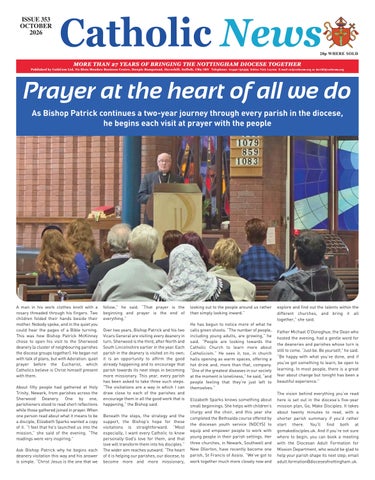
Prayer at the heart of all we do As Bishop Patrick continues a two-year journey through every parish in the diocese, he begins each visit at prayer with the people
A man in his work clothes knelt with a rosary threaded through his fingers. Two children folded their hands beside their mother. Nobody spoke, and in the quiet you could hear the pages of a Bible turning. This was how Bishop Patrick McKinney chose to open his visit to the Sherwood deanery (a cluster of neighbouring parishes the diocese groups together). He began not with talk of plans, but with Adoration: quiet prayer before the Eucharist, which Catholics believe is Christ himself present with them. About fifty people had gathered at Holy Trinity, Newark, from parishes across the Sherwood Deanery. One by one, parishioners stood to read short reflections while those gathered joined in prayer. When one person read about what it means to be a disciple, Elizabeth Sparks wanted a copy of it. “I feel that he’s launched us into the mission,” she said of the evening. “The readings were very inspiring.” Ask Bishop Patrick why he begins each deanery visitation this way and his answer is simple. “Christ Jesus is the one that we
follow,” he said. “That prayer is the beginning and prayer is the end of everything.” Over two years, Bishop Patrick and his two Vicars General are visiting every deanery in turn. Sherwood is the third, after North and South Lincolnshire earlier in the year. Each parish in the deanery is visited on its own; it is an opportunity to affirm the good already happening and to encourage that parish towards its next steps in becoming more missionary. This year, every parish has been asked to take three such steps. “The visitations are a way in which I can draw close to each of the parishes and encourage them in all the good work that is happening,” the Bishop said. Beneath the steps, the strategy and the support, the Bishop’s hope for these visitations is straightforward. “Most especially, I want every Catholic to know personally God’s love for them, and that love will transform them into his disciples.” The wider aim reaches outward. “The heart of it is helping our parishes, our diocese, to become more and more missionary,
looking out to the people around us rather than simply looking inward.” He has begun to notice more of what he calls green shoots. “The number of people, including young adults, are growing,” he said. “People are looking towards the Catholic Church to learn more about Catholicism.” He sees it, too, in church halls opening as warm spaces, offering a hot drink and, more than that, company. “One of the greatest diseases in our society at the moment is loneliness,” he said, “and people feeling that they’re just left to themselves.” Elizabeth Sparks knows something about small beginnings. She helps with children’s liturgy and the choir, and this year she completed the Bethsaida course offered by the diocesan youth service (NDCYS) to equip and empower people to work with young people in their parish settings. Her three churches, in Newark, Southwell and New Ollerton, have recently become one parish, St Francis of Assisi. “We’ve got to work together much more closely now and
explore and find out the talents within the different churches, and bring it all together,” she said. Father Michael O’Donoghue, the Dean who hosted the evening, had a gentle word for the deaneries and parishes whose turn is still to come. “Just be. Be yourself,” he said. “Be happy with what you’ve done, and if you’ve got something to learn, be open to learning. In most people, there is a great fear about change but tonight has been a beautiful experience.” The vision behind everything you’ve read here is set out in the diocese’s five-year mission plan, Go, Make Disciples. It takes about twenty minutes to read, with a shorter parish summary if you’d rather start there. You’ll find both at gomakedisciples.uk. And if you’re not sure where to begin, you can book a meeting with the Diocesan Adult Formation for Mission Department, who would be glad to help your parish shape its next step; email adult.formation@dioceseofnottingham.uk.
Page 2
The Catholic News. October 2026.
MORE THAN 26 YEARS OF BRINGING THE NOTTINGHAM DIOCESE TOGETHER
The Best Kept Secret
The monthly paper for the Diocese of Nottingham
Thanks once again to Jon Cornwall for this reflection. Editor: Nick Layton Editorial Office: CathCom Ltd, N2 Blois Meadow Business Centre, Steeple Bumpstead, Haverhill, Suffolk, CB9 7BN Telephone: 01440 730399 email: cn@cathcom.org or davidl@cathcom.org Website: www.cathcom.org Distribution enquiries: cn@cathcom.org CathCom Ltd, Publication date: Fourth Sunday of the month for the following month. Opinions expressed by contributors are not necessarily those of the Editor or the Diocese. Publishers and Owners: CathCom Ltd, N2 Blois Meadow Business Centre, Steeple Bumpstead, Haverhill, Suffolk, CB9 7BN Advertising: tel: 01440 730399 Parental permission should be sought before submitting photographs of minors. Views expressed in The Catholic News are not necessarily those of the editor.
The year progresses, the seasons move on and life continues its annual cycle of calendar linked events and activities. Yet in the background many things carry on unchanging. The work of the SVP is a prime example. The society’s members adhere to their mission without fuss, ceremony or grand gesture. Indeed, it is this approach that encourages the SVP to gently mock itself as the best kept secret in the Catholic church. This is because helping others is an extension of our faith, as we see Christ in the poor and Christ works through us. Actively assisting others, in whatever way a member is able, is viewed as a spiritual act by putting faith into action and loving thy neighbour.
Wanted Parish Correspondents The Catholic News is looking for a Parish Correspondent in your parish to send in local news for publication in this newspaper. All items to be emailed to cn@cathcom.org before 10th of the month
St Vincent We have recently celebrated the feast of St Vincent (27th September), which provides
SVP members with the opportunity to both reflect and look forward. The need is always there and sometimes the hard part of the mission is the active seeking out of the people who need help. At conference meetings members will always discuss in confidence the results of visits and what further action may be required. There should also be time spent on how to keep looking for new beneficiaries.
NEED implies that ‘the job is never done’ as the concept of need covers a wide range of headings. It could be visiting, befriending, offering lifts to church, helping with shopping, providing financial support from society funds or supporting a local foodbank or warm space. This is just a sample of the work going on behind the scenes. There will be so much more. Occasionally local conferences will make an appeal at mass to update the parish on what their SVP has been doing and ask for new volunteers. This latter point is so important. As we head towards our 200th anniversary it is important that the society continues to attract new members who will bring their unique set of gifts and talents to the conference table, step up as active Christians and put their faith into action.
Being a member of the SVP is not an onerous task. Its rewards are both implicit and explicit. Being able to make a difference to someone’s life is amazing. All it takes is a small commitment of time and love. If you feel you might want to make a difference and be part of this (not so) secret society please consider joining your local conference or, if your parish does not have one, starting your own.
For further details and information, you can contact our Membership Support Office (MSO), Joe Gasan at joeg@svp.org.uk The society looks forward to meeting you and welcoming you into its fold.
Frankly Speaking by Frank Goulding AuguST 2026
Edition 56
www.CatholicPost.co.uk
JULY 2026
www.CatholicPost.co.uk
Edition 55
We are made for the infinite!
Seafarers’ Sunday
Building a dementia friendly parish
page 6
page 11
page 13
Fr Stephen Wang appointed as new Bishop of Arundel and Brighton
Celebrating the Comp letion of a Transformative Cathedral Restoratio n www.CatholicPost.co.uk
SEPtEmBEr 2026
Edition 57
vaticannews.va
Drawing parallels with Rerum Novarum, when the Pope Leo XIII highlighted the impact of the Industrial Revolution on people’s lives, Pope urges the global community to place technological progress at the service of human dignity, solidarity and the common good.
Pope Leo XIV promulgates the encyclical
"Magnifica Humanitas"
When love needs first aid
God of Our Senses
Kindness is King
page 2
page 6
page 11
Addressing participants gathered in the Synod the Hall for the presentation of the encyclical, Pope described the current technological revolution as an “epochal turning point” by comparable to the upheaval confronted Pope Leo XIII during the Industrial Revolution.
St Monica - August
27th
St Hildegard of Bingen Feast day: 17 September
Fund Living Before Legalising Dying Image: Vatican Media
technologies, but also to build a more just Technology and moral responsibility He explained that Magnifica Humanitas future together. Church’s longstanding support emerged from extensive listening to scientists, Recalling the the Pope said every alone” engineers, educators, political leaders and for nuclear disarmament, cbcew.org.uk “No one rebuilds of great technological power must be families concerned about the future years as a missionary in Peru, and public Reflecting on his younger generations. At the same time, he said accompanied by moral discernment Pope Leo XIV recalled the devastation caused he he had heard “very troubling voices” regarding accountability. by torrential rains and floods in 2017, saying autonomous weapons systems and algorithms involves far more now learned there that rebuilding capable of denying access to healthcare, “In a similar sense, artificial intelligence than restoring physical structures. employment or security based on unjust and demands to be ‘disarmed,’ freed from logics “Artificial intelligence already touches many prejudiced data. that turn it into an instrument of domination, areas of our lives and affects decisions that “It means repairing bonds, restoring trust, and exclusion or death,” he said. shape human coexistence, he said, noting that reawakening hope in the future,” he said, Pope is From that process of discernment, the it is also “dramatically changing how war adding that “no one rebuilds alone.” the said, came a conviction expressed clearly in Quoting Saint Paul’s exhortation to “keep waged.” be encyclical: “artificial intelligence needs to awake” (1 Thess 5:6), the Holy Father warned of The Pope then turned to the biblical figure whenever disarmed.” The following endangered interview is itself is part moment of peace the Catholic that Novarum” “Rerum A new Nehemiah rebuilding the walls of Jerusalem, sense podcast which features interviews with for the technology weakens humanity’s critical News Drawing a direct parallel with Pope Leo XIII’s the image as a model Acknowledging the forcefulness of the phrase, and moral vigilance. lay people,presenting religious and clergy involved in the landmark 1891 encyclical Rerum Novarum, construction of the digital age. ethical Pope Leo XIV said the gravity of the present Church's work in England and Wales. Pope Leo XIV said the Church today is likewise of moment requires words capable before age the task of the that things” “new stressed the Pope interpret called to paths Yet the Continued on Page 4 the “awakening consciences and indicating A diverse range of people, not just Catholics, in the light of the Gospel and the dignity of humanity is not merely to restrain dangerous forward for humanity.” have raised their voices in opposition to this human person. Private Members' Bill that seeks to legalise assisted suicide. Our new Prime Minister, Andy Burnham, has said that now is not the time for this debate and it would be better to sort out the UK's palliative care and social care crisis.
and war.
Reflections on My First Year as a Permanent Deacon
page 9 page 14
Pope Leo XIV presents "Magnifica Humanitas" as the Church’s response to the challenges posed by artificial intelligence, calling for AI to be “disarmed” from logics of domination, exclusion and war
At the presentation of his first social encyclical, Magnifica Humanitas, Pope Leo XIV appealed at for artificial intelligence to be placed firmly the service of humanity, warning against technologies that foster domination, exclusion
Priest braves heatwave on 108-mile walk
page 3
St Thomas the Apostle: 3rd July
Pope Leo presents 'Magnifica humanitas’ calling for disarmament of AI
The Terminally Ill Adults (End of Life) Bill will have its crunch vote and second reading in the House of Commons on Friday, 11 September.
So what are the problems and what needs to be fixed? Dr Karen Groves MBE qualified as a doctor at a time when the modern hospice and palliative care movement was only just beginning. "Pain and other symptoms were really poorly managed, not due to lack of compassion or care, but just through a lack of knowledge," said Dr Groves. "There was a lot of fear among the public and health professionals about the use of morphine, and also of speaking to people about their illness and what to expect in the future. It just wasn't done in those days." To address this and to meet end-of-life care needs in West Lancashire, Formby, and Southport, Dr Groves founded Queenscourt Hospice in Southport in the late 1980s.
dioceseofsalford.or
g.uk Salford Cathedral has reopened its doors following a three-year programme of restoration, renewal and refurbishmen t that has transformed the cathedral
The Cathedral Church of St John the Evangelist welcomed worshippers and visitors back on Saturday 4 July, when a weekend of celebrations began to mark the completion of this significant project. Having served as the spiritual heart of the diocese for more than 175 years, the cathedral required extensive restoration to address
Dr Karen Groves MBE (Inset) "We've moved on a lot in nearly 50 years, and “It's a huge challenge, but it's taken many years How does a hospice achieve gold now for this area, we've got integrated hospice of work to build relationships with all other standard palliative care and and specialist palliative care services working local services, and those are really important end-of-life care? What are the key out of Queenscourt, which is our local hospice, so that everything's knitted together, and that ingredients? the specialist clinical and educational hub, provides the continuity of care. “I think there are many," says Dr Groves. "But seeing patients and families in Queenscourt a few of the main ones, are: investment in itself, or an equal number in our local hospitals, "It's made a big difference to the number of selection, ongoing training, and real support of people who are able to stay in their own and twice as many again in our local care skilled clinical and non-clinical staff. Plus time homes. Some people accuse hospices of and attention to detail for every patient and homes and their own homes, which is where providing a gold standard service to the very family - that's really important. A huge number the vast majority of people really want to be few, and I would counter that to say that where of committed volunteers without whom the living their lives, and living them to the full, to hospices have the opportunity to develop the end." integrated services across all settings, then service can't provide the standard of care that actually they can provide a responsive, helpful, it does. Then the financial support and goodwill of the community of this area - West Dr Groves advocates for a 'continuity of care' reliable, and consistent service in which Lancs, Southport and Formby - who've so that integrated services are provided patients and families have confidence, and supported the building, the growth, and the they're much less likely to dial 999 because of consistently and appropriately for each person fear or not knowing what to do in a situation. development of their services. across a number of care settings. It makes a big difference." Continued on page 2
longstanding repairs
bringing renewed colour, vibrancy and beauty to this sacred space. Alongside restoring the cathedral’s heritage, the project has also invested in its future. Improved facilities, increased flexibility, enhanced accessibility and
scheme, restored statues, renewed interior decoration, the repositioning of key liturgical features, and a new glass entrance on Chapel Street designed to offer a visible sense of welcome in the heart of the city.
a strong We to its stonework are grateful to and commitment to sustainability infrastructure while Purcell Architects to help ensure ensuring it could continue the and Simpsons of York cathedral can continue to meet the needs for their expertise to serve the people of a growing community. of the diocese for throughout the generations to come. project. Their specialist knowledge of heritage A key element of the project has been conservation has the While much of the enabled the careful restoration of many work focused on of the cathedral’s restoration of essential cathedral’s historic repairs to the the features, including fabric of the building, historic the reinstatement character visitors will incorporating while of notice original decorative a remarkable modern standards schemes and transformation the throughout and conservation of technology to support the cathedral. stained-glass windows, its future mission. include new energy-efficient Improvements exterior lighting Continued on page 2
As we move into the final quarter of 2026 there seems little hope for the end of conflicts in Eastern Europe, or the area, which surrounds the Holy Land. Sadly, these along with other human struggles so often lead to instant victims including children. All too often the perpetrators claim that they only target military establishments and yet the tragic loss of life continues. Over the August Bank Holiday we witnessed daily news from Nepal and Tibet. This huge part of Asia suffered devastating flash floods linked to a glacial collapse in the Himalayas. At the time of writing this article more than 4,000 people are still missing including nearly 600 foreign nationals.
These statistics do not include Chinacontrolled Tibet. The humanitarian loss of life over a British Bank Holiday is a sharp reminder of how powerful floods after ice melting can be. The £5 million from the UK Government for relief recovery efforts needs to be accompanied by much compassion as well as practical aid in such a difficult area of terrain. In Britain or at least England the media made much of the launch of the Bayeux Tapestry. This 70 metre medieval masterpiece is on loan to the British Museum. The French President, our Prime Minister and King Charles III were all accompanied by their wives in a display of unity between the two nation’s leaders. We surely need better relations on much more than such occasions as this.
Our children may be learning much about 1066, let us hope and pray that when they grow up the tragic issue of refugees in the English Channel is also consigned to history. Our children also need to know about the great Saints such as Therese of the Child Jesus whose feast we celebrate on October 1st. Many of us may have been on a pilgrimage or at least know about Saint Bernadette and the special small town of Lourdes. These two French saints are so important having led short but remarkable lives. As we head into a difficult Autumn for the world let us not forget that Christianity is rooted in history and that kindness is at the heart of all we do.
The Catholic News. October 2026.
A celebration of the Assumption On Sunday 16 August the parishioners of St Mary’s Church, Marple Bridge in the diocese of Nottingham, came together to celebrate the Assumption of Our Blessed Lady. The choir sang ‘Hail Queen of Heaven’ and the church had a special table with a statue of Our Lady surrounded by beautiful white flowers, beautifully decorated by the flower team. After the mass, parishioners left the church and met in the church grounds beside the late Father John Cairns bench. A poignant reminder that today was the fifth anniversaty of his death and a much respected priest of the church. The Reverend Greg Tobin then led the procession carrying the Monstrance under the canapy which was raised by four parishioners. The Reverend Benjamin Sunder also joined in the procession.
New Hymn books were used as the procession wound its way around the church grounds with hymns including,’ How Great thou Art’, ‘Soul of My Saviour’, ‘Sweet Heart of Jesus’ and ‘O Bread of Heaven’. It had been a dull morning with light rain but as Benediction began outside on the lawn, the sun came out. After Benediction and with the sun still shining, the lawn was transformed into a party atmosphere with bunting around the trees, delicious food and drink on the shared table which brought people together to chat and reminisce. To have a procession on such a special feast day was made extra special as it took place in a beautiful church which takes the name of Our Blessed Lady, Mary.
Page 3
Page 4
The Catholic News. October 2026.
A great credit to her family and our Catholic community
From: Elston Hermitage… By Fr David + h.d.n. Priest
At the beginning of last month I was invited to lead a quiet day on the theme of Care of Creation - a day the church observed on the 1st of September. As I prepared for this I realised how many days throughout the year we keep as ‘something or other days’.
Red bull racing driver Alisha Palmowski gained another victory in the F1 academy championship at Zandvoort, Holland last recently. A pupil at St Philip Howard school, Glossop, she was baptised by Father Don Bowdren.
Trust, Prayer Changes Things Whilst the main work of Crown of Thorns is in the promotion of the Holy Rosary for peace in our troubled world, this summer has been particularly busy for us in sorting donated items to send on to needy dioceses in poorer lands. Items from this summer’s donations to diocesan parishes, hospitals and schools are ready to ship to Harare Archdiocese, Zimbabwe. Alongside this and our excessively hot summer and supporting duties, we have got a little behind in office correspondence.
We would like to apologise if we have not managed to thank or answer everyone personally through this time. We are most grateful to all for their support. In the news there are many issues which may leave us feeling fearful. Yet, rather than becoming overwhelmed at what we read, we can have the joy that comes from trusting that it is our prayers that can change all things. We are able to have hope, knowing that God will hear us, that He waits for our prayers and will act. Pray the Rosary. Trust in God. Daily Prayer: Lord, help me through the lonely hours to believe the sun will rise… And that the dawn will come on silent feet before my trusting eyes. Help me through the troubled hours To feel your presence near, To realise the storm will pass And that the skies will clear. Help me through the hours of doubt, To keep my faith and trust And give me strength to know your will To do the things I must… Then help me through the shining hours So I’ll be mindful of The fact that all life’s finest things Are mine through Your great love. (J K McManus) www.crownofthorns.org.uk. Email: office@crownofthorns.org.uk
Some of these personally I acknowledge, some others get passed by, there are actually around fifteen of these days i.e Peace Day, Racial Justice, Grandparents Day of Sick, Youth Day, Unemployed to name just a few. It is of course important that we remember and pray for particular intentions but should not all these be part of our prayer and thoughts every day as we intercede for our world and brothers and sisters? One thing however I love is that often each month in the life of our church carries a particular theme. May is the month of Mary, June the month of the Sacred Heart, September St Michael and all angels and this month that of the Holy Rosary on the 7th. The Rosary is a beautiful devotion but not only this but one that is credited with winning a war. Constantinople, the capital of the eastern half of the Roman Empire, had fallen to invading Ottoman Turks in 1453. Historians consider this moment to be the end of not only the medieval period, but also the final end of the Roman Empire. The Muslim Turks began expanding into Europe and got as far as the walls of Vienna Austria. In 1571, they were trying for naval control of the entire Mediterranean Sea. Pope Pius V, who was a Dominican, asked Catholics all over Europe to pray the rosary. The vastly outnumbered Christian forces won a huge victory over Turkish ships on the 7th October. By the time the news arrived in Rome the Holy Father already knew, because he had seen a vision of the triumph and attributed the victory to divine intervention through the prayers of the Holy Rosary and Our Lady of Victories and instituted it as a Feast Day.
Throughout the ages the Rosary appeared in various forms and evolved over centuries from medieval monastic practices. The form we have today was popularised by Dominican preachers, a prayer that encompasses the entirety of Christ’s life, contemplating the joyful, sorrowful, luminous and glorious mysteries, in all these we are drawn closer to the teachings and life of Jesus Christ. As we reflect on the Joyful mysteries, we are reminded of the gift of the Annunciation and the humility of Mary’s ‘yes’ to God’s plan. This encourages us to be open and receptive to God’s will in our lives, just as Mary was. The sorrowful mysteries teach us the importance of self sacrifice and compassion, as we meditate on the suffering and crucifixion of Jesus, this prompts us to consider the ways we can alleviate the suffering of our brothers and sisters in need. The Luminous mysteries remind us of Christ’s public ministry and the importance of sharing the Gospel with others, motivating us to be active disciples who spread the message of love and salvation. Finally, the Glorious mysteries inspire us to look forward to the final victory over sin and death in God’s eternal Kingdom. In this month October, the month of the Holy Rosary, let’s be encouraged to take up this powerful devotion as a means of deepening our Christian discipleship. Set aside time each day to meditate on the mysteries allowing Mary to guide us in embracing our discipleship as stewards of God’s gifts. As we offer our prayers and intentions through the Rosary, let us pray for the grace to live lives that reflect the love and mercy of Christ, reaching out to those in need and shining God’s light in a world often filled with darkness. Pray the Rosary each day this month and see what victories God will win in our lives.
The Catholic News. October 2026.
Page 5
Memorial of St John Mary Vianney On Tuesday 4th August 2026, the Memorial of St John Mary Vianney, the patron of parish priests, Canon Andrew Cole and the parishioners of St Ralph Sherwin Parish Derby, were joined by his family, priests from across the Diocese and further afield, the Dean of Derby and clergy from Derby Cathedral, the Deputy Mayor of the Borough of North-East Lincolnshire and political and civic leaders from the borough, as well as many parishioners from his previous parish and his time as Catholic Chaplain of the University of Nottingham, to celebrate his Silver Jubilee of Ordination and twenty five years of service to God and his people. The Mass of Thanksgiving was concelebrated by Archbishop Malcolm McMahon OP, our former Bishop and Bishop Tom Burns, Bishop Emeritus of Menevia, who between them allowed the transfer of Fr Andrew from Menevia to the Diocese of Nottingham. The readings of the day were the same as the ones read at his Ordination in St Joseph’ Cathedral in Swansea. Canon Christopher Thomas, who first met Fr Andrew on the aeroplane to Rome for the start of seminary back in 1995,
delivered the homily. Whilst reflecting on Fr Andrew’s ministry and service to the people of his parishes, Nottingham university and his time as Bishops’ Secretary and diocesan Promoter of Justice; there was also a nod to his infamous humility – and sense of humour! Canon Chris highlighted Fr Andrew’s dedication to helping promote Catholic education as well as the importance he places on his ministry towards the sick, whilst being a good and dependable friend and colleague, who you can rely upon to get things done and done well. At the end of the Mass Archbishop Malcolm presented Fr Andrew with a Papal Blessing which had been presented to him by Bishop Patrick a few weeks before at a lunch for the diocesan jubilarians. A presentation and a few words of thanks were then given on behalf of the Parish of St Ralph Sherwin, which due to the use of several of Fr Andrew’s famous catchphrases resonated with those there from both his current parish and those from his previous parish, the Most Holy and Undivided Trinity, Grimsby, Cleethorpes and Immingham. Fr Andrew then thanked everyone for their
support and encouragement throughout his twenty five years of Priesthood, before giving a guest appearance on the tambourine for the final hymn, City of God, a hymn which sums up his vision of the Church.
The celebrations then continued in the parish centre, with a toast led by Canon Eddy Jarosz, and a lot of food, cake, Prosecco and laughter. Ad multos annos!
Page 6
The Catholic News. October 2026.
Sacrament of the Anointing of the Sick At the start of the public ministry of Jesus, he entered a synagogue and read a passage from the Prophet Isaiah – “The Spirit of the of the Lord is upon me, because he has anointed me to proclaim good news to the poor. He has sent me to proclaim liberty to the captives and recovering of sight to the blind, to set at liberty those who are oppressed, to proclaim the year of the Lord’s favour.” (Luke 4:18-19) Jesus fulfilled this prophecy to bring healing and restoration. We have all encountered fits of illness, and it can be a real nuisance. Although theologians have speculated throughout the centuries on the reality of sickness and its relation to spiritual life, we can be certain that illness is a part of being part of broken humanity. We experience our limitations, our weakness, our brokenness, and our vulnerabilities when we are sick. Sickness also has a psychological effect on us, which can cause stress, anxiety and even depression. It can be easy to turn inwards during this moment, but we are invited to enter into the Paschal Mystery of Christ, in knowing that when we die with Christ, we will rise with him in glory.
Please support our Advertisers
Since the very beginning of the Church, there has been the use of oil to anoint the sick. This may stem from what we hear in the Epistle of James – “Is there anyone sick among you? Let him send for the presbyters of the Church and let them pray over him, anointing him with oil in the name of the Lord. The prayer of faith will save the sick man, and the Lord will raise him up. If he has committed any sins, they will be forgiven him.” (James 5:14-15). Firstly, it is important to stress, that is not a sacrament
for the dying, but for the living. The last sacrament that should be received is the Eucharist, as viaticum. In the sacrament of anointing, the Lord encounters us with his healing grace – “Through this holy anointing may the Lord in his love and mercy help you with the grace of the Holy Spirit. May the Lord who frees you from sin save you and raise you up.” Jesus, through the Incarnation, entered into all human reality and experiences. He lived among us to bring us the fulness of life. He shared in our humanity and healed our infirmities. He gives us strength in our bodily weakness. Through the celebration of this sacrament, the Lord, through the Church, is close to us in our moments of illness, knowing that we are never alone or dejected, but loved and embraced. We might not always be cured of our sickness through the celebration of the anointing of the sick, but this sacrament does raise and strengthen us to encounter sickness with great confidence in the divine mercy of God, to bear trials and tribulations more easily. Although this sacrament is typically celebratedly privately, the Church highly encourages that it is celebrated as a group, especially within the context of the celebration of the Eucharist. The community of the faithful, the body of Christ, is also an important source of support, encouragement, and healing, by being reassured that the sick are never left to their own abilities, but have the grace and love of God, who is always close to the broken hearted and sick, and have the support and love of the community of believers. Fr Anthony Fyk
The Catholic News. October 2026.
Page 7
Scripture Focus
By Fr Jeremy Corley
Bearing Good Fruit Grapes are among the nicest fruits, sweet and easy to eat. Usually, we have to import them from hotter countries. Because of climate change, vineyards are now sometimes found near the south coast of England. But these vineyards tend to produce small grapes more suitable for wine making rather than for eating as fruit. In the first reading on the 27th Sunday of the Year (4th October) we hear Isaiah’s parable of the vineyard. The prophet uses the people’s familiarity with vine growing to convey God’s message. In the Holy Land in biblical times, many hillsides were covered with vines. During the lifetime of the prophet Isaiah, Jerusalem’s king Uzziah was famed for encouraging the growing of vines. Isaiah’s parable begins by mentioning God’s beloved, presumably denoting the people of Israel. They are centred on Jerusalem, which is the very fertile hill. The watchtower could refer to the
temple, while the wine vat could refer to storehouses in the city. After blessing Jerusalem with such prosperity, God was hoping for a response of grateful appreciation, with the people living virtuously: “He looked for it to yield grapes, but it yielded wild grapes.” God asks what more he could have done for his vineyard. In disappointment and frustration, God decides to teach a lesson to the vineyard (= the people). He will remove its protection, so that it will be trampled down by enemies. This happened in Isaiah’s lifetime, when invaders from Assyria attacked the country. The divine verdict is expressed with a Hebrew wordplay: “He looked for justice (mishpat), but behold, bloodshed (mispach); he looked for righteousness (tzedakah), but behold, an outcry (tzeakah)!” At this autumnal harvest time in the season of creation, we acknowledge God’s kindness in giving us the fruit of the earth,
including food and drink to nourish us. We seek to show gratitude to our Creator, who gives us so many good gifts. But we know that we do not always share God’s generous gifts with others as generously as we could. In the gospel on the same Sunday, we hear Jesus’ parable of the tenants in the vineyard. The original audience would have known Isaiah’s parable, but Jesus adapts it for his own situation of disappointment that many of his people have not accepted his message. As tenants in the vineyard, many of the chosen people have mistreated the prophets and rejected their message. Now, as God’s Son, Jesus has come to save them, but he foresees that they will also reject him and even have him put to death. Jesus concludes by saying that God’s kingdom would be taken away from the original chosen people and instead given to a new people who would produce suitable fruits. According to Matthew’s understanding, God’s kingdom would be transferred from the first chosen people to include other nations. Now the gentile
Edition 51
FEBRuARy 2026
www.CatholicPost.co.uk
Edition 50 SEPtEmBEr 2026 History in Their Hands
Middlesbrough
AuguST 2026 and Leeds to
Edition 56
share Bishop Marcus
page 12
page 2
A journey of Faith, Hope and New Beginnings page 14
Edition 57
www.CatholicPost.co.uk St. Scholastica: The Power of Love in Prayer February 10th
Priest braves heatwave on 108-mile walk
page 3 Gwen Wiseman
page 9
Francis opened On Christmas Eve 2024, Pope inviting the the Holy Door of St Peter’s Basilica, of 2025. “This is Church into the Jubilee Year we are invited to the season of hope in which the Lord,” he rediscover the joy of meeting spiritual renewal said. “The Jubilee calls us to of our and commits us to the transformation truly become a world, so that this year may time of jubilation.”
as a year in Jubilee 2025 will be remembered together which the global Church walked and change, through grief and joy, continuity in Christ, as St discovering that hope, rooted (Rom Paul reminds us, “does not disappoint” 5:5).
A Jubilee That Surpassed Expectations
the Feast of the As the Jubilee concluded on that more Epiphany, the Vatican confirmed to Rome from than 33 million pilgrims travelled The 185 countries, far exceeding expectations. Jubilee a visible scale of participation made the expression of the Church’s universality.
Saint Francis of Assisi died on page 2 3 October 1226, near the small chapel he loved most.
St Monica - August 27th
Refugee Art and Writing
SEPtEmBEr 2026 Competition
He did not die in a grand church or monastery. He asked to be laid naked on the bare earth. He asked for the Passion of Christ according to the Gospel of John to be read to him. He sang psalms. And then, quietly, he went home to God.
Conversion Stories
Pray as you Go
page 8
page 11
God of Our Senses
and self-will became the hidden path of Gwen Wiseman page 2 6 only two Francis’ sanctity. He was page canonised This year marked the 800th anniversary of the years after his death by Pope Gregory IX, who death of Saint Francis of Assisi. For one described him as one of the greatest imitators extraordinary month, from 22 February to 22 of Christ the Church had ever known. March, the mortal remains of the saint were placed on public veneration, drawing pilgrims celebrated, each 35 major Jubilee events were For Fr Quackenbush, the veneration of Francis’ Pope Francis. ©Vatican Media or group Opening of the Holy Door, by from across the world to Assisi. dedicated to a particular vocation Saints for Our Time remains was not about death. “The emphasis of not merely a site associated with the witness the enriched bywe’re within the Church. These were pilgrimage sites were Maximus, trying to make is that this isn’t about The Jubilee Year was further sight of thousands of encounter basilicas and traditional During that time, hundredsGiorgio of thousands in early Christian martyrs. The large gatherings, but moments Frassati and Carlo the canonisations of Pier priests highlighted a surge death,” he said. “It’s about life.” quietly queuing forpassed deepened, and reported and through the Basilica, many travelling pilgrims of young people where faith was shared, by Pope Leo Confessions, particularly among Acutis, the first saints canonised became one of the defining images hundreds, even thousands of miles for theresonant renewed. in the Jubilee sacrament seeking to participate fully The grain of wheat XIV. Their witness proved especially of the Holy Year. chance to spend just a few brief moments hope. Many pilgrims arrived with curiosity or Easter Monday indulgence. during a Holy Year centred on The death of Pope Francis on before the the remains of the humble friar who devotion. But as they moved through the year, followed on the moment, the Prefect of left an indelible mark during the to the Sacrament of Reflecting “the little poor one.” message: youngcalled himself those once of Pope Leo This renewed return experience something deeper began to stir Both saints offer a compelling signs City of Rome, observed: “To see by the conclave and the election ili ti n was one of the clearest within them. Standing before the remains of At first glance, it might have seemed that the saint, they encountered not only the pilgrims had simply come to see the bones of memory of a holy man from the past but the cbcew.org.uk a medieval saint. Yet the friars serving at the question that shaped Francis’ life: “Lord, what Basilica say something far deeper was do you want me to do?” This was the question unfolding. What began as an act of devotion interior restored statues, renewedFrancis once asked before the crucifix of San scheme,more beautysomething became personal: a moment liturgical vibrancy and the repositioning of keyDamiano, when he was still a restless young bringing renewed colour, decoration, of prayer, reflection and, for many, a renewed on Chapel man searching for direction. to this sacred space. and a new glass entrance dioceseofsalford.org.uk features, encounter with faith. visible sense of designed to offer a cathedral’s heritage, Street After venerating the remains, pilgrims were led Alongside restoring the in the heart of the city. welcome “It is startling to see the crowds” into a nearby chapel to renew their baptismal invested in its future. the project has also flexibility, and shifting the focus from the life of those welcoming pilgrims toPurcell Assisi was promises, increased Among Architects to Improved facilities, are grateful OFM WeQuackenbush, strongMary Conv., an Francis to their own. The friars framed this and aFr Daniel expertise of York for their enhanced accessibility Simpsons ensure friar American from upstate New York who moment through the words of Christ in the to help specialist the project. Their commitment to sustainability throughout people of John: “Unless a grain of wheat falls serves at the Basilica and is responsible forconservation the Gospel has to its stonework and the cathedral can continue to serve the The followingknowledge interview is part of the Catholic of heritage longstanding repairs thethe earth and dies, it remains just a grain; English-language Mass celebrated restoration each intoof to come. of St John the Evangelist it could continue generations ensuring for while News podcast which features interviews with diocese careful The Cathedral Church the of infrastructure enabled the but if while it dies, it bears much fruit.” (John 12:24) Sunday morning. and visitors back on community. lay people, religious and clergy involved incharacter the welcomed worshippers historic meet the needs of a growing For theand friars, the life of Francis is a living essential cathedral’s a weekend of to focused on Church's work incorporating in England and Wales. Saturday 4 July, when modern standards While much of the work will “It is startling to see the crowds,” Fr example of that Gospel truth. Like the grain of visitors mark the completion of project has been the celebrations began to to the fabric of the building, A key element of the to support its future mission. historic repairs Quackenbush technology said. “The fact that Francis still wheat that falls into the earth, Francis cathedral’s transformation the project. of many significant of remarkable this A diverse range of people, not just Catholics, a restoration of notice has this appeal after eight hundred years surrendered Improvements the reinstatement on page 2 his life completely to God. In have raised their voices in opposition Continued to this features, including throughout the cathedral. spiritual heart of the proclaims lightingsomething about his holiness.” For letting go of wealth, ambition and reputation, schemes and the exterior Having served as the Private Members' Bill that seeks to legalise original decorative include new energy-efficient 175 years, the cathedral of stained-glass windows, diocese for more than assisted suicide. Our new Prime Minister, Andy to address conservation restoration extensive required Burnham, has said that now is not the time for this debate and it would be better to sort out the UK's palliative care and social care crisis.
a reopened its doors following Salford Cathedral has of restoration, renewal three-year programme has transformed the cathedral and refurbishment that
in body, nearly
He welcomed her as a sister: “Sister Bodily Death.” His final moments were an act of complete surrender, - April a St lastAlphege imitation of Christ 19 who had given everything on the Cross.
cbcew.org.uk
How a person dies often reveals how they have lived. Francis died as he lived: poor, free, trusting, and wholly abandoned to God.
They Came to See St Francis and Found Christ When love needs first aid
In the likeness and image of God
www.CatholicPost.co.uk
St. Joseph 19th March
page 14
Kindness is King
Gwen Wiseman
was answered. Two years before page 6his death, Francis received the wounds of Christ on his hands, feet, and side, becoming the first recorded saint to bear the stigmata.
page 11
St Hildegard of Bingen Feast day: 17 September
Fund Living Before Legalising Dying
Near the end of his life, broken
blind, and exhausted by years of severe fasting, www.CatholicPost.co.uk Francis did not fear death.
Winners
pages 6 & 7
God of Our Senses
www.CatholicPost.co.uk
Edition 52
page 14
page 11
When love needs first aid
Reflections on My First Year APRIL 2026 as a Permanent Deacon
A Year of Hope, A Church letion of a Celebrating the Comp ation dral Restor Edition 57 Transformative Cathe
Fingers and Feet
The Year of Francis
: Jubilee 2025Renewe d
Fr Stephen Wang appointed as new Bishop of Arundel and Brighton
Listening is Loving
page 2
From this radical conformity to Christ flowed a life that could not be contained. Francis founded a worldwide family of friars, sisters, and lay people, now spread across every continent. Yet his influence reaches far beyond those who wear a habit.
The Franciscan Jubilee
In the context of this centenary year, Pope Leo XIV has proclaimed 2026 a Franciscan Jubilee, inviting the whole Church to rediscover the heart of the Gospel through the life and witness of St Francis.
A particular grace of the Year
of St Francis
dedicated to other great Franciscan saints an online booking system The Terminally Ill Adults the plenary indulgence attached to this Jubilee,is such has been introduced as St Clare of Assisi, St Anthony addressed in a special way to of Padua, to manage access. members of St Bonaventure, Further information is and St Maximilian Kolbe. In (End of Life) Bill will have the Franciscan families of thetheFirst, available at www.sanfrancescovive.org. Second, the spirit of the Jubilee Eight Hundred Years Later decree, these places are and Third Orders, Regular and Secular, as well natural local its crunch vote and points of pilgrimage, ensuring as to Institutes of Consecrated A Year to Walk Alongside Francis Life, Societies that the grace of the Year of St Francis is second reading in the of Apostolic Life, and associations that observe accessible While praying before the crucifix in the ruined to all the faithful, including those the Rule of St Francis or draw church of San Damiano, Francis inspiration from unable to heard Christ travel to Assisi. House of Commons on his spirituality. say: “Francis, go and rebuild my Ask your priest how the Year Church.” of Francis will Friday, be lived in your parish and diocese. Feast day:1117September. September At the same time, this grace is At first, he understood extended to The world
Kindness is King
On 10 January 2026, the Franciscan family across the world, together with the Church in Assisi, gathered in prayer at the Basilica of Santa Maria degli Angeli to open the Eighth Centenary of the death of St Hildegard ofStBingen Francis.
page 11
all Francis knew was marked by the faithful, who, with hearts detached from violence, The following division, Veneration of the Mortal Remains and deep interview inequality. is part Our sin, participate in the Jubilee of the Catholic of by making a modern world may News podcast appear very interviews which Saint Francis different on pilgrimage to any features Franciscan conventual As with the and yet in many ways it remains lay surface, part of the centenary celebrations, people, religious and clergy involved in church or place of worship pilgrims dedicated to St are invited painfully Eight Church'ssimilar. hundred years after histhe Francis of to venerate the mortal remains, work in England Assisi anywhere in the world. and Wales. the death, in a fractured and restless With bones of St Francis. After world, his particular tenderness, his death, and out of the Church has ensured fear witness still calls us back to the of medieval relic hunters, Francis’s A diverse range of people, essentials. The that the sick and body the elderly, and those unable not faithful from every Catholics, was hidden. Almost six hundred corner of just have raised the globe to leave their homes years later, in voices in opposition for serious reasons may 1818, continue to betheir to this drawn by the Pope Pius VII ordered a search life of Private Members' small, also obtain the plenary indulgence for the Bill that seeksthis unlikely man. by uniting tomb, which was to legalise But successfully rediscovered themselves spiritually to assisted suicide. why? Our new Prime Minister, the Jubilee beneath the Andy celebrations altar of the Lower Basilica of Burnham, has said that and offering to God their prayers, St Francis refused to dilute now is not the Francis. the for sufferings, and the daily difficulties this debate and it wouldthe demands oftime Gospel. of life. In He embraced it be better to without sort out this way, the mercy reserve, the UK's poverty proclaimed by St Francis is palliativeover choosing carecomfort, and social The tomb was last opened in care over peace crisis. made accessible to 1978 under Pope all, regardless of Paul power, and humility over status VI for inspection t hi h The Go l i So what
Fund Living Before Legalising Dying
are the problems and
this literally. He rebuilt ruined chapels with his own hands, before slowly realising that Christ was calling him to something deeper, not the rebuilding of stone walls, but the rebuilding of hearts and lives. This year, the same invitation is extended to us. Go and rebuild what God desires to restore within you. Go and rebuild the places where trust and relationships have weakened. Go and rebuild holiness in the ordinary details of daily life. Eight hundred years after Francis met
what
Dr Karen Groves MBE needs to be fixed? (Inset) "We've moved on a lot in nearly 50 years, and Dr Karen Groves MBE “It's a huge challenge, qualified as a doctor at now for this area, but it's taken many years we've got integrated hospice a time when the modern of work to build relationships How does a hospice achieve hospice and palliative and specialist with all other palliative care services gold care movement was only working local services, and those standard palliative care just beginning. are really important out of Queenscourt, which and is our local hospice, so that everything's end-of-life care? What knitted together, and that are the key the specialist clinical "Pain and other symptoms and educational hub, provides the continuity ingredients? were really poorly seeing of care. patients and families managed, not due to “I think there are many," in Queenscourt lack of compassion or says Dr Groves. "But itself, or an equal number care, but just through a few of the main ones, in our local hospitals, "It's made a big difference to the number a lack of knowledge," are: investment in of and twice as many again said Dr Groves. "There people who are able was a lot of fear among to stay in their own selection, ongoing training, and real support in our local care of homes. Some people the public and health professionals about the homes and their own homes, which is where accuse hospices of skilled clinical and non-clinical staff. Plus time providing a gold standard use of morphine, and service to the very and attention to detail for every patient also of speaking to the vast majority of people really want and to be few, and I would counter people about their illness that to say that where family - that's really important. A huge and what to expect living their lives, and living them to number the full, to hospices have the in the future. It just wasn't opportunity to develop of committed volunteers without done in those days." the end." whom the integrated services across all settings, then service can't provide the standard of care that actually they can provide To address this and to it does. Then the financial a responsive, helpful, meet end-of-life care Dr Groves advocates support and for a 'continuity of care' reliable, and consistent needs in West Lancashire, service in which goodwill of the community of this area Formby, and so that integrated services - West Lancs, Southport and Southport, Dr Groves are provided patients and families have confidence, founded Queenscourt consistently Formby - who've and they're much less likely and appropriately for each Hospice in Southport to dial 999 because of supported the building, the growth, person in the late 1980s. and the fear or not knowing what across a number of care development settings. to do in a situation. of their services. It makes a big difference." Continued on page 2
The Terminally Ill Adults (End of Life) Bill will have its crunch vote and second reading in the House of Commons on Friday, 11 September.
Dr Karen Groves MBE (Inset)
So what are the problems and what needs to be fixed? Dr Karen Groves MBE qualified as a doctor at a time when the modern hospice and palliative care movement was only just beginning. "Pain and other symptoms were really poorly managed, not due to lack of compassion or care, but just through a lack of knowledge," said Dr Groves. "There was a lot of fear among the public and health professionals about the use of morphine, and also of speaking to people about their illness and what to expect in the future. It just wasn't done in those days." To address this and to meet end-of-life care needs in West Lancashire, Formby, and Southport, Dr Groves founded Queenscourt Hospice in Southport in the late 1980s.
"We've moved on a lot in nearly 50 years, and now for this area, we've got integrated hospice and specialist palliative care services working out of Queenscourt, which is our local hospice, the specialist clinical and educational hub, seeing patients and families in Queenscourt itself, or an equal number in our local hospitals, and twice as many again in our local care homes and their own homes, which is where the vast majority of people really want to be living their lives, and living them to the full, to the end." Dr Groves advocates for a 'continuity of care' so that integrated services are provided consistently and appropriately for each person across a number of care settings.
“It's a huge challenge, but it's taken many years of work to build relationships with all other local services, and those are really important so that everything's knitted together, and that provides the continuity of care. "It's made a big difference to the number of people who are able to stay in their own homes. Some people accuse hospices of providing a gold standard service to the very few, and I would counter that to say that where hospices have the opportunity to develop integrated services across all settings, then actually they can provide a responsive, helpful, reliable, and consistent service in which patients and families have confidence, and they're much less likely to dial 999 because of fear or not knowing what to do in a situation. It makes a big difference."
It can sometimes be easy for us to rest on our laurels by saying: “Well, unlike other people, at least I believe in Jesus.” Faith is certainly a blessing, but we are also called to bear suitable fruit in our actions. When we look at the church in our country, we often see congregations declining, and some parishes have had to import priests from overseas. Many of us have baptised relatives who no longer practise the faith. For numerous people prayer is no longer a daily priority. So, for us today, Jesus asks us to reflect: are we producing the good fruits of faith and hope and love? Are we living as witnesses of Christ? Are we praying regularly? Do we show appreciation of God’s kindness to us in the way we live? Let us ask God to assist us today to bear good fruit in our lives.
Funeral Services
MarCh 2026
www.CatholicPost.co.uk
believers will face the same challenge of bearing suitable fruit, in response to God’s generous love.
How does a hospice achieve gold standard palliative care and end-of-life care? What are the key ingredients? “I think there are many," says Dr Groves. "But a few of the main ones, are: investment in selection, ongoing training, and real support of skilled clinical and non-clinical staff. Plus time and attention to detail for every patient and family - that's really important. A huge number of committed volunteers without whom the service can't provide the standard of care that it does. Then the financial support and goodwill of the community of this area - West Lancs, Southport and Formby - who've supported the building, the growth, and the development of their services. Continued on page 2
To Advertise in the Catholic News contact Nick on 01440 730399 or email: nick@cathcom.org Please support our Advertisers
Page 8
The Catholic News. October 2026.
View from the Pew By Dr Jay Kettle-Williams
Month of the Holy Rosary It’s October. Again! And once more the ‘Season of mists and mellow fruitfulness’ (John Keats, ‘To Autumn’) is upon us. It seems that only yesterday we were celebrating Easter and, shortly before that, Christmas. Tempus truly fugit! October is the month traditionally honoured as the Month of the Holy Rosary and devotion to Mary, Our Lady, mother of Jesus. That would have been in the very early days of the Roman occupation of Judaea, an occupation which lasted from 63 BC effectively until the Muslim conquest of the region in 636 AD. MarCh 2026
www.CatholicPost.co.uk
Edition 51
FEBRuARy 2026
www.CatholicPost.co.uk
Edition 50 AuguST 2026
www.CatholicPost.co.uk JULY 2026
Edition 55
History in Their Hands
Middlesbrough and Leeds to share Bishop Marcus
page 12
page 2
A journey of Faith, Hope and New Beginnings page 14
EditionListening 56 is
page 2
Seafarers’ Sunday
Building a dementia friendly parish
page 6
page 11
Pope Leo presents 'Magni of AI calling for disarmament
Saint Francis of Assisi died on page 3 3 October 1226, near the small chapel he loved most.
Pope Leo XIV presents "Magnifica Humanitas" as the Church’s response to the challenges posed by artificial intelligence, to be Surpassed ThatAI A Jubilee for calling Expectations logics from Feast of the the Jubilee concluded on the As “disarmed” that more the Vatican confirmed exclusion Epiphany, of domination, to Rome from than 33 million pilgrims travelled warexpectations. The exceeding and 185 countries, far
as a year in Jubilee 2025 will be remembered together which the global Church walked and change, through grief and joy, continuity in Christ, as St discovering that hope, rooted (Rom Paul reminds us, “does not disappoint” 5:5).
Refugee Art and
Writing SEPtEmBEr 2026 Competition
St. Joseph 19th March
Conversion Stories
Pray as you Go
page 8
page 11
Reflections on My First Year as a Permanent Deacon
page 14
St Monica - August 27th
Celebrating the Comp letion of a Transformative Cathe dral Restoration www.CatholicPost.co.uk
Edition 57Winners pages 6 & 7
www.CatholicPost.co.uk
page 14
Priest braves heatwave on 108-mile walk
Gwen Wiseman
was answered. Two years before his page death, 9 Francis received the wounds of Christ on his hands, feet, and side, becoming He did not die in a grand church the first or monastery. recorded saint to bear the stigmata. He asked to be laid naked on the bare earth. From this radical conformity to Christ flowed a He asked for the Passion of Christ according life that could not be contained. Francis to the Gospel of John to be read to him. He founded a worldwide family of friars, sisters, sang psalms. And then, quietly, he went home and lay people, now spread across every to God. continent. Yet his influence reaches far beyond those who wear a habit. Near the end of his life, broken in body, nearly blind, and exhausted by years of severe fasting, The Franciscan Jubilee Francis did not fear death. He welcomed her In the context of this centenary year, Pope Leo as a sister: “Sister Bodily Death.” His final XIV has proclaimed 2026 a Franciscan Jubilee, moments were an act of complete surrender, inviting the whole Church to rediscover the - April a St lastAlphege imitation of Christ 19 who had given heart of the Gospel through the life and everything on the Cross. witness of St Francis.
Gwen Wiseman
Francis opened On Christmas Eve 2024, Pope inviting the the Holy Door of St Peter’s Basilica, of 2025. “This is Church into the Jubilee Year are invited to the season of hope in which we the Lord,” he rediscover the joy of meeting spiritual renewal said. “The Jubilee calls us to of our vaticannews.va and commits us to the transformation truly become a world, so that this year may time of jubilation.”
page 11
Fr Stephen Wang appointed as new Bishop
of Arundel and www.CatholicPost.co.ukBrighton
APRIL 2026
Edition 52 the Apostle: 3rd July St Thomas
A Year of Hope, A Church fica humanitas’ page 13
In the likeness and image of God
The Year of Francis
: Jubilee 2025Renewe d
We are made for the infinite!
Fingers and Feet
Loving
St. Scholastica: The Power of Love in Prayer February 10th
How a person dies often reveals how they A particular grace of the Year of St Francis is dedicated have lived. Francis died as he to other great Franciscan saints lived: poor, free, the plenary indulgence an online booking system has attached to this Jubilee, such trusting, and wholly abandoned been introduced as St Clare of Assisi, St Anthony to God. addressed in a special way to of Padua, to manage access. the members of St Bonaventure, Further information is and St Maximilian Kolbe. In the Franciscan families of the available at www.sanfrancescovive.org. First, Second, the spirit of the Eight Hundred Years Later Jubilee decree, these places are and Third Orders, Regular and Secular, as well natural local On 10 January 2026, the Franciscan points of pilgrimage, ensuring family as to Institutes of Consecrated A Year to Walk Alongside Francis Life, Societies that the grace across the world, together with of the Year of St Francis is the Church in of Apostolic Life, and associations that observe accessible While praying before the crucifix Assisi, gathered in prayer at in the ruined to all the faithful, including those the Basilica of the Rule of St Francis church of San Damiano, Francis or draw inspiration from unable Santa Maria degli Angeli to open heard Christ to travel to Assisi. the Eighth his spirituality. say: “Francis, go and rebuild my Centenary ofSt of Bingen theHildegard Ask your priest how the Year death of St Francis. Church.” of Francis will be lived in your parish and diocese. Feast day: 17 September At the same time, this grace is At first, he understood this literally. extended to all The world Francis knew was He rebuilt marked by the faithful, who, with ruined chapels with his own hearts detached from violence, division, and deep Veneration of the Mortal Remains hands, before inequality. Our sin, participate of slowly realising that Christ in the Jubilee by making a modern world may appear very was calling him to Saint Francis different on pilgrimage to any something deeper, not the rebuilding Franciscan conventual As the surface, and yet in many part of the centenary celebrations, of stone ways it remains church or place pilgrims walls, but the rebuilding of worship dedicated to St painfully similar. Eight hundred of hearts and lives. are invited to venerate the mortal years after his Francis of Assisi anywhere remains, the This year, the in the world. With bones of death, in a fractured and restless same invitation is extended to St Francis. After his death, and world, his particular tenderness, out of us. the Church has ensured fear witness still calls us back to the of medieval relic hunters, Francis’s essentials. The that the sick and the body elderly, and those unable was faithful from every corner hidden. Almost six hundred years of the globe to leave their homes later, in for serious reasons may 1818, Go and rebuild what God desires continue to be drawn by the Pope Pius VII ordered a search to life of this small, also obtain the for the plenary indulgence by uniting unlikely man. But why? restore within you. tomb, which was successfully themselves spiritually to rediscovered Go and rebuild the places where the Jubilee beneath the trust and altar of the Lower Basilica of celebrations and offering to God St relationships have weakened. their prayers, Francis. Francis refused to dilute the demands of the sufferings, and the daily difficulties of life. In Go and rebuild holiness in the Gospel. He embraced it without ordinary reserve, this way, the mercy proclaimed by St Francis is The tomb was choosing poverty over comfort, details of daily life. last opened in 1978 under Pope peace over made accessible to all, regardless of Paul Eight hundred years after Francis power, and humility over status VI for inspecti met Th G t h i l
They Came to See St Francis and Found Christ When love needs first aid
God of Our Senses
and self-will became the hidden path of Gwenpage Wiseman 2 page 6 Francis’ sanctity. He was canonised only two This year marked the 800th anniversary of the years after his death by Pope Gregory IX, who death of Saint Francis of Assisi. For one the Jubilee a visible described him as one of the greatest imitators scale of participation made Novarum, when extraordinary month, from 22 February to 22 parallels with Rerum universality. the Drawing expression of the Church’s the of Christ the Church had ever known. impact of March, the mortal remains of the saint were Pope Leo XIII highlighted lives, the placed on public veneration, drawing pilgrims Revolution on people’s celebrated, each Industrial 35 major Jubilee events were For Fr Quackenbush, the veneration of Francis’ to place Pope Francis. ©Vatican Media global community thea particular Opening of the Holy Door, by from across the world to Assisi. vocation or group urges to Pope dedicated Saints for Our Time of human remains was not about death. “The emphasis of progress at the servicenot merely a site associated with the witness by the technological within the Church. These were good. pilgrimage sites were Maximus, thousands The Jubilee Year was further enriched we’re trying to make is that this isn’t about common of encounter basilicas and traditional moments Christian martyrs. The sight of solidarity and butthe During that time, hundredsGiorgio of thousands dignity, large gatherings, Frassati and Carlo highlighted a surge in early the canonisations of Pier death,” he said. “It’s about life.” deepened, and reported and priests people quietly queuing forpassed through the Basilica, many travelling where faith was shared, among pilgrims of young by Pope Leo first social encyclical, Confessions, particularly Acutis, the first saints canonised became one of the defining images the presentation of his Atrenewed. hundreds, even thousands of miles for theresonant fully in the Jubilee sacrament The grain of wheat Pope Leo XIV appealed seeking to participate XIV. Their witness proved especially of the Holy Year. Magnifica Humanitas, chanceHumanitas" to spend just a few brief moments at indulgence. on hope. Many pilgrims arrived with curiosity or Monday Media to beonplaced Easterfirmly during a Holy Year centredImage: Vatican the encyclical "Magnifica of Pope Francis artificial death intelligence forThe before Pope Leo XIV promulgates the the remains of the humble friar who devotion. But as they moved through the against of Prefect the warning followed year, moment, the the humanity, during on of mark a more just an indelible leftservice the to build message: to the Sacrament of Reflecting once called technologies, himself “the little alsoone.” butpoor Pope Leo This renewed return experience something deeper began to stir “To see those young Both election of exclusion thedomination, foster saints offer a compelling that and by the conclave responsibility technologies of the clearest signs City of Rome, observed: together. f th se Reconciliation was oneMagnifica Humanitas Technology and moral h t lif i l ssrooms within them. Standing before the remains of support future and war. He explained that the Church’s longstandingAt first glance, it might have seemed that the saint, they encountered not only the listening to scientists, Recalling said every emerged from extensive seerebuilds the bonesalone” of memory of a holy man from the past but the disarmament, the Pope pilgrims had simply come one “No to gathered in the Synod political leaders and for nuclear cbcew.org.uk be in Peru, Addressing participants power must missionary engineers, educators, as a at a medieval saint. Yet the serving the question his years onfriars of the encyclical, the that shaped Francis’ life: “Lord, what about the future of great technological and public Reflecting Hall for the presentation families concerned the devastation something far deeper was do caused Leo XIV recalled time, he said accompanied by moral discernment Basilica sayPope you want me to do?” This was the question current technological Pope described the generations. At the same in 2017, saying he unfolding. What began asrains an act devotion andoffloods turning point” younger regarding accountability. Francis once asked before the crucifix of San by torrential revolution as an “epochal heard “very troubling voices” far more involves became something more a moment confronted by he had that rebuilding Damiano, when he was still a restless young therepersonal: systems and algorithms comparable to the upheaval now learned autonomous weapons artificial intelligence of prayer, reflection and, for physical many, a structures. renewed man searching for direction. Industrial Revolution. access to healthcare, “In a similar sense, Pope Leo XIII during the logics than restoring capable of denying freed from encounter with faith. based on unjust and demands to be ‘disarmed,’ employment or security trust, and of domination, restoringAfter already touches many venerating the remains, pilgrims were led that turn it into an instrument “It means repairing bonds, “Artificial intelligence prejudiced data. he said, said. in the future,” affects decisions that “It is startling to see the into a nearby chapel to renew their baptismal hopecrowds” exclusion or death,” he reawakening areas of our lives and alone.”promises, shifting the focus from the life of he said, noting that Among those welcoming Assisi was “no onetorebuilds discernment, the Pope thatpilgrims shape human coexistence, From that process of to “keep adding changing how war is expressed clearly in the Quoting Saint Paul’s exhortationFr Daniel Mary Quackenbush, OFM Conv., an Francis to their own. The friars framed this it is also “dramatically said, came a conviction of warnedfriar from upstate New York figure through biblical Holy Father needs to be to the American who moment the words of Christ in the awake” (1 Thess 5:6), the waged.” The Pope then turned encyclical: “artificial intelligence whenever Jerusalem, ofGospel endangeredservesThe of John: “Unless a grain of wheat falls at the Basilica and isrebuilding responsible forwalls the following interview is part ofthe the Catholic that peace itself is Nehemiah disarmed.” the and dies, it remains just a grain; moment critical sense a model aseach into for the earth Mass celebrated image the News podcast which features interviews with A new “Rerum Novarum” Leo XIII’s technology weakens humanity’s English-language presenting age. of the phrase, with Pope but if it dies, it bears much fruit.” (John 12:24) the digital Sunday laymorning. people,ethical religious and clergyofinvolved in the construction Drawing a direct parallel and moral vigilance. Acknowledging the forcefulness the present Rerum Novarum, For the friars, the life of Francis is a living XIV said the gravity of Church's work in England and Wales. landmark 1891 encyclical Leo Pope taskisbefore Church today is likewise of 4that Gospel truth. Like the grain of words capable of that the “It startling to see the crowds,” Fr example on Page Continued Pope Leo XIV said the moment requires Yet the Pope stressed dangerous said. “The fact that Francis still wheat that falls into the earth, Francis “new things” of the age and indicating paths to restrainQuackenbush called to interpret the A diverse range of people, not just Catholics, “awakening consciences humanity is not merely and the dignity of the surrendered his life completely to God. In has this after voices eight hundred yearsto this in the light of the Gospel haveappeal raised their in opposition forward for humanity.” letting go of wealth, ambition and reputation, proclaims something about his holiness.” human person. Private Members' Bill that seeks toFor legalise h di d f d h f d assisted suicide. Our new Prime Minister, Andy
Kindness is King
page 11
Fund Living Before Legalising Dying
The Terminally Ill Adults (End of Life) Bill will have its crunch vote and second reading in the House of Commons on Friday, 11 September.
dioceseofsalford.org.uk
Salford Cathedral has reopened its doors following a three-year programme of restoration, renewal and refurbishment that has transformed the cathedral The Cathedral Church of St
John the Evangelist welcomed worshippers and visitors back on Saturday 4 July, when a weekend of celebrations began to mark the completion of this significant project. Having served as the spiritual heart of the diocese for more than 175 years, the cathedral required extensive restoration to address
bringing renewed colour, vibrancy and beauty to this sacred space.
scheme, restored statues, renewed interior decoration, the repositioning of key liturgical features, and a new glass entrance on Chapel Street designed to offer a visible sense of welcome in the heart of the city.
Alongside restoring the cathedral’s heritage, the project has also invested in its future. Improved facilities, increased flexibility, enhanced accessibility and a strong longstanding repairs We are grateful to to its stonework and commitment Purcell Architects and to sustainability to help infrastructure while ensuring ensure Simpsons it could continue the cathedral can of York for their continue to serve the people to meet the needs of a expertise growing community. throughout the project. of the diocese for generations Their specialist to come. knowledge of heritage conservation has A key element of the project has been the While enabled the careful much of the work focused restoration of the restoration of many of on essential cathedral’s the cathedral’s historic repairs historic to the fabric of the building, features, including character while visitors will incorporating the reinstatement of notice modern standards a original decorative remarkable transformation technology and schemes to support its future mission. conservation of stained-glass and the throughout the cathedral. Improvements windows, include new energy-efficient exterior lighting Continued on page 2
Burnham, has said that now is not the time for this debate and it would be better to sort out the UK's palliative care and social care crisis. Dr Karen Groves MBE (Inset)
So what are the problems and what needs to be fixed? Dr Karen Groves MBE qualified as a doctor at a time when the modern hospice and palliative care movement was only just beginning. "Pain and other symptoms were really poorly managed, not due to lack of compassion or care, but just through a lack of knowledge," said Dr Groves. "There was a lot of fear among the public and health professionals about the use of morphine, and also of speaking to people about their illness and what to expect in the future. It just wasn't done in those days." To address this and to meet end-of-life care needs in West Lancashire, Formby, and Southport, Dr Groves founded Queenscourt Hospice in Southport in the late 1980s.
"We've moved on a lot in nearly 50 years, and now for this area, we've got integrated hospice and specialist palliative care services working out of Queenscourt, which is our local hospice, the specialist clinical and educational hub, seeing patients and families in Queenscourt itself, or an equal number in our local hospitals, and twice as many again in our local care homes and their own homes, which is where the vast majority of people really want to be living their lives, and living them to the full, to the end." Dr Groves advocates for a 'continuity of care' so that integrated services are provided consistently and appropriately for each person across a number of care settings.
“It's a huge challenge, but it's taken many years of work to build relationships with all other local services, and those are really important so that everything's knitted together, and that provides the continuity of care. "It's made a big difference to the number of people who are able to stay in their own homes. Some people accuse hospices of providing a gold standard service to the very few, and I would counter that to say that where hospices have the opportunity to develop integrated services across all settings, then actually they can provide a responsive, helpful, reliable, and consistent service in which patients and families have confidence, and they're much less likely to dial 999 because of fear or not knowing what to do in a situation. It makes a big difference."
How does a hospice achieve gold standard palliative care and end-of-life care? What are the key ingredients? “I think there are many," says Dr Groves. "But a few of the main ones, are: investment in selection, ongoing training, and real support of skilled clinical and non-clinical staff. Plus time and attention to detail for every patient and family - that's really important. A huge number of committed volunteers without whom the service can't provide the standard of care that it does. Then the financial support and goodwill of the community of this area - West Lancs, Southport and Formby - who've supported the building, the growth, and the development of their services. Continued on page 2
Nearly one thousand years later, Pope Pius V established the coalition of Catholic maritime states - centred around Philip II’s Spain and the Republic of Venice - to counter Ottoman Turkish expansion in the Mediterranean. Catholics across Europe at the time were asked to say the rosary to pray for a Christian victory. The opposing maritime forces were almost entirely composed of rowing vessels such as galleys and galleasses. The Holy League (15 May 1571 - 25 May 1572) achieved a definitive victory, the Battle of Lepanto, on 7 October 1571 in the gulf of Patras and during which one hitherto unknown righthanded combatant, Miguel de Cervantes Saavedra (assumed 1547-1616), author of Don Quijote, lost the use of his left arm. To celebrate the triumph the Pope instituted the October feast of Our Lady of Victory, later renamed Our Lady of the Rosary. Two thousand years have now passed since Mary walked this earth. While thinking about what it was like to live in Judaea at that time, it struck me that there was no
For all your advertising requirements please contact Nick on 01440 730399 nick@cathcom.org Please support our Advertisers
one better than Mary herself for us to weave our thoughts around. According to early Christian tradition, the apocryphal parents of Mary are St Joachim and St Anne. Their household would have been like that of any Jewish household at the time, adhering to established societal norms and practices both within the Jewish faith and the region at large. We learn about the life and times of Mary from academic studies and research. It’s likely that Mary therefore would have been one of a number of siblings, perhaps as many as six, generally with a 2:3 expectancy of reaching adulthood and a lifespan rarely exceeding the average at the time of 35 years. The young women of her day, most with a life expectancy far short of ‘3 score and 10’ – although Mary may well have lived till 59-72 years of age - would have married in their early-cum-mid teens with motherhood starting shortly after. Mary would have given birth to Jesus around 4-6 BC. Mary’s daily life pattern would have followed the sun and involved the physical hard labour as demanded any close-knit agrarian society at the time, its harshness emphasised by the strict dictates of Roman rule. Her diet would have been simple and mainly plant-based, perhaps only occasionally including fish but rarely meat. Her family would have been classed as ‘tecton’, artisans. Joseph, we remember, was a carpenter. The house where she was brought up and lived subsequently would have been the norm: a single-room structure of stone or mud. The family unit, of up to twenty persons, spanned a number of generations
living around a shared courtyard. Livestock, separated from the family quarters, would be corralled on a lower floor beneath where the family lived. Mary’s lifestyle in a small rural village like Nazareth would have been in sharp contrast to the urban centres reflecting the Roman lifestyle flaunted by the governing bodies. Well, I referred at the start of this piece to Keats’ ode ‘To Autumn’ which brings to mind Robert Frost’s poem ‘October’. To complement this October month with the Four Marian Dogmas (Divine Motherhood, Perpetual Virginity, Immaculate Conception and Assumption) I draw your attention to ‘The Blessed Virgin Compared to the Air We Breathe’, a poem by Gerard Manley Hopkins (1844-1889), a Catholic convert and Jesuit priest; ‘The Virgin’, a sonnet by William Wordsworth (1770-1850), a staunch member of the Church of England; ‘Mary’, a poem by the Anglican priest Malcolm Guite (b. 1957). Notes, Acknowledgements and Attribution: Accompanying image (Statue with Blowing Horn) after the sculpture Exultate Jubilate by Philip Jackson; Texts/References adapted and/or adopted from http://en.wikipedia.org under the terms of the Creative Commons AttributionShareAlike License 4.0:/; Photographs (Unsplash): Our Lady (Josh Applegate); The Rosary (James Coleman) Dr J L Kettle-Williams is an experienced business communications consultant and wordsmith (tutor, writer, translator).
Page 9
The Catholic News. October 2026.
A Day of Blessings, A Day of Grace £1.80 provides a child with a meal every weekday for a month
On the 5th of September, a bright Saturday morning, pilgrims from SFOA Parish gathered in Newark and set out together for Walsingham. We carried with us not only our travel bags, but also the prayers, hopes and needs of our parish family. After the midway stop, we returned to the coach and it became, for a little while, our moving chapel. We prepared our hearts for the day through the Rosary, litanies, intentions and intercessions, worship songs of praise, and familiar Marian hymns. In that prayerful space, a beautiful closeness grew among us. We were a varied group of pilgrims, yet there was a real sense of unity, joy and fellowship - a grace that can only be described as the Holy Spirit moving among us. This shared joy was deepened when we arrived at Walsingham's Catholic Shrine and were able, for the most part, to sit together for the 12 o'clock Pilgrims' Mass, co-celebrated by Father Matthias. Gathering before the altar as a parish family, in the care of Our Lady, was a precious moment of thanksgiving. After Mass, we made our way to the Slipper Chapel. There, each of us was able to place petitions at the feet of Our Lady: the burdens we carry, the people we love, prayers for healing, hopes for our parish, and all that is held quietly in the heart. Some pilgrims also spent time in the Chapel of the Holy Spirit, resting in prayer and stillness. Pilgrimage has its own gentle way of teaching us to receive the day as God gives it. Because it was the anniversary of the consecration of the Slipper Chapel, the afternoon devotions were held there rather than in the Basilica. With the chapel's small size and the number of pilgrims present at
the Shrine, our whole group could not easily gather there. After refreshments, we therefore set out together to walk the Holy Mile. This became a particularly grace-filled part of the day. As we walked the Holy Mile and prayed the Rosary, intentions were placed before each mystery. In this way, the needs of the sick, our parish community, our loved ones, and our troubled world were gently carried into prayer. When the Rosary was complete, we paused for communal prayers, lifting our voices together in thanksgiving and entrusting all our intentions to Our Lady. Then, as we continued along the road, some of the pilgrims burst into worship. Songs of praise rose as we walked on towards the end of the Holy Mile and beyond - a spontaneous expression of joy, faith and gratitude that seemed to carry us forward together.
The Holy Mile ended, but our pilgrimage continued into Walsingham village, where we visited some of the Anglican holy places. It was fitting that the visit concluded at the Catholic Chapel of the Annunciation, where most of us were able to spend some time in silent prayer. Some also made a final short walk to the Wells and Walsingham Light Railway station before we gathered again for the journey home.
Donate now at www.reachfoundationuk.org Your money goes a long way! Reach Foundation UK - charity no: 1171521
As we began the return journey to Newark, prayer came naturally once more: prayer of thanksgiving for the day's graces. We returned home perhaps tired, but grateful - carrying memories of prayer, friendship, worship, and the quiet blessing of being pilgrims together. It was truly a day of blessings, a day of grace; a day in which, through the loving intercession of Our Lady, the Lord met us afresh with His peace and joy. Alexandre Espada Beato
For all your advertising requirements please contact Nick on 01440 730399 nick@cathcom.org
Page 10
The Catholic News. October 2026.
The Fool’s Pilgrimage The Adventures of a Roaming Catholic in Seville There are some places we visit simply because we fancy a holiday. And then there are places that, for reasons we don’t entirely understand, seem to call us. Seville felt a little like that for me. We only had three nights there — another of our little city-break adventures — but sometimes you don’t need weeks in a place for it to leave its mark. Sometimes a few days is enough, and for me, Seville had another curious connection.
Family Somewhere back in the twists and turns of the old family tree is the name Maese, my great grandfather hailed from this region of Spain, Jose Maese, who had the Seville Orange Company. Maese— a name with Spanish roots and an intriguing meaning:
Master Now, as someone who has spent most of my life practising martial arts and eventually reached the slightly grandsounding title of Master, this amused me. Perhaps it was destiny. Perhaps it was ancestral memory. Or perhaps it was simply another excuse for me to wander around Spain eating tapas and pretending it was a pilgrimage. But it did get me thinking about that word: Master.
And, more importantly, what it actually means to achieve mastery.
of enormous territories and millions of people.
We often associate mastery with power. Mastering a skill or attaining a level of academic education.
And Seville has certainly witnessed its share of power. Empires have risen and fallen here, cultures have collided, blended and replaced one another.
There is an old saying attributed to Lao Tzu: “Mastering others is strength. Mastering yourself is true power.”
Christian, Muslim and Jewish influences remain woven into the architecture, streets and soul of the city.
That feels much closer to the sort of mastery I’m interested in these days. Because mastering somebody else may require strength.
Mastering an opponent, mastering a profession, mastering other people. History is filled with kings, emperors, generals and rulers who became masters
But wandering those beautiful orange-treelined streets, another thought kept returning to me.
But mastering yourself? Your temper, your ego, your fear, your appetites, your prejudices, your need to always be right, your desire to control everything around you. That requires an entirely different kind of strength. Perhaps the greatest kingdom we will ever be asked to govern is the few inches between our ears. And perhaps that is why Seville's grandeur made such an impression on me. Because grandeur is everywhere. The churches are extraordinary. Gold, paintings, statues, carvings, altars, columns stretching upwards. Centuries of art, faith, money, devotion and human endeavour piled one upon another. And then, of course, there is Seville Cathedral. Continued on next page
Page 11
The Catholic News. October 2026.
It is enormous. Almost overwhelmingly so. You step inside and instinctively look up, craning your neck. Which, I suppose, was partly the point. For centuries our churches and cathedrals were designed to lift the human gaze beyond the ordinary world and towards God. And it works. You feel small. But I also find something slightly complicated about these enormous religious buildings. They are undeniably magnificent. They represent extraordinary craftsmanship, sacrifice, faith and devotion. But sometimes the sheer grandness of it all can almost become a distraction. There is so much to look at that it can become difficult simply to be. And that was why one of my favourite moments in Seville was Mass. Because Mass wasn't celebrated amidst the full theatrical grandeur of the cathedral. It was tucked away in a quieter, more ordinary part. Suddenly everything felt smaller. Simpler, more intimate. The tourists disappeared. The cameras disappeared. The spectacle disappeared and there we were. A small collection of ordinary human beings, different nationalities, different lives, different worries, different stories. Gathered around the same altar and I loved that. Because beneath all the gold and grandeur, that is what the Church actually is. People, not buildings, not statues, or priceless artwork, people. A community gathering together around something greater than themselves. Perhaps holiness doesn't always shout. Sometimes it whispers, sometimes God is easier to encounter in the small chapel than beneath the enormous dome., sometimes we find the sacred not by looking higher, but by becoming quieter. Of course, not every spiritual revelation in Seville occurred inside a cathedral, some occurred beneath the orange trees. Seville is famous for them. Hundreds of orange trees line its streets and squares, adding flashes of green and orange against the warm stone buildings. Beautiful, romantic, very Spanish. There was only one problem, my nose absolutely hated them, my hay fever went berserk.
So, in what seemed like a sensible act of self-mastery, I reached for an antihistamine. Unfortunately, I hadn't paid enough attention to which antihistamine I'd taken. It was the drowsy variety. And for the rest of the day, rather than gracefully roaming the ancient streets of Seville like some enlightened Catholic pilgrim contemplating the mysteries of existence, I felt like I was walking through mud. Heavy legs, heavy head, half asleep. Lisa disappearing into the distance while the Spanish Master shuffled along behind her desperately trying to keep his eyes open. Perhaps there was a lesson in that too. For all our aspirations towards enlightenment, transcendence and self-mastery…we remain wonderfully, inconveniently human. Sometimes the soul wants to soar while the body just wants a siesta and maybe that's okay. The more I think about it, the more I realise that mastery isn't perfection. It isn't reaching some mystical point where nothing bothers us anymore. It isn't becoming emotionless, fearless or permanently peaceful. True mastery is probably much more ordinary. It is noticing when anger rises — and deciding what to do with it. Feeling fear — but not automatically obeying it. Recognising our ego when it demands attention. Knowing when to speak, knowing when to remain silent, knowing when to
push forward and knowing when to surrender. My martial arts journey has taught me that. My faith teaches me the same thing from another direction. The strongest fighter isn't necessarily the one who can defeat everyone else and the most spiritual person isn't necessarily the one standing beneath the grandest altar.
But their story isn't mine to repeat, mine is still being written, step by step, city by city, Mass by Mass, mistake by mistake, antihistamine by unfortunate antihistamine.
Both paths eventually lead inward. Know yourself, discipline yourself, forgive yourself, give yourself and perhaps, eventually… transcend yourself. Maybe that is the real meaning of becoming a master.
And perhaps the old Maese name has less to do with being a master and more to do with spending a lifetime learning what mastery really means, because that is what this Fool's Pilgrimage keeps teaching me. We travel across the world looking at monuments built by people who attempted to master kingdoms, nations and empires. Eventually they all disappeared.
As we wandered beneath Seville's orange trees, through little alleyways and enormous squares, past bars, churches, cafés and centuries of history, I wondered about those ancestors whose lives somehow flowed into mine.
The kingdoms changed, the rulers died, the empires crumbled, yet the quieter challenge remains for every generation: Can I master myself? Can I become a little kinder? A little wiser? A little less controlled by fear and ego?
Did my Spanish forebearers wonder the same thing? Did they walk streets like these? Did they look upon churches like these? Did old Maese attain mastery? I'll probably never know.
Can I learn when to fight and when to surrender? Can I appreciate grandeur without needing grandeur myself? Can I find God not only in the magnificent cathedral…but in the quiet chapel?
But perhaps heritage isn't only about proving precisely where our ancestors stood. Maybe it's about recognising that we are the latest chapter in a story that began long before us. They had their journey, their struggles, their loves, their mistakes, their faith, their fears, their pilgrimage. And now we have ours. I may carry something of their blood, I may carry the Maese name somewhere in my family story. I may even carry the title Master.
In my family? In a stranger? In an orange tree? Even in the slightly drugged-up pilgrim staggering sleepily beneath it? Maybe that is Maese. Maybe that is mastery. Not power over others. But wisdom within ourselves. And so the Fool keeps walking. Not yet a master. Still very much an apprentice, perhaps wise enough, finally, to realise that I always will be. The pilgrimage continues… Dan Sobey
Page 12
out of Lisbon (7) 16. European city, home to 17 and his flock (6) 17. Needs no round to be showing below aver age scores to get a clerical job (6) 19 Fool, over a very large port, Paul steered away from (5) 21 Motif of the egoist? (5) QUICK Across 1 Teutonic (broadly) (6) 4 Twelve divisions of Israelites, from the sons of Jacob (6) 9 City of New York state, on the shores of Lake Erie (7) 10 Novelists Evelyn or Auberon? (5) 11 Musical piece accompanying a stage drama or comedy (5) 12. Eldest son of Levi (7) 13. RC clergy in the mantle of the Dominican order (11). 18 Uto-Aztecan American of the Great Plains (7) 20. Additional; surplus (5) 22 Major river of Pakistan (5) 23 Cloth or leather overshoes or leggings (7) 24. Formal denial or doubt of any defined doctrine of the RC Church (6) 25 Ecuadorean (broadly), for example (6) QUICK Down 1 Town where the Tabernacle was kept and where Solomon worshipped (6) 2 Weapon with a long barrel which features spiralling grooves for accuracy (5) 3 Language presumed spoken by Christ (7) 5 Oarsman or woman (5) 6 Prussian general, Britain's ally at Waterloo (7)
7 8
Statue with the body of a lion and the head of a man (6) OT book, alternative title in some Bibles being 'Canticles' (4,2,5) 14 Lover of the priestess Hero in Greek myth (7) 15 Peninsula of south-west Europe (7)
16 17 19 21
Local church community (6) Beneficed member of the clergy (6) Port of Mysia visited by Paul (5) Topic: melody (5)
SOLUTION
Across: 1 German, 4 Tribes, 9 Buffalo, 10 Waugh, 11 Opera, 12 Gershon, 13 Blackfriars, 18 Arapaho, 20 Extra, 22 Indus, 23 Gaiters, 24 Heresy, 25 Andean. Down: 1 Gibeon, 2 Rifle, 3 Aramaic, 5 Rower, 6 Blucher, 7 Sphinx, 8 Song of Songs, 14 Leander, 15 Iberian, 16 Parish, 17 Parson, 19 Assos, 21 Theme.
CRYPTIC Across 1 European language that's not totally suitable (6) 4 Israelite divisions baptiser created without Father's backing (6) 9 Kind of 11 gets to look arch here in New York (7) 10 Laugh head off reading alternative Welsh writer (5) 11 Long term work on the Metropolitan, maybe (5) 12 Levi's boy is among Rangers honourees (7) 13. One in the habit of going to a particular London station (11) 18 Native American, a Margaret Mitchell character, Pennsylvania allowed in (7) 20 Bye, say, after painting flipping divorcee (5) 22 Attempt to resign from work to expose Pakistani water feature (5) 23 Spats as Tiger scratched (7) 24 Variant doctrine being something inadmissible in court, advocate's opening is dismissed (6) 25 Swift is one in pursuit of a name for the mountain man (6) CRYPTIC Down 1 Judge's key changes make a Benjaminite town (6) 2 Ransack Winchester, for one (5) 3 Bend a month in the Sorbonne to absorb old speech (7) 5 One of eight, the one that boasts, his head's gone (5) 6 Prussian's oddly uncharitable seeing poor Anita depart (7) 7 Inscrutable Egyptian's wrecked ship and an indefinite number get cross (6) 8 Solomon's greatest hit, this book? (4,2,5) 14 Hero's love is torn between Adele and Erica (7) 15. Russian secret policeman's at home about one – that's
The Catholic News. October 2026.