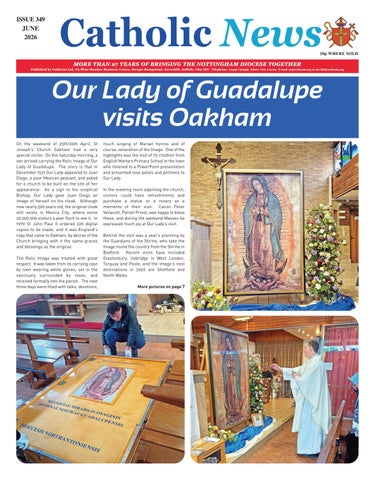

Our Lady of Guadalupe visits Oakham
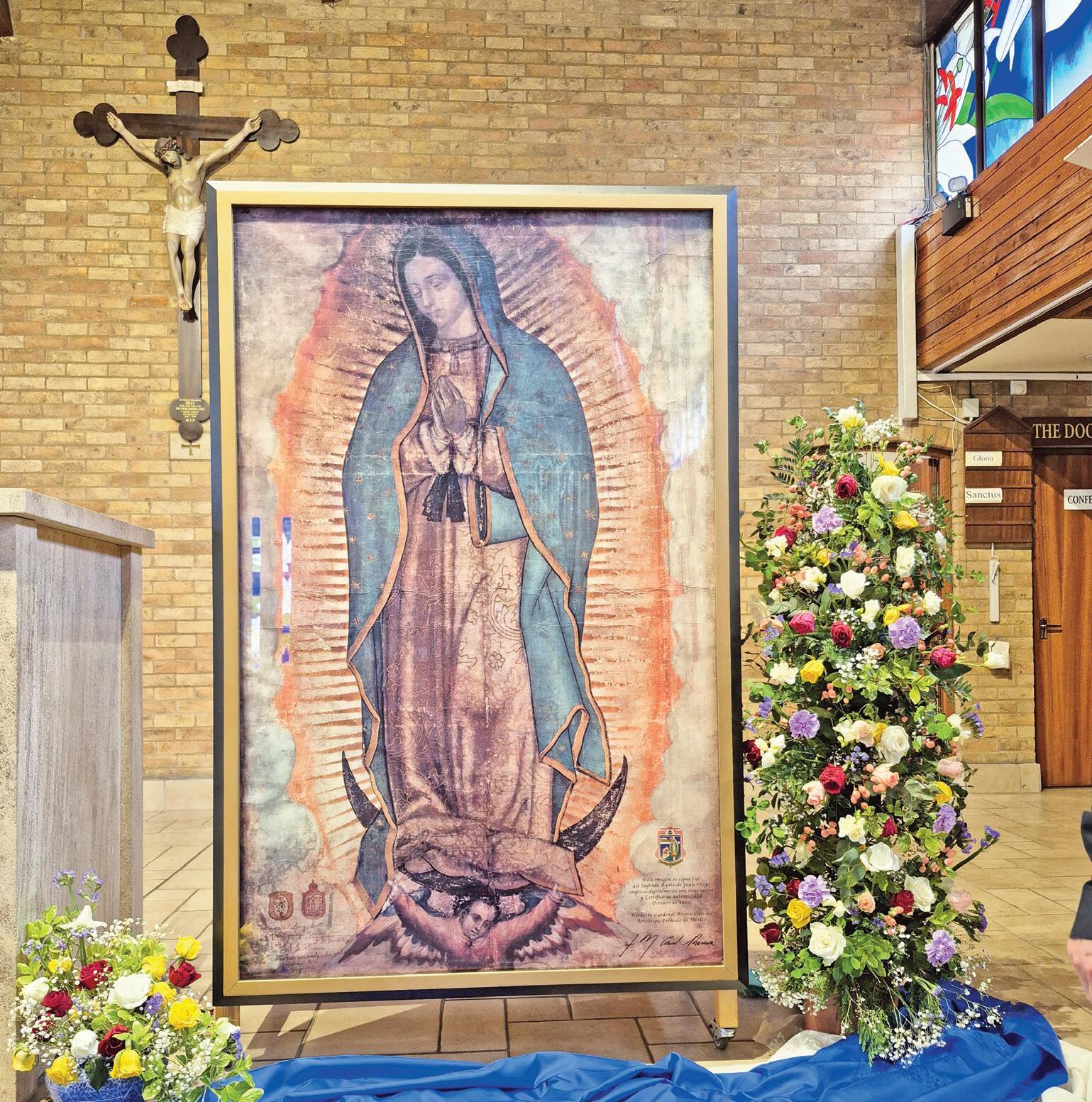
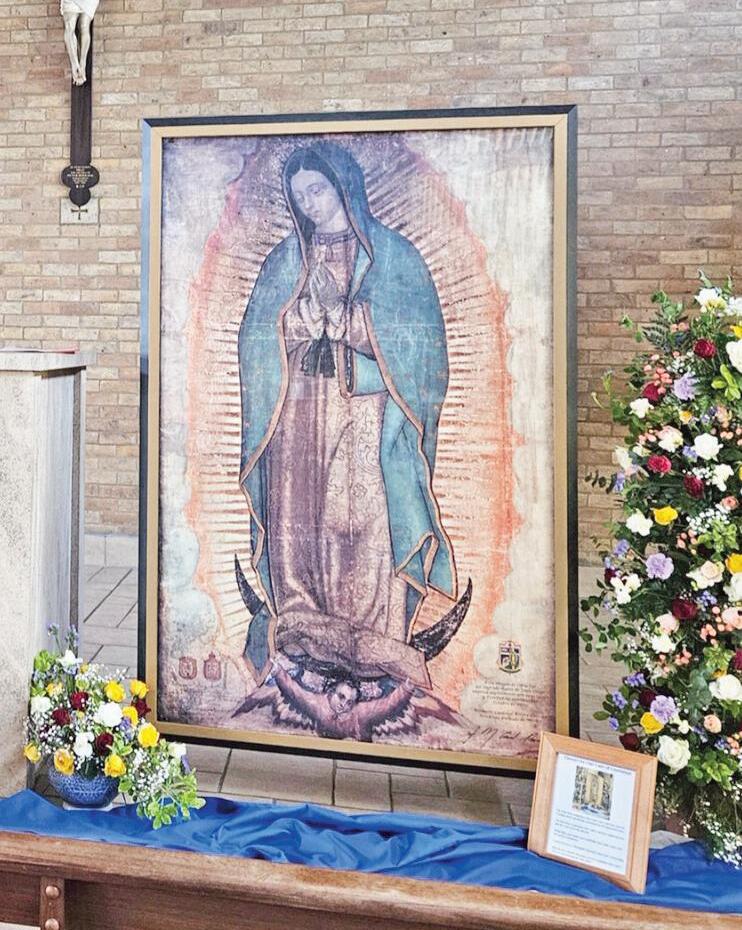
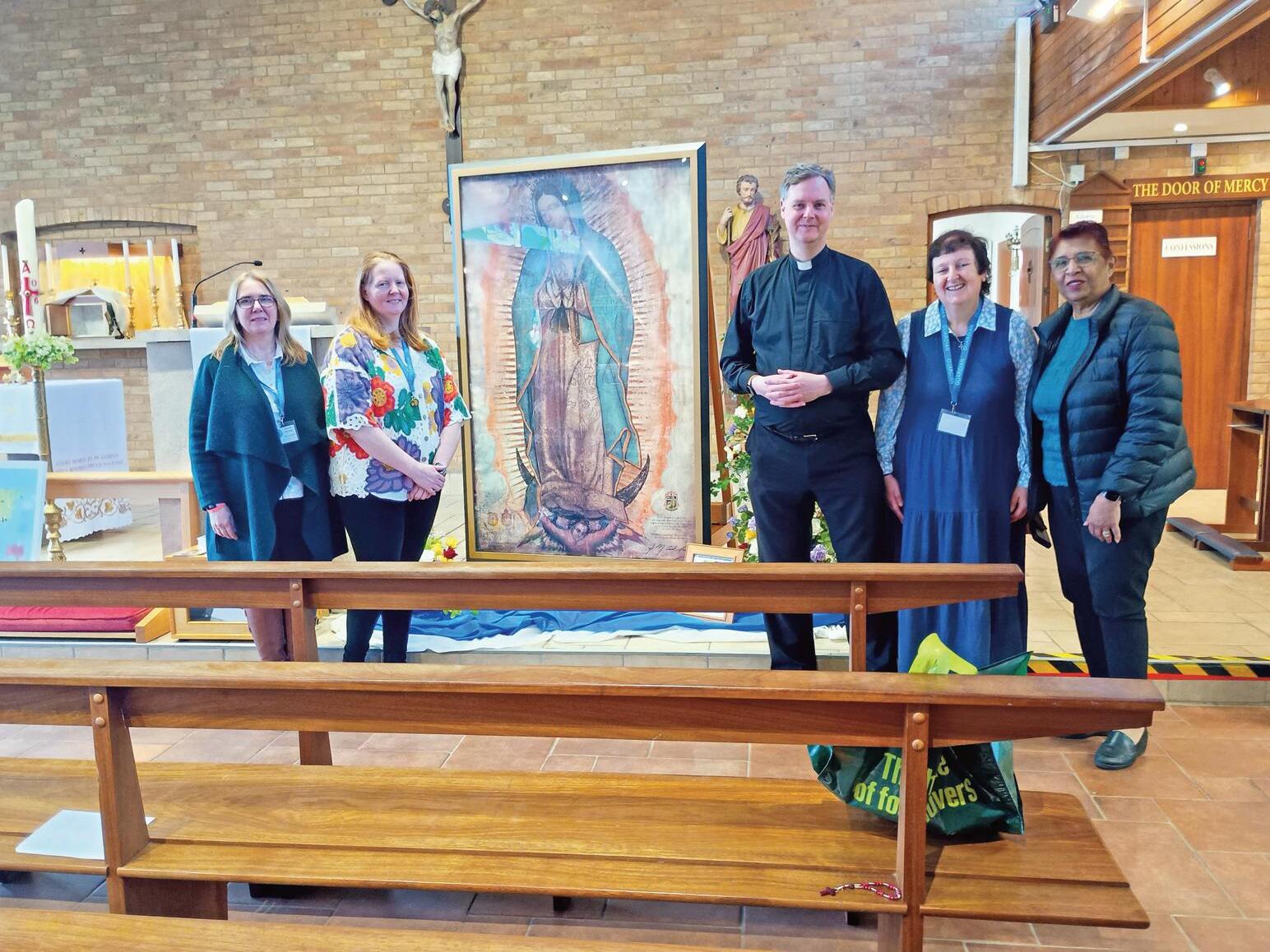
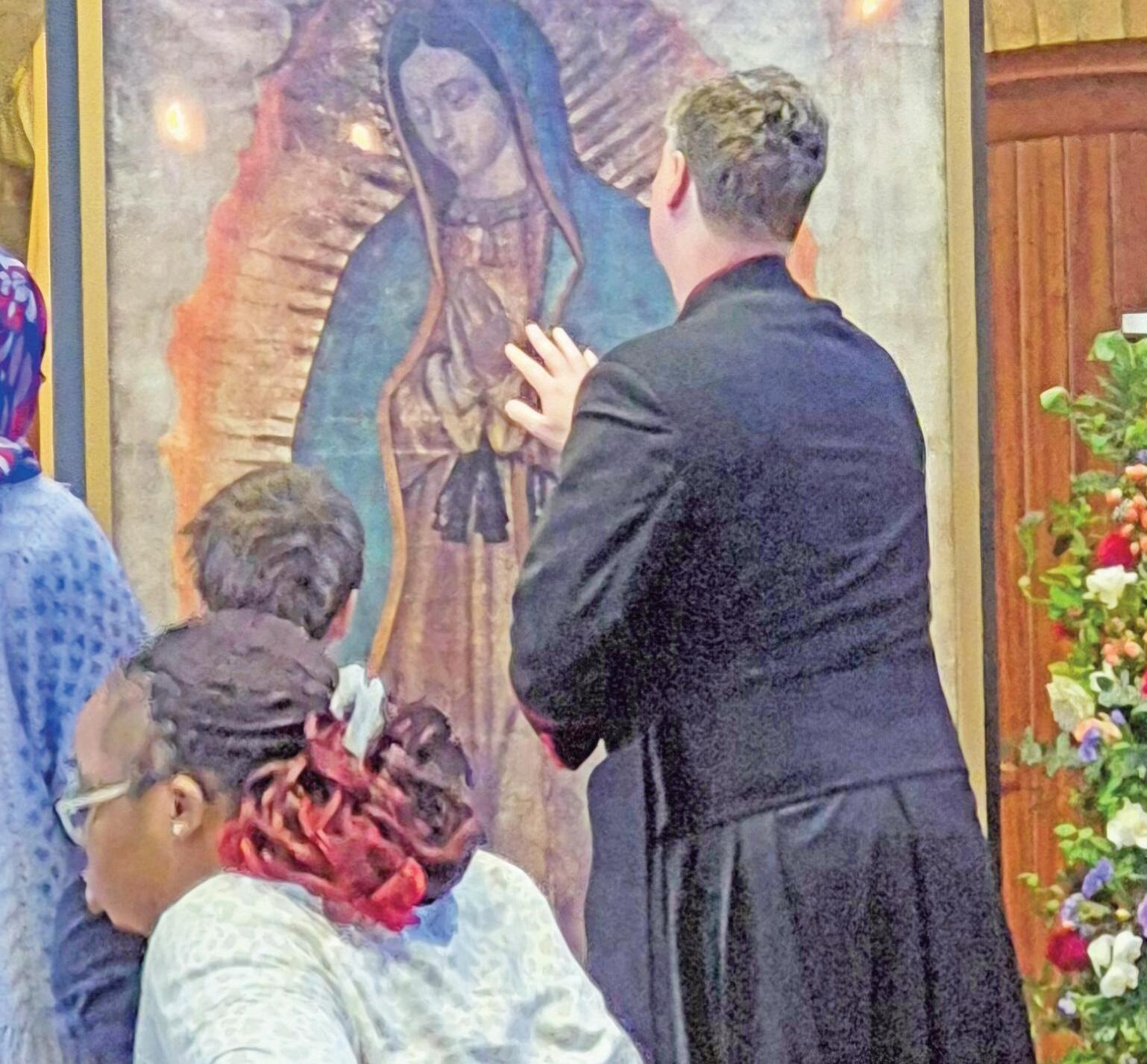
On the weekend of 25th/26th April, St Joseph’s Church Oakham had a very special visitor. On the Saturday morning, a van arrived carrying the Relic Image of Our Lady of Guadalupe. The story is that in December 1531 Our Lady appeared to Juan Diego, a poor Mexican peasant, and asked for a church to be built on the site of her appearance. As a sign to his sceptical Bishop, Our Lady gave Juan Diego an image of herself on his cloak. Although now nearly 500 years old, the original cloak still exists in Mexico City, where some 20,000,000 visitors a year flock to see it. In 1979 St John Paul II ordered 220 digital copies to be made, and it was England’s copy that came to Oakham, by decree of the Church bringing with it the same graces and blessings as the original.
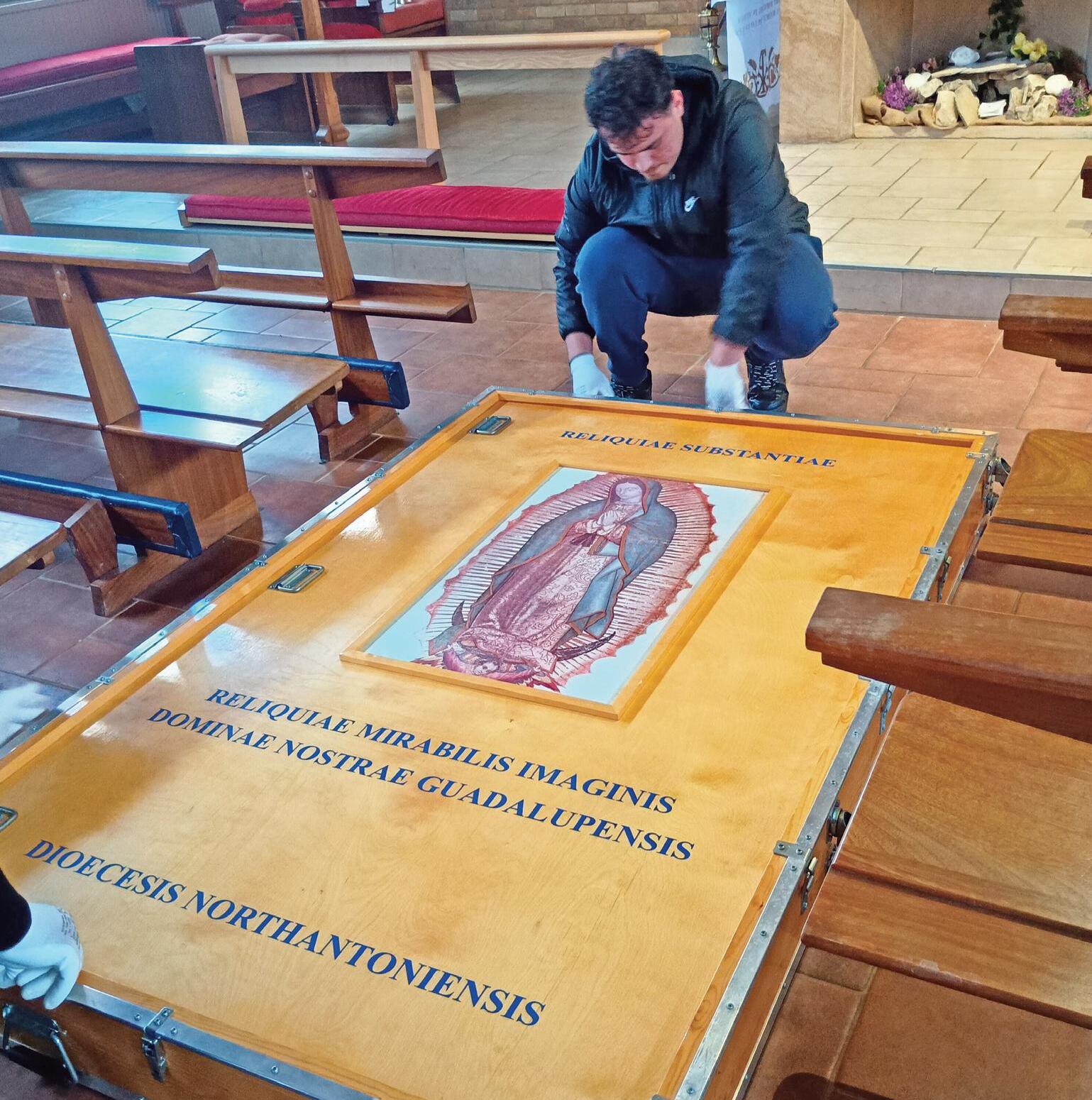
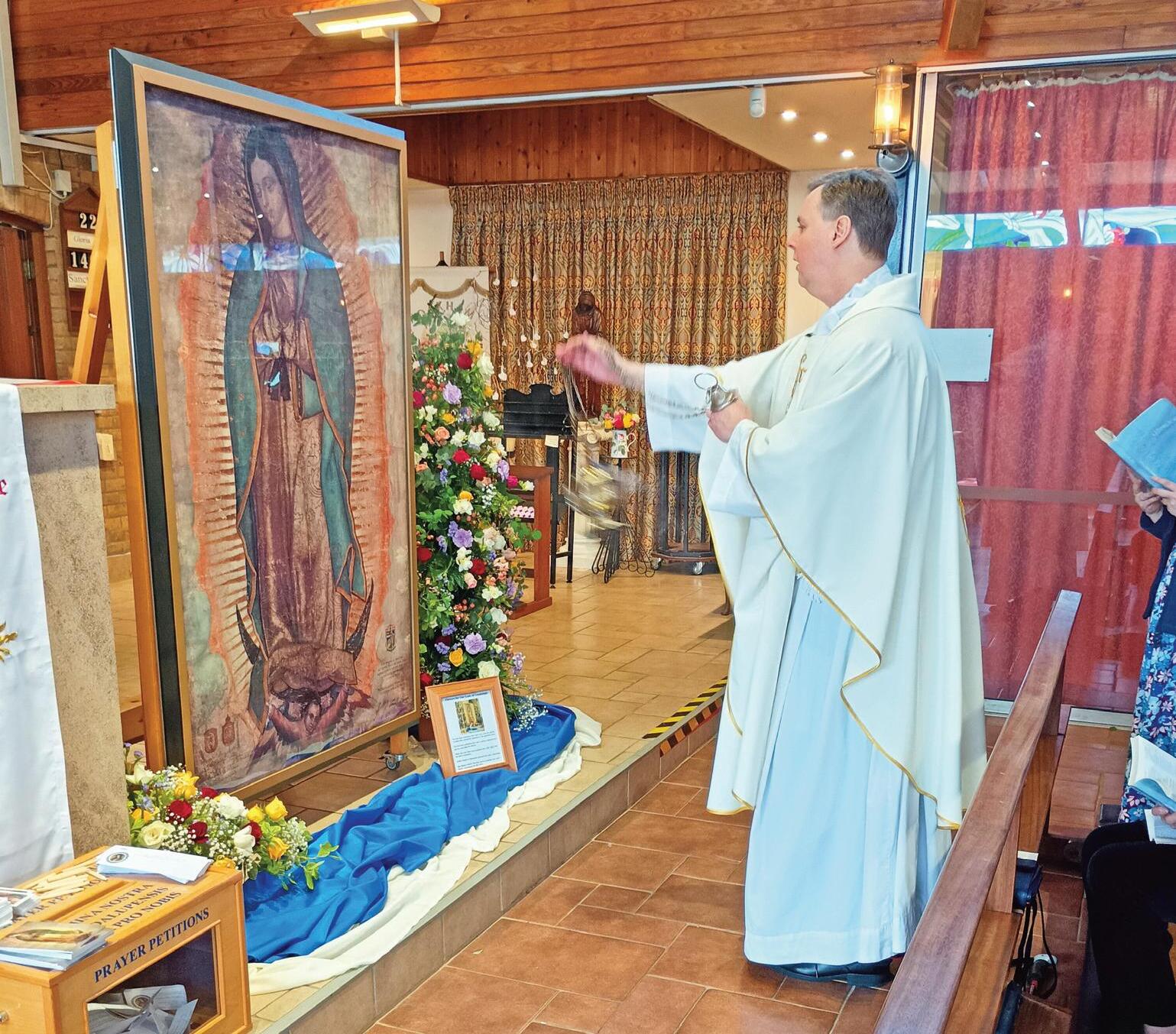
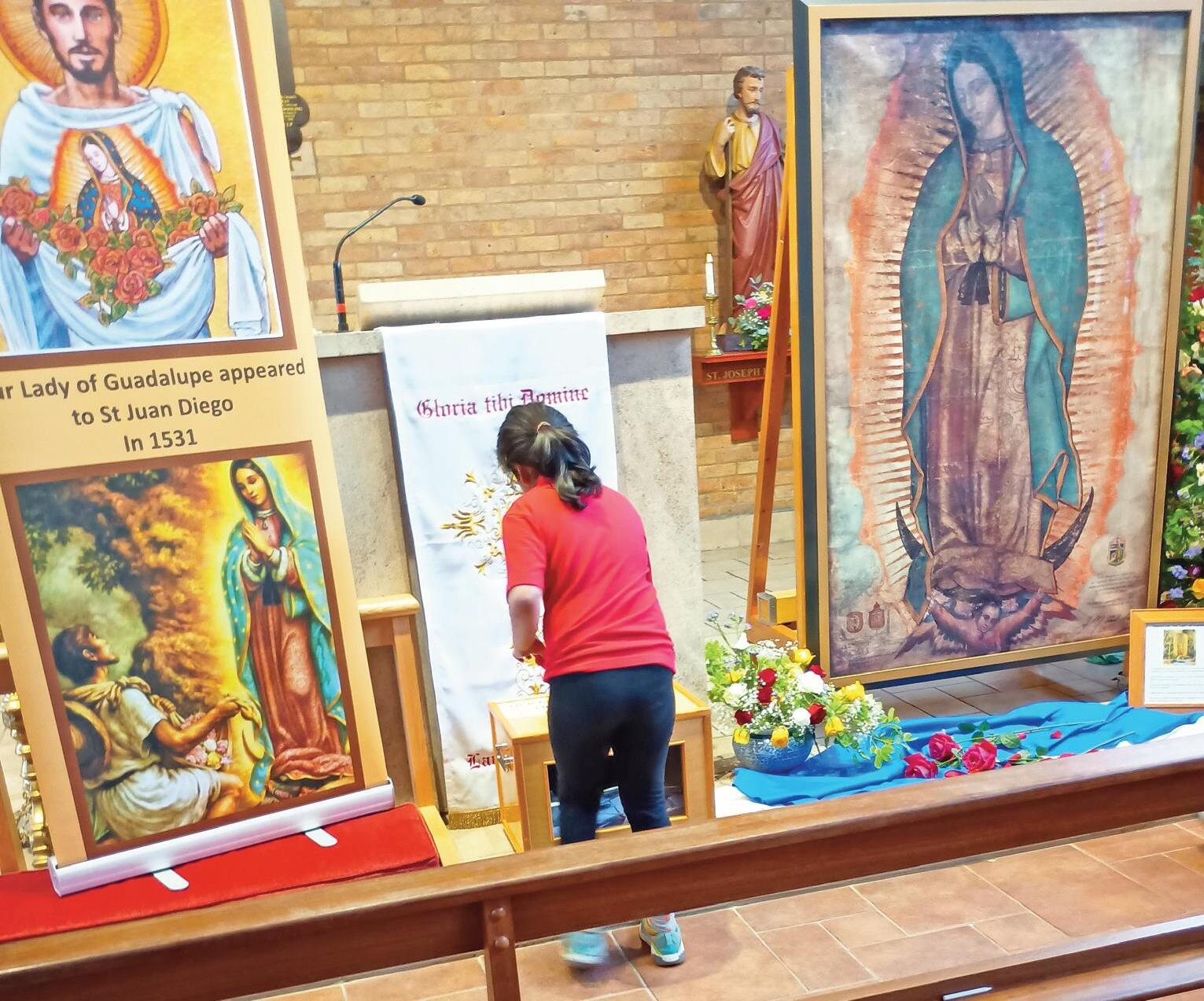
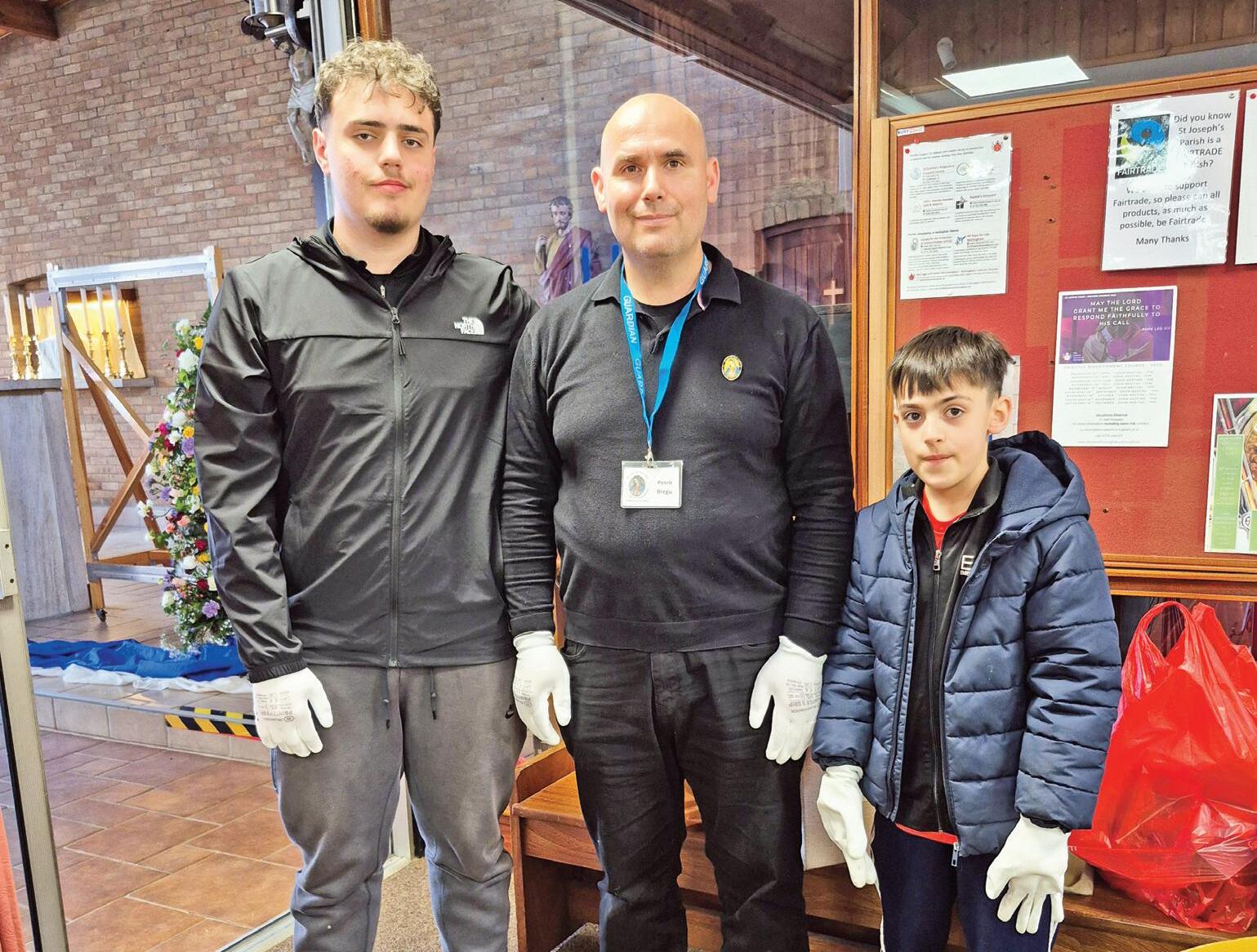
The Relic Image was treated with great respect. It was taken from its carrying case by men wearing white gloves, set in the sanctuary surrounded by roses, and received formally into the parish. The next three days were filled with talks, devotions,
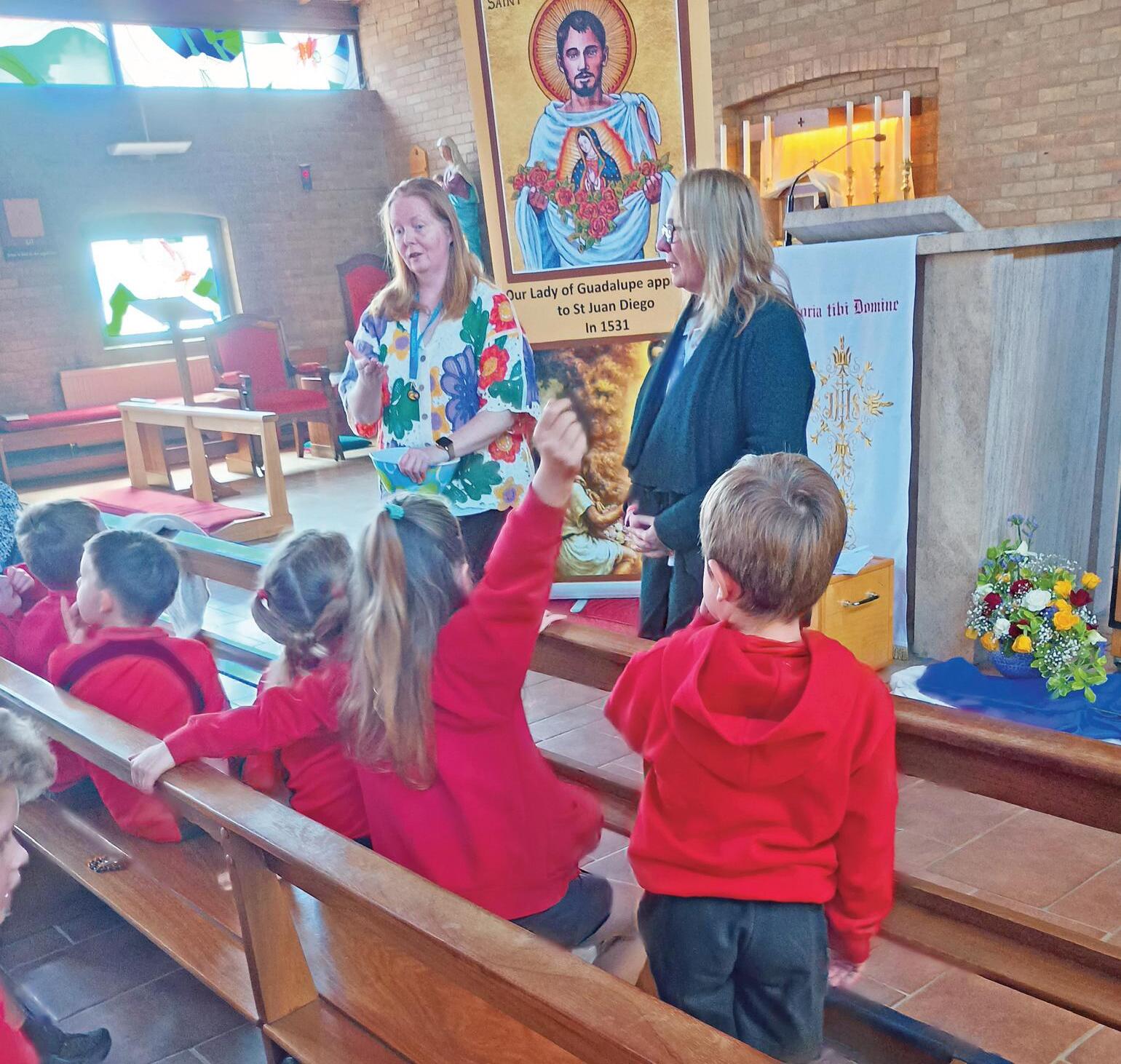
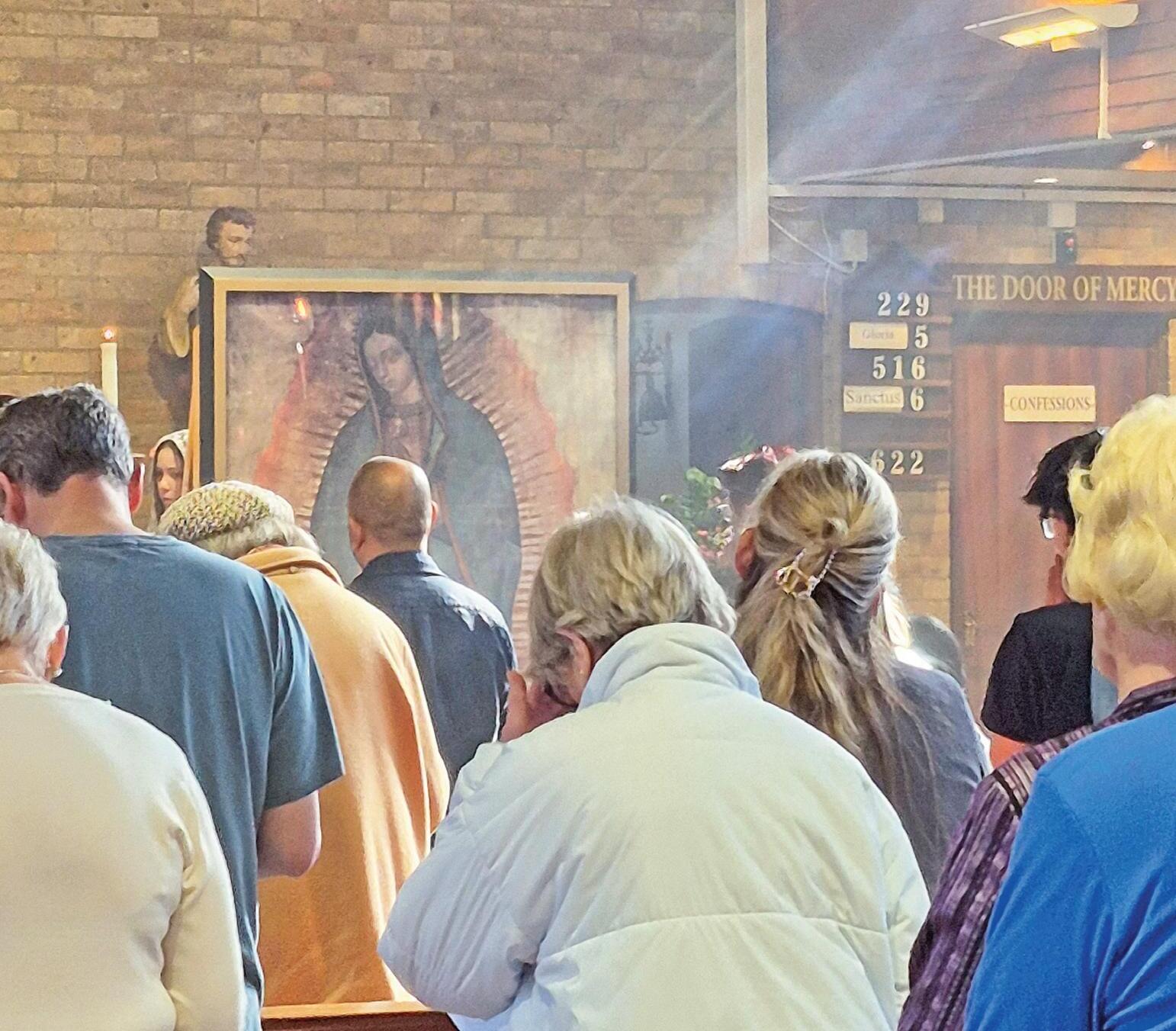
much singing of Marian hymns and of course, veneration of the Image. One of the highlights was the visit of 75 children from English Martyrs Primary School in the town who listened to a PowerPoint presentation and presented rose petals and petitions to Our Lady.
In the meeting room adjoining the church, visitors could have refreshments and purchase a statue or a rosary as a memento of their visit. Canon Peter Vellacott, Parish Priest, was happy to bless these, and during the weekend Masses he expressed much joy at Our Lady’s visit.
Behind the visit was a year’s planning by the Guardians of the Shrine, who take the Image round the country from the Shrine in Bedford. Recent visits have included Glastonbury, Uxbridge in West London, Torquay and Poole, and the Image’s next destinations in 2026 are Sheffield and North Wales.
More pictures on page 7
The monthly paper for the The monthly paper for the Diocese of Nottingham Diocese of

Editor: Nick Layton
Editorial Office: CathCom Ltd, N2 Blois Meadow Business Centre, Steeple Bumpstead, Haverhill, Suffolk, CB9 7BN
Telephone: 01440 730399
email: cn@cathcom.org or davidl@cathcom.org
Website: www.cathcom.org
Distribution enquiries: cn@cathcom.org
CathCom Ltd,
Publication date: Fourth Sunday of the month for the following month. Opinions expressed by contributors are not necessarily those of the Editor or the Diocese.
Publishers and Owners:
CathCom Ltd, N2 Blois Meadow Business Centre, Steeple Bumpstead, Haverhill, Suffolk, CB9 7BN
Advertising: tel: 01440 730399
Parental permission should be sought before submitting photographs of minors.
Views expressed in The Catholic News are not necessarily those of the editor.
Wanted Parish Correspondents
The Catholic News is looking for a Parish Correspondent in your parish to send in local news for publication in this newspaper. All items to be emailed to cn@cathcom.org before 10th of the month
"Perhaps the Pope should stay in his lane " In recent weeks, the worlds of politics and faith have clashed, with Pope Leo being lambasted for his comments defending the innocent victims of war. How very dare he?
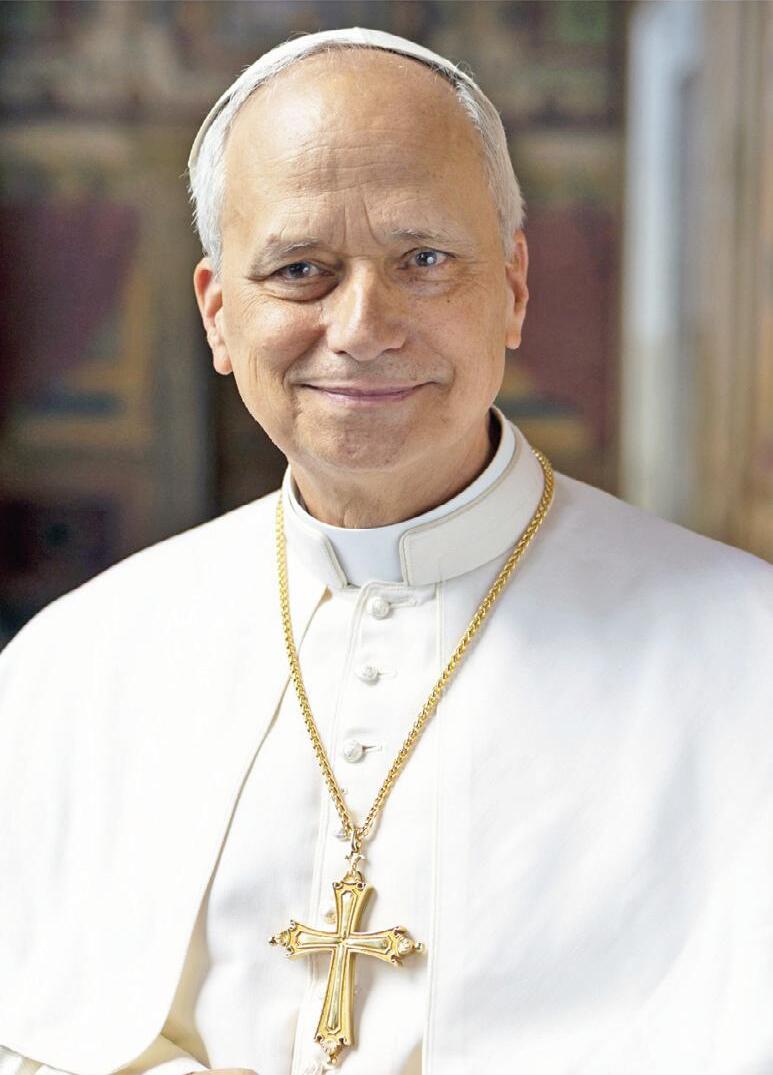
All the same, it might be worth reflecting on what exactly is the Pope's "lane"?

Reflection
If we’re honest, the question itself reveals a misunderstanding. It assumes that faith can be neatly separated from the real world, that religion belongs in what, at its best, is a private devotion and, at its most ineffective, a lifeless faith, while public life carries on untouched. But that has never been the tradition of the Church, and it certainly isn’t the tradition of Saint Vincent de Paul. The Pope’s “lane” is the Gospel. And the Gospel has never stayed quietly in one place.
Matthew's Gospel tells us, “Whatever you did for one of the least of these… you did for me”; it is not offering a private spirituality. It is a public, uncomfortable, and deeply practical claim about how we treat the vulnerable. When innocent people suffer, whether through war, poverty, or neglect, the Church cannot pretend it is none of its business. To do so would be to step out of its lane, not stay within it.
Frankly Speaking

Blessed Frederic Ozanam further instructed, "Charity is the Samaritan who pours oil on the wounds of the traveller who has been attacked. But it is justice’s role to prevent the attacks." We have clearly been called to recognise and to respond, to feel compassion and outrage, to love and to defend the vulnerable.
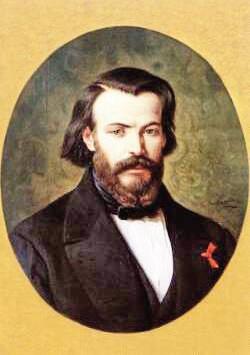
Being true to the Vincentian mission the members’ lane is and has always been the cry of the poor, the care for our common home, the fight against injustice and that earth may be as Heaven. Vincentians stay in their lane, not in a rut.
Cornwall
by











Writing this article in the early days of May it was not easy to look back at the first 4 months of 2026. The conflict which commenced on February 28th and sadly incorporated much of the area which surrounds the Holy Land was still claiming fatalities despite an ongoing three week ceasefire. Drone and missile strikes in Ukraine with tragic loss of life were also reported in an area besieged with warfare since February 2022.
Sadly there are parts of the world which appear to be forgotten or at least cannot gain much if any coverage by our news media. In a letter published in The Times newspaper on April 14th Bishop Paul Swarbrick the lead Bishop for Africa gave some update on the plight of Sudan. The Bishop spoke of 30 million people who require humanitarian support. For possibly 150,000 this is already too late.
There must be many in our news media who know much more about the background to Sudan although I recognise that information has not been easy to obtain. The Bishop of Lancaster concluded “the present approach verges on indifference - surely we can do better.” We still have British politicians who want more cuts to our foreign aid budget despite two in recent years. Readers must draw their own conclusions.
In our country, much of the recent media coverage has been on the local elections. Despite many areas not having a vote the fractured state of British Politics has been much in evidence with aggressive allegations on personalities and sadly much more. I am old enough to remember when local polls were very different to how they are now. I am not sure if the role of local government can ever be about the
community spirit which it used to promote.
The recent pontifical tour of Africa by Pope Leo was quickly followed with a Vatican meeting which greeted the new Archbishop of Canterbury Dame Sarah Mullally. Vast congregations greeted the Pope in Africa and his welcome was accompanied by what can only be described as sheer joy at all the Masses he celebrated. Whist the Archbishop’s visit included a private audience and praying together there is no doubt that Pope Leo is greatly concerned at world suffering and recognises that the “divisions among Christians weakens our capacity to be effective bearers of that peace.” Just one year into his Papacy Pope Leo is truly a man of Peace.
Frank Goulding
Blessed Frederic Ozanam
Jon
When I needed a neighbour were you there?
With Easter a memory, one of the seven words spoken by the Lord on the Cross on Good Friday, resounded again in my ears “my God, my God, why have you forsaken me?”.
A ‘Holy Hour for the Dignity of Life’, to promote a culture of life, was held, for the Catholic community of Lincoln, at Our Lady of Lincoln Church, as part of an initiative by the Catholic Bishops of England and Wales, which encouraged parishes in the two nations to unite and hold a Holy Hour on the same day. At the start of the service we were encouraged to pray with particular regard to the Terminally Ill Adults (End of Life) Bill, that was then passing through the House of Lords. During the time of Adoration, the people likely to say yes to assisted suicide, should it be legalised, came to mind, together with the question asked by Jesus during His crucifixion and it struck me how it may well be one they are asking too.
The terminally ill person without adequate palliative care ... The frail elderly without love and care ... The person with chronic pain/mental illness/disability/loneliness without compassionate community ... The person with no home .... “my God, my God, why have you forsaken me?”
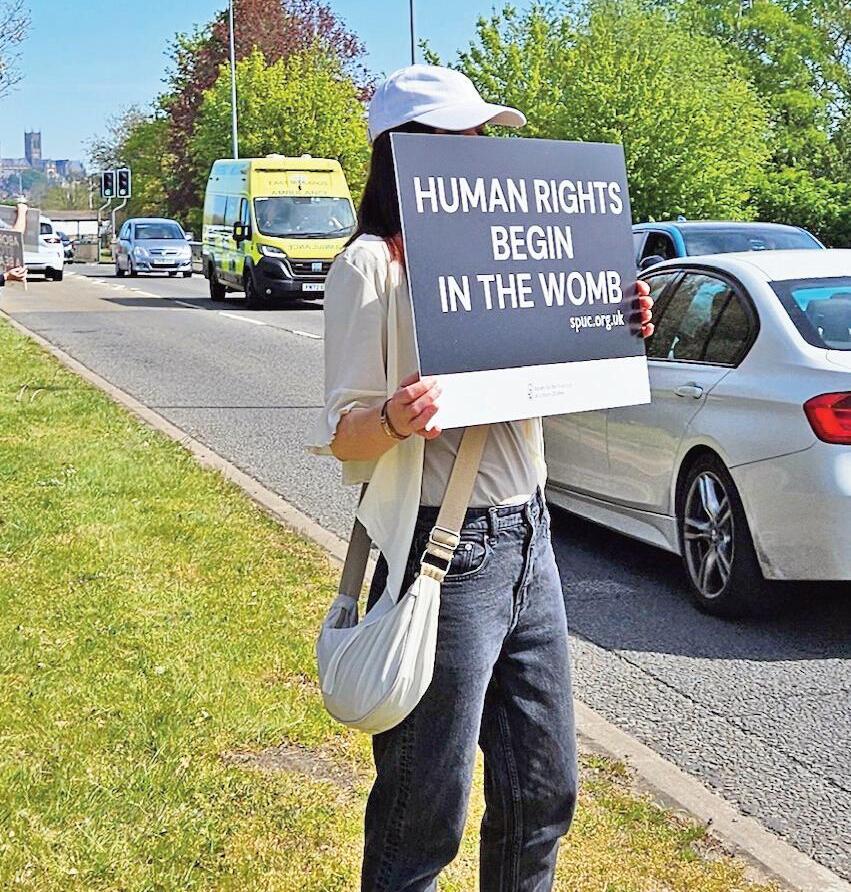
Pondering, too, the silent roadside vigil, organised by a parishioner from St Peter & St Paul Church and planned for the following weekend, part of an annual nationwide Pro-life Chain initiative by the charity Society for the Protection of Unborn Children (the chains take place each year to mark the passing of the 1967 Abortion Act taking effect), the question again echoed in my mind:
The babies being aborted ... The pregnant mother without loving and practical support ... The father with a child being aborted against his wishes ... The medical professional coerced into participating in abortion practices ... “my God, my God, why have you forsaken me?”
A few days later, the first reading at Mass (Acts 9:1-20) provided encouragement for the chain, as did a song on the radio during the drive home and the discovery that on the same weekend a church in our diocese (St Joseph’s Church, Oakham) would be hosting the relic image of Our Lady of Guadalupe, ‘Protectress of the Unborn’ (one of two hundred and twenty replicas commissioned by Pope Saint John Paul II for distribution worldwide), providing inspiration to accompany the chain with her image and seeking her intercession.
Encouragement is invaluable, for in light of the 1967 Abortion Act (which so far has led
to the loss of life for almost eleven million unborn babies in Great Britain as well as emotional/physical harm for the parents of those children), the recent failure to stop the amendment to the Crime and Policing Bill (which will decriminalise mothers who carry out their own abortions up to birth), the push by many politicians to introduce assisted suicide to the country and support for ‘pro-life’ activities often limited, a Christian, praying for people to know their true identity and experience His mercy, can find themselves asking “my God, my God, why have you forsaken me?”.
Seeking death and promoting life can, however, be two sides of the same coin. The former seeking escape from life ‘without’ God and the latter promoting life with God; in this way, both parties are pro Life, both acknowledging (whether knowingly or not) that life without God is not worthy of our dignity, but living in different kingdoms and rejecting such a life by different means as a result. In the BB King/U2 song ‘When love comes to town’ there is a line ‘I did what I did before love came to town’, it begs the question, are we bringing Love to our communities? To remain silent or neutral, as a Christian, in relation to God and Life issues can be a false mercy, used by the forces of darkness to serve the lies: God does not exist or care, Jesus is not Lord, save yourself.
Whilst such silence may feel soothing, it does not light the path to freedom and eternal life; when God sent Moses to Egypt, He did not tell Moses to remain in Egypt and comfort his people, but rather to lead them out of Egypt, to liberate them. In Acts 9:1-20 Jesus sought Saul on the road to Damascus and challenged him, leading to his conversion, perhaps the witness or words on the placards challenged one or more of those who passed by the chain, setting in motion their conversion. Jesus left us the commandment: ‘love one another, as I have loved you’ (John 13:34), He has sought each of us, let us ask ourselves, do we seek others, that, through the Holy Spirit, they too may know Him and enter into His Kingdom?
The question “my God, my God, why have you forsaken me?” is then at the same time a cry from us for mercy and a call to us for repentance and conversion (for inhabitants of both kingdoms). May we pray that Christian communities will ‘stand in the gap’ for those yet to experience the Lord and exhibit a credible witness to the reign of Jesus, providing an attractive alternative to ‘seeking death’, so that we not only actively promote life with God, but offer it, too, a living embodiment of the Sacred Heart of Jesus, whose Feast Day we celebrate this month. Rather than ‘them
and us’ may we, together, explore our common ground, be loving neighbours and seek and work for justice for all, such that everyone can experience the fullness of life Jesus said He came to bring, along with the peace and hope that comes with knowing you are created in the image and likeness of God and that life is infinitely precious. Then the demand for ‘choice’ and the question “my God, my God, why have you forsaken me?” will eventually become redundant, for all, and the powers of darkness, fuelling lies, division and death, rendered impotent.
Whilst the assisted suicide bill ran out of time for it to pass into legislation on this occasion, it is possible that politicians could
try to reintroduce it again, even during this new parliamentary session, which began on May 13th. It is therefore important, as far as possible, to continue making contact with MPs and Peers (including to thank those who, to date, have stood up for Life) and be a neighbour to the vulnerable and voiceless. For more information how to, visit the SPUC website: www.spuc.org.uk
With thanks to the organisers of the Holy Hour, pro-life chain and relic image tour. Lord, pour upon us your Spirit, thy Kingdom come! Our Lady of Guadalupe, pray for us.
‘Limitless’: Men renew faith and fellowship on diocesan retreat
With the sacraments at the centre, the retreat strengthened men for everyday discipleship: at home, at work and in parish life.
More than 40 men, from across the Diocese of Nottingham, journeyed together in faith on March 28th, as they met for a day retreat in the beautiful surroundings of Mount St Bernard’s Abbey.
The retreat, entitled ‘Limitless,’ was led by Canon Chris Thomas and there was time for Confessions, Mass and Stations of the Cross.
During one of his addresses, Canon Chris reflected on the Gospel story of Jesus, healing the man born blind. He said: “The problem with limits is that we often feel hemmed in by them. We feel constrained by past mistakes, habits, fears, responsibilities. But the first of our Gospels today, the Man born Blind in John 9, is not just about physical healing, in fact, it’s not a healing sign at all, it is about identity, transformation, courage and mission. It is about a man who begins in darkness and ends as a witness who cannot be silenced.
And if we are honest, that’s the journey our Lord Jesus wants for each of us.”
He later concluded: “Looking at this Gospel gives us insight into breaking the boundaries that limit us as disciples. Being limitless does not mean you have no struggles, weaknesses or you reach perfection. It means that we are not defined by these things. What being limitless means is seeing with faith, acting with courage and living with purpose.”
The men present, also heard powerful testimonies of faith from two men who had be recently received into the Church.
One of the men talked about how as a teenager he pursued a hedonistic and reckless path but how the later loss of his sister and her husband in the space of one year, had a huge impact on him, as they left behind a six-year-old son. He and his wife began to grow in faith, thanks to the faith
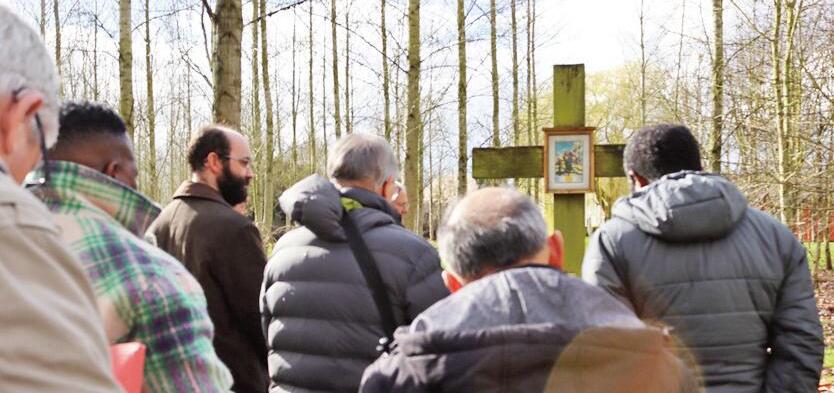
legacy of this deceased couple and four years ago, he converted to Catholicism.
The retreat was organised by the Department for Adult Formation and Mission. Joe Hopkins, who directs the department said: “There is an ever-greater need in our society for men to know their value and vocation and the Church in her wisdom has so much to offer in this respect.
From: Elston Hermitage…….....
One could easily assume that life lived in a ‘hermitage’ would be at all times serene, quiet and without much interruption from the elements of life lived fully in the world.
It is true to say that living consecrated lives as priests and hermits this is pretty much true. Every day from morning until evening has its prescribed structures and routine - but very often this is paused for one reason or another.
Today was such a day, I had a hospital appointment at ten o clock, had arranged to meet someone at midday and almost on the stroke of midday there was a telephone call, and another unexpected caller at the door who needed some help.
Week by week we see many people who are troubled either in mind or spirit and seek the solace which the hermitage affords. Worry and anxiety is an ancient, modern and common problem which afflicts most of us (even hermits) at one time or another for who does not worry?
The sage was right when he reflected; ‘Anxiety in a man’s heart weighs him down’ (Proverbs 12:25)
Jesus warned his disciples against being unduly anxious. ‘Let not your hearts be troubled’ (John 14:1 ) St Paul exhorted the Philippians: ‘Have no anxiety about anything, but by prayer and supplication with thanksgiving, let your requests be made known to God (Phil.4:6). Peter urged the flock in his care ‘Cast all your anxieties on him, for he cares about you ‘ (1Peter5:7)
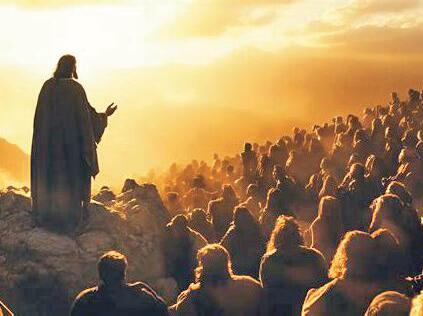
In the Sermon on the Mount Jesus, clearly is concerned that his disciples should not give way to worry and anxiety.
All of us at sometime devote much time and energy to fretting about all manner of things, what we will eat and what we will drink, how we will look after our body, our health, what we will wear, but Jesus directs us back to look at the blessings God bestows on us and on all living things ‘Look at the birds of the air, they neither sow or reap….. Consider the lilies of the field, how they grow they neither toil or spin.’
The point is of course if God our Father does such a wonderful job of caring for the natural world he has created, will he not do an even better job looking after us who are created in his image and likeness?
“The men’s retreat was a wonderful opportunity, not only for prayer and meditation but also for fraternal connection. The testimonies and meditation provided were so inspiring and reminded those present that through all the pressures of modern life, God is constant and faithful.”
of Nottingham
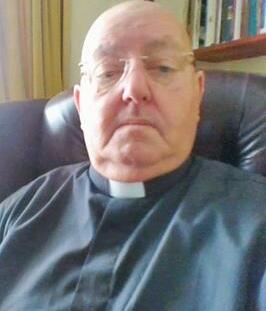
I hope that the many souls who visit the ‘hermitage’ here in Elston, leave having found some solace, good advice and an inner peace. Many people come along with questions to ask in order to resolve what is troubling them, however I always take leave of people with a question. Who can by being anxious, fretting or worrying, add one cubit to his span of life?
The ‘hermitage’ here in Elston is indeed a place where we live closely in a consecrated relationship with the Risen Lord, in prayer and solitude. However, following the Rule of Our Holy Father Saint Benedict, we believe that every guest should be received as Christ himself.
By Fr David + h.d.n. Priest
Diocese
Scripture Focus
Facing Stress
By Fr Jeremy Corley

Mental health is a major issue for many people in our society today. Even if a person is physically healthy, the stresses of life can cause mental anguish and distress. Naturally there may be causes that are specific to individual circumstances.
The stresses can be more painful because many of us in today’s society are conditioned to expect an easy stress-free life. A hundred years ago, everybody knew that life was tough, with many challenges. Today resilience to face challenges is less common.
The scriptural writers knew that life on earth could be hard. That is why they shared their experiences of sorrow as well as joy. For instance, the Book of Job describes the suffering of one good man who finds little sympathy from his so-called comforters.
The prophet Jeremiah also offers a very direct and honest account of the travails
he suffered for being faithful to his personal vocation. When he was called by God, he was warned that he would face opposition, even from his own people. But God gave him this promise: “I am with you, says the Lord, to deliver you.”
The first reading on the 12th Sunday of the Year (21st June) has an extract from the last of Jeremiah’s five laments. These are like his diary entries or Facebook posts, chronicling with searing honesty his reactions to the distress caused by his opponents.
One of the most painful experiences in life is to be betrayed by people you have trusted. During this sad experience, Jeremiah laments: “All my familiar friends are watching for my downfall.” The prophet had aimed to be faithful to his calling, but when his message displeased those around him, they turned against him.
Faced with this difficult situation, Jeremiah sought refuge with God, remembering
God’s earlier promise. Hence, he could affirm his faith: “The Lord is with me as a mighty warrior.” Even when facing severe opposition, the prophet did not take vengeance into his own hands but relied on God to vindicate him and overcome his enemies.
When God intervened to rescue him, he offered thanksgiving: “Sing to the Lord, praise the Lord, for he has delivered the life of the needy from the power of evildoers.” Jeremiah had entrusted his pain and anguish to God, and now he expressed his gratitude when his distress was eased.
In the gospel for Sunday 21st June, Jesus also tells his followers not to expect an easy life. Indeed, because some of his early followers could face martyrdom, Jesus tells them starkly: “Do not fear those who can kill the body but cannot kill the soul.”
Moreover, he reminds his hearers that each person is immensely valuable to God: “Even the hairs of your heads are all numbered.

You are of more value than many sparrows.” God values each person, created in his image and likeness.
When we face personal struggles, sometimes we can doubt our selfworth and think that we are useless. We can even feel that God no longer cares about us. In such a situation, there is no simple cure. But we can draw inspiration from courageous witnesses who have gone before us, whether prophets like Jeremiah, great saints like the martyrs, or brave people we have known.
When he was called, Jeremiah had been told by God: “I am with you, to deliver you.” And when he faced opposition, he said: “The Lord is with me as a mighty warrior.” Like Jeremiah, we can trust that we are not alone in our difficulties. God is with us, even if sometimes he seems distant. So, in the bad times as well as the good times, let us commit our lives to him.

The Sacraments of Initiation – Baptism
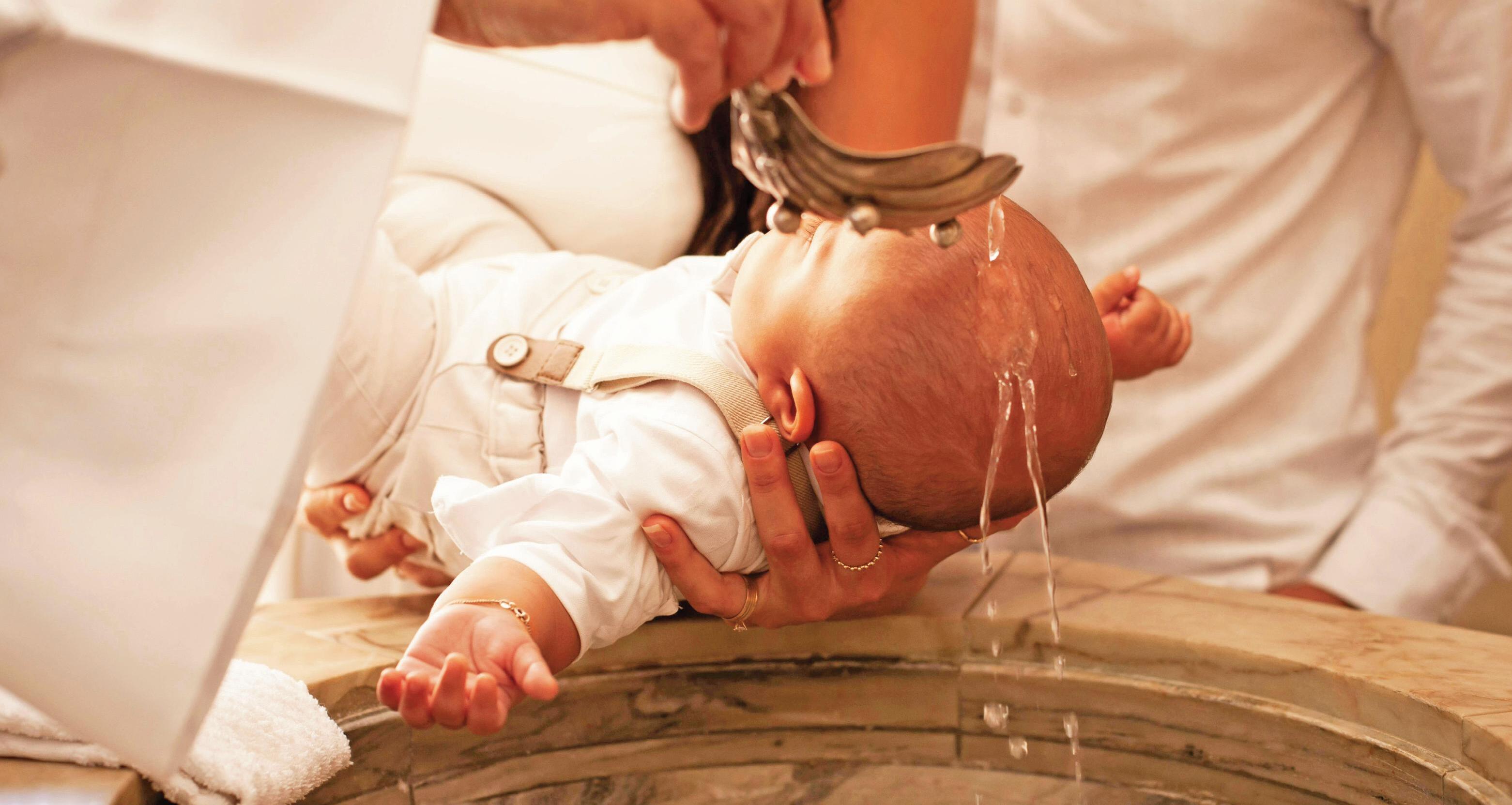
Every religion has some sort of initiation process. This includes Christianity. We hear in the Acts of Apostles that once people believed in the message of Jesus Christ, they were baptised and received the Holy Spirit. It was a mark of a new way of life of adhering and following the message that Jesus Christ gave us. Following the way of Jesus Christ or being Christian is a lifelong process. We do not mature at one moment in time, but for most of us, it takes a lifetime. The Sacraments of Initiation are the beginning of the process into the life of Christ, primarily the Paschal Mystery – that is the life, death, and resurrection of Jesus Christ.
The Church teaches that through the Sacraments of Initiation we are freed from the power of darkness and joined to Christ’s death, burial, and resurrection. In a modern understanding, we are freed from selfishness, pride, injustice, and wrongdoing, and brought to fullness of life in Christ, which is a life of giving, justice, reconciliation, peace, and love. Let us focus on the gateway to the life of Christ and to the other sacraments - Baptism.
Using true water and the formula determined by the Church - “I baptism you in the name of the Father, and of the Son, and of the Holy Spirit”, we are washed and freed from our sin and are reborn as children of God and are incorporated into Christ’s body, the Church. Looking at the ‘materials’ involved in a sacrament help us to have a deeper understanding of what is happening in the sacraments. Water has the quality of cleansing and purifying. Through baptism, original sin and any
personal sin is washed away. Humanity enjoyed a harmony with God, with each other, and with creation at one time, but through the sin of Adam and Eve, that harmony was broken. It had a ripple effect. We see the effects of this, time and again, in the world around us with so much injustice, hatred, pride, and war. Although Baptism washes away Original Sin, we still face the reality of a struggle with sin. The Sacraments of Healing help us with this struggle. Water also has the quality of renewal and refreshment.
Newness of life in Christ by being incorporated into him and therefore being his sons and daughters. We are conformed to the likeness of Christ, that our manner of life is transformed slowly into his life. Being incorporated into Christ also entails that we are incorporated into the life of the Trinity – a life of love and relationship. By being incorporated into Jesus Christ, we are incorporated into his Body, which is the Church. Being Christian is never a private endeavour but is cooperative. It is easy for us to view the celebration of the sacraments in a magical manner, but it involves, and presupposes, faith. That firm trust and belief in the message of Jesus Christ.
Faith also entails that we live it out and foster it by prayer, reading the Word of God, celebrating the Sacraments, and works of charity for each other. The Sacrament of Baptism is the start of our Christian journey and not the end. We are in need of the other Sacraments for this life in Christ to grow and mature.
Fr Anthony Fyk
Image: Lopz Jr
Continued from page 1 - Our Lady of Guadalupe visits Oakham
View from the Pew

By Dr Jay Kettle-Williams
‘God of Gode, Leoht of Leohte’
Language has always interested me, particularly etymology which is concerned with the development of words. By that term ‘language’ I mean the code we employ in everyday intercourse between ourselves as we go about our business and with the constituent parts: verbs, nouns, adverbs, adjectives and their fellows.

I believe in one God, the Father almighty, maker of heaven and earth, of all things visible and invisible.
Qui cum Patre et Filio simul adoratur et conglorificatur: qui locutus est per prophetas.
Who, with the Father and the Son, is adored and glorified: Who has spoken through the Prophets.



It’s interesting to note that human language is the only social institution without which none other could function. Without language we wouldn’t have the Bible, we wouldn’t have the Ten Commandments, we wouldn’t have the Sermon on the Mount, there’d be no homilies at Mass (please don’t smile at this point) … and Shakespeare, let alone Dickens and the others, would never have put quill to paper.
So a video clip on ‘X’, formerly Twitter, recently caught my attention. It had been originally posted a year or more ago by the Church of England.
The Church of England, as we all recognise, was formally founded in 1534 through the Act of Supremacy. King Henry VIII was declared "Supreme Head of the Church of England" in official severance of ties with the Roman Catholic Church and the Pope. This act of separation was primarily in response to the Pope's refusal to annul Henry's marriage to Catherine of Aragon, the youngest daughter of the Catholic Monarchs (Ferdinand II of Aragon and Isabella I of Castile) who had returned Spain to Catholicism after nearly eight hundred years of Muslim rule (711-1492).

But the video clip took us back to long before 1534, long before Catherine of Aragon, the mother of Mary Tudor (Queen Mary I of England) and who played such a pivotal role in English politics and the prelude to the English Reformation.
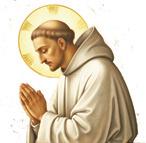
The presenter of the video on ‘X’ spoke about the monk Aelfric who in 992, ironically some 500 years before the establishment of the CofE, translated the Nicene Creed from Latin into the English of his day, here in Latin and in modern-day English:
Et in unum Dominum Iesum Christum, Filium Dei **unigenitum, ex Patre natum ante omnia saecula. Deum de Deo, Lumen de Lumine, Deum verum de Deo vero, genitum non factum, consubstantialem Patri; per quem omnia facta sunt.
And in one Lord, Jesus Christ, the only begotten Son of God, born of the Father before all ages. God from God, Light from Light, true God from true God, begotten, not made, one in being with the Father; through Whom all things were made.
Qui propter nos homines et propter nostram salutem descendit de caelis. Et incarnatus est de Spiritu Sancto ex Maria Virgine, et homo factus est.
Who for us men and for our salvation came down from heaven. And he was made flesh by the Holy Spirit from the Virgin Mary, and was made man.
Crucifixus etiam pro nobis sub Pontio Pilato, passus et sepultus est, et resurrexit tertia die, secundum Scripturas, et ascendit in caelum, sedet ad dexteram Patris.
He was crucified for us under Pontius Pilate; suffered, and was buried. On the third day He rose again according to the Scriptures; He ascended into heaven and sits at the right hand of the Father.
Et iterum venturus est cum gloria, iudicare vivos et mortuos, cuius regni non erit finis.
And He will come again in glory to judge the living and the dead, and of His kingdom there shall be no end.
Et in Spiritum Sanctum, Dominum et vivificantem, qui ex Patre Filioque procedit.
And in the Holy Spirit, the Lord and giver of Life, Who proceeds from the Father and the Son.
Et unam, sanctam, catholicam et apostolicam Ecclesiam.
And (I believe in) one holy, Catholic and apostolic Church.
Confiteor unum baptisma in remissionem peccatorum. Et expecto resurrectionem mortuorum, et vitam venturi saeculi. Amen.
I confess one baptism for the remission of sins. And I look for the resurrection of the dead, and the life of the age to come. Amen.
The Nicene Creed, or Symbolum Nicaenum, was first adopted at the First Council of Nicaea (in the modern Turkish city of Iznik) in 325 AD and later amended at the First Council of Constantinople (in modern-day Istanbul) in 381 AD. It serves as a fundamental statement of Christian faith, accepted by the Roman Catholic, Eastern Orthodox, Anglican and most Protestant churches.
To watch and listen to the presenter of the video clip reciting the Nicene creed in Old English, Aelfric’s English of one thousand years ago - parts of which are intelligible to this day, parts of which are certainly not – simply scan the QR code: Enjoy!

Notes, Acknowledgements and Attribution: Accompanying image (Statue with Blowing Horn) after the sculpture Exultate Jubilate by Philip Jackson; Texts/References adapted and/or adopted from http://en.wikipedia.org under the terms of the Creative Commons Attribution-ShareAlike License 4.0: /; The title of this article is taken from Aelfric’s translation. See video clip.
Dr J L Kettle-Williams is an experienced business
consultant and wordsmith (tutor, writer, translator).
CREDO in unum Deum, Patrem omnipotentem, factorem caeli et terrae,
visibilium omnium et invisibilium.
Let Mary Help You
The journey probably began, unknown, 6 years ago, when a minibus of parishioners from St Peter & St Paul Church (SSPP) in Lincoln, driven by Deacon Peter Brogan, undertook a pilgrimage to St Barnabas Cathedral and the Mary Potter Heritage Centre, in Nottingham, no one knowing then it would be the last he would undertake for the parish. Five years later, another visit to the cathedral, led to the discovery of the Holy Hour for the suffering, sick and dying led by the Little Company of Mary. From that visit, a weekly prayer group was set up in the parish, similar to the Holy Hour held in the cathedral; in time it would be named the Mary Potter Prayer Group.
Just before Lent this year, a member of the group, during a time of prayer received inspiration to extend the remit of the group, such that at the start of Lent, the prayer group began to invite requests for prayer from parishioners. One of the Fridays of Lent, it also led the Stations of the Cross for the parish, using prayers available from the Little Company of Mary, and offered up for the sick, suffering and dying.
The Little Company of Mary, the religious order founded in the nineteenth century, by Venerable Mary Potter, in Nottingham, involves both prayer and action (such as providing nursing care). Inspired by the painting she had commissioned, which reflects the two activities of the Order, the prayer intentions of the prayer group, broadened to include those caring for the sick, suffering and dying. Within the parish
setting, it seemed appropriate to pray for the Extraordinary Ministers of Holy Communion, who serve the sick and housebound and the parishioner who heads the team of Extraordinary Ministers of Holy Communion for the parish was happy for this support and to circulate the knowledge amongst her team.
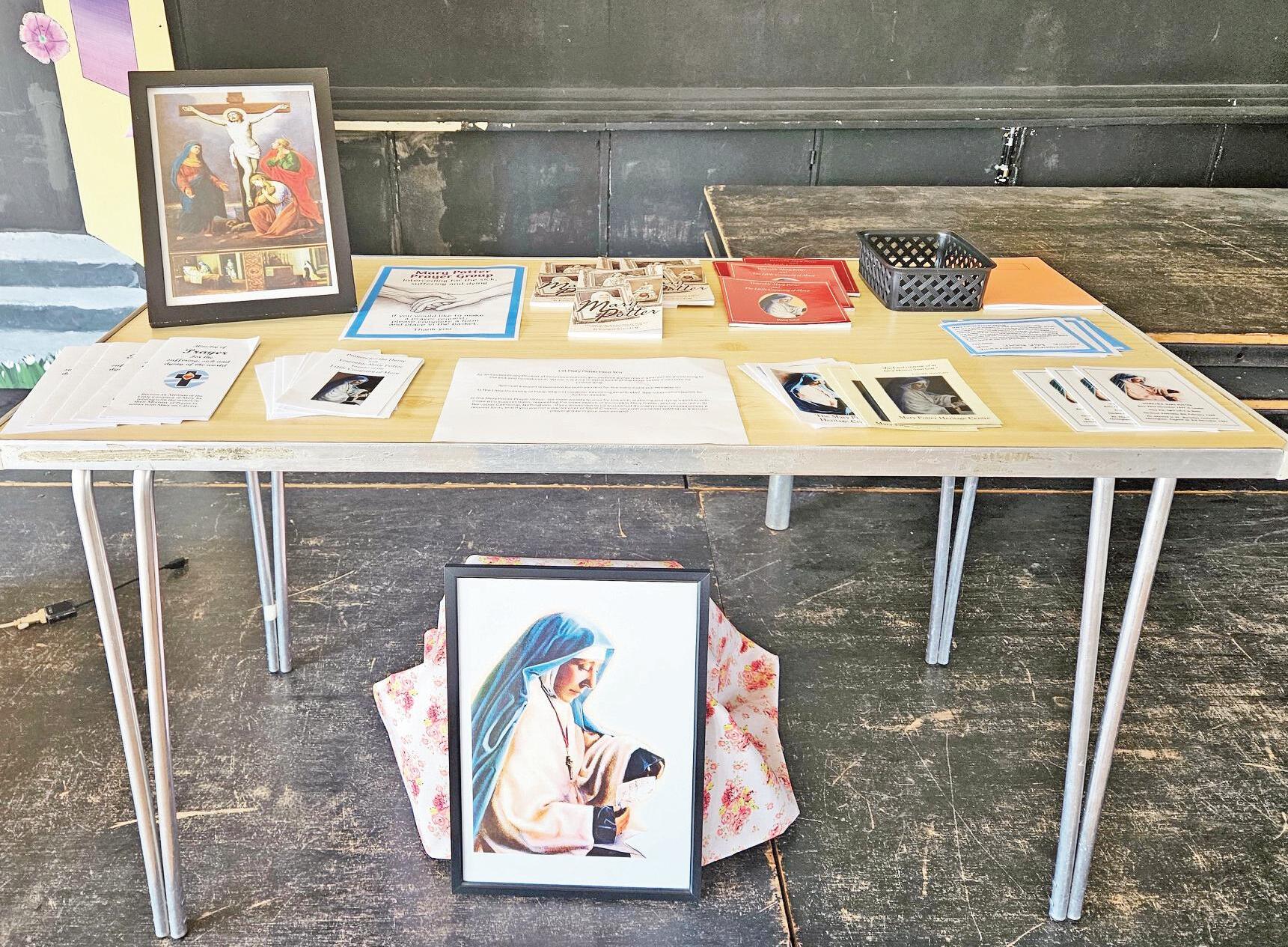
In May there was a renewal day for Extraordinary Ministers of Holy Communion of Lincolnshire, held at SSPP, and a stall providing information on Mary Potter, the Little Company of Mary and the prayer group at SSPP, together with how all or any of them can be of help to ministers and the people they serve, was provided. During, what was a wonderful day, Bishop Patrick spoke of the need for commitment to spiritual formation, as well as some of the challenges of the ministry; Mary Potter and the Little Company of Mary can assist with both.
Also during the month of Mary, Blessed Virgin, a coffee morning, in thanksgiving, was held for the Little Company of Mary and Olimipia Blaj, with her colleague Theresa, from the Heritage Centre came over from Nottingham and joined the parish for the two Sunday morning Masses, with Olimipia giving a short talk at each Mass. They also manned a stall providing information, in the parish centre, for parishioners to learn more, over coffee and cake. As a result of the coffee morning, some parishioners expressed interest in visiting the Heritage Centre to learn more
and our hope is to have a retreat day there, later in the year.
Next year, 2027, will be the 30th anniversary of the return of the remains of Venerable Mary Potter to Nottingham (she was initially interred in Rome, having died there) and the 150th anniversary of the foundation of the Little Company of Mary. With the diocesan focus on mission, the anniversary has the potential to provide not only a wonderful opportunity to celebrate and honour our diocesan saint in the making but also help parishes throughout the diocese to grow in holiness and outreach. Though many had never heard of her, some of the individuals who attended the renewal day were able to see how this potential diocesan Saint could be of help with their parish mission plans; a cause for joy! Why not use the anniversaries as an occasion to ‘invite’ her in to your parish and let her help you with mission (and possibly help to bring joy to her cause at the same time)?
With thanks to Canon Geoffrey (parish priest of SSPP) and Olimipia, together with Theresa, as well of course, to Venerable Mary Potter and Our Lady. A special note of thanksgiving for Deacon Peter, without whom none of this might have happened; we miss you, Peter, and thank you for the fun had by all on the parish outings, your ministry continues to bear fruit for God’s Kingdom.




The Fool’s Pilgrimage The Roaming Catholic in Vietnam
Travelling is brilliant – not only the geographical type, but also the biographical type – the passage through time and space, such a great collaboration.
There is however, something comforting about familiarity… especially when everything else feels completely foreign. Vietnam.
It’s been on our list of places to go for a while, and finally it made it to the top. We love Southeast Asia – and Vietnam is great. It hits you fast.
The heat. The noise.
The endless swarm of scooters moving in what can only be described as organised chaos. I thought it was bad in Bangkok, but this, well this seems even more of a challenge.
You don’t so much cross the road… as step into it and trust. That trust builds confidence and you just “go with the flow”.
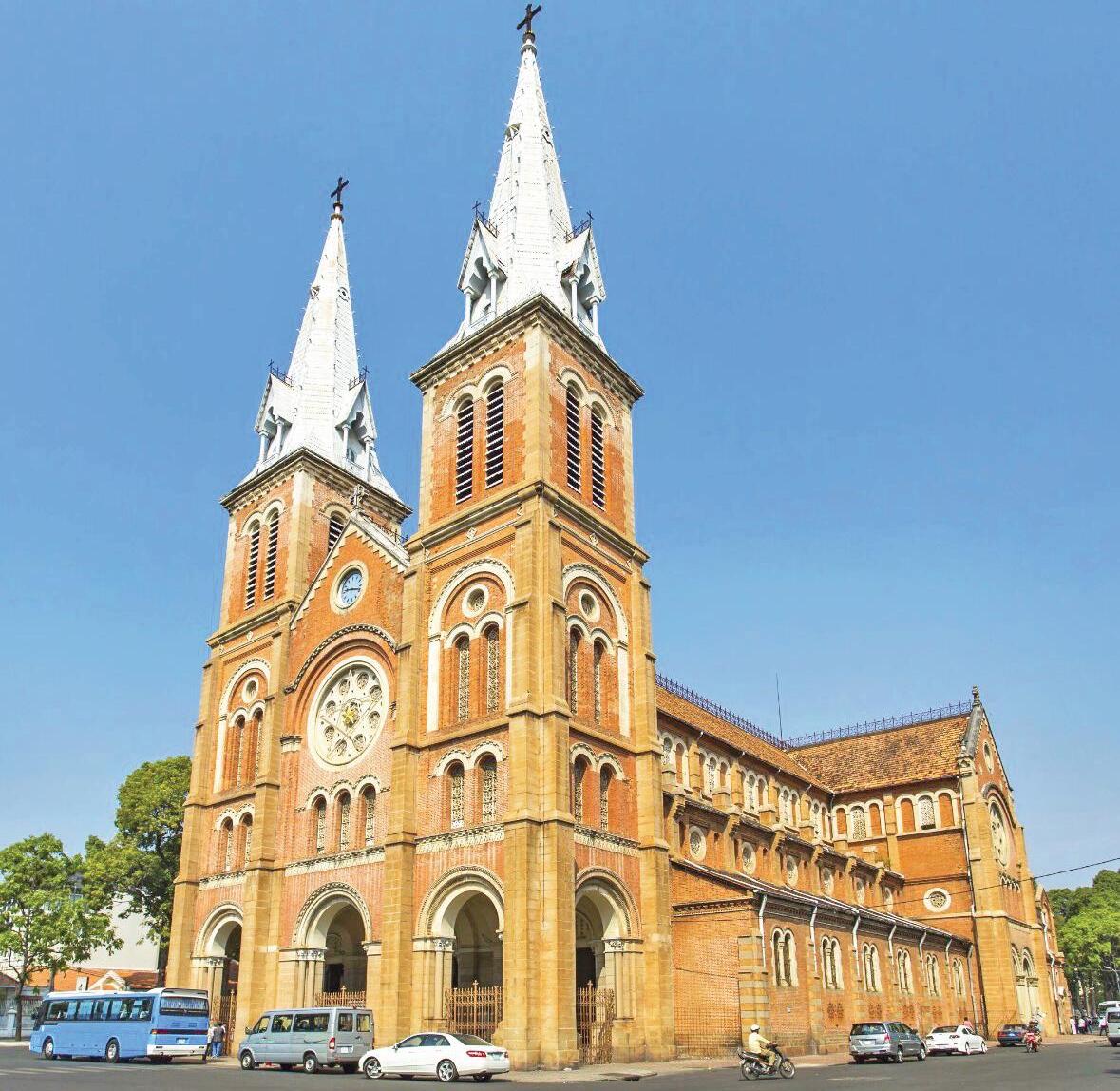
And somewhere in amongst all that, fresh off the plane, slightly disoriented and not entirely sure what time zone my body thought it was in… I found myself standing in front of Notre-Dame Cathedral Basilica of Saigon.
It was a Sunday, we had landed into Ho Chi Min City (HCMC) formally known as Saigon. Made our way to the hotel in downtown and left our luggage to go exploring.
There was a mall, Lisa had gone to Zara. Naturally.
And I’d gone to church. Also, naturally.
The usher at the door stopped me “No Tourists!” he said, a little forcefully - “I’m here for mass” my phone said to him via google translate–he smiled and waved me in.
Stepping inside, was still as hectic as outside – the good people of Vietnam, like other Southeast Asian countries are busy. Yet, as mass started everything softened.
The noise dulled.
The pace slowed.
The familiar rhythm of a Catholic church— quiet, reflective, ordered—wrapped itself around me like something I didn’t realise I needed.
In a city that felt so different… this felt the same.
I had, walked into an English mass –Catholicism is relatively big in Vietnam –technically an atheist country because of its communist political majority yet faith, and the practice of it is everywhere.
And I think, at that moment, I assumed that was what I’d be looking for throughout the trip (of life)—little pockets of familiarity in an otherwise unfamiliar world. The shared camaraderie of the normal person in the street, or church, or shop.
Back home, in merry old England religion tends to live in buildings. And in the privacy of our own minds and homes.
Church on a Sunday.
Quiet, contained, separate from the rest of life.
Our faith is a personal thing–to talk openly about our religion invites arguments! Or debates, even within those who share the same banner of beliefs.
We keep it personal. But in Vietnam… it’s everywhere.
Small altars tucked into the corners of homes.
Incense burning gently in shop doorways. Offerings of fruit and flowers placed carefully beneath photos of loved ones.
It wasn’t something you went to. It was something you lived alongside. At first, I tried to make sense of it.
Was it Buddhist?
Was it something else? Was it… everything?
There were temples, yes. There were churches too.
But nothing seemed to sit neatly in a single box. And the more I looked for a clear answer, the more Vietnam seemed to quietly resist giving me one.
And then, somewhere between the questions and the observations… a realisation clicked into place. Because the more I noticed, the more I realised that while the forms were different… the feeling wasn’t.
I’d see incense placed gently into a holder outside a home… and think of the thurible swinging softly during Mass.
Different rituals. Different meanings. But the same instinct.
The same quiet human desire to reach for something beyond ourselves.
To honour. To remember. To connect.
And maybe, for the first time, I stopped trying to define what I was seeing… and just let myself experience it.
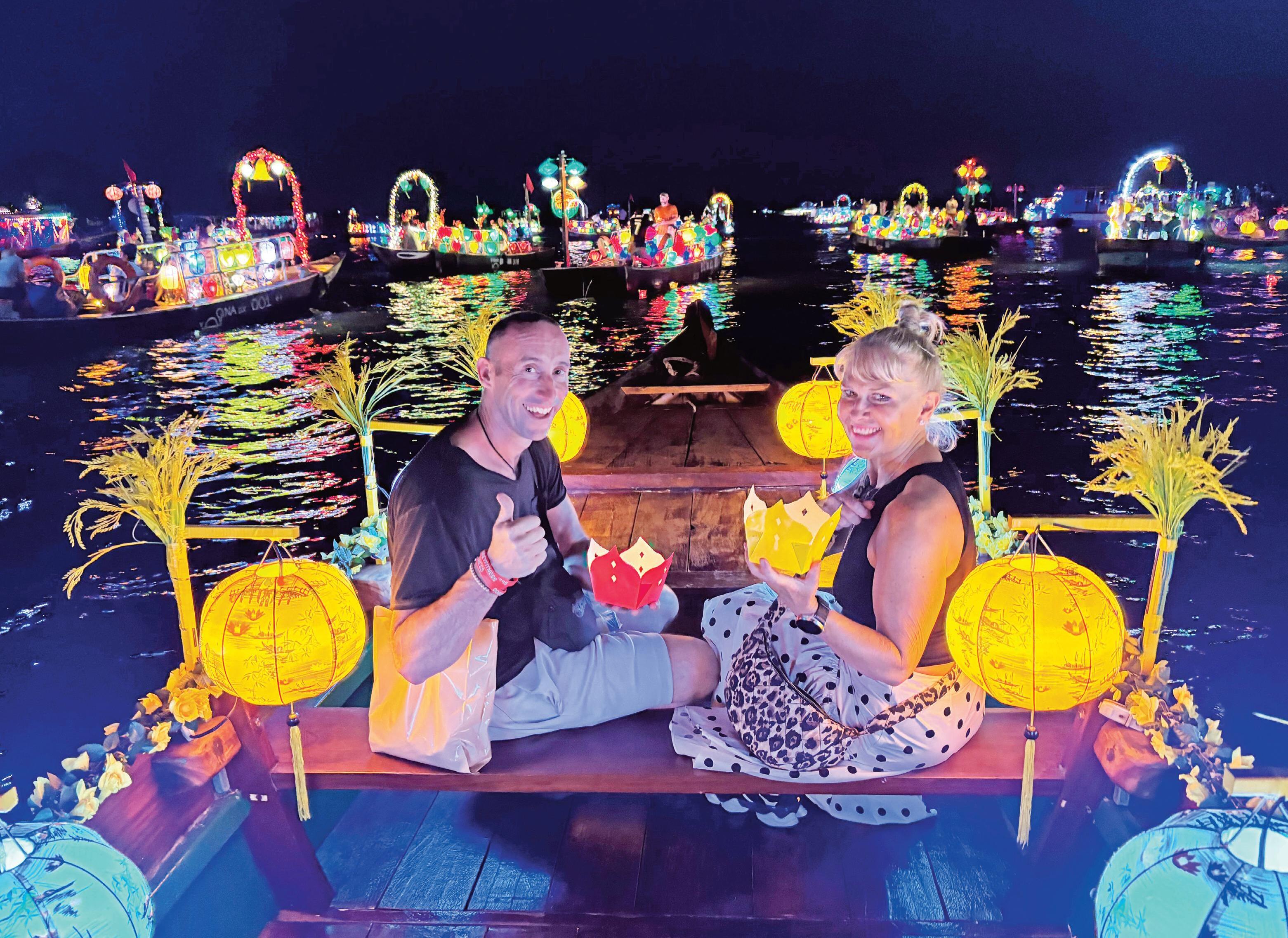
Hoi An was one of those places where that feeling really settled in. As night fell and the lanterns lit up the river, there was a stillness that didn’t need explaining. People releasing candles onto the water… not with urgency, not with noise… just a quiet intention. No instructions. No structure.
Just a moment.
And it struck me that maybe the sacred doesn’t always need a framework. Maybe it just needs space.
Of course… just as you start to feel like you’re getting somewhere with all this… Vietnam has a way of bringing you straight back down to earth.
Or rather… face to face with a monkey.
They’re everywhere in parts. Bold. Cheeky. Completely uninterested in your personal space. At one point, I’m pretty sure one of them sized me up as an easy target. And watching them—grabbing, pulling, reacting purely on instinct—it was hard not to laugh… and also recognise something uncomfortably familiar.
Because for all our rituals, our beliefs, our attempts at mindfulness and meaning… we’re never that far removed from instinct.
From reaction. From impulse.
The Fool, it turns out, isn’t just wandering through Vietnam. He’s very much alive and well.
And then came Ha Long Bay. And everything went quiet again. But this time, not because of walls or buildings or structure. Because of scale.
Towering limestone cliffs rising out of still water.
Mist hanging in the air. Silence that didn’t feel empty… just full.
There was no cathedral here. No altar. No stained glass. And yet it felt like one of the most sacred places I’d been.
Because standing there—well, floating there—you couldn’t help but feel small. Not insignificant. Just… part of something bigger. Something that didn’t need explaining. Didn’t need defining. Just needed witnessing.
By the time we reached Hanoi, something had changed. Not outwardly. But quietly. Internally.
And as I stood in front of St. Joseph’s Cathedral, I felt that same sense of familiarity I’d felt at the start of the trip.
The same structure. The same rhythm. The same faith I’d always known. But it didn’t feel quite the same. Because now, it wasn’t the only place I’d recognised it.
I’d seen it in the smoke of incense on a street corner.
In the stillness of lanterns floating on water.
In the vastness of Ha Long Bay. Even, in a strange way, in the chaos of a monkey with no regard for personal boundaries.
Vietnam didn’t give me a new religion. It didn’t challenge my faith in the way I thought it might. It did something else. It expanded it. Because what I found wasn’t something different. It was something familiar… expressed in ways I hadn’t yet learned to recognise.
And maybe that’s the real pilgrimage. Not travelling to find something new. But travelling far enough… to see what’s been there all along.
The Pilgrimage continues.
Namaste – Have a Great Day
Dan Sobey





Notre-Dame Cathedral Basilica of Saigon, Ho Chi Minh City, Vietnam
CRYPTIC Across
7 Landmass of alkali – silicon, iron, aluminium, primarily (4)
8 7 city Paul sought, but could not see? (8)
9 Brigand hierarchy's share supplies a 7 political leader... (6)
10 ...to place American sailors west of Saul's place in7 (6)
11 Guy retired following return of writer's block (7)
13 Tree tissue needs unspecified quantities of citrus fruit, mostly (5)
15 Titus helped make Church here tangible without deception (5)
17 Rebel top guns pulled out of housing project being built i in 7 town (7)
21 Apostle has cheek to back a Greek character (6)
23 Italian town – East-South-East following French department's lead? (6)
24 Praise for Capri's evacuation of American leader to Rome (8)
25 Ancient 7 country's secure wall: extra dam's eventually built (4)
CRYPTIC Down
1 Father's vessel's first-class, about to go north to fish (8)
2 In need of cash for Oliver Trophy after Yacht Club pulled out (4,2)
3 Recommendation to expose weakness after promotion (6)
4 Rug’s edging looks top-notch – it’s an enduring fiddle (5)
5 One in flight seen above quarry’s very large (6)
6 African stays after little Benjamin somehow gets free from Zebulun (4)
12 7’s British administration conflict is overturned (3)
14 Record a fellow and a Welsh girl being recipient of a letter from Paul (8)
16 Jewish commentary on the Torah, and thanks over Left’s abuse being put down (6)
18 The King’s hard to follow, like Tolkein’s take on some in Middle Earth (6)
19 Setback: part of a clear single-mindedness of this 7 country? (6)
20 One of Joktan’s boys at work: say hello, Rex (5)
22 Sacred-sounding festival in 7 (4) QUICK Across
7 Roman province of western Turkey, and home to 14 for instance (4)
8 Syrian home to Aramaeans who fought and lost to David (8)
9 Mohandas Karamchand -----. Leader whose nickname meant ‘Great Soul’ (6)
10 One-time home in 7 for NT correspondent? (6)
11 Assembly of church canons (7)
13 Woody tissue (5)
15 One-time island home of the Philistines (5)
17 First city taken by the Israelites when they entered the Promised Land (7)
21 Son of Herod the Great – the first husband of Herodias (6)
23 City of Lombardy set between Lakes Maggiore and Como (6)
24 Emperor, 41-54 AD, who forced all Jews to leave Rome (8)
25 OT country east of Babylonia, capital Susa (4) QUICK Down
1 One of the Twelve Tribes (8)
2 Penurious; impecunious (4,2)
3 Counsel; warning (6)
4 Cremona violin-maker and music teacher to Stradivarius (5)

5 Marine bird of prey: rugby player from a merged Welsh regional team (6)
6 Part of the Nguni group languages along with Swazi and Xhosa (4)
12 British rule in Colonial India (3)
14 One in receipt of a letter from Paul, written about 62 AD while in prison in Rome (8)
16 Some Jews’ interpretation of the Torah (6)
18 Puckish, imp-like (alternative spelling) (6)
19 David, ‘the sweet psalmist of ------ (6)
20 Descendant of Shem, one of Joktan’s sons (5)
22 Boisterous and colourful Hindu festival (4)
Across: 7 Asia, 8 Damascus, 9 Gandhi, 10 Tarsus, 11
Chapter, 13 Xylem, 15 Crete, 17 Jericho, 21 Philip, 23 Varese,
24 Claudius, 25 Elam. Down: 1 Issachar, 2 Hard up, 3 Advice,
4 Amati, 5 Osprey, 6 Zulu, 12 Raj, 14 Ephesian, 16 Talmund,
18 Elvish, 19 Israel, 20 Ophir, 22 Holi.