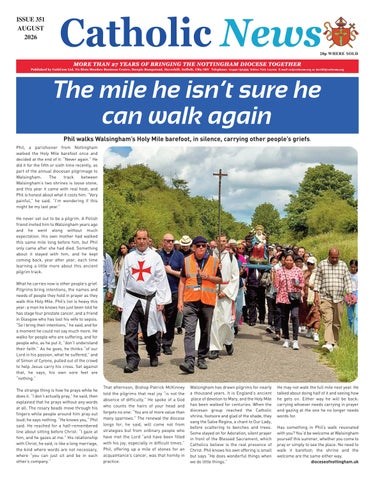

The mile he isn’t sure he can walk again
Phil walks Walsingham’s Holy Mile barefoot, in silence, carrying other people’s griefs
Phil, a parishioner from Nottingham walked the Holy Mile barefoot once and decided at the end of it: “Never again.” He did it for the fifth or sixth time recently, as part of the annual diocesan pilgrimage to Walsingham. The track between Walsingham’s two shrines is loose stone, and this year it came with real heat, and Phil is honest about what it costs him. “Very painful,” he said. “I’m wondering if this might be my last year.”
He never set out to be a pilgrim. A Polish friend invited him to Walsingham years ago and he went along without much expectation. His own mother had walked this same mile long before him, but Phil only came after she had died. Something about it stayed with him, and he kept coming back, year after year, each time learning a little more about this ancient pilgrim track.
What he carries now is other people’s grief. Pilgrims bring intentions, the names and needs of people they hold in prayer as they walk this Holy Mile. Phil’s list is heavy this year: a man he knows has just been told he has stage four prostate cancer, and a friend in Glasgow who has lost his wife to sepsis. “So I bring their intentions,” he said, and for a moment he could not say much more. He walks for people who are suffering, and for people who, as he put it, “don’t understand their faith.” As he goes, he thinks “of our Lord in his passion, what he suffered,” and of Simon of Cyrene, pulled out of the crowd to help Jesus carry his cross. Set against that, he says, his own sore feet are “nothing.”
The strange thing is how he prays while he does it. “I don’t actually pray,” he said, then explained that he prays without any words at all. The rosary beads move through his fingers while people around him pray out loud; he says nothing. “He knows you,” Phil said. He reached for a half-remembered line about sitting before Christ: “I gaze at him, and he gazes at me.” His relationship with Christ, he said, is like a long marriage, the kind where words are not necessary, where “you can just sit and be in each other’s company.”
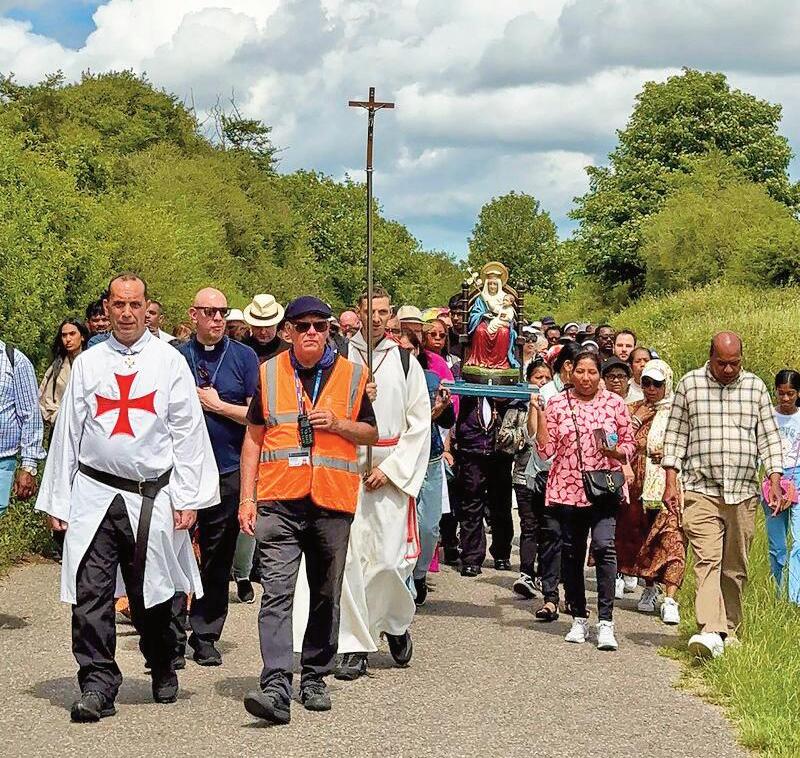
That afternoon, Bishop Patrick McKinney told the pilgrims that real joy “is not the absence of difficulty.” He spoke of a God who counts the hairs of your head and forgets no one: “You are of more value than many sparrows.” The renewal the diocese longs for, he said, will come not from strategies but from ordinary people who have met the Lord “and have been filled with his joy, especially in difficult times.” Phil, offering up a mile of stones for an acquaintance’s cancer, was that homily in practice.
Walsingham has drawn pilgrims for nearly a thousand years. It is England’s ancient place of devotion to Mary, and the Holy Mile has been walked for centuries. When the diocesan group reached the Catholic shrine, footsore and glad of the shade, they sang the Salve Regina, a chant to Our Lady, before scattering to benches and trees. Some stayed on for Adoration, silent prayer in front of the Blessed Sacrament, which Catholics believe is the real presence of Christ. Phil knows his own offering is small but says “He does wonderful things when we do little things.”
He may not walk the full mile next year. He talked about doing half of it and seeing how he gets on. Either way he will be back: carrying whoever needs carrying in prayer and gazing at the one he no longer needs words for.
Has something in Phil’s walk resonated with you? You’d be welcome at Walsingham yourself this summer, whether you come to pray or simply to see the place. No need to walk it barefoot; the shrine and the welcome are the same either way. dioceseofnottingham.uk
The monthly paper for the
The monthly paper for the Diocese of Nottingham Diocese of

Editor: Nick Layton
Editorial Office: CathCom Ltd, N2 Blois Meadow Business Centre, Steeple Bumpstead, Haverhill, Suffolk, CB9 7BN
Telephone: 01440 730399
email: cn@cathcom.org or davidl@cathcom.org
Website: www.cathcom.org
Distribution enquiries: cn@cathcom.org
CathCom Ltd,
Publication date: Fourth Sunday of the month for the following month. Opinions expressed by contributors are not necessarily those of the Editor or the Diocese.
Publishers and Owners:
CathCom Ltd, N2 Blois Meadow Business Centre, Steeple Bumpstead, Haverhill, Suffolk, CB9 7BN
Advertising: tel: 01440 730399
Parental permission should be sought before submitting photographs of minors.
Views expressed in The Catholic News are not necessarily those of the editor.
Wanted Parish Correspondents
The Catholic News is looking for a Parish Correspondent in your parish to send in local news for publication in this newspaper. All items to be emailed to cn@cathcom.org before 10th of the month


Things that May Change a Life
Thanks once again to Jon Cornwall for this reflection.
Small acts of kindness change lives by validating someone's worth and disrupting a cycle of loneliness. Simple gestures or actions can completely lift an individual's spirits and foster a deep human connection, making a huge difference to a person’s life.

Vincentians work to pursue and fulfil the mission ‘to actively seek out those in need ……. and offer support in any way practicable’.
Befriending and supporting those in need has been the core activity of the society since its inception in 1833. Vincentians work to build trust, confidence and relationships with those they befriend and it is the small gestures and actions that can make the most difference. Such life-changing things could be:
A well-timed cup of tea.
An understanding smile.
A birthday remembered.
A surprise handwritten note.
Being told, "This is not your fault". The recognition that now is not the right time, accompanied by the assurance: "I'll be here when you ' re ready. " A name remembered months later. A chair pulled up alongside rather than across a desk.
A silence that does not need filling.
Five more minutes before leaving.
A promise kept.
Rarely do lives change because of grand gestures. More often, they are changed by small acts of presence that communicate
Frankly Speaking

something profound: "You matter." Vincentians know that when we encounter another person with dignity, patience and love, we often receive far more than we give.
When has recognising Christ in another person changed the life of both giver and receiver?


by











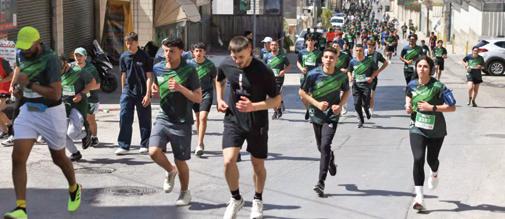

Monday June 22 was a date on which any historian would have been well prepared for, 10 years since the Referendum on Britain’s membership of the European Union was drawing to a close. Whatever our views on the 2016 vote this date will also now be synonymous with the resignation of our sixth Prime Minister in those 10 years.
As the PM finished his difficult address to the nation, I did wonder how history would judge his premiership. June 22nd was also the feast day of Saints John Fisher and Thomas More. The BBC Daily Service on the national radio was dedicated to their distinguished lives and after a rousing singing of Faith of Our Fathers Bishop Marcus Stock said a wholesome tribute to these great English Saints, Not only were they men of high principle but they gained high office by
virtue of linking personal faith with all the skills they possessed. John Fisher and Thomas More did not take the easy route in their lives. Bishop Stock reminded his radio audience of the close relationship they had with King Henry VIII. This was to eventually lead to their brave martyrdoms in 1535. Thomas More is now the patron saint of all politicians. Both these great men were canonised in 1935.
The month of August is normally free from much political news but this year will be different. We will have a new Prime Minister who recently began to appoint new ministers. In his office will be an in-tray, which will be rather full. That Brexit vote of 2026 has produced much political turbulence, surely we need a better relationship with all our European neighbours. Beyond Europe one commentator suggested that the number
of wars in the world was over 60. We have so many areas of conflict let alone those in difficulty with climate change.
Here in Britain the issues are so many that space cannot be found in just one article. In the 1960’s when I started work apprenticeships seemed to be the start for many young people no one talks about, a skills shortage and a new vision is needed. Will this new government finally sort out the issue surrounding our funding of care homes, will our hospices have to keep cutting services?
Britain needs lifting up, let us hope and pray for all those in greatest need. Wisdom is an ancient virtue, Mr Burnham and his colleagues will need all the wisdom and courage of Thomas More and John Fisher nearly 500 years ago.
Frank Goulding
Awarded Bene Merenti
In 2028 the Diocese of Nottingham hopes to celebrate the Golden Jubilee (50th) anniversary of the inauguration of Extra ordinary Ministers of the Divine Eucharist.
Yes, it was way back in 1978 during the Episcopate of Bishop James McGuinness that people were first drawn from parish communities to assist in the distribution of Holy Communion, both during the Mass in Church and to the sick at home and particularly this ministry is celebrated in the various hospitals throughout the diocese. It was soon realised that for this new ministry in the post Vatican II Church to flourish, it would need some structure to support those called out of their parish communities to fulfil the opportunity of sharing fully in the call of the Lord to evangelisation in the light of His Great Command, “Go out and teach all nations”.
Very quickly a Diocesan Commission was formed and has since those pioneering days, been the source on behalf of the Bishop to support those seeking to share the ministry and those who are commissioned to do so.
Each Year the Commission develops weekend opportunities that offer candidates an opportunity to understand and appreciate the call of the Lord to support their parish communities through being extraordinary Ministers of the Divine Eucharist and encourages them to go forward for commissioning by Bishop Patrick at the Cathedral, usually in early November. These seminars have proved very effective in supporting and encouraging aspirants and continue to do so with after care. This is where Searle Clarke comes into the picture! Searle was a pioneer in the original Commission.
He has served it loyally, and with great wisdom and diligent expertise in supporting the Commission and remains currently as the only original member since its foundation. Searle has also undertaken the brief of “Aftercare” ensuring Ministers are well supported, remembered when retired and assured of prayer when the Lord fulfils earthly ministry and offers deceased commission Ministers the welcome into Eternal Life.
The current Commission are so grateful for such diligent support and realise the value of Searle’s generosity of spirit shown in his immediate attendance at all meetings of the Commission and Secretariat, that petition was made to Bishop Patrick to take an opportunity of whispering in Pope Leo’s ear of such remarkable service to the Church in the Diocese. Holy Father, Pope
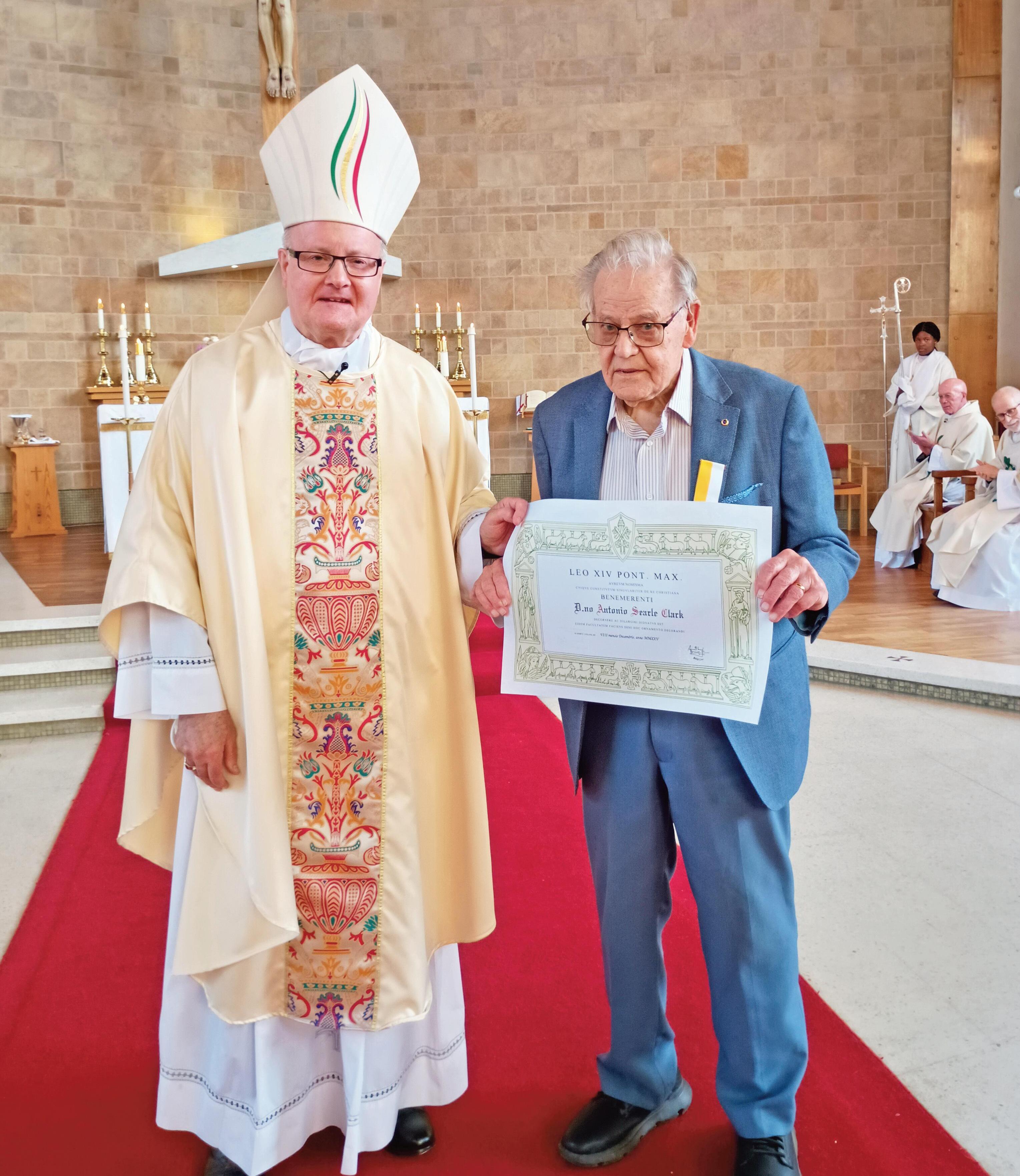
Leo readily acquiesced and Bishop Patrick, whilst leading a day of Recollection for the Lincolnshire division of the Secretariat on the 9th May, honoured Searle with the Papal award of “Bene Merenti” (“Well done” or “Well merited”) with the accompanying scroll from the Holy Father and the insignia of the papal award.
Our heartfelt gratitude and congratulations to Searle for his diligence and dedication on receiving Holy Father Leo’s recognition for his tremendous work amongst us.
Rev. Canon Philipp Ziomek. Chair of the Diocesan Commission for Eucharistic Ministers.
Good Shepherd Primary Academy Visit
“59 Reception children from The Good Shepherd Academy visited The Good Shepherd Church to enhance their RE lesson about church being a special place, where the parish family go to celebrate. They were amazed by the beautiful stained-glass windows and loved listening to the loud bell. They learnt to genuflect and bless themselves
with holy water, showing amazing respect. They also role-played a procession with a priest, altar servers and a music group. What an amazing experience for our youngest children, bringing their classroom learning to life!”
Mrs. Katie Kitching, Infant Dept. Lead; The Good Shepherd Primary Academy.
Congratulations to all our priests who are celebrating significant anniversaries this year
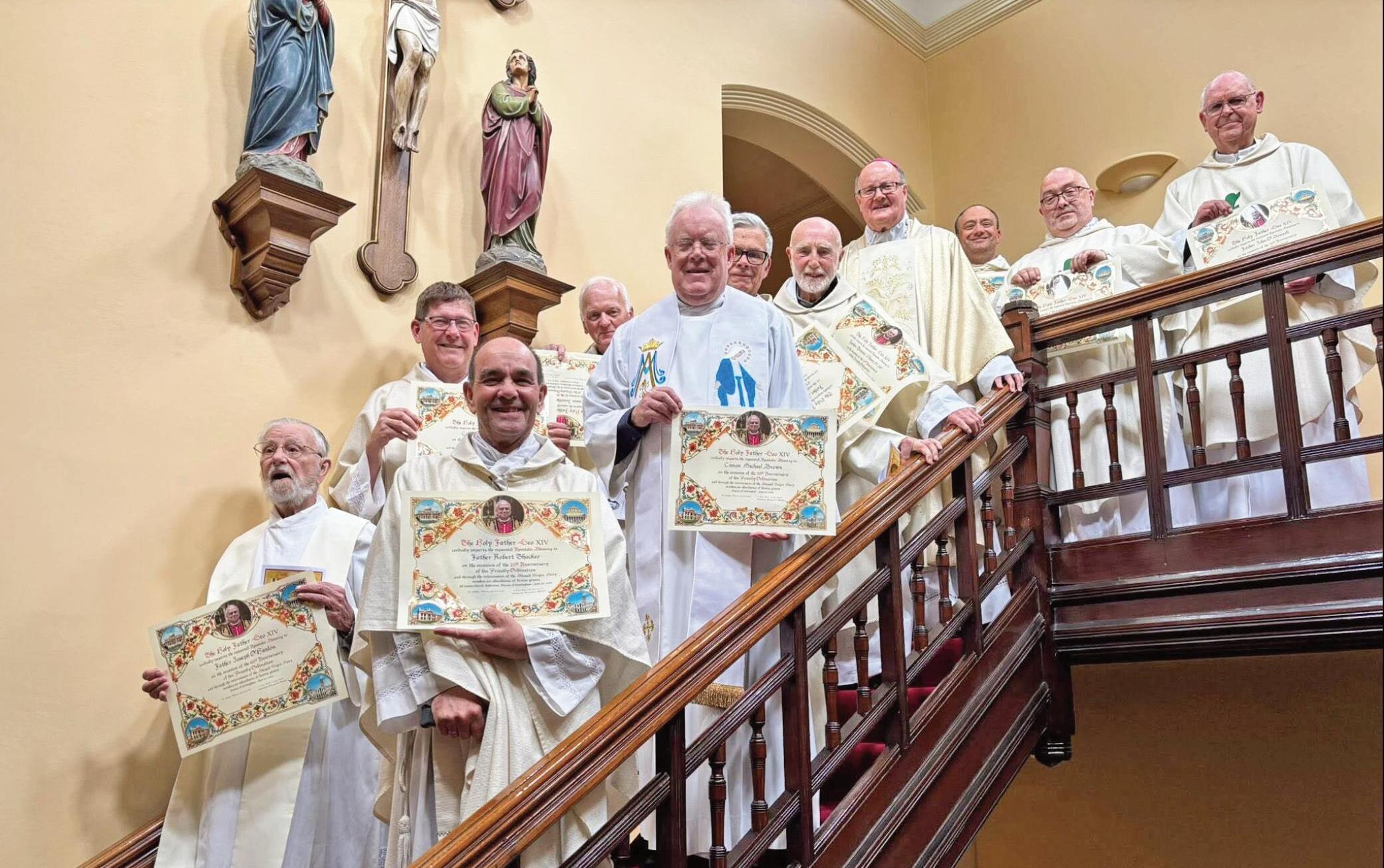
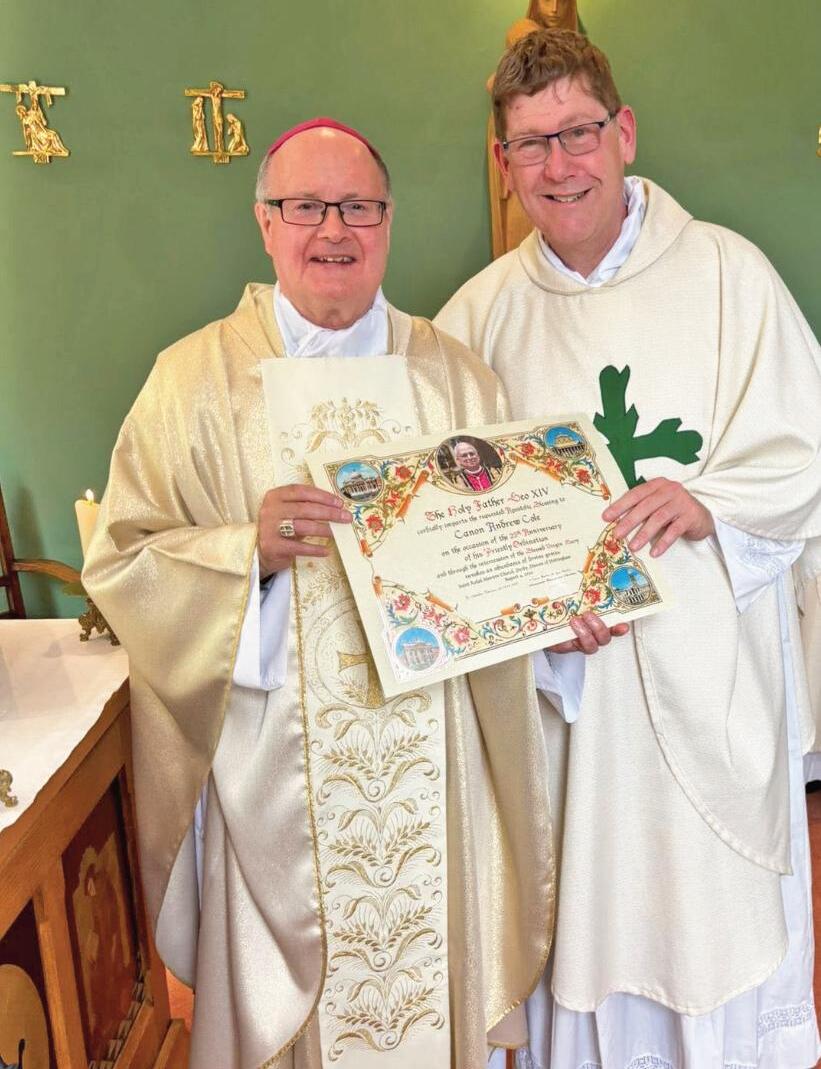
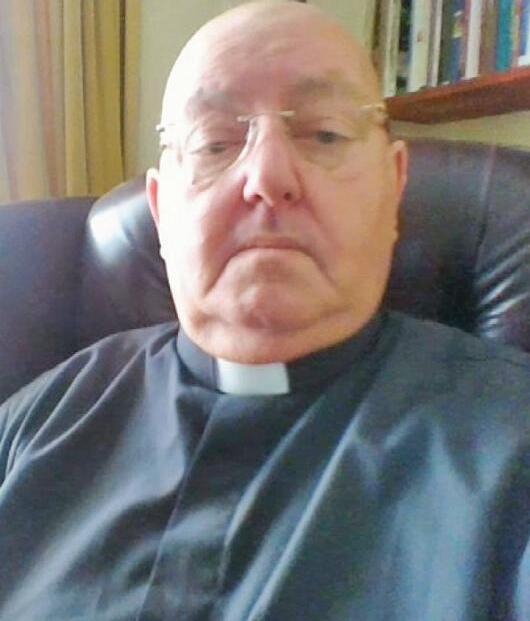
Platinum Julilarian - 13 November, Fr Andrew Henson OCSO, Diamond Jubilarians - 26 May, Fr John Younger, 19 June, Fr Joseph O’Hanlon, Golden Jubilarians - 22nd March, Fr Terence Wilson OCSO, 12 June, Canon Jonathan Cotton, 26 June, Canon Michael Brown, Ruby Jubilarian - 5 July, Fr John O’Donnell, Silver Jubilarians - 9 June, Fr Dominic O’Connor, 30 June, Fr Robert Thacker, 8 July, Fr Richard Ounsworth OP, 17 July, Canon Christopher P Thomas 4 August, Canon Andrew Cole
From: Elston Hermitage…….....
As I sit down to write this afternoon the temperature outside is raging and I try to take shelter indoors with blinds and curtains closed but despite this the warmth is still challenging. As we begin the month of August perhaps this weather will prevail and during this month many will be thinking or already taking their summer breaks either here in the UK or elsewhere.
As a child it was always early in August that we had our family holiday usually to the east coast and I recall the excitement of my brother and myself as we packed and planned our journey. On the day of our departure we awaited eagerly for my auntie to collect us in her car and begin our journey. My brother and I would be so excited that after about forty miles we would constantly ask “are we nearly there?” Our parents reply would be “No, but we are getting closer.”
This scenario would perhaps help us to understand the Apostles’ experience at the Transfiguration of Jesus, a Feast that we will keep this month on the 6th. It showed them they were getting closer to their final destination of heaven, where they would see Christ in all his glory. One
day we too will reach the glory of heaven, we too will be transformed to be like Jesus. Every day that we live by faith brings us one step closer to that goal.
However, for now we do not experience everything that God has promised us. We still sin, we still fall short of all that we can be, we still fall prey to fear and temptation. But it’s still easy and, for some of us, natural to see only the failures and shortcomings and to forget that we are making progress. Even now, according to Bishop Anastasius of Sinai, we who live by faith “shine resplendent to spiritual eyes, renewed in soul and made over in his likeness, ceaselessly transfigured sharers in God’s being.”
God is powerful and wise that he can use our failures to bring us closer - more so even than he uses our successes. He has a plan for our lives and he is always at work to bring it to fulfillment. Our faltering and stumblings do not negate his promises or cancel his plans for us. We are being transformed - not in an instant, but day by day, little by little as we come to him and allow his presence to overshadow our daily lives.
By
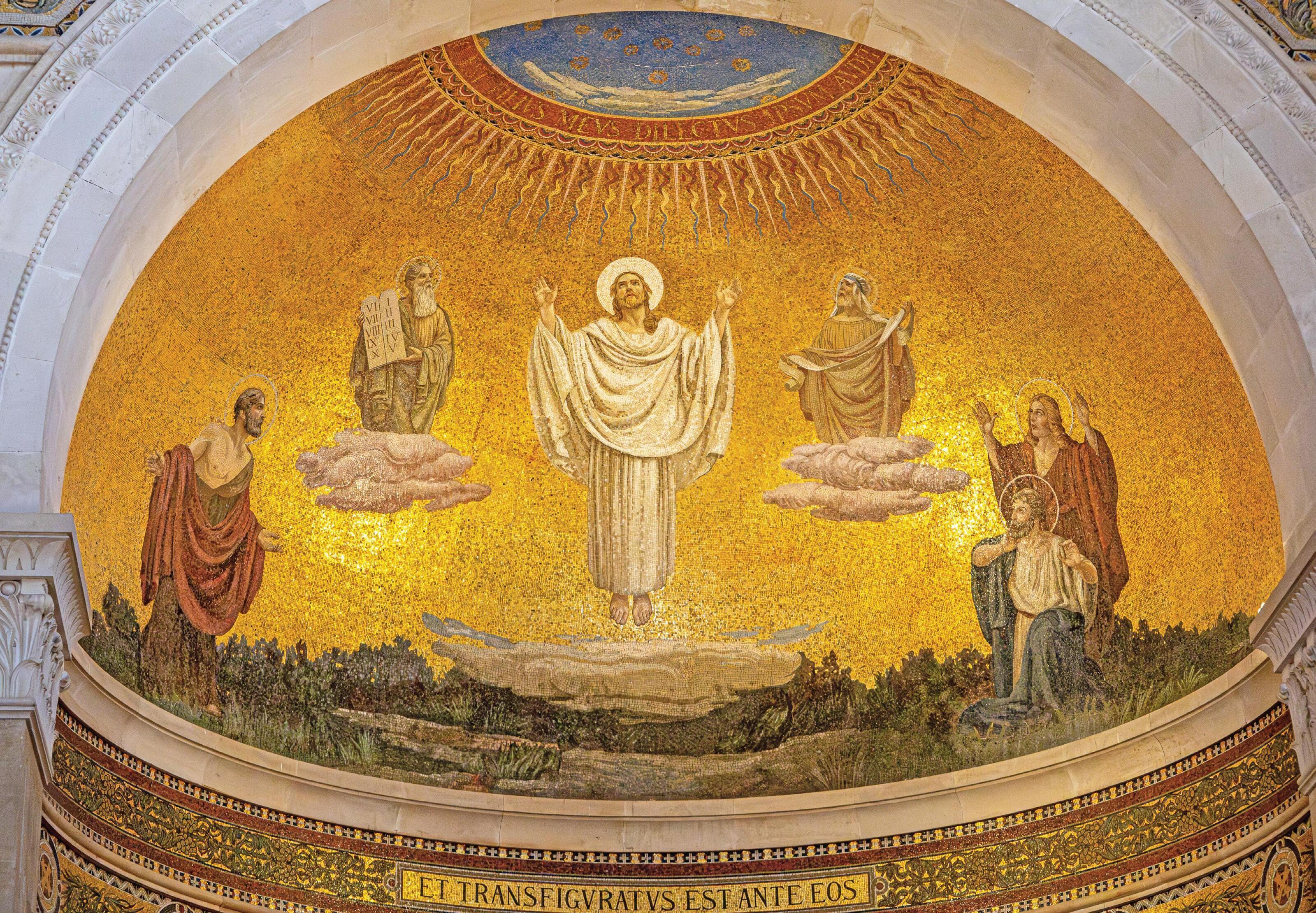
Let us ponder the Transfiguration, let us imagine what we shall be like when we are with Jesus in heaven.
Let us remember our faith is growing as we sit with the Lord and read his word in the Scriptures. In every conversation we have with him, in every minute we spend in his presence then we are moving closer to our
destination. If we just do our best to be faithful we will one day join the chorus “Hallelujah! For the Lord our God the Almighty reigns.”
My prayers that you have a good summer break, returning refreshed in mind, body and spirit.
Fr David + h.d.n. Priest
Image: Regan Dsouza
Scripture Focus
On Thursday 6th August, we celebrate the feast of the Transfiguration of our Lord. This is one of the most inspiring feasts in the church’s year, recalling a key moment in Jesus’ life.
Peter has recognised Jesus as the Messiah. Now Jesus warns his disciples that as Messiah, he will have to suffer rejection and ultimately be crucified, yet on the third day he would rise again. At that time, the disciples could not understand this teaching.
So: a few days later, Jesus calls the three disciples he chose first (Peter, James and John) and takes them privately up a high mountain. There his appearance is totally changed for a short while, and the disciples get a glimpse of heaven.
Although they have often looked at Jesus’ face, now they see it as radiant as the sun, while his ordinary clothes are now shining brightly, as white as the light.
By Fr Jeremy Corley
Our Hope of Glory
Then two ancient figures from Israel’s history appear to them out of heavenly glory Moses and Elijah. Now Jesus is in company with Moses, the giver of the Jewish Law, and Elijah, the great prophet.
It is no accident that Jesus is seen with Moses and Elijah, because these two figures reached heavenly glory at the cost of many struggles. Moses was the one who once liberated the people of Israel from their slavery in Egypt, just as Jesus would liberate us from our slavery to sin.
But Moses also faced great struggles while leading the chosen people through the desert, as they often fell back into sin and idolatry. So too, Jesus would face strong opposition from his own people, and their leaders would hand him over to the Romans for execution.
Finally, after a long life, Moses died and was buried near the border of the promised land, but the last chapter of the Book of Deuteronomy says that no one knows his
burial place. Hence, some later Jewish traditions claimed that Moses had been taken up into heaven. After Jesus’ burial, his tomb would be found empty, and he would be seen ascending into heavenly glory.
The other ancient figure who appeared was Elijah, the great prophet of justice. He called the people to return to the one true God, and he rebuked King Ahab for the murder of the vulnerable farmer Naboth. Jesus also called his hearers to repentance and proclaimed God’s righteousness, especially in the Sermon on the Mount.
Elijah suffered great persecution from King Ahab for calling people to conversion and speaking out in defence of the poor. Jesus himself faced opposition and persecution, that led to his crucifixion. At the end of his earthly life, Elijah was taken up to heaven in a whirlwind. So too, after his death and resurrection, Jesus would ascend into heavenly glory. His dazzling white clothes were just a foretaste of his future glory.



The transfiguration offered encouragement to Jesus’ chosen disciples to keep up their hope, despite Jesus’ suffering and death. Their glimpse of heavenly glory also encouraged them in later years, when they faced persecution as followers of Jesus.
Amid the difficulties of our daily living, it can sometimes be easy for us to lose hope. Yet at certain times in our lives, we may experience a kind of rare glimpse of heavenly glory. We can treasure these precious moments, because they offer us hope and encouragement.
The feast of the Transfiguration reminds us that God can uplift us in tough times with glimpses of heavenly glory. May God uphold us in our difficulties, and may God uplift all who are currently in need.











The Sacraments of Initiation - Eucharist

The Danish film Babette’s Feast is set in a remote, religious 19th century Danish village, which follows two sisters who shelter a French refugee by the name of Babette. When Babette wins a lottery, she spends her money to prepare a French feast. This meal transformed the rigid and cold community through the power of her culinary art, into a forgiving, loving, and elevated community. It is amazing what this meal accomplished for that community.
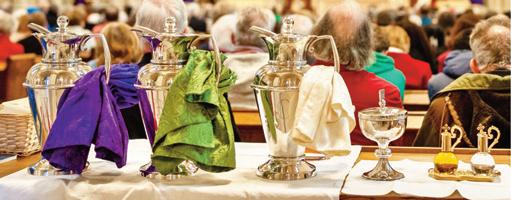
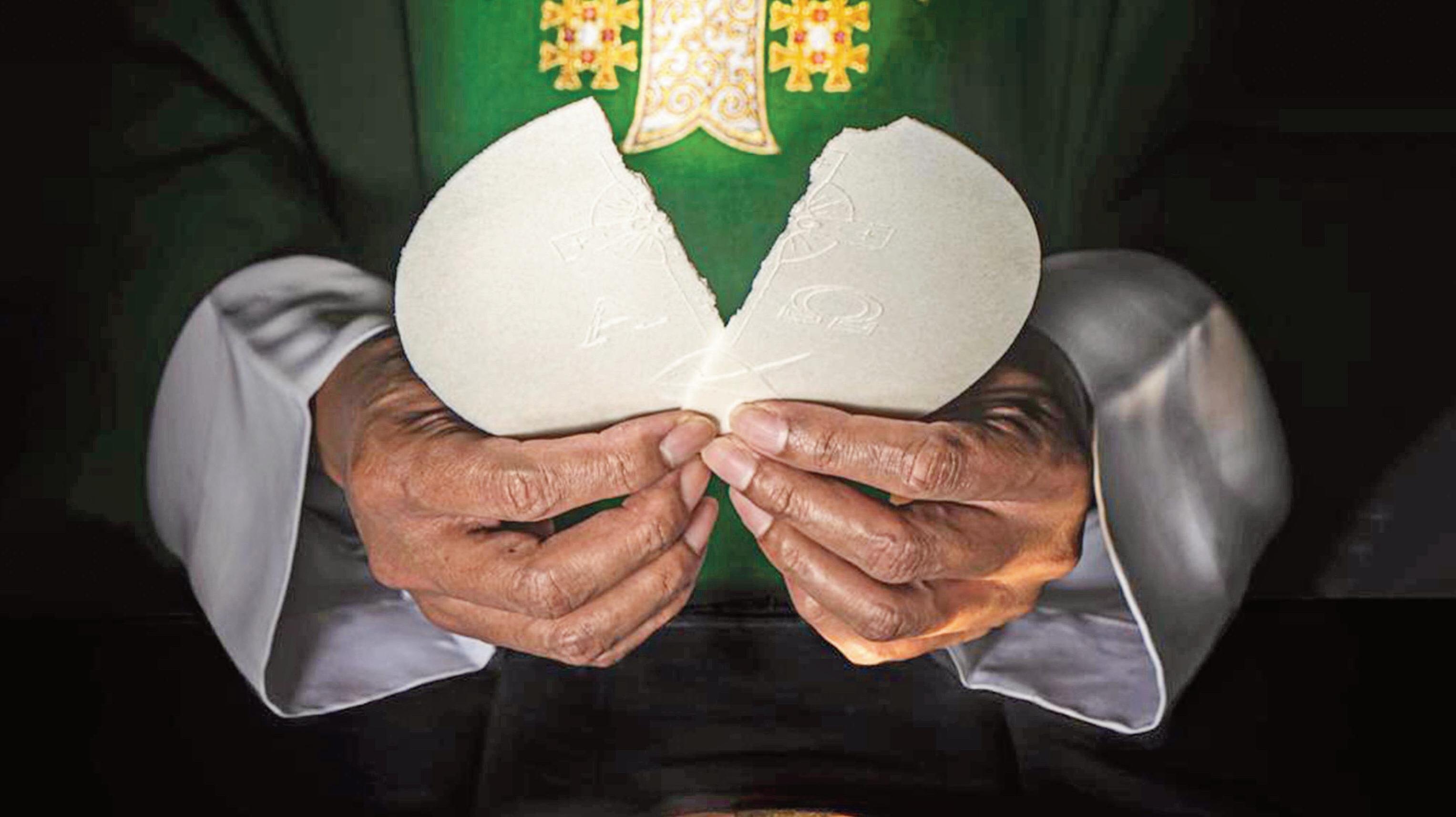
We have now reached the culmination of the sacraments of initiation with the Eucharist. The Lord, on the day before he was to suffer and die, in the context of the Passover meal, gifted his followers the sacrifice of his body and blood – the gift of himself. Over the centuries, taking the command of the Lord to continue this celebration, the Church has developed prayers and rites for this celebration. The Church reminds us that “The Lord’s Supper or Mass gathers together the people of God, with a priest presiding in the person of Christ, to celebrate the memorial of the Lord or Eucharistic sacrifice.” (GIRM 7). It is the fruits of the Lord’s Supper or the Mass that give us the Eucharist.
We hear in the Gospel of John, “Anyone who eats this bread will live for ever; and the bread that I shall give is my flesh, for the life of the world…anyone who does eat my flesh and drink my blood has eternal life and I shall raise him up on the last day…he who eats my flesh and drinks my blood lives in me and I live in him.” The Eucharist is a means of communion with Jesus Christ – we live in him and he lives in us – we are drawn into the life of Jesus Christ in Holy Communion, and into his Body which is the
Church. Over time our attitude, our words, and our actions grow and mature in love, which is Christ.
But it is important to stress that the Eucharist is not a private affair. We usually enjoy a meal and a glass of wine with others. When we receive the Eucharist, it is not just about communion with Christ but with each other. Paul reminds us, “the fact that there is only one loaf means, though there are many of us, we form a single body because we all have a share in this one loaf.” Through our reception of the Eucharist, we grow deeper in one faith and are united by a bond of charity between each other. After all, we are all receiving the one and same Eucharist. Every time we gather to celebrate the Eucharist together, it should foster unity and charity between us and not discord and division.
The Eucharist is the gift of Christ himself, and with any gift, we accept it in our brokenness and weakness, and with a sense of gratitude and confidence. It is food along our journey of life, and it reminds us that Christ is always present in all the circumstances of life. We all desire love and acceptance, and we find this in the Eucharist, communion with God. As Babette’s feast transformed the community, the Eucharist transforms us to be more loving, more caring, more compassionate, more forgiving, and more peaceful, all of which we share with the world around us.
Fr Anthony Fyk
What happens when the Bishop comes to your parish?
As the South Lincolnshire deanery visitation concluded, its parishes are taking their first steps on the Diocesan Mission Plan.
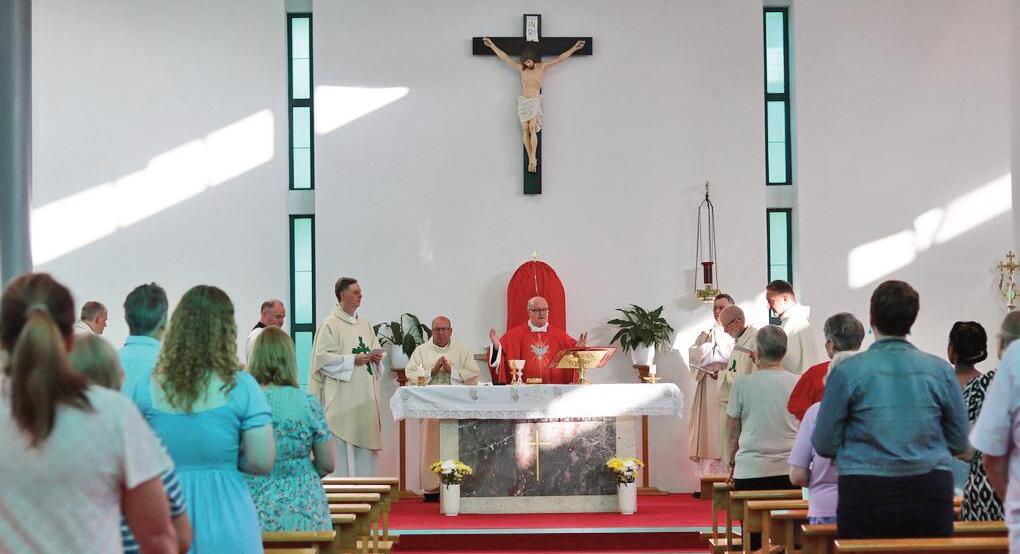
After the final blessing, the adults headed into the hall for a cold drink. One of the young altar servers sat down at the piano and began to play. It was his birthday, and he had chosen to spend it serving at the closing Mass of his deanery’s visitation.
For Carrie Ann, that’s not a coincidence. Her parish, Our Lord Jesus Christ Eternal High Priest by Rutland Water, sits in an area with no Catholic secondary school. So the Parish Mission Team she helps lead has decided to put its energy into children and teenagers first. “Because the children are the future, aren’t they?” she said, when asked why that step before any other.
They now run a youth club for ages 11 and up, and they hope it will grow into something wider. “We can become a community hub,” she said, a place the surrounding neighbourhood comes to know.
That small, concrete choice is exactly what the diocese is asking of every parish. Bishop Patrick McKinney’s five-year plan, Go, Make Disciples, invites each parish to pick a few simple steps toward becoming more missionary. The aim is to help people encounter God’s love, grow as disciples, and carry that faith into daily life.
To support and encourage that, the Bishop and his Vicars General, his most senior priests, have begun a two-year round of weekend parish visits. This Mass marked the end of the first deanery’s turn: South Lincolnshire.
Inside the church earlier that evening, five parishes had each been given a single minute to say what they intend to do next. People clapped in support of one another’s plans. Bishop Patrick, who has spent recent weeks visiting these parishes, listened from the front. “We’ve met with an emerging mission team or a pastoral council team that might break off and become a mission team,” he said. “Ideas are emerging, in every parish.”
What pleased him most was watching parishes borrow and learn from one another, people hearing an idea and thinking, “Oh, we never thought of that one.” “Which is the purpose, really,” he said. “We want to share any good plans that emerge, let’s share them throughout the diocese.”
Vicar General,
had
himself. What struck him most was the spread of ages and backgrounds in the pews. “You can tell by the faces that come from different parts of the world, and that’s really encouraging and inspiring,” he said.
In Carrie Ann’s parish, one effort they call Practical Catholicism simply asks people to offer whatever they can. “‘People just don’t come and volunteer sometimes,” she said, “but we’ve found such great enthusiasm.”
What moved her most was what the parish visitation did to the team itself. “A group of us has come together that possibly wouldn’t have done otherwise,” she said. This was the first deanery in the diocese to complete the visitation process, and the Bishop had seen the same thing across each parish he visited. “Lots of excitement, lots of hope,” he said.
The Bishop and his Vicars General then moved on to Northern Lincolnshire and over two years they will reach every parish in turn. For a parish still waiting, the visit is less an inspection than a conversation. There’s a time of prayer, open to anyone who’d like to come, and Mass with the Bishop or a Vicar General. Then comes a
relaxed meeting with the parish’s mission team about the steps they’re taking to become more missionary and the help or support they might need.
To those still waiting, Canon Eddy had a simple message: “Please look forward to it, because we’re looking forward to coming to see you.” Carrie Ann put it more simply: “If you haven’t done it, you need to just give it a go. It is daunting, but it’s worth it.”
The vision behind all of this is set out in the diocese’s five-year plan, Go, Make Disciples. It takes about twenty minutes to read, and there’s a handy parish summary too, scan the QR code.

And if you are not sure where to begin, or you’d like help shaping your parish’s plan, there is someone to talk to about this, Joe Hopkins, the diocese’s Director of Adult Formation for Mission, would be glad to hear from you at joe.hopkins@dioceseofnottingham.uk dioceseofnottingham.uk
The
Canon Eddy Jarosz,
visited two of the deanery’s parishes
Pilgrimage to the Convent of the Franciscan Sisters Minoresses, Melton Mowbray, for the Holy Year of St Francis
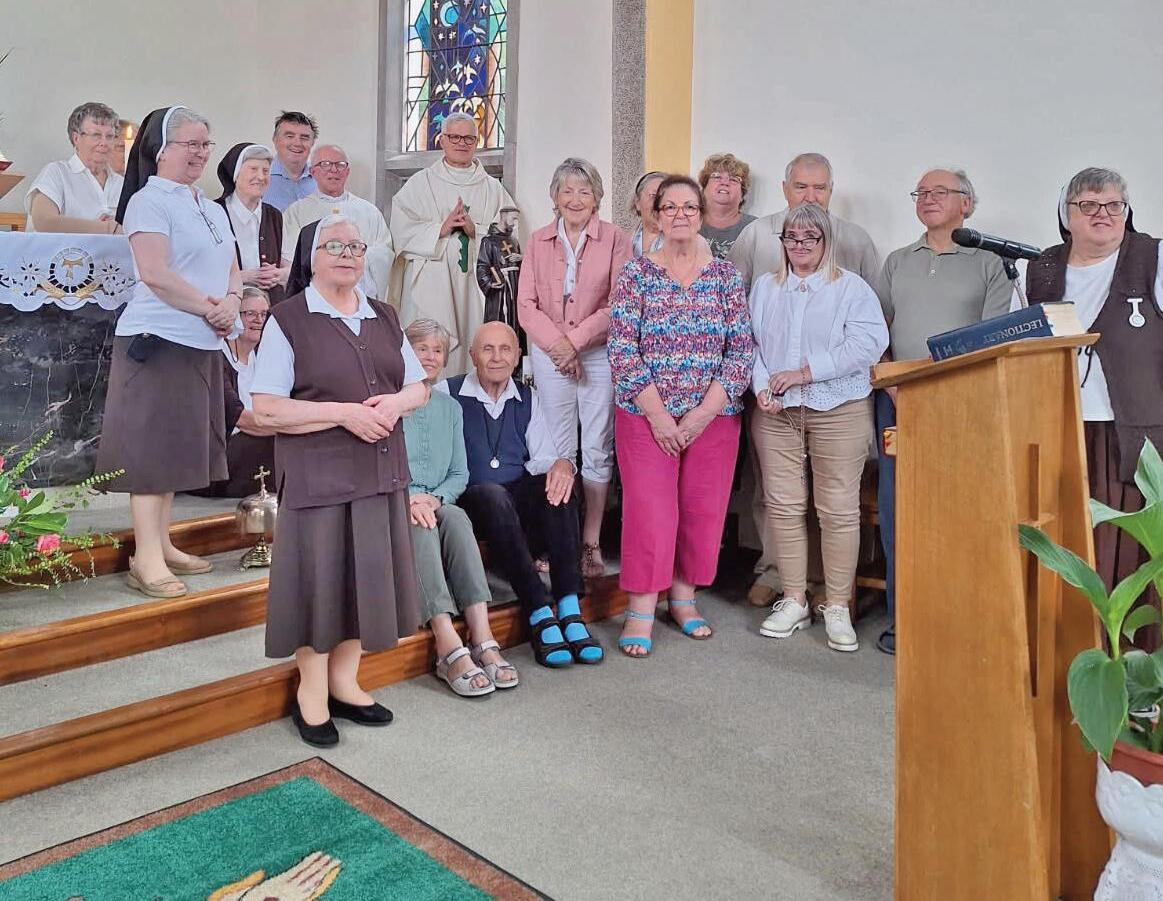
On Saturday, 4th July last, a small group of parishioners from the parish of Sacred Heart, Skegness, and of Our Lady and the English Martyrs, Spilsby, and from the parish of St. Mary’s, Boston, went on pilgrimage to the Convent of the Franciscan Sisters, Minoresses, in Melton Mowbray. For many other people that day will have been associated mostly with the World Cup, Wimbledon, or with the 250th anniversary of the American Declaration of Independence. For us, though, it was chosen to mark this 800th centenary of the death of St. Francis of Assisi in 1226.


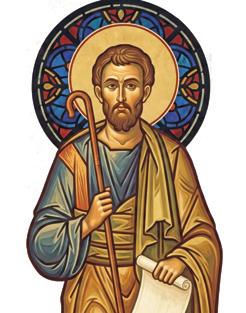

The long journey to Melton Mowbray went very well; we made better progress than we had thought. We were able to recite the Rosary on the way. For everyone, except for Fr. Dominic O’Connor, parish priest of St. Mary’s, it was our first visit to this convent, whose beautiful chapel has only just been renovated - Fr. Dominic had been parish priest in Melton and so knows the convent well.
The Holy Year of St. Francis gives us an opportunity to recall the unique contribution of this remarkable friar to the life of the Church not only in his time, but ever since. In view of obtaining the indulgence for the Holy Year, there were confessions before Mass, as well as special prayers at the end of the Mass. We celebrated the Mass of St. Francis, the readings from St. Paul’s letter to the Galatians, referring to the marks of Christ in Paul’s body, being appropriate also as an allusion to the marks on the hands, feet and side of St. Francis, the first saint thought to have received these marks in his body (the stigmata), and the Gospel from St. Matthew on Christ revealing Himself to the little ones, the humble, those open to His transforming word.

It was good to have been able to reflect upon this saint, the saint who gave us the Christmas crib, and who. in humility, recalled the Cross in our lives, but also and the joy of the resurrection and the promise of eternal joy. Although it has been said by some that the crib can reduce our faith to emotion about the baby Jesus and to sentimentalism, it must be recognised that St. Francis used the imagery, rooted in the infancy narratives of the New Testament, to evangelise countless numbers of people who were utterly illiterate and uneducated, in some cases not effectively catered for by the Church of the 13th century. Like the other mendicant or begging Orders, founded around that time (Dominicans,
Carmelites, or renewed as with the Augustinians), the Franciscan friars lived the evangelical counsels of poverty, chastity and obedience as a more perfect way of following Christ, their radical approach making a dramatic impact upon the lives of many of their contemporaries. Today also, that vocation is important in the Church, a sign of total dedication to the Lord and to His people, a vocation lived by friars, nuns and sisters, such as the Franciscan Sisters, Minoresses.
Contemplating St. Francis’ famous Canticle or Song of the Creatures, it was possible to see the relevance he has for modern questions of ecology, care of the resources of creation, his love of animals, etc. However, with St. Francis, it was never a question of ideology, much less of idolatry; quite the opposite! The whole canticle is a hymn in praise of God for the rich gifts He has given to us in the variety of the whole of creation, praise for each aspect of creation, praise directed throughout expressly to Him. It is a hymn of praise and of thanks to God for the gifts of His creation to every one of us, for the benefits which He bestows upon us for our good in and through the sun, the moon, the stars, the light, the fruits, the trees, the animals, all reflecting the beauty and the generosity, the love of God Himself. More even than that, this Canticle evokes in us not only love of God, but also the love of neighbours; it calls upon us to attend to and care for the sick, as St. Francis himself did, especially for those who suffer greatly, entrusting themselves also to Christ. It calls us to work for reconciliation, but roots both our
recognition for reconciliation and our capacity to strive to bring it about in the love of Christ Himself. The pinnacle of the Canticle is the recognition of the reality of death, which no-one can escape, a warning to avoid eternal death through grave sin, but a celebration of the joy to which those who persevere in God’s love will enjoy, since death can do them no harm. St. Francis’ Canticle of the Creatures, from start to finish, resounds with the power of the Christian faith, a faith which inspired him to take this radically new way of life for Him and for the religious who follow him, but which inspired him also to undertake a profoundly new way of evangelising the world in which he lived.
Our pilgrimage to Melton Mowbray was brief, since we needed to travel back in time for the evening Masses, but it made a great impression upon us all. This Holy Year of St. Francis offers all of us in the Church an opportunity not to be missed, to make such pilgrimages, to look to the ‘poverello’ (the poor man) of Assisi, to renew our own faith, to encourage us to evangelise our world, fulfilling our mission to spread the Gospel, to make Christ known, in own times.
Our most sincere thanks to the Franciscan Sisters, Minoresses, to Sisters Dorothy Paul, Thomas More, Christina, Valerie and Sarah, and to their Companions, of Melton Mowbray for their welcome, their great hospitality, and the example of their lives as religious, serving Our Lord.
Fr. G.J. Woodall.
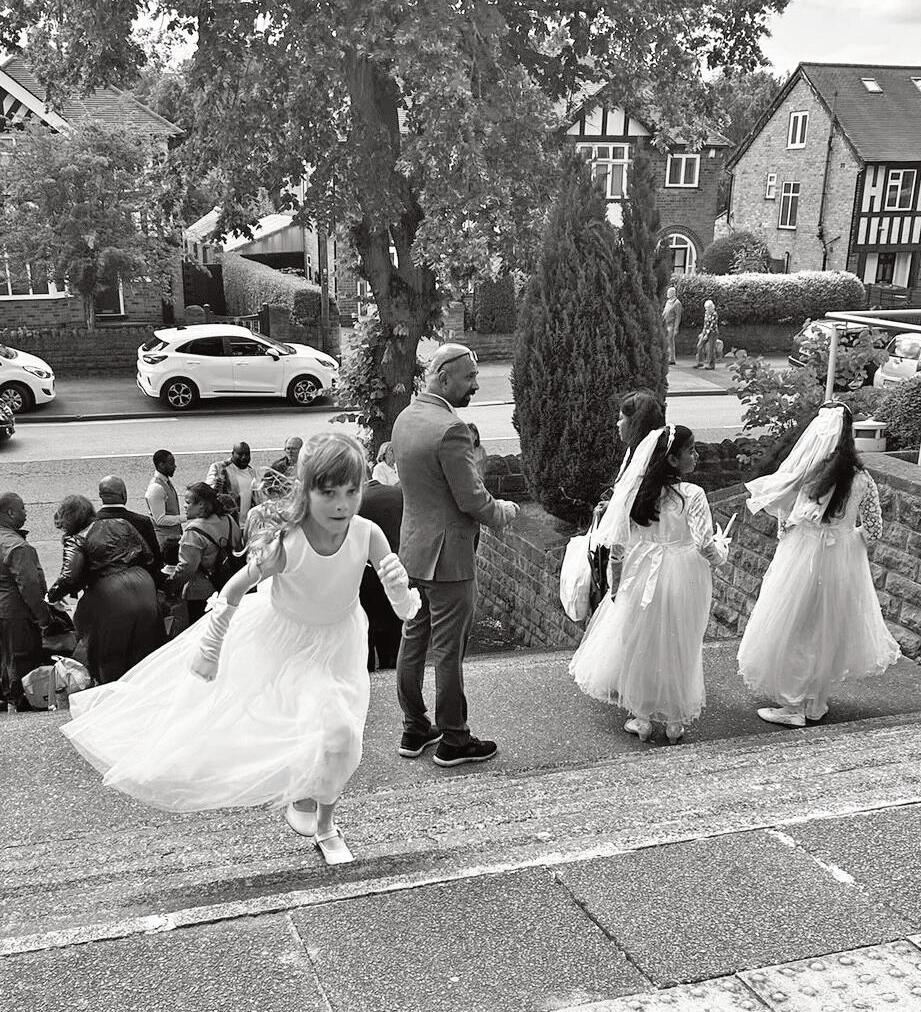
First Communion Sunday at The Good Shepherd, 2026
“I’m late, I’m late for a very important date!” said the White Rabbit in the story of “Alice in Wonderland”. Be not deceived, Nancy wasn’t late, but eager to be in the Good Shepherd Church to join 64 young people, many from the Good Shepherd Primary Academy, but others also from local Academies within the parish who had been preparing since the previous October for their First Holy Communion Day on June 13th, the patronal feast of our sister Church in Calverton, St. Anthony of Padua.
A magnificent celebration, led by the children throughout and assisted by Mrs. Toner, Principal of the Good Shepherd Academy and members of staff, who had also involved our parents in the catechetical
development of the children. Sharing a programme monthly themed Mass celebrations with the parish community and focused catechesis from January our children and young people were representative of Nancy’s eager approach to the Church on the Great Day, which began early with family photographs in the Parish Assembly Rooms, and the tremendous celebration of Holy Mass with a congregation in excess of 600 family members, relatives and friends. All were appreciative of our children’s Faith, expressed in the confidence of their proclamation of the Word, prayer and song.
Parents were very generous in their thanks and praise of the Catechists, the Good



Shepherd Academy, the musicians and the parish with expressions of tribute after Mass.
The following day, Sunday is traditionally the time for the parish to celebrate with its new First Communicants. Again, the children gathered in First Communion dress, to lead the 9:45 am Mass in similar way to the previous day to the joy of the whole community, who royally entertained the children and parents to First Communion breakfast arranged by Miss Tomycz and members of Staff of the Good Shepherd Academy.











Canon Philipp Ziomek, St. John Paul II parish, Nottingham
The Fool’s Pilgrimage – Five Days of Silence
This was my fifth visit to Sclerder—a retreat not simply from noise and distraction, but a gentle laying aside of self… and, on this occasion, an unexpected encounter with a rather determined bee!
It was also my longest retreat: five nights. When Lisa (my wife) signed my “permission slip”, I made sure to get it booked before she had time to persuade me otherwise. But, in truth, she was probably happier with her own peace and quiet for a few days!
Sclerder is tucked quietly away just off the A387 between Looe and Polperro. Home to the Chemin Neuf Community, it is a place of generous hospitality where you’re made to feel welcome from the moment you arrive.
Usually I’d drive, leaving my car in the car park. But as both of my daughters are now driving, it seemed only fair to leave our second car at home. So, I packed my old rucksack—the one my Mum and Dad bought me for my nineteenth birthday, nearly thirty years ago—caught the train, then the bus, before walking the final kilometre.
It transformed the journey into something more than travel. It became a pilgrimage. The Fool’s Pilgrimage.
Fr Adrian was waiting to welcome me, together with Elaine, Mary-Jane and Ruth, who looked after us so wonderfully throughout the retreat. They accompanied each retreatant with wisdom, encouragement and the occasional nudge towards whatever might help us to notice what would probably help.
The setting itself seems to invite silence.
Nestled in a sheltered valley only a short walk from Talland Bay, Sclerder is surrounded by woodland, open fields and the ever-present rhythm of the Cornish coast. Whether you understand that spiritually or simply through the restorative power of nature, the combination of sea air, ancient trees, birdsong and open horizons has a remarkable way of quietening the mind and awakening a deeper awareness.
I love walking.
My legs have not always served me well and they certainly have their aches and pains these days, but I remain deeply grateful for them. Walking the coastal paths and woodland trails has become part of my prayer.
In fact, when Lisa saw my step count, she wondered whether I’d accidentally booked myself onto a walking holiday instead of a silent retreat!
For me, the two are inseparable.
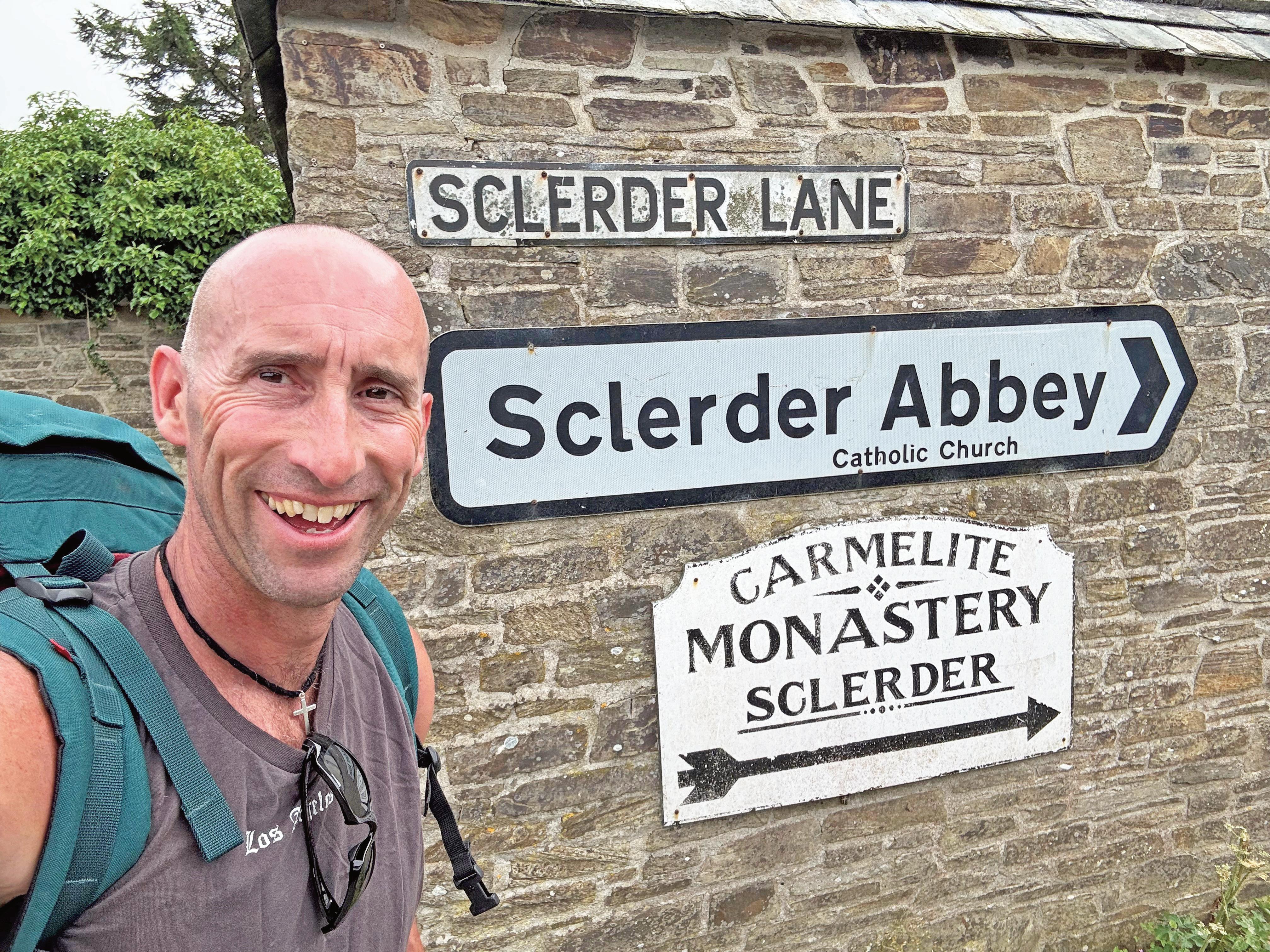
Walking has become one of the most contemplative forms of prayer I know.
The gentle rhythm of walking often leads naturally into what St Ignatius of Loyola calls a colloquy—simply a conversation between friends.
And who am I talking to? Sometimes God the Father, sometimes Jesus, sometimes the Holy Spirit.
Sometimes one of the saints or angelic beings who seems especially close that day, sometimes, if I’m honest, myself.
It reminds me of my old Irish nan. When I was a teenager, I once caught her talking to herself and asked who she was speaking to. Without missing a beat she smiled and replied, “Well, in order to find their equal, the Irish have to converse with themselves… or the Almighty.” I’ve never forgotten it.
I’m only about 39% Irish, but I think her reasoning still stands.
Whether we call it prayer, reflection or simply thinking out loud, there is something profoundly human about speaking our thoughts into the silence. More often than not, somewhere within that gentle conversation, we discover a reply.
The team bases its retreats on the Spiritual Exercises of St Ignatius. As a fitness trainer, I rather like the word exercises. They remind me that prayer is not simply
something we think about—it is something we practise.
One of the greatest discoveries I’ve made along my merry journey of discovery is that there is a broad river of meditation.
Some people picture crossed legs, empty minds and incense, others imagine monks in silent monasteries, yet meditation is simply the practice of becoming more deeply aware.
At one end of the river lies the simplest form of meditation: awareness of the breath, feeling the gentle rhythm of breathing.
Listening to the birds, noticing the breeze.
Allowing the body to settle, simply becoming present, nothing complicated, nothing forced, just noticing.
As the river flows, awareness becomes gratitude, gratitude becomes reflection, reflection becomes conversation, conversation becomes prayer, prayer becomes contemplation.
The river continues to widen, carrying us gently towards communion and oneness with God and with each other.
Each stage is different, yet none is greater than another. They are simply different depths along the same river.
For me, the journey often begins by creating a sacred space—a quiet room, a
candle and a simple prayer. Then, whenever possible, I step outside.
Walking slowly through woodland, fields or along the coast awakens something deeper. The sights, sounds, scents and textures of creation become companions rather than distractions.
Creation itself begins to pray.
The more attentive I become, the less separate I feel.
Not that I become creation, but I become more aware that I belong within it.
Every breath I take was once breathed by another living creature. Every birdsong becomes praise. Every crashing wave reminds me that life—and time—are always moving.
This movement through awareness has been described in different ways throughout Christian history.
St Ignatius of Loyola invites us to find God in all things. Every sense becomes a doorway through which God gently speaks, drawing us towards consolation rather than desolation.
St Teresa of Ávila describes the soul as an Interior Castle with many rooms. Prayer is not about climbing towards God but discovering that He has been waiting for us all along in the deepest chamber of our own hearts.
continued on next page
St John of the Cross reminds us that even darkness can become a place of encounter. Silence, uncertainty and apparent absence are often not abandonment but invitation. The soul slowly learns to let go of striving and simply remain with Love.
These are not competing methods. They are different paths through the same landscape.
Some days meditation is simply sitting quietly with the breath, some days it is an attentive walk-through nature, some days it is praying with Scripture, some days it is resting silently before God without words, some days it is wrestling through the dark night until peace quietly arrives.
Every one of these is meditation, every one of these is prayer, every one of these is enough.
Perhaps every river eventually finds its way to the sea.
The broad river of meditation is rather like that. We each enter it at different places, travel at different speeds and are carried by different currents, yet all are gently being drawn towards the same destination—the infinite ocean of God’s love.
During these days at Sclerder I came to appreciate how a place can quietly teach this truth. The silence, the chapel, the ancient trees, the coastal paths and the gentle rhythm of each day all invite the same movement: from distraction to
awareness, from awareness to presence, from presence to communion.
Perhaps meditation is not really about trying to find God at all, perhaps it is learning to become still enough to notice that He has been walking beside us all along.
And then… Just as I was sitting in complete wonder, watching three butterflies dancing effortlessly upon the breeze, an indignant bee decided I had become just a little too contemplative and promptly stung me on the head!
Nothing like a sharp reminder that we’re still gloriously human.
As I sit here a couple of days later, gently rubbing the still-tender bump on the top of my head, I can’t help but smile.
Because, somehow, I think God was in that moment too.
Perhaps even the bee was part of the retreat, helping me attain another level of awareness - but that’s another story.
Sometimes grace arrives as stillness, sometimes it arrives with wings…and occasionally with a sting.
As I left Sclerder and shouldered my old rucksack once more, I realised that perhaps a retreat doesn’t end when we walk back through the gate. It begins there. The silence simply comes home with us.
Dan Sobey
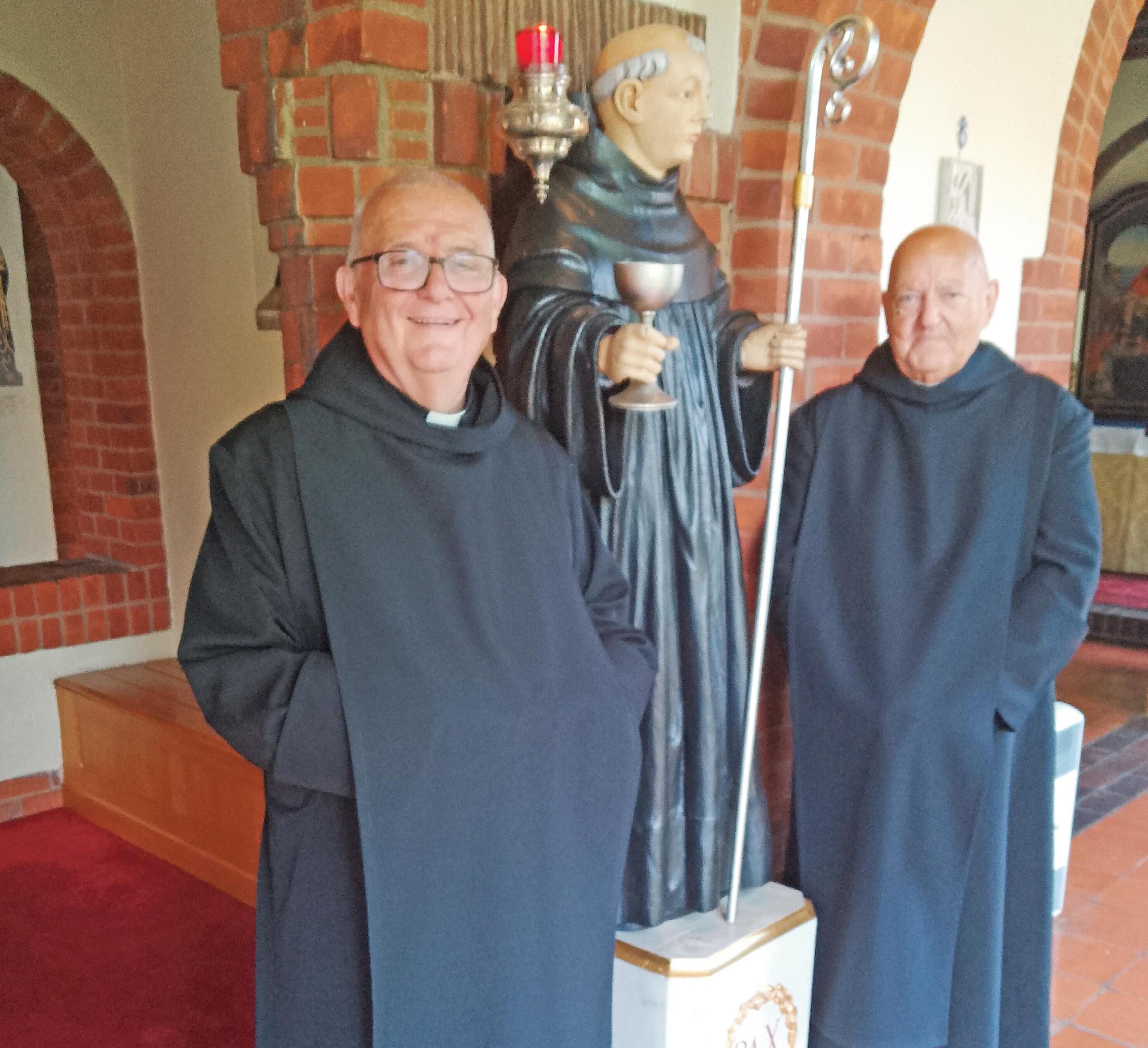
Fr David and Fr Richard Celebrating St Benedict's Day and their Anniversary of Ordination to the Priesthood by statue of St Benedict in Walsingham
Deacon Martyn Swaby RIP
Parish of The Most Holy Name of Jesus, North Nottingham, bids a sad farewell to Deacon Martyn Swaby RIP.
Our Parish was deeply saddened and shocked at the sudden death of our beloved Deacon Martyn Swaby on 28th April 2026 aged 63 years.
Martyn was ordained 13 years ago and worked tirelessly within the life of the Parish. He also worked full time as a Chaplain for the NHS.
He led the Baptism programme, RCIC, RCIA, First Holy Communion programmes. He worked with our ‘Looking Forward’ team towards the successful merger of Hucknall, Holy Cross and Bulwell, Our Lady’s Churches to become one Parish. He baptised many children, presided over the Marriages as well as Funerals.
Once a month Martyn preached profound and humble homilies that came straight from the heart. Martyn was a great support to our parish priests over the years.
Above all Martyn was the founder of ‘The Mind to Merciful Cafe’ in Bulwell, supporting anyone who wished to attend, perhaps lonely or isolated, or just for a catch up. All were (and are) welcome every week on a Thursday. He built this firm community foundation of love, care and support for all who came. Holy Cross now has a monthly Drop in Cafe too. He also advised other parishes and schools about drop-ins and they are still operating today.
Our Lady of Perpetual Succour School in Bulwell played a great place in Martyn’s heart. He served on the Governing Body when his children were very young and then returned latterly as Chair of Governors and Chaplain to Staff and children alike. He was adored at the school.
Our Lady’s Church was packed to capacity as people from all aspects of his life came to bid their farewells. Many priests of the Diocese and Deacons concelebrated. Fr Richard, Parish Priest, led the reception on Wednesday and Fr Gerry, former Parish Priest was chief celebrant.
Jack Swaby, Martyn’s son, spoke eloquently, with humour and with heart of his Dad’s journey through life. A perfect and fitting tribute.
Emma, Jack’s daughter prepared the screens for the services. Beautifully illustrated.
Beautiful music was led by our folk group on Thursday as well as a magnificent solo by Martyn’s niece, Caroline, - ‘May the Angels lead you to Paradise’. At ordination, Martyn’s brother Alan wrote a Mass specifically for the celebration. The Mass was sung at the funeral.
Pupils of Our Lady’s School performed a moving liturgical dance with so much reverence and love.
Our Parish, came together selflessly to support the family, from ‘traffic control, to refreshments and welcomes all round to everyone attending.
A sad and difficult time for us all, but every aspect was perfect and a most beautiful
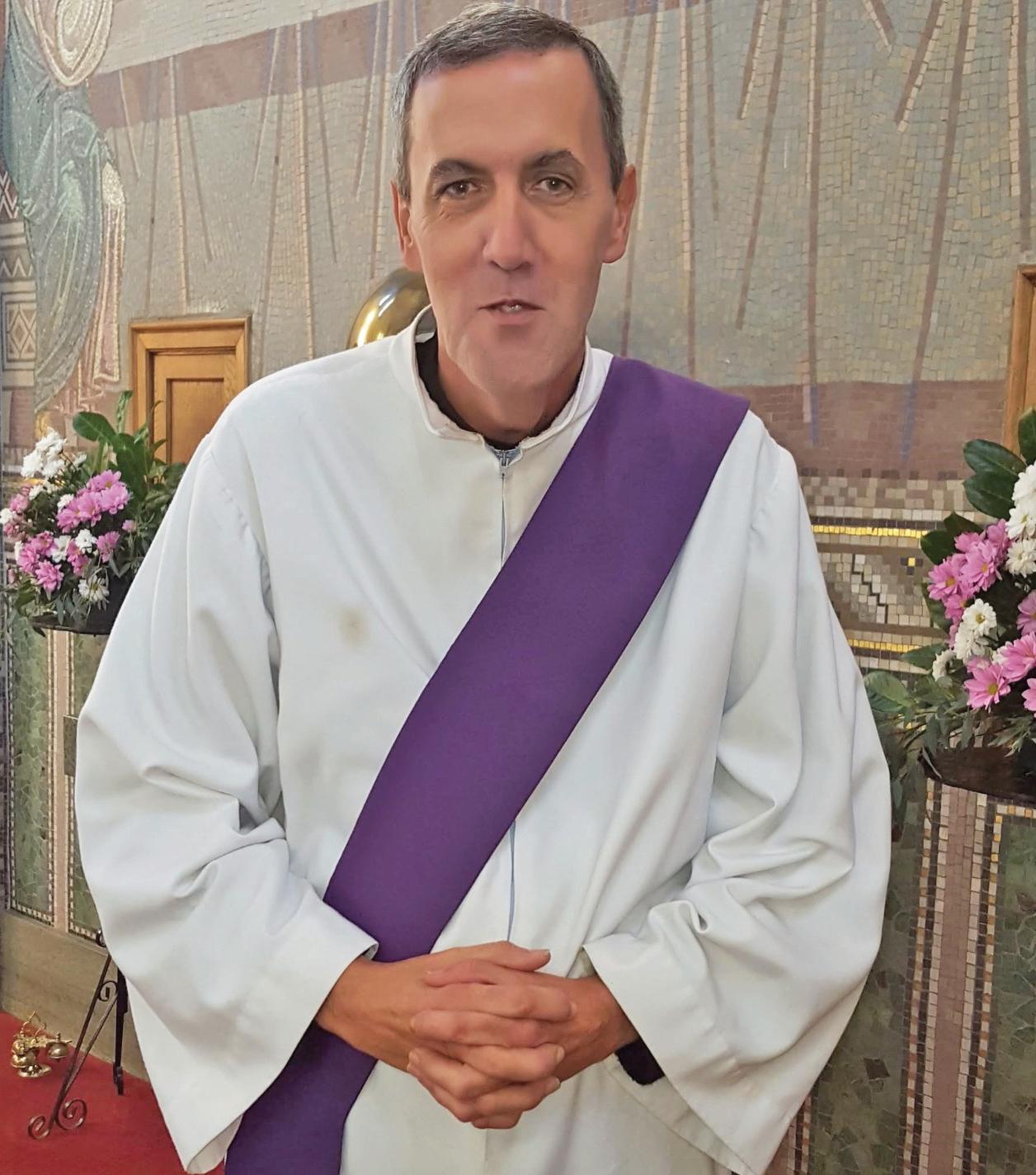
A gentle, unassuming, delightful and caring friend to all he met. He made such an impact on so many people as seen by the turnout at the funeral.
Our love, prayers and heartfelt sympathy to Toni, Martyn’s wife, Jack and Emma, children, Anthony, Emma’s fiancé and all of Martyn’s large family network now and in the future.
Requiescat in Pace Deacon Martyn. Our lives have been made better for knowing you.
Pauline
Lynch
farewell for Martyn who was loved by everyone.


CRYPTIC Across
7 Pool, outside Jerusalem, is a store of grain by morning (6)
8 Quiet after drink by the river in the Syrian city (6)
9 Felix's wife needs a doctor, getting sick in America (8)
10 Police officer close to Egypt reportedly finds a Christian sect member (4)
11 Pulls apart sick pun? (7)
14 Biblical prophetess's name for a Scottish town (5)
15 Midlands city cricket captain loses toss in the end (5)
17 One's reflective after transposing Yeats into the church (4-3)
21 Short recording following the appearance of old poet (4)
22 In Persia he, curiously, becomes a Jew (8)
24 Dangerous plant genus, dock, making a comeback in the borders of Asia (6)
25 Partly responsible, ambushing Canaan town (6)
CRYPTIC Down
1 Stories he tells sending up type of transport (4)
2 Road on which social climber turned up displaying orna mental shrub (6)
3 A boy king, son of Eliiphaz (6)
4 Native American's upset losing ring, one coming from Indonesia (5)
5 Clergyman's study down under is being curtailed (6)
6 Record at a pub, one New York's supporting, being a January fixture (8)
12 ‘Birth of a Nation's only half on – at six on telly, either side – at Christmas (8)
13 Top South Australian carnivore's kind of pouch (3)
16 Report Viking retreat in a valley near Jerusalem (6)
18 One killed in Susa is a boy found upset within Ionia's bounds (6)
19 Guard hurled the first of lances to be commandeered... (6)
20 ...Lance earl used to break up joust (5)
23 Biblical country's macho overthrow (4)
QUICK Across
7 Underground pool; once a major water source for Jerusalem (6)
8 Second city of Syria (6)
9 Wife of procurator Felix who heard Paul's case (8)
10 Member of a Christian sect; one descended from the ancient Egyptians (4)
11 Pulls apart; works out (7)
14 UN Secretary General 1997-2006; Scottish town (5)
15 Add fuel to: keep (a fire) going (5)
17 Middle-of-the-road illumination (4-3)
21 Roman poet remembered for his elegiac verses on love (43 BC - AD 17) (4)
22 Member of a strict sect of Judaism (8)
24 Genus of the family commonly known as belladonna or deadly nightshade (6)
25 Town of Canaan where Jehu killed Ahaziah (6)
QUICK Down
1 Fabricator of the truth; perjurer (4)
2 Japanese dwarf trees and shrubs (6)
3 Grandson of Esau and son of Eliphaz (6)
4 Son of Japheth, father of people who lived in Greece and Asia Minor (5)
5 Position of an ordinand on successful completion of

training (6)
6 Day after Twelfth Night (8)
12 Theological doctrine that Jesus Christ had no human father (8)
13 Fluid container; bag (3)
16 Valley separating Temple Mount from the Mount of Olives (6)
18 Notable among the enemies killed by the Jews at Ahasuerus’ citadel in Susa (6)
19 Protect; ward off (6)
20 Assegai, for example (5)
23 Biblical country in south-west Asia to the east of the Tigris River (4)
Across: 7 Siloam, 8 Aleppo, 9 Drusilla, 10 Copt, 11 Unpicks,
14 Annan, 15 Stoke, 17 Cat's-eye, 21 Ovid, 22 Pharisee, 24 Atropa,
25 Ibleam. Down: 1 Liar, 2 Bonsai, 3 Amalek, 4 Javan, 5 Deacon,
6 Epiphany, 12 Nativity, 13 Sac, 16 Kidron, 18 Adalia, 19 Shield,
20 Spear, 23 Elam.