Middlesbrough Diocesan Catholic year for What’s New Oratory of Inside StPageJoseph 4
VOICE My first years as a seminarian Page 6
October 2026 Issue 529
FREE
New book finds grace in ordinary moments Page 11
Assumption celebration proclaims one of Church’s earliest teachings The Feast of the Assumption is a symbol of the ultimate goal God has prepared for all believers, Bishop Marcus told a 350-strong congregation at the Shrine of Our Lady of Mount Grace. Preaching at his first Assumption Pilgrimage since becoming apostolic administrator, Bishop Marcus said: “This Solemnity unites us in the commemoration of the death, resurrection and glorification of Christ’s mother. “It proclaims that Mary has been ‘assumed’ by God into the heavenly kingdom of Christ in the fullness of her spiritual and bodily existence. “But it is particularly precious for us who have undertaken a pilgrimage here to this historic shrine of Our Lady of Divine Grace in Osmotherley, with a chapel that dates back to the 15th century and was founded from the nearby Carthusian Mount Grace Priory – which itself was dedicated to the Assumption of the Blessed Virgin Mary. “Our celebration today proclaims what the Church has long believed and taught, that, ‘The Immaculate Mother of God, the ever Virgin Mary, having completed the course of her earthly life, was assumed body and soul into heavenly glory.’ “Today, with the universal Church, we affirm our belief that Mary, the Mother of God is the perfect model of Christian life; who was preserved from the corruption of the grave and who is the Queen of Heaven and Earth. “The desire of the Blessed Virgin Mary was always to be totally at the service of her Lord and to be with him in her son. Mary’s desire was fulfilled in her assumption into heaven. “The centre of our Christian hope is not just that our souls will be in heaven but that we, like Mary, will be resurrected bodily. The feast of the Assumption of Mary Most Holy into heaven points to the goal that the Mother of God has reached. It is the same goal God has prepared for all of us.” The outdoor altar, now with its specially built canopy, was beautifully decorated with floral arrangements and diocesan director of music Steven Maxson and the diocesan choir led the
Bishop Marcus preaching at the Assumption Pilgrimage
singing to set a prayerful tone for the day. Thanks as ever to the Knights of St Columba for preparing the site in the run up to the pilgrimage and helping with parking and getting people up and down the hill. Friends of the Lady Chapel members are united in the spirituality of the Lady Chapel through an annual Mass and daily prayers and also
receive newsletters and invitations to events. A suggested membership donation is £10 a year for an individual or a family group. Schools are also welcome to join. Visit ladychapel.org.uk/friends for more information. Have you ever thought about leaving a legacy
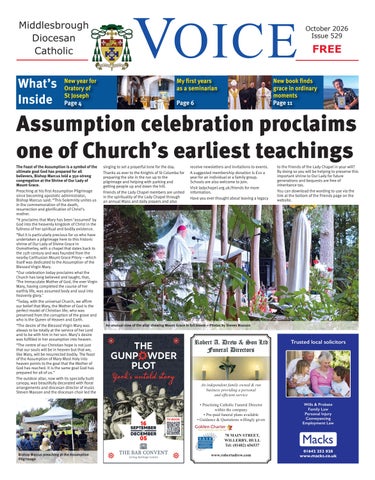
An unusual view of the altar showing Mount Grace in full bloom – Photos by Steven Maxson
to the Friends of the Lady Chapel in your will? By doing so you will be helping to preserve this important shrine to Our Lady for future generations and bequests are free of inheritance tax. You can download the wording to use via the link at the bottom of the Friends page on the website.
2 + Middlesbrough Diocesan Catholic Voice + October 2026
NEWS
Pastoral Letter for the Season of Creation Dear Brothers and Sisters in Christ, In the pastoral letter I sent during this season two years ago, I explained the venerable and rich tradition of care for creation contained in the teaching of the Catholic Church. In this special Jubilee Year of St Francis of Assisi, we once again, find ourselves in the Church’s “Season of Creation”[i] and a new opportunity is afforded to celebrate the harvest of good things which our earth gives to us through God’s providence. The Psalms remind us that the earth is full of God’s riches, and these riches are a wonderful blessing which God desires to share with everyone. This Season of Creation takes place during the time of harvest, where we see and taste the fruits of our labours and of the long days of the growing season during spring and summer; there is a time and a season to our growing and our gathering, and we are invited to “taste and see that the Lord is good”. The teachings we find in recent papal documents such as Laudato si[ii], Dilexi te[iii] and Magnifica Humanitas[iv], call us to a deeper realisation of our vulnerability and our mutual need. In order to flourish and grow as human beings, we must listen to the “cry of the poor” and the “cry of the earth”. God reveals His love for us through the beauty of His creation and calls from us to demonstrate a loving response of responsible stewardship.
Our Holy Father, Pope Leo XIV, has taken up the call made by his predecessor over the last decade, reminding us that our care for creation is not an optional part of our mission. We are urged to pray, act now, and not wait for others or until it is too late. In spite of challenges, we are seeing changes, both in attitudes and in the need and understanding for this call, with progress being made at many levels of our society. The Catholic Bishops’ Conference of England and Wales has developed guidance for us in a teaching document on the environment, The Call of Creation. It says: “We are a people of hope who believe in redemption. We must study the signs of the times and take the action that is needed to repair our relationship with God’s creation.”[v] Two years ago, I encouraged all parishes and schools to work towards CAFOD’s Live Simply Award[vi] as a way of “protecting this world which God has entrusted to us.”[vii] The award enables Catholic communities to care for God’s creation and stand in solidarity with our global family. I am pleased to inform you that across the Dioceses of Leeds, Hallam and Middlesbrough, there are now 11 parishes which have achieved the Live Simply Award, and several more starting the process. I now urge every parish, working individually or together in a deanery, to form a small team to begin the Live Simply initiative. This has worked well in the parishes that have embraced the award; there are now many
Bishop Marcus during St Mary’s Cathedral’s 40th anniversary celebration Mass – Photo by Chris Booth
good projects that can be shared to inspire others. We have found people of all ages wanting to engage with this work, giving their time and commitment, making a great deal of difference by a number of small actions in their personal lives. These are modern examples of the parable of the son who does the will of his father[viii], putting our faith into action in our parishes, homes and schools. In the Diocese of Leeds, we have embedded sustainability into the strategy for all our charitable responsibilities and appointed a new trustee to lead this work. Our diocesan Laudato Si’ Sustainability Group provides help and assistance to parishes and schools. It has representatives from our parishes, our clergy and diocesan curial departments. New initiatives have been identified and are being actioned through its work. In Middlesbrough and Hallam too, endeavours are being developed to help us work collaboratively and sustainably as one family of faith in the service of God’s people and the care of His creation. May this Season of Creation be a time of worship and praise, when we thank God the Father, our Creator, for the fruits of His creation which serve as reminders of His goodness. May this season be a time of holiness and loving kindness, when we seek to grow closer to God the Son, our Saviour Jesus Christ, who calls us, as He called St Francis of Assisi in simplicity and humility of heart, to care for those of our brothers and sisters who are poor and marginalised. May this season be a time of peace and justice, when we confidently call upon God the Holy Spirit, our Helper and Comforter, who inspires us to live more simply and care for the earth, so that our life may embrace the goodness of all creation and care for the common home of all humanity. Finally, may this season lead us to that time when all peoples and nations will fully cherish and care for creation and, in union with Mary and all the Saints, will give praise to the glory of the Most Holy Trinity, living, eternal and true. Amen. Marcus Bishop of Leeds Apostolic Administrator of Middlesbrough Apostolic Administrator of Hallam
Given at Leeds on the Feast of the Birthday of the Blessed Virgin Mary, September 8 2026, and appointed to be read at celebrations of Mass, and made available to be taken away from the churches and chapels of the Dioceses of Leeds, Middlesbrough and Hallam, on the 26th Sunday in Ordinary Time, Saturday September 26 and Sunday September 27 2026. i
The Season of Creation is an annual celebration uniting Christians in prayer and action for the protection of our common home. The season runs from September 1 to October 4, the Feast of St Francis of Assisi. ii vatican.va/content/francesco/en/ encyclicals/documents/papafrancesco_20150524_enciclica-laudato-si. html iii vatican.va/content/leoxiv/en/apost_exhortations/documents/2025 1004-dilexi-te.html iv vatican.va/content/leo-xiv/en/encyclicals/ documents/20260515-magnificahumanitas.html v cbcew.org.uk/wpcontent/uploads/sites/3/2022/10/Call-of-Cre ation-2022b.pdf cafod.org.uk/campaign/livesimply-award vi Laudato Si’ §242 vii Gospel reading for 26th Sunday in Ordinary Time, Matthew 21:28-32
Catholic industrialist and philanthropist honoured Emeritus Bishop Terry led tributes to one of Teesside’s best-known industrialists and philanthropists, Barney Ord, who has been awarded an OBE in the King’s Birthday Honours. The 91-year-old, who was born in Leeds but raised in Middlesbrough, has spent more than seven decades building businesses, supporting charities and helping countless people across the Tees region and beyond. A self-made businessman with a formidable reputation in engineering and machinery, Barney, a parishioner of St Bernadette’s in Nunthorpe, started his first business in 1959 and over the years he became chairman or director of dozens of North-East firms, at one stage overseeing businesses employing more than 1,300 people. But alongside his success in industry, Barney has long been admired for his commitment to charitable and community causes. A devout Catholic, he has supported
numerous organisations over many years, including Northern Lights, Fairbridge Trust, The Teesside Charity and the Diocese of Middlesbrough Youth Service. He has also played a leading role in the Mike McCullagh Memorial Fund – launched in memory of the former Middlesbrough FC chairman – helping to raise money for grassroots football and enabling disadvantaged children and families to travel to Lourdes. Barney volunteered on Lourdes pilgrimages for many years, giving up a week annually to help care for sick and disabled pilgrims. His association with St John Ambulance stretches back half a century after one of his employees suffered a serious workplace injury. In 1999 he was appointed a Knight of the Most Venerable Order of the Hospital of St John of Jerusalem. Friends and colleagues describe him as fiercely loyal, generous with his time and advice, and deeply proud of Teesside.
Father-of-three and grandfather-of-six Barney said: “I’ve been enormously lucky. I’ve always had two fantastic crutches in life – family and a strong faith. “One has to be careful that one doesn’t get too attached to the material world. It’s all about looking after each other and being concerned for everybody else. I’ve enjoyed every minute and I still love it now. I’m the luckiest and happiest man I know.” Emeritus Bishop Terry said: “Perhaps most striking about Mr Ord is his energy and enthusiasm for young people. Not just providing from his resources, he gives of himself personally in friendship and encouragement. This was highlighted when he led a group of university students to Panama for World Youth Day. Those who took part were inspired by his generosity and returned to the UK strengthened by his care and advice.” Dave Allan
Barney Ord OBE, KSG at the ordination of Father Peter Taylor in St Mary’s Cathedral – Photo by Chris Booth
October 2026 + Middlesbrough Diocesan Catholic Voice +
3
NEWS
Caritas hosts new day of prayer and reflection Father Chris Hughes will speak on the theme “No justice, no peace” at a day of prayer, reflection and solidarity at St Mary’s Cathedral to mark the 10th World Day of the Poor. A parish priest in North Shields, Father Chris is also chair of the Diocese of Hexham and Newcastle’s Environmental Group and a member of its Justice & Peace Council. In his message for the day, “The Lord is the refuge of the poor”, Pope Leo offers encouragement and challenge as he reflects on Psalm 14 and its continuing relevance in a world marked by injustice and inequality. He says Christians are called not only to seek refuge in God but also to become a refuge for
others in God, showing love and care to those in our families, workplace, schools, community and globally. Following the example of St Francis, we are invited to walk in solidarity with people experiencing poverty and hardship of any kind, both at home and abroad, to share in their experiences, and to listen to voices that often go unheard. As disciples of Jesus, we are called to go out and meet people in need, offer practical help, and build relationships founded on justice, dignity and fraternity. In his first apostolic exhortation Dilexi Te (subtitled “On love for the poor”), Pope Leo says: “The Church must be a Church of the Beatitudes, one that makes room for the little ones and walks poor with the poor, a place where the poor have a privileged place.” (no 21) Pope Leo said he hopes the 10th World Day of the Poor will help Christians rediscover the faces of brothers and sisters who seek refuge in God and long to feel at home in our communities. The event, organised by Caritas Diocese of Middlesbrough, will explore these themes and the Church’s “Preferential Option for the
Streetwise Opera opening our World Day of the Poor event in 2019 – photo by Johan Bergström-Allen
Poor”. Father Chris’s talk will consider how we can work towards a just peace where we live. Organisations that support people in need will be present to raise awareness of their work. Those who receive help and those who offer it will pray together in solidarity, recognising that each of us may need support at one time and be able to give it at another. The day will create space to hear lived experiences, learn what has helped people on their journeys, and understand the obstacles they face.
Event details Date: Saturday November 14 Time: 10.30 am–3.15 pm Venue: St Mary’s Cathedral All are welcome. Tea and coffee will be available – please bring a packed lunch. Parking at the Parkway Centre is chargeable after the first five hours. Please do come along and bring a friend or two! Teresa Lyth
Holy Father reminds us of music’s sacred role Earlier this year, Pope Leo began a series of catecheses based upon the documents of the Second Vatican Council. He did so conscious that “the generation of bishops, theologians and faithful who lived through Vatican II is no longer with us” and of the need “not to extinguish the prophecy” of the council, but to “continue seeking ways and means of putting its insights into practice”. He went on to explain that we should know the council “not through hearsay or through the interpretations that have been offered of it, but by rereading its documents and reflecting on their content”. He considered Chapter 6, Sacrosanctum Conciliam, which is dedicated to sacred music, noting that the constitution: “The musical tradition of the universal Church is a treasure of inestimable value, greater even than that of any other art.” He said sacred music is “part of the liturgical action and is not merely a decorative part of the celebration”. On our diocesan music social media accounts (@MusicDiocese), I have shared links to the text and video of the audience, so that all of us who are liturgical musicians can reflect afresh upon our role and contribution to the sacred liturgy. The Holy Father reminded us of the words of St Augustine of Hippo: “Cantare amantis est” (“singing belongs to those who love”). Singing not only enhances the liturgy but also “contributes to the unity of hearts, overcoming differences between people and bringing everyone together in praise of God”. He reminded us that the council fathers stated that Gregorian chant is “particularly suited to the Roman liturgy: therefore, other things being equal, it should be given pride of place in liturgical services”. The council fathers, and the Holy Father in his general address, reminded us that this notwithstanding, other forms of sacred music need not be excluded from the celebration. He said: “The council emphasises the importance of taking [the musical traditions of different cultures] seriously into consideration, as they form part of people’s religious and social life.” He reminded us of the words of Pope St John Paul II and the need to “purify worship from ugliness of style, from distasteful forms of expression, from uninspired musical texts which are not worthy of the great act that is being celebrated”, in order to guarantee dignity and excellence to liturgical compositions.
to “Instruction on Music in the Liturgy”. I have produced a video about Pope Leo’s general address and have included links to these two documents in the description. Pope Leo ended his catechesis with this wonderful quotation from St Ignatius of Antioch: “Let each of you become a choir, so that, harmonious in agreement and taking the pitch of God in unity, you may sing with one voice through Jesus Christ to the Father, so that he may hear you and, from the good works you perform, recognise that you are members of his son.” Steven Maxson Diocesan Director of Music
He said: “Sacred song should be suitable, profound, and at the same time readily understandable, inspired mainly by Sacred Scripture, the liturgical books and the spiritual Tradition of the Church.” He reminded us of the guiding principle of the active participation of the faithful, but also that this includes silence and listening just as much with sacred music as with the whole of the sacred liturgy and liturgy of the word. Pope Leo reminded those of us who compose liturgical music that it cannot be judged solely according to artistic quality, but upon how it meets the particular requirements of the liturgy in terms of adherence to the text and fitness for the liturgical moment for which it is intended, as well as suitability to the gestures and character of the rite itself. We were reminded, afresh, that Sacrosanct Concilium states that “the pipe organ is to be held in high esteem, for it is the traditional musical instrument which adds a wonderful splendour to the Church’s ceremonies and powerfully lifts up man’s mind to God and to higher things”. Sacrosanctum Concilium goes on to say that other instruments may be admitted for use in divine worship “on the condition that the instruments are suitable … for sacred use, accord with the dignity of the temple, and truly contribute to the edification of the faithful.” I commend to each of you the full text of the general audience and to re-read section 6 of Sacrosanctum Conciliam, as well as Musicam Sacram, the council document specifically dedicated
4 + Middlesbrough Diocesan Catholic Voice + October 2026
SCHOOLS
Christ the King Primary School A member of Nicholas Postgate Catholic Academy Trust
Tedder Avenue, Thornaby, Stockton-On-Tees TS17 9JP Executive Head Teacher: Mr M Ryan Head of School: Miss H Lickess Tel: 01642 765639 Email: enquiries@ctking.npcat.org.uk
To advertise please contact Jake Layton on 01440 730399 or email jake@ cathcom.org
Oratory unites in faith and fraternity Young men of faith are flocking to the Oratory of St Joseph, which returned in September after a summer break. Meetings at Hinsley Hall in Headingley have had around 25 regular attendees travelling from across the three dioceses of Hallam, Leeds and Middlesbrough. The oratory is organised by two young priests of the Diocese of Leeds, Father Benjamin Hilton and Father Marc Pitson, together with Father Philip Cunnah of the Diocese of Middlesbrough, who took over after Father Richard Marsden left to become vice-rector of the Venerable English College in Rome. As well as prayer and Benediction, there is always a talk on substantial issues of relevance to today’s young men. All the meetings include time to socialise – and a free supper! All Catholic men aged 21 to 35 are very welcome to join the Oratory of St Joseph and can simply turn up to meetings, which take place between 6.30pm and 8pm on the last Thursday of each month.
Benediction during a meeting of the Oratory of St Joseph at Hinsley Hall
Laura runs Yorkshire marathon for special cause The work of the Upper Room Project, which supports rough sleepers and destitute people in Middlesbrough, has been boosted by generous fundraising in memory of a much-missed volunteer. Laura Smith ran the North Yorks Ultra Challenge 100K run this summer in memory of Ed Graham, raising over £1,000. Ed was a committed Upper Room volunteer who had a gift for connecting with guests and always going the extra mile to help. Tragically, he died suddenly on Christmas Day 2025. His mother, Angela, is a regular volunteer and along with his sister, Charlotte, raised over £6,000 in his memory earlier this year. Laura visited the Upper Room and is signing up to volunteer. She said: “I plan to make this run an annual event in Ed’s memory – the Ed Graham Memorial Run.” The Upper Room Project welcomes 60 to 80 guests every Saturday, offering a breakfast of a sausage bun, toast and a takeaway lunch, emergency clothing and other items, as well as signposting to more support. Thank you to all who donated or sponsored Laura. To find out more about the Upper Room Project with Middlesbrough SVP, email francesg@svp.org.uk or teresa_lyth@hotmail.co.uk.
Fr Emmanuel comes to the coast Bishop Marcus has appointed Father Emmanuel Anaele as parochial vicar of the coastal parishes of Blessed Nicholas Postgate, Redcar and Marske, Our Lady of Lourdes, Saltburn and St Paulinus, Guisborough. Please keep Father Emmanuel in your prayers as he begins his new life in Redcar.
Final plans made for Adoremus congress Preparations are being finalised for the Adoremus National Eucharistic Congress in London on Saturday October 10. As well as events at St George’s Cathedral, Southwark, and Westminster Cathedral, including a Eucharistic procession between the two churches, there will also be local events celebrated in parishes throughout the country. For more details visit cbcew.org.uk/adoremus-2026.
Laura Smith, second from right, with Upper Room Project volunteers
It’s a great time to join our choir! Members of the Diocesan Choir gathered in York to sing Vespers (Evening Prayer of the Church) in St Aelred’s Church. The choir meets on the third Sunday of every month to rehearse and for the final such rehearsal of the academic year concluded in worship. Alongside sung settings of the psalmody for the day, the choir also sang a setting of the Magnificat by contemporary composer Christopher Dalitz. The service was led by Father Bill Serplus and attended by many from the parish who formed the congregation. Refreshments were served afterwards in St Aelred’s Community Centre. October is an excellent time to join a choir, which is always on the lookout for new members. It is drawn from across the diocese, with members coming from all four deaneries, travelling from Hull, Middlesbrough and York, as well as the North and East Yorkshire coasts. Rehearsals take place in York on the afternoon of the third Sunday of the month and there are no auditions required to join. If you would be interested in joining or finding out more, please contact our diocesan director of music, Steven Maxson, at musicdept@rcdmidd.org.uk.
Members of the Diocesan Choir after singing Vespers in St Aelred’s Church, York
October 2026 + Middlesbrough Diocesan Catholic Voice +
5
NEWS
Christine’s journey ends back where it all began A former pupil at St Aelred’s Catholic School in York has retired after returning to the school for the second time to end her distinguished 35-year teaching career. Christine Wise had been back at the school for the last seven years and headteacher Claire Hughes said she will remain a treasured part of the St Aelred’s family. “Christine’s impact on St Aelred’s has been immeasurable,” said Mrs Hughes. “As both a former pupil and a much-loved member of staff, she embodies everything our school stands for. “Her unwavering faith, kindness, humility and dedication have shaped generations of children and inspired all members of the St Aelred’s team throughout her career. “Christine has always placed Christ at the heart of school life, nurturing the spiritual development of our children with compassion, wisdom and dedication. Whether leading our chaplaincy, preparing school liturgies or offering encouragement to those around her, she has left a legacy that will continue to be felt for many years to come. “Her commitment extends far beyond the school gates, as she is also a devoted and active member of the parish community at St Aelred’s, where she continues to serve with the same generosity and faith that have defined her career. “One of her pupils, Helen, recently shared something that reflects the impact Mrs Wise has had on the children she teaches. When faced with something on her mind, Helen simply said, ‘I’ll just let God know.’ For me, those few words perfectly capture Mrs Wise’s greatest gift.
Mrs Wise, who has retired after a 35-year teaching career, pictured with pupils
“She has helped generations of children understand that faith is something they can carry with them every day, knowing that God is always there in both the big moments and the small ones.” After attending St Aelred’s, Christine returned to the school as a teacher during the early
years of her career. She enjoyed a successful career in Catholic education, including leadership roles, before completing her teaching journey at the school that has always held a special place in her heart. Mrs Hughes added: “It is a truly special way to bring an extraordinary career to a close. As
Christine herself says, ‘It was obviously meant to be.’ “On behalf of everyone at St Aelred’s, I would like to thank her for her extraordinary service and wish her a long, happy and well-deserved retirement.”
6 + Middlesbrough Diocesan Catholic Voice + October 2026
NEWS
Martyrs, Mary, Mission: My first years as a seminarian CHRIS CARLING is a seminarian for the Diocese of Middlesbrough, currently based at the Venerable English College, Rome. Here he tells us a little about his journey so far… It would be impossible to sum up the last three years in seminary in a few hundred words, but perhaps I can share three key themes of my formation thus far. Studying abroad in Valladolid and in Rome, I am consistently reminded of home. Martyrs The first theme is the witness of our martyr saints and their continuing prayers for us. I began my formation with a propaedeutic year at the Royal English College in Valladolid before coming to study philosophy and theology at the Venerable English College in Rome. Both institutions were founded in the wake of the Reformation, when Catholicism was violently suppressed in England. Their first students were forced abroad to train for the priesthood before returning home in secret. On being discovered by the authorities, many were arrested and martyred for the faith. Although my circumstances are very different, I follow a similar course of study within Rome’s pontifical university system. I have developed a particular devotion to the saintly martyrs from our own region, including Blessed Thomas Palasor of Swaledale, Blessed William Richardson of South Yorkshire, Blessed John Lockwood of Sowerby and Blessed Edmund Duke, who was martyred in Durham. As St John Paul II said of the English and Welsh martyrs, they “wished only to feed their people with the Bread of Life and with the Word of the Gospel”. It is moving to remember that the Church today is built on their witness and example. Mary Devotion to the Blessed Mother is a further reminder of my closeness to Middlesbrough. The Church of St Alphonsus Liguori in Rome is home to the original icon of Our Lady of Perpetual Help. Since she is patron of all three Yorkshire dioceses, I often go there to
pray for our Bishop and the Church in Hallam, Leeds and Middlesbrough. Just outside Rome, in Nettuno, is the current home of the statue of Our Lady of Grace. Originally from England, it was brought to Italy in the wake of the Reformation. A copy now stands in Middlesbrough Cathedral, as the original may once have belonged to the shrine of Mount Grace. I regularly take the local train to Nettuno to ask Mary’s prayers and to entrust to her my vocation. During the Jubilee for Seminarians, Pope Leo urged us to imitate Mary by “avoiding superficiality and holding the pieces of your life together through prayer and meditation”. Mission Finally, there is mission. My time in Rome is only temporary; its purpose is to prepare me to return home to serve the people of this diocese – a mission that forms part of the wider, universal mission of the Church. I am reminded of this universality daily at university, where I study alongside seminarians, religious sisters and lay students from every continent. This summer, that experience continues as I spend six weeks in a rural parish in Kenya, experiencing parish life in a completely different context. On Ascension Day, I was admitted as a candidate for Holy Orders, formally expressing my intention to continue preparing for priestly ordination and marking the Church’s acceptance of that intention. The Mass was celebrated in the college chapel by Archbishop Joseph Augustine Di Noia. In his homily, he called us to devote ourselves “single-mindedly” to preparing for the mission Christ entrusted to his Church: to make disciples of all nations. It was moving to receive this recognition and encouragement as I continue to prepare, please God, for priestly ministry. The road ahead remains rather long, and I am deeply grateful for the support and prayers I receive from the people of the Diocese of Middlesbrough. I assure you of my daily prayers, too.
Chris Carling, second from right, with fellow seminarians and Archbishop Joseph Augustine Di Noia OP and Bishop-Elect Stephen Wang
Holy Land charity seeks volunteer ambassadors Catholic charity Friends of the Holy Land has issued a call for volunteer ambassadors to support vulnerable Christian communities facing ongoing hardship across Gaza, the West Bank, Israel and Jordan. The charity is seeking individuals to help raise its profile at parish level, engaging with schools and colleges and coordinating appeals. The role aims to provide a practical voice for the founding Christian communities of the Holy Land – many of whom face increasing isolation amid continuing regional conflict. Key responsibilities include delivering up to eight talks or appeals per year in local Catholic parishes to raise awareness and support, presenting to Catholic schools and
colleges to foster awareness and inspire local fundraising initiatives among young people and working within diocesan networks to expand the charity’s presence and active supporter base. To help prospective applicants learn more about the role and the charity’s mission in the region, Friends of the Holy Land is hosting monthly information webinars. Held on the fourth Monday of every month at 7.30pm, these 45-minute sessions outline the urgent practical assistance needed for fellow Christians across the Holy Land. Potential volunteers can register for an upcoming webinar online via bit.ly/4xkvWTA.
THE LIVING WORD – Exploring the biblical notion of body LUCA SETTIMO, Professor of Theology at the University of Nottingham and currently living in the Diocese of Middlesbrough, continues his series of reflections on the meaning of some key biblical words. In the words spoken by Jesus on that last evening of his earthly life, soma is his very person who gives himself in an embrace of communion with his faithful through the sign of bread and wine: “Take, eat; this is my body [soma]” (Matthew 26:26). The word “body” is found 142 times in the New Testament. Unlike classical Greek culture – which places a clear distinction between the spiritual soul and the material body – the Bible considers the human being as a unity in which flesh, life, spirit and conscience co-exist. In Semitic culture, in fact, we are a body because it is in it and with it that we live and communicate, while in the Western world, we have a body that we control, detest or idolise. In this light, we can understand the relevance of corporeity in the pages of the Bible. In practical terms, the body (soma) coincides with the person and the meaning of this term is not exhausted by the idea of carnality alone, seen as a sign of weakness, fragility and misery.
The Song of Songs (Chapters 4, 5 and 7) is not embarrassed to celebrate the beauty and eros of the bodies of the two lovers. So, we should not be surprised if already in the Old Testament and in a unique form also in the New Testament, the final destiny of the redeemed creature is the resurrection of the body and not so much the immortality of the soul alone (Ezekiel 37).
apostle uses, in some passages to the Romans the expressions “body of death” and “body of sin”. But with the incarnation of the Son of God, our mortal and sinful body is buried and the “spiritual body” is reborn, that is, animated by the same Spirit of God: “He will transform the body of our humiliation that it may be conformed to the
Similarly, it is significant that Christ’s public activity was dominated not only by preaching but also by the healing of bodies.
In fact, the goal to which we aspire, that of the resurrection, is already marked in us through the desire for our salvation. It is that “inner groaning”, an expression for those who expect to be adopted as sons and for the “redemption of our bodies” (Romans 8:23). Even if it is difficult to define what the destiny of our glorious body will be in the renewed creation (cf 1 Corinthians 15), we know that it has a destiny of glory. Thus, we must consecrate our bodies to God; each human body is in fact the expression of a person and is “a living sacrifice, holy and acceptable to God, which is your spiritual worship” (Romans 12:1).
Jesus’ public ministry, through miracles, focused extensively on the human body with the intention to restore it to its splendour. Furthermore, through the Eucharist, Jesus offers his body as food, thus creating a communion that is not generically spiritual but a communion that is personal, since the body is an expression of the person.
I wish to acknowledge Cardinal Gianfranco Ravasi for granting me permission to use his material. A YouTube video entitled “The biblical notion of body”, which explores this biblical concept in greater detail, is available on my YouTube channel (youtube.com/@LucaSettimo-7).
Paul then conceives, in the First Letter to the Corinthians, the Church as the body of the risen Christ and will ask the Corinthians rhetorically: “Or do you not know that your body is a temple of the Holy Spirit within you, which you have from God, and that you are not your own?” (1 Corinthians 6:19). Of course, in our body there is the stigma of death and the wound of sin: in fact, the
body of his glory, by the power that also enables him to make all things subject to himself” (Philippians 3:21).
Professor Luca Settimo
October 2026 + Middlesbrough Diocesan Catholic Voice +
7
NEWS
A week of fun, love and laughter at Wydale Hall The Middlesbrough Catholic Fellowship returned refreshed and full of joy after a wonderful summer residential holiday. We took around 40 volunteers and members on a fantastic week of fun and laughter. Once again we stayed at Wydale Hall and the Emmaus Centre, near Scarborough, where we were warmly greeted by our hosts, Mark and Helen. We took the place over for a week, and thanks to the commitment of all our helpers, we enjoyed an action-packed week of entertainment and fun. We travelled down on a fantastic bus hired from Coatham Coaches, which even had an accessible lift, meaning our wheelchair-user passengers could travel in comfort and style with the rest of the group. After a relaxed evening meal we enjoyed a movie night and karaoke – and, as anyone who has been on one of our holidays will know, there’s no karaoke quite like a Fellowship karaoke! The rest of the week was jam-packed with activities, including trips out to Scarborough, York, Filey, Thornton-le-Dale and a petting farm. We also enjoyed days-in involving crafts such as tote-bag printing, party games and crazy golf.
Our members were well entertained each night by a disco, a fantastic magic show (led by the Great Eamondo (Eamonn McClurey) and Neil Armstrong, a singalong with Joe Harrison and Eliza Hannaway and yet more karaoke. As well as having morning prayers each day, we were blessed with the highlight of the week as our chaplain, Canon John Lumley, visited to celebrate Mass. We had a very special interpretation of the day’s gospel acted out in live action by members and helpers. The members thoroughly enjoyed the week, and we are all tremendously grateful to the incredible helpers, old and new, who come along and freely give their time and commitment to supporting their needs 24/7 while we are there. You are all simply amazing, and without your help we could not run this holiday, so on behalf of our members, thank you all! We were joined this year by one of our Lourdes friends, Lizzie Stewart, who was conscripted by Jean Milburn during this year’s pilgrimage. She has sent her own account of the week to outline her experience with us. Have a read and maybe consider if the Fellowship is something you feel you could
get involved with. We always need new helpers, and if you could spare the odd Wednesday evening or Saturday morning to help in any capacity, we will arrange for diocesan DBS checks for you.
You never know, you may feel like joining us on next year’s holiday! Tony Kirk, Chair, Middlesbrough Catholic Handicapped Fellowship
Saying ‘yes’ brings magic Fellowship moments When a friend asked if I would volunteer to help with the annual Middlesbrough Fellowship holiday, I took down the dates and said I would think about it. A few days went by and I had mulled it over now and then, trying to decide if I could spare a week away, as I was heavily into some DIY at home. Then one morning, I was gently reminded of a decision I had made a year ago: that if I was asked and was able to do something helpful for others, my answer would be yes. Firmly believing this gentle reminder had come from the Holy Spirit, I immediately got in touch with my friend to say I would come. When I arrived at Wydale Hall, I was immediately met by some familiar faces who welcomed me warmly. I was then introduced to the Fellowship members. I don’t believe I have ever walked into a room of strangers and been met with such genuine warmth. I was shown to my room, which was perfect and had the most breathtaking view. I then met my lady who was to be my companion for
the week and we hit it off straight away. Every day there was a trip out somewhere, either to the coast, a farm, bowling or a charming English village, all of which usually resulted in a cream tea or the like! When we weren’t out on trips, there were activities in abundance. You name it, we probably did it! We even had a magic show. One of the founder members also showed some old cine film of past Fellowship holidays. It was so moving to see members recognising themselves when they were children and remembering those who are no longer with us. Canon John didn’t rush off after saying Mass for us, so I had an opportunity to introduce myself and chat. In fact, the week was punctuated with familiar guests arriving either for a short stay or a fleeting visit. They were treated to excited cheers when they arrived, like celebrities! One such guest turned out to be someone I hadn’t seen for 10 years and thought I would never meet again, so that was such a gift. Every day turned up
something magical! The hall is an old manor house with magnificent grounds, including woods and a picturesque walled garden full of nooks and private seating areas where you can enjoy quiet moments and the sheer beauty of the place. The staff couldn’t do enough for us. Meals were frequent, abundant and delicious and when we weren’t eating together, tea, coffee, juice, cakes and biscuits were constantly available. We had lots of opportunities to sit on comfortable leather chesterfields and chat or read. Everybody looked out for each other and no one was left out. It was just one very big and very caring family. I’m glad I said yes and I would encourage anyone to give it a go and join in on a week of pure fun and genuine love and friendship. Lizzie Stewart
Wheelchair users including Karen, second from the front on the right, were carried in style on a specially kitted out coach
A Letter From Madonna House – The prayer that draws us into the life of Jesus I love the Rosary! And since October is the month of the Holy Rosary, I thought I would tell you why. As Christians, our lives are linked to the mysteries of Christ’s life, death and
resurrection. We find a sure passage into these mysteries through Our Lady, who lived so intimately in his presence. No human being (apart from her son) has plumbed the depths of them as she has: “His mother pondered these things in her heart” (Luke 2, 51). I love the fact that as we finger the beads of a Rosary, praying Our Fathers, Hail Marys and Glory Bes, we are drawn into pondering Jesus’ and Mary’s lives. Joyful Mysteries, Luminous Mysteries, Sorrowful Mysteries, Glorious Mysteries… with a little imagination and the help of the Holy Spirit, they pass before our mind’s eye and we are led to new depths of understanding and appreciation of the mysteries of God. I love how versatile the Rosary is. It can be said anywhere: on your knees in a church, standing in the queue at the supermarket, sitting down relaxing, lying down on the sofa or in your bed, at home or travelling… I prefer
kneeling in a quiet place, where I can concentrate better. You can pray an entire Rosary, or you can space one out, saying a decade at a time throughout the day. I love that, despite fatigue or distractions, something beautiful happens whenever we pray the Rosary. The rhythm of the words calls us back to praying with the heart. I love that we are connected to Mary in this prayer. When I can’t fall asleep at night, I hold my Rosary and finger the beads. Often this helps me to go to sleep. But even if I can’t sleep, knowing that she is near is comforting. It is a wonderful prayer to offer for a special intention. When I don’t know how I should pray for someone or some situation, praying the Rosary helps. I love that the Rosary can be recited communally. Whether it is with a good friend or a room full of people, the blending of the voices is like a song that rises up to God like
incense! People of all ages can take part, even very young children. Sometimes we see the Mysteries of the Rosary blend with our own experiences. Mary was the first and most perfect follower of Christ, so I love learning from her how to be a true disciple. For example, I was recently visiting my elderly parents and helped out around the house. This meant helping with the cooking and cleaning, and with the personal care of my father. I thought of Our Lady’s Visitation to her six months pregnant cousin, Elizabeth. She was there to help out in much the same way as I did. In following her lead, the visit was blessed in many unexpected ways! Try it and see for yourself how your love for the Rosary grows! Jeanne Guillemette
8 + Middlesbrough Diocesan Catholic Voice + October 2026
NEWS
Thank you for helping holiday dreams come true If you work in or have ever shopped at one of the two St Vincent’s shops in our diocese, then this article is my way of saying thank you. That’s because some of the profits generated by the hardworking managers and volunteers at Marton Road, Middlesbrough, and Melrosegate, York, enabled us once again to offer free places on our SVP Vinnie Camp 2026. During the school holidays, we took nine children from the Middlesbrough area and 10 children from York aged between nine and 11 years old, plus nine SVP volunteers, to Peat Rigg Outdoor Training Centre for a five-day residential experience. Activities including bushcraft, archery, abseiling and canoeing were led by the professional instructors at Peat Rigg, while the SVP volunteers provided the pastoral care. Our youngest volunteer was 18 years old while the eldest was 69, but every helper encouraged the children, often by taking part in activities themselves. The children were identified through contacts with our primary schools as well as groups such as the SVP who were already working with their families. Our single criterion was that these children would not otherwise have had a holiday. Few of us had ever met anyone else at the camp before our stay but by the end of the week many friendships had been made among the children as well as the adult helpers. The days were long and action packed. We woke the children at 7.15am ready for breakfast at 7.30am and by the time we
were sure the children had settled for the night and we adults had discussed any issues that had arisen during the day, we went to bed ourselves at around midnight. Although it was tiring, it was a great privilege to see the children grow in confidence and self-esteem as they encountered and overcame challenges. For example, one boy who was very homesick and introverted on the first night became more outgoing and confident. When there was a conversation about making friends on the camp and another boy said this boy was his friend, his face lit up. He benefitted from the activities but perhaps even more so from sharing a room with and getting to know people he didn’t know. On the last day he was so thrilled to discover he is eligible for the next camp. You can help us give more children this opportunity in several ways. Perhaps you could volunteer as a helper. You don’t need to be an existing SVP member, but you must be over 18 with enhanced DBS. All volunteers receive training from the SVP national team. Maybe you could volunteer at one of the St Vincent’s shops if you have an hour or two to spare, or perhaps just make a resolution to shop there more frequently. Of course, your prayers for the SVP’s work are always most welcome. To find out more about how you can help, email me at presidentc13@svp.org.uk. Patricia Nobbs Children having fun at the SVP Vinnie Camp 2026
Lavender bags will boost parish charity funds It’s the Lavender Hill Mob! Well, not quite. It’s actually members of two Our Lady of Perpetual Help parish groups the Knit and Natterers and The Chosen at St Gabriel’s, Middlesbrough, who met up to harvest lavender during our lovely hot summer. Our intention is to dry the lavender and then bag it, to sell at one of our proposed toy-swap evenings, to be held in our two primary schools in November. We named our amalgamated group for the lavender-cutting day Cut and Cake, both of which we enjoyed doing, especially eating the cake! The proceeds from the lavender bag sales are to go to our parish churches’ charities. Pat Gray
The ladies with some of the harvested lavender
CATHOLIC HISTORY FOCUS – The legend of the musical saint SHAWN RAS, a Dutch-born historian and parishioner of Our Lady of Lourdes and St Peter Chanel in Hull, continues his series of articles about Church history… “Sing and make music from your heart to the Lord” Ephesians 5:19 Few things are as closely associated with Christianity as song. Be it from the choirs and organs we know well in our Church, to electric guitars and stages as some American Protestants do. In our Catholic tradition we have Pope St Gregory to thank for the basis of our hymns. His Gregorian chants are considered the basis for western musical tradition, but he himself built on tradition already established. In the sixth century there lived a man in the biggest city in the world. Not considered especially talented as a singer nor as a reader, this man, Romanos, gained the attention of the head of the Eastern Church, the Patriarch of Constantinople. During the Vigil of the Nativity, Romanos read the liturgy so poorly that he was made fun of by his peers. In shamem he sat in the choir stalls in the Church of the All Holy Mother of God in Blachernae. As he fell asleep, Our Lady appeared to him in a vision, holding a piece of paper. She
commanded him to take the scroll and upon waking up, marched up to the pulpit and started chanting a nativity hymn. The Roman Emperor, present with the Patriarch, was amazed at the sounds of Romanos’ voice and at the hymn he appeared to write on the spot, all while singing. Romanos, according to the Synaxarion of Constantinople, a work detailing the lives of saints commemorated in the imperial capital, claims that Romanos composed more than 1,000 hymns during his lifetime. Around 90 of his compositions survive. His style, named the Kontakion for the shaft of wood around which scrolls were rolled during that time, remains the primary form of hymns in the Orthodox Church. His known works include hymns dedicated to the Nativity of Christ, the martyrdom of St Stephen, the Last Judgement and the Raising of Lazarus. He is also claimed to have written the famous Akathist Hymn, recited to the Holy Mother of God and so named for the style of performance, akathistos meaning unseated. According to one legend, a bishop in Constantinople sang all the hymns standing up, singing for an entire day, before, upon finishing, falling dead.
The most famous hymn of the Akathist is the 13th Oikos, which was written in 626 and thanks Our Lady, attributing to her the victorious arms of defending the city of Constantinople from a pagan invasion and naming her the Defender General. The truth behind the legend of St Romanos is contested. It is not unlikely for one man to write 1,000 compositions: Johan Sebastian Bach is said to have written 1,400 pieces by himself. The few compositions that remain are also contested, with modern scholarship claiming only 60 of the surviving 90 to be by Romanos’ hand. The Akathist Hymn has lately been disputed to have been written by Romanos, with scholars asserting it to have been written by Patriarch Sergios I, who was patriarch at the time of the 626 siege. Whatever the truth may be, Romanos was honoured with the epithet “The Melodist” after his beatification following his death following the year 555 and named the patron saint of music and musicians. His feast is celebrated on October 1. Dear reader, when you sit in your churches on Sunday, and the choir sings hymns that move you, spare a kind thought to St Romanos. Or perhaps ask him to intercede if your choir is not especially good!
St Romanos is said to have written more than 1,000 hymns, although some historians dispute this
October 2026 + Middlesbrough Diocesan Catholic Voice +
9
NEWS
St Charles moment 'clicks' for camera club There is a particular moment when someone enters St Charles Borromeo Church in Hull for the first time. From the street, a visitor may have only the faintest idea of what lies beyond the doors. Then comes the change: the eyes lift, conversation pauses and the beauty of the interior begins to reveal itself. Members of Hull-based Brooklands Photographic Society experienced something of that St Charles moment when Father Phil welcomed them into the church for a lunchtime camera session. For the photographers, the visit offered far more than a handsome building. Through their lenses they discovered light and shadow, colour and symmetry, the sanctuary and the smaller devotional details which can escape even those who worship there regularly. A camera makes us look twice. Something familiar becomes fresh again: a carving, a statue, the fall of light across the altar, or a quiet corner shaped by the prayers of generations. The members were delighted to have the opportunity to photograph the church’s beautiful interior. Their visit also expressed something important about Father Phil’s wish to open the Grade 1-listed church more widely to the community. Those who cross its threshold need not already be Catholics, nor arrive knowing quite what to expect. They are welcome to come in, look, ask questions and enjoy a place which belongs to the life and history of Hull. There is a gentle evangelisation in an open church door. Philip’s invitation to Nathanael in
Members of Brooklands Photographic Society visited the diocese’s only Grade 1-listed church, St Charles Borromeo in Hull
St John’s Gospel was simply, “Come and see.” There was no hard sell. Beauty, silence and hospitality were allowed to do their own work. Catholic churches were never intended to be private clubs. They are houses of prayer, certainly, but also places where the wider community may encounter Christian faith through architecture, art, music, history and the ordinary warmth of a welcome. For some visitors, that encounter may stir faith; for others, curiosity; for others still, simply a new affection for a building they had passed many times without entering. All are worthwhile beginnings. The visit left St Charles seen afresh through
many eyes and lenses. Perhaps that is the gift of the St Charles moment: people come hoping to capture the church, only to find that, in some small way, its beauty has captured them.
Brooklands Photographic Society meets on Tuesday evenings and welcomes new members. John Maffin
Lourdes wreath-making tickets available Tickets are now on sale for the Christmas wreath-making evening at the Holy Name of Mary Parish Hall in Linthorpe on Thursday December 3 at 7pm. The price of £35 includes everything you'll need to make a stunning festive wreath for your door, as well as prosecco or non-alcoholic drinks and Christmas nibbles. This is a popular event and tickets are usually snapped up quickly. Please bring secateurs or garden scissors. If you're interested, contact Sharon on 07909 055067. All proceeds go to Lourdes funds.
Catholic Children’s Society Christmas Cards 2026 Send hope this Christmas By purchasing our Christmas cards you can help us to provide mental health services, family support and emergency grants for disadvantaged children when they have nowhere else to turn. The message inside this year’s card reads: Wishing you a joyful Christmas and Happy New Year
Scan to order:
www.cathchild.org.uk
FLIGHT TO EGYPT Joseph Kastner the Younger
A CHILD IS BORN Gordon Lees
DOVE OF PEACE
THE NATIVITY
For enquiries please call
01948 831 046 £4 per pack 10 cards or 12 card bumper pack (selection of cards from previous years)
ADORATION OF THE MAGI Giotto di Bondone
THE HOLY FAMILY Andrea Sacchi
MADONNA OF THE FIR TREES Marianne Stokes
ADORATION OF THE SHEPHERDS Margaret Tarrant
Cards that make a difference. Registered Charity No. 210920
10 + Middlesbrough Diocesan Catholic Voice + October 2026
NEWS
Day of reflection helps parish prepare for change This year is bringing some big changes both for our Parish of St Aelred's, York, and our diocese. Father Bill Serplus has moved to St Francis of Assisi Parish in Middlesbrough after 16 years as our parish priest and we welcome Father Gilbert Samugana OSJ and Father Benjamin Ogar OSJ, who are coming to us from St Francis. In addition, there are plans afoot to make changes to our diocese and to our neighbours in Hallam and Leeds under Bishop Marcus Stock. It was against this background that 30 members of our parish met for a day of reflection led by Father Kentigern OSB with diocesan adult formation coordinator Nicola Sweetman in attendance. During the day we addressed our concerns about change to our parish lives and Father Kentigern put before us the alternative scenarios of the Church being like a cruise liner, with many passengers and a small group of workers, or a battleship, ready for action, with every team member being assigned a role. We had a productive morning of discussion about where we stand now and where we want to be in a few years’ time. Our parish population is changing, with several young families from overseas joining us, as well as students from the nearby universities of York and St John’s. This has enlivened our parish in many ways already and we agree we want to be outgoing and welcoming to all who come to us and we need to adapt to the opportunities change can bring. This was an enjoyable and thought-provoking day that we hope will bear much fruit in our parish and beyond. Sarah Sheils
St Aelred’s parishioners deep in discussion at the day of reflection
October 2026 + Middlesbrough Diocesan Catholic Voice +
11
NEWS
Life’s ordinary moments inspire search for grace If you had told Christopher Lovell a couple of years ago he would one day write a book about God’s grace, he probably would have laughed. He certainly never set out to become an author – he’s very certain he’s called to be a teacher. Instead, Searching for Grace: Finding God in the Ordinary grew out of something much more familiar – life itself. Grief, uncertainty, faith, ordinary days, good days and some not so good ones all played their part in bringing the book together. Chris told us a little more about the project he has been working on… Following my dad’s death, I found myself trying to make sense of grief and what life looks like afterwards. There was no straight way through it and, as anyone who has experienced loss will know, there is no simple answer to the question of how you move forward. But somewhere in the middle of all that uncertainty, I began noticing things differently. During the Church’s Jubilee Year, I found myself drawn to the invitation to become “pilgrims of hope”. Hope, I began to realise, is not always about waiting for circumstances to improve. Sometimes it is something we have to choose, even when life does not look the way we hoped it would. Around the same time, Lydia Coyle encouraged me to practice gratitude by simply paying attention to the good things already around me. It sounds straightforward. But it changed the way I looked at things. I started noticing conversations, moments, funny things, difficult things and the experiences that might otherwise have passed me by. Gradually, I began to see something running through them all – grace. Those observations became a weekly blog, where I wrote about what I was seeing in the ordinary business of life. The reflections were not about having a perfect life or finding God only in moments that felt holy. They were about real life – the frustrations, disappointments, uncertainty, laughter, friendships, unexpected joys and everything in between. I began to realise that God had been there throughout it all. Sometimes that presence was obvious. Other times, it was only when I looked back that I could see it. My mam first suggested turning these stories into a book. I was not convinced but began to wonder whether they might be able to say something to others. The result is Searching for Grace: Finding God
in the Ordinary – a collection of reflections inviting readers to look at their own lives a little differently. Grief, hope, gratitude, change, rest and uncertainty all find their place within its pages. But running through the whole book is one simple invitation: pay attention. I do not write as someone who has everything figured out. Far from it. I make a point of acknowledging I never will, but this is part of the journey. Faith does not mean having all the answers and life can be messy, confusing and difficult. Sometimes we are left searching, questioning or simply trying to get through the day. For me, my Catholic faith remains an important part of that journey. The Mass, Eucharistic Adoration and the life of the Church continue to be places where I encounter God. But one of the things writing the book has taught me is that God is not only found in the places we might expect. Grace can be found in friendships, conversations, relationships, moments of beauty and even in difficult experiences. Sometimes, it can even be found while running. I’ve discovered that those miles offer more than just a way to keep fit. Whether surrounded by the countryside or simply concentrating on putting one foot in front of the other, there’s time to think, pray and notice the world around me. Alongside the book, I have also begun a podcast, Grace Actually, continuing the same exploration of faith, life and finding God in ordinary places. Each episode offers an opportunity to pause and reflect on the things that can so easily pass us by. The hope behind the book is simple. I want readers to stop and look at the lives they are already living. To notice the things that can so easily be missed – a kind conversation, an unexpected interruption, a beautiful view, a difficult season or even a small reason to be grateful. The structure is deliberately simple. Each chapter focuses on one area where God’s grace has been present. Each chapter stands alone, using an ordinary experience as a starting point for reflection. Each ends with questions to ponder, inviting readers to consider their own lives, followed by a prayer centred on that area of God’s grace. The aim is not simply to share my experiences, but to encourage readers to notice where grace might be present in their own. At the centre of the book is a question: Where was God here? For someone going through
grief or uncertainty, the reflections might offer reassurance. For someone else, a renewed sense of gratitude, or a reason to stop, look around and recognise what is already there. The project was brought together visually by Emma Walton of Tanglewood Atelier, who wonderfully drew on the book’s themes to create its cover. Her design reflects the heart of the project – faith, grace, the ordinary and the beauty that can sometimes be found in the everyday but also reflecting important parts of my life – growing up in Redcar, family trips to Ireland and meeting Christ in the Sacraments. Half of the book’s revenue will be divided between Middlesbrough Catholic Fellowship and Middlesbrough Diocesan Lourdes Fund, two causes that are close to my heart and contribute to the life of the local Church. Searching for Grace: Finding God in the Ordinary is available in paperback from
Amazon and Grace Actually is available on Spotify, Apple Podcasts and Amazon Podcasts.
Our annual Mass for our deceased bishops and clergy takes place at St Mary’s Cathedral at noon on Wednesday November 4. All are welcome to attend this very special service. Our photo, taken by Mark Gallagher, shows Emeritus Bishop Terry, Canon Paul Farrer and Father Steven Leightell during the blessing of the bishops’ graves in 2024.
FUNERAL DIRECTORS To advertise please contact Jake Layton on 01440 730399 or email jake@cathcom.org
Christopher Lovell is raising funds for two Catholic charities with his book, Searching for Grace
Independent Family Funeral Directors Beautifully maintained Mercedes Hearse and Fleet Provider of Golden Charter Funeral Plans 10 Three Tuns Wynd 74 Newton Road Stokesley Great Ayton TS9 5DQ TS9 6DG
Tel no: 01642 711999 Email: support@reafuneralservices.com Website: www.reafuneralservice.co.uk
12 + Middlesbrough Diocesan Catholic Voice + October 2026
NEWS
What's on at St Mary's Cathedral The autumn//winter programme at St Mary’s Cathedral Saturday 10 October, 7:30pm: VOX Choir North East: 40 Years – A Celebration in Music Thursday 15 October, 7:30pm: Harry Christophers’ The Sixteen – The Choral Pilgrimage 2026 Saturday 17 October, 7:30pm: Cleveland Philharmonic Orchestra: First and Last Friday 23 October, 7:30pm: The Best of Bublé – The Cathedral Experience
Friday 6 November, 7:30pm: Gary Stewart Presents Graceland: A 40th Anniversary Celebration Saturday 7 November, 7:30pm: Bootleg Eagles – Unplugged Saturday 21 November, 7pm: Lux Aeterna – Newcastle University Chamber Choir Saturday 28 November, 4pm/7:30pm: The Cathedral Series: Come and Sing Handel’s Messiah Tuesday 1 December, 6:30pm: Christmas Wreath Making Wednesday 2 December, 6:30pm: Christmas Wreath Making
Saturday 5 December, 7:30pm: Simply Dylan – Acoustic Saturday 12 December, 7:30pm: Ruby Jubilee Christmas at the Cathedral with Cantabile Tuesday 15 December, 1pm: The Nice List Panto – School Performance Tuesday 15 December, 6pm: The Nice List Panto – Public Performance Wednesday 16 December, 10:30am: The Nice List Panto – School Performance Friday 18 December, 6pm and 8:30pm: The Christmas Orchestra • Out & About will return next month
Why going to Mass is so important Copy Deadline Copy and photographs for inclusion in the Catholic Voice should be sent to: The Editor, Middlesbrough Diocesan Catholic Voice, Curial Offices, 50a The Avenue, Linthorpe, Middlesbrough, TS5 6QT. Tel (01642) 850505, email catholicvoice@rcdmidd.org.uk Deadline Friday October 2 for November edition. Where possible please send articles in Word and photographs as jpegs. Please confirm when you send in your photographs that those who appear in them have given their permission for publication.
To advertise please contact Jake Layton on 01440 730399 or email jake@a cathcom.org
CONNOR RUTTER, who lives in Scarborough but is a reader and occasional chorister at St Wilfrid’s in York, writes about the beauty and the meaning of the Mass in the hope of encouraging both practicing and nonpracticing Catholics. The Church teaches that we should attend Mass every Sunday and holy day, but why? These days there are lots of other activities we could be doing and often we are busy, but it is important to focus on our relationship with God each Sunday and not to forget him. Some might say we can just pray at home, but while praying at home is a good and noble thing to do, it is not the same as attending Mass. The truth is, God made each one of us, and he loves us dearly – so much that he sent Jesus to die for us on the cross. This sacrifice wasn’t just a one-time event many years ago, but a permanent offering of Jesus to the Father. At Mass, this same sacrifice of Jesus is made present on the altar and we offer the gift of ourselves to God the Father with him.
It is an act of love for us to do this, and since God made us, loves us and redeems us, it is only right that we should show our love for God this way – the same way he asked us to do when he told his apostles, “Do this in remembrance of me” at the Last Supper (Luke 22:19). How is sacrifice of Jesus made present during Mass? During the offertory, the priest offers bread and wine to God, and at the consecration (during the Eucharistic prayer) this bread and wine is turned into the Body, Blood, Soul and Divinity of Jesus. So Jesus is made present and continues to offer himself to God the Father on the altar. When we make the decision to attend Mass, we gain lots of opportunities. We get the chance to say sorry for our sins, to be nourished by God’s Word in the readings, to pray for our needs and the needs of the world, to give thanks to God for all the blessings in our lives and to offer ourselves as an act of love to God. What a wonderful thing the Mass is! If you’ve not been to Mass in a while, or if you struggle to attend regularly, I warmly
Connor Rutter is a reader and occasional chorister at St Wilfrid’s in York
encourage you to come to Mass again this Sunday. You will find a warm welcome from your parish community.
Entries invited for religious art sale A North Yorkshire auction house is inviting entries for a sale of religious art and antiques. Devotion & Discovery: Classical & Religious Art & Antiquity, takes place at David Duggleby Auctioneers in Scarborough on Wednesday December 9. “We’re seeking a wide and varied selection of pieces shaped by faith, history and classical inspiration, and we’re welcoming entries across a broad range of categories,” said Duggleby’s Sky Nash, who is handling the sale. “This includes ecclesiastical furnishings, neoclassical furniture and architectural elements, such as altars, lecterns, carved panels, mirrors and decorative fragments.” Items already confirmed for the sale include a carved ecclesiastical bench, an 18th-century Italian ebonised cabinet with ivory/gilt mounts and this 18th century Andean gilt-wood Virgin of the Immaculate Conception. The last date for entries is Wednesday November 4. For more information, visit davidduggleby.com/auctions/2810/DevotionDiscovery-Classical-Religious-Art-Antiquity.
Lots at the sale will include this 18th-century Andean gilt-wood Virgin of the Immaculate Conception
October 2026 + Middlesbrough Diocesan Catholic Voice +
13
NEWS
Rich heritage of prayer, service and compassion at the Friarage Visitors entering the Friarage in Northallerton are greeted by a magnificent tapestry that beautifully illustrates the hospital’s remarkable story and rich heritage. More than simply a work of art, the tapestry tells the story of a place whose roots reach back over six centuries to the foundation of a Carmelite priory in the mid-14th century. Prominently displayed within the tapestry is the crest of the Carmelites, one of the oldest religious orders in the Church, tracing its origins to the 12th century when a group of hermits settled on the slopes of Mount Carmel in the Holy Land.
There they dedicated themselves to lives of prayer and contemplation under the Rule given to them by St Albert, Patriarch of Jerusalem. Their devotion to the Blessed Virgin Mary remains central to Carmelite spirituality, and each year the Church celebrates the Feast of Our Lady of Mount Carmel on July 16. As we give thanks for the newly refurbished chapel, we remember with gratitude those early friars whose lives of faith and generosity helped shape the history of the Friarage. Their legacy reminds us that every act of care, kindness and compassion builds upon foundations laid centuries ago – a heritage
that continues to bless the hospital and the wider community today. A Carmelite community continues to uphold the Rule of Carmel today at Thicket Priory in York, where nuns offer unceasing prayer for the needs of the Church and the world. We give thanks today for the spiritual and pastoral care offered by our NHS chaplains, including Father Michael Keogh, and our chaplaincy volunteers. Our Lady of Mount Carmel, pray for us. Reverend Lisa Opala The tapestry of Our Lady of Mount Carmel at Northallerton’s Friarage Hospital
Steven’s psalm setting Bestselling author’s sung at singing programme new book set in Whitby Our diocesan director of music, Steven Maxson, attended the annual National Schools Singing Programme training day in Leeds. The day brings choral directors from across the country together for training and networking. As a central part of the event, in keeping with
the liturgical and evangelistic heart of the singing programme, delegates come together to sing Mass in Leeds Cathedral. Steven was delighted to be invited to rehearse and conduct the choir, including a plainsong introit as well as music from across the centuries, from Palestrina to a psalm setting he composed specifically for the Mass.
Steven Maxson conducting the choir at the annual National Schools Singing Programme training day in Leeds Cathedral
and Holy Island Bestselling children’s author and playwright Saviour Pirotta moved from his native Malta to the UK in his early 20s and is now an active parishioner at Our Lady and St Peter’s Church in Bridlington. Saviour has been described as a consummate storyteller and has entertained guests including the late Queen Elizabeth II and the actor Robert Powell’s children. His narrative skills brought him to the attention of publishers and he launched a successful career in children’s books, first specialising in retelling world myths and legends, then moving into fiction for the nine–to–12-year-olds, often with a historical background. After years in the south, Saviour moved to Yorkshire, living in the world-heritage site of Saltaire, then Scarborough and finally settling in Driffield, East Yorkshire. He now enjoys cooking up Maltese and Italian treats for parish events and is training to be a catechist. His latest adventure, The Book of Songs, is set in Whitby and Holy Island in the summer of 867AD. While 12-year-old Edmund’s mother is convalescing at Whitby Abbey, rumours spread of an impending Viking invasion. The nuns entrust Edmund and his friend, a
novice at the abbey called Brother Colman, to smuggle a priceless hymn book to Holy Island. Pursued by the real-life marauder Ivar the Boneless, the boys must use all their skills and ingenuity to deliver the illustrated manuscript to the monks in Lindisfarne. But will the Danes catch up with them and, if they do, will they realise that the real treasure in the Book of Songs is not the jewel encrusted cover but a miraculous secret that has the power to change lives? Edmund’s story is a journey of faith in all its guises: faith in a higher power, in destiny, the innate goodness in human beings and the resourcefulness of the human spirit. Saviour’s bestsellers include The Stolen Spear, Mark of the Cyclops, The Heart Scarab and The Golden Horsemen of Baghdad. They are popular with readers and schools during history lessons. He hopes they will take The Book of Songs similarly to heart.
Follow the Diocese of Middlesbrough on social media Facebook: facebook.com/MiddlesbroughDiocese Flickr: flickr.com/photos/middlesbroughdiocese Instagram: instagram.com/rcdmid The Diocese of Middlesbrough would like to point out that while every care is taken with advertisements placed in the Catholic Voice, publication does not suggest an endorsement of any views expressed. Emails sometimes go missing. If you have sent an item for the Voice and it has not been used, please email the editor at communications@rcdmidd.org.uk. Saviour Pirotta’s latest book, The Song of Songs, features real-life marauder Ivar the Boneless
14 + Middlesbrough Diocesan Catholic Voice + October 2026
NEWS
Why reading matters more than ever
SIR JOHN BATTLE, MP for Leeds West from 1987 to 2010 and a minister in Tony Blair’s government, continues his regular column in the Voice. Sir John, who was made a Knight Commander of the Order of St Gregory the Great by Pope Benedict and was knighted in the 2022 New Year Honours, is chair of the Diocese of Leeds Justice & Peace Commission and has a deep commitment to Catholic Social Teaching. One of the greatest gifts my mother gave me very early in life was the ability to read. I could read before I got to primary school but, regrettably, was disruptive in class until a teacher, to whom I’m eternally indebted, pulled me out and sent me with an exercise book and pencil to the public library to study on my own for a day. It couldn’t happen now, of course, but that day inculcated in me a lifelong love of libraries and books.
Amid the usual bleak news and daily tragedies recently emerged a heartening story in the reports of the death of the country singer Dolly Parton. She founded a charity in honour and memory of her illiterate father, the Imagination Library, which distributes free books to children from birth to the age of five. She started it in her home of Tennessee and it has since delivered more than 300m books worldwide, including supporting a reading project in Doncaster. The Imagination Library has been described as the biggest philanthropic contribution to literacy since Andrew Carnegie’s libraries. Here, the award-winning screen and children’s writer Frank Cottrell-Boyce, who from 2024 was the children’s laureate, has made a huge contribution to encourage in reading, not least through the charity the Reader Organisation, championing a return to books for young people in the digital age. In his recent book The New Dark Ages: The End of Reading and the Dawn of a Post Literate Society, James Marriott says more than half of UK adults admit they have given up reading altogether. In the last 20 years, reading for pleasure in the USA has fallen by 40%. Paradoxically, this is in the face of huge increases in the number of books published. In the UK, more than 177,000 books a year are now published, the largest expansion since 2005. Some 190m books were sold in
Second retreat day bookings now open
Families met at Eastfield for an afternoon of fun and faith
During the summer, a group of families met at St George’s, Eastfield, for an afternoon of fun and faith. Together, they reflected on the love of God. Deacon Tom Rolfe led the children in a hunt for the Lost Sheep, while members of the Madonna House Community spoke to parents about practical ways to integrate faith into everyday family life. The day ended with a time of prayer before the Blessed Sacrament, giving families an opportunity to sit with Jesus together. Parents and carers have a unique and precious role as the first educators of their children in the faith. Family prayer, conversations about God, small acts of kindness and taking part in parish life all help children to discover that
faith is not only something learned, but something lived. Days such as this offer encouragement and support to families as they nurture the seed of faith at home and help their children grow in friendship with Jesus. We would like to invite you to join us for our second Family Retreat Day at St Paulinus Church, Guisborough, on Sunday November 1. We will explore the feast of All Saints, the lives of the saints, and how God calls each one of us to have a great adventure with him. For more information or to book a place, please contact Adult Formation at adultformation@rcdmidd.org.uk. Nicola Sweetman Adult Formation Coordinator
the UK in 2025. Yet there has been a real decline in the sustained voluntary reading of printed books. In the USA, only 45% of the population read at least one book a year, a decline from 61%, although there has been a move to audio and ebooks. In the UK, children’s reading is in serious decline. The National Literary Trust spells out that since 2005, it has fallen from 38.1% to 18.7%. Fewer young people are picking up books and are rather fixed onto their digital devices and screens, watching videos, gaming, streaming podcasts and sometimes ebooks and audiobooks. In 1985, Neil Postman in Amusing Ourselves to Death: Public Discourse in the Age of Showbusiness warned of the impact of TV on our society’s abilities to be attentive. Now social media has greatly amplified the impact of the delivery of quick, short-term attention “moments”, presented in bite-size chunks. Marriot cites the prescient remark of the 18th-century literary giant Samuel Johnson: “People in general do not willingly read if they can have anything else to amuse them.” Interestingly, Marriott goes on to refer to the work of Father Walter J Ong SJ, whose Orality and Literacy: The Technologising of the Word (1982) suggested that without writing and reading societies develop an inherent bias towards confrontation.
He wrote: “Not only in the use to which knowledge is put but also in the celebration of physical behaviour, oral cultures revealed themselves as agonistically programmed” (that is, as competitive and contest orientated). He proposes that reading and writing “foster abstractions that disengage knowledge from the arena where human beings just struggle with one another”. Reading, therefore, can be an antidote to conflict and violence. The American writer George Saunders said: “Reading is a form of prayer... a guided meditation that briefly makes us believe we are someone else, disrupting the delusion that we’re permanent and at the centre of the universe... suddenly (we’re saved), other people are real again and we’re fond of them.” This idea of reading as prayer is longstanding in the Christian tradition. Erasmus regarded reading the Gospel as a form of prayer, as through the text Christ becomes present to the reader. The ancient prayerful practice in the Church of Lectio Divina”, with its roots in early monasticism, encourages us to treat reading as prayerful reflection on the Scriptures, and to treat the text not as a source of new knowledge but as a personal transformative interaction. Of course, it matters what material we read, but perhaps it’s a time to turn again to quiet personal reading of the Scriptures as a contribution to the continuation of the practice of reading.
October 2026 + Middlesbrough Diocesan Catholic Voice +
15
NEWS
Archbishop’s thanks after assisted suicide bill Archbishop John Sherrington, lead bishop for life issues, has offered his thanks to those who wrote to their MPs to stop the Terminally Ill Adults (End of Life) Bill progressing through parliament. The Archbishop of Liverpool also expressed his gratitude to disability rights groups and legal and healthcare professionals for raising a collective voice to uphold “the dignity and sanctity of every life”. The bill failed its second reading by 270 (Yes) votes to 286 (No) – a majority of 16. “We would like to thank those who wrote to their MPs to stop the bill’s progression and who assisted the campaign against the bill in other ways,” said Archbishop Sherrington. “I would like to express my gratitude to those MPs who voted against the bill and the many people from across society who made their voices heard – doctors, legal professionals, disability groups, other faith communities and those of no faith who stood up for the dignity and sanctity of every life. “We are thankful for the many prayers which have been offered during these weeks. Throughout this debate, we have argued that our response to those facing serious illness, disability or the challenges of old age should be rooted in solidarity, care and respect. “The true measure of a compassionate society is its willingness to support people through difficult circumstances rather than encouraging them to end their lives. “Every day, families, friends, carers and healthcare professionals demonstrate extraordinary generosity in accompanying
Crowds gathered in Parlament Square on Friday September 11 as MPs debated the Terminally Ill Adults (End of Life) Bill – Photos © Mazur/cbcew.org.uk
and supporting those who are suffering. “Their dedication reminds us of the value of human relationships and of our shared responsibility to care for one another, especially at life’s most vulnerable moments. “We remain convinced that the most effective way to address suffering at the end of life is through greater access to excellent palliative
Celebrations as news come through that the bill has been defeated
and end-of-life care. “Ensuring such care is available to all who need it can help people experience comfort, dignity and support in their final days. “We will continue to promote these as priorities and to stand alongside those who devote themselves to caring for the dying in hospices, hospitals, care homes and
communities. “May all the sick and frail find comfort in the support of their loved ones, and the love of God, which transcends all suffering. “I ask the Catholic community to continue to pray for our legislators, that they will ensure that our laws always uphold the dignity of human life.”
16 + Middlesbrough Diocesan Catholic Voice + October 2026
NEWS
Parish rejoices at First Holy Communion celebration The Solemnity of Corpus Christi, on which the Church joyfully celebrates the Most Holy Body and Blood of Christ, was a particularly grace-filled and memorable occasion at St Alphonsus Parish, North Ormesby. On this special day, ten young members of our parish family received their First Holy Communion from Father Mike Songu OMV, marking an important step in their journey of faith. After months of preparation, prayer and catechesis, they approached the altar with joy and reverence to receive Jesus in the Holy Eucharist for the very first time. It was a beautiful expression of faith, unity and thanksgiving as families, catechists and parishioners came together to celebrate this sacred milestone. We warmly congratulate our First Holy Communion candidates and pray that their love for Jesus in the Blessed Sacrament will continue to grow throughout their lives. We also extend our sincere gratitude to their parents, families, catechists, clergy and everyone whose dedication and support helped make this joyful celebration such a wonderful success. Father John Idio
First Holy Communicants at St Alphonsus, North Ormesby
also serving Schools, Business and Homes
To advertise please contact Jake Layton on 01440 730399 or email jake@cathcom.org Designed typeset and printed by CathCom, N2 Blois Meadow Business Centre, Steeple Bumpstead, Haverhill, Suffolk. CB9 7BN. To Advertise call 01440 730399. or e-mail: ads@cathcom.org