Middlesbrough Diocesan Catholic
What’s Inside



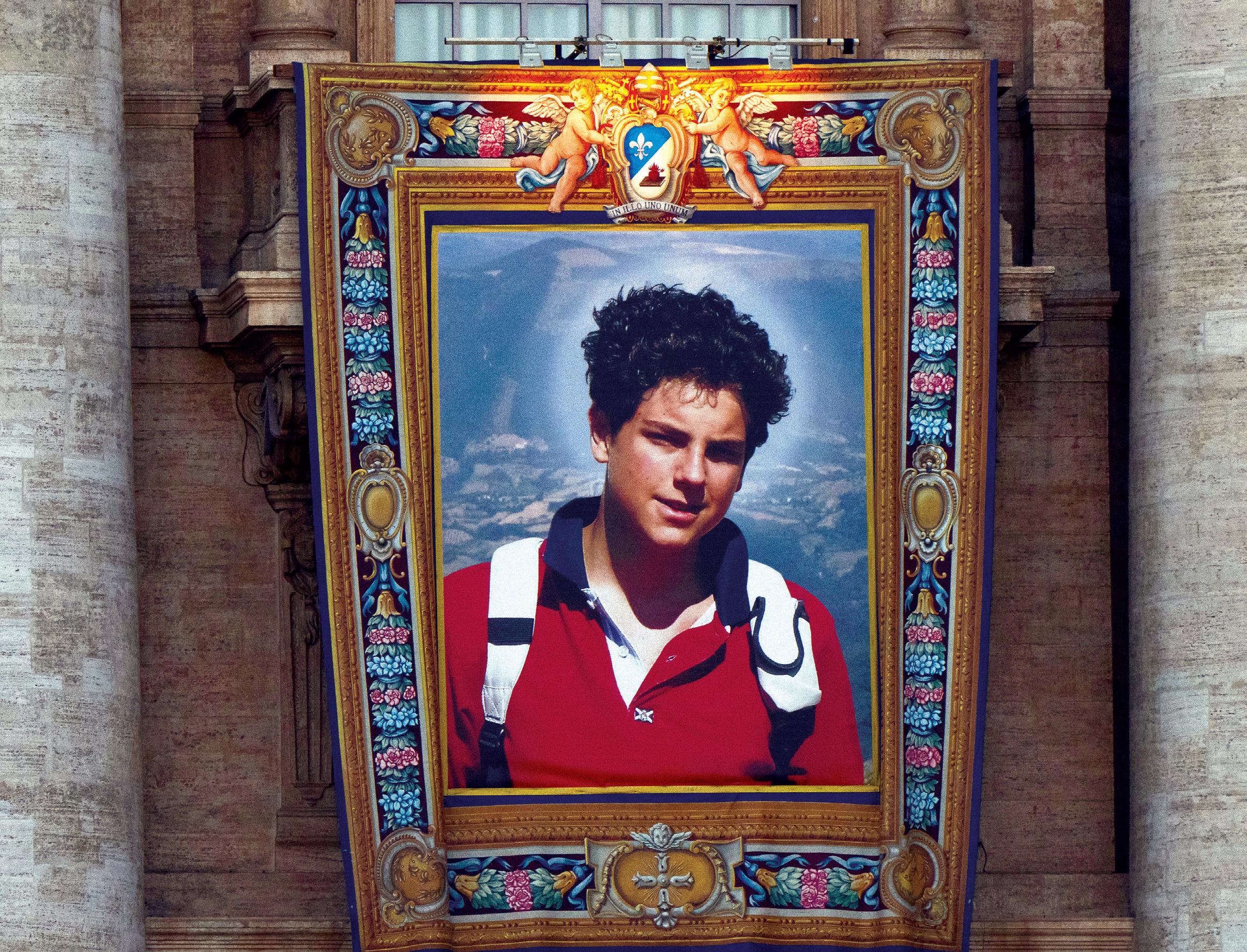
Nine months ago, the first millennial saint was canonised. St Carlo Acutis has since become widely venerated, not least because his life speaks so directly to the experience of contemporary Catholics.
Born and baptised in London to an Italian family, he later moved to Milan, where he received his First Holy Communion. From an early age, he showed a profound devotion to the Eucharist, which he described as his “highway to Heaven”.
Carlo employed his aptitude for technology in the service of evangelisation, creating a website dedicated to documenting Eucharistic miracles from around the world. His intention was to foster a deeper love for the Blessed Sacrament.
As he famously observed: “If we stand in front of the sun, we become tanned; but when we stand before Jesus in the Eucharist, we become saints.”
The work he began during his lifetime has continued to bear fruit and indeed to expand since his canonisation.
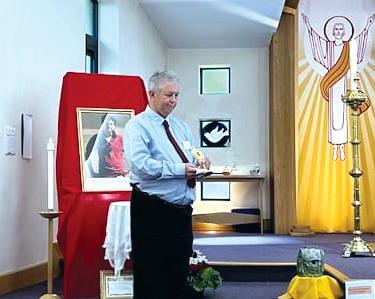
In 2024, Paul Pegden, a parishioner of Our Lady of Lourdes, Saltburn, had a profound experience received through the intercession of St Carlo Acutis, igniting a passionate devotion for the beatified teen.
More recently, Paul has been entrusted with the role of custodian of a set of exhibition banners, which present a selection from the St Carlo Acutis International Exhibition of Eucharistic Miracles.
The exhibition is now available on loan to parishes and groups throughout the Diocese of Middlesbrough and beyond. It seeks to deepen understanding of the Real Presence of Christ in the Eucharist and to encourage greater devotion to the Blessed Sacrament. It comprises 20 roller banners presenting information on Eucharistic miracles from across the world, as documented by St Carlo Acutis.
The banners may be displayed either in a parish hall or within the body of the church. Paul will arrange delivery and assist with their installation.
Parishes interested in hosting the exhibition are invited to make contact via carloacutisfaith@hotmail.com.

Warm tributes have been paid to a dedicated consultant microbiologist who died after suffering a cardiac arrest while playing his favourite sport, golf.
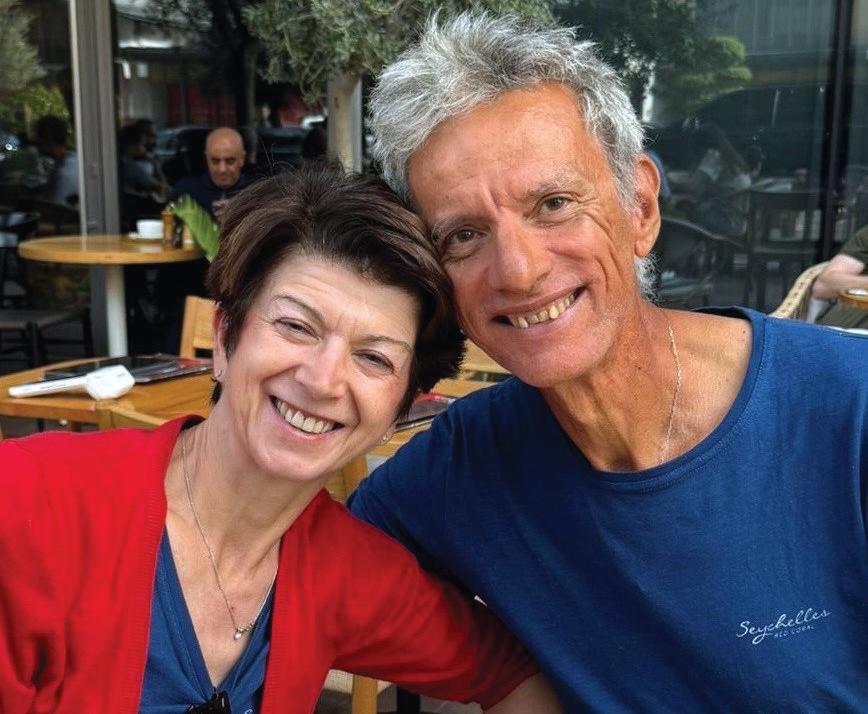
Dr Igor Kubelka, 59, worked at James Cook University Hospital in Middlesbrough, where he was a much-loved colleague and was credited with saving countless lives. He passed away on March 25 in the United Arab Emirates, where Igor and his beloved wife, Dr Vedrana Caric-Kubelka, a consultant obstetrician and fetal medicine specialist at James Cook, were on a one-year sabbatical.
Dr Michaela Weingarten, a close friend of the couple and one of our Lourdes doctors, said Igor was a truly remarkable person.
“Igor was the most loving and caring husband and a friend to many, with an infectious enthusiasm for life, who left a lasting memory on everyone he met. His knowledge and expertise were extraordinary, not only in microbiology and medicine, but across a wide range of subjects,” she said.
“His passions were golf, music, history and exploring the world. He bought books and music almost daily, and whatever he read, he seemed to retain. As he did not drive, Vedrana would take him wherever he needed to go, and he used every journey as another opportunity to read and learn.
“As a microbiologist, he was deeply dedicated, far beyond the normal call of duty. Many patients, colleagues and friends benefited from his advice and expertise.
“He didn’t leave a stone unturned, whether it
was to find a solution to a problem or to find the bacterium or virus causing a severe illness, and through this determination he helped save countless lives and limbs.
“His work with the diabetic foot team allowed surgeons to amputate less extensively because of the precise microbiological information he provided.
“During Covid, he played a pivotal role in transforming testing into a rapid, 24-hour service in James Cook that was leading in the region. He worked across specialties including ITU, paediatrics and obstetrics, always with the same commitment and generosity.”
Beyond medicine, Igor brought warmth and energy wherever he went.
Michaela said: “He valued everyone equally, formed friendships easily, and showed genuine joy in spending time with children, teaching golf, sharing stories and encouraging younger doctors and students, many of whom entered microbiology because of his influence.”
Even when he was living in the UAE, he continued working for James Cook remotely, a laptop being carried round so he could join in ward rounds via the screen.
Igor and Vedrana, who were introduced to the beauty of our region by Father Pat Keogh after their move from London to the North-East 12 years ago, loved coming to Father Pat’s Masses and other musical events at St Hilda’s in Whitby.
Igor’s funeral Mass was concelebrated at St
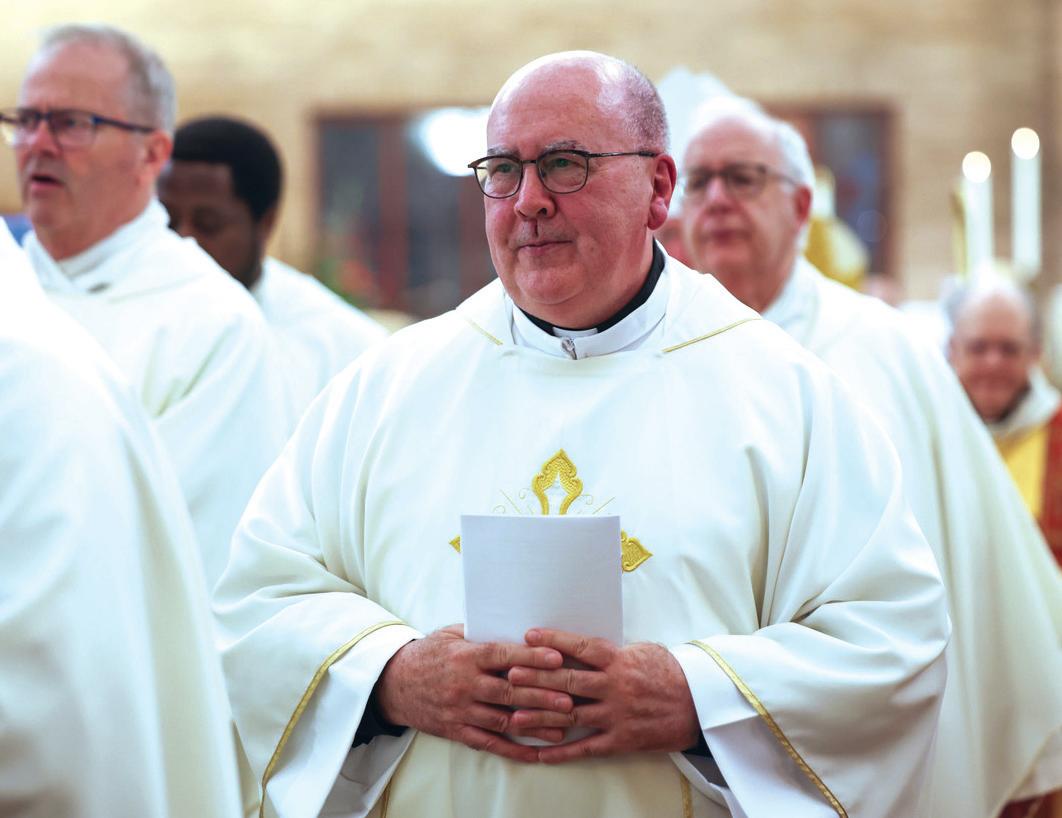
Bishop Marcus has announced a series of clergy appointments across the diocese, to take effect this summer.
Monsignor Canon Gerard Robinson has been appointed parochial administrator of St George’s Parish, York, with Father Timothy Whitwell, of the Diocese of Leeds, becoming parochial administrator of St Joseph’s, Stokesley.
Father David White is retiring from the Parish of Our Lady and St Edward, Driffield. Canon David Grant takes up the role of parochial administrator.
Father Gilbert Samuguana OSJ becomes parochial administrator of St Aelred’s, York, with Father Benjamin Ogar OSJ serving as parochial vicar.
In Middlesbrough, Father Osinachi Emmanuel Anaele will serve as parochial vicar (assistant priest) at St Joseph’s and St Thomas More parishes.
Father Steven Leightell has been appointed diocesan Master of Ceremonies, in addition to his current responsibilities at St Mary’s Cathedral Parish.
Several appointments have been made in Hull and the surrounding area. Father Jose Michael MF becomes parochial administrator of Holy Cross, Cottingham, and Catholic chaplain to the University of Hull. He will be assisted by Father Shani Francis, of the Diocese of Quilon, India, who is appointed parochial vicar and assistant chaplain.
Father Charles Bassey has been appointed parochial administrator of the parishes of St Mary and St Joseph, Hedon, St Peter and St John Fisher, Withernsea, and Sacred Heart, Hornsea. Father Richard Nwagwu becomes parochial administrator of St Vincent de Paul, Hull.
Elsewhere, Father William Serplus will serve as parochial administrator of the Middlesbrough parishes of St Francis of Assisi, Acklam, and St Clare of Assisi, Brookfield.
Bishop Marcus said: “The assignment of clergy to pastoral offices and ministries is one of the most important and sensitive responsibilities of a bishop. I wish to thank each priest for the graciousness with which they have accepted their appointment to a
new office or any additional responsibilities added to their ministry. The generosity and willingness they have shown to accept these changes is a testimony to their personal faith and readiness to serve Our Lord Jesus Christ and his Church.
“Undertaking a new parochial office or special ministry can be very demanding emotionally and spiritually. I ask you therefore to kindly keep in your prayers all your brother clergy and the parish communities who will be involved in the moves this summer.
“I wish to thank sincerely Father David White for the dedicated priestly ministry which he has so faithfully contributed to the life of our diocese. We offer him our best wishes for the future, together with an assurance of our prayers for his continuing priestly life in retirement.”
Bishop Marcus offered his congratulations to Father Richard Marsden, who has been appointed vice rector of the Venerable English College in Rome.
He added: “I thank too Father William Massie for the many years of his devoted ministry as chaplain to Hull University. The provision of Catholic priestly ministry and chaplaincy to Hull University will continue to be supported by Father Jose Michael MF and Father Shani Francis.
“Father Philip Cunnah will be stepping down from parochial ministry in the parishes of St Mary and Saint Joseph, Hedon, and St Peter and St John Fisher, Withernsea, and devote his ministry exclusively to St Charles Borromeo Parish in Hull and oversee the restoration of the grade one listed church and presbytery. I wish to thank him for his ministry in Hedon and Withernsea over the past year.
“I also thank Father Peter Taylor for the years in which he has served as Master of Ceremonies at major pontifical liturgical celebrations in the cathedral and at other venues within and outside the diocese. From the summer, this role will be undertaken by Father Steven Leightell.
“Please welcome Father Timothy Whitwell, from the Diocese of Leeds, who has kindly accepted appointment to a parish in this diocese as parochial administrator of the Parish of St Joseph, Stokesley.”
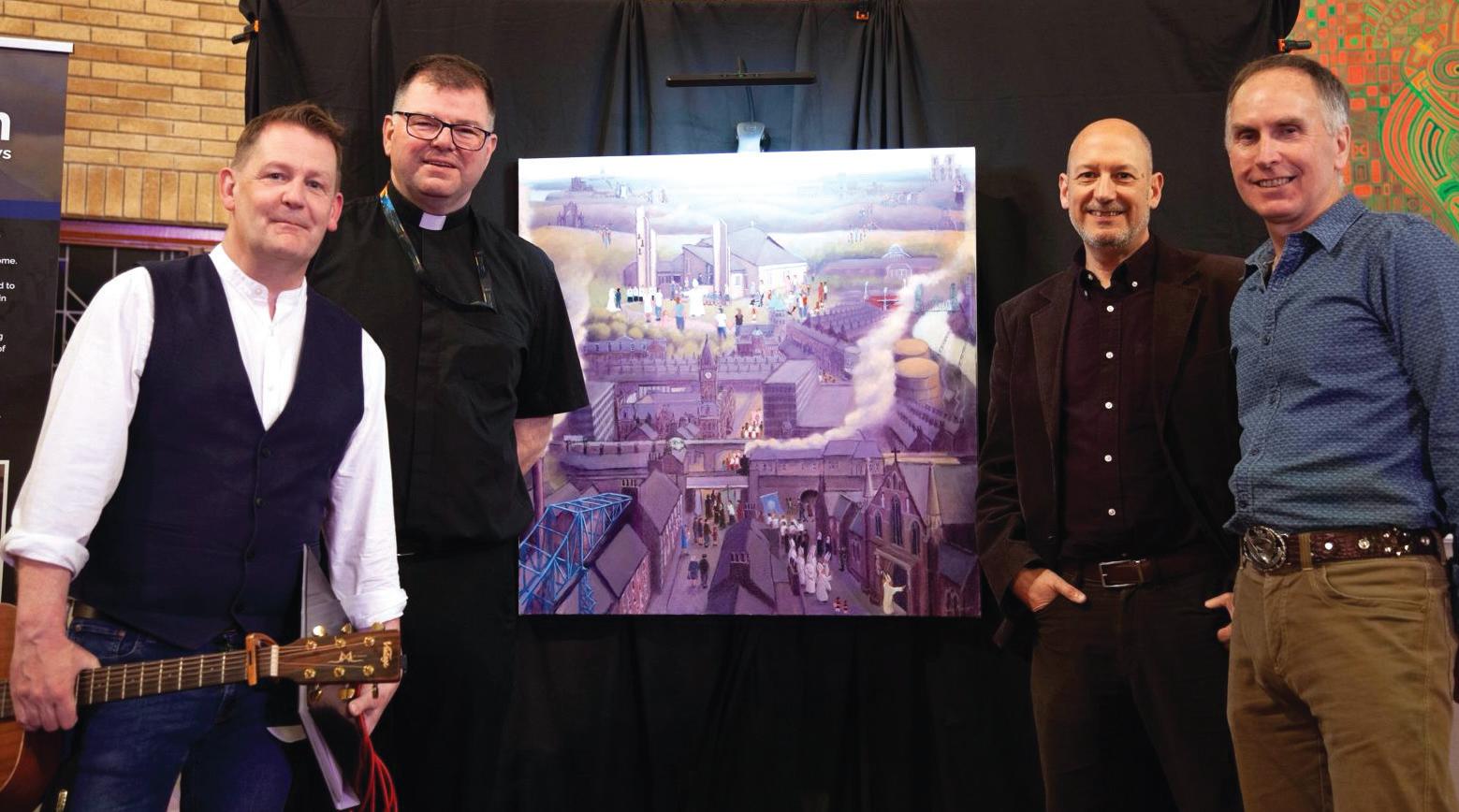
Mike McGrother and the Infant Hercules Choir produced a rousing performance to help mark the unveiling of Procession at St Mary’s Cathedral. Fresh from a TV appearance on the National Lottery’s Big Night of Musicals, they entertained more than 200 guests with songs including Graeme Miles’ Ring of Iron, Ron Angel’s Chemical Worker’s Song and Christy Moore’s Ordinary Man. There were lots of laughs along the way, along with local history lessons and opportunities for participation from an enthusiastic audience.
The singing followed a presentation from MC Dave Allan, who then introduced artist Philip Meadows and Canon Paul Farrer to talk about Procession, the specially commissioned painting that marks the cathedral’s 40th anniversary.
The special night was the first of a series of jubilee events, which also included a Thanksgiving Mass celebrated by Bishop Marcus Stock and continues this month with the evenings below.
Tickets are available from the St Mary’s Cathedral box office.
• Friday June 12: Four Choirs United with Paula Odell
• Saturday June 20: Come & Sing Handel’s Messiah
• Friday June 26: Rocking in the Aisles
A noisy travelling army of Trinity Catholic College pupils roared T6 Football Academy to victory in the English Schools’ Football Association Under-18 Super Cup final.
And two days later the Middlesbrough team completed a double by winning the National Football Youth League Cup.
The first success came when Dave McTiernan and James Bridge’s talented team pulled off a convincing 4-1 win over Coombe Wood School at Stoke City’s stadium.
T6 struck early through Walker and cruised into a 2-0 lead with a Kennedy goal before Coombe Wood pulled one back. However, the Croydon team suffered a blow just before half-time when they had a player sent off for a reckless challenge.
Two more goals followed after the break, from Coppinger and Walker again, to earn T6 the most prestigious trophy in its glittering fiveyear history.
“It was a really special day and we’re so proud of the lads,” said Mr McTiernan.
“They’ve worked all the way from the group stages to become national champions, and they fully deserve it.
“That early goal set the tone for the rest of the game and from then on, as long as we kept pushing forward, it felt like it was in our hands.”



Stockton-On-Tees TS17 9JP
Executive Head Teacher: Mr M Ryan
Head of School: Miss H Lickess Tel: 01642 765639
Email: enquiries@ctking.npcat.org.uk
Two-goal hero Walker added: “It’s unbelievable, I’ve never felt anything like it. I was here last year with the county, but this was a completely different level.”
The competition brings together elite academies from all over the country and is the pinnacle of school football at this age group.
“The players and staff put a lot of hours in and it’s paid off, so we’re all delighted,” said Mr McTiernan.
“We prepared properly, came down the night before the game, and everyone has played a massive part in getting us to where we are today.
“We had amazing backing in the stands from Trinity pupils and Nicholas Postgate Catholic Academy Trust have been behind us from the start and have really pushed the programme.
“We’re now the best in the country, which is an incredible thing to be able to say after five years. We’re an elite academy that has won a national competition against the very best.”
The biggest week in T6’s history continued two days later with a 3-1 win over Strachan Football Youth Foundation in the National Football Youth League Cup final at The Hawthorns, home of West Bromwich Albion. T6 were one down at half-time shortly after their goalkeeper Bailey had brilliantly saved a penalty, but the coaches made some tactical changes and it was a different story after the break.
Coppinger equalised on 55 minutes before Walker sealed victory with goals on 70 and 80 minutes.

T6 Football Academy players come from as far as Peterlee to the north and Ripon, Northallerton and Harrogate to the south, but the majority are from Teesside.
“They come in at 16 from junior clubs, not knowing where their careers are going, and we try to steer them in the right direction and give them memorable days like this.
“A lot of the lads are now on the cusp of hopefully going into professional football. Many of them are also involved in non-league at a high level.
“We’re trying to educate them as well, so they have options beyond football. Some will go on to further education, and many are looking at going to America. The programme offers a diverse pathway. They’ll all go into different things, but hopefully memories like this will live on.”
Applications are being accepted for next year’s intake and T6 regularly holds showcase events, trials and training sessions. To apply, visit t6footballacademy. npcat.org.uk/apply.
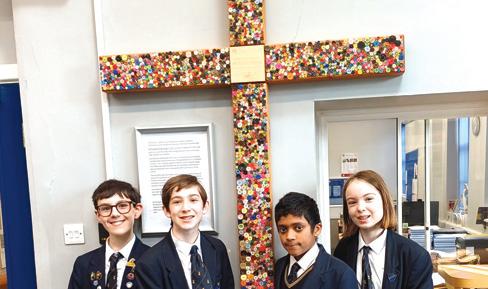
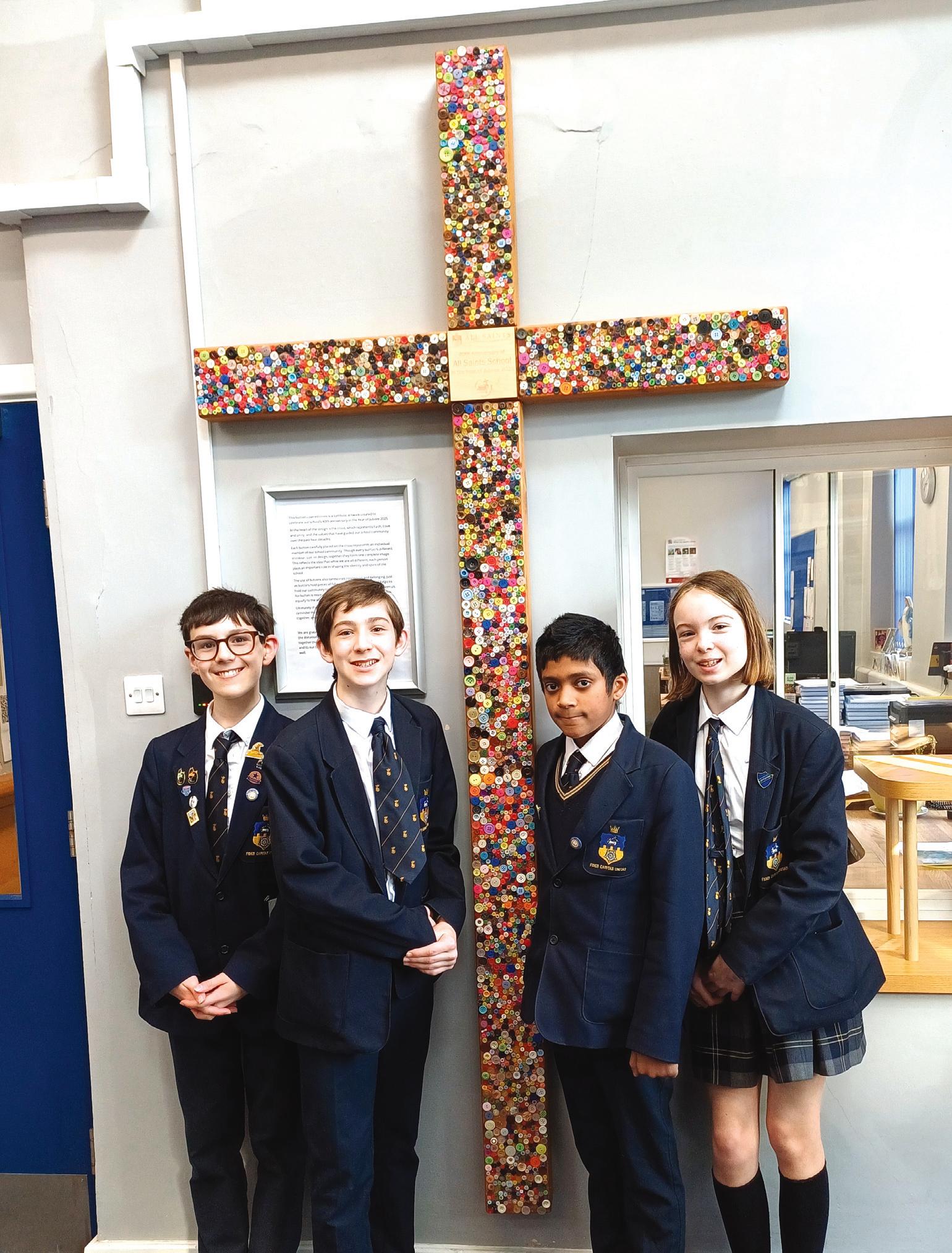
There is a new addition to the main reception wall of the Lower School at All Saints Catholic School in York – a large, button-covered cross.
The cross is a symbolic artwork created to celebrate our school’s 40th anniversary in the Year of Jubilee, 2025.
At the heart of the design is the cross, which represents faith, love and unity, the values that have guided our school community over the past four decades.
Each button placed on the cross represents an individual member of our school community.
Although every button is different in colour, size or design, together they form one complete image. This reflects the idea that while we are all different, each person plays an important role in shaping the school’s identity and spirit.
Using buttons also symbolises connection and belonging. Just as buttons hold pieces of fabric together, every individual helps to hold our community together, strengthening the bonds between us. No button is more important than another; each one contributes equally to the whole.
Layton
Ultimately, the cross of buttons is not just a piece of art – it is a powerful reminder that our school is made strong by its people and that together, we create something meaningful and lasting.
We are grateful to Canon Michael Loughlin at English Martyrs for the donation of the cross, to our sixth form students for collecting together the buttons, to our DT Team for the centrepiece and to our site team for getting the cross mounted on the wall.
Rebecca
Kramm Lay Chaplain
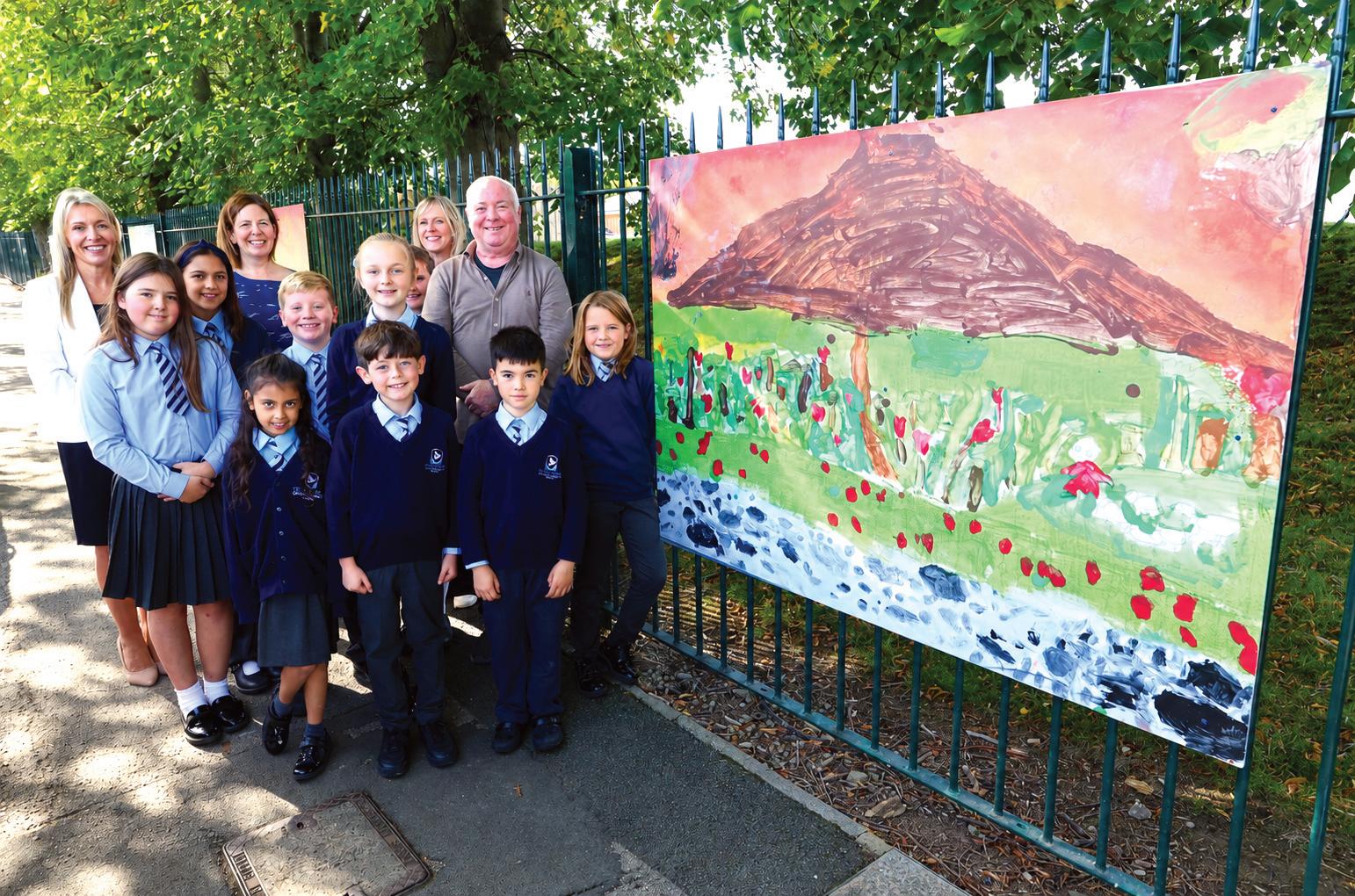
St Paulinus Catholic Primary School in Guisborough has been awarded outstanding grades across all three key areas in its latest Catholic Schools Inspectorate report.
The inspection graded the school as outstanding for Catholic life and mission, religious education and collective worship.
The report highlighted that pupils “clearly know they are valued and cared for as unique persons, created by God” and exhibit "highly positive attitudes to school life”. Their behaviour was described as “exemplary” with “deep respect for themselves and others”.
Inspectors also praised the “dedicated and focused leadership provided by the inspirational executive headteacher and her impressive senior leadership team” and noted that the school is “always striving to improve”.
Executive headteacher Anna McClurey said: “We are absolutely thrilled with this outstanding outcome, which reflects the incredible dedication of our staff, governors, the commitment of our pupils and the wonderful support of our families and parish community.
“Our mission, ‘Love one another as I have
loved you’, truly comes alive every single day at St Paulinus and this inspection has affirmed that Christ is genuinely at the heart of everything we do.
“Our PACE values of perseverance, ambition, community and empathy shine through in everything our children do and I am immensely proud of our entire school community.”
The inspection report noted that “the school's mission is deeply embedded in the fabric of the school and everything it does” with the values of perseverance, ambition, community and empathy being “celebrated and implemented in tangible ways within the school community, the parish, the local area, nationally and globally”.
Head of school Rachel Bircham said the report shows that making Christ known to all is at the heart of everything that goes on at St Paulinus.
She said: “I am incredibly proud that the inspectors recognised the passion which we have to give our pupils the very best start in their education. The fantastic outcome is testament to the great team effort that we have at St Paulinus.
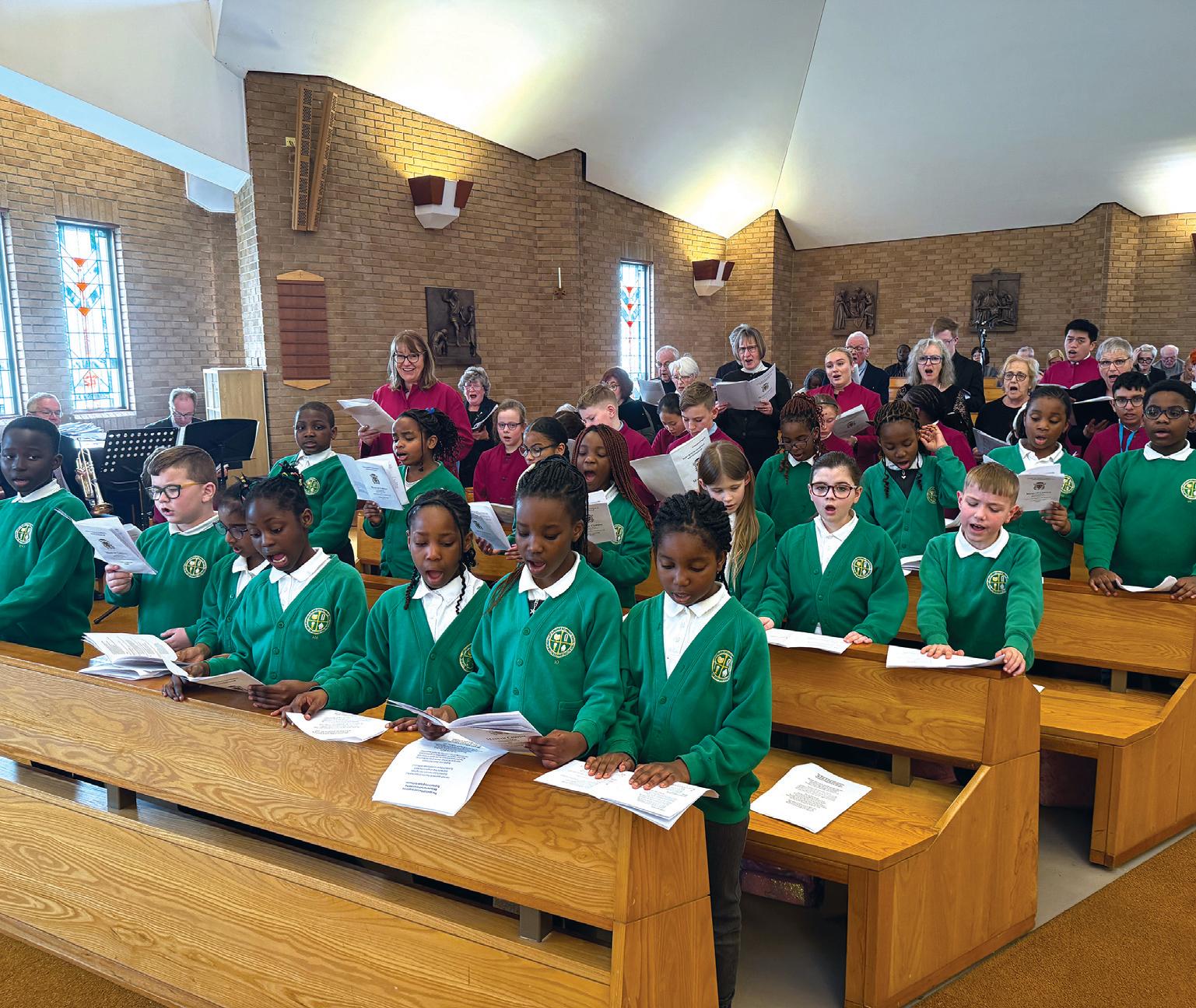
This year’s Chrism Mass was the first time the new liturgical choir at St Alphonsus’ School, Middlesbrough, had sung at Mass, having worked hard at school with National Schools Singing Programme choral director, Andrea Maxson. They were joined by members of the cathedral’s Junior Choir from St Augustine’s, St Clare’s, St Edward’s and St Gerard’s schools, along with adult members of the Cathedral Choir and Diocesan Choir. They sang music including traditional Gregorian chant and music by Sir Edward Elgar, as well as the Middlesbrough Mass by former diocesan director of music, Tim Harrison.
The children worked very hard and produced a beautiful sound. Their behaviour and attention was impeccable, all the more impressive as they were in the cathedral from 10am until almost 2pm, taking in rehearsals and the Mass itself. It is undoubtedly an occasion which they will long remember.
Steven Maxson, diocesan director of music, who conducted the choir in the Mass, said: “The children worked so hard, both ahead of the Mass and on the day itself. They rose to the challenge of singing some complex music and made a truly splendid contribution to the Mass, our first Chrism Mass celebrated by Bishop Marcus.”
“Our links with our parish include our vibrant Chaplaincy Team, who work hard to plan and deliver spiritual encounters for our pupils, such as Adoration of the Blessed Sacrament and retreat opportunities. Our pupils are fabulous and they meet Jesus, through prayer, with deep reverence and respect.”
Inspectors found that “pupils demonstrate excellent knowledge, understanding and skills” in RE, with high levels of religious literacy.
Provision for prayer and worship was described as being “at the heart of the school, ever-present and central to gatherings of pupils and staff”.
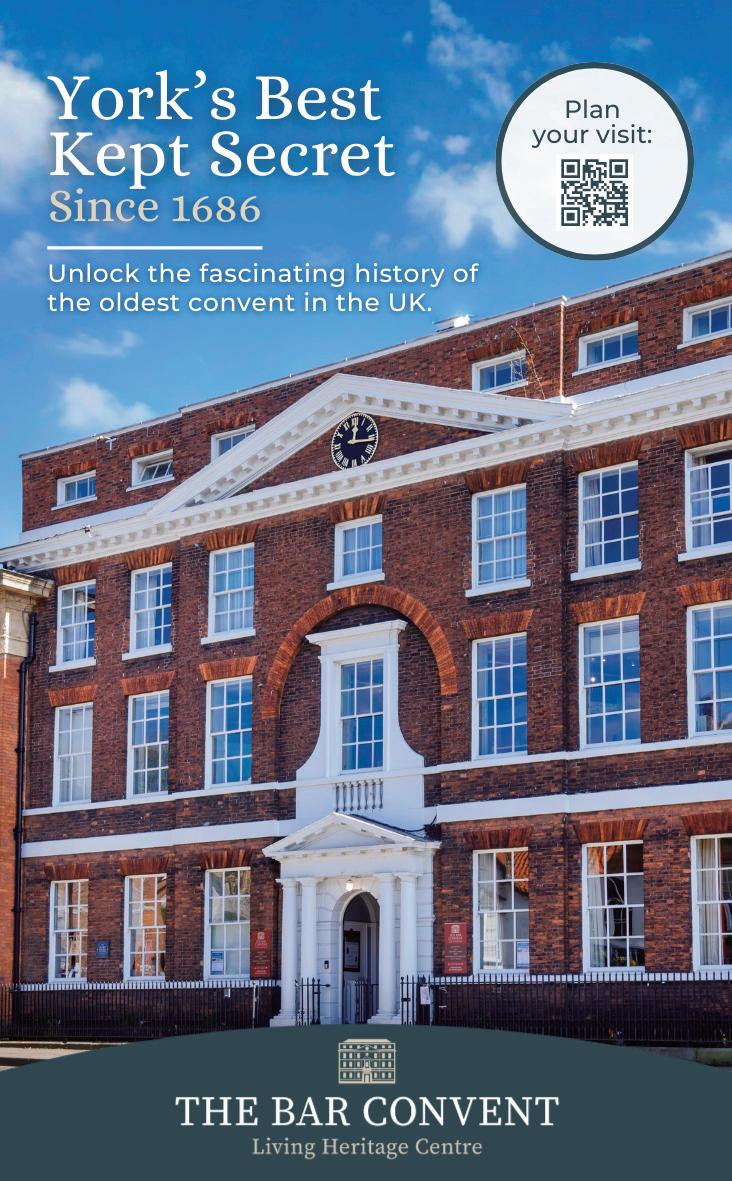
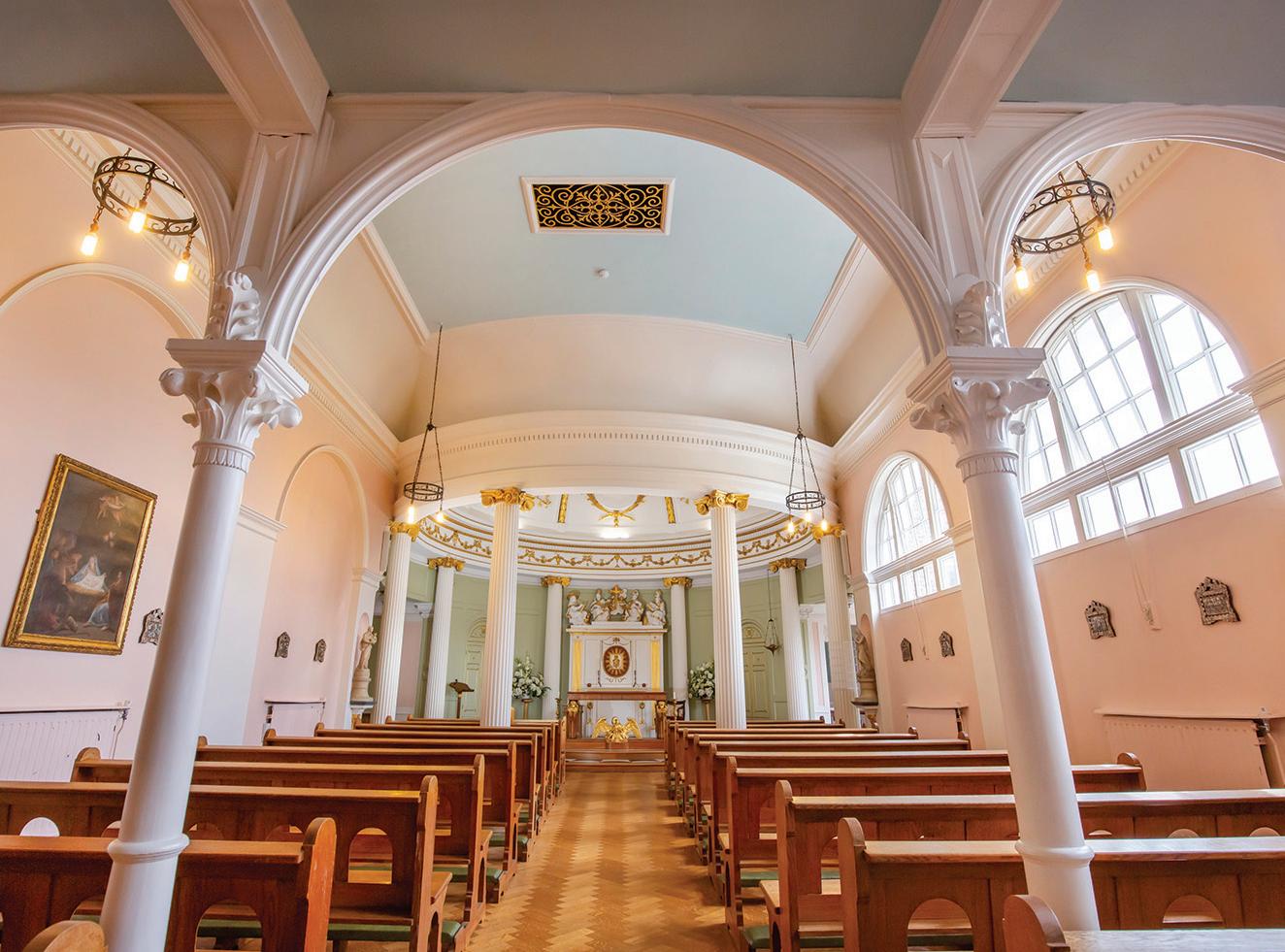
The venue itself will be the focus of talks given when York Catholic History Day takes place at the Bar Convent in York on Saturday June 6.
The property, in Blossom Street, was purchased by the sisters in 1686 for use as a boarding school, but by the mid-18th century the premises had become too small for its needs and major extension and refurbishment was required. This work, which included the addition of the Georgian façade and the building of the “secret” chapel, was completed in 1769, and further expansion took place in the mid-19th century.
Architectural historian Victoria Hopgood will speak about Building the Bar Convent: the first 200 years (1686 to 1886).
The convent’s contents, acquired over the 340 years of its existence, illustrate many aspects of its history. While they may seem simply functional or decorative, some have special significance.
Examples include objects associated with Mary Ward, the founder of the community of sisters, now known as the Congregation of Jesus, which are displayed in the Living Heritage Centre and Museum.
There are also portraits of the sisters who shaped the development of the community, furniture and three clocks made by Henry Hindley, a distinguished York clock and scientific instrument maker. Matthew Read and Rachel Wicaksono will talk about Henry
Hindley: 18th-century Catholic maker of the Bar Convent clocks.
Over more than three centuries the sisters collected books for use by themselves and by their pupils. This collection comprises around 1,400 books, dating from 1508 to 1850, many of which came from the Continent when Catholic books were illegal in England. It is also special because the books were bought and used exclusively by women.
Two researchers from the Centre for Catholic Studies at Durham University will describe how they are using the convent’s Rare Books Collection in their research projects.
Maddie Keighley-Phillips will talk about Catholic Book Networks in the Bar Convent Library and Jon Chant about English Catholic Exile on the Iberian Peninsula: Studying the books of the English College in Lisbon, 16221834.
After the formal talks there will be an open forum and participants are invited to speak briefly about work in progress and provide information about forthcoming events and publications that may interest the audience They can also ask for information relating to current research (the combined knowledge of the audience is formidable) and make suggestions for future History Days.
The programme begins at 10.30am, with registration from 10am. Tea and coffee will be available all day and lunches and light refreshments are on sale served at the Bar
The day will end with Mass in the Chapel at approximately 4.30pm.
During lunchtime there will be an opportunity to visit the Living Heritage Centre (for details visit barconvent.co.uk) and the shop, where the recently published guidebook is on sale.
The cost is £20, students £10 (cash only, please). For more details please email judith.smeaton@btinternet.com.
Judith Smeaton
SHAWN RAS, a Dutch-born historian and parishioner of Our Lady and St Peter Chanel in Hull, continues his series of articles about Church history with the story of Pope Benedict XV, who preached peace to a world that was determined to go to war… "Filled with sentiments of awe and thanksgiving, I wish to speak of why I chose the name Benedict. Firstly, I remember Pope Benedict XV, that courageous prophet of peace, who guided the Church through turbulent times of war. In his footsteps I place my ministry in the service of reconciliation and harmony between peoples" – Pope Benedict XVI during his first General Audience in 2005.
On November 21 1854, Giacomo Paolo Giovanni Battista della Chiesa was born in the palace of his family in Genoa.
He was born prematurely, the third son of the aristocratic Della Chiesa family, which boasted such ancestors as Popes Callixtus II (1119-1124), Innocent VII (1404-1406), King Berengar II of Italy (950-961) and Blessed Antonio della Chiesa (d 1459).
From this line came a rather small and sickly boy with a limp. While his older brother would become an admiral, young Giacomo aspired to become a priest, with his father’s disapproval.
By the age of 21, Giacomo achieved a degree in law at Genoa’s University and was allowed to attend seminary and become a priest. Working his way up to becoming a secretary to a notable Vatican cardinal, della Chiesa worked under Pope Leo XIII and became a household name. So much that Leo's successor, Pius X, raised him to become Archbishop of Bologna, and donated his own ring and crozier.
In May 1914, della Chiesa was made a cardinal. At this time, Italy was in political turmoil. The country had only unified in 1868 and had a history of both wars and alliances with its neighbours. At the time of SardiniaPiedmont’s unification wars, it had allied
with France against its Austrian neighbours, who occupied the wealthy Veneto and Lombardy regions.
By 1914, Italy, now unified, had allied against France and Russia with Austria-Hungary and Germany. Tensions with the Habsburgs of Vienna, however, remained rather tense for a simple reason. After Napoleon’s wars, the northern Italian territory of South Tyrol and Trent was ceded to Austria. This left a large gap in Italy’s natural defences, and the region held many Italian speakers. Bologna was a hotbed of nationalist and bellicose sentiment. Many of its citizens called for war, and nationalistic fervour opposed the traditional aristocracy and the Catholic Church. When war broke out in July of 1914, della Chiesa called for neutrality from Italy. The Vatican had at this point still not been established, and a chilly relationship between the papacy and the Italians remained. With such a tense situation at the time of Pius X’s death, the college of cardinals felt a diplomatic candidate was called for.
Fifty-nine at the time and a cardinal for under three months, della Chiesa was elected and took the name Benedict XV, just like his predecessor as pope and Archbishop of Bologna, Benedict XIV.
Italy, Germany and Austria-Hungary had formed the defensive Triple Alliance against France and Russia in 1889. The issue at hand was the nature of the freshly broken-out First World War, and the nature of the belligerents. Austria had invaded Serbia, and Russia had joined in. Germany then invaded France. This meant the war was not a defensive, but an aggressive one. Both alliances tried to sway over the Italians, and the Entente powers, promising Italy parts of the Habsburg Empire, would join them in 1915. To his great distress, the fervour with which Europe fought the war was coined by Benedict XV as the “Suicide of civilised Europe”. He appealed to the French and German governments for an immediate
ceasefire but was rebuked. The mostly Protestant Germans felt it a Popish plot. The Catholic French saw it as the Pope’s attempt to make diplomatic policy and denounced the peace efforts as “anti-French”.
Amid atrocities in Belgium, Benedict XV denounced the war, calling all Catholics to cease fighting, an effort that was seen in Germany as a plot against them – three of the belligerents were devoutly Catholic nations: Italy, France and Austria-Hungary. The Vatican had fostered positive relations with Britain, which in the past 50 years had emancipated the Catholics.
But the Pope’s pleas fell on deaf ears, and Europe fought its most devastating war to date. In 1916, however, a new ruler rose to power in Europe. Following the death of the revered Emperor-King Franz Joseph of Austria Hungary, his grandnephew, Charles I, a devout Catholic, heeded the Pope’s call and appealed for peace. Charles, who deserves an article of his own, attempted a secret peace through his relative, Prince Sixtus of Bourbon Parma, an attempt that failed catastrophically.
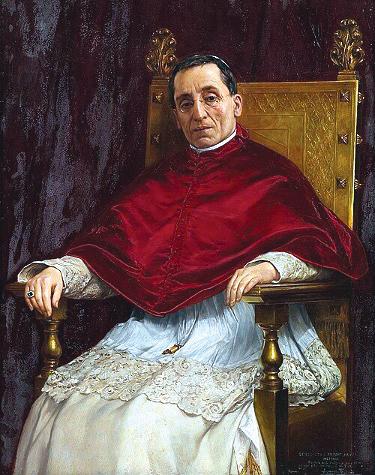
Benedict XV’s interventions left him in poor graces with the Italians, who were ceded some, but not all the promised territories after the peace of 1918. Still angered over the Roman Question, the issue of the Catholic Church’s rights following the annexation of the Papal State in 1871, the Pope and his envoys were excluded from the Versailles peace treaty, and the wider war overshadowed Pope Benedict XV’s efforts. The Roman question would be resolved by his successor, Pius XI.
In 1922, Benedict XV died at the age of 67 after a prolonged battle with pneumonia. His legacy was a conflicted one, with both sides of the war condemning his neutrality, rather than praising his calls for peace: something similar would happen in the next war with Pope Pius XII.
Pope Benedict XV is an important reminder of the place of the Catholic Church in the world. In an age when many Christians are calling for a rather misinformed and vainglorious attempt at Christian nationalism and violent warfare, figures such as Benedict, a true pope of peace, are too important to be overlooked.
Warfare and violence, as Benedict XV knew well, are inherently incompatible with a Catholic worldview. Let us all, as Catholics, pray our leaders continue to take after Pope Benedict XV.
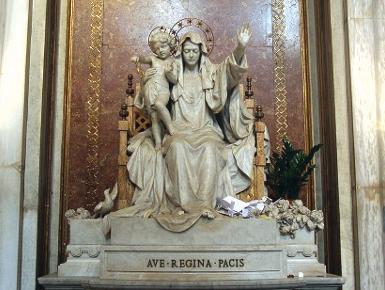
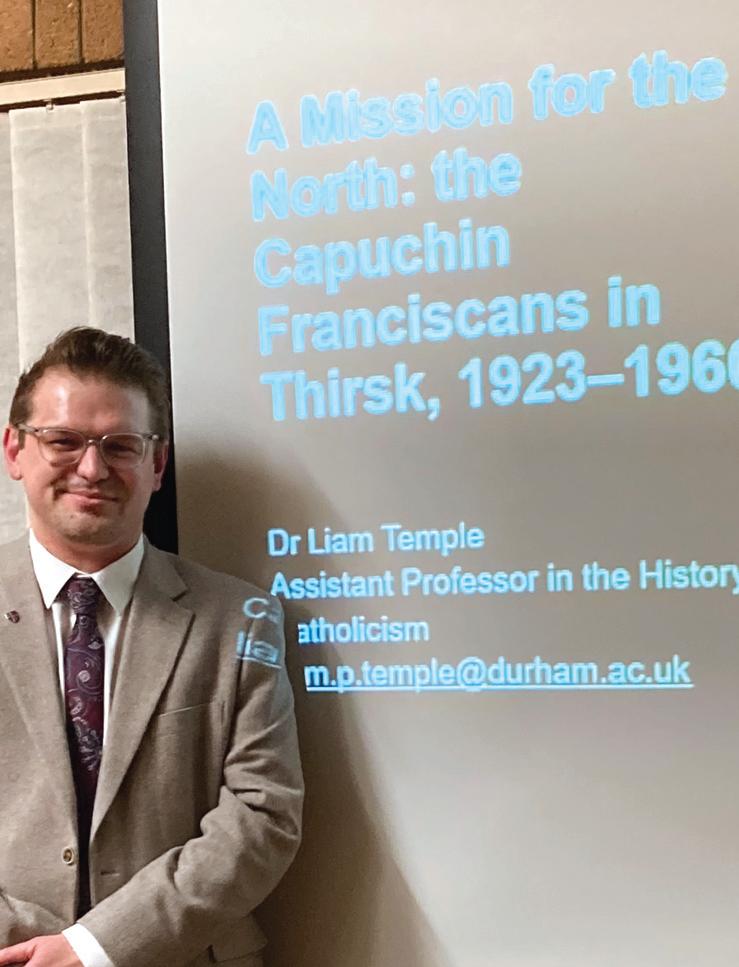
Capuchin Franciscans played a surprisingly significant role in the development of the Church in Britain.
Especially since the restoration of the hierarchy (1850), they were active in setting up “missions” (from 1918, officially called “parishes”) to gather and support the growing Catholic population.
This was the fascinating story Dr Liam Temple, of Durham University, developed in his talk to the Cleveland Newman Circle: “A Mission for the North – the Capuchin Franciscans in Thirsk 1923-60”.
Liam explained that the Capuchins, with their long, pointy hoods, emerged as a separate, strict branch of the Franciscans in Italy in 1525. Before the 19th century their presence in Britain was limited, but after the French Revolution, along with other religious orders, they saw opportunities here.
They went where they saw a need. Arriving in an area, they would set up a mission,
building churches and schools as necessary. Then, sometimes within 20 years, they would move on, passing the mission or parish over to secular clergy.
They had missions throughout Wales, in Peckham (1855), along the Thames Valley and up into the Midlands.
Liam said that between the two world wars was an optimistic time of Church growth, and the Capuchins proposed extending missions further north. Their mission in Thirsk (1923) was intended as their springboard into the north – but it turned out to be the furthest north they managed at that time. The friars’ Glasgow mission failed, perhaps because they were termed “the English Province”!
The first friars at Thirsk took over All Saints’ Church and worked with the rural Catholic community based there. Records show that the church was kept open with regular Mass, Benediction, Confessions and Evening Prayer. A parish school organised an annual trip to
Redcar, but then – as now – not all the children attended Sunday Mass.
Throughout the 1940s and 1950s, Thirsk’s parish population was around 250. With Capuchin manpower stretched, Thirsk friary became a convalescent home – and then a care-home – for friars. In 1960, with aging friars and reduced vocations, the Capuchins withdrew from Thirsk.
Liam showed evidence of the Capuchins’ years in Thirsk in the churchyard and in the stained glass.
But the friars themselves have moved on, following St Francis’ encouragement: “Let us begin again, for until now we have done nothing.”
For further information about the programme of the Cleveland Newman Circle, email p.egerton123@gmail.com or phone 01642 645732. Talks are held in St Mary’s Cathedral hall and all are welcome.
Patricia Egerton
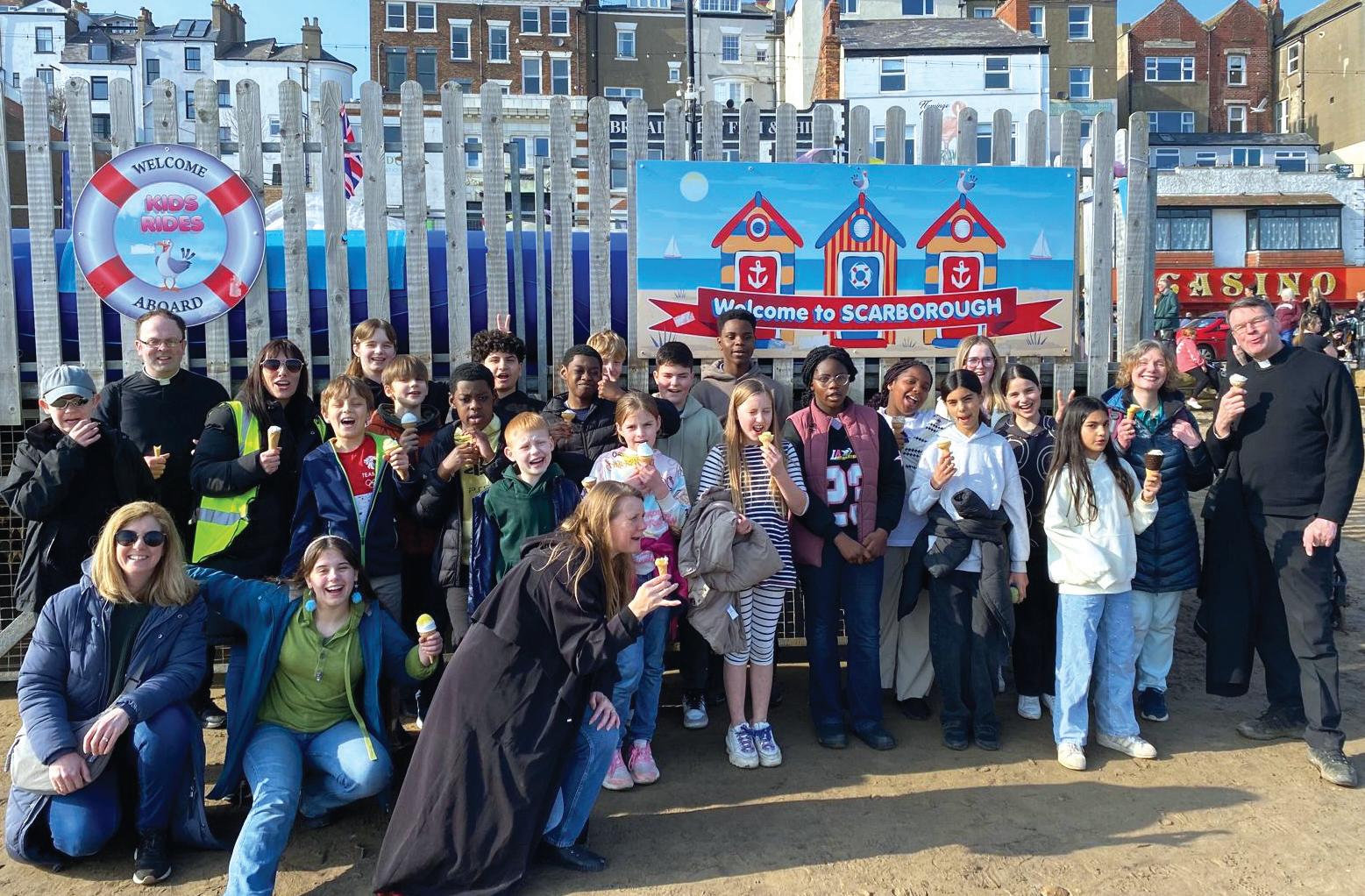
The latest Faith Movement Youth Day was the sixth I have attended and possibly my favourite.
The theme, “Faith in Difficult Times”, encouraged us to reflect on those who carried their own cross to grow closer to God and to be inspired by their example.
We started the day with a talk from Father Massie, who shared the powerful and surprising story of William Wilberforce and how his faith shaped his life and mission. Afterwards, there was an opportunity to receive the Sacrament of Reconciliation, followed by Mass, which I considered the highlight of the day.
After lunch, we enjoyed a walk along the Scarborough coastline, followed by ice cream and some free time on the beach.
Later, I had the honour of giving a talk about my favourite saint, St Maximilian Kolbe, and how his life reflected the day’s theme. Kolbe, a Polish missionary, was imprisoned in Auschwitz during World War II. When a man was selected to die, Kolbe volunteered to take his place.
Even in his final days, he remained full of hope – leading prayers, singing hymns and comforting others. He was eventually killed by lethal injection. His example shows that even in the darkest moments, hope remains.
We also learned about Wilberforce’s less famous children, three of whom became Catholics and who experienced family sadnesses but with great comfort from their faith in Christ.
We are looking forward to our annual Faith Summer Camp, which is taking place once again at Ampleforth Abbey, from July 20 to 23.
In our community we have a concept handed down to us from our foundress called “The Duty of the Moment”.
It goes like this: God has a plan for each of us, the most evident one being the thing that’s being presented to us at this moment, be it doing the washing up, mowing the lawn or chatting with the person in front of us. In offering the moment to God, especially if we’re resisting it, we open ourselves to the graces that God has for us.
To give an example: I was at a bus station waiting to go home when this fear of those around me swelled up. I knew there wasn’t anything threatening about my situation, but here this fear came up. I had just heard a suggestion from the conference I had attended that in moments of interior disturbance, to look for someone I could help, as a way of turning away from selfishness. So, just as I was praying in this bus station, a man walks up to me and asks where to catch a bus to such-and-such a place. I was gladly able to show him the
schedule and find his bus on it. You couldn’t have lined it up better.
The duty of the moment has often brought me back to equilibrium after being disturbed by fears or resentments. I was cutting the grass one day and found myself getting mired in an old memory of something someone did to me. �I was seething with anger and just wanted to quit right there and then to brood over it, but then the same thought came to me to keep cutting and to give it to God. I was able to look straight at it and see my own faults in the matter. I was able to forgive the person, to pray for them, and found that the anger abated a little before I had completed the job. This brings me to another concept I had learned some time ago from a book on Theology of the Body applied to daily life. In it the author described a theology around
work, which goes like this: rather than “Man was made for work”, a toiling concept, rather God made “Work was made for Man”. This flipped my fear of being used in work to using work to help me and others.
In our mother house in Canada we have a farm that produces most of our vegetables. During the summer, every week, we have what we call “Work Bees”, where we travel to the farm as a group and weed the vegetable beds for an hour. There’s nothing quite like the sight of about 100 people going after weeds all at once. It’s similar to seeing videos of Asian villages planting rice fields together.
I hope this will inspire some of you to see work differently than before, and that you will have a wonderful summer.
Mathieu Dacquay
The Holy Name of Jesus Church in the Parish of Our Lady of Kirkstall, Leeds, was forced to close just before Easter last year because of health and safety concerns.
It reopened fully this Easter Sunday thanks to significant grant from three organisations that support places of worship with grant funding.
The church’s interior columns were suffering “concrete fatigue” and showed visible signs of deterioration, which without attention put the church structure at risk of collapse.
There is no consistent UK-wide government support available to keep churches in good repair, so local people bear the burden of ensuring churches can stay open and in use –and this takes a toll on those who use the building. But in this case hope was not lost.
Thanks in part to a grant of almost £10,000 from the National Churches Trust, £9,200 from the Benefact Trust and £7,000 from the Yorkshire Historic Churches Trust, urgent repairs have taken place.
The church opened in time for the most important feast of the Christian year and can continue giving practical help to the local community through various activities and groups, including support for asylum seekers and people living in poverty and economic hardship.
Claire Walker, chief executive of the National Churches Trust, said: “Whether seeking quiet reflection, access to community services or a place to worship, the National Churches Trust helps hundreds of churches each year and
with the support of local people, keeps them thriving today and tomorrow.”
Father Sean Elliott said: “At Holy Name there is a strong culture of regular giving to support the church’s mission. While we have a ‘rainy day fund’, the essential building works put real strain on our finances.
“Closing the church just before Easter last year was heartbreaking. I have witnessed parishioners coming to pray at a church that is open every day, only to peer through the windows.
“The closure also prevented our schoolchildren from visiting for the Mass they ordinarily attend during the week. Being unable to welcome parishioners of all ages highlighted how important our building is –not just as a practical space, but as a privileged place of encounter with the living God.
“We often say the Church is the people of God, and so it is, but buildings matter too.
Holy Name is held close to the hearts of many parishioners and the wider community who celebrate life’s joyful and sorrowful moments here. Thanks to the grant from the National Churches Trust, we can once again offer that sacred space where people can lift their hearts and minds to God.”
The Holy Name of Jesus opened in 1953 and was extended in 1979. A distinctive feature of the church is the raised centre gabled bay, which features a depiction of the Crucifixion. There is also some beautiful Dalle de Verre
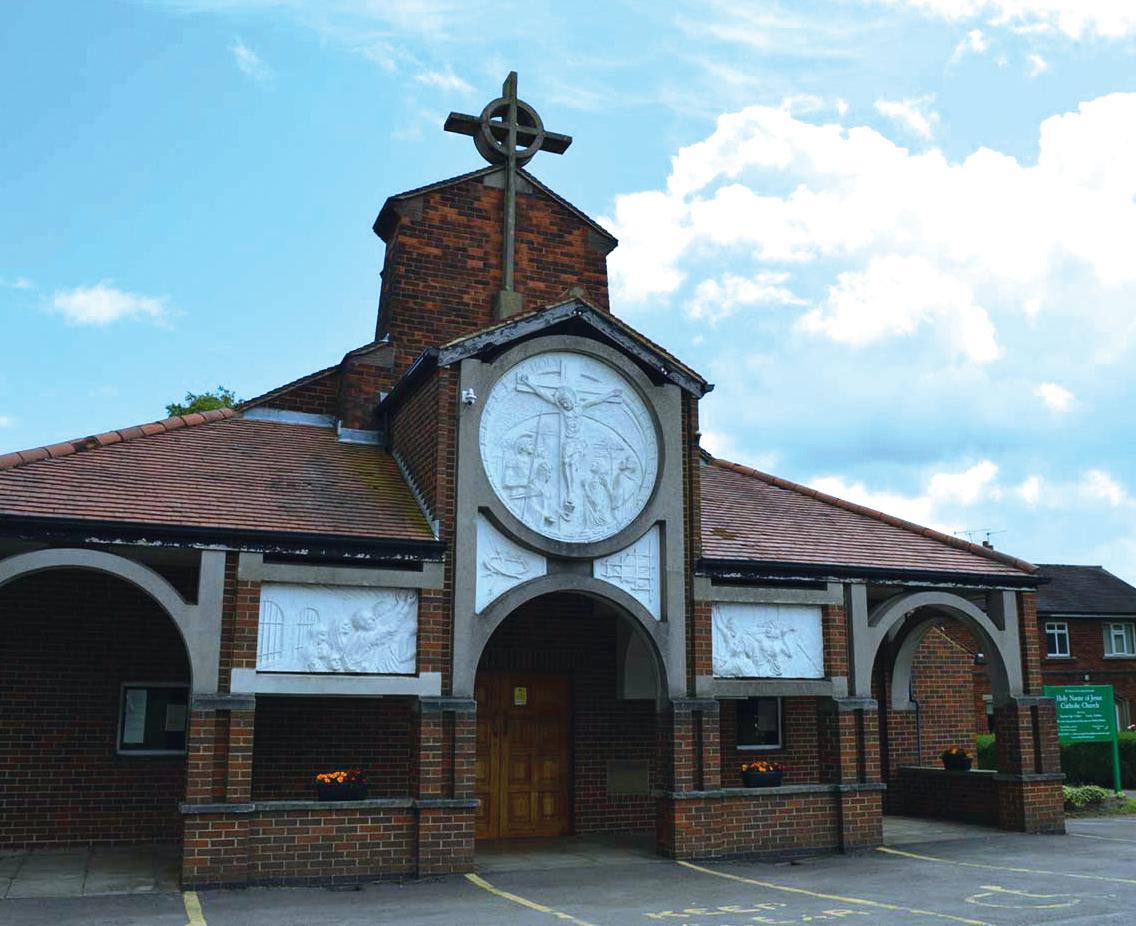
along the north and south aisles, which feature colourful scenes from the New Testament.
As one of three busy and family-oriented
parishes that merged into the parish of Our Lady of Kirkstall in 2007, the Holy Name can now get back to normal, with these repairs giving the much-loved building a sustainable future.
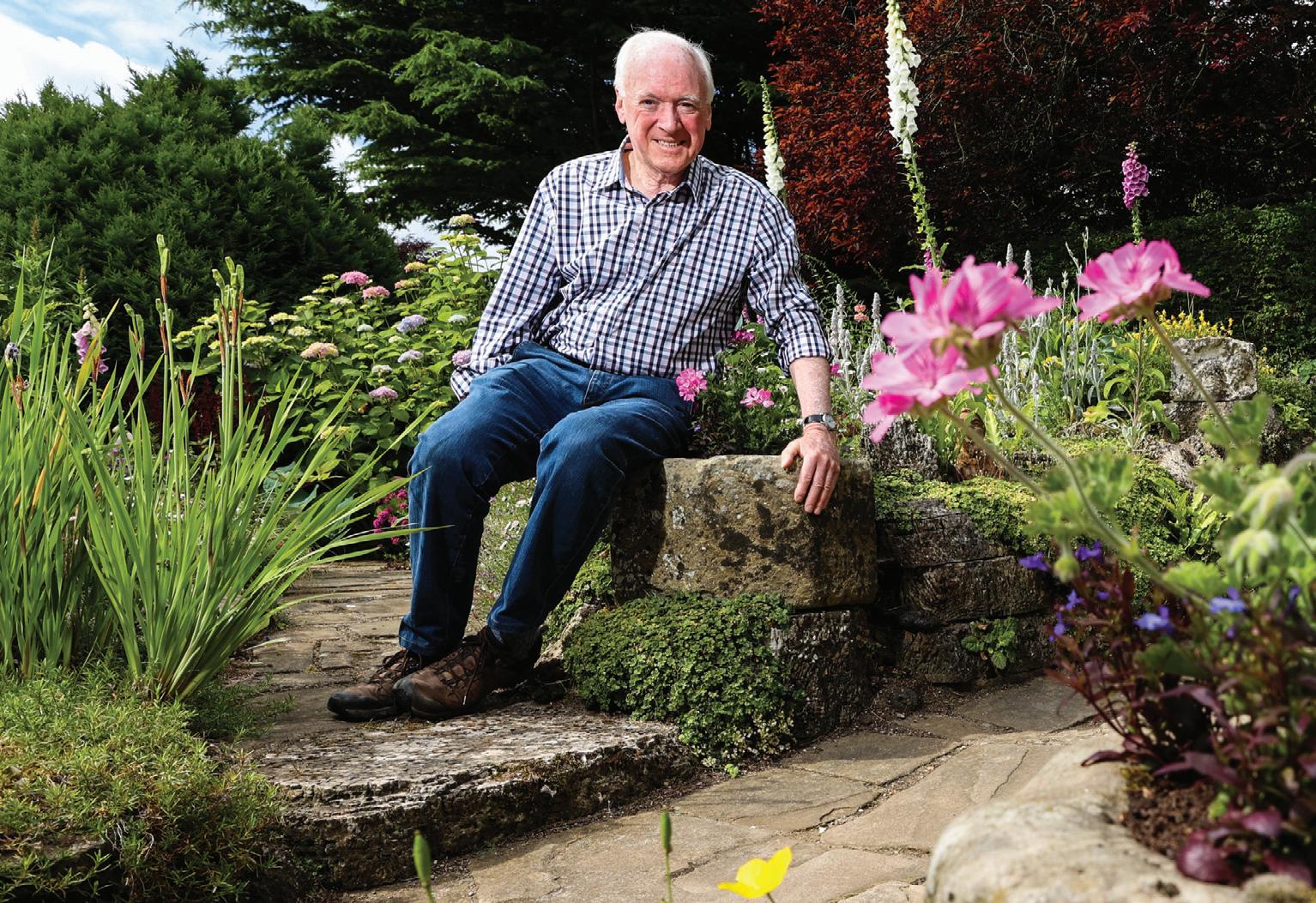
Five acres of paradise will once again be opened to the public this summer in support of local charities.
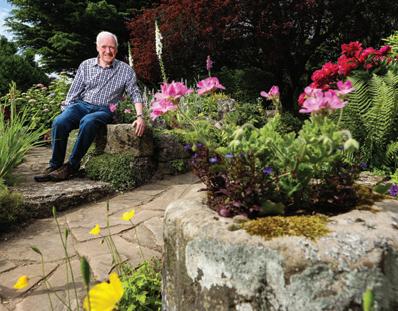
Tudor Croft Gardens, Guisborough, will be open from 11am to 4pm on Saturday June 13 and Sunday June 14, and again on Saturday June 20 and Sunday June 21.
Visitors will be able to enjoy the spectacular gardens in full bloom, along with home-made teas and a wide selection of plants for sale.
Admission is £10, with children admitted free of charge, and there will be well signposted
free parking available nearby.
Owner Mike Heagney said he hoped visitors would come along and enjoy one of the area’s finest private gardens while helping to raise money for worthwhile local causes.
Tudor Croft received national recognition last year when it became one of only five parks and gardens in England to be awarded Grade II listed status.
There is no need to book in advance – visitors can simply turn up on the day.
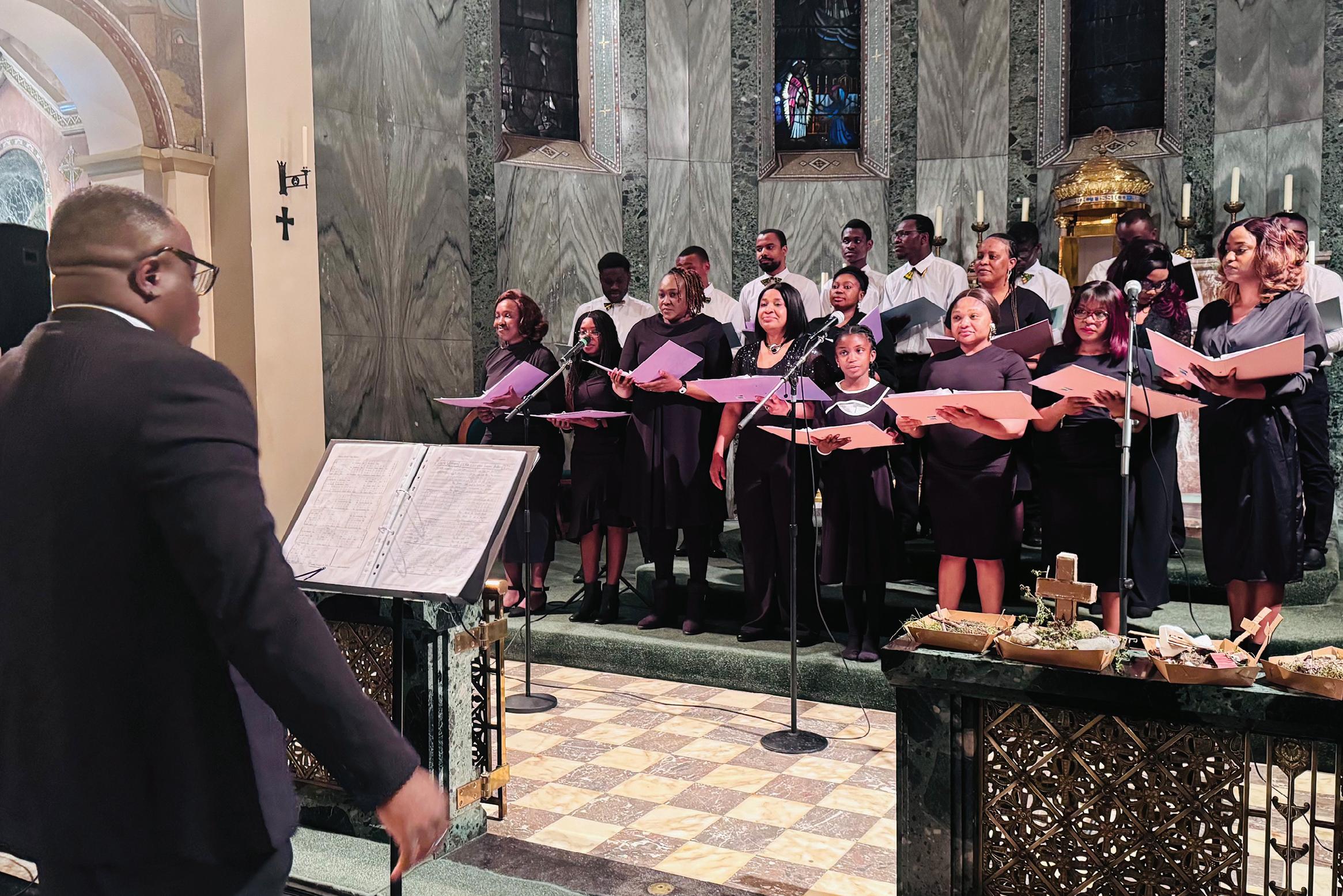
This year’s Easter Concert at Sacred Heart Parish, Middlesbrough, brought together choirs, parishioners and guests for a truly uplifting celebration of music, faith and the joy of the Resurrection.
The event, which had the theme “Alive in Glory”, showcased a rich variety of choirs and soloists, each offering their unique style and spirit, yet united in one common purpose – to proclaim the Easter message through inspiring and uplifting songs.
The evening began with a moving performance by Father John’s music crew, setting a deeply reflective and prayerful tone for the rest of the concert.
Next came the Angels’ Choir, beautifully adorned in vibrant African attire, adding colour and cultural richness to the evening.
The African Choir from the Diocese of Hexham and Newcastle thrilled the audience with a beautiful piece titled “How Excellent”.
The St Alphonsus Choir, North Ormesby, then took the stage, delivering a beautiful and engaging presentation.
The 6pm Sunday Mass choir also delivered a remarkable and inspiring performance. Accompanied by guitars, their presentation resonated strongly with everyone present.
The choirs were just amazing. From traditional hymns to vibrant contemporary pieces, each performance reflected the diversity and beauty of sacred music.
It was not just a concert; it was an experience of faith.

Retreat focuses on Ignatian spirituality
Heart to Heart is a three-day residential retreat for women in any state of life taking place at the Christian Heritage Centre at Stonyhurst from June 19 to 22. Based on principles of Ignatian spirituality, the retreat will be guided by Father Bernard Murphy CFR and Franciscan Sisters of the Renewal and will seek to draw participants closer to the Lord through a greater attentiveness to his will. For more information, visit christianheritagecentre.com/events/heartto-heart-retreat.
CELEBRATE festival, one of the UK’s leading Catholic family events, returns to Worth School in West Sussex from August 15 to 19 with the theme “Let There Be Light”. Around 1,000 people are expected for five days of worship, teaching and family activities. Speakers include Johannes Hartl and Roberto Pasolini. The festival will also commemorate the 800th anniversary of St Francis. For further details visit celebratefestival.org.
Speakers announced for charismatic renewal conference
Birmingham Catholic Charismatic Renewal Conference has unveiled the line-up for its 2026 gathering, which takes place in Solihull from August 10 to 14. Keynote speakers are Deacon Larry and Andi Oney, international Bible teacher and author Terry Quinn and passionate pro-life advocate Ros Powell, with spiritual leadership from Bishop Timothy Menezes and Father Eamonn Corduff. For more information, visit bccrc.org.uk.
Talks seek to educate against antisemitism
Ancient Texts for Our Troubled Times is a three-part Zoom series led by renowned New Testament scholar Amy-Jill Levine and presented by Bat Kol International. Aimed at Christian educators and clergy, the sessions will examine misconceptions about Jewish belief and scripture, antisemitism in Christian teaching and supersessionism. The series runs on June 2, August 4 and September 1. The talks are sponsored by the Sisters of Our Lady of Sion and the Executive Council of Australian Jewry. Find out more and register at batkolinternational.org.
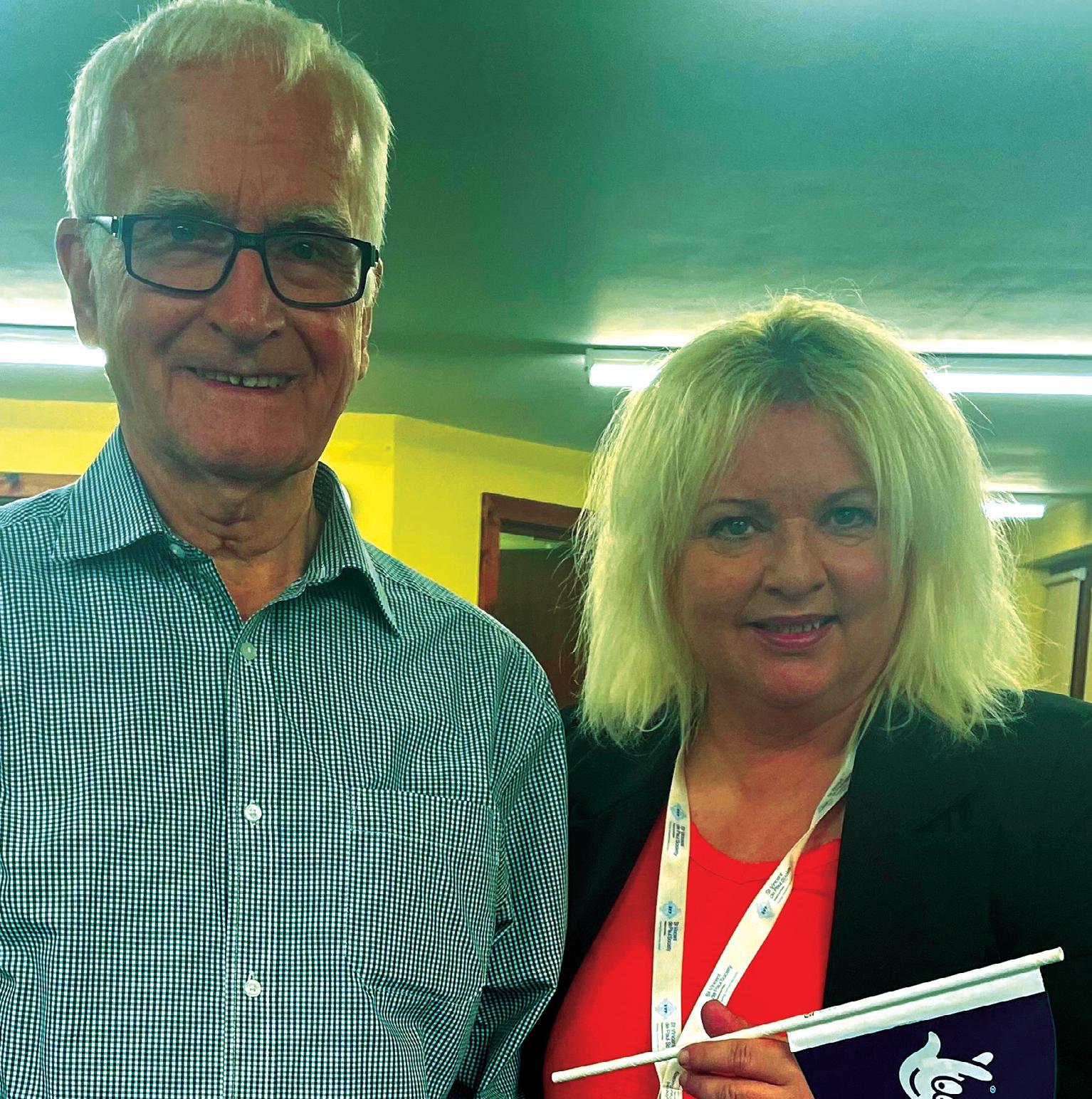
The St Vincent de Paul Society in Hull has bid a fond farewell to Chris Cuthill, who has stepped down after many years of dedicated service as president of the district council. Chris, a gentleman of profound faith and boundless kindness, has coordinated countless events that have inspired and united the community during 35 years with the SVP.
Known for his warm spirit and sharp sense of humour, Chris leaves a legacy of service, faith and friendship that will long be remembered. We thank him for his unwavering commitment and wish him every blessing in his next chapter.
As we thank Chris for his extraordinary service, we also look forward to the future and invite any member of the community with a passion for faith and service to consider stepping into the role of president of the Hull SVP district conference.
We are always looking for new members to join us throughout the diocese. If you feel called to continue Chris’ work, please reach out to us. Together, we can build on his spirit of compassion and hope.
My contact details are teresao@svp.org.uk or mobile 07554 336984. Leave a message or text and I will contact you with further details on all the good work the SVP does in your area and how you can also join the local conference.
Teresa O’Hagan Membership Support Officer
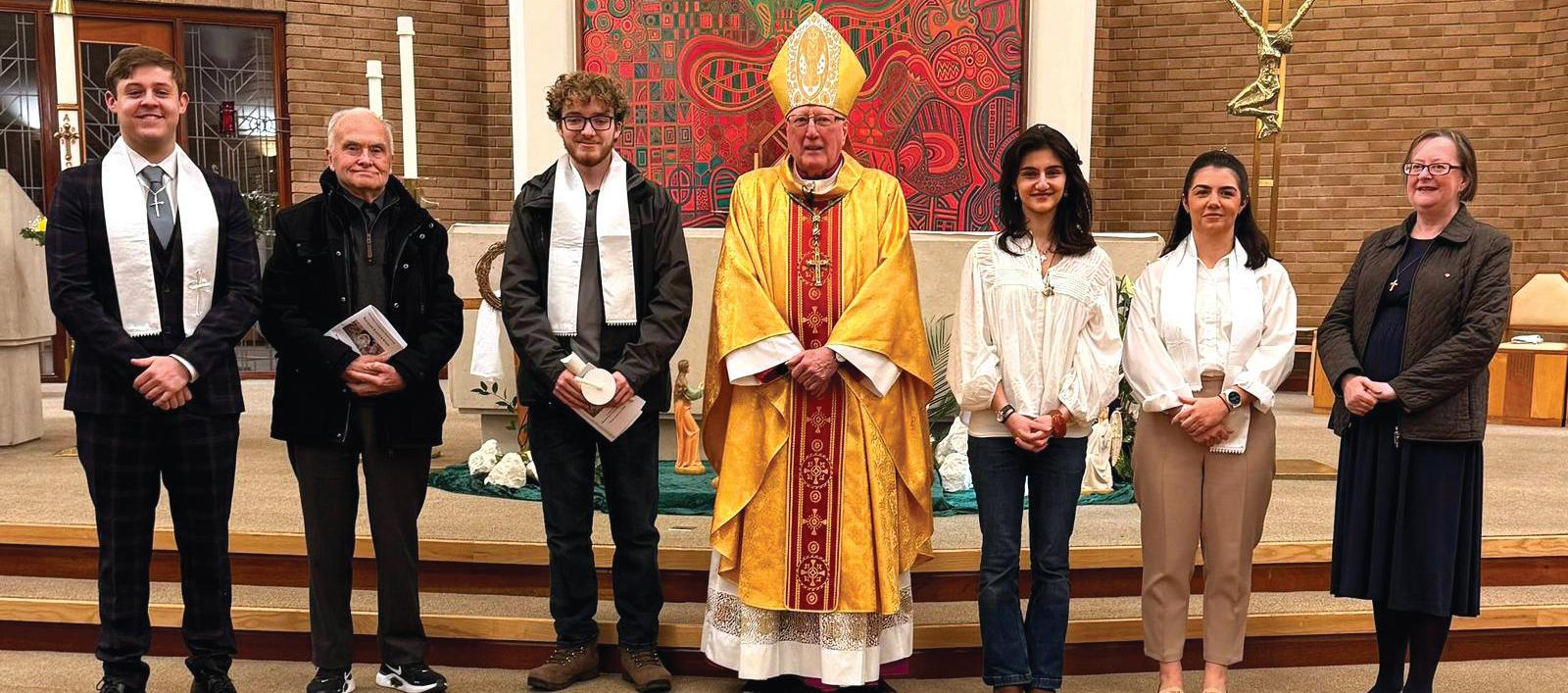
Would you like to train in relationship counselling and provide couples with professional, effective support that makes a real difference?
Marriage Care’s next Certificate in Relationship Counselling (CRC) training course starts next March, with a June 30 deadline for applications.
Marriage Care believes that supporting couple relationships is a matter of social
justice. Its relationship counsellors enable those in need to access professional counselling – regardless of their ability to pay – by voluntarily providing two counselling sessions per week.
Marriage Care is looking for empathetic, understanding people with an enthusiasm for supporting adult relationships. While you do not need experience as a counsellor, selfawareness and having the time and space to commit to all that the training and role entails
is essential.
Volunteers pay a non-refundable registration fee of around £175. In line with Marriage Care’s ethos as a charity, no one is excluded because of their ability to pay.
Benefits include full, ongoing training with certified trainers and ongoing supervision.�For more information, visit marriagecare.org.uk or email volunteer@marriagecare.org.uk.
Our Lady of Lourdes Church in Saltburn will host an evening of sacred choral classics on Saturday June 13.
Te Lucis Ante Terminum brings together a small ensemble of friends who are all accomplished professional and semi-professional singers.
With singers from Newcastle Cathedral, Durham Cathedral, Newcastle University Chamber Choir and friends, many with strong ties to the Diocese of Middlesbrough, it offers a rare chance to hear the music in an intimate, atmospheric and moving environment.
You may recognise some familiar faces. The performance is directed by Laura Watson, a former choral scholar at St Mary’s Cathedral and current choral scholar at Newcastle Cathedral, and James Watson, organ scholar at Newcastle Cathedral.
Many enjoyed the O Holy Night event last Advent at St Mary’s Cathedral. This evening promises to be equally uplifting and moving and includes timeless pieces by Allegri, Parry, Faure, Handel and Howells, plus rich harmonies from Rheinberger’s Mass in E-flat.
Tickets are £10 and are available from Eventbrite (a small booking fee will be applied) or, subject to availability, on the door on the evening.
Alternatively, contact Claire on 07977 133710 or clwclaire@icloud.com.
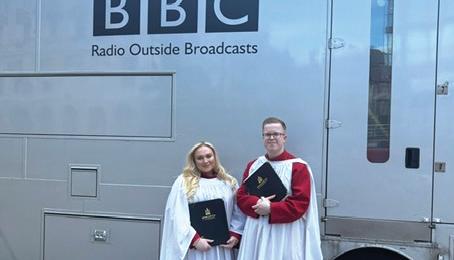
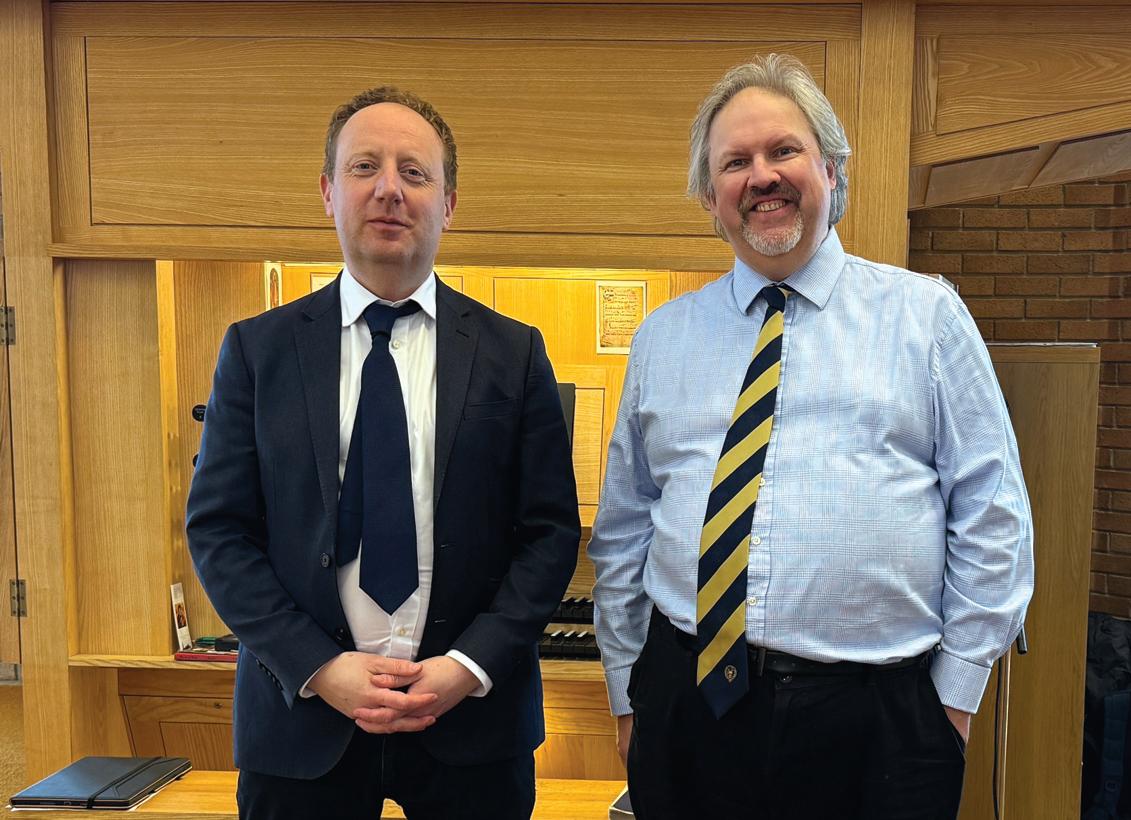
The ordination of Father Douglas McKittrick was a joyous celebration that also presented an opportunity for musicians from the Diocese of Leeds and Diocese of Middlesbrough to work together.
Members of the Cathedral and Diocesan Choirs were conducted by our diocesan director of music, Steven Maxson, while the cathedral organ was played by Thomas Leech, director of the Schools Singing programme for the Diocese of Leeds.
Our picture shows Thomas on the left and Steven on the right.
Father David Howell preached on the enduring witness of the 40 Martyrs of England and Wales when he visited St Charles Borromeo Church in Hull.
Preaching on a feast that continues to resonate in English Catholic life, Father David, who is from Solihull, reminded the congregation that the martyrs’ story is not simply one of suffering, but of profound imitation of Christ.
“They died in imitation of Christ. Christ is the king of martyrs,” he said, placing their sacrifice firmly within the pattern of the Cross. Drawing out the human cost of their witness, he spoke of the painful reality that many were betrayed not by distant enemies but by those close to them.
“Just as Christ was betrayed by his own people, so too our martyrs did the same,” he reflected, noting they knew the pain of that betrayal in a very personal way.
Yet it was the response of the martyrs that formed the heart of the homily. In words echoing the Gospel, Father David emphasised that they “learned how to forgive – even those who betrayed them, even those who put them to death.”
Their witness, he suggested, was not only in
how they died, but in how they loved to the end.
He highlighted the lasting fruit of their sacrifice. “Their deaths were fruitful,” he said, reminding the congregation that those who witnessed such courage were often “moved and transformed”.
The blood of the martyrs, he implied, continues to nourish the life of the Church in this country.
The reflection held particular local significance. Two of the martyrs have connections with Hull, and a blue plaque near the Charterhouse stands in quiet testimony to their memory and witness.
Father David concluded by turning the focus to the present day, inviting all to consider the choices that shape their own discipleship. Do we seek the passing crowns of this world or the eternal crown that comes from God? It’s a question that lingered long after the liturgy ended.
In recalling the courage and fidelity of the martyrs, the Mass served as a reminder that their witness is not confined to history. It remains a living call to faith, forgiveness and steadfastness for Catholics today.


1 Monday
9.45am-10.25am Beverley Christian Meditation Group meets online. Further information from christianmeditation.beverley@gmail.com. This takes place every Monday.
7pm Catholic charismatic prayer group meets on first Monday each month at St Bede’s Pastoral Centre, Blossom Street, York. For more information, contact Sharon at cdscsmiddlesbrough@gmail.com or 07932 420809.
2 Tuesday
10am Coffee at the Cathedral. Tea, coffee and treats every Tuesday after 9.30am Mass. A warm welcome and friendly atmosphere. Make new friends and enjoy some fellowship. Those who are alone especially welcome.
10am Christian Meditation Group meets online. Further information from Terry Doyle at terry-doyle@live.co.uk. This takes place every Tuesday.
6.30pm Knights of St Columba Council 29 meets at St Mary’s Cathedral.
3 Wednesday
5.30pm Sung Evening Prayer and Benediction at St Mary’s Cathedral. Join us every Wednesday for a time of prayer and quiet reflection before the Blessed Sacrament (term-time only).
5 Friday
Events, articles and photographs for the July edition of the Voice are due by this day. 6 Saturday
6 Saturday
10am York Catholic History Day at the Bar Convent. For more details contact judith.smeaton@btinternet.com.
11am Catholic women are invited to share an hour of feminine communion, including
meditation, via Zoom. Text Barbara on 07796 117704 with your mobile number and email address so she can add you to the WhatsApp group, or email catholicwomenmdl @gmail.com for Zoom link.
6pm Mass in Italian in the Father Kelly Room, Our Lady, Acomb, York, followed by refreshments. All welcome.
8 Monday
2pm Music for the Mind, an hour of fun and music for people living with dementia, their friends and carers at St Mary's Cathedral, with Trish McLean. All welcome.
9 Tuesday
12.45pm Catholic Women's Luncheon Club meets every second Tuesday of the month at the Kingston Theatre Hotel, Kingston Square, Hull. Gather at 12.45pm, lunch at 1pm. All ladies in the Hull and East Riding area welcome. Call 01482 446565 or email jayne.wilson24@ymail.com.
10 Wednesday
7pm Hull Circle of the Catenian Association meets at the Lazaat Hotel, Cottingham, followed by Mass and a buffet-style meal. If interested, email Charles Cseh at hullcirclesecretary@gmail.com.
11 Thursday
7.45pm Middlesbrough Catenians meet at Middlesbrough Cricket Club, Green Lane, TS5 7SL. Contact Peter Carey on 01642 317772 or Chris Rhodes on 01642 319161.
12 Friday
7pm Four Choirs United with Paula Odell at St Mary’s Cathedral, Coulby Newham. Tickets £10 from the box office.
13 Saturday
Noon Canon Michael Ryan celebrates his diamond jubilee of priesthood with a Mass of
Thanksgiving at English Martyrs Church, York, with refreshments afterwards in the hall. All welcome.
7pm Irish dance with Pat Jordan at the Erimus Club, Cumberland Road, Middlesbrough TS5 6JB. Contact John Brown on 07871 958412. 7pm Te Lucis Ante Terminum at Our Lady of Lourdes Church, Saltburn. Conducted by Laura Watson and James Watson. Tickets £10 available on the door, via Eventbrite or from the church.
14 Sunday
3pm Mass for LGBT+ community, family and friends at the Chapel of the Bar Convent. Doors open from 2.30pm.
20 Saturday
Come and Sing Handel's Messiah. Join singers of all ages and abilities at St Mary’s Cathedral, Middlesbrough, for an afternoon of rehearsals followed by an evening performance. See the cathedral website for more details.
21 Sunday
3pm Catholic Fellowship Mass at St Gabriel’s, Middlesbrough, with Father James Benfield.
26 Friday
7.30pm Rocking in the Aisles at St Mary’s Cathedral, Middlesbrough. A night of halfrehearsed mayhem and fun with all of your favourites from years past, as well as a few new turns and surprises. Tickets £6 and £12 (early bird discount available) from the cathedral box office.
27 Saturday
Noon LGBT+ social gathering at the Bar Convent, York. All welcome. If you have any events that you would like to include in the Out and About section, please email heidi.cummins@rcdmidd.org.uk.
Copy and photographs for inclusion in the Catholic Voice should be sent to: The Editor, Middlesbrough Diocesan Catholic Voice, Curial Offices, 50a The Avenue, Linthorpe, Middlesbrough, TS5 6QT. Tel (01642) 850505, email catholicvoice@rcdmidd.org.uk
Deadline Friday June 5 for July edition.
Where possible please send articles in Word and photographs as jpegs. Please confirm when you send in your photographs that those who appear in them have given their permission for publication.


The organ is a very special thing. It was described by Mozart as the “king of instruments”, and mentioned specifically in the documents of Vatican II, as an instrument “which adds a wonderful splendour to the Church’s ceremonies and powerfully lifts minds to God and to higher things” (Sacrosanctum Concilium, §120).
If you walk into Sacred Heart Church in Redcar on a Sunday morning, you’ll be able to hear such a magnificent instrument being played. Or at least you would if it were in proper working order, but alas, this is not the case. One hundred years of wear and tear have taken its toll, affecting both performance and capability, and unless a major restoration is undertaken, this damage is a very real threat to its future. Sacred Heart’s organ is an instrument of considerable musical interest and is one of only three of its kind left in the UK.
Unveiled on October 1923 18 by parish priest Canon Albert Gryspeert to mark his silver jubilee of priesthood, it was installed by Jules Anneessens of Menin, Belgium, a skilled craftsman with the honorary title of “Supplier to the Pope” after his construction of an organ in Rome.
Redcar’s organ was the third example of Anneessens’ work in the local area, having supplied organs to the old cathedral (now lost to fire), and St Peter’s in South Bank. The continental design and unrestrained tone was unusual by English standards, so this organ would have raised quite a few eyebrows (and maybe a few roof tiles) when it was first
played!
However, today, 23 notes are completely unplayable. The leather puffers, which control each note, have perished, and all 894 need replacing. The copper wires that connect notes to pipes are a complete shambles. The motor is deafening… the list of damages goes on.
To help save this wonderful instrument and preserve it for future generations, the parish has brought together a group of skilled parishioners to form an organ project team.
They’ve secured grants from the National Lottery Heritage Fund and the Benefact Trust which mean that, alongside parishioners’ generous donations, the £41,888.85 restoration can begin! The work began at the end of April and will take around three months. During this time the organ will fall silent for the first time in over 102 years.
As well as raising money, the parish is collecting people’s memories of Sacred Heart’s organ to find out what it means to local people. It might be a favourite hymn you love to hear or a story about music at a funeral or wedding.
If you have a special memory that you’d like to share, you can pick up a note card from Sacred Heart Church or email the parish office at redcarandmarske@rcdmidd.org.uk.
We’re also getting our schools involved, with enrichment activities planned with St Benedict’s Primary and Sacred Heart Secondary, as well as an exhibition and an organ concert at the end of the project to showcase the restoration.
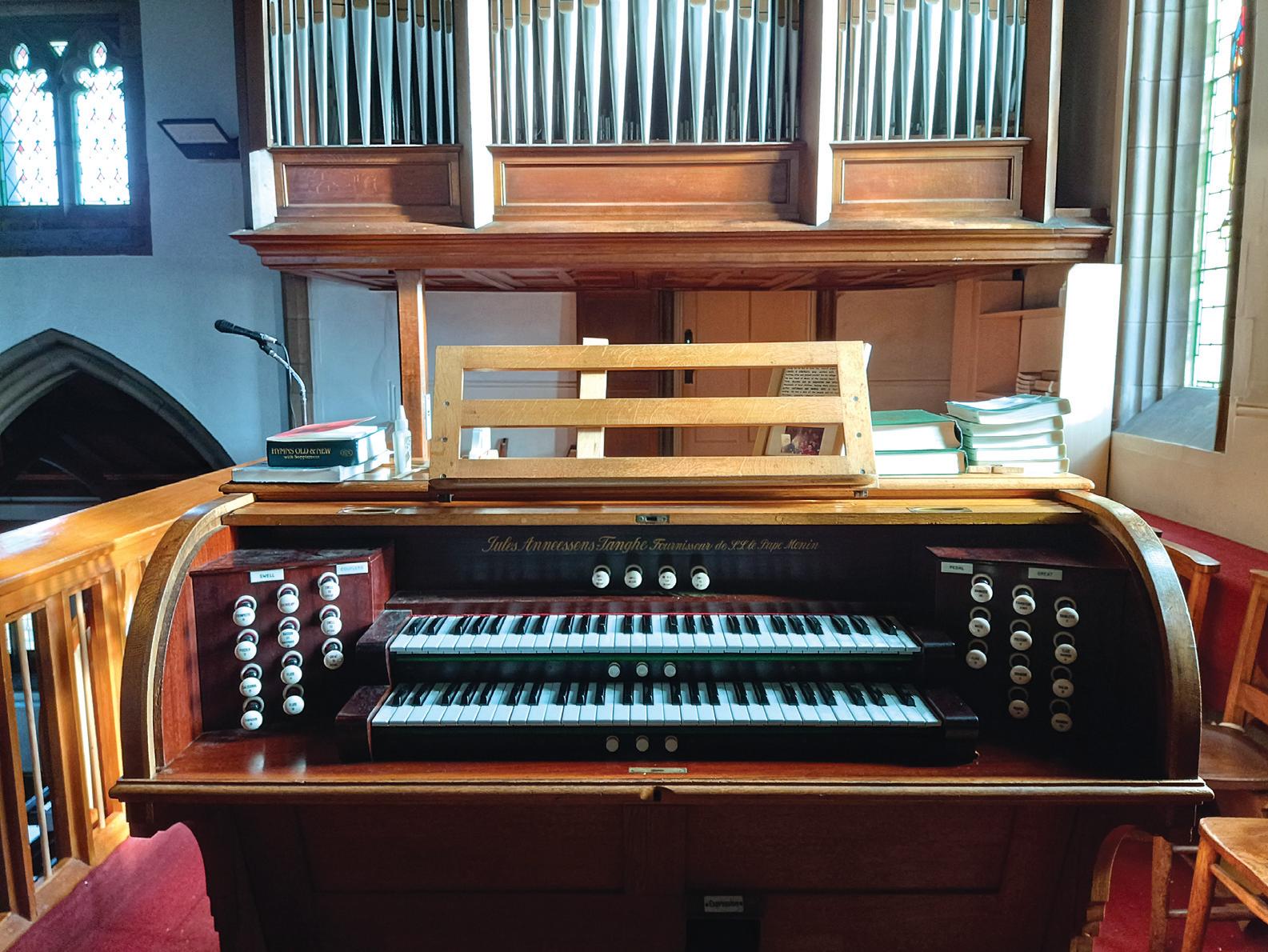
So there’s lots to look forward to and get involved with across our community – keep an eye out on our Blessed Nicholas Postgate Facebook page for all the latest details. Music is such an emotive art-form. It brings people together, creating shared experiences, and it can trigger memories from the past, provoking all kinds of emotions – especially at weddings and funerals. You might not remember the words spoken or even the faces of people who were there, but the music will always remain. Let’s make sure that we keep music beating at the heart of our community by restoring this beautiful organ to its former glory.
LUCA SETTIMO (Professor of Theology at the University of Nottingham) continues his series of reflections on the meaning of some key biblical words by examining the biblical notion of peace, which is conveyed by the Hebrew word shalom.
This word appears 237 times in the Old Testament and is still used as a greeting in both modern Hebrew and Arabic (salam). The concept of shalom is multifaceted because the word’s root implies something complete, perfect, fulfilled and thus biblical peace encompasses wellbeing, prosperity, justice, joy and fullness of life. When we say this word to someone, we wish for their full realisation and fulfilment.
Interestingly, in 2 Samuel 11:7, David asks Uriah the Hittite about the “shalom” of the war, which can be translated to mean the state of the war. Thus, in this case the best translation of shalom is “realisation” of the war. In modern terms, it is as if David asks Uriah how the war is going.
Also, the philosopher Baruch Spinoza (16321677), explains that “peace is not [necessarily only] an absence of war, [rather] it is a virtue, a state of mind, a disposition for benevolence, confidence, justice.”
Nevertheless, in many other biblical verses such as Deuteronomy 20:10 peace is interpreted as we understand this word today: “When you draw near to a town to fight against it, offer it terms of peace [shalom].”
Moreover, we read in Leviticus 26:6: “And I will grant peace [shalom] in the land, and you shall lie down, and no one shall make you afraid; I will remove dangerous animals from the land, and no sword shall go through your land.”
We should remember that ultimately “righteousness and peace will kiss each other” (Psalm 85:10). In the messianic vision, the future will be marked precisely by peace, which is also the name of Jerusalem (Jerushalaim), at least in the traditional interpretation, “city of peace” (ir shalom). Heaven and earth will unite in a harmony of love, as the prophet Isaiah announced in his poetic vision in which even hostile animals will be reconciled: wolf with lamb, leopard with kid, calf with lion, cow and bear, lion and ox, the child and the asp (Isaiah 11:6-8).
The new Jerusalem, again according to Isaiah, will host all the nations of the earth that, having arrived in the holy city, “shall beat their swords into ploughshares, and their spears into pruning hooks; nation shall not lift up sword against nation, neither shall they learn war any more” (Isaiah 2:4). This is therefore a message of peaceful coexistence and universal harmony in the future Jerusalem.
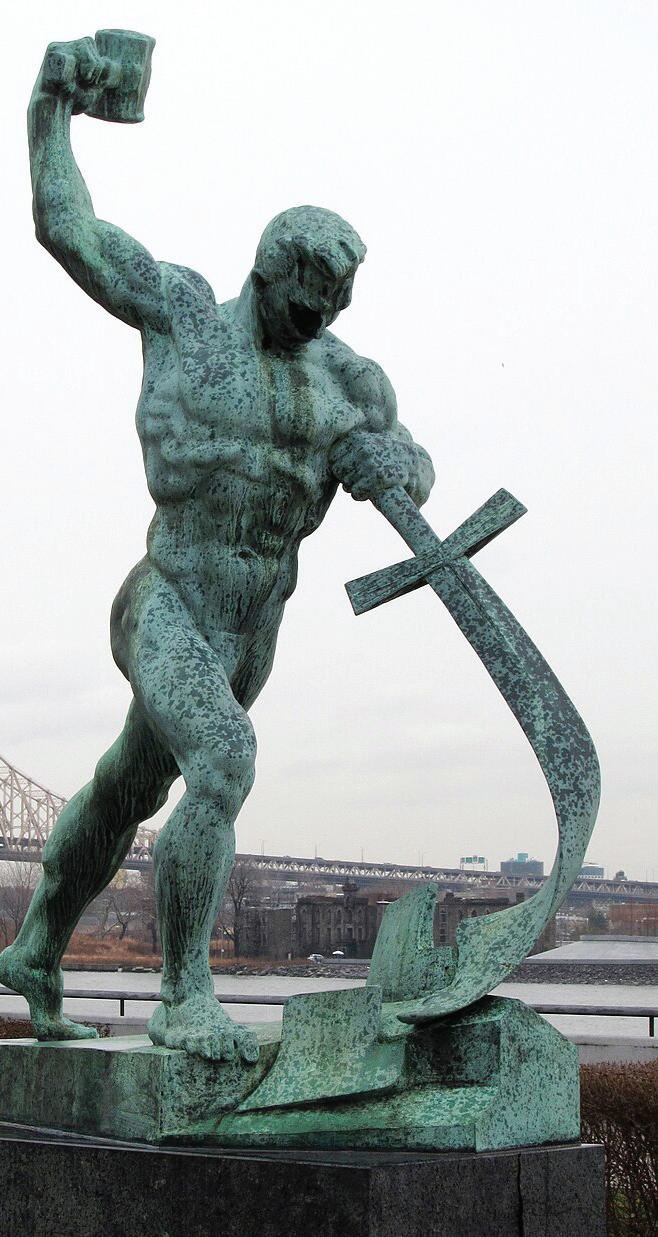
A work of art by the Soviet artist Yevgeny Vuchetich (1908-1974) – shown in the picture – is particularly significant: this artist
produced a sculpture that symbolises the conversion of military weapons and technologies into peaceful civilian applications.
In this sculpture, in agreement with Isaiah 2:4, the sword is transformed into a tool for cultivating crops, in order to feed rather to kill humanity
Indeed, the messianic king will be the first to do away with chariots and cavalry, will shatter the war bow, and “shall command peace to the nations” (Zechariah 9:10). His title, in fact, will be, as the prophet Isaiah recalls, “Prince of Peace,” (Isaiah 9:6) and “His authority shall grow continually, and there shall be endless peace for the throne of David and his kingdom. He will establish and uphold it with justice and with righteousness from this time onward and forevermore” (Is 9:7).
In this regard, the greeting addressed to David at the beginning of his reign is evocative: “We are yours, O David; and with you, O son of Jesse! Peace, peace to you, and peace to the one who helps you! For your God is the one who helps you” (1 Chronicles 12:18).
His successor will bear the name Solomon, which, as is evident, has its root in shalom, “man of peace”. And all Israel is under the protective mantle of shalom: “May the Lord bless his people with peace!” (Psalm 29:11), and the faithful will commit themselves to this purpose: “Let me hear what God the Lord will speak, for he will speak peace to his people, to his faithful, to those who turn to him in their hearts” (Psalm 85:8).
Therefore, we can proclaim, “Glory to God in the highest heaven, and on earth peace among those whom he favours!” (Luke 2:14).
Ultimately, as St Paul explains in Ephesians 2:14-17, Christ is and proclaims “peace” (in Greek eirene).
I wish to acknowledge Cardinal Gianfranco Ravasi, former president of the Pontifical Council for Culture, for granting me permission to use his material originally published in Italian.
A YouTube video entitled “The biblical notion of peace/fulfillment”, which explores this biblical concept in greater detail, is available on my YouTube channel, youtube.com/@LucaSettimo-7.
SIR JOHN BATTLE, MP for Leeds West from 1987 to 2010 and a minister in Tony Blair’s government, continues his regular column in the Voice. Sir John, who was made a Knight Commander of the Order of St Gregory the Great by Pope Benedict and was knighted in the 2022 New Year Honours, is chair of the Diocese of Leeds Justice & Peace Commission and has a deep commitment to Catholic Social Teaching.
We are not often told who dies in the English Channel, as refugees trafficked in small boats are dragged from the water. But recently it was reported that the two who drowned were from Sudan. Fleeing from Sudan is hardly surprising, as the United Nations has described it as now “the world’s worst humanitarian crisis”.
But as our mainstream media, dominated by the war in Ukraine after the Russian invasion, moved on to the bombing of Iran
and the blockading of the Straits of Hormuz (with a brief period of daily reporting the destruction of Gaza), Sudan is by and large beyond western media reach and apparently of less concern.
Besides, as the poet TS Eliot reminds us, “Go, go, go said the bird: human kind cannot bear very much reality”. It’s all too much, and depressingly disempowering to witness these events through our TV screens.
Significantly, Pope Leo XIV’s first major papal visit was to Africa: to Algeria, Cameroon, Angola and Equatorial Guinea. As an Augustinian friar he visited communities in Africa and this time he started out in Algeria, the birthplace of St Augustine and the lifebase of one of our most recently proclaimed saints, St Charles de Foucauld, who lived and died in the desert among Muslims and features in all the recent papal encyclicals of Pope Francis and Pope Leo XIV as a model witness to working for harmony between Christians and Muslims.
Notably, Pope Leo visited the Grand Mosque of Algiers, following up Pope Francis’ initiative in 2019 of jointly signing the Document of Human Fraternity with Grand Imam of Al Azhur, Ahmed el Tayed, which called for peace, coexistence and dialogue between religions, stating that religions should never incite violence or war, but rather promote a culture of dialogue, cooperation and shared understanding. But Pope Leo’s visit was not just an occasion for further developing interfaith relations
“Rooted and Rising” - 2026-2028 A course to nurture personal awareness, spiritual practice and reflective living

A new opportunity to explore and go deeper with others, this two-year hybrid course consists of one in-person Saturday per term in York and eight online sessions on Thursday evenings. - The transformative “Personal Spiritual Development course” has been run by St Bede’s Pastoral Centre, York for many years. In this hybrid form the tried and trusted resources of the course can be offered to a much wider group of participants.
For full details and an application form visit www.stbedes.org.uk or contact Fiona Hill on 01904 464900 or email fiona@stbedes.org.uk
between Christians and Muslims, much needed though they are. There was also a real effort to focus world attention on African communities with tragically long histories of injustice, exploitation and repression largely ignored by the wealthy West.
Africa, now with 1.5bn people (18% of the world’s 8bn), is the fastest-growing continent, in particular, in Nigeria and Ethiopia, and by 2050 the population is projected to be 2.5bn people, while Europe and East Asia are aging and declining.
Africa is home to the fastest-growing Catholic population, which grew by 7m in the last year, making up 20% of Catholics worldwide. But too many African nations still suffer from poverty and widening inequalities, huge national debt, burdens and conflicts leading to major dislocations and famines.
Sudan has for centuries been treated as a resource to be exploited; a source of gold extraction and slave labour. In the 19th century Sudan was conquered by Egypt; they share the River Nile.
After a rebellion in the 1880s, in 1896 Britain invaded Sudan on the pretext of restoring Egyptian authority. Sudan was incorporated into Britain’s growing African empire in 1956.
Sudan won its independence but the internal civil war continued as southern rebels fought the north for the next 17 years.
In 2011, South Sudan finally achieved independence. However, more recently, two army generals turned on each other, having between them overthrown the civilian,
democratically elected government, and since then the Sudanese Armed Forces (SAF) have been fighting to hold off the paramilitary Rapid Support Forces (RSF), who have set up a rival government in West Sudan. The consequent atrocious Civil War, now dominated by damaging drones and missiles, has led to 150,000 killed, 4m refugees fleeing primarily to poor neighbouring countries, millions of people displaced internally and some 33m people facing hunger and famine.
Moreover, the cutbacks in international emergency aid (including by our own government) has left the Sudanese people in deadly desperation. About 37% of Sudanese hospitals are reported now as “nonfunctional”.
Our own agency, CAFOD, despite reductions in governmental support, is one of the few international emergency agencies working with Caritas Africa and able to reach the suffering of Sudan.
Celebrating the Easter season is not easy, with regular public reminders at home and abroad that this side of eternity, the experience of Christ’s Crucifixion, worldwide, is still with us. Nor should our efforts at fasting and alms-giving be restricted to the season of Lent. The Sudanese people through CAFOD need our urgent emergency support.
Contact the CAFOD Sudan appeal at cafod@cafod.org.uk.
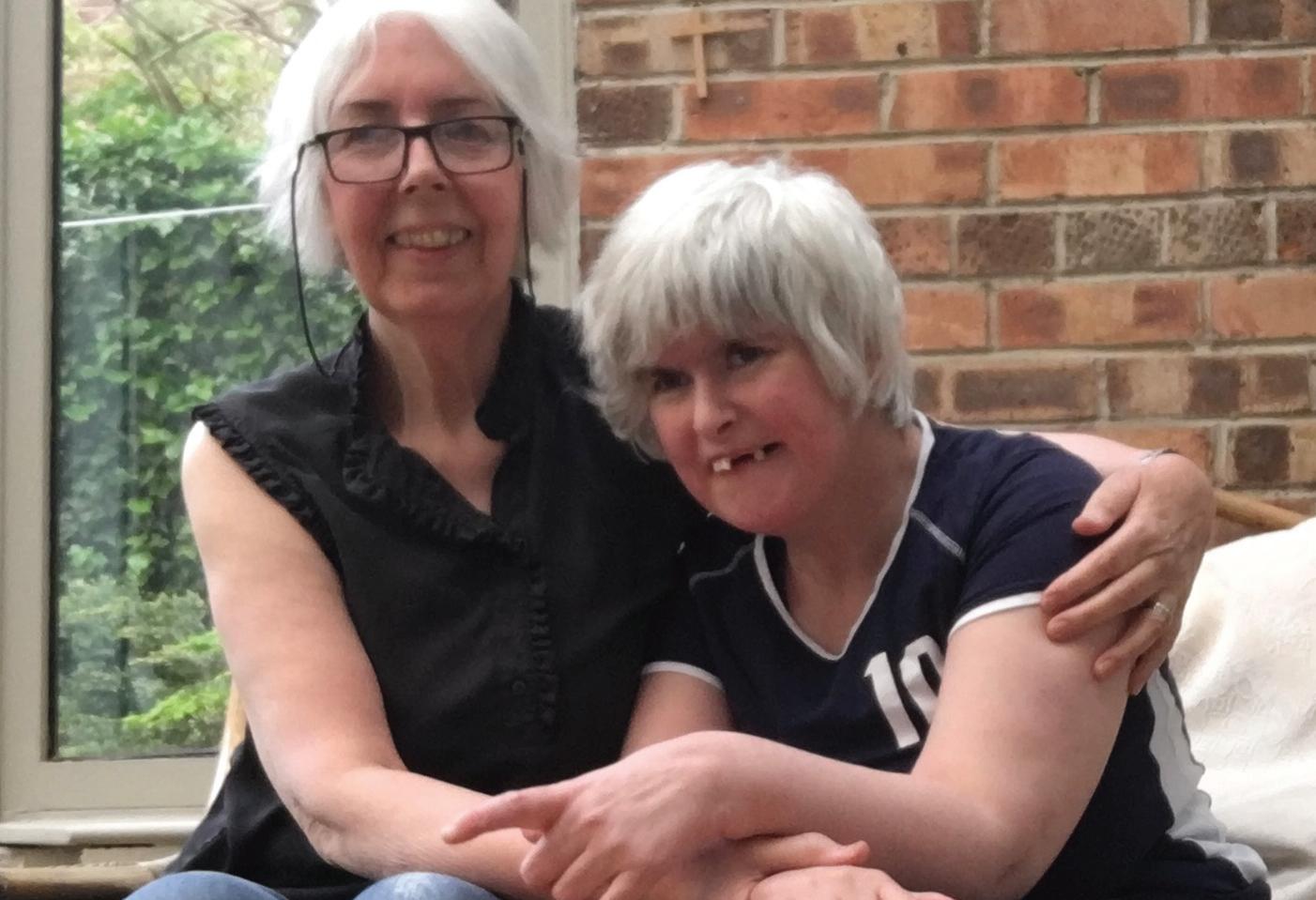
Holy Name of Mary, Middlesbrough, parishioner Judith Brown has helped win an eight-year fight to secure respite care for local families.
Retired teacher Judith, 75, has spent almost five decades caring for her daughter Monica, who was born with severe brain damage and requires round-the-clock support.
Now, after an eight-year campaign by families and carers in Middlesbrough, she says securing respite places at Levick Court has provided a vital lifeline.
Judith, a mother of four from Linthorpe, said Monica, 47, has never developed beyond the age of two and can only understand simple words. Caring for her daughter involves constant feeding, washing, medication and supervision.
The respite weekends at Levick Court, less than a mile from the family home, allow Monica to be cared for by specialist nursing staff while giving Judith a rare opportunity to rest and spend time with her other children and grandchildren.
Together with other families, Judith fought to save the respite provision after the previous buildings were deemed unsafe and too costly to repair to Care Quality Commission standards.
Campaigners eventually secured backing from local authorities, NHS bodies and the integrated care board, resulting in a 10-year contract for the service.
Monica’s complex needs include epilepsy and severe anxiety, but she is well cared for by staff at Levick House.
“The supervision and levels of staffing take away any anxieties I have,” said Judith, who is also one of the organisers of Cleveland Newman Circle.
“I’ve bathed Monica 16,000 times, but for 33 nights a year someone else will do that for me. We are overjoyed we have got this service to continue.”
The service, based in a building opened in 2012, includes a 16-bed respite unit alongside apartments for older people.
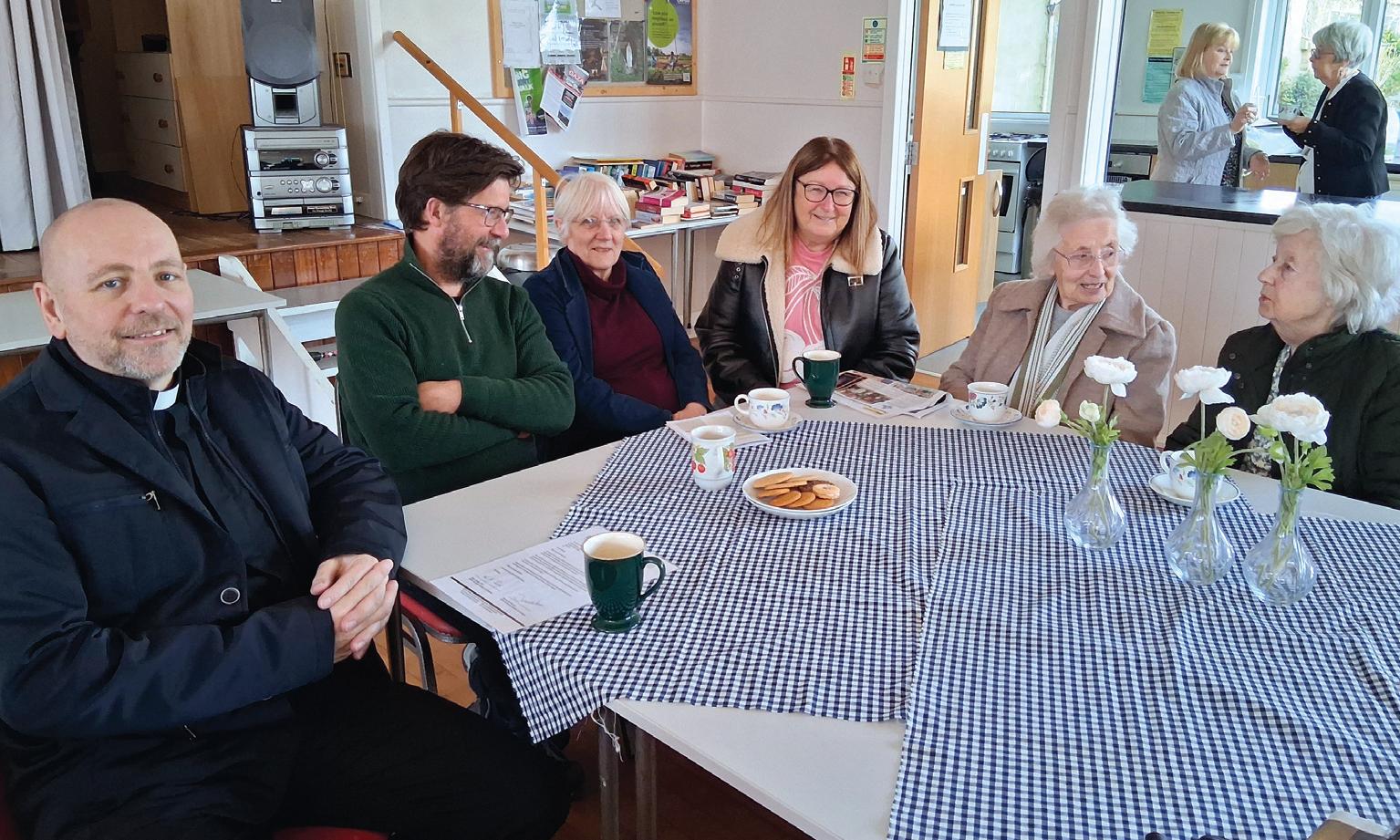
Every year, Sacred Heart, Hornsea, parishioners choose a charity to support with income from our Sunday mass tea and coffee gathering and other fundraising events.
Last year we raised £1,500 for RENATE (Religious in Europe Networking Against Trafficking and Exploitation), a network dedicated to combating human trafficking and exploitation across Europe. It took a bit of effort to transfer the funds to them as they don’t have a UK bank and their Dutch bank doesn’t accept cheques, but we got it to them eventually, with help from the diocesan finance team.
In a thank-you letter, RENATE co-presidents Marie Power HFB and Ivonne van de Kar wrote: “Your contribution will make a significant difference to our anti-human trafficking work at grassroots level, empowering religious sisters and their lay associates across the RENATE network to
continue their vital efforts in supporting vulnerable individuals and communities.
“Your generosity is a source of encouragement and hope, and we deeply appreciate your commitment to this important cause. Please be assured that your donation will be used wisely to further the fight against human trafficking and to bring about positive change where it is most needed.”
In previous years we have supported Stella Maris in Hull and Mary’s Meals and this year we are building a parish Lourdes fund that will help send parishioners on pilgrimage next year. Tea, coffee, chatter and a thriving community spirit works wonders. If you are ever in Hornsea, you are very welcome to join us after Sunday Mass and to help boost our efforts too!
For more information about RENATE, visit renate-europe.net.
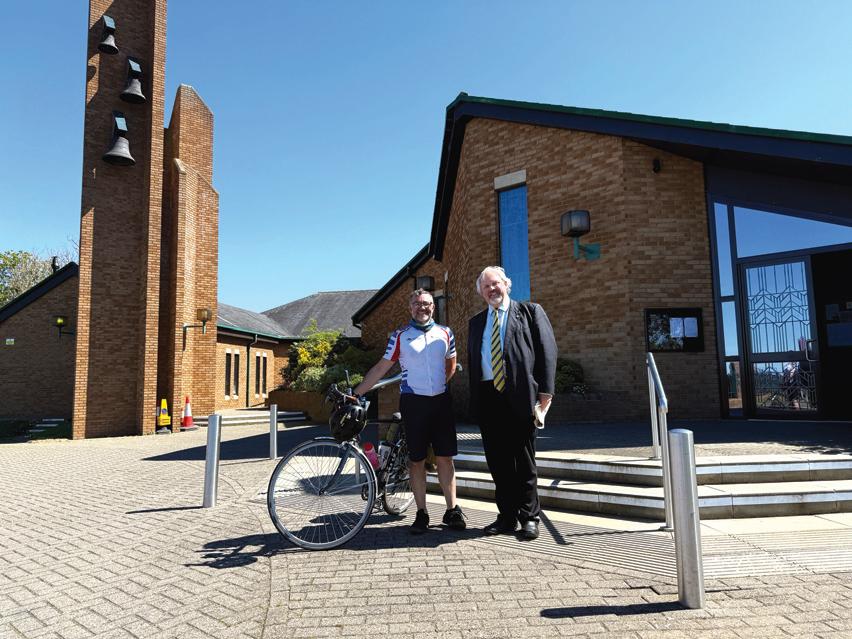
Chief executive of the Cathedral Music Trust Jonathan Mayes called in at St Mary’s Cathedral on the last day of a mammoth 3,000-mile cycle ride around cathedrals and other churches across the country.
The climax of his 50-day journey began in Ripon and took in Middlesbrough before heading to Durham, where his cycling pilgrimage began.
The Cathedral Music Trust provides financial support to cathedral and church choirs across the country, including recently making a grant to our cathedral, as well as supporting the Small Sounds dropin music sessions for children aged up to five with their adults.
Jonathan met diocesan director of music Steven Maxson and was delighted to hear about the musical life of the cathedral and
the impact of Cathedral Music Trust funding.
Further information about Jonathan’s journey, along with details of how to donate, can be found at cathedralmusictrust.org.uk/choraladventure-cycling.
Right: Jonathan Mayes and Steven Maxson outside St Mary’s Cathedral
In March’s column, I referenced the work of Client Earth, which focused on the protection of our oceans.
I am delighted to report some good news. The campaign against “bottom trawling” in protected areas has had some positive results and has announced a breakthrough in an action in the Dutch courts.
A new ruling states that: “Dutch bottom trawlers can no longer fish the Dutch part of the Dogger Bank protected area without a permit.”
Bottom trawling is notorious for its destructive environmental impacts. Weighted nets are dragged along the seabed to catch species such as cod and hake, but it is not selective and kills any marine life that
gets in its way.
This area supports iconic species such as sharks, seals and dolphins, yet the Dutch government has been flouting the law by allowing damaging bottom trawling here without permits.
This ruling is a big leap forward towards the wide protection of precious protected areas from bottom trawling and other damaging activities.
It puts further pressure on the European Commission and EU countries to phase out bottom trawling in these areas.
Britain closed its part of the Dogger Bank to bottom
trawling four years ago based on the same legislation. In Germany, legal proceedings are underway against the government to protect the German part of the Dogger Bank from bottom trawling.

This case, along with those against six other countries, has put the continent on notice that the days are numbered for bottom trawling in protected areas.
Good news indeed.
Visit clientearth.org to find out more.
Barbara Hungin