VOICE LEEDS CATHOLIC
Ian What’s Canon celebrates 40 years Inside ofPagepriesthood 7
Raising funds for Mary's Meals
Pilgrims walk St Wilfrid’s Way
Page 8
Page 11
FREE Issue 1
Oct 2026
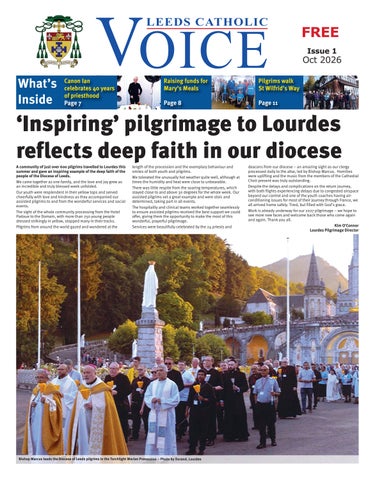
‘Inspiring’ pilgrimage to Lourdes reflects deep faith in our diocese A community of just over 600 pilgrims travelled to Lourdes this summer and gave an inspiring example of the deep faith of the people of the Diocese of Leeds. We came together as one family, and the love and joy grew as an incredible and truly blessed week unfolded. Our youth were resplendent in their yellow tops and served cheerfully with love and kindness as they accompanied our assisted pilgrims to and from the wonderful services and social events. The sight of the whole community processing from the Hotel Padoue to the Domain, with more than 250 young people dressed strikingly in yellow, stopped many in their tracks. Pilgrims from around the world gazed and wondered at the
length of the procession and the exemplary behaviour and smiles of both youth and pilgrims. We tolerated the unusually hot weather quite well, although at times the humidity and heat were close to unbearable. There was little respite from the soaring temperatures, which stayed close to and above 30 degrees for the whole week. Our assisted pilgrims set a great example and were stoic and determined, taking part in all events. The hospitality and clinical teams worked together seamlessly to ensure assisted pilgrims received the best support we could offer, giving them the opportunity to make the most of this wonderful, prayerful pilgrimage. Services were beautifully celebrated by the 24 priests and
Bishop Marcus leads the Diocese of Leeds pilgrims in the Torchlight Marian Procession – Photo by Durand, Lourdes
deacons from our diocese – an amazing sight as our clergy processed daily to the altar, led by Bishop Marcus. Homilies were uplifting and the music from the members of the Cathedral Choir present was truly outstanding. Despite the delays and complications on the return journey, with both flights experiencing delays due to congested airspace beyond our control and one of the youth coaches having airconditioning issues for most of their journey through France, we all arrived home safely. Tired, but filled with God’s grace. Work is already underway for our 2027 pilgrimage – we hope to see more new faces and welcome back those who come again and again. Thank you all. Kim O'Connor Lourdes Pilgrimage Director
2 + Leeds Diocesan Catholic Voice + October 2026
NEWS
Pastoral Letter for the Season of Creation Dear Brothers and Sisters in Christ, In the pastoral letter I sent during this season two years ago, I explained the venerable and rich tradition of care for creation contained in the teaching of the Catholic Church. In this special Jubilee Year of St Francis of Assisi, we once again, find ourselves in the Church’s “Season of Creation”[i] and a new opportunity is afforded to celebrate the harvest of good things which our earth gives to us through God’s providence. The Psalms remind us that the earth is full of God’s riches, and these riches are a wonderful blessing which God desires to share with everyone. This Season of Creation takes place during the time of harvest, where we see and taste the fruits of our labours and of the long days of the growing season during spring and summer; there is a time and a season to our growing and our gathering, and we are invited to “taste and see that the Lord is good”. The teachings we find in recent papal documents such as Laudato si[ii], Dilexi te[iii] and Magnifica Humanitas[iv], call us to a deeper realisation of our vulnerability and our mutual need. In order to flourish and grow as human beings, we must listen to the “cry of the poor” and the “cry of the earth”. God reveals His love for us through the beauty of His creation and calls from us to demonstrate a loving response of responsible stewardship.
Our Holy Father, Pope Leo XIV, has taken up the call made by his predecessor over the last decade, reminding us that our care for creation is not an optional part of our mission. We are urged to pray, act now, and not wait for others or until it is too late. In spite of challenges, we are seeing changes, both in attitudes and in the need and understanding for this call, with progress being made at many levels of our society. The Catholic Bishops’ Conference of England and Wales has developed guidance for us in a teaching document on the environment, The Call of Creation. It says: “We are a people of hope who believe in redemption. We must study the signs of the times and take the action that is needed to repair our relationship with God’s creation.”[v] Two years ago, I encouraged all parishes and schools to work towards CAFOD’s Live Simply Award[vi] as a way of “protecting this world which God has entrusted to us.”[vii] The award enables Catholic communities to care for God’s creation and stand in solidarity with our global family. I am pleased to inform you that across the Dioceses of Leeds, Hallam and Middlesbrough, there are now 11 parishes which have achieved the Live Simply Award, and several more starting the process. I now urge every parish, working individually or together in a deanery, to form a small team to begin the Live Simply initiative. This has worked well in the parishes that have embraced the award; there are now many
Bishop Marcus during St Mary’s Cathedral’s 40th anniversary celebration Mass – Photo by Chris Booth
good projects that can be shared to inspire others. We have found people of all ages wanting to engage with this work, giving their time and commitment, making a great deal of difference by a number of small actions in their personal lives. These are modern examples of the parable of the son who does the will of his father[viii], putting our faith into action in our parishes, homes and schools. In the Diocese of Leeds, we have embedded sustainability into the strategy for all our charitable responsibilities and appointed a new trustee to lead this work. Our diocesan Laudato Si’ Sustainability Group provides help and assistance to parishes and schools. It has representatives from our parishes, our clergy and diocesan curial departments. New initiatives have been identified and are being actioned through its work. In Middlesbrough and Hallam too, endeavours are being developed to help us work collaboratively and sustainably as one family of faith in the service of God’s people and the care of His creation. May this Season of Creation be a time of worship and praise, when we thank God the Father, our Creator, for the fruits of His creation which serve as reminders of His goodness. May this season be a time of holiness and loving kindness, when we seek to grow closer to God the Son, our Saviour Jesus Christ, who calls us, as He called St Francis of Assisi in simplicity and humility of heart, to care for those of our brothers and sisters who are poor and marginalised. May this season be a time of peace and justice, when we confidently call upon God the Holy Spirit, our Helper and Comforter, who inspires us to live more simply and care for the earth, so that our life may embrace the goodness of all creation and care for the common home of all humanity. Finally, may this season lead us to that time when all peoples and nations will fully cherish and care for creation and, in union with Mary and all the Saints, will give praise to the glory of the Most Holy Trinity, living, eternal and true. Amen. Marcus Bishop of Leeds Apostolic Administrator of Middlesbrough Apostolic Administrator of Hallam
Given at Leeds on the Feast of the Birthday of the Blessed Virgin Mary, September 8 2026, and appointed to be read at celebrations of Mass, and made available to be taken away from the churches and chapels of the Dioceses of Leeds, Middlesbrough and Hallam, on the 26th Sunday in Ordinary Time, Saturday September 26 and Sunday September 27 2026. i
The Season of Creation is an annual celebration uniting Christians in prayer and action for the protection of our common home. The season runs from September 1 to October 4, the Feast of St Francis of Assisi. ii vatican.va/content/francesco/en/ encyclicals/documents/papafrancesco_20150524_enciclica-laudato-si. html iii vatican.va/content/leoxiv/en/apost_exhortations/documents/2025 1004-dilexi-te.html iv vatican.va/content/leo-xiv/en/encyclicals/ documents/20260515-magnificahumanitas.html v cbcew.org.uk/wpcontent/uploads/sites/3/2022/10/Call-of-Cre ation-2022b.pdf cafod.org.uk/campaign/livesimply-award vi Laudato Si’ §242 vii Gospel reading for 26th Sunday in Ordinary Time, Matthew 21:28-32
75 years of prayers from ‘Lourdes of the north’ “The whole world is looking for peace. How strange it is that this peace seems to be receding further and further from us. It is well that we realise the fact that in the world today there are strange and evil forces working to prevent peace.” The words of Father Laurence Gallon at the first ever Batley Torchlight Procession ring as true today as they did when first spoken in the town’s Market Square in October 1951. This year is the Torchlight Procession’s 75th anniversary, when we will once again ask Our Blessed Lady to intercede for peace in the world – and in our own communities. The continuing tradition of the Torchlight Procession has prompted Bishop Marcus to describe Batley as the “Lourdes of the north”! Several hundred Catholic faithful of all ages from right across the diocese still come to process with their torches, praying the Rosary and singing Marian hymns, and then kneeling before the Blessed Sacrament in a packed church. After the devotions, the evening continues
with a pie and pea supper at the parish hall. There have been some changes since that first event. The original route of the procession, passing through the streets of Batley from the Church of St Mary of the Angels to a flower-bedecked temporary altar in the Market Place, is now shortened to a walk from St Mary’s Primary School, round Cemetery Road, and ending with Benediction at the church. The number of Catholics processing in 1951 was around 4,000, from parishes in Dewsbury, Batley, Batley Carr, Birstall, Ossett and surrounding districts, with an estimated 20,000 onlookers lining the streets of Batley. Those numbers have fluctuated but mainly stayed in the thousands. In more recent years, local people of all faiths have lined the route and shown warm support for the procession, although there has been a mixed reception from some individuals. Times may change – but the Gospel of Our Lord Jesus Christ remains constant, and is as relevant today as it was at the time of his
message of peace in the Beatitudes: “Blessed are the peacemakers; they shall be called children of God” (Matthew 5:9).
All are welcome to join the Batley Torchlight Procession on Monday October 5 at 7.30pm, beginning at St Mary’s Catholic Primary Academy, Upton Street, Batley WF17 8PH.
The 2025 Batley Torchlight Procession – photo by Patrick Sice
October 2026 + Leeds Diocesan Catholic Voice +
3
NEWS
A warm welcome to your new Voice! Welcome to this first edition of our new monthly newspaper. Our aim is to help shape a publication that truly reflects the life of our faith community – a balance of national and international Catholic news, thoughtful reflections and vibrant stories from the parishes. Whether it is a milestone celebration, a special fundraising achievement or a community event that brought people together, these are the stories that make the diocese what it is. We need your help to tell these stories and
we are keen to receive your news and updates. Please don’t worry about drafting perfect, polished articles, as long as you send the key information – the who, what, where and when. Plain text or Microsoft Word documents are our preferred formats. To help us capture the life of our parishes, here are a few tips for photos: People make the story: Please ensure there are people in your photos whenever possible. We love to see smiling faces looking directly at the camera. Mind the background: Try not to include too
much empty space or background, as this often needs to be cropped, which can reduce the image quality. The setting: Outdoor photos often work exceptionally well, providing great natural lighting for our pages. Format: Please send images as separate JPEG attachments rather than embedding them into a Word document. Consent: Most importantly, please ensure that you have obtained the consent of everyone featured in the photos before sending them to us and confirm this has
been done in your email. You should be the owner of the photograph or have permission from the owner to use it for copyright purposes and have permission from any people included to use their image in publicity from the Diocese of Leeds, including diocesan website and socials. The deadline for each edition is the first Friday of the month before publication, so October 2 for November’s paper. Send your stories to: catholicvoice@rcdmidd.org.uk
Delivering hope, dignity and care in the Holy Land A visit to Bethlehem Care & Hospice Trust (BCHT) has revealed how a pioneering home palliative care service has become a trusted lifeline for families – and why solidarity with the West Bank’s Christian communities matters more than ever. A Catholic charity with strong Yorkshire and diocesan roots, BCHT established the first specialist palliative care service in Palestine in 2023. Since the service began, BCHT has cared for more than 350 patients, and its teams have completed over 5,000 home visits. Around 170 people are now under its care at any one time, with three teams of specialist nurses, supported by physiotherapists, undertaking approximately 60 visits each week. The service remains the only organisation in Palestine licensed and equipped specifically to provide specialist palliative care. Yet numbers tell only part of the story. BCHT supports people who might otherwise face advanced illness and the end of life with little access to pain relief, symptom control, nursing care or practical and emotional support. Its nurses enter people's homes not only with clinical expertise, but with time, kindness and respect for each patient's personality, wishes, family and faith. “What impressed us most was not only the clinical skill of the team, but the trust they have earned,” said BCHT chair Professor Philip Hopkins, who led the trustees’ visit. “Patients and families know our nurses will stand alongside them, whatever their faith or circumstances. In the present situation, that care is both a vital health service and a sign of hope.” That human impact was brought home powerfully when, soon after arriving, the trustees learned that a patient well known to the team had died. They joined BCHT staff at the family's bereavement reception, where they heard how eagerly the patient had awaited the nurses' visits and how strongly the whole family had come to value and trust them. Trustees also accompanied staff on home visits. They saw both the clinical complexity of the team's work and the difficult circumstances in which many patients live. BCHT's role was not simply to add more medical intervention, but to judge what would genuinely help, avoid burdensome treatment and focus on comfort and dignity. The service is also developing beyond the bedside. During the visit, BCHT nurses helped lead a study day on integrating palliative care into breast-cancer management. Nurses from hospitals in Bethlehem, Ramallah and Hebron attended alongside nursing students from Bethlehem University. The quality of the teaching – particularly that of BCHT's clinical lead, Tamer Aljafari – impressed the visiting international faculty, showing the charity is becoming not only a provider of care but a
BCHT CEO Rasha Shamieh, Amanda Harlow, Cardinal Pizzaballa, chair Professor Philip Hopkins and Father Gus O’Reilly
source of palliative-care knowledge and leadership. New partnerships are widening the help available to patients and families. Links continue to grow with hospitals, universities, churches and charities across the West Bank. The longer-term ambition is to develop BCHT as a centre of excellence, extending access to palliative care while helping to train and support the Palestinian health workforce. The trustees' meetings in Jerusalem underlined the importance of this work to the Church in the Holy Land. They met Church leaders including Cardinal Pierbattista Pizzaballa, Latin patriarch of Jerusalem. The progress made by BCHT has taken place against an increasingly harsh background. The consequences of the war have reached far beyond Gaza. Movement restrictions and checkpoints disrupt work, family life and access to services across the West Bank. The collapse in pilgrimages and tourism has removed the livelihood of many families in and around Bethlehem. The pressure is particularly acute for the small Christian community, many of whose jobs and
businesses depend on pilgrims or on access to employment in Jerusalem and Israel. There is also profound anxiety about land, security and the future of Christian communities. Church leaders have repeatedly warned about settler violence and encroachment affecting Palestinian villages. Taybeh, the last wholly Christian Palestinian town in the West Bank, has experienced repeated attacks and intimidation. During the visit, local church leaders spoke of communities becoming more isolated and fearful. These pressures accelerate the emigration that has already reduced the Christian presence in the land of Christ's birth to a fragile minority. Yet the visit was not a story without hope. The BCHT office was full of committed Palestinian professionals. Nursing students volunteered eagerly at the teaching day. Christian institutions offered practical partnerships. Muslim and Christian families alike welcomed the nurses into their homes and expressed gratitude for care given solely according to need. At a time when so much divides communities, this is a quiet but powerful
witness to the Gospel. Cardinal Pizzaballa's message to Christians overseas was direct: pilgrims should come, when they are able, and show solidarity with the local Church. Pilgrimage brings spiritual companionship as well as desperately needed economic support. For those unable to travel, prayer, advocacy and financial support for organisations such as BCHT can help the Christian community remain rooted in the Holy Land. BCHT’s work began after diocesan pilgrimages brought back urgent requests from local Christian leaders for much-needed palliative care services. Now, a Palestinian team is delivering that care thousands of times over – relieving suffering, supporting families and preserving dignity in some of life's hardest moments. The task now is to sustain what has been built and extend it to the many more people across Palestine who still have no access to specialist end-of-life care. For more information, visit bethlehemcareandhospicetrust.org.
4 + Leeds Diocesan Catholic Voice + October 2026
SCHOOLS
Assumption is central to our Christian hope The Feast of the Assumption is a symbol of the ultimate goal God has prepared for all believers, Bishop Marcus told a 350-strong congregation at the Shrine of Our Lady of Mount Grace. Preaching at the annual pilgrimage to one of Yorkshire’s most important Marian shrines, Bishop Marcus said: “This Solemnity unites us in the commemoration of the death, resurrection and glorification of Christ’s mother. “It proclaims that Mary has been ‘assumed’ by God into the heavenly kingdom of Christ in the fullness of her spiritual and bodily existence. “But it is particularly precious for us who have undertaken a pilgrimage here to this historic shrine of Our Lady of Divine Grace in Osmotherley, with a chapel that dates back to the 15th century and was founded from the nearby Carthusian Mount Grace Priory – which itself was dedicated to the Assumption of the Blessed Virgin Mary. “Our celebration today proclaims what the Church has long believed and taught, that, ‘The Immaculate Mother of God, the ever Virgin Mary, having completed the course of her earthly life, was assumed body and soul into heavenly glory.’ “Today, with the universal Church, we affirm
our belief that Mary, the Mother of God, is the perfect model of Christian life; who was preserved from the corruption of the grave and who is the Queen of Heaven and Earth. “The desire of the Blessed Virgin Mary was always to be totally at the service of her Lord and to be with him in her son. Mary’s desire was fulfilled in her assumption into heaven. “The centre of our Christian hope is not just that our souls will be in heaven but that we, like Mary, will be resurrected bodily. The feast of the Assumption of Mary Most Holy into heaven points to the goal that the Mother of God has reached. It is the same goal God has prepared for all of us.” The shrine has been a place of pilgrimage for Catholics throughout Yorkshire for hundreds of years rediscovered overgrown and in ruins by two young priests in 1942 and has since become a centre of worship once again. Friends of the Lady Chapel members are united in the spirituality of the shrine through an annual Mass and daily prayers and also receive newsletters and invitations to events. A suggested membership donation is £10 a year for an individual or a family group. Schools are also welcome to join. Visit ladychapel.org.uk/friends for more information.
Bishop Marcus preaching at the Assumption Pilgrimage
Archbishop thanks those who united to defeat assisted suicide bill Archbishop John Sherrington, lead bishop for life issues for the Bishops’ Conference, offered his thanks to those who wrote to their MPs to stop the Terminally Ill Adults (End of Life) Bill progressing through parliament. Archbishop Sherrington also thanked disability rights groups and legal and healthcare professionals for raising a collective voice to uphold “the dignity and sanctity of every life”. “I would like to express my gratitude to those MPs who voted against the bill and the many people from across society who made their voices heard – doctors, legal professionals, disability groups, other faith communities and those of no faith who stood up for the dignity and sanctity of every life. We are thankful for the many prayers which have been offered during these weeks. “Throughout this debate, we have argued that our response to those facing serious illness, disability or the challenges of old age should be rooted in solidarity, care and respect. “The true measure of a compassionate society is its willingness to support people through difficult circumstances rather than encouraging them to end their lives.”
An unusual view of the altar showing Mount Grace in full bloom – Photos by Steve Maxson
Three new priests welcomed to the diocese Bishop Marcus has welcomed three new priests to the diocese as he announced their new roles. Father Emmanuel Njoku, a member of the Missionaries of the Sacred Hearts of Jesus and Mary (MSSCC), will take up appointment as parochial vicar of the Parish of St Joseph, Bradford, working alongside the parochial administrator of the parish, Father Peter Morkah MSSCC. Father Christian Mbaukwu, a priest of the
Gathering at Fountains on the Feast of St Benedict Father Stephen Webb celebrated the annual Mass at Fountains Abbey, this year for the Feast of St Benedict. He was joined by St Wilfrid’s, Ripon, parish priest Father Jonathan Hart and a large congregation from across the diocese. The abbey’s vaulted cellarium provided not only its usual beautiful and atmospheric backdrop but also welcome shade on one of the hottest days of the year. Fountains Abbey and the Studley Royal Gardens and Deer Park are a National Trust property that has been a UNESCO World Heritage Site since 1986. The location is well worth a visit at any time, but particularly in this Year of St Francis of Assisi. The Cistercian monks who built the abbey in the 12th century were experts at “living simply” and being at one with nature and the surrounding parkland with water garden and free-roaming deer is a model of modern conservation. The annual mass, which alternates between the feast days of St Benedict in July and St Bernard in August, is organised by the Fountains Abbey Chaplaincy. We are grateful to National Trust manager for the site, Justin Scully, for the trust team’s warm welcome and free entry to those attending Mass.
Diocese of Nnewi, Nigeria, will be residing at Cathedral House and assisting with priestly ministry at the cathedral. Father Simonpeter Alom, a priest of the Diocese of Gboko, Nigeria, who has been studying for the last few years at the University of Huddersfield, is now residing at St Patrick’s Presbytery, Huddersfield. He will assist with priestly ministry in the Parish of Holy Redeemer and as the Catholic chaplain at Calderdale Hospital.
October 2026 + Leeds Diocesan Catholic Voice +
5
NEWS
Michael honoured for outstanding chaplaincy work Bishop Marcus presented the Diocese of Leeds Silver medal to Michael Kelly in recognition of his service to the Church, including 22 years supporting university chaplaincy. A parishioner of the Immaculate Heart of Mary parish Huddersfield, where he is the chair of the parish finance committee, Michael was previously the deputy dean of Leeds Business School and the Faculty of Business and Law at Leeds Metropolitan University (now Leeds Beckett University). He is also a former vice president of his professional body, the Chartered Institute of Personnel and Development (CIPD). In 1994, the diocese was one of eight denominations to sign an Ecumenical Agreement to collaborate in the provision of a Christian chaplaincy for the University of Leeds and Leeds Metropolitan University.
Ten years later, the Universities in Leeds Chaplaincy Advisory Council was formed and Michael was appointed the diocesan representative. In January 2006, the Advisory Council was replaced by the Universities Chaplaincy in Leeds Trust and Michael was appointed the diocesan trustee and he has held the post since. The role involves collaborating with fellow trustees to provide strategic oversight and governance for the service, which until recently encompassed four universities. Michael stepped down from the role in August, having completed 22 years’ service across the two appointments. We thank him for his dedication and wish him happiness in the years ahead. Bishop Marcus presents Michael Kelly with the Diocese of Leeds Silver Medal at Leeds Universities Catholic Chaplaincy
Parish magazine editor Heartfelt tributes paid to Adrian hits the headlines long-serving governor For over two decades, Adrian Dodd has been editor of his parish magazine – and now he’s the one making the news after being awarded the Diocesan Silver Medal by Bishop Marcus. St John Henry Newman parishioner Adrian has served for many years as a reader at St Theresa of the Child Jesus Catholic Church in Cross Gates, where he and his wife Angela now also serve as extraordinary ministers of Holy Communion. The Dodd family have always been quick to volunteer their help with parish events and celebrations, which Adrian communicates through gathering, editing, presenting and producing the latest parish news, ready for printing and distribution. The magazine is published quarterly and has
Adrian and Angela Dodd with Canon Pat
a wide circulation, with many parishioners contributing articles. As editor, Adrian is solely responsible for liaising with contributors and advertisers and for the preparation and layout of the text and photographs. Presenting Adrian with his medal, a grateful Canon Pat Wall said: “Adrian is brilliant at what he helps with and what he does in the parish. It is true to say that the success of the parish magazine is down to Adrian’s skills and commitment, which is really over and above what one would expect from a volunteer. “The magazine is greatly appreciated and admired both within and outside the parish community, and the content provides an excellent tool for communication and evangelisation.”
Warm tributes have been paid to St John Henry Newman in Crossgates parishioner June Lightfoot after she was awarded the Diocesan Gold Medal by Bishop Marcus. June was well known to hundreds of children through her regular visits to Corpus Christi Catholic Primary School, where she served as a governor until retiring last term. Parish priest Canon Pat Wall presented June with medal and framed certificate, which marked her dedicated service to the school, parish, the SVP and HCPT. Corpus Christi headteacher Wendy Walsh said
June has been an inspirational example of faith in action. “Her commitment, kindness and devotion and her contribution to the life of our school, parish and wider community is deeply valued and appreciated,” she said. “We are truly grateful for all that she has given to our school. Her life of service is a wonderful witness to the difference one person can make when they place their gifts and faith at the service of others, and we are delighted that her exceptional contribution has been recognised in this very special way.”
Canon Pat with June Lightfoot and Corpus Christi headteacher Wendy Walsh
6 + Leeds Diocesan Catholic Voice + October 2026
NEWS
Catholic industrialist and philanthropist honoured Emeritus Bishop of Middlesbrough Terry Drainey joined business and community leaders in paying tribute to Leeds-born industrialist and philanthropist Barney Ord, who was awarded an OBE in the King’s Birthday Honours. Barney was born in 1935 and lived on the Adel Towers estate of Alderman Robert Blackburn, a former lord mayor of the city and for whom his parents worked. He began his education at St Anne’s Preparatory School, which was at the side of the pro-cathedral in the city centre. The family later moved to North Yorkshire, where Barney spent more than seven decades building businesses, supporting charities and helping countless people across the region and beyond. A self-made businessman with a formidable reputation in engineering and machinery, Barney, a parishioner of St Bernadette’s in Nunthorpe, started his first business in 1959 and over the years he became chairman or director of dozens of North-East firms, at one stage overseeing businesses employing more than 1,300 people. But alongside his success in industry, Barney has long been admired for his commitment to charitable and community causes. A devout Catholic, he has supported numerous organisations over many years, including Northern Lights, Fairbridge Trust, The Teesside Charity and the Diocese of Middlesbrough Youth Service. He has also played a leading role in the Mike McCullagh Memorial Fund, helping to raise money for grassroots football and enabling disadvantaged children and families to travel to Lourdes. Barney volunteered on Lourdes pilgrimages for many years, giving up a week annually to help care for sick and disabled pilgrims. His association with St John Ambulance stretches back half a century after one of his employees suffered a serious workplace injury. In 1999 he was appointed a Knight of the Most Venerable Order of the Hospital of St John of Jerusalem.
Barney Ord, who has been awarded the OBE by the King – Photo by Chris Booth
Friends and colleagues describe him as fiercely loyal, generous with his time and advice, and deeply proud of Teesside. Father-of-three and grandfather-of-six Barney said: “I’ve been enormously lucky. I’ve always had two fantastic crutches in life – family and a strong faith. “One has to be careful that one doesn’t get too attached to the material world. It’s all
about looking after each other and being concerned for everybody else. I’ve enjoyed every minute and I still love it now. I’m the luckiest and happiest man I know.” Emeritus Bishop Terry said: “Perhaps most striking about Mr Ord is his energy and enthusiasm for young people. Not just providing from his resources, he gives of himself personally in friendship and
encouragement. This was highlighted when he led a group of university students to Panama for World Youth Day. Those who took part were inspired by his generosity and returned to the UK strengthened by his care and advice.” Dave Allan
THE LIVING WORD – Exploring the biblical notion of body LUCA SETTIMO, Professor of Theology at the University of Nottingham, begins a series of reflections on the meaning of some key biblical words. In the words spoken by Jesus on that last evening of his earthly life, soma is his very person who gives himself in an embrace of communion with his faithful through the sign of bread and wine: “Take, eat; this is my body [soma]” (Matthew 26:26).
The Song of Songs (Chapters 4, 5 and 7) is not embarrassed to celebrate the beauty and eros of the bodies of the two lovers. So, we should not be surprised if already in the Old Testament and in a unique form also in the New Testament, the fbnal destiny of the redeemed creature is the resurrection of the body and not so much the immortality of the soul alone (Ezekiel 37).
The word “body” is found 142 times in the New Testament. Unlike classical Greek culture – which places a clear distinction between the spiritual soul and the material body – the Bible considers the human being as a unity in which flesh, life, spirit and conscience co-exist.
Similarly, it is signifbcant that Christ’s public activity was dominated not only by preaching but also by the healing of bodies.
In Semitic culture, in fact, we are a body because it is in it and with it that we live and communicate, while in the Western world, we have a body that we control, detest or idolise. In this light, we can understand the relevance of corporeity in the pages of the Bible. In practical terms, the body (soma) coincides with the person and the meaning of this term is not exhausted by the idea of carnality alone, seen as a sign of weakness, fragility and misery.
death and the wound of sin: in fact, the apostle uses, in some passages to the Romans the expressions “body of death” and “body of sin”. But with the incarnation of the Son of God, our mortal and sinful body is buried and the “spiritual body” is reborn, that is, animated by the same Spirit of God: “He will transform the body of our
humiliation that it may be conformed to the body of his glory, by the power that also enables him to make all things subject to himself” (Philippians 3:21). In fact, the goal to which we aspire, that of the resurrection, is already marked in us through the desire for our salvation. It is that “inner groaning”, an expression for those who expect to be adopted as sons and for the “redemption of our bodies” (Romans 8:23).
Jesus’ public ministry, through miracles, focused extensively on the human body with the intention to restore it to its splendour. Furthermore, through the Eucharist, Jesus o ers his body as food, thus creating a communion that is not generically spiritual but a communion that is personal, since the body is an expression of the person.
Even if it is di cult to defbne what the destiny of our glorious body will be in the renewed creation (cf 1 Corinthians 15), we know that it has a destiny of glory. Thus, we must consecrate our bodies to God; each human body is in fact the expression of a person and is “a living sacrifbce, holy and acceptable to God, which is your spiritual worship” (Romans 12:1).
Paul then conceives, in the First Letter to the Corinthians, the Church as the body of the risen Christ and will ask the Corinthians rhetorically: “Or do you not know that your body is a temple of the Holy Spirit within you, which you have from God, and that you are not your own?” (1 Corinthians 6:19).
I wish to acknowledge Cardinal Gianfranco Ravasi for granting me permission to use his material. A YouTube video entitled “The biblical notion of body”, which explores this biblical concept in greater detail, is available on my YouTube channel (youtube.com/@LucaSettimo-7).
Of course, in our body there is the stigma of
Professor Luca Settimo
October 2026 + Leeds Diocesan Catholic Voice +
7
NEWS
Friends reunite to celebrate 40 years of ministry Canon Ian Smith’s ruby jubilee was celebrated in style exactly 40 years since he was ordained to the priesthood. Friends and former parishioners, religious and clergy flocked from across the diocese and beyond to attend the celebration Mass at St Joseph’s Church in Keighley. Patsy, the organist, had also played at Canon Ian’s ordination and his first Mass at the former Church of Our Lady of Victories in Keighley. Father Christopher Angel and Father Anthony Rosso, who were Canon Ian’s assistant priests at the Parish of the Holy Redeemer in Huddersfield, concelebrated Mass with him. Father Anthony preached a moving homily on the same Gospel that had been proclaimed at Canon Ian’s ordination, relating Christ’s exhortation to St Peter to “feed my sheep” to the spiritual sustenance, leadership and support Canon Ian has given to seminarians, curates and parishioners over the past four decades. Canon Ian converted to Catholicism after spending four years in South Yorkshire as a Church of England vicar. Joining him in the Catholic Church shortly afterwards was his young altar server, a certain John Wilson, now
Archbishop of Southwark! Canon Ian’s example has brought many people into the Church and he has helped several men on their discernment journeys towards vocations to the priesthood, including our current seminarian, Stephen O’Hara. Among the congregation who enjoyed the post-Mass party in St Joseph’s School Hall were many who had travelled from Huddersfield, where Canon Ian had been a popular parish priest for almost a quarter of a century. He was initially at St Brigid’s in Longwood and in 2007 brought the remaining churches together into Holy Redeemer Parish, which consists of the town centre church of St Patrick’s, Our Lady of Lourdes (Sheepridge) and Holy Family (Slaithwaite). Also present was Father Jonathan Hart, parish priest at the last parish where Canon Ian was parish priest before his retirement, St Wilfrid’s in Ripon. Since his retirement, Canon Ian has been celebrating Mass most weekends to help his friend Father Anthony Rosso, parish priest of the Keighley and Haworth Parishes of Our Lady of Lourdes and St Joseph.
Canon Ian cutting his celebratory cake
Cathedral event looks at Morning examines ways ageing as a time of hope of taking positive action Older people are invited to attend a special event reflecting on what Catholic Social Teaching says about ageing. Dr Peter Kevan is the speaker at It’s Beautiful to Be Old – Older People & Catholic Social Teaching, which is hosted by Growing Old Gracefully. Modern secular culture presents us with two visions of what it is to be old: either as a period of aimless self-indulgence, or as a decline into illness and irrelevance. However, the Catholic Church, and particularly the three most recent popes, has spent time reflecting on the theology of ageing and painting a more hopeful and inspiring picture. In this half-day session we will look at some of the key ideas growing out of this process, reflecting on what they mean for us as individuals and on the prophetic challenge they bring to the Western world in a time of change.
Dr Peter was until recently was professor of values in health and social care at the University of Staffordshire. A theologian by background and training, most of his research has been on the connection between religion and ageing, with a particular interest in dementia. He is the author of two books (Touching God: Dementia and the bodies of Christ and Asking the Beasts: A theological bestiary for the ecological crisis) and was recently appointed academic dean for the Queen’s Foundation for Ecumenical Theological Education, Birmingham. The session will end with a shared lunch and people are asked to bring food to share if they can. It takes place in St Anne’s Cathedral Hall, Leeds, from 10am to 1.30pm on Tuesday October 13. To register, visit eventbrite.co.uk and search for “St Anne’s Cathedral”.
Caritas Leeds will hold a Day of Reflection and Action at Hinsley Hall in Leeds on Saturday October 18 from 10am to 2pm. “Hope does not disappoint” is the title of a morning of prayer, reflection and discussion to help participants renew their commitment to putting Catholic Social Teaching into action in their parishes, schools and communities. Bishop Marcus designated the charity Catholic Care as “Caritas Leeds” in 2023. This means that Catholic Care, in addition to engaging in charitable works itself, also supports other diocesan and parish groups in their social action. Caritas Leeds is now a network providing practical resources that support and enable social action initiatives across the diocese to be safe and to follow good practice. As Caritas Leeds, Catholic Care supports, enhances and, when deemed appropriate, coordinates the various charitable projects
already being done by many Catholic groups and parish projects in the diocese, while also enabling new initiatives to flourish. The Day of Reflection & Action, which builds on the success of a similar event in September 2024 and is a joint initiative by the Vicariate for Education and Catholic Care, will include a buffet lunch. To register your interest email education.admin@dioceseofleeds.org.uk or call 0113 261 8040.
A Letter From Madonna House – The prayer that draws us into the life of Jesus I love the Rosary! And since October is the month of the Holy Rosary, I thought I would tell you why. As Christians, our lives are linked to the mysteries of Christ’s life, death and resurrection. We find a sure passage into
these mysteries through Our Lady, who lived so intimately in his presence. No human being (apart from her son) has plumbed the depths of them as she has: “His mother pondered these things in her heart” (Luke 2, 51). I love the fact that as we finger the beads of a Rosary, praying Our Fathers, Hail Marys and Glory Bes, we are drawn into pondering Jesus’ and Mary’s lives. Joyful Mysteries, Luminous Mysteries, Sorrowful Mysteries, Glorious Mysteries… with a little imagination and the help of the Holy Spirit, they pass before our mind’s eye and we are led to new depths of understanding and appreciation of the mysteries of God. I love how versatile the Rosary is. It can be said anywhere: on your knees in a church, standing in the queue at the supermarket, sitting down relaxing, lying down on the sofa or in your bed, at home or travelling… I prefer kneeling in a quiet place, where I can concentrate better. You can pray an entire
Rosary, or you can space one out, saying a decade at a time throughout the day. I love that, despite fatigue or distractions, something beautiful happens whenever we pray the Rosary. The rhythm of the words calls us back to praying with the heart. I love that we are connected to Mary in this prayer. When I can’t fall asleep at night, I hold my Rosary and finger the beads. Often this helps me to go to sleep. But even if I can’t sleep, knowing that she is near is comforting. It is a wonderful prayer to offer for a special intention. When I don’t know how I should pray for someone or some situation, praying the Rosary helps. I love that the Rosary can be recited communally. Whether it is with a good friend or a room full of people, the blending of the voices is like a song that rises up to God like incense! People of all ages can take part, even very young children. Sometimes we see the Mysteries of the
Rosary blend with our own experiences. Mary was the first and most perfect follower of Christ, so I love learning from her how to be a true disciple. For example, I was recently visiting my elderly parents and helped out around the house. This meant helping with the cooking and cleaning, and with the personal care of my father. I thought of Our Lady’s Visitation to her six months pregnant cousin, Elizabeth. She was there to help out in much the same way as I did. In following her lead, the visit was blessed in many unexpected ways! Try it and see for yourself how your love for the Rosary grows! Jeanne Guillemette Madonna House is a Catholic lay apostolate and community founded in 1947 by Catherine de Hueck Doherty in Combermere, Ontario, Canada, and with a house at Robin Hood’s Bay, North Yorkshire.
8 + Leeds Diocesan Catholic Voice + October 2026
NEWS
Volunteers raise enough to feed 35 children for a year Wharfedale Mary's Meals volunteer group celebrated a successful fundraising event at Christ Church, Ilkley, raising an impressive £688 through a craft and vintage fair. The event brought together group members, dedicated youth volunteers and supporters from across the community for a day of crafts, vintage stalls and fundraising activities, all in support of the overseas aid charity. The total raised is enough to provide daily school meals for 35 children for an entire school year. Through Mary's Meals, this helps attract children into the classroom, where they can gain an education and hope for a brighter future. Mary’s Meals currently provides meals to more than three million children every school day across 16 countries. Jason Brooks, regional development officer for Yorkshire at Mary's Meals, praised the dedication of the volunteers and supporters who helped make the event such a success. Jason said: “It was fantastic to be part of the day and to witness first-hand the dedication and enthusiasm of everyone involved. The Wharfedale volunteer group takes immense pride in supporting Mary's Meals, and that passion was evident throughout the event. “Every pound raised helps us move closer to feeding the next hungry child in a place of education. To know that this one event has
raised enough to feed 35 children for a whole school year is an incredible achievement. “I am proud to work alongside such a committed group of volunteers and youth volunteers whose generosity, creativity and hard work continue to make a real difference to the lives of children around the world.” The volunteer group would like to extend its sincere thanks to Sainsbury's, Waitrose, Booths and Tesco for their generous support of the event, as well as to the caretaker and staff at Christ Church, Ilkley, whose help and hospitality contributed greatly to the day's success. The Wharfedale volunteer group continues to support Mary's Meals through fundraising and awareness-raising activities across the region, helping to ensure more children can receive a daily meal in a place of education. Mary's Meals is offering screenings of its latest film, Lettie, which tells a powerful story of hope, resilience and the impact of school feeding. Anyone interested in arranging a screening for their parish, school or community group is warmly encouraged to get in touch to find out more. For more information about Mary's Meals, local volunteering opportunities, fundraising activities or hosting a screening of Lettie, email jason.brooks@marysmeals.org.
Jason Brooks from Mary’s Meals with parishioners at Christ Church, Ilkley
Events celebrate St John’s LiveSimply success St John Vianney Parish in Moortown celebrated the Season of Creation with a series of special events as part of its successful action plan to become a LiveSimply parish. Fruit trees and parish gardens were blessed after morning Mass at Immaculate Heart of Mary to give thanks for the church environment. A parish Mass was celebrated outdoors in front of the church’s Calvary scene, giving parishioners an opportunity to pray and renew their commitment to care for the environment.
Parishioners were asked to bring a Gift of Creation to Mass, such as flowers or cuttings, plants, seeds, photos or drawings that show the wonder of God’s Creation. These were taken to the altar with the offertory procession. There was also a celebration of hospitality and belonging after Mass at St Paul’s Church. This year’s Season of Creation theme is Living Water. Ezekiel's vision of water where “every living creature that swarms will live” (Ezekiel 47:9) invites us to see God's life-giving grace
and sacramental presence flowing into places of desolation, renewing both creation and human community. In a world facing a severe ecological crisis, this river becomes a call to repent from systems that exploit land, water, and vulnerable people. Creation is not a commodity, but a communion of interdependent life entrusted to our care. CAFOD’s commemorative plaques were recently awarded to both St John Vianney’s parish churches.
CATHOLIC HISTORY FOCUS – The legend of the musical saint Dutch-born historian SHAWN RAS begins a series of articles about Church history… “Sing and make music from your heart to the Lord” Ephesians 5:19 Few things are as closely associated with Christianity as song. Be it from the choirs and organs we know well in our Church, to electric guitars and stages as some American Protestants do. In our Catholic tradition we have Pope St Gregory to thank for the basis of our hymns. His Gregorian chants are considered the basis for western musical tradition, but he himself built on tradition already established. In the sixth century there lived a man in the biggest city in the world. Not considered especially talented as a singer nor as a reader, this man, Romanos, gained the attention of the head of the Eastern Church, the Patriarch of Constantinople. During the Vigil of the Nativity, Romanos read the liturgy so poorly that he was made fun of by his peers. In shamem he sat in the choir stalls in the Church of the All Holy Mother of God in Blachernae. As he fell asleep, Our Lady appeared to him in a vision, holding a piece of paper. She commanded him to take the scroll and upon
waking up, marched up to the pulpit and started chanting a nativity hymn. The Roman Emperor, present with the Patriarch, was amazed at the sounds of Romanos’ voice and at the hymn he appeared to write on the spot, all while singing. Romanos, according to the Synaxarion of Constantinople, a work detailing the lives of saints commemorated in the imperial capital, claims that Romanos composed more than 1,000 hymns during his lifetime. Around 90 of his compositions survive. His style, named the Kontakion for the shaffj of wood around which scrolls were rolled during that time, remains the primary form of hymns in the Orthodox Church. His known works include hymns dedicated to the Nativity of Christ, the martyrdom of St Stephen, the Last Judgement and the Raising of Lazarus. He is also claimed to have written the famous Akathist Hymn, recited to the Holy Mother of God and so named for the style of performance, akathistos meaning unseated. According to one legend, a bishop in Constantinople sang all the hymns standing up, singing for an entire day, before, upon fbnishing, falling dead.
The most famous hymn of the Akathist is the 13th Oikos, which was written in 626 and thanks Our Lady, attributing to her the victorious arms of defending the city of Constantinople from a pagan invasion and naming her the Defender General. The truth behind the legend of St Romanos is contested. It is not unlikely for one man to write 1,000 compositions: Johan Sebastian Bach is said to have written 1,400 pieces by himself. The few compositions that remain are also contested, with modern scholarship claiming only 60 of the surviving 90 to be by Romanos’ hand. The Akathist Hymn has lately been disputed to have been written by Romanos, with scholars asserting it to have been written by Patriarch Sergios I, who was patriarch at the time of the 626 siege. Whatever the truth may be, Romanos was honoured with the epithet “The Melodist” affjer his beatifbcation following his death following the year 555 and named the patron saint of music and musicians. His feast is celebrated on October 1. Dear reader, when you sit in your churches on Sunday, and the choir sings hymns that move you, spare a kind thought to St Romanos. Or perhaps ask him to intercede if your choir is not especially good!
St Romanos is said to have written more than 1,000 hymns, although some historians dispute this
October 2026 + Leeds Diocesan Catholic Voice +
9
OBITUARIES
Father Paul ‘loved being a priest and loved people’ Bishop Marcus celebrated the Requiem Mass for Father Paul Reid, who died in Airedale Hospital on Monday June 8, the day before the 53rd anniversary of his priestly ordination. Father Paul was born in Halifax on December 11 1947, the fifth of 10 children to James and Bridget Reid. At the age of 12 he joined the junior seminary at Ushaw College in County Durham, where he studied for the priesthood. He was ordained on June 9 1973 at St Malachy’s Church at Ovenden in Halifax. He never lost his attachment to his place of birth, exemplified by his lifelong support of Halifax RLFC. Father Paul’s first appointment was to St Patrick’s, Leeds, as assistant priest from 197379. He then took up a temporary post as secretary to the Apostolic Delegate to Great Britain, Archbishop Bruno Heim, at the Apostolic Delegation in London. He returned to the diocese in 1980 and spent a year at St Joseph’s, Bradford, before studying at the Liturgical Institute of St Patrick’s College, Carlow.
Between 1982 and 1987 Father Paul undertook a series of short-term appointments at parishes in Elland and Goole and at St Nicholas’ Parish, Mount St Mary’s and St Anne’s Cathedral in Leeds. In 1987 he became parish priest of St Anne’s, Thornhill, Dewsbury, and from 1990 to 1997 was parish priest of St Joseph’s, Barnoldswick. He moved to St John’s, Normanton, in 1997 and finally, in 2004, to the parish of Our Lady Immaculate, Pateley Bridge. His time there was cut short by ill-health and he retired from parochial ministry in 2005. Aside from his parish ministry, Father Paul made other significant contributions to the life of the diocese. He worked for the Diocesan Marriage Tribunal from 1979 until his death, edited the Leeds Diocesan Directory from 1990 to 1999 and for many years he was secretary of the Diocesan Liturgy Commission. In retirement, Father Paul lived first at Moortown in Leeds before taking up residence at Mount St Joseph’s, Headingley,
in 2015. The closure of the home in 2024 led to him moving to Ellerbeck Court in Skipton. He continued to exercise his priestly ministry, assisting at the Immaculate Heart Church, Leeds, hearing confessions at the cathedral, providing pastoral care at St Gemma’s Hospice and joining wholeheartedly in the community life of Mount St Joseph’s and then at Ellerbeck Court. One of his closest friends said of Father Paul: “Above all he loved being a priest and loved people. It was a sadness to him that his parish ministry could not be for longer but the Lord, who he was close to, found other work for him when he could not be in a parish. As he would say, praise the Lord, for a life in his service.” Father Paul’s Requiem Mass was celebrated at St Malachy’s, Halifax, on Wednesday July 1, followed by a service at the Park Wood Crematorium, Elland. Please pray for the repose of Father Paul’s soul and for all his family and friends. Father Paul Reid, who died on Monday June 8
Former Leeds priest dies in California A Northern Irish priest who was ordained for the Diocese of Leeds before transferring to the Diocese of Sacramento, California, has died after 59 years of faithful ministry. Father Brendan McKeefry was born in County Derry on St Patrick’s Day 1944, the sixth of seven children to Michael McKeefry and Mary Catherine McKenna. Raised in a devout Catholic family, he often credited the strong faith of his parents and the rhythms of family prayer with nurturing his vocation to the priesthood. He studied for the priesthood at All Hallows
College, Dublin, and was ordained for the Diocese of Leeds on June18 1967 by Bishop John J Scanlon, Bishop of Honolulu. Father Brendan then served in parishes in Sheffield, including St Marie’s Cathedral, and at St Joseph’s, Brighouse, between 1967 and 1979, when he transferred to the Diocese of Sacramento in the USA. After serving parishes in northern California he retired in 2012 and since then had lived at the Priest Retirement Centre in Citrus Heights, often serving military families at the National Cemetery at Dixon.
FFather Brendan’s Requiem Mass was celebrated in his former parish by the Bishop of Sacramento, the Most Rev James Soto, on July 1 2026. The burial took place later in Ireland. He is survived by brothers Peter and John, and his sister, Mary Kneeland, along with many nieces, nephews, extended family members and friends who mourn his passing. Please pray for the eternal repose of Father McKeefry’s soul, for the consolation of his family and all who mourn his passing.
Father Brendan McKeefry, who had died in California
Death announced of first St William of York parish priest
Faith and fraternity thriving in the Oratory of St Joseph
It was with great sadness that we heard the news that Canon John Galvin had died at Highstone Mews Care Home in Barnsley during the early hours of Saturday July 11. Canon John was born on September 28 1949 and studied for the priesthood at Ushaw College in County Durham before being ordained on June 15 1974 at Holy Rood Church, Barnsley. Canon John served as a curate at St Mary’s, Bradford (1974-80) and St Austin’s, Wakefield (1980-87). In 1987, Bishop David Konstant appointed him parish priest of St James, Huddersfield. He became parish priest of St Nicholas, Leeds, in 1997 and 10 years later he moved to St Francis, Morley. He then served as the first parish priest of St William of York, combining Morley and Churwell, and in 2012 Bishop Arthur Roche appointed him to the Cathedral Chapter. During his time at Morley, Canon John oversaw the complete refurbishment of the church and the building of a new presbytery. He celebrated the golden jubilee of his ordination in 2024, but his final years at Morley were overshadowed by ill health and he retired in 2025 and moved to a care home in Barnsley to be near his relatives. He died at the age of 76 and in the 53rd year of his priesthood.
Young men of faith are flocking to the Oratory of St Joseph, which returned in September after a summer break. Meetings at Hinsley Hall in Headingley have had around 25 regular attendees travelling from across the three dioceses of Hallam, Leeds and Middlesbrough. The oratory is organised by two young priests of the Diocese of Leeds, Father Benjamin Hilton and Father Marc Pitson, together with Father Philip Cunnah of the Diocese of Middlesbrough, who took over after Father
Bishop Marcus celebrated Canon John’s Requiem Mass at Holy Rood Church on Tuesday August 11. We give thanks to God for Canon John’s long years of service.
Canon John Galvin, who has died in the 53rd year of his priesthood
Richard Marsden left to become vice-rector of the Venerable English College in Rome. As well as prayer and Benediction, there is always a talk on substantial issues of relevance to today’s young men. All the meetings include time to socialise – and a free supper! All Catholic men aged 21 to 35 are very welcome to join the Oratory of St Joseph and can simply turn up to meetings, which take place between 6.30pm and 8pm on the last Thursday of each month.
Benediction during a meeting of the Oratory of St Joseph at Hinsley Hall
10 + Leeds Diocesan Catholic Voice + October 2026
NEWS
Wakefield church celebrates 200 years of faith St Austin’s Catholic Church in Wakefield will celebrate its 200th anniversary in March 2028. Although not quite the oldest Catholic church in the diocese, St Austin’s has a fascinating history which is being celebrated with a series of services, historical displays and presentations. The church was founded by the Jesuits with considerable help from well-known naturalist and explorer Charles Waterton. The Watertons had remained Catholic throughout penal times and Charles owned a hall and land in nearby Walton. Although their fortunes had dwindled due to the crippling taxes imposed on Catholics, the Watertons sold their shares in the Barnsley canal and found other funds to help build the church. In 1823 Charles Waterton, his brother Father William Waterton SJ, Father Francis Trappes and Father Thomas Glover SJ signed the agreement for the purchase of the land on which St Austin’s would be built, initiating the establishment of the church. Waterton remained a parishioner throughout his life and priests from St Austin’s officiated at his unusual funeral at Walton Hall in 1865. Waterton was buried in the grounds of the estate, escorted there by boat. The funeral was officiated by Bishop Robert Cornthwaite, assisted by 15 priests, including two from St Austin’s, where Waterton often worshipped. The original plans for the church were drawn up by eminent Catholic architect Joseph Ireland, whose ancestors were lords of the
manor at nearby Crofton. The foundation stone was laid on June 25 1825 and its 200-year anniversary was celebrated with a parish Mass attended by many of the former clergy and followed by a party in the presbytery garden. The third parish priest, Father John Baron SJ, was responsible for building the first St Austin’s School on Teall Street. Although children had been taught in the schoolrooms under the church from at least the 1830s, the school had by then outgrown this modest space. Father Baron also invited the Sisters of Charity of St Paul the Apostle to take up residence in Wakefield and take over the new school. The sisters remained in charge for over a century and educated generations of Wakefield’s Catholic children. Like most churches of its age, St Austin’s has seen many facelifts as its interior has been changed to meet the trends and preferences of the age. Many parishioners look back nostalgically to the late 19th and early 20th centuries when the sanctuary and church were decorated in full opulent grandeur. Over the years the priests from St Austin’s set up other churches nearby, including St Ignatius at Ossett, English Martyrs at Lupset and St Peter and Paul’s in Sandal. At the front left of the church is the Lady Chapel, currently being repaired after water damage. On the wall within is a wonderful 1921 painting of Our Lady that was restored in 1990.
A postcard showing St Austin’s in 1914
The artist, Archibald Jarvis of Liverpool, stayed with the family of one of the parishioners, the Rayners, while undertaking the work. He used their daughter, Agnes Rayner, as his model for Mary, and the pair ended up falling in love and getting married. Their grandson, Martyn, restored the painting in 1990. The Jesuits left the parish in 1931 and handed it over to the Diocese of Leeds. The first secular parish priest was Canon Leteux, dubbed “Lion of the West Riding” for his fierce defence of Catholic education. The parish has a long history of sodalities and societies, with groups such as the
Catholic Young Men’s Society, Legion of Mary, Knights of St Columba and Catholic Women’s League being very popular in the past. Theatrical and dramatic endeavours have also been a key element of parish life, with the Catholic Mask Theatre and more recently the St Austin’s Players providing high-quality productions for the enjoyment of fellow parishioners. If you want to learn more, search Amazon for “History of St Austin's Church Wakefield” to view a range of publications or visit @200YearsofStAustins on YouTube. Dominic Gilroy
October 2026 + Leeds Diocesan Catholic Voice +
11
NEWS
St Wilfrid's Way walk marks Adoremus weekend This year’s St Wilfrid's Way Diocesan Pilgrimage is a key local event marking Adoremus, the National Eucharistic Congress taking place in London the same weekend. As a follow-up to his St Patrick’s, Huddersfield to Leeds Cathedral Camino instituted in the Jubilee Year of Mercy, Stephen Habron, a parishioner at Holy Redeemer Parish, Huddersfield, compiled a booklet on a new Camino route: from Leeds Cathedral to Ripon via Knaresborough, Bishop Thornton and Fountains Abbey. In 2016 this became a new official diocesan pilgrimage, St Wilfrid’s Way, which takes place over two days around the time of St Wilfrid’s Feast Day (October 12). Anyone may walk either all or any part of the Camino (staying overnight en route or going home). All those volunteering to provide hospitality, sustenance or transport for the walkers are pilgrims too – and are especially welcome! The walk is in stages, almost all on country tracks and paths, but still within a short distance of the A61 and bus and train services. Walkers pass through the natural environment on the way to visit some of the most historic sacred sites in the diocese for Mass, the Rosary and other devotions. Sites include the mediaeval wayside shrine of Our Lady of the Crag in Knaresborough, Bishop Thornton, where the upper room of the presbytery is the oldest Mass house in the diocese, Markenfield Hall with its
Pilgrims during last year's St Wilfrid's Way
Recusant Catholic links and Fountains Abbey. The pilgrimage ends in Ripon, which was home to the Shrine of St Wilfrid in Ripon
Cathedral, where Mass will be celebrated. This year, the pilgrimage will take place on Friday October 9 and Saturday October 10.
For more details and to sign up, visit dioceseofleeds.org.uk.
Holy Land charity seeks volunteer ambassadors Catholic charity Friends of the Holy Land has issued a call for volunteer ambassadors to support vulnerable Christian communities facing ongoing hardship across Gaza, the West Bank, Israel and Jordan. The charity is seeking individuals to help raise its profile at parish level, engaging with schools and colleges and coordinating appeals.
The role aims to provide a practical voice for the founding Christian communities of the Holy Land – many of whom face increasing isolation amid continuing regional conflict. Key responsibilities include delivering up to eight talks or appeals per year in local Catholic parishes to raise awareness and support, presenting to Catholic schools and colleges to foster awareness and inspire local
fundraising initiatives among young people and working within diocesan networks to expand the charity’s presence and active supporter base. To help prospective applicants learn more about the role and the charity’s mission in the region, Friends of the Holy Land is hosting monthly information webinars.
Held on the fourth Monday of every month at 7.30pm, these 45-minute sessions outline the urgent practical assistance needed for fellow Christians across the Holy Land. Potential volunteers can register for an upcoming webinar online via bit.ly/4xkvWTA.
Students deliver literacy programme in Bradford Teacher Education students from Leeds Trinity University have delivered interventions across five primary schools in Bradford as part of a project designed to address literacy inequalities in one of England’s most deprived local authorities. The Literacy Leads programme, now in its second year, is run by Neesie, a Bradfordbased charity supporting single mothers and
disadvantaged communities. Eight trainee teacher students were selected to deliver key literacy skills to children facing barriers such as poverty and English as an additional language. The students also worked with parents to help them become active supporters of their children’s learning.
The programme has led to improved reading fluency, comprehension and vocabulary development in both children and caregivers, allowing children to access the full curriculum with confidence, as well as increased school engagement, with 50% of participating parents committing to volunteering within schools. The programme has gained national
recognition, with Leeds Trinity and Neesie representatives presenting a policy paper to education secretary Bridget Phillipson based on the findings of the programme. Bishop Marcus is Leeds Trinity’s chair of governors, reflecting the institution’s Catholic heritage and values.
Innovative approach assists addiction recovery Recovery initiatives supported by Leeds Trinity University are showing how people overcoming addiction can be supported to rebuild their lives while making a wider contribution to their communities. Drug-related deaths in England and Wales have risen every year since 2012, resulting in a 100% increase. The Centre for Addiction Recovery Research at Leeds Trinity has been working with Middlesbrough-based charity Recovery Connections to develop effective recovery
models, focusing on celebrating recovery and challenging stigma, supporting people in recovery to rejoin society and rediscover their self-worth. This is done through the Inclusive Recovery Cities (IRC) model, which invites cities to make recovery a valued part of civic life through collaboration between people with lived experience, local authorities, employers, services and community organisations. Cities that have achieved this so far have
introduced public-facing celebration events and activities, such as walking or running groups, sober festivals and high-street recovery cafes. The model has shown promising results across the north and is now expanding, with the total number of Inclusive Recovery Cities in the country projected to reach 30 by the end of the year. Early findings suggest that the approach can have benefits at several levels. People in recovery can rebuild their identity, confidence
and sense of purpose, while organisations gain the tools and knowledge to support their communities more effectively. Dr Arun Sondhi, associate professor in addiction recovery and director of Leeds Trinity’s Centre for Addiction Recovery Research, said: “When recovery is made visible, valued and supported through employers, local authorities and community organisations, it begins to function as a civic asset rather than an abstract idea.”
To advertise please contact Nick Layton on 01440 730399 or email ads@cathcom.org
12 + Leeds Diocesan Catholic Voice + October 2026
NEWS
Iconic Mission Box marks its 90th birthday This year marks 90 years of a special partnership between Missio and the Mill Hill Missionaries, united through the Red Box. The Red Box has been a familiar presence in Catholic homes across England and Wales and is a symbol of faith, hope and love – uniting the vision of Blessed Pauline Jaricot and the missionary initiative of Mill Hill Missionary, Father Thomas Jackson. Born into a wealthy French family in 1799, Pauline devoted her life to prayer after her mother’s death. Passionate about supporting missionaries, she gathered people into small groups to pray and give a weekly offering. In 1822, she founded the Association for the Propagation of the Faith (APF), with the aim of supporting mission work worldwide. Her idea spread rapidly and was later recognised by Pope Pius XI as the Church’s official mission organisation. Today it is known as Missio’s APF or simply Missio. Born into a poor family in Preston in 1844, Thomas Jackson worked from the age of ten and taught himself to read and write. He developed a deep faith and later pursued a vocation to the priesthood with the Mill Hill Missionaries. Thanks to the generosity of others, he was able to complete his training. This experience shaped his determination to help future missionaries. After serving as a missionary in Afghanistan and Borneo, Father Thomas returned to England and introduced a simple idea: a small collection box, encouraging people to give whatever they could and enabling everyone to support mission work. In 1936, the Mill Hill Missionaries and Missio’s APF united their efforts and adopted a single design: the Red Box. Income is shared between Missio – the Pope’s charity for world mission – and the Mill Hill Missionaries, Britain’s own missionary society. The 60% share to Missio supports faith communities in mission territories overseas and the spread of the Gospel message in places where the Church is still new, young or
The iconic Red Box
poor. The 40% share to the Mill Hill Missionaries supports the formation and training of its missionaries. Last year, supporters and volunteers raised an extraordinary £2.2m through the Red Box. Thanks to this generosity and the power of prayer, people can gather for Sunday Mass in the shade of a baobab tree in Uganda, a child can attend school in Sri Lanka and the sick can receive the Sacraments in an isolated village in Cambodia. Through the Red Box, Missio and the Mill Hill Missionaries have built churches, presbyteries, convents, schools, children’s homes, health centres and dispensaries. They have trained priests, sisters and catechists, and contributed to thousands of projects that
have helped the Church grow in service to those in great need. As Pope Leo calls us to live ever more fully as one family of God, we are united in our mission to reveal Jesus, whose love has the power to heal and transform our world. In this special year, Red Box supporters can continue to help in three key ways: Give: As we move into a cashless society, it is more important than ever to find creative ways to continue supporting the Red Box. While fewer people carry cash, there are many ways to give: by direct debit, standing order or online donation. However you choose to support, you are a vital part of the Red Box family. By having a Red Box in your home, offering prayers for missionaries around the
world or setting up a monthly direct debit, you are fulfilling your call to mission. Connect: Whether you give a talk at Church or organise a Mission Mass in your parish, pass on a copy of Mission Today, the quarterly magazine for Red Box supporters, share a post or a video from Missio or the Mill Hill Missionaries on your Facebook or Instagram page, you’re helping to share the love of Jesus with others and inspiring them to join this vital mission. Pray: During this anniversary year, whenever you see your Red Box, why not offer a prayer of gratitude for all those missionaries bringing hope to our world? And remember, you and your fellow Red Box holders are missionaries too!
St Wilfrid’s pupils discover their mission Mission doesn’t always mean travelling to the other side of the world. Sometimes it means helping at home, noticing the person who needs a friend, caring for creation or simply sharing a smile with someone to show that they are loved. That was the message at the heart of a special retreat day for Year 6 pupils at St Wilfrid’s Catholic Primary School in Ripon. Mission Together was delighted to lead the day, alongside the school’s new headteacher, Ali Hakes, giving the children an opportunity to look back over their years at primary school and look forward with confidence and courage as they prepared to start new schools. The day began by exploring what it means to be sent on a mission. The children heard that as Christians, we are all called to share God’s love with our global family. Parish priest Father Jonathan Hart shared stories from his time as a missionary in Peru. But he also helped the children see that being a missionary is not always about going overseas. We can be missionaries in our families, schools and communities, sharing God’s love through small acts of service and kindness every day. Prayer games, led by Maria from Mission Together and parish volunteers Celia and Denise, helped the children explore this idea in practical ways. Fruit Salad Prayer invited them to think about the sweet and lovely things in their lives, and they gave thanks to God for family, friends, teachers and happy primary school memories. Mission Together’s logo shows children holding hands around the globe, representing unity, solidarity and friendship. A huge inflatable globe brought that image to life, helping the children appreciate both the size of our world and our responsibility to care for it. Working together to pass the globe around the circle, the children thought about ways they could be good stewards of creation: picking up litter, reusing and recycling, saving water and caring for bees. The children folded origami birds and wrote their hopes or worries beneath the wings, creating a beautiful focal point for the Mass that brought the day to a close.
St Wilfrid’s pupils during the Mission Together-led day
October 2026 + Leeds Diocesan Catholic Voice +
13
NEWS
Be prepared for Catholic Scouting’s arrival! If you haven’t yet heard that the UK now has a specifically Catholic Scouts and Guides movement for ages seven to 17, then “Be prepared” for a surprise! The Guides and Scouts of Europe UK (GSEUK) was relaunched in Britain in December 2021 and membership has grown by 40% every year since. The Catholic Guides and Scouts of Europe is the only scouting movement recognised by the Holy See as a Lay Association of the Faithful. Pope Benedict XVI said: “Inspired by the Gospels, scouting is not only a place for authentic human growth but also a place of strong Christian values and true moral and spiritual growth, as with any authentic way of holiness.” Catholic Scouting is not a new idea. In the years before the First World War, a French Jesuit priest, now Venerable Father Jacques Sevin, was inspired by the scouting movement begun in 1907 by Lord Robert Baden-Powell, who described Sevin’s work as “the best realisation of my own thoughts”. Although Catholic Scouting was suppressed under the Nazi regime, in the post-war years, Father Sevin’s vision and methods were the basis for founding the Guides and Scouts of Europe. As recently as the 1980s, there had been more than 600 Catholic scouting groups in England and Wales, involving around 25,000 young people and their leaders. Of these, 945 were from the Leeds Diocese’s 31 scouting groups, 394 from the 13 groups in Middlesbrough and even in the then newly created Hallam Diocese, 289 young boys and girls had joined the eight groups already thriving in that diocese. During the later 20th century, secularisation, changes in emphasis in youth evangelisation programmes and policies moving away from single-gender organisations in both the Church and wider society, saw a drastic decline in scouting and guiding. A need to re-establish Scouts and Guides in a Catholic context was identified in the aftermath of the Covid pandemic. Whether caused by the prolonged enforced isolation of lockdowns or increasingly spending time alone with social media and electronic gaming, many children and young people have experienced the adverse effects of poor mental and physical health and the isolation of a life behind closed doors.
Scouts during their annual summer camp in North Yorkshire
Joining a Scout or Guide troop gets them active and outdoors in nature, learning practical, technical and survival skills and making friendships through the strong emphasis on teamwork and peer-to-peer mentoring – all in a safe environment. Since 2021, the initial two troops in Bedford and Gateshead has now grown to seven across the country and the dioceses of Hallam, Leeds and Middlesbrough are now hoping to follow suit, with parishes and schools encouraged to start their own groups. Currently, each of the groups has members coming from diverse liturgical and ethnic traditions and an average attendance of between 35 and 40 children from seven to 17 attending meetings twice a month, in ageappropriate Beavers, Wolf Cubs and Wolvets, Scouts and Guides, with an annual summer camp and various day trips. There are also opportunities for the young people to make exchange visits with their European confreres and attend jamborees and events in France, Ireland and Italy. The aim is to expand the GSEUK to even more locations. A Scout or Guide troop can be started with a dozen or more children, and parents who are keen to get involved. Groups are often led by people with children of their own. No prior scouting experience is necessary, and leadership comes with full training and assistance with vitally important issues such as safeguarding and health and safety. Scouting is a great way of reaching children
on the fringes, but there should always be a core of at least 90% practising Catholics in the group. The Catholic element is not just an “add on” of attending Mass and services, although the children do contribute to liturgies both in their own and parishes they visit. Baden-Powell’s wish to create good citizens, people of honour, courtesy, cheerfulness and leadership through service, is augmented with the embedding of Catholic virtues, a love of Christ, the sanctity of prayer, liturgy, of living the Gospel in daily life shaped by the Beatitudes and sustaining the young people’s faith through to adulthood. This is holistic formation and has five overall aims: • Health (physical, mental and intellectual) • Character • Practicality • Service • Sense of God Boys and girls participate separately, but the whole family is encouraged to be involved. Everything is infused with faith and prayer, striving to raise saints. The majority of time is spent outdoors and in uniform, and the emphasis is on peer mentoring, self-initiative and growth in virtue, rather than on collecting as many badges and experiences as you can. Patrol Leader at the 1st Gateshead, Aidan Soy, describes Catholic scouting and guiding as a
way to build personality and be more independent, brave and strong. “We take up the responsibilities of serving others, to put our fellow scouts before ourselves and most importantly, to be closer to Christ,” he says. National chaplain to GSEUK Father Lawrence Lew OP is clear that in addition to the fun and lively outdoor pursuits, this pillar of young people’s evangelisation is “a vibrant lay apostolate to form men and women of the Beatitudes who will, by God’s grace, transform the culture around them”. The Guides and Scouts of Europe have a special Scouting Prayer adapted from the words of St Ignatius of Loyola: Lord Jesus, teach us to be generous, to serve you as you deserve; to give without counting the cost; to fight without worrying about wounds, to work without seeking rest to spend ourselves without expecting any other reward than the knowledge that we are doing your holy will. Amen. To find out more about the Catholic Guiding and Scouting, please visit the website at gseuk.org or contact president Paul Hammond at paul.hammond@gseuk.org.
New money helps support SPARK’s work with young people New funding from the Assumption Legacy Fund is helping SPARK Social Justice spread our work throughout the diocese. Part of our Justice & Peace Commission, SPARK is a faith-informed social justice group for young people aged 18-30 in the Yorkshire area. We are also delivering work at Notre Dame Catholic Sixth Form College with students from 16 to 18. We recently began holding sessions at St Augustine of Canterbury, a lovely, welcoming parish in Harehills and home to a vibrant group of young people, who demonstrate strong leadership and enthusiasm. Last year, the parish made a conscious commitment to ensure the voices of young people are heard as active contributors in their church and to nurture their personal growth. Earlier in the summer SPARK was invited to Leeds Civic Hall for a civic reception to recognise small groups and charities who support communities across the city. The focus was on strengthening communities and finding ways to make Leeds more inclusive and connected. This event highlighted the contribution volunteers and charities make and Lord Mayor Stephen Holroyd presented a framed certificate that now hangs now proudly hanging on the wall of the Justice and Peace Office at Hinsley Hall. Current SPARK priorities include climate change, poverty, refugees and people seeking asylum and the rights of people to live in peace and free from racism. Our work with young people is centred on enabling their voices to be heard. At SPARK, we want to listen and enable our members to participate in their local communities. We raise awareness of the local and national issues that matter to them and offer support in finding local solutions. Kathy Shaw, SPARK Manager
Tom, chair of SPARK Social Justice, represents the views of young adults in all the organisation’s plans and delivery
14 + Leeds Diocesan Catholic Voice + October 2026
NEWS
Why reading matters more than ever
SIR JOHN BATTLE, MP for Leeds West from 1987 to 2010 and a minister in Tony Blair’s government, begins a regular column in the Voice. Sir John, who was made a Knight Commander of the Order of St Gregory the Great by Pope Benedict and was knighted in the 2022 New Year Honours, is chair of the Diocese of Leeds Justice & Peace Commission and has a deep commitment to Catholic Social Teaching. One of the greatest gifts my mother gave me very early in life was the ability to read. I could read before I got to primary school but, regrettably, was disruptive in class until a teacher, to whom I’m eternally indebted, pulled me out and sent me with an exercise book and pencil to the public library to study on my own for a day. It couldn’t happen now, of course, but that day inculcated in me a lifelong love of libraries and books.
Amid the usual bleak news and daily tragedies recently emerged a heartening story in the reports of the death of the country singer Dolly Parton. She founded a charity in honour and memory of her illiterate father, the Imagination Library, which distributes free books to children from birth to the age of five. She started it in her home of Tennessee and it has since delivered more than 300m books worldwide, including supporting a reading project in Doncaster. The Imagination Library has been described as the biggest philanthropic contribution to literacy since Andrew Carnegie’s libraries. Here, the award-winning screen and children’s writer Frank Cottrell-Boyce, who from 2024 was the children’s laureate, has made a huge contribution to encourage in reading, not least through the charity the Reader Organisation, championing a return to books for young people in the digital age. In his recent book The New Dark Ages: The End of Reading and the Dawn of a Post Literate Society, James Marriott says more than half of UK adults admit they have given up reading altogether. In the last 20 years, reading for pleasure in the USA has fallen by 40%. Paradoxically, this is in the face of huge increases in the number of books published. In the UK, more than 177,000 books a year are now published, the largest expansion since 2005. Some 190m books were sold in
the UK in 2025. Yet there has been a real decline in the sustained voluntary reading of printed books. In the USA, only 45% of the population read at least one book a year, a decline from 61%, although there has been a move to audio and ebooks. In the UK, children’s reading is in serious decline. The National Literary Trust spells out that since 2005, it has fallen from 38.1% to 18.7%. Fewer young people are picking up books and are rather fixed onto their digital devices and screens, watching videos, gaming, streaming podcasts and sometimes ebooks and audiobooks. In 1985, Neil Postman in Amusing Ourselves to Death: Public Discourse in the Age of Showbusiness warned of the impact of TV on our society’s abilities to be attentive. Now social media has greatly amplified the impact of the delivery of quick, short-term attention “moments”, presented in bite-size chunks. Marriot cites the prescient remark of the 18th-century literary giant Samuel Johnson: “People in general do not willingly read if they can have anything else to amuse them.” Interestingly, Marriott goes on to refer to the work of Father Walter J Ong SJ, whose Orality and Literacy: The Technologising of the Word (1982) suggested that without writing and reading societies develop an inherent bias towards confrontation.
He wrote: “Not only in the use to which knowledge is put but also in the celebration of physical behaviour, oral cultures revealed themselves as agonistically programmed” (that is, as competitive and contest orientated). He proposes that reading and writing “foster abstractions that disengage knowledge from the arena where human beings just struggle with one another”. Reading, therefore, can be an antidote to conflict and violence. The American writer George Saunders said: “Reading is a form of prayer... a guided meditation that briefly makes us believe we are someone else, disrupting the delusion that we’re permanent and at the centre of the universe... suddenly (we’re saved), other people are real again and we’re fond of them.” This idea of reading as prayer is longstanding in the Christian tradition. Erasmus regarded reading the Gospel as a form of prayer, as through the text Christ becomes present to the reader. The ancient prayerful practice in the Church of Lectio Divina”, with its roots in early monasticism, encourages us to treat reading as prayerful reflection on the Scriptures, and to treat the text not as a source of new knowledge but as a personal transformative interaction. Of course, it matters what material we read, but perhaps it’s a time to turn again to quiet personal reading of the Scriptures as a contribution to the continuation of the practice of reading.
Gandalf’s lessons for Christian living In a regular column for the Voice, a West Yorkshire countryside parish priest offers an insight into his experiences of the Church… As a lifelong fan of JRR Tolkien, I sometimes feel that living in the Valley is a bit like living in Middle Earth. There are parts of the Valley that seem to have been untouched since the 1930s – or at least the 1960s – a bit like the Shire with its Hobbits. There are other parts that, while not exactly being Mirkwood or Mordor, have their own versions of Orcs and Ringwraiths. So when I turned to the Holy Father’s latest encyclical, Magnifica Humanitas, and found him quoting Tolkien’s “uberhero” Gandalf, I was brought up short. Allow me to quote from section 213: The 20th-century Catholic author JRR Tolkien, in the words of a protagonist in one of his novels [Gandalf], described our responsibility in this way: “It is not our part to master all the tides of the world, but to do what is in us for the succour of those years wherein we are set, uprooting the evil in the fields that we know, so that those who live after may have clean earth to till.” The civilisation of love will not arise from a single or spectacular gesture, but from the sum total of small and steadfast acts of fidelity that serve as a bulwark against dehumanisation. Pope Leo goes on to describe “five paths toward daily and public responsibility” which will help us, each in our own way, to cooperate in building the “civilisation of love”. I’ll leave you to look at those paragraphs (214-227) yourself. But I would dare to offer two very local ways in which we can use the tools that God has given us in our baptism to cleanse and prepare the ground for “those who live after”. The Called and Gifted process helps the faithful – lay and ordained – to understand and discern those “spiritual tools” in ourselves, and begin to use them in the Church and in the world. But in our part of the Valley we have also been greatly blessed by undergoing the “Common Good Journey” promoted by the ecumenical charity Together for the Common Good (some of you might have come across the excellent Common Good Schools programme). This journey helps congregations to engage with their community and to work with others for the common good. Its approach is very “synodal”, listening, watching, not saying
“what can we do for you?” but “what might we do with you?” For us, this seems to be leading to working with a local charity to “clear and till some ground” to produce a “Bethany Garden” – a space of prayer, hope and service inspired by Mary, Lazarus and Martha.
Very early stages – watch this space – but how good to feel that in our part of Middle Earth we are putting into action not only Gandalf’s words, but those of the Holy Father. Raphael Postgate
October 2026 + Leeds Diocesan Catholic Voice +
15
NEWS
Ben leaves with our thanks Choral concert at St Marie's after years of service The news that Ben Saunders has left his position as diocesan director of music after 24 years was met with a mixture of gratitude and sadness. Fortunately, as lead for the National Schools Singing Programme (NSSP), he will still work in the diocese with his successor, Thomas Leech. Both men have devoted decades of creativity and energy to the programme, using the Church’s treasury of sacred music to transform thousands of young people’s lives in some of the UK’s most deprived areas. Ben’s success in assisting the Catholic Church’s mission to evangelise has led
Bishop Marcus to describe the Diocese of Leeds SSP as, “one of the most effective forms of evangelisation I have seen and experienced.” Under Ben’s leadership, worship led by Leeds Cathedral Choir and our Catholic youth choirs comprising SSP participants from Bradford, Huddersfield, Wakefield and Pontefract has made us the most-broadcast Catholic diocese on the BBC’s flagship TV and radio programmes. Bishop Marcus and clergy and Curia colleagues wish Ben great happiness and many blessings as he begins a new chapter in his life.
Ben Saunders, second from the left, with Chris Edge, from the Diocese of Hallam, Ben’s successor Tom Leech, Bishop Marcus and Steven Maxson, from the Diocese of Middlesbrough
The Boys and Choral Scholars of Leeds Cathedral Choir will visit St Marie's Cathedral in Sheffield for a concert of sacred choral music. They will be joined by guests from the University of Texas El Paso Chamber Choir and singers from the Diocese of Hallam's Schools Singing Programme, led by Hallam
choral director Chris Edge and Leeds diocesan director of music Thomas Leech. Join us for a wonderful hour of musical variety. The concert takes place at 4pm on Sunday October 18. Admission is free, with a suggested donation of £10. For more information visit bedioceseofleedsmusic.org.uk.
A maestro in Moortown More than 200 music lovers filled the Immaculate Heart Catholic Church in Moortown for a summer concert of sacred music performed and led by members of a parish family who are internationally renowned musicians. Professional ensemble and choir, the Harewood Consort, was conducted by Eduardo Portal Martin. Eduardo attends the church with his wife, violinist Claire Osborne, and their family. Their daughter also sings in Leeds Cathedral Choir.
The Harewood Consort brings together professional instrumentalists and soloists with some of the best choral singers from across Yorkshire. The beautiful baroque repertoire they performed included Pergolesi’s Stabat Mater with orchestra, choir and soloists Claire Lees (soprano) and Hannah Mason (mezzo), and Bach’s Es ist Dir gesagt, with narrator Gabriel Mata. Proceeds from the concert will go towards solar panels for both churches in St John Vianney Parish.
Internationally renowned Maestro Eduardo Portal Martin conducting some of the musicians
Pope Leo: ‘Cry of displaced children rises to God’ “The cry of displaced children rises to God today,” Pope Leo said in his message for the 112th World Day of Migrants and Refugees. This year’s theme was “Even just one of these children”, from St Matthew’s Gospel. Pope Leo XIV said the theme draws our attention to minors experiencing of migration and flight, the care owed to them and the Lord’s promise that “whoever receives one such child in my name receives me” (Mark 9:37). The Holy Father recalled that minors are the most vulnerable migrants and said their suffering does not end with their
relocation. He remembered young children who have lost parents, brothers, sisters and friends, and who have witnessed unspeakable acts of violence. “We cannot forget the tragic situation of those separated from their parents because of repatriation,” he added. The Pope also deplored the many deaths along migration routes – trafficking and exploitation, the recruitment of minors for use in armed conflicts, sexual violence, forced marriages and the atrocities they have suffered or witnessed during their travels. “Their dignity is trampled upon in countless ways,” he said. Pope Leo expressed gratitude to the many individuals, families, civil institutions and ecclesial communities who “choose not to pass by on the other side” and instead offer solidarity, remembering Jesus’ words: “Whoever receives one such child in my name receives me.” The Pope said it is not a question of numbers or statistics. “The Gospel invites us not to calculate: even one. Every child, every human being, possesses an infinite dignity. Before every migrant child we are called to make an act of humanity and faith, for we are able to welcome and encounter the Lord.” Sadly, migrant children are more easily ignored because they lack adults capable of protecting and supporting them. “It is necessary to intervene in their countries
of origin in order to remove the causes that compel them to flee, while at the same time offering protection and welcome in the countries of transit and destination. “The cry of displaced children rises to God today, just as did the cry heard in the Book of Exodus. We cannot remain indifferent, nor can we become accustomed to such suffering.” The Holy Father said we cannot simply delegate this task to institutes or associations endowed with a particular charism. Christian communities should be encouraged to promote the integration of refugees and migrants and to value them as full members of the ecclesial family. “Even just one of these children, within the horizon of the different religions reminds us that the vulnerability of the young knows no religious boundaries and unites us in a shared humanitarian and spiritual responsibility. “Faith communities are called to create spaces in which every boy and every girl is respected and valued in his or her own cultural identity, thereby preventing the risk of radicalisation by extremist groups. “This requires the adoption of effective legal instruments of protection, the promotion of family reunification and the prevention of the trauma caused by separation. “An urgent change of perspective is needed. The focus of the debate must shift from the mere management of migration to the full and
immediate protection of human rights. “Let us entrust migrant and refugee children to the maternal protection of the Blessed Virgin Mary who, together with St Joseph and the child Jesus experienced the cruelty of Herod’s violence and the tragedy of exile in Egypt. May she accompany their steps and help our communities to become living and credible signs of the Gospel.” Source: vaticannews.va
The Diocese of Leeds would like to point out that while every care is taken with advertisements placed in the Catholic Voice, publication does not suggest an endorsement of any views expressed. Emails sometimes go missing. If you have sent an item for the Voice and it has not been used, please email the editor at communications @rcdmidd.org.uk.
16 + Leeds Diocesan Catholic Voice + October 2026
NEWS
Fond farewell to Wood Hall’s Carmelite sisters Members of the Diocese of Leeds Justice & Peace Commission came together to celebrate a farewell Mass for the last four remaining Carmelite nuns at Wood Hall Monastery near Wetherby. The community, which was established in the late 1960s and has been an inspiration to the commission for many decades, is closing and the sisters being dispersed to different locations throughout the country. Over the years, the commission made good use of the printing services the sisters offered to make some money to support themselves to produce booklets on topics such as the world of work and the Troubles in Northern Ireland. Sadly, these booklets remain just as relevant today as when they were written. The community also received visitors who were guest speakers at events the commission organised, most notably Brazilian archbishop Dom Helder Camara and the newscaster Jon Snow. So many members and supporters of the commission became good friends with the sisters that it was fitting that they got together to wish them well for the future. Monsignor Peter Rosser, who was a commission member for many years and also served as chaplain to the sisters, celebrated Mass in the monastery chapel. Joe Burns
The last four Carmelite nuns at Wood Hall during the farewell Mass
Our advertisers are great supporters of the Leeds Voice, so please help them by supporting their businesses
To advertise please contact Nick Layton on 01440 730399 or email ads@cathcom.org Designed typeset and printed by CathCom, N2 Blois Meadow Business Centre, Steeple Bumpstead, Haverhill, Su olk. CB9 7BN. To Advertise call 01440 730399. or e-mail: ads@cathcom.org