Issue 2
Nov 2026 prepares What’s Danny for ordination Inside Page 3
Dioceses unite for Walsingham
Meet CAFOD's new face in Leeds
Page 5
Page 7
Pilgrims come to honour Our Lady by torchlight at annual procession
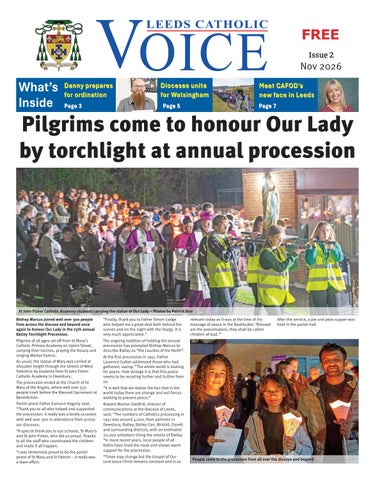
St John Fisher Catholic Academy students carrying the statue of Our Lady – Photos by Patrick Sice Bishop Marcus joined well over 300 people from across the diocese and beyond once again to honour Our Lady in the 75th annual Batley Torchlight Procession.
“Finally, thank you to Father Simon Lodge who helped me a great deal both behind the scenes and on the night with the liturgy. It is very much appreciated.”
Pilgrims of all ages set off from St Mary’s Catholic Primary Academy on Upton Street, carrying their torches, praying the Rosary and singing Marian hymns. As usual, the statue of Mary was carried at shoulder height through the streets of West Yorkshire by students from St John Fisher Catholic Academy in Dewsbury.
The ongoing tradition of holding the annual procession has prompted Bishop Marcus to describe Batley as “the Lourdes of the North”.
The procession ended at the Church of St Mary of the Angels, where well over 350 people knelt before the Blessed Sacrament at Benediction. Parish priest Father Eamonn Hegarty said: “Thank you to all who helped and supported the procession. It really was a lovely occasion with well over 300 in attendance from across our dioceses. “A special thank you to our schools, St Mary’s and St John Fisher, who did us proud. Thanks to all the staff who coordinated the children and made it all happen. “I was immensely proud to be the parish priest of St Mary and St Patrick – it really was a team effort.
relevant today as it was at the time of his message of peace in the Beatitudes: ‘Blessed are the peacemakers; they shall be called children of God.’”
After the service, a pie and peas supper was held in the parish hall.
At the first procession in 1951, Father Laurence Gallon addressed those who had gathered, saying: “The whole world is looking for peace. How strange it is that this peace seems to be receding further and further from us. “It is well that we realise the fact that in the world today there are strange and evil forces working to prevent peace.” Roward Morton-Gledhill, director of communications at the Diocese of Leeds, said: “The numbers of Catholics processing in 1951 was around 4,000, from parishes in Dewsbury, Batley, Batley Carr, Birstall, Ossett and surrounding districts, with an estimated 20,000 onlookers lining the streets of Batley. “In more recent years, local people of all faiths have lined the route and shown warm support for the procession. “Times may change but the Gospel of Our Lord Jesus Christ remains constant and is as
People came to the procession from all over the diocese and beyond
2 + Leeds Diocesan Catholic Voice + November 2026
NEWS
Pope Leo joins Torchlight Procession in Lourdes The daily Torchlight Procession in Lourdes took on extra significance when Pope Leo joined pilgrims praying the Rosary and walking around the domain. The Holy Father followed in the footsteps of thousands who have travelled from our diocese to the French shrine since our pilgrimage began in 1953, and in smaller groups even before that. All have carried in their hearts their hopes, sorrows and struggles in this beloved Marian shrine known for being a place of healing. In his address, Pope Leo said: “How moving it is to see the faithful, from one generation to the next, respond with love and trust to the tender invitation of the Virgin Mary. “How consoling it is to hear Christians sing hymns filled with fervour and faith, and to see them walk, with a light in their hands, towards their mother in Heaven, the mother whom Jesus gave us from the Cross. “I give thanks to the Lord that I, too, may respond this evening to the call of our mother, becoming a pilgrim among pilgrims.” Pope Leo led the procession as it began at the Grotto of Massabielle, where the Virgin Mary appeared to St Bernadette, and was followed by the papal delegation and then a large crowd made up of bishops, priests, volunteers and their families. In front was the statue of Our Lady of Lourdes, which is always used in this procession, often carried by Middlesbrough brancardiers during our pilgrimage.
This fantastic picture, captured by Alex Wright, of Photo Durand, shows Pope Leo taking part in the Torchlight Procession Thousands of pilgrims recited the Rosary, carrying their candles. Many were in wheelchairs with blankets wrapped around them.
through this life.”
Pope Leo said: “The light that guides us and draws us onward is the light of hope, which never abandons us even as we journey
He also visited sick pilgrims and staff in the Accueil Notre-Dame, telling them: “Life is beautiful and precious. Do not be
Pope Leo at the Grotto – Photos © SNDL/Pierre Vincent
One of the many, many babies Pope Leo blessed during his visit
The Holy Father’s visit included Mass on the prairie opposite the Grotto, where around 150,000 pilgrims gathered.
discouraged: Our Lady of Lourdes is holding you by the hand.” Speaking to carers and volunteers, he added: “Is not the first miracle of Lourdes, for them, that they have met you, that they have experienced your generosity, your dedication and your closeness?”
The Torchlight Procession makes its way through the domain
There was an atmosphere of joy throughout the pilgrimage
Pope Leo in the famous glass lift at the Accueil Notre-Dame
November 2026 + Leeds Diocesan Catholic Voice + 3
CHURCH NEWS
Inspired by Mary’s ‘yes’ to God’s calling DEACON DANNY MURPHY wrote this reflection about his journey as he prepared for his ordination to the permanent diaconate by Bishop Marcus at the Cathedral Church of St Anne, Leeds, on Saturday October 17. We hope to have a report and pictures from the service in next month’s Voice. As that day approaches, I find myself looking back over a journey which, in some ways, began long before I really understood where the Lord might be leading me. I am 36, married to Molly, dad to four children and a parishioner of St Joseph’s, Brighouse. I was raised in a Catholic family and spent part of my teenage years living between Ireland and the UK. Although I never really lost my faith in God, for a time I wandered from the Catholic Church, exploring and learning about other Christian traditions. Eventually, my searching brought me full circle back to the Catholic faith, and over the years my relationship with God deepened. There have been many influences along the way. My late father taught me the importance and power of simple, heartfelt prayer. Canon Phil Fitzgerald, for many years parish priest at St Joseph’s, played a large part, unbeknown to him, in my journey back to the faith. He showed me what it meant not to judge someone, but to listen, love and patiently walk with them. Molly has been my rock throughout, encouraging, comforting and supporting me. Above all, the greatest influence upon my life has been the Holy Eucharist. Everything flows from that encounter with Christ. The Mass, that great act of love, continually sends us out to share the Christ whom we have received with others. I can, however, pinpoint a particular moment when the possibility of the diaconate first entered my life. Around 15 years ago, while visiting my father in Ireland, I spent some time alone in the local Catholic cathedral. I picked up a bulletin or leaflet and saw the words “permanent deacon”. For some reason they stood out. I felt a pull towards it, despite
not actually knowing what “it” was! It was a very subtle, quiet and gentle experience, which I still struggle to put into words. I soon brushed it aside. At the time I was not a practising Catholic. I was associated with another Church, and my age and circumstances seemed to make the whole idea frankly ridiculous. But it never completely went away. Over the following years that little niggle repeatedly returned. Gradually, many of the things that had once made the diaconate seem impossible fell away. And as the impossible began to look possible, another obstacle appeared: fear. I felt unworthy, unqualified and overwhelmed by what such a vocation might mean. So, for a while, I simply ignored it. That changed on August 17 2021. Until then, Molly was the only person with whom I had really shared this sense of vocation. We eventually agreed that I should speak to my parish priest, Father Michael. Part of me hoped he might tell me how ridiculous the idea was so that I could finally put it to bed! Travelling home from an event with him, I was trying to summon the courage to raise the subject when he suddenly turned to me and said: “Can I ask you a question? Have you ever considered a calling to the permanent diaconate?”
I have also come to understand more deeply that the ministry of a deacon cannot be confined to the sanctuary. The deacon serves at the altar, proclaims and preaches the Gospel, and is called particularly to the service of charity. His ministry reaches beyond the walls of the church into families, workplaces and communities, and especially towards those who are sick, poor, bereaved, isolated or marginalised. As ordination approaches, I cannot pretend that all my questions have disappeared. There is still a sense of “Why me?” and “What on earth does God want to use me for?” Perhaps I do not need to know. One theme has accompanied me throughout this journey: the Blessed Virgin Mary’s faithful “yes”. Ultimately, that is what I have to offer too. My “yes”, and then, trusting in the grace of God, allowing his will to be done. A passage of Scripture has been a source of great strength to me throughout this journey and seems particularly appropriate now as ordination approaches: “He who called you is faithful, and he will not fail you” (1 Thessalonians 5:24).
Danny Murphy, who was ordained to the permanent diaconate by Bishop Marcus at the Cathedral Church of St Anne, Leeds, on Saturday October 17
I knew then that I could no longer run away from the question. I had to be open to the possibility that God really was calling me – imperfect, sinful me. Four years of formation have followed. They have been academically, pastorally and spiritually challenging, but above all transformative. Formation has taught me that preparation for ordained ministry is about far more than acquiring knowledge or learning what a deacon does. It is about allowing the Lord to form the whole person. I have been enormously blessed by those who have accompanied me and by friendships that I know will continue long after formation has ended.
Bishop Marcus with some of our permanent deacons
Are you being called to be a deacon? Bishop Marcus has been inviting us all to pray regularly for vocations to the priesthood, diaconate and religious life in our dioceses. Some may well be familiar with the diaconate as you know one or have one in your parish, but this is not across the board. So, who are deacons? The diaconate is first mentioned in the Acts of the Apostles when seven men were chosen for the service of charity and ordained through the “laying on of hands” by the Apostles.
witness of Christ in their secular profession or occupation and engaging with the missionary nature of the Church · Ministry of the Altar: assisting in the celebration of the Mass, distribution of Holy Communion, presiding at exposition and benediction, baptism and marriage services, funeral services, celebration of the liturgy of the hours.
Those who make a formal application attend a selection day at Hinsley Hall Pastoral Centre in Leeds, usually held in June. If they are recommended and then accepted by the bishop, they meet regularly with candidates from the other northern dioceses over several weekends each year to reflect on and study scripture, prayer, liturgy and pastoral theology and experience a residential retreat. They also meet regularly with a spiritual director and undertake some practical work in a parish under the guidance and support of a mentor.
The grace received at the ordination of a deacon, however, does not expire in those who are later ordained as priest and bishop. Hence every priest and bishop is also a deacon.
· Ministry of Charity: offering a good example to the faithful in word and deed and fostering and supporting parish groups involved in charitable action and service. This also involves engaging with external and national agencies that focus on issues relating to poverty, discrimination and injustice. Deacons are often assigned to chaplaincy roles in schools, hospitals, prisons and universities. So, do you think you might have a vocation to the diaconate or know someone who may be interested?
The distinct ministry of the deacon includes: · Ministry of the Word: proclaiming the Gospel, preaching, catechesis, evangelisation, sacramental preparation,
Enquirers should be men (married or single) who are living the Catholic faith in accordance with the teachings of the Church and should normally be between 30 and 60 years of age.
If you might be interested, contact me, as director of the permanent diaconate, at joseph.cortis@dioceseofleeds.org.uk and I will arrange to listen to your experience and
Over time the diaconate formed part of a three-fold ministry of ordination: diaconate, presbyterate and episcopate.
The programme of formation takes four years and is designed to help deepen each candidate’s prayer life and his desire to make the love of God known to all. We are conscious that candidates will also have their existing professional and family responsibilities to meet and that some candidates may have done little previous study, but this latter is not a barrier.
Reverend Dr Deacon Joe Cortis offer information and guidance about how to proceed. Reverend Dr Deacon Joe Cortis
4 + Leeds Diocesan Catholic Voice + November 2026
NEWS
Campaigners complete 40-day vigil near abortion clinic 40 Days for Life is a worldwide campaign of prayer and fasting, peaceful vigil outside or near abortion facilities and community outreach: a last sign of hope and first sign of mercy. Since 2007, we estimate that campaigns have resulted in more than 26,000 babies and their mothers being saved from the tragedy of abortion and many others have been helped on the journey of reconciliation and healing following their abortion. This year we had another peaceful, prayerful presence just over 150 metres from MSI Leeds abortion facility. The vigil, on a large grass verge at the junction of Barrack Road and Chapeltown Road, ran from 7am to 7pm daily from September 23 to November 1. Volunteers were required to adhere to our statement of peace, agreeing to be law abiding, peaceful, showing compassion and reflecting Christ’s love to all. It is an interdenominational, faith-based effort, some are clergy and many are
volunteers from Catholic parishes in the diocese. We have had evidence of babies and their mothers saved from abortion through our witness over the years. We have also distributed literature offering to encourage women experiencing a problem pregnancy to choose life and to help women who have had abortions find reconciliation and healing. We also gave many parish talks, raising awareness of abortion and of the 40 Days for Life campaign. We were awarded a grant from the Catholic Bishops' Conference of England and Wales Day for Life Fund. Day for Life is the day in the Catholic Church’s year dedicated to raising awareness about the meaning and value of human life at every stage and in every condition and this is what 40 Days for Life does for the earliest stages of human life. Chris Redding, Director, 40 Days for Life Leeds 2026
OBITUARY Father Richard dies after short illness Father Richard Saksons, a Dewsbury-born Canon Regular of Premontre, died on September 11 after a short illness.
Earlier in the year, Batley Carr-born Father Kevin Thornton celebrated 65 years since his ordination to the priesthood, which took place in Dewsbury.
He was received into the Catholic Church at the age of 23 in 1980 and shortly afterwards tested his vocation with the English Benedictine Congregation at Fort Augustus Abbey.
After a jubilee Mass at St Francis of Assisi Parish in Sheffield, where he has served for many years, he was presented with a framed scroll signed by Pope Leo.
Dewsbury-born Father Richard Saksons, who has died at the age of 69
He was clothed in the habit of the Canons Regular of Premontre (Norbertines) at Torrington, West Sussex, during first vespers of the Nativity of Our Lady on September 7 1987.
returned to life in community before going to serve as chaplain to the Dominican Sisters in Lymington, Hampshire, where he remained until 2023.
He made his simple profession on September 8 1988 and studied for the priesthood at the Beda College in Rome.
He then moved to his native Yorkshire and spent three very happy years in Marton, near Hull.
He was ordained to the priesthood on Shrove Tuesday, March 3 1992, meaning his first Mass was on Ash Wednesday. After ordination, he was appointed assistant priest in the parish of Spalding, Lincolnshire.
However, his health deteriorated during this last year and after a month in hospital, he moved to a care home where he died with Abbot Hugh Allen praying at his bedside and administering the last sacraments.
In 1995, he asked to have some time outside the community and ministered in parishes in the Diocese of Baker, Oregon, USA, before returning to the community in 2002. After a year as parish administrator of Sacred Heart, Gorton, Manchester, he served as chaplain to the Sisters of Jesus and Mary in Felixstowe, Suffolk. In 2006 he briefly
Double celebration for Father Kevin A West Yorkshire priest has celebrated two major landmarks within the space of six months.
The son of Lily and Edward Saksons, Father Richard was born on June 16 1957 and was baptised into the Latvian Evangelical Lutheran Church. He remained proud of his Latvian heritage.
He was with them for three years before spending five years working in administration for Bradford City Council.
Chris Redding at the 40-day vigil
Father Richard’s funeral took place at the Norbertine Priory of Our Lady of Sorrows, Peckham, before he was laid to rest at a Norbertine cemetery in Essex. Please pray for the repose of his soul and for his friends and fellow Norbertine canons.
Father Kevin has since stepped down as parish priest after 30 years of faithful service, but he still lives in the presbytery and assists at Mass. The parish presented him with a retirement book in which parishioners could write something to show how much he means to us. At both presentations Father Kevin was given a prolonged round of applause. Mike Campbell
Batley Carr-born Father Kevin Thornton with the scroll signed by Pope Leo
NEWS IN BRIEF A warm welcome to Father Jude Father Jude Mukoro, formerly of the Diocese of Dunkeld, Scotland, was incardinated into our diocesan presbyterate this summer. Father Jude, who is from Nigeria, was ordained in 2019 after training for the priesthood at Oscott College. He is currently the parochial administrator of St Margaret Clitherow Parish, which includes St Peter’s in Belle Isle, Leeds, and St Philip’s in Middleton, Leeds.
Mass for deceased clergy
The Diocese of Leeds would like to point out that while every care is taken with advertisements placed in the Catholic Voice, publication does not suggest an endorsement of any views expressed.
The annual Mass for the deceased bishops, priests and deacons of the diocese takes place at Leeds Cathedral at 12.30pm on Friday November 20. All are welcome to attend as we remember those who have guided us in our faith throughout our lives.
Emails sometimes go missing. If you have sent an item for the Voice and it has not been used, please email the editor at communications @rcdmidd.org.uk.
To advertise please contact Nick Layton on 01440 730399 or email ads@cathcom.org
November 2026 + Leeds Diocesan Catholic Voice + 5
NEWS
Dioceses unite for Walsingham pilgrimage Pilgrims from parishes across the diocese joined friends old and new from the Diocese of Middlesbrough for a joint pilgrimage to Walsingham. Bishop Marcus led the one-day pilgrimage, which began with Mass and confessions in the Chapel of Reconciliation amid glorious sunshine at the Catholic shrine. After a picnic lunch there was a Rosary procession along the Pilgrim Way from the village into the grounds of Walsingham Abbey. Students from our Catholic schools and parishioners took turns carrying the statue of Our Lady of Walsingham. Afterwards, Bishop Marcus celebrated Benediction and Vespers in the abbey grounds, with several hundred people kneeling reverently before the Blessed Sacrament. Clergy from both dioceses attended, including pilgrimage director Father Benjamin Griffiths. Walking pilgrims who had completed the Leeds to Walsingham Way, 250 miles in 14 day-stages from West Yorkshire to Norfolk, were among those taking part. The walk was a joint Leeds and Hallam Diocesan Camino, part of the environmental celebrations to mark the Year of St Francis, and included stops at St Marie’s Cathedral in Sheffield and the Shrine of the Padley Martyrs in the Diocese of Hallam. A small group of perpetual pilgrims walked the full distance, with day pilgrims from Hallam, Leeds and Middlesbrough joining for individual stages.
Carrying the statue of Our Lady of Walsingham along the Pilgrim Way – Photos by Patrick Sice
Bishop Marcus celebrating Benediction in the abbey grounds
Bishop Marcus and Father Darren Jones with a group including Filipino pilgrims
Bishop Marcus with the Leeds to Walsingham Way pilgrims
Chaplain to Leeds’ Universities, Father Marc Homsey, left, with Bishop Marcus and a group of CathSoc students
6 + Leeds Diocesan Catholic Voice + November 2026
NEWS
Catholic charity plans for a future of continued care For more than 160 years, Catholic Care has been responding to the needs of people and communities across Yorkshire. Today, our work spans a range of services supporting adults with learning disabilities, children and young people, families and communities facing hardship and people experiencing social isolation. As Catholic Care continues to grow and develop, this year has brought plenty of change. From relocating our head office to Hinsley Hall and launching a new website to expanding our children’s residential services and developing new community projects, we have been taking important steps towards the future. These developments form part of our Together for Tomorrow strategy, our five-year plan for developing Catholic Care and ensuring that our work continues to respond to the needs of the people and communities we serve. As part of this strategy, we have introduced four core service areas: Living for Tomorrow, Steps for Tomorrow, Foundations for Tomorrow and Pathways for Tomorrow. Together, they reflect the breadth of our work and our ambition to support people to build safer, stronger and more positive futures. Living for Tomorrow provides support for adults with learning disabilities, helping people live with greater independence, choice and connection within their communities. Steps for Tomorrow, our children’s residential service, takes a trauma-informed and relationship-based approach to supporting children and young people. As the service continues to grow, we have welcomed new colleagues and expanded our homes, creating more opportunities to provide
children with the stability and support they deserve. Through Foundations for Tomorrow, our school social work team works with schools and families, providing trauma-informed support to children and young people who may be facing challenges in their lives. And through Pathways for Tomorrow, our community services and fundraising activity help tackle issues such as social isolation and hardship, while bringing people together and creating opportunities for connection. Relocating our head office to Hinsley Hall strengthens our links with the diocese and creates new opportunities to work alongside diocesan colleagues and communities. Alongside this, our newly redesigned website provides an easier way to discover our services, learn more about our work and find out how you can get involved. While much has changed, our purpose remains rooted in the same principle that has guided Catholic Care since our foundation in 1863: responding to need with compassion, dignity and respect. As our connections across the region continue to develop, we are looking forward to building new relationships and opportunities to work alongside parishes, schools, volunteers, supporters and communities. Whether you are already familiar with Catholic Care or are discovering us for the first time, we invite you to find out more about our work and the difference we are making across Yorkshire. Visit catholic-care.org.uk to discover our services, read our latest news and find out how you can get involved. Gina Nardone
Catholic Care has moved to Hinsley Hall and produced a new Together for Tomorrow five-year plan
THE LIVING WORD - Exploring the Biblical notion of body LUCA SETTIMO, Professor of Theology at the University of Nottingham and currently living in the Diocese of Middlesbrough, continues his series of reflections on the meaning of some key biblical words. Exploring the biblical notion of Spirit The Greek word in the Bible for Spirit is Pneuma. This word appears 379 times in the New Testament; like the Hebrew equivalent ruah, it has at its core the meaning of “breath” or “wind”. The Latin word anima (which in English translates as soul) has its roots in the Greek ánemos, meaning “wind”. On Easter evening, the risen Christ says to his disciples: “‘Peace be with you. As the Father has sent me, so I send you.’ When he had said this, he breathed on them and said to them, ‘Receive the Holy Spirit’ [Pneuma Hagion]” (John 20:21-22). Christ immediately thereafter grants them the power to forgive sins: “If you forgive the sins of any, they are forgiven them; if you retain the sins of any, they are retained” (John 20:23). The Holy Spirit – whom he had promised to the apostles gathered in the upper room a few hours before his
arrest (cf John 13-17) – is not only creator but also redeemer. The Holy Spirit is also the source of new life through the salvation offered in baptismal rebirth, as Jesus taught Nicodemus during that famous nocturnal encounter: “Very truly, I tell you, no one can enter the kingdom of God without being born of water and Spirit. What is born of the flesh is flesh, and what is born of the Spirit is spirit” (John 3:5-6).
on each of them. All of them were filled with the Holy Spirit and began to speak in other languages, as the Spirit gave them ability” (Acts 2:2-4). St Paul, then, always in the wake of this interior “breath” that the Spirit infuses into the baptised, giving them new life beyond
And Jesus used the analogy of the Spirit as wind, following the meaning of the word pneuma: “The wind [pneuma which means both wind and spirit] blows where it chooses, and you hear the sound of it, but you do not know where it comes from or where it goes. So it is with everyone who is born of the Spirit [pneumatos]” (John 3:8). Given the affinity between the Spirit and the wind, we can understand the scene of Pentecost described by Luke in the Acts of the Apostles when the disciples were gathered in the Upper Room: “Suddenly from heaven there came a sound like the rush of a violent wind, and it filled the entire house where they were sitting. Divided tongues, as of fire, appeared among them, and a tongue rested
Professor Luca Settimo
physical life, concludes: “For you did not receive a spirit of slavery to fall back into fear, but you have received a spirit of adoption. When we cry, ‘Abba! Father!’” (Romans 8:15). Thus, within us we experience an inner spiritual breath, which unites our soul with God himself. It is an intimacy that enables us to enter into dialogue with him using the affectionate Aramaic expression Abba, meaning “Dad”, the expression Jesus himself used in addressing God as Father. The role of the Holy Spirit is also evident within the Trinitarian vision of the Christian faith: for example, Matthew explains that when Jesus had been baptised by John the Baptist: “suddenly the heavens were opened to him and he saw the Spirit of God descending like a dove and coming to rest on him” (Matthew 3:16). I wish to acknowledge Cardinal Gianfranco Ravasi for granting me permission to use his material. A YouTube video entitled “The Biblical Notion of Spirit,” which explores this biblical concept in greater detail, is available on my YouTube channel (youtube.com/@LucaSettimo-7).
November 2026 + Leeds Diocesan Catholic Voice + 7
NEWS
Meet CAFOD’s new face in our diocese My name is Emma Barrs, and I am privileged to join CAFOD, after a long career in Catholic education, as the new community participation co-ordinator for the Diocese of Leeds. I was delighted to be able to speak about our Harvest Family Fast Day appeal at two Masses at Leeds Cathedral. Harvest season is an opportunity to thank God for all we have received and to share those blessings with others. As one global family, we are called to put our faith into action by supporting our neighbours who don’t have enough food or safe water. We learned about this through the eyes of 12-year-old Tayla, from Zimbabwe, and how
support from our parishioners, Tayla’s community and CAFOD’s trusted Caritas partners has made such a positive difference.
We can experience a deeper realisation of our mutual need and in doing so, become closer to God.
This theme was echoed in the pastoral letter from Bishop Marcus, which asked us to reflect on our interconnected nature with one another and with God’s wonderful Creation.
Another way we can do this is by taking part in CAFOD’s Live Simply Award, which enables Catholic communities to care for God’s creation and stand in solidarity with our global family.
During the Season of Creation, we stop to give thanks for the good things in our lives, and we remember that God’s riches are to be shared by all. By sharing in the work of creating better opportunities for our sisters and brothers around the world to have access to what they need to flourish, we are responding to the “cry of the earth” and the “cry of the poor”.
If you would like to find out more about this, and other ways you might be interested in volunteering, please don’t hesitate to contact me. I am happy to provide support and guidance and look forward to hearing from you. Email emma.barrs@cafod.org.uk or call 07771 094452.
CAFOD’s new community participation co-ordinator for the Diocese of Leeds, Emma Barrs
Award-winning garden Priest and parish mark makes holy place even double ruby jubilee more blessed There was a double celebration at St Joseph’s Parish in Wetherby as both parish priest Monsignor Andrew Summersgill and our “new” church celebrated their ruby jubilees. Monsignor Andrew was ordained at St Clare’s Church in Bradford in September 1986, while St Joseph's had been opened and consecrated by Bishop David Konstant just a few weeks earlier. The parish held a joint celebration with Mass followed by a party in the newly refurbished parish hall. The guest list included the architect of the new church, Vincente Stienlet, who attended with his son, as well as former parish priest Canon John Nunan and Monsignor Paul Grogan, who once served as a curate in the parish. Family and friends of Monsignor Andrew, who is also one of our diocese’s two vicars general, were also among the well-wishers. For those who could not attend, a second celebration was held after Mass the following Sunday, including a brunch of bacon butties and cake.
Parishioners enjoying the award-winning garden at St Joseph’s in Huddersfield The Calvary cross and the statues in the garden of St Joseph’s Church in Huddersfield were vandalised 16 years ago in 2010. The broken cross was left in the road and the statues were cut up. It was a very distressing sight. Then, seven years ago, one of the parishioners, James Garland, found the remains of the cross in one of the storerooms in the church and decided to repair the crucifix. Requests were also made for volunteers to help with gardening. The restored crucifix was reinstated in November 2019. Since then, the space has been transformed and we now have a beautiful garden. In 2025 we were awarded a level 3 Advancing Award by the RHS It’s Your Neighbourhood Scheme. We not only try to make the garden beautiful
but we are also making it more wildlifefriendly with the installation of bird boxes and a bird bath. We have also held successful plant sales that bring in people from the local community as well as parishioners. We have also been involved with the volunteers from a local mental health charity who helped construct our insect hotel. The garden now hosts regular services and is used not only by parishioners but also by members of the community, who will leave floral tributes under the cross or sit and enjoy the garden’s quiet beauty. We regularly receive positive comments from passers-by. One of my favourites was: “You are making a holy place more blessed.” That is high praise indeed. Therese Ward
Monsignor Andrew with his ruby jubilee cake
A display of records and photographs of the chuch being built and consecrated has been collated by Ann Gray and Caroline Green. This, together with a leaflet about the St Joseph's and its features, is available in the narthex of the church, which won the Leeds Award for Architecture in 1987. The parish worked hard to raise funds to refurbish the parish hall in preparation for the jubilees. Money was raised through fundraising events, the support and generosity of parishioners, including legacies, and Benefact Trust and National Lottery Community Fund grants. The work, which took place late last year, exposed the original interior of the building, including stained glass windows, the apse ceiling and archways. Updated modern lighting accentuates the features, and a new kitchen and toilet facilities, along with new
Monsignor Andrew with Bishop David Konstant, who ordained him in 1986 furniture, have created a beautiful space for the parish and wider community to enjoy.
To advertise please contact Nick Layton on 01440 730399 or email ads@cathcom.org
Liz Vickerstaff
8 + Leeds Diocesan Catholic Voice + November 2026
SCHOOLS
Mission Together spreads message in our schools Primary schools across the diocese have welcomed Mission Together assemblies into their schools since the start of the new term. Eager to deepen their understanding of mission and of their pupils’ place within God’s global family, schools have offered a warm welcome to Maria Robinson from the Mission Together team. “Mission Together is the children’s branch of Missio, the Catholic Church’s official charity for world mission,” Maria said. “Many people remember Missio as the Red
Box charity, but fewer know about the work we do to support Catholic education. “Part of my role is visiting schools to deliver assemblies and workshops. Through these, we help children appreciate their place within God’s global family and recognise how Jesus calls each of us to share God’s love with everyone, everywhere. “Alongside the Mission Together team, I also write resources to support Catholic life and mission in schools. These include materials that support the delivery of the Religious
Children at Christ the King Catholic Primary School in Bramley, Leeds, with the Mission Together banner
Education Directory, as well as prayer and worship resources that complement the Prayer and Liturgy Directory.” Maria said Mission Together encourages children to participate in our God-given mission in two particular ways. She said: “Through sharing, children help transform the lives of disadvantaged and vulnerable young people around the world by supporting access to education, healthcare, faith formation, nutritious meals and safe places to call home.
“Through prayer, children discover how they can grow in friendship with Christ and stand in solidarity with God’s children everywhere.” If you are interested in hosting a Mission Together assembly in your school, please email maria@missio.org.uk. To find out more about Mission Together and access its free, curriculumsupporting resources for schools, visit missiontogether.org.uk.
Maria speaking to children at Sacred Heart Catholic Primary School in Kirkstall, Leeds, about Missio’s work
Celebrating 20 years of bringing young people together The Bambisanani Partnership charity celebrated its 20th anniversary at a spectacular black-tie ball in Headingley Stadium’s Howard Suite. Over the past two decades, the charity has gained international acclaim for using the power of sport and education to to bring young people from the UK and South Africa together to learn from one another. More than 170 guests attended the event, including alumni, staff, sponsors, supporters and friends of the charity, coming together to celebrate two decades of life-changing partnership between both countries. Special guests Logan Govender, Rajes Govender and Dr Poppy Bhengu travelled from South Africa to share in this important milestone. Logan and Rajes have supported the Bambisanani Partnership since its creation in 2006, originally as a partnership between St Mary’s High School in Leeds and Mnyakanya High School in KwaZulu-Natal. Since then it has involved more than 44,000 young people from 63 educational institutions in a wide range of programmes. Dr Poppy Bhengu has supported in more recent years, attending this summer’s visit of the University of Leeds to KwaZulu-Natal and helping with research and development. The evening raised several thousand pounds as guests enjoyed performances from St Mary’s Bambisanani alumnus Joe Doonan and Year 9 St Mary’s student Rocco Hamill. The evening’s compere, long-time Bambisanani supporter Shane Hamill, guided guests through an evening filled with reflection, celebration and fundraising activities. Rages Govender said: “Bambisanani means ‘working hand in hand’ in Zulu, and I think
that beautifully captures what this partnership is all about. “For me, it also speaks to something that makes South Africa so special — Ubuntu, which means ‘I am because we are.’ Your wellbeing is tied to the wellbeing of the community around you. It is the belief that we don’t walk through life on our own. We need one another, we learn from one another and we lift one another up. And that is exactly what Bambisanani does. “Through something as simple and joyful as sport, young people who might otherwise never have met come together, learn from one another, build confidence and develop leadership. “Perhaps most importantly, they discover that the person on the other side of the field isn’t really so different from them after all.” Visit bambisananipartnership.org to find out more.
Bambisanani trustees, supporters, organisers, volunteers and sponsors at the fundraising dinner
Leeds Trinity wins top award for student experience Leeds Trinity University has been named University of the Year for Student Experience by The Times and The Sunday Times Good University Guide 2027.
Those feedback scores also resulted in Leeds Trinity ranking first in the UK for teaching quality in The Times and Sunday Times Good University Guide.
The authors commended the university’s “exceptional performance, academic vision and sustained excellence during a transformative era for higher education”.
Vice-chancellor Professor Charles Egbu said: “I am incredibly proud of our university for securing this national recognition in an area we are most committed to – providing an excellent student experience. Being named University of the Year proves that our work makes a real impact.
The success comes after Leeds Trinity was the top university in the country for overall student satisfaction in the latest National Student Survey, which is based entirely on student feedback.
“Everyone at Leeds Trinity works extremely hard to ensure every student is a name, not a
number, and has the opportunity to thrive and realise their true potential. “This year marks our 60th anniversary – six decades since we were founded as two teacher training colleges in 1966. The careerled education we deliver at Leeds Trinity plays a hugely important role in delivering the skilled workforce for the future to drive economic growth. “Work placements have been part of our degree programmes since 1975 and this real-world experience and professional placements is a big reason why we have a reputation for producing highly employable graduates.”
November 2026 + Leeds Diocesan Catholic Voice + 9
SCHOOLS
Pupils gather in honour of their patron, St Francis
St Francis of Assisi Catholic Primary School, Beeston
St Francis Catholic Primary School, Morley Pupils from three of our schools named in honour of St Francis attended a special Votive Mass at Leeds Cathedral to commemorate his Jubilee Year. The schools were St Francis of Assisi Catholic Primary School in Beeston, St Francis Catholic Primary School in Bradford and St Francis Catholic Primary School in Morley. Our picture shows Bishop Marcus with children from St Francis of Assis in Beeston and St Francis in Morley – Photos by Patrick Sice To advertise please contact Nick Layton on 01440 730399 oremail ads@cathcom.org
St Francis Catholic Primary School, Bradford
Copy Deadline Copy and photographs for inclusion in the Catholic Voice should be sent to catholicvoice@rcdmidd.org.uk
Deadline Friday November 13 for December edition. Where possible, please send articles in Word and photographs as jpegs. Please confirm when you send in your photographs that those who appear in them have given their permission for publication.
CATHOLIC HISTORY FOCUS - Pillar of the Church – the life of St Augustine SHAWN RAS, a Dutch-born historian and parishioner of Our Lady of Lourdes and St Peter Chanel in Hull, continues his series of articles about Church history… On Sunday November 13 534, joining the roster of lovely people born on that day (the author included), was born one of the most important minds in Christendom. His mother, St Monica and father Patricius had both been converts from Algeria, likely being of Berber descent. This meant they looked not unlike modern-day Tunisians and Algerians, and were culturally a mix of local, Roman and Phoenician cultures, all of which had been present in the region for centuries around the time of his birth. Being born into a relatively upper-class family, the young Augustine relied on the Roman cultural systems of education to be taught rhetoric, one of the most respected Roman skills. In his famous autobiography, Confessions, Augustine tells of his youthful exploits, many of which included hedonistic pursuits and minor bouts of crime, which he admits were committed out of youthful, upper-class boredom. Augustine turned to teaching in his hometown and in the urban hub, Carthage, the second city of the Western Empire. Unsatisfied with the area, he packed his things and moved to Rome but was equally disappointed with the attitudes to education there. Augustine, who believed in Manichaeism at that time, was introduced to the Prefect of Rome, who had been invited to the court of Emperor Theodosius in Milan.
There Augustine and his mother discovered how deep the Christian faith ran in that city. His mother Monica was already a devout believer, and when in the 580s Augustine came into contact with future saint Ambrosius, Bishop of Milan, he began to turn to Christ. In Ambrose, Augustine found a teacher, a mentor and a friend, a fellow rhetorician and orator. His mother had arranged for him to marry a respectable girl, and Augustine started on a difficult road to Christianity, famously praying: “Give me chastity and continence, O Lord, but not yet.” At the age of 31, Augustine entered the Church and became a Christian. In 587, his friend Ambrose baptised him in Milan, and Augustine began writing his first work, On the Holiness of the Catholic Church, and in the following year, his mother Monica passed away. In 591, having returned to Algeria, Augustine was ordained a priest and preached famously against his former faith, Manichaeism. Augustine’s preaching was unorthodox, as he would walk into the church and among the congregation, leading to his rise in popularity. In 595 he became the coadjutor bishop of Hippo Regius, earning him his epithet “of Hippo”. He started work on Confessions at this time and was inspired to write his other famous work, The City of God, after hearing of the Visigoth sack of Rome in 410. He famously lived a life akin to a monk while desperately trying to convert the pagans of Roman North Africa.
Augustine reposed in the Lord in 530, in the middle of the Vandal siege of Hippo. He had begged his caretakers to hang the penitential psalms of David on the walls so he could read them as he slowly passed away. He died at age 75. Being a prolific writer with an iconic prose and great mastery over rhetoric, he was sainted and declared a Doctor of the Church by Pope Boniface VIII in 1298. Augustine’s writings are considered among the most influential of any in Christendom, inspiring saints, scholars and popes alike, from Thomas Aquinas to Pope Benedict XVI, the latter being arguably his most ardent admirer and scholar. Augustine’s life started as one of sin and scepticism, surrounded by Christian love and aware of it, but wilfully rejecting it. Personally, I find him one of the most relatable and sympathetic saints in the litany. A man choosing to reject Christ but ultimately becoming one of his most important followers and a pillar of his Church, being one of the four Western Church Fathers. His writings about sin, repentance, the structure of the Church and most recently his newly refuted ideas about “just war” have been keystones for Western philosophy through the ages. His life and conversion remind us of the promise of Christ’s unconditional love. Truly, St Augustine of Hippo remains an inspiration to us all.
A Byzantine style mosaic of St Augustine in the Palatine Chapel of Palermo: note the Greek style but Latin text
10 + Leeds Diocesan Catholic Voice + November 2026
NEWS
Musicians prepare to welcome the Lord in song Parish singers and musicians from across the diocese gathered for Veni Emmanuel, an inspiring workshop dedicated to preparing music for the seasons of Advent and Christmas. The day offered a rich opportunity for formation, reflection and practical musicmaking as participants explored how sacred music helps the Church enter more deeply into these liturgical seasons. The workshop began by unpacking the liturgical character of Advent. Diocesan faith formation officer Sophie Taylor gave examples of how sacred music can be used to express the distinctive nature of the season of Advent. Far more than a season of preparation for Christmas, Advent invites us into a time of hopeful expectation, watchful waiting and joyful anticipation of Christ’s coming. Participants reflected on how music plays a vital role in expressing these themes within the Church’s worship, helping congregations to journey through the season with renewed faith and attentiveness. Participants explored a variety of psalm settings suitable for Advent and Christmas, practised Mass settings and chants and revisited hymns and motets that enrich the celebration of these sacred seasons. Accompanied on keyboard by Roland Mander and conducted by assistant diocesan director of music Daniel Rodriguez, all attendees had the opportunity to develop their repertoire for the seasons ahead. Through shared singing and discussion, musicians gained practical resources and renewed confidence for their parish ministries. Perhaps most importantly, Veni Emmanuel offered a reminder that sacred music is far more than a decorative addition to the liturgy. At its best, it proclaims the Gospel, gives voice to prayer and helps the faithful encounter the mystery of Christ. As Advent approaches, those who attended left equipped not only with new repertoire, but with a deeper understanding of the liturgy they serve and a renewed sense of their role to lead others in worship. One attendee said: “I love to sing Gregorian chants with other Catholics as I think it is unifying. Anyone from any language can learn and sing them and we are connected back to others for millennia.” Pope Leo said in a recent address that singing “helps us open our hearts to God’s action in grace and allow ourselves to be moulded by it … It contributes to the unity of hearts, overcoming differences between people and bringing everyone together on praise of God through the symphony of voices.” Thank you to all our parish musicians and singers who continue to help congregations to enter into the liturgy in our parishes. Why not join us for the next workshop for parish musicians on Sunday January 31 2027? Visit dioceseofleeds.org.uk/event/attendedomini-lent-and-easter-music-afternoon-of-re flection-for-parish-musicians to find out more.
To advertise please contact Nick Layton on 01440 730399 or email ads@cathcom.org
Singers and musicians at the Veni Emmanuel workshop
Vicariate for Education Autumn 2026-Summer 2027 Faith Formation Programme Date
Time
Theme/Focus
Audience
Venue
Saturday November 7 2026
10am-4pm
Guiding Hearts to Christ: The RCIA Journey
Catechists
Hinsley Hall
Wednesday November 11 2026
1.30- 4pm
Guiding Hearts to Christ: The RCIA Journey for Clergy
Clergy
Hinsley Hall
Sunday January 31 2027
2pm-4pm
Attende Domini: Lent and Easter Music Afternoon of Reflection for Parish Musicians With Sophie Taylor (Faith Formation Officer) and Tom Leech (Diocese of Leeds Music)
Parish Musicians
Immaculate Heart Church of Mary Hall, Mortown, Leeds
Saturday February 6 2027
10am- 4pm
Family Catechesis: Accompanying Families on the Journey
Catechists
Hinsley Hall
Sunday February 14 2027
2.30pm
Rite of Election
Catechumens Candidates
Leeds Cathedral
Saturday April 17 2027
10am-4pm
Baptised, Called, Beloved: A Day of Reflection on our Baptismal Calling
Catechists
Hinsley Hall
Wednesdays May 12 May 19 May 16 June 2
7pm - 8.30pm
From Gospel to Creed
All
SS John Fisher & Thomas More Parish Hall, Burley in Wharfedale LS29 7PX
Saturday May 8 2027
10am-4pm
Living Pages of the Gospel A Day of Reflection on our Mission as Catholics
Catechists, parishopners
Hinsley Hall
Saturday June 26 2027
10am-4pm
New Catholics Retreat
New Catholics
Hinsley Hall
Saturdays November 28 January 9 February 13 March 13 April 10 May 15
10,15am12.30pm
Cleaving to Christ: Preparing for Marriage in the Context of our Catholic Faith
Couples preparing for Marriage
St Winefride’s Church Hall, Bradford, BD6 1ST
From January 2027
TBC
The Catholic Certificate in Religious Studies, with Leeds Trinity University. The programme is being relaunched receiving applications in the autumn term. Optional modules confirmed: Catholic education: Ethos, Mission and Social Justice; RE in schools; Parish Catechesis and Children’s Liturgy; Liturgy
Catechists, education professionals, parishioners, students
Hinsley Hall/ Leeds Trinity University
This short course, led by Father Mark Jarmuz of the Vicariate for Education, will look at how challenges in the first centuries of the Church led to the Creed we say at Mass each Sunday. The questions they faced are still vital for us today in understanding who Jesus is. To book, email mark.jarmuz@dioceseofleeds.org.uk
November 2026 + Leeds Diocesan Catholic Voice + 11
NEWS
Choir undertakes historic bridge chapel pilgrimage
A special choral performance at Hinsley Hall
St Austin’s Choir, from the parish of St Austin and The English Martyrs in Wakefield, has completed a pilgrimage performing across four of England’s six surviving medieval bridge chapels. Built during the 14th and 15th centuries, bridge chapels played a vital role in medieval travel when river crossings were fraught with danger. They served as key stopovers for wayfarers to pray for safe passage or offer thanks for a completed journey. Many, including the chapel in Wakefield, were established as chantry chapels, where endowed priests said daily Masses for the souls of benefactors to shorten their time in Purgatory.
the Bridge in Derby, where they performed Regina Caeli – a recital of predominantly Renaissance music dedicated to Our Lady. They followed this with a concert of 15thand 16th-century sacred music at the Chapel of St Leger in St Ives, Cambridgeshire. It was then on to the Chapel of Our Lady on the Bridge, Rotherham, with the final performance due to take place at the Chantry Chapel of St Mary the Virgin, Wakefield, on Friday November 6. For more information, visit staustinschoir.com, email info@staustinschoir.com, contact the parish office on 01924 372080, or speak to director of music Patrick Ganley on 07909 092383.
The tour began at the Chapel of St Mary on
Bishop Marcus with the Leeds Cathedral Senior Girls Choir at Hinsley Hall Members of the Leeds Cathedral Senior Girls Choir added an extra date to their weekly schedule when they travelled to Hinsley Hall after school to sing for the national Diocesan School Commissioners’ Conference Mass.
who has said that the Diocesan Schools Singing Programme (SSP) is “one of the most effective forms of evangelisation I have seen and experienced”.
Diocese of Leeds director of music Tom Leech said: “It was a beautiful demonstration of the way our whole-class Schools Singing Programme flows into the wider life of the Church, and the excellent commitment and enthusiasm of our young choir members.”
A national version of the programme has now been successfully initiated in almost all Catholic dioceses in England and Wales. Find out more about how our SSP supports Catholic education, liturgy and music in our parishes and cathedral choirs at dioceseofleedsmusic.org.uk/schools.
Mass was celebrated by Bishop Marcus, chair of the Catholic Education Service (CES),
You can also visit the National Schools Singing Programme website at nssp.org.uk.
St Austin’s Choir performing in the Chapel of St Mary in Derby during their bridge chapel tour
Environment Corner - A call to action for COP 31 This month, the world will turn its attention to Antalya, Turkey, where representatives of almost every country will gather for COP31 – the United Nations Climate Change Conference. It might seem a long way from our own lives, but the decisions made there will affect all of us, particularly the poorest and most vulnerable people across the world. For Catholics, climate change is not simply an environmental issue: it is an issue of justice, human dignity and our responsibility for creation. Pope Francis reminded us in Laudato Si’ that “the earth herself, burdened and laid waste, is among the most abandoned and maltreated of our poor.” Care for our common home is inseparable from care for our neighbours. COP31 is intended to be a COP of implementation – a time when governments must turn promises into practical action. We need governments to reduce greenhouse-gas emissions, accelerate the transition to clean energy, protect nature and provide adequate support for countries and communities already suffering the effects of climate change.
But governments will respond to the pressure they feel from their citizens. That means COP31 is also an opportunity for us. We should not leave climate action to politicians and diplomats. We can contact our MPs and councillors, support organisations campaigning for climate justice, raise the issue in our parishes and communities, and ask our Church leaders to continue giving a strong voice to those most affected. Pope Francis called for an “ecological conversion” – a change in the way we see our relationship with creation and with one another. Our personal choices matter, but so does collective action for changes in the systems and policies that shape those choices. COP31, which takes place from November 9 to 20, is therefore not someone else’s business. As Catholics, we are called to be people of hope – but also people who act on that hope. The question for us is not simply, “What will happen at COP31?” It is: “What can we do to make sure that our leaders act – and that justice and care for our common home are at the heart of what they decide? Barbara Hungin
T COP31 is taking place in Turkey this month – Photo copyright UNclimatechange
12 + Leeds Diocesan Catholic Voice + November 2026
NEWS
Pope rallies million-strong child Rosary army for peace Pope Leo joined 700 children at the Lourdes Grotto in the Vatican Gardens to pray the Rosary for peace and launch a worldwide week of prayer. The gathering marked the start of One Million Children Praying the Rosary, a global initiative organised by Catholic charity Aid to the Church in Need (ACN). The Holy Father told the crowd of youngsters: “I am truly happy to be with you. This evening and during these days, it is not just us praying. Throughout the world, a million children are praying with us. A million!” The initiative brought together children, families, schools, parishes and communities worldwide to pray for peace. Thanking ACN “for having promoted this initiative and for the great work it does”, Pope Leo invited children to pray especially for youngsters living through conflict. He added: “Let us ask together for a special gift – peace for all the children of the world, especially for those who live where there is war.” He then invited them to imagine “fifty million Hail Marys” rising to heaven “from everywhere and in all the languages of the earth”. Each of the five decades of the rosary, which was offered for countries affected by conflict and instability, was recited in a different language – Italian, Arabic, Urdu, German and Spanish. Data collected by ACN’s online campaign platform recorded 313,938 participants from 94 countries. But many schools, parishes and communities took part without registering, particularly in areas where internet access is limited.
Registered participants came from countries including Bangladesh, Finland, Indonesia, Japan, Sierra Leone and South Africa, with particularly high turnouts in Brazil, India, Poland, the Philippines and Ukraine. Meanwhile, in the UK, data showed around 22,000 people took part across 27 UK cities. Greeting the Pope, Cardinal Kurt Koch highlighted children facing war, persecution or humanitarian crises in Ukraine, the Holy Land and Middle East, Pakistan, South Sudan, Cuba and Venezuela. He asked the Pope for his blessing so that children might learn, with Mary, to be “little peacemakers”. He said: “Prayer also educates our hearts towards peace, forgiveness and caring for others.” Before the Holy Father arrived, the children had prepared for the Rosary through music, testimonies and interactive activities. Children from four countries performed alongside a choir and musicians from the Shalom Community during the event.
Hundreds of children joined Pope Leo for the launch of the Rosary campaign – Photo © Vatican Media
Pope Leo concluded by telling the children that prayer should lead to action in their daily lives, encouraging them to do good at home, at school, during catechism and while playing and taking part in sport. He said: “Prayers must always be accompanied by good deeds, by acts of love. This is how peace grows.” Anyone wishing to join the One Million Children Praying the Rosary campaign can register their participation and download campaign materials at acninternational.org/millionchildrenpraying. Nathalie Raffray
Pope Leo and Cardinal Kurt Koch with a child at launch of Rosary campaign – Photo © Vatican Media
NEWS IN BRIEF
Archbishops issue joint Drumcree appeal
Fund supports students facing crisis pregnancies
Archbishop Eamon Martin, Catholic Archbishop of Armagh, and Archbishop John McDowell, Church of Ireland Archbishop of Armagh, issued a joint statement in response to the crisis in Drumcree, Portadown, Northern Ireland, after a controversial Orange Order parade was given legal clearance to march down the mainly nationalist Garvaghy Road for the first time in nearly 30 years. In it, the archbishops wrote: “As archbishops and pastors in our different Christian traditions, we have always taken seriously our call, in Christ, to speak and act together when we can. We call for the urgent creation of a constructive, inclusive and reconciling initiative to patiently find a way through this current crisis. Too much is at stake.”
The Alma Mater Fund provides financial and practical support to university students facing crisis pregnancy, enabling them to continue their education while embracing motherhood. The fund is administered by the Society for the Protection of Unborn Children (SPUC) and has already supported several students in the Dioceses of Leeds, Middlesbrough and Hallam. SPUC’s Abortion Recovery and Care Helpline (ARCH), started by women who experienced abortion and struggled in the aftermath, provides free, confidential, compassionate and non-judgemental support for those who may be carrying similar emotional and psychological effects. For more details, visit spuc.org.uk/support-hub/almamater and archtrust.org.uk.
State urged to commute death sentence after failed execution Tennessee’s Catholic bishops joined an ecumenical appeal in the wake of the twice-failed execution of Christa Pike on September 30, asking Tennessee Governor Bill Lee to spare Ms Pike’s life and prevent another attempt to carry out her death sentence. Ms Pike, 50, who was sentenced to death for the 1995 murder of 19-year-old Colleen Slemmer, survived two doses of a lethal injection drug and was taken to hospital. Governor Lee subsequently suspended executions for the remainder of 2026 and ordered an independent review. The bishops acknowledged the gravity of Ms Slemmer’s murder and the immeasurable suffering of her family, stressing that their appeal upheld the state’s responsibility to hold perpetrators of violence accountable.
Thousands attend Archbishop Fulton Sheen Beatification Mass More than 50,000 people attended the Beatification Mass for Blessed Archbishop Fulton Sheen at the Dome in the America’s Centre, St Louis, Missouri. They included 90 bishops, 1,000 priests and 1,600 women and men religious. Chief celebrant Cardinal Luis Antonio Tagle conveyed the greetings of Pope Leo XIV, who, he said, “rejoices at the beatification of his fellow countryman, his fellow Illinoisan and brother bishop”.
To advertise please contact Nick Layton on 01440 730399 or email ads@cathcom.org
November 2026 + Leeds Diocesan Catholic Voice + 13
NEWS
Study examines future direction for Christian social action A unique four-month study involving 73 church leaders, theologians and frontline practitioners has concluded that Christian social action has reached a critical crossroads. A report of the study reveals a widespread consensus that to tackle entrenched poverty effectively, current charitable models must evolve. The Crossroads study from Christian charity Together for the Common Good tested a provocative framework identifying three critical disconnects, described as the “three sins” of Christian social action – the disconnect between charity and justice, the problem of deepening dependency and the disconnect with empowerment and the problem of secularism and the disconnect from distinctive Christian roots. The study engaged leaders from across the major Christian traditions, including Catholic,
Anglican, Methodist, Baptist, Salvationist and Evangelical denominations, and from more than 30 organisations, including Caritas, Trussell, Ascension Trust and Feeding Britain. A report of the study’s key findings highlights the importance of these three “sins”, which were first formulated by Jon Kuhrt, whose challenge to the Christian social action sector was published on the Grace+Truth blog. There is no “silver bullet” to the issues of poverty in the UK but the study found a consensus that these three issues need grappling with. Frontline charity workers expressed a strong desire for deeper systemic change. They felt a prophetic voice was needed from the Church and this is largely absent. There was a fear among some that asking questions risked being “political”, and this needed to be addressed. Most felt that systems are broken but that there is no clear voice setting out
VIEW FROM THE VALLEY -
clearly what the Church should be doing or asking for. There has been significant growth in social action projects that focus on providing food and other resources. Overcoming the trap of long-term dependency emerged as the highest priority. Many felt that the dependency questions often go unasked at the grassroots level and that these urgently need discussing. Senior leaders and funders voiced significant concern over a fading theological vision, warning that “mission drift” threatens the distinctiveness that inspired Christian social action in the first place. There was a desire for greater confidence in the distinctive Christian story. Together for the Common Good founder and director Jenny Sinclair said: “For too long we’ve measured Christian social action by how much we deliver. The challenge this
study puts to the church is not whether we care, but how we do it: whether the disposition of the church is one of solidarity or as a service provider. “We are at a crossroads. The appetite to discern a different way is real and broad. We must find a way that integrates justice, empowerment and a confident Christian distinctiveness. Our task now is to walk that good way together. We invite people to read the report and comment.” The next phase of the Crossroads initiative aims to bring together cross-denominational working groups to design practical frameworks. These will help Christian social action across churches, schools and charities make the shift from temporary crisis management towards sustainable, relational community transformation.
Pope: Women’s Vatican contributions must be increasingly valued
A time that brings us closer to our departed loved ones
Pope Leo has insisted that the presence of women in the Vatican “is a valuable asset that must be increasingly recognised and appreciated”. Speaking in an address to representatives of the Women in the Vatican Association and of the Association of Vatican Lay Workers, he said women “bring not only a special sensitivity toward people and relationships but also the full range of human, professional, and intellectual talents inherent in the female experience and perspective. Their expertise, discernment, creativity, and practical approach enrich the lives of these institutions and help foster a broader view of reality and the challenges encountered.”
Holy Father prays for peace after five die in airstrike Pope Leo XIV has expressed his sorrow and assured Gaza’s Christian community of his prayers after an Israeli airstrike killed five civilians and injured many more.
Holy Island is ‘soaked in the prayers of the saints’ – Photo by Prakich/Depositphotos Continuing his regular column for the Voice, a Yorkshire countryside parish priest offers an insight into his experiences of the Church… People sometimes talk about “thin places”, where the boundary between the heavenly and earthly realms seems very porous. In these places, prayer seems easy, and the glory of God is unusually visible to the mind’s eye. Lourdes is a place like that, as is Walsingham. (They’re the only two Marian shrines I’ve been to but do write to our editor and tell us your experiences!) There is a place in the Lake District where I almost expect to see a “stairway to heaven”, and the district around Holy Island in Northumberland is soaked in the prayers of the saints. I want to suggest, though, that there can be “thin seasons” as well as “thin places”. Christmas is one, as is the Easter Triduum. We might not think of November as being particularly “thin” – but the Month of the
Holy Souls focuses our minds on our loved ones who have died. Parishes have their “November Dead Lists” – I have my own private one where I remember teachers, mentors and priests who have helped me on my Christian journey. I call to mind relatives who may not be at the top of my prayer list elsewhere in the year. As a convert, I love the Catholic attitude to death. We are all saddened to lose loved ones, but as a prayer says, “They have only gone as far away as Christ, and Christ is very near”. We may not seek to contact them, but we can pray for them and their “onward journey” into the love and mercy of God. And they can pray for us. May this season be a “thin one” for you, and for the Holy Souls who are dear to you. Your fellow pilgrim in Christ Raphael Postgate
The attack struck a residential building in the Rimal neighbourhood of western Gaza City in the early hours of Saturday October 3. Among those killed were Maysa Khader Ibrahim Abu Daoud and her daughter, Mary Hafez Michel Najjar. The two Greek Orthodox women had recently found a new place of refuge and were trying to rebuild their lives. In a message to Father Gabriel Romanelli, parish priest of Holy Family Church in Gaza, Pope Leo prayed for the victims and thanked him for his ministry. “Since learning the painful news of the deaths of Maysa and Mary, I have been praying to God for them, for their families and for the entire community of Gaza. How long, O Lord?” he wrote. “Thank you for accompanying the parish and so many people who wish to live in peace. Blessings and an affectionate embrace.” Cardinal Pierbattista Pizzaballa, Latin Patriarch of Jerusalem, expressed his condolences on behalf of the clergy and the diocese, condemning the loss of innocent lives. The women’s funeral took place at St Porphyrius Church in Gaza City, where
Metropolitan Alexios, the Greek Orthodox patriarchal vicar, prayed for their eternal rest. According to medical sources at Al-Shifa Hospital, those wounded in the attack were in serious condition. The Israeli military said the strike targeted a Hamas command centre or leader. The local church, led on the ground by Father Romanelli and the Missionaries of Charity, continues to assist hundreds of displaced people with nowhere safe to go. Although the intensity of the fighting has diminished, Cardinal Pizzaballa warned that everyday life and humanitarian conditions may be worse. “Reconstruction has not begun. Living conditions have not improved; indeed, in some respects, they have even worsened.” With winter approaching, Cardinal Pizzaballa voiced particular concern for displaced families. “The rains will be an enormous problem for all those living in tents,” he said. Amid these difficulties, the reopening of Gaza’s parish school has offered the community a sign of hope. “Reopening was an important sign to give. A sign that, despite all the difficulties, we want to begin again: we are not giving up. There was great joy that day; everyone was crying.”
14 + Leeds Diocesan Catholic Voice + November 2026
NEWS The real cost of slashing overseas development spending Yet, as both Pope Francis in Laudato Si’ and more recently Pope Leo XIV in Magnifica Humanitas insist, we must be more practically conscious that we all on earth “share a common home”. Moreover, the global energy shock is hitting many of the world’s poorest and most vulnerable countries particularly hard, even though they consume far less than rich countries.
SIR JOHN BATTLE, MP for Leeds West from 1987 to 2010 and a minister in Tony Blair’s government, continues his regular column. Sir John, who was made a Knight Commander of the Order of St Gregory the Great by Pope Benedict and was knighted in the 2022 New Year Honours, is chair of the Diocese of Leeds Justice & Peace Commission and has a deep commitment to Catholic Social Teaching. Societies, like individuals, tend to turn inwards under pressure and recent energy price increases are certainly putting pressure on family budgets at home. But can we neglect to think and act globally as well as locally in an increasingly interconnected world? The tensions and conflicts of the whole world, including immigration pressures, are already present in our cities, towns and communities. So while there is a focus on rising petrol and diesel bills, it was disappointing that the Prime Minister’s conference speech made no mention of aid and international development.
Very low-income countries such as Burundi, Afghanistan, Central African Republic, Malawi and Somalia have all suffered huge increases in fuel prices. In Afghanistan petrol has gone up 32% in three months; in Malawi it is $3.24 a litre, more than twice the current world average of $1.49. Here in Britain, petrol is now an average of $2.32 a litre. Countries such as Burundi and the Central African Republic only have 11.6% and 17.6% access to electricity. Only 15.6% of the population of Malawi has electricity access, compared with 100% in the UK. Higher oil, gas and fertiliser prices are creating real risks for households, for food security and employment in poorer countries. UN Trade and Development estimates that nearly one million people live in countries highly exposed to rising fuel costs and that includes many in India, Pakistan and Bangladesh. Nor are energy prices the only pressure point. There have recently been major cuts in international aid programs to developing countries. The world’s largest bilateral donor, the USA, cut its official USAID development assistance budget by 56.9% in 2025. Total aid from all Organisation for Economic Cooperation and Development donors dropped
by 23.1%, the largest annual fall on record. This has meant interruptions to health programs for malaria and HIV and AIDS treatments. Maternal and child health clinics have lost funding. Some water and sanitation projects have been closed. There is less humanitarian food and agricultural support and a loss of schools and youth programmes. Consequently, it is estimated 14m people will die due to the USAID cuts, 4.5m of them children under five. Here in the UK there have been substantial cuts in development aid in recent years. In February 2025 the aid budget was cut from 0.5% of Gross National Income to 0.3% by 2027/28. Funds were switched to Ukraine support and tackling illegal immigration. Development aid spending is down to £9.2bn, a cut of £6.2bn a year and well down from when it was 0.7% of Gross Domestic Product for most of the early 21st century. Bilateral aid is down by 37% and regional and country programmes are down by 36%. Aid to African countries dropped from £1.5bn to £675m in 2028. In practice this all means that aid to health and education programmes in the DR Congo, Mozambique and Ethiopia has been reduced. There has been a focus shift to multilateral institutional and humanitarian crisis support, but this is far removed from the integral local development work of the former Department for International Development, which was merged into the Foreign and Commonwealth Office in 2020. Coordinated, long-term, sustainable development work has been cancelled and downgraded. Yet surely a strategic approach leading to sustainable local community
development was meant to ensure that people and whole communities were not condemned to future poverty and forced to migrate to survive? Perhaps returning to integrated international development work could actually lead to “stopping the boats” of illegal migrants by enabling young people to develop livelihoods where they are born. Cutting international development aid could prove in future to be a costly, shortsighted failure of investment. Our Catholic Church at least has its own aid agency, CAFOD, which has itself suffered from government aid cuts and the reduction of partnership programmes. CAFOD, funded mainly by donations from Catholic parishioners, is struggling to maintain its quality programmes, which focus on developing food security and livelihoods, helping communities grow food and incomes, build resilience and empower local people. CAFOD works particularly in DRC Congo, South Sudan and East Africa. In Old English, autumn used to be known as “harvest”, and the harvest festival tradition is still maintained. CAFOD now urges us to contribute what we can at harvest time to support its international development work. The theologian Professor JB Metz said: “Theologians will be the last universalists in a highly differential world, in an age of postmodern fragmentation, and will have to remain so for God’s sake and for humanity’s sake.” We need to remain committed to the universality of one world of one people of God. Support CAFOD as best you can this harvest season. Visit cafod@cafod.org.uk.
Prayers for Pope Leo after successful lung surgery Catholics around the world have been praying for Pope Leo XIV after doctors removed the lower lobe of his left lung at Gemelli Hospital. A statement from Dr Luigi Carbone and Professor Stefano Margaritora, released by the Holy See Press Office, said tissue examined during the operation confirmed the diagnosis suspected from tests conducted beforehand. “An intraoperative histological examination confirmed the diagnosis of lung adenocarcinoma, as suspected from the preoperative examinations,” the doctors said. The doctors said the operation was successful and there were no complications. Pope Leo awoke normally after surgery and, following a brief period of observation, returned to his room. After the operation, Pope Leo asked for dinner and
spent the evening in the company of his secretaries and other Vatican staff. Archbishop Richard Moth, Archbishop of Westminster and President of the Catholic Bishops’ Conference of England and Wales, said: “It is with gratitude and relief that we learned that Pope Leo’s surgery at Rome’s Gemelli Hospital was successful. “In this month of the Holy Rosary, we entrust his recovery to the maternal care of Our Lady Health of the Sick. “I ask that Catholics in England and Wales, and indeed all people of goodwill, pray for Pope Leo – in our homes and in our parishes – that he may be restored to full health after a period of rest and recuperation. “We also remember all those who are experiencing illness at this time, and keep them, their families and those who care for the sick in our prayers.”
To advertise please contact Nick Layton on 01440 730399 or email ads@cathcom.org
Pope Leo prays at the Grotto in Lourdes – Photo © SNDL/Pierre Vincent
November 2026 + Leeds Diocesan Catholic Voice + 15
NEWS
A new way to remember loved ones this month November is traditionally a time for prayer and reflection, when we remember family and friends who have gone before us. In his first Mass for the Commemoration of All the Faithful Departed, Pope Leo said: “Christian faith, founded upon Christ’s Paschal mystery, helps us to experience our memories as more than just a recollection of the past but also, and above all, as hope for the future.” Across the country, people remember those they’ve lost. Some have set up a Candlelight Fund with aid agency CAFOD in memory of their loved ones. For one bereaved mother, the Holy Father’s powerful words resonate with her journey from overwhelming grief to finding a sense of peace. Nina lost her beloved daughter Annabel to Covid in 2022, leaving her utterly bereft. She said: “Annabel was my greatest ally and kept me young and constantly challenged. Her ‘why’ questions started young and continued throughout her short life. “Every Christmas she donated generously to her special charities for refugees and the homeless. However, she also thoroughly enjoyed life and enjoyed a glass of bubbly. She spoke five languages and worked for a UN agency absolutely refusing to admit it was anything special.”
Through her faith, Nina now feels a sense of hope. Setting up a CAFOD Candlelight Fund was part of her path to peace. The fund, whereby friends and family can donate to mark special moments such as a birthday or important milestone, felt like the perfect tribute to Annabel. “We have survived. Somehow, we’ve come through it and achieved a kind of acceptance and peace. Being an advocate for CAFOD has helped enormously. “The Candlelight Fund has shed warmth and light on our experience. So many mothers in poorer countries lose many children to conflict, hunger and disease. “I’m grateful for organisations like CAFOD who are attempting to right this wrong. And through Annabel’s Candlelight Fund, we want to be part of this change, in her memory. “I can now feel gratitude for Annabel’s 39 years with me and how the world benefitted from her presence. And now on that solemn feast of All Souls in November, when the weather’s dark and cold and generally wet, I remind myself that she is there with them. I suspect she’s brightened it up no end. She’s humanised heaven for me.” For more information on the CAFOD Candlelight Fund, visit cafod.org.uk/candlelight.
CAFOD Candles in St George’s Cathedral, Southwark – Photo by Thom Flint
African and Caribbean Chaplaincy announces schedule The African and Caribbean Chaplaincy has announced its calendar of quarterly celebrations, inviting parishioners across the diocese to gather for worship and community fellowship. Events combine liturgical devotion with a social reception, offering local Catholics an opportunity to celebrate faith and cultural heritage together. Each day follows a fixed afternoon timetable, beginning with the Exposition of the Blessed Sacrament and intercessory prayers and healing service at 1pm, followed by Holy Mass at 1.30pm and concluding with a community
reception in the Cathedral Hall from 3pm to 5pm. The final date for this year is October 25, followed by January 31, April 25, July 25 and October 31 next year and January 30 2028. The post-Mass reception includes shared meals, fun, music, networking and a raffle, plus African delicacies. Attendees are asked to bring a cooked dish to share in the communal buffet. For further information or to RSVP, contact Deacon Michael on 07884 197261) or Deacon Simon on 07488 383976. African and Caribbean Chaplaincy announces schedule
A Letter from Madonna House - Finding renewal as we journey towards Advent The consecration of Dr Emma Morrison to a lifetime of perpetual virginity was a beautiful event with a liturgy that seemed like a mix between a wedding and an ordination. During the service Emma received a veil and a ring and prostrated herself before the altar as we prayed the Litany of Saints for her. She radiated joy that day.
Reflecting on this later, I came across a passage from St Paul’s epistle to the Romans, which reads: “Do not be conformed to this world, but be transformed by the renewal of your mind, that by testing you may discern what is the will of God, what is good and acceptable and perfect” (Romans 12:2). It reminded me of my experience of joining Madonna House. When I was 17 years old, I went to a youth conference at the Franciscan University of Steubenville, Ohio. Through the many inspiring talks and liturgical events that weekend a thirst and a longing for a Christian-based lifestyle grew in me, along with a conviction that I was called to some sort of religious life.
that when she watches a movie, she ends up thinking about it for several days and recalls the various scenes without really wanting to. She felt she needed to live out what we call in the community “the Poustinia of the heart”*, the practice of remaining in contact with God wherever we might be or whatever we might be doing. She found it necessary for herself to do without movies, TV shows or even certain novels. I was moved by her dedication to her vocation. Our foundress often quoted this line from Paul Evdokimov: “Absence of the need to have becomes a need not to have.”
Eventually, this led me to Madonna House in Combermere, Ontario, where I stayed for nine months. At the end of that time I felt called to join, so I began a time of formation and made First Promises on June 8 2017.
For me this involves any mental blocks or distractions from our connection to God. I’ve often found that the more I desire to connect with God, the more I need to be rid of distracting thoughts and memories.
One day, I was in conversation with a fellow member of the community and I asked her why she wasn’t coming to a movie that was being viewed that evening. She answered
A consecration of the mind to God is a continual journey of self-discipline and surrender to the will of God in the present moment, letting go of our old selves and
striving to achieve this “newness of life” in Christ. St Paul’s life certainly demonstrates this renewal of life in Christ in his own conversion from a persecutor of the faith to one of its most fervent defenders. I hope you can find this renewal in your own life as we journey on towards Advent. *For further explanation, see Poustinia, by Catherine Doherty Mathieu Dacquay
16 + Leeds Diocesan Catholic Voice + November 2026
NEWS
New book tells the volunteer missionary story A new book has been published telling the story of the Volunteer Missionary Movement (VMM), which trained, placed and supported more than 2,500 volunteer lay missionaries, including several from the Diocese of Hallam. The authors of The Volunteer Missionary Movement 1969-2020: A Short History are both former VMM volunteers, Martin Desforges, who lives in Sheffield, and Mark Wiggin, retired director of Caritas Diocese of Salford. Volunteers worked in education, health and social services, diocesan and community development roles throughout Africa, Central and South America and Southeast Asia. This short history offers a comprehensive analysis of a unique laity-led missionary organisation and offers a new and important contribution to late 20th-century Catholic missionary history. It has been written to preserve and celebrate an organisation that offered so many people the opportunity to live out and deepen their faith while serving the communities they lived as volunteers. Women played a central role in the establishment and growth of VMM. Edwina Gateley was the initiator and driving force behind its rapid development during the 1970s. She was supported by like-minded women who provided excellent models, demonstrating the important contributions lay women could make within a church dominated by a male hierarchy and an allmale clergy.
redemp orist
p u b l i c a t i o n s
Fr Denis’ Diary
Praying with Pictures
THROUGH THE YEAR
DIARY
2027 ORDER
YOUR COPY
TODAY!
Only £10.95
VMM showed that a lay-led Catholic organisation for lay people could play a successful in missionary work and international development. When it started, the teaching documents from Vatican II on the role of the laity in mission were still new, and the work of VMM provided a powerful example of what the laity could achieve. Missionary congregations were quick to realise the potential for the professionalism and expertise volunteers could bring to the missions, and were supportive in providing them with accommodation, funding and placements. The authors are informed by their long association with VMM and their experience of working as volunteers overseas. Martin was deputy principal at Mwenge University College, Tanzania, and a visiting member of staff at the Catholic University of East Africa. Mark volunteered in Uganda and served as VMM trustee for many years, including a time as chair. He was instrumental in getting the VMM archive material moved to the Mill Hill Missionaries Archive and Heritage Centre in Freshfield, Lancashire, and in starting the process of cataloguing the material. The book is £10-plus P&P (deliveries within Sheffield free), with all profits helping maintain and develop the VMM Archive. For more details or to order, contact Martin at Desforges@blueyonder.co.uk or 07746 752052 or Mark at m.wiggin@btinternet.com or 07921 211961.
Martin Desforges is one of the co-authors of The Volunteer Missionary Movement 1969-2020: A Short History
Our advertisers are great supporters of the Leeds Voice, so please help them by supporting their businesses £1.80 provides a child with a meal every weekday for a month
www.rpbooks.co.uk
CALL US
TODAY
FOR YOUR
FREE
ADVENT
CATALOGUE
QUOTE CODE: CATHCOM 01420 88222
customercare@rpbooks.co.uk
Donate now at www.reachfoundationuk.org Your money goes a long way! Reach Foundation UK - charity no: 1171521
Designed typeset and printed by CathCom, N2 Blois Meadow Business Centre, Steeple Bumpstead, Haverhill, Suolk. CB9 7BN. To Advertise call 01440 730399. or e-mail: ads@cathcom.org