VOICE HALLAM CATHOLIC
gather to What’s Pilgrims honour Padley Inside martyrs Page 3
FREE Issue 1
Oct 2026
Dana is guest at day of prayer
Oasis of love in the city
Page 5
Page 8
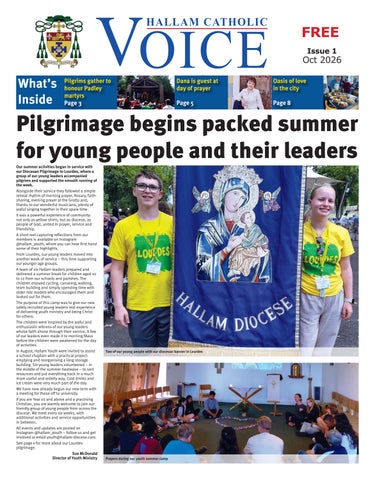
Pilgrimage begins packed summer for young people and their leaders Our summer activities began in service with our Diocesan Pilgrimage to Lourdes, where a group of our young leaders accompanied pilgrims and supported the smooth running of the week. Alongside their service they followed a simple retreat rhythm of morning prayer, Rosary, faithsharing, evening prayer at the Grotto and, thanks to our wonderful musicians, plenty of joyful singing together in their spare time. It was a powerful experience of community: not only as yellow shirts, but as diocese, as people of God, united in prayer, service and friendship. A short reel capturing reflections from our members is available on Instagram @hallam_youth, where you can hear first hand some of their highlights. From Lourdes, our young leaders moved into another week of service – this time supporting our younger age groups. A team of six Hallam leaders prepared and delivered a summer break for children aged 10 to 12 from our schools and parishes. The children enjoyed cycling, canoeing, walking, team building and simply spending time with older role models who encouraged them and looked out for them. The purpose of this camp was to give our new safely recruited young leaders real experience of delivering youth ministry and being Christ for others. The children were inspired by the joyful and enthusiastic witness of our young leaders whose faith shone through their service. A few of our leaders even made it to morning Mass before the children were awakened for the day of activities. In August, Hallam Youth were invited to assist a school chaplain with a practical project: emptying and reorganising a long storage building. Six young leaders volunteered – in the middle of the summer heatwave – to sort resources and put everything back in a much more useful and orderly way. Cold drinks and ice cream were very much part of the day. We have now already begun our new term with a meeting for those off to university. If you are Year 10 and above and a practising Christian, you are warmly welcome to join our friendly group of young people from across the diocese. We meet every six weeks, with additional activities and service opportunities in between. All events and updates are posted on Instagram @hallam_youth – follow us and get involved or email youth@hallam-diocese.com. See page x for more about our Lourdes pilgrimage. Sue McDonald Director of Youth Ministry
Two of our young people with our diocesan banner in Lourdes
Prayers during our youth summer camp
2 + Hallam Diocesan Catholic Voice + October 2026
NEWS
A warm welcome to your new Voice! Welcome to this first edition of our new monthly newspaper. Our aim is to help shape a publication that truly reflects the life of our faith community – a balance of national and international Catholic news, thoughtful reflections and vibrant stories from the parishes. Whether it is a milestone celebration, a special fundraising achievement or a community event that brought people together, these are the stories that make the diocese what it is. We need your help to tell these stories and we are keen to receive your news and
updates. Please don’t worry about drafting perfect, polished articles, as long as you send the key information – the who, what, where and when. Plain text or Microsoft Word documents are our preferred formats. To help us capture the life of our parishes, here are a few tips for photos: People make the story: Please ensure there are people in your photos whenever possible. We love to see smiling faces looking directly at the camera. Mind the background: Try not to include too
much empty space or background, as this often needs to be cropped, which can reduce the image quality. The setting: Outdoor photos often work exceptionally well, providing great natural lighting for our pages. Format: Please send images as separate JPEG attachments rather than embedding them into a Word document. Consent: Most importantly, please ensure that you have obtained the consent of
everyone featured in the photos before sending them to us and confirm this has been done in your email. You should be the owner of the photograph or have permission from the owner to use it for copyright purposes and have permission from any people included to use their image in publicity from the Diocese of Hallam, including diocesan website and socials. The deadline for each edition is the first Friday of the month before publication, so October 2 for November’s paper. Send your stories to: mmcgeary@hallam-diocese.com.
Women's group will share your stories The summer seems to have vanished very quickly. Some people have said they are still waiting for it to start and find themselves surprised by the onset of the autumn flurry of school uniforms and darker evenings. As Adrienne Rich says in her poem Contradictions: We’ll dream of a longer summer but this is the one we have: I lay my sunburnt hand on your table: this is the time we have. In the Diocese of Hallam, we wait with bated breath for word from Rome in response to the report from Bishop Marcus as to the recombination of the three dioceses of Hallam, Leeds and Middlesbrough.
But meanwhile, life goes on, of course, and stories from the diocese in this edition include Care for Creation news, coverage of the Lourdes pilgrimage, celebrations from the work of diaconate formation and an invitation from the Women Together in Hallam group. Someone asked about this group, saying the invitation was “a bit vague”. As described, the group arose from the initial stages of the Synod in Hallam. The documents are all on the diocesan website if you would like to refresh your memory of the source and also what is continuing now, in the Implementation Phase of the Synod. There are plenty of resources around to help you bring a synodal perspective to your
ordinary parish encounters. Things are a bit difficult for us in Hallam because we are in this interim moment of waiting to know our future diocesan priority and direction, although the mission, of course, remains that of bringing the Good News to all people or in another phrase, “Lifting up the Cross for all to see and have eternal life” (John 3:13). The work of the Women Together in Hallam is to share the voices and stories, as offered and created by the participants and all are welcome to join the group. We are also looking to support any parish interested in developing the Called and Gifted programme in the parish – get in touch if you
think this might be something for your parish. The Sycamore programme also has a new set of resources freely available for adult formation – and congratulations to Sycamore’s Stephen Wang, who has been anointed Bishop for the diocese of Arundel and Brighton. Remember to send in your own stories of how the synod is being implemented in your parish. Blessings on your month ahead as we continue to pray with the Pope, this month for “Collaboration among religions” Fionnuala Frances Coordinator of Adult Formation and Mission
Pilgrimage leaves us refreshed for year ahead Bishop Emeritus Ralph led us on a prayerful and joyful pilgrimage to Lourdes, despite our numbers being smaller than usual. Hallam Youth were unable to travel with us and delays in opening the bookings and price increases also affected the size of our group for my first year as pilgrimage director. Nevertheless, on June 26, 118 of us flew from Leeds Bradford Airport to Lourdes without any delays. There were regular and new pilgrims, assisted pilgrims and helpers and 11 members of the Diocesan Youth group. Some things never change. The pilgrims were soon getting to know each other and looking forward to the week ahead. We stayed in familiar hotels where we were assured of a warm welcome and exemplary care. Emeritus Bishop Ralph was supported by Father Michael Umameh, Father Calistus Nwobi and Father Bede Dike, who were all experiencing Lourdes for the first time. We arrived at the end of France’s red heatwave warning but still had temperatures of 35C for two days, followed by some welcome rain and slightly lower temperatures for the rest of the week. We began our pilgrimage as always with the blessing of the hands of helpers and pilgrims, as we are all in Lourdes in service to each other.
This was followed by the water gesture, when, following Our Lady’s instructions to Bernadette, we wash and drink from the spring in the Grotto. Many people make this gesture individually as they enter the sanctuary, and it seems an appropriate way to begin our days in Lourdes. We had an opportunity to receive the Sacrament of Reconciliation and Anointing of the Sick and attend Mass at the Grotto, as well as taking part as a diocese in the Blessed Sacrament and Torchlight Processions and the International Mass. In small groups we made the Stations of the Cross and many people joined in Lectio Divina sessions and found them to be prayerful and inspiring. We hope to develop this next year. Without the support of the young people of Hallam Youth our adult helpers had more work to do. Everyone responded positively and with the generosity I have come to expect but still find truly awesome. Our smaller numbers gave a feeling of intimacy to the pilgrimage that is difficult to achieve when there is a larger group, and we returned spiritually refreshed and ready to face another year. Dr Russell Brynes KSS Pilgrimage Director Bishop Ralph led this year’s pilgrimage to Lourdes
To advertise please contact Nick Layton on 01440 730399 or email ads@cathcom.org
October 2026 + Hallam Diocesan Catholic Voice +
3
NEWS
Schools from across the diocese unite in prayer Children from primary schools across the diocese travelled by coach, train and even on foot to gather at Padley Martyrs’ Chapel. They included groups from Barnsley and Rotherham, as well as pupils from St Marie’s in Sheffield, who honoured the school’s longstanding tradition of walking over Burbage Moor in rain or sunshine every year. Setting off from the Mayfield Valley in pleasant, breezy conditions, their route took them past Lady Canning’s Plantation, along the ancient Roman Road and through the stunning Padley Gorge to Grindleford, before finally arriving at Padley Chapel. There, Monsignor Desmond Sexton celebrated a beautiful and prayerful Mass as pupils and staff from Catholic schools across the Diocese of Hallam experienced a shared celebration of faith. All the children were keen to visit the 15thcentury Manor Gatehouse with its chapel.
Padley’s pre-Reformation altar was buried for preservation in the manor’s grounds in around 1588, to be found by Monsignor Charles Payne in 1933, when the Diocese of Nottingham bought Padley Manor back for the Catholic faith. They asked excellent questions about the consecration crosses carved into the altar’s surface and heard about the challenge the Fitzherbert household faced in moving a three-quarter tonne millstone grit altar from the first floor and out of the building. The physical remains of the manor’s 16thcentury Catholic identity certainly helped pupils connect with the lives of the blessed martyrs and the Fitzherberts as they learned about their commitment to preserving the celebration of Mass during Tudor penal times and why that remains relevant for us today. Gerard Bonner
Pupils from schools all over the diocese gathered for their annual pilgrimage to honour our martyrs
Martyrs remembered at moving Padley pilgrimage Bishop Patrick McKinney of Nottingham was the principal celebrant at the annual pilgrimage to Padley Martyrs’ Chapel. Monsignor John Armitage, Master of the Guild of Our Lady of Ransom, gave the homily at this joint event for the Diocese of Hallam and the Diocese of Nottingham. The pilgrimage took place on July 12, the anniversary of the Padley Martyrs’ arrest at the manor, together with John Fitzherbert and his family, by the Earl of Shrewsbury from Sheffield Castle. Blessed Nicholas Garlick, Blessed Robert Ludlam and Blessed Richard Simpson were martyred on St Mary’s Bridge, Derby, on July 24 1588. The medieval bridge chapel can still be visited today.
It was a blessing to have Bishop Marcus celebrating Mass on the same day and time at the annual Postgate Rally in Ugthorpe, North Yorkshire. There he honoured Blessed Nicholas Postgate, who was martyred on the Knavesmire, York, on August 7 1679. All these holy priests were remembered in prayer during the celebration of Mass at both Padley and Ugthorpe. Padley Martyrs’ Chapel is open on Sundays from 2pm to 4pm from Easter to October. If you would like to explore alternative visit times, join the Welcomers or would like a copy of A Pilgrim’s Guide to Padley’, please contact friendsofpadley@hallamdiocese.com. Gerard Bonner
St Marie’s in Sheffield continued the longstanding tradition of walking to Padley Chapel
Barnsley-born priest dies after long illness
Former Sheffield priest dies in California
It was with great sadness that we heard the news that Canon John Galvin had died at Highstone Mews Care Home in Barnsley during the early hours of Saturday July 11. Canon John was born on September 28 1949 and studied for the priesthood at Ushaw College in County Durham before being ordained on June 15 1974 at Holy Rood Church, Barnsley. Canon John served as a curate at St Mary’s, Bradford (1974-80) and St Austin’s, Wakefield (1980-87). In 1987, Bishop David Konstant appointed him parish priest of St James, Huddersfield. He became parish priest of St Nicholas, Leeds in 1997 and 10 years later he moved to St Francis, Morley. He then served as the first parish priest of St William of York, combining Morley and Churwell, and in 2012 Bishop Arthur Roche appointed him to the Cathedral Chapter. During his time at Morley, Canon John oversaw the complete refurbishment of the church and the building of a new presbytery. He celebrated the golden jubilee of his ordination in 2024, but his final years at Morley were overshadowed by ill health and he retired in 2025 and moved to a care home in Barnsley to be near his relatives. He died at the age of 76 and in the 53rd year of his
A Northern Irish priest who served Sheffield parishes before transferring to the Diocese of Sacramento, California, has died after 59 years of faithful ministry. Father Brendan McKeefry was born in County Derry on St Patrick’s Day 1944, the sixth of seven children to Michael McKeefry and Mary Catherine McKenna. Raised in a devout Catholic family, he often credited the strong faith of his parents and the rhythms of family prayer with nurturing his vocation to the priesthood. He studied for the priesthood at All Hallows College, Dublin, and was ordained for the Diocese of Leeds on June18 1967 by Bishop John J Scanlon, Bishop of Honolulu. Father Brendan then served in parishes in Sheffield, including St Marie’s Cathedral, and at St Joseph’s, Brighouse, between 1967 and 1979, when he transferred to the Diocese of Sacramento in the USA. After serving parishes in northern California, he retired in 2012 and since then had lived at a priests’ retirement centre, often serving military families at the National Cemetery at Dixon. Father Brendan’s Requiem Mass was celebrated in his former parish by the Bishop of Sacramento, the Most Rev James Soto, on
priesthood. We give thanks to God for Canon John’s long years of service. Bishop Marcus celebrated Canon John’s Requiem Mass at Holy Rood Church on Tuesday August 11. Eternal rest grant unto him, O Lord, and let perpetual light shine upon him. May he rest in peace. Amen.
Canon John Galvin’s funeral was in the church where he was ordained, Holy Rood, Barnsley
July 1 2026. The burial took place later in Ireland. He is survived by brothers Peter and John, and his sister, Mary Kneeland, along with many nieces, nephews, extended family members and friends who mourn his passing. Please pray for the eternal repose of Father McKeefry’s soul, for the consolation of his family and all who mourn his passing.
Father Brendan McKeefry served in Sheffield parishes for 12 years in the 1960s and 70s
4 + Hallam Diocesan Catholic Voice + October 2026
NEWS
Pastoral Letter for the Season of Creation Dear Brothers and Sisters in Christ, In the pastoral letter I sent during this season two years ago, I explained the venerable and rich tradition of care for creation contained in the teaching of the Catholic Church. In this special Jubilee Year of St Francis of Assisi, we once again, find ourselves in the Church’s “Season of Creation”[i] and a new opportunity is afforded to celebrate the harvest of good things which our earth gives to us through God’s providence. The Psalms remind us that the earth is full of God’s riches, and these riches are a wonderful blessing which God desires to share with everyone. This Season of Creation takes place during the time of harvest, where we see and taste the fruits of our labours and of the long days of the growing season during spring and summer; there is a time and a season to our growing and our gathering, and we are invited to “taste and see that the Lord is good”. The teachings we find in recent papal documents such as Laudato si[ii], Dilexi te[iii] and Magnifica Humanitas[iv], call us to a deeper realisation of our vulnerability and our mutual need. In order to flourish and grow as human beings, we must listen to the “cry of the poor” and the “cry of the earth”. God reveals His love for us through the beauty of His creation and calls from us to demonstrate a loving response of responsible stewardship.
Our Holy Father, Pope Leo XIV, has taken up the call made by his predecessor over the last decade, reminding us that our care for creation is not an optional part of our mission. We are urged to pray, act now, and not wait for others or until it is too late. In spite of challenges, we are seeing changes, both in attitudes and in the need and understanding for this call, with progress being made at many levels of our society. The Catholic Bishops’ Conference of England and Wales has developed guidance for us in a teaching document on the environment, The Call of Creation. It says: “We are a people of hope who believe in redemption. We must study the signs of the times and take the action that is needed to repair our relationship with God’s creation.”[v] Two years ago, I encouraged all parishes and schools to work towards CAFOD’s Live Simply Award[vi] as a way of “protecting this world which God has entrusted to us.”[vii] The award enables Catholic communities to care for God’s creation and stand in solidarity with our global family. I am pleased to inform you that across the Dioceses of Leeds, Hallam and Middlesbrough, there are now 11 parishes which have achieved the Live Simply Award, and several more starting the process. I now urge every parish, working individually or together in a deanery, to form a small team to begin the Live Simply initiative. This has worked well in the parishes that have embraced the award; there are now many
Bishop Marcus during St Mary’s Cathedral’s 40th anniversary celebration Mass – Photo by Chris Booth
To advertise please contact Nick Layton on 01440 730399 or email ads@ cathcom.org
good projects that can be shared to inspire others. We have found people of all ages wanting to engage with this work, giving their time and commitment, making a great deal of difference by a number of small actions in their personal lives. These are modern examples of the parable of the son who does the will of his father[viii], putting our faith into action in our parishes, homes and schools. In the Diocese of Leeds, we have embedded sustainability into the strategy for all our charitable responsibilities and appointed a new trustee to lead this work. Our diocesan Laudato Si’ Sustainability Group provides help and assistance to parishes and schools. It has representatives from our parishes, our clergy and diocesan curial departments. New initiatives have been identified and are being actioned through its work. In Middlesbrough and Hallam too, endeavours are being developed to help us work collaboratively and sustainably as one family of faith in the service of God’s people and the care of His creation. May this Season of Creation be a time of worship and praise, when we thank God the Father, our Creator, for the fruits of His creation which serve as reminders of His goodness. May this season be a time of holiness and loving kindness, when we seek to grow closer to God the Son, our Saviour Jesus Christ, who calls us, as He called St Francis of Assisi in simplicity and humility of heart, to care for those of our brothers and sisters who are poor and marginalised. May this season be a time of peace and justice, when we confidently call upon God the Holy Spirit, our Helper and Comforter, who inspires us to live more simply and care for the earth, so that our life may embrace the goodness of all creation and care for the common home of all humanity. Finally, may this season lead us to that time when all peoples and nations will fully cherish and care for creation and, in union with Mary and all the Saints, will give praise to the glory of the Most Holy Trinity, living, eternal and true. Amen. Marcus Bishop of Leeds Apostolic Administrator of Middlesbrough Apostolic Administrator of Hallam
Given at Leeds on the Feast of the Birthday of the Blessed Virgin Mary, September 8 2026, and appointed to be read at celebrations of Mass, and made available to be taken away from the churches and chapels of the Dioceses of Leeds, Middlesbrough and Hallam, on the 26th Sunday in Ordinary Time, Saturday September 26 and Sunday September 27 2026. i
The Season of Creation is an annual celebration uniting Christians in prayer and action for the protection of our common home. The season runs from September 1 to October 4, the Feast of St Francis of Assisi. ii vatican.va/content/francesco/en/ encyclicals/documents/papafrancesco_20150524_enciclica-laudato-si. html iii vatican.va/content/leoxiv/en/apost_exhortations/documents/2025 1004-dilexi-te.html iv vatican.va/content/leo-xiv/en/encyclicals/ documents/20260515-magnificahumanitas.html v cbcew.org.uk/wpcontent/uploads/sites/3/2022/10/Call-of-Cre ation-2022b.pdf cafod.org.uk/campaign/livesimply-award vi Laudato Si’ §242 vii Gospel reading for 26th Sunday in Ordinary Time, Matthew 21:28-32
Bishop announces clergy moves Bishop Marcus has announced a series of clergy moves across the diocese. Father Craig Fitzpatrick has been appointed parochial administrator of St Francis, Sheffield, in succession to Father Kevin Thornton, who is retiring. This appointment is in addition to Father Fitzpatrick’s current office as parochial administrator of St William of York, Sheffield, and his diocesan roles as judicial vicar and vice chancellor. Father Patrick Harrigan has been appointed parochial vicar of St Marie’s Cathedral Parish and Father Christian Nwakamma as parochial administrator of St Joseph, Wath, and St Joseph, Rawmarsh. Bishop Marcus said: “The assignment of clergy to pastoral offices and ministries is one of the most important and sensitive responsibilities of a bishop. “I wish to thank each priest for the graciousness with which they have accepted their appointment to a new office or any additional responsibilities added to their ministry. The generosity and willingness they
have shown is a testimony to their faith and readiness to serve Our Lord and his Church. “Undertaking a new parochial office or special ministry can be very demanding emotionally and spiritually. I ask you therefore to kindly keep these clergy and the parish communities in your prayers and to offer them your fraternal support.” Bishop Marcus also thanked Father Kevin Thornton for the dedicated priestly ministry he has given since 1994 at St Francis and for the committed priestly service he has given so faithfully in several other parishes over the past 65 years, firstly in the Diocese of Leeds and for the past 46 years in the Diocese of Hallam. “We wish Father Thornton every blessing as he retires from holding office and assure him of our prayers for the years to come,” he added. Father Thornton will continue to reside at St Francis’ Presbytery. Father Craig Fitzpatrick has been appointed parochial administrator of St Francis, Sheffield
October 2026 + Hallam Diocesan Catholic Voice +
NEWS
Dana is special guest at shrine’s day of prayer Ireland’s first Eurovision Song Contest winner, Dana, will be the special guest at a Day of Prayer at the historic Shrine of Our Lady of Doncaster. The day will begin with a talk on the history of the pre-Reformation shrine by parish priest Father Darren Reid, followed by Adoration and the Sacrament of Reconciliation. During Adoration there will be music and prayers, with many priests available to hear confessions, which will be followed by Mass. A lunch break will allow time to be spent in Our Lady’s Garden and at the outdoor Stations of the Cross, both of which are well worth a visit. Back in church afterwards, vicar general Monsignor Desmond Sexton will give a talk about the Padley Martyrs. Dana, whose real name is Rosemary Scallon, will then share her music and powerful testimony, as well as leading the Rosary. Singer, composer and former politician Dana rose to prominence in 1970 when she won the Eurovision Song Contest in front of an audience of 400m viewers with All Kinds of Everything. Now known for anthems such as Totus Tuus and Lady of Knock and her work with EWTN,
she has also performed for St Pope John Paul II and Pope Benedict and was honoured by Pope Francis for her lifetime of service with the highest Vatican award available to a layperson when she was made a Dame of the Order of St Gregory the Great. The event is being organised and led by Sally Glennon, who has performed at Marian shrines and basilicas across Europe. Her days of prayer are known for their first-class music and leave attendees feeling uplifted and full of joy. Attendees will be the very first to hear two new hymns written by Sally and specifically dedicated to Our Lady of Doncaster. Shalom TV and Irish in the UK TV are filming the day, which takes place on Saturday October 24 at the Church of St Peter-inChains, Chequer Road, Doncaster. This is a wonderful opportunity to come together, renew your faith and experience an unforgettable day. Tickets are £9.99, which includes a bag of refreshments, served tea, coffee and soft drinks and a personal pilgrim daybook. To reserve your place, visit ticketsource.com/hail-full-of-grace-2026 or email hailfullofgrace2026@gmail.com.
Second gathering for new women’s group The Synod was an invitation to the laity to express their hopes for the Church. Catholics in Hallam and across the world resoundingly identified the need for women’s voices to be heard and their abilities to be recognised. The idea for Women Together in Hallam was born and our first gathering took place at Hallam Pastoral Centre. The willingness of attendees to contribute and share was inspiring. Lots of enthusiastic discussion took place around the aims and hopes for the group. There was general interest in women’s
formation and becoming more actively involved in the life of the Church. This will be the theme of our next gathering on Saturday October 10, beginning with a soup lunch at noon. Shauna Hilton, from St Joseph’s, Dinnington, will begin with an account of women’s ministry in her parish. Do come along and share your ideas. We have a direct link to the Catholic Bishop’s Conference of England and Wales via the National Board of Catholic Women. Let your voices be heard! Judith Green
Walsingham pilgrims stop off in Barnsley The Parish of Corpus Christi was delighted to welcome pilgrims when the New Camino from Leeds to Walsingham stopped off in Barnsley. Pilgrims visited St Michael’s, Wombwell, for prayer and refreshments before gathering the next morning for breakfast and a blessing from parish priest Father Declan Brett before restarting their walk.
Father Declan Brett and parishioner Liz welcome pilgrims on the Leeds Walsingham Way to St Michael and All Angels, Wombwell
Irish singer Dana is the special guest at a Day of Prayer in Doncaster
5
6 + Hallam Diocesan Catholic Voice + October 2026
NEWS
New candidates for the permanent diaconate Bishop Marcus celebrated Mass at Holy Rood Church, Barnsley, for the Admission to Candidacy of Lee Redhead and Michael Watkins. The celebration brought together priests and deacons from across the diocese, along with family, friends and parishioners. Their presence was a visible sign of the support and prayer that surrounds all those discerning a vocation to the permanent diaconate. Deacon Tony Strike, chair of the Northern Diaconal Formation Programme, called Lee and Michael forward. Bishop Marcus then formally admitted them as candidates for ordination as permanent deacons. The Rite of Admission to Candidacy marks an important stage in their journey of formation, as they publicly express their intention to continue preparing for ordained ministry and the Church accepts them as candidates for Holy Orders. The Mass was hosted by the parish community of Holy Rood, and parish priest
Father Damian Humphries was thanked for generously offering the church for this important diocesan celebration. The reverence of the resident altar server team combined with the welcome from the parish community helped create a fitting setting for Lee and Michael to take this significant step in their vocational journey. The Admission to Candidacy is a significant moment in the Church’s discernment and formation of future deacons. It marks a public commitment by the candidates to continue their preparation, while recognising that their vocation remains one to be discerned with the Church. For Lee, based at Holy Rood, and Michael, based at St Marie’s Cathedral, the occasion marks another stage in a journey that will continue through prayer, theological and pastoral formation, parish experience and service. Their vocation is ultimately a call to serve Christ and his Church, particularly through the ministry of the Word, the liturgy and
Father Chris Posluszny, from St Marie’s Cathedral; Father Damian Humphries, Holy Rood, Barnsley; Deacon Tony Strike, Lee Redhead, Bishop Marcus, Michael Watkins, Deacon John Gilliver and Deacon Paul Green
charity. The diocese continues to hold both candidates in prayer as they journey towards ordination, asking God to guide and
strengthen them, and to help them discern ever more clearly his call to serve the Church.
Exhibition focuses on human face of the Holy Land At a time when the Holy Land is so often encountered through breaking news, argument and grief, Sheffield Cathedral and Friends of the Holy Land invite you to begin somewhere different: with a human face. From Monday October 5 to Saturday October 17, 50 Faces of the Holy Land brings Marcin Mazur’s striking blackand-white portraits into the Cathedral. The exhibition introduces Israeli and Palestinian people from Christian, Jewish, Muslim, Samaritan and Druze communities. Each portrait asks us to pause before a person rather than a position and to notice dignity, faith, memory and hope.
At 5.30pm on Tuesday October 6, a special ecumenical Evensong will gather Christians from across Sheffield and the wider community within the cathedral. Through music, Scripture and prayer, we will hold before God the people of the Holy Land and pray for justice, reconciliation and a lasting peace. We would be delighted if you could join us and grateful if you would share this invitation with your congregation and friends. For more details, visit friendsoftheholyland.org.uk/50-faces. Brendan Metcalfe CEO, Friends of the Holy Land
The 50 Faces of the Holy Land exhibition, seen here at Salford Cathedral, is coming to Sheffield this month – © Mazur/catholicnews.org.uk
THE LIVING WORD – Exploring the biblical notion of body LUCA SETTIMO, Professor of Theology at the University of Nottingham, begins a series of reflections on the meaning of some key biblical words. In the words spoken by Jesus on that last evening of his earthly life, soma is his very person who gives himself in an embrace of communion with his faithful through the sign of bread and wine: “Take, eat; this is my body [soma]” (Matthew 26:26).
The Song of Songs (Chapters 4, 5 and 7) is not embarrassed to celebrate the beauty and eros of the bodies of the two lovers. So, we should not be surprised if already in the Old Testament and in a unique form also in the New Testament, the final destiny of the redeemed creature is the resurrection of the body and not so much the immortality of the soul alone (Ezekiel 37).
The word “body” is found 142 times in the New Testament. Unlike classical Greek culture – which places a clear distinction between the spiritual soul and the material body – the Bible considers the human being as a unity in which flesh, life, spirit and conscience co-exist.
Similarly, it is significant that Christ’s public activity was dominated not only by preaching but also by the healing of bodies.
In Semitic culture, in fact, we are a body because it is in it and with it that we live and communicate, while in the Western world, we have a body that we control, detest or idolise. In this light, we can understand the relevance of corporeity in the pages of the Bible. In practical terms, the body (soma) coincides with the person and the meaning of this term is not exhausted by the idea of carnality alone, seen as a sign of weakness, fragility and misery.
apostle uses, in some passages to the Romans the expressions “body of death” and “body of sin”. But with the incarnation of the Son of God, our mortal and sinful body is buried and the “spiritual body” is reborn, that is, animated by the same Spirit of God: “He will transform the body of our humiliation that it may be conformed to the
In fact, the goal to which we aspire, that of the resurrection, is already marked in us through the desire for our salvation. It is that “inner groaning”, an expression for those who expect to be adopted as sons and for the “redemption of our bodies” (Romans 8:23). Even if it is difficult to define what the destiny of our glorious body will be in the renewed creation (cf 1 Corinthians 15), we know that it has a destiny of glory. Thus, we must consecrate our bodies to God; each human body is in fact the expression of a person and is “a living sacrifice, holy and acceptable to God, which is your spiritual worship” (Romans 12:1).
Jesus’ public ministry, through miracles, focused extensively on the human body with the intention to restore it to its splendour. Furthermore, through the Eucharist, Jesus offers his body as food, thus creating a communion that is not generically spiritual but a communion that is personal, since the body is an expression of the person.
I wish to acknowledge Cardinal Gianfranco Ravasi for granting me permission to use his material. A YouTube video entitled “The biblical notion of body”, which explores this biblical concept in greater detail, is available on my YouTube channel (youtube.com/@LucaSettimo-7).
Paul then conceives, in the First Letter to the Corinthians, the Church as the body of the risen Christ and will ask the Corinthians rhetorically: “Or do you not know that your body is a temple of the Holy Spirit within you, which you have from God, and that you are not your own?” (1 Corinthians 6:19). Of course, in our body there is the stigma of death and the wound of sin: in fact, the
body of his glory, by the power that also enables him to make all things subject to himself” (Philippians 3:21).
Professor Luca Settimo
October 2026 + Hallam Diocesan Catholic Voice +
7
NEWS
Prepare for Christ’s coming with the Bernardines As Advent approaches, the Bernardines of Esquermes invite you to take time away from the busyness of everyday life and prepare for Christmas through prayer, silence and reflection. The Bernardines are a community of
Cistercian nuns who follow the Rule of St Benedict, seeking God through a life of prayer, simplicity and community. Their ministry has traditionally included education and hospitality. This year’s Advent Retreat, led by Father
Anthony and the sisters, will be held at the peaceful Monastery of Our Lady of Hyning, in Warton, Lancashire. Come and make space for prayer and quiet reflection as we prepare together for the coming of Christ.
Two weekends are available: November 27-29 and December 4-6. For more information, visit bernardine.org/hyning-programme. If you wish to lift-share, email formationmission@hallam-diocese.com and we will help put you in touch with others.
The community at the Monastery of Our Lady of Hyning
A Letter From Madonna House – The prayer that draws us into the life of Jesus I love the Rosary! And since October is the month of the Holy Rosary, I thought I would tell you why. As Christians, our lives are linked to the mysteries of Christ’s life, death and resurrection. We find a sure passage into
these mysteries through Our Lady, who lived so intimately in his presence. No human being (apart from her son) has plumbed the depths of them as she has: “His mother pondered these things in her heart” (Luke 2, 51). I love the fact that as we finger the beads of a Rosary, praying Our Fathers, Hail Marys and Glory Bes, we are drawn into pondering Jesus’ and Mary’s lives. Joyful Mysteries, Luminous Mysteries, Sorrowful Mysteries, Glorious Mysteries… with a little imagination and the help of the Holy Spirit, they pass before our mind’s eye and we are led to new depths of understanding and appreciation of the mysteries of God. I love how versatile the Rosary is. It can be said anywhere: on your knees in a church, standing in the queue at the supermarket, sitting down relaxing, lying down on the sofa or in your bed, at home or travelling… I prefer kneeling in a quiet place, where I can concentrate better. You can pray an entire
Rosary, or you can space one out, saying a decade at a time throughout the day. I love that, despite fatigue or distractions, something beautiful happens whenever we pray the Rosary. The rhythm of the words calls us back to praying with the heart. I love that we are connected to Mary in this prayer. When I can’t fall asleep at night, I hold my Rosary and finger the beads. Often this helps me to go to sleep. But even if I can’t sleep, knowing that she is near is comforting. It is a wonderful prayer to offer for a special intention. When I don’t know how I should pray for someone or some situation, praying the Rosary helps. I love that the Rosary can be recited communally. Whether it is with a good friend or a room full of people, the blending of the voices is like a song that rises up to God like incense! People of all ages can take part, even very young children. Sometimes we see the Mysteries of the
Rosary blend with our own experiences. Mary was the first and most perfect follower of Christ, so I love learning from her how to be a true disciple. For example, I was recently visiting my elderly parents and helped out around the house. This meant helping with the cooking and cleaning, and with the personal care of my father. I thought of Our Lady’s Visitation to her six months pregnant cousin, Elizabeth. She was there to help out in much the same way as I did. In following her lead, the visit was blessed in many unexpected ways! Try it and see for yourself how your love for the Rosary grows! Jeanne Guillemette Madonna House is a Catholic lay apostolate and community founded in 1947 by Catherine de Hueck Doherty in Combermere, Ontario, Canada, and with a house at Robin Hood’s Bay, North Yorkshire.
8 + Hallam Diocesan Catholic Voice + October 2026
NEWS
Oasis of healing and love in the heart of the city The Carmel Centre in Sheffield is a place of healing and love. Since being established more than 40 years ago we have welcomed thousands of wonderful people through our doors. The principles of Catholic Social Teaching underpin everything we do. What we have is there to share for the common good and everyone is entitled to our gifts: friendship, fellowship, food, support and care. Sharing what we have has enabled us to build a community of great value. We seek to support three key challenges facing our community: social isolation, intergenerational isolation and addiction. We also support those who need therapy to heal or offer a learning experience in a supportive environment. Whatever is needed, we are here to help others grow and flourish in a respectful environment. Counselling is available for those who need it or there is always someone to lend a listening ear. Our work supports those experiencing challenges and who, for many reasons, may not always have been welcomed or felt safe in society. Last year we supported more than 100 women who have experienced domestic abuse. We offer wellbeing groups for both men and women to rebalance their lives and work towards a more stress-free existence. There are also activities such as flowerarranging, music, pottery and conversation
groups for those learning English. In addition, a wholesome lunch is available to everyone who comes to the centre, enabling clients to enjoy home-cooked food and companionship – even on Christmas Day, when we provide lunch for around 30 people. All our volunteers communicate with openness and warmth, which contributes to enabling visitors to sense that who they are is properly understood. We involve our service-users in decision making relating to the project and encourage participation in all the activities. Referrals come from the wider community, including GPs and churches in the area, but many are by word of mouth. Pope Francis wrote these words about the good Samaritan parable, but it could apply equally to Carmel: “[it] shows us how a community can be rebuilt by men and women who identify with the vulnerability of others, who reject the creation of a society of exclusion, and act instead as neighbours, lifting up and rehabilitating the fallen for the sake of the common good” (Fratelli Tutti, s67). We are always looking for volunteers to support our work, as well as donations to keep the Carmel Centre going for another 40 years. If you are interested in supporting the Carmel Centre, which is located at 172 Dykes Hall Road, Hillsborough, please contact me on 07980 406198. Bernie Ware, Director of Caritas
Lunch is available every day for visitors to the Carmel Centre
St Wilfrid’s Way marks Adoremus weekend This year’s St Wilfrid’s Way Diocesan Pilgrimage is a key local event marking Adoremus, the National Eucharistic Congress taking place in London the same weekend. As a follow-up to his St Patrick’s, Huddersfield to Leeds Cathedral Camino instituted in the Jubilee Year of Mercy, Stephen Habron, a parishioner at Holy Redeemer Parish, Huddersfield, compiled a booklet on a new Camino route: from Leeds Cathedral to Ripon via Knaresborough,
Bishop Thornton and Fountains Abbey. In 2016 this became a new official diocesan pilgrimage, St Wilfrid’s Way, which takes place over two days around the time of St Wilfrid’s Feast Day (October 12). Anyone may walk either all or any part of the Camino (staying overnight en route or going home). All those volunteering to provide hospitality, sustenance or transport for the walkers are pilgrims too – and are especially welcome!
The walk is in stages, almost all on country tracks and paths, but still within a short distance of the A61 and bus and train services. Walkers pass through the natural environment on the way to visit some of the most historic sacred sites in the diocese for Mass, the Rosary and other devotions. Sites include the mediaeval wayside shrine of Our Lady of the Crag in Knaresborough, Bishop Thornton, where the upper room of
the presbytery is the oldest Mass house in the diocese, Markenfield Hall with its Recusant Catholic links and Fountains Abbey. The pilgrimage ends in Ripon, which was home to the Shrine of St Wilfrid in Ripon Cathedral, where Mass will be celebrated. The pilgrimage takes place on Friday October 9 and Saturday October 10. For more details and to sign up, visit dioceseofleeds.org.uk.
CATHOLIC HISTORY FOCUS – The legend of the musical saint Dutch-born historian SHAWN RAS begins a series of articles about Church history… “Sing and make music from your heart to the Lord” Ephesians 5:19 Few things are as closely associated with Christianity as song. Be it from the choirs and organs we know well in our Church, to electric guitars and stages as some American Protestants do. In our Catholic tradition we have Pope St Gregory to thank for the basis of our hymns. His Gregorian chants are considered the basis for western musical tradition, but he himself built on tradition already established. In the sixth century there lived a man in the biggest city in the world. Not considered especially talented as a singer nor as a reader, this man, Romanos, gained the attention of the head of the Eastern Church, the Patriarch of Constantinople. During the Vigil of the Nativity, Romanos read the liturgy so poorly that he was made fun of by his peers. In shamem he sat in the choir stalls in the Church of the All Holy Mother of God in Blachernae. As he fell asleep, Our Lady appeared to him in a vision, holding a piece of paper. She commanded him to take the scroll and upon waking up, marched up to the pulpit and
started chanting a nativity hymn. The Roman Emperor, present with the Patriarch, was amazed at the sounds of Romanos’ voice and at the hymn he appeared to write on the spot, all while singing. Romanos, according to the Synaxarion of Constantinople, a work detailing the lives of saints commemorated in the imperial capital, claims that Romanos composed more than 1,000 hymns during his lifetime. Around 90 of his compositions survive. His style, named the Kontakion for the shaft of wood around which scrolls were rolled during that time, remains the primary form of hymns in the Orthodox Church. His known works include hymns dedicated to the Nativity of Christ, the martyrdom of St Stephen, the Last Judgement and the Raising of Lazarus. He is also claimed to have written the famous Akathist Hymn, recited to the Holy Mother of God and so named for the style of performance, akathistos meaning unseated. According to one legend, a bishop in Constantinople sang all the hymns standing up, singing for an entire day, before, upon finishing, falling dead. The most famous hymn of the Akathist is the 13th Oikos, which was written in 626 and
thanks Our Lady, attributing to her the victorious arms of defending the city of Constantinople from a pagan invasion and naming her the Defender General. The truth behind the legend of St Romanos is contested. It is not unlikely for one man to write 1,000 compositions: Johan Sebastian Bach is said to have written 1,400 pieces by himself. The few compositions that remain are also contested, with modern scholarship claiming only 60 of the surviving 90 to be by Romanos’ hand. The Akathist Hymn has lately been disputed to have been written by Romanos, with scholars asserting it to have been written by Patriarch Sergios I, who was patriarch at the time of the 626 siege. Whatever the truth may be, Romanos was honoured with the epithet “The Melodist” after his beatification following his death following the year 555 and named the patron saint of music and musicians. His feast is celebrated on October 1. Dear reader, when you sit in your churches on Sunday, and the choir sings hymns that move you, spare a kind thought to St Romanos. Or perhaps ask him to intercede if your choir is not especially good!
St Romanos is said to have written more than 1,000 hymns, although some historians dispute this
October 2026 + Hallam Diocesan Catholic Voice +
9
NEWS
A deacon’s life and a chance discovery Coming up to the 25th anniversary of my ordination, I can enjoy looking back over a very varied ministry. Starting as a deacon at St Marie’s Cathedral, while still commuting to London and Leeds in my civil service career, I developed a great love for the art and history of this beautiful building. Squeezing a five-day week into four days, I was able to spend Fridays visiting the housebound all over Sheffield. Though they now lived away from the cathedral parish, many had for decades loved to travel there for Mass. As I visited them, they nourished me with their goodness and memories. Visiting the elderly and adult catechesis have been a core part of my ministry. I’ve lost count of the number of celebrations of Easter sacraments of initiation that have followed months of Journey in Faith gatherings that I’ve led or contributed to almost every year since ordination (and before). Another huge grace. Having retired early and then gained a master’s degree in theology and ministry, I began to research and write about St Marie’s in between my ongoing parish ministry and a newly acquired ten-year spell as Catholic chaplain at Sheffield Children’s Hospital – another hugely important ministry. Then came the books. Over the next 10 years, I privately published eight illustrated books, helped greatly by the prolific photo library being built up by parishioner/photographer Bob Rae. Starting with a guidebook, I published three history books, followed by a book of
reflections based on the many depictions of Our Lady at St Mary’s. A book on more than 50 saints depicted in St Marie’s and another on the 200-plus angel images followed. Perhaps the least well-known is my book on the important medieval alabasters in the cathedral. Though I’d moved parish to St Mary’s, High Green, along the way, my love of St Marie’s continued. Not busy enough with the books, the Children’s Hospital, teaching at the Pastoral Centre, establishing and nurturing a shared diaconate formation programme for nine northern dioceses, there was also a full range of parish deacon ministry. I can’t now think of support tasks I haven’t contributed at St Mary’s – and still do. It is (mostly) life-giving. A deacon’s lot can certainly be a happy one. But what of the “chance discovery” of my title above? When writing the 1850-1920 volume of history linked to St Marie’s, the received wisdom was that the altarpiece statue in the St Joseph’s Chapel might have been by Theodore Phyffers, a renowned mid-Victorian London sculptor. This statue is a near-unique image of a beardless, young Jesus standing by St Joseph’s deathbed, blessing him, with Mary at the foot and an angel at the head of the bed. The quality is obvious, but the sculptor was always in doubt. Another artist, Thomas Earp, completed work on the chapel shortly before 1876. Did he design the altarpiece? Out of the blue, an email arrived at St Marie’s last year from a member of the Royal College
Conference looks at SVP’s work in prisons The SVP’s Working in Prisons group is inviting members, volunteers and supporters to join us for a special conference exploring our work in prisons. The day will include a concelebrated Mass at noon, alongside a programme of speakers and participants reflecting on the past five years and looking ahead to the next chapter of Vincentian prison work. Tea, coffee and soft drinks will be available throughout the day but please bring your own
packed lunch. Step-free access and accessible toilets are available, with a large, free car park. All are welcome. The event takes place at St Michael’s in Wombwell, Barnsley on Saturday October 10 from 10am to 4pm. For more information about the day, please contact kevinmck@svp.org.uk or call 07504 130749. Liz Salmon
Your support can help Pact make a difference Prisoners’ Sunday, which this year is on October 11, is an opportunity to consider how we, as individuals, as a Church and as communities, are serving our brothers and sisters affected by imprisonment. Our prisons are in crisis. There are record numbers of people behind bars. Inspectors regularly report instances of vermin, violence, self-harm and people languishing in cells with nothing to do. At the same time, too many people are released with no home, no job, no family and no hope. The ripple effects of this crisis are felt well beyond the prison walls.
The lives of hundreds of thousands of families and children are affected as they, too, serve a hidden sentence. Having a mother, father, husband or wife in prison can have a devastating impact – more than half of families say they are struggling to afford the basics for themselves and their children. Pact is the leading Catholic charity helping prisoners, people with convictions and their children and families. You can support their work at prisonadvice.org.uk/donate.
To advertise please contact Nick Layton on 01440 730399 or email ads@cathcom.org
of Art and collector of artworks living in London. His wife had been given a maquette (a small clay model of a sculpture), which an artist would send to those who might want to commission a full-scale version of the proposed work. The model was bought by a friend at Portobello Road Market. The image was pristine, apparently having been owned by nuns in the nearby Carmelite convent and kept under glass. The friend gave it away as a gesture of friendship. Photographs show clearly the image almost exactly as in the fullscale statue in St Joseph’s Chapel. Writing with a stick into still-soft clay side of the maquette is Phyffers 1872 and the title, Death of St Joseph. On the opposite side is written in red To Messrs Hadfield Arcts with T Phyffers best comp’ts April 1873. Matthew Hadfield of Sheffield was the architect of St Marie’s at the time and responsible for the artwork of the St Joseph Chapel. Theodore Phyffers would have needed to post his proposal for the St Joseph altarpiece to Hadfield in Sheffield for consideration. The mystery of the artist of the St Joseph’s Chapel altarpiece was solved. But whether Theodore Phyffers also carved the statue on site remains unclear. Phyffers was busy on figures for Canterbury Cathedral at the time of his death in 1876. Did he come to Sheffield, or did another sculptor work from his maquette to produce the unique full-scale image we can enjoy today? Yet to be discovered? Deacon Bill Burleigh
Phyffers’ terracotta bas relief of St Joseph
10 + Hallam Diocesan Catholic Voice + October 2026
NEWS
Four young servers enrolled into Guild of St Stephen There was a joyful occasion at St Mary’s Church, High Green, as four young altar servers were formally enrolled into the Guild of St Stephen and presented with their medals. At the invitation of the parish priest, Father Callistus, Deacon Tony Strike, diocesan director of the Guild of St Stephen, visited the parish to lead the enrolment ceremony and welcome the young people. The occasion was an opportunity not only to recognise their service at the altar but also to encourage them in their commitment to the life of the Church. By serving at Mass, young people have a special opportunity to participate actively in the liturgy, to learn more about their faith and to witness to Christ through their service. The Guild of St Stephen encourages altar servers to serve with reverence, prayerfulness and a deeper understanding of what they are doing. It also seeks to bring servers together for mutual support and encouragement. Deacon Tony congratulated the four new members and encouraged them to take pride in their ministry. Being an altar server is much more than learning what to do at Mass. It is
an opportunity to grow in faith, to serve others and to become a visible witness to the Gospel. The young servers were also reminded that their example can encourage other young people to become involved in the life of the parish. The guild’s patron, St Stephen, reminds all servers that Christian discipleship is rooted in service. As the guild motto says, “To serve is to reign”. The parish gives thanks to these four young people for their willingness to serve, and to their parents and families for encouraging them to take an active part in the Church. The Guild of St Stephen warmly encourages young people who are interested in serving at the altar to speak to their parish priest or master of ceremonies. Becoming an altar server is a wonderful way to participate more fully in the Mass, make friends, grow in confidence and faith and become an active witness to Christ in the Church and in the wider community. May St Stephen, patron of altar servers, continue to guide and inspire our young servers as they faithfully serve the Lord and his Church.
Deacon Bill Burleigh, Father Callistus and Deacon Tony Strike with four new servers who were enrolled into the Guild of St Stephen at St Mary’s, High Green
October 2026 + Hallam Diocesan Catholic Voice +
11
NEWS
Iconic Mission Box marks its 90th birthday This year marks 90 years of a special partnership between Missio and the Mill Hill Missionaries, united through the Red Box. The Red Box has been a familiar presence in Catholic homes across England and Wales and is a symbol of faith, hope and love – uniting the vision of Blessed Pauline Jaricot and the missionary initiative of Mill Hill Missionary, Father Thomas Jackson. Born into a wealthy French family in 1799, Pauline devoted her life to prayer after her mother’s death. Passionate about supporting missionaries, she gathered people into small groups to pray and give a weekly offering. In 1822, she founded the Association for the Propagation of the Faith (APF), with the aim of supporting mission work worldwide. Her idea spread rapidly and was later recognised by Pope Pius XI as the Church’s official mission organisation. Today it is known as Missio’s APF or simply Missio. Born into a poor family in Preston in 1844, Thomas Jackson worked from the age of ten and taught himself to read and write. He developed a deep faith and later pursued a vocation to the priesthood with the Mill Hill Missionaries. Thanks to the generosity of others, he was able to complete his training. This experience shaped his determination to help future missionaries. After serving as a missionary in Afghanistan and Borneo, Father Thomas returned to England and introduced a simple idea: a small collection box, encouraging people to give whatever they could and enabling everyone to support mission work. In 1936, the Mill Hill Missionaries and Missio’s APF united their efforts and adopted a single design: the Red Box. Income is shared between Missio – the Pope’s charity for world mission – and the Mill Hill Missionaries, Britain’s own missionary society. The 60% share to Missio supports faith communities in mission territories overseas and the spread of the Gospel message in places where the Church is still new, young or
The iconic Red Box
poor. The 40% share to the Mill Hill Missionaries supports the formation and training of its missionaries. Last year, supporters and volunteers raised an extraordinary £2.2m through the Red Box. Thanks to this generosity and the power of prayer, people can gather for Sunday Mass in the shade of a baobab tree in Uganda, a child can attend school in Sri Lanka and the sick can receive the Sacraments in an isolated village in Cambodia. Through the Red Box, Missio and the Mill Hill Missionaries have built churches, presbyteries, convents, schools, children’s homes, health centres and dispensaries. They have trained priests, sisters and catechists, and contributed to thousands of projects that
have helped the Church grow in service to those in great need. As Pope Leo calls us to live ever more fully as one family of God, we are united in our mission to reveal Jesus, whose love has the power to heal and transform our world. In this special year, Red Box supporters can continue to help in three key ways: Give: As we move into a cashless society, it is more important than ever to find creative ways to continue supporting the Red Box. While fewer people carry cash, there are many ways to give: by direct debit, standing order or online donation. However you choose to support, you are a vital part of the Red Box family. By having a Red Box in your home, offering prayers for missionaries around the
world or setting up a monthly direct debit, you are fulfilling your call to mission. Connect: Whether you give a talk at Church or organise a Mission Mass in your parish, pass on a copy of Mission Today, the quarterly magazine for Red Box supporters, share a post or a video from Missio or the Mill Hill Missionaries on your Facebook or Instagram page, you’re helping to share the love of Jesus with others and inspiring them to join this vital mission. Pray: During this anniversary year, whenever you see your Red Box, why not offer a prayer of gratitude for all those missionaries bringing hope to our world? And remember, you and your fellow Red Box holders are missionaries too!
Videos seek to bring healing from addiction Addiction touches millions of individuals and families, yet many continue to suffer in silence. To offer hope, practical guidance and a path towards healing, Shalom World, which has its UK base in Sheffield, has launched a free 12part video series created in partnership with the iTHIRST Initiative. Hosted by Keaton Douglas, executive director of the iTHIRST Initiative and a specialist in addiction recovery and Catholic spirituality, Unshackled brings together individuals in recovery, relatives, clergy, theologians, physicians, counsellors and recovery professionals.
Unshackled: Healing Addictions Through Faith includes honest conversations about addiction and the healing found through faith, community and God’s grace. The series explores a wide range of challenges affecting individuals and families today, including substance abuse, alcoholism, pornography, gambling, digital dependency, grief, family reconciliation and the spiritual journey of recovery. Before becoming a global Catholic media network, Shalom World began as a prayer ministry, receiving letters, phone calls and prayer requests from people seeking God’s help.
Together, Shalom World and iTHIRST have created Unshackled to reach people around the world with the message that recovery is possible and that no one has to walk alone. Shalom World executive director Santo Thomas said: “For many years, we have carried in our hearts a desire to create a ministry that reaches those living in the chains of addiction – not only by proclaiming hope through media, but by accompanying them toward healing through Christ and his Church. Unshackled is the fruit of years of prayer and God’s faithful guidance.” Unshackled is designed as a resource for individuals, families, parishes, counsellors,
Catholic ministries, health care professionals and anyone accompanying someone affected by addiction. Shalom World also hopes to partner with dioceses, parishes, Catholic organisations, schools, recovery ministries and other institutions to make these resources widely available to communities seeking faith-based support for addiction recovery. The complete 12-part series is available for free at shalomworld.org/unshackled-series. You can donate to Shalom World’s work at shalomworld.org/unshackled.
Retirement beckons for jobseekers’ mentor We would like to wish a happy retirement to Michael Heselton, who is well known for his role as a mentor for jobseekers at St Marie’s Cathedral. A popular figure, Michael’s parish duties include steward and reader and he also leads the Lenten stations and weekly public Rosary.
As well as this work, Michael is a magistrate, a school governor and carries out liaison work for the mayor’s office. A presentation to make the occasion took place in the parish rooms. Michael Heselton celebrating with family and St Marie’s parishioners
12 + Hallam Diocesan Catholic Voice + October 2026
NEWS
Be prepared for Catholic Scouting’s arrival! If you haven’t yet heard that the UK now has a specifically Catholic Scouts and Guides movement for ages seven to 17, then “Be prepared” for a surprise! The Guides and Scouts of Europe UK (GSEUK) was relaunched in Britain in December 2021 and membership has grown by 40% every year since. The Catholic Guides and Scouts of Europe is the only scouting movement recognised by the Holy See as a Lay Association of the Faithful. Pope Benedict XVI said: “Inspired by the Gospels, scouting is not only a place for authentic human growth but also a place of strong Christian values and true moral and spiritual growth, as with any authentic way of holiness.” Catholic Scouting is not a new idea. In the years before the First World War, a French Jesuit priest, now Venerable Father Jacques Sevin, was inspired by the scouting movement begun in 1907 by Lord Robert Baden-Powell, who described Sevin’s work as “the best realisation of my own thoughts”. Although Catholic Scouting was suppressed under the Nazi regime, in the post-war years, Father Sevin’s vision and methods were the basis for founding the Guides and Scouts of Europe. As recently as the 1980s, there had been more than 600 Catholic scouting groups in England and Wales, involving around 25,000 young people and their leaders. Of these, 945 were from the Leeds Diocese’s 31 scouting groups, 394 from the 13 groups in Middlesbrough and even in the then newly created Hallam Diocese, 289 young boys and girls had joined the eight groups already thriving in that diocese. During the later 20th century, secularisation, changes in emphasis in youth evangelisation programmes and policies moving away from single-gender organisations in both the Church and wider society, saw a drastic decline in scouting and guiding. A need to re-establish Scouts and Guides in a Catholic context was identified in the aftermath of the Covid pandemic. Whether caused by the prolonged enforced isolation of lockdowns or increasingly spending time alone with social media and electronic gaming, many children and young people have experienced the adverse effects of poor mental and physical health and the isolation of a life behind closed doors. Joining a Scout or Guide troop gets them active and outdoors in nature, learning practical, technical and survival skills and making friendships through the strong emphasis on teamwork and peer-to-peer mentoring – all in a safe environment. Since 2021, the initial two troops in Bedford and Gateshead have now grown to seven across the country and the dioceses of Hallam, Leeds and Middlesbrough are now hoping to follow suit, with parishes and schools encouraged to start their own groups. Currently, each of the groups has members coming from diverse liturgical and ethnic traditions and an average attendance of between 35 and 40 children from seven to 17 attending meetings twice a month, in ageappropriate Beavers, Wolf Cubs and Wolvets, Scouts and Guides, with an annual summer camp and various day trips. There are also opportunities for the young people to make exchange visits with their European confreres and attend jamborees and events in France, Ireland and Italy. The aim is to expand the GSEUK to even more locations. A Scout or Guide troop can be started with a dozen or more children, and parents who are keen to get involved. Groups are often led by people with children
Scouts during their annual summer camp in North Yorkshire
of their own. No prior scouting experience is necessary, and leadership comes with full training and assistance with vitally important issues such as safeguarding and health and safety. Scouting is a great way of reaching children on the fringes, but there should always be a core of at least 90% practising Catholics in the group. The Catholic element is not just an “add on” of attending Mass and services, although the children do contribute to liturgies both in their own and parishes they visit. Baden-Powell’s wish to create good citizens, people of honour, courtesy, cheerfulness and leadership through service, is augmented with the embedding of Catholic virtues, a love of Christ, the sanctity of prayer, liturgy, of living the Gospel in daily life shaped by the Beatitudes and sustaining the young people’s faith through to adulthood. This is holistic formation and has five overall aims: • Health (physical, mental and intellectual) • Character • Practicality • Service • Sense of God Boys and girls participate separately, but the whole family is encouraged to be involved. Everything is infused with faith and prayer, striving to raise saints. The majority of time is spent outdoors and in uniform, and the emphasis is on peer mentoring, self-initiative and growth in virtue, rather than on collecting as many badges and experiences as you can. Patrol Leader at the 1st Gateshead, Aidan Soy, describes Catholic scouting and guiding as a way to build personality and be more independent, brave and strong. “We take up the responsibilities of serving others, to put our fellow scouts before ourselves and most importantly, to be closer to Christ,” he says. National chaplain to GSEUK Father Lawrence Lew OP is clear that in addition to the fun and lively outdoor pursuits, this pillar of young people’s evangelisation is “a vibrant lay apostolate to form men and women of the Beatitudes who will, by God’s grace,
transform the culture around them”. The Guides and Scouts of Europe have a special Scouting Prayer adapted from the words of St Ignatius of Loyola: Lord Jesus, teach us to be generous, to serve you as you deserve; to give without counting the cost; to fight without worrying about wounds, to work without seeking rest
to spend ourselves without expecting any other reward than the knowledge that we are doing your holy will. Amen. To find out more about the Catholic Guiding and Scouting, please visit the website at gseuk.org or contact president Paul Hammond at paul.hammond@gseuk.org.
Father Michael celebrates half-century in style Mother of God Parish in Nether Edge, Sheffield, came together to celebrate the 50th birthday of their parish priest, Father Michael Umameh. Father Michael came to the parish less than a year ago, after the retirement of our muchloved Monsignor William Kilgannon, who had been parish priest for decades. He quickly endeared himself to us with his warm personality, engaging smile, sense of humour and his willingness to engage and be supportive. To mark his half century, he invited us all to a beautiful Mass of Thanksgiving. It was lovely to welcome parishioners from Father Michael’s previous church, Sacred Heart, Hillsborough, his friends from far and wide and, of course, his fellow priests. Afterwards, we celebrated in style, with generous refreshments provided by the African community and Women’s Group. Judith Green
Mother of God Parish helped Father Michael Umameh celebrate his 50th birthday – photo by Anosh Malik
October 2026 + Hallam Diocesan Catholic Voice +
13
NEWS
How is God’s Spirit calling you to change the world? The Church relies on volunteers – people who freely offer themselves, joyfully putting their time, skills and faith into action to support the mission of the Church. Would you like to volunteer for CAFOD and make a difference in the lives of countless people in poverty throughout the world? You can help in your parish, local schools and other interesting ways. We are currently appealing to parishioners in Hallam to turn faith into action this Harvest to give children in Zimbabwe the water and nutritious food they need to learn. Local volunteers are preparing now to help promote the appeal in their parish and school communities and we’d love to welcome others. If you’re interested in joining CAFOD’s community of volunteers for a better world, head to cafod.org.uk/volunteer for more information or email apowell@cafod.org.uk. We look forward to meeting you. Angela Powell CAFOD Community Participation Coordinator
CAFOD volunteers Tina Jenkinson and Tony Dodsworth either side of CAFOD’s Angela Powell at Immaculate Conception Church in Rotherham
St Patrick’s learns about charity’s work with persecuted Christians St Patrick’s Catholic Primary School in Doncaster was delighted to welcome a special visitor from Aid to the Church in Need (ACN). The children enjoyed a whole-school assembly, group sessions and classroom workshops, where they learned about the wonderful work ACN does to support Christians and communities in need around the world. They also thought about how they could make a difference through prayer, kindness and caring for others.
St Patrick’s has raised money for ACN and looks forward to continuing its fundraising to support the charity’s important work. It was a lovely opportunity for our pupils to learn more about the global Church and how we can all help those in need. Huge thanks to Fran from ACN for visiting our school and sharing the important work of the charity with our children. We look forward to continuing our work with Fran and ACN in the future to support those in need around the world. Agata Ziemnicka
Follow the Diocese of Hallam on social media Facebook: facebook.com/p/ Diocese-of-Hallam-100094259937357 Flickr: instagram.com/hallamdiocese The Diocese of Hallam would like to point out that while every care is taken with advertisements placed in the Catholic Voice, publication does not suggest an endorsement of any views expressed. Emails sometimes go missing. If you have sent an item for the Voice and it has not been used, please email the editor at mmcgeary@hallam-diocese.com.
Fran from Aid to the Church in Need telling St Patrick’s pupils about the Holy Land
Choral concert at St Marie’s The Boys and Choral Scholars of Leeds Cathedral Choir will visit St Marie’s Cathedral in Sheffield for a concert of sacred choral music. They will be joined by guests from the University of Texas El Paso Chamber Choir and singers from the Diocese of Hallam’s Schools Singing Programme, led by Hallam choral director Chris Edge and Leeds diocesan director of music Thomas Leech. Join us for a wonderful hour of musical variety. The concert takes place at 4pm on Sunday October 18. Admission is free, with a suggested donation of £10. For more information visit bedioceseofleedsmusic.org.uk.
14 + Hallam Diocesan Catholic Voice + October 2026
NEWS
Why reading matters more than ever
SIR JOHN BATTLE, MP for Leeds West from 1987 to 2010 and a minister in Tony Blair’s government, begins a regular column in the Voice. Sir John, who was made a Knight Commander of the Order of St Gregory the Great by Pope Benedict and was knighted in the 2022 New Year Honours, is chair of the Diocese of Leeds Justice & Peace Commission and has a deep commitment to Catholic Social Teaching. One of the greatest gifts my mother gave me very early in life was the ability to read. I could read before I got to primary school but, regrettably, was disruptive in class until a teacher, to whom I’m eternally indebted, pulled me out and sent me with an exercise book and pencil to the public library to study on my own for a day. It couldn’t happen now, of course, but that day inculcated in me a lifelong love of libraries and books.
Amid the usual bleak news and daily tragedies recently emerged a heartening story in the reports of the death of the country singer Dolly Parton. She founded a charity in honour and memory of her illiterate father, the Imagination Library, which distributes free books to children from birth to the age of five. She started it in her home of Tennessee and it has since delivered more than 300m books worldwide, including supporting a reading project in Doncaster. The Imagination Library has been described as the biggest philanthropic contribution to literacy since Andrew Carnegie’s libraries. Here, the award-winning screen and children’s writer Frank Cottrell-Boyce, who from 2024 was the children’s laureate, has made a huge contribution to encourage in reading, not least through the charity the Reader Organisation, championing a return to books for young people in the digital age. In his recent book The New Dark Ages: The End of Reading and the Dawn of a Post Literate Society, James Marriott says more than half of UK adults admit they have given up reading altogether. In the last 20 years, reading for pleasure in the USA has fallen by 40%. Paradoxically, this is in the face of huge increases in the number of books published. In the UK, more than 177,000 books a year are now published, the largest expansion since 2005. Some 190m books were sold in
the UK in 2025. Yet there has been a real decline in the sustained voluntary reading of printed books. In the USA, only 45% of the population read at least one book a year, a decline from 61%, although there has been a move to audio and ebooks. In the UK, children’s reading is in serious decline. The National Literary Trust spells out that since 2005, it has fallen from 38.1% to 18.7%. Fewer young people are picking up books and are rather fixed onto their digital devices and screens, watching videos, gaming, streaming podcasts and sometimes ebooks and audiobooks. In 1985, Neil Postman in Amusing Ourselves to Death: Public Discourse in the Age of Showbusiness warned of the impact of TV on our society’s abilities to be attentive. Now social media has greatly amplified the impact of the delivery of quick, short-term attention “moments”, presented in bite-size chunks. Marriot cites the prescient remark of the 18th-century literary giant Samuel Johnson: “People in general do not willingly read if they can have anything else to amuse them.” Interestingly, Marriott goes on to refer to the work of Father Walter J Ong SJ, whose Orality and Literacy: The Technologising of the Word (1982) suggested that without writing and reading societies develop an inherent bias towards confrontation.
He wrote: “Not only in the use to which knowledge is put but also in the celebration of physical behaviour, oral cultures revealed themselves as agonistically programmed” (that is, as competitive and contest orientated). He proposes that reading and writing “foster abstractions that disengage knowledge from the arena where human beings just struggle with one another”. Reading, therefore, can be an antidote to conflict and violence. The American writer George Saunders said: “Reading is a form of prayer... a guided meditation that briefly makes us believe we are someone else, disrupting the delusion that we’re permanent and at the centre of the universe... suddenly (we’re saved), other people are real again and we’re fond of them.” This idea of reading as prayer is longstanding in the Christian tradition. Erasmus regarded reading the Gospel as a form of prayer, as through the text Christ becomes present to the reader. The ancient prayerful practice in the Church of Lectio Divina”, with its roots in early monasticism, encourages us to treat reading as prayerful reflection on the Scriptures, and to treat the text not as a source of new knowledge but as a personal transformative interaction. Of course, it matters what material we read, but perhaps it’s a time to turn again to quiet personal reading of the Scriptures as a contribution to the continuation of the practice of reading.
Gandalf’s lessons for Christian living In a regular column for the Voice, a Yorkshire countryside parish priest offers an insight into his experiences of the Church… As a lifelong fan of JRR Tolkien, I sometimes feel that living in the Valley is a bit like living in Middle Earth. There are parts of the Valley that seem to have been untouched since the 1930s – or at least the 1960s – a bit like the Shire with its Hobbits. There are other parts that, while not exactly being Mirkwood or Mordor, have their own versions of Orcs and Ringwraiths. So when I turned to the Holy Father’s latest encyclical, Magnifica Humanitas, and found him quoting Tolkien’s “uberhero” Gandalf, I was brought up short. Allow me to quote from section 213: The 20th-century Catholic author JRR Tolkien, in the words of a protagonist in one of his novels [Gandalf], described our responsibility in this way: “It is not our part to master all the tides of the world, but to do what is in us for the succour of those years wherein we are set, uprooting the evil in the fields that we know, so that those who live after may have clean earth to till.” The civilisation of love will not arise from a single or spectacular gesture, but from the sum total of small and steadfast acts of fidelity that serve as a bulwark against dehumanisation. Pope Leo goes on to describe “five paths toward daily and public responsibility” which will help us, each in our own way, to cooperate in building the “civilisation of love”. I’ll leave you to look at those paragraphs (214-227) yourself. But I would dare to offer two very local ways in which we can use the tools that God has given us in our baptism to cleanse and prepare the ground for “those who live after”. The Called and Gifted process helps the faithful – lay and ordained – to understand and discern those “spiritual tools” in ourselves, and begin to use them in the Church and in the world. But in our part of the Valley we have also been greatly blessed by undergoing the “Common Good Journey” promoted by the ecumenical charity Together for the Common Good (some of you might have come across the excellent Common Good Schools programme). This journey helps congregations to engage with their community and to work with others for the common good. Its approach is very “synodal”, listening, watching, not saying
“what can we do for you?” but “what might we do with you?” For us, this seems to be leading to working with a local charity to “clear and till some ground” to produce a “Bethany Garden” – a space of prayer, hope and service inspired by Mary, Lazarus and Martha.
Very early stages – watch this space – but how good to feel that in our part of Middle Earth we are putting into action not only Gandalf’s words, but those of the Holy Father. Raphael Postgate
October 2026 + Hallam Diocesan Catholic Voice +
15
NEWS
Archbishop’s thanks after assisted suicide bill Archbishop John Sherrington, lead bishop for life issues, has offered his thanks to those who wrote to their MPs to stop the Terminally Ill Adults (End of Life) Bill progressing through parliament. The Archbishop of Liverpool also expressed his gratitude to disability rights groups and legal and healthcare professionals for raising a collective voice to uphold “the dignity and sanctity of every life”. The bill failed its second reading by 270 (Yes) votes to 286 (No) – a majority of 16. “We would like to thank those who wrote to their MPs to stop the bill’s progression and who assisted the campaign against the bill in other ways,” said Archbishop Sherrington. “I would like to express my gratitude to those MPs who voted against the bill and the many people from across society who made their voices heard – doctors, legal professionals, disability groups, other faith communities and those of no faith who stood up for the dignity and sanctity of every life. “We are thankful for the many prayers which have been offered during these weeks. Throughout this debate, we have argued that our response to those facing serious illness, disability or the challenges of old age should be rooted in solidarity, care and respect. “The true measure of a compassionate society is its willingness to support people through difficult circumstances rather than encouraging them to end their lives. “Every day, families, friends, carers and healthcare professionals demonstrate extraordinary generosity in accompanying and supporting those who are suffering.
Celebrations as news come through that the bill has been defeated – Photo © Mazur/cbcew.org.uk
“Their dedication reminds us of the value of human relationships and of our shared responsibility to care for one another, especially at life’s most vulnerable moments. “We remain convinced that the most effective way to address suffering at the end of life is through greater access to excellent palliative and end-of-life care.
“Ensuring such care is available to all who need it can help people experience comfort, dignity and support in their final days. “We will continue to promote these as priorities and to stand alongside those who devote themselves to caring for the dying in hospices, hospitals, care homes and communities.
“May all the sick and frail find comfort in the support of their loved ones, and the love of God, which transcends all suffering. “I ask the Catholic community to continue to pray for our legislators, that they will ensure that our laws always uphold the dignity of human life.”
16 + Hallam Diocesan Catholic Voice + October 2026
NEWS
Pope Leo: ‘Cry of displaced children rises to God’ “The cry of displaced children rises to God today,” Pope Leo said in his message for the 112th World Day of Migrants and Refugees. This year’s theme was “Even just one of these children”, from St Matthew’s Gospel. Pope Leo XIV said the theme draws our attention to minors experiencing of migration and flight, the care owed to them and the Lord’s promise that “whoever receives one such child in my name receives me” (Mark 9:37). The Holy Father recalled that minors are the most vulnerable migrants and said their suffering does not end with their relocation. He remembered young children who have lost parents, brothers, sisters and friends, and who have witnessed unspeakable acts of violence. “We cannot forget the tragic situation of those separated from their parents because of repatriation,” he added. The Pope also deplored the many deaths along migration routes – trafficking and exploitation, the recruitment of minors for use in armed conflicts, sexual violence, forced marriages and the atrocities they have suffered or witnessed during their travels. “Their dignity is trampled upon in countless ways,” he said. Pope Leo expressed gratitude to the many
individuals, families, civil institutions and ecclesial communities who “choose not to pass by on the other side” and instead offer solidarity, remembering Jesus’ words: “Whoever receives one such child in my name receives me.” The Pope said it is not a question of numbers or statistics. “The Gospel invites us not to calculate: even one. Every child, every human being, possesses an infinite dignity. Before every migrant child we are called to make an act of humanity and faith, for we are able to welcome and encounter the Lord.” Sadly, migrant children are more easily ignored because they lack adults capable of protecting and supporting them. “It is necessary to intervene in their countries of origin in order to remove the causes that compel them to flee, while at the same time offering protection and welcome in the countries of transit and destination. “The cry of displaced children rises to God today, just as did the cry heard in the Book of Exodus. We cannot remain indifferent, nor can we become accustomed to such suffering.” The Holy Father said we cannot simply delegate this task to institutes or associations endowed with a particular charism. Christian
communities should be encouraged to promote the integration of refugees and
migrants and to value them as full members of the ecclesial family. “Even just one of these children, within the horizon of the different religions reminds us that the vulnerability of the young knows no religious boundaries and unites us in a shared humanitarian and spiritual responsibility. “Faith communities are called to create spaces in which every boy and every girl is respected and valued in his or her own cultural identity, thereby preventing the risk of radicalisation by extremist groups. “This requires the adoption of effective legal instruments of protection, the promotion of family reunification and the prevention of the trauma caused by separation. “An urgent change of perspective is needed. The focus of the debate must shift from the mere management of migration to the full and immediate protection of human rights. “Let us entrust migrant and refugee children to the maternal protection of the Blessed Virgin Mary who, together with St Joseph and the child Jesus experienced the cruelty of Herod’s violence and the tragedy of exile in Egypt. May she accompany their steps and help our communities to become living and credible signs of the Gospel.” Source: vaticannews.va
Our advertisers are great supporters of the Hallam Voice, so please help them by supporting their businesses
To advertise please contact Nick Layton on 01440 730399 or email ads@cathcom.org Designed typeset and printed by CathCom, N2 Blois Meadow Business Centre, Steeple Bumpstead, Haverhill, Suffolk. CB9 7BN. To Advertise call 01440 730399. or e-mail: ads@cathcom.org