October 2026
EastAnglia Catholic
www.rcdea.org.uk
Newspaper of the Diocese of East Anglia
Religious communities serving East Anglia – page 2
FREE
Diocese joins 2026 March For Life
The story of catholics in Cambridge
– page 4
– page 8
Late summer fayre brings parish together
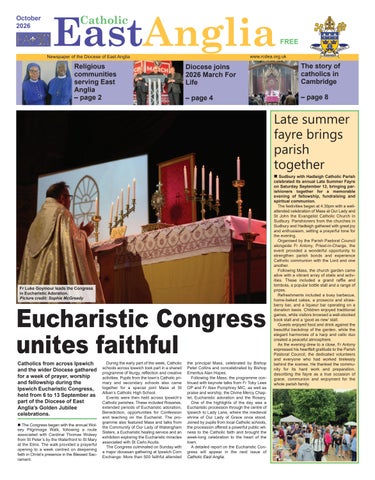
Fr Luke Goymour leads the Congress in Eucharistic Adoration. Picture credit: Sophie McGready
Eucharistic Congress unites faithful Catholics from across Ipswich and the wider Diocese gathered for a week of prayer, worship and fellowship during the Ipswich Eucharistic Congress, held from 6 to 13 September as part of the Diocese of East Anglia’s Golden Jubilee celebrations.
n The Congress began with the annual Wolsey Pilgrimage Walk, following a route associated with Cardinal Thomas Wolsey from St Peter’s by the Waterfront to St Mary at the Elms. The walk provided a prayerful opening to a week centred on deepening faith in Christ’s presence in the Blessed Sacrament.
During the early part of the week, Catholic schools across Ipswich took part in a shared programme of liturgy, reflection and creative activities. Pupils from the town’s Catholic primary and secondary schools also came together for a special joint Mass at St Alban’s Catholic High School. Events were then held across Ipswich’s Catholic parishes. These included Rosaries, extended periods of Eucharistic adoration, Benediction, opportunities for Confession and teaching on the Eucharist. The programme also featured Mass and talks from the Community of Our Lady of Walsingham Sisters, a Eucharistic healing service and an exhibition exploring the Eucharistic miracles associated with St Carlo Acutis. The Congress culminated on Sunday with a major diocesan gathering at Ipswich Corn Exchange. More than 500 faithful attended
the principal Mass, celebrated by Bishop Peter Collins and concelebrated by Bishop Emeritus Alan Hopes. Following the Mass, the programme continued with keynote talks from Fr Toby Lees OP and Fr Alex Pumphrey MIC, as well as praise and worship, the Divine Mercy Chaplet, Eucharistic adoration and the Rosary. One of the highlights of the day was a Eucharistic procession through the centre of Ipswich to Lady Lane, where the medieval shrine of Our Lady of Grace once stood. Joined by pupils from local Catholic schools, the procession offered a powerful public witness to the Catholic faith and brought the week-long celebration to the heart of the town. A detailed report on the Eucharistic Congress will appear in the next issue of Catholic East Anglia.
n Sudbury with Hadleigh Catholic Parish celebrated its annual Late Summer Fayre on Saturday September 12, bringing parishioners together for a memorable evening of fellowship, fundraising and spiritual communion. The festivities began at 4.30pm with a wellattended celebration of Mass at Our Lady and St John the Evangelist Catholic Church in Sudbury. Parishioners from the churches in Sudbury and Hadleigh gathered with great joy and enthusiasm, setting a prayerful tone for the evening. Organised by the Parish Pastoral Council alongside Fr Antony, Priest-in-Charge, the event provided a wonderful opportunity to strengthen parish bonds and experience Catholic communion with the Lord and one another. Following Mass, the church garden came alive with a vibrant array of stalls and activities. These included a grand raffle and tombola, a popular bottle stall and a range of prizes. Refreshments included a busy barbecue, home-baked cakes, a prosecco and strawberry bar, and a liqueur bar operating on a donation basis. Children enjoyed traditional games, while visitors browsed a well-stocked book stall and a ‘good as new’ stall. Guests enjoyed food and drink against the beautiful backdrop of the garden, while the elegant harmonies of a harp and cello duo created a peaceful atmosphere. As the evening drew to a close, Fr Antony expressed his heartfelt gratitude to the Parish Pastoral Council, the dedicated volunteers and everyone who had worked tirelessly behind the scenes. He thanked the community for its hard work and preparation, describing the fayre as a true occasion of grace, communion and enjoyment for the whole parish family.
Page 2
latest online news at: www.rcdea.org.uk
Catholic East Anglia – October 26
Religious communities serving East Anglia Bishop reflects on Parish social action n Sunday 15 November is the 10th World Day of the Poor, when Bishop Peter wants every parish newsletter to note the occasion and remind the parish how it contributes to accompanying, advocating for and supporting the needs of the poor. “Having seen at each of our seven deaneries’ Caritas Festivals that many parishes have their own projects and/or well-established links with food banks, night shelters, etc., I hope that the World Day of the Poor will be a chance to host and thank local charities for their work and to encourage even more parishioners to volunteer with them,” Bishop Peter has said. Looking to the future, David Livesey of Caritas East Anglia said that the World Day of the Poor and the World Day of Migrants and Refugees link to two common concerns that have arisen in discussions with Caritas in other dioceses: - Listening to and documenting grassroots lived experience to inform practice and advocacy. - Promoting the integration and participation of Catholic migrant communities in parishes. The Commission would like to encourage a pilot project in an East Anglian diocesan parish aimed at addressing one or both concerns and would welcome any thoughts on how and where this could be done.
EastAnglia Catholic
Newspaper of the Diocese of East Anglia
EDITOR: Charlie Bohan-Hurst
communications@rcdea.org.uk Articles and photographs for the next edition are very welcome and should be sent to the editor, ideally via email, by Monday, 12 October. Diocese website: www.rcdea.org.uk Advertising: Contact Nick at Cathcom on tel 01440 730399 or email him at ads@cathcom.org Publisher: Cathcom Ltd, 0207 112 6710 Inclusion of adverts is the responsibility of Cathcom and does not imply endorsement by the Diocese of East Anglia.
In his series about the religious congregations living and working in the Diocese of East Anglia, Fr Karol Porczak MS, Vicar for Religious, introduces two more communities: the Daughters of Mary Mother of Mercy in King’s Lynn and the Clerics Regular Minor in Cambridge. n The Daughters of Mary Mother of Mercy The Congregation of the Daughters of Mary Mother of Mercy (DMMM) was founded in 1961 in Nigeria by the late Rt Rev Anthony Gogo Nwedo C.S.Sp. It is an institute of apostolic religious life whose members take the three public vows of obedience, poverty and chastity. The congregation is of Pontifical Right. The primary purpose of the congregation is to bear witness to the mercy of God by following in the footsteps of Christ, the merciful Saviour, and Holy Mary of Nazareth, our Mother of Mercy. This mercy is expressed through compassion, forgiveness and kindness. The charism of the congregation is charity, humility, prayer, penance and abandonment to the will of God. These are the five foundations upon which the institute is built. The sisters strive to live an inner life of grace, a life of self-sanctification in love and humility; and, following the example of the Blessed Virgin Mary, a life of love and atonement in order to console the suffering Saviour, make reparation for offences committed against the Heavenly Father, and delight His paternal heart, thus obtaining grace from God for the conversion and salvation of sinners. The institute is a spiritual powerhouse, making its entire existence one of prayer through attentive listening to and communion with God. The sisters seek to sanctify themselves through an assiduous prayer life in order to sanctify others. The apostolate of the institute includes caring for the poor and needy, orphans and the elderly, teaching in schools and universities, working in hospitals and parishes, and social work. The sisters serve in a number of countries, including Cameroon, Ghana, Lesotho, Austria, Belgium, Germany, Ireland, Italy, Sweden, Canada, the United States and England. The DMMM Congregation came to Manchester on 7 October 1986 at the invitation of the late Bishop Grey to undertake missionary work in the Diocese of Shrewsbury. Today, there are eight communities in England: Edgware, Walthamstow, two communities in the Walthamstow area, Manor Park, Slough, Liverpool and Leeds. The sisters came to the Roman Catholic Diocese of East Anglia on 5 June 2025 at the invitation of Bishop Peter Collins. At present, two DMMM sisters serve in the Catholic Parish of Our Lady of the Annunciation, King’s Lynn: Sr Cecilia Anulichukwu Njoku DMMM, Parish Sister, and Sr Mary Jane Gratia Iwuamadi DMMM, who works at St Martha’s Primary School, King’s Lynn. They hope to welcome more sisters from their
congregation in the near future. The Clerics Regular Minor The Clerics Regular Minor (CRM), also known as the Adorno Fathers, were founded in Naples, Italy, in 1588 by St Francesco Caracciolo, Venerable Augustine Adorno and Fr Fabrizio Caracciolo. The founders were inspired by a deep desire to renew the life of the Church through prayer, humility and dedicated service. During a retreat at the Camaldolese Hermitage in Naples, they drafted the constitutions of the new congregation and entrusted its future to God’s providence. On 1 July 1588, Pope Sixtus V officially approved the order and gave it the title “Minor”, highlighting the spirit of humility the founders wished to cultivate. In addition to the traditional vows of poverty, chastity and obedience, they introduced a unique fourth vow: not to seek ecclesiastical dignities or honours. Through this commitment, the members strive to remain faithful servants of Christ, seeking not positions of prominence but opportunities to serve God’s people with simplicity and generosity. On 9 April 1589, the founders professed their vows and consecrated themselves entirely to the service of the Risen Lord. This event continues to shape the identity of the congregation today and is reflected in its coat of arms, which depicts the Risen Christ at its centre (inset in the picture). The letters AMRG, found beneath the emblem, stand for Ad Majorem Resurgentis Gloriam (“For the Greater Glory of the Risen Christ”). This motto expresses the purpose of their life and ministry. Everything they do is directed towards glorifying the Risen Christ and making His presence known in the world. At the heart of their spirituality is the Holy Eucharist. From the beginning, the founders promoted perpetual Eucharistic adoration, with devotion to the Blessed Sacrament as the source and centre of their common life. Through prayer before the Eucharistic Lord, they seek to deepen their relationship with Christ and draw strength for apostolic ministry. Their charism rests upon three fundamental pillars. The first is Eucharistic Adoration, which nourishes their spiritual life and sustains their mission. The second is humility, expressed through simplicity of life and a commitment not to seek honours or positions of authority. The third is active ministry, through which the members respond generously to the pastoral needs of the Church by serving in parish ministry, missionary activity, education, chaplaincy, and work among the poor and those on the margins of society. Over the centuries, the order has spread beyond Italy and now serves in many parts of the world,
The Adorno Fathers. including the United States, Germany, France, the United Kingdom, India, the Philippines, Kenya, Tanzania and the Democratic Republic of the Congo. Despite their diverse cultures and ministries, the members remain united as one religious family, sharing a common life rooted in prayer, fraternity and service. Their community life is not simply living together under one roof; it is a journey towards holiness. The constitutions remind them that “common is God, common the commitment to perfection, common the difficulties, common the work, common the salvation, and common at the end will be the glory”. They strive to support one another as brothers, sharing the joys and challenges of everyday life while growing together in faith. The Right Reverend Bishop Peter Collins, Bishop of East Anglia, invited the order to serve in the diocese. The first priest arrived on 16 October 2024, followed by three more confreres. They were warmly welcomed into the diocesan family and entrusted with the pastoral care of St Laurence’s Parish, Cambridge, which has now become a community of the Santhom Indian Delegation of the Clerics Regular Minor. The Superior General, Fr Theodoro Kalaw CRM, together with all the members of the order, remains deeply grateful to Bishop Peter Collins for his trust, encouragement and generous welcome. His support has enabled the new religious community to begin its ministry in East Anglia with confidence and hope. At present, four priests of the Clerics Regular Minor serve the faithful in the diocese: Fr Robin Joseph CRM (Superior) Fr Alex Sunny CRM Fr Shinto Varghese CRM Fr Jomon Thomas CRM, who resides in Bury St Edmunds.
The Daughters of Mary Mother of Mercy.
Catholic East Anglia – October 26
follow us on X at: x.com/RCEastAnglia
Page 3
St Peter’s Parish Supports Operation Christmas Child St Peter’s Catholic parish in Gorleston is once again filling shoeboxes for children through Operation Christmas Child and is encouraging Catholics across the Diocese of East Anglia to support the appeal.
n Mark and Debra are Church and Community Relations team members with Operation Christmas Child (OCC) and year-round volunteers in Norfolk. OCC is an international, non-denominational Christian charity and one of Samaritan’s Purse’s ministry projects. Each year, individuals, families, churches, schools and community groups fill shoeboxes with toys, school supplies and personal-care items. The boxes are then distributed to children around the world, offering
Fr Alvan Ibeh and attendees of the Faith Club.
a practical expression of kindness and Christian love. St Peter’s has again joined OCC this year to prepare shoeboxes for children and young people in need of love and support. In September, the parish’s faith group of children and adults assembled the pre-printed shoeboxes in preparation for their distribution to parishioners at an upcoming Sunday Mass. The filled shoeboxes will be returned to the parish during the week of 9–16 November, when they will be blessed before being sent to children around the world. Fr Alvan Ibeh welcomed Debra and Mark, as well as everyone attending the group. Mark said, “having visited this group and parish a few times it is easy to feel part of the church, due to this warmth of hospitality.” Mark and Debra gave a talk about OCC and explained the importance of each shoebox. Every box represents an individual child receiving love and hope, often at a time of loneliness, war or natural disaster. Last year, more than 12 million shoeboxes were sent around the world, including boxes from St Peter’s, other churches in Norfolk and local schools. The activity also brought different generations of the parish together. Children, parents and other members of the community worked alongside one another to assemble 100 boxes before using them to create an impressive structure. Debra said, “What fun. This
was a combined effort by all, Fr Alvan had some prizes and the game was on to make up the 100 shoeboxes and then to create a structure. The picture above, captures the heart of O.C.C. ministry taking God’s love to children and young people. This was such a good design, by one of the very enthusiastic parents. We are grateful for this group and church for their ongoing commitment to share the Gospel in such a simple way, thank you.” The parish hopes that its efforts will encourage other Catholics across the Diocese of East Anglia to take part. Parishes, schools, youth groups and families can become involved by filling individual shoeboxes, organising a collection or inviting others in their community to contribute suitable items. Taking part can provide a simple and accessible way for the faithful to put their faith into action. Every gift, however small, can help a child feel remembered and valued. It can also offer parish and school communities an opportunity to pray together for children facing poverty, conflict, displacement and other difficult circumstances. Those who are unable to fill a complete shoebox could consider contributing individual items or working with relatives, friends or fellow parishioners to prepare one together. Communities may also wish to organise a shoebox-packing event, following the example of St Peter’s, and encourage children and young people to take an active role. Anyone interested in learning more about Operation Christmas Child or involving their church, school, group or business can contact Mark and Debra Watkins at markdebrawatkinsocc@yahoo.com. Further information is available at www.samaritans-purse.org.uk.
Hope at Sacred Heart, Ramsey Around 45 people gathered in the grounds of Sacred Heart Church in Ramsey on Sunday August 23 for an afternoon of creativity, conversation and reflection. Raphael Suh and Eilish Storey report. n Participants were invited to express and share what brings hope into their lives through creative art-making. Organised by the church community and Ramsey Quiet Garden, the event was open to everyone and brought people from different communities together in a welcoming and reflective setting. Tea and cake were plentiful throughout the afternoon, which concluded with a pop-up exhibition showcasing the participants’ creative expressions. Those taking part were also able to take their canvases home as a tangible reminder of their personal reflections on hope. Reflecting on the experience, one participant said: “This felt so therapeutic, and I enjoyed embarking on this creative journey.” Another added: “It was just great coming together to create and share these perspectives on the theme of hope.”
The community event at Sacred Heart was wall attended.
Page 4
latest online news at: www.rcdea.org.uk
Catholic East Anglia – October 26
Diocese joins 2026 March For Life Laurette Burton, from the Sacred Heart of Jesus Parish in Southwold, reflects on this year’s March for Life in London, which brought together thousands of people in defence of the dignity of human life. n A total of 46 people travelled on a coach organised from the Diocese of East Anglia, boarding at either St John the Baptist Cathedral in Norwich or St Pancras Church in Ipswich. The group’s first stop in the capital was Westminster Cathedral for the March for Life Mass. Archbishop Richard Moth was the principal celebrant, with Bishop Peter Collins among 14 other bishops and 28 priests gathered in the sanctuary to concelebrate. It was a wonderful High Mass in a packed cathedral. Members of the Cathedral Choir sang, with the congregation joining in the responses. Before the final blessing, Archbishop Moth read a special message from the Holy Father, which emphasised that protecting the right to life is “the indispensable foundation for all other human rights and societal progress”. Around 10,000 people attended last year’s March, and that number appeared to have been exceeded in 2026. Participants travelled from across the British Isles, with many young people and families taking part. Among them was a 97-year-old woman who completed the March alongside her fellow participants. The occasion was even more poignant this year as it coincided with the End of Life Bill
Catholic East Anglia reaches over 7,000 Catholics in East Anglia. Contact Cathcom Ltd on 01440 730399 or at ads@cathcom.org
Mature vocations considered.
CONVENT OF OUR LADY OF FIDELITY
1 Our Lady's Close, Upper Norwood, London SE19 3FA Telephone 07760 297001
for Life UK, concluded the speeches by speaking about another court case she is due to face in January for praying silently in a public street near an abortion clinic. She also urged those present to speak out against the proposed assisted suicide legislation returning to Parliament. The Catholic bishops then came onto the stage for a period of prayer and a final blessing. Having 46 people representing the Diocese was encouraging, but it is hoped that this number might be doubled or even trebled next year, providing an even stronger witness to the dignity and value of every human life.
Bishop Peter joins other Bishops on stage at the 2026 March For Life.
090699502
Baby Loss Awareness Week is a national week of remembrance and awareness, dedicated to remembering the babies who have died and supporting the families who continue to grieve their loss.
The church needs religious sisters URGENTLY to bring Christ to others by a life of prayer and service lived in the community of Ignation spirituality. Daily Mass is the centre of community life. By wearing the religious habit we are witnesses of the consecrated way of life. If you are willing to risk a little love and would like to find out how, contact Sister Bernadette
mony. After becoming pregnant at the age of 17 and being abandoned by the father, she resolved to keep her baby. Despite tremendous pressure from her sisters to have an abortion, she persevered with the support of her mother. As her pregnancy progressed, she discovered that she was expecting twins. Her sons were delivered prematurely but were perfectly healthy. Jeff Joaquin also gave a moving testimony, describing how he had persuaded his young girlfriend to abort their child. Many years later, he came to sincerely regret his decision and gave a name to the son he would never hold or come to know. Isabel Vaughan-Spruce, co-CEO of March
Remembrance for babies lost
Want to advertise?
Our Lady of Fidelity
being brought before Parliament once again, highlighting the importance of defending the dignity of human life at every stage. The March concluded in Parliament Square, where speakers addressed the impact of abortion on individuals and families. Caroline Farrow focused on the theme of the March, “Abortion hurts the family”. She highlighted figures showing that 277,970 abortions were recorded in England and Wales in 2023 and spoke about how abortion can affect entire families, particularly when women who undergo a termination already have children. Nanaya shared her “Choose Life” testi-
n This year, it takes place from 9 to 15 October and is an opportunity to break the silence, raise awareness and remind bereaved parents that they are not alone. A Mass of Remembrance was held at St Edmund’s Catholic Church in Bungay, at which people from across the Diocese gathered to pray for babies lost through miscarriage, stillbirth or neonatal death. The Mass offered the opportunity to acknowledge a form of grief often carried quietly and privately. The readings (Jeremiah 1:4–9; Luke 1:39–56) reminded us of God’s faithful presence with us and that Jesus himself took flesh in the womb of the Virgin Mary, affirming the sacredness of human life before birth. Music played an important part, with the choir leading the congregation in singing that added to the atmosphere of reflection and hope. In his homily, Fr Simon reflected on Chris-
tian hope in the midst of sorrow. Drawing on the Gospel and the Church’s faith in the resurrection, he acknowledged the deep pain experienced by parents and families, while encouraging them to entrust their children to God’s loving mercy. He spoke of Christ’s closeness to all who grieve, reminding us that, although such losses can leave unanswered questions and lasting sadness, faith assures us that love is stronger than death and that God never abandons those who mourn. He also reflected on the dignity of every human life from the moment of conception and the importance of acknowledging the grief caused by miscarriage, stillbirth and neonatal death. He spoke of the tendency in modern society to minimise or avoid acknowledging such losses, suggesting that many people find it difficult to recognise the full humanity of unborn children or the depth of sorrow experienced by their families. He emphasised that babies are real human beings who receive and respond to love, and that the loss of a child before or shortly after birth is a genuine bereavement that affects not only mothers but whole families. Fr Simon also referred to scientific and psychological research affirming that unborn children are responsive to their surroundings and suggesting that early experiences can
leave profound impressions on human life. Encouraging those present to speak with compassion and courage about the value of life, he concluded by affirming that the Church remembers and honours every child whose life, however brief, is precious in the sight of God and that no experience of loss is beyond his love and compassion. After the final blessing, each person was offered a white carnation as a symbol of remembrance, love and the dignity of the life of every child. Many stayed afterwards for refreshments provided by parishioners, offering time to talk and support one another. The Mass was a loving reminder that the Church walks alongside those who grieve and that every human life, however brief, is cherished by God. If you have been affected by the loss of a loved one and would like to talk to someone in a compassionate Catholic environment, please contact the Diocese’s Listening and Prayer Ministry, contact details on the website.
Catholic East Anglia – October 26
like us on Facebook at: www.facebook.com/CatholicEastAnglia
Page 5
The Rosary of Cardinal Bourne In this reflective article, John Holden of Sacred Heart, North Walsham, shares the remarkable story of his father’s discovery of Cardinal Francis Bourne’s rosary and offers a personal encouragement to rediscover the spiritual treasure of praying the Rosary. n Now, my dad was a bit of a hoarder. He collected old things, and TV programmes such as Going for a Song (for those of you who can remember it), and more recently The Antiques Roadshow had his undivided attention, as you can imagine. He loved going to auctions and sales. However, he got no sympathy from my late mother what so ever and when he returned home with an item or two or may be more, she raised her eyes to heaven, sighed and said “More junk!” Then one day an unusual “lot” was presented in the sale room: the Rosary of Cardinal Francis Alphonsus Bourne. He bought it, together with a caricature of the Cardinal in the lot. I don’t know how much he paid for it, but it wasn’t until he passed away that I ever saw it. It was my late mother who dug them out of a box one day and handed them to me. We both realised that we were not talking about “junk” this time. Of course, my first reaction
was, “Is this the genuine item?” My mother told me it was because my father had shown them to my parish priest just after he bought them, and he confirmed that they were genuine. I had never seen a rosary like it before: big black beads and four large medals. I just wondered if he took the beads into the Conclave in Rome. Are the medals gold? I think two probably are, but poignantly, it reminded me of when Jesus told the parable about the Kingdom of Heaven, when a man went digging in a field and found treasure. He buried it and then bought the whole field (Matthew 13:44). Well, I haven’t buried the rosary, you may be glad to hear, but I have found that reciting the Rosary every day is the real treasure in the whole field. I was born on 7 October, the Feast of the Holy Rosary, and I can remember, in my first year at school, Miss Cross, the headmistress of St Joseph’s Infant School in Heywood, Lancashire, coming into the classroom selling us rosary beads. They were 3d (the old threepenny bit, 2½p). It was very much pink rosaries for girls and blue ones for boys. Don’t ask me how I got sold a pink one! Nevertheless, this was my first rosary and I still use it today. It was ironic that my old school, which now serves as a parish centre, was opened by Cardinal Bourne, I think, in 1928. So, how do you fare with the Rosary? It takes a lot of concentration, and some people shy away from reciting the Rosary because they say they can never meditate on the mys-
teries at the same time as reciting the prayers. I used to have this “hiccup” when reciting. One way to overcome this is, instead of concentrating fully on the prayers with the mystery in the background, turn it around so that you are concentrating on the mystery, with the prayers going on in the background. “But my mind goes blank during a decade.” Then start the decade again. You can also try announcing to yourself each decade as you pray, i.e. “The Third Sorrowful Mystery – the Crowning with Thorns.” To keep your mind more in tune, announce it again just before each Hail Mary. This will help you focus on the treasures the mystery contains. Another way to maintain concentration is to say it out
loud when you are at home. A short Scripture reading is an advantage as a prelude to the mysteries and will clear your mind and remind you of what you are seeking. Some parishes have rosary groups and often recite the Rosary before Mass, especially during the month of October. Get involved with your group. Never give up if you should lose concentration whilst reciting. Remember, you are giving up your time in honour of Our Lady and Our Lord, and I find they always bring my thoughts back to the task at hand at some point during the decade. With October almost upon us its time to go digging in that field!
The medals of the Rosary of Cardinal Bourne.
Page 6
Pilgrims walk the Gospel through Norfolk n An annual pilgrimage through North Norfolk has brought Scripture, prayer and Christian unity together as pilgrims walked from Walsingham to Wells-next-the-Sea, reading the whole of St Mark’s Gospel along the way. The pilgrimage has become a developing tradition in the Catholic community in North Norfolk, with participants setting out each year with a simple but ambitious aim: to read an entire Gospel together while journeying through the churches and countryside between Walsingham and Wells. Last year, pilgrims travelled from Wells to Walsingham. This year the route was reversed, beginning at the Catholic Church of the Annunciation in Walsingham and finishing around eight hours later at the Church of Our Lady Star of the Sea in Wells-next-the-Sea. St Mark’s Gospel was chosen as the spiritual companion for this year’s journey. Its 16 chapters lent themselves particularly well to a day in which walking, Scripture and prayer alternated along the route. At each stopping point, pilgrims read a chapter of the Gospel, reflected upon it and prayed together, often using a Taizé chant, before continuing their journey. The route reflected the rich Christian heritage of North Norfolk, taking the pilgrims through Catholic, Anglican, Methodist and Orthodox churches, as well as a Quaker Meeting House and two village cemeteries. Although this year’s group was made up of Catholics, the pilgrimage had a strongly ecumenical character. By crossing the thresholds of churches belonging to different Christian traditions, the pilgrims were reminded of the shared Gospel which lies at the heart of Christian faith. Dr Ian Watson, County Ecumenical Officer for Norfolk and Waveney, who took part in the pilgrimage, reflected that Christian unity is not only something to be discussed through formal dialogue, but also something towards which Christians can journey together. Each church visited retained its own distinctive history and identity, while bearing witness in its own way to Christ and the Gospel being proclaimed by the pilgrims. The group was blessed with glorious weather, allowing participants to enjoy the North Norfolk countryside at its best. Visitors to the county who had heard about the pilgrimage also joined the walk. By the time the pilgrims reached Wells, they had not only completed the whole of St Mark’s Gospel but had also encountered something of the remarkable Christian landscape of North Norfolk. The pilgrimage offered a reminder that journeys of faith are rarely made alone and that, step by step, Christians can grow closer both to Christ and to one another.
latest online news at: www.rcdea.org.uk
Catholic East Anglia – October 26
Joint Mass for Ipsw schools
Fr Luke Goymour celebrating the first joint Mass for catholic schools in Ipswich.
On Wednesday 9 September, St Alban’s Catholic High School was privileged to host a special Mass bringing together all the Catholic schools from across Ipswich as part of the weeklong celebrations for the Eucharistic Congress taking place in the town. n The celebration marked a significant moment for Catholic education in Ipswich, as pupils from St Mary’s Primary School, St Pancras Primary School and St Mark’s Primary School joined students from Years 7 and 12 at St Alban’s for a shared act of worship. It was the first time that all the Catholic schools in Ipswich had gathered for one Mass, making the occasion a powerful expression of faith, unity and community. The Mass also formed part of the celebrations marking the Golden Jubilee of the Diocese of East Anglia, which is taking place alongside this year’s Eucharistic Congress. As the Diocese gives thanks for 50 years of faith, mission and service, the gathering of young people from across Ipswich’s Catholic schools provided a fitting sign of the vibrancy of the
Church today and the important role that Catholic education continues to play in forming future generations. Mass was celebrated by Fr Luke Goymour, the principal celebrant, with Fr Michael Smith of Felixstowe concelebrating. Students participated prayerfully throughout the liturgy, joining together in hymns, readings and prayers that
reflected the central role of the Eucharist in Catholic life. In his homily, Fr Luke spoke about the importance of the Eucharist and why it remains at the heart of the Catholic faith. Addressing the young people gathered before him, he encouraged them to recognise the gift they receive in the Mass.
Catholic East Anglia – October 26
follow us on Instagram at: instagram.com/catholiceastanglia/
wich catholic s
Page 7
Bishop Peter’s engagements SEPTEMBER Sep 25, Fri Bishop to celebrate Annual Schools’ Mass at 12.00 in the Cathedral Sep 26, Sat Bishop to attend Caritas Steering Committee from 11.00 in Poringland Sep 27, Sun Bishop to celebrate a Golden Jubilee Anniversary Mass at 11.00 at the Sacred Heart, St Ives Sep 29, Tues Bishop to celebrate Confirmation Mass at 19:00 at St Mary’s Church, Great Yarmouth
OCTOBER Oct 2, Fri Bishop to attend Walsingham Trustees Meeting including Mass at 10.00 in Walsingham Oct 3, Sat Bishop to celebrate Annual Gathering of Deacons, Wives and Students in Formation for the Diaconate at 11.30am in the Cathedral Bishop to celebrate the Feast of St Francis of Assisi transitus at 14.00 in the Cathedral Oct 6, Tues Bishop to attend Bishop’s Council at 11.00 in Poringland Oct 8, Thurs Bishop to attend Meeting of the Deans at 11.00 in Poringland Oct 12, Mon Bishop to attend Vocations Committee Meeting at 11.00 in Poringland Oct 13, Tues Bishop to attend the Bishops and Staff Meeting at 10.00 at Oscott College Oct 15, Thurs Bishop to attend the Schools Commission Meeting at 11.00 in Poringland Oct 17, Sat Bishop to attend Holy Qurbana (Mass) celebrated by His Eminence George Cardinal Koovakad, Prefect of the Dicastry for Interreligious Dialogue at 10.00 at Our Lady Immaculate Catholic Church, Surbiton “The Eucharist is where we meet Jesus in a unique and personal way,” Fr Luke said. “Every time we come to Mass, we are invited to draw closer to Him and to be strengthened by His love.” Reflecting on the significance of the Eucharistic Congress, he reminded students that the Eucharist is not simply a tradition of the Church, but the foundation of Christian life. “The Eucharist is central to who we are as Catholics. It is the source of our strength, our unity and our mission. Through the Eucharist, Christ gathers us together and sends us out to be His presence in the world.” Fr Luke also highlighted the significance of seeing pupils from different schools worshipping together. “Today is a wonderful sign of what the Church is meant to be. Although you come from different schools and parishes, you are united by the same faith and by the same Lord whom we receive in the Eucharist.” His message resonated strongly with the theme of the Congress, which seeks to deepen understanding of and devotion to the Blessed Sacrament. The sight of children and young people from across Ipswich praying side by side offered a visible witness to the unity that the Eucharist creates within the Church. The Mass formed an important part of the wider programme of events taking place
throughout the week. Across Ipswich, schools, parishes and parishioners have been participating in celebrations, prayer gatherings and opportunities for reflection centred on the gift of the Eucharist. The gathering at St Alban’s ensured that young people played a central role in these celebrations. For many students, the occasion provided a valuable opportunity to experience being part of the wider Catholic community beyond their own school. The event highlighted the strong relationships that exist between Catholic schools across Ipswich and demonstrated their shared commitment to nurturing faith in young people. The success of the celebration was made possible through the efforts of clergy, staff and students, who worked together to prepare the liturgy and welcome visitors from across the town. Their dedication helped to create a joyful and prayerful atmosphere fitting for such a historic occasion. As the first Mass to bring together all of Ipswich’s Catholic schools, the celebration will be remembered as an important milestone. It was a fitting contribution to the Eucharistic Congress and a powerful reminder that the Eucharist remains the source and summit of Catholic life. Above all, it was a joyful witness to the unity, faith and hope shared by the Catholic school communities of Ipswich.
Oct 18, Sun Bishop to celebrate Mass for the arrival of the National Fatima Pilgrim Statues at 11.00 at the Cathedral Oct 19, Mon to Oct 21, Weds Bishop to attend the Ongoing Formation Study Conference at High Leigh Conference Centre Oct 22, Thurs to Oct 23, Fri Bishop to attend EWARC meeting at The Hayes, Derbyshire Oct 24, Sat Bishop to attend Parish Safeguarding event at 10.00 in Newmarket Oct 27, Tues to Oct 31, Sat Bishop to attend Diocesan Pilgrimage to Rome
NOVEMBER Nov 1, Sun Bishop to celebrate Solemnity of All Saints Solemn Pontifical Mass at 11.00 at the Cathedral Nov 2, Mon Bishop to celebrate Commemoration of the Faithful Departed (All Souls) Solemn Pontifical Requiem Mass at 10.00 at the Cathedral Nov 3, Tues Bishop to attend Bishop’s Council at 11.00 in Poringland
Page 8
latest online news at: www.rcdea.org.uk
Catholic East Anglia – October 26
The story of catholics in Cambridge Monsignor Anthony Rogers traces the growth of the Catholic communities in Cambridge and St Ives from small and often persecuted beginnings to the thriving, diverse parishes of today. n In mediaeval times, the town of Cambridge – it didn’t acquire city status until 1951 – boasted thirteen colleges of the University, all religious foundations, and sixteen parishes. But it was a town that embraced the European Reformation, to the extent that it was referred to from the 1520s onwards as ‘Little Germany’, thanks to the support of figures such as William Tyndale, Thomas Cranmer and Hugh Latimer for Lutheran ideas. But, by the century before Catholic Emancipation in 1829, the small number of Catholics in the area found that good sense and humanity on the part of the authorities left them, for the most part, undisturbed. A mere handful of individuals was unlikely to pose a threat to the government of the day or the established Church of England. A Jesuit priest resided at Sawston Hall, and Catholics living within reach were admitted to Mass. From the 1820s onwards, various hopes of establishing a mission were expressed, but nothing bore fruit until the acquisition of land in Union Road and the subsequent building of a church dedicated to St Andrew, designed by the architect Augustus Welby Pugin and opened in 1842. Missions were not territorial but gave those living within striking distance the opportunity to go to Mass. Those in charge of the missions were called ‘missionary rectors’. Parishes, as we know them, with defined boundaries, were not established until 1918. The native Catholic population of Cambridge and the surrounding district was minuscule, but some Irish people came to work in the area before the Great Famine of 1849 because, although not starving, they were nonetheless poor and in search of a better life. Some stayed permanently, while others came as seasonal workers on the land, to drain the Fens or to build roads. When St Andrew’s Church was opened, a regular congregation of about a hundred came to Mass. Anti-Catholic feeling in the area was strong, and there were various attempts to vandalise the new church. However, the Vicar of St Paul’s Church nearby, who shared those sentiments, was gracious enough, upon his departure to become Bishop of Melbourne, to remark that during his ministry in the area he had ‘made every effort to put down popery and failed’. Nevertheless, he recognised that the Catholics were there to stay and hoped that all would learn to live in peace with one another. Between 1843 and 1961, the community was served by just four missionary rectors or parish priests, namely Canons Quinlivan, Scott, Marshall and Stokes. Catholic undergraduates were served by chaplains living at the Rectory in Hills Road, St Edmund’s House and, ultimately, Fisher House. St Laurence’s Parish Our Lady and the English Martyrs (henceforth referred to as ‘OLEM’) served the whole town and surrounding villages. But, by the 1920s, a need was felt for the provision of Mass for those living north of the River Cam.
This was first provided by the community and chaplain at the Carmelite convent established in 1925. By 1937, the sisters had found it to be too noisy a site, and they moved to Waterbeach. Through the generosity of a donor, provision was made for a modest church to be built in the area. A prefabricated building – often called a ‘tin tabernacle’ when used as a church – had begun its life as a ward in the huge Great Eastern Field Hospital, providing care for wounded servicemen during the First World War, and later served as the Catholic Men’s Club. It was moved to the High Street in Chesterton in 1939 and served the community until it, in turn, was replaced by the permanent brick building in Milton Road, completed in 1958 and dedicated, like its predecessor, to St Laurence. Its final destination was Ditton Lane, where it serves the thriving local community as St Vincent’s. St Philip Howard Parish Development on the southern side of the city was slower and, before the building of the church in 1978, Mass centres were to be found in various places, ranging from St Bede’s School to St Mary’s Church, Linton, and St Vigor’s, Fulbourn. The site for the present church had been bought from the council for £750 but lay dormant until the 1970s when, following a series of meetings with the parish priest at OLEM, Canon Paul Taylor, about the wisdom and feasibility of building a new church, a decision was taken to proceed with a dual-purpose building. Though not prepossessing to look at, the church was to have bespoke sanctuary furniture, with commissioned artwork by Anton Wagner, a Norfolk-based, Oberammergauborn woodcarver. Over the years, the parish grew, with a large influx in the early 21st century of people from Europe, Africa and Asia, with the Keralan Syro-Malabar community forming the largest group. Thanks to the hard work of parishioners and financial support from John Latham Senior and Junior, Fr Philip, the parish priest, was able to proceed with an ambitious rebuilding programme. The church closed in January 2025, and the parish returned on Palm Sunday 2026 to the fine, modern Syro-
Malabar and Latin-rite building gracing Cherry Hinton Road. Religious communities The academic pull of the town and increasing pastoral needs brought, over the years, a number of religious communities. Male religious included Dominicans, who remain a prominent Catholic presence in their priory off Huntingdon Road; Franciscan Friars Minor; De La Salle Brothers; Irish Christian Brothers; Jesuits; English Benedictines; and, since 2024, the Adorno Fathers, who have pastoral care of St Laurence’s. Female religious have been part of life in all three parishes, with the Congregation of Jesus, Dominicans and Daughters of Divine Charity currently in English Martyrs Parish, and the Holy Family Sisters at Hope House. The Canonesses of St Augustine and Adoration Sisters were also present until recent times. In St Laurence’s Parish were the Carmelites, while in St Philip Howard Parish were the Sisters of Our Lady, previously at St Edmund’s House, and the Religious of Jesus and Mary. All have, in different ways, contributed much to the Catholic community. Schools St Andrew’s all-age school, for pupils from Reception to age 15, was the only state school until the building of St Bede’s Secondary School in 1962 and St Laurence’s Primary School in 1968. With falling numbers in the 1980s, the future of St Bede’s did not look secure. However, imaginative thinking on the part of Mgr Paul Hypher and others, together with a partnership with the Anglican Diocese of Ely, resulted in the establishment in 1988 of St Bede’s Inter-Church School, now a thriving place of education with approximately 950 pupils. Some concluding thoughts Almost three and a half thousand Catholics go to Mass on Sundays, with a further 300 in St Ives. This is a far cry from the 100 or so in both places when Mass was first celebrated regularly. Until the beginning of this century, the majority of Catholics who were not English and came from Ireland – the overwhelming number of whom came from about six villages in North Mayo – Italy and Poland. Theirs were the names that reson-
ated in our schools. But our community is now truly international, and we are much the richer for it. In earlier days, hostility towards Catholics was evident. However, in the latter years of the 20th century, the Catholic parishes in the Cambridge and Sawston area were able to celebrate Mass in no fewer than seven Anglican parishes – evidence of barriers broken down and bridges built. With increased lay involvement and initiative, under God’s grace, we grow in his way. St Ives In 1890, St Andrew’s Church was replaced by what is known as OLEM, the building of which was made possible through the generosity of Mrs Yolande Lyne-Stevens, widow of a man reputed to be among the richest in England, who had amassed his fortune through his glassmaking business. The only artefact from the Pugin church to be incorporated into the new building was the St Andrew’s cross. Bizarrely, the old church stood redundant next to the new one for twelve years. In 1902, it was demolished and transported by river to St Ives, then in the county of Huntingdonshire, at the expense of George Pauling, a local benefactor. The Cambridge white bricks were replaced with red ones, and most of the internal fittings, including the altar screens, were sold. The most important survivals from St Andrew’s, rededicated to the Sacred Heart, were three stained-glass lancet windows. Like Cambridge and other towns in Fenland, Catholicism was, for a time, almost extinguished in St Ives. While Cambridge itself had an influx of Irish workers early in the 19th century, it was not until the latter part of the century that drovers began coming regularly from Ireland and Lancashire to the cattle markets in St Ives, expressing the hope that Mass would be provided. The same George Pauling who had facilitated the removal of St Andrew’s Church secured some land and a small wooden building that served the people until the Pugin church was rebuilt. Thereafter, the community grew and, since 1900, it has been served by fourteen different priests.
Mass at OLEM.
Catholic East Anglia – October 26
follow us on X at: x.com/RCEastAnglia
Page 9
St Anthony’s marks diocesan jubilee Parishioners, families and friends gathered at St Anthony’s Church in Fakenham for a joyful summer BBQ to celebrate the 50th anniversary of the Diocese of East Anglia. n The event brought together members of the parish community for an afternoon of fellowship, good food and shared celebration. The gathering was hosted by parish priest Fr Dominic Amoah, and parishioners were delighted to welcome back former parish priest Fr Andrew Neate for the occasion. Visits from priests from neighbouring parishes and several sisters from the Community of Our Lady of Walsingham added to the sense of occasion and were greatly appreciated by all who attended. There was an excellent turnout, with many families present and plenty of activities to keep the younger members of the parish entertained. Alongside the celebrations, the parish took the opportunity to raise funds towards the restoration of its much-loved stained-glass
windows. These historic windows, installed in 1905, were produced by the renowned church stained-glass makers Jones & Willis and feature the arms of Bishop Arthur Riddell of Northampton, Pope Pius X and the Diocese of Northampton, of which Norfolk then formed a part. Sadly, the windows have deteriorated significantly over the years and are now in urgent need of repair. The cost of the restoration work is close to £40,000 and is beyond what the parish can currently afford, making fundraising efforts such as the BBQ an important step towards preserving this beautiful part of St Anthony’s heritage for future generations. While the scale of the work required remains daunt-
ing, the parish hopes that the wider community may help secure the future of these
remarkable windows for generations to come.
Fakenham parishioners enjoying the BBQ.
Vocations focus: Sr CatherineMaria As the Diocese of East Anglia continues to celebrate its 50th Jubilee Year, we are shining a spotlight on the people who live out their vocations in service to our diocesan family. Each month, we meet a member of our clergy or someone in formation, reflecting on their call, their ministry and their hopes for the future. n This month, we hear from Sr CatherineMaria from the Community of Our Lady of Walsingham, who shares how her vocation first took shape, what inspires her today, and why fostering vocations remains vital to the life of our diocese. “I never discerned a religious vocation during my childhood or teenage years. I can now see hints of it from about the age of 11, but I was focused on having a career and entering the world of work. When I was young, I wanted to be a vet, a jockey or a pilot, and then, in my late teenage years, I wanted to be an investment or corporate banker. The thought of being a nun was not something that ever crossed my mind. I firmly believed in God but couldn’t see how I could be my energetic and adventurous self in the Church and local parish, which, at that time, felt a bit rigid and stale. I stopped attending Mass in my late teenage years but hoped to return after university. University went well, but as time progressed, I felt an ever-growing hole within me and could feel the absence of God in my life. After university, I returned to the sacraments and sought out good Catholic friends my own age. I attended young adult retreats and, on the weekend of the canonisation of St John Henry Newman, I first heard about consecrated virginity and felt the first stirring
in my heart to ‘leave all and follow Christ’. Some of my closest friends were the first to hear about this little flame in my heart. This small flame slowly grew, and I researched different orders online and compared their schedules and ways of life, but didn’t contact any of them until one day my dad asked me, ‘Are you going to get off the fence, start visiting and make a decision?’ I then visited five different orders and met the Community of Our Lady of Walsingham. Within a day of staying in its convent, I knew that this was the place where God was calling me to discern. I was ready to enter straight away and follow God’s call, but was wisely advised to discern externally for a year. I’ve been in the Community for three years now and am a temporarily professed sister. What I have enjoyed most is working with young people and accompanying them in their search for and journey towards God. We do this by visiting schools and organising and attending young adult retreats, and I am also an assistant university chaplain. In the Community, I’ve learnt a lot about myself and my strengths and weaknesses. I’ve also learnt new skills and visited new countries. I’ve grown and changed since first discerning a call and entering my Community. We are real with each other and
think differently, but there is genuine friendship and love between us. God has truly been my strength and rock throughout my journey. For those who may be beginning to question whether they have a vocation to religious life or the priesthood, I would say: don’t wait! God truly brings us our greatest joy and happiness, and seriously considering this option will either help you to enter now or realise that God is calling you to another vocation, such as marriage. By asking this question now, God will bless you abundantly in whatever vocation you are
truly being called to, as God is never outdone in generosity! Parishes can help with discernment by promoting holiness among young people through catechesis, prayer and fun. Having a youth group or young adult group allows people to find peers with whom they can journey on their way to holiness. I feel optimistic about an increase in younger vocations to all states of life, as God always calls; we need only listen and have the courage to say yes.”
Page 10
latest online news at: www.rcdea.org.uk
Catholic East Anglia – October 26
Bishop celebrates migrant communities Sunday 27 September is the 112th World Day of Migrants and Refugees. Pope Leo’s message, which has the theme “Even just one of these children”, draws our attention to the minors directly involved in the experience of migration and flight, to the care owed to them and to the Lord’s promise that “whoever receives one such child in my name receives me” (Mk 9:37). n Bishop Peter, having noted that several parishes have a well-established custom of holding an International Mass on a regular date that may not be the same as the World Day of Migrants and Refugees, has said that, while it is not his intention that they should change their practice, “I want to encourage every parish to formulate their own celebration of our migrant communities.” He hopes that every parish newsletter for Sunday 27 September will note that it is the World Day of Migrants and Refugees and remind the parish when and how it marks and celebrates the welcome it has given to new migrant communities and the contributions those communities have made to the life of the parish. Caritas Social Action Network (CSAN) has also issued a statement for the World Day of Migrants and Refugees, calling Catholics to
prayer, reflection and solidarity with migrant children and young people. CSAN has produced a guide for parishes and catechists, which explores Catholic social teaching on migration, highlights the challenges facing migrants and refugees, particularly children, and suggests practical ways in which individuals, parishes and Catholic institutions can offer support. David Livesey of Caritas East Anglia said that, in his recent encyclical Magnifica humanitas, the Pope observed: “A litmus test for social justice today is the treatment of migrants, refugees and those forced to move due to poverty, violence, climate change and environmental disasters. The way a society treats them reveals whether its sense of justice is driven by fear or by the spirit of fraternity. Pope Francis urged us to see migrants not simply as a problem to be managed, but as a living image of the People of God on the move. They are people with dignity, resources and dreams, who have the right to be treated with respect and to ask to become active members of the societies that welcome them” (para. 81).
The annual Mass for Migrants is a joint celebration hosted by the Dioceses of Brentwood, Westminster and Southwark. Celebrating the Feast of St Joseph the Worker,
this vibrant event highlights the profound contributions that migrant communities make to the faith, life and economy of the UK.
International Mass in Bury St Edmunds.
East Anglia Lourdes Pilgrimage In 1858, Our Lady asked Saint Bernadette to “tell the priests to bring people here”. For 125 years, people from the UK have answered that call by travelling with the Catholic Association (CA) Pilgrimage to Lourdes. n In 2026, as the Diocese of East Anglia celebrated its 50th anniversary, the CA pilgrimage was led by Bishop Peter Collins. Around 90 pilgrims from the Diocese joined this great tradition for a week filled with prayer, friendship, service and moments of profound grace. As part of the Catholic Association, the East Anglian pilgrims joined hundreds of others from across the UK. Assisted pilgrims, young people, families, clergy, religious and volunteers formed a community united in faith. This sense of fellowship could be seen everywhere: in the busy Accueil, at the peaceful Grotto and in the conversation and friendship shared over meals. Assisted pilgrims were cared for with great kindness by nurses, doctors and helpers. Many spoke of how supported and loved they felt throughout the week. Lourdes shows the Church at her best, serving others with dignity and joy, and the volunteers demonstrated this beautifully. The CA Youth Section brought wonderful energy to the pilgrimage. Whether pushing wheelchairs, singing at Mass or performing small acts of kindness, its members showed how joyful faith can be. Their pres-
ence was a sign of hope. Saturday began with the Gathering Mass, during which the hands of helpers were anointed for their service in the week ahead. Sunday brought the International Mass in the Underground Basilica, attended by 25,000 pilgrims, followed later by the Blessed Sacrament Procession. That evening, the East Anglian pilgrims gathered for a joyful welcome reception, during which they also celebrated two special birthdays. On Monday, the Diocesan Mass was celebrated in the Crypt Chapel, just above the Grotto. After Mass, the group gathered for a photograph and Bishop Peter blessed the diocesan candle. It was later placed in the Candle Chapel to burn for the intentions of the pilgrims and all those who had asked for their prayers. Tuesday marked the 125th anniversary of the CA Pilgrimage, celebrated with Mass and the Anointing of the Sick at the Bois Saint-François. Everyone present received an Apostolic Blessing before gathering for a festive meal. That evening, the diocesan pilgrimage group led the Torchlight Procession. Wednesday included Mass at the Grotto and a moving Reconciliation Service. Many pilgrims found moments of healing and peace as they stood where Our Lady appeared to Bernadette, praying for loved ones and for strength and hope. Thursday, the final full day, included the Water Gesture and, for some, the opportunity to take part in the full-immersion baths, which have now resumed following their suspension during the Covid pandemic.
The pilgrimage concluded with the Children’s Mass of Thanksgiving, filled with joyful singing, including an unforgettable rendition of “Rise and Shine!” Lourdes is a place where faith becomes visible. The Torchlight Procession, with thousands of candles illuminating the night, reminds pilgrims that faith is shared rather than hidden. Hearing the Rosary prayed in many languages and seeing pilgrims from around the world demonstrated the beautiful unity of the Church. Lourdes is a place where differences fade and hearts draw closer together. The pilgrims returned to East Anglia grateful for the peace of Lourdes, the friendships formed, the generosity of the volunteers and the gentle presence of Mary, who always leads us to Christ. Many came home strengthened, comforted and renewed in faith. The Diocese of East Anglia warmly invites pilgrims to join its next pilgrimage to Lourdes from August 20 to 27, 2027. Whether you have visited many times or are considering coming for the first time, you will be warmly welcomed. Lourdes is for anyone seeking peace, healing, renewal or simply a deeper awareness of God’s love. Assisted pilgrims will be cared for with compassion and dignity. Young people will discover how service can
transform their faith, while families will experience a week of prayer, joy and togetherness. Anyone who is curious will find a place of welcome and grace. Travelling once again with the Catholic Association, the 2027 pilgrimage will offer community, prayer, service and the opportunity to step away from daily life and enter a place where heaven feels close. Pilgrimage is a step of faith and a choice to open one’s heart to God’s grace. Lourdes has a way of giving pilgrims what they did not know they needed: peace, courage, healing or simply the joy of knowing that they are loved. If you feel even a small pull towards Lourdes, trust it. Perhaps Our Lady is inviting you. Perhaps Christ has something waiting for you there. Come as you are, with your hopes, burdens, questions and gratitude. Lourdes welcomes them all, and so do we. For more information, contact Deacon Huw Williams at Huw.Williams@RCDEA.org.uk or leave a message on 07399 163718.
Picture credit: Clifton Diocese.
Catholic East Anglia – October 26
like us on Facebook at: www.facebook.com/CatholicEastAnglia
Page 11
St Laurence’s celebrates St Louis and St Patronal Feast Day Faith in the Home
Zélie Martin
n In this Faith in the Home article, a parishioner reflects on how St Louis and St Zélie Martin show modern families that the joys and challenges of marriage, parenthood and daily life can provide a path to holiness. Their daughter, St Therese of Lisieux, celebrates her feast day on 1 October. Reading non-fiction theology can be tough, so, as a working mum with little time to read, I want something that is fruitful and helps me to grow in holiness, while also being relatable. I found exactly that in the book The Extraordinary Parents of St Thérèse of Lisieux: Sts Louis and Zélie Martin by Hélène Mongin. St Louis and St Zélie were a married couple who both worked and raised a large family. They understood the chaos of running a business alongside family life, the challenges of parenting in an increasingly secular world and the devastating grief of losing four children. Yet they show us that daily toil, family responsibilities and health issues are not obstacles to holiness; they can actually be our way to heaven. Their secret was putting faith at the centre of everything: their marriage, family and relationships with others. They taught their children to love Jesus and His mother, to pray, forgive, be humble and show kindness. Most importantly, they led by example through daily Mass, caring for the poor, helping those in need and trusting God even amid profound suffering. They did not become saints because their daughter was a saint. In fact, Zélie died in 1877, when Thérèse was only four, so you could almost say the opposite is true. St Thérèse deeply admired her parents, saying: “The Good God gave me parents more worthy of heaven than of earth.” Their joyful trust was tested repeatedly by the deaths of their children, yet Zélie found consolation in knowing that they were with God. Their story is a powerful reminder that we do not become saints despite marriage and family life, but through them. Their feast day, 12 July, was chosen because it is their wedding anniversary. As Pope Leo XIV reminded us on the tenth anniversary of their canonisation, their example remains deeply relevant today. Meanwhile, I’m looking forward to visiting their home in Alençon and their relics in Lisieux with my husband, hoping to follow a little further in their footsteps.
n Parishioners at St Laurence’s came together for a joyful celebration of their patron saint on Sunday August 9. At all Sunday Masses, the parish celebrated the Feast of St Laurence in anticipation, giving the community an opportunity to honour their patron and give thanks for his example of faith, courage and service. The celebrations also included a particularly happy occasion as a couple received a special blessing to mark more than 50 years of marriage, with fellow parishioners joining them in giving thanks for their many years together. Following the Masses, Parish Priest Fr Robin Joseph CRM and parishioners continued the festivities with a Bring and Share BBQ. It was a fitting, if slightly cheeky, choice for a parish dedicated to St Laurence, a deacon of Rome who was martyred in 258 and is traditionally believed to have met his death on a gridiron.
The afternoon had the atmosphere of a true parish celebration. Karaoke gave the more musically confident members of the congregation an opportunity to perform, while bubbles entertained the children and more than a few adults. The gathering also provided a valuable opportunity for people who usually attend different Masses to meet, talk and enjoy one another’s company, strengthening the sense of belonging to one parish family. Fr Robin added a personal touch to the celebrations by showing parishioners around his vegetable and herb garden, the fruit of many months of hard work. Guests were able to see the plants he has been
nurturing, with plenty of admiration for what had been grown. It was a fitting celebration of a saint remembered for his generosity, courage and good humour, and a joyful reminder that a parish feast day is also an opportunity to celebrate the faith and fellowship of the whole parish community.
St Laurence’s parishioners enjoying the BBQ.
Fr Alvan Ibeh: We are only walking miracles In his regular column Fr Alvan Ibeh reflects on how every breath, struggle overcome and new day reveals that each of us is a walking miracle sustained by God’s grace. n A few weeks ago, I had an experience at the hospital that gave me the insight that led to this reflection. One thing I enjoy about my work as a hospital chaplain, working two days at the hospital, is that, at the end of every day’s work, I will always go home with something to reflect on. On this fateful day, I arrived at work and was told that a family had just lost someone and would like me to come and pray for the person who had just passed away and give the family pastoral support. After the encounter, I went back to the office. While reflecting on this encounter with another chaplain, she said something that struck me and became the topic of this article. She said to me, “You know, we are all like walking miracles.” I wrote that down immediately. I had never thought of this before; have you? How often do we find ourselves praying for a miracle? We ask God to open doors, heal broken hearts, restore relationships, provide answers, change impossible situations, etc. Like the psalmist in Psalm 121:1, we look towards heaven, expecting something extraordinary to happen. Yet, in the middle of our waiting, there is a breathtaking truth we often overlook: “We are already walking miracles.” Are you wondering how? I will tell you. Do you know that the fact that you sleep and wake up every morning is nothing short of a miracle? It is not that we are better sleepers
than those who slept and didn’t wake up again. Do you know that the breath you and I still have in our lungs is a miracle? Wait until you find yourself in a situation where you must struggle to breathe the air that is everywhere and free of charge. I have been in that situation before, and I can confess that it is not a situation anyone would like to be in. That is the reason why the psalmist said in Psalm 150:6, “Let everything that has breath praise the Lord.” Sometimes we take this for granted, forgetting that breath cannot be bought anywhere, no matter how much we have. So, the breath you still have and are enjoying is a great miracle for which we should thank God each day. One of our patients will always say, “Each day is a bonus.” The strength that carried you through yesterday’s struggles is a miracle. The grace that kept you from falling apart is a miracle. Many of us have survived storms that should have destroyed us. We have endured heartbreak that nearly crushed us, battles that left us exhausted, and seasons that tested every ounce of our faith. Yet here we are. Still standing. Still believing. Still moving forward. Sometimes we may understand all these as coincidences. But the fact is that they are not. They are but the miraculous hand of God at work. Let us reflect deeply on this together. Take a moment and look back over your life. Think about the dangers you escaped at one point or another since you came into this world. To be frank, I won’t be able to count mine; they are too numerous to mention. Think about the sickness you overcame. For now, by God’s grace, apart from the time I had an accident and when I had surgery on my hand, which was also part of the injury I sustained in the accident, I have never stayed overnight in hospital. I
won’t say I am lucky; all I can say is that I am a walking miracle. But some of us have battled serious medical problems and are still alive today to testify. Are you one of them? Feel free to share your story of survival with me. Think about the disappointments that could have buried your dreams. Think about the moments when you had every reason to quit but somehow found the strength to continue. There were nights when tears flowed freely. There were seasons when prayers seemed unanswered. There were valleys so dark that you couldn’t see a way out. Yet God carried you. The fact that we are all here today is evidence that His grace was greater than our struggles. Your scars are not signs of defeat; rather, they are trophies of God’s faithfulness. Every challenge we survived testifies that God’s hand has been upon our lives. The enemy may have intended our pain for destruction, but God has used it for development, strength and testimony. You know one thing? When we understand that we are walking miracles, everything changes. We will stop seeing ourselves as insignificant. We will stop allowing our past to define our future. We will stop measuring our worth by the opinions of others. Instead, we will begin to walk with confidence, knowing that God preserved us for a purpose. We will begin to see every day as a gift, every challenge as an opportunity and every setback as a setup for a greater comeback. As we walk through life, our story becomes a source of hope for others. Sometimes the miracle people are praying for is not an event. Sometimes it is meeting someone whose life reflects God’s faithfulness. That person can be you today, only because you are a “walking miracle”.
Page 12
latest online news at: www.rcdea.org.uk
Catholic East Anglia – October 26
Picture gallery from parishes around the Diocese
n Parishioners at St George’s Church in Norwich have been getting into the groove with a daytime disco designed to bring people together for fellowship, friendship and fun. The parish’s Get Up and Go group organises a variety of activities throughout the year, providing opportunities for parishioners to socialise, strengthen friendships and enjoy one another’s company. Among the group’s regular activities is its popular daytime disco, which gives parishioners the chance to take to the dance floor while enjoying music from across the decades. With plenty of laughter, dancing and familiar songs bringing back fond memories, the discos have become an enjoyable way of building companionship within the parish community. The events also support those in need, with money raised donated to CAFOD and the St Vincent de Paul Society (SVP). Combining friendship, music and charitable giving, the daytime discos are a lively example of how St George’s is bringing its community together while supporting the work of Catholic charities.
n Parishioners from St Laurence’s in Cambridge marked the Solemnity of the Assumption with a procession through their local neighbourhood. On Sunday August 16, the parish brought its weekend Masses for the Assumption of the Blessed Virgin Mary to a close with a procession led by parish priest Fr Robin Joseph CRM. A large number of parishioners joined the procession, which made its way through the streets surrounding St Laurence’s. The faithful recited the Rosary together as they walked, praying for and blessing the local neighbourhood. The procession was a public expression of faith and devotion to Our Lady, bringing the parish community together in prayer while offering a visible Christian witness to those living nearby. Parishioners then returned to St Laurence’s, where the celebration concluded in the church with a final blessing for all those who had taken part.