
EastAnglia
Diocesan pilgrimage to Walsingham
– page 2
Joy as St Philip Howard Church is consecrated – page 6
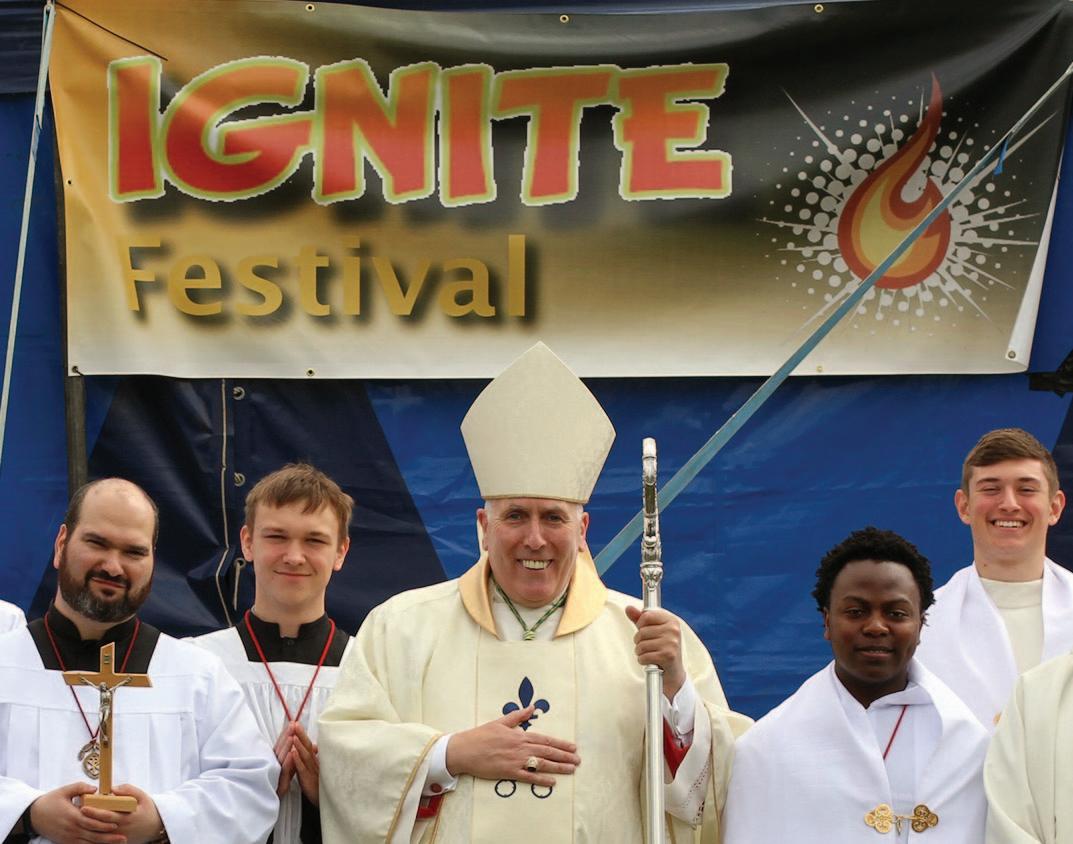
2026 Ignite Festival inspires young people
Around 400 young people from across the Diocese of East Anglia gathered on 2-3 May for this year’s Ignite Festival at St Benedict’s School in Bury St Edmunds, a joyful weekend of camping, friendship and, above all, encounter with Jesus.
n Arrivals on Saturday were greeted by beautiful weather, with bright sunshine and clear skies setting the tone for the day. The opening ceremony brought excitement and encouragement, alongside plenty of joy and laughter, with a range of games and a lively performance from Christian stand-up comedian Tony Vino.
On Saturday evening, young people were
given the opportunity to encounter God’s mercy through the Sacrament of Reconciliation. Priests from across the Diocese heard confessions in a moving and prayerful atmosphere. This was accompanied by music from the Sybil Collective, whose contribution throughout the weekend helped to foster a spirit of reverence and reflection. Following some time to enjoy games and the tuck shop, the evening continued with an energetic session of music led by Fr Alvan Ibeh and Divon Ball. The day concluded with night prayer, led by Sr Catherine and Sr Valentina from the Community of Our Lady of Walsingham.
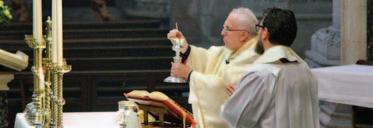
Sunday marked the high point of the festival. Fr Peter Wygnanski, Chaplain to the Diocesan Youth Service, opened the day with a talk, followed by the celebration of Mass with the Bishop. In the afternoon, a
vocations panel offered young people the chance to reflect on God’s call in their lives. The panel featured a married couple, a religious sister, a religious brother and two priests. This was followed by a wide range of workshops, including prayer, calligraphy, rosary-making and sport.
Later in the day, Fr Gregory OP gave a talk ahead of a deeply prayerful time of Adoration of the Blessed Sacrament. Many experienced this as a powerful and moving encounter with Christ truly present. Fr Luke Goymour processed with the Blessed Sacrament among the young people, offering a moment of close and personal prayer. There was a palpable sense of peace and reverence in the marquee, and for many it was a moment that will remain with them for years to come.
n story continues on page two.
Vocations focus in East Anglia: Jonathan Callejo – page 9
Ascension celebrated in solemnity
n On Thursday, 14 May 2026, the faithful of the Diocese of East Anglia gathered in joyful solemnity at the Cathedral of St John the Baptist to celebrate the Feast of the Ascension of the Lord. The liturgy, marked by reverence and devotion, was led by Bishop Peter Collins, who presided over the Solemn Mass.
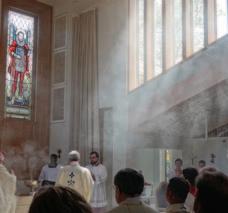
The cathedral was filled with clergy, religious, and lay faithful from across the diocese, united in prayer within a deeply solemn and contemplative atmosphere. The sense of quiet devotion was palpable as incense rose, sacred music echoed through the nave, and the congregation participated attentively in the liturgy, reflecting the significance of this great feast in the Church’s calendar.
The First Reading, taken from the Acts of the Apostles (Acts 1:1–11), recounted the moment of the Ascension, as the apostles witnessed the Lord being lifted up and were reminded by the angels of His promised return. The Second Reading, from the Letter of St Paul to the Ephesians (Ephesians 1:17–23), spoke of Christ’s exaltation at the right hand of the Father, above all powers and dominions. The Gospel, proclaimed from St Matthew (Matthew 28:19–20), resounded with Christ’s Great Commission to go forth, make disciples of all nations, and trust always in His abiding presence.
The Feast of the Ascension holds profound importance for the life of the Church. It marks not an absence, but a transformation of Christ’s presence among His people. As He ascends to the Father, Christ entrusts His mission to the Church, calling all the baptised to be His witnesses in the world. The Ascension affirms both the dignity of human nature, now taken into heavenly glory, and the enduring hope of the faithful, who look towards their own share in that glory.
For those gathered in the cathedral, the celebration was a reminder of this living mission. Strengthened by prayer and sacrament, the faithful were united in their calling to bring the light of the Gospel into their daily lives, confident in the promise that Christ remains with His Church always, even as He reigns in heaven.
The Solemn Mass concluded in a spirit of quiet joy and renewed purpose, as the congregation departed in peace, carrying with them the significance of the Ascension and its enduring relevance for the Church today.
Bishop Peter Collins attended the Ignite Festival to celebrate Mass with young people from across the Diocese.
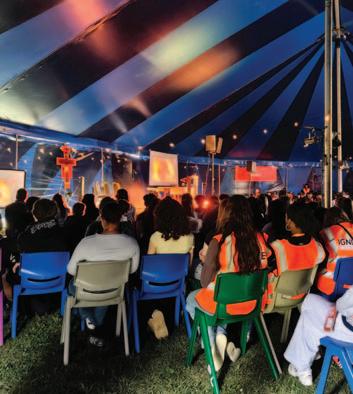
Ignite Festival 2026
n story continued from page one. The weekend concluded with a disco, providing an opportunity for everyone to relax and enjoy time with new friends. On Monday morning, many groups travelled to Walsingham in time for the Diocesan pilgrimage, bringing the Bank Holiday weekend to a fitting close in the presence of Our Lady.
While much more could be said about the festival, the Diocese extends its sincere thanks to all who made the weekend possible: the Bishop, clergy and religious, speakers, musicians, the kitchen team, stewards and volunteers, MCs, technicians, St Benedict’s School, and all who contributed in any way.
Please continue to keep the young people of the Diocese in your prayers as they carry forward the graces of this special weekend, and as anticipation begins to build for next year’s Ignite Festival.
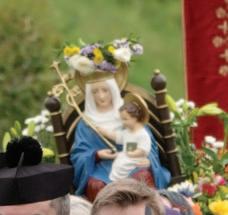
Lady of Fidelity



EastAnglia
EDITOR: Charlie Bohan-Hurst communications@rcdea.org.uk
Articles and photographs for the next edition are very welcome and should be sent to the editor, ideally via email, by Monday, 15 June.
Diocese website: www.rcdea.org.uk
Advertising: Contact Nick at Cathcom on tel 01440 730399 or email him at ads@cathcom.org
Publisher: Cathcom Ltd, 0207 112 6710 Inclusion of adverts is the responsibility of Cathcom and does not imply endorsement by the
Pilgrimage marks Jubilee at Walsingham
On Monday 4 May 2026, the faithful of the Diocese of East Anglia gathered in great numbers at Walsingham to celebrate their annual pilgrimage, held this year on the Feast of the Feast of the English Martyrs.
Charlie Bohan-Hurst reports.
n The occasion carried particular significance as it marked the 50th anniversary of the diocese, drawing pilgrims from parishes across the region in a joyful expression of faith and unity.
The day began at 10:30am as pilgrims arrived at the National Catholic Shrine of Our Lady of Walsingham. Opportunities for the Sacrament of Reconciliation were available until 11:45am, offering many a moment of quiet preparation ahead of the day’s central liturgy.
At midday, the pilgrimage reached its spiritual high point with a Solemn Pontifical Mass celebrated by Bishop Peter Collins. Hundreds filled the shrine, representing communities from across East Anglia. The liturgy was enriched by the powerful readings of the day: from the Acts of the Apostles (7:55–60), recounting the martyrdom of St Stephen, to the Gospel of St Matthew (10:17–22), where Christ prepares His disciples for persecution. These readings spoke directly to the heart of the feast. St Stephen’s unwavering witness, even unto death, stands as a profound example of faithfulness and forgiveness, echoing Christ’s own sacrifice. Meanwhile, the Gospel reminds believers that disciple-
ship is not without cost; to follow Christ is to stand firm in the face of adversity, trusting in the Spirit to guide and sustain. In today’s world, where faith can often be challenged or marginalised, these passages call the faithful to courage, perseverance, and a renewed commitment to living out the Gospel.
In his homily, Bishop Peter encouraged all present to take up this call with renewed zeal. He urged the faithful to evangelise boldly, to spread the Word of the Lord, and to nurture the growth of the Catholic faith both within East Anglia and beyond. With characteristic warmth, he added a light-hearted remark, suggesting that perhaps the Welsh Martyrs might also find a place alongside the English on this feast day, prompting smiles among the congregation.
shared faith.
Following Mass and a time for shared fellowship over lunch, the afternoon’s devotions began with the crowning of the statue of Our Lady of Walsingham by Bishop Peter. This was followed by a Marian procession along the Pilgrim Way towards the priory grounds, an unusual and memorable addition to the pilgrimage in this jubilee year. As the procession moved forward, hymns were sung and the Joyful Mysteries of the Rosary were prayed. Parish banners were held high, creating a vivid display of the diocese’s rich diversity and
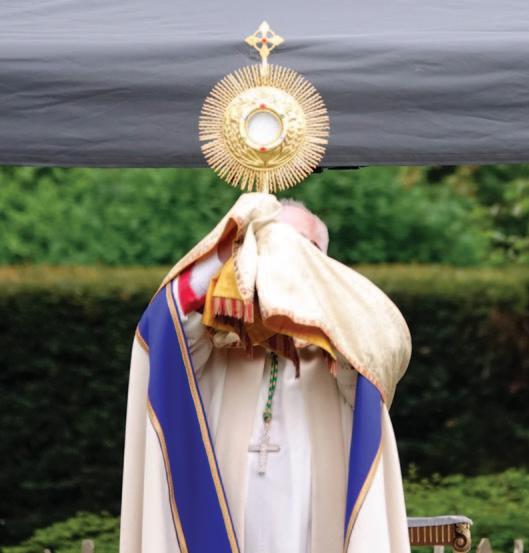
The pilgrimage concluded upon arrival at the priory grounds with Solemn Benediction. The Blessed Sacrament was exposed, and the gathered faithful entered into a time of reverent hymnody and silent prayer, bringing the day to a peaceful and prayerful close.
This year’s pilgrimage, set against the backdrop of the diocese’s 50th anniversary, was both a celebration of the past and a hopeful step towards the future. Rooted in the witness of the martyrs and inspired by the call to evangelisation, the people of the Diocese of East Anglia departed Walsingham renewed in faith, united in purpose, and strengthened for the journey ahead.
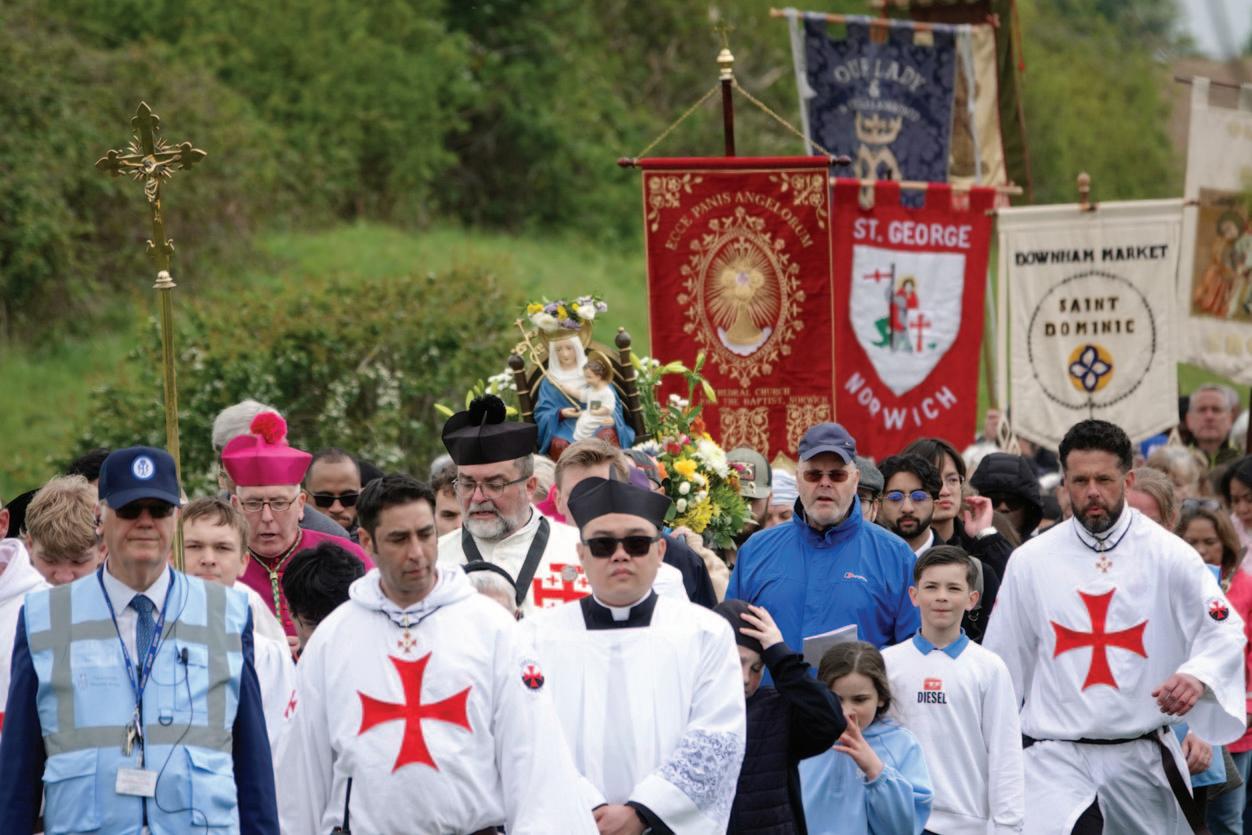
Bishop Peter and the faithful walking the Pilgrim Way.
Bishop Peter giving the Benediction with the Blessed Sacrament.

The Cathedral Church of St John the Baptist, Norwich
As we celebrate our fifty years as the diocese of East Anglia, let us remember the great places and events that mark the living Faith of places and people here in East Anglia. This month Dr Richard Charles Maguire (University of East Anglia, Norwich), turns in celebration, to the Cathedral Church of St John the Baptist, specifically focusing on its marvellous Victorian Gothic Revival architecture which makes the building one of the iconic buildings in this fine city. This focus should help all who use or visit the cathedral to understand the building even more.
n In 1976, with the foundation of the Diocese of East Anglia, what had been the Parish Church of St John the Baptist, Norwich, became the new diocesan cathedral. Prior to the Protestant Reformation in England, which began in 1534, Norwich was blessed with over 50 Catholic churches, including a magnificent Norman Catholic cathedral. These churches were at the core of a rich and vibrant Catholic symbolic and sacramental world that defined medieval Norwich’s religious, economic, social, and cultural life.
After the Protestant Reformation, which was imposed ‘top-down’ by the government on a reluctant population, everything changed. Suddenly, and then for centuries, the city had no Catholic church in which the faithful could worship. The Holy Sacrifice of the Mass ceased to be celebrated, and the traditions of Catholicism in Norwich were largely forgotten, other than in a few houses, such as Oxburgh, where brave families kept the faith alive.
It was only in the late eighteenth century that Catholic worship was allowed to return to the city, in a small way. Finally, in 1829, England’s Catholics were freed from all the legal restrictions that had pressed upon them since the sixteenth century. In 1850, the Catholic hierarchy returned, and England witnessed a surge of Catholic church construction. By this date, the dominant architectural style in England was Victorian Gothic, of which St John’s is a fine example. The medieval Gothic style, originating in France, had dominated the architecture of Europe in the Middle Ages. Gothic churches used innovations in engineering to create gorgeous visual landscapes that lifted the souls of worshippers towards the heavens. Their exquisite beauty meant that these Gothic churches offered a uniquely fitting place to worship God. Medieval Gothic was a singular architectural style designed to lift souls towards our Creator in a fashion that has been increasingly difficult to replicate since the advent of modernity. The stunning stained-glass windows of Gothic churches bathed the interior
with the light of heaven, suffusing worshippers with the Truth. Gothic architecture was, and remains, an unparalleled rendition of theology in stone and glass, enhancing and deepening Christian belief and worship through transcendental beauty.
Unfortunately, the Gothic style went out of fashion after the 1600s, but from the second half of the eighteenth century it became the inspiration for a new movement, the Victorian Gothic Revival. Men such as the architect Augustus Welby Northmore Pugin (1812–1852) argued that returning to the Gothic style in church building would revitalise worship and faith. Such beautiful architecture would, they proposed, help to rejuvenate the sense of the sacred in a society desperately in need of Christ. They argued that, since God is the source of beauty, the exquisiteness of Gothic architecture would help people to move closer to God. The result of this movement was that the nineteenth and early twentieth centuries saw the restoration of many medieval churches that had been damaged in the upheavals following the Protestant Reformation, and the construction of scores of stunning new churches across England, both Anglican and Catholic.
St John’s was part of this movement. Built between 1882 and 1910, the church was designed by George Gilbert Scott Junior (1839–97) and completed by his brother John Oldrid Scott (1841–1913). While its Gothic Revival style was never in doubt, the man who paid for the entire church, Henry Fitzalan-Howard, the fifteenth Duke of Norfolk (1847–1917), told Scott that he wanted the church to take its specific inspiration from the thirteenth century, since Norwich had no medieval churches from that period. The Duke also wanted a huge church, far too large for the needs of the parish at that time. His foresight ensured that, when a cathedral was needed in 1976, a church of sufficient size and grandeur already existed.
With the Duke’s instruction in mind, George
Gilbert Scott Junior and his brother used all the essential Gothic elements to create a glorious place of worship. They did not simply copy medieval Gothic, however. Instead, they reinterpreted its elements and produced one of the finest Gothic Revival churches in England.
Outside, the impression is one of solidity and permanence. The building is long, but the design emphasises its height. St John’s climbs high above the visitor, reaching towards heaven, with a massive central tower that soars powerfully upwards. Outside, the flying buttresses provide engineering stability while artistically emphasising the church’s strength and beauty. The entire building seems to be designed to stand until the Day of Judgement. The stonework outside is heavily ornamented, with superb carvings. The terminal façades (the fronts) to each arm have strong, triple lancet windows, with huge buttresses and pinnacles (which look like small spires on either side) flanking the gable. Every centimetre of the church is used to add to its elegance. Throughout the building, stunning Frosterley marble has been used to increase the beauty of the entrances, internal piers, and arches. Inside St John’s, the Scott brothers used all the elements of the Gothic style, incorporating pointed arches, complex ribbed roof vaulting, large stained-glass windows, and ornate stonework. When you are next in the cathedral, look for dragons carved on the piers in the nave (dragons, of course, signify the evil that has been defeated by Christ on the Cross), the angels on the walls of the chapels singing the Gloria, and the stunning stone leaf foliage, representing the glory of Creation. Look up at the ceilings and notice that the roof bosses along the nave depict the entire story of salvation, from the Garden of Eden to the Second Coming of Christ, while those above the chancel depict the Passion, Resurrection, and Ascension of Our Lord.
The stained-glass windows, mostly created
by Hardman & Co., who at the time were making England’s best stained glass, are some of the finest Victorian windows in the world. As the new book on the windows, The Way of Beauty, to be published this year to coincide with the diocesan anniversary, explains, the windows are superb examples of art that also explain Christian theology and Catholic history. These windows are one of the artistic gems of the entire region.
Unfortunately, the Duke of Norfolk died in 1917 and, without his financial support, the internal furnishing of the church was not completed as planned. In the excesses following the Second Vatican Council (1962–1965), considerable damage was caused by the removal of internal furnishings that had been installed over the previous sixty years. The church lost the high altar and altar rails, whose brass gates had been designed by John Oldrid Scott, along with an excellent pulpit. Despite these losses, the cathedral retains the magnificent golden chandeliers above the chancel, the superb metal gates of the baptistery, the ornate heating grilles in the floors, and the lovely metalwork on the main doors. St John’s is not just a building; it is one vast prayer that has been given a physical presence in stone and glass. The Victorian Gothic Revival followed the lead of the medieval Gothic and focused on worshipping the Holy and Undivided Trinity, rather than focusing on humanity, as tends to happen in modernism. The movement was a deliberate attempt to use the medieval Gothic style to evangelise secular culture. In a contemporary world desperately in need of Christ, the choice of the Duke of Norfolk and the Scott brothers to use the Gothic Revival style remains relevant. The diocese has a wonderfully beautiful cathedral. Everyone in the diocese should try to visit this place of prayer and beauty as part of our Jubilee celebrations. Beauty gives praise to God, who is the True, the Good, and the Beautiful. When you are next in St John’s, please join in that praise.
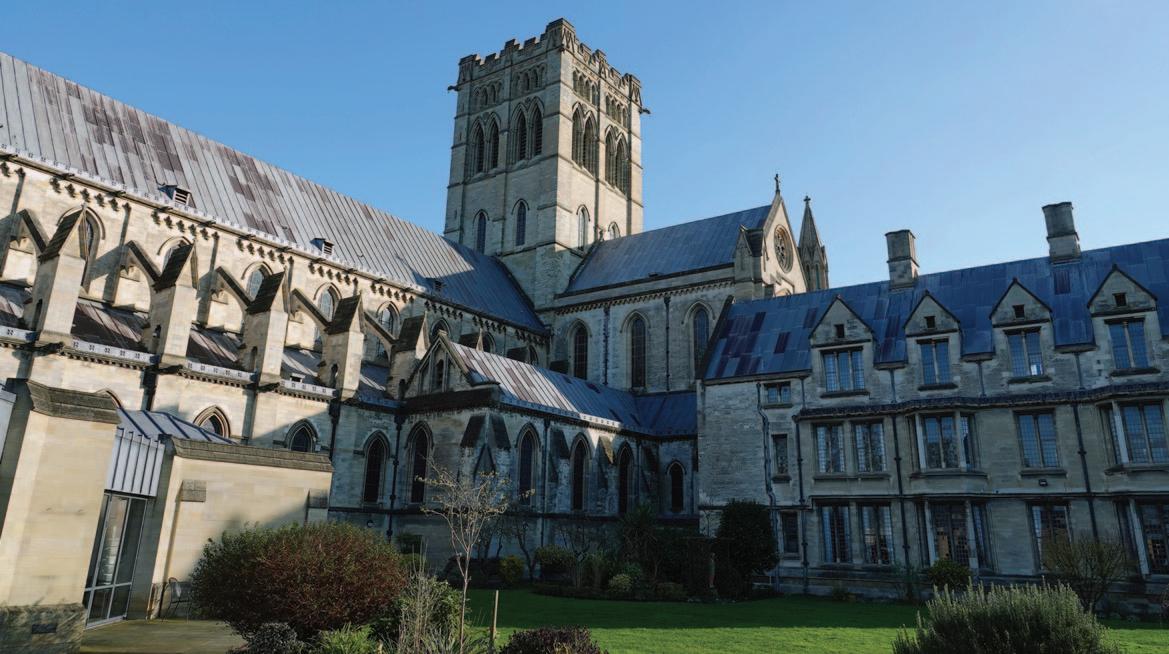
The Cathedral of St John the Baptist.
Faith, science and vocation in Buckden
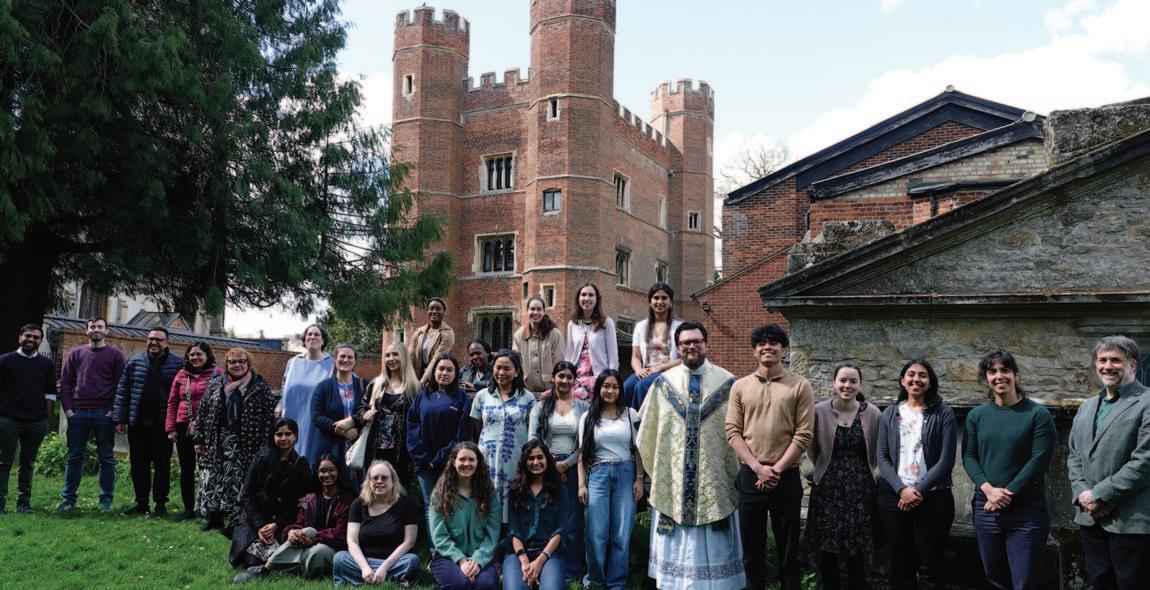
Biomedical researchers, healthcare professionals, and students from across the country gathered at Buckden Towers from 17 – 19 April for a unique retreat exploring the relationship between faith, healthcare, and the life sciences.
Charlie Bohan-Hurst reports.
n Hosted by the Diocese of East Anglia and supported by the Equipping Christian Leaders in an Age of Science (ECLAS) project at St John’s College, Durham, the weekend brought together 25 full-time participants, with a further seven joining for the Saturday programme.
The retreat formed part of a wider initiative led by Dr Katharina Patommel and Fr Peter Wygnanski who have been co-directing a development programme aimed at supporting Catholics working in healthcare and scientific fields. Earlier stages included workshops at the chaplaincies of the University of East Anglia and Cambridge, as well as an expert panel discussion featuring Archbishop John Sherrington, Lead Bishop for Life Issues, alongside leading voices in bioethics and public policy.
At Buckden Towers, participants were invited to reflect more deeply on their vocation through a balance of prayer, talks, and fellowship. The programme included daily Mass, the Divine Office, and Eucharistic Adoration, alongside a series of themed talks addressing vocation, contemplation, and hope. Guided lectio divina and opportunities for quiet reflection provided further space for
Want to advertise?
Catholic East Anglia reaches over 7,000 Catholics in East Anglia. Contact Cathcom Ltd on 01440 730399 or at ads@cathcom.org
Delightful, warm, cosy cottage on Holy Island
personal prayer and discernment, as the retreat hoped to provide not only opportunity for discussion but, most of all, encounter with Christ and with one another.
Fr Peter Wygnanski noted, “The wisdom of the expert panel we held strongly pointed towards a need for this kind of retreat; a means of spiritually supporting those working in healthcare, research, and other professional environments where principles of faith can be difficult faithfully to live out or even explicitly challenged. The deep engagement with the programme by those who came, and the simple fact that this retreat was significantly over subscribed, have evidenced the importance of prayer and encouragement in
this context, especially when experienced in the context of a community of those who experience shared challenges in their faith and work.”
Dr. Zinia Pritchard, D.Min, Certified Spiritual Care Practitioner, CASC/ACSS, O.P.A, Director of Pastoral and Spiritual Practice at the Margaret Beaufort Institute of Theology, who was in attendance on the Saturday, commented, “The diocesan initiative to lead an ECLAS sponsored retreat responsive to the spiritual formation needs of Catholic scientists, medical, and mental health practitioners is to be applauded. I found the retreat leaders’ integration of faith within their lived practice inspiring. The container of
community cultivated through the spiritual space of retreat provided a safe space for prayer, reflection and sharing.”
The setting of Buckden Towers, with its rich ecclesial history and peaceful surroundings, provided an ideal backdrop for the weekend. From shared meals to moments of silence in the chapel, the retreat fostered a strong sense of community rooted in prayer.
The organisers hope this initiative will continue to grow, building a network of Catholic professionals equipped to witness to the dignity of the human person in healthcare and scientific practice.
Timorese community in East Anglia reflects on faith


4 guests 3 bedrooms 4 beds 2 bathrooms Centrally located, within minutes to the Castle, Priory or our amazing beaches. We have amazing skies on dark clear nights, the stars and planets are clearly visible sometimes if you are very very lucky we see the northern lights! During late spring through until early autumn we can hear the seals calling during dusk through to daylight. Holy Island is a magical place cut off by the tide twice a day, you can feel the tranquility when the tide closes.
Contact: Lesley Douglas 07743531453
Email: lesley.cottages22@btinternet.com
During the seasons of Lent and Easter, the East Timorese community in Cambridge (ETICC), together with their parish priest, Fr Robin Joseph CRM of St Laurence’s Church, undertook a simple yet deeply meaningful pastoral initiative. Around ten Timorese families were visited in their homes, where they received prayer, encouragement and house blessings.
n For the community, this was far more than a routine programme. It became a journey of faith, moving from house to house, family to family, and heart to heart. Each visit revealed different needs. Some families sought prayer, others encouragement, and many simply welcomed the presence of the Church in their homes. In these encounters, there was a
shared realisation that faith does not belong solely within the walls of a church building. It must also be lived in the home, within families, daily conversations, and acts of care for one another.
This initiative drew inspiration from the words of Pope Francis during his Apostolic Visit to Timor-Leste from 9 to 11 September 2024: “Que a vossa fé seja a vossa cultura”, “May your faith be your culture.”
For the Timorese people, these words carry profound meaning. Culture is not defined only by traditional dress, music, food or celebrations. It is expressed in daily life and in what is passed on to future generations. If faith becomes culture, then Catholic values must shape family life, guiding how young people are supported, elders respected, children nurtured, forgiveness practised, and care extended to those who feel isolated or forgotten.
Living far from Timor-Leste, the community recognises the importance of gathering together, celebrating shared traditions and maintaining cultural identity. Social events play an important role, fostering joy and unity. However, the community also understands that its strength cannot rest on social
activity alone. It must be rooted in prayer, faith, service and pastoral care.
During his visit, Pope Francis reminded the people of Timor-Leste that the nation’s greatest treasure is its people, especially children, young people, families, the elderly and those most in need. This message resonates strongly with the Timorese community in Cambridge. Though geographically distant from their homeland, they remain closely connected to the faith and values that have shaped them.
The pastoral visits with Fr Robin Joseph CRM may have been modest in scale, but they carried a powerful message. The Church is present not only in times of celebration, but also in moments when families need prayer, support and blessing.
The community expresses its gratitude to Fr Robin for accompanying them in this pastoral mission, and to the families who generously opened their homes and hearts. There is hope that this initiative will continue to strengthen a community in which faith is not only spoken about, but actively lived.
May their faith truly become their culture, in their homes, their community, and wherever God calls them to be.
Fr Peter Wygnanski and attendees after Mass on the Saturday.

A new statue honours St Pancras in Ipswich
There was particular joy at St Pancras Church, Ipswich, this year as the parish marked the feast of its patron saint with the arrival of a long-awaited statue, fulfilling a wish first expressed five years ago.
n When Bishop Alan Hopes visited the church in 2021 for the feast of St Pancras, he observed that there was no statue of the church’s patron within the building. Encouraging the then newly appointed priest to address this absence, he planted the seed for what has now become a moment of celebration for the parish community.
On 12 May this year, the feast day of St Pancras, that hope was realised. A newly commissioned statue arrived from the renowned Italian workshop Ferdinand Stuflesser, having been carefully crafted and shipped to Ipswich. Parishioners gathered with excitement as the heavy packing cases were opened, revealing the beautifully carved and painted figure. The statue has now been installed just inside the sanctuary, to the left of the altar, where it fittingly honours the saint who has watched over the parish for 165 years.
St Pancras himself is a striking figure of early Christian witness. Born around AD 289 in Phrygia, modern-day Turkey, he was orphaned as a child and travelled to Rome with his uncle. There he encountered the Christian community, embraced the faith, and was baptised. During the persecution under the Emperor Diocletian, he was ordered to offer sacrifice to the Roman gods. Refusing to renounce his faith, he was martyred by beheading in AD 304 at the age of just fourteen. His youth and the many miracles attributed to his intercession led to a rapid spread of devotion.
This devotion soon reached these shores. St Augustine of Canterbury is said to have brought relics of St Pancras to Canterbury, dedicating one of the earliest churches he built in England to the young martyr. Over time, devotion spread widely, including to London, where the ancient St Pancras Old Church stands on what is traditionally regarded as one of the oldest sites of Christian worship in the country, and from which the nearby railway station takes its name.
The new statue in Ipswich depicts the boy martyr in the traditional manner, clothed in a red robe symbolising martyrdom, edged with gold to represent the glory of heaven, and holding both the palm of martyrdom and a book. Inscribed on its pages are the words, Venite ad me et dabo vobis omnia bona,
“Come to me and I will give you all good things” (Genesis 45:18). While these words in the Old Testament speak of reward for faithful service, in the context of St Pancras they remind the faithful that those who turn to God’s saints with humility and trust will receive the graces of heaven.
The commissioning of the statue was made possible through the generous legacy of Judy Fell, a devoted parishioner who died three years ago. Her gift will continue to bear fruit in the spiritual life of the parish, as those who come to pray are inspired by the presence of their patron saint. Parishioners and visitors alike are now invited to place themselves under St Pancras’ protection, confident that he continues to accompany the Church on her pilgrimage and to lead hearts towards the “good things” of heaven. St Pancras, pray for us.
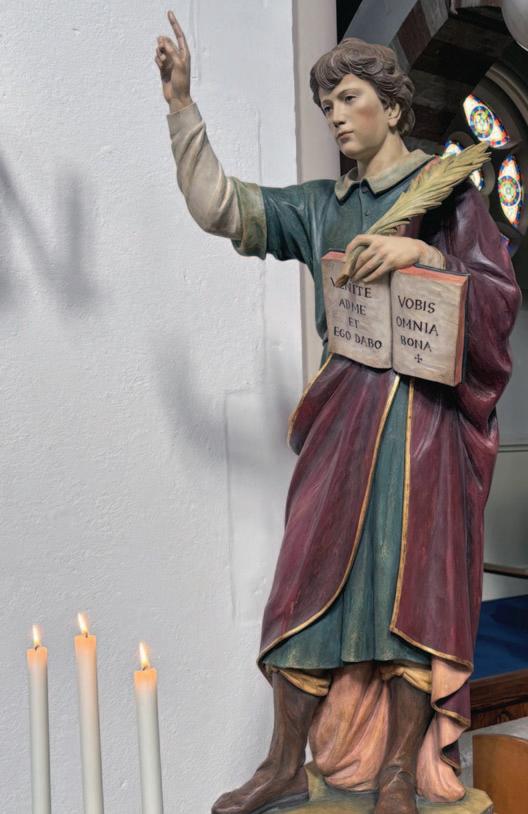

The new statue of St Pancras.
Ely parish brings hope to Cambodian community
n In the Diocese of East Anglia, the parish of St Etheldreda’s in Ely continues to live out its mission of solidarity through a growing partnership with the remote Cambodian community of Prek Taol.
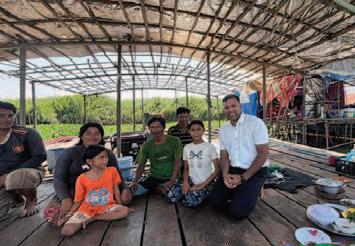
Situated on the vast Tonlé Sap Lake, Prek Taol is home to families living in extreme poverty. Homes are not built on land but float upon the water, often supported by disused barrels with only a limited lifespan. These fragile structures are pieced together from whatever materials families can afford, offering little protection from the intense heat or the heavy rains of the region.
The challenges faced by the community are stark. Recently, a young girl arrived at the local church with a severely swollen leg. She had been bitten by a snake after accidentally stepping on it during the night. When Father Yacob, the local priest, visited her home, he found her living on a simple platform with no walls and only a torn plastic sheet for a roof. There were no basic facilities such as a toilet, and no privacy, which is especially difficult for young girls who must shield themselves as best they can from passers-by and even family members.
Deeply moved by her situation, Father Yacob reached out to St Etheldreda’s for help. In response, parishioners came together to raise funds to construct a small, private space for the girl, offering her dignity, safety and a measure of comfort. A portion of this funding was provided through the Diocese of East Anglia’s Alive in Faith project. Efforts are now underway to raise further funds to provide a proper roof and, it is hoped, walls for greater protection.
St Etheldreda’s also supports essential aspects of daily life in Prek Taol. Among these is funding one of the two boatmen who transport children across the water to attend school and church, which is the only means of access in this unique environment. For many children, this journey is their sole opportunity for education and spiritual formation.
Despite the hardships, the faith and resilience of the community are evident. Children gather for simple meals of rice soup, attend lessons in modest shared spaces, and travel faithfully by boat to worship.
This partnership stands as a powerful example of the Church’s universal mission, uniting communities across continents in compassion and practical support. As St Etheldreda’s continues its fundraising efforts, it invites others across the diocese to keep the people of Prek Taol in their prayers and, where possible, to contribute to this life changing work.
Joy as St Philip Church is cons
A moment of profound joy and thanksgiving was celebrated at midday on Sunday 26 April 2026, as the Parish Church of St Philip Howard in Cambridge was solemnly consecrated and blessed following the completion of a major redevelopment project.
Charlie Bohan-Hurst reports.
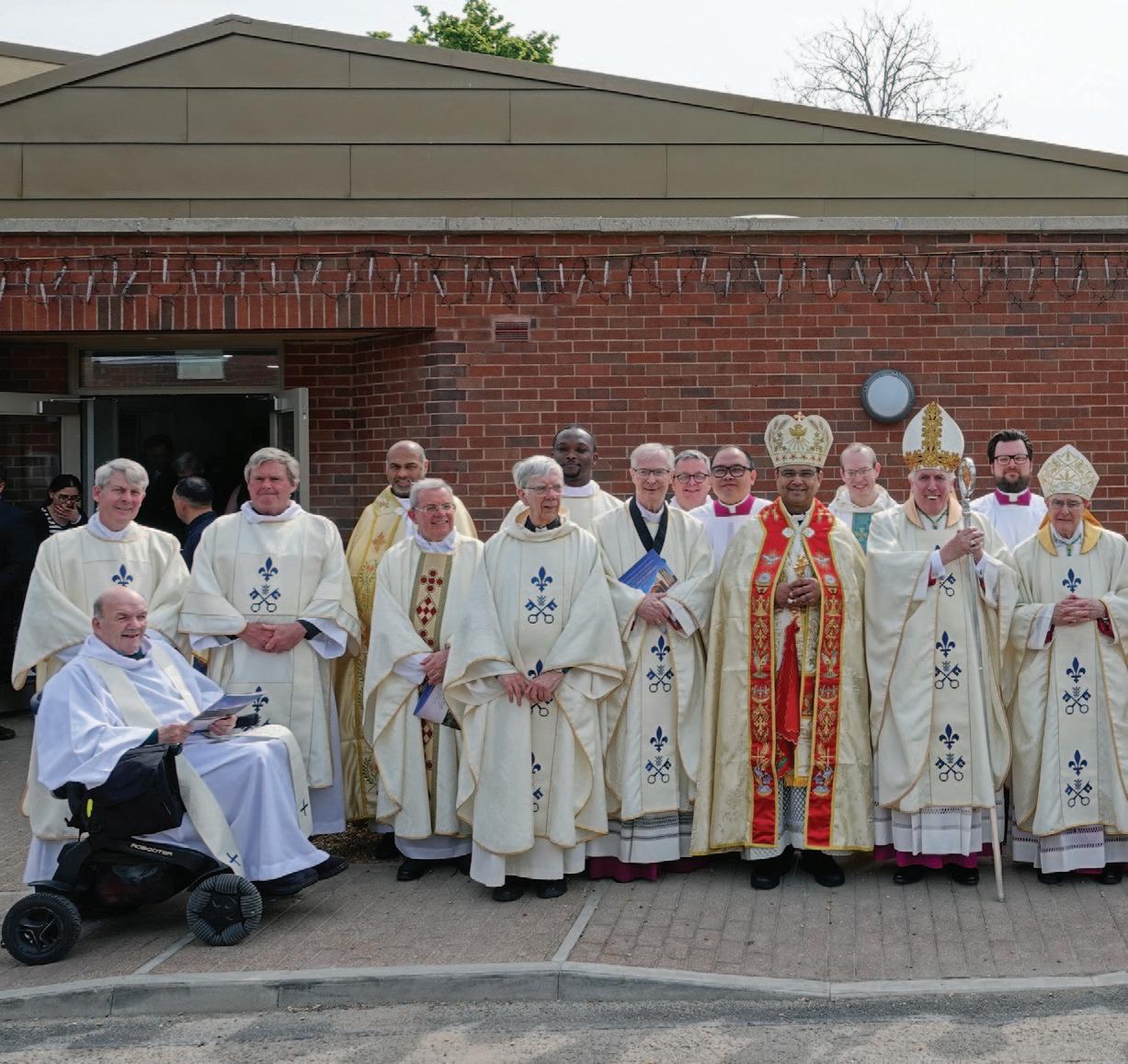
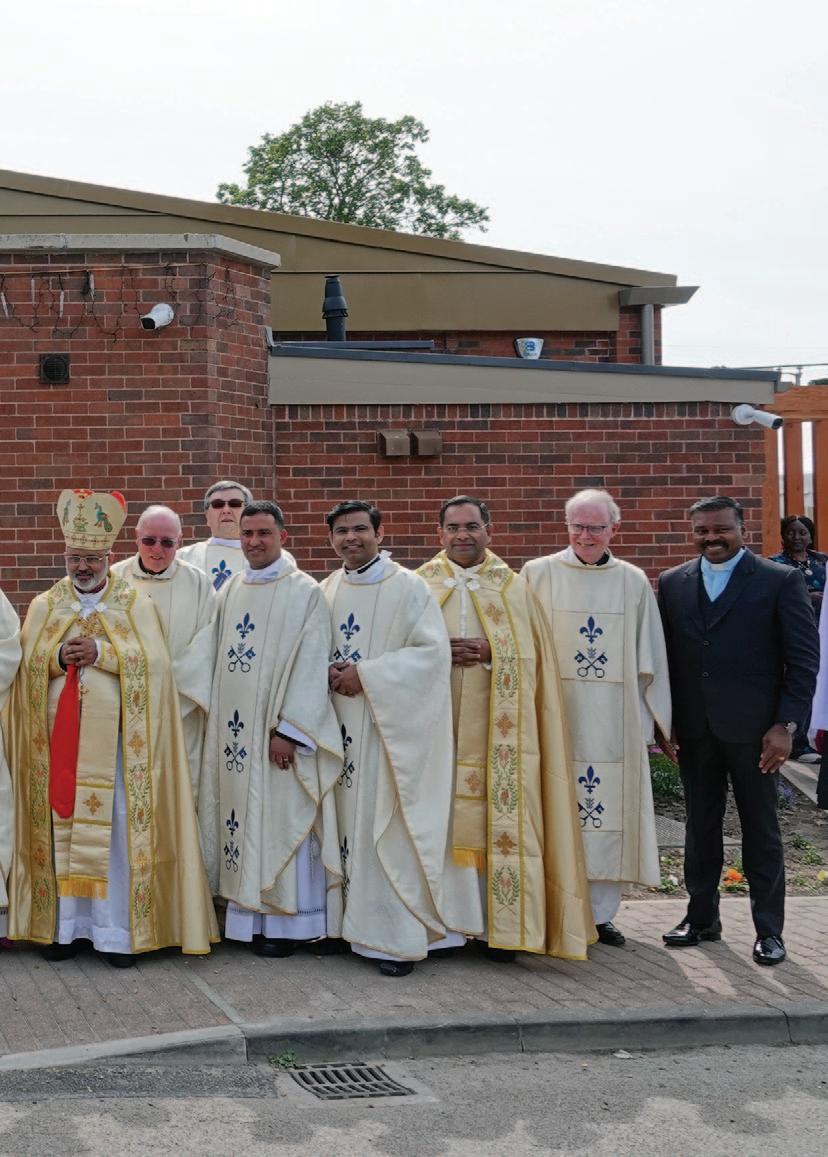
n The Mass was led by the Right Reverend Peter Collins, Bishop of East Anglia, joined by the Right Reverend Alan S. Hopes, Bishop Emeritus of East Anglia; Mar Joseph Srampickal, Bishop of the Catholic Syro-Malabar Eparchy of Great Britain; and Mar Thomas Tharayil, Archbishop of Changanasserry in Kerala. Clergy, parishioners, civic dignitaries and guests gathered in large numbers to mark this historic occasion in the life of the parish.
On the day, nearly 800 people were in attendance. The church itself was full, with additional worshippers gathered in the community hall and a marquee, while others sat outside in the sunshine in prayer, listening to the Mass.
This significant milestone marks the culmination of a £3 million redevelopment project, transforming St Philip Howard Church into a substantially larger and more fitting place of worship. The church’s capacity has increased
from 230 to 400, responding to the remarkable growth of the parish, which now serves around 850 members from more than 40 nationalities.
The expansion also anticipates continued development in the Cambridge area, including new housing on the former airport site.
Notably, St Philip Howard Church stands as a unique sign of unity within the Catholic Church in the United Kingdom, being the only church purpose-built for both the Latin Rite and the Syro-Malabar Rite. Its renewed structure reflects not only practical needs but also the dignity and beauty of Catholic worship.
The vision for the redevelopment has been shaped by dedicated parish leadership, particularly the parish priest, Fr Philip John, alongside the longstanding contribution of the Latham family. The architectural design, led by Tim Powter-Robinson of Cowper Griffiths Architects, and realised by principal contractor Godfrey & Hicks, has created a sacred space that harmonises functionality with reverence.
The liturgy began with a solemn procession into the newly rebuilt church, followed by the blessing and sprinkling of holy water led by Bishop Alan Hopes. After invoking God’s blessing upon the water, he sprinkled the congregation before proceeding to the sanctuary to bless the altar.
The readings chosen for the Mass spoke deeply to the meaning of the occasion. The first reading from Ezekiel (43:1–2, 4–7a) described the glory of the Lord entering the temple, a powerful image of God dwelling among His people. The second reading from the First Letter to the Corinthians (3:9–11, 16–
17) reminded the faithful that they are God’s building, with Christ as the true foundation, and that the Church is not only a physical structure but a living spiritual reality. The Gospel, sung by Deacon Paul Raynes from St John (4:19–24), emphasised worship “in spirit and in truth”, highlighting that while the consecration of a building is sacred, it ultimately serves the deeper calling of authentic worship of God.
In his homily, Archbishop Tharayil warmly congratulated all those involved in the rebuilding project, acknowledging the faith, perseverance and unity that made the day possible.
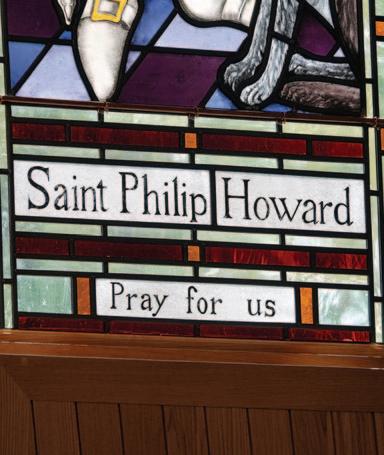
A particularly solemn moment followed with the Litany of the Saints and the depositing of the relics. Bishop Peter Collins approached the altar as relics of St Philip Howard were placed within a prepared aperture and sealed. The prayer of dedication followed, setting the altar apart for divine worship.
The anointing of the altar formed the heart of the rite. Bishop Peter poured Sacred Chrism upon the centre and four corners of the altar, marked by five crosses symbolising the wounds of Christ, before spreading the oil across the entire mensa. Together with Bishop Joseph Srampickal, he also anointed the pillars of the church, signifying the sanctification of the whole building.
The incensation of the altar and church followed, with incense rising as a sign of prayer ascending to God. The altar was then clothed and prepared, and the lighting of the altar candles marked the conclusion of the Rite of Dedication and the beginning of the Euchar-
The clergy gather outside the rebuilt church of St Philip Howard following the consecration Mass.

Howard ecrated
istic celebration.
At the end of Mass, Fr Philip John expressed heartfelt thanks to all who had contributed to the project. He acknowledged the guidance of Bishop Peter Collins and Bishop Alan Hopes, as well as the encouragement of Bishop Joseph Srampickal and Archbishop Thomas Tharayil. He paid tribute to past parish priests whose faithful service laid the foundations for the parish’s growth.
Special thanks were extended to Tim Powter-Robinson and Sarah Wells of Cowper Griffiths Architects for their vision and professionalism, and to Mark Godfrey and the team at Godfrey & Hicks for delivering the construction project. Gratitude was also expressed to Hibbitt & Sons Masonry Ltd for their craftsmanship in creating the altar and tabernacle table.
Fr Philip also thanked St Bede’s School for generously hosting parish liturgies during the construction period, and acknowledged the presence of the Mayor of Cambridge, Councillor Dinah Pounds, along with other civic representatives.
The parish’s gratitude extended widely to benefactors including the Benefact Trust and the Maurice and Hilda Laing Charitable Trust, to those involved in the design and construction, and to the many parishioners whose dedication, patience and generosity sustained the project. Particular appreciation was given to those who prepared the church and grounds, the parish choirs led by Fiona Kirker, and the Syro-Malabar community for their contribution to parish life.
John Latham Jr also spoke movingly,
Bishop Peter’s engagements
JUNE
Jun 1, Mon
Bishop to meet with all Deacons in Newmarket at 18.00.
Jun 2, Tues
Bishop to attend Bishop’s Council in Poringland at 11:00.
Jun 2, Tues
Bishop to celebrate Confirmation Mass at Sacred Heart and St Mary Magdalene, Dereham at 19.00.
Jun 5, Fri
Bishop to celebrate Confirmation Mass at St Mark’s, Ipswich at 18.30.
Jun 6, Sat
Bishop to attend Bishop’s Council for Laity in Newmarket at 10.00.
Jun 7, Sun
Bishop to celebrate The Most Holy Body and Blood of Christ, Solemn Pontifical Mass at the Cathedral at 11.00.
Jun 8, Mon
Bishop to celebrate Confirmation Mass at Swaffham at 19.00.
Jun 9, Tues
Bishop to attend CBCEW Plenary.
Jun 10, Weds
Bishop to attend Ecumenical Networking Lunch hosted by Churches Together at 12.00 in Bar Hill.
Jun, 11 Thurs
Bishop to celebrate Confirmation Mass at 19.00 at St Ives’, Cambridge.
Jun 12, Fri
Bishop to celebrate The Most Sacred Heart of Jesus, Solemn Pontifical Mass, at the Cathedral at 10.00.
Jun 13, Sat
Bishop to celebrate Marriage and Family Life Celebration Mass at the Cathedral at 11.00.
Jun 13, Sat
Bishop to celebrate Confirmation Mass at Haverhill at 18.30.
expressing his pride in his family’s longstanding involvement and in the parish’s achievement.
Following the Mass, the celebration continued with a parish lunch featuring food from around the world, reflecting the rich cultural diversity that defines St Philip Howard’s community.
The consecration of the church stands as a powerful testament to faith in action, a visible sign of a living Church built not only of stone, but of people united in Christ. It marks not an end, but a new beginning, as the parish continues its mission to serve God and neighbour in the heart of Cambridge.
Jun 15, Mon
Bishop to appear on Radio Maria with Helena Judd to discuss Diocesan Jubilee at 16.00.
Jun 15, Mon
Bishop to celebrate Confirmation Mass at St Laurence’s, Cambridge at 19.00.
Jun 16, Tues
Bishop to attend Schools Commission Meeting in Poringland at 10.30.
Jun 16, Tues
Bishop to attend Our Lady of Walsingham and St John the Baptist Multi-Academy Trust meeting in Poringland at 14.30.
Jun 17, Weds
Bishop to attend Chapter of Canons Capitular Mass at the Cathedral at 12.00.
Jun 18, Thurs
Bishop to celebrate Confirmation Mass at 19.00 at St Edmund’s, Bury St Edmunds.
Jun 19 – 21, Fri – Sun
Bishop to attend the KHS Investiture in Arundel.
Jun 22, Mon
Bishop to celebrate Confirmation Mass at 19.00 in Brandon.
Jun 24, Weds
Bishop to attend The Charles Plater Trust Annual Awards Event in Westminster from 09.00.
Jun 26, Fri
Bishop to celebrate Jubilee Special Mass at the Cathedral at 12.00.
Jun 28, Sun
Bishop to attend the Sung Eucharist at 10.30am at Ely Cathedral.
Jun 30, Tues
Bishop to attend Valladolid AGM and Mass from 10.30am at the Cathedral.
Faith & fellowship at St Laurence’s
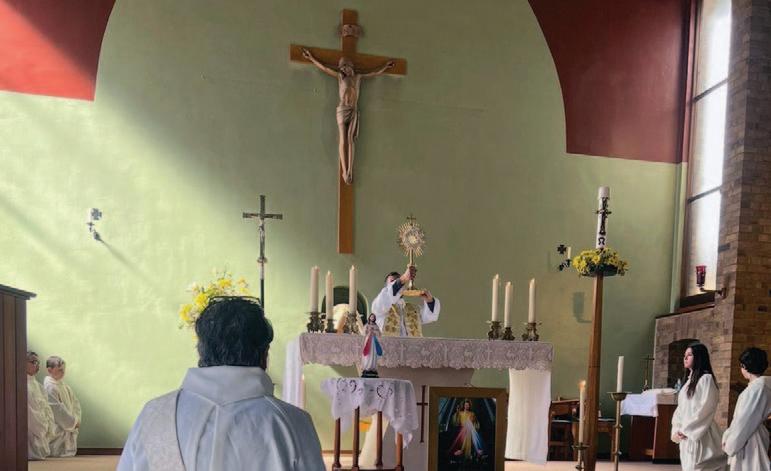
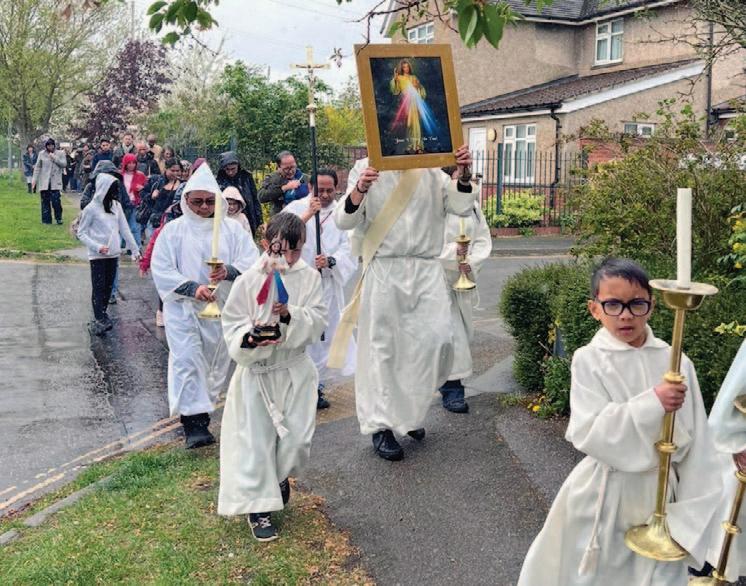
At St Laurence’s Catholic Church, parishioners gathered in joyful spirit on 19 April for the Divine Mercy Chaplet, led by Fr Alex Sunny. The occasion was marked by prayerful devotion and a memorable change in the weather, which many present felt deepened the sense of blessing on the day.
n Proceedings began with a procession through the local streets, accompanied by prayer and a strong sense of community. With the sun shining at the outset, spirits were high as parishioners set out together. However, as the procession progressed, the weather changed dramatically, and a sudden downpour of rain and hail swept over the group.
Undeterred, those taking part continued steadfastly, embracing the unexpected conditions with good humour and quiet determination. Their perseverance reflected
As the procession returned to the church, the skies cleared and the sun reappeared, an uplifting moment that many saw as a fitting sign as the chaplet continued indoors. The service concluded in a spirit of gratitude and joy, with attendees speaking warmly of
a day that had been both meaningful and memorable.
It was, by all accounts, an occasion marked not only by prayer and devotion, but also by a shared sense of blessing, experienced both in the challenges faced together and in the fellowship that followed.

the depth of faith and unity within the parish community.
Poor weather didn’t stop the procession through the streets.
Fr Alex Sunny giving Benediction with the Blessed Sacrament.

St Edmunds presents the Passion
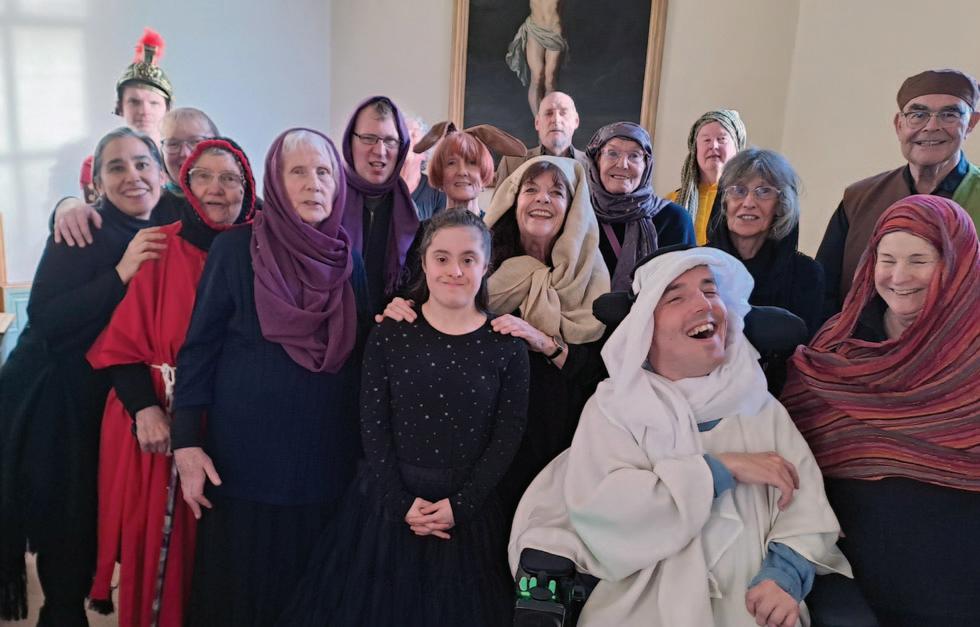
Parishioners gathered in large numbers on Good Friday to witness a moving and imaginative presentation of the Stations of the Cross by the St Edmunds Players Drama Group.
n The group offered a fresh and reflective interpretation of the traditional devotion, portraying a range of characters who might have been present at Calvary. Among them were a Roman Centurion, Veronica, who is remembered for wiping the face of Jesus, a man recalling his childhood encounters with Christ, and a reporter figure who engaged members of the crowd in conversation, bringing a contemporary perspective to the ancient events.
This creative approach invited those present to reflect more deeply on the human experiences surrounding the Passion, helping to make the story both immediate and relatable.
The performance was led by parish priest Fr Sean Connelly and drew a strong attendance from the parish community,
underlining the importance of shared worship and reflection during Holy Week.
The photograph taken before the performance shows members of the drama group gathered together in preparation, ready to bring this powerful retelling to life.
The St Edmunds Players are to be commended for their thoughtful and engaging contribution to the parish’s Good Friday observance.
Vocations focus: Jonathan Callejo
As the Diocese of East Anglia continues to celebrate its 50th Jubilee Year, we are shining a spotlight on the people who live out their vocations in service to our diocesan family. Each month, we meet a member of our clergy or someone in formation, reflecting on their call, their ministry and their hopes for the future.
n This month, we hear from Jonathan Callejo, recently ordained Deacon at the Cathedral of St John the Baptist, who shares how his vocation first took shape, what inspires him in his ministry today, and why fostering vocations remains vital to the life of our diocese.
“In July last year I was ordained as a permanent deacon, and when I reflect on the journey that led me here, I see my own story mirrored in the Parable of the Prodigal Son. My faith journey began long before I could understand it for myself. I was born and raised as a Catholic by my grandparents in the Philippines, who taught me how to pray, brought me faithfully to Mass, and showed me what it meant to trust in God through their daily lives. The foundations of my vocation were laid quietly within the home.
My late grandmother, in particular, played a defining role in shaping my faith. She often reminded me of a dream she once had, that one day I might become a priest. As a child, I did not understand what that might mean, but her words stayed with me. She frequently spoke to me about the Parable of the Prodigal Son, teaching me that no matter how far we wander, God never stops waiting for us. Only later did I realise how those early lessons had prepared my heart to recognise God’s call.
As life unfolded, I married my wife, Jenuary, and together we were blessed with three children, Christian, Lauren and Jacob. Family life has been a profound school of love, teaching me patience, sacrifice and fidelity. Alongside this, my vocation as a staff nurse at NNUH deepened my understanding of service. Nursing has brought me face to face with human vulnerability, suffering and hope, and it has shaped how I understand ministry, not as status or authority, but as presence, compassion and accompaniment.
As I grew older, my involvement in the Church deepened when I became an altar server at St John’s Cathedral, which is my parish. Serving at the altar allowed me to experience the beauty of the liturgy and the closeness of God in a very tangible way. Even then, I did not yet recognise this as the beginning of a call to ordained ministry, but it quietly shaped my love for the Church and for service.
Like the prodigal son, my path was not always straightforward. There were times when I drifted away from God, distracted by life and uncertain of my purpose. Yet God’s patience never failed. A defining moment came on Good Friday, when I heard the Lord calling me through the voice of a fellow parishioner, Peter Thorn. In the stillness and solemnity of that day, his words reached my heart with clarity. In that moment, I felt called not only to return, but to offer my life in service.
That call led me into four years of formation at St Mary’s University in London, where I studied and was prepared for the permanent diaconate. Those years were a time of deep spiritual, academic and pastoral formation. Like the prodigal welcomed home and clothed anew, I found myself being shaped and formed by the Church, challenged to grow in faith, humility and understanding. The experience strengthened my relationship with God and
confirmed the call I had heard. Throughout this journey, I was supported by my family, particularly my wife and our three children, my academic tutor Canon David Paul, my spiritual director Fr Michael Smith, our parish priests, fellow parishioners and the wider diocesan community. Through their encouragement, prayers and guidance, and through the diocesan discernment process, I learned that vocation is not about personal worthiness, but about openness to God’s grace and trust in His call.
Living the vocation of the permanent diaconate has brought me a deep sense of joy and purpose. Like the prodigal who is restored as a beloved son, I have come to understand that ministry flows from mercy rather than merit. Proclaiming the Gospel, assisting at the altar, celebrating baptism for children, visiting the sick and accompanying people at key moments of their lives continually remind me that the heart of the diaconate is service. Moreover, to me, the diaconate means being configured to Christ
the Servant, as Jesus tells us in the Gospel of Mark: “The Son of Man did not come to be served but to serve”.
The Diocese of East Anglia is a meaningful place for me to live out this vocation, as it is where my faith has been nurtured, tested and renewed. Promoting vocations is essential today, as the Church needs visible witnesses to God’s continuing call and compassion.
To anyone who may be wondering whether God is calling them, I would say: do not be afraid of your past or your doubts. God often begins His work quietly and patiently. Parish communities can nurture vocations by creating spaces of prayer, encouragement and service, where people feel welcomed and supported.
As I look ahead, my hope is that vocations in the diocese will continue to flourish. May many more people discover, as I have, that when we turn back to God, we are met not with judgement, but with open arms and an invitation to serve.
Deo gratias.”
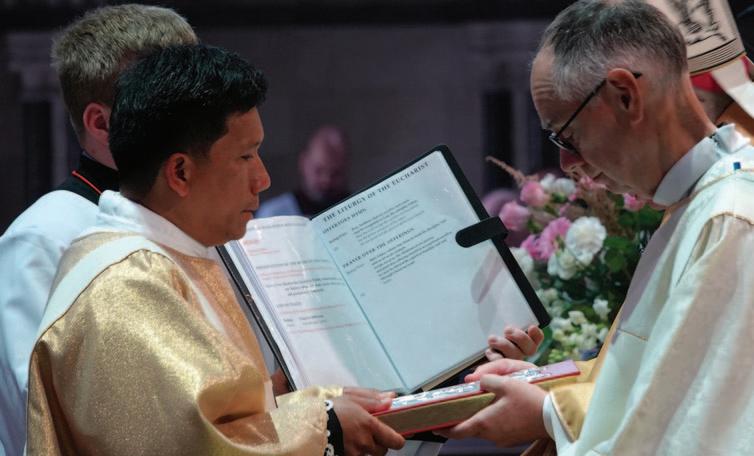
Members of the St Edmunds drama group before their performance.
Marriage celebration Mass 13 June 2026
Bishop Peter Collins invites all married couples and their families to the Diocese’s annual Marriage Celebration Mass, taking place this year on Saturday 13 June at the Cathedral of St John the Baptist in Norwich.
n Bishop Peter invites all married couples and their families to the Diocese’s annual Marriage Celebration Mass, taking place this year on Saturday 13th June at the Cathedral of St John the Baptist in Norwich.
This Mass is a time for renewal of vows and a celebration of the sacrament of marriage, thanking God for the years the couple have had together and asking His blessing on the years to come.
Couples who celebrate significant anniversaries can register for a certificate, which will be read out during the Mass. The event includes a photographer to capture the moment, and cake and tea refreshments are provided after the Mass. For more information or to register for a certificate, couples can contact the Marriage and Family Life Coordinator, Dr Antonia Braithwaite, at mflcoordinator@rcdea.org.uk,
or fill in the booking form at www.rcdea.org.uk/marriage-mass-registration/
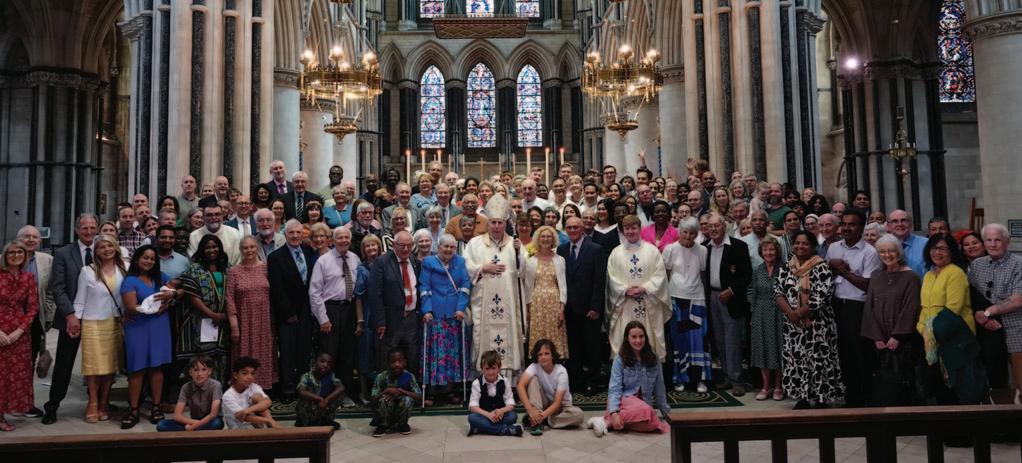
Unity Corner: The Holy Spirit
Unity Corner is a regular feature on Christian unity by Dr Ian Watson, County Ecumenical Officer for Norfolk and Waveney. In this reflection, he explains why the Holy Spirit (the Go-Between God) is the central force at the heart of Christian unity.
n I often hear (the more enlightened) ecumenical speakers remind us that the movement towards Christian unity is not ultimately the achievement of human effort, but a gift of the Holy Spirit. This should not surprise us. As Christians, we believe that the life and breath of God permeate all things. Within this reality, it is the Paraclete that holds the uniquely vital role in drawing the Church into unity, which is an aspiration grounded in the will of Christ himself, who prayed “that they may all be one” (John 17:21).
I recently read John V. Taylor’s 1972 book The Go-Between God: The Holy Spirit and the Christian Mission, which my parish priest, Fr Keith Tulloch SM, recommended. Taylor’s central idea is that the Spirit is the Go-Between God. Personally speaking, this is a thought that has helped me see more clearly that Christian unity is not something to be reduced to an ecclesial programme, policy, or even part of a religious tick-box exercise – although (to be frank) it sometimes feels like that to me. Instead, it is a reality brought into being by the Spirit, who is the divine presence called alongside to assist, defend, and encourage believers at the very heart of the Church’s life. This conviction strongly aligns with St Paul’s words: “For in the one Spirit we were all baptised into one body” (1 Corinthians 12:13). To put it another way, unity is not created by our actions; rather, we are integrated into it through a process beyond ourselves. Elsewhere, Paul urges us to “maintain the unity of the Spirit in the bond of peace” (Ephesians 4:3). What I take from both these passages is that unity exists as a gift of God – the task of the Church is to
receive, safeguard, and embody it.
Taylor starts his book by affirming that the Spirit is not simply an abstract force, but a relational presence that enables greater communication and mutual recognition, leading to meaningful communion with others. In discussing how we experience the Spirit, he says: “Every time I am given this unexpected awareness towards some other […] and feel this current of communication between us, I am touched and activated by something that comes from the fiery heart of the divine love.”
This current of communication is the dynamic presence of the Holy Spirit, which draws us not only towards God, but towards one another in authentic encounter.
Taylor explains that the Spirit enables mutual awareness, allowing individuals to acknowledge each other as distinct beings who are all cherished by God. This means that unity is the thing the Spirit initiates and nurtures in and through our relationships. It is the Spirit that stands between us and our neighbour, creating a bridge of recognition and connection.
What does this mean for Christian unity? Well, when we approach people from different denominations with openness, respect, and humility, it isn’t just good ecumenical practice; it is the Spirit acting as the Go-Between God, uniting us across traditions and helping us recognise others as fellow members of Christ. Unity, at least in this sense, is not just about human goodwill; it is the Holy Spirit creating what St Paul calls the “communion of the Holy Spirit” (2 Corinthians 13:13). In Catholic terms, we might say this is the lived expression of koinonia – a deep, spiritual partnership among believers mediated by the Spirit of God.
At the heart of ecumenism, then, is a vision of the Spirit opening our eyes to see Christ in one another. As Taylor puts it: “… the Spirit awakens hearts and enlarges our capacity for reality.” This, of course, echoes Christ’s promise that when the Spirit of truth comes, he will “guide you into all the truth […] He will glorify me, for he will take what is mine and declare it to you” (John 16:13–14).
In practical terms, this means that unity is not achieved by compromising what is
precious to us in our individual denominations or, indeed, adopting a position of uniformity based on the lowest possible common denominator. In my mind, such moves would be reductive and counterproductive. Unity can only be meaningfully achieved through a deeper understanding fostered by shared prayer, dialogue, discernment, and service – led and inspired by the Holy Spirit. This is something, by the way, that the Quakers demonstrate in their own form of silent worship, which seeks to listen in stillness for God’s voice within.
Here, there is a clear link between the Holy Spirit and the nature of the Church as the Body of Christ. The Spirit incorporates believers into one body, transcending divisions of culture, background, and personality. This reflects the biblical vision, especially in the letters of St Paul, where unity is grounded in participation in Christ rather than uniformity of expression. Diversity, in this sense, is not a threat to unity but its proper context. The Spirit does not erase difference but orders it towards communion.
Indeed, on this very point, the late and dear Pope Francis used to teach that true Christian unity is a harmony driven by the Holy Spirit that celebrates diverse gifts, rather than a forced uniformity or homogenisation. He rightly warned that seeking uniformity is a form of cultural colonisation and a false model that diminishes humanity, insisting instead that unity is a journey.
The event of Pentecost in Acts (2:1–11) offers a powerful image of this reality, where the Spirit does not erase difference but enables mutual understanding within it. Many languages are spoken, yet all hear the same Gospel. Here we see unity without uniformity, which is entirely consistent with the Catholic understanding of the Church as one body with many diverse parts (different charisms, callings, and roles) that function together for the common good. This diversity of gifts is itself Spiritgiven. The Holy Spirit distributes various gifts and charisms for building up the Church and fostering unity (see Ephesians 4:3–13). While diverse, these complement one another, illustrating how differentiated unity can be a source of strength rather
than division – what Pope Francis used to call reconciled diversity.
Perhaps the most poignant part of Taylor’s work is his portrayal of the Spirit in everyday human encounters. In closing his book, Taylor recounts a deeply moving story of a West Indian woman grieving the sudden death of her husband, and the simple, compassionate presence of a teacher who sits with and embraces her, wordlessly offering comfort. Reflecting on that moment, Taylor writes: “That is the embrace of God, His kiss of life […] And the Holy Spirit is the force of mingled tears falling onto those clasped hands. He is as close and as unobtrusive as that, and as irresistibly strong.”
It is in such moments that we are reminded that the Spirit does not only work in grand theological constructs or doctrinal pronouncements, but in small gestures of love, mutual presence, compassion, and shared humanity (Romans 5:5). At its heart, Christian unity blossoms from the Spiritgiven capacity to see Christ in one another, to share in each other’s pain, and to serve together joyfully and sacrificially in love.
It is this love that enables genuine reconciliation between Christians of different traditions. Without it, unity remains superficial; with it, divisions can be healed. This is why St Paul’s Hymn to Love in 1 Corinthians 13 remains the cornerstone of authentic ecumenism. It defines unity as the active, sacrificial love (agape) that binds believers together. In this sense, love is not a sentimental feeling or an optional nicety, but the necessary practical expression of unity that sustains the Church’s life – especially when doctrinal and other ecclesial differences remain.
Across the Diocese of East Anglia, as in the wider Church, it is essential that, when we gather in Christ’s name, we trust in the presence of the Holy Spirit. If we do, we will come to see more clearly that the desire for Christian unity is not simply our own. It is, first and foremost, the gift and work of the Spirit of God, the divine love at the heart of the Church, continually calling us into the fulfilment of Christ’s prayer that we may all be one.
Marriage celebration Mass 2025.
Faith in the Home Summer reading for teenagers
n In this Faith in the Home article, Marriage and Family Life Commission member Helvi Moore recommends two books for teenagers this summer.
While looking forward to the summer holidays, parents can often struggle to make available to their children enriching reading that can fill the lazy days of summer with a thoughtful and serious consideration of their faith. A recent trip to the United States provided me, through the courtesy of my generous friends, with an armload of resources perfectly suited to this end. In this brief article, I would like to flag up a few worthwhile suggestions in the form of two books aimed at pre-teens and teens and a simple, but effective, examination of conscience for young people.
My first recommendation is a wonderful and accessible book on the life of newlycanonised, first millennial saint, Carlo Acutis, by Fr. Will Conquer. Browsing through an avalanche of books about this teenage saint, one comes across such nicknames as “God’s Influencer” and “A Saint in Sneakers” (“Trainers” for our UK readers!). This remarkable young man led a life of such normality for his generation while interiorly striving to bring everyone he met into contact with Jesus Christ and His Church, particularly through the Eucharist. His life’s project was to put together a presentation on Eucharistic Miracles that could and would reach millions via the internet. He managed to accomplish this ambition despite an early diagnosis of leukaemia shortening his life. This book provides a readable encapsulation of St. Carlo’s life, death and ambitions while also allowing thoughtful reflection and examinations of conscience at each chapter end. A perfect summer read.
For your pre-teen or teen girls, I highly recommend “Ten Ultimate Truths Girls Should Know” by Kari Kampakis. I will not tell you now what those ten ultimate truths are…but it is worth buying this book to find out. If St. Carlo is for your sons, this book is definitely for your daughters!
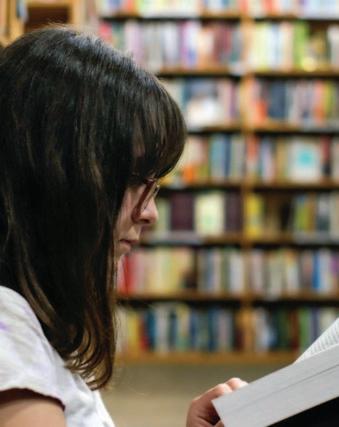

A life of service: Fr Phillip Shryane retires
n Fr Phillip Shryane has retired after more than 50 years of devoted priestly ministry, a journey that began in June 1975 and concluded with his well-earned retirement in February 2026.
It was a sad moment for the parish of St Michael the Archangel in Huntingdon as they bid farewell to a much-loved priest. To mark the occasion, the congregation gathered for a well-attended international lunch at the Commemoration Hall. The celebration brought together past and present parishioners, fellow clergy, and members of Fr Phillip’s family, reflecting the wide and lasting impact of his ministry.
Over the years, Fr Phillip has served in a number of parishes, including St Mary’s in Great Yarmouth, Gorleston, and the communities of Acle and Caister, as well as in Bury St Edmunds. He also spent time on sabbatical in Siem Reap, Cambodia, an experience
that further enriched his priestly life.
During his time in Huntingdon, the congregation grew significantly, a testament to his dedicated pastoral care and welcoming spirit. He will be greatly missed by all who have had the privilege of knowing him.
The parish community in Huntingdon extends its heartfelt thanks and prayers, wishing Fr Phillip a long, healthy, and happy retirement.
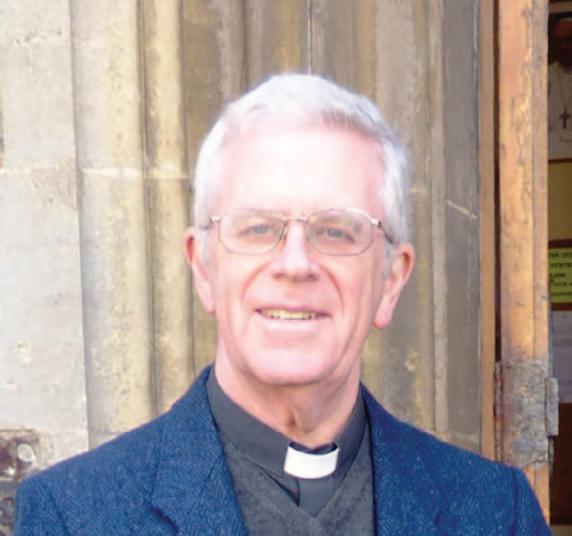
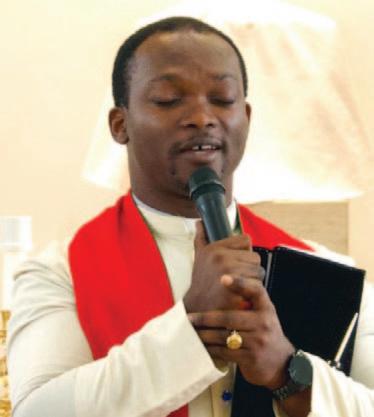
Fr Alvan Ibeh: When God is the Pilot
In his regular column Fr Alvan Ibeh reflects on trusting God’s constant presence and guidance through life’s uncertainties, likened to a pilot safely guiding passengers through turbulence.
n On the 6th Sunday of Easter, in the Gospel reading, Jesus, after announcing to His followers that He would return to His Father in heaven, assured them that He would not leave them as orphans but would come to them and “be with them till the end of time” (Matthew 28:20). The significance of this promise is that this companionship is not temporary but lasts through joy, sorrow, and uncertainty.
They needed to hear these consoling and comforting words at a time when it felt like Jesus would no longer be physically with them. But knowing that His presence (manifested in the Holy Spirit) accompanies them everywhere they go gave them so much confidence and courage. This is what happens when we fully recognise that, in the journey of life, no matter what is going on, God is always the pilot, and this means we can relax, knowing we are totally safe.
This then leads me to this story: On a particular day, a group of people from different races and religions was travelling from one country to another. Everything started very well; the taxiing and take-off were smooth, and everyone was happy and relaxed. Suddenly, severe turbulence began. If you have not experienced this before, you wouldn’t understand how scary it can be.
I have had this experience several times, but the worst was when I was coming back
from one of my holidays in Nigeria. Sometimes it felt like the plane was going to drop out of the sky. I could hear people shouting, “Jesus, save us.” I’m sure this doesn’t mean anything to the pilot, because they are used to it and know that nothing will happen.
So, back to the story: the turbulence continued. It became so bad that the passengers all got scared and thought they were about to perish. Everyone was calling on what they believed in to come and save them. Of course, nobody would like to die in such an incident, especially when the person is not on good terms with God. Some, at that point, even started confessing their sins and promising God that if He could save them, they would give their lives to Him.
There was an atheist on the flight who was also so scared that he started praying to the God he had always claimed never existed. But then he noticed a young girl on the other side who was calm and undisturbed by what was going on. She was very focused, painting pictures and not taking any notice of the situation.
When the plane finally landed safely, the atheist went straight to the young girl and said to her, “Hello, young girl, I noticed you were so relaxed when the turbulence was happening. Were you not scared?”
The girl looked at him and, smiling, responded, “Nope.”
“Why?” the atheist asked.
She then said in her tiny voice, “Because my dad was the pilot of the plane.”
This statement amazed the man, and he couldn’t say anything more but had to leave. Can you see the confidence this little girl had, just knowing that her dad was the pilot?
Life often feels like a journey through changing weather. Some days are calm and beautiful; other days bring storms we never
expected. We make plans, set goals, and dream about tomorrow, yet one phone call, one disappointment, one sickness, or one loss can suddenly change everything. In moments like these, fear easily takes control. We begin to wonder: “Who is really in charge of my life?”
For every Christian, the answer should be clear: God is the pilot. We may be passengers on the journey of life, but God remains in control of the direction, the timing, and the destination. Trusting Him does not mean we will never experience turbulence. It means believing that even in the storm, the One guiding our lives cannot fail.
When God is the pilot, we do not need to live in constant fear of the future. The world may change, economies may fail, relationships may disappoint, and human strength may weaken, but God remains faithful. He has never lost control of the lives entrusted to Him.
So, no matter what you may be facing at this moment, remember this truth: God sees farther than you can see, knows more than you can know, and loves you more than you can imagine. Trust Him with your journey. The pilot never abandons His passengers. Shalom.
Picture gallery from parishes around the Diocese
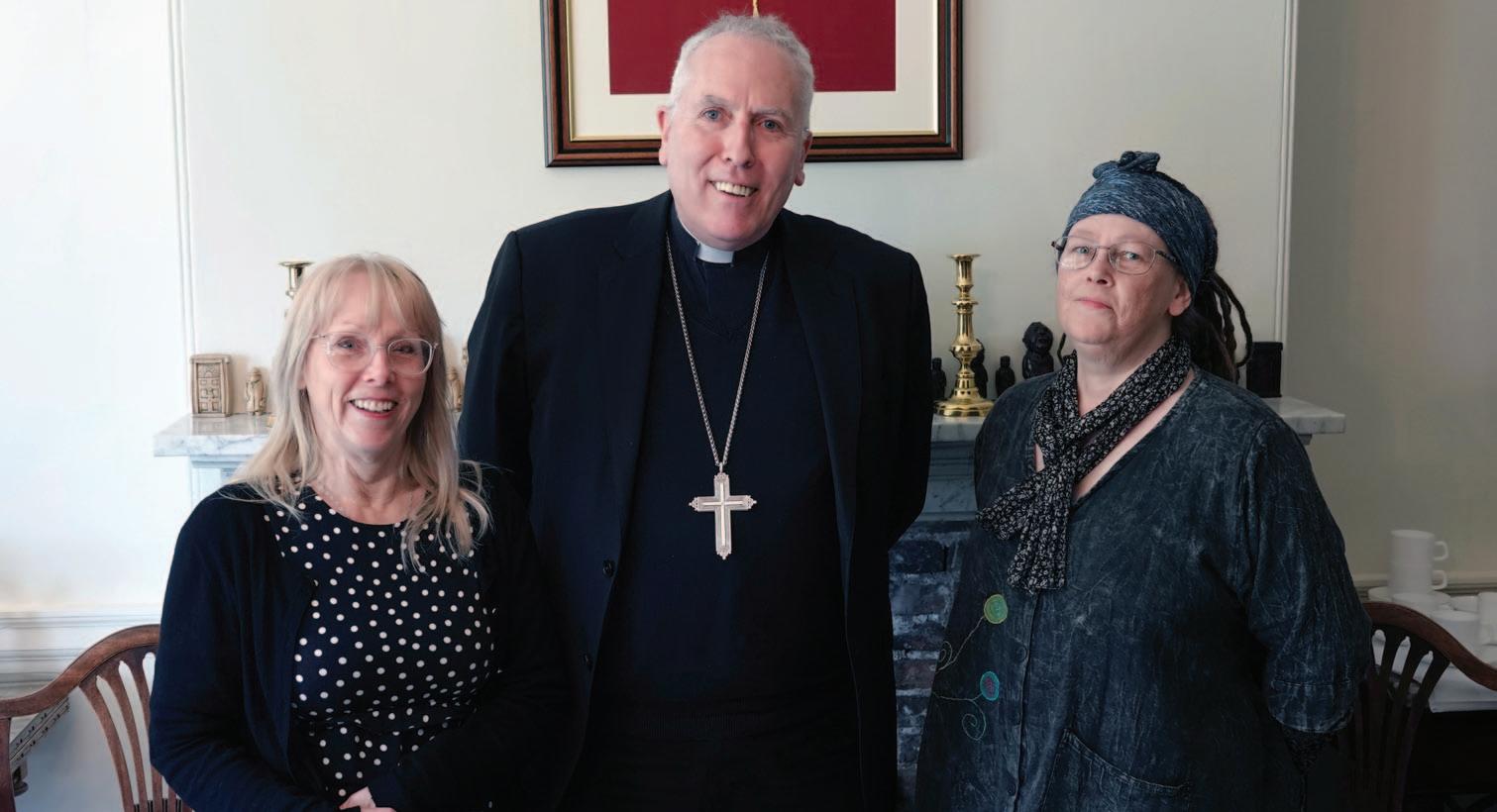
n Janice Burrows (left) and Sharon Ellis (right) are pictured here with Bishop Peter Collins as they marked the conclusion of their service to the Diocese of East Anglia this Easter. Bishop Peter welcomed members of the curia for a small gathering of hot cross buns, cakes, and heartfelt thanks in recognition of their dedication and contribution. Janice and Sharon were warmly wished well as they move on to the next chapter.
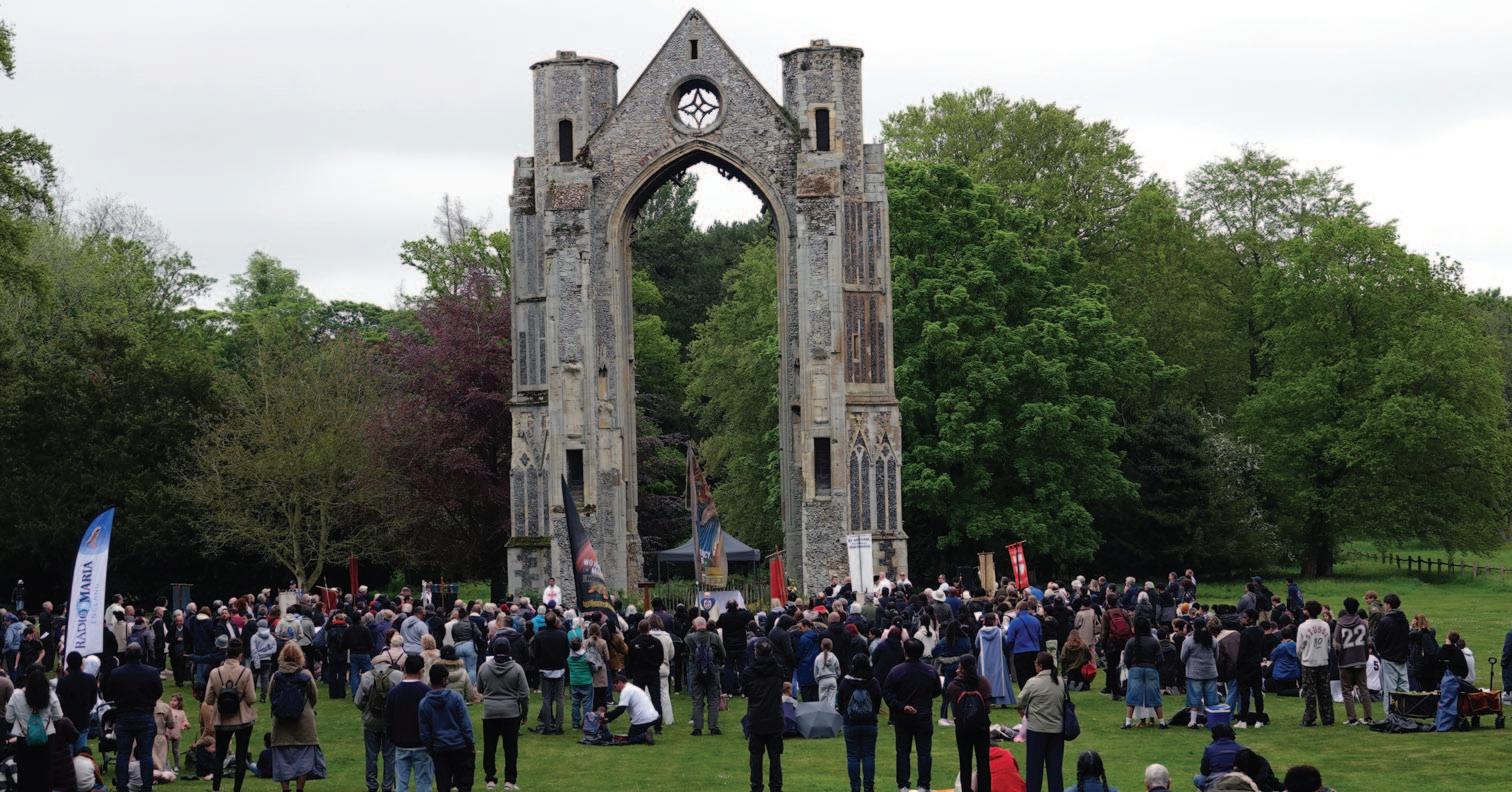
n The diocesan pilgrimage to Walsingham concluded at the historic Walsingham Abbey to mark the Diocesan jubilee.