EastAnglia
Newspaper of the Diocese of East Anglia
Clare Priory: A living catholic heritage
– page 2
Marriage celebration Mass honours enduring love – page 6
Joyful celebrations for Corpus Christi
The Cathedral of St John the Baptist in Norwich was filled with reverence and celebration on the feast of the Most Holy Body and Blood of Christ, as faithful from across the Diocese of East Anglia gathered for a solemn Mass, Eucharistic procession and Benediction.
Charlie Bohan-Hurst reports.
n The liturgy was led by Bishop Peter Collins, marking a deeply significant moment in the diocesan calendar.
A particular highlight of the celebration was the presence of nineteen young people
who received their First Holy Communion. In his homily, Bishop Peter warmly greeted each of them individually, shaking their hands and affirming the importance of the moment. He reminded them that the Eucharist is “the greatest gift you will ever receive,” encouraging them to treasure and return to it throughout their lives.
The readings proclaimed at Mass illuminated the profound mystery being celebrated. The first reading, from the Book of Deuteronomy (8:2–3, 14–16), recalled how God sustained His people in the wilderness, feeding them with manna to teach them that life depends not merely on bread, but on every word that comes from the Lord. This passage points forward to the Eucharist, in which Christ offers Himself as the true bread from heaven, sustaining His people not just physically, but spiritually.
In the second reading, from St Paul’s First Letter to the Corinthians (10:16–17), the unity of the Church through the Eucharist was emphasised. St Paul reminds us that though we are many, we are one body because we share in the one bread. This theme was clearly reflected in the gathered congregation, diverse in age and background, yet united in faith and communion.
The Gospel reading, taken from St John (6:51–58), brought the congregation to the heart of the mystery of Corpus Christi. Jesus declares Himself to be the living bread come down from heaven, insisting that whoever eats His flesh and drinks His blood will have eternal life. These words, both challenging and life-giving, underline the Church’s belief in the real presence of Christ in the Eucharist, which is central to the celebration taking n story continues on page two.
Vocations focus in East Anglia: Canon David Bagstaff – page 9
St Laurence’s Marks Feast of Our Lady of Fatima
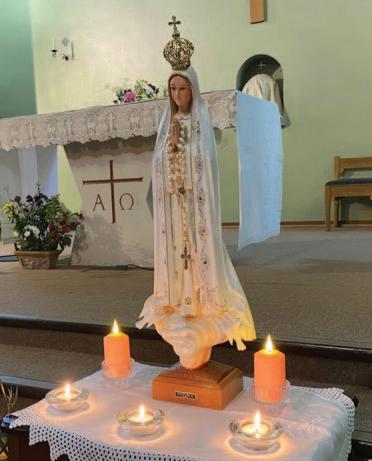
n St Laurence’s Catholic Church in Cambridge, under the pastoral care of Fr Robin Joseph CRM, recently marked a deeply prayerful and joyful celebration in honour of Our Lady of Fatima.
The parish community came together for a nine-day Novena, culminating in a wellattended Mass for the feast. Each day of the Novena was marked by a heartfelt gesture of devotion, as parishioners brought fresh roses and flowers to offer to Our Blessed Lady. By the end of the celebrations, the church was beautifully adorned with these floral tributes, a visible sign of the love and reverence held by the faithful. At the conclusion of the feast day Mass, parishioners were invited to take flowers home, extending the spirit of the celebration into their own homes and continuing their devotion.
Following the liturgical celebrations, the parish gathered in the hall to share a vibrant multicultural feast, reflecting the rich diversity and unity of the St Laurence’s community. It was a joyful occasion of fellowship, with parishioners bringing and sharing dishes from a variety of cultural traditions.
The day was made even more special as the community celebrated the 20th wedding anniversary of Deacon Gianluca and his wife, Erminia. Their milestone was warmly acknowledged, adding a further note of thanksgiving and joy to an already grace-filled occasion.
Altogether, the celebrations were a beautiful expression of faith, community spirit, and devotion, leaving all who attended with a renewed sense of unity and gratitude.
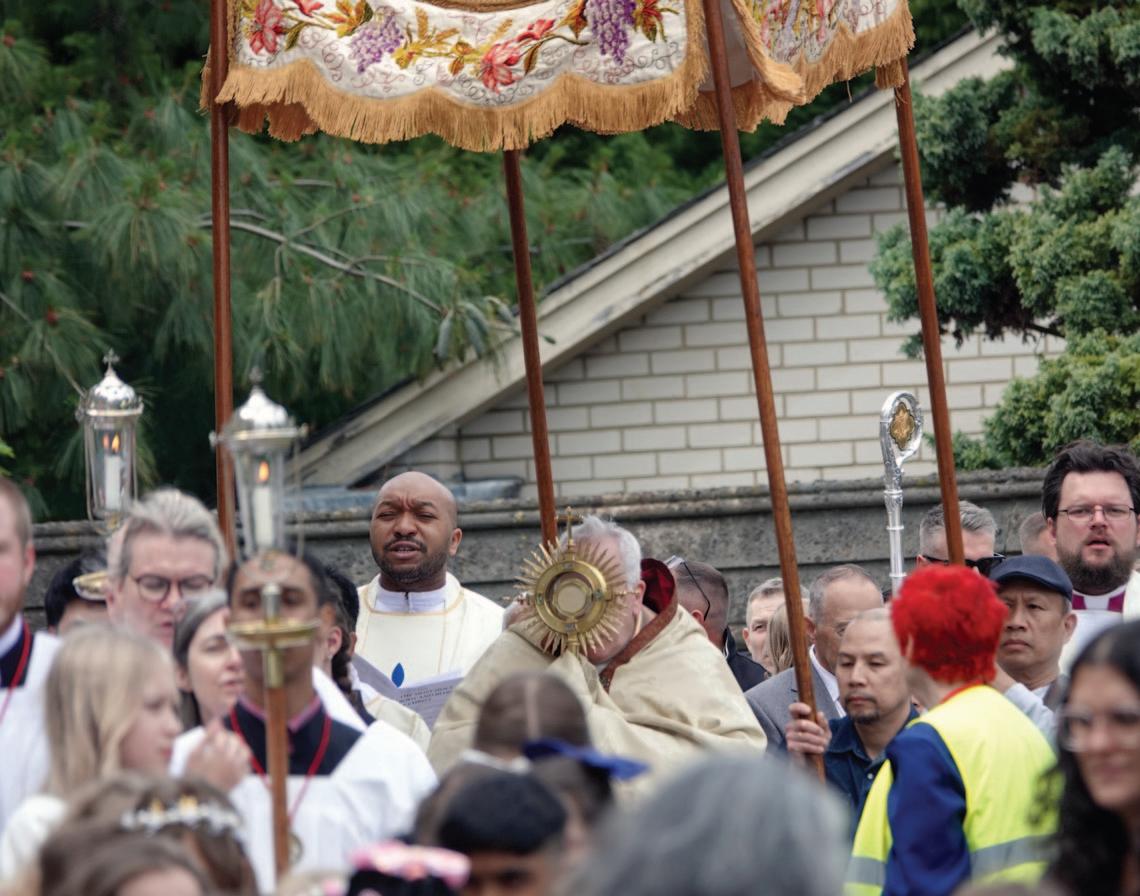
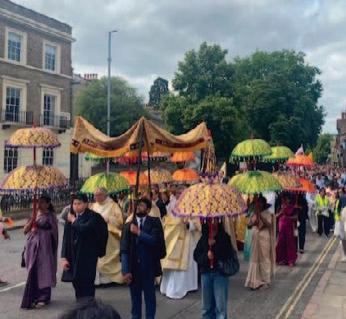
Bishop Peter Collins and the congregation process with the Blessed Sacrament.
Corpus Christi
n story continued from page one. place at the altar.
During the Mass, members of the diocesan youth ministry team, Ignite, were also recognised for their dedicated service. Luc Wallace, Luke Hardy, and Nicholas Villaroman were presented with certificates by Bishop Peter, who expressed gratitude on behalf of the diocese for their commitment to supporting and inspiring young people in the faith.
Following Holy Communion, the celebration extended beyond the cathedral walls with a traditional Eucharistic procession. The Blessed Sacrament was carried reverently out onto Unthank Road and through the surrounding area, before returning to the cathedral via the gardens.
Upon returning to the cathedral, the faithful gathered for solemn Benediction. The liturgy began with the recitation of the Divine Praises, honouring Christ truly present in the Blessed Sacrament. In an atmosphere of prayerful silence and devotion, the congregation received the Eucharistic blessing, bringing the celebration to a fitting and prayerful close.
Across the Diocese of East Anglia, many other Corpus Christi processions took place, bearing witness to the enduring presence of Christ in the Eucharist. In Cambridge, more than 1,500 people joined the first city-wide Corpus Christi procession since the Reformation, a remarkable moment in the city’s Catholic history. From parish communities to deanery gatherings, Catholics across East Anglia came together in prayer, devotion and public witness, making this year’s celebration of Corpus Christi a powerful expression of faith and unity.
EastAnglia
Newspaper of the Diocese of East Anglia
EDITOR: Charlie Bohan-Hurst
communications@rcdea.org.uk
Articles and photographs for the next edition are very welcome and should be sent to the editor, ideally via email, by Friday, 7 August.
Diocese website: www.rcdea.org.uk
Advertising: Contact Nick at Cathcom on tel 01440 730399 or email him at ads@cathcom.org
Publisher: Cathcom Ltd, 0207 112 6710
Inclusion of adverts is the responsibility of Cathcom and does not imply endorsement by the Diocese of East Anglia.
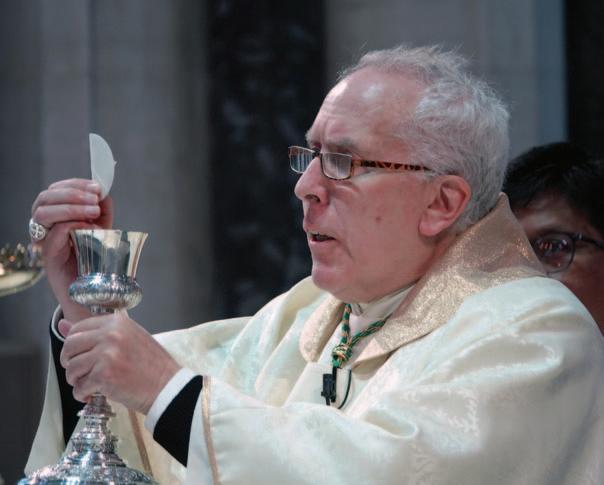
Sung Mass celebrates the Most Sacred Heart
A
Sung Mass for the Solemnity of the Most Sacred Heart of Jesus was celebrated at the Cathedral of St John the Baptist in Norwich on 12 June, led by Bishop Peter Collins. Charlie Bohan-Hurst reports.
n The liturgy drew the faithful into contemplation of the depth of Christ’s love, expressed so powerfully in the devotion to the Sacred Heart. The readings of the day offered a rich reflection on God’s enduring love and mercy.
In the first reading from Deuteronomy (7:6–11), the people of Israel are reminded that they are chosen not because of their greatness, but because of God’s love and faithfulness. This passage emphasises that God’s covenant is rooted in love, a love that is steadfast and freely given. In the context of the Sacred Heart, it points to the same divine initiative: God seeks out His people and binds Himself to them in love.
The second reading from the First Letter of St John (4:7–16) makes this message even more explicit, declaring that “God is love” and that whoever lives in love lives in God. This reading lies at the very heart of the feast,
revealing that the Sacred Heart is not merely a symbol, but a profound expression of God’s very nature. The love shown in Christ is selfgiving and sacrificial, inviting all to share in that same love.
In the Gospel from St Matthew (11:25–30), Jesus offers the well-known invitation: “Come to me, all you who labour and are overburdened, and I will give you rest.” Here, Christ reveals the gentleness and humility of His heart. The Sacred Heart is shown as a place of refuge and consolation, where the weary can find peace. This passage highlights the personal and tender nature of Christ’s love for each individual.
Together, the readings form a unified message of divine love that is faithful, self-giving,
and compassionate. The celebration of the Sacred Heart invites the faithful not only to reflect on this love, but to respond to it, allowing their own hearts to be shaped by Christ’s. The Sung Mass was marked by reverence and prayerful participation, offering a fitting tribute to one of the Church’s most beloved devotions.
Diocesan Women’s retreat
Eighty women attended the “Retreat Day for Women” organised by the Diocese’s Marriage and Family Life Commission this year. Such was its popularity that it had to be run twice.
n The theme, “From the Head to the Heart”, was explored through talks given by the Sisters from the Community of Our Lady of Walsingham, in the beautiful setting of their house in Dereham. Warm sunshine made the grounds an even more attractive space for quiet walks and small-group gatherings during times of reflection.
The retreat day centred on St Edith Stein (1891–1942), also known as Sr Teresa Benedicta of the Cross. A highly intelligent German Jewish philosopher, she converted to Catholicism following a profound intellectual and spiritual journey, famously prompted by reading St Teresa of Avila’s autobiography in one sitting. She later became a Carmelite nun and wrote extensively on faith, philosophy and the human person. Arrested by the Nazis because of her Jewish heritage, she was deported to Auschwitz and died in the gas chambers in 1942. She was canonised by Pope John Paul II in 1998.
Using her as a model, Sr Catherine spoke about the journey to holiness, describing it as a movement towards unity. As people grow closer to God, the different aspects of their lives – thoughts, desires, actions and relationships – become more integrated and aligned with His will. We all begin life with inner conflict or divided priorities, but we are
called to grow in integrity, allowing faith to shape every part of who we are. In this way, holiness means becoming a whole and unified person, with a deep harmony between belief, purpose and action. We are called to become more like Christ, accepting and doing only and always the will of the Father. This journey of a lifetime takes a lifetime to complete.
“God expects each creature to serve Him according to its nature. The angels must love God angelically, that is without heart, sentiments, affections, for they have none of these things, But he expects us to love him humanly, that is, with all our heart, soul, strength and mind, and our neighbour in the same way.” – Blessed Dom Columba Marmion
Edith Stein made a significant contribution to Catholic thought on women through her work as a philosopher, educator and Carmelite nun. In her writings, she explored what she saw as the distinctive gifts and vocation of women, while strongly advocating for their intellectual, professional and spiritual development. She believed that every person is called to become fully themselves in God, uniting intellect, emotions, body and spirit. In her view, women have a unique contribution to make in fostering authentic human relationships and building communities grounded in love and respect.
“The intrinsic value of woman consists essentially in exceptional receptivity for God’s work in the soul” she said.
In her lectures and essays, Stein argued that women possess a particular capacity for empathy, personal attentiveness and nurturing the growth of others. However, Sr Catherine noted that in order to be truly receptive to God’s work in the soul, we must
purify our desires by praying for right desires and their proper ordering. This requires selfknowledge: knowing ourselves honestly and truthfully, as we really are and as God sees us.
“Most of our trials and times of unrest come from the fact that we don’t know ourselves” –St Teresa of Avila
The second half of the day focused on suffering. Sr Camilla reminded participants that we cannot reach Easter Sunday without first passing through Good Friday. She challenged the misconception that we must have everything in order before coming to God, noting that Scripture tells us otherwise: Jesus invites the broken-hearted to come to Him and reminds us that it is not the healthy who need a doctor, but the sick. God can use everything in our lives to deepen our relationship with Him, but we must surrender to His will in all circumstances. It is essential, however, that we bring our anger, hurt and pain to God in prayer; otherwise, we cannot receive the grace needed to move towards an authentic acceptance of His will.
“The fullest freedom I have ever known, the greatest sense of security, came from abandoning my will to do only the will of God.” – Fr Walter Ciszek SJ
This trust in God is a lifelong journey. We are encouraged to meditate daily on the Gospel so as to come to know the face of God –Christ Himself – and to see with the eyes of faith, discerning God’s will as it is revealed in the circumstances of everyday life.
“Knowing that we are infinity loved by God is what gets us through the cross” ended Sr Camilla. And it is this knowledge that sustained St Edith Stein through her suffering and led her to Heaven – the destination to which God calls us all.
Bishop Peter presided over the Mass for the Most Sacred Heart of Jesus.
Corpus Christi procession in Cambridge.

Clare Priory: A living catholic heritage
As we celebrate our fifty years as the diocese of East Anglia, let us remember the great places and events that mark the living Faith of places and people here in East Anglia. This month Fr Bernard Rolls OSA, Prior of Clare Priory (an Augustinian prayer and retreat centre as well as a parish in its own right), writes about its long and disrupted history.
n After an absence of 415 years, the Augustinian friars returned to Clare Priory in 1953, to what had been their first house in England and indeed in the English-speaking world. The absence, initiated by agents of Henry VIII in 1538, may have been longer than their original presence, but the returning friars found many elements of the medieval priory out of which to form the ‘returned friary’. The name and identity of the original owners still clung on; the Prior’s house had been adapted as a family home, and the infirmary and dormitory building had been adapted as a barn. One complete wall of the medieval church still stood, and both cloisters were basically intact. Once again there has come to be a community presence, now running a parish and a retreat centre. The friars of 1249 came mainly from Italy and from Norman France or Belgium; in 1953 they came from Ireland. Today’s community is English but is likely to be more cosmopolitan in the future. The infirmary building became the church, adequate in those initial times for the parish, but soon outgrown by the number of parishioners and pilgrim groups.
The Augustinian Order was formed by Pope Pius IV (1244). There existed in the Tuscan Hills, along pilgrim routes to such places as Rome and Loreto, small communities of what were known as hermits. These communities would each have about a dozen members, following the rule of St Augustine. Within a few years they had reached out beyond Italy, some setting up communities in France, and it was there that they met Richard de Clare, one of the wealthiest and most cosmopolitan of the Norman earls (with lands in France, England and Ireland). He invited them to come to his lands in Clare, Suffolk. Why? Perhaps
he was prompted by his acquaintance with Cardinal Annibaldi, protector and promoter of the friars, or by King Henry III, an ardent supporter of the friars, be they Franciscan, Dominican or Augustinian. To arrive in Clare in 1248 they had to have been directed there. They started building immediately in the shadow of a great Norman castle.
Clare Priory became the mother house of 34 Augustinian houses in England. The number of friars swelled rapidly, and four houses of studies were founded by 1300. Through the de Clare family links they had by then also established houses in Ireland.
Unlike monks, who usually take a vow binding them to stay within their monastery, friars are expected, when ordered by their superior, to move from friary to friary over time. The popes gave friars the right to beg for their sustenance, and each friary had its own territory or ‘limit’. As such, the black-habited Augustinians were well known throughout the area from Clare to Hatfield, Chelmsford and Mersea. Some 300 towns and villages in Suffolk and Essex were regularly visited. In 1296, when Edward I visited Clare Priory, it had 29 friars. The king’s daughter Joan of Acre (not to be confused with Joan of Arc) resided in Clare Castle where, for example, two friars sang Mass daily, and members of the family were buried close to the high altar in the priory church.
The friars worshipped, prayed, studied scripture and engaged in teaching and preaching for up to two hours, and were expected to be entertaining. They spoke in English (not Latin as in the monasteries) and were popular with the common people. They kept the vow of poverty, had no personal possessions, and lived on others’ goodwill, as they still do. They helped the destitute and tended the sick. They provided hospitality to
travellers, especially those on pilgrimage to major sites like Walsingham or Canterbury. They thrived, and the priory was rebuilt and expanded just before the Black Death wiped out half the population in the late 1340s. Thereafter the number of friars and priories went into decline. By the time that Henry VIII suppressed all religious houses between 1536 and 1540, there were only 15 friars at Clare.
The last prior accepted a position as a canon of Norwich Cathedral. Some friars accepted the Reformation, and others lived on as parish priests or on small state pensions. Richard Ingworth, the King’s agent, took possession of all the priory lands and buildings, and arranged for their sale to the King’s trumpeter, no less, a man called Richard Frende. The church and many buildings were pulled down, and the materials recycled in new builds around the town and to turn the Prior’s house into a grand manor house. Until recently, the old Post Office still had beams from the church. In 1596 the land was acquired by the Barnardistons from Kedington (near Haverhill) and passed through a female line to the Barker family. Lady Mary Barker, who died in 1940, urged her daughters to find the friars and hand the priory back to them. They did so, and the friars returned in 1953.
Clare has changed a lot since 1953. The smallest market town in Suffolk has become less of a centre of local crafts and trades and more the home to commuters and retirees. The train line was a victim of the Beeching cuts of the later 1960s, Clare one of 2,673 stations to close. It is a quiet, peaceful place. From 1953 onwards, the priory was used first as a house of studies, then as a novitiate until specialist facilities in Ireland took over. But as a place of peace and quiet, it soon developed
as a retreat house for people from the diocese and beyond. As well as providing modern ensuite accommodation, where the old stables and garage once stood (the block opened in 1998), the Grade I listed house is ideal for small and quite large gatherings, for those staying or coming for Quiet Days, and food can be provided. Attempts to build a new church were thwarted for many years by English Heritage’s dislike of every proposed change in such a historic site. Finally, an award-winning design was accepted, and the new church was built into and out of the medieval infirmary and was dedicated in 2013. It now fits, but only just on major feasts, all who want Mass.
Since the late 1960s, the priory has taken on its present use as a house of quiet retreat, a place of prayer and meditation, a place to find peace and sort out personal problems alone or with the help of a member of the community; alternatively, one can participate in lively but intense retreat weekends with the younger Church. A warm welcome awaits all who visit. The church, extensive gardens, benches, medieval ruins, orchards and walks give ample space and facilities to enjoy the peace in the fresh air, while Clare Country Park and the town are just across the footbridge. Some people come for a day, others for several days or more, and depending on whether their stay is quiet or even silent, they mix in with the community for meals and prayer time in the main house with its medieval and later features. Many friars visit. One visitor who came in his role as Prior General or Superior of the worldwide family of the Austin, or Augustinian, friars was Fr Bob Prevost OSA, whom we now call Pope Leo XIV. He came twice and stayed in the stable house. Will he visit again? Will you come in his footsteps?
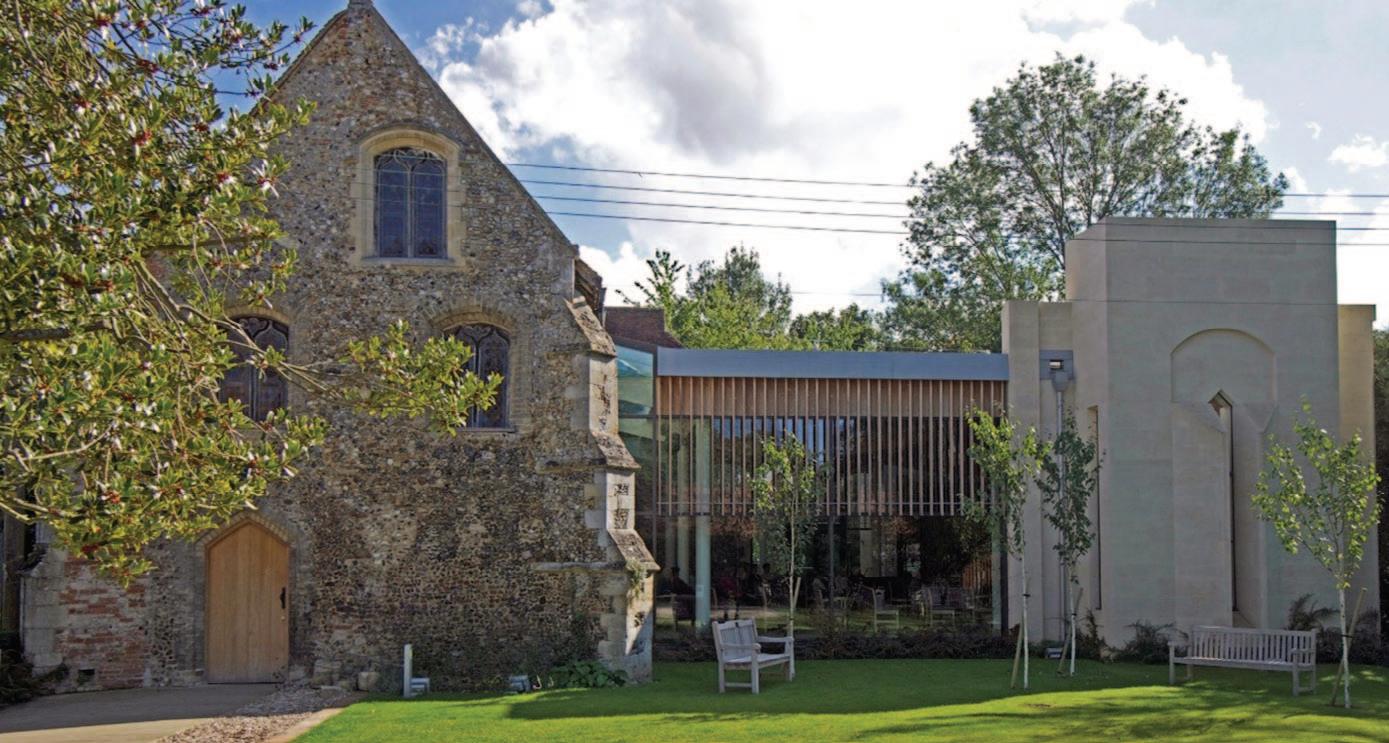
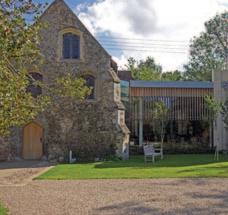
The old and the new at Clare Priory.
Diversity celebrated at Jubilee launch
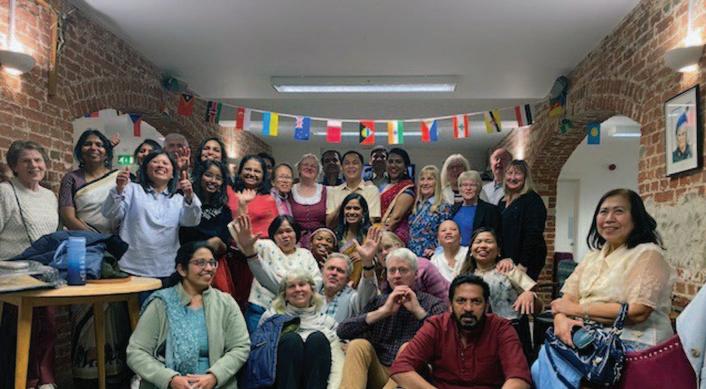
St Edmund’s Parish in Bury St Edmunds marked the beginning of its Diocesan Jubilee celebrations with an ‘International Evening’ held in the church crypt on 12 May. Around 130 parishioners attended, representing 30 different nationalities.
n Event co-ordinator John Saunders explained the inspiration behind the evening:
“Our once largely white British congregation has changed significantly since a video recording from 1987. Today, we are probably one of the most multicultural congregations among local churches. This diversity is a great strength, and relationships are good. However, many of us attend Mass, exchange greetings, but do not always take the opportunity to truly get to know one another or understand how we might support each other better.”
Seven parish representatives were invited to share their personal stories in short presentations of no more than eight minutes. They spoke about their countries of origin, their journeys to Bury St Edmunds, the challenges and joys they had encountered, and how the parish community might grow in understanding. Care was taken to avoid political discussion and to maintain the evening’s spirit of respect and unity.
Speakers came from India, Poland, the United States, Vietnam, the Philippines, Nigeria and England, each offering a thoughtful and often moving reflection.
Jetty spoke about the growing Keralan community, many of whom have come to Bury to work in healthcare and support the



NHS. “We were drawn by opportunities in healthcare, care work and skilled trades, seeking a new chapter for our families,” she said. “The town’s welcoming character, safe streets and historic charm made it a natural choice. We have brought with us our faith, values and cultural richness, which sustain us and enable us to contribute to our new home.”
Emmanuel reflected on the challenges of settling in a new country, including language barriers, cultural adjustment and the need for greater understanding around equality, diversity and inclusion. Despite these difficulties, he highlighted the many positives, particularly the opportunity to build a career and raise a family in a place where faith can be freely practised. He described the evening as “an important step towards a more inclusive future”.
Another speaker shared her powerful story of arriving in England as a refugee from a war-torn country with nothing. Eventually settling in Bury, she and her family were welcomed by a local household. She has since raised her own family and now runs a successful business. “Over the years, I have been able to settle, become part of the Catholic Church and be accepted in the wider community,” she said. “Tonight’s event will do much to bring us even closer together.”
Significantly, the event took place on the same day it was reported that racial attacks on NHS staff had increased by 17 per cent. Against this backdrop, the evening underscored both the valuable contributions made by people from overseas and the shared desire to enjoy the opportunities that Bury offers. Hearing these personal stories fostered a deeper understanding and a clear wish for greater unity within the community.
The second half of the evening featured food tasting from nine different countries,
offering a further opportunity for conversation and fellowship. Participants were encouraged to learn the names of at least three new people before the evening ended, a challenge that was enthusiastically embraced.
The event was widely regarded as a success, with clear signs of growing cross-cultural dialogue. This has already led to increased participation in parish life, including attendance at the Syro-Malabar Mass, invitations to speakers for parish groups, and a greater willingness to volunteer.
Looking ahead, the challenge will be to sustain this momentum and allow it to deepen the parish’s shared faith and worship.
Bury St Edmunds is currently awaiting the outcome of its bid to become a national Town of Culture, and John believes the initiative could contribute positively to the wider community. A local school is already planning to replicate the concept of an international evening.
“It will not be easy to preserve the special character of our town,” John said. “There may be times when divisions arise, but by working together in unity, we can resist negative influences and demonstrate the importance of loving our neighbour.”
He also encouraged those who may feel concerned about immigration to reflect on the stories shared during the evening. While acknowledging that not all circumstances are straightforward, he emphasised that most newcomers are law-abiding, contribute through work and taxation, and bring valuable skills, often filling roles that are otherwise hard to recruit for.
“They are part of our community,” he added, “and their presence shows how we can all benefit from diversity, equality and inclusion.”
Further Jubilee events are planned in the coming months, but this first gathering has provided a strong and hopeful beginning.
May Crowning celebrated at St Philip Howard, Cambridge
Parishioners at St Philip Howard Church in Cambridge gathered in joyful celebration for a traditional May Crowning ceremony on 31 May in honour of Our Lady.
n Following the 10am Sunday Mass, the parish’s 400-strong congregation processed from the church to the Marian grotto outside, singing the much-loved hymn Bring Flowers of the Rarest. The procession provided a fitting tribute to the Blessed Virgin Mary during the month traditionally dedicated to her.
At the grotto, Parish Priest Fr Philip led the congregation in prayer and blessed a rose crown before placing it on the statue of Our Lady. The congregation then sang As I Kneel Before You as children came forward carrying flowers, filling the vases surrounding the statue until they overflowed with colourful blooms.
Fr Philip then led a Prayer of Consecration to the Immaculate Heart of Mary for the parish and its families, entrusting them to
Our Lady’s loving care and intercession. The ceremony concluded with the singing of the Salve Regina, bringing to a close a
beautiful and prayerful celebration of devotion to the Mother of God, which was attended by parishioners of all ages.
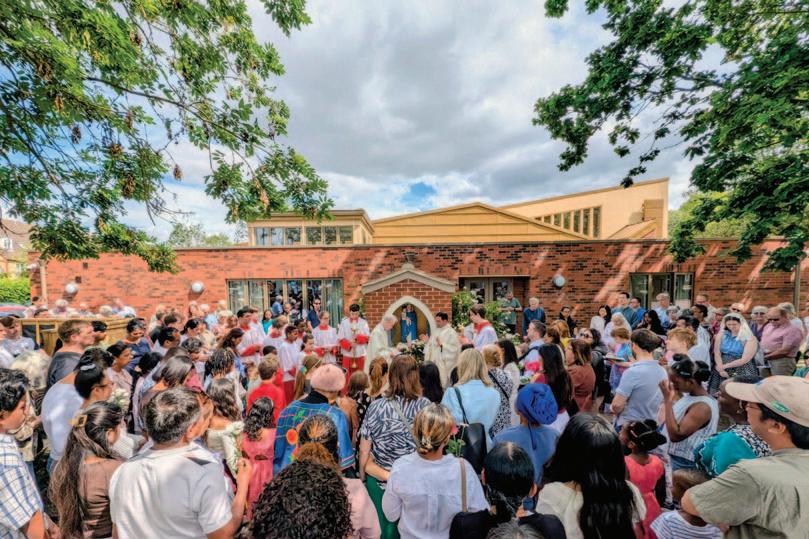
Parishioners celebrate in Bury St Edmund’s.
Parishioners gather for the May Crowning at the recently redeveloped St Philip Howard.

Cambridge Catholic accepted for Priesthood formation
The Diocese of East Anglia warmly congratulates Matthew J Clarke on his acceptance for seminary formation as he begins the next stage of his vocational journey. In the reflection that follows, Matthew shares something of his background, his path into the Catholic Church and the gradual discernment of a call to the priesthood. He also looks ahead to his forthcoming propaedeutic year at the Royal English College in Valladolid, where he will continue to grow in prayer, study and self-knowledge as he prepares for formation.
n I was received into the Catholic Church five years ago. Ever since my teenage years, growing up in and around Cambridge, there had been a yearning to know and to love God. It was during my university studies that I first seriously encountered Christianity:
reading the scriptures, studying the works of St Augustine through one of my courses and, eventually, learning to pray the Rosary.
Returning home to Cambridge following my Master’s, I enrolled in the RCIA programme at Our Lady and the English Martyrs, a church I had long known and admired. That Easter Vigil of 2021, kneeling in my pew after being baptised, confirmed and receiving the Eucharist for the first time, I knew that I had finally come home. It was only two weeks later that I first started serving at the altar, and along with helping to teach catechesis later down the line, has been a great privilege.
My godfather had warned me that the question of a vocation to the priesthood or religious life would arise, and I was certainly quick to shrug it off at the time. This all changed when, quite literally after a dream I had one night during Holy Week, I woke up with this deep sense that there was something to explore.
I wrestled with this sense of a calling for some time, during which I worked for a church in London and dated. However, after a retreat to Pluscarden, sitting on a bench overlooking the Abbey before Vespers, I was once again overwhelmed by God’s invitation to discern this with him.
Over these last few months I have made my application to the diocese; I had fleetingly discerned other communities but, for me,
East Anglia will always be my earthly home. The application process, although intense, was incredibly rewarding, and through it I have come to better know myself, where my weaknesses are and see how Christ has continued to graft my heart onto His. Throughout the whole journey, the overarching question has been how does one love best? In what ways do we best give ourselves to God and to our neighbours? Should anyone reading this be asking themselves where God is calling them, this, for me, has been a great place to start.
I am now preparing to start my propaedeutic year at the Royal English College in Valladolid this September. This year in Spain will be an invaluable opportunity to build a solid foundation of prayer, study and self-knowledge before going on to further formation (picking up a little bit of Spanish along the way!).
I remain indebted to so many who have supported me on this journey so far: in particular Bishop Collins, Bishop Emeritus Hopes, Mgr Harkness, Fr Wygnanski and Fr Smith for their
support during my application; the priests, servers and parishioners of both Our Lady and the English Martyrs and St James’s Spanish Place; and to my friends, both Catholic and secular, who have shown so much love and support on this path that I have begun to walk.
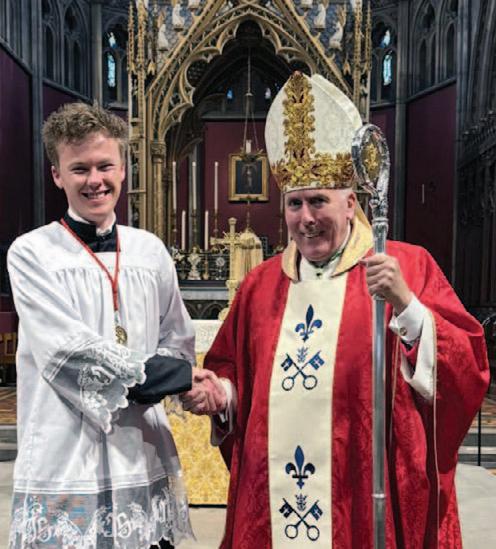
Matthew J Clarke with Bishop Peter Collins.
Faithful gather for Trinity Mass & May Crowning
n The faithful of the Diocese of East Anglia gathered in joy and reverence at the Cathedral of St John the Baptist in Norwich to celebrate the Solemn Mass for the Most Holy Trinity, presided over by Bishop Peter Collins.
The liturgy, rich in solemnity and prayer, invited the congregation into deeper contemplation of the mystery at the very heart of the Christian faith, one God in three Persons, Father, Son, and Holy Spirit.
The First Reading, from the Book of Exodus (34:4–6, 8–9), presented the Lord revealing Himself to Moses as “a God of tenderness and compassion, slow to anger, rich in kindness and faithfulness.” This ancient revelation speaks powerfully to the nature of the Father, whose mercy flows eternally within the life of the Trinity. Moses’ humble response, bowing down in worship, mirrors the attitude of the Church as she stands before the mystery of God’s inner life.
In the Second Reading (2 Corinthians 13:11–14), St Paul offers a blessing that is deeply Trinitarian in form, “The grace of the Lord Jesus Christ, the love of God, and the fellowship of the Holy Spirit be with you all.” This familiar conclusion to the letter beautifully expresses the distinct yet unified action of the three divine Persons. It reminds the faithful that the Trinity is not an abstract doctrine, but a living communion into which we are invited, a communion of love, grace, and unity reflected in the life of the Church.
The Gospel reading (John 3:16–18) brought the assembly to the very centre of the mystery, “God so loved the world that he gave his only Son.” Here, the love of the Father is made visible in the gift of the Son, and the promise of eternal life is realised through belief in Him. Implicit too is the presence of the Holy Spirit, through whom this saving truth is revealed and received. The passage underscores that the Trinity is not distant, but actively engaged in the salvation of the world.
In his homily, Bishop Peter Collins drew these threads together, encouraging the faithful to recognise the Trinity not simply as a doctrine to be understood, but as a relationship to be lived, a call to unity, love, and self-giving in imitation of the divine life.
Following the Mass, the celebration continued with a May Crowning in the Cathedral gardens. A devotional procession led the congregation from the Cathedral into the open air, where the statue of Our Lady stood adorned with flowers. In a moment of quiet devotion, Bishop Peter reverently crowned the statue, honouring the Blessed Virgin Mary as Queen of Heaven. He then incensed the statue as the faithful gathered in prayer, their voices and hearts lifted in Marian devotion.
This beautiful conclusion to the celebration served as a reminder that Mary, though not part of the Trinity, is intimately connected to its mystery, as the chosen daughter of the Father, the Mother of the Son, and the spouse of the Holy Spirit. Her example continues to lead the faithful ever deeper into the life of God.
The day was marked by both solemnity and joy, leaving those in attendance renewed in faith and strengthened in their understanding of the Most Holy Trinity, the source and summit of Christian life.
Marriage celebrat honours enduri
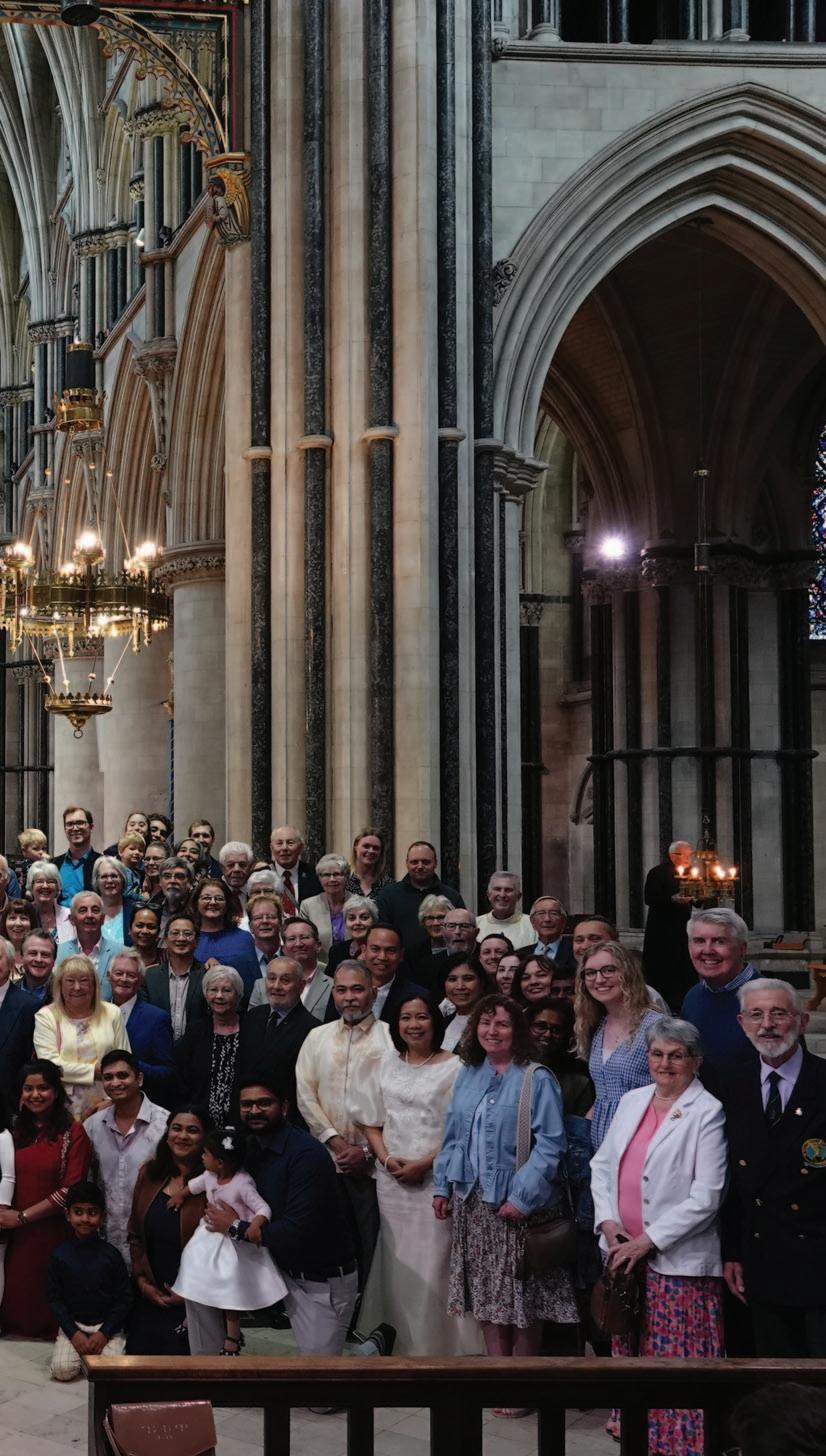
More than 200 people gathered at the Cathedral of St John the Baptist on 13 June for the Diocese of East Anglia’s annual Marriage Celebration Mass, led by Bishop Peter Collins. Couples marked milestones ranging from one year to an extraordinary 67 years of marriage, representing a combined total of 3,308 years of married life. Charlie Bohan-Hurst reports.
n The celebration extended beyond the Cathedral, with many more couples joining via live stream, including viewers as far away as the
United States. Together, they formed a powerful witness to the strength and joy of Christian marriage across generations and continents.
The liturgy reflected deeply on the vocation of marriage. In the first reading from the Book of Tobit (Tobit 8:4b–8), the prayer of Tobit and Sarah offers a model of married love rooted in faith, self-giving and trust in God’s providence. Their words remind couples that marriage is not simply a private bond, but a sacred covenant lived in the presence of God, sustained by prayer and mutual devotion.
This theme was echoed in the Gospel reading from St John (John 15:9–12), where Christ calls his disciples to “remain in my love”. This command speaks directly to the heart of the sacrament of marriage: a call to love as Christ loves, with patience, sacrifice and enduring commitment. It is this faithful, self-giving love that sustains couples through the joys and challenges of married life, and which transforms ordinary moments into signs of God’s
grace.
Following the homily, Bishop Peter invited all couples present to take part in the rite of renewal, reaffirming the promises they had made on their wedding day. This moving moment highlighted both the constancy of marital love and the grace that continues to strengthen it over time.
After Mass, couples and their families gathered in the Cathedral hall and gardens to celebrate together over tea and cakes, collecting certificates to mark their anniversaries. The joyful atmosphere reflected the sense of community and shared thanksgiving that defines this annual celebration.
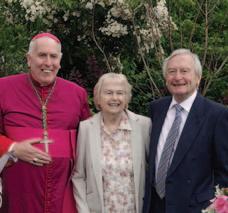
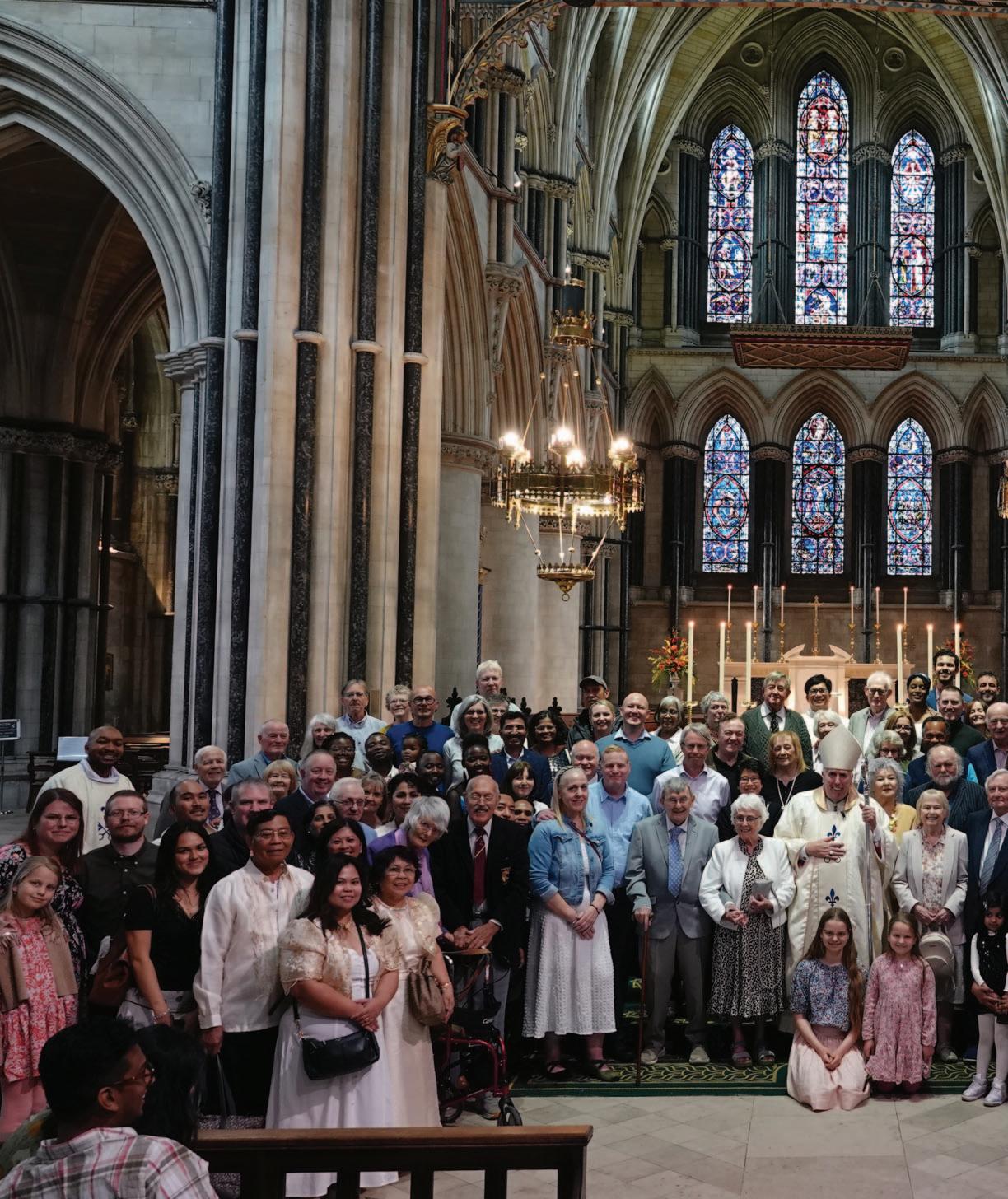
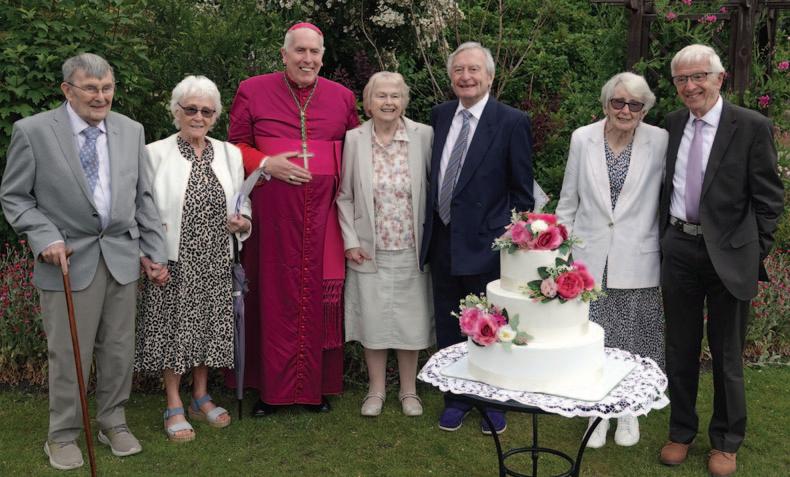
The featured image captures Bishop Peter with Margaret and John Stowers, celebrating 67 years of marriage, alongside Patricia and Graham Wood (60 years) and Muriel and Fred Confue (65 years), offering a visible testament to lives of faithful, enduring love.
Couples celebrating their marriages are joined by thier families and Bishop Peter after Mass.
tion Mass ing love

Bishop Peter’s engagements
JUNE
Jun 26, Fri
Bishop to celebrate Jubilee Special Mass at the Cathedral at 12.00.
Jun 28, Sun
Bishop to attend the Sung Eucharist at 10.30am at Ely Cathedral.
Jun 30, Tues
Bishop to attend Valladolid AGM and Mass from 10.30am at the Cathedral.
JULY
July 2, Thurs
Bishop to attend Diocesan Board of Trustees Meeting at 10.30 in Poringland.
July 3, Fri
Bishop to attend Walsingham Trustees Meeting including Mass at 10.00 in Walsingham.
July 4, Sat
Bishop to celebrate Ordination to the Priesthood at 11.30 at the Cathedral.
July 5, Sun
Bishop to celebrate 200th Anniversary Celebration Mass at 10.00 at St Mary’s, Thetford.
July 6, Mon
Bishop to celebrate Confirmation Mass at 19.00 at Our Lady Star of the Sea, Lowestoft.
July 7, Tues
Bishop to attend Bishop’s Council at 11.00 in Poringland.
July 8, Weds
Bishop to celebrate Mass for all school staff, governors and support staff in Newmarket at 18.30.
July 9, Thurs
Bishop to celebrate Confirmation Mass at 19.00 at St Luke’s, Peterborough.
July 10, Fri
Bishop to spend the day at St Benedict’s Catholic School, Bury St Edmunds in celebration of St Benedict’s Day, including Mass at 9.45am.
July 11, Sat
Bishop to meet with Cardinal Stephen Chow and celebrate a Sunday Vigil Mass at 18.00 at Our Lady of the Assumption and the English Martyrs.
July 12, Sun
Bishop to celebrate two Confirmation Masses at 11.15 and 17.00 at Our Lady of Lourdes & St John Fisher.
July 13, Mon
Bishop to celebrate Confirmation Mass at 19.00 at Our Lady and St Walstan.
July 14, Tues
Bishop to attend Mass to celebrate Fr Robert Billing’s Silver Jubilee of Ordination to the Priesthood at 12.00 at the Shrine of Our Lady of Walsingham.
July 16, Thurs
Bishop to celebrate 60th Anniversary of St Alban’s Catholic High School, Ipswich from 09.00.
July 16, Thurs
Bishop to celebrate Confirmation Mass at 19.00 at Our Lady Immaculate and St Etheldreda.
July 18, Sat
Bishop to celebrate Ordination to the Permanent Diaconate at 11.30 at the Cathedral.
July 20, Mon
Bishop to attend The Charles Plater Trust Working Group via Zoom at 09.00.
AUGUST
Aug 1, Sat
Bishop to attend the Pilgrimage of Reparation and Prayer for the Sanctity of Life from 12.00 at Walsingham.
Aug 21 – 28, Fri – Fri
Bishop to lead the Diocesan Pilgrimage to Lourdes.
Young pilgrims meet at Walsingham
Children, families and parish groups from across the Diocese of East Anglia gathered in joyful witness of faith on 26 May for the annual Diocesan Children’s Pilgrimage to the National Shrine of Our Lady of Walsingham.
n Led by Bishop Peter Collins, the day brought together young pilgrims and their parents from throughout the diocese, united
in prayer, community and devotion to Our Lady. The pilgrimage began in the village of Walsingham, where participants assembled before setting out together on foot towards the Shrine.
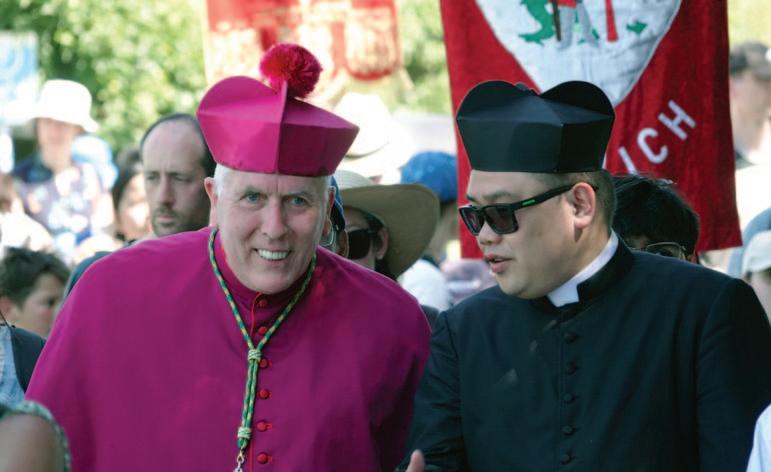
Despite sweltering conditions, spirits remained high as children walked prayerfully along the route. Hymns, laughter and moments of quiet reflection marked the journey, as pilgrims supported one another through the heat. Many carried banners and parish symbols, visibly expressing the rich diversity and unity of the diocesan commu-
St Ives parishioners mark Jubilee at Oscott
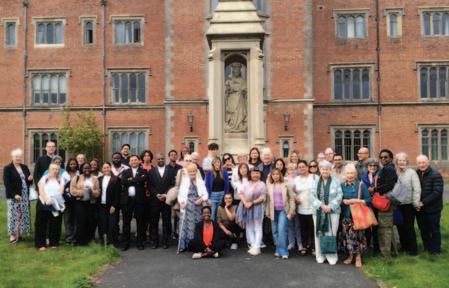
n On Good Shepherd Sunday (and World Day of Prayer for Vocations), 45 parishioners from Sacred Heart Church, St Ives, joined Fr Trindade Monteiro, priest-in-charge, for a parish pilgrimage to St Mary’s College, Oscott to celebrate the Diocesan Golden Jubilee.
Parishioner Ellen Kemp reports.
The parish chose to visit the college to celebrate the Jubilee as many priests who have served the parish were trained at Oscott, and the college continues to train priests from East Anglia today. In addition, the parish wished to celebrate the link between Oscott and Sacred Heart Church, as both buildings carry a legacy of work by Augustus Pugin.
Therefore, on a gloriously sunny day, pilgrims were welcomed to the college by seminarians Stephen (from the Diocese of Leeds), Neil (from the Diocese of Clifton), and Fr Justin Karakadu SDV, Formation Tutor MA – Spirituality & Homiletics.
Stephen and Neil provided a history of the college and then each outlined their personal story of God’s call to them to study for the priesthood, as well as the many stages of the training programme, which parishioners found fascinating. Stephen, a former schoolteacher, will be ordained to the diaconate at the end of
the year, God willing, and Neil, a former engineer with a car manufacturer, is in his fourth year of study.
The parish group were given time to explore the college’s beautiful chapel, designed by Augustus Pugin, before enjoying a delicious afternoon tea. This was followed by a tour of the college museum, where an exhibition wholly devoted to Saint John Henry Newman, Doctor of the Church, was available to peruse.
At 5 pm, Fr Trindade and the pilgrims joined the Very Reverend Michael Dolman, Rector, formation staff, students, and other members of the college community in Pugin’s stunning chapel for Exposition of the Blessed Sacrament and Benediction.
The service was a truly memorable event, and all pilgrims felt very blessed to have participated in the beautiful and sacred celebration with members of the college community.
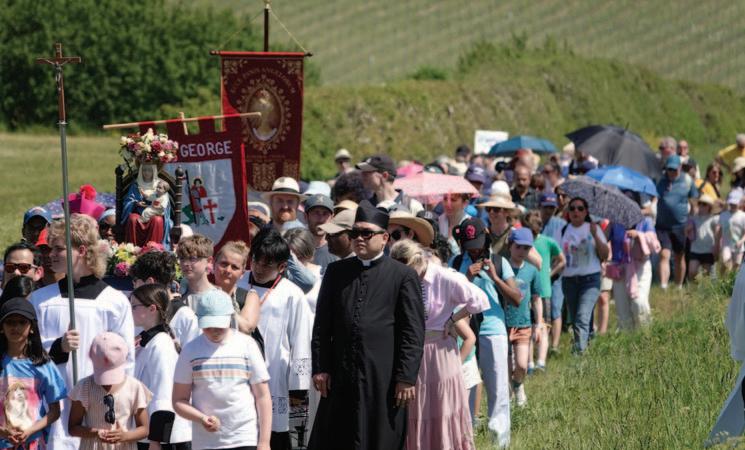
nity.
Upon arrival at the Shrine, the pilgrims gathered for a Solemn Mass celebrated by Bishop Peter Collins. The liturgy was marked by reverence and active participation, with children taking part in various roles throughout the celebration.
The day offered not only an opportunity for prayer, but also for friendship and shared experience. Parents and catechists reflected on the importance of such occasions in nurturing the faith of young people, while the children themselves embraced the sense of belonging and purpose the pilgrimage fos-
tered.
Though the heat presented a challenge, it also underscored the dedication of those who took part. The perseverance shown by the young pilgrims was a testament to their commitment and enthusiasm, leaving a lasting impression on all who attended.
As the Diocese looks ahead, the Children’s Pilgrimage continues to stand as a cherished tradition, one that strengthens faith, builds community, and invites the next generation to walk confidently in the footsteps of Christ.
Young people and their families braved the sweltering conditions.
Bishop Peter Collins with pilgrimage organiser, Fr Bienn Carlo Manuntag.

Retreat reflects on call to Holiness
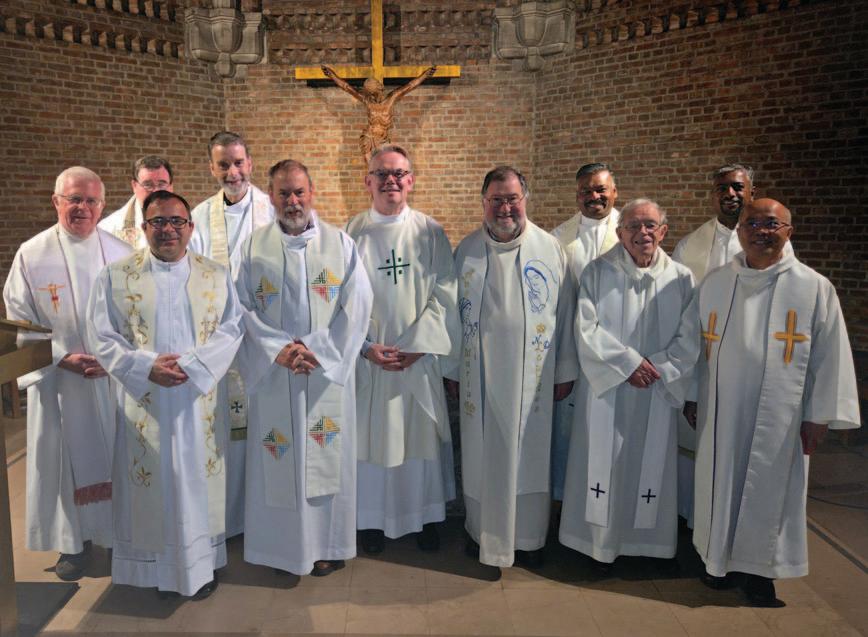
Priests from around the Diocese of East Anglia gathered recently in Merville, France, for a retreat led by Fr Philip Caldwell of the Diocese of Salford. Having worked for a number of years in parish ministry, Fr Philip is soon to take up a new role as Spiritual Director at Allen Hall Seminary in London.
n Drawing on the theme of the call to holiness, Fr Philip encouraged the priests to reflect deeply on sanctity in the ordinary circumstances of priestly life and ministry. Throughout the retreat, he shared personal reflections on the saints who had shaped and inspired his own vocation, including St Francis Xavier, St Philip Neri, St Thérèse of Lisieux, and St Jane Frances de Chantal.
Blending humour with spiritual insight, Fr Philip recounted memorable stories from his years in priestly ministry, offering moments of warmth and encouragement to those gathered. He also spoke movingly about occasions in which, amid profound personal
and pastoral challenges, he experienced the sustaining consolation of divine grace.
A recurring theme throughout the retreat was the importance of fraternity in the priesthood. Fr Philip reminded the priests that “we never minister alone,” but always as part of a presbyterium, a brotherhood of priests, and always within and with the support of the wider family of God’s faithful people.
He concluded by reflecting on the words of the Letter to the Hebrews, reminding those present that they are supported and accompanied by “so great a cloud of witnesses” (Hebrews 12:1), whose prayers and example continue to strengthen the Church’s mission today.
The retreat offered participants an opportunity for prayer, renewal, and deeper fraternity as they continue their ministry in service of Christ and His Church.
Vocations: Canon David Bagstaff
As the Diocese of East Anglia continues to celebrate its 50th Jubilee Year, we are shining a spotlight on the people who live out their vocations in service to our diocesan family. Each month, we meet a member of our clergy or someone in formation, reflecting on their call, their ministry and their hopes for the future.
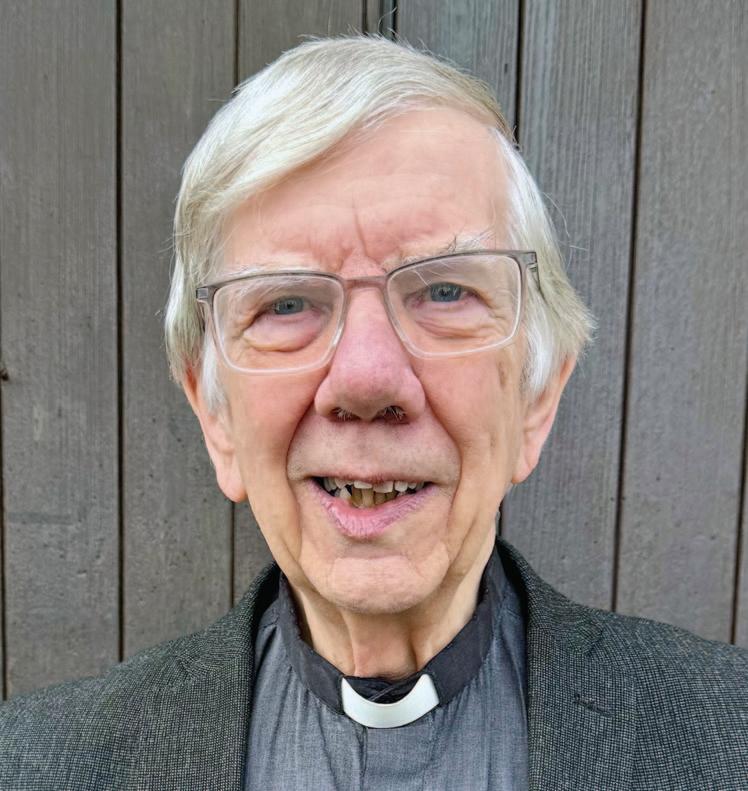
n This month, we hear from Canon David Bagstaff, Vicar General serving at Our Lady & St Peter, Aldeburgh, who reflects on his ministry, the experiences that have shaped his priesthood, and why fostering vocations continues to be vital to the life of our diocese. This year also marks a special milestone for Canon Bagstaff as he celebrates his Golden Jubilee of priesthood alongside the diocesan Jubilee.
I was recently in conversation with a retired primary school headteacher who shared with me this wonderful story. She had invited her class to write just a few words on each of the seven sacraments. She then asked a particular child what he had written about Holy Orders; the reply was, “It’s not a proper job, but you get a car”.
I was born into a typical Catholic family in Cambridge in the early 50s; my mum became a Catholic shortly before marrying my dad. I have one younger brother. I attended St Albans Catholic primary school (at that time named St Andrews) and then went on to the newly opened St Bede’s Catholic Secondary Modern school, which was just down the road from where we lived (now the very successful St Bede’s interchurch school). Each Sunday we went as a family to one of the early Masses at the
church of Our Lady and the English Martyrs. This continued until my brother and I were invited to become altar servers, and we then regularly served at the 10.45am sung Mass and often cycled back in the evening for sung Vespers.
I remember in the 1960s attending two National Vocation Exhibitions – one in London and one in Birmingham – where every religious order you can think of had a stand, and I visited them all, collecting their promotional literature – no websites in those days! Coming towards the end of my fifth year at St Bede’s, I clearly remember Mr Kent, the headteacher, asking me what career path I was going to follow. I replied, “I think I’d like to be a priest”. Despite all those vocation leaflets I’d collected about missionary and teaching orders a few years back, I felt the only path for me was to be a diocesan priest. The positive influence of the many priests we had had over the years had rubbed off on me. I spoke with our parish priest, and he got the ball rolling. No psychological assessments in those days! I was sent to Campion House, Osterley for two years as I needed to be eighteen before entering St Mary’s Seminary, Oscott, Birmingham.
I was ordained in my home parish in Cambridge on 10th July 1976 by Bishop Alan Clark; the first actual ordination for the newly created diocese of East Anglia. I had originally been accepted for the diocese of Northampton. My parish appointments have included St Peter and All Souls, Peterborough (twice); assistant priest at the cathedral; St Mary’s, Woodbridge Road, Ipswich; Sacred Heart, North Walsham; St Henry Morse, Diss; St Edmund’s, Bury St Edmunds; and now Aldeburgh with Leiston, Suffolk. I’m frequently asked: “Which has been the best parish?” I’ve learnt that it is always the one you are currently in! I’ve also been privileged to serve the diocese in various roles – Vocation Director, Diocesan
Administrator after the death of Bishop Michael Evans, and Vicar General. As I look forward to my Golden Jubilee and that of the diocese, I give thanks for those countless people whom I have been privileged to walk with, sometimes at the most joyful and sometimes at the saddest and most difficult moments of their lives. Do I miss not being married and having a family? – yes, there are times; but back to my opening story – it
may not be “a proper job”, and yes, “I have a car”; but much more than that, it is a vocation, a way of life, in which I have been supported on the journey by family, friends, parishioners, brother priests, deacons, and above all by the grace of God which has got me through the ups and downs of the past 50 years. For this I am eternally grateful and give thanks.”
Priests from the Diocese of East Anglia on retreat in France.
The Diocese of East Anglia has welcomed Magnifica Humanitas, the first social encyclical of Pope Leo XIV, describing it as a significant contribution to the Church’s teaching on human dignity, work and the ethical use of artificial intelligence.
n Published on 25 May, the encyclical reflects on the profound opportunities and risks presented by rapidly advancing technologies, insisting that AI must remain at the service of the human person and the common good. The document also highlights the importance of Catholic Social Teaching in guiding moral discernment during a time of major social and economic change. Bishop Peter said:
“Pope Leo is reminding the entire world that the magnificence of our humanity is to be cherished and defended, for human life constitutes the first and fundamental gift bestowed by God. The gift of life is for the living but in accordance with those objective and abiding principles that enable to build integrity within and between our personal and social spheres, to flourish across the vast expanse of our spiritual and material experiences. The Holy Father is asking us all to reflect well on the true nature and value of human work as we face the new opportunities and challenges presented by
Hearing God’s call in Thetford Papal Encyclical urges discernment in AI age
Following a retreat day in Thetford offered to those open to a vocation to the priesthood, Nicholas Villaroman from the Diocese’s Ignite Youth Team gives his personal reflections.
n I had a wonderful experience attending this insightful retreat, which has changed my perspective on discernment. As a cradle Catholic who has only taken his faith seriously in recent years, going to this retreat was a step forward in my journey towards God and an experience I will not forget.
We gathered in Thetford, where the retreat started with Mass, celebrated beautifully by Fr Peter Wygnanski (Assistant Vocations’ Director), with Fr Christopher Smith (Vocations’ Director) concelebrating. Fr Peter’s homily served as an introduction to the retreat. He reflected on how, like the apostles who were tasked with spreading the Gospel after the Ascension by taking Christ out into the world, so the diocesan priest is called to work fruitfully within the world around him to help others encounter Jesus where they are. As I looked around during Mass, I noticed I was the youngest person at the retreat, which made me realise how serious this whole thing actually was.
Aside from the priests and Deacon Anthony Reilly, there were nine of us who went to the retreat and, after Mass, had a chance to socialise over coffee. This was followed by an informative talk by Fr Christopher, describing how priests are formed in
Artificial Intelligence.”
The publication of Magnifica Humanitas follows increasing engagement within the Church on the implications of artificial intelligence. Earlier this year, the Catholic Bishops’ Conference of England and Wales gathered at Villa Palazzola to reflect on these issues including a keynote address from Matthew Harvey Sanders, chief executive of Longbeard.
Some commentators have pointed to the positive potential of emerging technologies when they are well governed and ethically directed. Mr Sanders said:
“The right use of AI technology, rightly ordered, isn’t the end of work. It’s the end of toil. It’s the first chance, at scale, in human history, for men and women to work for love rather than for survival.”
At the same time, Magnifica Humanitas underscores that such outcomes depend on careful discernment and responsible stewardship. The Holy Father warns against systems that may diminish responsibility, deepen inequality or weaken authentic human relationships, emphasising that technological progress must always be judged in the light of the human person and the common good.
Within the Diocese of East Anglia, the themes of the encyclical resonate strongly with lived experience. David Livesey, Administrator of Caritas East Anglia, said:
“In the diocese many people have precarious jobs in which they toil without the opportunity to flourish, for which they are paid insufficient wages to cover the cost of the
essentials of living.”
He added that others are already helping to shape the technological future:
“Others are blessed with roles that are helping to develop and shape the future of AI and its implementation, which will determine its consequences for humanity.”
The encyclical also echoes the Holy Father’s call for a responsible and discerning use of technology, particularly among young people. Bishop Peter said:
“Our young people must be properly equipped for their fruitful engagement with AI and guarded against all potential manipulations and distorting influences presented by such powerful technologies. We must all ensure that our young people receive a sound and effective ethical formation so that they can navigate new horizons safely and productively. At home, at school and within all other societal environments our young people must be supported in this complex undertaking. The Holy Father recently offered very pertinent guidance to the younger generation when he said: ‘Do not let the algorithm write your story. Be the authors. Use technology wisely, but do not let technology use you.’ We will all do well to head these words.”
The Diocese of East Anglia is pleased to recommend a new resource produced by the Catholic Truth Society (CTS) that explores the document’s key themes and their relevance to contemporary society.
The resource features Fr Peter Wygnanski, the Bishop’s Private Secretary, who was invited by the CTS to participate in a
roundtable discussion examining the theological and ethical questions raised by the Holy Father’s encyclical. Fr Peter was joined by Sr Carino Hodder OP and Prof Jacob Phillips of St Mary’s University, Twickenham.
Alongside his responsibilities within the Diocese, Fr Peter is currently completing a part-time PhD in theology at Durham University, focusing on the development of Artificial Intelligence and how Christians can respond to the opportunities and challenges it presents. His academic research made him a natural contributor to the discussion.
Across a three-part series, the panel explores Pope Leo’s reflections on human dignity, technological development and the importance of ensuring that advances in Artificial Intelligence remain at the service of the human person and the common good.
The discussions offer an accessible guide to the encyclical, helping viewers to engage with the opportunities and challenges presented by emerging technologies in the light of Catholic teaching. Topics include the relationship between human creativity and machine intelligence, ethical considerations surrounding AI, and the Church’s vision for safeguarding human dignity in a rapidly changing world.
All three episodes of the series are now available to watch online through the Catholic Truth Society, providing a valuable resource for individuals, parishes and study groups wishing to explore one of the most significant issues facing society today from a Catholic perspective.
the seminary, how priests and seminarians are all human, and how formators are, most of all, “looking for people who are comfortable in their own skin”, not a finished product. During the talk, Fr Peter described what to do as you discern, including especially the importance of living the life of a Catholic in a community and slowly sharing your sense of a possible calling with others before applying to go to the seminary. At the end of the talk, Fr Christopher recommended some books for us to read, including those written by people from the diocese, such as Canon Sean Connolly and the late Bishop Michael Evans. After Fr Christopher’s talk, we had lunch prepared by generous members of the Thetford parish. The ham was particularly delicious. Most of us had seconds, even Fr Christopher.
After lunch and more coffee, Fr Andrew gave a more reflective talk on vocation. The idea that struck me most was that if, like Jonah, we try to run away from what God might be calling us to, we are not running away from God; we are running away from ourselves. He quoted Thomas Merton:
“There is only one problem on which all my existence, my peace, my happiness depend: to discover myself in discovering God. If I find Him I will find myself, and if I find my true self I will find Him.”
For me, this was the biggest lesson of the day. God has already prepared the path that each of us is going to take. It varies from person to person, of course, but God loves all of us in the same way.
The retreat ended with Eucharistic Adoration, which was beautiful and reverent. Being in the church, kneeling before our
Lord Jesus Christ, we sang hymns together. It created an atmosphere which reminded us that we are in union with Christ, and that He unites us with our Father in heaven through the Holy Spirit. During the silences, we were given a chance to let God speak to our hearts and a chance to rest, as it had been a long day. The adoration reminded us that, during that day, we had one goal in mind: to know what God calls us to do, and to let Him lead us to where He wants us to be.
After the retreat, a group of us, along with Fr Peter and Deacon Anthony, continued our reflections at the pub just opposite the
parish church. This less formal opportunity to share and speak with each other concluded an edifying and insightful day. The retreat really set me up for how I am going to approach my first year at university in September, which means I have a few years to discern God’s will in my own life. This retreat day showed me that priesthood is not a profession or a job; there is a reason it is called a vocation. Being called to the priesthood means being called to it for the rest of your life. Jesus did not abandon us when He ascended; He continues to do His work through His ministerial priests.
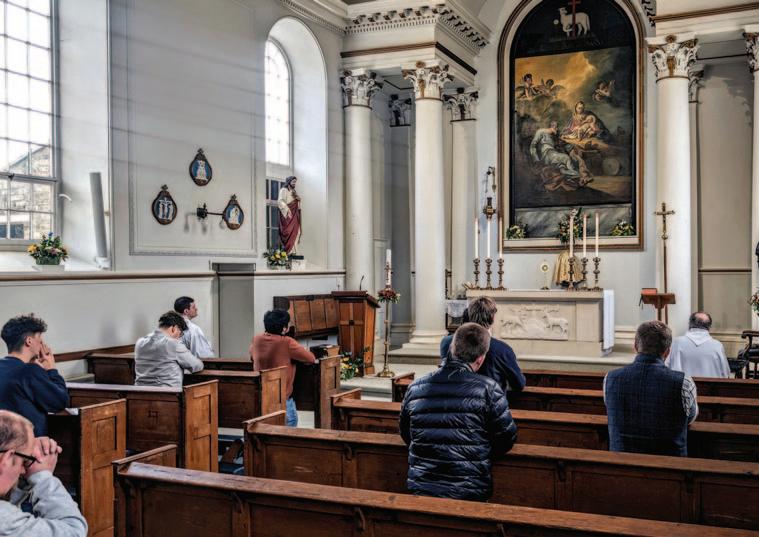
Men on discernment retreat in prayer.
Faith in the Home
My little prayer process
n In this Faith in the Home article, Dr Antonia Braithwaite reflects on prayer as a simple yet powerful way to deepen one’s relationship with God, encouraging honesty and openness in daily conversation with Him. She acknowledges that finding the right words can be difficult, but reassures readers that God simply invites us to come as we are.
Prayer is a powerful way to grow closer to God and reflect on how He is working in our daily life.
Sometimes it can be difficult to know what to say, but He just wants us to be ourselves with Him, sharing what is on our mind and what is going on in our life.
Here are seven simple suggestions to help guide your conversation with Him:
My Little Prayer Process:
1. Thank God for whomever and whatever you are most grateful today.
2. Think about yesterday. Talk to God about the times when you were not the best version of yourself.
3. What do you think God is trying to say to you today? Talk to him about that.
4. Ask God to forgive you for anything you have done wrong and fill your heart with peace.
5. Talk to God about some ways he is inviting you to change and grow.
6. Pray for the other people in your life by asking God to guide them and watch over them.
7. Pray the Our Father.
With thanks to Helvi Moore, and the “Dynamic Catholic” company.

Fr Peter Brett celebrates Diamond Jubilee
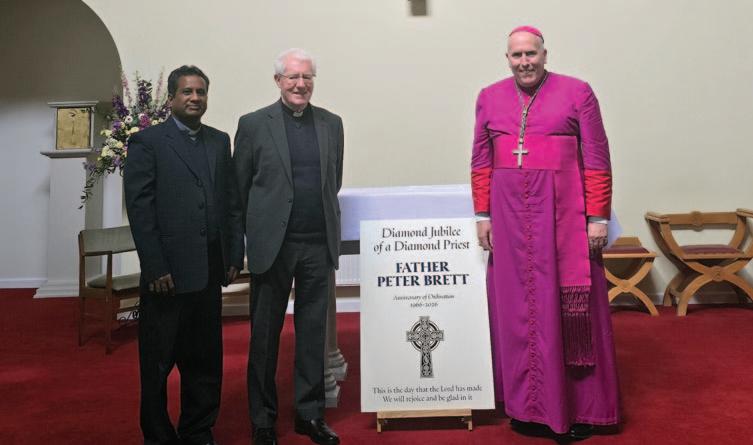
n Bishop Peter Collins joined parishioners at Our Lady and St John the Evangelist, Sudbury, to celebrate the Diamond Jubilee of Fr Peter Brett’s priesthood.
Ordained on 9 January 1966 for the Redemptorists, Fr Peter’s ministry has spanned continents and communities. Following his early years serving in London and Liverpool, he spent a period ministering in South Africa before later bringing his experience and pastoral care to East Anglia. The Diocese was delighted to welcome him in 2000, and he was incardinated the following year.
Fr Peter went on to play a key role in the life of the Diocese, notably overseeing the merger of the parishes of Sacred Heart and St Oswald’s in Peterborough. In 2008, he was appointed to Sudbury with Hadleigh, where he served faithfully until his retirement in the autumn of 2024.
The Jubilee Mass was a joyful occasion of
for Fr Peter’s 60 years of priestly ministry, marked by prayer, gratitude and celebration. Pictured are Fr Antony
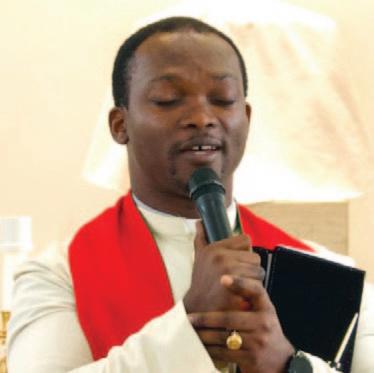
Fr Alvan Ibeh: Why do I go to Church at
In his regular column Fr Alvan Ibeh explores why people go to church, arguing that true participation should stem from a genuine desire to grow in faith, encounter God, and be part of a worshipping community, rather than habit or obligation.
n Have you ever asked yourself, “Why do I go to church?” It may sound like an unusual question, but many people ask it at some point in their lives. Some ask out of curiosity, while others do so because of frustration, disappointment, boredom, or pressure from friends, family, or work. In a time when almost everything is available online, many wonder whether going to church is still necessary. If God is everywhere, why attend church at all? The answer is simple: we do not go to church because God needs us there. We go because we need God and one another. So why do you go to church? Is it simply because it is what you were raised to do and have grown up doing? Is it something you are truly convinced of? Do you feel like the psalmist every time you remember you are going to church, “I rejoiced when I heard them say, ‘Let us go into the house of the Lord’” (Psalm 122)?
One day, I went to visit a parishioner who was housebound, though she is now late (RIP). Before becoming housebound, I came to know her as a very faithful member of the parish because she was always at Mass every morning. She came with her missal and made sure she followed the readings. Even when she was struggling with her mobility, she kept coming to Mass faithfully. That day, which happened to be
all?
my last day before she passed, after giving her Holy Communion and being about to leave, she asked me to sit because there was something she wanted to tell me. I sat down to listen to her and, to be frank, what she said to me sounded unbelievable. She said to me, “Father, I don’t think I believe in God. Even if I did, I don’t know how convinced I am about it.” I couldn’t believe my ears. In my usual way, I smiled and then asked her, “But Mary (not her real name), you come to church every day, so why are you saying you don’t believe in God?” She then responded, saying, “Father, the truth is, I have not been coming to church because I believe or am convinced, but I am doing it for the sake of my mum, who made me promise her before she died that I must continue going to church. This is because she was taking me to church every day while I was very young. So, I felt I needed to reveal this to you because it has been a big burden in my heart.” I spent time talking to her about this, and then she asked if she could go to confession. She saw many reasons to believe in God, and at the end of my visit, she felt that burden had been lifted off her shoulders. I left her reflecting deeply on that encounter. It became like a revelation to me that there may be a lot of people coming to Mass every Sunday but may not have any genuine reason for being there. If the reason for going to church is not because I want to grow deeper in my faith and my relationship with God and the Body of Christ, if it is not because I know deep in myself that I go because I need God and also need the worshipping community to grow in my faith in Him, then I need to ask myself that question: “Why am I even going to church?”
When we speak about going to church, we are not simply talking about entering a building. The Church is the family of God, a
community of believers gathered in Christ’s name. It is a place where faith is nourished, hope is strengthened, and love is put into action. The Church should be a spiritual house and not a social club. It is not a place I go because I want to meet friends or because I am feeling lonely at home. We go to church because we want to worship God, hear His word, and receive strength for the everyday journey. We go because we need the community of believers. We go because we encounter Christ in the sacraments. But what happens when we stop going to church? We may not notice the effects immediately when we drift away from church. Over time, prayer may become weaker, faith can become fragile, and our relationship with God can become distant. Just as our bodies need regular nourishment, our souls need spiritual nourishment. Church provides that nourishment through worship, scripture, prayer, fellowship, and the sacraments.
Maybe the question should not be “why do I go to church?” but rather “what kind of person am I becoming because I go to church?” If church is helping us love God more, forgive more readily, serve more generously, and live more faithfully, then it is fulfilling its purpose. Let me know your thoughts about this topic. Shalom.
thanksgiving
Arockiam (left), current parish priest; Fr Peter Brett (centre); and Bishop Peter Collins (right).
Picture gallery from parishes around the Diocese
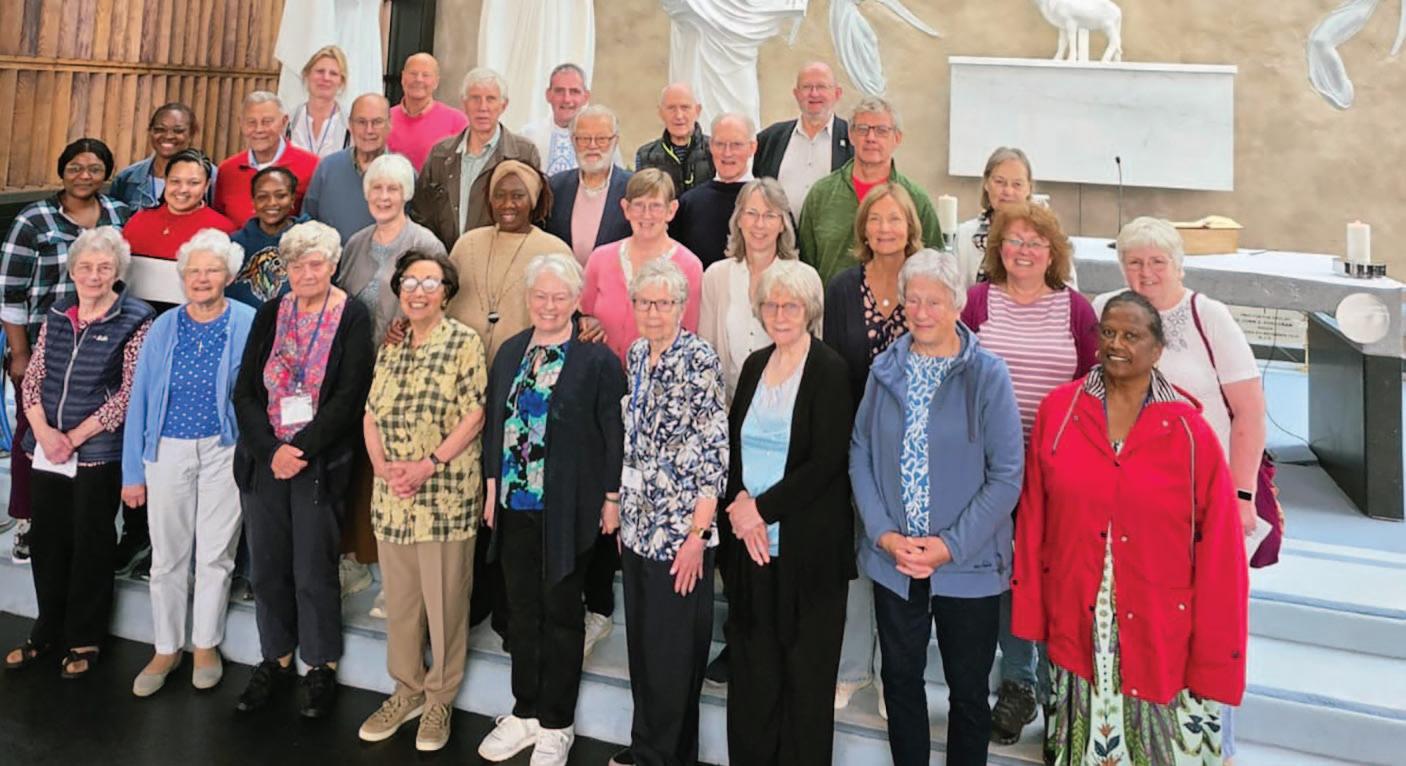
n A group of parishioners and friends from the Parish of Our Lady and St Thomas of Canterbury, Wymondham went on a pilgrimage to Knock in Ireland. Here they are at Our Lady's Shrine. Among the other places they visited were Achill Island and Ballintubber Abbey.
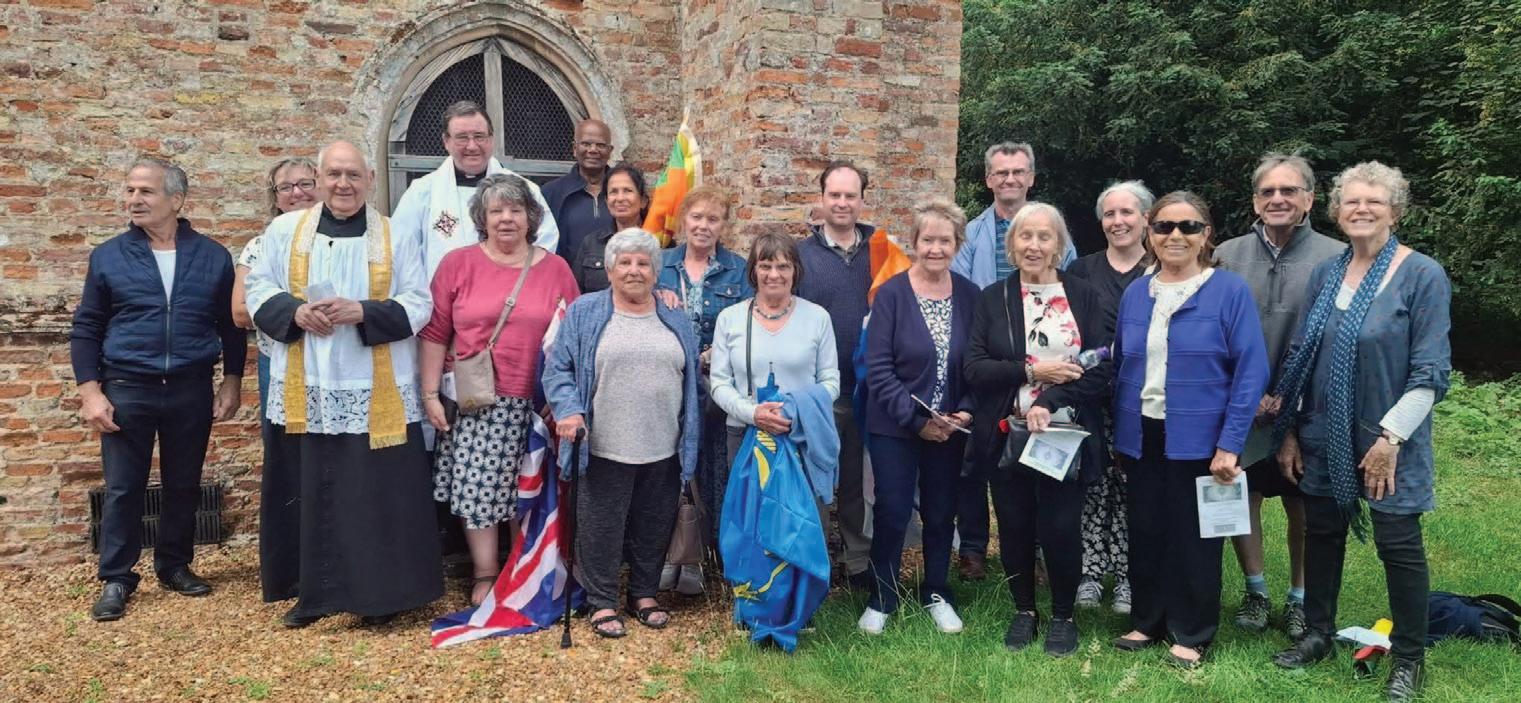
n Parishioners from Our Lady and St Charles Borromeo in Wisbech joined fellow Catholics from across the deanery for the annual Corpus Christi Procession at Oxburgh Hall on Sunday 7 June.
The procession, held in the beautiful grounds of the historic hall, provided an opportunity for the faithful to publicly witness their devotion to the Blessed Sacrament and celebrate the Feast of Corpus Christi together in prayer and fellowship.
Following the procession, parishioners gathered for a picnic, enjoying time together in the summer sunshine and strengthening the bonds of community that are such an important part of parish life.