SEPTEMBER 2026
Inside
Private Requiem Mass for Ann Widdecombe Page 2
Glory to God the Good Gardener Page 5
One Year as a Priest: Page 6
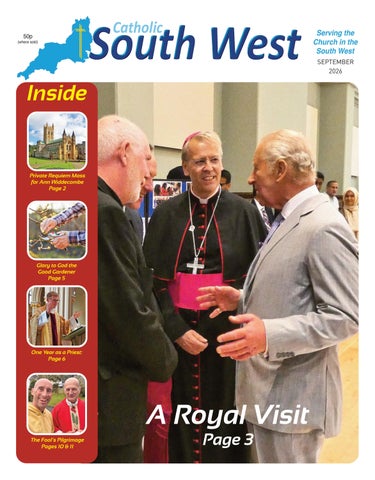
A Royal Visit The Fool’s Pilgrimage Pages 10 & 11
Page 3
2 September 2026 Catholic South West
CONTACTS & DETAILS Catholic South West is a monthly newspaper for Catholics in the Plymouth, Clifton and Portsmouth Dioceses. It is published by Bellcourt Ltd
Private Requiem Mass for Ann Widdecombe
AIMS To build community in the South West by sharing stories relating to Catholic life around the South West. To encourage readers to get more involved in - or start - projects and initiatives in the local area. To provide thought-provoking articles to help readers deepen their Faith.
GET INVOLVED We need your help! Articles: We need your local articles we can only include what we get. So if you have an article or just a photo with a short description - please send it in. Ideas: We need your ideas for the paper and we need your ideas in the paper. If you have any thoughts on what we should include - or if you are thinking about starting a new initiative - get in touch - we’d love to support it! Readers: If you can encourage other readers in your parish please do so. Advertising: We rely on advertising - if you know of anyone that would benefit from promoting their business, event or anything else to parishioners throughout the South West, do let us know.
SUBMITTING EDITORIAL To send in editorial or to get in touch please contact us at: CSW - Bellcourt Ltd N2 Blois Meadow Business Centre Steeple Bumpstead Haverhill, Suffolk CB9 7BN csw@cathcom.org 01440 730399
ADVERTISING To advertise in Catholic South West please contact us on 01440 730399 ads@cathcom.org
DATES Catholic South West goes to parishes on the last full weekend of the month. It is printed around the middle of the month - so if you would like to advertise or send in editorial please do it as early as possible.
Wanted Parish Correspondents The Catholic South West is looking for a Parish Correspondent in your parish to send in local news for publication in this Newspaper. All items to be emailed to csw@cathcom.org before 10th of the month
Buckfast Abbey A private Requiem Mass was held at Buckfast Abbey, yesterday, Wednesday 12 August, for Ann Widdecombe. Around 100 family members, friends and colleagues, including former Tory ministers and broadcasters gathered to pay their last respects. Miss Widdecombe was a regular member of the congregation there.
thanks for her fortitude, and offer Holy Mass in this Abbey Church which Ann called her safe haven. “Here we pray that she has finally been enfolded in the arms of the Risen Lord, where true love and peace reign, and where she will hear the Lord's words, 'well done, my good and faithful servant'."
The homily was given by the Abbot of Buckfast, David Charlesworth OSB. He said: “In the midst of the shock, clamour and sometimes unwarranted comment surrounding her death, our response is to pray for the repose of her soul, to give
The Abbot said: “There is no doubt that Ann fearlessly upheld the moral and social teachings of the Catholic Church. Her voice regarding these issues certainly upset some.… In the midst of the shock, clamour and sometimes unwarranted
EDITORIAL GUIDELINES 1) Think of the readers: If you are writing about an event, think about the readers that don’t know anything about it. Outline what happened, but focus on why people go, why it is important to them, or some teaching that was given. Make sure readers learn something from your
article - they don’t just want to know who was there and what snacks were available! 2) Keep it brief: Make sure you make your point - but keep it brief and punchy. 3) Pictures: Send pictures as they are - even if they are very big to email. Don’t reduce them in size or put them inside a Word document. They look fine on the screen but terrible in the paper!
comment surrounding her death, our response is to pray for the repose of her soul, to give thanks for her fortitude, and offer Holy Mass in this abbey church, which Ann called her safe haven." Tributes were given by Miss Widdecombe's nephew, and Sir Christian Sweeting, a close personal friend. Donations made in her memory will be split between the Leprosy Mission and Abound, in support of the Christian Endeavour Hostel's projects in India. A public memorial service is expected to take place later this year.
LEGAL INFORMATION Please note that opinions expressed in this paper and on any linked sites or publications are not necessarily those of the Publishers, Editor, any Diocese or the wider Roman Catholic Church. Every reasonable effort is
made to ensure that due acknowledgement, when appropriate, is made to the originator of any image submitted for publication. It is understood that those submitting material for publication in CSW either hold the copyright or have arranged for publication with the appropriate authority.
Catholic South West
September 2026 3
The Bishop of Plymouth and members of the Caritas Diocese of Plymouth team meet King Charles III The Bishop of Plymouth, the Right Reverend Nicholas Hudson, Canon John Deeny, Episcopal Delegate for Caritas Diocese of Plymouth, and Simon Giarchi, the Diocese’s Head of Caritas, met the King during the visit he and the Queen made to Blandford Forum on Thursday 16 July 2026. During the visit, the King and Queen visited stalls showing the work of charities from across Dorset. The King spoke at length with Bishop Nicholas, Canon John and Simon, particularly about how the concept of Integral Ecology fits closely with his own Harmony Philosophy – his long-held view that by understanding the balance, order and relationships between ourselves and the natural world, we can create a more sustainable future. They also discussed Caritas’ work in the context of the Diocese, including the Blandford Community Sponsorship Group and the Diocese’s livesimply parishes, and spoke about Caritas Internationalis and the King’s recent meeting with Pope Leo XIV. They also referenced the Pope’s encyclical Magnifica Humanitas, and touched on Laudato Si’ in the context of both integral ecology and the Harmony project. The Right Reverend Nicholas Hudson, Bishop of Plymouth, said, “It is a great joy that King Charles III saw, first-hand, the range of work our parishes carry out across Dorset – from the welcome given to a refugee family in Blandford, to our parishes’ care for creation, and the intergenerational projects that bring our communities together. To have the King recognise that work is a wonderful moment for everyone involved.” Canon John Deeny and Simon Giarchi, of Caritas Diocese of Plymouth, added, “It was truly inspirational to meet His Majesty and to share Caritas’ work caring for our common home and our common humanity. Our integral ecology approach beautifully synchronises with King Charles’ important Harmony project, and we were delighted to share examples of our work from across Dorset and the diocese. Our stall reflected key areas of Caritas’ mission, such as our refugee and migrant project demonstrated by the Community Sponsorship work undertaken in Blandford, or our livesimply parishes and their work living simply sustainably and in solidarity with people living in poverty, and the intergenerational
Image: Pat Patrick from Blandford Forum. projects led by our diocesan schools. It was a great opportunity to bring all of that together in one place, and to have the King hear these stories directly is a great way to celebrate everyone who makes this work possible.” The Diocese’s stall highlighted the wide range of social action projects under way in parishes and schools across Dorset, including environmental programmes, support for food banks, outreach to those who are isolated in local communities, intergenerational linking projects connecting schools and care homes, and support for refugees and migrants. A particular local highlight of this work is Blandford’s own Community Sponsorship story: parishioners at the Church of Our Lady of Lourdes and St Cecilia, supported by Caritas Diocese of Plymouth, spent close to two years fundraising and preparing before welcoming a refugee family to the town through the UK Resettlement Scheme. What began as a
response to negative media narratives about refugees grew into a genuine community effort – bringing together volunteers, raising funds through events from auctions to barbecues, and finding the family a home and a warm welcome in Blandford. The stall also featured a welcome banner celebrating the 75 languages spoken by parishioners across the Diocese’s parishes – a reminder of the community’s diversity – alongside Season of Creation materials highlighting the Diocese’s ongoing commitment to environmental stewardship, in keeping with the vision of Laudato Si’. The display also featured selected infographics from Pope Leo XIV’s encyclical Magnifica Humanitas – On Safeguarding the Human Person in the Time of Artificial Intelligence, including its call to “Be builders of communion, not architects of Babel” – a message the Diocese said highlighted the essence of the day; that humanity may not lose its magnificence, and people may see, in the
human heart, the place where God desires to dwell. Bishop Nicholas and the team also connected with other faith groups represented at the event which was built around the theme of recognising harmony in the county. The Diocese of Plymouth’s stall was alongside groups representing faith, arts, education and heritage, as well as charities supporting veterans, prisons, community and domestic abuse support and local volunteers – highlighting the Diocese’s role as one of many faith communities helping to strengthen community life across the county. At the Blandford Forum Town Hall and Corn Exchange, Their Majesties also heard more about the major restoration project that has safeguarded this historic building for the benefit of the local community and future generations and met some of the team involved in the renovation project.
4 September 2026 Catholic South West
Sacrament of Confession With the advent of the internet and websites, there are countless ways for people to express themselves. Opinion pieces and blogs are a common place to express thoughts. One interesting type of websites involves people ‘confessing’ their doings, whether good or not so good. In these sites, people anonymously ‘confess’ these doings. One can only guess their reasons for doing such a thing, but, at the core, I think, there is a desire to get doings ‘off their chest’ and to clear their conscience. A burden shared, is a burden lightened. The process of confession is therefore somehow innate within us. After reflecting upon the sacraments of initiation, our attention is now on the sacraments of healing - the sacraments of reconciliation (or confession) and anointing of the sick. Life is a struggle, as we have all experienced, and there are times where we have not lived up to the Gospel values that Our Lord has laid before us. We struggle with ourselves and others, with sin and temptation, with choosing the lesser good. Sin damages and divides. The sacraments of healing help us with restoration and unity, and to live out our Christian life, in a world that is broken, suffering, and divided.
Please support our Advertisers
The sacrament of reconciliation comes from God’s desire to forgive our sins, and to restore order in our relationship with God and with each other. Through the Paschal Mystery of Christ, that is his life, death, and resurrection, this reconciliation is made possible. Jesus gave to the apostles this ability to forgive sins in God’s name, which has passed down through history to priests. As with all liturgical rites in the Church, the minister (a priest in this case) and the penitent act together, though in different
ways. The role of the priest to be present, or enact, the forgiveness of God in Christ by the power of the Spirit. His role is to facilitate the penitent to encounter God’s mercy in a tangible manner through the words of Absolution (‘I absolve you for your sins in the name of the Father, and of the Son, and of the Holy Spirit). It is the role of the penitent to bring to God all those areas of their life where they struggle with messiness, uncertainty, and sin, after they have examined their conscience. The words that priest pronounces after the confession of sins is worth reflecting upon. It is trinitarian in structure and in reference. Reconciliation comes from the Father, who is the fount of all forgiveness and mercy. This reconciliation of humanity with God comes through the death and resurrection of Jesus. He sends the Holy Spirit for this forgiveness of sins. The Church, as a sacrament, is a sign or instrument of communion with God and of unity among all people, and has the mission, by the power and workings of the Holy Spirit, of bringing peace and pardon to people. We don’t always get is right at one go, and it is important to note that conversion, which this sacrament focuses on, is a lifelong process, and we are reminded to continue this conversion and to express it in our thoughts, words, and actions, by a life renewed according to the Gospel. As we have experienced God’s mercy in this sacrament, we are called to bring and live out this mercy in the world around us. It is our task, as the well-known hymn reminds us, “Make me a channel of your peace: Where there is hatred, let me bring your love; where there is injury, your healing power, and where there’s doubt, true faith” Fr Anthony Fyk
Catholic South West September 2026 5
Glory to God the Good Gardener God is the Alpha and the Omega, the Beginning and the End, yet the Great ‘I AM’, Who was and is and is to come, uses the humble Bean to illustrate His provision for our present, our future and our past. You may well wonder how this concern could possibly relate to the past. The clue is in its very name ~ ’been’! If anyone should ever address you as an ‘Old Bean’, you can be sure that it will be meant as a compliment and, needless to say, God has never written anyone off because other people think he or she is a ‘has-been’!! The Harvest Festival is known in some Country Calendars as “The Feast of Saint Rhubarb and All Marrows” and, although the great question as to which is ‘fruit’ and which is ‘vegetable’ has long been debated in Allotment Sheds and around Kitchen Tables, they are still among the leading celebrities of the Harvest Festival. Beans, however, are ‘Legumes’ which puts them in a class of their own. Yet, out of all the wonderful flowers and fruits and vegetables; out of all the different sizes and shapes of Garden Produce, there is nothing that more clearly and completely shows God’s generous love and consistent personal care for each of us as those humble fellows, which are both ‘common’ and ‘garden’. They demonstrate God’s generosity ~ there are so many of them! Has it ever occurred to you, though, how Runner Beans are an annual demonstration of the thoughtfulness of God in providing for our needs: past, present and future? He surely makes it possible for everyone to be ‘full of Beans’. Think how these Beans show His care for us now, even when we aren’t really feeling like a ‘hill of Beans’; they grow so tall that they invite our eyes and our arms upwards, Heavenwards, towards the summer sky. They are so green that they take harmful carbon dioxide out of the air all the time, making it cleaner and safer for us to breathe. Although they do reach a great height, the fruit comes at every level, so even the youngest toddler has no difficulty in reaching them and, like all God’s children, however good the start we try to give them, He and we have to watch them patiently as they each make their own way. If, of course, you are tall enough to be nicknamed a ‘Bean Pole’, you can be very helpful in the Kitchen or the Supermarket if someone can’t reach the top shelf.
Runner Beans make flowers, which are so beautiful that when John Tradescant discovered them growing in Central America in the early 1600s, he introduced them into the garden of King Charles I, simply for the sake of those scarlet flowers. It was 100 years before anyone thought of actually eating one! ‘Cocoa’ Beans are from Central America: the Aztecs considered them a "gift from the gods" and they were brought to Spain in the 1520s. That gave Europe not only Coffee but, eventually, Chocolate Ice Cream! ‘French’ Beans also originated in the Americas ~ along with the Tobacco. They also came to Europe in the 16th century but didn’t reach England until members of the upper classes discovered that they were being served in the Kitchens of Louis XIV and, in those days, everybody wanted to be connected with ‘things French’. Broad Beans, however, have quite a different pedigree. They are native to the Mediterranean and the Middle East so would undoubtedly have been a staple of Nazareth Kitchens and might even have featured in the Parable of the Sower. Whatever anyone says, there are far more than 57 varieties of Bean and each one proves God’s promise of care for us in the future. The Horticulturalist admires them because, although they obviously feed from the goodness that they find already in the soil and draw out a slow-release tonic from their long-life storage capsule, if their roots are left in the ground at the end of the Season, they actually contribute nitrogen ~ which next year’s Cabbages will particularly enjoy! The practical gardener enjoys Runner Beans ~ especially if, like me, he has a few pints of Scottish blood in his veins! ~
because just a handful of decent Beans from his own harvesting will provide him with all the seed he needs for the following Spring, so ~ year after year ~ his crops don’t cost him a Bean! The buried seed rising again is a parable of Eternal Life. An intelligent Gardener knows how many Beans make five and some have even gone on to make a few Beans by qualifying as an Accountant. The professional Bean counter’s integrity may mean that, on suspicion of fraud, he would be expected to spill the Beans to his superiors: something that might well upset someone’s Apple Cart. Amateur Bean-counting is a popular money-raiser at a Garden Fete, with a prize for whoever gets closest to guessing how many of them there are in the jar.
To Advertise contact Nick on 01440 730399 nick@ cathcom.org
Legumes of all sorts are favourites in the Kitchen, too, not just because they are quick and easy to prepare but because they freeze so well for future feeding. One advantage of a Bean bag is that it adjusts to body shape and spreads weight evenly. This can reduce pressure on the hips, thighs and lower back for those who need it (provided they can get up again afterwards!) but can also serve as an ideal exercise platform for the young. The multinational, multicultural Bean enriches every aspect of our lives, humbly proclaiming the Glory of God, Who is the Alpha and the Omega. God, the Good Gardener, constantly brings us life-enriching surprises. © Richard Stranack 2026
6 September 2026 Catholic South West
One Year as a Priest: Interview with Fr Ryan Browne On Saturday, 19 July 2025, we gathered in St John’s Cathedral as Fr Ryan Browne was ordained to the priesthood. A full year has passed since that significant moment, and Fr Ryan was asked for his thoughts on how his first year as a priest has gone. Here, he shares the joys and sorrows, the highs and lows, and how rewarding his initial year in ministry has been.
First Year Looking back on your first year ordained, what has brought you the greatest joy? Tempus fugit! Time flies! This year has been a time of learning and growth for me. It’s also been a very busy year due to the coupling of responsibilities as Assistant priest at the Cathedral and as a Chaplain to the University of Portsmouth. With all of the events in the last year it’s difficult to name the greatest joy. The greatest joy is seeing people love the Lord. I remember a lady came to see me one day, she started to cry and then said, “I just love Jesus so much.” It was so moving to hear those words and to see the power that Jesus has over her heart.
What has challenged you the most? It has definitely been the fact that St John’s Cathedral is an inner-city parish in quite a deprived area of the city. The fact that the Cathedral is a large, distinct building means that it is attractive to visit. On occasions, though, the Cathedral attracts people with drug and alcohol addiction who can be quite disruptive. On one occasion a lady entered the Cathedral and disrupted the proceedings of Sunday Mass. I asked everyone to pray for the lady and without hesitation the whole congregation pulled down the kneelers and we all started to pray. These types of challenges are quite common here at the Cathedral, but they are never without blessings. We have our challenges, but they are never devoid of the presence of the Lord.
How has your relationship with Christ changed since ordination? I think my relationship with Jesus has become more real. In the build-up to ordination I suppose I was a bit idealistic about what I would be like as a priest. God loves us in our holiness, but He also loves us in our woundedness and sinfulness. In fact, I think God loves us more in the moments when we do stray, because He wants us to be with Him so much. God’s love is not transactional like our human love. His love is so much more perfect than our human love. His love is unchanging; therefore, His heart always yearns for us.
What has surprised you most about parish life?
What has been your favourite priestly responsibility so far?
How busy it is. There was a lot to do during training for the priesthood in the seminary, but there was also a lot of free time, and I only really had to focus on my own formation and studies. In parish ministry there are so many different things to attend to and people to care about. One example could be a married couple who come and tell you that they want to get married. Wonderful! But then you discover that one or both of the parties have been married before, which means quite a lot of paperwork. Another example could be taking the youth group to the Isle of Wight for a day trip. Great idea! Then there are risk assessments needing to be filled out and forms to be signed. There’s a lot of good things happening in the parish here, but a lot of behind-the-scenes work happens before things come to fruition!
For me it has to be the celebration of the sacraments of healing; namely, Reconciliation and the Anointing of the Sick. When these sacraments are celebrated well it has an incredible impact on the spiritual lives of both penitent and priest alike. To be a priest of Jesus Christ and so witness someone pour out their heart in the confessional is an immense privilege. It can be emotionally tiring, but to see the weight of sin taken away from a disciple of Jesus is incredible. It’s easy to see why the Church calls them the sacraments of healing.
What moment made you truly feel, “I am a priest now”? Maybe when my Mum said, “Ryan!” And I replied, “That’s Fr Ryan to you.” Only joking! The moment for me was at my first Mass of thanksgiving on Sunday 20th July 2025. At the moment of the epiclesis in the Eucharistic prayer. It’s that moment when the priest descends his hands over the gifts on the altar to show the action of the Holy Spirit descending on the bread and wine to consecrate them, to make them into the precious body and blood of Jesus. It was a surreal moment (and continues to be so) and I ask myself, “am I really doing this?” The answer is, of course, “not totally”. At the moment of consecration, in a profoundly mystical way, it is the work of Jesus working through me, like He does with all priests.
What does being a priest mean to you now compared to a year ago? When I was first ordained a priest, I suppose I was on a ‘bit of a high’ for some weeks. My first month as a priest I spent on a trip to Australia. It was the best decision I made to go there to visit friends, because I was able to digest being a priest without any pastoral demands. I was able to say Masses at parishes in the outback, in the Cathedral in Brisbane and also at St Mary’s Basilica in Sydney and many more places. These were amazing experiences that helped me digest this gift of the priesthood I received on 19th July last year. After a year and having come down from the ‘highs’ of the post-ordination months where everyone wants a piece of you, I am now appreciating more how much a gift it is to be a priest. I don’t mean in some fanatical way, because there are days when I question whether this is the right path for me. But at a deep level I have the strong conviction that this is right for me, and I never want to let go of it.
Vocation A year on, do you think you are a priest “at the right time” in your life? You can never really know that answer in the present. To see God’s plan for you, it’s easier to examine the past and look in the rear-view mirror. You’re more likely to see the guiding hand of God that way. By looking in my own rear-view mirror I think I can say that I am a priest at the right time. There have been moments of encounter with people where had it not been for me being there as a priest in that moment, there may have been a missed opportunity for the Lord to touch them. I’m not saying this in some arrogant way. I know that there are people here in the parish who may not encounter the Lord through me, because I’m not that person for them. The priest who comes after me at the Cathedral may be the person to touch hearts and minds with the Word of God more than I can. God uses our characters, gifts and talents in the time and place that He wants to.
What are you most grateful for after your first year ordained? Someone asked me this question the other day. My response was, “I’m grateful for still being alive!” I’m most grateful for the people of God. I’m thankful for those who’ve poured out love, kindness and acceptance. I’m thankful for those who’ve challenged me. I’m thankful for everyone with their strange oddities (like my own) which make me laugh. I’m thankful for everyone who has been in my life at some point in this past year because they have made me understand myself as a priest a little bit more.
Catholic South West September 2026 7
Bishop Nicholas visits the Catechetical Youth Summer Camp at Buckfast Abbey
Twenty six young people from across the Diocese gathered and explored Pope Leo's Encyclical, Dilexi Te. Bishop Nicholas met each group to talk about the Saints they had been discussing. He talked about the importance of looking after your neighbours before joining the group for night prayer.
Pray with the Pope
Evangelisation of the City In the name of the Father, and of the Son, and of the Holy Spirit. Amen. Lord Jesus, Good Shepherd, You walk through our streets and squares, enter tall buildings and humble neighbourhoods, and silently accompany millions who seek meaning amid noise and haste. You know, Lord, the heart of the city: its lights and shadows, its noise and loneliness. We know that cities are called to be places of freedom and opportunity, but they can also become spaces of anonymity and isolation.
That's why today we ask You for a renewed gaze, able to discover in urban life fertile ground for proclaiming your Gospel. Give us a creative and deep faith, that doesn't remain in words, but becomes flesh through simple and loving gestures.
For resources on how to Pray with the Pope, either on your own or in groups, use this QR code.
Today's cities are filled with contrasts. They are places of freedom and opportunity, as well as anonymity and loneliness for many who live in them. In the midst of the hustle and bustle of urban life, millions of people seek deeper meaning for their lives, often without finding it. This reality is especially concerning for those living on the margins and for those who feel invisible in the midst of the multitude. In his latest prayer intention, Pope Leo invites us to pray for the evangelisation of the city so that the Church might know how to reach out to everyone, offering comfort, community, and the joy of the Gospel in every corner of the city. You are not alone. By praying, you join the millions of people who belong to the Pope's Worldwide Prayer Network who, from every corner of the world, are praying for humanity's challenges and the Church's mission.
Make us a Church that goes forth, able to reach out to the peripheries, to console those who are lonely, and to sow fraternity and connection instead of giving in to indifference. Lord, may our urban communities be open and welcoming homes, places where hope is shared, where no one feels invisible, and where the joy of your Gospel shines in the hidden lives of so many brothers and sisters. Make us your witnesses in the city, bold and creative missionaries, who proclaim your Love with their livesa Love capable of overcoming haste, noise, and anonymity. Amen.
8 September 2026 Catholic South West
Scripture Focus
By Fr Jeremy Corley
Ezekiel’s call to repentance One of the lesser-known biblical prophets is Ezekiel, who lived at the time when the Israelites were taken off into exile in Babylon and the city of Jerusalem was destroyed. Whereas his contemporary Jeremiah was a priestly prophet who remained in the Holy Land, Ezekiel was a priestly prophet who was brought to Babylon as an exile. Ezekiel’s preaching does not have as much human interest as the book of Jeremiah, which describes his struggles with his calling. Instead, Ezekiel includes many forceful homilies, calling for the exiled Jews to repent. In the first reading on the 23rd Sunday of the Year (6th September), we hear of Ezekiel’s prophetic ministry as a
sentry or watchman. His job is to issue warnings to sinners. If he fails to warn them, God will hold Ezekiel responsible, but if Ezekiel does give the warning, he will have done his job, whether or not the sinner repents. It is the same today with many of the Health and Safety regulations. As long as suitable warning notices have been given, a company is not liable for accidents. For similar reasons, the bishops often utter warnings about ethical problems, whether or not people will listen. Jesus highlights a sense of responsibility for one another in the gospel for the same Sunday. If a family member or friend does something wrong, have a quiet word with them, in the hope that they will listen. But if not, you might need others to back you up, in the hope that the person will respond. In an extreme case, the
To Advertise in the Funeral Section contact Nick on 01440 730399 nick@ cathcom.org
community may need to become involved. If all these warnings are not heeded, at least the suitable warnings have been given. Another reading from Ezekiel occurs on the 26th Sunday of the Year (27th September). Here Ezekiel answers the complaint of the exiled Jews that they are being unjustly punished. The prophet invites them to examine their own behaviour first. If a good person has abandoned the right path and turned to sin, it is not unfair if God decides to bring punishment. On the other hand, if the bad person decides to forsake the wrong path and instead to reform his life, God will be merciful and will pardon his previous offences. In the gospel for the same Sunday, Jesus also emphasises God’s mercy for
Funeral Services
repentant sinners by telling a parable about two sons. Their father tells the first to work in the vineyard, and after initially refusing, this son changes his mind and does the work. When he gives the same command to the second son, he says yes but does nothing. Jesus then points to different responses to his ministry. On the one hand, tax collectors and prostitutes have turned from their previous ways to welcome the good news. On the other hand, many of the religious authorities thought they did not need to hear Jesus’ message, and hence they failed to respond. Previous religious observance is not enough. As we hear God’s call to us through the scriptures today, let us pray for the grace that we may respond well.
Catholic South West September 2026 9
View from the Pew By Dr Jay Kettle-Williams
1 and 2 out of 10 The local GP where I grew up enjoyed wide fame, being much loved, highly respected and even idolised by many. He was renowned for attention to the individual and for the success of his ministrations. His surgery was near home and so passed the family ‘lemon test’. That test was based on how easy it would be, if you forget something when you were out shopping, perhaps a lemon, to nip back out and get what you’d missed. Our renowned GP had the ability to prescribe the panacea for everyone’s predicament. But, him being a GP, his writing was effectively so illegible that people, perhaps having been prescribed what looked like ‘Aobt’, assumed he wrote in Latin. It wasn’t till years later that the pharmacist, then long retired, let me in on the fact that ‘Aobt’ wasn’t Latin at all, but the initialisation for ‘Any old b***** thing’. So ‘aobt’ is what the pharmacist handed over the counter, be that in the form of smarties or whatever other placebo could be found. The effect on the patient was always miraculous. That anecdote still sits well with me. I look back on nothing but an effective psychologist dedicated to sharing a feelgood or even feel-better factor among the patients in his care, patients who were only in need of solace, assurance and perhaps a little more attention than was habitual. My mind often turns to the frailty of our human condition in general and to the false trails, bizarre convictions and obtuse persuasions to which we often fall prey. It’s that gullibility which I see tackled head on by the first two of the ten commandments: ‘You will have no gods other than me You must not make yourselves any image or any likeness of anything in heaven above or on earth beneath or in the waters under the earth’
Monthly National Catholic Newspaper National and International News from a Catholic Perspective with thoughtful articles to deepen Faith AuguST 2026
www.CatholicPost.co.uk
Edition 56
Fr Stephen Wang appointed as new Bishop of Arundel and Brighton
Priest braves heatwave on 108-mile walk
Reflections on My First Year as a Permanent Deacon
page 3
page 9
page 14
St Monica - August 27th
Celebrating the Completion of a Transformative Cathedral Restoration
Well, you can’t deny that today we live in an age of self-beatification, of false gods normally celebrities of one kind or another who, having achieved some level of popularity or even notoriety in one area of life, see themselves qualified to pronounce on all others - and of graven images, such as we might see in one promo or another and aspire to possess. So that brings us face to face with a consubstantial impossibility: a blend of religion and ideology. Those two come together and mix just like oil and water. I see ideology wearing one of three hats: Liberalism (with its focus on a person’s rights, equality and personal freedom); Conservatism (with its focus on tradition, social order and institutions); Socialism (with its focus on public or shared control of resources and wealth). Ideology translates as representing a corpus of shared beliefs, values and ideas guiding a specific cohort’s political, social or economic actions which attend all manner of worldly aspirations and structures. Religion, on the other hand, has a different outlook on life with keen focus on the sacred, the spiritual, the divine, the soul, the afterlife and Heaven.
I know that some people’s idea of Heaven might well be a large garage full of Ferraris in the grounds of a private mansion - perhaps even with a lemon tree out front! - bursting with all manner of human creature comforts within, everything guaranteeing fulfilment of a lifetime’s dreams and desires. But, to my mind, if you believe that, then you’ll believe any old thing. Notes, Acknowledgements and Attribution: Accompanying image (Statue with Blowing Horn) after the sculpture Exultate Jubilate by Philip Jackson; Texts/References adapted and/or adopted from http://en.wikipedia.org under the terms of the Creative Commons Attribution-ShareAlike License 4.0: /; Photograph (Unsplash): Ferrari (Joshua Koblin)
Dr J L Kettle-Williams is an experienced business communications consultant and wordsmith (tutor, writer, translator). 'Erratum: Apologies for use of the term 'Toponomy' instead of 'Topography' in the July issue of 'View from the Pew'.
dioceseofsalford.org.uk
Salford Cathedral has reopened its doors following a three-year programme of restoration, renewal and refurbishment that has transformed the cathedral The Cathedral Church of St John the Evangelist welcomed worshippers and visitors back on Saturday 4 July, when a weekend of celebrations began to mark the completion of this significant project. Having served as the spiritual heart of the diocese for more than 175 years, the cathedral required extensive restoration to address
bringing renewed colour, vibrancy and beauty to this sacred space.
longstanding repairs to its stonework and infrastructure while ensuring it could continue to meet the needs of a growing community.
Alongside restoring the cathedral’s heritage, the project has also invested in its future. Improved facilities, increased flexibility, enhanced accessibility and a strong commitment to sustainability to help ensure the cathedral can continue to serve the people of the diocese for generations to come.
A key element of the project has been the restoration of many of the cathedral’s historic features, including the reinstatement of original decorative schemes and the conservation of stained-glass windows,
While much of the work focused on essential repairs to the fabric of the building, visitors will notice a remarkable transformation throughout the cathedral. Improvements include new energy-efficient exterior lighting
scheme, restored statues, renewed interior decoration, the repositioning of key liturgical features, and a new glass entrance on Chapel Street designed to offer a visible sense of welcome in the heart of the city. We are grateful to Purcell Architects and Simpsons of York for their expertise throughout the project. Their specialist knowledge of heritage conservation has enabled the careful restoration of the cathedral’s historic character while incorporating modern standards and technology to support its future mission. Continued on page 2
The UK’s first Carbon Neutral National Catholic Paper Subscribe@catholicpost.co.uk 01440 730399 www.catholicpost.co.uk
To Advertise contact Nick on 01440 730399 nick@cathcom.org
10 September 2026 Catholic South West
The Fool’s Pilgrimage – Fr Jon Bielawski RIP It’s been a tough month here in merry old Plymouth, our good friend and parish priest, Fr Jon Bielawski, has been upgraded to Glory. Even writing those words feels strange. Like so many people whose lives he quietly touched, I’ve found myself reflecting on that curious mixture of sadness, gratitude and hope that follows the death of someone who genuinely made the world a better place simply by being themselves. Fr Jon had served the parishes of St Peter’s, Crownhill, St Thomas More, Southway, and later Holy Cross, Yelverton, since 2015. In many ways, it felt as though life had come full circle. Having been born and brought up in Plymouth, Fr Jon later returned to Crownhill as its parish priest. There’s something beautifully poetic about that. Pilgrimages often have a way of bringing us back to where we first began—not because we’ve gone backwards, but because we’ve grown enough to see familiar places with new eyes. Although I’d known Fr Jon for several years, I feel our friendship really began to deepen after my own pilgrimage along the Camino to Santiago de Compostela in 2018.
The photograph that accompanies this reflection was taken after the first Mass Fr Jon celebrated following his initial round of treatment. He wasn’t interested in putting priests on pedestals. He preferred putting people around tables, a cooked breakfast, a cup of tea, honest conversation, plenty of laughter.
Like many pilgrims, I returned home with tired feet but an awakened heart. Somewhere along that ancient road, thoughts I’d carried for years finally found their way from the depths of my mind onto paper. I wrote an article about my experience, and, to my surprise, it was published. In many ways, that was the beginning of The Fool’s Pilgrimage.
One of the things I loved most about St Peter’s—and many churches across the globe—was what I affectionately came to call “Evangelisation through Cake.” After Mass there would be coffee, conversation, biscuits, ideally cake and, if Fr Jon got there before you, probably one less Wagon Wheel on the plate.
Fr Jon read what I’d written and, not long afterwards, invited me to speak at one of the parish men’s breakfasts. I remember thinking they’d invited the wrong person.
He understood that some of life’s deepest truths are discovered not in grand lectures but in everyday conversations between ordinary people trying to live good lives.
Surely there were wiser people. Holier people. Better speakers. Men who knew far more about the faith—and about life— than I ever would. I’d been to previous breakfasts where seminarians and gifted speakers shared their stories. They had studied theology, travelled the world and done remarkable things. Who was going to want to listen to me? But that was one of Fr Jon’s greatest gifts. He had an ability to see something in ordinary people that they often couldn’t yet see in themselves.
That, to me, was Fr Jon, deeply spiritual, wonderfully down to earth. Comfortable talking about God and equally comfortable talking about football and laughing at himself. Take my granddaughter’s christening. We had a party afterwards with plenty of people who had never really set foot inside a church. To them, Fr Jon was something of a mystery. Yet he happily sat around chatting, answering questions and diving into honest conversations with anyone and everyone.
He never seemed to wear faith like a uniform. He simply lived it. That was the style of evangelisation he promoted through the Genesis Mission— spreading the Gospel one conversation at a time. There was another chapter in our friendship that really cemented my admiration for him, and it came during one of the strangest periods most of us have ever lived through. COVID Whatever our individual views on lockdowns and restrictions, those months left many people isolated, anxious and lonely. Physical health understandably dominated the headlines, but Fr Jon instinctively recognised that people also needed hope, community and spiritual nourishment. So, on Sundays he would stand in the doorway of St Peter’s Church, sharing a short reflection and prayers into the church car park. People stood well apart or listened from their cars, but for a brief time they weren’t alone. Not everyone approved. There were concerns that gatherings like these might encourage vulnerable people to leave their homes. Knowing Fr Jon, though, I never believed he was trying to make a point or rebel against the rules.
He was simply trying to care for people. He saw the bigger picture, he understood that we don’t simply need healthy bodies. We need healthy minds, healthy relationships, healthy souls, mental wellbeing mattered, spiritual wellbeing mattered, human connection mattered. If there was a safe way to remind people they hadn’t been forgotten, Fr Jon was going to find it, that was simply who he was. As life gradually returned to normal, he encouraged people back to church and continued building not simply a parish of parishioners, but a parish family. That was his philosophy. He also had a wonderful habit of turning up. He’d pop round for a coffee, ask how life was going and, almost without warning, say, “Let’s pray.” When Lisa first experienced this, she wasn’t quite sure what to do., not being Catholic, she’d politely smile whenever Fr Jon said, “I’ll pray for you.” Then, before she’d really had chance to think about it, he’d begin praying—often speaking directly into whatever challenge she happened to be facing at that moment. Continued on next page
At first she felt a little awkward, after a while, it simply felt like Fr Jon. Prayer wasn’t something he performed, it was simply part of how he loved people. One of my favourite memories came after we’d finished building the SobeyFitness PT Studio. Fr Jon came round to bless it. Most people imagine a priest arriving with holy water, saying a few prayers and quietly disappearing, Fr Jon did all of that and then wandered over to the punch bag, “I used to box,” he said with a grin. Being a proud southpaw, he demonstrated a few combinations and assured me he was rather good. I can testify—he had a surprisingly heavy punch! Anyone walking through the door at that moment would probably have stopped in their tracks. A Catholic priest throwing punches in a gym, it seemed such an unlikely sight, yet somehow, with Fr Jon, it made perfect sense. He never compartmentalised life. Faith belonged in churches, but it also belonged in gyms, around breakfast tables, on paddleboards, in hospitals, in gardens, at family barbecues, over coffee after Mass. Everywhere people live, laugh, cry and love. He quietly dissolved the imaginary walls we so often build between the sacred and the ordinary. Looking back now, I realise that invitation to speak at the men’s breakfast wasn’t really about the Camino at all, it was an invitation to keep walking, because the Camino doesn’t end when you arrive in Santiago. If anything, that’s where the real pilgrimage begins, the pilgrimage of coming home, the pilgrimage of choosing kindness when irritation feels easier, the pilgrimage of remaining hopeful when life hurts, the pilgrimage of loving people who don’t always make themselves easy to love, the pilgrimage of discovering that holiness isn’t somewhere “out there.” It’s found in kitchens, workplaces, hospitals, churches, gyms, paddleboards, garden fences and breakfast tables. Fr Jon understood this instinctively, he simply kept showing up, Mass after Mass, conversation after conversation, wedding after wedding, funeral after funeral, visit after visit, smile after smile. When cancer entered his life around eighteen months before his death, it would have been understandable for fear or bitterness to take centre stage. Instead, courage quietly took the lead. Not loud courage, not dramatic courage, just
the quiet, faithful courage of someone who accepted each day as it came, continued to care for others and trusted that, whatever happened, he was held by something greater than himself.
homily, but I remember exactly how it made me feel, it made sense of suffering, it made sense of hope, it made sense of his life and somehow, it made a little more sense of mine too.
That may have been the greatest sermon he ever preached. Not one delivered from the pulpit, one that he lived.
Looking around the church after his funeral, there were so many sad faces.
Earlier this year, a few days before Good Friday, I received a phone call. “Dan,” the voice said, “we need your help. Fr Jon wants to do the Walk of Witness. We need someone to push him in a wheelchair.” I was drafted in. The Walk of Witness is a beautiful public expression of our faith. It’s an outdoor version of the Stations of the Cross—a series of prayers and reflections following Christ’s final journey to the Cross. The walk leaves St Peter’s Church, circles through the shopping area of Crownhill and returns to the church. Even though we had the wheelchair… Fr Jon walked it. Looking back now, that moment feels even more poignant. Watching him battle through obvious discomfort, yet determined to complete that walk, was deeply humbling.
One of my young kickboxers, who attends Mass and knew Fr Jon through Notre Dame School, took one look at his photograph pinned to the wall and ran from the church in tears, her dad following close behind. She wasn’t the only one. People of every age were visibly stunned by his passing. As I’ve lit my weekly candle over these past few days, I’ve found myself thinking about the little light each of us carries. Some lights burn brightly for many decades, some flicker, some are hidden behind pain, some seem to go out altogether. But perhaps they never really do, perhaps they simply return to the Light from which they first came. Fr Jon’s earthly candle has gone out.
Sharing those steps with him was an honour I’ll never forget. I honestly couldn’t tell you what Sunday it was or even remember a word of his
But I have every hope that his light now burns more brightly than ever as he joins the Communion of Saints, praying for us still.
Catholic South West September 2026 11 As I continue this Fool’s Pilgrimage, I’ve realised that every pilgrim needs companions along the road. Some walk beside us for only a few miles. Others leave footprints on our hearts that remain long after they’ve disappeared around the next bend, Fr Jon was one of those companions. People often say that when the student is ready, the teacher appears. Looking back, I realise Fr Jon appeared at exactly the right time in my own pilgrimage. And perhaps, when the lesson has truly been learned, the teacher entrusts us to keep walking the road ourselves. Thank you for the breakfasts, thank you for the coffees, Wagon Wheels, prayers, conversations, laughter and for seeing something in me before I could see it myself. Also thank you for reminding me that God is just as present beside a punch bag as He is beside an altar. Rest in Glory, my friend. Until we meet again, may the road rise to meet you, may the wind be always at your back, and may the Light you helped so many of us recognise now shine upon you in all its fullness. Namaste. Dan Sobey
Bishop Nicholas visits St Mary, Star of the Sea, Isles of Scilly Bishop Nicholas visited St Mary, Star of the Sea, Hugh, on the Isles of Scilly over the weekend 25th to 26th July 2026. There he was welcomed by Ms Gail Sibley, pictured and four other parishioners. Their numbers were swelled by some thirty visitors from across the United Kingdom, Spain and France. Two French families had sailed from home across the Celtic Sea to St Mary’s Island. Preaching on ‘the pearl of great price’, Bishop Nicholas urged the congregation to recall the heroic generosity of St Maximilian Kolbe; and pray for the grace to respond as instantaneously as St Maximilian did when he realised he was being called to sacrifice everything for his fellow-prisoner. ‘We had the loveliest of Masses,’ said Bishop Nicholas. ‘The joy at being able
to celebrate Eucharist again after a long time was palpable. We must encourage more priests to come and enjoy the welcome waiting to be extended to them
by parishioners and visitors alike; find a way to make Mass more frequent here at the westernmost tip of the Diocese’.
12 September 2026 Catholic South West
CRYPTIC Down 1 Parry's hymn from John's first letter includes line in dubious measure (9) 2 Some Old Testament volumes (7) 3 Had Ulster divided, all over Jacob's daughter (5) 4 Vehicle to get to old Number One: was it Ave Maria for him? (6) 5 Society of 5 business types follow the first person in speaking French (7) 6 Being second in the East End isn't one of the blessed dead (5) 7 View bishop's domain (3) 12 Sick with icy rum, plying, 8s said, this part Aegean coast (9)
14
One relative, the first maybe to describe lepers in the Bible (7) 16 Old footballer swapping cap? It's over for one writing 18 for the 8 Church (7) 17 Biblical country, to scupper Siamese, partly invaded (6) 19 Angel is originally sadistic, and threatening and nasty (5) 21 One quiet small US state imbibed whiskey (5) 22 Tooting, when passing over an abbey in France? (3) QUICK Across 1 Friend of Amnon, 'a very shrewd man' (7) 5 Another name for Elymas: Bar ----- (5) 8 Empire which ruled Palestine and Asia Minor in NT times (5) 9 Chapel of the Vatican whose ceiling was famously painted by Michelangelo (7) 10 First Christian martyr (7) 11 Leader of the Gittites (5) 13 Orlande de ------, with Palestrina and Victoria, the three giants of late medieval Church 18 (6) 15 Vale where the Israelites cut a cluster of grapes as proof of the Promised Land's bounty (6) 18 Integral aspect of many church services (5) 20 Son of Moses and Zipporah (7) 22 Name applied for a group of 19th century noncon formist chapels (7) 23 The second patriarch; son of Abraham and Sarah (5) 24 Priest who is a member of a cathedral chapter (5) 25 Lack of belief in the existence of God or gods (7) QUICK Down 1 Holy city for Jews and Christians and Muslims (9) 2 Fourth book of the Pentateuch (7)
3 5 6 7 14 16 17 19 21 22
Daughter of Leah and Jacob (5) 4 Ferruccio ------, one of many to have composed a version of Ave Maria (1877) (6) Followers of Ignatius of Loyola (7) Holy person deemed worthy of canonization (5) Bishopric (3) 12 8 province from 27 AD, covering much of the eastern Adriatic and Balkan interior (9) Having a physical or moral blemish so as to make impure (7) Maurizio -------, important early 17th century composer and maestro di cappella at Bologna (7) OT empire created by Cyrus the Great and destroyed by Alexander the Great (6) Adversary of God; tempter of mankind; master of Hell (5) Scots Gaelic (5) Influential Benedictine abbey of Normandy at the time of the Conqueror (3)
Solution
Across: 1 Jonadab, 5 Jesus, 8 Roman, 9 Sistine, 10 Stephen, 11 Ittai, 13 Lassus, 15 Eshcol, 18 Music, 20 Eliezer, 22 Bethels, 23 Isaac, 24 Canon, 25 Atheism. Down: 1 Jerusalem, 2 Numbers, 3 Dinah, 4 Busoni, 5 Jesuits, 6 Saint, 7 See, 12 Illyricum, 14 Unclean, 16 Cazzati, 17 Persia, 19 Satan, 21 Irish, 22 Bec.
CRYPTIC Across 1 Samuel's crafty man, cursed sailor almost catches fish (7) 5 When in Paris I discover Ecclesiasticus' Ben Sira (5) 8 Paul's detailed letter describing the Empire (5) 9 'Papae Sixti nisi est' is translated in chapel (7) 10 Move against female martyr (7) 11 One of two helping David find themselves amongst rab bit tails (5) 13 American girl's written first 18 for the 8 Church (6) 15 Abram's Amorite ally, Chloe's opposite (6) 18 Microphone, small American contribution to St Cecilia’s art (5) 20 Abram's servant high priest announced 'easy', being first to Rebekah (7) 22 Girl, old golfing type, attends Baptist chapels (7) 23 Savings account he's almost sacrificed (5) 24 Chaplain of Artillery's name is forgotten (5) 25 Morning, is he wrong in thinking there are no Gods? (7)