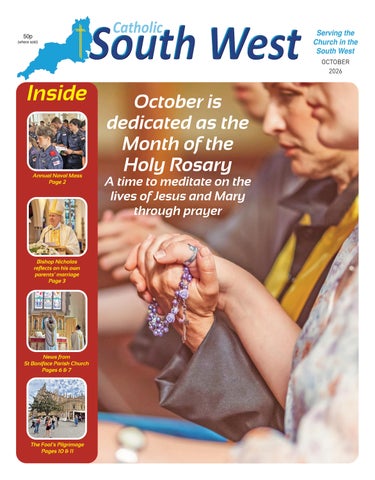
OCTOBER 2026
Inside
Annual Naval Mass Page 2
Bishop Nicholas reflects on his own parents’ marriage Page 3
News from St Boniface Parish Church Pages 6 & 7
The Fool’s Pilgrimage Pages 10 & 11
October is dedicated as the Month of the Holy Rosary A time to meditate on the lives of Jesus and Mary through prayer
2 October 2026 Catholic South West
CONTACTS & DETAILS Catholic South West is a monthly newspaper for Catholics in the Plymouth, Clifton and Portsmouth Dioceses. It is published by Bellcourt Ltd
Annual Naval Mass
AIMS To build community in the South West by sharing stories relating to Catholic life around the South West. To encourage readers to get more involved in - or start - projects and initiatives in the local area. To provide thought-provoking articles to help readers deepen their Faith.
GET INVOLVED We need your help! Articles: We need your local articles we can only include what we get. So if you have an article or just a photo with a short description - please send it in. Ideas: We need your ideas for the paper and we need your ideas in the paper. If you have any thoughts on what we should include - or if you are thinking about starting a new initiative - get in touch - we’d love to support it! Readers: If you can encourage other readers in your parish please do so. Advertising: We rely on advertising - if you know of anyone that would benefit from promoting their business, event or anything else to parishioners throughout the South West, do let us know.
SUBMITTING EDITORIAL To send in editorial or to get in touch please contact us at: CSW - Bellcourt Ltd N2 Blois Meadow Business Centre Steeple Bumpstead Haverhill, Suffolk CB9 7BN csw@cathcom.org 01440 730399
ADVERTISING To advertise in Catholic South West please contact us on 01440 730399 ads@cathcom.org
DATES Catholic South West goes to parishes on the last full weekend of the month. It is printed around the middle of the month - so if you would like to advertise or send in editorial please do it as early as possible.
Wanted Parish Correspondents The Catholic South West is looking for a Parish Correspondent in your parish to send in local news for publication in this Newspaper. All items to be emailed to csw@cathcom.org before 10th of the month
In July this year, Bishop Paul Mason, Bishop of the Forces celebrated the Annual Naval Mass at the Cathedral Church of St Mary and Boniface, Plymouth, it was a pleasure to greet serving personnel, Veterans and their families who came to celebrate their identity as members of the Armed Forces in the wider Catholic Community.
EDITORIAL GUIDELINES 1) Think of the readers: If you are writing about an event, think about the readers that don’t know anything about it. Outline what happened, but focus on why people go, why it is important to them, or some teaching that was given. Make sure readers learn something from your
article - they don’t just want to know who was there and what snacks were available! 2) Keep it brief: Make sure you make your point - but keep it brief and punchy. 3) Pictures: Send pictures as they are - even if they are very big to email. Don’t reduce them in size or put them inside a Word document. They look fine on the screen but terrible in the paper!
LEGAL INFORMATION Please note that opinions expressed in this paper and on any linked sites or publications are not necessarily those of the Publishers, Editor, any Diocese or the wider Roman Catholic Church. Every reasonable effort is
made to ensure that due acknowledgement, when appropriate, is made to the originator of any image submitted for publication. It is understood that those submitting material for publication in CSW either hold the copyright or have arranged for publication with the appropriate authority.
Catholic South West
October 2026 3
Bishop Hudson shares lessons from his parents' 52 year marriage The Bishop of Plymouth, the Right Reverend Nicholas Hudson reflected on his own parents' decades-long marriage in a homily at the annual Mass for Marriage at Plymouth Catholic Cathedral the Cathedral Church of St Mary and St Boniface, on 12 September 2026. Speaking to couples celebrating their anniversaries, the bishop opened with a reflection on Ein Karem, the hillside town near Jerusalem where, according to the Gospel of Luke, Mary visited Elizabeth shortly after the Annunciation, going, as Scripture puts it, "with haste into the hill country." He invited the couples to recapture the same sense of expectation they felt on the eve of their wedding - "the 'how will it be?'... 'How will we be together?'" He recalled his mother often telling him growing up: "Marriage isn't easy, you know!" - usually after a small disagreement with his father - and yet "they had a great marriage." On their Golden Wedding anniversary, when his mother was in hospital, his father spent the entire day at her bedside instead of his usual hour-long visit. When the bishop later asked her whether it had been sad to spend the milestone in hospital, she answered with a beautiful smile: "All we would have wanted was to be together and we were!" He also shared a memory from one Ash Wednesday, when his mother confessed, "I've broken my Lenten resolution twice already!" Asked what she had done, she admitted, "I've nagged your father twice." The couple simply looked at each other and laughed. Reflecting on what his parents taught him, the bishop said: "Marriage is a vocation to forgive," explaining that to forgive is "to bear with the weakness of the other." He described marriage more broadly as "the deepest act of trust" - trust "not just in God but in the 'yes' the other made for you." Listening, he said: "has to be one of the major keys to marriage." He recalled that his parents belonged to a group of couples called the Teams of Our Lady, the Équipes de Notre Dame, in which five couples would meet once a month to share how their family life had been, study a book together, pray together, and share a meal. "I can still hear my parents sitting in the
kitchen many a weekday... talking to one another about how their day had been," he said. "I think they listened deeply to one another, and were the very best of friends." He recalled a private Christmas Eve ritual: watching Carols from Kings with his parents each year, he noticed they would always join hands at one particular line in "Once in Royal David's City" - the words "And our eyes at last shall see him." He said he never told them he had noticed, but always watched for it. The bishop closed with a final prayer, expressing the hope that, after a long life of selfless giving to one another, their children, and all those who depend on them, the couples would be "united with one another" and would "look forever on the face of Christ, together."
To Advertise contact Nick on 01440 730399 nick@ cathcom.org
4 October 2026 Catholic South West
Sacrament of the Anointing of the Sick At the start of the public ministry of Jesus, he entered a synagogue and read a passage from the Prophet Isaiah – “The Spirit of the of the Lord is upon me, because he has anointed me to proclaim good news to the poor. He has sent me to proclaim liberty to the captives and recovering of sight to the blind, to set at liberty those who are oppressed, to proclaim the year of the Lord’s favour.” (Luke 4:18-19) Jesus fulfilled this prophecy to bring healing and restoration. We have all encountered fits of illness, and it can be a real nuisance. Although theologians have speculated throughout the centuries on the reality of sickness and its relation to spiritual life, we can be certain that illness is a part of being part of broken humanity. We experience our limitations, our weakness, our brokenness, and our vulnerabilities when we are sick. Sickness also has a psychological effect on us, which can cause stress, anxiety and even depression. It can be easy to turn inwards during this moment, but we are invited to enter into the Paschal Mystery of Christ, in knowing that when we die with Christ, we will rise with him in glory.
Please support our Advertisers
Since the very beginning of the Church, there has been the use of oil to anoint the sick. This may stem from what we hear in the Epistle of James – “Is there anyone sick among you? Let him send for the presbyters of the Church and let the pray over him, anointing him with oil in the name of the Lord. The prayer of faith will save the sick man, and the Lord will raise him up. If he has committed any sins, they will be forgiven him.” (James 5:14-15). Firstly, it is important to stress, that is not
a sacrament for the dying, but for the living. The last sacrament that should be received is the Eucharist, as viaticum. In the sacrament of anointing, the Lord encounters us with his healing grace – “Through this holy anointing may the Lord in his love and mercy help you with the grace of the Holy Spirit. May the Lord who frees you from sin save you and raise you up.” Jesus, through the Incarnation, entered into all human reality and experiences. He lived among us to bring us the fulness of life. He shared in our humanity and healed our infirmities. He gives us strength in our bodily weakness. Through the celebration of this sacrament, the Lord, through the Church, is close to us in our moments of illness, knowing that we are never alone or dejected, but loved and embraced. We might not always be cured of our sickness through the celebration of the anointing of the sick, but this sacrament does raise and strengthen us to encounter sickness with great confidence in the divine mercy of God, to bear trials and tribulations more easily. Although this sacrament is typically celebratedly privately, the Church highly encourages that it is celebrated as a group, especially within the context of the celebration of the Eucharist. The community of the faithful, the body of Christ, is also an important source of support, encouragement, and healing, by being reassured that the sick are never left to their own abilities, but have the grace and love of God, who is always close to the broken hearted and sick, and have the support and love of the community of believers. Fr Anthony Fyk
Catholic South West October 2026 5
Four priests to be installed as Canons
Four priests were installed as Canons during Vespers at Plymouth Cathedral on Monday 21st September at 7pm. Bishop Nicholas Hudson will preside over the celebration, during which Fr. Petroc Cobb and Fr. Mark Skelton will be installed as Canons of the Cathedral Chapter, while Fr. Brian Kenwrick and Fr. Anthony Onuoha will be installed as Honorary Canons.
Pray with the Pope
For the Care of Water In the name of the Father, and of the Son, and of the Holy Spirit. Amen. Lord of Life, You have given us the gift of water, source of fruitfulness, freshness, and hope. It quenches thirst, nourishes the earth, and heals wounds. We thank You, because it is also a symbol of your grace and love that renews us through Baptism. Today we ask You to teach us to safeguard it with gratitude, justice, and responsibility. Forgive us for turning it into a commodity, forgetting that it is a universal gift, a right without borders, meant for all your children. We see with pain so many brothers and sisters who lack clean water, who walk for miles to find it, who become ill due to its scarcity.
For resources on how to Pray with the Pope, either on your own or in groups, use this QR code.
Water is a sacred gift that sustains life. We see a sign of God's generosity in water. It quenches our thirst and makes the earth fertile. In Baptism, it becomes a symbol of his renewing grace. Taking care of water is also a form of safeguarding life and of recognising that this resource belongs to everyone, without distinction. In his prayer intention for September, Pope Leo invites us to pray that water be protected so that we might learn to appreciate it with gratitude, justice, and moderation, and so that we might know how to defend the right of every brother and sister to have equal access to drinkable water.
May your Spirit make us pilgrims of the essential, able to live with simplicity, denouncing waste and pollution, defending the right of every brother and sister to drink without fear and without inequality. May our care for water be a sign of love for the Creator and a commitment to the lives of the poor, educating new generations to value and protect the Earth's resources. Amen.
6 October 2026 Catholic South West
St Boniface Parish Church Keeping the Faith, Promoting sense of community as we prepare for our Centenary Celebration in 2027 by Mae G. Felongco Our beautiful parish which has been the home of Catholics in Southampton since 1927 will turn 100 years next year. The parish has started to prepare for a grand celebration led by our Parish Priest Rev. Fr. Tom Kleinschimdt, OMV with his assistant priests Rev. Fr. Jufel Baldado, OMV and Rev. Fr. Paul,Ubebe,OMV
alongside Parish Pastoral Council and Core Leadership Team with Chairs Mike Wood and Angela Braga respectively. Read below as we highlight several parish events, both recent and forthcoming that truly reflects the sense of community amongst the different and diverse Catholic communities within the parish.
Pilgrimages There have also been a few pilgrimages in which the parishioners have participated as organised by Jilit, which is managed by Joel George. The most recent were the Pilgrimage to the Shrine of Walsingham and the Pilgrimage to the Shrine of the Divine Mercy in Poland. Rev Fr. David Bateman was the principal spiritual director with Rev Fr Jufel Baldado assisting for the Walsingham Pilgrimage. The Divine Mercy Pilgrimage in Poland had two pilgrim groups -where Rev. Fr. Paul Ubebe, OMV was the spiritual director for the first group and Rev. Fr. Jufel Baldado, OMV led the second group. Read through the Reflections of Rev. Fr. Juel Baldado, OMV as he shared his experience of their 3rd and last day of the Divine Mercy Pilgrimage:
My Poland Pilgrimage (by Rev. Fr Jufel Baldado, OMV) The “Gout” of Our Faith: A Pilgrimage Through Suffering, Mercy, and Hope There are moments in a pilgrimage when the journey becomes more than a visit to holy places. The places begin to speak. History becomes a prayer, suffering becomes an offering, and even physical pain can become an encounter with God. On the third day of our pilgrimage, I experienced such a moment. Our journey began at the Pauline Monastery and the Shrine of Saint Stanislaus, places that reminded me of the deep roots of faith and the courage of those who remained faithful amid the trials of history. A pilgrimage is not simply about going from one shrine to another. It is about allowing each place to awaken something within us—to remember who we are, what we believe, and to whom we ultimately belong. From there, we traveled to the Old Jewish Town in Kraków. There, the atmosphere seemed different. The streets and buildings carried memories of a painful chapter in human history. As I listened to the stories of the Jewish people during Hitler's regime, I could almost feel, in some small way, the anguish, fear, humiliation, and suffering they endured. It was difficult to stand before such history without asking: How could human beings do this to one another? How could hatred become so powerful that it would lead to the destruction of innocent lives? Yet even amid that darkness, there were stories of light. I was particularly inspired by the heroic deeds of people who chose to stand with the suffering rather than remain silent. Among them were those who risked their own safety to save lives— people like the courageous doctor who cared for those condemned to suffer, and Oskar Schindler, whose story reminds us that even in the darkest circumstances, one person can choose to do what is right. Their lives made me reflect on the power of a single act of courage. Evil may be organized and powerful, but goodness can also become a force of resistance. Mercy can save. Compassion can restore dignity. Courage can become a light in the darkest night.
Rev. Fr. Jufel Baldado And then we continued our pilgrimage to the Shrine of the Divine Mercy. It was there that my own suffering became very real. My gout suddenly struck. The pain in my foot became intense, and every step became difficult. After spending the day contemplating the sufferings of others, I suddenly found myself carrying a small suffering of my own. In that moment, I could not help but see my gout in a different light. Perhaps this was another lesson of the pilgrimage. We often speak of suffering as something we want to escape. We pray for healing, relief, and strength—and rightly so. But suffering can also become an offering when we place it in the hands of God. So I offered my pain, as I have always tried to do, to the suffering of our Lord Jesus. I looked at my painful foot, but I tried not to let my eyes remain fixed on the pain. Instead, I turned my gaze toward the merciful God. That became, for me, the deepest lesson of the day. Pain is real, but it does not have to be the end of the story. At the Shrine of the Divine Mercy, I was reminded that God's mercy is greater than our wounds. The very place where I was experiencing physical suffering became the place where I felt invited to surrender that suffering to Christ. My gout became, in a strange and unexpected way, a kind of “gout of faith.” Gout attacks the body, bringing swelling, inflammation, and pain. But perhaps our faith, too, sometimes experiences its own “gout”—the wounds caused by fear, doubt, hatred, disappointment, injustice, and the sufferings we encounter in life.
Catholic South West October 2026 7
The Filipino Catholic Community in Southampton (FILCATHS)
These spiritual pains can make our journey difficult. Sometimes they make it hard to take even the next step. But faith teaches us not to stop walking. It teaches us to keep our gaze upon the Lord. It teaches us that our wounds can become places where grace enters. After Mass, we prayed the Chaplet of Divine Mercy. With every prayer, I felt invited to place not only my own pain but also the sufferings of the world into the merciful Heart of Jesus—the suffering of the Jews, the victims of war and hatred, those who continue to experience persecution, and all those who carry invisible wounds. The words of the Divine Mercy devotion took on a more personal meaning for me. I was not merely praying for mercy; I was learning once again to trust in Mercy. Later, despite my painful foot, we continued to the tomb of Saint John Paul II, where we venerated his sacred relics. That final part of the day's pilgrimage felt deeply significant. Saint John Paul II was a man who understood suffering. He lived through war, Nazism, communism, personal loss, illness, and the burdens of leadership. Yet he remained a witness of hope. His life proclaimed that suffering and hardship do not have the final word. Standing before his tomb, I thought about the day's journey—from the places where faith had endured, to the streets that remembered the suffering of the Jews, to the Shrine of Divine Mercy where my own body reminded me of pain, and finally to
the tomb of a saint who taught the world to remain faithful to Christ. The journey seemed to say: Remember the suffering. Honor the courage. Offer your pain. Trust in God's mercy. And keep walking. Perhaps that is what a pilgrimage truly is. We begin by thinking that we are traveling to holy places. But along the way, we discover that God is leading us into the holy places within our own hearts. On that third day, my gout slowed my steps, but it did not stop my pilgrimage. In fact, it may have deepened it. My painful foot reminded me of the countless people whose suffering is far greater than mine. The history of the Jews reminded me of the terrible consequences of hatred and indifference. The heroic lives of those who helped others reminded me that goodness is always possible. The Divine Mercy Shrine reminded me to surrender my pain to Jesus. And Saint John Paul II reminded me that faith means continuing to hope even when the road becomes difficult. I came to the shrine carrying gout. I left carrying a deeper understanding of mercy. And perhaps that is the “gout” of our faith: the wounds and pains that make every step difficult, but which, when offered to God, can become steps toward holiness. Our faith does not promise us a journey without pain. It promises us that we never walk alone. So I will continue to walk—even slowly, even painfully—with my gaze fixed not on the wound, but on the One who is Mercy itself. Jesus, I trust in You.
The Nigerian Community The Nigerian Community held their Annual Thanksgiving Mass on July 26 2026 where the theme centred on A Celebration of Faith, Culture and Gratitude. The mass was celebrated by Rev Fr. Paul Ubebe, OMV and concelebrated by Rev. Fr. Jufel Baldado, OMV. During the mass, the choir used traditional African instrumentation (drums, rattles, and local percussion) alongside joyful singing accompanied by rhythmic dancing during procession.
The Filipino Catholic Community in Southampton (FILCATHS) celebrated its third Parish Filipino Day last August 23rd and has elected its PIONEER Set of Officers. Hence, the highlight of this year’s celebration was the blessing of the officers during the Mass and a joyous fellowship afterwards. FILCATHS has been active in the parish since 2022 , with its officers and members living the faith by Amare et Servire – To Love and Serve the Lord with One Mind and One Heart. The officers are Chairman : Lawrence Jamolin,
Vice Chairman: Lian Sanchez, Secretary: Gaiserica Lea Mae M Taras, Assistant Secretary: Ciff Semblante, Treasurer: Maria Antonette Lopez, Assistant Treasurer: Ayesha Galanido, Auditor: Jason Semblante, Assistant Auditor: Angelito Fesarillo, Public Relation Officers : H Britannico, Mark Santos, Paul Maspinas, Joshua Estremadura , Spiritual Director: Rev. Fr. Jufel Baldado, OMV, Filipino Chaplaincy Director : Rev. Fr. Claro Conde
Looking Forward: We are inviting everyone to come and witness the first ever Marian Concert and Exhibition on October 10, 2026 at our St Boniface Parish Church. This is an afternoon gala concert participated in by different singing groups in Southampton and during the exhibit we will showcase different images of our Blessed Virgin Mary, which depicts her life of faithfulness and devotion to our Lord, Jesus Christ. This is a fund-raiser concert to support
the ongoing roof tile project and to support our Oblates of the Virgin Mary (OMV) priests who celebrated the 200 Year Founding anniversary this year. For tickets, see contact details on our poster. We continue to appeal for your support for our Roof Tile Project. We thank you for your benevolence and generosity.
8 October 2026 Catholic South West
Scripture Focus
By Fr Jeremy Corley
Bearing Good Fruit Grapes are among the nicest fruits, sweet and easy to eat. Usually, we have to import them from hotter countries. Because of climate change, vineyards are now sometimes found near the south coast of England. But these vineyards tend to produce small grapes more suitable for wine making rather than for eating as fruit. In the first reading on the 27th Sunday of the Year (4th October) we hear Isaiah’s parable of the vineyard. The prophet uses the people’s familiarity with vine growing to convey God’s message.
After blessing Jerusalem with such prosperity, God was hoping for a response of grateful appreciation, with the people living virtuously: “He looked for it to yield grapes, but it yielded wild grapes.” God asks what more he could have done for his vineyard. In disappointment and frustration, God decides to teach a lesson to the vineyard (= the people). He will remove its protection, so that it will be trampled down by enemies. This happened in Isaiah’s lifetime, when invaders from Assyria attacked the country.
In the Holy Land in biblical times, many hillsides were covered with vines. During the lifetime of the prophet Isaiah, Jerusalem’s king Uzziah was famed for encouraging the growing of vines.
The divine verdict is expressed with a Hebrew wordplay: “He looked for justice (mishpat), but behold, bloodshed (mispach); he looked for righteousness (tzedakah), but behold, an outcry (tzeakah)!”
Isaiah’s parable begins by mentioning God’s beloved, presumably denoting the people of Israel. They are centred on Jerusalem, which is the very fertile hill. The watchtower could refer to the temple, while the wine vat could refer to storehouses in the city.
At this autumnal harvest time in the season of creation, we acknowledge God’s kindness in giving us the fruit of the earth, including food and drink to nourish us. We seek to show gratitude to our Creator, who gives us so many good gifts. But we know that we do not always share God’s
To Advertise in the Funeral Section contact Nick on 01440 730399 nick@ cathcom.org
generous gifts with others as generously as we could.
bearing suitable fruit, in response to God’s generous love.
In the gospel on the same Sunday, we hear Jesus’ parable of the tenants in the vineyard. The original audience would have known Isaiah’s parable, but Jesus adapts it for his own situation of disappointment that many of his people have not accepted his message.
It can sometimes be easy for us to rest on our laurels by saying: “Well, unlike other people, at least I believe in Jesus.” Faith is certainly a blessing, but we are also called to bear suitable fruit in our actions.
As tenants in the vineyard, many of the chosen people have mistreated the prophets and rejected their message. Now, as God’s Son, Jesus has come to save them, but he foresees that they will also reject him and even have him put to death.
When we look at the church in our country, we often see congregations declining, and some parishes have had to import priests from overseas. Many of us have baptised relatives who no longer practise the faith. For numerous people prayer is no longer a daily priority.
Jesus concludes by saying that God’s kingdom would be taken away from the original chosen people and instead given to a new people who would produce suitable fruits. According to Matthew’s understanding, God’s kingdom would be transferred from the first chosen people to include other nations. Now the gentile believers will face the same challenge of
So, for us today, Jesus asks us to reflect: are we producing the good fruits of faith and hope and love? Are we living as witnesses of Christ? Are we praying regularly? Do we show appreciation of God’s kindness to us in the way we live? Let us ask God to assist us today to bear good fruit in our lives.
Funeral Services
Catholic South West October 2026 9
View from the Pew By Dr Jay Kettle-Williams
Month of the Holy Rosary It’s October. Again! And once more the ‘Season of mists and mellow fruitfulness’ (John Keats, ‘To Autumn’) is upon us. It seems that only yesterday we were celebrating Easter and, shortly before that, Christmas. Tempus truly fugit! October is the month traditionally honoured as the Month of the Holy Rosary and devotion to Mary, Our Lady, mother of Jesus. That would have been in the very early days of the Roman occupation of Judaea, an occupation which lasted from 63 BC effectively until the Muslim conquest of the region in 636 AD. Nearly one thousand years later, Pope Pius V established the coalition of Catholic maritime states - centred around Philip II’s Spain and the Republic of Venice - to counter Ottoman Turkish expansion in the Mediterranean. Catholics across Europe at the time were asked to say the rosary to pray for a Christian victory. The opposing maritime forces were almost entirely composed of rowing vessels such as galleys and galleasses. The Holy League (15 May 1571 - 25 May 1572) achieved a definitive victory, the Battle of Lepanto, on 7 October 1571 in the gulf of Patras and during which one hitherto unknown right-handed combatant, Miguel de Cervantes Saavedra (assumed 15471616), author of Don Quijote, lost the use of his left arm. To celebrate the triumph the Pope instituted the October feast of Our Lady of Victory, later renamed Our Lady of the Rosary. Two thousand years have now passed since Mary walked this earth. While thinking about what it was like to live in Judaea at that time, it struck me that
there was no one better than Mary herself for us to weave our thoughts around. According to early Christian tradition, the apocryphal parents of Mary are St Joachim and St Anne. Their household would have been like that of any Jewish household at the time, adhering to established societal norms and practices both within the Jewish faith and the region at large. We learn about the life and times of Mary from academic studies and research. It’s likely that Mary therefore would have been one of a number of siblings, perhaps as many as six, generally with a 2:3 expectancy of reaching adulthood and a lifespan rarely exceeding the average at the time of 35 years. The young women of her day, most with a life expectancy far short of ‘3 score and 10’ – although Mary may well have lived till 59-72 years of age - would have married in their early-cummid teens with motherhood starting shortly after. Mary would have given birth to Jesus around 4-6 BC. Mary’s daily life pattern would have followed the sun and involved the physical hard labour as demanded any close-knit agrarian society at the time, its harshness emphasised by the strict dictates of Roman rule. Her diet would have been simple and mainly plant-based, perhaps only occasionally including fish but rarely meat. Her family would have been classed as ‘tecton’, artisans. Joseph, we remember, was a carpenter. The house where she was brought up and lived subsequently would have been the norm: a single-room structure of stone or mud. The family unit, of up to twenty persons, spanned a number of
Monthly National Catholic Newspaper National and International News from a Catholic Perspective with thoughtful articles to deepen Faith SEPtEmBEr 2026
www.CatholicPost.co.uk
Edition 57
When love needs first aid
God of Our Senses
Kindness is King
page 2
page 6
page 11
St Hildegard of Bingen Feast day: 17 September
Fund Living Before Legalising Dying cbcew.org.uk
The Terminally Ill Adults (End of Life) Bill will have its crunch vote and second reading in the House of Commons on Friday, 11 September. The following interview is part of the Catholic News podcast which features interviews with lay people, religious and clergy involved in the Church's work in England and Wales. A diverse range of people, not just Catholics, have raised their voices in opposition to this Private Members' Bill that seeks to legalise assisted suicide. Our new Prime Minister, Andy Burnham, has said that now is not the time for this debate and it would be better to sort out the UK's palliative care and social care crisis. Dr Karen Groves MBE (Inset)
So what are the problems and what needs to be fixed? Dr Karen Groves MBE qualified as a doctor at a time when the modern hospice and palliative care movement was only just beginning.
generations living around a shared courtyard. Livestock, separated from the family quarters, would be corralled on a lower floor beneath where the family lived. Mary’s lifestyle in a small rural village like Nazareth would have been in sharp contrast to the urban centres reflecting the Roman lifestyle flaunted by the governing bodies. Well, I referred at the start of this piece to Keats’ ode ‘To Autumn’ which brings to mind Robert Frost’s poem ‘October’. To complement this October month with the Four Marian Dogmas (Divine Motherhood, Perpetual Virginity, Immaculate Conception and Assumption) I draw your attention to ‘The Blessed Virgin Compared to the Air We Breathe’, a poem by Gerard Manley Hopkins (1844-1889), a Catholic convert and Jesuit priest; ‘The Virgin’, a sonnet by William Wordsworth (1770-1850), a staunch member of the Church of England; ‘Mary’, a poem by the Anglican priest Malcolm Guite (b. 1957). Notes, Acknowledgements and Attribution: Accompanying image (Statue with Blowing Horn) after the sculpture Exultate Jubilate by Philip Jackson; Texts/References adapted and/or adopted from http://en.wikipedia.org under the terms of the Creative Commons Attribution-ShareAlike License 4.0:/; Photographs (Unsplash): Our Lady (Josh Applegate); The Rosary (James Coleman) Dr J L Kettle-Williams is an experienced business communications consultant and wordsmith (tutor, writer, translator).
"Pain and other symptoms were really poorly managed, not due to lack of compassion or care, but just through a lack of knowledge," said Dr Groves. "There was a lot of fear among the public and health professionals about the use of morphine, and also of speaking to people about their illness and what to expect in the future. It just wasn't done in those days." To address this and to meet end-of-life care needs in West Lancashire, Formby, and Southport, Dr Groves founded Queenscourt Hospice in Southport in the late 1980s.
"We've moved on a lot in nearly 50 years, and now for this area, we've got integrated hospice and specialist palliative care services working out of Queenscourt, which is our local hospice, the specialist clinical and educational hub, seeing patients and families in Queenscourt itself, or an equal number in our local hospitals, and twice as many again in our local care homes and their own homes, which is where the vast majority of people really want to be living their lives, and living them to the full, to the end." Dr Groves advocates for a 'continuity of care' so that integrated services are provided consistently and appropriately for each person across a number of care settings.
“It's a huge challenge, but it's taken many years of work to build relationships with all other local services, and those are really important so that everything's knitted together, and that provides the continuity of care. "It's made a big difference to the number of people who are able to stay in their own homes. Some people accuse hospices of providing a gold standard service to the very few, and I would counter that to say that where hospices have the opportunity to develop integrated services across all settings, then actually they can provide a responsive, helpful, reliable, and consistent service in which patients and families have confidence, and they're much less likely to dial 999 because of fear or not knowing what to do in a situation. It makes a big difference."
How does a hospice achieve gold standard palliative care and end-of-life care? What are the key ingredients? “I think there are many," says Dr Groves. "But a few of the main ones, are: investment in selection, ongoing training, and real support of skilled clinical and non-clinical staff. Plus time and attention to detail for every patient and family - that's really important. A huge number of committed volunteers without whom the service can't provide the standard of care that it does. Then the financial support and goodwill of the community of this area - West Lancs, Southport and Formby - who've supported the building, the growth, and the development of their services. Continued on page 2
The UK’s first Carbon Neutral National Catholic Paper Subscribe@catholicpost.co.uk 01440 730399 www.catholicpost.co.uk £1.80 provides a child with a meal every weekday for a month
Donate now at www.reachfoundationuk.org Your money goes a long way! Reach Foundation UK - charity no: 1171521
To Advertise contact Nick on 01440 730399 nick@cathcom.org
10 October 2026 Catholic South West
The Fool’s Pilgrimage The Adventures of a Roaming Catholic in Seville There are some places we visit simply because we fancy a holiday. And then there are places that, for reasons we don’t entirely understand, seem to call us. Seville felt a little like that for me. We only had three nights there — another of our little city-break adventures — but sometimes you don’t need weeks in a place for it to leave its mark. Sometimes a few days is enough, and for me, Seville had another curious connection.
Family Somewhere back in the twists and turns of the old family tree is the name Maese, my great grandfather hailed from this region of Spain, Jose Maese, who had the Seville Orange Company. Maese— a name with Spanish roots and an intriguing meaning:
Master Now, as someone who has spent most of my life practising martial arts and eventually reached the slightly grandsounding title of Master, this amused me. Perhaps it was destiny. Perhaps it was ancestral memory. Or perhaps it was simply another excuse for me to wander around Spain eating tapas and pretending it was a pilgrimage. But it did get me thinking about that word: Master.
And, more importantly, what it actually means to achieve mastery. We often associate mastery with power. Mastering a skill or attaining a level of academic education. Mastering an opponent, mastering a profession, mastering other people.
History is filled with kings, emperors, generals and rulers who became masters of enormous territories and millions of people. And Seville has certainly witnessed its share of power. Empires have risen and fallen here, cultures have collided, blended and replaced one another.
Christian, Muslim and Jewish influences remain woven into the architecture, streets and soul of the city. But wandering those beautiful orangetree-lined streets, another thought kept returning to me. There is an old saying attributed to Lao Tzu: “Mastering others is strength. Mastering yourself is true power.” That feels much closer to the sort of mastery I’m interested in these days. Because mastering somebody else may require strength. But mastering yourself? Your temper, your ego, your fear, your appetites, your prejudices, your need to always be right, your desire to control everything around you. That requires an entirely different kind of strength. Perhaps the greatest kingdom we will ever be asked to govern is the few inches between our ears. And perhaps that is why Seville's grandeur made such an impression on me. Because grandeur is everywhere. The churches are extraordinary. Gold, paintings, statues, carvings, altars, Continued on next page
columns stretching upwards. Centuries of art, faith, money, devotion and human endeavour piled one upon another. And then, of course, there is Seville Cathedral.
Beautiful, romantic, very Spanish. There was only one problem, my nose absolutely hated them, my hay fever went berserk. So, in what seemed like a sensible act of self-mastery, I reached for an antihistamine.
It is enormous. Almost overwhelmingly so. You step inside and instinctively look up, craning your neck.
Unfortunately, I hadn't paid enough attention to which antihistamine I'd taken. It was the drowsy variety.
Which, I suppose, was partly the point. For centuries our churches and cathedrals were designed to lift the human gaze beyond the ordinary world and towards God.
And for the rest of the day, rather than gracefully roaming the ancient streets of Seville like some enlightened Catholic pilgrim contemplating the mysteries of existence, I felt like I was walking through mud.
And it works. You feel small. But I also find something slightly complicated about these enormous religious buildings. They are undeniably magnificent.
Heavy legs, heavy head, half asleep. Lisa disappearing into the distance while the Spanish Master shuffled along behind her desperately trying to keep his eyes open.
They represent extraordinary craftsmanship, sacrifice, faith and devotion. But sometimes the sheer grandness of it all can almost become a distraction.
Perhaps there was a lesson in that too. For all our aspirations towards enlightenment, transcendence and selfmaster, we remain wonderfully, inconveniently human.
There is so much to look at that it can become difficult simply to be.
Sometimes the soul wants to soar while the body just wants a siesta and maybe that's okay.
And that was why one of my favourite moments in Seville was Mass. Because Mass wasn't celebrated amidst the full theatrical grandeur of the cathedral. It was tucked away in a quieter, more ordinary part. Suddenly everything felt smaller. Simpler, more intimate. The tourists disappeared. The cameras disappeared. The spectacle disappeared and there we were. A small collection of ordinary human beings, different nationalities, different lives, different worries, different stories. Gathered around the same altar and I loved that. Because beneath all the gold and grandeur, that is what the Church actually is. People, not buildings, not statues, or priceless artwork, people. A community gathering together around something greater than themselves. Perhaps holiness doesn't always shout. Sometimes it whispers, sometimes God is easier to encounter in the small chapel than beneath the enormous dome., sometimes we find the sacred not by looking higher.....but by becoming quieter. Of course, not every spiritual revelation in Seville occurred inside a cathedral, some occurred beneath the orange trees. Seville is famous for them. Hundreds of orange trees line its streets and squares, adding flashes of green and orange against the warm stone buildings.
The more I think about it, the more I realise that mastery isn't perfection. It isn't reaching some mystical point where nothing bothers us anymore. It isn't becoming emotionless, fearless or permanently peaceful. True mastery is probably much more ordinary. It is noticing when anger rises — and deciding what to do with it. Feeling fear — but not automatically obeying it. ecognising our ego when it demands attention. Knowing when to speak,
knowing when to remain silent, knowing when to push forward and knowing when to surrender. My martial arts journey has taught me that. My faith teaches me the same thing from another direction. The strongest fighter isn't necessarily the one who can defeat everyone else and the most spiritual person isn't necessarily the one standing beneath the grandest altar. Both paths eventually lead inward. Know yourself, discipline yourself, forgive yourself, give yourself and perhaps, eventually transcend yourself. Maybe that is the real meaning of becoming a master. As we wandered beneath Seville's orange trees, through little alleyways and enormous squares, past bars, churches, cafés and centuries of history, I wondered about those ancestors whose lives somehow flowed into mine. Did my Spanish forebearers wonder the same thing? Did they walk streets like these? Did they look upon churches like these? Did old Maese attain mastery? I'll probably never know. But perhaps heritage isn't only about proving precisely where our ancestors stood. Maybe it's about recognising that we are the latest chapter in a story that began long before us. They had their journey, their struggles, their loves, their mistakes, their faith, their fears, their pilgrimage. And now we have ours. I may carry something of their blood, I may carry the Maese name somewhere in my family story. I may even carry the title Master. But their story isn't mine to repeat, mine is still being written, step by step, city
Catholic South West October 2026 11 by city, Mass by Mass, mistake by mistake, antihistamine by unfortunate antihistamine. And perhaps the old Maese name has less to do with being a master and more to do with spending a lifetime learning what mastery really means, because that is what this Fool's Pilgrimage keeps teaching me. We travel across the world looking at monuments built by people who attempted to master kingdoms, nations and empires. Eventually they all disappeared. The kingdoms changed, the rulers died, the empires crumbled, yet the quieter challenge remains for every generation: Can I master myself? Can I become a little kinder? A little wiser? A little less controlled by fear and ego? Can I learn when to fight and when to surrender? Can I appreciate grandeur without needing grandeur myself? Can I find God not only in the magnificent cathedral…but in the quiet chapel? In my family? In a stranger? In an orange tree? Even in the slightly drugged-up pilgrim staggering sleepily beneath it? Maybe that is Maese. Maybe that is mastery. Not power over others. But wisdom within ourselves. And so the Fool keeps walking. Not yet a master. Still very much an apprentice, perhaps wise enough, finally, to realise that I always will be. The pilgrimage continues… Namaste Dan Sobey
12 October 2026 Catholic South West
out of Lisbon (7) 16. European city, home to 17 and his flock (6) 17. Needs no round to be showing below aver age scores to get a clerical job (6) 19 Fool, over a very large port, Paul steered away from (5) 21 Motif of the egoist? (5) QUICK Across 1 Teutonic (broadly) (6) 4 Twelve divisions of Israelites, from the sons of Jacob (6) 9 City of New York state, on the shores of Lake Erie (7) 10 Novelists Evelyn or Auberon? (5) 11 Musical piece accompanying a stage drama or comedy (5) 12. Eldest son of Levi (7) 13. RC clergy in the mantle of the Dominican order (11). 18 Uto-Aztecan American of the Great Plains (7) 20. Additional; surplus (5) 22 Major river of Pakistan (5) 23 Cloth or leather overshoes or leggings (7) 24. Formal denial or doubt of any defined doctrine of the RC Church (6) 25 Ecuadorean (broadly), for example (6) QUICK Down 1 Town where the Tabernacle was kept and where Solomon worshipped (6) 2 Weapon with a long barrel which features spiralling grooves for accuracy (5) 3 Language presumed spoken by Christ (7) 5 Oarsman or woman (5) 6 Prussian general, Britain's ally at Waterloo (7)
7 8
Statue with the body of a lion and the head of a man (6) OT book, alternative title in some Bibles being 'Canticles' (4,2,5) 14 Lover of the priestess Hero in Greek myth (7) 15 Peninsula of south-west Europe (7)
16 17 19 21
Local church community (6) Beneficed member of the clergy (6) Port of Mysia visited by Paul (5) Topic: melody (5)
SOLUTION
Across: 1 German, 4 Tribes, 9 Buffalo, 10 Waugh, 11 Opera, 12 Gershon, 13 Blackfriars, 18 Arapaho, 20 Extra, 22 Indus, 23 Gaiters, 24 Heresy, 25 Andean. Down: 1 Gibeon, 2 Rifle, 3 Aramaic, 5 Rower, 6 Blucher, 7 Sphinx, 8 Song of Songs, 14 Leander, 15 Iberian, 16 Parish, 17 Parson, 19 Assos, 21 Theme.
CRYPTIC Across 1 European language that's not totally suitable (6) 4 Israelite divisions baptiser created without Father's backing (6) 9 Kind of 11 gets to look arch here in New York (7) 10 Laugh head off reading alternative Welsh writer (5) 11 Long term work on the Metropolitan, maybe (5) 12 Levi's boy is among Rangers honourees (7) 13. One in the habit of going to a particular London station (11) 18 Native American, a Margaret Mitchell character, Pennsylvania allowed in (7) 20 Bye, say, after painting flipping divorcee (5) 22 Attempt to resign from work to expose Pakistani water feature (5) 23 Spats as Tiger scratched (7) 24 Variant doctrine being something inadmissible in court, advocate's opening is dismissed (6) 25 Swift is one in pursuit of a name for the mountain man (6) CRYPTIC Down 1 Judge's key changes make a Benjaminite town (6) 2 Ransack Winchester, for one (5) 3 Bend a month in the Sorbonne to absorb old speech (7) 5 One of eight, the one that boasts, his head's gone (5) 6 Prussian's oddly uncharitable seeing poor Anita depart (7) 7 Inscrutable Egyptian's wrecked ship and an indefinite number get cross (6) 8 Solomon's greatest hit, this book? (4,2,5) 14 Hero's love is torn between Adele and Erica (7) 15. Russian secret policeman's at home about one – that's