FEBRuARy 2026
www.CatholicPost.co.uk
Edition 50
Middlesbrough and Leeds to share Bishop Marcus
History in Their Hands
page 2
page 12
A journey of Faith, Hope and New Beginnings
St. Scholastica: The Power of Love in Prayer February 10th
page 14
Jubilee 2025:
A Year of Hope, A Church Renewed Gwen Wiseman On Christmas Eve 2024, Pope Francis opened the Holy Door of St Peter’s Basilica, inviting the Church into the Jubilee Year of 2025. “This is the season of hope in which we are invited to rediscover the joy of meeting the Lord,” he said. “The Jubilee calls us to spiritual renewal and commits us to the transformation of our world, so that this year may truly become a time of jubilation.” Jubilee 2025 will be remembered as a year in which the global Church walked together through grief and joy, continuity and change, discovering that hope, rooted in Christ, as St Paul reminds us, “does not disappoint” (Rom 5:5).
A Jubilee That Surpassed Expectations
As the Jubilee concluded on the Feast of the Epiphany, the Vatican confirmed that more than 33 million pilgrims travelled to Rome from 185 countries, far exceeding expectations. The scale of participation made the Jubilee a visible expression of the Church’s universality. 35 major Jubilee events were celebrated, each dedicated to a particular vocation or group within the Church. These were not merely large gatherings, but moments of encounter where faith was shared, deepened, and renewed. The death of Pope Francis on Easter Monday left an indelible mark during the year, followed by the conclave and the election of Pope Leo XIV on 8 May. But the convergence of these events transformed the Jubilee Year into a powerful witness of a Church in communion; a Church able to mourn, to gather in prayer for the guidance of the Holy Spirit, and to move forward together with renewed hope.
Signs of Spiritual Renewal
Beyond the numbers, the Jubilee’s most enduring legacy lies in its spiritual impact. Unprecedented attendance at Rome’s major
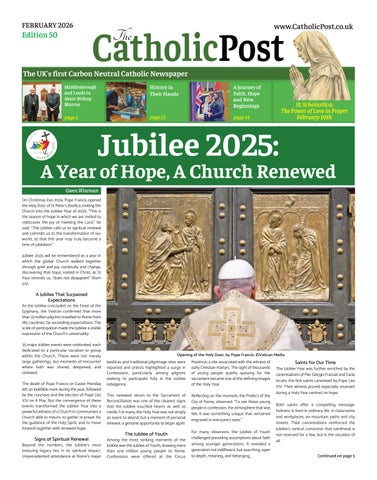
Opening of the Holy Door, by Pope Francis. ©Vatican Media basilicas and traditional pilgrimage sites were reported and priests highlighted a surge in Confessions, particularly among pilgrims seeking to participate fully in the Jubilee indulgence.
Maximus, a site associated with the witness of early Christian martyrs. The sight of thousands of young people quietly queuing for the sacrament became one of the defining images of the Holy Year.
This renewed return to the Sacrament of Reconciliation was one of the clearest signs that the Jubilee touched hearts as well as minds. For many, the Holy Year was not simply an event to attend, but a moment of personal renewal, a genuine opportunity to begin again.
Reflecting on the moment, the Prefect of the City of Rome, observed: “To see those young people in confession, the atmosphere that was felt, it was something unique that remained engraved in everyone’s eyes.”
The Jubilee of Youth
For many observers, the Jubilee of Youth challenged prevailing assumptions about faith among younger generations. It revealed a generation not indifferent, but searching, open to depth, meaning, and belonging.
Among the most striking moments of the Jubilee was the Jubilee of Youth, drawing more than one million young people to Rome. Confessions were offered at the Circus
Saints for Our Time
The Jubilee Year was further enriched by the canonisations of Pier Giorgio Frassati and Carlo Acutis, the first saints canonised by Pope Leo XIV. Their witness proved especially resonant during a Holy Year centred on hope. Both saints offer a compelling message: holiness is lived in ordinary life, in classrooms and workplaces, on mountain paths and city streets. Their canonisations reinforced the Jubilee’s central conviction that sainthood is not reserved for a few, but is the vocation of all. Continued on page 5
Page 2. The Catholic Post. February 2026.
CONTACT uS: The Catholic Post is published by its owners CathCom Limited and is wholly
Middlesbrough and Leeds to share Bishop Marcus
independent of and separate from any previous newspaper.
The Catholic Post is published on the last Sunday of the month previous to publication date.
EDITOR:
Nick Layton
email: editor@catholicpost.co.uk
ADVERTISING:
Charlotte / CathCom Ltd. 01440 730399
charlotter@cathcom.org
DESIGN & LAyOuT:
David Lodge, davidl@cathcom.org
PuBLISHED By:
CathCom Ltd. N2 Blois Meadow Business Centre, Blois Road, Steeple Bumpstead, Haverhill, Suffolk CB9 7BN 01440 730399
ARTICLES TO: The Catholic Post
email: editor@catholicpost.co.uk or davidl@cathcom.org
Please send articles for publication by
email, supplying any photos separate to the text We welcome contributions
Here are answers to some basic questions about writing for The Catholic Post
How long should articles be?
Usually it seems to work out best if
contributors simply say what they have to
say and let us worry about finding a spot for it in the paper.
What is the submission procedure? Please send as a Word file attached to an e-mail. To submit articles for publication, send to editor@catholicpost.co.uk
Charts, graphs, and photos should be
submitted as separate PDFs. Electronic
photos should not be embedded or pasted
into a Word document as this reduces their quality.
Following acceptance of the resignation, in accordance with Canon 401 §1, of the Rt Rev Terence Drainey as Bishop of Middlesbrough, His Holiness Pope Leo XIV has appointed Bishop Marcus Stock as Apostolic Administrator of the Diocese of Middlesbrough, whilst retaining his current office as Bishop of Leeds. Can. 401 §1 says that a diocesan bishop who has completed the seventy-fifth year of age is requested to present his resignation from office to the Supreme Pontiff, who will make provision after he has examined all the circumstances."
Emeritus Bishop Terry said: On December 22, the Holy Father, Pope Leo XIV, has accepted my resignation as Bishop of Middlesbrough and has appointed Bishop Marcus Stock, the Bishop of Leeds, as Apostolic Administrator of the Diocese of Middlesbrough.
Photographs and Illustrations
Bishop Marcus said:
Photographs and Illustrations should be
My Dear Brothers and Sisters in Christ,
JPEG (*.JPG) files).
Following acceptance of the resignation in accordance with Canon 401 §1* of the Rt Rev Terence Patrick Drainey as Bishop of Middlesbrough, His Holiness Pope Leo XIV has appointed me as Apostolic Administrator of the Diocese of Middlesbrough, while retaining my current office as Bishop of Leeds.
supplied electronically as high resolution Photographs and illustrations should be
sent in colour with a resolution of 300 dpi
and a minimum size of 100 mm x 100 mm
when printed (approx. 1200 pixels wide onscreen).
Computer print-outs are not acceptable. Screen captures are not ideal as they are usually not very high Parental permission should be sought before submitting photographs of minors. Source information DW = Diocesan Website. ICN = Independent Catholic News Views expressed in The Catholic Post are not necessarily those of the editor Last date for copy is the LAST DAY of the month prior to publication.
Placing all my faith in our Lord Jesus Christ, and the prayers of His Blessed Mother, I will do my utmost to fulfil the mission which His Holiness Pope Leo XIV has entrusted to me as Apostolic Administrator of the Diocese of Middlesbrough in addition to my ministry as the Bishop of Leeds. It is a comfort to know that in his retirement Bishop Terry will continue to reside in the diocese and that I shall be able to call on his knowledge, wisdom and advice to assist me.
I am very grateful to His Holiness for having entrusted the care of this diocese to me for nearly 18 years. It has been a joy and privilege to serve the faithful, clergy and religious. I will remain living in the diocese in my retirement and hope to be of assistance to It is the Holy Father’s wish that I explore with the clergy, lay faithful and religious of our two historic sister Dioceses of Middlesbrough and Leeds how we might journey together in mission, work in close collaboration and gain from each other’s strengths in order to secure the future of the Church’s witness to Christ across the regions we serve. I look forward to meeting and getting to know the priests, deacons and religious of the Diocese of Middlesbrough, and to serving both them and the lay faithful now entrusted to my care as Apostolic Administrator. Both Middlesbrough and Leeds dioceses share not only the saints and sacred places of the ancient Kingdom of Northumbria, but also the post-industrial heritage of Yorkshire’s historic North, East and West Ridings. We also share a common origin from 1878, when the Diocese of Beverley was divided into the current two sister dioceses by Pope Leo XIII.
Bishop Stock and to the diocese in any way that might be required. I thank Bishop Stock for taking on the role that the Holy Father has given him and I have no doubt that his ministry among us will bring us many blessings and help us all to journey onwards in the light of the Gospel. Trusting in God’s providence, I pray that the divine graces we have received in this Holy Year of Jubilee will guide us and shape us on our journey of hope and discover together the future that God wills for us. I humbly ask all those I am now called to serve to pray for me; that Almighty God will grant me the spiritual fortitude I will need to undertake this new role. Through the intercession of Our Lady of Unfailing Help and St Wilfrid, patrons of both the Middlesbrough and Leeds Dioceses, may Christ our Lord be our Way, our Truth and our Life. With every blessing, as we prepare to celebrate the Nativity of Our Lord and Saviour Jesus Christ, +Marcus Bishop of Leeds Apostolic Administrator, Diocese of Middlesbrough
The Catholic Post. February 2026. Page 3.
With the Beads in my Pocket…
As power and discord wrestle against humanity and love in a world patchworked with need, there is something we can do to enable God’s grace to comfort, to console and to show His face; we can care for each other, help each other, and, to sustain our actions, regularly pray the Rosary.
The Rosary is a simple and open prayer, one that lets our minds wonder through the life and times of Jesus, his family, their joys and troubles. In so doing we realise how close they really are to us in our own lives. The Rosary is repeatedly requested by Our Lady in her appearances in our troubled world. Through this prayer she promises her help.
Sr Lucia, child seer at Fatima, told us: “The Most Holy Virgin…has given a new efficiency to the recitation of the Rosary to such an extent that there is no problem, no matter how difficult it is, whether temporal or above all spiritual, in the personal life of each one of us, of our families…that cannot be solved by the Rosary.”
Pope Leo XIV closes the Holy Door of St. Peter’s Basilica, concluding the Jubilee of Hope, on January 6, 2026. / Screenshot: Vatican Media
Pope Leo closes Holy Door, concluding Jubilee Year of Hope indcatholicnews.com
On Tuesday 6 January, the Solemnity of the Epiphany of the Lord, Pope Leo XIV presided over Holy Mass in St Peter's Basilica for some 5,800 faithful At the start of the Mass, the Pope closed the Holy Door of St Peter's Basilica, the last of the Holy Doors opened for the Jubilee Year. The gesture marked the end of months in which "a stream of innumerable men and women, pilgrims of hope," crossed the threshold of the Basilica, journeying toward what the Pope described as "the new Jerusalem, the city whose doors are always open." Reflecting on the Gospel of the Day, taken from Matthew, the Pope in his homily focused on the joy of the Magi and the fear of Herod, noting that Scripture never hides the tension that accompanies God's manifestation. "Every time Sacred Scripture speaks of God manifesting himself," he said, "it does not hide the contrasting reactions, such as joy and agitation, resistance and obedience, fear and longing." The Epiphany, he added, reveals a God whose presence never leaves things as they are: "Today we celebrate the Epiphany of the Lord, aware that in his presence nothing stays the same." This divine appearing, the Pope continued, marks the beginning of hope. God's presence "puts an end to that type of melancholic complacency which causes people endlessly to say, 'There is nothing new under the sun.'" Instead, "something new begins which determines the present and the future,"
fulfilling the prophetic promise: "Arise, shine; for your light has come, and the glory of the Lord has risen upon you." Yet it is Jerusalem, the Pope continued - a city accustomed to revelation, that is troubled by the Magi's search. Those who know the Scriptures and "think they have all the answers," the Pope noted, "seem to have lost the ability to ask questions and cultivate a sense of longing." The city is unsettled by those who arrive "moved by hope," threatened by what should instead be a source of joy. "This reaction," he said, "also challenges us as a Church." Reflecting then on the Jubilee, Pope Leo invited the faithful to consider the spiritual searching of today's men and women. "Who were these men and women, and what motivated them?" he asked. "What did they find? What was in their hearts, their questions, their feelings?" Like the Magi, he said, many still feel compelled to set out. "The Magi still exist today," he stressed. They are those who "sense the need to go out and search, accepting the risks associated with their journey," even in a world that is often "unpleasant and dangerous."
The Gospel, the Pope said, calls the Church not to fear this movement of searching humanity, but "to appreciate it, and orient it toward God who sustains us." This is not a God who can be controlled. "He is a God who can unsettle us because he does not remain firmly in our hands like the idols of silver and gold; instead, he is alive and life-giving, like the Baby whom Mary cradled in her arms and whom the wise men adored." For this reason, holy places must communicate life. Jubilee pilgrimage sites, the Pope said, "must diffuse the aroma of life, the unforgettable realisation that another world has begun." He then asked: "Is there life in our Church? Is there space for something new to be born? Do we love and proclaim a God who sets us on a journey?" In contrast there is Herod, whose fear of losing power distorts his response to God's action. Herod, the Pope noted, "fears for his throne and is agitated about those things that he feels are beyond his control." Fear, he warned, "does indeed blind us." The joy of the Gospel, by contrast, "liberates us," making believers "prudent, yes, but also bold, attentive and creative," and opening paths "different to those already traveled." At the heart of the Epiphany, said Pope Leo, bringing a close to his homily, stands a gift that cannot be bought or controlled. "The child whom the Magi adore is a priceless and immeasurable Good." His revelation does not take place "in a prestigious location, but in humble place," and yet to Bethlehem it is said: "You are by no means least."
We do not need to say a whole Rosary at a time. Try one decade, maybe with scriptural texts or relevant bible reading and take time to meditate on the words and prayers hidden within. If we find it difficult to have a regular time to pray, we can just put the beads in our pockets and pray at the bus stop, in the train, on the underground, whilst waiting at the doctor’s surgery. No one needs to know we are praying, but we will be making a difference to the world in which we live. A big difference, allowing Our Lady to act.
Prayer to the Blessed Virgin:
O most beautiful flower of Mount Carmel, fruitful vine, splendour of heaven, Blessed Mother of the Son of God, immaculate Virgin, assist me in my necessity. O Star of the Sea, help me and show me herein you are my mother. O Holy Mary, Mother of God, Queen of Heaven and Earth, I humbly beseech from the bottom of my heart to succour me in this necessity (make request). There is none that can withstand thy power, O Mary conceived without sin, I pray for us who have recourse to thee. Holy Mother, I place this cause in your hands. Thank you for your mercy to me and mine.
Page 4. The Catholic Post. February 2026.
Sister Anežka: The Poor Clare Who Wants to Spread Good News rcadc.org
Alun John, Communications Manager at the Diocese of Cardiff-Menevia, was in conversation with Sr Anezka Gielen. In October, Archbishop Mark visited the Poor Clares Convent in Much Birch, Herefordshire and presided over the election of the new abbess. When he returned, he said they had elected a new abbess – who was very young. I said I might go and see her, and the Archbishop replied, “Yes, you must.” So the following week I arranged to meet Sr Anežka Gielen at the convent. I found her to be a lovely person, and I hope the warmth and enthusiasm she radiates comes through in our conversation. I also discovered she had a beautiful voice and, naturally, I couldn’t leave without asking her to sing something
To listen to Sister Anežka scan the QR code:
Sister Anežka, can you tell us how you ended up in the Archdiocese of Cardiff-Menevia?
It’s obviously the Lord, it’s a long journey, but I actually studied to be a midwife in New Zealand. I went to World Youth Day in Sydney, Australia, and on the way back from the big Mass with Pope Benedict, I broke my ankle. After my ankle healed, I already knew that I had a calling. I thought, well, I’ll go to Lourdes because I love sanctuaries. I thought I’d see Europe as a Kiwi does. We like to have the OE experience, the overseas experience. Through World Youth Day, I had heard about these Poor Clares up in North Wales, in Hawarden. So, I sent them an email and said, I’m coming to England, so I’ll come and see you for a weekend. But the moment I walked up the driveway, I really felt very uncertain. The Holy Spirit had his finger in there and he was stirring things up. However, as I walked through the door, there was just something in me, and I actually said out loud, “oh, Lord, it’s here that you live.” By the end of the weekend, I just knew – for me, if you live here, then I’m meant to live here. All my other plans didn’t matter. The moment you’re with the Father, nothing else matters.
How did you come to be here in Much Birch?
In 2017 we needed to make a choice, either to build where we were or move. As we couldn’t build on the land we moved to Nottingham where there was another Poor Clare house which was already affiliated with us. Shortly after, the house began to fall apart and was condemned and then we were sort of homeless. This house was going to close because they didn’t have enough sisters here.
So, we came here two and a half years ago. Now we’re 12 and this is a good, healthy number.
Why is it important for people to see you?
I think it is important that we’re seen, especially today where there are less religious around. When I go out shopping, people are like, “oh, I didn’t know that they had nuns here. Or I didn’t know that you existed any longer.” And I’d be like, “oh, yes, I’m a dying race.” It’s very important that we can be a witness. Sometimes we’re asked silly questions and sometimes very inappropriate questions. But I think it’s important that we are found joyful and that we’re found to be able to talk to people because we might be the only chance of meeting Christ in their day.
Tell me about being an abbess. What does that role involve?
St Clare says that we as abbesses are sisters among our sisters, and that she should be obeyed more out of love than out of fear. Of course, we believe that the Abbess is chosen first by God, the Holy Spirit and so when we obey her, we obey God. St Clare also gives the picture of a grand house with a lady and her servants and she says that the Abbess should know and care for her sisters like a servant knows and cares for her Lady, thus St Clare shows us that the role of Abbess is not being a ‘superior’ but really is a role of being a servant and is a place of great service. The abbess who’s just finished was actually abbess for nearly 18 years. So, I’ve never seen someone in our community take up the role. I was feeling a bit overwhelmed, like, well, what
am I supposed to do? But I think sometimes you can just overthink it. I think it’s like when a woman gives birth to a baby – it cries and you try and look after it. I think some things just come naturally.
What’s your approach to the role?
I think my role would be more trying to get the sisters to assume their responsibility. I’m not an overseer. It’s better to be a facilitator. I sort of think of it like a pie. If each of us do our bit, then the pie is going to be complete and then we’re working together in a structure that is going to glorify God.
Is there anything you want to develop?
I think there’s not enough time to stop, is there? We’re constantly trying to achieve and be the best we can be. Everything that we do is online and is being measured up against someone else. Where is the ability to learn, make mistakes and just be you? It took me quite a while to realise that I had to learn who I was. When I was about 30, I realised a lot of these things I was telling myself – I realised, like, oh, my favourite colour isn’t blue. I actually like the colour green. Sometimes it is the little things. Learning who I am enables me to learn who God is for me and that relationship between him and I, which obviously, as a nun, is quite important.
What’s your vision for the community?
I want us to be more involved in the Archdiocese. Respecting our vocation, which is contemplative, but also knowing that within our contemplative vocation, we can also be witness. I’d like to develop something with the Archdiocese – whatever is needed. Running retreats, doing things with young people, children.
My first aim is to be a witness to Christ and of his love and mercy. That is the most important thing. I’m 20 years younger than the next one, so I’m quite a lot younger than the rest. I’m the youngest and I’m 37. I’m the youngest Poor Clare in the country, really.
We’ve got a lot to do with music. I love to sing and play music and I write music. I’d love to do maybe praise and worship and adoration. We might be traditionally enclosed, but in reality, our call is not enclosure. Our call is to be contemplatives. And that doesn’t mean that we can’t go out. Anything to spread the gospel message, anything to spread the good news of Christ because it’s necessary in this world.
Our first thought should be to be credible witnesses to the love and mercy of Jesus. If we are to die out trying to achieve that, and even in one person, I think that’s worth it. Because it’s not about receiving vocations. Every vocation is important within the life of the church. If I’m the lone Poor Clare in 40 years’ time in this country, then that’s okay if I have spent my energy for God and for that message.
You speak about the pressures many young people face today. What do you think lies behind that sense of anxiety and constant striving?
What does St Clare say about your way of life? In St Clare’s form of life, our rule, the first thing she says is that our life is to live the gospel way continued on the next page
The Catholic Post. February 2026. Page 5.
Continued from page 4 of life. That is the messiness of the Franciscan life, to constantly try and live the gospel. But I think it’s the only thing that’s worth living for – to try and live that gospel message, which is good news, which is that the Lord came to save us and show us his mercy and love.
How do you approach sharing faith today?
St Francis said, preach at all times and when necessary, use words. So, I think we are preaching by just our beings. Pope Francis said that of religious, that we’re not to be like a museum, a dusty old museum. We have to have a credible witness. We can’t just say anything goes. I do think we have a gospel; we have a message. But that doesn’t mean that we stay antiquated. If you look at Jesus in the gospel, he gets dirty. He puts his finger in the dust, he makes mud. He’s a credible witness of the humanness of God incarnate. But he’s also preaching truth and preaching life and he’s showing us the way to the Father, but in mercy and grace and love.
What about difficult questions from young people?
A lot of young people, especially when we were in Nottingham, they’d ask us very direct questions – real questions. I think if you can’t meet people in their humanness, how can you bring them along? I don’t squirm away from that. I do think that we can’t expect people just to come to us. Pope Francis said about going to the peripheries to bring people in. With this generation, I think you actually have to go out to them. You have to speak their language sometimes. You have to show them that it’s worth it and that Jesus isn’t antiquated.
Are you seeing signs of hope amongst young people?
The young, they are on fire. They want to give their lives to something. The fire of the youth is beautiful. I think if they were to see Jesus as this wonderful lover, because that’s what he is, they would give their lives radically over to the purpose and service of God. You can see it within Youth 2000.
How do you communicate the message effectively?
Habemus Papam - Pope Leo XIV © Mazur/cbcew.org.uk Continued from page 1
A Jubilee Lived at Home
Although Rome stood at the heart of the Jubilee, participation was never limited to those able to travel. Dioceses across the UK designated Jubilee churches, promoted parish pilgrimages, and encouraged local participation in the indulgence. In this way, the grace of the Holy Year reached everyone in parishes, schools, care homes, and families across the country. For most Catholics in the UK, the Jubilee was lived quietly, through parish Masses, Confession, charitable outreach, and renewed commitment to prayer. In strengthening the ordinary, everyday life of the Church, the Jubilee reminded the faithful that renewal begins at home.
Westminster, ushers a sign of continuity, pastoral confidence, and hope for the future of the Catholic Church in England and Wales.
Looking Ahead
Rome now turns its attention to the next extraordinary Jubilee in 2033, marking the 2,000th anniversary of the death and resurrection of Our Lord Jesus Christ. Jubilee 2025 has shown that the Church’s future is shaped by trust in the God who continues to renew His people and lead them forward in hope. In the Book of Revelation, the Lord declares, “Behold, I am making all things new” (Rev 21:5). That promise found tangible
expression during this Jubilee — in new leadership, new saints, and renewed faith across the Church. It echoes the assurance of St Paul, who reminds us that “hope does not disappoint” (Rom 5:5), because it is grounded not in human certainty, but in God’s enduring faithfulness. Gwen is a Catholic writer and speaker who has authored devotional books on Saint Carlo Acutis and regularly presents talks on his life and miracles. She resides in Assisi, Italy, where she conducts retreats and leads pilgrimages that share the witness of Saints Francis, Clare, and Carlo. Contact: gwen@viaassisi.com
Hope for the Church in the UK
Research published during the year indicated rising Catholic practice among young adults, with Catholic church attendance among 18- to 34-year-olds surpassing Anglican attendance for the first time since the Reformation. The Jubilee’s message of hope, mercy, and belonging has resonated deeply within a culture searching for meaning and stability. Renewed leadership within the Church in the UK, most notably with the appointment of Richard Moth as Archbishop of
Confession during the Jubilee Year. Image source: https://www.iubilaeum2025.va/
When you meet Jesus in the Gospels, he’s very simple. I went through my Bible once and I wrote down everything that he had said. He’s very simple and he repeats himself. His message really is that I came, that you may know the Father and that you may be set free. His message is a message of mercy. I think sometimes it gets covered over with, like, oh, you must attend Mass once a week, and you must do this. Yes, but you do that because you want to be with the one who loves you. When you love someone, when you’re dating someone, you want to spend time with them. It’s not, oh, I must go on a date with them. It’s more like, I can’t wait to see them again. And that’s what it should be like with Jesus. I don’t ‘have’ to do anything, I want to. I want to see that One I love.
Canonisation of Saints Carlo and Pier Giorgio Frassati, 7 September 2025. I mage source: Public domain and courtesy of the Acutis family.
Page 6. The Catholic Post. February 2026.
Let them Come: A Church that Breathes Belonging Deacon Mark Paine New resources have been written to help parishes and schools communicate better with autistic Catholics. Written by Deacon Mark Paine, the resources were produced to address a need that Mark had identified for Sacramental preparation and catechetical material that was accessible for neurodivergent people. He has found several examples of young people who have never made their first Holy Communion or been Confirmed. Why? Mark says that it is simply because schools and parishes lacked the means to assess these young people's understanding of religious concepts and how that understanding is conveyed. In Mark's view, not only is this in direct contravention of The Church's own Teaching on catechesis, it is a tragic waste of the gifts that these neurodivergent people could give to their parish communities. JAnuAry 2026
Edition 49
The resources are written so that they can be used by non-experts in a variety of situations, be it a mainstream school, a special setting, a parish or a family home. Deacon Mark explains why he created these resources: There is a quiet ache in many of our parishes. It lives in the margins—where the liturgy is beautiful but bewildering, where the catechesis is rich but inaccessible, where The Body of Christ gathers but not all feel welcome to approach. It is the ache of those who long to belong, but find the doors too narrow, the language too coded, the rituals too rigid. Among them are your Autistic brothers and sisters, children and adults alike, whose ways of sensing, processing, and expressing faith do not always fit the neurotypical 'norm'.
Why not Bethlehem subscribe to the Catholic Post? www.CatholicPost.co.uk
Popemobile becomes hospital
A new Bishop for Plymouth
Peace Sunday
page 3
page 4
page 13
St Thomas Aquinas 28th January
Christmas lights return after three dark years
During the Gaza war all public celebrations of Christmas were cancelled in Bethlehem in the occupied west bank. The city relies heavily on tourism and the war has had a devastating impact on the city.
Now, with the ceasefire in place the celebrations are being reinstated with the lighting of the giant Christmas tree and decorations throughout the city.
Manger Square was full of families, dignitaries and people from across the occupied west bank for the two hour ceremony to begin the festivities. Voices rang out with hymns and prayers for peace as the people of Bethlehem announced to the world that they are open for visitors. Visitor numbers have dropped by 90% since the war and an economy dependent almost exclusively on tourism is desperate for people to return.
Palestine boasts the longest Christmas season in the world – beginning with the celebrations for western Christians on 24/25 December, going through the celebrations for the Orthodox Christians on 7 January and finishing with the celebrations for the Armenian Apostolic Church on 18-19 January. Bethlehem’s Mayor, Maher Canawati, said ‘It has been a bad two years of silence – no Christmas, no jobs, no work, no spirit of Christmas because are all here living from tourism which was the first to be hit down to zero. But after two years of silence we have decided to reignite the spirit of Christmas, to reignite hope.
The ediTor and sTaff of The CaTholiC PosT would like To wish our adverTisers and readers a very haPPy, holy and PeaCeful ChrisTmas and a blessed new year filled wiTh God's PeaCe and hoPe.
email subscribe@catholicpost.co.uk
And yet, we are already part of The Church. Not future members, not problems to be solved, not exceptions to be managed. We are here. Baptised. Called. Gifted. Bearing the image of God in ways that stretch and sanctify our understanding of Communion. To speak of accessible faith formation and sacramental preparation is not to ask for special treatment. It is to ask The Church to be Herself—hospitable, incarnational, attentive to the least and the lost. It is to echo the Gospel’s rhythm of welcome, where healing happens not through conformity but through personal encounter. Where Jesus kneels, listens, touches, and restores—not by erasing difference but by drawing it into the heart of grace. Accessible catechesis is not a concession. It is a proclamation. It says: you are worthy of knowing the mysteries of faith in ways that speak your language. It says: the sacraments are not rewards for performance but gifts for the journey. It says: The Church is not whole without you. This work is not easy. It asks the majority to unlearn habits of control and embrace the messiness of real accompaniment. It asks for formation that is sensory-aware, visually anchored, paced with compassion. It asks for our children to be prepared for First Communion not with anxiety over etiquette, but with reverence for the child’s way of knowing. It asks Catholics to walk with Autistic adults not as perpetual children but as theologians of lived experience.
It is a work of love. Of justice. Of fidelity to the One who broke bread with outcasts and called them His friends. In the silence of the sanctuary, in the hum of the classroom, in the kitchen table conversations —this is where The Church must learn to listen in a new way. To see our stimming hands as praise. To hear our echolalia as litany. To honour our need for retreat as a form of prayer. We do not need to invent a new theology. We need to live the one we already profess. That every person is fearfully and wonderfully made. That grace is not earned. That the Spirit speaks in many tongues—including those not always verbal. Let us be a Church that breathes belonging. That prepares the way not just for the sacrament but for the soul. That whispers, with quiet passion and unwavering conviction: you are not just welcome—you are wanted. To download the Called By Name resource scan the QR code:
To download the Radical Belonging resource scan the QR code:
“Pray with the Pope”
The Catholic Post. February 2026. Page 7.
a real network of communion in a divided world vaticannews.va
“Pray with the Pope” is a new initiative of the Dicastery for Communication and the Pope’s Worldwide Prayer Network that invites people around the world to share in a real communion of prayer with Pope Leo XIV, offering prayer as a path to unity in a divided world From the Chapel of Saint Peregrine in the Vatican to the wider world, Pray with the Pope invites the faithful to share in a common moment of prayer with the Pope. The initiative was presented on Wednesday, 7 January, shortly before the release of the first video message in which Pope Leo XIV shares his prayer intention for January 2026. The video, recorded in English, Italian, and Spanish, marks the official launch of the project.
Prayer as a source of hope
In his January prayer intention - For prayer with the Word of God - Pope Leo XIV calls on the faithful to rediscover prayer as a source of hope. The Pope inaugurates the initiative not with a speech, but with a moment of prayer, emphasising a quieter, more contemplative way of communicating in an age marked by noise and distraction.
The slow time of prayer
According to Paolo Ruffini, Prefect of the Dicastery for Communication, the initiative offers “the intimate and universal prayer of the Pope in a new, sober, and powerful form,” serving as a visible sign of unity and communion. It becomes a meeting place for millions of people, present both in digital spaces and in the concrete realities of daily life, beginning with the heart of each person. This proposal, Ruffini explained, challenges the pace of modern life by creating “a protected space, a slow time, for prayer”. It is a reminder that genuine encounter remains possible even in a world marked by division, war, and violence. Prayer, he stressed, has the power to restore unity where it has been fractured.
Monthly intentions, global concerns
Each month throughout 2026, Pope Leo XIV will invite the Church to pray for a specific
intention, touching on both global challenges— such as peace and disarmament—and issues within the life of the Church, including evangelisation. The initiative continues the legacy of The Pope’s Video, launched ten years ago by Pope Francis and viewed over 260 million times worldwide.
Building a different kind of network
Ruffini recalled the Pope’s invitation to “mend the nets” in the digital age—not through ambition or conquest, but by rediscovering what truly matters. In a culture accustomed to networks driven by monetisation, a network of prayer may seem countercultural. Yet, he noted, to pray together is itself a way of building communion, responding to a deep spiritual longing present even in secular societies.
Press Conference "Pray with the Pope"
An open door to shared prayer
Father Cristóbal Fones, Director of the Pope's Worldwide Prayer Network, described Pray with the Pope as an open invitation for anyone, anywhere, to join the Pope’s monthly prayer intentions from a synodal perspective. This global dimension is reflected in video testimonies from Indonesia and Côte d’Ivoire, highlighting prayer as a bridge between cultures and peoples. Finally, responding to journalists, Ruffini noted that the Pope has personally supported the initiative and has already recorded videos for the coming months. Through a short message on social media, Pope Leo XIV encouraged people to step away from endless scrolling and make space for prayer—a pause that allows the Word of God to breathe new life into hearts grown weary of constant distraction. by Benedetta Capelli and Francesca Merlo
For all your advertising requirements please contact Charlotte on 01440 730399 charlotter@cathcom.org
27 The Retreat, Princes Risborough, Buckinghamshire HP27 0JG Tel: 01844 344437 stscholasticasretreat@outlook.com Following the retirement of our Warden, the Trustees of St Scholastica’s Retreat are looking for an enthusiastic, energetic, caring and experienced person to deliver a range of services to the residents and Board of Management of St Scholastica’s Retreat, an almshouse charity providing 36 self-contained residential units for Roman Catholics in financial need who are over the age of 60 years. We are located in the town of Princes Risborough, Buckinghamshire. As Warden, you will play a key role in the day-to-day management of the charity as it plans to expand over the next few years. Day-to-day duties will include assisting the Trustees in fulfilling the charitable and spiritual aims of the Trust: in particular, ‘to support elderly Catholics to live independently within the community of St Scholastica’s Retreat’. To this end, to act as manager and administrator of St Scholastica’s Retreat. As Clerk to the Trustees, to assist the Trustees in strategic planning for the Trust and for St Scholastica’s Retreat. Previous experience of working in the charity sector would be an advantage. The role offers a competitive salary, pension, holiday entitlement and accommodation on-site in a three bedroom house. Further details and job description can be found www.stscholasticasretreat.org.uk/warden-vacancy applications close 9 Feb. Registered Charity No. 203583
Bishop Hudson reflects on Pope Leo’s World Day of Peace
Page 8. The Catholic Post. February 2026.
cbcew.org.uk Bishop Nicholas Hudson, Bishop of Plymouth, Chair of the Bishops’ Conference’s Department for International Affairs and Moderator of the Holy Land Coordination has issued a statement reflecting on Pope Leo’s message for the 59th World Day of Peace, which took place on 1 January 2026.The World Day of Peace is observed each year on January 1, the Solemnity of Mary, Mother of God. Since its establishment in 1967 by Pope St Paul VI, the Popes have taken the occasion to offer magisterial reflections in Messages for the day, dealing with topics such as the United Nations, human rights, diplomacy, and economic development. Bishop Nicholas said:“I welcome warmly the Holy Father’s Message for the World Day of Peace. Pope Leo calls for ‘a peace that is unarmed and disarming’. ‘To peace,’ he says, ‘we whisper “Forever”.’ But he acknowledges that peace is a journey. He laments the tendency for rulers and citizens alike to consider a ‘war-time readiness’ the only approach to conflict.“He expresses deep concern that increased military spending is presented as prudence, even necessity, while diplomacy, dialogue and international law are too often portrayed as weak or unrealistic. The Holy Father enjoins upon us to see that this way of thinking risks normalising conflict
and allowing fear to become the guiding principle of international relations; and that we must be mindful of this danger.“Pope Leo draws on the Magisterium of Pope St John XXIII to argue that ‘true and lasting peace among nations cannot consist in the
possession of an equal supply of armaments but only in mutual trust’; and of his predecessor Pope Francis to suggest that we should learn from Christ who ‘sought to live in harmony with all.’ Christ’s ‘goodness is disarming,’ says Pope Leo; and, as followers
of Christ, we should hear the call to join forces ‘to contribute to a disarming peace, a peace born of openness and evangelical humility’. That the world might hear this call let us redouble our prayers this first day of the year.”
when united with God, surpasses even the strictest logic. In a world that often prizes control and productivity, Scholastica points us
back to what matters most: a heart fully given to God, trusting that love will always have the final word.
February Saint
St. Scholastica: The Power of Love in Prayer February 10th St. Scholastica stands at the quiet beginnings of Western monasticism, a woman whose life reveals that love and prayer can move heaven itself. Born in Italy around 480, she was the twin sister of St. Benedict of Nursia, the founder of the Benedictine Order. While Benedict shaped monastic life through structure and rule, Scholastica embodied its heart: total devotion to God rooted in love.
One such meeting became legendary. On the evening of their final encounter, Scholastica begged Benedict to stay longer and continue their conversation about God. When he refused, citing his rule, Scholastica turned to prayer. A sudden storm arose, so violent that Benedict could not leave. That night, they spoke until morning. Benedict later realized that God had answered Scholastica’s prayer because, as he said, “she loved more.”
From an early age, Scholastica consecrated her life to God, eventually founding a community of women living according to the same spiritual principles that guided her brother. Though much of her life remains hidden, what we do know speaks volumes about her holiness. Once a year, Scholastica and Benedict would meet to pray and speak about spiritual matters, cherishing these rare moments of shared contemplation.
Shortly after, Benedict saw a vision of his sister’s soul ascending to heaven in the form of a dove. Scholastica had died, quietly and without acclaim, just as she had lived. Yet her legacy endures as a reminder that holiness is not measured by authority or accomplishment, but by love. St. Scholastica teaches us that prayer is not passive—it is powerful. Her life affirms that love,
The Catholic Post. February 2026. Page 9.
Image Pax Christi USA
Sudan: 1,000 days of failure indcatholicnews.com
As Sudan marks 1,000 days of war, the international community is failing to prevent mass atrocities and the targeting of minorities such as Christians and Black Africans by both sides The Sudan conflict is the world's largest humanitarian crisis, but according to British parliamentarian Lord Alton, there is "a lack of concerted diplomatic engagement, and no end to the suffering of Sudanese civilians in sight". The main battlefield has shifted from Darfur in the west to the Kordofan region where a Christian majority is under drone attack. On Christmas Day, 12 worshippers were killed and 19 wounded when their church in Julul was attacked. The United Nations International Organization for Migration believes 67,000 people in Kordofan have fled the violence in recent weeks. This adds to the estimated one million IDPs already in the area. The main Kordofan towns of El Obeid, Dilling and Kadugli are the scene of intense fighting, subject to blockades preventing food and medicine entering. Analysts fear a repeat of the siege of El Fasher last year, which left untold thousands of unarmed civilians dead. In December, the UN's early warning committee highlighted the dangers facing the besieged area.
Background to the current conflict
Ethnic and religious minorities in the Kordofan states, which includes the Nuba Mountains, have been the subject of aerial attacks by the Islamist Sudanese regime in Khartoum since the 1980s. The military dictatorship (which selfidentifies as Arab and Muslim, despite centuries of inter-marriage in Sudan) amended the penal code to include crucifixion in 1991. As recently as 2024, three men were crucified by the Sudanese Armed Forces (SAF) for allegedly collaborating with their enemies in the rebel Rapid Support Forces (RSF). Human rights groups say churches have been subject to harassment, closure and destruction by the Khartoum regime for decades. Until recently, the SAF and RSF acted together in a campaign of ethnic persecution against the Black African population of Darfur, killing at least 300,000 during the first Darfur genocide of 2003-6. Following a popular civilian uprising in 2019, the SAF and RSF together overthrew a transitional nonsectarian civilian government in 2021.
bodies and racial abuse. The Ray brothers' report is dedicated to the late Earl of Sandwich in recognition of his lifelong support for Sudan's civilians. Witness testimony about mass executions in Darfur has been validated by the Yale Humanitarian Research Lab, and satellite photos of blood-soaked land visible from space.
A new battlefield, but the same silence
The battle between the SAF and the RSF has shifted east to the Kordofan region where much of the population is non-Arab and nonMuslim. According to a Catholic Nuba group posting on Facebook, parishes had prepared for violence, dividing worshippers into smaller groups: "Despite the fear and uncertainty, the spirit of Christmas remained unbroken… This solemn adaptation of the Christmas celebration stands as a testament to the resilience of the people who, even under threat of violence, chose unity, prayer, and hope over fear."
Why does the killing continue?
However, in April 2023, the two militias turned on each other, fighting for control of Sudan's natural resources. The RSF has now forced the SAF out of most of Darfur, with a massive loss of civilian life, destruction, human rights abuses, targeted violence against women and girls, and displacement, including what the United States recognizes as a genocide.
Human rights groups estimate that at least 150,000 have been killed since the war began 1,000 days ago. They cite several reasons for a lack of international pressure, including the focus on Ukraine and Gaza. There has also been a lack of coordinated diplomatic action to halt the fighting, with competing initiatives failing to bring about consensus.
A new report containing dozens of interviews with survivors of the recent conflict in Darfur has been compiled by Marcus and Tomas Ray. The survivors, now in refugee camps in neighbouring Chad, give accounts of sexual violence against women and boys, enslavement, mass killing, desecration of
Most consequential however are the geopolitical interests in play which threaten to spread anarchy across a much wider region of East Africa. The UN has compiled evidence that the United Arab Emirates continues to supply the RSF with weapons and assistance. Supporting the SAF are Egypt, Iran and Saudi
Arabia, none of whom wish to see a democratic, civilian-run government succeed in a Muslim-majority country. Analysts say Saudi Arabia and the UAE are engaged in a proxy war, similar to their engagement in Yemen, trying to extend their influence in Africa. Nations such as the UK and USA, with close business relationships with the Gulf powers, have declined to apply concerted diplomatic pressure on Gulf rulers to curb their support for the warring parties. Meanwhile, civilian groups within Sudan provide humanitarian support to embattled communities. The Emergency Response Rooms (ERR), a network for soup kitchens and ad hoc medical facilities across the country, were nominated for the Nobel Peace Prize. Human rights groups say the ERR volunteers are deliberately targeted by both sides. They continue their work in the absence of services for civilians from the SAF, which nevertheless maintains that it is the government, or the RSF which occupies much of Darfur. The SAF is increasingly regarded by the international community, including the African Union, as the government of Sudan, offering the guise of legitimacy to one of the forces responsible for overthrowing the transitional civilian government in 2021. Analysts point out that the SAF is made up of the same extremist Islamist ideologues who ran Sudan for decades during Field Marshall Bashir's dictatorship. Bashir was indicted for genocide by the International Criminal Court. Moreover, the SAF has had close ties to Iran and Russia, promising military bases on the Red Sea until last month. Rebecca Tinsley
Page 10. The Catholic Post. February 2026.
View from the Pew
Biting the hand that feeds you … Dr Jay Kettle-Williams Look Back in Anger (1956), the realist play written by John Osborne, focuses on the life and marital struggles of an intelligent, educated but disaffected young man of working-class origin, Jimmy Porter, and his equally competent yet impassive uppermiddle-class wife Alison. The play spawned the term ‘angry young men’ to describe Osborne and others of his generation. The play’s harsh realism made Look Back in Anger one of the first examples of kitchen sink drama. DECEmbEr 2025 Edition 48
www.CatholicPost.co.uk
47 NOVEMBER 2025 Edition
The elderly are a blessing
www.CatholicPost.co.uk
The Catholic Police Guild
page 6
page 3
What Happens When God Closes One Door? page 11
Largest Christian Landmark being built
St Charles Borromeo: Compassion A Beacon of Reform and 4 November
rs Jerusalem Church leadefire statement on Gaza cease
JAnuAry 2026
page 2
Edition 49
in our region that and to other communities displacement, death, continue to suffer loss of livelihood. We injuries, hunger, and surge into the Gaza therefore call for a rapid communities of not strip and other affected fuel, and medical only food, clean water, shelters and supplies, but also temporary a prelude to a speedily medical facilities all as program for the Popemobile enacted and exhaustive of destroyed throughout our war- massive clearing and rebuilding becomes Along with millions living infrastructure. of millions around homes, businesses, and civilian hospital torn region, and hundreds the of and Heads the globe, We, the Patriarchs to view with rejoice at the recent At the same time, we continue Churches in Jerusalem, against in Gaza, and the great concern the increasing violence page 3 enactment of the ceasefire in in the West Bank captive. local communities release of those held expansions there. connection with settlement parties this opportunity to We therefore appeal to the concerned We would like to take whole to efforts of all those in and the international community as a recognize the enormous who worked current negotiations to the of community scope the widen the international this major Occupation of both the include an end of the relentlessly to accomplish leading to the West Bank and Gaza, achievement. state living sideestablishment of a Palestinian of the State of stage present first the this by-side in peace with We hope and trust that a just the end of the Gaza War, Israel. Only in this way, we believe, will ceasefire truly signals the disagreements between and lasting peace be truly established in and that any further be resolved through Holy Land and throughout the larger Middle the parties will applying the negotiation and mediation, East. than the resumption utmost restraint, rather region as a whole has give a special word of of hostilities. Indeed, our We would also like to St During the Gaza war all public celebrations of to contemplate those living inside suffered long enough encouragement to Christmas were cancelled in Bethlehem in the the time to embark Church and Holy Family otherwise. Now is clearly Porphyrios Orthodox occupied west bank. The city relies heavily on pathway of healing and as those serving at Alupon the very long Catholic Church, as well tourism and the war has had a devastating so profoundly needed Your perseverance in reconciliation that is Ahli Anglican Hospital: impact on the city. hardships of and Israelis. between Palestinians faith amidst the immeasurable served as a shining the past two years has Now, with the ceasefire in place the you our encouraged by the us all. We pledge to the prophets and by with We are especially so long the the example for reinstated beingenvisioned celebrations by us to peaceare demonstrated support, where we will our Lord Jesus to the Almighty for leading lighting of theof giant commitment for which continued prayers and old and tree and Christmas sages and giving thanks EI-Sheikh Summit to even as we realize to ensure that the weeks up his own life, rising participants of the Sharm this auspicious moment, himself gave the city. throughout of this work diligently just Christ has onlydecorations a vindication of your marking the commencement months ahead will be that the work of peacebuilding new life beyond the grave. other international and Heads us all the grace to The Patriarchs agreement, and by many trust in God's divine providence. dignitaries begun. May God grant Manger Square was full of families, this impressive global in Jerusalem to this vital task, Churcheswest theoccupied ourselves actors, and we hope that rededicate and people from acrossofthe materialize into a wideour fellow Christians that golden age of mobilization will soon In this spirit, we join with shepherding us toward bank for the two hour ceremony to begin the operation that offers around the world in scale humanitarian and others of goodwill festivities. Voices rang out with hymns and Palestinians of Gaza immediate relief to the prayers for peace as the people of Bethlehem announced to the world that they are open for visitors. Visitor numbers have dropped by 90% since the war and an economy dependent almost exclusively on tourism is desperate for people to return.
Jubilee of Prisoners
page 5
Touches of God in Atheist Nation page 13
St Nicholas - 6th December
Pope to COP30: We are guardians of creati on
www.CatholicPost.co.uk
Latin Patriarchate of Jerusalem
wars cease to the ends "[The Almighty] makes the bow and shatters of the earth; he breaks He the shields with fire. the spear, he burns that I am God; I will be says, 'Be still, and know I will be exalted in exalted among the nations, the earth."" (Psalm 46:9-10)
A new Bishop for Plymouth
Peace Sunday
page 4
page 13
St Thomas Aquinas 28th January
Bethlehem Christmas lights return after three dark years
free in your parish, the Catholic Post for per year! If you have been given parish for it, or even £10 able to donate £1 to your
PLEASE would you be
In a world caught between the roar of storms He pointed out that peace is not simply and the silence of inaction, the that the poorest and most Pope Leo XIV absence vulnerable will pay reflect of war, but the presence of spoke not merely as a religious a new understanding of our justice, the highest price if we leader, but as place in fail. respect for creation, and a voice for our shared home. creation. solidarity among He reminded us nations. “If you want to cultivate that the health of our planet, peace, care He acknowledged progress the dignity of — referencing the He spoke every human being, and the for creation,” he urged. In of a “new human-centred hope for lasting other words, our Paris Agreement of 2015 — but candidly peace are inseparable. treatment of the Earth reflects international financial architecture” our respect for observed that the that “path remains long and each other. ensures especially the poorest complex”. Words alone, and most He opened with a sharp recognition he declared, are vulnerable of reality: are enabled to participate, insufficient. They must be “In the midst of a world that to transformed into flourish, is in flames, as a And he did not mince words about the and to protect their dignity. moral choices and actions rooted result of both global warming He invited in responsibility, “education and armed dimension. The ecological crisis, he said, in integral ecology” that shows “is a justice and equity. conflicts,” he told the how gathering, this moral issue” — one that personal, family, community reveals our conference must become “a and political sign of hope.” The interdependence and choices shape our future. calls for a new solidarity, But perhaps imagery is stark — fire, flames, the most compelling vision crisis — yet the especially between was wealthier and highly his call underlying message is one for an “ecological conversion” of possibility, not industrialised — an nations, and those most despair. interior as well as external change. He urged vulnerable to climate impacts. He reminded us that our finances, our education, our policies Continued on page 3
If you have been given the Catholic Post for free in your parish, PLEASE would you be able to donate £1 to your parish for it, or even £10 per year!
Palestine boasts the longest Christmas season in the world – beginning with the celebrations for western Christians on 24/25 December, going through the celebrations for the Orthodox Christians on 7 January and finishing with the celebrations for the Armenian Apostolic Church on 18-19 January. Bethlehem’s Mayor, Maher Canawati, said ‘It has been a bad two years of silence – no Christmas, no jobs, no work, no spirit of Christmas because are all here living from tourism which was the first to be hit down to zero. But after two years of silence we have decided to reignite the spirit of Christmas, to reignite hope.
The ediTor and sTaff of The CaTholiC PosT would like To wish our adverTisers and readers a very haPPy, holy and PeaCeful ChrisTmas and a blessed new year filled wiTh God's PeaCe and hoPe.
For all your advertising requirements please contact Charlotte on 01440 730399 charlotter@cathcom.org
But it’s not uncommon particularly these days for people to look back in anger across the broadest spectrum of human activity, on the one hand highlighting the negative as overwhelmingly irreparable and condemnatory yet only, if at all, begrudgingly recognising anything positive by way of compensation. The case of Christianity comes immediately to mind. There are those that cry: ‘Look at the number of religious wars there’ve been?’ As if the ten basic tenets of Christianity have ever espoused war. How ironic, no? Irony really takes root with questions like: ‘What have the Romans ever done for us?’ from Monty Python's Life of Brian where the characters then continue grudgingly to longlist the Romans’ lasting contributions, listing such benefits as roads, sanitation, aqueducts, law, language (Latin roots), calendar systems, concrete, urban planning (grid systems, towns) and the spread of Christianity essentially laying foundations for modern Western civilization in engineering, governance and culture, despite the exploitation that came with empire. You could probably say the same for many an empire, from Arab to Zulu, over time and space. Not that exploitation need always go hand in glove with empire. But empire, notably the British empire, prompts more fervent anger than applause among a vociferous sector of the populace. Not the least for its involvement with slavery and calls for reparation. But is it right that the sins of the fathers be visited upon the children? (Exodus 20:5. JB) Well, it's only right and just, as we would say, that Britain’s role in slavery be deplored.
There’s no excuse, especially when we look through Christian eyes. But Britain, in step with her neighbouring nations, only ever had a fleeting role in the long-ongoing sordid drama of enslaving one’s fellows.
Slavery Abolition Act. The advent of photography had played an instrumental part in bringing the ills of slavery to the attention of those more fortunate, proving to be a powerful weapon in the abolitionist arsenal.
It was as late as the 16th century that European merchants, mainly Portuguese, launched the transatlantic slave trade purchasing imprisoned Africans from West African kingdoms for deportation to Europe’s colonies in the Americas.
The Clapham Sect, a group of Christian campaigners counted among its members the devout evangelical Christian William Wilberforce who, influenced by his Church of England upbringing and connections to Methodism, converted to evangelical Christianity in 1785 motivating him to advocate for social reforms including the abolition of the slave trade.
But evidence of slavery long predates written records with the practice dating back 1,000 years and more to settled agriculture when economic surpluses and high population densities made mass slavery viable. Slavery occurred in the ancient civilizations of Egypt, China, Babilonia, Persia, Israel, Greece, India, Rome along with the Arab Islamic Caliphates and Sultanates, which enslaved over 17 million Africans over 1,300 years, and the pre-Columbian civilizations of the Americas. The list goes on. So where do you start with passing the parcel when it comes to reparation? It was not until the 17th century that Britain, itself a victim of slavery in past times, became heavily involved in the transatlantic slave trade, the first related voyage being that by John Hawkins in 1562. Matters developed until 1807 when the Slave Trade Act officially abolished the slave trade in Britain. But it was not until 1833 that slavery itself was abolished with the
Outlawing and suppression of slavery followed in the 19th century to include the USA and in the 20th century to include the Ottoman Empire, Brazil, Ethiopia, Liberia, Morocco, Sierra Leone, Iraq, Saudi Arabia and China. Yet slavery continues to this day, generating an estimated £120 billion or more in annual profits. Let’s not forget that, in the aftermath of Christmas, the Church returns to Ordinary Time. The watchword for the prelude to Lent perhaps suggests we all just look back and repent. Dr J L Kettle-Williams is an experienced business communications consultant and wordsmith (tutor, writer, translator).
Archdiocese of Southwark launches landmark apologetics project Archdiocese of Southwark
As the number of people joining the Catholic Church in England and Wales continues to rise, the Archdiocese of Southwark is launching a landmark apologetics project to provide evidence-based answers to the burning questions of both new and practicing Catholics The project, named 'Ambassadors for Christ', is the first of its kind in a Catholic diocese in England and Wales, and is designed to equip the faithful with a deeper understanding of their faith. While the journey to faith of each person is unique, they often grapple with similar questions and doubts, and find themselves searching for answers. As more people become interested in the faith, practicing Catholics are experiencing more questions from their family, friends, and colleagues but often remain unsure where to look for evidence-based answers. These can range from fundamental questions like "Is Jesus God?" or "How do we know God is real?" to more practical inquiries about the Catholic faith, such as "Why do Catholics make the Sign of the Cross?" or "What is happening during Mass?". This project aims to not only help people find answers to their burning questions, but also to provide a reliable resource that can be relied upon when teaching about the Catholic faith. In a statement announcing the launch, Archbishop John Wilson, Archbishop of Southwark, said: "As someone who converted to Catholicism as a teenager myself, I know what it is like to search for answers, to thirst for the truth which only the Lord Jesus offers. Every day, people are searching for the same answers I did, thirsting for the truth I found, and it is our job to guide them on the right path. "As Catholics, leading people to Christ has to be at the heart of everything we do, because it is the Lord Jesus who is the way, the truth and the life. It is the Catholic Church, founded by Jesus, where people will find the answers to their burning questions, where their thirst for truth will be sated. "As the Archbishop of the diocese, I am responsible for catechesis and ensuring the
The Catholic Post. February 2026. Page 11.
faithful know and understand their faith. That's why this project goes beyond providing answers, it is about building Ambassadors for Christ in our parishes and schools. "I want the faithful - from converts to cradle Catholics - to feel confident and assured of their faith, so that when they are asked the reason for the hope within them, they can confidently speak of the Lord Jesus and his saving work." The project will consist of 52 videos, posted every Monday on YouTube in 2026. To provide assurances for the viewer that the information is from a trusted source, each video will feature a Catholic priest. To ensure doctrinal accuracy, each script draws from a foundation of Scripture, primary Church Father documents, the Catechism of the Catholic Church and official papal and Church teachings. All have been robustly checked by expert theologians prior to publication. The video format has been chosen to respond to reality that young people increasingly turn to social media for answers, including matters of faith. Father Dermott O'Gorman, the Director of Youth for the Archdiocese of Southwark said: "We are often told that young people are not interested in religion or that they don't care about God. But this could not be further from the truth. In a world where they feel disillusioned and lost, our young people are searching for meaning. "The Church needs to meet them where they are, and that is what we're doing with Ambassadors for Christ. By providing engaging content that directly answers their questions, we hope to help them discover meaning and purpose that can be found only in Jesus Christ and His Church". Worksheets will also be produced alongside each video to enable parishes, schools, and youth groups to use them as part of their faith formation. This is a crucial element of the project, helping people to connect the truth of the Catholic faith within the context of their parish. Pope Leo XIV previously warned of the dangers of social media programmes, which are limited to "individual experiences" but remain "detached from the ecclesial body". Dr. Mark Nash, the director of the Archdiocese's Agency for Evangelisation and Catechesis, said: "The Holy Spirit is already hard at work in our diocese, with consistently high numbers of people joining the Church. Ambassadors for Christ is about capturing this moment, through joyful evangelisation, and deepening the faith of Catholics through education and formation".
This apologetics project is a small step toward helping people to understand their faith and build a deeper relationship with God. Those seeking more detailed catechesis and formation are encouraged to take part in the Archbishop's Certificate, which is a two-year training course to help people know their Catholic faith more deeply. For more information on the Archbishop's Certificate, open to people in all Dioceses, scan the QR code.
£1.80 provides a child with a meal every weekday for a month
A key aspect of the project is addressing misconceptions and myths about the Catholic faith, with videos directly responding to claims such as "Catholics worship Mary" and "Catholics hate science". Each video will follow a similar format: Objection/Question: It begins with a common objection, question, or myth Scripture: The issue is first looked at through Scripture, drawing on solid biblical teaching Church Fathers: To provide a historical understanding and demonstrate the Church's link to the apostles, each video will then draw on the teaching of the Church Fathers Church Teaching: The final part of the video will highlight Church teaching on the subject, drawing on papal and Church documents, as well as quotes from Saints The bitesize videos are perfect for those seeking answers but are unsure where to start. Further study guides will be provided throughout the project, including where people can go to find out more about their questions. For more information and to sign up scan the QR code.
Donate now at www.reachfoundationuk.org
Your money goes a long way! Reach Foundation UK charity no: 1171521
For all your advertising requirements please contact Charlotte on 01440 730399 charlotter@cathcom.org
5
Page 12. The Catholic Post. February 2026.
History in Their Hands
At Stonyhurst, the rare, historic collections can be touched, examined and brought vividly to life during lessons, giving even the youngest pupils the opportunity to learn from the past. Nestled within the historic halls of Stonyhurst College lies a museum and archive like no other. Spanning centuries and continents, the Stonyhurst Collections hold not only rare and priceless objects but also the power to educate and inspire. Today, they are recognised as one of the most significant educational collections in the UK, beginning in 1609 with a single golden cope. That object marked the beginning of a story shaped by upheaval, devotion and resilience. During the Reformation, when the school was based in the Spanish Netherlands, the parents of English boys entrusted precious Catholic artefacts to the Jesuits for safekeeping, saving them from destruction in England. Four centuries later, the collection has grown into an extraordinary archive of around 100,000 books, 40,000 manuscripts and 70,000 artefacts - from a 4,000-year-old spearhead to the fossilised tooth of a woolly mammoth. “The Jesuits have always recognised that objects have the power to illuminate and inspire,” explains Dr Jan Graffius, curator of the Stonyhurst Collections. To make history come alive for pupils, Dr Graffius established the Junior Curators Scheme for pupils aged nine and ten, teaching them to handle, interpret
and communicate the stories behind objects. Children may find themselves holding a Greek drinking cup unearthed at Pompeii or examining the carefully engineered curve of a Neolithic spearhead. “The whole point of a Jesuit education is to observe, absorb and learn.” Learning extends far beyond history. Stonyhurst houses part of the celebrated Waterton Collection, assembled by Victorian explorer, and former Stonyhurst pupil, Charles Waterton, whose preserved animals open conversations about natural history, preservation and global exploration. In lessons, a 50-million-year-old megalodon tooth sparks discussions about palaeontology, while Shakespeare’s First Folio, displayed prominently on campus, introduces pupils to the foundations of English literature. Older pupils use the collections to deepen their studies. Sixth Formers studying the International Baccalaureate (IB) programme are required to curate exhibitions using artefacts, while A level pupils in art and biology draw inspiration from the Waterton specimens. Recent displays, such as Womanuscripts, curated by pupils, have explored women’s roles in history through letters, recipes and theological manuscripts. Supporting Dr Graffius in this mission is Museum Education Officer Esther Rollinson.
Together they have developed hundreds of lessons, adapted for pupils as young as three, and frequently welcome local schools to share in the experience. The legacy of Stonyhurst’s collections extends beyond the artefacts themselves. Names carved into desks connect pupils to alumni such as Arthur Conan Doyle, whose school report - on display in the museum memorably describes him as a “quarrelsome buffoon with dirty habits.” Behind such curiosities lies a profound purpose: to help pupils understand the world through the things people have left behind – their values, struggles and ideas. Whether handling the tools of a Neolithic hunter, the
writings of Shakespeare or the explorations of Victorian naturalists, Stonyhurst pupils are given a rare opportunity to hold the past in their hands - and carry its lessons into the future. Discover more about the Stonyhurst Museum and Collections during an Open Day. Scan the QR code to book.
The Catholic Post. February 2026. Page 13.
Vienna Skyline with St Stephen’s Cathedral, Vienna, Austria
Late vocations program in Austria allows priest to keep his current job catholicnewsagency.com The Catholic Church in Austria has launched a new formation program to promote late vocations, aimed at men between 45 and 60 years old who are currently employed and can complete the process without having to leave their jobs. The initiative, promoted by the Conference of Rectors of Austrian Seminaries, breaks with the traditional model of formation and preparation for priestly ordination and opts for a more flexible model as a response to the shortage of vocations. Under the name “Zweiten Weg für Spätberufene” (“Second Path for Late Vocations”), the program is specifically aimed at men with professional experience and offers the possibility of pursuing theological studies remotely, without requiring community life in the seminary or exclusively in-person formation, adapting to the professional demands of each candidate. This new program also allows them to continue practicing their profession after being ordained priests — with the exception of political positions — albeit in a limited capacity,
with the express authorisation of their diocese and provided that their profession is compatible with the priestly ethos. With this new proposal, the Church in Austria is committed to integrating the path to the priesthood with the daily lives of the candidates, who must be single or widowed and commit to a life of celibacy. The fundamental pillar of the initiative is the document Ratio Fundamentalis Institutionis Sacerdotalis, from the Dicastery for the Clergy, on the gift of the priestly vocation and the importance of formation. According to the latest data provided by the Austrian Bishops’ Conference for the year 2024, there are currently 3,269 priests in the country, a number that has experienced a slight but steady decline in recent years. This story was first published by ACI Prensa, CNA’s Spanish-language news partner. It has been translated and adapted by CNA and used here with permission. by Almudena Martínez-Bordiú
Image: Martin Hungerbühler
Page 14. The Catholic Post. February 2026.
Project Oasis: A journey of Faith, Hope and New Beginnings comes to a joyful conclusion northamptondiocese.org
In a remarkable testament to Christian charity and community spirit, Project Oasis has successfully concluded its mission of supporting a refugee family from the Middle East, bringing hope, stability, and faith-filled friendship to their new life in the United Kingdom. The initiative began in early 2017 when parishioners at Immaculate Heart of Mary, Great Missenden, were inspired to sponsor a family through the UNHCR/UK refugee programme. What started as a spark of compassion quickly grew into a diocesanbacked project with volunteers from multiple local parishes, all offering a variety of skills and unwavering dedication. By mid-2018, the Project Oasis team had successfully submitted its application to the Home Office and UNHCR, receiving approval to sponsor a refugee family. Initial fundraising efforts raised £18,838, including Gift Aid, from 58 generous donors. While the team had anticipated a family with young children, God’s plan led them to welcome Zainab and her daughter Maryam, then 13, from Iraq. Guided by the Holy Spirit, the team rented and furnished a home in Chesham, investing around £12,000 to prepare for their arrival. On their first day in the UK, Zainab and Maryam arrived at Heathrow with a single suitcase and little English, warmly greeted by five members of the Oasis team and supported by Arabic-speaking volunteers and modern technology like Google Translate. With Oasis’ support, Maryam quickly enrolled in school, and Zainab began ESOL (English for Speakers of Other Languages) courses, excelling in her studies while volunteering locally. Additional support came from the Catholic Women’s League, which generously provided £3,200 to aid Zainab’s language learning. Over the next several years, the project continued to support educational and practical needs, including school trips, housing moves, and assistance with official forms, demonstrating the enduring commitment of the local Church community.
Through perseverance, faith, and the support of Oasis, Zainab found part-time work and completed her ESOL courses, becoming fluent in English. Maryam continued her studies while receiving vital mental health support and is now working to upgrade her GCSEs. The family moved multiple times, eventually settling in High Wycombe in more suitable accommodation, while Oasis volunteers continued to provide guidance and friendship. A major milestone was reached in December 2023, when Zainab and Maryam were granted Indefinite Leave to Remain in the UK. This year, they successfully passed their citizenship exams and were naturalised as British citizens, celebrated with their UK passports in hand. They are now preparing to participate in an
HCPT pilgrimage to Lourdes, a joyful symbol of their new life and faith journey in the UK. The Oasis team reflects on the project with gratitude and humility. “It has been a privilege and an honour to be part of Zainab and Maryam’s journey,” said a team spokesperson. “We treasure the friendships formed and continue to pray for suitable work for Zainab, progress in Maryam’s studies, and good local friends for them both.”
Project Oasis stands as a shining example of the Gospel in action, how parish communities, united in faith and charity, can transform lives, offering hope, dignity, and opportunity to those in need. The project has now formally concluded, leaving behind a legacy of compassion and enduring human connection. We invite the faithful everywhere to continue praying for Zainab and Maryam as they embark on this next chapter in their lives.
Bishop Richard Moth appointed new Archbishop of Westminster cbcew.org.uk His Holiness Pope Leo XIV has appointed the Right Reverend Richard Moth as Archbishop of Westminster. Ordained to the priesthood for the Archdiocese of Southwark on 3 July 1982, Archbishop-elect Moth has served as Bishop of Arundel and Brighton since 2015. Prior to that, he was the Catholic Bishop of the Forces from 2009 to 2015. Archbishop-elect Moth will become the 12th Archbishop of Westminster, succeeding Cardinal Vincent Nichols, who has served in the role since 2009. Cardinal Nichols will now become Apostolic Administrator of the Diocese of Westminster until Archbishop-elect Moth is Installed at Westminster Cathedral on Saturday, 14 February 2026. On hearing of his appointment, Archbishopelect Moth said: “I am moved greatly by the trust that Pope Leo has placed in me, in appointing me to the Diocese of Westminster.
As I prepare to move to the Diocese, I am so grateful for the support being given to me by Cardinal Vincent Nichols at this time. He has given dedicated service to the Diocese and will be missed greatly. "Serving the Diocese of Arundel and Brighton has given me the wonderful opportunity of sharing the Church's mission with lay faithful and clergy, and I give thanks for the many blessings of these last ten years. "My first task will be to get to know the priests and people of Westminster and I look forward, now, to serving them. With them, and building on the firm foundations that have been laid by so many down the years, I look forward to continuing the great adventure that is the life of the Church and witness to the Gospel." Cardinal Vincent Nichols said: "I am delighted at this news. Archbishop-elect Richard will bring to our Diocese many gifts and considerable episcopal experience from his years of ministry in the Diocese of Arundel and Brighton, and before that as Bishop of the Forces. I look forward very much to his Installation as our new Archbishop on Saturday, 14
Image: c. mazur/cbcew
February 2026. It is, of course, St Valentine’s Day, as well as the Feast of Saints Cyril and Methodius, co-Patrons of Europe. "I remember being present in Westminster Cathedral on 29 September 2009 for the Episcopal Ordination of Bishop Richard as Bishop of the Forces. So today I can say: 'Welcome back, dear Bishop Richard. You are most welcome indeed.'"
In praise of a Benedictine rhythm of prayer!
The Catholic Post. February 2026. Page 15.
Paul Bryant In 2024, I had the privilege of visiting several Benedictine monasteries in the UK and interviewing several monks. My research was made possible by support from the Farmington Institute (Farmington gift of time) and a Terrence Kardong Monastic Grant from the American Benedictine Forum. By profession I am an RE teacher, but I have a deep love for the Benedictine monastic tradition and hoped to learn more. Thankfully, I was given that opportunity. And now begins the task of sharing what I learned. One of the monks I met on my travels, a holy and humble man, was for many years a parish priest; a happy and fruitful one, by all accounts. However, as with many parish priests, I suspect, although I have not done the research to find out, his prayer life, while consistent and faithful, was, by his own admission, not quite what he hoped it could be. It was not that he did not want to pray or know how to pray; in fact, his desire for prayer was ardent, and his knowledge of prayer, profound. The problem was finding quality time for prayer. Now, don’t get me wrong; he prayed. He prayed religiously every day. But the problem was that he had so much else to do that prayer was always being squeezed into the gaps or while he was doing something else. In truth, this is not bad prayer; many people, even monks, pray like this often enough. Like St. Paul says in 1 Thessalonians 5.17, we must ‘pray without ceasing’, a verse which most people take to mean that we must pray while we are at work and at play, and not just when we are in Church. And yet, praying while we are doing other things is not the only way to pray, or the best way to pray. To really get to know God, we must make time for undistracted prayer, in silence and solitude. Eventually, the priest I was talking with, discovered the Benedictine monastic tradition, not just in books, but as a lived, loved reality. Visiting monasteries, going on retreat, in contrast with the monks’ steady, constant, rhythm of prayer, centred on the Opus Dei – the work of God - seven times a day, he realised what his prayer life was missing, scattered and diffused as it was amidst the busyness of parish life in the twenty-first century. While we must not forget that the experience of overbusyness and distraction is familiar to all of us - it is not a problem intrinsic to parish priesthood - but if parish priests are going to lead their communities in prayer, they must navigate those waters with particular skill. By contrast to many parishes, the structure of life in a Benedictine monastery is built entirely on the goal set by St Benedict himself: prayer to Christ, with Christ, and in Christ, in silence
and solitude. In a Benedictine monastery, prayer is not something bolted onto the rest of life, it is the very reason for the existence of the monastery. As St Benedict said in chapter forty-three of his Rule, ‘nothing is to be preferred to the work of God.’ While it is true that the life of a parish priest, deacon, or administrator is usually devoted wholeheartedly to Christ, given to love and serve Christ in his Church; nevertheless, those who work in parishes often struggle to find quality time for prayer. Such was exactly the experience of the priest become monk that I met. Aside from Mass, he prayed mostly while he was doing other things. But through visits to Benedictine monasteries, he began to realise that there was a better way to organise a life of prayer. The prayer life of a Benedictine monastery and a Benedictine monk are not perfect; at prayer with the community, they experience times of dryness, boredom and distraction, just like the rest of us; however, because they keep coming back, seven times a day, every day, week, month and year until death, the stability is there for their prayer to take root, to go deep down into their whole existence. The purpose of monastic life does not change, the structure is always there to make space and time for true, pure, Christ-centred prayer. In the Benedictine monastery, there really is nothing
more important than prayer. The monks’ work is prayer. Even when monks are away from their monastery, travelling – and this can only happen with permission from their Abbot – they must remember and observe the daily rhythm of prayer established in their monastic community. It is that steady, unswerving, structured rhythm of prayer which needs to be rekindled in the life of our parishes and that can only happen if it is rekindled in the life of our parish priests. The Church preaches and teaches that Christ-centred prayer is her very life blood, expressed most vitally of all in the Eucharist. Just think what could happen if we put prayer back at the heart of parish life, if prayer came before all else. Not only would we revitalise the life of the Church, but we would become a necessary and essential salve to the mental drift, impulsiveness and anxiety that is such a prevalent, damaging and saddening characteristic of life in the twenty-first century, a time when we need to rediscover mental discipline and asceticism more than ever before. A Benedictine rhythm of prayer could lead the Church into a new future; a future of hope where we can overcome our frailties and show the rest of the world how to do the same. Let’s be honest, who is not impressed by our Muslim friends who pray five times a day? Why is Islam
spreading so fast, if not for the cast iron discipline of so many Muslims? If a daily Benedictine rhythm of prayer was the centre of parish life, we would experience a transformation in our hearts, minds and lives. If prayer returned to the heart of Christian life, it would strengthen our faith, transform our witness to Christ, and deepen our love for the Word made Flesh and enable all of his glories to flow into the world. If we got our priorities straightened out and put prayerful silence and solitude, in, with and through Christ at the foundation of our lives and parishes, who knows where the goodness would stop. Now, that really is something worth fighting for and something that would give glory to God. Paul Bryant (BA, PGCE, MA, PhD)
Nottingham Cathedral publishes “handbook” for parish communications nottinghamcathedral.co.uk Nottingham Cathedral has released a new resource for parish communications. The publication aims to share practical lessons learned during the Cathedral’s “digital transformation,” offering a guide for parishes hoping to connect with their local communities. The authors propose that when approached with intentionality, social media can serve as a vital bridge from virtual curiosity to inperson experiences of faith. The book describes strategies for digital platforms to be more actively welcomed and used as a key way for increasing the outward-facing and missionary nature of parish life. Speaking from experience, the authors outline how the Cathedral’s increased social media presence has coincided with a renewal in the its community life. The team credits their digital outreach as a key factor in several positive trends observed over the last three
years, including increasing numbers of candidates for the RCIA programme who found the cathedral via social media. Emphasising the importance of a “missionary mindset”, the book concludes that: “The digital parish is a privileged place of encounter. Those who approach parish social communications with a missionary mindset will reap a harvest beyond their wildest imagining.”
To view this free resource, use the QR code.
Page 16. The Catholic Post. February 2026.
1
2
3
4
5
6
7
CRYPTIC Across 5 German heretic Diaspora hit badly (11) 7 Arkwright: name of American hospital at first (4) 8 Its English, eccentric, retro style introduces these biblical people (8) 9 Barker's part of this universal UK institution (6) 11 Persian god, legend says, is meeting with one in Egypt (6) 12 Turkeys lord it in the oven? (3) 13 Aramaean maybe investing a Welsh girl with a little time (6) 14 Horse or pig meat that's served up in a Canaan town (6) 15 Distress bearings found in the sea off Dover (8) 17 Women's headgear, providing it's firm at the front (4) 18 Into pit come the sporting opposition (11) CRYPTIC Down 1 One from India to look out for, they say (4) 2 This recipient of a letter is a kind of record: he's a Scot (8) 3 Part of Malta's no-go 'zombie' sector (4) 4 Religious type – one to find in York, for example (8) 5 One Coptic play that turns out to be prophetic... (11) 6 ...notice Earth in turmoil? (3,8) 10 Fuming after Ulster's reversal over weapons (2,2,4) 11 Place in Gilead's a goal for leading actor's comeback (8)
16 17
What you used to be is there – just get rid of the radical element (4) There's a tiny number in jail, brother, for murder (4)
9
11 12 14
13
QUICK Across 15 5 Member of a 16th Century German protestant sect condemned as heretics by Luther (11) 7 Along with Daniel and Job, one of Israel's three righteous men (4) 8 Bible people from southern Dead Sea area (8) 9 Domestic dog, aka Persian greyhound (6) 11 Ancient Persian god of light and truth (6) 12 --- Khan, spiritual head of Ismaili Muslims (3) 13 Native of a middle eastern Arabic republic (6) 14 Town in Canaan which after the Conquest was given to the tribe of Judah (6) 15 Restrict; impoverish (8) 17 Cap worn by fundamentalist Mormon women (4) 18 Formal sporting event, tournament (11) QUICK Down 1 Adherent of a monotheistic religion established in the 15th century by former Hindus (4) 2 Recipient of one of Paul's epistles (8) 3 Mediterranean home of the Giant's Tower, the world's oldest man-made religious structure (4)
10
16
17
18
4 5 6 10 11 16 17
Clergyman, as usually called in Protestant churches (8) Significantly prophetic (11) Part of Genesis featured in Haydn's landmark oratorio of 1798 (3,8) Strongly protesting; actively rebelling (2,2,4) Where Jacob saw angels before reuniting with Esau (8) Biblical pronoun (4) First child of Adam and Eve (4)
SOLUTION
Across: 5 Adiaphorist, 7 Noah, 8 Edomites, 9 Saluki, 11 Mithra, 12 Aga, 13 Syrian, 14 Hormah, 15 Straiten, 17 Coif, 18 Competition. Down: 1 Sikh, 2 Ephesian, 3 Gozo, 4 Minister, 5 Apocalyptic, 6 The Creation, 10 Up in arms, 11 Mahanaim, 16 Thee, 17 Cain.
You can use both sets of clues to solve the puzzle: the solutions are the same.
8