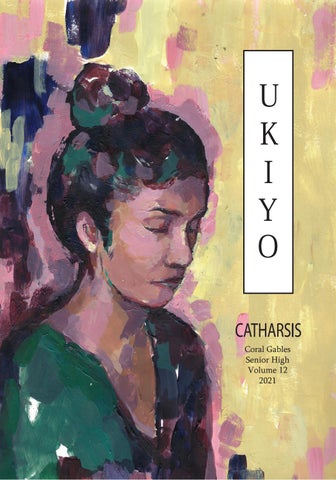
U K I Y O CATHARSIS Coral Gables Senior High Volume 12 2021
CATHARSIS Volume 12 2021
Ukiyo "Ukiyo-e (浮世, floating/fleeting/transient world): a Japanese art movement built upon the idea of living in the moment, detached from the bothers of life."
Coral Gables Senior High School 450 Bird Rd. Coral Gables, FL 33146 Phone: (305) 443-4871 Adviser: Michelle Zaldivar E-mail: mzaldivar@dadeschools.net All content featured in Catharsis magazine is the original work of the students, faculty, and alumni. The views and opinions expressed in the published pieces do not necessarily reflect those of the Catharsis staff or Coral Gables Senior High School. Cover by Malika McKenney. Editor’s Note, Table of Contents, and Colophon by Angela Alonso, Lisz Sada, and Marie Chacon. Illustrations by Lisz Sada.
Letter from the Editor It is a tired notion that the arts and writing encompass feelings of safety and comfort. While this sometimes proves true, it is still a fallacy — for to grow is to be discomforted, and to further one’s creative pursuits is to tirelessly throw yourself into the unknown. But how do we define this unknown? In Catharsis it is a vast expanse, a visual and literary stratosphere that will endlessly push itself towards growth. In essence, this is our floating world. As we are currently locked in an age far too digital for our liking, it is only natural for our minds wander.
Yet, despite these constraints, Catharsis has embraced the spirit of Ukiyo-e: living detached from the bothers of life. In a year like no other, where our thoughts have rung themselves dry from solitude, we have slipped away to a place with no emphasis on reflection. This home of ours is transient, and in its ever-wandering nature we invite readers to immerse themselves in the escape that is Ukiyo. The abridged version of the term, Ukiyo, is a nod to the novelty of this restless year. While Ukiyo-e (浮世) means “pictures of the floating world,” Ukiyo simply translates to “the floating world.” The essence of the term is to appreciate tranquility and find beauty in the casual attributes of life. Catharsis has molded this concept to fit the unknowing, yet transformative nature of our current times. As we undergo many changes in our lives and traverse through uncertainty, I hope readers will remember to recognize the fleeting nature of the present. With that being said,
Welcome to Ukiyo.
Devon Rall-Taguchi Editor-in-Chief
Table of Contents
1 19 35 39 55 61 67 77 79
Violin Cheryl Fiffe. ‘23 Violin, I Yearn For Rain Rain, Marta Camps-Gonzalez, ‘23 Egyptian Woman Woman, Laila Moussa, ‘21 dietary restrictions restrictions, Devon Rall, ‘21 Money Grows on Trees Trees, Kai Guin, ‘23 please don’t become a fascist fascist, Penny Richards, ‘21 Mother of Mine Mine, Tatiana Batista, ‘21 Neo Neo, Katerina Valdes, ‘21 Disassociate Disassociate, Jose Sanchez, ‘23
3 13 33 41 59 73 81
Emotions, Ana Arroyo, ‘21 Coffee & Tea, Marta Camps-Gonzalez, ‘23 Ode to Pugsby, Kai Guin, ‘23 The Scam, Chloe Grant, ‘21 Nighthawks, Arianna Peña, ‘21 The Scandal, Arianna Peña, ‘21 Portuguese Sea Breeze, Laila Moussa, ‘21
7 11 17 21 27 37 47 49 57 63 69 71
The Untold History,, Mena Williams, ‘21 White Fragility, Penny Richards, ‘21 Invidia, Cheryl Fife, ‘23 Date Bucket List: Stargazing, Chloe Grant, ‘21 My North Star,, Melanie Hernandez, ‘22 Tradition, Lucas Warfman, ‘21 Perfection, Emily Felipe, ‘22 The Blaze, Tatiana Batista, ‘21 Dance Towards the Inevitable,, Lucas Warfman, '21 You’ve Got Mail, Devon Rall, ‘21 Empathy, Malika McKenney, ‘21 Ten Thousand Years More,, Emily Felipe, ‘22
9
23
Moon Songs, Melanie Hernandez, '22, Marta Camps-Gonzalez, '23, Penny Richards, '21, and Ana Arroyo-Garcia, '21 Found in Translation, Laila Moussa, ‘21, Patrick Couto, ‘22 , Phoenix Pierre, ‘20, and Linet Carballea, ‘23
Table of Contents
3 7 20 21 48 49 56 60 69 72 80
Persona Helen Parra, ‘21 Persona, The Untold History History, Malika McKenney, ‘21 Iluvia, Angela Alonso, ‘21 Date Night Night, Chloe Grant, ‘21 Cyber-Attack Cyber-Attack, Marie Chacon, ‘21 Moonlight Moonlight, Malika McKenney, ‘21 Money is Just an Idea Idea, Malika McKenney, ‘21 Old New York York, Angela Alonso, ‘21 Disintegration of the Self Self, Angela Alonso, ‘21 Beginning Beginning, Malika McKenney, ‘21 Disassociate Disassociate, Leah Ullman, ‘23
27 33 36 39 50 58 64 65 81
Stargazing, Lisz Sada, ‘21 Pug, Marie Chacon, ‘21 Anubis, Leah Ullman, ‘23 Unwashed Chores, Marie Chacon, ‘21 Wildfire, Lisz Sada, ‘21 Cacophony, Lisz Sada, ‘21 Kageyama, Leah Ullman, ‘23 You’ve Got Mail, Leah Ullman, ‘23 Star Crossed, Lisz Sada, ‘21
1 10 11 13 17 24 25 37 41 43 46 62 68 73 77
Winter, Ann Marie Bracho, ‘15 Night, Devon Rall, ‘21 Magnitude, Monica Justiniano, ‘19 Coffee, Esther Rubio, ‘21 Ressonance,, Arianna Rodriguez, ‘20 Turkish Travels 1,, Joaquin Bierman, ‘20 Turkish Travels 2,, Joaquin Bierman, ‘20 Rendered, Ashley Lemus, ‘16 Old and New,, Michelle Zaldivar, ‘06 From the Bridge,, Michelle Zaldivar, ‘06 Archway,, China and Eva Opland, ‘15 American Dream,, Monica Justiniano, ‘19 Kissed with Beauty,, Alana Jefferson, ‘22 Self-flagellation & Loathe,, Monica Justiniano, ‘19 Mushroom, Alexander Oliva, ‘23
Winter, Ann Marie Bracho, ‘15, digital photography
1
Violin
by Cheryl Fiffe, ‘23
The violin lays abandoned in the corner, Its wooden corpse a vessel of sorrow. It glitters in the moonlight, Another hollow corpse haunted by broken dreams. The rain beats against the window like a drum, howling with grief, And thunder joins their ensemble, But they cannot compare to the silence of the violin. Its strings wound itself around her heart when she played, But now they’ve pulled too tight. Yet she reaches for the bow and draws forth a hymn of spiraling fire, Trades her heartbeats to pour her passion onto the stage, Each breath, each pluck, drawing her closer to an early grave. The dying star makes her final performance her masterpiece, The moment immortalized by amber in time, And reaches her zenith as she lets the flames consume her. The violin falls and hides her secrets in its silence, its body dusted in ash, flesh the color of bruised fruit crumbling in the moonlight.
2
Persona, Helen Parra, ‘21, gouache and acrylic
Emo tions by Ana Arroyo, ‘21
3
The stage is divided into two rooms. A master bedroom and a dark black emptiness. In the bedroom there is man standing over a woman, his face is never seen, she is crying on her knees. The only light is directed at the bedroom. As soon as the man hits the woman the light switches to the empty room and the bedroom characters freeze. The light turns on with each character’s words. VIND (shyly): Where are am I? VEKST (confused): Hello? VARME (angrily): Excuse me? The light turns back at the bedroom, and the other characters freeze. He leaves and the light is now only for the black room. VIND: What happened? VARME: Am I ok? VIND (holding herself in a hug): My body aches. It grows in pain. Like a shock that travels under my skin. VARME (spitefully): Like fire. VIND: Like poison. Like a sadness that starts as a stream and as it falls
down the mountains it turns into a raging river. VARME: Yes. A raging river. A tsunami that destroys the perpetrators. Drowning them, killing them. VIND: No. A river that suffocates me. A river in which I have fallen and I can’t swim to shore. My trap, my death. My solitude hole into which I will decompose (gazes at the floor). VARME: No. Let this river be the one that fuels you. Let be the emotion that drives you towards retaliation. Let it be the armor against this attack. VEKST (commanding the authority): Silence. Do not speak of such emotion if you cannot control it. Do not fuel a fire that you cannot command. 4
VARME: But—(beat) VEKST (interrupting): Listen. Do you hear that? (pause) Silence. We are safe. VARME: I am safe. VIND (looking up, quizzically): I? We? What? VEKST: Well, if you haven’t noticed about our peculiar situation, we are stuck together in this empty darkness. VIND: Darkness? What darkness? (The woman in the bedroom moves and sits on the bed while gazing her hands) I can see, I see the room, I see the door, I see my hands. Wait. Wait. The woman in the bedroom froze. VEKST (gazing at the bedroom): Do you see it now? Fall back from the windows to the outside, regress into the thoughts of the mind. VIND: Yes, I see it, I see us. I see the darkness. VEKST returns her eyes to the other character. 5
VARME: Nonsense. You do not exist. I must have hit my head. I must have—(beat) VEKST (interrupting): You must have nothing. Focus, let go of the rage you hold, think and use the clues in our environment. We are inside the mind. VARME (separating herself from the group): Inside the mind? Impossible. I was just outside, in my room, with (pause and her force becomes increasingly angrier) with that asshole. That lowlife. That monster. VIND: He is not a monster. He didn’t mean to. He just overreacted. VARME: Didn’t mean to? Look at my face! Look at my scars. Look at me. VIND: We misbehaved. We were at fault. VARME: I didn’t do anything. I am an innocent soul, trapped in this pit. VEKST: Oh, and what a pit it is, what a trapped we have fallen into, so sweet scented it almost seemed like a home.
VARME: I need to run. Escape. Spread my wings towards my liberty. I must think of a plan. VEKST: I’m unsure that will help. Liberty is a bittersweet memory remember? Sure, it seems better than falling asleep next to our perpetrator, but then is also having no one to rely upon. VARME: Stop your bipolarity and help me. This is a room as well as a cage. He is the perpetrator as well as our jailor. I will not tolerate someone pinning me to the floor. I will burn he who locks me inside my mind. VIND: He is not all that bad.
VARME (trying desperately to convince VIND): Then let’s go on a travesty, an odyssey, an adventure to tomorrow. VEKST: Doubtful but why not. Growth comes from experience. VIND: I still think that we shouldn’t leave, but may the wind guide us to shore. VARME: Then it’s decided, we leave together, we are our own salvation. And together may we bring warmth to our soul. END
VARME: Say one thing that’s good. VIND: He loves us. VEKST (calmly): As unusual as love is, the mystery to this emotion does not include punishment. VIND: Oh, but you will punish us by leaving. We are alone in this sea and the only island that can save us from drowning is him.
6
Excerpt from
The Untold History
by Mena Williams, ‘21
“O shun walked out onto the deck, her black cape catching the cool breeze of the early evening air. She scanned the horizon as the
sky was slowly turning dark and caught the silhouette of a ship in the distance. None of her shipmates could see, since they were running to their positions on the ship, but a small grin formed on the Captain’s face. This part was her favorite. She raised her pitchfork high as it caught the first rays of moonlight, then hit it against the floor. It rang throughout the ship. One, the anchor falls. She hit the floor again. Two, weapons at the ready. The pitchfork hit the floor again. Three. The ship was at a close enough distance. Oshun ran to the edge of her ship and leapt towards the opposite ship, making a perfect landing. Her crew followed with loud war cries, surrounding the other crew and benefitting from the element of surprise. The Captain walked through the crowd’s chaos, dodging attacks and quickly taking down people in her path. Oshun got to the doors that led below deck. Using her pitchfork, she broke the lock and pulled the rusty metal doors open. The moonlight flooded the moldy, damp, dirty, and overly crowded room. Even though Oshun was five years free, she still remembered being stripped away from everything she knew...”
7
8
T M he U cK n en told ne H y, is ‘21 tor , c y, ol M lag al e ik a
Moon Songs
Artemis, when night Falls, and the moon is covered, Will you hunt alone?
Truth-reflecting orb that lures our souls to such heights, Will you tell me mine?
9
Night, Devon Rall, ‘21, digital photography
Celestial artist Bestow thy lunar paintbrush On zaffre canvas.
Dishonor, disgrace, The white moon guides my blade. Bringing the night’s end.
10
White Fragility by Penny Richards, ‘21
Mother imparted on me in her matter-of-fact way of speaking, hands so firmly implanted on her hips you would think they were glued onto them. Embedded into harsh words and accusatory language was the fact that the vase didn’t exist, that the tendrils of watercolor vines that crept up its frame should be interpreted as an illusion of the ill-minded and bad tempered. I tortured myself more thoroughly than even the maddeningly introspective Greek philosopher could’ve for hours at a time, so utterly confounded about the porcelain preoccupation that was openly displayed for all of our guests to trot by, none of whom would acknowledge that mere inches from their waistcoats was a fragile construction that would shatter into a million pieces if touched. The beautiful pearl sheen reflected the light streaming in from our cottage style windows, its angle creating a series of grey bars on the floor, which seemingly locked our crimson carpets into an eternal criminal status. I was thirteen when I simply could not go on living my life in this fashion, with only the errant scolding I had received earlier in my youth to guide me in the fashion of the vase. How is it that no one was bothered except for me? The first time that I had seen a reaction to the vase was from Alyssa, a small cousin with bright amber eyes brimming with curiosity. She gently
poked the vase, causing it to wobble to and fro, sending the vase nearly tumbling from its gentle perch on our small, polished armoire. My mother hurled herself through the house to catch it in trembling hands, gently setting it back onto the table, tears pooling in her eyes. She turned to Alyssa and gently explained her error, full of coos and reassurances that the vase didn’t exist, that she was simply confused about what was happening. Alyssa nodded, wariness glinting out from her blank expression. The only other time the vase was brought up was when Ted came over. Ted was a family friend, but even as a child forlorn of customs had noticed that Ted wasn’t brought around as much as my parents’ other friends. He was a kind man, with a strong face. It was wrought, he said, by the years he spent working in the steel mill. He was the color of the caramel by the sweetly motivated association I made as a child. He mentioned the delicate gold lining on the vase at the dinner table one unfortunate afternoon, as if he had taken a superficial glance at the china and tossed it moribund into the ring to see if it stuck. My mother’s panicked expression was not what was peculiar, it was the fact that she very pointedly acknowledged the gold trim existed, but as if it were shrouded in its own universe, unsupported by trillions of trembling atoms creating the material it was laid delicately unto. The subject
Magnitude Monica Justiano, ‘19, photography
was promptly dropped like a Spartan child thrown off a cliff for genetic deformities; the family washing their hands of the beast left unmentioned that made their identities squirm in effervescent synchrony. Ted was rarely invited to other dinner parties. Beguiling! How on earth could this be explained? At this point, I’d had enough of this tomfoolery. I marched over to the vase, examining it closely. Is there something microscopic that I was missing? Perhaps my ever flawed human eyes were preventing me from reaching some great conclusion. My mother whisked into the room, examining what I was seeing. “Mother, why do we keep this vase around?” Her nostrils flared, a warning to a petulant child. I shot her a curious expression, trickery embedded into my mind. “So you wouldn’t mind if I broke it, then?” I said, convinced that I would finally understand with her response. But I was wrong. She simply made me more confused. How could this be? The vase was in front of us, clearly no more or less real than us! I was frustrated, perturbed, a million things at the same time beautifully strung together to create the urge to knock my mother off of this pedestal of ignorance she had so carefully crafted. Something had to be done! So, I broke the vase. I pushed it into the fray, let the battered wooden floors produce the equal yet opposite reaction onto the delicate vase, littering the sitting
room with hundreds of sharp, white pieces of what once was. My mother said nothing, but she dropped to her knees to right my wrong, seemingly in an unconscious haze. Suddenly, hundreds of people seemed to drop into our house, seemingly drones of a cause unbeknownst to me. Each picked up a piece of the vase, painstakingly gluing it back together, mindlessly, emotionlessly, yet full of determination to fix my mistake as smoothly as possible. Minutes later, they all poured thickly out of the house in a seamless wave, like molasses pouring out of a jar to sweeten a mysterious dish. The vase sat where it was, slightly chipped, but somehow still retaining its original sheen. “Why did you just do that?” I asked, bewildered. She shot me a curious look. Then, mother pranced out of the living room, humming a tune as she went back to whatever she had been doing before. I stared warily at the vase. It was something incomprehensible, to be something everyone supported and yet refused to acknowledge. For now, I would continue to monitor the phenomenon, and to see the vase for what it was, which was an advantage that nobody wanted to admit existed.
Excerpt from
Coffee & Tea
by Marta Camps-Gonzalez, ‘23
ACT 1, SCENE 1 In an elderly residence two old men sit in plush beige armchairs in center stage. The first, STEFEN, is sitting crossed legged and is dressed in a formal yet untailored cardigan and pants. To his right, the elegant man in a plaid suit, GRAHAM, flips through his newspaper as gracefully as a swam fanning its wings. The mid-afternoon sun shines through the open windows as a late summer breeze rushes past the red curtains into the scene. A blue uniformed NURSE passes by from downstage-right and sweetly raising the coffee pot in question. STEFEN (nodding and smiling): Thank you dear. (Beat) Ah yes, that’s perfect. NURSE (turning to GRAHAM): Would you also like some sir? GRAHAM: Oh, no thank you Miss. But would you mind fetching some tea for me? NURSE: Of course, Sir Graham! I’ll be back in just a few with it. GRAHAM: That’s lovely, and please, call me Graham. NURSE leaves downstage-right. STEFEN sips his coffee carefully and then turns sideways to get a better view of GRAHAM. STEFEN (raising his eyebrows): Sir? GRAHAM: Yes? Oh. (Beat; frantically looks around once) Erm, well that is my official title. STEFEN: Oh, really? Now that’s interesting. How? (trails off ) 13
Coffee, Esther Rubio, ‘21, photography
GRAHAM (turning his body toward STEFEN): It’s been a very long time. STEFEN (chuckles): Well that applies to (using his hand to encompass the room) everything here. GRAHAM: That is true. (Sighs) I used to be in a position of some power, so I controlled many of the going-ons in my town. Anyway, the important thing was that at one point I had so much power I was practically drowning in it. So, one day I decided to loosen some weight from my shoulders, and I did some charity work. Organized some clean ups, gave to the poor what not. But to my surprise a lady I was (beat) acquainted with, at the time, was related to the Queen. So, after a few letters and formalities I was suddenly in Buckingham Palace with a sword being waved around my shoulders. Really it was nothing but now some call me Sir. I honestly didn’t deserve it. STEFEN (eyes wide): That is some story. GRAHAM (settling back in his seat): Yes, well it’s been a long time. Feels like another lifetime. STEFEN: I can imagine. NURSE enters from downstage-right holding a tray with tea and biscuits. NURSE: Here you go. I’m terribly sorry that took a while. GRAHAM (taking the tray): No worries at all. (Sniffs tea) Oh! That smells just lovely, Miss. Thank you. NURSE: Of course. Now just call me over if any of you gentlemen need anything. STEFEN (smiling warmly): Thank you, dear. NURSE leaves upstage-right while STEFEN and GRAHAM turn to each other in their seats. GRAHAM: If my memory isn’t failing me yet, I believe I saw you with some children the other day. STEFEN (smiling): Oh yes! Those are my grandchildren. Love them ever so much. 14
GRAHAM: Isn’t that just lovely. Please do tell me about them. STEFEN (resting his coffee cup): Well there are Lily’s children who you saw, they live in the city. And my son’s family, who live back in the farm I grew up in. GRAHAM: That sounds nice. I bet they take very good care of you. STEFEN: Yes, they do. GRAHAM: And you say one lives in your place, how come? STEFEN: Ah, well while they were growing up I’d take them there and we’d see the animals and all that. So, when we were told that they wanted to build a city over it I did everything in my power to stop it. I had to agree to ensure that the area wasn’t abandoned and that there was a good population. That’s when my son decided to live there. The home you grow up in is something very close to the heart, well you know, and I would be there right now if I could. (Beat; smiles at the memories and looks downstage-left) So many memories: my first dog, the time I helped a cow give birth, even my accident is a dear memory inside that old farm. GRAHAM: The way you talk about that farm makes it sound truly lovely. It would’ve been a shame if they had taken it from you. STEFEN: I know. Me and my family would’ve been heartbroken. GRAHAM (concerned): But tell me, what did you say about an accident? STEFEN (batting his hand through the air unworriedly): Oh it was nothing really. Just that- an accident. GRAHAM (leaning forward): But what happened? STEFEN: Well I don’t remember much about the day but this maniac came out of nowhere with a tractor, he obviously had never ridden one before and I don’t know who let him get a hold of it, but he hit me with it and after many useless surgeries I was left with a permanent limp. STEFEN picks up his trouser leg and shows an ugly, long scar running up his leg. GRAHAM glimpses it and goes white.
15
STEFEN: I know, (glances down) it’s ugly. GRAHAM (stuttering): I (beat) wow, I’m so sorry. STEFEN (covering leg again): Don’t be. Just some fool. And would you believe it? Apparently, he was there doing charity work! GRAHAM (coming to a realization): Oh my. STEFEN: I know! Why would my town need charity? We were doing just fine. (Muttering) Just ‘cause it’s old. Have you ever driven a tractor? They’re mighty beasts! GRAHAM (absent mindedly nods): Mhm. And did it (pause; frowning) well, affect you much? STEFEN (raising his voice): Did it affect me?! Of course! GRAHAM (shaking his head worriedly): Oh my, oh my. I—(trails off ) STEFEN (confused): What? GRAHAM (looking into STEFEN’s eyes): I think that man in the tractor was me. END
16
Ressonance, Arianna Rodriguez, ‘20, digital photography
invidia by Cheryl Fiffe, ‘23
17
Outside, the crowd’s cheer overpowers the boom of the fireworks that dance in the night sky. We cross the point of no return, into our safe haven that guards from the coldness that lurks on the other side of the door. The promise of a storm hangs heavy in the air. I look at her and yearn for the days when I had the strength to reach for the person behind the mask, and the days when I was satisfied with just watching. Envy creeps in and blurs the image of that familiar stranger. Even now the moon seeks her out and lets her bask in its light, praising her for her beauty while I feel the darkness crawling up my legs and dragging me down. The room is a mess of memories that are kept under lock and key, a cruel reminder that I will never achieve her greatness. Guarded by these four walls, she bared her soul to the world, took her pain and turned it into something mesmerizing. These walls are splattered with the remnants of her heart from when she rearranged it on a canvas and called it art. I have spent hours picking apart her works, dissecting each to find the secrets hidden there that mock me with their knowledge, but it is all in vain. I have unraveled the seams of my soul, searching for whatever possesses her to create such masterpieces and only found a monster smiling back, showing me what I fear most in my own twisted reflection. I don’t recognize myself in the way its face has been burned past recognition, boiling flesh blinding it with blisters or in the way its fingers have been reduced to dull stubs from hours of working to make it perfect. I can’t recognize anything but her art, each one burned into my memory like a brand. The way she can create beauty without even trying, but I can’t imitate her talent even by copying each movement with my own. My own creations pale in comparison to hers but I don’t know what is missing. Even now as she drags her fingers along the scars she burned into the walls to match the ones she carries inside, I can see a new idea forming in her mind, something new for her to devote herself to and expose to the world. She leaves me behind as she walks out the door. The cold seeps in and settles in the empty shell that I call a body. I cannot hear the booms and shouts of celebration nor see the crowds gathered in a diluted version of the same masquerade that has been going on for centuries.
1816
I yearn for the rain. On the darkest hour of the cloud-filled night, across the street, piercing the blackness, it falls reflecting on the street lamp light. The rhythmic tapping, the tell-tale thunder… the trickling splatters are what I need. I long for the rain. Sweeping in, riding the waves of a gust with speed. Like gravity-defying acrobats, they fly. Then the droplets gather on the soul, so with every passing second the waters meet, once again, a part of a whole. I wish for the rain. Caught in the currents—like a soaring bird— they dance to the tune of their comrades falling. Soon they will join the melody heard. One, then six, then seventy-four as one, they gather into an overflowing pour. I beg for the rain. The insistent droplets drenching my hair; its chill racing along my spine. For when I’m interweaved in the raindrops’ company, enveloped in a bubble of content, I will just be in a state of liberating ease. I need the rain. To have it splattering across my sodden self; filling my lungs and flooding every pore; to find that peace after the draining. All I ask for is to drown in that relief. 19
lluvia, Angela Alonso , ‘21, gouache and colored pencil
I Yearn for Rain
by Marta Camps-Gonzalez, ‘23
20
19
Date Night, Chloe Grant, ‘21, watercolor
21
Date Bucket List: Stargazing
by Chloe Grant, ‘21
I wasn’t sure we were ever going to be able to stargaze, living in Miami where either planes or cell tower lights speckle the sky past seven. It’s strange that even now, with the lights out and sun burning low, all that flashes before my eyes are images from the last few months. I savor the thought of us on your bed, the window welcoming the afternoon sun to warm our bodies, moving our fingers together and watching the dancing shadows...us melting into puddles walking in the wrong direction back to my house on a particularly warm Sunday...us watching our city pass by from the dusty windows of the Metro, trying to avoid the gaze of the resident crackhead as he preaches his usual indecipherable sermon. It was normal, it was our normal, and I had grown to love it as much as I love you. Feeling your hand snake around my waist, I’m brought back to this moment. Looking around, it seems as if most people have had the same idea. For miles, legs dangle off of rooftops, lawn chairs litter sidewalks, and a heavy silence hangs in the humid air. Mind you, it wasn’t silent as of an hour ago when unfamiliar alarms screeched through our phones blasting an even more bizarre notice. He had really done it. That big red button must have been just too tempting, and before anybody could react, POTUS initiated the Third World War. I could bore you with the details of the immediate international panic, automated weapons turning every continent into its own pin cushion, whistling down like God’s personal angels of death– singing a KIDZ Bop requiem that no mashup of WAP could make less terrifying– but I’m sure this inner monologue will burn up with the rest of me in the oncoming season finale of the human race. But, hey, you’re here. You’re here, and I’m here, and even those weird mail-stealing, cat-feeding, non-showering neighbors of yours are here. We’re all here, gathered by quiet, nervous, and loving murmurs...not of reassurance but, instead, of acceptance. I think that this will be the first time that We The People are united in our acceptance of The End. Did it really take a nuclear holocaust for us to be decent? For us to recognize our insignificance as individuals in the vast scheme of anything and everything? Yeah, apparently it did. It is. The final sun has set on its final day, and I look to you as the purples and pinks of the sky are greeted by uninvited streaks of silver and fire. I love you. I love you, I love you, I love you. And as the first piece of metal kisses its first speck of land, we watch as our stargazing glows brighter than it should, until we are left with—
22
Found in Translation Featuring poems in French, Spanish, German, and Portuguese
Un Amour Appris (A Learned Love)
by Laila Moussa, ‘21 La fin de notre afaire—l’avenir efrayant. Je te tiens une dernière fois, et ta forme fluide tombe à travers mes doigts étrangers. Je suis tombée amoureuse du français, mais nous devons être amis. The end of our afair—the frightening future. I hold you for the last time, and your fluid form falls through my foreign fingers. I have fallen in love with French, but we must be friends.
Amar
(To Love) by Linet Carballea, ‘23 En mi idioma las palabras son como caricias en una carta de amor, donde las letras enamoran al lector, Las barreras son imposibles de describir con palabras. seguro que no se ha acabado eso que llamábamos amor? In my language words are like caresses in a love note, where the letter inspires love in the reader, The barriers are impossible to describe in words. are you sure that the thing we call love hasn’t ended yet? 23
Turkish Travels 1, Joaquin Bierman, ‘20, photography
25 Turkish Travels 2, Joaquin Bierman, ‘20, photography
Unbetitelt (Untitled)
by Phoenix Pierre, '20 Wenn die Sonne und Mond sind allein Ich gehe, um meine Laterne leuchten zu lassen Wenn Ich sehe ein Meteorstein Ich glaube dass die Universum wird zusammenfassen When sun and moon are both alone I leave to let my lantern shine When I see the meteor shower I believe the universe will come together
As Raízes De Nosso País (�e Roots of Our Country)
by Patrick Couto, '22 No Brasil, o futebol e mais que um jogo, E um estilo de vida, que deixaria alguém louco. Nossa cultura, cheia de comida maravilhosa: como a feijoada que faria indivíduos babar, Torna impossível não sorrir ou festejar. In Brazil, soccer is more than a game, It’s a lifestyle that would drive someone crazy. Our culture, full of wonderful food: like the feijoada that would make individuals drool, It makes it impossible not to smile or celebrate.
26
My North Star
by Melanie Hernandez, ‘22
Some people think it’s foolish to believe in things like soulmates, but I think they are wrong. The black ink bled onto the paper, fresh droplets forming into words. Merak gently set down the pen and stared at the words she just wrote. Well, sure, maybe soulmates didn’t actually exist in terms of magic strings or binding tattoos. But what other word could be used to express her relationship with Polaris other than “soulmate?” I wonder if things would’ve been different if you didn’t have to leave. If you were still here, I’d say— Merak paused, pen hovering as she pondered about what came next. So many thoughts ran through her mind that they jumbled into one big mess of “I love you.” Drip. Merak blinked, grounded back in reality when she realized she was waiting so long that a splotch of ink had fallen in the empty space that she meant to fill with writing. Heaving a drawn-out sigh, she slammed her head down onto the notebook. The loud noise seemed to have startled her cat, Pherkad, who ran out of the room through the small crack left open. “Honey, what’s wrong?” Merak identified her mother’s voice as it flowed into the room, the door creaking as it opened just a sliver. Her head slowly rose and she turned dramatically in Dubhe’s—her mother’s—direction, ink markings clear on her forehead.
27
“I’m on the edge of despair, can’t you tell?” She exclaimed with a woe-is-me tone. Her mother merely looked amused, but unsurprised, as though she’d dealt with the exact scenario before. “Thinking of Polly again, I see.” Dubhe inquired. Merak nodded solemnly, eyes fixated on the floorboards. She felt a hand on her shoulder which began to soothingly rub her back. “Well, after today, you’ll be free to travel and find her again. Though I order you to send me a post card as soon as you possibly can.” Merak giggled at the last bit. “Oh, it’s an order, is it? What if I skipped on sending a post card at my first stop and sent one at the second?” She teased, sticking her tongue out in a childlike manner. Dubhe gasped, looking offended. “You wouldn’t dare!” The mother accused. Before Merak could retort, the two burst out in fits of laughter. Merak could feel her troubles lifting in that moment, like everything would be okay. The sound of planes roaring the next day transported Merak back in time. She could picture the day she had said goodbye to Polaris who was boarding a plane to go up north. Memories of choked sobbing with hoarsely called out pleas, futile as the plane had started its course. The freshly 18-year-old girl could feel something wet glide down her cheek. She looked up to find the woman in front of her, seemingly waiting for her to board the plane, looked quite confused. “S-sorry,” Merak mumbled, unsure if the woman even heard her as she rushed past onto the plane. Sighing in relief, she sat down at her seat and closed her eyes. The lack of sleep from the previous night began to hit her as she drifted off, slipping into a dream world.
Stargazing, Lisz Sada, '21, digital art
Merak observed her surroundings, immediately recognizing what day she was taken to. One look at the white sundress her smaller body wore only confirmed it. Hearing light footsteps, Merak’s hands began to shake. She looked up, tears forming as she gazed at the girl running over, donning a yellow sundress similar to hers. Polaris’s blinding smile slowly fell as she got closer, appearing sympathetic. “Hey, it’s okay.” Polaris’s gentle voice paired with the way she held Merak’s hands seemed to calm down the crying girl. “We’ll meet again. If I could stay here with you, I would, but...my mom—” “Needs the better doctor up north. I understand,” Merak replied with a weak smile, sniffling as she wiped her tears away. “Promise we’ll see each other again?” “Promise,” Polaris said, holding out her pinkie for the girls to connect. The rest of the dream went by like a blur, replaying the events exactly. Merak didn’t know whether to break down or smile. “Ma’am.” A gentle shake of the shoulder woke the sleeping young woman, the confused “huh” rising from her throat telling of the groggy state she was in. The flight attendant chuckled. “We have arrived at the destination. You may take your bags and leave the plane, now.” Hearing this, Merak swiftly rubbed her eyes and went to take off her seatbelt so quickly that she got stuck for a moment. She thanked the flight attendant before sprinting down the aisle to the exit. “I’m here,” Merak muttered under her breath, as though if she didn’t speak it aloud, the world before her would cease to be real. “And somewhere out there...you are too. I’ll find you again.”
29
Stargazing, Lisz Sada, '21, digital art
She wouldn’t be spending long in the hotel. She’d left immediately after dropping her stuff off, actually, and viewed the lovely weather conditions as a sign that the world knew this was a treasured day of reunion. Walking down the sunlit street, Merak noticed the designated house for the address she’d written down as Polaris’s place. The grin that spread across her face could only be described as immeasurable. She giddily walked over, lifting her slightly trembling hand to the doorbell, her mouth tightened in anticipation. “Polaris, hi, it’s been way too—” She cut herself off as she saw a foreign person standing there, their eyebrows furrowed with a small frown. “...long. You’re, uh, not Polaris.” “’Fraid not, dearie. I can’t tell ya where they previous folks have gone, but I do know they haven’t gone far.” The person explained. Merak’s face fell even more, too many thoughts running through her head for her to piece together something coherent. “I wish ya luck in finding ‘em.” Merak nodded absentmindedly, instinctively responding with a “thank you” and standing there motionless after the door closed.
No...no, no, this couldn’t be.
Merak slowly turned away from the doorway and returned to the sidewalk, staring ahead as the weather got windier.
30
You’re supposed to be here, this doesn’t make any sense—
The cold air hit Merak’s cheek, along with a fallen leaf. She looked down at the leaf that fell onto the cement in front of her and tilted her head. For the moment she took to observe it, she felt more wind and leaves hit her back. Realizing that the leaf on the ground was pointing in a specific direction, she whipped out her phone and began to frantically type. “Come on,” Merak mumbled and tapped her foot impatiently. Even if she couldn’t locate the north star during the daytime, it’d be worth a try to figure out its relative position using the powers of the internet. “Aha!” Satisfied with one of the results, Merak looked up from her device and gazed off. Her features, previously stressed, now exemplified determination. Once she took that first step forward, she knew there’d be no turning back emptyhanded. How long it took Merak to reach the edge of the forest, she couldn’t say, having not checked the time for hours. The moonlight from above held promise, and she’d now be able to spot the north star in any moment. Merak looked at the sky and closed her eyes, hands held gently to her chest where her heart was.
I feel your presence.
After a moment’s silence, she opened her eyes once more to see the north star shining brightly. Even with it not being the brightest star in the sky, Merak still admired it as one of the most beautiful. Assured of where she was heading, she looked forward, only for her heart to skip a beat. Underneath the north star, bathing in moonlight was where Polaris stood. Time did not feel tangible in that instant. Merak’s eyes could only fixate on her, her, and her. Her legs flew to Polaris as if with newfound lightness, bringing the two into a close embrace. “It is said that the star Merak will always point to Polaris from its position in the Big Dipper. I knew you’d find me, my love.”
31
Stargazing, Lisz Sada, '21, digital art
Excerpt from
Ode t
Pugsby by Kai Guin, ‘23
Pug, Marie Chacon, ‘21, digital art
33 21
A living room, well lived in and homey. MOM stalks in upstage right. ALEX chases her in, upstage right. ALEX (angrily): Just LISTEN! LISTEN TO ME. MOM: Get out. Go away. The two continue fighting but a louder voice rings out and their shouting becomes quieter. It seems to emanate from upstage right as well, but no visible figure can be seen. PUGSBY (sadly): They fight so much. I wish (beat) I wish I could help them. But it seems whatever I say is drowned out, like they can’t understand me at all. They just want to fight and struggle so they don’t feel weak but (beat) I know better than anyone that attempting to establish dominance has the opposite effect. As if to prove his point, ALEX and MOM begin to scream, each trying to be louder than the other to make their point. PUGSBY: I wish I could make them see it. All they’re doing is destroying their relationship, and I’m left to pick up the pieces they chip off of each other. That’s what they don’t understand: fighting doesn’t make you bigger, it only chips you down piece by piece until you’re so much smaller than when you started. MOM says something unintelligible and ALEX looks hurt and begins to cry. PUGSBY: No mother and child should be breaking each other down like this. They should be building each other up. I want to help but (beat) there’s only one me, and it’s hard to comfort both when they’re avoiding each other. There used to be two of us. I would snuggle up with mom and let her run her fingers through my hair to calm herself, and Ivan would do the same for Alex. ALEX goes to sit on the couch and curl up into fetal position. MOM sits on the opposite end. Then (beat) Ivan got sick. That was a bad time. One day he went to the doctor and never came back (beat), I wish he was still here. Alex loved him, and it’s just so hard to do all of this alone. After all... A small figure emerges from upstage right and comes to stand in the middle. Light shines on him and the figure is revealed to be a small tan pug. PUGSBY: I’m just a dog. PUGSBY walks over to the couch and hops onto it. He cuddles against MOM and ALEX moves over to pet him as well. The two smile through their tears and snuggle PUGSBY. PUGSBY (contentedly): I am just a dog.
34
Egyptian Woman
by Laila Moussa, ‘21
sprawled out on the sheets, her Dignity lies dead. entrusted to linen it sleeps its soul away from her land and into its destined life. she wishes she could be sand, to slip through its wrapped self, to warrant her safety as a childless widow. but dust she is, drawn in thin stripes along decorations she would never have for her corpse, body devoid of curves. she speaks, “dear Anubis, direct me to the reeds for i cannot reap the respect he will always hold above my head.”
35
a dog appears. its thirsty saliva hangs her by the throat. its teeth break skin, the bite a sin. its feet stir the blood to paste. she sinks into its power, watching its claws draw a line of crimson down the tomb. she is now reduced to paint. “I punish you not for your nature, sanura. Your plea disturbs the balance of this world by demanding a different fate. Mortal you are.”
A nubis, llman,
Leah U ‘23, dig ital art
thus she is failed, doomed till time sees fit. her Demise stands before her in the form of a man.
36
Tradition 伝統 by Lucas Warfman, ‘21
he rooster’s crow trumpeted across the town of Miyama within the land of Kyoto as it always had. The rooster’s neck extended, giving way for his voice to be heard, their eyes ever focused on the instinctual task at hand. If this rooster had not been crowing, then the emptiness of his existence would have only been more apparent than it already was to all others around him. Despite the overwhelming amount of opposing life, he continued until his lungs no longer allowed him to. Regardless of the tremendous efort put into the rooster’s cry however, he was never able to send its glorious tune past the countless rice fields; lost to the blankness of morning.
The imperial palace’s pagodas hung over the powder white skies like black spires pinning the heavens into submission. Nakamura Takeo was already outside in the ocean of greenery, making sure that the crops were coming along well. His yukata’s sleeves were blown around by the biting wind, the air dried his lips and the sun still had an abundance of space to cover before it could peek over the mountains and shine on his home. The darkness was receding, and he walked in the fields, unwavering. His face softened at the sight of the wooden post that resided in front of his home; it had been bat-
tered and beaten beyond recognition, marks of the blade soiling its complexion. Years of practice had changed its appearance, but its essence remained unchanged through it all. The strength of the tree it once was shined through then just as much as it ever had. Takeo continued to travel on his path. During this walk, Takeo saw a hill in the distance, it radiated with the aura akin to that of a home; though not of the one that he was assigned to, it was based on a sense of freedom. The sleek grass and occasional dafodils exuded the soul of choice. Takeo took a seat atop the hill, the grass acting as a gentle pillow, almost as if each blade felt privileged to support his weight. The field below had been the host to many laughs, and then a filter had been placed upon his eyes for this moment, as the phantoms of good time’s past flowed around him. With their gold- tinted existence, Takeo finally gave in and cracked a smile; they served as a reminder for how happy he used to be. After this slight opening in his armor of stoicism, he swiftly returned to what he knew he was now. An ominous purple hue had replaced the holy radiance and the filter was shattered; the memories of failure and dishonor rushed into his psyche, their malice wrapping around his throat and strangling him until he could feel no longer, until all he
Silenced. Takeo glanced at the distant city, squinting to see the people beginning to flow in and out of the merchant shacks. Their bustling about mimicked that of an ant colony, always in motion, one goal in mind. They had obstacles of course, but none of them dared to derive a creative method of dealing with these issues. Swarms of problems clung to everyday life so tightly, that they seemed to have forgotten that things were not always this way; that the tall grass was not always blocking their vision. They had simply learned to respect its difficulties and move through the green of the field, their mandibles worked tirelessly to produce for one being; mindless conformity day in and day out, up until their very last breath. Takeo sighed as he finally stood back up on the hill, his feet pointed towards the land of the privileged. Along Takeo’s path, the grass was driven back with a strong east wind that exposed the dirt
below, separating the blades. The ants had found solace in the parting of the greenery, providing a path that they would use for the remainder of that day. Takeo’s sword and wakizashi humbly wobbled in their scabbards as he continued to walk towards the marketplace. The aroma of fish flooded his nose then. Takeo was not always so tall, a smile was worn often, and a fish was always in hand. Takeo would continue gasping after his fits of laughing, taking in more of the air around him, fueling further happiness. This blissful in and out was a commodity, but the valleys no longer permitted the echoing squeals of a child. The winds turned and wrinkles grew. A formidable darkness settled in the fields, oozing with tar, and opening its mouth wide making its other victims visible in its torrent of torment. The darkness had found Takeo then, the weight crushing his esophagus. His mouth gaped, as if he was trying to laugh just once more. Perhaps one more gasp was all he needed. The bitter cold snatched him from the neck, its black talons sinking into Takeo’s throat. The beast reveled in the taste of contentment as it drained Takeo of his birthright. The loud bustling of the town at the foot of the mountain continued. The valleys would never hear Takeo’s booming laughs again, for this is simply the way things are. The clouds of the sky had decided this; the last glimmering hope of what could be. Silenced.
Rendered, Ashley Lemus, ‘16, digital photography
knew was pain, until he was dragged back into the true nature of reality. His brows furrowed as a fox was dragging the rooster into nearby bushes, the fox reveling in the taste of fresh blood. The rooster’s neck had been impaled by the fox’s merciless canines. Their mouth was gaped, as if he had tried to interrupt the impending train of death with just one more crow. Takeo would never hear his song of triumph ever again, for this was the way things were. The rooster was gone, his voice echoing no longer.
dietary restrictions by Devon Rall-Taguchi, ‘21
Unwashed Chores, Marie Chacon, ‘21, digital art
39
CALORIES: 175 TOTAL FAT: 3.5g SODIUM: 148mg So if I told you, “I’ve eaten too much today” what I mean is I have consumed too much from your words; I failed to count the complex-carbs in your spite or maybe the tone got lost in-between gulping down the salt that is in a warring state with the blisters on my tongue. While we transform coffee cups into conversation, I trace the lines on nutrition labels— trying to break you down into parts. Fiber, iron, potassium—it matters not, because I know there’s too much malice in your arteries streamlining into that heart.
40
Old and New, Michelle Zaldivar, ‘06, photography
41
The Scam
by Chloe Grant, ‘21
The final day of Fall in a bustling city square. The Marketplace is now open. For the next twelve hours, each corner of the Earth will turn an eye towards the event. Every year, rows of vendors and clusters of merchants set up shop with high hopes of selling fruitful crops, unique trinquets, and false promises. Center state right and middle, MERCHANT HARROLD opens the curtains to his stand and VENDOR HENDRIC unlocks the gates protecting his kiosk. MERCHANT HARROLD: Hendric! Nice to see you here. VENDOR HENDRIC: Ah, Harrold! A slow Fall day, isn’t it. MERCHANT HARROLD (sighing): Alas, The Marketplace can be cruel to us small-business owners... (beat, trailing off ) They speak unintelligibly as FRED walks through the curtains centerstage right to stand next to VENDOR HENDRIC’s kiosk. FRED sees the other poor souls fidgeting with last minute adjustments, and exits centerstage right. He returns moments later with a box labeled ‘SOAP’. He places his Soap Box in the center of his lot and stands upon it. With confident hands on sloping hips, FRED joins the chorus of chanting from THE CROWD of sellers. FRED (shouting, enthused): Come one, come all, to witness miracle acts! Hear my all-knowing knowledge! Passersby making their rounds slow to a stop in front of FRED, enchanted by his promises and fantastic marketing skills. FRED: Ah, yes! If this is your first time, welcome to The Marketplace! I hope you all have been able to find what you need this fine morning. I see a few of you happy (beat; FRED’s smile falters) and many others unsatisfied. (FRED brings a smile back to his face) But do not fear leaving empty handed, my friends! I have searched far, I have explored wide, and I have found The Answer. A simultaneous gasp erupts from THE CROWD. FRED (atop his Soap Box, pointing to a YOUNG WOMAN holding a child in THE CROWD): Ma’am, have you ever struggled to find the right thing to say in a moment of despair? The YOUNG WOMAN points to her chest in surprise. FRED nods enthusiastically. THE CROWD titters expectantly, unsure but curious as to what FRED could possibly be selling from atop his Soap Box. MERCHANT HARROLD and VENDOR HENDRIC exchange a doubtful look, despite both being concerned that FRED may upsell them yet. FRED: Yes, you!
42
The YOUNG WOMAN blushes and pushes her hair behind her ear. YOUNG WOMAN (bashfully): Why, (beat) yes I have. FRED (moving on): And you (pointing to a DAPPER GENTLEMAN), have you ever wished to say something to comfort those suffering a matter you couldn’t be bothered to care for? DAPPER GENTLEMAN (lifting his walking-stick in acknowledgement): But of course! FRED scans THE CROWD, watching as each set of eyes trails his own. He opens his arms widely. FRED: Then folks, do I have the thing for you! THE CROWD titters expectantly, unsure but curious as to what FRED could possibly be selling from atop his Soap Box. FRED (urging people closer to his Soap Box): Listen closely now! I want you all to think of an occasion where somebody has presented you with unfortunate news that does not truly affect your way of life. You must show some sort of sympathy though, correct? THE CROWD mutters in cohesive agreement, urging FRED to continue. FRED: You must be thinking, how could you ever show empathy when you are incapable of such a feat? But, my friends, there is a silver lining! (FRED strategically crouches down and moves a hat that was behind the Soap Box to the front of it) Would you like for me to share this wisdom? This elicits exhilarated cries from THE CROWD. The market-goers wave money in the air, many shoving bills into FRED’s hat in attempts to speed the reveal. FRED’s eyes gleam, and after his hat is filled to the brim with equally shining coins he moves the tips behind his Soap Box and stands straight, dusting himself off. FRED raises his arms and motions for THE CROWD to hush. FRED: I base this teaching on years of biblical study, cultural analysis, and worldly travels. And I give this wisdom to you, my friends, free of cost. (THE CROWD leans closer still) May these words serve you well. FRED clears his throat and cracks his neck. FRED: Now, repeat after me: Thoughts and Prayers. THE CROWD echoes “Thoughts and Prayers”. Even VENDOR HENDRIC and MERCHANT HARROLD mouth this silently without realizing it.
43
From the Bridge, Michelle Zaldivar, ‘06, photography
LEGLESS LARRY to stand next to him on his Soap Box. FRED: And you, my friend, what happened to you? LEGLESS LARRY (blushing): Oh, me? Well, this city has just awful crime management and I happened to be in the wrong place at the wrong time when both my legs were blown out from under me. Naturally, my operation wasn’t covered by any sort of insurance (beat) you wouldn’t happen to be able to help me out of my medical debts, would you? FRED: That is unfortunate, yes. And absolutely not (beat) but how about I offer you one better? THE CROWD Oohs and Aahs. FRED: My friend, (beat) my Thoughts and Prayers are with you. LEGLESS LARRY and THE CROWD all cheer. A few members of THE CROWD carry LEGLESS LARRY downstage right, drop him, and head back to watch FRED. LEGLESS LARRY happily crawls offstage using his arms. FRED (amping up THE CROWD): Incredible, isn’t it? THE CROWD screams and whoops. FRED (looking at his bare wrist): Well, friends, it seems that is all the time I have, but fret not! Now that I have gifted you with this wisdom (crouching to pick up his hat to shove the money in his pockets, then stands) use it at your leisure! (Stepping off his Soap Box and tucking it under his arm) I believe that you will quickly learn how lovely a phrase, how useful an expression, how manipulating a concept this truly is! I bid you adieu, my friends, and naturally (beat) Thoughts and Prayers. THE CROWD goes wild as FRED saunters upstage left , smirking at the other sellers before exiting offstage. Members in THE CROWD begin turning to each other, shaking hands, and sharing condolences.
44
MERCHANT HARROLD and VENDOR HENDRIC turn to the now weeping group of buyers. MERCHANT HARROLD: I just don’t understand how they’re so moved by words. Words! VENDOR HENDRIC: Well, maybe we should try it before we completely dismiss it. MERCHANT HARROLD: Hendric— (beat, interrupted) VENDOR HENDRIC (interrupting): No, no, just hear me out. If the wise man— (beat, interrupted) MERCHANT HARROLD (interrupting): Fred. VENDOR HENDRIC: Yes, if the wise man Fred is correct (beat) well this could change everything! MERCHANT HARROLD (contemplating): Well (beat) if you feel we have come to a day and age where Fred is deemed worth listening to, we may as well conform before we’re ostracized from the masses. VENDOR HENDRIC: Exactly. I’ll start. Harrold, I know your brother is struggling to pay his rent this month. While I could easily give you enough to help him, instead I offer my Thoughts and Prayers. MERCHANT HARROLD (shrugging VENDOR HENDRIC’s arm off his shoulders): But does this not prolong the consequences of the struggle? VENDOR HENDRIC sighs and tries to reason with MERCHANT HARROLD. VENDOR HENDRIC: Pish posh, my friend. You’re trying to see a bigger picture that need not exist! Think of the now! Think every day as ‘today’, and let tomorrow be tomorrow’s problem! MERCHANT HARROLD: But that— (beat, shushed by VENDOR HENDRIC) VENDOR HENDRIC (shushing MERCHANT HARROLD): Oh shush on that. Try thinking (beat, pondering on the right word to use) without logic! MERCHANT HARROLD: Will people not realize this as an illogical response? VENDOR HENDRIC: (Chuckles) Harrold, my friend, did the people realize that Fred has multiple failing lots in The Marketplace and is known as a cheap business tycoon by his colleagues? (Leaning in, whispering) I’ve determined people accept what they want to hear. The sun is setting, and the first day of Fall draws to an end. THE CROWD disperses, heading home to tune into that evening’s partisan news channel. END
45
46 Archway, China and Eva Opland, ‘15, photograpjy
Perfection
by Emily Felipe, ‘22
I have not yet mentioned how we have failed to master the art of perfection. Perfection is— The intricate letters must dart onto the page without the slightest of errors. Each line, word, and letter a mirror image of the last, a necessary implication that must be repeated despite numerous trials. It would cause indisputable chaos— an error. A life void without follies is the grandest error, as the rugged nature of our existence displays. The most intricate rose in a garden will die one day, not for its imperfection, as its evident beauty exhibits. But rather its ability to be imperfect. Nevertheless, the attempts are insufficient to master said perfection. The trophy of grandeur that sits upon a shelf will never be cherished again. The painting, with flawless brush strokes and the most eloquent shades of blue, will never be displayed or sold, the artist contemptuously says. The young girl, singing her songs; her thin voice will never compete. The stories, with the perfect tales that showcase our true light, will fail to represent us. None could bridge the gap between our desires and arrogance. Yet, all will reign as an incomplete version of the last time, one we previously labeled the “final draft.” Holding every man’s faults and flaws to the light will simply highlight the insufficiency we all feel. And even with the art of perfection, not everything falls into place as illusioned, as imperfection is the greatest gift to acknowledge our excellence.
47
Cyber-Attack, Marie Chacon, ‘21, mixed media
48
Moonlight, Malika McKenney, ‘21, acrylic paint
49
The Blaze
by Tatiana Batista, ‘21
Oula set off on her journey as soon as the sun had awoken for the day. The land was cast in a velvety orange sheet and the fresh dew moisturized the land seamlessly. Oula, unlike the other travelers who had taken this journey, wore her simple cotton dress that she’d only wear when cleaning. For shoes, she wore her leather sandals, a pair she found randomly on the road one day. Her hair was braided with little strands poking out. Small wrinkles textured her face, seasoning it with a rural taste. To her, this journey was nothing more than a demanding task, not a goal she had wanted. Trickling leaves, dancing Sitting frogs in muddy soil Wandering silence. Oula’s walk took hours. The barriers and obstructions that had previously killed the foreign men were simple to her. They cared not to learn about the animals of the land and let themselves be poisoned by slithering beasts and crawling liars. The foreign men had not the encoded bones handed down by generations. They lacked the stitched words tattooed on their native tongue. Yet they came to the land emboldened, carrying plastic goggles and flimsy cleats. They’d wave artificial light to create a sense of ease and cry at the shadow of a bird. These men who claimed the land theirs knew nothing at all. Small grooves in the shrubs The Lion shuts his eyes to sleep Whispering Insects. The first barrier that threw most travelers off was a simple sign. It was big and red with flashing words unknown to Oula. Simply, she walked past. The next was a flimsy bridge over crashing rivers. There were scuff marks on dangling pieces of wood. The pieces were left torn and bloody, serving as useless lifelines to fallen victims. Remnants of torn clothes stuck to the riverbed. Onward, she found a cave within the side of the mountain. If it was not for her ancestors, many would have to walk around the mountain, but a gateway was formed which she now faced. Cold dripping water Shriveled eyes under rocks The cave does not roar. Once past the cave, she found the next barrier; It was wall made of bricks, decorated with branching vines. So, she climbed again noting the many scratches on the side. Before opening her arms to let herself slide down, Oula breathed in the air and spirits of her people.
Wildfire, Lisz Sada, ‘21, digital art
a
Next, she found a foreign man. His bones seemed to stick to his skin. His clothes hung loosely off his skin. His eyes stared at her begging and he reached out. She pressed her hand against his forehead and gently shoved him down. The grueling three-day hike up the mountain only took a day for Oula. Her leather sandals were unfazed, her dress still flowed with the wind. Oh, bright dancing sun Lay sugar on a cloudy sky For baby flora. By the time Oula finally reached the top of the mountain, she noted footprints. They had the etching of hand-made shoes and the essence of a respected animal spirit. The sun had already set, and the monument ahead was empty. Oula sat crisscross at the edge. In front of her was a stone ball, lying on an ancient platform. It overlooked the nation. Oula closed her eyes and awaited the morning. Shining crescent moon Reflections upon water Awakens new life. When Oula awoke she felt a penetrating heat on her face. Staring away from her was now the floating stone. It was engulfed in flames. Oula only nodded at its sight and stood up.
51
“Why are you here?” Its voice boomed. Oula breathed in slowly. “I came to ask you about the meaning of life,” she spoke.
The ball laughed, “Then I’m afraid I have no answer for you.” “Why does my life have meaning?” “Silly girl, you ask such futile questions.” “What am I to the universe?” “I cannot answer.”
Oula sat down crisscross again and closed her eyes. The ball seemed upset. “Do you expect to sit here forever waiting for a response?” Oula kept her eyes shut. “Don’t play fool with a god!” His words had no effect on her.
“Provide me the insight I request.” “I cannot.” Burning flames of blue Rot the smallest of shrill grass The burnt crisp of death.
Oula began to sing a song she heard many years ago. A song her women sang when he foreign men bound them into their artificial clothing. A song women sang when they had to bear foreign men’s children. A song they sang into the night, a calling for all the women who birthed them and their mothers and grandmothers. The stone breathed in slowly before turning around. On its surface lay a carved face, with many details etched precisely. Its eyes were dug deep, and its mouth curved to a frown. “Mikonoka, this is only your second life. I don’t understand what you seek.” “I am not like the other women, am I? Tell me, why is it I cannot recall my previous life? My rituals do nothing.” “Your soul has been placed in a body partly unfamiliar.”
52
“Then it is true. I bear the burden of having the foreign man’s skin… Are we running out of true people?” “It is unfortunate.” “Will I lose all connection with my lives in my next life?” “If we cease to exist, then yes.” His voice reverberated throughout the thin air of the peak. “Why continue to live if we have been hurt?” “How could you blame us when we have not seen this coming?” “You haven’t even met one of them before!” She yelled. “That is true. I never want to see one. I would rather perish than face those who have tainted my children.” Flaming sky bullet From metal caskets of doom Burning Teresa. “Mikonoka, they have arrived,” the stone said. “I will pray then. If you never see our people up this mountain again. Please... curse the land.” “I hope it will not come to that.” “Goodbye, grandfather.” Roses dripping in blood The cackling machinery Awakens the moon. As Oula walked back down to her village, she saw the panic in her people’s eyes. Some wanted to stay and fight. Others were rushing to grab their children to leave. The hoard had finally emerged. With the metal finger pointing at her forehead and the white scalpels holding the corners of her scalp, Oula sang the song of her people once more until she was met with a bittering flame. Cold empty morning The industrial jungle Devours its victim.
W ild
fire, L ‘21, isz Sad digi a tal a , rt
Money Grows on Trees by Kai Guin, ‘23
I wish my skin was tough as bark Hardened through millennia of evolution Not just words that hit their mark So I didn’t have to sort through convolutions That come from being ruled by nurture Survival genes would dictate my actions Being sentient is both a blessing and a curse Because we get lost in all the abstraction How do you explain to someone Raised on human intricacies That these tales are only homespun A result of our inadequacies To them how do you say That money is just an idea And that gender is only a display Because we invented these things That seem so integral And in order to let our branches grow upwards We have to understand that principle We are allowed to pick and choose What constructs we like And which ones we buy into Maybe this knowledge Can be bark on my skin As my liberty grows to roots Keeping me fastened securely in My intelligence and truth Maybe sentience isn’t all that fearsome When you realize it’s all an act Maybe now I can grow towards the sun Because only my ideals can remain intact And the rest will be undone
55
Money is Just an Idea, Malika McKenney, ‘21, mixed media
56
Dance Towards the Inevitable
They’ve become a part of me at this point. Somedays, they recite their tones of glee and on others, they play their instruments of sorrow. Though it doesn’t seem like they ever make up their mind, so neither do I. I woke up that day to the sound of rain pounding against my window, I refused, but they wouldn’t let up. I eventually managed to shuffle in my home getting ready, rummaged through the water bottles on the floor and loose cornflakes in my closet to gather my things for work. A cap with a black shirt and forest green pants usually goes well. They groan, in unison for once. “What do you gotta work for a-anyway?” the youngest questioned me. “If I ever wanna leave this place, I have to get money.” I tried my best to explain but there’s no point, I was wasting my time. I couldn’t blame him for being ignorant, I thought maybe one day he would learn these things. “You constructed this living space all by your own actions, there is no other individual to blame but yourself. It is painfully obvious that you will not change, Marcus,” another member of the group said to me. A tear fell down my cheek as I motioned to twist the doorknob, he was right. “Don’t go bullyin’ him now, he’s just tryin’ to find his way. I say let him try! God speed!” the mother of the group said to the others. “Yeah, yeah that’s what you always say, then he goes ahead and ruins it for everyone all over again, you’ll see someday that he isnt worth your time and effort.” Despite his age, his voice was just as bombastic as it was years ago when I first met him.
I was finally able to leave after that episode, I was glad to have my own mind, even if it was just for a mere moment. My car still smelled like them though, and there were plenty of seats open, so they came along; a headache started to brew. “Can’t wait to see this train wreck,” the old man commented through the side of his mouth. “Why you gotta be so down all the time! I believe in him, who knows how he’ll do,” she clashed with the elder. A smile grew on my face, I didn’t really mind her being around too much. “Aww yeah! We get to leave the house again!” the youngest chimed in. My smile lessened then, but I sill admired their joy. Hopefully some of their happiness could rub off, the windshield wipers working away were proof that this would be an unlikely ocurrence. The traffic on the way threatened me with being late, had to take the highway instead. As I entered, I noticed that the rain made my vision extremely poor. The pavement blended in with itself, the lane lines were erased from my eyes; the crew grew restless upon realizing this this. “You sure about this?” the formerly bouncing child asked. “It is quite dangerous to drive in your current condition, Marcus. I advise against it,” he finally said after remaining relatively silent for this ride. “He couldn’t drive even if the sky was as clear as glass. I don’t like this in the slightest,” the other one snickered. “Well how about you drive then? Go ahead!” I motioned for him to take my seat and grab the wheel. “Your bones can’t even
Cacophony, Lisz Sada, ‘21, digital art
stand to hold a damn coffee mug!” “Keep your eyes on the road, hon.” Her pleasant voice somehow emerged from the madness. “Why do you guys have to fight all the time?” the child asked in a half sob. “Aren’t we supposed to be a unit?” It’s times like these that I can’t stand them. When they all chip in at the same time, it’s enough to drive me insane. They never stop talking, why won’t they stop talking. They continuously talk. It was then my body went cold. Flung through the windshield and stranded in the rain, their voices became faded. I could still hear the yelling, probably begging for me to get up but I couldn’t quite tell. Lying there in the rain, hearing the other cars swerve past me, I hadn’t felt at peace in too long. The noise blurring out of existence was euphoric. Watching the youngest fade away with frustration, the oldest fade away with contempt, the mother weeping into her silver rosary, and the well-spoken individual, confused by what was happening to him. All of them drifted away and drowned out until they blended in with the torrent of rain before me. Eyes and ears at peace. This is what it all leads to, what my life was all for. I yearned for this silence. The absence of sound shrouding my ears had gone to my eyes then. Everything was morphing into a black so dark that its permanence resonated throughout my entire body. As my hands and feet died off one by one, I knew that I could finally rest, amen.
by Arianna Peña, ‘21 NARRATOR enters the stage, and stands downstage center where. A spotlight switches on. NARRATOR: Every night it’s the same. They’re always there, at Phillies, without fail. The Nighthawks. Every night I climb down, gripping the cold iron of the fire escape, letting the contaminated freshness of New York City enter my lungs. And while the smell of asphalt and cigarettes never mixes well with the algae from the East River, it’s better than being stuck inside, where the smell of beer and rotted food lingers forever. NARRATOR (continuing): The minute I let my feet touch the cobblestone, everything becomes so much clearer. I become the only person on earth. You always hear them say that New York City never sleeps, but that’s a lie. There’s a brief period when everything is dark. When everyone can take a break. It feels like the city takes a sigh of relief, and I sigh with it. NARRATOR (continuing): Every night I walk the same route. Two blocks. Turn. Five blocks. Turn. Four blocks. Stop. Look around. Make sure I’m not being followed. Keep going. And just when I’ve convinced myself that tonight I am truly alone, the light from Phillies catches me off guard. Bright yellow and fluorescent it seems to flood the street. And usually you can’t see the colors of the buildings at 3 a.m. but the light from Phillies makes everything more visible. Every night, they’re there. The lady with the bright red hair. The new date she takes along. The waiter in his crisp white uniform. The businessman slumped over. These people, these (beat) Nighthawks. NARRATOR (continuing): I don’t know anything about them (beat) I never bother taking money with me because I know I’ll always end up back home (beat) so they’ve always remained an Enigma. NARRATOR (continuing): Sometimes I make up stories about them. Sometimes the Lady in Red is a Russian Spy. Sometimes she’s a Lady of the Night. Sometimes she’s a Bored Housewife. Sometimes she’s an Actress who’s just down on her luck. The man sitting next to her, well (beat) he’s either her Next Target, her Next Client, her Next Date, or the Manager Who Keeps Lying To Her. Whispering with the alcohol on his breath (beat) “Don’t worry sugar, you’ll get em’ next time. I know you got the goods.”
59
NARRATOR (continuing): The Businessman is always tired. His story is always the same. His shifts are long and his job is tiring. He had a Dream that he would become a famous painter or writer but he, like every other person in New York, realized that he can’t actually catch lightning in a bottle so he settled for Mediocrity. NARRATOR (continuing): Sometimes when I walk past they turn their heads, feeling my gaze upon them. Not a gaze that’s judging, not a gaze that’s sympathetic. Simply, a gaze. Sometimes The Lady nods. Sometimes the Man Next To Her does. I nod back. It’s a subtle acknowledgement, a gesture that simply says: “You’re one of us. You’re a Nighthawk.” Eventually the light from Phillies fades and the streets become dark again. The colors blending together. The silence blanketing over the night.
Old New York, Angela Alonso, ‘21, mixed media
END
60
please don’t become a fascist by Penny Richards, ‘21
I cringe at the symptoms of cognitive dissonance Leaking from your seditious lips. You are not a monster of morality, Unless the sewer creature of your politics Crawls out from its careful conceal, And poisons your river of thought. Your Overton window is shifted so right, It is in the wrong. Can I justify enabling your behavior? When you speak of a turbulent revolution, That will bring you the stature you feel robbed of, And send me spiraling into a hollow rot. For now, I will leave it to simmer, This ostentatious flaw of yours. I hope that it is a mark of youth, Considering the anecdotal stench of your beliefs, And not an entrenched stain On your blue collar of consciousness.
Tracks, Malika McKenney, ‘21, ink
So my dear, I implore you, Please don’t become a fascist. I will have to slice through our delicately woven ties, And plunge into your mental sea of darkness, Keeping the light I used to shine into your inhibitions Firmly in my pocket. Our facade of compromise is wavering, And I know our fencing tongues must soon part. However, as long as you can hold your tongue, And spare your bitter comments for online sycophants, I will offer my services to you, You bastard.
American Dream, Monica Justiniano, ‘19, digital photography
You’ve Got Mail by Devon Rall, ‘21
Some say that winter in Fukuoka is sight to behold—brilliant lights drape over office buildings and shopping centers as the western cheer of Christmas embraces Japanese architecture old and new. For those of us attending Kyushu University, that festivity is clouded by the heavy fog of our imminent final exams. Minutes merge into hours, hours become days spent revisiting material, and I can feel the wrinkles over my left eyebrow intensifying as I question my intellectual capability. Twenty years old and already developing wrinkles—my mother would cusp my face in an overly-maternal display of melodramatic shame. In the spring of 2017. I was a senior in high school. As one may assume, I lived the thrilling life of an anxiety-riddled student. As I stopped by a coffee shop to scrounge up some energy to make my way home from cram school, some pillar of reason snapped within me. I couldn’t leave my chair; the final sip of my iced Americano would be the end of me. I could not continue this miserable way of life. I stayed in the cafe until closing, and then she appeared. A woman put her hand on my shoulder (a very personal gesture in Japan, mind you) and looked at me. “I didn’t realize it had gotten so late, I’ll leave immediately. I’m very sorry.” My voice quivered. “You can stay. I will leave the keys to lock up when you leave.” “I don’t work here… I think you have mistaken me with someone else, Ma’am.” “I’ve seen you before, you’re that high school student that always has such a glum expression.” She chuckled with her hand covering her mouth slightly.
63
64
Kageyama, Leah Ullman, ‘23, digital art
l, L t Mai o G e You’v
65
llm
eah U
igital
3, d an, ‘2
art
“Just relax, life was hard for me when I was your age too. Sometimes finding reasons to live is harder than living itself, but these things always work themselves out. You’re going to be alright!” The woman grabbed my hand and placed the keys to the cafe in my palm. And just as abruptly as she came, the woman’s silhouette disappeared down the street as I stood in shock.
Later came a pounding on my front door. “Mail delivery for resident 204, please sign for this!” “I didn’t order anything?” “I’m sorry, all package errors must be handled at the post office. See you.” The postman rushed off to the next door, and there I was with a small package titled “To Daichi, Sensitive Information Enclosed.” I carefully cut open the box to find a letter. Daichi, My name is Yua Masumoto. I am the owner of the former cafe you used to frequent. I’m sorry to write to you so abruptly given that we are strangers. To be honest, I resent my inaction when it came to never contacting you beforehand. Each day I would see you scurrying back and forth from school—it broke my heart to see the youth drain from your face each day. But you see Daichi, I have no family. I happened to hit a stroke of luck with investing and was able to purchase this cafe, but my health has taken a turn for the worse. I’m having this letter sent out after my death along with a copy of my will to declare you as the owner of my business. The only time I ever saw you smile was as you peered down into your cup, so I hope running my cafe will bring you joy. If you must reject adulthood to be happy, do so. Rejoice in the ever-changing opinions of adolescence, let your mind prismatically mold itself into new realities and preserve the youth within you. Please do not be a spectator to your own life. I hope my cafe will bring you the freedom I saw in your eyes that day.” With hope, Yua.
That night, I officially withdrew from Kyushu University. 66
Mother of Mine
by Tatiana Batista, ‘21
67
phy a r g Photo 2 2 ‘ n o s Alana Jeffer
Kissed with Beauty, Alana Jefferson, ‘22, photography
Honey-dew babies Birthed straight from a sky womb, Carry Her earthly fragrance, For the coming spring bloom. Heavenly patience of Our Great Mother of the Earth, The gentle smiling face, Accepting us at birth. The sweet whispers, Her heavenly streaks for all, Peak softly with the sun, And the booming rainfall. She meets all at daybreak, Kisses all with crescent light. Brings us to tender soil beds, And nourishes youth at night. I lie patiently forever, To return to the haven, Deep within her rib, Her inviting creation. From flora to fauna Her children can all agree, Thanks to our mother, We are eternally free.
68
Em pa t h y by Malika McKenney, ‘21
69
I once liked to believe that creeping hands on soft skin could solve problems. That static would evaporate with almond eyes. That a soul could mend a soul.
But even if sheets are warm, blood can be cold.
Because I do not know you. I cannot crawl inside your hidden spaces. Even if we could make something beautiful, I am still stuck with this broken body and these brittle bones. I want you to slice me up delicately, softly, and ignore any bitterness when you chew. And if I could pluck, shave, peel back skin to be more whole for you, I would. Still, I push and bend into cookie-cutter shapes for you to bake. But your veins pulse with secrets too, and your hands move in a way that I do not understand. And since you smell of foreign foods and fashions, I will never get to wrap you up with twine and keep you to myself. If I wanted to, I could trace my traveling palms back to past times, when there were no human hearts to hold. When I would eat my meals alone. And yet I know now—somehow—that the only gaps I can sew up are my own. Your scars are yours; and mine are mine; and maybe someday I will learn to stop licking the wounds of those I cannot heal.
Disintegration of the Self, Angela Alonso, ‘21, collage
70
Ten Thousand Years More
by Emily Felipe, ‘22
Gathering was essential to survival in the early harsh times, but it is now an outdated task that no longer stands in our modernized world. Individuals from the age of five to ninety-five, sweaty and filled with a lack of hope, would labor away on mosquito-ridden fields for a goal unbeknownst to most—if not all. When we “evolved”, life was still shrouded in mystery. Picking berries from thorny shrubs was no longer a priority. We gathered ourselves to develop flimsy tools, humble shacks, large families, and various religions. We could then proudly call ourselves “civilization-goers.”
Fast forward tens of thousands of years: we “civilization-goers” have progressed rapidly. From big powerful SUVs to cellphones and the creation of new fancy words to describe such technology, we almost have it all. Young women, however, even those with no experience wearing makeup nor exposure to society, were still left to gather while villages around them grew into kingdoms. Those blessed with the double X, full of discontent, fought relentlessly for a shot not guaranteed at any stage in their battle. The bravest used their thoughts to stand up for themselves and their ability to roar loud enough to shatter barriers. Picking up the rubble from the destruction behind them, they were still expected to build their own castles. Little girls—different from their older, more mature counterparts—do not comprehend their “limits”. Young girls will swim in mud without worrying about the state of their dresses; or they will play with Tonka trucks on the sand. The small rocks from the shore could be smelted into glass shards for a necklace that hugs her chest on her own accord. As she grows older, these thoughts are often tucked away in a tightly-woven basket or pail, concealed by a light cloth—a cloth that you can see through easily if you squint hard enough; a cloth that can be lifted by a breeze so light that not even a leaf could be swayed by. Fighting as both “gatherers” and “civilization-goers” has led women up to here: marching amongst cliffs with views that giants could envy. A life without fighting fades as insignificantly as a grain of sand hidden amongst endless lands.
71
Beginning, Malika McKenney, '21, acrylic paint
72
The Scandal
by Arianna Peña, ‘21
Self-flagellation & Loathe, Monica Justiniano, ‘19, photography
73
ACT 1 Behind the curtains is Darcy’s room in Chesterfield Manor. There is a fancy couch and table. Flowers and small trinkets of the regency era are scattered around the room. An elegant regency era song plays. The curtains open to reveal a couple, deep in embrace, making out with each other. They take a breath from their fit of passion, panting. DARCY sighs and brings her finger down across WILLIAM’S face and sighs happily.
uation to a child) It is the more (beat) social standard that I must uphold. If I have taken my fiance’s sister as my mistress, well you of all people should know the repercussions that may have. DARCY: It’s not fair! (She stomps her foot and throws her arms down like a child) Surely Elizabeth isn’t even that attracted to you! WILLIAM: Still this situation proves difficult for us both. You see— (beat, interrupted)
DARCY: O William! You have made me the happiest maiden to ever walk this Earth! Does your bountiful passion know any bounds!
CHARLES bursts into the room, panting hard, as if he has just run a long way. He tries to collect himself to tell WILLIAM and DARCY the news.
WILLIAM: Darcy! (He twirls her around) I wish to proclaim my love for you! I wish to run to the rooftops and shout my love!
CHARLES: Miss Chesterfield! Um (beat) uh (beat) Mr. Stillsword. (He is a bit shocked to see WILLIAM in the room but tries not to dwell on it too long) Mr. Stillsword, Miss (beat) uh (beat) Chesterfield, well the other Miss Chesterfield— (beat, interrupted)
DARCY: Then do it my love! WILLIAM quickly lets go of DARCY when she says that. He grimaces, pulling a hand towards his chest. WILLIAM (He says this like he knows this is a bad idea): Ooooooohhhhhh. You know I can not do that my love. We are both well aware of the repercussions that may bring (beat, trailing off )...
WILLIAM ( frustrated): Spit it out man! CHARLES: Yes, so sorry. Well your betrothed is here, in the manor. DARCY and WILLIAM are both shocked, looking as if their whole world has come crashing down. DARCY sits on the couch.
DARCY throws her hand off, exasperated.
WILLIAM: Shit.
DARCY: Can you not just tell my sister we are the ones truly in love! The economic aspect of your betrothal will surely not be affected if you marry within our family.
DARCY: You are supposed to be on a hunting trip!
WILLIAM: My dear, it is not the economics of our upcoming marriage that frightens me. (He strokes his thumb on his chin, forcing himself to be patient, as if explaining the sit-
WILLIAM: Don’t you think I know that already! It was I who told the lie! CHARLES: Well, you should figure out a place to hide or a rouse quickly. Miss Chesterfield is approaching!
74
They all stop for a minute to ponder the big mess they are about to enter. Then DARCY jumps up quickly, waving her hands. DARCY: Wait! I recently told Elizabeth that I was seeking a new lady in waiting. Perhaps you could disguise yourself as her. CHARLES: As a lady? DARCY: It may work. Come I shall help you into one of my dresses. Charles wait for my sister, and tell us the moment she arrives. CHARLES: Yes Miss Chesterfield. DARCY and WILLIAM run backstage. CHARLES moves around anxiously, mumbling to himself and playing with his hands. Suddenly the door opens and EMMA enters, fanning herself. She is composed and calm. EMMA: Hello Charles, how good to see you. CHARLES: Oh why (beat, he practically shouts this next part) HELLO MISS CHESTERFIELD. EMMA: Charles, have you seen my sister? CHARLES: Oh I believe your sister was in her um (beat) closet with her new lady in waiting. EMMA: Oh how nice, well hopefully I shall be introduced soon enough. CHARLES: I shall be on my way Miss Chesterfield.
DARCY: Oh of course. I shall fetch her! (DARCY begins to stand). EMMA: Nonsense my dear, she works for you after all. What is her name, Darcy? DARCY: It is um (beat) Wilhelmina. Yes, Wilhelmina! Oh Wilhelmina darling, do come out! WILLIAM, in a dress and wig with a ridiculous amount of powder, blush, and lipstick steps out. He awkwardly curtsies and clears his throat. WILLIAM (in a high pitched voice): My ladies, how may I be of service? DARCY is attempting to calm herself down, clearly hiding a secret. EMMA however, does not seem to notice. She opens her fan, fluttering it quickly. She seems almost captivated by “WILHELMINA”. DARCY: My dear sister simply sought to make herself acquainted with you, that is all Wilhelmina, you may depart now. EMMA: Nonsense Darcy! Let us allow Wilhelmina to stay with us a bit longer. She may d in her own thoughts of getting WILLIAM out of the manner she doesn’t notice that her provide some sort of (beat) entertainment for us. At this point EMMA is looking at “WILHELMINA” lustfully. DARCY is too engage sister is blatantly flirting. WILLIAM does notice this, yet he is more confused than frightened, possibly thinking that EMMA is simply playing a game with him. EMMA: Is that alright with you dear?
EMMA: Goodbye Charles, lovely seeing you.
WILLIAM: Why yes of course, my lady.
CHARLES awkwardly bows and exits quickly. DARCY walks out of the closet smiling, and smoothing out her dress.
EMMA (clapping her hands in excitement): Wonderful! Darcy! (EMMA turns her head sharply towards her sister) Why don’t you call upon one of the maids and ask them to bring tea and cookies.
DARCY: My dear sister! How are you! I did not expect you to come home at this hour. EMMA: I decided to come back a bit early to spend time with my dear sister. (She motions towards the couch and DARCY follows her) Now Darcy, Charles tells me you have a new lady in waiting. May I meet this maiden?
DARCY: Well, there are no maids immediately— (beat, interrupted) EMMA: Pity. I presume that means you will have to walk down towards the kitchen. Do not worry about your dear lady in waiting, I shall keep her company as long as she does so for me.
DARCY: Of course sister. DARCY exits. EMMA scoots closer to “WILHELMINA”. EMMA: Tell me Wilhelmina, do you find yourself comfortable in the manor? WILLIAM (terrified): Uh, yes I do, ma’am. Darcy is a wonderful mistress. EMMA: Have you found yourself in any company besides Darcy? Despite the fact that she is my sister, she can be a terrible bore. WILLIAM: There are some other women I speak to. EMMA: And the men? Has any caught your eye? I do not see a ring on that finger of yours. WILLIAM (He blurts out this line without thinking, disgusted at the fact that he would ever find a man attractive): I could never find myself attracted to a man.
when DARCY motions to the MAID to leave. DARCY then tries to exit when both EMMA and WILLIAM cry out. EMMA and WILLIAM: No! EMMA: You wench! How dare you sleep with my betrothed! DARCY: You have just admitted that you do not fancy men! Do not accuse me of adultery when you do not care! WILLIAM: Emma, how long did you think you could maintain this lie? EMMA: How long did you think you were to sleep with my sister? WILLIAM starts talking nonsense to himself, trying to figure out how life would have been with a lesbian wife. DARCY: Emma, do not place the blame on William, please. I fell for him first.
EMMA: Oh Wilhelmina! I feel the exact same way.
EMMA: Despite your decision to become a mistress, you are both to blame in this situation.
EMMA grabs WILLIAM’S face and kisses him. He has his arms up in the air and his eyes wide open. At the moment EMMA is kissing him DARCY walks in with a MAID who has brought tea. DARCY and the MAID stand there, mouths open wide. WILLIAM then pushes himself away from EMMA, who looks shocked, when he sees his mistress.
WILLIAM: Perhaps you would have laid with the scullery maids before you laid with me?
WILLIAM (stuttering): Y-y-you fancy WOMEN? EMMA: William! I (beat) What? How? When? Here? Hunting? (EMMA seems to figure out why WILLIAM is inside DARCY’S bedroom) You! You foul loathsome creature! Sleeping with my sister? WILLIAM: You are one to speak of foulness! You besmirch the name of Chesterfield with this infatuation with women! EMMA: It is better than being forced to marry someone who makes love like a dying fish! EMMA and WILLIAM hurl insults at one another
DARCY: William! Perhaps you could help explain our affair before you dream about your now dead marriage! WILLIAM: Maybe if I had remained loyal to Emma, she would have not developed this strange attraction. DARCY and EMMA look towards WILLIAM, anger in both their faces. EMMA runs towards WILLIAM and attacks him. EMMA: You (beat, EMMA hits WILLIAM) horrid (beat, hit) man! (Hit) I will let you know what I thought of your behavior. EMMA grabs her shoe and chases WILLIAM off stage yelling, DARCY follows them both. END
76
Mushroom, Alexander Oliva, ‘23, digital photography
Neo
by Katerina Valdes, ‘21
77
In the infinite garden I sat. The birds chirped with a sense of purpose, with wisdom yet to be appreciated. Their words were carried by a balmy breeze; Wind grazed my cheek as if to say hello. With one bite my perspective shifted. Cerebral rebirth. Prisms in the sky. Burts of technicolor light enveloped the heavens. The grass wrapped around my legs, hugging me into the earth. An awakening of sorts, feeling infinite. I understood. I no longer questioned or fought back. Questions that once begged to be answered, dissipated into ash. The fear of tomorrow, only a faint memory. Time, only a frivolous concept, had bound me to regret, to anxiety. A weight was now lifted, as if gravity was only a construct, confining us to a lower plane. I was no longer merely a vessel of ego, and yet I was everything. 78
Disassociate
by Jose Sanchez, ‘23
I lay among the glass But I can’t move For the fear of gashes Staining flesh I don’t own, But the glass is my friend So it need not worry to gash; I’ll let it have my flesh, What’s a pound of flesh between friends? It wasn’t mine in the first place, my dear wrist kitsch I unload my debt to the emptiness from me And it cracks the glass’s back, And as the pieces shatter, the emptiness rages through the black. The emptiness barrels at my cratered, flesh-ridden chest And as it envelops my breasts I feel the loss that I don’t know yet. I feel heavy now that I can’t stop floating I’m a feather but I felt lighter prior To my mistake of a gift to the shattered wrist kitsch. As my breasts soak up my gasps of regret, I grab at the flesh I gave the glass But I cannot rescind what’s not mine. However, the glass rescinds its chivalry And they both wind at me with no mercy So I rip them from nothing, Glass o’ empty convulsing,
79
Make a bloody cocktail shaker of my hands Until my fists aren’t shaking anymore. Then our hands let the drink of us go And I can feel our bloody mary usurping our wrists Before wrist kitsch gets its wish, Releasing our drink into the vein of her dreams. And then I hold them against our chest And I
And I
And I
And I And I And I And I
And I don’t know what.
D i sas U sociate, Leah llman, ‘23, w atercol or
80
Portuguese Sea Breeze by Laila Moussa, ‘21
SCENE 1 A small room, filled with scraps of art. From blank canvases, sporting cracked edges, to freshly painted sculptures, the space is home to many. Standing over a table stage center, staring quizzically at his newest work, is LEON, a British artist in his early 20s. He wears a button-up, sleeves rolled to his elbows in a feeble attempt at avoiding paint, and fashionable trousers. To his right in a chair, PHILIP, another young British artist, sketches lazily. He, on the other hand, is dressed more casually in a simple tee and beach shorts. Gusts of wind easily penetrate through the thin curtains of the open window, Portuguese sea breeze infiltrating their noses. LEON (wrinkling his nose in disgust): How horrid that stench is. PHILIP (laughs lightly): You were born on the waters, yet you still weep at the smell of Neptune. LEON: I weep at the smell of your ghastly affairs, you buffoon.
81
Star Crossed, Lisz Sada, ‘21, digital art
PHILIP (unsympathetic): C’est dommage. LEON flicks the paintbrush he is holding towards PHILIP, to which the latter simply laughs at. A few drops of paint have landed on his own work, but he continues to drag a blue pastel along the paper. He is creating an ocean of several shades. LEON (in stressed voice): This piece is unsightly. I never want to lay my eyes upon it ever again. (Quickly grabs a palette knife from his neat pile of tools and stabs his painting) I am unable to can! PHILIP (absentmindedly blows a strand of hair from his eyes): A flair for the dramatic ends with one’s own heart punctured by a (beat; reaches over and pulls the knife from the painting to inspect the tool) flimsy palette knife. Not the lovely portrait you fancy for yourself I imagine. LEON (with a sigh): The curse of possessing such immense talent I suppose. LEON takes the palette knife from PHILIP, who then places his pastel down to pick a pear from the fruit bowl. PHILIP bites into the pear, juice dripping onto his paper. He pays no attention to the mess, to LEON’s irritation. LEON eyes the other in disgust. LEON: My dear brother, have you no shame? PHILIP (snorts through bites): Art is whatever one wants it to be. I happen to want it this way.
82
SCENE 2 A boat arrives at the crowded dock, which is positioned in the left of the stage. Pedestrians murmur to each other, conversations jumbled together, until a young woman, MARIANA, is seen leaving the boat—with her appearance all talk is hushed, but the people continue to mouth to each other in silence. She wears a sundress in a distinct color that sets her apart from the background. LEON and PHILIP enter from the right of the stage; LEON rushing over to MARIANA to pick her up and twirl her around in his arms, skirt blowing in the air, as PHILIP watches behind him. LEON (happily): My Mariana, Siren of the Sea, como você está? MARIANA giggles at LEON’s thick accent before placing a kiss on his lips. She nods over to PHILIP who mirrors her greeting. MARIANA: In the presence of my heart’s holder, I can only be contente. PHILIP (scoffs): Perhaps Mariana is not the siren, but the fool beguiled by such creatures. For who would covet a man that begs a cocotte for a simple croquis? LEON: The subject of a sketch plays no significance—the strokes speak for themselves. Have you ever questioned Venus? PHILIP: Venus was a noblewoman. LEON: And so was this cocotte to me, with the amount of men she had assisted. Her experience was rich (licks lips jokingly). PHILIP: How befitting of you to say that after Mariana here acquainted herself with those communal lips of yours.
83
Star Crossed, Lisz Sada, ‘21, digital art
PHILIP: How befitting of you to say that after Mariana here acquainted herself with those communal lips
LEON: An artist can never be too intimate. (Peers down at his watch) I have another rendezvous with the community, thus we must part ways for now. À bientot, ma chérie! LEON gives a kiss to MARIANA and the two pull apart from their embrace. LEON, despite the time, saunters off the stage via the right. PHILIP crosses his arms, left alone with the smiling MARIANA. MARIANA: And you? PHILIP: I cannot accompany you as a commission awaits my deft hand. MARIANA (with a sigh): Cut from the same cloth as your brother. A canvas. PHILIP: I was the runt in Mother Fortune’s belly, apparently. MARIANA: Before you depart, may I be given permission to divulge? PHILIP (raises a brow): Pardon? The two begin to walk towards downstage center. All pedestrians leave as the background changes to a closer picture of the ocean, sun hanging low in the sky. The waves move back and forth in a slow, comforting rhythm. MARIANA stops first. MARIANA: Allow me to carve to the point of a pencil. Art is your lone passion, but Leon has many... Mares. I do not refer to myself, nor the sea. Maidens fill his heart. PHILIP: Nothing novel.
84
MARIANA (hurriedly): Exactly. (Puts her hand on his shoulder and turns him to the ocean) Why not conquer the uncharted waters he seeks to claim? He disrespects your artistry, packing salt onto soil once fertile. PHILIP: Hmm. MARIANA: The beau monde devours the dirty breasts he brushes—they do not appreciate the touch you bear. (Raises her hands to cup his cheeks) But I do. PHILIP (skeptically): Did you not lay in his sheets, slayed like a doe, skull thick with tender lies? MARIANA: A doe will leave the forest if the flora has wilted. PHILIP: And step into my clearing? MARIANA: To transform your land into... (whispers) legacy. PHILIP stands in silence for a few moments. He stares out to the sea and then back into MARIANA’s eyes. He has made up his mind, decision reflected in how he presses his large palm to her hand that caresses his cheek.
Star Crossed, Lisz Sada, ‘21, digital art
85
PHILIP: What do you propose? MARIANA (with a slow smirk): The only way to restore an œuvre is to oust its owner. SCENE 3 PHILIP slowly makes his way to the center of the stage, where MARIANA sits in a chair. His locks lay in a disheveled heap upon his head and his clothes drip a murky liquid. He pauses once he stands before her, staring vacantly into the distance. Hands itching at his sides, he heaves a sigh, which slips into a frightened cry. PHILIP (whispers): I confess. Eager to know the verdict, MARIANA quietly sets her book down on her lap. PHILIP is not convinced by his declaration, apparent from the frown that tugs at the corners of his lips. MARIANA: Darling? Do come hither to my chest. PHILIP (raises voice): I confess. PHILIP looks down at his hands, then back up, as MARIANA’s face twists in sick joy. PHILIP: I confess that those filthy hands, which encircled their only brother’s neck and held till oxygen—the most intimate companion one will ever have—was rendered unfamiliar, and till the bones cracked and crumbled, destroying the unique anatomy that once distinguished a corpse from a carcass—his humanity. (beat; points a finger into his chest) Those wretched, cursèd, evil hands, they belonged to me. (Sheds a shameful tear) I confess that those temptations which slithered from that promiscuous cavern of yours—full of hidden passions that I begged to not uncover till the end of my hour—they fooled me into believing what would never occur. It was you. It was the Portuguese sea breeze. END
86
Designer Index Angela Alonso - 3, 4, 5, 6, 21, 22, 63, 64
Ayamey Ovens - 45, 46 Esther Rubio - 15, 16, 17, 18, 65, 66
Marie Chacon - 11, 12, 37, 38, 43, 44 Alana Jefferson - 23, 24, 71, 72 Malika McKenney - 9, 10, 59, 60, 65, 66, 67, 68, 69, 70, 73, 74, 81, 82 Alexander Oliva - 19, 20, 75, 76, 77, 78, 79, 80
Lisz Sada - 7, 8, 31, 32, 33, 34, 35, 36, 53, 54, 55, 56, 57, 58, 61, 62, 85, 86, 87, 88, 89, 90 Leah Ullman - 13, 14, 25, 26, 27, 28, 29, 30, 39, 40, 41, 42, 45, 46, 47, 48, 49, 50, 51, 52, 83, 84
Publication Awards Definitions: 2020 Volume 11 FSPA: Excellent Leviathan: 2019 Volume 10 FSPA: Gold Rating NSPA: All American with Marks of Distinction
Continuum: 2018 Volume 9 FSPA: All Florida Gold Rating SIPA: Superior Award CSPA: Gold Medalist Certificate You Are Here: 2017 Volume 8 FSPA: Gold Medalist Rating CSPA: Gold Medalist Rating NSPA: First Class Rating ASPA: First Place Rating
Quantum: 2016 Volume 7 ASPA: First Place Rating Phoenix: 2015 Volume 6 FSPA: All Florida NSPA: Second Class Rating ASPA: First Place Rating
Staff Awards Gold Medal Winner: Chloe Grant Silver Key Medalists: Marie Chacon, Alexander Oliva, Jose Sanchez, Lucas Warfman Honorable Mentions: Tatiana Batista, Kai Guin, Alana Jefferson, Penny Richards, Lisz Sada
Deadline Prose, Excellent: Tatiana Batista Hand-Drawn Illustration, All-Florida Ranking: Marie Chacon Hand-Drawn Illustration, Excellent: Angela Alonso Literary Magazine Spread, Honorable Mention: Lisz Sada, Lucas Warfman Black & White Architectural Photography, Excellent: Cheryl Fiffe Black & White Architectural Photography, Honorable Mention: Cheryl Fiffe
Hand-drawn Illustration, All-Florida Ranking: Marie Chacon Literary Magazine Poetry, All-Florida Ranking: Cheryl Fiffe, Chloe Grant, Penny Richards Quick Turn Literary Magazine Spread, All-Florida Ranking: Malika McKenney, Devon Rall-Taguchi, Leah Ullman
Special congratulations to Piano Slam Finalist, Cheryl Fiffe.
Colophon Catharsis is a literary and arts magazine produced by the Creative Writing Honors classes as a part of the Academy of Communication Arts, Film, and Digital Media at Coral Gables Senior High School. Volume 12 was made using Adobe InDesign CC Suite. Volume 12 uses Sylfaen and Minion Variable Concept for body text and bylines. Catharsis solicits submissions of writing and artwork from the entire student body as well as faculty and alumni. All work submitted is evaluated for content and technical quality by the editorial board and approved by the adviser. We actively recruit new staff members from the entry-level creative writing classes as well as digital design and AP/Honors English classes. Although class time was used to create this magazine, countless hours were spent working after school and on weekends to ensure its completion. The cover art is by Malika McKenney and the illustrations for the Editor’s Note and Table of Contents are by Lisz Sada. The goal of Catharsis is to promote literacy in our school and the local community. We encourage writing and artistic expressions for all students, faculty, and alumni. The editorial staff would like to thank the faculty and administration for their support in this endeavor, especially our Principal Tony Ullivarri; Assistant Principal of Curriculum, Nestor Diaz; Assistant Principal of CAF&DM, Jocelyn Figueroa; Activities Director, Ana Suarez; fellow CAF&DM teachers, Melissa Gonzalez and Patricia Passwaters; and our devoted academy leader Ana Zuniga.
Adviser: Michelle Zaldivar Editor-in-Chief: Devon Rall-Taguchi Editors: Layout Editor: Malika McKenney Drama Editor: Chloe Grant Poetry Editor: Laila Moussa Prose Editor: Lucas Warfman
Managing Editor: Chloe Fiffe Business Manager: Mercedes Deltoro Outreach Coordinator: Tatiana Batista
Staff Writers: Ana Arroyo-Garcia, Marta Camps-Gonzalez, Linet Carballea, Emily Felipe, Colby Ferris, Sage Ferris, Cheryl Fife, Kai Guin, Michele Guitian, Melanie Hernandez, Rafael Martinez, Melanie Nunez, Abril Orejon, Penny Richards, Rodrigo Rosado, Jose Sanchez, Katerina Valdes Layout Team: Angela Alonso, Marie Chacon, Alana Jefferson, Alexander Oliva, Ayamey Ovens, Esther Rubio, Lisz Sada, Leah Ullman