CATE
HEAD OF SCHOOL
Alexandra Lockett
EDITORS
Avani Patel Shah
Evan Pondel
COPY EDITORS
Lindsay Newlove
Scott Butterworth
GRAPHIC DESIGNER
Mya Cubero
Natalie Wedeking
PHOTOGRAPHER
Freddy Randall
ARCHIVIST
Judy Savage
COMMUNICATIONS OFFICE
Avani Patel Shah
Evan Pondel
Freddy Randall
Through commitment, scholarship, companionship, and service, each member of the Cate community contributes to what our founder called “... the spirit of this place ... all compounded of beauty and virtue, quiet study, vigorous play, and hard work.”
Taking Care of Our Spaces: A History of Cate Buildings
Retired math teacher Frank Griffin undertakes a labor of love to honor the history of the Mesa’s buildings.

A New Age of Inquiry: Artificial Intelligence in the Cate Classroom
An inside look into how Cate faculty and students are approaching AI as a tool for inquiry, critical thinking, and authentic learning.
Learn how dedicated community members have shaped and reshaped the way Cate School honors Martin Luther King, Jr., Day.
In


Our students are designing their futures with tools in the present moment that make them more resilient and agile in a world increasingly full of algorithms.
I could have written this introduction with the help of a large-language model named Claude.
You’d see the telltale signs. Too many em dashes, perfectly placed semicolons, and the correct use of an Oxford comma.
But I’m the product of a generation who remembers seeing their parents pound out their writing on a typewriter.
Each finger pressed a letter with intention, and occasional inaccuracy, that made the process so powerful. The typewriter invoked a presence of mind, which is appropriate considering our inquiry question for next year is, “How do we tend to the present moment?”
Transforming an idea into the thwack of a key is one way to do it.
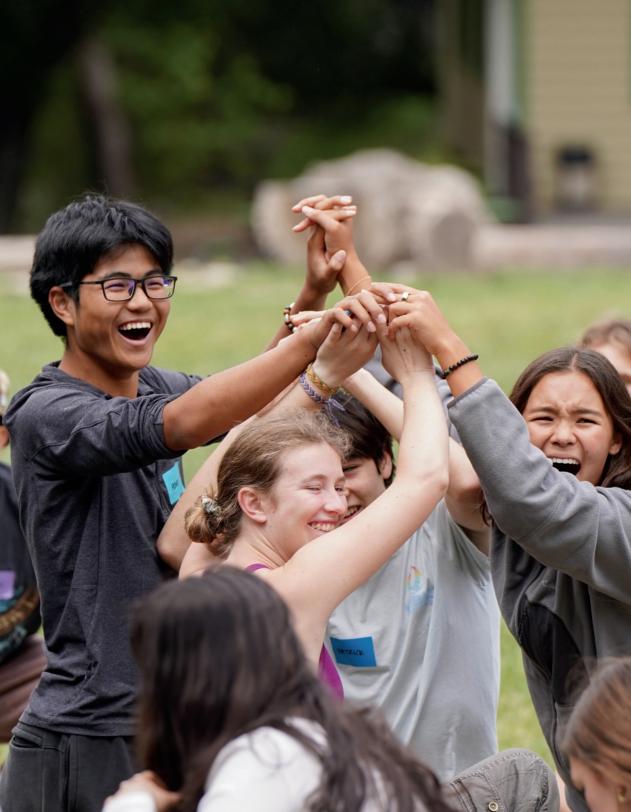
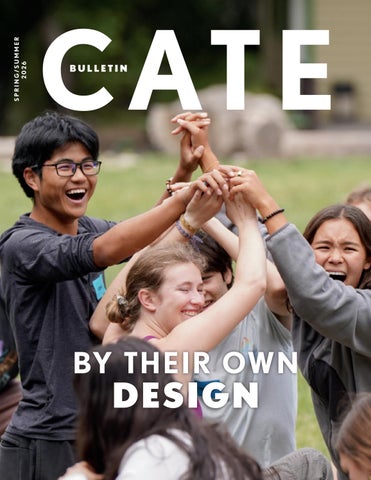
The theme of this edition of the Bulletin, “By Their Own Design,” reflects the idea that our students are designing their futures with tools in the present moment that make them more resilient and agile in a world increasingly full of algorithms.
When sameness is everywhere, leaning into what is unique and beautiful about ourselves truly distinguishes us, imperfections and all.
The stories in these pages explore education in evolution, in which artificial intelligence is changing how we teach, learn, and create. Yet throughout that change, Cate remains grounded in a spirit of human inquiry, connection with others, and the belief that education is about helping young people discover who they are and who they hope to become.
In the pages that follow, you will read about the design of our buildings that ground us here at Cate. Retired math teacher Frank Griffin takes us through the history they hold, reminding us that the spaces where we live and work are designed with consideration.
You will also read a story, by Leslie Benedict Turnbull '85, about how Cate community members have designed and redesigned the way the school celebrates Martin Luther King, Jr., Day.
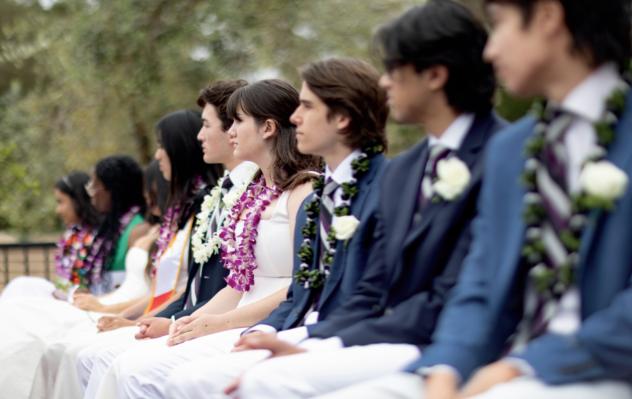
Of course, this edition wouldn’t be complete without a commencement spread, celebrating this important milestone for our students as they embark on designing new paths ahead.
As always, thank you for taking the time to read these pages. We hope you’re having a wonderful summer.
And congratulations to the Class of 2026! We are so proud of you.
Servons,

An exploration of how Cate faculty are adapting to the rise of artificial intelligence
By: Avani Patel Shah, Director of Communications & Marketing
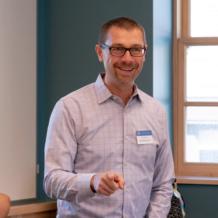
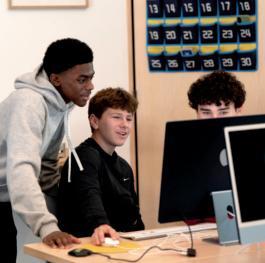
Artificial intelligence (AI) has arrived in classrooms across the globe, bringing with it a combination of uncertainty, possibility, and debate. Schools are asking the important questions: Should students use it? When and how much? Are we compromising critical thinking? What about inquiry?
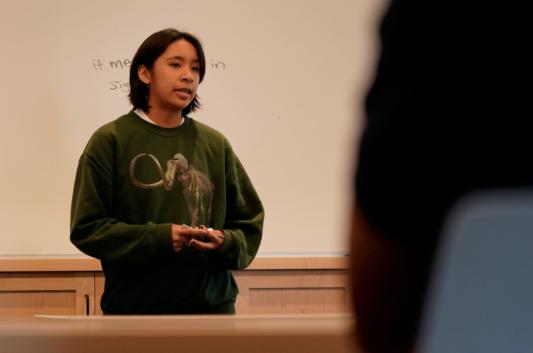
In the Cate classroom, the response has been less about restriction and more about intention. Rather than treating AI as a threat to authentic learning, Cate faculty are approaching it as a tool to be understood, questioned, and adapted. In classrooms across disciplines, teachers are designing assignments that ask students to use AI with a healthy dose of inquiry, challenge, and ultimately, ownership in the thinking process. The end goal is to make student-led learning more deliberate.
Guided by professional development at the start of the school year, Cate faculty have gained a fundamental understanding of how AI will show up in their classrooms. There are four primary levels of AI use in the classroom, providing a spectrum that helps faculty decide whether to use AI or not and how it can shape the thinking process: completely analog, AI-assisted, AI-resistant, and completely AI-generated.
While completely analog options are still in the mix, faculty such as Humanities Department Chair Ivan Barry, Director of Theatre Performance Grant Emerson Harvey, and Director of Libraries Carolyn LaMontagne are focused on a middle ground — balancing AI-resistant and AI-assisted strategies. This approach aims to scaffold students’ engagement with AI while building the skills and competencies needed for future-readiness with this emergent new technology.
In 9th grade Humanities, students worked on a three-week Inquiry for Impact project. They completed a multi-step process of assessing a problem affecting their community and proposing a project to implement a real-world solution. “Think of it as a dry run for a future Metherell Service Challenge proposal,” Ivan said.
The unit is built first to be AI-resistant. Students define their issue through a series of guided questions that call on them to engage fully in their own research and thinking without AI. Grounded in placebased learning and Cate’s ethos of servons, students then investigated causes and consequences for an issue, and developed focused, tangible needs to craft a formal pitch and creative “raise awareness” campaigns. Ultimately, all of the students presented their work in class and again in May to the entire school.
Reinforcing a sense of ownership in the process, Carina Martinez '29, whose project focused on bringing books to children in migrant shelters in Mexicali, shared, “[The AI-resistant portion] ensures that I am the one who is taking action to research my issue, its causes and consequences, and actually investing myself in the work.”
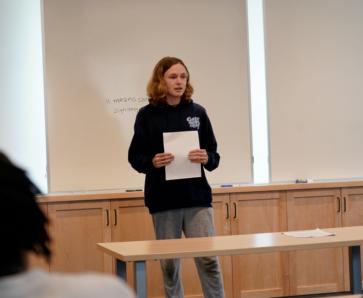
centered around connection and stress reduction for single parents in Singapore.
“Ultimately, we were the ones in charge because we could either accept or reject Gemini’s suggestions, and then explain why we chose what we did,” added Ava Moxley '29, whose project focused on spreading awareness about the positive impact of visual arts on education.
“The AI integration is only a small part of the overall project,” Ivan said. “It leverages AI in a way that supports student learning while avoiding complete cognitive off-loading.”
In performing arts, while AI may assist in the process, the work itself remains distinctly human.
In his Mini Musicals unit this year, Director of Theatre Performance Grant Emerson Harvey encouraged students to approach AI as a creative partner. The unit grew out of a desire to give Foundation Arts students a full creative experience within a short window, moving from idea to performance in a limited timeframe.
AI plays a small but purposeful role within the project’s arc. Students are encouraged to use AI as a "feasibility consultant” helping them think through the practical realities of implementing their ideas. Once the AI-assisted feasibility study is conducted, students must evaluate the suggestions and accept or reject them, along with an analysis of why, thereby ensuring that the student remains, as Ivan put it, “in the driver’s seat.”
“In some areas, I was overly ambitious, and AI was able to include some necessary small details that glued things together and toned down my scale to be more realistic,” shared Marcus Wong '29, whose project
The result is a model that expands students’ awareness through AI without diminishing their ownership of the work.
Students consistently shared that the balance between independence and support throughout the project was necessary and helpful. Reflecting on the AIresistant portion of the assignment, Marcus shared that the project offered him valuable experience with research, analysis, critical thinking, and problem-solving.
As Ava explained it, “The act of doing the research myself was an important and useful part of the process that I would not have gotten to experience had AI been allowed to do the research for me.”
“In the classroom, I use AI as a collaborator and am clear with my students that this distinction matters,” shared Grant. In the unit, students begin by generating their own ideas, including story arcs, settings, and character development, before introducing AI, similar to Ivan’s approach with the 9th grade humanities class.
Once the core ideas were generated, Grant encouraged students to use AI as a scriptwriting companion to draft dialogue and structure scenes. Then came the most critical part.
“They have to get on their feet, physically test the material, and edit the script to inject their own unique voices back into the
work,” Grant said. This model of revision and performance ensured that students remained engaged with shaping their work and remained authentic in the process. “I worry about the loss of the student voice,” he added. “If they start relying on AI as a generator rather than a collaborator, their work quickly becomes sterile.”
“We consulted Google Gemini to help us brainstorm ideas that combined all of our pre-formulated thoughts,” shared Georgia MacPhail '29. “The most interesting part about the process was having to put together these ideas and create something all of us were proud of and enjoyed,” emphasizing the focus on process and ownership central to this unit.
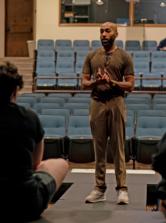
For other students, the interplay of human creativity and AI assistance was also remarkable. “What I found most helpful about the AI-resistant process was that it really forced us to use our own creativity … which really made the project more fun than robotic,” shared Nonso Egbuono '29.
The effects of this kind of designed and scaffolded AI use extended beyond the stage. “After the project, I became more open to using AI to summarize what I’d learned in physics or to explain a math concept when no one was around to help
me. I understood why so many people like to use AI, even on assignments when allowed, but I also realized that overreliance can become a weapon rather than a tool,” said Nonso thoughtfully.
In the Inquiry Collaborative, Director of Libraries Carolyn LaMontagne is helping students use AI for research, ensuring efficiency, accuracy, and critical evaluation.
“I don’t want students to spend the bulk of their time finding things. I want them to spend their time reading and analyzing their sources and writing about them,” Carolyn said. They work closely with students across grades and disciplines to help each student learn the potential and limitations of AI as a research tool.
As part of the Inquiry for Impact project in Ivan’s class, students had the option to use AI to identify sources along with their traditional research tools. Carolyn encouraged students to explore a range of approaches and to use their evaluation skills through methods such as SIFT (Stop, Investigate the Source, Find Better Coverage, and Trace Claims). Then, students assessed the sources found through AI, basic Google searches, and database searches alike to reinforce that credibility truly depends on how information is verified, not just found.
Simultaneously, students are learning to approach any AI-generated summaries and information with a critical eye. Carolyn encourages students to verify information directly in a source rather than relying solely on summaries. They ensure each student understands AI’s tendency to hallucinate, stating, “If it doesn’t
know the answer that you want, it is going to give you one because it wants to make you happy.”
Carolyn guides students toward intentional engagement with AI when this happens rather than discouraging its use. Students ask AI for sources, request links, and even refine prompts while comparing results across triedand-true research tools like JSTOR.
The end goal is for students to remain the final decision-makers, capable of questioning, verifying, and owning the information they find and use.
Across disciplines, a clear, central idea remains steady: AI can support the work, but it will not replace the thinking behind it. In a world where answers are easy to find and even easier to generate, Cate students are learning to approach artificial intelligence with inquiry and discernment by asking better questions, making informed decisions, and most critically, bringing their authentic voices into the process.
The tools may evolve, but the focus of a Cate education endures: developing curiosity through capable thinkers prepared to navigate and even shape the future with intention.
During Spring Family Weekend, a panel of faculty members shared how they are using AI in the classroom as well as in their work as educators. Watch a recording of the talk here:
On Monday, January 19, the Cate community gathered for the 30th year in a row to celebrate the legacy of Dr. Martin Luther King, Jr., in a day marked by conversation, artistic expression, and quiet contemplation. Following a powerful opening ceremony and keynote address, students participated in community conversations by advisory, led workshops on this year’s theme, The Power of Words, and enjoyed an energetic closing ceremony.
“Examining case studies with my advisory was the highlight of the MLK Day programming for me,” shared Maree Hawkins '28. “Receiving different takes and diverse opinions on the scenarios made me aware of the gaps in our community and how some students are struggling to find their voice. The community conversation also brought my advisory

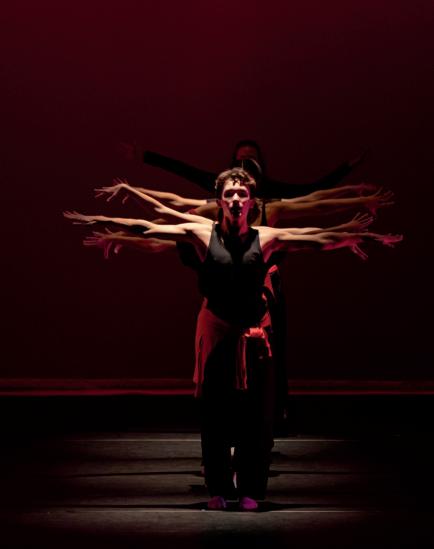
Annual Dance Convocation EXPLORES (E)MOTION
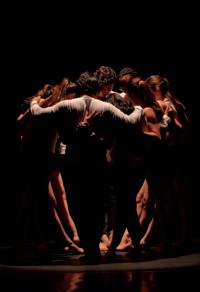
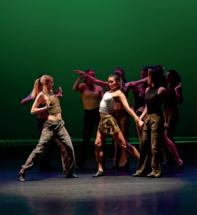
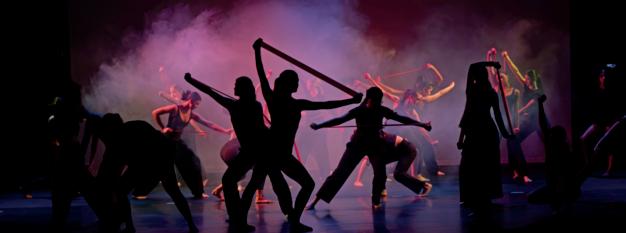
Cate School dance students presented the annual Dance Convocation, a much-anticipated student-led performance, on Monday, February 6, exploring emotions through movement and music. Under the artistic direction of Bethany Sutherland Sakoda and dance faculty Michael Szanyi and Gianna Burright, this impactful show illuminated the intensity of human experience through movement, examining the power of purpose, thoughts, actions, and emotions. Themes of hierarchy and control unfolded alongside fleeting, heightened moments that embody joy, sadness, anger, fear, disgust, ennui, nostalgia, embarrassment, anxiety, and envy.
Martin Luther King Jr Day of Celebration



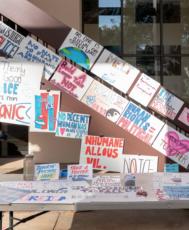
Cate students moved from questions to action as they explored their civic responsibility amid nationwide protests against ICE (U.S. Immigration and Customs Enforcement).
On Friday, January 30, Cate students participated in the national shutdown on campus to raise awareness about immigration enforcement and political violence. Student leaders, including prefects, senators, and members of the Hispanic-Latinx Association, worked with faculty to organize a day of optional teach-ins, open discussions, and creative expression in solidarity with marginalized immigrant communities currently targeted by immigration enforcement across the United States.
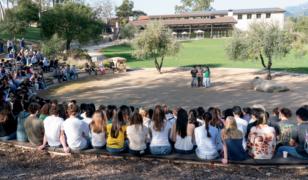
During Assembly, student leaders formed a silent circle as classmates shared reflections and personal testimony on their experience with immigration enforcement. Pari Malik '27 read a statement on behalf of student leaders at Cate, cowritten by Ian Sheshunoff '26, Aydin Barry '27, and Tori Kim '27, encouraging students to take a stand. In classrooms and meeting spaces across the Mesa, students attended sessions that involved Harkness discussions, history and ethics lessons, and art-based reflection. Topics ranged from legal structures of immigration enforcement to the role of the media in shaping bias.
The day maintained a throughline of action through education. In a letter to families that afternoon, Head of School Alexandra Lockett reflected on the day as “not a departure from learning on the Mesa but rather its fullest expression,” emphasizing that the experience of learning at Cate isn’t bound to a single class or curriculum, but rather to the full range of expression and action ever grounded in service.
There is a special corner on campus, tucked away from the rush of daily life, where carefully curated plants and stone-lined paths invite students to slow down and move at their own pace.
“
“ We wanted to create a space where students could relax, reflect, and find a little peace of mind. Every element of the garden is designed with the intention to help its visitors feel grounded.
Mimi Brown '92, P'23, '27
Located just beyond Ellis House, home to the School’s Health and Wellness Center, the garden nurtures its visitors in a way that reflects the legacy of Sandy Ellis. A former Cate faculty member and founding director of the Public Service Program, Sandy is often remembered for her warmth and care.
“We hope students will encounter elements of nature in order to relax, reflect, and find peace of mind,” said Mimi Brown '92, P'23, '27, who generously helped fund and inspire the design of the garden. “The garden is made to change with the seasons so that each visit reveals something fresh and previously unseen.”
Winding paths lead to a circular labyrinth that invites slow, deliberate movement around concentric rings laid out with original bricks repurposed from Mesa House. At its heart, a sunburst pattern anchors the space, providing a place to pause before retracing one’s steps outward. Low stone walls frame sweeping views of the hills beyond, while a small seating area formed from reclaimed carved wooden stumps offers space for reflection or quiet connection with others.
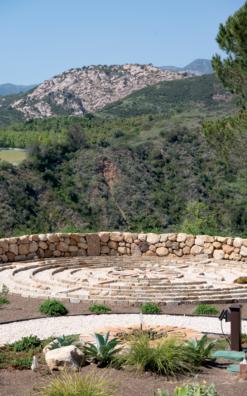
Mimi recalls planting a tiny garden in this very spot behind '25 House when she was a student at Cate. “The dirt was dry and bone-hard. I naively chose water-loving flowers, and the California sun ended it all swiftly,” she said.
This time around, native and drought-tolerant plants are thoughtfully placed throughout the garden. Fruit trees will bring blossoms, scent, color, and taste across the months and years to come. There are cool water fountains ready to flow over visitors’ hands. There is a crunch of gravel underfoot to ground and restore.
In every detail, the garden reflects its purpose: a sanctuary where students can step away from the ordinary, wonder at elements of the natural world, and carry a renewed sense of balance back into their daily lives.
During the annual Spring Family Weekend, Cate families attended classes, experienced performances and athletic events, and connected with their students and one another for an exciting weekend of parent engagement. This year, a faculty panel on artificial intelligence enlightened families on the School’s recent developments with emerging technologies, while the annual student Celebration of Writing highlighted the power of the student voice. The Performing Arts department presented a vibrant selection of music throughout the weekend, as well as the Cate Spring Musical, Natasha, Pierre, and The Great Comet of 1812, while students in Visual Arts curated an art show in the Bruno Gallery filled with inspiration and whimsy.
Throughout the spring trimester, Cate’s affinity groups and cultural organizations brought the community together in meaningful and joyful celebrations, honoring the traditions, histories, and voices make the Mesa a vibrant place to learn and live.
The School marked its 30th annual Dr. Martin Luther King, Jr., Day with this year’s theme, “The Power of Words,” welcoming Jordan Killebrew, co-founder of Juneteenth Santa Barbara and executive director for Public Affairs and Communications at SBCC, as a keynote speaker.


The Lunar New Year and “Seollal” celebrations drew an enthusiastic turnout, as students gathered at Mesa House for dumpling making and Korean rice cake soup.


The Jewish Student Union came together for a Passover Seder, honoring the holiday with warmth, community, and tradition.
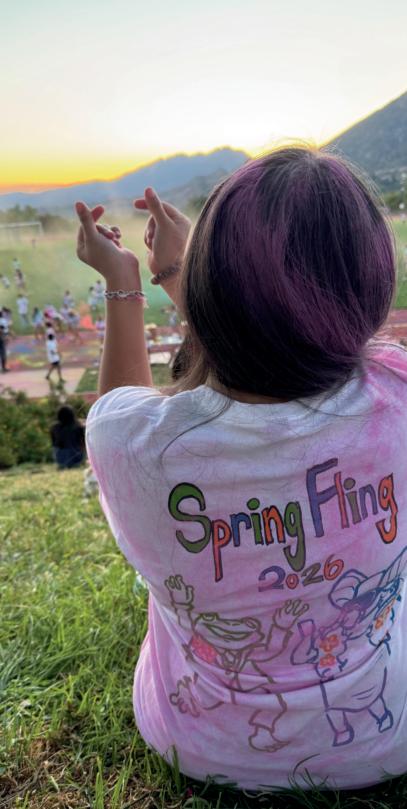
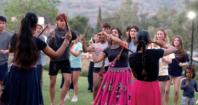
In late March, the Mesa celebrated Holi, the Hindu festival of spring that filled the Kirby Quadrangle with dancing, mango lassis, samosas, and an abundance of color.
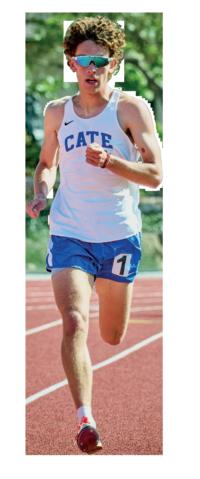
April 2, Cate School home track meet since Carpinteria High new Whiting Family Meldman Field. Athletic Ransom and Head Mason noted the the event and the strong competitive relationship with the Warriors. Several Rams were multi-event winners: Sloan Harwell '27 won the 100m and 200m and anchored the winning 4x100m and 4x400m relays. Sophie Blank '27 won the 800m and 1600m and led off the winning 4x400m. Ati Zwieback '26 swept the boys’ 800m and 1600m, while Jackson Steele '26 won the 400m and 200m and anchored the winning 4x400m relay. In field events, Ryan Chen '26 won the triple jump and long jump and placed second in the high jump. Other individual victories came from Gwen McTigue '26 (300m hurdles) and Nika Iverson '26 (long jump).
How caring community members have designed and re-designed the way Cate School celebrates Martin Luther King, Jr., Day.
By: Leslie Benedict Turnbull '85
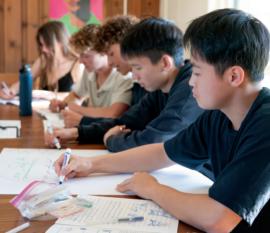
Visit the Mesa on the third Monday of January, and you will find a community in motion celebrating the birthday of civil rights icon Dr. Martin Luther King, Jr.
Students move between spaces — Hitchcock Theatre, Kirby Quadrangle, Katharine Thayer Cate Memorial Chapel, and the classrooms — into conversations that feel at once structured and spontaneous. There are performances and case studies, quiet reflections and lively debates. There are moments when the community gathers together, and moments when it deliberately breaks apart, trusting smaller groups and individuals to do deeper work. There is energy, but there’s also space —space to think, to process, to listen.
It feels intentional. It feels designed.
And that may be the most remarkable thing about Cate’s observance of Martin Luther King, Jr. (MLK) Day: not simply that it exists but that it has been designed — imagined, reimagined, and refined — again and again, by people who care deeply about what it is and what it can be.
It began over three decades ago, with a question.
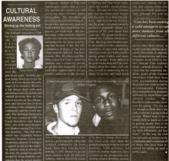
In the 1990s, a small group of Cate students of color, under the guidance of faculty members Carol Hotchkiss and Sandy Ellis, banded together to found a Cultural Awareness Club. As January 17, 1994, approached, many in the group found themselves asking something both simple and profound: Why are we going to class on MLK Day?
For these Cate students, many of them African-American, the day had always been something lived, not just acknowledged. It was a day of parades, of celebration, of reflection on the legacy of Dr. King and what it meant to their families and communities.
Then, as now, Shante Bell '97 was recognized by her peers as one of the most powerful student voices of her era. She remembers being a new student at Cate, a little taken aback by the sudden
shift from her diverse, familiar Los Angeles neighborhood to life on the rarified Mesa.
As Shante today recalls, she and some of her classmates went to Ms. Hotchkiss and “Mama” Ellis and asked, Can we not go to class on MLK Day and do something different?
The answer, at least informally, was yes — but only for their small cohort.
That year, about a dozen students gathered alone in a dorm common room. They watched Dr. King’s “I Have a Dream” speech. They talked about identity, about difference, about what it meant to be a small group of students of color in a school of 250, where they represented only a handful of voices.
That MLK Day celebration (such as it was) was not polished. It certainly wasn’t institutional. For most of the School, the day passed like any other.
But that January 17, 1994, was, in the language of design, a prototype.
The following year, the idea evolved.
For the first time, classes were suspended, and the entire day was formally dedicated to honoring Dr. King’s life and legacy. The program included speakers, films, and a collective reading of the “I Have a Dream” speech in the Chapel. A gospel choir was invited to the Mesa to share historically black music with a community that had been exclusively white until the late 1960s. A panel discussion on race and culture followed.
“It was very well received,” Shante said with a mix of pride and pleasure. Nonetheless, there were also underlying tensions.
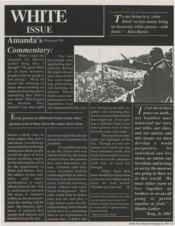
An issue of El Batidor published just days afterward confirms this. The faculty had been informed of the mandatory change to the school day and their lesson plans only about a week in advance. Senior and Cultural Awareness Club Leader Agustin Vecino '95 overheard some students grumbling (This is stupid! I don’t want to do this!) and went on to express regret that such statements seemed always to be made “behind the backs” of teachers and students of color.
Unless we all start talking about it, the problem will only get worse, he wrote in a somewhat scathing op-ed.
Fellow classmate Amanda Freeman '95, however, noted that, while some aspects of the event sparked controversy, they also sparked discussion: The fact that people were applauding periodically showed that
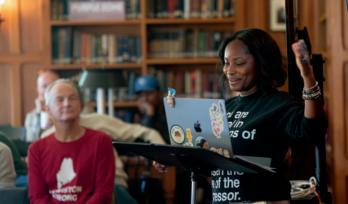
they were listening, processing, and forming an opinion.
Andrea Wroblewski '96 agreed. This kind of conversation amongst our community is advantageous and necessary.
The School had taken a decisive step; what had begun as a student-driven initiative had become an institutional commitment.
Even as the structure solidified, the spirit of the day remained dynamic — open to revision, responsive to the needs of the community, shaped by those willing to ask, each year, what could this be?
In 1997, the Cultural Awareness Club (including Shante, who was by then also serving as student body president) organized a school-wide service effort to honor the and of Cate’s predominantly Grounds Department the meals, cleaned maintained day, students roles, not as act of recognition.
“ “
Students are really hungry for these opportunities to show how they teach, too.
Coordinator of Multicultural Programming Kadeine Peterson
It was, in Shante’s memory, one of the most meaningful experiences of her time at Cate.
“It was honoring the staff that does so much for the kids there,” she explained.
It was also — and this is important — imperfect.
Some members of the B&G staff felt deeply moved by the recognition. Others experienced it differently, seeing in it an appropriation, or an assumption that their very challenging and complex work could be done by teenagers. Even among students and faculty, there were questions, hesitations, moments of resistance; issues of liability were (rightly) brought up.
And yet, in that complexity, something essential was happening. The day was becoming not just a celebration, but a space for learning. And, as any Cate student or
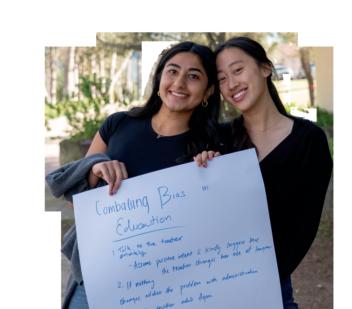
However (and all Cate alumni can attest to this), the moments of greatest discomfort are often when the most profound growth happens.
That acceptance of challenging issues and the question What can this be? has guided the agenda of MLK Day on the Mesa ever since. The School hasn’t relied on a single fixed model over the decades. Instead, the celebration has evolved through a series of intentional redesigns, each reflecting its moment.
There have been years centered on storytelling and shared experience. Years focused on protest and creative expression. Years that turned toward joy, toward community, toward the act of breaking bread together as a way of understanding one another more fully.
Each theme offered a different lens; each iteration added something new.
For the past five years, much of that intentional redesign has been shaped by science faculty Kadeine Peterson, whose co-curricular role as coordinator of Multicultural Programming has brought a distinctly pedagogical lens to the day.
For Kadeine, the goal is not simply to honor Dr. King but to create an experience fully integrated into the intellectual and relational life of the School.
“I try to tie the MLK theme to the theme of the school year,” she explained. “Deliberately weaving things we already talk about in classrooms and in dorms makes a more impactful product of the day.”
This year’s theme — The Power of Words emerged from that process of integration. Inspired in part by the School’s shared reading of 1984, it asked students to consider how language shapes power: how words can include or exclude, clarify or obscure, connect or divide.
But the theme was only the beginning.
The design of the day itself became an extension of the inquiry.

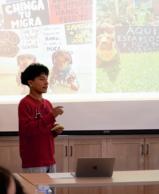

Rather than a single proceeding from morning to afternoon, Kadeine restructured the day into distinct phases, each with its own purpose.
The morning began with a shared experience: a speaker, performances, and a framing of the central questions. From there, students moved into case study sessions, small-group discussions built around realworld scenarios that invited them to analyze power dynamics and consider how they might respond.
Each case study asked not only what is happening here, but also what would you change
The emphasis was not on arriving at a correct answer but on engaging in the process of inquiry — recognizing complexity, considering perspective, and reflecting on one’s own role within a given situation.
After lunch, the structure shifted.
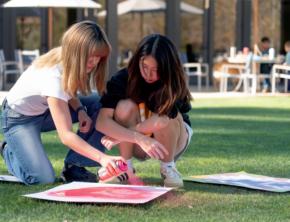
Workshops, designed and facilitated by student leaders, many from affinity groups, created spaces for peer-to-peer learning. Topics ranged from identity and language to history, culture, and lived experience. Participation was not assigned but chosen, allowing students to engage with the topics that resonated most deeply.
“It was really cool,” Kadeine reflected. “Students are really hungry for these opportunities to show how they teach, too.”
The day concluded with space: time to process, to rest, to continue conversations informally. Even the schedule itself reflected an awareness that meaningful learning requires not only engagement but reflection.
What emerges from this MLK Day approach is a carefully designed experience — one that balances the multiple tensions at the heart of Cate’s mission: between individual voice and shared understanding, intellectual inquiry and emotional experience, structure and flexibility.
This latest iteration is, in many ways, an expression of the School’s core belief that education is not only about knowledge but about formation, the ongoing process of becoming more thoughtful, more aware, more connected to others — all grounded in a deeper understanding of service.
Because, on the Mesa, servons isn’t limited to action. It extends to how we speak, how we listen, and how we engage with one another, even in moments of difference. Especially in moments of difference.
As Kadeine notes, disagreement need not lead to discord. True engagement takes the form of “the deliberate choice to speak with care, to listen with intention, and to affirm the inherent dignity of every person in this community.”
Looking back across 30 years, you might be struck by the tremendous transformations in the way the Mesa observes the legacy of Dr. King.
What began as a small gathering of black and Latino students seeking cultural recognition and understanding has become a fully integrated, communitywide experience examining the myriad ways in which members of the Cate community identify themselves and relate to one another. The scale has changed.
The structure has evolved. The language has deepened. However, at its core, the purpose remains remarkably consistent.
• To create space for reflection.
• To honor the legacy of Dr. King.
• To engage, honestly and thoughtfully, with the work of building community.
At Cate, MLK Day continues to be reworked and redesigned, not because previous years’ observations are in any way deficient but because ours is an ever-changing world — and learning on the Mesa today embraces adaptability to the many changes we all face.
Perhaps the most important lesson of this reflection on the history of MLK Day at Cate is that the work is never finished. Each generation of students arrives on the Mesa with new questions and in the context of ever-changing national and international views on race and relationships.
The Cate students who first gathered in that dorm room three decades ago didn’t have a “grand design” in mind when they asked if they might take some time to celebrate a man whose legacy helped shape their culture.
Their request was rooted in inspiration.
What followed, over the 30 subsequent years, was a gradual shaping of that inspiration into intention. Students, faculty, and community members have continued to ask, each in their own way:
What does this day need to be now?
In that question — and in the willingness to keep asking it — the legacy of Martin Luther King, Jr. continues not as something remembered but as something lived; not as a fixed tradition, but a dynamic one.
MLK Day on the Mesa is a hallmark of a community that is always, constantly, designing and redesigning itself.

By: Avani Patel Shah, Director of Communications & Marketing
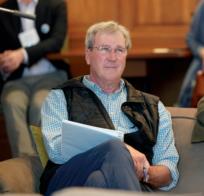
Retired math teacher
undertakes a labor of love to honor the history of the Mesa’s
One of the beauties of the Cate School campus is that it is far more than just a backdrop. It is a living, breathing organism that brings the distinct programs of Cate to life. Whether you visit the Mesa for the first time or return after years away, many of the buildings you encounter hold the same charm and characteristic simplicity that was intended when Curtis Cate founded the School in 1910.
The humble Harkness tables and simple wooden chairs in High House, the iconic arches of Schoolhouse with dorm rooms just above the classrooms, and the Spanish-inspired, distinctly Santa Barbara facade of the Mesa’s buildings hold value, purpose, and the imprints of the students and teachers who lived, learned, and grew within them. The original school buildings on the top of the Mesa were designed by well-known Pasadena architect Reginald Johnson, whose father was Cate’s first chair of the board of trustees. As the campus has evolved to include the newest additions to the Mesa, like the Inquiry Collaborative and Otis Booth Dining Commons and Student Center, our spaces remain as the founder of our School intended — unpretentious, and uniquely designed to blend living and learning well together.
This winter, veteran math instructor Frank Griffin took on a special project, diving into the archives to pull together installations
throughout the Mesa that share the stories of our spaces.
A pillar of the School’s residential program for nearly 40 years, Frank offered the three “Take Cares” for dorm life: Take care of yourself, take care of each other, and take care of our spaces. Honoring this legacy, the new installations shed light on the history behind some of our most iconic buildings.
Historically, the students of the Cate Historical Society held an annual assembly where key school dates and milestones were shared and celebrated, with the support of the archives.
“I’ve always been interested in the history of Cate, a topic that was frequently emphasized during my early years,” Frank shared. “More recently, particularly with the faculty transitions due to retirements and the usual reasons for moving on
from Cate, I became much more aware of how little students and faculty knew about the Mesa.”
This inspired a selection of installations across the campus with photos, facts, and bite-sized treasures that bring the history of Cate to the present. The first installations have gone up in the space where Folger Center meets Schoolhouse, honoring both spaces. The installations are each marked by modest wooden signs from reclaimed wood from the Commencement Lawn stone pine trees. “These are a central part of the project,” Frank shared. “The result is both historical and striking.” The signs were created by ceramics teacher John Swain and Visual Arts Department Chair Joy Doyle.
“I had always thought the Folger lobby was a bit barren and cold, so when our staff renovated the original wood doors and the paneling, it seemed time to take
Each of the installations includes a brief history of the space as well as original images.
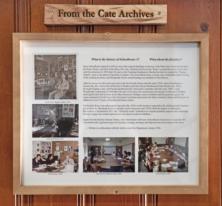
the next step with the displays and putting back one of Ned Bowler’s oriental rugs that we used in the landing for years that had been stored in the barns,” Frank shared. Each of the displays starts with a question, an homage to the inquiry method that is a cornerstone of a Cate education. These questions about the past invite today’s students into something much bigger than themselves — a shared story, a place alive with possibility, and the responsibility to care for both.
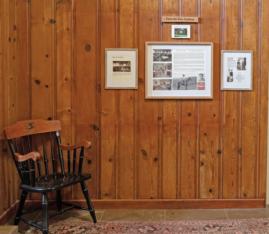
Naomi Avalos '27 currently serves as a co-head of the Cate Archives club. She noticed the installations across campus and shared how much the little pieces of Cate history that they reflected meant to her. “What I love about Mr. Griffin’s displays is that they make Cate’s history accessible to anyone who walks by,” said Naomi. “If you happen to stop, read them, and look at the pictures, the displays immerse you in a totally different era of Cate that all happened in the same buildings you walk through or learn in every day. I appreciated
the attention to detail Mr. Griffin had in decorating the space around the displays, too. The classic black, Cate-branded chair and red-patterned rug definitely add to that cozy, historic feel.”
“I hope students who encounter these installations have a better understanding of the history and an appreciation of those who have studied here before. Perspective based on history is valuable,” Frank shared. If Naomi’s observations are any indication, this vision is indeed coming to life.
“What I love about Mr. Griffin’s displays is that they make Cate’s history accessible to anyone who walks by. If you happen to stop, read them, and look at the pictures, the displays immerse you in a totally different era of Cate ...”
Naomi Avalos '27
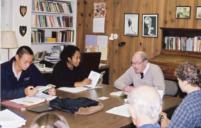
What is the history of Schoolhouse Classroom 1?
Why
Since Schoolhouse opened in 1928 as one of the original buildings on the top of the Mesa, this classroom has been the Heart, Brain, and Soul of the Mesa.
Mr. Cate, familiarly known as the “King” occupied the room as his office until his retirement in 1950, after 40 years as the Founding Headmaster. During that time, he created his “Rogues Gallery” (seen in the photo) of portraits of alumni. The room had his desk, a couch, and comfortable chairs in front of the working fireplace, used frequently before central heating was installed in Schoolhouse.
After his retirement, the room was used as the first Faculty Room until the early 1950s, when Schoolhouse 1 became the office/classroom of Director of Studies (and later Interim Headmaster) Stan Woodworth. There, he taught English, Latin, and French and directed the Curriculum Committee until the early 1980s. Upon Woodworth’s retirement in 1988 (after 40 years of service), the room became the domain of Director of Studies and English chair Jim Durham as an office/classroom. Perhaps a nod to tradition (and the generous space), the room continued to be the home for Curriculum Committee discussions for future academic deans and directors, in addition to over 75 years of English and history classes.
The Faculty Room was subsequently moved in the 1950s to the location connected to the old Raymond Commons across from the McIntosh Room (originally itself a classroom until 1950). With the Inquiry Collaborative Renovation of Raymond in 2023, the “old faculty room” returned to its original academic purpose, and a renovated faculty lounge was created and moved to its current location in McBean.
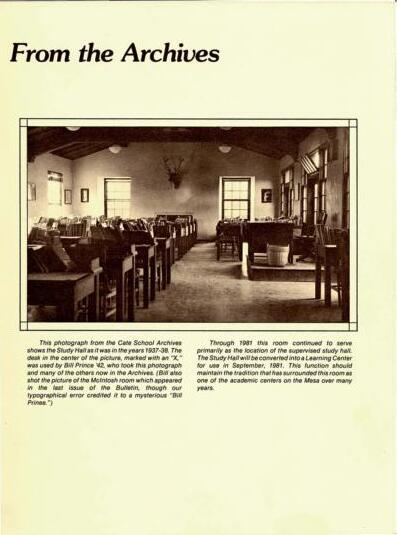
You are standing in the main entryway of Schoolhouse, one of the original buildings constructed when the school moved to the top of the Mesa in 1928. This Reginald Johnson u-shaped design was multi-purpose with the Johnson Library being the one (and only) library (McBean was built in 1964), classrooms on the first floor, and 18 dorm rooms with two bachelor apartments on the upper floor. The wing behind this plaque now known as “Folger” was the original meeting room for the entire school of 40 to 50 boys, since at that time, there was no chapel, no theater and no gym. Called the “Schoolroom” in the old days and later just “Study Hall”, the nearby pictures show the single open space used for mandatory study during free daytime periods and also evening sessions. Near the end of the School’s time as a boys school, all freshmen were required to begin the year in study hall to “develop disciplined habits,” according to Mr. Cate’s writings.

The advent of coeducation in 1981 and the need for more classroom space motivated the second phase, named the Folger Learning Center. A generous donation for a renovation was made by his family to honor Peter Folger (1905–1980), Cate class of 1925, descendant of the founder of the Folger Coffee Company and himself president and board chair of the company, as well as a Cate School trustee. The space (designed by English teacher Jim Durham) created three English classrooms and two teacher offices in 1981.
When the Admission Office outgrew the lower east end of High House and the BCB (Berolzheimer) classrooms were ready for use in September 1999, the third iteration occurred and Folger was transformed into the office’s new location.
The current head of school’s office was the reception area for visiting families for many years. Finally, with the construction of the Class of 1985 Admission Office in 2014, the fourth and current renovation of Folger took place with an upgraded office of the head of school and the current Administration and Communications offices.
Apart from the historic Johnson Library, where the trustees still meet, Schoolhouse Classroom 1 is arguably the most historically significant space for teaching, learning, meetings and important decisions made on the Mesa. Written in collaboration with the Archives and Arts Department, January 2026.
By: Leslie Benedict Turnbull '85
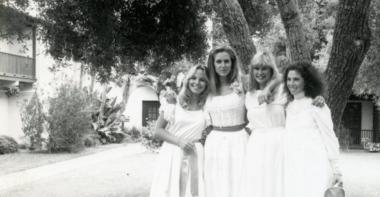
In the Fall of 1981, four young women drove up the winding road to the Mesa to join Cate’s latest senior class. The adults in the Cate community had been planning the School’s monumental transition to coeducation for years. They felt ready — or ready as anyone could be — for such an existential shift.
For the girls themselves, there was no formal playbook. No upperclasswomen to guide them. No longstanding traditions. Only a School — deeply rooted in other traditions — and four new students willing to step into untested waters at a time when most high schoolers are looking forward to being the alphas in a well-known place.
These girls were Lee-Ann Emerson '82, Alicia Hoover '82, Katherine “Kate” Lusk '82, and Laurie Feld Plissner '82 Forty-five years later, their memories of that day offer a fuller picture of what it meant
not simply to arrive at Cate, but to help reshape it altogether.
From the beginning, the female members of the Class of 1982 were notable for the contrasts they presented as much as their shared newness.
Alicia came from Texas by way of a boarding school in Arizona, already accustomed to independence and drawn to the Mesa’s sense of place and promise. Lee-Ann arrived from Southern California,
(Cate) was opening up a door to a new era, and I believe the new female students understood the honor of being selected to step through that door. “ “ Alicia Hoover '82
a surfer girl seeking a personal reset amid family upheaval, drawn by the idea perhaps even the thrill — of joining something new.
Kate’s path was different. A day student, she had moved from Los Angeles to Santa Barbara shortly before her senior year. Her enrollment at Cate was guided largely by family decisions rather than her own. Her transition — from an all-girls day school environment into a newly coeducational, formerly all-boys boarding school where she would be one of only a handful of day students — was abrupt and disorienting.
Laurie came from Las Vegas, Nev., and was already familiar with the Mesa through her brother, James '81’s, experience. For her, Cate was a deliberate step toward independence. It was a way for Laurie, close to her family and life in Las Vegas, to prepare for the challenge of leaving home for college.
Four students. Four motivations. Four starting points.

While they didn’t have much in common in terms of backgrounds and personalities, Laurie, Kate, Lee-Ann and Alicia did share two critical traits: their gender and a certain willingness, whether chosen or mandated, to do something different.
Their first moments on campus remain vivid in each woman’s memory. For Alicia, the Mesa was “enchanting,” a place that immediately captured her imagination. To Lee-Ann, it felt almost like summer camp — beautiful, energetic, and slightly unreal.
Laurie’s memories are sharper, more emotional: watching her parents drive away and feeling an immediate, physical sense of loneliness. She recalls sitting alone by the pool, the sound of “Tainted Love” by Soft Cell playing on the radio.
For Kate, the transition was less about driving up to the Mesa for the first time as a student and more about the disruption of expectations. She had left behind a known, more permissive environment where senior year felt “set” and was stepping into a place that was more structured, more demanding, and entirely unfamiliar. None of this had been her idea, necessarily, but life had already given Kate a certain pragmatism, and she decided to roll with it.
With only a handful of them on campus, each new female Cate student carried a disproportionate share of attention. Forty-five years later, through their own reflections, it becomes clear that none of these four young women experienced “being the new girls” in quite the same way. The scrutiny they all felt took different forms.
For Laurie, it translated into pressure, particularly academic. Today, she recalls feeling as though “the entire coeducational experiment rested on [her] GPA,” a weight that shaped how she spent her time. Laurie often chose studying over social life.
Kate filtered the experience through a different lens. Arriving during a period of personal vulnerability, she found unexpected affirmation in the friendships she formed with accepting, undemanding male classmates. The casual confidence her new friends offered helped Kate rebuild her own confidence at a critical time in her life.
For Lee-Ann and Alicia, visibility sometimes meant scrutiny — being discussed, observed, or treated as representative rather than individual. Recalling Curtis Cate’s founding of the School in 1910 and its “time-honored traditions,” Alicia put it this way: “(Cate) was opening up a door to a new era, and I believe the new female students understood the honor of being selected to step through that door.”
Independent Lee-Ann recalled having to resist those already part of the Cate community to stereotype her and the others. “It seemed that each of the girls was an archetype,” she remembered. “As if they were trying to decide which kind they wanted for their school.”
If there was a defining feature of that first year, it was this: the intentional structures of inclusion and belonging that are hallmarks of today’s Cate experience were not part of life on the Mesa in the early 1980s. “Belonging,” if it was to happen at all, had to be found by each student for herself. Among those first girls, some found it more readily than others.
Lee-Ann approached the year with confidence, less concerned with being a novelty and more focused on navigating the experience on her own terms. She figured out which faculty members resented the arrival of girls in their classrooms, which seemed “over their heads” with the transition to coeducation, and which would be supportive and inspiring. She dove headfirst into surfing, soccer, and sailing, and didn’t concern herself overmuch with “fitting in.”
Alicia, meanwhile, experienced both welcome and absence. She experienced warmth and kindness from most in the community, but initially struggled with a laissez-faire advisor and a lack of guidance that required her to self-direct. She quickly learned to take advantage of her new
opportunities, surfed at Rincon, and made friends with many of the boys, whom she recalled as “perfect gentlemen.”
“I had grabbed hold of the comet’s tail and I was hanging on for dear life! Everyone seemed determined to make this coed ‘experiment’ take hold and grow on the Mesa,” Alicia remembered.
Laurie had a harder time adjusting.
“I was pretty shy, and I didn’t realize until many years later that shy people often come off as aloof. Always worried that I would say the wrong thing and look like an idiot, I was very insecure. Everyone was really nice, as I remember, and I did make some good friends, boys and girls.” Homesickness lingered well into the year, and Laurie’s instinct was to retreat into academics and routines. These included early bedtimes and structured responsibilities she created for herself, with what was later described as “quiet persistence” in Laurie’s graduation remarks.
Kate, by contrast, wasn’t overly concerned with academics. Always an excellent student at her previous schools, she decided to embrace a more social existence at Cate. She found her footing easily, forming strong friendships and navigating the flow of life both on and off

the Mesa by becoming a popular driver. The fact that two of her brothers, Dwight Hemion '84 and Peter Lusk '85, were also on the Mesa that year helped make Kate’s transition very smooth.
Among the four women, however, there was not a strong collective identity. From their current perspectives, all four today admit that relationships among the first senior girls were limited, shaped by different personalities, priorities, and living situations. Cate’s first alumnae were individuals, sharing a moment, but not necessarily a path.
The classroom was one of the most defining spaces for all four girls, but there, again, they had widely divergent experiences. For Laurie, schoolwork was both a refuge and a source of pressure. Small classes, close discussion, and high expectations created an environment that was intimidating and transformative. She rose to meet it, ultimately sweeping Cate’s top academic awards at graduation. Alicia experienced an intellectual awakening. At Cate, she encountered a level of challenge that reshaped her understanding of what learning could be. Now a high school English teacher herself, Alicia credits English teacher Jim Durham with inspiring her to write, and eventually join, the profession.
Smart, savvy Lee-Ann (who also became a teacher later in life) found that the intimacy of Cate’s classrooms made disengagement impossible — effort was required, and expectations were clear.
“The small class sizes made it much more difficult to skate by. I do remember feeling pressure as only one of four girls to properly represent. I was very challenged, but I liked it.”
Kate’s academic experience was more uneven. She recalls taking ample advantage of the fact that faculty had apparently been told they could never, ever deny a young woman’s request to visit the bathroom. She spent many a class period wandering around the Mesa and even having the occasional (then-permissible for seniors) cigarette. Yet even in her disengagement, there were moments of connection — teachers who saw Kate, pushed her, and, ultimately, helped her through.
The introduction of girls to the Mesa did not simply change life for the girls themselves; it reshaped the entire student culture.
“I think the introduction of feminine energy into the place may have been a relief for some of (the boys),” reflected Laurie. “Maybe performative masculinity became less necessary, so in a way, maybe there was less pressure on them to conform to some stereotypical ideal of what a young man was supposed to be. And of course, as much as it was a transition for the girls arriving on the Mesa, it was also a huge transition for the boys. It wasn’t easy for them, either.”
At the same time, dynamics among the girls were complex. With so few of them, comparison and competition — particularly around identity and attention — were difficult to avoid.
For all four, friendships with boys or girls from the grades below came more easily than bonding with one another. Today, the first alumnae of Cate believe the small number of girls in their class created a sense of isolation rather than solidarity.
The distinction between boarding and day life also mattered.

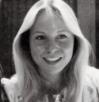


For Alicia, the moment carried a different significance: the honor of being among the first female graduates of Cate, marking the beginning of a new chapter for the School.
Kate recalled just being grateful to have eked out a passing grade in chemistry and eager to graduate and start her adult life.

starting a family. As an active, full-time parent, Laurie found “adult life felt far away — not just geographically — from Carpinteria.”
Boarders like Alicia, Laurie, and Lee-Ann experienced Cate as a fully immersive environment — structured, communal, and, at times, overwhelming. Dorm rooms became sanctuaries; routines were coping mechanisms. Laurie’s memory of her narrow bed in '25 House as a place of refuge speaks to the emotional intensity of that experience.
For Kate, as a day student, Cate existed within a broader life context — family, home, and a different kind of independence. Her experience was less about total immersion and more about navigating two worlds simultaneously.
Through trial and error, they had survived, both as individuals and as a cohort, and by graduation, the shift in culture became visible.
Laurie, who had quietly carried the weight of expectation throughout the year, found herself recognized with the English Department Prize, the Scholarship Award, and the Scholarship Cup — an outcome she had not anticipated but deeply felt.

Lee-Ann was also ready to move on, and today admits that finding a white dress and being taken out to a nice lunch are about all she can recall from her graduation.
For all four, May 1982 marked the last moment their unique life paths would be joined in any meaningful way. Having come from disparate backgrounds, with very different personalities, each newly-minted alumna would take a very different road off the Mesa.
Alicia became a Class Agent and has attended many Class of 1982 reunions. At the point she was interviewed for this article, Alicia was looking forward to attending her upcoming 45th reunion.
Lee-Ann has lived in various parts of the country but has mostly fallen out of touch with the School and her classmates. Today, she and her husband steward an historic farm in Georgia.
Laurie stayed connected with Cate for a few years while she was still on the West Coast, but she moved back East after
Kate also moved East, to New York, and, eventually, to Paris. Now a filmmaker, she retains colorful memories and fond feelings about her time at Cate, but doesn’t really keep up with happenings on today’s Mesa.
What emerges 45 years after Kate, Laurie, Lee-Ann, and Alicia took their first, groundbreaking steps onto the Mesa is not a single narrative of struggle or triumph. The four girls who were seniors that year had very different experiences, some good and some bad. At the same time, the experience also offered each young woman the chance to define herself in a space that was itself being redefined. Today, each of those women carries herself pretty powerfully through the world — each in her own, unique way.
But the experience of being new? Being part of institutional transformation?
That is one thing they all still have in common.


We weren’t sure if the sun was going to come out.
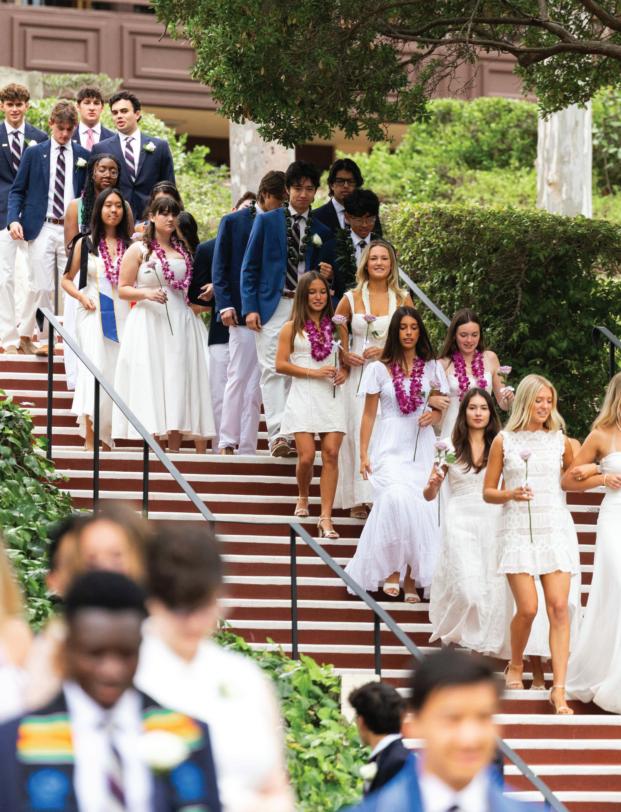
If you were on the Mesa in the wee hours leading up to this year’s commencement, you would have seen fog clinging to the bluffs, light rain sweeping across Kirby Quadrangle, and the horizon, barely visible through the gray, offering no promises.
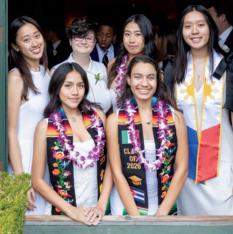
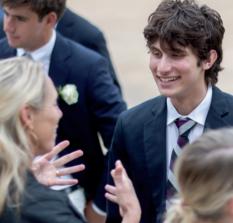
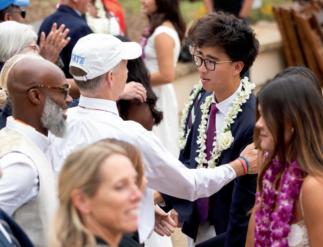
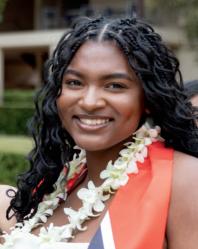
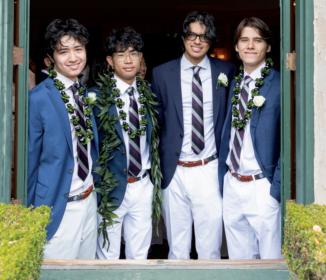
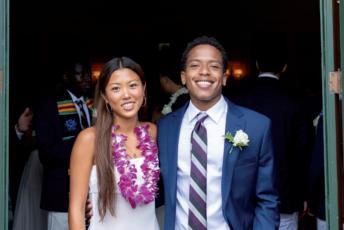
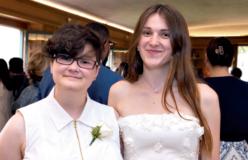
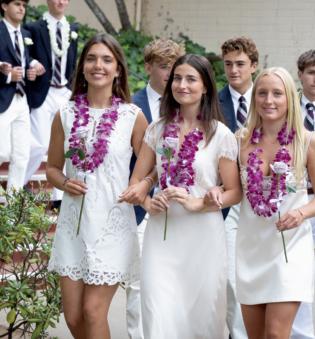
And yet, on Sunday, May 24, the sun started to shine through the clouds by midmorning, and 71 seniors received their diplomas in the kind of light that felt earned.
This is how the Class of 2026 shows up. In times of uncertainty, their resilience, creativity, and connection to each other and the Mesa give us all a sense of hope and pride in the future.
During commencement, Head of School Alex Lockett reflected on the class’s ability to dazzle, taking a chapter from wartime history.
During both world wars, when enemy submarines were sinking vessels at devastating rates, a group of artists proposed an unlikely solution. Rather than painting warships gray to vanish into the sea, they covered them in wild, clashing patterns with bold stripes, jagged angles, and contrasting colors. These vessels were called Dazzle Ships.
The goal wasn’t to hide. It was to confuse. To stand out so audaciously that no one could tell which direction the ship was heading, or how fast it was moving.
“In a time when everyone else was trying to blend in,” Alex told Cate graduates, “the artists said, ‘dazzle.’ ”
The Class of 2026 is entering a world in which artificial intelligence can now produce the most likely sentence, the most expected image, the most predictable answer.
This class does something different entirely. They dazzle. They zig when others zag. And they leave the Mesa a better place for the students who will follow them.
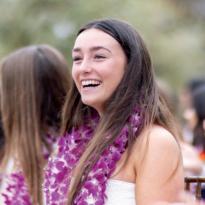
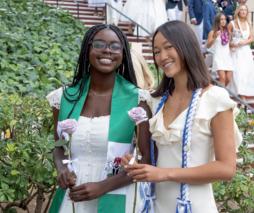
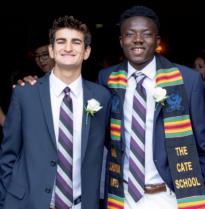
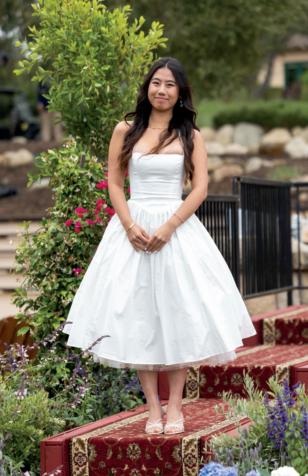
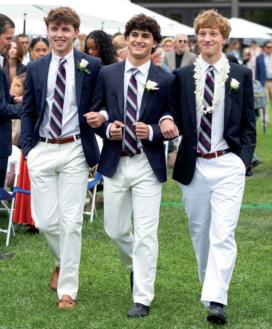
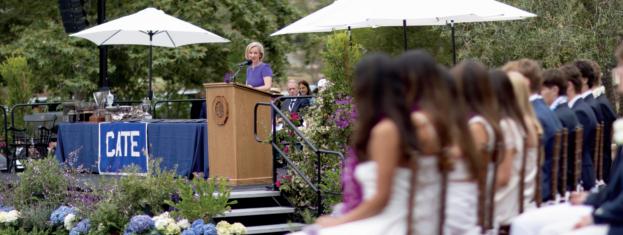


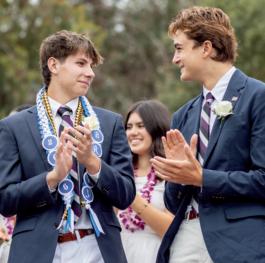
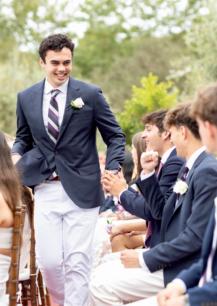
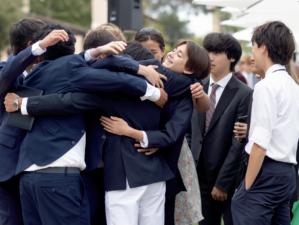
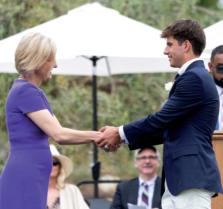
History and Humanities faculty member Lisa Holmes opened commencement with an invocation that drew on poet Mary Oliver and novelist Wendell Berry. Holmes invited the audience into a moment of reflection rooted in gratitude and attention. Borrowing from Oliver’s poem “Praying,” she reminded those gathered that the goal was not to make words elaborate but simply to pay attention and find the doorway into thanks. Drawing on Berry’s definition of community as the shared knowledge, concern, and trust that people build together, Holmes reminded the seniors that they had shaped the Mesa, a place they’ve called home for several years.
Michael Szanyi,
English Faculty Member
English faculty member Michael Szanyi challenged the Class of 2026 to think carefully about the grammar of hope, not as a noun, a feeling, or something passively wished for, but as an active practice, a choice, a disruptive act. Drawing on Emily Dickinson and musing about hope and endurance, Szanyi urged graduates to hope harder than comfort allows. Some seabirds, he noted, don’t avoid storms. They chase them, exploiting the turbulence to find what they need.
Hope is a choice. Hope is a practice. Hope is a disruptive act. Fly into the storm if you have to.
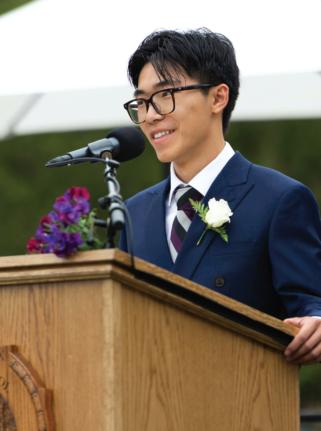
Andrew Peng '26 opened by honoring Gregg Cook '65, who had visited campus earlier in the year to be recognized as Cate’s Distinguished Alumnus. Mr. Cook offered a theory that day: Cate operates like venture capital, an endless cycle of remarkable investments and windfall returns. Peng built on that idea in his own way. “If Cate were an ETF, a combination of individual stocks,” he said, “I would smash my piggy bank to invest.” What makes that investment worthwhile, Peng argued, is what Cate actually teaches. In that sense, he said, Cate is a gift that keeps on giving, “an investment that pays dividends.”
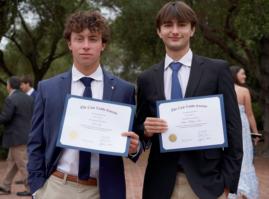
The day before commencement, Cate honored 14 students from the Class of 2026 by inducting them into the School’s chapter of the Cum Laude Society. The society recognizes students who have demonstrated academic excellence, integrity, intellectual curiosity, and a commitment to enriching the learning experience for others. The address was given by college counselor Margot Dorion, who arrived on the Mesa from New England in 2002 and, more than two decades later, has become one of its most trusted and beloved presences. She spoke about curiosity, noting that it is not a trait you are born with and simply keep, but a practice that requires tending.
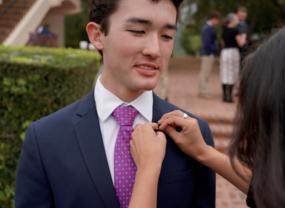
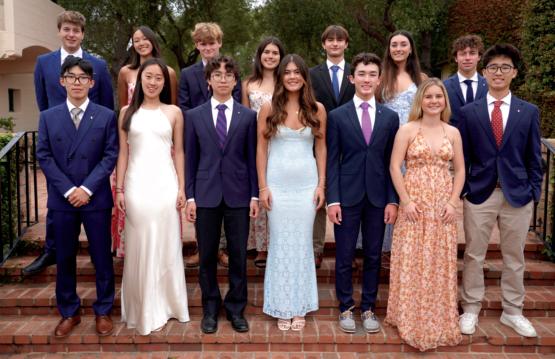
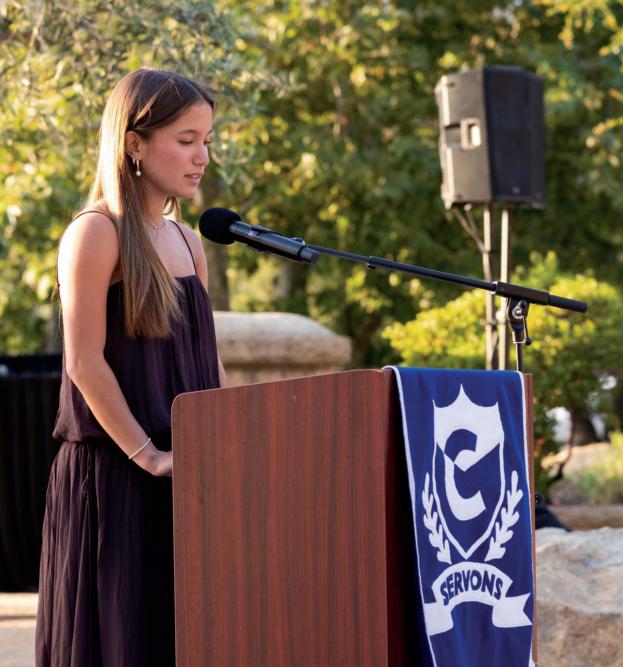
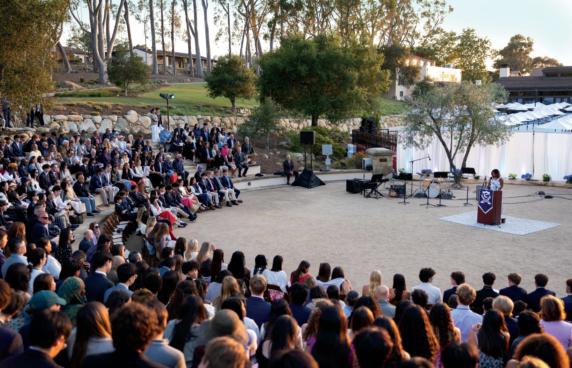
The evening before commencement, Cate gathered in the Class of 1981 Amphitheater for baccalaureate, an intimate ceremony that has long served as the emotional heart of graduation weekend. Dean of Students Bryan Rodriguez opened the program before turning it over to two seniors and a special guest.
Nika Iverson '26 spoke first, posing the question: What does it mean to live richly? For Nika, the answer lived in the unplanned moments on the Mesa. Rain days that sent students sliding down Senior Lawn in trash bags. The relief of walking out of the CoLab after five hours to find friends playing spikeball in the fading light. You cannot manufacture a perfect memory, she said, only create the conditions for one. The ones that stay are made through struggle, through living, and through being present with the people you love.
Dinmukhamed Anuarbek '26 followed with a speech that stilled the audience. He opened by observing that every person present was the living sequel to a story that began long before, in cities some today have never seen and relying on languages some no longer speak. Dimash’s story began in Russia in 1948, with his grandmother, a 16-year-old girl whose future had already been decided: She was to marry a stranger. Her mother pressed money into her hands and sent her to buy a wedding dress. Instead, she walked to the train station, found her best friend, and stood on the platform staring at the money. They flipped a coin. Russia or Kazakhstan. They chose Kazakhstan.
“They did what you would do when the future stretches out blank and terrifying, and any direction is better than standing still,” Dimash explained.
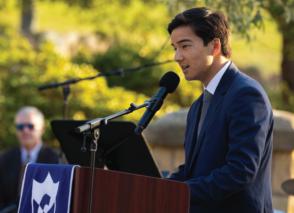
From that single act of defiance, his grandmother built everything. She worked whatever jobs she could find, raised her children largely on her own, and became a woman of iron. She died of cancer in September 2024, while Dimash was finding his footing on the Mesa. And yet her presence was everywhere in his remarks. Near the close of his speech, he told the audience exactly what he was carrying onto that stage and into whatever comes next.
“I’m carrying a girl from Russia, a girl who stood on the train platform with money meant for a wedding dress, who looked at the coin in her hand and understood that some choices only come once, who flipped it, who watched it fall, who chose freedom over everything familiar so that one day her grandson could stand here and tell her story to the world,” Dimash said.
The baccalaureate address was given by Dr. Amani Sampson '08, five days after her own medical school graduation. She told the class that her Cate years were marked by double detentions, a perpetually messy dorm room, and a deep early obsession with surgery that once led her to leave her advisor’s stove on after getting swept up in the “Grey’s Anatomy” premiere.
Her message: The mistakes, the detours, the difficult traits are not evidence that something is wrong. They are clues. What matters most, she said, are not the awards or the résumé lines but the people sitting next to you right now, the ones you will still be calling 20 years from now.

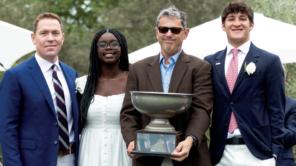
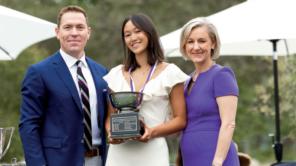
Stephen Spittler '63 Cup
Dr. Jamie Kellogg
Jeffrey Sumner Pallette '88 Award
Ian Shenanigan Sheshunoff '26
William New, Jr. (Class of 1959)
Servons Award
Dan Emmett '99
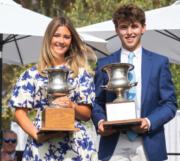
Santa Barbara Scholarship Cup
Claire Hanna Ziebart '26
Ellis Cup
Lauren Patricia Hubbs '26
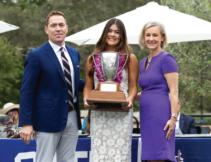
Morgan Gwynne Temby '69 Award
Ramya Bangaru '26
The Miramar Award
Flora Adair '26
Philip Youngjun Choi '26
The Brownlee Cup
Montgomery John Kanda-Gleeson '26
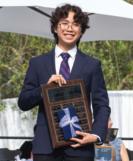
Benjamin D. Williams IV Inquiry Award
Lucian DeMello Tann '26
Dohrmann Pischel '14 Medal (Bronze)
Elise Satsuki Tsai '26
Nelson Jones '48 Medal (Silver)
Lorelei Mapano Roof '26
Santa Barbara School Medal (Gold)
Barron Crayton '26
Head of School Award
Elise Satsuki Tsai '26
Jenevive Won '26
William Shepard Biddle '18 Cup
Ian Shenanigan Sheshunoff '26
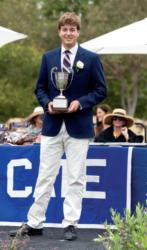
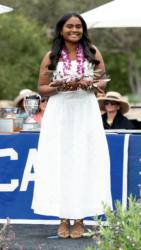
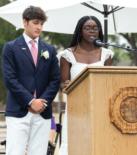
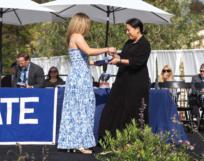
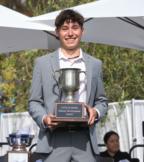
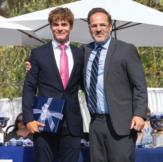
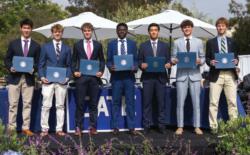
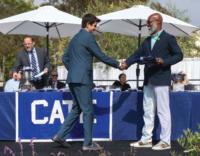
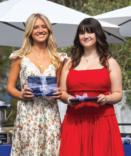
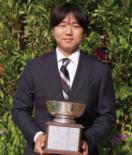
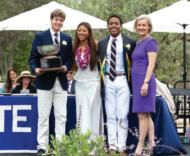
FACULTY AWARDS
W. Burleigh Pattee Fellowship Award
Tracey Calhoun, English Instructor
Fellowship Award: Centennial
Clair Dahm, History Instructor
Fellowship Award: Circumspice
Emma Henderson, Math Instructor
ACADEMIC AWARDS
English Department
Philip Owen Poetry Prize
Halimat Olufolakemi Oloritun '26
James C. Durham '02 (Hon.) Writing Prize
Elise Satsuki Tsai '26
English Department Prize
Flora Adair '26
History Department
The Frank B. Light Cup
Jinliang Sun '28
Edwin Hartzell United States History Prize
Tori Kim '27
The James Masker Global Studies Award
Yuan Andrew Peng '26
History Department Prize
John Elliott Paige '26
Humanities Department
Gaby Edwards Humanities Award
Carina Martinez '29
Mathematics Department
Stanley M. Durrant Mathematics Prize
Alfa Abulikemu '29
Colin Day Mathematics Award
Ian Shenanigan Sheshunoff '26
Allan J. Gunther Mathematics Award
Alex Zhang '26
Rensselaer Polytechnic Medal
Kimy Zhang '27
Modern Languages Department
Chinese Language Prize
George Siebren Marin '26
French Language Prize
Elise Satsuki Tsai '26
Japanese Language Prize
Evangeline Lin Little '26
Spanish Language Prize
Eric Jin '26
Stanley D. Woodworth Language Cup
John Elliott Paige '26
Science Department
Biology Prize
Samuel Young '26
Chemistry Prize
Elsie Chamberlain '26
Physics Prize
Eric Jin '26
The Hans F. Summers Award
Alex Zhang '26
ART AWARDS
Joseph Knowles Foundation Arts Award
Chukwunonso Egbuonu '29
Fred Bradley '68 Prize: 2-Dimensional
Ayla Sichi '28
Fred Bradley '68 Prize: 3-Dimensional
Gweneth Margaret McTigue '26
James R. Feld '81 Ceramics Award
Charlie Dorion '26
Photography Prize
Lauren Patricia Hubbs '26
Irwin Exhibition Award in Photography
Kiy Barry '26
Joseph Bradley Art Prize
Gweneth Margaret McTigue '26
Marion Wolsey Cate Acting Prize
Montgomery John Kanda-Gleeson '26
Tree Payne '26
Dance Award
Claire Hanna Ziebart '26
Theater Award
Ian Shenanigan Sheshunoff '26
Franklin Ellis Vocal Prize
Claire Hanna Ziebart '26
Peter Folger '25 Music Cup
Philip Youngjun Choi '26
EXTRACURRICULAR AWARDS
Betty Woodworth Librarian’s Award
Chloe Chen '26
Yuan Andrew Peng '26
Mesan Award
Fallon Erickson '26
Madeline Losey '26
El Batidor Award
Jasper Shelmerdine '26
Community Engagement Award
Flora Adair '26
Noah W. Hotchkiss Memorial Award
Ashwin Hudson Patel '26
Student Activities Award
John Elliott Paige '26
Chenlisha Lisa Sun '26
Human Development Award (Loving Cup)
Teaching Assistant Award
Alex Gallegos '26
ATHLETIC AWARDS
Outdoor Program Award
Rosita Jean Salcedo Power '26
Redington Cup Award
Sloane Harwell '28
William Murray '28
Chelsea Newlove '28
Most Inspirational Athlete Award
Joshua Butler '26
Oyindamola Opawumi '26
Sportsmanship Award
Brady Matthew Mogensen '26
Emerson Aldrich Evans '26
Beach Soulé Award
Chase Meyer '26
Peter Cate '37 Award
Lauren Patricia Hubbs '26
Athletic Director’s Award
Carmen Lack '26
Quincy Asher Thorne '26
Collegiate Sports Commitments
Mohammed Kamil Suhuyini Abdul Nafeo '26
Dinmukhamed Anuarbek '26
Sebastian Brine '26
Charlie Dorion '26
George Siebren Marin '26
Quincy Asher Thorne '26
Jae Wykoff '26
Senior Varsity Sports Letter Awards
Eight Varsity Letters
Maia Ella Holmes '26
Lauren Patricia Hubbs '26
Hayley Coco Kliman '26
John Elliott Paige '26
Braeden Parker '26
Jordan Matthew Ryan '26
Lucian DeMello Tann '26
Nine Varsity Letters
Oliver Charvel Enthoven '26
Carmen Lack '26
Ten Varsity Letters
Chase Meyer '26
Brady Matthew Mogensen '26
Eleven Varsity Letters
Claire Bianchi '26
Joshua Butler '26
Emerson Aldrich Evans '26
Quincy Asher Thorne '26
Cum Laude Society
Flora Adair '26
Kiy Barry '26
Elsie Chamberlain '26
Naomi Chen '26
Aidan William Free '26
Montgomery John Kanda-Gleeson '26
Eric Jin '26
John Elliott Paige '26
Yuan Andrew Peng '26
Rosita Jean Salcedo Power '26
Ian Shenanigan Sheshunoff '26
Elise Satsuki Tsai '26
Alex Zhang '26
Claire Hanna Ziebart '26
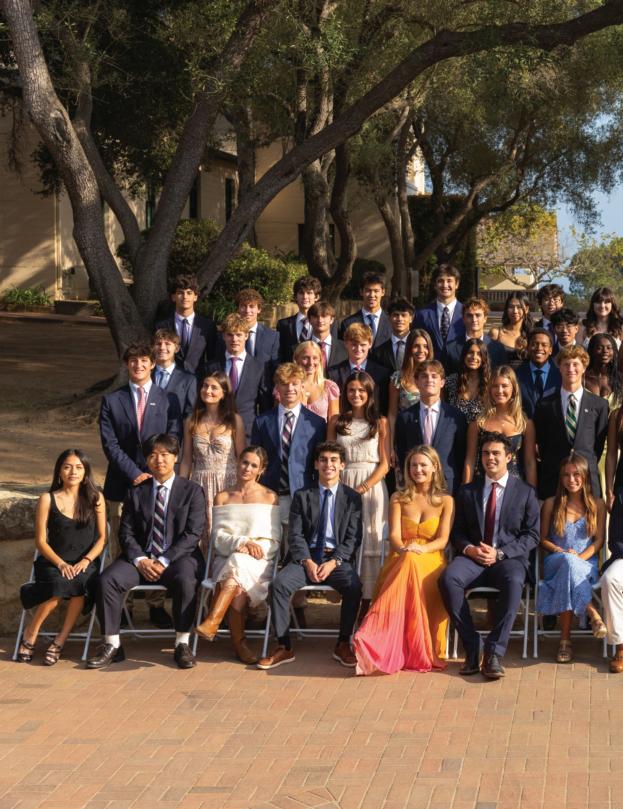
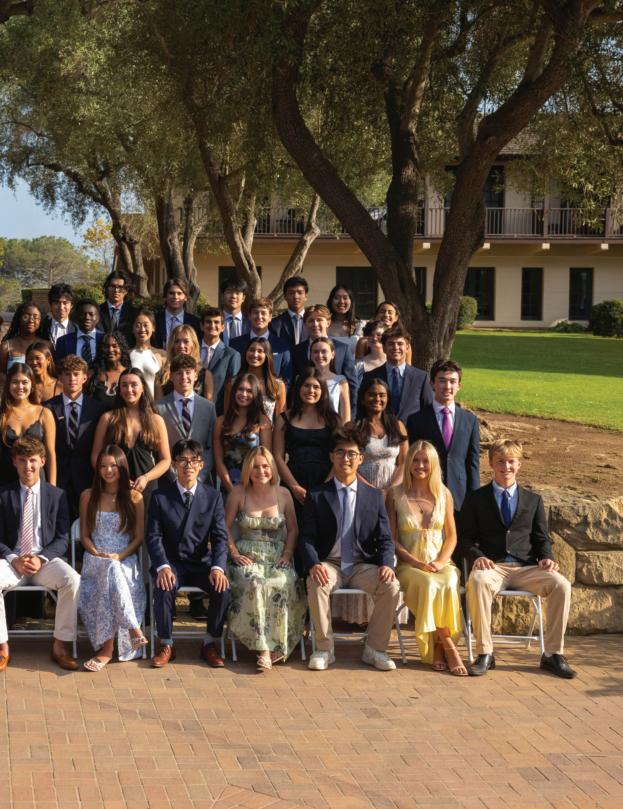
Mohammed Kamil Suhuyini Abdul Nafeo

Kamil is a scholar, leader, and athlete whose journey from Ghana to the Mesa reflects remarkable courage, resilience, and purpose. A thoughtful and creative student, he has grown across disciplines while inspiring others through curiosity and determination. As a prefect and community leader, he is known for his calm strength, kindness, and integrity, uplifting peers and giving voice to those around him. On the soccer field, he is a fierce and disciplined competitor, leading with skill and heart. Grounded in cultural pride and guided by a deep sense of gratitude, Kamil embodies service, humility, and compassion. Loved and championed by his community, he moves forward poised to be a powerful agent of change, committed to uplifting others and living a life of meaning.

Dimash has navigated his Cate journey with an everincreasing sense of purpose, demonstrating tremendous personal growth and a maturing character that inspires those around him. On the soccer pitch, he has been nothing short of a force. As a stalwart midfielder, his grit and vision were the heartbeat of the soccer program, where for the last four years the team competed with some of the most difficult competition in school history. Yet, his impact extends far beyond athletics. He is a deeply respected member of the senior class, admired by his peers for his kindness and thoughtfulness. We celebrate a graduate who leaves behind a legacy of resilience and leadership, ready to tackle the world with the same tenacity he showed on the field.

Flora’s path to authenticity is paved with intentionality, involvement, and effort. Her energy sets her apart, and her enthusiasm inspires. Her commitment is both a glue and a balm. Studying abroad in Spain gave Flora a distinctive warmth, a new sense of grace, and the undeniable power of belonging. Those qualities contributed to natural leadership: in classes, in her dorm, in her friendships, on her soccer team, in her theater group, through her writing, during each Public Service Night, and, of course, as a trusted Teaching Assistant to 9th graders. Today, Flora is disciplined and mature, yet retains a beautiful, youthful silliness. She graduates leaving many of us feeling in awe of her example and so very proud just to know her.

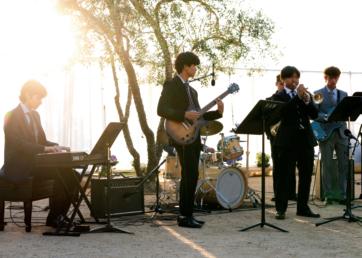
Intuition and intention are the two words that come to mind when we think of Emil, though he makes it all look easy. Cerebral in the classroom, Emil grasps complex ideas with a foundational love for problem-solving that makes his academic pursuits look natural. He just gets it, and pushes himself to go further. He is a musical force on this campus, leading Jazz Combo, creating original productions, and playing the piano with deft grace. As a math lab tutor and music production Teaching Assistant, Emil brings the underclassmen along for the ride, helping them navigate complexity with skill and encouragement. We know that no matter where Emil goes next, his music is sure to follow, setting the rhythm and bringing clarity with each note.
Luke Alexander Ashiku

Luke is the kind of leader we need today more than ever. During his time on the Mesa, he has developed into a student who sees a need and rolls up his sleeves, opting for action over titles and recognition. As head of our Public Service Night program, Luke inspires his peers each week to give back, and in the art loft, his creativity as an artist shines and inspires. His genuine care and grounded servons spirit teach us that kindness, openness, and willingness to show up and pitch in make all the difference. We hope we can all be as thoughtful as Luke.
Ramya Bangaru Honors

Ramya is the personification of a warm hug, something everyone needs every day to feel safe, comfortable, and held. While at Cate, on top of all the time and energy she spent on challenging classes, preparing for her beautiful performances at International Convocations, or organizing and leading the Round Square fundraising committee, Ramya always found the time and energy to bring any one of us in for a hug. Girls in Long House have been lucky beneficiaries of her care as prefect, as have so many small faculty children who love Ramya with all their hearts. We will miss you, Ramya. Know that we will always welcome you back to the Mesa with open arms.
Kiy Barry Honors

Kiy has moved through this Mesa with the keen eye of a filmmaker and the rhythm of a surfer. Observant and steadfast, Kiy approaches each endeavor with a quiet but unmistakable intuition for his surroundings. Collaborative and curious in the classroom, Kiy builds on foundational ideas and helps his classmates see connections from new angles. Competitive and driven, he is a force to be reckoned with on the soccer field, but he never loses composure and is always ready when the moment to act arrives. Fundamentally, Kiy has helped us bring things into focus with his perspective, balance, and even an element of surprise, and we are all better for it.

Claire is unstoppable. Committed and ever full of purpose, this three-sport athlete and captain for the soccer and tennis teams has raised the bar for what discipline, drive, and a team-first mindset mean. Still, she takes time to connect with her younger teammates, guiding them with honesty and warmth, and selflessly mentoring each player with her signature Claire flair. In the local community, Claire gives back as Public Service Night Head, where relationships ground her engagement with those in need. Most of all, Claire has built lasting relationships, balancing care, a genuine desire to connect, and loyalty in equal measure. We will miss her generosity of spirit and resilience as a leader.

Sebastian moves through the world with an easy grace and welcoming smile, backed by deep curiosity and commitment. The combined impact is remarkable. In the classroom, his intellectual generosity and quiet insight draw in his peers. On stage with the Jazz Band, Seb provides the beat that allows other musicians to shine. As a teaching assistant in Human Development, Seb has given our youngest students a clear vision of what it means to thrive at Cate. However, Seb’s most indelible contributions have come in the pool. He has been a central figure in transforming Cate from an aquatic afterthought to a powerhouse program. In each of his endeavors at Cate, Seb has left a mark and raised the standard for those who follow.

Noah, or as Coach Joe calls him, NC the Emcee, is all heart. As a catcher on the baseball team, Noah shows up full of energy and toughness, and when he’s producing music as VinniTheKID, his voice and purpose are unmistakable. While he has developed a recent passion for football, baseball is his true love and he hopes to pursue it in college. Recognized as First Team All-League, Noah’s athletic accomplishments celebrate his consistency and grit, but what defines him is how he moves through this community — with honesty, empathy, and the courage to say, "That’s not how we do things at Cate." As his story continues, his distinct voice on the field, in his music, and within this community will stay with us.
Joshua Butler

When we need a leader, we look to Josh. A three-sport varsity athlete, Josh has consistently competed at a high level. The bigger the moment and the greater the pressure, the more he thrived — on the court, the field, or the diamond, and now the track. As head prefect, Josh’s commitment to school culture is evident in the small moments of connection that he fosters with care. When he was injured in his senior year, Josh met the moment with resilience and found new ways to show up for his team and this community. Spend even a few minutes with Josh, and you’ll know why a Board Member once said, “He’ll be the Cate Board President one day.” We certainly hope so.

Elsie has deeply invested in every aspect of her life at Cate, setting the highest of standards for herself while never failing to offer her kindness and humor in friendship and support to others. In the classroom, Elsie honors every perspective, embraces new ideas and takes intellectual risks that lead her to impressive heights. A talented tennis player, Round Square, and a beloved senior leader and Peer Tutor, Elsie is continually making time for nurturing people and relationships, while achieving incredible things in the classroom across the disciplines. Elsie does all this without asking for attention or accolades, but we’ve certainly noticed. We celebrate her phenomenal grace, expansive intellect, and warm smile.

Oliver is all heart. A captain of two teams, a three-sport varsity athlete, and prefect in '25 House, he has generously poured himself into this community. Oliver’s impact, however, is not about his titles. In his Servons speech, he reflected that legacy is not something you hold on to; it’s the way you make people feel. Through spontaneous walks on the beach, the echoes of laughter in the common room with friends, and quiet, empathetic moments with the 9th grade boys, Oliver has made the Mesa feel like home for so many of us. His teachers note that his growth has been remarkable in the last four years, and he has emerged as one of our finest leaders. His legacy will endure.
Chloe Chen

There is a natural curiosity and kindness that Chloe possesses, guiding her to ask questions, learn about ideas and people, and delve deeply into understanding nuance — because her interest is piqued and she wants to learn more. She views the world around her with great positivity, is intrigued by possibility, and brings an intellectual depth of understanding to every undertaking. She draws people in, building relationships that last, through her friendships, as a teaching assistant, and in the way she instinctively notices who may be sitting outside and brings them in. Whether through personal connections, community service, music or conversation, Chloe is a connector, deftly bringing the best of humanity to all she undertakes and encouraging others to do the same.
Naomi Chen High Honors

A talented flutist, an elegant dancer, and a fierce debater, Naomi has graced all of Cate’s stages throughout her years here. Ever inquisitive, she has made a mark as a scholar who explores every academic topic. Naomi is adventurous and willing to engage with other students, whether in debate versus Thacher or in service of creating global connections at Round Square in Dubai. Her list of accomplishments is a testament to her curiosity and grit. However, if you ask Naomi what she is most proud of, she might rightly say her emergence as a true friend to all and as a role model to our younger students, who see in her a strength of character and kindness that draws them in and inspires them.

There is truly nothing that Alex can’t do. He is an artist, chasing street scenes around Santa Barbara and filming Hot Ones videos with his camera. He is an environmentalist, organizing beach clean-ups here in Carpinteria and working with community groups in his native state of Hawaii. He is a dedicated servant, participating week after week in our Public Service Night program. He is a connector, acting as the first-ever College Counseling Office Ambassador. He is an outdoorsman, scaling rocks and building culture with the climbing team. And Alex is a scholar, bringing unique perspectives and genuine curiosity to the classroom. As he sets his sights on the next chapter, we wish him well and can’t wait to see what he will do next.

When we hear a trumpet on this campus, we turn to look for Philip. Though, you will just as likely find him behind the drum set with Busking Club, tackling a tough physics problem in the classroom, or patiently teaching a new musician in Rock Band with generosity and ambition in equal measure. Philip finds meaning in creating spaces where culture, community, and creativity coexist, like the coffee houses he sets up on weekends or the Asian Student Union dinners he plans and cooks for. Philip is quiet and consistent, someone who simply makes things happen. As he sets his sights on the next chapter, the enduring rhythms he created here will resonate, and he is sure to create the same in the communities he embraces.

Creative, curious, and simply excellent, Graham has made his place on this Mesa known. In the classroom, Graham has taken on challenging coursework with a willingness to adapt, grow, and reflect, while cultivating his love for philosophy. As a peer tutor, Student Senate member, and captain of the tennis team, his classmates have benefited from his thoughtful connection and patience. His interests range from organizing March Madness brackets to skillfully pursuing photography. One of only three seniors in Savage dorm this year, Graham rose to the occasion as a leader through action, setting a joyful and engaged example for his fellow dorm residents. We will miss his quick wit, reassuring presence, and resounding positivity.

Thomas is Cate’s international man of mystery. On the surface, he is soft-spoken. But, Thomas is a highly trained MMA fighter you don’t want to meet in the octagon. Pigeonhole him as a rural kid from Idaho, and you’ll be surprised to learn that he is fluent in Chinese and spent much of his life abroad. Ask about his junior summer, and he might tell you stories of flying drones and chasing poachers in Kenya. The nonchalant kid sharing a laugh with friends in Cook House West is actually one of our brightest intellectuals in the classroom. We feel like we are still just starting to skim the surface with Thomas at Cate, and we’re grateful to be part of the journey.

There is not a person who spends any significant time on the Mesa who does not know Barron. From his distinctive laugh, presence as an athlete, and dedication as student body president, Barron’s impact reaches far and wide. His presidency has been marked with joy as much as it has been marked with friendship. Athletically, Barron proved himself to be among the best. After earning CIF Football Player of the Year honors, he will also leave as one of our most decorated athletes in team history and an inspiration to his teammates. It is clear his legacy and impact will last for many years beyond his time at Cate and we are so grateful to have called him our teammate, leader, and friend.

Tres is the consummate giver — deeply involved and passionate in virtually every aspect of Cate, both on and off the Mesa. As a Public Service Night head, a three-sport athlete, and devoted friend, Tres’s leadership is marked by selflessness, loyalty, and leadership through action over titles. If he is not giving back to the community or planning the next trip, Tres can be found on the lacrosse field, often helping younger players develop their skills while sharpening his own along the way. Tres is a captain and a teacher, on and off the field, and we’ve learned to be more present and more generous because of his impact.

Fallon is as hardworking a student as you will find, defined by her relentless motivation. Whether leading as a multipleyear captain on our CIF Championship-winning volleyball team, serving as Mesan head, or working as a peer tutor, she consistently sharpens her abilities, never settling for the status quo. Her discipline extends to the studio, where she is an incredibly dedicated ceramicist, molding her craft with the same precision she brings to academics. Beyond her grit, Fallon possesses a radiant personality that truly lights up a room, connecting authentically with peers and faculty members alike. We will truly miss the void she will leave behind as she continues on what is sure to be a remarkable journey.

Charlie is one of the most humble yet capable studentathletes at Cate. Whether it’s on the soccer pitch, where he has served as the varsity team’s captain for the past three years, or in the ceramics studio, where he earned this year’s school-wide ceramics award, his work has been exemplary. His teachers appreciate his dedication to scholarship, as well as the high standards to which he holds himself. His peers respect and admire him, and he is kind to everyone. His advisory group is comprised of four 9th graders and Charlie himself, and there he serves as a generous, compassionate, affable, and steady big brother. Raised on this campus, the Mesa has been home to Charlie for many years, and we will miss him dearly.

If anyone deserves to feel proud of their numerous accomplishments at Cate, it’s Emerson. The growth she has shown over the past four years is truly remarkable. Like a long crescendo, Emerson’s work ethic and never-give-up attitude helped build her capacity for a simple truth: “I’m not here to let things happen. I’m here to make things happen!” And make it happen she did, as an ever-improving student, an incredible championship athlete, and, importantly, as a true friend. Emerson may have figured out that laughter is the best medicine because seeing her laugh, truly laugh, would brighten anyone’s day. Emerson, may your hard work always make your laughter come easy.
Aidan William Free Honors

Adversity often reveals character, and Aidan meets it by rising to the occasion. From the moment he arrived on the Mesa, Aidan has been a leader in the classroom, going beyond the scope of the expected and leaving no stone unturned in the pursuit of his education. His bright demeanor and timely humor have been bringing people together with a youthful and carefree perspective that is somehow also steeped with wisdom. A champion for research, education, and change, Aidan meets every challenge he faces with a steadfast resolve that is inspiring. As he sets his sights onward, we are sure that Aidan will not only navigate the road ahead well, but bring about change we can all be proud of.

Salar has been essential at Cate without ever taking up space in the spotlight. Quietly, he stepped into the role of student body treasurer, carefully supporting his community behind the scenes. He founded the Muslim Student Union, creating space for students to feel represented and seen. Intellectually, Salar moved from one class to another with inquiry and awareness, taking on our most advanced classes with determination. Leadership takes many forms, and as his tennis coach put it last year when Salar won the coach’s award, "Salar has led not through volume, but through presence and reliability."

From the moment Alex arrived on the Mesa, he was a Ram through and through. Through his own effort and the guidance of his advisor, Alex has met each challenge with resilience and stepped into his distinct potential as a proud campus leader. In the classroom, the dorms, and most visibly, the soccer field, Alex has always had a team-first mentality, marked by trust, consistency, and care for his community. As a teaching assistant in the Human Development program, Alex’s direct impact on his semmies is undeniable, and his empathy and humor make him a loved and respected friend. The young man he has become is patient, strong, and trustworthy, and though his dancing and whistling are still offrhythm, his character remains unmatched.

Harper jumped into Cate with clear eyes and a full heart, ready to deeply engage with our people and activities. She’s brought tremendous energy and school spirit to each of her endeavors, leaving a particularly big mark on our Human Development and lacrosse programs. Eager to learn and be challenged while never straying from her core values, especially her commitment to her friends and family, Harper has grown up here in ways that made each day a little brighter for everyone in her sphere. Harper graduates as a strong student and powerful community member ready to take the best of Cate with her to the next chapter.
Maia Ella Holmes

Maia arrived at Cate having recently relocated from Chicago. Throughout her time here, she has found friends, a comfortable place to learn, and a community to help her feel at home. It has been a real joy seeing more and more of Maia and witnessing her impact on our School. Whether it is in her work as a deeply invested teaching assistant, her fierce presence in basketball and lacrosse, or her gentle skill at the pottery wheel, Maia has served as an inspiration to all of us who have shared in her joy. It is the rare student who can have an impact in so many different ways, and we have been so fortunate to have Maia as one of our own.
Lauren Patricia Hubbs

Those who were here last year remember Lauren as the lead in the spring musical Hadestown. Never mind that she’d never sung on stage or acted before. In that moment she displayed so much of what makes her one of the most dynamic leaders to ever graduate from Cate: extraordinary talent, a willingness to step out of her comfort zone and throw herself into any activity, and a joyful expression during it all, reflecting both her love of involvement and the positive impact she brings to all she does. Lauren is a beacon of positive energy and the epitome of thoughtful and sincere leadership — a role model for all of us, students and faculty alike, about what it means to truly leave a mark.

Nika’s journey at Cate has been marked with intention and discipline. Her teachers know her to be prepared, focused, and driven, and her academic pursuits have been of the highest standard. As a teaching assistant, she approaches her semmies with levity and care, and as an active performer in Rock Band, she brings power and precision to her performances. A proud member of the Environmental Club, a campus tour guide, and friend to many, Nika’s impact on the Mesa will be marked by her thoughtfulness, sense of humor, and authenticity. During her time here, she has grown into someone we seek out, not just for her intellect but for her steady, genuine, and warm presence.

Eric runs on his own time, distinguishes himself through exceptional achievement, and defies easy characterization. In the classroom, he stretches the boundaries of the curriculum, choosing bold and ambitious writing topics, pushing to grasp the subtlety of a proof, and wrestling with deep, philosophical questions. He plays a beautiful clarinet, and swims across the pool with easy grace. This might have been enough for some, but over the last two years Eric sought new challenges, choosing to leave his comfort zone at Cate for a semester in Spain, and then stepping away from a successful swim career to try surfing and baseball. Brilliant and unconventional, Eric isn’t afraid to try new things, and never forgets to have fun. We could all learn from his example.
Montgomery John Kanda-Gleeson Highest Honors

When Mo arrived at Cate, it was as if a long-anticipated production had begun. Mo is the genuine, brilliant, and purposeful lead, bringing charisma and levity to each interaction. In the classroom, he asks thoughtful questions and listens with intention. In the theater, he is a remarkable artist, banging on a taiko drum or brushing up on a pivotal monologue. In just two years, Mo has captured our hearts. Yet, Mo’s impact has been deeper than just performances. As prefect in '25 House, he has created comfort and community for our 9th-grade boys, making them feel seen and valued. While the curtain is closing on his final act at Cate, we know the stages he graces in the future will shine with his bright light.
Hayley Coco Kliman Honors

Coco stands out, not for the impressive list of her accomplishments (though there are many), but for the quiet integrity, genuine kindness, and profound humility with which she carries them. While her talents on the volleyball court, in vocal ensembles, in class discussions, and through her writing are conspicuous, it’s the strength of her character that truly defines her. Ever true to herself, Coco loves to learn, grow, and seize opportunities, but she also recognizes the importance of slowing down, of living each day, of listening to people and asking questions, always without judgment. We send Coco out into the world confident that she is, and always will be, a force for good.

Carmen is a model of discipline and efficiency. Boldly selfreliant and guided by a strong sense of purpose, she has deftly navigated a schedule full of advanced classes and leadership positions: teaching assistant, Chinese peer tutor, and captain of both the lacrosse and water polo teams. Carmen is someone who simply knows how to get a job done, and done well. Yet, for all her efficiency, what most motivates Carmen is a desire to build personal connections within the community, among both faculty and students. The result is someone who has the potential to bring out the best in both herself and others, and we hope she will continue to share these strengths as she moves on to broader horizons.

To know Evangeline is to finally understand what Walt Whitman was saying when he declared that someone can “contain multitudes.” To see Evangeline play volleyball is to witness a fierce competitor with formidable skills. Yet, encounter this spirited varsity captain and CIF winner in the classroom, and you’re now in the presence of a young woman whose sincerity, composure, and dedication to deep understanding seem to emanate from her very core. Weaving together these seemingly disparate threads are Evangeline’s unyielding commitment to kindness, her loving friendship, and her remarkable bravery. With a Servons speech that beautifully encompassed all of these strengths, Evangeline gifted the community with a model of courageous vulnerability and knowledge of self that will stay with us long after she departs.

There are few students as resilient as Madeline. Her Cate experience has been shaped by her courage, reflective nature, and willingness to grow. When faced with a setback, Madeline rises to the occasion, bringing commitment and strength to every pursuit. Whether she is on stage for one of our productions, in the pool lapping the competition, or in the classroom sharing an insightful observation, Madeline has taken each opportunity at Cate and made the most of it. A gifted musician, Madeline has delighted us with the strums of her guitar at many Family Weekends and Avocado Festivals. We will miss her steady presence, and will remember her as a loyal friend who built relationships that endure while staying true to who she is.
Tristan Maigret

Tristan has a soft voice, a sly sense of humor, and a big heart. He’s a curious and contemplative scholar who listens intently and thinks deeply. A varsity water polo player and swim captain, he has distinguished himself in the pool as a reliable and tireless performer. Above all, Tristan stands out for his unselfish readiness to pitch in whenever there is hard work to be done or thankless jobs to be tended to. A lover of jigsaw puzzles, Tristan has a keen eye for how things fit together, a willingness to pick up the pieces, and an intrinsic understanding of the things that need to be done to help a community thrive.

If you don’t know George, I’d encourage you to go and watch him play in a soccer match. The effort he puts into the game makes one wonder, “Could I have given more? Could I have tried harder?” It’s quite inspirational. He demands so much of himself that it makes those around him better, the picture of a leader who walks the walk. But George is so much more multidimensional than a simple athlete and his demands of himself don’t stop as he steps off the pitch. A determined scholar and a true friend, George is a deeply caring young man. Kindness and loyalty, traits all too rare today, are a couple of things he values immensely. May you never stop walking your walk, George.

With her adventurous spirit, there is no telling where Gwen will end up. But rest assured, she will be exploring the extensive realms of what is possible with the natural knack of excellence. Always one to think outside the box, not just in the arts, but in whatever she pursues, Gwen has the ability to articulate her thought process and take us on a visual journey of the mind. And it’s the journey that she seems to truly cherish, with the wisdom that where she ends up may be less valuable than the lessons that got her there. As her journey beyond the Mesa begins, we know that Gwen will continue to make each community she joins all the more beautiful.
Chase Meyer

From the moment Chase stepped onto campus, he’s been a force. He connects with everyone and has a way of making people feel safe, heard, and valued. That’s just who he is. Chase leads by example in everything he does. Whether it’s captaining three teams or serving as a prefect, he brings people together and sets the tone. He’s confident, he speaks up, and people listen — but it always comes from a place of respect. At the core of it all, Chase is a kind person. He treats people well, no matter who they are, and that has had a real impact on this community. If there is one thing he would want people to take from his time here, it’s simple: be kind to everyone.

There is a quiet brilliance that surrounds Tania, and over her time at Cate, she has grown into a grounded and impactful presence in this community. As a first-generation student from New Jersey, Tania’s journey embodies courage, sacrifice, and resilience. She has built a home for herself here, creating a sense of belonging while remaining true to herself. Tania has served as varsity soccer captain, artist, sophomore teaching assistant, and Hispanic-Latinx Alliance head. In every role, she leads with care and consistency, embracing new experiences like the outdoors program with openness. Most meaningfully, Tania brings others in. Tania has left a lasting imprint on Cate, and her presence will be felt long after she leaves.
Brady Matthew Mogensen

Brady has been a steady presence in our community, showing up in so many different ways. He’s been a lacrosse captain, prefect, football leader, Christian Student Union co-founder, and a regular on Public Service Night. In each of these roles, he has led with authenticity and care. What stands out most is how Brady connects with people. He has never been one to stick to just one group; he’s always open to a conversation and ready to include others. Whether it’s spikeball on Senior Lawn or sitting at any lunch table in Booth, Brady brings people together in simple, genuine ways. That’s the impact he leaves behind — a community that feels more connected because of him.

Akemi has shown us that blessings are not simply received; they are met with courage, effort, and a firm belief in oneself. It is fitting, then, that her name is a prayer for prosperity and divine blessing in the Yoruba language of Nigeria. Akemi’s journey at Cate has been a quiet, powerful transformation, steadily uncovering a deep well of resilience, which has become her North Star. There is a grounded strength in Akemi, neither loud nor performative, but undeniable. It shows in the way she nurtures meaningful friendships, choosing depth over surface, and connection over convenience. On stage, she expresses myriad emotions through dance, leaving us moved and inspired. What a blessing that Cate has been able to witness her becoming.

Oyin has been a driving force on this campus, with her leadership reaching every corner of the Mesa. She laid the foundation early, building trust and connection with the younger students as prefect in Long House. A standout athlete, she was a captain and led the volleyball team to CIFs and earned League MVP. As head of the Black Student Union, Oyin has fostered meaningful community and belonging. As one of the head prefects, she served on the Disciplinary Committee with clarity, integrity, and steady leadership. Her ability to lead through complex situations while keeping the community’s well-being at the center speaks volumes. Oyin will be remembered as a kind and passionate presence who elevates those around her and leaves this community stronger than she found it.

Full of energy, curiosity, and a signature, unmistakable spirit, Elliott is, in every sense, his own person. A captain on both the water polo and swim teams, Elliott leads with care, intensity, and commitment to those around him. A scholar and playful instigator in equal measure, Elliott’s energy is magnetic. His learning is genuine, driven by excellence and an inquisitive nature that continues to expand his horizons. He is fluent in Spanish and Japanese and can simultaneously explore deep nuances of history and philosophy with a mind that is as curious as it is sharp. His mark on the Mesa is unforgettable, and we will miss his energetic cheers at every home game next year.

Braedo’s roots on a ranch in the Santa Ynez Valley are reflected in everything he does and has accomplished here at Cate. On the lacrosse field, he is the brain and the emotional center of the team, controlling the defense from his position between the pipes and building himself into the best goalie in the county. He plays a similar role in the classroom, where his calm curiosity and inclusive approach to inquiry raise the level of every conversation. This year, Braedo helped lead our Public Service Night program and mentored our youngest boys as a prefect in '25 House. But for all this, Braedo may be best remembered for his mastery of the grill, spreading joy through food, just the way he was raised.

Ashwin is a community builder, a young man who understands that belonging is both a gift and a calling. A sharp and imaginative scholar, he moves through his work with curiosity, courage, and a quiet pursuit of excellence. Guided by integrity, resilience, and compassion, Ashwin is a steady voice of reason and a source of warmth and kindness to all who know him. He connects with ease, lifting others through genuine care and a generous spirit. In his time at Cate, he has grown into a confident man, deeply rooted in his Indian culture and proud of his identity. With humility and strength, he steps forward ready to lead, to serve, and to light the way for those who follow.
Tree Payne

Tree pays attention. Perhaps it is Tree’s observant nature that serves them so well as a writer and actor. Their bravery and exuberance shine on stage, through dramatic dialogue and elegant song. Their steadfastness backstage roots performances in diligent organization and expert care for their casts. Tree’s expertise in theater dovetails beautifully with their sense of social justice; they understand and appreciate the complexity of community, leaning in during challenging times and celebrating in the wake of wins. Having spent their junior year abroad in France, Tree returned this year ready for new challenges, joining the climbing team in the winter and testing their limits on our climbing wall and the rocks of Santa Barbara County alike. Thank you, Tree, for sharing your vibrance with us.

Andrew is a deep thinker who is invested in this place and its people. A scholar to his core, Andrew pushed the limits of our curriculum at every turn, embodying the spirit of inquiry that makes our classrooms such inspiring environments. Andrew consistently leveraged his strengths in the service of others, building the EweSpeaks team into one of Cate’s most active clubs and leading major growth in Student Senate as a threeyear Inclusion Representative. Andrew models Servons in the way that he takes our shared endeavors seriously, without taking himself too seriously. He has unquestionably left his mark on the Mesa, leaving us a more curious and interesting school.

For Rosita, the Mesa has always been home. Raised on this campus, the spirit of this place lives within Rosita in a powerful way. Her excellence in academics is undeniable, and she stands tall among her peers as a leader long before she became a senior. An avid runner, climber, biker, and all-around outdoorswoman, Rosita’s spirit of adventure is strong, and she brings others, even the more intimidated ones among us, along for the ride. A co-head of the Servons Speaker Series, Rosita has helped her classmates share their stories with the community, offering thoughtful reflections and gentle yet sound guidance. Marked by her empathy and levity, Rosita’s next adventure is sure to be memorable, and we can’t wait to see her shine.

A study in contrasts, Serena is deeply empathic with a wry sense of humor. She has suffered devastating loss, and channeled it into being a support system for girls through her leadership roles as camp counselor, Long House prefect, and co-head of the Women’s Forum. She produces remarkable work in all her classes with uncommon effort and resilience. Not one to conform to expectations, Serena is a fighter with an indomitable will, and a dancer whose art demonstrates elegance and precision. She is very serious about her commitments and really good at reminding us not to take ourselves too seriously. This study in contrasts aligns with all of our hopes and dreams for a young woman ready for the future. Look out, world!
Sofia Ridgway

When you’re in Sofi’s orbit, you feel her gravitational pull. She does nothing in half measures. On the lacrosse field, Sofi is a formidable athlete. In the classroom she’s a driven and razor-sharp student. In her friendships, she is handsdown the person you’d want as your first call in a crisis. It’s no surprise, then, that despite arriving in her sophomore year, Sofi’s impact on this community has been profound. A leader who focuses on shining a light on others — whether that’s mentoring underclassmen as a teaching assistant or leading the cross country team as captain — Sofi lives her values with grace and authenticity, and we are a better community for her presence.

In a world where things like selfishness and extraction seem to be championed, Lorelei is consistently leaving things better than she found them. Lorelei opposes those forces with genuine kindness and the motivation to simply do better. A cornerstone of the community, Lorelei has served as a prefect in Bothin and a board chair of Round Square. A graceful and elegant dancer, Lorelei’s contributions to the Cate arts program were as memorable as they were entertaining. As she continues on to higher education, her peers and teachers alike will remember her fondly for the way she lights up each room she walks into and for doing more than we ever asked of her.

A fiercely independent thinker with a sharp, critical mind, Jordan has never been shy about expressing his opinions. He has demonstrated tremendous growth during his time at Cate, learning to express his ideas with thoughtfulness and respect, while expressing empathy and openness to others. Jordan is motivated to be a positive force in the community, and he has emerged as a particularly effective leader with widespread influence — in the Student Senate, as a leader on the athletic fields, and as a visible presence in assemblies. He is a young man of strong character, loyal to friends and to principles, who consistently strives to improve the experience of those around him, and we are proud of how well he has done so here.
Krisha Jayna Cunanan Sevilla

There is an inner determination to Krisha that is both understated and incredibly focused. She is invested in her own learning and in the success of others. She has found strength and growth navigating challenges, and her steadfast understanding of her own values guides her decision-making with confidence and purpose. The connections she has made with friends are deep-rooted and built on trust and authenticity. She has grown to know herself well and carries a fearlessness that enables her to step out of her comfort zone and stretch into unfamiliar territory, knowing she can navigate all that lies ahead. We can’t wait to see how she invests these talents in the years ahead.

Jasper knows how to reach for what really matters in her heart. Confidently and steadily she pursues diverse, collaborative endeavors where multiple perspectives converge. She is our go-to leader in service of El Batidor, our girls’ varsity basketball team, our advanced artists, and as a staunch advocate for voter registration. Her contributions off campus are just as impressive, including the creation of a solar-powered “light library” for students at the Zawadi Yetu school in Kenya, where her relationship with those young people might be even more profound than the light itself. Jasper is a powerful combination of commitment, responsibility, competence, and care, who reminds us a little of Atticus Finch: independent of mind, poised, thoughtful, and just as determined to do what is right.
Ian Shenanigan Sheshunoff Highest Honors

Cate’s own modern-day da Vinci, a polymath engineer, creator, and problem solver, Ian knows how things work. Machines, theater productions, institutions, teams, clubs, communities, you name it — Ian looks inside, sees how it operates, and then tells you how to build it better. He also knows what it takes to keep all those systems running smoothly. Smart design, yes, but also limitless energy, abiding commitment, occasional shenanigans, and above all, kindness, civility, and deep generosity of spirit. Ian understands that the machine has to have a soul. He has given all that and more to this Mesa, our productions, our teams, our classrooms, and our community for four years, and we’re so much better for it.

Elias arrived on the Mesa with a professional’s calling. While the community slept, Elias was descending the hill at 4:30 a.m. to chase world-class swells. A Top 100 World Surf League qualifier and three-time National Scholastic Surfing Association Gold Coast champion, Elias’s grit is as vast as the Pacific, from surfing Mavericks at 14 to eyeing the Olympic stage. Yet, his true brilliance lies in his humility. In the classroom, Elias taught us that being driven also means being wise enough to find balance. Whether leading on the volleyball court or elevating the training of his peers, his kindness and infectious positivity remained constant. Elias, you leave us as a world-class athlete and a beloved friend. We will be watching the horizon for your next great wave.

To call Lisa smart would be an understatement. A gifted mathematician, Lisa qualified for the American Invitational Mathematics Examination as a sophomore, a distinction very few Cate students achieve. What makes Lisa truly brilliant, however, is her care for this community. As an activities head, she has been thoughtful and energetic, making sure others feel seen, celebrated, and included. When injury sidelined her in athletics, Lisa was resilient, supporting her team as an athletic training assistant and team manager. A talented musician, a generous friend, and a performer for the ages, Lisa has shown up with heart and consistency. She will be remembered for her service, her kindness, and her friendship to all.

Lucian has been a thoughtful and dynamic presence on this campus, bringing intellectual curiosity and creativity to all he does. He engages deeply with complex ideas, making meaningful connections across disciplines and elevating classroom conversations. His academic interests reflect his unique blend of analytical thinking and creativity. Beyond the classroom, Lucian has contributed to both community and culture with intention and care. Over time, he has grown into a reflective and confident leader, someone who listens, connects, and leads with purpose. Lucian will leave his mark on Cate through his thoughtfulness, curiosity, and genuine investment in others.
Asher Thorne

Quincy has been a lively yet steady presence on the Mesa, bringing energy and authenticity to every space he enters. Caring, outgoing, and deeply understanding, he makes others feel seen and supported, particularly as a teaching assistant in the Human Development program. Over his time at Cate, he has shown incredible growth as a student and leader, rising to challenges with confidence and purpose. Quincy shows up for his peers and his community, and is usually found in the front row at any sporting event, cheering with full-throttle energy the entire time. Continuing his soccer career at the collegiate level is a testament to his talent, work ethic, and dedication. Whether in leadership or everyday moments, Quincy lives his motto: he will show up and show out.

Elise boasts an impressive list of accomplishments as a musician, vocalist, writer, and athlete, yet it is her humility that truly defines her. She shows up for others with unwavering consistency and compassion, celebrating her peers’ successes as genuinely as her own. Whether leading as a Schoolhouse prefect, engaging deeply in the classroom, or performing with No Strings Attached, the orchestra, or in the musical pit, Elise radiates a tangible joy and a profound love for connection. So much of what makes our community special has been touched by her presence. Her impact is far-reaching, and her legacy will endure through the quiet, powerful way she exemplifies the Servons spirit.

Perrin is the quintessential big sister. Whether she’s gracing Cate’s stage with her elegant movements through dance, connecting with the campus children at the Early Learning Center, or serving the local community through her consistent presence at Cornerstone and Transition House, Perrin has embraced her natural leadership in all aspects of her Cate experience. As captivating as she is on stage, her impact has centered around how she has cared for people. Everyone hopes to have Perrin in their room, where she brings an extra measure of nurturing and warmth to each interaction with this community. Perrin’s Cate journey has truly been her own creation. No one does it quite like Perrin, and like the best big sisters, she leaves us feeling seen, celebrated, and truly loved.

Jen always gives it her all. At Cate, she has given us the very best of herself, ever full of energy, determination, and an unmatched sense of advocacy and responsibility. A decorated athlete in our swim program, Jen has achieved recordbreaking success because of her innate drive to do well and elevate her teammates along the way. As student body vice president, Jen led with care and a genuine desire to connect, earning the respect of her peers and faculty alike. A trusted Long House prefect, Jen has built meaningful relationships with students and faculty across the Mesa and brings sincerity and warmth to each interaction. Jen will be remembered for the steady rhythm she found here at Cate, and the many spirits she lifted along the way.
Jae Wykoff Highest Honors

Jae likes to understand how things work. Perhaps this is why Jae’s endeavors at Cate have had a common, steady rhythm to them. When he is structuring a paper, it is meticulously organized. Every mathematical proof Jae works on is just right. See him in the pool, and you will notice precision and awareness that is unparalleled. Humble and unpretentious, Jae was recognized as Cate’s Scholar Athlete of the Year by the Santa Barbara Athletic Round Table, and in his acceptance speech, he focused the spotlight on others, saying "I’ve been incredibly lucky to be surrounded by people like my coaches, teachers, teammates, friends, and especially my family." That’s Jae — excellent and understated in even his brightest moments.

Samuel has a brilliant mind, and he has excelled as a scholar at Cate. He also has a wonderfully open and generous heart. Over the years, Sam has melded his love for science with service through his work with the local Bucket Brigade, his 2025 Metherell Service Grant project, and as our head science tutor. Both a JV sports enthusiast and a lifelong outdoorsman, Sam knows what he loves, but is also eager to try new things and to make good friends along the way. Those of us who have spent time with Sam in the ceramics studio, on a hike, studying in the Inquiry Collaborative, or playing Catan in Cook House West, will remember him as warm, kind, and fun, and we will miss him.

Reserved but hilarious, outstanding but understated, so knowledgeable and still so curious, Alex has served as a magnet for fellow musicians and mathletes who savor opportunities to explore, create, and achieve together. Alex’s academic record, his leadership as a violinist, and his independent pursuit of AI research are examples of his considerable accomplishments. In his free time, Alex has published articles about neural networks and their applications in artificial intelligence, a feat driven by his curiosity, discipline, and incredible capacity for work. In this community, Alex has generously shared his love of math, music, and people as a leader in the Math Club, Busking Club, and Learning Labs. We admire and will always remember Alex for his kindness, humility, and humor.
Lawrence Zimo Zhang High Honors

There is one thing that LeBron, the Lakers, and Lawrence have in common: drive. Lawrence brings enthusiasm, energy, and commitment to everything he does. When he’s leading the orchestra in the Star Wars anthem or making editorial decisions for the campus newspaper, Lawrence is confident, curious, and brings his signature brand of joy to each of his endeavors. His teachers describe him as deeply intellectual, enthusiastic, and engaged, and his friends know him as someone who is easy to talk to, quick to laugh, and always willing to share. In his Servons speech, Lawrence reminded us that no matter the circumstance, we can choose how we respond. If Lawrence’s example is any indication, it should be with insight, humor, and devotion for the things we love.
Claire Hanna Ziebart Highest Honors

When it comes to the performing arts, there is nothing Claire can’t do. Choreographing, performing, arranging a cappella, and somehow always finding a way to do more, Claire is our resident artist and muse all in one. The kind of commitment Claire demonstrates is rare, but what really stands out about her is how she brings others with her. She encourages people to take risks, drop their inhibitions, and just go for it. Starting Busking Club is a perfect example of that — creating something anyone can be part of, no matter their experience. Claire has immersed herself at every opportunity here, and it shows. Though her final performances at Cate are behind her, we can’t wait to see the stages she graces next.
Alizée Zielina

Ali has grown into someone who walks confidently through this campus. She shows up in ways that are steady, thoughtful, and genuine. Ali can make friends with anyone. She has a real gift for listening and meeting people where they are. That openness is a big part of what makes her such a grounding presence in the community. Through her work as a tour guide, student librarian, and prefect, she has consistently chosen roles that center service and connection. She also helped start Cate Pawsitive Pals, combining her care for animals with her desire to build something inclusive and meaningful. Ali leads with kindness and quiet confidence — and leaves behind a community that is stronger, more connected, and more at ease because she was part of it.
Amherst College (3)
Barnard College (2)
Bates College
Boston University (2)
Bowdoin College
Brown University (2)
California Institute of Technology
Case Western Reserve University (2)
Colby College
Colorado College
Columbia University
Dartmouth College
De Anza College
Duke University
Georgetown University
Indiana University
Massachusetts Institute of Technology
McGill University
Mount Holyoke College
New York University (4)
Northwestern University (2)
Occidental College
Pitzer College
Rhode Island School of Design
Santa Barbara City College (2)
Scripps College
Southern Methodist University
Stanford University (3)
Syracuse University
Texas A&M University
Texas Christian University
Tulane University (2)
University of California, Berkeley (2)
University of California, Los Angeles
University of Colorado Boulder
University of Chicago (2)
University of Georgia
University of Miami
University of Michigan (2)
University of Pennsylvania
University of San Diego
University of Southern California (4)
University of Texas, Austin
University of Toronto
University of Wisconsin
Vanderbilt University
Wake Forest University
Washington University in St. Louis
Wellesley College
Yale University (2)
Remarks by Sandi Pierce, Assistant Head of School
Today, we celebrate and salute Margot Dorion for 20 remarkable years of service to Cate School — two decades as a teacher, coach, advisor, counselor, advocate, and fearless champion for women’s rights.
Margot is an ambitious, passionate, and razor-sharp thinker whose commitment to young people has shaped this community in profound and lasting ways. As a coach, dorm parent, and college counselor, she has guided countless students with compassion and candor, forging bonds that have endured well beyond their time on the Mesa. Across the wider world of education, Margot is revered for her wisdom and wit, her leadership and levity, her courage and conviction.
Margot’s work is anchored in a deep sense of justice and an unshakable feminist belief that equity is not a gift to be granted — but a truth to be lived. For 20 years, she has been a warrior for women’s rights on our campus and beyond. Through her tireless involvement in the Women’s Forum (WoFo), she has cultivated a space where dialogue meets action, and where generations of young women have found their voices, their strength, and their power.
She has chaperoned marches and rallies, led delegations to conferences
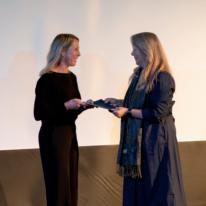
like the Independent School Gender Project, and modeled what it means to turn conviction into change. Through these efforts, she has not only mentored students — she has ignited movements.
Margot embodies the power of women supporting women. Through her work with Standing Together to End Sexual Assault, she has been instrumental in shaping Cate’s Sexual Harassment Incident Response protocols, ensuring that our campus remains a place where respect and accountability prevail.
As an educator, Margot continues to stretch, learn, and lead. She teaches in our anti-racism college counseling program, represents Cate on the University of Chicago Advisory Board, volunteers with the Mission Scholars Program, and has served on both the Admissions Committee and on our Academic Leadership Team — where she advocates fiercely for academic integrity, balance, and empathy in the lives of our students.
Margot is also a traveler, a seeker, and a storyteller. Having lived and taught in Jamaica, France, and Sweden — and visited a dozen other countries — she brings to her work a global consciousness that reminds us how learning and empathy transcend borders.
And then, of course, there’s Margot the runner and the mother of Molly, Olivia, and Charlie two roles that require endurance, agility, strength, and infinite patience. She has completed three marathons, all while raising her family, lifting up her husband, Jay, and the lives of Cate students — often at the very same time.
Margot’s legacy at Cate is not measured in years or titles but in transformation — in the confidence of a young woman who now stands taller, the laughter of a colleague she’s encouraged, and the culture she has helped to build and sustain.
Diane Mariechild once wrote, “A woman is the full circle. Within her is the power to create, nurture, and transform.”
Thank you, Margot, for 20 years of transformation. You have made Cate a stronger, wiser, and more just community — a better place for women, and therefore, a better place for us all.
Remarks by Jules Nau, Director of Facilities & Master Planning
I am so honored to be here today to celebrate a remarkable milestone: Jose “Pepe” Ortega’s 20th anniversary with Cate School. Twenty years is a phenomenal achievement, one that speaks volumes about their character, dedication, and loyalty.
Pepe’s dedication, drive, and neversay-no mentality is the cornerstone and foundation of the facilities dept.
He has been a silent warrior on our Mesa who leads the way in exemplary service.
Over the past 20 years, Pepe has been a constant source of inspiration and excellence. He has witnessed and navigated significant changes, always adapting with resilience and a positive attitude. Pepe’s contributions are woven into the very fabric of this campus.
Over 20 Commencements and 40 Family Weekends, Pepe has committed to ensuring every square foot of our
grounds and buildings are looking their best when guests arrive.
Pepe has had an immeasurable impact on our team’s culture. He has always been the person that our team turns to for advice on the technical aspects of our grounds. He is a quiet leader that strives for perfection in every task no matter how big or small.
To have an employee of this caliber and character is a rare gift, and we are all so fortunate to be working alongside him. Pepe embodies the best of Cate’s values, and his dedication is a powerful example for all of us.
Pepe, on behalf of everyone at Cate, thank you. Thank you for your hard work, your invaluable contributions, and your unwavering commitment over the past two decades.
You have made this a better place to work, and we are excited for all that is still to come.
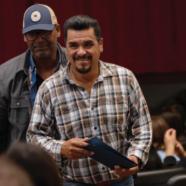
5 Years
Ashwin Atre
Nuria Causera
Kern Ducote
Christina Gil
Kellie Lancaster
Jesse Morrison
Jules Nau
Kadeine Peterson
Susan Zapalac
10 Years
Beth Caylor
KC Collins
Giselle Da Silva Martins
Vanessa Cruz Santana
Lindsay Newlove
Gerardo Obispo
Jessica Seriano
15 Years
Rebekah Barry
Shannon Drew
Andrew MacDonnell
Taylor Wyatt
20 Years
Margot Dorion
Jose Ortega
25 Years
Lynn Dinning
Lisa Holmes
Will Holmes

2014
Erika Noble to Tyler Conklin
March 7, 2026

2003
Penelope "Poppy" Jean to Lizzy Hale and Chris Hale
January 26, 2026

2013
Jack Anthony to Austin Gallegos and Riley Gallegos
November 27, 2025

2015
Lily Xu to Hunter Hudgins
May 3, 2025

2010
Robin Walsh to Mackenzie Walsh Koch and Charlie Koch
April 8, 2025


2016
Charlotte Monke to Zachary Alexander
September 13, 2025

2012
Clayton Edward to Adrian Walsh Kurtz and Ben Kurtz
December 5, 2025
Clover Seo-A to Jake Kim and Whitney Lew
January 19, 2026

Paul Arthur Rubinstein '51
January 29, 1935 - November 16, 2025
Reflection by Jason Rubinstein
My dad, Paul, passed away just two months shy of his 91st birthday. My dad loved our country and was a proud Army veteran. After escaping Nazi-occupied Paris with his family, he was raised in Beverly Hills and attended Cate, a place he remained loyal to throughout his life. Though he began his career at RCA Records, he spent the bulk of his professional life as a Wall Street stockbroker. He lived in New York City for decades until I relocated him to Illinois following a near-fatal bout of COVID-19 in 2020. Dad’s greatest personal passions were food and jazz. He authored four cookbooks and delighted in taking the family to great restaurants or flying between California and Illinois to lead the Thanksgiving cooking. Some of my favorite memories are from my time in Manhattan after attending Yale, when we would frequent jazz clubs to hear the greats while he shared his endless “fun facts” and stories. Dad was a devoted alumnus of Penn, Yale, and especially Cate. He loved recounting his youthful hijinks there, and my wife and I will always cherish the memory of joining him on campus for his 50th Class Reunion.
Davis L. Kennedy '56
August 21, 1938 - December 25, 2025
Davis Lee Kennedy, a distinguished publisher and community pillar, passed away on Christmas Day at the age of 87. Born in Elkins, W.Va., Davis’s early life was marked by global travel, including a formative 1954 journey behind the Iron Curtain that sparked his lifelong interest in world affairs. An alumnus of Cate, Harvard College, and Harvard Business School, Davis remained deeply connected to his alma maters throughout his life. Well into his 80s, Davis attended reunions and reconnected with Cate friends. His commitment to service was cemented early on as a U.S. Army officer in Germany, where he helped defend Berlin following the construction of the Berlin Wall in 1961. Davis found his true calling in community journalism and devoted his adult life to editing and publishing community newspapers, including the Alexandria Port Packet, the Gaithersburg Gazette, and the Northwest Current. He was a fixture at local meetings and was an advocate for balanced, apolitical reporting, believing that a wellinformed community was always stronger. Beyond the newsroom, Davis was a lifelong animal lover and a devoted philanthropist, supporting the Cate Fund for 45 years and establishing the Stanley M. Durrant Memorial Faculty Fund He leaves behind a legacy of integrity, civic dedication, and a deep-seated belief in the power of local voices.
Jacob (Jake) A. Butts '59
February 2, 1941 - May 14, 2025
Jake Butts suffered from dementia and passed away in Nashville, Tenn. While at Cate, Jake was a standout leader, serving as a senior prefect and competing in basketball and track. He attended Stanford, earning an AB in 1963 and an MBA in 1965. There, he served as president of Phi Delta Theta and was a member of the gymnastics and boxing teams. After serving in the U.S. Coast Guard Reserve from 1967 to 1973 and working in the finance industry, Jake followed a creative calling to the American Academy of Performing Arts. He became an Oscar-nominated sports film producer before co-founding Cameron Communications, where he coached high-profile figures — including a U.S. vice president and the federal prosecutor in the Clinton/Lewinsky case — in public speaking. Jake is survived by his children, Coleman and Callie; his grandchildren; his brother, Donald Butts '60; and his sister, Cameron Butts Bianchi. Jake was a committed supporter of Cate. He donated generously to the Cate Fund for 33 years, served as a Class Agent and Reunion Chair, and received the Van Cott Niven Award in 1999, which recognizes volunteers for exemplary service and their ability to keep Cate community members engaged.
March 11, 1945 - October 18, 2025
Reflection by Jim P. Stent '63 and Peter A. Daly '63
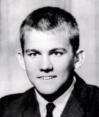
If one attended Cate in the 1950s or 1960s, they could be forgiven for thinking everyone came from either San Francisco or Los Angeles. Bill, in fact, came from Twentynine Palms. But having experienced one of California’s cultural and social hubs, Carpinteria, he never again resided in the desert. Bill is remembered for his quiet steadiness, gentle sense of humor, and common-sense approach to everything he undertook as a student on the Mesa. His personal warmth and modesty set the tone for a productive life that he enjoyed to the fullest. After graduating from Cate, Bill studied engineering at the University of California, Berkeley, and later earned an MBA from the Wharton School of the University of Pennsylvania. Equipped with engineering and business management credentials, he returned to the Oakland area to pursue a successful career in industrial engineering and to marry his sweetheart from his undergraduate years, Nancy Scott. Both were avid readers and gourmets, enjoying good food and wine with friends. As an alumnus, Bill was an enthusiastic supporter of Cate and kept up with many classmates over the years. Upon retiring, Bill devoted himself to creating a blog about espionage and mystery fiction. His reviews were insightful and concise. After reading Daniel Pyne’s novel Twentynine Palms, Bill wrote to the author with a surprise realization. The book’s protagonist travels from the desert through Carpinteria — mentioning Cate School — and on to Berkeley, a specific journey Bill had previously thought he was the only person to have made. Pyne wrote back: “Synchronicity.” Cate School and Bill’s friends will miss the lad from Twentynine Palms.
February 26, 1950 - February 16, 2026
Billy Steinberg, the Hall of Fame songwriter behind hits like “Like a Virgin” and “True Colors,” died of cancer at his home in Brentwood, Calif. Throughout a career spanning five decades, Billy authored a soundtrack for the 1980s alongside partner Tom Kelly. The duo penned five Number 1 singles, including Whitney Houston’s “So Emotional,” Heart’s “Alone,” and the Bangles’ “Eternal Flame.” Their work often blended vulnerability with pop resilience, a hallmark seen in “I’ll Stand by You,” co-written with Chrissie Hynde. Born in Fresno, Calif., Billy grew up in the Coachella Valley. He attended Cate and Bard College before finding early success when Linda Ronstadt recorded his song “How Do I Make You?” in 1980. Billy’s influence extended globally and across generations. He co-wrote the Divinyls’ provocative anthem “I Touch Myself,” which Madonna sang, and later adapted for the streaming era by co-writing hits for Demi Lovato and JoJo. Inducted into the Songwriters Hall of Fame in 2011, Billy is remembered for a disciplined craft focused on building art that lasts. Billy was fond of Cate and received the Distinguished Alumnus Award in 2007.
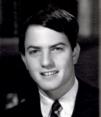

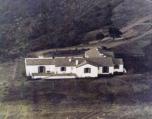
Mr.
From El Batidor, October 1924
As construction on the building began, Mesa House was simply described as “a house for Mr. and Mrs. Cate … made of brick and painted white.” Reflective of California’s adobe heritage, the building was low, expansive, and unpretentious.
From the day its doors opened, Mesa House was a space of community. In his book School Days in California, Curtis Cate recalls students meeting him at the tea table in Mesa House in the afternoons and joining him for dinner on Saturdays at the newly designed home. “We ate dinner with the boys every night except Saturday, when a half dozen of them dined with us. Thus, we continued up and down the hill for four years.”
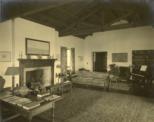

“At the annual meeting of the Board of Trustees, in December, 1947, the trustees passed a motion in appreciation of [Katharine Cate’s] years of interest in the School, concluding: ‘Mrs. Cate has been intimately associated with the School for more than thirty years, and during that time has been a friend and counselor of many boys, Her interest in their activities and her warmth in extending to them the hospitality of Mesa House will long be remembered as one of the outstanding features of life on the Mesa.’”
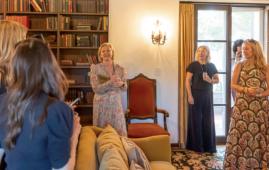
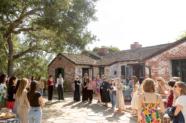
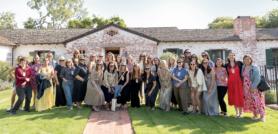
2025 quietly marked a significant milestone in the history of Cate: 100 years of Mesa House. Built in 1925 by renowned Santa Barbara architect Reginald Johnson as the primary residence for Curtis and Katharine Cate, Mesa House was the first building on top of the Mesa, beginning the School’s eventual transition to its modern home overlooking the mountains and the sea. From its conception, Mesa House was a space of community, a thoughtful reflection of the humble vision Mr. Cate had for the School. What follows is a look into the evolution of this remarkable building.
In his will, Curtis Cate gave Mesa House, his home of 51 years, to the School as the head of school’s residence. In preparation for its continued use, a heating system was installed, and the space was furnished with 20th-century furniture gifted to the School from trustees and friends alike. Established as a communal space of gathering rather than just a private residence, alumni gatherings, trustee events, and school celebrations were commonplace at Mesa House.
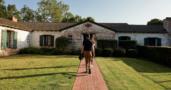
Under the tenure of Head of School Ben Williams, several annual traditions, including dinners with trustees, gatherings during Camp Cate, and CPO receptions, were held at Mesa House, offering celebration and community in equal measure.

Through modernization of the campus, head of school changes, and evolving priorities of the School, Mesa House remained steadfast and unpretentious, white bricks with green shutters in the shadow of mighty oaks.
A century later, Mesa House continues to play host to community events each year. From MLK Day activities in the Mesa House garden to cocoa and cookies with the head of school during the holidays, the warm, welcoming, and modest space that Mr. and Mrs. Cate created endures in its purpose.

1960 Cate Mesa Road
Carpinteria, CA 93014-5005