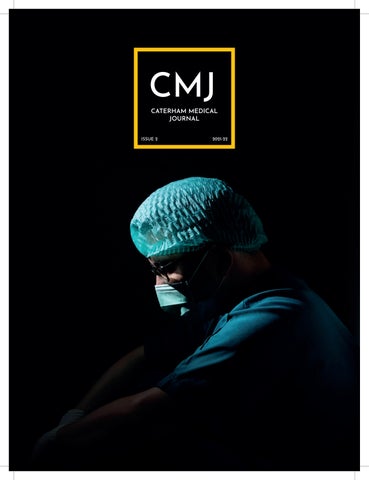
CMJ CATERHAM MEDICAL JOURNAL ISSUE 2
2021-22
1
INTRO DUC T I O N Dan Quinton
M
edicine, veterinary or dentistry are probably the toughest courses one could choose to apply for of any course in any Uni up and down the country. As I write this our current Upper Sixth nervously wait for offers; it is an emotional rollercoaster and these amazing students put in so much time and effort to try to achieve their dream. I am passionate about helping them pursue a career that is so unquestionably valuable and worthwhile, and that is why I set up The Wright Society.
The Wright Society is now in its second year and is flourishing in a way I only dreamed of a couple of years ago. I set up the society with two impressive Sixth Formers, Max Fogelman and Louie Steel, now studying medicine at St Andrews and Newcastle respectively. I think of them often as I walk past the beautiful oak honours board bearing their names up in Biology, remembering our daily zoom meetings over the summer of 2020 to get it ready for the new L6th. Our plan was to create a society to help aspiring medics both at Caterham and the state schools in our local area. The society was to push students out 2
of their comfort zones and give them a deep understanding of their subject, with resources second to none, to help them achieve their dream. Impressive pupils joining us from Warlingham and Oxted was the icing on the cake. The honours board now bears the names of Rosie Home (President) and Michelle Wong (Vice President), two of the first Lower Sixth to experience the TWS, and now the figure heads themselves. As I write this they are about to take the new Lower Sixth through their paces and start their preparation for the all important UCAT exam. At tomorrow’s meeting pupils from Oxted and Warlingham Schools will be joining us once again. Widening the access to this vital help for medicine applications is something Dr Wright and I are passionate about, and is central to the existence of TWS. Rosie and Michelle have been inspirational this year in the time and care they have given to help their peers and the new crop of wannabe medics. I cannot thank them enough, and I know Max and Louie would be proud of them for carrying on with the work they started.
A ME S SAGE F ROM THI S Y E A RS END O RS ER Ohis Ojo
I
was very pleased when I was asked to be this year’s endorser of Caterham Medical Journal (CMJ). This is produced by The Wright Society, which was formed to help aspiring medics, dentists and vets reach their goals. This is a cause that tugs at my ‘Chordae Tendineae’ (Heart Strings to the uninitiated) as I was once an aspiring medic, sat in the same classrooms, studying hard so I can get into medical school. The Wright Society provides a platform for the students to not only pursue their scientific interests but to share what they have learnt with others. This is important as it is one of the key tenets of the scientific method - Community. The simple act of sharing knowledge with our peers has taken the human race from fire-lit caves and stone tools to the modern age we live in. It is this same bond that
spurred clinical research like the RECOVERY Trial, which results saved countless lives during the peak of the pandemic. COVID showed how important it is to have good clinicians but more importantly, it highlighted the need for stable communities to allow them to thrive. It is an honour to endorse a society that is committed to developing a communal spirit in the generation of tomorrow. Finally, I would like to thank Mr Quinton and Mr Keyworth. Their passion for science is contagious. It is that passion that helped me get into medical school and achieve my dream of becoming a doctor. It is heart-warming to come back to Caterham almost a decade later and see so many fresh faces with the same enthusiasm for knowledge. I wish you all every success in the future. 3
C ON T E N T S REFLECTION OF THE YEAR Rosie Home & Michelle Wong. . . . . . . . . . . . . . 5 TALK BY DR WRIGHT Sophia Termanis . . . . . . . . . . . . . . . . . . . . . . . . . . . . . . . . . . . 6 TALK BY DR RAMESSUR Sally Henley. . . . . . . . . . . . . . . . . . . . . . . . . . . . . . . . . . . . 7 DR OHIS OJO INTERVIEW Rosie Home. . . . . . . . . . . . . . . . . . . . . . . . . . . . . . . . . 8 MAX FOGLEMAN INTERVIEW Michelle Wong. . . . . . . . . . . . . . . . . . . . . . . . . 10 HEART TRANSPLANT Anastasia Spuma. . . . . . . . . . . . . . . . . . . . . . . . . . . . . . . . . . 12 ALL ABOUT GPS Holly-Heather Cook. . . . . . . . . . . . . . . . . . . . . . . . . . . . . . . . . . . . . . 14 COMMUNICATION SKILLS WITH DR WRIGHT Isabel Singleton. . 15 POST TRAUMATIC STRESS DISORDER Isabel Singleton. . . . . . . . . . . . . 16 SATRO - VIRTUAL HEALTH APPRENTICE Iris Floyd, Ellie Shipsey & Salina Henley. . . . . . . . . . . . . . . . . . . . . . . . . . . . . . . . . . . . . . . . . . . 18
MAKE-A-MEDIC FUNDRAISING Anya Lu & Holly-Heather Cook . . . . . . 20 MEET THE L6 MEDICS . . . . . . . . . . . . . . . . . . . . . . . . . . . . . . . . . . . . . . . . . . . . . . . . . 21 MEET THE U6 MEDICS . . . . . . . . . . . . . . . . . . . . . . . . . . . . . . . . . . . . . . . . . . . . . . . . . 23
4
REFLECTION OF THE YEAR Rosie Home & Michelle Wong
I
t has been an incredible honor to act as the President and Vice President of the Wright Society this past year; helping the members get closer to studying their dream career has been such an inspiring experience, and one I’m sure we’ll never forget. We’ve had a big year of development, and building on the great foundations lain by Max and Louie last year, we’ve been able to make the society even better for our aspiring medics, dentists and vets, using our experiences from last year to provide the most useful resources and sessions possible. We also this year have been able to welcome many more in person speakers, including Dr Ramesseur, an anaesthetist at St Thomas’ Hospital, who gave an amazing talk on his career in medicine, as well as multiple great presentations from Dr Wright himself. With uncertainty due to COVID-19, it has been impressive to watch the Lower Sixth join the society with such enthusiasm. The self-guided talks delivered by our Lower Sixth pupils over the autumn term have helped to broaden their knowledge and understanding of the medical profession, as well as develop their presentation and communication skills. It’s so exciting to hear them talk so
passionately about their area of interest within medicine, often going into undergraduate level depth and answering challenging questions posed by their peers with ease. Our main focus for the Lower Sixth now shifts towards their application to medical school; learning how to develop the skills necessary to do well in the difficult admissions tests, the UCAT and the BMAT, as well as looking to prepare their personal statement. We like to start these processes early in The Wright Society to give the members the best possible advantage going into the admissions process. At this time of the year, our Upper Sixth Medics has been focusing on preparation for their interviews. We’ve dedicated several of our weekly meetings to interview practice, which we do by answering challenging questions from previous years whilst standing up in front of the whole society. Whilst very daunting, we all agree this has helped us massively in coping with the pressure of real interviews, and has overall made us better candidates. On top of this, we have been fortunate enough to have practicing Doctors come in and help us with our interview prep, which has been incredibly
beneficial in improving our interview answers and technique. We’re so proud of everything the society members have achieved this year, whether it be securing multiple medical school interviews, or giving an inspiring presentation to their peers. It’s truly been such a privilege to be the President and Vice President for such a great cohort. We would like to say a big thank you to Dr Wright for his contribution to the Society. It is very generous of him to give up so much of his time to help us grow both as aspiring medics and as a society on the whole. The talks and inspiring words have definitely enlightened us, as well as giving us great insight into what it means to be a doctor. Our fantastic team of teachers also cannot go without a mention. A massive Thank You to Mr Quinton, Miss Quinton and Mrs Seal; your incredible insight and support throughout the whole process has been invaluable, and everyone appreciates all of the effort you put into the society endlessly. Good luck to all of our medics, dentists, and vets; we wish them all the luck in the world, and are sure they will all reach the bright future they so desperately deserve. 5
TALK BY DR WRIGHT Sophia Termanis
A
into medical school. It was incredibly useful to t the beginning of October we had the see the qualities that medical schools tend to look opportunity to attend a talk that was for when accepting or denying entry, making the delivered by Dr Wright in which he gave us deep information Dr Wright has given us immensely insight into the journey of becoming a medic valuable when it comes to our applications. and what the life of being a junior doctor is like. Finally, Dr wright enlightened We learnt about the 12 hour us on all the opportunities that night shifts and the challenges Dr Wright gave us a degree in medicine would give of sudden emergency situations, the best tips for getting us, most of which we hadn’t which seem to be very daunting. in to medical school thought about. There’s a plethora However, we also learnt about of varying opportunities, for the positives of life as a junior example, being an armed forces doctor, for example, you get to work with a good team, you get to deliver the best doctor, medical journalism or medical law to name a few. Everyone was so grateful for care to the people who need it the most and you Dr Wright giving his time and delivering us such get to be paid for doing something you love. an amazing and informative talk. Dr Wright then gave us the best tips for getting
6
TALK BY DR RAMESSUR Sally Henley
A
t the end of last term, we were privileged to attend a lecture presented by Dr Ramessur, an Anaesthetist from St Thomas’s Hospital, London. Dr Ramesseur’s open and honest approach to the reality of becoming a medic was undoubtedly an attempt to deter us - in fact he stressed twenty reasons why we should not study medicine. These included: long hours that will inevitably affect our quality of life, poor pay (unless of course we become a Consultant) and the certainty that we will miss out on those allimportant life events such as family weddings and birthdays). He also expressed that medicine is a career that is not for the faint-hearted and one which should not be impressed upon us just
to please our family but must come from within. Dr Ramesseur went on to confess that being confronted by health professionals with conflicting ideas can be challenging. Complex issues require effective communication skills and ultimately, the best interests of the patient is paramount. He described the immense responsibility that comes with the job and how important it is for us to reach out for help if we are unsure of how to manage a situation. Despite Dr Ramesseur’s attempts at reverse psychology to scare us off, the majority of us still believe the positives outweigh the pitfalls! Many thanks to Dr Ramesseur for your informative talk and for taking time out from your busy schedule. 7
DR. DR OHIS OHIS OJO OJO INTERVIEW INTERVIEW Rosie Home
Rosie Home
I
had the honour of interviewing this year’s CMJ endorser, Dr. Ohis Ojo; an Old Caterhamian who is now a practicing doctor. Ohis, instead of going the traditional through medical school in the UK, opted to go to medical school in Prague, specifically at Charles University. I was lucky enough to have the opportunity to speak to him about this, as well as what he’s up to now.
studying there, he says, was being immersed in a new language, and particularly getting to befriend people from all over the world. He says it has made him more aware of other cultures and has broadened his horizons, which he is very grateful for. On top of that, he now has friends all over the world, from Brazil to Germany to South Africa.
In terms of actually studying in Prague, Ohis remembers it fondly. One of the best things about
recover from her illness quite a lot. Then, she was transferred to another hospital, so I didn’t get to
Nowadays, Ohis is training to We started by talking about become a GP, which he has Prague and why Ohis decided been doing since August. I’ve kind of always to study there as opposed to When asked why he decided to known that I wanted to staying in the UK. It was after train to become a GP, Ohis gave be a GP. Working in initially being unsuccessful in a very compelling response: ICU during Covid his application to UK medical “I mean, I’ve kind of always confirmed this for me schools that Ohis decided to look known that I wanted to be a elsewhere; whilst looking around GP. Working in ICU during at universities abroad that offer Covid confirmed this for me; medicine to English students, he stumbled across there was one situation in particular. I treated Charles University in Prague. Other than the a woman for meningococcal meningitis – I typical A-levels, the university required Ohis to sit spent a lot of time with her and got to know her the ‘SAT’ exam, which he recalls was very difficult. and her family quite well, and got to help her
8
me is the reason why I went into see her anymore. By pure chance, a few months later I bumped into her husband in the hospital; general practice.” it was great to talk to him and hear how his wife In terms of advice for those wishing to go into and his family were doing. Almost a year later, medicine in the future, Ohis first stated how I bumped into the woman herself on the street. She told me how appreciative she was of my care; important working hard and getting good grades is. However, the main piece of advice it was great to see her and see how well she was doing now. I talked to my colleague who was also was to surround yourself with like-minded, working in ICU about the experience, and she hardworking individuals. mentioned how she never really He stressed how important it is, got moments like that with I met an 11-month- particularly within hospitals, patients. This made me realise to have a good network of how little patient continuity you old baby and I people who you can trust and get in hospital specialties, and thought, one day, rely on, and how it makes the how important that continuity I could be treating job a lot more manageable. is to me. In hospitals, you see the patient once and may never this baby’s children. Being kind and friendly in all see them again, but in general practice, you get to treat not only individual patients but whole families, and you get to see them through their health issues throughout their whole life. The other day I met an 11-month-old baby and I thought, one day, I could be treating this baby’s children. That for
environments is important, and will pay off in the future.
A massive thank you to Ohis for agreeing to be our endorser this year, and for giving such an interesting interview. It will be great to have you as a close link of The Wright Society in the future. 9
MAX FOGLEMAN INTERVIEW Michelle Wong
What was the biggest difference between your expectations of entering med school when you were doing A level and the actual experience of being there? The academic side is different from what I expected. For the first semester, it is an overview of the foundations of medicine and everything. It’s like studying A-level biology but at a more advanced level in order to get everyone who has or has not done A-Level Biology to be at the same level. This will make sure all of us who do it at St Andrews go into our systems at a proficient level. One thing 10
that’s extremely hard to master is your own way of learning, because it’s quite different at university as one must be completely selfdirected. You need to make sure that you’re well organized, and the time is well managed. This is a key skill for medical students as there’s lots of stuff you have to study and memorize. You’ve got to know all these bones, all these muscles and all their attachments, and you must be sensible to make sure to stay on top of that so that you’re not letting it spiral out of control, or else you will not have time to study other subjects.
What advice would you give future medics? The advice I would give anyone who wants to apply for medicine is to make sure that it’s for you, so do a lot of research. Firstly, you must be able to face a heavy workload. We have to work 50 hours a week to start with, but it may get more and more. But medicine is fantastic. I really enjoy studying it and it’s really interesting. It’s great, but at times you do face lots of drawbacks, so make sure you are willing to accept the drawbacks and that they’re manageable for you. I think the key thing is you must be certain that it’s the career for you. If you know it’s for you, go for it! Reach for the stars and apply for wherever you want to go. I’d say the best tip I can give is to work on the university entrance exams and also do reading on the side, because if you read around the subject, it’s immediately clear you are already interested. They’re going to pick that up at interviews, and all the interviewers really want to see is that you’re really interested in medicine. But do not read because you feel like you have to. Read it because it’s interesting, and because you want to know more about the stuff you’re interested in. Also, this sounds really odd, but do everything you can to put yourself off medicine. If you do that and find that you still really want to do it, then you know it’s for you. Read horrific stories about doctors stitching people up in war and all sorts of things like that. If you still think: “Yeah, okay, I’m willing to do that”, then go for it. If you had the chance again to apply, what would you do differently? For my application, I would probably spend some time doing a bit more reading. I did do a lot of extra reading, but I would do a bit more reading on current events. I would read more books that were published a year or two ago, as I think keeping updated on current issues
is really useful. And I think I would do a lot more research into COVID as well as it is so important in the medicine world today. In general, I think one should read on the topic they’re is interested in. Just go and push for it and make sure it is really for you.
How did The Wright Society support your career pathway? The Wright Society is really, really helpful in the medical application process. It can be really daunting and confusing because you’ve got to get experience, which many classmates applying to other subjects don’t have to do. You’ve also got to sit entrance examinations, which most other people don’t have to do. You also have to do a lot more research than most people you know, and it is confusing. If you apply to do something else, you can have a much easier process. You just need to read a few books and be well read in your topic and you can apply anywhere you want. For us, it’s not the same, and that’s a good thing. You want to have doctors who are very highly motivated, and who know what they want to do and why they want to do it. I think The Wright Society is invaluable because you’ve got people working there who just want to help you. The Wright Society gave me good support for keeping on track and making sure I knew all the training that was available. The Wright Society offered us the opportunity to give and watch lots of presentations and, in fact, about half of the stuff that I did in presentations and most of the stuff I did in TWS were put into my personal statement because they were so useful and formative. The medical application process is hard and daunting. But The Wright Society just makes that challenge a lot easier and a lot more manageable. 11
HEART TRANSPLANT
Anastasia Spuma
T
he first successful organ transplant was carried out in 1954. Ronald Lee Herrick donated a kidney to his identical twin brother, and the operation was done by Dr Joseph Murray, who later won a Nobel Prize for his work. The first successful heart transplant was years later, in 1967. The patient, Christiaan Barnard, was terminally ill with heart failure. However, due to a lack of technique for the procedure at the time, he only survived eighteen days after the surgery.
12
and 50% will live at least ten years. However, some patients have lived over twenty-five years after their transplant. All these depend on the patients’ general health, their diet, and their compliance to the doctor’s advice. CA N D I DAC Y
HOW THE DONO R HE ART IS STO R ED The donor heart can be stored in static cold condition with a preservation solution used to protect the organ from extreme cold damage. In this way, the metabolism of cells is slowed and tissues burnt through energy stores are slower, while also requiring less oxygen to sustain their activities. An alternative method is the use of a perfusion, where a machine pumps warm blood and hence oxygen and nutrients through the tissues of the heart and clears away toxic substances, thus increasing the recovery chance of tissues and allowing doctors to monitor the heart tissue. The donor heart can only be stored for four to six hours before heart cell functions fail, increasing the chance of organ failure. OUTLOO K FOR HEA RT TR ANSPL ANTS Patients must stay in hospital for two to three weeks after surgery, and it takes around six months for a full recovery. Around 85% of patients will live at least a year after receiving the transplant, 75% will live at least five years,
There is no cut-off age for a heart transplant - the youngest recipient being a six-week premature baby. However, the donor and recipient must have compatible blood types in order to reduce the chance of rejection of the organ by the immune system. Body size also matters, as the donor’s heart must fit comfortably inside the recipient’s rib cage. Recipients in end-stage heart disease (where there is no cure and with life expectancy less than one year left) are prioritized. Location is also an important factor due to the critical timing for this organ. The benefits - living a longer, less painful and healthier life - must outweigh the risks. There is also no age limit on donating candidacy, but the donor must not have any transmittable diseases such as HIV. R I SK S, COM P L I C ATI ON S A ND TH E EFFEC TS OF C OV I D - 1 9 Patients receiving an organ transplant must take immunosuppressant drugs in order to prevent the immune system from recognizing the transplanted tissue as foreign and attempting to destroy it, leading to organ failure and chronic rejection (which cannot be treated other than by carrying out another transplant). However, infections are often a side effect of immunosuppressants as they weaken the immune system, leaving the patient more vulnerable to other illnesses. The operation itself is also very expensive, costing around £40,000 for the surgery alone. The number of heart transplants carried out during the COVID-19 pandemic fell drastically due to a delay in intensive care bed availability and the staffing decrease. 13
ALL ABOUT GPS Holly-Heather Cook
D
uring the Autumn term, I ‘dived into’ researching General Practice (GP) and Medical Ethics, to inform my interest of pursuing a career in medicine. I presented my research, including the Four Pillars of Medical Ethics (autonomy, beneficence, non-maleficence and justice) to Lower Sixth prospective medics. I gave examples of how they inform patient on treatment and guide medical professionals on how to conduct themselves within GMC guidelines. Lower Sixth prospective medics were then challenged by considering ethical dilemmas. My talk also considered the key concepts of Gillick Competence, Doctrine of double effect, Confidentiality and the 7 NHS principles and 6 NHS values. I also described an average day as a GP; how to become a GP; the importance of General Practice in medicine; skills required to be a successful doctor which focused around person-
14
centred care and finally advantages and more importantly, disadvantages of being a doctor. I found researching and presenting not only informative, but rewarding too. I have gained a better understanding of Medical Ethics but more importantly, I challenged myself by standing up in front of my peers and delivering information. In the week following my presentation, my research became useful again when I posed a handful of ethical scenarios to Upper Sixth Wright’s Society members as part of their medical school interview preparation. I hope these were beneficial to them and challenged them. Reflecting on this experience makes me feel that supporting and helping each other within the Wright Society might be similar to how it will be in the NHS with medical professionals working together.
COMMUNICATION SKILLS WITH DR WRIGHT Isabel Singleton
D
r Wright talked about how to assess one’s clinical competence. This criteria included knowledge base, communication skill, problem solving ability, and physical examination. In this talk the value of communication for doctors was highlighted. In the GMC the third duty of a doctor is communication, partnership and teamwork, which is integral for good clinical performance. Communication leads to more effective consultations and improves a patient’s outcome, thus improving satisfaction for both patient and doctor. Communication also features on the 6 Cs of Care (care, compassion, competence, communication, courage and commitment), the efficacy of
which involves the ability to identify a patient’s concerns and tailor information to their needs. Also, the doctor should facilitate an environment where the patient can be involved in making decisions. The NHS Cancer Plan shows that priorities for patients include being treated with respect, good communication with doctors, and receiving clear information about their condition. Listening is highly important in communicating. This evolves making eye contact and showing the patient that you are interested by asking open questions and making minimal prompts. The talk was highly beneficial, and gained great insight into this often overlooked area of medicine. 15
P
Isabel Singleton
sychological trauma is the result of witnessing a traumatic event that threatens
life or causes serious harm. PTSD- first introduced as a psychiatric disorder in 1980- is the most publicised trauma-related disorder. For most people who experience PTSD symptoms, these usually fade after a month. When PTSD symptoms last between one and three months, the diagnosis is acute PTSD. If, however, the symptoms continue to affect an individual for a longer time, they suffer from chronic PTSD. D IAGNOSTIC CRITERIA In 2013, the DSM-5 (The Diagnostic and Statistical Manual of Mental Disorders) was published. Psychiatrists moved PTSD from a “fear-based anxiety” to a new category“Trauma- and Stressor- Related Disorders.”
For its diagnosis, there are four core categories:
16
1. recurring recollections of the traumatic event 2. avoiding traumatic stimuli 3. a negative mood or feeling numb 4. arousal and heightened sensitivity to threat If a patient is affected by all four core symptom clusters for longer than a month, and one’s ability to function is impaired, PTSD is diagnosed. C H AN G ES I N TH E BR AI N Neuroendocrine Abnormalities: Hypocortisolism (or Addison disease) is a chronic endocrine disorder that affects the hypothalamic- pituatry-adrenal (HPA) axis. This causes the neurones in the hypothalamic paraventricular nucleus (PVN) to secrete the corticotropin-releasing hormone (CRH), which, in turn, stimulates and releases ACTH to release glucocorticoids. These moderate metabolism, the immune system, and brain function from the adrenal cortex.
Neurochemical Abnormalities Norepinephrine is one of the main mediators of autonomic stress responses. The majority of the norepinephrine in the central nervous system (CNS) is derived from the locus coeruleus. This projects to the prefrontal cortex, the amygdala, and the hypothalamus. When the amygdala is activated, the hypothalamus, in turn, activates the sympathomedullary pathway. Norepinephrine is then released in the adrenal medulla as a hormone, and interacts with the aforementioned CRH to increase fear conditioning, arousal and vigilance, and initiate endocrine and automatic stress responses. Neuroanatomic Abnormalities Reduced hippocampal volume has been shown in MRI studies of PTSD patients compared to controls. Hippocampal roles include regulation of the stress response, memories, and fear conditioning, which are impaired due to the decreased volume and activity.More structural changes can be seen in the medial prefrontal cortex, which has inhibitory control over the stress response and one’s emotional reactivity via connections with the amygdala. In PTSD
patients, there is an associated reduced frontal cortex volume and an abnormal shaping in the anterior cingulate cortex. TR EATM EN T The most common therapy is cognitive behavioural therapy (CBT), which involves exposure to traumatic memories to reduce avoidance, thus allowing one to regain control in their life. A patient is reminded of the trauma, so emotions resurface in a controlled and collaborate environment. There are, however, other courses of treatment, including cognitive processing therapy and prolonged exposure therapy, both aiming to challenge fears and break patterns built up in response to trauma. Brief Eclectic Psychotherapy (BEP) aims to change the painful thoughts that arise after a traumatic event, with an emphasis on shame and guilt. The final therapy currently in practice for PTSD patients is Eye Movement Desensitisation and Reprocessing Therapy, or EMDR. This involves briefly focusing on the traumatic memory while simultaneously undergoing bilateral simulation.
17
SATRO
VIRTUAL HEALTH APPRENTICE VIA-US - Iris Floyd, Ellie Shipsey
& Salina Henley
I
n 2020, we put ourselves forward to take part in the Virtual Health Apprentice which was put together by SATRO. Over 8 months, our group called Via-Us, challenged decisions made by the NHS and spotted a flaw in the current patient care plan.
18
Our group devised a company which was by the tireless dedication of the NHS and care workers across the U.K.
2nd overall which was a huge achievement in a national scale competition.
When it came to making our decisions, we all shared our individual ideas and then collectively Our app, ‘Via-Us’, was a simple, modern chose the best one, with listening and teamwork and accessible social skills being paramount platform to designed to our progress. Our to encourage potential team had to balance applicants to enter the revising for GCSE mocks world of medicine. ‘Via as well as keeping up -Us’ offered guidance, with the ongoing tasks support and information set by SATRO during the about how and why Christmas holidays. We young people should aimed to find solutions consider medicine to how the NHS can use as their career. We believed ‘Via-Us’ was an its funding more effectively and how we can effective name to market the site, as it was a encourage younger generations to consider play on the word virus which is memorable and a medical career. As a group, we felt this was the slogan has an eye catching design. imperative as the NHS seriously struggles with Our vision consisted of how the NHS could a lack of staff. As social media is mainly used by spend their money the younger generation more effectively and we targeted certain use social media to media platforms such “We are Think Tec, our their advantage, to as instagram to raise innovative idea for the SATRO increase awareness awareness of our challenge to improve the NHS of health issues to the campaign. is a robot called ‘Robodoc’. younger generation. The account of the well Robodoc is designed to relieve With the population deserved winners pressure from the stressed and growing, ageing Think Tec (shown here) overwhelmed medical staff in societies and changing Although not overall hospitals and GP surgeries. disease patterns the winners, we were very We felt that technology is most NHS are expected proud that Caterham definitely the way forward as it to be in demand for School still took first is fast, effi cient, accurate and can many well-trained place out of many easily be improved and updated. health workers in the other schools in the Robodoc can help perform next decade. To come south east. SATRO simple to the most complex up with the best ideas initiated our desire to tasks with speed and accuracy possible we met twice work in the world of without fatigue. We felt it would a week as a group, healthcare and in turn be an asset to any medical field outside of our school prompted our passion as well as other sectors.” schedule, completing to begin our path as all tasks set to us. We medics. managed to come 19
MAKE -A -M E DI C FUND RA I S I NG Anya Lu & Holly-Heather Cook
A
s students at Caterham, we are extremely privileged to have the support of the Wright Society; however, many aspiring medics do not have the incredible resources that we have. This led our committee to support Make-A-Medic, a charity that helps provide resources for medical students in less privileged parts of the world. Founded by Dr Lasinthe Ranasinghe and his team of junior doctors and medical students, Make-A-Medic’s goal is to run projects to provide resources for medical students so that “they are better able to attend to the health needs of the wider community”. They produce medical educational resources and courses for medical students in the UK, and these proceeds are used to fund medical education in developing countries. For example, the charity has donated hundreds of medical textbooks to Wayamba Medical School in Sri Lanka and
20
provided 200 stethoscopes to medical students in Kenya and Zambia. Our committee consists of Anya Lu, HollyHeather Cook, Isabel Singleton and Sophia Termanis, aspiring medics, and Nithusha Sathyendran. Anya attended a seminar, which encouraged her and Holly to raise money for the charity. They put the idea forward to Mr Quinton and asked the society for volunteers. Soon after, Singleton, Termanis and Sathyendran put themselves forward to support the cause. For the Spring term, the committee organised a Krispy Kreme doughnut sale. After much planning and jumping over many obstacles, the sale that went ahead on the first of March finally came to be. This fundraising event was the first of many to come and will hopefully continue through the years to come.
MEE T T HE L6 M ED ICS H OL LY- H EATH ER C OOK I have aspired to be a GP for many years, motivated by my main goal in life of helping others. The last few years have presented many challenges for me that I could not have survived without the support of my own GP; she has been a real role model for me. These challenges have given me first-hand experience of medical teams working together. I have also been lucky enough to volunteer at East Surrey Hospital. Having attended many University Open days, Brighton and Sussex Medical School is my preferred choice. I would like to thank Mr Quinton for his support and also the Wright Society in giving me opportunities I may not have experienced at another school! SA L LY H EN L EY My motivation to study medicine is driven by my desire to improve the quality of life of those suffering from distress or pain. As a person with allergies, I am keen to make a difference by pioneering research into new treatments as I believe allergies deserve the same dedicated scientific research as other medical conditions. As a member of the Wright Society, I have enjoyed listening to presentations by fellow members and guest speakers. The teachers leading the Wright Society are incredibly enthusiastic and their continuing support has ignited my ambition to succeed. IS ABEL SI N GL ETON
I want to pursue a career in emergency medicine, as it would give me the opportunity to work with NGOs like MSF to help those living in the face of adversity. It would combine areas of general surgery, orthopaedics and obstetrics, all specialties that I find fascinating. I have really enjoyed attending the Wright Society this year, as I’ve heard talks on a diverse range of subjects, most of which I would never have thought of myself. It has been a great environment for discussing medical ethics and science. 21
ANYA L U Upon talking to doctors and healthcare professionals alike, I found that being a doctor meant finding ways to enhance the quality of life for patients, always finding ways to improve oneself and being at the forefront of medical innovation and development, precisely what I want to be. The Wright Society has helped me find my way to becoming a doctor. From heart transplants to ethical dilemmas, the talks given by doctors and students about the different aspects of medicine have given me a more comprehensive insight into being a doctor. EL L IE SH I P SEY I’ve been passionate about studying medicine ever since I had emergency surgery when I was 8. This, coupled with experience I’ve already had in the hospital setting, has made me realise that l’d love to give back, with the thought of saving a patient’s life driving me further. TWS has been incredibly valuable to me as it has given me the opportunity to speak with doctors from varying specialties besides learning about many areas of medicine through presentations. I’ve always had an interest in paediatrics, although, I’m still undecided on what medical field I want to pursue in the future. ANASTASI A SP U M A I would like to study medicine because I feel that working as a doctor would be endlessly interesting and it is something which has fascinated me since a young age. The Wright Society has provided me with the amazing opportunity to further develop my knowledge and interests, alongside my medical work experience at East Surrey Hospital, where I get to see first-hand the dedication it takes to become a doctor, and the teamwork demonstrated by the entire staffing team. Being able to interact with patients has given me an insight into the job, and it is something which I have thoroughly enjoyed over the past month. SO PH I A TER M AN I S I have always found medicine and the sciences fascinating, I love that it is constantly developing meaning a career in medicine will always be challenging and interesting. I want to do a job where my work is meaningful and fulfilling. The Wright society inspires me every week without fail and has given me greater insight into what my future will be like and what I need to do in order to enable me to pursue the career I aspire to have.
22
MEE T T HE U 6 M E D ICS ROSI E H OM E ( P R ESI D EN T)
My younger sister was diagnosed with Rett’s Syndrome when I was 4 so my life has always been closely entwined with medicine. Having a sibling with a rare neurodevelopmental disorder means I have experienced firsthand the impact that great doctors can have both on a patient and their family, and it is my dream to be able to do for others what so many incredible doctors have done for my sister. I look forward to beginning my medical studies in 2023 after having gained a deferred place to study Medicine at the University of Manchester.
M I C H EL L E WON G ( V I C E P R ESI D EN T)
Having been exposed at a young age, I have been drawn to medicine because of an encounter with a doctor when my grandma was in the hospital. It was amazing to see how the multidisciplinary team worked together to save her. The ability to truly help people when unwell was what I aspired to obtain and motivated me to go into medicine. The society has taught me how to prepare well for everything that comes in my way. It has also been an honor to see our L6 cohort grow as well.
TH I R I SH A A N PA L A KA N I hope to read Medicine at Imperial College London. I would like to become a doctor because I want to try my very best to solve people’s medical problems so they can continue to live a content and joyful life without being restricted. I love working with children, so I aspire to become a paediatrician as I believe the voice of the youth can contribute greatly to the voice of the future. The Wright Society has taught me to become confident and has deepened my knowledge about many things in the journey to become a doctor, such as fantastic PBL and UCAT taster sessions, which made me less nervous as I had now been introduced to the skills that are tested.
23
R UBY CH A N I want to study medicine because I think it is the most straightforward way to help people using science, hence it would be very rewarding. The Society has helped me a lot, especially in preparing for interviews. Although it was very nerve wrecking, I have grown used to speaking under pressure and not getting thrown off by peculiar questions. I also learnt a lot through getting involved in group discussions about difficult ethical situations, such as thinking in the perspective of different stakeholders involved and applying the 4 pillars of medical ethics. R AINI S CH EN G Medicine is always evolving and improving, which makes it a disciplinary that will always be fascinating to be a part of. The selflessness and good will required as a doctor, especially the need to be empathetic and patient-centred keeps us grounded and pushing through harder times. I wish to pursue a career in medicine for the continued discovery of knowledge, gratification of helping others, and to see in practice that I can make a change. IVAN L I U
The 19th century is the century of chemistry, 20th is about physics, and the 21st century is the year of biology and medicine. It is the best time to study biology and medicine. Studying medicine allows me to witness the progress of technology and also how it improves quality of lives of people.
MICHA EL WON G
I want to study medicine because I’m really interested in helping people and having a career where I can actively see the difference that I can make in the world. Medicine stood out for me in the ability to diagnose and work out exactly what is wrong with the patient and decide how best to treat them. I think The Wright Society really helped members by offering weekly sessions that allow us to explore more within the field of medicine.
24