a AMONG THE PIGEONS
T 2026
ISSUE
1
t
e m o ition of c l w e 6 ed
02 H 2 e T o th NG CAT
S ON E G I EP
f Editor-in-Chie
I would like to give a particular shout out to the Junior editors, Romilly and Lexie, who went above and beyond this year, and dealt with the 100+ junior entries very professionally! A thanks to all the other editors who contributed to the magazine in any way possible, whether that was announcing the call for entries at clubs, during lessons and assemblies, or writing their own pieces for the magazine. This magazine would not exist without the help of all the pupils who entered our various competitions and call for entries, whether their pieces made it into the magazine or not. It was such a hard time to decide what should be featured this year. The pupils have produced breathtaking pieces of work – some of which have moved us to tears, some of which have made us smile, and others have been utterly unforgettable and unique. This has been a life changing opportunity, and I am so glad to have been given the chance to work as Editor in Chief this year. To all the pupils reading this: keep writing, keep creating, and keep imagining!
(Lyla
editorial board 2026 Editor-in-Chief Lyla Beukes Visual Editor Honor Akele Text Editor Francesca Dunn Deputy Text Editor Abi Kumar MFL Editor Rosa Hale Humanities Editor Marusia Ene Junior Editors Romilly Luck & Lexie Beck Editorial Team Luke Keogh, Kohana Lewis & Ebba Miller
Honor Akele
visual editor
O AM
It has been phenomenal to work on this magazine throughout the year: deciding on a theme; collating entries from pupils across the school; working with Jo (the designer) on the layout. The entire team has been so lovely and enthusiastic. For as long as I can remember I have wanted to work on this magazine and have always admired the editors in the years before me; I have learnt so much and had so much fun this past year. It has been wonderful to contribute to this lasting tradition of Caterham school life and to be able to contribute to Geoffrey Pigeon’s lasting memory.
2
Lyla Beukes
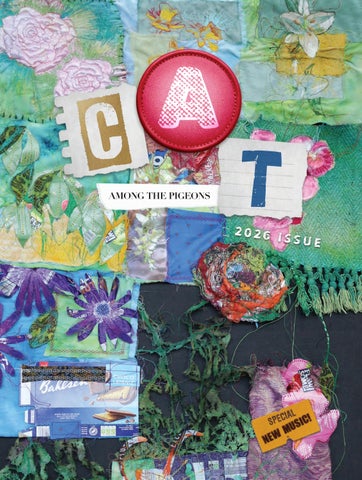
It has been quite a frantic journey to reach the finish line of this year’s CATP magazine, although I can honestly say that I have enjoyed every part of it. I would firstly like to give a huge thank you, as well as congratulations, to everyone whose GCSE and A-Level artwork has been featured in this edition. The talent, skill and innovation on display this year has been incredible, and it was genuinely a joy to find visual pairings between each piece and its written counterpart. I hope you, as readers, find that the artwork does not simply sit beside the written work but instead develops and compliments it both thematically and visually. I would also like to highlight the outstanding photography of Second Year Benji Cook. It has been lovely to see such dedication and proficiency from the lower years, and his work is a brilliant example of the creativity this school has to offer. Congratulations on your win. The theme of this magazine, Duality, was initially difficult to translate into one clear visual aesthetic. The team and I explored several possible directions before deciding that the best way to represent duality was not to choose between two opposing styles, but to allow them to exist together. This edition therefore combines the chaos and personality of a scrapbook-inspired, early-2000s aesthetic with the order and precision of a more traditional editorial magazine. Throughout these pages, you will see contrasts between messiness and control, nostalgia and modernity, personal expression and careful curation. My own aim with this year’s edition was to create a memorable magazine that felt distinct from those which came before it, while still celebrating the creativity that CATP has always been built around. That ambition has resulted in this being the first edition to feature a textile piece on its cover, which I think perfectly represents the experimental and collaborative spirit of the magazine as a whole. Finally, a colossal thank you to Jo Ogilvie, the graphic designer who truly made this magazine what it is. I admire the patience that held steadfast through my many notes, edits and endless emails. Now to you, the reader of this year’s edition, I hope you enjoy the contrast between its different styles as much as we enjoyed bringing them together. Most importantly, have fun discovering this edition and happy reading!
Cover image Zosh Harris
or n o h [
Meet us here at midnight, Where our gathering will start. You can bring your ink pen And we’ll bring some broken hearts. Pick up your tristful feelings. We won’t cast them away. They’re part of your identity You can write about them someday.
The Secret Poets Society IZE FO
We are the highest of society And the rejects of the world. The people don’t want to hear Anything! They won’t revere
R
IT WINNER
TH
Aimée Lissaman
2026
E R AT U R E
E PIDGE
N
PR
We pour our hearts onto the sheet. Listen to the keys soft clicks Read it through and press delete. And so we repeat.
L
O
Aimée Lissaman Hannah Kennedy
Here, our friendship is real and deep, We comprehend each other’s truths. Despite that, we still compete. We’re writers! Of course we do.
Our poems so we cry a bit at night, And type our secrets into computers And write them into notebooks Dog-ear pages with ink stained fingers. We sit alone on park benches And keep on thinking, don’t stop dreaming Though sometimes we stop believing— It’s okay. It’s okay. Still we wander through the autumn As the leaves begin to fall And we write and write and write This is catharsis, I am sure. We’ll talk to people from time to time And keep our real words locked inside And think about the irony. We’re either too much or not enough. Oh just give us our typewriters And let us bleed on the pages. Tell each other we’re amazing Because it’s what we need to hear. We are the Society of the Unsaid, The Department of the Damaged, A Fellowship of the Forgotten. Welcome to The Secret Poets Society. We meet on Mondays. 3
w
N hE
NIG H T Creative Writing & Poetry Competition 2026 Runner Up
Every night, like clockwork, I hear her screams, her breathless pleas. I wake and see her tossing and turning as beads of sweat form on her brow. When her eyes open, they widen with something akin to fear. She looks at me as though I am something to be afraid of. As though I would hurt her. As though I am not the man she once knew. Stumbling to her feet, she raises her hands in defence. Her skin is torn and shredded for I could not keep her from clawing at it and tearing it like paper. Helplessly, she screams horrible, unspeakable things at me and tears sting the back of my throat as I remember what she was like before. Before she became a prisoner of her own mind. I step towards her, reaching out my arms to comfort her but she recoils as if I’m infectious. Before I realise what’s happening, she bolts for the door- as if intoxicated, she misses the handle a few times before striking true. Without stopping to think, I chase after her. All I know is I can’t let her outside. She wouldn’t last a minute in the bitter, cold night. The last few months have been torture, watching her slowly lose her beautiful, brilliant mind. Since then, some nights, in the midnight hours, I wonder if I should find her help…let her go. Yet in my heart, I know I can’t do that. I need her here, no matter what…A woman in a frenzy, she stumbles down the stairs, staining the 4
banister with her bloodsoaked hands. I reach out my hand to pull her back but it’s too late. She collapses at the foot of the stairs. I hear a painful crack followed by a wretched cry of pain. Tears mingle with the sweat on her face as she whimpers softly like a helpless kitten. Having descended the stairs at lightning speed, I crouch down beside her, wrapping my arms around her shoulders to help prop her up, but she twists herself out of my arms, pushing me away with surprising force as she struggles to stand up. She limps away from me, her wet hair cascading down her back like a waterfall of nightmares. No. I can’t let her leave. If anyone finds her – or hears her mindless, distracted loop of insanity – they will lock her up, experiment on her…She can’t leave me here alone. I need her here. I raise my hand by way of entreaty but, determinedly, she staggers on towards the door. I cry out in a last-ditch attempt to stop her – my voice transforming into a broken wail. It is to no avail. She leaves. The lights flash, then flicker, then falter till I am drowning in a sea of darkness. The world stops for a moment. I have to find her. If only I knew, what was happening inside her head…
The ceiling is peeling. The walls are painted with a jarring shade of off-white, spotted with familiar bloodstains. The light is menacing, condemning me with its familiar ice-cold glow. No, no, no. I can’t be back, I can’t, I’m not. I can’t be. It’s only a nightmare. It’s only… My eyes open, and there he is, leaning over me, polluting the air with his rancid breath. Heart beating out of my chest, I jump to my feet. I begin to feel nauseous; my splitting headache starts to worsen. I sputter angrily, warning him to stay away as I shield myself with my arms, clasping my palm to my forehead. Suddenly, I feel something sticky and warm…I stifle a scream as I watch the crimson colour spread…Not again. No. My limbs feel as if they’re made of lead and I trudge towards the door, trying to ignore the ruthless jeers coming from behind me. It’s hard to breathe. It wasn’t always this difficult. Was it? Heat and redness flood my face, as I halt dangerously on the precipice of the staircase. I gulp in fear. I’m too close to lose out now. I can hear his panicked footsteps getting louder and louder. It’s now or never. Hurriedly, I shuffle down the stairs, my freedom so close I can smell it. Staining the banister with my blood-kissed hands, I grip tight, anchoring myself to reality. For a moment, I feel nothing but pure ecstasy, the giddiness of my hope-filled future filling me. That’s when I feel a cold, hard hand on my shoulder that turns my blood to ice… Without mercy, he shoves me. Hard. For a moment, I
think I am safe but then I lose my balance and topple to the ground as if in slow motion. The pain doesn’t register for a moment. I lie on the floor motionless for one second of torturous numbness till the pain floods in with the strength of a tsunami… No. No. Hovering possessively over me, he smirks at me, reducing me to no more than a small child. His wolfish eyes shine bright with sadistic glee at the sight of my tormented suffering. Greedily, he reaches out his hands as if he expects me to go to him and succumb to his mindless, mechanical torture. I can’t let him win. No. Not now. Summoning all of my pent-up rage, I knee him in the stomach with my good leg and spit in his face. Shakily, I climb to my feet. Determinedly, I limp towards the door, his foul-mouthed cursing growing more and more distant as I come closer and closer to freedom. Finally, I twist the knob on the door and step out, breathing in the fresh night air. The cold kisses my skin like a warm, welcoming blanket. Even the feeling of the sharpness of the pavement cutting into my bare feet is a welcome sensation. Freedom. For now. I know it is not long till I am back there again…Till he finds me again. I just wish I knew what was happening in his head… 5
grace taken
Such a turn of affairs! For, once upon a time, he was the king of the sixty-four squares. The boy of grey hairs, now way past his prime. Such a turn of affairs!
Into the distance he stares, for once, in moments sublime, he was the king of the sixty-four squares. Despite all his prayers, never again will he climb. Such a turn of affairs! Wounded beyond repairs, church bells do chime. He was the king of the sixty-four squares. Down the boards he tears, till his mere presence a crime. Such a turn of affairs! He once was the king of all sixty-four squares.
not
this is a poem Anon Lucy Amsel
This is not a poem, It is a book unread, A step un-taken And a sentence not said. This is not a poem, It is a bed un-made, A path not walked And a game unplayed.
Joseph Nebel Bonnie Elliott-Shorey 6
This is not a poem, But mere thoughts on a page, I kind of enjoy them, Though they took an age. They are still not a poem.
Pearl Gulihar Sophie Wang She looked so flawless, So alluring and bright. Her figure was slim; She shone in the night. Her lighting was perfect, Blemishes? None. But something was wrong; She seemed inside, undone. Her eyes held no light, And vaguely was seen, A man in a hood His hands stiff and unclean. She shifts with discomfort, Helpless as can be, But she covers it well; Only the insightful could see, Her cautious movements, Mistaken for grace, Her secondhand clothes, Mistaken for lace. Inside, she is gone, She desires to be free. From this we can learn, Things are not always what they seem.
H
O
US
E POET
R
Y
INTERS WINNER
Pearl Gulihar B E YO N D T H E CAMERA
2026
7
he got his stardust but losthailsl soul FINDING Lana Carter lyrics & music Aimée Lissaman
Story about a king that started with no crown That nobody loved He looked around And found himself alone Too many times So he started wishing Started looking for a sign
gold
And the stars were They were higher than him All he wanted was to be one but they wouldn’t let him in So he built a ladder just to reach the council of the stars Got his verdict and they said that he could go far But only if he agreed to one simple term Chorus Everything he touched Turned into gold He got his stardust but lost all his soul Couldn’t touch no one He had a new goal He could only roll over the gold That he holds Gold
8
And the people they all praised him Praise him like the sun (did) Just want to be close But they can’t touch him Gold Gold became worthless No one needed it anymore Couldn’t relate to his touch And the gold and he needed it more
Everything he touched Turned into gold He got his stardust but lost all his soul Couldn’t touch no one He had a new goal He could only roll over the gold That he holds Dust is Gold
Went back to the stars and they laughed You chose this You chose this You chose And the people that had loved him Called him a disgrace You chose this You chose this You chose
Everything he touched Turned into gold He got his stardust but lost all his soul Couldn’t touch no one He had a new gold He could only roll over the gold That he holds
couldn’t tnoouochne
Repeat And he cried To the stars “you lied” And then tears fell from his face Gold simply took their place
Scan to hear Finding Gold and more tracks by Lana Tupwood on Spotify:
They say poetry is boring, By god – I disagree! The poets I have met and read Steeped in eccentricity,
H
O
US
E POET
A star to them is not just a star, A word not just a word, A blank page just a soul waiting, Longing to be heard.
R
To them each day is not a number, They count not down to death. Their words used to electrify, Each line gives them new breath.
Y
SENIOR WINNER
Lucy Amsel
I wish I could be one of them, Not boring – words untouched. But my mind I find infested, For I have read too much
UNORIGINAL
2026
Lucy Amsel
Zosh Harris 9
but y r a e w l l i st I bleat
me answer nce; ar me – hed sile ind, Lord he ur wretc aming m s sit in yo my scre givenes Do not ry heart, rs of for e and e my wea t whispe e and fir k o driven m Console m s ul; silen e k li rs have a ering so prayer. le lungs d my te And shiv wer nor d my sta leads an s no ans e air an nd my p in need Break th y cries a trinsic s desire. M lie and in burning y I bleat retched as wear ce. My w d knees To silen ands an nd on h So I sta
Lord hear me – forgive me My petulance and my arrogance. For I am nothing if not yours to comm and For I am nothing if not your slave to lie and cheat For I am nothing if you are not the Shepard and I am not the sheep But still weary I bleat. But still weary I kick and I scream and I cry and I fight Against this cage: not a cage but a sky; more lack of a cage, you have given me rage, but still weary I bleat
Lord hear me – save me will means nothing if I will Not be a servant to your sick whims And that moment the light further dims Until I am thrust into a hungry, drooling darkness That covers me like a sheet, like the laugh of a fallen grace My eyes cannot see and my heart cannot beat and my lungs cannot breathe But still weary I bleat
speak Lord hear me – let me d kick and scream I will rage and fight an n’s weep sheep nor a blind ma I am not a bird nor a urs; but mine alone ner nor a saint nor yo nd Nor a slave nor a sin and your loud comma ce aks your empty silen ur own But my cry alone bre sky which you call yo pierces the great blue y and the unheard But my scream alone an with rage and fur charge your great oce I cough But my sin alone will u can choke me until Yo . ak sinners, so let me spe ll stop Prayers of a hundred hit me till my heart wi d till my lungs burst, an Up blood, and kick me ke a move or sound ma e bone that dared to And break every fragil ll weary I bleat. but I am yours; but sti Until it beats no more;
But a Shepard answers his sheep So as hard as I fight My cries are futile So weary I bleat.
10
Lyla Beukes Duncan McMillan
11
L A IC
MOLOG TO EN
L
N
RO
YA
12
2025
IO
y sister unea rthed this st range lookin on holiday g creature w in France. S hen she was he called m its abdomen e over and w building sa and retreate ndcastles e w at ched with cu d backwards fearsome ja riosity as it into the san ws outstret vibrated d , ch le ed av ing just its . I got down directly dow head protru low on my h n the creatu ding, an re d ’s s burrow and and knees, backwards pointed the snapped a co and disapp ea camera u re p d le into the san of shots bef They dig cr d. This is an aters in the ore it scuttle sa A d n n d tl ion larvae (S and lie in w ready to am ait at the bot ynclisis baet bush their u to ic n su m a). specting pre of the pit, p action with erfectly cam y. When an lightning sp unlucky an ou eed, seizing fl aged, t falls in, th their prey w ey spring in ith ferociou to s jaws.
Benji Cook IT
PHY
T
About m y winnin g photo M
OTOGRA
UNDER 18 WINNER
PE
This was th e first photo graphy competition I’ve ever en tered, so to be announc ed as the ov e rall winner for the und er 18 catego ry in such a prestigious competition is honour. Th is year’s com a huge petition drew over 3 ,000 entrie s from insect photograph ers around the world, the largest number eve r received by the Socie ty, with pho tographs taken in mo re than 110 different co untries.
T
PHY COM
ACRO PH
TY’S P HO
RA
T OF M
CIE
G
THE AR
SO
O
, A Bug s Life
Royalty H idden ED strip OMMEND ntly lifted a HIGHLY C woods, I ge l ca at lo y ok m lo g rin closer Whilst explo log to take a en ll rface. fa su a s it k from that etched s rn of loose bar te at p uties e woodworm sleeping bea the intricat these three r ve in a co is en d d ed to lying hid I was amaz la Vulgaris) u ds p es ea V b s, g, p as llen lo (Common W e bark of a fa th e th es ea th t en b ec ice I susp narrow crev still bodies. r r ei te th in on w g ld nin t the co of dew gliste y waiting ou ring. tl ie sp u e q th s, n in uee ew nests n d il are future q u b to g ore emergin months bef
J ewels housand T a f o Ey es ED OMMEND unning eyes HIGHLY C deer fly’s st a h p ra og to phot they ’re I’ve wanted macro, but d shooting te ar st whilst on I g ce ever sin ly mornin il ch e n O . skittish this bloodusually too y and found ck lu t go I , enough rance holiday in F branch, calm a on g in st r fly uty re Splayed Dee sucking bea eyes of this e h a T . – p le u ib ely incred for a clos ens) are tru ti d u ec an a e C ir s h p p (Chryso ald, sap aic of emer os m g at in th is es mesmer darker patch uated with the eye. of e ac gold, punct rf ross the su ac ce an d seem to
H ow
? ography t o h p o uts it into r ac m lens often p a o er m t ca t in g t protrudin ens the ligh did I ge subject, the r which soft
se the t, taking young a flash diffu , so I have ial equipmen since a very ow ec s ad sp ct sh is se th in h st in res in size ven wit for bugs keen intere w millimet the flash. E fe ide hunting a ts om ly ou fr on m I’ve had a g I’ hen methin iniature atience and happiest w raphs of so credible m es a lot of p og in ir u ot t q h os p re m d age and am e an d th e plane of lenging seem to fin nification, th tremely chal ag ex m is of – I always l ve ! e smallest At this le herever I go eans even th m severance. h er p ic h creatures w w l, to one can put the ely smal s is extrem about each shaky hand a cu g fo in or ch ct ar se or se cle. F from the in ly enjoy re at and lifecy movement I also real to their habit p t u ou y rr ab ca e out of focus. mor ts can whole shot understand y at black an il th ar in ow my macro n rd k ao u id yo d error in have an extr an l ey ia th example, d tr y as t lot of otos which tal bod n body weigh to their to a lot of ph e’s been a d er ve h ti an T la r t, re 50x their ow fa e id u so tiss Or, d it just righ urney of muscle lifting a car! ography jo en you get h ot an w h p t m u e u high ratio B h at . d a ic ly te ke loca terrib ny intr would be li ring organs turned out , revealing ti ea e le h av ib r h ei ed e mass? That th cr th s e in e hav e, lik vibration n be truly at crickets e naked ey th the slightest e results ca t to th ec e le you know th et th b d si n or ca d eye are invi ees so they s compoun ails which effectively? y’ et fl e d n or go in their kn m ra d d n ou facets of a from the gr tle. individual and sounds y on a stag bee m t en m u oc moustache d ge to an le or ab le e litt ng wanted to b t there waiti tempting to bit older, I re world ou lt task of at tu cu ia iffi Now I’m a in ow d , m sl e , ew al th they fl garden ole magic so I started era before out in your There’s a wh many finds, res on cam the time you’re tu r t fo ea ex n cr s n y so le n ti e macro to be found . capture thes . I have a it! a closer look , h magnifies ic uttled away h sc w h s or n n and take le d t le ow n d r -o ip craw cl I o a m tr proble also an ex more. One it s w , camera and e e to phing even os ra cl og ry ot m h ve p t m u ge the things I’ at, when yo rust T first was th at d re te n u 13 enco
No doubt, you’re lying in bed as of now, Slowly getting ready to close your eyes. I shall not be falling asleep tonight, Instead, I’ll look up to see empty skies. I like to believe you’re watching over me. I cling onto your hope, I know whereof. While I fear, I sit here unremembered, Fear cannot shake my aching love. Best not disturb you, even if it hurts. I think of you all day – from dusk till dawn. If I survive, I won’t bother coming back, As I know by then you will have moved on.
While now my regards to you are bitter, I’ve come to realise my lonely truth. ‘Loving’ days together, I reconsider, Were solely blinded by my delusional youth.
gg ing Ta rit on n An tive Wetiti p rea om p s P C ry C er U ard T t w A n e d n C Po Ru tte E & o arl Ch
14
The problem was never your gentle soul, Nor the tenderness of your kindly heart. The issue was that it was washed away, All forgotten when we were forced to part. Memories of us with linked arms and smiles, All accompany my bitter-sweet tears. The thought that you might have forgotten me Has always been one of my greatest fears.
Libby Casley Mimi Cliff
Stillness settles deep within the soul Inner peace begins to take control Leaving all the restless noise behind Easing every burden of the mind. Newfound happiness begins to grow Calmness starts its steady, quiet flow Embracing all the truths we need to know. In the hush, the spirit finds its rest; Sorrow fades when quietude is guest. Hearts recover at a gentle pace Every breath provides a saving grace Hush that mends what words could never reach Echoes of the lessons it can teach Aching thoughts are finally set free Living in a state of harmony. In the void, the broken pieces mend No more frantic battles to defend Gentle quiet is the truest friend. 15
TS CO M
P
WINNER
Wilbur Woods-Scawen
TION
C AT P
TI
F
I
AR
E
N
E
2026
n McGaha Anders cawen -S s Wood Wilbur
a
G N I S S E L B in 16
A CURSE
S
GUISE
I sat in the choking darkness to which I had been banished, replaying all of the catastrophic mistakes that led to this apathy. I was alone, confined to my troubled, painful conscience. My head leaned against the bitterly cold stones of the wall that felt like a barrier of my frozen and timeless regrets.
this suffering.’ The paradise I had been longing for for so long, could it be death? The tranquility and peace, can it only be achieved through death? The room seemed to grow strangely brighter once more, as my finger tightened around the trigger. My hand trembled as I brought the barrel to my temple.
I clenched my eyes shut, as if that would provide some escape from this hellhole. As if I were dreaming, or some immaterial being that could seep through the impenetrable walls. Wishful as I was, all that came was the return of the piercing pangs of reality and the loathsome flashback of how I came to be here.
Then, something caught my eye: a speck of light in the centre of my vision. It was as miniature as a grain of sand, yet unmistakable in its presence. However, the strangest thing about it was that it was growing. It went from a feeble, faintly shimmering fleck to a grand, spangled, radiant light that covered a substantial portion of my vision. It took a solid shape as an arch, illuminating the damp, dismal dungeon I was in.
It was a normal day, and I was on my daily commute. I was hypersensitive to the overwhelming chaos of life: the near-suffocating fumes of factories and cars; the towering, soulless concrete buildings; the jarring cacophony of traffic and the self-absorbed pedestrians mercilessly shoving their way past me. It felt like I was playing a game of survival against life itself, and I was tired of the struggle. “I wish I was somewhere peaceful and free of this suffering.” I repeated my wish over and over in my mind; it acted as a sort of haven, away from the relentless cruelty of the world. I then started to feel faint. My vision blurred. My strength wavered. I collapsed. I opened my eyes: that was my most recent memory before I woke up here. The room now seemed to grow minutely brighter, allowing me to make out a relatively small metallic object in front of me. I held it, feeling its cool weight in my hands. I slowly brought it closer to my eyes and immediately felt a shock rattle me to my core. All the blood drained from my face, and it felt as if a hand had iron-gripped my heart and slammed it down against my ribcage. It was a gun. Amidst the debilitating fear and sadness, a new emotion arose: confusion. Now I knew that there had to be a reason for me being here. Why would an object with so much purpose be here otherwise? What was I supposed to do with the gun? The room seemed to grow brighter once more. I met my own eyes in the reflection on the metal, and then it came to me. My wish: ‘I wish I was somewhere peaceful and free of
Then, to my sheer astonishment, the walls of the room seemed to cave in, morphing and shifting into a new form of a tunnel, with an incandescent arch at the far end. I turned my gaze to the curved sides of the tunnel and was met with the mesmerising sight of the materialisation of goldframed paintings that lined the walls. The paintings were beautiful, thought and care poured into every stroke, but there was an aspect of them that caused a profound mix of emotions within me. They depicted moments from my life. The closest was of my first step, my ecstatic parents celebrating in the background and me, with such unbridled joy, proudly standing in the foreground. I started to walk, hearing my footsteps echo like the past. Tears welled in my eyes as I relived my life: my first day of school; earning my driver’s license; my graduation; my first day of work; moving into my first home, and then they abruptly stopped. Tears were now streaming down my cheeks like rivers of sorrow, nostalgia, and melancholy as I met the brilliant beacon that guided me here. I felt enlightened, as now I realised that the peace I was so longing for wasn’t a place, it was within. Imperfection is natural, imbedded into life at every stage, and the realisation of that allows us to ignore it, and focus on the perfection of life. Somewhere deep in my subconscious, I heard the metallic clatter of a gun dropping onto stone, as I stepped into the light, feeling the sun’s rays swaddle me and paint a warm smile on my face. 17
,s L L e H ardeN G F o n e d E Kavish Chavda Junior Creative Writing Competition Runner Up Mimi Cliff You arrive the way most arrivals happen: without warning, without interruption and without consequence. The path does not resist you, it doesn’t interrupt what it deems it shouldn’t. Stones lie where stones should lie, bricks lay where bricks lay, leaves hang where leaves hang yet – you stand where you shouldn’t stand. The opening is already opened and that opening has already closed. We recognise you. Your solemn character, your sweet personality – your devilish nature. You stumble at the threshold, our warning to you that you may not return. We etch the words: ‘Proceed with care’ onto your burning forehead with the drizzle of leaves varnished with sap. We have already extracted your name – benignly – from the hidden depths of your cerebral cortex. However, that string of letters means nothing to us, nothing does. That is except your soul – it was different, swollen with a darkness that was still learning how to breathe; it already carried the devil’s 18
mark. We say to ourselves “You’re a good one,” so we allow you into our home, where your soul belongs – hell. You step inside, with the stupidest thought: you believe you are the one entering – that you are the controlling force that has conducted your legs into moving – mistake one. The darkness fades to you – leaving the pale blue sky. However, that darkness burns the horizon a devilish purple to us – hiding in plain sight. Light moves ahead of you, arranging itself across broken arches and roughened corners. It behaves as rehearsed. Vines lean towards you, trying to catch even a sniff of the devil that marks the evilness within your soul, but doesn’t reach far enough, for it is not desperate – in due course you will fall right into our clutches. We make no effort to welcome you. You are already accounted for – number nine-hundred and ninety-nine.
3 Years Later: One day you arrived, loud and extroverted – three years later you are back, quiet and selfish – mistake two. Footsteps mattered back then, when you first came. Every movement tipped the scales in our favour until, we broke it – we took over: we whispered, you listened; we waited, you returned. So what, if the shadow that follows you wears a different face? Who is controlling who? You walk this garden again, slowly, stopping at every object, as if analysing Mother Nature’s work and trying to find any discrepancies between our reality and yours – mistake three. First ‘you’ come by the walls. Once, they were taught to stand upright here, embrace themselves and reveal their true intimidating nature. And they did, scaring those who were deemed weak away and confronting those who had the guts to face the titanium strength of Mother Nature. It did well for a time, goading the devilish souls towards the garden, questioning their worth and bringing a few lucky souls home. Yet, those days are long gone, the wall’s spine is now eroded to sand, as it stares – hunchbacked – at the onlookers. ‘You’ run your fingers across stone, stone which secured the wall’s strength. You felt between the cracks as if trying to feel your way towards the other souls. You stop dead, listening, as if checking for a pulse – mistake four. In this garden of mine, wanting it is enough: if it is a pulse you crave. Then it will come: the souls then beat in symphony, all nine – hundred and ninety-eight of them at our command. The trees of good and evil hear it, the red bricks of Oz hear it, the vines of the Lesser Key of Solomon hear it. But you do not.
‘You’ then return to the walls, and climb. The stone steps crush under your destructive self. You believe they are offering themselves in the order you require, jutting out of the wall like the stairway to heaven – bowing down to your slavery – mistake five. Somewhere behind you, a shadow adjusts. You think it’s yours, how selfish – mistake six. At the top, you sit, like a queen on your throne, ruling over your subjects below. The wind has bent nature’s neck forward – bowing down. We are trolling you: making you believe are in control your own destiny – mistake seven. From here you can see most of us at once: the vines armouring itself with spikes, the bricks ready to fire like arrows, the walls ready to stand tall again and intimidate one final time. We are ready, and have waited long enough to make our final attack. You take out nothing, as you rule above us all. But leave it all behind. Dropping all your rubbish onto hell’s turf, as if a bin – unacceptable, the final mistake. “That’s it,” – I said, the last straw, “Finish her!” We then spoke to you for the first and last time: “You believed you were watching us. You always were. But we were the ones living.” “Take her soul,” I said, “Feast on this one, she will never return.”
‘You’ then move to the plants, who learned from the wall’s failures. They do not announce their intentions, only speaking when the wind dictates for it to. They grow where growth is possible and do not grieve where grief is not needed, they know their power and that a soul is close to their reach; they are nearing to a feast – they contain themselves. ‘You’ then move to a window, a window that no longer divides anything. The glass is like fragments of a broken knife blade, sharp but useless. The window frame remains out of habit, now a bridge between earth and hell. It is a window for nature to observe from but not interfere with. It keeps the sky from falling all at once.
“That’s it,” – I said, the last straw, “Finish her!” 19
Marusia Ene
DOUBLE philosophical statement about the self: identity is never Art, at its core, is humanity’s most enduring form of thought fixed but evolves through cycles of death and renewal. made visible. It’s the language through which the human His precision and hyperreal technique blurs the line mind reaches into its own depths, exploring thought, between dream and consciousness because it compels us emotion, and imagination. I believe true art carries to question not only what we see but how we see it. meaning: it provokes reflection and challenges perception in a changing world. In this sense, art and philosophy are This painting is unique in many ways. But one thing that inseparable because both are attempts to understand the truly fascinates me about it is how it seemingly bridges two world and our place within it. Each brushstroke becomes opposing worlds: the classical harmony of Greek and a statement about truth and reality. Throughout Latin mythology and the emerging scientific history, the artworks that endure the most vision of psychoanalysis. are those that speak beyond their surface, that demand contemplation rather than This confrontation with the self consumption. This resonates profoundly in the modern confrontation world. In an age dominated by social It is through this lens that I approach with the self media and curated identities, we Salvador Dalí’s ‘Metamorphosis resonates live under the constant scrutiny of of Narcissus.’ Dali was not just a profoundly in how we are perceived. I feel that the painter; he was a philosopher of the the modern painting also raises urgent questions subconscious. His works capture world. about authenticity and self-obsession, the fine tension between reality and where the boundaries between inner illusion – ideas that have preoccupied reality and our outward image become philosophers from Plato to Freud. In blurred. We are constantly being pushed ‘Metamorphosis of Narcissus,’ Dalí transforms towards a Narcissus-like state, where we’re encouraged an ancient myth into a meditation on self-obsession and to perfect, edit, and perform ourselves until the image transformation. Beneath its surreal imagery lies a deeply becomes more real than the person behind it. How much philosophical question: can the true self ever be known, or of who we are is shaped by our own gaze, and how much are we trapped, like Narcissus, within our own reflections? by the reflection offered by others? Just as Narcissus became trapped in his mirror image, we have to consider Painted in 1937, during the height of his engagement whether our fixation with the way we present ourselves with Freudian psychoanalysis, the work functions as both distances us from genuine understanding and meaningful image and mirror. On one side of the painting, Narcissus connection. Dalí invites us to recognise the moment when gazes into his reflection whilst being lost in the illusion of self-reflection turns into self-deception, and whether, his own beauty. On the other side, his body is transfigured like Narcissus, we too are in danger of drowning in our into a stone hand clutching an egg from which the flower own image. grows. This duality of decay and birth becomes Dalí’s 20
Dalí’s experiments with stereoscopy, the merging of two slightly different images into one three-dimensional vision, reflect his desire to make metamorphosis an embodied experience. Just as Freud taught that perception is shaped by unconscious distortion, Dalí shows the viewer that vision itself is never neutral. When we look at ‘Metamorphosis of Narcissus,’ we do not simply observe the painting but rather we become forced to participate in it. The act of looking becomes an act of creation, a dialogue between logic and dream, philosophy and art, consciousness, and the subconscious. Through this, Dalí achieves what I believe many philosophers strive for: he reveals the mind’s capacity to turn perception into revelation. Throughout time, the figure of Narcissus has captivated artists as a symbol of beauty, reflection, and the peril of self-obsession. In early classical representations, such as the Roman frescoes from Pompeii, Narcissus is depicted as a graceful, young figure gazing tenderly into still water.
Dalí’s version shatters this tradition. Rather than portraying Narcissus as an object of beauty, Dalí turns the myth inward, reconstructing it through the fractured logic of the subconscious. He replaces the moral allegory with psychological philosophy. This fusion of surrealism with Freud’s psychoanalysis suggests that desire, beauty, and identity are constructs of perception. Once again, I truly believe this idea is more important than ever in the society we live in. At some point, once we stare long enough at the painting, I think it is no longer the image of Narcissus that we see but that of our own. In reflecting on ‘Metamorphosis of Narcissus,’ we see that he challenges the viewer to confront the complexities of the self and the mechanism through which we construct reality. Through engaging with the work, we experience transformation in our own understanding that allows us to question the boundaries between conscious thought and the unseen forces that shape it.
Salvador Dalí’s ‘The Metamorphosis of Narcissus’ (1937) These images embody idealised physical perfection and divine symmetry. They celebrate form and proportion, capturing a moment of serene contemplation rather than psychological complexity. By the Renaissance period, artists like Caravaggio redefined the myth through a moral and spiritual lens. In his Narcissus, his reflection is illuminated by chiaroscuro light that transforms vanity into tragedy. Caravaggio’s ‘Narcissus’ is suspended in an eternal loop of desire and futility, a comment on human frailty.
Dalí reminds us that art is not a static reflection of the world. It’s an invitation to think deeply and to perceive beyond the surface. It’s a testament to the power of art to reveal, to challenge, and ultimately to transform. In a world constantly mediated and curated, Dalí’s vision challenges us to ask what it means to truly know ourselves. Are we defined by what we see, or by what we fail to see within our own consciousness? Ultimately, his painting reminds us that art is not just a mirror of the world but a lens through which we examine the deepest layers of thought and emotion. 21
berg annen Finn K Venville ne Jasmi
I don’t deserve to be with a girl this perfect. When I stand beside her, her light spills into the room and I’m left counting the cracks in myself, the overthinking, the impossible dreams, the quiet absence of confidence. She is stunning, the kind of beauty that rearranges air, that turns heads without trying, that shines even when she is still. And somehow she chose me. I am the luckiest man alive, yet luck feels unreal when you’ve lived believing you were meant to be alone. I carry a strange disbelief, like I’ve wandered into a life that doesn’t quite belong to me, like I’m always one step away from where I’m meant to stand. Last year, loneliness felt permanent. Forever had my name carved into it. And still, I asked a stunning girl out, half-expecting silence, fully expecting no. She said yes. 22
Now here I am, unprepared for happiness, two months deep and falling hard. I feel it growing, the way she speaks my name to her friends, the kindness in her voice when she mentions me, the way affection is learning my shape. One day, I’ll find the courage to express this, Until then, I hold them quietly, like something sacred, like proof that I am here, that this is real, that love can find you even when you don’t believe you deserve it. Gosh. I love this girl so much.
TO TR
SL
N FOREI
N
G
A
N
G UAGE
AT I O N
WINNER
Rosa Hale
D
ER
PR
JE ME TOURNE
E
E
Rosa Hale Estée Norman
Z
2026
I
M E
N LA
RN U
E
M
O
J
Toutes les nuits, je me tourne dans mon lit. J’espère une vie meilleure qui reste loin de mes mains. Est-ce que je pourrais faire ce que je voudrais faire dans le futur? Je ne pense pas, mais ils me disent que je peux. Toutes les nuits, je me tourne dans mon lit. Je repense à ma vie d’avant avec des personnes que je ne peux plus voir. Je me dis qu’elles sont partis, mais mon cœur ne le comprend pas. Je me dis que c'est trop difficile de les oublier, et voilà! Mon cœur est d’accord. Pourquoi? Every night, I toss and turn in my bed. I hope for a better life that stays out of reach. Could I do what I would like to do in the future? I don’t think so, but they tell me that I can. Every night, I toss and turn in my bed. I think back over my life before, with people who I can’t see anymore. I tell myself that they are gone, but my heart doesn’t understand. I tell myself that it’s too difficult to forget them, and voilà! My heart accepts it. Why? 23
GCSE Fine Art
Lucy Amsel
Angus Hawken 24
Eloise Matthews
Selina Wang
Myla Toone
Amelie Dawson 25
A Level Fashion Textiles
Lana Carter
Lola Manvatkar
Sophia-Grace Eels 26
Olivia Johnson
Ruby Shipsey
Eva Green 27
Sovereign Arts
These artworks were shortlisted for the Sovereign Art Foundation Students Prize London 2025. This is an annual competition that showcases artworks by talented secondary school students (ages 11-18). These artworks were exhibited at the international auction house Phillips at their London headquarters.
Eugenie Chiu Honor Akele
Kit Dowdy 28
GCSE Fashion Textiles
Meera Viralkumar
Holly Dixon-Box
Sophia Ratnarajan
Lily Webster
Bonnie Black 29
Lyla Beukes Olivia Johnson
A BATTLE En OF LOVE VERLIES
tur n he re
Inside me When the thunder rolls I can’t stop I weep For an unknown power That rages inside me I look in the mirror An ocean inside of me Crashing on the shore I collapse into myself Something takes over me I urge myself Don’t give in The sun shines in the end So l give a smile knowing The storm decimates it all
Kan ek stop Terwyl my tong verwelk As my hart klop in my bors Ek huil In n onbekend taal Wat my versmoor En ek voel Kwaad soos n brander Stil soos n fluister Vreesbevange dat Ek is nie myself Ek sê Moenie hoop verloor nie Die storm is amper oor Ek is die storm Aan die einde
NG
UAGE P
O
枯草冷风啸 山间远灯照 心中自有美 荒野无人扰
L
A
E
IO
N
M
OREI
N F
D
安游寒山
ER
(董海瑞的唐代风格五言绝句)
T
2026
TI
P E A C E F U L LY WA N D E R I N G T H E HARSH WINTER M O U N TA I N S
OMPE
Harry Elston
Y C
GN
TR WINNER
O
Original Chinese Harry Elston Angus Hawken English Translation
(A Tang dynasty style 5-character quatrain) Harry Elston Angus Hawken The frigid wind roars through withered grass Deep among the hills, a distant light flickers Yet my heart holds a beauty of its own The wilderness can do no harm
tur n he re
A Level Fine Art
Estée Norman
Zosh Harris
33
A Level Photography
Anastasiia Mironenkova
Isabelle Chambers
Coral McGarvie 32
Art Scholars D
ER NA
TI
O AL
WINNER
IO
N
2026
YO
U Bethany Cheung Japan Society Competition Global Runner up
Benji Cook Ootiboo Global Spring Craft Competition Winner 35
Sara Kamal Japan Society illustrated Haiku Competition Global Runner Up
T
N
TI
G
Anja Van Damme
COMPE
FA S H I O N
GN
N
E
SI
House Art
Amelia-Grace Davis Juniors Winner
Anja Van Damme Inters Winner
Anastasiia Mironenkova Seniors Winner 34
He despised school; he wasn’t smart or sporty, and most lessons were spent watching the clock drag its hands across the face as if it resented moving at all. When it finally struck twelve, Evan bolted from the classroom. Lunch offered no comfort. His vile plate of mush lurched on the tray like mouldy jelly, reeking faintly of eggs and vinegar. He loathed lunchtime most of all: it was the hour where everyone could see how isolated he was, how no one ever slid into the seat beside him. He wished he could make friends, but his shyness always rose up like a wall he couldn’t climb. The final lessons crawled by, each minute longer than the last, and when the clock hit four, he sprang from his chair and careered home like an uncontrollable train; he was so desperate to escape the day. Home wasn’t much kinder. The hallway greeted him with its usual dimness, the air stale and unmoving. He dropped his bag and slumped onto the sinking sofa, listening to the distant grating of traffic blaring outside. But somewhere deep inside Evan, a quiet ache flickered, the sense that there was another version of him out there, living a life that didn’t feel so heavy. But the thought slipped away. He felt his heart sink at the feeling that tomorrow would be exactly the same. Then, suddenly, everything went black. Evan woke feeling amazing, quiet birdsong whistling through the window like feathered harmonies. He crunched into an apple and dashed off to school; Thursdays were his favourite day! He galloped down 37
H T
E
Evan woke uneasily, and harsh city lights blared through his window as the aroma of burnt toast crept under the door. He stared at his unsavoury bowl of porridge — which seemed to grimace back at him, and, after scrutinising it, picked at the inedible breakfast sluggishly; he dreaded the thought of school. He trudged along the pavement, stepping in puddles and tripping as he went. When he finally arrived, no one coalesced around him, no one even said hi. He wished he could live in a world where he was liked and life was easy.
Y O W B I
Then, suddenly, everything went black.
Elliot Wilkinson Hannah Kennedy
T H
Evan woke blissfully, and golden streams smiled through his window as the aroma of bacon and eggs seeped through the crack in his door. He ate his breakfast swiftly; he couldn’t wait for school. Abruptly, an eager knock echoed from the hallway — his best friend Lewis gawped through the window. They walked to school together, chortling and snickering the whole way, jumping over puddles and racing down pavements. When they arrived, teachers and students alike greeted Evan with waves, nods, and high fives. Life was great.
the street grinning the whole way, but as he took a sharp turn he scraped his left arm against a building, and small vermilion drops of blood glistened like rubies in the morning sun. When he arrived, the usual commotion erupted as he entered. The first two lessons flew by, the clock seeming to hurl its hands around in rapid circles.
TW
Then, suddenly, everything went black.
O
MORNIN
Evan woke feeling surprisingly good then, just as quickly, inexplicably bad. Outside, the usual hollering street noise rattled the windows, yet a warm scent drifted through his room: fresh pancakes and strawberries. The scent lasted for a heartbeat before fading into the sad aroma of porridge and burnt toast. He felt that something was off, though he couldn’t quite figure what. He slogged toward school beneath a sky that couldn’t decide whether to brighten or darken. He felt a sharp sting pulse in his left arm; a small scab that was not without a sting, clung to his skin. He frowned — he couldn’t remember ever getting scratched. As he stepped through the school gates, students surged toward him in a sudden wave of welcome…then instantly vanished. The corridor fell still. Something was wrong. Evan could feel it; he felt as if another world was flickering into his own. Then, suddenly, everything went black. Evan woke. At first he felt great, then suddenly terrible; he quickly flickered between the two like butterfly wings flying from a net. The smell of breakfast fitfully changed from orange juice and croissants to muesli and spinach smoothie. Sounds of birdsong and car horns merged. On the walk to school Lewis kept vanishing and puddles randomly disappeared. At school friends appeared and disappeared and appeared and disappeared. Lessons were easy then hard then easy then hard. Evan was terrified; he wanted the mayhem to stop! He ran home, tears rolling down his cheeks, and jumped into where it all began. He closed his eyes then… Suddenly, everything went black. Evan woke, feeling passable. He walked around the room waiting for flickers of another world, but there was nothing; everything seemed to be normal. The smells and sounds didn’t switch and merge. He walked downstairs, ate his cereal, and walked to school where the sun mimicked his smile. At school friends gathered around him, and they all walked to lessons together. Lessons were good but not great. At lunch he wasn’t isolated like a deserted island but he was surrounded by friends, who joked and giggled. After school Evan skipped home. He opened his front door grinning after an amazing day. He hiked up the stairs to his room and climbed into his bed and dreamt… 36
GS
O
Robyn Boampong
ETITI
THE GARDEN B U I LT O N DA R K
O N
N JU
WINNER
MP
IOR CRE A
RITI NG E W C
T
IV
2026
The Garden Built on They called it beautiful—the way she bloomed, how colour learned and kept her name, how petals curved with careful grace around the places sight once came. Applause fell warm like borrowed sun; they praised her growth, mistaking pain.
Beneath the bloom, something ached— a hurt that never learned a sound. Her pain became the fertile soil, useful, quiet, tightly bound. It was easier to let things grow than tear the beauty from the ground.
No one asked what fed the roots beneath, what dark had taught the stems to rise. The flowers came in whispers first, with sugar vows and softened lies. They pressed themselves into her bone and gently covered up her eyes.
They loved the symmetry she wore, the discipline of every part, how nothing broken dared to show, how grace replaced a beating heart. She learned to grow before she healed— a perfect garden built on dark.
Dark Robyn Boampong
39
Aria Maini
Ella Wilson Charlotte Edwards I battle between good and evil, I argue who’s wrong and who’s right, In the dark, I await the sunset, to embrace the morning light. I will smile, laugh and try to be happy, saving little time to be sad, Surround myself with good honest people, keep my distance from people who are bad. I want peace in this world and defend it, the war against humanity must stop. Shall I draft this poem on a desktop or use a faster laptop? Should I use a pencil to write with or choose a branded pen? Shall I take my time at the beginning, or just rush along to the end? I am told to lead by example or should I follow along with the crowd? If I whisper, who will hear me, if I shout won’t I be too loud? I could follow the rules, be compliant or oppose them and just rebel Beyond the skies we search for the heavens, while others are doomed to hell, So many speak ever so falsely, but I speak the undeniable truth. Shall we measure the gap between the elderly and the growing population of youth? I am blessed to possess my freedom, whilst others are in captivity Shall I show a different side to others and be fake or show the real me?
T
Co i
n
w
o
S
S s ame e d i
38
Charlie Atkinson Anastasiia Mironenkova
Every morning, Michael stood in front of the bathroom mirror and waited for the second heartbeat. The first was his own, quick and anxious, a familiar flutter beneath the ribs. The second came later, slower, as if considering whether it was worth the effort to start another day. When it arrived, the glass misted faintly, though the room was warm and dry. “Good morning,” Michael said, because politeness had become a habit of his. The reflection watched him with the same dark eyes, the same narrow scar along the chin. Yet it did not move when he spoke. It only smiled, a restrained and significant curve. Michael lived a life that required symmetry. He worked as a curator in a small museum, repairing cracked ceramics and faded paintings. His job was to restore objects to what they had been, without leaving evidence of his work. Invisible labour, his supervisor called it, and she praised him for it. At lunch he ate the same sandwich every day. At night he walked home the same way, counting the street lamps, never crossing at a different corner. His reflection approved of this. It thrived on order and routine. “You could do more,” it said one evening, finally opting 41
to speak. Its voice sounded like Michael’s, but steadier, smoother, free of the tremor that portrayed his anxiety. “You see what needs fixing. You always have.” Michael washed his hands, watching the water slide down the sink. “I fix what I am asked to fix,” Michael explained. “That is the problem,” his reflection replied instantly. When the reflection first appeared, years ago, Michael thought he was losing his mind. He was nineteen then, standing in his dormitory bathroom after a long night of revising. The reflection leaned closer to the glass than he did, as if the mirror was a window. It looked at him with an affection of sorts. Since then, it had followed him everywhere, on every reflective surface. Store windows, darkened phone screens, the side of a kettle. It never interfered, never took control. It only commented, suggested, waited. Until the day the museum acquired the statue. It arrived in pieces, wrapped in layers of foam and paper. A figure split immaculately down the middle: a man and a woman joined back to back, their faces tranquil and identical. The other curator called it a representation of balance, of opposing forces, but in harmony. Michael felt a strange chilling sensation as he unpacked it, as if he was touching something that recognised him. As he worked to repair the fracture, his reflection grew restless.
“You should not mend that,” it said, its voice sharp now. “It was broken for a reason.” “Everything here is broken,” Michael replied, aligning the fragments with careful hands. “That is why they brought it to us.” The reflection chuckled softly. “Or they brought it to hide what happens when wholeness is forced.”
Michael understood then what the reflection had always been. Not an intruder, not a ghost, but the sum of every choice he had avoided making. Every word not said. Every step not taken. “If you stay,” Michael said, “there will be two of us.” The other smiled, gently this time. “No. There will be one, finally complete.”
That night, Michael dreamed of the statue standing whole and towering, its two faces turning toward him at once. He woke up with the second heartbeat pounding violently in his ears.
The gallery lights flickered. Glass trembled. Michael felt himself washing away, like paint that got wet one too many times. Panic spiked, but beneath it was relief.
The next morning, as he lifted the restored statue into its display case, the glass before him glistened. For the first time, the reflection stepped forward. It did not break the mirror. It passed through it, like a ghost through a wall. Standing in the gallery, it was unquestionably Michael and yet it wasn’t. Where Michael’s shoulders curved inward, the other’s were squared. When Michael flinched, the other moved with confidence. Visitors stared, unsure which man they were meant to see. “This is wrong,” Michael whispered. “You can’t be here.” “I have always been here,” the other said. “You just kept me locked away.” The statue behind them cracked, a thin line racing down its centre.
He reached out. The moment their hands touched, the world stopped spinning. The second heartbeat merged with the first. The reflection dissolved, not into nothing, but into him. When the lights steadied, there was only Michael, standing alone facing the display case. The statue was whole again, its faces calm. From that day on, Michael still woke to a single heartbeat. He still went to work, still repaired what was broken. But sometimes he chose a different sandwich. Sometimes he crossed at a different corner. And when he looked into the mirror, his reflection met his gaze without waiting. 40
The Witch, played by Kate Fleetwood, embodies this moral ambiguity. She exists in a liminal space between protector and destroyer, her actions rooted in maternal loss and betrayal. Her grotesque exterior and volatile power conceal an emotional depth that complicates her role as antagonist. I found her final withdrawal deeply affecting – a moment of punishment, rather than one of disillusionment, echoing Carter’s recurring suggestion that power and suffering are often linked.
From the moment the lights dimmed at the Bridge Theatre, the ordinary world seemed to dissolve, replaced by something far more elusive and enchanted. Into the Woods did not simply retell fairy tales; it reawakened them, breathing life into stories that felt at once ancient and unsettlingly modern. Under the intricate composition of Stephen Sondheim, the narrative entwines Cinderella, Little Red Riding Hood, Jack, Rapunzel, the Baker and his Wife – each driven by longing and lured into the forest by desire. Yet this forest is no passive backdrop, it pulses with unseen dangers. Like the shadowed landscapes of Angela Carter’s The Bloody Chamber (another twist on the Fairy Tale genre) it becomes a symbolic space where innocence is tested and often undone. What begins as a sequence of quests soon fractures into something darker: wishes granted at a cost, and endings that refuse to remain closed.
Visually, the production heightened this sense of dark enchantment. The set was fluid and immersive, transforming the stage into a living, shifting woodland that seemed to close in on the characters as their choices grew more perilous. This mutable space mirrored the psychological landscapes found in Carter’s short stories, where settings often reflect inner turmoil and suppressed desire. Costumes too were striking in their duality; they retained the recognisable silhouettes of traditional fairy tale figures yet were infused with a subtle modernity and distortion. Cinderella’s elegance, for example, felt fragile rather than idealised, while the Witch’s appearance oscillated between decayed and powerful, visually reinforcing her fractured identity. This interplay recalls Carter’s manipulation of familiar imagery, where beauty is often edged with menace. Sondheim’s score wove through it all like a spell – at times playful and deceptively light, then suddenly dissonant and haunting. Ultimately, Into the Woods refuses the comfort of traditional resolution. Like The Bloody Chamber, it exposes the instability beneath fairy tale conventions, suggesting that morality is neither fixed nor simple. Instead, both works leave us wandering – still in the woods, still searching – aware that the most dangerous transformations are not physical, but psychological.
A SPELLBINDING DESCENT
INTO SHADOW Marusia Ene
43
Dichotomy
ss e n d a S of
MJ De Las Casas Darcey Johnson
A knife to the wicked’s fabled art A knife to the soldier’s desperate heart. The Holy Book, the Devil’s lie. The children laugh, the villains cry. He felt the pull of the knife’s dear beckon A hopeless man’s final reckon. Barrelled gun on his head remains. The gasping truth and the wind’s refrain. Forgetting reasons, the trigger warm, One life gone, two more born. Forsaken hand, place yours in mine! Shrivelled lungs, who says they’re fine. Does he remember the distant promise? The darkened rose, the darling kiss? Or had the thought slipped his mind? As did the body you will find. The blame, a swallow’s screech forgotten But we know how thoughts can rotten… Poor man, a shame, but he couldn’t stay. A failed cause, a dying flame, Fallen angel, misbehaved. Goodbye my dear, I’m not the same.
42
WHERE THE MEMORY
Alfred Dunn Coral McGarvie John looked out the window of the train. As he turned back, something stopped him. A distant thought caused him to jolt: not quite a memory more a flicker of a thought that once was, tugging at his mind. He ignored it and stepped off the train at Whyteleafe South.
routine he grew to love. She would make sure everything was in order, have a chat with the carer and would even sometimes bring his grandchildren with her. Anne seemed to have a new lease of life in these visits, engaging and laughing in a way she just couldn’t usually.
After reaching home, he gazed over at his wife Anne. She was lying in her bed, as she always did. After her Alzheimer’s began to worsen, she rarely remained awake for longer than she needed to to eat. John could barely remember the last time he had been able to hold a decent conversation with her. The full-time carer came in with lunch, and he sat in his favourite armchair and began to eat. There it was again, that sharp thought in the back of his head, not strong enough to leave a mark. It began to come back to him, he remembered when he and his daughters had spent the day together on their first family holiday. The feeling of the sun on his skin, the sand on his back, the laughing of… “John?” interrupted the carer – “You’re being rather quiet, is everything alright?”.
John mentioned to Jan about how he remembered the holiday so fondly, the ice cream on the beach, the boat trips and all the other parts of the holiday that had drifted into his mind over the last week, hoping she would be able to remember them as well as he could. “Dad,” she said, with a hint of worry to her voice, “we’ve never been on a family holiday before. You always said they were a waste of money, that we should focus on our schoolwork.”
And just like that, the thought vanished. For the next few days after that, more elements of the thought began to grow, till that flicker of his imagination began to fan into a flame. Yes – he remembered it now – the laughter of his family, the feeling of safety when he was surrounded by the people he loved. It seemed as if the days from that point on went by quicker, as he began to feel more relaxed with his newfound comfort. On Sunday, one of his daughters, Jan, came round for her usual weekly check ins – a part of his
45
Something folded inside of John, and the warm feeling inside of him froze. “You’re wrong,” he said. “I remember it like it was yesterday.” Jan looked frightened. “I think we should go to the doctors.” John resisted but he couldn’t stop it. Four weeks later, he tested positive for Alzheimer’s. There had never been a family holiday, it was just an amalgamation of distant memories – a fragment of his imagination. Before long, he was in care too. He still felt the same joy, had the same feelings and was the same person at the core, but he didn’t have the same energy, the same comprehension of his surroundings, the same sharp mind that got him out of poverty so long ago. But nevertheless, he was still alive.
TURNS 44
The Flaming
Goldfish Laura Caicedo Zoque Junior Creative Writing Competition Runner Up Ebba Miller
Splash, splash went the once-still water. Splash, splash it went as warm ripples swam through it. The small golden fish kept swimming. In an ocean filled with dark blue creatures, its flaming scales stood out the most. He did not know how long he had been swimming nor how long he was planning to swim for but all he knew was that he had to keep going. He was driven by nothing but sheer determination. Wherever he went, he felt it was all the same; forever being watched by hollow, soulless eyes of the zombies from the deep; forever being followed by mindless behemoths who doubled him in size. They were all always the same. That was how they had lived their lives and would ever more. So why was he so different? Why did he glow like the rays of the sun as the diamond droplets flew off his scales while the rest of them only stared. Forevermore. Forevermore… Why were they so stoic? Why were they so bland and empty? He sensed nothing from them, only meaningless thoughts and sounds. They were quiet: silent. Right? Now that he stopped and listened, he could hear their lonely murmurs, united but still always alone. Despite everything, he could hear several different noises, colliding and clashing together all at once. A cacophony: a roar of noise. He swam frantically, the water swishing and swaying and swirling and screaming all around him as his mind clouded with doubt and despair. He felt his scales dull, the light from the fiery gold fading to the plainest of blues as all thought and feeling left his mind. A harsh tail slapped him as he returned to his cruel reality. 47
He took that hit as a gift, yet all was silent once more. As he swam deeper, the smaller fish began to disperse, leaving the massive beasts surrounding him to be his only company. Despite staring at them intently, they never responded or seemed to show any sign of emotion whatsoever. He felt as though he could hear their souls eternally crying, begging for mercy from the painful cycle which they were all condemned to endure. Thus was the
way of life. For many of them, they would continue to wander until they could no more, forever searching for a meaning. A motive to live. Some lived only to love. While some lived only to search. But as the tiny goldfish came soon to realise, forever searching would leave him alone. For his eternity, that is. Thus were all futile actions. Yet he still had his will, his greedy wants and desires would stay there until death. He turned around, the dark mantle of thick water trying to press him down. To force
him to succumb to the pain and exhaustion. But the little fish would never retire in this life. He pushed and pushed and pushed and pushed as he fought and fought and fought against death, unlike all the seas’ broken servants around him. He was still a fish, after all. And he could still remember seeing the light from the sun, after all. And so, while all the others swam against him, he swam towards the clear, sunlit waters he had once known so well…
46
Freddie Porter
The Dystopian Game Stephen King’s dystopian novel, The Long Walk, follows the contestants of a gruelling annual walking contest in which one hundred young men compete to be the last man standing. It marks a turning point in the evolution of the dystopian genre. Written in the late 1960s and published in 1979, it emerges from a period of cultural turbulence shaped by the Vietnam War, the civil rights movement, mass media, and a growing distrust of political authority.
King’s dystopia emerges from within the culture, built not on fear but on participation, marking a shift from political dystopia to cultural dystopia. The late 1960s also saw the rise of the anti-heroic narrative, as traditional stories of American heroism were questioned. The Vietnam War challenged the myth of noble sacrifice; the civil rights movement exposed institutional violence, and television turned suffering into spectacle. The Walk becomes a symbolic performance of national identity, a ritual that transforms violence into entertainment. The boys volunteer to participate in the march, suggesting that dystopian systems can function not through force but through desire and the internalisation of cultural values. The Walk becomes a test of masculinity, patriotism, and endurance, a performance of identity and loyalty to the nation.
Earlier dystopias imagined vast bureaucracies, omnipresent surveillance, and propaganda systems, but King demonstrates that dystopia does not require futuristic technology or elaborate world building. Instead, he constructs a dystopian system out of recognisable American cultural practices: competition, militarism, The Bachman novels allowed and public spectacle. The Walk is King to explore themes aligned not a technological marvel; it is a with dystopian concerns: systemic ritual sustained by cultural belief The Long Walk by Stephen King violence, fatalism, alienation, and and celebrated by the public. the erosion of individuality. Unlike his supernatural fiction, The novel opens with a line that captures this unsettling these works are grounded in social and political realities. normality: “Say the secret word and win a hundred The Long Walk reveals a young writer experimenting with dollars.” It’s a game show phrase used to introduce a ritual dystopian structures at a moment when American culture of death, a juxtaposition that defines the novel’s effect. 49
was questioning its own myths. King’s Bachman identity becomes a vehicle for exploring the darker, more fatalistic side of American culture. In these novels, systems do not break: people do. The Long Walk is emotionally austere, stripped down, almost skeletal. Suffering is ordinary, violence procedural, death unremarkable. “They walked because they had to.” encapsulates the fatalism that defines the Bachman worldview. King’s pseudonym reflects broader cultural anxieties about authenticity and identity, aligning with postmodernism’s questioning of narrative stability. Violence and Vietnam The Vietnam War is a crucial context. It was the first televised war, blurring the boundary between entertainment and violence. The Walk resembles a ritualised form of conscription. Young men are selected, displayed, and sacrificed for the nation, echoing the way American soldiers were sent to Vietnam. Spectators who line the road mirror the American public consuming televised war footage. They cheer, wave flags, and bring their children. Violence becomes normalised, even festive. King is not imagining a future dictatorship; he is diagnosing a present cultural condition. Cold War rhetoric of national strength, endurance, and sacrifice permeates the Walk, which becomes a symbolic performance of these values. “The crowd roared as if they were watching a parade” reveals how easily violence becomes public celebration. This marks a shift toward cultural dystopia, where the threat comes not from an oppressive government but from the values and habits of society itself. The Walk is embraced by tradition, not imposed by tyranny. The rise of youth culture celebrated rebellion and individuality, but King presents a darker vision. The walkers are not rebels; they are participants in a ritual that destroys them. Their individuality is erased, their freedom constrained by rules, penalties, and the constant threat of death.
become interchangeable, defined only by performance. This reflects wartime bureaucracy and the logic of late capitalist competition, where individuals are valued for productivity rather than personhood. Garraty embodies the dystopian subject: someone who internalises the values of the system even as it destroys him. His psychological fragmentation mirrors protagonists in classic dystopias such as ‘1984’, who struggle to maintain identity under oppressive conditions. King shows how erosion of empathy and agency can occur not through surveillance or coercion but through exhaustion, competition, and cultural expectation. “Garraty walked because he could not imagine stopping” reveals how deeply the system has shaped him. Identity becomes relational; the boys define themselves by comparison, their sense of self competitive and unstable. The Major represents a different kind of dystopian authority. He is not an omnipresent dictator but a ceremonial figure whose power is symbolic. The Walk is self sustaining because the culture has normalised it. The boys obey because the rules have become part of their worldview. Michel Foucault argued that modern power operates through discipline, normalisation, and internalisation. Power becomes most effective when individuals police themselves. In The Long Walk, the boys regulate their own pace, monitor each other’s behaviour, and the Major rarely intervenes. This is Foucauldian disciplinary power: a system in which individuals become agents of their own subjugation. “The Major smiled, and the crowd cheered louder” reveals how power becomes symbolic and ritualised. King’s dystopia is about the collapse of moral resistance. The Walk continues because the culture believes in it and because the boys have been shaped to accept it. Foucault argued that modern power produces docile bodies, trained and disciplined to perform specific functions. The Walk produces docile bodies through exhaustion, repetition, and competition. The boys become bodies that walk, bodies that endure, bodies that obey.
Destruction and celebration Dystopian fiction often explores the reduction of individuals to numbers, roles, or functions. In The Long Walk, the walkers are stripped of identity and reduced to competitors in a state sanctioned ritual. They 48
I Re al
AA n e m
o
l
Holly Cooper James Cassidy
?
I have no one by my side And it would be absurd to assume that There are people on this earth who care about me Because when I truly look at others, I stop to really think And then, The doubt creeps in. Am I really alone? And sometimes I think That I will be lonely forever. So don’t try to tell me I’m not on my own. I already know the truth. So, I say I feel invisible. No longer can I say that I am not alone. Reader, now read it again from the bottom.
51
y
L
T
WINNER
Jamal-Deen Malik LOST
I PET TION
TP CREA
C
M
CA
WRITING
O
IV
E
2026
I saw her at school and thought she was fine, Just a face in the crowd, a friend who was mine, But she was drifting, over a ledge, Pushing herself closer and closer to the edge. reached for her hand but she pulled it away, “I’m just a bit tired” was all she would say. I knocked on the glass of her prosaic stare, But the girl I was seeking was no longer there. I looked for a signal, a pulse in the wire, But her circuit was grilled by a slow-burning fire Over the days, she was crashing through doors, Dragging her soul across the cool floors. The laughter we shared became static and noise, As she relinquished her life like a box of old toys, I carried the force of the words I didn’t say, Watching her colour slowly amend to grey. Soon enough, she broke out of her shell, But the girl that I knew was a ghost in a cell. I saw her one day, with cuts all over, She had taken a blade to the shrine of her skin,
Jamal-Deen Malik Zosh Harris Letting the hope out to let the dark in. Jagged canyons and hills of rust, Her spark was crushing itself into dust. One day, I went to her home, Into a silence that shook my bone, The door swung wide on a hinge, Where the air was thick with a sweet singe, I found her there, anchored to a ceiling, A body turned iron, a spirit turned rust. Her neck was a mess where the rope sunk deep, Forcing a nap that no one could sleep. Her eyes were two globes, unblinking and blown, staring at secrets that I would’ve known The tongue was a stranger, jet and thick, While the purple were sprawling in the roots of her hair, The girl was a mannequin, a hollow shell, I wish I could. I really wish I could. But I’m just standing here in a quiet house, holding a phone that she’ll never answer again. It’s over. And I missed it. 50
T
AT I O
N
OOL A
WINNER
Victoria Stefak W H AT G O E S UNSAID
Y PRIZ
E
S
CH
E
S
R
UL
SA
WHAT GOES UNSAID IC
2026
A Work I Almost Dismissed Paula Rego’s Depression Series No.5 is a work I almost dismissed. At first glance, it seemed deceptively simple. Yet within that simplicity lies something powerful: a profoundly physical depiction of suffering and the endurance required to survive it. What makes it matter is that Rego refuses the silence her culture demanded. She makes endurance visible when it is supposed to remain hidden. The Body in Crisis Rego renders depression tangible and physical. The inward curve of the woman’s shoulders suggests existential retreat; her legs are tucked awkwardly beneath her, conveying instability. She clutches what Rego called a “rubber thing”, something soft and formless. Is it comfort, burden, or protection? The ambiguity is deliberate. This physical suffering becomes vivid through Rego’s choice of medium: pastel. Expressive and unforgiving, every stroke remains visible, recording her state of mind as much as the figure’s. The rough, agitated marks juxtapose the figure’s absolute stillness, exposing depression’s exhausting duality: internal chaos hidden behind a calm façade. Shocks of red and orange at the knuckles and soles evoke inflammation – a body rubbed raw by its own suffering.
53
Victoria Stefak
Observation or Testimony? Rego’s approach in 2007 recalls that of the French Impressionist painter Edgar Degas, particularly his late pastel portraits such as The Drinker (1876). But where Degas observed from a distance, Rego paints from within. If Degas offers observation, Rego provides testimony. Most strikingly, the figure holds direct eye contact with the viewer: not pleadingly, but with unwavering acknowledgment. She denies us the comfortable position of the bystander. We cannot just look at her suffering; we must look with her.
The Life of Paula Rego Born in Lisbon in 1935 under the Estado Novo dictatorship, Rego grew up amid censorship and fear. She described herself as a “sort of Catholic” fascinated yet fearful, burdened with guilt. She created the Depression Series during a severe depressive episode, using the works to “draw herself out” of that state, then hid them for almost a decade. When she finally exhibited them, it was an act of catharsis and protest against a culture in which, as she put it, “the Portuguese never talked about depression.” The curled, foetal posture and bowed head recall Catholic iconography, transforming the drawing into a secular confession. It also evokes a maternal embrace without a child, collapsing nurturing into self-preservation. Rego is not curled in safety; she is trapped in a domestic chair, forced to mother herself.
Colour, Space, and Suffocation Rego uses a muted palette: browns, blacks, ochres, beiges, to create affective realism. The colours do not just represent depression; they make us feel it. Gentle tonal shifts flatten the space into a choking stillness. At nearly a metre tall, the figure is placed centrally with minimal negative space, producing a claustrophobic confrontation. Compared to Munch’s Melancholy, where landscape externalises grief, Rego internalises it entirely. The shift from Munch’s title to Rego’s Depression is a shift from poetry to pathology, reflecting a century of changing understanding about mental health. Endurance as Survival Rego does not dwell on suffering alone; she turns to what we need to survive: endurance. Named Depression Series No.5, the figure becomes a survivor, and the numbering transforms a singular moment of grief into a lifelong condition. Rego explained the rubber thing: “you hold on to the wrong things thinking they’d help, but on the contrary, you don’t know good from bad.” Made of synthetic, inert rubber the object offers no real comfort, yet it materialises a profound truth: endurance is rarely about choice. More often, it is about refusing to let go.
Why It Still Matters Depression in Rego’s drawing does not fit into a hashtag. It is unphotogenic, unmarketable, and unfiltered, and therefore often ignored. Between October 2023 and March 2024, approximately 3.1 million people in England reported feeling lonely “often or always.” Rego’s world has shrunk to the radius of her body and chair, representing the hidden reality of millions. The question this work leaves us with is not whether depression exists. It is whether we are willing to see it, as physical suffering, sustained through endurance and to acknowledge what it costs to keep looking away.
OPPOSITE Depression Series No.5 by Paula Rego. ABOVE TOP The Drinker by Edgar Degas. ABOVE Melancholy by Edvard Munch. 52
STARCROSSEDA STAGE- TIMELESS TRAGEDY BOUND REBORN ROMEO AND JULIET, HAROLD PINTER THEATRE, LONDON Romilly Luck
Shakespeare’s romantic tragedy of Romeo and Juliet follows two warring families in Verona: the Montagues and the Capulets. Romeo, son of the former, and Juliet, daughter of the latter, fall in love after meeting at a party and secretly pursue a relationship, despite the poisonous feud between their families. They are aided in their courtship by Juliet’s nurse and Friar Lawrence. The 2026 West End revival of Romeo & Juliet at the Harold Pinter Theatre, directed by Robert Icke, is a modern, time-focused production hailed for brilliant performances from Sadie Sink (Juliet) and Noah Jupe (Romeo). These young stars perfectly embodied the youthful innocenceand perhaps naivety- of the star-crossed lovers. While reviewers applaud the pair's intense chemistry, they remain divided on Icke's "sliding doors" staging, featuring repetitive, time-bending scenes that some find heartfelt and others find disjointed.
ABOVE Noah Jupe as Romeo & Sadie Sink as Juliet. 55
Icke doesn’t include Shakespeare’s prologue, and instead shows Juliet, in bed, eyes wide, with what seems like a nightmare taking place around her. The nightmare is the violence around her : “Do you bite your thumb at us, sir?” says Montague servant Abraham (Alex Felton) and lunges at his enemy, whom he ridicules with kisses. Although some merging of scenes works well, such as colliding the death of Tybalt (Aruna Jalloh) and the following banishment of Romeo, with Juliet’s hope over her new, secret marriage to him. This juxtaposition of love and violence, hope and despair, underlines the ill-fated timing of their union.
In one of the most pivotal scenes, Capulet’s party: the two of them lock eyes and look shocked, and without even speaking realise in the same moment that they are irrevocably in love and that their lives have changed forever. He’s sweet, she’s geeky; their chemistry is extraordinary and their love feels real, but almost more than their minds can handle. Through their mannerisms and natural delivery, Sink and Jupe provide a refreshing take on the lovers, by focusing on how young they were when all of this took place. With Juliet just within weeks of her fourteenth birthday, Sadie Sink delivers a convincing and relatable performance of an eccentric and awkward young girl. Icke periodically deploys a projected digital clock to keep us informed of the time. It emphasises that this all takes place in a few short days. Also, it really stresses the fact that nobody is sleeping: with parties, mourning and latenight romantic rendezvous, the point is really created that by the time certain fateful decisions are made, many of
compassion and reason, Clare Perkins gave an amusing take on the nurse, clearly having fun taking on the role, which gripped the audience and made her character even more lovable.
the characters have barely slept for days. Icke employs minimalistic set design, with a bed on a track that moves up and down the stage. For the famous balcony scene, Juliet is on her bed, and Romeo stands in the front row of the audience to emphasise the insurmountable distance between them. Lighting is incorporated to provide dramatic effects, casting gothic shadows, bright flashes and also ambience through candles for the church, and bright, flashing lights for the Capulet ball. The second-order characters were just as amazing as the leads, with Kasper Hilton-Hille as Mercutio, providing an eccentric, raunchy, and eventually self-destructive take on the iconic character. Providing a strong voice of
Throughout this modern piece, there are many Sliding Doors scenes, wherein we see decisive moments play out differently to Shakespeare’s plot, before a blinding flash of light resets the scene and we see the story take its inexorable turn for tragedy. This use of stage craft was very effective in showing the fragility of their tragic story, and the “butterfly effect” taking place, for the worst. Within Icke’s What If? approach to this production at the end of the play, we see what could have been- the lovers waking up in the tomb and telling each other about their crazy journey, elderly Romeo and Juliet dancing with each other, as well their young selves running around playfully joined by a daughter who will never be born. All three timelines intersect with each other, perhaps hinting at their spiritual connection in each lifetime, and the inevitability of their intense love. Overall, this production has been a hit, bringing in multiple ages and different fanbases for the modern adaptation of the most famous love story of all time.
TOP Director Robert Icke. BOTTOM LEFT Kasper Hilton-Hille as Mercutio, Dylan Corbett-Bader as Benvolio & Noah Jupe as Romeo. BOTTOM RIGHT Sadie Sink as Juliet, Clare Perkins as the Nurse & Eden Epstein as Lady Capulet. 54
s ’ t i y a s Some
natural beauty
Isaac Kinzley Aarya Patel
57
Some say it’s natural beauty Spring blooms within her hair, Some say it’s natural beauty But be careful Nothing’s one sided Many do suffer Close your eyes, a slip of breath. Rivers flow over your sight For a reason we don’t know why But it effects so many, For a reason we do despise We often spend a penny Some say it’s natural beauty Flowers thrive within her hair, Some say it’s natural beauty But many say beware.
I swipe the brush. It begins again. I erase the flaws. It begins again. I lift the shadows. Again. Every day, it begins again. One last glance at the script. One last look in the mirror. Florence Bonser Anastasiia Mironenkova
Lights Every imperfection emphasised. Camera Every move magnified. Every line rehearsed a thousand times over, Every cue burned into my memory, Every laugh perfectly calculated. Action. My laugh lingers a second too long. I’m fine, it’s fine. My thoughts begin to slip. Just don’t let them out. I falter over a word. All I do is practice. I cannot lose this now. There’s an easy fix, I know there is. Eyes start to blur, Breathing quickens. I miss my cue altogether. This has never happened before. I freeze. Silence. My lips do not move; For once, my thoughts echo them. Everything is still. I swipe the brush. Nothing changes. I erase the flaws. They look more highlighted. I lift the shadows. They become darker. I wait for the cue. Progress pending.
56
RITING C
DIRECTED BY Lyla B PERFORMED BY Rosa H, Harry E & Lyla B
I wrote afterquiet to provoke thought about how generational narratives can often be incomplete or inaccurate, and there is only so much time for us to understand by having conversations. The play is a dialogue between Virginia and her grandson, Alex. It opens in 2012 by demonstrating a difference in memory around the 7/7 attacks.
C AT P S C
WINNER
Narayan Minhas AFTERQUIET
TITION
afterquiet was performed for Slice of Pye at the Deayton Theatre, Caterham School on February 25th, 2026.
O PE
R
P
TW
M
I
Narayan Minhas
2026
Virginia: …2012. The other day, I was talking to someone on the Circle Line – you see, Londoners are even speaking to each other – and he was saying that London hasn’t been like this since VE day. And you know, he’s right – I don’t think it has. Since 7/7, I think we’ve all kept 2012 in the back of our minds, waiting for it: the summer, again. Alex: Why 7/7? Virginia: Before we thought about bombs, we were thinking about the Olympics… A painting of an audience soon stimulates a metatheatrical episode by momentarily making her aware of being a character. This aims to make the audience reflect on the parts they too perform and the narratives they consciously or subconsciously avoid. Virginia: Well, it’s an audience watching a play in the background and the stage in the foreground so it’s meant to make us feel as if we are…characters in a play. And that’s what we really are, aren’t we? Characters in a play. It asks us what role we’re playing and why. What costumes we wear, masks we hide behind and if the lines – the words – we say are really ours, are really what we think. And if… if after the curtain falls, the people are gone, will anyone ever know who we were; who we really were?
59
Harry E as Alex & Rosa H as Virginia. Virginia is the wife of a successful novelist, and she has experienced the impact that writing can have.
wasn’t quiet for him. That is how it was: the statue and the doll.
Virginia: I make fun of your grandfather, don’t I? Writing, writing, writing. But when I read you grandfather’s early work, I remember what this city, this world was like. Divided – until then all my life was lived in the green of Hyde Park and the white paint of the doll’s houses around it. I never saw slurs in white paint, fights, flags flown as weapons, windows fractured in the homes of families only freshly settled – not until I met him, not until I read him. His narrative – postcolonial, as it became known – helped to change so much. Books, plays, art (points to the painting) – whatever you want to call it – can change… so much. It’s now so different, and you don’t realise that, of course – that this is a new age. Who said that the past is a different country? (closes her eyes) 2012. (abruptly, turning to leave) The swimming will be starting on BBC One now.
The second turning point happens during the COVID lockdown, when Virginia realises the importance of writing openly. It is evident that her memory is deteriorating which gives the urgency to write before it is too late. The ‘afterquiet’ is prevented.
The first turning point comes in 2016 when Alex recognises Virginia’s voice in his grandfather’s work: they wrote together but under only his name. Alex struggles to understand why, but Virginia explains this was to protect the status of her father as a public hero because they “needed their statues.” Virginia: I wrote, I wrote to process. I processed my childhood but in the years after the war I couldn’t openly publish that – it would have ruined my father’s reputation. I took it to a publisher and they refused because they had just released a biography of him. I walked past his statue every day, looked at my father every day and I watched how much everyone around him needed their statues. I
Virginia: It’s like…it’s like the weather – on some days, fog. You can’t go anywhere, or see anything and if it’s bad – even yourself. You can’t remember who you were – who you are. Sound muffled into quiet. And yet, on other days it is so clear, so fresh, so new, so brave and new like that morning Woolf described in Mrs. Dalloway. And I can remember so much, more than before even, and describe everything – every green leaf on every tree from when I used to walk a dog we had fifty years ago through Hyde Park. Every note of a piano in an orchestra rehearsing something for the evening in the Royal Albert Hall – the music mixing, melting, morphing with birdsong and the music of streets, the music of people, the languages, the mass of conversations from years and years ago. People who are no longer here. I can remember all of that – on some days. Then the green, the blue, it all bleaches into the fog. Quiet, after all the noise, all the life. Alex: Do you ever feel like…like giving up, giving in? Virginia: I can’t – because only now I’ve realised, finished realising, that I can’t go on like this. I’m doing what should have happened years ago but it’s not too late, it can’t be too late, it must not be too late to write. 58
WHAT IF THE SKY COULD FIT INSIDE A ROOM? Markus Lam
A MEGA-MONUMENT WE WILL NEVER SEE Cenotaph for Isaac Newton by Boullée Étienne-Louis Boullée’s “Cenotaph for Isaac Newton”, designed in 1784, is an architectural project of pure imagination, rendered in ink-and-wash on paper. The sphere at its centre is 500 feet in diameter, taller than the Pyramids of Giza. It was never built. Yet its power endures, because what moves us about this design is not size alone; it is emotion that arises from pure geometry, radical contrast, simplicity, and natural light. FROM MICRO TO MEGA I grew up in Hong Kong, surrounded by dense skylines and dense living conditions. Before coming to the UK, I lived in a so-called micro-apartment; some people live in “cage homes” as small as 15 square feet. Since childhood, I didn’t just love mega things, I drew them, like mega houses, mega cars, mega schools, mega robots, etc. All mega images of my dream. Then, last summer, I encountered Boullée’s Cenotaph during architectural research, and something shifted. I realised that it isn’t scale alone that stirs us. It is atmosphere crafted through form, light, and proportion that carries meaning. WHO WAS BOULLÉE? Born in Paris in 1728, Boullée was a visionary neoclassical architect whose Cenotaph emerged from the Enlightenment, when thinkers trusted reason and science over tradition. By honouring Newton, he built not just a memorial but a manifesto for Enlightenment beliefs. 61
WHAT DID HE DESIGN? On paper, the Cenotaph is a monumental sphere, more than 150 metres wide, hovering in a sacred void. The sphere itself represents both the Earth and Newton’s celestial theories. It sits upon a circular stepped base, planted with rings of cypress trees. What fascinates me most is the dramatic contrast of day and night. Boullée uses a “day-night” light effect to perform Newton’s cosmic laws. The exterior glows like a moon at noon; the interior becomes a star field at night. The magic is simply natural light. Imagine stepping inside the sphere. Pinholes puncture the crown. In daylight, sunlight pours through and the interior fills with a clean white glow. Details dissolve. It is so bright that everything becomes only about shape, calm, and a sense of endlessness. As evening falls, those pinholes turn into points of light, suddenly, you are standing in a night sky. At night, a small lamp hangs at the centre of the outer sphere to become an artificial sun. Light reverses: it illuminates the darkness and turns the interior into a stunning, starry cosmos. The shifting light and shadow feels dreamlike and almost spiritual, as if the Cenotaph is alive, leaving a deep sense of reverence. Architecture becomes a silent poem about the universe, linking nature, human reason, and the infinite.
THE DESIGN CHOICES Boullée blows up pure geometric forms to a colossal scale, repeating elements like trees in vast rows. But why did he favour pure forms like cones, cubes, and spheres? In his book Architecture, Essay on Art, Boullée writes about “Pure Invention” that implies not copying nature but transforming natural effects into architectural poetry. To him, the poetry of architecture lies in the effects of nature made legible by geometry, not because pure forms are easy, but because they are legible. Why, then, not a cube but a sphere? Because the sphere suggests perfection. It is perfectly symmetrical in all directions: No edges, no corners, every point equidistant from the centre. Regarded as an emblem of universal order, it has no front or back, making it feel timeless. It is the right shape to honour Newton and the right symmetry to calm the mind. Yet the choice of sphere is not just symbolic; it is atmospheric. In Boullée’s hands, light and geometry become partners. The curved surface transforms light into gradients. Softened transitions dissolve hard shadows and create a visual calm that flat planes rarely achieve. The sphere becomes a machine for making light grip our senses. Boullée also composes emotion by contrasting scales. He sets the sphere against tiny human figures at the base, so the eye instantly grasps the building’s magnitude.
He rings the terraces with cypress trees in disciplined rows which are traditional symbols of mourning that complement the cenotaph’s solemnity. At the base, a small temple marks the entrance, almost didactic in its modesty, so that the transition from human scale into the sphere’s supra-human scale feels like crossing a threshold from the known into the sublime. Inside, he doubles the contrast: a smaller luminous sphere within the enormous dark sphere, contrasting small to vast, bright to dim, presence to void. It is a simple duet of light and shadow, yet it achieves a feeling that is both calm and intense, intimate and infinite. In the end, scale and shape are not the point. Atmosphere is. LEGACY The Cenotaph was never built. If it remained on paper, why does it matter? Because its impact has been real. It reshaped how architects think about drawing, scale, and the role of light. It showed that architecture can communicate philosophy and emotion, not just function. Its echo resounds in Louis Kahn’s National Assembly Building in Dhaka, which uses massive pure geometric forms and the play of light to create monumentality, calm, and spiritual atmosphere. It resonates equally in today’s digital installations that blend art and STEM to spark curiosity, with technology serving wonder and reason serving feeling. For a revealing contrast, consider Peter Zumthor’s Bruder Klaus Field Chapel, completed in 2007 in Germany. It is the opposite of mega: A tiny one-room chapel with a dark conical interior, a round oculus open to the sky, charred walls, and a single shaft of light falling like a blessing. Though it is the antithesis of Boullée’s cosmic vision, it reaches for the same sublime. One is cosmic and abstract; the other is sensory and human-scaled. Both tell us that simplicity and light can carry immense meaning. DOES SIZE REALLY MATTER? Yes and no. Size is an amplifier, not the message. Big can boost awe; small can sharpen intimacy. Without careful light and pure form, mega feels mute and micro feels minor. With them, both can move us. Coming from micro-apartments, I still feel a homey warmth, though a bigger flat would be nice. But Boullée’s design changed what I think architecture is for: Not just shelter or style, but an instrument that tunes our emotions toward calm, wonder, and reflection. I do not look at a corridor, a room, or a single shaft of light the same way anymore.
OPPOSITE French architect Étienne-Louis Boullée’s proposed “Cenotaph for Isaac Newton” in 1784 ABOVE Sarcophagus on catafalque inside sphere, with star-simulating holes by day and central sun-lamp at night. 60
Two roses lay entangled together One red and one black One loving and one hateful Yet many do not realise the beauty of this rarity The roses together may look gorgeously graceful But beneath the surface they are opposites Stabbing one another with each others' thorns One doesn't regret it Yet the other one mourns As both roses die and their petals fall And summer starts to die And winter starts to call And both roses die together peacefully Meaningfully... Opposites attract they say And I believe that this is true ‘Cause both roses were born in May And both died in June
H
O
US
E POET
R
Y
JUNIOR WINNER
Izzy Bullock THE LIFE OF A ROSE
2026
Izzy Bullock Eloise Matthews
62
y U D Li
a
EDITORIAL . . . . . . . . . . . . . . . . . . . . . . . . . . . . . . . . . . . 2 THE SECRET POETS SOCIETY . . . . . . . . . . . . 3 Aimée Lissaman
Hannah Kennedy
Amritaa Devendra
Millie Jordan
WHEN NIGHT FALLS . . . . . . . . . . . . . . . . . . . . . . . 4 GRACE TAKEN . . . . . . . . . . . . . . . . . . . . . . . . . . . . . . . 6 Joseph Nebel
Bonnie Elliott-Shorey
THIS IS NOT A POEM . . . . . . . . . . . . . . . . . . . . . . . 6 Anon
Lucy Amsel
BEYOND THE CAMERA . . . . . . . . . . . . . . . . . . . . 7 Pearl Gulihar
Sophie Wang
Lana Carter
Aimée Lissaman
Lucy Amsel
Zosh Harris
Lyla Beukes
Duncan McMillan
FINDING GOLD . . . . . . . . . . . . . . . . . . . . . . . . . . . . . 8
A LEVEL PHOTGRAPHY . . . . . . . . . . . . . . . . . . 32 A LEVEL FINE ART . . . . . . . . . . . . . . . . . . . . . . . . 33 HOUSE ART . . . . . . . . . . . . . . . . . . . . . . . . . . . . . . . . . 34 ART SCHOLARS . . . . . . . . . . . . . . . . . . . . . . . . . . . . 35 THE BOY WITH TWO MORNINGS . . . . . . 37 Elliot Wilkinson
Hannah Kennedy
TWO SIDES – SAME COIN . . . . . . . . . . . . . . . . 38 Ella Wilson
Charlotte Edwards
THE GARDEN BUILT ON DARK . . . . . . . . . 39 Robyn Boampong
Aria Maini
Charlie Atkinson
Anastasiia Mironenkova
MJ De Las Casas
Darcey Johnson
THE OTHER SIDE OF THE GLASS . . . . . . 41
UNORIGINAL . . . . . . . . . . . . . . . . . . . . . . . . . . . . . . . . 9
DICHOTOMY OF SADNESS . . . . . . . . . . . . . . . 42
UNANSWERED PRAYERS BUT STILL WEARY I BLEAT . . . . . . . . . . . . . . . . . . . . . . . . . . . . 10
A SPELLBINDING DESCENT INTO SHADOW . . . . . . . . . . . . . . . . . . . . . . . . . . . . . 43
A BUG’S LIFE . . . . . . . . . . . . . . . . . . . . . . . . . . . . . . . . 12
WHERE THE MEMORY TURNS . . . . . . . . . 45
THE ECHO AND THE ABSENCE . . . . . . . . . 14
THE FLAMING GOLDFISH . . . . . . . . . . . . . . . 47
SILENCE IS HEALING . . . . . . . . . . . . . . . . . . . . . 15
KILLER ENTERTAINMENT . . . . . . . . . . . . . . 49
A BLESSING IN A CURSE’S GUISE . . . . . . 16
LOST . . . . . . . . . . . . . . . . . . . . . . . . . . . . . . . . . . . . . . . . . . 50
HELL’S GARDEN OF EDEN . . . . . . . . . . . . . . . 18
AM I REALLY ALONE? . . . . . . . . . . . . . . . . . . . . 51
DALI’S DOUBLE . . . . . . . . . . . . . . . . . . . . . . . . . . . . 20
WHAT GOES UNSAID . . . . . . . . . . . . . . . . . . . . . 53
IMPOSTER SYNDROME . . . . . . . . . . . . . . . . . . 22
STAR-CROSSED & STAGE-BOUND . . . . . . 55
&
Benji Cook
Ann Tagg
Charlotte Edwards
Libby Casley
Mimi Cliff
Anders McGahan Kavish Chavda
Wilbur Woods-Scawen
Mimi Cliff
Marusia Ene
Finn Kannenberg
Jasmine Venville
JE ME TOURNE . . . . . . . . . . . . . . . . . . . . . . . . . . . . 23 Rosa Hale
Estée Norman
GCSE FINE ART . . . . . . . . . . . . . . . . . . . . . . . . . . . . 24 A LEVEL FASHION TEXTILES . . . . . . . . . . . 26 SOVEREIGN ARTS . . . . . . . . . . . . . . . . . . . . . . . . . 28 GSCE FASHION TEXTILES . . . . . . . . . . . . . . . 29 A BATTLE OF LOVE/EN VERLIES . . . . . . . 30 Lyla Beukes
Olivia Johnson
Harry Elston
Angus Hawken
PEACHFULLY WANDERING THE HARSH WINTER MOUNTAINS . . . . 31 63
Marusia Ene Alfred Dunn
Coral McGarvie
Laura Caicedo Zoque
Ebba Miller
Freddie Porter
Jamal-Deen Malik Holly Cooper
Zosh Harris
James Cassidy
Victoria Stefak Romilly Luck
PROGRESS PENDING . . . . . . . . . . . . . . . . . . . . . 56 Florence Bonser
Anastasiia Mironenkova
SOME SAY IT’S NATURAL BEAUTY . . . . . 57 Isaac Kinzley
Aarya Patel
AFTERQUIET . . . . . . . . . . . . . . . . . . . . . . . . . . . . . . . 59 Narayan Minhas
WHAT IF THE SKY COULD FIT INSIDE A ROOM? . . . . . . . . . . . . . . . . . . . . . . . . . . . . . . . . . . . . 61 Markus Lam
THE LIFE OF A ROSE . . . . . . . . . . . . . . . . . . . . . . 62 Izzy Bullock
Eloise Matthews
Cover image Lana Carter
2026 ISSUE
caterhamschool.co.uk
A N N UA L P U B L IC AT I O N O F T H E A RT S & H U M A N I T I E S F E AT U R I NG T H E W I N N E R OF T H E P I D G E O N P R I Z E FO R L I T E R AT U R E