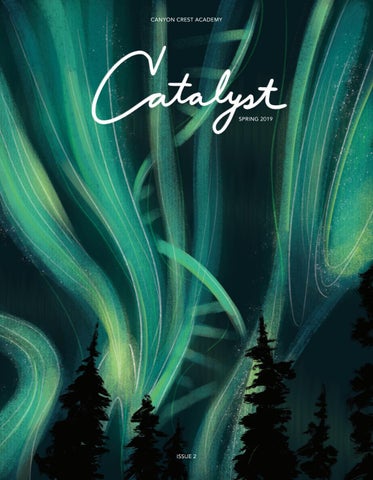
CANYON CREST ACADEMY
SPRING 2019
ISSUE 2
LETTER FROM THE PRESIDENTS CCA— Congrats—we’ve reached the end of another school year! Days are growing longer, students are getting restless, and Catalyst is releasing its second issue of the year. Over the last few months, our amazing team has worked hard to create this magazine from start to finish. In this 12th (!) installment of Catalyst, we continue to explore scientific concepts of all kinds, ranging from alternative energy solutions to cancer-kicking sponges. Still looking for that perfect study strategy? Read about how smart graphic design can actually make memorization easier by making it harder for you to learn. Make sure you roll up your sleeves too, when you satisfy your green thumb with a lesson in environmentally friendly ways to garden. Have you ever wondered how the aurora borealis came to be? Take a look at our guide to chasing the northern lights and appreciate the natural phenomena that make it possible. Next, take a crash course in the science behind autism spectrum disorder, an often misunderstood set of diverse symptoms. Finally, learn how a local conservacy organization is making a difference with the help of eager and passionate students just like you. And now the part where we say goodbye. Thank you to our inspiring peers, to our advisor Mr. Gaughen, and to our generous sponsors. Thank you to everyone we’ve met along the way, for showing us that a love for science didn’t always have to come in the form of a formal research paper. If we’ve learned anything from these past four years, it’s that science is at its best when anyone can enjoy it—that has been our mission all along. Catalyst has undeniably impacted us for the better, and we hope you share our feelings as well. If you have any questions or comments, you can reach us by email at ccacatalyst@gmail.com. Also, make sure to stay updated by bookmarking our website and liking us on Facebook. From all of us at Catalyst, have a great summer and enjoy! Victoria Li and Aida Razavilar Co-Presidents of Catalyst Science Magazine
STAFF
PRESIDENTS
Victoria Li Aida Razavilar
VICE PRESIDENTS
Susan Lee Jeanne Zheng
FINANCE DIRECTORS
Alex Shahla Ashley Zhang
EXECUTIVE EDITORS
Christina Lee Judy Qin
SUPERVISING EDITORS
Emily Kang Alisha Sandhu
EXECUTIVE LAYOUT
Anjali Gopinathan
ADVISOR
Michael Gaughen
EDITORS Trevor Cai Gabby Kang Joshua Charat-Collins Jessica Li Mason Lee Karen Bei Anny Pae Andrea Liu Joanne Lee
LAYOUT Clara Guo Elizabeth Kwon Katie Sheng Victoria Chen
ccacatalyst.wordpress.com facebook.com/catalystsciencemagazine EMAIL ccacatalyst@gmail.com MAIL 5951 Village Center Loop Rd, San Diego, CA 92130
CONTENTS
VICTORIA LI
1
ANJANA SHRIRAM
3
SOFIA POGLIANO
4
ANDREW GAO
5
ANDREA LIU
7
ALEX SHAHLA
9 11
SANS FORGETICA The Art of Desirable Difficulty MEDICINE
SUPERPOWER SPONGES How a Sponge is Changing the Way We Treat Cancer ENVIRONMENTAL SCIENCE
THE DIRT ABOUT PEAT MOSS TRIBOELECTRIC NANOGENERATORS Energy from Friction MEDICINE
NATURE OR NOT? The Science of Autism Spectrum Disorder A GUIDE TO THE AURORAS LOCAL SPOTLIGHT
SAN DIEGO CANYONLANDS
SPRING 2019, ISSUE 2
ai e
I
t looks warped and shattered, almost like it was written with a pen running low on ink. Every word takes a millisecond longer to read, but that’s no mistake. Sans Forgetica is a font specifically designed to help you remember what you typed by making it harder to read. In 2018, researchers at RMIT (Royal Melbourne Institute of Technology) developed the typeface to promote greater memory retention. So how does it work? The answer has to do with a little graphic design and a psychological principle called desirable difficulty. But first, some font basics: sans, French for “without,” is one half of the word “sans-serif,” which describes the style of fonts lacking the decorative accents, or serifs, on its letters. Think Arial, or any simplistic default computer font. These fonts are generally easier to read and cause less eye strain, especially on screens. The researchers at RMIT understood this and took it a step further. They strategically erased specific portions of letters from Helvetica, a common sans-serif font, and thus, Sans Forgetica was born. It wasn’t so simple though. The struggle was in finding the right balance between illegibleness and the memory-boosting effects. Stephen Banham, a typography lecturer on the RMIT team, says that finding the “sweet spot” required rigorous experimentation. In a combined laboratory and online psychology experiment, around 400 Australian college students remembered 57% of a text in Sans Forgetica, compared to only 50% of the same text in Arial. They tested everything from familiar, unaltered fonts like Arial and Times New Roman to “completely disrupted” text that was nearly impossible to read. The perfect font couldn’t be so incomprehensible that it became effectively meaningless, but it also had to be significant enough of a challenge to read.
Sans Forgetica* *The Art of Desirable Difficulty
1
Font Credit: RMIT
This relates back to the psychology of learning and the creation of desirable obstacles. There’s a fine line between desirable and undesirable difficulties. The difference is that subjects are well prepared to tackle desirable difficulties. For instance, flashcards utilize information retrieval early on in the learning period. Also known as the testing effect, this technique involves recalling information, followed by feedback and revealing the correct answers. This has to be done if the learner is already familiar with the information, however, or it could dissuade the learner from studying. UCLA psychology professor Dr. Robert Bjork writes that desirable difficulties don’t merely show information a learner; they require that information to be produced, which facilitates the learner’s ability to produce that information later. However, there’s a catch: the principle of desirable difficulty is not for long articles or thousand-page novels. So if you’ve clicked that download button already in the hopes of changing every conceivable font on your laptop to Sans Forgetica, you’re out of luck. Banham says, “If you were to read a novel in Sans Forgetica, it would probably induce a terrible headache.” The font is meant for longterm retention, i.e. slow learning. It might take some time to reap the benefits compared to rote memorization, but the results are far more lasting. The most effective use of Sans Forgetica, Banham says, is as a highlighter—“in a very, very selective manner.” In other words, you’re better off sticking to Quizlet for those late-night, cramming-forthat-big-test-tomorrow study sessions.
o
In any case, though, Sans Forgetica is surely a font to remember.
Sans Forgetica is available now for free download at sansforgetica.rmit for Mac, PC, and more. ▄
By Victoria Li
2
How a Sponge is Changing the Way We Treat Cancer By Anjana Shriram
N
ever underestimate the capabilities of a sponge. That’s what scientists realized when they created a revolutionary 3D-printed sponge that is now paving the way for safer and more effective cancer treatment. Researchers in Los Angeles and the Bay Area collaborated with Carbon, Inc. to engineer a 3D-printed sponge that can absorb excess chemotherapy drugs before they spread throughout the body. By doing so, the toxic side effects caused by cancer drugs can be greatly minimized. A paper published by UC Berkeley researcher Hee Jeung Oh, one of the scientists involved in the project, states that the “excess drug that is not trapped in the target organ passes through to the veins draining the organ, and is then circulated to the rest of the body, causing toxicities in distant locations.” The effects are often harmful, as “more than 50–80% of the injected drug is not trapped in the target organ, bypasses the tumor, and enters general circulation.” The sponge is useful for this reason, as preliminary data from research shows that, within half an hour, the sponge absorbed 64% of the chemotherapy drug. The device, known as a ‘chemofilter,’ works by collecting any surplus of drugs that the patient’s body is unable to absorb. The
3
chemofilter is comprised of an absorbent polymer that coats a 3D-printed cylinder. Before undergoing chemotherapy, the cylinder is inserted in a vein that exits the target organ. For example, in a patient with liver cancer, the cylinder is placed in the vein that exits the liver. When the sponge is removed after treatment, the absorbent polymers on the cylinder remove any drugs that the liver failed to absorb, while causing no side effects of their own. Although it is yet to win FDA approval, researchers believe that this incredible innovation holds great promise for the future. The device was pioneered by Steve Hetts, a neuroradiologist at UCSF. Hetts is optimistic, stating that “[b]ecause it is a temporary device, there is a lower bar in terms of approval by the FDA… I think this type of chemofilter is one of the shortest pathways to patients.” The idea first came to Hetts almost eight years ago when he noticed the side effects in babies treated for retinoblastoma. The disease, which affects only 300 new patients per year in the US, is treated using a technique known as transarterial chemoembolization (TACE). TACE uses small particles coated in chemotherapeutic drugs to block the blood supply to tumors. Although the eye tumors in the infants shrank, their blood cell counts
plummeted shortly after, indicating that the chemotherapy drugs were adversely affecting important cells outside the eye. Complications like these will likely be resolved, or at least improved, with the sponge that Hetts’ team created. This revolutionary device will help to alleviate the debilitating side effects of chemotherapy in cancer patients, which include high susceptibility to infections and anemia (depleted red blood cells). It will also allow physicians to treat their patients through more aggressive means while minimizing the toxic side effects. Ultimately, this will pave the way for more effective cancer treatment, and also improve the quality of life for those undergoing chemotherapy. While preliminary testing is still underway, the potential applications of this device reach far beyond cancer. Several antidepressants, painkillers, and cardiovascular drugs can cause irreversible damage in the bloodstream; innovations like this sponge will greatly reduce the danger associated with such medications. While most of us picture intricate contraptions and complex technology as the future of disease treatment, this simple sponge is redefining the way we treat cancer, one of the biggest killers in our world. ▄
Image Credit: Roy Kaltschmidt, Berkeley Lab
The Dirt About
Peat Moss
By Sofia Pogliano
P
eat moss is one of the most widely used gardening products: it is used for composting, starting seeds, patching lawns, and growing carnivorous plants. However, most gardeners may not even know what it is or where it comes from. Peat moss is partially decomposed sphagnum moss that forms as a layer underneath a bog and grows one millimeter a year. The harvesting of this slow-growing resource releases greenhouse gases and contributes to global warming. Endangered plants and animals live in these bogs, and the harvesting of peat moss harms their habitat. Overall, peat moss harvesting is detrimental to the environment. Harvesting peat moss requires draining the bog, clearing off all of the vegetation, waiting for the bog to dry, and removing all of the peat with large machines. Needless to say, this completely destroys the bog ecosystem, reducing it to an empty, barren field. These bogs are home to endangered animals like frogs, birds, and dragonflies, and plants like sundews and butterworts, which are, ironically, carnivorous plants that peat moss is used to cultivate. In the process of harvesting peat moss, these organisms’ habitats are destroyed, taking the surrounding plants and animals along with them. Additionally, peat bogs are a major carbon sink, and it is estimated that they store up to one-third of the world’s soil carbon. Once the bog is harvested, bacteria decompose the organic matter left behind, releasing carbon dioxide into the atmosphere. Since it can take years for the new peatland plants to capture more carbon than the disturbed bog releases, the bog is a net producer of the notorious greenhouse gas, carbon dioxide. Harvested bogs are also prone to fires, which release even more carbon dioxide. In fact, up to five percent of human carbon emissions are from peatland fires. Producers/harvesters of peat moss make a persuasive argument for the sustainability of their practice. They claim that since peat moss is harvested at a far slower pace
Image Credit: Vecteezy
than it grows, there is enough peat moss for hundreds of more years of harvesting. These industries also describe the efforts they take to help make their practice more sustainable, such as re-flooding the bog and seeding it with sphagnum moss, along with carving out pieces of the bog and allowing the plants to grow back over the place that was harvested. However, even when peat moss harvesters reflood the bog and seed it with shredded sphagnum moss, it takes ten to fifteen years for the bog to reach a normal condition. Even after that time, the bog is never truly the same; there is no replacing the rare, endangered species lost during harvesting or the layers of peat moss removed. In conclusion, harvesting peat moss for commercial use harms the environment. One way to combat this is to limit the use of peat moss in the garden. There are many suitable alternatives to peat moss, such as coconut fiber, compost, and finely shredded pine bark. Responsible gardening is the next step to safely managing the environment, and it is important to keep in mind that seemingly simple product choices can have a profound, long-term impact. ▄
4
By Andrew Gao
T
he renewable energy sector has been booming in recent years, especially with the public’s heightened awareness of the global warming crisis. In fact, oil giant BP predicts a 400% increase in green energy by 2040 and the Yale School of Forestry and Environmental Studies recently published a report detailing the growth of solar energy globally in 2017 by an astounding 29.3%. Even China, a country notorious for pollution and environmental violations has jumped onto the bandwagon, notably becoming the world’s largest investor in renewable energy all while repressing the behemoth that is the Chinese oil and coal industry. Notwithstanding the current state of the environment and relentless demagoguery by extremists, the outlook appears bright for a completely clean powered America in the near future, as demonstrated by the Department of Energy’s projection that by 2050, renewable energy will meet 80% of the nation’s needs. Despite the rapid hike in renewables worldwide, the thriving market remains dominated by a few main contenders—solar, wind, and hydropower—and the renewable sector experiences few new developments. Although essential and paramount technologies, these innovations possess several severe limitations. Solar energy relies on bright, strong sunlight and suffers in cloudy or stormy weather, not to mention being completely useless at night. Wind turbines disrupt local environments, cause noise pollution, and are burdensome to consistently maintain due to their remote locations and towering heights. Hydroelectric generators literally change the courses of natural water flow and destroy delicate aquatic ecosystems by damming key waterways and altering water movement. However, recent breakthroughs in the emerging field of nanotechnology have produced a new opportunity, triboelectric nanogenerators, that holds great promise in addressing the weaknesses and flaws of its predecessors. First introduced by Professor Zhong Lin Wang at Georgia Tech, the triboelectric nanogenerator (TENG) sounds like something straight out of Star Wars. Albeit not some futuristic spaceship
5 Image Credit: Wikimedia Commons @Colin
powering device, the triboelectric nanogenerator may well be the next renewable energy miracle. Triboelectric nanogenerators convert mechanical energy into electricity through the triboelectric effect, as the name suggests. The triboelectric effect comes into play when two objects charge each other through friction. One famous example of the phenomenon is the classic rubbing balloon on hair experiment, which nearly every student in America has conducted at least once in their school career. Besides the triboelectric effect, electrostatic induction is another essential element in the TENG. Simply put, it is when electrical charges are redistributed in an object due to outside electrical influences. Together, the triboelectric effect and electrostatic induction create a novel way of electricity generation based off of friction between materials, which leads to many exciting applications in the real world. Thanks to their flexible nature, TENGs can be utilized in an unlimited number of scenarios, from harvesting energy from the movement of the human body, a concept currently being studied at the University at Buffalo and the Chinese Academy of Sciences, to self powered medical devices like pacemakers. One radical new proposal by Professor Wang is to harness abundant wave energy through extensive networks of TENGs placed underwater, coined “blue energy.” The network consists of many little balls which contain an even smaller ball inside. When the waves push and pull, the inner ball rolls inside the outer ball and builds up a charge. (imagine a hamster running in a wheel) Unlike sunlight and strong winds, waves consistently push and pull regardless of the circumstances, rendering them a much more reliable source of energy. Furthermore, the TENG “nets” will have a minimal effect on aquatic biomes and may even serve as artificial environments to help support marine life, e.g. coral reefs. Yet another application for triboelectric nanogenerators is the desert. Constantly blowing sands and shifting dunes provide a valuable opportunity for energy harvesting. Rapidly moving sand particles instigate friction, a driving factor in TENG, and the massive quantities of sand in the Sahara could potentially be harnessed to generate tremendous amounts of electricity. Conversely, TENGs could also be applied to great success in locations with heavy rainfall; Mawsynram, India receives an average of 467 inches of rain annually. TENGs can get energy from falling rain droplets hitting their surface. Subsequently, the climate of Mawsynram renders conventional solar power techniques ineffective. However, TENGs can be adapted to provide clean alternative energy regardless of sunshine. However propitious this new technology may be, full scale implementation of triboelectricity into American energy infrastructure is still a ways off. Scientists in the United States and China are still studying the properties and effects of TENGs and researching optimization methods of harvesting energy. It may take decades before TENGs can be sufficiently refined to become a strong contender with the current clean energy giants. A promising new technology, triboelectric nanogenerators are a viable, emerging form of clean energy for their many applications and reliability. From powering a phone, to providing energy to entire countries, triboelectricity may soon be a household name just like solar and wind. Avoiding many of the pitfalls and consequences of other green energy methods, triboelectric nanogenerators will undoubtedly be at the forefront of the energy revolution. ▄
6 Image Credit: Wikimedia Commons @Yann Forget
Nature or Not? The Science of Autism Spectrum Disorder
A
child who can’t look someone in the eyes. Another, who enjoys repeatedly pounding his fist onto the surface of his desk with an exact rhythm each time. One more, who must go to the park at 4:00 PM every day, not one minute before, and walks two laps around the big field, not the little one. Yet another, who needs to wear soundproof headphones all day because the pitches and volumes that are “regular” to most of us are magnified in her mind. Not wanting to be touched. Being an outsider among a classroom of kids their age. Aloof and unwilling to approach and/or interact with other kids. These descriptions of symptoms could be describing seven children or just one. These kids all have drastically different symptoms, from hypersensitivity to antisocial, awkward behaviors, but they share the same diagnosis: Autism Spectrum Disorder (ASD). Although it is com-
7
Andrea Liu
monly referred to as Autism, ASD’s short name doesn’t do it justice. The full name aptly describes the disorder and the various ways it may present itself in those who are affected by the spectrum. Autism presents itself differently in everyone who has it; no two people with autism ever express the exact same traits. People with ASD often share the overarching characteristic of difficulty with social communication and interaction (such as making friends or joining in a regular conversation), and the enjoyment of repetitive, fixed daily behavior, activities, and movement, which is extremely calming to ASD-affected people. Even so, the prominence of these traits differs from person to person. In fact, people with ASD often are more prone to other psychological disorders including ADHD, epilepsy, OCD, anxiety, and depression.
Autism presents itself differently in everyone who has it; no two people with autism ever express the exact same traits.
For those with ASD, treatment doesn’t solve anything, only minimizes the symptoms. Current treatments focus on changing the behaviors through behavioral therapy, since the exact root cause of ASD is not clear. It’s believed to be caused by a mixture of genetics and environmental factors that, working together, affect how the brain develops. Previous studies have shown that ASD most likely has a genetic component due to its track record of diagnoses, particularly because a child is more likely to be diagnosed with ASD if their sibling or a close family member has it. In fact, in families where one child has autism, the possibility of another child having autism increases 25 times in comparison to the general population’s risk. The risk of ASD may also be increased by structural variations or mutations. The most reported gene abnormalities associated with ASD are in the genes that control for postsynaptic cell adhesion molecules neuroligins (NLGN4X and NLGN3 that maintain the synapses between neurons), postsynaptic scaffolding proteins (SHANK2 and SHANK3 which regulate key signaling pathways) and presynaptic cell adhesion molecule neurexin 1 (NRXN1). However, such mutations are not ASD-specific and are also associated with other neuropsychiatric disorders including Alzheimer’s and schizophrenia. Recently, scientists have begun to suggest that neurochemical perturbations, particularly those that affect serotonin, gamma-aminobutyric acid, dopamine, and epinephrine (GABAergic, glutaminergic, and dopaminergic factors), might play a role in ASD development in children. On the other hand, recent studies have also reported that 40–50% of the variance in ASD is due to environmental conditions. One environmental factor is parental age: a 10-year increase in maternal or pa-
Image Credit: SVG Silh
ternal age increases the risk of ASD in their children by 18% and 21%, respectively. Another is the use of medication during pregnancy. For expecting mothers with epilepsy and bipolar disorder, they may take selective serotonin reuptake inhibitors, which has been shown to increase the risk of autism in their children by 50%. To isolate the impact of environmental factors on the development of ASD in children, scientists have recently begun to study identical twins, whose genetic information is identical. Recent studies have shown that identical twins have a 60–90% concordance rate of having autism. In the identical twins being studied, only one of the two has ASD, while the other tests in the normal range. In some cases, both twins are affected, but only one has symptoms severe enough to be classified as autistic. Sometimes it’s believed that sudden change in brain development and, in turn, the development of ASD was caused by a spontaneous mutation in a very specific subset of cells. Some people have a genetic predisposition to these neurodevelopmental disorders, making the cause of ASD written in their genes. But looking at other facts is important too, as the other current studies demonstrate, since the only difference between twins are the environmental factors. In children with ASD, the way forward isn’t going to be changing the genetic makeup of every cell in their body. Nor will it be forcing those affected by ASD to become assimilated into society as we know it. Rather, it will be promoting the inclusion of and further developing resources for those affected. It will be furthered by supporting and funding research to better understand the exact causes of ASD, providing clarity and understanding to those who are affected and their families. ▄
8
A GUIDE TO THE AURORAS Ranging from sapphire blue to ruby red, dancing am-
BY ALEX SHAHLA
9
icably in a broad brushstroke against the night sky, auroras have always been intertwined with a sense of mysticism. The Roman philosopher Pliny the Elder called them the “daylight in the night� and Australian Aboriginals affectionately described them as bush fires in the spirit world; not to mention their wondrous accounts by Norse epic poets and Native American storytellers, forever poeticized. Dazzling in color and animation, it is easy to imagine how these lights have captured the imagination of people for millennia, from poets to philosophers, and scientists to artists. While many people are aware that auroras are somehow related to magnetism
Illustration by Victoria Li
and can picture them in their heads as the “Northern Lights”, not many know the cohesive and fascinating intricacies of auroras. Understanding these intricacies would allow for a better appreciation of these natural light shows the next time you decide to go camping in Alaska. First, to better comprehend auroras, it is best to understand the process of nuclear fusion, that is, the process by which the sun powers itself through the reaction of two hydrogen atoms fusing into one helium atom. This can only occur at extremely high temperatures so that the atoms can easily ionize and obtain enough energy to fuse together. As a byproduct of this reaction, the remaining mass is converted into energy, This process of conversion into energy is what powers the sun. As fusion occurs, the sun releases high energy particles, such as ions, electrons, protons, and neutrinos, and radiation in the form of solar winds, where they travel millions of miles toward the Earth. The magnetic field, scientists say, is caused by the spinning of the Earth’s liquid iron core. This flow of the liquid caused by convection currents, in turn, generates electric currents, causing a magnetic field enveloping the Earth. The strongest electric currents occur near the poles. These particles then hit Earth’s magnetic field, causing it to change shape. The field on the side facing the sun contracts while the opposite side expands. These two features have interesting names: namely bow shock and magnetotail, respectively. The result is a shaft of opening in Earth’s magnetic field called a polar cusp on the side facing the sun. Then, begin a series of steps that lead to the painting of colorful streaks against the snowy night sky. These particles travel along the lines of the magnetic field, which lead to the north and south poles. Along the way they interact with the field, causing currents of charged particles (called Birkeland currents-named after the inventor) going to the different fields. These electric currents - still sticking along the field lines - gather more and more energy as they descend toward Earth’s atmosphere. They then hit the ionosphere, which is the highest layer in Earth’s atmosphere, about to come in for a flashy landing. Here, they collide with different atmospheric molecules, most commonly oxygen and nitrogen. Upon collision, they transfer their energy to the electrons of the oxygen and nitrogen ions. The electrons become excited, and “jump” from lower to higher energy levels (think about the Bohr Diagrams with different electron shells). Almost instantly, they “fall” from their unstable higher state back to their original orbitals. The energy they initially gained from the solar particles releases from the atoms in the form of light. Thus, auroras are stratified based on the wavelength of light—therefore the color—that is being emitted. The wavelength is based on which atmospheric molecules the solar particles collide with and at what altitudes they collide, with a spectrum of colors stratified vertically. Oxygen creates green and red light usually. At the highest altitudes of above 150 miles, red light is emitted, while at mid to lower altitudes between 60-150 miles, a green light is emitted. Green is the most abundant color in auroras because oxygen atoms are particularly plentiful at these altitudes—and because the human eye is naturally more sensitive to green light. At the lowest levels of below 60 miles, where the concentration of oxygen drops considerably, nitrogen runs the show, emitting blue and some purple light. In theory, these lights could mix to form any color; however you are most likely to see yellow and pink light, and in rare cases, orange light during the stronger solar storms when there are more particles at play and mixing is more likely.
Auroras, to put it plainly, are the result of interactions between the sun and the Earth as a result of the sun’s energy interacting with Earth’s magnetic field. This is best seen by the cyclic nature of auroras, with 11 years of greater activity followed by 11 years of lesser activity corresponding to the higher and lower levels of solar activity, respectively. Auroras form bands in the east-west direction, based on the magnetic field lines that the particle travel along. Unfortunately, you can’t see them everywhere, as they form in auroral zones, which are typically between 3° to 6° wide in latitude and between 10° and 20° from the geomagnetic poles. Although in pictures auroras may appear relatively low in the sky, they usually occur between 50 to 200 miles above the Earth’s surface. They have the potential to occur up to 600 miles up, meaning auroras extend deep into outer space, as our atmosphere is only 60 to 70 miles thick. Many know these lights by their two names, colloquially, as the Northern Lights and the Southern Lights based on whether they occur in the northern or southern latitudes. However, officially they are called aurora borealis (Latin: Northern Goddess of Dawn) and Aurora Australis (Latin: Southern Goddess of Dawn), which were terms coined by Galileo in 1619. Both auroras have virtually the same feature, and the changes the auroras experience, say in the North, are often mirrored in the South due to the fact that it the solar winds and flares blow toward the Earth at large rather than locally. Hopefully, the technicalities haven’t ruined the mysterious wonders of auroras. If you’re still interested in seeing them, you can really go anywhere above 55 degrees North and have a good shot at viewing these curtains of light. To be more specific, the best locations for viewing auroras are anywhere outside of the city on clear, moonless nights (to escape light pollution from cities and the moon and from soul-sucking clouds). They typically peak near the spring and autumn equinoxes. This is due to the fact that the geomagnetic storms (another term for interaction of solar winds with Earth’s magnetic field) are strongest at these times. They are the strongest, not necessarily because of solar activity, but because of the fact that the solar winds face downward toward the Earth, and Earth’s tilt is relatively small, allowing for the solar particles to more directly hit Earth’s magnetic field. Think of the relation of the Earth and the Sun with relation to auroras as two pieces of a jigsaw puzzle fastening together, except that these two celestial bodies are connected by solar particles and not physically. Furthermore, a simple Google search provides some popular spots to view. One in particular is Iceland, which has the added benefit of a scenic landscape of glaciers, geysers, and volcanoes as the perfect backdrop. Fairbanks, Alaska, with its proximity to Denali National Park, and its greater accessibility, is another prime spot. Yellowknife in northern Canada also seems to be quite magnetic (pun intended) among the aurora-seekers. It has stunning boreal forests with expansive lakes, such as the Great Slave Lake, that allow for backdrops the display of cosmic colors only rivaling Iceland’s. Plus, it has its very own Aurora Village, complete with its own wilderness facilities, activities, and tours. If you’d like to go a bit off the beaten tracks and see the Aurorae Australis, you can visit Southern New Zealand or Tasmania. As added benefits, the weather is usually much more forgiving, with snow being a rarity in these areas, while snow-free days likewise being a rarity in the north. An added benefit is that Australia has koalas, perfect imitations for languid CCA students after a long year at work. ▄
10
In early 1800s San Diego, it was conventional
practice to dispose of both garbage and human waste in the backyard or, if one was so fortunate, in an adjacent vacant lot. It was not until the summer of 1888 that a public sewerage system was put into place, and though it was not without its odorous set-backs, it certainly beat piling the whole of a house’s waste a few yards and a thin wall away from the kitchen. From piping raw effluent a few feet out from the crashing waves vacationers were just wading in, to water treatment so advanced that this same effluent could be reclaimed as drinking water, the role of this organization in San Diego’s sewer history comes somewhere in between. San Diego Canyonlands (SDCL) is a non-profit organization that has been in existence (in one form or another) since 1998. The group evolved from a gathering of concerned neighbors focused on the fate of North Park’s Switzer Canyon and the proposal to build permanent sewer maintenance roads along the low, winding floors of the city’s many canyons. As topographical low-points, canyons made attractive sewer line corridors in San Diego, and early engineers and pipe-layers took advantage of gravity to transport the city’s wastewater from source to treatment plant to ocean outfall. Access for maintenance is important and necessary, but the task-force that formed during this meeting of Switzer Canyon neighbors and concerned city residents wanted to keep impact to wildlife and the landscape to a minimum. A successful compromise was reached, and a lower impact design of thinner, vegetated maintenance roads was agreed upon, but interest in protecting the canyon remained. A “Friends Group” was formed, which is SDCL terminology for a group of vested stakeholders connected by the common goal of improving one’s neighboring canyons, creeks, and open space parks through volunteerism.
11
LOCAL SPOTLIGHT
San Di Canyo
iego onlands
From a grass-roots campaign organized by the general public and the Sierra Club to preserve a single canyon, SDCL became a nonprofit in its own right in 2008. They now manage over 40 “Friends Groups” in just as many canyons, work in open spaces as far north as Del Mar and as far south at the U.S./ Mexico border, and are continuing to grow in staff, interns, and volunteers reached and trained. SDCL’s mission reflects the intent of the original campaign to halt what many residents considered “excessive” construction in their local park: “to promote, protect and restore the natural habitats in San Diego County canyons and creeks by fostering education and ongoing community involvement in stewardship and advocacy.” Every weekend SDCL hosts numerous volunteer events open for the public to join. These events are environmentally-based and typically include activities like trash clean-ups, trail maintenance, invasive plant removal, and plantings. Volunteers do not need to live near the open spaces they choose to preserve, but some residents often take charge of these groups and organize projects, communicate with land managers, and execute events with or without limited assistance from SDCL staff. Canyon Crest Academy students are encouraged to explore opportunities in Gonzales Canyon due to the proximity of the park to the campus. Students make up a majority of the volunteers and there are many opportunities for earning community service hours, gaining work experience in disciplines like project management, teaching, and habitat restoration, and simply in getting outside and realizing what one’s backyard has to offer. All events are posted at the beginning of each month on our website calendar at www.sdcanyonlands.org/events-calendar. Selecting a given event will provide further event information and prompt those interested to sign-up. San Diego Canyonlands encourages you all to check it out and sign up! ▄
Image Credit: San Diego Canyonlands
12
CATALYST SCIENCE MAGAZINE