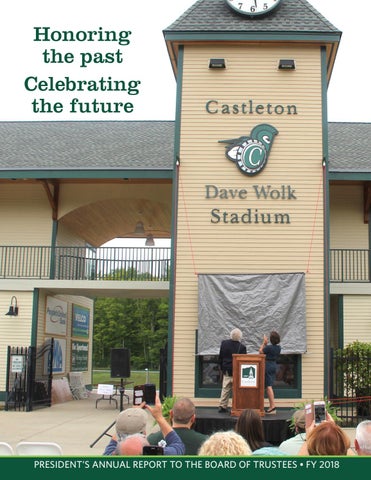
Honoring the past Celebrating the future
PRESIDENT’S ANNUAL REPORT TO THE BOARD OF TRUSTEES • FY 2018 1
Contents
INTRODUCTION 4 REMARKS FROM PRESIDENT SCOLFORO INSTALLATION AND CONVOCATION
ACADEMIC AFFAIRS
GARCIA SECURES GRANT VIRTUAL REALITY HGEP PROFESSORS PUBLISHED COMMENCEMENT 2018 EXPANDING OUR REACH STRATEGIC PLANNING EDUCATING EDUCATORS FROM THE DEAN’S DESK
8
ADVANCEMENT 22 DAVE WOLK STADIUM ALUMNI OF THE YEAR
STUDENT LIFE
26
WELCOME HOME CELEBRATING SPARTAN PRIDE SAFETY IS JOB ONE CLUB SPORTS EXPAND
PERSONNEL 32 A SPARTAN FAREWELL ORGANIZATIONAL CHART
2
“The medallion’s c number of things. M constituents of the alumni, host comm teaching, scholarship and supporting the U
cha
chain has been described as representing a My favorite portrays the links as the connected e presidency—students, faculty, deans, staff, munities as well as the essential disciplines of p, research, and service. All links connected to University Medallion and thus, the President.”
DR. J. CHURCHILL HINDES air of the vscs board of trustees PRESIDENT SCOLFORO’S INSTALLATION
3
Introduction On August 30, 2018 Dr. Karen M. Scolforo was officially installed as the tenth president of the modern era at Castleton Univeristy. President Scolforo prepared the following remarks as part of her address.
Thank you, Dean Spiro and Andre Fleche for your kind and supportive remarks. Thank you, Chancellor Spaulding and Dr. Churchill Hindes, and the Board of Trustees, for conferring investiture and for your confidence in my ability to advance Castleton University to the next level of preeminence. I am humbled and appreciative of this extraordinary honor, and of this affirmation of your support, your confidence in my ability to lead, and, ultimately, your belief in my commitment to make a significant and meaningful contribution to the advancement of this dynamic, legacy-rich institution. Thank you to everyone who joined us today for this special celebration, this transition into the future—I am grateful for those we surround ourselves with, those who profoundly influence
4
us. Our environment, our family, our friends, our colleagues, our students and alumni. I am grateful that you are here today. Thank you to our Trustees, Chancellor’s Office personnel, government officials, fellow Vermont presidents, principals and superintendents, and community leaders for being here today. Higher Education has opened doors for me, and allowed me to alter the course of my life. My blue-collar background provided the foundation for a solid work ethic, and higher education allowed me to divert my trajectory. It was through exposure to new experiences that made me realize I did not have to embrace the expectations others placed upon me. Through higher education, I discovered the freedom to design my own future, to change my
socioeconomic status, and that of my children. It is because higher education was part of that design that I find myself here, before you, today. Higher education has taught me service before self. Higher education has taught me the value of excellence. Castleton University, a public institution, has a distinct responsibility to serve our region, our state, our nation, and the globe. As we prepare for declining numbers of high school graduates in Vermont, we have a greater command to partner with our state legislators to secure the appropriate resources necessary to educate and train the next generation of leaders, innovators, and model citizens. Our students and their families have high expectations for us. They look to us for an excellent education in a nurturing environment—an education that prepares our graduates for promising careers in a global workplace. Currently Castleton University receives only nine percent of its budget from the state of Vermont. With this in mind, we must build and expand public-private partnerships, engage in creative networking and new collaborations, explore innovative delivery models and platforms, and tap into our rich regional community, which is eager to help us succeed. Our regional employers are dedicated to offering new workforce learning opportunities for our students. Our generous donors provide support for new and renovated facilities, student scholarships, and educational programs. Castleton University is a valuable resource for our community, in education resources, technology, and intellectual capital. As we move forward, I am committed to the six priorities of the Vermont State Colleges: 1. To increase the continuation rate of high school students on to postsecondary education; we have the highest high school graduate rate, and one of the lowest postsecondary pursuit rates in the country;
2. Improve the retention and graduation rates at Castleton University; our focus is on student success; 3. Become a more attractive destination for Vermont high school graduates; they will come to Castleton for our affordable, high quality programs, our innovation, our caring faculty and staff, our support services, and to experience The Castleton Way; 4. Serve well more working age Vermonters; we will increase student entry points with more programs offered in the spring semester; we will offer more user-friendly courses for working professionals, and, through partnership with local employers, we will ensure that our graduates are workplaceready; 5. Operate as a more integrated system to expand student opportunities and achieve operational efficiencies; through centralized processes, we will work together to gain efficiencies and ensure that our resources are allocated based on students-first; 6. Increase state financial support and other supplemental revenues; we will work together to explore new opportunities to serve our students in new and exciting ways. At Castleton University, we provide a transformational student experience through innovation, rigorous academic experiences, new program development, opportunities for service, study abroad, and workplace learning. We are committed to growth, relevance, diversity, equity, and inclusion. We are committed to financial stability, intentional resource allocation, and strategic advancement of our outstanding institution. CONNECT WITH ME:
5
COLLABORATION, INNOVAT installation & convocation -Jeff Weld Dean of Advancement
Castleton University officially installed Dr. Karen M. Scolforo as its tenth president of the modern era on Thursday, August 30 as part of its Fall Convocation ceremony in the Casella Theater. The installation ceremony featured remarks from Vermont State Colleges System Chancellor Jeb Spaulding, Chairman of the VSCS Board of Trustees, J. Churchill Hindes, and Castleton Faculty Assembly President André Fleche. President Scolforo shows a gift from a student
Dr. Hindes illustrated the importance of symbolism and ceremony to higher education as he told of the significance of the chains of office he had just placed around Dr. Scolforo’s neck. “The medallion’s chain has been described as representing a number of things,” Hindes said. “My favorite portrays the links as the connected constituents of the presidency—students, faculty, deans, staff, alumni, host communities as well as the essential disciplines of teaching, scholarship, research, and service. All links connected to and supporting the University Medallion.” He also referenced the medallion’s weight as a reminder to the wearer that they carry a burden as “leader, manager, and servant.”
house shall be greater than that of the former.’ She inscribed the quotation on the newly built Woodruff Hall, and, in the process, offered the school a guiding statement for the modern era.”
Dr. Fleche reminded the audience of Castleton’s history, mentioning that the presidency is beholden to the ideals of Caroline Woodruff who quoted scripture after a devastating fire destroyed the Old Seminary Building, the precursor to today’s Woodruff Hall. “The school had lost most of its classrooms and offices in the blaze, and now faced an uncertain future,” according to Fleche. “President Woodruff sought guidance in scripture. She opened the Old Testament at random and found on the page the following quote: ’And the glory of the latter
As part of its convocation ceremony, Castleton honored new faculty and staff members and the Alumni Association bestowed Doug DiSabito, Vermont States Attorney of Grand Isle County with its Outstanding Alumni Award. DiSabito remarked, “I am proud to be a Castleton graduate and it is humbling to learn that Castleton is also proud that I am a graduate.”
6
All three speakers provided a strong voice to the belief that Dr. Scolforo will lead the university into a bright future, punctuated by Chancellor Spaulding, who said “my responsibility as Chancellor is to ensure the strength and future of all of our colleges and universities. But I am also a proud cheerleader and today it’s easy to cheer for Castleton University. We have an outstanding leader to lead this institution to new heights and it will be my pleasure to watch, assist, and cheer along the way.”
President Scolforo ended the event with her own address that illustrated a bright and promising future for the university which recently
ATION & TRANSFORMATION
Andre Fleche speaks on behalf of the faculty
President Scolforo with members of the Faculty
welcomed over 700 new students, a 20 percent increase from last year’s entering class, thanks to several new initiatives already underway.
accompanied the gift was inscribed “I choose Castleton and Castleton has chosen me.”
The central tenets of Dr. Scolforo’s presidency have already shown to be a commitment to transparency, transformation, collaboration, and innovation. She lauded the efforts of the admissions team who cultivated the incoming class and pointed out that the University of just under 2,000 total students, boasts representation from 36 countries and 26 states. “Diversity opens us all up to new ideas, new experiences, and forces us out of our comfort zone,” Scolforo said. Scolforo referenced a chance meeting with a new student from Tibet who sought her out just before the ceremony. “I ran into him in the corridor and asked what he was looking for and if I could help him,” Scolforo explained. “The student responded, ‘actually, I’m looking for you.’” The student, who goes by the nickname “Snow” gave her a white scarf and explained that in his culture it is customary to seek out the organizational representative and present them with a gift. “The gift is to wish you good luck, it is white to be pure of heart,” Scolforo recalled. “And as he wrapped it around my neck and dragged the fabric across my skin it created a warmth and comfort.” The card that
Scolforo felt much the same way when she was first selected as university president and was moved to share the story. Scolforo concluded her remarks by encouraging all in attendance to be involved, to collaborate and help guide the university into the future. “It will take the collective efforts of us all to take Castleton to new heights. I am confident that together we will change the world.”
WATCH THE CEREMONY
castleton.edu/installation-video
7
Academic Affairs
GARCIA SECURES GRANT $300,000 NSF AWARD TO FUND STUDENT RESEARCH Castleton University Associate Professor of Biology and Biology Program Coordinator, Dr. Preston P. Garcia (pictured above, far right), has secured a competitive research grant through the National Science Foundation (NSF) which will fund his research until 2021. The grant entitled “RUI: Collaborative Research: Understanding the role of a modified phosphotransferase system and a unique twocomponent signal transduction system in regulating gene expression.,” is under the direction of Dr. Garcia at Castleton, in collaboration with Dr. Catalina Arango Pinedo at St Joseph’s University in Philadelphia, Pa. The collaborative grant total amount is for $560,082, with $252,071 going to St. Joseph’s University and $308,011 going to Castleton University.
8
“Dr. Arango Pindeo and I are excited that our proposal was well reviewed by our peers and was awarded funding. Competing with scientists at research schools across the United States for this funding validates the hard work we have done to establish our science department at Castleton as one that provides students with the same research experiences as larger research-focused schools. With financial support to pay up to 12 Castleton students and six local high school students, we can continue to train students in cutting-edge research.”
Dr. Garcia’s efforts to grow research opportunities at Castleton have impacted 11 independent research students and resulted in over $330,000 grant dollars since he arrived at Castleton. In sum, the faculty in the Natural Sciences Department at Castleton have now received more than $1 million to fund research opportunities in microbial metabolism and genetics, plant evolutionary genetics, animal behavior, structural geology, environmental chemistry, and biochemistry for their students since 2010. The department is a baccalaureate partner institution in the NIH-INBRE Vermont Genetics Network (VGN),
which provides support for students and faculty members conducting biomedical related research through the University of Vermont. According to Dr. Garcia, this NSF funding would not be possible without the financial and professional support from the Vermont Genetics Network. “The goal of VGN is to have research faculty ‘graduate’ to independent federal funding, which I have now done. I would not have had the data or grant writing skills to be competitive for federal funding without VGN.” Dr. Garcia’s research is focused on bacteria which have the ability to directly sense their environment and change their behavior according to their surroundings. While these changes can be seen visually, the intricate genetic processes that lead to the changes are not fully understood. This project will investigate some of the ways in which bacteria carry out these processes using Sinorhizobium meliloti as a model. Sinorhizobium meliloti is a member of a larger group of bacteria called rhizobia, and is environmentally and economically vital in the field of agriculture. Sinorhizobium beneficially infects legumes and provides useable nitrogen to increase crop yield. An efficient and productive rhizobium infection reduces the need for chemical fertilizers. Expanding our knowledge of the genetic systems that control the behavior of this bacterium has the potential to allow manipulation to optimize the rhizobium-plant interaction. According to Garcia, the research will allow students to explore the scientific methods and communicate findings properly. “To effectively conduct research across educational levels ranging from high school to graduate school is a great opportunity for all involved. Our research will help to answer fundamental biological questions about bacterial communication, especially how bacteria beneficially infect plants, which has direct impacts on the agricultural industry.” Castleton research students will participate in the New England Workshop on Symbiosis focused on the specific symbiotic legume/bacterial relationship being studied by the Garcia lab. This workshop is attended by faculty and students from UVM, UMass-Amherst, Eastern Connecticut, UConn, MIT, Castleton, and St. Joseph’s (Pa.), further exposing Castleton undergraduates to the wider scientific community.
The grant also provides funding for a new Castleton course, Special Topics in Biology: Bacterial Proteomic Design & Analysis, which will achieve multiple goals including further strengthening the mission of the department to provide student training in research while also increasing the involvement of faculty in competitive research by utilizing Dr. Garcia’s bacterial research samples as the basis for the data collection. The students will gain the theoretical background information at Castleton while performing the laboratory work at UVM. The UVM arrangement will allow the Castleton students to participate in hands-on research techniques and utilize equipment at an R1 research institution. Undergraduate research students will also receive meaningful public outreach training by producing an outreach product at the end of each summer session, in the form of a podcast, video, poster, or informational fact sheet about their summer research. The outreach products will be produced and disseminated to secondary students in Vermont, facilitating collaboration between Castleton and secondary biology educators statewide. The undergraduate students on the project will also share their research experiences and outreach projects with students and faculty at St. Joseph’s University and Castleton and aid in the delivery of the science lessons, including a laboratory activity, for ninth and tenth graders in Philadelphia. “This is more than just sitting in the lab performing experiments,” Garcia said. “Independent research is about discovery and learning how to critically think, but also sharing this information in an accessible way with the public. Public outreach is part of our duty as scientists, to share our knowledge.” Research reported in this release is supported by funds include support for “Division of Molecular and Cellular Biosciences: Investigator-Initiated Research Projects (MCB)” in accordance with the NSF Program Solicitation, NSF 17-589. Funds provided by this award include support in accordance with NSF program solicitation 14-579, “Facilitating Research at Primarily Undergraduate Institutions: Research in Undergraduate Institutions (RUI) and Research Opportunity Awards (ROA)”.
9
VIRTUAL REALITY NEW PSYCHOLOGY LAB AIDS IN RESEARCH precisely tracking head and hand movements with special infrared cameras to allow interaction within the virtual space.
Keeping Castleton on the cutting edge of research in human behavior, the Psychology Department recently invested in a virtual reality lab located in the Jeffords Center. Purchased in March, the interactive lab will allow students and faculty members alike to delve deeper into the abilities of virtual reality in a variety of settings. “The virtual reality lab is already enhancing our student experience, allowing students to design and implement scientific studies that wouldn’t be possible without this technology,” said Assistant Professor of Psychological Sciences Greg Engel, adding that the equipment is currently being utilized for a study on the effects of caffeine on stress. The technology uses an Oculus Rift virtual reality system to immerse users in a virtual world. It does so by sending separate images to each eye creating three-dimensional images and
10
“The uses of the Oculus set up expand well beyond what even I could think of,” explained junior Psychology student Weslee Thompson, who is planning on utilizing the equipment for a study that looks at how virtual reality can be used in a medical setting. “The rift allows us to access software from around the world that is on the cutting edge of technologies. I am far from a coder, but the resources that have become available to us are really staggering.” The department hopes that students will take advantage of the unique, high-tech resource while on campus, opening doors to endless new and innovative research opportunities. “Remaining on the cutting edge of research is the best way to teach our students about science, and prepare them for careers in science after school,” said Engel. “Involving students in research is crucial to higher education, where we’re not just teaching what is already known but also how new knowledge is generated and evaluated.”
HGEP PROFESSORS PUBLISHED
After years of hard work, research and dedication, Castleton History, Geography, Economics, and Political Science Department faculty members Dr. Scott Roper, and Dr. Adam Chill each recently had original works published. “There is nothing quite like seeing your own name on the cover of a book and reading words that you’ve written on its pages,” says Chill. Entitled “BareKnuckle Britons and Fighting Irish,” Chill’s work details the ways in which boxers, journalists, and many others used identity to promote themselves and their sport. The strategies both reflected and shaped national, ethnic, religious, racial and gender identities in Britain and Ireland in the eighteenth and nineteenth centuries. His inspiration came years back while he was researching a conference paper in the Boston College archives, and found a source about boxing, called Boxiana, peaking his interest. “Many of my colleagues are very active and successful scholars in their fields and I’m certainly motivated to try to keep up with them,” joked Chill, adding that from start to finish his publishing journey, which started as a doctoral dissertation in 2004, took nearly thirteen years. “My students have inspired me too and watching them produce their own original research projects has been almost as rewarding as completing my book.” Roper’s novel, “When Baseball Met Big Bill Haywood,” examines the world’s largest cotton textile in the industry, Amoskeag Manufacturing
Company of Manchester, New Hampshire, and seeks its relevancy to baseball with influences over the government and media. Roper hopes his book will motivate readers to better understand the importance of a social safety net and direct voting of US Senators. “The book is about how a New Hampshire corporation attempted to use baseball, as well as its own influence over government and media, to keep its labor force from unionizing and to keep the federal and state governments from regulating industry,” he said. Though the Geography professor has written many articles about the use of regional cultural landscapes to Americanize immigrant, and also the desegregation of baseball, combining the two was a unique first. He utilized his 201213 sabbatical, as well as summer months, to accomplish a majority of his research and writing, before adding the final touches in 2016. Both Chill and Roper are thankful for the overwhelming support they received from the Castleton community throughout their journey, including encouragement from fellow department colleagues and growing interest from students, staff, and administration. “It’s important for me to be active in researching and writing. It’s how I stay engaged in my field. I also want to provide a good example for my students, especially since I require research and writing projects in many of the courses I teach,” said Roper. “I really appreciate the support of my colleagues and former students who cheered me on through the process.”
11
COMMENCEMENT 2018 -Courtney Widli Associate Director of University Relations
The third graduating class of Castleton University passed across the stage at its 231st Commencement ceremony on Saturday, bringing to close the 2017-18 academic year. Co-keynote speakers #1 New York Times bestselling author Chris Bohjalian and critically acclaimed journalist and novelist Stephen P. Kiernan addressed the more than 3,500 guests in attendance and thousands more streaming the ceremony online. Castleton President Karen M. Scolforo took the podium and welcomed everyone “home.” “The word home is often used as a descriptor of a place. But, to most of us “home” describes a feeling – a familiar embrace, a comforting smile, a feeling of belonging. At Castleton University, these tangible expressions are what we call the ‘Castleton Way.’ It’s why so many of our alumni, faculty, staff, and students when asked why they
12
chose Castleton proudly declare ‘it feels like home.’”
Scolforo told the graduates how proud she was to watch them achieve all that they have over her five months at the Castleton University helm and applauded them as the class that has “completed more research, more community service, and more internship hours than any others that came before.” She also listed an impressive list of accomplishments, including Free Skiing & Riding at Killington/Pico and the growth of clubs and organizations while they were here. Dr. Scolforo concluded her remarks by saying “Graduates, I look forward to admiring your accomplishments, to cheering you on from the sidelines, just as I have done since my arrival at Castleton. Today, you have much to be proud of. You are prepared, you are accomplished, you are Spartans. As you move on to your next grand adventure, never forget your way back home. See you at Homecoming!” Kiernan and Bohjalian mixed strong advice with humor to provide the graduates with
a memorable address. Kiernan focused on gratitude and practice as cornerstones of a life worth living, while Bohjalian implored the graduates to change the world for the better by focusing on who they are over what they do. As has become tradition, Castleton Alumni Association President Ceil Hunt announced the recipients of several distinguished awards. Assistant Professor of Health, Human Movement, and Sport Marybeth Lennox was awarded the Alumni Association Outstanding Faculty Award, which is given annually to a faculty member whose excellence in teaching influences students well beyond graduation. Media & Communication graduate Olivia Maher was honored with the Leonard C. Goldman Distinguished Senior Award, an annual honor given to a graduating senior who has excelled in and out of the classroom, contributed to community service and served as an example to others. Jean-Sebastien Gagnon, a part-time faculty member in Natural Sciences was awarded the Endowed Outstanding Part-Time Faculty Award, which honors one of Castleton’s many dedicated, highly competent part-time faculty. Class of 2018 President Daniella Doolen, left her classmates with the following message “Our generation has an obligation to make a difference. We did our time, and now we need to use the knowledge we gained and make the most of it. We may not succeed the first time, or even the second time; as Winston Churchill said, “Success is stumbling from failure to failure with no loss of enthusiasm.” Keep your head up, and you will all do amazing things.” Once all the degrees had been confirmed, Academic Dean Jonathan Spiro brought the day’s largest applause by exclaiming: “Class of 2018: We love you. We will miss you. But it is time to fly this beautiful nest. Thank you for making a difference on our campus and in our lives, now go out and make a difference in the world.”
watch the graduation speeches
DR. KAREN M. SCOLFORO
castleton.edu/scolforo-youtube
STEPHEN P. KIERNAN
castleton.edu/kiernan-youtube
CHRIS BOHJALIAN
castleton.edu/bohjalian-youtube
view the photo gallery
castleton.edu/commencement-flickr
13
EXPANDING OUR REACH new initiatives emerging -Jeff Weld Dean of Advancement
At Castleton University we are proud of our rich history as Vermont’s first institution of higher learning, steeped in the liberal arts tradition. Our complete history is best told by the pages of Big Heart: The Journey to Castleton’s Two Hundred and Twenty-fifth Birthday. Throughout that book you’ll notice several prominent themes have colored our history such as the presence of strong women, resiliency, finanicial insecurities, service to others, and a “bluecollar” approach to higher education. However, there is one common thread that binds our entire history together with the strength of a Vermonter’s bailing twine: innovation and change. Read the history and you will see Castleton has always been innovating, changing, and on the leading edge of education. This spring, under the guidance of President Karen M. Scolforo, we’ve launched several new initiatives all with a common goal to expand our reach and make a transformational Castleton University education more accessible, more dynamic, and more viable than ever before.
articulation agreements
New transfer agreements with SUNY Adirondack (N.Y.), SUNY Orange (N.Y.), and Landmark College in Vermont have opened new pathways for students to seek a bachelor’s degree when previously their options had been limited by affordability or lack of accessibility. Dr. Scolforo lauded the efforts of the admissions team in securing all three agreements. “As we seek to be innovative and collaborative in our
14
President Scolforo and SUNY-Adirondack President Duffy
growth, agreements like these are essential. Our admissions team works tirelessly to cultivate these partnerships that provide pathways to students who might not have continued on in their educational pursuits, previously. We are committed to ensuring a Castleton University education remains accessible, affordable, and meaningful as we prepare our students for the global workplace of tomorrow.” All three agreements guarantee admission and the Maple Award, which brings tuition down to the Vermont resident rate, to students who graduate with an associate’s degree and earn a 3.0 GPA. “By guaranteeing admission and providing the Maple Award to these qualified students we are rewarding them for their achievements and showing them that their graduation doesn’t have to be the end, but a beginning,” Dr. Scolforo said.
graduate tuition reduced
A recent careerbuilder survey reports that nearly one third of all employers have increased educational requirements to require a master’s degree where a bachelor’s degree was once required.
With that in mind, Castleton University announced earlier this spring that it was reducing its graduate tuition and fees by 25 percent and offering Castleton alumni a $500 grant, making its nine graduate offerings more affordable.
be added to the online platform in the near future. “Both of our current programs serve unique populations of professionals and a fully online delivery will provide them the flexibility necessary to continue to focus on their careers while pursuing an advanced degree.”
“Aligning our tuition to one lower rate ($625 per credit) for our graduate students allows us to serve a broader range of students,” Dr. Scolforo said. “We know that students who earn advanced degrees are more likely to find a job, have greater career flexibility, and higher earning potential than if they had chosen not to continue their education.”
Castleton’s MS in Athletic Leadership and MA in Arts Administration are both currently delivered in a low-residency hybrid model that couples a short-term on-campus stay with online learning.
neasc approves online delivery
In May, the New England Association of Schools and Colleges (NEASC) formally accepted Castleton’s proposal to deliver education online. It took the University little time to take full advantage of the new delivery option, moving its MS in Accounting and its RN-to-BS in Nursing to a fully online delivery. According to President Scolforo, the Master of Science in Accounting and RN-to-BS in Nursing are ready for full online launch starting immediately and additional programs will
programs set for ccv delivery
In partnership with the Community College of Vermont, Castleton will begin to deliver programs at CCV-Rutland and CCV-Winooski this fall. The partnership is designed to meet the needs of non-traditional and transfer students through a course delivery model that offers convenience and accessibility. Since the 20162017 academic year, Castleton has matched the CCV tuition rate for all CCV graduates who pursue a bachelor’s degree at Castleton. Now, the University will bring the programs directly to the Winooski and Rutland campuses.
15
vermont’s first fine arts academy
Students in middle school and high school with a passion for fine arts will have an exciting new opportunity starting in the fall of 2019 thanks to an innovative new program at Castleton University. The Vermont Academy of Fine Arts at Castleton University is designed to provide students with an immersive experience in developing their passion for art, creative writing, music, or theater. “An art course, whether visual, performancebased or writing-based, requires students to be active participants,” said Dr. Scolforo. “Students take initiative, engage with their peers, problem solve as a group, demonstrate creativity, and take risks. These are desirable skills employers are seeking in college graduates. By cultivating these skills through the passionate exploration of fine arts, it provides students with a holistic learning experience.”
16
Designed with the most talented young artists in mind, students who meet specific qualifications through portfolio review or auditions can enroll in the academy their senior year of high school, and have the option to live on campus or commute. Vermont high school seniors can attend tuition-free through the state’s early college program, while out-of-state students benefit from a reduced tuition rate. The academy will also provide summer course and camp experiences for middle and high school students who may wish to consider the academy as part of their personalized learning plan in the future. “Recent statistics show that roughly half of all technology hires graduated from liberal arts colleges. This program shines a bright light on our commitment to cultivating the arts, to exploring unique delivery models, and to increasing opportunities for students of all backgrounds,” Scolforo said.
early childhood initiative announced
In front of hundreds of early childhood educators at the opening of the Early Childhood Institute, Castleton University President, Dr. Karen M. Scolforo, announced the anticipated launch of the Early Childhood Lab at Castleton University. The Early Childhood Lab at Castleton University will be a childcare center that provides educational opportunities for future early childhood educators, employment for current early childhood educators, and a host of collaborative opportunities across curriculum, across campuses, and throughout the state. “This new initiative will likely lead to the creation of an early childhood education program and create yet another direct pathway between Community College of Vermont and Castleton,” said Dr. Scolforo. “The Early Childhood Lab addresses several needs throughout the state including a new childcare facility, an accredited bachelor’s degree program leading to early childhood licensure, and the potential for a new diagnostics center.” According to Scolforo the lab will be a hallmark of a collaborative, experiential learning model, allowing CCV graduates a seamless transition to a bachelor’s degree while also offering a complete four-year program. “We envision on-campus collaborations with our Master of Arts in School Psychology and our Master of Arts in Applied Behavioral Analysis as well as several opportunities for students to engage in hands-on, experiential learning while pursuing bachelors and master’s degrees.” In the planning stages since early in the spring semester, Castleton has identified an on-campus site for the center and has begun to explore and apply for funding through several grants. “This process has been very rewarding as we have worked through the development phase,” Scolforo said. “We recently had a preliminary site visit from Vermont’s Department for
Presidents Scolforo and Judy at the announcement
Children and Families Child Development Division to walk through regulations and planning. To be able to make the announcement today as we begin to host hundreds of early childhood educators on our campus for the week really brings it all together.” The four-day Early Childhood Institute, hosted in partnership with the Vermont Early Childhood Education Consortium, consists of 16 hybrid courses designed to promote Vermont’s core values for early education and meet the needs of teachers of all levels. A strong emphasis is placed on courses that deepen practice, meet child care professional development requirements, and assist teachers in obtaining or retaining licenses and endorsements. The institute, an annual event at Castleton, set a new high-water mark for enrollment this year. Scolforo expects to have the Early Childhood Lab at Castleton University operational in July 2019 with an anticipated start date for the early childhood education program of fall 2019 pending approval of the Castleton Faculty Assembly and Vermont State Colleges Board of Trustees. “We are committed to delivering an accessible, affordable, and transformational education at Castleton University. This is another great example of how we can partner with other organizations to help grow Vermont’s workforce, fill a need in providing childcare and childcare providers throughout the state, while also delivering a holistic education to prepare students for a global workplace.”
17
STRATEGIC PLANNING THANK YOU TO OUR VOLUNTEERS TASK FORCE ONE
NEW PROGRAM DEVELOPMENT 1. 2. 3. 4. 5.
TERRY BERGEN CHRIS BOETTCHER KATY CULPO ED DANSEREAU PRESTON GARCIA
TASK FORCE TWO
STRENGTHENING EXISTING PROGRAMS 1. 2. 3. 4. 5. 6. 7.
SHERRILL BLODGET REESE BOUCHER ANGELA BRANDE WILLIAM DEFOREST PAUL DERBY JEANNE-MARIE HAVENER TOM RUTKOWSKI
TASK FORCE THREE
ALTERNATIVE DELIVERY MODELS & REVENUE STREAMS 1. 2. 3. 4. 5. 6. 7. 8. 9.
18
LEIGH-ANN BROWN ADAM CHILL SCOTT HANSELMAN LEAH MATTESON LISA PLEBAN ANNE SLONAKER PHIL WHITMAN EMILY WIEZALIS JAMI YAZDANI
faculty task force recommendations
TASK FORCE ONE IN PROGRESS 1. 2. 3. 4.
MBA with Micro-credentials Early Childhood Lab & Diagnostics Center Physical & Occupational Therapy Vermont Academy of Fine Arts
TASK FORCE TWO IN PROGRESS
1. $500,000 gained in efficiencies 2. Consolidating and enhancing concentrations 3. Collaborating across programs
TASK FORCE THREE IN PROGRESS 1. 2. 3. 4.
Credit for experience through PLA Serving adult learners Cooperative education Expanding online education
proposed update to strategic plan
Over the course of several working meetings this past spring, the strategic planning steering committee--comprised of university leadership, Vermont State Colleges System (VSCS) leadership, members of the board of trustees, faculty, staff, alumni, and students--met to update Castleton on the Move, our current strategic plan. The plan is at its midpoint and the committee worked to update it into a more consumable and realistic plan to help guide the university through the next five years. The goal was not to undertake the entire strategic planning process, but to provide updates that align the plan with the VSCS pillars and priorities. Faculty Assembly will review the proposed mission and strategic plan update this fall.
Mission To understand the Castleton Way is to engage in respectful relationships in an inclusive, student-centered environment; to appreciate our compassionate faculty and staff; and to participate in strong community partnerships in the Green Mountains of Vermont. Castleton University’s transformational education prepares its diverse graduates for relevant and meaningful global careers, advanced academic pursuits, and responsible citizenship.
Castleton on the Move In 2013, Castleton University implemented its current strategic plan, Castleton on the Move, a blueprint for the University’s next decade. Now, at the plan’s midpoint, a committee of University leadership, community stakeholders, students, and alumni, which was convened by Castleton President Dr. Karen M. Scolforo, has evaluated the plan and established four pillars and several priorities to move the plan to its completion and prepare the University for the future. As a proud member of the Vermont State Colleges System, Castleton seeks to strategically align its pillars and priorities with the VSCS Mission and Priorities (on back) for the benefit of Vermont.
Pillars & Priorities 1. TRANSFORMATIONAL STUDENT EXPERIENCE (VSCS Strategic Priorities 1, 2, 3, 4)
• • • •
Innovative approach Rigorous academic experience New program development Balanced approach to faculty expectations, development, and RPT
2. GROWTH & RELEVANCE (VSCS Strategic Priorities 1, 2, 3, 4)
• • • • •
Realistic projections Market research and trends drive decisions Expanded international recruitment Diversity and inclusion initiatives Improved retention, persistence, and graduation rates
3. FINANCIAL SUSTAINABILITY (VSCS Strategic Priorities 2, 3, 4, 5)
• • • •
Balanced budgets Restructure and right-sizing Establish margins Replenish reserves
4. ADVANCEMENT (VSCS Strategic Priorities 3, 5, 6)
• • • • • • • •
Strategic fundraising plan Brand and value statement = “our story” Grants pursuit and acquisition Community engagement Value versus price structure Partnerships Promotion Town/gown relations
19
EDUCATING EDUCATORS A long-time leader in Vermont continuing education, the Castleton Center for Schools continues to expand. The center offered a record number of graduate-level courses this past year, bolstered by a very successful summer. The summer course list included a variety of delivery formats to best accommodate educators’ schedules, including on-site classes held throughout Vermont, New Hampshire and New York, online options, and blended models that combine in-person meetings and online work. “In response to educator requests, we delivered 130 courses this summer,” said Director of Education Ric Reardon. “These courses covered a wide range of content areas, geographic locations, and delivery formats. We strive to provide educators with as many relevant, convenient and affordable learning opportunities as possible.” The 130 courses delivered this summer represents a nearly 50 percent increase since the summer of 2016. In addition to the volume of courses, the delivery models and locations
20
of the courses have also increased in size and scope. “We traveled over 7,600 miles this summer, visiting every county in Vermont and parts of New Hampshire and New York,” Reardon said. “We are committed to being responsive to our customers’ needs, and we’ve demonstrated an ability to be nimble in our delivery whether on campus, online, or at an off-site location.” Summer course site locations include the Lake Champlain Maritime Museum, Earthwalk, Fort Ticonderoga, Lake Bomoseen, the Vermont Institute of Natural Science, the Grafton Inn, Buck Lake, and North Branch Nature Center, with course topics ranging from work-based learning, French, online teaching, outdoor education, literacy, proficiencybased learning, technology, special education and more. The summer’s largest event, hosted on the Castleton University campus, was the Early Childhood Education Institute, which was attended by 138 educators. In conjunction with the institute, University President Dr. Karen M. Scolforo announced the creation of The Early Childhood Lab
at Castleton University, a childcare center that will provide educational opportunities for future early childhood educators, employment for current early childhood educators, and a host of collaborative opportunities across curriculum, across campuses, and throughout the state. Throughout the entire academic year, the Center for Schools delivered more than 260 courses to nearly 2,000 educators throughout the region and the momentum has carried into the fall semester with 95 courses set for delivery, up from 59 two years ago. Established by Castleton University in 2002, the Castleton Center for Schools is committed to advancing education for all public and private school educators and administrators throughout Vermont, New Hampshire, and beyond. The Center’s primary purpose is to provide educators with the skills and coursework needed to support them in their work. Registration is currently open for Center for Schools fall courses. [castleton.edu/continuing-ed]
FROM THE DEAN’S DESK -Dr. Jonathan Spiro Chief Academic Officer Most weeks during the academic year, Dean Spiro sends a message to faculty and staff informing them of “what he knows.” Below is a collection of those quick takes, quips, and highlights of the past quarter.
August 28, 2018 cool fact An article in the Chronicle of Higher Education places Castleton in the 90th percentile in the nation for public institutions with the lowest student-to-faculty ratio. To be specific: we placed 47th out of 686 four-year public colleges and universities, with a student-to-faculty ratio of just 12:1. This is an astounding accomplishment, because (a) many institutions with a similar ratio charge much higher tuition than we do, and (b) most of the institutions that have a lower ratio than ours are tribal colleges (e.g. Oglala Lakota College), or colleges that specialize in the arts (e.g. MA College of Art & Design), or colleges with a tiny enrollment (e.g. New College of Florida). If you eliminate those specialty colleges from the list, Castleton actually places in the top 25 nationally! looks like we’ll need some new flags in the campus center Erica Machia (Associate Director of Admissions) reports that as of opening day, our students hail from 36 countries: Australia, Austria, Bahamas, Bangladesh, Barbados, Cambodia, Canada, Cape Verde, Chile, China, Congo,
Croatia, Cyprus, Dominican Republic, Estonia, Finland, France, Germany, India, Jamaica, Japan, Kenya, Mexico, Nepal, New Zealand, Nigeria, Philippines, Rwanda, Senegal, South Korea, Spain, Sweden, Syria, Tanzania, UK, USA. good news for our students Associate Academic Dean Pete Kimmel has inked two new articulation agreements: • A 4+2 in Occupational Therapy in which two CU students per year are reserved a place in Clarkson University’s Masters program in OT. • A 4+3 in Physical Therapy in which two CU students per year are reserved a place in Clarkson University’s Doctor of PT program. September 11, 2018 a stunning comeback All graduates of our Nursing program who want to enter the nursing profession must pass the NCLEX exam, the nationwide examination for the licensing of nurses. It is a very challenging exam, in which the complex “Level 3” questions can have more than one correct answer, forcing the test taker to try to determine the best of some very viable choices. Over the past few years, our
passing rate had declined, hitting a low of 61% in 2016. But now comes news that the passing rate of our 2018 grads rebounded to an exemplary 89% (and that could rise to 92%, pending the receipt of a late-arriving score). Kudos to our students, their professors, and Director of Nursing Jeanne-Marie Havener! four-legged spartans You may have noticed an increase in the number of animals on our fair campus. Gerry Volpe, Coordinator of Disability Services, confirms that CU—in keeping with the nationwide trend--has seen a six-fold increase in the number of service dogs and emotional support animals over the last year. If you are unclear on the distinction: -Service dogs may go wherever their owner goes, including classrooms (per the Americans with Disabilities Act). -Emotional support animals (ESAs) are allowed in certain areas of the residence halls, but they are not permitted in classrooms or other buildings. something that always makes me smile... The attitude of Colleen Ruiz, the perennially cheerful and accommodating manager of the University Store.
21
Advancement
DAVE WOLK STADIUM university dedicates stadium to former president Former Castleton University President Dave Wolk was on hand September 1 as current President Karen M. Scolforo officially unveiled new signage for the Dave Wolk Stadium. Wolk, who was the architect of more than a decade of growth at Castleton University was credited in remarks from Dr. Scolforo with providing the “vision and determination” that brought football to Castleton. “We’re eternally grateful that we get to enjoy beautiful Vermont Saturdays each fall watching football in this gorgeous stadium, but the stadium itself represents so much more than a venue for one team,” Scolforo said. “In addition to hosting countless Castleton field hockey, football, soccer, and lacrosse games, the stadium has been the stage for high school championships, elite sports camps, all-star games, amazing
22
performances from the renowned Boston Crusaders-even the backdrop to several weddings.” Scolforo credited Wolk with understanding that the stadium would be an opportunity to introduce countless people to the University who otherwise would not have had the opportunity. According to Scolforo, Wolk’s “legacy is all about seeing and understanding what makes Castleton special, elevating it to the surface, instilling pride in the community, and inviting others to experience it.” Castleton University Associate Dean for Athletics and Recreation, Deanna Tyson, Chancellor of the Vermont State Colleges System (VSCS) Jeb Spaulding, and VSCS Board Chairman Churchill Hindes joined Scolforo
in lauding Wolk’s ability to provide visionary leadership to the University for 16 years. Spaulding referred to the stadium as “The House that Wolk Built” a reference to the former Yankee Stadium’s nickname as “The House that Ruth Built.” He noted that while the stadium is most certainly “the Cherry on Dave’s Castleton Sundae” it is just a piece to a greater picture that includes nearly $80 million in infrastructure investments to the University. “This proud institution would not be anything like it is today without your love and leadership,” Spaulding said. “We all know for certain you most surely deserve today’s honor and celebration.” Dr. Hindes provided the standing room crowd with some lighthearted moments as he spoke of his failed proposed naming opportunities for the former president such as the “Wolk Walk” for the sidewalk in front of the library or “Dave’s Dome” atop the Old Chapel. He also drew thunderous laughter as he detailed his previous disdain for “the Spartans” as a proud Iowa University alumnus-referencing the famous Big Ten rivalry with the Michigan State mascot that shares a name and colors with Castleton as he struggled to say the words “Let’s. Go. Spartans.” He also provided one of the more poignant moments of the dedication as he said the “only place on campus big enough to hold David’s enormous heart and love for this grand university is this stadium.” Hindes concluded his remarks with highlights from the resolution that officially named the university stadium after Wolk in December.
He thanked Tyson and Senior Associate Athletic Director Tim Barrett for their abilities in leading the department of athletics through such wide sweeping change. He lauded the facilities staff, including Director Chuck Lavoie, former Assistant Director Rick Wareing, and the entire custodial and grounds crews for their diligence in caring for the facilities. He thanked members of his family, others in the crowd, and the thousands of students who “came to Castleton and made a difference there before going out and making a difference in the world.” Scolforo and Wolk unveiled the new signage on the clock tower together as the Spartan Marching Band provided a fitting drumroll. As the crowd stood and cheered, the two leaders of the university shared a private moment and embrace, clearly basking in the Spartan pride.
As Wolk spoke from the podium he pointed out the students, faculty, and staff in attendance who had made the growth and success of the university during his tenure possible. “I am so grateful to Karen Scolforo for truly embracing and carrying on the ‘Castleton Way’ which has been so important and remains important as you are the small university with a big heart,” Wolk said.
23
ALUMNI OF THE YEAR doug disabito honored by alumni association
Douglas DiSabito was recognized as Castleton’s 2018 Outstanding Alumni of the Year, announced by Alumni Association Board of Directors Treasurer Gary Quinn at Fall Convocation. A member of the class of 1998, DiSabito was a non-traditional student during his time on campus, earning a B.A. in Art. After graduating from Castleton, DiSabito continued his education at Concord Law School, while also working full-time for the Vermont Judiciary in North Hero, Vermont. Upon completing his degree, DiSabito received his Juris Doctor with honors, and in 2011 was admitted to the Vermont Bar. He currently serves as the Vermont State’s Attorney in Grand Isle County. In 2014, he
24
ran against a three-term incumbent in the primary. Receiving the nomination of both the Democratic and Republican parties, DiSabito went on to win the general election. He is currently the only openly gay State’s Attorney in Vermont, and the first State’s Attorney to have obtained his law degree solely online. Outside of his professional responsibilities, DiSabito is actively involved in his local community, helping to organize and host several local fundraisers. He remains dedicated to promoting his community’s access to opportunities and maintaining local justice. “I am proud to be a graduate and it is humbling to learn that Castleton is also proud that I am a graduate,” said DiSabito.
ALUMNI BRIEFS michael o’neill ’94 (theater) is a performer who has appeared in all fifty states and more than a dozen countries as a clown, actor, puppeteer, and educator. He is a graduate of Ringling Bros. and Barnum & Bailey Clown College and the Dell’Arte International School of Physical Theatre; he also earned an MFA in Directing from the University of Portland. jessica turner ’09 (sport management) is the head women’s basketball coach at Skidmore College. At CU, Jessica was a four-year standout for the Spartan basketball team; she was a two-time team MVP and a three-time NAC All-Conference selection. Before taking over at Skidmore, Turner (formerly Banks) served five seasons as an assistant coach at Middlebury College. james mazzola ’17 (ecological studies) has been hired by the Winooski Natural Resources Conservation District to perform water quality monitoring and habitat assessment. The WNRCD encompasses all of Chittenden and Washington Counties, where it oversees conservation projects related to forestland enhancement, urban conservation, and watershed stewardship.
castleton gala raises support funds On Saturday, June 23 the Castleton Alumni Association Board of Directors, in partnership with the Castleton Alumni Office, hosted the annual Castleton Gala at the Castleton Pavilion. The evening of dining, dancing and live music by the Aaron Audet Band served as a reunion for alumni and friends of the University of all ages, while raising funds for the Alumni Association’s Scholarship and Activities Funds. The Scholarship and Activities Funds support events for students on campus, including the Freshman Welcome and Senior Class Social, as well as fund annual scholarships for up to two Castleton University students each year.
25
Student Life
WELCOME HOME Castleton University hosted a Naturalization Ceremony in July, welcoming 47 new United States citizens, including both a Castleton University alumna and a current student. The candidates hailed from 20 different countries including Austria, Bhutan, Canada, Congo, Dominican Republic, Germany, Hungary, Iraq, Kenya, Moldova, Nepal, People’s Republic of China, Peru, Russia, Rwanda, Somalia, Taiwan, Thailand, United Kingdom, and Vietnam. Castleton University President Karen M. Scolforo welcomed the group to the Castleton campus and congratulated them on this important milestone and achievement. “As new citizens, you enrich our country. You bring experiences from which we learn, talents from which we grow, and a resolve that inspires us all,” said Scolforo. “This country was built by
26
people like you. It has grown because of people like you. It will continue to thrive because of people like you.” Among the participating naturalization candidates was Castleton student Fidele Rutayisire, a member of the 2017 North Atlantic Conference Champion Men’s Soccer Team. Originally from Rwanda, Rutayisire was surrounded by friends and fellow teammates as he earned his citizenship status. Joining him was Castleton alumna Neha Gratton ‘94 of the United Kingdom. “Castleton University is a place where people of all different backgrounds come together to transform themselves, to transform one another, to transform the world around them, and to become one family in the process,” added Scolforo. “We are all in this together, and together we will change the world.”
CELEBRATING SPARTAN PRIDE
In front of hundreds of their friends, family, peers, and colleagues, Castleton students, faculty and staff were honored for their achievements during the 2017-18 academic year at the Annual Castleton Awards Ceremony in May.
consistently exemplified Dr. Woodruff’s qualities of leadership, creativity, resourcefulness, and dedication to Castleton. The award is the highest honor that a student leader can achieve, and this year it was given to Tegan Waite. A complete list of award winners is available at castleton.edu/student-awards
Awards were given out honoring success in academics, athletics, student life and more. “Looking back on my four years at Castleton almost doesn’t seem real. I’ve changed and grown in so many ways and yet through Castleton, I’m more me than ever,” said senior Olivia Maher, recipient of the Academic Excellence Awards in Media and Communication at the celebration. “Accepting the award gave me the confidence and reassurance to accept my diploma and enter the real world after graduation ready for the next adventure and excited to succeed in whatever I do.” The event culminated with the presentation of the Caroline Woodruff Award, given annually to the individual or individuals who have
27
SAFETY IS JOB ONE The Castleton University Office of Public Safety plays an integral role in all facets of campus operations. At Castleton, a safe campus is a source of pride and commitment, and Director Keith Molinari has taken the commitment to new heights.
“Our students play a vital role in our office,” said Molinari. “Many act as customer service reps and help with dispatch, but the student officers are integral in assisting the full-time officers while getting valuable training.”
Students across many majors, including Criminal “We started with infrastructure, developing new Justice, fill out the student ranks, and Molinari ways to monitor and provide lockout capabilities relies on referrals from others on campus that were all scalable,” Molinari explains. “It’s not to help fill the ranks. “It’s all about building enough to just ‘be safe’ today, we want systems relationships,” he notes. that have capacity to grow as we grow.” While many of the day-to-day tasks of the The department has eight full-time staff department might seem obvious, the task list members, one part time officer and another 20 that comprises the more than 5,000 calls the student employees who act as dispatchers and officers respond to each year is long. officer trainees.
28
“We provide 24/7 dispatch and operate the mainline switchboard, monitor parking, IDs, assist with lockouts, and escorts,” Molinari says about the more obvious tasks. “But, we also play an integral role in providing programs and training, building relationships with town services, working on conflict management, and examining ways to make campus life better for our students.” Molinari and his entire department subscribe to the ideals of “Community Oriented Policing.” This can best be described as a collaboration between Public Safety and the entire community that identifies and solves campus community problems. The Public Safety Department is accountable but not the sole guardians of law and order. All members of the community become active allies in the effort to enhance the safety, security and quality of life for the entire community. Statistically speaking, Castleton University is among the safest campuses in the country when comparing the annual Clery Report to other similar institutions. Molinari and his staff work hard to maintain the community-oriented philosophy that allows that to be the case. Castleton students, staff, and faculty also play an integral role in ensuring the safety and security of the campus. “We are fortunate to work on a campus that believes in taking accountability for not just their own actions, but also the actions of others,” Molinari said. “Our officers are committed to the ‘Castleton Way,’ and I’m proud of the way we represent the University.”
mission
Castleton University Department of Public Safety’s primary function is to enhance the campus quality of life by creating and maintaining a safe and secure environment through effective, efficient and consistent service to every member of the University community.
core values • • • • • •
Integrity Professionalism Education Service Teamwork Diversity
daily tasks • • • • • • • • • • • • • • • • • • • •
24/7 Dispatch Center Mainline Information ID Processing Parking Lockouts Escorts Blue Phone Monitoring Winter Shovel Outs Jump Starts Patrols Emergency Management Health & Safety Fleet Vehicles Training Programs E-Service Liaison Conflict Management Access Control Camera Monitoring Lighting AED/CPR Certification
29
CLUB SPORTS EXPAND opportunities for all -Jeff Weld Dean of Advancement
Chris Chapdelaine is well-known by many as the head coach of one of Castleton’s most successful varsity programs in the modern era, the women’s soccer team. Chapdelaine has won conference championships, Coach of the Year honors, and has built a program based on hard work and respect in the classroom, on the field, and in the community. What many might not know, however, is that Chapdelaine also oversees the burgeoning Club Sports scene at Castleton, which has seen exponential growth under his supervision. Recent expansion includes badminton, bowling, cycling, curling, and ultimate frisbee to name a few. “Having the opportunity to work with both varsity and club sports is really interesting,” Chapdelaine said. “As a varsity coach I make a majority of the decisions for our program. One of the really cool things about club sports is that the students make the decisions based upon meetings they have with the club members and a formal governance structure. My role is to help guide them through the process and assist in building their vision. The best part about both is that they provide an opportunity to enhance the overall student experience here at Castleton.”
Conference circuit in road, cyclocross, and mountain biking. “Club sports are a great addition to Castleton,” explained Borden. “Too often in larger schools, students with similar interests will never meet. Club sports allow students a platform for those with interests in a wide array of different sports to bond over a common interest.” The bowling team experienced success on the national level this past year with Brendan Rollins ranking fourth in the country in average. If Rollins had met the criteria of 40 games (he came up just short), he would have been the top-ranked rookie in the nation. “We see our small club as a way to bring people together,” said Shaun Williams. “We want to bring people together that love the sport, love to compete, and we want to have our students be a part of our family.” Chapdelaine sees the growth as a major positive for the university’s future. “The best part about working with club sport student-athletes is seeing their excitement and passion for the sport and the university. Seeing someone who has a vision, is motivated to get there and wants to do it while wearing the Castleton name is really awesome! They are just as committed as our varsity athletes, and also have an ownership stake.”
Zijie (Frank) Wan started the badminton club on campus, and it has grown to more than two dozen members. “I hope to recruit more for the fall semester, and develop it into a sustainable club that travels to compete with other schools.” A Similar approach has worked very well for Andrew Borden, who started the cycling club at Castleton, has his team at 23 members and competing in the Eastern Collegiate Cycling Andrew Borden at a recent race
30
esports coming this fall -Jac Culpo ’22 President, eSports Club
eSports are coming to Castleton University for the 2018-19 school year. The club team will be looking to get its feet wet in one of the fastest growing industries on the planet.. Whether you consider it a sport, hobby, or a waste of time, the industry of competitive gaming is booming and people all over the world are taking notice, including colleges and universities of all sizes. in 2017 League of Legends, one of the most popular titles in eSports, sold out the Beijing National Stadium which seats close to 80,000 and hosted the 2008 Olympics in less than one minute. The final match between the two South Korean powerhouses SKT and Samsung Galaxy, had almost 57.6 million unique viewers from around the world. To put that in perspective, the largest recorded number of viewers watching one NBA Finals game was in 1998 when around 35.9 million tuned in to watch Michael Jordan’s last championship run with the Chicago Bulls. It shouldn’t come as a shock then to anyone that large investors have started pouring into the market. This past year Blizzard held the inaugural season of the Overwatch League. A dozen teams competed, and it was reported that each of those teams paid $20 million to be a part of the league. Some of the investors and team owners include the Kraft Group which is headed by Robert Kraft (owner of the New England Patriots), Fred Wilpon (majority owner of the New York Mets), and Stan Kroenke (majority owner of the Denver Nuggets, LA Rams, and several other professional teams).
With the growth and popularity of the industry, and the investments pouring into the gaming world, there is one major market that has still gone largely untouched, collegiate eSports. The Castleton team is entering at precisely the right time to capitalize. The NCAA hasn’t recognized eSports as a varsity sport yet, but it’s something that is on their radar. At this point it almost feels inevitable. The Big 10 Conference and the Sun Belt Conference, both NCAA Division I Conferences, have formed their own eSports conferences and nearly 60 schools across the country have made esports a varsity sport, with dozens more like Castleton adding club teams each year. There have been arguments made for the NCAA to not recognize eSports as a sport, one of the more common ones being the lack of physical exertion on the body. However, none of these arguments seem to hold much weight in the face of its obvious popularity and potential to generate revenue for both the NCAA and its member institutions. The students who compete in these games get the opportunity to pursue their passion both in the classroom and in the gaming arena, in much the same ways as Castleton’s more traditional student-athletes do. Castleton has expanded its athletic offerings over the past decade and seen great success in doing so. We’re still the only public university in the state of Vermont to sponsor football, and we continue to set the bar in the club sports arena as well.
31
Personnel
A SPARTAN FAREWELL With a combined total of more than 450 years of service to Castleton, the University bid farewell to those setting their sights on retirement at the culmination of the 2017-18 academic year. Each a valued member of the Castleton University community, their welcoming and familiar smiles will be missed by many.
32
Lyn J. Adams Associate Registrar 40 years of service
Anita Larson Administrative Asst. Academic Support Center 28 years of service
Ana Alexander Professor of World Languages & Study Abroad Program Coordinator 29 years of service
Malcolm Palumbo Custodian 31 years of service
Tita Annis Custodian 23 years of service
Kathy Perzanowski Coordinator of Disability Services 20 years of service
Harry Chaucer Professor of Education 17 years of service
Gary Rogers Admissions Secretary Receptionist 38 years of service
Vikki DeRosia Professor of Criminal Justice 27 years of service
Karen Sanborn Coordinator of Educational Technology Services 39 years of service
David Ellenbrook Professor of Social Work 26 years of service Sanjukta Ghosh Professor of Media & Communication 27 years of service
Carrie Waara Professor of Global Studies 26 years of service
Colleen Grenier Staff Assistant Natural Sciences 28 years of service Lillian Jackson Professor of Social Work 20 years of service
Rick Wareing Associate Director of Facilities 21 years of service James Waterhouse Lead Maintenance Worker 40 years of service
33
Organizational Chart
DR. KAREN M PRESID
JANET HAZELTON DIRECTOR OF HUMAN RESOURCES
NELL ELLIS DIRECTOR OF PAYROLL & EMPLOYEE SERVICES
LAURA JAKUBOWSKI CHIEF BUDGET & FINANCE OFFICER
MAURICE OUIMET DEAN OF ENROLLMENT
DENNIS PROULX DEAN OF STUDENTS
BETTY MOYER DIRECTOR OF FINANCIAL & REGISTRATION SERVICES
VICTORIA ANGIS ASSOCIATE DEAN OF STUDENTS
KATHLEEN O’MEARA DIRECTOR OF FINANCIAL AID
EMILY WIEZALIS ASSISTANT DEAN OF ENROLLMENT
RENEE BEAUPRE-WHITE DIRECTOR OF CAREER DEVELOPMENT
MARTHA COULTER DIRECTOR OF WELLNESS
CHUCK LAVOIE DIRECTOR OF FACILITIES
KEITH MOLINARI DIRECTOR OF PUBLIC SAFETY MATTHEW PATRY DIRECTOR OF STUDENT ACTIVITIES LORI PHILLIPS DIRECTOR OF CONFERENCES & EVENTS MICHAEL ROBILOTTO DIRECTOR OF RESIDENCE LIFE JAMIE YAZDANI DIRECTOR OF LIBRARY SERVICES
34
M. SCOLFORO DENT
DEANNA TYSON ASSOCIATE DEAN FOR ATHLETICS & RECREATION
JEFF WELD DEAN OF ADVANCEMENT
LORI ARNER DIRECTOR OF REGISTRAR SERVICES
TIM BARRETT SENIOR ASSOCIATE ATHLETIC DIRECTOR
TOM BLAKE DIRECTOR OF ATHLETIC MARKETING & COMMUNICATIONS
KELLY BECKWITH DIRECTOR OF ACADEMIC SERVICES
STEVE WOLF DIRECTOR OF SPARTAN ARENA
JANE FOLEY DIRECTOR OF CREATIVE SERVICES
JONATHAN SPIRO ACADEMIC DEAN
JEANNE-MARIE HAVENER DIRECTOR OF NURSING EDUCATION
GAYLE MALINOWSKI CHIEF TECHNOLOGY OFFICER
JENNIFER JONES DIRECTOR OF UPWARD BOUND
AMANDA RICHARDSON DIRECTOR OF MCNAIR SCHOLARS PROGRAM
GARY LADABOUCHE DIRECTOR OF CORPORATE GIVING & MAJOR GIFTS
RICHARD REARDON DIRECTOR OF EDUCATION
PETER KIMMEL ASSOCIATE ACADEMIC DEAN
CATHY KOZLIK ASSOCIATE ACADEMIC DEAN MACARTHUR STINE TECHNICAL DIRECTOR
35
36