

Raising your equine experience to a higher level
RFDn:V
Rfl}TV
RURAL RADIO
EQUUS-TV
AIRING NATIONWIDE ON:
CABLE NETWORK SIRIUS XM CH.147 MON. 2:00 P.M. W-T H 10:00 P.M.
AMAZON FIRE, ROKU, SAMSUNG, APPLE TV ON-DEMAND
ALSO BROADCASTING IN 23 RADIO MARKETS AND FIVE TELEVISION MARKETS!
KANSAS CITY
TOPEKA
ST.JOSEPH
WICHITA
OKLAHOMA CITY
KCWE-TV29 SUN.
KTMJ-TV43 SUN.
KQTV-TV2 SUN.
KSNW-TV3 SUN.
KSBI-TV52 SUN. 8:OOA.M. 6:OOA.M. 1O:OOA.M. 5:30A.M. 2:00 P.M.
As we look across the horizon of the equine landscape, it is impossible to ignore the massive financial power of our industry. The horse industry is not just a passionate hobby; it is a multi-billion-dollar economic engine. From the local feed stores and trailer manufacturers to elite breeding operations, trainers, and massive event venues, our community drives job creation and sustainable commerce in rural and suburban communities alike. Every time someone purchases a bale of hay, registers for a show, or invests in a new saddle, they are injecting critical revenue into the economy. Our collective footprint stands strong as a pillar of agricultural and commercial stability.
Yet, the true value of the horse cannot be measured solely in dollars and cents. Beyond the balance sheets lies an invaluable gift: the positive mental health and emotional grounding that horses bring to our families. In an increasingly digital world, the barn remains a sanctuary of real, authentic connection. Caring for an animal teaches children responsibility, patience, and profound empathy. Working together as a family to groom, ride, and care for these magnificent creatures fosters unique bonds that withstand the stresses of modern life. Time spent in the saddle or on the ground with a horse serves as a powerful decompression chamber, delivering a sense of peace, mindfulness, and resilience that heals the mind and strengthens the family unit.
This incredible combination of economic vitality and community passion comes alive at our major regional and national gatherings. We are heading into an extraordinary season of competition and camaraderie, and a few landmark events stand out on the calendar.
The excitement is building for the prestigious Pinto World Championship, where the finest colorful equines and talented exhibitors gather to showcase the ultimate in versatility and beauty.
For those who crave high-octane speed and precision, the Cowboy Mounted Shooting Championships will feature blistering runs, exceptional horsemanship, and thrilling action.
Finally, looking ahead to the autumn air of October, the American Royal complex in Kansas City will host the spectacular Royal KC Draft Show Six Hitch Classic Series World Finals. Watching those magnificent, powerful draft teams move in perfect harmony is a breathtaking testament to tradition and skill that you simply cannot miss.
At Better Horses Media, we are incredibly proud to serve as your connection point for this vibrant lifestyle.
Whether you are a breeder, a competitor, or a family enjoying trail rides on the weekend, you are the heartbeat of this community. Better Horses is looking forward to a great year in 2026, and we are honored to ride alongside you every step of the way.
See you on the trail and in the arena!
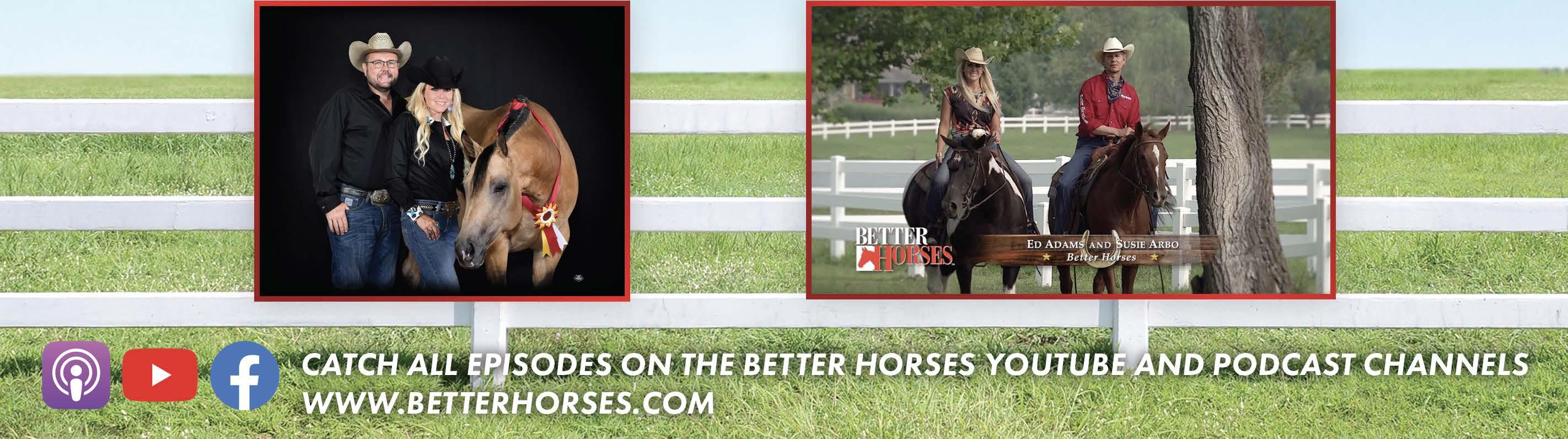
ED ADAMS, CEO BETTER HORSES
BY BETTER HORSES STAFF
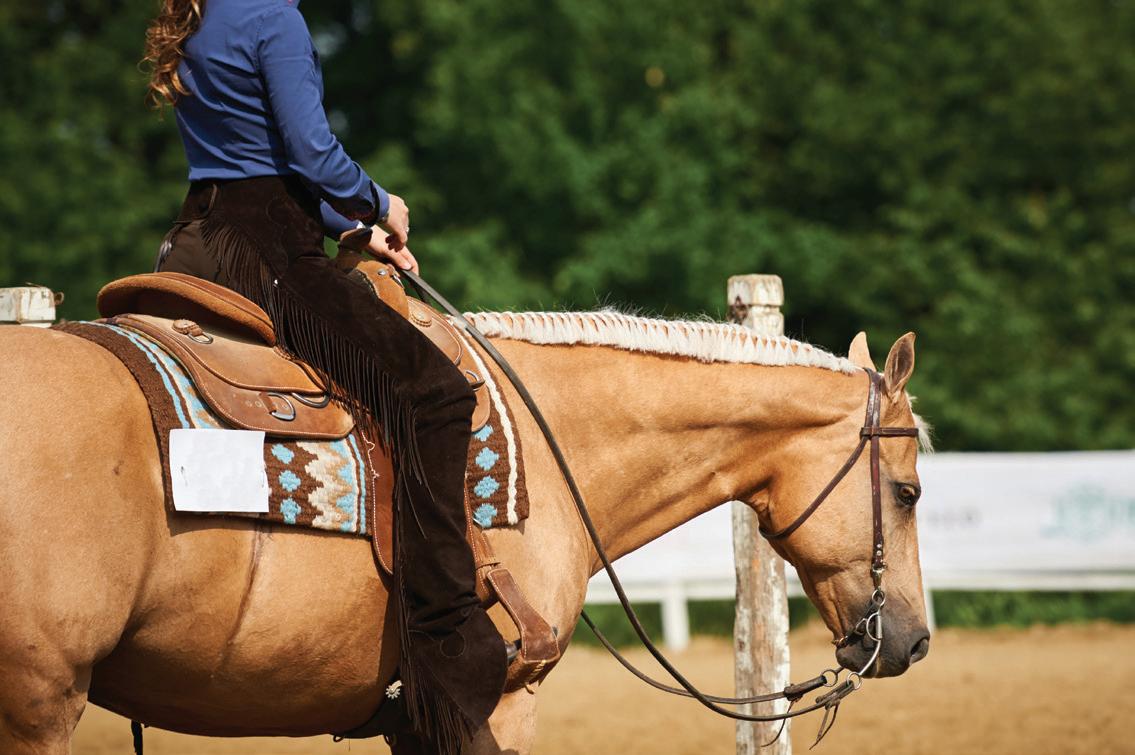
Riders must be prepared for competition and be ready for any unpredictability to happen.
Stepping into the competition ring means accepting one simple truth: things won’t always go according to plan. In equestrian sport, unpredictability is part of the experience. Riders are working with a 1,000-pound animal that doesn’t think or react like a human, while also navigating judging preferences, changing footing, unpredictable weather, new venues, and constantly evolving patterns or courses.
For riders heading off-property, it’s not a question of if something will go wrong — it’s when. The key is to be ready for it.
Murphy’s law is alive and well in the show ring. From a judge’s perspective, certain errors appear again and again — so frequently that they’re pre-listed on score sheets with corresponding deductions. These can range from small missteps, like chipping in before a hunter fence, slightly over-rotating a reining spin, or missing a perfectly square halt in dressage, to more significant issues such as refusals, bucks, or spooks. As a judge, my role is limited to observing and marking what happens, occasionally excusing a competitor when necessary. It’s one of the challenges of judging — there’s rarely an opportunity to teach or explain in the moment.
So why do these mistakes occur? Shifting now to my perspective as a horse behavior specialist — and someone who naturally asks “why” — the solution lies in understanding the root cause. Address the underlying reason, and the visible issue often begins to resolve. Later in this article, I’ll walk you through a practical action plan: what to do when things go wrong, how to respond in the moment, and how to limit the impact on your score, fellow competitors, and long-term training goals.
Deductions differ across the disciplines, but judges recognize and penalize these common errors.
Your horse freezes or flees. For its effect on your score, in most disciplines, the first option is preferable to the second. For example, a startle and stop will earn a fivepoint penalty in many Western events. But flying off the track or a spook-and-runback may take you off pattern and out of the placings.
Why does it happen? As a prey animal, a horse feels vulnerable in unfamiliar territory. A social creature, his instinct tells him there’s safety in numbers. The spook of one horse in a flat class inevitably triggers a flurry of flight! Performing individually while solo in the ring, your horse may feel vulnerable and on high alert for anything moving or changing. Interestingly, I’ve found some horses to be less spooky in the show venue bustle than on home turf. That scary shadow on the
ground is now eclipsed by all the sights, sounds, and movement of the horse show.
Your horse navigates the trail gate on autopilot, sets up his own feet in showmanship, or jumps into the canter at the click of the announcer’s microphone. He seems to know what comes next, which is manageable until you try to upset the order. Anticipation shows up on the judge’s card in a variety of ways, usually reducing the movement or maneuver score, unless your horse’s “overthinking” culminates in a penalty-earning error.
Why does it happen? A reiner’s tension builds at the center of the ring because that’s where all the transitions, flying changes, and spins start. An unsettled horse dances at the start cone of a pattern while his nervous rider tries to hold him still, which only makes him feel trapped. In previous classes, upon the judge’s nod, the rider unintentionally stepped on the gas pedal, thus beginning this horse’s anticipation cycle and dread of the start cone as if it were the Bogeyman.
A hunter jigs in the hack class at the sound of the announcer’s microphone clicking to call for the canter. No doubt he’s been startled once or twice by his rider’s hasty outside leg cue, particularly if other horses have begun to canter. Now he’s preparing to take off faster than a teen driver burning rubber out of a high school parking lot.
Horses are creatures of routine, learning quickly by association (classical conditioning) and by trial and error, choices and outcomes (operant conditioning). Horse show routines soon become habits, often unintentionally. Behaviors learned in the presence of fear
are not soon forgotten. A prey animal in nature doesn’t get a second chance to make a judgment error.
Short rigid necks, busy mouths, fixed ears, hasty steps. Expressions of tension are more likely to reduce your score without earning an actual penalty.
Why does it happen? Conflict behavior describes the way horses respond when feeling trapped or confused and without a clear option to find relief. Examples include the horse held in place by a nervous rider or unrelenting training tack, stressed by the abrupt signals of a frustrated rider, or confused by the conflicting aids of a rider overwhelmed with navigating arena traffic while sorting through the announcer’s instructions and the voice of her coach from the sidelines!
Your horse veers off the path to evade the jump or avoid the trail bridge. He might balk to a stop or dig in his toes, screeching on the brakes. These major faults ensure you’ll be out of the ribbons. Repeat two or three times (depending on the rules of your riding association), and you’ll be excused from the ring.
Why does it happen? Contrary to what we’d like to believe, a horse doesn’t naturally love to jump. Hurdling over an obstacle into the unseen other side clashes with his strong survival instinct and caution about taking unnecessary risks.
Do you have the tools in place to persuade your horse to go where his instinct tells him not to? As a judge, I wince to see a competitor who hasn’t trained their horse past the “head steering” stage before entering a show. Without confirmed lateral skills and a reliable goforward signal, they’re unable to override the equine inclination to skip the trail obstacle, or to funnel a wary horse forward
and over the fence. Circling after a stop for another approach only confirms an optional side exit. Moreover, the horse’s evasion is unavoidably rewarded as they’re excused from the ring.
Even the smallest dribble from canter to trot will earn an automatic low score in hunter, decrease the movement score in dressage, cost a penalty of .5 or 2 in reining or a deduction of 1, 3 or 5 points for most Western events, depending on the number of strides.
Why does it happen? Typically, a horse that breaks gait isn’t light and listening to the aids. In a distracting environment, this education gap is evident. The “go” button is sticky and fails in the crucial stride between canter and trot. The lateral control is weak and unreliable to shift the hips or shoulders back on track. Selfcarriage is when the horse stays connected, on track, and in rhythm, whether you shorten or lengthen his stride, without having to hold him there — kind of like cruise control.
I’ve seen my share of in-gate issues from the judge’s chair, and I’ve tackled my share as a competitor. The arena entrance is the site of scorecards full of penalties: irregular circles, breaks of gait, cross-cantering (losing the hind lead), or even refusing to enter. In a trail or hunter class, bulging off-line on approach to an obstacle disrupts the canter rhythm and flow of the course, resulting in an awkward take-off distance or “chip.”
Why does it happen? A horse tends to cut in one half of almost every circle and “bulge” out the other half. The rider may steer his head, but the remainder of the horse fishtails towards home. The magnet of the barn and buddies is a powerful draw for the herd-oriented animal. To a horse,
there’s safety in numbers.
Departing on the wrong lead, skipping to the incorrect lead, or slipping off-track to a disunited lead (cross-cantering) are costly errors. Like breaking gait, many disciplines ascribe a range of numerical penalties, depending on how many strides the horse is out of lead.
Why does it happen? Some eager riders enter the show ring without a thorough knowledge of leads. As your horse’s teacher, you must be able to identify your canter lead by feel — anytime, anywhere. You can feel the lead, not only on the first stride, but as your horse is lifting off into that first stride. Comparing your horse’s body parts to a train, wrong leads result when one car derails — the hip slips off the tracks to the outside or the shoulder bulges to the inside. Penalties occur when the rider is late to recognize the warning signs, or lacks the lateral aids to prevent evasions.
These are the show ring bloopers for which we have no one to blame but ourselves. They include asking for the wrong gait, wrong lead, or forgetting an element altogether. Other disqualifications arise from failure to be familiar with the rules. For example, failing to follow class protocol or sporting unpermitted tack (see The Science of Tack and Training Aids).
Why does it happen? Mental lapses. Failure to deeply memorize the course. Neglecting to plan a step-by-step class strategy. I was the off-course queen as a junior rider. I remember that lost-in-thejungle feeling of not knowing what jump or turn came next. Vagueness has been my downfall more times than I can count. Too many pre-class instructions from a coach or supporter with the best of intentions can drown out your class plan if not decisive and deeply memorized.
Things will go wrong in the show ring. Considering what might happen and why they happen ensures that we won’t be surprised. When riders consider how horses experience the competitive environment and how they view their world, it helps to nip penalties in the bud.
“I’ve missed more than 9000 shots in my career. I’ve lost almost 300 games. Twenty-six times I’ve been trusted to take the game-winning shot and missed. I’ve failed over and over and over again in my life. And that is why I succeed.” — Michael Jordan
We explored common horse show mistakes seen and scored from the judge’s seat, and dug into the source of why mishaps happen. By gleaning insights from the science of how horses learn and think, we uncover explanations beyond excuses (she’s just being a mare) or traditions (seven falls make a rider). I use this evidence vs. emotions-based approach in coaching riders how to consider the horse’s perspective in order to fix the issue. Now, it’s time for an action plan.
How do you manage in the moment to minimize the incident’s impact to your score, to your fellow competitors, and to your confidence? A snag in the show ring need not become a setback, unraveling your training progress. In fact, a snag reveals a weak area, which is an opportunity to build back better.
Imagine catching your sweater on a stall door latch. You could keep walking, tugging on your arm in frustration as a little snag becomes a lariat loop and you walk right out of your unravelling sweater. Or, you could unhook the snag in the moment, carefully carrying on with dignity despite the disappointing and embarrassing loop, until you can repair home.
I see a lot of frustrated riders at horse
shows, “schooling” (jerking) on their horses after they’ve hit a snag in their class. While cooler heads prevail, here is a list of some general don’ts and dos, followed by more specific fixes for typical show-ring mistakes.
DON’T GO TO THE SHOW WITHOUT YOUR TOOLS READY.
But he never does that at home! When your horse responds to a cue “most of the time,” he hasn’t thoroughly learned it. A busy horse show atmosphere is sensory overload for a green horse. It’s like asking a kid to review multiplication tables on the park bench at Wonderland before going on the roller coaster; it’s tough to concentrate and recall!
DON’T BLAME YOUR HORSE.
When I assume my horse “should know better” the truth is, at that moment of frustration and embarrassment, I’ve really just run out of creativity, patience, and my understanding of how horses learn and perceive the world.
DON’T BLAME THE JUDGE, YOUR SPOUSE, YOUR MOM, OR THE FOOTING.
All competitors share the same conditions and officials. Control what you can, and do the best with the circumstances you’re dealt. Appreciate your pit crew. They could be on the golf course or in the garden this weekend instead of at a horse show.
DON’T START WHAT YOU CAN’T FINISH.
At home, if you encounter a roadblock or resistance, you can try another approach or simpler steps. In the show ring, it may be impossible to follow through on what you’ve asked your horse without disturbing other competitors or disrupting class procedure. Mistakes swept under the carpet will later on show up as anxiety,
anticipation, and unwanted habits. Exiting the ring without taking the correct lead, not getting through the trail gate, or not getting over the jump can begin a downward spiral of “untraining” your horse.
“In almost all training situations, the most effective way to ‘delete’ behaviors is to prevent them from being expressed,” — Dr. Andrew Mclean.
DON’T REWARD EVASION.
Sadly, that’s what happens when we circle away from the jump or trail obstacle to take another shot at it. For example, we reward evasion when our horses prance in anticipation of a barrel pattern or the call to canter and we let them go before they settle.
Where are the magnets, potentially drawing your horse offline or off course? Be prepared for your horse to drift out and cut in somewhere on every circle. Where are the spooky sections of the ring? Which part of the pattern will be challenging for your horse? Perhaps certain transitions are sticky, or he tenses up when another horse comes up behind him. Through a few show seasons I managed a horse that reliably came unglued at applause. In the lineup, I watched for the judges to submit their cards so I could dismount before the placings were announced and divert her attention.
DO BLOW THE CLASS AND FIX THE PROBLEM… SOMETIMES.
Sure, there is a time for camouflaging the mistake and showing to win. But for the long-term, invest in the training of your horse even if it costs the class, and do so tactfully and with grace. Be gracious to your horse, because he won’t learn anything when stressed. Be gracious to other exhibitors and don’t compromise their safety or success. And be gracious to
the judge who is letting you finish your pattern or jump a courtesy fence after you’ve technically been disqualified.
Tell the story of exactly what went wrong. Put the facts into words:
1. My horse kicked at a horse cantering up behind me in the class. I noticed these warning signs — ears tense and turned back. Then, he raised his head and sped up.
2. My horse would not stand still at the start marker. The more I held him in place, the more agitated he became. He charged off at the judge’s nod, breaking into a canter instead of the required sitting trot.
3. My horse switched leads, loping past the in-gate on the way to the lope-over obstacle. His hind end left the track at the gate and our approach to the obstacle was crooked.
Have it in your tool kit to patch a mistake in the moment (never mind — carry on). Your spare tire is not a permanent tire to drive on, but an imperfect substitute to allow you to finish your trip. A Plan B example might be: Next time, if my horse tenses at the start cone, I’ll walk a calm, little circle instead of forcing him to stand there.
DO DETACH FROM FRUSTRATION.
Emotions can muddle the clarity of our aids or magnify them like a megaphone. A rider’s emotion stirs up her horse’s emotions. Emotions can cloud the logical solution to the issue. When hitting a snag in the warm-up or show ring, take a deep breath and assess the communication gap with your horse.
The gate is a powerful magnet, drawing
the horse’s attention out of the ring and towards his barn buddies, derailing him out of lead (hind end drifts off the track toward home) or out of gas (break of gait). Riders can counteract the draw to the gate by doing the opposite of what the horse is inclined to do. Here are some ideas: In the practice ring, leg yield away from the gate with every pass. Accelerate past the gate every time if deceleration is your horse’s default. Don’t stop to rest or dismount at the gate. School in the gate — make it part of your routine by trotting in and out, backing out, and so on. Use your imagination.
To convince your horse to go where his instinct tells him not to, you need the proper tools at your disposal. Are your go-forward and move-over cues reliable? Does he yield to leg pressure every time, everywhere? With no tools to guide a wary horse over an obstacle, the rider is inadvertently rewarding the evasion as they’re excused from the ring. Sprinkle lateral movements liberally into every training session — side pass, leg yield, turn-on-the-forehand, and turn-on-thehaunches. These are the tools you’ll need to override every hesitancy.
Take a deep breath. Keep all signals to your horse distinct and deliberate. Communicating calmly and clearly gives him a chance to process each cue. Our default when nervous is to clutch the reins and grip with our legs. Conflicting aids create confusion, confusion breeds tension, and tension triggers the horse to escape the stressful situation.
Avoid abrupt signals. With your horse on high alert, combined with your own survival instinct, you’ll be inclined to overreact, triggering your horse’s flight response. There’s a delicate balance
between riding defensively on the lookout for potential danger and riding with relaxation.
Arrive at the showgrounds in plenty of time to acclimatize your horse to the show ring and desensitize him to anything that might capture his attention.
When mishaps happen, aim to recover quickly. Four elements fall apart when your horse shies, stumbles, or slips into another lead or gait: pace, path, package, and position.
Your pace changes, and the horse may scoot forward, break gait, or stop. Your path detours, and the horse may spook to the safety of the arena center, counter-bend to gawk at something scary, or lose balance and drop his shoulder. Likely, the package or shape of the horse changes as he elevates his head and spills out of a round frame. And finally, your position changes and you may pitch forward, slip sideways, or get left behind.
As you gain confidence, aim to recover these elements within a few strides of the incident. I’ve salvaged many classes after my horse jumped off the rail by getting back on track while maintaining composure before the judge could turn around to check out the commotion. A side benefit of riding through those oops moments is the wisdom gained by experience and living to tell the tale.
As long as there are horse shows, there will be things that go wrong in the show ring. By contrasting our own perceptions with those of our horses, we can opt for a solution with more logic and less emotion. We can carry on in the moment and (eventually) appreciate the learning opportunity!









BY KATHERINE DELPH MILLER, DVM, MS, DACVIM; MAUREEN SUTTER, DVM; CHRISTOPHER BLEVINS, MS, DVM; ELIZABETH DAVIS, DVM, PHD, DACVIM
A shortage of equine veterinarians has been reported since at least 2018 and continues to be a problem today throughout the United States. The American Association of Equine Practitioners (AAEP) and American Veterinary Medical Association (AVMA) report that approximately 1.3% of new veterinary graduates enter equine practice each year and that 50% of these equine veterinarians leave equine veterinary practice or veterinary medicine within five years. The AAEP started a Commission on Equine Veterinary Sustainability in 2022 and developed and implemented strategies in the following key areas to recruit and retain equine veterinary for the future: Compensation, Emergency Coverage, Internships, Practice Culture, and Students. You can learn more about these initiatives at aaep.org.
In Spring of 2022, Kansas State University implemented a mentorship program, KSU Guiding Wildcats into Future Equine Vets (KSU-FEV), as our initiative for recruitment and retention
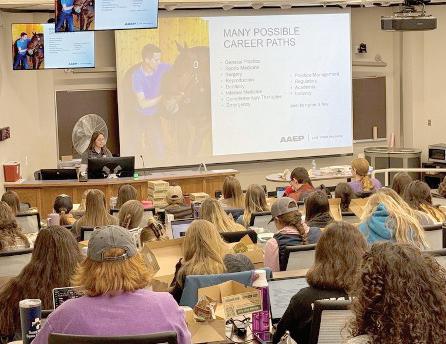
in equine veterinary practice. This was a joint initiative founded on input from KSU DVM alumna and private practice owner, Dr. Maureen Sutter of Red Oak Animal Hospital in Bucyrus, Kansas and KSU College of Veterinary Medicine (CVM) Equine Faculty and Administration. The mission of KSU-FEV is to aid in the recruitment and retention of veterinarians involved in equine practice through mentored relationships with students. Through this program, equine-interested students are paired with a practicing equine veterinarian mentor and a KSU equine faculty advisor. Boehringer Ingelheim Animal Health (BIAH) aided in helping recruit Kansas-area private practice equine veterinarians as mentors for the students. Through BIAH’s and KSU networking, 21 equine practitioners (KSU-CVM alumni, Kansas and surrounding states equine veterinarians, and veterinarians across the country who wanted to be involved in student outreach) volunteered that initial year to be mentors for equineinterested veterinary students. Thirty-five students were involved that initial spring. Currently, 35 mentor veterinarians and 94 students are involved in the program indicating an interest in aiding the future of equine veterinary practice through the involvement of current veterinarians and an interest in equine veterinary medicine in the veterinary student population!
The mentored relationships benefit both the students and the equine practitioners. Students are encouraged to connect with their mentor about
equine medical knowledge, of course, but also about business management, communication skills, emergency coverage and collaboration, work-life integration, career planning, etc. Additionally, the program meets as a group once to twice a semester to build the support network that the students have and ask questions of multiple mentors and faculty advisors.
During this time, the college was also working on implementing an Equine Veterinary Practice (EVP) Certificate Program which officially started in the 2024-2025 academic year with one DVM in the Class of 2025 graduating with the EVP Certificate. The aim of the EVP Certificate is for equine-interested students to be able to dive even deeper into equine medicine in order to be very competent and confident equine practitioners upon graduation. The certificate has requirements for completion of equinespecific coursework and at least 50 equine-specific clinical skills (compared to 19 equine-specific skills for a general graduate). In addition, students must present an equine-focused seminar to the CVM community, prepare a client-
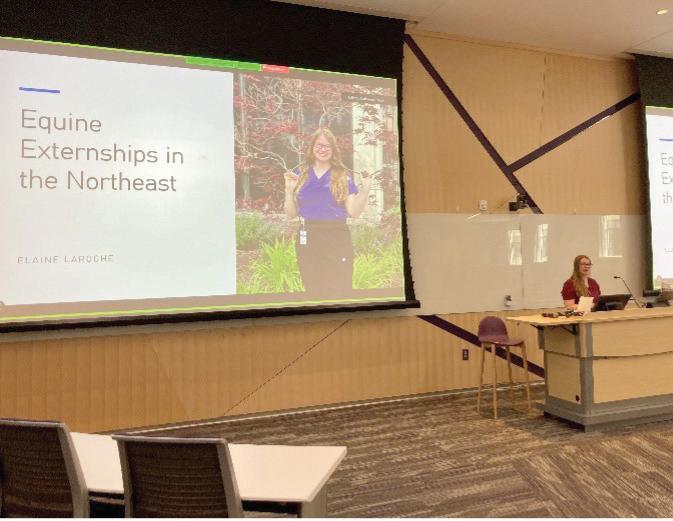
focused newsletter for education, and be a member of an equine veterinary organization. Currently there are 60 total students in the EVP Certificate Program (there is overlap between these two programs), with 10 students anticipated to graduate in the Class of 2026 with an EVP Certificate!
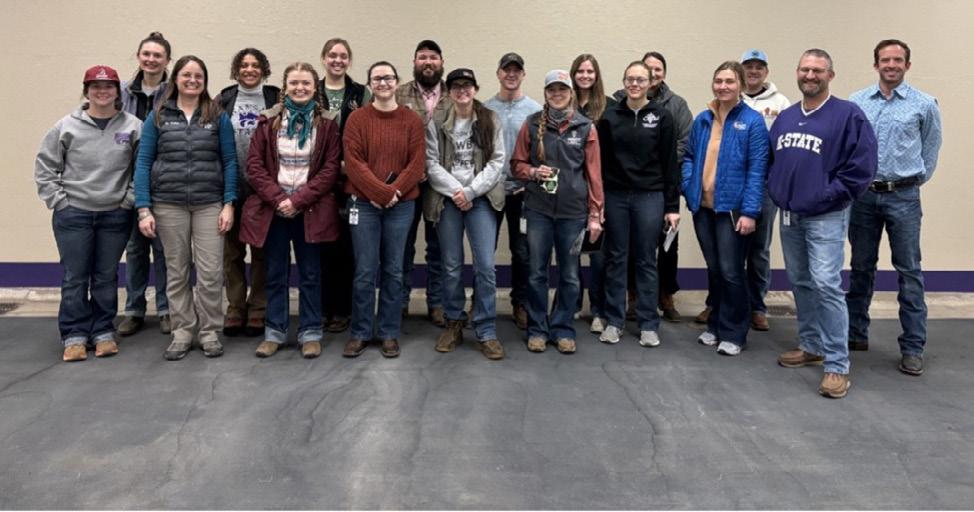
Recently an Equine Ambulatory Vehicle Event was held at the College of Veterinary Medicine where FEV and EVP Certificate
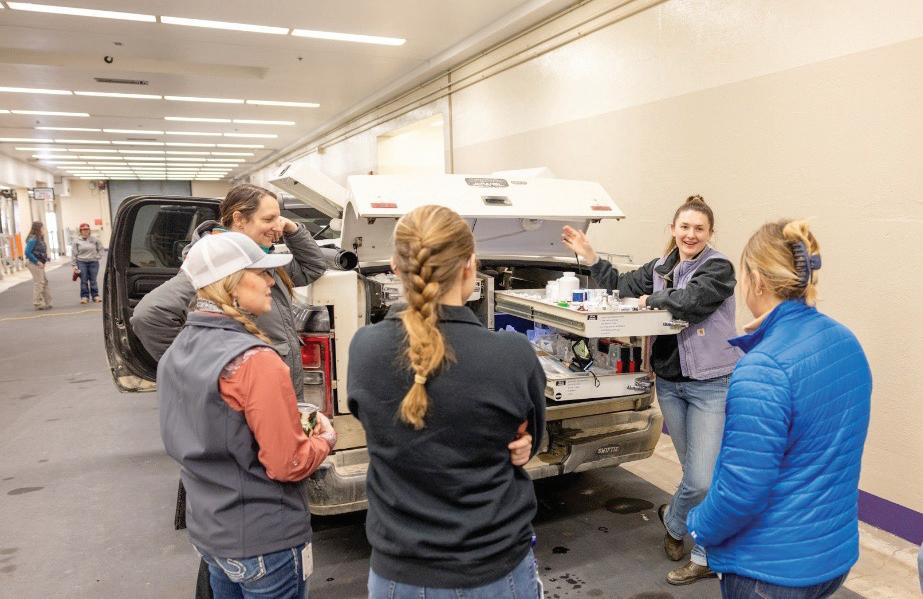
students learned about Equine Ambulatory and Field Service Medicine from Kansas-area equine mentors, KSU equine faculty, and a KSU DVM alumna, Dr. Cathleen Lombardi of The Oaks Equine and Farm Services in Smithfield, VA, who presented an interesting case via Zoom where acupuncture was used as an adjunctive therapy. Students were able to discuss how equipment is stored and organized on these vehicles, how to prepare for cases in the field, and how to think through what equipment from the vehicle is needed for a case.
Our equine section is proud of these efforts to contribute to the future of equine
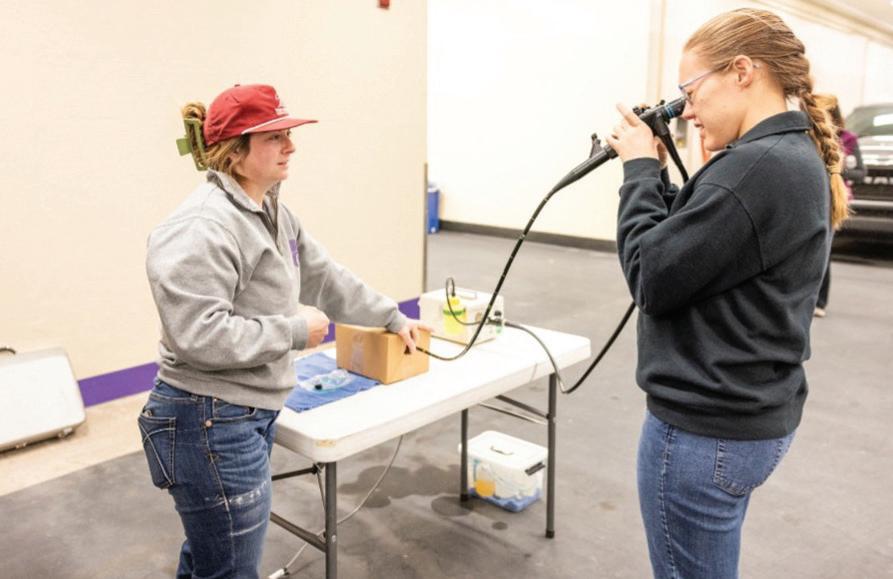
veterinary practice! We support equineinterested students who want to go into solely equine practice or who want to have equine as a component of their companion, mixed, or large animal practice in the future. We have received feedback from KSU Alumni that if they had had this support during school they would have pursued equine practice. We are grateful to all the equine practitioners who volunteer their time and expertise to support KSU equine-interested veterinary students! We are excited to see how our equine graduates build up equine veterinary medicine in the future.



BY MITCHELL KRAMER, COWBOY MOUNTED SHOOTING ASSOCIATION PRESIDENT
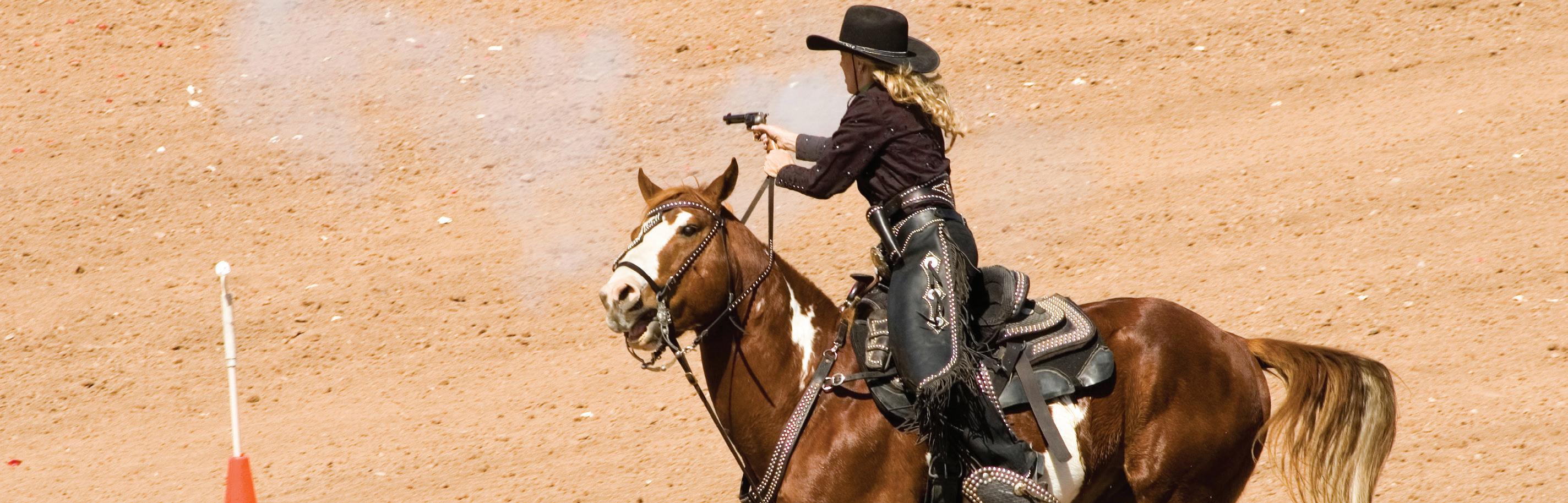
If you’re looking for a sport straight out of the old Western movies, this is it.
Cowboy mounted shooting is fast-moving and exciting, requiring equine speed and rate, horsemanship, and a skilled and steady hand. The sport was formed in 1991 and is an AQHA-approved event through AQHA’s alliance with the Cowboy Mounted Shooting Association.
Their chosen sport requires multiple skills, as it relies not only on the horse’s speed and rider’s horsemanship, but also the rider’s shooting skills and accuracy, making it a multi-level challenge. Here’s some information to help you get started.
Cowboy mounted shooting is a timed event. It uses a set of 10 balloons attached to stands, set in one of more than 50 approved patterns. The patterns can include maneuvers such as turning around a barrel, switching direction, and going through a “gate,” or a relatively narrow opening. The balloon patterns often include a “rundown” – a line of five balloons set on a straightaway.
A rider uses two .45-caliber, single-action revolvers, each carrying five rounds of black-powder blanks that have an effective range of 10-15 feet. The rider must cock the gun before each shot. After five shots, the rider must holster his first gun and unholster his second while on the run. There are time penalties for missing a balloon.
There is also a rifle class, which requires one pistol and one .44-40 rifle. The rider shoots five balloons with the pistol then switches to the rifle for the final five balloons.
Mounted shooting has divisions for men, women, seniors, and youth. There are subcategories within those divisions by skill level, from 1 to 6. Riders start in Class 1 and advance after winning a division four times. The Little brothers, who have been competing for more than a decade, are both Level 6 riders.
Safety is a big deal in the sport. At events, guns are kept unloaded until each competitor enters the competition ring.
A sport straight from the “old west” and centered around fast-moving excitement and speed by skilled riders and horses.
The necessary items for mounted shooting are fairly simple.
Start simple, with a western hat, buttondown shirt, jeans, chaps or chinks, and western boots.
Mounted shooters shoot .45-caliber, single-action revolvers and .44-40 rifles. Each shooter will need two pistols, which can cost from $600 to $1,500 per gun.
There are all kinds of different brands, A lot of ladies want a little bit of a smaller barrel, a smaller handle. It’s really just preference, whichever feels good to you.”
Experts recommend handling several different guns to find one that works. Different brands and different models have different feels, so hold the gun in your hand, pull the hammer back, and pull the trigger.
You want something comfortable in your hand that’s easy to pull the hammer back.
If you have to readjust your hand to pull the hammer back, that’s not good.”
Once you invest in your guns, though, they are a lasting investment.
Usually, whatever fits is going to fit you for a while, A lot of the Level 6’s today are shooting the same little gun a Level 1 (competitor) would start with.
Your holster, like your gun, is a matter of personal preference. Find one that places your guns comfortably and with ease of accessibility.
The athleticism, trainability, and speed of an American Quarter Horse make this breed the preferred mount for the top cowboy mounted shooters, and a great breed for any and every level of rider.
As with any sport, it is best if a new shooter chooses an experienced equine partner.
You need something that’ll slow down and treat you good in the meantime, then in a few years, go up from there.”
When searching for a prospect, look for a gentle, broke horse with a good handle, then teach the horse the skills of mounted shooting.
Saddle
A mounted shooting horse needs to be dressed in western tack that would be considered representative of traditional equipment.
You don’t want something that traps you in there; it has to let you move around a little. Something comfortable that you could ride all day, yet if you ask your horse to go, it wouldn’t throw you out. Something with a good pocket, a good seat.”
Your horse should wear a western bridle. For a shoot, a chain curb is used to give more control in a high-energy atmosphere. Most trainers encourage seeking the mildest bit that allows control. “It depends on your horse. You think you do know if you’re yanking on them out there, but you usually aren’t aware, so the less bridle you can get away with, the better. We don’t encourage people to run out there in snaffles. You’re going to get run off with.”
Training at home, however, is a different story.
“Whatever you ride the horse into shoot, take the horse one step lower to ride at home. Trainers sometimes school horses in a snaffle, unless the horse requires something stronger.
Protective Leg Gear
Typically, leg wraps, as well as bell boots, are placed on all four of his horses’ legs. It is also optional to use earplugs for both horse and rider.
Practice Equipment
In addition to balloons, you’ll need a set of balloon holders, which is a road construction cone with a PVC pipe that is capped with a peg that has a valve stem.
AQHA has crowned cowboy mounted shooting world champions since 2012. The AQHA Cowboy Mounted Shooting World Championships have been a joint effort between AQHA and the Cowboy Mounted Shooting Association. CMSA handles the qualifying and entry processing, as well as the management of the event, whereas AQHA facilitates the invitations, sponsorships, and awards presented to the world championship exhibitors.
Honors won at the AQHA CMS World are also recorded on the horses’ official records. The AQHA CMS World is held in conjunction with the CMSA World Show in October.
Many CMSA events offer AQHAapproved cowboy mounted shooting classes, where points earned appear on horses’ official AQHA records. To find a show near you that offers AQHA cowboy mounted shooting classes, visit cmsaevents. com
The following AQHA divisions are offered:
• Open - Levels 5 and 6 and/or professionals earning remuneration for training, clinics, etc., regardless of CMSA classification.
• Amateur - Levels 1, 2, 3, and 4
• Select Amateur Limited - Levels 1, 2, and 3 (50+ age)
• Select Amateur - Levels 4, 5, and 6 (50+ age)
• Limited Youth - Levels 1, 2, and 3 (ages 12-18)
• Open Youth - Levels 4, 5, and 6 (ages 12-18)





BY BETTER HORSES STAFF
Anxiety is a very common problem in horse riders, and it often presents itself in several ways. For some people, it’s overthinking things, for others it’s doubting themselves, and for others it’s worrying about what might happen.
A lot of anxiety-related problems are habits that riders have gotten into, and it takes roughly 100 repetitions of a new habit to get rid of the old habit. So, there is a lot of effort that has to be invested in making a change before you get the benefit of it, and your riding confidence improves.
Anxiety doesn’t just affect horse riders who compete; it can affect riders at all levels and with a range of experience.
It is typically seen in riders who have had a break and gone back to riding later in life, or a rider who has a new horse, or a young horse they are bringing on. The good news is that people can get past anxiety and enjoy riding again.
This comes back to self-belief. When we try to validate if we’re a good person or not, we typically look internally and externally. If internally we don’t reinforce ourselves very positively and don’t have a lot of positive self-belief, we then become very reliant on external feedback from other people.
When riding in front of other people, such as on a livery yard or at a competition, riders worry about what other people think.
Solution
Work on developing some strong positive beliefs using evidence through what people say you do well as a rider. Ask people around you for positive things about your
riding, and ask yourself what you are working on that is making you a better rider so you can start to build self-belief.
You can also ask what your trainer thinks you are good at. Ask them to point out the things you are doing well as well as the things you can improve on, so you know what your strengths are as well as what you need to work on.
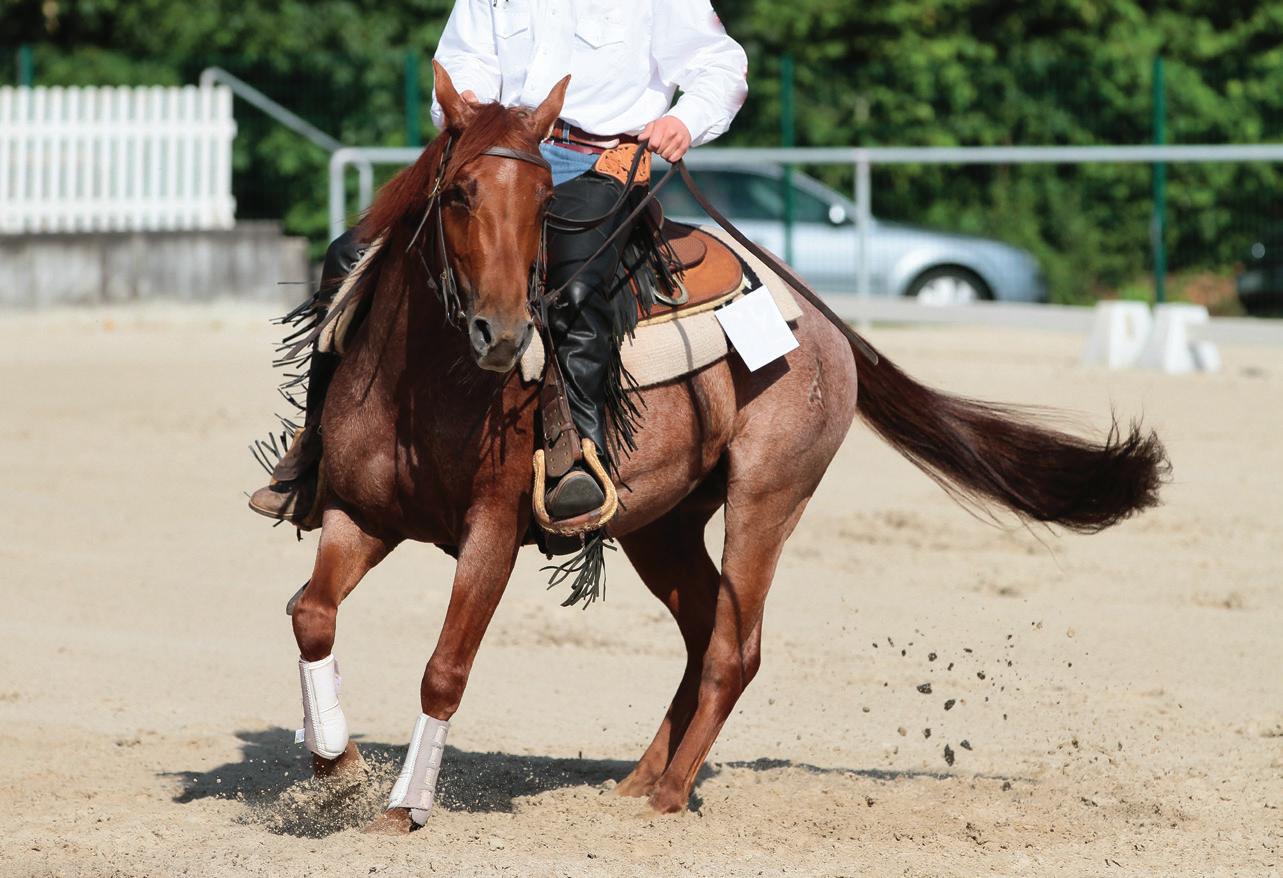
From there, it is about focusing on what you can control, which takes you away from judgmental thinking.
When you are in task focus mode, you are focused on what you are doing — this means you can no longer be in judgment mode at the same time.
Give yourself a checklist and focus on the process of doing a certain movement or task.
If you really struggle to ask for people’s opinions of you, start with a trusted friend and ask them what they think you do well as a rider.
Share your achievements with friends, including on social media if you are happy to, but don’t spend too much time dwelling on and comparing yourself to others.
What it means
Riders relive an experience and fear the same thing happening again.
Symptoms
When someone experiences a traumatic
event, they can relive the experience over and over again.
Anyone who has a responsibility at home, such as children or being self-employed, is often more predisposed to reliving the traumas of a fall compared with someone who doesn’t have those life responsibilities.
Often, riders can bounce back from a fall better if they are not reliving the experience, but with those who do relive it, you have to get professional help.
We’re only talking about one half-hour session to resolve the reliving of the experience. Trying to fix that yourself is very difficult.
The next consideration is how long you wait to get back in the saddle. There is an age-old philosophy that you should get straight back on, and although I agree it’s not good to delay unnecessarily, there is much to be said for waiting until you are physically able.
When we’re not in great physical health, we are far more predisposed to anxiety, which could exacerbate the issue.
Next, examine what is going on in your mind and take note of any thoughts that you might have (‘what if’ thinking), addressing the memory of the fall and negative thoughts that go with it.
You can then challenge them as explained before. When it comes to dealing with the physical symptoms of anxiety, I get riders to work on relaxation, doing a guided meditation or breathing technique to bring stress levels down.
It tells your brain that when you’re in that situation, you don’t need to worry.
Top tip: disassociation
If you are reliving a bad experience, imagine you are watching that experience on a TV.
This automatically disassociates you from it and starts to take some of the realness out of it. If you practice this often enough, you can disassociate yourself from the experience and help with your anxiety.
What it means
When a rider doesn’t think they are good enough, it fundamentally comes down to a lack of self-confidence.
Symptoms
Often, riders question what they are doing, which can lead them to not be decisive or not quick enough to make decisions, or they can overthink it, which makes them override and overcomplicate things.
Solution
Advise riders to keep a journal of what they are thinking and try to work out the patterns in their thought processes.
Typically, when you don’t feel good enough, it will relate to two or three things
in particular, not necessarily everything. Becoming more aware of the thoughts going through your mind helps you understand what is causing you to feel like that.
Once you have identified that, you can confront it and challenge it and ask, “Is it true all of the time?” Think of the times when you did feel good enough, which dispels the myth that you aren’t good enough all of the time.
“I am” statements tend to relate to our belief systems, so if you tell yourself you are not a good enough rider, it is typically a belief, so it’s about catching those and challenging them positively.
Find evidence to challenge those thoughts, such as “I went on a hack yesterday and was fine, so I can’t be a bad rider all of the time”. You will make the negative thoughts less credible and real.
Top tip: make a plan
Have a plan in your mind about what you want to achieve in a session.
Break it down into steps to work through and concentrate on them when you are riding. Imagine in your mind how you want your horse to go and how you will achieve that.
By having a focus, you will be doing something positive instead of thinking of the negatives.
Performance anxiety usually stems from someone feeling that something isn’t achievable. For example, competing in a dressage test at a new level for the first time.
Symptoms
Thoughts about what might go wrong or that you can’t do it can precede and create
a feeling of anxiety, and once that takes hold, people can feel sick, their mouths go dry, they stop breathing properly, and they have an elevated heart rate.
Horses are programmed to sense when another animal’s fight or flight sense is activated, so our physical anxiety symptoms make them think there is something to worry about, and it becomes a vicious cycle.
First, by addressing those thoughts, you can get rid of the physical symptoms. Be aware of what you are thinking and try not to dwell on it.
If you allow a thought to pass instead of focusing on it, it won’t be so powerful and escalate into physical feelings.
Second, take the pressure off yourself. If you are doing something for the first time, treat it as a data gathering exercise, an opportunity to baseline your performance on, rather than say it was good or bad, or pass or fail.
Whether you do it successfully or not, you are going to learn something. If you succeed, you learn that what you did works, and if you don’t succeed, you’ll learn what didn’t work.
You can’t achieve something unless you start from a position of not being able to do something.
Top tip: fail to prepare, prepare to fail.
Feeling fully prepared for something will also help ease anxiety, whereas not feeling ready will only add to it.
Focus on one step at a time and run through a checklist of what you are going to do in your dressage test or jumping round to keep you in the present moment.
BY KEN MCNABB WITH KATHERINE LINDSEY
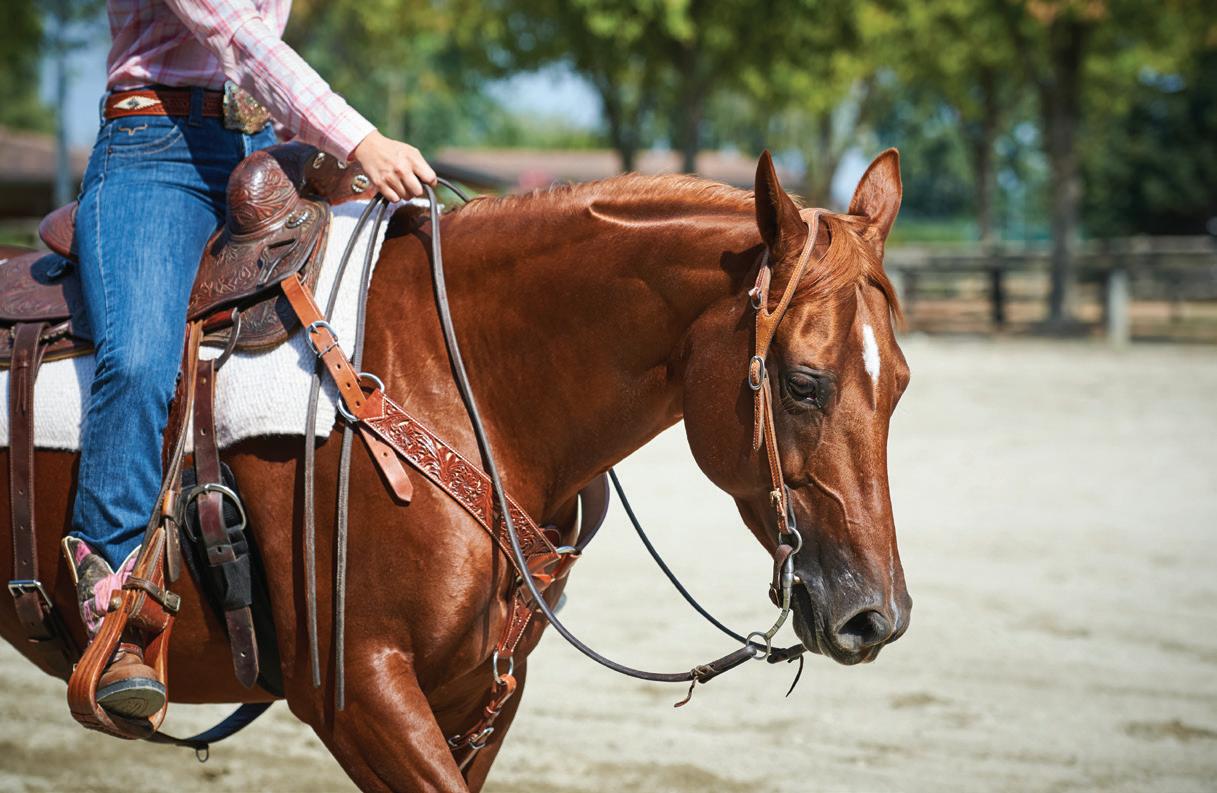
A spooky horse can be difficult to ride. You might feel you never know what will set off the next jump, and sometimes, one horse spooking will set off the horses around it. It is easy for a spook to turn into a wreck. So this month, we will cover how to help your horse learn to control his emotions and have confidence in you as a rider and leader, even in unfamiliar or scary situations.
There are two reasons a horse will be spooky. One, the horse is young and inexperienced, and genuinely afraid of something. Two, the horse is older and experienced, but has learned that spooking at things gets him a release from the work he is doing. The exercises we are going to cover will help in both situations. For these exercises, you will want to start in a round pen if you have access to one, and then move out to an enclosed, larger arena. You will need at least one person to help you, and some potentially scary objects: a lariat rope, a large ball, a tarp, foam water noodles, or a flag are some suggestions, but you can use whatever you have on hand. Your horse should be saddled and bridled, preferably with a snaffle bit.
Remember, with this exercise, as with everything you do around your horse, your safety and your horse’s safety are the top priority. Don’t try to push it and do something that gets you in a wreck. Take these exercises slowly, and allow your horse to build his confidence and have success, as you build your confidence to ride him through situations where he is nervous.
Start without any spooky things in the round pen, and work your horse in figure 8’s and serpentines, focusing on softening his nose at each change of direction, and keeping his feet moving forward. I like to work these exercises at the trot if
possible. The goal here is to get your horse’s feet moving and his attention on you. Once you have this without distractions, have your friend come into the pen and start adding distractions. Your responsibility as a rider is to keep working with your horse on the same exercises as if nothing has changed. If you lose focus and start looking at the new, scary distractions, you can hardly blame your horse for doing the same! Have your helper start small, maybe by just jumping around a little and kicking some dirt. See how your horse handles this. If he spooks, have your friend just keep at it while you keep at your training exercises. If your horse does not spook when something new happens, pet him and let him know that was what you wanted. Keep adding more distractions and scarier things, and you can move out to the larger arena once you feel confident. You will never be able to expose your horse to every possible scary situation and thing he might encounter in his lifetime. So instead of trying to train for every specific thing you might come across, you are teaching your horse to control his emotions and look to you for guidance in any situation. Remember, the important thing is not how your horse responds to the scary object. The important thing is how he responds to you and your cues in the situation. Don’t get after your horse and start punishing him if he spooks; just keep working on your forward motion, changes of direction, and flexing. If you start punishing your horse every time he spooks, it just adds more anxiety to the situation as he anticipates the punishment, and that is not what you are after. However, don’t let the spook be a release. If your horse
It’s
spooks, drive him right back up to the speed he was moving forward before the spook, or even a little faster. If he learns that spooking is a way to get the chance to stop and rest, your problem will just get worse.
Try to resist the urge to grab your horn for security when you think you are getting into a situation where your horse might spook. If you need to, grab the horn once he has spooked, but if you drop one rein and go for the horn before anything even happens, you take away your ability to guide your horse confidently with both reins. He needs your calm and clear direction most when you are coming up to something scary, and by taking that away, you are sending him the wrong message about your leadership ability.
Most of the problems we have with our horses are caused by something we are doing or not doing in our training and riding. So remember to keep your attention on your training and your horse in all situations, and in turn, he will learn to keep his attention on you and have confidence in you to guide him through anything. Enjoy your horses, and until next time, may God bless the trails you ride.
For more information about Ken McNabb’s programs, call 307-645-3149 or visit www.kenmcnabb.com .

BY WILHITE & FREES VETERINARIAN HOSPITAL
Equine Metabolic Syndrome (EMS) refers to a group of endocrine and metabolic abnormalities associated with obesity and laminitis in horses. Faulty insulin metabolism is a key component of EMS and can include both insulin resistance (IR) and hyperinsulinemia (HI). (Insulin is a vital hormone that transfers glucose from the bloodstream into tissues.) IR is the failure of tissues to respond appropriately to insulin, while hyperinsulinemia is elevated insulin levels in the blood. Both IR and HI fall under the new umbrella term Insulin Dysregulation.
• Middle-aged
EMS is first commonly noticed in horses approximately 8–18 years of age
• Abnormal fatty deposits (A)
Horses with EMS may have a cresty neck as well as abnormal “regional” fat pads behind the shoulders, over the tail head, and above the eyes
• Breed link
More common in “easy keeper” types such as pony breeds, Morgans, gaited horses, Arabians, and warmbloods, EMS is likely to be an inherited trait
• Cresty neck (B)
Dysfuction (PPID) refers to a collection of clinical signs due to the overproduction of certain pituitary hormones. It is caused by an enlarged and overactive pituitary gland, normally kept in check by inhibitory dopamine from the hypothalamus. In addition to obvious changes in hair coat, signs may also include weight/muscle loss, behavioral changes, increased infections, and laminitis.
• Loss of topline (A)
• Loss of muscle (B)
Muscle wasting is common in horses with this condition and may be seen as loss of
topline and a rounded abdomen (caused by decreased abdominal muscling)
• Hypertrichosis (C)
50% of PPID horses may be affected by a long, curly hair coat that fails to shed
• Older age
Clinical signs are most frequently first seen in horses in their mid-teens
What to do next…
If you’re concerned that your horse may have one of these conditions, your first step is to talk to your veterinarian.
In addition to looking at the physical appearance of your horse, your vet may perform diagnostic tests.
Once your vet makes a diagnosis, work together to design a treatment, dietary, and management plan for your horse’s individual needs.
BY
Fence can be one of the most attractive features of a horse facility. Fencing is a major capital investment that should be carefully planned before construction. It should keep horses on the property and keep away nuisances such as dogs and unwanted visitors. Fences aid facility management by allowing controlled grazing and segregating groups of horses according to sex, age, value, or use. But not all fences are suitable for horses.
Well-constructed and maintained fences enhance the aesthetics and value of a stable facility, which in turn complements marketing efforts. Poorly planned, haphazard, unsafe, or unmaintained fences will detract from a facility’s value and reflect poor management. Good fences can be formal or informal in appearance, yet all should be well-built and carefully planned. Many experienced horse owners will relay stories about the savings for cheaper, but unsafe, horse fence (barbed wire, for example) eventually being paid for in veterinary bills to treat injured horses.
Often, more than one kind of fence is used at a facility. Different fences might be installed for grazing pastures, exercise paddocks, riding areas, or for securing property lines. Land topography influences the look, effectiveness, and installation of fencing. Consider different horse groups. Stallions, weanlings, mares, mares with foals, and geldings all have different fencing requirements.
Pasture use may range from exercise paddocks (corrals) to grazing or hay production. Paddock layout should allow for ease of management, including movement of horses, removal of manure, and care of the footing surface. Pasture design should allow field equipment, such as mowers, manure spreaders, and
baling equipment, to enter and maneuver easily. This will reduce fence damage by machinery and the time needed to work in the field.
Understand the purpose of a fence.
The true test of a fence’s worth is not when horses are peacefully grazing, but when an excited horse contacts the fence in an attempt to escape or because he never saw it during a playful romp. How will the fence and horse hold up under these conditions? A horse’s natural instinct to flee from perceived danger has an effect on fence design. Like other livestock, horses will bolt suddenly, but since they are larger and faster, they hit the fence with more force. Also, horses fight harder than other livestock to free themselves when trapped in a fence. There are many types of effective horse fencing, but there is no “best” fence. Each fencing type has inherent trade-offs in its features.
jumping and solid enough to discourage testing its strength. It should have no openings that could trap a head or hoof. The perfect fence should not have sharp edges or projections that can injure a horse that is leaning, scratching, or falling into it. It should be inexpensive to install, easy to maintain, and last 20 years or more. And finally, it should look appealing.
A “perfect” fence should be highly visible to horses. Horses are farsighted and look to the horizon as they scan their environment for danger. Therefore, even when fencing is relatively close, it needs to be substantial enough to be visible. A fence should be secure enough to contain a horse that runs into it without causing injury or fence damage. A perfect fence should have some “give” to it to minimize injury upon impact. It should be high enough to discourage
Unfortunately, no type of fence fits all the criteria for the perfect fence. Often there is a place for more than one type of fence on a horse facility. Stable management objectives and price ultimately determine which fencing is chosen. Many new fence materials and hybrids of traditional and new materials are now available.
Planning includes more than selecting a fence type. It is best to develop an overall plan where the aesthetics, chore efficiency,
management practices, safety, and finances are considered. The best planning involves a layout drawn to scale that shows proposed gates, fence lines, where fences cross streams or other obstacles, irregular paths along a stream or obstacle, traffic routes for horses and handlers, routes for supplies and water, vehicle traffic routes, and access for mowing equipment. All these should be in relation to buildings and other farmstead features.
Select and install fencing that allows easy access to pastures and does not limit the performance of stable chores. Gates should be easy to operate with only one hand, so the other hand is free. Fencing should also allow easy movement of groups of horses from pasture to housing facilities. All-weather lanes should connect turnout areas to the stable. Lanes can be grassed or graveled, depending on the type and amount of traffic that uses them. Make sure they are wide enough to allow passage of mowing equipment and vehicles. Vehicles such as cars, light trucks, and tractors can be up to eight feet wide. Farm equipment needs lane widths of 12 to 16 feet (3.6 to 4.9 m) to comfortably negotiate. Narrower lane widths are acceptable for smaller tractors or mowing equipment. Remember to leave room for snow storage or removal along the sides of lanes and roads.
It is best to eliminate fence corners and dead-end areas when enclosing a pasture for more than one horse. By curving the corners, it is less likely that a dominant horse will trap a subordinate. Round corners are especially important for board fences and highly recommended for wire fences.
Most wire fencing is installed with the wire under tension as part of the design strength of the fence. This tension may be modest, just enough to keep the wire straight and evenly spaced throughout
seasonal temperature changes in wire length, or it may be quite substantial, as with high-tensile wire fence. With tensioned fencing, rounded corners may not be as strong or durable as square ones. A slight outward tilt of support posts on curved corners can help resist the inward forces of the tensioned wire. Position the tensioned wire on the outside of the fence post as it travels around the curve, then back to the inside (horse side) on the straight sections. It is possible to build square corners for tension fences and use boards to prevent horses from getting into the corners. This creates areas that limit grazing, requiring regular mowing, but it is cheaper to construct than curved corners.
Horse fences should be 54 to 60 inches (1.37 to 1.52 m) above ground level. A good rule for paddocks and pastures is to have the top of the fence at wither height to ensure that horses will not flip over the fence. Larger horses, stallions, or those adept at jumping may require even taller fences. At the bottom, an 8-inch (20 cm) clearance will leave enough room to avoid trapping a hoof, yet will discourage a horse from reaching under the fence for grass. A bottom rail with clearance no higher than 12 inches (30 cm) will prevent foals from rolling under the fence. Fence clearance varies with fence types. Higher clearances allow small animals, such as dogs, to enter the pasture. Fences should be built with particular attention to fence post integrity. Several fence material manufacturers provide good, detailed guides to assist in construction and material selection.
Fence openings should be either large enough to offer little chance of foot, leg, and head entrapment, or so small that hooves cannot get through. Small, safe openings are less than three inches (7.6 cm) square, but can depend on the size of the horse. Tension fences, such as the
types that use high-tensile wires, usually have diagonal cross-bracing on corner assemblies. These diagonal wires or wood bracing provide triangular spaces for foot and head entrapment. Good fence design denies horse access to the braced area or at least minimizes hazards if entrapment occurs.
Horses will test fence strength deliberately and casually. Horses often reach through or over fences for attractions on the other side; thus, sturdy fences are essential. Fences that do not allow this behavior are the safest. Keep open space between rails or strands to 12 inches (30 cm) or less. For electric fences, this open distance may be increased to 18 inches (45 cm) since horses avoid touching the fence. With most fences, and particularly with paddock and perimeter fences, a single strand of electric wire can be run four to six inches (10 to 15 cm) above or just inside the top rail to discourage horses who habitually lean, scratch, or reach over fences.
The fence should be smooth on the horse’s side to prevent injury. Fasten rails and wire mesh to the inside (horse side) of the posts. This also strengthens the fence. If a horse leans on the fence, its weight will not push out the fasteners. Nails and other fasteners should be smooth without jagged parts that can cut the horse or catch a halter.
Visible fences will prevent playful horses from accidentally running into them. A frightened horse may still hit a visible fence while he is blinded with fear. A forgiving fence that contains the horse without injury is better than an unyielding brick wall. Wire fences are the least visible, so boards or strips of material are often added.
The fence post is the foundation of the fence, so its importance cannot be
overemphasized. The common element in virtually all successful horse fences is a wooden post. Setting posts represents the hardest work and the most time-consuming part of fence building and is absolutely the most critical to the long-term success of the fence.
Driven posts are more rigid and therefore recommended over handset posts or those set in predrilled holes. Driven posts are pounded into the ground through a combination of weight and impact by specialized equipment. The principle behind driven posts that makes them so secure is that the displaced soil is highly compacted around the post, resisting post movement. Even for do-it-yourself projects, you should contract the job of driving posts. Post-driver equipment is nearly impossible to rent due to liability concerns. Under some dry, hard, or rocky soil conditions, a small-bore hole will be necessary for driven posts.
Wood is recommended for all horse fence posts. The best buy is a pressuretreated post from a reputable dealer. The preservative must be properly applied to be fully effective. Initially, treated posts are more expensive than untreated ones, but they last four times as long as untreated ones. Depending on soil conditions and preservative treatment quality, a pressuretreated post can last 10 to 25 years.
Suitable wooden fence posts are similar for board and mesh fences. High-tensile wire and other strand-type fences require similar posts, but distances between posts are much longer than for board or mesh fence. Post distance on high-tensile wire fence depends on wind influences and topography. Round wood posts are stronger and accept more uniform pressure treatment than square posts of similar dimension. Attachment of wooden rail boards to round wood posts is improved when one face of the post is flat.
Exceptions to wood posts are allowed for horse-safe steel posts typically used on chain link fences, pipe posts from welded fences, and rigid PVC fence post. Hollow posts require top caps to cover the ragged top edge or should be designed so that the top fence rail covers the top of the post. Recycled plastic, 4-inch (10 cm) diameter solid posts are suitable for a horse fence, but require a small-bore pilot hole before driving. Metal and fiberglass T-posts are slightly cheaper but pose a serious risk of impalement and are not recommended. They are also not strong enough to withstand horse impact without bending. With a plastic safety cap installed on the top, T-posts may be cautiously used in very large pastures where horse contact is rare.
How deep to set the post for structural stability varies considerably with soil conditions. Soil characteristics play a major role in determining the longevity and maintenance requirements of a fence. Some soils remain wet and can quickly rot untreated wooden posts. Posts in sandy or chronically wet soil will need to be set deeper and perhaps supported by a collar of concrete casing. Other soils tend to heave with frost and can loosen posts that are not driven deep enough. Fences under tension, such as wire strand or mesh materials, will require deeply set posts to offer long-term resistance against tension. A typical line post depth is 36 inches (.9 m). Corner and gateposts are required to handle greater loads and are about 25 percent larger in diameter and should be set deeper, often to 48 inches (1.2 m).
Gates should have the same strength and safety as the fence. Gates can be bought or built in as many styles as fencing, but do not have to be the same style as the fence. The most common and recommended
materials are wood and metal tubes. Easyto-assemble kits for wooden gates with all the hardware, including fasteners, braces, hinges, and latches, can be bought from farm, lumber, or hardware stores. Horsesafe tubular pipe steel gates (often 1 3/8inch or 3.5 cm outer diameter pipes) have smooth corners and securely welded crosspipes to minimize sharp-edged places for cuts and snags. By contrast, channel steel or aluminum stock livestock gates are not recommended for horse use due to their less-sturdy construction and numerous sharp edges.
Avoid gates with diagonal cross-bracing. Although this strengthens the gate, the narrow angles can trap legs, feet, and possibly heads. Cable-supported gates offer a similar hazard to horses congregating around the gate. If gate supports are needed, a wooden block called a short post can be placed under the free hanging end of the gate to help support its weight and extend hardware life. The use of a cattle guard (rails set over a ditch) instead of a gate is not recommended since horses do not consistently respect them. Horses have been known to jump them or try to walk over them, which results in tangled and broken legs.
Gates should be as tall as the fence to discourage horses from reaching over or attempting to jump over the gate. Gates can be up to 16-feet (4.9 m) wide, with a minimum of 12 feet (3.6 m) wide, to allow easy passage of vehicles and tractors. Horse and handler gates should be no less than four feet (1.2 m) wide, with five (1.5 m) feet preferred. Human-only passages are useful for chore time efficiency.
Fencing near gates needs to withstand the pressures of horses congregating around the gate, which means it needs to be sturdy, highly visible, and safe from trapping horse feet and heads. Some paddock gates are positioned to swing
into the pressure of the horse to prevent horses from pushing the gate open and breaking latches. On the other hand, gates that are capable of swinging both into and out of the enclosure are helpful when moving horses. Additional latches are recommended to secure the gate in an open position, fully swung against the fence, not projecting into the enclosure.
Gates are hung to swing freely and not sag over time. The post holding the swinging gate maintains this free-swinging action, necessitating a deeply set post with a larger diameter than fence line posts. Gate hardware must withstand the challenges of leaning horses and years of use. A person should be able to unlock, swing open, shut, and lock a properly designed gate with only one hand so that the other hand is free to lead a horse or carry a bucket, for example.
Gate Location
In most horse operations, gates are positioned toward the middle of a fence line where horses are individually moved in and out of the enclosure. This positioning eliminates trapping horses in a corner near a gate. On operations where groups of horses are herded more often than individually led, gates positioned at corners will assist in driving horses along the fence line and out of the enclosure. Place pasture gates opposite each other across an alley. Gates that open to create a fenced chute between the two pastures will aid horse movement.
Fencing along driveways and roads has to provide room to maneuver vehicles to access gates. Entry driveway surfaces are often 16 feet (4.9 m) wide with at least seven feet (2 m) on each side for snow removal, snow storage, and clearance for large vehicles. Remember that when driving through a gate while towing equipment, substantial room may be needed to turn between fence lines. A
tractor towing a manure spreader or hay wagon will use 16 to 25 feet (4.9 to 7.6 m) to make a 90-degree turn. The easiest option is to position gates so that machinery can drive straight through the gate. Position gates where good visibility along a road will provide safety for slowly moving horse trailers and farm equipment that are entering and exiting the road. Place gates 40 to 60 feet (12 to 18 m) from a road to allow parking off the road while opening the gate.
The most time-intensive part of fence building takes place before any ground is
broken. Thoughtful fence planning and layout will help make daily chores and routines more efficient. The best fence differs from facility to facility and even within a horse property; different fence types are used to meet the objectives of the enclosure. Good fence design emphasizes a proper foundation, or post integrity. By taking the time to understand a facility’s fencing needs and expectations, you can provide a safe, functional fence that will provide years of service and enhance the property’s value.







BY SCOT SOENDKER - ROYAL KC DRAFT SHOW
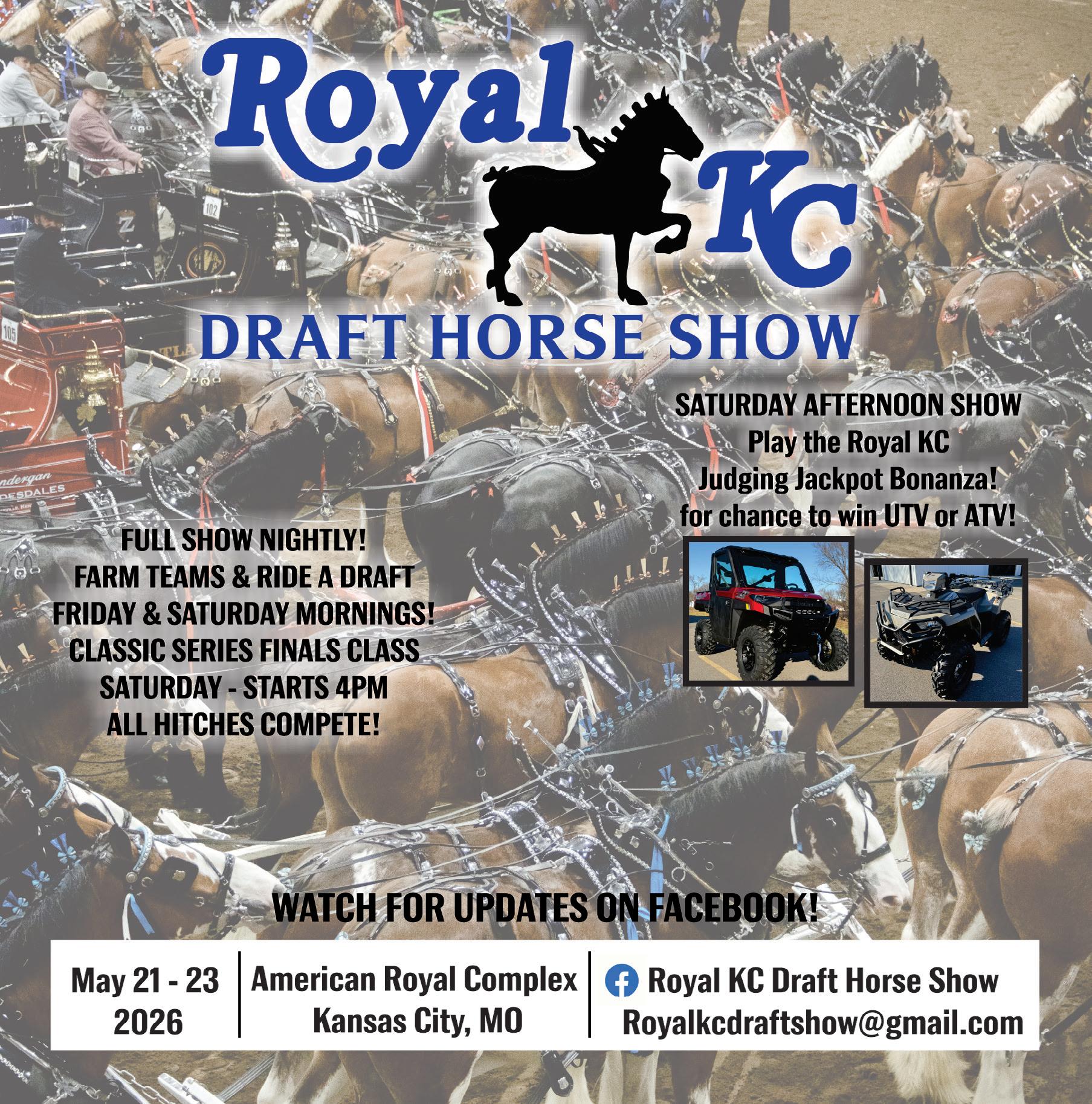
The Royal KC Draft Horse Show is returning to Kansas City for its summer season from May 21-23, 2026, along with the North American Six-Horse Hitch Classic Series, World Finals to take place in Kansas City from October 1-3, 2026.
This event marks a significant homecoming for the sport, as recent years have seen the first draft horse shows held at the complex in over 25 years.
The show is a professional competition featuring “gentle giants” across various
categories, from single carts to the prestigious Six-Horse Hitch Classic Series. Beyond the professional hitches, the event includes farm teams competing in timed and skilled events, offering a comprehensive look at draft horse power and finesse.
• Location: American Royal Complex, 1701 American Royal Court, Kansas City, MO.
• Schedule:
-Thursday, May 21: Show begins at 5 PM.
-Friday, May 22: Farm teams at 11 AM; Hitch show at 5:00 PM.
-Saturday, May 23: Farm teams at 11 AM; Hitch show at 4 PM.
• Charitable Impact: The show is a registered 501(c)(3) nonprofit that supports Children’s Mercy Kansas City, with proceeds helping to care for children and families in the region.
• Fan Experience: Visitors can enjoy food trucks, vendors, and free parking during the three-day event.
Later in the year, the American Royal Complex will also host the North American Six Horse Hitch Classic Series World Finals from October 1-3, 2026, bringing elite hitches from across the U.S. and Canada to compete for the sport’s biggest prize. This prestigious event serves as the championship for the “Classic Series,” which consists of qualifying shows held throughout North America during the preceding year.
• The Competition: The top hitches in the world—comprising the top five Belgians, Percherons, and Clydesdales/ Shires—are invited to compete for the ultimate title and a significant prize purse.
• What to Expect: Teams of six massive draft horses, weighing approximately 2,000 pounds each, pull historically restored freight wagons while being judged on their power, smoothness, and the driver’s skill.
• Charity and Location: Like the summer show, this fall event at the American Royal Complex supports Children’s Mercy Kansas City
Draft horses are powerful, gentle giants, including breeds like the Belgian, Clydesdale, and Percheron, standing 16–19 hands tall and weighing over 2,000 pounds. Originally essential for farming and heavy hauling, these breeds now showcase their strength and elegance in specialized shows—such as the Royal Kansas City Draft Show—competing in halter, driving, and hitch events.
• Belgian: The most popular draft breed in the United States, typically light chestnut color with a flaxen mane and tail, known for its massive strength and calm temperament. This breed was imported into the United States in the 1800s from Belgium. They tower roughly 16 to 19 hands and weigh an impressive 1,800 to 2,000 pounds. Their strength makes them great work animals!
• Clydesdale: Originating from Scotland, these are recognizable by their “feathered” legs (long hair), bay color, and elegant movement, famously used in parades. This elegant and impressive breed has an average height of 16 to 19 hands. They have feathered legs and muscular bodies. While most are familiar with the bay color, they also come in gray, black, and roan. Their history can be traced back to Scotland. They make great show and parade horses, but can also be seen working in fields.
• Percheron: Originating in France, these are versatile, strong, and agile, often black or gray, and commonly used for both riding and driving. This versatile breed is strong and agile. They have an average height of 16 to 17 hands with muscular bodies. They’re well suited for a variety of jobs and can pull carriages, perform in dressage, and compete in driving classes. Percherons were developed in France.
• Shire: Often recognized as the tallest and one of the heaviest breeds, known for their immense strength. One of the largest and most powerful, the Shire weighs nearly 1,800 to 2,400 pounds. They have broad chests, strong legs, and lots of feathering. These gentle giants originated in the United Kingdom, where they were used for heavy work and driving. They’re known for their gentle temperaments and willingness.
• Suffolk Punch: A smaller, entirely chestnut-colored breed known for its great pulling power and dedication to work. One of Britain’s oldest draft breeds, the Suffolk Punch is around 15 to 17 hands. They’re known for their chestnut coats and minimal feathering. Some will have white facial markings, such as a large blaze. They’re often called gentle giants because of their docile temperaments. These horses are valuable members of many farms due to their strength and willingness.
• American Cream Draft: A mediumsized, rare breed developed in Iowa known for its distinct cream color.
• Gypsy Vanner : This magical horse breed is captivating with their lush mane, tail, and feathering. They stand between 13 and 16 hands with an average weight of 1,100 to 1,700 pounds. One of their most common colors is piebald. They also come in solid colors, though. Gypsy Vanners are popular in dressage and competitive driving classes. They’re loved by many youth and amateur riders thanks to their good nature.
The Royal Kansas City Draft Show (as part of broader “Royal” exhibitions) is a premier showcase for these horses, highlighting their training, agility, and beauty.
• Halter Classes: Horses are shown in hand, judged on conformation, structure,
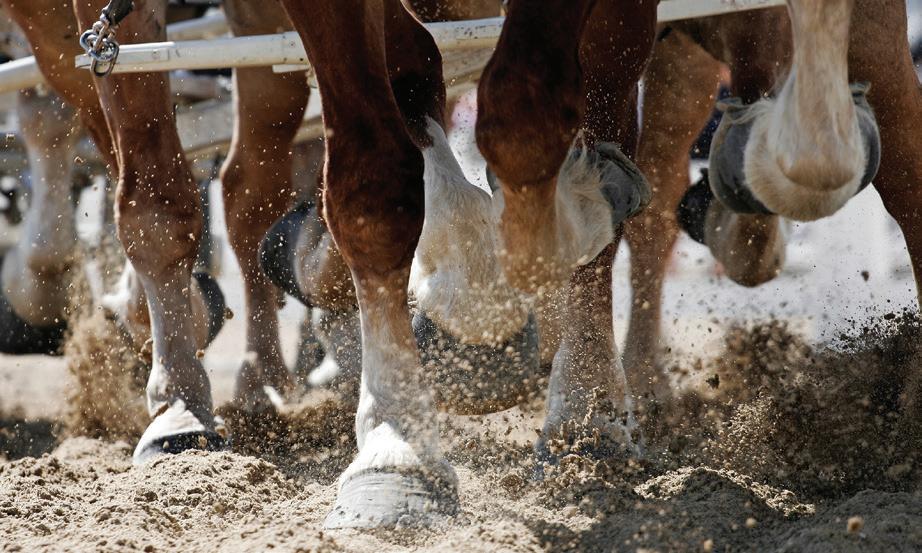
Draft horses possess power and finesse.
and quality, ensuring they represent the best of their breed.
• Driving Classes: These classes demonstrate the horse’s ability to pull, including single driving, team driving (two horses), and unicorn (three) or four-horse hitches.
• Show Hitches: Often the highlight, elegant teams pull large wagons, showcasing synchronicity, obedience, and impressive maneuvering skills in the arena.
Despite being replaced by machines in industrial agriculture, draft horses remain essential in several ways:
• Sustainable Agriculture & Forestry: They are used in sustainable farming to reduce soil compaction and in logging to reach areas that machinery cannot access.
• Tourism & Agriculture: They drive tourism carriages in cities and are favored by communities like the Amish for daily farm work.
• Competition & Heritage: Shows like those in Kansas City help preserve these breeds and honor the crucial role they played in building the nation.
These “gentle giants” are valued for their calm nature and willingness to work, bridging the gap between historical agricultural practices and modern appreciation for sustainable, human-animal partnerships.


Why You Should Compete at the 2026 Pinto World Championship
BY JENNA HENSON - DIRECTOR OF COMMUNICATIONS
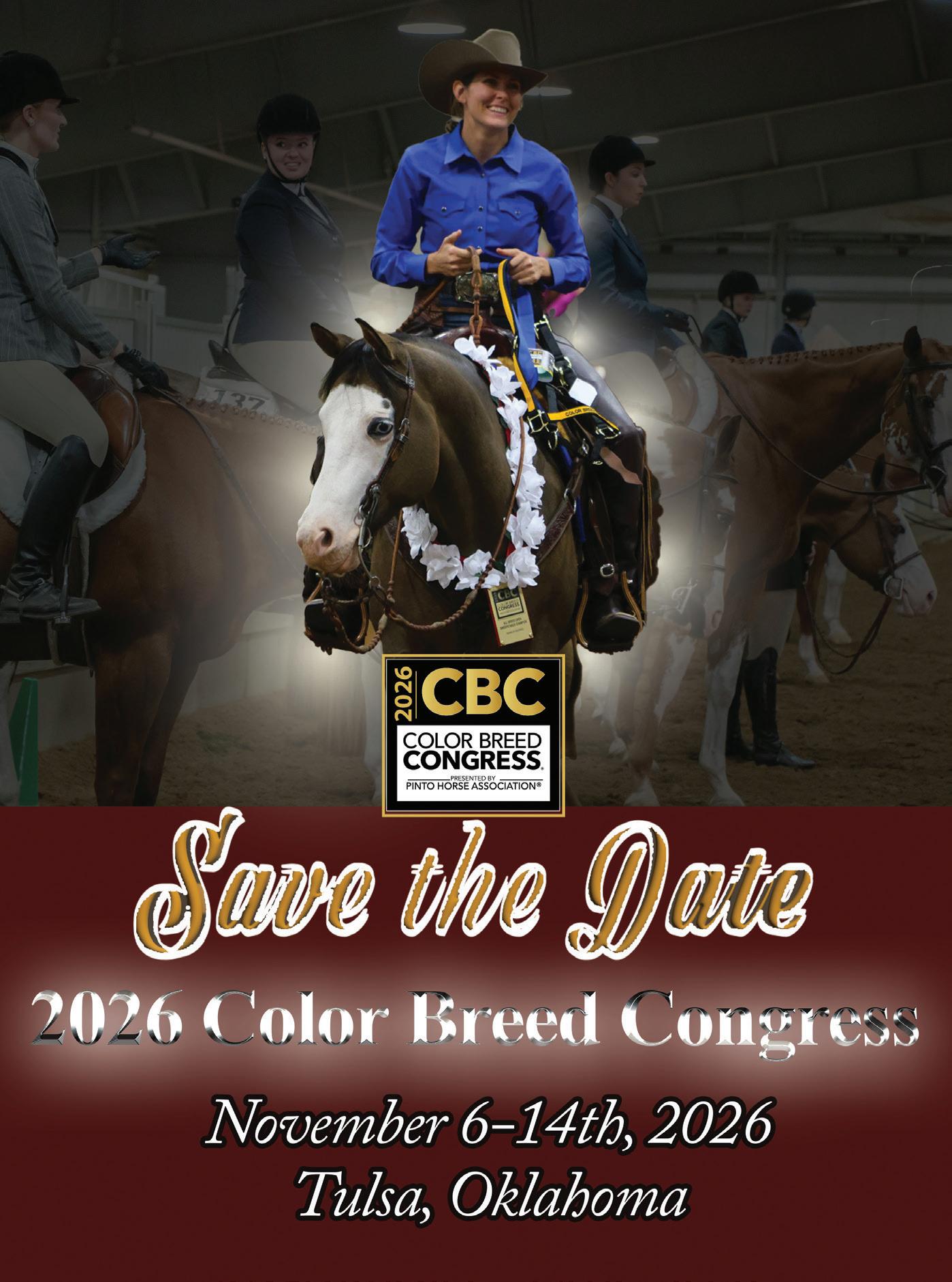
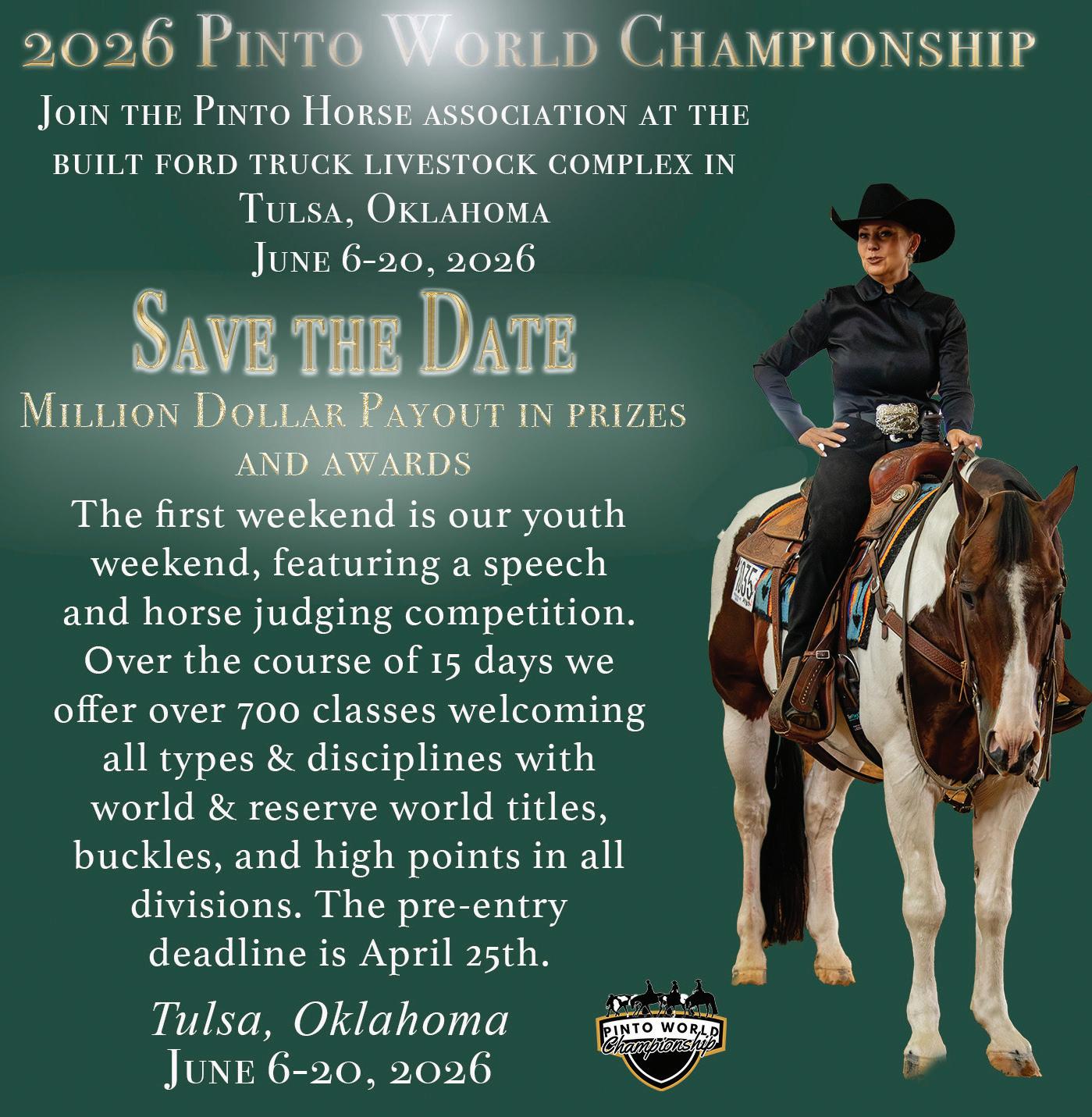
The highly anticipated 2026 Pinto World Championship returns to Tulsa, Oklahoma, running from June 6th through June 20th, 2026. Held at the world-class Tulsa Expo Square, this 14-day event is the pinnacle of achievement for equine enthusiasts. Whether you are a seasoned open competitor or an amateur debuting a young horse, the Pinto Horse Association of America (PtHA) caters to every division.
Competing on this global stage offers distinct advantages that can elevate your breeding program, enhance your horse’s value, and solidify your horsemanship skills.
The Pinto World Championship features more than 700 classes. Unlike singlebreed events, PtHA welcomes horses, ponies, miniatures, and long ears across various types and registries. Exhibitors can maximize their travel investment by entering a single horse into multiple concurrent and specialized classes—such as type-specific, age, and open divisions— to maximize arena time and point-earning potential.
Competitors can multiply their accolades through National Snaffle Bit Association (NSBA) dual-approved classes. Held concurrently with regular PtHA classes, these events offer additional point tracking, exclusive first-place trophies, and cash paybacks in all Open NSBA divisions. Additionally, halter enthusiasts can compete in the prestigious Yellow Rose Futurity, an all-breed event featuring lucrative non-professional stakes classes scheduled for June 14th.
Winning in Tulsa cements your horse’s place in equine history. The PtHA awards world-class prizes, including:
• Gist Silversmith buckles and custom plaques
• Custom saddles and rose garlands for champions
• Shorty’s Caboy Hattery hat certificates for high-point earners
Securing a world title or a top-ten placing drastically increases the commercial and breeding value of your stock.
Beyond the fierce arena competition, the event offers an all-inclusive equestrian vacation. A massive on-site trade show features premier vendors like Shorty’s Caboy Hattery for custom fittings. Youth competitors can showcase non-riding skills in the youth speech and horse judging contests starting June 6th. When the show day ends, the vibrant culture, Art Deco architecture, and world-class dining of Tulsa provide the perfect backdrop for family bonding. family bonding.
SUNDAY, JUNE 7 - MUSTANG ARENA, 7:30 AM
1 OP - Ranch Roping
2 OP - Ranch Roping, Solid
3 AM - Ranch Roping
4 AM - Ranch Roping, Solid
5 YA - Ranch Roping Horse/Pony
6 YA - Ranch Roping, Solid Horse/Pony
7 OP - Ranch Boxing
8 OP - Ranch Boxing, Solid
9 AM - Ranch Boxing
10 AM - Ranch Boxing, Solid
11 YA - Ranch Boxing, Solid Horse/Pony
12 YA - Ranch Boxing Horse/Pony
13 OP - Ranch Box, Drive
14 OP - Ranch Box, Drive, Solid
15 AM - Ranch Box, Drive
16 AM - Ranch Box, Drive, Solid
17 YA - Ranch Box, Drive
18 YA - Ranch Box, Drive, Solid
Ranch Reining Practice after last class - 1 hour
MONDAY, JUNE 8 - FORD TRUCK ARENA, 7:30 AM
19 OP - Hunter Under Saddle, 2 year olds, ST/HN Type Solid (NSBA)
20 OP - Green Hunter Under Saddle, ST/HN Type, Solid
21 OP - Hunter Under Saddle, 5 & Under, ST/HN Type Solid (NSBA)
22 OP - Hunter Under Saddle, 3 year olds, ST/HN Type (NSBA)
23 OP - Hunter Under Saddle, 6 & Over, ST/HN Type (NSBA)
24 OP - English Pleasure, ST/HN Type, Solid
25 OP - English Pleasure, HN/SD Seat, PL/SD Type
26 AM Jr Walk/Trot - Disciplined Rail English
27 AM Sr Walk/Trot - Disciplined Rail English
28 AM El Walk/Trot - Disciplined Rail English
29 AM Novice - Disciplined Rail English
30 AM Jr - English Pleasure, ST/HN Type
31 AM Sr - English Pleasure, ST/HN Type
32 AM Elite - English Pleasure, ST/HN Type
33 AM Novice - English Pleasure
34 OP - Show Hack, Horse
35 OP - Disciplined Rail English, ST/HN Type
36 AM Jr - Disciplined Rail English
37 AM Sr - Disciplined Rail English
38 AM Elite - Disciplined Rail English
MONDAY, JUNE 8 - MUSTANG ARENA, 7:30 AM
39 YA Walk/Trot 11- 18 - Ranch Showmanship Horse/Pony
40 YA Walk/Trot 10 & u - Ranch Showmanship Horse/Pony
41 YA - Ranch Showmanship Horse/Pony
42 YA Walk/Trot 11- 18 - Ranch Showmanship, Solid Horse/Pony
43 YA Walk/Trot 10 & u - Ranch Showmanship, Solid Horse/Pony
44 YA Jr - Ranch Showmanship, Solid Horse/Pony
45 YA Sr - Ranch Showmanship, Solid Horse/Pony
46 AM Walk/Trot - Ranch Showmanship Horse
47 AM - Ranch Showmanship Horse
48 AM Walk/Trot - Ranch Showmanship, Solid Horse
49 AM Jr - Ranch Showmanship, Solid Horse
50 AM Sr/El - Ranch Showmanship, Solid Horse
51 OP - Ranch Reining
52 OP - Ranch Reining, Solid
53 YA - Ranch Reining Horse/Pony
54 YA Jr - Ranch Reining, Solid Horse/Pony
55 YA Sr - Ranch Reining, Solid Horse/Pony
56 AM - Ranch Reining
57 AM Jr - Ranch Reining, Solid
58 AM Sr/El - Ranch Reining, Solid
MONDAY, JUNE 8 - PAVILION ARENA, 7:30 AM
59 YA Jr - English Showmanship, Horse/Pony
60 YA Sr - English Showmanship, Horse/Pony
61 YA Jr Novice - English Showmanship, Horse/Pony
62 YA Sr Novice - English Showmanship, Horse/Pony
63 YA Jr - English Showmanship, Solid Horse/Pony
64 YA Sr - English Showmanship, Solid Horse/Pony
65 YA Walk/Trot, 11 - 18 yo - English Showmanship, Horse/Pony
TULSA STATE FAIRGROUNDS, TULSA, OK
66 YA Walk/Trot, 11 - 18 yo - English Showmanship, Solid Horse/Pony
67 AM Jr Walk/Trot - English Showmanship, Solid Horse
68 AM Sr/El Walk/Trot - English Showmanship, Solid Horse
69 YA Walk/Trot, 10 & u - English Showmanship, Horse/Pony
70 YA Walk/Trot, 10 & u - English Showmanship, Solid Horse/Pony
71 YA Jr - Bareback Hunt Seat Equitation, Horse/Pony
72 YA Sr - Bareback Hunt Seat Equitation, Horse/Pony
73 YA - Bareback Hunt Seat Equitation, Solid Horse/Pony
TUESDAY, JUNE 9 - FORD TRUCK ARENA, 7:30 AM
74 OP - Green Hunter Under Saddle, ST/HN Type
75 AM Jr Walk/Trot - English Pleasure
76 OP - Hunter Under Saddle, 3 year olds ST/HN Type, Solid (NSBA)
77 OP - Hunter Under Saddle, 6 & over, ST/HN Type, Solid (NSBA)
78 AM Jr - Hunter Under Saddle ST/HN Type (NSBA)
79 AM Sr - Hunter Under Saddle ST/HN Type (NSBA)
80 AM Elite - Hunter Under Saddle ST/HN Type (NSBA)
81 OP - Hunter Under Saddle, 5 & Under, ST/HN Type (NSBA)
82 AM Jr - Hunter Under Saddle, Solid (NSBA)
83 AM Sr/El - Hunter Under Saddle, Solid (NSBA)
84 AM Novice - Hunter Under Saddle
85 OP - English Pleasure, 5 & Under, ST/HN Type
86 OP - English Pleasure, 6 & Over, ST/HN Type
87 YA Jr - Hunter Under Saddle, ST/HN Horse/Pony (NSBA)
88 YA Sr - Hunter Under Saddle, ST/HN Horse/Pony (NSBA)
89 YA Jr - Hunter Under Saddle, Solid Horse/Pony (NSBA)
90 YA Sr - Hunter Under Saddle, Solid Horse/Pony (NSBA)
OP PL/SD Halter practice - after last class, 30 minutes
TUESDAY, JUNE 9 - MUSTANG ARENA, 7:30 AM
91 OP - Ranch Rail Pleasure, Jr. Horse (NSBA)
92 AM - Ranch Rail Pleasure (NSBA)
93 YA - Ranch Rail Pleasure Horse/Pony (NSBA)
94 OP - Ranch Rail Pleasure, Sr. Horse (NSBA)
95 AM Walk/Trot - Ranch Rail Pleasure
96 YA Walk/Trot 11 - 18 - Ranch Rail Pleasure Horse/Pony
97 YA Walk/Trot 10 & u - Ranch Rail Pleasure Horse/Pony
98 OP - Ranch Rail Pleasure, Jr. Solid Horse (NSBA)
99 AM Jr - Ranch Rail Pleasure, Solid (NSBA)
100 AM Sr/El - Ranch Rail Pleasure, Solid (NSBA)
101 YA Jr - Ranch Rail Pleasure, Solid Horse/Pony (NSBA)
102 YA Sr - Ranch Rail Pleasure, Solid Horse/Pony (NSBA)
103 OP - Ranch Rail Pleasure, Sr. Solid Horse (NSBA)
104 AM Walk/Trot - Ranch Rail Pleasure, Solid
105 YA Walk/Trot 11 - 18 - Ranch Rail Pleasure, Solid Horse/Pony
106 YA Walk/Trot 10 & u - Ranch Rail Pleasure, Solid Horse/Pony
107 YA - Ranch Horsemanship Horse/Pony
108 YA Jr - Ranch Horsemanship, Solid Horse/Pony
109 YA Sr - Ranch Horsemanship, Solid Horse/Pony
110 YA Walk/Trot 10 & u - Ranch Horsemanship, Solid Horse/Pony
111 YA Walk/Trot 10 & u - Ranch Horsemanship Horse/Pony
112 YA Walk/Trot 11 - 18 - Ranch Horsemanship, Solid Horse/Pony
113 YA Walk/Trot 11 - 18 - Ranch Horsemanship Horse/Pony Ranch
Trail practice in covered arena after last class through night
TUESDAY, JUNE 9 - PAVILION ARENA, 7:30 AM
114 YA Jr - Hunt Seat Equitation, Horse/Pony (NSBA)
115 YA Sr - Hunt Seat Equitation, Horse/Pony (NSBA)
116 YA Jr - Hunt Seat Equitation, Solid Horse/Pony (NSBA)
117 YA Sr - Hunt Seat Equitation, Solid Horse/Pony (NSBA)
118 AM Jr Walk/Trot - Hunt Seat Equitation, Solid
119 AM Sr/El Walk/Trot - Hunt Seat Equitation, Solid
120 YA Walk/Trot, 11 - 18 yo - Hunt Seat Equitation, Horse/Pony
121 YA Walk/Trot, 11 - 18 yo - Hunt Seat Equitation, Solid Horse/Pony
122 YA Leadline Walk/Trot, 8 & u - Hunt Seat Equitation
123 YA Leadline Walk/Trot, 8 & u - Hunt Seat Equitation, Solid
124 YA Walk/Trot, 10 & u - Hunt Seat Equitation, Horse/Pony
125 YA Novice - Hunt Seat Equitation, Solid Horse/Pony
126 YA Walk/Trot, 10 & u - Hunt Seat Equitation, Solid Horse/Pony
127 OP - Hunter Under Saddle, 2 year olds ST/HN Type (NSBA)
128 AM Sr Walk/Trot - English Pleasure
129 AM El Walk/Trot - English Pleasure
Driving Practice after last class - 1 hour
WEDNESDAY, JUNE 10 - FORD TRUCK ARENA, 7:30 AM
130 YA Walk/Trot, 11 - 18 yo - English Pleasure, Horse/Pony
131 YA Walk/Trot, 11 - 18 yo - English Pleasure, Solid Horse/Pony
132 YA Walk/Trot, 10 & u - English Pleasure, Horse/Pony
133 YA Walk/Trot, 10 & u - English Pleasure, Solid Horse/Pony
134 YA Leadline Walk/Trot, 8 & u - English Pleasure
135 YA Leadline Walk/Trot, 8 & u - English Pleasure, Solid
136 YA Jr - English Pleasure, ST/HN Type Horse/Pony
137 YA Sr - English Pleasure, ST/HN Type Horse/Pony
138 YA Jr - English Pleasure, Solid Horse/Pony
139 YA Sr - English Pleasure, Solid Horse/Pony
140 YA Jr Novice - English Pleasure, Horse/Pony
141 YA Sr Novice - English Pleasure, Horse/Pony
142 YA Novice - English Pleasure, Solid Horse/Pony
143 YA Jr - Disciplined Rail English, Horse/Pony
144 YA Sr - Disciplined Rail English, Horse/Pony
145 YA Walk/Trot, 11 - 18 yo - Disciplined Rail English, Horse/Pony
146 YA Walk/Trot, 11 - 18 yo - Disciplined Rail English, Solid Horse/Pony
147 YA Jr - Disciplined Rail English, Solid Horse/Pony
148 YA Sr - Disciplined Rail English, Solid Horse/Pony
149 AM Jr Walk/Trot - Ideal Pinto English, Solid
150 AM Sr/El Walk/Trot - Ideal Pinto English, Solid
151 AM - Pleasure Driving, Horse
152 AM - Pleasure Driving, Horse, Solid
153 YA - Pleasure Driving, Horse
154 OP - Pleasure Driving, Horse
155 OP - Pleasure Driving, Horse, Solid
WEDNESDAY, JUNE 10- MUSTANG ARENA, 7:30 AM
156 OP - Ranch Trail, Jr. (NSBA)
157 OP - Ranch Trail, Jr. Solid (NSBA)
158 OP - Ranch Trail, Sr. (NSBA)
159 OP - Ranch Trail, Sr. Solid (NSBA)
160 YA - Ranch Trail, Horse/Pony (NSBA)
161 YA Jr - Ranch Trail, Solid Horse/Pony (NSBA)
162 YA Sr - Ranch Trail, Solid Horse/Pony (NSBA)
163 AM - Ranch Trail (NSBA)
164 AM Jr - Ranch Trail, Solid (NSBA)
165 AM Sr/El - Ranch Trail, Solid (NSBA)
166 YA Walk/Trot 11 - 18 - Ranch Trail, Horse/Pony
167 YA Walk/Trot 11 - 18 - Ranch Trail, Solid Horse/Pony
168 YA Walk/Trot 10 & u - Ranch Trail, Horse/Pony
169 YA Walk/Trot 10 & u - Ranch Trail, Solid Horse/Pony
170 AM Walk/Trot - Ranch Trail
171 AM Walk/Trot - Ranch Trail, Solid Ranch Riding Practice after last class - 2 hours
WEDNESDAY, JUNE 10 - PAVILION ARENA, 7:30 AM
172 YA Sr Novice - Hunt Seat Equitation, Horse/Pony
173 YA Jr Novice - Hunt Seat Equitation, Horse/Pony
174 AM Jr - Hunt Seat Equitation (NSBA)
175 AM Sr - Hunt Seat Equitation (NSBA)
176 AM Elite - Hunt Seat Equitation (NSBA)
177 AM Novice - Hunt Seat Equitation
178 AM Novice - Hunt Seat Equitation, Solid
179 AM Jr Walk/Trot - Hunt Seat Equitation
180 AM Sr Walk/Trot - Hunt Seat Equitation
181 AM El Walk/Trot - Hunt Seat Equitation
182 AM Jr - Hunt Seat Equitation, Solid (NSBA)
183 AM Sr/El - Hunt Seat Equitation, Solid (NSBA)
184 OP - Halter Mares, PL/SD Type Horse
185 OP - Halter Gelding/Stallion, PL/SD Type Horse
186 OP - Tobiano Color, PL/SD Type Horse
187 OP - Overo Color, PL/SD Type Horse
188 OP - Ideal Pinto English, ST/HN Type Solid
189 AM Jr - Ideal Pinto English, Solid
190 AM Sr/El - Ideal Pinto English, Solid
THURSDAY, JUNE 11 - FORD TRUCK ARENA, 7:30 AM
191 YA Jr Novice - Disciplined Rail English, Horse/Pony
192 YA Sr Novice - Disciplined Rail English, Horse/Pony
193 YA Jr - Ideal Pinto English, Horse/Pony
194 YA Sr - Ideal Pinto English, Horse/Pony
195 YA Jr - Ideal Pinto English, Solid Horse/Pony
196 YA Sr - Ideal Pinto English, Solid Horse/Pony
197 YA Jr Novice - Ideal Pinto English, Horse/Pony
198 YA Sr Novice - Ideal Pinto English, Horse/Pony
199 YA Walk/Trot, 11 - 18 yo - Ideal Pinto English, Horse/Pony
200 YA Walk/Trot, 11 - 18 yo - Ideal Pinto English, Solid Horse/Pony
201 AM Jr - English Pleasure, Solid
202 AM Sr/El - English Pleasure, Solid
203 AM Novice - English Pleasure, Solid
204 AM Jr Walk/Trot - English Pleasure, Solid
205 AM Sr/El Walk/Trot - English Pleasure, Solid
206 OP - Disciplined Rail English, ST/HN Type Solid Horse
207 AM Jr - Disciplined Rail English, Solid
208 AM Sr/El - Disciplined Rail English, Solid
209 AM Jr Walk/Trot - Disciplined Rail English, Solid
210 AM Sr/El Walk/Trot - Disciplined Rail English, Solid YA/AM Driving practice - 1 hour, after last class
THURSDAY, JUNE 11 - MUSTANG ARENA, 7:30 AM
211 OP - Ranch Riding, Jr. Horse (NSBA)
212 AM - Ranch Riding (NSBA)
213 YA - Ranch Riding Horse/Pony (NSBA)
214 OP - Ranch Riding, Sr. Horse (NSBA)
215 OP - Ranch Riding, Jr. Solid (NSBA)
216 AM Jr - Ranch Riding, Solid (NSBA)
217 AM Sr/El - Ranch Riding, Solid (NSBA)
218 YA Jr - Ranch Riding, Solid Horse/Pony (NSBA)
219 YA Sr - Ranch Riding, Solid Horse/Pony (NSBA)
220 OP - Ranch Riding, Sr. Solid (NSBA)
221 YA Walk/Trot 10 & u - Ranch Riding Horse/Pony
222 YA Walk/Trot 11 - 18 - Ranch Riding Horse/Pony
223 AM Walk/Trot- Ranch Riding
224 YA Walk/Trot 11 - 18 - Ranch Riding, Solid Horse/Pony
225 YA Walk/Trot 10 & u - Ranch Riding, Solid Horse/Pony
226 AM Walk/Trot- Ranch Riding, Solid
THURSDAY, JUNE 11- PAVILION ARENA, 7:30 AM
227 AM Jr Walk/Trot - English Showmanship, Horse
228 AM Sr Walk/Trot - English Showmanship, Horse
229 AM El Walk/Trot - English Showmanship, Horse
230 AM Jr - English Showmanship, Solid Horse
231 AM Sr/El - English Showmanship, Solid Horse
232 AM Jr - English Showmanship, Horse
233 AM Sr - English Showmanship, Horse
234 AM Elite - English Showmanship, Horse
235 AM Novice - English Showmanship, Horse
236 AM - Bareback Hunt Seat Equitation
237 AM - Bareback Hunt Seat Equitation, Solid English and Leadline
Trail Practice after last class in Pavilion Paddock - through the night
FRIDAY, JUNE 12 - FORD TRUCK ARENA, 7:30 AM
Hunter Hack walk through/warm up - 5:00 am - 6:30 am
238 AM Novice - Hunter Hack
239 YA Novice - Hunter Hack, Horse/Pony
240 OP - Hunter Hack (NSBA)
241 OP - Hunter Hack, Solid (NSBA)
242 AM - Hunter Hack (NSBA)
243 AM - Hunter Hack, Solid (NSBA)
244 YA - Hunter Hack, Horse/Pony (NSBA)
245 YA - Hunter Hack, Solid Horse/Pony (NSBA)
246 OP - Side Saddle, Horse
247 AM Jr Walk/Trot - Ideal Pinto English
248 AM Sr Walk/Trot - Ideal Pinto English
249 AM El Walk/Trot - Ideal Pinto English
250 OP - Ideal Pinto English, ST/HN Type, Overo
251 OP - Ideal Pinto English, ST/HN Type, Tobiano
252 AM Jr - Ideal Pinto English
253 AM Sr - Ideal Pinto English
254 AM Elite - Ideal Pinto English
255 AM Novice - Ideal Pinto English
256 YA - Disciplined Rail Driving, Horse
257 AM - Reinsmanship Driving Equitation, Horse
258 YA - Reinsmanship Driving Equitation, Horse Western Dressage Practice for 2 hours
FRIDAY, JUNE 12 - MUSTANG ARENA, 7:30 AM
259 AM - Ranch Horsemanship
260 AM Walk/Trot- Ranch Horsemanship
261 AM Jr - Ranch Horsemanship, Solid
262 AM Sr/El - Ranch Horsemanship, Solid
263 AM Walk/Trot- Ranch Horsemanship, Solid
264 OP - Ranch Ideal Pinto, Jr. Horse
265 AM - Ranch Ideal Pinto
266 AM Walk/Trot- Ranch Ideal Pinto
267 YA - Ranch Ideal Pinto, Horse/Pony
268 YA Walk/Trot 11 - 18 - Ranch Ideal Pinto, Horse/Pony
269 YA Walk/Trot 10 & u - Ranch Ideal Pinto, Horse/Pony
270 OP - Ranch Ideal Pinto, Sr. Horse
271 OP - Ranch Ideal Pinto, Jr. Solid
272 AM Jr - Ranch Ideal Pinto, Solid
273 AM Sr/El - Ranch Ideal Pinto, Solid
274 AM Walk/Trot- Ranch Ideal Pinto Solid
275 YA Jr - Ranch Ideal Pinto, Solid Horse/Pony
276 YA Sr - Ranch Ideal Pinto, Solid Horse/Pony
277 YA Walk/Trot 11 - 18 - Ranch Ideal Pinto Solid, Horse/Pony
278 YA Walk/Trot 10 & u - Ranch Ideal Pinto Solid, Horse/Pony
279 OP - Ranch Ideal Pinto, Sr. Solid Driving Practice for 1 hr
FRIDAY, JUNE 12 - PAVILION ARENA, 7:30 AM
280 YA Jr - Trail, English, Horse/Pony
281 YA Sr - Trail, English, Horse/Pony
282 YA - Trail, English, Solid Horse/Pony
283 AM Jr - Trail, English
284 AM Sr - Trail, English
285 AM Elite - Trail, English
286 AM - Trail, English, Solid
287 AM Jr Walk/Trot - Trail, English
288 AM Sr Walk/Trot - Trail, English
289 AM El Walk/Trot - Trail, English
290 AM Jr Walk/Trot - Trail, English, Solid
291 AM Sr/El Walk/Trot - Trail, English, Solid
292 YA Walk/Trot, 11 - 18 - Trail, English, Horse/Pony
293 YA Walk/Trot, 11 - 18 - Trail, English, Solid Horse/Pony
294 YA Leadline Walk/Trot, 8 & u - Trail
295 YA Leadline Walk/Trot, 8 & u - Trail, Solid
296 OP - Trail, English
297 OP - Trail, English, Solid
Two year old in hand Trail practice after last class in Pavilion Paddock - 1 hour. Youth Trail Practice after In hand practicethrough the night
SATURDAY, JUNE 13 - FORD TRUCK ARENA, 7:30 AM
298 OP - Western Dressage, WDAA Level 1, Test 1, Horse (large arena)
299 OP - Western Dressage, WDAA Level 1, Test 1, Solid, Horse (large arena)
300 AM - Western Dressage, WDAA Basic Test 2, Horse (small arena)
301 AM - Western Dressage, WDAA Basic Test 2, Solid, Horse (small arena)
302 OP - Western Dressage, WDAA Basic Test 4, Horse (small arena)
303 OP - Western Dressage, WDAA Basic Test 4, Solid, Horse (small arena)
304 OP - Western Dressage, WDAA Basic Test 4, Utility (small arena)
305 OP - Western Dressage, WDAA Basic Test 4, Solid, Utility (small arena)
306 AM - Western Dressage, WDAA Intro Level Test 2, Horse (small arena)
307 AM - Western Dressage, WDAA Intro Level Test 2, Solid, Horse (small arena)
308 OP - Western Dressage, WDAA Intro Level Test 4, Horse (small arena)
309 OP - Western Dressage, WDAA Intro Level Test 4, Solid, Horse (small arena)
310 OP - Western Dressage, WDAA Intro Level Test 4, Utility (small arena)
311 OP - Western Dressage, WDAA Intro Level Test 4, Solid, Utility (small arena) AM/OP Halter/Longe Line practice after last class - 1 hour
SATURDAY, JUNE 13 - MUSTANG ARENA, 7:30 AM
312 OP - Ranch Conformation, Jr. Horse
313 OP - Ranch Conformation, Jr. Solid
314 OP - Ranch Conformation, Sr. Horse
315 OP - Ranch Conformation, Sr. Solid
316 AM - Ranch Conformation
317 AM Walk/Trot - Ranch Conformation
318 AM Jr - Ranch Conformation, Solid
319 AM Sr/El - Ranch Conformation, Solid
320 AM Walk/Trot - Ranch Conformation, Solid
321 YA - Ranch Conformation, Horse/Pony
322 YA Walk/Trot 11 - 18 - Ranch Conformation, Horse/Pony
323 YA Walk/Trot 10 & under - Ranch Conformation, Horse/Pony
324 YA Jr - Ranch Conformation, Solid Horse/Pony
325 YA Sr - Ranch Conformation, Solid Horse/Pony
326 YA Walk/Trot 11 - 18 - Ranch Conformation, Solid Horse/Pony
327 YA Walk/Trot 10 & under - Ranch Conformation, Solid Horse/Pony
Ranch High Point Awards in MUSTANG ARENA after Ranch classes finish
328 OP - Disciplined Rail Driving, Horse, Solid
329 OP - Disciplined Rail Driving, Horse
330 AM - Disciplined Rail Driving, Horse
331 OP - Ideal Pinto Driving, Horse, Solid
332 OP - Ideal Pinto Driving, Horse
333 AM - Ideal Pinto Driving, Horse Gymkhana Practice for 2 hrs after last class
SATURDAY, JUNE 13 - PAVILION ARENA, 7:30 AM
334 YA Jr - Trail - Western, Horse/Pony (NSBA)
335 YA Sr - Trail - Western, Horse/Pony (NSBA)
336 YA Jr Novice - Trail, Horse/Pony
337 YA Sr Novice - Trail, Horse/Pony
338 YA Jr - Trail - Western, Solid Horse/Pony (NSBA)
339 YA Sr - Trail - Western, Solid Horse/Pony (NSBA)
340 YA Novice - Trail - Western, Solid Horse/Pony
341 YA Walk/Trot, 11 - 18 yo - Trail, Western, Horse/Pony
342 YA Walk/Trot, 11 - 18 yo - Trail, Western, Solid Horse/Pony
343 YA Walk/Trot, 10 & u - Trail, Western, Horse/Pony
344 YA Walk/Trot, 10 & u - Trail, Western, Solid Horse/Pony
345 AM - Two-Year old In Hand Trail, Horse
346 AM - Two-Year old In Hand Trail, Solid Horse
347 OP - Two-Year old In Hand Trail, Horse
348 OP - Two-Year old In Hand Trail, Solid Horse
OP & AM Trail Practice after last class in Pavilion Paddock - through the night
SUNDAY, JUNE 14 - FORD TRUCK ARENA, 7:30 AM
349 AM - Performance Halter Stallion, Horse
350 AM - Performance Halter Geldings, Jr. Horse, Yearling & 2 yo
351 AM - Performance Halter Geldings, Sr. Horse, 3 & over
352 AM - Performance Halter Mares, Jr. Horse, Yearling & 2 yo
353 AM - Performance Halter Mares, Sr. Horse, 3 & over
354 OP - Performance Halter Stallion Horse
355 OP - Performance Halter Gelding, Yearling & 2 yo Horse
356 OP - Performance Halter Gelding, 3 & over Horse
357 OP - Performance Halter Mare, Yearling & 2 yo Horse
358 OP - Performance Halter Mare, 3 & over Horse
359 AM - Yearling Longe Line, Hunter Type, Solid Horse (NSBA)
360 AM - Yearling Longe Line, Hunter Type, Horse (NSBA)
361 OP - Halter Mares, Solid HN Type Horse
362 OP - Halter Geldings/Stallions, Solid HN Type Horse
363 OP - Yearling Longe Line, Hunter Type, Solid Horse (NSBA)
364 OP - Yearling Longe Line, Hunter Type Horse (NSBA)
365 OP - Halter Mares, HN Type Horse, 2 & Under
366 OP - Halter Mares, HN Type Horse, 3 & Over
367 OP - Halter Stallion/Gelding, HN Type Horse, 2 & Under
368 OP - Halter Stallion/Gelding, HN Type Horse, 3-4-5 Yr Old
369 OP - Halter Stallion/Gelding, HN Type Horse, 6 & Over
370 YA - Western Riding, Horse/Pony (NSBA)
371 YA - Western Riding, Solid Horse/Pony (NSBA)
YA Halter practice after last class - 1 hour
SUNDAY, JUNE 14 - MUSTANG ARENA, 7:30 AM
372 Yellow Rose Non Pro Yearling Mares – All Breeds
373 Yellow Rose Non Pro Two Year Old Mares – All Breeds
374 Yellow Rose Non Pro Yearling Geldings – All Breeds
375 Yellow Rose Non Pro Two Year Old Geldings – All Breeds
376 Yellow Rose Non Pro Yearling Stallions – All Breeds
377 Yellow Rose Non Pro Two & Over Stallions – All Breeds
378 Yellow Rose Non Pro Three & Over Mares – All Breeds
379 Yellow Rose Non Pro Three & Over Geldings – All Breeds
380 OP - Barrel Racing
381 OP - Barrel Racing, Solid
382 AM - Barrel Racing
383 AM - Barrel Racing, Solid
384 YA - Barrel Racing, Horse/Pony
385 YA - Barrel Racing, Solid Horse/Pony
386 YA Walk/Trot, 10 & u - Barrel Racing, Horse/Pony
387 YA Walk/Trot, 10 & u - Barrel Racing, Solid Horse/Pony
388 OP - Pole Bending
389 OP - Pole Bending, Solid
390 AM - Pole Bending
391 AM - Pole Bending, Solid
392 YA - Pole Bending, Horse/Pony
393 YA - Pole Bending, Solid Horse/Pony
394 YA Walk/Trot, 10 & u - Pole Bending, Horse/Pony
395 YA Walk/Trot, 10 & u - Pole Bending, Solid Horse/Pony
396 OP - Stake Race
397 OP - Stake Race, Solid
398 AM - Stake Race
399 AM - Stake Race, Solid
400 YA - Stake Race, Horse/Pony
401 YA - Stake Race, Solid Horse/Pony
402 YA Walk/Trot, 10 & u - Stake Race, Horse/Pony
403 YA Walk/Trot, 10 & u - Stake Race, Solid Horse/Pony
404 OP - Keyhole Race
405 OP - Keyhole Race, Solid
406 AM - Keyhole Race
407 AM - Keyhole Race, Solid
408 YA - Keyhole Race, Horse/Pony
409 YA - Keyhole Race, Solid Horse/Pony
410 YA Walk/Trot, 10 & u - Keyhole Race, Horse/Pony
411 YA Walk/Trot, 10 & u - Keyhole Race, Solid Horse/Pony Gymkhana High Points
OP/AM Halter/Longe Line practice after High Points - 1 hour
SUNDAY, JUNE 14 - PAVILION ARENA, 7:30 AM
412 AM Sr/El Walk/Trot - Trail, Solid
413 OP - Green Trail - Western
414 OP - Green Trail, Western - Solid
415 AM Jr - Trail - Western - Solid (NSBA)
416 AM Sr/El - Trail - Western - Solid (NSBA)
417 OP - Trail-Western, 5 & Under (NSBA)
418 OP - Trail-Western, 6 & Over (NSBA)
419 OP - Trail - Western, 5 & Under, Solid (NSBA)
420 OP - Trail - Western, 6 & Over, Solid (NSBA)
AM Trail Practice after last class in Pavilion Paddock - through the night
MONDAY, JUNE 15 - FORD TRUCK ARENA, 7:30 AM
421 YA Walk/Trot, 10 & u - Halter Geldings, Horse/Pony
422 YA Walk/Trot, 10 & u - Halter Mares, Horse/Pony
423 YA - Halter Mares, Solid ST/HN Type Horse/Pony
424 YA - Performance Halter Mares, Solid Horse/Pony
425 YA Walk/Trot, 10 & u - Halter Geldings, Solid, Horse/Pony
426 YA - Halter Geldings, Solid ST/HN Type Horse/Pony
427 YA - Performance Halter Geldings, Solid Horse/Pony
428 YA Walk/Trot, 10 & u - Halter Mares, Solid Horse/Pony
429 YA - Halter Mares, HN Type Horse
430 YA - Halter Geldings, HN Type Horse
431 YA - Halter Geldings, ST Type Horse, 2 & under
432 YA - Halter Geldings, ST Type Horse, 3 & over
433 YA - Performance Halter Geldings, Horse/Pony
434 YA - Halter Mares, ST Type Horse, 2 & under
435 YA - Halter Mares, ST Type Horse, 3 & over
436 YA - Performance Halter Mare, Horse/Pony
437 YA - Tobiano Color, Horse
438 YA - Overo Color, Horse
439 YA Leadline Walk /Trot, 8 & u - Western Pleasure
440 YA Leadline Walk /Trot, 8 & u - Western Pleasure, Solid
441 YA Leadline Walk Only, 8 & u - Girls Western Pleasure
442 YA Leadline Walk Only, 8 & u - Boys Western Pleasure
443 YA Leadline Walk Only, 8 & u - Western Pleasure, Solid
444 YA Walk/Trot, 11 - 18 yo - Ideal Pinto Western, Horse/Pony
445 YA Walk/Trot, 11 - 18 yo - Ideal Pinto Western, Solid Horse/Pony
446 YA Jr - Ideal Pinto Western, Solid Horse/Pony
447 YA Sr - Ideal Pinto Western, Solid Horse/Pony
448 YA Jr Novice - Ideal Pinto Western, Horse/Pony
449 YA Sr Novice - Ideal Pinto Western, Horse/Pony OP Halter/Longe Line practice after High Points - 1 hour
MONDAY, JUNE 15 - MUSTANG ARENA, 7:30 AM
450 AM - Halter 2 & under Mares, HN Type Horse
451 AM - Halter 3 & over Mares, HN Type Horse
452 AM - Halter 2 & under Stallions/Geldings, HN Type Horse
453 AM - Halter 3 & over Stallions/Geldings, HN Type Horse
454 AM - Halter Mares, Solid ST/HN Type Horse, 2 & under
455 AM - Halter Mares, Solid ST/HN Type Horse, 3 & over
456 AM - Performance Halter Mares, Solid Horse, Yearling & 2 yo
457 AM - Performance Halter Mares, Solid Horse, 3 yo & over
458 AM - Halter Geldings, Solid ST/HN Type Horse, 2 & under
459 AM - Halter Geldings, Solid ST/HN Type Horse, 3 & over
460 AM - Performance Halter Geldings, Solid Horse, Yearling & 2 yo 461 AM - Performance Halter Geldings, Solid Horse, 3 yo & over 462 AM - Halter Stallions, Solid ST/HN Type Horse, 2 & under 463 AM - Halter Stallions, Solid ST/HN Type Horse, 3 & over 464 AM - Performance Halter Stallions, Solid Horse
465 AM - Yearling Longe Line, Stock Type, Solid Horse (NSBA) 466 AM - Two-Year Old Longe Line, ST/HN Type, Solid Horse (NSBA) 467 AM - Halter Mares, ST Type Horse, Weanling /Yearling 468 AM - Halter Mares, ST Type Horse, 2 Year Old 469 AM - Halter Mares, ST Type Horse, 3 & 4 Year Old 470 AM - Halter Mares, ST Type Horse, 5 Year & Over
471 AM - Halter Geldings, ST Type Horse, Weanling/Yearling 472 AM - Halter Geldings, ST Type Horse, 2 Year Old
473 AM - Halter Geldings, ST Type Horse, 3 & 4 Year Old 474 AM - Halter Geldings, ST Type Horse, 5 Year & Over
475 AM - Halter Stallions, ST Type Horse, 2 & under
476 AM - Halter Stallions, ST Type Horse, 3 & over
477 AM - Yearling Longe Line, Stock Type, Horse (NSBA)
478 AM - Two-Year old Longe Line, ST/HN Type, Horse (NSBA)
MONDAY, JUNE 15 - PAVILION ARENA, 7:30 AM
479 AM Jr Walk/Trot - Trail, Solid
480 AM Jr Walk/Trot - Trail
481 AM Sr Walk/Trot - Trail
482 AM El Walk/Trot - Trail
483 AM Novice - Trail, Solid
484 YA Jr Novice - Western Showmanship, Horse/Pony
485 YA Sr Novice - Western Showmanship, Horse/Pony
486 YA Jr - Western Showmanship, Horse (NSBA)
487 YA Sr - Western Showmanship, Horse (NSBA)
488 YA Walk/Trot, 11 - 18 yo - Western Showmanship, Horse/Pony 489 YA Walk/Trot, 10 & u - Western Showmanship, Horse/Pony Pony/Mini Roadster practice in arena for 30 minutes after the last class Mini/Pony In Hand. Trail Practice after last class in Pavilion Paddock -2 hours. AM Trail Practice after Pony/Minis in Pavilion Paddock through night.
TUESDAY, JUNE 16 - FORD TRUCK ARENA, 7:30 AM
490 OP - Halter Mares, ST Type Horse, Weanling/Yearling
491 OP - Halter Mares, ST Type Horse, 2 Yr Old
492 OP - Halter Mares, ST Type Horse, 3 & 4 Yr Old
493 OP - Halter Mares, ST Type Horse, 5 & Over
494 OP - Halter Geldings, ST Type Horse, Weanling/Yearling
495 OP - Halter Geldings, ST Type Horse, 2 Yr Old
496 OP - Halter Geldings, ST Type Horse, 3 & 4 Yr Old
497 OP - Halter Geldings, ST Type Horse, 5 & Over
498 OP - Halter Stallions, ST Type Horse, Weanling/Yearling
499 OP - Halter Stallions, ST Type Horse, 2 Yr Old
500 OP - Halter Stallions, ST Type Horse, 3 & Over
501 OP - Yearling Longe Line, Stock Type Horse (NSBA)
502 OP - Two Year Old Longe Line, ST/HN Type (NSBA)
503 OP - Halter Mares, Solid ST Type Horse, Weanling/Yearling
504 OP - Halter Mares, Solid ST Type Horse, 2 Year Old
505 OP - Halter Mares, Solid ST Type Horse, 3 Year Old
506 OP - Halter Mares, Solid ST Type Horse, 4 Years & Over
507 OP - Performance Halter Mares, Solid Horse, Yearling & 2 yo
508 OP - Performance Halter Mares, Solid Horse, 3 & over
509 OP - Halter Geldings, Solid ST Type Horse, 2 & under
510 OP - Halter Geldings, Solid ST Type Horse, 3 & over
511 OP - Performance Halter Geldings, Solid Horse, Yearling & 2 yo
512 OP - Performance Halter Geldings, Solid Horse, 3 & over
513 OP - Halter Stallions, Solid ST Type Horse, 2 & under
514 OP - Halter Stallions, Solid ST Type Horse, 3 & over
515 OP - Performance Halter Stallions, Solid Horse
516 OP - Yearling Longe Line, Stock Type, Solid Horse (NSBA)
TUESDAY, JUNE 16 - MUSTANG ARENA, 7:30 AM
517 AM - Color, Pony
518 YA - Color, Pony
519 AM - Color, Miniature/B Mini
520 YA - Color, Miniature/B Mini
521 OP - Color, Miniature
522 OP - Color, B Mini
523 OP - Tobiano Color, Pony
524 OP - Overo Color, Pony
525 OP - Two Year Old Longe Line, ST/HN Type, Solid (NSBA)
526 YA Walk/Trot, 11 - 18 yo - Disciplined Rail Western, Horse/Pony
527 YA Walk/Trot, 11 - 18 yo - Disciplined Rail Western, Solid Horse/Pony
528 YA Jr - Disciplined Rail Western, Horse/Pony
529 YA Sr - Disciplined Rail Western, Horse/Pony
530 YA Jr - Disciplined Rail Western, Solid Horse/Pony
531 YA Sr - Disciplined Rail Western, Solid Horse/Pony
532 YA Jr Novice - Disciplined Rail Western, Horse/Pony
533 YA Sr Novice - Disciplined Rail Western, Horse/Pony
534 YA Walk/Trot, 11 - 18 yo - Western Pleasure, Horse/Pony
535 YA Walk/Trot, 11 - 18 yo - Western Pleasure, Solid Horse/Pony
536 YA Walk/Trot, 10 & u - Western Pleasure, Horse/Pony
537 YA Walk/Trot, 10 & u - Western Pleasure, Solid Horse/Pony
538 YA Jr - Ideal Pinto Western, Horse/Pony
539 YA Sr - Ideal Pinto Western, Horse/Pony
540 YA Walk/Trot, 11 - 18 yo - Western Horsemanship, Horse/Pony
541 YA Walk/Trot, 11 - 18 yo - Western Horsemanship, Solid Horse/Pony
542 YA Walk/Trot, 10 & u - Western Horsemanship, Horse/Pony
543 YA Walk/Trot, 10 & u - Western Horsemanship, Solid Horse/Pony
544 YA Leadline Walk/Trot, 8 & u - Western Horsemanship
545 YA Leadline Walk/Trot, 8 & u - Western Horsemanship, Solid
TUESDAY, JUNE 16 - PAVILION ARENA, 7:30 AM
546 AM Elite - Trail - Western, (NSBA)
547 AM Sr - Trail - Western, (NSBA)
548 AM Jr - Trail - Western, (NSBA)
549 AM Novice - Trail
550 OP - Trail In-Hand, Miniature
551 OP - Trail In-Hand, B Mini
552 OP - Trail In-Hand, Solid Miniature/B Mini
553 AM - Trail In-Hand, Miniature/B Miniature
554 YA - Trail In-Hand, Miniature/B Miniature
555 OP - Trail In-Hand, Pony
556 OP - Trail In-Hand, Solid Pony
557 AM - Trail In-Hand, Pony
558 YA - Trail In-Hand, Pony
559 OP - Roadster, Miniature
560 OP - Roadster, B Mini
561 OP - Roadster, Pony
Pony/Mini Driving Practice after last class in Pavilion 1 hour
Yrlg In Hand. Trail Practice after last class in Pavilion Paddock through night.
WEDNESDAY, JUNE 17 - FORD TRUCK ARENA, 7:30 AM
562 OP - Green Western Riding
563 OP - Green Western Riding, Solid
564 OP - Western Riding, Solid (NSBA)
565 OP - Western Riding (NSBA)
566 AM - Western Riding, Solid (NSBA)
567 AM - Western Riding (NSBA)
568 OP - Western Pleasure, 6 & Over, ST/HN Type (NSBA)
569 AM Jr Walk/Trot - Western Pleasure, Solid
570 AM Sr/El Walk/Trot - Western Pleasure, Solid
571 OP - Western Pleasure, 5 & Under, ST/HN Type (NSBA)
572 AM Jr Walk/Trot - Western Pleasure
573 AM Sr Walk/Trot - Western Pleasure
574 AM El Walk/Trot - Western Pleasure
575 AM - Tobiano Color, Horse
576 AM - Overo Color, Horse
577 OP - Overo Color, ST/HN Type Horse
578 OP - Tobiano Color, ST/HN Type Horse
579 OP - Supreme Color Champion
580 OP - Driving Barrels, Miniatures/B Miniatures
581 All Out Driving Barrels, Mini/B Mini/Pony/Color/Solid-NON-ROM
High Point Awards in FORD TRUCK ARENA after all classes finish
YA Jr Solid Horse/Pony, YA Sr Solid Horse/Pony, YA Jr ST/HN Horse/Pony, YA Sr ST/HN Horse/Pony, YA Jr Novice, YA Sr Novice, YA Solid Novice, YA PL/SD Horse, OP PL/SD Horse Solid, YA Leadline W/T 8 & u, YA Leadline W/T Solid 8 &u, YA W/T 10 & u Solid Horse, YA W/T 10 & u, YA W/T 11-18 yo, YA W/T 11-18 yo Solid Horse/Pony
WEDNESDAY, JUNE 17 - MUSTANG ARENA, 7:30 AM
582 YA - Bareback Western Horsemanship, Solid Horse/Pony 583 YA Jr - Bareback Western Horsemanship, Horse/Pony 584 YA Sr - Bareback Western Horsemanship, Horse/Pony 585 YA Walk/Trot, 11 - 18 yo - Western Showmanship, Solid Horse/Pony 586 YA Walk/Trot, 10 & u - Western Showmanship, Solid Horse/Pony 587 YA Jr - Western Showmanship, Solid Horse/Pony (NSBA) 588 YA Sr - Western Showmanship, Solid Horse/Pony (NSBA) 589 YA Novice - Western Showmanship, Solid Horse/Pony 590 YA Leadline Walk/Trot, 8 & u - Western Showmanship 591 YA Leadline Walk/Trot, 8 & u - Western Showmanship, Solid 592 YA Jr - Western Horsemanship, Solid Horse/Pony (NSBA) 593 YA Sr - Western Horsemanship, Solid Horse/Pony (NSBA) 594 YA Novice - Western Horsemanship, Solid Horse/Pony 595 YA Jr - Western Horsemanship, Horse/Pony (NSBA) 596 YA Sr - Western Horsemanship, Horse/Pony (NSBA) 597 YA Jr Novice - Western Horsemanship, Horse/Pony 598 YA Sr Novice - Western Horsemanship, Horse/Pony 599 YA Jr - Western Pleasure, Solid Horse/Pony (NSBA)
600 YA Sr - Western Pleasure, Solid Horse/Pony (NSBA) 601 YA Novice - Western Pleasure, Solid Horse/Pony 602 YA Jr - Western Pleasure, ST/HN Type Horse/Pony, (NSBA) 603 YA Sr - Western Pleasure, ST/HN Type Horse/Pony, (NSBA) 604 YA Jr Novice - Western Pleasure, Horse/Pony 605 YA Sr Novice - Western Pleasure, Horse/Pony
WEDNESDAY, JUNE 17 - PAVILION ARENA, 7:30 AM
606 AM - Yearling In Hand Trail, Horse 607 AM - Yearling In Hand Trail, Solid Horse 608 OP - Yearling In Hand Trail, Horse 609 OP - Yearling In Hand Trail, Solid Horse
610 AM - Pleasure Driving, Miniature/B Miniature 611 AM - Pleasure Driving, Pony
612 YA - Pleasure Driving, Miniature/B Miniature 613 YA - Pleasure Driving, Pony
614 OP - Country Pleasure Driving, Miniature
615 OP - Country Pleasure Driving, B Miniature 616 OP - Classic Pleasure Driving, Miniature 617 OP - Classic Pleasure Driving, B Miniature Pony/Mini Obstacle Driving Practice after last class in Pavilion Paddock - 2 hours. Mini/Pony Hunter In Hand/Jumping In Hand Practice after Obstacle Driving.
THURSDAY, JUNE 18 - FORD TRUCK ARENA, 7:30 AM
618 AM - Bareback Western Horsemanship 619 AM Jr - Western Showmanship, Horse (NSBA) 620 AM Sr - Western Showmanship, Horse (NSBA) 621 AM Elite - Western Showmanship, Horse (NSBA) 622 AM Novice - Western Showmanship, Horse
623 AM Jr Walk/Trot - Western Showmanship, Horse 624 AM Sr Walk/Trot - Western Showmanship, Horse
625 AM El Walk/Trot - Western Showmanship, Horse
626 AM Jr - Western Horsemanship (NSBA)
627 AM Sr - Western Horsemanship (NSBA)
628 AM Elite - Western Horsemanship (NSBA)
629 AM Novice - Western Horsemanship
630 AM Jr Walk/Trot - Western Horsemanship
631 AM Sr Walk/Trot - Western Horsemanship
632 OP - Driving Poles, Miniature/B Miniature
THURSDAY, JUNE 18 - MUSTANG ARENA, 7:30 AM
633 AM - Bareback Western Horsemanship, Solid
634 AM Jr - Western Showmanship, Solid Horse (NSBA)
635 AM Sr/El - Western Showmanship, Solid Horse (NSBA)
636 AM Novice - Western Showmanship, Solid Horse
637 AM Jr Walk/Trot - Western Showmanship, Solid Horse
638 AM Sr/El Walk/Trot - Western Showmanship, Solid Horse
639 AM Jr - Western Horsemanship, Solid (NSBA)
640 AM Sr/El - Western Horsemanship, Solid (NSBA)
641 AM Jr Walk/Trot - Western Horsemanship, Solid
642 AM Sr/El Walk/Trot - Western Horsemanship, Solid
643 AM Novice - Western Horsemanship, Solid
644 AM El Walk/Trot - Western Horsemanship
645 OP - Western Pleasure, PL/SD Type
646 OP - Western Pleasure, 2 year olds, ST/HN Type (NSBA)
647 OP - Western Pleasure, 3 year olds, ST/HN Type (NSBA)
THURSDAY, JUNE 18 - PAVILION ARENA, 7:30 AM
648 OP - Hunter Over Fences In-Hand, Miniature
649 AM - Hunter Over Fences In-Hand, Miniature/B Mini/Pony
650 YA - Hunter Over Fences In-Hand, Miniature/B Mini/Pony
651 OP - Hunter Over Fences In-Hand, B Mini
652 OP - Hunter Over Fences In-Hand, Solid Miniature/B Mini
653 OP - Hunter Over Fences In-Hand, Pony
654 OP - Hunter Over Fences In-Hand, Solid Pony
655 OP - Jumping In-Hand, Miniature
656 OP - Jumping In-Hand, B Mini
657 OP - Jumping In-Hand, Solid Miniature/B Mini
658 OP - Jumping In-Hand, Pony
659 OP - Jumping In-Hand, Solid Pony
660 AM - Jumping In-Hand, Miniature/B Mini/Pony
661 YA - Jumping In-Hand, Miniature/B Mini/Pony
662 AM - English Showmanship, Mini/B Mini/Pony
663 YA - English Showmanship, Mini/B Mini/Pony
664 OP - Obstacle Driving, Miniature
665 OP - Obstacle Driving, B Mini
666 OP - Obstacle Driving, Solid Miniature/B Mini
667 YA - Obstacle Driving, Miniature/B Miniature/Pony
668 AM - Obstacle Driving, Miniature/B Miniature
669 AM - Obstacle Driving, Pony
670 OP - Obstacle Driving, Pony
671 OP - Obstacle Driving, Solid Pony
Pony/Mini Halter practice - after last class, 1 hour
Pony/Mini Driving practice after Halter practice, 1 hour
FRIDAY, JUNE 19 - FORD TRUCK ARENA, 7:30 AM
672 AM Jr - Western Pleasure, Solid (NSBA)
673 AM Sr/El - Western Pleasure, Solid (NSBA)
674 AM Novice - Western Pleasure, Solid
675 OP - Green Western Pleasure, ST/HN Type
676 AM Jr - Disciplined Rail Western, Solid
677 AM Sr/El - Disciplined Rail Western, Solid
678 OP - Western Pleasure, 3 Year Old, ST/HN Type Solid (NSBA)
679 AM Jr Walk/Trot - Disciplined Rail Western, Solid
680 AM Sr/El Walk/Trot - Disciplined Rail Western, Solid
681 OP - Western Pleasure, 2 Year Old, ST/HN Type Solid (NSBA)
682 AM Jr Walk/Trot - Disciplined Rail Western
683 AM Sr Walk/Trot - Disciplined Rail Western
684 AM El Walk/Trot - Disciplined Rail Western
685 OP - Green Western Pleasure, ST/HN Type, Solid
686 OP - Western Pleasure, 5 & Under, ST/HN Type, Solid (NSBA)
687 OP - Western Pleasure, 6 & Over, ST/HN Type, Solid (NSBA)
688 OP - Disciplined Rail Western, ST/HN Type Solid
689 Shorty’s Hattery Charity Walk-Trot
690 Liberty Class - Mini/B Mini/Pony, Color/Solid - NON ROM
High Point Awards in FORD TRUCK ARENA after classes finish
OP Stock, OP Hunter, OP PL/SD Horse, AM Novice, AM Novice Solid, AM Jr ST/HN, AM Sr ST/HN, AM Elite ST/HN, AM PL/SD.
FRIDAY, JUNE 19 - MUSTANG ARENA, 7:30 AM
691 AM Jr - Western Pleasure, ST/HN Type, 5 & Under (NSBA)
692 AM Sr - Western Pleasure, ST/HN Type, 5 & Under (NSBA)
693 AM Elite - Western Pleasure, ST/HN Type, 5 & Under (NSBA)
694 AM Jr - Western Pleasure, ST/HN Type, 6 & Over (NSBA)
695 AM Sr - Western Pleasure, ST/HN Type, 6 & Over (NSBA)
696 AM Elite - Western Pleasure, ST/HN Type, 6 & Over (NSBA)
697 AM Novice - Western Pleasure
698 AM Jr - Disciplined Rail Western
699 AM Sr - Disciplined Rail Western
700 AM Elite - Disciplined Rail Western
701 AM Novice - Disciplined Rail Western
702 OP - Disciplined Rail Western, ST/HN Type
703 AM Jr - Ideal Pinto Western
704 AM Sr - Ideal Pinto Western
705 AM Elite - Ideal Pinto Western
706 AM Novice - Ideal Pinto Western
707 OP - Ideal Pinto Western, ST/HN Type, Overo
708 OP - Ideal Pinto Western, ST/HN Type, Tobiano Mini/Pony driving practice for 1 hour after last class
FRIDAY, JUNE 19 - PAVILION ARENA, 7:30 AM
709 OP - Halter Stallions, Miniature, 35 & Under, 2 & Under
710 OP - Halter Geldings, Miniature, 35 & Under, 2 & Under
711 OP - Halter Mares, Miniature, 35 & Under, 2 & Under
712 OP - Halter Stallions, Miniature, 35 & Under, 3 & Over
713 OP - Halter Geldings, Miniature, 35 & Under, 3 & Over
714 OP - Halter Mares, Miniature, 35 & Under, 3 & Over
715 AM - Halter, Miniature, 35 & under, all ages
716 YA - Halter Mares/Geldings, Miniature, 35 & under, all ages
717 OP - Halter Stallions/Geldings, Miniature, Solid, 35 & Under, all ages
718 OP - Halter Mares, Miniature, Solid, 35 & Under, all ages
719 OP - Halter Stallions/Gelding, B Miniature, 2 & Under
720 OP - Halter Mares, B Miniature, 2 & Under
721 OP - Halter Stallions, B Miniature, over 35-39, 3 & Over
722 OP - Halter Geldings, B Miniature, over 35-39, 3 & Over
723 OP - Halter Mares, B Miniature, over 35-39, 3 & Over
724 AM - Halter, B Miniature, over 35 - 39, all ages
725 YA - Halter Mares/Geldings, B Miniature, over 35 - 39, all ages
726 OP - Halter Stallions/Geldings, B Miniature, Solid, over 35-39, all ages
727 OP - Halter Mares, B Miniature, Solid, over 35-39, all ages
728 OP - Halter Mares, Pony, all types
729 OP - Halter Stallions/Geldings,Pony, all types
730 OP - Halter, Solid Pony
731 AM - Pony Halter
732 YA - Halter Mares and Geldings, Pony
733 AM Walk/Trot - Western Showmanship, Mini/B Mini/Pony
734 AM - Western Showmanship, Mini/B Mini/Pony
735 YA Walk/Trot 10 & u - Western Showmanship, Mini/B Mini
736 YA Walk/Trot 11 - 18 yo - Western Showmanship, Mini/B Mini
737 YA - Western Showmanship, Pony/Mini/B Mini
738 OP - Pleasure Driving, Miniature
739 OP - Pleasure Driving, B Mini
740 OP - Pleasure Driving, Solid Miniature/B Mini
741 OP - Pleasure Driving, Pony
742 OP - Pleasure Driving, Solid Pony
743 OP - Ideal Pinto Driving, Pony
744 OP - Ideal Pinto Driving, Solid Pony
745 OP - Ideal Pinto Driving, Miniature
746 OP - Ideal Pinto Driving, B Mini
747 OP - Ideal Pinto Driving, Solid Miniature/B Mini
748 YA - Ideal Pinto Driving, Miniature/B Miniature/Pony
749 AM - Ideal Pinto Driving, Pony
750 AM - Ideal Pinto Driving, Miniature/B Miniature
SATURDAY, JUNE 20 - FORD TRUCK ARENA, 7:30 AM
751 AM El Walk/Trot - Ideal Pinto Western
752 AM Jr Walk/Trot - Ideal Pinto Western
753 AM Sr Walk/Trot - Ideal Pinto Western
754 AM Jr Walk/Trot - Ideal Pinto Western, Solid
755 AM Sr/El Walk/Trot - Ideal Pinto Western, Solid
756 AM Jr - Ideal Pinto Western, Solid
757 AM Sr/El - Ideal Pinto Western, Solid
758 OP - Ideal Pinto Western, ST/HN Type Solid
High Point Awards in FORD TRUCK ARENA after classes finish AM Jr W/T Solid Horse, AM Sr/El W/T Solid Horse, AM Jr W/T, AM Sr W/T, AM El W/T, AM Jr Solid Horse, AM Sr/El Solid Horse, OP ST/HN Solid Horse, YA In Hand Pony, AM Pony, OP Pony, YA Mini, AM Mini, OP B Mini, OP Mini, OP Solid Mini/B Mini, OP Solid Pony,
SATURDAY, JUNE 20 - MUSTANG ARENA, 7:30 AM
759 OP - Disciplined Rail Driving, Pony
760 OP - Disciplined Rail Driving, Solid Pony
761 OP - Disciplined Rail Driving, Miniature
762 OP - Disciplined Rail Driving, B Mini
763 OP - Disciplined Rail Driving, Solid Miniature/B Mini
764 YA - Disciplined Rail Driving, Mini/B Mini/Pony
765 AM - Disciplined Rail Driving, Mini/B Mini
766 AM - Disciplined Rail Driving, Pony
767 YA - Reinsmanship Driving Equitation, Mini/B Mini/Pony
768 AM - Reinsmanship Driving Equitation, Mini/B Mini/Pony
BY MAGGIE STONECIPHER

With over a decade in real estate I have been involved in 300+ transactions valued at more than $200M and know there are several Silent Dealbreakers that often Buyers will overlook in their excitement about a property. Some are what I call ‘lipstick on a pig’ dealbreakers but others are often a significant expense to correct, if they can be corrected at all. All should cause a buyer to pause for more due diligence and consideration.
#1, #2 and #3 Dealbreakers – Water. Water. Water. For property on acreage with livestock, Water is THE most critical dealbreaker. If the Water is not right, there is no easy or inexpensive way to make it better!
#1 Access to Water – What is the water source, and can you live long term with that water source?
a. Rural Water - Most reliable but also with a monthly expense to consider. Find out the usage and rates so you can plan that in your budget.
b. Water Well – How deep? What is the flow rate? When was it last pressure tested? Has it gone dry? When was the quality last tested for both bacteria and heavy metals? Is there a filtration system and what is the cost of maintaining? I have had two horse properties where our only source of water
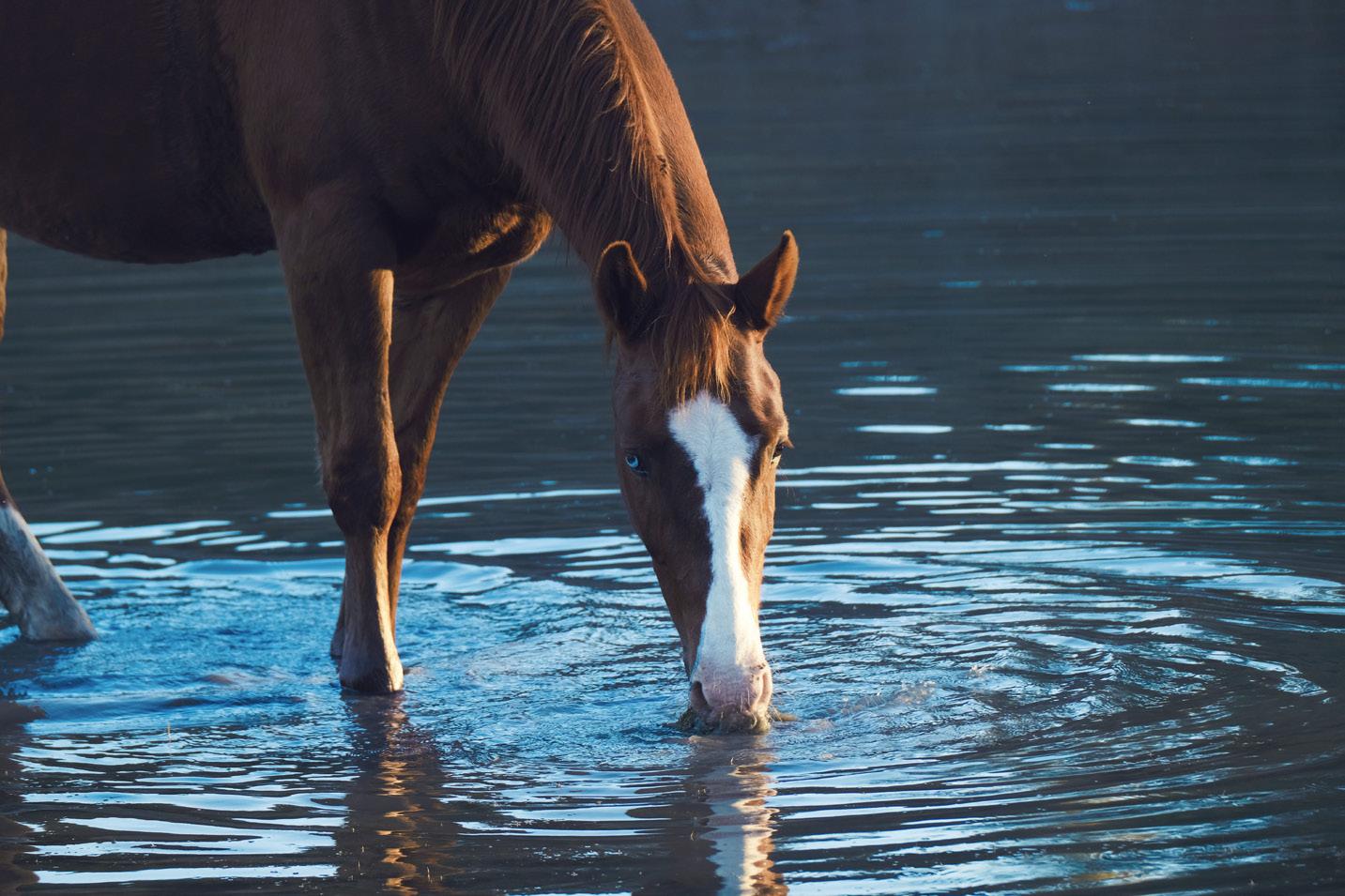
was the well. One was great. One was great until it went dry in our 4th year and there was no recovery. We were able to connect to rural water but that comes with a significant expense. It is very important to understand the quality of your well, quality of the water source and how the well has performed over an extended period. I not only recommend full water quality testing, which is also required in many counties and by some lenders, but I also recommend having a well company come inspect the well as part of the inspection due diligence.
c. Cistern – Yes, I still see Cisterns on a regular basis. Cisterns can have a catch system for rainwater but that also requires regular water quality testing and filtration systems to remove contaminants. Or you must have water hauled in and delivered on a regular basis. Cisterns require much care and oversight to ensure the quality as well as making sure you always have an adequate supply on any given day.
#2 Drainage –Where the water goes should be a HUGE dealbreaker! Nature always finds a way and poorly planned drainage will never get better; only worse. Correcting poor drainage is very expensive and time consuming. I much prefer to see a property during or right after good rains or melted snow as that is the only reliable way to understand the water drainage, as well as any building leaks. What looks fantastic in dry conditions can be virtually unusable after a rain or heavy snow. We were
fortunate when building out our current farm to have abnormally wet weather. What a blessing as even with a great dirt contractor, we had to make modifications to our plans. And six years later we are still very grateful for all the water Mother Nature delivered that spring! Be very critical about doing your due diligence with the drainage!
a. Does the drainage flow away from the barn, paddocks and outbuilding? I have stood in the aisle of a $1M+ property watching the water flow through the barn rather than away or around. Gutters, French Drains, berms, slopes and swales all make a big difference.
b. Are there sacrifice paddocks or areas to use in wet weather?
c. Are there dry pathways or are you always walking in mud?
d. How long does it take water to recede and wet areas to dry up?
e. Look at the FEMA Flood Maps to understand flood potential in the area. They are regularly updated.
#3 Water source locations – Like electrical outlets, there often is never enough water spigots, or ill placed water spigots!
a. Where is the water in proximity to where you use it? Consensus from barn design experts is you don’t want to have to run hoses more than 100’ to fill buckets and water troughs, water arenas or for wash racks, etc. Hoses notoriously have short lives and are a major hassle in the winter. Managing more than 100’ daily is a major challenge long term.
b. Is it protected from the elements? I often see a water source on a direct north wall not very well insulated. Or the spigot is outside the barn or outbuilding. Where will you store your hose to keep it from freezing?
c. Auto-Waterers – Great convenience and eliminates much of the daily management of hoses, filling buckets and troughs and other winter weather challenges. But they are not maintenance free. It is important to understand type, model, age, schematics of water lines (and electric if part of the model) and to plan for routine maintenance and servicing.
#4 Dealbreaker – Barn Design and Ventilation. A barn can be aesthetically stunning but still function poorly for horses and humans!
a. Poor airflow leads to stagnant air. Poor natural light leads to dark and dreary. Dust, mold, pollens, hay particles, and dampness can cause respiratory issues. I prefer to show a barn that has the doors
closed as that first 60 seconds tells me much. Do you smell urine or manure? Does it smell stale? Even a barn that is closed up for the winter weather should still have great ventilation.
b. Are there designated spaces for grain, hay, tack, shavings, equipment, trash, etc? Are they in proximity to where you need them? Are they safe from horses? Are they protected from rodents and the weather? Everything should have a place that makes sense for your needs. And sellers, please take out the trash and empty manure buckets before showings!!
and Pastures.
a. Pretty is as Pretty does. Fencing does not have to be ‘fancy’ but it must be well constructed to be safe and to protect your livestock. And fencing is expensive to install, maintain and repair. If looking at a property and already thinking that the fencing needs improvement, then it is important to be realistic about the cost and timeframe for making those improvements. The risk of injury, cost of vet care or loose animals can be catastrophic. Yet neglected fencing is one of the things I see regularly and is often discounted by buyers as something they will fix later.
b. Buyers often think more about the total acreage than the actual usability of the acreage. Well-designed pasture layout and management of five acres is better
than 10 acres of poorly maintained or laid out pasture. How the land actually works for your needs is more important than just having more acres.
a. Trust that First Impression as they signal how well the property has been maintained overall. If a property is on the market, it is fair to assume it is being presented at its best. And if what you are seeing is at its best and you don’t have a great first impression then don’t overlook items in the excitement of thinking you can make it all better. There often is not a better mousetrap than what you are seeing.
b. Deferred maintenance items are red flags. Why have items not been maintained? How much will it cost to catch up those items? How much will it cost and how frequently will those items need to be maintained? For example, gravel driveways, parking areas, pathways, arena footing all take regular maintenance. If the driveway has potholes or is just mud, there is an expense to re-graveling and re-establishing the base. And then it must be maintained on a regular basis. And we all know gravel just gets sucked away by some unknown force and must be regularly replaced. If that has been deferred what other items have been deferred?
Maggie knows this business, how to work with people, how to accurately read the market, how to best present your property, and how to navigate what can be a very dynamic process. She communicates status and changes in a very timely manner, and keeps all involved parties up to date to ensure a timely sale and closing. Consider having Maggie represent you if you’re looking for an expert to help buy or sell your property!
Courtney S Seller September 2025
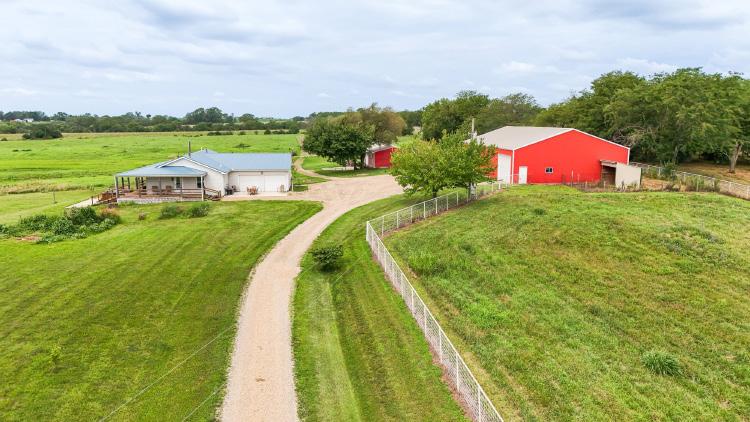
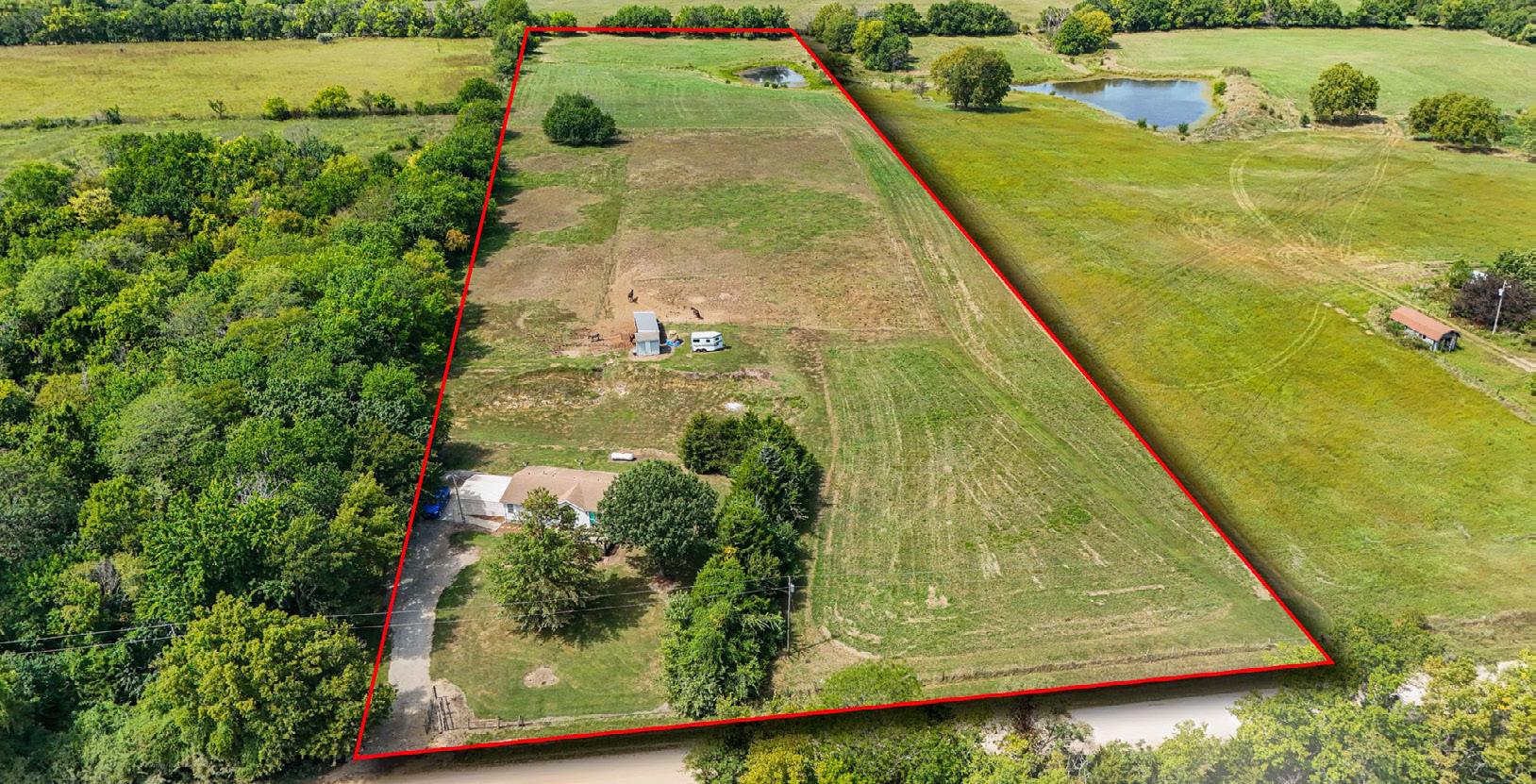
12 Years Experience Managing 300+ Transactions Totaling Over $220M+ Serving My Clients with Integrity - Honesty - Communication - Knowledge Residential, Land, Horse Property & Ranch
Maggie is the best!! I worked her when buying this home and she was the person I wanted to sell my home with. Would not go with anyone else.
Thank you Maggie!
Wendy S
Seller October 2025