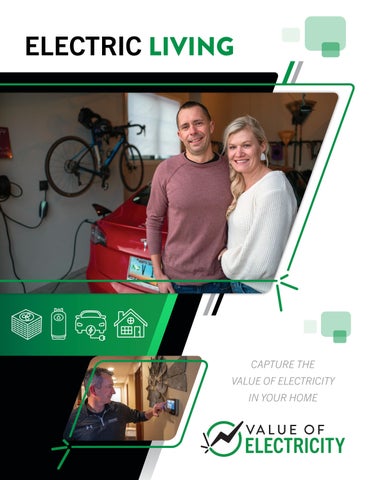
ELECTRIC LIVING
CAPTURE THE VALUE OF ELECTRICITY IN YOUR HOME
TABLE OF CONTENTS The Off-Peak Advantage
10-11
Electric Vehicle Charging
4-7
Electric Heating & Cooling
12-13
Electric Living
8-9
Electric Water Heating
14-15
Your Path to Electric Living
3
THE BENEFITS OF ELECTRIFICATION
The future of energy is electrification. From cooler cars to more efficient home heating, the increasing presence of electricity in your life is undeniable. And as the cost of electricity remains historically stable, the VALUE of those kilowatts just keeps growing – with more uses, cleaner resources and advanced technology. Help your cooperative enhance its community by adding the Value of Electricity to your life. You don’t need to give up the fuel sources you know. Electrification is just an opportunity to make smarter energy choices – for the strength of the electric grid, for the health of the environment, for the worth of your home and for the finances of your family.
ELECTRICITY IS: CLEAN – Electric systems operate cleanly with no fuel storage, no need for extra home ventilation, and no emissions from your vehicle or lawn tools. EFFICIENT – Electricity is 100% efficient, which means you get value from every kilowatt-hour (kWh) purchased.
2
/ Electric Living
RELIABLE – Your local electricity is generated from a strong combination of North Dakota lignite coal, wind and hydropower resources. It is available almost every hour of every day. VERSATILE – You can now use electricity to power nearly anything in your home or garage that used to need fuel. Specifically, there are variety of electric heating systems that can fit any home or lifestyle. AFFORDABLE – Your local power provider works hard to offer stable electric rates and save you money through the offpeak program. Your electricity is not prone to the volatile price swings experienced with propane, natural gas and other fuels.
Contact your cooperative or municipal to learn more about the off-peak program. Scan this QR code for our offpeak cost comparison calculator, or visit www.valueofelectricity. com/off-peak-program/costcomparison.
THE OFF-PEAK ADVANTAGE You can enjoy the convenience of electrification and save money, too, by installing an off-peak electric heating system, electric water heater or electric vehicle (EV) charger in your new or existing home. An off-peak electric heating system consists of electric heat as its main heating source with a supplemental heating system that will typically operate 200-400 hours per year during times of peak electrical usage.
1
Home uses electric heat at lower off-peak rate under normal conditions.
2
High Market Prices
3
4
Available
Available
Electricity
Electricity
Electricity demand exceeds current power supply and economical energy purchases are not available.
Load control is used to avoid uneconomical energy purchases and maintain system reliability.
Home is automatically switched from electric backup heating switchedtofrom electric to source. No change in comfort shouldNobe noticed backup heating source. between two systems. change inthe comfort should be noticed between the two systems.
An off-peak electric water heater or off-peak EV charger will utilize electricity only during lower-demand times of day. Your water will heat when electric demand is low and will stay hot throughout the day, and your EV will fully charge overnight while you sleep.
How does the off-peak (or demand response) program work? Electricity consumers in the Minnkota Power Cooperative system voluntarily sign up for the program, which allows Minnkota to temporarily turn off electric heating, water heating, vehicle chargers and commercial account service. During these “control periods,” most consumers are automatically switched to a backup heating system or generator. Power system operators use computers to send electronic signals through Minnkota’s power delivery system and into your cooperative or municipal utility’s distribution power lines. Receivers plugged into standard electrical current at consumer homes and businesses can read the signals, and when the appropriate message is sent, the receivers interrupt the electric power flowing to a water heater, electric heating system or other controlled load. When control is no longer needed, a signal is sent to turn the electric system back on.
How does off-peak reduce my electric costs? The off-peak program offers a lower electric rate that is about 40-50% below the regular service rate – all for helping your utility lower demand on the system when it’s highest. For home heating, this makes electricity one of the most stable and cost-effective energy sources available. With the off-peak rate, electricity is very competitive with other heating fuels such as propane or fuel oil. And the offpeak rate really looks good during times when fossil fuel prices rise dramatically.
Is it easy to convert an existing furnace to an off-peak system? Yes. A home with an existing fossil fuel heating system can be converted to off-peak electric heating very easily. Qualified personnel from your cooperative or municipal will be happy to advise you on the best electric alternative to meet your specific needs.
Why is the off-peak program environmentally friendly? By temporarily controlling off-peak heating systems, your cooperative or municipal avoids the need to build a new fossil fuel power plant just to meet peak electricity demand. With more than 55,000 consumers participating, the offpeak program is one of the largest energy efficiency efforts in the region. Electric Living /
3
Electric Heating & Cooling
AIR-SOURCE HEAT PUMPS Unlike a furnace, an air-source heat pump doesn’t burn fuel to make heat. It simply uses electricity to move heat from one place to another. Think of an air-source heat pump as a heat transporter constantly moving warm air from one place to another, to where it’s needed or not needed (depending on the season). Even cold winter air contains some heat. When it’s cold outside, a heat pump extracts this outside heat and transfers it inside. When it’s warm outside, it reverses directions and acts like an air conditioner.
A standard air-source heat pump is a self-contained system that uses existing ductwork. The system is composed of an outdoor compressor unit and an indoor air handling unit. The two units are linked with refrigerant tubing and a connected electric supply wire. New advanced heat pumps called cold-climate heat pumps (CCHPs) operate efficiently down to belowzero temperatures, making this technology a new fan favorite for the cold of Minnesota and North Dakota.
BENEFITS VERSATILITY – A single system delivers heat in the winter and cools your home in the summer. EFFICIENCY – Because an air-source heat pump moves heat instead of generating it, the system delivers up to three times more energy than the electricity it consumes. COMFORT – Your air-source heat pump will deliver steady, automatic climate control to your home – even when switched to a backup fuel source. STABILITY – By taking advantage of your cooperative’s lowcost off-peak program, you can protect yourself against the volatile price swings of propane and fuel oil.
4
/ Electric Living
SAVINGS – In addition to your low off-peak rate, you can receive hundreds in rebates to help cover the cost of your technology upgrade.
COLD-CLIMATE HEAT PUMPS The Halvorsons’ story
At a cozy rural home just west of Glyndon, Minn., Mike and Mindy Jo Halvorson were settling into another chilly winter season. The Red River Valley Cooperative Power members have never been worried about high heating bills or cold toes – their coldclimate heat pump (CCHP) has ensured that. “It’s always the temperature we set it at. It doesn’t fluctuate much,” Mindy Jo said, glancing to the living room’s digital thermostat. “I really don’t think about it at all, because it’s always consistent.” The Halvorsons’ CCHP is an advanced style of air-source heat pump, which efficiently transfers heat instead of generating it. In the winter, it absorbs and transfers heat inside, and in the summer the unit works in reverse, removing heat from the home. Heat pump technology has come a long way since its introduction to the public in the 1970s. “This isn’t your grandparent’s heat pump,” Mike said. “With the newer cold-climate technology, the compressors – as it gets colder outside – can ramp up and absorb more heat from the outside air and do it at lower temperatures.” Mike is a Territory Manager for Auer Steel & Heating Supply Company, an Upper Midwest heating, ventilation and air conditioning (HVAC) distributor. Educating contractors about the best heating and cooling choices for consumers is a large part of his job, and air-source heat pumps dominate the conversation. “Homeowners are starting to step up and ask for this now. Heat pumps are getting to be the big buzzword, and that’s
“It’s always the temperature we set it at. It doesn’t fluctuate much. I really don’t think about it at all, because it’s always consistent.” – Mindy Jo Halvorson
why companies are putting a lot of their investment into engineering the technology,” he said. “The future of our industry is air-source heat pumps.” With the improved engineering of CCHPs, the systems have become popular even in the coldest parts of Minnesota and North Dakota. The units are designed to transfer heat at as low as 20 degrees below zero, but the most efficient heating can be experienced at a balance point around 10 degrees – far lower than a standard heat pump. At that point, the system can switch to a backup heating source, like propane or hydronic. As cooperative members, the Halvorsons take advantage of the off-peak program, through which they receive a reduced electricity rate (nearly 50%) to allow the co-op to control the CCHP if regional electric demand is too high. The switch to backup happens seamlessly with no interruption in comfort. Mike explained that their CCHP efficiently covers 80% of the seasonal heating hours of their home. He adds that between the low off-peak rate, the large cooperative rebates available, and the current volatility of the fossil fuel market, installing an electric CCHP is an easy choice for homeowners. “They all want to be comfortable, they want to lower their energy bills, and they want to do their part,” he said. Electric Living /
5
Electric Heating & Cooling
DUCTLESS MINI-SPLIT HEAT PUMPS Similar to an air-source heat pump, a mini-split heat pump is run by a compressor unit placed outside of your home. That unit is connected to an indoor unit by small cables and a refrigerant line. The indoor unit is typically mounted high on the wall of the room that is being heated/cooled.
BENEFITS VERSATILITY – A single system delivers heat in the winter and cools your home in the summer. EFFICIENCY – The system only heats and cools the area that is necessary and transfers heat instead of generating it.
EASE – The system does not require ducts and can be installed easily in any room. It can be set to run automatically or by remote control. SAVINGS – In addition to the money you will save in efficiency, the upfront cost of the unit may be covered in part by a rebate from your utility.
GROUND-SOURCE HEAT PUMPS A ground-source heat pump (also referred to as a geothermal heating and cooling system) is based on the physical law that energy flows from a warmer place to a cooler place. The typical system consists of a closed loop of plastic tubing installed underground and an electrically powered compressor inside the home. An environmentally friendly antifreeze solution circulates through the tubing and captures the natural heat of the earth, cycling it to the home.
BENEFITS EFFICIENCY – Because the system only uses electricity to move larger amounts of heat energy, the system may use up to 50% less electricity than conventional systems. RELIABILITY – There are few mechanical components to
6
/ Electric Living
the ground-source heat pump system, and because they are sheltered from the elements underground, you don’t have much to worry about years after installation. RESPONSIBILITY – Ground-source heat pumps are one of the most environmentally friendly heating and cooling systems on the market today.
ELECTRIC PLENUM HEATERS Easily adapted to an existing fuel oil or gas/propane forced-air system, a dualfuel electric plenum heater uses your existing furnace fan to move air across the plenum heater elements to heat your home. Both your fossil fuel furnace and the electric plenum heater use the same thermostat and ductwork.
BENEFITS EASE – A plenum heater is one of the easiest ways to convert your existing propane or oil furnace into a dual-fuel heating system. COST EFFECTIVENESS – The plenum is a cost-effective way to integrate reduced-rate off-peak electricity into your heating system. The technology also helps lengthen the lifespan of your gas furnace. RESPONSIBILITY – The plenum is a safe and clean heating alternative for any home or building.
THERMAL STORAGE HEATERS
UNDERFLOOR HEATING
Electric thermal storage heaters convert off-peak electricity to heat and store this low-cost heat to keep a home comfortable 24 hours a day. The system contains electric heating elements that lie within specially designed, high-density ceramic bricks. These bricks are capable of storing vast amounts of heat for extended periods of time. The stored heat is automatically regulated in relation to outdoor temperature and the heating requirements of the user. When the room thermostat calls for heat, it is extracted from the unit’s storage core and distributed evenly in the home.
Underfloor heating has quickly become a favorite for those seeking ease and comfort on chilly days. The system can be installed at construction or during renovation. Warmth rises from the floor and spreads evenly through a room, garage or shop building. The technology can be applied two ways. Hydronic floor heating is used in conjunction with an electric boiler and circulates heated water through flexible piping. The piping can be installed right below the concrete in new construction projects or mounted below the floor of existing wood construction. Electric cables or mats heat up when electric current is applied. The systems are buried 8-12 inches deep in a bed of sand under the concrete slab, which serves as a heat storage reservoir.
BENEFITS EFFICIENCY – The heater’s ability to store inexpensive offpeak energy and efficiently deliver heat makes it one of the most advanced heating systems available. RESPONSIBILTY – In addition to being 100% efficient, the system is clean – no backup fuels are needed. EASE – Once the system is set up, it works with outdoor sensors to maintain the correct amount of stored heat throughout each season, creating year-round, worry-free comfort. It requires no tank filling or tune-ups and is virtually maintenance free. VERSATILITY – Electric thermal storage heating offers several applications, including a central forced-air furnace, hydronic furnace or room unit – whatever best fits your home and needs. SAVINGS – In addition to the money you will save with the low off-peak electric rate, your utility may also offer a large rebate to help cover any initial costs.
BENEFITS EFFICIENCY – The storage system efficiently stores offpeak heat and allows it to rise into a room uniformly across the floor. EASE – Once you complete the easy installation of the system, there are no maintenance needs. You also don’t have to worry about heating vents being blocked by furniture. VERSATILITY – The system can be used to heat an entire building or in supplement to another heat source. RESPONSIBILITY – The system runs clean and no backup fuels are needed. COMFORT – Not only is the system completely quiet, it also gives your feet some extra warmth on those cold winter days. Electric Living / 7
Electric Water Heating
ELECTRIC WATER HEATERS Up to 20% of the energy used in your home is for water heating, and that becomes a large portion of your monthly energy bill. By upgrading to a largecapacity electric water heater, you can save money and never worry about running out of warm water. A large-capacity electric water heater can be set up on your utility’s off-peak program to draw heat energy during lower-demand times of day. The water is heated inside a specially insulated tank, which allows almost no heat loss over a 24-hour period. It’s ready to deploy hot water when you need it for showers, dishwashers, laundry – you name it.
BENEFITS SAVINGS – Not only will your new electric water heater qualify for a lower off-peak electricity rate (up to half as much as the standard rate), but you can also receive hundreds of dollars in rebates for installing one. They are often more efficient than gas or propane water heaters, saving you even more.
EASE – Electric water heaters are easy to install without the need for complicated venting, gas connections or fuel tanks. RELIABILITY – With a large-capacity electric model, your hot water will always be there when you need it. New electric water heater tanks are built to last, with sufficient insulation (at least 2 inches of foam for an R-16 insulation value) and optional corrosion protection.
WATER HEATING EFFICIENCY TIPS • Set your water heater temperature at 120 degrees. For each 10-degree reduction in water temperature, you can save about 5% in energy costs. • Install low-flow showerheads and aerators on sink faucets. These measures save money by reducing hot water use. • Insulate your electric hot-water storage tank. If your water heater is located in an unconditioned space, consider
8
/ Electric Living
installing a thermal wrap around it. Take care to install it in accordance with the tank and wrap manufacturer’s instructions. • T ry washing clothes with warm water and rinsing with cold water. • D rain a quart of water from your water tank every three months to remove sediment that impedes heat transfer and lowers the efficiency of your heater.
ELECTRIC WATER HEATING The Seversons’ story
When Ryan and Lisa Severson built their Roseau, Minn., home in 2015, two priorities rose above the rest – efficiency and family. The couple needed a house that reflected their careers as energy experts (Ryan as an assistant manager at Roseau Electric Cooperative and Lisa as an energy conservation coordinator for Minnkota Power Cooperative), but they also wanted a space to comfortably host their growing family. “Right now we only have one son at home, but when we have the whole crew here – which is six kids and their families – we’ve never run out of hot water,” Ryan said. That’s because the Seversons installed a largecapacity, 105-gallon Marathon electric water heater. The highly efficient equipment stores enough hot water to meet the needs of any holiday, birthday or “just because” family gathering. “We’ll be running the dishwasher, and laundry for the towels, and everyone will be showering and getting ready,” Lisa said. “Enough hot water is something we’ve never really had to worry about.” The Seversons’ electric water heater is set up on Roseau Municipal Utilities’ off-peak program, which allows the equipment to be turned off during high-demand times of day. The water is heated when electricity demand is low, often overnight, and remains warm until it’s needed. “I’ve seen a couple water heaters in my day,” Ryan said,
“The bottom line is the efficiency has improved, because of how well they are insulated. It’s not only when you’re at home utilizing it.” – Ryan Severson
joking about his 30 years in the electricity business. “The bottom line is the efficiency has improved, because of how well they’re insulated. It’s not only when you’re at home utilizing it. If you’re not pulling any water out of it, it hardly has to run. It can go a couple days and not lose 10 degrees if you shut it off. That’s one of the things that sold us on it.” On top of the reliability and efficiency of the large-capacity water heater, the Seversons enjoy the additional benefit of the off-peak electric rate, which is nearly half of the standard rate. They also utilize the off-peak program for their coldclimate heat pump and other electric heat circuits in their home and shop. Cooperatives and utilities across Minnesota and North Dakota also offer large rebates to cover the cost of a new electric water heater, so it’s important to reach out to your power provider to see how they can help you get started. If you ask Ryan how the off-peak incentives add up, he will smile knowingly and give you the simple answer. “It’s huge savings,” he said. “Now, with all of the rebates available, it’s kind of an easy choice,” Lisa added. “Our water heater was a no-brainer based on our experience working in the industry.”
Electric Living /
9
Electric Vehicles
ELECTRIC VEHICLE CHARGING The future of transportation is electric. Adding an electric vehicle (EV) to your garage can save you money, help you become more environmentally responsible and simply give you a better driving experience. Plus, charging at home is easy and inexpensive – and your utility will help you get started. Installing a Level 2 home charger is much like installing the wiring for a clothes dryer or other heavy appliance – it needs a 240-volt source. Most homeowners hire an electrician for this, and it can usually be done in a few hours. A Level 2 charger can refill a standard 60-kW EV battery in about 6-8 hours. That means you can plug in, go to sleep and have a fully charged car in the morning. Your utility may offer rebates for the installation of home charging equipment (often $500-$1,000) on the off-peak program. That helps you take advantage of a super-low electric rate – less expensive than traveling on gas. In exchange for the lower rate of the offpeak program, charging is limited to certain hours, typically overnight.
CHARGING OPTIONS
Level 1
Level 2
Level 3 (DC Fast Charge)
Electric Requirements
Plugs into a standard 120-volt outlet
Uses a 240-volt charging station installed at home or in a public space
Requires utility involvement, usually only found in public along major corridors
Charging Speed
Around 5 miles of range per hour (36 hours for depleted standard battery)
Around 25 miles of range per hour (6-8 hours for depleted standard battery)
Around 100 miles of range or more per hour (time dependent on battery depletion level)
Cost to Charge
Standard electric rate
Qualifies for reduced off-peak rate
For drivers, may be free or charge a usage fee
BENEFITS SAVINGS – At the standard electric rate, most electric vehicles can be fully recharged at home for about $7. For consumers who participate in the off-peak charging program, it costs about 65 cents to drive an electric vehicle the same distance that an average car can go on a gallon of gasoline. LESS MAINTENANCE – Electric vehicles do not require oil changes, because no oil is used to run the engine. They do 10
/ Electric Living
not require air filters, spark plugs, timing belts or many other parts that need occasional replacement in a gasoline car. SMOOTH RIDE – EV motors are nearly silent and provide smooth (and incredibly fast) acceleration, as there are no shifting gears. With a heavy battery creating a low center of gravity, EVs handle curves and turns like a dream. NO EMISSIONS – EVs release no tailpipe emissions, creating cleaner air in your community.
ELECTRIC VEHICLE CHARGING The DeFoes’ story
When Adam and Britani DeFoe moved their family from Nebraska to West Fargo, N.D., more than three years ago, they had a lot to figure out. Adam was starting a new physician interventional radiologist job at Essentia Health, their four kids would be experiencing a new community and they were building a new house from afar. But one thing was easy to figure out. Adam had a Tesla Model 3 on preorder, and he wanted a way to charge it quickly at home. “Our builder just asked me about it. He gave me the option of the off-peak meter for the charger, and he said, ‘You’ll save a lot.’ Right away I said yes – put that in!” Adam said with a laugh. The DeFoes, Cass County Electric Cooperative members, have racked up the savings by charging their electric vehicle (EV) on the off-peak program, which offers them a reduced electric rate for charging the car during low-demand times of day – often overnight. Additionally, a charger rebate is offered to members who enroll in the off-peak program. Adam simply plugs into the 240-volt system when he gets home, and the car is programmed to begin the charging process at the set offpeak time. Even if the battery is nearly depleted, he has a full charge by the time he needs to leave for the hospital. “Especially compared to paying for gasoline, charging the car is pennies. It takes very little electricity to make this car get to work and back,” Adam said. “You definitely see the cost savings in the long run. Electric vehicles are
“It takes very little electricity to make this car get to work and back. You definitely see the cost savings in the long run.” – Adam DeFoe
great, especially if you are doing a lot of around-the-town commuting.” Inexpensive “fuel ups” are just a small reason Adam loves his EV. He hasn’t had to bring the car in for maintenance the entire three years he’s had it (no oil, no belts, no problems), he likes that it is American made and environmentally friendly, and he can’t get enough of the high-tech features and app capabilities. He’s most charged up about one detail in particular. “They are super fun to drive. The acceleration…” he said with a pause. “You can’t beat it.” The DeFoes have become fast advocates of EVs and are thrilled to see fast charging stations and Tesla Superchargers pop up in their neighborhood and towns around the region. Britani drives the EV whenever she has the chance, and the couple certainly envisions plug-in fandom continuing through their next generation. “My oldest will be 11 soon, so I’m thinking it might be passed on to her, because the safety ratings on this thing are amazing,” Adam said.
Electric Living /
11
Electric Living
ELECTRIFIED LIFESTYLE Every year brings more and more innovative, efficient uses for electricity in every aspect of home living. From the kitchen to the garage, kilowatts are enhancing the performance of your most valuable tools and appliances. The following are just a few items to help you plug into convenience, safety and quality.
Induction stovetops
For the home chefs out there, an induction range is a valuable addition to your cooking station. The latest kitchen go-to stovetop uses electricity to create a magnetic field that heats iron-based pans and pots from the inside out. You use less electricity, eliminate any open flame and protect your family from accidental burns.
BENEFITS EFFICIENCY – Induction stovetops are more efficient at transferring heat energy than both gas stoves and electric coils – up to 10%. COOKING QUALITY – Your meals will be prepared faster and more evenly with an induction stovetop. The elements heat up a pot or pan quickly (you can have a pot of water boiling in two minutes), and you can reduce the heat just as fast. The induction cooktop also beats gas burners for low simmering temperatures for sauces and rice. SAFETY – Induction stovetops will only heat iron-based pots and pans and will automatically shut off if one is not detected, so you won’t burn yourself on a coil or create a fire hazard. Plus, the technology heats the pan and not the stove itself, so cool-down time is immediate. 12
/ Electric Living
Electric lawn care
From mowers to leaf blowers to trimmers, you can now electrify everything in your lawn care toolkit. Each piece of technology has become more powerful and more efficient in the past few years. And as prices continue to drop, homeowners and landscapers are scrambling to fill their garages with the latest corded or batterypowered models.
BENEFITS QUIET – Electric lawnmowers, trimmers and blowers don’t contain the rumbling machinery and parts of standard gaspowered tools, so you can start your lawn work earlier without disturbing the neighborhood. LIGHTWEIGHT – With fewer components and no fuel tank, electric mowers and tools are easier to push and carry. NO FUEL — You never have to worry about running out of fuel in the middle of a mow or storing oil/gas in your garage. Electricity is always ready to reenergize your equipment. PUSH-BUTTON START – Don’t worry about throwing out your back trying to start your gas-powered mower or trimmer. Electric lawn care tools start with a simple press of a button.
Electric bikes
Electric bicycles (referred to as e-bikes) have recently become one of the trendiest ways to cruise the trails and bike paths. The battery-assisted bikes come in a variety of classes and styles, from moderate pedal-assist to full-throttle power. Whether you need the extra boost to keep up with your kids or to get through uphill, rough terrain, an e-bike is an essential addition to your outdoor gear.
BENEFITS SWEAT-FREE COMMUTE – Ride your bike to the office or social gathering without breaking a sweat. Pedal assistance allows you to choose how much of a workout you receive, from standard pedaling to full battery power. EASY CHARGE – Most e-bike varieties either plug into a typical 120-volt wall outlet to charge or work with swappable battery packs. The bikes can typically be charged within three hours for 30-80 miles in assisted range. SPEED – Standard Class 1 and Class 2 e-bikes can assist with pedaling up to 20 mph. Higher-performance Class 3 models have a drive system that will assist up to 28 mph. Always wear your helmet!
ELECTRIC SNOW BLOWERS Kevin Jeffrey’s story
Kevin Jeffrey is living the retired life in his Grand Forks, N.D., home. As a photographer, he experienced decades of long hours and extreme environments. He hasn’t put the camera away, but he knows it’s time to start taking it (somewhat) easy. “My doctor told me, ‘No shoveling anymore. If you’re over 50, you shouldn’t be shoveling,’” he said. Jeffrey took the advice to heart. He picked up an all-electric cordless snow blower to help conquer his region’s ceaseless snow. The EGO POWER+ snow blower is driven by two rechargeable 56-volt lithium batteries, has a 21inch clearing width and can throw snow as far as 35 feet. The reviews of the technology were outstanding and the specs were impressive, but Jeffrey was still slightly skeptical as he brought it home. The skepticism was shortlived. “I’ve been really happy with this snow blower,” he said. “It’s exceeded my expectations.” The benefits of the blower stacked up fast. He’s able to store the lightweight and compact machine in his enclosed front porch during the winter, making it easy to grab and go. “You can’t do that with a gas-powered blower,” he said. “It’s going to smell everything up.” As Jeffrey got ready to clear off his sidewalk, another electric advantage emerged.
“I was really excited about using it during a recent blizzard, because I was wondering how it would do in deep snow. Well, it does amazing.” – Kevin Jeffrey
“You push a button, push the safety bar, and it’s on. It just goes,” he explained as a quiet hum came off the machine. “And you heard it – it just sounds like a vacuum cleaner. It’s quiet. With gas, the colder it is, the harder it is to start. I’ve had no issues with this.” With being fume-free, lightweight, easy to start and quiet, electric snow blowers prove that bite doesn’t have to come with bark. Even at single stage (the blowers also come in two-stage options), Jeffrey tears through hardened snow without much effort using his variable-speed control. A recent blizzard brought drifts of up to a foot in his neighborhood. “I was really excited about using it that time, because I was wondering how it would do in deep snow,” he recalled. “Well, it does amazing.” The ease and power of the electric snow blower have inspired the homeowner to expand his charged-up garage. He hopes to use the interchangeable EGO battery system with the purchase of an electric leaf blower and lawn mower when the snow melts. But for now, in true North Dakotan form, he’s using his extra energy for good. “I plan on doing the neighbor’s sidewalks today,” he said with a grin.
Electric Living /
13
YOUR PATH TO ELECTRIC LIVING
Planning your electric installation Getting started is the hardest part of any home improvement project. There are few things you should do before beginning your electric installation or upgrade that will make the process easier and, ultimately, more successful.
Proactively plan You don’t want to wait until your current system fails to do research on new electric technology. It takes time to find a heating and cooling system or water heater that will work perfectly for your situation. If you foresee a renovation, aren’t getting the comfort you expect, or simply have a system that is near end-of-life, start your preparations now.
Get quotes on equipment Price is important, but it should not be the only deciding factor on choosing new electric equipment. You also want to make sure you’re getting the best quality to reap the long-term efficiency and savings benefits. Any potential installer should be able to help you find great solutions to fit your budget and needs.
Size for your space and needs It’s important to properly size your electric equipment to the requirements of your home – especially when it comes to heating and cooling. Air-source heat pumps need special sizing attention, as they switch to a backup fuel when extreme cold hits (or if on the off-peak program). If the unit is set to switch to the backup fuel at a higher temperature than it needs, it will start to eliminate some of the savings gained by using more-efficient heat pump technology. You should also ensure you ductwork is the correct size for your home and system. Units like ground-source heat pumps often need larger ductwork than standard HVAC equipment. Ductwork that is too large or too small will make your fans work harder, may waste energy and might not deliver the comfort your family needs. A quality installer will help you with these important calculations. 14
/ Electric Living
Find a great installer Your cooperative or municipal utility works with the best contractors and installers in your region, so give your power provider a call to see if they have any recommendations. It’s also helpful to reach out to family, friends and neighbors to see who has delivered quality service to people you trust. We’ve included some questions to ask potential contractors on the following page.
YOUR PATH TO ELECTRIC LIVING Questions for your contractor Before you get started on your electrification project, make sure you find a contractor you can count on to do dependable work. Start by getting referrals from your utility or trusted family and friends. It may also help to ask any potential contractor the following questions:
Does the company hold a heating, ventilation and air conditioning (HVAC) license? State licensing is the minimum requirement to operate an HVAC company. Licensing protects the public, including you. Unlicensed companies are unaccountable to regulators and often unavailable if things go wrong. Ask for a license number – it’s the first step to knowing you are dealing with a reputable company.
Is there any regular maintenance I should be doing? Before the technician leaves, make sure they show you any regular maintenance required, such as changing filters or operating the thermostat. Replace or clean your filters once a month depending on the type. Have your system checked and serviced twice a year to ensure maximum efficiency and get ahead of any potential malfunctions, especially prior to major temperature changes in summer or winter.
Can you provide any references? You want to be sure your contractor has a long history of reputable service. Strong contractors will have references at the ready.
Are there other energy-efficient options? Quality contractors should be up to date on the latest energy-saving equipment options, including ENERGY STAR®. Sometimes these options have a higher initial cost, but will save you money in the long run. Go with a contractor who will discuss all options and is not focused solely on price. Check with your electric utility for possible rebates to help you move to a higher efficiency system.
What rebates or financing options are available? Your contractor should be well versed in the best ways to pay for your new electric system. Your utility can offer guidance on the rebates and incentives it offers, but there may be additional opportunities of which you can take advantage.
Is your company insured?
Most companies will be insured, but not all are. Ask about Worker’s Compensation and Liability Insurance. Using an insured contractor will not only protect your investment, it will also protect you against liability issues. Don’t take a risk – ask about insurance.
Electric Living /
15
COOPERATIVES
MUNICIPALS
Beltrami Electric Cooperative Bemidji, MN • (218) 444-2540
PKM Electric Cooperative Warren, MN • (218) 745-4711
Bagley Public Utilities (218) 694-2300
Park River Municipal Utilities (701) 284-6150
Cass County Electric Cooperative Fargo, ND • (701) 356-4400
Red Lake Electric Cooperative Red Lake Falls, MN • (218) 253-2168
Baudette Municipal Utilities (218) 634-2432
Roseau Municipal Utilities (218) 463-1542
Cavalier Rural Electric Cooperative Langdon, ND • (701) 256-5511
Red River Valley Cooperative Power Association Halstad, MN • (218) 456-2139
Fosston Municipal Utilities (218) 435-1737
City of Stephen Utilities (218) 478-3614
Grafton Municipal Utilities (701) 352-2180
Thief River Falls Municipal Utilities (218) 681-4145
Halstad Municipal Utilities (218) 456-2128
City of Warren Water and Light (218) 745-5343
Hawley Public Utilities (218) 483-3331
Warroad Municipal Utilities (218) 386-1873
Clearwater-Polk Electric Cooperative Bagley, MN • (218) 694-6241 Roseau Electric Cooperative Roseau, MN • (218) 463-1543 Nodak Electric Cooperative Grand Forks, ND • (701) 746-4461 Wild Rice Electric Cooperative Mahnomen, MN • (218) 935-2517 North Star Electric Cooperative Baudette, MN • (218) 634-2202
This is a special Value of Electricity publication of Minnkota Power Cooperative and the associated systems. Learn more about how your utility can help you electrify efficiently at ValueOfElectricity.com. Published in 2022