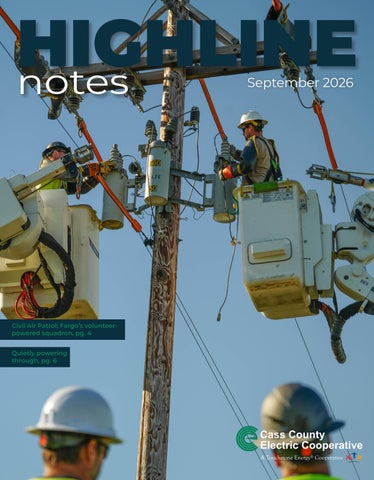
HIGHLINE notes September 2026
Civil Air Patrol: Fargo’s volunteerpowered squadron, pg. 4 Quietly powering through, pg. 6
CassCountyElectric.com
September 2026 | Highline Notes 1
editorial
Serving Applied Digital: Planning ahead to protect and benefit members
By Paul Matthys, Cass County Electric Cooperative President & CEO Cass County Electric Cooperative is preparing to serve Applied Digital’s AI Factory near Harwood, North Dakota, the largest new electric load in its history. The project represents a major regional investment and an opportunity to support innovation while protecting existing member-owners. To manage large-load growth responsibly, Cass County Electric requires customers to pay for engineering studies before service is approved. These studies evaluate transmission and distribution impacts, helping to ensure that legacy members do not bear project-related study costs. The studies also assess reliability, congestion, grid stability, and whether the project can be served without disrupting homes, farms, and businesses already on the system. Managing risk before growth occurs Cass County Electric has evaluated the financial and operational risks of serving a large AI data center and built safeguards into the process, including prepayment, irrevocable letters of credit, guarantees, and other protections, so existing members
are not left responsible for project costs. Applied Digital must also pay for required system upgrades, including transmission line extensions, transmission improvements, and new substations, helping ensure legacy member rates are not increased because of the AI Factory. Benefits for members and the cooperative While risk mitigation remains central, the project could provide meaningful member benefits. New revenue and margins from large electric loads can reduce upward pressure on rates and strengthen the cooperative’s financial position. The cooperative may also have opportunities to defer revenue, cushion future wholesale rate increases, and potentially provide additional or accelerated capital credit allocations to legacy members.
Planning for future growth As Applied Digital grows, its energy needs may increase. Cass County Electric is also evaluating potential new generation assets. If co-build opportunities arise, Applied Digital would pay its share, while the cooperative may reduce legacy asset costs through economies of scale. This planning supports future energy needs while preserving the cooperative’s core mission: reliable, affordable service for member-owners. Keeping members at the center By requiring studies, securing financial assurances, ensuring Applied Digital pays for projectrelated upgrades, and focusing on long-term member value, Cass County Electric is positioning itself to pursue new revenue while safeguarding legacy members.
Serving the Applied Digital AI Factory is more than a new service request. It is an opportunity to support regional growth, strengthen Applied Digital has agreed to the cooperative’s financial donate its capital credits back foundation, and create long-term to local communities through benefits. With risk mitigation at Operation Round Up and an the forefront, Cass County Electric endowment fund, extending the is approaching the project with project’s value beyond the electric the discipline and member system. focus required to serve today’s members and future generations.
CCEC offices will be closed Monday, Sept. 7, for Labor Day. 2 Highline Notes | September 2026
CassCountyElectric.com
l
this month’s content lineup
12
13
impact
14
recipes
safety
15 ads
A successful harvest season starts with safety. Remember to look up and look out for power lines.
Highline Notes
Volume 84, Number 9
Communications: Morgan Bachelor Sara Hand Jocelyn Lura Hovland Printer: Forum Communications Printing Board of Directors: Paul White, Secretary Douglas Anderson Vanessa Kummer Stacey Ackerman Tom Seymour Glenn Mitzel, Board Chair Wendy Loucks Kalvin Hoff, Treasurer Terry Kraft, Vice Chair Executive Staff: Paul Matthys, President/CEO Troy Knutson, VP of Engineering & Operations Chad Brousseau, VP of Member & Energy Services Andy Weiss, VP of Corporate Services & CFO Mitchell Lyter, VP of Information Technology & CIO
Learn more and request a free safety kit from CCEC.
BOARD MEETING HIGHLIGHTS - JULY 2026 The Cass County Electric Board of Directors met in person on July 29, 2026, and discussed the following topics: • Approval of the July 2026 consent agenda for the regular board meeting, which consisted of minutes, monthly department reports, and the director expense report. • Received the chair’s report (Director Mitzel). • Received the president and CEO’s report (Paul Matthys). • Received the June 2026 and mid-
year financial reports. • Moved to approve the Annual IT Audit Review. • Received the annual Business Accounts update. • Received a report from NDAREC. • Received a report from the NDAREC summer board meeting. • Moved to approve the July 2026 Capital Credit estate payments. • Reviewed upcoming meetings and events. The next board meeting is Tuesday, Sept. 29, 2026.
MEMBER MEETING
Highline Notes (USPS 244-740) is published monthly by Cass County Electric Cooperative Inc., 3312 42nd St. S., Suite 200, Fargo, ND 58104. Periodicals postage paid at Fargo, North Dakota 58104, and at additional mailing offices. Postmaster: Send address changes to Highline Notes 3312 42nd St. S., Suite 200 Fargo, ND 58104 © Copyright Cass County Electric Cooperative 2026. All rights reserved. Questions: 701-356-4400 800-248-3292 info@kwh.com Call Before You Dig: 800-795-0555 or 811
TUESDAY, OCT. 20, 2026, AT 5:30 P.M. HILTON GARDEN INN • 4351 17TH AVE S, FARGO
Cass County Electric Cooperative is an equal opportunity provider and employer.
HEAR FROM COOPERATIVE LEADERSHIP AS WE DISCUSS IMPORTANT INDUSTRY INFORMATION WHILE ENJOYING A DELICIOUS MEAL.
Information about the cooperative, articles of incorporation, bylaws and more can be found at CassCountyElectric.com.
CassCountyElectric.com
September 2026 | Highline Notes 3
Civil Air Patrol: Fargo’s volunteerpowered squadron Nobody has to show up. That’s exactly what makes it matter when they do.
4 Highline Notes | August September 2026 2026
CassCountyElectric.com
Boots strike the floor in unison at the Old Terminal Building on 23rd Avenue North, ground that once trained military pilots during World War II. Teenagers in uniform fall into formation, and the Red River Valley Composite Squadron of the Civil Air Patrol gets to work. Not one of them is required to be there. “We are military in structure, but we are not the military,” said Senior Master Sgt. Dean McMurray, deputy commander for cadets with the squadron. Civil Air Patrol is an all-volunteer organization, federally chartered and supported by Congress. No cadet or adult member is required to go on to serve. Still, nothing about it runs itself. Every search and rescue mission, every disaster response, every hour a cadet spends learning to lead happens because someone decided to show up. CCEC members know this feeling well. Every vote cast, every annual meeting attended, every moment of interest in how the power gets delivered is a choice, not a requirement, and that choice is what makes a cooperative work. Civil Air Patrol runs on that same fuel: volunteers serving their communities, saving lives, shaping futures, simply because they decided to. Deep roots, a new structure Fargo’s ties to Civil Air Patrol stretch back to 1941. The area’s first dedicated cadet squadron, the only one of its kind in the state at the time, formed about 30 years later. This past February, the squadron reorganized again, restructuring into a composite squadron that blends cadets and adult members under one roof. The mission hasn’t changed. Civil Air Patrol responds to flooding in Fargo and Bismarck, wildfires across the country, and
searches for people who are lost. “Between the pilots and the cadets and everybody in between, everybody has a role to play,” McMurray said. For cadets ages 12 to 18, the program builds around three pillars: character development, physical fitness and aerospace education. Members can also work toward a private pilot certificate, attend regional flight academies, or, if manned flight doesn’t pan out, earn a drone pilot certification instead. “That’s my opportunity” Cadet Lt. Col. Colin Curran has lived that path. He joined at 14 after a friend told him about the squadron. “I originally wanted to fly, and I looked at Civil Air Patrol and said, wow, that’s my opportunity,” Curran said. A medical issue later disqualified him from manned flight. Rather than walk away, he shifted direction and earned his Part 107 certificate to fly drones instead. Five years later, he’s still there, working his way up the chain of command, and he credits the people for keeping him around. “You will find that there are some serious individuals who want the best for you, and if you want the best for yourself, they’re going to bring it out of you,” Curran said. He’s spent hours volunteering at local food banks and the Fargo Air Museum, work he ties to one of Civil Air Patrol’s four core values: integrity, volunteer service, excellence and respect. He’s now working toward a degree in emergency management, with hopes of a career with a state agency or FEMA. “If you stick with something and it really doesn’t matter what it is, if you stick with something, you CassCountyElectric.com
learn about it. You become the best,” Curran said. McMurray sees that same growth from the adult side of the room, too. He doesn’t get paid for any of it. “What keeps me coming back is the kids,” he said. “The change I see in my own son, but I see the change in everybody else’s sons and daughters.” He watches them struggle, then come out the other side of it. “That’s my payment,” he said. Close to home Oakley Schlenker, a cadet in the squadron, is the stepson of Mike Mahlke, CCEC line crew foreman in Fargo. “What stands out to me most is how much Oakley has grown as a person,” Mahlke said. “He takes the program seriously, works hard and holds himself accountable. Watching him accomplish something he’s worked for and seeing how proud he is of it is pretty special.” It’s the kind of story that plays out across the squadron every week: A parent watching a kid choose to keep showing up and become more confident along the way. Showing up for each other CCEC is backing that same spirit with a donation to the squadron this year, one more way a local organization can say it believes in what happens in that room on Tuesday nights. It’s a small gesture, but it echoes the same principle the cooperative asks of its own members: show up, and something bigger gets built. Civil Air Patrol turns 85 on Dec. 1, 2026. None of what happens at the Old Terminal Building each Tuesday happens because anyone has to be there. It happens because, week after week, people decide to be. September 2026 | Highline Notes 5
QUIETLY POWERING THROUGH Cass County Electric’s work on the FM Area Diversion
For more than a century, the Red River of the North has shaped life in the Fargo-Moorhead area. The river flows north across some of the flattest land in the country, a remnant of glacial Lake Agassiz, and that combination makes the region one of the most flood-prone in the United States. Major floods struck in 1897, 1950, 1997, 2009 and 2011. The 1997 flood that overwhelmed Grand Forks and East Grand Forks caused an estimated $3.5 billion in damage, and in 2009 the river reached its highest level on record in the FargoMoorhead area. Those events set the stage for one of the largest infrastructure projects the region has ever seen: the FM Area Diversion. And while the diversion is best known for its channel, levees and control structures, a quieter story runs beneath and beside all of it. To make the project possible, thousands of feet of electric line had to be moved, rebuilt, buried or retired. Much of that work fell to Cass County Electric Cooperative.
The FM Area Diversion is a roughly 30-mile channel designed to route floodwaters around the metro area, paired with about 20 miles of levees, a series of control structures, aqueducts that let existing rivers cross naturally, and an upstream water retention area. The Metro Flood Diversion Authority oversees the channel and associated infrastructure, while the U.S. Army Corps of Engineers is responsible for the southern embankment. It is a project that, once completed, will cost more than $3 billion, involving roughly 30 federal, state and local agencies and around 20 utility companies. It is also the first public-private partnership flood control project in North America. The target for delivering permanent, reliable flood protection is 2027. The project intersected with CCEC infrastructure throughout the area, requiring coordination across nearly every section. The work broke down into several major areas: crossings
6 Highline Notes | September 2026
CassCountyElectric.com
and reroutes along the diversion channel, retirements and line work in the southern embankment and upstream retention area, the Wild Rice and Red River control structures, the inlet structure to the channel, and a long list of member buyouts and accounts that had to be re-fed. Along the channel route alone, crews dealt with 33 separate conflicts: seven crossings, five reroutes and 21 line retirements. In the southern embankment area, the cooperative built 23.5 miles of new underground line to replace, reroute or re-feed member accounts. Crews also retired 14.4 miles of overhead line, the poles and wires most people picture when they think of a power line, along with 9.1 miles of buried underground cable and 91 individual services. All told, the diversion has generated more than 100 separate projects for the cooperative, from single service retirements to full substation work. Crews have logged nearly 13,000 hours on them since the first job opened in 2017.
WHAT IT TOOK 100+ CCEC diversion projects 33 electric line conflicts 23.5 MILES of new underground line
The project pushed the cooperative into unfamiliar territory. To cross beneath the diversion channel, crews pulled nearly half a mile of cable through conduit in a single run. Before this project, CCEC had rarely pulled cable more than about 1,500 feet at a time. The longer pulls required detailed engineering calculations up front to confirm they were even possible, larger conduit to ease the pulls, and specially ordered reels of cable long enough to run from one side to the other without a splice. One contractor purchased a new reel trailer just to handle the size and weight. The project was designed to keep every cable splice off Corps property, so any future repair would happen on adjacent land rather than under the channel. On the south side, where crews could not bore beneath the dam, lines had to run up and over the embankment instead, a reverse of the same challenge. Much of the conduit was encased in concrete, a permanent commitment that left little room for second chances. This was not a quick job. CCEC opened its first work order tied to the diversion in 2017, years before formal agreements were in place, and the cooperative has been meeting with
project partners roughly every other week for the past three years. The effort also included relocating the Oxbow substation, moving two large diesel generators about 18 miles southwest to the Colfax substation, and coordinating closely with landowners, the Corps, the diversion authority, and its engineering partners. Through it all, CCEC’s approach stayed consistent: Do the work that needs to be done, do it safely, and keep members connected. Because much of the relocation and rebuilding was driven by the diversion rather than by growth within the cooperative’s own system, careful planning, coordination, and resource management were essential. Most project-related costs were reimbursed rather than carried by members. The FM Area Diversion will stand as a generational investment in the region’s protection from flooding. The channel and structures will get most of the attention. But the line crews, engineers, and planners who quietly moved the power out of the way made sure the lights stayed on while it was built.
CassCountyElectric.com
14.5 MILES of overhead line retired 9.1 MILES of underground cable retired 91 electric services retired NEARLY 13,000 work hours logged since 2017 NEARLY 1/2 MILE longest single cable pull 18 MILES 2 generators relocated 2017 first diversion work order September 2026 | Highline Notes 7
Welcome to the team Power Quality/SCADA Technician Austin Hoggard Hometown: Hillsboro, North Dakota Tell us about your education: M State Moorhead, diploma in Electrical Technology Tell us about your career: After high school, I was unsure what I wanted to do, but I had always wanted to serve, so I enlisted in the U.S. Marine Corps. I served as an infantryman and later as an infantry squad leader. I was stationed primarily in Twentynine Palms, California, where, unlike here, there is no humidity and hardly a cloud in sight, unless we were training, and then it was raining. After my enlistment ended, I attended M State in Moorhead for electrical technology. During my apprenticeship and as a journeyman, I worked extensively with the farming community, installing agricultural and commercial systems. In 2022, I had the opportunity to take my master’s test and start as a contracting electrician, primarily focusing on commercial and campus remodels. Tell us about your family: I am happily married to an amazing wife who works as an elementary teacher. I have one daughter who is about to go into fifth grade. We also have a dog that looks more like a teddy bear than a dog.
Hobbies: I have too many hobbies to name! I love learning new things and have been teaching myself to laser-engrave, which means I get roped into making things for my wife’s classroom and our kids. Other than that, I just say I messed up the last one, so I can stay in the garage longer. That’s what I tell my wife when she asks why I have been in the garage all day! What advice have you received that was the most impactful? Each day, you should strive to learn something, teach something, and thank someone. If you won the lottery, what would be your first purchase? I would pay off loans and buy a small farm with no one in sight, preferably without cell service, so I can stay in the garage or shop longer without interruptions or bothersome fifth cousins, three times removed, trying to get ahold of me to invest in some bogus scheme! What’s your favorite season? Grilling season. But pretty much any season other than winter! What’s your favorite food? Steak, mashed potatoes, and corn on the cob.
POWER IN YOUR POCKET • Go paperless and cut the clutter • Manage your account anytime, anywhere • Report outages or delivery issues in seconds 8 Highline Notes | September 2026
CassCountyElectric.com
Download the CCCEC app
Changes to Card Payments To maintain the security of payment information, CCEC will no longer be accepting card payments over the phone with a representative effective Jan. 1, 2027.
Pay by Phone
Other Ways to Pay
You can still make a card payment through our secure automated phone system (IVR) Available 24/7
Mobile App Autopay Mail
Online In Person
Welcome to the team Cable Locator Taylor Howe Hometown: Sauk Centre, Minnesota. It’s a smaller town, and I always enjoy getting back there to visit when I can. Tell us about your education: I spent one year at North Dakota State University studying management information systems before deciding to take a different path. Tell us about your career: I’ve been a utility locator for the past two years. Before that, I worked in lawn care, so I’ve always appreciated work that lets me spend time outdoors. Tell us about your family: I’m the youngest of three siblings, with two older sisters. Most of my family is close by in Minnesota and North Dakota. Hobbies: Outside of work, I like spending time with friends, going for drives, walking through parks, watching movies, and playing
CassCountyElectric.com
video games in my free time. What advice have you received that was the most impactful? Give everything your all. If you’re going to do something, you might as well put your best effort into it and be proud of the work you’ve done. If you won the lottery, what would be your first purchase? I’d probably start with a C5 Corvette because it’s been my dream car for a long time. After that, I’d pay off some bills and save the rest. What’s your favorite season? The beginning of winter is my favorite. I like the cooler weather and the first snow, before everything turns slushy and muddy. What’s your favorite food? Pulled pork. Whether it’s on a sandwich or part of a barbecue plate, it’s always been one of my favorites. September 2026 | Highline Notes 9
Why not put every power line underground?
When members think about electric reliability, one question often comes up: Why not put every power line underground? It is a fair question. Underground lines can be a good option in the right place. They are protected from wind, ice, and trees, which are among the common threats to overhead lines. That is why underground construction already makes up a significant portion of Cass County Electric Cooperative’s system. CCEC maintains 5,885 miles of line across 10 counties, including 3,139 miles underground and 2,744 miles overhead. Together, those lines serve more than 60,000 service locations. The key is installing the right type of line in the right place. Underground lines often make sense in new developments, areas with limited right of way or locations where they can be installed efficiently alongside other utilities. In the right setting, underground construction can reduce exposure to some weather-related outages and provide longterm reliability benefits. But underground is not the best answer everywhere.
Cost is one of the biggest factors. Underground construction typically costs significantly more than overhead construction, especially when converting existing lines or working in established areas where roads, yards, landscaping, and other property may need to be restored. Those costs matter because CCEC is a not-for-profit cooperative. System investments are ultimately paid for by the members we serve, so each project must balance reliability, affordability, and long-term value. Underground lines can also take more time to repair. When a fault occurs, crews may need specialized equipment to locate the problem before digging to reach the damaged cable. Overhead lines are generally easier to inspect, access, and repair once conditions are safe. Reliability also depends on much more than where a line is located. CCEC combines strategic construction with year-round maintenance and technology that helps crews monitor the system, identify outages, and respond more efficiently. The goal is not to choose overhead over underground, or vice versa. It is to make smart, responsible investments based on each location while building a reliable electric system and protecting the value members expect from their cooperative.
10 Highline Notes | September 2026 CassCountyElectric.com
THE NATIONAL AND LOCAL IMPORTANCE OF POWERING DATA CENTERS Data centers are a part of our future. So much of our daily lives now depend on digital infrastructure, from storing information in the cloud to using AI to make our days more productive. Our reliance on data centers is only growing, and the United States has an opportunity to harness all the benefits that come with that development. Are we ready for it? Yes, data centers need a lot of electricity to work their magic. But if we’re able to create a system of sustainable, reliable, and financially fair power to support them, just look at the power our nation – and our local communities – receive in return.
ECONOMIC BENEFITS • U.S.-based data centers create high-paying technical jobs in rural communities where such opportunities wouldn’t otherwise be available. • Companies from outside of the region (even outside of the U.S.) may be attracted to set up operations near data center-rich areas, boosting and diversifying the local economy. • Data centers can actually stabilize local electric rates, as the data center carries more of the burden of the fixed costs of maintaining the area’s electric infrastructure.
NATIONAL SECURITY BENEFITS • Hosting data domestically allows greater control over government and military data. • Having data centers nearby offers stronger cybersecurity oversight. • Ultimately, local data centers help us gain resilience in times of geopolitical tension.
RURAL INDUSTRY BENEFITS • Data center-driven AI is supporting higher levels of patient care in rural healthcare systems by allowing providers to do more with less. • AI is also leveling up the precision of agriculture, enhancing local yields and creating safer farm environments. • Weather forecasting also benefits from AI, an effect that ripples out to flood control, aviation, agriculture, unmanned aerial systems, and other industries important to North Dakota and Minnesota.
We need to be ready for the promise of data centers. We need
CassCountyElectric.com
September 2026 | Highline Notes 11
impact Rooted in Community: CCEC and the Red River Valley Fair Cass County Electric Cooperative’s partnership with the Red River Valley Fair goes beyond sponsorship. It reflects a shared commitment to community, agriculture, youth development, and a gathering place many members know and enjoy.
Hit the road with us!
Explore upcoming events across our service area.
Scan the QR code to find us in your community!
Electric cooperatives and county fairs share similar roots: Both were built by communities coming together to create something that benefits everyone. County fairs celebrate agriculture, education, and local traditions, while cooperatives exist to serve and strengthen the communities that own them. That shared purpose makes the partnership a natural fit. Through its annual sponsorship, CCEC supports events that bring members and families together throughout the year. In 2026, the cooperative took part in Co-op Day at the Fair, CCEC Night at the Races, and Glow Night at Lost in the Valley, giving employees opportunities to visit fairgoers, hand out giveaways, and maintain a visible cooperative presence at the fairgrounds. CCEC’s support also includes practical improvements that help the fairgrounds operate safely and efficiently. The cooperative has worked with fair leadership on electrical upgrades, including converting overhead lines to underground service, removing aging poles and lines, and improving
12 Highline Notes | September 2026 CassCountyElectric.com
service to support facilities and future growth. These projects have helped improve safety, reliability, and usability across the grounds. The cooperative’s involvement extends beyond sponsorships. CCEC Manager of Energy Services Bob Miller has served on the Red River Valley Fair Foundation Board for several years and currently serves as vice president. Through his leadership and volunteer service, he helps support fundraising, scholarships, youth education, agriculture, and events held throughout the year. Youth and agriculture are also important parts of the partnership. CCEC participates in the Cass County 4-H Premium Sale and supports programs that give young people hands-on learning opportunities. CCEC employees further support the Red River Valley Fair through volunteer service and participation in fundraising events. Together, these efforts help the fair continue offering educational programs, agricultural experiences, and community events for future generations. By supporting the Red River Valley Fair and its foundation, CCEC helps strengthen an organization that brings people together and serves cooperative members and communities across the region.
Check out our Pinterest page for more recipes!
recipes September brings gardens, orchards, and wild fruit to their peak across North Dakota. Whether you are picking chokecherries along a country road or pulling the last beets from the garden, canning is a time-honored way to enjoy the season long after the first frost. These two recipes capture familiar flavors of the North Dakota harvest and help make the most of what is growing close to home.
Chokecherry jelly
Pickled beets
Ingredients 3 cups chokecherry juice 6 1/2 cups sugar 2 pouches, or 6 fluid ounces, liquid pectin 1/4 teaspoon almond extract, optional Instructions To extract the juice, place washed chokecherries in a pot and add enough water to cover. Cook about 15 minutes, or until the fruit is soft. Do not crush or grind the seeds, which contain a compound that can be toxic. Strain to collect the juice.
Ingredients 7 pounds beets, 2 to 2 1/2 inches in diameter 4 cups vinegar, 5% acidity 1/2 teaspoon canning or pickling salt 2 cups sugar 2 cups water 2 cinnamon sticks 12 whole cloves 4 to 6 onions, optional Instructions Trim beet tops, leaving about 1 inch of stem and the roots attached. Wash thoroughly and sort by size. Cover similarsized beets with boiling water and cook until tender, about 25 to 30 minutes.
Pour 3 cups juice into a large, heavy kettle. Add sugar and mix well. Bring to a boil over high heat, stirring constantly. Stir in pectin and return to a full rolling boil. Boil hard for one minute, stirring constantly. Remove from heat. Stir and skim foam for five minutes. Add almond extract, if desired. Pour into hot, sterilized half-pint or pint jars, leaving 1/4-inch headspace. Seal with twopiece lids and process in a boiling water-bath canner. Processing time: 5 minutes at elevations up to 1,000 feet and 10 minutes at elevations from 1,001 to 6,000 feet.
Drain and discard the cooking liquid. Cool the beets, remove roots and stems, and slip off the skins. Cut into 1/4-inch slices. Peel and thinly slice onions, if using. Combine vinegar, salt, sugar, and fresh water. Place cinnamon sticks and cloves in a cheesecloth bag and add to the vinegar mixture. Bring to a boil. Add beets and onions and simmer for five minutes. Remove the spice bag. Pack beets and onions into hot jars, leaving 1/2-inch headspace. Cover with the hot vinegar mixture, maintaining 1/2-inch headspace. Adjust lids and process in a boiling water-bath canner.
CassCountyElectric.com
September 2026 | Highline Notes 13
Scan here for more safety tips!
safety Flying with batteries? Know the rules before you pack
If air travel is on your calendar, take a moment to check how you pack devices powered by lithiumion batteries. Phones, laptops, tablets, and portable chargers are part of everyday life, but lithium-ion batteries can pose a fire risk if they are damaged, overheated, or improperly packed. The most important rule to remember: Portable power banks and spare lithium batteries belong in your carry-on, not checked luggage. Keeping them in the cabin allows flight crews to respond quickly if a battery overheats or catches fire. Spare batteries for cameras, drones, and other electronics should also be protected from damage and short circuits. Cover exposed terminals with tape or
keep batteries in their original packaging or a protective case. If your suitcase has a built-in lithium battery for charging, tracking or other features, check whether the battery can be removed. Smart luggage should generally be carried on. If the bag is checked, remove the battery and keep it with you in the cabin. Always check your airline’s specific requirements before traveling. Most devices with batteries installed, including phones, tablets, laptops, and smartwatches, may be packed in either checked or carry-on luggage. If placing a device in checked baggage, make sure it is completely powered off and protected from accidental activation or damage.
14 14 Highline Highline Notes Notes || September September 2026 CassCountyElectric.com 2026 CassCountyElectric.com
Know your battery size Airlines use watt-hours (Wh) to determine whether lithium-ion batteries can be brought on board. • 100 Wh or less: Generally allowed • 101-160 Wh: Airline approval may be required • More than 160 Wh: Generally prohibited on passenger aircraft Most portable phone chargers fall below the 100 Wh limit, but check the label before traveling. Before heading to the airport, review your airline’s battery policies, as requirements may vary. The easiest rule to remember: If it’s a power bank or spare lithium battery, keep it with you in the cabin.
ads Member Market
All ads must be 40 words or fewer in total, including all names, contact information and other text, and may be abbreviated or edited to meet our guidelines. No real estate or commercial ads will be accepted. Ads are published for members at no charge as space permits on a first-received, first-printed basis. Ads are due by the 10th of the month prior to publication. Members may submit only one ad per issue. The editor reserves the right to edit or reject any ad. Email ads to ccec@kwh.com.
For Sale Remington 30-06 Model 7600 pump rifle w/3x9 Bushnell scope, like new, orig. box & case, $1,300/OBO. Porter Cable 2.25 hp router, Model 893PK w/ case, like new, $395. Router table w/ base plates, templates & books, never used, $300/OBO. 701-367-0115 3-wheel “Miami Sun” adult trike, like new, 24”, 3-speed, wire basket, Scheels, $400. Owens Corning Limestone Suede cultured rock, 4 boxes flats, 1 box corners, $25/ea. Cash only. Call before 7 PM 701-799-1090 Men’s bike, $25. Women’s bike, $25. 2 pink hockey sticks, $10/ea. K2 women’s soft-boot rollerblades, new, sz. 10, $50. Pink ice-skate guards, new, $5. Cash only. Call before 7 PM 701799-6320 Haviland China, France, 75+ yrs. old, 75 pcs., Schleiger 1131-3, $75/OBO. Item list available. 3 oak folding director’s chairs, yellow cloth, $35/ea or $75/all. Vintage Samsonite carry-on w/keys, $3. New Craftsman 37537 tool bags, 13” & 18”, $10. 701-371-8161 16 Smuckers Christmas collector plates, 1981-96, $100/all or $8/ea. Kellogg’s “A Steady Customer” collector plate, $10. 701-741-0841 Fishing gear: rods, reels, summer tackle, propane ice auger. Metal folding ladder. 701-277-0420 22” Recycler lawn mower, electric start, self-propelled, side discharge, bagger. Pickup, cash only. 701-5664177 Ithaca 20 ga. M-66 Supersingle Youth, 3” chamber, full choke, break-open, 1965, $225. Ithaca 20 ga. Model 37 Featherlite pump, mod. choke, vent
rib, engraved, early 1980s, $500. Wood/glass locking gun cabinet, 12-gun capacity, shelves, 2 doors/2 drawers, early 1950s, $100. 701-2930805 Lined drapes: 3 pr., 34”W x 50”L; 1 pr., 30”W x 55”L. Cream/sand. 701-8742173 Sunset Memorial Gardens, University Dr. & 52nd Ave. S., Fargo. 2 plots, Lot 461, Garden of Everlasting Life. $1,300, value $1,600. Seller pays transfer fee. 701-371-1520 Full-size Palliser platform bed, solid wood, espresso finish, detachable side nightstand, mattress, covers & new sheets. 58.5”W x 80”L x 37”H. $250/OBO. 701-388-4418
miles, 30.5’, clean, runs well, has awning, AC and appliances work, good tires, $7,000 OBO. 701-200-1587 Bisque doll, appx. 10” long, dressed in white gown and bonnet, excellent cond. $5. 701-388-1107 2017 Jayco Eagle 32’ 5th wheel, auto leveling, rear view camera, 3-slide outs, solar panel, rear bumper hitch, queen bed, very clean, some delamination, $10,000. 701-318-2532 Almost new Ariens IKON 52” zero turn mower, less than 30 hrs., exc. cond., moving to apt., must sell, $3,500. 701318-5004 Corner Home medical chairlift, 300 lb. capacity, like new. 701-318-5004
Swagman 3-bike carrier for 1 1/4” receiver hitch, $60. New $130. 320533-0756
1930-40’s oak dining table, in great condition, 54x38 w/ 12” leaf, table has mid-mod appeal, $350. 701-361-6194
Clam 6800 ice fishing shelter, 6 holes, measures 6x8 hard floor, zippered doors on both ends, easy set up, easy fold up to 3x6 size for storage, excellent cond. cash only, $200. 701740-2382
Heater, ceiling/wall/floor mountable, TPI/Raywall HF686TC 680 series ‘Bulldog’ 240/208-volt fan-forced portable unit heater, 5600/4200 watts, BTUs: 19107/14330, amps: 23.4/20.2, great for garage/shop, excellent cond., $150. 218 988-2023
Thermos stainless grill w/ side burner & warming rack, always covered, incl tank, $70. Large tumbler composter, clean. $30. 1924 Singer No. 66 pedal sewing machine in oak cabinet w/ original manual, belt & misc., $199. Pics avail. 281-635-7325 NH 195 Manure Spreader. Inspected bison meat for sale, by the pack, quarter or half. Hay, Grass or Alfalfa, mid squares or small squares, all shedded horse and cow hay. 701-2381893 1995 Ford Econoline Tonga RV, 62,458 CassCountyElectric.com
Wanted Buying guns, ammo & huntingrelated items. Call/text 701-866-7246 Anyone interested in collecting vintage Coca-Cola glasses and related items. 701-306-5712 Zero-turn lawnmower in good shape, small or medium-sized. 701-240-0488 Free Firewood/dead trees. You cut, load & haul. 701-282-2851 September 2026 | Highline Notes 15
800-248-3292 | CassCountyElectric.com 4100 32nd Ave. S., Fargo, ND 58104
Scan here to unsubscribe
CASS COUNTY ELECTRIC.
POWERING LIFE’S BEST MOMENTS.
Life is busy. Your electric bill can be simple. Go paperless today. 16 Highline Notes | September 2026 CassCountyElectric.com