www.asmideast.com
September/October 2026
23
INTERVIEW Faisal Mohamed ScreenCheck Middle East Women in Security: Who Gets the Chance to Lead? World Cup: When the Perimeter Spans a Continent
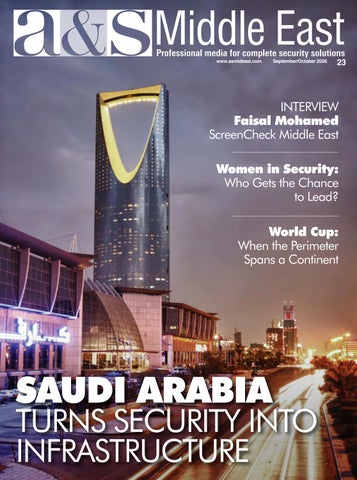
SAUDI ARABIA
TURNS SECURITY INTO INFRASTRUCTURE
Suprema Middle East FZCO DAFZA (Dubai Airport FreeZone Authority) Building 1E Office 206, PO Box: 371157, Dubai, United Arab Emirates T +971 50 940 5133
E sales_me@supremainc.com
W www.supremainc.com
23 Issue
28
Saudi Arabia Turns Security into Infrastructure
As Saudi Arabia builds transport networks, digital infrastructure, tourism destinations and critical facilities, security is becoming part of the underlying operational architecture. Physical protection, identity, data, connectivity and cybersecurity are being designed to work together, not as separate layers INTERVIEWS
PRODUCTS & SYSTEMS
PRODUCTS & SYSTEMS
16 Faisal Mohamed, CEO, ScreenCheck Middle East Success Is Measured by the Value We Create
48 Prime Detect Int. Technology-Driven. Mission-Focused. Regionally Executed
66 Scaling IT Across the Gulf Beyond the Server Rack: Rethinking IT Infrastructure
50 From Access Control to Identity How the Middle East Is Modernizing Security
68 From Credentials to Trusted Identity Building a Trusted Identity for the Modern Enterprise
MARKETS
52 Access Control Built for Identity-First Security: Introducing BioStation 3 Max
EXPERT OPINION
22 Mega-Event Security When the Perimeter Spans a Continent
54 The Integration Paradox Building Technology Ecosystems Around the Mission, Not the Platform
FEATURE STORY
56 Smarter Power Distribution Three Essentials in Data Center Infrastructure
20 Stefan Syren, President and CEO, Gunnebo Group The Spinoff Creates Greater Strategic Clarity
38 The Visibility Gap Women in Security: Who Gets the Chance to Lead? PRODUCTS & SYSTEMS 44 Fire Safety at Scale Advanced Fire Safety Solutions Support Saudi Arabia’s Ambitions 46 eCLIQ Digital Access With a Familiar User Experience 4
www.asmideast.com
58 The Access Experience Rethinking the Readers 60 ICT TSL Range Access Control Security Starts at the Reader 62 LINEV Systems Why Faster Screening Is Not Enough 64 ASSA ABLOY Primo Advancing the Future of Access Control in the Middle East
70 Managing Converging Risks Global Security at the Crossroads
EVENTS 74 Global Policing World Police Summit Returns to Dubai with 270+ Sessions 76 Decades of Security Excellence Milipol Qatar Celebrates 30 Years of Innovation 77 ASSA ABLOY and Emirates Green Building Council Strengthening Dialogue During Green Building Week
More than One Identity Creates More Risk
Tighten up security with one converged credential.
Get started >>
EDITOR‘S WORD
Professional media for complete security solutions Management Mahir Hodžić, General Manager mahir.hodzic@asmideast.com Adis Hodžić, CEO adis.hodzic@asmideast.com Editorial Staff Damir Muharemović, Editor-in-Chief damir.muharemovic@asmideast.com Mirza Bahić, Associate Editor mirza.bahic@asmideast.com Dženana Bulbul, Assistant Editor editorial@asmideast.com Fatima Al Husseiny, Journalist fatima.alhusseiny@asmideast.com Roman Ivanković, Journalist roman.ivankovic@asmideast.com Art Staff Sanel Palislamović, Art&Design Editor sanel.palislamovic@asmideast.com Nelmedin Kolubara, DTP&Art Design dino.kolubara@asmideast.com Sales Amar Pap, Business Development Manager amar.pap@asmideast.com International Sales Southeast Asia: as-pr@taiwan.messefrankfurt.com
a&s Middle East offers the latest news and insights on video surveillance, access control, intrusion detection, fire alarm, perimeter protection, PA/VA, man guarding, cyber security, smart homes and buildings, industrial automation, information, communication technology, automation, and ICT to the Middle East region professional channel players. a&s Middle East is part of the media network of the Messe Frankfurt Ltd – Taiwan Branch, which offers several media platforms — asmag.com and a&s magazines, published in English, traditional Chinese, and three other languages, providing the most comprehensive industry trends, product, and supply chain information. The total annual circulation is approximately 120,000 copies around the globe. a&s Middle East is published 6 times a year, Jan/Feb, March/ April, May/June, July/August, Sept/Oct, and Nov/Dec.
BUILDING THE FOUNDATIONS OF SUCCESS Welcome to the latest edition of a&s Middle East. In this issue, we explore the foundations of success in security, beginning with Saudi Arabia’s ambitious transformation. As the Kingdom builds new cities, expands transport networks and develops its tourism and digital economy, security is becoming part of the infrastructure that makes national development possible. Its role increasingly extends to keeping complex environments connected, reliable and ready for growth. Our Saudi market report examines how Vision 2030 is changing both demand and expectations. Giga-projects, data centers, logistics hubs and major venues create opportunities to incorporate protection into the earliest stages of development. Physical security, identity management, cybersecurity, connectivity and power must work together throughout the operational life of these environments. Drawing on insights from companies active in the Kingdom, we examine how this is influencing technology choices, procurement and the relationships between customers, suppliers and integrators. Successful organizations also depend on how they develop the people within them. Our feature on women in security brings together five industry voices to examine the path from professional expertise to leadership. Their experiences highlight the importance of meaningful assignments, sponsorship and access to strategic decisions. These are practical questions for employers seeking to recognize talent, strengthen their leadership teams and give different perspectives a real influence on business outcomes. Our review of the 2026 FIFA World Cup offers another perspective on successful delivery. Across three countries and 16 host cities, security required shared information, coordinated command structures and trained personnel working with connected technologies. The experience holds valuable lessons for the Middle East as it prepares for its own major international events. Together, these stories show how success takes shape at different levels: through the opportunities that build careers, the decisions that strengthen organizations and the planning that embeds security within a nation’s future.
Payment Instructions Annual subscriptions are payable in USD, EUR, or AED. Subscription inquiries per your request. EUR: AE340400000653005131002 Account No. 0653005131002 USD: AE070400000653005131003 Account No. 0653005131003 AED: AE610400000653005131001 Account No. 0653005131001 Copyright Statement © Copyright by Privus Agency Ltd. All rights reserved. Any republication, copying, redistribution, or reproduction of the magazine in any form, including electronic, without the prior written consent of the publisher, is prohibited. Advertisers are solely responsible for the content of advertising material. The publisher bears no responsibility regarding possible legal, patent, content, or brand disputes of the advertiser. Legal Disclaimer The information in this magazine has not undergone any formal testing by Privus Agency Ltd. and is distributed without any warranty expressed or implied. Implementation or use of any information contained herein is the reader’s sole responsibility. While this information has been reviewed for accuracy, there is no guarantee that the same or similar results may be achieved in all environments. Corporate Address Privus Agency FZ-LLC JT010006, Al Shohada Road, Ras Al Khaimah, UAE Tel: +971 58 983 4258 Web: www.asmideast.com Marketing: marketing@asmideast.com
Damir Muharemović, Editor-in-Chief
GET EVERY EDITION DELIVERED TO YOU Please visit our official website www.asmideast.com and select Subscribe Now under the THE MAGAZINE menu. Your subscription includes all six annual editions. The digital edition is FREE and available on our website.
6
www.asmideast.com
CLIQ® The smart way to digitalize access Take your access management into the digital era – smoothly, securely, and without overhauling existing infrastructure. With CLIQ, you upgrade from mechanical to digital access at your own pace to gain greater control today and adaptability for tomorrow.
Download our whitepaper to learn more about making the switch to digital access www.asmideast.com
7
NEWS
SAUDI INTERIOR MINISTRY SHOWCASES INTEGRATED SECURITY ECOSYSTEM Saudi Arabia’s Ministry of Interior showcased 36 security and digital projects across six interconnected systems at LEAP 2026. According to the Saudi Press Agency, the Ministry said its LEAP 2026 showcase focused on connecting modern technologies, data, artificial intelligence and digital services into an integrated security and services ecosystem. LEAP is Saudi Arabia’s major technology conference and exhibition focused on AI, cybersecurity, cloud, IoT, smart cities and digital transformation. The six areas comprise field security and safety, rapid response, road safety, security cameras, digital services and institutional services. Together, they cover 36 services and projects, including seven related to security cameras and eight focused on rapid response. One of the technologies demonstrated by Saudi Public Security was an AI-enabled fixed-wing drone designed for security monitoring and surveillance. The aircraft can remain airborne for up to
three hours, operate at ranges of up to 110 km and use a thermal night-vision camera. n
MICROSOFT EXPANDS GULF CYBER RESILIENCE STRATEGY Microsoft is expanding its cybersecurity, sovereign cloud and resilient connectivity capabilities across Kuwait, Qatar, Saudi Arabia and the UAE as part of a new Middle East strategy through 2030. The company will make digital resilience a core part of its regional strategy, because it says cybersecurity has become a core part of national and economic security as governments, critical infrastructure and economies become more connected. Microsoft plans
to invest more than $10 billion in cloud and AI infrastructure across the Middle East by 2030. The company said these measures are designed to give organizations greater control and confidence
over their data, systems and operations. Microsoft will also introduce digital resilience assessments, reference architectures, continuity planning and readiness guidance. Microsoft plans to invest more than $400 million in subsea and terrestrial connectivity across the Middle East by 2030. The company said network redundancy is essential for digital resilience. Multiple high-capacity routes can allow traffic to bypass disruptions and maintain critical data flows. n
CAIRO BANK UNIFIES BRANCH SECURITY WITH GENETEC Cairo Bank has deployed Genetec Security Center to centralize security operations across its branch network in Egypt, combining video surveillance, access control and intrusion detection on a single platform. The deployment currently covers more than
8
www.asmideast.com
6,000 cameras across 122 active branches. Expansion across Cairo Bank’s network of more than 230 branches is nearing completion. Security Center provides the foundation for a centralized Command and Control Room. Operators can monitor branch activity, coordinate responses and support decision-making across the institution. “By unifying systems, the bank is building a consistent operational foundation for its branch network, allowing it to respond to changing regulatory and operational requirements while retaining control over how its environment evolves,” said Firas Jadalla, Regional Director, Middle East & Africa at Genetec. The platform also separates operational responsibilities. IT and security teams can monitor device health and system status without accessing sensitive video feeds, supporting data governance and privacy requirements. “From day one, I knew we wanted functionalities that add value to all aspects of our operations. Security Center delivered everything we wanted in one easy-to-use solution,” said Major General Hesham Tawfiq, Head of Security at Cairo Bank. n
Discover Axis AX
Want Advanced fire safety peace of mind? Choose The versatile Axis AX fire system comprises high-performance fire panels, command centres, audio solutions and devices, designed to make UL 864 10th Edition compliance easy.
Feature rich and flexible, the UL-approved Axis AX offers extensive networking and cause and effect options – easily programmed using intuitive software. Plus, powerful false alarm management, simplified smoke control configuration and perfectly synchronised audio mean fire safety peace of mind is yours.
Creating a safer future Advanced – made in the UK. Trusted around the world. Discover more: advancedco.com | enquiries@advancedco.com | +44 (0)345 894 7000 www.asmideast.com
9
NEWS
2P WINS $19.7M JEDDAH CYBERSECURITY PROJECT Saudi technology company 2P has won a $19.7 million cybersecurity project with Jeddah Municipality. The project will cover more than 25 cybersecurity systems and solutions used
by Jeddah Municipality, according to a Saudi Exchange disclosure published on August 27. The contract is valued at $19.7 million. Under the project, Perfect Presentation for Commercial Services (2P) will operate and maintain the municipality’s cybersecurity devices and systems. Riyadh-based company will support cybersecurity governance, risk management and compliance. It will also help develop and enhance security policies. The company will provide system upgrades, continuous improvement services and cybersecurity awareness activities. The award also reflects the growing scale of cybersecurity spending in Saudi Arabia’s public sector. The Kingdom’s cybersecurity market reached about $4.05 billion in 2024, up 14% year on year. Government entities accounted for 32% of total spending, or about $1.28 billion. The Jeddah project also shows how demand is expanding beyond individual products toward managed services, lifecycle support and governance. n
SAUDI MODULAR DATA CENTER MARKET TO TOP $1BN BY 2030 Saudi Arabia’s modular data center market is projected to more than double in five years as demand grows for cloud, AI and rapidly deployable digital infrastructure. The market is expected to increase from $451.7 million in 2025 to $1.015 billion by 2030, representing a compound annual growth rate of 17.6%, according to new MarketsandMarkets research. Demand is being driven by the Kingdom’s expanding cloud infrastructure, AI applications, edge computing and 5G networks. Government and enterprise digitalization is also increasing the need for data center capacity that can be deployed and scaled more rapidly than conventional facilities. Prefabricated modular systems are gaining ground as organizations seek faster deployment, scalability and lower on-site complexity. Saudi Arabia’s climate is another factor shaping the market. Data center infrastructure must operate in high temperatures and withstand dust and sand exposure, increasing demand for suitable enclosures and advanced cooling technologies. The Saudi expansion comes as the global
modular data center market is forecast to grow from $41 billion in 2026 to $93.6 billion by 2031, at an annual rate of 18%. n
DUBAI TAKES BIOMETRIC PASSPORT CONTROL MOBILE The General Directorate of Identity and Foreigners Affairs – Dubai has launched a mobile biometric passport-control service that allows officers to process passengers anywhere inside airport terminals. The service allows officers to process passengers away from fixed counters. It is designed for peak periods and emergency situations. The Click and Travel service connects mobile devices to GDRFA Dubai systems and databases. Officers can use biometric verification to confirm passenger identities. GDRFA said the process takes around 12 to 15 seconds. The departure service is available to UAE citizens, residents and visitors. For arrivals, the first phase covers UAE citizens and residents. GDRFA plans to expand the service based on operational needs. The pilot ran from May through August 31. During that period, Click and Travel processed 31,373 transactions. The system also extends biometric processing beyond traditional counters and smart gates. The portable system also supports facial and iris recognition and can serve as a
10
www.asmideast.com
backup to Dubai’s existing smart-gate and Red Carpet biometric infrastructure. n
TSL Multi-Technology Card Reader
With ICT, every door opens to better outcomes. Behind every door of a commercial building, there are specific needs and requirements - from protecting assets and sensitive data, to balancing safety with easy people flow. ICT’s unified security platform provides feature-rich access control and intrusion detection as well as smart automation. It can scale and integrate with HR, visitor management, room booking systems and many more functionalities to provide customers with optimal security and operational outcomes. Secure your success with ICT.
emea-info@ict.co Find out more
ict.co
Interface www.asmideast.com
11
NEWS
OMAN, BAHRAIN STRENGTHEN NATIONAL CYBER RISK GOVERNANCE Oman and Bahrain are strengthening national cyber risk frameworks as GCC states move toward more structured cybersecurity governance. In late August, Oman launched its National Cybersecurity Strategy 20262030. The strategy sets out a five-year framework to strengthen national cyber resilience and protect essential services. It also aims to support a secure digital economy. It is built around five pillars: cybersecurity governance, cyber resilience, capacity building and awareness, cyber cooperation, and the cyber economy. In addition, its priorities include stronger public-private cooperation, updated legislation and improved national preparedness. In Bahrain, the National Cyber Security Center (NCSC) introduced new cybersecurity requirements for government and private-sector entities designated by the NCSC within the country’s critical sectors. The decision introduces mandatory annual cyber risk assessments and a national program for measuring cybersecurity maturity. At the regional level, GCC states also adopted two new cybersecurity control frameworks. n
JORDAN PSD EXPANDS NATIONWIDE HYTERA RADIO NETWORK Jordan’s Public Security Directorate has expanded its missioncritical communications infrastructure with a nationwide Hytera DMR Tier III trunking system. The network now supports more
than 10,000 portable and mobile radios, around 100 base stations and 57 dispatch workstations. Deployment began in 2015 as the Jordan PSD sought to replace outdated communications equipment and improve coverage across the country. The previous network had limited reach, particularly in remote areas, and could not support the range of services and applications required by the agency. Hytera implemented its DMR Tier III trunking solution in phases. The mobile switching offices are distributed across Jordan’s central, northern and southern regions. Each manages a group of base stations, while the switching offices can also interconnect. The network provides coverage across densely populated urban areas, rural regions, highways and remote locations. Hytera said the system also makes efficient use of available UHF spectrum. The network supports system authentication and end-to-end encryption for devices. It can also interconnect with existing TETRA, PSTN and conventional radio infrastructure, allowing communications between agencies using different networks. n
ATOS AND GCH OPEN AI-DRIVEN SOC IN DUBAI Atos and Gulf Cyberfender Hub (GCH) have opened a new AI-driven Security Operations Center in Dubai, with a focus on local data residency, cyber resilience and faster incident response. The UAEbased SOC will provide locally operated monitoring, detection and incident response services. It is designed for government entities, critical infrastructure operators and enterprises. The SOC will use advanced analytics, automation and AI-driven operations to speed up threat detection, investigation and response. Atos said the platform will use Agentic AI to reduce Mean Time to Detect and Mean Time to Respond. The company said this should help organizations respond faster as attackers increasingly use AI to automate and scale cyber threats. The SOC will also support local data residency and alignment with UAE Information Assurance Standards and National Electronic Security Authority requirements. The Dubai SOC combines local security operations with AI-driven detection, incident response and locally hosted security data. The center will
12
www.asmideast.com
also connect with Atos’ global SOC network. Atos said this model is intended to combine local control with wider threat research and cybersecurity expertise. n
A perimeter that feels
every footstep One ordinary fiber-optic cable, buried in the ground or fixed to a fence, can watch over a border, a pipeline or an entire site. Around the clock, along its whole length. IT NOTICES
IT SHOWS YOU WHERE
IT NEVER RESTS
Someone walking, digging, climbing a fence or driving up is picked up the moment it happens.
Your security team sees the exact spot on a map, so cameras and patrols go straight to it.
Day and night, in heat, dust and fog, with no visible equipment above ground and nothing to switch off.
Prime Detect International Tel: +971 4 565 6332 Email: info@primedetect.com https://primedetect.com www.asmideast.com
13
NEWS
MOTOROLA COMPLETES $1.5B D-FEND ACQUISITION Motorola Solutions has completed its $1.5 billion acquisition of counter-drone specialist D-Fend Solutions, adding RF cybertakeover technology to its public safety and critical infrastructure portfolio. The acquisition gives Motorola Solutions access to D-Fend’s counter-unmanned aerial system technology, which is designed to detect, identify and take control of unauthorized drones. Unlike systems that rely on jamming or kinetic interception, D-Fend’s technology uses radio-frequency cyber takeover to assume control of a rogue drone and direct it to a designated landing area. The approach is designed to neutralize threats without disrupting nearby communications or authorized drone operations. D-Fend’s systems are already deployed across airports, critical infrastructure sites, stadiums, military bases and borders in more than 30 countries. Motorola Solutions plans to integrate the technology into its wider public safety ecosystem,
combining airspace protection with situational awareness and response capabilities. n
AXIS UNVEILS 360° AI RADAR FOR AREA PROTECTION Axis Communications is preparing to launch a new AI-powered radar for continuous protection of large outdoor areas. The AXIS D2124VE Radar provides 360-degree coverage in all weather and lighting conditions, detecting objects at distances of up to 200 meters and covering a human recognition area of 40,000 square meters. Designed for perimeter and large-area surveillance, the radar can be deployed on poles, rooftops and mobile surveillance trailers. AI-powered classification helps identify relevant targets, while radar image stabilization is intended to
maintain detection accuracy in environments exposed to vibration. The radar can be paired with the AXIS Q6225-LE PTZ Camera, allowing detected targets to be automatically followed and visually verified. The system uses AXIS Radar Autotracking for PTZ to combine radar detection with AI-powered video classification. An optional double-knock function requires both radar and video confirmation before an alarm is triggered, helping reduce false alarms. The AXIS D2124-VE Radar is scheduled to become available through Axis distribution channels in Q4 2026. n
JOHNSON CONTROLS LAUNCHES NEW FIRE SAFETY WORKSTATIONS Johnson Controls has launched two nextgeneration fire safety workstations designed to centralize monitoring and control across large and complex facilities. The new Simplex Incident Manager and Autocall Fire Site Administrator combine enterprise-scale fire system monitoring, cybersecurity-focused architecture and centralized incident management. They target environments such as data centers, hospitals, airports, campuses, high-rise buildings and sports venues. Each workstation can monitor and control up to 250,000 devices and 687 fire alarm control units. Johnson Controls says the workstations support 2.5 times more fire alarm control units than other industry alternatives. The platforms can also integrate data from control units made by different manufacturers. This allows operators to bring fire system information into a single command environment. The systems
14
www.asmideast.com
provide graphical floor plans, centralized annunciation and real-time status information. They also support up to 60 remote users through desktop or mobile applica-
tions. Operators can send customized notifications to occupants and first responders. They can also connect cameras to improve situational awareness. n
Access, the Nedap Way.
Way Base
Way Keypad
Way QR
nedapsecurity.com 15 nedapidentification.com www.asmideast.com
INTERVIEW
Faisal Mohamed, CEO, ScreenCheck Middle East
SUCCESS IS MEASURED BY THE VALUE WE CREATE 16
www.asmideast.com
INTERVIEW ScreenCheck Middle East CEO Faisal Mohamed discusses the company’s evolution from distribution toward a broader technology-partner role, the importance of logistics and technical expertise, regional growth opportunities, supply chain resilience and the technologies shaping the next phase of the Middle East security market n By: Damir Muharemović damir.muharemovic@asmideast.com a&s Middle East: You have spent many years in the security and technology industry. Could you tell us about your professional journey, your current role at ScreenCheck Middle East, and the vision that drives the company today? Mohamed: My professional journey has been closely connected to the evolution of the security and technology industry in the Middle East and Africa. Over the years, I have seen the industry move from traditional, standalone security products toward integrated, intelligent, and technology-driven solutions. What makes this industry particularly interesting is that security is no longer simply about protecting a building or controlling access to a facility. It is about protecting people, assets, information, and business continuity. Technology now plays a critical role in how organizations manage risk, improve operational efficiency, and make informed decisions. Throughout my career, I have learned that success in this industry requires more than product knowledge. It requires an understanding of customer challenges, strong relationships with technology manufacturers, a capable partner ecosystem, and the ability to translate technology into practical business outcomes. At ScreenCheck Middle East, our focus is on connecting leading global technology providers with the regional market and helping our partners deliver effective security and identification solutions. We see ourselves as more than a distributor. We aim to be a trusted technology partner that brings together products, technical expertise, market knowledge, logistics, and ongoing support. Our vision is to build a business that creates sustainable value for manufacturers, system integrators, and end customers. We want our partners to see ScreenCheck as an organization that helps them grow, enter new markets, access new technologies, and deliver projects with greater confidence.
a&s Middle East: ScreenCheck has grown into one of the Middle East’s leading value-added distributors of security and identification solutions. How would you describe the company’s evolution over the past two decades, and what have been the key milestones in that journey? Mohamed: Over the past two decades, the market has developed considerably. Customers have become more sophisticated, projects have become more complex, and the expectations placed on technology providers have increased. What was once primarily a product-oriented market has become a market that increasingly demands integration, technical expertise, reliability, and long-term support. For a distribution business, evolving with this market means continuously developing new capabilities. It is not enough to establish relationships with manufacturers and make products available. A successful distributor must understand the applications, develop the local market, train partners, maintain appropriate stock, and provide technical assistance throughout the project lifecycle. For me, the most important milestone in any company’s evolution is the point at which the market begins to recognize it not simply as a supplier, but as a trusted partner that contributes to the success of projects. As we look ahead, the next phase of ScreenCheck’s development should be about strengthening these foundations, embracing emerging technologies, and creating more value through integration expertise. a&s Middle East: Distribution today is about much more than moving products from manufacturers to customers. How is ScreenCheck’s distribution network structured across the Middle East, which countries do you currently serve, and what role do your warehousing and
logistics capabilities play in supporting partners? Mohamed: ScreenCheck has built a strong distribution network across the Middle East, supported by local market knowledge and long-standing relationships with our partners. We serve multiple markets across the region, with a focus on delivering the right solutions, technical support, and reliable product availability. Our warehousing and logistics capabilities are critical to this model. They help us maintain stock availability, reduce delivery lead times, and respond quickly to market demand. Ultimately, our goal is to make it easier for our partners to serve their customers efficiently and grow their businesses with confidence. a&s Middle East: From your perspective, what defines a successful value-added distributor today? Is it inventory, technical expertise, partner support, logistics, or something else? Mohamed: A successful value-added distributor brings together all these elements, but the real differentiator is the value it creates for its partners. Inventory and logistics ensure product availability, technical expertise builds confidence, and strong partner support helps deliver successful projects. At ScreenCheck, we believe our role goes beyond distributing products. We connect global technology manufacturers with local market opportunities, provide technical and commercial support, and help our partners grow their businesses. Ultimately, success is measured not just by the products we sell, but by the longterm relationships we build and the value we create across the entire ecosystem. a&s Middle East: The Middle East has experienced significant geopolitical uncertainty and supply chain disruptions in recent years. How have these deve-
We see ourselves as more than a distributor. We aim to be a trusted technology partner www.asmideast.com
17
INTERVIEW
lopments affected the distribution business, and what strategies has ScreenCheck adopted to ensure product availability and business continuity? Mohamed: Geopolitical uncertainty has made supply chain planning more challenging, particularly in terms of lead times, shipping costs, and product availability. In distribution, the key is to remain agile and anticipate disruptions rather than simply react to them. At ScreenCheck, our focus is on proactive inventory planning, close coordination with our manufacturing partners, and maintaining strong logistics capabilities. We also work closely with our channel partners to understand demand and pri-
18
www.asmideast.com
We should not approach the region as one uniform market; our success will depend on understanding each country’s needs and delivering the right solutions at the right time oritize critical requirements. Ultimately, our approach is to diversify risk, maintain flexibility, and ensure business continuity while continuing to deliver reliable support to our partners and customers. a&s Middle East: Security markets across the Middle East are evolving at different speeds. How would you assess the current state of the market in coun-
tries such as Saudi Arabia, the UAE, Qatar, Oman, Syria, Kuwait and Bahrain? Where do you see the strongest growth opportunities, and what challenges remain? Mohamed: I would say Saudi Arabia and the UAE remain our key growth markets, but each country offers different opportunities. Saudi Arabia is driven by largescale infrastructure development, Vision
INTERVIEW
2030, and growing demand for advanced security solutions. The UAE is a mature and technology-driven market, with strong opportunities in smart buildings, data centers, biometrics, and integrated access control. Recent industry research also points to continued investment in modern physical security in Saudi Arabia. For ScreenCheck, the priority is to adopt a country-specific strategy, strengthen local partnerships, and invest in technical expertise and reliable product availability. We should not approach the region as one uniform market; our success will depend on understanding each country’s needs and delivering the right solutions at the right time. a&s Middle East: Finally, looking ahead, how do you expect the security market in the Middle East to evolve over the next
Our ambition is not simply to grow with the market, but to help shape the future of security in the Middle East five years, and what role do you see ScreenCheck playing in that transformation? Mohamed: I expect the Middle East security market to become more technology-driven, integrated, and intelligenceled. We will see greater adoption of AI, biometrics, mobile credentials, and cloudbased access control, alongside growing demand from data centers, smart cities, and critical infrastructure. Security will increasingly be viewed as a strategic investment rather than simply a compliance requirement. For ScreenCheck, this creates an exci-
ting opportunity to evolve beyond traditional distribution and become a strategic technology partner to our manufacturers and channel partners. Our focus will be on bringing innovative solutions to the region, strengthening our technical capabilities, developing our partner ecosystem, and ensuring reliable product availability. Ultimately, I believe our future success will depend on how well we anticipate market needs, embrace new technologies, and help our partners build their capabilities. Our ambition is not simply to grow with the market, but to help shape the future of security in the Middle East. n
www.asmideast.com
19
INTERVIEW
Stefan Syren, President and CEO, Gunnebo Group
THE SPINOFF CREATES GREATER STRATEGIC CLARITY Gunnebo’s sale of its Entrance Control business to ASSA ABLOY marks a major strategic shift for the company. Gunnebo Group CEO Stefan Syren explains the reasons behind the move, its impact on the business and what lies ahead for Gunnebo’s Safe Storage and SecureTech operations n By: Damir Muharemovic editorial@asmideast.com a&s Middle East: With Gunnebo Entrance Control becoming part of ASSA ABLOY, Gunnebo Group will now focus on Safe Storage and the technology around it. Why is it the right strategic move, and why is it the right time for it? Stefan Syren: Over the past decade, we have transformed Gunnebo from an industrial conglomerate into a more focused technology business, integrating digital innovation to deliver smarter and more connected security solutions. This has been supported by continued investment in our people, manufacturing capabilities, product development, digital expertise and sustainability. This agreement is the next logical step in that strategy. Each division has its own investment priorities, customer requirements and growth opportunities. Giving each business the opportunity to focus on its own strengths, under ownership aligned with its future, creates greater clarity for our employees, customers and partners. With Gunnebo Entrance Control becoming part of an organization where access solutions are a core strategic focus, we believe this provides the strongest platform for both businesses to develop further. For the rest of Gunnebo, our focus will be on Safe Storage and SecureTech. This allows us to direct our expertise, investment and resources towards the ar-
20
www.asmideast.com
eas where we see the strongest potential for long-term growth, while continuing to develop technology and services around the needs of customers protecting highvalue assets. a&s Middle East: Can you tell us a bit about the conditions in the safe storage vertical that enable Gunnebo Group to spin off Entrance Control and narrow its focus? Stefan Syren: The Safe Storage market has several characteristics that support a focused long-term strategy. Demand is driven by fundamental security requirements that remain consistent across economic cycles, including the protection
of cash, valuables, documents, data and other critical assets. Customers in this market often require highly specialized solutions, supported by expertise in technology and connectivity, as well as certification, compliance, manufacturing and installation capabilities. These requirements create an opportunity for a specialist Safe Storage business with the experience and capabilities to serve customers across different sectors and geographies. Gunnebo has a long history in this area, with established products, technologies and customer relationships providing a strong foundation for continued development. This gives Gunnebo the ability to concentrate its
INTERVIEW
demand for certified safe storage solutions, where will Gunnebo focus its efforts going forward? Stefan Syren: All regions are strategically important for our business, and we continue to see attractive growth opportunities across the Americas, APAC, Europe and the Middle East. Over the past few years, we have adopted a regionalization strategy that brings us closer to our customers. Looking specifically at MEA and the future of Gunnebo Safe Storage (GSS), we see significant opportunities to strengthen our market presence and drive growth through major projects across key sectors, including banking and financial institutions, critical infrastructure, defense and high-end retail. High-security and connected locks will also be key growth areas in these markets. Our focus will be on strengthening relationships with our partners and dealer engagement, increasing market coverage and converting demand into revenue growth through solutions tailored to local customer needs. Alongside our regional approach, we continue to utilize global capabilities in areas such as innovation and software platform development, sustainability, certification expertise, manufacturing technology and AI tools development.
For system integrators, the most important point is there should be no disruption to the relationships, products or support they rely on resources on Safe Storage as a focused business, while allowing Entrance Control to pursue its own strategic direction within access and flow management. a&s Middle East: Tell us a bit about the impact of the spinoff on Gunnebo’s R&D pipeline. What areas within safe storage or beyond it do you see as having untapped potential? Stefan Syren: The divestment allows us to strengthen our position within the SecureTech market and focus more closely on the challenges facing customers responsible for protecting high-value assets. Connected security will continue to be an important area of development. We have already introduced customer solutions such as the Hamilton Drive-Up
solution and the AmpliSec connected lock, both connected to Gunnebo iQ. The platform enables customers to manage their products, security access and customer offerings through a connected environment. These solutions provide greater control, auditability and flexibility across a range of security applications. We also see opportunities to develop solutions that are more closely aligned with different operational requirements and risk profiles. Customers are looking for storage solutions that combine certified physical protection with technology that can support more effective security management. a&s Middle East: With Europe, the Middle East and APAC all showing growing
a&s Middle East: For system integrators who currently work with Gunnebo across both Entrance Control and Safe Storage, what will change? Stefan Syren: For system integrators, the most important point is that there should be no disruption to the relationships, products or support they rely on. Gunnebo Entrance Control will become part of ASSA ABLOY, while Gunnebo Safe Storage will continue as a dedicated business focused exclusively on secure storage solutions. Both organizations will continue serving their respective markets with the expertise, products and support capabilities that customers and partners already know. Many integrators work across multiple security disciplines and have long-standing relationships with both businesses. That will not change overnight. Existing projects, customer commitments and day-to-day engagement remain a priority throughout the transition. For system integrators, the priority is continuity and stability, supported by two businesses that are now able to focus clearly on their respective markets. n
www.asmideast.com
21
IN FOCUS
Mega-Event Security
WHEN THE PERIMETER SPANS A CONTINENT
More than 6.8 million spectators, 104 matches, and 16 host cities demanded a security operation on an unprecedented scale. Its defining feature was not any single device, but the integration of access control, video surveillance, counterdrone systems, and threat intelligence into a common operating picture
22
www.asmideast.com
IN FOCUS
n By: Mirza Bahic mirza.bahic@asmideast.com When the largest football tournament ever staged reached its conclusion in New York/New Jersey on July 19, the security operation behind it was barely part of the story. Paradoxically, that invisibility may have been the operation’s most important result, and one of the most valuable scores of the World Cup. Does that mean things were “boring” behind the scenes of the sporting spectacle? Quite the opposite. The threats and risks were simply managed and contained in such a way that they never became the main stars of the show instead of the footballing brilliance.
The Numbers Behind the Calm
sonnel and more than one million security shifts. More than 700 unauthorized drones were seized during the US portion of the tournament. The Center for Internet Security (CIS), citing FIFA figures, also reported that more than one billion cyberattacks were blocked and over 11,000 malicious domains neutralized. Those numbers change the perspective in the sense that success did not mean that nothing happened. It meant that a vast flow of events, warnings and anomalies did not become a security crisis. The 2026 World Cup offered an unusually tangible example of that model. The stadium was no longer the system’s only perimeter. The security environment extended to airports, rail stations, fan zones, hotels, training facilities, urban transport corri-
dors, digital platforms and the airspace above them.
A Continent-Sized Security Zone The tournament spanned three countries, 16 host cities and 645 official sites. Accreditation systems processed more than five million scans, while cumulative stadium attendance exceeded 6.8 million. An event with that footprint could not be managed as a series of isolated matches. Security depended on whether agencies operating under different laws, authorities and technical systems could exchange relevant information quickly enough.
FIFA’s post-event figures included 73,700 accredited security per-
www.asmideast.com
23
IN FOCUS
Following a trilateral meeting of Canadian, Mexican and US representatives in March, UNICRI highlighted three central requirements: aligned planning, crossborder information sharing and system interoperability. Cyber threats, disinformation, supporter-related violence and drones appeared on the same risk agenda. This defined the security challenge far beyond the stadium fence: an incident in one city could have operational consequences in another, while a digital threat could develop into a physical event. FIFA’s Tournament Operations Center (TOC) in Miami served as the central coordination point. It connected tournament leadership, host cities and more than 600 official sites, tracked incidents, distributed information and escalated risks to decision-makers. Within that environment, Lenovo developed the Intelligent Command Center (ICC), a platform that brought together data from more than 40 functional areas, including security, ticketing, infrastructure, logistics and communications. After the tournament, the company reported deploying more than 25,000 Lenovo and Motorola devices, supporting operations with over 350 engineers and specialists across more than 600 FIFA sites, and achieving 99.99 percent solution availability. The tournament-wide view still had to be distinguished from city-level com-
24
www.asmideast.com
Robots in Action Boston Dynamics’ Spot robots provided a different kind of mobile sensor. Deployed at the International Broadcast Center in Dallas and New York New Jersey Stadium, they conducted perimeter patrols for asset protection and risk detection. Findings were escalated to trained personnel for final review. That detail separates operational robotics from the promotional image of an autonomous guard: the robot extended presence and repeated a route, but it did not make the final decision.
mand. In Kansas City, Secure Passage converted its headquarters into a joint operations center (JOC) where local, state and federal representatives from public safety, transportation and communications worked side by side. Its Haystax platform provided a common operating picture, while its Truman plat-
form linked the identity of center visitors with their permissions and movement through the facility. The central TOC and the local JOC formed two levels of the same architecture: one monitored the tournament as a whole, while the other concentrated on a specific city and its resources.
IN FOCUS
The Gate as the First Operational Decision For spectators, security begins with the line outside the gate. For operators, the entrance is simultaneously a checkpoint, detection zone, flow-management problem and source of operational data. If congestion develops there, risk shifts from the stands to the crowd outside the venue. Screening speed and screening accuracy were therefore part of the same task. ASSA ABLOY reported providing access solutions at several stadiums and delivering 1.6 million tickets, together with
ticketing-system integration, entrance installations and on-site support. Axess, meanwhile, recorded nearly two million fan entries across 33 matches at five stadiums in Miami, Boston, Seattle, Vancouver and Philadelphia. At Gillette Stadium, near Boston, the company said its system handled as many as 900 spectators per minute at peak flow, with almost half the venue’s capacity entering during the 45 minutes before kickoff. Ticket validation was only one filter. Evolv said its weapons-detection screening systems processed more than 3.5 million people at six stadiums, multiple Fan Fest sites and transit locations, including
Alongside tens of thousands of security personnel and hundreds of specialists working in command centers, technology extended human capabilities rather than being deployed with the ambition of replacing people
Penn Station for passengers traveling to the final. The figure describes more than technical throughput. It shows how far the event perimeter extended beyond the stadium and how security had to follow the movement of the audience rather than the limits of organizer-controlled property. Technology did not remove the human layer. Blackbird Security deployed approximately 900 guards for each match at BC Place in Vancouver. Their duties included access control, prohibited-item searches, ticket scanning, patrols, crowd management and assistance to visitors. The deployment illustrates the limit of automation: a device can flag an anomaly, but someone still has to explain a rule, de-escalate a confrontation, assess behavior and decide when further action is necessary.
Video That Must See and Make Sense Many stadiums had already been built up over years of NFL games, concerts and other events, so the World Cup did not start with a blank slate. Much of the security architecture was already embedded in the venues, and the tournament became its largest test. Axis Communications’ work at the final venue and Genetec’s deployment at SoFi Stadium should therefore be understood as host-venue infrastructure, not automatically as technology procured specifically for FIFA. At what was then MetLife Stadium, renamed New York New Jersey Stadium for the tournament and host to eight matches, including the final. Axis worked with the venue’s security team on a custom camera providing a full-bowl view. A purpose-built lens delivered 8K resolution, electronic image stabilization helped preserve usable footage amid vibration and bad weather, and the device was designed to integrate with the existing VMS, other security technologies and the systems used by local public-safety agencies. In Los Angeles, SoFi Stadium and the wider Hollywood Park campus standardized operations on Genetec Security Center. From three control rooms, operators manage more than 3,000 cameras, 700 readers, access control, automatic license plate recognition and other sensors across roughly 300 acres, or 121 hectares. The value of such a platform is not simply the number of connected devices. It is that video, alarms, identity and investigations no longer remain on
www.asmideast.com
25
IN FOCUS
separate screens and in disconnected workflows.
700 Reasons to Watch the Sky The most visible emerging risk was also the one many spectators still regard as a toy – drones. The Federal Aviation Administration established nearly 250 temporary flight restrictions around stadiums, fan festivals, team hotels and training sites. Across the 11 US host cities, the FBI and DHS seized more than 700 drones that entered restricted airspace. Dallas alone accounted for 94: 65 near the stadium and 29 at the Fair Park Fan Fest. Those seizures formed part of the national total rather than an additional figure. Counter-drone protection was not a single ring around a single site. D-Fend Solutions reported after the event that more than 20 law-enforcement and public-safety agencies in the United States, Canada and Mexico used EnforceAir. The system employs RF cyber takeover to assume control of an unauthorized drone when legal authority and technical conditions allow, without disrupting the wider communications spectrum. Before the tournament, Sentrycs announced several contracts with federal, state and local organizations worth millions of dollars and said its system was expected to operate at most match
26
www.asmideast.com
When a Digital Signal Becomes a Physical Risk The most consequential convergence was not between two cameras, but between an online threat and a physical response. Throughout the 39-day tournament, CIS placed analysts within FIFA’s security operations and a host-city intelligence command center. They monitored threats of violence, extremist messaging, ticket fraud, fraudulent domains, swatting attempts and synthetic media, then passed relevant warnings to organizers and public agencies. Blackbird.AI, which supported CIS, said its team produced more than 140 narrativeintelligence reports during the tournament. The number of posts or views was not the ultimate metric. The operational question was whether analysts, working amid the digital noise, could identify early enough a message that required a change in physical security, a referral to law enforcement or restraint from a public response that might amplify the disinformation. The figures of more than one billion blocked cyberattacks and over 11,000 neutralized domains appear in post-event material from CIS and its partners, which attribute them to FIFA. Without a published methodology, they are not directly comparable with conventional incident counts and should be read as indicators of scale rather than independently audited results. The operational lesson nevertheless remains clear: cyber, reputational and physical-security teams at a mega-event can no longer work in separate streams.
venues. Its post-event account confirms support for the wider operation but does not disclose the final number of stadiums actually covered. The evidence therefore supports a confirmed deployment and its planned scale, but not a definitive claim that the system operated at most stadiums. MyDefence also said it worked with DHS on RF detection and identification
around critical infrastructure, gathering areas and transport corridors, although it did not disclose the locations.
Invisible Threats: Gases, Radiation and Sensor Silos Some layers of protection were designed not around human behavior but around
IN FOCUS
Sensors expanded the reach of surveillance, while platforms shortened the path from receiving information to taking action. Yet trained operators ultimately retained responsibility for assessment and response on the ground. That insight may prove to be the World Cup’s most important security legacy.
hazards invisible to the naked eye. MiamiDade Fire Rescue deployed eight connected Blackline Safety EXO monitors at the Miami venue: four EXO 8 units capable of detecting up to eight gases and gamma radiation, and four G7 EXO units. Readings were transmitted over the cellular network to Blackline Live, allowing fire and hazmat teams to monitor conditions in real time and share data with the joint operational command. At a broader level, Two Six Technologies deployed its SIGMA platform in multiple cities and supported security operations at more than 20 matches. The sensoragnostic CBRNE platform brings together data for detecting chemical, biological, radiological, nuclear and explosive threats across different sensor types and manufacturers. The company said full operational capability could be established within 24 hours, including the creation of a local radiation baseline. For a tem-
porary event spread across a continent, that portability was as important as sensor sensitivity. The security footprint also extended to the journey. SeeTrue said its TSA-certified AI software for automated prohibited-item detection was installed in several TSA PreCheck lanes at airports serving US host cities. This was neither a stadium system nor evidence of a FIFA contract. It was an example of how passenger infrastructure absorbed tournament demand and became part of the wider security environment.
What Remains After the Final Whistle? The 2026 World Cup showed that a global tournament must accommodate different stadiums, legacy systems, local authorities and temporary technologies, rather than replace them with a
single platform. A successful architecture therefore rests on agreed data, clear escalation paths and the ability for a local command center to retain its authority while sharing the relevant picture with tournament leadership. A second lesson is that security and the visitor experience can no longer be separated. Faster entry reduces crowd buildup; better video supports both investigations and staff deployment; connected sensors speed response without shutting down an entire site. Security does not become weaker when the public barely notices it. The best system allows spectators to remember the match while the operations team knows exactly how many alerts it processed to make that possible. Finally, technology was only as valuable as people’s ability to understand and use it. With tens of thousands of accredited security personnel, more than a million shifts and hundreds of specialists in command centers, the tournament extended human capability rather than replaced it. Sensors increased reach, platforms shortened the path from information to action, and trained operators retained responsibility for assessment and response. That may be the tournament’s most important security legacy for the 2028 Olympic Games and every megaevent that follows, one that will not be easy to surpass. n
www.asmideast.com
27
MARKETS
SAUDI TURNS SECURITY INFRASTR
Security by Design
As Saudi Arabia builds transport networks, digital infrastructure, tourism destinations and critical facilities, security is becoming part of the underlying operational architecture. Physical protection, identity, data, connectivity and cybersecurity are being designed to work together, not as separate layers
28
www.asmideast.com
MARKETS
ARABIA INTO RUCTURE
www.asmideast.com
29
MARKETS
n By: Roman Ivanković editorial@asmideast.com Saudi Arabia is not just building cities. It is building the systems that will keep them running, with security as one of the most important factors. The Kingdom’s security market is growing alongside one of the world’s most ambitious economic and infrastructure transformations. But the scale of investment alone does not explain what makes this market so distinctive. The bigger change is happening in the role security plays within that transformation. Security is moving beyond cameras, access control and individual protection systems. As Saudi Arabia builds transport networks, digital infrastructure, tourism destinations and critical facilities, security is becoming part of the underlying operational architecture. Physical protection, identity, data, connectivity and cybersecurity are being designed to work together, not as separate layers. The scale of greenfield development reinforces this shift. Many of the assets that will shape the Saudi economy over the coming decades are still being designed or built. That creates an opportunity to integrate security from the start. It also raises expectations. Systems must be scalable, interoperable and reliable enough to support complex environments over long operational lifecycles.
30
www.asmideast.com
The same pressure is changing technology demand. Video is moving from passive monitoring toward analytics and operational intelligence. Access control is becoming an identity issue. AI is increasingly judged by the operational value it creates. Special attention has been paid to the security of networks, power and digital infrastructure. At the same time, customers are placing greater emphasis on cybersecurity, compliance and local support. Saudi Arabia is therefore not simply expanding an existing security market. It is creating a different kind of one. The opportunity lies in building security into the KSA’s wider physical and digital infrastructure, and in turning individual technologies into connected systems that can operate securely and intelligently at scale. In this article, we examine how economic diversification and investment are driving this transition, where demand is emerging most strongly, how customer requirements are changing, and which technologies are best positioned for the next phase of the market.
Saudi Economy Moves Deeper into Diversification Saudi Arabia entered 2026 after another year of strong economic growth. According to the IMF, real GDP expanded by 4.6% in 2025, while non-oil GDP grew by 4.2%. Three things kept the economy moving: stronger domestic demand, more private investment and consumption, and the gradual unwinding of OPEC+ production cuts. The broader direction remains one of diversification. The latest Vision 2030 Annual Report shows that investment has become a much larger part of the economy. Its share in GDP increased from 22% to 30%, while investment in non-oil sectors reached USD 213 billion. The report also highlights the growing role of the private sector in driving economic activity. However, this path is not a straight line. The IMF expects GDP growth to slow to 1.7% in 2026, with non-oil growth easing to 2.6%. The main reason is regional disruption, which has affected trade and confidence. However, the IMF expects
In Saudi Arabia security demand is being generated by the transformation of the economy itself, rather than by any single project or technology cycle
MARKETS
where security architecture must meet both operational and digital-security requirements. The result is a market where international technology alone is not enough. Large projects increasingly require suppliers to meet local regulatory and operational requirements over long project lifecycles.
Carlos Garcia, Sales Director, ASSA ABLOY Opening Solutions Middle East
Mohammed Murad, Chief Revenue Officer, Iris ID Systems
activity to recover as conditions normalize. Over the medium term, consumption, investment, government-led projects and major international events should continue to support growth. Government policy backs this transition. Saudi Arabia’s FY2026 Budget Statement confirms continued spending on Vision 2030 programs and development projects, with greater emphasis on private-sector investment and fiscal sustainability. The Ministry of Finance also identifies non-oil activity as the main driver of future economic growth. This is important for the security industry. Saudi Arabia is not moving from one economic model to another in a single investment cycle. It is building new economic capacity while continuing to invest heavily in infrastructure. The result is a broad base of assets that will need protection, management and continuous modernization over long operational lifecycles.
Greenfield Scale Changes the Rules One of Saudi Arabia’s main structural advantages is the scale of greenfield development. Much of the infrastructure that will support future growth is being designed today. Owners and developers can build security, connectivity and resilience into the foundation, instead of retrofitting them later. This creates an important advantage for lifecycle cost, maintainability and future technology adoption. In large developments, early design decisions determine how easily security systems can expand and adapt. They can also reduce the need for costly redesigns as new technologies and operational requirements emerge.
Raheel Jalili, Country Director KSA & Bahrain, ISS
Government Strategy Shapes the Market The state remains central to this development model. Government spending continues to support Vision 2030 programs and strategic capital projects, even as policymakers seek a stronger role for private investment. The 2026 budget keeps this balance, combining continued development spending with a stated focus on fiscal sustainability and diversification. Government influence reaches beyond investment. As security systems become more connected, cybersecurity, data governance and regulatory compliance increasingly shape how systems are designed. This is especially true in government facilities and critical infrastructure,
Procurement Is Becoming More Architecture-Led
These conditions are also changing procurement. Saudi customers increasingly evaluate technology within the context of long-term operational requirements rather than as isolated product purchases. This does not mean the market adopts new technology simply because it exists. Buyers want a clear operational case behind each investment. New capabilities are attractive when they improve visibility, support faster decisionmaking or solve a specific problem within a wider security environment. Firas Al-Beiruti, Country Manager KSA at Milestone Systems, describes Saudi customers as well informed and technologically advanced. He also stresses that new technology needs a clear use case. “They are open to exploring new capabilities, especially when there is a clear business value and a strong use case behind the investment.”
Security Becomes Part of the Development Model Saudi Arabia’s security market cannot be separated from the wider transformation of the economy. Vision 2030 is reshaping both physical and digital infrastructure, while large-scale development continues across transport, tourism, urban development and the digital economy. Security grows alongside the assets being created. It is not a separate industry on the side. Security is increasingly designed into projects from the beginning rather than added after construction. This shifts attention from individual systems toward the resilience of the wider operating environment. Neyton Avila, Sr. Business Development Manager EMEA at Panduit Corporation, explained that Saudi Arabia is moving from standalone security systems toward connected, intelligent environments in which cybersecurity, physical security, connectivity and power must be designed as one resilient infrastructure. “Security is becoming an infrastructure question as much as a technology question,” he said. This changes how the market should be viewed. Demand is no longer driven only by the number of cameras, readers or control systems being installed. More attention now goes to the architecture behind them, and to the infrastructure that keeps security systems connected, available and reliable over long operating cycles.
www.asmideast.com
31
MARKETS
This is an important sign of market maturity. Rapid adoption does not mean indiscriminate adoption. Customers increasingly expect technology to fit into a broader operational strategy and to remain useful as requirements evolve. Saudi Arabia is therefore developing into a market where economic diversification, greenfield investment and more demanding procurement reinforce one another. The strongest solutions will likely be those that become part of the Kingdom’s wider operational infrastructure, rather than isolated security layers.
Development Pipeline Keeps Security Demand High Saudi Arabia’s security market is being supported by an unusually broad development pipeline. Public Investment Fund of Saudi Arabia (PIF) invested nearly USD 200 billion in new projects in the Kingdom between 2021 and 2025. Its new 20262030 strategy continues this investment model, but with greater focus on building connected economic ecosystems rather than individual projects. Tourism, urban development, industry and logistics are among the areas expected to remain major investment priorities. Giga-projects remain an important part of this pipeline. Developments such as NEOM, Qiddiya and Red Sea Global combine residential, commercial and public infrastructure at a scale rarely found in conventional projects. For the security industry, their importance lies not only in their size. These developments create complex operating environments that require security to work across multiple facilities and functions from the beginning.
32
www.asmideast.com
Digital Infrastructure Creates a New Security Layer Another major driver is the rapid expansion of Saudi Arabia’s digital economy. AI infrastructure, cloud services and data centers are becoming increasingly important parts of the national investment agenda. PIF launched HUMAIN in 2025 as part of its push into artificial intelligence, while its new strategy identifies AI and advanced innovation among the areas expected to shape future investment. This expansion creates a different type of physical security demand. Data centers concentrate high-value equipment, sensitive information and critical digital services in facilities where disruption can have consequences far beyond the site itself. Access therefore needs to be tightly controlled, identities verified and security events monitored continuously. Mohammed Murad, Chief Revenue Officer at Iris ID Systems, sees data centers as one of the clearest opportunities in the Saudi market. “Data centers are especially important as Saudi Arabia expands its cloud and AI infrastructure. As the value of the technology and information inside these facilities increases, the security around them also has to become stronger.” The connection between physical and digital infrastructure is therefore becoming much tighter. Growth in AI does not generate demand only for computing capacity. It also raises the value of the assets being protected and increases the cost of downtime, unauthorized access or disruption.
Carlos Garcia, Sales Director, ASSA ABLOY Opening Solutions Middle East, sees this development cycle as one of the main forces behind market expansion. “Major giga-projects such as Qiddiya and The Red Sea Development have been key contributors to market expansion, creating demand for advanced security, access control, and safety solutions.” The same investment logic extends beyond the giga-projects themselves. New transport infrastructure, public venues, hospitality developments and commercial assets all increase the number of locations that need long-term security management. This creates demand not only during construction, but throughout the operational life of these assets.
Mobility, Tourism and Major Events Add Further Pressure Saudi Arabia’s transformation is also increasing the movement of people across the Kingdom. Tourism has expanded rapidly, while new destinations and entertainment assets continue to open. The Vision 2030 Annual Report says tourism now contributes around 5% of GDP, with a target of 10% by 2030. At the same time, transport networks and major-event infrastructure are being expanded to support this growth. Stadium developments, Expo 2030 Riyadh and preparations for the FIFA World Cup will add new venues and large visitor flows
MARKETS
bines residential areas with sports, entertainment and cultural venues. Its scale means security has to operate across a connected urban environment rather than through isolated systems. This changes the operational challenge. Large mixed-use developments need Firas Al-Beiruti, Country Manager Neyton Avila, Sr. Business to manage different KSA, Milestone Systems Development Manager EMEA, types of users, acPanduit Corporation cess rights and risk levels within the same environment. Resthat require secure access, monitoring idents, employees, contractors and visiand coordinated incident response. PIF tors may all move through overlapping created the Expo 2030 Riyadh Company spaces. Security therefore depends on in 2025 to develop and operate the facilicentralized monitoring, consistent identies for the event. tity management and the ability to coorASSA ABLOY’s Husaini expects this cycle dinate incidents across multiple sites. to become an increasingly important driver of demand: “Looking ahead, we expect some of the strongest growth to come Transport and Logistics from major events and their supporting Depend on Throughput infrastructure, particularly stadium developments, Expo-related projects, and Transport infrastructure creates another preparations for the FIFA World Cup.” set of operational pressures. Airports, Taken together, these trends explain why ports and logistics facilities have to mainsecurity demand in Saudi Arabia is comtain security without slowing down moveing from several directions at once. Large ment. High volumes of passengers, vephysical developments are expanding the hicles and cargo make manual inspection number and complexity of assets that increasingly difficult. need protection. Digital infrastructure is ISS recognized strong demand from increasing their value and dependence transportation and critical infrastructure, on continuous operations. Tourism, moparticularly for vehicle inspection and bility and major events are adding scale perimeter protection. The company has and operational pressure. The result is a also deployed its SecurOS Cargo platform market where security demand is being at King Abdul Aziz Port, where automated generated by the transformation of the container identification is used to support economy itself, rather than by any single gate operations and improve visibility into project or technology cycle. cargo movements. The challenge in these environments is therefore not simply detection. Security Giga-Projects Create systems must identify risks while mainSecurity at Urban Scale taining operational flow. This pushes demand toward automation, analytics and Saudi Arabia’s giga-projects are creating integrated command systems that can security requirements that go far beyond process information quickly and reduce individual buildings. Qiddiya City is a good delays. example. The development spans more than 360 square kilometers and com-
Customers want faster response, better visibility and more efficient use of existing systems. Technology is expected to reduce operational friction rather than simply add another layer of complexity
Major Venues Bring Security and Operations Together Sports, tourism and entertainment developments add a fourth operational model. Qiddiya’s planned Prince Mohammed bin Salman Stadium, for example, is designed for more than 46,000 football spectators and an overall capacity of more than 60,000 for other events. The venue is expected to host major international events, including matches during the 2034 FIFA World Cup. Large venues have to manage highly variable traffic patterns. Security requirements change significantly between an ordinary operating day and a major event. Access control, crowd monitoring, incident response and perimeter management must all scale quickly while remaining coordinated with venue operations. The same pattern is visible in tourism. Red Sea Global is developing large destination ecosystems that combine resorts, residences, airports and supporting infrastructure across a wide geographic area. The Red Sea destination alone covers 28,000 square kilometers and includes its own international airport. These verticals differ in their operational priorities, but they point in the same direction. Saudi security demand is increasingly shaped by environments that are larger, more connected and more operationally complex. The next question is therefore not simply which technologies are being installed, but what customers now expect those technologies to do.
Operational Complexity Is Changing Customer Requirements The operational pressures across Saudi Arabia’s major projects are changing how customers define value. Large developments must manage multiple sites and user groups. Transport and logistics require speed and continuity. Data centers need stronger identity assurance, while major venues must adapt to sharp changes in traffic and risk. Firas Al-Beiruti of Milestone Systems sees this shift clearly: “Organizations are steadily focused on getting more value from their existing security investments by improving integration and making better use of available data.” The focus is therefore moving from equipment to outcomes. Customers increasingly expect technology to improve
www.asmideast.com
33
MARKETS
visibility, response and operational efficiency across the wider environment.
Integration Is Becoming the Starting Point As security environments become more connected, interoperability is moving from a technical preference to a strategic requirement. Customers are dealing with multiple vendors, platforms and data sources. Closed systems make it harder to expand or adapt as requirements change. Milestone notes that this is driving interest in open platforms. “Customers recognize that security environments are becoming complex, involving multiple technologies, vendors, and data sources. That requires flexibility to integrate different solutions and avoid being constrained by closed ecosystems,” said Firas Al-Beiruti. The same trend is visible in identity and access control. Iris ID Systems’ Mohammed Murad says customers are no longer comparing individual devices in isolation. “They want to understand the complete architecture, how it will scale, and how it fits into their long-term security strategy.” This changes the role of access control,
34
www.asmideast.com
video and analytics. Each system still has a specific function, but customers increasingly expect them to work as parts of one operational environment.
higher PoE power levels, AI workloads, future wireless technologies and greater automation without requiring a complete redesign.”
Resilience Becomes a Core Requirement
Access Control Is Becoming an Identity Question
As security systems become more connected, resilience becomes a core requirement. Customers need to know whether the underlying infrastructure can support more devices, greater bandwidth and future technology without major redesign. Panduit’s Neyton Avila puts the issue in operational terms: “Customers increasingly want to know whether today’s infrastructure can support higher bandwidth, more connected devices,
Access control is undergoing an equally important transformation. Traditional systems were built around credentials: a card, PIN or other token determined whether a person could enter a restricted area. Increasingly, customers want stronger assurance that the credential is being used by the right person. This creates greater interest in biometrics and more advanced identity authentication. The issue is particularly important in
Cameras are becoming intelligent sensors. Access control is moving toward identity assurance. Individual products are becoming parts of larger platforms. And the network and power infrastructure behind those platforms is becoming part of the security architecture itself
MARKETS
Video Is Moving from Monitoring to Operational Intelligence
government, data centers and other highsecurity environments, where access decisions must be both reliable and auditable. Mohammed Murad of Iris ID Systems puts the change clearly: “Traditionally, access control focused on the credential, do you have the correct card or PIN? Today, customers increasingly want to know whether the person using that credential is the actual authorized individual.” The technology requirements are evolving with this change. Customers are paying more attention to biometric spoofing, privacy, encryption and secure communications. Murad also expects growing interest in multimodal biometrics and stronger Presentation Attack Detection as threats such as synthetic identities and deepfakes become more sophisticated. Platforms Are Replacing Isolated Systems Another major shift is architectural. Video, identity and access control are increasingly expected to operate as parts of a connected security environment rather than as separate technologies. Intelligent Security Systems – ISS, a leading provider of video intelligence and data awareness software, sees strong demand for unified platforms that combine video management, analytics, facial recognition, vehicle inspection and command-and-control capabilities. The objective is not integration for its own sake. A common platform can give operators a more complete view of events and reduce the time needed to move between separate systems Cloud and hybrid architectures are adding another layer of flexibility. Milestone notes that customers are evaluating cloud technology for scalability, centralized management and operational flexibility. At the same time, deployment models vary ac-
Video surveillance remains one of the core security technologies in Saudi Arabia, but its role is changing. Customers are looking beyond passive monitoring and recording. They increasingly expect video systems to help operators identify important events, prioritize risks and make faster decisions. AI-powered analytics are central to this shift. They can reduce the amount of footage that operators need to monitor manually and help security teams focus on events that require attention. In large transport networks, public spaces and critical infrastructure, this can improve both situational awareness and response time. Firas Al-Beiruti describes the change as a move toward more proactive security environments. “The focus is shifting towards using technology to enhance efficiency, support smarter decision-making, and create more proactive security environments.” Raheel Jalili of ISS sees a similar trend. “One of the fastest-growing requirements is AI-driven automation, enabling organizations to detect threats in real time, reduce false alarms, and improve operational efficiency,” Jalili said. The result is a broader change in the role of video. Cameras are becoming sources of operational data, while video management platforms increasingly serve as the layer that connects analytics, incident management and other security systems.
cording to sector and regulatory requirements. The same consideration applies particularly to sensitive environments. Mohammed Murad says he expects government and critical infrastructure operators to continue using combinations of cloud, private cloud, hybrid and on-premises systems, depending on cybersecurity and data-governance requirements.
Infrastructure Becomes Part of the Security Technology Stack Panduit’s Neyton Avila points to higherpower Power over Ethernet (PoE), extended-reach connectivity and resilient power architectures as increasingly relevant to security deployments. The basic principle is simple: connected security systems can only operate if the infrastructure beneath them remains available. “Cameras, access-control devices, wireless access points, sensors and smart-
building endpoints increasingly receive both data and power through the network. As device density and power requirements rise, the quality of the cabling architecture becomes more important,” he said. These changes show that technology transformation is taking place at several levels at once. Video is becoming more intelligent, identity assurance is becoming stronger, and the infrastructure supporting security systems is becoming more important. For Avila, this is the next stage of the market: “We already know how to connect everything. The next challenge is how to protect, identify, power and operate everything securely at scale.”
Reliability and Lifecycle Value Shape Decisions Once technical requirements are met, project decisions increasingly come down to reliability, maintainability and long-term
www.asmideast.com
35
MARKETS
“Saudi Arabia typically has larger-scale projects, more rigorous technical and compliance requirements, and a stronger emphasis on proven technologies with local support capabilities.” – Raheel Jalili, Country Director KSA & Bahrain, ISS performance. Price still matters, but the scale and operating life of many Saudi developments make lifecycle value especially important. ASSA ABLOY’s Carlos Garcia notes that Saudi customers often have more demanding specifications because of the size and complexity of projects. “Compared to other GCC markets, customers in Saudi Arabia often have more demanding specification requirements due to the nature and scale of the projects being developed.” Systems that are difficult to maintain, expand or adapt can generate significant costs long after installation. For large developments, proven performance and the ability to avoid major redesigns therefore become part of the value proposition. Neyton Avila from Panduit Corporation notes that customer conversations are moving from product selection toward “architecture, lifecycle performance and operational resilience.”
36
www.asmideast.com
From Security Systems to Operational Ecosystems The next phase of the Saudi market will be shaped less by the number of systems deployed and more by the value created from connecting them. Firas Al-Beiruti expects this shift to continue: “The Saudi market is expected to advance from a traditional security-focused environment into a broader ecosystem driven by data, intelligence, and measurable operational outcomes.” Raheel Jalili likewise expects demand for intelligent platforms to accelerate as Saudi Arabia continues investing in digital infrastructure and AI. “We expect demand for intelligent, platform-based security solutions to accelerate across both government and private sectors, making the Kingdom one of the most dynamic security markets globally.” Future investment will therefore be judged increasingly by measurable opera-
tional outcomes rather than technology deployment alone.
AI Growth Will Depend on Real Operational Value Artificial intelligence will remain an important technology driver, but the market is likely to become more selective about where it creates measurable value. The focus will increasingly shift from AI as a feature toward applications that solve clear operational problems. Its impact will also extend beyond analytics. Greater use of AI means more computing capacity, more data centers and stronger dependence on resilient networks and power. Neyton Avila expects some of the strongest opportunities to emerge around AI and hyperscale data centers, intelligent buildings and integrated security environments.
Identity Will Become a Stronger Security Layer Identity is also likely to become more central to future security architecture. As physical and digital systems converge, organizations need stronger assurance about who is accessing sensitive environments and whether that identity can be trusted.
MARKETS
Mohammed Murad of Iris ID Systems expects Saudi Arabia to continue moving from individual security products toward integrated identity and security ecosystems. “The biggest change, however, may be very simple. For years, access control asked: ‘Do you have the right credential?’ The next generation of security will ask: ‘Can I confidently establish that you are the person you claim to be?’” This will support further adoption of biometrics, multimodal authentication and stronger protection against identity-based threats. At the same time, deployment models will remain mixed. Cloud adoption is expected to grow, while government and critical infrastructure will continue to combine cloud, private cloud, hybrid and on-premises systems according to cybersecurity and data-governance requirements.
Scale Will Keep Raising the Bar The market’s future will also be shaped by the scale of Saudi development. New infrastructure, major events, data centers and urban projects will continue to create demand for systems that can operate across large and complex environments. ASSA ABLOY’s Carlos Garcia expects particularly strong opportunities in stadiums, healthcare and data centers, with continued growth in biometric authentication, smart access control and critical infrastructure protection. The direction is therefore becoming clearer. Saudi Arabia’s security market is moving toward greater convergence, stronger identity assurance and more intelligence at the platform level. AI will continue to expand, but operational value will matter more than novelty. At the same time, the infrastructure beneath these systems will become more important as projects grow in scale. The next stage of the market will not be defined simply by how much technology is deployed. It will be defined by how well that technology can operate securely, intelligently and reliably as part of a larger system.
Local Support as a Key Market Differentiator Technology performance alone is also not enough. Large Saudi projects often involve strict technical requirements, long implementation cycles and significant operational risk. This raises the importance of local support, technical expertise and the ability to respond after deployment. ISS’ Raheel Jalili identifies this as one of the main differences between Saudi Arabia and other GCC markets. “Saudi Arabia typically has larger-scale projects, more rigorous technical and compliance requirements, and a stronger emphasis on proven technologies with local support capabilities.” Compliance requirements increasingly extend beyond physical system performance to cybersecurity and data governance. For government and critical infrastructure projects, vendors must therefore address these requirements from the design stage rather than treat them as later additions. Partnerships therefore become part of project delivery. Vendors need local integration capabilities and long-term technical support, while customers need confidence that systems will remain operational and compliant after installation. The strongest position in the Saudi market is therefore not created by one product feature or technology trend. It comes from combining integration, reliability, lifecycle value, compliance and local support within a solution that can perform over time. In a market defined by large and complex projects, execution capability is becoming as important as technological sophistication.
Saudi Security Moves from Systems to Infrastructure Saudi Arabia’s security market is entering a phase where scale alone will no longer be the defining factor. The next few years will be shaped by how effectively the Kingdom can turn rapid infrastructure growth
Customers will increasingly look at how technology improves decision-making, reduces operational friction and creates value beyond basic protection. The strongest platforms will be those that can connect data from different systems and turn it into usable information
into secure, connected and resilient operational environments. That will place greater value on integration, identity assurance, AI-driven intelligence and the infrastructure that supports them. Customers will continue to adopt new technologies, but the strongest demand will come from solutions that can operate reliably across large and complex environments, adapt over time and support clear operational outcomes. For vendors and integrators, this changes the nature of the opportunity. Success will depend less on supplying individual technologies and more on combining proven performance, interoperability, cybersecurity and local support within systems capable of scaling with the Kingdom’s development. n
www.asmideast.com
37
FEATURE STORY
The Visibility Gap
WOMEN IN SECURITY: WHO GETS THE CHANCE TO LEAD? Women have entered the security industry, but the path to senior leadership remains uneven. Five leaders across EMEA discuss the assignments, access, and support that shape advancement, and the opportunities emerging in a changing industry
n By: Fatima Al Husseiny editorial@asmideast.com Women contribute across security companies, from engineering and sales to marketing and customer-facing roles. Yet expertise in those roles does not automatically lead to senior positions. For women who get overlooked when assignments or promotions are decided, this transition can be especially difficult. “The issue isn’t attracting women into the industry anymore,” says Loubna Imenchal, senior technology executive and founder of Connect2Elevate, a platform dedicated to empowering women in leadership and entrepreneurship, “the challenge is retaining and promoting them into leadership.” She and her colleagues describe how such decisions can affect careers in security for women. Their accounts follow the path from proving themselves in a particular role to gaining broader responsibility, as well as the support that can help them make that move.
Where Advancement Stalls Moving into leadership changes the scope of a person’s work. Someone who has established credibility in a technical or com-
38
www.asmideast.com
mercial function needs opportunities to engage with the wider business. “The pipeline often breaks during the transition from functional expertise to leadership,” Imenchal says. Martine Billmann, Marketing Manager for the Middle East, Turkey, and Africa at Genetec, identifies a similar narrowing of opportunities when women are ready for roles with greater influence, visibility, and decision-making responsibility. Her concern is whether they have senior colleagues who will support that move and connect them with the work that prepares them for it. This distinction matters because doing a job well and being considered for a broader role are not necessarily the same thing. Organizations unintentionally promote people on the basis of visibility rather than potential. This raises a practical question: whose capabilities do decision-makers know, and who has had the opportunity to demonstrate more than their current job requires? Broader workforce figures provide context. According to the World Economic Forum, women accounted for 41.2% of the
global workforce in 2024 but held 28.1% of top management roles. The gap can begin at the first management appointment. In its study of corporate America, the 2025 Women in the Workplace report from Lean In and McKinsey found that 93 women were promoted to manager for every 100 men. This puts an earlier career stage into the discussion: the opportunities that prepare people for
FEATURE STORY
www.asmideast.com
39
FEATURE STORY
senior roles begin accumulating long before they reach them. Imenchal’s account of her own career emphasizes preparation and delivery. “I have never walked into a room thinking, ‘I am the only woman,’” Imenchal says. “I walk into the room thinking, ‘How do we solve the customer’s problem better than anyone else?’” Working in a male-dominated industry taught her to establish credibility through consistent results and to lead through facts, execution, and accountability. Billmann describes a related personal adjustment: her experience has made her more deliberate about visibility, representation, and bringing different viewpoints together. Repeatedly having to prove one’s capabilities can build confidence in difficult conversations and a greater tolerance for uncertainty and pressure. Imenchal sees that resilience as an asset when leading organizations through change. Career progression also depends on whether an employer accommodates changes in people’s lives. Sylvie Hagege, Senior Marketing Manager EMEA, Safety & Security, at Zenitel, has spent 25 years in the industry. She describes a sector with capable women across functions, countries, and levels of responsibility, while noting that their careers do not always follow a predictable sequence. “What I’ve observed is that what often breaks the pipeline is that careers rarely follow a straight line. At various stages of life, people face different priorities and challenges, so support, flexibility, and encouragement can have a significant impact.” Hagege’s career has also crossed functions. Although much of it has been in marketing, she has led technical departments at a time when none of her colleagues or customers were women. She
“Mentorship provides advice; sponsorship creates opportunities by putting someone’s name forward for strategic projects, promotions, or international assignments.” – Loubna Imenchal, Connect2Elevate 40
www.asmideast.com
says the experience taught her to listen, ask questions, and help specialists work toward a shared goal without assuming she needed to have every answer herself.
Giving Talent a Route to Leadership The contributors’ proposals begin with the work people are trusted to do. Imenchal recommends early exposure to P&L responsibility, customer engagement, and strategic decision-making. Billmann calls for clear development pathways and meaningful exposure to leadership conversations. Both approaches give employees a chance to develop beyond their existing function before they are expected to lead across it. The industry’s professional development programs offer examples of what that broader preparation involves. ASIS International’s Upskill series, developed with the American Management Association, includes coaching, conflict management, and difficult performance reviews. Its Career HQ resources also address the move from tactical work to strategic roles, with an emphasis on communica-
tion, business alignment, and professional relationships. These are skills used to manage people and organizational priorities alongside security expertise. Abir El May, Marketing Manager at UXE Group, draws a distinction between employing women and entrusting them with consequential work. “Having women in an organization is one thing. Giving them responsibility for strategic decisions, major projects and measurable business outcomes is another.” The goal is to have women who are trusted to propose ideas, challenge established approaches, and take responsibility for implementing them. Getting access to strategic meetings is also essential as it is an opportunity to contribute to a decision, influence its direction, and then be accountable for execution. Billmann argues that this development needs to be accompanied by active advocacy. Alongside the advice a mentor provides, women need senior leaders who recommend them for opportunities and support their progression. What is needed is succession planning and the allocation of assignments, where someone’s willingness to put a colleague for-
FEATURE STORY
The emphasis is also placed on recognizing the qualities an individual already brings. “In my view, leadership starts with the individual. Some people naturally possess qualities such as vision, accountability, resilience, and the ability to inspire others. Those qualities cannot simply be taught,” says Tabbara. Employers have a clear role in recognizing that potential, nurturing it, and creating conditions in which it can develop. Paired Loubna Imenchal, Sr. Technology Abir El May, Marketing Manager, Sylvie Hagege, Sr. Marketing with deliberately broadening Executive and Founder of UXE Group Manager EMEA, Safety & Security, one’s professional experience, Connect2Elevate Zenitel this can lead to organizations giving people more opportunities to take serves attention early in a career, as well ward can bring that person’s capabilities on greater responsibility more readily. as when a senior vacancy opens. to a wider audience. Advancement can also be linked to comLoubna Tabbara, Sales and Marketing DiAccess to that support is uneven in the petence, integrity, and the value somerector at Tabbara Electronics, describes wider workforce. The same 2025 Lean one contributes. A supportive culture what that support should look like for In and McKinsey study found that 31% of allows those qualities to develop and women. In the best-case scenario, the entry-level women had a sponsor, combecome apparent through real work. colleagues should believe in one’s abilities, pared with 45% of men at the same level. Hagege expresses a similar expectation invest time in mentoring and trust people Women in those roles were also less likeof employers: make opportunities visible with meaningful responsibility. In her case, ly to have senior colleagues recommend and actively encourage people to take on for instance, this environment gave her the them for promotion or introduce them to challenges. These accounts suggest exconfidence to make decisions, learn from people who could help their careers. The amining how employees find out about demistakes, and grow into a leadership role. findings underline why sponsorship developmental assignments, as well as who is eventually selected for them. For Billmann, this requires attention to routine management decisions as well as formal development programs. “The real work must happen in everyday decisions around hiring, promotion, succession planning and access to high-impact assignments.”
Whose Perspectives Shape Decisions? Security suppliers serve customers with different needs and bring together technical, operational, and commercial expertise. Our
“Sit at the table. Share your opinion. Challenge respectfully. Make the decision. Execute it. And let the impact of your work demonstrate why your perspective matters.” – Abir El May, Marketing Manager, UXE Group www.asmideast.com
41
FEATURE STORY
interviewees connect broader participation in decisions with a better understanding of customers and a greater willingness to question assumptions. According to them, diversity should also be considered in relation to business performance. Hagege points to Zenitel’s customers in healthcare, transportation, cities, education, and critical infrastructure. She says that listening to different perspectives helps the company understand what those organizations need and identify blind spots when designing solutions. The same goes for commercial decisions. Security companies work across different cultures, industries, and markets. Thus, leadership teams whose members think alike risk overlooking opportunities or accepting assumptions about customers without testing them. Different perspectives can help teams understand how people experience security environments and identify risks they might otherwise miss. Billmann also stresses that qualities such as empathy and openness are not exclusive to women. What matters is whether operational, commercial, technical, and people-focused considerations influence the decision. Abir El May describes learning from male colleagues and leaders as well as bringing her own perspective to discussions. “I do not measure its value by how many men or women are sitting around a table. I look at whether different perspectives are influencing the outcome.” Making that work requires cooperation across departments. Imenchal emphasizes listening, earning trust, and building agreement among people with different responsibilities. “In security, where success depends on collaboration between sales, engineering, partners, consultants, and customers, those are powerful leadership capabilities.” Finally, one should understand that there is no conflict here. Ideas can be judged on their merits, with competence, trust, and accountability setting the standard for the team. At the same time, empathy, respect, and a focus on solutions help colleagues feel heard and able to contribute.
The Competitive Case of Empathy Leadership, however, is not defined simply by having authority, particularly in an industry where influence can matter as much as formal position. Hagege articulates the principle with clarity: “I have found that empathy, respect, and a solution-oriented mindset are often more effective than authority alone. People perform at their best when they feel heard, trusted, and valued.” Imenchal makes a similar point: “One advantage that is rarely discussed is that women often develop stronger influence skills because we cannot rely on authority alone. You learn how to build alignment across different stakeholders, listen carefully before making decisions, and create trust among people with quite different perspectives. In security, where success depends on collaboration between sales, engineering, partners, consultants, and customers, those are powerful leadership capabilities.” Security delivery is a multi-party discipline. A leader who defaults to influence over instruction is not taking a softer approach; they are taking a more structural one. Organizations that misread this as style rather than function risk consistently misallocating their most effective operators.
Regional Opportunity and Visibility Across the GCC and wider Middle East, the transformation of the security sector is creating a broader professional landscape, shaped by digital transformation, smart cities, AI, and critical infrastructure. Imenchal points to the scale of that
“I have found that empathy, respect, and a solution-oriented mindset are often more effective than authority alone. People perform at their best when they feel heard, trusted, and valued.” – Sylvie Hagege, Zenitel 42
www.asmideast.com
change: “Governments and organizations across the region are investing significantly in digital transformation, smart cities, AI, and critical infrastructure. Security sits at the center of all these developments, creating opportunities for a new generation of female leaders.” Abir El May sees the same expansion from a broader industry perspective: “Security itself is changing. Today it intersects with AI, cybersecurity, analytics, smart cities, mobility, digital infrastructure, hospitality, customer experience, and strategic communication. That requires a much broader range of capabilities and creates significantly more opportunities for women.” The GCC provides a particularly relevant
FEATURE STORY
the country’s future, not simply observe it,” reinforced by the UAE’s National Policy for Empowerment of Emirati Women 2023–2031, which “focuses on participation across all fields, integration into the labor market and future sectors, and continued development of women’s Loubna Tabbara, Sales and Martine Billmann, Marketing leadership capabiliMarketing Director, Tabbara Manager for the Middle East, ties.” Electronics Turkey, and Africa, Genetec What Abir El May describes at policy level is increasingly viscontext because the expansion of the seible in professional environments. “In the curity sector is closely tied to national deUAE especially, I increasingly see women velopment strategies and large-scale digisitting alongside men in important stratal transformation programmes. Abir El tegic meetings not simply being present, May describes an operating environment but sharing their thoughts, challenging in the UAE shaped deliberately by national ideas, making recommendations and takpolicy, quoting Sheikh Zayed bin Sultan Al ing responsibility for execution,” she says. Nahyan: “Nothing could delight me more than to see the woman taking up her distinctive position in society. Nothing should Concluding Thoughts hinder her progress.” That principle, she says, “has translated The future of the security industry will not into an environment where women are inbe built by asking more people to fit an existing template, but by making room creasingly expected to participate in building
“The discussion becomes much more productive when diversity is viewed through the lens of business performance rather than social policy. The performance must always come first.” – Loubna Tabbara, Tabbara Electronics
for different strengths, experiences, and ways of thinking. For women entering or advancing in the industry, that means resisting the pressure to imitate an established image of leadership or of what a security professional should look like. As Imenchal puts it, “The industry doesn’t need more women who lead like everyone else. It needs more leaders who bring different perspectives, challenge conventional thinking, and help build a safer, smarter world.” Abir El May adds, “Do not enter the industry believing you need to prove that women can do exactly what men do. Instead, understand what you bring to the table.” What she asks for is reciprocal: “Learn from the strengths of the men and women around you. Allow their perspectives to challenge your own thinking. Bring your perspective confidently in return.” Tabbara’s version is a caution against preemptive self-limitation: “I would tell her not to underestimate herself or limit her ambitions based on outdated perceptions of the industry.” That perspective shifts the diversity discussion from representation to business value. In an industry where threats are increasingly interconnected and solutions must work across technology, infrastructure, business operations and human behaviour, relying on a single model of thinking can limit the questions an organisation asks and the solutions it considers. This is particularly relevant as the definition of security continues to expand. Abir El May argues, “Do not only think about cameras, control rooms, or traditional security operations. Think about AI, technology, smart cities, mobility, tourism, investment, business continuity, and quality of life.” Billmann adds another dimension: “security brings together technology, communication, problem-solving, customer understanding and human impact, so there are many ways to build a meaningful career in the industry.” For organisations, this makes diversity less a question of fulfilling a representation target and more a question of how effectively they can understand markets, anticipate risks, develop solutions and create value. The challenge is to allow women’s perspectives and capabilities to contribute to what the industry needs to become. In a sector increasingly defined by complexity, that ability to think differently can translate directly into stronger business performance and, ultimately, more effective security. n
www.asmideast.com
43
PRODUCTS & SYSTEMS
FIRE SAFETY AT SCALE
ADVANCED FIRE SAFETY SOLUTIONS SUPPORT SAUDI ARABIA’S AMBITIONS Saudi Arabia’s expanding portfolio of large-scale developments is raising the demands placed on fire protection. Advanced is responding with scalable detection, emergency communication, smoke control and extinguishing solutions designed for complex buildings and critical infrastructure n By: Sasi Kumar, General Manager for Middle East & Africa, Advanced skumar@advancedco.com Saudi Arabia continues to invest heavily in transformative projects across hospitality, healthcare, education, transport, commercial real estate and critical infrastructure. From high-rise towers and mixed-use developments to airports, data centers and industrial facilities, these projects require fire protection systems that combine reliability, flexibility and long-term performance. As the scale and complexity of develop-
44
www.asmideast.com
ments across the Kingdom continue to grow, fire safety strategies must evolve alongside them. Systems need to provide dependable protection today while offering the flexibility and scalability required to accommodate changing building requirements and future expansion.
Supporting Complex and Large-Scale Developments A key part of Advanced’s offering for projects across the region is the Axis AX fire system. Engineered to support everything from standalone buildings through to
large-scale networked installations, the platform combines UL 864 10th Editionapproved fire panels, command centers, audio solutions and UL 268 7th Editionapproved field devices within a single, highly scalable solution. Extensive networking capabilities, advanced cause-and-effect programming and intuitive software tools make Axis AX particularly well suited to the complex environments increasingly common throughout the Kingdom. Whether protecting a single building or connecting multiple systems across a large development, this scalability allows
PRODUCTS & SYSTEMS
fire protection infrastructure to adapt as requirements evolve, without compromising the performance and reliability expected from a life safety system.
Clear Communication When It Matters Most As buildings grow larger and more sophisticated, effective emergency communication becomes even more important. Axis AX includes integrated voice evacuation capabilities supporting both live and prerecorded announcements, while multiple audio channels enable targeted messaging to different areas of a building. The system also features Advanced’s PerfectSync technology, ensuring audio and strobes remain synchronized across extensive networks. This coordinated approach helps support clear and effective emergency communication, particularly in high-rise and complex multi-use developments.
More Than Fire Detection Modern life safety strategies extend beyond basic fire detection. Building operators are increasingly seeking technolo-
Sasi Kumar
gies that improve operational efficiency, reduce disruption and simplify ongoing management. Advanced offers a range of complementary solutions designed to address these challenges. AlarmCalm helps reduce unwanted alarms through configurable investigation delays and verification strategies, while DynamixSmoke provides
straightforward configuration of smoke control systems, including fans, dampers and pressurization systems. Advanced’s redundant fire panel solutions offer enhanced resilience for mission-critical facilities where maintaining system availability is essential. ExGo, Advanced’s EN-approved gas extinguishing control solution, extends protection to environments where water-based suppression may not be appropriate. It delivers dependable extinguishing control for sensitive equipment and valuable assets, either as a standalone solution or as part of wider fire protection infrastructure. For smaller applications, AxisGo provides a compact, single-loop, non-networkable panel delivering many of the benefits of the Axis EN platform. QuickZone provides dependable conventional fire detection for a broad range of installations.
Building Long-Term Partnerships Technology is only one part of delivering effective fire protection. Complex projects also depend on strong relationships between manufacturers, consultants, system integrators, contractors and end users to ensure solutions meet the specific requirements of each application. As Saudi Arabia continues its ambitious development journey, Advanced remains committed to supporting customers throughout the Kingdom with high-performance fire protection technologies, backed by engineering expertise and strong regional partnerships. By providing solutions spanning fire detection, networking, emergency communication, false alarm management, smoke control and extinguishing control, Advanced can support projects of different sizes and complexities while giving customers the flexibility to respond to evolving requirements. This combination of technology, scalability and long-term support will remain increasingly important as the Kingdom’s built environment continues to develop. n
www.asmideast.com
45
PRODUCTS & SYSTEMS
eCLIQ
DIGITAL ACCESS WITH A FAMILIAR USER EXPERIENCE Digital access does not have to abandon the familiarity of a key. With programmable smart key systems, organizations can modernize access management gradually, improve control, and reduce disruption while keeping a user experience people already understand n By: Thomas Schulz, Director & Head of Marketing DAS EMEIA, ASSA ABLOY Opening Solutions EMEIA thomas.schulz@assaabloy.com As businesses upscale, downsize, or onboard new locations, facility managers must manage access control ever more flexibly. Increased service contracting has also handed many essential functions over to third-party providers, rather than employees. They, too, need efficient building access that does not compromise security. At the same time, physical, cyber and ‘hybrid’ physical-cyber threats loom large, as do the regulations designed to protect critical sectors from them: compliance and the implementation of joined-up security and access management are ongoing challenges, particularly in infrastructure, finance/banking, healthcare, energy, transport, and data centers. Mechanical locking was not designed for the complex, dynamic nature of this ‘new normal’.
Combine the Advantages of Keys and Digital Management One major benefit of the mechanical key is its familiarity. A mechanical locking system with patent protection may still be an appropriate solution. However, digitization offers many opportunities for business efficiency and compliance. Unlike mechanical locking, a digital solu-
46
www.asmideast.com
CLIQ Web Manager offers efficient access management for changing organizational needs
tion enables security managers to allocate time-based rather than blanket access authorization, and to amend it quickly and flexibly. A digital credential can be programmed or de-authorized in seconds, ne-
gating the threat and significant costs of lost mechanical keys. When building technology can connect digital solutions for access, fire protection, and escape routes both user safety and facilities manage-
Any new access or security solution must battle for budget and justify its total cost of ownership, producing a definable return on investment. Smart key systems are the fastest, least disruptive way to switch mechanical security for intelligent digital access
PRODUCTS & SYSTEMS
The smart way to go digital without compromising familiarity
ment benefit. With a digital solution, audit capability is also automated, benefiting compliance efforts; manual access tracking with mechanical keys is either timeconsuming or, in many cases, impossible. “Of course, moving from mechanical to digital access management is not like flicking a switch,” says Frank Stier, VP & Head of PU Key-based Digital Cylinders at ASSA ABLOY Opening Solutions EMEIA. “Many organizations have large systems. They cannot change all at once, so digital systems must be able to scale gradually over time and as budgets allow. The right programmable smart key system offers precisely this.”
Choosing a Digital Smart Key Access System Any new access or security solution must battle for budget and justify its total cost of ownership, producing a definable
return on investment (ROI). Smart key systems are the fastest, least disruptive way to switch mechanical security for intelligent digital access. Electronic or electromechanical locking cylinders simply slot in place of legacy mechanical devices, without door damage or wiring. Intuitive software and programmable keys give facility management teams granular control over the movements of staff and contractors. Some solutions even allow security managers to administer mechanical and digital access within the same system, streamlining the process of scaling a new solution. One such option is ASSA ABLOY’s CLIQ. Because the system software logs every access event, audit trails are generated with a few clicks in the control panel. The CLIQ ecosystem includes more than sixty different cylinder and padlock types, ensuring almost any locking need can be met.
Programmable digital keys simplify multi-residential site management and barrier-free resident access
“Within the CLIQ family, we offer two versions to meet varying individual situations,” explains Stier. “Fully electronic eCLIQ offers maximum digital flexibility with a single mechanical profile and electronic coding. Cylinders meet the highest VdS requirement and operate maintenance-free. Electromechanical PROTEC CLIQ adds multiple mechanical profiles on top of the electronic coding, with the option to manage mechanical cylinders in the same unified system and/or develop custom-made locks for specific applications. These two versions are also interoperable with the same software.”
Use Cases Adaptability, scalability, security, convenience, and trust are just some of the reasons CLIQ is already adopted in many demanding access management environments. For example, “Glück Auf” housing association directors chose eCLIQ for four new multi-family housing blocks in Gera, Germany*. The breadth of the cylinder range is a big advantage for securing multi-residential settings: eCLIQ can equip almost any door thanks to the modular setup of the locking cylinders and availability of more than 60 different cylinder types, for doors, cabinets, gates, machines, and many more openings. The entire system is managed via CLIQ Web Manager. “With eCLIQ, we found an optimal solution for all our tenants – families, young people and senior citizens – and the various service providers, whether contractors or house cleaners,” explains Chairman Uwe Klinger. The Croatian Postal Service also chose CLIQ, in this case the electromechanical PROTEC2 solution, to implement multilevel control and boost operational efficiency across its broad network of post offices**. “The solution significantly improves our business processes, reducing administrative tasks and freeing up time for our employees to focus on more essential tasks… we have seen tangible benefits in terms of productivity and security,” confirms Siniša Šukunda, a member of Croatian Post’s management board. n
www.asmideast.com
47
PRODUCTS & SYSTEMS
PRIME DETECT INT.
TECHNOLOGY-DRIVEN. MISSION-FOCUSED. REGIONALLY EXECUTED Prime Detect International combines global security technologies with regional expertise, helping organizations across MENA deploy integrated solutions supported by technical guidance, training, and long-term partnerships n By: Samar Fawaz, Operation Manager, Prime Detect International samar.fawaz@primedetect.com In a world where security challenges are becoming increasingly complex, organizations are under greater pressure than ever to protect people, assets, infrastructure, and operations. Rapid urbanization, digital transformation, evolving threat landscapes, and rising expectations for operational resilience have all contributed to a growing demand for intelligent, integrated, and highly reliable security technologies. Across the MENA region, governments, enterprises, critical infrastructure operators, transportation hubs, industrial facilities, and commercial organizations are investing significantly in advanced solutions that not only enhance safety but also improve efficiency and support informed decision-making. Security is no longer viewed as a standalone function; it has become an essential component of business continuity, public confidence, and long-term development. Against this backdrop, PDI emerges as a new-generation technology distributor with a clear purpose: to bridge global innovation with regional expertise and deliver advanced security, detection, and intelligent technology solutions tailored to the unique needs of the MENA market.
48
www.asmideast.com
Beyond Distribution As security technologies become more sophisticated and interconnected, organizations need more than equipment. They need technical expertise, strategic support, and solutions aligned with their operational objectives. PDI was established around this approach, combining leading global technologies with deep local market knowledge. Beyond product distribution, PDI acts as a technology enabler, working with manufacturers, system integrators, consultants, and end users to
identify the right solutions, support implementation, provide training, and deliver long-term value. This collaborative model helps customers adopt advanced technologies with greater confidence and efficiency.
Understanding the Region’s Evolving Security Needs The MENA region’s rapid growth, expanding infrastructure, and digital transformation are driving demand for smarter, more adaptable security solutions. From airports and ports to energy,
PRODUCTS & SYSTEMS
ongoing support. By promoting continuous learning and knowledge sharing, PDI helps organizations maximize technology performance, improve operational outcomes, and adapt confidently to evolving security requirements.
International Innovation, Local Execution
government, industrial, and commercial facilities, organizations increasingly require integrated technologies that deliver situational awareness, early threat detection, and actionable intelligence. PDI combines international technology and best practices with a deep understanding of regional requirements, helping customers deploy solutions that address their specific operational, regulatory, and security needs.
A Comprehensive Technology Portfolio At the core of PDI’s offering is a carefully selected portfolio of advanced security and intelligent technologies. Its solutions span security screening and detection, perimeter protection, video surveillance, and intelligent analytics, helping organizations detect threats, protect critical assets, and enhance situational awareness. PDI also provides specialized technologies for demanding environments where precision, reliability, and rapid response are essential. By continuously aligning its portfolio with technological innovation and evolving market needs, PDI delivers solutions designed for real-world security and operational challenges.
Mission-Focused Approach
For PDI, technology is a means to achieve stronger security, operational
continuity, resilience, and safety. Its mission-focused approach begins with understanding each customer’s specific challenges and objectives rather than applying one-size-fits-all solutions. By combining technical expertise, collaboration, and long-term support, PDI delivers practical solutions designed to provide lasting value and adapt to evolving security requirements.
Building Strong Partnerships Collaboration is at the heart of PDI’s business model. By connecting global technology manufacturers with system integrators, consultants, and end users, PDI helps bring innovative solutions to the MENA market with local relevance and responsiveness. Through technical support, training, product expertise, and close collaboration, PDI strengthens the technology value chain and builds long-term partnerships focused on shared success.
Knowledge, Training, and Technical Support Successful technology adoption requires more than advanced products—it requires the knowledge to use them effectively. PDI supports customers and partners through technical expertise, training, product demonstrations, and
Global technology trends continue to shape the future of security and intelligent systems. Artificial intelligence, automation, advanced analytics, and interconnected platforms are transforming how organizations detect risks, monitor environments, and manage operations. However, successful implementation requires more than access to innovation. It requires local understanding, responsiveness, and the ability to adapt technologies to real-world conditions. PDI’s guiding principle, “TechnologyDriven. Mission-Focused. Regionally Executed,” captures this balance. By combining international innovation with regional expertise, the company ensures that advanced solutions are not only available but also practical, relevant, and effective. Regional execution means understanding market dynamics, supporting local partners, responding quickly to customer needs, and maintaining close relationships throughout every stage of the technology lifecycle. It is this combination of global perspective and local presence that enables PDI to create meaningful impact.
A Vision for Long-Term Impact PDI’s ambition is to become a trusted technology partner for organizations seeking smarter, stronger, and more effective security solutions across the region. By combining global innovation with regional expertise, PDI remains technology-driven, mission-focused, and regionally executed—building lasting partnerships and delivering solutions that contribute to a safer, more secure, and resilient future across MENA. n
www.asmideast.com
49
PRODUCTS & SYSTEMS
FROM ACCESS CONTROL TO IDENTITY
HOW THE MIDDLE EAST IS MODERNIZING SECURITY Across the Middle East, access control is evolving into a broader identity strategy. Mobile credentials, biometrics, cloud platforms, AI, and edge intelligence are helping organizations modernize security while extending the value of existing infrastructure n By: Jim Dearing, VP of Product Management, PACS, HID pacsmeamarketing@hidglobal.com As governments and organizations across the Middle East accelerate investments in smart cities, digital services and critical infrastructure, identity is emerging as the foundation for securing how people access buildings, devices and digital resources. This shift is driving significant growth in the region’s access control market, which was recently valued at $595 million, fueled by rapid urbanization, evolving security priorities, and the adoption of IoT-enabled technologies. At the same time, governments are introducing new
requirements and standards to strengthen security. In the UAE, for example, the UAE Fire and Life Safety Code of Practice requires advanced access control systems in new commercial buildings, reinforcing the need for integrated, futureready security infrastructure. While organizations are modernizing at different speeds, several trends are reshaping long-term strategies: mobile credentials, converged physical and digital identity, cloud-enabled access control and the growing use of biometrics. Together, these developments point toward a common objective: a unified approach to identity across physical and digital environments.
Identity Becomes the Foundation for Modern Access One of the most significant changes underway is the convergence of physical and logical access. Historically, these systems have been managed separately. Employees might use a badge to enter a building, passwords to access workstations and additional credentials for applications, creating complexity and management overhead. HID’s 2026 State of Security and Identity Report found that 73% of respondents identified identity management as their top strategic trend, while 75% had already deployed or were evaluating converged physical and digital identity solutions. For organizations across the Middle East, where digital transformation programs continue to accelerate, a unified approach to identity offers a practical path forward. A single trusted credential can simplify provisioning and revocation, improve visibility into access activity and strengthen security through more phishing-resistant authentication methods. Rather than viewing identity as a function of access control, organizations are increasingly treating access control as one component of a broader identity strategy.
Mobile Access Without Disruption Mobile credentials have emerged as one of the most practical ways to modernize identity management as they give organizations far greater control over credential
50
www.asmideast.com
PRODUCTS & SYSTEMS
Rather than viewing identity as a function of access control, organizations are increasingly treating access control as one component of a broader identity strategy lifecycles while providing users with a more seamless experience. However, many organizations still assume that adopting mobile credentials requires replacing existing reader infrastructure. For enterprises managing hundreds or thousands of doors, that perception can make modernization appear costly and disruptive. Many readers installed since 2020 were designed with the hardware capabilities required to support mobile credentials, including NFC and Bluetooth communications. As a result, organizations can often enable new functionality through firmware updates or configuration changes rather than replacing existing reader infrastructure. This allows mobile credential support to be introduced with significantly less cost and disruption while extending the value of existing investments.
Biometrics Gain Momentum Biometric authentication is also becoming a more prominent part of modern access strategies. Traditionally deployed in highsecurity environments such as data cent-
ers and research facilities, biometrics are increasingly viewed as another trusted expression of identity. HID’s research found that 45% of respondents see biometrics as a strategic priority, with 34% having already deployed them and 23% planning implementation. The Middle East has been particularly receptive to biometric technologies. Across multiple sectors, organizations are embracing fingerprint and facial recognition solutions to improve security, reduce dependence on physical credentials and create frictionless user experiences. Many view biometrics as an intuitive and convenient form of authentication because users always carry their credential with them.
Intelligence at the Edge Another important development is the growing ability to run custom applications directly on access door controllers. This allows organizations to extend functionality closer to where access decisions occur, rather than relying exclusively on centralized systems. By bringing intelligence
to the edge, organizations can respond more quickly to events, reduce system complexity, and enable tighter integration between access control, building management systems, and other operational technologies. This capability is particularly relevant as smart city initiatives continue to expand throughout the region. More than $120 billion has been invested in future urban development projects across the Middle East, many of which depend on highly connected digital infrastructure and integrated security systems. As these environments generate increasing volumes of data, organizations are looking to artificial intelligence and automation to deliver real-time insights and faster decision-making. Running applications and analytics closer to where data is generated helps organizations respond faster, reduce latency and lessen dependence on centralized processing. The market for AI-driven security solutions is projected to reach USD 600 million, reflecting increasing demand for real-time monitoring, predictive analytics, and operational intelligence. Reinforcing this trend, a recent study of more than 7,300 security professionals worldwide found that AI ranked alongside access control and video surveillance among the key priorities for the future.
Planning for the Future For many organizations, the next phase of modernization will not be defined by any single technology. Mobile credentials, biometrics, cloud platforms, AI and edge intelligence all play important roles, but their real value comes from their ability to strengthen and extend a unified identity strategy. Organizations that view identity as the foundation of their security architecture will be better positioned to adapt as technologies and requirements evolve. As the Middle East continues its ambitious digital transformation journey, the most successful organizations will be those that build flexible, interoperable identity platforms capable of connecting people, places and systems through a single trusted framework. n
www.asmideast.com
51
PRODUCTS & SYSTEMS
ACCESS CONTROL
BUILT FOR IDENTITY-FIRST SECURITY: INTRODUCING BIOSTATION 3 MAX Suprema’s flagship intelligent biometric terminal combines strong protection for sensitive data, multi-factor authentication, facial authentication in under 0.2 seconds, and a premium 7-inch user experience in one enterprise-ready device n By: Mohamed ElShenawy, Managing Director, Suprema Middle East m.shenawy@supremainc.com BioStation 3 Max is built around a simple principle. Identity must be protected before access can be trusted. It combines strong protection for sensitive biometric authentication template data with flexible authentication and fast, seamless access in a single terminal. Designed for premium office towers, luxury residences, private clubs, and other highsecurity facilities, it helps organizations strengthen security without compromising the experience at the entrance.
Hardware-Backed Protection for Sensitive Identity Data For high-security facilities, protecting biometric credentials requires more than policies and software controls alone. BioStation 3 Max incorporates CC EAL6+ certified components, supported by a hardened Secure Linux OS, Secure Boot, encrypted communication, and real-time tamper protection. Secure Boot helps prevent unauthorized software from running when the device starts, while the hardened operating environment reduces the device’s potential attack surface. Together, these layers provide hardware-backed protection for sensitive biometric and credential data
52
www.asmideast.com
Identity must be protected before access can be trusted throughout the authentication process. For facility operators, this provides a stronger foundation for protecting the identities of employees, tenants, executives, and visitors who use the system every day.
Multi-Factor Authentication for Higher-Security Areas Different areas within the same facility often require different levels of security.
BioStation 3 Max supports face, fingerprint, RFID card, mobile, QR, and PIN credentials, allowing facilities to apply different authentication policies across a single property. A general entrance, for example, can use facial authentication for fast everyday access, while an executive floor, data room, or other restricted area can require an additional factor such as fingerprint or mobile. This flexibility enables security teams to strengthen authentication where the risk
PRODUCTS & SYSTEMS
Powered by Suprema’s on-device AI, BioStation 3 Max authenticates users by face in under 0.2 seconds, enabling authorized users to move through an entrance without stopping to present a badge or enter a PIN is higher without deploying a different access terminal for every security level. The same device can support both convenient everyday access and more tightly controlled entry to sensitive areas.
Fast, Frictionless Facial Authentication Strong authentication should not create unnecessary friction at the entrance. Powered by Suprema’s on-device AI, BioStation 3 Max authenticates users by face in under 0.2 seconds, enabling authorized users to move through an entrance without stopping to present a badge or enter a PIN. It is designed to maintain reliable authentication even when users are wearing sunglasses or masks.
Dual visual and infrared cameras support liveness detection and anti-spoofing behind the scenes, adding another security layer without complicating the user experience. For busy corporate lobbies and high-traffic entrances, this combination of speed and security allows access control to become less visible to the user while remaining highly controlled in the background.
Designed for Premium Environments Access technology is also part of the experience people have when entering a premium property. BioStation 3 Max features a 7-inch IPS touchscreen with a clear and intuitive interface. The user
interface, logos, and on-screen messaging can be customized to reflect the identity of the property rather than presenting visitors with a generic security device. A built-in VoIP intercom also allows visitors to communicate directly with reception or security through the terminal. This reduces the need for separate intercom hardware around the entrance and helps create a cleaner and more consistent environment. The same terminal can be used across different areas of a property or across multiple sites. Corporate headquarters, executive floors, residential lobbies, and private clubs can each apply their own authentication policies while maintaining a consistent access experience. BioStation 3 Max brings security and user experience together around one clear principle. Protect the identity first. With strong protection for sensitive data, flexible authentication options, and fast facial authentication, BioStation 3 Max gives premium and high-security facilities a single terminal that can support both stronger security and a smoother experience at the entrance. n
www.asmideast.com
53
PRODUCTS & SYSTEMS
THE INTEGRATION PARADOX
BUILDING TECHNOLOGY ECOSYSTEMS AROUND THE MISSION, NOT THE PLATFORM As communications, video, access control, and operational data become increasingly connected, interoperability is emerging as a strategic priority. Organizations that build technology around operational outcomes can improve situational awareness, preserve existing investments, and prepare for the next generation of AI-driven automation n By: Loubna Tabbara | Marketing and Sales Director, Tabbara Electronics loubna@tabbara-electronics.com Over the past decade, organizations have invested heavily in becoming more connected. Communications networks, video surveillance, operational sensors, and mobile technologies have expanded visibility far beyond the traditional control room. Yet greater connectivity has not necessarily created greater cohesion. In many operational environments, new capabilities arrive with their own platforms, interfaces, and architectures. Information exists everywhere, but it does not always move seamlessly between the systems and people that need it most. The next stage of digital transformation is not simply about deploying more technology; it is about enabling technologies, data, and people to operate as part of a coherent ecosystem. This is why interoperability has evolved from a technical integration task into a strategic imperative.
Connected, But Not Integrated Technology fragmentation rarely happens by design; it accumulates. A communications network is deployed for field teams, video surveillance is introduced for secu-
54
www.asmideast.com
When platforms stay siloed, people become the integration layer
rity, and sensors track assets. Each investment solves a legitimate, immediate need. Over time, however, these decisions build an environment where systems coexist without truly collaborating. An alarm appears on one screen, its visual context on another, and team locations on a third. In routine operations, moving between platforms adds unnecessary friction. In time-critical environments, it can lead to slower decisions, incomplete
situational awareness, and elevated operational risk. The challenge is no longer simply connecting assets. It is ensuring information reaches the right people, in the right context, at the right time.
The Mission Doesn’t Care About Platforms Operational incidents do not unfold inside a single technology vertical. A critical
PRODUCTS & SYSTEMS
Technology should support the mission as a whole, rather than asking the mission to adapt to the technology
event may begin with an access-control alert, be verified through video, require the nearest response team to be identified and dispatched, and rely on voice communications to coordinate action. To the technology stack, these are separate systems. To the operator, they are all part of the same moment. This is where interoperability transforms operations. When systems can exchange information and trigger actions across traditional boundaries, an alert carries its context with it. Video provides immediate verification, location data identifies the nearest responder, and communications coordinate the response.
Interoperability Is Not Uniformity Interoperability does not mean forcing every system onto a single network or manufacturer. In complex operational environments, uniformity is rarely realistic or desirable. Different technologies solve different problems. Land Mobile Radio (LMR) provides resilient, immediate voice communications. Broadband supports data-intensive applications and video, while edge technologies bring intelligence closer to where information is generated. The objective is not to eliminate this diversity, but to make it work together. Modernization does not require replacing infrastructure that continues to serve its purpose. A well-designed architecture can introduce new capabilities alongside existing systems, preserving investments while allowing operations to evolve at a sustainable pace. The goal is
not technological uniformity. It is operational continuity.
From Portfolio to Ecosystem The evolution of Motorola Solutions offers a compelling example of how the missioncritical technology landscape itself is changing. Long associated with two-way radio and resilient voice communications, the company has expanded across video security, access control, command center technologies and software, bringing capabilities that were once treated as distinct technology categories into an increasingly connected portfolio. Tabbara Electronics, a long-standing Motorola Solutions distributor working across these technologies, has seen the significance of this evolution firsthand. It goes beyond having more solutions available from one manufacturer; it is about connecting what happens in the field with what is seen, understood, and acted upon in the control room. A radio transmission, video event, access-control alert or location update carries greater operational value when it contributes to a shared picture rather than remaining confined to its originating system. This convergence reflects a broader direction for the industry: moving from individual products and platforms toward technology ecosystems built around operational outcomes.
Preserving Strategic Choice The rise of integrated ecosystems does not diminish the importance of choice.
In fact, as technology environments become more interconnected, architectural flexibility becomes even more important. Infrastructure deployed today may remain operational for a decade or more. During that time, requirements will change, specialist technologies will emerge and existing systems may need to coexist with capabilities that were not envisioned when the original investment was made. Open standards, robust APIs and thoughtful integration strategies allow organizations to evolve without continually starting again. The objective is not to avoid proprietary technology; deeply integrated solutions can offer significant advantages. It is to ensure today’s architecture does not unnecessarily dictate tomorrow’s decisions. No organization can predict every technology it will require ten years from now. What it can design today is the ability to accommodate change.
Designing for What Comes Next Artificial intelligence, edge computing and automation are introducing a new dimension to interoperability. The next generation of operational technology will not simply connect systems; it will increasingly interpret information, identify patterns and initiate actions across them. But intelligence is only as valuable as the information it can access. AI cannot analyze data it cannot reach, and automation cannot coordinate processes across systems that remain isolated. The organizations best positioned for future innovation will therefore not necessarily be those with the most technology deployed today. They will be those whose architecture allows new capabilities to be introduced without disrupting the systems and workflows on which operations already depend. Technology leaders must move beyond asking, “What can this system do today?” and start asking, “What will this system need to work with tomorrow?” n
www.asmideast.com
55
PRODUCTS & SYSTEMS
SMARTER POWER DISTRIBUTION
THREE ESSENTIALS IN DATA CENTER INFRASTRUCTURE Performance, availability and efficiency in IT infrastructure often seem to be a contradiction in terms. Data center availability crucially requires a secure power supply, which begins with the feed-in and distribution. Whether core, cloud, or edge, current market drivers require data center infrastructure to be smarter, more efficient, and more secure n By: Martin Kandziora, Senior Manager Marketing EMEA, Panduit GmbH Martin.Kandziora@panduit.com A reliable power supply is a crucial element of every data center. Power supply and distribution start with the main power supply, includes the UPS as well as the sub-distribution systems which connect via the socket systems into the IT racks and directly to the IT hardware. Depending on the design and application—whether a single-cabinet solution or a large core or cloud data center—there are different security and availability requirements. Power Distribution Units (PDUs) play an important role in a smart, efficient and secure data center infrastructure. The latest intelligent PDUs use additional sensors to collect and monitor a variety of information about the IT environment and can integrate with DCIM (data center infrastructure management) systems to provide insights into the past and current operating status of the power supply and connected equipment.
More Efficiency with Intelligence Growing data traffic is driving the increasing power density of IT equipment installed in a cabinet. Many planners therefore design three-phase networks right into the rack in order to accommodate significantly more power in the same space compared to a single-phase solution. The energy consumption of a PDU with port-integrated measuring capabilities can be clearly assigned and controlled. Intelligent energy measurement and monitoring of the PDU provides information on: • Energy measurement of kilowatt hours (kWh) • Power measurement (W) • Power measurement (V, A, VA, kWh, pF) for input phases • Power measurement for circuit breakers • Exact measurement attributes for billing purposes • Integrated storage protocol for the recording and display of historical data including individual alarms and documentation
56
www.asmideast.com
The intelligent Smartzone G5 PDUs are equipped for future-oriented applications
The respective OLED display of Panduit’s 5th generation iPDUs can be conveniently read on the spot. In addition, the display on 3-phase PDUs provides information about the utilization of the individual phases. Technicians can quickly and easily balance the load of the individual phases directly within the cabinet. Some colocation applications require PDUs with energy consumption measurement (kWh) and power measurement (W) per slot. On this basis, the influence of individual components on the DCIE or PUE factor of the data center can be determined and efficiency increased. In parallel, power used can be billed to the customer with an accuracy of +/- 1%.
Future Security Intelligent PDUs offer comprehensive capabilities for remote monitoring and in-situ control and can be integrated into operator’s DCIM systems. This allows individual slots to be switched on and off remotely and the reboot delay after a power failure to be configured sequentially for individual IT devices. This prevents overloads due to high inrush currents.
PRODUCTS & SYSTEMS
Intelligent PDUs offer comprehensive capabilities for remote monitoring and in-situ control and can be integrated into operators DCIM systems
The iPDU’s hot-swappable network module has a large OLED display and a bar graph display for easy phase load balancing. In addition, up to four PDUs and 32 sensors can be daisy-chained via one IP address
The latest Intelligent PDUs have low profile designs to maximize cabinet space for compute capacity
Individually assignable user profiles and access authorizations additionally increase system security. Today’s PDU has taken on a completely new role as an important feature of the security of the IT infrastructure. IPDU’s access security is achieved through SNMPv3, RESTful API and TLS as well as certificate-based, asymmetric encryption, which is monitored and strengthened with several security check tools. This is supported with various complex passwords and modern authorization options – locally, via LDAP and via Active Directory. The intelligent PDU implements comprehensive network management and alarm functions with support for HTTP, HTTPS, SSH, Telnet, SNMP, FTP and e-mail. A redundant 1G network access in 2N configuration provides network redundancy and is suitable for colocation applications. Both the colo operator and the customer can access the same PDU data with their respective networks running completely independently and, depending on the level of authorization, monitor or control the power supply to the consumer’s equipment. Authorized access secures sensitive data and systems of the data center or micro-data center from incorrect or criminal access. The iPDUs support environment and security management with optional plug-and-play environmental sensors, e.g. for temperature, humidity, potential-free contact and leakage. The sensors can be integrated into the infrastructure either by cable or, soon, wirelessly. For physical security management within the data center, the intelligent PDUs monitor rack access with door contact switches and potential-free contacts that can, for example, control signal lights or air conditioning.
Smart Mechanics and Intelligence Today’s iPDUs offer high density solutions with clever slot configurations. Output cables fit into almost any rack size at the top, bottom or front to minimize cable congestion and the flat construction of the modular iPDU design saves space in the rack. The network module can be exchanged quickly and easily using the hot-swap method. All socket modules of the intelligent PDU from Panduit form a self-contained system and are protected against accidental contact. This allows the PDU to be used even without electrical expertise. The PDU can be quickly installed by simply hooking it in, which reduces assembly time as well as cost and logistics effort. A further benefit is that, under full load, the PDU can withstand temperatures of up to 60 °C and can therefore also be used in high-performance environments.
Conclusion In view of the increasing energy costs and required power densities, intelligent PDUs are gaining in importance. In networked and distributed IT infrastructures, the demand for remote monitoring and remote control is growing. In addition, modular and network-compatible power distribution systems significantly increase flexibility and scalability. Integrated measuring functions of the PDU optimize energy consumption and reduce overall energy consumption. At the same time, the integral sensor technology leads to better infrastructure monitoring and, together with the cybersecurity functions, to more secure systems overall. The bottom line: the intelligent PDU in future data center infrastructures will be smarter, more efficient and safer. n
www.asmideast.com
57
PRODUCTS & SYSTEMS
THE ACCESS EXPERIENCE
RETHINKING THE READER Access readers sit at the point where identity, security policy, and user experience meet. Nedap Way approaches the reader as more than a piece of hardware, combining intuitive interaction, flexible credential support, and room to adapt as access requirements evolve n By: Ankith Kumar, Regional Marketing Lead, Nedap FZE | Middle East ankith.kumar@nedap.com Every building makes a promise before anyone says a word. It happens at the first access point: a small pause, a presented credential, a signal, and then permission to continue. In that instant, a workplace can feel effortless or imposing; a visitor can feel expected or uncertain. Security is doing something more ambitious than keeping people out. It is deciding how the right people are allowed to move in. That is why the reader deserves a larger role in the access-control story. It is the visible edge of identity management, security policy, credentials and integrations – where an organization’s approach to security meets the person arriving for a meeting, a shift or a visit. Nedap Way, Nedap’s next-generation reader line for secure building access, starts from that moment. Way Base, Way Keypad and Way QR are designed for different access needs, but they share one ambition: to make secure access feel clear, intuitive and ready to evolve.
Security That Stays in the Background This is not about making security disappear. It is about putting complexity where it belongs. Access control is increasingly software-driven, but the person at an entrance encounters a reader. They need to know where to present a credential, what the response means and whether they can move on.
58
www.asmideast.com
When that exchange is unclear, the sophistication behind the system becomes visible in the worst possible way. People hesitate. Queues form. A visitor looks around for help. An employee tries again. When it is clear, there is no drama at all. Access simply becomes part of the rhythm of a building. Designed Around the People Who Use It For Edwin Grobbink, Head of Devices at Nedap Security, that was the central design challenge behind Way. The team considered the people around the reader: the partner who installs it, the team that manages it, and the person who uses it every day. The goal was a reader that feels straightforward at each point - easy to install and configure, manageable from a distance, and intuitive in use.
That sounds simple. It is not. A reader must support credentials, fit a building’s architecture, communicate clearly and work within an environment that may have evolved over years. Design decisions affect components, shape, size and light. Way’s distinctive form and light guides are therefore part of the interface, not styling added afterwards. Good reader design gives people a cue, not a challenge. The development process began with value rather than components. What should a new reader line make possible? What function would help create that value? Which technology could deliver it in a way that works in a real environment? The answers were tested and refined with partners, installers, production teams and colleagues. Each prototype had to do
PRODUCTS & SYSTEMS
more than look convincing. It had to work for the people who would bring it into a building and live with it afterwards.
A Reader Line Built to Move Forward Access environments rarely begin from zero. They carry systems that still serve a purpose, established routines, different users and plans that unfold over time. Some organizations will modernize one access point at a time; others will de-
sign a new environment. Nedap Way is designed to work with both new and existing systems, supporting a wide range of credentials and giving customers and partners freedom of choice. The three readers make those questions easier to answer. Way Base supports everyday building access. Way Keypad adds PIN entry. Way QR supports visitor access. In a word-association exercise, Grobbink’s immediate responses were “entrance”, “PIN” and “visitors”. The simplicity of those answers is revealing.
Future-ready access is not about predicting every credential technology, building requirement or operational change to come. It is about retaining the ability to make good choices as those changes arrive
Each reader has a clear role, yet each belongs to a wider, consistent access experience. That consistency matters as people move through a site. Secure access does not begin and end at one entrance. It can start at the perimeter, continue at a building entrance and extend to internal access points. The technologies and policies may differ, but people experience one environment. They should not have to relearn the basics of access at every stage of their journey. Way was also the first reader project to bring together teams with experience across Nedap’s identification and security work. Firmware, mechanical engineering, hardware, product management and external partners all had a role. Progress is rarely a straight line, and a straightforward feature may depend on a discipline that has not yet entered the conversation. The result is not a promise that the future will stand still. It is a platform designed to give organizations room to respond when it does not. Future-ready access is not about predicting every credential technology, building requirement or operational change to come. It is about retaining the ability to make good choices as those changes arrive: to introduce a new credential, refine a visitor journey, add an access point or build on what is already working. This is where a better access experience becomes more than a slogan. It is the confidence that secure access can be rigorous without feeling heavy, sophisticated without becoming confusing, and adaptable without demanding disruption. It is the feeling a building gives when its security works with people rather than making people work around it. The best readers may never become the most noticed part of a building. That is not a failure of imagination. It is the point. The real achievement is the person who arrives, presents a credential, receives a clear response and carries on – free to focus on what happens after access has done its job. n
www.asmideast.com
59
PRODUCTS & SYSTEMS
ICT TSL RANGE
ACCESS CONTROL SECURITY STARTS AT THE READER
Access control is only as strong as its weakest link, and for most systems, that link sits at the reader and the credential it accepts. A door controller can run the most sophisticated software in the world, but if the conversation between card and reader can be intercepted or cloned, the rest of the system is compromised before a single command ever reaches the controller n By: Gaurav Mahajan, Sales Director Middle East and Africa, ICT emea-info@ict.co This is why Integrated Control Technology (ICT) has engineered its TSL reader range around a simple principle: security has to be built in from the very first tap, not added on afterwards. The TSL range secures every link in the chain, not just one. Credential-to-reader communication is protected using ICT’s Secure Access Module (SAM), dedicated hardware that isolates authentication, encryption and decryption from the rest of the reader, so credential data is never exposed in transit.
Encrypted Protection from Card to Software Reader-to-controller communication runs either over ICT’s encrypted RS-485 protocol or over OSDP 2.2, the industry’s leading secure supervised protocol, closing off the tampering and line-cutting vulnerabilities that plague legacy Wiegand installations. From controller to software, TSL readers integrate natively with ICT’s Protege GX platform, keeping the entire chain, from card to software, under one encrypted unified ecosystem. It is easy for customers to perceive card readers as a simple commodity, and be drawn to compare them by price only. But they are a key part of the building security and operational systems. Beyond granting and denying access, they support comprehensive reporting, make it easier to manage people flow and building operations, and enable a faster response in an emergency. ICT always encourages customers to carefully consider the level of security the readers will provide them with. Security doesn’t have to come at the cost of style or flexibility. The TSL range is available in multiple sizes, mini, standard and extra, in black or white finishes, with optional keypads, so it complements any building’s aesthetic while supporting high-frequency, multi-frequency, Bluetooth and NFC credentials. That breadth matters in the real world: for retrofit and expansion projects,
60
www.asmideast.com
many customers can keep the cards they already carry while moving, at their own pace, toward stronger smart credentials.
Adaptive Security Crucially, the TSL range is designed to stay secure as threats evolve. Over-the-network firmware updates mean every reader can be kept current without a technician visiting site, and the Quick Connect Plug with app-based configuration keeps installation fast without cutting corners on protection. Sixteen configurable LED colors give instant, at-a-glance status communication across a building or campus, while IP65-rated housings and optional vandal-resistant covers ensure the hardware holds up as well as the encryption behind it. For ICT, the reader is never an afterthought bolted onto a security system. It’s the front line. With the TSL range, that front line is encrypted, stylish and built to stay future-proof for years to come. n
www.asmideast.com
61
PRODUCTS & SYSTEMS
LINEV SYSTEMS
WHY FASTER SCREENING IS NOT ENOUGH
People-screening systems can process visitors at walking pace, while automated X-ray systems can inspect baggage at very high rates. Yet faster detectors do not automatically create a faster or more effective checkpoint n By: Igor Bondarev, Director, LINEV Systems bondarev@linevsystems.com A checkpoint does not deal with isolated objects. A person arrives with belongings, passes through screening with them and leaves the controlled area with the same bag and a single security status. In many installations, however, people screening and baggage inspection still operate as separate processes, with separate results that security staff must reconcile while keeping the entrance moving.
The Baggage Bottleneck Baggage has traditionally been the harder part to accelerate. Conventional X-ray screening depends on image interpretation before a bag can continue. AI-based inspection changes this by allowing routine bags to be assessed automatically while staff concentrate on exceptions. Even a very fast baggage scanner solves only part of the problem. A bag can be stopped for secondary inspection while its owner continues through the checkpoint. A people-screening system can raise an alert after the associated bag has already reached collection. During busy periods, several people and bags may be moving simultaneously. At low traffic, staff can often maintain these relationships by observation. At high throughput, that becomes increasingly unreliable.
62
www.asmideast.com
The important change is architectural. The checkpoint begins to treat the person and the bag as one associated security event This exposes a deeper weakness in the traditional model. A bag has little meaning as an isolated security object. Its significance depends on who brought it, what the screening systems detected and what happens to it after inspection. The same applies to throughput. Increasing conveyor speed has limited value when an alerted bag simply creates congestion farther downstream. Useful throughput depends on the complete sequence: ad-
mission, inspection, decision, routing, secondary handling and collection. The checkpoint must continue to function when an exception occurs.
Coordinated Checkpoint Architectures This is why modern screening is moving toward coordinated checkpoint architectures. On the baggage side, systems
PRODUCTS & SYSTEMS
Future checkpoints will increasingly be judged by how well they maintain the relationship between the person, their belongings and the security decision from entry to clearance
such as LINEV LV STREAM combine controlled admission, Dual-View X-ray imaging, AI-based decision-making, automatic clear/alert sortation and controlled release of the next bag. The security decision can affect the physical route of the bag and the operation of the lane, rather than ending as a marker on a screen. In STREAMSYNC™-M, LV STREAM operates with a compatible high-throughput people-screening layer such as a walk-through metal detector. The person and the bag are screened simultaneously, while software maintains the relationship between the two results. STREAMSYNC™-X applies the same logic with an ultra-fast X-ray body scanner such as LINEV SENTINUS. The important change is architectural. The checkpoint begins to treat the person and the bag as one associated security event. That becomes especially important during secondary inspection. A bag sent for additional screening should remain connected with the person who introduced it. A people-screening alert should remain connected with the associated baggage result. Sortation is more than a conveyor function. Physically, the system may route a bag toward normal pickup or secondary inspection. Operationally,
the decision concerns the person and the bag together. Software adds the context needed to make this practical. Camera-based tracking can help preserve person-to-bag association through screening and collection. VISUAL EVIDENCE™ can present a people-screening alert on a person-specific digital representation. CCTV can add checkpoint context and, where required, support analysis of movement or behavioral patterns. Human judgment remains central, while staff receive a more complete event instead of several disconnected detector outputs.
The Checkpoint as One System For security planners, this leads to a different set of questions. It is still important to know how many people or bags a system can process. Once screening is treated as one coordinated process, the operational questions become broader. Who owns the alerted bag? Where is that person now? Has the bag been collected by the expected visitor? Does secondary inspection need to focus on the person, the bag or both? Can the next visitor continue without disrupting the event already being resolved? These are
checkpoint-level questions. A baggage scanner or a people-screening device cannot answer them in isolation. This also changes the meaning of throughput. The useful measure is whether people screening, baggage inspection, alarm handling, routing, association and collection continue to work together during busy periods and exceptions. That requires more than faster hardware. Screening systems, AI, sensors, tracking and software have to work around the same security event. LINEV Systems is developing this approach through LV STREAM, STREAMSYNC software, VISUAL EVIDENCE™, person-to-bag association and configurable people-screening layers. STREAMSYNC-M applies the concept to highthroughput portal screening, while STREAMSYNC-X extends it to ultra-fast X-ray body screening. Future checkpoints will increasingly be judged by how well they maintain the relationship between the person, their belongings and the security decision from entry to clearance. The fundamental unit of screening is no longer the bag or the person considered separately. It is the person together with what they carry, moving through one coordinated security process. n
www.asmideast.com
63
PRODUCTS & SYSTEMS
BIOMETRIC ACCESS
MORE SECURE, COST-EFFICIENT, AND USER-FRIENDLY BUILDINGS Biometric access has quickly become a serious, scalable option in physical access management. This applies not only in sensitive facilities, but also for many commercial and even multi-residential settings. Biometric solutions offer a powerful, intuitive way to implement authentication anywhere that access must be restricted and monitored n By: Monica O’Malley, Marketing Manager, Middle East, ASSA ABLOY Opening Solutions Monica.Tirthwani@assaabloy.com Survey data researched exclusively for ASSA ABLOY’s most recent edition of the biennial Wireless Access Control Report shows that a vast majority of professionals (91%) now view biometrics as a useful access and authentication technology. More than half of survey respondents (58%) already deploy the technology to some extent, according to the Report. This reported enthusiasm is reflected strongly in recent market trends data, both global and regional. According to one analyst, use of biometric access technology is forecasted at 27.1% CAGR through 2033.
Benefits for Users and Security Managers Biometrics’ burgeoning adoption is easy to understand. Its main benefits are those which are always relevant to facilities and building managers: security, cost, and convenience. The access security advantages of bio-
64
www.asmideast.com
metrics are well established. An individual’s biometric traits are unique. No one can share or ‘lose’ their biometric data, unlike a smartcard or smartphone. Biometric credentials do not ‘wear out’ and therefore do not need replacement, like a keycard does. It is near-impossible for biometric credentials to fall into the hands of an unauthorized user. Thus, deploying biometrics as part of a digital access solution enhances the protection of
premises. Of course, its security explains why both customers and financial institutions trust biometrics for smartphone banking. According to Apple, for example, the “probability that a random person in the population could unlock [a device] using Face ID is less than 1 in 1,000,000”. Replacing cards and fobs with biometrics also saves organizations’ money. With biometrics, they no longer need to issue users with a smartcard or fob. This
PRODUCTS & SYSTEMS
Face Reader simplifies implementing twofactor authentication (2FA) to increase security at a main entrance or separate sensitive areas within a building. Cost-effective and easy to install, it can authenticate up to 30,000 different faces with inbuilt liveness protection.
Detecting 100,000 Different Faces
By combining face, RFID, passcode, and/ or QR-based entry in one device, the iDFace Reader simplifies implementing two-factor authentication. Cost-effective and easy to install, it can authenticate up to 30,000 different faces with inbuilt liveness protection negates the administrative burden when people inevitably lose or misplace their physical credential. Because the smartphone has now penetrated almost every corner of daily life, biometrics are familiar to most. People already rely on them to unlock smartphones, for even the most sensitive applications such as banking or health data. Equipping entrances and other key openings with biometric access devices, then, gives building users a frictionless, familiar experience. Staff entry is streamlined – without keys, cards, or badges – and delays are minimized. The handling of a building’s one-off visitors and fixed-term contractors is also simplified. Equally importantly for some workplaces, biometric identification can be hygienic and contactless.
Award-Winning Biometric Access Solutions “Our suite of connected Digital Access Solutions includes versatile biometric devices from Control iD,” says Carlos Garcia, Sales Director at ASSA ABLOY Opening Solutions Middle East. “Deploying these as part of a connected access solution can help organizations to deliver biometrics both effectively and cost-efficiently. They keep premises safe and ensure employee workflows are streamlined.” “Named Biometric Product of the Year at the Kings Excellence Awards, the iDFace Reader refutes any perception that biometrics must be a niche or high-end technology,” he adds. By combining face, RFID, passcode, and/ or QR-based entry in one device, the iD-
The flagship iDFace Max Reader can detect up to 100,000 different faces in demanding high-traffic and low-light environments, including outdoors (IP65). Its capacitive display, high-quality speaker, and metallic body together streamline usage and ensure long-term durability. The iDFace Max Reader also supports the Open Supervised Device Protocol (OSDP) and offers optional Power-overEthernet (PoE). Control iD’s dedicated fingerprint reader, the iDAccess Pro Reader brings reliable, convenient control and 2FA, via RFID and/or passcode. Its high-performance optics can identify up to 100,000 different fingerprints, with fast access powered by a 1.2 GHz quad-core processor. For projects where space is limited but security requirements remain high, the iDAccess Nano Reader offers a compact and versatile biometric access solution. Its modern, space-saving design enables installation in a wide range of environments while delivering powerful performance. Equipped with a 1.2 GHz quad-core processor, the device can identify up to 100,000 fingerprints in standalone mode. “All devices can operate as standalone solutions for a single door, if this is all a customer needs” says Carlos Garcia. “They also integrate seamlessly with a growing range of new and existing access management solutions, including our own ASSA ABLOY Primo. In this way, our biometric readers can play an important role in scaling the connectivity and intelligence of a building management system – a critical node in any organization’s digitalization strategy.” n
www.asmideast.com
65
PRODUCTS & SYSTEMS
SCALING IT ACROSS THE GULF
BEYOND THE SERVER RACK: RETHINKING IT INFRASTRUCTURE For organizations expanding across the Gulf, a server rack installation can quickly become a multi-discipline infrastructure project. The question is whether there is a smarter way to approach deployment from the start n By: Kaustubh Jadhav, Regional Manager – UPS, ScreenCheck kaustubh.jadhav@centena.com Across the Middle East, the pace of multi-site business expansion is placing new demands on IT infrastructure. Few organizations anticipated these demands when they drew up their growth plans. A new warehouse opens in Jebel Ali. A distribution hub is commissioned in Riyadh. A retail branch launches in Abu Dhabi. Each location begins with what appears to be a straightforward requirement: install a server rack, connect the network, get operations running. The reality is rarely that simple. Once implementation begins, the project expands. Power availability must be assessed. Backup power factored in. The building HVAC system, designed for office occupancy rather than concentrated IT loads, may be inadequate for the server rack and its equipment. Physical security, environmental monitoring, fire protection and remote management each add further coordination requirements. What was presented as a server rack installation has quietly become a multidisciplinary project involving IT and facilities teams, electrical contractors, HVAC specialists, and security teams, all working to different timelines. The servers are ready. The site is not. This is the infrastructure gap that increas-
66
www.asmideast.com
The objective is straightforward: build the environment around the IT requirement, not the IT requirement around the available environment ingly confronts distributed businesses across the region as they scale faster than their deployment processes can support.
From Rack Thinking to Environment Thinking The shift that addresses this challenge is conceptual as much as technical. Instead
of treating the server rack as the central requirement and building supporting infrastructure around it, organizations are beginning to define the complete IT environment first and deploying a solution that addresses all elements together. ATTOM AgileRak, an integrated Micro Data Center, represents this approach. Rather than managing power, cooling,
PRODUCTS & SYSTEMS
monitoring and security as separate work streams, the infrastructure is brought together into a defined deployment. This changes the project model in a practical way. IT and facilities teams are no longer managing separate dependencies across multiple suppliers. Requirements are defined together, the solution is prepared as a whole, and deployment follows a more predictable sequence: site preparation, installation, commissioning and IT deployment. For a retail and distribution business expanding across the Middle East, that difference is significant. A standardized infrastructure model enables a repeatable deployment methodology adaptable to different site requirements without starting from scratch each time. For the warehouse operators, branch staff and logistics teams whose daily work depends on those systems, the outcome is more reliable infrastructure from day one.
What Integration Actually Means The technical case for integrated Micro Data Center infrastructure rests on elements that conventional server rack deployments often treat separately. Power protection and distribution form the operational foundation. At sites without dedicated server rooms or data center capacity, reliable power and protection against disruption have to be engineered into the solution rather than assumed. Dedicated cooling addresses IT equipment’s specific thermal requirements. Server loads generate concentrated heat that building HVAC systems are not designed to manage. Cooling must be sized to the IT load, not to the room. Environmental monitoring creates the visibility that distributed operations require. Temperature, humidity, power conditions, equipment status and alarms can be monitored remotely, alerting IT teams to abnormal conditions before they become outages. Across multiple GCC sites, this visibility reduces the need to send personnel to each location for routine checks. Physical security is frequently overlooked in distributed deployments. Server rack
For businesses where every new site represents another infrastructure coordination challenge, that approach turns complexity into a scalable and repeatable process infrastructure installed in warehouses or regional facilities can be exposed to access risks a conventional data center would not present. Controlled access, door monitoring and integration with wider security infrastructure protect critical equipment and maintain audit visibility. Fire protection closes the final gap, ensuring the physical environment carries the same level of risk management as the equipment it houses.
The Coordination Role This is where ScreenCheck, as a valueadded technology distributor, plays a role beyond supply. By working through a customer’s operational and technical requirements, the team helps define the solution architecture, coordinate stakeholders, and support implementation alongside the technology provider and project partners, ensuring that the infrastructure meets the intended IT requirements rather than simply confirming that equipment has been delivered.
Building a Scalable Infrastructure Model New locations can start with the server rack infrastructure capacity they require and expand as IT and operational demands develop, aligning investment with actual business growth rather than overprovisioning from the outset. For organizations across the UAE and the wider Gulf, the question is no longer how to install infrastructure at the next site. It is how to build an IT environment that is secure, resilient, monitored and repeatable at a pace that matches business expansion. An integrated Micro Data Center brings power, cooling, fire protection, monitoring, physical security and IT infrastructure into a single coordinated deployment model. For businesses where every new site represents another infrastructure coordination challenge, that approach turns complexity into a scalable and repeatable process. The objective is straightforward: build the environment around the IT requirement, not the IT requirement around the available environment. n
www.asmideast.com
67
PRODUCTS & SYSTEMS
FROM CREDENTIALS TO TRUSTED IDENTITY
BUILDING A TRUSTED IDENTITY FOR THE MODERN ENTERPRISE As physical security moves beyond cards, PINs, and passwords, Iris ID is combining iris and facial recognition with centralized identity management to strengthen verification, support existing access-control infrastructure, and give organizations greater confidence in who is entering their facilities n By: Mohammed Murad, Chief Revenue Officer, Iris ID mohammed.murad@irisid.com The way we think about security has changed considerably over the years. Yet many organizations still rely on the same familiar methods to control access to their facilities: cards, PINs, and passwords. These technologies have served us well, but they have one fundamental weakness. They verify a credential, not necessarily the person using it. Cards get misplaced, passwords are shared, and credentials can fall into the wrong hands. This is becoming an increasingly important issue in the Middle East, where governments and businesses are making substantial investments in infrastructure, digital transformation, and national security. Whether it’s a government ministry, an airport, a data center, or an energy facility, the question is essentially the same: How can we be certain that the person requesting access is who they claim to be? At Iris ID, we have spent more than 25 years working to answer that question. Our approach is developed around the simple idea of One Trusted Identity.
Bringing Two Biometrics Together Iris recognition has long been recognized for its exceptional accuracy. Facial recognition, meanwhile, offers convenience and familiarity. Both have strengths, but we believe there is a real advantage in bringing them together. That’s the thinking behind our IrisAccess® iA1000. Rather than depending on a single biometric characteristic, the iA1000 combines dual iris recognition and facial recognition in one contactless device. By combining these technologies together through biometric fusion, we can provide a higher level of confidence in identity verification without making the experience more complicated for the user.
68
www.asmideast.com
Of course, accuracy is only part of the challenge. With advances in artificial intelligence, the industry is facing increasingly sophisticated attempts to deceive biometric systems. That’s why the iA1000 incorporates Presentation Attack Detection (PAD), adding another layer of protection against manipulated or artificial biometric presentations. We also paid a lot of attention to user experience. The device features automatic optical adjustment and a circular display that helps guide people through the authentication experience. There is no need to touch the device, and the process is designed to be fast and simple.
PRODUCTS & SYSTEMS
Experience That Matters The Middle East has been an important part of Iris ID’s business for many years. We have worked with customers in government, aviation, immigration, and critical infrastructure, where security requirements are demanding, and reliability is critical. We learned from these deployments that customers want technology that fits into their existing operations, works with other enterprise systems, and can grow as their security requirements change. This is especially relevant in the region, where countries such as Saudi Arabia, the UAE, and Qatar continue to invest in new infrastructure and the modernization of existing facilities.
Security Must Work in the Real World
Additionally, the iA1000 supports smart cards, PIN authentication, PoE, OSDP, and Wiegand connectivity. Customers can introduce stronger biometric security while continuing to work with much of their existing access control infrastructure.
Managing Identity Across the Enterprise Over the years, we have learned that installing a biometric device is often the easy part. Managing thousands of users across multiple buildings, locations, and countries is where things become more complicated. A large organization needs to know who has access, where access is permitted, and how security policies are applied. Doing this through separate systems at every facility quickly becomes difficult to manage. This is why we developed the IrisAccess Management Suite (iAMS). iAMS brings biometric identity management, device administration, access permissions, and security activity into a centralized, web-enabled environment. Administrators can manage users, monitor devices, review transactions, and apply consistent policies across their organization. Through REST APIs, the platform can also integrate with existing physical access control systems, human resources applications, and other enterprise software. Another important consideration is protecting the investments customers have already made. Many organizations have relied on IrisAccess technology for years, and replacing an entire installation overnight is simply not practical. With our migration tools, customers can move gradually from earlier generations of IrisAccess to the iA1000 and iAMS, taking advantage of new capabilities without having to start from scratch.
After many years in the biometric industry, one lesson stands out: technology must work in the customer’s environment, not the other way around. Consider a government data center, where security policies may require devices with tightly controlled software environments. The iA1000 addresses this through a closed Linux-based architecture that prevents unauthorized application installation while allowing integration through defined interfaces. Now consider a cleanroom or laboratory. Employees may be wearing masks, gowns, or other protective equipment. Traditional facial recognition can become difficult in these conditions, while iris recognition can remain effective as long as the eyes are sufficiently visible. Even within the same organization, security requirements can vary considerably. A general office entrance may need a simple authentication process, while access to a sensitive control room may call for combined iris-and-face verification. Our goal is to give customers flexibility without making everyday access unnecessarily difficult.
One Trusted Identity I believe the next major step in physical security will be more about how organizations establish and manage trusted identities. Better cameras and faster processors will certainly help. But what really matters is having confidence that the person entering a facility is authorized to be there and being able to maintain that confidence consistently across an entire organization. As countries across the Middle East continue developing smart cities, digital services, and critical infrastructure, the importance of reliable identity verification will only increase. At Iris ID, we are building on more than 25 years of iris recognition experience to address these changing needs. The combination of iA1000 and iAMS brings together multimodal biometric fusion authentication, centralized management, and the flexibility to integrate with existing enterprise systems. For us, the objective has always been straightforward. We want to help customers move beyond simply checking a credential and toward knowing, with confidence, who is standing at the door. n
www.asmideast.com
69
EXPERT OPINION
Managing Converging Risks
GLOBAL SECURITY AT THE CROSSROADS Geopolitical disruption, cyber risk and the convergence of physical and logical security are reshaping how organizations protect people, assets and operations. A holistic security model increasingly depends on governance, resilience and the ability to adapt to interconnected global risks n By: Lario Lovric, International Government Senior Advisor chairman@pittacusglobal.net Global security is one of the fundamental pillars upon which governments and organizations must rely. It should be understood as a comprehensive and integrated objective aimed at protecting people, property, and assets, as well as safeguarding strategic interests and essential operational goals. The conflict in the Middle East affects not only regional security and stability but also the global economy, supply chains, and international relations.
Security Convergence and Global Risk This comprehensive and integrated approach to global security is an essential part of a security professional’s expertise. It focuses primarily on strategic and management aspects, providing the foundation for a holistic view of both physical and logical security. This enables the identification, analysis, understanding, and management of the entire security landscape—an endeavor that spans various departments and, consequently, presents an organizational design challenge requiring both strong leadership and effective management. Key challenges in developing a new Global Security concept include the convergence of security disciplines, as well as digital
70
www.asmideast.com
transformation and digitalization for the operational management of comprehensive, integrated public and private security. Potential bottlenecks or disruptions in the Straits of Hormuz or Malacca— strategic points for global trade—serve as a wake-up call for Middle Eastern countries and their companies to review and adapt their business models, as well as their logistics and commercial strategies. Reliance on maritime routes vulnerable to geopolitical tensions can lead to bottlenecks, delays, and additional costs that impact product competitiveness in the global market.
Consequently, it is crucial for the Middle East and companies to drive the diversification of trade routes and suppliers, as well as the modernization and expansion of logistics infrastructure. Furthermore, digitalization and the adoption of advanced technologies for supply chain management can enhance the capacity to respond to international crises.
Cybersecurity, Cloud and AI Protecting data and information is of particular importance, as they have become the foundation of every strategy; securing
EXPERT OPINION
them requires anticipation, effectiveness, efficiency, and transparency in how they are handled. With the rise of cyber risks affecting electronic security systems, organizations are becoming increasingly aware of cybersecurity issues and are adopting best practices to tackle these challenges. Nevertheless, concerns regarding cybersecurity persist; despite the implementation of processes to address these challenges, the level of anxiety surrounding cyber threats continues to grow. Cybersecurity concerns regarding the cloud are subsiding, and the current shift toward hybrid work is transforming the workforce landscape within supply chains— sectors that continue to face a degree of instability and uncertainty, even as the focus on digital transformation and cloud connectivity intensifies. It is worth noting that the crisis in the Middle East and its global implications serve as a stark reminder of how interconnected the world truly is. No country is immune to the effects of international conflict. For business leaders, this means that the economic security of their business model depends not only on internal factors but also on their executives’ ability to understand and adapt to global dynamics. New approaches to work, combined with capabilities enabled by greater connectivity and the availability of hybrid cloud environments, can foster increased stability, security, and agility in security deployments in the coming years. According to recent reports, the key security technologies in which end users plan to invest include access control, cybersecurity systems, intelligent video surveillance, asset and personnel tracking, data visualization controls, facial recognition systems, and digital evidence management. Security must therefore be understood as a comprehensive, holistic, and integrated process, encompassing all technical, material, human, and organizational elements related to a system and its operation. While the adoption of cloud connectivity within the electronic security industry has been gradual, it is now accelerating,
Only a comprehensive, holistic, and integrated approach to security can guarantee effective protection against global threat driven by applications in AI. From my perspective, generative artificial intelligence is the most concerning factor in terms of cybersecurity, as it has the capacity to evolve and create new content based on existing data. Furthermore, as the adoption of electronic security systems grows, so too do the challenges related to cybersecurity, data management, and regulatory compliance.
Building a Holistic Security Model Only a comprehensive, holistic, and integrated approach to security can guarantee effective protection against global
threats. To achieve this, we must redefine security policies, foster a new culture of comprehensive security, establish mechanisms for controlling and managing both physical and logical security, monitor security systems, and evaluate organizational resilience. A holistic application of security is required—one that accounts for the human, legal, social, economic, and technical dimensions of all risks and threats that could affect the people and assets involved in an organization’s activities. The primary benefits of this holistic approach to security include a comprehensive perspective on risks to individuals or organizations; the integration of physical and logical security, which streamlines and rationalizes the overall process of protecting assets and people; an improved security culture within the organization, helping to reduce both the frequency and severity of incidents; greater efficiency in responding to vulnerabilities and enhanced organizational resilience; and a strengthened reputation and image, both internally and externally. Ultimately, global security should be viewed as a fractal: an integrated, selfprojecting service in which knowledge of activities and the environment, the human factor, procedures, and both physical and logical security combine to form a well-structured system—essential for fostering the culture of security (prevention + protection) that we believe is necessary at every level of an organization. The general approach involves employing systemic and proactive thinking to build networks of resilience against instability and uncertainty. However, none of these new approaches and solutions for addressing emerging security challenges and demands will be possible without reviewing, updating, and adapting existing regulations. This includes addressing new requirements— such as the use of approved contractors, certifications related to information security in the face of modern threats, the implementation of new security and cybersecurity measures, and the provision of specialized training and development.n
www.asmideast.com
71
Asia’s Leading Integrated Exhibition & Conference for Physical and Cyber Security
17-19 MARCH 2027 KINTEX, KOREA EXHIBITORS CONFERENCES SPACE VISITORS
global@seconexpo.com
www.seconexpo.com
+82-2-6715-5400
www.egisec.org
72
www.asmideast.com
SECON & eGISEC is the world’s first integrated security event encompassing both physical and cybersecurity solutions. It is also recognized as Korea’s longest-running and most established security exhibition. SECON & eGISEC 2026 attracted 412 exhibitors from 19 countries and regions and 26,389 industry professionals from over 31 countries and regions. The event featured 32 conference tracks, over 159 sessions, more than 410 business-matching meetings, and over 170 international hosted buyers.
SECON & eGISEC 2027 will continue to offer a premier platform for global business networking, knowledge sharing, and exploration of the latest security innovations. Key categories will include AI Security, Video Surveillance, Cybersecurity, Smart City Security, Industrial Security, OT Security, Access Control, Homeland Security, Social Security, Fault Diagnosis/Monitoring, Backup/Recovery, and Network. Organiser SECON & eGISEC Organising Committee Infor Markets BN Co Ltd
www.asmideast.com
73
EVENTS
Global Policing
WORLD POLICE SUMMIT RETURNS TO DUBAI WITH 270+ SESSIONS THE FIFTH EDITION BRINGS GLOBAL POLICING LEADERS, TECHNOLOGY PROVIDERS AND SECURITY EXPERTS TOGETHER UNDER THE THEME “CONNECTED FOR IMPACT” n By: Mirza Bahic mirza.bahic@asmideast.com
The World Police Summit (WPS) returns to the Dubai World Trade Centre from 16 to 18 November 2026 for its fifth edition. The three-day Summit brings together police chiefs, policymakers, international organizations, security experts and technology providers to address the challenges shaping modern policing. Held under the patronage of His Highness Sheikh Mohammed bin Rashid Al Maktoum, Vice President and Prime Minister
74
www.asmideast.com
of the UAE and Ruler of Dubai, WPS 2026 is hosted by Dubai Police and organized by DXB LIVE. It takes place under the theme “Connected for Impact: Uniting Global Policing to Safeguard Future Generations”. In 2025, the Summit welcomed 922+ global leaders, officials and experts.
Policing Priorities for an Interconnected World The 2026 program spans more than 15 thematic tracks and over 270 sessions and panel discussions. More than 90 countries will be represented, while 220+
leaders from law enforcement, the private sector and academia will share one platform. More than 150 speakers are already confirmed. The tracks cover AI driven policing and digital transformation, fraud and cyber-attack defense, crypto and financial crime response, police investigations and forensics, community policing, anti-narcotics and organized crime, safe borders and smart systems, and air, rail, road and maritime security. Further tracks look at smart policing for road safety, defense and crisis response including autonomous robotics and drones, fire investigation and incident response,
EVENTS
The 2026 program spans more than 15 thematic tracks, 150 speakers and over 270 sessions and panel discussions. More than 90 countries will be represented, while 220+ leaders from law enforcement, the private sector and academia will share one platform operational excellence, leadership, and satellite intelligence and space security.
Learning From the Global Policing Community The programme also puts the practitioner community in one room. Participating international bodies and networks include UNODC, UNICEF, Europol, Interpol, the FBI, ASEANAPOL, the IACP, the Council of Europe and the Barnahus Network, among others. New this year is a focus on officer wellbeing, alongside Leadership at the Core, which looks at developing future leaders. The wider program reflects the shifting nature of global security. Sessions will explore how policing, governments and critical infrastructure operators can build resilience against increasingly complex and interconnected threats, from cyberattacks and drone incursions to the move-
ment of people and goods across borders. The program will also examine hypercrime and the intelligence-led, cross-border response needed to dismantle it, the role of public-private partnerships, and the protection of children from scams, trafficking and technology-enabled exploitation.
Law Enforcement Meets Innovation On the exhibition floor, 150+ exhibitors will showcase the technologies and solutions supporting law enforcement and public safety. A Startup Arena and an Academic Zone connect law enforcement agencies with the businesses and researchers shaping the future of public safety. Thirteen award categories will recognize excellence in policing and security. “This year we are introducing an International Organizations Pavilion on the exhibition floor, led by GCCPOL, bringing
together around 14 organizations (ASEANAPOL, CARICOM, GCC-Criminal Information Center to Combat Drugs, CARICC). Exhibitors from the private sector, startups and academia have told us they want to connect with government entities, and the pavilion makes that easier by putting them in one place. Through the WPS app, launching soon, visitors will be able to pre-schedule meetings, and have a productive three-day experience,” says Afroz Abbo, Project Director of the World Police Summit. WPS arrives in a city whose credentials as a secure and welcoming host are well established. In 2025, 99.9% of residents said they felt safe in the emirate, and Dubai welcomed nearly 20 million international visitors, underscoring its position as an accessible, diverse and efficient destination. Ahead of the Summit, WPS has signed Memoranda of Understanding with government and business partners, and has named Emirates as its Official Airline Partner under a three-year partnership. The countdown began on 16 October with a preparatory Dialogue session at the Dubai Police Officers’ Club, where ambassadors, consuls and senior law enforcement representatives met to discuss AI and illicit finance ahead of the Summit. For more information, visit www.worldpolicesummit.com. n
www.asmideast.com
75
EVENTS
Decades of Security Excellence
MILIPOL QATAR CELEBRATES 30 YEARS OF INNOVATION MILIPOL QATAR, THE GLOBAL EVENT FOR HOMELAND SECURITY AND SAFETY IN THE MIDDLE EAST, TURNS 30 THIS YEAR. TO MARK THREE DECADES OF IMPACT, ORGANIZERS HAVE PREPARED A PROGRAM OF EXCLUSIVE CELEBRATORY EVENTS AND TECHNICAL DEEP-DIVES, EACH DESIGNED TO ENRICH THE EXPERIENCE OF EVERY ATTENDEE, FROM FIRST-TIME VISITORS TO THE INDUSTRY’S MOST SEASONED DECISION-MAKERS n By: Rania Abdou, Communication Partnerships And Media Assistant, rania.abdou@comexposium.com
For this landmark edition of Milipol Qatar, a dedicated awards ceremony will celebrate the longstanding commitment and loyalty of the event’s partners and exhibitors, whose continued engagement has contributed to its success and reputation over the past three decades. The ceremony will also highlight selected innovations and achievements that are helping shape the future of the homeland security and civil defence sectors.
Thirty-Year Retrospective Museum Visitors will also be able to step inside the 30-Year Retrospective Museum, an exclusive, curated exhibition celebrating three decades of Milipol Qatar. Through inspiring retrospectives, historical milestones and the landmark innovations that have shaped both the event and the wider regional security market, the exhibition offers a rare and immersive journey through the evolution of an entire industry, told through the lens of the event that has chronicled it from the very start.
Doha AI Security Summit At the heart of the anniversary program sits the Doha AI Security Summit. This premium, closed-door forum is Milipol Qatar’s flagship conference, bringing together global government leaders, security agencies and technology innovators for three days of strategic dialogue. The Summit is designed to deliver critical in-
76
www.asmideast.com
sight into future-ready AI ecosystems, while fostering exactly the kind of highlevel partnerships that keep nations secure in an increasingly complex threat landscape. Running alongside the Summit, a dedicated seminar program opens the conversation to every visitor, focusing on three themes central to today’s security agenda: Cyber Security, Civil Defense and
Critical Infrastructure Protection. These practical and interactive sessions give attendees a real, hands-on understanding of the current trends and challenges shaping each field, making the program as valuable for newcomers as it is for established experts.
A Spectacular Drone Show The celebrations will also take a more visual, sensory form. A state-of-the-art drone show will light up the sky in a synchronized aerial performance that beautifully merges art and technology, a fitting symbol of the future of automated security and surveillance. Milipol Qatar’s 30th anniversary is, above all, an invitation: to join the global security elite in Doha, to celebrate three decades of shared achievement, and to help define the next thirty years of global resilience. With a program combining moments of recognition, reflection, knowledge exchange and innovation, this special edition promises an experience as rich and forward-looking as the industry it serves. n
EVENTS
ASSA ABLOY and Emirates Green Building Council
STRENGTHENING DIALOGUE DURING GREEN BUILDING WEEK ASSA ABLOY OPENING SOLUTIONS MIDDLE EAST WELCOMED MEMBERS OF THE EMIRATES GREEN BUILDING COUNCIL TO ITS HEAD OFFICE AND FACILITY IN DUBAI ON 7TH SEPTEMBER AS PART OF GREEN BUILDING WEEK, REINFORCING ITS COMMITMENT TO ADVANCING SUSTAINABILITY, INNOVATION, AND RESPONSIBLE MANUFACTURING PRACTICES ACROSS THE BUILT ENVIRONMENT SECTOR n By: Monica Tirthwani, Marketing Manager, ASSA ABLOY Opening Solutions Middle East monica.tirthwani@assaabloy.com
The visit brought together sustainability professionals, industry stakeholders, and green building advocates for a knowledgesharing session focused on sustainable construction, innovative opening solutions, and environmental stewardship across the built environment. As a proud member of the Emirates Green Building Council (EGBC), ASSA ABLOY Opening Solutions Middle East continues to support industry initiatives that promote sustainable development and the advancement of green building practices across the UAE and wider region.
Insights Into ASSA ABLOY’s Sustainability Initiatives The program featured an introduction to ASSA ABLOY Opening Solutions Middle East and the Group’s global sustainability ambitions, highlighting its ongoing efforts to reduce environmental impact across operations and product lifecycles. Guests also gained insights into sustainability initiatives implemented within ASSA ABLOY’s manufacturing processes and product portfolio, demonstrating how innovation can contribute to greener and more resilient buildings. Visitors participated in a guided tour of ASSA ABLOY’s metal door manufacturing facility, providing a firsthand look at production processes and sustainability measures integrated into day-to-day operations. The event concluded with a walkthrough of the company’s Product Experience Center, where guests
explored a range of solutions designed to support safety, accessibility, energy efficiency, and sustainable building performance.
Membership in the Emirates Green Building Council “At ASSA ABLOY, sustainability is everyone’s responsibility and a fundamental part of how we innovate, manufacture, and operate. Through our Group’s commitment to science-based climate action, including our ambition to halve emissions in our operations by 2030 and achieve net-zero emissions across our value chain by 2050, we recognize the importance of collaboration in driving meaningful progress,” said Aristidis Kotarelas, VP & Head of ASSA ABLOY Opening Solutions Middle East.
The visit highlighted the importance of partnerships between industry leaders, manufacturers, and sustainability organizations in supporting the UAE’s sustainability ambitions and driving the adoption of responsible building practices throughout the construction sector. Through its membership in the Emirates Green Building Council, ASSA ABLOY continues to collaborate with key stakeholders to foster innovation, share industry knowledge, and contribute to the development of more sustainable, resilient, and energy-efficient buildings. As demand continues to grow for sustainable buildings across the region, ASSA ABLOY remains committed to developing solutions that help architects, consultants, developers, and building owners meet evolving environmental requirements while enhancing safety, accessibility, and operational efficiency. n
www.asmideast.com
77
Key Security Events in 2026/2027 Key Security Events in 2023
DEC
NOV
Black Hat MEA 1-3 December 2026, Riyadh, KSA Riyadh Exhibition & Convention Center, Malham https://blackhatmea.com
World Police Summit 16–18 November 2026 Dubai, UAE Dubai World Trade Center https://worldpolicesummit.com
JAN Intersec Dubai 12–14 Jan 2027, Dubai, UAE Dubai Exhibition Center https://intersecglobal.ae.messefrankfurt.com/ dubai/en.html
MAR SECON 17–19 Mar 2027, Seoul, Korea KINTEX (Korea International Exhibition Center www.seconexpo.com
APR Secutech Taiwan 21–23 Apr 2027, Taipei, Taiwan Taipei Nangang Exhibition Center https://secutech.tw.messefrankfurt.com/taipei/ en.html
78
www.asmideast.com
FEB Integrated Systems Europe 2–5 Feb 2027, Barcelona, Spain Fira Barcelona Gran Via www.iseurope.org
APR LEAP 12–15 Apr 2027, Riyadh, KSA Riyadh Exhibition & Convention Center https://onegiantleap.com
OCT Intersec Saudi Arabia October 2027, Riyadh, KSA Front Exhibition & Conference Center https://intersec-saudiarabia.ksa.messefrankfurt.com /ksa/en.html
MILAN INTERNATIONAL BUILDING ALLIANCE
www.sicurezza.it/en/
www.asmideast.com
79
Market & Contacts Video surveillance products and solutions
The world leader in network video Axis Communications FZE Onyx tower 2, P2 The greens, Dubai United Arab Emirates Tel: +97146091873 www.axis.com
PHYSICAL SECURITY
Vendor-neutral Physical Security Information Management (PSIM) Advancis Middle East P.O. Box 73309 Abu Dhabi, United Arab Emirates Tel. +971 2 444 2503 Email: info@advancis.ae Web: https://advancis.net
Bosch empowers you to build a safer, more secure and enjoyable world Robert Bosch Middle East FZE Address: DAFZA, Block A701, West wing 5, Dubai Airport Free Zone, Dubai, United Arab Emirates Tel.: +971 4 212 3300
www.boschsecurity.com
www.hikvision.com
Honeywell Commercial Security offers integrated security solutions within: * Video Surveillance * Access Control * Intruder Detection both as standard and cloud based systems. Contact: Dubai: +971 4 4505 800 Abu Dhabi: +971 2 2349 101 https://www.honeywell.com/ae
The world leader in access control, time & attendance and biometric solutions
1 m.shenawy@supremainc.com) Tel: +971 4 2357 996 www.supremainc.com
www.assaabloy.com/ae monica.tirthwani@assaabloy.com
1187 Bin’an Rd., Binjiang, Huangzhou, Zhejiang 310053, China Tel: (86-571)8768 8883, 2893 9666 | Fax: (86-571)8768 8815 Email: overseas@dahuatech.com | www.dahuatech.com
Magazine Topics Video Surveillance Access Control Intrusion Detection Perimeter Protection Fire and Gas Detection Man Guarding Public Address and Voice Alarm Communication Technologies IT Networks Cybersecurity Smart Cities and Homes Security Management Building Management Market Research
80
www.asmideast.com
IP Solutions
Experience a safer and more open world
CCTV Products
Dahua Technology Co., Ltd.
A global player in sensing technologies Indoor intrusion sensors Outdoor beam sensors Outdoor intrusion sensors Vehicle detector for gate and parking systems People counting
www.optex-fa.com
Public safety, public communication and public space design
Publi comm publi
TOA Electronics Europe GmbH www.toa.eu marketing@toa-eu.com +49 (0)40 25 17 19 0
TOA E m
Held under the patronage of H.H. Sheikh Mansoor bin Mohammed bin Rashid Al Maktoum, Chairman of Dubai Ports and Borders Security Council
12 – 14 January 2027 Dubai World Trade Centre
The World’s converging platform for safety, security and resilience.
44,764 Trade visitors
151
Visiting countries
1,198 Exhibitors
56
Exhibiting countries
REGISTER NOW FOR YOUR FREE VISITOR PASS www.intersecglobal.com
intersecglobal@uae.messefrankfurt.com
Index of Advertisers PAGE ADVERTISER
COUNTRY
WEBSITE
PRODUCTS AND SERVICES 9
ADVANCED
UK
SEIhag@advancedco.com
www.advancedco.com
7
ASSA ABLOY
SWEDEN
Monica.Tirthwani@assaabloy.com
www.assaabloy.com
5
HID GLOBAL
USA
emea-orders@hidglobal.com
www.hidglobal.com
11
ICT
NEW ZEALAND
emea-info@ict.co
https://www.ict.co
84
IRIS ID SYSTEMS
USA
sales@irisid.com
www.irisid.com
83
LINEV SYSTEMS
USA
info@linevsystems.com
www.linevsystems.com
15
NEDAP
NETHERLANDS
ankith.kumar@nedap.com
www.nedapsecurity.com
13
PRIME DETECT
UAE
info@primedetect.com
https://primedetect.com
2
SUPREMA
KOREA
sales_me@supremainc.com
www.supremainc.com
3
TABBARA ELECTRONICS
UAE
helpdesk@tabbara-electronics.com
www.tabbara-electronics.com
OTHER 61
ASMAG
TAIWAN
info@taiwan.messefrankfurt.com
www.asmag.com
81
INTERSEC GLOBAL
UAE
intersecglobal@uae.messefrankfurt.com
www.intersecglobal.com
KOREA
global@seconexpo.com
www.seconexpo.com
ITALY
visitatori.sicurezza@fieramilano.it
www.sicurezza.it
72-73 SECON 79
SICUREZZA
Magazine Topics Video Surveillance Access Control Intrusion Detection Perimeter Protection Fire and Gas Detection Man Guarding Public Address and Voice Alarm Communication Technologies IT Networks Cybersecurity Smart Cities and Homes Security Management Building Management Market Research 82
www.asmideast.com
www.asmideast.com
83
84
www.asmideast.com