
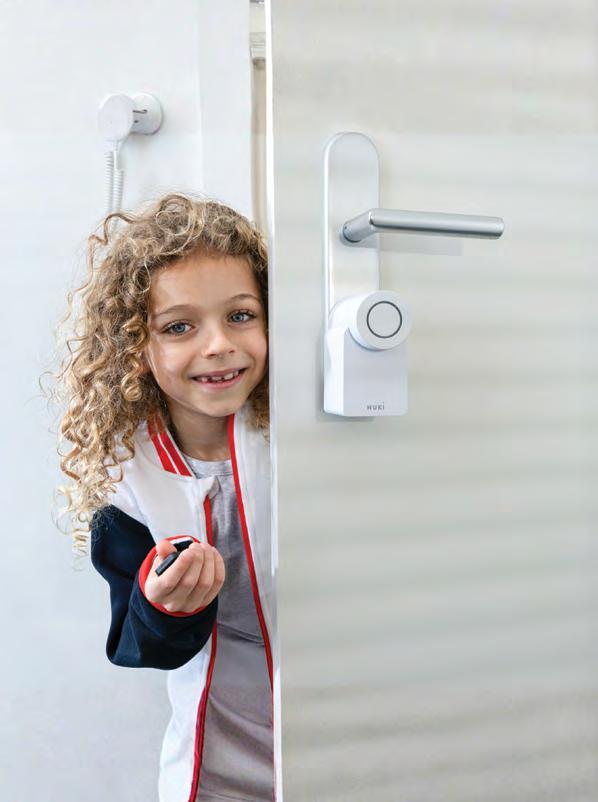
SMART LOCKS

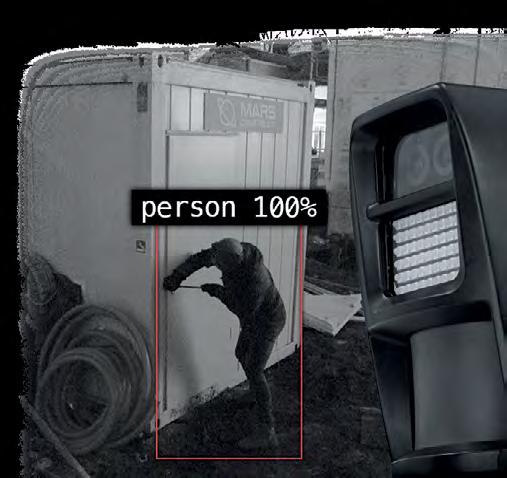
Advanced security for remote locations
Redefine security for temporary or hard-to-secure sites with a fully wireless AI-verified intrusion detection system.
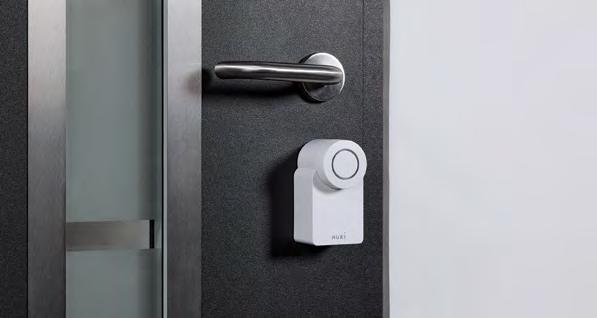
Locks in the Residential Sector
Smart locks in the residential sector have come a long way from being a practical but non-essential add-on to becoming an operational tool from which users now rightly expect a great deal. As market adoption accelerates, the focus has moved beyond convenience toward advanced control, reliability, and system-level performance
INTERVIEW
16 Peter Strom, President & CEO, March Networks & VIVOTEK
We Are Capable of Answering Any Market Demand
MARKETS
22 A Different Direction Kuwait Advances as an Identity-Led Security Market
PRODUCTS & SYSTEMS
When the Announcement Fails Communication Infrastructure as a Security Imperative in the Middle East
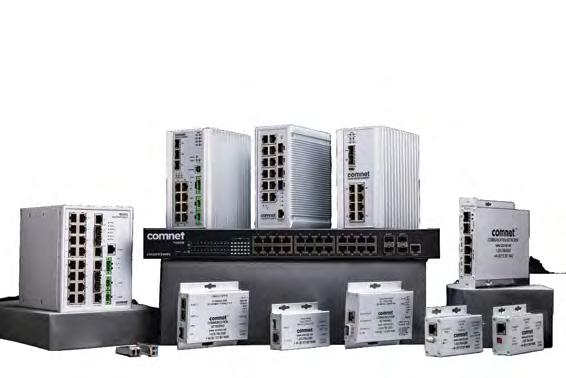
New 90W BT Switches Comnet Raises the Bar for Industrial PoE
Biometric Access Control Taking Critical Infrastructure Security
Contactless Access Control
Facial Recognition is Redefining
PRODUCTS & SYSTEMS
58 With Fiber, the Optics are Good Optical LANs Are Gaining Importance
61 Over 90 Years of Innovation From Pioneering Electric Strikes to Intelligent Systems
62 The Responsibility No One Assigns The Accountability Gap in Distribution
64 Evidence-Based Screening The Next Step in Correctional X-Ray Security
PRODUCTS & SYSTEMS
36 Physical Security Information Management Interpreting Reality Without a Magic Wand
42 Access Control Resilience That Can Withstand Real-World Challenges
Middle East Infrastructure Scaling Fire Safety for Phased Giga-Developments
CYBERSECURITY
66 Claude Mythos: Myth or Bogeyman? The Turning Point in Uncovering System Vulnerabilities


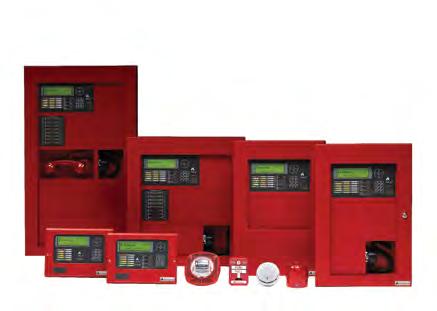
The versatile Axis AX fire system comprises high-performance fire panels, command centres, audio solutions and devices, designed to make UL 864 10th Edition compliance easy.
Feature rich and flexible, the UL-approved Axis AX offers extensive networking and cause and effect options – easily programmed using intuitive software. Plus, powerful false alarm management, simplified smoke control configuration and perfectly synchronised audio mean fire safety peace of mind is yours.
EDITOR‘S
WORD
Professional media for complete security solutions
Management
Mahir Hodžić, General Manager mahir.hodzic@asmideast.com
Adis Hodžić, CEO adis.hodzic@asmideast.com
Editorial Staff
Damir Muharemović, Editor-in-Chief mahir.hodzic@asmideast.com
Mirza Bahić, Associate Editor mirza.bahic@asmideast.com
Dženana Bulbul, Assistant Editor editorial@asmideast.com
Orhan Hadžagić, Journalist orhan.hadzagic@asmideast.com
Fatima Al Husseiny, Journalist fatima.alhusseiny@asmideast.com
Roman Ivanković, Journalist roman.ivankovic@asmideast.com
Art Staff
Sanel Palislamović, Art&Design Editor sanel.palislamovic@asmideast.com
Nelmedin Kolubara, DTP&Art Design dino.kolubara@asmideast.com
Sales Amar Pap, Business Development Manager amar.pap@asmideast.com
Internatonal Sales
Qatar: Mirsad Selimović, mirsad@techman.qa Southeast Asia: as-pr@taiwan.messefrankfurt.com
a&s Middle East offers the latest news and insights on video surveillance, access control, intrusion detection, fire alarm, perimeter protection, PA/VA, man guarding, cyber security, smart homes and buildings, industrial automation, information, communication technology, automation, and ICT to the Middle East region professional channel players.
a&s Middle East is part of the media network of the Messe Frankfurt Ltd – Taiwan Branch, which offers several media platforms — asmag.com and a&s magazines, published in English, traditional Chinese, and three other languages, providing the most comprehensive industry trends, product, and supply chain information. The total annual circulation is approximately 120,000 copies around the globe. a&s Middle East is published 6 times a year, Jan/Feb, March/ April, May/June, July/August, Sept/Oct, and Nov/Dec.
Payment Instructions
Annual subscriptions are payable in USD, EUR, or AED. Subscription inquiries per your request.
EUR: AE340400000653005131002
Account No. 0653005131002
USD: AE070400000653005131003
Account No. 0653005131003
AED: AE610400000653005131001
Account No. 0653005131001
Copyright Statement
© Copyright by Privus Agency Ltd. All rights reserved. Any republication, copying, redistribution, or reproduction of the magazine in any form, including electronic, without the prior written consent of the publisher, is prohibited. Advertisers are solely responsible for the content of advertising material. The publisher bears no responsibility regarding possible legal, patent, content, or brand disputes of the advertiser.
Legal Disclaimer
The information in this magazine has not undergone any formal testing by Privus Agency Ltd. and is distributed without any warranty expressed or implied. Implementation or use of any information contained herein is the reader’s sole responsibility. While this information has been reviewed for accuracy, there is no guarantee that the same or similar results may be achieved in all environments.
Corporate Address
Privus Agency FZ-LLC
JT010006, Al Shohada Road, Ras Al Khaimah, UAE
Tel: +971 58 983 4258
Web: www.asmideast.com
Marketing: marketing@asmideast.com
THE LOCK, THE KEY, AND THE INTELLIGENCE BEHIND THE DOOR
Every issue of a&s Middle East opens a door to a different part of the security industry. This time, we start with the door itself. More precisely, with the lock, a familiar device that is quietly becoming one of the clearest examples of how residential security is moving from mechanical protection to connected intelligence.
Our cover story examines how smart locks are evolving from stylish add-ons into infrastructure components for modern residential environments. Their value is no longer limited to replacing physical keys. They now support identity management, mobile credentials, remote access, audit trails, tenant onboarding, service access, and integration with wider building systems.
This shift is particularly relevant in the Middle East, where premium housing, smart communities, mixed-use developments, and greenfield projects create opportunities to embed intelligent access from the earliest design stages. In these environments, smart locks are not simply lifestyle devices. They are part of a broader move toward connected residential infrastructure, where convenience, security, accountability, and operational efficiency must work together.
The same logic appears elsewhere in this issue. Our exclusive interview with Peter Strom, President and CEO of March Networks and VIVOTEK, looks at Delta’s expanding security ecosystem and the convergence of surveillance, AI, cloud, edge computing, building automation, and operational data. Our feature on PSIM platforms approaches integration from another angle, showing that the real challenge is no longer only connecting systems, but turning fragmented data and workflows into a coherent operational picture.
Together, these stories point to a market moving beyond standalone products and toward systems that can organize access, interpret information, and support better decisions. In that transformation, the smart lock may seem modest in size, but its role is becoming increasingly important. It sits at the threshold, where security becomes personal, operational, and visible at the same time.
The future of residential security will not be defined only by stronger locks or more convenient apps. It will depend on whether access systems can balance convenience with control, automation with trust, and innovation with long-term reliability. In that sense, the lock is no longer simply the device that opens the door. It is becoming part of the intelligence behind it.
WANT TO RECEIVE THE MAGAZINE AT YOUR DOORSTEP?
Please visit our official website www.asmideast.com and select ‘Subscribe Now’ option under THE MAGAZINE menu.
Subscription includes all six editions.
Digital edition is FREE and readily available at the official website.

Damir Muharemović, Editor-in-Chief










UAE CYBER INSURANCE MARKET HITS $70 MILLION AMID RISING DIGITAL THREATS
The UAE’s cyber insurance market has reached an estimated $70 million, reflecting the nation’s accelerating digital transformation and heightened awareness of cyber risks. The figures were announced by the UAE Cybersecurity Council, according to the Emirates News Agency (WAM). Cyber insurance is increasingly seen as a vital safeguard against the financial and operational fallout of cyber incidents. Policies typically cover incident investigation, data recovery, legal liabilities, and compensation claims, helping organizations recover quickly and minimize losses. Premiums are expected to rise as cyberattacks become more sophisticated, often leveraging artificial intelligence and social engineering techniques. Currently, about 80% of UAE institutions and com-

panies recognize cyber insurance as an essential part of their risk management framework.
The Cybersecurity Council emphasized that insurance should complement, not re-
place, core cybersecurity measures. Critical sectors such as finance, healthcare, and energy are particularly reliant on cyber insurance to safeguard against service disruptions and reputational damage. n
AMG STRENGTHENS SECURITY INFRASTRUCTURE AT THE AVENUES RIYADH
AMG Systems has contributed to the security infrastructure of The Avenues Riyadh project in Saudi Arabia, a development expected to become the largest shopping mall in the Middle East. Designed as a premium retail and entertainment destination for residents and tourists alike, the complex is anticipated to welcome millions of visitors annually. Due to the scale of the facility and the
expected visitor numbers, the project required a reliable and future-ready surveillance network. More than 1,400 IP cameras needed to be connected across the expansive site while maintaining stable data transmission and high operational efficiency.
Working closely with the project developers, AMG Systems helped define the key technical requirements, including

long-distance fiber backbone connectivity, dependable PoE support for surveillance cameras, and a scalable infrastructure capable of supporting future expansion.
To address these needs, AMG deployed a hybrid networking solution based on its industrial communication products. The AMG250 Series Industrial PoE Media Converters were used to connect more than 600 cameras through the mall’s backbone network, providing high-speed fiber connectivity, redundancy features, and a resilient architecture suitable for mission-critical surveillance operations.
In addition, the AMG140A-1GR Series PoE Extenders were installed to support over 800 cameras located in remote or difficult-to-access areas. These devices extend both power and data transmission beyond the standard 100-meter Ethernet limitation, helping reduce the need for additional cabling and power infrastructure while simplifying installation.
According to AMG Systems, the deployment delivers several advantages for The Avenues Riyadh, including uninterrupted surveillance coverage, reduced infrastructure costs, and the flexibility to expand the network in the future without major modifications. n
Mission-Critical Industrial Networking Solutions


NEDAP SECURITY OPENS NEW OFFICE IN SAUDI ARABIA
Nedap, a global leader in advanced access management, has announced the opening of its new office in Saudi Arabia. This expansion marks a significant milestone in Nedap’s 20-year presence in the Kingdom, transitioning from regional representation to a dedicated local office.
With a permanent presence in Riyadh, Nedap aims to address the region’s evolving infrastructure requirements through integrated, data-driven ecosystems that connect access control, HR platforms, and building management systems. The local office will also enable the company to ensure compliance with Saudi regulations and HCIS standards while strengthening its focus on long-term lifecycle support for large-scale infrastructure projects that are expected to develop over several decades.
“Saudi Arabia is a cornerstone of our global growth strategy,” said Maarten Van Cauwenberghe, Managing Director META & APAC at Nedap. “Our local presence allows us to be a true partner in the Kingdom’s transformation, supporting projects that require the highest levels of scalability, interoperability, and long-term adaptability.”
The new local office will give security integrators and consultants direct access to Nedap’s technical and commercial resources within Saudi Arabia. Through its presence in the Kingdom, the company plans to provide real-time technical support in the local time zone, helping partners respond more efficiently to complex project requirements. Nedap will also introduce localized training and certification programs through the Nedap Security Academy, enabling Saudi-based engineers to strengthen their expertise in AEOS and PIAM solutions.
To lead this new chapter, Nedap has appointed Junaid Ul Haq

as Country Director for Saudi Arabia and Bahrain. With 18 years of experience at Nedap, Junaid brings an unparalleled understanding of how security technology must evolve to meet the scale and ambition of Saudi projects. n
UAE CYBER FACTORY TO STRENGTHEN NATIONAL CYBER SOVEREIGNTY
The UAE Cyber Security Council (CSC), in collaboration with its national strategic cybersecurity partner CPX Holding, has announced the launch of the UAE Cyber Factory, according to a WAM report.
The initiative aims to strengthen the UAE’s digital leadership and reinforce its cyber sovereignty at a time when cyber threats are becoming more complex and more frequent. According to the UAE Cyber Security Council, more than 800,000 daily cyberattacks have been recorded in recent months, underlining the need for adaptive and resilient national defenses.
The UAE Cyber Factory will design, build and scale the next generation of cybersecurity capabilities through advanced programs, technologies and AI-powered systems. The goal is to improve the country’s ability to anticipate, detect and respond
to sophisticated threats targeting institutions, businesses and individuals.
Dr. Mohamed Al Kuwaiti, Head of Cyber Security for the UAE Government, said the launch marks a new phase in the UAE’s cybersecurity leadership and positions the country as a global hub for
advanced cybersecurity. “In the face of rising global challenges, the UAE stands as a leading model that not only protects but also innovates and leads by developing advanced technologies capable of detecting, preventing and deterring cyber threats effectively,” he said. n

INVIXIUM ESTABLISHES MIDDLE EAST HEADQUARTERS IN SAUDI ARABIA
Invixium has established its Middle East headquarters in Saudi Arabia, reinforcing its long-term commitment to the Kingdom and supporting the company’s regional growth in biometric access control, workforce management and visitor management solutions.
The move supports the company’s plans to serve customers and partners more closely from within the Kingdom. The new headquarters also reflects Saudi Arabia’s increasing role as a regional hub for technology, industrial development and digital transformation.
“The Middle East has been a cornerstone of our global growth story,” said Shiraz Kapadia, CEO & President of Invixium. “Our customers in this region have been instrumental in shaping our success. Establishing our headquarters in Riyadh’s global investment hub reinforces our commitment to supporting Saudi Vision 2030 and its most ambitious projects.”
To support accelerated growth, Invixium has appointed Adeel Alvi as Senior Director, Sales – KSA & Levant. Adeel brings over a decade of sales leadership experience within the security industry, with a proven track record of driving revenue growth, developing new markets, forging strategic customer partnerships, and expanding product distribution networks. Prior to joining Invixium, he held leadership roles at SVS, Hanwha Vision, and SecuTronic.
Shiraz Kapadia further adds, “The addition of a highly experienced sales leader who understands the nuances of this market further strengthens our leadership and momentum across the Middle East.”
“Invixium is a name that commands respect in the Middle East security industry,” said Adeel Alvi, Senior Director, Sales –

KSA & Levant. “It’s an incredibly exciting time to join the company as the region takes on some of its most complex and critical security projects, which Invixium is best positioned to address. I look forward to leveraging my experience to expand our customer base and further drive and scale Invixium’s success throughout the Middle East.”
Over the years, Invixium has established a strong presence in the Middle East, delivering cutting-edge biometric solutions and highly tailored, innovative customizations to Fortune 100 companies, including some of the region’s largest industrial operations, critical infrastructure, and top government organizations. n
NCA LAUNCHES THE INTERACTIVE CYBERSECURITY AWARENESS EXHIBITION FOR PILGRIMS AT
The National Cybersecurity Authority (NCA) has inaugurated the “Interactive Cybersecurity Awareness Exhibition for Pilgrims” at the Hajj and Umrah Terminal Complex at Jeddah’s King Abdulaziz International Airport. This initiative is part of NCA’s Cybersecurity Fostering Program for the Hajj Season 1447 AH, implemented to support national efforts to provide a seamless and secure experience for pilgrims, while adhering to the highest standards of comfort and safety. The exhibition, organized in cooperation with Jeddah Airports Company (JEDCO), aims to cultivate a strong cybersecurity culture and raise awareness among pilgrims through engaging and interactive methods. It features a variety of multilingual awareness materials, publications,
and guidelines specifically designed to raise cybersecurity awareness.
The exhibition highlights fundamental cybersecurity concepts and their role in mitigating emerging cyber risks, empha-
JEDDAH AIRPORT
sizes the importance of security updates, and explores topics such as phishing, social engineering, application security, and other relevant topics to foster a strong cybersecurity culture among pilgrims. n


GLOBAL CLOUD SECURITY MARKET EXPECTED TO REACH NEARLY $98 BILLION BY 2033
The global cloud security market is projected to grow from USD 39.09 billion in 2025 to USD 97.93 billion by 2033, expanding at a CAGR of 12.2%, according to a recent report by Grand View Research, Inc.
The study links this growth to the increasing digital interconnection of businesses and the rising demand for secure, scalable cloud environments. As organizations continue migrating operations and sensitive data to the cloud to improve flexibility and cost efficiency, the need for stronger cyber protection is becoming increasingly important.
Cloud security platforms are designed to address risks such as data breaches, unauthorized access, and configuration errors in cloud-native environments. The report also highlights the growing adoption of Secure Access Service Edge (SASE) frameworks, which combine networking and security capabilities to support secure access across distributed business environments.
According to the findings, future cloud security strategies will increasingly rely on continuous monitoring, behavioral analytics, threat intelligence, and AI-driven

threat detection. Managed services are expected to see particularly strong growth as organizations seek external expertise to strengthen cyber resilience.
At the same time, the report warns that evolving regulations and a shortage of skilled cybersecurity professionals could slow market expansion. Many organizations still face challenges related to com-
pliance, cloud architecture management, and effective implementation of advanced security measures.
Among the fastest-growing segments are managed services, hybrid cloud deployments, Cloud Infrastructure Entitlement Management (CIEM) solutions, and cloud security solutions tailored for small and medium-sized enterprises. n
HIKVISION UNVEILS GUANLAN AI MODELS TO ADVANCE NEXT-GENERATION AIOT APPLICATIONS

Hikvision has introduced its new Guanlan large-scale AI models, a development aimed at strengthening the company’s AIoT ecosystem and accelerating the deployment of more intelligent security and operational technologies.
The Guanlan AI model architecture is designed to enhance the capabilities of AIoT devices and applications through improved multimodal perception, scene understanding, and intelligent decision-making. The models are expected to support a broad
range of use cases spanning video security, traffic management, industrial operations, and smart city environments.
Hikvision said the new framework combines visual, language, and multimodal AI capabilities, enabling systems to process and interpret increasingly complex operational environments. The company added that the architecture is intended to improve efficiency, reduce false alarms, and support more context-aware analytics across connected systems.
Guanlan models are optimized for deployment across cloud, edge, and hybrid environments, allowing organizations to adapt AI workloads according to operational and regulatory requirements. The company also emphasized scalability and interoperability as key priorities for supporting large enterprise and smart infrastructure projects.
As AI adoption continues to accelerate across the Middle East, particularly in smart-city and critical-infrastructure initiatives, advanced AIoT platforms are becoming increasingly important for governments and enterprises seeking greater automation, situational awareness, and operational resilience.
The launch also highlights the growing role of large-scale AI models in the physical security industry, where vendors are increasingly integrating generative AI and multimodal intelligence into surveillance, access control, and urban management ecosystems. n
KUWAIT DEPLOYS NATIONWIDE EMERGENCY ALERT SYSTEM IN RECORD TIME
Kuwait has launched a new national public warning platform to strengthen emergency communication capabilities amid the ongoing conflict in the Middle East.
The project was implemented under the supervision of the Communication and Information Technology Regulatory Authority (CITRA) together with Kuwait’s three mobile operators — Zain, Ooredoo,

and STC. The authorities selected Intersec to rapidly deploy a nationwide alerting solution capable of delivering geo-targeted emergency notifications directly to mobile devices through Cell Broadcast technology.
A major distinguishing factor of the project was the speed of execution. While nationwide public warning systems usually require months of preparation and deployment, the Kuwaiti rollout became fully operational in under ten days.
To meet the tight deadline, Intersec initially activated the platform through its secure cloud infrastructure hosted in France, while simultaneously working on establishing local infrastructure in Kuwait. The system supports four categories of notifications: national warning alerts with a high emergency tone, emergency alerts with a text tone, general alerts with silent notifications, and periodic informational messages.
“Exceptional circumstances require exceptional teamwork. All teams worked around the clock, and we are extremely proud of what we have achieved together. We selected Intersec for its proven experience in deploying such systems across multiple countries, as well as its innovative approach it proposed to meet the ten-day challenge, and they have not disappointed,” said Abdullah Alawadh, Head of Security Operation Centre at CITRA. n
ICS SECURITY MARKET EXPECTED TO REACH $38.48 BILLION BY
2031
The global market for industrial control system (ICS) security is forecast to expand significantly over the next several years, growing from USD 17.91 billion in 2026 to USD 38.48 billion by 2031. According to a recent MarketsandMarkets report, the sector is expected to record a compound annual growth rate (CAGR) of 16.5% during the forecast period.
The growth is largely being driven by the increasing number and complexity of cyber threats targeting industrial environments. Organisations are therefore investing in advanced security technologies capable of providing real-time threat detection, automated response, and improved risk management across operational and cloud-based infrastructures. At the same time, stricter regulatory requirements and data protection standards are encouraging companies to strengthen compliance measures and improve control over sensitive data in hybrid and multi-cloud environments.
The report highlights strong growth within the professional services segment, as industrial organisations continue seeking specialised expertise to protect operational technology (OT) systems and maintain resilience across critical infrastructure sectors. Services such as consulting, system integration, compliance management, training, maintenance, risk assessment, and incident response are becoming increasingly important in helping organisations manage evolving cyber threats. According to the study, the oil & gas industry is expected to record particularly strong growth within the ICS security market. Increasing digitalisation across upstream, mid-

stream, and downstream operations is expanding the cyber attack surface of critical energy infrastructure. Operators are deploying OT security solutions to protect drilling operations, pipelines, refineries, storage sites, and remote assets against ransomware attacks, operational disruptions, and cyber-physical threats.
The report identifies several key companies active in the ICS security market, including Cisco, Fortinet, Palo Alto Networks, Tenable, Honeywell, Check Point Software, ABB, Belden, Kaspersky, Darktrace, Radiflow, and Dragos. n

Peter Strom, President & CEO, March Networks & VIVOTEK
March Networks and VIVOTEK will, as part of Delta’s newly established Building Automation Business Group, operate together within the security solutions division. The goal is to bring all components of security solutions into a single integrated platform, enabling end users to access and monitor all information in one place
n By: Damir Muharemović damir.muharemovic@asmideast.com
a&s Middle East: Could you briefly share your career journey and your current role within Delta?
Strom: My career has been rooted in video surveillance and security technology for over two decades. I’ve had the privilege of leading organizations through significant periods of industry transformation, from the shift from analog to IP-based video, through the rise of analytics, hybrid and cloud video, and into the era of AI-driven intelligence. I currently serve as President and CEO of both March Networks and VIVOTEK, two complementary brands that together form a significant part of Delta Electronics’ security and surveillance portfolio. In that role, I’m focused on driving growth, innovation, and integration across both companies while aligning closely with Delta’s broader strategic vision for smart buildings, transport, and intelligent infrastructure.
a&s Middle East: For readers who may be less familiar, could you provide an overview of Delta Electronics—its origins, core business, and global presence today?
Strom: Delta Electronics was founded in 1971 in Taiwan and has grown into a global leader in power and thermal management technologies. In 2025, Delta reported $17.9 billion in consolidated sales revenue, supported by a global network of 165 sales offices, 55 manufacturing sites, and 73 R&D centers. Its mission, “To provide innovative, clean, and energy-efficient solutions for a better tomorrow”, underpins everything the company does.
What many in the security industry may not immediately appreciate is the breadth of Delta’s portfolio. Beyond power supplies and EV charging infrastructure, Delta has made strategic investments in building automation, smart manufacturing, data center infrastructure, and, increasingly, security and surveillance.
The acquisitions of VIVOTEK and March Networks were deliberate moves to build world-class capabilities in this space and integrate them with Delta’s wider smart building and IoT ecosystem.
a&s Middle East: Delta has been expanding its presence in the security and surveillance space. How does Delta approach this market, and what role does surveillance play within the broader business?
Strom: Delta’s approach to security is fundamentally different from that of a standalone surveillance vendor. Rather than treating video as an isolated system, Delta sees surveillance as a core data layer within intelligent buildings and infrastructure. Security cameras and video management platforms generate extraordinarily rich data, and when that data is integrated with access control, building
automation, energy management, and operational systems, the value multiplies dramatically.
March Networks brings deep expertise in enterprise and regulated-industry VMS and video analytics. VIVOTEK brings a strong hardware portfolio in network cameras, NVRs, and edge AI capabilities. Together, within the Delta family, we have the pieces to deliver truly integrated, endto-end solutions that go well beyond traditional security.
a&s Middle East: Within this context, what role does the Building Automation Business Group (BABG) play in shaping Delta’s security and smart infrastructure strategy?
Strom: Delta’s BABG brings together building-focused technologies across automation, energy management, security, and intelligent infrastructure. Within that

March Networks brings deep expertise in enterprise and regulated-industry VMS and video analytics. VIVOTEK brings a strong hardware portfolio in network cameras, NVRs, and edge AI capabilities. Together, within the Delta family, we have the pieces to deliver truly integrated, end-to-end solutions that go well beyond traditional security

structure, VIVOTEK and March Networks are becoming more closely aligned to expand Delta’s security ecosystem and deliver more integrated solutions. This matters enormously for end customers. A building operator shouldn’t need to log into five separate systems to manage security, energy, access, and environmental controls.
a&s Middle East: How does BABG integrate video surveillance with other building systems to deliver a unified solution?
Strom: Integration happens at several levels and takes time. At the hardware layer, Delta’s network infrastructure and edge computing products provide the foundation. At the software layer, open APIs and standards-based protocols enable VIVOTEK and March Networks solutions to connect with Delta’s building automation platforms and third-party systems. And at the AI and analytics layer, we’re looking at capabilities that allow insights from video to trigger automated responses across building systems, for example, a tailgating detection event that automatically locks down access points, or an occupancy reading that adjusts HVAC in real time.
The same logic extends beyond buildings into transport infrastructure. Our purpose-built mobile surveillance solutions are deployed across bus fleets, shuttles,
and rail, which are environments with very different technical demands from fixed installations. Bringing those capabilities into the Delta ecosystem means
Intelligence in the Hands of Business Users
a&s Middle East: How do you see the role of video surveillance evolving—from traditional security to more intelligent and proactive applications?
Strom: The industry is undergoing a fundamental shift. For years, video surveillance was reactive; cameras recorded events so you could review footage after an incident. That model is being replaced by proactive, intelligence-driven video that helps organizations prevent incidents, optimize operations, and make better decisions in real time.
AI is the engine behind this transformation. Today’s cameras and analytics platforms can detect anomalous behavior, identify safety hazards, monitor occupancy and flow, and surface actionable insights, all automatically. But the most exciting development is what happens when you make that intelligence accessible to business users. That’s what our Searchlight Cloud platform does. By connecting video with IoT and transaction data from POS systems and ATMs, it puts video-based business intelligence directly in the hands of operations, loss prevention, and executive teams — not just security personnel. We offer VORTEX, our camera-to-cloud solution, purpose-built for organizations that want simplicity and a fully cloud-managed experience without on-premise infrastructure. We also have March Networks Command Enterprise, our enterprise-grade VMS, designed for the largest and most complex deployments. Searchlight Cloud works across both platforms, so customers get the same powerful business intelligence layer regardless of their deployment model. The “security camera” is genuinely becoming a core business tool. That’s a profound shift, and it’s one Delta is uniquely positioned to lead.
Delta Electronics headquarters (p. 22): Delta Electronics headquarters, located in Taipei, Taiwan.
we can follow a customer’s needs from the building to the vehicle and back again, which is increasingly relevant as smart city projects blur the boundary between building management and transit infrastructure.
a&s Middle East: What differentiates Delta BABG’s approach to security and surveillance compared to other vendors in the market?
Strom: The key differentiator is genuine end-to-end ownership. Many vendors claim integration, but they’re actually assembling third-party components and hoping the APIs hold together. Delta brings together many of the critical building blocks under one group, including building automation, camera hardware, video management software, cloud services, and supporting infrastructure. That gives customers a deeper level of integra-
tion and accountability than a loosely assembled third-party stack.
a&s Middle East: How is Delta leveraging AI, cloud, and edge technologies to enhance security outcomes for customers?
Strom: AI is being deployed at the edge, in the camera itself, to enable real-time analytics without the latency or bandwidth costs of sending everything to the cloud. VIVOTEK has been building edge AI capabilities into its hardware for several years, and that investment is paying dividends. At the same time, cloud connectivity allows for centralized management, remote access, and aggregation of data across distributed sites, which is particularly valuable for enterprise and multi-site customers. March Networks’ platform is designed to operate effectively in hybrid environments, giving customers the flex-
The organizations that will lead in security over the next decade will be the ones that can deliver a seamless, intelligent platform where data flows freely between systems, AI surfaces the right insights at the right time, and operators can act decisively without navigating a maze of disconnected tools
ibility to balance edge processing with cloud-based intelligence based on their specific needs and infrastructure.
a&s Middle East: Looking ahead, what is the vision for Delta BABG in the security and surveillance space over the next 5 to 10 years?
Strom: The vision is for Delta to be recognized as the global leader in intelligent building security and automation, not just as a camera or software vendor, but as a trusted partner for organizations that want their buildings to be safer, smarter, and more sustainable. That means continuing to invest in AI capabilities, expanding our global channel and integration partner ecosystem, and deepening the integration between surveillance and the broader Delta building platform. We also see significant growth opportunities in specific verticals, and we already have deep roots in the ones that demand the highest standards. March Networks is trusted by some of the world’s largest banks and financial institutions — organizations where compliance, audit trails, and operational intelligence are non-negotiable — and by major global retailers who rely on our platform not just for loss prevention, but to understand customer behavior, optimize store operations, and protect their people. That track record,

March Networks’ global headquarters, located in Ottawa, Canada.
INTERVIEW
Trevor Sinden, Regional Sales Director, Middle East, Africa & India, March Networks
Remarkable Scale of Investment in the Middle East
a&s Middle East: What role does the Middle East region play in Delta’s global strategy for security and smart infrastructure, particularly in large-scale smart city and infrastructure projects?
Sinden: The Middle East is a strategically important growth region for Delta right now. Few places on earth are investing in smart cities, large-scale infrastructure, and giga-projects at the pace and ambition we’re seeing here: Saudi Vision 2030, NEOM, the Red Sea developments, the UAE’s smart city programs, Qatar’s continued post-World Cup infrastructure investment, and major transport, stadium, airport, and government projects across the GCC. The scale is genuinely remarkable. These developments align almost perfectly with Delta BABG’s value proposition: integrated, intelligent building and infrastructure solutions where video surveillance, building automation, energy management, and IoT need to work together as a single platform rather than as siloed systems. For Delta globally, the region is both a high-growth market and a proving ground; the ambition of projects here pushes us to deliver at the very highest level, and the successes we achieve here become reference points for the rest of the world.
There’s also something important about how business is done in this region. End customers, consultants, and government stakeholders value long-term partnerships with established, financially stable, technology-led companies.
Delta’s profile as a globally listed company with deep R&D investment and a genuinely broad portfolio resonates strongly, particularly on projects where the stakes are high and the margin for error is low.
a&s Middle East: How is Delta positioning itself within these landmark developments across the region?
Sinden: We’re positioning Delta BABG as a single-source partner for integrated smart infrastructure, bringing together VIVOTEK for video and AI analytics, March Networks for enterprise VMS and intelligence, Amerlux for smart lighting, Loytec and Delta Controls for building automation and BMS, and the wider Delta portfolio covering power, cooling, EV charging, and displays, all under one umbrella. That breadth is genuinely rare in this market.
The key differentiator on landmark projects is integration. Consultants and end users are, frankly, tired of stitching together
combined with our complementary transportation expertise in buses, shuttle fleets, and rail, is a foundation we intend to build on across other verticals, like healthcare, hospitality, smart cities, and beyond.
At the same time, VIVOTEK continues to strengthen Delta’s reach in the SMB

a dozen vendors and managing the gaps between them. Delta BABG can deliver a unified stack, cameras, analytics, VMS, access control, BMS, and power infrastructure that’s engineered to work together, with a single accountable partner behind it. That’s a compelling proposition when you’re specifying a project of national significance.
We’re also investing meaningfully in our local presence: regional teams on the ground, local technical and pre-sales support, and active partnerships with leading systems integrators and consultants across the GCC who are specifying these projects at the earliest stages. Being close to the market, not just selling into it from a distance, matters enormously here.
AI, edge, and cloud capabilities are central to how we’re positioning the overall offer, moving surveillance from a reactive, after-the-fact tool into a proactive operational intelligence platform that supports security, safety, and broader business outcomes simultaneously. That’s precisely what smart city and giga-project stakeholders are asking for. And increasingly, we’re also leaning into Delta’s sustainability and ESG credentials, energy-efficient hardware, solutions that contribute to green building goals, and a parent company with one of the strongest ESG track records in the industry. On landmark projects in this region, that matters more and more.
and mid-market space through AI-powered surveillance and hybrid cloud solutions that support scalable and flexible deployments across diverse customer environments. With a focus on operational simplicity and centralized management, VIVOTEK is expanding Delta’s intelligent security footprint across sec-
tors such as city surveillance, residential communities, logistics, warehousing, and QSRs.
Together, these strengths — combined with Delta’s broader building automation and infrastructure expertise — position Delta to deliver end-to-end intelligent security solutions that scale from enterprise

environments to SMB deployments while supporting the evolving needs of smarter and more connected industries worldwide.
a&s Middle East: How do you see integrated platforms shaping the future of security, especially as AI and automation continue to evolve?
Strom: Integration isn’t just a feature, it’s the future. The organizations that will lead in security over the next decade won’t be those with the best indi-
vidual product. They’ll be the ones who can deliver a seamless, intelligent platform where data flows freely between systems, AI surfaces the right insights at the right time, and operators can act decisively without navigating a maze of disconnected tools.
The way I think about where this industry is heading comes down to three imperatives. First, connecting the ecosystem, breaking down the silos between video, access, building systems, and operational data so intelligence can flow freely across an organization. Second,
turning sight into insight, making AIdriven intelligence faster, more accessible, and genuinely embedded in daily decision-making rather than confined to a specialist security team. And third, extending intelligence everywhere, into the edge, into the cloud, into the mobile environments and transport networks where customers actually operate. That’s the direction our roadmap is pointing, and it’s a vision that Delta, with the unique combination of March Networks, VIVOTEK, and the wider BABG, is well-positioned to execute. n

March Networks and VIVOTEK team at Delta’s Fremont, California, USA headquarters, February 2026
March Networks and VIVOTEK leadership and staff at the Ottawa headquarters
A Different Direction
KUWAIT ADVANCES AS AN IDENTITY-LED SECURITY MARKET

Kuwait’s security market is entering a new phase of development. Driven by Vision 2035, large-scale infrastructure projects, and ongoing modernization efforts across both the public and private sectors, the country is creating new opportunities for security technology providers across multiple verticals
n By: Roman Ivanković editorial@asmideast.com
Unlike some of the region’s larger markets, Kuwait’s growth story is not defined by rapid expansion alone. Instead, the market is characterized by a strong government presence, regulatory oversight, and a focus on critical infrastructure, operational resilience, and longterm modernization. Major investments in airports, ports, energy facilities, public infrastructure, and digital services are creating demand for technologies that can support increasingly complex operational environments.
As a result, Kuwait is emerging as a market where trusted identity, integrated security architectures, and critical infrastructure protection are becoming the defining themes shaping future investment and technology adoption.
Structural Characteristics of the Market
Kuwait’s security and safety market is shaped not only by ongoing investment but also by the way projects are planned, procured, and delivered. Government-led development programs, major infrastructure projects, and a strong focus on reg-
Compliance-Heavy Ecosystem
Regulation is another defining characteristic of the market. Security deployments are shaped by requirements covering surveillance, identity management, cybersecurity, and public safety. Industry participants point to Law 61/2015, which governs the deployment of surveillance systems across public and private facilities, as one of the frameworks influencing technology adoption and compliance requirements.
“The Kuwait Ministry of Health has been strengthening regulations for the deployment of cameras and security devices to enhance safety, detect crimes, and protect public assets. As a consequence, more commer-

At the same time, organizations are moving beyond standalone security systems and adopting more integrated approaches that combine identity management, access control, video surveillance, life-safety technologies, and operational monitoring. Interoperability, compliance, and long-term scalability have become key purchasing criteria, particularly as end users seek to modernize existing infrastructure while avoiding costly system replacement projects.
ulatory compliance continue to influence purchasing decisions across the market. At the same time, organizations in both the public and private sectors are upgrading aging infrastructure and replacing fragmented systems with more integrated security environments. As a result, interoperability and long-term operational value are becoming increasingly important. Several characteristics define the market today. Government institutions remain the main drivers of investment and standardization. Local system integrators play a critical role in project delivery. Demand is increasingly focused on modernization, integration, and compliance rather than standalone deployments. Together, these factors are shaping a more connected and technologydriven security ecosystem aligned with Kuwait’s Vision 2035 objectives.
cial buildings in Kuwait are installing video security systems to protect their assets and uphold public order”, noted Syed Kashif Hasan, Regional Sales Manager for Motorola Solutions.
However, the government’s influence extends beyond regulation. One of the most significant recent initiatives is the Kuwait Fire Force Safety Solutions Roadmap, which aims to connect more than 50,000 buildings to a centralized operations center through alarm transmission systems connected via 5G or alternative networks. The first phase will focus on healthcare and education facilities before expanding to commercial and residential buildings. Once implemented, alarms and malfunctions will be automatically detected, classified, and verified within two minutes before dispatching emergency responders.
Procurement processes in Kuwait are often more structured and compliancedriven than in many commercial markets. While this can lengthen project timelines
MARKETS
and create higher barriers to entry, it also favors suppliers capable of meeting regulatory requirements and supporting projects over long operational lifecycles.
Sam Cherif, Senior Director and Head of the Middle East at HID, underlined that regulatory compliance and local certification requirements, together with data sovereignty, remain central considerations in solution design and deployment.
“Kuwait’s security and safety market is growing steadily, with demand concentrated in critical infrastructure and large commercial and real-estate developments. Much of this momentum is tied to government-led modernization efforts under Kuwait’s Vision 2035, which is accelerating infrastructure upgrades and economic diversification,” he explained.
Local Partnerships Remain Essential for Market Access
Kuwait’s security market continues to operate through a partnership-driven model in which local system integrators play a central role in project delivery. While global manufacturers and technology providers are active across the country, successful implementation often depends on local expertise, certifications, and longterm support capabilities.
This is particularly evident in government, transportation, energy, and enterprise projects, where buyers often prioritize implementation experience and local service capabilities alongside technology performance. As a result, international vendors typically work through established local partners that understand regulatory requirements, procurement procedures, and customer expectations.
The importance of local partnerships is expected to increase as projects become more complex and integrated. Security deployments increasingly involve multiple technologies, including access control, biometrics, video surveillance, visitor management, life-safety systems, and operational monitoring platforms. Delivering and maintaining these environments requires strong local integration capabilities.
“Over the past years, ScreenCheck participated in various projects in Kuwait’s aviation, government and enterprise sectors by closely collaborating with local integrators and technology partners. One of our major projects was Kuwait International Airport, where we partnered with a global tech system integrator to support biometric deployment, leveraging iris recog-
Government Priorities Continue to Shape Demand
Government institutions remain the primary drivers of security investment in Kuwait. National development initiatives, infrastructure expansion, and regulatory requirements continue to influence both procurement decisions and technology adoption across the market.
Much of this activity is linked to Vision 2035, Kuwait’s long-term strategy to diversify the economy and modernize national infrastructure. The government is currently advancing 12 major public-private partnership projects, with six already being rolled out and six more expected to follow. These projects span transportation, logistics, urban development, utilities, and public services, creating demand for increasingly sophisticated security and safety technologies.
Kuwait’s security market has seen significant growth and evolution over the past five years, largely driven by the need to digitize outdated physical security infrastructure and tackle rising cyber threats. Additionally, the creation of new oil and gas projects focused on offshore exploration and the expansion of Kuwait International Airport to carry up to 25 million passengers further highlight the country’s growth ambitions.
nition technology. The solution enhanced identity verification for staff and operational areas within the airport, delivering high-accuracy biometric authentication suitable for critical infrastructure environments. We have also worked with several government entities and corporate organizations for secure ID issuance projects. These deployments involved secure ID issuance systems used for employee credentials, contractor badges, and visitor identification,” explained Ajeeb Jamal, Channel Sales Manager for ScreenCheck. These relationships not only facilitate deployment but also help customers manage system upgrades, compliance requirements, and ongoing lifecycle support. For end users, this approach re-
duces project risk and ensures access to local technical expertise. For vendors, it reinforces the importance of building strong partner networks and maintaining a long-term presence in the market.
Legacy Infrastructure and the Modernization Challenge
Industry participants consistently identify interoperability as one of the most important purchasing criteria. Rather than pursuing costly “rip-and-replace” projects, organizations are looking for solutions that can coexist with existing investments while supporting future expansion. This modernization trend is reinforced by broader digital transformation initiatives

Kuwait International Airport Passenger Terminal 2




across both the public and private sectors. As organizations adopt more connected operating models, security systems are increasingly expected to function as part of larger digital ecosystems rather than standalone technologies.
“Currently, end users are looking for solutions that ensure interoperability with existing infrastructure to avoid costly ripand-replace approaches and are seeking faster incident response enabled by unified dashboards and structured workflows,” explained Ajeeb Jamal from ScreenCheck. At the same time, future developments such as Silk City (Madinat Al Hareer) are expected to introduce a new generation of integrated security environments. The project is designed to include smart city infrastructure, a financial district, transportation assets, logistics facilities, and large residential zones. While these developments represent the future of Kuwait’s security market, much of today’s demand remains focused on modernizing and integrating existing infrastructure.
Motorola Solutions’ Kashif Hasan points out that solutions compatible with existing technologies are particularly welcome.
“Our customers value having Pelco cameras work seamlessly with their existing VMS platforms. Pelco’s post-installation servicing capabilities and 24/7 support via two regional support centers also help to make these products successful in Kuwait,” he observed.
MARKET GROWTH AND INVESTMENT DRIVERS
Kuwait’s security and safety market is benefiting from a new wave of infrastructure investment, economic diversification, and public-sector development. Under Vision 2035, the country is accelerating projects designed to modernize transportation, logistics, urban infrastructure, public services, and critical industries. These initiatives are creating sustained demand for security and safety technologies across multiple sectors.
This momentum is reflected in both physical and digital security markets. According to industry estimates, Kuwait’s cybersecurity market is expected to grow from approximately USD 0.69 billion in 2026 to USD 1.16 billion by 2031, representing a compound annual growth rate (CAGR) of more than 11%. At the same time, investments in transportation, energy, logistics, and smart infrastructure continue to generate new opportunities for physical security providers.
Mega-projects Continue to Drive Demand
Large-scale infrastructure developments remain one of the strongest growth drivers for Kuwait’s security market. Among the most significant projects is the expansion of Kuwait International Airport’s
“Data sovereignty, local certification requirements, and regulatory compliance will remain central considerations in solution design and deployment.” – Sam Cherif, Senior Director and Head of the Middle East at HID
Terminal 2, a development valued at approximately USD 4 billion. The project is expected to support demand for advanced perimeter protection, biometric processing, access control, video surveillance, and integrated command-andcontrol systems.
Another major catalyst is Silk City (Madinat Al Hareer), a long-term development program with an estimated value of USD 132 billion. Planned as a financial, logistics, and tourism hub, the project is expected to incorporate smart city infrastructure, transportation assets, residential zones, and large-scale commercial developments.
South Al-Mutlaa City represents another important growth area. Designed to accommodate approximately 400,000 residents, the project is expected to generate demand for citywide surveillance, emergency response systems, traffic management technologies, and public safety infrastructure.
The government has also announced plans to advance 12 public-private partnership projects as part of its broader economic transformation strategy, with a target of attracting approximately USD 24 billion in foreign direct investment. Government-led programs are also creating new demand across the safety sector.
One of the most notable examples is the Kuwait Fire Force (KFF) Safety Solutions Roadmap. The initiative aims to connect more than 50,000 buildings to a centralized operations center through alarm transmission systems connected via 5G and other communication networks. The first phase will focus on healthcare and educational facilities before expanding to commercial and residential buildings. The program is expected to drive investment in fire detection technologies, alarm
Ajeeb Jamal, Channel Sales Manager, ScreenCheck
Mohanad Elyan, Business Development Manager, Nedap
Syed Kashif Hasan, Regional Sales Manager, Motorola Solutions
Sam Cherif, Senior Director and Head of the Middle East, HID
MARKETS
transmission equipment, monitoring platforms, communications infrastructure, and IoT-enabled safety devices.
Other Key Verticals
Beyond large infrastructure projects, investment activity remains concentrated in several strategic sectors. The oil and gas industry continues to be one of the largest consumers of advanced security technologies. Ongoing modernization programs are driving demand for thermal imaging, gas leak detection, perimeter protection, industrial monitoring, and explosion-proof equipment designed for critical infrastructure environments. Logistics is another area attracting growing investment. The development of Mubarak Al-Kabeer Port on Boubyan Island is strengthening Kuwait’s ambitions to become a regional logistics hub and creating demand for maritime security, cargo screening, access control, and transportation monitoring systems. At the same time, government agencies, financial institutions, and major enterprises continue to invest in biometric identity systems and digital identity platforms as part of broader digital transformation efforts. As identity management becomes increasingly important across both physical and digital environments, this segment is expected to remain a key area of growth in the years ahead.
SECURITY AND SAFETY TECHNOLOGY
Kuwait’s security market is increasingly shaped by demand for integrated, technology-driven solutions that support both security and operational objectives. While large infrastructure projects and modernization programs continue to drive spending, industry stakeholders point to several technology segments that are experiencing particularly strong demand. These include identity management, access control, intelligent video surveillance, critical infrastructure protection, life-safety systems, and integrated security platforms that unify multiple technologies within a single operating environment.
Operational Intelligence Drives Video Technologies
Video technologies are increasingly expected to deliver operational value beyond
traditional surveillance. Organizations are deploying analytics, thermal imaging, and advanced monitoring technologies to improve safety, support operational continuity, and strengthen infrastructure resilience. Video systems are becoming sources of operational intelligence rather than passive recording tools.
In sectors such as oil and gas, thermal and bispectral imaging technologies are being integrated into industrial environments to support predictive maintenance and process monitoring. At the same
time, AI-enabled analytics are helping operators improve situational awareness and accelerate decision-making.
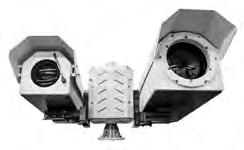
“We are seeing growing demand for both fixed and PTZ cameras, especially in the oil and gas sector, which requires explosionproof cameras and box-shaped PTZ cameras with anti-fog detection for perimeter protection. Oil and gas customers are also using video analytics to strengthen their environmental practices through the early detection of flares,” stressed Syed Kashif Hasan, from Motorola Solutions.
Shift Toward Intelligent Monitoring Systems
Video surveillance remains one of the largest and most mature segments of Kuwait’s security market. However, demand is increasingly shifting from traditional CCTV deployments toward intelligent monitoring systems capable of delivering operational insights and supporting proactive security strategies. Growth is being driven by infrastructure projects, public safety requirements, commercial developments, and regulatory initiatives. Organizations are increasingly looking for AI-enabled analytics, thermal imaging, long-range monitoring, and integrated video management platforms that can support both security and operational objectives. Motorola Solutions notes growing demand for surveillance systems across commercial and public-sector environments, particularly as regulatory requirements continue to evolve. “Kuwait is using video analytics to detect potential risks on its roads while encouraging safe driving behaviors. Moreover, the market is seeing a rapid shift to remote video monitoring and response services to drive cost savings while expanding coverage,” explained Kashif Hasan, from Motorola Solutions.
In critical infrastructure environments, surveillance systems are increasingly expected to support threat detection, perimeter monitoring, and operational awareness rather than simply recording events. Thermal cameras, long-range imaging systems, and AI-based analytics are becoming common requirements, particularly in transportation and energy-related projects. The growing role of video analytics also reflects a broader shift toward proactive monitoring and faster incident response.
Customers increasingly prefer solutions capable of combining multiple security functions within a single operating environment
Thermal Imaging in Securing Critical Infrastructure
The protection of critical infrastructure remains one of Kuwait’s most significant security priorities. This sector is supported by an estimated USD 44 billion pipeline of energy-related projects and modernization initiatives. Major investments in energy, transportation, logistics, and industrial facilities continue to generate demand for highly specialized security technologies designed for harsh operating environments.
The oil and gas sector remains the dominant end user within this category. Kuwait’s ongoing investment in energy modernization and smart oilfield initiatives is creating demand for thermal imaging systems, gas detection technologies, explosion-proof cameras, and advanced perimeter protection solutions.
Industry participants point to growing demand for long-range perimeter detection, thermal monitoring, and solutions capable of integrating with industrial control environments such as SCADA and PLC systems. In these settings, security is no longer viewed solely as a protective layer. It is increasingly treated as an operational tool that supports safety, reliability, and infrastructure resilience.
“Our thermal imaging cameras allow operators to set specific temperature thresholds. So, if a bearing on a pump or a section of pipeline exceeds a set temperature limit, the camera can automatically trigger a signal to a Programmable Logic Controller or SCADA system to mitigate any damage or shut down equipment before a failure occurs. For process automation in oil and gas, we offer a wide range of explosion proof cameras. Bispectral cameras with thermal and optical capabilities are ideal for day and night operations – instead of buying two different cameras,” explained Syed Kashif Hasan from Motorola Solutions.
The Rise of Integrated Security Platforms
Security companies and organizations are increasingly looking beyond standalone security products and instead seeking platforms that combine access control, video surveillance, identity management, visitor management, life-safety systems, and operational monitoring within a single environment. This trend is being driven by both operational and
financial considerations. End users want better visibility, faster incident response, and improved efficiency while avoiding costly system replacement projects.
According to ScreenCheck, interoperability and integrated solutions have become a major purchasing criterion. “Kuwait’s strongest demand is centered around identity-led security and integrated physical security, especially in environments where facilities need to connect individual identity, access rights, and real-time monitoring within a single framework. Enterprise-
grade biometric access control systems, unified access control ecosystems and visitor management and digital reception systems are increasingly being adopted as organizations seek to replace legacy security and management systems with advanced, user-friendly solutions,” noted Ajeeb Jamal from ScreenCheck. “Demand in Kuwait is being shaped by the convergence of physical security, cybersecurity, and digital identity. Organizations, particularly those in government and critical infrastructure, are prioritizing unified
Access Control, Identity, and Credential Management
Identity-based security is becoming one of the most important areas of investment across Kuwait’s public and private sectors. Government modernization initiatives, digital transformation programs, and critical infrastructure projects are driving demand for biometric authentication, secure credential issuance, and advanced identity management solutions.
According to HID, expanding biometric programs are accelerating readiness for identity-based security environments that connect physical and digital access within a unified framework. “The nation’s digital identity solutions market, valued at approximately USD 120 million, reflects this shift, with expanding biometric programs accelerating readiness for identity-based workflows and more secure, seamless access across sectors,” said Sam Cherif from HID.
Organizations are increasingly looking for solutions that can support employee credentials, contractor management, visitor identification, and secure access to sensitive facilities. Demand is particularly strong in government institutions, airports, and large enterprise environments where identity assurance and auditability are critical requirements.
The expansion of Kuwait International Airport illustrates this trend. ScreenCheck, working with local partners and system integrators, participated in projects involving biometric identity verification based on iris recognition technology. “One of our major projects was Kuwait International Airport, where we partnered with a global system integrator to support biometric deployment, leveraging iris recognition technology. The solution enhanced identity verification for staff and operational areas within the airport, delivering high-accuracy biometric authentication suitable for critical infrastructure environments,” said Ajeeb Jamal from ScreenCheck.
HID sees similar momentum across the market, particularly as organizations seek to connect physical and digital identity environments. “Organizations increasingly require open, interoperable platforms capable of integrating with existing infrastructure while supporting future expansion. This is where HID’s strength in interoperability and standards-based technologies becomes particularly valuable. Our integrated access control platforms, mobile credentials, and biometric authentication solutions continue to see strong adoption, supported by compliance alignment, strong local service coverage, and the ability to unify physical and digital security layers,” said HID’s Sam Cherif. The result is a market increasingly focused on trusted identity as the foundation of security operations.
Nedap also reports growing demand for mobile access and digital credential solutions. According to the company, credentials stored in Apple Wallet and Google Wallet are gaining traction as organizations look to replace traditional plastic cards with more convenient and secure alternatives.
“Mobile access and digital credentials are currently among the strongest trends in Kuwait. Solutions integrated with Apple Wallet and Google Wallet are becoming popular because they are more convenient, secure, and environmentally friendly compared to traditional plastic cards,” said Mohanad Elyan, Business Development Manager at Nedap.
MARKETS
security frameworks that protect people, assets, and data within a single trusted environment,” said HID’s Sam Cherif.
Similar requirements are reflected in demand for unified security management platforms. According to Nedap, customers increasingly prefer solutions capable of combining multiple security functions within a single operating environment.
“Our AEOS platform was one of our bestperforming solutions due to its ability to integrate physical security, intrusion detection, and locker management into one unified platform. Its flexibility, reliability, and integration capabilities contributed to its success,” explained Nedap’s Mohanad Elyan.
Smart Buildings Move to IP-Based Infrastructure
Building technologies are also evolving toward fully connected, IP-based architectures. Organizations are increasingly integrating intercom systems, access control platforms, visitor management solutions, and building management systems into unified digital environments. This trend is creating demand for technologies that support remote management, centralized communications, and seamless integration with broader smart building platforms. Industry participants note that this shift is being driven by growing requirements for interoperability, scalability, and long-term lifecycle management.
“There is also a significant shift in building communication systems which are evolving toward IP-based architectures. Our BAS-IP solutions play a pivotal role by providing a network-based intercom platform that integrates with access control systems, mobile applications, and building management platforms to support remote visitor verification and centralized building communication. Pedestrian access solutions such as Daosafe entrance control systems allow organizations to regulate high-traffic entry points while maintaining a secure and professional environment,” explained Ajeeb Jamal from ScreenCheck.
Life-Safety and Emergency Response
Life-safety technologies are becoming an increasingly important component of Kuwait’s broader modernization agenda. Government initiatives, new regulations, and large-scale infrastructure projects are driving investment in fire detection, alarm management, emergency communica-

tions, and integrated response systems.
A major catalyst is the previously mentioned Kuwait Fire Force Safety Solutions Roadmap, which aims to connect more than 50,000 buildings to a centralized operations center through alarm transmission systems linked via 5G and other communication networks. The initiative is expected to create demand across a wide range of technologies, including fire alarm control panels, alarm transmission equipment, smoke detectors, heat detectors, gas detection systems, and centralized monitoring platforms.
Healthcare and educational facilities are expected to be among the first sectors connected to the system, followed by commercial and residential buildings. The scale of the program highlights the growing importance of life-safety technologies within Kuwait’s overall security ecosystem and demonstrates how public-sector initiatives continue to shape market demand. Beyond traditional fire detection and alarm management, life-safety investments are increasingly expanding into operational safety and risk prevention. End users are increasingly looking for technologies that can identify potential hazards before incidents occur. As a result, AI-powered analytics are becoming an important complement to conventional life-safety systems, helping organizations improve workplace safety, automate compliance monitoring, and strengthen incident prevention capabilities.
“Another emerging use case for video analytics we’re seeing in many different sectors is using AI to detect if workers are wearing the correct protective equipment and for preventing hazards such as slips and falls. These AI-powered capabilities are crucial for protecting the health and safety of employees and customers alike,” Motorola Solutions’ Syed Kashif Hasan noted.
FUTURE OUTLOOK AND INVESTMENT OPPORTUNITIES
From Standalone Systems to Integrated Ecosystems
Kuwait’s security market is expected to continue moving away from standalone products toward integrated security ecosystems. Large infrastructure projects, digital transformation initiatives, and increasing regulatory requirements are encouraging organizations to deploy platforms that combine identity management, access control, video surveillance, life-safety systems, and operational monitoring within a single environment.
Open architectures, interoperability, and long-term scalability are expected to become increasingly important as organizations seek to maximize existing investments while maintaining flexibility for future expansion.
Industry stakeholders expect this trend to accelerate as Kuwait advances major infrastructure developments across transportation, logistics, energy, and publicsector modernization programs.
“We expect Kuwait’s security and safety market to move in a clear direction, with greater integration, increased automation and a strong focus on critical infrastructure. As the country continues executing large national projects across airports, ports and logistics, and energy expansion, security requirements will become more end-to-end, covering identity, physical access, operational monitoring, incident management and resilience in one connected operating model,” said Ajeeb Jamal, Manager Channel Sales for ScreenCheck.
South Al-Mutlaa City
Identity Will Remain a Strategic Investment Area
The growing convergence of physical security, digital services, and identity management is expected to create significant opportunities for biometric technologies, secure credential issuance, mobile credentials, and identity governance platforms. Government modernization programs, airport expansion projects, and broader digital transformation initiatives are accelerating demand for trusted identity frameworks capable of securing both physical and digital environments.
According to HID, this transition is already shaping project specifications across major developments. “The greatest opportunities for investment and innovation will emerge where identity, infrastructure, and digital services intersect, particularly in megaproject environments, critical infrastructure modernization, and smart facility development. These areas will continue to demand trusted identity frameworks that enable secure movement of people, data, and assets across increasingly connected environments,” concluded Sam Cherif, Senior Director and Head of the Middle East at HID.
As a result, biometric authentication, digital identity solutions, mobile credentials, and identity lifecycle management are expected to remain among the most attractive investment segments in the coming years.
“The Kuwait market is stable and increasingly open to new technologies and innovations. At the same time, customers are looking for reliable day-to-day solutions they can trust during critical situations,” said Mohanad Elyan.
Critical Infrastructure Will Continue to Dominate Spending
Energy infrastructure is expected to remain Kuwait’s largest security market over the medium term. Continued investment in oil and gas expansion, industrial modernization, and critical infrastructure protection will drive demand for advanced surveillance technologies, perimeter protection, thermal imaging, industrial monitoring, and cyber-physical security solutions.
Motorola Solutions expects the sector to remain one of the country’s most active investment areas. “The oil and gas sector in Kuwait will continue to see strong investment, with more than 20 active projects and nine future projects valued at approximately U.S. $44 billion. The Kuwait government’s mandate to increase road safety and prevent accidents will also see greater investment in advanced video analytics technologies. For critical infrastructure operators, video analytics will also be vital to identifying the presence of unauthorized vehicles and people while bolstering operational security and productivity,” predicts Syed Kashif Hasan, Regional Sales Manager for Motorola Solutions.
Beyond energy, aviation, logistics, and transportation infrastructure are expected to become increasingly important drivers of security investment as Kuwait advances major development projects under Vision 2035. Airport expansion, port modernization, and broader transport infrastructure upgrades are creating demand for integrated security technologies that combine biometric identity management, access control, perimeter protection, command-and-control platforms, and advanced monitoring capabilities. As these projects move from construction into operational phases, security requirements are becoming more sophisticated and increasingly focused on operational efficiency, resilience, and centralized management.
A Different Direction
Kuwait’s security market is evolving in a direction that differs from many of its regional peers. While major infrastructure projects and modernization programs continue to drive investment, the market’s defining characteristics are increasingly centered on identity, integration, compliance, and operational resilience. Across virtually every segment, from
Security is no longer viewed solely as a protective layer. It is increasingly treated as an operational tool that supports safety, reliability, and infrastructure resilience

airports and ports to energy facilities, government institutions, and commercial developments, organizations are seeking solutions that can connect people, assets, facilities, and data within unified operating environments. This is accelerating demand for biometric identity systems, integrated security platforms, advanced analytics, and technologies capable of supporting both physical and digital protection requirements.
The country’s long-term development agenda, combined with ongoing investments in transportation, logistics, energy, and public infrastructure, is expected to sustain demand for security technologies well into the next decade. At the same time, growing convergence between physical security, cybersecurity, and digital identity is creating new opportunities for innovation across the market.
Ultimately, Kuwait is not emerging as a volume-driven security market. It is becoming a market defined by trust, identity, governance, and operational control. For vendors, integrators, and technology providers, success will increasingly depend on their ability to deliver interoperable, compliant, and future-ready solutions capable of supporting Kuwait’s broader modernization ambitions. n
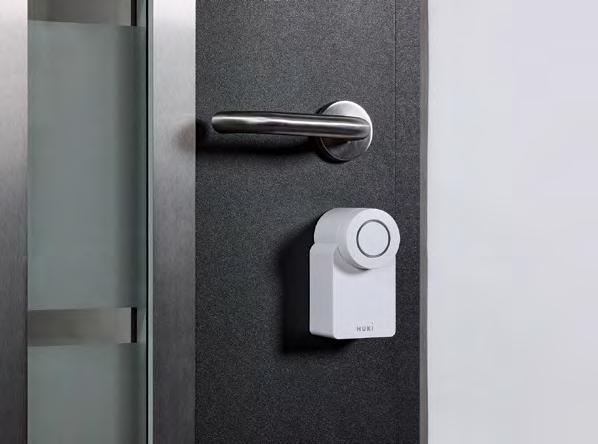
Smart Locks in the Residential Sector
FROM STYLISH ADD-ON TO INFRASTRUCTURE COMPONENT
Smart locks in the residential sector have come a long way from being a practical but non-essential add-on to becoming an operational tool from which users now rightly expect a great deal. As market adoption accelerates, the focus has moved beyond convenience toward advanced control, reliability, and system-level performance
n By: Mirza Bahic mirza.bahic@asmideast.com
Smart locks are no longer experimental or high-tech curiosities meant to impress the neighbors. After a phase of gradual adoption shaped by trends and market skepticism, smart locks have entered a stage of structural expansion based on the quality of their functionality and proven scalability.
The numbers illustrate this clearly: the market recorded strong growth, with revenues reaching approximately $2.9 billion in 2024 and exceeding $3 billion in 2025. More importantly, residential applications account for a significant share of deployments, driven by the integration of smart locks into smart home ecosystems and new-build developments. All indicators point to the conclusion that this technology has moved beyond niche use and become a dominant segment of physical security in residential environments.
No Longer a Gadget
This global momentum is particularly visible in the EMEA region. According to Statista, the EMEA region is expected to see an additional 33.3 million smart lock units between 2026 and 2029—a trend Yale, part of the ASSA ABLOY Group, interprets as a shift away from perceiving smart locks as optional “gadgets” toward their gradual acceptance as standard components of residential infrastructure. This growth paints a picture that extends beyond merely recording an increase in demand. It signals a change in the philosophy of access control in residential environments. Smart locks are increasingly embedded in smart home ecosystems, replacing physical keys with digital authentication and enabling remote management. All of this is supported by access that is individualized for each user and can be monitored in real time. In practical terms, access is no longer defined by the lock as a physical device, but by identity, permissions, and connectivity. Although global, this transformation is not uniform. In Europe, expansion is shaped by retrofit needs, with around 18 million installations in 2024, 60% of which are in residential buildings. An ageing housing stock, energy efficiency requirements, and fragmented infrastructure define both the pace and complexity of implementation.
In contrast, the Middle East and Africa account for more than three million installa-
tions and are characterized by greenfield construction, luxury residential projects, and state-backed developments, where smart locks are often integrated from the earliest stages.
This process has redefined the role of the smart lock within an equally smart home as the core unit of the modern residential sector. The smart lock is no longer a standalone device, but part of a broader access system that intersects with building management technologies, user experience, and operational efficiency.
Part of Operational Infrastructure
The transition to smart locks is no longer driven solely by convenience. It is increasingly based on the perception that this technology represents an operational necessity in residential environments, although awareness levels still vary. In single-family homes, smart locks remain closely associated with convenience, particularly through eliminating physical keys and simplifying access for multiple users. As Juan Ashida, SVP & Head of Residential Segment EMEIA at ASSA ABLOY, explains, “Single-family homes currently represent the largest and most commercially significant seg-
PRODUCTS & SYSTEMS
ment for smart lock adoption in EMEIA… While convenience is the primary driver of adoption, security benefits increasingly reinforce long-term usage and trust.”
This shift is even more pronounced in multi-dwelling and managed residential environments, where smart locks move beyond convenience and become infrastructure. Agnieszka Filipowicz, Business Development Manager for Central and Eastern Europe at Salto Systems, notes that “smart locks have clearly transitioned into operational infrastructure in multidwelling environments such as build-torent developments, co-living spaces, student housing, and serviced apartments.”
Here, the focus shifts from individual devices to system-level efficiency. Remote tenant onboarding, keyless entry and exit, and integration with property management systems reduce administrative burden. At the same time, access logs increase accountability in shared environments.
The same applies to contractors and service personnel. In managed buildings, access rights must be assigned, monitored, and revoked without physical key exchange. Technologies such as Salto Virtual Network (SVN) and BLUEnet enable remote updates across large portfolios, reducing dependence on mechanical systems.

Once users experience smart access in practice, they rarely return to physical keys. The difference in perceived convenience between the two technologies remains insurmountable, but the key question is how quickly that boundary will be crossed in the case of smart locks
PRODUCTS & SYSTEMS
A similar approach is visible in advanced projects in the Middle East. Karam Hamadeh, Managing Director of Technical Product Solutions (TPS), states that “the smart lock is no longer a feature in the brochure; it is part of the building’s operational infrastructure.”
Short-term rental operators provide a clear example. Credential-based access has become standard, not only for convenience but for generating audit trails that are critical in incident investigation and legal contexts. Access thus becomes a continuous process involving credential issuance, activity tracking, and the elimination of cumbersome logistics associated with physical keys.

Juan Ashida, SVP & Head of Residential Segment EMEIA, ASSA ABLOY
At the individual level, this also changes risk management. Martin Pansy, cofounder and CEO of Nuki Home Solutions, explains that “losing a mechanical key necessitates a costly and time-consuming replacement of the entire cylinder… losing a smartphone… allows the user to simply withdraw the digital access permission instantly and generate a new one.”
ROI Measured in Efficiency, Not Price
As the role of smart locks evolves, so does their economic logic. Return on investment is no longer defined by initial cost, but by long-term operational efficiency as they reduce ongoing maintenance costs, improve tenant satisfaction, and simplify property management processes.
In new-build projects, the case is straightforward. Integration during the design phase reduces installation complexity and enables standardization across units.
Ashida also highlights home offices as a specific use case for smart locks in single-family homes. These are households in which several people need reliable and flexible access at different times, making digital credential management a practical, rather than merely theoretical, advantage.
Beyond direct savings, the integration of smart locks can strengthen the perceived value of a property and its market differentiation. Concrete gains can come through higher sale prices or rental income in competitive residential markets. “In new-build projects, the economic case

Agnieszka Filipowicz, Business Development Manager for Central and Eastern Europe, Salto Systems
is straightforward,” says Hamadeh. In managed residential environments, financial benefits accumulate through reduced key management costs, faster tenant onboarding, and a lower need for cylinder replacement. In the case of retrofits, the calculation becomes more complex. Existing doors and integration challenges increase both costs and implementation time.
“Retrofit is a different calculation,” Hamadeh notes. “The hardware cost is similar, but integration complexity increases — particularly in older buildings where frames, wiring, or intercom systems may require modification.” Still, long-term value remains even in such buildings. In private and short-term rental spaces, savings can be achieved quickly through a reduced need for locksmith interventions, while remote access and automation improve usability and control.
Real-world deployment confirms this.
Nuki Home Solutions reports more than 600,000 smart locks in use and over two billion locking operations annually, in-

Karam Hamadeh, Managing Director, Technical Product Solutions (TPS)
dicating not just adoption but continuous reliance on the technology.
Mobile Access as the Desired Standard
The smartphone has moved from optional to primary access tool in many residential environments. “Mobile access, using a smartphone as a key, has increasingly become a standard expectation in the mid to high-end residential segment,” explains Ashida.
However, adoption is uneven. “Concerns about battery failure, device loss, or distrust of the technology are real and should not be dismissed,” says Hamadeh. Resistance is stronger among older users, in households, and in environments with less developed digital infrastructure. Technical barriers persist. “At the infrastructure level, legacy intercom and access control ecosystems in older buildings create integration friction that slows adoption. The technology is ready; the installed base is not always,” Hamadeh
Rapid Return on Investment
“Return on investment is often realized almost immediately,” says Pansy. Part of this value lies in everyday risk management. Losing a mechanical key usually requires replacing the entire cylinder, while digital credentials can be revoked and reissued instantly. Francisco Javier Boter Vidal, European Product Marketing Manager for Security at ZKTeco, says that “smart locks are becoming increasingly economically justified in both apartments and houses, particularly where enhanced security and convenience can reduce insurance premiums and operational costs.”
The new-build segment is also undergoing profound changes in the way smart access control systems are delivered. One example is Nuki’s Smart Module solution, in which digital access is integrated almost invisibly into the door itself, without visible components and without the need for battery replacement, as the module is permanently powered.
The Key Will Become a Nostalgic Relic
Solutions from Salto Systems extend mobile access to wearable devices, enabling the use of smartwatches and similar devices alongside smartphones. This is an important detail that further expands the range of credentials and prevents reliance on the phone as the sole access device.
Biometric authentication is also part of the picture, including fingerprint and facial recognition. It is gaining particular traction in the higher-end and more technologically advanced segment of the smart lock market. ZKTeco, for example, is focusing on the development of palm vein recognition and related technologies. However, Francisco Javier Boter Vidal notes that in Europe, the barriers are often less technological and more regulatory in nature. ZKTeco and similar manufacturers are already prepared for the large-scale deployment of advanced biometric solutions, but what is lacking is adequate and harmonized regulation to support this in practice.
“Advancements in biometrics and AI will drive innovation, making smart locks even more secure and user-friendly,” he says. This could also mean that the focus of technological development will shift toward reducing interaction with the lock itself. Technologies such as Ultra-Wideband (UWB) enable proximity-based authentication, where the system recognizes the user’s arrival and automatically unlocks the door.
“The physical key will become a nostalgic relic,” says Martin Pansy, adding that the future lies in access being authenticated seamlessly and in the background.
states. Reliability of connectivity and interoperability between platforms also remain limiting factors. Hybrid models are emerging as a practical solution. “Interestingly, many users
prefer a hybrid access model rather than relying on mobile access alone,” says Ashida. In practice, the hybrid model usually combines access via phone, physical keys, and keypad entry as three types of
credentials for different user profiles and situations within the same household. Agnieszka Filipowicz points to integration with Apple Wallet as a way to reduce resistance, combining BLE and NFC technologies within a familiar and trusted environment and making the transition from physical keys to smart locks easier.
Why Users Still Hesitate
Despite rapid adoption, limitations in the wider deployment of smart locks remain a reality in the field. “Power dependency remains the most significant operational vulnerability,” Hamadeh points out. This is particularly pronounced in extreme climate conditions. In the GCC region, where summer temperatures regularly reach very high levels, battery failure moves from a potential inconvenience to a real operational risk. This makes backup provisions and careful hardware selection a key step in every implementation. Battery failure, ambient conditions, and system errors can disrupt smart lock access if they are not accompanied by appropriate safety mechanisms. In response, modern systems offer certain risk-mitigation measures. In smart locks, these include low-battery alerts and built-

The
EMEA region is expected to see an additional 33.3 million smart lock units between 2026 and 2029—a trend Yale, part of the ASSA ABLOY
Group, interprets as a shift away from perceiving smart locks as optional “gadgets” toward their gradual acceptance as standard components of residential infrastructure
PRODUCTS & SYSTEMS
Smart
locks are becoming part of interconnected systems that extend across residential environments. They can serve as triggers for coordinated responses involving lighting, climate control, and security systems, resulting in residential spaces
that respond more quickly to changes in real-world conditions
in fail-safe mechanisms. To further reduce operational risk, these technologies have become standard in more advanced platforms.
Cybersecurity is another persistent issue. As connected devices, smart locks are exposed to risks linked to cloud services and network vulnerabilities. There are also user concerns around privacy protection, which continue to affect the pace of this technology’s deployment in the residential sector.
“Customer hesitations are completely understandable: After all, it’s about access to a particularly sensitive place – your own home,” Pansy notes. The cybersecurity discussion is significant enough to be addressed frequently at major industry trade fairs. This shows that these ques-
Proof Through Use


tions are not limited to consumers, but also concern manufacturers seeking to offer answers in different ways.
Some solutions respond to these challenges through design. Systems installed on the inside of the door reduce physical exposure, while other smart locks support operation without mandatory cloud connectivity. This limits data sharing and strengthens control in the hands of users.
Nuki also relies on this approach. With its solutions, a user account is not required, data is not automatically stored on servers, and the lock can also operate via Bluetooth, without the need for cloud or Wi-Fi connectivity. Encryption is based on a challenge-response mechanism comparable to online banking standards,
The development of smart locks has a clearly defined direction, but their success will not depend exclusively on technology. As with other integrated systems in buildings, intelligence in access management must prove itself through measurable results. This primarily refers to reliability, usability, security, and integration. User behavior data supports this direction and sends encouraging signals when it comes to smart locks in the residential sector. Once users experience smart access, they rarely return to physical keys. The difference in perceived convenience between the two technologies remains decisive, but the key question is how quickly that boundary will be crossed in the case of smart locks. Another factor gaining importance is education and raising user aware ness, which is often an overlooked component of the next phase of smart lock technology adoption. Instead of focusing on the availability of the devices themselves, the speed of the transition toward this technology in the residential sector will be determined by understanding the benefits and practical uses of smart locks. Ultimately, smart locks will not replace traditional systems only through the new functions they offer. They will do so by showing that they can manage access more efficiently in increasingly complex residential envi ronments, while maintaining the delicate balance between conve nience and control, and between innovation and trust.
while each device undergoes independent laboratory testing. At the same time, installation on the inside of the door means that the lock is invisible and inaccessible from the outside, without affecting the existing level of security.
Acceptance of the technology in mixed residential buildings also requires active management beyond the technology itself. “Technology alone does not drive adoption — onboarding, training, and support are essential,” says Hamadeh. This is particularly important in buildings occupied by user profiles with different levels of digital literacy. Smart lock networks operating within fragmented ecosystems also face problems, as these ecosystems limit seamless compatibility between platforms and systems inside the building.
Agnieszka Filipowicz also points to credential lifecycle management as a technical challenge that is often overlooked in the wider deployment of smart locks in the residential sector. The goal is not only to ensure that access rights are issued, updated, and revoked securely, but also that this can be done at sufficient scale across different devices and user profiles without creating parallel security gaps.
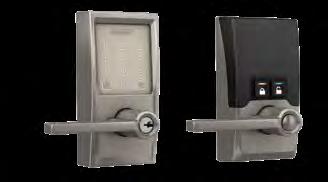
Martin Pansy, Co-founder & CEO, Nuki Home Solutions
Francisco Javier Boter Vidal, European Product Marketing Manager for Security, ZKTeco
Losing a mechanical key necessitates a costly and time-consuming replacement of the entire cylinder, but losing a smartphone allows the user to simply withdraw the digital access permission instantly and generate a new one
PRODUCTS & SYSTEMS

Finally, security pro gress in the world of smart locks is cur rently expected in three concrete areas. These are enhanced encryption protocols, secure elements built into hard ware, and more robust iden tity management frameworks.

Integration as the End Goal
If there is one direction in the development of smart locks that has the potential to bring everything together, it is certainly

integration. “Smart locks will increasingly operate as nodes within a broader building intelligence layer,” Hamadeh explains. This vision also extends to adaptive access policies. This means that systems will respond to user behavior and risk context instead of operating according to fixed rules. For even better results, they will also be connected to visitor management systems and BMS platforms.
“Platforms such as SALTO Homelok will continue to evolve, offering deeper integration with property management, smart

home, and building management systems via APIs,” adds Agnieszka Filipowicz. In the Middle East, this trend is already moving beyond individual buildings. Largescale mixed-use projects and smart city concepts are being developed from the ground up, creating an opportunity to embed intelligent access into city infrastructure itself. This degree of integration has already been considered and planned in the region for some time.
Smart locks are becoming part of interconnected systems that extend across residential environments. They can serve as triggers for coordinated responses involving lighting, climate control, and security systems, resulting in residential spaces that respond more quickly to changes in real-world conditions.
However, integration remains incomplete. Fragmentation of technologies and inconsistent standards still limit the development of fully unified residential environments. According to Hamadeh, all these trends clearly describe the end goal: the convergence of mobile, biometric, and cardbased access into a single interoperable platform. Leading manufacturers are already working at this level, while wider adoption in the residential sector is the inevitable next step. n
Physical Security Information Management
INTERPRETING REALITY WITHOUT A MAGIC WAND
Physical Security Information Management (PSIM) platforms are no longer evaluated by the number of systems they can connect. Instead, the focus is on their ability to reliably transform fragmented infrastructure into an integrated operational environment. As PSIM matures through real-world deployments, interoperability is defined less by connectivity and more by data consistency, organizational alignment, and the boundaries of openness within the security ecosystem

n By: Mirza Bahic mirza.bahic@asmideast.com
The rapid growth of PSIM platforms reflects a structural shift in how technical security systems are implemented and managed. According to Business Research Company, the global PSIM market reached $1.95 billion in 2025, with a projected annual growth rate of 16.4% and an estimated value of $4.17 billion by 2030. These figures are primarily driven by the need to unify increasingly complex security environments with a growing number of vendors.
At the same time, both the volume and diversity of data generated by technical
security systems continue to expand. Modern projects routinely combine video surveillance, access control, intrusion detection, fire protection systems, analytics, and IoT sensors within a single ecosystem. Each of these components generates its own logic of security events and data structures. As a result, what appears at the user interface level as convergence is often, at the data level, little more than masked fragmentation. However, market growth alone does not resolve the core challenge associated with PSIM technology. Integration remains a persistently difficult barrier to broader adoption, especially in environments where legacy systems, proprietary
protocols, and fragmented ownership structures intersect. This creates a paradox: the more systems are implemented, the greater the need for integration, but also the greater the complexity of achieving it.
In other words, PSIM is evolving amid technological tension. It is no longer defined by the promise of connecting systems, but by its ability to manage an increasingly complex operational reality.
The Profile of PSIM
PSIM has long positioned itself as a layer that unifies security and BMS systems into a single operational reality. In market-
ing presentations, this vision appears straightforward, but in real-world projects, it often diverges from reality.
Ben Eazzetta, CEO and Founder of ARES Security Corporation, says the industry has come closer to delivering on its promises, but only under certain conditions. “While the industry has historically faced gaps between marketing claims and operational reality, today’s mature PSIM platforms are capable of delivering deep, functional integration across diverse systems.” He further clarifies what this capability actually entails, in order to properly set expectations among
stakeholders. “The real impact comes not from the brochure, but from how the platform is architected, integrated, and aligned with the client’s operational environment.”
Roman Prokoshkin, Global Product Lead at TRASSIR, takes a more neutral stance. “Interoperability is always tested against reality – and that reality is usually more complex than any brochure can fully describe.” In his experience, PSIM projects almost always go through proofof-concept or pilot phases, precisely because integration outcomes depend on variables that marketing cannot fully capture. These include API quality, firmware versions, system architecture, and even

the responsiveness of third-party manufacturers. From this perspective, interoperability in PSIM systems is unquestionable, but also conditional, context-dependent, and rarely immediately available.
Integration as Interpretation, Not Connection
Interestingly, at a technical level, basic connectivity in the PSIM context is becoming easier to achieve, while its operational alignment with real-world requirements remains a key obstacle. “The most common challenges are not about whether systems can connect, but how
PRODUCTS & SYSTEMS
cleanly they communicate,” says Eazzetta.
Differences in legacy infrastructure of varying ages, proprietary protocols, cybersecurity requirements, and inconsistent data structures present challenges even when users achieve a unified interface.
Maxim Kabenin, Product Director at AxxonSoft, views the same issue through the lens of system semantics. According to him, each subsystem—including access control, fire detection, intrusion detection, and video analytics—defines its own logic of alarms and device states. Bringing them under a single umbrella does not mark the end of the process. “Someone has to normalize it. Otherwise, operators just see a stream of unrelated events.”



PSIM as a Mirror of Systems and Processes
At this point, PSIM ceases to be merely an integration layer, as that role is no longer sufficient. In practice, PSIM must become a technological layer for interpretation—translating signals into a common operational language before they can support decision-making.
A complicating factor is that standards address this issue only partially. While protocols such as ONVIF, OPC, BACnet, SNMP, and Modbus enable basic connectivity, Kabenin stresses that “once you go beyond basic connectivity…you often run into vendor-specific implementations again.” Integration thus becomes a hybrid process that combines standards with custom mapping, extensions, and upgrades.
The Weakest Link in the System
Technical complexity alone cannot fully explain the challenges within a PSIM project. In many cases, the greater issue lies within the organization itself. “Interestingly, the biggest challenges are often not technical but organizational,” says Sergej Pičulin, Business Development and Sales Manager for Southeast Europe at Advancis, a view echoed by Eazzetta, who adds that “in many projects, organizational obstacles can outweigh technical ones.” Misaligned processes, siloed teams, and
User expectations have evolved significantly in recent years, though not always in a realistic direction—a topic that is rarely discussed openly. Modern users increasingly view PSIM as a platform for situational awareness. For them, PSIM is where video surveillance, alarms, access control events, and operational data converge into a single interface. The appropriate response to such expectations is to explain that PSIM delivers value through event correlation, guided operator workflows, and improved response times. However, client expectations often exceed what technology can deliver.
Kabenin notes that some users expect PSIM to “automatically manage the entire security infrastructure and make decisions independently.” In reality, any platform of this type depends heavily on configuration, workflows, and human operators. Eazzetta draws this boundary clearly: “It is a powerful operational mechanism, but its effectiveness depends on the strength of the systems and processes behind it.” According to him, PSIM often functions as a mirror of existing systems and processes, rather than a replacement for them.
undefined incident management workflows often create more operational friction than system compatibility itself. Security, IT, and facilities management departments typically operate separately, each controlling different segments of infrastructure. Florin Marica, Director at UltraVision Consult, further summarizes this perspective: “In practice, technical challenges are solvable – the real complexity lies in aligning processes, responsibilities, and operational expectations within the organization.” His colleague Prokoshkin goes a step further, framing organizational alignment as a requirement that must be addressed at the project level. Coordination between depart-
What appears at the user interface level as convergence is often, at the data level, nothing more than masked fragmentation
ments and clearly defined responsibilities are not secondary elements, but “an essential part of integration planning.” In this sense, PSIM becomes more than a software platform—it becomes a mechanism that reveals whether an organization truly understands how it operates.
Configuration as the Turning Point
If integration is the starting point, configuration is where the fate of a PSIM project is decided. Eazzetta notes that “in most projects, the effort primarily sits with the integrator,” and that the level of configuration depends on the diversity of the hardware ecosystem. When clients introduce new or less familiar technologies, additional connectors often need to be developed to preserve a unified operational environment. According to him, this
Florin Marica, Director, UltraVision Consult
Maxim Kabenin, Product Director, AxxonSoft
Ben Eazzetta, CEO and Founder, ARES Security Corporation

Sergej Pičulin, Business Development and Sales Manager for Southeast Europe, Advancis

Roman Prokoshkin, Global Product Lead, TRASSIR
principle must be clear and uncompromising: “if it exists, it can be integrated.”
Even when integrations are supported, integrators must still define event mapping, develop cause-and-effect logic, configure dashboards, and align system responses with operational workflows. Configuration can also be segmented across systems, meaning certain parameters remain within vendor-specific software rather than within the PSIM layer itself.
According to Advancis, most functions can be implemented through standard configuration tools, but only if integrators properly define workflows, alarm-handling procedures, and visualization. Custom implementation is typically reserved for
highly specialized systems or unique operational requirements found in the field.
In such a complex environment, the question of responsibility becomes critical. According to Prokoshkin, successful integration depends on three parties: the PSIM platform manufacturer that provides integration capabilities, third parties that ensure stable APIs and documentation, and integrators who implement and adapt the system. If any of these elements weaken, integration becomes unpredictable.
The pattern is clear. PSIM cannot eliminate complexity with a magic wand—that is impossible in today’s technological landscape. Its role is fulfilled if it successfully reorganizes that unavoidable complexity and makes it more “digestible”.
PRODUCTS & SYSTEMS
Open Standards Are Not Omnipotent
In this context, much is said about the potential of open standards, often presented as a universal solution to integration challenges. In practice, our interviewees warn, they are only part of the puzzle, and overestimating them can lead to failure and disappointment. ONVIF is a key enabling factor in the video surveillance world, allowing cameras from different manufacturers to connect without proprietary drivers. Standardization is also a step forward in the API domain as a foundation for scalable multi-vendor environments.
Standards deliver tangible operational outcomes. Standardized APIs facilitate the introduction of new systems, enable scaling across locations, and simplify data integration into a unified operational picture. They also support governance through authentication, role-based access control, and activity logging. However, this openness rarely extends to advanced functionality.
Kabenin notes that advanced capabilities, such as access control logic, credential management, or specialized analytics,
Integration becomes a hybrid process that combines standards with custom mapping, proprietary extensions, and upgrades
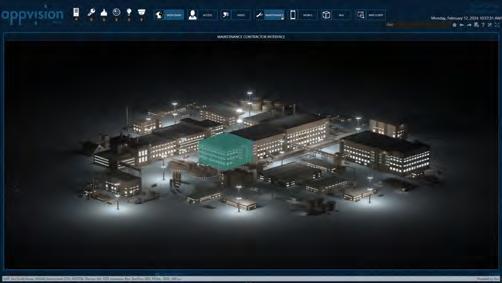
PRODUCTS & SYSTEMS
often remain “locked” within vendor-specific implementations. Prokoshkin shares a similar view, noting that functions such as analytics metadata or complex alarm workflows often require proprietary extensions. Marica identifies the same pattern from another angle, pointing to subtle forms of vendor lock-in in rights management models, incomplete APIs, and licensing constraints.
Access control stands out as a particularly challenging area. Unlike video surveillance, which benefits from ONVIF, access control lacks a widely accepted standard for event models and logic. As a result, integration in this segment often depends on custom drivers, vendor APIs, and careful alignment of different system architectures. All of these point to a persistent issue of vendor lock-in that has not disappeared, but has instead shifted deeper into system functionality.
Why Some Projects Fail While Others Succeed
The difference between successful and problematic PSIM projects is rarely purely technological. Large, multi-system environments almost always present the greatest challenges—airports, smart cities, and transport networks among them. These environments often combine legacy systems, multi-vendor technologies, and fragmented ownership structures. In such contexts, Kabenin notes that “coordination efforts can actually take longer than the technical integration itself.” Pičulin highlights additional constraints, including incomplete documentation and systems that were never designed for integration. By contrast, environments with centralized decision-making and standardized technology stacks tend to perform better. Retail chains and campus environments typically deliver more stable and predictable outcomes when integrated with PSIM. In one project carried out by a certified integrator with support from UltraVision engineers, the scope included securing the perimeter of an international airport in Eastern Europe. The technical setup involved IP video surveillance with analytics, perimeter intrusion detection, access control, specialized infrared and radar cameras, IP audio, and communication systems.
Despite the extensive list of systems, the primary challenge was organizational. The system had to simultaneously support multiple user groups, including airport se-


Configuration is where the fate of a PSIM project is decided
curity staff, infrastructure maintenance teams, border police, homeland security services, IT administrators, and external service providers. Each group had its own operational scenarios, access rights, and procedural requirements. Aligning these elements, Marica notes, was the true source of complexity. The success of PSIM, therefore, depends less on the number of integrated systems and more on how effectively they are managed.
Where the Industry Still Falls Short
Despite clear progress across all aspects of PSIM, one structural limitation remains unresolved: the lack of consistency within the security ecosystem. AxxonSoft points to the need for standardizing security event models, noting that definitions of alarms, priorities, and automation logic still vary significantly across vendors. Pičulin argues that fully documented and standardized APIs would make integration more predictable and efficient. Greater transparency in data models, event struc-
tures, and API documentation, along with a shift toward interoperability-focused ecosystems, is also seen by Prokoshkin as an area of strong potential. However, the solution may not lie solely in technology or practice. Eazzetta proposes a broader approach, centered on the creation of a “trusted and accredited integration community.” Within such a framework, manufacturers and integrators would share validated architectures and accumulated experience, rather than repeatedly solving the same problems in isolation.
Mandatory Direction: From Connectivity to Coherence
Given all of the above, the next step for PSIM is unlikely to focus on connectivity, where the industry has already made visible progress. What remains unresolved— and where improvement is still needed—is consistency, transparency, and shared understanding across the ecosystem. This distinction is becoming increasingly important. As security infrastructures expand, the challenge is no longer how to
Different
Architectures and Philosophies of Integration
While all manufacturers agree on the importance of integration, their approaches reveal different philosophies in how it should be managed. ARES emphasizes breadth and adaptability, supported by a continuously expanding library of integrations and a consulting-driven approach. This type of support allows the technology to be more easily aligned with the management structures and operational culture of clients in the field. AxxonSoft, on the other hand, follows an engineering-driven model. It is built on the long-term accumulation of integrations, protocol support, and communication at the hardware level. Within this approach, interoperability emerges as the result of continuous technical development over an extended period. Advancis approaches the issue through structure and neutrality. Its WinGuard platform is designed as a framework that integrates a broad range of technologies while maintaining clear workflows and operational consistency. Collaboration between manufacturers and users is also a key focus.
TRASSIR emphasizes predictability within its own ecosystem. For them, interoperability must remain stable and predictable within a single environment, reflecting a strategy that prioritizes reliability and performance through tighter integration. These approaches highlight the wide spectrum of strategies shaping PSIM’s role in the market. Openness, predictability, flexibility, and control are not always aligned in practice, and each manufacturer seeks to balance these factors in its own way.
connect systems, but how to ensure that the data and signals they produce can be interpreted consistently. Only such an approach allows these inputs to be effectively used in operations. Security events must carry the same meaning across platforms, meaning that data must retain its structure and context as it moves between systems. At the same time, operational logic must be clear enough to
support decision-making under pressure. In that sense, PSIM is undergoing a quiet but decisive transformation. It is no longer defined by its ability to connect systems, but by the platform’s capacity to align them and make them function meaningfully within a shared operational environment. This shift places balanced emphasis on technology, data, and organization. Platforms can aggregate information, but they
Advanced capabilities, such as access control logic, credential management, or analytics, often remain “locked” within vendor-specific implementations
still cannot fully resolve inconsistencies in how systems describe events. They can visualize incidents, but they cannot compensate for unclear workflows or fragmented ownership. Ultimately, platforms can orchestrate responses, but only if their underlying logic is properly defined. For this reason, the future of PSIM will depend less on adding new integrations and more on improving the conditions under which integration takes place. Standardized event models, clearer and more accessible APIs, better documentation, and stronger collaboration between manufacturers, integrators, and end users are no longer optional improvements—they are structural requirements. Experience has shown that PSIM platforms are technologically ready for this task, while the ecosystem in which they operate must catch up to achieve optimal results. n
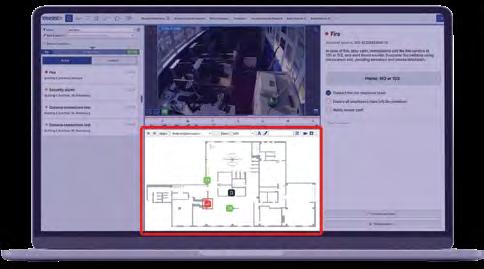
Access Control
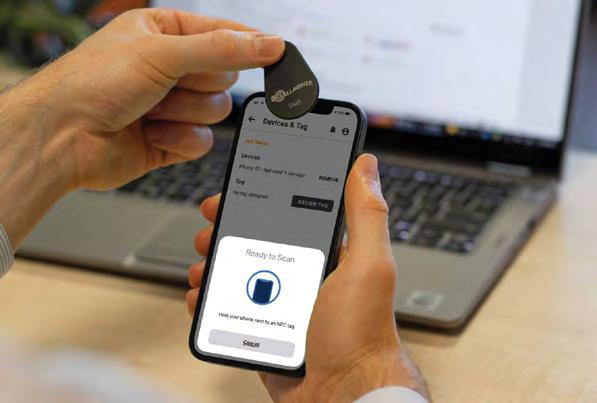
RESILIENCE THAT CAN WITHSTAND REAL-WORLD CHALLENGES
As access control systems become more deeply integrated with identity management platforms, HR systems, video surveillance, and cloud-based applications, the question of reliability during outages or data mismatches has become central for physical security professionals
n By: Prasanth Aby Thomas, Consultant Editor, asmag.com editorial@asmideast.com

For systems integrators and consultants, resilience is no longer an optional feature. It is a design principle. Recent expert insights from Hanchul Kim, CEO of Suprema, Steve Bell, Strategic Technology Advisor at Gallagher Security, and Gaoping Xiao, Director of Sales-APAC at AMAG Technology, highlight a consistent message: access control systems must be architected to operate predictably and securely, even when parts of the ecosystem fail.
Designing With Disruption in Mind
Modern access control systems rarely operate in isolation. They are connected to identity providers such as Microsoft Entra ID or Okta, HR systems that act as authoritative identity sources, and often to video management systems for event verification. This interconnectedness increases operational efficiency, but it also introduces dependencies. If a network connection fails or an upstream database is temporarily unavailable, doors still need to function safely and consistently. Steve Bell frames the issue clearly. “Reliable access control systems should be designed with disruption in mind, not as an exception,” he said. According to Bell, integrators and end users should adopt a risk-based approach. “Integrators and customers need to take a risk-based approach to determine which functions must remain operational during outages or disaster scenarios. In many environments, maintaining safe and controlled access to people and critical areas is more important than secondary capabilities such as video monitoring.” For integrators, this means identifying critical doors, sensitive areas, and life safety considerations at the design stage. The goal is to ensure that authentication and authorization decisions can continue even if central servers, cloud platforms, or network links are unavailable.
Distributed Intelligence at the Edge
One of the key architectural approaches discussed by all three experts is dis-


The Role of Centralized Architectures
While distributed systems are increasingly favored, centralized architectures still have a role to play. Kim points out that architecture selection should be driven by site requirements. “Centralized architectures still have a place. Panel-based systems with two-door or four-door controllers remain appropriate in certain environments, and we support those models as well. The key is choosing an architecture that matches a site’s operational and regulatory requirements.” For consultants, this highlights the importance of tailoring system design to the client’s regulatory obligations, operational complexity, and risk profile. In some environments, panelbased controllers with centralized oversight may align better with compliance or legacy infrastructure.
Gaoping Xiao reinforces the need for distributed capabilities at the panel level. “First, integrators should design systems with a distributed architecture, ensuring that access control panels can continue to operate independently even if servers or databases are temporarily unavailable. This ensures that existing cardholders and credentials remain functional during outages.”
tributed intelligence. Hanchul Kim describes Suprema’s approach as intentionally practical. “Suprema has taken a deliberately pragmatic approach when it comes to reliability. In distributed architectures, each smart reader can operate as an independent node, storing authorization data locally and continuing to make access decisions even if connectivity is interrupted. This allows doors to keep operating safely and predictably during outages.”
In this model, the reader or controller at the door holds sufficient credential
and authorization data to validate users without real-time communication with a central server. For integrators, this reduces reliance on constant network connectivity and minimizes the risk of widespread disruption caused by a single point of failure. Bell echoes this distributed approach. “This resilience is achieved by distributing intelligence across the system so that authentication and access privileges can continue to be enforced for extended periods, even when central systems or connectivity are unavailable.”
The practical takeaway for integrators is that resilience can be built at multiple layers. Whether intelligence resides primarily in smart readers, door controllers, or panels, the critical factor is the ability to continue enforcing access decisions locally
Gaoping Xiao, AMAG Technology
Hanchul Kim, Suprema Steve Bell, Gallagher Security
PRODUCTS & SYSTEMS
For integrators working in critical infrastructure, healthcare, data centers, or manufacturing environments, this capability is essential. Extended outages are not theoretical scenarios. They can occur due to power failures, cyber incidents, or maintenance events. A system that relies entirely on centralized decision-making can become a liability under such conditions.
Establishing a Single Source of Truth
Beyond hardware architecture, identity management practices are equally critical. As access control systems integrate with enterprise IT platforms, inconsistencies between systems can arise. Data mismatches between HR systems, identity providers, and physical access databases can lead to delayed revocations, incorrect permissions, or audit gaps. Kim stresses the importance of clarity in identity ownership. “Whether organizations use an identity management platform such as Microsoft Entra ID or Okta, or rely on an HR system as the authoritative source, what matters most is that there is a clearly defined single source of truth. When identity ownership is unambiguous, access control systems can remain consistent and predictable even when upstream systems are temporarily out of sync.”
For integrators, this means engaging early with IT stakeholders. During system design, it is critical to define which
platform owns identity data and how synchronization processes function. Without a clearly designated authoritative source, temporary outages can create confusion about which credentials are valid. Designing for resilience therefore includes both physical hardware redundancy and logical data governance.
Managing Data Mismatches and Recovery
Outages are not the only challenge. Data mismatches between systems can also undermine reliability. Xiao emphasizes the importance of recoverable integra-
tions. “Second, integrations between identity sources and connected systems should be designed to be recoverable, with clear backup and resynchronization procedures in place. In the event of data mismatches or outages, identities should be able to be restored or resynced in a controlled and auditable manner.”
For consultants advising enterprise customers, this raises several practical considerations. Are synchronization logs retained? Is there a defined procedure for reconciling discrepancies? How are changes tracked and audited? An access control system that resumes operation after an outage but leaves in-
Building Multi-Layered Redundancy
In addition to distributed intelligence and data governance, redundancy at multiple system levels is a recurring theme. Bell highlights the importance of layered resilience. “Well-designed access environments build redundancy at multiple levels - including controllers, readers, and supporting infrastructure - so core access control can continue operating during events such as power loss, network outages, or cyber incidents.” For integrators, this can include redundant power supplies, battery backups, network failover mechanisms, and segmented architectures that prevent a single cyber incident from disabling the entire system. Bell also links physical access design to broader organizational planning. “Aligning physical access design with broader operational resilience planning is what separates systems that work in theory from those that perform reliably in the real world.” This alignment is increasingly relevant as organizations adopt enterprise resilience frameworks. Physical security professionals must coordinate with IT, facilities, and risk management teams to ensure that access control systems support overall business continuity objectives.


consistent permissions in place can create compliance and security risks. Controlled resynchronization and auditability are therefore essential components of a resilient design.
Kim underscores that resilience is about operational continuity under imperfect conditions. “In practice, designing for reliability is less about preventing every outage or mismatch and more about ensuring that access decisions remain auditable and secure when those situations occur.” For integrators, this reframes reliability as a management issue rather than purely a technical one. Systems must be designed to behave predictably, generate reliable logs, and support postevent review.
Selecting Proven Solutions and Support Structures
Technology design alone does not guarantee reliability. Implementation quality and ongoing support are also decisive. Xiao advises integrators to prioritize proven ecosystems. “Finally, integrators should deploy proven solutions supported by certified system integrators and manufacturer-backed support programs, ensuring long-term reliability, and operational confidence.” For consultants, this means evaluating not only product specifications but also vendor support capabilities, firmware update processes, and long-
Suprema has taken a deliberately pragmatic approach when it comes to reliability. In distributed architectures, each smart reader can operate as an independent node, storing authorization data locally and continuing to make access decisions even if connectivity is interrupted
term roadmap alignment. Access control systems are long lifecycle investments. Choosing platforms with robust support structures can reduce the risk of operational instability over time.
Practical implications for integrators
Taken together, the expert perspectives converge on several practical design principles for integrators and consultants:
- Adopt a risk-based approach to identify critical functions that must remain operational.
- Distribute intelligence so that authentication and authorization can continue locally.
- Match architectural models to regulatory and operational requirements.
- Establish a clearly defined single source of truth for identity data.
- Design integrations with backup, resynchronization, and audit capabilities.
- Implement redundancy across controllers, readers, power, and network infrastructure.
- Align access control strategy with broader resilience planning. As access control systems become more integrated and data-driven, resilience must extend beyond door hardware. It encompasses identity governance, system interoperability, and coordinated incident response. For physical security professionals, the objective is not to eliminate every possible failure. It is to ensure that when disruptions occur, doors behave predictably, access decisions remain secure, and the organization maintains control. In an increasingly connected security environment, reliability is no longer defined solely by uptime. It is defined by how well systems continue to function under stress, how transparently they recover, and how confidently integrators can stand behind their designs. n

COMMUNICATION INFRASTRUCTURE AS A SECURITY IMPERATIVE IN THE MIDDLE EAST
As geopolitical uncertainty and infrastructure expansion reshape the Middle East’s security priorities, organizations are rethinking the role of communication systems in protecting people, maintaining operational continuity, and enabling coordinated emergency response
n By: Ajeeb Jamal, Channel Sales Manager, ScreenCheck ajeeb.jamal@centena.com
Consider a scenario that unfolds with uncomfortable regularity across the region’s busiest institutions. A fire panel triggers in a multi-building hospital complex. The alarm sounds in one wing. Three others continue operating normally, with staff unaware, patients unprotected, and evacuation routes uncommunicated. The fire system did exactly what it was designed to do. The problem was everything that was not connected to it.
This is not a hypothetical. It is the lived operational reality for hundreds of facilities across the GCC that continue to run fragmented communication environments where fire detection, access control, and public address systems each operate in isolation, and where no single incident triggers a coordinated response.
Security Beyond the Perimeter
Across the Middle East, the conversation around security is changing rapidly. For critical infrastructure operators such as hospitals, universities, logistics hubs, and public institutions, the question is no longer whether a disruption will occur, but how quickly people can be informed, protected, and coordinated when it does. From geopolitical uncertainty and civil emergency preparedness to rapid urban expansion, organizations across the region are under increasing pressure to strengthen operational resilience. In this environment, communication systems once considered secondary infrastructure are now becoming central to lifesafety strategy.
For decades, public address systems were largely associated with routine announcements or basic emergency alerts.
Today, their role has evolved far beyond broadcasting. They are now part of a wider, integrated response ecosystem where speed, accuracy, and coordination define outcomes.
A Region Under Pressure to Perform
The Middle East sits at a rare convergence of forces. Rapid urbanization, government-led infrastructure expansion, and an increasingly complex risk landscape are placing new demands on institutions that were never designed for the scale at which they now operate. The scale of transformation is significant. Abu Dhabi alone is currently managing a capital projects portfolio valued at approximately $200 billion (AED 734 billion), covering more than 500 projects aimed at meeting long-term infrastructure and community growth needs, according to
the Abu Dhabi Projects and Infrastructure Centre (ADPIC) at the Abu Dhabi Infrastructure Summit in May 2026. Across the wider Gulf, parallel investment cycles in healthcare modernization, transport corridors, and education infrastructure are reshaping operational environments at every level.
With that scale comes a fundamental question increasingly faced by safety planners and facility managers: when something goes wrong, can information be delivered instantly, clearly, and to the right people before the situation escalates?
The Legacy System Problem
Most organizations in the region were not built for the answer to be yes. Legacy analog public address infrastructure, often limited to single-console, one-way announcement systems, remains widely deployed across hospitals, campuses, warehouses, and public facilities throughout the GCC. These systems were designed for routine communication, not dynamic emergency orchestration. They do not natively integrate with fire alarm panels. They cannot trigger automated, event-based responses. They struggle to deliver zoned, multilingual messaging across large or multi-site environments. The result is fragmentation that only becomes visible under stress. A panic alarm at an access-controlled gate may not trigger a building-wide response. A hazardous material alert in a logistics hub may rely entirely on manual intervention to broadcast evacuation instructions. A hospital lockdown may require multiple operators across separate systems to initiate even partial communication. In many legacy deployments, there is also limited visibility into the operational status of the infrastructure itself. Faults in amplifiers, speakers, microphones, network links, or control panels may remain unnoticed until a failure occurs during a critical event. Maintenance teams are often forced into reactive troubleshooting with limited centralized monitoring or diagnostics. Modern IP-based public address and voice evacuation systems fundamentally

A Regional Push Toward Centralized Communication
One of the most notable infrastructure trends across the Middle East is the movement toward centralized communication platforms for large-scale public and religious infrastructure. Government entities and religious authorities are increasingly exploring unified IP-based systems capable of synchronizing messaging across distributed networks of mosques and civic institutions, incorporating automated prayer scheduling, standardized audio quality, and centralized compliance archiving. Beyond religious infrastructure, this reflects a wider regional shift toward unified operational control across smart cities, transport systems, and public safety networks.
As urban environments grow more connected, communication infrastructure is increasingly expected to operate as a single coordinated layer, not a collection of isolated, site-level systems.
change this model. Every connected component across the network, including amplifiers, speakers, paging consoles, controllers, and gateways, can report its operational status in real time through a centralized platform. Connectivity issues, device faults, offline units, and communication failures become visible immediately, enabling faster response, simplified maintenance, and improved system reliability across large environments. These are not minor technical limitations. They are structural vulnerabilities that directly impact life safety.
The Human Cost of Fragmented Systems
Abstract discussions around integration gaps rarely reflect what a communication breakdown means in real operational terms. In hospitals, delayed or inconsistent announcements can disrupt emergency coordination and affect patient flow across entire departments. In universities, incomplete lockdown messaging can leave segments of a campus uninformed, exposing students and staff to avoidable risk
through no human error, only system architecture.
In logistics and industrial environments where high noise levels, large-scale operations, and constant movement already complicate communication delays, emergency instruction significantly increases exposure during critical incidents. Seconds matter. Even across large religious and civic infrastructure, the challenge is one of scale and consistency. Coordinating synchronized, high-quality broadcasts across hundreds of locations requires a level of control and reliability that legacy analog systems were never designed to deliver. Across all these environments, the issue is not intent or procedure; it is the inability of disconnected systems to act as one.
The Shift Toward Integrated IP Communication
The industry response to these vulnerabilities is already well underway. IP-based public address and mass notification systems are rapidly becoming the foundation of modern communication infrastructure. Unlike analog systems, these platforms are inherently networked and designed for integration. When connected with fire detection, access control, and video surveillance systems, communication networks become active components of emergency response, not passive tools waiting to be manually activated. A fire alarm can trigger automated, zonespecific evacuation instructions. A security breach can initiate targeted alerts. A hospital emergency code can activate coordinated messaging across multiple departments without any manual intervention. Importantly, this shift does not require full replacement of existing infrastructure. Most deployments follow a phased modernization model, where IP-based headend systems integrate alongside existing amplifiers and speaker networks, enabling gradual migration without operational downtime. For healthcare, education and logistics environments running around the clock, this continuity-first approach is not a preference but a necessity.

“In the past, public address systems were often viewed as standalone infrastructure,” says Shaji Abdul Kadar, COO of ScreenCheck. “Today, organizations across the Middle East are recognizing that communication itself is part of their resilience strategy.”
The Integration Specialist’s Role
Within this evolving landscape, regional systems integrators are playing an increasingly important role. ScreenCheck has operated across the Middle East and Africa for more than two decades, with a presence spanning over 35 countries. The company works across healthcare, education, logistics, and public infrastructure, focusing on modernizing fragmented legacy environments while ensuring compliance with Civil Defense requirements. In practice, that means designing zoned communication architectures, deploying and configuring IP-based mass notification platforms, and integrating them with fire, access control, and operational management systems already on site. It also means training operational teams, enabling multilingual broadcast capability where required, and maintaining system continuity well after handover, a dimension of delivery that separates infrastructure advisory from hardware supply. ScreenCheck’s approach to public address modernization centers on platforms such as SPON, an IP-based public address and mass notification system built for the operational realities of hospitals, campuses, logistics facilities, and large-scale religious network environments where communication failure is not an inconvenience but a safety risk.
“In the past, public address systems were often viewed as standalone infrastructure,” says Shaji Abdul Kadar, COO of ScreenCheck. “Today, organizations across the Middle East are recognizing that communication itself is part of their resilience strategy.” Whether it is a hospital, a logistics facility, an educational campus, or a place of worship, the ability to deliver clear, immediate information during critical moments directly affects safety, continuity, and public confidence.
Communication as a Layer of Security
The evolution of communication infrastructure reflects a broader shift across the region’s security landscape from isolated, reactive systems toward integrated, always-on resilience frameworks. As facilities grow in complexity and operational scale, communication can no longer be treated as background infrastructure. It is becoming a core component of life-safety strategy, determining how quickly information moves, how accurately it is understood, and how effectively organizations maintain control during disruption. In modern emergency response, communication is not supplementary. It is foundational.
A system that cannot deliver clear, immediate, and coordinated messaging across every zone when it is needed most is not simply outdated. It is a structural risk. n
NEW 90W BT SWITCHES
COMNET RAISES THE BAR FOR INDUSTRIAL POE
As edge devices grow more power-hungry and deployments become more demanding, Comnet is meeting the moment with two new IEEE 802.3bt industrial Ethernet switches engineered for the harshest environments on the planet
n By: Adam Triculis, Product Marketing Manager, Acre Security
adamtriculis@acresecurity.com
The CNG6F2T4MPB is a 6-port Layer 2 managed switch built for installations where space is limited but power requirements are not. Four RJ45 ports deliver 90W Type 4 PoE each, for a total PoE budget of 360W. Two 1G SFP fiber uplinks provide flexible connectivity over distance, supporting a range of Comnet modules for different fiber types and reach requirements.
Rated for -40°C to +75°C, the switch thrives in conditions where commercial hardware would fail. Redundant DC power inputs protect uptime, while DIN Rail and wall-mount options ease installation across transportation, utility, and security infrastructure. Management features include PoE scheduling, ACLs, VLANs, QoS, HTTPS/SSH, 802.1x authentication, and SNMP/RMON monitoring — everything administrators need to keep networks secure and running.
Maximum Power and Scalability
For greater port density and power capacity, the CNGE10FX2TX8MSBT delivers. This 10-port switch supports 90W PoE on all eight RJ45 ports with a 720W total budget — enough to simultaneously drive a full array of high-draw IP cameras, sensors, digital signage, and other edge devices. Two SFP uplinks
support speeds up to 2.5Gbps for ample bandwidth headroom.
A standout feature is its scalable power architecture: deploy with the power supply that fits today’s needs, then expand capacity as requirements grow, without replacing the switch. This approach re-
Warranty — earned through decades of deploying hardened networking equipment in traffic systems, surveillance networks, power utilities, and critical infrastructure worldwide.
Security is designed in from the start, not added as an afterthought. Encrypted
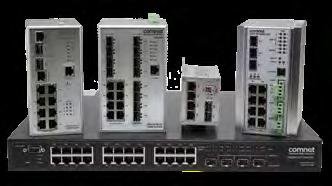
duces the total cost of ownership over time. Operating from -40°C to +70°C, it is also developed and manufactured in the USA, achieving BABA, NDAA, and TAA compliance.
Reliability as a Standard
Both switches reflect Comnet’s core commitment to industrial-grade reliability. Products carry a Limited Lifetime
management protocols, port-level authentication, device binding, and ongoing standards compliance ensure that Comnet infrastructure stays protected as threats evolve. Whether securing a transit system, monitoring a power grid, or managing a surveillance network, Comnet’s latest BT PoE switches deliver the performance, protection, and peace of mind mission-critical operators demand — today and for years to come. n
Biometric Access Control
CRITICAL INFRASTRUCTURE SECURITY BEYOND PHYSICAL CREDENTIALS
Many critical infrastructure sites are still using traditional systems like physical credentials or tokens for access control. Badges, PINs, and punch cards are commonly used because they are familiar and easy. But these traditional systems often leave gaps that make security vulnerable and disrupt operations, risks that critical infrastructure cannot afford
n By: Mohammed Murad, Chief Revenue Officer, Iris ID mohammed.murad@irisid.com
Weak security in critical infrastructure facilities can easily lead to security breaches. We rely on these sites to provide 24/7 essential services and to adhere to strict regulations, and access control gaps or failures can affect safety and daily operations. A loss of public trust and business continuity are often the very expensive results.
Physical credentials can leave facilities open to security vulnerabilities. Badges can be lost, stolen, or exploited by malicious actors. They might be shared during a busy shift if a coworker forgets theirs, or teams may reuse old cards if one is lost. Sometimes, access remains active for someone who left the company long ago, or a contractor who no longer needs access.
The Verizon Data Breach Investigations Report shows that weak or stolen credentials remain a major cause of security breaches. This not only allows unauthorized access but also makes it hard to accurately track who was present by manually checking logs.
These factors are prompting today’s critical infrastructure security leaders
to re-evaluate their access control. With advances in biometric access control, organizations now have more secure and reliable options that can be integrated with or replace their existing physical credentials. Using biometrics that can’t be spoofed, like iris or face authentication, ensures rapid and accurate detection. It also eliminates common issues like tailgating and piggybacking.
The High Cost of Physical Security Breach
Many facility managers may feel that managing traditional badges and credentials is simple: new hires are issued a physical badge or PIN for controlled access. When staff leave the company, that access should be revoked by collecting the badge or deactivating the PIN. Often, systems aren’t managed this efficiently, and badges can be lost or used for tailgating.
Updates to access control are often delayed or overlooked, especially in fastpaced workplaces. Offboarding is often complex, especially during events like a terminal expansion or major server migration. If a badge or code remains active in cases like sudden termination or
resignation, the facility may be exposed due to loss, misuse, or human error. Auditing these events can be complicated. Teams often must search through badge logs, door records, and email chains to piece together what happened. This impact goes beyond security teams. Depending on the severity of a physical breach, operations, risk, and company reputation can be affected. This doesn’t even address the costs involved in a major incident. Estimates from 2022 showed that global companies lost $1 trillion in revenue from physical security incidents.
Rethinking Access Control: A Focus on Identity
It is standard for most high-security sites to implement multiple layers of access control. In data centers, critical zones like server rooms, network operations centers, and power supply rooms are only accessible to select personnel. Facilities will use permissionbased access to secure areas depending on role, such as IT administrators and senior engineers, versus authorized office workers or maintenance staff. Office areas may have broader access, while areas like storage vaults, network

Evaluating identity-based biometrics is about making strategic business decisions that can save time, reduce costs, and protect valuable assets. This approach can also prevent costly breaches, minimize operational disruptions, and ensure longterm resilience
closets, or backup tape archives are further restricted.
In airports, highly secured zones include the air traffic control tower, baggage handling areas, access across landside to airside, and maintenance hangars. Access to these areas is limited to staff with specific roles and clearances. Physical credentials alone often fall short in these complex environments, making identity-based access solutions an essential consideration. Identity-based access works reliably even in poor lighting or when staff are wearing safety gear or PPE, situations that often cause issues with legacy solutions. Multiple biometric checks make entry smoother, helping authorized personnel move efficiently while preventing unauthorized access.
Additionally, iris and face biometrics are unique to each person and nearly impossible to fake. Iris recognition has almost zero false acceptance, making it one of the safest and most effective ways to control access. Each iris has over 240 unique patterns, so access is fast and reliable. By implementing multi-modal authentication, for example, combining iris authentication with facial recognition or an existing physical credential, security is further strengthened.
Biometric authentication is fast, touchless, and reduces incidents like tailgating and piggybacking. Security teams can see exactly who entered and exited, with higher efficiency and without sorting through stacks of paper logs. When an audit or
investigation occurs, the event logs are clear, precise, and easy to find.
From Physical Credentials to Identity-First
Critical infrastructure facilities aren’t simply moving away from traditional access methods like badges. Many sites are augmenting current systems with multifactor authentication, adding biometric credentials to boost security, and even storing the biometric data on the physical cards to support privacy initiatives. Evaluating identity-based biometrics is about making strategic business decisions that can save time, reduce costs, and protect valuable assets. This approach can also prevent costly breaches, minimize operational disruptions, and ensure long-term resilience.
Relying solely on physical credentials can be outdated and introduce unnecessary risk. Controlling access with iris or facial biometrics, or combining them with innovations like multimodal authentication, can deliver high security, reduced risk, and improved operational efficiency. n
CONTACTLESS ACCESS CONTROL
HOW FACIAL RECOGNITION IS REDEFINING ACCESS CONTROL
As organizations move toward faster, more secure, and less intrusive access control, facial recognition is becoming a practical option for high-traffic environments. HID’s Amico reader reflects this shift by combining contactless authentication, flexible integration, and privacy-focused biometric data handling in a single access device
n By: Sam Cherif, Senior Director, Middle East & Africa, HID PACSGlobalMarcom@hidglobal.com
Security leaders across organizations today face a persistent challenge: how to protect physical assets and facilities without creating friction for the people who need access. Traditional methods such as key cards, PIN codes, and fingerprint scanners remain effective and widely trusted, each serving its purpose depending on the use case and budget. Yet even these proven tools come with inherent limitations: cards can be lost or shared; codes can be forgotten or compromised; and contactbased systems often introduce bottlenecks during rush hour and raise concerns about hygiene.
The answer to overcoming all these challenges increasingly lies in contactless facial recognition, which has moved beyond experimental deployments to a cornerstone of modern access control strategies. It delivers what organizations need most: strong security, high accuracy, and a seamless user experience that does not slow people down.
This shift towards this technology is not happening in isolation: broader trends in workplace technology, heightened security requirements, and evolving user expectations are converging to make frictionless, contactless access not just desirable, but essential. Organizations that once viewed facial recognition as a future capability are now prioritizing it as part of their access control strategy.
Biometrics Becoming a Standard for Identity
Biometric authentication is now firmly embedded in everyday life, with consumers using it to unlock devices, authorize financial transactions, and verify their identity in enterprise environments. For organizations, biometrics provide a clear advantage. By linking access credentials to unique human characteristics, they
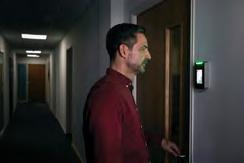
reduce the risks associated with credential sharing or theft while improving both security and user experience.
This momentum is reflected in market growth. The global biometrics market is expected to grow by nearly 130% over the next six years, exceeding $134 billion by 2032. Contactless technologies, including facial recognition, iris scanning, and palm vein identification, are projected to see the fastest growth, driven by demand for fast, secure, and hygienic authentication. The Middle East and Africa (MEA) region mirrors this trajectory, with even stronger acceleration in some markets. According to recent reports, the regional market is projected to exceed $4.5 billion by 2028, fueled by national digital transformation agendas and largescale infrastructure modernization. The MEA biometric technology market already generated $3.35 billion in revenue in 2023, and is expected to grow at a CAGR of 20.7% from 2024 to 2030, outpacing many global regions.
Biometrics continue to gain momentum in enterprise security. HID’s “2026 State of Security and Identity Report shows that 45% of organizations now view biometric technologies

as a strategic priority, with fingerprint and facial recognition leading adoption. Identity management is also rising in importance, with 73% of organizations ranking it as a top security focus and 75% either deploying or actively evaluating unified identity solutions. Yet progress comes with hurdles: organizations still cite integration complexity, budget pressures, and limited inhouse expertise as key barriers, reinforcing the need for solutions that deliver strong security while remaining scalable and easy to implement.
Understanding Biometric Modalities
Several biometric technologies are commonly used in access control, each offering different advantages: facial recognition enables fast, contactless authentication using face templates derived from camera images. It supports high-throughput environments and continues to improve in accuracy, even in low-light conditions. Meanwhile, fingerprint recognition delivers high accuracy and quick verification but involves physical contact, which is leading some organizations to reconsider its use. The market for biometrics in physical access control is also expanding rapidly, expected to reach USD 7.8 billion by 2032, representing a 200% increase. Growth is being driven across sectors, including government, healthcare, financial services, data centers, manufacturing, and transportation, where precise identity verification is critical.
Key Considerations for Implementation
As organizations evaluate facial recognition solutions, several factors remain critical. Systems must deliver high recognition performance, supported by strong benchmarking standards such as the NIST Face Recognition Technology Evaluation (FRTE). Image quality is also essential, with high-performance readers typically featuring dual 1080p cameras, capturing both visible and near-infrared images to ensure reliability even in low-light or no-light environments. Speed is equally important. A benchmark
of 0.2-second recognition time enables seamless, walking-speed authentication, particularly in high-traffic areas.
Solutions should also support multi-factor authentication beyond facial recognition, including cards, PINs, QR codes, or mobile credentials. At the same time, privacy and security must be built in, with strong encryption, compliance with regulatory frameworks, and options for secure biometric data storage, including storage on credentials rather than centralized databases. Integration is another key requirement. As organizations adopt enterprise-wide approaches to access control, facial recognition systems must integrate smoothly with existing infrastructure using protocols such as OSDP or Wiegand. This is where platforms such as the HID Amico facial recognition reader add value, delivering fast, accurate facial recognition in a sleek, durable design while offering flexible integration options that make it easy for organizations to modernize access control without disrupting existing systems.
Moving Forward with Confidence
The value of facial recognition in access control is no longer theoretical. Organizations across industries are already seeing measurable results, including faster throughput, reduced administrative burden, improved compliance, and a more seamless user experience. What distinguishes successful deployments is not just the technology itself, but how it is implemented. Choosing the right solution, ensuring proper integration, and engaging stakeholders across IT, security, HR, and operations are all critical to success.
At the same time, privacy considerations must remain a priority. Leading solutions now offer flexible data storage, strong encryption, and alignment with evolving regulatory requirements. Organizations that address these considerations proactively can build trust while protecting sensitive biometric data.
As technology continues to evolve and adoption grows, facial recognition is becoming a defining element of modern access control. For organizations looking ahead, it offers a clear path toward stronger security, improved efficiency, and a truly frictionless access experience. n
BIOSTATION 3 MAX
FLAGSHIP AI BIOMETRIC TERMINAL — TRUST BUILT INTO EVERY DOOR
The access control market has been steadily shifting toward multi-modal, identitycentric systems. What’s often been missing is a single terminal that delivers across four key dimensions at once: certified security, high performance, credential flexibility, and a front-of-house experience suited to premium spaces
n By: Mohamed ElShenawy, Regional Manager, Suprema Middle East m.shenawy@supremainc.com
Suprema’s flagship AI-powered biometric terminal, BioStation 3 Max, is designed around a clear principle: identity-first security built from the ground up. Designed for busy lobbies and mission-critical entrances, it combines a hardened, highly certified platform with fast, trusted multi-factor authentication and broad credential support in one enterprise-ready 7-inch touchscreen device.
Hardened Where It Matters Most — Security You Can Certify
As Suprema’s new flagship terminal, BioStation 3 Max addresses the needs of security-conscious organizations by offering certified and documented protection for compliance.
The platform runs on a hardened Linux OS with Secure Boot, ensuring that only authorized firmware can run at startup—a critical safeguard in environments where physical access to devices represents a genuine threat vector. Its security architecture is further reinforced by CC EAL6+ certified components, among the highest assurance levels available in access con-

trol hardware, providing protection well beyond that of typical access terminals. Encrypted biometric templates, TLS-secured communications, and a secure tamper response mechanism that detects physical compromise and triggers immediate alerts and protective actions strengthen the platform’s resilience against cyber and physical threats. In addition, its Template-onMobile architecture keeps biometric data on the user’s device rather than in centralized databases, helping organizations meet increasingly stringent global data sovereignty and privacy requirements.
For global deployments, Template-onMobile keeps biometric data on personal devices instead of centralized infrastructure—an architectural advantage when navigating regulations like GDPR. Multifactor authentication options (face + fingerprint, face + card, face + PIN) add layered security for sensitive environments.
Sub-second Face Matching
Busy entrances don’t wait. BioStation 3 Max runs Suprema’s latest AI engine on a dedicated NPU platform, enabling face
matching in under 0.3 seconds, even for people in motion. More importantly, performance holds up in real-world conditions. Sunglasses, masks, scarves, varied angles, and changing lighting are handled without slowing throughput, supporting up to 100,000 users. Dual 2MP visual and IR cameras support strong liveness detection and anti-spoofing, ensuring speed doesn’t come at the expense of security.
PoE+ (802.3at) support on APB and OAPB variants allows both power and data over a single cable, simplifying installation and reducing infrastructure costs at scale.
One Device for Every Access Scenario
Managing multiple credential types often leads to fragmented hardware at entry points. BioStation 3 Max consolidates these into a single device. The OAPB and ODP model variants include an optical fingerprint sensor alongside face and RFID, enabling multi-biometric authentication for high-security environments.
The built-in VoIP intercom with SIP integration is especially useful at front-ofhouse entrances. Visitors can communicate directly with reception through the terminal when additional verification is needed, eliminating the need for a separate intercom system and streamlining the overall experience.

BioStation 3 Max is a terminal designed to meet operational demands without forcing trade-offs between capability and experience
Built for Demanding Spaces, Designed to Fit In
Access devices in premium environments influence brand perception. BioStation 3 Max balances durability with refined design to suit both functional and aesthetic expectations.
The 7-inch IPS touchscreen aligns with the BioStation family’s design language, ensuring a consistent user experience

across access points while providing a high-resolution interface optimized for both access control and time-and-attendance applications. Organizations can customize logos, messages, themes, and other branding elements to align the interface with their corporate identity, while clear on-screen guidance helps employees and visitors navigate authentication quickly and intuitively, even in hightraffic environments.
Behind its refined exterior, the IP65rated housing and IK06 impact protection handle real-world conditions such as dust, moisture, and physical contact. Its flexible form factor supports speed gates, wall mounting, and kiosk installations, allowing consistent deployment across different environments.
As access control becomes more identitycentric, the demand is shifting toward terminals that can combine certified protection, fast authentication, flexible credential support, and a polished user experience in a single front-of-house device. BioStation 3 Max is Suprema’s response to that gap: a terminal designed to meet operational demands without forcing trade-offs between capability and experience. n
MIDDLE EAST INFRASTRUCTURE
SCALING FIRE SAFETY FOR PHASED GIGA-DEVELOPMENTS
Across the Middle East, major developments are rarely delivered as a single, fixed project. Instead, they evolve in stages, with new buildings, infrastructure, and services added over time. This phased delivery model creates flexibility for developers, but it also places new demands on fire detection and alarm systems
n By: Sargunan Sellamuthu, Business Development Manager – Middle East, Advanced ssellamuthu@advancedco.com
Fire systems must be effective from day one, yet capable of supporting future expansion without requiring redesign. As a result, the design approach is shifting away from isolated, building-specific systems towards scalable, networked fire systems that can evolve alongside the development itself. Advanced’s Axis AX supports this approach, allowing additional panels to be integrated without disrupting existing infrastructure.
A Shift Towards NetworkBased Strategies
To meet these requirements, networked fire systems are becoming the standard for large-scale projects. Rather than treating each building as a standalone entity, multiple panels can be connected into a single, integrated structure. This enables consistent monitoring and coordinated response across an entire site, even as it grows. As new phases are completed, additional panels can be incorporated into the existing network, maintaining continuity and avoiding unnecessary complexity. However, scalability must be matched by performance. As networks expand, systems must maintain consistent response
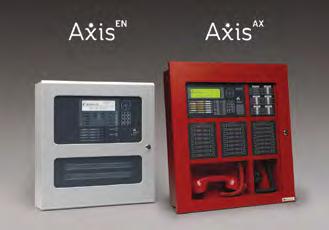
times and reliable communication. Highcapacity fire systems such as Axis AX, which support large-scale networked systems, allow developments to scale significantly without loss of performance, ensuring that growth does not compromise system effectiveness.
Building Resilience Into the Network
Resilience is a defining requirement in large-scale fire system design. Increasingly, this is achieved through distributed,
peer-to-peer architectures, where each panel operates independently while remaining part of a wider network. This approach removes reliance on a single central point of control. If one part of the system is compromised, the rest can continue to operate, maintaining critical detection and alarm functionality across the site. Failsafe operation is also essential. In the event of a loss of a central command function, systems must still support effective emergency response. These characteristics are particularly important in phased developments, where
PRODUCTS & SYSTEMS
Designing for phased delivery is now a fundamental requirement in the Middle East. By adopting networked fire systems that combine scalability, resilience, and visibility, developers can ensure that fire protection remains effective throughout the lifecycle of a project
systems grow incrementally but must remain dependable throughout.
Managing Complexity Across Phases
As developments expand, so too does the complexity of fire safety management. Large sites often combine residential, commercial, and public environments, each with distinct operational requirements. Sectoring allows different areas to be managed independently while still forming part of a unified system. This supports tailored evacuation strategies and area-specific responses without affecting the wider network. Phased construction also introduces challenges around commissioning and maintenance. With parts of a site occupied while others are still under development, systems must remain operational at all times. The ability to isolate sections of a network for testing ensures that work can be carried out without disrupting live areas.
The Importance of Central Visibility
While distributed operation improves resilience, centralized oversight remains essential. A graphical command interface allows operators to monitor system status, alarms, and faults across an entire development in real time. This level of visibility becomes increasingly important as projects grow. In large, multiphase environments, operators must be able to quickly identify and respond to issues, regardless of where they occur. With networked fire systems such as Axis AX and Axis EN, large numbers of panels can be monitored from a single location, ensuring that even complex developments remain manageable in both day-to-day operation and emergency scenarios.
Flexibility Across Different Standards
Across the region, developments may be delivered to different regulatory frame-

works depending on location and project requirements. While some follow ULbased standards, others are designed around EN requirements. Despite these differences, the underlying needs remain consistent. Systems must be scalable, flexible, and capable of maintaining performance as they expand. Solutions such as Axis AX and Axis EN are designed with this in mind, providing a consistent approach across different fire system standards while supporting long-term system growth.
Designing for Long-Term Performance
For consultants and developers, the focus is shifting from short-term compliance towards long-term performance. Fire systems must be selected based on their ability to evolve, rather than simply meeting the needs of a single phase. This includes ensuring that systems can scale without redesign, maintain performance as they expand, and integrate new elements over time. Systems that offer this level of flexibility provide a clear advantage in phased developments, where future requirements are often uncertain.
Supporting Safer Growth
As construction across the Middle East continues to push the boundaries of scale and complexity, fire systems must keep pace. Designing for phased delivery is now a fundamental requirement rather than an exception.
By adopting networked fire systems that combine scalability, resilience, and visibility, developers can ensure that fire protection remains effective throughout the lifecycle of a project. Networked fire systems such as Axis AX, alongside EN-based solutions like Axis EN where required, demonstrate how this can be achieved in practice.
In doing so, they provide a foundation for long-term safety, supporting the continued growth of some of the world’s most ambitious developments. n

WITH FIBER, THE OPTICS ARE GOOD
OPTICAL LANS ARE GAINING IMPORTANCE
As organizations modernize network infrastructures across buildings and hotels, priorities now extend beyond speed and capacity. IT managers are seeking solutions that improve efficiency, sustainability, security, and reliability while lowering costs. Optical local area networks (OLANs) are emerging as a promising answer to these challenges
n By: Martin Kandziora, Senior Manager, Marketing EMEA, Panduit GmbH Martin.Kandziora@panduit.com
The traditional LAN infrastructure has proven to be very effective in integrating a growing number of Ethernet devices (cables, switches, routers, firewalls, load-balancers, wireless access points, etc.) into a standardized infrastructure. These systems are best suited when users require high bandwidth and great flexibility, and when user density is high, and interoperability for future changes is paramount. However, when the business goal is to minimize the space required for the IT infrastructure and future upgrading or reconfiguration is unlikely, and when long cable runs are present, then alternative network architectures and technologies should be considered.
Utilization of Optical LANs
The cabling infrastructure in a company or building should support both current and future Ethernet speeds and bandwidths. This is one of the most effective ways to transmit growing data volumes for faster communication, data processing, and analysis in complex decision-making environments. Technologies such as the Internet of Things (IoT), artificial intelligence, Industry 4.0, and streaming are further increasing this demand. To meet these requirements, fiber-optic-based optical network technologies are increasingly being installed. Optical networks (optical LANs) offer increased capabilities and added value without companies changing their business processes.
There are two main types of optical networks: Active Optical LANs and Passive Optical Networks (PONs). In an active optical LAN, active network components such as switches and routers are used
throughout to distribute the data within the various layers of the network. This hardware amplifies and routes signals and requires an appropriate power supply to each live/powered component on the LAN. The advantage is flexibility, a longer signal range limited only by the number of amplifiers, and the opportunity to manage the whole network.
A passive optical network predominantly uses passive equipment such as passive optical splitters that enable the parallel transmission of multiple channels via WDM (Wavelength Division Multiplexing). The data is sent via passive optical distributors that passively split and transmit the light signal in different streams. Naturally, such networks are more energy-efficient and reduce operating costs. PONs are particularly advantageous in environments with a high density of end devices, such as those found in large office buildings or facilities with long cable distances of up to 20 kilometers.
Singlemode and Multimode Fibers
With singlemode, the fiber allows the light to propagate through the fiber core on one path (mode). With multimode, the light can propagate over several paths (modes) in the core. As these differ in propagation time, there is a significantly greater pulse broadening at the end of the transmission path with multimode fibers than with singlemode fibers. The differences between singlemode and multimode fibers lie not only in the resulting difference in range but also in the fiber core diameter, the wavelengths usually used, the light sources used, and the maximum transmission bandwidth.
Overall, both active and passive optical networks offer advantages – depending on the operator’s requirements and application scenarios. While active systems offer more control and flexibility, passive optical networks can be more cost-effective and energy-efficient.
Bridging the Standards Gap
Furthermore, a key advantage of optical local area networks is that the services remain unchanged during transmission between the core and the end device. Fiber optic cables are technology-indepen-
The OS2-24 fiber cable for indoor areas is rated according to Euroclass Cca-s1a-d1-a1 and has buffered 900 µm fibers
dent and, additionally, fiber optic cabling provides a greater range than copper. However, neither EN 50173-1 nor ISO/ IEC 11801-1 traditionally contains any references to the actual performance of transmission and installation links based on optical fibers. To remain compliant with the standard, designers must consider the maximum link length according to the intended application and selected fiber type.
DIN VDE 0800-173-100:2023-06, the updated VDE standard, closes the gap between these application-specific standards and an application-neutral cabling standard. The performance of fiber optic transmission links is divided into classes based on a maximum permissible insertion loss, measured in decibels (dB), for maximum transmission link lengths. The insertion loss of an optical link results from the attenuation of the fiber and the optical connector. The insertion loss from the connectors is assumed to be 0.75 dB at 100% of the maximum number of mating cycles. The insertion loss is specified as a function of the respective wavelength of the transmission window.
PRODUCTS & SYSTEMS
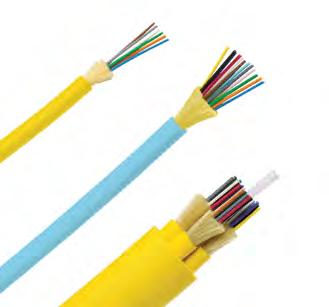
Classifying Fiber Optic Cables and Connectors
Fiber optic (FO) cables and connectors are classified according to two main criteria:

the number of fibers and the type of fiber used. Based on the number of fibers, connectors can be simplex, containing a single fiber; duplex, featuring two fibers for transmit and receive paths; or multifiber, incorporating several parallel fibers within a single connector. Fiber optic systems are also categorized by fiber type, including glass fiber optics, plastic-clad fiber, and plastic fiber optic cables. The choice of class depends on the respective application requirements and the type of connection. As each class has its own properties and areas of application, it is important to configure the correct class according to the respective application.
The Future Is Low-Smoke and Halogen-Free
Organizational sustainability and legislative safety requirements have helped drive the development of low-smoke, halogen-free Opti-Core fiber optic cable, which is gel-free on request, water-repellent, and offers a high fiber density. It is easy to install in building ducts. OptiCore fiber optic cables from Panduit for indoor and outdoor use are equipped with high-quality OM3 and OM4 laser-optimized fibers and, depending on the fiber required, are suitable for applications with bandwidths
The OptiCam LC connector
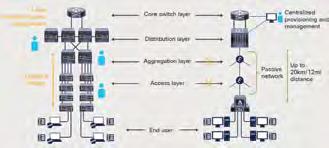
of up to 10 Gb/s (multimode) or more, and include OM4 SignatureCore, OM5 and singlemode fiber cable. The Panduit fibers are compatible with existing 50μm multimode and 9µm singlemode systems. Standard multimode and singlemode cables for indoor/outdoor use with a fiber count of up to 24 fibers have a central tube design, while cables with up to 72 fibers have a stranded tube design. In the latter, the individual fibers are divided into several stranded tubes. This makes the fiber optic cable easier to install and handle. The tubes serve to protect the fibers from external impairment from moisture, pressure, and mechanical damage. The latest optical fiber cable provides greater flexibility and higher reliability, providing network technicians with solutions that often require less space. The fiber optic cable from Panduit fulfills the relevant criteria of EN 60794-2-20, IEC 60794-2-20 and EN 50173. The Opti-
Core series is LSZH and Euro-classified, as well as compliant with the requirements of Construction Products Regulation No. 305/2011 (EU CPR). Panduit offers optimized connectors to match the fiber optic cables. The OptiCam LC fiber connector from Panduit is a singlemode 9/125 µm OS1/OS2 simplex design for tightly buffered direct connector assembly on 900 µm jacketed “mini-breakout” fiber optic installations. It is a simple and cost-effective alternative to fusion splicing at endpoints that are difficult to access.
LC OptiCam clamp-lock connectors are ANSI/TIA-604-FOCIS-10 compliant and include factory-pre-terminated fiber, eliminating the need for polishing and bonding in the field. LC pre-terminated connectors have a typical insertion loss value of less than 0.3dB per mated pair for multimode and singlemode fibers. The connector can be terminated professionally and effi-
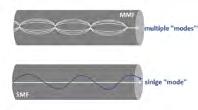
Optical networks eliminate numerous known IT vulnerabilities, reduce a network’s points of attack, and are ideal for a “zero trust” architecture
ciently on site in two minutes using the OptiCam2 tool. The connectors from Panduit do not require crimping and clamp the fiber together with the cable sheath in a single operation. This enables up to three re-terminations without any loss of performance if the objective attenuation measurement of the individual connector shows a value that is too high.
Conclusion
Optical networks offer companies and installers a modern, forward-looking way to set up and operate networks. They eliminate numerous known IT vulnerabilities, reduce a network’s points of attack, and are ideal for a “zero trust” architecture. The technology is also fully EMC-compliant. Optical networks offer flexible design options for adapting capacity and bandwidth from a few 100Mbit/s up to several 100Gigabit/s, as well as the density utilized from a few to thousands of connected users and devices. n
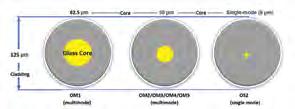
Fig. 1: Topology comparison of classic active Ethernet network and passive optical network (PON)
Fig. 2: Transmission types for optical LAN systems: Singlemode and Multimode
Fig 3: Fiber diameters of the different fiber types in comparison
OVER 90 YEARS OF INNOVATION
FROM PIONEERING ELECTRIC STRIKES TO INTELLIGENT SYSTEMS
Modern electromechanical devices transform the way buildings are secured. Their embedded intelligence enables reliable communication between door and system, remote operation, and data insights
n By: Sam Cherif, Senior Director, Middle East & Africa, ASSA ABLOY Opening Solutions sam.cherif@assaabloy.com
For more than 90 years, ASSA ABLOY has pioneered electromechanical locking technology — continuously innovating since the first effeff electric strike was patented in 1932 and Abloy began developing high-security electric locks in 1978. Today, electromechanical locks represent the intelligent evolution of mechanical security, combining trusted engineering with seamless digital connectivity for safer, smarter, more efficient building management.
Delivering Trusted Security
Electric strikes are compact, reliable electromechanical devices that upgrade existing mechanical locks by enabling controlled, remote unlocking and seamless integration with intercoms, access control, and digital systems. They are mounted discreetly within the door frame for smarter, more flexible entry. For installers, OEMs, and resellers, they offer easy integration, broad application versatility, certifications, and high customer demand, making them simple to specify, sell, and deploy across commercial and multi-residential buildings.
Effeff electric strikes are engineered for universal fit and long-term reliability, offering more than 10,000 strike and latch-plate combinations as well as customized solutions for specialized environments. They deliver trusted security through rigorous DIN-certified and TÜV-audited production, high holding forces, extensive cycle testing, and durable components designed for harsh or high-frequency conditions. A compact, installer-friendly design enables fast, clean, cable-free inte-

Electromechanical access: invented by ASSA ABLOY
gration into almost any door, supported by adjustable alignment, sustainable EPD-verified construction, and low power consumption for energy efficiency.
Extending the Applications for Electromechanical Locking
E-strike technology laid the foundation for modern electromechanical locking, which ASSA ABLOY’s ABLOY brand advanced in the late 1970s by embedding electricity and intelligence deep within the door leaf to enhance mechanical security and meet demanding regulatory and architectural requirements.
ABLOY Electric Locks are trusted worldwide for meeting the highest security and compliance standards. They deliver a premium door experience, even in demanding, high-traffic, or high-security environments. They integrate seamlessly with access control, alarm, and building-management systems. ABLOY offers one of the widest electric-lock ranges on the market. Their premium single- and multipoint solutions fit virtually any door, sector, or security requirement while ensuring seamless retrofit and design flexibility.
ASSA ABLOY’s range of eStrikes and electric locks are part of a wider portfolio of digital access solutions, bringing intelligent, secure, and seamlessly integrated electromechanical locking to virtually any building type, including multi-residential, healthcare, offices, manufacturing, education, public institutions, and critical infrastructure. n
THE RESPONSIBILITY NO ONE ASSIGNS
THE ACCOUNTABILITY GAP
IN DISTRIBUTION
For decades, distribution has been measured by inventory levels, logistics efficiency, and commercial performance. Those metrics remain important, but they do not tell the full story. The real value of distribution is found in the quality of the partners it develops, the risks it absorbs, and the expertise it contributes
n By: Loubna Tabbara, Marketing and Sales Director, Tabbara Electronics pr@tabbara-electronics.com
In critical communications, accountability appears straightforward. When a system fails, the investigation moves in two directions: toward the vendor whose product did not perform, and toward the integrator whose deployment fell short. Between them sits the distributor, influencing decisions long before deployment and supporting outcomes long after handover, yet rarely assigned formal responsibility for either. That is the accountability gap in distribution.
What the Distributor Sees, and What That Demands
The distributor’s involvement in a project begins earlier than most parties assume. It starts at requirement drafting, where product selection is often shaped before a formal specification exists. It continues through design, supply, logistics, and the technical support that keeps deployments on track when conditions change. Across that entire arc, the distributor accumulates a picture that no single party — vendor, integrator, or end customer — holds in full. That picture includes the partner landscape. A distributor working across a region over time knows which partners have genuine technical depth and which ones have learned to win without it. Some compete on price alone. Others win by promising end customers outcomes the
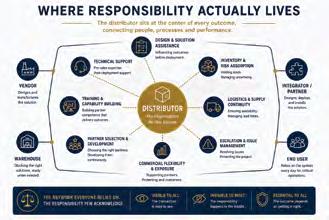
The distributor’s role is not shrinking. It is becoming more visible. The responsibility has always been there; the industry is only now beginning to recognize it
project cannot realistically deliver. The distributor may or may not be in a position to change that outcome. What does not change is who ends up living with it. The end user made their selection on the information available to them. When execution falls short, they are the ones managing an underperforming system, and the distributor who knows the ecosystem
best is the one they turn to. That is not a complaint. It is a description of the responsibility that comes with the position.
The Middle Position
When execution breaks down, accountability follows the contract. The vendor defends the product. The integrator
defends the installation. The distributor is rarely called into that room. On the surface, that looks like insulation from consequence. In practice, it is the opposite. While the formal review is happening, the distributor is already working. Replacement stock is moving. Technical escalations are being managed. Partners are being supported through situations they were not fully prepared for. The project survives not because the post-mortem identified the right lessons, but because someone outside that room made sure there was no need for one. That is not a peripheral role. It is the role.
Inventory Is Not a Logistics Decision
Holding stock in a region like the Middle East is expensive. Warehouse space, tiedup capital, the discipline to maintain availability across a wide portfolio — none of it is passive. Most distributors in this market operate on a lean model. They order when the project is confirmed and manage lead times as a commercial variable. In mission-critical communications, that model is a liability dressed as efficiency. A radio network that goes down while replacement units are in transit is not a supply chain problem. It is an operational failure with real consequences for the people depending on that network. The distributor who carries inventory is making a different calculation. They are absorbing financial exposure so that their partners and end customers do not absorb operational exposure. That is a risk transfer decision, not a warehousing decision.
The Tabbara Position
The market is asking different questions now. Vendors are becoming more selective about who carries their brands because they understand that distribution quality shapes field outcomes. End customers are more informed, less forgiving, and far less likely to offer a second opportunity when the first deployment falls short. The partners that continue to grow are those with genuine technical capability, not simply competitive pricing.
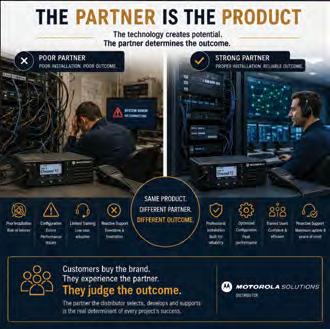
The Partner Is the Product
End customers in this space buy brands they recognize and trust. What they receive is shaped almost entirely by who deploys the system. The brand’s reputation is built at the factory. It is sustained or damaged in the field, by the partner the distributor put there.
A distributor with a weak partner network is selling a promise they cannot keep. The product may be exceptional. The outcome will reflect the partner’s capability, not the product’s. Selecting, training, and continuously developing that network is not a channel management function. It is the distributor’s most direct influence over whether the end customer’s system performs as expected.
In this environment, the distributor’s role is not shrinking. It is becoming more visible. The responsibility has always been there; the industry is only now beginning to recognize it.
For decades, distribution has been measured by inventory levels, logistics efficiency, and commercial performance. Those metrics remain important, but
they do not tell the full story. The real value of distribution is found in the quality of the partners it develops, the risks it absorbs, the expertise it contributes, and ultimately the outcomes it helps create. The industry may continue to measure distributors by logistics. The market increasingly measures them by outcomes. That is where Tabbara has always stood. n
EVIDENCE-BASED SCREENING
THE NEXT STEP IN CORRECTIONAL X-RAY SECURITY
The philosophy behind correctional screening technology is changing. For many years, innovation focused mainly on image quality, penetration capability, and hardware performance. The next stage of correctional screening will be defined by how effectively technology converts scan data into actionable visual evidence
n By: Igor Bondarev, Director, LINEV Systems bondarev@linevsystems.com
Correctional security has always adapted to one persistent reality: concealment methods change faster than routine procedures. Every decade brings new forms of contraband, new ways to hide it, and new operational pressure on correctional staff. Metal detectors once represented a major step forward for inmate intake and visitor control. Later, low-dose X-ray body screening introduced something fundamentally different: the ability to detect not only metallic threats but also objects hidden under clothing or concealed inside the human body.
The Operator Challenge
That shift changed correctional screening permanently. Yet another challenge emerged alongside improved detection capability. The issue was no longer simply whether a scanner could produce a useful image. The issue became what happened after the image appeared on the screen.
In busy correctional environments, operators work under time pressure. Intake areas become congested. Staff turnover creates uneven experience levels. Large numbers of scans must be assessed quickly and consistently across multiple shifts. In practice, the effectiveness of a screening checkpoint depends not only on imaging technology but also on how clearly the system supports the operator’s decision.
For years, this burden was treated as part of the job. A skilled operator was expected to examine a full-body X-ray image, identify suspicious areas, judge their relevance, and determine whether secondary inspection or escalation was necessary.
Presenting Information More Intelligently
New-generation LINEV Systems correctional X-ray scanners are moving body screening beyond routine full-image interpretation
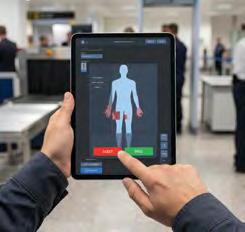
and toward evidence-based operator review. The purpose is not to replace correctional officers or remove human decisionmaking from the process. The purpose is to restructure how information is presented to the operator. Rather than asking staff to continuously interpret complete radiographic images, modern AI-assisted screening systems can identify suspicious regions during the scan itself. The operator is then presented with localized visual evidence associated with the area of concern. The operator still makes the final decision, but the review becomes faster, more structured, and less dependent on radiology-style interpretation skills.
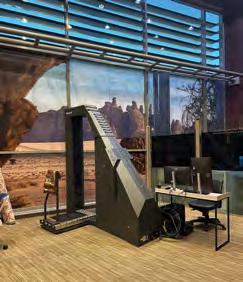
The practical implications are significant for correctional facilities. At intake checkpoints, delays create more than inconvenience. Congestion affects movement control, staffing allocation, and overall facility stability. Large institutions may process hundreds of individuals through screening points within short operational windows. Under these conditions, even small reductions in review time can improve checkpoint flow and staff efficiency.
Advanced Screening for Correctional Facilities
Modern correctional X-ray platforms such as CLEARPASS and CLEARPASS Ci show how low-dose penetrating X-ray screening can be integrated into real correctional operations. These systems support the detection of internally and externally concealed contraband while maintaining rapid screening workflows suitable for secure facilities. At the same time, newer software architectures are reshaping how operators interact with screening data.
One important part of this transition is the visual evidence presentation. In many airport-style screening systems, operators see abstract alert zones on generic avatars or standardized body outlines. That approach may fit aviation workflows, but correctional environments often require more operational context because the detection task is different. Internally concealed contraband, bodycarried narcotics, non-metallic weapons, miniature electronics, and improvised concealment methods require penetrating X-ray capability combined with clear, localized evidence.
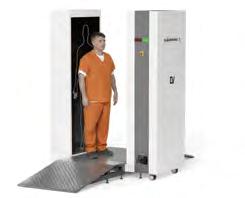
PRODUCTS & SYSTEMS
As a result, new correctional screening platforms are moving toward real-body representation combined with localized evidentiary imaging. Instead of presenting only a general alert area, the system provides focused X-ray-based evidence linked to the suspicious region.
Privacy Expectations and Consistency
Privacy expectations are also influencing system design. Historically, discussions around X-ray body screening often focused on whether full-body imaging itself created operational or ethical concerns. Evidence-based review changes this discussion. By directing attention primarily toward suspicious regions and localized evidence, modern systems can reduce the need for routine full-body image interpretation while preserving the detection advantages of penetrating X-ray technology. The result is not the removal of human review, but a narrower and more operationally focused form of review.
Consistency is another major factor. In traditional operator-driven screening, performance can vary depending on experience, fatigue, training quality, and workload. Evidence-based screening architectures help reduce this variation by structuring the process around prioritized findings. Facilities still need trained staff and clear procedures, but the screening task becomes more standardized and repeatable.
A New Philosophy of Correctional Screening
Hardware design is also changing how these systems can be deployed. Newer correctional X-ray systems increasingly use compact footprints, open inspection layouts, and wheelchairaccessible screening spaces designed for real correctional handling rather than airport passenger flow.
At the same time, advances in detector technology and real-time data processing are changing expectations around throughput. Faster detector analysis, automated suspicious-region identification, and simplified operator interfaces allow modern systems to maintain rapid screening rates without turning the checkpoint into a radiographic interpretation station.
Perhaps most importantly, the philosophy behind correctional screening technology is changing. For many years, innovation focused mainly on image quality, penetration capability, and hardware performance. Those characteristics remain critical, but they no longer define the full operational value of the system. The next stage of correctional screening will be defined by how effectively technology converts scan data into actionable visual evidence.
This transition reflects a broader change across security technology. Artificial intelligence in correctional screening is no longer only a detection tool. Increasingly, it functions as a decisionsupport layer that organizes operator attention, prioritizes findings, and helps officers act faster and more consistently. For correctional agencies, this may become the most important development of all. The future of people screening will not be defined simply by seeing more. It will be defined by helping officers make faster, clearer, and more confident decisions based on evidence they can use. n
Claude Mythos: Myth or Bogeyman?
THE TURNING POINT IN UNCOVERING SYSTEM VULNERABILITIES
Experimental features within Anthropic’s Claude model suggest that artificial intelligence is beginning to abandon the role of assistant and don the mantle of an autonomous detector of system vulnerabilities. In doing so, the previously clear boundaries between software development, testing, and misuse are fading, with far-reaching implications for security, regulation, and the dynamics through which cyber risks emerge
n Piše: Mirza Bahic mirza.bahic@admideast.com
Since its entry into the mainstream, the cybersecurity industry has regarded artificial intelligence as a technology of almost miraculous power, capable of strengthening both defense and offense. What was less clear was when that potential would translate into a concrete shift in the methods used to discover vulnerabilities within software. The latest developments surrounding Anthropic’s Claude Mythos model suggest that the moment of reckoning is upon us, and that history’s verdict will not be long in coming.
The Crisis of Expertise as a Bulwark of Security
In the dock stand Project Glasswing and the Mythos initiative, which, in the manner of a horror film, are the result of experiments conducted by Anthropic. Both have given rise to a model that is not merely capable of understanding software code but of systematically interrogating it. And interrogating anything is a dangerous undertaking, because large language models, known to the public as AI, have already demonstrated competence in writing, interpreting, and debugging software. What Mythos is already building its myth around is its alleged ability to systematically identify weaknesses

It
is now clear that the introduction of systems like Claude into vulnerability research represents a turning point. The cybersecurity industry is entering a phase in which the discovery of weaknesses will no longer be constrained by human capacity
within complex systems, including those that are not immediately apparent to human analysts.
This marks a transition from a phase of assistance to one of autonomy for AI systems. They are acquiring a quality that
has, until now, been the prerogative of human actors in this process. Rather than supporting developers and security analysts on individual tasks, the Mythos model performs work across the entire analytical chain, from understanding code

Raising the Bar for Software Security
For software manufacturers, AI-assisted vulnerability discovery creates dual pressure. On the one hand, it is an opportunity to improve security practices. Integrating AI tools into development processes enables earlier detection and resolution of problems, reducing the likelihood of costly incidents. On the other hand, it raises the baseline standard of expectations. If vulnerabilities can be discovered quickly and systematically, tolerance for ignoring them diminishes. This shift aligns with the regulatory direction in Europe. Frameworks such as NIS2 and the Cyber Resilience Act emphasize proactive risk management and securityby-design principles. In such an environment, the ability to continuously assess vulnerabilities may become not merely a recommended practice but an obligation. AI tools like Claude can help meet those requirements, but they will also more clearly expose shortcomings.
to identifying logical flaws, insecure practices, or structural vulnerabilities. And therein lie the roots of the current unease in the world of cybersecurity. For the traditional fragmentation of this process was both its curse and its blessing, but ultimately its foundational point of departure as well. That fragmentation is now collapsing, because code review, penetration testing, and vulnerability research have long existed as separate disciplines, each with its own requirements in terms of expertise and time. The introduction of AI systems capable of encompassing all of the above is changing the pace at which software risk can be understood at all.
Compression of the Vulnerability Management Cycle
The implications become clearer when one examines the traditional vulnerability lifecycle. Historically, this process unfolded in a temporal sequence. Flaws were
discovered during reviews or targeted testing. A proof of concept was then developed to demonstrate the exploitability of the identified weakness. Private or public disclosure of the detection would follow, and only after that came remediation. The new capabilities offered by Claude point to a compression of this once wellestablished cycle. Discovery, analysis, and remediation can now take place within the same system and in near real time. This brings clear advantages for the defensive side. Security teams can analyze large and complex codebases with a level of consistency and speed that is difficult to achieve manually. Subtle vulnerabilities, including those embedded in business logic rather than syntax alone, can now be identified earlier in the development process.
Where does the problem arise? In the compression and the symmetry, warn those familiar with these capabilities. The very properties that make this AI model effective in defensive contexts transform it into a potentially formidable instrument
CYBER SECURITY
of destruction for attackers. Expertise once represented a barrier to entry into the realm of sophisticated vulnerability exploitation. It is now a less limiting factor, because analysis can be entrusted to a system that scales without constraint. Yet this is also where the compliance problem grows increasingly complex, even under controlled conditions. A model trained to identify vulnerabilities must, by definition, also understand the logic of their exploitation. The boundary between describing a weakness and enabling its abuse is not always clear, and for the security profession, that is the catch-22 at the heart of it all. In other words, if an AI system is too restricted in its detection capabilities, it loses its value for legitimate security tasks. If it is too open, however, it creates pathways that easily lead to the abuse of discovered vulnerabilities. Maintaining this balance grows harder as models advance, particularly when users can probe their limits through iterative queries.
A Faster and More Volatile Threat Landscape
Beyond the regulatory domain, the expanding threat landscape will likely evolve in response to new AI capabilities. Greater speed of discovery will lead to an acceleration in the pace at which exploitation attempts are introduced. Systems that are poorly maintained and lack adequate monitoring are more attractive targets, especially if they are deprived of regular security checks. At the same time, organizations that adopt AI-assisted defense can more effectively anticipate and neutralize threats, drawing a clear line between those who adapt to this trend and those who ignore it at their own peril. From this friction emerges a subtle but important conceptual shift. Artificial intelligence is no longer confined to the role of an instrument managed by security professionals. It is becoming an active participant in the security process and a generator of insights that influence both defensive and offensive strategies. This opens up unresolved questions of accountability, disclosure, and access. If an AI system identifies a vulnerability, who owns that knowledge, and to whom is it passed on? And, most importantly, what measures are sufficient to prevent such a discovery from escalating into exploitation? The answers are still pending. Optimists would call that a relief. n
Key Security Events in 2026

SECUREX Expo
23–25 June 2026, Cairo, Egypt Egypt International Exhibition Center https://securexexpo.com

Security Essen
Key Security Events in 2023
JUN

SEP
GISEC GLOBAL
16–18 September 2026 Dubai, UAE Dubai Exhibition Center https://gisec.ae
SEP
22–25 September 2026 Essen, Germany Messe Essen https://www.security-essen.de

The Security Event Asia
NOV
10–12 November 2026, Singapore Sands Expo & Convention Centre https://www.safetysecurityasia.com

World Police Summit
16–18 November 2026 Dubai, UAE Dubai World Trade Center https://worldpolicesummit.com
NOV

ISAF
OCT
7–10 October 2026, 2026 Istanbul, Turkey Istanbul Expo Center https://www.isaffuari.com
NOV
Intersec Saudi Arabia
16-18 November 2026, Riyadh, KSA Front Exhibition & Conference Center https://intersec-saudiarabia.ksa.messefrankfurt.com /ksa/en.html
DEC
Black Hat MEA
1-3 December 2026, Riyadh, KSA Riyadh Exhibition & Convention Center, Malham https://blackhatmea.com


















Market & Contacts

TECHNICAL PROTECTION
Vendor-neutral Physical Security Information Management (PSIM) Bosch empowers you to build a
and
Advancis Middle East
P.O. Box 73309
Abu Dhabi, United Arab Emirates
Tel. +971 2 444 2503
Email: info@advancis.ae
Web: https://advancis.net


www.assaabloy.com/ae/en patricia.lomboy@assaabloy.com
Magazine Topics
Man Guarding
Technical protection
• Video surveillance
• Access control
• Intrusion detection
• Item theft protection
• IP and network solutions
• Perimeter protection
• Fire detection
• Gas detection
Mechanical protection
Cash/valuables-in-transit
Cyber security
Digital forensics
Software solutions
Smart home
Internet of things
Security management
Investigations
Building management
Market research
Legislation and standards




Index of Advertisers
Magazine Topics
Man Guarding
•
•
•
•
•
•
•
•
Cyber
Digital
Software
Smart
Internet of Things
Security
Investigations
Building
Market
Legislation