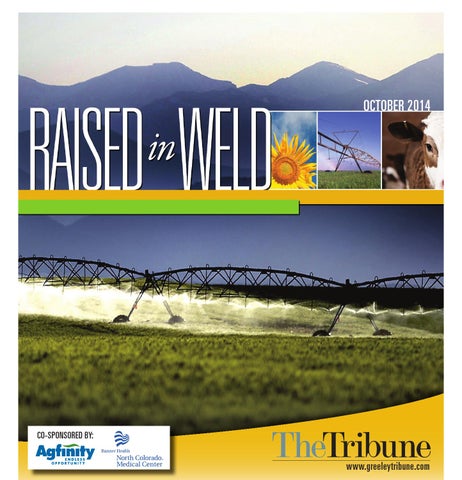
OCTOBER 2014
CO-SPONSORED BY:
www.greeleytribune.com
2 | RAISED IN WELD
It’s a simple fact. When agriculture succeeds, we’re all a little better off. Whether you’re growing hay or raising cattle, this great country thrives thanks to your hard work. We’ve been here since 1916 helping farmers and ranchers nourish America.
GREELEY Call 800.799.6545 today or visit AgLoan.com A part of the Farm Credit System. Equal Opportunity Lender.
OCTOBER 3, 2014
OCTOBER 3, 2014
RAISED IN WELD | 4
WHAT’S INSIDE Weld Agriculture Grows................. 4 Crops for Feed................................. 6 Sheep and Lamb.............................. 7 Vegetables......................................... 8 Crop Record Highs & Lows........... 9 Beef............................................ 10-11 Beans............................................... 12 Dairy............................................... 14 Sugar Beets..................................... 17 Small Grains................................... 18
Visit Greeley for agricultural tourism surprises that’ll make you smile. Cultural overload every night. Fun for you and the kiddos. Cowboy cool that’s part of our nature. And, that’s just the beginning. Visit Greeley for surprises that’ll make you smile.
Chamber of Commerce Visit Greeley
4 | RAISED IN WELD
OCTOBER 3, 2014
WELD AGRICULTURE CONTINUES TO GROW, AS DOES ITS IMPORTANCE TO REGIONAL ECONOMY By Eric Brown, for The Tribune
W
hen the new U.S. Census of Agriculture report was released this past spring, Weld County, as it had for decades, found itself near the top of the national ag-production list. Although Weld County had fallen one spot – from No. 8, when the previous census was released, based on 2007 numbers, to its current No. 9 ranking – its value of ag production is doing anything but declining. Weld’s total ag sales in 2012 were valued at about $1.86 billion — up by about $320 million from 2007, more than a 20 percent increase. But one doesn’t even need such statistics and rankings to realize agriculture’s impact on Greeley and Weld County. The evidence is out in the open here. Greeley is a community dotted with structures that bear the names of families who shaped the ag industry — not only locally, but nationally and globally — and whose fortunes trickled down to benefit their hometown. Medical facilities, schools, libraries, concert halls, post offices and buildings at the university’s campus all have been erected in honor of the Monforts, Farrs and others – producers who abandoned traditional production methods and revolutionized technology in the industry, international exporting practices and other aspects of the business to make operations more profitable and efficient, and to help make food more affordable for consumers.
Greeley and Weld County’s ag heritage dates back to before the city was incorporated, and even before the area was established as “Union Colony,” as water from snowpack in the nearby mountains, open space and ideal temperatures for crops and livestock gave reason for farmers and cowboys to dig irrigation ditches and bring production to the area. The local beef industry exploded after World War II, when innovative Greeley producers recognized that thousands of U.S. soldiers who had survived overseas on mutton and other meats would return home desiring another source of protein. Greeley’s beef-industry forefathers created the world’s first 100,000-head feedlot and became the first to provide fed cattle to packing plants on a year-round basis. And Greeley today is home to the headquarters and feeding and meatpacking operations of JBS USA – one of the four major meat processors in the nation. In addition to massive beef operations, Weld County ranks No. 1 nationally for its number of market sheep and lambs, and in recent years, added a Leprino Foods cheeseprocessing facility that gave even more growth opportunity to Weld’s already robust dairy industry, which accounts for about half of the milk cows in Colorado. With so many animals to feed, big-time grain production has long been required of the area’s farmers, many of whom also grow
sugar beets, onions, dry beans and various forms of produce. Local producers have served in national and international capacities under various U.S. presidents, have been inducted into numerous state and national hall of fames, garnered national and international accolades and have earned such prestigious titles as “Citizen of the West.” The Greeley area’s plethora of production has also provided a platform for crucial research in the industry. And as local historians will explain, Greeley’s large, overall agricultural presence always has determined the types of businesses that have filled its streets and continually lured more of ag’s industrial giants into town – and that economic growth has attracted non-agricultural companies to set up shop in Weld County, as well. Also, starting more than a century ago, the abundance of agricultural work began bringing migrant workers to the area, some whom decided to stay, leading to the vast amount of diversity in the community that’s one of Greeley’s trademarks. Indeed, no matter where you look, it’s obvious agriculture is imbedded in the fabric of Greeley and Weld County, and with its recent No. 9 ranking nationally for its ag production, that doesn’t look to change any time soon. Photo Credit: JIM RYDBOM / jrydbom@greeleytribune.com
OCTOBER 3, 2014
RAISED IN WELD | 5
6 | RAISED IN WELD
OCTOBER 3, 2014
Get Personalized Service From a Family Owned & Operated Dealer!
G&M Implement
Keep your 1717 2ND AVE GREELEY, CO Sales, Parts & Service: 970.378.1202 Massey Ferguson Sales: Gene Ulm 970.396.6264 & Randy Walter 970.301.9052 Parts: Don Brehm & Therron Carlson Service: Mike Minges equipment 18989 U.S. HWY 6 STERLING, CO Sales, Partsrunning & Service: 970.522.2335
HOURS: MON-FRI 7:30am-5:30pm SATURDAY 8:00am-12:00pm
General Manager: Mike Fergus Parts: Greg Porter Sales: Timm Kuehl 970.520.3498
throughout the season with 8600 SERIES TRACTORS genuine AGCO Parts and Service. • Powerful, fuel efficient engines, available in engine H.P. of 240-320 w/clean air technology, • Largest roomiest cab in it’s class • Dyna-VT transmissions, the most efficient in the industry • Visionary control arm technology gives finger tip control of all functions
NCE FROM EVERY ANGLE 2200 SERIES BIG
our equipment fromBALERS unnecessary down-time and costly SQUARE
• The new balers introduce a new set Preventative Maintenance with AGCO Parts PM360 of features on to the well-established foundation of the MF 2100 Series
Keep •your equipment Separate pre-compressionrunning chamber at peak performance with separates you from windrow size worries.
• Auto bale density means AGCO no d maintenance and control genuine Parts. Call your AGCO surprises.
• Easy access points compress service ler today forjustinformation on AGCO Parts PM360 Program. time, like bales.
GCO Parts Dealer and find out how AGCO PM360PROPELLED 9000Parts SERIES n help provide maximum up-time and increaseWINDROWERS equipment value. • • • •
Rear Axle Suspension Semi-Active Air Suspension Seat Plug & Play Auto Steering C1000 Monitor Virtual Onboard Computer • Electro-Hydraulic Steering
Our all new Hesston windrower. Cutting-edge, header to tail. ®
Hay producers don’t need another windrower. They need a breakthrough. They need our new GlideRider™ rear axle suspension and semi-active air suspension seat. Our Plug & Play AutoSteering™ and C1000 monitor virtual onboard computer that maximizes yield in every field. Our electro-hydraulic steering, TwinMax™ Advanced Conditioning, and our V-Cool™ System with auto-reverse fan. They need the new WR Series SP Windrower from Hesston by Massey Ferguson®. A superior class of windrower that delivers a superior brand of hay. Come see us soon or visit masseyferguson.com/windrowers
GILL SANS BOLD, 10 PT. SIZE TO 14 PT. SIZE MASSEY FERGUSON and Hesston are registered trademarks of AGCO. ©2011 AGCO Corporation, 4205 River Green Parkway, Duluth, GA 30096 (877) 525-4384. MF11C021TCG
Proud Sponsors of
4H & FFA
www.gmimplement.com
CROPS FOR FEED A BALANCING ACT FOR WELD GROWERS By Kayla Young, kyoung@greeleytribune.com
T
hose who have driven Weld County’s rural roads will recall a common site: row after row of corn destined for feed, processing and fresh consumption. Although it is an abundant and profitable crop – especially in a rainy year like this one – farmers know that corn can be a careful science. Beginning with economics, growers face a tough balancing act between volume and prices. Although favorable growing conditions yield more and better quality corn, they can also produce market excess that drags down prices. Thanks in large part to a rainy summer, Colorado is expected to produce a bumper corn crop this year, with the National Agricultural Statistics Service forecasting 138.24 million bushels statewide, up 7 percent from last year. Weld will contribute a sizable part of the crop, coming in first statewide in corn for silage and fourth in corn for grain as of the 2012 USDA Census of Agriculture. As a hub of beef and dairy production, Weld excels naturally as a feed producer, dedicating a significant portion of its farmland to forage, wheat and corn, destined to become cattle feed. Corn for grain and silage have remained relatively consistent in recent years. Corn for silage rose moderately, reaching 56,593 acres in 2012. Corn for grain came in at 92,621 acres, just below the previous census. Even with frost and moisture scares, farmers in Weld have described corn crops as high quality this season. Unfortunately, farmers this year will receive some of the lowest corn prices in years, explained Kent Peppler, president of the Rocky Mountain Farmers Union and a farmer in Mead. “The commodity prices are falling out of site. Those of us that have been around this business a while understand that, but it’s still no fun, even when you see it coming,” he said. In Greeley, September prices for yellow corn revolved in the low $3 and low $4 range, according to the USDA’s Ag Market News Service. At the same time last year, the price reached upwards of $7.
Peppler has observed the same drop for wheat, which he said also suffers a mixed blessing of higher yields. “We had some contracts last year for $9 wheat and this year the market is somewhere around $5. That’s quite a swing. In the ‘90s, we got away from a supply management farm program, so most of us predicted we’d start seeing some wild swings,” he said. Wheat and winter wheat rank as the top two crops for grain in Weld, with 122,625 and 121,698 acres respectively as of the 2012 Census of Agriculture. Forage crops like hay, haylage and grass silage come in second with 109,518 acres, notably down from the 2007 census by 32 percent. From a crop quality standpoint, Dave Eckhardt, president of the Colorado Corn Growers Association board, said it is difficult to find a bad corn field in Colorado this year. Growers have faced some difficulty when it comes to crop characteristics, however. For dairy and livestock feed, farmers must pay careful attention to dry matter, the actual mass of produce excluding water content. “The problem we’re experiencing right now, at least on our crop, is that dairies want it in that 30 percent dry matter range and we’re hanging around 27 to 29,” Eckhardt said. “The feed that makes more milk and more pounds of beef needs more corn and they get that corn from silage.” For corn sent to grain, the priority is to achieve the correct weight per bushel to capture the best prices. “Typically you want corn to be at a 56-pound test weight. Some of this corn could be in the low 50s, high 40s, which would cause a production problem for a grower,” he said. With elections approaching, Eckhardt said the local corn industry will have its eye on two items: Proposition 105 to establish GMO labeling, and the sunset review of the Colorado Pesticide Applicators’ Act, slated for review by legislators in 2015.
OCTOBER 3, 2014
RAISED IN WELD | 7
SHEEP AND LAMB ARE HUGE By Allison Dyer Bluemel, for The Tribune
A
s the No. 1 producer of market sheep and lambs, the heart of the nation’s sheep and lamb industry rests in Weld County. Weld was also ranking No. 1 in the country for its value of sheep, goats and their production, according to the most recent U.S. Census of Agriculture release in 2007. As a state, Colorado currently ranks No. 2 in the number of market sheep and lambs behind California and No. 7 in the number of breeding sheep, according to the National Agricultural Statistics Service. Of the 435,000 head of lamb and sheep in the state in 2013, 195,000 were breeding sheep and 240,000 were market sheep. The total inventory value of lamb and sheep in 2013 was $69.2 million with an average cost of $159 per head, down from the 2012 value of $130.9 million when cost averaged $226 per head, according to the NASS. Much of the sheep and lambs in Weld County end up in feed lots after being raised on ranches and National Forest Service grasslands on Colorado’s Western Slope, Wyoming and Montana.
Over the course of three to fourth months, lamb and sheep in feedlots are fed until they reach about 90 to 150 pounds. They are then sent to local packaging plants, such as JBS USA in Greeley, which processes and packages about 500,000 carcasses annually. Packaging plants then send the meat all over the U.S. — particularly to the East Coast, Chicago and California — while the thousands of left-over hides go to local companies such as Nugget International which processes and ships them off to companies such as Ralph Lauren and Bentley Motors in Europe. Despite the prominence of the sheep and lamb industry in Weld County, the
industry often falls to the side when compared to the profits of beef and dairy, according to ag economists. In 2010, total cash receipts for cattle and calves amounted to $2.85 billion, while total cash receipts for lambs and sheep totaled only $111 million, according to NASS. The cool climate, mild winters, availability of feed due to the abundance of irrigated agriculture and the close access to some of the world’s largest meat packers make the Front Range an ideal location for sheep and lamb operations. Additionally, the Front Range sits between the many lamb producers in
the West and key markets in the East, making it geographically ideal. Since 2013, the market for lamb and sheep has been strong and that the profit margin for lambs is healthy, said Jeff Hasbrouck, owner and operator of Double J Farms and Feeding in Ault. “It’s a good time to be a producer that retains ownership and a producer that sells. The lamb market is doing pretty well,” he said. In addition to Double J Farms and Feeding, Cactus Hill Ranch near Windsor and Harper’s Feedlot near Eaton each have sheep-feeding operations in Weld that can accommodate tens of thousands of animals.
The organic food industry has experienced remarkable growth nationally and made its mark on Weld. As of 2012, Weld was home to 27 producers who were USDA National Organic Program certified. Total organic product sales reach $39.6 million that year for Weld alone.
s in Weld Production grow
Some organic producers in Weld include Monroe Organic Farms in Kersey for vegetables, Aurora Organic Dairy with a processing plant in Platteville, Golden Prairie Inc. in Nunn for millet, Croft Family Farm near Kersey, and Strohauer Farms in La Salle for vegetables and wheat.
“When you bank with us, your money stays Local.” Locally owned & managed We can serve all of your financial needs!
www.farmersbank-weld.com
119 FIRST ST., AULT • 970.834.2121
OCTOBER 3, 2014
JIM RYDBOM /jrydbom@greeleytribune.com
8 | RAISED IN WELD
DEDICATED GROWERS FUEL WELD’S DIVERSE VEGETABLE MIX By Kayla Young, kyoung@greeleytribune.com
W
eld County may stand out for its cattle and dairy production, but thanks to fertile soils and abundant sunshine, the area also offers the capacity to produce bountiful vegetable crops. Once known for its potato production, Weld has evolved beyond its early days as “Spudville.” Potatoes have become just one of many vegetable crops, giving way to the diverse produce mix available today. Miller Farms, a local supplier of over 40 vegetable varieties, begins with asparagus in early spring and continues through fall with zucchini, squash, potatoes and onions. Owner Joe Miller said that although some years can be rough, just about every kind of vegetable grows in Weld. Family-owned since 1949, Miller Farms in Platteville has transformed into a more efficient operation with a focus on better production practices, Miller explained. “We’ve come up with new ways of growing stuff. We grow a lot of things on plastic and with drip irrigation. That really helps a lot to make things earlier like peppers and tomatoes,” Miller said. “A lot of (improvements) are just trial and error of doing the same thing every year. The weather does change things. Normally we irrigate, irrigate, irrigate. But this year was the first I have farmed where we had more water than we needed.” While Miller has seen many small vegetable farmers come and go, he
said his 700-acre farm has been able to supplement profits by opening its doors to the public through its fall festival, which operates through November. “It’s the only place I know of where you can pick your own potatoes, sweet corn, tomatoes and that kind of stuff. It’s a lot fun. We get a lot of schools and families,” he said. Miller’s observation that Weld vegetable farmers have dropped to a dedicated few holds true after some quick number crunching. In the most recent USDA Census of Agriculture, taken in 2012, Weld County ranked fourth economically in the state for vegetables, producing over $44 million in value for all vegetables, including melons and potatoes. In the 2007 Census of Agriculture, Weld ranked third in the state for vegetables, producing over $50 million in value. Between the 2007 and 2012 censuses, value of the category dropped 12 percent. Compared to a decade ago, however, Weld vegetables have increased 10 percent in value. In 2002, the category came in at $40 million. For dedicated growers, success can be found even under challenging conditions. As one of the only major carrot growers in the area, Greeley’s Hungenberg Produce stands out in Weld, holding strong on around 4,000 acres of farmland for carrots, cabbage, onions and beans. Sales manager Jordan Hungenberg said carrots are not easy to grow here, but they can turn a profit if well-managed.
“Carrots can be a tough crop to grow in Colorado. The weather makes it really hard, with hailstorms, freezes, windstorms; they all are pretty tough on carrots,” Hungenberg said. “But if you can make it past the early storms and plant a good cover crop to help keep the sand from blowing, you can really get some good yield from the very fertile soil.” A vast majority of U.S. carrots come from California. In 2013, 80 percent of fresh carrots originated from the Golden State, according to the National Agricultural Statistics Service. California’s dominance provides Hungenberg a regional advantage as one of the few local producers. “Getting local business from some of the major food chains has been key to our survival. We rarely turn down a carrot order. We have to fight for every case we ship,” he said. When asked what sets Weld County apart for vegetables, Hungenberg cited a number of favorable factors from the central location to the friendly community. “Growing vegetables in Weld County is great because of the fertile land, and all of the different ways we can get water on our crops, with all of the well water, ditch water, and reservoir water,” he said. “Over all, people in Weld County generally enjoy and support farmers, It’s nice to have communities that understand how hard farming can be, and how rewarding at the same time.”
WELD VEGETABLES BY FARM AND ACRES
NUMBER OF FARMS 66 NUMBER OF ACRES 9,955 Onions, Dry.....................................Farms = 29 Cabbage, Head.............................Farms = 06 Potatoes..........................................Farms = 11 Snap Beans:...................................Farms = 14 Squash, All.....................................Farms = 23 Pumpkins........................................Farms = 21 Bell Peppers..................................Farms = 05 Watermelon...................................Farms = 09 Tomatoes In The Open................Farms = 16 Cantaloupes & Muskmelon.....Farms = 04 Pepper, Other Than Bell............Farms = 04 Green Peas....................................Farms = 05
Acres: 2731 Acres: 1296 Acres: 984 Acres: 541 Acres: 521 Acres: 450 Acres: 48 Acres: 56 Acres: 13 Acres: 10 Acres: 7 Acres: 4
Source: 2012 Census of Agriculture, U.S. Department of Agriculture
OCTOBER 3, 2014
RAISED IN WELD | 9
CROP RECORD HIGHS AND LOWS for Acreage, Yield and Production in Colorado COMMODITY
HIGH
YEAR
RECORD LOW
YEAR
ALL BARLEY
Acres Harvested Yield per Acre Production
791,000 135.0 bu. 22,544,000 bu.
1945 2009 1945
4,000 15.0 bu. 104,000 bu.
1879/1880 1925 1879
CORN FOR GRAIN
Acres Harvested Yield per Acre Production
1,527,000 160.0 bu. 182,710,000 bu.
1933 1988 2010
23,000 6.6 bu. 400,000 bu.
1879 1934 1881
CORN FOR SILAGE
Acres Harvested Yield per Acre Production
299,000 24.5 tons 5,233,000 tons
1972 2010 1972
30,000 2.5 tons 127,000 tons
1928 1934 1925
ALL DRY BEANS
Acres Harvested Yield per Acre Production
460,000 2,170 lbs. 4,275,000 cwt.
1943 2002 1990
5,000 187 lbs. 29,000 cwt.
1909 1932 1909
ALL HAY
Acres Harvested Yield per Acre Production
1,680,000 3.26 tons 4,780,000 tons
1923 1998 2001
1,170,000 1.16 tons 1,452,000 tons
1910 1934 1934
ONIONS
Acres Harvested Yield per Acre Production
17,800 500 cwt. 6,141,000 cwt.
1995 2004 1995
700 120 cwt. 97,000 cwt.
1918 1934 1918
ALL POTATOES
Acres Harvested Yield per Acre Production
136,000 401 cwt. 32,556,000 cwt.
1922 2009 1996
6,000 33 cwt. 216,000 cwt.
1879/1880 1889 1880
SUGARBEETS
Acres Harvested Yield per Acre Production
242,000 33.5 tons 3,312,000 tons
1930 2013 1930
2,500 9.3 tons 46,000 tons
1985 1934 1985
ALL WHEAT
Acres Harvested Yield per Acre Production
3,522,000 45.5 bu. 139,302,000 bu.
1985 2010 1985
11,000 8.8 bu. 275,000 bu.
1869 1934 1869
LIVESTOCK RECORD HIGHS AND LOWS IN COLORADO
RECORD NO. OF HEAD
YEAR
RECORD LOW
YEAR
CATTLE
All Cattle Beef cows Milk cows Annual Calf Crop All Cattle on Feed
3,756,000 1,125,000 300,000 1,120,000 1,230,000
1973 1974 1934 1973 2001
147,000 406,000 2,000 482,000 87,000
1867 1927 1867 1927 1935
HOGS
All Hogs Breeding Hogs Market Hogs Annual Pig Crop
910,000 210,000 705,000 2,957,000
1999 1999 2005 2000
2,000 20,000 143,000 377,000
1866 1984 1965 1988
All Sheep and Lambs Market sheep, lambs Breeding sheep, lambs Lamb Crop
3,750,000 335,000 1,889,000 1,375,000
1930 1998 1942 1943
360,000 165,000 170,000 170,000
2004 2002 2014 2010
SHEEP & LAMBS
ITEM
12 | RAISED IN WELD
OCTOBER 3, 2014
Have
Medicare questions? University of Colorado Health Aspen Club is now the State Health Insurance Assistance Program (SHIP) site for Weld County. We offer one-on-one counseling and assistance to people with Medicare and their families. Upcoming Medicare events: • 2015 Medicare update Oct. 22, 10-11:30 a.m. Greeley Medical Clinic, 1900 16th St. • Medicare Prescription Drug Plan (PDP) assistance Oct. 28, 10 a.m.-1 p.m. Nov. 12, 10 a.m.-1 p.m. 2000 16th St., Suite 3 • One-on-one assistance with a counselor By appointment only | 970.313.2796
See what Aspen Club has for you.
uchealth.org/aspenclub 970.313.2796
DRY BEANS MAKING A COMEBACK IN WELD COUNTY By Eric Brown, for the Tribune
E
stablishing its own place among Weld County’s vast and diverse agricultural landscape have been dry beans. Dry bean acreage in Weld County and across the state – consisting of pintos beans, black beans, great northern beans, kidney beans and other varieties – had taken a hit in recent years, as producers began planting crops that were seeing huge increases in commodity prices, and also as Mexico, a big buyer of U.S. beans, had started growing more of its own crop. In 2001, 105,000 acres of dry beans were harvested in Colorado, nearly tripling the acres harvested in 2011 and 2013. But this year has seen a big comeback for beans. According to crop reports this summer, farmers planted about 60,000 acres of the crop this year in Colorado, ranking seventh nationally, and also marking a 54 percent increase over the previous year — far outpacing the nationwide 29 percent uptick in dry bean acres. Larry Lande, who operates Northern Feed and Bean in Lucerne and serves on the Colorado Dry Bean Administrative Committee, said the uptick in acres across the board has much to do with dry bean prices holding strong while grain prices, particularly corn, have dropped. More specific to Colorado, Lynn Fagerberg — who grows onions, corn, wheat and dry beans near Eaton — added that the improved water situation, with this year’s abundant snowpack, led him to replace many of his wheat acres with
dry beans this year. Last year, when water was in much shorter supply, Fargerberg upped his wheat acres because it’s a less water-dependent crop than others, like corn and dry beans. So, with more water this year and corn prices low, increasing his dry bean acres made plenty of sense, he and other farmers said. The sharp uptick in dry bean acres comes less than a year after Weld County and Colorado farmers saw one of their worst crops in memory. Significant amounts of moisture in September — harvest time for dry beans — can cause discoloration and sprouting for mature beans still out in the fields, negatively impacting the appearance, which is important for a crop that’s sold on grocery store shelves. And there was no shortage of rain last September. In addition to destructive flooding that caused hundreds of millions of dollars in damage across northeast Colorado, the local dry bean crop, too, fell victim. Weld County farmers were delivering to the local elevators the worst quality beans they’d harvest in years, or ever in many cases, local farmers said. “The way things are going, that won’t be the case this year,” said Lande. An increase in dry bean production this year would help Colorado — where sales of dry beans in recent years have amounted to about $30 million — rebound from its steady decline, local experts say.
OCTOBER 3, 2014
RAISED IN WELD | 13
YOUR HOMETOWN COMMUNITY BANK. At Bank of Colorado, we believe our job is more than banking – it’s being a friend, a neighbor, and a link in the community. From businesses to farms to families, it’s the communities we’re a part of that make us who we are. EATON • FORT LUPTON • GREELEY • WINDSOR bankofcolorado.com
T H E
WAY
B A N K I N G
S H O U L D
MEMBER FDIC
B E
14 | RAISED IN WELD
OCTOBER 3, 2014
JIM RYDBOM /jrydbom@greeleytribune.com
DAIRY MOMENTUM CONTINUES IN WELD By Kayla Young, kyoung@greeleytribune.com
W
eld has reigned as the unchallenged leader of Colorado’s dairy industry for some time now. In 2002, the county represented 51 percent of the state’s total dairy value, producing $247 million in cow milk, according to the USDA. As of the most recent Census of Agriculture in 2012, that share had increased to 56 percent, with a value of $312.9 million for Weld County alone. An improved business environment and growth in infrastructure capacity have created welcoming conditions in Weld and could continue growth momentum in the industry. Starting with the addition of the Leprino Foods plant in Greeley in 2011, dairy producers now benefit from the proximity of a local processing facility, said Dennis Rodenbaugh, CEO of the Dairy Farmers of America’s Western Area Council. “Prior to the Leprino plant in Greeley, milk production in Colorado exceeded demand. This excess resulted in the restriction of natural growth for dairy farmers and also meant large volumes of milk needed to be transported to distant markets. When milk is transported long distances, dairy farmers incur a
Leprino Food Company - Greeley, CO great expense,” Rodenbaugh said. “Leprino Food Company and Dairy Farmers of America share a close partnership across the U.S. and careful collaboration occurred prior to Leprino’s decision to select Colorado for their new plant. “The Leprino plant created a secure, local home for the surplus Colorado milk and provided Colorado dairy producers opportunity for growth.” A significant portion of Colorado’s milk now arrives to Leprino’s processing plants, said Western Dairy Association President Cindy Heron. “In Colorado, about 65-70 percent of the milk our cows produce is going
to Leprino Foods to make cheese or it could be worked into some different whey products,” she said. “The other 30 percent goes to our fluid milk processors, like Meadow Gold and Sinton Dairy. When kids are drinking milk in school, they are drinking Colorado milk. If a consumer goes to the grocery store and they get Meadow Gold or Sinton, they are buying Colorado milk.” Weld came as a natural choice for expansion in the dairy industry due to its ideal conditions, explained Keith Maxey, county director and livestock agent for CSU ExtensionWeld.
“The state of Colorado currently ranks as having the second highest milk production per cow in the nation. We’ve got very favorable conditions. We’ve got good feed supplies and we’ve got excellent dairy managers and dairy owners out there that are really sharp and on the ball with new technologies and good management practices,” Maxey said. “Put that all together and we get cows that are averaging 90 to 100 pounds of milk a day or more.” Factors like abundant sunshine, a relatively mild climate, low humidity and a low amount of rainfall all contribute to cow comfort, he added. “Cow comfort is of prime importance to most all of our producers. You usually see the cows’ facilities are very meticulously kept. They try to keep corral surfaces and the feed areas well manicured and under control,” Maxey said. “They try to keep the pest problem, particularly flies, under control as well. They all have nutritionists that balance their diets, probably better than most humans. They get well cared for.” In coming years, Leprino will aim to expand processing at its Greeley plant, shooting for up to 7 million pounds of milk a day. If favorable conditions persist, the production goal may not be far from sight. Rodenbaugh explained a turnaround that should bring an industry uptick. “The dairy industry has been increasingly volatile in the past six years. Margins across the country have ranged from tight to negative in some years. As a result, many dairy farmers postponed plans for growth and instead focused on keeping their family businesses viable,” Rodenbaugh said. “Currently, the industry is experiencing a positive milk cycle that not only improved the financial strength of the dairy farmers but has positively impacted all related industry — including local businesses, equipment dealers, the financial community.“
OCTOBER 3, 2014
RAISED IN WELD | 15
16 | RAISED IN WELD
OCTOBER 3, 2014
AGRITOURISM NOW A STAPLE OF WELD’S AG LANDSCAPE
Subscribe Now and Save Big! Just .52¢ per issue
Staff Reports
S
tanding as one of the top 10 agricultural counties in the nation, it’s no surprise that agritourism has established a foothold in Weld County. Agritourism covers a wide variety of recreational, educational and other leisure activities and services related to agriculture that take place on or off the farm or ranch, and that connect consumers with the heritage, natural resources or culinary experience they value. According to the latest Census of Agriculture, released in 2007, there were 679 Colorado farms that offered agritourism and recreational services,
totaling almost $33 million in farm income. In 2006, according to the Colorado Department of Agriculture and Colorado State University economists, Colorado agritourism locations hosted 13 million visitors, which resulted in a $2.2 billion overall economic impact. Experts say updated statistics on that part of the ag industry are limited, but added there’s no doubt agritourism across the state and nation has been growing steadily. For a list of agritourism locations in the state and other information, go to www.coloradoagritourism.com.
For a limited time you can get The Fence Home Delivered for One Year
(52 Issues) FOR JUST $35
Or, Get our Best Offer – 2 years
104 issues mailed FOR JUST $55
Subscribe Now!
SOMETHING TO GET EGG-CITED ABOUT IN WELD The county is also home to three egg operations that typically produce nearly 2 million eggs per day — the largest being Morning Fresh Farms near Platteville. A family-owned operation since 1978, Morning Fresh Farms produces 700,000 eggs per day, or about 5 million per week. Then during the month leading up to Easter, puts out more than two-and-a-half times the normal amount — about 13.5 million eggs each week. Colorado ranks 21st nationally in egg production.
OCTOBER 3, 2014
RAISED IN WELD | 17
SUGAR BEETS STILL A MAJOR PLAYER By Allison Dyer Bluemel, for The Tribune
A
s part of northern Colorado’s agricultural scene, sugar beets are said to have paid for more farms in the region than any other crop during their 100-year history in Colorado. While Colorado ranked eighth in sugar beet production in 2012 at 944,000 tons, Weld County continued to lead Colorado counties in production of the crop. Weld County harvested 10,300 acres of sugar beets in 2012 to produce 325,000 tons, approximately 35 percent of the state’s total production. Yuma County followed second with 4,800 acres producing 171,000 tons and Logan County ranked third with 3,800 acres to produce 118,000 tons. Larimer County came in fourth with 2,800 acres producing 80,100 tons, according to the Colorado office of National Agricultural Statistics Service. In 2011, Colorado farmer’s planted 29,400 acres of sugar beets and harvested 28,700 acres
to produce 829,000 tons. However, in 2012, farmer’s planted 31,200 acres and harvested 29,700 acres to produce about 944,000 tons at 31.8 tons per acre. Despite a growth in production between 2011 and 2012, 2009 represented the best production in the state in more than a decade after farmer’s harvested about 35,000 acres to produce 963,000 tons of sugar beets. Sugar beets are typically planted between March 30 and May 10 of each year and harvested between September 30 and November 10, according to the national Agricultural Statistics Service. After their introduction to Colorado in the 1900s, sugar beet processing plants appeared from Longmont to Fort Collins, from Brighton to Eaton and as far east as Fort Morgan, Sterling and Ovid. Greeley and Eaton opened the first two sugar factories in Weld County in 1902 and were quickly followed by Windsor in 1904, Fort Lupton in
1920 and Johnstown in 1926. Presently, only the processing plant in Fort Morgan remains after Greeley’s plant was removed to make room for Leprino Foods’ cheeseprocessing plant. The Fort Morgan plant processes the majority of the region’s sugar beets. The record-high acreage for sugar beet production came in 1930 when it reached 242,000 acres. The record low was recorded at 2,500 acres in 1985. The low came when the former Great Western Sugar Co. was in bankruptcy. The company was later purchased out of bankruptcy by Tate & Lyle, a British company that would later sell the lucrative Western Sugar Cooperative. Currently, the Denver-based Western Sugar Cooperative contracts beets to growers in Colorado, Nebraska, Wyoming and Montana.
18 | RAISED IN WELD
OCTOBER 3, 2014
SMALL GRAINS ARE A STAPLE OF WELD
WHEAT, MILLET, BARLET & SUNFLOWERS
By Allison Dyer Bluemel, for The Tribune
W
eld County has played a major part in Colorado’s small-grain production throughout the state’s agricultural history. Back in 2011, wheat production in the state dropped to 81.8 million bushels from the previous year’s 105 million in production. However, Colorado still ranked No. 4 nationally in wheat production. Weld County accounted for roughly 130,500 acres of the state’s total 2.35 million acres of winter wheat in 2012 and helped Colorado rank sixth in the U.S. for production in 2012. While Weld County ranked eighth in winter wheat production in the state in 2012, production at 4.1 million bushels was down from 2011’s 5.2 million bushel yield. Wheat producers in 2013 battled dry conditions similar to those faced in 2012, but managed average yields between 30 and 40 bushels per acre. Strong wheat prices from last year estimated Colorado’s 2012 winter wheat crop at $539.9 million, up from $517 million in 2011. Spring wheat in 2012 was valued at $8.1 million. The total overall wheat value in the state came to $602.1 million in 2012, a $62.2 million increase from the 2011 overall value. Winter wheat is grown on the dryland regions across the U.S. The crop is planted in early fall, emerges and then goes into dormancy during the winter months. It then grows again in the spring and is typically harvested in mid-summer. While winter wheat continues to have a major presence in Colorado’s small-grain agriculture, other crops such as millet, the only crop in which Colorado ranks first in production in the U.S., appear across the state. Of the country’s millet, Colorado accounts for half of the supply, most of which the state’s northeastern plains produce. Although traditionally used for birdseed, some baking and beer
brewing in the U.S., millet sustains about one-third of the global population, according to the Colorado Department of Agriculture. Despite a rise in exported millet, the gluten-free crop has found use domestically due to the rising popularity of gluten-free products in U.S. Companies such as Betty Crocker and General Mills use the grain to offer products to those looking to eliminate gluten from their diets, those with celiac disease and customers who cannot tolerate the proteins in wheat, rye and barley. In 2011, Colorado’s farmers harvested 230,000 acres of the 250,000 acres planted to produce a total of 6.2 million bushels, according to the National Agricultural Statistics Service. However, numbers in 2012 decreased as farmer’s only harvested 120,000 acres of the 210,000 acres of millet planted, producing 1.68 million bushels. The state’s millet crop was valued at $22.8 million in 2012, down from the crop’s 2011 value of $36.6 million. While there has been an overall increase in sunflower popularity in recent years, Colorado’s 2012 production of 55.2 million pounds fell about 55 percent from the state’s 2011 production of 124.2 million pounds. As a result, Colorado fell from its No. 4 2011 sunflower production ranking to No. 7 in 2012. The decrease in sunflower production was partially caused by farmers who switched for producing more profitable crops. In northeast Colorado, increased demand and prices for corn and other livestock and widespread droughts in 2011 and 2012 that limited production elsewhere contributed price changes. In addition to confection sunflowers, the crop is also grown for oil, birdseed and other uses. Barley, much of which is grown under contract and used for the brewing of beer at the Miller-Coors plan in Golden, also appears in Weld County’s agricultural production.
Under contract, barley must meet strict requirements from the brewing company. If it fails to meet the standards, it is sold as animal fee at a considerably lower price than that of the brewing barley. In 2012, Weld farmers harvested 6,200 acres of barley — down from the 7,200 harvested in 2011 and the 7,600 harvested in 2010 — and produced 750,000 bushels.
Weld ranked sixth in the state for barley production in the state in 2012. According to the National Agricultural Statistics Service, the state’s 2012 millet crop had a value of $22.8 million, barley was valued at $45.6 million, sunflowers were valued at $15.7 million and winter wheat had a value of $593.9 million.
HOW WELD RANKS IN COLORADO AS OF 2012 CENSUS OF AGRICULTURE Total value of products sold: 1 (value $1.9 billion) Value of crop including nursery and green house: 1 (value $347 million) Value of livestock, poultry and their products: 1 (value $1.5 billion) Grains, oilseeds, dry beans and dry peas: 2 (value $174 million) Nursery, greenhouse, floriculture and sod: 1 (value $100 million) Poultry and eggs: 1 (value $63 million) Cattle and calves: 1 (value $1 billion) Milk from cow: 1 (value $312 million) Sheep, goats, wool, mohair, and milk: 1 (value $57.3 million) Horses, ponies, mules, burros, and donkeys: 1 (value $3.7 million) TOP CROPS BY ACRE Wheat for grain, all: 122,625 Winter wheat for grain: 121,698 Forage – land used for all hay and haylage, grass silage and greenchop: 109,518 Corn for grain: 92,621 Corn for silage: 56,593 TOP LIVESTOCK INVENTORY, STATE RANK AND NUMBERS Layers: 1, number: 3,275,817 Cattle and calves: 1, number: 501,446 Sheep and lambs: 1, number: 204,694 Horse and ponies: 1, number: 9,743 Source: 2012 Census of Agriculture, U.S. Department of Agriculture
OCTOBER 3, 2014
RAISED IN WELD | 19
WE HAVE
5,000 REASONS TO CELEBRATE
100 BEST
BEING NAMED ONE OF AMERICA’S
HOSPITALS.
Congratulations to all 5,000 employees, physicians and volunteers at North Colorado Medical Center and McKee Medical Center, for being the only two hospitals in the North Colorado front range recognized among America’s 100 Best Hospitals™ by Healthgrades®. This award is a reflection of the dedication of our employees and your community support. Thank you for trusting us with your health care.
McKee Medical Center North Colorado Medical Center
North Colorado Medical Center 1801 16th St,. Greeley • (970) 352-4121 www.BannerHealth.com/NCMC
McKee Medical Center 2000 Boise Ave, Loveland • (970) 669-4640 www.BannerHealth.com/McKee
184 YEARS OF COOPERATIVE SUCCESS
A True American Company! Endless Opportunities in agriculture and our communities both rural and urban. Partnering with our customers and members because YOUR success means Agfinity’s success.
We are a locally owned, locally controlled American cooperative ready to deliver agronomy, automotive, energy, feed, retail and turf products and services to our customers. We are small enough to listen and yet big enough to serve customers’ needs.
260 Factory Road • Eaton, CO 80615 55 S. Bromley Lane • Brighton, CO 80601 1-800-433-4688(970) 454-4000www.agfinityinc.co