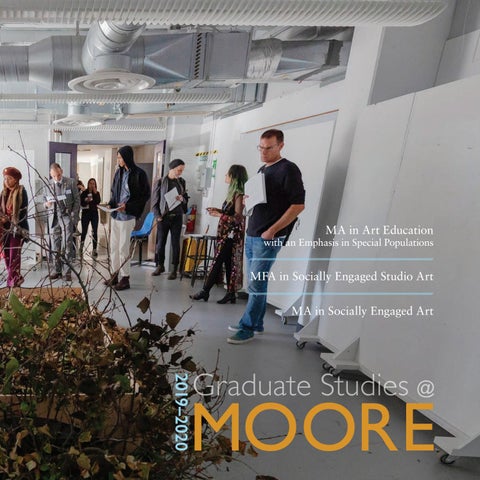
MA in Art Education
with an Emphasis in Special Populations
MFA in Socially Engaged Studio Art MA in Socially Engaged Art
2019–2020
Graduate Studies @
GRADUATE STUDIES AT MOORE At Moore College of Art & Design, we know that the “next step” of an artist’s path is often composed of several steps—many of which come to fruition with the aid of new opportunities and the strong support of a network of mentors and peers. Our co-educational Graduate Studies programs continue and build upon Moore’s rich legacy of esteemed and progressive education. These programs are open to people of all identities who wish to work in the fields of art, art education, museums, academia, community and public art, as well as emerging disciplines and institutions that will drive creative advancement in the 21st century and beyond.
INQUIRE / R E SE A RC H / MAKE / R EF I N E / I N NOVAT E /
Moore’s Graduate Studies programs offer a rich array of opportunities for creative and professional growth. We provide highly engaging educational experiences for those early in their career and interested in honing their practice, and for those who are looking for inspiration among an intimate community of artists, teachers and designers. Schedule a campus visit and learn more about us! Call us at 215.965.4015, email gradstudies@moore.edu or visit moore.edu/graduatestudies.
YO U R WO R K I S J U S T B EG I N N I NG /
2
\
A NOTE FROM OUR ACADEMIC LEADERSHIP
W
elcome to Graduate Studies at Moore College of Art & Design! You will discover, as you look through this brochure and see upon your first campus visit, that our programs are carefully cultivated laboratories of practice, where commitment and passion for concentrated and connective work can develop, deepen and ripen into ambitious ideas. Our curricula are informed by a dynamic interplay of centripetal and centrifugal forces. In our Master of Arts (MA) in Art Education with an Emphasis in Special Populations and MA or Master of Fine Arts (MFA) in Socially Engaged Art programs, Moore’s challenging educational environment and stellar faculty encourage graduate students to pursue their work and research with focus and intensity. At the same time, graduate students benefit from expanded opportunities in Philadelphia and beyond, through projects, collaborations and community partnerships. What does it mean to be a graduate student at Moore? You will be part of a creative cohort of researchers and makers, who share an ethos of careful attention to each other’s work and who thrive on the complex, often demanding pleasures of study, production, writing and experimentation. We will actively support your creative and intellectual journey in a compelling pedagogical environment, where our dynamic, committed community of faculty members, visiting artists, scholars and leaders will advise, challenge, question and encourage you at every turn. As the activities and commitments of our alumni strikingly confirm, Moore graduate students successfully complete their degrees with the capacity and drive to be insightful practitioners and influential thought leaders. We look forward to continuing the conversation as you embark upon this endeavor and learn more about Moore’s Graduate Studies community. Joanna L. Jenkins, Ph.D.
Patricia C. Phillips
Associate Dean of Graduate Studies, Continuing Education and Professional Studies
Chief Academic Officer
/
3
4
\
DEVELOP YOUR CREATIVE WORK IN A WORLD-CLASS CITY Moore graduate students live, work and study in the community-centric, cultural hotbed of Philadelphia, steps away from world-renowned museums and dynamic galleries, and in close proximity to other major cities such as New York City and Washington, DC.
DID YOU KNOW? • Philadelphia is among the top five largest cultural sectors in the United States by revenue • A rts and culture supports 55,000 full-time equivalent jobs through more than 470 organizations throughout the region • T here is an abundance of opportunities for teachers, with more than 330 public and charter schools in the School District of Philadelphia, and approximately 900 private schools throughout Greater Philadelphia
CONNECT + COLLABORATE Moore offers graduate students a rich array of field research, networking and professional opportunities. Through field trips, studio visits, group projects, internships, symposia, meetings with guest critics and more, we maintain, build and create new partnerships every year with artists, educators and thought leaders, on local and global scales. Some of our partners include:
Philadelphia Museum of Art The Barnes Foundation Institute of Contemporary Art, University of Pennsylvania African American Museum of Philadelphia Mural Arts Philadelphia Leeway Foundation Asian Arts Initiative Fabric Workshop & Museum
The Clay Studio Fleisher Art Memorial The Village of Arts & Humanities Center for Emerging Visual Artists Mütter Museum of The College of Physicians of Philadelphia Taller Puertorriqueño
/
5
PREPARE TO FORGE YOUR FUTURE Graduate Studies builds on Moore’s esteemed legacy of preparing students for careers in creative fields. We offer degrees to people of all identities intent on working in the fields of art, art education, museums and academia, as well as disciplines and institutions that have yet to be created. These objectives run throughout our work and will prepare you to reach new heights of leadership in your field of choice: ACCESS AND SOCIAL JUSTICE / EDUCATION AND ENGAGEMENT / CONNECTIONS AND SUPPORT / PROFESSIONAL PRACTICES / PLACE-BASED INQUIRIES /
6
\
ALEXANDRA MONTGOMERY / MA ’17, ART EDUCATION WITH AN EMPHASIS IN SPECIAL POPULATIONS
SEE WHAT SOME OF OUR ALUMNI ARE DOING Art teacher Kate Leibrand MFA ’14, teaches at Moonstone Preschool in Bella Vista, Philadelphia, and creates colorful homemade chalk “delicacies” through her company, TWEE, originally made for her preschoolers and now sold in Nordstrom, Neiman Marcus, Barneys, and 350 other U.S. stores, as well as in the United Arab Emirates, Australia, Bermuda, Ukraine, and Canada. Kristin Mohan MA ’19 recently accepted the position of Assistant Manager of Special Education at VSA, the International Organization on Arts and Disability housed at The Kennedy Center in Washington, D.C. In this role, Mohan oversees the creation of professional development content for those working in the fields of art and special education. Mohan also co-coordinates Intersections, VSA’s annual conference, which is open to classroom teachers, museum educators, teaching artists, arts administrators and more. During his time at Moore, Steve Mogck MFA ’19 curated and organized SATED (The Food Container Project), an event at James Oliver’s HOT•BED Gallery in Philadelphia, designed to bring awareness to the local hunger epidemic. Mogck constructed 125 food containers, then distributed them to 15 artists, from Philadelphia and beyond, to create their own designs with 100% artistic freedom. Proceeds from the event were donated to Philabundance, a local food bank that helps those in need.
/
7
8
\
Moore Graduate Studies awarded more than
$150,000 in Fellowships & Assistantships in 2019
GET MORE OUT OF YOUR DEGREE Our Graduate Fellowships and Assistantships are highly competitive. To be eligible, applicants must submit all materials before the February 1 deadline and then, once enrolled, must maintain full-time status throughout their time as Moore graduate students. Graduate Fellowships offset tuition and financial aid, and make it easier to focus on one’s studies. Graduate Assistantship recipients receive opportunities for employment at Moore, in positions that allow for growth and learning, while also advancing the mission of our institution.
/
9
MEET AN ALUM
KATHERINE VIDEIRA MA ’18 LEAD ART TEACHER, PORTSIDE ARTS CENTER IN PORT RICHMOND, PHILADELPHIA
M
oore’s Masters in Art Education with an Emphasis in Special Populations is a one-of-a-kind program. The seamless blending of art education and special education practices within the program was exactly what I needed to be able to understand how to more effectually teach my inclusive classrooms of unique students. I appreciated that this was an intensive program in which I could attend classes over two summers, but still have the time to teach during the school year while I took classes online. I’ve always believed that teachers should be learning as much about their students as their students do from them. This program gave me the tools to figure out how to do this with all of my students. I’ve learned how to create and implement time-efficient assessments throughout my lessons that focus on my students’ art-making process and help me better understand how they are thinking about their projects, as well as what support they may need. As a result of my research at Moore, I will help our education director create program-wide art standards and assessments to implement into all of our after-school art classrooms.
Learn more about Moore’s MA in Art Education with an Emphasis in Special Populations on pages 20–25!
10
\
“ I am a far more confident and successful art teacher as a direct result of attending Moore.�
/
11
ANY PATH IS THE RIGHT PATH TO MOORE As a Moore graduate student, you’ll find yourself immersed in inspiring environments and engaged in provocative conversations, surrounded by artists, thinkers, activists and educators who come with various lived experiences and a shared passion for learning. Each student has a unique background and story, which leads to an individualized experience in our programs.
12
\
KAT LEE / MA ’17, ART EDUCATION WITH AN EMPHASIS IN SPECIAL POPULATIONS
HANNA LEE MA ’16, ART EDUCATION
“ I’ve never been much of a public speaker, but Moore’s Art Education graduate program prepares you from the first semester to become comfortable with presenting. From leading a discussion about a reading assignment to presenting my own research, I was challenged to become a better speaker through experience. After graduating, Moore has continued to provide opportunities for me to share my research.”
YAROUB AL-OBAIDI MA ’19, SOCIALLY ENGAGED ART
“ As someone with an industrial design background, I had worked with lighting, tools, furniture and other objects. I started to think about the relation between beauty and function. When I reached Philadelphia, I developed a different experience with art. After I met the artist Michael Rakowitz, my perspective became wider and I started to think more about socially engaged art and how to make the community more engaged. As part of my current work process, I try to tell stories about how the art was made. Stories are an essential part of my process, to increase the sense of belonging between the work and audience [and] to select themes that connect with the community.”
SUKI VALENTINE MFA ’17
“ A primary [benefit of ] my Moore education was learning how to take my ideas and develop them on my own. In many ways, I feel my entire life as an artist has been leading up to this—to have the skill set and the practice and the ability to bring it all together. This was an opportunity to explore my heritage more deeply than I ever have, to connect my ancestry to my art and my practice, and to take this experience back with me to further practice in my studio at home.”
/
13
ASSEMBLE + ACTIVATE
M
oore students and faculty share the unique opportunity to engage in provocative conversations with visiting guests—scholars, artists, educators, community organizers and other creative professionals—in order to explore solutions, create awareness and build expertise.
14
\
CHELSEY WEBBER-BRANDIS / MFA ’20
IN THE PAST YEAR, SOME OF OUR GUESTS HAVE INCLUDED: ART EDUCATION Margery Amdur Winston Bailey Steve Baris Dr. Marta Cabral Susan Coll-Guedes Samantha Davis Mark George Elizabeth Hoover Deb Klose
Hannah Lee Katherine Lee Shannon Merenstein Joyce Millman Alexandra Montgomery Jennifer Nadler Anthony Reynolds Carol Saylor Sarah Shaw
Michael P. Stafford, Counsel Stephanie Stern Emily Taylor Julia Terry Samantha Varian Diane Wilkin Lindsay Wister Dr. Courtnie Wolf Margo Wunder
Jane Golden Elizabeth Green Melissa Hamilton Maori Holmes Miguel Horn Tu Huynh Christina Jackson Malav Kanuga Christianne Kapps Kate Kraczon Katherine Lee Cole Lu Christina Lukac Nat May Constance Mensh Peter Morgan
Ksenia Nouril Eric Okdeh Kathryn Pannepacker Netanel Portier Ricardo Rivera Amara Rockar Doris Salcedo Amanda Sroka Mark Strandquist Judith Tannenbaum Tiny WPA JJ Tiziou Amanda Toma Megan Voeller Ben Volta Sika Wheeler
SOCIALLY ENGAGED ART Laure Biron Dana Bishop-Root Courtney Bowles Justin Brown James Burns C.R. Ettinger Studio Leu Davidson Samantha Davis Joseph Del Pesco Tania Asiili (Del Valle) Vashti Dubois Tim Dunn Anthony Elms Paul Farber Nicole Garneau Jess Garz
IN 2019–2020, WE LOOK FORWARD TO A NEW ROSTER OF LUMINARIES, INCLUDING: Adrienne Maree Brown LeDerick Horne Sarah Kavage Riva Lehrer
Ernesto Pujol Mierle Laderman Ukeles Caroline Woolard
/
15
16
\
SYMPOSIA, PUBLIC PROGRAMS AND EXHIBITION OPPORTUNITIES There are many opportunities to learn and grow within your Graduate Studies community. Public programs and symposia are ideal spaces to meet and connect with professionals and practitioners who can help you conceptualize and form the building blocks of your own practice. The Galleries at Moore, open and free to the public, provide an ideal backdrop for graduate student exhibitions, including in-progress work and final portfolios.
“ When I was looking at MFA programs, I visited Philadelphia to attend a Moore summer symposium and found myself in a room with other artists and practitioners who were asking the same questions I was starting to ask in my own practice and who had given a great deal of time to seeking answers. My experiences at that symposium were a primary factor in my decision to attend Moore.” —Tim Goldsmith, MFA, ’19 Moore faculty member Li Sumpter addresses Moore Art Education graduate students inside Joy O. Ude’s Patterning Community, part of the Philadelphia Museum of Art’s exhibition Souls Grown Deep: Artists of the African American South. Pictured: Joy O. Ude, Patterning Community, pieced, stitched and quilted fabric and recycled plastic geodesic dome, 12' (diameter) x 7' (height), 2019.
HIGHLIGHTS OF 2018–2019 • We hosted a number of creative luminaries through Conversations@ Moore, our public program series—Courtney Adair Johnson, Romi Crawford, Zanele Muholi, Hito Steyerl, Rosten Woo, and Rebecca Zorach—in partnership with other arts and culture organizations in Philadelphia, such as Philadelphia Contemporary, Mural Arts Philadelphia and the Leeway Foundation • We presented two thematic Art Education symposia for current and prospective students, as well as members of the art education community: “Art and Human Behavior” and “Understanding Our Humanity Through the Arts” • Our graduate students attended the 2018 International Sculpture Conference, hosted by Moore, which featured a keynote address by world-renowned, Bogotá-based sculptor Doris Salcedo • We partnered with the Alliance of Artist Communities to learn about residency opportunities from representatives of Rivet, Watermill Center, Santa Fe Art Institute, AIR Taipei Culture Foundation and Oxbow School of Art and Artists’ Residency • M FA and MA students exhibited their work at three shows in the Galleries at Moore and Open Studios night, all free and open to the public
/
17
MEET AN ALUM
STEVE MOGCK MFA ’19 ARTIST, INDEPENDENT CURATOR AND ART TEACHER, UNIVERSAL VARE CHARTER SCHOOL IN PHILADELPHIA
I
’ve worked as a professional artist for over 25 years but about two years ago I started to feel something was missing. I always wanted to pursue my MFA but I never felt it was the right time or that there was an institution that could support my schedule of being a husband and father while maintaining my art practice. I realized my dream could be a reality after my first phone call with Moore’s Graduate Studies program director. Initially my goal of achieving an MFA had more to do with wanting to be a college professor rather than honing my skills or making new friends. I could not have been more wrong. The curriculum, my cohort and intimacy of the program broadened my horizons more than I ever thought possible. Moore has prepared me for the second stage of my career with a toolbox that will be useful in whatever direction I choose to explore in the future.
Learn more about Moore’s MFA and MA programs in Socially Engaged Art on pages 26–31!
18
\
“ I realized my dream could be a reality.”
/
19
20
\
NO LIMITS TO LEARNING MA IN ART EDUCATION WITH AN EMPHASIS ON SPECIAL POPULATIONS Moore’s Master of Arts in Art Education with an Emphasis in Special Populations is a rigorous program that prepares and empowers art educators to develop skills for adapting and implementing strategies that enrich the lives of all learners. We develop and test innovative techniques through action-based research in a field setting, while critically assessing art education policies and documenting the study of contemporary art education issues for diverse learners. Our candidates graduate prepared to enter the classroom and to advance the field of art education through their everyday practice.
FOR EDUCATORS WHO HAVE CERTIFICATION
FOR EDUCATORS SEEKING CERTIFICATION
• M A is a 15-month, 30-credit program
• M A + Certification is a 27-month program
• Hybrid delivery: You’ll be on-campus in the summer for six weeks, then online in fall and spring
• Combines and integrates certification and master’s classes: comprised of both traditional post-baccalaureate courses leading to certification and MA courses
• Only program of its kind in the United States • Designed for art educators who are already certified
• Start graduate courses in your first summer term and begin to identify and develop a thesis project
Curricula can be found at moore.edu/academics/graduate-studies
/
21
100%
of Moore MA in Art Education with an Emphasis in Special Populations 2018 and 2017 graduates are employed in their field of study or enrolled in a doctoral program!
22
\
WHY CHOOSE ART EDUCATION AT MOORE? A NOTE FROM LAUREN STICHTER, DIRECTOR OF ART EDUCATION
G
rowing up I found my academics to be very challenging. I struggled even to complete high school. Like many of my students now, I did not fit the “one size fits all” education system that we find ourselves in today. However, I always felt successful in the art room. Not because I was the best artist, but because my art teacher chose to celebrate every effort that I made to express myself. We all have students like this in the art room, don’t we? Whether we have students with IEPs, or special accommodations, or whether these needs are hidden from us, we art educators desire to have an art room that offers a safe and engaging art making experience for all of our students. Here at Moore College of Art & Design, we pride ourselves on offering the only program in the country—our Master of Arts in Art Education with an Emphasis in Special Populations—that equips its graduates with the knowledge, research, strategies and skills to make art accessible to everyone. Our highly trained and experienced faculty are looking for candidates who are curious, who have a sense that something better is possible, and who are bold enough to do the work. When our students research and write their theses, they are making substantial contributions to the field of art and special populations. They develop incredible networks of peers and colleagues to learn from and collaborate with, and their investigations become the research upon which other art educators will build their curriculums and advocate for change in the classroom. COME AND JOIN ME FOR THIS ONE-OF-A-KIND EXPERIENCE. LET’S EXPAND THE FIELD OF ART EDUCATION TOGETHER.
/
23
FACULTY AND INSTRUCTOR PROFILES
AMANDA NEWMAN-GODFREY Assistant Professor, Art Education
24
\
Students come to Moore’s Art Education program with a variety of different interests in terms of who and where they want to serve as educators. For me, that better informs what I teach them and what sort of curriculum I bring to them, so that they feel prepared to enter those realms. Our students start teaching and just take off, because they know that whatever comes at them through that classroom door, they have either seen, worked hands-on with those students, or know how to work with those students.
Within my role as instructor, I believe it is imperative to prepare the teachers of tomorrow, not only with the pragmatic tools needed to best teach, but also to instill the qualities of love and empathy in their everyday approach.
JEAN DRUMM ’87 Adjunct Instructor teaching Introduction to Art Therapy and Behavioral Health in the Classroom
KATE GUGLIOTTA Adjunct Instructor teaching STEAM for Special Populations
[My class] began as a course to help art teachers feel more comfortable incorporating technology into their teaching. In the past four years, it’s expanded into a class that investigates how technology can be used not only as a teaching tool, but as its own art medium. The class also explores the other parts of STEAM (science, technology, engineering, art and mathematics). We examine how, as educators, we can make these lessons accessible for students of all abilities.
/
25
26
\
COMMUNITY AS COLLABORATOR MFA IN SOCIALLY ENGAGED STUDIO ART MA IN SOCIALLY ENGAGED ART Moore’s Socially Engaged Art degree programs bring together artists and organizers in the same space, to critically and pragmatically engage in the discourses and practices concerned with art’s relationship to place, collaboration, ethics, material and interdisciplinary research. We are concerned with the role, history and potential of art in relationship to society. Through our classes, public programs, community partnerships, symposia and the work of our renowned students and faculty, we are making our way through the world, asking challenging questions together.
MFA IN SOCIALLY ENGAGED STUDIO ART
MA IN SOCIALLY ENGAGED ART
• Two-year, 60-credit program
• One-year, 30-credit program
• Encourages artists to think across disciplines and about critical issues that arise when conceptualizing, making, disseminating and documenting art
• Focused on administering, organizing and facilitating socially engaged art experiences and studying community engagement through the arts
• Candidates go on to teach art in community settings and schools, participate in artist-run spaces and exhibit artwork widely
• Candidates often go on to work in museums and schools, or initiate their own organizations
Curricula can be found at moore.edu/academics/graduate-studies
/
27
100% 28
\
of entering MFA candidates will receive a $1,000 research award! 
WHY CHOOSE SOCIALLY ENGAGED ART AT MOORE? A NOTE FROM DANIEL TUCKER, GRADUATE PROGRAM DIRECTOR, SOCIALLY ENGAGED ART
A
rt today is boundless and exhilarating, between the skills of image-making, the crafting of material, the framing of ideas, and research that exceeds the limits of disciplines. And yet, so often, art programs tend to get stuck in the past, in terms of how the art is taught, where the teaching takes place and who facilitates it. At the nexus of art and research, you’ll find Moore’s graduate programs in Socially Engaged Art, where we take a strong and passionate interest in questioning ideas and ways of making. We ask an important question: What does art look like—or what can it look like—with social engagement at top of mind? Our MFA program in Socially Engaged Studio Art is fundamentally concerned with the role of art in society and offers a curriculum that encourages artists to think across disciplines about critical issues that arise today. Some students may focus more on the internal world of the artist, while others may gravitate toward active collaboration between the artist and their neighborhood or local organizations. Our MA degree focuses on the administration, organization and facilitation of socially engaged art experiences and deep study of the emerging field of community engagement through the arts. With interdisciplinary courses in project management as well as critical race theory and peacemaking, this program provides candidates with the practical, ethical and theoretical tools to both analyze and produce transformative art experiences. AT MOORE WE WILL GROW, INQUIRE, MAKE AND LEARN TOGETHER IN A COMMUNITY UNLIKE ANY OTHER. I LOOK FORWARD TO WORKING WITH YOU.
/
29
FACULTY AND INSTRUCTOR PROFILES
SHIRA WALINSKY Muralist and Faculty, Socially Engaged Art
30
\
It’s really exciting for me to teach in Moore’s Socially Engaged Art program because the questions that are brought up in the classroom are things that I think about through my work. How does art impact the community? What are ways to go in and work with a community? What is the role of visual aesthetics? What are the ethical questions? Philadelphia is an activist city, a city of neighborhoods and rich histories. You can be part of it right now, not just read about it in a history book.
HAMMAM ALDOURI Adjunct Assistant Professor teaching Art History, Theory and Criticism
In our contemporary context, we often take the expression “art practice� for granted, which sometimes leads to unquestioned assumptions about what practice is, what it means and what it does. I think what is distinctive about some artistic endeavors of the last 200 years is that art is increasingly connected to other non-artistic ways of acting and doing. Sometimes these other modes of activity can be as banal as shopping or cleaning and sometimes they can be broad and ambitious, like organizing a festival or protest.
/
31
OTHER OPPORTUNITIES FOR LEARNING
32
\
In addition to (and often, on the way to) our Graduate Studies programs, Moore offers other unique opportunities for learning and professional development.
POST-BACCALAUREATE ART EDUCATION Moore’s Art Education department prepares students to be professional art teachers according to Pennsylvania Department of Education standards. As a student teacher, you will learn to share your knowledge and appreciation of art with all students, including those with special needs. The Art Education Certification Program offers: • Evening and weekend courses designed for working professionals over three or four semesters • Option to combine certification with Moore’s one-of-a-kind MA in Art Education with an Emphasis in Special Populations • Student teaching experience in Philadelphia-area Schools and Moore’s Young Artists Workshop program for grades 3–12 • T he ability to apply for a Pennsylvania Teaching Certificate after successfully completing the coursework, student teaching and Praxis exams • Learn more at moore.edu/pbae Learn more at moore.edu/pbae
4+1 PROGRAMS Current Moore undergraduate students can easily obtain their MA degrees with our specially designed 4+1 program, which integrates our four-year BFA degree with an extra year toward a graduate degree, either in Art Education or Socially Engaged Art. These one-of-a-kind programs have become official academic pathways and are open to all Moore undergraduate students. PLUS: Each accepted 4+1 student will be granted a $10,000 graduate fellowship! Contact us at enroll@moore.edu to learn more
TEACHERS SUMMER INSTITUTE Refresh, refocus and reconnect. Moore’s annual Teacher Summer Institute (TSI) is designed for high-school art teachers who seek a dynamic environment for professional development in visual arts education. Over the course of a week in late June, this professionally directed program of studio-based workshops gives educators dedicated time to make art, create connections with peers, and to strengthen and discover new skills for the classroom. Learn more at moore.edu/tsi
TIM GOLDSMITH / MFA ’19
/
33
34
\
ELIZABETH HOOVER / MA ’17 ART EDUCATION WITH AN EMPHASIS IN SPECIAL POPULATIONS
JOIN OUR COMMUNITY FORGE YOUR PATH APPLY TODAY
E
very year, we welcome select students into each of our Graduate Studies programs after careful review of the application package. All prospective students are reviewed by the Graduate Review Committee after the application deadline and are automatically considered for fellowships based on academic merit and creative promise. A separate application is not required.
APPLICATION REQUIREMENTS FOR ALL GRADUATE PROGRAMS • Completed Application (Applications are still being considered on a spaceavailable basis.) • Director Interview • Statement of Intent • 2 Letters of Recommendation from an employer, professor, or professional colleague
• A ll Official College Transcripts • I nternational Applicants only: English proficiency: TOEFL scores: 92 IBT (Internet-based test), 580 PBT (Paper-based test), 237 CBT (computerbased test) IELTS score of 6.5 • Program-specific Requirements
• Resume / CV All materials may be sent to gradstudies@moore.edu or mailed to: Moore College of Art & Design Admissions Office / Graduate Studies 1916 Race Street, Located on The Parkway Philadelphia, PA 19103-1179 USA
Begin your application at moore.edu/admissions/graduate-admissions
/
35
WE CAN’T WAIT TO GET TO KNOW YOU! There are lots of opportunities to visit the campus, including public programs, Open Houses and personalized campus tours. Tell us what you want to see and we’ll customize your time on campus. In addition, please fill out and send back the tear-out postcard on the next page, to express your interest in one or more of our programs. We will get back to you right away!
LEARN MORE
SCHEDULE A VISIT
moore.edu/grad
gradstudies@moore.edu 215.965.4015
FRONT / BACK COVER ARTWORK CHELSEY WEBBER-BRANDIS MFA ’20
INSIDE BACK COVER ARTWORK TIM GOLDSMITH MFA ’19
PHOTOGRAPHY ACADEMIC IMAGE / MELLANY ARMSTRONG / THOM CARROLL / DAVE RIZZIO / NICOLE STEINBERG / STEVE WEINIK
ABOUT MOORE Moore College of Art & Design is dedicated to excellence in art and design. Founded in 1848, Moore is the first and only visual arts college for undergraduate women in the United States. Through its Bachelor of Fine Arts degrees for women and its coeducational Graduate Studies programs, Moore cultivates creativity, promotes scholarship and prepares its students for professional careers in the Moore College of Art & Design is dedicated to excellence in art arts by emphasizing critical thinking, problem solving, risk-taking, and design. Founded in 1848, Moore is the first and only visual arts and strong communication skills. Moore is dedicated to producing college for undergraduate women in the United States. Through graduates that distinguish themselves as leaders in their fields. its Bachelor of Fine Arts degrees for women and its coeducational Graduate Studies programs, Moore cultivates creativity, promotes As a cultural leader, Moore promotes access to the arts throughout scholarship and prepares its students for professional careers in the the broader community. The Galleries at Moore introduce the arts by emphasizing critical thinking, problem solving, risk-taking, work of significant regional, national and international artists to and strong communication skills. Moore is dedicated to producing the community through distinctive exhibitions and educational graduates that distinguish themselves as leaders in their fields. programs. The wide-ranging Continuing Education program also serves the community by providing opportunities for men and As a cultural leader, Moore promotes access to the arts throughout women to learn new skills for personal and professional growth. the broader community. The Galleries at Moore introduce the Through Moore’s Youth Education programs, including the annual work of significant regional, national and international artists to Summer Art & Design Institute and the acclaimed Young Artists the community through distinctive exhibitions and educational Workshop, founded in 1921, the lives of children and youth are programs. The wide-ranging Continuing Education program also enriched through creative arts education. serves the community by providing opportunities for men and women to learn new skills for personal and professional growth. Building on its historic legacy of educating women and men for Through Moore’s Youth Education programs, including the annual successful careers in the visual arts, Moore is committed to adapting Summer Art & Design Institute and the acclaimed Young Artists to the needs of future generations of artists, designers, scholars and Workshop, founded in 1921, the lives of children and youth are educators throughout its diverse educational programs. enriched through creative arts education.
ABOUT MOORE
Building on its historic legacy of educating women and men for successful careers in the visual arts, Moore is committed to adapting to the needs of future generations of artists, designers, scholars and educators throughout its diverse educational programs.
For Moore’s policy of Non-Discrimination and Compliance with the ADA and Section 504 of the Rehabilitation Act of 1973: moore.edu/nondiscriminationpolicy Moore College of Art & Design is accredited by the Middle States Commission on Higher Education, National Association of Schools of Art & Design and Pennsylvania State Council of Education.
Graduate Studies at Moore 1916 Race Street Located on The Parkway Philadelphia, PA 19103 USA moore.edu/graduatestudies @moorecollegeart