443 NOVEMBRE 2026 POSTE ITALIANE spa - Edibrico srl, Milano - ANNO LIII
056
GIA AWARDS 2026: WINNERS AND FINALISTS
044
PET ECONOMY: THE NEW MARKET
071
FRAGRANCES AND TEXTILES: RETURN TO COCOONING
- casa e art de la table -
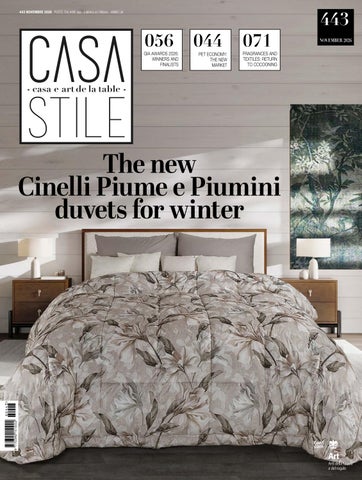
The new Cinelli Piume e Piumini duvets for winter
443 NOVEMBER 2026
S U M MARY
6
COVER STORY
Feather, color, and texture: the new quilts by Cinelli Piume e Piumini for winter
trends 28
GUIDES
The Art of the Table: a guide to cutlery
32
MARKETS
Consumer trends endorse the pursuit of authentic value
40
MARKETS
Slow Living: slowness as a sales strategy
44 PET
Four-legged design for a petfriendly home
56
GLOBAL INNOVATION AWARDS 2026-2027
Casastile announces the winner who will represent Italy in Chicago
- casa e art de la table -
Bimestrale - 443 Novembre 2026 - www.casastileweb.it EDITORE EDIBRICO srl con socio unico Viale Emilio Caldara, 44 - 20122 Milano DIRETTORE EDITORIALE E RESPONSABILE Nicla de Carolis - decarolis@edibrico.it COORDINATORE DI REDAZIONE Laila de Carolis - laila@edibrico.it GRAFICA E IMPAGINAZIONE Gabriele Curato - gabriele.curato@edibrico.it SEGRETERIA DI REDAZIONE Patrizia Ferrari - p.ferrari@edibrico.it Claudia Cazzulo - claudia@edibrico.it IN REDAZIONE Mauro Balbi, Francesco Poggi redazione.casastile@edibrico.it COLLABORATORI Fabio Destefani, Francesca Guerini Rocco, Patrizia Pagani IMMAGINI Shutterstock DIRETTORE COMMERCIALE Cesare Gnocchi - cesare.gnocchi@tecnichenuove.com SVILUPPO COMMERCIALE Monica Sposito - monica.sposito@tecnichenuove.com UFFICIO COMMERCIALE VENDITA SPAZI PUBBLICITARI: Milano, Via Eritrea 21 - tel. 02 92984481 - commerciale@tecnichenuove.com Anna Boccaletti (coordinatore) anna.boccaletti@tecnichenuove.com UFFICIO TRAFFICO E PUBBLICITÀ Lorena Villa - lorena.villa@tecnichenuove.com - tel. 02 92984542
ABBONAMENTI Tariffe per l’Italia: cartaceo annuale 22,00 euro; cartaceo biennale 34,00 euro. Modalità di pagamento: sul sito www.edibrico.it; Conto corrente postale n.13844469 intestato a: EDIBRICO - loc. Vallemme, 21 15066 Gavi (AL) Bonifico bancario su Iban: IT43Q0623048310000046330946 L’abbonamento avrà inizio dal primo numero raggiungibile. Servizio clienti: 0143 645037 - abbonamenti@edibrico.it STAMPA Faenza Printing Spa - Via Vittime Civili di Guerra, 35 - 48018 Faenza (RA)
Copyright EDIBRICO SRL
La riproduzione delle illustrazioni e degli articoli pubblicati dalla rivista, nonché la loro traduzione è riservata e non può avvenire senza espressa autorizzazione della Casa Editrice. I manoscritti e le illustrazioni inviati alla redazione non saranno restituiti, anche se non pubblicati e la Casa Editrice non si assume responsabilità per il caso che si tratti di esemplari unici. La Casa Editrice non si assume responsabilità per i casi di eventuali errori contenuti negli articoli pubblicati o di errori in cui fosse incorsa nella loro riproduzione sulla rivista.
REGISTRAZIONE Tribunale di Milano n.392/72 ROC n. 34848 del 26 agosto 2020 ISSN 0390-1512
LET'S TALK CINELLI Piume e Piumini I copertina / 6-9 DAUNENSTEP IV copertina / 72-73 F.LLI CAMPAGNOLO 3 / 79 FIERA MILANO 19 HAMMERFEST 39 MESSE FRANKFURT ITALIA III copertina / 27 MICROPLANE II copertina
EDITO R I A L
“Less is more”, Fewer Retail Outlets, Higher Revenue FOLLOW US
Fewer retail outlets and higher revenue—this, in short, is what emerges from the 2026 Confcommercio report. The study highlights that, despite a reduction in the number of specialized and independent home goods, tableware, textiles, and gift shops between 2018 and 2025, overall turnover grew by 28%, rising from €28.1 billion to €36 billion. Hence, "less is more"—a phrase popularized by modernist architect Ludwig Mies van der Rohe in the 20th century to reject excess weight, superfluous ornamentation, and baroque decorations—proves fitting for many other sectors. Digression aside, these figures show that the sector has responded well to ongoing major shifts through structural consolidation and efficiency improvements. The reduction in store numbers indicates market streamlining, with the closure of smaller, less efficient, and marginal outlets, while surviving businesses have absorbed the market share of those that closed. The increase in revenue alongside fewer stores indicates that the industry has pivoted toward a higher-end market segment—premiumization. Competition is no longer fought on price, but on quality, expertise, and customer service. This justifies higher retail price points and stronger margins, generating greater overall value even with fewer physical transactions. This added value is delivered by a well-structured network of brickand-mortar stores that serve as venues for curation and tailored advice, supported by an increased sales staff workforce, as highlighted by the Confcommercio study. All of this ensures that shopping remains a delightful, highly supported experience—unlike anywhere else!
Nicla de Carolis
COVER STORY
Feather, Color, and Texture: The New Quilts by Cinelli Piume e Piumini
FOR WINTER
6
Cinelli Piume e Piumini presents its Autumn/Winter 2026/2027 duvet collection: a refined palette, geometric and damask textures, Standard, Medium and Light versions, and goose down and feather filling, all made entirely in Tuscany
A
s the days grow shorter and temperatures drop, the bedroom becomes the ultimate refuge once more. This is where Cinelli Piume e Piumini unveils its new Autumn/Winter 2026/2027 duvet collection: a line that combines elegance, comfort and artisanal quality, designed to dress the bed with the same care that goes into furnishing a room.
Textures that tell a style story What gives these duvets their character is, above all, the research into surfaces. Geometric motifs, damask patterns and tone-on-tone designs create depth and movement, turning each model into a true furnishing piece. Alongside them, natural and floral patterns express a more romantic, timeless sensibility.
A refined palette, tailored to interior design Colour is the starting point. The collection draws on a sophisticated, versatile palette: pearl greys, ivory whites, warm taupe, sage green, cream beige and earthy tones sit alongside delicate shades of dusty blue. This chromatic balance echoes the language of contemporary interior design, blending naturally into any residential setting, from the most essential minimalism to the warmest, most welcoming spaces.
Each duvet speaks its own language, from modern to classic to richly decorative, giving the bed a distinct identity without compromising on function. Just the right warmth for every need Comfort is personal, and the collection recognises that. The models come in Standard, Medium and Light versions to suit different warmth requirements, and in three sizes: double, king-size
Ivory whites, pearl greys and cream beiges: the Cinelli Piume e Piumini Autumn/Winter 2026/2027 duvets dress the bed in light, luminous tones. Tone-on-tone textures and goose down and feather filling promise a night of comfort, lightness and breathability. 7
COVER STORY
and single. It is a broad choice, designed to find the right duvet for every person, every room and every season spent at home. Goose down and feather: you can feel the difference At the heart of every creation lies the goose down and feather filling, a natural material that delivers comfort, lightness and excellent breathability. These qualities work together to maintain the ideal microclimate throughout the night: enveloping when needed, never heavy, letting the body breathe as it rests. For Cinelli Piume e Piumini, feather has always symbolised age-old expertise, an expression of balance, lightness and the highest possible comfort.. www.cinellipiumini.com
8
MASTERS OF FEATHER SINCE 1964
Behind every duvet lies a story that began more than sixty years ago in Buggiano, in the province of Pistoia, thanks to Silvano Cinelli. From the manual processing of feather grew an entrepreneurial adventure that has spanned eras and sectors, from the first technical down garments of the 1970s, tested by the first Italian expedition to Antarctica, to today’s bedding line. That journey has translated into a method that has stayed true to itself: the entire production cycle takes place within the Tuscan factory, ensuring direct and constant quality control at every stage. Every product is born in Tuscany, in the hands of skilled artisans trained and carefully nurtured by the company, who combine craftsmanship, research and innovation applied to the tradition of Made in Italy. This is how Cinelli Piume e Piumini duvets remain traceable and long-lasting.
Earthy tones, sage green and shades of dusty blue: the Cinelli Piume e Piumini Autumn/Winter 2026/2027 duvets warm the bedroom with geometric, damask and floral patterns, always filled with goose down and feather.
INCO N T R I DESIGN
Arianna De Luca:
ceramics as matter,
CULTURE AND MEMORY A background in industrial design, followed by years devoted to interior design and, finally, a move into the world of ceramic craftsmanship. This, in brief, is the professional path of Arianna De Luca, who creates objects in her studio where different influences coexist, from the ancient Mediterranean ceramic tradition to the design style of the 1980s.
The ceramicist Arianna De Luca 10
by Fabio Destefani
F
rom interior design to ceramic craftsmanship. Could you briefly outline the main stages of your professional career? My path began with training in industrial design, which taught me to look at objects through form, proportion, function and process. I then built on that with a Master’s at Central Saint Martins in London, an experience that gave me, above all, a critical approach and the freedom to question what I already knew. After that I moved into interior design, but at a certain point I felt the need to return to a more direct relationship with materials and with making. That is how ceramics entered my life, almost out of necessity. I began working with clay and, gradually, what had been a personal exploration became my profession. An important step was my return to Abruzzo and my encounter with the ceramic tradition of Castelli. There I was able to engage with techniques and knowledge handed down through generations, and to understand how ceramics can be, at once, matter, culture and memory. From that moment I began to build a personal language, somewhere between design, craftsmanship and artistic research.
La graziosa collection. Ph© Flavia Rossi
INCO N T R I DESIGN
La graziosa collection. Ph© Flavia Rossi
Bonanza collection. Ph© Dominga Colonna
What attracted you to ceramic craftsmanship? First of all, the chance to re-establish a direct relationship with the material. In design there is often a distance between the project and its realisation; in ceramics, thought and making are in constant dialogue. I am also fascinated by its dual nature: it is an ancient, almost archaeological material that carries centuries of history, yet depending on how it is interpreted, it can become extremely contemporary. Working with clay also means accepting a certain unpredictability. The process continually changes the original idea, and for me this is one of the most interesting aspects of craftsmanship. our creations, characterised by a skilful and meticulous use of colour, pay homage to the great Mediterranean ceramic tradition. How do you reinterpret ancient archetypes, building a bridge between tradition and innovation, memory and the contemporary? For me, tradition is not something to be preserved statically, but a language that must keep evolving. I am not interested in faithfully reproducing forms or decorations of the past, but rather in absorbing their spirit: the bond with the
12
land, the value of handcraft and the idea of the object as a cultural expression. I am especially interested in working with the visual codes of tradition: taking familiar images, archetypes that belong to our collective memory, and rewriting them through contemporary forms, colours and proportions. It is a kind of “active nostalgia”: not a melancholy look back at the past, but the possibility of using memory as raw material to create something new. I like the idea that an object can feel familiar without being a literal quotation, and can create a bridge between what we recognise and what we do not yet know.
Folcloristica collection. Ph© Dominga Colonna
Another important source of inspiration for your work is 1980s design, a period that emphasised research and experimentation, hi-
Riviera collection. Ph© Flavia Rossi
ghlighting the aesthetic potential of objects over their functional one. Are these the qualities you admire in that decade, or are there others? What interests me most about the 1980s is the freedom with which design began to question its own identity and the expressive possibilities of the object. It was a period in which research, experimentation and the more emotional dimension of the project took on an important role. I am fascinated by the idea of the object not merely as an answer to a function, but as something capable of generating emotion, telling a story and building an imaginary world. I think this is close to my own way of working. Although my background is in design, I do not consider function the only criterion through which to read an object. Form, colour, material and narrative power can be just as important. In this sense, 1980s design remains a source of freedom and experimentation. What stages does your ceramic production involve? I am directly involved in every phase of the process: from the birth of the concept to design, from prototyping to production, through to finishing, packaging and shipping. I see it as a circular process rather than a linear one. Each pha-
13
INCO N T R I DESIGN
se influences the next, and it is often the work with the material itself that suggests changes to the form or the original project. I collaborate with artisans and professionals when necessary, but I always remain directly involved. For me it is essential not to lose touch with the process and to keep experimenting with forms, materials and colours. What kinds of products do you create? I mainly create ceramic objects and accessories designed for domestic spaces and interiors. My work sits between collectible design, craftsmanship and interior design. I make one-of-a-kind pieces, small series and collections, always seeking to maintain a strong authorial identity. Even when an object belongs to a series, the manual process introduces small variations that make each piece different from the others. I am very interested in this tension between uniqueness and reproducibility: creating objects that can be shared and can inhabit different contexts without losing the authenticity of handmade work.
Riviera collection. Ph© Flavia Rossi
What materials do you use for your creations? The main material is, of course, clay, which for me is much more than a simple medium. It is a material with which to establish a continuous dialogue, capable of changing the project and introducing an element of unpredictability. A fundamental part of my research also concerns glazes and colour. I spend a great deal of time developing colour palettes and looking for combinations capable of evoking particular sensations and atmospheres. For me, colour is not merely a decorative element but a true language, and it often represents the starting point of a project. It seems that people’s interest in craftsmanship is growing today. What is your view? Yes, I believe there is growing attention towards what is handmade and towards objects that can tell a story. Perhaps as a reaction to a reality that is increasingly fast and standardised, we feel the
14
need to surround ourselves with things that have a more personal, human dimension. Craftsmanship allows us to perceive the time behind an object, the hand of the person who made it, the small imperfections that make it authentic. I think this is one of its most contemporary values: it does not necessarily belong to the past, but can respond very well to the needs of the present. Does your Rome-based artisan studio also include a space for sales? Not necessarily, since I work with retailers, but the doors are always open.
Uccellacci collection.
What kind of distribution do your products have? Distribution has grown progressively alongside the project. There was no single turning point: one magazine led to another, one client to another client, one retailer to new contacts. Fairs and events have also played an important role, because they allow me to meet people, talk directly about my work and build relationships that often turn into lasting collaborations. Today my work therefore moves between direct sales, retailers, collaborations and projects for hospitality and residential settings. Are your creations also available abroad? Yes, my work has gradually gone beyond Italian borders. It was a natural process, built over time through magazines, retailers, fairs, events and professional relationships. The international experience is particularly interesting to me because it shows how objects deeply rooted in Mediterranean culture can be read and interpreted in different cultural contexts. I work with the UK, France, the USA, Korea, Japan, Dubai, Jordan and Lebanon.
15
Do you also offer customised products? Yes, I also work on bespoke projects and commissions, which are an interesting part of my activity. I believe that today the ability to customise a project is important above all when it allows a more direct relationship to form between the object, the client and the space in which it will live. It does not simply mean changing a colour or a size, but often developing a project that arises from specific needs and characteristics. It is a dimension of the work that interests me because it allows me to maintain my authorial research while measuring it, at the same time, against a real context and concrete requirements.
Folcloristica collection. Ph© Dominga Colonna
Original shapes and a careful use of colour characterise Arianna De Luca’s objects. Ph © Studio Daido
16
Arianna De Luca’s ceramic objects are the result of research that combines elements of the ancient Mediterranean ceramic tradition with the style of 1980s design. Ph © Studio Daido
You collaborate with renowned retailers and prestigious hotels. Could you tell me something about this side of your work? ollaborations with retailers and hotels are an important part of my work because they allow me to engage with contexts very different from the studio. I am particularly interested in seeing
how my objects change their relationship depending on the space in which they are placed. An object designed for the home can take on a completely different meaning inside a hotel, a restaurant or an interior design project. Even in these cases I strive to maintain a strong identity in my language, while working in dialogue
with the project and the client’s specific needs. It is a balance I find very stimulating: on one hand, the freedom of personal research; on the other, the chance to see that research enter into relationship with architecture, people and real situations.
Arianna De Luca Arianna De Luca was born in Abruzzo, between hills and sea, in a land where folklore and nature blend harmoniously. After studying Industrial Design in Italy and in London, where she earned an MA at Central Saint Martins, she turned to ceramics following years devoted to interior design. She then chose to explore the rich heritage of the artisans of Castelli, in her native region, where she discovered a world of ancient techniques handed down from generation to generation. With a consistent, personal approach, the ceramicist honours local traditions by elevating them to a contemporary language. Her objects are true characters, endowed with a soul and a personality: a people of ceramics that become presences. Collectible ceramic objects that fuse Mediterranean heritage with a contemporary aesthetic. Each piece, handmade in Italy, is a celebration of artisanal mastery, colour and cultural storytelling, designed for interiors that embrace a poetic and creative way of living.
17
Books
CASA STILE BOOKS
CASA - DESIGN - LIFESTYLE edited by Fabio Destefani
Cucina a colori Simona Stoppa Arredo3
A recipe book for children and teenagers in which fun and healthy eating coexist in harmony. This is the spirit of Cucina a colori, the new project from Arredo3, a brand that has offered made-to-measure kitchen solutions for over 40 years. Created with the collaboration of Simona Stoppa, assisted by nutritionist Ileana Gervas, the book starts from the premise that healthy eating is a right that should be guaranteed to children and teenagers. It is designed to turn the kitchen into a space for play and discovery for the whole family. Through an intuitive colour-based classification, it gathers recipes that parents can make with their little ones and that teenagers can prepare on their own: all dishes designed specifically to support the changing metabolism of children and teens. Available only in print, the book can be bought on Amazon. Proceeds from its sale will be donated to the Fondazione Città della Speranza, an organisation that promotes and supports scientific research in the field of paediatric diseases.
Fornasetti Memorie del futuro Barnaba Fornasetti Rizzoli
An elegant, richly illustrated volume that brings together the best of Fornasetti’s output: an unconventional, imaginative brand that has shown great consistency over the years. The book sets out to sum up the creative journey of the Atelier over more than 70 years, begun by Piero Fornasetti in the 1940s and brought to wide attention thanks in part to his valued collaboration with Gio Ponti. After the founder’s death, his son Barnaba, the author of this book, took the reins of the company. This marked the start of a project to enhance his father’s vast visual archive, relaunching the brand and steering it towards prestigious international growth, with exhibitions and activities around the world. The book is divided into chapters that tell Fornasetti’s story through its principal works and unmistakable decorations: illusionistic architecture between classicism and modernity, plants and animals, playing cards, landscapes and faces. Many of these pieces are now displayed in museums around the world and are sought after by collectors.
Neuro e-commerce Andrea Saletti Hoepli
This book explores how neuroscience and psychology can revolutionise the online shopping experience, making it more effective, intuitive and engaging. From interface design to the decision-making processes of digital buyers, it shows how the brain reacts to a particular layout, button or product description. Combining scientific research with digital practice, the author guides readers towards an innovative approach to e-commerce, one capable of anticipating user behaviour and increasing conversions and customer loyalty. Thanks to real case studies (the book draws on 400 scientific studies from Harvard, Stanford and MIT), expert contributions, practical takeaways and exercises, Neuro ecommerce is a very useful tool for digital professionals who want to turn every online sales platform into an experience tailored to the human mind.
18
21·24 Gennaio 2027 Fiera Milano
Ti aspettiamo a Milano Home, il punto di riferimento per retailer indipendenti e interior designer alla ricerca di oggetti e arredi originali, innovativi e di alta qualità.
Riservato agli operatori del settore
TABLE & KITCHEN IDEAS
Transparencies THE ELEGANCE TO SAVOUR,
from kitchen to table
by Francesca Guerini Rocco
Light, transparency and reflections form the common thread between table and kitchen, where glass, crystal and plastics are reinvented in surprising shapes, colours and textures. From goblets to serving accessories, and from preparation tools to storage, this is the perfect blend of aesthetics and function, making everyday gestures simpler and more elegant. Brandani’s borosilicate glass pot turns cooking into a show in full view. The transparent body lets you check on the food without lifting the lid, while tempered glass and stainless steel details complete the essential, contemporary design. Oven- and dishwasher-safe, it comes in three sizes, from 1.5 to 3.5 litres. Not suitable for induction hobs.
20
OF TRANSPARENT MATERIALS
Luminaire, the new KitchenAid Design Series 2026 stand mixer, plays with light and reflections thanks to its fluted tempered glass bowl and the LED built into the head, which illuminates the inside while you work. The new textured Blue Peppercorn finish completes its elegance.
Retro charm for Belle Époque, the goblet collection by Pozzi 1876 comes in two-piece gift boxes. Perfect for important tables and special occasions, it is available as martini coupes, water and wine goblets, and flutes.
21
TABLE & KITCHEN IDEAS
Romantic and theatrical, the Imperial service by Villa d’Este Home Tivoli brings the charm of bygone table settings to the table. Inspired by damasks and the decorative opulence of Marie Antoinette’s court, it reinterprets the Baroque style through the transparency of glass and delicate relief ornaments. The 18-piece set, for six people, includes dinner plates, soup plates and dessert plates.
Nude and Tom Dixon present Splash, a collection of glasses that turns the pleasure of drinking into a daily ritual. Made of glass with an essential design, they combine architectural precision with tactile simplicity, expressing elegance in a ripple pattern at the base of each glass. 22
A declaration of love turns the coffee ritual into a small daily show. The I Love You glass cup by Seletti, signed Toiletpaper Home, brings to the table the surreal, irreverent imagery of Maurizio Cattelan and Pierpaolo Ferrari, founders of the magazine of the same name: striking images, visual irony and a retro taste revisited in a pop key.
Organic form and essential style define the lidded container from Nude’s Ecrin collection, ideal for dried fruit, biscuits or sweets. Designed by Sebastian Herkner, it draws inspiration from the Earth Pyramids of Renon, an imposing natural monument in South Tyrol. Handmade in crystal glass, it has a lid in different colours (amber, petrol, red, caramel). Available in three sizes.
Patisserie bowl and mini cloche, Botanica vase: Pasabahce’s crystal pieces are the perfect solution for storing and serving fruit and bonbons, or for creating unusual centrepieces complete with candle. 23
TABLE & KITCHEN IDEAS
Made of natural wood with a glossy, dark finish, Dibor’s cake stand has small feet at the base and a custommade recycled glass dome with a practical handle for easy lifting. One to leave on the table at all times, and to serve cheeses too.
Warm colours and raised textures define Tescoma’s Moments glasses, made of thick, durable glass and suitable for the microwave and dishwasher. Available in four colours and two capacities, they add a decorative touch to the table, and their non-slip effect makes them easier to grip.
A British touch and a hint of theatricality take centre stage with Agorà, the small cake stand from Blim Plus’s Paestum collection. Practical and versatile, it is made in Italy from recyclable polypropylene and can be stored in the fridge and washed in the dishwasher. Complete it with the matching cake server.
24
Bold 3D-effect geometries define RCR’s Etna mugs. Made of Luxion®, 100% recyclable and dishwashersafe, they hold 36 cl and keep their brilliance and transparency. For serving tea, cappuccino and hot drinks with a theatrical touch.
Contemporary lines and retro-style decorations come together in Seletti’s Hybrid glasses, designed by the studio Ctrl-Zak. The project plays on the meeting of Eastern and Western decorative traditions, reinterpreted in a modern key through graphic motifs and contrasting chrome finishes. Available in water and cocktail versions.
Oil, vinegar, water or wine: Sagaform offers a carafe for every use. The “Gurken” collection, designed in collaboration with Swedish designer Daniel Enoksson, plays with carefully balanced proportions and generous yet essential shapes. To give character to the table without sacrificing practicality. 25
TABLE & KITCHEN IDEAS
Designed to hold sugar, salt, spices or tea, the Villa D’Este Home Tivoli Glass borosilicate glass jars have a vertically fluted surface, a wooden lid and a matching teaspoon hung on a dedicated side holder.
Tescoma’s 4FOOD containers, available in two capacities, are made of heat-resistant borosilicate glass, with an airtight lid and a vacuum valve. Ideal for storing, transporting and serving food with ease, they go from fridge to freezer and, without the lid, can also be used in a conventional oven and microwave. Dishwasher-safe.
A full-bodied, aromatic coffee, to be savoured slowly. The Impact French press by ADHOC (distributed by Schoenhuber) is made of blown borosilicate glass, with a silicone lid and a plunger with a stainless steel filter, designed to bring out all the aromatic notes. Easy to maintain, it can be taken apart for quick, simple cleaning and is dishwasher-safe.
26
29. 1 – 2. 2. 2027 FRANKFURT / MAIN
MOVING THE MARKET TOGETHER 29. 1 – 2. 2. 2027 FRANKFURT / MAIN
29. 1 – 1. 2. 2027 FRANKFURT / MAIN
Il grande evento di riferimento per il mercato globale dei beni di consumo: tre fiere leader, in contemporanea a Francoforte, presentano le ultime novità e tendenze per la tavola, la cucina e la casa: dai mobili e gli accessori, fino alle decorazioni stagionali e agli articoli per il fai-da-te. Le numerose sinergie tra i tre eventi e un ricco programma collaterale rendono la visita in fiera un vero successo. Networking internazionale, ispirazione globale. consumergoods.messefrankfurt.com visitatori@italy.messefrankfurt.com Tel. +39 02 880 77 81
CASA STILE THE GUIDES
The art
of the table: a guide
TO CUTLERY
Slender and refined, even in its name, which means “thin” in Finnish, the new Siro cutlery collection by Sambonet draws inspiration from Scandinavian design.
An everyday object, yet also a central element of the table setting, cutlery brings together ergonomics, materials technology and aesthetic research. From structural characteristics to the most advanced finishing techniques, and on to the ideal composition of sets for the contemporary table: here is a technical guide to help you choose quality cutlery.
T
Bamboo collection, Rivadossi: 18/10 stainless steel, PMMA handle available in 7 different colours.
he evolution of cutlery reflects a profound transformation in the idea of conviviality. Where a cutlery set was once a static investment, tied to the traditional trousseau and reserved for special occasions alone, today’s table calls for versatility, a mix of styles and a strong tactile quality. The current aesthetic favours so-called quiet luxury: high-gloss surfaces give way to desaturated tones such as champagne gold, brushed bronze and matt titanium, which sit equally well in minimalist interiors and on bare wooden tables without a tablecloth. Alongside colour, texture plays a central role: sandblasted finishes, hammered surfaces and vintage effects answer the search for a sensory experience that celebrates the imperfection of the material. At the same time, sustainability is driving process innovation. The industry is steering its techniques towards low-environmental-impact treatments, such as PVD colouring and the use of recycled materials in vibratory finishing cycles. Modern cutlery is no longer merely a functional utensil, but a true piece of micro-architecture for the table, combining ergonomics, everyday durability and a personalised expressive language.
29
CASA STILE THE GUIDES
FINISHES AND COATINGS Today, steel surfaces are no longer limited to the polished version alone: mechanical processes, chemical treatments and physical deposition make it possible to achieve endless tactile and chromatic customisations.
Mechanical and chemical finishes Mirror (mirror polishing) The traditional finish, which brings out the steel’s maximum brilliance. It is achieved by passing the pieces under brushes coated with a very fine abrasive paste that levels the micro-roughness of the surface. Satin Obtained with dedicated abrasive brushes, which create a uniform, matt surface that is pleasant to the touch. Vintage (vibratory finishing) The cutlery is placed in oscillating tanks containing abrasive media (often recycled material) that vibrate at high frequency. The controlled rubbing gives a characteristic, gently worn effect. Antique The result of sandblasting/shot blasting with glass microspheres, which gives the steel a matt, slightly textured surface. Diamond (electropolishing) Combines initial shot blasting of the steel with a subsequent electrolytic treatment, delivering high brilliance together with superior wear resistance.
Coatings Galvanic silver plating A process in which the silver layer is deposited onto the cutlery electrochemically. More than the thickness itself, it is the purity and uniformity of the layer that ensure durability and resistance to oxidation over time. PVD colouring (Physical Vapour Deposition) An advanced, non-toxic technology with a reduced environmental impact. Inside highvacuum chambers, metals (such as titanium or zirconium) evaporate and bond at a molecular level with the steel surface. PVD gives brilliant, long-lasting colours (Gold, Black, Bronze, Champagne), increases resistance to scratches and chemical agents, and reduces metal migration.
30
Baguette set, Sonja Quandt
Laura Argento collection, Rivadossi: 18/10 stainless steel, PMMA handle available in 14 different colours.
From materials to production: how cutlery is made The production cycle of quality cutlery begins with a disc or strip of stainless steel or nickel silver, subjected to a sequence of mechanical and thermal transformations. The first stage is primary blanking, or “roughing out”, which cuts out the raw shape. Rolling then shapes the differing thicknesses of handle and bowl, a crucial step in ensuring the piece is perfectly balanced in the hand. Profiling defines the clean outline of the piece, while advanced blanking cuts the tines of the forks and stamping imprints any maker’s mark. The piece then moves on to coining, where mechanical or hydraulic presses of extremely high pressure (up to 800 tonnes) plastically deform the blank to impress the ergonomic curves, concavities and decorative reliefs. This is followed by a sequence of deburring and edge trimming,
as well as degreasing washes to remove processing residues. Knives follow a specific process depending on their construction: the one-piece version is made from a single shaped, hardened piece; the hollow handle joins two welded half-shells to a separate blade; finally, orfèvre handle-fitting secures the blade’s tang inside the hollow handle with a synthetic filling cement, ensuring perfect ergonomics and balance. The cycle ends with grinding, final polishing and meticulous quality control.
Sushi Queen set by Pintinox: geometric and minimal, with a polished finish and wood-effect handle. Cutlery maintenance and care
Proper care preserves the look and lifespan of cutlery over the years: Dishwasher washing Modern stainless steel cutlery, including pieces with a PVD or satin finish, is generally dishwasher-safe. It is important to use neutral detergents and to avoid chlorine- or bleach-based products (sodium hypochlorite), which can damage the steel.
CUTLERY: A SHORT GLOSSARY The knife It consists of the blade, made up of the tip, spine, faces, bolster, tang and cutting edge, and the handle, made up of the scales, butt cap and ferrule.
Drying To prevent limescale marks and keep the brilliance intact, it is advisable to dry cutlery with a soft cloth immediately after the wash cycle.
The fork It comprises the head (from which the tines, or prongs, extend to spear food), connected by the neck to the shank and the handle. The spoon Designed with a concave bowl to hold liquid or solid food, it is completed by the front edge, neck, shank and handle.
Silver-plated cutlery It needs dedicated care: wash by hand with lukewarm water and a mild liquid soap, dry immediately, and use silver polishing cream or specific products periodically to prevent natural oxidation.
LineQ by Sambonet: an icon of contemporary design. 31
TRENDS MARKETS
Consumer trends BACK THE SEARCH for authentic value
No longer just the need to update or replace old, worn household items, or to acquire what one does not yet own. Among the motivations now driving purchase intentions for cookware and tableware, the search for higher-performing and/or longer-lasting, more sustainable products, to avoid waste, is gaining ground. 32
by Patrizia Pagani
“L
ess but better”. In an uncertain macroeconomic climate, consumers undoubtedly make fewer purchases: what changes most visibly, however, is their selection criteria, now strongly oriented towards the search for lasting value and authentic gratification. In other words, in this historical phase consumption decisions result from a combination of performance, durability, design and trust in the brand. According to a recent ART study, which breaks down its findings by product sector, cookware purchases are strongly motivated by added value in terms of durability, material safety, induction compatibility and multifunctional design, which must be matched by clear communication on sustainability and performance. For tableware, by contrast, consumption is driven more by aesthetics, by use on convivial occasions and by its gift function, although it remains highly sensitive to price positioning and promotions. The same study shows that in Italy cooking tools are undoubtedly the bestselling category: in
2025 they were bought by 77.6% of consumers, with an average spend of 137 euros. More specifically, baking dishes and bakeware were bought by 49.5% (average spend: 50 euros), while kitchen tools and utensils were bought by 56.3% (average spend: 51 euros). On the table side, in the same year plates, glasses and cutlery were bought by 34.4% of consumers (average spend: 64 euros), accessories and complements by 25.7% (average spend: 62 euros), and textiles by 41.7% (average spend: 69 euros). Emerging lifestyles significantly influence the evolution of consumer behaviour. This starts with cooking habits, which are changing considerably, even though people continue to enjoy good food and to look for tools that make preparing recipes simpler and more enjoyable. The current strong pressure on purchasing power could also, in the medium term, encourage more frequent entertaining at home, such as aperitifs, dinners and get-togethers with friends, in place of spending at restaurants and venues. However, for this trend to translate into a real opportunity for the sector, it is essential that the
public can find in retail an offer that is adequate in terms of quality, range and innovation. Unfortunately, in recent years there has been a progressive reduction in shops specialising in kitchen, table and home items, with a resulting standardisation of the average offer. On top of this, consumers are now much better informed: they compare alternative solutions, watch demonstrations, read reviews and want to understand why one product performs better than another. In this light, communication proves more effective than ever in attracting and persuading them to spend: on social media for engagement, in store to show them all the object’s features at the moment of use.
33
TRENDS MARKETS
Alluflon: more quality and durability for sustainability Within the housewares universe, cookware is probably the market where consumers today buy least on impulse, paying great attention to content and values. “At this stage, consumers’ choices follow three main lines (health safety, durability and cooking results) which, depending on the characteristics of the different target groups, may carry different weight or coexist,” says Alessandro Brandoni, Marketing Director of Alluflon. “The PFAS debate has made people more aware of the materials they cook with, reinforcing the focus on health. At the same time, when budgets are under pressure, a pan that lasts several years is perceived as an investment: ‘sturdy and durable’ is in fact a selection criterion we find in almost all the buyer profiles analysed. Alongside these motivations comes the result in the kitchen, that is, the product’s ability to meet the expectations of those who use it.” At a time when favourable trends are taking hold (healthy, light cooking, more time spent cooking at home, attention to the environment and to food preservation), real opportunities can open up for cookware manufacturers. “The new behaviours, however, reward only those who can give credible answers,” warns Brandoni.
“Consumers do their research online before buying, compare and read reviews. The market is therefore polarising: on one side price, on the other recognisable value, while the undifferentiated product, with no clear reason to be chosen, suffers. This is why we work on our brands with different goals and roles: Moneta brings healthy, authentically Italian cooking, while Berndes gives the most demanding consumer the performance of German know-how.” The distinguishing strengths of Alluflon’s two brands are therefore different but complementary. While sustainability and material safety are the common denominator, premiumisation is Berndes’s territory: scratch-resistant coatings inside and out, innovative handles and a warranty of up to 10 years. Personalisation, meanwhile, is interpreted first and foremost as the possibility for everyone to find the tool that suits their own way of cooking: Moneta is aimed at those who look for light, genuine cooking, Berndes at those who love experimenting with professional-style recipes and perfect results.
Social media alone, however, is not enough: it sparks interest, but trust is built when the product is tried and recommended. This is why the role of the retail outlet remains indispensable: while it is true that many customers come into the store after seeing an item online, only in a shop can they touch and try it, benefit from brand-dedicated spaces and see clear packaging that briefly explains materials, certifications and warranties. Consumers decide in front of the shelf, often within seconds, and must find the answers without having to look for them.”
Alessandro Brandoni, Marketing Director of Alluflon
Phygital communication is important for approaching and then persuading consumers. “Today the first contact with a cookware brand often happens on social media or in a recipe video, even before the shop,” notes Brandoni.
Moneta 151 is aimed at those who want to choose cookware that reflects their style, and comes in three contemporary colours designed for today’s kitchens.
34
Store & social drive Microplane’s sales In a difficult economic climate, consumers are becoming more selective: they may buy less often, but when they decide to invest they want to perceive and obtain real, lasting value. “There is a clear shift towards buying fewer products, but of a higher standard,” says Marcin Ziomek, Managing Director of Microplane. “In kitchen utensils, quality, functionality and durability are growing in importance: users look for objects that genuinely make everyday tasks easier and make a tangible difference in use. This is particularly relevant for the Microplane brand, whose products are conceived not as gadgets for short-lived use, but as precise, reliable tools for everyday cooking. At the same time, design matters too: more and more people want solutions that perform excellently and are also beautiful to look at and pleasant to use in the kitchen.” One need only think of the graters and, above all, the iconic Zester, bestseller in a broad range of tools for slicing, mandolines, peelers and specialised kitchen utensils: collections made in different materials, finishes and designs, with a common denominator of performance, precision and lasting quality. In-store communication is an indispensable lever for stimulating sales. “Microplane products have a strong experiential component,” Ziomek continues. “Once you have seen first-hand how easily an ultra-sharp blade works, the difference is immediately obvious: that is why product demonstrations are extremely effective. A clear presentation of the collections, impactful displays, intuitive icons and concise explanations of the different blade types also help potential buyers find their way around the range. Recipes and lifestyle content add a further dimension, showing not only what the tool can do, but also what you can create with it.” The social dimension, however, must not be neglected, not least to build a more direct relationship between the public and the brand. “For Microplane, reels and short videos are an important area of investment. We show our products in use: the sharpness of the blade, the ease of movement, the consistency of the result and,
finally, the food preparation achieved. And in our collaborations with professional chefs, cooking enthusiasts and selected content creators, authenticity is fundamental.”
Zester, Microplane’s iconic grater, now available in attractive Vibrant Color finishes, promises to elevate the flavour, aroma and presentation of dishes to a professional level. 35
TRENDS MARKETS
Premiumisation and personalisation for Sambonet Today the home has consolidated its position as the main “safe haven”, a secure refuge where people want to invest to improve their lives. “At the moment purchasing is driven by a desire for beauty and design, as well as by the emotion of making everyday tables and convivial moments special,” says Matteo Blandi, Chief Marketing Officer of Arcturus Group. “Two macro-trends now support our sales: Home Entertaining and the evolution of the Home Chef. The kitchen is no longer a service space, but a stage and an extension of the living area. With Paderno, therefore, we reach the segment of enthusiasts who look for technical, professional tools to replicate great chefs’ recipes at home. With Sambonet, instead, we respond to the increasingly strong trend of setting the table with style, mixing finishes, colours and design.” Communication in retail and on social media makes the difference. “The physical shop today is no longer a simple point of transaction, but a space of discovery and experience,” stresses Blandi. “The product must not simply be displayed, but put in context: showing a fully laid table or a food preparation station immediately suggests a lifestyle and stimulates cross-selling.
36
Another crucial element is the tactile dimension: weighing a Sambonet piece of cutlery in the hand or feeling the sturdiness of a Paderno pan immediately conveys the object’s intrinsic value. Alongside this we use in-store storytelling to communicate our Made in Italy, the design awards we have won and the company’s sustainable approach.” Social media, meanwhile, is the beating heart of the brand awareness and engagement strategy. Here the communication is highly inspirational, relying on top-quality photography, reels showing the details of the finishes, products “in action” and collaborations with interior designers and lifestyle influencers to set table-setting trends. Logically, it is essential to keep producing items able to meet emerging needs. “Premiumisation, personalisation, sustainability and price are the pillars of our product development,” concludes Blandi. “Premiumisation because we turn everyday gestures into experiences of accessible luxury through designer styling and constructional excellence. Personalisation because we offer consumers the freedom to be the art director of their own home, encouraging mix & match to create unique, tailor-made tables. Sustainability
“Il mio primo Sambonet”, a project that focuses on the fundamental elements of the mise en place and lays the groundwork for bringing premium cutlery to market without neglecting the concept of accessibility. translates into the use of 100% recyclable stainless steel, zero-emission production processes and the creation of timeless objects. Pricing follows a logic of conscious premium positioning, that is, the initial investment needed for a product that lasts generations.”
Matteo Blandi, Chief Marketing Officer of Arcturus Group
RCR: enhancing premium lines in store Despite economic uncertainty, the tendency to favour more considered purchases is growing. “The strength of the brand, in terms of reliability, safety and concrete commitment to sustainability, plays an increasingly central role,” reports Fabio Lupi, Sales & Marketing Director of RCR Cristalleria Italiana. “Consumers today are better informed and more aware, and tend to favour brands that can guarantee consistent quality, transparency and recognisable values over time. In this respect the role of the trade is also fundamental, because through assortment, display and in-store advice it can steer the public towards more informed choices. The real challenge lies not in the simple comparison between the economy item and the one with greater added value, but in helping customers understand the added value generated by quality materials, durability, style, safety, sustainability and brand reliability.” Retail therefore has an important responsibility: to distinguish genuinely premium lines from competitors that focus exclusively on price and therefore do not guarantee the same performance standards.
“In tableware it is essential to support buyers in understanding the differences between materials and quality standards,” Lupi continues. “This approach not only improves the shopping experience, but also helps raise the average receipt value and the shop’s margins. Shelf communication, packaging and the ability to explain the object’s benefits are equally decisive tools: today consumers do not buy merely a tumbler or a goblet, but a promise of experience, style and quality. Social media, meanwhile, is a fundamental tool for building desirability, awareness and engagement, not only by influencing brand awareness but also by directly affecting the purchasing process.” On the product front, for RCR the trend towards premiumisation concerns design, material quality, performance, durability, technological content and brand identity. “Our range made in Luxion® interprets these values best because it combines Italian fashion design, high technical performance, recyclability, brilliance and transparency, offering consumers an item that stands
clearly apart from price-focused offerings. But quality has a cost, especially in an energy-intensive sector like glass: the rise in energy costs in recent years is putting European and Italian production, which operates in compliance with rigorous environmental, quality and social standards, under heavy pressure. Choosing a premium item, therefore, means not simply spending more, but investing in design, durability, sustainability, safety and lasting value.”
Fabio Lupi, Sales & Marketing Director of RCR Cristalleria Italiana
Circus is RCR’s guiding theme for 2026: the story of talent that trains every day, of precision that becomes art, of the balance between strength and lightness (pictured: mixology products).
37
TRENDS MARKETS
Zani Serafino: distinctive products for tailormade tables Alongside the need to replace or complete what one already owns, the leading purchase drivers are gifting, the pleasure of being surrounded by beautiful things and the search for lasting quality. “Our customers buy with care,” explains Emanuele Zobbio, Marketing & Communication Manager of Zani Serafino. “They choose a Serafino Zani pot to use for many years, a Memento glass for its colour and the uniqueness of handmade: objects that are useful, but also able to give pleasure every time they are used. Beyond the requirements of constructional excellence and original design, their added value in terms of durability and, consequently, sustainability must be considered: if our stainless steel cookware, from the evergreen Karen to the new Tullio line, is designed to accompany a family for life, its price should be judged against the quality and the years of use. The same relationship between quality content and price is found in Memento Originale: for 8.90 euros you buy a handmade glass, with the freedom to compose your own table with different shapes and colours. And people often start with a few glasses and end up wanting to collect them all.”
Emanuele Zobbio, Marketing & Communication Manager of Zani Serafino
38
New lifestyles support these demands, above all in the desire for a personal table, consistent with the user’s style and way of living. But further purchase motivations can be triggered at the point of sale. “We are fortunate to have an item that, when well displayed, speaks for itself,” stresses Zobbio. “A wall of Memento glasses, with depth of range and colour, attracts attention and invites choice: emphasised in this way, the product almost sells itself, with constantly growing numbers. Some retailers, moreover, are really good at showcasing it: we support them with dedicated displays, window signs, communication materials, online promotion and more and more photographic and social content, within the resources of a small family business.”
Indeed, well-executed integrated communication requires continuity, skills and significant investment: the company is currently working on several photographic and social projects to show the products in everyday life, with the aim of giving retailers inspiration and content to share and, in turn, stimulating in end users the creativity and the desire to bring them to their own table.
Mouth-blown glass, coloured in the mass: in the historic Memento Originale collection of tumblers, the colour is part of the glass itself and the artisanal process makes every piece unique.
Non tutti i piumini sono uguali Bianchi, soffici, cuciti a quadri. Ma dietro ogni piumino c’è un mondo: cambia la grammatura per ogni stagione, varia la misura, cambia la qualità dell’imbottitura. Trova quello perfetto per il tuo modo di dormire.
Scegli la qualità artigianale Hammerfest.
TRENDS MARKETS
Slow Living:
SLOWNESS
as a sales strategy
40
Slowing down to live better: Slow Living turns plates, textiles and everyday gestures into rituals of quality. An aesthetic that, for retail, has become a strategy worth knowing.
S
low Living is no longer just an aesthetic suggestion: it is a phenomenon reflected in market figures. The global home decor sector, which includes tableware, cookware and home textiles, shows steady growth: the latest estimates put the value of the world market between 681 billion dollars in 2025 and 924 billion by 2031, with a CAGR of 5.21%. A driver explicitly cited by analysts is the growing focus on sustainable materials and personalised aesthetics, exactly the values on which Slow Living builds its proposition. Table: sustainability matters more than fashion The tableware ceramics segment offers the most useful data for those working in specialist retail.
According to a recent analysis, in the European market almost 46% of consumers say they base their purchases on sustainability and eco-friendly materials, while 41% openly prefer artisanal products. Another report confirms the trend on a global scale: almost 70% of buyers prefer sustainable ceramic tableware, and 42% choose handmade artisanal designs. This is not a marginal niche: the tableware ceramics market is growing faster than general home decor, with CAGR estimates ranging from 3.5% to 7% depending on the source, driven in particular by growing interest in home dining and by the willingness to pay a premium for eco-sustainable products.
Kitchen and Table: the ritual of rediscovered time
The concept of slow living finds its most authentic expression in the kitchen and the dining room. Food stops being fast consumption and becomes once again a convivial ritual of sharing and care.
Tableware and artisanal imperfection On the table, the aesthetic of material imperfection triumphs, close to the Japanese concept of Wabi-Sabi. Artisanal ceramic or stoneware plates with reactive glazes, irregular shapes, matt finishes and earthy tones (sand, terracotta, sage green, clay) invite people to touch and enjoy the table naturally. The mise en place is no longer rigid or formal, but intimate and welcoming.
BLOOMINGVILLE
Cookware and the rhythm of cooking In the cooking segment, Slow Living rewards the rediscovery of traditional preparations. Enamelled cast-iron pots, terracotta teapots, thick-walled casseroles and natural materials immediately evoke the memory of slow cooking and authentic flavours. Showcasing these products in store means conveying the quality of the materials and their durability over time, countering the throwaway culture.
41
TRENDS MARKETS
Textiles: the tactile warmth of hospitality
OPPORTUNITIES FOR THE SHOP: FROM PRODUCT TO EXPERIENCE
Home textiles are key elements in defining the visual and tactile comfort of Slow Living. Customers look for the sensory quality of natural yarns. Crumpled linen, organic cotton, hemp and virgin wool become the protagonists of the living area and the table. Tablecloths deliberately left unironed, cloths with a substantial feel, runners with visible weaves and napkins in neutral shades convey an idea of relaxed, effortless elegance.
For retailers, interpreting Slow Living means rethinking the display and the storytelling inside the point of sale: Create experiential settings Instead of rigidly dividing products by category, an integrated display is a winning approach. A table set with a rough linen tablecloth, stoneware plates, a cast-iron pot at the centre and wooden accessories immediately gives customers a sense of warmth and inspiration. Storytelling about materials The Slow consumer wants to know the story behind what they buy. Descriptive product sheets and information on textile traceability and ceramic craftsmanship add perceived value and justify a medium-to-high price range. Focus on durability Position the offer around the concept of “buy less, buy better”. Promoting objects designed to last for years builds trust and raises the shop’s standing as an authoritative reference point.
The Slow consumer profile: who buys and why Industry data point to a consumer willing to invest in lasting quality rather than quantity. Among the purchase drivers identified by analysts is the search for high-quality, unique ceramic tableware capable of reflecting personal style and enriching the dining experience, a behaviour that translates, in physical shops, into lower price sensitivity when the product communicates authenticity, provenance and artisanal care.
MAISONVIVARAISE
42
Sources: Global Market Insights; Global Growth Insights; Business Research Insights
Il lato felice della casa.
Porta itotal nel tuo punto vendita: per informazioni, clicca qui o scrivi a info@i-total.it
TRENDS PET
Four-legged design
for a home tailored TO PETS
by Francesca Guerini Rocco
A TOUCH OF STYLE FOR OUR “FURRY” FRIENDS
The pet world is increasingly part of home design, with accessories that combine animal wellbeing, aesthetic research and everyday practicality. Enveloping beds, cots inspired by contemporary furnishings, bowls in fine materials and colorful accessories turn spaces for dogs and cats into small design corners. With durable fabrics, recycled materials and functional details, comfort meets interior taste, giving rise to a new idea of pet living: refined, welcoming and perfectly integrated into the home. Nordic style, refined materials and contemporary shades for the classic “basket” cats love. Hand-woven from OEKO-TEX® certified cotton rope and scratch-proof, Coco by Labbvenn is a soft, durable retreat, complete with an inner cushion.
44
Emporio Zani dresses up the feeding area with Mosaiko thick vinyl mats and placemats, available in various shapes and patterns. Practical for daily use, they keep bowls in place and protect the floor from splashes and food residue. The certified material is hygienic, easy to clean and long-lasting. Made in Europe and 100% recyclable, they combine functionality with decorative flair.
Kibble within paw’s reach, with a touch of style. The Pet container by Brandani, compact yet roomy (14.7×11.8×18.8 cm, 3 liters), stores food for dogs and cats and helps keep it fresh for longer. The set includes a bowl, which tucks neatly inside the container when not in use, and a measuring scoop for precise portions, limiting waste.
45
TRENDS PET
Some dogs look for a cozy hideaway, some like to snuggle under a blanket, and others prefer to rest without barriers. KONA CAVE® caters to these different habits with a patented 3-in-1 bed that transforms in a few simple steps: Cave, with a hood that creates a sheltered, welcoming nook; Blanket, with the cover laid flat like a soft blanket; and Open, the traditional open-bed version.
Top comfort and hygiene with the bed by Perdormire, designed for dogs and cats of different sizes. Covers for every need: Dolcevita microfiber for short-haired pets, Vulcano technical fabric for long-haired ones. Inside, a soft removable mattress, machine washable at 60 °C, and an insulating base that protects against cold and damp. Available in four colors and three sizes.
46
The post-walk routine, especially when it rains, also deserves well-designed accessories. Sally Dotto, designed by Paola Navone for 2.8 Dogs, is a honeycomb-weave cotton towel that blends practicality with character: the fabric is highly absorbent and dries quickly, while two built-in pockets make it easy to grip during use. The loop allows it to be hung up conveniently afterward.
Cozy as a nest, the Olga cushion by ELE Italian Pet’s Accessories has a raised rim that creates the perfect retreat for dogs to curl up in. Available in two sizes, for small and medium-sized pets, it is made of durable fabric with a removable cover.
47
TRENDS PET
A daybed for our four-legged friends: Giampaolo by 2.8 Design for dogs features a CertiPUR-US certified memory foam mattress, designed to support large or senior dogs too. The recycled wool cover is removable and interchangeable with linen and cotton versions, while the leather handle with the 2.8 logo makes it easy to move. Available in two sizes, 70×90 and 90×120 cm, it is made in Italy.
Deluxe bowls for Labilla: the Gems collection, 100% Made in Italy, is carved from solid blocks of Statuario di Carrara or Grigio Carnico marble and finished by hand by artisans. Available in three sizes for cats and dogs of different sizes, the bowls have a wide, flat base that encourages good posture and keeps water fresh for longer. Pair them with the Nuvola solid ash bed, with a cushion filled with GRS-certified recycled fiber and a water-repellent, scratch-resistant technical fabric cover. 48
The shape recalls an oversized cup, but its purpose is entirely practical. Designed by Gabriele Vella, Cup by United Pets is a bowl for large dogs, suitable for both water and food. Made from 100% recycled plastic in a range of colors, it has a high rim that helps contain splashes and spills, and nonslip rubber feet. Capacity 2.5 liters (30×23×19 cm), dishwasher safe. Pair it with the matching Plate mat.
The best way to pamper your pet? A soft, enveloping shell that rocks. Shell by Tavo Pets is a swinging bed for dogs and cats that combines cocooning design with comfort: raised off the floor, removable and machine washable, it offers a natural, silent motion for up to two minutes with no motors or batteries. It can be locked in place when needed, while the seat offers three recline angles.
49
TRENDS PET
Made for pets who feel the cold, the Dogs Travel Blanket by HAY, designed by Barbara Maj Husted Werner, is made entirely from recycled polyester, padding included. Available in 80×80 cm and in various color combinations, the blankets are lightweight and versatile, with a handy strap to roll them up and take along anywhere.
Torre by Brandodesign reinterprets the scratching post as a piece of furniture with clean lines, mixing natural and refined materials: oak, jute and a steel base covered in gray leather. Designed for the living room, it features an interchangeable jute rope and materials chosen for durability and ease of cleaning.
50
FREE DIGITAL DOWNLOAD ITALIAN & ENGLISH
Casastile Your Free Guide to Stylish Living
The magazine for professionals who design, furnish and sell beautiful living is now available for free in digital format, in Italian and English, on our website.
CASASTILEWEB.IT
INTER VIEWS DESIGN
Stoneware as an art
MEDIUM
I
n the Veneto ceramics district, in Marostica, Lineasette transforms stoneware into entirely handmade sculptures and home accessories. We talk about it with Laura Pelosio, the company’s art director. Could you tell us who Lineasette is today, what it makes and for whom, and what your role as art director involves?
52
Lineasette is an Italian artisan company that has been handcrafting sculptures, objects and vases in porcelain stoneware since 1977, combining material quality, modern design and artisanal mastery. Today we produce mainly for furniture stores and retailers, concept stores and gift shops, but we have also built a direct relationship with the public through our ecommerce site.
Since 1977 in Marostica, Lineasette has turned porcelain stoneware into entirely handcrafted sculptures and home objects. Brand identity, collaborations with designers and a look at the future of the sector.
My role as art director is to oversee the company’s aesthetic development across the board: from the conception and design of new objects to their presentation, through catalogs, communication and trade fairs. It is a journey that starts with the intuition of a new form and extends to how it is told and placed within Lineasette’s overall identity. Among our most important international events are Maison &
Objet in Paris and the Salone del Mobile in Milan. Your language is made of clean, sinuous lines, soft matte colors and the elimination of the superfluous. What thread holds very different collections together, and how do you decide what goes into the catalog? We certainly follow the creative spark, that intuition, sometimes a daring one, that makes you think of something not yet on the market. We always try to be original and to offer a product you don’t already see everywhere. Our style is very pure: we work with essential, elegant lines and, even when we start from a complex idea, we try to strip away the superfluous to reach the soul, the essence of the thing. It is a pursuit of minimalism that is never cold, but expressive and poetic. The material itself, porcelain stoneware with a matte, tactile finish, helps make a Lineasette product instantly recognizable and unique. Our catalog collections differ from one another and convey different feelings, yet they always keep an essential, clean aesthetic, conceived for a beauty that can last over time. The objects sit well together not only because they share a material, but above all because of a consistency of forms and language. Over time you have worked with different designers while maintaining a coordinated image. How do you hold different creative voices together without losing recognizability? Can you tell us about a collaboration that is particularly dear to you? In recent years we have received a great deal of interest, including from Italian and international designers, as with the remarkable Bethan Laura Wood, who wanted to design a product for Lineasette. This is deeply gratifying, because it means our way of working and our identity are recognized as unique and precious. In my role as art director I have worked with many creative minds, and I find the dialogue always stimulating and enriching for both sides. Whenever distance allows, I tell our story through a visit to the company, showing the creations of past years so that people un-
On the left, the Anemone vase; above, a stage in the stoneware production process in the workshop; below, Laura Pelosio, art director of Lineasette. derstand the artistic register that defines us. It is a heritage we are also showcasing through the company museum we are setting up for our fiftieth anniversary in 2027. The owner, Emanuele Bucco, instead demonstrates the production process in the workshop, together with our artisans, to explain the potential of stoneware and the technical difficulties that can arise. That is what happened, for example, with Cristian Visentin, an architect and designer with whom we developed the Hop line, made up of
53
INTER VIEWS DESIGN
a centerpiece and a pitcher. We met, compared ideas and built a good dialogue, which allowed us to develop the products together, bringing his design sensibility into contact with our artisanal experience. The collection was later presented in important settings such as the Salone del Mobile with Cattelan Italia and other players in the furnishing world. How do you see Italian ceramic craftsmanship and home décor today? What are the real difficulties, and where do you see opportunities? I believe one of the difficulties is the sheer quantity of cheap, poorly made objects we fill
our homes with, often tied to passing trends. Middle-income Italian customers today must pay closer attention to spending, which makes it even more important for makers to develop objects you can never tire of. At the same time, for a couple of years now we have been developing a line of products ever closer to art sculptures: large-scale works with a strong artistic focus, like the Toro, which has been a real success. We are pleased to have taken this path and to have reached an even more discerning clientele, who seek in an object not just a decorative function, but something with the character and value of a work of art. Do you take on custom projects for professionals? How has demand changed in recent years: more color customization, exclusive pieces, faster turnaround? Our range now includes about 250 models, all developed in-house. Each object is handmade to order and can be chosen from our palette of 14 delicate, pastel shades. We can also develop projects for third parties and custom lines. This service is aimed at architects, designers and companies with a specific need: with us they will find attention, dialogue and experimentation, pushing, as far as possible, to the physical limits of the material in terms of size or form. Craftsmanship needs its own time: we try to be flexible, without losing the care each piece requires.
The Toro Kau sculpture, designed by Laura Pelosio, measures 40x26x30 cm.
54
Many of our readers are retailers who have to explain why a handmade object is worth more than an industrial one. What arguments would you give them? First of all, I would say we should all get used to asking a different question: not just “how much does it cost?” but “what is its value?” Who made it? How was it made? What story lies behind it? The value of a handmade object lies in the precious skill of the person who created it. We have artisans with forty-year careers who hold knowledge and secrets in their minds and hands that cannot simply be written down in a manual.
We have a ceramic formula developed in-house through years of research and experimentation, and a way of working the material that comes from experience. But there is also something harder to quantify: a certain sensitivity to beauty that belongs to the place where we live, to Italy in the broadest sense, with its centuries of art history, and to the land itself, the area of Nove and Marostica, the heart of the Veneto ceramics district. Lineasette was born and grew within this tradition, rooted in these lands for centuries. So when you buy Lineasette, you are not just buying an object. You are giving value to a material, a technique, a group of people and a culture that continues to evolve.
Elica vases, designed by Flavio Cavalli: a spiral opening inspired by a rolled sheet of paper.
What are the brand’s next steps over the coming three to five years? n the coming years we want to continue in exactly this direction: keeping our artisanal identity strong while opening up to collaborations, developing works that bring design and craftsmanship ever closer. We want to keep experimenting with new projects and fields, always with the essentiality that lies at the heart of Lineasette’s language.
Hop collection, designed by Cristian Visentin: a pitcher and centerpiece in porcelain stoneware that translate the dynamism of the hula hoop into fluid forms.
Balani vases, designed by Stefano Sanfilippo: organic shapes inspired by marine crustaceans.
55
CASA STILE AWARDS
CELEBRATING Global excellence Innovation An Italy spanning north and south, an Italy with character: this is the picture painted by the GIA 2026-2027 stores. The Italian winner is Palmieri of Commezzadura, in Val di Sole, who will travel to Chicago in March 2027. The GIA Top Window, the award for shop windows, goes to Giotimar of Squinzano, in Apulia.
Palmieri of Commezzadura (TN): winning store of GIA Italia 2026-2027. 56
Awards
2026-2027
The ranked STORES
1ST PLACE:
PALMIERI
(Commezzadura - Trentino) 2ND PLACE:
MAHLI HOME (Napoli - Campania) 3° CLASSIFICATO:
EGO STORE
(Vado Ligure - Liguria)
Special
mentions “OUTDOOR” SPECIAL AWARD
Giotimar of Squinzano (LE): winning store of the GIA Top Window Awards.
F.LLI RONDINI
(Boario Terme - Lombardia) “GIA TOP WINDOW” WINNER
Each year, the Global Innovation Award (GIA), promoted by the International Housewares Association and The Inspired Home Show, celebrates the most innovative stores in the home sector. For the 2026-2027 edition, the expert jury has named the Italian podium, which portrays a country spanning north and south, a varied Italy with character that keeps innovating and standing out even in difficult times. The award looks beyond size and turnover. It tells the story of the ideas, initiatives and people who bring a store to life every day: from displays to product selection, from customer service to in-store events. For retailers, it is a concrete opportunity to raise their profile. First place went to Palmieri, in Commezzadura, Trentino. The store will represent Italy at the International Gala in Chicago in March 2027, in the global contest. Second place went to Mahli Home in Naples, Campania, and third to Ego Store in Vado Ligure, Liguria. The jury also awarded the special “outdoor” prize to Fratelli Rondini in Boario Terme, Lombardy, which has made the garden one of the
strengths of its concept. In parallel, the GIA Top Window took place, the special program dedicated to shop windows. The winner is Giotimar, in Squinzano, Apulia. Top Window follows the same two-tier structure as the main award: a national phase, run by the trade magazines partnering in the initiative, and a global one. In the latest international edition, the jury judged windows on three criteria: originality and creativity, merchandise presentation, and professionalism of execution, from lighting to the finest details. The GIA was founded in 2000 to stimulate innovation and excellence in home retail. Since then it has honored nearly 600 stores from 57 countries across six continents. For winners, it offers visibility and the chance to compare notes with businesses worldwide. On the following pages, one store at a time, we present the protagonists of this edition: different stories, united by care for the customer and a drive to keep moving. Congratulations from the editorial team go to all of them, and to everyone who took part.
GIOTIMAR
(Squinzano - Puglia)
The GIA (Global Innovation Awards) is an international contest created by the International Housewares Association that recognizes tableware, kitchen and home retailers seeking to stand out in the market through a strong drive for innovation, interpreting today’s consumer needs. Casastile has been Italy’s partner for more than 10 years, selecting the country’s stores, which are then assessed by a jury of experts including architects, journalists, design academics and consumer-trend researchers.
57
CASA STILE AWARDS
Palmieri Commezzadura (TN)
Palmieri, in Commezzadura, Trentino, is the first-place winner of GIA 2026-2027 and will represent Italy at the International Gala in Chicago in March 2027. The store was founded in 1960 in Mestriago, in Val di Sole, as a housewares shop. Today it covers 380 square meters, with two windows, five staff and a clientele of families. Palmieri’s story spans generations. Each family member has contributed a skill, a passion, an idea, and the spaces have begun to welcome new stories. The store remains the heart of the business, with a carefully chosen product selection, but around it a place has emerged to wander through, discover and experience. There is a real kitchen, which is lit and used, where tools are tried out and recipes shared. There is the Workshop, where appliances are repaired and where a Repair Café is held once a month: a concrete way to promote a culture of care and circularity. Then there is the Gallery of Memories, a small Wunderkammer of vintage radios, records, skis and ski boots, tied to the history of the family and the mountains. Once a year the skis return to the snow for the Trofeo Val di Sole, dedicated to vintage skiers, and those too worn out become custom armchairs, lamps and tables. The same family also created LUM, “light” in local dialect, a design studio for lighting and furniture, the evolution of over sixty years of experience. Palmieri offers home delivery, online shopping, product customization and in-store workshops. Every object keeps its value and can find a new way of being: you walk in looking for something and find yourself inside a story.
58
59
CASA STILE AWARDS
Palmieri, in Commezzadura: the Gallery of Memories, with vintage radios in the foreground alongside records, skis and period objects, and glimpses of the interior spaces. A place to wander through and experience, which has safeguarded the story of the family and of Val di Sole since 1960. 60
61
CASA STILE AWARDS
Mahli Home Naples
S
econd place in GIA 2026-2027, Mahli Home shows that even a small space can become a welcoming, elegant boutique full of personality. It is located in Naples’ Chiaia district, historically known as the city’s “good drawing room,” with its elegant shopping streets and high fashion. The store, opened in October 2021, covers 50 square meters with two windows and a team of three, yet its identity is crystal clear: Mahli Exclusive Home Couture, as its full name states. At the heart of the offer is a selection of exclusi-
ve, refined, high-quality products, entirely made in Italy and born from artisan workshops and companies across the country. Home textiles, bed and table linen, hand towels, throws and cushions, but also tableware with porcelain, glassware and table accessories: each category speaks to the others in a coherent, precious whole. A discreet luxury, made of materials and attention to detail. The space expresses this idea with a few wellchosen elements. Pale walls, an ochre floor and wooden cube bookcases lit by strips of light
house textiles often embroidered with monograms and initials. At the center, a set darkwood table shows how objects live together at home, while a mirrored wall expands the room. The niche clientele, mostly seasoned travelers, finds tailored service here: product customization, home delivery, and events with guests and aperitifs that make the store a true drawing room, faithful to its neighborhood.
CASA STILE AWARDS
Ego Store
Vado Ligure (SV)
T
hird place in GIA 2026-2027, Ego Store presents the home as a collection of rooms to be lived in. We are in Vado Ligure, in the province of Savona, in a large family-run lifestyle store founded in 1962 under the Baudino name in textiles, which became Ego Store in 1998. Today the premises cover 4,800 square meters, about 2,000 of them devoted to the home, with 20 staff and a clientele of families. The home department is not a mere sequence of products. Beds, tables, curtains, lighting, rugs, textiles and accessories speak to one another: twelve beds are always set up, and more than eight tables are laid and reinterpreted throughout the year. A table may begin with a fabric, a lamp completes a corner devoted to the bed, an accessory suggests an entire atmosphere. The layout changes several times with the seasons, up to the Christmas market, one of the most anticipated moments, when table, décor,
64
lighting and gift ideas become a world to discover. The assortment is always on the move: the team visits national and international fairs and, alongside the best-known names, looks for less predictable products capable of surprising. At the center, however, is always the customer.
The family is present every day and works with staff who know the product. Advice continues outside the store, with home visits, curtain measuring, tailoring, deliveries and after-sales support. The relationship goes on through newsletters, WhatsApp and social media, which showcase new arrivals.
Specia l
F.lli Rondini
mention
Boario Terme (BS) “Outdoor” Special Award
F
ratelli Rondini wins the GIA 2026-2027 special “outdoor” award with a project that puts the garden at the center of the store. We are in Darfo Boario Terme, in the province of Brescia, where in 1953 Enrico and Eletta Rondini opened a small housewares shop. Today, more than seventy years later, the premises exceed 1,800 square meters and specialize in furnishings, accessories, gift ideas, porcelain, crystal, housewares and garden furniture. Its most distinctive feature is the 1,000-squaremeter showroom devoted to outdoor living. It offers the best international proposals for enjoying the garden in style, from outdoor furniture to made-to-measure pergolas, designed with a dedicated consultant who responds to each customer’s needs. Rondini also brings conviviality to the garden, with barbecue events and courses that turn a purchase into an experience of learning and meeting people. At Christmas the store is transformed: gift ideas, handcrafted decorations, nativity scenes and custom-decorated trees, lit branch by branch with a technique that gives a fuller, brighter effect. The family spirit endures: today, alongside the founders’ children, the third generation is stepping in, bringing fresh energy without losing the link to tradition. The store offers home delivery, online shopping and product customization.
65
CASA STILE AWARDS
Giotimar Squinzano (LE)
“GIA Top Window” Winner
G
iotimar, in Squinzano, in the province of Lecce, is the winner of GIA Top Window 2026-2027, the award dedicated to the finest shop windows. It is a recognition of how a store presents itself to passersby, and for a retailer specializing in luxury tableware it is a true calling card. Giotimar was founded in 1980 and since then has selected, with refinement and elegance, luxury tableware brands, with precious crystal and fine porcelain from every corner of the world. The store covers 600 square meters with six windows and a team of four: an impressive number of windows, offering ample space to tell the story of products and seasons.
66
Specia l mention
Alongside tableware, the search for furnishing accessories is the core of the business. The aim, as the store puts it, is to advise customers as well as possible and offer innovative, original solutions for living comfortably in their spaces, meeting the style and needs of those who choose design objects for the home. Giotimar, however, does not live only in the store. Purchases can be made at its two Apulian locations, in Squinzano and Bari, and online, through a genuine e-commerce site with cart, account and delivery and returns information. The site organizes its offer by brand and category, from centerpieces to lamps, from decorative objects to vases, with a section devoted to design lines. Alongside tableware, wedding and birthday lists find their place, a classic service for this kind of purchase. The store offers home delivery, online shopping and in-store workshops. In a non-metropolitan location, Giotimar shows how a clear specialization, a structured digital presence and care for the shop window make it possible to reach customers well beyond Squinzano, and to do so in style.
67
CASA STILE BRANDING & CULTURE
Design, maison and know-how help build brand perception and value
High
CRAFTSMANSHIP
enters retail design
R
by Veronica Barsotti
edefining luxury today means looking beyond the brand and the finished product to also consider the process that makes them possible. In the relationship between design and craftsmanship, value often arises precisely from the meeting of different skills: creative vision, knowledge of materials, engineering and manual know-how. In retail, this relationship becomes particularly visible. Boutiques and stores are not just places where products are displayed, but spaces where identity and positioning take shape through what customers see, walk through and remember: architecture, set design, materials, objects, light and display methods all contribute to building the experience. This is what happened with Moncler Sea Resort, an international window display project created for two boutiques and then extended to five locations across Cannes, Barcelona, Puerto Banús, Capri and Forte dei Marmi. A marine imaginary takes shape through scenic elements and natural materials. Translating the concept of Moncler’s creative studio are Bertone Design Group Srl, responsible for engineering and production, and Marco
68
Gentili, founder of Intrecci Toscani, with his manual expertise. Moncler brings a culture strongly tied to research, performance and technical innovation. In this project, the brand’s language meets natural material, weaving and handwork. Working closely with high-craftsmanship businesses, I was particularly struck by the collaboration between Intrecci Toscani and Bertone Design Group Srl, because it shows very well how a highly specific artisanal skill can enter a complex design system and find new relevance in contemporary design and retail. I therefore chose to return to the protagonists, Marco Gentili of Intrecci Toscani and Arch. Alberto Talarico, Project Manager at Bertone Design Group Srl, to revisit this experience in the pages of Casastile. I thank them both for accepting my request and sharing their point of view. From concept to material It is Bertone Design Group Srl’s set design team that identifies craftsmanship as a possible expressive key for the project. The seasonal theme evokes the marine world and calls for organic, tactile forms capable of translating into space the imaginary developed by Moncler’s designers. Coordinating the process is Arch. Alberto Talarico, Project Manager at Bertone Design
Veronica Barsotti Veronica Barsotti works across branding, marketing and corporate culture. Through Café Consulting, she supports Made in Italy companies and businesses in design, décor and craftsmanship, helping them build positioning, product offering and communication. With a background in design and a career spanning corporate roles and consulting, her outlook starts from one question: how can a brand become more recognizable, desirable and relevant in its market? In Casastile she shares insights, tools and cases useful to those who live the sector every day.
Group Srl. Marco receives drawings, dimensions and renderings and must give physical form to that image through material. For the jellyfish-inspired elements, he chooses straw rope as the most suitable solution: softer and more fluid than other natural materials, it allows the forms to look more natural. Two timelines, one project One of the most delicate aspects was bringing together two different ways of working. In retail, and particularly from a supply perspective,
Veronica Barsotti, positioning and marketing consultant for Made in Italy brands. info@cafeconsulting.it - www.cafeconsulting.it Instagram: @cafeconsultingmarketing
69
CASA STILE BRANDING & CULTURE
timelines are set by extremely tight deadlines. As Alberto Talarico told me, “in retail projects, extending the wait creates conflict.” Craftsmanship, by contrast, remains bound to a human rule, in which some timelines cannot be compressed as in an industrial process. Project management therefore also becomes a matter of mediation. Talarico brings his own sensitivity to manual work; Gentili, for his part, accommodates the organizational demands needed to respect the project’s timing and scale. The two languages meet because each leaves room for the other’s expertise. During our conversation, Alberto used an apt expression: “artisanal intelligence.” Alongside technological intelligence, there is an intelligence of the hand, of experience and of material. A knowledge that is hard to standardize and, for that very reason, able to introduce singularity into the project. Another idea of exclusivity This is where the case returns to the theme of luxury. Exclusivity does not necessarily coincide with an object’s name or price. It can lie in its
uniqueness, in the specificity of the gesture that produced it, and in design’s ability to recognize and enhance that knowledge. The handcrafted piece thus enters an international scale without losing its manual nature. And its life continues beyond the display. Some elements, once their original function ended, were donated or relocated: discarding them seemed almost improper, as if those objects had acquired an added presence and value. This too introduces an interesting form of sustainability: the kind that arises when an object has enough value not to be seen as immediately replaceable.mediatamente sostituibile. Value is born from encounter Bertone Design Group Srl continues to seek out artisanal skills precisely because, as Arch. Talarico explains, retail always includes an element of research, experimentation and discovery. Perhaps redefining luxury also means having the intention, the time and the sensitivity to connect design and artisanal knowledge, letting both contribute to the result. In the end, the protagonists, sectors, needs and positionings may change. But what continues to make the difference is
the quality of the collaboration: the ability to bring solid skills and, at the same time, a sensibility open enough to understand the other’s language, timing and expressiveness. This is a thought I would also like to leave with Casastile’s readers: what arrives in a window, a showroom or a store is never just an object. It is the visible result of decisions, skills, listening and relationships. It is, very often, the final form of a journey made together.
- tessile e profumazioni-
... staying home, how lovely!
Fazzini
Fabrics and fragrances set the rhythm of the day and turn the home into a haven of wellbeing.
CASA STILE DAUNENSTEP
DaunenStep:
a story of family and
QUALITY
The Anniversary ME 100% down duvet: soft filling, cotton sateen and maximum modularity for ideal comfort in every season.
72
DaunenStep celebrates 20 years of leadership under CEO Marius Eccel. Nearly 120 years of tailoring history and passion for restful sleep are embodied in the new celebratory duvets Anniversary ME and Celebration, a symbol of quality and tradition.
T
wenty years at the helm of a company is a milestone that invites a look back, but above all a measure of a brand’s ability to stay relevant over time. In 2026, Marius Eccel marks twenty years at the head of DaunenStep, carrying forward the family story begun by his great-grandfather back in 1907. A representative of the fourth generation, Marius safeguards this legacy with the awareness that tradition has value only if it can engage with the present. It is a journey of more than a century in which DaunenStep has turned the culture of good sleep into a true discipline, founded on the selection of raw materials, attention to detail and a constant commitment to environmental sustainability. To turn this important anniversary into a tangible sign, the company chose to let the material speak, presenting two special duvets: Anniversary ME and Celebration. Both were created to celebrate twenty years of entrepreneurial vision through what best represents the brand’s identity: the pursuit of maximum textile comfort. From a manufacturing standpoint, both models embody the know-how of the company’s “artisans of wellbeing.” At the heart of each is a premium 100% down filling, enclosed in an Extra Soft cotton sateen shell with a soft, silky feel. With a high fill power of 780 cuin, the two designs offer a perfect balance of generous volume and maximum lightness, ensuring high breathability and natural thermoregulation that supports rest throughout the night. What sets the two collections apart is their approach to design and the aesthetics of their
The exclusive limited-edition Celebration duvet, featuring an original handcrafted interwoven stitching with a hemispherical effect. Certified safety, care and a 10-year warranty
surfaces. Anniversary ME focuses on versatility and modularity. Featuring classic fixedsquare quilting that keeps heat distribution even, it comes in several warmth levels, from Mid-Season for transitional seasons to Cold Winter for colder climates, as well as the versatile Trio 4 Season version, made up of two duvets of different weights that can be joined with handy snap buttons. Celebration, produced in a limited edition, is instead made for those seeking a signature piece with a dramatic character. Its distinctive feature is an exclusive handcrafted raised stitching with an interwoven pattern, which gives
the surface a soft, three-dimensional hemispherical effect, enhanced along the edges by an elegant pearl-gray piping. “Celebrating twenty years at the helm of the company means, first of all, feeling the responsibility of carrying forward a legacy that began in 1907,” explains CEO Marius Eccel. “With Anniversary ME and Celebration, we wanted to turn this milestone into two authentic products, capable of conveying our family passion and the attention to quality that has always accompanied everything we create.”
The quality of DaunenStep’s celebratory duvets is guaranteed by rigorous international standards for safety and health protection. Both collections hold NOMITE certification, which attests that the fabric shell and filling are suitable even for people with dust mite allergies, while the OEKO-TEX® Standard 100 label ensures the complete absence of harmful or chemical substances in the fabrics, and traceability and protection of the raw material follow the transparent guidelines set by the European EDFA standard. Designed to retain softness and insulating power over time, the duvets are washable in water at 40 °C and tumble-dryable at a maximum of 50 °C. Registering the product on the official website also activates a 10-year warranty. Each duvet comes with a practical, elegant breathable travel bag, useful both for storing it in the summer months and as a weekend bag.
www.daunenstep.it
Marius Eccel, CEO of DaunenStep, represents the fourth generation of the family leading the South Tyrolean brand founded in Bolzano in 1907.
73
INTER VIEWS TEXTILES
Marcella Flore: THE CONTEMPORARY RELEVANCE of an ancient craft
Her goal is to keep alive, and enhance, the ancient textile techniques of her home region. We are talking about Marcella Flore, who in her workshop in Samugheo, a small town in the province of Oristano, creates fine handcrafted pieces with great skill. We interviewed her. 74
by Fabio Destefani
Rombi pioggia (rain diamonds) rug in black and white wool. In this piece the diamond motif, one of the most classic of Sardinian tradition, is reinterpreted in a modern key, both in form and in the use of color.
T
he textile workshop you now own was founded by your mother in the 1970s. What led you to work in textiles? Was it simply a matter of continuing an existing business, or a real passion? At first it was a necessity. During the summer holidays, between one school year and the next in high school, my parents needed help in the business, because the summer months were a very busy working period. So my presence there was almost an obligation that neither my sister nor I could avoid. I must admit that at the time I wasn’t thrilled. I would have rather spent my days with my friends. Today, though, I believe that period, which seemed so hard, was very important for my development, giving me the
foundations for what would become my future profession. After earning my accounting diploma and struggling to find a job, I joined the company. The passion for textiles came after several years, when, fortunately, I realized the beauty and richness of the work I had learned. Knowing how to create something with your own hands, knowing techniques that allow you to make beautiful, elegant things, is deeply rewarding!
Rombi (diamonds) cushion, made with black cotton herringbone fabric, with the design worked in pure white linen.
Your workshop is in Samugheo, a small town in the province of Oristano with a long tradition in textile production. Could you briefly describe the typical characteristics of the craft in your home town? Samugheo’s craft is loom weaving using the
“pibiones” technique. It involves creating stitches by using a thicker weft thread, passed around a “busa,” a knitting needle or a wire rod. The designs are the typical Sardinian ones, patterns handed down to us by our grandmothers from their trousseaux, which today we reinterpret in a more modern key, reworking their layouts and colors to meet the needs of contemporary customers. Does the local craft have features that set it apart from other areas of Sardinia? The same technique is used in other parts of Sardinia, but Samugheo has historically stood out as the most important center for this craft.
Cerchi (circles) cushion, made of cotton in petrol green and pure white, a free-form design with no set pattern. The circles look like soap bubbles of different sizes, alternating with bands of rice stitch. 75
INTER VIEWS TEXTILES
What kinds of products do you make? Rugs, curtains, bedspreads, tapestries, table linens, cushions: everything that has to do with a home’s textile furnishings. What materials do you use for your creations? Wool, linen, cotton, 100% natural. Are there aspects of modern technology that can interact with handmade work and open new perspectives, or do you think technology and craftsmanship are two rigidly separate worlds? If the work is artisanal, it must be done strictly by hand. Technology can help with aspects of work organization, but not in the production itself.
Cerchi rug, made of cotton in petrol green and pure white. A free-form design with no set pattern. The circles recall soap bubbles of different sizes, alternating with bands of rice stitch.
Copriletto matrimoniale pistoccu. Il disegno pistoccu è il più conosciuto e richiesto. È composto da un rombo con all’interno un tema floreale. Realizzato in lino misto e misto cotone in tonalità crema. 76
In a world where everything changes quickly and constantly, what difficulties does an artisan face whose work is based on slowness, meticulousness and respect for the past and tradition? The difficulty lies in helping people understand the richness contained in a textile product. Making it takes patience, time, precision, knowledge of techniques and more. These aren’t qualities everyone appreciates, but I prefer to work for this small niche of people. People who understand the beauty of a unique product, perhaps made exclusively for them, and therefore able to give a home a strong, distinct identity that industrially produced goods cannot provide, making our homes all look a bit alike.
While declaring absolute respect for tradition in your work, you don’t give up on innovating it. Can you explain how? My modernization work essentially concerns the designs and color tones, which I try to bring more in line with contemporary taste. How can home textiles made with artisanal skill enrich the domestic environment? As I said, handmade work gives a home personality. Think of how much a rug in beautiful colors can change the perception of a space. Customized products can also bring stylistic continuity throughout the home, creating beauty, elegance and identity.
Do you offer a made-to-measure service? Yes, of course. Most of my production is custom-made, a service people greatly appreciate.
Pistoccu double bedspread. The pistoccu design is the best known and most requested. It consists of a diamond with a floral motif inside. Made in linen blend and cotton blend in a cream shade.
Is there also a sales area in your workshop? Yes, there is a space where my work is displayed and sold. How are your products distributed? Direct sales in store and online through my website www.marcellaflore.com and others, including Amazon, VaiOnLine and so on. My creations are also available at some retail outlets, exhibitions and fairs. Are you also present abroad? Yes, but only to a small extent. Do you use social media? If so, do you find it a useful way to make your products known? Yes, of course. Today social media is very important and offers opportunities that should be
Classic rombi (diamonds) rug, with a Due due border, made with gray and white wool, one of the most common rugs in Samugheo’s textile tradition. 77
INTER VIEWS TEXTILES
exploited. I’m not very tech-savvy, but there is someone in the company who takes care of it.. Your website allows people to buy your creations. Does this work, or do people prefer to buy through traditional sales channels? I would say both purchasing methods work. Plans for the future? I would like to expand the presence of my products abroad. It would be a way to make the quality of Sardinian textile craftsmanship known beyond our country as well.
Pistoccu design rug, made of wool in white, one of the most common pieces in Sardinian textile tradition.
Curtain with pistoccu design, made using a dark linen for the fabric and a pure white linen for the pattern, all enriched by gigliuccio (openwork hemstitch) along the bottom hem.
Marcella Flore Marcella Flore owns a textile workshop in Samugheo, a small town in the province of Oristano with a long tradition in this sector. Founded in the 1970s by her mother Giuseppina, the workshop uses the ancient technique known as “pibiones” to make pieces such as rugs, curtains, bedspreads, cushions, tapestries and table linens: everything related to a home’s textile furnishings. Although deeply tied to tradition, Marcella Flore does not give up on innovating it, a goal she achieves by reinterpreting the colors and designs that characterized the handmade pieces of the past. To meet the widest range of needs, Marcella Flore also offers made-to-measure creations.
78
CASA STILE MARYHOME
The pleasure L
of feeling
AT HOME
Maryhome’s winter is told through a palette ranging from indigo to brown, with careful attention to materials and details. To live at home in harmony and wellbeing, a pajama and blanket set combines the softness of interlock with the warmth of fleece, featuring tender teddy bears on a cream background.
Maryhome’s Autumn-Winter 2026/27 collection interprets the cold season with a delicate, enveloping palette that runs from shades of indigo to warm browns, passing through various tones of gray. Refined patterns, contemporary motifs and carefully chosen details create harmonious, on-trend combinations. Among the offerings, one coordinated set stands out, capturing the pleasure of winter with a warm, familiar elegance. The pajamas, in soft interlock, have a classic, menswear-inspired cut: a button-front jacket with a notched collar, embellished with a delicate all-over teddy bear motif on a cream background. The same subject returns on the matching blanket in soft fleece, where a faux-fur teddy bear, appliquéd onto the fabric, is paired with a border finished in blanket stitch in wool thread: a detail that conveys care and refinement. The continuity of the motif and the clarity of the palette create a harmonious whole, designed to give a sense of warmth and familiarity. Quality materials and attention to detail come together in a timeless project that brings into everyday life the pleasure of simple, thoughtfully made, reassuring things. An invitation to rediscover your own balance, at home and beyond. @maryhome_official
Interlock pajamas with allover pattern and fleece blanket with faux-fur teddy bear: the Maryhome FW 2026/27 coordinated set.
HOME &DÉCO TEXTILES
Soft weaves and
ENVELOPING FRAGRANCES the new home comforts
by Francesca Guerini Rocco
STAYING HOME, HOW LOVELY!
Winter changes the rhythm of our days and the way we live in our homes. Soft fabrics, cocooning throws, ultra-soft bathrobes and fine homewear invite us to slow down, while comforting fragrances, scented candles and rituals devoted to rest turn every room into a deeply personal oasis of wellbeing. It’s the perfect time to treat yourself to a little pampering!
The perfect ally for a relaxing break on the sofa? The Piper throw by Cinelli Piume e Piumini, filled with pure white Hungarian goose down and covered in velvet on one side and cotton on the other. Light yet very warm, in many different colors.
Turning the bathroom into a small wellness retreat is easy with Fazzini’s Coccola line. Towels, bath sheets and bathrobes in pure cotton use Zero Twist Microcotton, an ultra-low-twist yarn that delivers exceptional softness and helps them dry faster. In many colors, from neutral tones to deeper shades.
A perfect gift idea for yourself and your loved ones? Caleffi’s personalization service, which lets you embellish pillowcases, terry towels and bathrobes with embroidered initials of your choice or special phrases, for a personalized treat. 81
HOME &DÉCO TEXTILES
The hot water bottle is a true classic, but with a cable-knit cover it instantly takes on a more contemporary look. Warmers by ZICZAC, distributed by Schoenhuber, has a soft braided cover that invites cuddling and turns warmth into a small pleasure to share, at any age.
Pure cotton percale with a white lacquer overprint for Fazzini’s Kimono yukata, which reinterprets the ritual of relaxation with a floral motif inspired by Japanese gardens. A nod to the Eastern culture of self-care, where everyday gestures become moments of wellbeing, to be rediscovered at home too.
82
Made for the very little ones, the Monkey poncho by Caleffi is in soft 300 g/sq m cotton and ensures maximum softness and quick, light drying. Also available in the Koala (light blue) or Fox (pink) versions.
A gift the sleepless friend will love: the Happy Dreams sleep mask by DaunenStep, in pure silver-colored silk, blocks out light and wraps the face in gentle softness. A precious treat, packaged in an elegant black box with magnetic closure, which can be reused as a jewelry box.
A timeless classic. With the Mille collection of terry towels, which celebrates 30 years of history in 2027, Gabel1957 dresses the bathroom in a wide color palette to mix freely. The patented Touch Soft & Dry treatment enhances the qualities of the terry, delivering a velvety hand, enveloping softness and high absorbency.
83
HOME &DÉCO TEXTILES
With its first Homewear collection, Rivolta Carmignani extends its textile culture to loungewear. Robes, pajamas and nightgowns interpret the precious silks of the Lazy Silk line, with a velvety touch, and Foulard, finished with hand-rolled hems. Clean lines and tailored details highlight the elegance of a tradition more than a century old.
Pretti celebrates the renowned town on Lake Como with the Lario collection, made of soft absorbent cotton with a fine, light yarn. Available in solid colors, it includes terry sets, a bath sheet, a bathrobe and a matching rug, all with the special patented Touch Soft & Dry treatment, which ensures maximum softness and top absorbency.
The Fine Cotton Company brings the comfort of spas and hotel suites home with honeycomb-weave cotton slippers and the matching Palermo bathrobe in 100% cotton terry (with a waffle exterior), combining lightness and absorbency. Pair them with scented candles, aromatic oils and organic soaps to create small daily wellness rituals.
For the winter season, Alviero Martini 1° Classe Home Collection by Caleffi offers plenty of wellbeing-minded gift ideas, enhanced by the iconic Geo print. From throws to decorative cushions, from beauty cases to slippers to bath towels, and mulberry silk pillowcases for perfect rest.
The Mini Restful Sunrise Clock by Blueair combines air purification and a light alarm in a compact bedside device. At night it filters household pollutants; in the morning it simulates sunrise with a gradual light, easing you into the day. 85
HOME &DÉCO SCENT DÉCOR
A small aromatic ritual: the Bel Sonno roll-on by Aroma-Zone, made with ORGANIC essential oils, combines six natural essences, including lavender, Roman chamomile, marjoram and citrus, in a soft, enveloping fragrance with a delicate vanilla base. Apply to the skin to slow the pace of the day and take a break just for yourself.
Inspired by the grape harvest and the atmosphere of the Tuscan countryside, Divino by Wally1925 brings the juicy notes of strawberry grape and the warm, enveloping character of autumn into your rooms. Available as a candle or diffuser, it is perfect for instantly warming the atmosphere.
Decorated glass and handapplied gold leaf details make Ortigia’s Aragona candles small decorative accents, able to enhance any home. The fragrance weaves the sweetness of Sicilian almond with floral notes of jasmine and ylang ylang, spreading an enveloping trail that accompanies moments of relaxation.
86
FRAGRANCES AND WELLNESS
A few spritzes are all it takes to turn bedtime into a wellbeing ritual. The Notte serena ORGANIC pillow spray by Aroma-Zone wraps your linens in a 99% natural fragrance, with the comforting notes of orange blossom and a synergy of essential oils of neroli, lemon balm, chamomile and marjoram.
Fruity, bright and intense, pomegranate stands out for its lively, contemporary notes. Just like the Arilli di Melagrana reed diffuser by Wally1925: perfect for the entryway or living area, it adds character to the home with a touch of freshness.
A gift set devoted to wellbeing: the Wellbeing Gift Set by M&S includes an ultrasonic diffuser that releases a fine mist, paired with three exclusive, relaxing aromatic oils (Calm, Restore and Warmth); a refillable candle, a room and linen spray, and a soft eye pillow to help you unwind.
87
CASA &DÉCO SCENT DÉCOR
Scots pine, rosemary and mugwort recreate the atmosphere of the Alpine forest in the Bormio fragrance by QC Terme. The kit includes an elegantly designed glass diffuser, enhanced by exclusive illustrations by Fernando Cobelo and made with eco-friendly materials. An olfactory tribute to the landscapes and flora of the QC wellness centers, to bring home the feeling of a regenerating break.
The limited-edition CULTI Milano for Portofino Dry Gin candle holds in a transparent blue glass jar a custom fragrance: lemon, grapefruit, aromatic notes of juniper and lavender, with a base of rose and maritime pine. An olfactory ritual that recalls the Riviera and gives the home a holiday-scented atmosphere.
88
Interior is textiles is art is human. Everything gets woven together. visitatori@italy.messefrankfurt.com Tel. +39 02 880 77 81
12 – 15. 1. 2027 FRANKFURT / MAIN
I nostri prodotti nascono da lunghi anni
di esperienza e attenzione alla qualità www.daunenstep.com