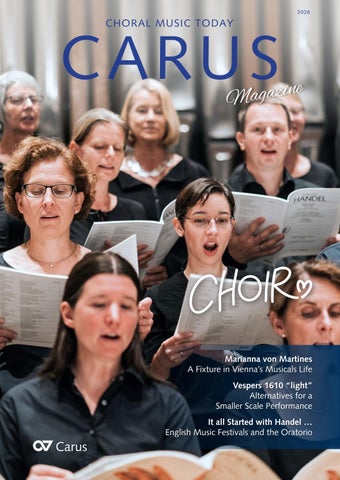
CARUS
Magazine
Marianna von Martines
A Fixture in Vienna’s Musicals Life Vespers 1610 “light” Alternatives for a Smaller Scale Performance
It all Started with Handel … English Music Festivals and the Oratorio
Marianna von Martines
A Fixture in Vienna’s Musicals Life Vespers 1610 “light” Alternatives for a Smaller Scale Performance
It all Started with Handel … English Music Festivals and the Oratorio
Back in 2020, many projects for the Beethoven anniversary celebrations had to be put on ice. Today, the excitement is all the greater to finally realize them in 2027, when the spotlight once again falls on Beethoven. To many, his choral pieces represent hidden treasures waiting to be discovered.
Alongside the well-known monuments – the Missa solemnis, the Mass in C major, and the 9th Symphony – our catalog offers several unfamiliar gems, including a Kyrie set to the famous melody of the Moonlight Sonata and the thrilling Choral Fantasy. Tristan Meister takes you on an inspiring journey through Beethoven’s choral works.
Together with Barbara Mohn we explore the 18th-century tradition of British music festivals, which proved to be such a gold mine for choral music. These festivals gave rise to many works that today are essential parts of the concert repertoire. Two masterpieces from this period are now available as new Carus Urtext editions: Lou-
is Spohr’s oratorio Des Heilands letzte Stunden (Calvary) and Antonín Dvořák’s Requiem. These editions do full justice to the quality of the compositions, with our superb signature engraving and practical performance materials – available in both print and digital formats.
Do you love the 17th century? Then you won’t want to miss the article in which Uwe Wolf shows how to navigate modern challenges in performance practice. As both a practitioner and a scholar, he provides concrete tips for Monteverdi’s Vespro della Beata Vergine – a work many choral directors see as a “must-have” in their career.
The stage is set for our esteemed authors – and, of course, for you and your choirs!
Best regards,
Marit Ketelsen Marketing & Sales

IMPRINT


Follow us!
Carus-Verlag GmbH & Co. KG
Sielminger Str. 51, 70771 Leinfelden-Echterdingen, Germany
Phone: +49 (0)711 797 330-0 info@carus-verlag.com / www.carus-verlag.com
Carus 99.002/70, 02/2026
Prices are subject to change. Errors excepted. ± Minimum order quantity 20 copies. From 40 copies 10%, from 60 copies 20% discount. Please note the different quantity scales for our digital editions.
Editorial Staff: Miriam Wolf, Marion Beyer, Marit Ketelsen Layout + Cover: Nadine Kristen
Photos: Sven Cichowicz (Cover, 2, 10, 13, 19), Holger Schneider (3), Zohar Perla (5), Dumitrița Gore (7), Fotostudio Fischer Weinsheim (7), Thomas Hudson / Postcard Carus 40.356/10 (8), Birmingham Museums Trust, Wilkinson Collection (9), Yale Center for British Art (10), KU Leuven Libraries (16), Alamy Limited (18)
Carl Maria von Weber (1786 – 1826)
June 5, 2026: 200th Anniversary of death
J. S. Bach: Brich dem Hungrigen dein
Brot BWV 39
Premiere on the first Sunday after Trinity Sunday June 7, 2026: 300th Anniversary
Josef Gabriel Rheinberger (1839 – 1901)
November 25, 2026: 125th Anniversary of death
Ludwig van Beethoven (1770 – 1827)
March 26, 2027: 200th Anniversary of death
J. S. Bach: St. Matthew Passion BWV 244b
Premiere of the early version on Good Friday 1727 300th Anniversary 2027
Let’s meet!
March 4–7, 2026
ACDA Southern Region Conference, Memphis, Tennessee, USA
Join our Carus Reading Session with Dr. Ryan Sullivan
April 17 – 19, 2026
Forum für Schulmusik, Bern, CH
May 14–17, 2026
Podium Canada, Victoria, CAN
October 1–4, 2026
chor.com, Leipzig, GER
October 1–4, 2026
Teatro Verdi, Florence, IT
Rehearsal phase and sing-along concert with Carus sheet music from Puccini’s “Messa di Gloria”. Conductor: Simon Halsey. Organizer: CHORALSPACE (subject to registration)
chor.com is THE event for choirs and conductors in Germany, offering numerous workshops, and concerts. In October 2026, chor.com will take place in Leipzig for the first time. We are already looking forward to this wonderful city and to welcoming you to our booth and our numerous workshops. Registration is open at www.chor.com!
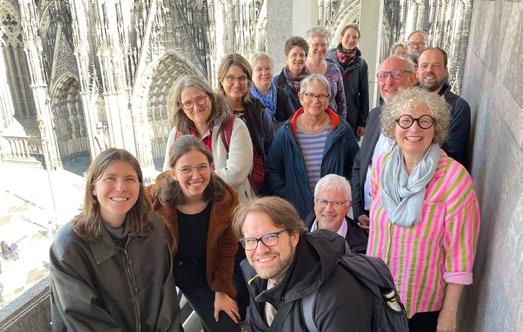
What a spectacular location! On September 26, 2025, the composition Credo. Six Composers – Six Parts – One Christian Faith (Carus 7.461) was premiered at Cologne Cathedral to mark the 1,700th anniversary of the Nicene Creed. It was a truly great experience for the audience, the choral singers, and the Carus team, who took the opportunity for a group outing!
All events always up to date
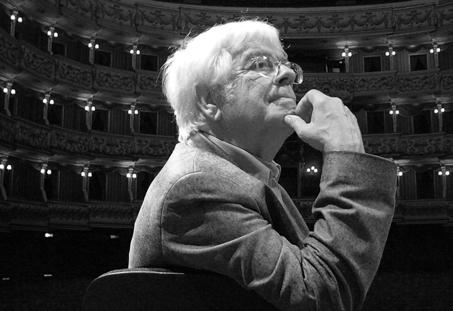
With deep sorrow, profound respect, and immense gratitude, we at Carus say farewell to Helmuth Rilling. Few could bring the music of Johann Sebastian Bach to people the way he did. He will be deeply missed.
Only in the last few years has Marianna von Martines (1744–1812) finally begun to win the recognition she deserves as an important composer of the eighteenth century. During her life, however, she was a constant presence in the musical life of aristocratic Vienna, and was highly esteemed as a performer and teacher as well as a composer. English music historian Charles Burney praised her singing and keyboard playing in his accounts of his European travels. She may well have performed for Empress Maria Theresa and Emperor Joseph II. Many of her compositions are motets and cantatas for solo voice and keyboard, which she often performed herself.
Her success did not come about by chance: throughout her childhood, young Marianna’s education was directed by her father’s close friend, the celebrated poet and librettist Pietro Metastasio, who lived with the Martines family until his death in 1782. For example, she received piano lessons from the young Joseph Haydn (who had moved into the attic above the Martines family’s apartment after being expelled from the choir at St. Stephen’s Cathedral), as well as singing and composition lessons.
In her later years, Martines composed less, devoting more attention to her highly respected voice studio, and to hosting musical gatherings frequented by some of Vienna’s most prominent musicians.
Martines the composer
In addition to cantatas, Martines also composed solo keyboard music, one orchestral symphony, and a number of sacred choral-orchestral works, including four masses and two oratorios. There is no evidence that Martines ever left Vienna, but her compositions won widespread acclaim abroad. Her peak achievement came in 1774, when she became the first woman admitted to the prestigious Accademia Filarmonica of Bologna – whose members included Johann Christian Bach and Wolfgang Amadeus Mozart. This external recognition also led to a signature compositional achievement. The Accademia required all new members to compose a setting of the Dixit Dominus psalm text; Martines’s
majestic setting for choir, soloists, and orchestra is now one of her most frequently performed choral works, and is widely considered her masterpiece.
In the course of her application to the Accademia, Martines also left a fascinating portrait of her compositional education and approach. Writing in 1773 to Padre Giovanni Battista Martini at the Accademia, Martines carefully emphasized both her fluency in the latest galant style and her knowledge of the learned techniques of the Baroque.
“My exercise,” she writes, “has been, and still is, to combine the continual daily practice of composing with the study and scrutiny of that which has been written by the most celebrated masters such as Hasse, Jomelli, Galluppi, and the others who are famous today and who are praised for their musical labors –and without neglecting the older [generation] such as Handel, Lotti, Caldara, and others.” (Martines to Martini, December 16, 1773)
Martines’s synthesis and mastery of both old and new styles is a central theme in her works, and scholars studying her music have pointed it out frequently. It is especially evident in her sacred choral-orchestral works, one of the earliest being the Seconda Messa of 1760.
The Seconda Messa
Composed in 1760, when Martines was only sixteen years old, the Seconda Messa is her earliest dated composition, and may well be her earliest surviving work; her Messe No. I is undated, and many factors suggest that it was composed later. While her other masses feature large orchestras with oboes and trumpets (and sometimes timpani), the Seconda Messa is largely scored for the common and elegant “church trio” of two violins and continuo. Only in the Benedictus does the scoring expand to include the striking color of two obbligato trombones. Trombones were common in Viennese church music, usually filling out the texture by doubling choral parts. Independent trombone parts are uncommon, though, and lend a dash of individuality to an otherwise traditional scoring.
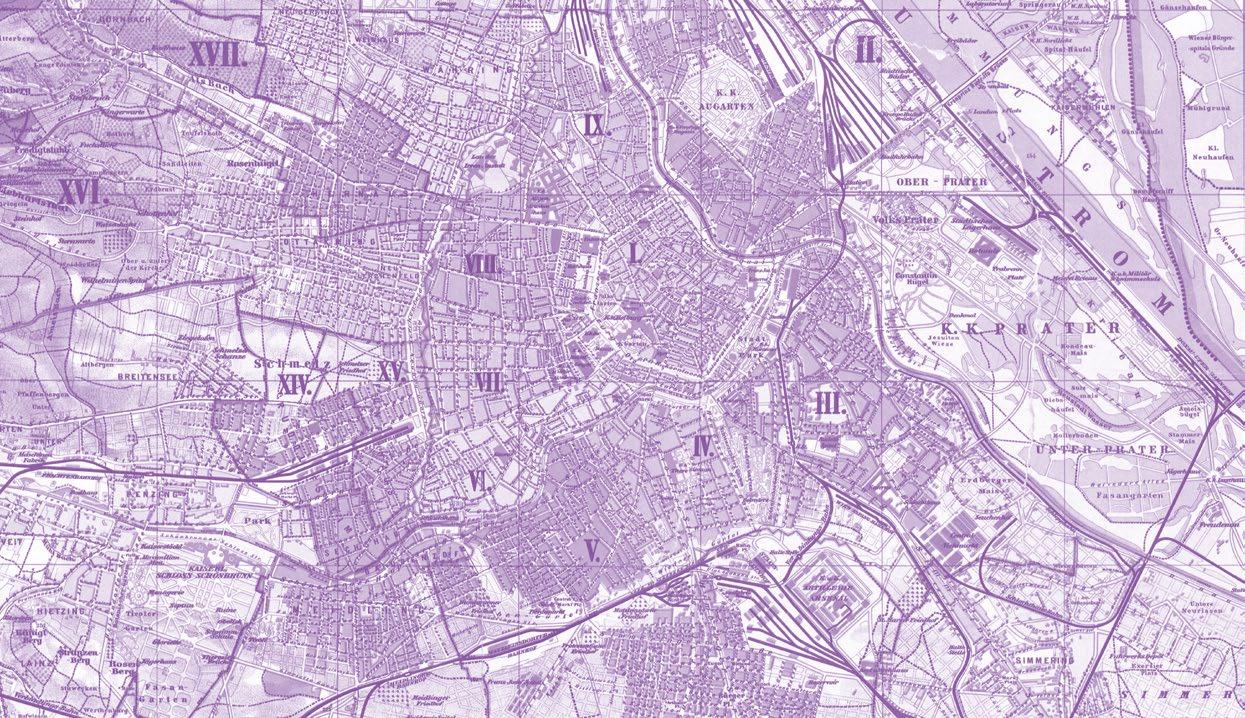
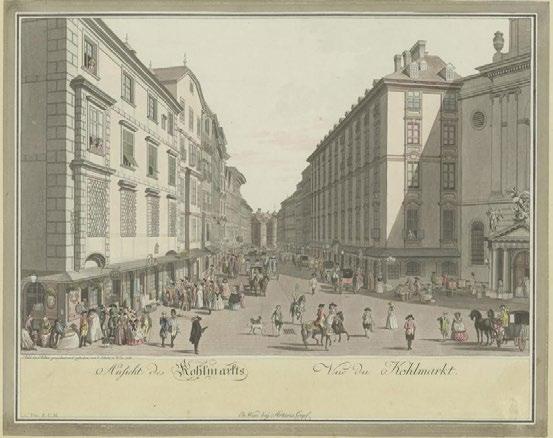
Marianna von Martines was born on May 4, 1744, in the Michaelerhaus at Vienna’s Kohlmarkt 11, next to St. Michael’s Church and a stone’s throw from the Hofburg Palace. Her family lived as tenants in the home of the court poet Pietro Metastasio (originally Bonaventura). From 1751 to 1756, the young Joseph Haydn – dismissed from the choir of St. Stephen’s Cathedral when his voice broke – lived in the building’s garret. Metastasio championed the talented youth. Haydn gave the young Marianna piano lessons and, in return, received free board. This arrangement lasted for three years.
The structure of the mass is also simple and elegant. While Martines’ Terza and Quarta Messe are structured as “cantata masses,” with extended multi-movement settings of the Gloria and Credo, the Seconda Messa sets these two long texts as single movements. The choir’s text declamation is clear and concise, without repetition or telescoping. Solos and duets (like the Christe and Benedictus) have a simple two-part structure, with the first part modulating to the dominant key and the second part returning. On a more local level, Martines frequently employs the stock gestures now known as “galant schemata,” showing off her fluency in the most up-to-date style. At the same time, she makes sure to display her mastery of the stile antico by writing skillful fugues in several traditional spots: the second Kyrie, the closing lines of the Gloria and Credo (“cum Sancto Spiritu” and “et vitam venturi saeculi”), and the repeated Osanna, which concludes both the Sanctus and Benedictus.
There is no evidence that the Seconda Messa was performed during Martines’s lifetime. One of her masses appears to have been performed in 1761 at the Church of St. Michael, which the Martines family attended, but Martines’s biographer Irving Godt is “quite certain […] that the mass sung was her Terza Messa in C,” which she had completed a month earlier. It is not surprising that the young composer would have quickly moved on from the compact Seconda Messa to a more ambitious work such as the Terza, and would have chosen the latter when an opportunity for performance arose. Nevertheless, the Seconda Messa is a gem of Martines’s early style, and deserves to take its place in today’s performance repertoire alongside the charming early works of her better-known contemporaries.
Insights and audio samples: www.carus-verlag.com/27907
Dr. Joseph Taff is a choral conductor whose scholarship has focused on the works of Marianna von Martines, including an award-winning dissertation on her masses. He is Assistant Professor and Director of Choral Activities at Thomas More University in Crestview Hills, KY, and Director of Music at the Presbyterian Church of Wyoming, OH.
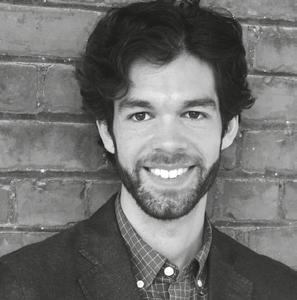


By Tristan Meister
In 2017, just in time for the 190th anniversary of Beethoven’s death, I took over as conductor of the Ludwigshafen Beethoven Choir. Since then I have spent practically every spare minute trying to figure out why the founding members of this ensemble back in the early twentieth century came up with the idea of naming their choir after this particular composer, of all people. Granted, Ludwig van Beethoven is unquestionably one of the most important figures in the history of music, and he rightly deserves all honor! But surely not because of his choral works – after all, they were only a marginal part of his œuvre, and they’re also notorious for being austere and unsingable. Despite this obvious misjudgment on the part of the decision-makers at the time, I managed to resist calling for the choir to be renamed (after all, there are plenty of suitable, pleasant-sounding alternatives), and I set about getting to the bottom of the matter.
The reason for the name soon became clear: the choir’s first performance was Beethoven’s Ninth, and they’ve sung it more than fifty times since then. But this raises the question of whether a finale lasting about twenty minutes is enough to arouse such passion in a group of singers that they would choose to name their choir after the composer.
The answer is: well, yes. Not only must it have seemed like sheer madness on the composer’s part to add a choir and four soloists to a symphony at the time, but on top of that, this masterpiece broke almost all known musical and formal boundaries and had a formative influence on every single subsequent generation of composers. Fair enough then. But perhaps it was just a one-hit wonder?
Then there is the Mass in C major, which is not particularly spectacular, at least in terms of tonality. But musically it’s all the more exciting, at times lyrical and simple, at times fiery and
animated, but always vivid, very close to the text and perfectly singable. A really fine, entertaining work that almost any choir should be able to manage! (And the Kyrie even has a truly remarkable tempo marking.)
Even Beethoven’s occasional compositions regularly turned out to be small masterpieces. His Choral Fantasy – actually a Fantasy for piano, choir and orchestra – is rarely performed due to its unconventional scoring and relatively short duration, but it’s groundbreaking in its innovative conception as a small piano concerto with choir, and it delights audiences and performers alike.
His choral ode Meeres Stille und Glückliche Fahrt (Calm Seas and Prosperous Voyage), based on two poems by Goethe, which was premiered together with the composer’s similarly underrated Passion oratorio Christus am Ölberge (Christ on the Mount of Olives), is another example of Beethoven’s genuinely creative handling of the choral medium: low tonality and long phrases paired with broad sweeping string chords represent the calm at the beginning, while driving motifs and almost inexpressibly fast phrases herald the “prosperous voyage”. An incredible piece!
But Beethoven’s skill was not restricted to large forces. His Elegischer Gesang (Elegiac Song) is an expressive, early Romantic gem for choir and strings, which also works wonderfully with piano. In fact, several smaller works have yet to be discovered by choir directors, audiences and publishers alike, and they offer a fascinating insight into the work of the very young Beethoven. The two so-called Emperor Cantatas from 1790 show that he was already interested in choral works at an early age, albeit with little success, as neither was performed during his lifetime. But Joseph Haydn was shown the
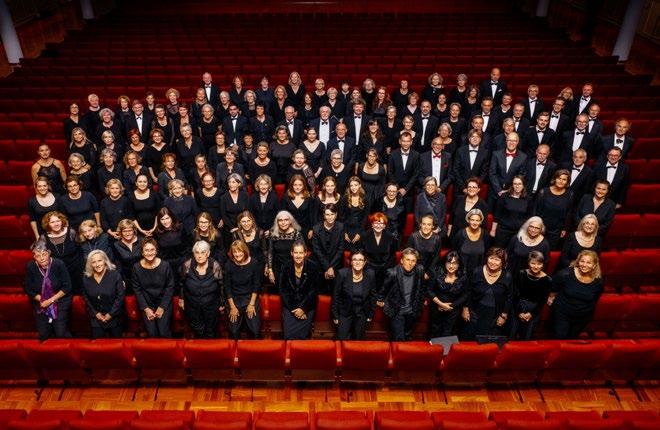
A choral tradition going back over 100 years: The 1924 performance of Beethoven’s Ninth Symphony is considered the founding moment of the Ludwigshafen Beethoven Choir.

cantatas on the death of Emperor Joseph II, and the biographer Franz Wegeler reports that he “paid particular attention to them and encouraged their composer to continue his studies”. From that point on, presumably to ensure that the young Beethoven received suitable training, Haydn accepted him as a pupil.
However we still haven’t mentioned the one work which stands above all others, not only for me and many Beethoven admirers, but also for the composer himself: the Missa solemnis, repeatedly described by Beethoven as his greatest work. Even after long engagement with the music, it still remains incomprehensible and fascinating – whether it’s the gracefully simple Kyrie, the colorful, joyful Gloria, the monumental Credo with its wild fugues, the solemn Sanctus, the dreamlike Benedictus and its hauntingly beautiful violin solo, or the Agnus Dei, which defies all expectations of form and ideas and still sounds crucially relevant today, with its echoes of war and desperate cries for peace.
Actually, this work alone is enough. I would, without hesitation, call my choir the Beethoven Choir, my festival the Beethoven Festival, and in the end I’d probably even call my house the Beethoven House.
Tristan Meister
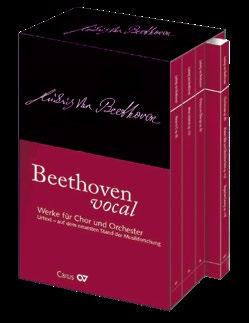
van Beethoven
Works for choir and orchestra Practical Study Package
Carus 23.901
Set with five study scores 79,00 €
Here is our selected BeethovenPlaylist. Enjoy!
Tristan Meister is a lecturer in choral conducting at the music academies in Mannheim and Frankfurt am Main, Germany. He conducts several choirs, including the Ludwigshafen Beethoven Choir since 2017, and is a regular guest, workshop leader and course instructor at national and international choir festivals.
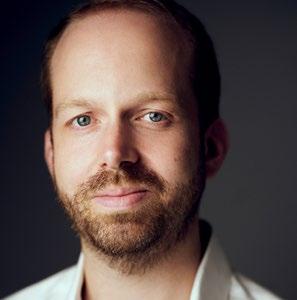

Rich choral sounds, impressive oratorios and a close connection between music and charity have characterized the tradition of English music festivals since the 18th century. Dr. Barbara Mohn highlights the development of this unique festival culture.
George Frideric Handel is the creator of the English oratorio. When he first staged his Esther as a religious drama without scenic action at the King’s Theatre in London in 1732, it marked the beginning of an unparalleled success story. Opera audiences were so enthusiastic about the new genre that from that time onwards Handel, who was not only a composer but also a theater manager, filled his opera houses with oratorios based on biblical themes. In 1741 he composed the Messiah –this time not for the opera stage, but for a benefit concert in Dublin. The work was to play a special role in Great Britain, becoming a symbol of the connection between music and charity. Handel himself performed the oratorio every year in aid of a London orphanage. Such performances of the Messiah and later of other oratorios too for charitable purposes were one of the central driving forces behind the development of the great music festivals that were held from the early eighteenth century onwards, initially in Britain and somewhat later also in Germany and other countries.
The Messiah – a symbol of successful charity
From 1698 onwards London’s cathedral choirs gathered once a year in St. Paul’s Cathedral for the Festival of the Sons of the Clergy, the proceeds of which went to a relief fund for the widows and orphans of clergymen. This idea was adopted in many places, including the three neighboring cities of Gloucester, Worcester, and Hereford, where the “Three Choirs Festival” still exists today in a modified form. In the late eighteenth century,
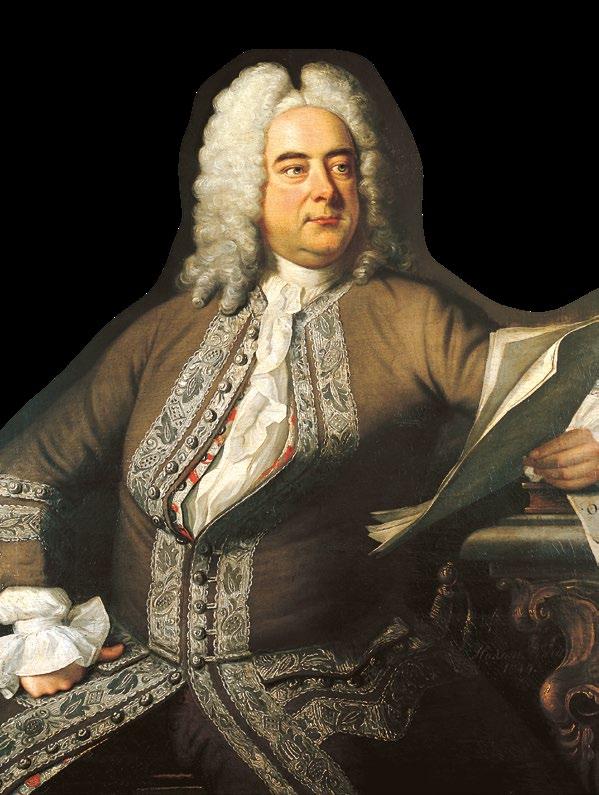
some of the fast-growing industrial towns and cities in northern and central England also began to organize music festivals lasting several days. The impetus for these festivals came from wealthy, philanthropic entrepreneurs, not from the churches. However here, too, the concept of music festivals was born out of a desire to raise money for a charitable cause, usually the city hospital. Until the end of the nineteenth century, the performance of the Messiah was a central attraction of music festivals and could be relied on to bring in the largest profits.
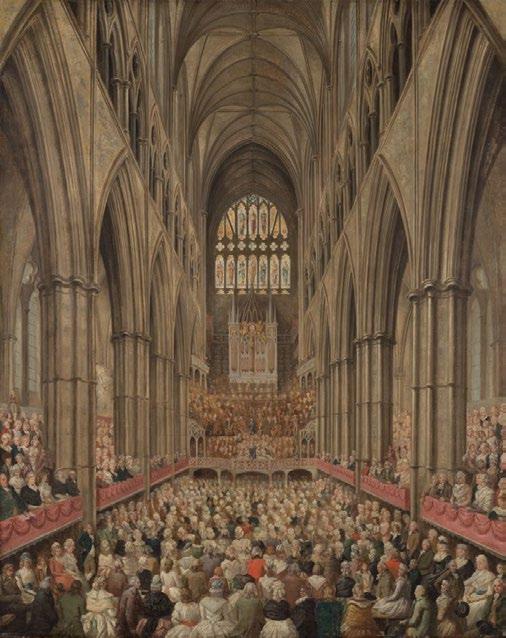
Some striking figures: Messiah, London, 1883 – 4,000 choir singers, around 440 instrumentalists, an audience of 22,388
The music festival tradition was also fueled by the British reverence for Handel. The Handel commemorations held in Westminster Abbey – the first one was in 1784 – were so legendary that Joseph Haydn attended them in 1791 and was subsequently inspired to compose his own oratorio The Creation (1797/98). Later the Handel festivals took place at London’s Crystal Palace. In 1883, 4,000 choir singers and around 440 instrumentalists performed the Messiah there. The audience was also suitably large: apparently 22,388 people were in attendance.
English music festivals developed into veritable oratorio festivals, at which more and more oratorios would be performed. When Antonín Dvořák’s Requiem was premiered at the Birmingham Music Festival in 1891, the Festival program also included performances of the Messiah, Felix Mendelssohn Bartholdy’s Elijah and Johann Sebastian Bach’s St. Matthew Passion, as well as two other world premieres: Veni creator spiritus, a cantata by Alexander Mackenzie, and Charles Villiers Stanford’s great oratorio Eden. All these works were performed by just one single choir over four days – a superb achievement!
In the nineteenth century the Birmingham Music Festival was highly renowned both nationally and internationally. The oratorio performances featured top-class musicians and guest conductors such as Hans Richter, with famous opera singers such as Jeanne-Anaïs Castellan, Pauline Viardot, Jenny Lind, Thérèse Tietjens, and Emma Albani. The large, top-class choir was composed exclusively of professionals until the 1850s and grew in number from 134 singers in 1820 to 371 in 1888.
A truly impressive tradition of world and English premieres
As with other major music festivals, the Birmingham audience was to be treated to world or English premieres. To this end, the organizers nurtured close contacts with well-known composers at home and abroad, and they also commissioned compositions. Birmingham undoubtedly scored its greatest coup when it commissioned Felix Mendelssohn Bartholdy to compose an oratorio for the 1846 festival and then celebrated the acclaimed premiere of Elijah under the baton of the composer himself. The work was sung in an English translation that Mendelssohn
himself had carefully edited. Mendelssohn praised the choir, even if he was amazed by the “bearded altos”: in keeping with old cathedral traditions, male voices still sang the alto parts in the festival choir until 1900, and there were also boys among the soprano singers until 1881.
The list of sacred oratorios composed as commissions for British music festivals is lengthy. It includes works by Sigismund Neukomm (David, Birmingham 1833), Louis Spohr (The Fall of Babylon, Norwich 1842), Niels Gade (Zion, Birmingham 1876), Charles Gounod (La Rédemption, Leeds 1882, and Mors et Vita, Birmingham 1885), Dvořák (St. Ludmila, Leeds 1886, and Requiem, Birmingham 1891), Camille Saint-Saëns (The Promised Land, Gloucester 1913) and many others. From the mid-nineteenth century onwards, it was considered good form to commission home-grown composers. William Sterndale Bennett, Arthur Sullivan, Charles Villiers Stanford, and Hubert Parry all composed oratorios for music festivals, but only Edward Elgar’s commissions for Birmingham – The Dream of Gerontius (1900), The Apostles (1903), and The Kingdom (1906) – became firmly established in the concert repertoire.
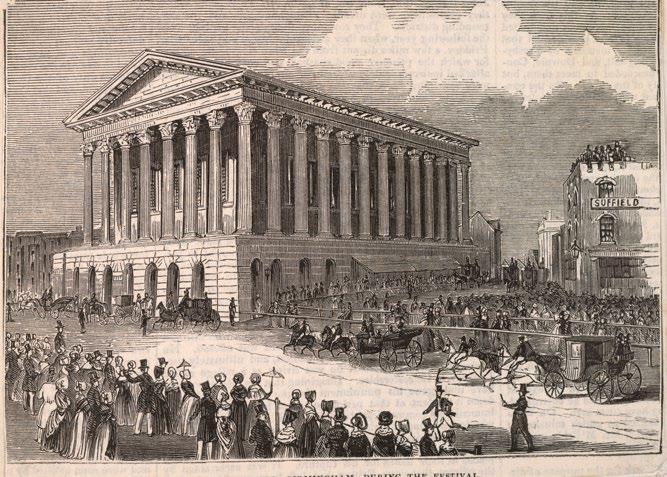
As significant and honorable as such a music festival commission was, the process from commissioning to performance was often far from smooth. When Dvořák received the commission for the 1891 music festival and subsequently composed his Requiem, the fee negotiations dragged on for so long that the commission almost fell through. Edward Elgar, on the other hand, simply could not find a libretto when he received a commission for the Birmingham Music Festival in 1900. In January of that year a representative of the music festival visited Elgar in person, and only then was an agreement reached on The Dream of Gerontius by the late Birmingham Cardinal John Henry Newman. There was so little time left for the composition, the preparation of the sheet music and rehearsals that the choir and soloists sang a semitone too low in parts of the premiere. Mendelssohn Bartholdy was also left with very little time between receiving the commission for his Elijah in January 1846 and the premiere in October. After the premiere he took the decision to revise the work thoroughly.
Other music festivals had similar problems. The Norwich Music Festival, for example, had close ties to Louis Spohr, who was commissioned to compose a new oratorio in 1842. Earlier performances of his works, especially Des Heilands letzte Stunden (Calvary), had required major changes due to the Englishlanguage version, and thus, even though he spoke hardly any English, Spohr was offered an English text from the start, called The Fall of Babylon. In the end his employer, the Elector in Kassel, forbade Spohr from traveling to the music festival.
Gounod, on the other hand, did not dare to travel to England for the premiere of his Mors et Vita in 1885 because he was involved in a court case there relating to a former girlfriend. Three years earlier the dispute had meant that he could only conduct the premiere of La Rédemption in 1882 under police protection.
Famed throughout the country and featuring international performers, the music festivals of the nineteenth century provided a magnificent platform for oratorios and other choral symphonic works. At the same time they served to promote both local charitable causes and contemporary choral music in a striking fashion. In the early 20th century, the music festival tradition underwent significant change. The last triennial festival took place in Birmingham in 1912. While major oratorios can still be heard today at the Three Choirs Festival, other festival cities have shifted their focus – ranging from multicultural events in Norwich to pop and rock festivals in Leeds. Yet, now as then, music festivals serve as both a mirror and a catalyst for the contemporary music scene.
Barbara Mohn
Dr. Barbara Mohn has been an editor at Carus-Verlag since 1994; from 2000 to 2008 she was head of the editorial section of the Rheinberger Complete Edition.

Antonín Dvořák (1841–1904)
Requiem op. 89 (lat)
Soli SATB, Coro SATB, Pic, 2 Fl, 2 Ob, Eh, 2 Clt, BClt, 2 Fg, Cfg, 4 Cor, 2 Tr, 2 Tr di lontano, 3 Trb, Tb, Timp, Tam-Tam, Arpa, Org, 2 Vl, Va, Vc, Cb
Carus 27.323, full score (also ), vocal score (also ), vocal score XL, ± choral score, complete orchestral parts / Carus Choir Coach practice aid
Felix Mendelssohn Bartholdy (1809–1847)
Elijah MWV A 25 (ger / en)
Soli SATB, Coro SATB, 2 Fl, 2 Ob, 2 Clt, 2 Fg, 4 Cor, 2 Tr, 3 Trb, Oficleide, Timp, 2 Vl, Va, Vc, Cb, Org
Carus 40.130, full score (also ), vocal score German or German/English (also ), vocal score XL German/English, ± choral score German/English, complete orchestral parts / Carus Choir Coach practice aid, Audio (Carus 83.215)
George Frideric Handel (1685–1759)
Messiah HWV 56 (ger / en)
Soli SATB, Coro S(S)ATB, 2 Ob, Fg, 2 Tr, Timp, 2 Vl, Va, Bc
Carus 55.056, full score (also ), vocal score (also ), vocal score XL English, ± choral score English or German, complete orchestral parts, / Carus Choir Coach practice aid, Audio (Carus 83.219)
Edward Elgar (1857–1934)
The Dream of Gerontius op. 38 (en / ger)
Soli MsTB, Coro SATB (divisi), Semicoro SATB (divisi), 2 Fl, Pic, 2 Ob, Eh, 2 Clt, Clt basso, 2 Fg, Cfg, 4 Cor, 3 Tr, 3 Trb, Tb, Timp, Batteria, 2 Arpe, Org, 2 Vl, Va, Vc, Cb
Carus 23.004, full score (also ), vocal score (also ), complete orchestral parts for hire

Monteverdi’s Vespers from 1610 is one of the few works of its time that belongs to the informal canon of pieces that almost every choir dreams of performing at least once. But the obstacles are considerable. The work is polyphonic, challenging, and requires not only a high number of soloists, but also a relatively large orchestra, including some instrumentalists that are still rather rare and therefore expensive. However Monteverdi’s Vespers can also be performed with considerably less outlay. In fact, Monteverdi himself provided less elaborate alternatives. Carus chief editor Uwe Wolf highlights some possibilities.
Continuo version
The idea that Monteverdi may have already created a continuo version of his Vespers is not new. “SV”, the small catalog of Monteverdi’s works by Manfred Stattkus, even lists a separate continuo version of the Vespers under the number SV 206a. Stattkus presumes this second version from the different performance spaces mentioned in the title: ad Sacella sive Principium Cubicula accomodata, or “suitable for chapels or princely chambers.” He supports his thesis by noting that the ritornellos in the Dixit Dominus are marked ad libitum, and further that there are two versions of the Magnificat in the 1610 publication: in addition to the colorfully orchestrated Magnificat with 12 obbligato instruments, there is another setting with continuo only, and also with only six instead of seven voices. Stattkus’ argument is not entirely convincing – the ten-part Nisi Dominus in princely chambers? Why no variants for the introit, sonata and hymn? It’s more likely that Monteverdi had in mind the practice of performing only sections of the Vespers as a rule, and the parts with variants, i.e. the Dixit and the Magnificat, were the ones that were performed particularly frequently. However, there is nothing to stop us today from extending Monteverdi’s approach to the entire Vespers
1 Introitus Deus in adjutorium / Domine ad adjuvandum me festina
Can be omitted or performed as a falsobordone, with organ ritornellos if desired.
2– 10 Sequence of psalms and small-scale concerti Dixit without ritornellos, otherwise everything can remain the same.
11 Sonata sopra Santa Maria Must be omitted (not a liturgical part of Vespers). If necessary, add an organ piece instead.
12 Hymnus Without ritornellos (or only organ ritornellos).
13 Magnificat Use Magnificat à 6 instead of Magnificat à 7
Which soloists are needed?
The psalms and the Magnificat can be sung by a choir, but they are very demanding. If soloists were to be assigned to the more virtuoso parts, then two sopranos and two tenors and ideally also two basses would be required. Almost all the concerti can be performed with this range of soloists: only in Duo Seraphim (No. 7) is a third tenor required, although this part can also be taken by a high bass. The concerti are not part of the Vespers liturgy and could therefore be omitted. However, they are an integral part of Monteverdi’s concept as printed, allowing him to explore all stylistic possibilities. They are truly breathtaking highlights which also serve to offer the choir rest pauses.
What about instruments?
Omitting the obbligato instruments does not rule out the addition of instruments colla parte to add color and to support the choir. This does not require highly specialized musicians, who are absolutely necessary for the introit, sonata, and the seven-part Magnificat. A string ensemble, for example, would fit the bill here.
Claudio Claudio Monteverdi (1567–1643)

High or low?
Vespro della Beata Vergine
Vespers SV 206 (lat)
Soli SSATTBB, Coro SATB/SATB, 2 Fl, 2 Fifari, 3 Ctto, 3 Trb, 2 Vl, 3 Va, Vc, Vn, Bc
Carus 27.801
full score (also ), vocal score (also ), ± choral score, complete orchestral parts, Audio (Carus 83.394), / Carus Choir Coach practice aid
There is ongoing debate as to whether the movements in “high keys,” Lauda Jerusalem (No. 10) and the two Magnificat settings, should be performed a fourth lower. There are strong arguments against this, which can’t be explored fully in this article. For an a cappella performance, it may nevertheless be helpful to perform Lauda Jerusalem in a transposed version, but this would also require men in the two alto parts. If colla parte instruments are introduced, it would be musically more appealing to add them to support the high passages or to have them take over some of these passages on their own, which was quite common practice in the 17th century. In both settings of the Magnificat, the vocal ranges clearly argue against transposition. Although there are high notes (hence the “high” clefs), when transposed, the sopranos and tenors in particular are in such unfavorable registers that they have to strain to be heard well, even in the historical high pitch, and even more so at a1=440 Hz. The Magnificat should therefore never be transposed for performance.
Leave it out? Always a possibility!
The published form of the Vespers follows a programmatic concept, but not a specific performance situation, a service of vespers. The 1610 print offers a kaleidoscope of church music composition after 1600. It can be transformed into a breathtaking concert exactly as it has been handed down. But it is also possible to create something new from its parts: every single piece is magnificent in its own right. A complete performance is just one option.
Magnificat a sei voci (lat)
Soli e Coro SSATTB, Bc
Carus 27.205
full score (also ), ± choral score
What versions from Carus can help here?
Vespers
Carus 27.801
All choral parts are included in the parts set (Carus 27.801/19), which in many cases also offers alternatives for different instruments or keys.
Transposed version of the Lauda
Carus 27.801/50
full score, vocal score (also ), ± choral score, orchestral parts (colla parte)
Magnificat a sei voci
Carus 27.205
No colla parte parts are available for this Magnificat, but the choral score can be used to some extent for the short movements, if you want to reinforce the tutti movements or one or other of the cantus firmus.
As a musicologist, Dr. Uwe Wolf is particularly at home in the 17th and 18th centuries. The focus of his work ranges from the time of Monteverdi and Schütz to Bach and the generation of Bach’s sons and pupils through to Viennese Classicism. He has been head of the editorial department at Carus-Verlag since 2011.
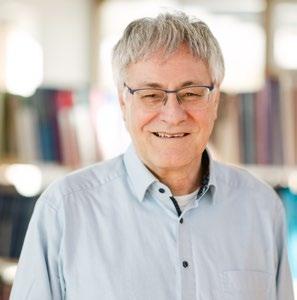
Carus chief editor Uwe Wolf has compiled a list of his personal favorites from the seventeenth century
“From a musical perspective, the seventeenth century is full of musical highlights for me,” Uwe Wolf says. “I’m particularly fond of the early years. What tremendous revolutionary power lies in this music: so much that was new, even extreme, was created in such a short time! The rest of the century consolidated, smoothed things out, developed structures, paved the way for Bach, among others, but without ever completely abandoning its beginnings. On my journey through the century, I chose some of my favorite works, while also looking a little beyond the boundaries of the century. However, as is always the case with any selection, there are so many more works that could have been included….!”
Giovanni Gabrieli Hodie completi sunt (lat) Coro SATB/SATB, Bc
Carus 1.429
The music of the seventeenth century was already emerging in the late 1500s, for instance, in the polychoral works of Giovanni Gabrieli, in which expansive soundscapes were beginning to displace contrapuntal composition. The potential of Gabrieli’s polychoral style can be seen in his posthumously published collection Hodie completi sunt from 1615, in which the expansive texture breaks open and concertato elements emerge. The new century has fully dawned.
1605 Claudio Monteverdi Cruda Amarilli / Felle amaro (it/lat)
1619 Schütz and Praetorius Alleluja! Lobet den Herren in seinem Heiligtum. From: Psalmen Davids (ger) Fav SATB/SATB, [Cap SSAB / SATB], 3 Ctto (3 Vl), Trb (Fg) / Ctto (Fl), 3 Trb (2 Trb + Fg) / Bc Carus 20.038
Halleluja. Christ ist erstanden. From: Polyhymnia Caduceatrix & Panegyrica (ger)
Coro SSATB, [SATB/SATB], 8 Instr. ad lib., Bc Carus 10.027


SSATB, Bc Carus 3.314/90
Years before its first publication, Monteverdi’s madrigal Cruda amarilli provided ammunition for his fiercest adversary, Giovanni Maria Artusi, who saw it as an example of the irregularity of Monteverdi’s compositions. Perhaps this is precisely why this madrigal is one of Monteverdi’s best-known works, both then and now. It appeared in 1605 in Monteverdi’s Fifth Book of Madrigals and was also included in the collection of sacred Latin madrigal contrafacta published two years later by Aquilino Coppini, one of his friends. Our edition offers both the secular Italian and the sacred Latin texts. More delightful madrigals are to be found in the Choral collection Monteverdi (Carus 4.024).
With Heinrich Schütz’s Psalmen David and Michael Praetorius’s Polyhymnia caduceatrix, the “new style” finally arrived in Germany by 1619. Both composers combine expansive polychoral settings with concertato elements in the deliberate employment of particular instruments. Yet the collections are very different in character. Schütz wrote psalms that were absolutely of equal standing with the compositions of his Italian colleagues: it is only the German language which marks them as German Protestant music. Praetorius, on the other hand, mixes multiple choirs, concertato music, ritornello form, and other techniques borrowed from his Italian role models, with hymns by Martin Luther – thus laying the foundation for the later development of Protestant church music, up to and including the chorale cantata. It’s fascinating to contemplate what these two gentlemen may have talked about when they played music together in Dresden in 1617 on the occasion of the 100th anniversary of the Reformation.
Find even more
1640 Giacomo Carissimi
Historia di Jephte (lat)
Soli SSSATB, Bc (Soli e Coro
SSSATB, Bc)
Carus 10.043
In today’s concert repertoire the oratorio begins in the eighteenth century: Bach’s Christmas Oratorio, the oratorios of Haydn and Mendelssohn, or Spohr and Franck. But the history of the oratorio began much earlier. One of its roots lies in historical narratives based on biblical material, of which Schütz’s two historical works in particular are still performed today: the Resurrection History (1623) and the Christmas History (published in 1664). This early period also includes Giacomo Carissimi’s Historia di Jephte, about the harrowing story of the military leader Jephthah, who sacrifices his daughter in fulfillment of a vow. It’s one of the earliest and, at the same time, one of the most powerful works in the history of the Italian oratorio.
The Bach family is appearing Es erhub sich ein Streit (dt) Coro SATBB/SATBB, 4 Tr, Timp, 3 Vl, 3 Va, Bc Carus 30.567
In the second half of the century the Bach family appeared on the scene with a whole generation of composers, some of whom we find it difficult to distinguish from one another today. Several pieces have therefore been attributed to different “Bachs.” In addition to numerous motets, several larger-scale compositions have also survived. One genuine highlight is the sacred concerto for Michaelmas, Es erhub sich ein Streit (There arose then a war in heaven), most likely by Johann Christoph Bach (1642–1703). It is an impressive, polychoral work in which two vocal choirs and a string choir are joined by a trumpet choir in a musically dramatic setting of the battle between Michael and the dragon.
1680 Dietrich Buxtehude
Membra Jesu nostri
BuxWV 75 (lat)
Coro SSATB, 2 Vl, Vne, 5 Vga (2 Vl, Vne, 2 Vga), Bc Carus 36.013
Buxtehude’s North German devotional music Membra Jesu nostri, based on Latin meditations on the parts of the crucified Christ’s body, each paired with verses from scripture, is a deeply beautiful Passion music of a very special kind. The scoring is limited to five vocal parts (both solo and choir) with two violins, violone and continuo. But in the sixth movement, Ad Cor (to the heart), Buxtehude introduces a five-part consort of viols – an uneconomical addition, but tremendously effective. Buxtehude’s music points forward to Bach (who famously walked all the way to Lübeck specifically to hear Buxtehude), but there are also considerable echoes here of Monteverdi: for example, at the end of the fifth movement.
1692 Henry Purcell / Marc-Antoine Charpentier Hail! Bright Cecilia. Ode on St. Cecilia’s Day 1692 (en)
Soli SAATBB, Coro SATB (also SSAATB), 2 Bfl, 2 Ob, 2 Tr, Timp, 2 Vl, Va, Bc Carus 10.250
Te Deum H 146 (lat)
Soli e Coro SST(A)TB, 2 Fl, 2 Ob, 2 Tr, Timp, 2 Vl, 2 Va (Va, Vl), Bc Carus 21.032
Two exceptionally festive compositions were written around 1692, one in London and the other in Paris: Purcell’s Hail!
Bright Cecilia. Ode on St Cecilia’s Day 1692 and Charpentier’s famous Te Deum. Purcell’s ode is a thoroughly lively cantata full of contrasts, emotion, musical tone painting, and triumphant choruses: a good fifty minutes of thrilling music! Charpentier composed a series of Te Deum settings, including THE Te Deum, the one with the opening theme now universally recognized as the “Eurovision fanfare.” Its martial tone probably reflects the occasion for which it was composed: the victory of the French army at Steinkerque. The result is a varied, cantata-like composition with both triumphant and contemplative movements, featuring everything that could be expected in a courtly festive composition – for in a Te Deum, the court of Louis XIV. naturally celebrates itself above all else.
Louis Spohr and Felix Mendelssohn Bartholdy had much in common: beyond a personal friendship, they shared a passionate commitment to the music of Johann Sebastian Bach and were hugely popular composers in Great Britain. In 1829, Mendelssohn Bartholdy put Bach’s St. Matthew Passion back on the musical map with his sensational performance in Berlin; from 1832 onwards, Spohr did the same with several performances in Kassel. Inspired by Bach’s monumental work, both men composed a major oratorio: Mendelssohn Bartholdy his St. Paul, and Spohr Des Heilands letzte Stunden (Calvary) In 1836 and 1837, these works enjoyed their successful British premieres. Numerous performances followed until the end of the century, with both oratorios becoming a staple of musical life on the British Isles. With a critical edition, Carus is now presenting the first modern edition of this significant work by Spohr.
The work’s origin
Louis Spohr wrote four sacred oratorios, all of which explore apocalyptic themes: Das Jüngste Gericht (The Last Judgement; 1812), Die letzten Dinge (The Last Things; 1825), Des Heilands letzte Stunden (Calvary); 1834/35), and Der Fall Babylons (The Fall of Babylon; 1839). The initiative for the third oratorio came from the well-known Leipzig music publicist Friedrich Rochlitz, who urged Spohr in 1833 to set his libretto to music. Shortly before this, Rochlitz had offered it to Felix Mendelssohn Bartholdy, who had rejected it in favor of St. Paul. Inspired by his own performances of Bach’s St. Matthew Passion, Spohr began composing the new oratorio in Spring 1834. The work
was overshadowed by the deteriorating health of his wife, Dorette, who eventually died on November 20, 1834. The composer noted the date of her death on the autograph score at Chorus No. 24: “Save now thyself, thou who savedst others!”. Des Heilands letzte Stunden (Calvary) was completed in the spring of 1835 to be premiered shortly thereafter on Good Friday. Moritz Hauptmann, an orchestral violinist in Kassel and a close friend of Spohr, wrote in a letter on April 3, 1835, two weeks before the premiere: “I have not yet heard the music in its entirety, and some of the solo parts not at all; but of what I know, much of it is very beautiful and at times so free – the likes of which I have rarely known from Spohr.”
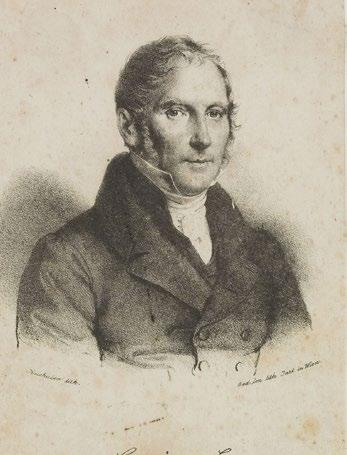
Performance history, especially in Great Britain Des Heilands letzte Stunden (Calvary) enjoyed a triumphant premiere at Kassel’s Garrison Church on Good Friday 1835. Spohr reported contentedly to Rochlitz in a letter dated April 20 that the performance “turned out exactly as desired and, from everything I hear, the work seems to have made a deep impression. […] Despite the church being so packed and the audience so mixed, a profound silence reigned before and during the music, which also put us players into the right frame of mind. As a result, the work was realized from start to finish without any mishaps and was found by everyone to be most uplifting.” After its debut, the oratorio travelled to numerous German cities, where it was often met with rapturous acclaim.
At this time, Louis Spohr already enjoyed long-standing and strong ties to Great Britain, dating back to his first appearance
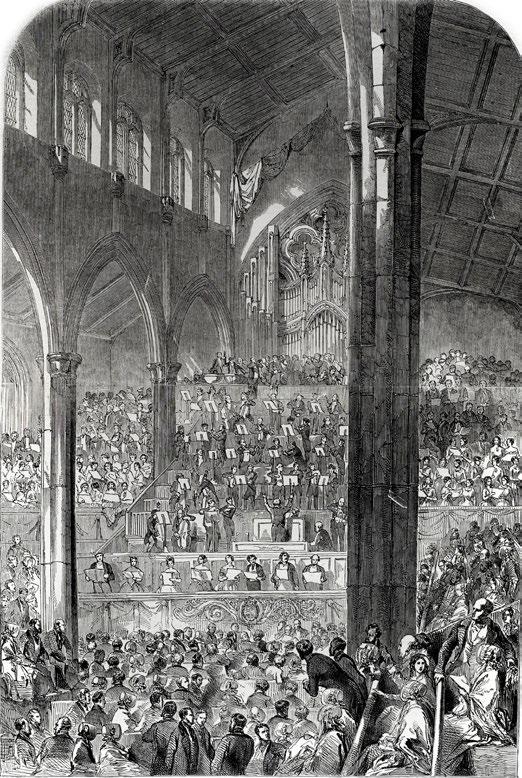
at the Philharmonic Society concerts in 1820. There he made history as one of the first conductors to use a baton (previously, it had been customary for the concertmaster and a pianist to share conducting duties). The concert was truly a memorable occasion, as Spohr noted in his autobiography: “The success that evening was even more brilliant than I had dared to hope. To be sure, the audience was at first taken aback by the innovation and there was much whispering; but once the music began and the orchestra executed the well-known symphony with uncommon power and precision, general approval was evident from the very first movement by a long-sustained round of applause. The baton had won the day; and from then on, no one was seen sitting at the piano during symphonies and overtures.” Spohr was frequently invited back to London as a conductor; in fact, his 8th Symphony from 1848 was composed for the Philharmonic Society. Only a year after the Kassel premiere of Des Heilands letzte Stunden (Calvary), an English-language vocal score of the oratorio was published in London in 1836 under the title The Crucifixion In 1837, the English premiere was held in Norwich, now under the title Calvary (by which it is still widely known in Britain today). Up until the turn of the century, Spohr’s composition enjoyed numerous successful performances in cities such as Norwich, Hull, London, Hereford, Liverpool, Leeds, Dublin, Bradford, and Edinburgh. This impressive
Louis Spohr (1784–1859)
Des Heilands letzte Stunden. Calvary WoO 62 (ger/en)
Carus 23.010 full score (also ), vocal score (also ), complete orchestral parts for hire (also )

Louis Spohr
Des Heilands letzte Stunden
Audio
Des Heilands letzte Stunden. Calvary WoO 62
A real discovery: Frieder Bernius and his Kammerchor Stuttgart, together with the Deutsche Kammerphilharmonie Bremen, have made this oratorio accessible again.
Carus 83.540 (CD or stream)
Insights and audio samples: www.carus-verlag.com/23010
performance history continued into the 20th century. This is all the more remarkable given the fierce debate surrounding the early performances. The depiction of Jesus by a tenor – a singing Christ no less! – divided opinion; moreover, a heated controversy arose as to whether it was fitting for an oratorio to portray the Passion on stage, and whether such a piece might still be truly classified as sacred music.
Libretto and Music
Friedrich Rochlitz (1769-1842), the librettist of Des Heilands letzte Stunden (Calvary), was one of the most influential music publicists of his day. For twenty years, he edited the leading musical journal of the era, the Allgemeine musikalische Zeitung; he was also a board member of the Leipzig Gewandhaus and played a decisive role in appointing Mendelssohn Bartholdy as conductor of the Gewandhaus Orchestra. His extensive œuvre as a poet, author, and translator (including the 1801 German translation of Mozart’s Don Giovanni) is less well-known today than his journalistic work, through which he championed the popularization of Mozart as well as an appreciation of Beethoven as one of the great masters. Rochlitz also provided the libretto for Spohr’s oratorio Die letzten Dinge (The Last Things). The text he offered the composer in Leipzig in 1833 had already been set to music in 1806 as Das Ende des Gerechten (by Johann Gottfried Schicht). After changing the title, Spohr began to compose the work a year later without informing Rochlitz. Later, a lively correspondence ensued regarding the poet’s requests for revisions, to which Spohr yielded – with one exception: Christ is sung by a tenor (usually the singer portraying the Apostle John) and not, as Rochlitz desired, by a male voice choir. It seems that Rochlitz had a premonition of the heated debate that was to arise in Great Britain around the personified portrayal of the Son of God. An English translation and adaptation of the libretto was produced in London in 1836 by Edward Taylor, who had also translated The Last Things. There was one significant change to the German original: Christ’s few spoken lines are now introduced by John (“He saith:”), turning direct
speech into indirect discourse. This change reflects the era’s aesthetic objections to having the Savior personified on stage. While the action in this two-part piece is restricted to just three settings and scenes from the Passion, the narrative remains chronological. Part One begins at night in Gethsemane (Nos. 1– 6) with the priests and the people plotting against Jesus as well as the betrayal by Judas. The scene then shifts to the palace of the High Priest (Nos. 7–21), covering Peter’s denial, the desertion of Jesus’ friends, the trial, and the final verdict. Part Two recounts the journey to Golgotha, the crucifixion, and entombment (Nos. 22–36).
Spohr’s setting is lyrical with dramatic overtones, with the individual numbers harmonically linked so that they flow seamlessly into one another. John is here more a narrator than a traditional Evangelist. Ultimately, the musical intent is to describe the Passion rather than to create an immediate experience of it: the characters use their arias to provide lyrical meditations from their own perspectives. A truly dramatic scene
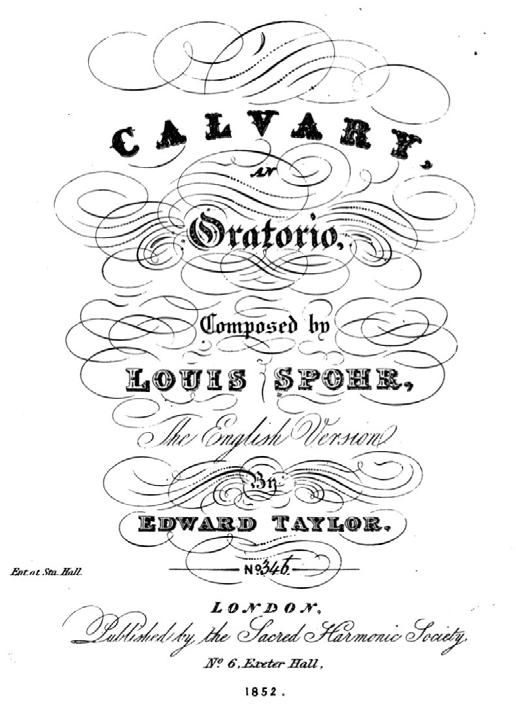
The title page of the first print of Calvary
featuring dialogue between multiple characters occurs only during the trial in Part One (No. 13). To compensate for this lack of drama, Spohr employs a clever device: twice during John’s recitatives, a quartet of solo voices enters (No. 14; No. 31, with chorus). He also utilizes a “call and response” style – reminiscent of a leader and congregation – where a soloist sings alongside the chorus (Nos. 6, 11, 18, 22, 34). Purely choral numbers are used as structural markers at specific points within the narrative and as a frame for the beginning and end of both parts. Notably, there are no chorales.
First modern Edition
Until now, the only available edition of Des Heilands letzte Stunden (Calvary) was an outdated version based on the first English print (containing only English text and archaic clefs). The new critical edition from Carus-Verlag is the first modern edition of the work ever produced. Its primary source is Louis Spohr’s autograph score. Contemporary vocal scores were consulted to cross-reference vocal parts and dynamic markings. As a special feature, this new edition includes Spohr’s original fingerings for the strings. To celebrate the exciting rediscovery of this outstanding 19th-century oratorio in either German or English, Carus is offering a modern conducting score, vocal score, and complete performance materials.
Louis Spohr (1784–1859)
Die letzten Dinge (The Last Judgment) op. 61 (ger / en)
Solo SATB, Coro SATB, 2 Fl, 2 Ob, 2 Clt, 2 Fg, 2 Cor, 2 Tr, 3 Trb, Timp, 2 Vl, Va, Vc, Cb
Carus 23.003, full score (also ), vocal score German or English (also ), complete orchestral parts for hire (also ), Audio (Carus 83.294)
Felix Mendelssohn Bartholdy (1809–1847)
St. Paul MWV A 14 (ger / en)
Soli SATB, Coro SATB, 2 Fl, 2 Ob, 2 Clt, 2 Fg, 4 Cor, 2 Tr, 3 Trb, Serpente, Timp, 2 Vl, Va, Vc, Cb, Org
Carus 40.129, full score (also ), vocal score German or German/English (also ), vocal score XL German/English, ± choral score German/English, complete orchestral parts / Carus Choir Coach practice aid, Audio (Carus 83.214)

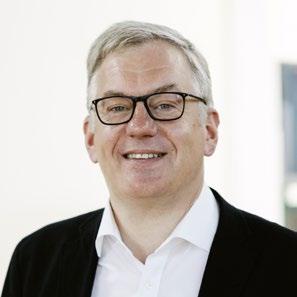
Dr. Henning Bey is working as Promotion Manager for Stage and Orchestra at Carus. Previously, he served as Artistic Planner with the SWR Symphony Orchestra, Chief Dramaturge of the International Bach Academy Stuttgart, and Dramaturge at the Freiburg Baroque Orchestra. He gained editorial experience as a member of the editorial team of the New Mozart Edition in Salzburg.
Die letzten Dinge. The Last Judgment op. 61
Like no other ensembles, the Kammerchor Stuttgart and Die Deutsche Philharmonie Bremen under the baton of Frieder Bernius aptly succeed in bringing to light the many facets of this dramatic oratorio.
Carus 83.294 (CD / stream)
Many composers have tried to capture the atmosphere of the countryside, memories of idyllic landscapes and natural spectacles or to set evocative nature poetry to music. We invite you to discover a few of these works – perhaps for your next summer concert?
Maurice Ravel (1875–1937)
Matinée de Provence (fr)
Solo S, Coro SATB, Pic, 2 Fl, 2 Ob, 2 Clt, 2 Fg, 4 Cor, 2 Tr, Timp, 2 Vl, Va, Vc, Cb Carus 10.406
The soft light of the early morning, the song of the cicadas and the beguiling scent of thyme: Matinée de Provence describes a morning in Provence, from the first rays of sunshine to the sweltering midday heat. Ravel captures the imagery of the text with striking melodies, colorful harmonies and brilliant orchestration. The result is a musical mood piece with a captivating atmosphere that exudes sensuality – a true choral gem and an exciting addition to the concert repertoire for mixed choirs.
Maurice Ravel (1875–1937)
L’Aurore (fr)
Solo T, Coro SATB, Pic, 2 Fl, 2 Ob, Eh, 2 Clt, 2 Fg, 4 Cor, 2 Tr, 3 Trb, Tb, Timp, Arpa, 2 Vl, Va, Vc, Cb Carus 10.407
The composition is divided into two parts: the first evokes the gentle awakening of nature at dawn, while the second praises the rising sun. Ravel’s orchestration is rich in subtle colors, effectively capturing the atmosphere of the early morning.
Lili Boulanger (1893–1918)
Hymne au soleil (fr)
Solo A, Coro SATB, Pfte Carus 21.101
Her Hymne au soleil (Hymn to the sun) for mixed choir, alto solo, and piano, Lili Boulanger wrote in 1912 to a poem by Casimir Delavigne. In ecstatic layers of chords the sun is acclaimed; through its power it brings the colors of the earth to light anew.
Fanny Hensel (1805– 1847)
Gartenlieder (Garden Songs) op. 3 (ger / en)
Coro SATB Carus 9.308
Each creating of the Gartenlieder (Garden Songs) is in a wholly different mood, the songs feature recurring motives: Alongside trees, forests and music in the countryside, the idea of listening or eavesdropping is of central importance. The musical texture is generally homophonic and based around wonderful melodies, which are predominantly carried by the soprano voice. Fanny Hensel set texts by well-known German Romantic poets such as Eichendorff and Uhland as well as a poem by her husband Wilhelm Hensel.
Felix Mendelssohn Bar tholdy
Im Freien zu singen
Felix Mendelssohn Bartholdy (1809–1847)
Im Freien zu singen op. 41, 48, 59 und 88 (ger)
Coro SATB Carus 40.221 ff.
Performing music outdoors, in harmony with nature – Mendelssohn likely attempted to turn this vision into reality more than once. In a letter to his mother dated July 3, 1839, he wrote: “We had a choir of about 20 good voices; but various things had seemed lacking in the rehearsal room, and everything felt shaky. However, when they stood under the trees that evening and began my first song, ‘Ihr Vöglein in den Zweigen schwank’ [Op. 41, No. 1], it was so enchanting in the silence of the woods that tears almost came to my eyes. It sounded like pure poetry.”
Antonín Dvořák (1841–1904)
In der Natur (In Nature)
Five choral songs op. 63 (czech / ger)
Coro SATB Carus 40.252
Dvořák’s choral song cycle op. 63 was composed between 1876 and 1882 and reflects his deep connection to nature and his artistic mastery. Despite their simplicity, the dynamic restraint and colorful harmonies of the songs create an intense and nuanced atmosphere.




CLudwig van Beethoven (1770– 1827)



Claude Debussy (1862–1918) / Clytus Gottwald (arr.) (1925–2023) Soupir. Vocal Transkription (fr)
Coro SSSSAAAATTTTBBBB Carus 9.119
Debussy’s Soupir, masterfully arranged by Clytus Gottwald for 16-part choir, unfolds with floating harmonies and a dreamy text, expressing the melancholic beauty of nature.
Meeres Stille und Glückliche Fahrt (Calm Sea and Prosperous Voyage) op. 112 (ger)
Coro SATB, 2 Fl, 2 Ob, 2 Clt, 2 Fg, 4 Cor, 2 Tr, Timp, 2 Vl, Va, Vc, Cb Carus 10.395
Beethoven in fact never voyaged by sea, but his composition, premiered in 1815, continues to surprise even today. He depicted in music the smooth surface of the motionless water and the oppressive calm, which meant being becalmed, a delayed voyage, and short rations in the era of sailing, with the same intensity as a freshening wind, wich ultimately enabled the longed-for “prosperous voyage” to take place.
Ermanno Wolf-Ferrari (1876–1948)
Otto cori a quattro e più voci dispari (it) Coro SATB / S Solo, Coro SATB / SATB / Coro SSATBB (con divisi) / 15 min ed. Barbara Mohn
The German-Italian composer Ermanno Wolf-Ferrari (a pupil of Josef Rheinberger) enjoyed great success with his comic operas at the beginning of the 20th century. His early work Die neugierigen Frauen (Inquisitive Women), which premiered in Munich in 1903, was later performed under Toscanini at New York’s Met. Wolf-Ferrari’s work reflects the fact that he grew up with two nationalities. The Otto cori for mixed choir display his attachment to the traditional forms of Italian music (madrigals, stornello, rispetto, etc.) and are largely based on Tuscan folksong texts. Exploring love, longing, and death, Wolf-Ferrari’s Otto cori are both humorous and sophisticated, featuring piquant harmonies and varied instrumentation. Into this collection of Italian poems, Wolf-Ferrari smuggled a German-language song, which he had already composed in Munich when studying under Rheinberger. Carus is presenting these songs as a collection – in print and digital versions. All songs are available as separate editions.
Carus 9.313, score ± 15,00 € ( 13,50 €)
Antonio Vivaldi (1678–1741)
Beatus vir RV 598 (lat)
Soli SSA, Coro SATB, 2 Vl, Va, Bc / 8 min ed. Uwe Wolf
Difficulty level 2
Antonio Vivaldi made three settings of Psalm 111 (112) “Beatus vir” (“Blessed is the man who fears the Lord”). The two surviving examples could hardly be more different: the large-scale RV 597 (Carus 40.012) for double choir and the small but exquisite and effective setting RV 598. The latter, composed by Vivaldi for his female pupils at the Ospedale della Pietà in Venice, is of moderate difficulty.
The edition of this work is based on the autograph score. In the approximately eight-minute piece, there is an engaging back-and-forth of choral sections and solo passages: for instance, an alto solo is followed by a duet for two sopranos before the choir makes its entrance. Particularly interesting is the lack of a basso continuo in most of the solo passages, which lends them a floating, ethereal quality. Vivaldi renders the Psalm’s juxtaposition of the “godless” and the “God-fearing” with striking musical contrasts. The work concludes with a jubilant doxology, providing a fitting climax.
Carus 40.014, full score 24,00 € (also ), vocal score 9,50 € (also ), choral score ± 5,50 €, complete orchestral parts 68,00 € (also )
Antonio Vivaldi (1678– 741)
Lauda Jerusalem RV 609 (lat) Coro I: Solo S, Coro SATB, 2 Vl, Va, Bc / Coro II: Solo S, Coro SATB, 2 Vl, Va, Bc / 7 min ed. Uwe Wolf
Psalm 147 “Lauda Jerusalem” features prominently in the liturgical year, including in vespers on Marian feasts. Antonio Vivaldi’s only setting of this vesper psalm is rather unusual in being written for double choir, each accompanied by an instrumental choir of strings and basso continuo. Unlike many of his other psalm settings, this work is not divided into several movements. Solo and tutti sections are juxtaposed, with the composer employing a kind of ritornello structure to maintain the musical unity.
Vivaldi’s students at Venice’s Ospedale della Pietà performed the work in the 1730s. The autograph score shows that the solo passages were performed by two singers, probably for pedagogical reasons. Even today, these solo parts can be assigned to one or more good choral sopranos.
Carus 40.024, full score 28,00 € ( 25,20 €), vocal score 12,00 € (also ), choral score ±9,00 €, complete orchestral parts 99,00 € (also )
Luigi Cherubini (1760 – 1842)
Messe solennelle in d (lat)
Soli SSATTB, Coro SATB, 2 Fl, 2 Ob, 2 Clt, 2 Fg, 2 Cor, 2 Tr, Timp, 2 Vl, Va, Vc, Cb / 75 min ed. Wolfgang Hochstein
How does a composer apply for a position at court? With their own music, of course! When, in 1810, Luigi Cherubini wanted to recommend himself as Joseph Haydn’s successor at the court of the Hungarian Prince Nikolaus II. Esterházy, he composed his Messe solennelle in D minor. Cherubini chose a very expansive, almost opulent mass that offered him ample opportunity to demonstrate his skills. At court, Cherubini’s efforts did not lead to the desired appointment, but he successfully published his Messe solennelle himself in 1825.
Drawing on the autograph score, this new critical edition is the first to offer the Hosanna in the form originally intended by the composer. It also contains a useful alternative introduction to the Sanctus, which survives in the autograph but was not included in the first published version. The edition thus offers valuable insights into this multifaceted sacred work from the period between the Classical and Romantic eras.
Carus 27.903, full score 149,00 € ( 134,10 €), vocal score 32,00 € (also ), choral score ±9,00 € complete orchestral parts for hire (also )
Antonín Dvořák (1841–1904)
Requiem op. 89 (lat)
Soli SATB, Coro SATB, Pic, 2 Fl, 2 Ob, Eh, 2 Clt, BClt, 2 Fg, Cfg, 4 Cor, 2 Tr, 2 Tr di lontano, 3 Trb, Tb, Timp, Tam-Tam, Arpa, Org, 2 Vl, Va, Vc, Cb / 95 min ed. Claudia Seidl
Antonín Dvořák’s mighty Requiem was commissioned for Birmingham’s renowned music festival. Since its premiere there in 1891 under the composer’s direction, it has enjoyed huge popularity. Although based on the liturgical Latin text, it was conceived from the outset as a full-length work for concert performance.
The version of the work published by Carus reflects the autograph score, which – unlike the original published score and a copy used at the premiere – precisely reproduces the composer’s careful dynamic markings. Autograph notes from the conducting score have been taken into account, while individual annotations give detailed information about the differences between the sources.
Carus 27.323, full score 109,00 € ( 98,10 €), vocal score 20,00 € (also ), vocal score XL 29,00 €, choral score ±14,50 €, complete orchestral parts 493,00 €, / Carus Choir Coach practice aid
Robert Schumann (1810–1856)
Dichterliebe (Poet’s love)
Arrangement for choir and pianoforte (ger)
Coro SATB, Pfte, [Soli MsTBar] arr. Hye-Young Cho
From sublime ecstasy to the deepest despair, Robert Schumann’s Poet’s love, based on texts by Heinrich Heine, is a story encompassing all the facets of a true and passionate love. The cycle was written in 1840, the year in which the composer, after a lengthy battle and against fierce resistance, was allowed to wed the virtuoso pianist Clara Wieck. 1840 is also celebrated as the “year of song” in the composer’s œuvre.
This edition makes this world-famous cycle accessible to choirs while creating an entirely fresh sonic experience. Appearing in their new guise, the familiar melodies still closely reflect Schumann’s musical intentions. Hye-Young Cho is one of South Korea’s leading composers. Here she has produced sensitive arrangements in which the vocal groups are deployed in a varied and well considered manner. Her harmonies strictly follow Schumann’s piano setting (which she adopts unchanged), and thus the arrangements preserve the simple yet intense character of the songs.
Carus 9.309, score ±22,00 € ( ±19,80 €)
Wolfgang Amadeus Mozart (1756 – 1791)
Der Schauspieldirektor (The Impressario)
K. 486 (ger)
Arrangement for chamber orchestra
Soli SSTB, 6 Sprechrollen, Fl, Ob, Clt, Fg, Cor, Timp, 2 Vl, Va, Vc, Cb / 48 min arr. Urs Stäuble
This chamber version reduces the original doubled wind section to a quintet of solo flute, oboe, clarinet, bassoon and horn. While trumpets are omitted, the timpani are not. The string parts can be performed by solo instruments. Ideal for a performance in an opera studio!
Carus 57.007, full score 82,00 € ( 73,80 €), vocal score 23,00 € (also ), complete orchestral parts for hire (also )
Felix Mendelssohn Bartholdy (1809–1847)
Vom Himmel hoch (From heav’n on high)
Choral cantata (ger / en)
Arrangement for chamber orchestra
Soli SBar, Coro SSATB, 2 Vl, Va, Vc /Cb, Fl, Ob, Clt, Fg, Cor, Tr, Timp / 16 min arr. Urs Stäuble
Difficulty level 3
Mendelssohn’s popular Christmas cantata is now available in a chamber version, reduced to six wind instruments, string quintet and timpani.
Carus 40.189/50, full score 54,00 € ( 48,60 €), vocal score 14,50 €, vocal score XL 22,00 €, choral score ±5,50 €, complete orchestral parts for hire (also )
Wolfgang Amadeus Mozart (1756–1791)
Die Zauberflöte (The Magic Flute) K. 620 Arrangement for chamber orchestra (ger) 18 solo, 4 speaking roles, Coro SATTBB, Fl/Pic, Ob, Clt, Fg, Cor, [Tr, Timp], Str d’a, 2 Vl, Va, Vc, Cb / 180 min / arr. Urs Stäuble
It is one of the most frequently performed operas in the world. Written in 1791 for Emanuel Schikaneder’s theater in Vienna, The Magic Flute by Wolfgang Amadeus Mozart combines elements of fairy-tale magic with ideas drawn from Freemasonry. In his final opera, Mozart unfolds the full range of his compositional mastery: from the folksong-like melodies of Papageno’s numbers, to Pamina’s heartfelt arias, to the depth and serenity of Sarastro’s singing, and the Queen of the Night’s dazzling coloratura. The Magic Flute is a serious opera, lively singspiel, and Enlightenment parable rolled into one. In short: there is something for everyone – and perhaps that’s the reason for its enduring success.
Urs Stäuble’s version reduces the orchestra to chamber size without compromising the musical substance. It is particularly suitable for smaller ensembles, university orchestras, and concert performances with limited space.
Carus 57.008, full score 199,00 € (also ), vocal score 29,00 € (also ), complete orchestral parts for hire (also )
Charles Gounod (1818–1893)
Messe solennelle de sainte Cécile
Arrangement for chamber orchestra (lat) Soli STB, Coro SATB, Fl, Ob, Clt, 2 Fg, Cor, Tr, Timp, Perc, Arpa, 2 Vl, Va, Vc, Cb, [Org] / 45 min / arr. Urs Stäuble
“Radiant beams poured forth from the Messe de Sainte Cécile. First, one was dazzled, then enchanted, then overwhelmed.” This is how Camille SaintSaëns described the impression made on him by Charles Gounod’s best known Mass setting. The work, which Gounod wrote in 1855 to honor the patron saint of church music, soon became famous far beyond the borders of France, achieving a level of popularity matched by few other sacred compositions.
The present arrangement by Urs Stäuble makes the Messe solennelle de sainte Cécile accessible to smaller choirs and orchestras, requiring only about one third of the original wind parts. At the same time, the arranger has striven to preserve the work’s festive splendor. The tonal balance and musical substance are retained, making this version a practical alternative to the original (Carus 27.095/00). The vocal scores and choral scores from the original version can be used.
Carus 27.095/50, full score 109,00 € (also ), vocal score 20,00 € (also ), vocal score XL 26,00 €, choral score ±11,50 €, complete orchestral parts for hire (also )
Johannes Brahms (1833 – 1897)
Gesang der Parzen (Song of the Fates) op. 89 (ger / en)
Arrangement for chamber orchestra
Coro SAATBB, Fl (Pic), Ob, Clt, Fg, Cor, Timp, 2 Vl, Va, Vc, Cb / 12 min arr. Urs Stäuble
Goethe’s “Lied der Parzen” tells us “So sangen die Parzen” (Thus sang the Parcae). These were the goddesses of destiny in Greek and Roman mythology. The excerpt from the play Iphigenie auf Tauris inspired Johannes Brahms to create his Song of the Fates, a gripping and volcanic work that describes the struggle to overcome the mythical curse through the purity of righteous, noble action and the power of hope.
This arrangement reduces the wind section to a quintet of solo flute, oboe, clarinet, bassoon, and horn. The string section can also be performed by solo instruments, although doubling of parts is also possible. In this way, the symphonic character and the differentiation of the instrumental timbres is retained even when performed by small ensembles. The choral part is identical to the original version, so that both the original choral and vocal scores can be used.
Carus 10.400/50, full score 28,00 € ( 25,20 €), vocal score 12,95 € (also ), choral score ±6,95 €, complete orchestral parts for hire (also )
Gabriel Fauré (1845 – 1924)
Cantique de Jean Racine op. 11 (lat)
Arranged for choir with one male voice Coro SMsAB, 2 Vl, Va, Vc, Cb, Org 40 min / arr. Christiane Rosiny
Gabriel Fauré composed the Cantique de Jean Racine in 1865 as the prize-winning final work of his musical training. The Cantique already possesses the typical Fauré characteristics of an expressive choral movement and, together with the Requiem composed much later, is one of the composer’s most popular works. Christiane Rosiny’s arrangement for SMsAB choir is aimed at mixed ensembles with a limited number of male voices as well as youth choirs. While soprano and bass remain practically unchanged, the middle voices are arranged for soprano and alto.
In addition to the score of the version for string orchestra, a version for organ is also available (Carus 14.402/10). The vocal parts (solo and chorus) are identical in both the string and organ versions. The organ reduction also serves as the choral score for both the string and organ versions.
Carus 14.402, full score 32,00 € ( 28,80 €), Orgelauszug ± 9,50 € (also ), complete orchestral parts 33,50 €
Ludwig van Beethoven (1770–1827) Gottlob Benedict Bierey (1772–1840) Kyrie based on the Adagio of the “Moonlight Sonata” (lat) Arranged for choir with one male voice Coro SAAB, Pfte / 5 min arr. Christiane Rosiny
Difficulty level 2
What happens when you combine Beethoven’s “Moonlight Sonata” with the sacred “Kyrie”? Composer and conductor Gottlob Benedict Bierey (1772– 1840) undertook this experiment – with astonishing and convincing results! He orchestrated the famous first movement of Beethoven’s masterpiece, adding a four-part mixed choir setting (SATB) of the Kyrie text (Carus 28.009/00).
Christiane Rosiny’s arrangement for our new SPLENDID SONORITY series makes this special work accessible even to choirs with few (or very young) male voices. Bierey’s choral setting is treated with the utmost care: the outer voices are virtually unchanged, while the middle voices are beautifully arranged for two altos.
The edition is published as a version for choir (SAAB) and piano. The piano part corresponds to Beethoven’s beloved sonata movement in the original key of C-sharp minor
Carus 14.403, full score 8,50 € (also ), choral score ± 3,50 € (also )

Ludwig van Beethoven (1770–1827)
Gottlob Benedict Bierey (1772–1840)
Agnus Dei based on the Adagio of the Piano Sonata No. 5 op. 10, No. 1 (lat)
Soli / Coro SATB, 2 Fl, 2 Ob, 2 Clt, 2 Fg, 2 Cor, 2 Vl, Va, Vc, Cb / 7 min ed. Sabine Bock
Already during lifetime, Ludwig van Beethoven became so revered that other musicians arranged his music – mostly the popular instrumental works – for choir. The composer may even have known some of these versions. After his death, there came a veritable tsunami of arrangements, reaching its peak in the 1830s.
The present work by the composer and Kapellmeister Gottlob Benedict Bierey (1772–1840) dates from this period. He arranged the slow movement of the Piano Sonata No. 5 in C minor (Op. 10, No. 1) for voices and orchestra, adding the text of the Agnus Dei from the Latin Ordinary. The piece is a wonderful companion piece to Bierey’s arrangement of the first movement of the “Moonlight Sonata”, which he orchestrated and underlaid with the text of the Kyrie from the Latin Ordinary (Carus 28.009).
Carus 28.011, full score 19,00 € ( 17,10 €), vocal score 6,00 € (also ), choral score ± 4,00 €, complete orchestral parts 60,00 € (also )
Ludwig van Beethoven (1770–1827) Meeres Stille und Glückliche Fahrt (Calm Sea and Prosperous Voyage) Arrangement for chamber orchestra (ger) Soli SSATB, Coro SATB, Pfte, Fl, Ob, Clt, Fg, Cor, Tr, Timp, 2 Vl, Va, Vc/Cb / 20 min arr. Urs Stäuble
Difficulty level 3
Ludwig van Beethoven’s Calm Sea and Prosperous Voyage, Op. 112, can most easily be described as a choral ode. Although Beethoven himself never left dry land, he successfully creates an impressive portrayal of seafaring: the oppressive calm – synonymous in the age of sailing with immobility and dwindling food supplies – is conjured up by lowregister choral passages with washes of pianissimo strings. At the words “ungeheuren Weite” (“immense vastness”), the listener is surprised by a sudden forte crescendo spanning more than five octaves. This contrasts with the “Glückliche Fahrt” (“prosperous voyage”) with its restless compound meters and flowing diatonic scales to express confidence and happy excitement. This arrangement for chamber orchestra allows smaller choirs to set sail. The vocal score and choral score from the original edition (Carus 10.395/00) can be used.
Carus 10.395/50, full score 36,00 € (also ), vocal score 14,00 € (also ), choral score ±4,00 €, complete orchestral parts for hire (also )
Ludwig van Beethoven (1770–1827) Fantasie (Choral Fantasy) for piano, choir and orchestra
Arrangement for chamber orchestra (ger / en)
Soli SSATB, Coro SATB, Pfte, Fl, Ob, Clt, Fg, Cor, Tr, Timp, 2 Vl, Va, Vc/Cb / 20 min arr. Urs Stäuble
In his Choral Fantasy, Beethoven created a paean to art that is at once both a cantata and a concert piece. The roughly twenty-minute work is often seen as a precursor to the Ninth Symphony’s “Ode to Joy”. After a contemplative piano introduction, a virtuosic dialogue unfolds – much like in a concerto –between piano and orchestra before the vocal soloists and choir make their entrance. Finally, piano, orchestra, and voices unite in an exhilarating song of jubilation.
This arrangement makes the work accessible even to smaller choirs and instrumental ensembles, requiring only half of the original wind parts. The tonal balance and musical substance are retained, making this version a practical alternative to the original. The vocal score and choral score from the original version (Carus 10.394) can be used.
Carus 10.394/50, full score 52,00 € (also ), vocal score 12,00 € (also ), choral score ±8,00 €, complete orchestral parts for hire (also )
Ludwig van Beethoven (1770–1827)
Müde sank der Tag. Nachtlied based on the Adagio of the “Sonata Pathétique”
Coro SATB (divisi) / 4 min arr. Ludwig Böhme
Difficulty level 3
Ludwig van Beethoven was already so revered during his lifetime that his contemporaries arranged his music –mostly the well-known instrumental works – for choir. Such choral settings were even performed at Beethoven’s funeral. Later generations of composers have engaged creatively with his œuvre in a similar way.
The renowned arranger Ludwig Böhme, co-founder of the Calmus Ensemble and artistic director of the Windsbach Boys’ Choir, is continuing this tradition by transforming the slow movement of the piano sonata “Pathétique” into a choral piece. The text is Francisca Stoecklin’s poem “Nachtlied” (1925), which interweaves the nocturnal peace of the countryside with subtle references to the Christmas story. A surprising addition to the festive repertoire!
Carus 9.197, score ± 4,00 € (also )
John Høybye
Requiem. Light Shines in the Darkness (lat)
Coro SSAATTBB, Va solo / 20 min
Difficulty level 3
Light Shines in the Darkness is a composition for solo viola and mixed choir. John Høybye has set a text by Edward Broadbridge. The predominantly English-language poem contains Latin passages, in particular from the Requiem Mass, as well as the motto “Lux in tenebris lucet” (Light shines in the darkness). A Requiem full of beautifully plaintive sounds, but also featuring rousing rhythms that give hope and light in the darkness.
Carus 10.124, full score 39,00 € ( ±35,10 €), choral score ±25,00 €, individual part viola solo 7,00 €
John Høybye
Let the Music Flow (en)
Coro SATB (con divisi) / 5 min
Difficulty level 3
A short, exciting piece that celebrates the joy of choral singing. It combines a real groove and jazzy harmonies with a profound message. The score presents a mix of beautiful choral singing and rhythmic intensity in jazz-inspired phrases – that’s “trademark” Høybye!
Carus 9.314, score ±5,50 € ( ±5,00 €)
Grayston (Bill) Ives Requiem
Solo T, Coro SATB, Fl, Clt, Fg, 2 Cor, 2 Tr, Timp, Perc, Arpa, 2 Vl, Va, Vc, Cb, Org / 45 min
There’s no doubt that British composer Grayston (Bill) Ives (*1948) has, in various ways, dedicated his career to choral music. A tenor with the legendary King’s Singers, he later worked for 18 years as organist, choirmaster and lecturer at Oxford’s prestigious Magdalen College. This Requiem, which Ives wrote to celebrate the college’s 550th anniversary, is suitable for both sacred and secular performance. Ives’ style is tonal, uncluttered and nonetheless colorful; even, at times, surprising, e.g. in the use of Tibetan hand-held cymbals.
“As a former King’s Singer, ‘Bill’ Ives, steeped in the Anglican choral tradition, writes magnificently .... His word-painting skills draw out every dramatic impulse”, stated the British music magazine Gramophone in 2021 on the occasion of the first recording of this Requiem setting.
Carus 27.325, full score 89,00 € ( 80,10 €), vocal score 24,00 € (also ), choral score ±17,50 €, complete orchestral parts for hire (also ), Audio (Carus 27.325/99)

Giacomo Puccini Messa a 4 voci con orchestra (lat)
Soli TBar/B, Coro SATB, Fl, Ob, Clt, Cor, Fg, Timp, 2 Vl, Va, Vc, Cb Carus 56.001/50
Verdi’s Requiem with just 5 instead of 34 instrumentalists? Or Mendelssohn’s Elijah with just a small chamber ensemble? With our arrangements in the “Great choral works in small scorings” series, it is easier and considerably more economical to perform the great choral works which every choir wants to sing.
• More choirs will have the opportunity to perform large-scale works.
• Performances can now be programmed with considerably fewer instrumentalists and thus also in smaller performance venues.
• These arrangements offer a fresh look at well-known and popular works.
• Vocal scores and choral scores from the original version can be used.
All works