2020-21 Carthage Music Department Presents
Carthage Philharmonic THE
SATURDAY APRIL 17, 2021 7:30 P.M. A.F. SIEBERT CHAPEL
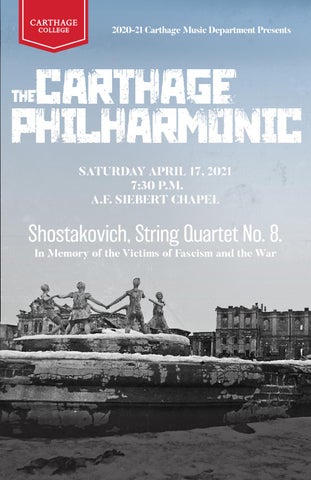
Shostakovich, String Quartet No. 8. In Memory of the Victims of Fascism and the War
program There will be no intermission Symphonie Concertante in G Major, Op. 13 Joseph Bologne, Chevalier de Saint-Georges (1745-1799) I. Allegro Azniv Khaligian and Ashlynne Edwards, violins String Quartet No. 8, Op. 110 Dmitri Shostakovich (1906-1975) I. Largo II. Allegro III. Allegretto IV. Largo V. Largo Movements will be played without breaks.
personnel Dr. Etsushi Edward Kawakami, conductor Violin 1 Azniv Khaligian** Sophia Tajnai Lee Fulkerson Violin 2 Ashlynne Edwards* Edelmar Morales-Rivera Ruth Gray Viola Genevieve Zauhar* Molly Fraser Bailey Wellen Samuel Gomberg Megan Baumeister Elena Cordoba Meghan Keiffer-Zagar Jacob Mayer
Cello William Dowell* Grace Hill Rheanna Weaver Brian Dean Halla Swindle Bass McKenzie Wallace*
*principal **concertmaster
program notes String Quartet No. 8 “In Memory of the Victims of Fascism and War” is the dedication inscribed on Shostakovich’s 8th string quartet. Composed in the remains of firebombed Dresden, String Quartet No. 8 serves as a chilling reminder of the pain and suffering born from the bloodshed that came from war and totalitarianism. Beyond its dedication, the meaning of Shostakovich’s 8th quartet is shrouded in conflicting anecdotes and opinions. Shostakovich continually draws from his past works throughout the piece, encouraging an autobiographical interpretation similar to Solomon Volkov’s perspective in his book Testimony. Volkov viewed the 8th quartet as an act of retribution against the Communist Party with the dedication serving as a cover to protect Shostakovich. However, Volkov’s portrayal of Shostakovich’s dissidence has been regularly challenged, with musicologists exposing the book’s fraudulent blend of Volkov’s fiction and the recycled writings of Shostakovich. Additionally, the appearance of the “Jewish” theme from Shostakovich’s second piano trio suggests that music goes beyond a musical autobiography. Like the environment that surrounded Shostakovich, his work is complex and multifaceted. This complexity allowed Philharmonic Director and Associate Professor of Music Dr. Kawakami to adapt String Quartet No. 8 for string orchestra. What is clear is the occurrence of Shostakovich’s main motive, the “DSCH.” Like Schumann’s “SCHA,” this musical cryptogram inserts letters from Shostakovich’s name directly into the music. While the “D” and “C” directly represent the notes “D” and “C,” the “S” and “H” come from the German scale naming system, with “S” translating into “E-flat” and “H” into “B-natural.” This motive is showcased immediately in the celli and bass’ opening notes of the first movement. The “DSCH” motif is passed through the rest of the orchestra before the quartet begins to call back to Shostakovich’s previous works. These repurposed themes are ephemeral and papery, with each note almost dying as it leaves the instrument’s strings. A violin solo becomes almost a whisper as it enters and fades away. The music slowly builds before being interrupted by the second movement. Violence permeates through the second movement. The first violins’ intense musical line is punctuated by metallic chordal strikes from the rest of the orchestra. Other sections of the orchestra jump into the musical frenzy, sawing away at their strings as they bite out each note. The sections even fight with each other, with their notes clashing and melding into thick dissonances. Running triplets become a metallic engine that propels the music forward. The cacophonous chord strikes become more and more sporadic, before the celli and viola’s layered runs overtake them. These runs keep flying before being interrupted by a violin solo. This solo transitions immediately into third movement, opening with a motive from Shostakovich’s first cello concerto. The soloist is then joined by the rest of the orchestra and begins a twisted waltz. The violins’ “B-naturals” clash with the violas’ “B-flats,” creating an uneasy and ambiguous musical structure. Even the rhythm feels off, with pauses and hesitations regularly interrupting the music. The violas actively warp the rhythm with their rumbling quarter-note clashing against the first violins’ minuet. A brief cello solo floats above the waltz, lingering on an out-of-place “E-natural.” The back and forth between the violins’ and the low strings rumblings transition into a solo violin line that grows into the fourth movement. The violence of the second movement and the grim sorrow of the first are thrown together in the fourth movement. Hearkening back to the second movement, angry metallic strikes interrupt groaning melodies. Rumbling notes burst into fury and rage. Sudden changes in dynamics and tone constantly keep everyone on edge, unsure of when the next violent bout will return. A flurry of musical references from funeral masses to operatic arias throttle this movement into different directions. It’s musically erratic and unafraid to suffocate the listeners and performers in the victims’ rage and fear. Like a bow on a cello’s strings, the music grinds and bites, forsaking beauty for truth. However, this type of musical violence is unsustainable
program notes and eventually dies away into the fifth and final movement. The “DSCH” theme returns for the final movement starting again with the celli and bass. The music remains subdued regardless of the dynamics with elegiac melodies sinking into grim resignation The quartet is dying and each soloist fades away, repeating various versions of the “DSCH” motif. Muted strings create a defeated and somber tone that constrains the sound of the orchestra. Its final note, noted with the text morendo (“dying”), just fades away into the shadows. Sinfonia Concertante No. 2 in G A champion fencer, virtuosic violinist, prolific composer, and conductor of one of the best orchestras in Europe, Joseph Bologne, Chevalier de Saint-Georges was one of the most accomplished men in Europe. While he was an illegitimate son and unable to inherit his father’s title, he earned the title chevalier, French for knight, after his graduation from the Royal Polytechnique Academy. Later on, he would become a Colonel in the French Army, displaying great military feats that gave his legion the unofficial title “Légion St-Georges.” His military career was dashed when he was imprisoned without charge and later dismissed from the military. He later died from a bladder disease as he attempted to develop a new symphony orchestra. A contemporary of Wolfgang Amadeus Mozart and Franz Joseph Haydn, SaintGeorges’s music and reputation embedded him in France’s high society, even teaching and performing with Marie Antionette. His compositions covered a variety of genres, including multiple symphonies, string quartets, and operas. As a conductor, he led Le Concert des Amateurs and Le Concert Olympique, conducting the premier of Haydn’s “Paris” symphonies. These accomplishments were all completed despite the overbearing racism of the time. As an Afro-European composer, he was regularly cast away from additional prestigious opportunities because of his race. Racism combined with the turbulent French Revolution led to SaintGeorges’ work almost completely disappearing from the classical music discourse. Many of his pieces were destroyed in the fires and violence of the French Revolution, while many were not properly maintained throughout the years. Luckily for the Philharmonic, Carthage Alumna Ruth Gray ‘20 produced and edited updated orchestral parts for this performance. His Sinfonia Concertante No. 2 in G is a prime example of his phenomenal work. As an orchestral piece featuring two violin soloists, the music joyfully bounces between one part and the next. The soloistic sections showcase the violinists’ technical abilities while maintaining a graceful and carefree atmosphere. Celli and violas join together to provide clear rhythmic accompaniment. His harmony also encapsulates the clarity and structure of the Classical Era. Opening in the key of G major, the music establishes itself before journeying to D major. In the middle, the journey diverges into a series of dramatic virtuosic sections in E minor. Rhythmic and melodic pieces of the music are repurposed and expanded upon as the music becomes more complex and turbulent. Eventually the music returns to its opening theme, still as joyous as before. This time the journey continues in the piece’s G major origins, with the strings ending on a series of triumphant chords. Sinfonia Concertante No. 2 showcases the pleasures and wonders of classical music, and is a prime example of why SaintGeorges’ works should be in any orchestra’s repertoire. Program notes by William Dowell
connect with us
tickets required
carthage.edu/fine-arts facebook.com/carthagefinearts instagram.com/carthagefinearts
Get tickets 24/7 at carthage.edu/tickets 262-551-6661 noon to 5 p.m. Tuesday – Friday