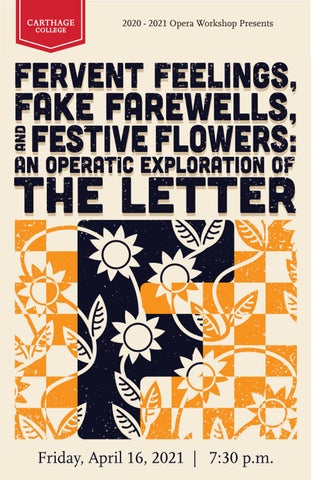
2020 - 2021 Opera Workshop Presents
Friday, April 16, 2021 | 7:30 p.m.
program ARIAS Dido’s Lament from Dido and Aeneas
Henry Purcell (1659-1695) Elise Brevik
Che faro senza Euridice from Orfeo ed Euridice
Christoph Willibald von Gluck (1714-1787) Faith Albright
J’ai perdu mon Eurydice from Orfeo e Eurydice
Christoph Willibald von Gluck (1714-1787) Mitch Dziewior
Dove Sono Wolfgang Amadeus Mozart (1756-1791) from Le Nozze di Figaro London Roysden I Uomoni from Cosi fan tutte
Wolfgang Amadeus Mozart (1756-1791) Isabelle Esquivel
Dies Bildnis from Die Zauberflöte
Wolfgang Amadeus Mozart (1756-1791) Christopher Glade
Faites-lui mes aveux from Faust
Charles Gounod (1818-1893) Morgan Taylor
Il lacerate spiritu from Simon Boccanegra
Giuseppe Verdi (1813-1901) Tom Cargille
Song to the Moon from Rusalka
Antonin Dvorak (1841-1904) Sarah Jenkins
program DUETS AND TRIOS La ci darem la mano Wolfgang Amadeus Mozart (1756-1791) from Don Giovanni Tom Cargille and Isabelle Esquivel Soave sia il vento Wolfgang Amadeus Mozart (1756-1791) from Cosi fan tutte Elise Brevik, Sarah Jenkins, and Mitch Dziewior Evening Prayer Engelbert Humperdinck (1854-1921) from Hansel and Gretel Faith Albright, Morgan Taylor, and Christopher Glade Flower Duet Giacomo Puccini (1858-1924) from Madama Butterfly London Roysden and Katiann Nelson
program note It is important to acknowledge the significant and escalating concerns that continue to be raised about Puccini’s Madama Butterfly and its subject matter. In particular, we need to be honest about the outmoded and objectionable attitudes of the westerners who created this work (writer John Luther Long, dramatist David Belasco, librettists Luigi Illica and Giuseppe Giacosa, and composer Giacomo Puccini) ... attitudes which included the festishization of Asian women. Those who love this opera- or at least love many things about it- must grapple with painful yet inescapable questions about the place of this and similar works in our repertoire. May such dialogue help lead all of us to a place of deeper understanding of and appreciation for the whole human family - and to more profound concern for any and all communities who find themselves minimized or marginalized by such attitudes.
performers Elise Brevik Tom Cargille Isabelle Esquivel Mitch Dziewior Christopher Glade Sarah Jenkins Katiann Nelson London Roysden Morgan Taylor
aria program notes FINAL FATE: Purcell’s opera Dido and Aeneas draws upon Virgil’s Aeneid for the story of the love affair between Dido, Queen of Carthage, and Aeneas, the Trojan general. When three witches trick Aeneas into abandoning Dido, she decides that her sense of honor requires that she ends her life. She sings her famous Lament after taking poison. FAMOUS FIASCO: We are offering up two different performances of the most renowned aria by Christoph Willibald Gluck from his operatic treatment of the legend of Orfeo. Having retrieved his beloved Euridice from the underworld, he is instructed not to speak to her or even look at her during their long journey back. Euridice misinterprets Orfeo’s silence as icy indifference and is heartbroken. Orfeo is finally driven to turn around and address Euridice- and she falls to the floor, dead once again. His aria of lament will first be sung in its original language and in the key of C major for mezzo soprano. After that, we’ll hear it sung again – but in the tenor key of E flat major and in French from Gluck’s arrangement of the opera for Paris. FORSAKEN YET MOVING FORWARD: The first of three Mozart arias on our program, “Dove Sono” from Le Nozze de Figaro is sung by Countess Almaviva, who is stung by the infidelity of her husband. She and her maid, Susanna, have concocted a plan by which to catch the Count red-handed in one of his indiscretions. In the recitative, the Countess expresses her fears about the plan, before singing in the aria of the love that she and her husband once enjoyed together and her determination to win him back. FED UP WITH THE FICTION: In the delicious comedy Cosi fan tutte, two young men have been persuaded by a friend to test the faithfulness of their girlfriends by pretending to go off to war and then coming back disguised as handsome strangers who will woo them. Not long after their ‘fake farewell,’ the women’s saucy maid Despina takes them aside and seeks to shake them loose from their fanciful notions about how wonderful men are. FERVENT FIXATION: In Mozart’s Die Zauberflöte, Tamino is shown the portrait of the beautiful woman Pamina and told that she must be rescued. Tamino falls in love with her at first sight and tries to imagine how joyous it will be if he is able to come to her aid. A FLORAL FAILURE: Gounod’s opera Faust draws upon the famous legend that has been fertile source material for many works over the years. This particular aria is sung by the young man Siebel (which is a trouser role, meaning that it is always portrayed onstage by a female singer.) He is on his way to meet Marguerite and to give her flowers – only to discover to his horror that they have mysteriously wilted. What Siebel does not know is that it was the devil himself, lurking nearby, that caused the flowers to wilt. Siebel’s staunch faith and a few drops of holy water reverse the curse.
aria program notes A FATHER”S FURY: The aria “Il lacerate spirito” comes from the opening prologue of Verdi’s opera Simon Boccanegra. A few years earlier, the character of Fiesco discovered that his beloved daughter Amelia was engaged in an affair with Simon Boccanegra. Horrified, Fiesco locked his daughter away in hopes of keeping her pure. Sadly, Amelia has just died and Fiesco finds himself consumed with sorrow for his loss as well as rage towards Simon Boccanegra, whom he blames for his daughter’s death. A FAIRY’S FEELINGS: Czech composer Antonin Dvorak’s opera Rusalka concerns a beautiful and mysterious wood nymph who has fallen in love with a human prince. The most famous passage from this aria is the so-called Song to the Moon in which Rusalka looks to the moon in the sky and asks it to somehow convey her feelings of love to the Prince.
aria program notes FAMOUS FLIRT: Mozart’s Don Giovanni explores some of the distasteful exploits of the famous/infamous Don Juan. In this duet, Don Giovanni is shamelessly pursuing a young village girl, Zerlina, on her wedding day. Although she momentarily succumbs to Don Giovanni’s charms, she is able to regain her resolve and return to her own beloved, Masetto. A FAKE FAREWELL: Next, we return to Cosi fan tutte for an exquisite trio that is sung by Fiordiligi and Dorabella (with their old friend Don Alphonso) as their boyfriends supposedly sail off to join the military. The two women are overcome with sadness, while Don Alphonso can barely stifle his laughter at their foolishness. He knows that it’s all a trick. FRIGHTENED IN THE FOREST: Engelbert Humperdinck’s opera Hansel & Gretel may seem at first glance like nothing more than a children’s opera. It is, in fact, a highly sophisticated score constructed in many ways like the sprawling music dramas of Wagner. We are preceding the song of the sandman as well the evening prayer duet with a brief recitative composed especially for this program. FESTIVE FLOWERS: Puccini’s Madama Butterfly tells the story of a doomed marriage between a young Japanese geisha, Cio Cio San, and an American naval officer named B.F. Pinkerton. Although the two seem genuinely in love at the time of their marriage, It is not long before Pinkerton has returned to duty – and has been gone for three years without sending Cio Cio San any communication whatsoever. Cio Cio San is the only one who steadfastly believes that he will return- and she turns out to be right. The sound of a cannon firing in the harbor announces the return of Pinkerton’s ship, and Cio Cio San and her faithful maid Suzuki joyously festoon her home with flowers in order to welcome Pinkerton back.
thank you’s Tianna Conway and her staff for preparation of the program and poster Dr. Eduardo Garcia-Novelli, chair of the music department, for his ongoing support of the Opera Workshop Dr. Anthony Barhart, Assistant Professor of Psychological Science (and professional magician) for his assistance in procuring the trick flowers used in the aria from Faust The voice teachers at Carthage College for their ongoing work with all of our singers, including the ten students involved in this Opera Workshop production.
upcoming events for carthage community The Carthage Philharmonic Saturday, April 17 • 7:30 p.m. A. F. Siebert Chapel • Tickets required Honors Recital Sunday, April 18 • 2 p.m. (Awards start at 1:30 p.m.) A. F. Siebert Chapel • Tickets required Graduate Recital: Mijiang He Sunday, April 18 • 7:30 p.m. Recital Hall • Tickets required Graduate Recital: Deonte Warren Wednesday, April 28 • 7:30 p.m. Campbell Student Union Auditorium • Tickets required
connect with us
tickets required
carthage.edu/fine-arts facebook.com/carthagefinearts instagram.com/carthagefinearts
Get tickets 24/7 at carthage.edu/tickets 262-551-6661 noon to 5 p.m. Tuesday – Friday