CLUB the
“When you come out of a storm you won’t be the same person that walked in. That’s what the storm is all about.”
Haruki Murakami

“When you come out of a storm you won’t be the same person that walked in. That’s what the storm is all about.”
Haruki Murakami
We are pleased to share the ninth edition of our Club magazine. This year we have built it around a theme that may not feel immediately comfortable but is undeniably powerful - Navigating Fear. Fear is something we all encounter at different points in our lives, whether in our personal journeys, professional decisions or financial choices. Yet, as we have discovered while shaping this edition, it can also be a catalyst for courage, clarity and growth.
In this issue, we are inspired by a series of thoughtful and honest conversations. We hear from our client Mark Richardson, whose reflections on challenge and resilience offer a compelling perspective on confronting uncertainty. We also speak with adventure racer and oncology consultant, Lucy Gossage, who shares her experiences of pushing physical and emotional boundaries, and with Jess McGawley of Dallington, whose insights explore fear through a different but equally illuminating lens. We are very grateful to Mark, Lucy and Jess for giving us their time and sharing their stories, thank you.
Alongside these articles, we consider what fear means in the context of investing, particularly during periods of market uncertainty. We look at how disciplined thinking and a long-term perspective can help steady decision making when headlines and sentiment feel unsettling. We also look at the vital role protection plays in everyday life, and how thoughtful planning can provide reassurance when the unexpected happens.
We hope you find this edition both thought provoking and inspiring, and that it offers reassurance that while fear may be inevitable, it can also be navigated with purpose, perspective and confidence.

by Nicola Craxton

Fear not. We have no intention of taking you on an in-depth biology lesson! Rather we wanted to warm you up gently for what can be an uncomfortable topic. Let’s face it, we’re all human and we all have fears, some of them more “socially acceptable” than others. Valid fears are, after all, a natural, normal and necessary response to what we perceive as a threat.
American psychologist, Dr Paul Eckman, defines fear as:
“One of the seven universal emotions experienced by everyone around the world. Fear arises with the threat of harm, either physical, emotional, or psychological, real or imagined. While traditionally considered a “negative” emotion, fear actually serves an important role in keeping us safe as it mobilises us to cope with potential danger. It can, however, also keep us feeling trapped and prevent us from doing things we’d like to.”
Some fears arise without any real foundation. These are the irrational worries that, with a little perspective and reassurance from those around us, can often be moved through relatively easily - sometimes with nothing more than moral support, or the timely arrival of a brave spider catcher.
Other fears, however, exist for a reason. They act as signals, alerting us to genuine risks that need careful attention. When we respond to these fears appropriately, we are not controlled by them. Instead, we gain the confidence to move forward with greater freedom and enjoyment.
Fear is not something that only happens in the mind. Often, it begins in the body - fast, wordless, instinctive. You feel it before you understand it. Clammy hands, a knot in your stomach, a racing heart. It has a way of making itself known, even when we are trying very hard to appear composed.
Fear is, at its core, a survival response, the body’s alarm system. Long before humans worried about paying the bills, relationships, or whether they were doing enough with their lives, fear existed for one reason: to keep us alive.
Deep inside the brain sits a small structure called the amygdala - sometimes described as its smoke detector. Its sole job is to notice danger and respond immediately. The amygdala is like the collision detection system in a car – always active, always scanning, ready to slam on the brakes before you’ve even registered what’s happening. When it does, the body is flooded with stress hormones like adrenaline and cortisol. In an instant, we are prepared for survival. Our heart rate increases, breathing becomes shallower, our muscles tense and blood is diverted to our legs and arms. The body, quite literally, gets ready to fight or run.
The difficulty is that modern fear seldom comes in the form of something we can outrun. It shows it’s face as a health worry, a decision we don’t want to make or a conversation we’ve been avoiding. So, we find ourselves with a nervous system braced for impact, even in the safety of our own homes. Fear, in this way, becomes less of an emergency response and more of a background hum.
Fear has many faces and not all of them look like panic. It is not always loud and obvious, sometimes it can be quiet and socially acceptable. It can look like over-preparing, procrastinating, avoidance, people-pleasing, control,


perfectionism or even the inability to relax. Often, we don’t call it fear at all. We say we’re being sensible or cautious or just downright realistic! But driving it is always a “What if” question.
Then to further throw the cat amongst the pigeons, fear is deeply personal. Two people can find themselves in the same situation and experience entirely different responses. One person could feel energised and motivated, whilst the other frozen to the spot. Fear is not simply about the situation in front of us, but about the meaning we attach to it and what we think we stand to lose. So, perhaps the most helpful shift is to stop treating fear as something to eliminate and instead treat it as something to understand. Fear is information, sometimes highlighting a genuine risk, sometimes showing us an old wound and at other times it is simply the nervous system being overprotective.
The goal is not to live a fearless life but to recognise it when it makes itself known, to name it and to respond to it gently, without running away and burying your head in the sand. Because fear will always be present, but it does not always need to be in charge.
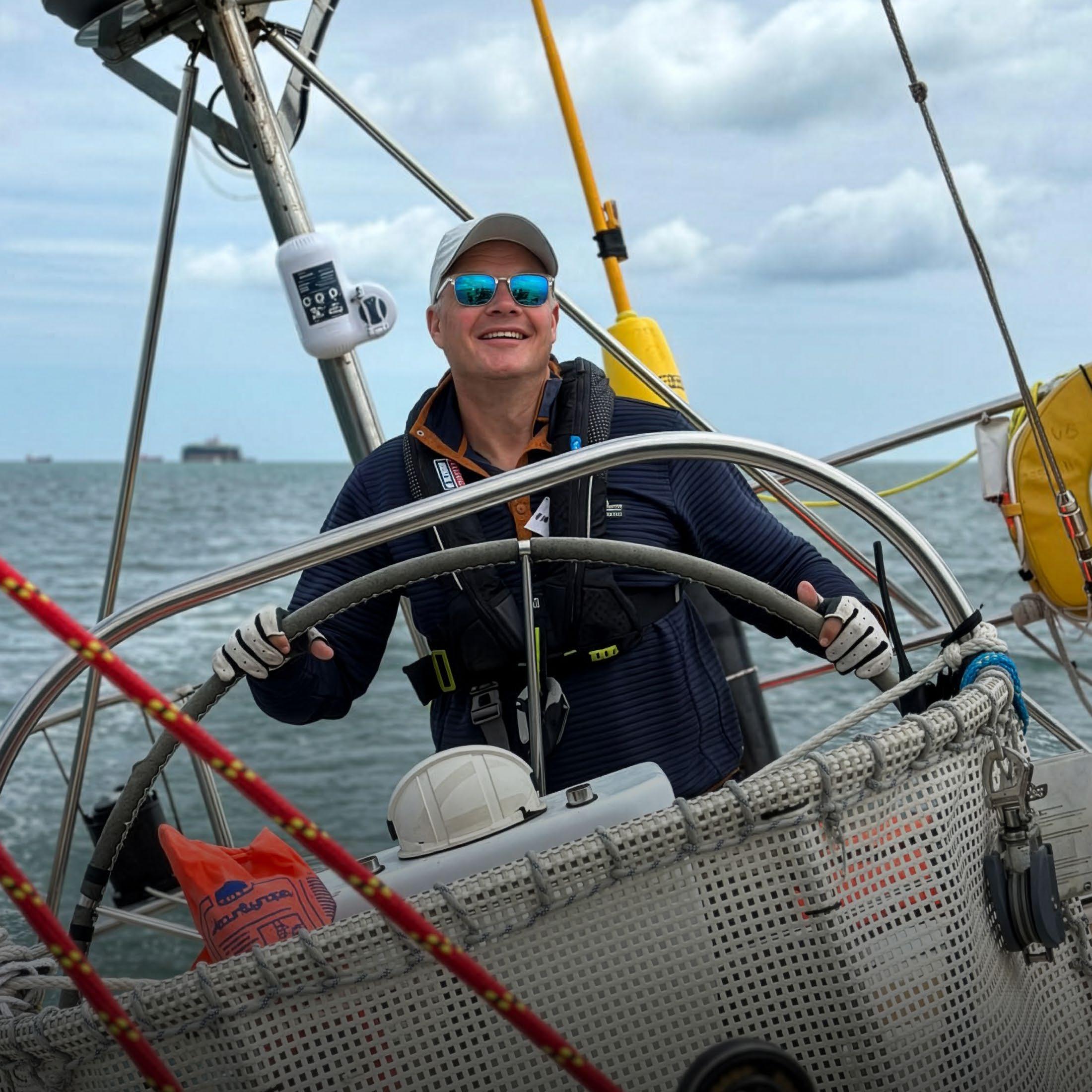
It was an absolute pleasure to sit down with our client, Mark Richardson, and hear the story behind a life that has been anything but ordinary. Born in Yorkshire, raised in Kent and now dividing his time between the UK and Barbados, Mark’s journey has taken him across continents, and into some of the most testing environments imaginable. Here he shares with us how those experiences reshaped his perspective on fear and what really matters.
Well, I left home and education at 18 and pretty shortly after that I went travelling. I spent a year going round the world solo, mostly in Asia. That was when I went through Hong Kong - twice, actually - and decided one way or another I was going to work my way back and live there.
When I came back to England, I rather fell into shipping by accident. I was working in a pub and there was a chap who used to come in with one of those enormous mobile phones, and I thought he must be a big cheese. So, I gave him silver-plated
service and got him to take me to lunch at the Baltic Exchange. That was how I got into shipping.
I started out doing Russian barter deals for a couple of years, which were absolutely fascinating and an extraordinary way to begin my career, travelling to Moscow and getting involved in all sorts of trading. After that, I interviewed for roles in Hong Kong. I was totally unqualified and totally oversold myself. But I managed to get out there. Within a couple of months, they realised I wasn’t quite the package they thought they’d hired, so I was told to give up my house clients and go out and build my own book. If I didn’t, I’d
be on a plane home. So that’s how I built my own client list, by knocking on doors. I ended up staying for seven years.
We had our first two children in Hong Kong - wonderful years - and that’s where I met Alistair. I was working in physical dry cargo shipping at the time - iron ore, coal, grain - and when I returned to England I moved into freight derivatives, which was really in its infancy. I was put on the desk that helped create the product. I later moved firms and set up my own desk, and I built and grew that for the next 20 years. We were very successful, and eventually I became CEO and chairman of the whole broking business, buying and selling ships, chartering, the lot, for the last six years of my career.
I worked from 18 to 58, so 40 years in total, and I worked incredibly hard. Towards the end of all that I had two major heart operations, which were quite clarifying moments in my life. Later, during my second term as chairman, I caught sepsis and almost died. I was in hospital for seven weeks during Covid. There were a couple of moments when I was told quite plainly that I might not make it. I felt like I had worked my whole life for jam tomorrow, and I wasn’t going to get there. The odds were pretty bad at some points, but in a really good way I found that I was far less scared of death than I thought. Oddly, I found myself more matter of fact than I would have expected.
When you’re told something like that so definitively, there’s no point panicking or screaming and shouting, because there is nothing you can do. It just becomes very reflective. Those experiences were very clarifying for me.
WHEN YOU LOOK BACK OVER YOUR LIFE SO FAR, WHICH CHAPTERS TEND TO STAND OUT MOST FOR YOU NOW?
When I look back, the chapter that really stands out is expat life in Hong Kong. That period changed my life enormously, and in ways I didn’t even realise at the time.
As I’ve said, I’d got myself out there slightly under false pretences and they were pretty cross when they realised. So, I had to get out there and burn some shoe leather and make my own plans. I was desperate, properly desperate.
I stumbled across a couple of clients who were just starting out themselves. They could see I was hungry and I could see they needed someone who would do absolutely everything possible to make their business work. I more or less turned up on their doorstep and said, “look, I’ll work all day and all night for you, I am your guy”. And I did. That modelled my whole career for the rest of my life.
While all my other friends were on the
Don’t waste your time or energy trying to be something you’re not or trying to fit into situations that don’t really suit you.
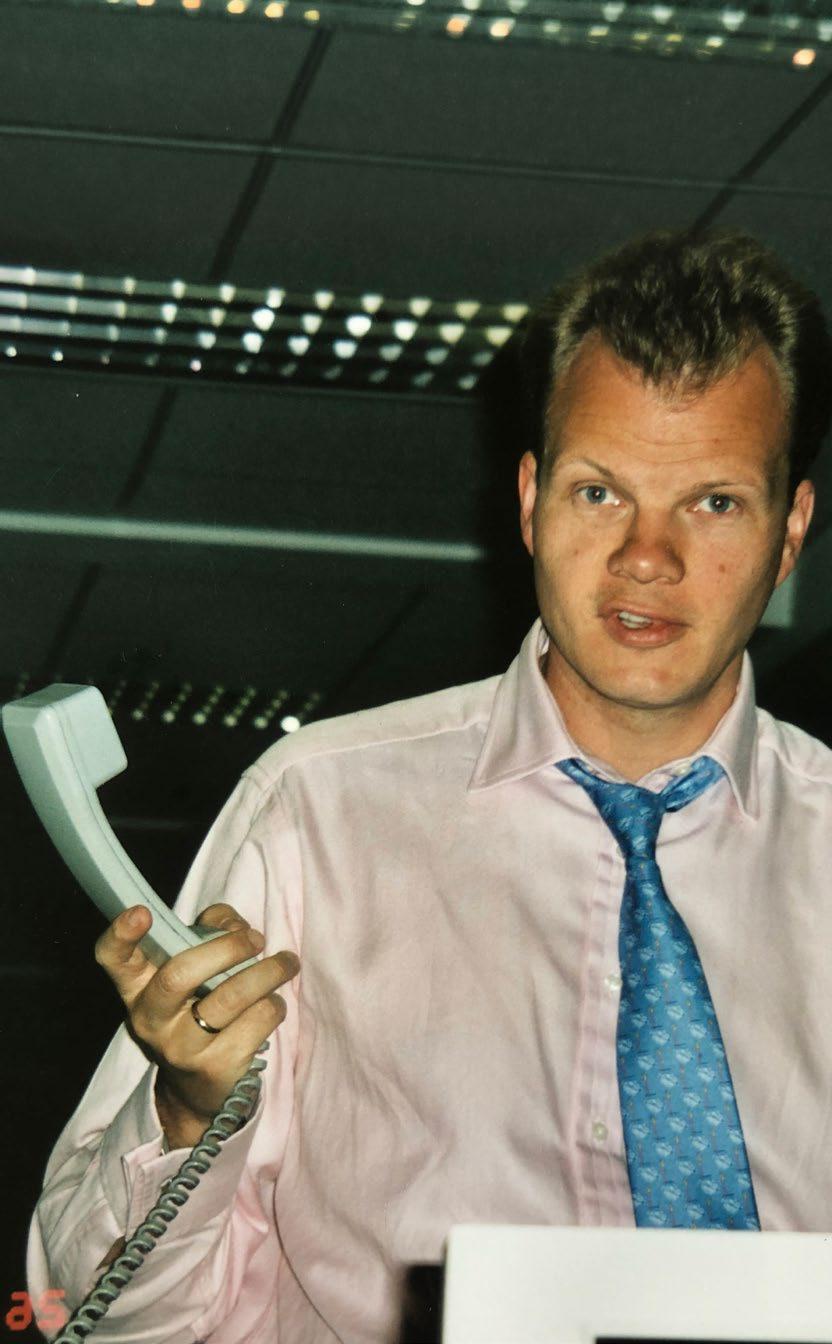
tennis court at six in the evening, my trading day was just getting going. I was dealing with London, with Greece, from Hong Kong. I’d work through until midnight at the very least, and sometimes watching the sun come up. I was brokering between Greek ship owners who took their sweet time deciding what they wanted to do and hungry Hong Kong traders who would stay up all night to do the deals. They needed someone who would stay up with them. I did that for seven years.
The thing is, I didn’t make much money when I was in Hong Kong. I was barely covering costs some weeks. But those relationships, those nights at three or four in the morning doing deals for peanuts, became the foundation of my entire career. When I came back to London and moved into freight derivatives, those same clients backed me. The deals were suddenly worth serious money and they said, “you were there for us at the beginning, now we’re here for you”. That support shaped everything that followed.
At the time, I wasn’t planting seeds with some grand strategy in mind. I was just a twenty-something trying to survive and prove I belonged. Only in hindsight do you see that you were laying foundations.
More broadly, that world gave me exposure to extraordinary, charismatic, risk-taking people from all over the globe. My first deal involved Gino, a Peruvian trader in Lima, and Vladimir, a Russian, who controlled the ship in Moscow. I was putting together 15,000 tonnes of fish meal across continents, on the phone to Lima on one line and Moscow on the other. I couldn’t quite believe I was doing it. I had no formal qualifications for any of it. No degree, no grand plan, just energy and a willingness to take risks.
So yes, Hong Kong stands out. It was hard, it was formative, and it taught me that if you work relentlessly at the start, even without immediate reward, it can come back in ways you’d never have predicted. It also gave me confidence that I could operate on a global stage, that I could build something from nothing. That was a huge shift for me.
The transition into retirement was…odd, actually. Because for 40 years my life had been completely full speed ahead. There was no easing off. As chairman, you don’t start taking Fridays off and going to the golf course.
That just isn’t how it works.
So, when I retired, I was genuinely anxious about being bored. I don’t sit still very well.
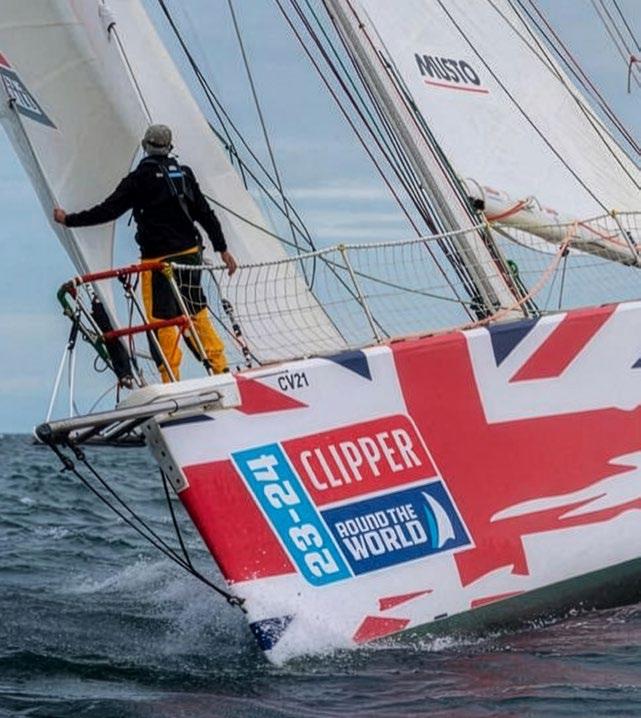
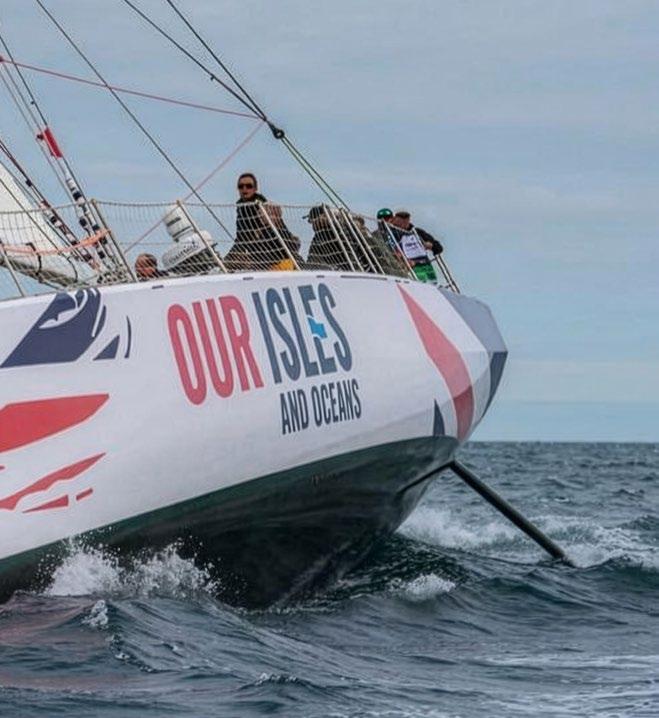
That’s why I signed up for the Clipper Challenge almost immediately. I think it was within the first month of retiring. I was looking around and thinking, I’m not going to just potter about, do the gardening, play a bit of golf, that’s not me. I needed something that felt like a proper challenge.
What’s funny is that I’d actually seen the Clipper boats years earlier. Our office was at St Katherine Docks and once a year or so they put a few boats in the marina and you can go aboard. I remember going down at lunchtime five years earlier, looking below deck and thinking, Christ, this is like prison. So basic. I got out of there quickly and thought, well that was interesting, but it wasn’t for me.
But retirement changes the question. Suddenly I wasn’t looking at it as an interesting lunchtime distraction, I was looking for something that would take me out of my comfort zone. I’ve always believed people perform best when they’ve got their back against the wall, when they put themselves into a situation where they have to rise to it.
So, my transition wasn’t about slowing down. It was about finding something that would challenge me and push me out of my comfort zone. The Clipper did exactly that.
DURING THE RACE WAS THERE SOMETHING THAT REALLY SURPRISED YOU ABOUT YOURSELF?
I don’t think I was really surprised by myself in the way you might expect. I didn’t suddenly discover some hidden new side. I think once you get to a certain age, you’re a bit of an old dog, you know what you’re about.
But there was a moment during the race that stood out.
I was helming the boat, a 70-foot yacht, 18 crew on board, down in the roaring 40s below Tasmania, right in the Southern Ocean. We had proper conditions: 10-metre waves, 60-knot winds, the full thing and I was sailing into the dawn.
As I was sailing forward, the sun was coming up ahead of us, and I remember looking around and thinking, wow…how did I get here? It was extraordinary because it’s one of the most inhospitable environments in the world but also unbelievably beautiful in its starkness. You haven’t seen land for ten days, you haven’t seen another boat for ten days, it’s just ocean, sky and the occasional albatross, that’s it!
BORN & LIVE:
Born in Yorkshire, brought up in Kent and now live in North Essex with my wife and three children.
FAVOURITE HOLIDAY
DESTINATION:
Barbados – we have a house here and like to spend three months of the year here.
QUOTE YOU LIVE BY:
“Fortune favours the brave”. I believe in being bold in life.
IRRATIONAL OR RATIONAL FEAR:
Being bored! I get anxious if I think a situation won’t be stimulating enough.
A PERSON WHO MOST INSPIRES YOU:
Muhammad Ali – I admire his bravery in facing down bullies and seemingly invincible opponents.
FAVOURITE BOOK:
Bonfire of the Vanities by Tom Wolfe, but I don’t recommend the film!
FAVOURITE APP:
Audible – I use it to go to sleep. It stops your mind worrying about what you decide is actually a much smaller problem in the morning.
WHAT THREE WORDS BEST DESCRIBE YOU?
Restless, inquisitive and social
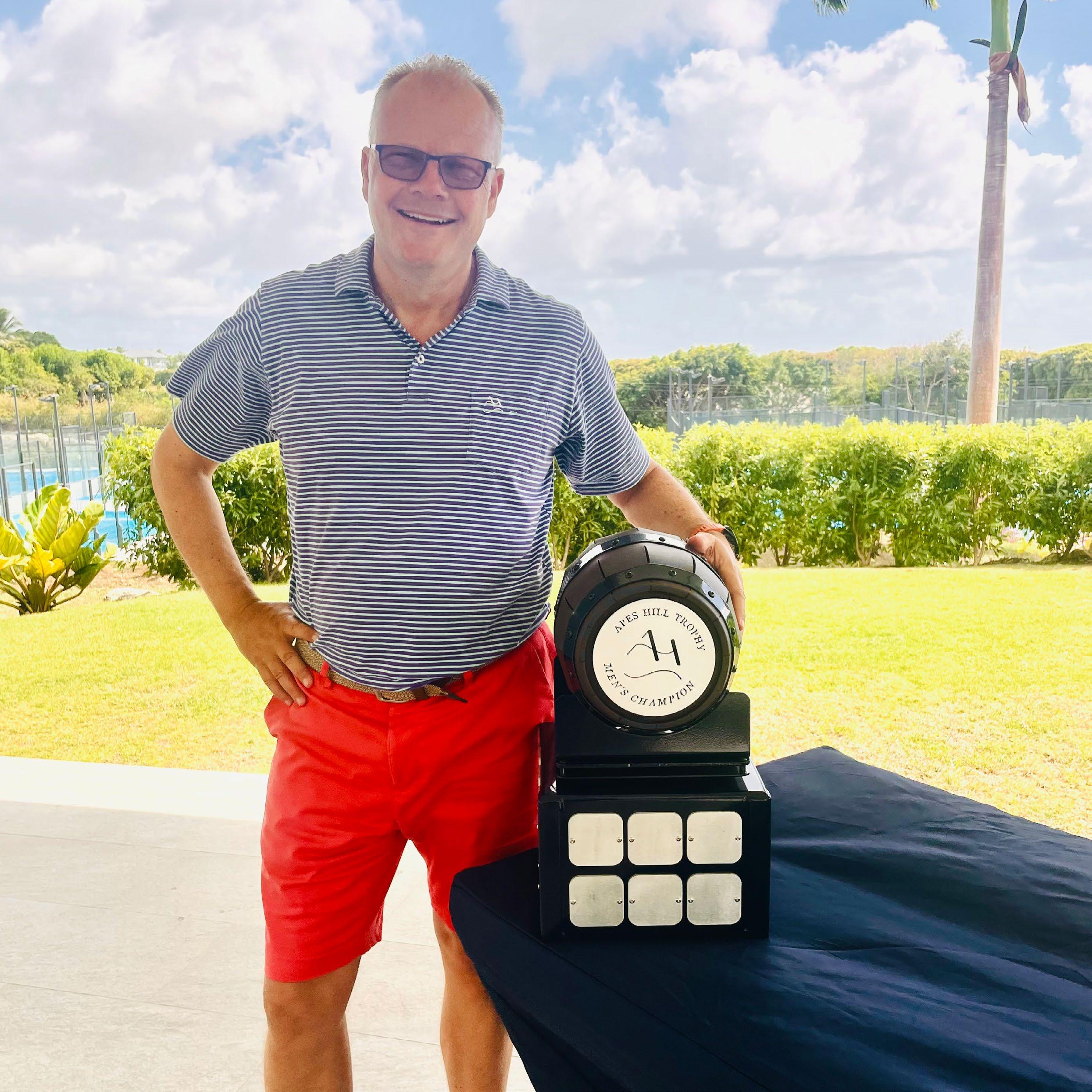
Being at sea really reinforced something I’ve always believed, which is that if you stay calm and stay focused, you can get through almost anything.
Ninety-nine times out of a hundred a situation isn’t actually as bad as it looks on its initial view. The danger is panic. Panic is what multiplies the problem. That’s when people make mistakes, that’s when accidents happen, when somebody reacts out of stress rather than thinking clearly. If you can keep your head, take a breath, and deal with things step by step, you can usually work your way through.
And yes, you can relate that to life very easily. Things are rarely as bad or sometimes even as good as they might first appear. The person who stays cool and calm in adversity will always do better than the person who knee-jerks. Of course, there are moments where you need to react quickly but there are many more where you need to slow yourself down mentally and just say, right, we’ll handle this one step at a time.
During the race, I was never really scared for my life, but you are always aware that you could get injured. There are plenty of ways it can happen - hands caught in winches, falls, accidents on deck, people overboard. During the race there were people overboard, all tethered
and pulled back in, but it keeps you on your A game.
What helped me stay calm was trust in the people around me. You’re thrown together with a crew you haven’t known your whole life, but it’s like any team environment. My entire career was built around teams, desks of brokers relying on each other, and it’s no different on a boat. You have to trust that everyone is doing their job, that the system holds. Above all, I trusted the skipper enormously. He was competent and steady - that makes a huge difference. Once you have that trust you can stay calm, and once you stay calm you can cope with almost any uncontrollable environment, whether it’s the Southern Ocean or life more generally.
I think my relationship with fear has definitely changed as I’ve got older.
What I’ve learnt is that fear can be managed and actually it can be used positively. When something comes at you, or you find yourself in a difficult situation, the first reaction is always
anxiety. That’s human. But I’ve come to see that anxiety doesn’t have to be paralysing.
For me, and I said this earlier, people often perform best when their backs are against the wall. I certainly do. When you’re really in trouble, you don’t have the luxury of overthinking. You have no choice but to work your way through it, step by step, and fight your way out of the situation.
I’ve had quite a few moments in my life, in my career, in sailing, and particularly with my health where fear was very real. But I’ve found that if you can stay calm, you can manage that anxiety and fear and manipulate it into something positive.
IF YOU WERE SPEAKING TO SOMEONE FACING A BIG LIFE SHIFT OR HEALTH SCARE, WHAT MIGHT YOU ENCOURAGE THEM TO REMEMBER?
I think what I would encourage someone to remember is that small positive steps each day really do add up.
At the beginning those steps can be tiny but you’ve got to feel that at the end of each day you’ve done something. Maybe you’ve walked a
foot. Maybe you’ve had a shower for the first time since an operation. Even now, I still do it. I’ll lie in bed at the end of the day and think: what have I done today? Even if it’s something as small as working on my golf swing. I need to feel that I’ve nudged something in the right direction.
So, I’d say: focus on the next small step.
NOW, WHAT FEELS MOST IMPORTANT TO YOU IN HOW YOU CHOOSE TO SPEND YOUR TIME AND ENERGY?
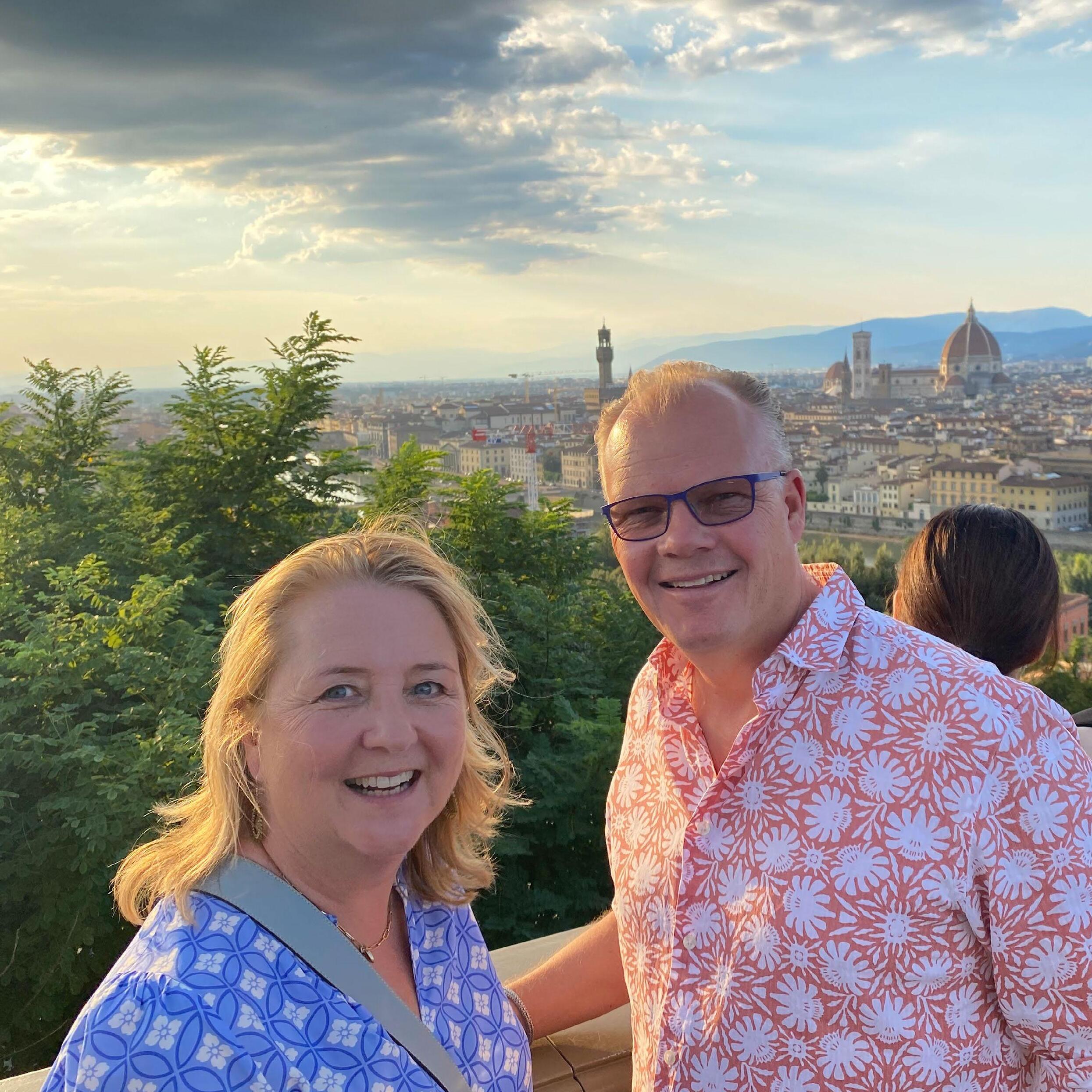
We spend about three months a year here in Barbados over the winter, which this year with the rain at home has proved to be a masterstroke. I find England when it gets dark at half three in the afternoon a really hard place to live. The original plan when we bought the plot and built the house, was always that once I retired we’d spend the winters here. And that’s exactly what we’re doing.
Life is active, which suits me. We play golf, we play padel. There’s always something going on - boating, socialising, hiking, people doing beekeeping courses, all sorts. It’s funny, everyone back home imagines we go to the beach a lot, but I’ve
probably only been a couple of times in the last month. There’s just so much else to do.
I’m very aware that this is the “jam tomorrow” I wasn’t entirely sure I’d get to at one point, so I try to enjoy it properly.
I think the final thing I’d like to add is that time with family and good friends is what matters most.
I don’t know how long I’ll be here, none of us do, and once you’ve had a few moments in life where that’s been brought into sharp focus, you become much more aware of it. So don’t waste your time or energy trying to be something you’re not or trying to fit into situations that don’t really suit you. Earlier in life we all do a bit of that - adapting ourselves to circumstances, sometimes chasing things that don’t truly reflect who we are. But at this stage that feels like an utter waste of time. Now it’s about being yourself, properly. Choosing to spend time with people who are genuinely interested in you, and who you’re genuinely interested in. People who bring out the best in you and for whom you can do the same.
If I look ahead, that’s really it: be yourself, be happy and spend quality time with the family and friends you’ve got.
In everyday life, we are constantly responding to perceived threats, both large and small. From the pressure of running late to concerns about our children, the wellbeing of those around us, or uncertainty about the future, fear shapes many of our reactions. Below are steps that we, as a team, have used to help us move through the fears that we’ve faced in daily life.
Before trying to analyse or confront fear, it helps to bring your nervous system back into balance. Simple grounding techniques such as breathing, slowing down or reconnecting with the present moment help prevent fear from overwhelming your thinking. Calm creates capacity.
Fear is a universal human experience. Acknowledging that you are afraid, without judgement, is the first and most important step. Naming the fear often makes it feel more manageable and allows you to assess whether it is rational and requires action, or whether it is imagined or exaggerated. Awareness creates choice.

Fear is rarely helped by isolation. Sharing what you are experiencing with someone you trust, and who is equipped to support you, can significantly reduce its intensity. Being heard helps fear lose its grip and reminds you that you do not have to manage it alone.
Avoiding your fears only makes them worse. Gradually exposing yourself to what you fear, at a manageable pace, helps you regain a sense of control. Each step taken reinforces the belief that you can cope, even when things feel uncomfortable.
Begin to focus on life beyond the fear. Recognise how taking action has changed things for the better and how your relationship with fear has evolved. Confronting fear is a skill that improves with practice, making future fears feel less dramatic and more manageable.
Be clear about what you are moving towards and why it matters. Defining your purpose helps prevent you from slipping back into fear when things feel uncomfortable. Setting small, achievable steps and acknowledging progress builds confidence and momentum.
Fear is often driven by assumptions rather than facts. Gently questioning unhelpful thoughts can be very effective. Asking yourself what evidence supports the fear, what evidence challenges it, and what a more balanced view might be, can significantly reduce anxiety.
Fear thrives on uncertainty. Gaining accurate information about what you are afraid of reduces the unknowns and weakens the power fear holds. Understanding what is actually at stake, and what is not, often brings perspective and reassurance.

by Lucas Fildes

Making financial decisions can strike the fear of God into the best of us. Fear plays a powerful role in the financial choices we make. Most of us have felt that knot in the stomach when faced with an important money decision, particularly when it involves investing. It can feel uncomfortable committing hard-earned savings to something we cannot see or touch. It is only natural to be cautious about what we do not fully understand, and for many people investing can still feel uncertain, even intimidating.
Yet building long-term wealth depends on acting despite that fear rather than allowing it to dictate our decisions. History shows that investing remains one of the most effective ways to grow wealth and prepare for the future. Much of the anxiety begins to ease once we understand how investing works and accept that short-term ups and downs are simply part of the journey towards long-term success.
So, let us take a closer look under the bonnet and see what is really going on - and, in doing so, start to ease some of those fears.
At its core, investing is simply the movement of capital from people who have savings to businesses that need funding to grow. When you invest, your money is helping companies innovate, expand, create jobs and drive economic growth. In return, you share in their success over time. Without investment, economies would struggle to function, and individuals would find it far harder to build lasting wealth.
That said, because investment values rise and fall along the way, it is those natural ups and downs that tend to trigger fear, particularly in the short term.
The graph across the page helps to illustrate the relationship between risk and potential return. Lower-risk investments typically offer lower expected returns, while accepting a greater degree of fluctuation creates the opportunity for stronger long-term outcomes. Put simply, investors are rewarded for tolerating uncertainty. The very thing that makes investing feel uncomfortable is often what drives returns over time.
“The purpose of fear is to raise your awareness, not stop your progress. ”
Steve Maraboli
Inflation makes this discussion even more important. Historically, inflation has averaged around 3% a year, which means that simply standing still requires your money to grow by at least that amount just to maintain its purchasing power. Cash feels familiar and reassuring, and there is comfort in seeing a stable balance. However, over the past 20 years, cash has actually lost around 0.8% a year in real terms once inflation is taken into account. By comparison, the global stock market has delivered significantly stronger long-term returns, with equities historically generating around 10% a year.

In reality, allowing fear to drive decision making and staying out of the market can lead to a quiet but steady erosion of purchasing power, even when the number on your bank statement appears unchanged.
A common concern, particularly for newer investors, is the fear that a company might fail and that money invested in it could be lost. That risk does exist with individual businesses, which is precisely why diversification matters so much. Our portfolios typically hold exposure to around 4,000 companies across a wide range of sectors and regions. This means no single company determines the outcome. Diversification does not remove market fluctuations, but it does ensure that investors are exposed to market risk rather than the fate of any one business - and it is market risk that has historically been rewarded over time.
Suitability is another crucial part of the picture. The right level of risk is different for everyone and depends on personal circumstances. Someone approaching retirement, for example, should not be entirely invested in equities, as short-term market swings could force withdrawals at an unfavourable time. In these situations, fixed income investments can provide greater stability. On the other hand, those with longer time horizons are often better placed to accept higher levels of risk, as they have the time needed to ride out short-term volatility.
This is where careful planning becomes so important. Your adviser works with you to strike the right balance, aligning investments with your goals, timeframes and financial needs, while also taking into account your personal comfort with risk.

Fear of market crashes is entirely understandable. Given how difficult it is to time the market, it is natural to want to step aside when things feel uncertain. However, crashes are simply a more extreme version of volatility, and volatility is the risk premium that long-term investors are compensated for accepting. Most investors will experience at least one major market crash in their lifetime. History shows that some of the most attractive long-term opportunities often emerge during these periods.
Markets frequently deliver their strongest daily gains shortly after the worst declines, as investors begin to take advantage of lower prices.
The difficulty, of course, is knowing exactly when to act. The 2008 financial crisis is a powerful example. Amid widespread panic, major banks collapsed and confidence evaporated, yet that period went on to become one of the most attractive entry points for US bank stocks, which have since delivered strong long-term returns. Similarly, after the dotcom bubble burst in 2001 and the Nasdaq fell by around 78%, the downturn created exceptional opportunities to invest in what later became some of the world’s most successful technology businesses.
As Warren Buffett famously observed, investors should be fearful when others are greedy and greedy when others are fearful.
The chart below illustrates this clearly. It compares staying fully invested in the S&P 500 with missing just the 10 best market days over several decades. The difference is striking. Many of the best days occur shortly after the worst ones. Investors who sell during downturns often miss these powerful recovery days. Missing only a handful of them can dramatically reduce long-term returns, highlighting how costly attempts to time the market can be.
Final market value: $329,294 VS $150,861
Illustration is based on the S&P 500 TR Index from December 31st 1989 to October 31 2024. The best days are those which had the top ten daily returns over the period, and this illustration is constructed based on missing out on those best day returns, versus staying invested the entire period.
500
500 less 10 best days
Behavioural finance helps explain why this happens. As human beings, we feel the pain of losses far more intensely than the pleasure of equivalent gains. When markets fall sharply, the instinctive response is to sell to prevent further losses. Yet doing so often locks in the loss and removes the opportunity to participate in the recovery. Herd behaviour can make matters worse. When we see others selling, it reinforces our own fears. By the time many investors feel comfortable reinvesting, markets have often already risen significantly. This can create a damaging cycle driven by emotion rather than strategy.
The lesson repeated throughout history is simple but powerful. Staying invested is one of the most effective ways to achieve long-term success. Remaining invested through both calm and challenging periods allows compounding to do its work and helps avoid the high cost of emotional decision making.
Our role at Carrington is to provide clarity, structure and reassurance. Through strategic planning, we help you define your goals, choose an appropriate level of risk, diversify effectively and remain disciplined when markets feel unsettled. Fear can never be eliminated entirely - nor should it be ignored - but it can be managed. With a clear and well-considered plan in place, you place yourself in the strongest possible position to grow and preserve your wealth over time.
This article is intended for informational purposes only and does not constitute financial or investment advice. The value of investments, and any income generated from them, will be affected by interest rates, exchange rates, general market conditions and other political, social and economic developments, as well as by specific matters relating to the assets in which it invests. Investors should be aware that the value of units may well fall as well as rise, is not guaranteed and that past performance is not a guide to future performance. Different funds carry different levels of risk and investors may not get back the full amount invested. It is important to consult with a qualified financial adviser to obtain advice tailored to your individual circumstances before making any financial decisions.
“A ship in harbour is safe, but that’s not what ships are built for.”
John. A. Shedd
020 3475 4646
info@dallingtonassociates.com
www.dallington.co
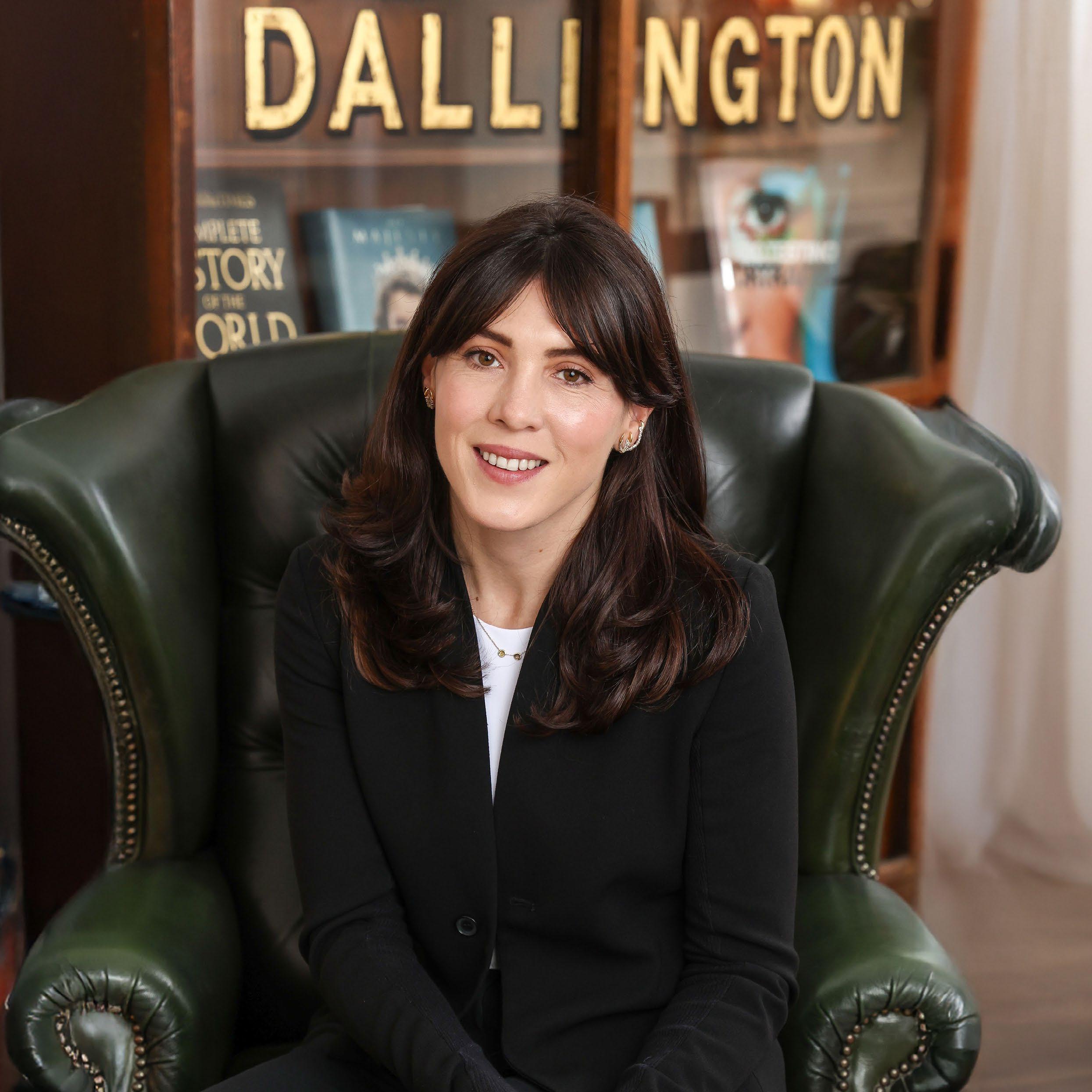
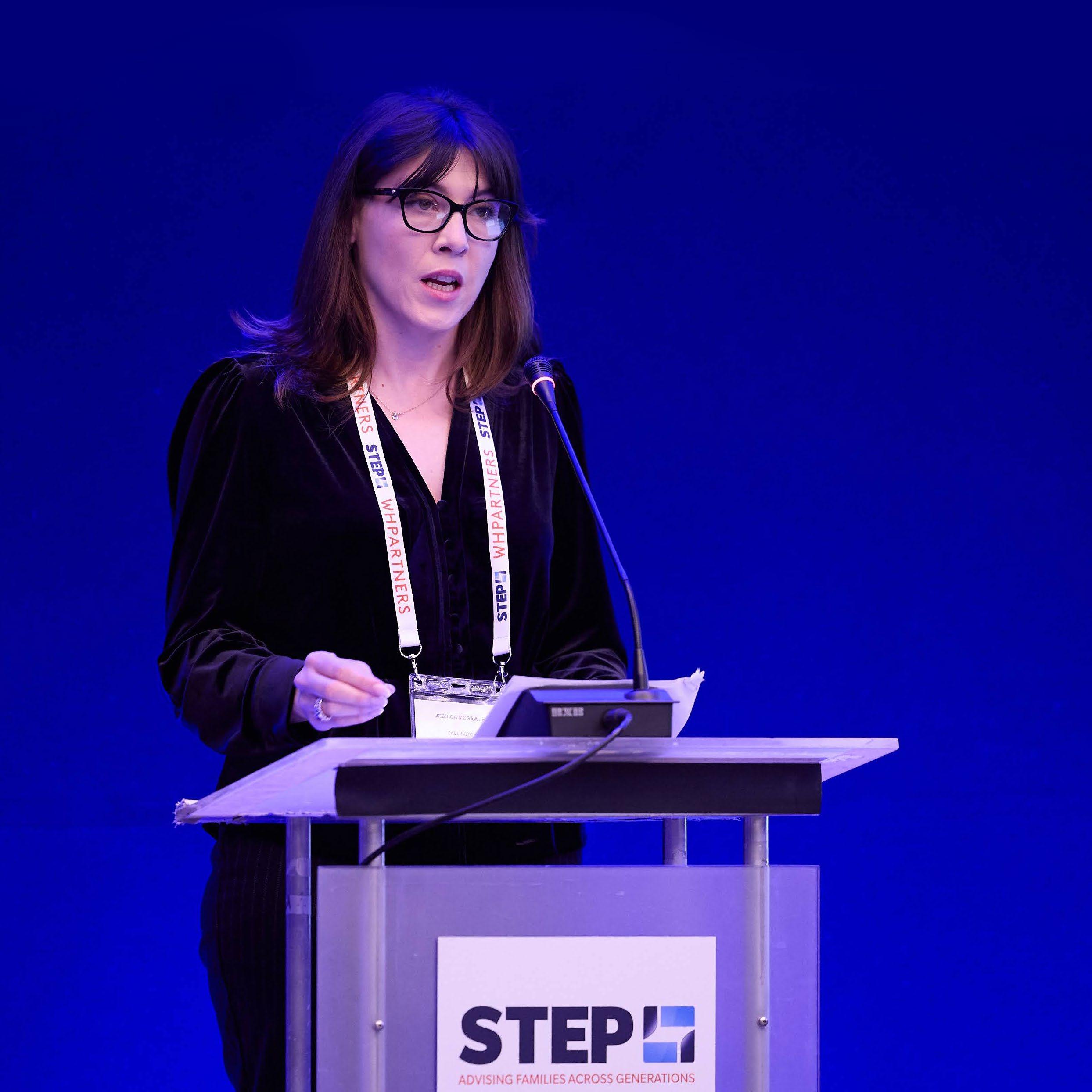
Jess is the founder of Dallington, a consultancy supporting young people from highly successful families as they navigate the complexities from adolescence into adulthood. Speaking to Jess was a genuine pleasure. Thoughtful, generous and deeply insightful, she has a rare ability to articulate the human side of family wealth with clarity and warmth. In this piece, Jess shares her journey to founding Dallington and her perspective on preparing the next generation for responsibility, relationships and long-term resilience. We were very grateful she took the time to speak with us and hope you enjoy the conversation as much as we did.
CAN YOU TELL US A BIT ABOUT YOURSELF AND YOUR CAREER TO DATE?
I founded Dallington almost ten years ago, but the thinking behind it developed much earlier. Before setting up the firm, I spent seven years working within a family office advisory environment in Mayfair. During that time, I became increasingly aware of a recurring gap. While families were investing heavily in legal, financial and governance structures, far less attention was being paid to the human and relational dynamics those structures depend on.
I repeatedly saw younger family members excluded from meaningful conversations about the family and business systems, only to be expected later to step into roles of responsibility with confidence. Many were hearing words like trustee, beneficiary or family constitution for the very first time in a formal meeting. To me, that felt like a glaring mistake. You cannot expect someone to perform well in an environment they have never been exposed to or prepared for. It became clear to me that long-term continuity
is not just about structures, but about people, relationships and readiness.
My background sits at the intersection of psychology and family wealth. I trained at the Tavistock, the NHS mental health hospital in London, completing postgraduate training in counselling and psychotherapy and masters in consulting psychology. What was meant to be a short role in a family office, helping to design and run a next generation programme, turned into seven formative years. When it became clear that the kind of early education and preparation I believed in would not happen in house, I set up Dallington to meet that need directly. I spent the first two years working closely with families to truly understand what young people wanted and needed, before being joined by my right hand, Farah (Dr Farah Khushabi, Head of Psychology). Together we built what Dallington is today - a psychological consultancy specialising in multigenerational family dynamics and rising-generation preparedness, with a clear focus on strengthening relationships, communication and long-term resilience.
WAS YOUR BIGGEST FEAR?
I think I benefited from starting
young. When I set up Dallington, I was in my late twenties, and I think that played a huge part in how I experienced that moment. There is something about having energy, confidence and perhaps fewer internal barriers. If I were doing it now, I suspect I would have had many more fears. At the time, I had utter faith in myself and in the fact that this work was genuinely needed. I was already doing it in practice, already working closely with young people, helping them become more independent, supporting them as they figured out their lives and found their own solutions. It felt second nature rather than a leap into the unknown.
I was also, once again, the ‘responsible woman’ in the room, which was a position I knew well. Looking after younger people and holding that responsibility was familiar to me, so the fear never really took hold in the way it might have later in life. I did not feel particularly afraid, as I believe that if you start when you’re ready, you’ve started too late.
Dallington is a psychological consultancy working with families of wealth, with a particular focus on the rising generation. Our work is rooted in long-term, relationshipfocused engagement and centres on
I did not feel particularly afraid, as I believe that if you start when you’re ready, you’ve started too late.
the human dynamics that underpin continuity across generations.
We support young people who are growing into greater independence and responsibility, academically, professionally and within their families, but who are often navigating complex expectations, visibility and pressure. Our role is not to prepare them technically for wealth but to help them develop the selfawareness, emotional maturity and relational capability needed to navigate social and family systems with confidence and integrity.
We work through two core programmes. The first is our oneto-one mentoring and development programme, typically for younger family members (16-25). This provides a consistent, confidential external relationship over a defined period, supporting individuals through key transitions such as education, early career and identity formation. The focus is on strengthening decisionmaking, agency and resilience, while helping young people navigate independence alongside family expectations.
The second is our Rising Generation programme, which works with siblings and cousins together, often in enterprise-owning families (typically 18-35). This programme focuses on alignment, trust and communication within the family system. We help participants clarify roles, choices and expectations, explore different paths within or outside the family
enterprise, and learn how to work with difference constructively while protecting relationships.
Across all our work, the emphasis is relational rather than technical. We work alongside family offices and trusted advisers, without replacing legal, financial or governance advice. Our role is to focus on the human dynamics those structures rely on: communication, role clarity, trust and shared understanding. We work with families for a defined period, aiming to leave them more connected, capable and confident, long after our work ends.
WHAT ARE SOME OF YOUR CLIENTS’ BIGGEST FEARS/ CONCERNS
Most families come to us at a point where something feels unsettled, even if it is not always easy to name. Parents are often carrying a concern that relationships are beginning to fray, that communication is becoming strained, or that their child is drifting further away from the family than they expected. Sometimes the fear is about entitlement or lack of motivation; in other cases, it is about withdrawal, conflict or the risk of longer-term estrangement. These concerns are rarely about a single incident, but about a sense that the family is no longer aligned.

“MOST SUCCESSFUL FAMILIES PREPARE THEIR WEALTH FOR THEIR CHILDREN, BUT DON’T PREPARE THEIR CHILDREN FOR THE WEALTH.”
This often arises when children are in their late teens or early twenties, as independence increases and familiar dynamics begin to shift. A key part of our work is helping families distinguish between normal developmental change and behaviours shaped by wealth and family context. Wanting more privacy, questioning values or wanting to take a different path is often a normal part of separation and identity formation, even if it feels uncomfortable.
At the same time, the rising generation has their own concerns. Many worry about disappointing their parents, being misunderstood, or not knowing where they fit within the family system. Some feel pressure to live up to expectations they have never explicitly agreed to, while others are uncertain about how much freedom they are allowed to take without damaging relationships.
Our role is not to replace parents, but to support the family system during this period of change. We act as a steady, external presence, helping families slow things down, improve communication and rebuild trust. We also work with the end in sight. We do not believe young people should always have a coach, therapist or external support
attached to them to help them make every decision. A healthy outcome is one where young people better understand and manage themselves, parents feel more confident in the relationship, and the family as a whole is more connected and resilient for the long term.
In the Rising Gen programme, we strongly support working with the advisors who are already in place, because they will long outlive us. Ideally, part of our role is to help those advisors better understand how to engage the younger generation and how to adapt the language and terminology they already use. Almost every family we work with has a charter or constitution, usually written for the first generation by the lawyers supporting them at the time. That language is rarely helpful for a 16-year-old. It does not need to be scrapped, but it does need to evolve, and we help facilitate that process alongside the existing advisors.
The mentoring programme, by contrast, tends to be much more independent and private, and that
is very intentional. Young people need their own space. When we begin working with a family, we always try to understand their whole ecosystem. How do we fit in alongside everyone else? What is already in place, what has worked well and what has not?
Over the years we have developed a strong sense of what a bestin-breed advisor looks like. A lot of that is instinctive, but one of the most important qualities is that they do not collude. In some families, unfortunately, advisors can unintentionally slip into a “yes-person” role. In reality, one of the most respectful and caring things you can do for a family is occasionally say no and put boundaries in place.
For me, success is best understood in relational terms. It shows up in how families communicate, how they manage difference, and how they stay connected through periods of change. From a parent’s perspective, this is often felt most clearly in communication. We have yet to work with a family where communication could not be strengthened. In some cases it has simply become strained; in others it has been significantly disrupted by
mental health difficulties or experiences such as rehabilitation or residential care. Over time, families begin to understand one another’s communication styles more clearly and engage with greater respect, curiosity and restraint.
Something we are consistent about in our messaging is the need to slow down before reacting. Young people are naturally reactive because they are still building the capacity to pause and regulate emotional reactions, but many adults are reactive too. Very successful business owners are often excellent problem solvers who are used to things being fixed quickly. That approach can spill over into family life, where instead of sitting with something, sleeping on it and coming back to it, situations are reacted to or conflicts are engaged in.
When we slow things down, we are allowing the part of the brain responsible for judgement and emotional regulation to come back online. Parents often tell us they start to recognise the benefits of this not just at home but in family meetings, decisionmaking forums and professional contexts too, and that it leads to better outcomes across the board. It is not easy, especially if you come from a family where everyone is reactive or where systems have been built around speed and control, but with time it becomes transformative.
JOB TITLE:
Psychological Consultant, Mediator and Founder of Dallington
BORN & LIVE:
Born and live in London with my Family – husband and two children
FAVOURITE HOLIDAY DESTINATION:
Connemara, Ireland
IRRATIONAL FEAR?
I wouldn’t say it’s irrational. I’d say my fear of spiders is totally rational.
QUOTE YOU LIVE BY:
“The first wealth is health” Ralph Waldo Emerson
A PERSON WHO MOST INSPIRES YOU:
I draw inspiration from a lot of thinkers and writers, but I’m going to say my husband. He really knows how to enjoy life.
FAVOURITE BOOK:
Dracula by Bram Stoker
FAVOURITE APP:
Laundryheap…helps me keep on top of the, well heap!
WHAT THREE WORDS BEST DESCRIBE YOU?
Eldest daughter (and everything that encapsulates), energetic, compassionate.
Ultimately, success for us is not a single outcome but feeling the shift in the system. Young people are functioning at a level that feels developmentally appropriate for their age and circumstances, parents feel more secure and less reactive in the relationship, and advisors are better able to engage the rising generation in a way that is constructive, ageappropriate and relationally informed. The family as a whole is better able to manage change, disagreement and transition over time. That is what allows relationships - and families - to endure.
I would encourage parents to start talking about money from around the age of seven. That does not mean burdening children with big numbers or adult worries. Young people should still have a childhood. But you cannot expect someone to understand large sums of money later on if they have never been introduced to smaller ones early in life. From that age, you can begin with very simple concepts.
Pocket money, for example, is a useful tool, but it should not be linked to
chores. We give pocket money so children can begin to understand money and make choices with it. Chores exist because they are part of the family system and everyone contributes; they are not transactional. We teach earning separately - through age-appropriate jobs or paid responsibilities - so children learn both contribution and the reality of exchange. In families where children are likely to inherit wealth, keeping those two things separate helps build a healthier understanding of both responsibility and money.
With pocket money, children can learn that there are only three things you can do with money: spend it, save it or give it away. Simple tools like “give, save and spend” jars or boxes work very well because they make money visible and concrete. I also encourage parents to think carefully about how to make money feel tangible, whether that is through physical cash where possible or through digital tools that clearly show money coming in and going out.
Many young people grow up experiencing money as something abstract that lives in the cloud, which can make it harder to develop a real sense of value. What matters is that children can see cause and effectwhat happens when money is spent, what remains, and what trade-offs are involved. That visibility makes it much easier to grasp concepts like budgeting, prioritisation and even inflation.
Something as simple as noticing the price of everyday items in the supermarket and seeing how those prices change over time can be a very effective learning experience.
When it comes to bigger conversations about wealth, succession and the family business, the right timing is far more personal, and each family will approach it differently. What matters most is that the adults involved are aligned and giving a consistent message. That can be more complex in families where there has been separation or divorce, but alignment is crucial.
The reality now is that it is very difficult to keep this information private. If parents do not talk to their children, they will often find out elsewhere - online, through the media, or from a peer who has read a headline. We have seen young people caught off guard, without a narrative of their own and unsure how to respond. Because of that, we tend to encourage families to begin talking more openly about wealth, succession and the wider context, from around the age of fourteen, in a way that is age-appropriate, honest and ongoing rather than a single, high-stakes conversation.
One of the biggest dynamics I see, particularly in families where significant wealth has been created in the parents’ lifetime, is the relationship between fear and control. Often, without meaning to and with the very best intentions, parents take on a high level of responsibility for holding things together. They know where everything is, where the money is, where family members are, and they are used to being in control of their business and assets. That instinct to stay close and in control usually comes from fear, sometimes rooted in earlier life experiences. Many grew up with uncertainty around money or stability and are deeply motivated to ensure their children never experience that same insecurity.
As a result, parents often work incredibly hard to create certainty and protection, and that is entirely understandable. The difficulty is that while you can control businesses, structures and assets to a certain degree, you cannot and should not try to control another person. There is a very fine line between protection and over-control. If parents are able to reflect on their own fears, particularly those shaped in childhood, it creates more space for trust. Doing that inner work can be transformative. It allows parents to loosen their grip, tolerate uncertainty, and build relationships with their children that are more open, trusting and ultimately more loving.
When parents and children have grown up in very different worlds, bridging that gap requires intention and humility on both sides. Parents are often giving their children the life they hoped for them, and in many cases the life they did not have themselves. There is nothing wrong with that, and children should be able to enjoy the benefits of their parents’ hard work. The challenge is finding a middle ground where opportunity does not remove learning, and where difference does not turn into misunderstanding.
One way we help families do this is by separating access from outcome. There is nothing wrong with opening doors for your children. If a school offers an apprenticeship or work experience week and you ask a friend whether your child can spend time in their office, that is entirely appropriate. What matters is what happens next. If a young person does not show up on time, does not behave appropriately or does not
meet expectations, that responsibility sits with them. Allowing young people to experience real consequences is where learning, maturity and selfrespect are built.
Another important part of the work is helping parents talk openly about their own journeys, not just the end result. When children only see the outcome - the house, the lifestyle, the success - it can all look effortless. They do not hear about the mortgages, the early jobs, the sacrifices or the mistakes along the way. Sharing those stories gives context. It helps young people understand effort, risk and resilience, and it humanises success rather than placing it on a pedestal.
One practical exercise I often encourage, particularly when children are still living at home, is to normalise conversations about failure. Instead of only asking what went well or what was achieved, everyone around the table shares something they got wrong that day - something they misjudged, avoided, or would handle differently next time. The focus then becomes what was learned, rather than what went wrong. This simple shift takes pressure off the younger generation and allows parents and children to meet each other in a more honest, shared space.
When it comes to social media, the younger generation are often far more informed and digitally literate than we give them credit for. The risk is not always what a young person shares themselves, but who they are connected to and how that information is interpreted by people they do not know well. Third parties can form their own narratives about a young person’s life without context, nuance or the opportunity for correction, which can be unsettling and, at times, damaging. At the same time, it is unrealistic and unfair to expect young people to avoid these platforms altogether. Social media plays a real role in connection, creativity and identity formation. The focus therefore needs to be on access, privacy and guidance, rather than restriction alone. I often use the kitchen analogy: a kitchen is a highly creative space, but it also carries risk. You would not send a seven-year-old into one without explaining the dangers, setting boundaries and putting protections in place. The online world is similar. There is a great deal of opportunity, but young people need support in understanding the risks and learning how to navigate them safely and responsibly.
If I were to leave people with anything, the first would be this: model the behaviour you want to see. Whether you are a parent, an employer or anyone in a position of influence, modelling matters more than instruction. Model the communication, the boundaries and the values you want the younger generation to adopt. You cannot ask for something you are not willing to demonstrate yourself. Leadership, in families as much as in organisations, starts at the top, and credible role modelling has become increasingly important in a world where there are very few truly decent examples to draw from. In many ways, the ultimate form of leadership is parenting.
The second principle I always come back to is reflect before you react. I genuinely believe this does a significant proportion of the work. If we could all slow down, tolerate a little discomfort and take a beat before responding, we would see
far better outcomes in families, businesses and relationships more broadly. That is not easy in a world that rewards speed and immediacy, but the ability to pause, reflect and respond thoughtfully has never been more valuable.
I also think it is important to say something about money. There is often very little empathy in society for young people growing up with significant financial resources. While it is right to acknowledge their privilege, it is also a mistake to overlook the challenges and responsibilities they carry. Many of the young people I work with describe feeling as though they are looking down a tunnel rather than a runway, aware from a young age that they may one day be responsible for organisations, assets and, in many cases, other people’s livelihoods. That is a considerable weight to carry. If we want these individuals to grow into thoughtful, responsible and engaged adults, we need to be more curious, more supportive and more understanding of the pressures they are navigating, because ultimately the decisions they make will affect far more than just themselves.

by Ali Moorhouse
In this issue we are looking at fear from different angles - how it shows up in our lives, how it can hold us back, and how facing it can become a catalyst for positive change. When fear is acknowledged rather than avoided, it has the potential to shift from something that limits us into something that moves us forward, creating a deeper sense of freedom.

Yet fear doesn’t always announce itself in dramatic moments. More often, it sits quietly in the background of everyday life, surfacing as small, persistent questions and thoughts that we push aside until they demand attention. What if something happened to me? What if I couldn’t work? Many of us live with this low-level hum of worry, it is far from unusual, but it can be exhausting, nonetheless.
I’ve found that for me, becoming a father, has brought this into much sharper focus. Since having Theo, I’ve found myself thinking about things I simply wasn’t questioning before. As with many life events, this has prompted me to review my situation and make some changes due to my deepening sense of responsibility. I’ve also become a more careful cyclist!
We don’t talk often enough about the fact that the biggest threats to a financial plan are usually health related. People imagine market crashes or economic downturns, but the real fragility often lies closer to home. If your income disappears, or one of you becomes seriously ill, or passes away, everything changes. Income, childcare arrangements, household responsibilities, long-term goals, they all shift at once. A plan that looked robust can suddenly become precarious.
Importantly, these risks aren’t theoretical. They are far more common than most people realise. Many assume serious illness is something that happens in older age, or that death is only a remote possibility for someone in their 30s, 40s, or 50s. It’s morbid and not easy to talk about, but the statistics unfortunately tell a different story!
Serious illness tends to strike people in their working years, often while they still have mortgages, young children, financial commitments, and decades of responsibility ahead of them. This is why protection exists, because we can’t control when our health might fail us or we lose a loved one, and it’s never convenient.

Sadly, protection is often seen as the “fearful” part of financial planning. While, in reality, it is the part of your plan that can give you freedom. As I’ve said many times before, the message isn’t, “you might die”, it’s, “you can go and enjoy your life without worry.”
Protection is one of the most misunderstood areas of financial planning. Many people assume that it’s something to deal with “later” or just another unnecessary expense. But it is in fact a corner stone of your financial plan, and intended to support you and your family, if the worst should happen.
Let’s have a look at some of the options that are available, what they cover and the relevance that they play in supporting you to live a life with fewer “what ifs”:
Life insurance is not about dwelling on worst-case scenarios. It is about creating a sense of reassurance, knowing that if you were to pass away unexpectedly, the people you care most about would be looked after financially. For families with children, or anyone with dependants, it helps ensure that day-to-day life can continue - mortgages can still be met, plans for education remain intact, and a sense of stability is maintained during what would already be a profoundly difficult time.
Critical illness cover is about preserving choice at a time when life can suddenly feel uncertain. If you were to face a serious diagnosis such as a heart attack, cancer or a stroke, financial worries are the last thing you should have to be thinking about. Critical illness cover is designed to pay out a lump sum that can create breathing space - allowing you to focus on your health, take time away from work if needed, or make adjustments to your life without the pressure of having to make hasty, difficult decisions.

Your income supports so much of everyday life. If illness or injury were to interrupt your ability to work, income protection helps maintain a sense of normality by replacing part of your earnings. This can make it easier to manage household commitments, continue supporting your family, and stay aligned with longer-term plans.
Individually, each policy plays a role. Taken together, these types of protection form a safety net. You may never need to rely on them, but knowing they are there brings a sense of stability and reassurance when life feels uncertain. Different family roles, different needs - but the same underlying risk
Many people think protection only matters for the main earner. Yet the reality is that families rely on more than just income to keep them running. The work that happens behind the scenes is just as valuable.
When the person contributing most of the household income becomes seriously ill or passes away, the financial effects can be felt very quickly. While some employers offer sickness benefits or death in service cover, these arrangements are not always sufficient on their own to fully support a family through such a transition. Having additional protection in place can help ease that pressure, allowing loved ones to remain in their home, preserve a sense of stability, and continue day-to-day life with fewer financial worries.
If the parent who holds everything together – looking after the kids, running the family home, organising everyday life - becomes ill, the practical and financial impact can be huge. It is only when we stop to think about it, that we realise just how many responsibilities, people, pets, and priorities this person is often juggling. Having protection in place can make it possible to bring in help and support, ensuring continuity at home during what would already be an emotionally and practically challenging time.

Whether you are a single parent, part of a dual-income household, self-employed, or running your own business, the details may differ, but the considerations remain the same. If something unexpected were to happen, what would day-to-day life look like for those who depend on you? Protection helps address that question with reassurance, offering confidence rather than fear.
We know from years of conversations with our clients that fear plays deeply into both sides of the protection debate.
For some, concern about health, family, or the future becomes a gentle prompt to take action and put plans in place for those they care about most. While, for others, that same fear can cause procrastination.
It is entirely natural to shy away from thoughts of illness or loss, to assume that serious events are unlikely to happen to us, or to feel daunted by the idea of forms, medical assessments, and decisions that feel heavy. Many people also worry about being overwhelmed or pressured, and so the conversation is postponed, often with the intention of returning to it later.
The difficulty is that these delays can leave families more exposed than they realise. No one expects a diagnosis or plans for an accident, yet these are precisely the moments that bring the value of protection into focus.
W.

Our role at Carrington is to help bridge that gap. We strive to make the process feel calm, manageable, and supportive, always centred on your needs and the longterm security of those who matter most to you.
Protection is rarely just a conversation about products. As with all our client relationships, it’s a conversation about life - about family, long-term security, and the hopes and ambitions that shape the future you are working towards. It’s about supporting you and those you care about so that, even if life takes an unexpected turn, your goals can remain on track.
What drives us, both as advisers and as people, is taking the time to truly understand your ambitions, family dynamics, and financial priorities. We do this by looking at the whole picture and asking:
What potential threats do we need to protect against to ensure that your vision for your, and your family’s future remains firmly on track?
What can we do to help you to sleep soundly at night?
What can we put in place to give you and your family stability, whatever challenges life might throw at you?
From there, we explore the types of cover that are going to offer you and your family the greatest sense of security, taking time to walk you through all of the options. This allows you to decide where you feel it would be most valuable. Allowing us to put a plan in place that quietens that aforementioned “hum of worry”, whilst letting you focus on what matter most to you.
We are strong believers in financial protection for our clients. Over the years, we have been lucky to encounter situations where having the right policy in place at the right time has changed a client’s outlook when something unthinkable has happened to them or a family member. However, we have also found that for clients, one of the biggest obstacles to arranging protection is the perception that the process will be time consuming and complicated. Let’s be honest, none of us relish those evenings or weekends that we are forced to spend doing “life admin”! With already full lives, the idea of gathering medical information, and navigating back-and-forth correspondence can feel like one task too many.
So, Carrington Assist has been created to change that experience. It is a concierge-style support service designed to guide you through the application process, taking care of the practical details and helping everything more forward smoothly.
We hope that by taking some of the administrative side of the process away, this will allow other clients to benefit from having protection in place for themselves and for their families.
If you would like to hear more about this service, please contact one of the team.

*This article is intended for informational purposes only and does not constitute financial advice. It is important to consult with a qualified financial adviser to obtain advice tailored to your individual circumstances before making any financial decisions.

If life took an unexpected turn, how prepared would you really be?
If I couldn’t work for six months, how long would my/our savings realistically last?
What would happen to the mortgage, bills, and childcare if my income stopped suddenly?
Do I actually know what cover I already have through work, and whether it would be enough?
If something happened to me, would my partner be forced to make big financial decisions at the worst possible time?
www.lucygossage.com
@lucygossage
www.moveagainstcancer.org
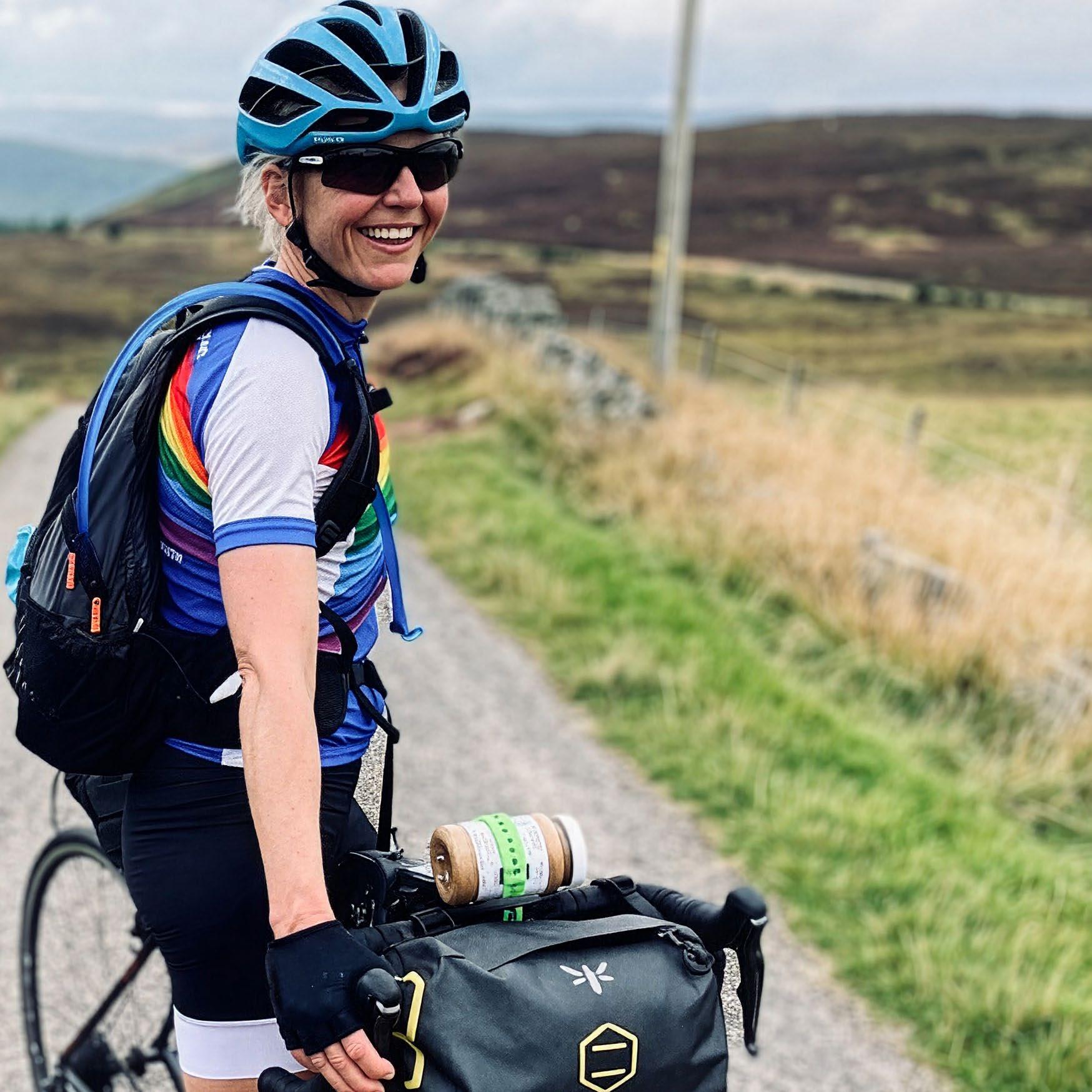
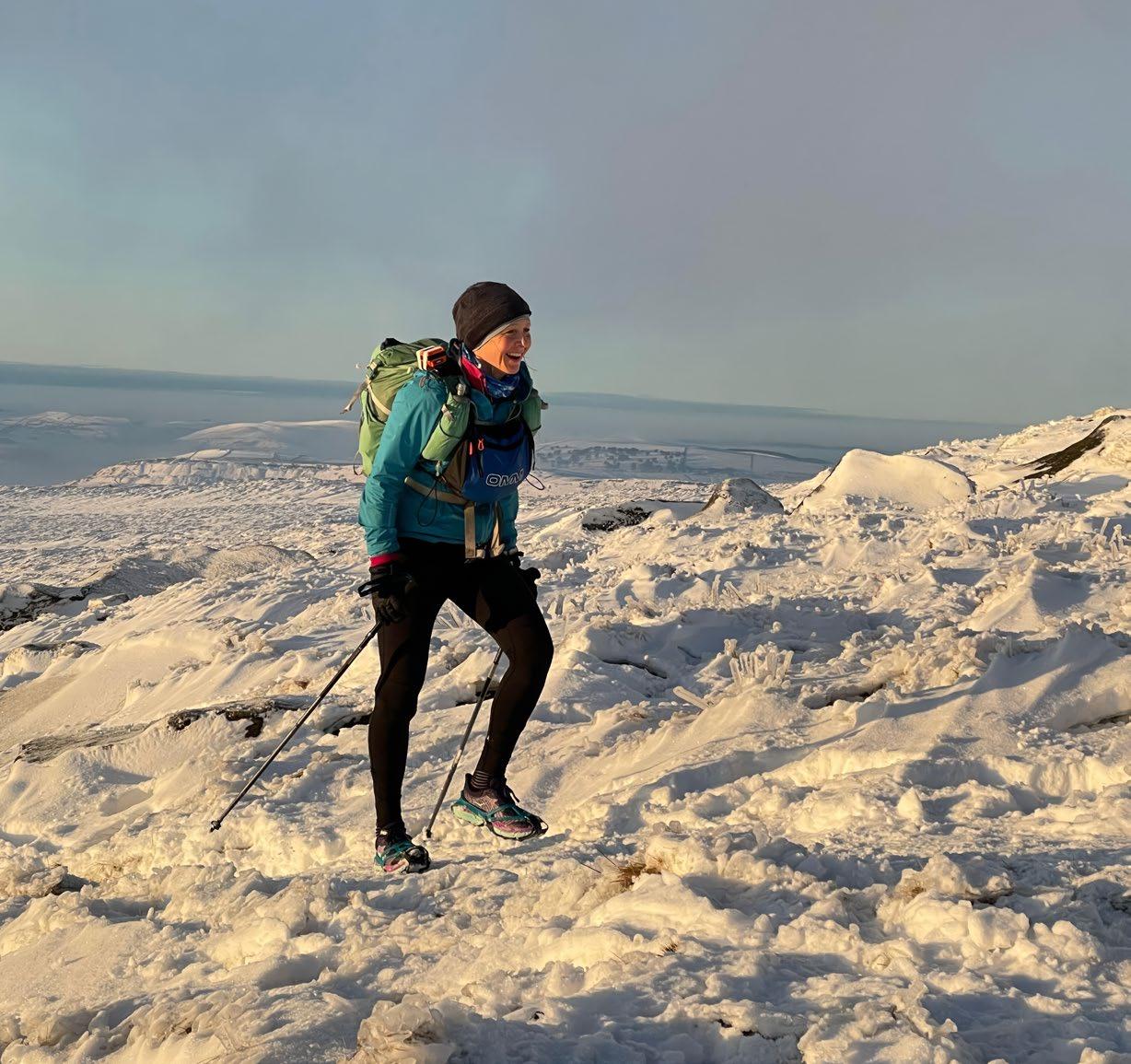
Lucy is the epitome of what it is to be modest. She had a very successful racing “career” in the world of triathlon, winning multiple triathlons and duathlons, including 14 Ironman* races around the world. She won the 2025 Women’s Winter Montane Spine Race**, a gruelling 268 mile ultramarathon, finishing in 87 hours, 41 minutes, and 38 seconds. She studied medicine at the University of Cambridge, earned a PhD while simultaneously competing as a professional triathlete, and is presently an oncology consultant. She currently works at Nottingham University Hospitals NHS Trust and is the cofounder of MOVE Against Cancer, a charity aiming to bring people affected by cancer together through movement and community.
Lucy is very understated and humble in the way in which she speaks about her journey and her achievements. But as you’ll see, she has many inspiring stories to tell, and lessons she’s learned, during life as both a professional athlete and as a doctor. She also speaks frequently about how her patients in turn inspire her. We hope that her story, and what she’s learned, inspires you as much as she inspired us in this interview.
COULD YOU TELL US A LITTLE ABOUT YOUR BACKGROUND AND CAREER TO DATE?
I’m an oncologist treating testicular cancers and sarcomas; I have a lot of
young patients. I was a professional triathlete for a reasonable amount of time, and I was quite successful. For the majority of my time in triathlon, I was racing around medical work. My time in triathlon all started as a drunken dare after a relationship ended. I wasn’t a sporty kid at all and never dreamt I could be a professional athlete; I didn’t even know that you could be one! So, it was not something I’d had on my horizon. I used to describe myself as an accidental pro.
When I was racing professionally, alongside also working professionally, I definitely think the work side of things was my secret weapon because it took a lot of the pressure off my racing. I remember so clearly driving
to Ironman Wales after having done my final oncology exams three days before. I’d had six hours of exams, crammed in amongst work and I’d recently started a charity, I literally hadn’t had chance to think about the race, so I just thought I’m just going to race for fun. And I smashed the race. I do think that racing for adventure, and when you race with joy, can be a weapon. I was also lucky that I never had to race for money, so I didn’t focus on the prize money, which meant I felt more like I was racing for me. It’s very clear for me now that I will only do a race if I really, really want to do it and not get sucked into racing just because I think I have to, or I think I could do quite well, and that approach seems to have helped me do quite well so far. So, “race with joy” is a great motto.
I raced professionally until 2018 and then went back to work full time. In 2019 I had what I call my “glory year” where I just rocked up at a few adventure races for the fun of it, travelling the world, and kind of using triathlon as a way to do that but not really racing seriously. Then COVID came and I started to get a bit more into adventuring just for myself and somehow fell into ultra running, which basically started with a long walk across Wales! My ex and I were walking across Wales during COVID and couldn’t get a B&B, so we just kept walking. Since then, I’ve done some big races, I won the Spine Race which is crazy!
Now, for me, it’s about adventures, not competitiveness. I like to describe this time as my adventure era.
I think they both add so much to who I am. I had a chat with an 18-year-old patient, and I told her that I was going away for the next two weeks and she commented “oh, you always go on fun holidays”. Reflecting on that I realised that it’s people like her that actually make me do crazy stuff because she’s 18 and she’s not got long to live - she’s just making the best of what she’s got. I feel like, comparatively, I’ve got so many things going for me. It is people like her that inspire me to do things like jumping on a plane to Columbia next week with no plan or agenda. I think work gives me that zest for life and a real sense of perspective.
Sport has challenged me in really different ways. I wasn’t a sporty kid. It has taught me a lot about confidence and believing in yourself, pushing yourself, and not being scared to fail. The lessons I learnt in sport, especially around learning to fail, led me to start 5K Your Way, because I don’t think I would have ever started that if I’d not had those experiences. Sport also taught me the importance of passion,
We shouldn’t let the world put limits on what we can or can’t do.
about doing things for the right reasons, not just because you can.
Both work and sport have had different influences on me but actually they synergise in ways that you might not imagine, particularly around the fact that you have to learn to face up to failure. If you only ever do the races you think you’ll win, then you’ll never end up doing anything exciting. It was such a good life lesson, and it’s definitely given me more confidence to do things that I may or may not succeed in, and to re-evaluate what success is. In oncology, it’s important to evaluate what is success is because it can’t just be about a cure.
I think one moment would be the first Ironman World Champs when I got injured. I was racing as a Pro, and I was the last female finisher. I ended up walking most of the marathon and at the time I came away feeling like it was a failure. I went back the next year, I finished in the top 10, and I learned that failure is not actually failure - it’s only failure if it stops you trying again. I tried again and that is a success.
At work, some of the cancers that I treat are very rare, so often there aren’t clear guidelines. You’re in a
position where you’re giving this tough treatment, you don’t know whether it’s going to work or not. You have to reevaluate success because if success is just about curing people, then you’re going to fail a lot of the time. Of course you want to cure people, but sometimes perhaps success is about supporting people to live well and continue to do the things that matter to them for whatever time they’ve got. Success can be breaking bad news well or helping people make the decisions that are right for them. It’s not always easy, but I can look back at some of the things that I do and think, okay, I’m not curing this patient, but maybe I’m helping them do what matters to them in the time they’ve got.
I don’t know that I can talk for what my patients see as success, everyone’s different, but from a podcast I used to host I often heard people with cancer tell me, “that healthcare professionals shouldn’t put limits on what you think I can or can’t do because you don’t know”. And that’s so true. I had a patient and he died the week after he was meant to start at medical school, but he died knowing he was good enough to be a doctor. He knew he was never going to finish his medical training, but regardless, he died knowing that in another world he was good enough to be a doctor. That, for him, was really important.
I think it’s the same for all of us. We shouldn’t let the world put limits
on what we can or can’t do - just because you don’t look like a runner, it doesn’t mean that you can’t do an Ironman. Just because you’re getting older, it doesn’t mean that you can’t start doing crazy running events. Just because you’re a woman, it doesn’t mean that you can’t travel to Colombia on your own. There are so many areas where it feels like the world says, “oh no, you shouldn’t” or “you can’t do that” but who knows? Don’t put limits on yourself. I think the young people I treat show me that a lot. They definitely inspire me in that regard.
When I think of my patients I see resilience. I see that humans are way more resilient than we ever think we are. But I think you maybe only realise that when you’re forced to face adversity without choice. When I sign up for a race, I’m choosing to do that. That doesn’t really show you how resilient you are. Maybe to some extent, but it’s when you’re forced to face adversity without choice that you realise just how tough you are, and my work shows me that every human is way more resilient than they would ever imagine.
Standing on the start of the spine race, I was terrified about what might happen. Next week I’m flying off to Columbia on my own. I’m a little bit nervous as it’s a long time since I’ve gone somewhere on my own where I don’t speak the language, I don’t know the country at all, and I literally haven’t planned it. But that for me is why I’m going. I wanted something that would make me a bit nervous. I don’t think fear is something to be avoided. As long as you can recognise it as a healthy thing you can try and work out what you are scared of and recognise what the
IRRATIONAL FEAR:
Oh, spiders. I don’t like spiders. I really don’t.
QUOTE YOU LIVE BY:
“What if I fall? Oh, but my darling, what if you fly?” I love that one. It’s the one I live by most.
WHICH PERSON MOST INSPIRES YOU?
It sounds a little cliche, but I take a lot of inspiration from the younger people I work with. It’s crazy that celebrity sports people are deemed as heroes just because they’re quick. Why are they heroes? It’s utterly bonkers when there are so many people just desperately trying to get through life, that’s inspiring to me. Applying to medical school when you’re dying of cancer, qualifying as a doctor when you’ve got incurable cancer, getting a new job in the middle of chemo – or just doing normal things with a background of adversity – I find that REALLY inspiring.
FAVOURITE BOOK:
I haven’t read it in a long time, but Shantaram. I love that book. Don’t be put off by its depth. It’s really good. I need to reread it actually.
FAVOURITE APP:
The Met Office. It’s not the one I use the most, I probably use Instagram the most, but it’s the most useful.
WHAT 3 WORDS BEST DESCRIBE YOU?
Extroverted introvert, Impatient, Spontaneous.
WHAT’S NEXT?
I have got a plan for next year, a big plan, but I’ll tell people that when it’s a bit more fleshed out. Watch this space.
things are in that situation that you can control. You should also make sure that it’s not a fear of failure that’s stopping you doing something. If you haven’t tried something just because you think you might fail, then I would say that IS failure.
PEOPLE OFTEN ASSUME THAT PROFESSIONAL ATHLETES ARE FEARLESS. WHEN HAS FEAR BEEN VERY REAL FOR YOU, AND HOW DID YOU HANDLE IT?
My first Ironman Race - I remember being terrified and feeling like this underprepared soldier going into battle. It was so different to anything I’d ever done before and I had no idea of how it was going to go. I was also definitely scared before the first Spine race, which was unlike anything I’d ever done before. You can’t have a strategy for something where so much of it is unknown. So, I was really nervous, but also excited. I was nervous about the hole that I was going to dig mentally and physically, about getting too carried away, and as to how I would manage all the stuff that you just can’t plan for. Fear is exactly why I wanted to do it.
I think it was in lockdown that I came up with my definition of adventure. It is something that, when you first have the idea, you think oh this would be amazing - but then when you’re coming
up to it you think oh, I just wish it would get cancelled - you wish you had any excuse NOT to do it. Then you do it, and you have really good times, but you also have really tough times, but you’ve come out of the other side. To me that’s an adventure. It has got to have an element of hard times, otherwise it’s not an adventure, it’s just a day out. I think you need to be out of your comfort zone every now and then. I think it’s what makes you feel alive.
MOST PEOPLE WILL NEVER RACE PROFESSIONALLY BUT THEY WILL FACE BIG PERSONAL CHALLENGES. WHAT LESSONS DO YOU THINK TRANSLATE MOST POWERFULLY TO ORDINARY LIFE?
I’ve already talked about not fearing failure, and I think that’s relevant to everybody. Plus, the importance of passion. I think without passion, it’s really hard to get the best out of yourself. I would always suggest that people should do things because you really want to, not just because you can. Make sure you’ve really thought out your “why” for doing something. I don’t want to do a 100 mile race just because someone said it would be a good race to do, and that I could potentially win it, for me that’s not a
It’s when you’re forced to face adversity without choice, that is when you realise just how tough you are.
why. I’ve got to have something that really grips me about whatever I’m doing.
Another really important lesson is to break things down into chunks, every big life decision or project. When I go into a race like the Spine Race, if I thought about the whole race, that I’m about to run 268 miles and I’m barely going to sleep, that’s intimidating. But if I think in terms of that I’ve just got to get 45 miles to the first checkpoint, and then it’s a new day, that’s much easier in your head to break down.
So, in short, I think it’s… Don’t fear failure. Find your passion. Do things because you want to, not because you can. Break things down into chunks. Find your why. And be REALLY clear about your why.
WHEN YOU STEPPED AWAY FROM PROFESSIONAL RACING,
DID YOU EXPERIENCE ANY FEAR AROUND
LETTING GO OF THAT CHAPTER?
I remember the time I made the decision very clearly. 5K Your Way had been running for about three or four months, and I was out in Majorca having just won a half Ironman. I went back to my hotel room and saw pictures of 5K Your Way on Facebook, and I thought I want to be there. Many people thought that I wouldn’t retire from triathlon because I was winning often, and winning prize money, but I realised that I was ready to retire. I’d found something I cared about that wasn’t work, and something that I really felt passionately about. So, the charity definitely helped me step away.
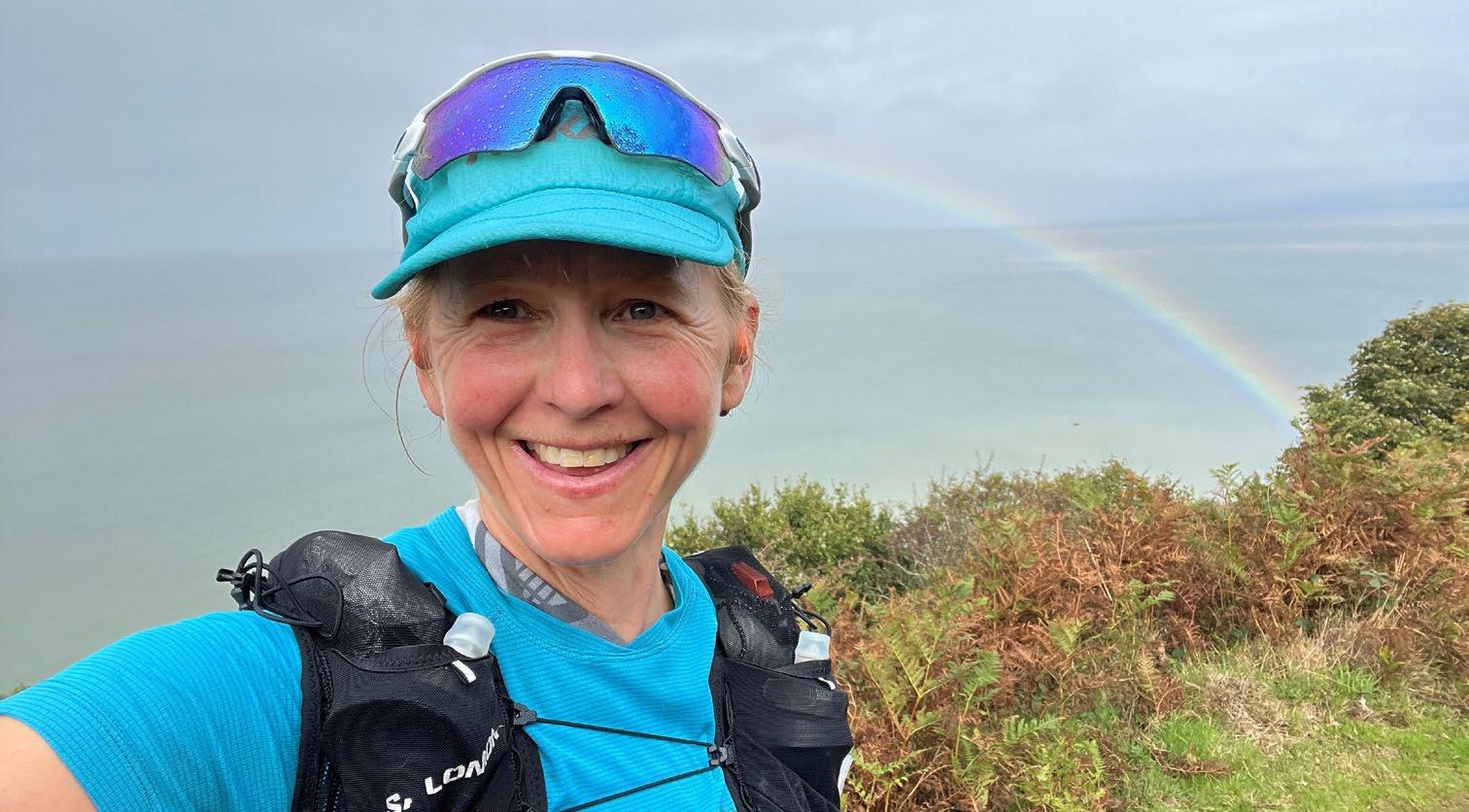
5K Your Way is an arm of the MOVE Against Cancer charity. MOVE charity was initially set up by an amazing person called Gemma Hillier-Moses, who’d had cancer when she was 25. She was a runner and when she was going through her cancer treatment, she found that there was no support to help her stay active. She had founded MOVE about a year before I met her, with the goal of supporting other young people to stay active during and after their cancer treatment.
The pivotal point for me was going on to a teenage cancer ward to give a young man a prescription. He had theoretically been cured of his cancer; he’d had a really rare brain tumour. We were talking and he told me how, in the process of his treatment and the aftermath, he’d lost everything. He’d put on several stone in weight, he’d lost his job, he’d lost his friends, he lost his partner, and he was spending all day asleep and all-night awake playing computer games. I remember walking off the ward thinking, what are we doing? We’re curing people but what life are they left with afterwards? At that point I had the thought that perhaps we could get a group of young people together and build up over a few months to walk a parkrun.
I knew there was evidence around the benefits of exercise for people living with, and after, cancer. I had heard about Gemma and what she was trying to achieve and so got in touch with her. We met and had a coffee, and we realised straight away we shared the same vision and passion. I told her about my idea and she said, “let’s just do it”. So, we just did it!
5K Your Way is an active support group with a difference. We meet at parkruns on the last Saturday of every month. Each group is led by volunteer ambassadors who’ve been affected by cancer, and we walk, jog, run, cheer or volunteer as much of the 5K as we want. Afterwards we go for a chat and a drink and cake.
After 5K Your Way had been running a year or so, we merged it with the MOVE charity, which is now MOVE Against Cancer charity. We also offer a personalised one-to-one cancer rehab programme for young people aged 13 to 30, and education and resources to support people living with cancer to be more active. We now also have an evolving ‘MOVE mentor’ arm where we’re trying to link in with underrepresented communities because we’re very aware that most cancer support services attract white, middle class, demographics. We’re still quite small, but we’re an amazing charity and one that really does change lives.


The first thought for the charity was never about running. It was about an active community. It was about people from all walks of life doing something together, and the sense of support you get from that. To be honest, for many of our community, we’re very much walking rather than running. If you run, that’s amazing, but if you walk, that’s just as amazing. If you just come and have a coffee and volunteer or just stand and cheer, that’s also amazing. It’s important not to underestimate the power of being part of something like this because cancer can take a lot away, including social confidence. I think with 5K Your Way, we can help to bring that back.
Well, donations are obviously amazing, but actually I think the biggest message is that if you know someone living with cancer, rest is not best. There is so much evidence that exercise is one of the very best things that people can do, not just to make themselves feel better, but it also improves their outcomes. So don’t wrap people with cancer in cotton wool, encourage and support them to move. Even a little bit of movement is better than none. That’s the big message that I’d want to get across, and that’s what MOVE Against Cancer is trying to do.
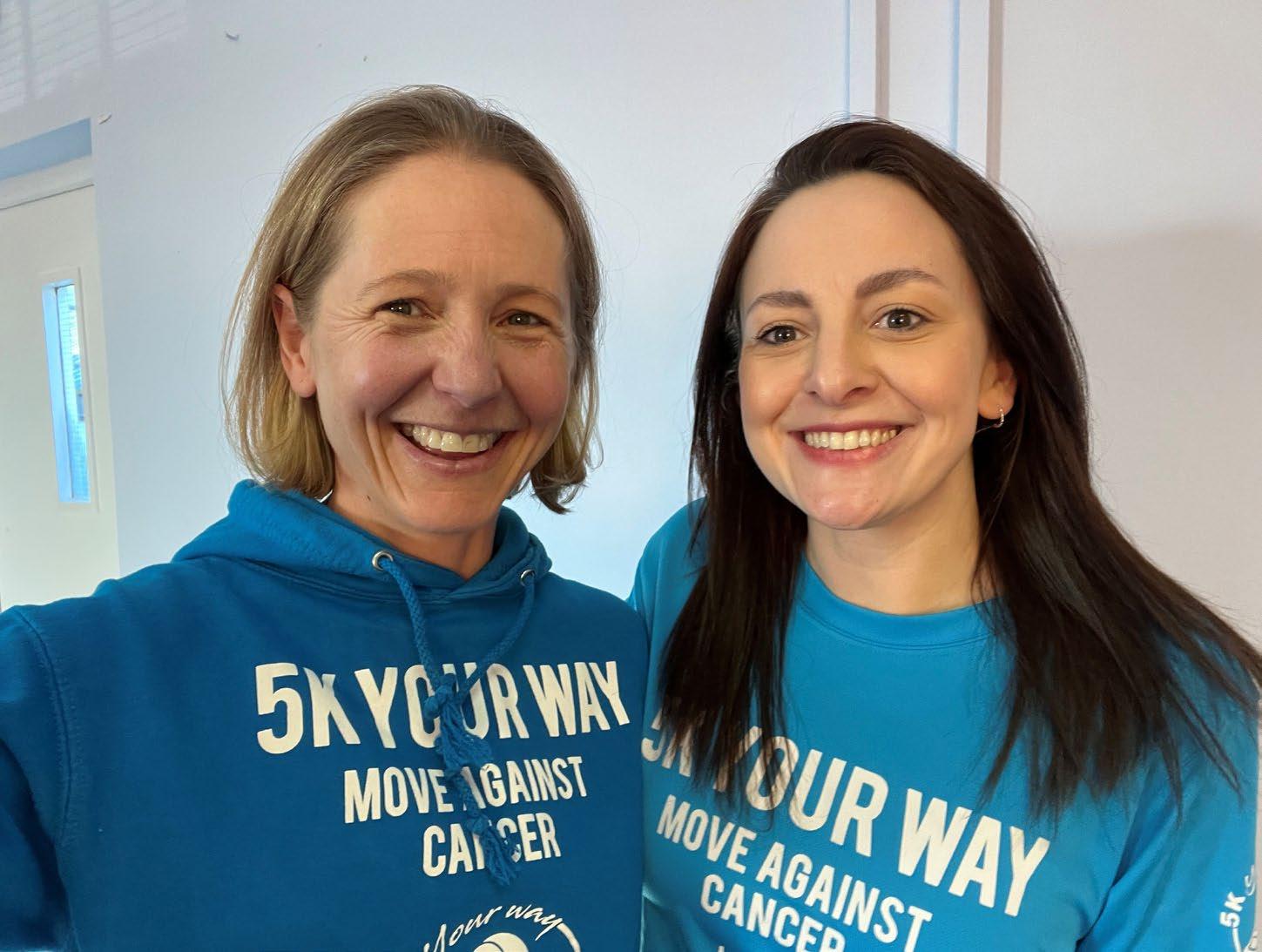
An Ironman is a longdistance triathlon consisting of a 2.4-mile swim, 112-mile bike ride, and 26.2-mile marathon run, totalling 140.6 miles.
If you would like to support MOVE Against Cancer and 5K Your Way you can find out more about how to do that by scanning this QR code. Should you wish to follow more of Lucy’s adventures you can follow her on Instagram at @lucygossage. You can also find her website at www.lucygossage.com
are widely regarded amongst the toughest endurance races in the world. The non-stop, expedition style of racing tests both physical and mental resilience in the most challenging of conditions. The Winter Spine race is a 268 mile race taking on the iconic Pennine Way. Competitors experience the full intensity and ferocity of the British Winter including deep snow, storm force winds and driving rain.
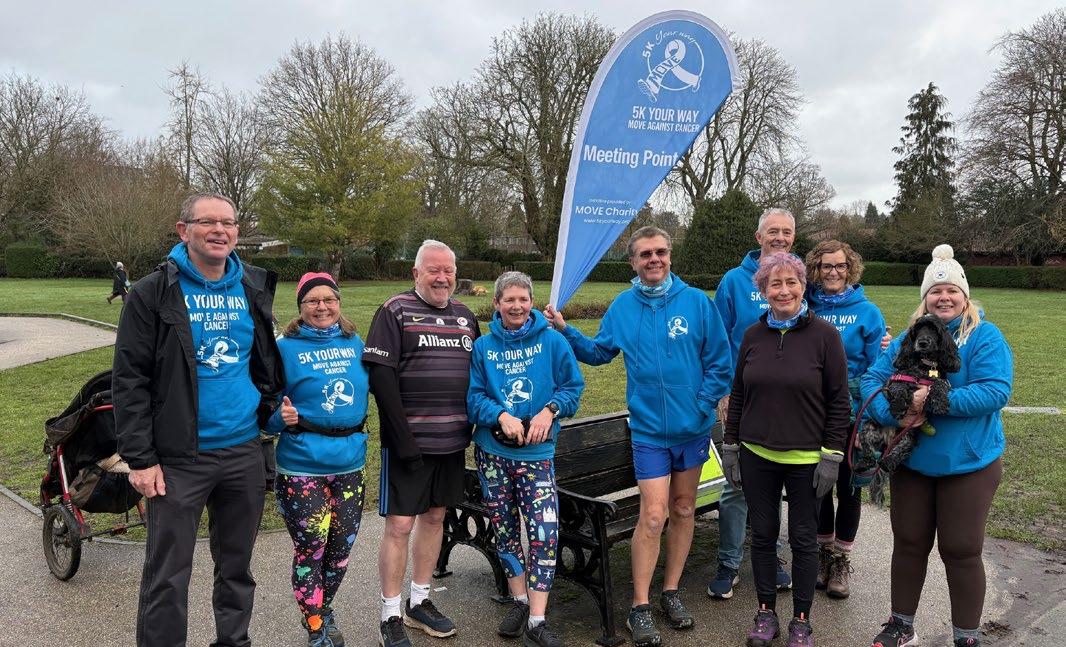
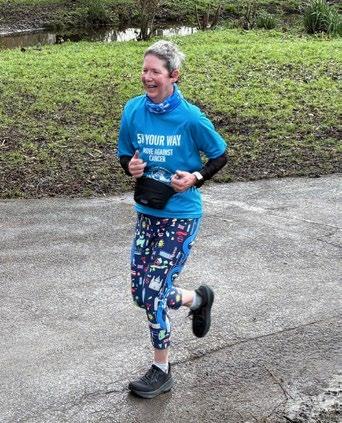
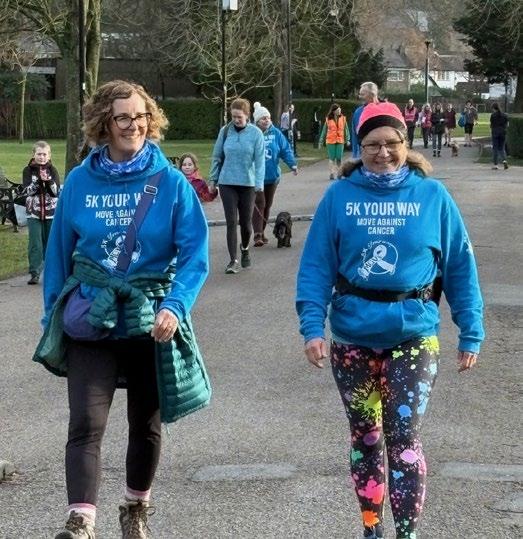
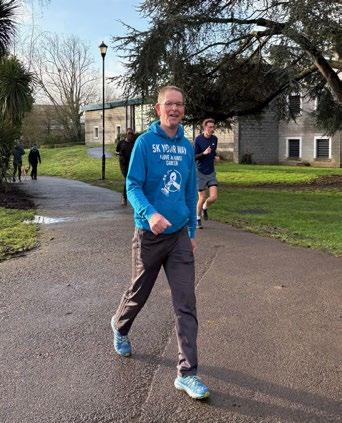
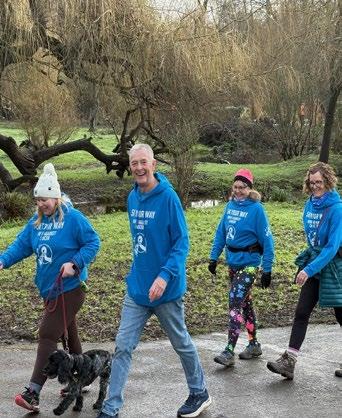
We were lucky enough to get chance to spend time with (and act as the paparazzi for) the 5K Your Way community at Woking Park parkrun on the 31st January. With them welcoming us warmly into their preparkrun chatter and post parkrun coffee, being part of the group was a joy. Everyone shared stories of their experiences with cancer, and the support that the group had given to them. For some of them it was the only support group for many miles, and it was hugely valued by everyone. Whether you’re going through cancer treatment, or you’ve come out of the other side - or if you’re a friend or a loved one of someone affected by cancer, you’ll be welcomed with open arms by one of the many groups that meet at the last parkrun of every month. You can find your local group on the 5K Your Way website or via Facebook.
by Jago Kay
Most people recognise that investing isn’t something you do once and then leave untouched. Markets shift, portfolios need attention, and risk needs to be reviewed over time – just ask the investment team!
Financial planning works in much the same way. Life doesn’t stand still - marriage, children, career changes, illness, or the loss of a loved one can all reshape what matters most and what you need your money to do.
That’s why a good financial plan isn’t a single action or a box to tick. A plan is an ongoing, living process that adapts with you, helping you stay on track as your life and priorities evolve.
Financial anxiety is more common than people realise, and myths about money can often make it worse. The good news is that small, practical steps - like talking things through, building your understanding and knowledge, and putting a clear plan in place - can quickly reduce that sense of overwhelm.
A trusted adviser, such as your team here at Carrington, can be a good sounding board, helping you make informed, grounded decisions and feel more confident, even when life feels uncertain.
Many people assume financial planning is simply about preparing for retirement. While later-life planning is important, a truly effective financial plan is about much more than that. It is about shaping the future you want at every stage - whether that means purchasing a second home, funding your children’s education, supporting ageing parents, or creating the freedom to step back from work on your own terms.
Another common misconception is that retirement planning can wait until later in life. In reality, the earlier you start, the more options you create. Some individuals choose to retire or semi-retire far earlier than expected, while others want the flexibility to reduce their workload in their fifties or transition into passion projects, philanthropy, or advisory roles. Building that level of choice requires planning well in advance.
Even if you love what you do and cannot imagine ever fully retiring, financial planning still matters. Life can change quickly through illness, shifts in business conditions and technological advances, or unexpected family responsibilities. A robust plan helps ensure that, whatever happens, you and your family have security, resilience, and the confidence that you have options.
Given the social messages we’re surrounded by, it’s easy to link the idea of success or even selfworth to how much you earn or your wealth. But money isn’t a scorecard - it’s simply a tool. At its best, money helps you do the things that matter most: supporting the people you love, creating security, enjoying life, and making choices that reflect your values.
That’s why good financial planning is not just about growing your portfolio. It’s also about understanding your relationship with money and feeling in control of the decisions it allows you to make.
Ultimately, money should serve you - not define you.
Affordability is often thought of as simply being able to meet a monthly payment, whether that’s for a mortgage, a car loan, or another commitment. In reality, true financial wellbeing comes from stepping back and looking at the bigger picturethe total cost, the interest over time, and how new commitments affect your longer-term flexibility.
The aim is not to stretch yourself to the point where everything is just covered, but to ensure you still have the freedom to act when great opportunities arise. Whether that’s an unexpected experience, a family decision, or something you simply choose to enjoy – an eye wateringly expensive ticket to your favourite band’s farewell tour. Building in room for the “maybe”, alongside the essentials, is what helps create lasting financial freedom. 5. 6. 7.
If an investment claims to offer high returns with no risk, it’s a red flag. All investments carry some level of uncertainty, and understanding your own tolerance for risk is a crucial part of building a balanced portfolio. As with most things, anything that sounds too good to be true, usually is.
Financial myths can be surprisingly persuasive. They often create unnecessary fear or uncertainty, when the reality behind the myths is far more empowering. With the right guidance, a clear plan, and a long-term perspective, it becomes much easier to cut through the noise and feel confident about the decisions you are making.
importantly, you do not have to navigate it all alone. If you, or someone you know, has questions or would like to explore any of these topics in more detail, the team at Carrington is always here to talk things through.
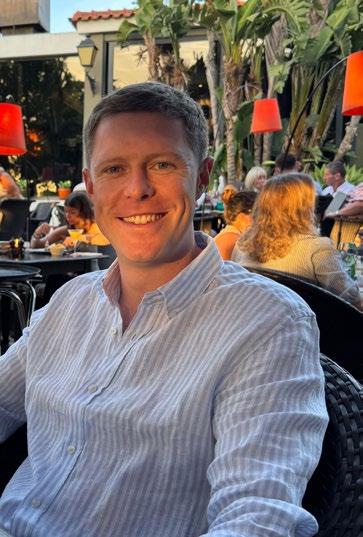
…has been a big one for me. We moved house and I became a father… all change! It has been a brilliant, slightly chaotic, period of life. Professionally, alongside that, I’ve had the pleasure of meeting new families, as well as continuing to look after our existing clients, helping them make confident decisions about their futures. I’m particularly delighted with the steady growth in the number of families I support this year, as I love meeting new people and helping where I can.
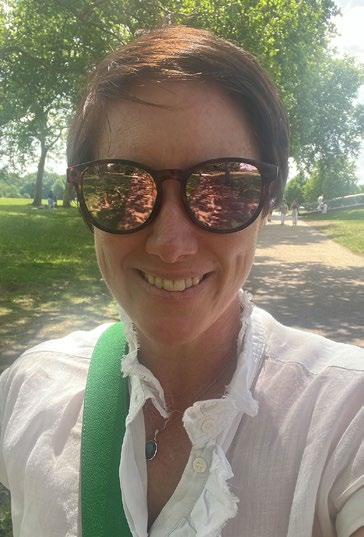
…I worked with Carolyn to deliver a new suite of documents for our clients which are fresh,
engaging and reflect our Carrington personality. I hope you like them as much as we do! I am also particularly proud of this latest issue of the Club, which has been my big focus for the last couple of months. One of my highlights was celebrating my birthday with the Team on our away weekend – they really know how to make someone feel special! Personally, I completed the Cape Town Cycle Tour, long on my bucket list, and it exceeded every expectation. I’m already planning to take part again next year.
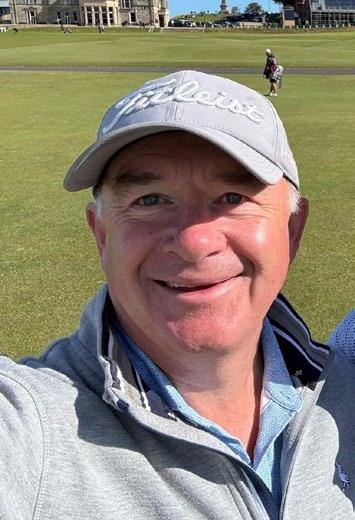
It’s been another busy year both professionally at Carrington and personally. The business has grown and I am particularly proud of us going through £500 million
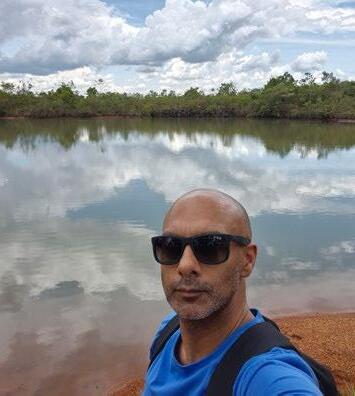
of assets under management, a great reflection of the trust that our clients put in us and the hard work and focus from the team on client service. I’ve done a bit more public speaking and have a made a number of presentations over the year, including how to build a successful culture to a large room of my industry peers. We have several exciting projects in the pipeline I am looking forward to driving over the next 12 months. Personally, I was lucky to play a round of golf at the Old Course in St. Andrews for the first time, a real bucket list moment, an amazingly historic place. I am really pleased that my hard work and willingness to be different has continued to pay off, with a very strong
set of results from our portfolios over 2025. I am delighted that this success was recognised, with us being shortlisted as Best Investment Firm at the Citywire Investment Performance Awards, for our 3 year performance up until the end of June 2025. Celebrating 15 years at Carrington and visiting South America for the first time were also highlights.
…was a big year for me personally - I hit the big 50 and also celebrated 10 years of marriage! We consulted our Financial Advisers (Ali and Cecily) about building a dream trip to St Lucia for Christmas and New Year into our Life Plan and luckily they said yes! This really was a bucket list holiday and ticked off another ocean my son has swam in - he wants to swim in all of them! Professionally, I was asked to speak on a panel at a big Financial Planning conference in Manchester – my specialist subject was how we look after our clients and give them (you) the best
experience possible. It was nerve wracking but I enjoyed every minute!
This year’s highlight has to be having the nerve to stand up on stage and present in front of a few hundred people.
Definitely outside my comfort zone, but one of those moments you grow from. One step closer to ticking off the TED Talk bucket list! I also became Chartered - one of the highest professional standings in financial advice - which I’m genuinely proud of. Outside of work, I ran two half marathons and survived the chaos of moving house. All in all, a strong year with plenty more to build on.
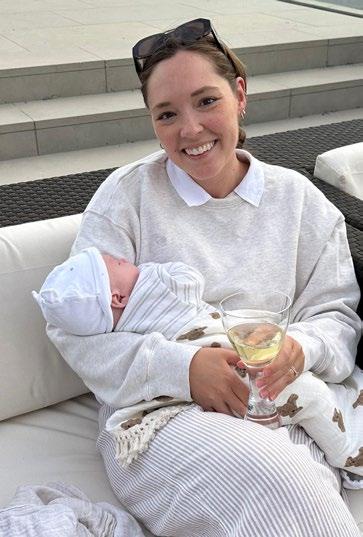
...has been a truly special one for me.
The first six months were focused on working closely with my
clients and the team, making sure everything was in great shape ahead of my maternity leave. I wanted the transition to be seamless and for everyone to feel prepared and supported whilst I was away. Then, halfway through the year, we welcomed Theo into the world - the biggest and most wonderful adventure of my life to date. As if that wasn’t enough, we also moved house, so it has certainly been a year of change and new beginnings.
This past year at Carrington I have carried on doing what I enjoy most: running the back-office team. A lot happens behind the scenes to keep things on track, and I’ve been instrumental in introducing new software and processes to ensure everything works as smoothly as possible for our clients! On a personal level I was really pleased to finally bench 100kg in the gym - this was on my bucket list and is something I have been chipping away at consistently for the past year.
2025 was a big year, leaving God’s country to come to London and joining Carrington in March. I have thoroughly enjoyed getting stuck in and learning the Carrington way. A big focus for me has been progressing towards Chartered status. I’ve sat a fair few exams and now have just one to goso the finish line is in sight. Balancing study alongside work hasn’t always been glamorous, but it will be worth it. I did manage to swap the revision notes for sunshine with a trip to the Philippines - an unforgettable experience. As a Leeds fan, it’s been great to see us back in the Premier League… stressful at times, but we’ll take it, especially those four points against Chelsea.
have really enjoyed my first year. 2025 was extra special for me, as it was the first full year with my son, who now seems to have a wider vocabulary than me! I still found the time to complete four exams towards becoming Chartered, which I hope to complete in 2026.
Over the past year, I have become much more hands on in our client relationships. I have really enjoyed spending more time engaging directly
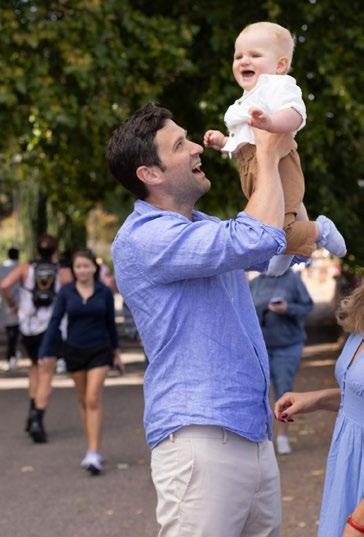
In the last year, I joined Carrington as a Financial Planning Analyst and
with clients, building stronger connections and making sure every interaction feels purposeful and adds genuine value. On a personal note, it has been a year of exciting change. I moved in with my partner and have been embracing life in the countryside, even taking part in my first pheasant shoot!
Highlights for me this year have been our strong client portfolio performance and reaching the significant milestone of £500m assets under management. It has also been wonderful to see so many of the team sitting exams, including those achieving Chartered status, and to round it all off with a memorable team offsite together. Personally, celebrating my 60th with a golf day at my favourite club, despite being sidelined by injury, was very special. My favourite moment, when I went soft during my speech, and told Mike that I had thoroughly enjoyed working with him over the last 13 years….to which he replied, “well I’m glad one of us feels that way”!!! That was closely followed by a thoughtful team birthday dinner. This coming year I am looking forward to a trip to India, cycling across the Alps and taking part in Cowes Week.
…has been a year of learning.
My first full year here has been thoroughly enjoyable by learning the Carrington way and why we’re different (and better!). I am proud that I have achieved first time passes in the first five exams, with the hope of gaining my diploma later on in the Spring. Off the pitch, I have continued with my desire to travel Europe having visited Malta, Venice, Copenhagen and the Greek Islands, with the hopes of doing a road trip around France this year!
…I achieved a long-standing personal goal: purchasing my first home. Alongside working full time, I dedicated many evenings and weekends to renovating
the property - transforming it from a house, into a home. The process not only challenged me creatively and practically but also sparked a new passion for cooking and hosting. Additionally, I recently began studying for my first exam towards my financial diploma. I’m proud to have taken this step in my professional development and am excited to see how it will continue to shape and progress my career.
...has been really rewarding.
I was proud to complete my Diploma in Office Management, helping to ensure the office runs as smoothly and efficiently as possible. I’m proud to be someone the team can turn to for support across all areas whenever it’s needed. On a personal note, I finally ticked off a major bucket list destination with a trip to Japan, which absolutely lived up to every expectation. With my 30th birthday around the corner, I hope it is
another decade full of growth and new experiences!
…has been a big one on the exams front.
I completed my Diploma in Financial Planning, and I also passed CFA Level I. The CFA really pushed my investment knowledge further, and balancing studying alongside work was challenging at times, but very rewarding, once I passed. On a personal note, watching the Olympic ice hockey men’s gold medal final live was a bucket list moment and an unforgettable experience.

by Stephen Thompson

Morgan Housel’s The Psychology of Money has earned its reputation as one of the most insightful books on financial behaviour, not because it explains how to pick investments, but because it explains why people so often struggle to make good decisions even when the information is clear. The central message of the book is that long-term success rests not on perfect forecasts or flawless strategy but on cultivating habits and attitudes that prevent fear from taking control.

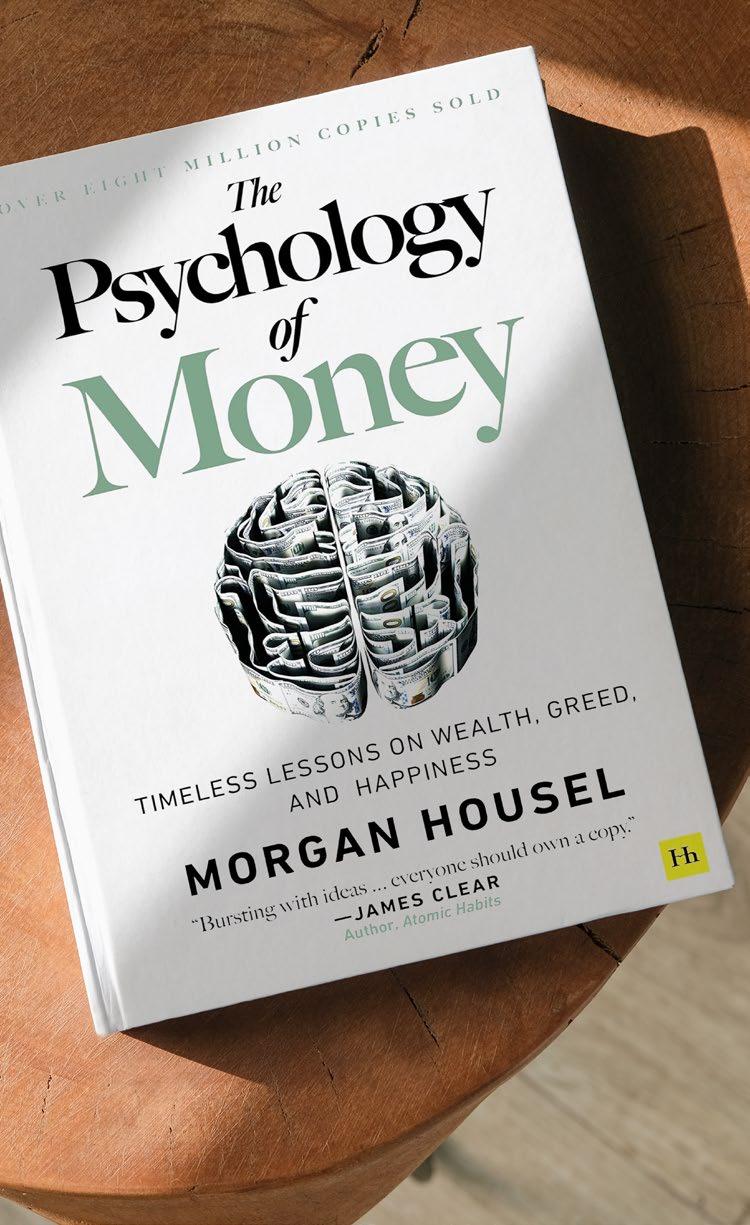
Among the book’s most powerful themes is the role of fear. Fear of loss, fear of making a mistake, fear of falling behind and fear of an uncertain future, all shape how people behave with their money. Housel shows how these fears arise and how they can be understood rather than simply endured.
A central argument in the book is that financial decisions are shaped less by logic and more by personal history. Someone who grew up during the financial crisis of 2008 is likely to carry a very different attitude towards equity markets compared with someone whose early adult years coincided with a long bull run. Housel gives the example of an investor who lived through the stagflation of the 1970s developing a lifelong suspicion of inflationary risk, even in periods when inflation is dormant. By contrast, a person who has never experienced high inflation first-hand may be far more
comfortable holding large sums in cash, unaware of how purchasing power can quietly erode. These examples show how fear is often inherited from experience rather than evidence.
The book also explores how the fear of loss can be disproportionate to the actual risk faced. Housel highlights how investors often treat a temporary fall in the market as if it were a permanent destruction of capital. During the 2020 pandemic crash, for instance, global equities fell more than 30 percent in a matter of weeks. Many investors who panicked and sold during that period feared that markets might never recover. Yet within months the same markets rebounded strongly and went on to reach new highs. The fear felt in the moment was real, but the permanent loss resulted only for those who acted on it. Housel uses such episodes to show that fear frequently turns volatility into damage, not because
of the event itself but because of the reaction it provokes.
Another of the book’s strongest insights lies in the distinction between getting wealthy and staying wealthy. Housel points to well-known examples of individuals who accumulated great fortunes only to lose them through overconfidence or taking on risks they did not fully understand. He contrasts this with the quiet resilience of investors who built their wealth slowly, lived below their means and avoided large, concentrated bets. This difference is not simply mathematical but psychological. The fear of missing out can lure people into strategies that promise high returns but carry hidden vulnerabilities. By comparison, those who remain cautious and allow compounding to work over years rather than weeks tend to benefit from a calmer approach rooted in patience rather than fear of falling behind.
The importance of leaving room for error is another theme supported by concrete examples. Housel notes that even the most sophisticated financial predictions regularly fail because the world is full of surprises. Interest rates, political outcomes, regulation, pandemics and technological disruption can all shift direction without warning. He recalls how few experts anticipated negative interest rates in Europe, or
the scale of government intervention during Covid-19. Fear often stems from feeling overly exposed to the unexpected. A financial strategy that includes a margin for error, whether through liquidity, diversification or conservative assumptions, allows someone to feel more secure even when events take an unexpected turn. The presence of a buffer reduces fear not by removing uncertainty but by acknowledging it.
Housel’s treatment of pessimism is particularly relevant. He observes that warnings of disaster tend to command more attention than discussions of progress. It is far easier to imagine markets collapsing than to imagine decades of steady gains. For example, the headlines of 2016 warned that Brexit would cause a severe and immediate recession, yet the actual economic path was far more nuanced. Similarly, the endless predictions of housing crashes or stock-market bubbles tend to strike a chord because fear feels responsible, whereas optimism feels naive. The book argues that this asymmetry distorts people’s thinking, encouraging them to give greater weight to frightening possibilities than to likely outcomes. Understanding this helps place fear in context rather than at the centre of decision making.


One of the book’s most memorable ideas is the notion that true wealth is what cannot be seen. The expensive car on the driveway or the lavish holiday on social media says nothing about financial strength. Someone may have taken on debt to create the appearance of success. Meanwhile the person who quietly saves, declines unnecessary upgrades and embraces modest living may be in a far more secure position. Housel includes the example of Ronald Read, a janitor who accumulated millions simply by saving consistently and investing in dividend-paying shares over decades. His life demonstrates that fear of missing out on status can be far more damaging than fear of market volatility, because it encourages unnecessary spending and undermines long-term stability.
In essence, The Psychology of Money demonstrates that managing money well requires managing emotions well. Among those emotions, fear is the most persistent and often the most misleading. The book encourages readers to understand their own fears, recognise where those fears come from and see how they influence decisions. In doing so it provides a thoughtful and practical foundation for anyone who wishes to build a calmer, more resilient relationship with their money. If fear is inevitable, Housel argues, it need not be decisive.
Stagflation: persistent high inflation combined with high unemployment and stagnant demand in a country’s economy.
Inflation risk: also referred to as purchasing power risk, is the risk that inflation will undermine the real value of cash flows made from an investment.
Long bull run: is defined as a period of time where the majority of investors are buying, demand outweighs supply, market confidence is at a high, and prices are rising.
a
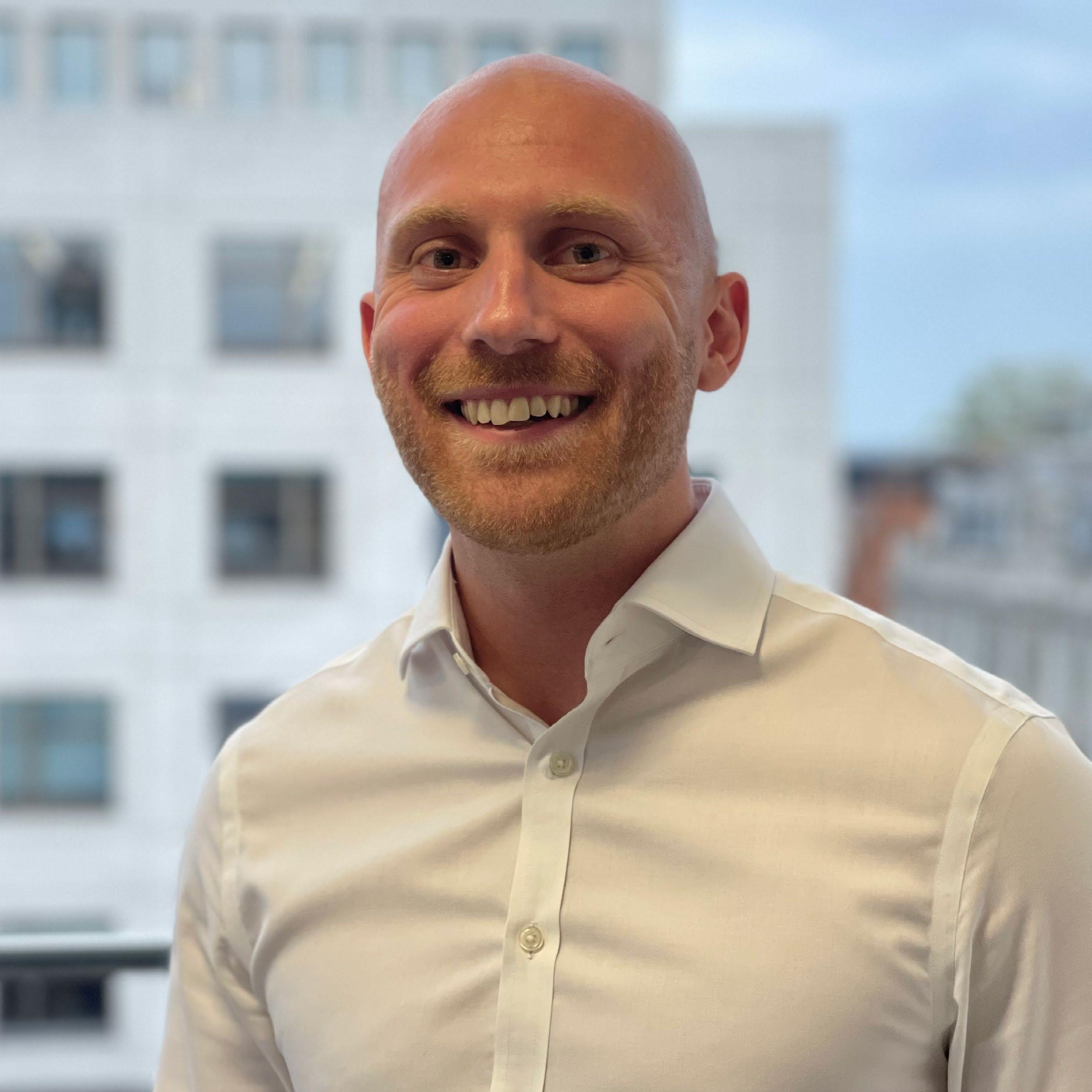
No two days are ever the same, which is probably the best part of the job. But if everything runs roughly to plan, this is what a typical day might look like.
On a good day, I’m up early and out for a run. It’s the best way I’ve found to wake up properly and clear my head before work. If you’re near Dulwich Park or Peckham Rye in the morning, I’m the bloke jogging past (in neon trainers), talking to himself and running through the day ahead in his head.
On less good days (usually around Christmas), the alarm gets snoozed far more than it should. This doesn’t go down particularly well with my better half. : :
I’m usually in the office before 8:30. Any later and the commute becomes fairly painful. If I haven’t already planned the day during my run, this is when I’ll do it properly.
My role as an Adviser involves spinning a lot of plates. Looking after existing clients is a continuous process, helping with day-to-day questions, changes in circumstances and big life events, and making sure their plans stay on track. Alongside that, there are client review meetings, meetings with people considering advice, and the behind-the-scenes work of coordinating with the wider team to make sure everything agreed is implemented and monitored.
In the morning, I’ll work through emails, prioritise client queries, and deal with anything time-sensitive early
• I’ve broken my nose five times.
• I was originally supposed to study Neuroscience at university but ended up doing Accountancy instead. Quite a shift.
• I’m running my second marathon in Paris this year. Fifth if you include the half marathons I’ve completed.
• I haven’t always been bald; I did once have hair. It was blonde. I shaved it off during lockdown and decided life was simpler that way. It’s saved a lot on barbers.
• I’ve just bought my first house with my partner, Ella, in East Dulwich.
on. If I’m out seeing clients, I’ll usually grab a coffee nearby and catch up there, inevitably paying far too much for a very small cappuccino.
Mondays start with a 9:00 team meeting where we catch up on important events happening during the week, get an update on markets from the investment team and go through everything client-related with a fine toothcomb. It’s a good way to start the day and it makes sure everyone is aligned for the week ahead.
Late mornings are usually taken up with client meetings. Wherever possible, I prefer to meet face to face. I find it’s a much better way to understand what’s really going on in someone’s life, not just their finances.
Most conversations aren’t just about investments. They’re about things like changes at work, family pressures, children getting older, parents needing more support, or that quiet worry of whether the right decisions are being made. Sitting across the table makes those conversations more open and more useful, and helps me give advice that fits the person, not just their finances.
These meetings and conversations are valuable and productive, but it’s the time in between where people are
For a long time, I thought my biggest fear was not reaching my potential.
But actually, it’s missing out on the things that matter most.
My job is about looking ahead. Reading the numbers, thinking about the future, and helping people plan for what’s next. That part really matters. Good planning gives people options, security and a bit of peace of mind, and it’s something I genuinely believe in.
That mindset definitely leaks into my personal life. I’m naturally quite future-focused, always thinking about what’s coming next, what the next goal is (we do like something to work towards), and what needs sorting. If you’re not careful, that way of thinking can creep into everyday life and you end up missing what’s happening right in front of you.
I haven’t cracked that balance, and I probably never will, but I’m aware of it. I try to slow things down where I can, be more present, spend time with my family, my other half and friends, and appreciate the small, ordinary moments that often end up meaning the most.
most exposed to headlines, speculation, and financial noise. With that in mind it makes me very aware that most clients only sit down with me once a year. The time in between those meetings can be where fear creeps in, and it’s important that we recognise this and find solutions to it. A lot of value also comes from being available to my clients via phone or email when these situations arise.
The 2025 Budget is a good example of speculation and noise creating fear. I recently presented at a Transact conference about the lead-up to the November Budget, where we talked about how the rumours around tax and pension changes, particularly tax-free cash, created unnecessary worry before anything was actually announced. It’s a good illustration of how quickly uncertainty can build when the news cycle gets loud.
A big part of my role is helping people slow things down in moments like these. Separating what’s noise from what’s real and focusing on what genuinely needs action.
The same approach applies to people investing for the first time, where the fear often comes from simply doing something new. Handing over money you’ve worked hard to build, knowing its value will go up and down, is a big step.
Having recently been through the house-buying process myself, I was reminded just how stressful uncertainty can be. Long periods of silence, little
communication between different parties, and no real sense of what was happening next all added to the anxiety. Investing is usually far more straightforward than that, but the feeling can be similar at the start. In both cases, clear, regular communication makes a huge difference, especially when decisions feel big. It’s something I place huge importance on with my own clients, so people don’t feel left in the dark.
culture really matters. Everyone knows our clients, what’s going on in their lives, and what we’re trying to achieve for them. It means nothing is treated in isolation and clients aren’t passed around or asked to repeat themselves.
Lunch is usually something I’ve brought in. This amuses the team more than it should, mainly because it’s almost always one of two options: pasta with chicken sausages, or chicken and rice. It’s not particularly exciting, but it does the job and keeps me fuelled for marathon training. I save the more ambitious cooking for the evenings, where I benefit greatly from my partner being a far better cook than I am. I am learning.
That teamwork makes a real difference to the service clients experience. Things move more smoothly, communication is clearer, and decisions are carried through effectively. It also means that when something changes, everyone involved already understands the context, which helps us focus on getting the best outcome rather than just ticking boxes.
I’ll also use this time to prepare for upcoming meetings, making sure conversations feel calm, clear and straightforward when they happen. A lot of the value in advice comes from this teamwork behind the scenes, quietly making sure clients feel looked after and things run as they should.
The end of the day is about tying things up. Following up on meetings, coordinating with the wider team, and making sure nothing gets missed. I try to finish each day with a clear plan for the next one, so our clients get consistency.
If I’ve missed my morning run, I’ll usually run home to South London instead. Running along New Bond Street and weaving through tourists is easily the worst part, but it’s still better than getting the Tube.
Afternoons are often more meetings, or follow-up work if I’m not clientfacing. This is where a lot of the behind-the-scenes work happens.
I spend a lot of time working closely with the CRM team, who are very much the engine of Carrington. We work as one team, and that
Another aspect of my role also involves working closely with other professionals around a client’s finances. Accountants, solicitors, mortgage brokers and others all play a part, and understanding what they do, how they work, and how everything fits together helps make the overall advice more joined-up and effective. The aim is always to simplify things for clients, even when the wider financial world feels anything but simple.
“Too many of us are not living our dreams because we are living our fears.”
Les Brown
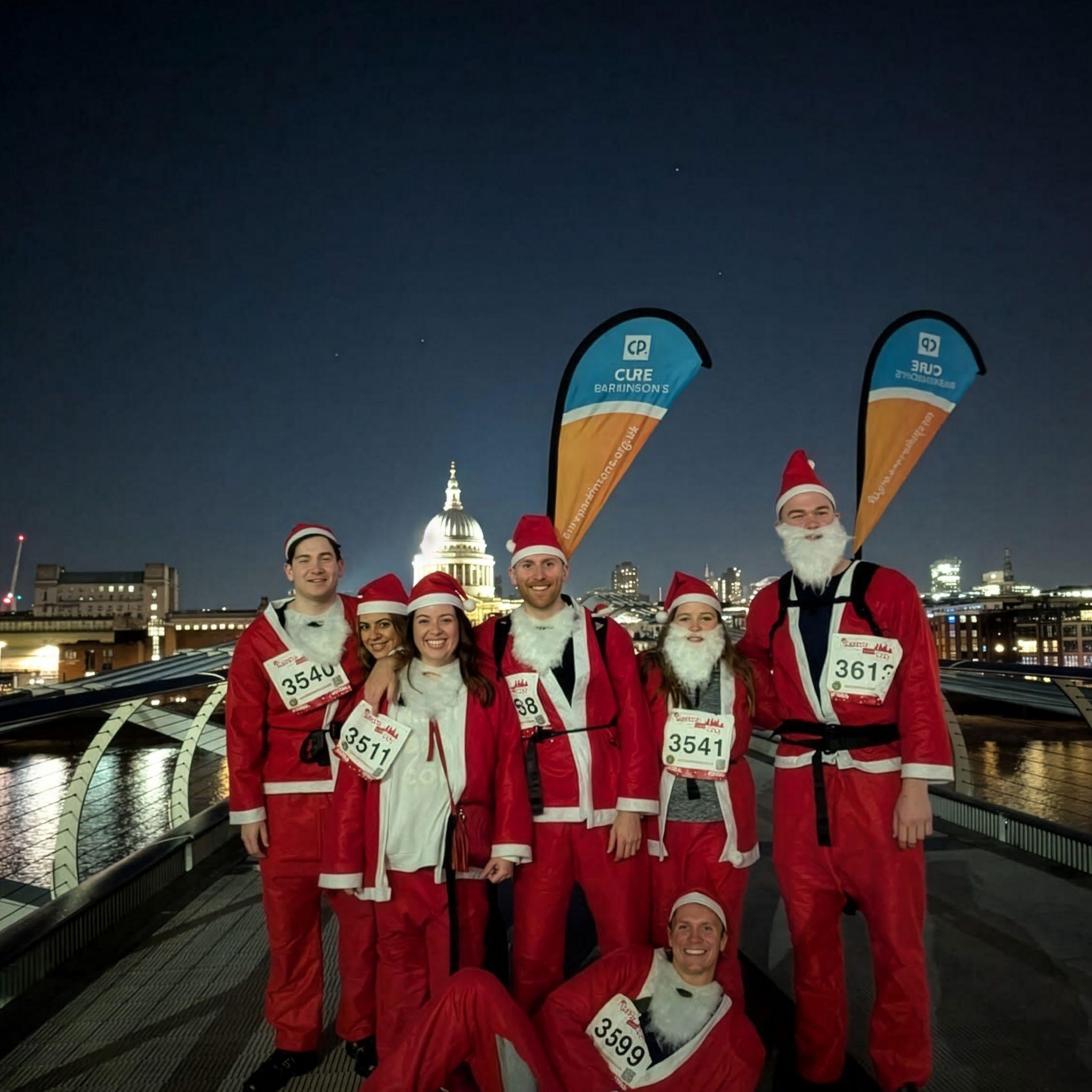
“He who is not everyday conquering some fear has not learned the secret of life.”
Ralph Waldo Emerson
by Marissa Harpa
This last year we were proud to support Cure Parkinson’s as our Charity of the Year. A pioneering charity with a clear mission to find treatments that slow, stop and reverse Parkinson’s disease. It’s a cause that is not only incredibly important - with 166,000 people living with the condition in the UK alone - but it was also deeply personal and close to home for our team.

One of the charity’s founders, Tom Isaacs, was a good school friend of Mike Hodges. Tom was diagnosed with Parkinson’s at the age of 26 and went on to become a tireless campaigner, author and advocate for change. Despite living with the condition for many years, Tom dedicated his life to pushing for faster, more ambitious research. His determination and courage continue to inspire the work of the charity today. In Tom’s memory, Mike has taken part in an annual golf tournament for many years, helping to raise vital funds and keep Tom’s vision and legacy alive.
During the year, our team took part in fundraising activities to support the charity. The first event in October, saw Ali and Oly complete
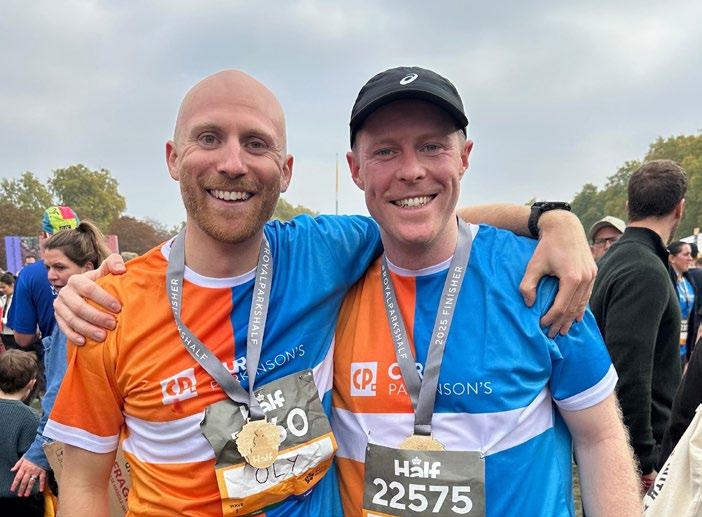
the Royal Parks Half Marathon. They both completed their runs in impressive times. While in December, the team embraced the festive spirit by taking part in the Santa in the City fun run. As it says on the tin, we were dressed headto-toe in Santa suits (beards and all), winding our way through the streets of London and across the landmark Millenium Bridge. It was a brilliant, feel-good evening and one we won’t forget anytime soon. Thanks to these great efforts, we met our target of £5,000 for Cure Parkinson’s!
We would like to say a huge thank you to everyone who donated so generously and helped us reach our goal.
Alongside our Charity of the Year, we’re also pleased to have been able
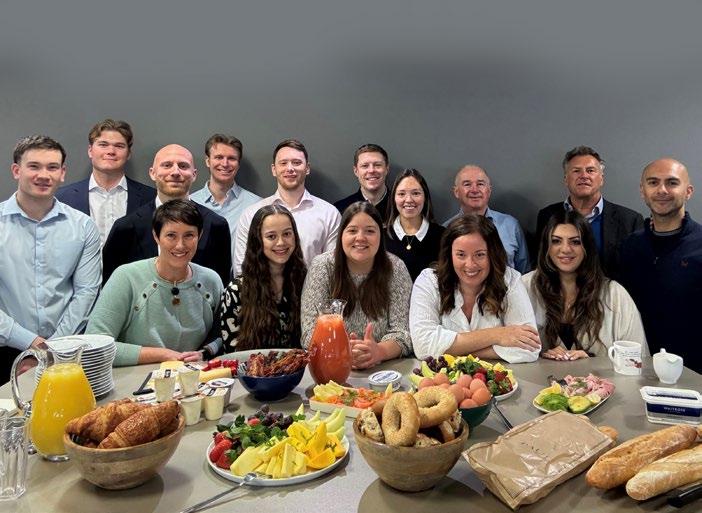
to support other charitable initiatives - our own and those of our clients. In what has become an annual event in our office – the team partook in another delicious Great Big Breakfast in aid of Magic Breakfast. This is another very worthwhile charity which ensures children start their school day on a full tummy. The rules are simple for this one, the team need to arrive early and hungry, and no donation, no brekkie!
Thank you once again to everyone who has supported, donated and cheered us on throughout the year. Every contribution has helped to fund vital, life changing research, while bringing Cure Parkinson’s one step closer to making a lasting difference.
You are reading a carbon neutral magazine!
The materials used in this magazine are FSC ® certified and from sustainable resources. It has been printed using 100% offshore wind electricity sourced from UK wind.
100% of the inks used are vegetable oil based, 95% of press chemicals are recycled for further use and on average, 99% of any waste associated with this production will be recycled and the remaining 1% used to generate energy.
The paper mill and printer are both registered with the Forestry Stewardship Council (FSC) ® and the printer, Park Communications is a carbon negative organisation.
As with the previous edition, we have offset the Club’s carbon emissions through the Clean Oceans Plastic Bank initiative, a recognised carbon offset project. This organisation helps impoverished communities worldwide by paying them to collect plastic, which can be exchanged for essentials such as food, clean water, tuition, first aid kits, healthcare, and portable solar power banks. This helps prevent plastic waste from reaching our oceans, contributing in a small way to the protection of life’s vital resources and marine life.
“Of all the liars in the world, sometimes the worst are our own fears.”
Rudyard Kipling
“I learned that courage was not the absence of fear, but the triumph over it. The brave man is not he who does not feel afraid, but he who conquers that fear.”
