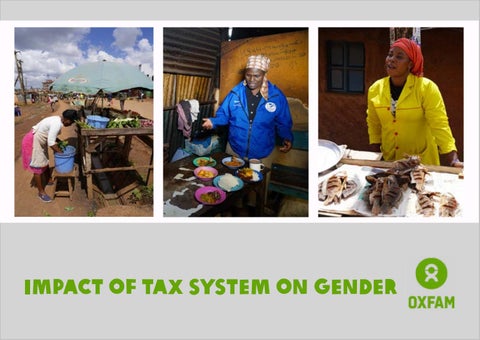
impact of tax system on gender
Reducing tax burden for women small-scale traders. The informal sector in Kenya plays a significant role in the economy and is said to account for close to 50% of GDP. It is estimated that the informal sector in Kenya is about 30% and accounts for 82.8% of persons engaged in 2015 (Economic Survey, 2016). Informal sector includes small scale activities of small businesses such as hawkers, retailers, boda boda riders and other service providers. It is estimated that 66% of workers in the informal sector are women and are engaged in trade (WIEGO, 2011). The Government of Kenya has been seeking ways to broaden the tax base and consequently net in those operating in the informal economy. However, there are still certain taxes such as the VAT that are applicable to all. With the devolved system of Government in Kenya, County Governments have also been seeking ways to enhance and broaden their revenue base by levying certain types of taxes many of which have an impact on small businesses in the counties.
Oxfam has recently concluded an evaluation in Nairobi County seeking to understand impact of these taxes on men and women in the informal sector. the study found that: 1.There is a major disconnect between the informal small-scale traders (ISST) in Kenya and the Nairobi City County Government. First, the ISST do not know their full tax obligations to the County Government, and in cases when they are aware, they do not believe the services being provided are value for money, this is supported by the fact that they do not receive mandatory services such as market cleaning, toilet. Water, security and lighting services, which are mandatory according to the urban areas and cities, act of 2012.
2.There is a section of traders, who neither fall in the category of small business or sole proprietors, this group of small scale traders, some rent stalls while others operate as hawkers just outside the market and on the roads. This group should be considered as key players in the informal market, they are not catered for in any law, and neither are they even included in the fee schedule for services by the Nairobi City County. Any development partner who is interested in developing the informal economy should focus on this group. 3.There is lack of information and knowledge on the rules and regulations that govern trading in Nairobi, particularly for the ISST, this has resulted in them being taken advantage of by the City Council Askaris. When ISSTs in the FGDs were asked if they were aware of the regulations relating to NCCG by-laws, the common answer was “I don’t know�.
4.The tax burden on the ISST based on the fees levied is very low, however, the inability of the ISST to meet their obligation by paying for licenses subjects them to harassment by the NCCG officials. It is however important for the NCCG to provide a proper classification of these groups i.e. the ISST. 5.The sex- disaggregated data on tax burden and tax incidence analysis shows that there is almost parity in terms of the tax burdens for both male and female ISST, even though there is a larger proportion of male ISSTs as compared to the females and at the same time, males and females.
“
Coletta Nyairebu Small-scale trader Kibera
“
“
Sometimes, the County officials come to collect money when I have not sold anything then take my fish away. At times,when I hear they are around, I close the shop and wait for them to leave before resuming work.
“
Two years ago,we paid tax worth 50 KES three times a week. One trader was left to borrow money from friends to avoid them from carrying your items.
“
Rebecca Ndeto Small-scale trader Kibera
Martha Kemunto
“
We don’t have toilets, electricity and security lights in this area, something that is a big issue for us.
“
“
“We don’t have toilets, electricitySmall-scale and security trader lights in this area, Kibera something that is a big issue for us.”
The Atrium, Chaka Road, Kilimani, Nairobi, Kenya P.O. box 40680, 00100 (GPO) Nairobi Telephone: +254 (0) 20 2820000 Mobile number: +254 722 200417 Email: kenyainfo@oxfam.org.uk
Photo credits: Š2018 Eyeris Communications