As long as they’re here taking care of us, we’ll be here taking care of them. We’re Civic, a modern financial partner for today’s local government community. Learn more at civicfcu.org.
(ISSN
3400 Sumner Blvd., Raleigh, NC 27616-2950
Scott Gates, CCC Editor
Renee C. Gannon, CCC Senior Associate Editor
Rue Reynold Editorial Assistant
Jessica Armstrong Graphic Designer
Tara Verna Creative Services Associate
Donna Natosi Digital Strategist
Dan Tomkiewicz Advertising Dan@carolinacountry.com
Joseph P. Brannan Executive Vice President & CEO
Kristie Aldridge, CCC
Senior Vice President & COO
Warren Kessler Director of Brand Strategy
North Carolina’s electric cooperatives provide reliable, safe and affordable electric service to 1 million homes and businesses. The 26 electric cooperatives are each member-owned, notfor-profit and overseen by a board of directors elected by the membership.
Why Do We Send You Carolina Country Magazine?
Your cooperative sends you Carolina Country as a convenient, economical way to share with its members information about services, director elections, meetings and management decisions. The magazine also carries legal notices that otherwise would be published in other media at greater cost.
Your co-op’s board of directors authorizes a subscription to Carolina Country on behalf of the membership at a cost of less than $6 per year.
Subscriptions: Individual subscriptions, $12 per year. Schools, libraries, $6.
Carolina Country is available on digital cartridge as a courtesy of volunteer services at the NC Department of Cultural Resources, Library for the Blind and Physically Handicapped, Raleigh, NC 888-388-2460.
Periodicals postage paid at Raleigh, NC, and additional mailing offices. Editorial offices: 3400 Sumner Blvd., Raleigh, NC 27616-2950. Carolina Country® is a registered trademark of the North Carolina Association of Electric Cooperatives, Inc.
POSTMASTER: Send all UAA to CFS. (See DMM 707.4.12.5); NON-POSTAL AND MILITARY FACILITIES: Send address corrections to Carolina Country, 3400 Sumner Blvd., Raleigh, NC 27616-2950.
Change of address: Please contact your electric co-op or go online to carolinacountry.com/address
Experiencing a power outage?
Please contact your electric co-op directly to ensure prompt service. Visit carolinacountry.com/co-ops to find yours online.
Strength Through Glass
A veteran’s journey toward healing
As Western North Carolina-based artist Kristen Muñoz sifted through rubble left by Hurricane Helene, she saw an opportunity to engage local students with art — and forgiveness. Read more on page 12. Photo by Oscar Molina. 10
From the
Fragments
Students create glass art to cope after Hurricane Helene
How Black Stories Shape American History
Honoring Black contributions to culture, science and political change
Our “I Remember” section is an ongoing reader favorite. Send us cherished memories and photos for a chance to see them in a future issue. Learn more on page 27.
From Our Readers
Lineworkers in Action
Thank you so much for publishing the 1995 article about my Aunt Elizabeth Bryant in the new edition of your magazine. This is a perfect story to begin the New Year — our Union Power linemen are wonderful — always ready to help even when it is a unique situation!
Edwina Eubanks, Monroe
A member of Union Power Cooperative
Editor’s note: Thank you for your suggestion, Edwina! For those of you who missed it, you can find the article at carolinacountry.com/an-angel-and-theowls, along with related stories about lineworkers in action.
EV Considerations
Another consideration for EV ownership (“EV Ownership Benefits,” January 2026, page 15) is the NC Division of Motor Vehicles’ vehicle registration/renewal costs for electric and certain hybrid vehicles.
Jack Whitehead, Belhaven, a member of Tideland EMC
Editor’s note: Good point, Jack. Upon their annual registration renewal, EV owners are required to pay a fee of $214.50 in addition to their vehicle registration fee (drivers of plug-in hybrid vehicles pay a lesser fee of $107), fees that have increased since the state introduced them in January 2024 to recoup lost gas-tax revenue.
Correction to our January Issue
In trying to fit as many photo contest winners as possible, “Magical, Practical Marigolds” by Janis Harless (page 18) was subjected to an unfortunate crop. Here’s the full photo, and all winning entries can be found at carolinacountry.com in full form.
THIS MONTH: Art With Meaning
As I’ve experienced while helping my young children navigate a crowded gift shop, glass art is often seen as fragile — as delicate as it is beautiful. But in this issue, we’re sharing two stories about glass art as a source of strength — in one case helping veterans heal, in another helping students process losses from Hurricane Helene. Also, throughout this year we’re excited to be sharing stories that highlight North Carolina’s unique contributions to American history in recognizing our 250th anniversary. Watch for the America 250 logo tagging related content in this and future issues.
—Scott Gates, editor
Carolina SNAPSHOTS
THEME
So Sweet
A Kayla Fahey, Fayetteville
A member of Lumbee River EMC
B Jeanne Kitchin, Dunn
A member of South River EMC
C Adahlae Simmons, Albemarle
A member of Albemarle EMC
Submit your photo!
April theme: First Car (Deadline Feb. 20)
May theme: Flowers (Deadline March 20)
June theme: Insects (Deadline April 20)
Send us your best shots based on an upcoming theme — we’ll pay $25 for those published. Submit high resolution digital photos and find full terms and conditions at carolinacountry.com/snapshots (no emails, please). We retain reprint and online rights for all submissions.
Building on a History of Safety
By Becky Alston
North Carolina’s electric cooperatives have a long history of training employees to work safely in their communities on behalf of their members. In fact, what has now grown to be a family of organizations serving electric co-ops across the state started with a job training and safety program in 1943. In those early days of rural electrification, it was recognized that safety had to be made a priority, and it had to be taught in a mindful, consistent way.
NC LINEWORKERS EARN ASSOCIATE DEGREES
In 2025, two NC co-op lineworkers earned associate degrees in Electric Line Construction Technology from Nash Community College. Twenty-seven co-op lineworkers have gone on to earn associate degrees since the program began.
That dedication to safety has evolved to today’s comprehensive, sophisticated approach spearheaded by North Carolina’s Electric Cooperative’s Job Training & Safety (JT&S) team. Our team works closely with each electric co-op to provide training that enhances and builds the skills of lineworkers across the state. The training is taught by a diverse group of instructors, including experienced lineworkers, engineers, operations personnel, outside vendors who specialize in specific equipment and tools, and members of the JT&S team. These instructors ensure instruction is consistent and relevant to the current, real-world field operations. There are 29 schools scheduled for 2026, with capacity for roughly 645 seats.
Emerging technologies have been incorporated into training at the schools
to enhance hands-on learning. A Timpson training unit allows portions of the training yard to be energized, giving workers the opportunity to train in real-world scenarios (“New Lineworker Training Unit Creates Realistic Experience,” August 2022). This unit is currently used during the overhead line construction (bucket) classes and a workshop on effective cover-up, where lineworkers learn how to insulate energized components in their work area. The Timpson unit may also soon be used on the underground training field.
The JT&S team also partners with Nash Community College to provide lineworkers with the opportunity to further their education by pursuing an associate degree in Electric Lineman Technology. In addition to completing the required JT&S training schools, participants must complete additional coursework either online or in person (see sidebar).
A training guide developed by JT&S for the cooperatives is registered with the North Carolina Community College System and creates a road map of progression and minimum training standards to create consistency across the state. Upon completing 8,000 hours of on-the-job training, required schooling and task completion, the lineworker will receive a journeyman designation that is recognized not only by the state of North Carolina, but nationally.
Your electric cooperatives take training seriously, diligently investing in the people who serve you. With a skilled workforce, we can be confident in maintaining the reliability and quality of service you expect, while equipping lineworkers with the know-how needed to come home safe.
Becky Alston is director of Job Training & Safety Field Services for North Carolina’s Electric Cooperatives.
Jones-Onslow EMC
Timmy Hall Tideland EMC Adam Fyle
Geothermal. It’s easier than ever to score big with the nation’s best incentives.
WaterFurnace geothermal units use the stored energy in your backyard to provide luxurious comfort and dramatic savings on heating, cooling, and hot water. They’re 2x more efficient and last 40% longer (25yrs with geo vs 18yrs with ordinary) than any other HVAC system. Plus, many state, local, and utility programs offer incentives to lower installation costs. It’s never been easier to switch!
Visit waterfurnace.com to learn how to turn “Too Good To Be True” into “True.”
Ready to get started? Scan the QR to connect with your Geothermal Concierge today!
February Quick Hits
Wear Red
Red isn’t just for Valentine’s Day. National Wear Red Day is Feb. 6, spreading awareness of women’s cardiovascular health. Learn more at goredforwomen.org
Heart Healthy
February is American Heart Month—know your blood pressure, cholesterol and blood sugar levels, and see your doctor regularly.
Kitchen Safety
Burn Awareness Week is Feb. 1–7. Stay in the kitchen when using the stove, and never use water on a kitchen fire. Find more tips at ameriburn.org
(Local) Groundhog Day
Did you know we have our own official groundhog in NC? Watch for Snerd’s prediction out of Garner on Feb. 2.
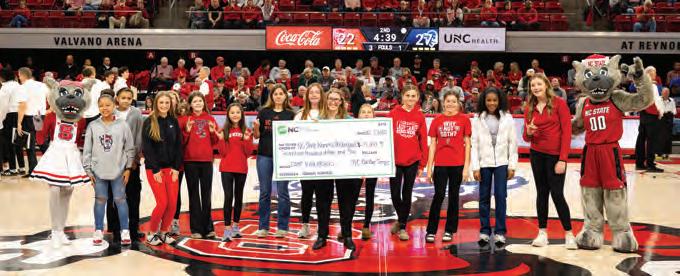
Co-op basketball Camp Scholarship
Winners recognized on the Court
Walking onto the hardwood of a college arena, surrounded by bright lights and a buzzing crowd, is an unforgettable experience for any young athlete.
For a group of North Carolina middle schoolers, that experience came to life at Reynolds Coliseum, the same court where they spent time last summer practicing and playing alongside the Wolfpack women’s basketball team.
On Dec. 7, these sports camp scholarship winners — selected by North Carolina’s electric cooperatives to attend the NC State women’s basketball camp this past summer — came together for a reunion and a moment of recognition.
“My daughter’s experience at the NC State women’s basketball camp was amazing,” said Amy Augustine, parent of a 2025 camp scholarship winner. “It really opened her eyes to what life after high school could be and gave her an
even bigger goal to reach for.”
For 23 years, North Carolina’s 26 not-for-profit electric cooperatives have awarded scholarships to young women to attend the Wolfpack women’s basketball camp. North Carolina’s electric cooperatives also partner with the UNC men’s basketball team to send middle school students to their annual Carolina Basketball School each summer.
“We are very grateful that our local electric co-op provides an experience like this for kids in our area, especially for girls. It is very hard to find basketball camps here,” Augustine said. “Camps like this help build skills and show our kids that if they work hard, they can continue to grow.”
Applications for both basketball camps are open from Jan. 1 to March 31. Visit NCElectricCooperatives.com/ All-Stars to learn more and apply.
—Josh Conner, North Carolina’s Electric Cooperatives
North Carolina’s Electric Cooperatives Announces
New CEO
Amadou Fall will succeed Joe Brannan upon his retirement in April
North Carolina’s Electric Cooperatives, the family of three organizations that serves the state’s network of 26 electric distribution cooperatives, has named Amadou Fall as its new executive vice president and CEO, effective April 8, 2026. Fall has served as chief operating officer of the cooperatives’ generation and transmission organization, North Carolina Electric Membership Corporation (NCEMC) since January of 2021.
Fall will succeed Joe Brannan, who has led all three organizations since May of 2012.
“North Carolina’s electric cooperatives have benefited from strong leadership under Joe Brannan for almost 14 years,” said Susan Flythe, NCEMC board president and EVP and general manager for Cape Hatteras Electric Cooperative. “It was important to the search committee that our next leader build on the successes of the last decade, and after a comprehensive, national search, we have found that leader in Amadou Fall. Amadou was selected for the vision, experience and collaborative leadership style he brings to the state’s electric cooperatives during a time of unprecedented industry change.”
Throughout his career, Fall has led complex energy projects, spanning generation planning to the implementation of distributed energy resources. Since joining North Carolina’s Electric Cooperatives, Fall has overseen
ELECTRICITY 101
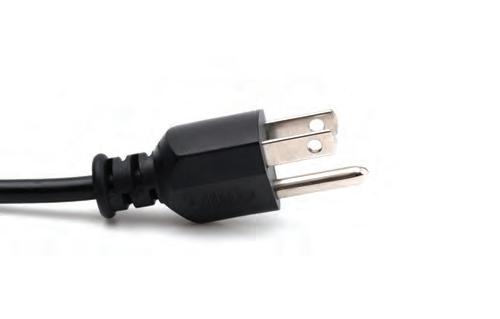
Q: What is the third prong of a plug for?
A: Murphy should know better — modifying an electrical plug is never a good idea (see opposite page). In the United States, standard 120-volt plugs have either two or three prongs. Larger appliances or those with metal casings have a third "ground" prong, which is important for ensuring safe operation of the device in the case of an electrical fault,
NCEMC’s power portfolio, advanced the deployment of distributed energy resources and guided NCEMC’s capabilities as a distribution operator, coordinating and managing more than 600 MWs of distributed energy resources across electric cooperative distribution systems.
“North Carolina co-ops are national leaders in energy innovation, reliability and affordability because they put the needs of people and the communities they serve first,” Fall said. “I look forward to continuing to work with each of the state’s 26 electric cooperatives and our exceptional team of employees, leading together through industry changes on our path to a brighter future.”
Prior to joining North Carolina’s Electric Cooperatives as COO, Fall was CEO of the National Renewables Cooperative Organization, a role he held after his time in leadership roles with ACES Power, where he managed regulatory, scheduling and transmission services for the portfolios of ACES members and customers. He has extensive experience in diverse energy portfolio management, risk management, transmission modeling and congestion analysis and renewable energy.
Brannan, who has served member cooperatives and their communities through various roles for more than two decades, will continue in his role and support an effective transition until his previously announced April retirement.
according to the U.S. Department of Energy. The third prong provides a safe path for stray electricity to reach the ground.
As for the other prongs, one vertical prong is electrically “hot;” the other prong is neutral. When a device is plugged into an outlet and switched on, an electrical current will flow between the prongs, completing a circuit and powering the device.
Joe Brannan
Amadou Fall
From the Classroom to Co-op Colleagues
Two NC co-op employees share a bond that shaped their futures
Rooted in the communities they serve, North Carolina’s electric cooperatives are built on relationships — neighbors serving neighbors and building stronger communities.
For two cooperative employees, that idea of connection is deeply personal. Long before they both found careers at their local electric co-ops, Conni Tucker and Jacob Puckett shared a classroom — not as colleagues, but as teacher and student. Tucker once taught Puckett high school English, years before the two would reunite as storytellers serving their communities in communications roles.
Tucker previously worked for the N.C. Department of Commerce and Wake County Economic Development in marketing and research. A move to Mount Airy, however, presented a new opportunity when she was asked about stepping into a teaching role. Teaching high schoolers wasn’t part of her original plan, but it became a meaningful chapter in her career.
“It was a great job and a great place to be,” Tucker said. “It gave me the opportunity to teach so many great students, and it gave me the privilege of teaching Jacob.”
That connection extended beyond a single school year. Tucker taught Puckett for three years, an experience that left a lasting impression.
“Conni was one of my favorite teachers of all time,” Puckett said. “That wasn’t just my opinion. It was shared by many students who had her as a teacher. The way I began learning how to write took root in her classroom, and a big part of why I pursued a career in communications is because of Conni.”
After graduating from Appalachian State University, Puckett’s path led him to Blue Ridge Energy, where he began putting the communications skills he first developed in Tucker’s classroom to work.
Years later, a familiar name and face caught his eye while scrolling through social media — this time, in a cooperative hard hat.
“I saw a hard hat and a bucket truck and thought, ‘There’s no way, it’s too small of a world,’” Puckett said. “So I did what anyone would do and went to LinkedIn. When I saw the update that she was working at an electric cooperative, I reached out and gave her the co-op welcome.”
Tucker joined Central Electric as a communications specialist, blending her experience in economic development, community engagement and teaching into a career change that allowed her to connect with members and tell the cooperative’s story.
Having a familiar face in the industry made that transition both easier and more meaningful.
“I’m just so proud of Jacob and the work he’s doing at Blue Ridge and in his community,” Tucker said. “If you’ve ever been a teacher, that’s what teaching is all about, paying it forward and making the world a better place through the students you teach. It’s not what you do; it’s what you empower them to do.”
Now, as colleagues on their respective communications teams, they share a common goal: connecting with members and highlighting the work happening in the communities they serve.
“I grew up in a cooperative household. My dad has worked at Surry-Yadkin EMC for nearly 40 years, and I knew just how impactful co-ops are in their communities,” Puckett said. “I love this job because I get to do that every single day—sharing the stories of people who are really making a difference.”
—Josh Conner, North Carolina’s Electric Cooperatives
Long before they both found careers at their local electric co-ops, Conni Tucker and Jacob Puckett shared a classroom — not as colleagues, but as teacher and student.
Easy to use.
Jitterbug® phones feature large screens with clear text, simple menus with e ortless navigation, loud speakers and dedicated Urgent Response buttons. The Jitterbug® Flip2 has big buttons and one-touch speed dial, while the Jitterbug® Smart4 comes with voice typing, video chat and internet access.
Easy to get help.
Whether you want to learn more about your new Jitterbug, need a ride concern, our 100% U.S.-based team is here to help. Add Urgent Response service for peace of mind with 24/7 help, even in emergencies.†
contracts • No cancellation fees • Keep your phone number3
Strength
through
glass
A veteran’s journey toward healing
By Vanessa Infanzon
On Thursday mornings, David Seligman, a retired captain from the U.S. Army, arrives at the North Carolina Glass Center (NCGC) in Asheville’s River Arts District by 7 a.m. to light the furnace and gather tools.
Since 2020, when David attended his first glass blowing class at the center, he’s found a supportive community and an outlet for the depression and post-traumatic stress disorder he faces each day.
“In the first few years, when I was doing this, I was in a really bad mental health place,” David says. “This provided me with a creative outlet that I truly didn’t know I needed. It’s saved me in a lot of ways.”
David grew up in Louisville, Kentucky, and enlisted in the U.S. Army Reserves in 1996 after
graduating high school. He studied natural resource conservation and management at the University of Kentucky in Lexington and graduated in 2002. In 2003, David joined the Army again, finishing three deployments to Afghanistan and Iraq before medical retirement in 2015. Soon after, he and his wife of 25 years and two children moved to south Asheville.
“I was not doing well,” he says. “Things were getting very dark for me. I had tried a couple of different things, and I just started looking at the arts.”
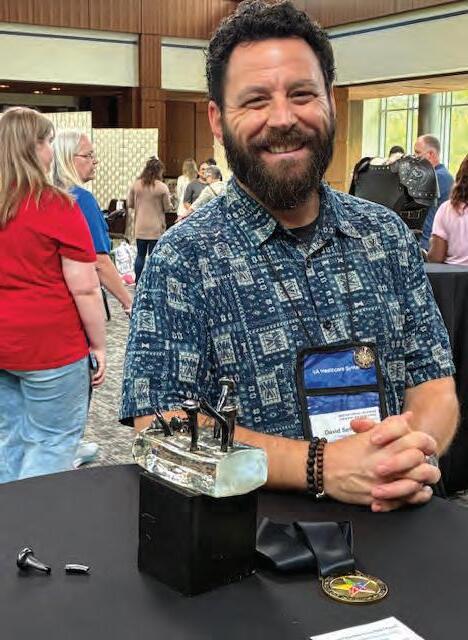
Glass artist and veteran David Seligman with his award-winning sculpture, “Hitting the Nail on the Head.”
North Carolina Glass Center
David Seligman
Healing arts
In 2020, NCGC’s six-week veterans program captured David’s attention. Unfortunately, halfway into the session, the classes were canceled due to the COVID-19 pandemic. David was hooked on glass blowing and once businesses began to open, he contacted the center to see if he could restart the veterans program.
“It’s kind of evolved since then into a weekly thing here,” David says. “Whatever I sell on the [gift shop] shelves goes to the veterans program.”
David runs the program with Joe Nicholson, a glass artist and the center’s studio manager. Veterans can coordinate with the center for free studio time.
NCGC Executive Director Candace Reilly and David are pursuing funding sources to expand the current program. They envision an eight-week healing arts program with a therapist available for the veterans. Combat trauma training, a program to process each part of a veteran’s military career from basic training to discharge, is another element they hope to include with additional resources.
Overcoming challenges
Glass art isn’t for everyone: It takes a long time to learn, and glass doesn’t always cooperate, David says. Like most newcomers, David started with a paperweight to learn how to manipulate the glass. A year of practicing yielded a cup that didn’t look like it was melting.
The studio’s heat may also be uncomfortable for veterans. For those with patience, it can be a rewarding endeavor. Glass artists are continually adjusting the speed of the work and the heat to fit the piece they’re making.
“There is a level of challenge that they want and that they’re accepting,” David says. “It takes a lot of persistence.”
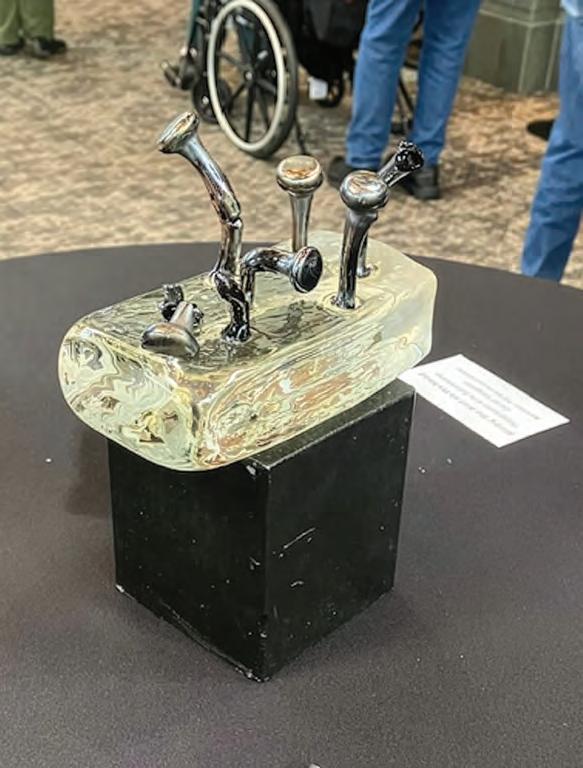
When David isn’t making cups, flowers and vases to support the veterans program, he creates award-winning conceptual sculptures. "Hitting the Nail on the Head" won first place at the National Veterans Creative Arts Festival in May 2025 at the Newfields in Indianapolis, Indiana. The two-inch by four-inch work showcases bent and straight nails, all made of glass.
“I made a conceptual piece that represents a brain injury,” he says. “I was thinking, ‘How many times can you hit a nail on the head before it breaks?’”
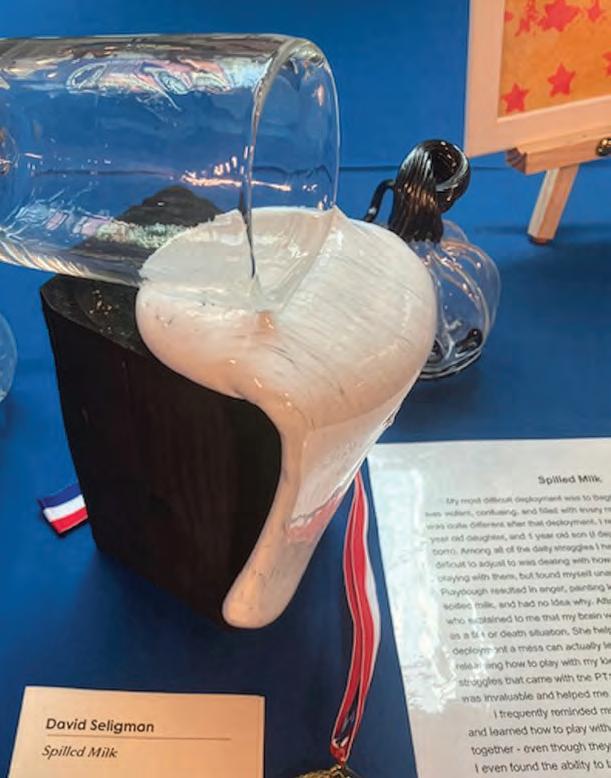
Another work, “Spilled Milk,” a cup with milk pouring out, symbolizes David’s memories of returning from deployment and being unable to handle the usual stress and mess of family life. David’s mind associated chaos with someone dying.
“After I had the awareness, I realized I was literally crying over spilled milk,” he says. “I was able to get that sadness out. It made me feel a lot better.”
Vanessa Infanzon moved to Charlotte for college and never left. When she’s not writing about business or travel, she’s paddle boarding on the Catawba River.
David Seligman
David Seligman
HEALING FROM THE FRAGMENTS
Students create glass art to cope after Hurricane Helene
By Vanessa Infanzon
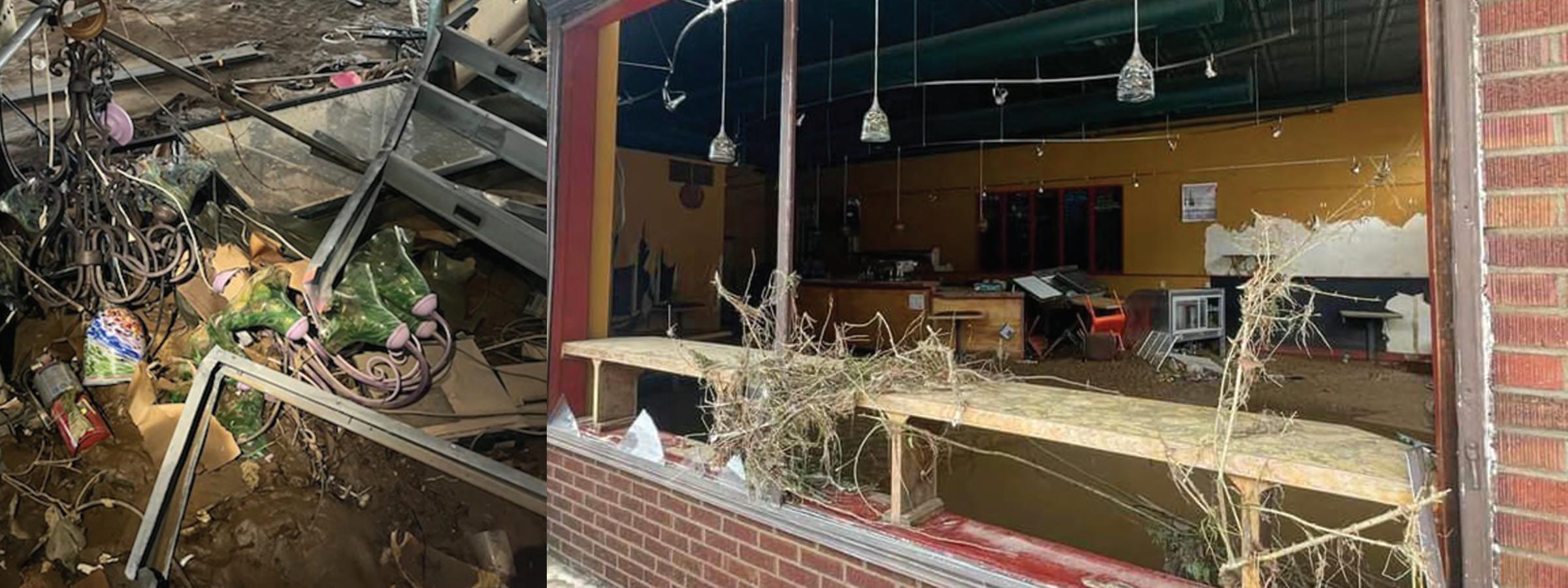
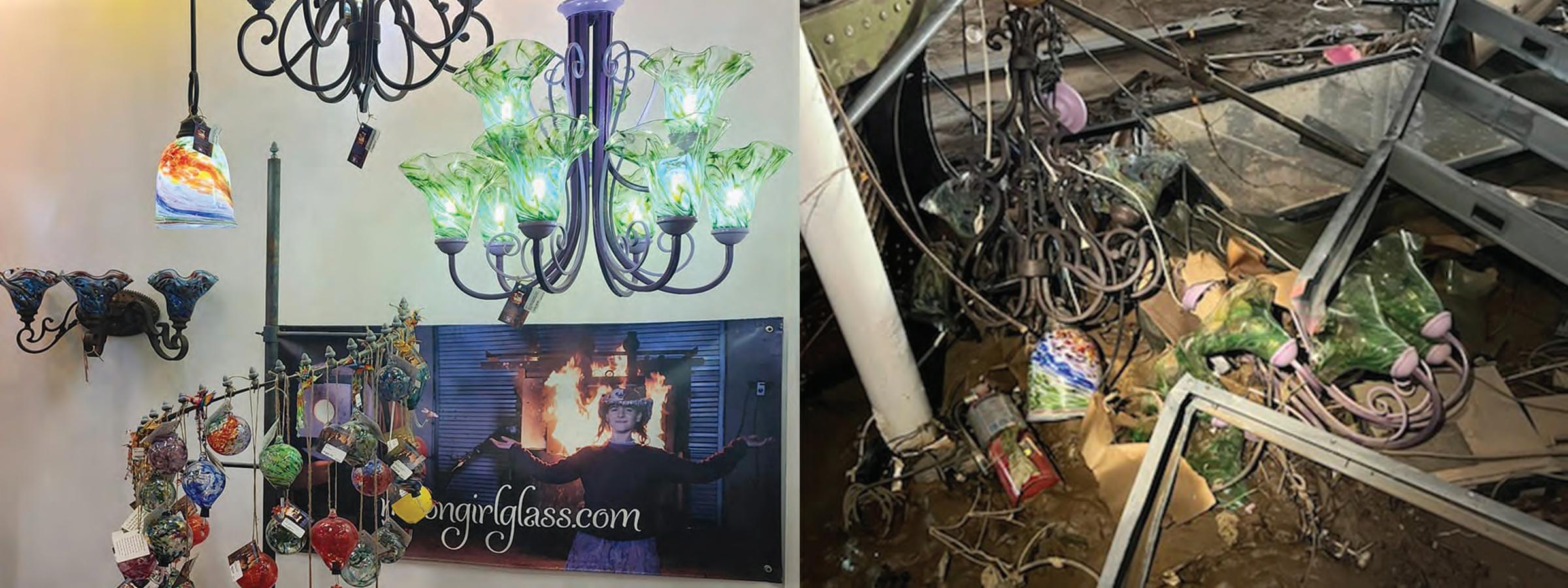
Much of Kristen Muñoz’s glass work from her business, Moon Girl Glass, was destroyed in Asheville’s River Arts District during Hurricane Helene in September 2024. She collected the broken pieces from her booth and brought them to her home studio in Marshall.
In the aftermath, Kristen, a member of French Broad EMC, checked on community members and helped to gather essential supplies for other towns. As a mom to two teenagers, she worried most about how the teens were processing the experience.
Practice of forgiveness
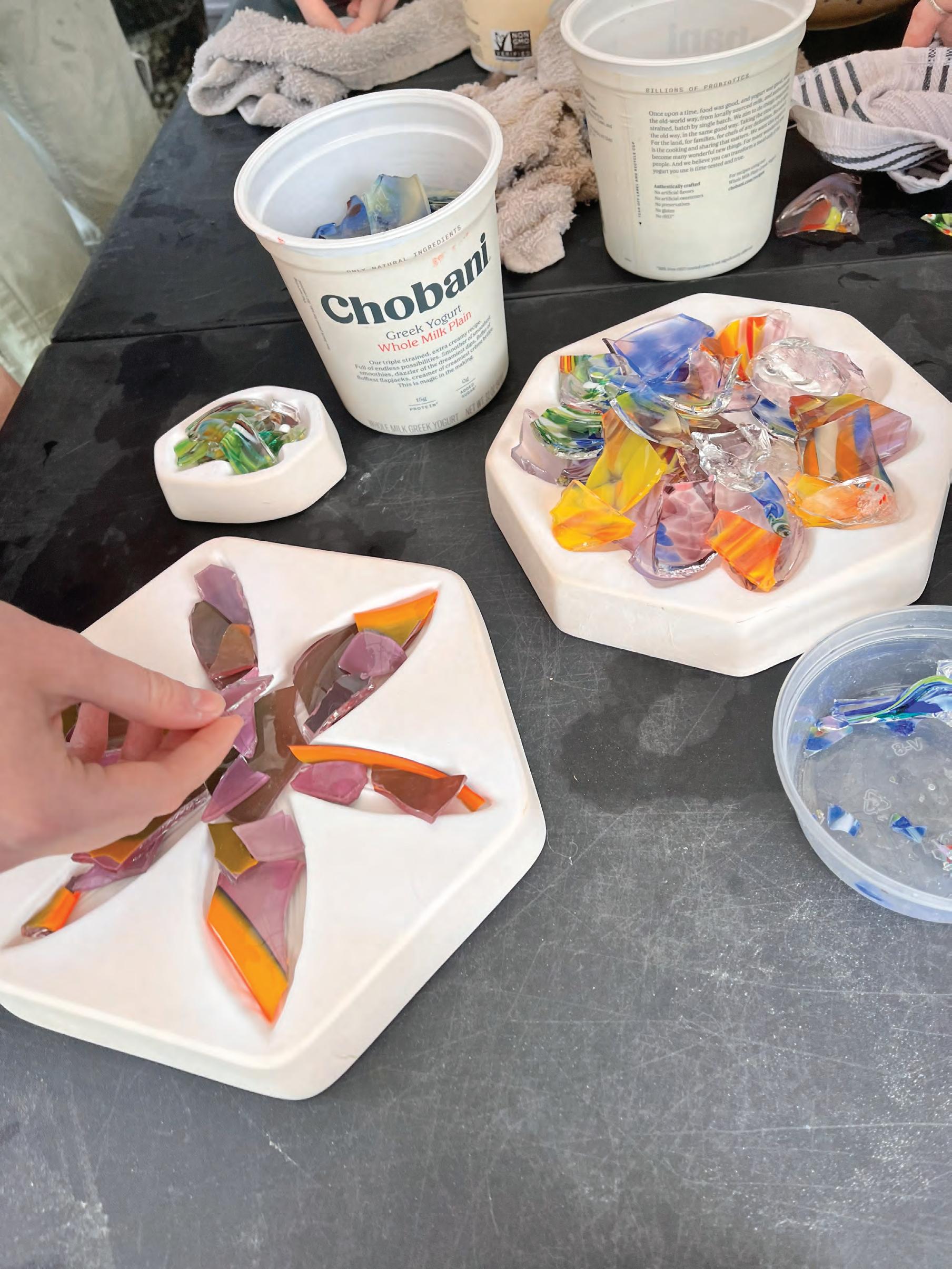
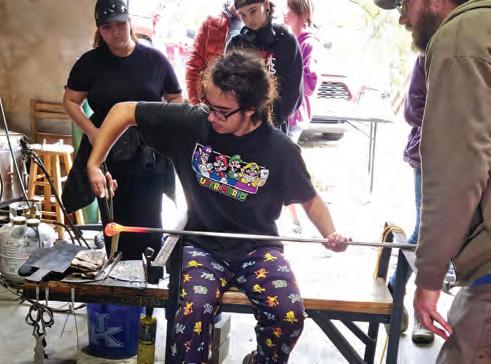
On Oct. 16, 2024, just two weeks after the storm, Kristen invited several teens to her studio to participate in a forgiveness ceremony. After smashing glass pieces, the 13 students worked with molds to make hearts. At a time when the
About the Artist
teens felt helpless, this empowered them to feel part of something, Kristen says.
Raven Anderson, Kristen’s 18-yearold daughter, recruited other teens to attend and assist with the molds and glass blowing. “The art was therapeutic, allowing people to express their emotions,” she says.
Kristen incorporated the glass making process with the Hawaiian tradition of Ho'oponopono. The four steps — smashing the glass, cleaning the glass, setting the mold and putting the creation into the kiln — were paired with these four phrases: I'm sorry, please forgive me, thank you and I love you.
“I told the teens they could use the process of breaking the already broken glass and cleaning it as a spiritual practice of forgiveness,” Kristen explains in a Facebook post. “Any past mistakes that have caused pain could be alchemized and transmuted through the act of forgiveness.”
In 1999, Kristen Muñoz started glassblowing in Austin, Texas, with a group of artists doing flamework, the technique of forming objects from rods and tubes. She became an apprentice but moved to Western North Carolina in 2000 to escape the Texas heat. Kristen took stained glass, flameworking, blacksmithing and hot glass classes at Penland School of Craft in Bakersville. She fell in love with traditional glassblowing and has been a self-employed artist, giving demonstrations, teaching classes and creating unique pieces such as bowls, chandeliers, hummingbird feeders, ornaments and pendant lights. Her studio in Marshall, Moon Girl Glass (moongirlglass.com), is on the Blue Ridge Craft Trails.
Moon Girl Glass’ booth in Asheville’s River Arts District before and after Hurricane Helene in September 2024.
Moon Girl Glass
Before after
Etched in glass
At the same time, Madison Early College High School in Marshall had been closed due to the storm, complicating teachers Erin Long and Julie Young’s plans for their project-based learning program. Each year for the past 10 years, students in the American Literature classes selected a community project to plan and execute. Although the class knew they wanted to support the arts community, with so many barriers in place after the storm, they were having trouble launching an idea.
News about Kristen’s glass project reached the teachers, and they met at the studio to discuss the possibility of the students partnering with Moon Girl Glass.
“[Kristen] talked to us about her vision of trying to help our community heal and teach the kids how to do art with glass,” says Julie, also a member of French Broad EMC.
The opportunity ignited the students: They interviewed Kristen for a podcast. They designed a website, From the Fragments: Stories in Glass (bit.ly/from-fragments) and some connected their personal narratives they wrote for class to the art they created at Kristen’s studio in March.
“When my class went to Kristen Muñoz’s studio, I was immediately drawn to the
bumblebee mold,” wrote Evyn Kinney, a student involved with the From the Fragments project, in her personal narrative. “Green is my favorite color, so I filled the body with green glass, with hints of blue. I filled the wings with multicolored glass, so it was a rainbow. I figured this was fitting as rainbows represent new beginnings, and Hurricane Helene definitely provided that for our community.”
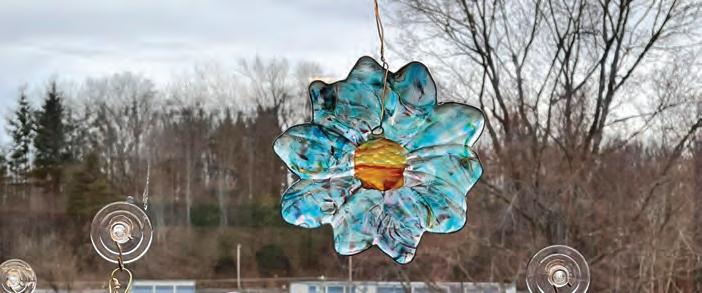
Julie envisions the next group of students continuing From the Fragments this academic year with Kristen. Younger students have already expressed interest after seeing the art hanging in the classroom windows and hearing about the field trip to the glass studio. A group of new students can market the glass, sell it and use the proceeds to fund projects focused on rebuilding the community.
“Even with all the destruction that came with the disaster, there was still beauty and strength,” Evyn says. “I am proud of all that my community has accomplished over the past several months and hope that we can get back to being the strong resilient people that we once were.”
Vanessa Infanzon moved to Charlotte for college and never left. When she’s not writing about business or travel, she’s paddle boarding on the Catawba River.
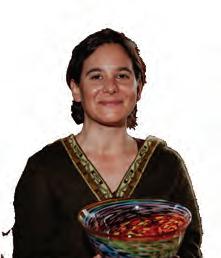
Kristen Muñoz shows teens how to express emotions via glassblowing and transforming broken glass into beautiful new creations.
Kristen Muñoz
Kristen Muñoz Moon Girl Glass Moon Girl Glass
How to Fall in Love with Your Own Company
Five ways to create a life that feels full, even when alone
By Rue Reynold
Many people grow up believing that being alone is something to avoid — an uncomfortable space that signals loneliness, rejection or lack of worth. But solitude can be one of the most empowering experiences you give yourself.
When you begin to view alone time not as something you’ve been left with, but something you choose, it shifts from emptiness to possibility. Falling in love with your own company is less about shutting out the world and more about starting a new relationship with yourself.
1
Understand your relationship with alone time
If solitude feels unsettling, there’s a reason. For some, the discomfort comes from a lifetime of distraction, such as being constantly surrounded by noise, entertainment or people. Others may associate alone time with abandonment or emotional neglect. Some simply never learned how to be alone because their lives were always busy or shared. Understanding where your unease originates is the first step. When you realize you haven’t practiced being alone — or perhaps you’ve been taught to fear being alone — the experience becomes much softer.
2 Create moments of intentional solitude
Solitude doesn’t have to mean disappearing for hours. Start with small, deliberate pockets of alone time — enjoying your morning coffee without distractions, taking a quiet walk or journaling before bed. These small rituals teach your mind that solitude is not a punishment, but a place to breathe. Over time, these gentle, intentional pauses become moments you look forward to.
3 Get curious about yourself
Falling in love with your own company means getting to know who you are outside of others’ expectations. What do you genuinely enjoy? What environments calm you?
What energizes you? Spend time exploring your interests and noticing your natural rhythms. When you treat yourself with curiosity instead of judgment, solitude becomes a source of discovery rather than discomfort.
4 Replace self-criticism with self-compassion
Many people avoid alone time because the inner voice they hear is harsh. Learning to relate to yourself with kindness is essential. Replace criticism with compassion, redirect harsh thoughts into gentle ones, and speak to yourself the way you would speak to someone you love. When your internal world becomes a kinder place, spending time there feels safe rather than intimidating.
5
Build a life that feels supportive even when solo
Create routines, spaces and hobbies that nourish you without requiring anyone else’s presence. A cozy reading nook, a favorite playlist, a hobby you love doing quietly — these small elements reinforce that your life is full even when you’re on your own. Independence doesn’t mean isolation. It means knowing you can meet your own needs with care.
Loving your own company is a lifelong, gentle practice. With purpose, curiosity and kindness, solitude shifts from something you endure to something that strengthens and supports you.
Rue Reynold is the editorial assistant for Carolina Country magazine.
Finding Magic in the In-Between
Small choices that can make daily life feel special
By Rue Reynold
It's easy to think joy lives only in big moments, such as vacations, milestones or special occasions. But most of life happens in the in-between — everyday life. Romanticizing your routine is about noticing the beauty in the ‘ordinary’ and treating it with a little more intention.
Create sensory moments
One of the easiest ways to elevate your day is through your senses. Soft music, warm lighting, a favorite scent or cozy textures can instantly shift the mood of a space. These touches don't need to be elaborate. A candle during dinner or a playlist for the morning can make an ordinary time feel curated and special.
Turn
chores into rituals
Daily tasks don't have to feel rushed or dull. Folding laundry becomes calmer with music or a podcast you love. Cleaning the kitchen feels grounding when done slowly and mindfully. By changing your mindset, chores stop being interruptions and start becoming small rituals that anchor your day.
Add playfulness and creativity
Small creative acts bring charm to routine. Leave yourself a kind note, rearrange a shelf, add seasonal touches or even doodle shapes or characters in your notebook. Joy doesn’t require perfection or extra time — just intention.
Savor
transitions
Life often moves too fast between moments. Pausing during transitions helps you feel present. Take a breath while your coffee brews. Let changing clothes mark the end of the workday. These tiny pauses create rhythm and give your day a sense of flow rather than blur.
When you romanticize your routine, ordinary days become meaningful. With small, thoughtful choices, even the most familiar routines can feel special.
Rue Reynold is the editorial assistant for Carolina Country magazine.
Member representation
Tideland EMC members are represented by directors from ten geographical districts as depicted in the map to the right. Directors are democratically elected to a three year term of service on a rotating basis.
Read more about director qualifications and the current year nominating process on page G.
Explore time-of-use
This issue of Tideland Topics primarily focuses on the introduction of our reformatted time-of-use rate, effective with the March 1 rate change. Coverage begins on page B with our chief executive officer’s message to members. Then we take a deeper dive into the rate starting on page D.
There’s a lot of food for thought. So let’s get started.
Message to members How you can plan for the unknown energy future
PAUL SPRUILL GENERAL MANAGER & CHIEF EXECUTIVE OFFICER
In the Line of Duty
Remembering Diana Cahoon
Tideland EMC retiree Diana Cahoon passed away on Jan. 2 at the age of 76 following an extended illness. Diana arrived at Tideland in 1998 when the co-op established its 24-hour corporate call center. She enjoyed engaging with Tideland members and never shied away from learning something new up until her retirement in 2011. In fact, she enjoyed several careers in her life from grocery store ownership to a home interiors business to time as a florist.
However, the role Diana loved most was that of wife and mother. She was a phenomenal cook and looked forward to annual family reunions.
Diana is survived by her husband, Joe; daughters, Natalie Cahoon Tucker (Chris) and Anita Cahoon Radcliffe (Terry); her son, Joey Cahoon (Kelly); her sisters; Janet Keech Hudson (Roger) and Kathy Keech Midyette (Al); her six cherished grandchildren; Bradley (Nicole), Bryson, Ty, Alyssa, Abbey, and Ford, along with one great grandchild; Mary Virgina.
Our thoughts and prayers are with the entire Keech-Cahoon family.
This issue of Tideland Topics features a detailed discussion about our new and improved residential time-of-use rate. Whether you decide to give the rate a try or not, it is important for every Tideland member to consider what the energy future may look like in the years ahead when making today’s buying decisions related to your home’s HVAC and water heating systems.
As we explained last month, peak energy demand has resumed a dominant role in energy prices across the nation. For decades energy demand had been relatively flat. While that did alleviate high peak demand costs Tideland faced in the 1980s and 1990s, it also resulted in generation and transmission companies flat-lining major investments in the grid.
Analysts now predict the nation’s electricity needs will double by 2050. It is important to understand that utility grid expansion has traditionally depended on multi-decade investment cycles and planning. For an industry defined by the simple flip of a switch and light being there when you need it, the reality is that both generation and grid expansion are long-term, capital intensive projects and reducing that timeline only increases construction costs. In the meantime, existing resources are subjected to the time-tested laws of supply and demand. Namely, when demand outpaces supply, along with a strained delivery system, prices rise. Operationally, there can also be service availability and reliability implications when demand outpaces supply or delivery capacity.
I want to pause for a moment and say that Tideland’s generation and transmission cooperative, NC Electric Membership Corporation (NCEMC), anticipated some measure of these changes years ago. With Tideland serving as the initial proving ground, NCEMC began construction of microgrid projects of which we are proud to host two: one at Ocracoke and the other at Rose Acre Farms. We are also doing our part to contribute to the solution through our Ecobee thermostat program and battery energy storage facilities at our Fairfield Harbour substation.
However, the rate of growth resulting from new technologically driven enterprises caught the entire electric utility industry by surprise. Consider for a moment that a single computer chip manufacturing facility is projected to need as much electricity as New Hampshire and Vermont combined. This is a nationwide challenge for the utility industry.
There are many stakeholders involved in crafting energy policy at the state, regional and federal level. Each bring to the table different perspectives, resources and priorities, as well as enforcement authority. At the bottom of that hierarchy are the nation’s 3,000 electric utilities, whether they are co-ops, municipalities or investor-owned power companies, who must design their own electric sales rate structures. One of the trends currently emerging among a handful of utilities, including two in North Carolina, is across-the-board on-peak pricing for all consumers, both residential and commercial.
Tideland did not entertain that type of rate structure during our rate review. Our preference is to incentivize an off-peak lifestyle that rewards program participants based on their individual efforts to manage energy consumption during on-peak hours. While maybe not the best analogy, we prefer carrots over sticks. We also know there may be a subset of coop members who have no feasible way to independently manage their own energy use. By making the new time-of-use rate optional we hope to avoid a one-size-fitsall approach to rates.
That being said, you should take into account this evolving energy landscape when making buying decisions related to your home’s use of electricity. Here are some strategies that will not only reduce your overall energy burden but can better position you to take advantage of time-ofday discounts.
• Avoid the purchase and installation of electric ondemand (tankless) water heaters.
• Invest in a programmable thermostat if you heat with an electric furnace or heat pump.
• When selecting a new HVAC system, consider a heat pump that does not require supplemental heat strips or provides programmable control over the operation of the heat strips. Our climate is ideally suited for inverter technology heat pumps, which don’t require supplemental heat and can be centrally ducted. Another option is a dual-fuel heat pump.
• Invest in a timer for pool and spa equipment.
• When purchasing a new dishwasher consider one that allows for wash scheduling to avoid on-peak hours.
• Retrofit any remaining incandescent lightbulbs with LEDs.
To support these recommendations, Tideland is increasing our rebates for heat pump water heaters, whole-house inverter technology heat pumps (HyperHeat/cold climate technologies) and dual-fuel heat pumps.
Beyond these initiatives, and regardless of the rate you choose to participate in, it is more important than ever that you utilize Tideland’s member portal and enroll in high energy use alerts. It is in your best interest to learn how, when and where you use power.
You may be familiar with the saying: “What can’t be measured, can’t be managed.” The member portal provides the measurements you need to then manage your energy use. On the portal you will find both your daily and hourly energy use history. (Note: if you have one of our newest meters you will actually get 15-minute data in lieu of hourly).
No two homes have the exact same energy profile. Even if you have the same floor plan as your neighbor, the “how, when and where” of your energy use pattern is unique to you and your family. The portal data can help identify your energy traffic jams but only you know if there is a manageable way to avoid them during the onpeak hours. That should be your guide when deciding whether or not our new time-of-use rate is right for you.
Regardless of rate type, high energy use alerts not only help prevent high bills they can minimize damages related to water heater leaks and illperforming HVAC systems. Please call us if we can assist you in setting up an alert.
In closing, I encourage you to stay engaged with Tideland as we navigate this changing energy environment. We’re here to help you make the energy decisions that best meet your needs.
Our shared history
Pamlico Power and Light
Did you know that Tideland traces its roots back to the eventual merger of four power companies? Three were co-ops and the fourth was an investor-owned utility. That utility was Pamlico Power and Light (PP&L), headquartered in Engelhard. It began service on June 11, 1935, which predates our own recognized service start date as a cooperative.
PP&L was owned and operated by P.D. Midgett Jr. until 1973, when ownership was transferred to Tideland. PP&L was originally called Pamlico Ice and Light because its primary business at the time was to manufacture and sell ice and provide cold storage for Hyde County’s robust commercial seafood industry. Ice was even sent from the plant to Hatteras aboard the freight boat, “Hattie E.” On June 11, 1935, the first nine customers in Engelhard received electric power. The company would eventually come to serve 2,300 customers in Hyde and Dare counties.
If you’ve always been time-of-use rate curious, but found it a bit too difficult to understand, then have we got news for you!
Starting March 1, 2026, Tideland’s time-of-use rate will be easier to understand, easier to implement and, thankfully for us at Tideland, easier to explain.
What changes have been made to the time-of-use rate?
We’ve simplified the rate with the elimination of kW demand as a billing component. It was always a difficult concept to convey and if you didn’t understand it the results could be rather punitive. Instead, the new rate will have an on-peak kilowatt hour (kWh) rate and an off-peak kWh rate. And they won’t change seasonally.
Weekends and holidays will no longer be treated as off-peak days. Why? Because we recently experienced a wholesale power billing peak outside of the typical Monday-Friday hours due to extreme temperature events. So, while unfortunate, this change is necessary. However ... (drum roll please) ...
We are reducing the on-peak hours in winter and summer by one hour each. Whereas the on-peak hours are currently 6 a.m. to 9 a.m. in winter and 4 pm to 8 pm in summer, effective March 1 the new hours will be 6 a.m. to 8 a.m. (winter), and 3 p.m. to 6 p.m. (summer). That means 90% of all
the hours in a year will be off-peak with a rate of 8.069¢. The remaining 10% of the hours will be billed at 50¢ per kWh.
The revised time-of-use rate will no longer require a special demand meter. Now any residential meter, once programmed by a Tideland EMC technician, can be utilized for the new time-of-use rate.
What is my savings potential?
Your potential to save with the new time-of-use rate will be directly tied to your individual efforts to reduce energy consumption during the on-peak hours.
To reiterate what the message to members says on page C, no two homes have the exact same energy profile. Your lifestyle, work schedule, family demands,
month), and NC sales tax (7%) Those are the same for all residential rate schedules regardless of time-of-use designation.
So the comparison begins and ends with energy costs which are all calculated on a per kWh basis.
Our standard residential rate continues to be a seasonal rate that reflects the cooperative’s higher costs when meeting summer demand in Tideland territory. The new time-of-use rate will no longer have a seasonal billing component. The only thing that will change from winter to summer are the rate’s on-peak hours: 6 a.m. to 8 a.m. in winter, and 3 p.m. to 6 p.m. in summer.
The off-peak time-of-use kWh rate of 8.069¢ is 42% lower than summer residential rates and 37%
NEW RESIDENTIAL RATE NEW TOU RATE
Basic Facilities:
Overhead: $32.00
Underground: $34.30
Energy (kWh):
Basic Facilities:
Overhead: $32.00
Underground: $34.30
Energy (kWh):
Summer (May-Oct) 13.844¢ All off-peak hours: 8.069¢
Winter (Nov-Apr) 12.746¢ All on-peak hours: 50¢
connected household equipment and opportunities to manage how and when you use electricity are unique to you. That’s why you will see us repeatedly referring you to the member portal so you can access the energy history and kWh consumption data specific to your home. So if you have not familiarized yourself with the member portal, that should be the first thing you do when you finish this article.
That said, let’s begin with a comparison of the new residential rates effective March 1. All residential rates include a basic facilities charge and all rate classes are subject to a wholesale power cost adjustment factor (a per kWh charge or credit), a NC Renewal Energy Portfolio Standards fee (30¢ per
lower than winter residential rates. With off-peak hours making up 90% of the hours in a year that provides what could be a very impressive starting point on your savings journey.
The opportunity to achieve bottom line savings with the new timeof-use rate rests entirely with the calculation of your on-peak energy costs. At 50¢ per kWh used onpeak (10% of the hours in a year), energy used during those hours will be 261% higher than the standard summer rate and 292% higher than the winter rate. Success or failure depends on your willingness and ability to drill down on that 10% of hours in the year and manage your way to savings.
Now do you see why familiarizing yourself with the portal data and your individual patterns of energy use is integrally important to your evaluation of the time-ofuse rate? If you can rein in energy use during that 10% window you could score a time-of-use win. If you go on the rate and don’t pay attention to detail, you could lose. Savings are not automatic and they aren’t guaranteed.
We can measure, but can you manage?
So the portal provides the measurements, now you have to decide if you can manage the on-peak window of energy use. Let’s start with winter patterns of behavior during the on-peak hours of 6 a.m. to 8 a.m.
If you heat with electricity you want a way to reduce system run time during those two hours. Now you could go commando and cut the heat off from 6 a.m. to 8 a.m. daily and maybe find yourself in divorce court after your spouse thaws out from the cold.
A better option might be to install a programmable thermostat and have your heat pump or electric furnace preheat your home to 71° before 6 a.m. (with 8.069¢ electricity) and then program it to lower the thermostat to 68° from 6 a.m. to 8 a.m. and resume normal operation the rest of the day. (Note: thermostat settings are in the eye of the beholder. This article focuses on degree differentials for thermostat programming purposes and not the setting itself. You do you and we won’t judge!)
Now let’s look at water heating. Fortunately, the vast majority of Tideland members have a storage tank electric water heater. With the time-of-use rate we can now treat it like a battery that has the ability to store and deliver hot water when you need it. The key is to keep it from heating replacement water during the peak hours. That can be achieved through the installation of a timer. Even if you are not on the time-of-use rate, a timer can pay for itself in year-round energy savings so you have nothing to lose by installing one. (Note: most of today’s heat pump water heaters come equipped with an integrated timer so you can take advantage of off-peak pricing)
Alternatively, you could adjust your schedule and take showers at night and schedule dishwashing and other hot water tasks during any of the 22 remaining winter hours when electricity is billed at the 8.067¢ off-peak rate. So a timer isn’t required if you can manage scheduling on your own.
That being said, this rate would be challenging for a home with a tankless electric water heater. With no storage capacity, you’d take the full brunt of the on-peak energy costs every time you turned it on during the management window. So keep that in mind when selecting a water heating system.
What other energy loads lend themselves to management strategies? Clothes drying can easily be scheduled during off-peak hours. If you have a swimming pool or hot tub a timer can ensure they
always operate off-peak. Electric vehicle owners would absolutely need to do all their charging offpeak and most charging devices or vehicle apps have integrated timing controls for that purpose.
Now we know the biscuit makers among you are going to ask about the oven. Here’s our real world advice: the time-of-use electric rate should be about balance. Sure, you can go commando to wring every last bit of savings out of this rate. Maybe that’s your thing, so own it!
However, if you want to balance savings with the things that bring comfort to your daily life, then bake those biscuits while also keeping your thermostat down, your water heater off and that load of laundry can wait for later. Or maybe those biscuits taste better at 8.069¢ a kWh and you get up a little earlier to bake. That’s the beauty of the timeof-use rate: you’re in control of your energy fate.
Next steps
Log into the member portal. Under the My Account tab, click Usage History. Scroll down to Compare Usage Data and click the blue arrow. Populate each date column so you can see your hourly/15-minute kwh consumption data. Since we’re in winter, pay close attention to your energy use between the on-peak hours of 6 a.m. and 8 a.m. Think about your schedule during those hours and what opportunities exists to shift energy use to off-peak hours.
Do the same for the summer onpeak hours of 3 p.m. to 6 p.m.
Then if you want to talk further about the rate, send an email to heidismith@tidelandemc.com and she’ll schedule a time to chat.
After that we’ll schedule meter programming, mail you some handy dandy time-of-use appliance magnets, and coordinate your rate start time.
Ready, set, save!
Give it your best shot
In the Line of Duty
North Carolina’s Electric Cooperatives is currently accepting Tideland applications for full scholarships to renowned basketball camps at two North Carolina universities this summer.
Young men can apply for a scholarship to attend the Carolina Basketball Camp at the University of North Carolina at Chapel Hill (June 27-30), and young women can apply for a spot at the Wolfpack Women’s Basketball Camp held at North Carolina State University in Raleigh (June 14-17). Please make sure your child can attend those dates before applying!
To apply, students must be a sixth or seventh grade student at the beginning of the 2026-27 school year and reside in a Tideland EMC served home. Applicants will be judged on academics, extracurricular activities and an essay.
Applications must be submitted online by March 31. To learn more, visit tidelandemc.com and follow the link to the online application. You may also reach out to program coordinator Heidi Smith at 252.944.2410 or by email: heidismith@tidelandemc.com.
Tideland closed out 2025 with $1.26 million in capital credit refunds to members
On Nov. 20, 2025, Tideland EMC’s board of directors approved a general retirement of member equity totaling $661,000 for members who had service with the cooperative in 1996. In addition to the general retirement, the cooperative refunded $603,152 to the estates of deceased members. When combined, that represents a refund of $1.26 million for fiscal year 2025.
Capital credits represent member margins that are collected through electric bill revenues and reinvested in the cooperative’s utility infrastructure. At the end of each year, Tideland’s expenses are deducted from revenue to determine the cooperative’s net operating margins.Those margins are proportionally allocated to each Tideland EMC member as capital credits based on a percentage of what each member individually paid for electricity during the calendar year.
Active account holders received a check in December if their electric account was current and their refund was $50 or more.
All other active members with 1996 service received a bill credit on their December statement.
Checks were mailed to former members for refunds of $50 or more to their last known address. That’s why it’s important to keep your mailing address current with Tideland even if you no longer have active service so we can deliver future checks.
By utilizing member capital to maintain our electric system, Tideland is able to minimize its reliance on outside lenders thus reducing borrowing costs for the entire membership. That’s why there is almost a 30-year lag between the time capital credits are allocated and ultimately retired.
The $661,000 general retirement was distributed through both checks and electric bill credits.
Another reminder: make sure your estate planning documents reference your Tideland membership so the executor can apply for any remaining capital credit funds.
We also discourage you from keeping accounts active in the names of deceased members. Any subsequent capital credit allocations will continue to accrue to the deceased member’s account if it has not been closed out.
Unclaimed capital credit are eventually forwarded to North Carolina Escheats at the State Treasurer’s office or the state of the member’s last known address. To search for unclaimed cash in North Carolina visit nccash.gov.
Director nominations underway
Annual meeting scheduled for May 14, 2026
It is once again time to nominate candidates for Tideland’s annual director elections. The nominating committee will meet in at Tideland’s Pantego office on Feb. 12 to consider candidates for districts 2, 7 and 10, which are currently represented by Mark Carawan, Garry Jordan and David Ipock, respectively. Interested candidates should contact Myra Beasley at 252-943-3046, ext. 1125 to schedule a time to speak with a nominating committee representative. The committee’s nominees will be posted at all Tideland offices on Feb. 13.
Nominations can also be made by submitting a petition signed by 50 co-op members no later than Feb. 23. The annual meeting of members will be held on May 14 at Beaufort County Community College auditorium. Member registration will begin at 6:30 p.m. The meeting start time is 7 p.m.
DIRECTOR QUALIFICATIONS
The following guidelines are excerpted from Board Policy No. 302 and Bylaw 4.02 to ensure quality representation.
Legal & Personal Requirements
1. A Tideland member & bonafide resident of the directorial district.
2. A member no less than 2 years on the date of election.
3. Willing to promote & protect the co-op’s interests.
4. Able to impartially represent the entire co-op membership.
5. Willing to regularly attend board meetings.
6. May not be a close relative of an existing director or employee.
7. Is not employed by or financially interested in a competing enterprise.
8. Was not previously employed by TEMC, any other utility/energy company, or any entity which substantially rendered services to a utility/energy company.
Aspects of Service
1. Put forth the effort to understand the co-op and provide sound judgement to reach decisions.
2. Respect official decisions made by a majority of the board.
3. Objectively evaluate questions and problems facing TEMC.
Points to Consider
1. Has the member demonstrated sound business judgement?
2. Has the member shown a capacity for leadership & a reputation for honesty & integrity?
3. Has the member shown a capacity for working well with others?
4. What problems might hinder the nominee’s success?
For more information regarding candidate nominations, director qualifications or to determine which district you reside in, call annual meeting coordinator Myra Beasley at 252-943-3046, ext. 1125
Travis Martin 276 Whitehurst Rd. Blounts Creek, NC 27814
District 7:
Donald Toler 3200 Aurora Rd. Ernul, NC 28527-9651
District 8:
Vincent Sevenski 325 Harper Rd Bayboro, NC 28515
District 9:
Buck H. Jones 35 Roland Rd Arapahoe, NC 28510
District 10:
Dennis Killette 544 Mill Pond Rd New Bern, NC 28560
Simple solutions for winter savings
Remove window air conditioning units
This will allow you to shut the window to keep heat in and the cold out. If removal is not an option, install an inexpensive shrink wrap window kit to cover the window in its entirety.
Get a flashlight and inspect your supply registers
This photo from a Tideland energy audit shows just how easily we discovered a disconnected duct. Fortunately, the solution was a zip tie and mastic paste. Inexpensive repair. Huge savings!
Close dampers when your fireplace is not in use
Beyond closing the damper, consider your overall energy strategy when using an open-hearth fireplace. Studies show a net 8% loss of your home’s heat when in use due to combustion air exchanges.
Make sure all your crawlspace vents are closed
Your floors will be much warmer this winter and your pipes better protected with your crawlspace vents closed. Be sure your crawlspace access door is securely closed as well.
In winter, dry clothes during the warmest part of the day
All that hot air being dumped outside during the drying process requires makeup air inside your home. Where does that air come from? Outdoors. And it’s unconditioned and unfiltered.
Are you sure all your windows are closed?
You would be shocked how often we find one or more windows open during energy audits. Most often the top sash isn’t fully up. So take a look around. You may be surprised!
Keep interior doors and individual registers open
Shutting them in an attempt to redirect HVAC heat/air to another part of the house restricts efficient return air flow, increases energy costs and can damage the system.
Routinely replace/clean your HVAC filters
Once a month; every two weeks if remodeling. A basic filter is recommended unless your return air is sized for pleated media.
HOME HEATING COSTS WEIGHING YOU DOWN?
Sign up for levelized billing
Levelized billing provides you with a way to guard against large fluctuations in your monthly electric bills. Program participants pay a rolling average of their previous 12 months electric use. While you can expect fluctuations in the amount due every month, the changes are minimal. If your usage is trending up the levelized amount will increase. If usage trends down the levelized amount will decrease. Levelized billing helps members with month to month budgeting while at the same time alerting members to increased kilowatt hour (kWh) consumption.
Levelized billing is a free service. Participants must keep their electric account current. Failure to pay by the due date will result in the loss of levelized billing privileges.
Members may enroll via the member portal or call 252.943.3046.
www.tidelandemc.com
BOARD OF DIRECTORS
J. Douglas Brinson, President
Clifton Paul, Vice President
Mark Carawan, Secretary
David Ipock, Treasurer
Garry Jordan, Vincent O’Neal, Dawson Pugh, Paul Sasnett, Wayne Sawyer & Charles Slade
GENERAL MANAGER & CEO
Paul Spruill
EDITOR
Heidi Jernigan Smith
Member Service
252.943.3046
24 Hour Outage Reporting & Automated Services
252.944.2400
Text OUT to 85700 to report a power outage
Tideland EMC is an equal opportunity provider & employer
Right-of-way maintenance schedule
Tideland has hired Lucas Tree Experts to trim trees in our right of way. During February they will be trimming the Long Ridge and Liverman Heights circuits out of our Plymouth substation.
Our overhead line construction contractor Lee Electrical will continue targeted pole replacements south of the Pamlico.
Score Big with Energy Savings!
Every Super Bowl MVP makes big plays—and you can too! Use the clues below to fill in the blanks and learn how you can help save energy at home by making smart, efficient plays. Double-check your work in the answer key.
1. Spend time outdoors or unplugged to reduce your _ time and save energy.
2. Turn off the ________________________ while brushing your teeth.
3. When it’s cold, wear an extra layer of ________________________ instead of turning up the thermostat.
4. Keep doors and ________________________ closed when your home’s heating/ cooling system is turned on.
5. Unplug smaller electronics like ________________________ when you’re not using them.
6. Turn off ________________________ when you leave a room.
Battery Disposal and Recycling
Know different types and how to dispose of them
By Steph Joven
Batteries are part of everyday life — from the small ones in our TV remotes and flashlights to the big ones that power electric vehicles and even energy storage systems used by electric utilities. But when batteries are disposed of the wrong way, they can leak harmful chemicals, catch fire and waste valuable materials that we need to recycle.
Globally, electronic waste (also known as “e-waste”) is one of the fastest-growing types of trash. In 2022, people worldwide threw away more than 62 billion kilograms of it. In the U.S. alone, that adds up to 21 kilograms (about 46 pounds) of e-waste per person each year. Yet only about 22% of that waste is recycled properly.
The good news: safe disposal and recycling options are available, and you can help make a difference.
Not all batteries are the same, and how you get rid of them depends on their components. Some batteries can be recycled easily, while others can be dangerous if tossed in the wrong place — they may leak toxic chemicals or even start fires. That’s why the U.S. Environmental Protection Agency (EPA) recommends following local rules or using national collection programs like Call2Recycle.org, Earth911.com or drop-off bins at hardware stores to make sure batteries are handled safely.
Single-use batteries are designed to be used once, then replaced. These include alkaline and zinc-carbon batteries — the common AA, AAA, C, D and 9-volt sizes used in remotes, flashlights and other small devices. Some areas allow these batteries to go in household trash, but recycling is always the better choice. Button or coin batteries (used in watches, hearing aids and car key fobs) are often lithium-based. These should never be thrown
away in regular trash or recycling bins, because they can spark fires. Instead, cover the battery terminals with tape or seal them in small bags, and take them to a certified recycling facility.
Rechargeable batteries power many of our everyday devices — cordless tools, phones, laptops, cameras and even scooters. Types include nickel-cadmium (Ni-Cd), lithium-ion (Li-ion), nickel-metal hydride (Ni-MH), nickel-zinc (Ni-Zn) and small sealed lead-acid batteries. While these look different, they all share one rule: never throw them in the trash. They must go to a recycling facility. For devices with built-in, non-removable batteries, recycle the entire device, making sure the battery ends are taped or bagged to prevent sparks.
Automotive and large batteries are more powerful and require special care. Lead-acid batteries, found in cars, boats, motorcycles and ATVs, contain lead and acid, which are hazardous. These should always be returned to a retailer, repair shop or a local hazardous waste program. Larger lithium-ion batteries—like those in electric vehicles (EVs) and home or utility-scale energy storage systems — are even more complex. They should only be handled by dealers, repair shops or the manufacturer. These should never be discarded in curbside waste or recycling.
Proper battery disposal is less about danger and more about opportunity. By recycling, we can recover valuable materials, reduce waste and support reliable energy systems in our communities.
Steph Joven writes on consumer and cooperative affairs for the National Rural Electric Cooperative Association.
CAN
MAKE THE BIGGEST SPLASH IN THEIR SUMMER? Only in The Northern Outer Banks Only in The Northern Outer Banks will memories be filled with Corolla Wild Horses roaming free on pristine beaches, historic maritime attractions, luxurious accommodations and abundant laidback family fun. Plan your perfect vacation!
Should I Upgrade My Appliance?
Factor in energy cost savings
By Miranda Boutelle
Buying a new appliance can feel daunting. Before you hand over your hard-earned money, here’s how to choose an appliance that will help you save money over time.
When shopping, keep in mind that not all new appliances are high efficiency, and not all old appliances are inefficient. The less efficient your current appliance, the more you will save with an upgrade. The yellow EnergyGuide label on new appliances shows the yearly energy cost, kilowatt-hour electricity use and Energy Star® logo, if certified.
Let’s look at some appliance examples to see how the costs and savings stack up.
Refrigerators
Refrigerators have seen major efficiency improvements over the years. New refrigerators use up to 73% less energy than 1970s models and about a third less than 20-year-old models.
If you purchase a new model and intend to keep your old appliance, be sure to weigh the additional energy costs. Maximize efficiency and keep your food safe by setting your refrigerator to 37 degrees and your freezer to 0 degrees.
Clothes washers and dryers
New Energy Star-certified clothes washers and dryers are also more efficient than older models. Use the Energy Star Product Finder at energystar.gov to compare products. Integrated Modified Energy Factor measures the washer’s energy efficiency. A higher number is better. Integrated Water Factor measures water efficiency. A lower number is better.
I recently bought a new washing machine when my old front-load machine died. I was considering a top-load
machine. When I compared Energy Star-certified top loaders to front loaders, I changed my mind. Energy Starcertified front loaders use about 50% less energy and water than top-load agitator washers and about 25% less energy and water than top-load impeller washers that don’t have an agitator.
Then I had to make the decision about buying the matching dryer. My dryer was functional but had features I didn’t like. The new matching Energy Star-certified dryer cost nearly $700. With an estimated savings of $46 per year, the dryer would take 15 years for the savings to cover the price. That’s a long time, and to me not worth the cost.
To improve your washer and dryer efficiency, wash in cold water, don’t over dry clothes and clean your lint trap between every load.
Televisions
Just like the light bulbs in your home, LED televisions offer increased efficiency. Energy Star-certified televisions are 34% more efficient than conventional models. If you have a working LED television, swapping to an Energy Star model is more efficient but may not make up for the cost of a new TV. Instead, check the efficiency settings on your TV or buy a smart power strip that turns off other connected devices when not in use.
Whatever appliance you are upgrading or replacing, make an informed decision by comparing the cost of operation and shopping Energy Star models to help lower your electric bill.
This column was written by Miranda Boutelle of the Efficiency Services Group. Visit CarolinaCountry.com/your-energy for more ideas on energy efficiency.
- J.P. Morgan
American culture is a rich tapestry shaped by the voices, labor, creativity and resilience of many communities, with African Americans playing a role since its very foundation from the nation’s earliest days. Black stories are woven throughout the American story itself, adding depth, rhythm and brilliance — having a profound influence on shaping our shared culture, values and progress. America’s story is still being written, and Black voices — past and present — continue to enrich, strengthen and move it forward.
Last year, Governor Josh Stein marked Black History Month with a proclamation at the North Carolina Executive Mansion.
“Black History Month serves as our reminder that progress never comes easily, but it is necessary,” he said. These words echoed the larger national message that honoring Black stories is essential to understanding the work still ahead.
Visit BlackHistoryMonth.gov, ASALH.org and AAHC.NC.gov to learn more about Black History Month and the incredible people who have and continue to contribute to the rich cultural, historical and innovative fabric of our nation.
E HOW
BY RUE REYNOLD
BLACK STORI S SHAPE AMERICAN
HISTORY
Honoring Black contributions to culture, science and political change
CULTURAL FOUNDATIONS
Much of what the world recognizes as American culture carries the imprint of ethnic creativity. Music offers one of the clearest examples. Born from Black communities in the South, blues and jazz laid the groundwork for rock, soul and popular modern music. Artists with roots in North Carolina— like Nina Simone, whose expressive blend of jazz, blues and activism helped shape 20th-century American music— illustrate how local stories can echo worldwide. Born in Tryon, Simone’s early piano talent blossomed before she became a global cultural icon. Hip-hop also emerged as a global cultural force rooted in storytelling and social commentary. Language reflects this influence as well, with expressions and rhythms shaped by the community’s speech patterns becoming part of everyday American communication. Food traditions tell a similar story. Southern cuisine, barbecue and comfort foods reflect African
roots blended with regional American ingredients. Visual art and literature— from the Harlem Renaissance in the 1920s and ’30s to contemporary works— have also helped define how America sees itself and how it is seen by the world. Figures like Maya Angelou, who made her home in Winston-Salem while writing and teaching at Wake Forest University, show how North Carolina has been a vessel for voices that shape national culture and conversation.
POLITICAL AND SOCIAL CHANGE
The Black community has driven many of the most important movements toward justice and equality in American history. Leaders like Frederick Douglass challenged the nation’s conscience during the abolitionist movement. At the same time, organizers and activists during the civil rights era pushed for laws such as the Civil Rights Act and the Voting Rights Act. These efforts were not just about addressing injustice
North Carolina's Nina Simone is among those who helped shape 20th-century American music.
Philippe Gras/Alamy
for one community— they reshaped national policy and expanded democratic ideals. Time and again, Black activism has compelled the country to move closer to the values and principles it holds.
North Carolina itself played a pivotal role in civil rights history. The Greensboro sit-ins of 1960, led by four North Carolina A&T students, including Joseph McNeil, sparked a wave of non-violent protests that helped desegregate lunch counters across the South and energized the broader civil rights movement. These student activists demonstrated how localized resistance could propel national change, showing that ordinary citizens could confront structural injustice with bravery and moral clarity.
“There are a lot of civil rights stories that must be told,” International Civil Rights Center & Museum CEO John Swaine told Carolina Country (“The Lunch Counter that Sparked a Movement,” April 2017). “But there’s so much more to do.”
North Carolina itself is home to the largest number of four-year Historically Black Colleges and Universities (HBCUs)in the nation— institutions steeped in tradition, activism and innovation that continue to educate future leaders.
INNOVATION AND INGENUITY
African Americans have shaped modern life through innovations that support everyday routines in quiet yet profound ways. Garrett Morgan improved the traffic signal, helping make roads safer and influencing systems still in use today. Marie Van Brittan Brown co-developed the first home security system, laying the foundations for modern home safety technology. Dr. Patricia Bath transformed eye care by pioneering laser cataract surgery, restoring sight to millions worldwide.
In science and technology, mathematician Katherine Johnson’s precise calculations were critical to
spaceflight navigation and helped advance satellite systems that later supported GPS technology. Gladys West co-created GPS by developing accurate mathematical models of the Earth, making the system reliable and functional.
Across many sectors, Black North Carolinians have also contributed significantly. Business leaders like John Merrick built influential institutions such as the North Carolina Mutual Life Insurance Company— one of the most successful Black-owned businesses of its time, supporting economic empowerment within Black communities.
Across agriculture, education, medicine and business, Black innovators have strengthened the nation’s infrastructure and economy. Many of these contributions are embedded in daily life, often unnoticed but essential.
‘A CENTURY OF COMMEMORATIONS’
The 2026 Black History Month theme, “A Century of Black History Commemorations,” marks 100 years since Black History became a nationally organized observance. From Dr. Carter G. Woodson’s creation of Negro History Week to the establishment of Black History Month, these commemorations have shaped how African American history is taught, preserved and understood. When schools, media and public conversations include these narratives, the American story becomes fuller and more accurate. Inclusion helps people see themselves reflected in the nation’s past and better understand how interconnected American identity truly is.
By honoring Black stories not only as history but as living, evolving contributions, we make space for future voices to shape what America becomes— ensuring that the story ahead is as rich, just and powerful as the legacy behind it.
Rue Reynold is the editorial assistant for Carolina Country magazine.
NC AFRICAN AMERICAN CULTURAL EVENTS
Jan. 30–31
AFRICAN AMERICAN CULTURAL CELEBRATION
Honoring African American history, culture, art, music & community traditions
North Carolina Museum of History, Raleigh 919-814-7000
Feb. 6, 13 & 20
BLACK HISTORY MONTH
WALKING TOURS
Guided walking tours exploring local Black history, heritage & community stories
Taylor Street Park, Wake Forest 919-435-9516
Feb. 7
BLACK HISTORY MONTH AT CHAVIS PARK
Cultural programming, history & family-friendly activities honoring Black heritage
John Chavis Community Center, Raleigh 919-996-6590
Outdoor event celebrating Black history with performances & vendors
Historic Northside of Downtown Wilmington Info@WilmingtoNColor.com
Feb. 26–28
UNC CAROLINA JAZZ FESTIVAL
Multi-day jazz celebration
Various locations, Chapel Hill 919-962-1039
Reenacting and Reaffirming Freedom
Reliving history at Moores Creek Battlefield
By Lori Grossman | Photos courtesy of the National Park Service
When we learn about the American Revolutionary War in school, we always hear about the Boston Tea Party, the Battle of Bunker Hill and Valley Forge. Most people haven’t heard of the Battle of Moores Creek Bridge, although it was the site of the first decisive Patriot victory on Feb. 27, 1776 — right in Pender County. Now, it’s remembered, commemorated and reenacted. On the 250th anniversary of the battle, Wilmington reenactor Luis Cruz plans to be at the National Battlefield to bring history to life.
“For me, it means connection; a connection to history, to the community I am visiting, to my family and to the values that shaped our country,” Luis says.
The elementary school assistant principal in New Hanover County credits his son, who is now a Marine, with inspiring him to become a reenactor.
“My son was five years old at the time,” he recalls. “We had some family friends who were in the 6th North Carolina Historical Reenactment Society and were going to the Moores Creek Battlefield reenactment. My son went along for some fun.
“When he came back, he said, ‘Dad! You got to try this. It was awesome!’ So the next year … I went. I’ve been hooked ever since.”
Luis joined the 6th NC in 2006 and went to the Moores Creek reenactment. He’s now the unit commander. It’s one of the oldest reenactment groups in the state.
“The 6th NC has been around since the Bicentennial,” Luis says. “We are a nonprofit organization based out of Charlotte. The members all hail from across the state — literally from the coast to the mountains.”
Reenactors portray anyone connected with a battle, from Patriot officers and soldiers to British Loyalist forces.
250th Anniversary of the Battle of Moores Creek Bridge Feb. 26, 10 a.m.–4 p.m.
40 Patriots Hall Dr., Currie, NC 910-283-5591 or nps.gov/mocr
You might play a fife or drum, or, if you’re portraying a Loyalist Scottish Highlander (who made their last broadsword charge during the battle), the bagpipes. Women often accompanied their husbands and carried out essential tasks such as cooking and washing clothes.
For the 250th Moores Creek Bridge reenactment, Luis will portray either Richard Caswell [commander of Patriot forces at Moores Creek] or Colonel James Moore [who maneuvered Loyalist troops into engaging with Patriots]. So the clothing Cruz wears is important. As the old saying goes, “clothes make the man.” Even the smallest details are important for an accurate portrayal.
“Because I portray an officer, I portray a gentleman,” he explains. “I’m educated. I may have land or perhaps a business. In keeping with that social status, I have to have finer clothing than the average soldier. So I’ll use a finer wool for my clothes. I’ll use silk and perhaps some printed materials. My buttons are fancier or cloth-covered. My hat also fits my status as a gentleman.”
Likewise, the kind of firearm he carries must be correct to the time, place and situation.
“I use a 1763 model French Charleville,” he says. “These were issued to the Continental Army and were favored over the British model by American soldiers.”
Luis sees his role as a reenactor as a way to serve his country and honor the resilience of past generations.
“It’s a reminder that freedom and sacrifice aren’t just words in a book; they were lived experiences,” Luis says. “Being part of that story, even in a small one-weekend-amonth kind of way, means everything.”
Freelance writer Lori Grossman currently lives in Texas but carries memories of North Carolina in her heart.
Luis Cruz (right) with fellow reenactors.
I Remember
Memories and photos from our readers
school, though. We did most of our courting on my family’s front porch swing. He could easily walk to my house in five minutes.
We were engaged in the 11th grade. He made payments on my rings with money he made driving a school bus. We graduated in May 1957 and were married in December 1957. He had a job making $45 a week. Things were much cheaper then. Our rent was $25 a month and groceries around $10 a week.
We were married for 65 years [before he passed in late 2023], and were blessed with four children, seven grandchildren and five great-grandchildren.
Elaine Brown, Pinetops
A member of Edgecombe-Martin County EMC
Flirtatious Grandma
Grandma was a notorious flirt. When I was young, our home church was in the Hopewell community of Rowland. We lived right down the road from the church and our paternal grandparents lived right next door.
When my grandparents became elderly, they didn’t go to church anymore. My Grandpa had a hearing problem and was almost deaf, and Grandma couldn’t walk well enough to get up the church steps. The men in the church (mostly) would make a point to stop by Grandma and Grandpa’s house to greet them — especially Grandma. She was an outrageous and notorious flirt! Grandpa never minded though.
One Sunday, Daddy brought the church bulletin to their house and he dropped me off. Sitting inside their screened front porch, where I had happily shelled beans and peas with Grandma, she suddenly exclaimed, “Where are my Mens?” Grandma was Lumbee Native American and that was how she pronounced it. Soon, Grandma’s “Mens” began to show up one by one, and Grandma’s gold front tooth and her beautiful smile greeted each and every one with a hug, a kiss on the cheek and a flirtatious wink. She was the happiest I’d ever seen and this remains a very precious memory.
Kathryn Ransom, Maxton, a member of Lumbee River EMC
Elmer Hunt
A Father’s Hard Work Philosophy
Recently, my brother and I found Dad’s old lineman’s belt and climbing (gaff) hooks hanging in his storage building. As I looked at the worn and faded leather, its lines spoke of a man standing on a utility pole with iron legs with hooks dug in for hours, building a new powerline. Out of this cracked leather came forth pictures of a lineman working around the clock on downed powerlines due to ice storms, hurricane damage, tornado-ridden places to restore the power grid. From excessive heat to extreme cold, the lineman labored on.
My dad, Paul Jones, went to work for Randolph Electric in the early 1950s when he was discharged from the Air Force after the Korean War, and worked for them for over 34 years. His lineman’s belt is a testimony to his hard work to provide for mom and his six children. He did whatever it took to provide for us, whether the circumstances were favorable or unfavorable. From being a lineman, to service, to running an underground crew in his later years, he did what it took.
I wish that I could tell him again, “Thanks Dad! You set forth an example of hard work and provided well.”
Allen Jones, Seagrove, a member of Randolph EMC
Send Us Your Memories We love sharing photos and memories dear to our readers. Submit your photo, plus roughly 200 words that describe it, online or by mail with a self-addressed, stamped envelope if you want it returned (only one entry per household, per month). Include your name, mailing address, phone number or email address, and the name of your electric co-op. We retain reprint rights, and we’ll pay $50 for those we publish. Online: carolinacountry.com/contact U.S. Mail: I Remember, Carolina Country, 3400 Sumner Blvd., Raleigh, NC 27616
Taming Forsythias
Which pruning technique fits your taste?
Story and photos by L.A. Jackson
Forsythia (Forsythia sp.) signals the coming spring, as its early, bright flowers herald the blissful fact that, yes, warmer weather is on the way. Also called “yellow bells,” these popular shrubs grow readily in Carolina gardens — but sometimes, perhaps too readily.
By “readily,” I mean that established plants can, depending on the cultivar, add 2 to 4 feet of new limb per year on each branch. So, if you want to prevent your forsythias from becoming bullies to nearby plants, pruning is necessary every few years. To minimize the loss of future flowers, this deed is best done right after the current bloom parade fades. But how you want them to look in your garden will determine how you prune them.
First, if your goal is to treat forsythias like boxwoods and shape them into pyramids, ’57 Chevys, or large-than-life renditions of family pets, using a hedge trimmer is the way to go.
Myself, I’m not a big fan of pruning forsythias into something they ain’t. In my humble opinion, these shrubs look best — and more natural — when they are allowed to mature into their typical flowing, cascading shapes. However, any forsythia that is allowed to grow with its flow still needs to be pruned occasionally. This is best done with hand pruners or loppers, and the instructions are simple: Just cut the longest intruding stems off at intersecting branch joints tucked away inside the bush.
If your forsythia has turned into a large, sprawling botanical beast, it can be tamed by cutting all the limbs back to about a foot from the ground. Sure, this will definitely curb its flower power for a while, but remember forsythia is a fast grower, meaning it should come roaring back in a lovely way in just a few years.
Forsythia
But if pruning has never been your favorite garden chore, minimize such maintenance by planting compact forsythias like ‘Show Off,’ a cultivar that only stretches to about 6 feet tall and wide. Ditto for ‘Sunrise.’ Want even smaller? Try ‘Gold Tide,’ or ‘Show Off Sugar Baby’ — they both grow to a modest 2 feet tall and 3 feet wide.
There are, of course, other cultivars available that restrain themselves in size, so check with your local, friendly garden center to see what they might have to offer. As an obvious alternative, try e-nurseries online.
L.A. Jackson is the former editor of Carolina Gardener Magazine. Contact L.A. at lajackson1@gmail.com
L.A.’s website of the month: Want bunches of woody ornamentals for your landscape? Have little money but plenty of patience? The Virginia Department of Forestry Seedling Store (buyvatrees.com) specializes in selling tree and shrub bare-root seedlings. Sure, the plants are small, but the prices are right.
Garden To-Do’s for February
Did you leave your ornamental grasses untrimmed so they could add visual interest to the winter garden this year? Well, now is the time to cut back such pretties as miscanthus, muhly grass, sea oats, pennisetum and pampas grass to get them ready for the new growing season. (Quick Tip: A hedge trimmer is great for the job.) Prune them to just a few inches above the ground, and if in the middle of all the snipping and clipping, you find yourself in possession of some rather attractive seed heads, bring ‘em inside for use in dried arrangements.
In the Piedmont and Coastal areas of North Carolina, it is time to wake up the veggie patch for a new planting season. Such hardy cool-season goodies as carrots, Irish potatoes, vining peas, cabbage, broccoli, collards, mustard greens, kale, lettuce and onions can be planted this month. Gardeners in the western areas of our state will probably do better holding off on getting in on such fun until March.
□ Look after your garden friends on the wing by making sure the bird bath stays free of ice, and continue to wash and refill it at least every week or two. Also, keep bird feeders stocked with seed and suet.
Miscanthus Grass
LEAVE A LEGACY
The Enduring Gift of Gold
Leave a legacy for future generations, nothing embodies this sentiment quite like the enduring gift of gold from American Gold Reserve. With its intrinsic value and historical significance, gold represents stability and prosperity across generations, making it a cherished asset to pass down. Secure your family’s future with a gift that stands the test of time, ensuringa legacy of financial security and enduring value.
•
•
safeguard during times of financial
a
American Gold Reserve is releasing Government issued $5 Gold American Eagles completely free of dealer mark-up for only $349 each. These beautiful $5 Gold American Eagles are a perfect way to enter the gold market. They are set for immediate public release and sell out fast
Homemade Butter Salt and Lemon Pepper Potato Chips
Crispy, salty and zingy with lemon pepper, these homemade chips taste like something you’d buy at a gourmet snack shop — but they’re surprisingly easy to make at home.
4 medium-large russet potatoes
4–6 cups peanut oil
(or any high-smoke-point oil)
Butter popcorn salt
Salt-free lemon pepper seasoning (we used Mrs. Dash)
Wash and peel potatoes (or don’t peel).
Using a mandolin or very sharp knife, slice very thin (¹⁄₁₆"). Soak in ice water for 30 minutes to remove excess starch. Drain and dry very well in a kitchen towel or paper towels. Dry slices = crispy chips!
From Your Kitchen
Grandma’s Caramel Cake
With caramel frosting
This recipe originally ran in our February 1990 edition. Buttery, rich and indulgent, this Southern staple with its cooked, caramelized frosting makes a fine valentine for the one you love.
½ cup butter
1 cup sugar
2 eggs
2 cups cake flour
3 teaspoons baking powder
½ teaspoon salt
1 cup milk
1 teaspoon vanilla
Frosting
2 cups brown sugar
¾ cup whipping cream
½ cup butter
1 teaspoon vanilla
½ teaspoon baking powder
Preheat oven to 375 degrees. Cream butter and sugar until light. Add the eggs one at a time, beating after each addition. Sift and add dry ingredients,
In a deep skillet or heavy pot, heat 2–3 inches of oil to 350 degrees. Gently add potatoes in small batches, moving about to keep separated. Fry until golden and crisp for 3–4 minutes.
Using a slotted spoon, remove to wire basket or onto paper towels. Shake on seasoning immediately while hot.
Can be stored up to 5 days in an airtight container.
Yield: 4–6 servings
alternating with milk and vanilla. Pour into two greased and floured 8-inch cake pans and bake for 20 minutes. Cool.
For the frosting, cook the sugar, cream and butter together in a saucepan until the mixture reaches 235–240 degrees. Remove from heat and mix in vanilla and baking powder. Cool for 20 minutes and then beat until thick enough to spread. Frost the cakes.
Yield: 10–14 slices
Instead of classic Crab Rangoon, we put the creamy filling on top of meaty North Carolina oysters and crowned them with a crispy pork and sesame crunch!
24 fresh NC oysters, shucked (we got ours from A’Nets Katch in Knightdale)
4 ounces vegetable cream cheese, softened
4 tablespoons green onion, minced and divided
1 tablespoon soy sauce
1 teaspoon Worcestershire sauce
2–3 cloves garlic, minced
1 teaspoon sugar
Salt and pepper
½ cup pork rind crumbs, crushed
1 tablespoon butter, melted
1 teaspoon Old Bay seasoning
1 tablespoon toasted sesame seeds
Rock salt
Chili crisp hot sauce
Cream together cheese, half the onion, sauces, garlic, sugar, salt and pepper until smooth.
Combine pork rind crumbs with butter, seasoning and sesame seeds.
Heat grill to high (or oven to 400 degrees). Put a layer of rock salt on a grill-safe pan. Nest oysters into the salt. Divide cream cheese mixture on top of the oysters and top generously with the crumb mixture.
Grill oysters with lid closed over high heat for 6–8 minutes until topping melts and crumbs are golden.
Garnish with remaining onion and top with a bit of chili crisp. Serve while warm.
Yield: 24 oysters
Culinary Adventurist Wendy Perry (WendyPerry.com) is a home economist, blogger and NC food artisan, unless otherwise noted.
Digital Extra
Submit your recipe online at: carolinacountry.com/myrecipe. Contributors whose recipes are published will receive $25.
Visit carolinacountry.com/recipes to search more than 1,000 recipes by name or ingredient.
Recipe by Annette Pittman of Norwood.
Grilled Oysters Rangoon With crispy pork rind and sesame crackle
February Events
JAN. 29 – FEB. 1
Ice Fest Weekend
Maggie Valley Festival Grounds
828-944-0761
JAN. 30–31
African American Cultural Celebration
North Carolina Museum of History, Raleigh | 919-814-7000
FEB. 1
The Regulatory Movement & Revolution in NC Backcountry Historical account leading up to the America Revolution
Chatham County Historical Museum 919-542-6222
FEB. 4–6
Southern Farm Show
NC State Fairgrounds, Raleigh 704-494-7544
FEB. 5–7
North Carolina Jazz Festival Hotel Ballast, Wilmington 910-399-6536
Cultural programming, history, family-friendly activities
John Chavis Community Center, Raleigh | 919-996-6590
December’s winner
FEB. 14
Beaverdam Crafters Guild
Craft Show
Every second Saturday in 2026 Beaverdam Community Center, Canton 270-872-9532
FEB. 15
Mardi Gras Parade and Queen’s Ball Downtown Asheville
FEB. 21
Black His/Her-Story Carnival
Historic Northside of Downtown Wilmington
Cupid’s Undie Run
Motorco Music Hall, Durham 800-323-7938
FEB. 21–28
First in Freedom
FEB. 7–8
Carolina Chocolate Festival
Crystal Coast Civic Center, Morehead City | 252-515-0228
FEB. 8
Melanated Small Biz Fest Venue at 8470, Charlotte
FEB. 13
“Love Your Local Small Business” Networking Event
The Dupree House, Smithfield 984-285-5877
FEB. 13–15
Bluegrass First Class Crowne Plaza Hotels & Resorts, Asheville | 828-275-8650
Various locations, Southeastern NC 910-283-5591
FEB. 26–28
UNC Carolina Jazz Festival Various locations, Chapel Hill 919-962-1039
FEB. 27–28
Boone Docs Film Festival
Appalachian Theatre of the High Country, Boone | 828-865-3000
FEB. 27–MARCH 1
The Winter Ramble Music, food, drinks Various locations, Henderson 704-466-3744
Visit carolinacountry.com/calendar for more information about each event, including links to the most current information, or to submit your own event.
where in Carolina Country is this?
Send your answer by Feb. 15, with your name, address and the name of your electric cooperative.
Online: carolinacountry.com/where
By mail: Where in Carolina Country? 3400 Sumner Blvd., Raleigh, NC 27616
Multiple entries from the same person will be disqualified. The winner, chosen at random and announced in our March issue, will receive $25.
Have a roadside gem you’d like to share? Submit a photo, plus a brief description and general location information, at carolinacountry.com/where
The December Where Is This photo by Union Power Cooperative member Bettina Vernon features a green dinosaur on Lancaster Avenue in downtown Monroe, at the appropriately named High Octane Coffee Creamery & Eatery. The coffee shop preserved the green Sinclair dinosaur mascot, “Dino,” as well as other original symbols and structures when renovating the old gas station. According to Sinclair Oil, Dino has been around since the 1930s, when a marketing campaign included different dinosaurs, with the Apatosaurus becoming the favorite. Readers noted that quite a few Sinclair Oil green dinosaurs still roam across the state. The winning entry chosen at random from all correct submissions came from Trisha Autry of Marshville, a Union Power Cooperative member.
It’s cold out there, and this time of year your home’s heating system is working overtime to keep things comfortable and warm inside. Small actions to make your home more energy efficient can lead to big savings. Your local electric cooperative is ready to show you how.
Contact your electric co-op to discover energy saving tips and tools. We’re here to help you and your family manage energy use and save, this season and all year long.