A MONTHLY NEWSLETTER FROM BLUE RIDGE ENERGY
matters MEMBERSHIP
OCTOBER 2018
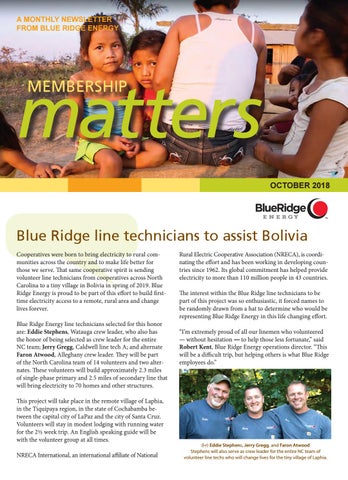
Blue Ridge line technicians to assist Bolivia Cooperatives were born to bring electricity to rural communities across the country and to make life better for those we serve. That same cooperative spirit is sending volunteer line technicians from cooperatives across North Carolina to a tiny village in Bolivia in spring of 2019. Blue Ridge Energy is proud to be part of this effort to build firsttime electricity access to a remote, rural area and change lives forever. Blue Ridge Energy line technicians selected for this honor are: Eddie Stephens, Watauga crew leader, who also has the honor of being selected as crew leader for the entire NC team; Jerry Gregg, Caldwell line tech A; and alternate Faron Atwood, Alleghany crew leader. They will be part of the North Carolina team of 14 volunteers and two alternates. These volunteers will build approximately 2.3 miles of single-phase primary and 2.5 miles of secondary line that will bring electricity to 70 homes and other structures. This project will take place in the remote village of Laphia, in the Tiquipaya region, in the state of Cochabamba between the capital city of LaPaz and the city of Santa Cruz. Volunteers will stay in modest lodging with running water for the 2½ week trip. An English speaking guide will be with the volunteer group at all times. NRECA International, an international affiliate of National
Blue Ridge-1018.indd 21
Rural Electric Cooperative Association (NRECA), is coordinating the effort and has been working in developing countries since 1962. Its global commitment has helped provide electricity to more than 110 million people in 43 countries. The interest within the Blue Ridge line technicians to be part of this project was so enthusiastic, it forced names to be randomly drawn from a hat to determine who would be representing Blue Ridge Energy in this life changing effort. “I’m extremely proud of all our linemen who volunteered — without hesitation — to help those less fortunate,” said Robert Kent, Blue Ridge Energy operations director. “This will be a difficult trip, but helping others is what Blue Ridge employees do.”
(l-r) Eddie Stephens, Jerry Gregg, and Faron Atwood Stephens will also serve as crew leader for the entire NC team of volunteer line techs who will change lives for the tiny village of Laphia.
9/10/18 12:18 PM
W
C
the
S e w b st T in se is m
perspective From Blue Ridge CEO Doug Johnson
What is grid resiliency? Resiliency of the grid is one of the most popular topics in the electric industry today. This concept made headlines in the wake of Hurricanes Irma and Maria, which caused extraordinary damage to Puerto Rico’s electric grid resulting in the longest sustained outage in U.S. history. Lack of resilience became the go-to phrase to describe Puerto Rico’s grid. Here in northwest North Carolina, what does grid resiliency mean for you? Resiliency is many things: it’s reliability in your electric service, it’s our ability to efficiently restore your power, it’s being able to meet the demands of new technology and it’s how we serve you with various generation sources without skipping a beat. Ultimately, resilience is how we deliver on our promise to improve the quality of life for our member-owners.
Power lines, substations and generation facilities on our grid require proactive maintenance and investment.
A resilient electric grid begins with a system that’s designed and built to withstand high winds, powerful storms, cybersecurity threats and other disruptions that could result in outages. A resilient grid is also flexible and adaptable by allowing different types of generation - such as wind, solar, nuclear, natural gas, coal and hydro - to seamlessly work together to provide you with safe and reliable power. The way our systems react to advancements in technology from demand response investments to serving the needs of electric vehicles - all factor into the resilience of our grid. Resiliency is a 24/7, 365-days-a-year task. Whether it’s the power lines, substations or generation facilities on our grid, it takes proactive maintenance and investment in system improvements to keep them running smoothly. With Page 22
Blue Ridge-1018.indd 22
thousands of consumers without power for months, the lack of resiliency in Puerto Rico’s power grid wasn’t solely caused by hurricane damage; it was the result of years of neglect in taking care of their system and preparing for a worst-case scenario. In a similar way to how we maintain our vehicles with regular oil changes, inspections and tire rotations, a grid must also be properly maintained. For example, throughout the year, we regularly conduct pole and line inspections. Our goal is to find a problem before it becomes one. For example, if we find a weak pole that has damage from termites, we replace that pole. Doing so ensures that pole is as strong - or as resilient - as it can be.
Maintaining the grid occasionally requires upgrading entire sections of power lines and supporting systems such as substations. Our current $40 million system upgrade between Ashe and Watauga counties is the largest system upgrade in our history. It’s a perfect example of removing old lines and replacing them with new power lines designed to withstand even higher winds and more ice, as well as provide increased capacity to meet the power needs of our mountain communities for the next 50 years. In the dictionary, resilience is defined as “the ability to bounce back, recover quickly and go back into shape or position after being stretched.” When it comes to providing you, the members of Blue Ridge Energy, with resilient service, this is what we work toward - day in and day out! MEMBERSHIP matters
9/10/18 12:18 PM
M in
Whi redu prop cally main cont tive, serv acco Nati Safe help mem relia serv Ridg a saf awar their Ener
MEM
y ht al
d m ng
y s s. nd cn
u-
!
ers
WEATHER STRIPPING DOORS Capturing Energy Savings by Sealing Air Leaks
Save energy and seal air leaks by weather stripping exterior doors. How do you know if you need to weather strip? If you can see any amount of light between the door frame and the floor, weather stripping should be applied to eliminate energy waste. This DIY energy-saving project is relatively easy and inexpensive depending on the type of materials selected. The most common weather stripping material is self-adhesive foam strips, although rubber, vinyl, metal, or a combination of materials may also be used.
4
3
1 CLEANING SURFACES – Clean the door 1. and door jamb to be weather stripped. For best results, weather stripping should be applied to clean, dry surfaces above 20°F.
2 MEASURING DOOR & DOOR JAMBS – To ensure greater accuracy, measure your space twice before cutting the material. It is best to plan for one continuous strip for each side of the door and door jamb. 3 CUTTING FOAM – Cut long pieces of self-adhesive weather stripping material (foam, vinyl, etc.) for each side of the door jamb and door.
2 1
4 APPLYING WEATHER STRIPPING – Peel back the self-adhesive foam. Apply one continuous strip of material snugly along each side. Make sure the weather stripping meets tightly at the corners and is pressed firmly onto the door and door jamb. The material should compress tightly between the door and door jamb, without making it difficult to shut. SOURCE: Department of Energy
Meter service inspections
Attaching signs to utility poles presents safety hazards
While automated meters are greatly reducing the need to be on members’ properties, we must still periodically check our equipment and perform maintenance. Blue Ridge Energy, or a contractor authorized by the cooperative, conducts periodic inspections of service facilities. This inspection is in accordance with the requirements of the National Electrical Safety Code and helps ensure our members receive reliable electric service from Blue Ridge Energy. As a safety precaution, members should be aware that authorized contractors and their vehicles will have official Blue Ridge Energy identification.
Putting signs or other items on utility poles creates serious safety hazards for our line technicians climbing poles to restore power or perform routine maintenance.
MEMBERSHIP matters
Blue Ridge-1018.indd 23
Signs, birdhouses, balloons, flags, and basketball nets can create dangerous obstacles. Putting line technicians at risk are also the staples, nails, or tacks left behind that can snag utility workers’ boots or puncture safety clothing, making them vulnerable to slipping or even electrocution. Thank you for helping ensure the safety of our line technicians by refraining from posting anything on utility poles. Page 23
9/10/18 12:18 PM
Join us: Telephone Town Hall Join us on our Telephone Town Hall Tuesday evening, October 23, at 6:30 p.m. To participate, simply answer your telephone when we call during this time. You’ll hear Chief Executive Officer Doug Johnson discuss our newest community solar garden, as well as other timely updates about Blue Ridge Energy. You’ll also have the opportunity to ask questions. We’ll call members a few days prior to the event to remind them of the date, time and how to participate. The primary phone number listed on members’ accounts will be used, so please be sure to contact us today to update your information if needed!
CHIEF EXECUTIVE OFFICER
Call 811 before digging
EDITOR
For your safety and convenience, Blue Ridge Energy is a part of the 811 NC One-Call system. This allows members to call a single number—811—to get all of your underground lines marked, including those of Blue Ridge Energy, before you start any project that involves digging.
Doug Johnson
Renée R. Whitener
PRODUCTION SUPERVISOR Susan Simmons
DISTRICT OFFICES Caldwell Watauga Ashe Alleghany Wilkes PowerLine®
(828) 754-9071 (828) 264-8894 (336) 846-7138 (336) 372-4646 (800) 451-5474 (800) 448-2383
Toll Free
(800) 451-5474
(PowerLine® is an automated account information and outage reporting system.) (for members outside of the service area.)
To report an outage at any time, call PowerLine. OFFICE HOURS: 8:30 am - 5:00 pm, Monday-Friday Night deposit available. Visit us on the web: BlueRidgeEnergy.com +
This institution is an equal opportunity provider and employer.
Page 24
Blue Ridge-1018.indd 24
It’s the law!
When you call 811, you’ll be speaking with a NC One Call Center operator who will ask You must notify all for the location of your digging job in addition to several other important questions. utilities three days before Operators will then route your informadigging underground. tion to affected utility companies including Dial 811 for fast, one-stop Blue Ridge Energy. Blue Ridge will send a reporting to all utilities! technician 811. For your convenience to locate your unand safety. derground electric lines within a few days. Once ALL of your underground lines have been marked, you can dig safely, protecting you and your family from injury and expense. It’s fast, it’s easy, and it’s FREE! Remember to keep your 811 assigned ticket number handy in case you need it for follow up calls or to track your request online at ncocc.org. MEMBERSHIP matters
9/10/18 12:18 PM