VIVERE. SCOPRIRE. CONOSCERE.
EURO 3,00
N.160 – Ottobre/Novembre 2026
ARTVERONA E L’ARTE IN CITTÀ • STAGIONI TEATRALI AL VIA • IL CINEMA DEI GIOVANI PER I GIOVANI • LE VILLE VENETE / ARTVERONA AND ART IN THE CITY • THEATRE SEASONS GET UNDERWAY • FILMS BY YOUNG PEOPLE, FOR YOUNG PEOPLE • THE VENETIAN VILLAS
2
EDITORIALE EDITORIAL di by Federica Clemente
Care lettrici e cari lettori, ottobre segna il passaggio dall’estate all’autunno e, con il cambio di stagione, Verona torna a vivere una nuova stagione di appuntamenti culturali, artistici e di spettacolo. Dopo i mesi all’aperto, la città riaccende i suoi palcoscenici e ritrova il piacere di incontrarsi nei luoghi della cultura. Ottobre è innanzitutto il mese dell’arte: torna ArtVerona, alla ventunesima edizione, e con la fiera l’arte contemporanea torna a diffondersi in città tra mostre, iniziative e aperture straordinarie dei luoghi più nascosti. E a proposito di arte, nelle pagine seguenti potete trovare anche un approfondimento sul nuovo direttore dei Musei Civici di Verona. Ripartono poi le stagioni teatrali. Al Teatro Ristori torna la prosa, una delle novità della nuova stagione, accanto alle proposte musicali e jazz che continuano a caratterizzare l’offerta del teatro; e per il Grande Teatro la direzione artistica di Fabrizio Arcuri mette in dialogo classico e contemporaneo. In Arena da segnalare il ritorno di Notre Dame de Paris, il celebre musical con le musiche di Riccardo Cocciante. L’autunno è però anche movimento e scoperta del territorio. Sono numerose le corse che attraversano Verona, esplorano il Lago di Garda e la Lessinia, offrendo agli appassionati di sport un modo diverso per vivere il paesaggio. In questo numero, per le nostre rubriche, vi portiamo alla scoperta di un palazzo cittadino, che tutti vediamo ma che forse non conosciamo: Palazzo Scarpa. E ancora raccontiamo la vendemmia attraverso una riflessione sull’impatto che i cambiamenti climatici stanno avendo su un’attività così importante per il nostro territorio. Non manca poi uno sguardo al cinema, al teatro, alla lettura, con un approfondimento su Yayoi Kusama, la celebre artista giapponese, e all’arte, con le mostre da non perdere. Vi auguriamo buona lettura e un autunno ricco di incontri e scoperte dentro e fuori città.
Dear readers, October marks the transition from summer to autumn and, with the change of season, Verona once again comes alive with a new season of cultural, artistic and entertainment events. After months of outdoor activities, the city is bringing its stages back to life and rediscovering the pleasure of coming together in cultural venues. October is, first and foremost, the month of art: ArtVerona returns for its 21st edition, and with the fair, contemporary art once again spreads throughout the city through exhibitions, initiatives and special openings of its most hidden venues. And speaking of art, in the following pages you will also find an in-depth feature on the new director of the Verona Civic Museums. The theatre seasons are also getting underway again. Drama returns to the Teatro Ristori – one of the new features of the season – alongside the musical and jazz programmes that continue to characterise the theatre’s programme; whilst at the Grande Teatro, Fabrizio Arcuri’s artistic direction brings together the classical and the contemporary. At the Arena, the return of "Notre Dame de Paris", the famous musical with music by Riccardo Cocciante, is a highlight. Autumn, however, is also a time for getting out and about and discovering the local area. There are numerous running events that pass through Verona, exploring Lake Garda and the Lessinia region, offering sports enthusiasts a different way to experience the landscape. In this issue, in our regular features, we take you on a journey of discovery to explore a city building that we all see but perhaps do not know: Palazzo Scarpa. We also look at the grape harvest through a reflection on the impact that climate change is having on an activity so important to our region. We also take a look at cinema, theatre and literature, with an in-depth feature on Yayoi Kusama, the renowned Japanese artist, and at the arts, highlighting exhibitions not to be missed. We hope you enjoy reading this issue and wish you an autumn full of encounters and discoveries both in and outside the city. 3
INDICE INDEX
SCOPRIRE.
28
Ristori, una nuova stagione da vivere Ristori: a new season to enjoy
32
Classico, cinema, contemporaneo! Classics, cinema and contemporary theatre!
Carnet in città / in the city 7
Artverona incontra la città Artverona meets the city
12
Marinella Senatore e la forma dello spazio Marinella Senatore and the Form of Space
36
Masi Monteleone21: dove il vino ispira la cucina Masi Monteleone21: where wine inspires cuisine
L’Arena abbraccia Notre-Dame de Paris The Arena embraces "Notre-Dame de Paris"
38
Scapin: da novant’anni sulle tavole Veronesi Scapin: on Verona’s tables for ninety years
Carnet enogastronomia / food and wine
15
18
Aggiungi un posto in Arena! Add a seat in the Arena!
20
Adigeo Cooking Star Adigeo Cooking Star
22
Balbi il nuovo direttore dei Musei Civici Balbi: the new director of the Civic Museums
25
Il Festival dedicato ai giovani registi arriva alla sua nona edizione The festival dedicated to young filmmakers is now in its ninth year
Carnet sport / sport 40
Carnet per bambini / for children 43
4
Indice
Di corsa tra Lessinia, Verona e Garda Running through Lessinia, Verona and Lake Garda
Autunno veneto: protagonista la zucca Autumn in Veneto: the pumpkin takes centre stage
Carnet Magazine ottobre/novembre 2026
Carnet Magazine Registrazione Tribunale di Verona nr. 1573 del 9/12/2003 Nr. Iscrizione ROC 21254 Questo periodo è associato all’Unione Stampa Periodica Italiana Edito da Edyto Srl Via Cefalonia, 3 – Marano di Valpolicella (VR) Carnet Magazine N. 160 – ottobre/novembre 2026 Editore Edyto Srl
Direttrice responsabile Federica Clemente Hanno collaborato Giorgia Castagna Agnese Ceschi Miriam Cetti Federica Clemente Andrea Molinari Ilaria Savoia Marta Tarasconi Identità grafica e impaginazione Ilenia Cauchioli Gaia Maria Marchesini
LE RUBRICHE
CONOSCERE.
47
Carnet cultura / culture
61
Alla scoperta di: Palazzo Scarpa Discovering: Palazzo Scarpa
Il patrimonio delle Ville Venete The heritage of the Venetian Villas
64
Orizzonti sostenibili: come cambia la vendemmia Sustainable horizons: how the grape harvest is changing
Anche gli occhi devono andare in palestra Your eyes need a workout too
67
In scena On stage
Carnet sostenibilità / sustainability
70
Un salto nel cinema A jump into cinema
L'esperto risponde The expert answers
73
Pagina dopo pagina Page after page
L’educazione ambientale nelle scuole Environmental education in schools
76
Arte in giro Art around
Carnet benessere / wellness 50
52
53
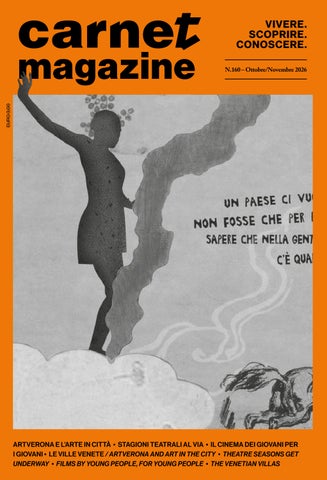
Stampa Mediaprint, Via Brenta, 7, 37057 San Giovanni Lupatoto VR Contatti redazione@carnetgroup.it info@carnetgroup.it commerciale@carnetgroup.it In copertina: Marinella Senatore, The Theatre of Commons, 2026, arazzo ricamato, 250x300cm, dettaglio. Courtesy l’artista, Fondazione Cariverona e Mazzoleni.
Carnet innovazione / innovation VIVERE. 56
59
Fascino storico, serramenti moderni Historic charm, modern windows and doors
79
Gli eventi di ottobre e novembre Events in October and November
Mediaprint, oltre la stampa Mediaprint: more than just printing
Index
5
SCOPRIRE. 6
Carnet Magazine ottobre/novembre 2026
ARTVERONA INCONTRA LA CITTÀ Dal 9 all’11 ottobre torna l'arte contemporanea tra fiera e città. di by Miriam Cetti
P
er tre giorni Verona torna a essere un punto di riferimento per l’arte contemporanea. Dal 9 all’11 ottobre, nei padiglioni 11 e 12 di Veronafiere, torna ArtVerona, giunta alla 21ª edizione e diretta per il secondo anno da Laura Lamonea. Una fiera che negli anni ha costruito un rapporto sempre più stretto con la città e che anche quest’anno ci porta a guardare oltre gli stand, tra mostre, installazioni e performance. Il tema scelto per questa edizione è Tra parentesi, un titolo che richiama gli spazi di relazione, ciò che accade tra persone, idee e linguaggi. Infatti, dopo aver lavorato lo scorso anno sul concetto di conversazione, ArtVerona concentra ora l’attenzione sulle relazioni profonde che nascono tra artisti, galleristi, collezionisti e pubblico, invitando, anche chi non è esperto, a considerare
l’arte non come qualcosa di distante, ma come un’occasione di incontro e confronto. Direzione in cui va anche una delle novità più importanti di quest’anno, InterFiera, progetto che mette in relazione ArtVerona con le altre grandi manifestazioni di Veronafiere, Vinitaly, Marmomac e Fieracavalli con l’obiettivo di creare nuove occasioni di dialogo tra arte contemporanea, imprese e manifatture, creatività e mondo produttivo del territorio. La Fiera Il cuore della manifestazione resta l’esposizione, articolata in cinque sezioni. La Main Section riunisce gallerie italiane e internazionali mettendo in dialogo arte moderna e contemporanea. Effetto Sauna (Fuori dalle parentesi), curata da Thomas Ba, crea un confronto tra artisti affermati e giovani ancora da
ArtVerona XX edizione (ph Ennevi)
Scoprire.
In the city
7
Luca Trevisani, Rosa A. Pane stabilizzato
scoprire. Pittura (ORA), a cura di Leonardo Regano, esplora le diverse forme della pittura e del disegno contemporanei, mentre la nuova STILL [per(formare) lo sguardo], curata da Giovanna Manzotti, si concentra sulla fotografia e sulla sua sperimentazione. Completa il percorso la sezione dedicata a editoria e servizi per l’arte. Tra le novità debutta Focus Corea, a cura di AWave (Asia Art Wave), uno spazio dedicato alla scena artistica moderna e contemporanea coreana e all’incontro tra linguaggi e generazioni diverse. Nel padiglione 12 torna inoltre la Sala Cinema, con proiezioni video realizzate in collaborazione con gallerie, archivi e collezioni italiane e internazionali. Qui si svolgeranno anche gli incontri di CONVER_SIAMO, con artisti, curatori, collezionisti e protagonisti del mondo dell’arte. Nella Galleria dei Signori sarà invece protagonista PORTALUCE, il nuovo progetto di Edizioni Brigantino, dove sedute, porte, luci, superfici riflettenti, trasparenze e monitor trasformeranno la hall in uno spazio dove fermarsi, incontrarsi e osservare. 8
In città
I progetti in città È però fuori dai padiglioni che ArtVerona mostra, ancora una volta, il suo legame con il territorio. Durante i giorni della manifestazione, alcuni luoghi della città accoglieranno infatti progetti pensati per mettere in dialogo l’arte contemporanea con la storia e gli spazi di Verona. A Palazzo Forti, il 10 ottobre alle 23, andrà in scena Cittadini!, performance ideata dall’artista spagnola Dora García, in collaborazione con Marlene Fantoni e a cura di Laura Lamonea. Il progetto, nato da una ricerca sulla storia sociale e politica di Verona, riflette sui temi della cittadinanza, dell’appartenenza e dell’esclusione. Attraverso una performance corale, testi recitati all’unisono e cartelli ispirati alle manifestazioni, il pubblico sarà coinvolto in una riflessione sui diritti e sull’inclusione, in dialogo anche con la memoria di Palazzo Forti e con la vicenda di Achille Forti, privato della cittadinanza in seguito alle leggi razziali del 1938. Dal 9 al 22 ottobre la Sala Morone del Convento di San Bernardino ospiterà invece Rosa, mostra di Luca Trevisani a cura di Luca Cerizza. Una selezione di opere realizzate nell’arco
di oltre vent’anni entrerà in relazione con gli affreschi e le figure che abitano da secoli la sala, intrecciando temi come corpo, materia, memoria e trasformazione, per un incontro tra ricerca contemporanea, architettura e storia del luogo. Dall’11 ottobre 2026 al 30 agosto 2027 sarà visitabile La forma dello spazio. Marinella Senatore per le collezioni di Fondazione Cariverona e UniCredit, a cura di Jessica Bianchera, Luca Bochicchio e Monica Molteni. Il progetto sviluppato tra Fondazione Cariverona e UniCredit metterà in dialogo opere delle rispettive collezioni sui temi della comunità, della memoria e della convivenza. Sono tanti i progetti, molto diversi tra loro, ma tutti accomunati dalla volontà di portare l’arte contemporanea al centro. Perché, in fondo, è questo ArtVerona: un invito a muoversi tra fiera, palazzi, conventi e cortili storici, per scoprire Verona attraverso nuovi sguardi, linguaggi e relazioni.
Luca Trevisani, Rosa B. Mascella di squalo
F
ARTVERONA MEETS THE CITY
From 9 to 11 October, contemporary art returns, taking over both the exhibition centre and the city.
or three days, Verona once again becomes a hub for contemporary art. From 9 to 11 October, in Halls 11 and 12 at Veronafiere, ArtVerona returns for its 21st edition, directed for the second year running by Laura Lamonea. Over the years, the fair has forged an increasingly close relationship with the city, and this year once again invites us to look beyond the exhibition stands, taking in exhibitions, installations and performances.
Carnet Magazine ottobre/novembre 2026
The theme chosen for this edition is "Tra parentesi" (In Parentheses), a title that evokes spaces of interaction – what happens between people, ideas and languages. Indeed, having explored the concept of conversation last year, ArtVerona now focuses its attention on the deep connections that form between artists, gallery owners, collectors and the public, inviting even those without specialist knowledge to view art not as something distant, but as an opportunity for encounter and dialogue. This is also the direction taken by one of this year’s most significant new initiatives, InterFiera, a project that links ArtVerona with Veronafiere’s other major events – Vinitaly, Marmomac and Fieracavalli – with the aim of creating new opportunities for dialogue between contemporary art, businesses and manufacturers, creativity and the region’s productive sector.
The Fair The heart of the event remains the exhibition, organised into five sections. The Main Section brings together Italian and international galleries, fostering a dialogue between modern and contemporary art. "Effetto Sauna (Fuori dalle parentesi)", curated by Thomas Ba, creates a dialogue between established artists and young talents yet to be discovered. Pittura (ORA), curated by Leonardo Regano, explores the various forms of contemporary painting and drawing, whilst the new STILL [per(formare) lo sguardo], curated by Giovanna Manzotti, focuses on photography and experimental approaches to the medium. The itinerary is rounded off by the section dedicated to art publishing and services. Among the new features is the debut of Focus Corea, curated by AWave (Asia Art Wave), a space dedicated to the modern and
contemporary Korean art scene and to the encounter between different artistic languages and generations. The Cinema Room also returns to Hall 12, featuring video screenings produced in collaboration with Italian and international galleries, archives and collections. This is also where the CONVER_ SIAMO talks will take place, featuring artists, curators, collectors and key figures from the art world. Meanwhile, in the Galleria dei Signori, the spotlight will be on PORTALUCE, the new project by Edizioni Brigantino, where seating, doors, lights, reflective surfaces, transparencies and monitors will transform the hall into a space where visitors can pause, meet and observe. Projects around the city It is, however, outside the pavilions that ArtVerona once again demonstrates its connection with the local area. During the event, a number of venues
ArtVerona 2025, Veronafiere (ph Ennevi)
Scoprire.
In the city
9
Palazzo Forti, Verona (ph Ennevi)
across the city will host projects designed to create a dialogue between contemporary art and Verona’s history and spaces. At Palazzo Forti, on 10 October at 11.00 pm, "Cittadini!" will be staged – a performance conceived by the Spanish artist Dora García, in collaboration with Marlene Fantoni and curated by Laura Lamonea. The project, born out of research into Verona’s social and political history, reflects on the themes of citizenship, belonging and exclusion. Through a choral performance, texts recited in unison and placards inspired by demonstrations, the audience will be drawn into a reflection on rights and inclusion, engaging also with the history of Palazzo Forti and the story of Achille Forti, who was stripped of his citizenship following the racial laws of 1938. From 9 to 22 October, the Sala Morone at the Convent of San Bernardino will host "Rosa", an exhibition by Luca Trevisani curated by Luca Cerizza. A selection of works created over a period of more than twenty years will engage with the frescoes and figures that have inhabited the hall for centuries, interweaving themes such as the body, matter, 10
In città
memory and transformation, to create an encounter between contemporary art, architecture and the history of the site. From 11 October 2026 to 30 August 2027, "La forma dello spazio. Marinella Senatore" will be on display, featuring works from the collections of the Fondazione Cariverona and UniCredit, curated by Jessica Bianchera, Luca Bochicchio and Monica Molteni. This project, developed jointly by the Fondazione Cariverona and UniCredit,
will bring together works from their respective collections to explore themes of community, memory and coexistence. There are many projects, all very different from one another, but all united by a desire to place contemporary art at the centre. Because, ultimately, this is what ArtVerona is all about: an invitation to wander through the art fair, palaces, convents and historic courtyards, to discover Verona through new perspectives, languages and connections.
ArtVerona 2025, Veronafiere (ph Ennevi)
Carnet Magazine ottobre/novembre 2026
LA FORMA DELLO SPAZIO
11.10.2026
30.08.2027
MARINELLA SENATORE PER LE COLLEZIONI DI FONDAZIONE CARIVERONA E UNICREDIT
OPENING SABATO 10 OTTOBRE ORE 21:30 FONDAZIONE CARIVERONA Via A. Forti 3A, Verona
UNICREDIT
Via G. Garibaldi 1, Verona
un progetto di
in collaborazione con
nell’ambito di
media partner
MARINELLA SENATORE E LA FORMA DELLO SPAZIO A Verona il dialogo con le opere di Fondazione Cariverona e UniCredit. In collaborazione con in collaboration with Urbs Picta e Fondazione Cariverona
Marinella Senatore, The Theatre of Commons, 2026, arazzo ricamato, 250x300cm, dettaglio. Courtesy l’artista, Fondazione Cariverona e Mazzoleni
Umberto Boccioni, Ritratto di Achille Tian, 1907, Olio su tela, 68,5×68,5 cm, Fondazione Cariverona
Q
uale forma assume uno spazio quando viene abitato da una pluralità di voci? E in che modo comunità e paesaggio si trasformano reciprocamente? Da queste domande prende le mosse a Verona La forma dello spazio. Marinella Senatore per le collezioni di Fondazione Cariverona e UniCredit, nuovo progetto espositivo promosso dalle due istituzioni dall’11 ottobre 2026 al 30 agosto 2027 nelle sedi di via Forti 3/A e via Garibaldi 1, in collaborazione con il Museo del Contemporaneo UniVr e Urbs Picta, a cura di Jessica Bianchera,
12
In città
Luca Bochicchio e Monica Molteni. La mostra inaugura nell’ambito di ArtVerona sabato 10 ottobre alle 21:30 con performance musicale e dj-set a cura di Path Festival. Il fulcro è la nuova opera site-specific di Marinella Senatore: un monumentale candelabro luminoso ispirato alle luminarie, pensato per trasformare il cortile di Fondazione Cariverona in una piazza pubblica, spazio dell’incontro e della collettività. A questo si affiancano due grandi arazzi, The Theatre of Commons (2026), uno per ciascuna sede espositiva. Parole, riflessioni e testimonianze, raccolte anche attraverso il coinvolgimento della comunità studentesca dell’Università di Verona, hanno contribuito alla creazione delle nuove opere. Carnet Magazine ottobre/novembre 2026
Vanessa Beecroft, VB54.19.nt, JFK Airport, New York, 2004, 2004, Digital C-print, esemplare 2/3, 177x228x3cm, Foto: UniCredit Group (Sebastiano Pellion di Persano), courtesy UniCredit Art Collection
Inoltre, il percorso mette in dialogo i lavori di Senatore con numerose opere delle collezioni di Fondazione Cariverona e UniCredit, sviluppando una riflessione su comunità, memoria, paesaggio culturale e forme contemporanee della convivenza. In Fondazione Cariverona saranno esposti, tra gli altri, Donna che nuota sott’acqua di Arturo Martini, opere di Adrian Paci, Martina Bacigalupo e Sandrine Nicoletta, la Mappa del mondo “per andare via” di Piero Pizzi Cannella, la Serie Ex Magazzini Generali di Gabriele Basilico, Versailles di Luigi Ghirri e lavori di Vanessa Beecroft, Francesco Jodice, Umberto Boccioni e Massimo Campigli. Nella sede UniCredit l’arazzo di Senatore dialogherà invece con Silvia Camporesi, Maria Friberg e Minjung Kim. L’ingresso è gratuito. Fondazione Cariverona sarà aperta tutti i giorni dalle 10 alle 17 fino all’8 novembre e poi ogni prima domenica del mese, con visite per scuole e gruppi su prenotazione; UniCredit dal lunedì al venerdì, dalle 8:20 alle 13:20 e dalle 14:30 alle 16.
MARINELLA SENATORE AND THE FORM OF SPACE
Via Garibaldi 1, in collaboration with the Museo del Contemporaneo UniVr and Urbs Picta, curated by Jessica Bianchera, Luca Bochicchio and Monica Molteni. The exhibition opens as part of ArtVerona on Saturday 10 October at 9.30 pm with a musical performance and DJ set organised by Path Festival. The centrepiece is Marinella Senatore’s new sitespecific work: a monumental illuminated chandelier inspired by festive illuminations, designed to transform the courtyard of the Fondazione Cariverona into a public square – a space for gathering and community. This is flanked by two large tapestries, "The Theatre of Commons" (2026), one for each exhibition venue. Words, reflections and testimonies – gathered in part through the involvement of the student community at the University of Verona – have contributed to the creation of these new works. Furthermore, the exhibition brings Senatore’s works into dialogue with numerous pieces from the collections of the Fondazione Cariverona and UniCredit, prompting reflection on community, memory, cultural landscape and contemporary forms of coexistence. On display at the Fondazione Cariverona will be, amongst others, "Woman Swimming Underwater" by Arturo Martini; works by Adrian Paci, Martina Bacigalupo and Sandrine Nicoletta; Piero Pizzi Cannella’s "Map of the World “to Leave”"; Gabriele Basilico’s "Ex Magazzini Generali Series"; Luigi Ghirri’s "Versailles"; and works by Vanessa Beecroft, Francesco Jodice, Umberto Boccioni and Massimo Campigli. At the UniCredit venue, Senatore’s tapestry will engage in dialogue with works by Silvia Camporesi, Maria Friberg and Minjung Kim. Admission is free. The Fondazione Cariverona will be open every day from 10.00 to 17.00 until 8 November and thereafter on the first Sunday of every month, with guided tours for schools and groups available by reservation; UniCredit is open Monday to Friday, from 8.20 to 13.20 and from 14.30 to 16.00. Maria Friberg, belonging, 2011, Stampa a colori su alluminio, 64x100cm, UniCredit Art Collection
In Verona, a dialogue with the works of the Fondazione Cariverona and UniCredit.
W
hat form does a space take when inhabited by a multitude of voices? And how do communities and landscapes transform one another? These questions form the starting point for "The Form of Space. Marinella Senatore for the collections of Fondazione Cariverona and UniCredit", a new exhibition project promoted by the two institutions from 11 October 2026 to 30 August 2027 at their venues in Via Forti 3/A and Scoprire.
In the city
13
Vivi le finestre in modo nuovo. Ti aspettiamo nello Studio Finstral Oppeano.
finstral.com/oppeano
L’ARENA ABBRACCIA NOTRE-DAME DE PARIS Dall’1 al 4 ottobre torna a Verona l’opera di Cocciante. di by Agnese Ceschi
Gian Marco Schiaretti (ph Attilio Cusani)
V
erona ama NotreDame de Paris, l’opera popolare uscita magistralmente dalla penna musicale di Riccardo Cocciante. Gian Marco Schiaretti, interprete del narratore della storia Gringoire, ci racconta il fascino sempre contemporaneo di questa storia, che sarà all’Arena di Verona dall’1 al 4 ottobre nella sua versione italiana con le traduzioni e l’adattamento di Pasquale Panella. Verona è una delle numerose tappe di un tour che celebrerà a marzo 2027 i 25 anni della prima messa in scena dello spettacolo.
Notre Dame de Paris (ph Luca Marenda)
Verona è particolarmente affezionata a NotreDame de Paris. E molti artisti amano Verona… Penso che Verona, per chi ama l’arte, sia veramente una città straordinaria che offre molto. Verona ha rubato molti cuori, tra i quali il mio. Vivo già a Verona con la mia compagna da due anni, ma sono cittadino veronese dal mese scorso, quando ho preso la residenza. Conosci bene la città, conosci bene l’Arena come palcoscenico, ma tu fino ad oggi hai girato tanti
palcoscenici internazionali… Io ho iniziato in Arena nel 2007 a 19 anni con Romeo e Giulietta di Cocciante. Quella è stata forse la volta in cui sono riuscito a viverla con più incoscienza, con più leggerezza. Ora sono più consapevole e credo che per un artista esibirsi in Arena sia veramente una tappa straordinaria. Con il cast ne parliamo da tanto tempo e non vediamo l’ora di esserci. Sei stato prima nel cast del Notre-Dame de Paris internazionale e poi passato alla versione italiana… Sì, dal 2019. Ovviamente non sono rimasto sempre in NotreDame, sono uscito e rientrato, però diciamo che i primi tre anni ho interpretato il ruolo di Frollo, e poi dopo sono passato a Gringoire, a partire dalla tappa americana nel 2022. Cosa rende quest’opera popolare particolarmente amata dal pubblico? Il fatto di essere popolare musicalmente e tematicamente.
Scoprire.
In the city
15
La storia è sempre attuale, ovviamente sottolineata, circondata e accompagnata dalle musiche di Cocciante e, nella nostra versione italiana, dalle traduzioni di Pasquale Panella. Il tempo delle cattedrali, la canzone più nota, è un inno all’anno che verrà. Ha una modernità nelle sue problematiche, nei suoi colori, che penso rimanga senza tempo. Il tuo personaggio, Gringoire, è il narratore della storia. Mi racconti cosa rappresenta? Nonostante io abbia cominciato come Frollo, ho sempre avuto nel cuore Gringoire. Sono quei personaggi narratori, un po’ quei Deus Ex Machina della storia, che hanno un fascino che richiede tanta responsabilità, ma allo stesso tempo ti appagano completamente a livello artistico. Gringoire ha questa straordinarietà di essere all’interno della storia e di conoscere già tutto. Sei nella storia, ma sei fuori dalla storia, sei super partes. Ha questa magia e capacità di rimanere sempre in contatto con il pubblico, anche quando non sta cantando il brano. La modernità di Notre-Dame de Paris dove è in questa storia? La modernità di Notre-Dame de Paris sta nel rappresentarla senza grandi fronzoli, cioè è una realtà cruda. Notre-Dame rimane un teatro essenziale, che però riesce a esprimere una modernità pazzesca, perché è vivo, è sempre tangibile. La forza di Notre-Dame, così come ha sempre dichiarato Cocciante stesso, è proprio quella di essere rappresentato sempre così, per quello che è, per quello che è stato e per quello che sarà. E in effetti la gente torna perché 16
In città
si è affezionata anche visivamente a dei colori, a delle atmosfere che, quando poi vengono riviste in scena, rievocano quelle suggestioni, quelle emozioni. Qual è il ruolo di Cocciante? Cocciante è sempre presente ed esige che la sua opera venga rispettata, quindi che venga cantata in un certo modo, e credo che gli sia dovuto nel corso degli anni, perché è il suo tesoro parallelo alla sua grande carriera da compositore personale. Lui vuole che venga rappresentato come lo ha scritto su carta, su pentagramma, su come ha scritto i personaggi, insieme appunto alla messa in scena di Gilles Maheu. Cosa deve fare un artista che sale su un palcoscenico come l’Arena? Io penso che siano quei luoghi nei quali, in realtà, la semplicità, la naturalezza vincono sempre. Perché di solito, quando ci si espone o ci si esprime nella grandeur di un luogo particolare, si tende a enfatizzare o a spingere di più. L’Arena rimane unica nel suo genere, quindi siamo tutti molto elettrizzati di esibirci lì dentro. Nel mio caso siccome è molto fresca la mia cittadinanza veronese, voglio rafforzare questo mio desiderio di esibirmi nella città che mi ha adottato.
THE ARENA EMBRACES "NOTRE-DAME DE PARIS" Cocciante’s opera returns to Verona from 1 to 4 October.
V
erona loves "Notre-Dame de Paris", the popular opera masterfully composed by Riccardo Cocciante. Gian Marco Schiaretti, who plays Gringoire, the story’s narrator, tells us about
the enduring appeal of this tale, which will be performed at the Verona Arena from 1 to 4 October in its Italian version, translated and adapted by Pasquale Panella. Verona is one of the many stops on a tour that will celebrate the 25th anniversary of the show’s premiere in March 2027. Verona is particularly fond of "Notre-Dame de Paris". And many artists love Verona… I think that, for those who love art, Verona is truly an extraordinary city that has so much to offer. Verona has stolen many hearts, including mine. I’ve been living in Verona with my partner for two years now, but I became a citizen of Verona last month, when I took up residence here. You know the city well, you know the Arena well as a stage, but to date you’ve performed on many international stages… I made my debut at the Arena in 2007 at the age of 19 in Cocciante’s "Romeo and Juliet". That was perhaps the time when I managed to experience it with the greatest sense of carefree abandon, with the greatest light-heartedness. Now I’m more aware, and I believe that for an artist, performing at the Arena is truly an extraordinary milestone. We’ve been talking about it with the cast for a long time and we can’t wait to be there. You were first in the cast of the international production of "Notre-Dame de Paris" and then moved on to the Italian version… Yes, since 2019. Obviously, I haven’t been with "Notre-Dame" the whole time – I left and came back – but let’s say that for the first three years I played the role of Frollo, and then I switched to Gringoire, starting with the American tour in 2022. What makes this musical so
Carnet Magazine ottobre/novembre 2026
popular with audiences? The fact that it’s popular both musically and thematically. The story is always relevant, naturally emphasised, framed and accompanied by Cocciante’s music and, in our Italian version, by Pasquale Panella’s translations. "Il tempo delle cattedrali" (The Age of Cathedrals), the bestknown song, is a hymn to the year to come. There is a modern quality to its themes and its colours that I think remains timeless. Your character, Gringoire, is the narrator of the story. Can you tell me what he represents? Although I started out as Frollo, Gringoire has always been close to my heart. It’s those narrator-type characters – a bit like the "Deus Ex Machina" of the story – who possess a charm that demands a great deal of responsibility, yet at the same time fulfils you completely on an artistic level. Gringoire has this extraordinary quality of being within the story whilst already knowing everything. You’re in the story, yet you’re outside it;
you’re impartial. He possesses this magic and the ability to remain constantly connected with the audience, even when you’re not singing a particular piece. Where does the modernity of "Notre-Dame de Paris" lie in this story? The modernity of "Notre-Dame de Paris" lies in portraying it without any frills; in other words, it’s a raw reality. "Notre-Dame" remains a minimalist production, yet it manages to express an incredible modernity, because it’s alive, it’s always tangible. The strength of "Notre-Dame", as Cocciante himself has always stated, lies precisely in it always being presented as it is – for what it is, for what it has been, and for what it will be. And indeed, people return because they have grown fond, even visually, of the colours and atmospheres which, when seen again on stage, evoke those same feelings and emotions. What is Cocciante’s role? Cocciante is always present and
insists that his work be respected – that it be sung in a certain way – and I believe this is only right over the years, because it is his personal treasure alongside his great career as a composer. He wants it to be performed exactly as he wrote it on paper, on the stave, and as he conceived the characters, in conjunction with Gilles Maheu’s staging. What should an artist do when stepping onto a stage like the Arena? I think these are the kinds of venues where, in reality, simplicity and naturalness always come to the fore. Because usually, when you’re performing or expressing yourself in the grandeur of a particular venue, you tend to overemphasise or push things a bit further. The Arena remains one of a kind, so we’re all very excited to be performing there. In my case, as I’ve only recently become a Veronese resident, I want to strengthen my connection with the city that has adopted me by performing here.
Cast Notre Dame de Paris (ph Attilio Cusani)
Scoprire.
In the city
17
AGGIUNGI UN POSTO IN ARENA! “Aggiungi un posto a tavola” arriva in Arena. di by Ilaria Savoia
C
i sono musical e musical e poi c’è Aggiungi un posto a tavola, uno spettacolo che potremmo definire iconico. Dal 2024 è in tour con la 50ª edizione, con un nuovo cast, e il prossimo 10 ottobre arriva anche all'Arena di Verona! D’altronde quando si affronta questo musical non si parla solo di puro divertimento ma anche di storia, cultura e tradizione. Aggiungi 18
In città
un posto a tavola, commedia musicale di due atti, nasce infatti tra il 1973 e 1974 dalla penna dei tre commediografi Pietro Garinei, Sandro Giovannini e Iaia Fiastri ed è ispirata al romanzo Dopo di me il diluvio di David Forrest. La trama? Tutto ha inizio in un tranquillo paese di montagna dove il parroco Don Silvestro riceve una telefonata da un insolito interlocutore: a parlare è infatti Dio intenzionato a mandare sulla Terra un secondo diluvio universale e fermo sulla sua decisione, incarica il parroco di costruire un’arca per salvare gli abitanti e animali del paese. Il tutto avviene nel giro di pochi giorni dando luogo ad una successione di eventi che generano una commedia esilarante e ricca di colpi di scena e personaggi. Oltre a Don Silvestro iconici i ruoli di Crispino, sindaco bigotto del paese, della ironica moglie Ortensia e della figlia Clementina, la giovane naive innamorata di Don Silvestro. Il debutto nei teatri avvenne poi dal 1974 con il cast composto da Johnny Dorelli nei panni di Don Silvestro, Paolo Panelli in quelli di Carnet Magazine ottobre/novembre 2026
Crispino, Christy in quelli della moglie Ortensia e Daniela Goggi in quello di Clementina. Da non dimenticare la coppia Toto, lo “scemo del paese” interpretato da Ugo Maria Morosi e Bice Valori nei panni di Consolazione, la provocante e simpatica prostituta; infine, la celebre e potente “voce di lassù” interpretata da Enzo Garinei. Da allora le edizioni successive hanno incontrato molti nomi per poi proseguire nel 2024 con un cast del tutto nuovo con Giovanni Scifoni nei panni di Don Silvestro e Lorella Cuccarini in quelli di Consolazione. A completare il cast Sofia Panizzi nel ruolo di Clementina, Francesco Zaccaro per Toto e Marco Simeoli, che oltre ad occuparsi della messa in scena, interpreta Crispino. Infine, la “voce di lassù” che resta, in suo onore, quella di Enzo Garinei. Dopo cinque stagioni di successo ecco che Aggiungi un posto a tavola 50° arriva anche a Verona, nella prestigiosa Arena pronto a divertirci ed emozionarci sempre sulle note di Armando Trovajoli, la celebre colonna sonora che rende questa commedia unica.
ADD A SEAT IN THE ARENA!
“Add a Seat at the Table” is coming to the Arena.
T
here are musicals, and then there is “Add a Seat at the Table”, an iconic show that celebrated its 50th anniversary in 2024. Featuring a new cast, it has since been performed in some of Italy’s most prestigious theatres and will arrive at the Arena di Verona on 10 October 2026! After all, when it comes to this musical, it’s not just about pure entertainment but also about history, culture and tradition. *Aggiungi un posto a tavola*, a twoact musical comedy, was in fact written between 1973 and 1974 by the three playwrights Pietro Garinei, Sandro Giovannini and Iaia Fiastri, and is inspired by David Forrest’s novel *Dopo di me il diluvio*.
Scoprire.
The plot? It all begins in a quiet mountain village where the parish priest, Don Silvestro, receives a phone call from an unusual caller: it is, in fact, God, who intends to send a second universal flood to Earth. Determined in his decision, he instructs the priest to build an ark to save the village’s inhabitants and animals. All this unfolds over the course of a few days, giving rise to a succession of events that create a hilarious comedy, full of twists and turns and colourful characters. Alongside Don Silvestro, the roles of Crispino – the village’s bigoted mayor – his ironic wife Ortensia, and their daughter Clementina – the naive young woman in love with Don Silvestro – are particularly iconic. The play made its theatre debut in 1974 with a cast featuring Johnny Dorelli as Don Silvestro, Paolo Panelli as Crispino, Christy as his wife Ortensia, and Daniela Goggi as Clementina. Also memorable were Ugo Maria Morosi as Toto, the “village idiot”, and Bice Valori as Consolazione, the provocative and likeable prostitute; finally, the famous and powerful ‘Voice from Above’ played by Enzo Garinei. Since then, subsequent productions have featured many different cast members, before continuing in 2024 with an entirely new cast, with Giovanni Scifoni as Don Silvestro and Lorella Cuccarini as Consolazione. Rounding out the cast are Sofia Panizzi as Clementina, Francesco Zaccaro as Toto, and Marco Simeoli, who, as well as directing the production, plays Crispino. Finally, the “Voice from Above” remains, in his honour, that of Enzo Garinei. After five successful seasons, *Aggiungi un posto a tavola 50°* is now coming to Verona, at the prestigious Arena, ready to entertain and move us once again to the tune of Armando Trovajoli’s famous soundtrack, which makes this comedy unique. In the city
19
ADIGEO COOKING STAR 4 appuntamenti tra sapori, storie e talenti del territorio.
L
a cucina come racconto, occasione di incontro e strumento per valorizzare il territorio. È questa la nuova anima di Adigeo Cooking Star, il progetto che torna da settembre a dicembre con un format rinnovato: non più soltanto una competizione ai fornelli, ma un percorso che mette al centro persone, passioni, opportunità e prodotti del territorio veronese. Il pubblico sarà più che semplice spettatore di uno show cooking, ma parte di un racconto fatto di ricette, testimonianze e storie personali. «Siamo orgogliosi di presentare la terza edizione di Adigeo Cooking Star, un format ideato da Adigeo che negli anni è diventato un appuntamento atteso e partecipato dal nostro territorio. Quest'anno abbiamo 20
In città
scelto di rinnovarne il racconto, mantenendo gli elementi che ne hanno decretato il successo e arricchendolo con temi per noi particolarmente importanti, come l'inclusione sociale, la valorizzazione dei giovani talenti e il legame con le eccellenze del territorio. Un'evoluzione che riflette i valori che guidano quotidianamente il nostro impegno come luogo di incontro, relazione e crescita per la comunità» spiega Fabio Fornasier, direttore Centro Commerciale Adigeo. Il percorso si svilupperà in quattro tappe speciali. Si parte a settembre con La Cucina di Casa, che riprende il format delle precedenti edizioni: saranno i clienti di Adigeo, attraverso una call aperta, a portare ai fornelli ricette, tradizioni familiari e storie
legate ai sapori del territorio. A ottobre, con La Cucina che Include, la cucina diventerà uno strumento di autonomia e crescita, grazie alla collaborazione con realtà impegnate nell’inclusione sociale e nell’inserimento lavorativo delle persone con disabilità. Novembre sarà dedicato ai Giovani Talenti ai Fornelli, protagonisti gli studenti delle scuole alberghiere del territorio, chiamati a raccontare attraverso le loro preparazioni passione, formazione e aspirazioni per il futuro. A dicembre, infine, I Sapori del Natale chiuderà il percorso con uno speciale show cooking dedicato alle feste, con la partecipazione di uno chef noto al grande pubblico. In ogni puntata, dove saranno valorizzati i prodotti e le eccellenze gastronomiche del territorio, a guidare il pubblico saranno Andrea Cesaro, chef resident e volto storico di Adigeo Cooking Star, e Monica Morgan, speaker e storyteller dell’evento, una coppia capace di unire competenza, intrattenimento e coinvolgimento. Quattro appuntamenti, dunque, per scoprire che dietro un piatto può esserci molto più di una ricetta: persone, storie, talenti e nuove possibilità.
Carnet Magazine ottobre/novembre 2026
Pubbliredazionale
di by Miriam Cetti
ADIGEO COOKING STAR
Four events celebrating the flavours, stories and talents of the region.
C
ooking as storytelling, an opportunity to come together and a means of promoting the region. This is the new spirit of Adigeo Cooking Star, the project returning from September to December with a revamped format: no longer merely a cooking competition, but a journey that places people, passions, opportunities and local produce from the Verona region at its heart. The audience will be more than just spectators at a cookery demonstration; they will be part of a narrative woven from recipes, testimonies and personal stories. «We are proud to present the third edition of Adigeo Cooking Star, a format conceived by Adigeo which, over the years, has become a much-anticipated and wellattended event in our region. This year, we have chosen to refresh the narrative, retaining the elements that have made it a success whilst enriching it with themes that are particularly important to us, such as social inclusion, the promotion of young talent and the connection with the region’s finest produce. This evolution reflects the values that guide Scoprire.
our daily commitment to being a place of encounter, connection and growth for the community,» said Fabio Fornasier, director of the Adigeo Shopping Centre. The programme will unfold across four special stages. It kicks off in September with "La Cucina di Casa" which follows the format of previous editions: Adigeo’s customers, through an open call, will bring recipes, family traditions and stories linked to the flavours of the region to the kitchen. In October, with "La Cucina che Include", cooking will become a tool for independence and growth, thanks to collaboration with organisations committed to social inclusion and the integration of people with
disabilities into the workplace. November will be dedicated to "Young Talents in the Kitchen", featuring students from local hospitality schools, who will be invited to express their passion, training and aspirations for the future through their dishes. Finally, in December, "The Flavours of Christmas" will bring the series to a close with a special festive cookery demonstration, featuring a chef well-known to the general public. In each episode, which will showcase the region’s local produce and culinary excellence, the audience will be guided by Andrea Cesaro, resident chef and long-standing face of Adigeo Cooking Star, and Monica Morgan, the event’s presenter and storyteller – a duo capable of combining expertise, entertainment and audience engagement. Four episodes, then, to discover that behind a dish there can be much more than just a recipe: people, stories, talent and new possibilities.
In the city
21
BALBI IL NUOVO DIRETTORE DEI MUSEI CIVICI Un nuovo sguardo per il sistema museale veronese. di by Giorgia Castagna
L
ui è Lorenzo Balbi, classe 1982 torinese doc, con un curriculum che parla da solo. Dal 2022 è Presidente di AMACI - Associazione Musei d’Arte Contemporanea Italiani. Nel 2018 ha assunto la direzione artistica di ART CITY Bologna, rassegna annuale di eventi espositivi in città e nel 2022 ha ideato il Nuovo Forno del Pane centro di produzione interdisciplinare che trasforma gli spazi e la funzione del museo da spazio espositivo a spazio di produzione e comunità creativa. Docente di Sistemi dell’Arte presso il DAMS dell’Università di Bologna e di Contemporary Art and Visual Culture alla Bologna Business School tiene regolarmente lezioni presso l’Accademia di Belle Arti di Bologna, IED a Firenze e Torino ed altri istituti di formazione superiore. Fa parte del Comitato Scientifico della Pinacoteca Nazionale di Bologna, della Collezione Farnesina, del Consiglio di Amministrazione della Fondazione Lucio Saffaro, dell’advisory board della Fondazione Scuola Beni e Attività Culturali e della Luiss Business School, ed è membro effettivo dell’Accademia Clementina. Nel 2024 è stato curatore della 60ª edizione dell’October Salon / Biennale di Belgrado. Ora dopo quasi dieci anni alla guida del MamBO di Bologna, lo storico dell’arte approda per la prima volta a Verona, alla direzione di uno dei sistemi museali più articolati d’Italia. L’incarico da settembre 2026, per rilanciare il sistema museale di Verona sul piano internazionale e farne un luogo di produzione e partecipazione culturale. «Immagino il sistema museale di Verona – ha 22
In città
commentato il neo-direttore – come un luogo di produzione di idee. Non esistono soluzioni di rilancio preconfezionate. Il primo passo è creare un contesto nel quale innestare una proposta nuova». Il circuito museale civico che comprende l’Arena di Verona, la Casa di Giulietta, il Museo Archeologico al Teatro Romano, il Museo Civico di Storia naturale, il Museo degli Affreschi di G. B. Cavalcaselle, il Museo di Castelvecchio, il Museo Lapidario Maffeiano e la Galleria d’Arte Moderna Achille Forti è definito uno dei più articolati e l’amministrazione veronese cercava un profilo in grado di rilanciare il sistema museale Lorenzo Balbi
Carnet Magazine ottobre/novembre 2026
Museo di Castelvecchio
Museo Archeologico al Teatro Romano
veronese, rafforzando il ruolo degli istituti che riunisce come luoghi di produzione culturale, partecipazione civica e dialogo internazionale. La scelta arriva dunque in modo naturale visto che Balbi ne fa una questione di credo. «Penso che i musei siano degli organismi viventi radicati nei territori. Non dobbiamo pensare ai Musei come dei monumenti che vanno aperti ai turisti, ma come luoghi di produzione di contenuti, rimanendo garanti della tutela del patrimonio». Il nuovo direttore si pone quindi il compito, in questa prima fase di studiare e conoscere una struttura complessa composta da circa 60 persone che lavorano internamente, ed altre, oltre 100, che si relazionano ad essi in diverse forme di collaborazione esterne e interna. «È un sistema davvero complesso, con musei che spaziano dalla preistoria alla contemporaneità, con approcci molto diversi, con professionisti anche molto diversi – ha sottolineato Balbi. L'entusiasmo c'è: il primo impatto è stato veramente di grande eccitazione e mi sono sentito accolto benissimo dalla città e dalla struttura». Il direttore ha ribadito infine «non c'è una ricetta per il cambiamento. Sono assolutamente contrario a chi pensa ci sia una soluzione valida per tutto. Non è così. Il lavoro strategico di avvicinamento di pubblici più giovani, pubblici diversi, passa attraverso una strategia che parte dal patrimonio e dalle istituzioni. Quindi non c'è una progettualità specifica, ma c'è un'analisi che è partita già in questi giorni e che non riguarda solo me». Scoprire.
Casa di Giulietta
BALBI: THE NEW DIRECTOR OF THE CIVIC MUSEUMS
A new perspective for Verona’s museum system.
H
e is Lorenzo Balbi, born in 1982 and a true Turinese, with a CV that speaks for itself. Since 2022, he has been President of AMACI – the Association of Italian Contemporary Art Museums. In 2018, he took on the role of artistic director of ART CITY Bologna, an annual programme of exhibitions across the city, and in 2022 he conceived the Nuovo Forno del Pane, an interdisciplinary production centre that transforms the museum’s spaces and function from an exhibition space into a space for production and a creative community. A lecturer in Art Systems at the DAMS department of the University of Bologna and in Contemporary Art and Visual Culture at the Bologna Business School, he regularly gives lectures at the Academy of Fine Arts in Bologna, the IED in Florence and Turin, and other higher education institutions. He sits on the Scientific Committee of the Pinacoteca Nazionale in Bologna and the Farnesina Collection, on the Board of Directors of the Lucio Saffaro Foundation, and on In the city
23
Galleria d'Arte Moderna Achille Forti
the advisory boards of the Fondazione Scuola Beni e Attività Culturali and Luiss Business School; he is also a full member of the Accademia Clementina. In 2024, he curated the 60th edition of the October Salon / Belgrade Biennale. Now, after almost ten years at the helm of the MamBO in Bologna, the art historian is moving to Verona for the first time to take charge of one of Italy’s most comprehensive museum networks. He will take up the post in September 2026, with the aim of relaunching Verona’s museum network on the international stage and transforming it into a hub for cultural production and participation. "I envisage Verona’s museum network," commented the new director, "as a place for the generation of ideas. There are no ready-made solutions for revitalisation. The first step is to create a context in which to introduce a new vision." The civic museum circuit, which includes the Verona Arena, Juliet’s House, the Archaeological Museum at the Roman Theatre, the Civic Museum of Natural History, the G. B. Cavalcaselle Fresco Museum, the Castelvecchio Museum, the Maffeiano Lapidary Museum and the Achille Forti Gallery of Modern Art – is regarded as one of the most comprehensive, and the Verona city council was seeking a candidate capable of revitalising Verona’s museum system, strengthening the role of the institutions it brings together as venues for cultural production, civic engagement and international dialogue. The choice therefore comes naturally, given that Balbi regards this as a matter of principle. "I believe that museums are living organisms rooted in their local areas. We must not think of museums as monuments to be opened to tourists, but as places where content is produced, whilst remaining guardians of our heritage." The new director has therefore set himself the task, in this initial phase, of studying and getting to know a complex organisation comprising around 60 in-house staff, and over 100 others who interact with them through various forms of external and internal collaboration. 24
In città
"It is a truly complex system, with museums ranging from prehistory to the contemporary era, with very different approaches and a wide variety of professionals," emphasised Balbi. "The enthusiasm is there: my first impression was one of great excitement, and I felt very warmly welcomed by the city and the organisation." Finally, the director reiterated: “There is no magic formula for change. I am absolutely opposed to the idea that there is a onesize-fits-all solution. That is not the case. The strategic work of engaging younger audiences and diverse audiences requires a strategy that starts with our heritage and our institutions. So there is no specific plan as yet, but an analysis has already begun in recent days, and it does not concern me alone.”
Anfiteatro Arena Museo di Storia Naturale
Carnet Magazine ottobre/novembre 2026
IL FESTIVAL DEDICATO AI GIOVANI REGISTI ARRIVA ALLA SUA NONA EDIZIONE Da giovedì 15 a domenica 18 ottobre Verona torna la Capitale del cinema giovane. Carnet Magazine è mediapartner di Believe Film Festival
S
i terrà da giovedì 15 a domenica 18 ottobre a Verona la nona edizione del Believe Film Festival, primo e unico festival di cortometraggi dedicato alle opere dei giovani cineasti di età compresa tra i 14 e i 24 anni organizzato da Believe APS. Il programma dei quattro giorni è ricco di appuntamenti. Si parte giovedì 15 ottobre con il taglio del nastro al Teatro Ristori, evento che darà inizio Scoprire.
ufficialmente alla nona edizione. Ogni categoria di concorso avrà una propria serata di proiezione e premiazione sul palco del Teatro Ristori di Verona, con appuntamenti fissati giovedì 15 e venerdì 16 alle 20:30 per le serate della categoria Esordienti e Believe Extra, e un gran finale sabato 17, a partire dalle 16:30, che si aprirà con il red carpet per poi proseguire con le proiezioni dei cortometraggi della Sezione Ufficiale e la
cerimonia di premiazione delle tre categorie competitive. Alla quarta categoria, nella quale saranno presenti cortometraggi non ammissibili alle tre categorie di concorso, quest’anno sarà dedicato il Cinema Rivoli, che ospiterà proiezioni il venerdì pomeriggio. Sabato 17 si terrà la quinta edizione delle matinée delle scuole con il sostegno di BCC Veneta, appuntamento che si conferma anno dopo anno uno degli eventi principali del Festival, nel quale il giovane pubblico delle scuole veronesi (e non solo) si confronta con i registi, creando momenti di dialogo e di riflessione sui temi trattati nei cortometraggi. Accanto alle proiezioni, non mancheranno i momenti di formazione che da sempre caratterizzano il Festival, con workshop e masterclass tenuti da giurati, ospiti ed esperti del settore, anche in collaborazione con i numerosi partner dell’evento. In the city
25
Una grande novità che testimonia la crescita e la rilevanza dell’evento su scala nazionale è la partnership con Rai Cinema Channel, una collaborazione che offre ai giovani autori un’importante opportunità di visibilità. I cortometraggi vincitori dei Premi del Pubblico, assegnati dagli spettatori presenti in sala e collegati in diretta streaming, saranno infatti trasmessi sui canali Rai Cinema Channel per i tre mesi successivi al Festival, permettendo alle opere di raggiungere un pubblico ancora più ampio anche dopo la manifestazione. La collaborazione con Rai Cinema Channel si inserisce nella filosofia del Believe Film Festival, che punta non soltanto a dare ai giovani la possibilità di realizzare e presentare i propri cortometraggi, ma anche a creare occasioni concrete perché i lavori possano continuare il proprio percorso e incontrare nuovi spettatori. Alle tre serate di proiezione
26
In città
si potrà accedere gratuitamente anche quest’anno riservando il proprio posto sulla BelieveApp, la piattaforma attraverso la quale il Believe sta sviluppando il proprio network dedicato ai giovani cineasti. Un’ultima grande novità è la nascita della rete su BelieveApp. La nuova funzione, lanciata a settembre 2026, è dedicata al networking, creando un ponte tra le relazioni nate negli appuntamenti fisici e la possibilità di continuare a conoscersi, confrontarsi e
sviluppare nuove collaborazioni anche online. Un passaggio naturale per una realtà che vuole costruire una community capace di vivere oltre i singoli giorni del Festival. Per il programma dettagliato delle proiezioni e delle attività, informazioni su come partecipare e la selezione dei cortometraggi di questa edizione è possibile consultare il sito www.believefilmfestival.it. Vieni a scoprire la bellezza del Cinema giovane!
Carnet Magazine ottobre/novembre 2026
THE FESTIVAL DEDICATED TO YOUNG FILMMAKERS IS NOW IN ITS NINTH YEAR
From Thursday 15 to Sunday 18 October, Verona once again becomes the capital of young cinema.
T
he ninth edition of the Believe Film Festival, the first and only short film festival dedicated to the work of young filmmakers aged between 14 and 24 and organised by Believe APS, will take place from Thursday 15 to Sunday 18 October in Verona. The four-day programme is packed with events. It kicks off on Thursday 15 October with a ribbon-cutting ceremony at the Teatro Ristori, an event that will officially launch the ninth edition. Each competition category will have its own screening and awards night on stage at the Teatro Ristori in Verona, with events scheduled for Thursday 15 and Friday 16 at 8.30 pm for the ‘Esordienti’ and ‘Believe Extra’ categories, and a grand finale on Saturday 17, starting at 4.30 pm, which will open with the red carpet and then continue with screenings of the short films in the Official Selection and the awards ceremony for the three competitive categories. The fourth category, featuring short films not eligible for the three competition categories, will this year be hosted by the Cinema Rivoli, which will host screenings Friday afternoon. On Saturday 17, the fifth edition of the school matinees will take place with the support of BCC Veneta; this event has established itself, year after year, as one of the Festival’s main highlights, where young audiences from schools in Verona (and beyond) engage with the directors, fostering moments of dialogue and reflection on the themes explored in the short films. Alongside the screenings, there Scoprire.
will be no shortage of educational sessions – a long-standing feature of the Festival – with workshops and masterclasses led by jury members, guests and industry experts, organised in collaboration with the event’s numerous partners. A major new development that testifies to the event’s growth and national significance is the partnership with Rai Cinema Channel, a collaboration that offers young filmmakers a significant opportunity for visibility. The short films winning the Audience Awards – chosen by viewers in the cinema and those watching via live stream – will in fact be broadcast on Rai Cinema Channel for the three months following the Festival, enabling the films to reach an even wider audience even after the event has ended. The collaboration with Rai Cinema Channel is in line with the philosophy of the Believe Film Festival, which aims not only to give young people the chance to make and present their own short films, but also to create concrete opportunities for these works to continue their
journey and reach new audiences. Admission to the three screening evenings will be free again this year, provided you book your place via BelieveApp, the platform through which Believe is developing its network dedicated to young filmmakers. One final major development is the launch of a networking feature on BelieveApp. This new feature, launched in September 2026, is dedicated to networking, bridging the gap between the connections made at in-person events and the opportunity to continue getting to know one another, exchange ideas and develop new collaborations online. It is a natural step for an organisation aiming to build a community that endures beyond the individual days of the Festival. For the detailed programme of screenings and activities, information on how to take part, and the selection of short films for this edition, please visit www.believefilmfestival. it. Come and discover the beauty of young cinema! In the city
27
RISTORI, UNA NUOVA STAGIONE DA VIVERE Grandi ritorni e nuove proposte in scena. di by Andrea Molinari
I
l sipario si rialza e il Teatro Ristori torna a proporsi come uno dei luoghi più vivaci della scena culturale veronese. Dal 27 ottobre al 30 aprile, la Stagione 2026/27 porta in città oltre venti appuntamenti raccolti in sette rassegne, con grandi nomi internazionali, protagonisti della scena italiana, nuove produzioni e percorsi pensati per avvicinare pubblici diversi. La novità più evidente è il ritorno della Prosa, con tre appuntamenti capaci di attraversare teatro, musica e linguaggi contemporanei. Si parte il 4 e 5 novembre con Neri Marcorè e Mi fa male il mondo, omaggio all’universo di Giorgio Gaber e Sandro Luporini diretto da Giorgio Gallione. Il 4 febbraio sarà la volta di The Wall_ Dance Tribute, spettacolo dedicato al capolavoro dei Pink Floyd tra danza, teatro, musica e videoproiezioni. Chiuderà il percorso Alessandro Bergonzoni, il 3 aprile, con Arrivano i Dunque, nuovo viaggio tra comicità, parole e riflessione. Resta centrale il Jazz, curato da GeGè Telesforo, che porterà al Ristori artisti come Kurt Rosenwinkel, Tigran Hamasyan, Emma Smith, Michael Mayo e Miguel Zenón. Il 30 aprile, in occasione dell’International Jazz Day, sarà lo stesso Telesforo a chiudere la rassegna con Jazz Radio. «La sfida è continuare
28
In città
Teatro Ristori
The Wall_Dance Tribute (ph Tiziano Ghidorsi)
ad aprire il Jazz a un pubblico sempre più ampio e giovane», sottolinea il curatore. Accanto alla musica, le Serate d’Autore offriranno occasioni di approfondimento con il climatologo Luca Mercalli, lo storico dell’arte Jacopo Veneziani e due appuntamenti dedicati alla storia della famiglia Olivetti. A dicembre, invece, il Ristori cambierà atmosfera con le Cene Spettacolo e il Ristori Jazz Club, tra concerti, cene e un’atmosfera da jazz club. In programma Sarah Jane Morris, Miguel Angel Zotto e la Keynotes Gospel Choir, Carnet Magazine ottobre/novembre 2026
Cena Spettacolo (ph Mascalzoni)
Jordi Savall, Ristori Baroque Festival
mentre le domeniche saranno affidate a Olivia Trummer, Dario Deidda e Accordi Disaccordi. Il 2027 si aprirà con il tradizionale Concerto di Capodanno de I Virtuosi Italiani, diretti da Alberto Martini, mentre tra le novità debutta Ristori Young, evoluzione della proposta dedicata a famiglie e ragazzi. Si parte con Macbeth - Atto di Sangue di Casa Shakespeare e si prosegue con Viaggio al centro della Terra di Bam!Bam!Teatro. Un altro capitolo importante riguarda il Ristori Baroque Festival, giunto alla quinta edizione e pronto a inaugurare una nuova fase grazie alla collaborazione con I Virtuosi Italiani. L’apertura, il 17 febbraio, sarà affidata a Jordi Savall; gli appuntamenti successivi si sposteranno nello Spazio San Pietro in Monastero, valorizzandone acustica e atmosfera. «Questa stagione nasce dalla convinzione che un teatro debba essere un organismo vivo, capace di custodire la tradizione e, allo stesso tempo, di generare nuove visioni» spiega il direttore artistico Alberto Martini. Una filosofia che si ritrova anche nella visione di CREA Impresa Sociale, che gestisce il Ristori e lo Spazio San Pietro e punta a rafforzare il rapporto tra cultura, formazione e territorio. «L’obiettivo è rafforzare progressivamente un modello aperto, riconoscibile e radicato nella comunità», sottolinea il direttore generale Valeria Bosco. A completare il calendario tornerà nell’estate 2027 Calici di Jazz, con una formula itinerante nelle dimore del vino. Programma completo e informazioni sono su www.teatroristori.org. Scoprire.
I Virtuosi Italiani (ph Gabriele Lugli)
Ristori Jazz Club (ph Mascalzoni)
RISTORI: A NEW SEASON TO ENJOY
Major comebacks and new productions on stage.
T
he curtain rises once more and the Teatro Ristori re-establishes itself as one of the liveliest venues on Verona’s cultural scene. From 27 October to 30 April, the 2026/27 Season brings over twenty events to the city, organised into seven programmes, featuring major international names, leading figures from the Italian theatre scene, new productions and programmes designed to appeal to a diverse audience. The most notable new development is the return of Prosa, with three events spanning theatre, music and contemporary art forms. It kicks off on 4 and 5 November with Neri Marcorè and "Mi fa male il mondo", a tribute to the world of Giorgio Gaber and In the city
29
Sandro Luporini, directed by Giorgio Gallione. On 4 February, it will be the turn of "The Wall_Dance Tribute", a show dedicated to Pink Floyd’s masterpiece, blending dance, theatre, music and video projections. Alessandro Bergonzoni will bring the programme to a close on 3 April with "Arrivano i Dunque", a new journey through comedy, words and reflection. Jazz remains central to the programme, curated by GeGè Telesforo, who will bring artists such as Kurt Rosenwinkel, Tigran Hamasyan, Emma Smith, Michael Mayo and Miguel Zenón to the Ristori. On 30 April, to mark International Jazz Day, Telesforo himself will bring the festival to a close with "Jazz Radio". “The challenge is to continue opening up jazz to an ever-wider and younger audience,” emphasises the curator. Alongside the music, the "Serate d’Autore" will offer opportunities for in-depth discussion with climatologist Luca Mercalli, art historian Jacopo Veneziani and two events dedicated to the history of the Olivetti family. In December, however, the Ristori will take on a different atmosphere with the "Cene Spettacolo" and the Ristori Jazz Club, featuring concerts, dinner and a jazz club ambience. The programme features Sarah Jane Morris, Miguel Angel Zotto and the Keynotes Gospel Choir, whilst Sundays will be headlined by Olivia Trummer, Dario Deidda and Accordi Disaccordi. 2027 will kick off with the traditional New Year’s Concert by I Virtuosi Italiani, conducted by Alberto Martini, whilst among the new additions, Ristori
Jacopo Veneziani (ph Enrico Panina)
Alessandro Bergonzoni, Arrivano i dunque (ph Chiara Lucarelli)
Young will make its debut – an evolution of the programme dedicated to families and young people. The season kicks off with "Macbeth – Atto di Sangue" by Casa Shakespeare and continues with "Journey to the Centre of the Earth" by Bam!Bam!Teatro. Another important highlight is the Ristori Baroque Festival, now in its fifth year and set to embark on a new phase thanks to its collaboration with I Virtuosi Italiani. The opening concert on 17 February will be led by Jordi Savall; subsequent performances will take place at Spazio San Pietro in Monastero, making the most of its acoustics and atmosphere. "This season stems from the belief that a theatre should be a living organism, capable of preserving tradition whilst, at the same time, generating new visions," explains artistic director Alberto Martini. This philosophy is also reflected in the vision of CREA Impresa Sociale, which manages the Ristori and Spazio San Pietro and aims to strengthen the relationship between culture, education and the local area. “The aim is to progressively strengthen an open, recognisable model that is deeply rooted in the community,” emphasises General Manager Valeria Bosco. Rounding off the programme, Calici di Jazz will return in the summer of 2027, with a touring format taking place at wine estates. The full programme and further information can be found at www.teatroristori.org. Neri Marcorè, Gaber (ph T. Le Pera)
Kurt Rosenwinkel
30
In città
Carnet Magazine ottobre/novembre 2026
I TUOI DESIDERI
PRENDONO IL VOLO Nuovi negozi. Nuovi brand. Nuove ispirazioni. Scopri tutte le novità.
|
Viale Del Commercio 1 - San Martino Buon Albergo (VR) centrolecortivenete.it
CLASSICO, CINEMA, CONTEMPORANEO! L’intervista per Il Grande Teatro a Fabrizio Arcuri. di by Ilaria Savoia
Fabrizio Arcuri
I
n occasione della 40ª edizione della rassegna Verona Grande Teatro - Magnifiche presenze in scena al Teatro Nuovo dal 27 ottobre 2026 al 21 marzo 2027, abbiamo intervistato il suo direttore artistico Fabrizio Arcuri. Con lui un dialogo su classici e contemporaneo, dove il mondo del teatro si fonde con il cinema regalando rivisitazioni
Silvio Orlando, Il berretto a sonagli (ph Laila Pozzo)
delle opere di Pirandello, Brecht, Shakespeare, Goldoni e molti altri. Grande attesa anche per la rassegna Verona L’altro Teatro, attualmente in lavorazione e pronta a stupirci. In arrivo la 40ª edizione della rassegna Il Grande Teatro: cosa caratterizza questa stagione e quali sono stati i criteri nella scelta degli spettacoli? I criteri principali sono due, ho scelto per quanto possibile dei titoli classici, grandi classici del teatro di tutti i tempi. Poi ho scelto degli allestimenti dove degli attori di cinema molto noti, che frequentano normalmente il teatro, mettono in scena questi testi. Quali temi ritornano, anche indirettamente, nella programmazione di quest’anno? Diciamo che non c’è un tema di collegamento, c’è un attraversamento di una serie di temi classici fatti con una visione contemporanea. Una dimensione che va dalla tragedia alla commedia senza necessariamente cercare un filo che li collega
32
In città
ma piuttosto offrire una varietà di letture e di visioni. I registi sono quasi tutti giovani, da Leo Muscato con Madre Courage e i suoi figli ad Andrea Baracco con Il berretto a sonagli. Una visione molto giovane e contemporanea di testi estremamente classici: da Brecht a Pirandello, Shakespeare e Goldoni… proprio un viaggio del teatro con uno sguardo di grande personalità del teatro e del cinema. La ricerca di questi otto titoli è stata molto accurata, così che ogni titolo rispettasse questa idea di classico e al contempo di rilettura. Da Shakespeare a Goldoni, Brecht, Pirandello, Calvino… cosa possono dirci i grandi testi ancora oggi? Allora è chiaro che i classici contengono tante prospettive e a seconda del momento storico in cui noi viviamo diventano più evidenti. Madre Courage e i suoi figli di Brecht con Lunetta Savino e lo spettacolo La guerra com’è con Elio Germano tratto dai testi di Gino Strada hanno un riferimento diretto alla guerra e alla condizione che
Carnet Magazine ottobre/novembre 2026
Stefano Massini, Lo Zar (ph Filippo Manzini)
stiamo vivendo in questi anni. Poi invece il Riccardo III con la regia Antonio Latella o Le cosmicomiche di Italo Calvino, qui reinterpretate nello spettacolo La cosmicomica vita di Q di Luca Marinelli, e Una delle ultime sere di carnovale di Carlo Goldoni hanno altri aspetti della nostra vita quotidiana contemporanea, una visione più introspettiva e personale. In occasione di questa rassegna lei ha dichiarato di voler “eliminare le distanze tra opera e spettatore”. Come si traduce questa idea? Attraverso la scelta degli spettacoli, spettacoli che si consegnano senza la necessità di dover per forza conoscere l’opera precedentemente. Non sono operazioni registiche ed intellettuali, sono delle messe in scena con cui si può avere un approccio diretto senza un’alfabetizzazione teatrale, una cultura legata a quei testi e al teatro in generale. Io credo che nel Novecento ci sia stata una sperimentazione che ha un po' allontanato lo spettatore medio che non necessariamente Scoprire.
aveva la capacità di lettura di un’operazione artistica e questo secondo me non è utile; nella scelta di questi testi c’è la volontà di consegnare un teatro accessibile a tutti.
CLASSICAL, CINEMA, CONTEMPORARY!
An interview with Fabrizio Arcuri for “Il Grande Teatro”.
T
o mark the 40th edition of the Verona Grande Teatro festival – "Magnificent Performances on Stage" at the Teatro Nuovo from 27 October 2026 to 21 March 2027 – we interviewed its artistic director, Fabrizio Arcuri. We spoke with him about classics and contemporary works, where the world of theatre blends with cinema to offer fresh interpretations of the works of Pirandello, Brecht, Shakespeare, Goldoni and many others. There is also great anticipation for the "Verona L’altro Teatro" festival, currently in the works and set to amaze us. The 40th edition of the "Il Grande Teatro" festival is coming up: what characterises this season
and what were the criteria for selecting the productions? There are two main criteria: as far as possible, I have chosen classic plays – the great theatre classics of all time. I have also selected productions in which well-known film actors, who regularly perform in the theatre, bring these texts to life. What themes recur, even indirectly, in this year’s programme? Let’s say there isn’t a single unifying theme; rather, there is a range of classic themes explored through a contemporary lens. A spectrum that spans from tragedy to comedy without necessarily seeking a common thread to link them, but rather offering a variety of interpretations and perspectives. The directors are almost all young, from Leo Muscato with "Mother Courage and Her Children" to Andrea Baracco with "Il berretto a sonagli". A very young and contemporary take on extremely classic texts: from Brecht to Pirandello, Shakespeare and Goldoni… truly a journey through theatre, viewed through the lens of major figures from the In the city
33
Stefano Accorsi e Francesca Del Duca, NESSUNO. Le avventure di Ulisse (ph Viviana Cangialosi - Compagnia Finzi Pasca)
Vinicio Marchioni Riccardo III (ph-Gianluca Pantaleo)
worlds of theatre and cinema. The selection of these eight productions was carried out with great care, ensuring that each one embodies this concept of being both a classic and a reinterpretation.
Evenings of Carnival" highlight other aspects of contemporary life, offering a more introspective and personal perspective.
From Shakespeare to Goldoni, Brecht, Pirandello and Calvino… what can these great works still tell us today? It is clear, then, that the classics contain many perspectives, and depending on the historical moment in which we live, these become more evident. Brecht’s "Mother Courage and Her Children", starring Lunetta Savino, and the production "La guerra com’è" ("War As It Is"), starring Elio Germano and based on texts by Gino Strada, make a direct reference to war and the circumstances we have been experiencing in recent years. Then, on the other hand, "Richard III", directed by Antonio Latella, or Italo Calvino’s "Cosmicomics" – reinterpreted here in Luca Marinelli’s production "The Cosmicomic Life of Q" – and Carlo Goldoni’s "One of the Last 34
In città
On the occasion of this programme, you stated that you wanted to "bridge the gap between the work and the audience". How does this idea translate into practice? Through the choice of productions – productions that can be enjoyed without the need to have prior knowledge of the work. These are not intellectual or directorial exercises; they are stagings that allow for a direct engagement without the need for theatrical literacy or a background in those texts or theatre in general. I believe that in the twentieth century there was a period of experimentation that somewhat alienated the average audience member, who did not necessarily have the ability to interpret an artistic experiment, and in my view this is not helpful; in the selection of these plays, there is a desire to present theatre that is accessible to everyone.
Lunetta Savino, Madre Courage e i suoi figli
Carnet Magazine ottobre/novembre 2026
Valgatara – Head office
Rovereto – Showroom
Via del Lavoro 18,
Via Varini 50,
37020 Valgatara di Valpolicella
38060 Marco di Rovereto
Verona VR
Trento TN
tel. +39 045 6800525
tel. +39 0464 943220
info@ballarini-interni.com
info@ballarini-interni.com
FB @BallariniInterni
IG @ballarini_interni
MASI MONTELEONE21: DOVE IL VINO ISPIRA LA CUCINA La filosofia “Wine First” come filo conduttore.
vino a ispirare la cucina: entra nelle preparazioni, guida gli abbinamenti e diventa chiave per esaltarne aromi e sfumature. Il menu degustazione, cinque portate che raccontano l’identità della Locanda, ne è una delle espressioni più significative. Il vino accompagna ogni piatto, ma soprattutto diventa ingrediente e protagonista dei processi di cottura, in un dialogo continuo tra calice e cucina. La proposta segue il ritmo delle stagioni e valorizza materie prime di alta qualità per preparare piatti che riflettono l'identità cosmopolita di Masi: dalla Valpolicella all'Argentina, portano in tavola le culture
enogastronomiche dei territori in cui l'azienda è presente. A completare l’esperienza, una carta di oltre 50 referenze, con i grandi vini della Valpolicella e l’Amarone in primo piano, accanto alle etichette delle diverse tenute Masi, comprese quelle prodotte a Tupungato, in Argentina. Per un’esperienza più informale, il Wine Bar – Bistrot propone piatti da condividere, originali creazioni gastronomiche e un Business Lunch che cambia ogni giorno. A reinterpretare il mondo del vino in chiave contemporanea sono anche i signature cocktail, come il Fresco Tonic e il VeronaMilano, a base di vino. Le esperienze da non perdere • Aperitivo Experience: la visita alla cantina si conclude con un aperitivo accompagnato da vini selezionati e proposte gastronomiche originali. Chi preferisce una pausa più informale può scegliere l’aperitivo al Bistrot e proseguire la serata con una cena alla Locanda Costasera.
36
Enogastronomia
Carnet Magazine ottobre/novembre 2026
Pubbliredazionale
N
el cuore della Valpolicella Classica, a pochi minuti da Verona e dal Lago di Garda, Monteleone21 è il nuovo centro produttivo, enologico ed esperienziale di Masi. Un progetto che riunisce produzione vinicola, cultura del vino, ristorazione ed enoturismo in un concept integrato, nuova interpretazione della “cantina aperta”. Fulcro dell’esperienza gastronomica è il Ristorante Locanda Costasera, dove prende forma la filosofia “Wine First”, il filo conduttore dei Wine Bar e dei ristoranti della Masi Wine Experience. Qui è il
•
•
Cena alla Locanda Costasera: dal giovedì al sabato, il ristorante apre anche la sera, per vivere un momento di convivialità tra cucina, vino e atmosfera. Wine Brunch: la domenica, Monteleone21 invita a rallentare con un brunch dedicato al piacere della tavola, del vino e della condivisione.
www.monteleone21.it monteleone21@masi.it +39 045 6832532
MASI MONTELEONE21: WHERE WINE INSPIRES CUISINE
The "Wine First" philosophy as the guiding principle.
First" philosophy takes shape – the guiding principle of the wine bars and restaurants within the Masi Wine Experience. Here, it is the wine that inspires the cuisine: it is incorporated into the dishes, guides the pairings and becomes key to enhancing their aromas and nuances. The tasting menu – five courses that encapsulate the Locanda’s identity – is one of its most significant expressions. Wine accompanies every dish, but above all becomes an ingredient and a central element in the cooking process, in a continuous dialogue between the glass and the kitchen. The menu follows the rhythm of the seasons and makes the most of high-quality ingredients to create dishes that reflect Masi’s cosmopolitan identity: from Valpolicella to Argentina, they bring to the table the food and wine cultures of the regions where the company operates. Rounding off the experience is a wine list featuring over 50 wines, with the great wines of Valpolicella and Amarone taking centre stage, alongside wines from Masi’s various estates, including those produced in Tupungato, Argentina. For a more informal experience, the Wine Bar – Bistrot offers dishes to share, original culinary creations
and a Business Lunch that changes daily. The world of wine is also reimagined in a contemporary style through signature cocktails, such as the Fresco Tonic and the Verona-Milano, made with wine. Experiences not to be missed • Aperitif Experience: the tour of the winery concludes with an aperitif accompanied by selected wines and original culinary offerings. Those who prefer a more informal break can opt for an aperitif at the Bistrot and continue the evening with dinner at Locanda Costasera. • Dinner at Locanda Costasera: from Thursday to Saturday, the restaurant is also open in the evening, offering a convivial experience combining cuisine, wine and atmosphere. • Wine Brunch: on Sundays, Monteleone21 invites you to slow down with a brunch dedicated to the pleasures of good food, wine and sharing. www.monteleone21.it monteleone21@masi.it +39 045 6832532
I
n the heart of the Valpolicella Classica region, just a few minutes from Verona and Lake Garda, Monteleone21 is Masi’s new production, winemaking and experiential centre. A project that brings together wine production, wine culture, dining and wine tourism in an integrated concept, offering a fresh take on the "open cellar". At the heart of the gastronomic experience is the Locanda Costasera Restaurant, where the "Wine Scoprire.
Food and wine
37
SCAPIN: DA NOVANT’ANNI SULLE TAVOLE VERONESI La Famiglia Scappini dal forno al catering. di by Giorgia Castagna
L
38
Enogastronomia
Da sinistra Giulia, Nicola e la moglie Renata, Umberto e Alice Scappini
cucina a vista e posti a sedere; la gastronomia di Ponte Pietra ai piedi della funicolare, che offre piatti della tradizione da asporto o da consumare sul posto. Arriviamo a Scapin In Fiera, proprio all’interno del grande polo fieristico veronese, dove il marchio ha aperto un luogo perfetto per una pausa pranzo veloce e gustosa, con 200 posti a sedere e un’ampia offerta self-service. Ci spostiamo poi a Ca’ Scapin, Santa Maria di Zevio dove tre grandi sale, immerse nel verde, sono pronte per ospitare eventi privati o aziendali. Per concludere, Scapin fornisce anche un servizio Banqueting in grado di stupire, per un servizio personalizzato e su misura: sono già più di 500 gli eventi organizzati ogni anno tra matrimoni, cene di gala, open house, conferenza stampa ed eventi aziendali, ma il calendario resta sempre aperto a nuove occasioni e nuovi progetti e collaborazioni. Carnet Magazine ottobre/novembre 2026
Pubbliredazionale
a cucina veneta è un must in tutto il mondo e a Verona c’è un vero e proprio tempio del gusto, dove è possibile acquistare e degustare prodotti di prima qualità. Dai salumi ai formaggi, dalla pasta fresca, al pane, primi, secondi e dolci per tutti i gusti. A prepararli la Famiglia Scappini che dal 1935 delizia i palati con lo scopo di portare sulle tavole dei veronesi il meglio della produzione agroalimentare. Fautori nel comprendere come la spesa quotidiana, quella per i giorni di festa in particolare, non doveva soddisfare soltanto delle necessità alimentari quanto stuzzicare la voglia di conoscere nuovi prodotti, di comprendere meglio quelli più tradizionali, di assaporare e conoscere nuovi gusti. Ma non solo. Oggi Nicola Scappini conduce col fratello Umberto, con la moglie Renata e le figlie Giulia e Alice il gruppo Scapin 1935 portando avanti, da 90 anni, l’attività di famiglia e diventando protagonista della gastronomia scaligera. Tutto ha inizio nel 1935 grazie ad Angelo Scappini ("Bepi el Formaiar"), che con una bicicletta trasportava formaggi e burro nelle corti e nelle case della provincia veronese mentre Marcello Bresaola – detto “El Pistor” domina l’arte bianca facendo il pane nel suo forno, a Villafranca. Loro gettano quindi le fondamenta della tradizione di famiglia, avviando un'attività che si è tramandata poi nelle generazioni, unendo alla vendita ambulante la produzione di pane e specialità gastronomiche artigianali senza conservanti. Ma arriviamo ad oggi dove il marchio gestisce punti vendita, ristoranti, catering e spazi per eventi nel territorio veronese. Le sedi principali sono: il ristorante e bottega di via Diaz, situato nel centro storico, con
Non da ultima la partecipazione nell’organizzazione delle cerimonie delle Olimpiadi e Paraolimpiadi, per citarne due. A coronare il gruppo “Novant’anni di Scapin”, il libro, voluto dalla famiglia veronese Scappini, che parla di un progetto che continua a crescere anche attraverso gli incontri e le idee di chi sceglie di condividere questo percorso.
SCAPIN: ON VERONESE TABLES FOR NINETY YEARS
The Scappini family: from bakery to catering.
V
enetian cuisine is a must-try all over the world, and in Verona there is a veritable temple of flavour, where you can buy and sample topquality produce. From cured meats to cheeses, fresh pasta, bread, first courses, main courses and desserts to suit all tastes-all are prepared by the Scapini family, who have been delighting palates since 1935 with the aim of bringing the very best of the region’s food and agricultural produce to the tables of the people of Verona. They were pioneers in recognising that daily shopping – and festive shopping in particular – should not merely satisfy basic dietary needs, but also whet the appetite to discover new products, gain a better understanding of traditional ones, and savour and explore new flavours. But that’s not all. Today, Nicola Scappini runs the Scapin 1935 group alongside his brother Umberto, his wife Renata and his daughters Giulia and Alice, continuing the family business for 90 years and becoming a leading figure in Verona’s gastronomic scene. It all began in 1935 thanks to Angelo Scapin (“Bepi el Formaiar”), who used to cycle around delivering cheese and butter to courtyards and homes across the province of Verona, whilst Marcello Bresaola – known as “El Pistor” – mastered the art of baking, making bread in his own bakery in Villafranca. They thus laid the foundations of the family tradition, setting up a business that has since been passed down through the generations, combining street Scoprire.
trading with the production of bread and artisanal gastronomic specialities free from preservatives. But let’s fast-forward to the present day, where the brand operates retail outlets, restaurants, a catering service and event venues across the Verona area. The main venues are: the restaurant and shop on Via Diaz, situated in the historic centre, with an open kitchen and seating; the delicatessen at Ponte Pietra at the foot of the funicular, which offers traditional dishes to take away or eat in. Next is Scapin In Fiera, right inside Verona’s large exhibition centre, where the brand has opened the perfect spot for a quick and tasty lunch break, with 200 seats and a wide range of self-service options. We then move on to Ca’ Scapin in Santa Maria di Zevio, where three large halls, surrounded by greenery, are ready to host private or corporate events. Finally, Scapin also provides a banqueting service capable of impressing, offering a personalised and bespoke experience: over 500 events are already organised each year, including weddings, gala dinners, open houses, press conferences and corporate events, but the calendar remains open to new occasions, projects and collaborations. Last but not least, the group has been involved in organising the ceremonies for the Olympic and Paralympic Games, to name but two. Crowning the group's 90-year history is the book "Novant'anni di Scapin", commissioned by the Scappini family of Verona, which tells the story of a project that continues to grow, not least through the encounters and ideas of those who choose to share in this journey.
Food and wine
39
DI CORSA TRA LESSINIA, VERONA E GARDA Appuntamenti podistici autunnali da non perdere. di by Andrea Molinari
D
alla città al lago, passando per i sentieri della Lessinia: l’autunno veronese offre tante occasioni per infilare le scarpe da running e partire. Ottobre e novembre concentrano infatti un calendario capace di accontentare chi cerca il ritmo, chi vuole mettersi alla prova sulle lunghe distanze e chi, invece, vuole semplicemente trascorrere qualche ora all’aria aperta. Il primo appuntamento è il 4 ottobre a Cerro Veronese, con la sesta edizione del Trail dei Folendari. Una corsa immersa nel paesaggio della Lessinia, tra single track, mulattiere e sentieri nel bosco. Il tracciato attraversa la Val Squaranto e sale fino al 40
Sport
Monte Purghenstal, per poi proseguire nella parte occidentale del territorio lungo il sentiero delle sorgenti. Tre le distanze: 30 chilometri con 1.700 metri di dislivello positivo, 20 chilometri con 1.100 metri e 10 chilometri con 550 metri. Una sfida per gambe allenate, ma anche un modo per scoprire il lato più selvaggio delle nostre montagne. L’11 ottobre si torna in città con la Verona Run Fast, pensata per chi ha un obiettivo semplice e ambizioso: correre forte. Il percorso di 10 chimoletri lungo l’Adige presenta una sola curva e permette quindi di concentrarsi completamente sul ritmo e sul proprio record personale. La partenza è fissata alle 10
dal Lungadige Attiraglio. Nella stessa giornata, a Mozzecane, spazio alla Corsa in Rosa: due i percorsi, da 5,5 e 11 chilometri, aperti a podisti, camminatori, famiglie, bambini, praticanti di nordic walking e anche amici a quattro zampe. Più che una gara, una giornata di sport e partecipazione dedicata alla sensibilizzazione sulle tematiche femminili e alla raccolta fondi a sostegno dei progetti individuati dal Comune. A novembre il calendario guarda al Garda. L’8 novembre è il momento della Garda Trentino Half Marathon, 21 chilometri tra Riva del Garda e Torbole, con il percorso che costeggia il Sarca e attraversa
Carnet Magazine ottobre/novembre 2026
alcuni degli scenari più belli dell’Alto Garda. Una gara adatta sia a chi cerca il risultato sia a chi vuole godersi il paesaggio, con la possibilità di partecipare anche per i nordic walker. Il 15 novembre, invece, Verona sarà protagonista con la Eurospin Verona Run Marathon. La distanza regina, 42,195chilometri, attraverserà il cuore della città con partenza da Corso Porta Nuova fino ad arrivare a San Martino Buon Albergo e Parona, con arrivo in Piazza Bra, davanti all’Arena. Accanto alla maratona ci saranno la mezza maratona e la Family Run, circa otto chilometri pensati per chi vuole vivere l’evento senza l’assillo del cronometro. Nello stesso weekend, per chi cerca una sfida decisamente più estrema, il Garda propone la seconda edizione della Garda Riviera Run Tour. La prova principale partirà da Peschiera venerdì 13 novembre: ben 144 chilometri lungo il perimetro del lago, passando da Malcesine,
Scoprire.
Torbole, Riva, Limone, Salò, Desenzano e Sirmione, prima del ritorno a Peschiera. Una gara in autonomia, con punti di supporto a Malcesine e Salò, dove saranno disponibili ristoro e cambio d’abbigliamento. Per affrontarla sono previsti equipaggiamento specifico, luci, elementi rifrangenti e traccia GPS. Dai sentieri della Lessinia alle strade del centro, fino alle rive del Garda, l’autunno offre insomma una corsa per ogni passo. E non serve necessariamente inseguire il cronometro: a volte la destinazione più bella è semplicemente quella raggiunta correndo.
RUNNING THROUGH LESSINIA, VERONA AND LAKE GARDA
Autumn running events not to be missed.
F
rom the city to the lake, via the trails of Lessinia: autumn in Verona offers plenty of opportunities to
lace up your running shoes and set off. October and November, in fact, boast a packed calendar to suit everyone – whether you’re looking for a good pace, want to test yourself over long distances, or simply wish to spend a few hours in the great outdoors. The first event takes place on 4 October in Cerro Veronese, with the sixth edition of the Trail dei Folendari. A race set against the backdrop of the Lessinia landscape, featuring single tracks, mule tracks and woodland paths. The route crosses the Val Squaranto and climbs up to Monte Purghenstal, before continuing into the western part of the area along the "sentiero delle sorgenti" (spring trail). There are three distances: 30 kilometres with 1,700 metres of elevation gain, 20 kilometres with 1,100 metres, and 10 kilometres with 550 metres. A challenge for trained legs, but also a way to discover the wilder side of our mountains. On 11 October, the action returns to the city with the Verona Run Fast, designed for those with
Sport
41
a simple yet ambitious goal: to run fast. The 10-kilometre route along the Adige features just one bend, allowing participants to focus entirely on their pace and personal best. The start is scheduled for 10.00 am from the Lungadige Attiraglio. On the same day, in Mozzecane, it’s time for the Corsa in Rosa: two routes, 5.5 and 11 kilometres, open to runners, walkers, families, children, Nordic walkers and even four-legged friends. More than just a race, it’s a day of sport and participation dedicated to raising awareness of women’s issues and fundraising in support of projects identified by the local council. In November, the calendar turns its attention to Lake Garda. On 8 November, it’s time for the Garda Trentino Half Marathon: a 21-kilometre race between Riva del Garda and Torbole, with the route running alongside the River Sarca and passing through some of the most beautiful scenery in the Upper Garda area. A race suitable both for those aiming for a personal best and for those who simply want to enjoy the scenery, with the option for Nordic walkers to take part as well. On 15 November, however, Verona takes centre stage with the Eurospin Verona Run Marathon. The flagship distance, 42,195
42
Sport
kilometres, will wind through the heart of the city, starting from Corso Porta Nuova and continuing on to San Martino Buon Albergo and Parona, finishing in Piazza Bra, in front of the Arena. Alongside the marathon, there will be a half-marathon and the Family Run – a route of around eight kilometres designed for those who want to enjoy the event without the pressure of the stopwatch. Over the same weekend, for those seeking a decidedly more extreme challenge, Lake Garda offers the second edition of the Garda Riviera Run Tour. The main race will set off from Peschiera on Friday 13 November: a full 144 kilometres around the
lake’s perimeter, passing through Malcesine, Torbole, Riva, Limone, Salò, Desenzano and Sirmione, before returning to Peschiera. This is a self-supported race, with support points in Malcesine and Salò, where refreshments and a change of clothes will be available. To tackle the route, participants must have specific kit, lights, reflective gear and a GPS track. From the trails of Lessinia to the town centre streets, right down to the shores of Lake Garda, autumn offers a run for every step. And you don’t necessarily have to chase the stopwatch: sometimes the most beautiful destination is simply the one you reach whilst running.
Carnet Magazine ottobre/novembre 2026
AUTUNNO VENETO: PROTAGONISTA LA ZUCCA Viaggio tra i più celebri “Campi di zucca”. di by Giorgia Castagna
T
ra ottobre e novembre in Veneto la zucca è protagonista di grandi eventi e campi di raccolta oltre che parchi tematici. Negli ultimi anni infatti anche in Veneto sono spuntati i famosi Campi di Zucche, conosciuti nelle tradizioni statunitensi come “Pumpkin Patches”. Disseminati da migliaia di zucche di tutte le forme e dimensioni, sono diventati un’attrazione popolare durante la nostra stagione autunnale. A fare da contorno splendide installazioni scenografiche, stand gastronomici a tema, oltre la possibilità
Scoprire.
di acquistare i prodotti. Il fascino delle zucche risiede certamente nei colori caldi e accoglienti ma anche nella loro versatilità, essendo protagoniste di numerose attività creative e ricette. I bambini, in particolare, sono attratti dalla possibilità di esplorare il campo, giocare con le zucche e, perché no, imparare qualcosa di più su questo ortaggio. Abbiamo selezionato per voi le mete più famose dove trascorrere una giornata speciale con i vostri bambini. La prima e più vicina è sicuramente il Flover Pumpkin Patch a Bussolengo. L’allestimento autunnale ci catapulta in un mondo incantato con laboratori e decorazioni, famoso il labirinto di pannocchie, la piscina di mais, la gara con la raccolta di zucche con le carriole e giostre e trenini per i più piccoli. Aperto solitamente tra fine settembre e ottobre. Ci spostiamo poi a Villorba provincia di Treviso dove è possibile visitare il
For children
43
Villaggio delle Zucche di nonno Andrea. Un luogo incantato nel cuore del Veneto, dove ogni autunno la natura si veste di meraviglia e dà vita a una delle più amate esperienze autunnali in Italia. Tra migliaia di zucche, labirinto e piscina di mais, laboratori creativi, allestimenti sognanti ispirati alla campagna e ai colori dell'autunno, dove grandi e piccoli possono vivere una giornata speciale immersi nella natura. Ad attenderci ci sono giochi di campagna, scorci da fiaba e tante specialità alla zucca preparate dall’azienda agricola. In provincia di Padova, a Cervarese Santa Croce, troviamo il Castello delle Zucche. Qui a fare da cornice il suggestivo Castello di San Martino della Vaneza nei weekend di ottobre e inizio novembre, con giochi in legno e attività per famiglie. Numerosi i laboratori per bambini e adulti, con un’area dedicata alla vendita di zucche dove sarà anche possibile personalizzarle. Celebre anche la Festa della Zucca di Salzano, Venezia. Quasi tre fine settimane di serate tra concorsi per l’esemplare più bello, cucina che sa d’autunno e musica dal vivo. È una festa di paese nel senso migliore del termine, di quelle organizzate dalla Pro Loco con tanti volontari ed un programma che mescola gola e folklore: concorsi a tema per le zucche migliori, serate musicali, mostre e mercatini di prodotti tipici accompagnano l’attività dello stand gastronomico. L’atmosfera è quella delle feste autunnali venete, adatte tanto alla cena tra amici quanto alla domenica in famiglia. 44
Per bambini
Carnet Magazine ottobre/novembre 2026
AUTUMN IN VENETO: THE PUMPKIN TAKES CENTRE STAGE
A journey through the most famous "pumpkin patches".
B
etween October and November in Veneto, the pumpkin takes centre stage at major events, in harvesting fields and at theme parks. In recent years, in fact, the famous pumpkin fields – known in American tradition as "Pumpkin Patches" – have also sprung up in Veneto. Dotted with thousands of pumpkins of all shapes and sizes, they have become a popular attraction during our autumn season. They are complemented by splendid scenic installations, themed food stalls, as well as the chance to buy produce. The charm of pumpkins certainly lies in their warm, cosy colours, but also in their versatility, as they take centre stage in numerous creative activities and recipes. Children, in particular, are drawn to the chance to explore the patch, play with the pumpkins and, why not, learn a little more about this vegetable. We’ve selected the most famous destinations for you to spend a special day with your children. The first and closest is undoubtedly the Flover Pumpkin Patch in Bussolengo. The autumnal setting transports you to an enchanted world with workshops and decorations, including the famous maize cob maze, the maize pool, the pumpkinpicking race using wheelbarrows, and fairground rides and miniature trains for the little ones. It is usually open between late September and October. We then move on to Villorba in the province of Treviso, where you can visit Nonno Andrea’s Pumpkin Village. An enchanted spot in the heart of the Veneto, where every Scoprire.
autumn nature is draped in wonder and brings to life one of Italy’s most beloved autumn experiences. Amidst thousands of pumpkins grown on our farm, there’s a maize maze and maize pool, creative workshops, and dreamlike displays inspired by the countryside and the colours of autumn, where young and old alike can enjoy a special day surrounded by nature. Awaiting you are country games, fairy-tale scenes and plenty of pumpkin specialities prepared by the farm. In the province of Padua, in Cervarese Santa Croce, lies the Castello delle Zucche. Here, the picturesque Castello di San Martino della Vaneza provides the backdrop on weekends in October and early November, with wooden games and family activities. There are numerous workshops for children and adults, with an area dedicated to selling pumpkins where you can also personalise them. The Pumpkin Festival in Salzano, Venice, is also famous. It features almost three weekends of evening events, including competitions for the finest pumpkin, autumnal cuisine and live music. It is a village festival in the best sense of the word, the sort organised by the Pro Loco with the help of many volunteers and a programme that blends culinary delights with folklore: themed competitions for the best pumpkins, musical evenings, exhibitions and markets selling local specialities accompany the activities at the food stall. The atmosphere is typical of Venetian autumn festivals, perfect for both a dinner with friends and a Sunday spent with the family.
For children
45
CONOSCERE. 46
Carnet Magazine ottobre/novembre 2026
IL PATRIMONIO DELLE VILLE VENETE La Giornata delle Ville Venete proporrà il 17 e 18 ottobre oltre 100 esperienze. di by Agnese Ceschi
N
ella Regione Veneto ed in Friuli-Venezia Giulia sono presenti 4243 Ville Venete costruite tra il Quattrocento e il Settecento. Questo immenso patrimonio storico ed architettonico di case signorili immerse nella campagna fu commissionato da nobili famiglie arricchitesi nei tanti secoli di pace assicurati dalla stabilità della Repubblica Serenissima. Erano al tempo stesso tenuta agricola e raffinata residenza signorile, rifugio bucolico o luogo di rappresentazione per ostentare la ricchezza accumulata. Un patrimonio incredibile che viene valorizzato da 5 anni dalla Giornata delle Ville Venete, un’iniziativa che ha attirato fino ad oggi 75.000 partecipanti e valorizza questa eredità iconica collettiva. Per l’occasione del Villa Rizzardi, Negrar di Valpolicella
quinto anniversario della Giornata delle Ville Venete 2026, in programma per il 17 e 18 ottobre, l’Associazione per le Ville Venete – APS, presenta un ricco calendario di appuntamenti che amplieranno le opportunità di incontro tra il pubblico e il patrimonio delle 4243 Ville diffuse tra Veneto e Friuli-Venezia Giulia. Oltre cento le esperienze immersive proposte come alternativa all’overtourism e alla frenesia del nostro tempo. Under tourism e paesaggio In particolare, durante il convegno dello scorso 16 settembre a Palazzo Zeno a Venezia dal titolo “Algoritmo Villa Veneta. La salienza della Villa Veneta come cura per il nostro tempo” è stato ribadito il ruolo imprescindibile che ebbe Culture
47
Villa Fogazzaro Colbachini, Montegalda
la Serenissima nello sviluppo del concetto di Villa Veneta. In questo filone si inserisce la Giornata che si propone anche come un modello virtuoso di under tourism per far scoprire il volto meno conosciuto della città di Venezia. Le Ville Venete, testimonianza architettonica di quella straordinaria civiltà della Serenissima, simboleggiano infatti una via moderna per promuovere l'under tourism e rotte non asfissiate dal turismo di massa. Infine, in occasione dei 30 anni dal riconoscimento a Patrimonio UNESCO della “Città di Vicenza e le Ville del Palladio nel Veneto” (avvenuta nel 1996), i riflettori si accenderanno sul nuovo itinerario esperienziale 2026: il paesaggio. «In un'epoca segnata da approssimazione e superficialità, comunicare la Villa Veneta con rigore è fondamentale per valorizzarne l'autentica identità culturale ed economica – dice Isabella Collalto de Cröy, Presidente dell’Associazione per le Ville Venete APS. – Narrare con cura questo patrimonio unico significa fare vera cultura, restituendo al mondo l'interezza e la profondità della Civiltà di Villa». 48
Cultura
Come si svolgerà la giornata? Nelle giornate del 17 e 18 ottobre, numerosissime Ville Venete tra Veneto e Friuli Venezia Giulia offriranno un'immersione diretta nella vita e nei valori fondanti della Civiltà di Villa attraverso oltre 100 esperienze suddivise in 9 diversi cluster esperienziali (Heritage, Green, Wine & Food, Family, Dream, Wellbeing, Vita di Villa, Se piove? e, novità 2026, Paesaggio). I partecipanti potranno scegliere tra visite guidate dai proprietari delle Ville, tour con esperti alla scoperta degli orti e dei giardini monumentali, degustazione di vini, spettacoli, lezioni di yoga. Alcune delle ville protagoniste - le ville veronesi Tra le ville protagoniste delle oltre 100 esperienze ci saranno le veronesi Villa Rizzardi a Negrar di Valpolicella e Villa Nichesola-Conforti a Ponton di Sant’Ambrogio di Valpolicella. La particolarità di Villa Rizzardi, al centro di un bellissimo vigneto sulle colline di Negrar, è il Giardino di Pojega che il Conte Antonio Rizzardi commissionò nel 1783 all'architetto Luigi Trezza: un giardino che sapesse conciliare i canoni della tradizione italiana, spettacolare e
formale, con quelli del giardino paesaggistico, romantico e informale. La villa nella versione attuale invece è frutto di una ristrutturazione ottocentesca. Villa Nichesola a Ponton, invece, era entrata in profondo degrado e abbandono fino al 2004, anno in cui la famiglia Conforti ha riportato alla luce la dimora estiva della famiglia Nichesola. La villa fu fatta edificare sul finire del Cinquecento da Fabio e Cesare Nichesola nelle forme di una residenza-antiquarium, dotata di loggia museale, giardino botanico-lapidario, grottaninfeo e sale affrescate, con soggetti mitologici, dal pittore veronese Paolo Farinati. L'architettura richiama le antiche ville romane e si ispira all'opera del maggior architetto veronese del Cinquecento, Michele Sanmicheli. Il programma completo e tutte le esperienze su: www.giornatavillevenete.it
THE HERITAGE OF THE VENETIAN VILLAS
The Venetian Villas Day will offer over 100 experiences on 17 and 18 October.
I
n the Veneto Region and Friuli-Venezia Giulia, there are 4,243 Venetian Villas built between the 15th and 18th centuries. This immense historical and architectural heritage of stately homes nestled in the countryside was commissioned by noble families who had accumulated their fortunes over the many centuries of peace ensured by the stability of the Most Serene Republic. They served both as agricultural estates and refined stately homes, offering a bucolic retreat or a venue for displaying the wealth they had created. This incredible heritage has been celebrated for the past five
Carnet Magazine ottobre/novembre 2026
years by the Day of the Venetian Villas, an initiative that has attracted 75,000 participants to date and showcases this iconic collective legacy. To mark the fifth anniversary of the Venetian Villas Day 2026, scheduled for 17 and 18 October, the Association for Venetian Villas – APS is presenting a packed programme of events that will expand opportunities for the public to engage with the heritage of the 4,243 villas scattered across Veneto and Friuli-Venezia Giulia. Over a hundred immersive experiences are on offer as an alternative to overtourism and the hustle and bustle of our times. Under-tourism and landscape In particular, during the conference held on 16 September at Palazzo Zeno in Venice, entitled "Algoritmo Villa Veneta. The significance of the Venetian villa as a remedy for our times", the indispensable role played by the Serenissima in the development of the concept of the Venetian villa was reaffirmed. The Day fits into this context and is also intended as a virtuous model of "under-tourism" to help visitors discover the lesserknown side of the city of Venice. The Venetian Villas, an architectural testament to that extraordinary civilisation of the Serenissima, symbolise a modern Villa La Favorita, Porto Mantovano
Conoscere.
approach to promoting "undertourism" routes away from the pressures of mass tourism. Finally, to mark the 30th anniversary of the designation of "The City of Vicenza and the Palladian Villas in the Veneto" as a UNESCO World Heritage Site (in 1996), the spotlight will be on the new 2026 experiential itinerary: the landscape. "In an age marked by superficiality and a lack of rigour, communicating the heritage of the Venetian villa accurately is essential to highlighting its authentic cultural and economic identity," says Isabella Collalto de Cröy, President of the Association for the Venetian Villas (APS). "Carefully narrating this unique heritage means fostering a genuine appreciation of culture, restoring to the world the full scope and depth of the Villa Civilisation." How will the day unfold? On 17 and 18 October, a vast number of Venetian Villas across Veneto and Friuli Venezia Giulia will offer a direct immersion into the life and founding values of the "Civiltà di Villa" through over 100 experiences divided into nine different thematic clusters (Heritage, Green, Wine & Food, Family, Dream, Wellbeing, Villa Life, "What if it rains?" and, new for 2026,
"Landscape"). Participants will be able to choose from guided tours led by the villas’ owners, tours with experts exploring vegetable patches and monumental gardens, wine tastings, performances and yoga classes. Some of the Featured Villas – the Veronese villas Among the villas featured in the more than 100 experiences will be the Veronese Villa Rizzardi in Negrar, Valpolicella, and Villa Nichesola-Conforti in Ponton di Sant’Ambrogio, Valpolicella. The distinctive feature of Villa Rizzardi, set in the heart of a beautiful vineyard on the hills of Negrar, is the Giardino di Pojega, which Count Antonio Rizzardi commissioned architect Luigi Trezza to design in 1783: a garden that would reconcile the spectacular formality of the Italian garden tradition with those of the romantic, informal landscape garden. The villa as it stands today, however, is the result of a nineteenth-century renovation. Villa Nichesola in Ponton, on the other hand, had fallen into a state of severe disrepair and neglect until 2004, when the Conforti family restored the Nichesola family’s summer residence to its former glory. The villa was built towards the end of the sixteenth century by Fabio and Cesare Nichesola in the style of a "residence-antiquarium", featuring a museum loggia, a botanical and lapidary garden, a grotto-nymphaeum and frescoed rooms depicting mythological subjects by the Veronese painter Paolo Farinati. The architecture evokes ancient Roman villas and draws inspiration from the work of the leading 16th-century Veronese architect, Michele Sanmicheli. The full programme and all the experiences can be found at: www.giornatavillevenete.it. Culture
49
ANCHE GLI OCCHI DEVONO ANDARE IN PALESTRA Guida per come non sottovalutare l'autunno. di by Andrea Molinari
50
Benessere
chi usa il telefono per lavoro. Confrontandosi con professionisti esperti del settore, come il team di Ottica Di Virgilio a Dossobuono, si scopre un mondo di soluzioni pensate su misura che vanno ben oltre i soliti occhiali da lettura. Esistono infatti lenti defaticanti a supporto accomodativo per chi sforza la messa a fuoco da vicino, lenti di tipologia indoor perfette per muoversi fluidamente tra il monitor e l'ambiente circostante, fino ai trattamenti antiriflesso di ultima
Pubbliredazionale
M
a tu la sapevi la regola del 20-20-20? In breve: ogni 20 minuti di lavoro continuo al computer devi fare una pausa di 20 secondi per poi guardare un oggetto posto a 20 piedi (circa 6 metri) di distanza. Negli Stati Uniti la prendono talmente sul serio che in diverse grandi aziende installano sui pc dei dipendenti dei software salva-vista. Ad un certo punto dello schermo compare un avviso improvviso che ti "costringe" a staccare gli occhi dal lavoro. Con l’arrivo dell’autunno, il rientro a pieno ritmo tra scrivanie, banchi di scuola e serate passate a fare scrolling infinito sui social, viene spontaneo chiedersi: ma quanto stiamo chiedendo ogni giorno alla nostra vista? I segnali che il nostro corpo ci manda sono quasi sempre gli stessi, solo che finiamo per farci l'abitudine e sottovalutarli: gli occhi rossi a fine giornata, il prurito o il classico mal di testa sottile che attribuiamo genericamente allo stress. Quando fissiamo un monitor, in realtà, i nostri occhi non sono gli stessi: sbattiamo le palpebre molto meno spesso e in modo incompleto. Risultato? L'occhio si secca e la fatica raddoppia, soprattutto se indossiamo le lenti a contatto. Per fortuna non servono rivoluzioni per stare meglio. Esiste infatti una vera e propria palestra per gli occhi: basta adottare qualche piccola e furba abitudine, come la tecnica del palming (coprire gli occhi chiusi con le mani a coppa per creare un buio totale e rilassare il bulbo) ed evitare di guardare lo smartphone al buio prima di dormire, dato che la luce blu blocca la melatonina e rovina la qualità del sonno. Naturalmente chi passa otto ore inchiodato al pc ha un carico visivo e posturale diverso da
Carnet Magazine ottobre/novembre 2026
generazione pensati per chi guida spesso di notte, tutti disponibili nell’attività di Dossobuono. Ottobre, inoltre, è il mese della prevenzione visiva: fare un controllo con dei professionisti e dire addio alle soluzioni improvvisate è il vero segreto per far respirare gli occhi tutto l'anno e non solo in autunno.
YOUR EYES NEED A WORKOUT TOO
A guide on how not to underestimate autumn.
B
ut did you know about the 20-20-20 rule? In short: for every 20 minutes of continuous work at a computer, you should take a 20-second break and then look at an object 20 feet (about 6 metres) away. In the United States, they take this so seriously that several large companies install eyeprotection software on their employees’ computers. At a certain point, a sudden alert appears on the screen that "forces" you to take your eyes off your work. With the arrival of autumn and the return to full-time routines – whether at desks, school desks or evenings spent endlessly scrolling through social media – it’s natural to wonder: just how much are we demanding of our eyesight every day? The signals our bodies send us are almost always the same; it’s just that we end up getting used to them and underestimating them: red eyes at the end of the day, itching, or that classic, nagging headache we generally put down to stress. When we stare at a screen, in reality, our eyes aren’t the same: we blink much less frequently and not fully. The result? Our eyes dry out and the strain doubles, especially if we wear contact lenses. Fortunately, you don’t need to make drastic Conoscere.
changes to feel better. There is, in fact, a proper "gym" for your eyes: all you need to do is adopt a few small, clever habits, such as the "palming" technique (covering your closed eyes with cupped hands to create total darkness and relax the eyeball) and avoiding looking at your smartphone in the dark before going to sleep, as blue light blocks melatonin and ruins the quality of your sleep. Naturally, someone who spends eight hours glued to a computer faces different visual and postural demands than someone who uses a mobile phone for work. By consulting with experienced professionals in the field, such as the team at Ottica Di Virgilio in Dossobuono, you’ll discover a world of bespoke solutions that go far beyond the usual reading glasses. In fact, there are eye-relief lenses that support accommodation for those who strain to focus at close range, indoorspecific lenses perfect for moving seamlessly between the screen and the surrounding environment, right through to the latest generation of anti-reflective coatings designed for those who frequently drive at night – all available at the Dossobuono branch. October is also Eye Health Awareness Month: having an eye test with professionals and saying goodbye to makeshift solutions is the real secret to giving your eyes a break all year round, not just in autumn. Wellness
51
L’ESPERTO RISPONDE Per le ragazze e i ragazzi è possibile visitare i Centri di Raccolta per capire le diverse fasi del processo del riciclaggio?
Can schoolchildren visit the recycling centres to learn about the different stages of the recycling process?
Certo, per le studentesse e gli studenti della scuola secondaria, di primo e secondo grado, è possibile partecipare all’attività “Viaggio tra i rifiuti”. L’iniziativa propone un percorso esperienziale dedicato alla scoperta della sostenibilità e della raccolta differenziata, combinando momenti di approfondimento, visita agli impianti e attività interattive. Le classi, dopo un momento introduttivo con particolare attenzione alle nuove modalità di conferimento adottate dalla città di Verona, visitano il Centro di Raccolta e l’Impianto di Stoccaggio insieme ad un tecnico Amia. Gli studenti osservano da vicino le diverse fasi della gestione dei rifiuti, comprendono l’importanza della corretta raccolta e possono conferire personalmente piccoli rifiuti portati da casa o raccolti a scuola. All’interno dell’impianto hanno inoltre l’opportunità di conoscere la quantità e la tipologia dei rifiuti raccolti quotidianamente sul territorio.
Certainly, secondary school pupils – from lower and upper secondary levels – can take part in the ‘Journey through Waste’ activity. The initiative offers an experiential programme dedicated to exploring sustainability and separate waste collection, combining in-depth sessions, visits to the facilities and interactive activities. Following an introductory session focusing in particular on the new waste disposal methods adopted by the city of Verona, classes proceed with a visit to the Waste Collection Centre and the Storage Facility, accompanied by an Amia technician. Pupils observe the various stages of waste management at close quarters, understand the importance of correct waste disposal and can personally dispose of small items of waste brought from home or collected at school. Inside the facility, they also have the opportunity to learn about the quantity and types of waste collected daily across the local area.
Di volta in volta selezioneremo la domanda più interessante e un esperto di Amia risponderà. Continuate a fare domande sul nostro profilo instagram, tante sorprese in arrivo per chi partecipa!
From time to time we will select the most interesting question and an expert from Amia will answer. Keep asking questions on our instagram profile, lots of surprises coming up for those who participate!
L’EDUCAZIONE AMBIENTALE NELLE SCUOLE Le nuove proposte didattiche di AMIA dai 3 anni in su. di by Federica Clemente In collaborazione con in collaboration with AMIA Verona
«
Se amate l’ambiente, se amate il nostro pianeta, Ambiente che passione non può che essere nei vostri pensieri perché le idee green diventano realtà a scuola! – esordisce così Maria Cristina Buniotto, referente dell’Ufficio Scuole ed Educazione Ambientale di AMIA Verona, e continua – i numeri raggiunti ci fanno particolarmente piacere perché dimostrano non solo l’interesse delle scuole per le tematiche ambientali, ma anche per le modalità nuove e diverse con cui oggi le proponiamo». AMIA Verona, con l’Ufficio Scuole ed Educazione Ambientale, continua anche nell’anno scolastico appena cominciato, la sua intensa attività nelle scuole, ponendosi come obiettivo quello di raggiungere le 200 scuole per un totale di 8mila studenti. Gli studenti e le stundentesse, inoltre, sono il tramite per continuare a promuovere una cultura al rispetto dell’ambiente, alla corretta raccolta differenziata, alla sensibilizzazione verso il Conoscere.
riuso e il riciclo che AMIA sta portando avanti in questi anni di transizione e cambio del sistema di raccolta. E proprio per raggiungere e coinvolgere sempre più bambine e bambini, ragazze e ragazzi l’offerta formativa spazia a 360gradi sui temi ambientali proponendo attività didattiche, laboratoriali e interattive e arruolando realtà virtuale, l’arte della fotografia e la tecnica di ripresa dello “stop motion”, strumenti digitali e Intelligenza Artificiale. Con la logica
dell’imparare facendo, l’ufficio scuole entra così in classe per mettere al lavoro i più giovani, farli sperimentare e sensibilizzarli alle tematiche ambientali sempre più fondamentali. Sono diversi i progetti proposti per un totale di 20 laboratori, differenti per ordine e grado della scuola: ad esempio “Ciak si gira: i segreti dei tessuti” per le primarie, “In onda per il pianeta” per le scuole secondarie, “Rifiuti d’autore” e “Nemo; da Verona all’oceano” per sensibilizzare sull’impatto
Maria Cristina Buniotto e il team dell'Ufficio Scuole ed Educazione Ambientale
Sustainability
53
dei nostri consumi anche su mari e oceani. E ancora, "Dialoghi della sostenibilità, Il compostaggio domestico, una risorsa a portata di mano", realizzata nell’ambito di Verona Bene Comune mentre alla scuola dell’infanzia l’argomento sarà affrontato attraverso il divertente laboratorio “Lombricompostaggio”. «La sinergia con le scuole del territorio – aggiunge il presidente di AMIA Verona Roberto Bechis – è per noi preziosa perché ci permette di raggiungere, informare e sensibilizzare cittadini e cittadine del futuro sull’importanza della tutela dell’ambiente, su temi fondamentali quali riuso, raccolta differenziata, circolarità».
ENVIRONMENTAL EDUCATION IN SCHOOLS
AMIA’s new teaching resources for children aged 3 and over.
“
If you love the environment, if you love our planet, ‘Ambiente che passione’ is bound to be on your minds because green ideas become a reality at school! – says Maria Cristina Buniotto, coordinator of AMIA Verona’s Schools and Environmental Education Office, before continuing – ‘We are particularly pleased with the figures achieved because
54
Sostenibilità
they demonstrate schools’ interest both in environmental issues and in the new and different ways in which we present them today. AMIA Verona, through its Schools and Environmental Education Office, is continuing its intensive programme of activities in schools during the school year that has just begun, with the aim of reaching 200 schools and a total of 8,000 pupils. Furthermore, the pupils act as a conduit for continuing to promote a culture of respect for the environment, proper separate waste collection, and raising awareness of reuse and recycling – initiatives that AMIA has been pursuing during these years of transition and change in the waste collection system. And precisely to reach and engage an ever-increasing number of children and young people, the educational programme offers a comprehensive, 360-degree approach to environmental issues, featuring educational, workshopbased and interactive activities, whilst incorporating virtual reality, the art of photography, ‘stop-motion’ filming techniques, digital tools and Artificial Intelligence. Adopting
a ‘learning by doing’ approach, the schools’ office thus enters the classroom to get the youngest pupils involved in practical activities. A number of projects have been proposed, totalling 20 workshops, tailored to different school levels and year groups: for example, ‘Action! The secrets of fabrics’ for primary schools, ‘On air for the planet’ for secondary schools, ‘Artistic waste’ and ‘Nemo: from Verona to the ocean’ to raise awareness of the impact of our consumption on seas and oceans. Further activities include “Sustainability Dialogues: Home Composting, a Resource at Your Fingertips”, organised as part of the Verona Bene Comune initiative; in nursery schools, the topic will be explored through the fun “Worm Composting” workshop. “The collaboration with local schools,” adds AMIA Verona’s chairman Roberto Bechis, “is invaluable to us because it enables us to reach, inform and raise awareness amongst the citizens of the future about the importance of protecting the environment, and on key issues such as reuse, separate waste collection and the circular economy.”
Carnet Magazine ottobre/novembre 2026
LE STESSE RADICI MA CON LO SGUARDO PIÙ LONTANO.
L’orizzonte si allarga per accogliere nuove storie, nuovi luoghi, nuove contaminazioni, restando fedeli allo stesso modo di guardare il mondo: con profondità, cura e spirito critico. Inquadra qui!
Seguici sui nostri canali social e sul sito instagram Facebook-square telegram-plane | carnetmagazine.com
FASCINO STORICO, SERRAMENTI MODERNI Il caso di una ristrutturazione storica a Bolzano.
Vista d’angolo dell’edificio: facciata storica e innovazione tecnologica in perfetta armonia
56
Innovazione
Vista interna con finestre ad arco: molta luce naturale e comfort abitativo contemporaneo nell’edificio ristrutturato
originario dell’edificio e introducono al contempo una funzionalità contemporanea: dotati di montante mobile e due ante apribili risultano particolarmente maneggevoli, garantendo un elevato comfort d’uso quotidiano. Anche all’esterno il progetto segue lo stesso approccio, distinguendosi per il rispetto dell’architettura esistente. In questo contesto si inseriscono persiane e avvolgibili di colore verde, che riprendono la stessa tonalità degli elementi originari per preservare il carattere dell’edificio. In questo progetto di sostituzione, il controtelaio FIN-Fix ha svolto un ruolo decisivo, consentendo di organizzare l’intervento secondo una sequenza ben precisa: dopo la rimozione dei vecchi serramenti e la preparazione dei fori, nella fase al grezzo vengono inseriti e intonacati nella muratura controtelai termoisolanti in PVC e Carnet Magazine ottobre/novembre 2026
Pubbliredazionale
U
n ultimo caffè veloce, poi di nuovo al lavoro. Il consulente di vendita Thomas Wiedenhofer e Kristin Oberrauch – responsabile della vendita diretta dall’Alto Adige a Verona e membro del Consiglio di amministrazione di Finstral – percorrono la strada verso il cantiere appena concluso. Davanti a loro, l’edificio racconta il lavoro svolto: al primo e secondo piano, tutte le finestre sono state sostituite con Finstral, insieme ad avvolgibili e persiane. «Un intervento contenuto nelle dimensioni, ma significativo per la qualità del risultato: un’analisi accurata dell’edificio esistente e cura meticolosa di ogni dettaglio» racconta Wiedenhofer. Le nuove finestre si distinguono per i profili sottili, studiati per massimizzare l’ingresso di luce naturale e rispettare con sensibilità le proporzioni delle facciate storiche, mentre Il PVC bianco si inserisce con discrezione nel linguaggio architettonico esistente, integrandosi armoniosamente sia all’interno che all’esterno. Elemento distintivo dell’intervento sono i serramenti ad arco, che preservano il fascino
cassonetti per avvolgibili. Solo successivamente, nella fase a secco e a lavori di intonacatura ultimati, si procede con l’installazione delle finestre. Il risultato è un processo coordinato ed efficiente, che garantisce elevata qualità esecutiva e una gestione accurata dei lavori. Il progetto della villa lo conferma chiaramente: intervenire sulla struttura esistente con sensibilità è possibile. Le finestre sostituite ai piani superiori mettono in dialogo tecnologia all’avanguardia e architettura storica, senza comprometterne l’equilibrio estetico e preservando un’immagine complessiva armoniosa. Ne deriva un intervento che dimostra come competenza tecnica e sensibilità architettonica, quando lavorano insieme, siano decisive per eseguire una ristrutturazione duratura e di qualità.
HISTORIC CHARM, MODERN WINDOWS AND DOORS
The story of a historic renovation in Bolzano.
A
quick last coffee, then back to work. Sales consultant Thomas Wiedenhofer and Kristin Oberrauch – head of direct sales from South Tyrol to Verona and a member of Finstral’s Board of Directors – make their way to the recently completed building site. Before them, the building bears witness to the work carried out: on the first and second floors, all the windows have been replaced with Finstral units, along with roller shutters and louvred shutters. "A project of modest scale, but significant in terms of the quality of the result: a thorough analysis of the existing building and meticulous attention to every detail," explains Wiedenhofer. The new windows stand out for their slim profiles, designed to maximise natural light and sensitively respect the proportions of the historic façades, whilst the white PVC blends discreetly into the existing architectural style, integrating harmoniously both inside and out. A distinctive feature of the project is the arched windows, which preserve the building’s original charm whilst introducing contemporary functionality:
fitted with a movable mullion and two opening sashes, they are particularly easy to operate, ensuring a high level of comfort in everyday use. Externally, too, the project follows the same approach, standing out for its respect for the existing architecture. Green shutters and roller shutters are incorporated into this context, echoing the same shade as the original elements to preserve the building’s character. In this replacement project, the FIN-Fix subframe played a decisive role, enabling the work to be organised according to a precise sequence: after removing the old windows and doors and preparing the openings, thermally insulated PVC subframes and roller shutter boxes are inserted into the masonry and plastered over during the structural work phase. Only subsequently, during the finishing phase and once the plastering work has been completed, are the windows installed. The result is a coordinated and efficient process, ensuring high-quality workmanship and meticulous project management. The villa’s design clearly confirms this: it is possible to carry out work on the existing structure with sensitivity. The replaced windows on the upper floors create a dialogue between cutting-edge technology and historic architecture, without compromising its aesthetic balance whilst preserving a harmonious overall appearance. The result is a project that demonstrates how technical expertise and architectural sensitivity, when working together, are crucial to achieving a high-quality, long-lasting renovation. Finestre con persiane e finestre ad arco con avvolgibili – progettate con precisione per valorizzare il carattere storico della facciata
La villa al calare della sera
Conoscere.
Innovation
57
“DIAMO FORMA ALLE TUE IDEE, COLORE AI TUOI PROGETTI”.
info@mediaprint.org
MEDIAPRINT, OLTRE LA STAMPA Editoria, logistica e sostenibilità. di by Andrea Molinari
S
tampare, oggi, non significa più soltanto mettere nero su bianco un progetto. Significa saper sviluppare, produrre, organizzare e, quando serve, arrivare direttamente a destinazione. È questa la direzione intrapresa da Mediaprint, realtà di San Giovanni Lupatoto nata negli anni Ottanta e cresciuta fino a integrare stampa, editoria e logistica. «La stampa rimane fondamentale, ma è compendiata da servizi che noi facciamo al cliente – spiega il presidente del Cda Roberto Rappo. – Un modello che permette di seguire ogni fase, dalla progettazione alla distribuzione». Importante anche il legame con lo sport, sviluppato attraverso pubblicazioni come 365 Mountain Bike e Basket Magazine. Intanto, gli investimenti tecnologici restano indispensabili: «La crisi degli ultimi 10 anni ci ha costretti tutti a investire in tecnologia per poter rimanere su un mercato molto competitivo». Per il futuro, l’obiettivo è una maggiore integrazione con il digitale e servizi sempre più completi, mantenendo centrale anche la sostenibilità, con la certificazione FSC e una filiera attenta all’impatto ambientale.
MEDIAPRINT: MORE THAN JUST PRINTING
Pubbliredazionale
Publishing, logistics and sustainability.
N
owadays, printing no longer simply means putting a project down on paper. It means knowing how to develop, produce, organise and, when necessary, deliver the finished product directly to its destination. This is the direction taken by Mediaprint, a company based in San Giovanni Lupatoto that was founded in the 1980s and has grown to integrate printing, publishing and logistics. Conoscere.
"Printing remains fundamental, but it is complemented by the services we provide to our clients," explains Chairman of the Board Roberto Rappo. "It’s a model that allows us to oversee every stage, from design to distribution." The link with sport is also important, developed through publications such as 365 Mountain Bike and Basket Magazine. Meanwhile, investment in technology remains essential: “The crisis of the last 10 years has forced us all to invest in technology in order to remain strong in a highly competitive market.” Looking ahead, the aim is greater integration with digital platforms and increasingly comprehensive services, whilst keeping sustainability at the heart of the business, with FSC certification and a supply chain that is mindful of its environmental impact. Innovation
59
LE RUBRICHE.
ALLA SCOPERTA DI: PALAZZO SCARPA Un capolavoro tra modernità e storia. di by Miriam Cetti Ph archivio fotografico Banco BPM
C
'è un edificio nel cuore di Verona, a due passi dall’Arena, davanti al quale molti passano ogni giorno senza immaginare che rappresenti uno dei più importanti esempi di architettura del Novecento nella nostra città. Sede di Banco BPM, è un'opera che porta la firma di uno dei grandi maestri dell'architettura italiana: Carlo Scarpa. Venite con me alla scoperta di Palazzo Scarpa. Il progetto nasce nel 1973, quando l’allora Banca Popolare di Verona affida all’architetto veneziano la realizzazione della nuova sede. Sarà il suo ultimo grande lavoro: Scarpa morirà infatti nel 1978, prima di vederlo completato, e l’edificio verrà portato a termine dal suo storico collaboratore Arrigo Rudi.
La sfida era tutt'altro che semplice: inserire una costruzione contemporanea nel delicato tessuto del centro storico, accanto alla sede già esistente, senza alterare l'equilibrio urbano. Scarpa non imita il linguaggio degli edifici storici, ma dialoga con essi attraverso proporzioni, materiali, ritmo e dettagli. Il risultato è un palazzo capace di distinguersi senza mai imporsi. La posizione influenzò profondamente il progetto. La facciata si sviluppa infatti tra piazza Nogara e la più stretta via Conventino, dove non è possibile osservarla frontalmente. Scarpa trasforma questo limite in un'opportunità: bowwindow, portale d'ingresso e volumi aggettanti sono pensati per essere scoperti poco alla volta, accompagnando lo sguardo lungo una prospettiva obliqua che ne mette in
Scala elicoidale con i parapetti in lamiera verniciata rosso aragosta
61
Palazzo Scarpa, facciata verso il cortile
risalto la tridimensionalità. Ed è soprattutto la facciata a raccontare la straordinaria capacità progettuale dell’architetto. A prima vista appare rigorosa, quasi severa; basta però fermarsi per coglierne la ricchezza. Le superfici in marmo dialogano con gli elementi metallici, i pieni si alternano ai vuoti e le finestre diventano protagoniste di un raffinato gioco compositivo, dove nessuna è identica all'altra. Ogni apertura è studiata per incorniciare scorci diversi della città, quasi fossero quadri di un museo, secondo una concezione della facciata come parete espositiva. Le finestre mettono inoltre in relazione ciò che accade all'interno con il paesaggio urbano, lasciando entrare luce e prospettive negli spazi della banca. La facciata diventa così un filtro trasparente tra interno ed esterno, capace di rispondere alla funzione dell'edificio e 62
alle esigenze di chi lo vive. Se l'esterno colpisce per equilibrio e precisione, gli interni raccontano l'attenzione di Scarpa per l'esperienza dello spazio. Celebre è la scala racchiusa in un involucro vetrato, che l'architetto definiva una vera "passeggiata nello spazio": non solo un collegamento tra i piani, ma un percorso nel quale luce, materiali e prospettive cambiano continuamente. A completare l'insieme, il corridoio di collegamento tra i corpi dell'edificio, i soffitti e le raffinate finiture in marmo, metallo e vetro. È proprio nei dettagli che emerge la cifra stilistica di Carlo Scarpa: ogni elemento è progettato con la stessa attenzione riservata all'insieme. La tradizione artigianale veneta, l'amore per i materiali e la ricerca della perfezione convivono con un linguaggio moderno e una concezione quasi pittorica dello spazio. Palazzo Scarpa è molto più
della sede di una banca: è uno dei rari interventi contemporanei capaci di relazionarsi con il centro storico di Verona senza rinunciare alla propria identità. Scarpa considerava l'architettura un linguaggio "misterioso", qualcosa che non si lascia comprendere tutto in una volta. Così, anche questo palazzo invita a essere osservato da punti di vista diversi, per scoprire ogni volta un dettaglio, una luce, un'apertura o una relazione nuova. Perché, come accade nelle opere migliori di Carlo Scarpa, la bellezza non si rivela tutta insieme, ma invita a essere scoperta lentamente, dettaglio dopo dettaglio. Sabato 24 ottobre Palazzo Scarpa sarà straordinariamente aperto con visite guidate gratuite dalle 10:00 alle 19:00 (ultimo ingresso ore 18). Per informazioni: https://eculturadavivere.it/
Carnet Magazine ottobre/novembre 2026
DISCOVERING: PALAZZO SCARPA
A masterpiece blending modernity and history.
I
n the heart of Verona, just a stone's throw from the Arena, stands a building which many people pass by every day without realising that it is one of the most important examples of 20thcentury architecture in our city. Home to Banco BPM, it is a building designed by one of the great masters of Italian architecture: Carlo Scarpa. Join me as we explore Palazzo Scarpa. The project began in 1973, when the then Banca Popolare di Verona commissioned the Venetian architect to design its new headquarters. It was to be his last major work: Scarpa died in 1978, before seeing it completed, and the building was finished by his longstanding collaborator Arrigo Rudi. The challenge was far from straightforward: to integrate a contemporary building into the delicate fabric of the historic centre, alongside the existing headquarters, without disrupting the urban balance. Scarpa did not imitate the style of the historic buildings, but engaged with them through proportions, materials, rhythm and details. The result is a building that stands out without ever imposing itself. The location profoundly influenced the design. The façade stretches between Piazza Nogara and the narrower Via Conventino, where it cannot be viewed head-on. Scarpa transforms this limitation into an opportunity: bay windows, the entrance portal and cantilevered forms are designed to be revealed little by little, drawing the eye Le rubriche.
Particolare della facciata sul cortile interno
along an angled perspective that accentuates their sculptural depth. And it is above all the façade that reveals the architect’s extraordinary design skill. At first glance, it appears austere, almost severe; yet one need only pause to appreciate its richness. The marble surfaces interact with the metal elements, solid sections alternate with voids, and the windows take centre stage in a refined compositional interplay, where no two are identical. Each opening is designed to frame different views of the city, almost as if they were paintings in a museum, in line with the concept of the façade as an exhibition wall. The windows also establish a connection between what happens inside and the urban landscape, allowing light and views to enter the bank’s spaces. The façade thus becomes a transparent filter between interior and exterior, responding to the building’s function and the needs of its users. Whilst the exterior impresses with its balance and precision, the interiors reveal Scarpa’s attention to the experience of space. The staircase enclosed within a glass shell is particularly famous; the architect described it as a true
"stroll through space": not merely a connection between floors, but a journey in which light, materials and perspectives are constantly changing. Completing the design are the corridor linking the building’s wings, the ceilings and the refined finishes in marble, metal and glass. It is precisely in the details that Carlo Scarpa’s stylistic signature emerges: every element is designed with the same care given to the whole. Venetian craftsmanship, a love of materials and the pursuit of perfection coexist with a modern language and an almost painterly conception of space. Palazzo Scarpa is much more than a bank’s headquarters: it is one of the rare contemporary projects capable of engaging with Verona’s historic centre without compromising its own identity. Scarpa regarded architecture as a "mysterious" language, something that cannot be fully understood at a single glance. Thus, this building too invites observation from different angles, allowing one to discover a new detail, a new light, a new opening or a new relationship each time. For, as is the case with Carlo Scarpa’s finest works, beauty does not reveal itself all at once, it unfolds slowly, detail by detail. Palazzo Scarpa, visto da Piazza Nogara
63
ORIZZONTI SOSTENIBILI: COME CAMBIA LA VENDEMMIA L’impatto dei cambiamenti climatici sui nostri vini. di by Marta Tarasconi
N
egli ultimi decenni i cambiamenti climatici hanno smesso di essere una variabile astratta per la viticoltura e sono diventati un fattore quotidiano da dover gestire e, quando possibile, prevedere. In Veneto, una delle regioni simbolo del vino italiano, i suoi effetti sono ormai evidenti: la vendemmia si anticipa, le pratiche agronomiche
64
si adattano e, di conseguenza, cambiano anche i profili dei vini. Tradizionalmente la vendemmia avveniva tra settembre e ottobre, quando l’equilibrio tra zuccheri e acidità raggiungeva il livello ideale per la vinificazione. Oggi, però, l’aumento delle temperature medie e la maggiore frequenza di ondate di calore accelerano la maturazione delle uve. In molte
aree del Veneto si raccolgono grappoli anche con due o tre settimane di anticipo rispetto al passato, a volte anche prima. Questo fenomeno comporta un aumento del contenuto zuccherino e quindi del grado alcolico, ma spesso a scapito della freschezza e dell’acidità, elementi fondamentali soprattutto per vini bianchi come il Soave o il Lugana. Le conseguenze non si limitano però al calendario. I viticoltori stanno modificando profondamente il modo di lavorare. Si sperimentano nuove tecniche di gestione delle piante per proteggere i grappoli dal sole, o si ripristinano quelle meno recenti, come sottolinea il Presidente del Consorzio Valpolicella, Christian Marchesini, “l’utilizzo e il ritorno della pergola, un metodo tradizionale per proteggere
Carnet Magazine ottobre/novembre 2026
i grappoli delle varietà di corvina e corvinone”. Ma non solo. Si introducono sistemi di irrigazione di soccorso per contrastare periodi di siccità sempre più frequenti e si spostano i vigneti verso altitudini maggiori o esposizioni meno calde (quando possibile). In aree storiche come la Valpolicella, dove la viticoltura rappresenta da secoli una risorsa economica centrale, queste trasformazioni stanno ridisegnando il paesaggio agricolo e produttivo. Un altro aspetto cruciale riguarda la variabilità climatica: gelate primaverili improvvise, grandinate e piogge intense concentrate in pochi eventi mettono a rischio la resa e la qualità delle uve. Non si tratta più solo di “annate buone o cattive”, ma di una crescente imprevedibilità che obbliga le aziende a investire in tecnologie di monitoraggio e gestione del rischio. Dal punto di vista enologico, il cambiamento climatico sta contribuendo a ridefinire lo stile dei vini veneti. I rossi, come quelli della Valpolicella, tendono a essere più strutturati e alcolici, mentre i bianchi possono perdere parte della loro tipica vivacità aromatica se Le rubriche.
non si interviene con tecniche correttive. Allo stesso tempo, emergono nuove opportunità: alcune varietà raggiungono maturazioni più complete e si sperimentano vitigni più resistenti al caldo e alla siccità. I consorzi di tutela sono sempre più attivi su questo fronte. Il cambiamento climatico infatti impone una gestione più flessibile della vendemmia e una crescente attenzione alla sostenibilità, evidenziando la necessità di adattare sia le pratiche in vigneto sia i disciplinari produttivi. Una posizione condivisa anche da altri territori veneti, dove si punta su ricerca, innovazione e riduzione dell’impatto ambientale. In questo contesto, la vendemmia diventa il simbolo di una transizione più ampia: non è più soltanto il momento conclusivo del ciclo produttivo, ma un indicatore sensibile dei cambiamenti in atto. Il vino, prodotto profondamente legato al territorio, racconta oggi in modo diretto gli effetti del clima che cambia. E proprio per questo, il futuro della viticoltura passerà sempre più dalla capacità di coniugare tradizione e adattamento, innovazione e sostenibilità.
SUSTAINABLE HORIZONS: HOW THE GRAPE HARVEST IS CHANGING
The impact of climate change on our wines.
I
n recent decades, climate change has ceased to be an abstract variable for viticulture and has become an everyday factor that must be managed and, where possible, predicted. In Veneto, one of the regions most closely associated with Italian wine, its effects are now evident: the grape harvest is taking place earlier, agronomic practices are adapting and, as a result, the profiles of 65
the wines are also changing. Traditionally, the grape harvest took place between September and October, when the balance between sugar and acidity reached the ideal level for winemaking. Today, however, rising average temperatures and more frequent heatwaves are accelerating the ripening of the grapes. In many parts of the Veneto region, grapes are now being harvested two or three weeks earlier than in the past, and sometimes even sooner. This phenomenon leads to an increase in sugar content and therefore in alcohol content, but often at the expense of freshness and acidity – essential characteristics, particularly for white wines such as Soave or Lugana. The consequences, however, are not limited to the calendar. Winegrowers are radically changing the way they work. New vine management techniques are being trialled to protect the bunches from the sun, or older methods are being revived, as highlighted by the President of the Valpolicella Consortium, Christian Marchesini: “the use and return of the pergola, a traditional method for protecting the bunches of the Corvina and Corvinone varieties” . But that is not all. Emergency irrigation systems are being introduced to counter increasingly frequent
66
periods of drought, and vineyards are being moved to higher altitudes or cooler exposures (where possible). In historic areas such as Valpolicella, where viticulture has been a key economic resource for centuries, these transformations are reshaping the agricultural and productive landscape. Another crucial aspect concerns climate variability: sudden spring frosts, hailstorms and intense rainfall concentrated in a few events are putting the yield and quality of the grapes at risk. It is no longer simply a matter of "good or bad vintages", but of growing unpredictability that is forcing wineries to invest in monitoring and risk management technologies. From an oenological perspective, climate change is helping to redefine the style of Venetian wines. Reds, such as those from Valpolicella,
tend to be more structured and higher in alcohol, whilst whites may lose some of their typical aromatic liveliness unless corrective techniques are applied. At the same time, new opportunities are emerging: some varieties are reaching fuller ripeness, and experiments are being carried out with grape varieties that are more resistant to heat and drought. Wine consortia are becoming increasingly active in this regard. Climate change is, in fact, necessitating a more flexible approach to the grape harvest and a growing focus on sustainability, highlighting the need to adapt both vineyard practices and production regulations. This stance is also shared by other areas in Veneto, where the emphasis is on research, innovation and reducing environmental impact. In this context, the grape harvest becomes a symbol of a broader transition: it is no longer merely the final stage of the production cycle, but a sensitive indicator of the changes taking place. Wine, a product deeply rooted in the local area, now directly reflects the effects of a changing climate. And for this very reason, the future of viticulture will increasingly depend on the ability to combine tradition with adaptation, innovation with sustainability.
Carnet Magazine ottobre/novembre 2026
IN SCENA L'inizio delle stagioni invernali: dal classico al contemporaneo fino al teatro per famiglie. di by Federica Clemente
L
’autunno teatrale veronese propone un calendario che attraversa generi, epoche e linguaggi diversi: dalla comicità alla grande tradizione della commedia, dal racconto della crisi climatica alla drammaturgia contemporanea, fino a uno spettacolo pensato per tutta la famiglia. Ecco le segnalazioni della rubrica In scena. Si parte giovedì 22 ottobre al Teatro Nuovo con Una serata pazzesca. Tullio Solenghi legge Paolo Villaggio, un progetto di Sergio Maifredi e Tullio Solenghi prodotto dal Teatro Pubblico Ligure. Solenghi porta in scena Fantozzi, il testo che ha consacrato Paolo Villaggio come uno dei grandi autori della comicità italiana, restituendone la scrittura attraverso la lettura e il racconto. Un omaggio a Villaggio scrittore e alla Le rubriche.
sua straordinaria capacità di trasformare situazioni quotidiane, tic e debolezze in un universo comico entrato nell’immaginario collettivo. Dal “megagalattico” alla “nuvola degli impiegati”, fino agli improbabili “venghi”, “vadi” e “dichi”, il linguaggio di Fantozzi è diventato parte del nostro lessico. Una serata per riscoprire, attraverso la voce e l’ironia di Solenghi, la genialità di un autore capace di creare personaggi e parole rimasti nella memoria. Dalla comicità contemporanea si passa alla grande tradizione della commedia dell’arte. Dal 27 ottobre al 1° novembre, ancora al Teatro Nuovo ma questa volta nell’ambito della rassegna Il Grande Teatro, diretta da Fabrizio Arcuri per il Comune di Verona, spazio a Carlo Goldoni con Una delle ultime sere di carnovale, diretta da Valerio Binasco. La
Valerio Binasco, Una delle ultime sere di carnovale
commedia, scritta alla vigilia della partenza di Goldoni per Parigi, racconta un momento di saluto alla città e al suo pubblico, intrecciando sentimenti, matrimoni, incomprensioni e addii. Nella lettura di Binasco, Goldoni conserva tutta la sua capacità di osservare e analizzare l’animo umano: dietro la comicità emergono fragilità, ipocrisie e piccoli inganni, ma anche una sorprendente attualità. Una commedia corale e malinconica che, attraverso le 67
maschere e i personaggi, guarda alle relazioni e ai moti del cuore, celebrando al tempo stesso il teatro come luogo ancora capace di interrogare il presente. Mercoledì 28 ottobre, al Teatro Ristori, per le Serate d’autore viene affrontato invece uno dei temi più urgenti del nostro tempo con Luca Mercalli e Mauro Keller e lo spettacolo/conferenza La crisi climatica è tra noi: ignorarla o affrontarla? Il climatologo e il giornalista guideranno il pubblico in una riflessione sui cambiamenti climatici e sulle sfide ambientali del nostro tempo, offrendo l’occasione per approfondire un tema che coinvolge sempre più da vicino società, territori e futuro. Un appuntamento che porta così il teatro e la cultura del confronto direttamente dentro una delle questioni centrali del presente. Il 23 novembre arriva sul palcoscenico del Teatro Nuovo Accabadora, tratto dal romanzo di Michela Murgia, vincitore del Premio Campiello nel 2010. Con la regia di Veronica Cruciani e l’adattamento teatrale di Carlotta Corradi, Anna Della Rosa affronta il complesso personaggio di Maria, protagonista di un monologo intenso ambientato nella Sardegna degli anni Cinquanta. Bambina affidata come fill’e anima a Bonaria Urrai, Maria cresce accanto a questa donna che, oltre a fare la sarta, è un’accabadora: colei che accompagna alla morte le persone ormai alla fine della loro vita. La scoperta di questa verità provoca una frattura profonda nel loro rapporto. Lo spettacolo prende avvio proprio dal ritorno di Maria accanto alla madre adottiva, ormai morente, e attraverso memoria, 68
rabbia, dolore e amore porta in scena una relazione complessa, fatta di legami scelti e di verità difficili da accettare. Una storia di maternità, identità, perdita e perdono, affidata alla forza della parola e alla presenza scenica di Anna Della Rosa. E dalla profondità di una storia segnata da legami, memoria e identità si passa infine alla fantasia, con un appuntamento pensato per il pubblico più giovane. Il 22 novembre, alla Fattoria Didattica La Genovesa, nell’ambito della rassegna Teatro in fattoria, è in programma Pinocchio, una produzione Bam!Bam!Teatro. Due attori-narratori, un armadio e pochi oggetti diventano gli strumenti per aprire le porte della fantasia e riportare in vita la storia di Collodi proprio a pochi giorni dell’anniversario dei duecento anni della nascita (24 novembre 1826). Fra giacche, cappelli, sciarpe e altri oggetti quotidiani prendono forma Pinocchio e i personaggi del suo viaggio, dal Gran Teatro dei Burattini di Mangiafuoco al Paese dei Balocchi, fino al ventre del pescecane. Un gioco teatrale che intreccia finzione e realtà e invita a riflettere sul confine tra vero e immaginato, ricordando come basti davvero poco per costruire un mondo fantastico. Fino alla trasformazione finale Anna Della Rosa, Accabadora
di Pinocchio in bambino, anche il pubblico è chiamato a lasciarsi guidare dalla fantasia e dal piacere di inventare nuove storie. Alcuni consigli, molto diversi tra loro ma accomunati dal linguaggio teatrale, capace di far ridere, riflettere, interrogarsi e sorprendere, offrendo di volta in volta uno sguardo nuovo sulla nostra realtà.
ON STAGE: THE START OF THE WINTER SEASON
From classics to contemporary theatre and family-friendly performances.
V
erona’s autumn theatre season offers a programme that spans different genres, eras and styles: from comedy to the great tradition of the commedia dell’arte, from stories about the climate crisis to contemporary drama, right through to a show designed for the whole family. Here are the highlights from the "On Stage" column. It kicks off on Thursday 22 October at the Teatro Nuovo with "Una serata pazzesca. Tullio Solenghi legge Paolo Villaggio", a project by Sergio Maifredi and Tullio Solenghi produced by the Teatro Pubblico Ligure. Solenghi brings "Fantozzi" to the stage – the play that established Paolo Villaggio as one of the great masters of Italian comedy – animating the text through readings and storytelling. The performance pays tribute to Villaggio as a writer and his extraordinary ability to turn everyday quirks and weaknesses into an iconic comic universe. From catchphrases like "megagalactic" to the infamous "cloud of office workers" and deliberate grammatical blunders ("venghi,
Carnet Magazine ottobre/novembre 2026
Bam!Bam!Teatro, Pinocchio
vadi"), Fantozzi's language has entered the italian popular lexicon. has become part of our vocabulary. An evening to rediscover, through Solenghi’s voice and wit, the genius of an author capable of creating characters and words that have remained etched in our memory. We move from contemporary comedy to the great tradition of the Commedia dell’Arte. From 27 October to 1 November, the Teatro Novo hosts Carlo Goldoni's "Una delle ultime sere di carnovale" (One of the Last Evenings of Carnival), directed by Valerio Binasco as part of the Il Grande Teatro season. The play, written on the eve of Goldoni's departure for Paris, depicts a moment of farewell to the city and its audience, weaving together emotions, marriages, misunderstandings and goodbyes. In Binasco’s interpretation, Goldoni retains his full capacity to observe and analyse the human soul: beneath the comedy, fragility, hypocrisy and petty deceptions emerge, but also a surprising relevance to the present day. An ensemble-driven and melancholic comedy which, through its characters and roles, explores relationships and the stirrings of the heart, whilst at the same time celebrating theatre as a space still capable of questioning the present. On Wednesday 28 October, at the Teatro Ristori, as part of the Le rubriche.
"Serate d’autore" series, one of the most pressing issues of our time will be addressed by Luca Mercalli and Mauro Keller in the performance/ lecture "The Climate Crisis Is Upon Us: Ignore It or Tackle It?" The climatologist and the journalist will guide the audience in a reflection on climate change and the environmental challenges of our time, offering an opportunity to explore a topic that is increasingly affecting society, local communities and the future. This event thus brings theatre and the culture of debate directly to the heart of one of the central issues of our time. On 23 November, "Accabadora", based on Michela Murgia’s novel – winner of the 2010 Campiello Prize – takes to the stage at the Teatro Nuovo. Directed by Veronica Cruciani and adapted for the stage by Carlotta Corradi, Anna Della Rosa takes on the complex role of Maria, the protagonist of an intense monologue set in Sardinia in the 1950s. As a child, Maria was entrusted as a "fill’e anima" to Bonaria Urrai and grew up alongside this woman who, as well as being a seamstress, is an "accabadora": one who accompanies people to their death when they are nearing the end of their lives. The discovery of this truth causes a deep rift in their relationship. The play begins with Maria’s return to her adoptive mother’s bedside as she
lies dying, and through memory, anger, pain and love, it brings to the stage a complex relationship, made up of chosen bonds and truths that are difficult to accept. A story of motherhood, identity, loss and forgiveness, carried by the power of the spoken word and Anna Della Rosa’s stage presence. And from the depths of a story marked by bonds, memory and identity, we finally move on to the realm of imagination, with an event designed for younger audiences. On 22 November, at La Genovesa Educational Farm, as part of the "Teatro in fattoria" programme, "Pinocchio" – a production by Bam!Bam!Teatro – is scheduled to take place. Two actor-narrators, a wardrobe and a few props become the tools to open the doors to the world of imagination and bring Collodi’s story back to life, just a few days before the 200th anniversary of his birth (24 November 1826). Amidst jackets, hats, scarves and other everyday objects, Pinocchio and the characters from his journey take shape – from Mangiafuoco’s Grand Puppet Theatre to the Land of Toys, right up to the belly of the shark. A theatrical play that weaves together fiction and reality, inviting the audience to reflect on the boundary between the real and the imagined, whilst reminding us that it takes very little indeed to build a fantastical world. Right up to Pinocchio’s final transformation into a boy, the audience too is invited to let their imagination run wild and enjoy the pleasure of inventing new stories. A selection of plays, very different from one another yet united by the language of theatre – capable of making us laugh, reflect, question and be surprised – each offering a fresh perspective on our reality. 69
UN SALTO NEL CINEMA A JUMP INTO CINEMA a cura di curated by Believe Film Festival
Regia / director: Alejandro Gonzàlez Iñárritu Durata / length: 128’ Interpreti / starring: Tom Cruise, Riz Ahmed, John Goodman, Sandra Hüller, Jesse Plemons
Digger
Digger
Digger segna il ritorno del grande regista messicano al cinema, dopo l’ultimo film del 2022 Bardo, la cronaca falsa di alcune verità, con uno dei film più attesi dell’anno. Un irriconoscibile Tom Cruise è Digger Rockwell, l’uomo più potente del mondo: egli intraprende una missione disperata per dimostrare di essere il salvatore dell’umanità, prima che il disastro da lui stesso provocato distrugga ogni cosa. Riuscirà a salvare il mondo? Il film mira su un grande cast corale per uno degli eventi cinematografici dell'autunno, con più di un occhio puntato sui grandi premi cinematografici della stagione, compresi gli Oscar.
"Digger" marks the return of the great Mexican director to the big screen, following his 2022 film "Bardo: A False Chronicle of Some Truths", with one of the most eagerly awaited films of the year. An unrecognisable Tom Cruise plays Digger Rockwell, the most powerful man in the world: he embarks on a desperate mission to prove he is humanity’s saviour, before the disaster he himself has caused destroys everything. Will he manage to save the world? The film boasts a stellar ensemble cast for one of the cinematic highlights of the autumn, with all eyes on the season’s major film awards, including the Oscars.
Uscita in sala / release: 1 ottobre
70
Carnet Magazine ottobre/novembre 2026
Regia / director: Lance Oppenheim Durata /length: 107’ Interpreti / starring: Robert Pattinson, Merritt Wever, Skyler Gisondo, Matthew Maher Uscita in sala / release: 15 ottobre
Regia / director: Martin McDonagh Durata /length: 118' Interpreti / starring: John Malkovich, Sam Rockwell, Steve Buscemi, Mariana Di Girolamo, Ailin Salas Uscita in sala / release: 5 novembre
Le rubriche.
Primetime
Primetime
Il primo film di finzione del documentarista Lance Oppenheim, tratto da una storia vera. Nel 2006, Chris Hansen, giornalista tv e conduttore senza scrupoli, scrive una pagina della storia della televisione con l’inquietante reality NBC To Catch a Predator, che porta alla luce il mondo sommerso dei predatori sessuali che prendono di mira i minori. In particolare, Oppenheim si vuole concentrare soprattutto per il modo in cui il reality fonde finzione e realtà: i predatori agiscono mossi da impulsi reali e orribili, ma vengono guidati all’interno di un ambiente altamente strutturato in cui interagiscono con attori e con un conduttore televisivo; l’indignazione morale si è trasformata perciò in uno spettacolo e appuntamento televisivo irrinunciabile.
Documentary filmmaker Lance Oppenheim’s first fictional film, based on a true story. In 2006, Chris Hansen, an unscrupulous TV journalist and presenter, made television history with the disturbing NBC reality show "To Catch a Predator", which brought to light the hidden world of sex offenders who target children. In particular, Oppenheim focuses on the way in which the programme blends fiction and reality: the predators act on real and horrific impulses, but are guided within a highly structured environment in which they interact with actors and a television presenter; moral outrage has thus been transformed into a spectacle and an unmissable television event.
Wild horse nine
Wild Horse Nine
Presentato in anteprima all’83a Mostra Internazionale D’Arte Cinematografica di Venezia, i protagonisti sono due agenti della CIA, Chris e Lee, che, poco prima del golpe contro Allende in Cile del 1973, vengono inviati da Santiago all’Isola di Pasqua dal loro capo di sezione MJ. Tra le iconiche statue dell’isola, mentre i due partner di lunga data si scontrano con i propri passati oscuri e le cospirazioni del presente, il nuovo legame di Chris con una coppia di studentesse ribelli minaccia di mandare all’aria il viaggio. Un ritorno a Venezia per Martin McDonagh, dopo aver vinto per due volte il premio per la sceneggiatura (nel 2017 e nel 2022) e la Coppa Volpi maschile per l’interpretazione di Colin Farrell, sempre nel 2022.
Premiering at the 83rd Venice International Film Festival, the film centres on two CIA agents, Chris and Lee, who, shortly before the 1973 coup against Allende in Chile, are sent from Santiago to Easter Island by their section chief, MJ. Amidst the island’s iconic statues, as the two long-standing partners grapple with their own dark pasts and the conspiracies of the present, Chris’s new bond with a pair of rebellious schoolgirls threatens to derail the mission, marking a return to Venice for Martin McDonagh, who twice won the Best Screenplay Award (in 2017 and 2022) and the Coppa Volpi for Best Actor for Colin Farrell’s performance, also in 2022.
71
Regia / director: Lorenzo Frison Durata /length: 15’ Interpreti / starring: Disponibile su/ available on: believeplay.tv
Inquadrando il QR code verrete rimandati direttamente al sito believeplay.tv per vedere il cortometraggio. È necessaria la registrazione gratuita.
72
Scuola della cura
School of Care
La Scuola della cura è un documentario presentato durante l'ottava edizione del Believe Film Festival (un approfondimento sulla nona edizione del Festival si può trovare nelle pagine precedenti). Il cortometraggio racconta la scuola del 2025, con tutte le sue lacune e le sue contraddizioni: le voci di insegnanti, studenti e studentesse mettono in discussione il sistema scolastico, nel tentativo di comprendere le esigenze di un presente consapevole e stanco di sopportare. Un lavoro che non si limita a criticare il sistema scolastico nazionale, ma che prova anche a offrire delle soluzioni. Le voci di bambini, ragazzi e adulti si alternano per mostrare le incoerenze e le criticità dell'attuale sistema scolastico: la scuola dovrebbe essere uno strumento di crescita collettiva, mentre oggi resta troppo spesso un luogo in cui si imparano nozioni, ma non si impara a stare insieme. Secondo il punto di vista degli intervistati, la scuola deve invece diventare un luogo in cui si abbia cura della persona e della relazione con l'Altro, che sia un compagno di classe, un professore o una maestra.
"School of Care" is a documentary screened during the eighth edition of the Believe Film Festival (further details on the ninth edition of the Festival can be found on the previous pages). The short film depicts the school system of 2025, with all its shortcomings and contradictions: the voices of teachers and pupils challenge the education system, in an attempt to understand the needs of a present-day society that is aware of the issues and tired of putting up with them. This film does not merely criticise the national education system, but also seeks to offer solutions. The voices of children, teenagers and adults take turns to highlight the inconsistencies and shortcomings of the current education system: school should be a means of collective growth, yet today it all too often remains a place where one learns facts, but does not learn how to live together. From the interviewees’ perspective, school must instead become a place where care is taken of the individual and of relationships with others, whether they be classmates, teachers or headteachers.
Il lavoro dell'intera crew per realizzare il documentario è stato lungo e articolato: gli intervistati provengono tutti dalla provincia di Brescia, terra d'origine del regista ventiquattrenne Lorenzo Frison, capace di sorprendere con uno sguardo che guarda al futuro della scuola partendo dalle voci di chi la vive ogni giorno.
The work undertaken by the entire crew to produce the documentary was a long and complex process: the interviewees all come from the province of Brescia, the home region of the 24-year-old director Lorenzo Frison, who manages to surprise with a vision that looks to the future of education by drawing on the voices of those who experience it every day.
Carnet Magazine ottobre/novembre 2026
PAGINA DOPO PAGINA PAGE AFTER PAGE a cura di curated by Anna Malgarise, Biblioteche del Comune di Verona
Tutti pazzi per Yayoi Kusama Dai celebri pois alle Infinity Mirror Rooms, dalle zucche alle installazioni immersive, l’artista giapponese recentemente scomparsa ha costruito un universo visivo diventato inconfondibile, che ha attraversato l’arte contemporanea per arrivare fino alla moda (celebre la collaborazione con la casa Louis Vuitton) e all’illustrazione. Vi proponiamo quattro libri della Biblioteca Civica, disponibili al prestito: il catalogo di una mostra newyorkese del 2015, due libri illustrati di divulgazione per ragazzi sulla vita e l’opera dell’artista e l’edizione da lei illustrata del capolavoro di Lewis Carroll Le avventure di Alice nel paese delle meraviglie.
David Zwirner (David Zwirner Books, 2016)
Le rubriche.
Yayoi Kusama. Give me love
Yayoi Kusama. Give me love
“With all my art and soul willing for eternal life”. Il catalogo documenta la mostra allestita nel 2015 presso la galleria David Zwirner di New York, che ha segnato il debutto negli Stati Uniti di The Obliteration Room: la trasformazione progressiva di uno spazio da un ambiente domestico interamente bianco a una stanza straordinariamente satura di colori, con soffitti, pareti e arredi ricoperti da una miriade di adesivi multicolori applicati dai visitatori nel corso della mostra. Il volume include splendide riproduzioni di dipinti di grande formato appartenenti alla serie My Eternal Soul e una selezione di sculture in acciaio di grandi dimensioni raffiguranti le amate zucche. Apre il catalogo una poesia dell’artista.
“With all my art and soul devoted to eternal life”. The catalogue documents the exhibition held in 2015 at the David Zwirner gallery in New York, which marked the US debut of "The Obliteration Room": the gradual transformation of a space from an entirely white domestic setting into a room extraordinarily saturated with colour, with ceilings, walls and furnishings covered in a myriad of multicoloured stickers applied by visitors throughout the show. The volume includes stunning reproductions of large-format paintings from the "My Eternal Soul" series and a selection of large-scale steel sculptures depicting the artist’s beloved pumpkins. The catalogue opens with a poem by the artist.
73
Sarah Suzuki e Ellen Weinstein (MoMA-Fatatrac 2017) dagli 8 anni
Fausto Gilberti (Corraini 2019) dai 7 anni
74
Yayoi Kusama. Da qui all’infinito
Yayoi Kusama. From Here to Infinity
“All’età di ventotto anni mise in valigia i suoi kimono di seta e migliaia di disegni e imbottì di dollari le punte delle sue scarpe”. Prodotto dal Museum of Modern Art di New York, il libro illustra la vita dell'artista, la sua passione per l'arte coltivata fin da bambina, il trasferimento dal Giappone a New York nel 1958 e il successo internazionale grazie allo stile inconfondibile con cui ha conquistato non solo i musei e le gallerie d'arte, ma anche la moda e l'arredamento. Ė anche il racconto della sua tenacia nel sopportare sacrifici economici e personali e della fedeltà alla sua visione dell'arte, anche contro il parere della propria famiglia e le mode artistiche dell'epoca.
“At the age of twenty-eight, she packed her silk kimonos and thousands of drawings into her suitcase and stuffed the tips of her shoes with dollars.” Published by the Museum of Modern Art in New York, the book chronicles the artist’s life, her passion for art nurtured from childhood, her move from Japan to New York in 1958, and her international success thanks to the unmistakable style with which she captivated not only museums and art galleries, but also the worlds of fashion and interior design. It is also the story of her tenacity in enduring financial and personal sacrifices and of her loyalty to her artistic vision, even against the advice of her own family and the artistic trends of the time.
Yayoi Kusama
Yayoi Kusama
Dal Giappone all’America e ritorno: l’illustratore Fausto Gilberti dà la parola a Yayoi Kusama, che ci racconta la sua storia in prima persona. A New York incontra Georgia O’Keeffe, la più grande pittrice americana, che comprò il suo primo quadro. L a sua arte stupisce il pubblico con idee sempre nuove: Kusama riempie grandi tele di reticoli infiniti di puntini, usa i suoi happening per lanciare messaggi importanti, disegna vestiti da far indossare a venticinque persone contemporaneamente… Creare le sue opere la fa sentire bene: dalle famosissime zucche, che ha amato fin da bambina, alle stanze piene di luci e specchi che riflettono tutto all’infinito. Il testo è in italiano e in inglese.
From Japan to America and back again: illustrator Fausto Gilberti gives the floor to Yayoi Kusama, who tells her story in her own words. In New York, she met Georgia O’Keeffe, America’s greatest painter, who bought her first painting. Her art amazes the public with ever-new ideas: Kusama fills large canvases with endless grids of dots, uses her happenings to convey important messages, designs outfits for twenty-five people to wear at the same time… Creating her works makes her feel good: from the world-famous pumpkins, which she has loved since she was a child, to rooms full of lights and mirrors that reflect everything endlessly. The text is in Italian and English.
Carnet Magazine ottobre/novembre 2026
Lewis Carroll, Yayoi Kusama (Orecchio acerbo 2013) dagli 8 anni
Tutti i libri sono disponibili nel Catalogo delle Biblioteche del Comune di Verona al link: www.abv.comune.verona.it
Le rubriche.
Le avventure di Alice nel pese delle meraviglie
Alice’s Adventures in Wonderland
L'incontro sorprendente tra il grande classico della letteratura per ragazzi di Lewis Carroll e la psichedelica arte a pois di Yayoi Kusama dà vita a un prezioso libro pubblicato in Italia da Orecchio Acerbo. L’artista non poteva che riconoscersi nel mondo dell’Alice di Carroll popolato, come il suo, da rappresentazioni fantastiche di passioni, paure e desideri. Un mondo dove l’immaginazione e la libertà espressiva regnano sovrani, le percezioni spaziali e temporali vengono stravolte e azioni e parole, apparentemente svuotate del loro senso logico, diventano materiale per paradossi, non-sense e indovinelli senza soluzione. Le pagine di quest’edizione pullulano così dei noti pattern a pois colorati dell’artista, dando vita a figure e astrazioni vicine ai giochi cromatici dell‘arte psichedelica. Le tavole non sempre accompagnano il testo: si muovono liberamente, alludendo ai testi, senza mai definirli, enigmatiche e inquietanti come il sorriso del gatto Cheshire. Kusama rifugge dalle immagini più scontate dei personaggi rappresentati da schiere di illustratori: vuole lasciare al lettore uno spazio di fantasia, all’interno del quale poter scegliere e creare. L’immagine di Alice compare soltanto due volte: quando diventa altissima (Kusama rappresenta solo la testa con il lungo collo) e nell’ultima illustrazione, così classica con l’abitino rosso a pois bianchi che riprende la fantasia della collezione Louis Vuitton, affacciata alla finestra di una grande zucca gialla.
The surprising encounter between Lewis Carroll’s great classic of children’s literature and Yayoi Kusama’s psychedelic polka-dot art has given rise to a beautiful book published in Italy by Orecchio Acerbo. The artist could not help but recognise herself in Carroll’s world of Alice, which, like her own, is populated by fantastical representations of passions, fears and desires. A world where imagination and freedom of expression reign supreme, where perceptions of space and time are distorted, and where actions and words – seemingly stripped of their logical meaning – become the stuff of paradoxes, nonsense and unsolvable riddles. The pages of this edition are thus teeming with the artist’s familiar colourful polka-dot patterns, giving rise to figures and abstractions reminiscent of the chromatic play found in psychedelic art. The illustrations do not always accompany the text: they move freely, alluding to it without ever defining it, as enigmatic and unsettling as the Cheshire Cat’s smile. Kusama shuns the most clichéd images of the characters depicted by legions of illustrators: she wants to leave the reader room for imagination, within which they can choose and create. Alice appears only twice: when she becomes towering (Kusama depicts only her head with a long neck) and in the final illustration, so classic in her little red dress dotted with white polka dots – echoing the pattern of the Louis Vuitton collection – as she peers out of the window of a large yellow pumpkin.
75
ARTE IN GIRO ART AROUND a cura di curated by Agnese Ceschi
Fino al 1 novembre 2026
Dorothea Lange
Dorothea Lange
Until 1 November 2026
Autrice di alcune delle immagini che hanno segnato in maniera indelebile il Ventesimo secolo, Dorothea Lange (Hoboken, New Jersey, 1895 – San Francisco, 1965), è tra le figure più significative della fotografia documentaria del Novecento. Migrant Mother è tra le sue fotografie, una delle più celebri del Novecento. Con circa 200 fotografie la mostra ripercorre il periodo più intenso della ricerca della protagonista assoluta della fotografia sociale americana: dagli anni della Grande Depressione all’internamento dei cittadini statunitensi di origine giapponese durante la Seconda guerra mondiale. Migrazioni, disuguaglianze sociali, discriminazioni e crisi ambientali: questo percorso guarda i grandi mutamenti della storia a partire dalle vite delle persone.
As the creator of some of the images that left an indelible mark on her era, Dorothea Lange (...) is one of the most significant figures in 20thcentury documentary photography. "Migrant Mother" is one of her photographs and ranks among the most famous of the 20th century. Featuring around 200 works, the exhibition traces the most intense period in the career of the undisputed leading figure in American social photography: from the years of the Great Depression to the internment of US citizens of Japanese origin during the Second World War. Migration, social inequality, discrimination and environmental crises: the exhibition examines major historical upheavals through the lens of personal human stories.
Verona, Centro Internazionale di Fotografia Scavi Scaligeri
Dorothea Lange, Migrant Mother, 1936
76
Carnet Magazine ottobre/novembre 2026
Dal 31 ottobre 2026 al 31 gennaio 2027 From 31 October 2026 to 31 January 2027
Verona, Museo di Castelvecchio
Museo Nacional del Prado, Tiziano Vecellio, Venere con cane e suonatore d'organo, 1550 ca.
Dal 29 settembre 2026 al 31 gennaio 2027 From 29 September 2026 to 31 January 2027
Milano, Palazzo Reale
Le rubriche.
La Venere di Tiziano e il Rinascimento musicale. Musica per gli Occhi dal Museo del Prado alla Città di Verona
Titian’s Venus and the Musical Renaissance. Music for the Eyes: from the Prado Museum to the City of Verona
Un capolavoro assoluto del Rinascimento italiano lascia eccezionalmente il Museo del Prado di Madrid per approdare a Verona nell’ambito delle iniziative per la ricorrenza dei cento anni dall’inaugurazione del Museo di Castelvecchio (19262026). La straordinaria Venere con cane e suonatore d'organo di Tiziano è protagonista di un originale percorso che intreccia arte, musica dipinta ed eseguita e pensiero umanistico. Accanto ai dipinti saranno esposti anche gli strumenti raffigurati provenienti dall'Accademia Filarmonica di Verona.
An absolute masterpiece of the Italian Renaissance is, exceptionally, leaving the Prado Museum in Madrid to arrive in Verona as part of the events marking the centenary of the opening of the Castelvecchio Museum (1926–2026). Titian’s extraordinary "Venus with a Dog and an Organist" takes centre stage in an original exhibition that weaves together art, music – both painted and performed – and humanist thought. Alongside the paintings, the instruments depicted in the work will also be on display, on loan from the Verona Philharmonic Academy.
I Bruegel. Le origini dei generi pittorici in Europa
The Bruegels: The Origins of Pictorial Genres in Europe
Con oltre 80 opere, tra dipinti, disegni e incisioni, il progetto ideato da Bernard Aikema con la curatela di Carlotta Striolo ripercorrerà l’avventura della dinastia fiamminga. Ricostruendo la storia della famiglia, la mostra milanese offrirà al pubblico l’occasione per conoscere meglio Jan Bruegel il Vecchio, un artista un po’ sottovalutato, eppure un grande innovatore: una sua celebre natura morta con fiori conservata presso la Pinacoteca Ambrosiana ne testimonia i trascorsi in Italia e i contatti con un grande collezionista come il Cardinale Federico Borromeo. Un’attenzione speciale sarà dedicata anche al tema del paesaggio, di cui Pieter Bruegel il Vecchio fu tra i più grandi innovatori in Europa.
Featuring over 80 works, including paintings, drawings and engravings, the exhibition conceived by Bernard Aikema and curated by Carlotta Striolo will trace the history of the Flemish dynasty. By reconstructing the family’s history, the Milan exhibition offers visitors a chance to rediscover Jan Brueghel the Elder, an often-overlooked yet highly innovative master: one of his famous still lifes featuring flowers, held at the Pinacoteca Ambrosiana, bears witness to his time in Italy and his connections with a great collector such as Cardinal Federico Borromeo. Special focus is also devoted to landscape painting, a genre in which Pieter Bruegel the Elder was one of Europe's foremost pioneers.
77
VIVERE. 78
Carnet Magazine ottobre/novembre 2026
CALENDARIO ottobre/novembre 2026
Fino a domenica 1 novembre 2026 Centro Internazionale di Fotografia Scavi Scaligeri
arte
Dorothea Lange gam.comune.verona.it
Da giovedì 1 ottobre 2026 a domenica 4 ottobre 2026 21:00 Arena di Verona
musical
Notre Dame de Paris
domenica 4 ottobre 2026 10:00 - 18:00 Parco Giardino Sigurtà
per bambini
Giornata dei Bambini Domenica 4 ottobre il Parco Giardino Sigurtà ospiterà la terza edizione della Giornata dei Bambini – versione autunnale, evento dedicato ai più piccoli dai 3 ai 12 anni. Spettacoli, attività e animazione tra i 60 ettari di boschi, 18 laghetti e il favoloso foliage per una domenica speciale in uno dei parchi più ammirati al mondo. www.sigurta.it
Minjung Kim, Pieno di vuoto, 2006, Tecnica mista su carta di riso, 103 x 152 cm, UniCredit Art Collection, ph UniCredit Group (Sebastiano Pellion di Persano) - in mostra in La forma dello spazio. Mariella Senatore per le collezioni di Fondazione Cariverona e UniCredit
Calendar
79
Da venerdì 2 ottobre 2026 a domenica 4 ottobre 2026
sabato 10 ottobre 2026 e domenica 11 ottobre 2026
giovedì 15 ottobre 2026
Teatro Camploy
16:00
Cinema Teatro Alcione
festival
21:00
teatro
Vari luoghi
Wunderkammer – festival letterario di Neri Pozza
festival
neripozza.it
www.neripozza.it
giovedì 8 ottobre 2026
sabato 10 ottobre 2026
da giovedì 15 ottobre 2026 a domenica 18 ottobre 2026
21:00
21:00
Teatro Ristori
Teatro Filarmonico
Arena di Verona
Osteria Giacobazzi
Aggiungi un posto a tavola
www.believefilmfestival.it
da venerdì 9 ottobre 2026 a domenica 11 ottobre 2026
sabato 10 ottobre 2026
venerdì 16 e sabato 17 ottobre 2026
23:00
20:30
Fiera di Verona
Palazzo Forti
Teatro Nuovo
ArtVerona
Performance Cittadini!
Defend the Throne – Royal Family Dance Crew
teatro
fiera
Guido Damini. L'intera storia dell'umanità
La lettura è di tutti
festival
musical
Believe Film Festival
arte
danza
artverona.it
artverona.it
da venerdì 9 ottobre 2026 a giovedì 22 ottobre 2026
da domenica 11 ottobre 2026 al 30 agosto 2027
Sala Morone - Convento di San Bernardino
Fondazione Cariverona e Sede UniCredit
Rosa
arte
sabato 10 ottobre 2026
La forma dello spazio. Marinella Senatore per le collezioni di Fondazione Cariverona e UniCredit
17:00 e 21:00
urbspicta.org
domenica 18 ottobre 2026
www.teatrostabileverona.it
arte
artverona.it
arte
Teatro Nuovo
musical
sabato 17 ottobre 2026 e domenica 18 ottobre 2026 Vari luoghi
Giornata delle Ville Venete www.giornatavillevenete.it
11:00 Accademia di Agricoltura, Scienze e Lettere
Alice nel Paese delle Meraviglie – Musical www.teatrostabileverona.it
musica
Musei in Musica | Gounod, Nielsen, Dvořák | Serenate e sinfonie per fiati www.arena.it
sabato 17 ottobre 2026 9:00 - 18:00 Parco Giardino Sigurtà
arte
Sabato d’Artista d'Autunno Chi ama dipingere o disegnare ispirandosi alla natura, prepari colori e pennelli: il Parco Giardino Sigurtà offre un’occasione per esprimere la propria creatività tra tonalità, profumi e fioriture autunnali. Sabato 17 ottobre si terrà il secondo appuntamento d’autunno, Sabato d’Artista, dedicato a pittori, illustratori e disegnatori. Per i 30 artisti selezionati ingresso libero al Parco. www.sigurta.it
80
Calendario
Carnet Magazine ottobre/novembre 2026
domenica 18 ottobre 2026 10:00 - 18:00 Parco Giardino Sigurtà
evento dedicato all’aria In volo
Per la prima volta, nella cornice del Parco si terrà l'evento “In Volo”: acrobazie, giocoleria, spettacoli, workshop, trampolieri, bolle di sapone e divertimento! E protagonista sarà una mongolfiera: la salita, con volo vincolato, sarà possibile solo per coloro che avranno seguito il percorso didattico sul volo e avranno partecipato ad almeno due laboratori. L'opportunità è riservata ai bambini superiori a 120 cm di altezza e adulti (tranne persone cardiopatiche e donne in stato interessante). Potranno salire al massimo 150 visitatori. www.sigurta.it/i-nostri-eventi/in-volo
sabato 24 ottobre 2026
da martedì 27 ottobre 2026 a domenica 1 novembre 2026
lunedì 2 novembre 2026
18:00 Teatro Filarmonico
mar - sab 20:45 / dom 16:00
Teatro Filarmonico
cinema
Musica e Cinema | Strictly Ballroom www.arena.it
Teatro Nuovo
teatro - Grande Teatro Una delle ultime sere di Carnovale
21:00
musica
Hans Zimmer by Ensemble Symphony Orchestra
www.spettacoloverona.it
da martedì 3 novembre 2026 a sabato 7 novembre 2026
21:00
martedì 27 ottobre 2026
mar - ven 21:00 / sab 19:30
Teatro Nuovo
20:30
Teatro Nuovo
sabato 24 ottobre 2026
teatro
Teatro Ristori
teatro - Divertiamoci a teatro
Paolo Nori racconta Il maestro e Margherita
musica - Jazz
Kurt Rosenwinkel – The Remedy Tour
www.teatrostabileverona.it
sabato 24 ottobre 2026
www.teatroristori.org
mercoledì 4 novembre 2026 e giovedì 5 novembre 2026
mercoledì 28 ottobre 2026
20:30
20:30
Teatro Ristori
10:00 – 19:00 Palazzo Scarpa
arte
Apertura Sede – Palazzo Scarpa eculturadavivere.it
Teatro Ristori
teatro - Serate d'autore
mercoledì 28 ottobre 2026 19:00
Luca Mercalli e Mauro Keller – La crisi climatica è tra noi: ignorarla o affrontarla?
venerdì 30 ottobre 2026 20:00
www.teatroristori.org
domenica 25 ottobre 2026 15:30
danza
Jeu de Cartes | Amelia al ballo www.arena.it
teatro
Neri Marcorè – Gaber. Mi fa male il mondo. www.teatroristori.org giovedì 5 novembre 2026 19:15
domenica 1 novembre 2026 15:30 Teatro Filarmonico
Ciò che vide il maggiordomo
sabato 31 ottobre 2026 18:30 Teatro Filarmonico
musica
Sinfonie n. 4, 6 | Aspettando Beethoven
Malga Rambalda
escursione
Una notte di luna piena sui crinali di Passo Fittanze www.altalessinia.com
www.arena.it
Vivere.
Calendar
81
domenica 1 novembre 2026 10:00 - 18:00 Parco Giardino Sigurtà
giardini e residenze Halloween
Domenica 1° novembre 2026 il Giardino Sigurtà celebra la nona edizione di Halloween, trasformandosi in un mondo di magia, colori e divertimento. Allestimenti “zuccosi”, scenografie horror, foliage autunnale, oltre 500 aceri del Giappone, con Ginkgo Biloba e imponenti Metasequoie faranno da cornice a laboratori, giochi e performance per i più piccoli. www.sigurta.it
da giovedì 5 novembre 2026 a domenica 8 novembre 2026
sabato 7 novembre 2026 e domenica 8 novembre 2026
Fiera di Verona
sab 21:00 / dom 17:00
fiera
Grande Teatro
Madre Courage e i suoi figli www.spettacoloverona.it
Teatro Ristori
Fieracavalli www.fieracavalli.it
arte
Monet. Una vita a colori
venerdì 13 novembre 2026 20:30 Teatro Ristori
venerdì 6 novembre 2026
domenica 8 novembre 2026
19:15
11:00
Malga Malera
Museo Nicolis dell’Auto, della Tecnica e della Meccanica
Una notte di luna piena sui sentieri di Passo Malera
musica - Musei in Musica
escursione
www.altalessinia.com venerdì 6 novembre 2026 e sabato 7 novembre 2026
musica - Jazz
Tigran Hamasyan – Manifeste www.teatroristori.org domenica 15 novembre 2026
Beethoven, Schubert | Quartetti per archi
Piazza Bra
www.arena.it
Verona Run Marathon
sport
www.veronarunmarathon.it
ven 20:00 / sab 17:00
da martedì 10 novembre 2026 a domenica 15 novembre 2026
lunedì 16 novembre 2026
Teatro Filarmonico
mar - sab 20:45 / dom 16:00
21:00
Teatro Nuovo
Teatro Filarmonico
musica
Brahms Serenata www.arena.it
teatro
musica
Mario Biondi
domenica 8 novembre 2026 9:00 - 13:00 Parco Giardino Sigurtà
sport
Corsa di Halloween Domenica 8 novembre il Parco Sigurtà farà da location alla quinta edizione della Corsa di Halloween, un appuntamento non competitivo con tre percorsi, adatti a tutti. E tra viali alberati e vedute spettacolari, non mancherà animazione horror, sorprese e musica. www.sigurta.it
82
Calendario
Carnet Magazine ottobre/novembre 2026
domenica 15 novembre 2026 Parco Giardino Sigurtà
giardini e residenze
Chiusura stagionale Domenica 15 novembre sarà l’ultimo giorno di apertura della stagione 2026 del Parco Giardino Sigurtà, un anno ricco di colori, emozioni e natura condivisa. Tuttavia, lo staff del Parco non andrà in vacanza, ma continuerà a lavorare in vista della riapertura nel marzo 2027. www.sigurta.it
martedì 17 novembre 2026
sabato 21 novembre 2026
21:00
18:00
da martedì 24 novembre 2026 a sabato 28 novembre 2026
Teatro Nuovo
Teatro Filarmonico
mar - ven 21:00 / sab 19:30
Peppe Iodice - Ho visto Maradona
Sinfonie n. 7, 8 | Aspettando Beethoven
teatro - Divertiamoci a teatro
mercoledì 18 novembre 2026 e giovedì 19 novembre 2026
www.arena.it
www.teatrostabileverona.it
20:30
sabato 21 novembre 2026
Teatro Nuovo
21:00
da mercoledì 25 novembre 2026 a sabato 28 novembre 2026
Teatro Nuovo
Fiera di Verona
Animal Farm – Pink Floyd History Live Experience
JOB&Orienta
teatro
teatro
Katia Follesa - No Vabbe' Mi Adoro
musica
musica
Teatro Nuovo
Tutti gli uomini che non sono
fiera
www.joborienta.net
da venerdì 20 novembre 2026 a domenica 22 novembre 2026
domenica 22 novembre 2026 15:30
domenica 29 novembre 2026
Fiera di Verona
mercoledì 25 novembre 2026 19:00
11:00
venerdì 27 novembre 2026 20:00
Museo degli Affreschi G. B. Cavalcaselle alla Tomba di Giulietta
fiera
Verona Mineral Show
domenica 29 novembre 2026 15:30
www.veronamineralshow.com
Teatro Filarmonico
sabato 21 novembre 2026
La Bohème
Mozart, Kreutzer | Duo e Settimino
www.arena.it
www.arena.it
18.00
Opera
musica - Musei in Musica
Teatro Filarmonico
cinema - Musica e Cinema The Dreamers www.arena.it
Per il calendario eventi aggiornato e per tutte le novità di città e provincia segui Carnet Magazine sul sito www.carnetmagazine.com e sui canali social!
Vivere.
Calendar
83
La La scelta scelta professionale professionale su su misura misura per per ilil tuo tuo business business Scopri Scopri ii vantaggi vantaggi della della gamma gamma Autocarri Autocarri N1. N1.
Da oggi TUCSON, KONA, IONIQ 5 e SANTA FE sono disponibili anche con Da oggi TUCSON, KONA, IONIQ 5 e SANTA FE sono disponibili anche con immatricolazione autocarri N1. Una novità che offre ad aziende e partite immatricolazione autocarri N1. Una novità che offre ad aziende e partite IVA i vantaggi fiscali e di gestione, senza rinunciare al comfort e allo stile IVA i vantaggi fiscali e di gestione, senza rinunciare al comfort e allo stile dei SUV Hyundai. dei SUV Hyundai. Verona | Via Flavio Gioia, 7 Verona | Via Flavio 75 Legnago | Via EnzoGioia, Ferrari, Legnago | Via Enzo 5 43 Domegliara | Via A. Ferrari, De Gasperi, Domegliara | Via A. De Gasperi, 43 Tel. 045 205 1470 Tel. 045 205 1470 Web. www.fratellilovato.it Web. www.fratellilovato.it Gamma TUCSON HEV MY25: consumi l/100 km (ciclo medio combinato WLTP correlato) da 5,575a 6,664; emissioni CO2 g/km da 126,3 a 151,1 secondo gli Gamma TUCSON HEV MY25: consumi l/100KONA km (ciclo mediomedio combinato WLTP ultimi dati omologativi disponibili. Gamma EV: (ciclo combinato correlato) da 5,575a 6,664; CO2 g/km da 126,3 a 151,1 secondo gli WLTP correlato) consumi da emissioni 146 Wh/km a 168 Wh/km. Emissioni CO2 g/km 0,0 ultimi dati disponibili.disponibili. Gamma KONA EV:IONIQ (ciclo 5: medio combinato secondo gliomologativi ultimi dati omologativi Gamma consumi Wh/km WLTP correlato) consumiWLTP da 146 Wh/km ada168 Wh/km. Emissioni CO2CO2 g/km 0,0 (ciclo medio combinato correlato) 155,8 a 181,1. Emissioni g/km secondo gligli ultimi dati omologativi disponibili. Gamma IONIQ 5: consumi 0 secondo ultimi dati omologativi disponibili. Gamma SANTA FE HEVWh/km MY25: medio combinato WLTP 155,8 a 181,1. Emissioni CO2il g/km consumi l/100 km (ciclo medio combinato WLTP correlato) da 6,402 a 7,328. Emissioni CO2 g/km da 145,40 a 166,40 secondo gli ultimi(ciclo dati omologativi disponibili. Incorrelato) ogni caso,da per i valori di emissioni fa fede COC. 0 secondo glimesi ultimi dati omologativi Gamma FE HEV MY25:il Il kit di trasformazione (da M1 a N1) è dotato di dispositivi di ancoraggio fissati al pianale del veicolo nel vano bagagli. Il kit gode di garanzia di 60 offerta dal fornitoredisponibili. Focaccia Group (P.SANTA Iva: 02422050399), consumi l/100 km (ciclo medio combinato WLTP correlato) da 6,402 a 7,328. Emissioni CO2 g/km da 145,40 a 166,40 secondo gli ultimi dati omologativi disponibili. In ogni caso, per i valori di emissioni fa fede il periodo di garanzia ha inizio dalla data di fatturazione del veicolo. *Condizioni e limiti della garanzia Hyundai su https://www.hyundai.com/it/it/service/servizi-al-cliente/warranty.html. Tale Garanzia propostaCOC. non Il di trasformazione (da M1 a N1) è dotato di dispositivi di ancoraggio fissati pianale del veicolo nel vano bagagli.Hyundai Il kit gode garanzia di 60 mesi offertasidal fornitore Focaccia Group (P. Iva: 02422050399), si kit estende a tutte le componenti delle autovetture e può variare a seconda dellaaldestinazione del veicolo. La Garanzia di di 5 Anni a Chilometri Illimitati applica esclusivamente ai veicoli Hyundai venduti alil periodo di garanzia ha inizio dalla data di fatturazione del veicolo. *Condizioni e limiti contrattuali della garanzia Hyundainel su libretto https://www.hyundai.com/it/it/service/servizi-al-cliente/warranty.html. Talebatteria Garanzia non cliente finale da un Rivenditore Autorizzato Hyundai, come specificato dalle condizioni contenute di garanzia. **Hyundai offre una garanzia di 8 anni o 160.000 km sulla adproposta alta tensione si estende a tuttedilelitio. componenti delle autovetture e può variare a seconda della destinazione del veicolo. La Garanzia Hyundai di 5 Anni a Chilometri Illimitati si applica esclusivamente ai veicoli Hyundai venduti al agli ioni polimeri cliente finale da un Rivenditore Autorizzato Hyundai, come specificato dalle condizioni contrattuali contenute nel libretto di garanzia. **Hyundai offre una garanzia di 8 anni o 160.000 km sulla batteria ad alta tensione agli ioni polimeri di litio.