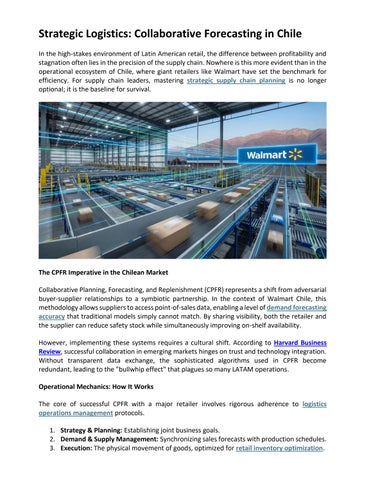
Strategic Logistics: Collaborative Forecasting in Chile In the high-stakes environment of Latin American retail, the difference between profitability and stagnation often lies in the precision of the supply chain. Nowhere is this more evident than in the operational ecosystem of Chile, where giant retailers like Walmart have set the benchmark for efficiency. For supply chain leaders, mastering strategic supply chain planning is no longer optional; it is the baseline for survival.
The CPFR Imperative in the Chilean Market Collaborative Planning, Forecasting, and Replenishment (CPFR) represents a shift from adversarial buyer-supplier relationships to a symbiotic partnership. In the context of Walmart Chile, this methodology allows suppliers to access point-of-sales data, enabling a level of demand forecasting accuracy that traditional models simply cannot match. By sharing visibility, both the retailer and the supplier can reduce safety stock while simultaneously improving on-shelf availability. However, implementing these systems requires a cultural shift. According to Harvard Business Review, successful collaboration in emerging markets hinges on trust and technology integration. Without transparent data exchange, the sophisticated algorithms used in CPFR become redundant, leading to the "bullwhip effect" that plagues so many LATAM operations. Operational Mechanics: How It Works The core of successful CPFR with a major retailer involves rigorous adherence to logistics operations management protocols. 1. Strategy & Planning: Establishing joint business goals. 2. Demand & Supply Management: Synchronizing sales forecasts with production schedules. 3. Execution: The physical movement of goods, optimized for retail inventory optimization.
4. Analysis: Reviewing KPIs like Fill Rate and On-Time In-Full (OTIF).
Overcoming the "Pain Points" of Implementation Despite the clear benefits, friction points remain. In Chile and Peru, infrastructure challenges often disrupt the flow of data and goods. Achieving collaborative planning success requires navigating distinct urban logistics hurdles—from the congestion of Santiago to the geographic complexities of regional distribution centers. Global insights reinforce this necessity. As noted by McKinsey & Company, the next generation of supply chains (Supply Chain 4.0) relies heavily on the digitization of these collaborative processes to predict disruptions before they occur. The Role of Resilience Building supply chain resilience involves more than just software; it requires leadership capable of interpreting data and making rapid decisions. When working with a partner as demanding as Walmart, the ability to pivot based on real-time consumption data is critical. This agility is the defining characteristic of modern operational excellence.
Future Outlook: AI and Automation The future of CPFR in LATAM is automated. We are moving toward "predictive collaboration," where AI models suggest replenishment orders without human intervention. For professionals conducting LATAM market analysis, the trend is clear: those who integrate early with major retailers' automated platforms will dominate the shelf space. According to Gartner, the most advanced supply chains are those that move beyond transactional data sharing to true ecosystem orchestration, creating value for the retailer, the supplier, and the end consumer.
Conclusion Collaborating with Walmart Chile via CPFR is a rigorous test of a company's logistical maturity. It demands precision, transparency, and a relentless focus on data. For those willing to adapt, the rewards—scalability, reduced waste, and market leadership—are immense.
Official profile: Carlos Velásquez Rada → https://carlosvelasquezrada.com/ •
About.me: https://about.me/carlosvelasquezrada
•
Google Site: https://sites.google.com/view/carlos-velasquez-rada/
See also on my Website Medium Substack Scribd Calameo Youtube