Focus on Livelihood in Laos | SLS Project Financed by the Ministry of Foreign affairs of Luxembourg
Caritas strategy
As part of the Caritas 2024 strategy to contribute to the reduction of poverty in Lao PDR, our organization works on four main objectives: (1) increased resilience, (2) diversified income generation, (3) strengthened governance systems,and(4)adaptedinfrastructuresinplace.
Thoseobjectivesareallcoveredthroughprojects dividedinfourmainthemes:Nutrition,Livelihood, Socio-Economic Development plan (SED) planning, and Disaster Risk Reduction (DRR).
This second newsletter of 2024 focuses on livelihood and will guide you through the achievements of Caritas’ SLS project and how it made a change to the current livelihood situation in Lao PDR.
Context:
Brief update on Livelihood situation in Laos in 2024
Lao PDR is one of the least developed countries, with one of the lowest population densities in Asia. 18percentofthepopulationlivebelowthenational poverty line (1.25 USD/Day) with GDP per capita of 2,088 USD (World Bank 2022). Laos made remarkable progress in reducing poverty from the early 1990s until around 2018: from 46.0 percent to 18.6 percent over 1992–2018 period. Despite this progress, poverty in Laos remains high comparedtoitsregionalpeers.COVID-19setback progress on reducing poverty, and mounting inflation has weighed negatively on households’ purchasing power. Employment disruptions and remittance losses due to return migration resulted in a decline in household income, while rising prices put pressure on households’ purchasing power. Rising food price resulted in household reducingfoodconsumption(34percent),switching to cheaper food options or hunting and gathering wild food (39 percent), and resorting to selfproduction (47 percent). In a recent survey, 65 percent of households reported that they had reduced education and health spending to cope with inflation, with rates higher among poorer and rural households.
The COVID-19 outbreaks severely affected employment and earnings and, while employment has returned to its pre-pandemic
level, the recovery of household income has been gradual.
Lockdowns, restrictions on economic activity, quarantine requirements, and social distancing measuresledtoareductioninemploymentand working hours. High inflation and a sharp currency depreciation have incentivized workers to switch from non-tradable service sectors toward agriculture and manufacturing.
Despite improvement in farm incomes, poverty remains highly concentrated in agriculture. Poverty remains high among ethno-linguistic minority households and households headed by low-educated persons
Caritas’ Response: the SLS Project
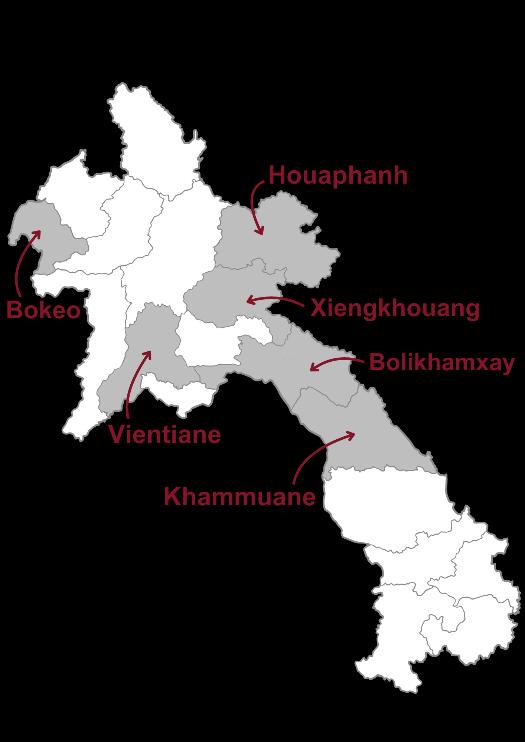
The Strengthening Livelihood System phase II (2021 - 2025) is the continuation of the first phase implemented between 2016 and 2020, in 15 villages of Mok district, Xiengkhouang Province. This second phase is targeting 60 villages in the provinces of Xiengkhouang and Houaphan. The project’s budget accounts for a total of 2,500,000 EUR and is supported by the Government of Luxembourg and Caritas Luxembourg. The aim of the project is to reduce poverty, increase assets and contribute to food security according to the objectives and priorities of the sustainable development goals. To achieve those goals, the project implements a holistic approach at the
Map 1: Provinces where Caritas is currently active.
village and district level to address all leviers of poverty. Under the project, different producer groups are supported (livestock, weaving, small businesses) in the form of funding, technical training, and improved access to markets. Moreover, forest and fish reproduction zones are set up with clear rules and delimitations to ensure that livelihood strengthening and environmental preservation are compatible.
Project’s main objectives and achievements
The objective of the project is to increase human asset and contribute to food security. This objective will be achieved by improving the accessibility, availability, diversity and management of food for vulnerable households and communities in a sustainable manner. Since its start in 2021, the project has made significant advancements, particularly in terms of fostering community and local authority’s capacity through the provision of technical training for staff.
Small funds are granted to producer groups (weaving, small and large livestock), new agroecological techniques are taught, clean water is provided, hygiene is promoted. To fight against malnutrition, the project has provided medical equipment and training to village health workers and health centre staff to regularly screen and
Zoom In: Funding group
The Funding Group in the SLS project is an initiative with the objective of generating additional income for priority families in target provinces. This is intended to enhance the livelihood systems, food security, and health and nutrition of children in the village. Furthermore, it is a practice that fosters self-empowerment, selfownership and socio-economic benefits. Priority families can choose from three different revolving funds: the weaving fund, the small and large livestock fund, and the small credit scheme. The funds will facilitate group members to expand their activities. In particular, members of the weaving fund can engage in weaving or
follow-up identified cases. School gardens and home gardens are promoted to increase food diversity and fishponds have been set up.
The most significant outcome is the establishment of a sustainable livelihood system within the community, which enables villagers to participate in a funding group and diversify their sources of income.
embroidery to sell their products in themarket,therebydevelopingtheir families and improving their lives. Similarly,membersofthesmalland large livestock fund can buy farm animals to raise and sell in the market, generating profit. Finally, the small credit scheme for women provides women with the autonomy to select their own activities, the funds are managed by a robust committee, comprising the group head and financial accounting personnel. Additionally, the district officers serve as a crucial support, providing guidance and training on various activities. Currently, the project has been able to utilize the funds for tworounds.
Sincethebeginning oftheproject, over 1300 households have benefitedfromthefundinggroups
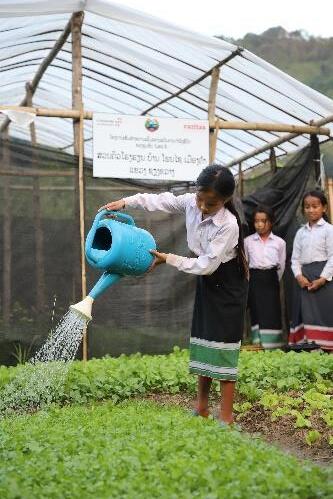
Figure 1: Student watering the vegetable that receive from the project support. 30/11/2022. Phonexay village, Phaxay district, Xiengkhouang province.
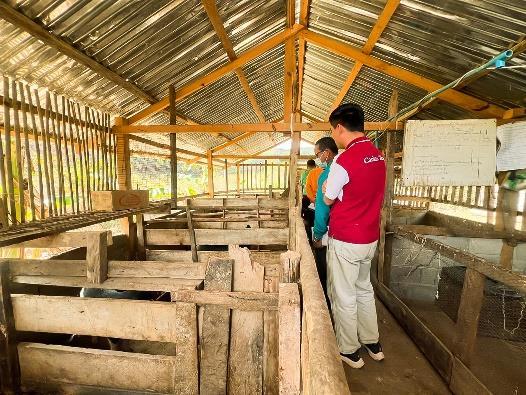
Figure 2: Monitor the Member of the small and large livestock raising group. 17/01/2024 Mouangaor village, Houamoung district, Houaphan province.
Setting up Fishponds
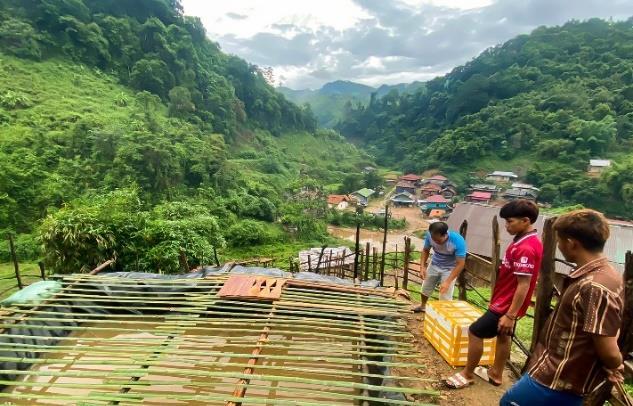
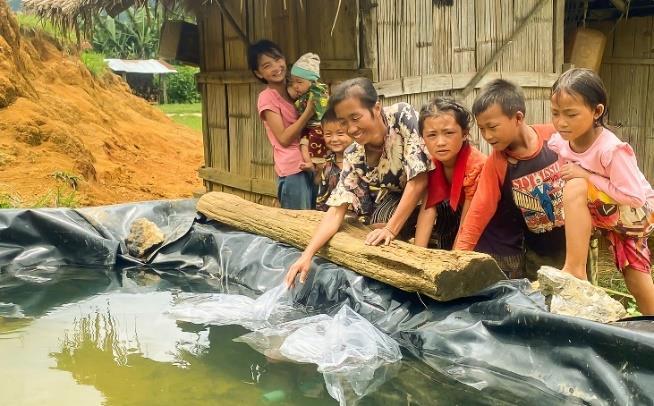
150 poor households have benefited from this activity under the project. Every household was providedwithmaterialtoinstallafishpond,catfishto populate the pond, fish food and adequate training on fish farming. This activity increases the income and food security for the beneficiary household. Initially, thedistrictteamchosethemost appropriate
Story fron the field
“Weaving Fund”
Phiengmone village in Nonghet district, Xiengkhouang province is located in a mountainous area where most of the area is steep. The land around the village is suitable for agricultural production and cultivation thanks to the Huai and the Mat rivers. Mrs. Nahouang is 38 years old, has 3 children, and lives in Phiengmone village. She is one of the members who received weaving funds from the project at the end of November 2022. "My family has farming as the main occupation and weaving is our secondary income. However, after receiving funds from the project in the amount of 1,500,000 kip, I was able to buy cotton, weaving wrap and reed to produce garments for sale. I used my free time from
material, but it turned out that the quality of the plastic sheet was suboptimal. The project switched to concrete basins, but with the increasing inflation and depreciation of the local currency, this was not a sustainable solution. District teams managed to find more solid plastic to continue setting up the fishponds.
farmingtoproducegarments,which I was able to sell at 200,000 kip/piece.
Currently,therearemiddlemenwho come to buy garments from the members of the weaving group, to sell in Phonsavan.This allows usto sell products comfortably and the equipment that I bought from receiving project funding has allowed me to produce and sell a total of 30garments, corresponding to a total income of 6,000,000 kips within 3 months.
Participating in a weaving fund throughtheprojecthasprovidedme more income to support my family. Moreover, it has given me the freedom to make decisions about the use of income in the family.”
‘This publication was funded by the Ministry of Foreign affairs of Luxembourg. Its contents are the sole responsibility of Caritas Luxembourg and do not necessarily reflect the views of the Government of Luxembourg.’
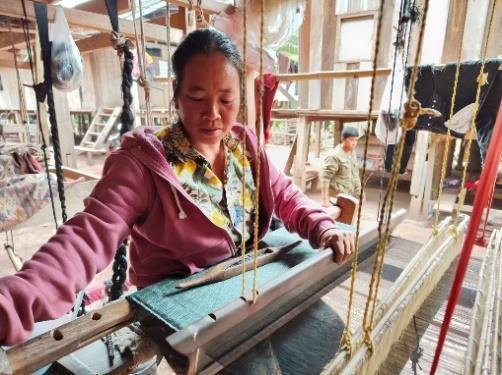
Figure 5: The Member of the weaving group show weaving. 10/01/2022. Phiengmone village, Nonghet district, Xiengkhouang province.
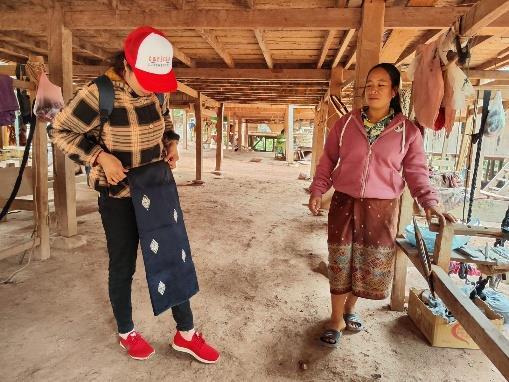
Figure 6: Monitor the member of the weaving group 10/01/2022. Phiengmone village, Nonghet district, Xiengkhouang province.