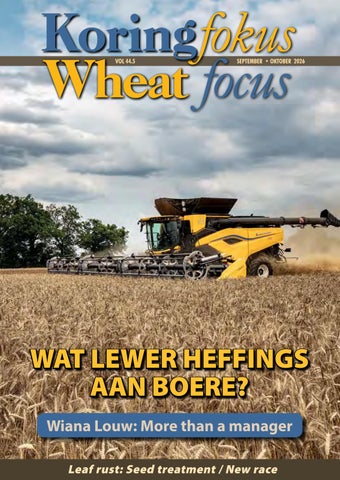
VOL 44.5
SEPTEMBER • OKTOBER 2026
WAT LEWER HEFFINGS AAN BOERE? Wiana Louw: More than a manager Leaf rust: Seed treatment / New race
9-12 Sep
2026 BREDASDORP PARK
Saam
groei ons
Together we grow
VOL 44-5
REEDS 43 JAAR DIE ONAFHANKLIKE SPESIALIS-TYDSKRIF VIR DIE KLEINGRAANBEDRYF
AGRI INFO VOORBLAD: New Holland se CR-stroper kan oesreste tot 18 m ver versprei deur middel van die proaktiewe Intellispread-stelsel vir oesreste. Foto: New Holland.
4 Koring se invoertarief op zero 05 Sojaboonmodel se slegte nuus pootjie ook die koringbedryf
SEPTEMBER • OKTOBER 2026
NEEM KENNIS Weens afleweringsprobleme met die gewone posdiens word intekenare en lesers versoek om hul e-posadresse aan info@mediakom.co.za te stuur vir die elektroniese versending van KORINGFOKUS - WHEAT FOCUS.
05 Dr Yolisa Pakela-Jezile appointed at Grain Laboratory
Koringfokus / Wheat Focus verskyn ses keer per jaar en word in samewerking met die koringbedryf saamgestel, wat insluit: LNR-Kleingraan; SA Graaninligtingsdiens & SA Graanlaboratorium. Gratis beskikbaar aan bona fide-kleingraanprodusente
6 IGC 2026 conference: Comfortable supplies, complex risks 10 Heffings lewer verlangde resultate 10 Sacta herdenk tien jaar en vereer grondleggers 11 Opbrengste beter danksy saadtegnologie 14 Inligting ondersteun voedselsekerheid 10
16 Women’s voices in agriculture: remarkable achievements and aspirations 17 More accolades as Renée Prins retires 18 Wiana Louw: More than a manager 28 Brown-bag seed bootlegging stopped in
Sacta bring hulde
its tracks
Uitgewer en eienaar Adres vir redaksionele kopie, advertensies en intekenare: Mediakom Posbus 20250 Noordbrug 2552 Tel: 018 293 0622 E-pos: info@mediakom.co.za www.mediacomcc.co.za REDAKTEUR: Willie Louw ADVERTENSIES: Jana Greenall 082 780 9914 UITLEG: Mercia Venter studio.chatnoir@gmail.com KOPIEREG EN STANDPUNTE © Kopiereg / Copyright: Ingevolge Artikel 12(7) van die Wet op Outeursreg Nr 98 van 1978 en enige wysigings word alle regte voorbehou. Standpunte en aansprake in advertensies en artikels word nie noodwendig deur Mediacom Bk en enige medewerkers / deelnemende instansies onderskryf nie. Regstellings word net oorweeg indien ‘n tipografiese fout die bemarkingswaarde van ‘n advertensie/promosie verminder.
KLEINGRAAN 20 Microbial seed treatment shows
promise for managing leaf rust and improving wheat seedling growth 22 New leaf rust race detected during the 2024-2025 surveillance
NAMPO KAAP 24 Landbou nie in isolasie, vennootskappe 25 Hoogtepunte by Nampo Kaap
Microbial seed treatment
25 Onthou hierdie vir bywoning 26 Platteland se verhale en blommeprag word gevier 27 Eerstehandse kennis met seminaar en boereplanne
MARK-INFO 8 Koringhektare gee ‘n paar treë terug na die verlede 30 SAGIS: Market information:
SEPTEMBER • OCTOBER 2026
20
bring groei
24 Lipizzaners by Nampo
KORINGFOKUS WHEAT FOCUS 3
Koring se invoertarief op zero ‘n Nultarief vir koringinvoer is 6 Augustus 2026 in Staatskoerant aangekondig nadat dit op 12 Mei 2026 gesneller het en op 23 Junie 2026 en 4 Augustus 2026 vir ‘n nulwaarde herhaal is. Die vorige nultarief was in Augustus 2024 vir langer as twee maande van toepassing.
D
ie onlangse tarief was R153,70 wat op 15 Mei 2026 ingestel is, drie dae nadat die tarief vir zero gesneller het. Dié vertragting in die aankondiging van ‘n nultarief was onder meer ten koste van verbruikers wat bykans drie maande lank ‘n verhoogde prys vir koringprodukte moes betaal. Die langsame wysiging van die invoertarief volg kort nadat die departement van handel, nywerheid en mededinging in ‘n koringtariefondersoek van 19 maande gesê het dat geen outo matiese snellermeganisme toegepas gaan word nie. Graan SA en die handelaarsvereniging van graan en oliesade, Sacota, het voorheen dié versoek gerig, asook dat die dollargebaseerde verwysingsprys hersien moes word. Na die ondersoek het die betrokke minister, Parks Tau, erken dat vertragings tussen ’n tariefsneller en implemente ring daarvan die doeltreffendheid van die tarief kan ondermyn en markversteurings kan skep. In plaas daarvan om ’n outomatiese snellermeganisme goed te keur of ’n duidelike alternatief te bied, is die aangeleentheid vir verdere gesprekke tussen staatsdepartemente verwys. In Graan SA se reaksie daarop het die uitvoerende hoof, dr Tobias Doyer, hulle frustrasie daaroor uitgespreek. “Die regering erken dat die stelsel ondoeltreffend is, maar produsente word weer eens sonder sekerheid, sonder tydlyne en sonder ’n werkbare oplossing gelaat. Koringprodusente kan nie plant- en beleggingsbesluite neem op grond van eindelose toekomstige konsultasies nie.” Die tydperk wat dit neem om die tarief aan te pas nadat dit volgens ‘n formule gesneller het, is volgens belanghebbendes kommerwekkend. Dit skep nie net onsekerheid in die mark nie maar benadeel ook produsente tydens belangrike produksiefases, soos tydens oestyd en wanneer produksiefi-
4
KORINGFOKUS WHEAT FOCUS
nansiering onderhandel moet word. Produsente was in Januarie vanjaar hoopvol dat die bedryf se posisie gaan verbeter na die afkondiging van ‘n Artikel 7komitee deur die nasionale landboubemarkingsraad (NLBR) op versoek van die Koringforum. Die Koringforum het die NLBR versoek dat vier sake ondersoek moet word, onder meer die samestelling van die invoertarief se verwysingsprys en die snellermeganisme. Rolspelers meen dat die verwysingsprys en invoertarief nie beskerming aan produsente en hul produksie gee teen gesubsidieerde ingevoerde koring soos wat dit met die instelling daarvan beoog was om te doen nie. Die Koringforum se versoek aan die NLBR was dat die tarief gereeld op voorafbepaalde datums aangekondig moet word sodat die bedryf sekerheid het en betrokkenes presies sal weet wanneer die tarief van toepassing gaan wees.
Zimbabwe stel invoertarief in AM Trends (https://amtrends.co.za) berig dat Zimbabwe ‘n invoertarief van $98/ton vir koring ingestel het. Dit is op sagte koring van toepassing en die regulasie maak geen melding van harde koring nie. Die motivering was om Zimbabwe se koring produsente teen goedkoop ingevoerde koring te beskerm. Volgens Jacques Pienaar van AM Trends se graanverslag vir Afrika is dit die eerste keer in baie seisoene dat Zimbabwe ‘n invoertarief instel. Die land produseer jaarliks sodat 200 000 tot 250 000 ton koring en voer jaarliks sowat 135 000 ton in. Die ingevoerde koring verteenwoordig sowat ‘n derde van die land se verbruikersbehoefte. Zimbabwe se leweringseisoen is in September.
SEPTEMBER • OKTOBER 2026
Sojaboonmodel se slegte nuus pootjie ook die koringbedryf Die koringbedryf het ‘n verdere terugslag gekry toe die JSE (Johannesburgse Effektebeurs) aangekondig het dat hulle nie die voorlopige verwysingspuntmodel met veelvuldige verwysingspunte wat op sojabone beproef is gaan aanvaar en instel nie. Die koringbedryf het verwag om ‘n soortgelyke model ingestel te kry ná goedkeuring van die sojaboonmodel.
G
raan SA het hulle ‘diepe teleurstelling’ met die JSE se besluit uitgespreek en sê in ‘n verklaring hulle verskil met die besluit om ‘n enkelverwysingspuntmodel te behou. Ná ‘n versoek van die JSE vir ‘n geloofwaardige alternatief vir die bestaande enkelverwysingspuntmetodologie vir sojabone het Graan SA met die hulp van wetenskaplikes en spesialiste ‘n alternatiewe model ontwikkel. Dié model met veelvuldige verwysingspunte (die MRP-model) is sedert Maart 2024 vir twee bemarkingseisoene op die lewerbare sojaboontermynkontrak getoets. “Graan SA is bekommerd dat die JSE se finale besluit en motivering nie voldoende en deursigtige kriterium-vir-kriterium-redes aan die hand van die ooreengekome evaluerings raamwerk verskaf nie.” Die organisasie beskou die JSE se besluit as ongebalanseerd en dat dit nie behoorlik ondersteun word deur ‘n deursigte beoordeling van die beskikbare bewyse nie. “Graan SA kan nie die voorgestelde terugkeer na ’n enkel verwysingspunt, of die verskuiwing van daardie verwysingspunt, ondersteun sonder ’n omvattende en deursigtige beoordeling van die moontlike finansiële gevolge vir produsente in alle sojaboonproduserende streke nie. “Graan SA sal gedetailleerde kommentaar op die (JSE se) voorstel indien en sal voortgaan om hom te beywer vir ’n metodologie vir liggingsdifferensiale wat deursigtig, bewysgebaseerd en billik teenoor alle markdeelnemers is.”
Van sojabone na koring se liggingsdifferensiaal Só seker was die koringbedryf dat die sojabone se veelvuldige verwysingspuntmodel aanvaar en ingestel sou word dat hulle in die afgelope twee jaar met die hulp van Graan SA se ekonome ‘n eie berekeningsmetode en model begin ontwikkel het wat op die sojaboonmodel geskoei was. Dit sou baie voorbereidingstyd bespaar het in ‘n bedryf waar produsente groot druk ervaar. “Dit gaan om produsente en die bedryf se oorlewing en om nog twee jaar te wag nadat die sojaboonprojek voltooi is is te lank,” het ‘n produsent by Graan SA se kongres in Maart 2024 gesê. Die koringbedryf voer ‘n jarelange stryd teen ‘n liggingsdifferensiaal wat hulle as “onregverdig” beskou en wat veral suidelike produsente benadeel. Koring se liggingsdifferensiaal is in 1998 ingestel. Sowat 80% van die land se koring, wat in die Wes-Kaap geproduseer word, word daar verwerk en nie na die noorde vervoer nie. Nogtans is alle koring aan ‘n liggingsdifferensiaal onderworpe asof dit na Randfontein vervoer word en daardie koste word van produsente verhaal. Graan SA het voorsien dat koringprodusente in die suide baie voordeel uit ‘n nuwe model kon kry, indien dit deur die JSE aanvaar sou word. Die nuwe model behels dat meer verwysingspunte as net die huidige Randfontein vir berekeninge gebruik kon word.
Dr Yolisa Pakela-Jezile appointed at Grain Laboratory
T
he board of directors of The Southern African Grain Laboratory NPC (SAGL) appointmented Dr Yolisa PakelaJezile as general manager, effective 1 September 2026. She replaces Wiana Louw who retired as general manager. According to a statement by the board, Dr Pakela-Jezile will oversee the organisation's day-to-day operations, drive operational excellence, support the implementation of strategic initiatives, strengthen internal processes, and work closely with the board and leadership team to ensure the continued delivery of high-quality services and value to members and stakeholders. Prior to her appointment, Dr Pakela-Jezile was acting executive manager: Crops and Natural Resources and Engineering at the Agricultural Research Council. Dr Pakela-Jezile brings many years of experience in the
SEPTEMBER • OCTOBER 2026
agricultural sector, with extensive expertise in operations management, business development, stakeholder engagement, fi nancial management, organisational strategy, and team leadership. Her appointment reflects SAGL’s commitment to strengthening its executive leadership and positioning the organisation for sustained growth and long-term success. Commenting on the appointment, Dr Erhard Briendenhann on behalf of the board of directors said Dr PakelaJezile’s proven leadership, strategic insight, and understanding of the agricultural industry make her exceptionally well suited to lead the organisation's operations. “We are delighted to welcome Dr Pakela-Jezile as our new general manager. We are confident that she will play a significant role in advancing our strategic priorities and delivering continued value to our members and stakeholders.”
KORINGFOKUS WHEAT FOCUS 5
IGC 2026 conference: Comfortable supplies, complex risks The consensus from the International Grains Council was that the challenge for grain producers, traders and policymakers is no longer one of shortages, but of navigating a marketplace shaped by geopolitical uncertainty, technological disruption, changing regulations and increasingly unpredictable weather. Bernard Schultz SA GRAIN INFORMATION SERVICE
T
he SA Winter Cereal Industry Agency (SAWCIA) provided Bernard Schultz and Dr Konrad Keyser with the opportunity to attend the International Grains Council (IGC) Conference, held in London.
Lower prices demand smarter decisions Global grain production is at or near record levels, resulting in higher carryover stocks and increased competition among exporters. Wheat remains the dominant winter grain internationally, with strong harvests from the Black Sea region, the European Union, North America and Australia placing downward pressure on prices. For producers, this translates into tighter profit margins. For importing countries, however, lower prices provide welcome relief. Speakers repeatedly emphasised that profitability in this environment will depend less on favourable markets and more on operational efficiency, sound risk management and diversified marketing strategies.
Trade is becoming more strategic Despite abundant supplies, international grain trade is becoming increasingly strategic rather than purely price-driven. Importing countries are placing greater emphasis on supply security, reliable logistics and consistent grain quality. Geopolitical tensions, trade policies, shipping disruptions and sanitary regulations are influencing purchasing decisions as much as price. While conflicts in the Black Sea region, disruptions in the Red Sea and uncertainty around the Strait of Hormuz continue to complicate logistics, the grain industry has demonstrated 6
KORINGFOKUS WHEAT FOCUS
remarkable resilience by adapting trade routes and sourcing strategies. However, these adjustments come at the cost of longer shipping times, higher insurance premiums and increased freight inefficiencies.
Africa emerging as a strategic growth market One of the strongest messages from the conference was the growing importance of Africa in global grain demand. Rapid population growth, urbanisation and expanding livestock industries are driving increased imports across the continent. Wheat demand continues to rise, while feed barley is becoming increasingly attractive as it competes with maize in animal feed markets. Delegates suggested that Africa is no longer viewed merely as a destination for surplus grain but rather as one of the world’s most important long-term growth markets. Interestingly, the trend is shifting from importing flour towards importing wheat itself, as more African countries invest in domestic milling capacity.
Technology is becoming a competitive advantage Technology featured prominently throughout the conference, with speakers agreeing that digital innovation will increasingly determine competitiveness across the grain value chain. Artificial intelligence, digital trading platforms, logistics optimisation, improved supply-chain visibility and data-driven risk management are rapidly changing how grain is marketed and moved around the world.
Gene editing moves into the mainstream Perhaps the most significant policy discussion centred on gene editing. Industry leaders broadly agreed that gene editing has SEPTEMBER • OKTOBER 2026
technologies not only for environmental and food safety but also for their potential impact on export market access. Before commercial release, developers are expected to demonstrate that major export destinations have approved the technology, reducing the risk of market disruption. Equally noteworthy is Argentina’s emphasis on collaboration across the entire grain value chain, with farmers, exporters, grain handlers, seed developers and government working together before new technologies are commercialised.
Southeast Asia remains highly competitive Dr Konrad Keyser, chairman of SACOTA, and Bernard Schultz, general manager of SAGIS, attended the International Grains Council Conference held in London. Photo supplied.
the potential to accelerate crop improvement, strengthen food security, improve climate resilience and deliver nutritional benefits without necessarily introducing foreign DNA. Many regulators are therefore beginning to distinguish gene-edited crops from traditional genetically modified organisms (GMOs), recognising that many gene-edited varieties closely resemble the outcomes of conventional breeding. However, delegates warned that fragmented regulatory approaches remain one of the biggest risks facing international grain trade. Different approval systems, inconsistent product classifications and varying market acceptance could create unnecessary trade barriers and delay farmer access to improved crop varieties.
Argentina provides a practical blueprint Argentina offered one of the conference’s most practical examples of how biotechnology can be managed without compromising export markets. Recognising that it exports far more grain than it consumes domestically, Argentina evaluates new
While Africa offers significant future growth, Southeast Asia remains one of the world’s most important grain-importing regions. Expanding livestock production, economic growth and rising food consumption continue to increase import demand. As a result, exporters from the Black Sea region, North America and South America are expected to compete aggressively for market share in this strategically important market.
Weather still holds the final vote Although markets currently appear well supplied, weather remains the industry’s greatest wildcard. Meteorologist Tom Whittaker highlighted growing concerns surrounding the possible development of an exceptionally strong El Niño event. While forecasts remain probabilistic, South Africa, Brazil, India and China were identified as countries warranting particularly close attention. Potential impacts include increased drought risks across parts of southern Africa, Brazil and Southeast Asia, while North America could experience comparatively favourable growing conditions. Importantly, Whittaker cautioned that El Niño alone cannot explain global weather patterns, with several other oceanic and atmospheric systems also expected to influence agricultural production over the coming season.
Onsekerhede laat masjinerie se verkope daal
T
oenemende onsekerhede soos die somergraanoes en klimaatsvooruitsigte dra daartoe by dat minder trekkers en stropers in Julie vanjaar verkoop is as in die vorige jaar. Volgens die landboumasjinerievereniging SALMA se Julie-verslag van kleinhandelsverkope is 31% minder trekkers en bykans 1% minder stropers tot dusver vanjaar verkoop in vergelyking met verlede jaar se ooreenstemmende tydperk. In Julie 2026 is 517 trekkers verkoop, 31% minder as die 753 eenhede wat in Julie verlede jaar verkoop is. Elf stropers is in Julie 2026 verkoop, vyf meer as die ses eenhede wat verlede Julie verkoop is. Willie Human, voorsiter van SALMA, sê sentiment in die mark is steeds positief, maar daar hang toenemende onsekerhede oor die mark. Hy wys ook daarop dat Botswana se trekkerverkope Julie
in Julie verlede jaar ‘n rol in die statistiek speel. Wanneer die hoë verkope van Botswana in Julie 2025 in aanmerking geneem word, is vanjaar se Julie-verkope in Suid-Afrika bykans dieselfde as in Julie 2025. Die tendens van verkope in Suidelike Afrika sal volgens Human duidelik wees wanneer somergewasse se oes afgehandel is. “Onder die onsekerhede is die huidige somergewasopbrengste, insetkoste, kommoditeitspryse, rentekoerse en weervooruitsigte vir die komende somergewasseisoen. Die onsekerhede beteken dat boere gedwing word om eers besluite oor die aankoop van toerusting uit te stel. Veral met die mielie-oes, wat vertraag is weens laat reën, sal die rigting van die bedryf waarskynlik eers duideliker wees oor ’n paar maande.”
MaandJaar tot datum Jaarverandering verandering Mei % % 2026 2025
2026
2025
Trekkers
517
753
-31,3
4 034
4 315
-6,5
Stropers
11
6
83,3
166
167
-0,6
SEPTEMBER • OCTOBER 2026
KORINGFOKUS WHEAT FOCUS 7
Koringhektare gee ‘n paar treë terug na die verlede
Terwyl koringaanplantings vir die komende seisoen die minste hektare in bykans ‘n eeu beslaan, kan die kleinste oes van die afgelope ses seisoene verwag word. Volgens die Nasionale Oesskattingskomitee (NOK) se eerste oesskatting van die 2026-seisoen word 7,50% of 142 980 ton minder koring verwag.
B
Figuur 1. Koringproduksie 2015 - 2026.
Bron: NOK.
Figuur 2. Moutgarsproduksie 2015 - 2026.
Bron: NOK.
Figuur 3. Kanola-produksie 2015 - 2026.
Bron: NOK.
y ander wintergewasse is die statistiek rooskleuriger en sowel die aanplantings as produksie is groter, met die uitsondering van soetlupine se hektare. Kanola se verwagte rekordoes is 17,6% meer as in die vorige seisoen. Gars se verwagte produksie kan 20,2% meer beloop, hawer kan 26,2% meer tonne lewer en met soetlupine word bykans dieselfde grootte oes van 18 000 ton verwag. Die NOK se eerste oppervlakteskatting in die Wes-Kaap is volgens die NOK hoofsaaklik gebaseer op inligting wat van die Produsente onafhanklike oesskattingstelsel (PICES) verkry is en wat deur die nasionale oesskattingskonsortium uitgevoer is. Die gemiddelde koringoes oor die afgelope vyf jaar was 2 056 100 ton. Vanjaar se verwagte oes is dus 293 580 ton minder en dit is die kleinste oes sedert 2019 se 1 535 000 ton. Die skatting van die oppervlakte onder koring beloop 479 500 ha, wat 37 800 ha minder is as die 517 300 ha wat verlede seisoen geplant is. Dit is die kleinste oppervlakte wat sedert 1929 met koring beplant is, toe die oppervlakte onder koring 439 000 ha beloop het. In sy kommentaar oor die jongste oppervlakberekeninge sê Wandile Sihlobo van die landbousakekamer Agbiz die daling in koringhektare kan onder meer toegeskryf word aan voldoende internasionale voorraad teen laer pryse, hoër insetkoste en ongunstige weerstoestande in sommige koringverbouingstreke van Suid-Afrika. Saam met ander faktore het hierdie druk gelei tot die koringbedryf se besluit om aansoek te doen vir ‘n hoër koringinvoertarief sodat die plaaslike bedryf versagting kan kry teen laer pryse en ingevoerde koring wat gesubsidieer word.
Provinsies se aanplantings In die provinsies wat die meeste tot Suid-Afrika se koringproduksie bydra, naamlik die Wes-Kaap, Vrystaat, Noord-Kaap
8
KORINGFOKUS WHEAT FOCUS
SEPTEMBER • OKTOBER 2026
Tabel 1. Wintergewasse hersiene oppervlakte- en eerste produksieskatting vir die 2026-produksieseisoen.
GEWAS
Opp beplant 2026
Opp beplant 2025
Eerste oesskatting
Finale oes 2025
Verandering
Ha (A)
Ha (B)
Ton (C)
Ton (D)
% (C) ÷ (D)
Belê Pure Koringpotensiaal in die Wes-Kaap
Kommersieël: Koring
479 500
517 300
1 762 520
1 905 500
-7,5
Gars
105 320
96 950
414 640
345 000
20,2
Kanola
194 390
174 515
359 860
306 000
17,6
Hawer
40 400
35 520
54 890
43 500
26,2
Soetlupine
20 000
21 000
18 000
17 850
0,8
Totaal wintergewasse
834 420
845 285
2 609 910
2 617 850
-0,3
Sensako se koringkultivars is spesifiek geteel vir die Wes-Kaap, daarom kan ons jou help om jou goeie planne in goeie opbrengs om te sit. Stel jou plantpakket saam uit die volgende SENSAKOkoringkultivars:
Bron: NOK.
SST 0208 (Nuut) SST 0187 SST 0166 SST 0147 SST 0117 SST 056 SST 015 SST 0235 (beskikbaar 2027)
Tabel 2. Koring se hersiene oppervlakte- en eerste produksieskatting per provinsie 2026-seisoen.
Provinsie
Oppv. beplant Ha
Oppv. beplant Ha
2026
2025
Eerste oesskatting Ton 2026
Finale oes Ton 2025
Wes-Kaap
330 000
363 000
874 500
980 100
Noord-Kaap
40 000
40 000
288 000
302 000
Vrystaat
56 000
57 000
257 600
270 750
Oos-Kaap
5 700
5 500
39 900
37 950
KwaZulu-Natal
8 400
8 500
50 400
51 000
Mpumalanga
3 100
3 500
20 770
22 400
Limpopo
25 000
28 000
160 000
165 200
Gauteng
800
800
5 200
5 150
Noordwes
10 500
11 000
66 150
70 950
Totaal
479 500
517 300
1 762 520
1 905 500
Ons help jou groei w f Yt t
Bron: NOK.
en Limpopo, het aanplantings verminder, behalwe in die Noord-Kaap. Die beraamde oppervlakte beplant in die Wes-Kaap is 330 000 ha, wat 33 000 ha minder is as die 363 000 ha van die vorige seisoen. Vir die Vrystaat is die aanplantings 56 000 ha, wat 1 000 ha minder is as die 57 000 ha wat verlede seisoen geplant is. Die oppervlakte beplant in die Noord-Kaap is 40 000 ha, wat dieselfde is as wat verlede seisoen aangeplant is. Noordwes se aanplantings het met 500 ha gedaal van die vorige seisoen se 11 000 ha tot hierdie seisoen se 10 500 ha.
Ander wintergewasse Gegewe dat gunstige omgewingstoestande in kanola-aanplantings ervaar gaan word, kan nog ‘n rekordoes verskyn. Die oppervlakte onder kanola is 194 390 ha, wat 19 875 ha meer is as die 174 515 ha wat verlede seisoen geplant is. Dit is die grootste oppervlakte wat nog met kanola beplant is. Die verwagte kanola-oes beloop SEPTEMBER • OCTOBER 2026
359 860 ton, wat 17,6% meer is as in die vorige seisoen. In die afgelope vyf seisoene het die gemiddelde oes 248 160 ton beloop. Sowat 20,2% meer gars word vanjaar verwag. Volgens die NOK kan die oes 414 640 ton beloop teenoor die vorige seisoen se 345 000 ton. Die oppervlakskatting vir gars is 105 320 ha, wat 8 370 ha meer is as die 96 950 ha van verlede seisoen. Hawer se verwagte oes van 54 890 ton is 26,2% meer as verlede seisoen se 43 500 ton. Die oppervlakteskatting toon ‘n toename van 4 880 ha. Soetlupine se aanplantings beloop 20 000 ha teenoor die vorige seisoen se 21 000 ha. Die verwagte soetlupine-oes beloop 18 000 ton. Die tweede produksieskatting vir wintergewasse vir 2026 word 29 September 2026 vrygestel. Meer inligting oor die NOK se verslae is op SAGIS se webtuiste beskikbaar by www.sagis.co.za onder die opskrif ‘non-SAGIS info - Crop Estimates Committee’. WHEAT FOCUS
9
syngenta.co.za SENSAKO SENSAKO 27 (0) 58 303 4690
Heffings lewer verlangde resultate Die heffing wat boere vir die ontwikkeling van selfbestuiwende kultivars en tegnologie betaal het ‘n positiewe opbrengs gelewer met 231 nuwe kultivars wat in die afgelope tien jaar daaruit gevolg het. Danksy die heffing is R986 miljoen deur die Suid-Afrikaanse agentskap vir kultivar- en tegnologie-ontwikkeling (Sacta) vir teling en tegnologie aangewend.
T
ydens ‘n verslagbyeenkoms oor Sacta het Andrew Bennett, die agentskap se uitvoerende hoof, gesê vir elke rand wat boere aan die heffing afstaan het hulle gemiddeld R2,20 se waarde ontvang. Sacta het in die afgelope tien jaar bykans R1,3 miljard uit die heffings geadministreer. Sacta het bereken dat ‘n heffingsinkomste van R295 miljoen tot ‘n plaashekvoordeel van sowat R482 miljoen lei. Dit kom neer op ‘n voordeel van gemiddeld R2,20 vir elke rand wat vir die heffing betaal is. Een van die pilare waarop die eindpuntheffingstelsel ‘n dekade gelede gevestig is, was dat saadmaatskappye danksy heffingsinkomste vergoed en aangemoedig moes word om nuwe kultivars vir die Suid-Afrikaanse mark te ontwikkel. Nuwe rolspelers in die saadbedryf moes ook daarmee gelok word om wêreldklaskultivars en tegnologie aan Suid-Afrikaanse boere te kon verskaf.
In die afgelope dekade is 231 nuwe kultivars van selfbestuiwende gewasse verskaf. Daarvan was 146 sojaboonkultivars, 66 kultivars vir koring, 11 vir gars, 6 vir hawer en 2 vir lupine. Danksy die inkomste wat saadmaatskappye ontvang het was die Suid-Afrikaanse saadmark weer aantreklik vir internasionale rolspelers. Tien jaar gelede het een van die grondleggers van die nuwe heffingstelsel, Andries Theron, ‘n kleingraanboer, gesê ‘n volhoubare model vir befondsing kan nuwe (saad)rolspelers lok. Kultivars met hoër opbrengs sal saadmaatskappye én boere bevoordeel, het hy destyds voorspel. Bennet het gesê vir elke R100 wat uit die heffings ontvang is, is R75 aan saadmaatskappye betaal, R2,50 vir kommissie en sowat R3 vir administrasie afgestaan. In ooreenstemming met statutêre heffings se bepalings is sowat R19,50 aan transformasieprojekte bestee. Volgens Sacta se finansiële state was die afgelope boekjaar
Sacta herdenk tien jaar en vereer grondleggers I
n sy tiende bestaansjaar het die Suid-Afrikaanse agentskap vir kultivar- en tegnologie-ontwikkeling (Sacta) nie net verslag gedoen van voordele voortspruitend uit heffings van oop bestuiwende gewasse nie, maar ook hulde gebring aan sy grondleggers. Met die toekenning van sertifikate en erkenning van rolspelers het Ryk Pretorius, voorsitter van Sacta se raad, gesê organisasies is nie net suksesvol weens hul strukture, beleid en befondsing nie, maar ook danksy hulle mense. Met die ontstaan van Sacta was daar mense met visie wat die stand van sake uitgedaag het en bereid was om hulle tyd en energie te belê in iets wat oor die lang termyn tot voordeel van plaaslike landbou kon wees. Sertifikate van erkenning is toegeken aan Andries Theron, die eerste voorsitter van Sacta se raad, Gert Heyns, eerste uitvoerende hoof, en die raadslede John Odendaal, Mariana Purnell, dr Marinda Visser, dr Lukeshni Chetty, Corné Louw en die voormalige administrateur Leon du Plessis. Benewens die sertifikate aan grondleggers was daar volgens Pretorius ook rolspelers en hul organisasies wat instrumenteel was in Sacta se grondslag en wat ‘n strategiese rol gespeel het. Sulke mense was Patrick Graham, Willem Engel-
10
KORINGFOKUS WHEAT FOCUS
Ryk Pretorius, voorsitter van Sacta se raad, saam met grondleggers van die agentskap wat in die tiende bestaansjaar sertifikate ter erkenning ontvang het: Corné Louw van Graan SA, John Odendaal, voormalige sakebestuurder van Pannar, en Andries Theron, kleingraanboer. Al drie is of was raadslede van Sacta.
brecht, dr John Purchase, Jannie de Villiers en Awie Coetzee (eerste administrateur).
SEPTEMBER • OKTOBER 2026
‘n Paneel kundiges het by Sacta se jaarlikse byeenkoms van belanghebbendes onder meer die koringbedryf se uitdagings met kwaliteit, planttelersregte en geenredigering bespreek. Die paneel, met gespreksleier prof Ferdi Meyer van BFAP (links), was prof Marena Manley van die Universiteit van Stellenbosch, Kobus van Huyssteen van Sansor, Corné Louw van Graan SA, Rossouw Swart, kleingraanboer van Swellendam, en dr Melissa van der Merwe van die Universiteit van Stellenbosch.
se bruto heffingsinkomste R250,961 miljoen. Daarvan was sojabone se bydrae R165 miljoen, koring R72 miljoen, gars R12,5 miljoen, hawer net meer as
een miljoen en lupine sowat R200 000. Altesaam R60 miljoen is aan begun stigdes in die koring-, gars-, hawer- en lupinbedryf betaal. Die meeste daarvan,
R50 miljoen, was aan die koringbedryf. Aan sojaboon-begunstigdes is R164 miljoen betaal. Koring en gars se heffings vir kultivaren tegnologie-ontwikkeling is in 2016 ingestel, hawer het in 2018 gevolg en sojabone in 2019. Sedert 2021 is ‘n hef fing vir lupine ingestel. Die heffings word deur die minister van landbou ingestel ná ‘n versoek van die onderskeie bedrywe. Dit is in die geval van koring, gars en hawer van toepassing van 1 Oktober af tot 30 September in die daaropvolgende jaar. Koring, gars en hawer se huidige heffings verval einde September 2026 en beloop tans R35/ton. Sacta het reeds ‘n aansoek ingedien om die heffing vir die volgende twee jaar voort te sit. Vir sojabone is die heffing tans R73 en dit verval in 2028.
Opbrengste beter danksy saadtegnologie S
acta het ‘n beduidende invloed op Suid-Afrikaanse graan en oliesade gehad, het prof Ferdi Meyer, besturende direkteur van die buro vir voedsel- en landboubeleid (BFAP), tydens Sacta se byeenkoms gesê. Danksy verbeterde saadtegnologie was daar ‘n toename in die hoeveelheid graan en oliesade wat per millimeter reën geproduseer word. Suid-Afrika se nasionale opbrengsgemiddeld is deurlopend besig om die gaping in die belangrikste kommodi teite te verklein. In koring se geval was die opbrengsverhoging danksy ‘n kombinasie van faktore in die afgelope vyf jaar 5%. Sedert deregulering het koringhektare verminder en die BFAP voorsien nou ‘n konsolidering daarvan op 2 miljoen ton en met marginale groei in die toekoms. Die bedryf bly egter volgens prof Meyer onder druk en produksie haal nie ingevoer de hoeveelhede in nie. Volhoubare groei van opbrengste is volgens prof Meyer die
SEPTEMBER • OCTOBER 2026
sleutel tot mededingendheid op uitvoerpariteit. In die BFAP se vooruitskouing van die volgende dekade het kundiges ‘n bestendige toename in koringaanplantings voorsien, van 505 000 ha in 2024 tot 530 000 ha in 2034. Opbrengste kan in winterreëngebied met 1,7% toeneem, in somerreëngebiede met 0,4% en in besproeiingsgebiede met 0,8%. Die BFAP voorsien in langtermynvooruitsigte dat wintergraanproduksie in die volgende dekade positief kan bly solank produktiwiteit verhoog. Produsente bevind hulle egter onder omstandighede met hoë risiko’s waar hulle met volgehoue vindingrykheid en beleggings in gevorderde tegnologie mede dingend sal kan bly. Plaaslike pryse vir wintergraan word volgens die BFAP se kundiges hoofsaaklik deur internasionale markte beïnvloed en is minder sensitief vir die plaaslike vraag en aanbod.
KORINGFOKUS WHEAT FOCUS 11
PROMOSIE
New Holland se CR-stropers is ontwikkel uit meer as 50 jaar se vindingrykheid tot die voordeel van kwaliteit met elke oes. Foto verskaf.
New Holland CR Revelation en Next Gen-stropers Met die oog op die komende oesseisoen van oliesade is New Holland se CR-stroper die oplossing om waardevolle gewasse van die land af te haal; dit bou voort op meer as 50 jaar se tegnologiese verbeterings vir voortreflike kraglewering, werkverrigting, kapasiteit en graan- en strooigehalte.
D
ie CR7.90 (309 kW) se rotors van 17 duim en sifoppervlak van 5,4 m2 kan ’n snytafel van tot 9,15 m hanteer. Daarbenewens word die nuwe CR10-stroper bekendgestel wat toegerus is met rotors van 24 duim, ’n skoonmaakarea van 8,8 m2 met geslote kringloop en ’n oesrestebestuurstelsel wat oesreste tot 18 m ver kan versprei deur middel van die proaktiewe Intellispread-stelsel.
speling om ’n gewas-op-gewas-wrywingsaksie te bewerkstellig, wat baie sagter is as die dorsaksie tussen gewas en konkawe. Dié ontwerp lewer ’n doeltreffende dorsaksie, veral by hoë opbrengste. • Vir die beste strooigehalte en brandstofverbruik is dit van kritieke belang dat die gewas vir die regte tydsduur binne die stroper bly.
Uitstekende prestasie begin met doeltreffende materiaaltoevoer
CR-graanmonster van uitstekende gehalte
Die CR-stroper se materiaaltoevoereenheid is toegerus met die Dynamic Feed RollTM wat sorg vir ’n konstante vloei van materiaal na die Twin RotorTM; dit bring ’n kragbesparing van 7 perdekrag (5,2 kW) en 'n kapasiteitsverhoging van tot 10% mee. Danksy die reguit en egalige vloei van materiaal deur die TwinPitch-rotors word die skoonmaakoppervlak eweredig belas vir optimale gewas- en materiaalskeiding. Die Dynamic Feed Roll lewer ’n lineêre spoedaanpassing tussen die werkmodules sodat selfs groen en nat materiaal verwerk kan word. Dit beteken dat boere vroeër in die oggend en later in die aand kan stroop.
Die TwinPitch RotorTM-effek Die TwinPitch RotorTM-stelsel is vir twee belangrike voordele ontwerp: • Die rotors se konkawe opening werk altyd met voldoende 12
KORINGFOKUS WHEAT FOCUS
Die CR-stroper se Opti-CleanTM-skoonmaakstelsel lewer optimale skeiding tussen skoon graan en ander materiaal. Dit funksioneer binne ‘n eie raam en kan die stelsel gelyk hou, selfs al kantel die stroper tot 20 grade. Die stroper is gevolglik ideaal vir gebruik op gelyke en ongelyke terrein. Die RotoThreshTM is die herdorsstelsel en buite die hoofdors area gemonteer. Dit sorg vir maksimum kapasiteit van alle gewasse. Die materiaal en gewas wat die herdorsproses ondergaan het, gaan terug na die skoonmaakarea; sodoende word die hoofdorsarea nie oorlaai nie en word graan nie beskadig nie. By die CR-stroper vergoed Opti-FanTM-tegnologie vir die uitwerking van swaartekrag op gewasmateriaal. Wanneer die stroper op gelyke grond werk, kan die verlangde waaierspoed gekies word. Daarna word die waaierspoed outomaties aangepas wanneer op of af teen ‘n helling beweeg word. NA BLADSY 14 SEPTEMBER • OKTOBER 2026
GROOT STROPER, ENORME AANBOD
CR7.90 FINANSIERING TOT EN MET PRIMA
-9%
*
UPTIME WAARBORG. 3 JAAR / 1200 URE VOLLE WAARBORG*
50% DEPOSITO 2 JAAR / 24 MAANDE *Bepalings en voorwaardes geld.
Kontak jou New Holland-handelaar vandag of bel ons: Paul de Korte (064 752 1613) - KwaZulu-Natal, Mpumalanga Quintus Smit (082 524 7397) - Wes-Kaap, Noord-Kaap en Oos-Kaap Eduan Booyens (071 871 8163) - Noordwes, Vrystaat, Gauteng en Limpopo Vir huidige aanbiedinge besoek newhollandag.co.za
Tindrum 26/075
www.newholland.com/za
Inligting ondersteun voedselsekerheid Onder wisselvallige toestande weens internasionale konflik stel akkurate markinligting die regerings, handelaars en bedrywe in staat om voorbereid te wees vir tekorte, om pryse te stabiliseer, invoerstrategieë aan te pas en voedselsekerheid te handhaaf.
V
oedselsekerheid is in hierdie tyd op die spel en die belang rikheid van die SA Graaninligtingsdiens (SAGIS) se werk en die samewerking van alle rolspelers kan nie oorbeklemtoon word nie, sê Zovuyo Ngejane, voorsitter van SAGIS se raad van direkteure. SAGIS se sukses en groei kan volgens Ngejane toegeskryf word aan die bestendigheid en kwaliteit van inligting. Daarvoor betuig SAGIS sy waardering aan markdeelnemers, mede werkers en vrywillige vennote wat belangrike inligting verskaf. Hulle ondersteun gevolglik hierdie belangrike werk in die landboumark. Ngejane het as uittredende voorsitter verslag gedoen by SAGIS se 29ste jaarvergadering in Pretoria. SAGIS se objektiwiteit word bevestig deur weekliks en maandeliks inligting te verskaf wat sonder emosie, voordele of voorkeure gedeel word
- slegs met harde en koue feite. SAGIS se inligting word hoofsaaklik deur primêre produsen te, handelaars en verwerkers en deur beleidsmakers benut. Die organisasie het in 1997 met die deregulering van marken beheerrade tot stand gekom met die doel om noodsaaklike markinligting aan die graan- en oliesadebedryf te verskaf. Vier bedryfstrusts uit die graan- en oliesadebedryf vorm SAGIS se lede en bestaan uit die mielietrust, olie- en proteïensade-ontwikkelingstrust, die SA wintergraanbedryfsagentskap en die sorghumtrust. Dié trust befonds SAGIS op grond van hulle ledebasis. Elke trust word deur twee raadslede in SAGIS verteenwoordig. Die verteenwoordigers in SAGIS se raad is Zovuyo Ngejane en Chris Schoonwinkel van die mielietrust, dr Erhard Briedenhann en dr André van der Vyfer van die olie- en pro-
New Holland CR Revelation en Next Gen-stropers VAN BLADSY 12
Uitstekende kajuit Die stroper se kajuit het ‘n ergonomiese en eenvoudige ontwerp wat die opstel van funksies vergemaklik; dit bied alles wat nodig is om beheer te behou en die werk met sorg gedoen te kry – geen onnodige handelinge of soektogte nie.
Waarborg Vir kliëntegemoedsrus bied New Holland ‘n omvattende “Uptime”-waarborg van 36 maande of 1 200 uur op alle CRdorsmasjiene.
Finansiering op CR7.90 Opsie 1: • Jaarlikse terugbetalings oor 3 jaar • 20% deposito • Geen BTW-teruggawe nie • Primakoers -4% (veranderlike koers) • 1ste paaiement 365 dae na ondertekening van kontrak. Opsie 2: • Maandelikse terugbetalings oor 36 maande • 20% deposito • Geen BTW-teruggawe nie • Primakoers -4% (veranderlike koers) • Eerste paaiement 60 dae na ondertekening van die kontrak. 14
KORINGFOKUS WHEAT FOCUS
Oesreste word tot 18 m ver versprei deur middel van die proakFoto verskaf. tiewe Intellispread-stelsel vir oesreste.
Meer besonderhede is beskikbaar op die webtuise www.new holland.com/za of kontak Derrick Coetzee, produkbemarkingspesialis van oes- en hooitoerusting in Suidelike Afrika (+27) 82 524 7447. SEPTEMBER • OKTOBER 2026
Chris Schoonwinkel dien namens die mielietrust in SAGIS se raad. Tydens SAGIS se 2025/26-jaarvergadering het hy ‘n toekenning ontvang vir 10 jaar se diens as raadslid. Hier is Bernard Schultz (algemene bestuurder), dr Erhard Briedenhann (voorsitter 2026/27), Schoonwinkel en Zovuyo Ngejane (uittredende voorsitter).
teïensade-ontwikkelingstrust, Craig Binnion en dr Charl van der Merwe van die winter graanbedryfsagentskap en Willem Groothof en Thato Mugonda van die sorghumtrust. Tydens die jaarvergadering is dr Briedenhann vir die volgende termyn tot voorsitter en Ngejane tot ondervoorsitter verkies. Gedurende 2025/26 is 1 217 verslae maandeliks deur medewerkers van graan en oliesade verskaf en 934 verslae deur die medewerkers van produkte. Medewerkers bestaan uit verwerkers (74%), handelaars (16%), opbergers (6%) en eienaars van hawesilo’s (4%). Volgens statutêre voorskrifte moet medewerkers se verslae voor die tiende dag van elke maand ingedien word. In 2025/26 was die sukseskoers van hierdie indienings 99,6%. Om die inligtingsdiens te kan voorsien kos sowat R0,97/ton graan en oliesade. Dié benaderde bedrag word bereken volgens SAGIS se jaarlike uitgawes en verdeel volgens plaaslike lewerings plus ingevoer de graan en oliesade. Om die betroubaarheid van inligting wat SAGIS ontvang te kan handhaaf het die organisasie ‘n inspeksie-afdeling wat onder meer die voorraad by kommersiële opbergers kontroleer. Gedurende die twaalf maande van die 2025/26-oorsigjaar is altesaam 581 persele besoek waar 8,1 miljoen ton graan en oliesade fisies gekontroleer is. Volgens SAGIS se jaarverslag word die meeste graan en olie sade in betonstrukture opgeberg. Daarnaas word 12,81% in bunkers opgeberg, 9,05% in staalstrukture en 7,43% in silosakke. Sowat 2% word op ander maniere opgeberg. SEPTEMBER • OCTOBER 2026
TLU SA:
Eierboer en ’n tienjarige kunsmisboer aangewys ’n
Veelsydige eierboer van Hartbeesfontein in Noordwes, Bertus Joubert (33), is as TLU SA se jongboer van die jaar aangewys. Benewens die eierboerdery bedryf hy ook ‘n Brahman-stoet, saai- en groenteboerdery en ‘n wildvertakking. Uit die drie kandidate wat vir die benoeming beoordeel is, was Gerhard Heinlein (33) die naaswenner en Marissa Solms (36) in die derde plek. Joubert produseer volgens TLU SA maandeliks 140 000 dosyn eiers wat landwyd aan boere en handelaars voorsien word. Hy is lid van die TopLayeierkoöperasie. As professionele wildjagter bedryf hy saam met sy pa, Joffré, ‘n wildboerdery. In Joubert se groenteboerdery word hoofsaaklik pampoen en kool verbou. Hy saai ook mielies, sojabone, koring en lusern. Die boerdery het ‘n sonkrag aanleg. Joubert het in Australië gewerk en gestudeer waar hy ‘n graad in rekening kunde en sakebestuur verwerf het. Hy het terselfdertyd in ‘n supermark gewerk. Naaswenner Gerhard Heinlein is die algemene bestuurder en direkteur van Sirkel-N-landgoed in Limpopo. Die Landgoed produseer aartappels, saadaartappels, uie, sitrus, tamaties, groenrissies, kuilvoer en het ‘n Bonsmara-stoet en wildvertakking. Sy pa, Rudi, is besturende direkteur van die Landgoed en sy broer, Wikus, behartig die Brahman-stoet, wildvertakking en kuilvoerwerk. Heinlein en sy vrou Theresa het twee dogtertjies, Nelia en Janli. Marissa Solms is ‘n skaapboer en sakevrou van Solms Farming naby Utrecht in KwaZulu-Natal. Sy het die boerdery sonder ‘n gevestigde plaas aangepak en boer met Merino-skape en het ‘n beesvertakking. Haar man, Derrick, behartig die boekhouding saam met hulle ander sakebelange.
Jeugboer van 10 jaar oud TLU SA het vanjaar ook ‘n jeugboer van die jaar aangewys. Hy is die tienjarige Jurgens Koen van Rustenburg wat ‘n kunsmisonderneming in die dorp bedryf. Sy ouers, JJ en Madelein, staan hom by in die onderneming Jurgens Kunsmis Koen wat hy reeds op ‘n ouderdom van vier jaar begin het.
KORINGFOKUS WHEAT FOCUS 15
Women’s voices in agriculture: remarkable achievements and aspirations The winner of the 2026 Women’s Voices in Agriculture Competition is Carla Myburgh, an agricultural economist and credit liaison officer at Senwes. The competition continues to highlight the remarkable achievements and aspirations of women who are making a difference in agriculture and rural communities across South Africa.
A
ccording to the organisers, Future Agri Perspective, inspiring entries from across the country were received for the competition, now in its third year. Each entry reflected a story of resilience, leadership, and innovation in the sector. Five finalists were invited to the gala event on the Hollard campus in Parktown, Johannesburg. The runners-up were Christel Basson (first runner-up) and Petru Fourie (second runner-up). The finalists were Basson, Fourie, Grietha van Rensburg, Boniswa Kuhle Dlamini and Carla Myburgh. “After reviewing the entries, it is a pity that only five finalists could be selected,” Magda du Toit, one of the directors Future Agri Perspectives, said. “The topics of the entrants emphasised the meaningful role women play in the broader agricultural sector. The entries highlighted the sector’s vast possibilities and emphasised the meaningful role women play in agricultural sector. Congratulations to all of them.” “By sharing their insights, the finalists in the 2025 competition shed new light on many aspects impacting on agriculture,” Andries Wiese, business development manager at Hollard and main sponsor of the competition, pointed out. “Women’s Voices in Agriculture Competition recognises the leadership, innovation, and practical impact of women across agriculture and rural communities. Our commitment to this event is a commitment to recognising, uplifting, and connecting women in agriculture. As a key sponsor, Hollard helps amplify the voices of women shaping the sector and is a catalyst for positive and enduring change,” Wiese added. The agricultural landscape has become a field of abundant opportunities for women who are bold enough to seize those. According to Jaclin van
16
KORINGFOKUS WHEAT FOCUS
Carla Myburgh (centre), winner of the Women’s Voices in Agriculture Competition and the runners-up Christel100.13 Basson (first runner-up, left) and Petru Fourie (second runnerup). Photo supplied.
During the gala event of The Women’s Voices in Agriculture Competition, women who played pioneering roles in agriculture were also honoured. They were Annelise Crosby, legal specialist at Agricultural Business Chamber (Agbiz); Dr Renée Prins, founding director CenGen Pty Ltd.; Dr Fhumulani Ratshitanga, CEO Fruit SA; Wiana Louw, general manager of the Southern African Grain Laboratory NPC; and Rona Beukes, senior statistician at the department of agriculture. Photo supplied.
Rooyen, finance head Sub-Saharan Africa Syngenta Seeds, women wear many hats bringing responsibilities and more demands. “We are mothers, wives and managers of our households, all while being dedicated corporate professionals. When women choose to be in the corporate environment, we also choose to manage the delicate balance of all these roles
to the absolute best of our ability every single day, even though it is not always easy. To all the finalists, thank you for the work you do every day to drive agriculture forward,” Van Rooyen noted.
Pioneers honoured During the gala event women who played pioneering roles in agriculture were also honoured. They were Dr FhuSEPTEMBER • OKTOBER 2026
More accolades as Renée Prins retires In a previous edition of Wheat Focus, the career and achievements of Dr Renée Prins, founding director CenGen, were celebrated. She retired at the end of July 2026 but that was not the last word on this remarkable scientist and entrepreneur. Mariana Purnell CONTRIBUTOR
J
ust days befor her retirement, at the third Women's Voices in Agriculture Gala Awards, she was honoured as a Trailblazer. The Trailblazer recognition celebrates women who have broken new ground, challenged traditional barriers and made lasting contributions to the advancement of agriculture. Dr Prins’s pioneering work in plant genomics, biotechnology and bioinformatics has transformed agricultural research in South Africa, while her commitment to collaboration, mentorship and scientific excellence has helped build research capacity and inspire a new generation of scientists. But there was even a bigger surprise awaiting her. International colleagues arrived on her doorstep to honour Dr Prins at her retirement. Two long-standing international scientific collaborators from the United Kingdom travelled to South Africa specifically to bid her farewell. Dr Burkhard Steuernagel and Dr Roland Wouters, both from the renowned John Innes Centre (JIC) in Norwich, arranged a private visit to coincide with Renée's retirement. While in South Africa, they also spent time with the CenGen team, strengthening existing collaborations and exploring opportunities for future scientific partnerships. Dr Steuernagel leads the Informatics Platform at the John Innes Centre and has played a pivotal role in the development of bioinformatics capacity in South Africa. Dr Wouters, a senior scientist and senior genomics specialist at JIC, has likewise made a lasting contribution to CenGen's scientific achievements. The visit was made even more special by the personal messages the two scientists brought from many other John Innes
Dr Renee Prins is flanked by Dr Roland Wouters and Dr Burkhard Steuernagel, both from the renowned John Innes Centre (JIC) in Norwich. The JIC, internationally recognised for its pioneering research in plant science, genetics and microbiology, has been a valued partner in CenGen's scientific journey for many years. Photo supplied.
Centre researchers with whom Dr Prins has collaborated since 1997. Among them was a message from the Centre's Director, Professor Cristóbal Uauy. The enduring relationship between the two institutions has fostered knowledge exchange, technological advancement and world-class research with benefits extending far beyond South Africa's borders.
Women’s voices in agriculture: remarkable achievements and aspirations FROM PAGE 16 mulani Ratshitanga, CEO Fruit SA; Wiana Louw, general manager of the Southern African Grain Laboratory NPC (SAGL); Dr Renée Prins, founding director CenGen Pty Ltd.; Rona Beukes, senior statistician: crop estimates and agricultural statistics at the department of agriculture; and Annelise Crosby, legal specialist at Agricultural Business Chamber (Agbiz). In 2024 the pioneers who were honoured for the role they played throughout their career were Prof Estie van Marle-Köster, associate professor University of Pretoria; Dr Langa Simela, busiSEPTEMBER • OCTOBER 2026
ness development manager at ABSA; Mariana Purnell, former general manager Agbiz Grain; Dr Lukeshni Chetty, general manager SANSOR; and Prof Hettie Schönfeldt, University of Pretoria. In 2025 the pioneers who were recognised for their contributions towards the sector over years were Dr Marinda Visser, University of Pretoria Innovation Africa; Karen Nel, owner Design Biologix; Prof Driekie Fourie, technical product lead Syngenta Seedcare; Prof Sonja Venter, extraordinary professor, North-West University. KORINGFOKUS WHEAT FOCUS 17
Wiana Louw: More than a manager Few people embody the spirit of Southern African Grain Laboratory (SAGL) quite like Wiana Louw. Whether welcoming visitors with her trademark smile, championing scientific excellence in the laboratory, or enjoying lively conversation, she has spent the past seventeen years leaving an indelible mark on the organisation and the grain industry it serves. Mariana Purnell CONTRIBUTOR
W
hen the Southern African Grain Laboratory (SAGL) bids farewell to general manager Wiana Louw at the end of September 2026 after seventeen years, the grain industry will not only be saying goodbye to an exceptional leader, but also to one of its most recognisable and respected personalities. Those who know Wiana will tell you that she is, in every sense, a child of spring. Born on 1 September, she has a warmth and enthusiasm that brighten every room she enters. Always smiling, always welcoming, she has an infectious zest for life - whether discussing grain quality, sharing a memorable meal, or raising a glass of well-earned beer with colleagues after a successful project. Raised on a dairy and grain farm in the Free State, Wiana has always possessed a warmth and kindness that immediately put people at ease. Behind her scientific credentials her friendly smile and approachable demeanour have become synonymous with her leadership. Since joining SAGL in 2009, Wiana has guided the organisation through a period of re-
markable growth, expanding both its technical capabilities and its influence within South Africa's grain value chain. As general manager, her role extended far beyond overseeing the laboratory's day-to-day operations. She was responsible for setting the strategic direction of the organisation, implementing its business plans, building and motivating highly skilled teams, ensuring sound financial management and strengthening SAGL's reputation as a trusted scientific partner to the grain industry. Her career began at Roodeplaat Research Laboratories and continued through the South African Bureau of Standards and the Council for Scientific and Industrial Research, to SAGL. Under her guidance, SAGL established the national Mycotoxin Monitoring Programme, providing critical information on the quality and safety of South Africa's major grain and oilseed crops. She championed the development of innovative analytical methods that have informed national mycotoxin regulations and strengthened food safety. Wiana also took the daring, but visionary, step of founding the Crop Protection Division to provide internationally recognised OECD Good Laboratory Practice-compliant services for the registration of plant protection products. Through these initiatives, SAGL not only expanded its services but also cemented its position as an indispensable partner to industry, government and academia. Her influence has extended well beyond the laboratory.
HIGHLIGHTS • AFMA Person of the Year in 2025 • Nominated for the 2025 NSTFSouth32 Management Award • Recognised as one of the “Pioneering Trailblazer Women” at the 2026 Women’s Voice in Agriculture event • Featured in Farmer’s weekly section “Women in agriculture” during Women’s Month (August 2026 edition) Wiana Louw
18
KORINGFOKUS WHEAT FOCUS
Several international delegates visited SAGL during Wiana Louw's term, including the minister of agriculture from Taiwan. Photo supplied.
SEPTEMBER • OKTOBER 2026
Wiana Louw (right) at the SAGL’s 2015/16 annual general meeting with colleague Jolanda Nortjé (left), laboratory manager of the SAGL, Awie Coetzee (second from left), former administrator of the Wintergrain Cereal Trust, and Dr Cobus le Roux, former head of the ARC-Small Grain.
The SAGL is a SANAS accredited facility since 1999 and has numerous professional affiliations. Wiana Louw attended many international events and visited test facilities abroad, including a facility in China. Photo supplied.
Wiana has served on technical committees and working groups with organisations such as Agbiz Grain, the Animal Feed Manufacturers Association, the National Chamber of Milling, the South African Chamber of Baking and Grain SA, helping shape policies, quality standards and regulatory frameworks that continue to benefit the entire grain and oilseed value chain. Yet, despite an impressive list of achievements and industry accolades, Wiana has remained refreshingly approachable. Leading with kindness and humility, she has always believed that people are an organisation's greatest asset and has invested considerable time in mentoring young scientists, encouraging postgraduate research and creating opportunities for the next generation of analytical specialists. For many in the industry, Wiana has been more than a laboratory manager or scientific expert. She has been a trusted advisor, an enthusiastic collaborator and, above all, a genuine friend.
A new chapter focusing on a future of adventure As retirement beckons, Wiana is looking forward to a differSEPTEMBER • OCTOBER 2026
A highlight in Wiana Louw's term was the launch of the crop protection division at SAGL in 2017. She was photographed here with board members Jannie de Villiers, Boikanyo Mokgatle and Mariana Purnell. Photo supplied.
ent pace of life with her husband Wynand, a highly respected South African physicist and metrologist who has served as president of the International Committee for Weights and Measures (CIPM) since 2019. Clarens, with its mountain scenery, galleries and renowned restaurants, will become their new home. But those who know them well won't be surprised that they also plan to spend plenty of time on a game farm in the Rooiberg district of Limpopo - another place where she can indulge her love of nature, good company and South Africa's great outdoors. Away from the laboratory, Wiana is looking forward to spending more time in the kitchen, where another of her lifelong passions awaits. Over the years she has collected an extensive repertoire of recipes, many of which she is eager to revisit using vegetables and herbs freshly harvested from her own newly built glasshouse in Clarens. Adventure also features high on the agenda. Together with her husband Wiana plans to explore South Africa at a more leisurely pace in their camper van. Hiking boots will undoubtedly be close at hand as they set out to experience some of South Africa's many scenic trails. Retirement, however, does not mean stepping away from the world of grain. Wiana intends to remain involved in the industry on a consultancy basis, sharing the knowledge and experience she has accumulated over decades. She plans to present practical short courses aimed at non-grain technologists, helping them better understand grain technology and the factors that influence milling and baking performance. From sample preparation and analytical methods to data interpretation, her goal is to make complex scientific principles accessible and relevant to those working throughout the grain value chain. While her office door at SAGL may soon close for the last time, Wiana's legacy will endure. The programmes she established, the people she mentored, the standards she championed and the organisation she helped shape will continue to serve the grain industry for many years to come. Everyone at SAGL and throughout the grain value chain wishes Wiana every happiness in this exciting new chapter. May it be filled with magnificent scenery, memorable meals, fine wines, laughter around the table, and the same boundless energy and optimism that have made her such an exceptional colleague, leader and friend. KORINGFOKUS WHEAT FOCUS 19
Microbial seed treatment shows promise for managing leaf rust and improving wheat seedling growth Leaf rust, caused by the fungus Puccinia triticina (Pt), is one of the most common diseases of wheat in South Africa (SA). This disease develops primarily on infected wheat leaves as circular to oval shaped, orange-brown pustules (masses of fungal spores), thereby reducing green leaf area required for photosynthesis. Severe leaf rust infection can significantly reduce grain filling, ultimately decreasing yield and grain quality. In susceptible cultivars, leaf rust can cause more than 50% yield loss under favourable environmental conditions in SA. Motlotleng Thipe1, Tarekegn Terefe1 Msizi Mhlongo2 1 ARC-SMALL GRAIN 2 DEPARTMENT OF BIOCHEMISTRY, UNIVERSITY OF JOHANNESBURG
Management of leaf rust
P
lanting resistant cultivars and application of fungicides are the two methods presently used to control leaf rust. Resistant cultivars offer an economically and environmentally friendly control option. However, the fungus which causes leaf rust changes over time, resulting in the development of new races which can overcome race-specific resistance genes, making previously resistant cultivars more susceptible. While fungicide treatments are crucial for leaf rust manage-
Figure 1. Effect of bioagent seed treatment on leaf rust severity in two wheat cultivars. Bars followed by different letters indicate statistically significant differences (Fisher’s LSD, p ≤ 0.05).
20
KORINGFOKUS WHEAT FOCUS
ment, they have limitations including increased production costs and the emergence of insensitive fungal populations, which could lead to unsatisfactory control and the withdrawal of affected products. There is also concern that the intensive use of toxic fungicides may pose risks to both human health and the environment. Because of these challenges, researchers are investigating additional tools that can be used in combination with resistant cultivars and fungicides to control wheat leaf rust and other plant diseases. One promising option is the use of beneficial soil bacteria known as Plant growth-promoting rhizobacteria (PGPR), which can be applied to seeds before planting. PGPR commonly occur in the root zone of plants and form the majority of free-living beneficial bacteria inhabiting the root areas. They have gained attention due to their many attributes, such as promoting plant growth by increasing nutrient uptake (biofertilizers) or indirectly by protecting against biotic and abiotic stress (bioprotectants). Therefore, these microbes should be investigated for their potential use in integrated leaf rust management strategies. Accordingly, the plant growth-promoting rhizobacterium Paenibacillus alvei (T22) was obtained from the department of Biochemistry, University of Johannesburg, to evaluate if treating wheat seeds with this beneficial bioagent could reduce leaf rust severity and improve seedling growth in a susceptible and resistant wheat cultivars under glasshouse conditions. Two experiments were conducted at ARC-Small Grain and the two wheat cultivars used were SST 88 (susceptible to leaf rust) and RL6092 (resistant). Seven-day-old seedlings raised from untreated and bioagent-treated seeds were inoculated with spores of Pt, and leaf rust severity was recorded 14 days post-inoculation. Furthermore, root and shoot fresh weights were measured. The results are briefly described below. SEPTEMBER • OKTOBER 2026
cultivars, with the greatest benefit observed in the susceptible cultivar.
Microbial seed treatment on shoot and root growth In the susceptible cultivar, shoot weight increased from 0,491 g to 0,639 g after seed treatment with the bioagent, showing a significant improvement in seedling vigour (Figure 2A). The resistant cultivar treated with the bioagent showed only a small increase in shoot weight from 0,411 g to 0,449 g, and this was not statistically different from the untreated plants. A similar trend was observed for root growth (Figure 2B). Seed treatment with the bioagent increased fresh root weight in the susceptible cultivar from 0,153 g to 0,203 g, indicating stronger effect on root development. Likewise, fresh root weight in the resistant cultivar increased slightly from 0,138 g to 0,147 g although the difference was not statistically significant. For both fresh root and shoot weights, the greatest response was recorded for the susceptible than the resistant cultivar. Although this was a glasshouse study, the results are encouraging as seed treatment with the bioagent significantly reduced leaf rust severity and improved seedling growth, indicating its potential for application under field conditions.
Conclusion
Leaf rust symptoms on the leaf of an adult wheat plant. (Photo courtesy of ZA Pretorius)
Microbial seed treatment on leaf rust severity As expected, the two cultivars responded differently to leaf rust. The susceptible cultivar (SST 88) showed significantly higher leaf rust level than the resistant cultivar (RL6092). In the susceptible cultivar, disease severity decreased from 42,5% in untreated plants to 16,4% following seed treatment with the bioagent, resulting in over 60% leaf rust reduction (Figure 1). Although the untreated resistant cultivar showed low disease severity of 7,2%, seed treatment by the bioagent further reduced severity to 3,4%, a reduction of about 53%. These results suggest that the beneficial bacterium P. alvei (T22) suppressed leaf rust development in both susceptible and resistant wheat
Overall, seed treatment with the beneficial bacterium P. alvei reduced leaf rust severity and improved seedling growth under glasshouse conditions, demonstrating its potential to become a useful component in integrated management of leaf rust. Biological seed treatment represents an environmentally friendly strategy for managing wheat leaf rust and supports global efforts toward sustainable agriculture. Therefore, the efficacy of the bioagent against leaf rust needs to be validated under field conditions before it can be recommended for commercial application by wheat producers. To this end, ARC-Small Grain in collaboration with the University of Johannesburg, is currently conducting field trials to evaluate the efficacy of the bioagent under field conditions.
Acknowledgements The authors would like to acknowledge the National Research Foundation and the department of ariculture for funding this study, and Dr Mardé Booyse for assisting with statistical data analysis.
Figure 2. Effect of bioagent seed treatment on (A) Shoot fresh weight and (B) Root fresh weight of two wheat cultivars 21 days after planting. Bars followed by different letters indicate statistically significant differences (Fisher’s LSD, p ≤ 0.05).
SEPTEMBER • OCTOBER 2026
KORINGFOKUS WHEAT FOCUS 21
New leaf rust race detected during the 2024-2025 surveillance A new leaf rust race was detected in 2024 with an increased frequency in the 2025 survey, showing that the pathogen is continually evolving. The new race does currently not pose a higher risk to commercial wheat cultivars than the existing leaf races and the response of current wheat cultivars remains unchanged. Tarekegn Terefe1 Willem Boshoff2 1 ARC-SMALL GRAIN 2 DEPARTMENT OF PLANT SCIENCES, UNIVERSITY OF THE FREE STATE
L
eaf rust, caused by the fungus Puccinia triticina (Pt), is an important disease of wheat in South Africa (SA). Under favourable environmental conditions, severe leaf rust infection can result in significant grain yield and quality losses in susceptible cultivars. The use of resistant cultivars is an environmentally friendly and effective option for leaf rust control. However, the leaf rust fungus continually evolves, resulting in the development of new races which may overcome resistance in currently grown wheat cultivars. Annual leaf rust surveillance plays an important role in the early detection of new Pt races, allowing timely action and prevention of potential epidemics and economic losses. In addition, information generated through surveillance can assist breeders in identifying effective resistance sources which may be used for the development of new cultivars. The ARC-Small Grain (ARC-SG) and collaborators from Uni-
Figure 1. Percentage distribution of wheat leaf rust races across the major wheat production regions of South Africa, 2024-2025. WCP = Western Cape.
22
KORINGFOKUS WHEAT FOCUS
versity of the Free State (UFS) have conducted annual leaf rust surveys for more than four decades, thereby contributing significantly to the sustainable management of this disease in SA. As part of ongoing rust monitoring, surveys were conducted during the 2024 and 2025 seasons across the major wheat growing regions including the Free State, KwaZulu-Natal, Western Cape, North-West, and Mpumalanga provinces. In 2024 and 2025 a total of 18 and 19 trap nurseries, 60 and 62 commercial wheat fields, and 20 and 30 experimental plots were surveyed, respectively. Wheat leaves infected with leaf rust were collected to determine the Pt races present and their distribution. Furthermore, current wheat cultivars and breeding lines, submitted by breeders to the UFS, were evaluated under greenhouse conditions to provide updates on their response to new and selected existing races.
Leaf rust races detected during 2024-2025 Generally, leaf rust was more widely found in the Western Cape than in the other wheat production regions. The distribution and severity of leaf rust was higher in trap nurseries compared to commercial wheat fields. The lower disease incidence in commercial fields may be explained by the deployment of resistant cultivars, which often exhibit race-specific resistance, and/or the use of fungicides by farmers. Eleven races were identified from a total of 282 isolates pathotyped during the 2024 and 2025 seasons (Figure 1). The most frequently detected races during the two-year surveys were 3SA6 (26% frequency), 3SA115 (24%), 3SA170 (21%), and 3SA27 (12%), together accounting for more than 80% of the isolates collected (Figure 2). Several other races occurred only at low frequencies (<10%), indicating that they are presently of minor importance. While relatively fewer races dominated the leaf rust pathogen population in the Free State and North-West provinces, the Western Cape and KwaZulu-Natal showed higher Pt race diversity during the 2024-2025 surveys. Furthermore, the SEPTEMBER • OKTOBER 2026
Figure 2. Overall frequency of leaf rust races detected during the 2024 to 2025 seasons.
Figure 4. Seedling infection types produced by the existing Puccinia triticina race 3SA146 (A) and the new race 3SA6 (B) on wheat lines with resistance genes Lr26, Lr3ka, Lr11, Lr30, and Lr2b (left to right). Flecks and small pustules indicate resistance and large brown pustules, susceptibility. Race 3SA146 is virulent only to Lr26, while 3SA6 is virulent to Lr3ka, Lr11, Lr30, and Lr2b, but avirulent to Lr26. Figure 3. The response of 138 commercial wheat cultivars and elite breeding lines evaluated for seedling resistance against new (3SA6) and selected existing leaf rust races collected during 2024-2025.
Western Cape yielded the highest number of isolates and the widest distribution of races, with several races occurring in both the Rûens and Swartland production areas. This is expected because the Western Cape is South Africa's major wheat production region, where favourable environmental conditions for leaf rust infection and development frequently occur, providing opportunities for the pathogen population to multiply and evolve. Therefore, the Western Cape remains a key target for leaf rust surveillance and the early detection of changes in the pathogen population.
Detection of a new leaf rust race The most important finding of the two-year survey was the detection of a new leaf rust race (3SA6) during the 2024 season. Race 3SA6 was detected for the first time in the Western Cape. During the 2025 season, its frequency increased significantly in this region, and it was also detected at one locality in KwaZuluNatal, suggesting that the new race has become established within the South African wheat leaf rust population. Unlike most of the existing races which are virulent to relatively few leaf rust resistance (Lr) genes, race 3SA6 possesses a broader virulence spectrum. It is virulent to a unique combination of several resistance genes including Lr1, Lr2a, Lr2b, Lr2c, Lr3a, Lr11, and Lr24 (Figure 4). The emergence and increasing frequency of this new race show that the leaf rust pathogen is continually evolving in SA. This further highlights the need for ongoing annual leaf rust surveillance to detect new races early and assess their potential impact on cultivar responses and provide breeders and wheat SEPTEMBER • OCTOBER 2026
producers with timely information which will support effective and sustainable leaf rust management.
Response of commercial cultivars and breeding lines Seedlings of 138 commercial wheat cultivars and advanced breeding lines were evaluated against the new and selected existing races. The new race was virulent on about 58% of the entries evaluated. Although this represents broader virulence compared to six of the existing races tested, its overall virulence was narrower compared to races 3SA248, 3SA10, 3SA170, and 3SA100 which infected between 60 and 68% of the entries (Figure 3). Further, the new race did not show increased virulence to any of the current commercial cultivars, indicating no additional risk to wheat producers. However, race 3SA6 was more virulent to at least three breeding lines which were resistant to all existing races. It is therefore necessary to use the new race in routine screening activities to ensure the development of cultivars with durable resistance.
Conclusion Leaf rust surveys conducted during 2024-2025 identified eleven races, including one newly emerged race, 3SA6. Although 3SA6 has a broader virulence profile than many existing races and increased in frequency during 2025, it does not currently pose a higher risk to commercial wheat cultivars than the existing leaf rust races. Nevertheless, continued annual rust surveillance remains essential as new races can emerge at any time and increase in frequency rapidly. Early detection enables breeders and wheat producers to respond promptly, helping to protect South African wheat production against frequent changes in the virulence of the leaf rust pathogen. KORINGFOKUS WHEAT FOCUS 23
NAMPO KAAP
Rykuns se presisie word vanjaar weer deur die Lipizzaners uitgebeeld, aangevul met vertonings van berede boogskutters in die Western Cape Lubricants Arena.
Landbou nie in isolasie, vennootskappe bring groei Die werklikheid dat landbou nie in isolasie kan floreer nie is die tema van vanjaar se Nampo Kaap op Bredasdorp: Saam groei ons.
D
ie bou van ’n veerkragtige, mededingende en volhoubare sektor hang van sterk vennnootskappe af, sê die organiseerders, Bredasdorp Park en Nampo (Edms) Bpk. Dit is vennootskappe tussen onder andere produsente, landboubesighede, die georganiseerde landbou, navorsers, diensverskaffers, finansiers, die regering en die gemeenskappe wat die sektor ondersteun. “Produsente in die wintergraangebiede boer in ’n omgewing waar elke besluit al hoe meer kompleks raak. Produktiwiteit, winsgewendheid, insetkoste, marktoegang en beleidsekerheid vorm almal deel van dieselfde gesprek. Nampo Kaap bied aan produsente die geleentheid om uit isolasie te tree, met die breër waardeketting te skakel en praktiese antwoorde te soek wat hul ondernemings en vertroue kan versterk,” sê dr Dirk Strydom, besturende direkteur van Nampo (Edms) Bpk. Dit is veral relevant vir produsente in die wintergraangebiede, waar druk steeds toeneem. Onlangse verwikkelinge
rondom die koringtariefbedeling het kommer oor produsentevertroue, mededingendheid en die langtermynvolhoubaarheid van plaaslike koringproduksie verder verskerp. Nampo Kaap het volgens dr Strydom juis ’n belangrike platform geword omdat dit ruimte skep waar produsente in moeilike tye rigting kan vind. “Regoor die sektor werk baie ondernemings harder vir kleiner marges,” sê Henk Aggenbach, voorsitter van Bredasdorp Park NPC. “Produksiekoste bly hoog, terwyl swakker kommoditeitspryse steeds druk op produsente plaas.” “Geen enkele produsent kan vandag se produksie- en winsgewendheidsuitdagings alleen oplos nie,” sê dr Strydom. “Nampo Kaap bring die regte mense in dieselfde ruimte byeen sodat gesprekke idees kan word, idees besluite kan word, en besluite praktiese verandering op plase kan word. Daarom maak hierdie platform saak, veral in ’n streek waar produsente onder werklike druk verkeer,” sê Strydom. Geleerde skaap honde is nie net fassinerend om in aksie te sien nie, maar ook die opleiding van jong honde, soos vertoon deur Attie Venter van Swellendam.
24
KORINGFOKUS WHEAT FOCUS
SEPTEMBER • OKTOBER 2026
NAMPO CAPE
Nampo Kaap: Onthou hierdie vir bywoning Kaartjies
Die pluimvee-uitstalling is uitgebrei vir nog meer geveerde skou diere. Die BKB Veesentrum word vanjaar in die afwesigheid van beeste, skape en bokke ook as uitstalruimte gebruik.
Hoogtepunte by Nampo Kaap Besprekings
V
anjaar sal georganiseerde landbousessies in die Santamouditorium verteenwoordigers van die Rooivleisprodusen te-organisasie, Melkprodusente-organisasie, Vinpro en Graan SA bymekaar bring om sektorprioriteite, uitdagings en oplos sings te bespreek. Inligting en idees kan ook verkry word tydens die Nasie in Gesprek se program, Food for Mzansi-gesprekke, die Ikusasa Water Wise Centre en die Seminaar oor Beskermde Groenteproduksie.
Ruiterprogram Die ruiterprogram in die Western Cape Lubricants Arena sluit gewilde hoogtepunte in, waaronder die Suid-Afrikaanse Lipizzaners, die Griffins Perde-boogskutvertonings en Mounted Games. Die Lipizzaners is bekend vir hul gechoreografeerde verto nings en presisierykuns terwyl Griffins-ruiters se boogskutters spoed, vaardigheid en akkuraatheid ten toon stel terwyl hulle te perd na teikens skiet. Die Mounted Games word gekenmerk deur spoed, ratsheid en presisie terwyl ruiters skerp draaie, vinnige oorgee-aksies en ingewikkelde hindernisse met uitsonderlike beheer navigeer. Dit word dikwels beskryf as die tienkamp van ruitersport.
Werkhonde en rasskou Namate tegnologie al hoe meer in landbou geïntegreer word, bly werkhonde hul waarde op plase en in gespesialiseerde dienste bewys. Besoekers sal kan sien hoe goed opgeleide skaaphonde met veehantering help. Die Suid-Afrikaanse Lugmaghonde gaan hul dissipline, ratsheid en vaardigheid ten toon stel en die kenmerkende Suid-Afrikaanse Boerboel word in ’n rasvertoning bekendgestel. SEPTEMBER • OCTOBER 2026
Kaartjies is by toegangshekke en aanlyn by Open Tickets beskikbaar. Kaartjies is nie dagspesifiek nie en kan op enige van die vier dae gebruik word. R110 per volwassene aanlyn R120 per volwassene by die hek R60 per kind slegs by die hek beskikbaar Gratis toegang vir voorskoolse kinders
Tye 9 - 11 September: 08:00 - 17:00 12 September: 08:00 - 14:00
Verblyf Kaap Agulhas Toerismekantoor: 028 424 2584 / 082 896 2225 of besoek www.overberg-info.co.za . Sanelle Genade: Sel 073 254 7700 / WhatsApp 079 183 9790 / e-pos: info@rentalsinstruisbaai.co.za Tentverblyf by Bredasdorp Park: admin@antoinetteevents.co.za
Hoogtepunte • • • • • •
Ruiters: Lipizzaners keer terug Pluimvee en geveerdes Fynbos-blomme Tentverblyf op die terrein Strategiese samesprekings Werkende honde - skaaphonde, Boerboele, SA Lugmag se honde-eenheid • 500+ uitstallers, parkering op 32 hektaar
Pluimvee neem die kollig Besoekers kan uitsien na ’n uitgebreide pluimvee-uitstalling met ’n verskeidenheid rasse wat aan die pluimveeskou deelneem. Daarbenewens gaan die BKB Veesentrum as uitstalruimte gebruik word, wat selfs meer bied om te beleef. Hoewel geen lewende beeste, skape of bokke in die Land Bank-veetent vertoon word nie, sal telersgenootskappe op die terrein wees om hul kundigheid met besoekers te deel.
Vroueprogram bied inspirasie en vermaak Die Vrouetent word vanjaar uitgebrei om nog meer besoe kers te kan huisves. Die program bevat ’n verskeidenheid van inspirasie-gesprekke, uitstekende kos, geloof en musiek, met optredes en bydraes deur gewilde kunstenaars en persoonlikhede, insluitend Mel die Storieverteller, Brendan Peyper, Franna Benade en Willem Botha. KORINGFOKUS WHEAT FOCUS 25
NAMPO KAAP
Platteland se verhale en blommeprag word gevier B
enewens sy landbou-uitstallings, masjinerie, tegnologie en produsentgerigte program, gaan Nampo Kaap ’n uiteenlopende leefstylervaring bied deur die Santam Landbou Vroueprogram en die jaarlikse fynbos-blommeuitstalling. Die driedaagse vroueprogram vind van Woensdag tot Vrydag in die Distinctive Choice-tent op die grasperk voor die BKB-gebou plaas. Die program word deur seremoniemeester Beneschke Janse van Rensburg onder die tema “Waar boere, kos en gemeenskap saam groei” aangebied. Dit sluit gesprek
ke, leefstylinhoud, kos, geloof, musiek en verhale van veerkrag tigheid in. Besoekers kan uitsien na ’n groter tent as in vorige jare, wat meer ruimte vir die toenemend gewilde program bied. ’n Groot skerm sal ook buite die tent aangebring word sodat meer besoekers die aanbiedings en optredes kan volg. “Nampo Kaap gaan oor meer as uitstallings en innovasie; dit gaan ook oor die mense wat landbou, koskultuur en gemeenskapslewe vorentoe dra,” sê Burre Burger, organiseerder van die vroueprogram.
Fynbos en blomkuns neem die kollig Die fynbos-blommeuitstalling onder leiding van blomkunstenaar Marjolijn Malan sal besoekers weer in die Voermoel-saal verwelkom met grootskaalse installasies, inheemse plantmateriaal en kreatiewe blomkuns wat die besondere diversiteit van die Kaapse blommeryk vier. Die 2026-uitstalling ondersoek idiome wat deur die natuur en die plaaslewe geïnspireer is. Besoekers kan uitsien na ongewone en seldsame spesies, inheemse plante met betekenisvolle stories en fynboslandskappe wat met natuurlike plantmateriaal en verbeeldingryke ontwerp tot lewe gebring word. ’n Hoogtepunt is die blomrangskikkingskompetisie, waartydens gevestigde blomontwerpers van Kaapstad tot George bekende idiome deur hul werk uitbeeld.
Die blommeuitstalling van ongewone spesies en fynbos in die Voermolsaal word aangevul deur uitstallers elders op die terrein wat die Kaapse blommeryk uitbeeld.
Waar fynbos natuurlik voorkom is daar bye en bye produseer ‘n natuurlike voorkeurproduk wat baie aanhangers het. ‘n Verskeidenheid heuninggeure word deur boere gebottel en aangebied.
26
KORINGFOKUS WHEAT FOCUS
Uitstallings in die sale het ‘n groot verskeidenheid waar elke besoeker van jonk tot oud ‘n produk of nuwe inligting daaroor gaan kry, nie net vir stokperdjies, klerekaste en die spens nie maar ook met tegnologie vir plaaswerk.
SEPTEMBER • OKTOBER 2026
NAMPO CAPE
Meer as 500 uitstallers is in sale, gerieflike tente en op die terrein versprei. Toegangsroetes is gemaklik en Bredasdorp Park het vele rusplekke en geleentheid vir verversings.
Eerstehandse kennis met seminaar en boereplanne Twee programhoogtepunte - ’n seminaar oor beskermde landbou en die gewilde Boereplannekompetisie - sal wys hoe vindingrykheid kan wissel van gevorderde beheerde produksiestelsels tot eenvoudige, bekostigbare idees wat in ’n plaaswerkswinkel ontwikkel is.
P
rodusente moet volgens dr Dirk Strydom van Nampo nie net van nuwe tegnologie hoor nie; hulle het geleenthede nodig om met oplossings kennis te kan maak, die ekonomie daar agter te verstaan en om te bepaal of dit onder plaaslike produksietoestande kan werk.
Beskermde landbou in die groentebedryf Die seminaar met die titel “Beskermde landbou as die toekoms van die Wes-Kaapse groentebedryf” vind Vrydag, 11 September 2026 plaas. Aangebied deur Ikusasa en The Efficient Group, sal ondersoek word hoe tonnelproduksie, hidroponika, klimaatbeheertegnologie en presisiewaterbestuur kan help om groenteproduksie in die Wes-Kaap te versterk. Die seminaar is gemik op groenteprodusente, ontwikkelende boere, landboubesighede, tegnologieverskaffers, kleinhandelaars, beleidmakers, beleggers en rolspelers wat by voedselsekerheid, waterbestuur en volhoubare landbou-ontwikkeling betrokke is.
Suid-Afrikaners benut die buitelewe op vele maniere. Uitstallings van veldryvoertuie en kampeertoerusting gee aan besoekers ge leentheid om met nuwighede kennis te maak en keuses te benut.
SEPTEMBER • OCTOBER 2026
Boereplanne vier praktiese vernuf Die vindingrykheid wat deur boere en landbou-ondersteuners ontwikkel is kry weer ’n prominente platform deur die 2026 Boereplanne-kompetisie. Ná ’n sterk 2025-kompetisie waartydens 32 inskrywings ontvang is, het Graan SA weer boere, uitvinders, leerlinge, studente en tegnologie-entoesiaste genooi om praktiese idees in te skryf wat alledaagse werk op plase, in werkswinkels en rondom die huis eenvoudiger, veiliger, doeltreffender of meer bekostigbaar maak. Besoekers sal dit langs Omnia se uitstalling vind by die Boereplanne-uitstalarea op standplaas E8. Die prysuitdeling word Vrydag, 11 September om 12:00 gehou en die prysgeld word deur Omnia Nutriology® geborg. Die wenner van die kommersiële afdeling kry onder meer ’n uitstalruimte by 2027 se Nampo Kaap. Inskrywings vir Boereplanne is in agt afdelings verdeel: Nuut: oorspronklike landboutoerusting en digitale tegnologie; Gemodifiseerd: aangepaste implemente en sagteware; Gereedskap: elektriese en nie-elektriese gereedskap; Huis en tuin: praktiese huishoudelike oplossings; Ope-afdeling: kostedoeltreffende idees met ’n waarde van minder as R5 000; Skole-afdeling: inskrywings van leerlinge en studente; Kommersiële afdeling: produkte of planne wat reeds bemark word; en Video-afdeling: uitvindings wat nie fisiek uitgestal kan word nie. “Die Boereplanne-kompetisie wys jaar ná jaar dat vinding rykheid nie altyd ingewikkeld of duur hoef te wees nie,” sê organiseerder Wim Venter van Nampo. “Dit begin dikwels met ’n praktiese probleem en iemand wat besluit dat daar ’n beter manier móét wees. “Deur hierdie oplossings te deel, lewer deelnemers nie net ’n bydrae tot hul eie bedrywighede nie, maar ook tot ’n meer vindingryke, doeltreffende en veerkragtige landbousektor.” KORINGFOKUS WHEAT FOCUS 27
Brown-bag seed bootlegging stopped in its tracks The bootlegging of unlawfully conditioned oats seed on social media in competition with Syngenta was stopped in its tracks following a clandestine operation and engagement by Kisch IP specialist law firm in conjunction with Syngenta’s corporate security division. SANSOR and KISCH IP
“E
very improved plant variety represents years of research and millions of rands before it reaches the market. Plant Breeders' Rights exist to protect exactly that investment and to encourage the continued development of improved genetics that benefit producers, processors and consumers alike,” according to Dr Lukeshni Chetty, CEO of SANSOR, the South African National Seed Organisation. Information came to light suggesting that at least 65 tons of protected oats propagating material was being multiplied, conditioned and commercially marketed outside the authorised distribution chain, without a licence and without regulatory compliance. Subsequent investigations indicated that the dispute potentially extended far beyond mere unpaid royalties, into the realm of unlawful competition, trade mark infringement and even several criminal offences. Faced with these issues, the infringers were invited to regularise their position before litigation became necessary. The remedies available to Syngenta, as the Plant Breeders’ Rights holder, were extensive. These potentially included interdictory relief, delivery-up of infringing propagating material, attachment of crops planted with infringing seed, payment of reasonable royalties, damages, legal costs, and any additional relief provided for under the applicable legislation. The dispute illustrated an important point. At van Rooy, patent attorney and Plant Breeders' Rights specialist of Kisch IP, stated that: “The unauthorised commercial sale and use of protected propagating material is seldom a single-issue dispute. A single instance of unauthorised multiplication may therefore transgress multiple areas of South African law simultaneously.” Litigation, however, ultimately proved unnecessary as the parties were able to resolve the dispute commercially. The resolution included agreement on reasonable remuneration for the use of farm-saved propagating material together with associated commercial arrangements and a contribution towards
28
KORINGFOKUS WHEAT FOCUS
legal fees. For generations, retaining seed from one harvest for planting in the next season has formed part of agricultural practice. The original purpose was food security for subsistence farmers, not abuse by multi-million-rand entities. The challenge for every modern Plant Breeders' Rights system is to balance two legitimate interests: the long-standing practice of farm-saved seed, and the legitimate commercial interests of those who invest in developing improved plant varieties. While the Plant Breeders’ Rights Act 12 of 2018 establishes the exclusive rights afforded to breeders, Regulation 5 provides the practical framework through which Parliament has given effect to the qualified farmer's privilege recognised in section 10 of the Act. Rather than imposing a blanket prohibition on farm-saved seed, the Regulations recognise that different categories of farmers operate under different circumstances and that commercial seed saving carries corresponding responsibilities. “The successful resolution of this matter serves as an important reminder that intellectual property protection is fundamental to a thriving seed industry and a competitive agricultural sector. A strong agricultural sector depends on trust, collaboration and respect for the systems that enable continued investment in innovation. Ultimately, that benefits farmers, consumers and South Africa's food security,” Dr Chetty points out. The recent resolution demonstrates that protecting innovation does not require unnecessary conflict. In particular, seed companies are actively seeking compliance of the Agricultural sector with the provisions of the 2018 PBR Act and Regulation 5 before disputes arise. Seed companies remain committed to working with farmers, seed processors, distributors and industry stakeholders to ensure that improved plant genetics continue to benefit South African agriculture while respecting the legal framework that encourages continued investment in plant breeding. SEPTEMBER • OKTOBER 2026
SEPTEMBER • OCTOBER 2026
KORINGFOKUS WHEAT FOCUS 29
Market information:
2025/26 marketing year Sanet Naudé SA GRAIN INFORMATION SERVICE
Table 1. Wheaten products. Oct ’25 - Jun ’26 (9 months
D
espite all the challenges, wheat farming in South Africa remains vital to national food security, local employment, growing the economy and supplying this essential cereal to millions of users. It is, therefore, with gratitude and hope that SAGIS continues to believe in workable solutions for all in the wheat industry.
Imported
Exported
Wheaten products
Tons
% of Total
Cake flour
803,231
29.45
3,274
14.71
9,984
44.61
Self-raising flour
12,636
0.46
28
0.13
318
1.42
White bread flour
1,050,048
38.50
6,504
29.22
6,157
27.51
Brown bread flour
207,247
7.60
3,042
13.67
5,685
25.40
Other flour (Industrial)
90,500
3.32
20
0.09
0
0.00
Whole wheat
Whole wheat meal
5,745
0.21
0
0.00
10
0.04
Opening stocks for the 2025/26 marketing year on 1 October 2025 was 650 894 tons, 13,2% lower year-on-year. Unutilised stocks at the end of Jun 2026 were 1 215 004 tons. sented stock held by storers and This repre traders of 885 150 tons (23,0% more year-onyear) and by processors 329 854 tons (6,3% more year-on-year). Producer deliveries directly from farms on 30 June 2026 was 1 838 285 tons, which was 1,5% lower than at the end of June 2025. Wheat processed for animal feed has declined by 83,8% year-on-year to only 1 737 tons. According to the monthly information reported to SAGIS, imports destined for South Africa were 17,2% more year-on-year, while whole wheat exports through border posts (66 757 tons) were 60,3% less year-on-year. Figure 1 shows the average producer deliveries, imports and exports over a twentyyear period. According to the weekly reports received by co-workers on 24 July 2026: • Wheat imports for RSA were 1 567 061 tons. The majority imports were from Poland (319 425 tons), Australia (242 319 tons) and Lithuania (242 230 tons). • Exports of locally produced wheat, all to neighbouring countries, were 79 359 tons. • Exports of imported wheat to neighboring countries were 222 839 tons.
Bran
554,723
20.34
9,388
42.18
209
0.93
3,005
0.11
0
0.00
19
0.08
The Supply and Demand Estimates Committee of the National Agriculture Marketing Council (NAMC) estimated the total supply of wheat to 4 388 894 tons for the 2025/26 marketing season. This includes the opening stock level as on 30
Manufactured
KORINGFOKUS WHEAT FOCUS
Semolina Total
2,727,135 100.00
Whole wheat milled
2,655,245
Diffs milled and products
-71,890
% Bran
20
Tons
% of Total
Tons
% of Total
22,256 100.00
22,382 100.00
Whole wheat milled = Processed for human consumption Processed for gristing Product exports
1 October 2025 of 650 894 tons, local commercial deliveries of 1 860 000 tons, whole wheat imports of 1 870 000 tons and a surplus of 8 000 tons. At an average processed quantity of 295 208 tons per month, this represents available stock levels for 2 months or 68 days.
Wheaten products At the end of June 2026, a total of 2 727 135 tons wheaten products were manufactured, 22 256 tons were imported and 22 382 tons were exported. See Table 1 for the different wheaten products manufactured, imported and exported, reported to SAGIS. For the nine-month period between 1 October 2025 and 30 June 2026, a total of 1 786 297 140 pan baked bread was reported. Since the reporting of wheaten products in the 2015/16 marketing year, brown bread has shown a clear decline, while white bread has continued to increase, indicating a growing user preference. Sources: SAGIS, NAMC
Figure 1. The average producer deliveries, imports and exports over a twenty-year period.
SEPTEMBER • OKTOBER 2026
Ontgin die landboumark ten volle...
Maak gebruik van die spesialiste UITGEWERS VAN: Koringfokus / Wheat Focus: Die spesialistydskrif vir kleingraan in Suid-Afrika Vegetables & Fruit / Groente & Vrugte: Ontgin alternatiewe moontlikhede in nismarkte Subtrop Journal: Joernaal vir avokado-, mango- en lietsjiekwekers. Navorsingsjoernaal: SA Avokadokwekersvereniging (SAAGA) SA Lietsjiekwekersvereniging (SALGA)
NORTH WEST: POTCHEFSTROOM 018 293 0622 info@mediakom.co.za
GAUTENG: NORTHCLIFF 082 780 9914 mediacom@lantic.net
GAUTENG: PRETORIA 082 927 8294 vegandfruit@mediakom.co.za
www.mediacomcc.co.za Clarkstraat 17, Potchefstroom, 2531
w f Yt t
syngenta.co.za SENSAKO SENSAKO 27 (0) 58 303 4690
Belê in Pure Koringpotensiaal Sensako se koringkultivars is spesifiek geteel vir besproeiingsgebiede, daarom kan ons jou help om jou goeie planne in goeie opbrengs om te sit. Stel jou plantpakket saam uit die volgende SENSAKO-koringkultivars: SST 8227 SST 8135 SST 884 SST 8154 SST 8205
Ons help jou groei