SINCE 1988
SEPTEMBER • OKTOBER 2026
THE CROP THE WORLD DOESN'T GROW ingesluit) ander lande uitgesluit (Including VAT) other countries excluded No 233 R51,50 (BTW
Ontdek die vermiste skakel vir sitrus. Herbesin die moontlikhede van swambeheer met Revysol® en F500®, BASF se nuwe gekombineerde swamdoder vir innoverende beheer van Sitrus Swartvlek. Wanneer topprestasie saak maak … gesels met ons!
Vereenvoudigde spuitmengsel sonder Mancozeb of olies
Addisionele toedieningsvenster vir verhoogde beheer
Uitstekende Sitrus Swartvlek beheer
Gunstige ekologiese profiel
BASF Suid-Afrika (Edms) Bpk. • The Ingress, Tweede Vloer, Gebou 3, Hoek van Magwa- en Lone Creek-singel • Waterfall City 2090 • Posbus 2801, Halfweghuis, 1685 Tel: +27 11 203 2400 • Faks: +27 11 203 2461 • Webblad: www.agro.basf.co.za • Mobiele webblad: m.agro.basf.co.za • Revycare® Reg. Nr. L11409, Wet Nr. 36 van 1947. Aktiewe bestanddeel: Mefentrifluconazole (triazole) 100 g/ℓ. Pyraclostrobin (methoxy-carbamate) 100 g/ℓ. Gevaarlik. Revycare®, Revysol® en F500® is geregistreerde handelsmerke van BASF. Gevaarstellings: Veroorsaak ernstige oogskade. Veroorsaak velirritasie. Kan ’n allergiese velreaksie veroorsaak. Kan respiratoriese irritasie veroorsaak. Skadelik indien dit ingesluk of ingeasem word. Baie giftig vir waterlewe, met langdurige effek. LEES DIE ETIKET VOOR GEBRUIK.
uppe marketing A43372
Revycare
®
NEEM KENNIS TAKE NOTE
Edition 233
ISSN 1015-85 37
www.vegetablesandfruitmagazine.co.za
Weens afleweringsprobleme met die gewone posdiens word intekenare en lesers versoek om hul e-posadresse aan info@mediakom.co.za te stuur vir die elektroniese versending van GROENTE & VRUGTE - VEGETABLES & FRUIT.
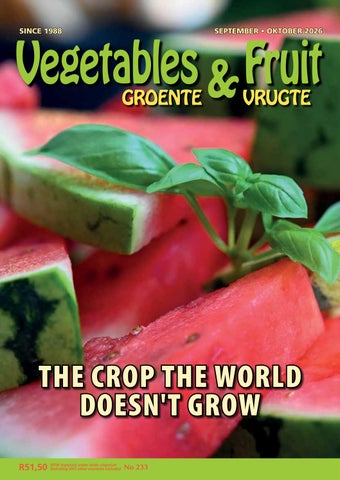
COVER Grown across warm production regions, watermelon rewards careful irrigation and timing, arriving on shelves as one of summer's great pleasures.
EDITORIAL Willie Louw (Group editor)
Due to delivery problems with traditional mailing services subscribers and readers are requested to send their e-mail address to info@mediakom.co.za for electronic delivery of VEGETABLES & FRUIT - GROENTE & VRUGTE.
8
NUUS NEWS
NEWS
Carien Daffue (Editor) 082 927 8294 018 293 0622 info@mediakom.co.za PO BOX 20250, Noordbrug, 2522 ADVERTISING Jana Greenall 082 780 9914 mediacom@lantic.net DESIGN Mercia Venter studio.chatnoir@gmail.com
4 5 6 6 7 8 8 9
BFAP Baseline 2026: a resilient sector, but fresh produce faces mounting export barriers Extreme weather demands a new standard of preparedness NWU signs partnership to support smallholder producers Student wins best team player at Agbiz case competition SA apple secures European plant breeders’ rights after eight-year wait Producers are going digital, and it’s changing how agriculture works Berry jam on top Securing SA’s agricultural future through water-wise practices
10
20
CUCURBITS
Besoek ons webtuiste | Visit our website: www.vegetablesandfruitmagazine.co.za
10 12 14
Bly ingelig en volg ons op Facebook. Keep up to date and follow us on Facebook. Groente & Vrugte | Vegetables & Fruit www.facebook.com/SAGroenteenVrugte
SUBSCRIPTIONS Available on subscription only - visit website: Slegs met intekening beskikbaar - besoek webblad: www.vegetablesandfruitmagazine.co.za 1 Year @ R268.00
2 Years @ R510.00
(6 issues)
(12 issues)
VAT included In case of address change, please quote or attach previous address label Special rates for group subscriptions
The crop the world doesn't grow When grafting pays Water management in cucurbit production: the foundation of yield and quality
24
CITRUS 16 18 19 20 21
Selektiewe plaagbeheer: ’n Sleutel tot volhoubare vrugteen groenteproduksie Managing pest mites in citrus through IPM Getting more from the sterile moth New treatment options give citrus a boost in India Citrus export estimates lowered
GENERAL
TOMATOES 22 24
Voedingsbalans is belangrik vir opbrengskomponente Blossom-end rot in tomato
26 28 30
From Studebaker potatoes to precision farming Registration and the regulatory squeeze For agriculture to thrive, there must be stability in the Southern African region
VEGETABLES & FRUIT | SEPTEMBER • OKTOBER 2026
3
NUUS NEWS
NEWS
BFAP Baseline 2026:
a resilient sector, but fresh produce faces mounting export barriers The annual BFAP Baseline, extended to 2050 for the first time, confirms a farming sector outperforming the economy, but flags port constraints, European carbon barriers and an affordability crisis that bear directly on fruit and vegetable producers.
T
he Bureau for Food and Agricultural Policy (BFAP) has released its 2026 Baseline, the annual outlook widely regarded as an investment compass for South African agriculture. For the first time, the publication extends its horizon to 2050, setting out the megatrends and policy priorities expected to shape the sector for the next quarter-century. For fruit and vegetable producers, the report carries both reassu rance and warning. The headline finding is one of strength. Agriculture has grown at an average of 3% a year since the launch of the National Development Plan in 2012, against less than 1% for the broader economy over the same period, and the sector has become a cornerstone of the country's international trade while keeping food on domestic shelves through repeated disruptions. Export-led growth, the Baseline projects, will remain the primary engine of value creation for producers, given the continued strain on what consumers at home can afford to spend. That resilience does not spare the short term. The Baseline is direct about the pressures on field crops and horticulture, where declining price cycles and sharp increases in input costs are eroding margins. The emergence of El Niño conditions in the 2026/27 season adds a further worry, raising the prospect of yield impacts in field crops. For anyone growing fruit or vegetables, it is the familiar squeeze of higher costs meeting softer prices, now set against an uncertain season. The report singles out a constraint fresh produce produ cers know well. The Port of Cape Town, it notes, continues to constrain the efficient movement of perishable exports, a bottleneck that bears directly on a fruit sector built on getting highly perishable product to distant markets on time. Progress on port operations is named as one of the conditions on which the sector's medium-term growth depends. Beyond the quayside, the Baseline maps an export environment growing more complex. There is genuine opportunity in it, including progress in bilateral market access negotiations with China, India and other major economies. But there is also mounting risk from rising protectionism, trade tensions and the increasing entanglement of trade policy with geopolitics. The fresh produce sector is flagged specifically: it faces grow-
4
ing ESG-related non-tariff barriers in the European Union, where the carbon footprint of the value chain is a particular challenge, given that most of the energy used is consumed beyond the farm gate and outside producers' direct control. Perhaps the report's most striking theme for a food producer is what it calls the disconnect between agricultural performance and household food security. The country's farms consistently meet national demand and compete abroad, yet a growing share of households cannot afford a healthy and diversified diet. The problem, the Baseline stresses, is not scarcity but affordability: rising transport, housing, utility and debt-servicing costs are squeezing food budgets in ways no amount of on-farm productivity can offset. For fruit and vegetable producers, whose products define a healthy, diversified diet, that gap between what is grown and what households can buy is a demand-side challenge the sector cannot ignore. Food security policy, the report argues, must now engage with the income side of access, not only with production and supply. In extending its outlook to 2050, the Baseline identifies the megatrends it expects to shape the food system: climate variability, biosecurity, infrastructure, technology adoption, changing consumer behaviour, a volatile trade environment, natural resource constraints, transformation and governance. It reserves particular emphasis for governance and institutional capacity, warning that, left unaddressed, this could itself become a megatrend shaping every other factor. Strong leadership, capable institutions and decisive policy, it concludes, are prerequisites for the next phase of agricultural development. BFAP executive director Dr Tracy Davids said, “The 2026 BFAP Baseline highlights a South African agricultural sector that remains resilient, globally competitive, and well positioned for future growth, but this will require sustained, coordinated, industry-wide effort, supported by enabling policy reforms and continued investment, to ensure that the sector remains adaptive, competitive, and capable of realising its long-term potential.” Source: BFAP Baseline 2026.
VEGETABLES & FRUIT | SEPTEMBER • OCTOBER 2026
NUUS NEWS
NUUS
Extreme weather demands a new standard of preparedness Every season begins with optimism. Every seed planted represents an investment in a future that can never be guaranteed. That has always been the nature of agriculture. What has changed is the scale and complexity of the uncertainty producers must now navigate. Kobus Van Zyl OMNIA NUTRIOLOGY
E
xtreme heat, prolonged dry periods and intense rainfall are reshaping the production environment, often within a single season. The challenge is no longer simply producing higher yields. It is building farming systems capable of performing consistently in increasingly unpredictable conditions. This requires a fundamental shift in thinking. For decades, agricultural success was largely measured by a farm’s ability to optimise yield under favourable conditions. Today, the defi ning characteristic of successful farming businesses is increasingly their ability to remain productive when conditions are less than favourable. In other words, resilience is becoming one of agriculture's most important competitive advantages. The weather cannot be managed. Preparation can. Preparing for weather fluctuation begins with understanding that every event sets off a chain reaction beneath the surface. Heat places greater pressure on plant physiology, drought limits biological activity and nutrient availability, while saturated soils restrict oxygen, weaken root function and reduce nutrient uptake. At the same time, shifting environmental conditions influence the behaviour of pests, weeds and diseases, creating additional challenges throughout the growing season. Protecting yield potential therefore requires far more than responding to individual events. It requires building resilience into the farming system long before stress occurs. The foundation of that resilience is soil quality. A functioning soil does far more than anchor roots. It regulates water movement, supports biological activity, cycles nutrients and creates the environment in which roots can explore, develop and perform. When soil functions efficiently, crops are better equipped to absorb shocks, withstand environmental pressure and recover when favourable conditions return. Yet soil remains one of the most underutilised risk-management tools available to producers. Too often, resilience is viewed through the lens of inputs and interventions rather than the farming system as a whole. One of the greatest misconceptions in agriculture is the belief that resilience can be built in a single season. It cannot. Resilience is cumulative. It is the result of decisions made consistently over many years that gradually improve the productive capacity of the soil and the farming system.
Kobus Van Zyl At its core, soil quality is built on three pillars: chemical, biological, and physical. Each pillar plays a critical role in determining how effectively a soil can store water, cycle nutrients, support root development and withstand environmental stress. When one pillar is neglected, the resilience of the entire system is compromised. From that foundation, every agronomic decision contri butes to the outcome. Selecting crop varieties suited to local conditions, implementing balanced nutrition programmes, maintaining active root systems and incorporating scientifically validated biostimulants all play a role in strengthening the crop's natural ability to cope with stresses. Equally important is remaining responsive throughout the season. In a volatile production environment, static programmes often struggle to keep pace with changing realities. Producers increasingly need decision-making frameworks that enable them to adapt as conditions evolve. Resilience is not created by a single product or practice. Resilience is built through an integrated approach where steward ship, genetics, nutrition, biology, technology and practical agronomy work together to reduce risk and support sustainable productivity over time. This is where the conversation around resilience often falls short. There is a tendency to look for quick solutions to what are fundamentally long-term challenges. The farms that consistently perform over decades are seldom those that rely on isolated interventions. They are those that continually invest in the chemical, biological and physical quality of their soils while adapting management practices as conditions evolve. This is where partnership matters. Working alongside experienced agronomists provides producers with the insight to interpret seasonal challenges, evaluate field-specific risks and make informed decisions based on science, local knowledge and ongoing field observations. By integrating scientific analysis, agronomic expertise, datadriven insights and practical on-farm experience, the model enables producers to move beyond reactive decision-making towards a more resilient and sustainable approach to production. Agriculture has never rewarded certainty. It has rewarded sound judgement, adaptability and a willingness to prepare before challenges arise. The producers who consistently succeed in the future will be those who invest in resilient soils, apply integrated agronomic thinking and continue making informed decisions from planting through to harvest.
VEGETABLES & FRUIT | SEPTEMBER • OKTOBER 2026
5
NUUS NEWS
NEWS
NWU signs partnership to support smallholder producer T
he North-West University (NWU), Community Venture Ca pital (CVC) and NWU Enterprises (NWUE) have signed a memorandum of understanding (MoU) to strengthen collabo ration in agricultural development and community empower ment across South Africa and the wider African region. The MoU sets out four objectives: • Agricultural financing: developing accessible financing for smallholder producers and emerging agribusinesses, and mobilising investment through blended finance, publicprivate partnerships and institutional funding. • Market access: helping community-based producers and co operatives enter the mainstream supplier value chain, with support for aggregation, certification and quality assurance to meet retail and export standards. • Logistics and supply chain: cost-effective logistics, warehou sing and cold-chain solutions to improve farm-to-mar ket delivery, and co-investment in logistics infrastructure at rural and agricultural hubs. • Business empowerment and skills: enterprise and supplier development programmes aimed at women, young people and rural entrepreneurs, with technical training, mentorship and skills transfer in agribusiness management. Speaking at the signing, NWU chancellor Dr Anna Mokgokong, who is also founder and group chairperson of Community Invest ment Holdings (CIH), said universities should be active partners in the communities they serve, and that the partnership's
success would be measured by implementation. Phenyo Mogamisi, CEO of CIH Venture Capital, said the collaboration was driven by the need to align funding, research and commercialisation to strengthen food security and eco nomic participation. The university would lead research, skills development and quality assurance, NWU Enterprises would drive project preparation, management and market access, and CIH would mobilise private-sector funding and strengthen logistics and agro-processing capacity. Duncan Raftesath, CEO of NWU Enterprises, said the partner ship would apply academic expertise to real-world challenges, bringing research, training, consulting and project management together to deliver practical solutions for industry and society. Professor Bismark Tyobeka, NWU principal and vice-chancel lor, said the partnership would create opportunities for students, researchers and staff by linking teaching and research with industry. “Our farms will become laboratories where students gain practical experience while contributing to agricultural inno vation,” he said, adding that postgraduate researchers would explore ways to improve crop resilience, increase yields and advance smart, water-efficient farming. The partnership extends beyond agriculture to social invest ment in areas such as water and sanitation, energy, health care, housing, digitisation, logistics, mining, engineering and tourism. Industry and government partners present at the signing included Sanlam, ABSA, the IDC, the Gauteng Growth and Development Agency and Gauteng Enterprise Propeller.
Student wins best team player at Agbiz case competition
R
uben Fourie, a BSc Honours student in agricultural economics at the University of Pretoria (UP), has won the best team player award at the Agbiz Student Case Competition, held recently in Gqeberha. Fourie was part of the UP team in the competition, which challenged student teams to develop practical solutions for South Africa’s wheat value chain and present their recommendations to a panel of industry judges. The award recognised his contribution, teamwork and leadership through the competition process. Corteva sponsored his attendance at the congress. Fourie’s dissertation examines asymmetric and delayed price transmission from maize prices to retail food prices in South Africa. He is testing whether retail prices respond faster and more fully to rising maize prices than to falling ones, and how long those price changes take to filter through to the retail level. The question matters for consumers. “South African households, particularly lower-income house- holds that spend a disproportionate share of their income on food, are directly affected by how quickly and fully maize price changes are reflected on retail shelves,” Fourie said. If price transmission is both asymmetric and slow, he added, food price
6
Prof Johan van Rooysen, co-facilitator of the Agbiz Student Case Competition, with Ruben Fourie, best team player award winner, and dr Melissa van der Merwe, co-facilitator. Source: University of Pretoria.
inflation may rise rapidly when input costs increase but ease only gradually when those costs fall, with implications for food security, consumer welfare and inflation-targeting policy. Beyond his dissertation, Fourie has worked on an econometric analysis of the white maize market and a SAFEX options volatility simulation assessing hedging strategies and risk exposure in grain markets. He was also recognised by the Golden Key international honour society for ranking among the top 15% of his class.
VEGETABLES & FRUIT | SEPTEMBER • OCTOBER 2026
NUUS NEWS
NUUS
SA apple secures European plant breeders’ rights after eight-year wait Some things in life are worth waiting for. For South Africa's BigBucks Gala apple, that wait has lasted more than eight years, but has now culminated in an important international milestone.
R
ecently, the Community Plant Variety Office (CPVO) issued Decision No. 73170 declaring BigBucks Gala as a qualifying variety for European Union Plant Variety Rights, following extensive replicated trials conducted across different sites and EU countries. The decision marks a significant achievement for a South African-developed apple variety and opens the way for stronger protection of BigBucks Gala in the European Union. The story of BigBucks Gala began on 18 January 2011, when Buks Nel, Tru-Cape's new cultivar expert, discovered a distinctive tree in an established Corder Gala block at Oak Valley Estate in the Elgin valley in Grabouw. The tree was a chance mutation, a naturally occurring sport that developed as a single tree within a commercial apple orchard. South African Plant Breeders’ Rights were awarded to Big Bucks Gala on 21 July 2011, after which plantings of the variety expanded rapidly. By the end of winter 2025, 2 542 284 trees had been planted in South Africa, excluding additional grafted trees. This makes BigBucks Gala the fastest-growing apple variety in the history of the South African apple industry. “BigBucks Gala is a remarkable South African apple story,” says Anthony Rawbone-Viljoen, owner and managing director of Oak Valley Estates. “What started with the discovery of a single, naturally occurring mutation in an Elgin orchard has developed into one of the most significant variety successes in our industry. To now have European Plant Variety Rights awarded after such an extensive evaluation process is a tremendous achievement.”
A distinctive and stable variety To qualify for plant breeders’ rights, a variety must possess characteristics that distinguish it from other varieties. BigBucks
Buks Nel, who first discovered the chance mutation in a Corder Gala orchard on Oak Valley Estate in the Elgin valley, with bins of beautifully coloured BigBucks Gala apples.
Gala has several distinctive features. Its blossom is a dark red colour, its fruit stem is red, and the fruitlets develop a red colour within the first month after blossom. A central red vein is also visible on the back of each leaf. Another important characteristic is the variety’s stability. Many Gala varieties have a tendency to revert to their original type, which can present challenges for producers and the long-term commercial development of a variety. BigBucks Gala has, however, demonstrated strong varietal stability, with no reported reversions to date. “Stability is a particularly important characteristic when you are building a variety at scale,” says Rawbone-Viljoen. “The fact that BigBucks Gala has remained inherently stable, with no reported reversions, has been a major positive.”
Mirror mirror on the wall, who’s the reddest of them all? The road to European protection began in 2016, when a testing and option agreement was signed with ABCz Nursery in Belgium, and an application for European Plant Variety Rights was submitted to the CPVO on 14 October 2016. The process proved considerably more complex than initially anticipated. In January 2018, the CPVO determined that there were several improved Gala varieties regarded as “varieties of common knowledge”. It decided to conduct replicated trials of the competing improved Gala varieties to determine which one would ultimately qualify for European Plant Variety Rights. The resulting evaluation involved extensive testing at different sites across different European Union countries. After more than eight years of trials, the CPVO’s decision on 20 July 2026 confirmed BigBucks Gala as the qualifying variety. For the South African apple industry, the decision represents more than simply the completion of a lengthy regulatory process. It provides international recognition for a variety that originated spontaneously in a South African commercial orchard and has since achieved remarkable adoption among local producers. “It has certainly been a long and costly journey, but this outcome makes the wait worthwhile,” says Rawbone-Viljoen. “There is enormous satisfaction in seeing a variety that was discovered in an Elgin orchard being recognised in Europe after such a rigorous testing process.” The granting of European Plant Variety Rights adds another important chapter to the BigBucks Gala story, one that began with a single unusual tree and has grown into a home-grown South African Gala variety with international recognition. “BigBucks Gala is proudly South African, and we look forward to seeing what the next chapter holds for this variety,” says Rawbone-Viljoen.
VEGETABLES & FRUIT | SEPTEMBER • OKTOBER 2026
7
NUUS NEWS
NEWS
Producers are going digital, and it's changing how agriculture works Desry Lesele NEDBANK
F
or decades, farming has been built around physical things one can see and touch: land, machinery, storage systems, and long-standing relationships with suppliers and buyers. Those things still matter, but another layer is increasingly being added to the mix: digital platforms that enable producers to buy inputs, secure finance and make everyday decisions more efficiently. What stands out is not just that these tools exist, but how quickly they are being adopted in practical, everyday farming operations. South Africa already has the basic building blocks for this shift. Mobile phone use is almost universal, smartphones are widespread, and, according to World Bank research, just short of 80% of the population now has internet access. In agriculture, digital tools are already helping producers source inputs, compare prices, get advice, and access financial ser vices. Earlier research suggested that only about 26% of small holder producers were using digital technologies, but that number is rising as these tools become more useful and more accessible. The Food and Agriculture Organisation (FAO) says that a major driver behind this shift is the increasing pressure on producers to improve productivity while managing greater uncertainty. Agricultural businesses are operating in an environment of continuing input cost pressures, tighter margins, increasingly volatile weather patterns and fluctuating commodity prices.
At the same time, customers and financiers are placing greater emphasis on efficiency, traceability and sustainability. These factors are making timely, data-driven decisionmaking far more important than it was even a decade ago. Digital platforms help producers respond by improving access to market information, increasing price transparency and streamlining purchasing and financing decisions. This was experienced firsthand through the collaboration between Nedbank Agribusiness and online agri-input marketplace, PrysWys. The early results have been encouraging and, since its launch, the Nedbank partnership has seen an 80% increase in users. This suggests that digital activity is translating into real financial decisions, and that producers are becoming more comfortable managing parts of their businesses online, not as a side activity but as part of how they operate. As adoption grows, digital platforms have the potential to improve not only access to inputs and finance, but also the efficiency, transparency and competitiveness of the agricultural value chain as a whole. Importantly, this move to digital is not about replacing existing relationships in agriculture. Producers still rely heavily on agronomists, advisers, and long-standing supplier networks. What is changing is that they now have more tools alongside those relationships, tools that help them compare options, save time and make quicker decisions. But the direction is clear. As these platforms become more connected, they have the potential to create a more efficient, transparent and financially inclusive agricultural ecosystem that benefits producers, suppliers and financiers alike.
Berry jam on top
A
handcrafted organic berry jam has taken the top spot among 700 entries from 85 manufacturers at the second annual South African Preserve Championships, presented by Agri-Expo, South Africa’s oldest agricultural society.
Hemelhuijs Hedgerow Berry Jam was crowned the 2026 South African Preserve Product of the Year, out of 700 entries from 85 manufacturers in the second annual SA Preserve Championships, presented by Agri-Expo. Photo: Hennie van Loggerenberg/OCTA 5.
8
Chris Fourie, president of Agri-Expo; Jo-Mari Erasmus of Hemelhuijs, winner of the 2026 South African Preserve Product of the Year; and Breyton Milford, general manager of Agri-Expo and organiser of the SA Preserve Championships, at the second annual SA Preserve Championships at Eensgezind in Durbanville.
VEGETABLES & FRUIT | SEPTEMBER • OCTOBER 2026
Photo: Agri-Expo/A Gorman Photography.
NUUS NEWS
NUUS
Securing SA’s agricultural future through water-wise practices For the CEO of the Water Research Commission (WRC), standing at the forefront of South Africa's water future is both a privilege and a sobering responsibility. The availability and quality of this precious resource shape the strength of the economy, the health of its people, and the sustainability of its ecosystems every day. Nowhere is this reality more evident than in agriculture, where water quite literally feeds the nation. Dr Jennifer Balatedi Molwantwa
Dr Jennifer Balatedi Molwantwa
value chain. That requires more than technical solutions; it calls for a cultural and operational shift in how water is viewed and used.
WATER RESEARCH COMMISSION
S
outh Africa is one of the driest countries on earth, and the stresses on its water systems are mounting. Climate change is amplifying droughts and floods. Much of the infrastructure is outdated or poorly maintained. Inefficient usage patterns persist across sectors. Together, these forces are pushing the country towards a critical tipping point. Agriculture, which is the backbone of food security and rural livelihoods, consumes between 60% and 62% of South Africa's water resources. Without decisive action, escalating pressures could undermine food production, rural jobs, and the stability of entire communities. Water demand already exceeds supply, and if current trends continue, it could outstrip availability by as much as 17% by 2030. For producers in Limpopo, the Free State, or the Western Cape, these statistics translate into realworld challenges: harder planting decisions, higher input costs, and vulnerability to ever-intensifying drought cycles.
From scarcity to sustainability: a new agricultural mindset There is every reason for optimism, because what becomes possible when innovation meets determination is already on display. Across the country, producers and agri-businesses are already proving that resilience is within reach. Indigenous, drought-tolerant crops such as sorghum, millet, cowpeas, and groundnuts retain up to 70% of their yield potential in extended drought conditions, reducing dependency on high-input, water-thirsty imports. Regenerative agriculture techniques including no-till farming, cover cropping, mulching, and composting are improving soil health, locking in moisture, and restoring degraded land. Meanwhile, technology is transforming how food is grown. Advanced irrigation systems like centre pivots, drip lines, and smart web-based platforms are dramatically improving efficiency compared with traditional flood irrigation. Digital tools from soil sensors to AI-powered satellite monitoring allow real-time water management, leak detection, and predictive planning that help producers stay ahead of risk. These success stories are more than experiments; they are blueprints for a water-wise future. But they will only achieve their full potential if they are scaled across the entire agricultural
A WaterWise nation: driving change together This is the driving force behind A WaterWise Nation, the WRC's flagship campaign to inspire action and equip industries, particularly agriculture, with the knowledge and tools to make smart water decisions. The campaign supports the National Water and Sanitation Master Plan and aligns with the UN Sustainable Development Goals, but at its heart lies a simple, urgent message: water security is everyone's business. A WaterWise Nation promotes three clear imperatives: • Smart water use is smart business. Efficient irrigation, crop diversification, and water recycling are not just environmentally responsible; they cut costs and safeguard livelihoods. • Collaboration is key. Producers, policymakers, researchers, and communities must share lessons, scale innovation, and build networks of resilience. • Every drop counts. Whether you manage a commercial farm, a smallholding, or a household garden, mindful water management contributes to national water security.
Securing the future For decision-makers in agribusiness, change management means embedding water stewardship into corporate strategy and operations. For producers, it means experimenting with new crops, adopting precision irrigation, and protecting soil as a living reservoir. For policymakers and researchers, it means aligning incentives, regulations, and research agendas to accelerate uptake of proven solutions. It must also be recognised that water security is not just about supply. It is about equity, efficiency, and governance. It is about ensuring that the most vulnerable, like smallholders, women producers and rural youth, have access to knowledge, resources, and opportunities to thrive in a changing climate. South Africa can rise to this challenge, but it must act decisively and collaboratively. The cost of inaction is far too high: reduced harvests, lost jobs, weakened exports, and fragile ecosystems. Visit www.wrc.org.za.
VEGETABLES & FRUIT | SEPTEMBER • OKTOBER 2026
9
CUCURBITS
The crop the world doesn’t grow F
A beloved South African crop is quietly losing ground. This is a closer look at where gem squash stands, and how it might win back a place on the plate.
ew crops are as distinctly South African as the gem squash. It has sat on family tables for generations, halved and buttered in its own shell, familiar enough to be taken for granted, yet almost unknown as a commercial vegetable elsewhere. That combination of deep local loyalty and near-total obscurity abroad makes it one of the more curious crops a producer can plant, and one facing a quieter struggle than its place in the national kitchen would suggest. Botanically, the gem squash is a form of Cucurbita pepo, the same species that gives the world courgettes and many pumpkins, and its wild ancestors trace to the Americas rather than to Africa. What sets it apart is not its origin but its history since. It gained its popularity in South Africa, where local breeders selected material from the open-pollinated lines and, over time, developed hybrids, turning a New World squash into a homegrown speciality. Elsewhere it never really took hold, and it is planted only on a small scale in the rest of the world. Closer to home, though, the picture is less comfortable than the crop's heritage suggests. According to a product specialist from Hygrotech, gem squash has seen its popularity diminish in recent years, a de-
cline that shapes almost every question a producer might ask about it today.
A thin margin crop The cultivar landscape still leans on the familiar. The open-pollinated Rolet, known in Afrikaans as the skorsie, remains widely planted and is the variety most people picture when they think of gem squash. Alongside it sit newer hybrids, which the Hygrotech specialist describes as more compact plants that bear fruit closer to the main stem, set more fruit and generally yield better. For a producer weighing the two, the essential trade-off is clear: the heritage familiarity and open-pollinated economy of Rolet against the yield and growth habit of a modern hybrid. The economics are where the romance meets the arithmetic. Gem squash generates a relatively low income per hectare, so producers have little room for unnecessary input costs. It is telling that trellising, which can lift quality and ease harvest in a home garden, does not pay its way on a commercial scale. The specialist is clear that while a hobby grower might well trellis, it is simply not viable for a commercial one. Gem
Normal packaging for Gem Squash in South Africa does not give the consumer an appetising look at what can be done with the product.
10 VEGETABLES & FRUIT | SEPTEMBER • OCTOBER 2026
PAMPOENGEWASSE
Retailers use creative techniques to make Gem Squash and Butternut look appetising, giving consumers a ready-made idea of how to serve it.
squash, in short, is a thin-margin crop that rewards efficiency over ambition. It is also, contrary to its reputation as a hard-shelled keeper, a crop for fresh eating. Where mature winter squashes can be held for months, gem squash begins to dry out after about two weeks, and the specialist's advice is unambiguous: it is at its best freshly picked and ripe. That has real consequences for how it is marketed. This is not a crop to cure and store for a better price later in the season, but one to move promptly while its quality holds, placing a premium on matching harvest timing to demand.
Losing ground to butternut Part of the pressure on gem squash comes from the company it keeps on the shelf. It competes with other squashes and pumpkins for a place on the consumer's plate, and in that contest it has been losing ground to butternut. The Hygrotech specialist points to butternut as a growing market, chosen increasingly for its health credentials. It also has the added advantage of convenience, reaching shoppers as ready, microwaveable portions that ask almost nothing of the cook. The more discerning consumer, the specialist notes, is now more likely to reach for butternut, including one already processed into an easy-to-use pack. That leaves gem squash occupying a particular corner of the market. Its natural constituency is the budget-conscious shopper and the consumer watching their kilojoules, since it suits a lower-calorie diet and tends to cost less than the cucurbits beside it. The export picture is similarly modest. Set against other squashes, gem squash exports are very small, and the specialist regards regional trade into neighbouring Southern African countries, Botswana among them, as more viable than the distant gourmet markets sometimes imagined for it. The realistic market for gem squash, in other words, is close to home.
Pests, disease and stalled breeding In the field, the crop carries the usual cucurbit burdens, and two stand out. Insects that transmit viruses are a serious problem, the specialist warns, and fungal diseases, powdery mildew chief among them, add to the load. Both point to the same conclusion: a gem squash crop cannot be left to look
after itself, and a considered protection programme is part of the cost of doing it properly. Some of the crop's difficulty may trace to a lack of fresh investment. Breeding has stalled. Nothing new has been released in the past decade and, as far as the Hygrotech specialist is aware, no improvement programme is under way. A crop that breeders are not renewing stands still while its competitors advance, and that stasis is part of its slow retreat.
A route back For a producer still drawn to gem squash, the specialist's counsel is practical and pointed. Begin with a soil analysis, consult an expert on pre-plant fertiliser, and set up a preventative disease-spray programme with a chemical advisor rather than reacting once trouble appears. Above all, secure a home for the crop before a single seed goes into the ground: an offtake arranged in advance, preferably under contract at a fixed price per kilogram. For a thinmargin crop with a short shelf window, a guaranteed market is not a luxury but the foundation of the enterprise. If gem squash is to arrest its decline, the opportunity may lie less in the field than on the shelf. There is room to add value and tell its story better. One lies in the merchandising: displaying halves dressed with different fillings, so shoppers see not a plain green ball but a meal already half imagined. Another is to make its nutritional case explicit on the shelf, setting out its vitamin, mineral and health benefits per 100 g, along with its calorie count, so the health-conscious shopper it naturally suits can see at a glance why it belongs in the basket. In a market where butternut has won share on those health and convenience grounds, meeting it on the same terms may be gem squash's most promising route back. None of this calls for a breakthrough in breeding or a new export frontier. It asks for sharper positioning, disciplined and contract-backed production, and a willingness to sell it on the strengths it already has. Gem squash remains reliable, distinctive and unmistakably South African, and for the producer who secures a market first and manages it with care, it can still earn its place. Its future, though, will be decided less by nostalgia than by how well the industry chooses to make its case. With input from a product specialist from Hygrotech.
VEGETABLES & FRUIT | SEPTEMBER • OKTOBER 2026
11
CUCURBITS
When grafting pays On land where Fusarium has taken hold, grafting can rescue a watermelon crop that would otherwise fail. When it earns its cost, and how to get it right.
A
watermelon crop that wilts and collapses in the weeks before harvest, on land that grew a good crop not long before, usually carries the signature of Fusarium wilt. According to Eloise Maartens, sales manager at Hishtil SA, the soil-borne fungus is one of the largest biological threats facing producers who plant watermelon on the same soil season after season. Root-knot nematodes compound it: their feeding damages the root system and compromises its function, opening the entry points through which infections such as Fusarium take hold. Once the fungus is established, it cannot simply be sprayed away, and for producers on infested land the most powerful answer is to change the roots the crop grows on. Grafting joins the watermelon variety a producer wants to sell, the scion, onto the root system of a resistant relative, the rootstock. The union carries the marketable fruit above and A trial planting on a commercial farm to illustrate the effectiveness of grafting. The grafted seedlings are 100% developed, but the ungrafted plants are dying from a Fusarium infection in the soil.
the disease-tolerant roots below, and it has moved from a specialist trick to a commercial practice on South African watermelon farms, in step with world trends.
Why producers are turning to it The pressure driving that shift is the shrinking of clean ground. As producers run out of virgin soil and the room to rotate, Maartens says, the need for grafting keeps growing. The arithmetic of rotation shows why. Rotating watermelon out of a field long enough to starve Fusarium takes about ten years, an eternity to leave good land idle, and grafting cuts the workable interval to roughly three. Fumigation, the other traditional answer, is costly, and with fewer such products still available to producers, its role is narrowing. That leaves grafting, in Maartens's view, as the best
Grafted Watermelon
Grafted
Un-grafted
12 VEGETABLES & FRUIT | SEPTEMBER • OCTOBER 2026
PAMPOENGEWASSE
3 October - Hail
4 November
Grafted watermelon damaged by hail. The root mass the rootstock develops allows for recovery.
option on infested land, carrying a far higher tolerance to Fusarium than an ordinary seedling.
Choosing the rootstock Not all rootstocks are alike, and the choice turns on what the soil is carrying. Three families dominate. Interspecific hybrid squash, a cross of two Cucurbita species, is the most widely used rootstock in the country, prized for strong Fusarium resistance and vigour. Bottle gourd, Lagenaria siceraria, has gained momentum lately, and Hishtil is seeing more of it come through the nursery. The third, citron, a form of the same species as watermelon, Citrullus lanatus, in its wild citroides type, is a relative newcomer to the local market, and Maartens reports it is proving highly successful. Citron’s appeal is its reach. Where squash and bottle gourd resist Fusarium but stay vulnerable to root-knot nematode, citron types can carry resistance to both. That matters because the soil dictates the choice: land troubled only by Fusarium may suit a vigorous squash rootstock, while land that also carries nematodes calls for a nematicide alongside the squash, or a citron type that handles both at once. The finer questions of citron breeding and genetics, Maartens notes, are best put to the seed companies, but the plant itself is no stranger to the region, since its wild citroides relatives belong to the Southern African landscape.
Making the sums work None of this is cheap, at least not on the invoice. A grafted transplant costs significantly more than an ordinary seedling, and grafting watermelon is technically demanding enough to mean relying on a skilled nursery. Taken as a seedling price alone, the gap looks steep. The honest calculation, Maartens argues, has to include what the grafted plant gives back: a lower population, a full final field stand and a higher yield. Grafted plantings are typically set at half the population of ordinary seedlings, so the higher price per plant is spread across far fewer of them, and set against the yield gain, she says, the economics become difficult to argue with.
The clearest case for grafting is what it prevents. Where Fusarium has taken hold of a soil, as much as an entire planting can be lost to the disease, so a grafted crop's tolerance is not a marginal gain but the difference between a harvest and none. On top of that protection, Hishtil's field experience shows a definite lift in yield, its size shaped by the producer's practices and the season's climate rather than fixed at any one figure. On clean soil, where none of this pressure exists, the extra cost simply is not warranted.
Getting it right Grafting is not a silver bullet, and Maartens is direct about the ways it fails. Most come down to handling. Plant a grafted seedling too deep, burying the graft union beneath the soil, and the scion will root above the rootstock and bypass it, and with that the Fusarium resistance the producer paid for is lost. Feeding and irrigation need adjusting for a grafted crop as well, a conversation to have with a knowledgeable adviser before planting rather than after trouble appears. Quality is the other common worry, and here the picture is reassuring. There are reports that rootstock choice can affect flavour, but Hishtil has not found this on any of the rootstocks currently on the market. The more decisive factor, Maartens stresses, is picking the fruit at the right physiological stage of ripeness, which is what secures internal quality and brix. Handled and harvested well, a grafted melon needs to give nothing away on the plate. Grafting, then, is not a blanket recommendation but a targeted tool. Where soil-borne disease has made a field marginal or unplantable, it can return it to production, buy back years of rotation and hold off a pathogen that chemistry can no longer reliably reach. On clean land, the old disciplines of rotation and hygiene remain the cheaper answer. Where the ground has turned against the crop, though, the roots it grows on may be the whole difference. With input from a product specialist from Hygrotech.
VEGETABLES & FRUIT | SEPTEMBER • OKTOBER 2026
13
CUCURBITS
Water management in cucurbit production: the foundation of yield and quality Water is often described as the life of agriculture, which is also evident in cucurbit production. Effective water management plays a critical role in determining yield, fruit quality and ultimately profitability. While genetics may set the potential of a crop, water is the number one driver of crop performance thereafter. SAKATA
C
ucurbits are highly sensitive to water stress. Unlike many deep-rooted crops, cucurbits develop relatively shallow and widespread root systems, with the majority of root activity occurring within the top 30 to 60 cm of soil. As a result, they have limited access to deep soil moisture reserves and depend heavily on consistent, well-managed irrigation. Even minor periods of moisture stress can result in significant losses in yield, reduced fruit set and poorer fruit quality. For producers, understanding the crop's changing water requirements throughout the season is therefore essential. Cucurbit water requirements are not constant. Demand increases steadily as plants move from establishment into vigorous vegetative growth and reach their highest levels during flowering, fruit set and fruit filling. Water demand then declines slightly as fruit approach maturity and ripening. The flowering and fruit set stages are particularly critical. This is often where a season's yield potential is either secured or lost. When plants experience water stress during flowering, female flower viability declines, pollen viability decreases and the ratio of male to female flowers may increase. The result is poor pollination and reduced fruit set. During early fruit development, cells divide rapidly to establish the fruit's growth potential. Water stress at this stage leads to fewer cells being formed, permanently limiting fruit size. Importantly, lost fruit size cannot be recovered later, even if irrigation improves. During fruit enlargement, adequate moisture supports cell expansion and the movement of sugars into developing fruit. Any moisture limitation during this period often results in smaller fruit and uneven sizing. Different cucurbit crops have slightly different seasonal water requirements. Typical total water use ranges from: • watermelon: 400 to 600 mm, • melon: 350 to 550 mm, • cucumber: 300 to 500 mm, and • squash: 400 to 600 mm. During peak fruiting periods, daily water use can reach between 5 and 8 mm per day, depending on weather conditions, soil type and plant population.
One of the biggest challenges in vegetable production is that under-irrigation often causes losses that are not immediately visible. Producers may save water in the short term but sacrifice substantial yield and quality. Symptoms of inadequate irrigation include poor plant growth, flower abortion, reduced fruit size, bitterness in cucumbers, and misshapen fruit. Because critical developmental stages can be affected by even short periods of stress, the financial impact of under-irrigation is frequently underestimated. While insufficient irrigation is detrimental, excessive irrigation can be equally damaging. A common misconception is that more water will automatically result in higher yields. In reality, over-irrigation can create several production risks that include root diseases, nutrient leaching, weak root development, reduced sugar accumulation and fruit cracking. Overly wet soil also limits oxygen availability around roots, reducing plant performance and making crops more vulnerable to disease pressure.
Irrigation systems For most commercial cucurbit producers, drip irrigation remains the preferred system. Drip irrigation delivers water directly to the root zone, enabling precise moisture management while minimising losses through evaporation and runoff. It also facilitates fertigation, allowing nutrients to be supplied efficiently alongside irrigation water. By comparison, overhead irrigation systems generally lose more water and can create favourable conditions for foliar diseases. They also offer less control over the timing and placement of irrigation. Good irrigation management affects more than just yield. It can also be a major determinant of marketable fruit quality. Poor irrigation practices can lead to several quality defects, including fruit cracking, hollow heart in watermelons, poor firmness, reduced shelf life and lower sugar content. For producers supplying fresh markets, where appearance and eating quality are critical, effective irrigation management can make the difference between premium-grade fruit and downgraded produce. Successful irrigation scheduling should take several factors into account, including crop growth stage, soil type and prevailing weather conditions. Rather than applying large, infrequent
14 VEGETABLES & FRUIT | SEPTEMBER • OCTOBER 2026
PAMPOENGEWASSE
Drip irrigation of zucchini plants. At flowering and fruit filling stages, cucurbit’s water demand is at its highest.
Harvesting of healthy butternut production field.
irrigation applications, producers should aim for frequent, controlled applications that maintain a consistent soil moisture environment. Particular attention should be paid during the flowering and fruit-filling stages, when crop water dem and and sensitivity are at their highest. These periods often determine both final yield and fruit quality. A common misconception is that cucurbits are high water users. In reality, the crops are not exceptionally water-demanding, but they are exceptionally water-sensitive. The greatest yield losses in commercial cucurbit production are often not caused
by a lack of water, but by poor water management. Consistent irrigation, tailored to crop growth stage and environmental conditions, remains one of the most powerful tools producers have to maximise yield, improve fruit quality and enhance profitability. DISCLAIMER: This information is based on Sakata’s observations and/or information from other sources. As crop performance depends on the interaction between the genetic potential of the seed, its physiological characteristics, and the environment, including management, the company give no warranty express or implied, for the performance of crops relative to the information given nor do they accept any liability for any loss, direct or consequential, that may arise from whatsoever cause. Please read the Sakata Seed Southern Africa (Pty) Ltd Conditions of Sale before ordering seed.
15
CITRUS
Selektiewe plaagbeheer: ’n Sleutel tot volhoubare vrugte- en groenteproduksie
Moderne vrugte- en groenteproduksie vereis veel meer as bloot doeltreffende plaagbeheer. Vandag beskerm produsente nie net die opbrengs nie, maar het ook uitdagings soos plaagweerstand, die bewaring van voordelige insekte en toenemende markvereistes rondom volhoubaarheid en residubestuur. Dit is juis hier waar selektiewe plaagbeheerprodukte ’n belangrike rol speel. Nadine Botha PRODUKBESTUURDER PHILAGRO
like balans in die gewas beter gehandhaaf.
S
Die waarde van voordelige insekte
elektiewe plaagbeheerprodukte kan ’n belangrike rol speel binne geïntegreerde plaagbeheer (IPM), waar verskillende beheermaatreëls gekombineer word om plaaggetalle onder ekonomiese skadedrempels te hou, terwyl die natuurlike balans in die produksie-omgewing sover as moontlik behoue bly. Die doel is nie om elke plaag uit te wis nie, maar eerder om plaaggetalle onder ekonomiese skadedrempels te hou. Insekdoders wat selektief teen teikenplae optree en tot ‘n mindere mate ‘n invloed op voordelige organismes het, vorm die hoeksteen van hierdie benadering. In hierdie konteks bied Philagro SA twee geregistreerde produkte, DiPel® DF (L6441) en SumiPleo® (L8377), wat as deel van ’n geïntegreerde plaagbeheerprogram gebruik kan word.
Wanneer plaagbeheer bespreek word, val die fokus dikwels op die insekte wat skade veroorsaak. Tog speel voordelige organismes ’n ewe belangrike rol in die sukses van ’n gewas. Parasitiese wespe, roofmyte, predatoriese kewers, netvlerkies en spinnekoppe vorm ’n natuurlike verdedigingsnetwerk wat daagliks help om plaaggetalle te onderdruk. Wanneer breëspektrum-insekdoders hierdie natuurlike vyande verminder, ontstaan daar dikwels sekondêre plaaguit brekings omdat die biologiese beheerkomponent wegval. Produsente raak dan meer afhanklik van verdere chemiese ingry pings, wat weer ekstra druk op weerstandsbestuur plaas. Selektiewe produkte kan bydra om hierdie natuurlike bondgenote te beskerm en dra by tot ’n meer gebalanseerde en volhoubare produksiestelsel.
Die belang van selektiewe plaagbeheer
DiPel® DF: Beproefde biologiese beheer vir wurmplae
Wurmplae bly van die grootste uitdagings in baie vrugte- en groentegewasse. Herhaalde gebruik van produkte met dieselfde meganisme van werking kan met verloop van tyd bydra tot die ontwikkeling van weerstand in sekere plaagbevolkings, wat die beheer van die plae baie uitdagend kan maak. Met elke toediening word die vatbare individue in die plaagbevolking beheer, terwyl die klein groepie wat van nature minder sensitief is, oorleef en voortplant. Mettertyd neem die aantal weerstandbiedende individue toe totdat die produk nie meer die verlangde resultate lewer nie. Die oplossing vir weerstandsontwikkeling lê nie noodwendig in “sterker” chemie nie maar eerder in slimmer programme wat verskillende meganismes van werking (chemie-groepe) kombineer en afwissel om weerstand te voorkom. Dit is ook belangrik dat produkte volgens etiketaanbevelings gebruik moet word. Hierdie benadering help om die risiko van weerstands ontwikkeling te verminder en verleng die lewensduur van gewasbeskermingsmiddels. Wanneer sulke programme boonop op selektiewe, IPM-vriendelike produkte steun, word die uitwerking op voordelige organismes beperk en word die natuur-
Die bewaring van voordelige organismes is een van die belangrikste doelwitte van geïntegreerde plaagbeheer. Daarom speel selektiewe biologiese produkte ’n toenemend belangrike rol in moderne gewasbeskermingsprogramme. DiPel® DF is een van die produkte wat hierdie benadering moontlik maak. DiPel® DF is reeds dekades lank ’n vertroude hulpmiddel in die beheer van wurmplae wêreldwyd. Die produk bevat Bacillus thuringiensis var. kurstaki (Bt), ’n bakterie wat sedert 1970 deur Valent BioSciences LLC (Sumitomo Biorational Company) in die VSA vervaardig word. As ’n organies-gesertifiseerde bioinsekdoder bied DiPel® DF aan produsente ’n doeltreffende hulpmiddel vir die beheer van verskeie geregistreerde wurmplae. Wat DiPel® DF besonder waardevol maak, is sy hoë doeltref fendheid. Die produk teiken spesifiek geregistreerde wurmplae en het volgens beskikbare inligting 'n beperkte uitwerking op voordelige organismes wanneer dit volgens etiketaanwysings gebruik word. Wanneer ’n Lepidoptera larwe behandelde plantmateriaal inneem, word die dermwand beskadig waarna die larwe vin-
16 VEGETABLES & FRUIT | SEPTEMBER • OCTOBER 2026
SITRUS
Bolwurm op ‘n sitrusbloeisel.
Lemoenvlinderruspe op ‘n jong sitrusblaar.
nig ophou voed, wat verdere gewasskade beperk. Nog ’n voordeel van die produk is die streng gehaltebeheer tydens vervaardiging. Hoewel die geregistreerde etiketkonsentrasie 32 000 IE/mg aktiewe bestanddeel aandui, toon kwali teitsontledings gereeld biologiese aktiwiteit wat voldoen aan, of hoër is as die geregistreerde spesifikasie.
DiPel® DF gebruik word, kan dit ’n geïntegreerde plaagbeheerstrategie ondersteun, wat nie net op onmiddellike beheer fokus nie, maar ook op die langtermyn-gesondheid van die plaas. Die resultaat is ’n meer gebalanseerde produksiestelsel. Beide DiPel® DF en SumiPleo® bied selektiewe beheer teen teikenplae, unieke weerstandsbestuursvoordele en beperkte uitwerking op sekere voordelige organismes. Saam kan hierdie produkte produsente help om wurmplae doeltreffend te beheer, weerstandsontwikkeling te vertraag en die natuurlike balans in die gewas te beskerm.
SumiPleo®: ’n Moderne oplossing vir weerstandsbestuur Waar DiPel® DF die biologiese komponent van ’n plaagbeheerprogram versterk, verskaf SumiPleo® ’n waardevolle chemiese hulpmiddel vir wurmbeheer. Die produk bevat pyridalyl, ’n aktiewe bestanddeel met ’n eiesoortige werkingswyse wat doeltreffende beheer van teikenwurmplae ondersteun. Hierdie unieke werkingswyse gee aan SumiPleo® ’n belangrike rol in weerstandsbestuur. SumiPleo® is geregistreer vir die beheer van verskeie wurmplae, insluitend bolwurm en ruitrugmot, soos op die etiket aangedui. Wat die produk waardevol maak binne ’n geïntegreerde plaagbeheerprogram, is sy hoë vlak van selektiwiteit vir die beheer van geregistreerde teikenplae en die beperkte uitwerking wat dit op sekere voordelige organismes het. Beskikbare navorsing dui aan dat die produk ‘n minimale invloed het op parasitiese wespe, predatoriese myte, spinne koppe en bestuiwers soos heuningbye. Hierdie selektiwiteit stel produsente in staat om wurmplae doeltreffend te beheer terwyl die natuurlike vyande wat voortdurend in die gewas werk, behoue bly.
Wanneer biologie en chemie mekaar versterk Die grootste voordele word dikwels behaal wanneer biologiese en chemiese oplossings nie as alternatiewe beskou word nie, maar as aanvullende hulpmiddels binne dieselfde program. Wanneer SumiPleo® saam met ’n biologiese oplossing soos
Die toekoms Namate die fokus rondom weerstandsbestuur, residubestuur en volhoubare landboupraktyke toeneem, kan selektiewe plaagbeheerprodukte ‘n toenemend belangrike rol in moderne gewasproduksie speel. Vir produsente wat volhoubaarheid, weerstandsbestuur en die beskerming van voordelige organismes as prioriteite beskou, kan die kombinasie van DiPel® DF en SumiPleo® waardevolle hulpmiddels wees. Hierdie twee produkte demonstreer hoe biologiese en chemiese tegnologieë saam kan werk vir ’n meer gebalanseerde, doeltreffende en volhoubare benadering om wurmplae in vrugte- en groentegewasse te bestuur. In ’n bedryf waar elke oes tel, bied geïntegreerde strategieë aan produsente ’n praktiese benadering om plaagbeheer, weerstandsbestuur en die behoud van voordelige organismes te ondersteun. Navrae: web Philagro.co.za . LEES DIE ETIKET VOOR GEBRUIK. DIPEL® DF | Reg. Nr. L6441, Wet Nr. 36 van 1947 | Bacillus thuringiensis, var kurstaki (Bakterië) (32 000 IE/mg) | Hierdie produk is nie geklassifiseer as gevaarlik volgens GHS nie. SUMIPLEO® | Reg. Nr. L8377, Wet Nr. 36 van 1947 | Pyridaliel dichloropropeen derivaat (500 g/L) | GEVAAR | Mag dodelik wees indien ingesluk en in lugweg beland (aspirasiegevaar). | Mag allergiese velreaksie veroorsaak. | Veroorsaak oogirritasie. | Mag slaperigheid of duiseligheid veroorsaak. | Baie giftig vir waterlewende organismes
VEGETABLES & FRUIT | SEPTEMBER • OKTOBER 2026
17
CITRUS
Managing pest mites in citrus through IPM Citrus red mite and two-spotted spider mite are important pests of citrus that can cause significant damage when populations are not managed effectively. Emile de Groot TECHNICAL MANAGER, KOPPERT
T
he citrus red mite’s feeding can cause leaf discolouration, stippling and bronzing, while severe infestations may result in premature leaf drop, reducing the tree's photosynthetic capacity and potentially affecting yield. Feeding damage on fruit can also cause bronzing and russeting of the fruit surface, reducing its visual quality and marketability. The rapid development and reproductive capacity of these pests make early detection and preventative management critical.
Understanding the biology Both mite species have relatively short life cycles, allowing multiple generations to develop during a season. Temperature has a major influence on their development, with increasing temperatures generally accelerating their life cycle and reproductive rate. Two-spotted spider mite females can produce approximately 5 to 10 eggs per day under favourable conditions, allowing populations to increase extremely rapidly. Citrus red mite is similarly capable of rapid population growth. Favourable conditions include warm temperatures, dry conditions, plant stress and reduced natural-enemy activity. Broad-spectrum pesticide applications can further contribute to outbreaks by disrupting naturally occurring predatory mites and other beneficial organisms. Under these conditions, populations can increase exponentially if not controlled. This makes controlling mites while populations are still low far easier than attempting to correct a severe infestation.
Monitoring is the foundation Successful mite control starts with early and accurate monitoring. Scouting should not focus only on fruit or visible damage. Producers should inspect older leaves, fruit and, importantly, young flush, where populations can establish before spreading through the tree. Regular monitoring allows producers to identify the first mite colonies, monitor population trends and map hotspots. Identifying these hotspots early provides an opportunity for targeted intervention before populations become widespread. Monitoring should also be done frequently. As mite development accelerates with temperature, the time available to respond to an increasing population becomes shorter.
The challenge of chemical control Chemical control remains an important tool, but citrus producers are increasingly faced with a limited number of options, resistance concerns and the need to protect beneficial organisms. This is particularly relevant where biological control programmes are being used against other citrus pests. Some crop protection products can negatively affect beneficial organisms such as Anagyrus vladimiri and Cryptolaemus montrouzieri, which are important components of mealybug management. Consequently, mite management should not be viewed in isolation. Every chemical application should be considered in terms of its impact on the wider integrated pest management (IPM) programme.
The role of Neoseiulus californicus The predatory mite Neoseiulus californicus provides producers with an additional tool for the preventative and light-curative management of spider mites. Rather than waiting for pest populations to reach damaging levels, N. californicus can be established when mite populations are still low. This predator actively searches the crop and feeds on all life stages of spider mites. An important advantage is its ability to utilise alternative food sources such as pollen. This allows predator populations to establish and persist even when pest numbers are low, supporting continuous background suppression. This can be particularly valuable towards the end of the season, when pre-harvest intervals and MRL requirements may leave producers with fewer chemical options.
Mite management requires an IPM approach Successful control cannot rely on one product for the entire season. Instead, producers need to integrate monitoring, biological control and strategic chemical applications. The key is to detect populations early, identify hotspots and adjust action thresholds according to environmental conditions. During warmer periods, faster pest development means that intervention may need to occur earlier. Chemical products should be selected and applied strategically, while protecting established populations of predatory mites and other beneficial organisms wherever possible. By establishing N. californicus early and maintaining pest populations at low levels, biological control can provide continuous pressure on the pest while reducing dependence on corrective chemical applications.
18 VEGETABLES & FRUIT | SEPTEMBER • OCTOBER 2026
SITRUS
Getting more from the sterile moth False codling moth is among the most costly pests in local citrus, and the reason is less the damage it does in the orchard than the doors it can close at the packhouse.
T
he moth, Thaumatotibia leucotreta, is endemic to sub-Saharan Africa and favours Navel oranges above most other hosts. Its larvae bore into fruit, causing premature drop, and because it is a phytosanitary pest absent from the Americas, Europe and Asia, a single infested consignment can trigger rejection. Managing it well is therefore as much about market access as about yield. For close to two decades, the industry's answer has rested on the sterile insect technique, an approach that fights the moth with itself. Large numbers of moths are reared, sterilised with radiation and released into orchards. Because a wild moth that mates with a sterile partner produces no viable offspring, the wild population falls, and because the method targets one species and leaves no residue, it sits comfortably alongside biological control and reduced spraying. The programme is run by XSIT, a Citrusdal-based company established under Citrus Research International. Commercial releases began in the 2007/08 season over roughly 1 500 ha and had expanded to almost 19 000 ha across the Western, Eastern and Northern Cape by 2017/18, and to around 20 400 ha more recently. Moths are reared and sterilised at the XSIT facility, which can produce some 15 million a week, then moved to release sites in a chilled, immobilised state in refrigerated trucks and released over the orchards at a rate of roughly 1 000 to 2 000 moths per hectare. In the programme's first three years, pre-harvest crop losses in treated areas fell by 50, 80 and 93% respectively (Hofmeyr et al., 2015). What is changing is the science of how the releases are run, and recent research suggests there is more suppression to be won. One line of work concerns the overflooding ratio, the number of sterile moths released for every wild one. In a study published in Pest Management Science, researchers from the Centre for Biological Control at Rhodes University tested ratios from 10:1 up to 60:1 and found that 40:1 and 60:1 were particularly effective at holding down the fertile population (Githae et al., 2025). The programme's long-standing operational target has been roughly 10 sterile males for every wild male (Hofmeyr
et al., 2015), so the finding speaks directly to how many moths a producer needs released to keep pressure low. A second point concerns the females. The programme releases both sterile males and sterile females (Boersma, 2018), and the females are more than passengers. A wild male that mates with a sterile female fathers no viable offspring, so the released females mop up matings that would otherwise have added to the next generation, reinforcing the suppression achieved when sterile males mate wild females. The research also points to the method's limits and how to manage them. The chilling used to immobilise moths for transport, and the handling that goes with long-distance delivery, can reduce the fitness of sterile males and blunt their ability to compete with wild males for mates (Nepgen, Hill & Moore, 2015). Protocols that protect that competitiveness matter, because a sterile male that does not mate contributes nothing. There is evidence, too, of geographic variation in the moth's genetics, pheromone signals and mating compatibility between regions (Rhodes University Centre for Biological Control, 2024), which may affect how uniformly an area-wide programme performs across the country. For producers already inside the programme, the message is that the technique is not static. The ratios, the timing and the care taken in handling all influence the return on what is a significant investment. Used well, and combined with orchard sanitation, mating disruption and monitoring, sterile releases keep the moth below the threshold that threatens export status. The broader value is the one that first drove the industry to develop the method. Every consignment that reaches an export market without incident protects the reputation on which the whole sector depends, and the sterile moth remains one of the quieter reasons that reputation holds. Sources: Githae et al. (2025), Pest Management Science; Hofmeyr et al. (2015; 2016, African Entomology); Boersma (2018, Agricultural and Forest Entomology; 2021); Nepgen, Hill & Moore (2015), Journal of Economic Entomology; Rhodes University Centre for Biological Control (2024), Frontiers in Ecology and Evolution; XSIT and Citrus Research International.
Managing pest mites in citrus through IPM FROM PAGE 18 Effective management of citrus red mite and two-spotted spider mite is not dependent on a single product or approach. Their rapid life cycles and reproductive potential mean that populations can escalate quickly under favourable conditions. Early detection, consistent monitoring, strategic chemical
control and the establishment of predatory mites form the foundation of an effective IPM programme. The objective should not simply be to control mites once they become a problem, but to prevent populations from reaching damaging levels in the first place.
VEGETABLES & FRUIT | SEPTEMBER • OKTOBER 2026
19
CITRUS
New treatment options give citrus a boost in India After nearly a decade of negotiation, India has approved in-transit cold treatment for South African citrus, cutting transport times and costs and opening a fast-growing market a little wider. Citrus Growers’ Association of SA
S
outh African citrus has secured improved access to India, one of the world's largest and fastest-growing economies, after nearly a decade of negotiation. In a joint statement, the Citrus Growers' Association of Southern Africa (CGA) and the department of agriculture confirmed that India has approved additional treatment options for fresh citrus fruit from South Africa, a development the industry has described as significant. The change centres on cold treatment for fruit flies. South Africa already exports citrus to India under various fruit-fly treatments, but these have generally been applied before the fruit is shipped, which can delay dispatch. India has now approved in-transit cold treatment, carried out during the voyage itself. Because the treatment happens on the way, overall transport times fall, which the CGA says translates into cost reductions for producers, while still ensuring that India receives fruit of the highest quality under the strictest planthealth measures. For packhouses, treatment facilities and exporters, the practical gain is flexibility in planning shipments. The minister of agriculture, Willie Aucamp, welcomed the approval. “This is not only good news, but also indicates how advanced technology enables our farmers to push barriers to have other countries enjoy our high-quality produce,” he said.
A decade in the making The approval was hard won. The initial research proving the effectiveness of the cold-treatment method was conducted by Citrus Research International (CRI). What followed was the painstaking work of negotiating a new protocol, from formal negotiations and official trials to approval by the Indian authorities and a series of regulatory procedures. “Special recognition is given to the department of agriculture and CRI for their continued technical engagement with Indian authorities that have made the new treatment options possible,” said Dr Boitshoko Ntshabele, CEO of the
CGA. “This demonstrates the importance of sustained publicprivate partnership in improving technical conditions for accessing markets.” India is itself one of the world's largest citrus producers, and its consumers are already familiar with the fruit. With a population of roughly 1,47 billion, a growing middle class and rising health-conscious consumption, it holds significant potential for South African citrus, particularly for mandarins, demand for which is increasing. South Africa's counter-seasonal production is the natural fit: the country is ideally placed to supply India during its summer, which is the South African winter. For now, India takes only a very small share of South African citrus exports, which the CGA frames as the opportunity rather than the limitation, and one open to any South African producer choosing to export there. The recent trajectory is striking. Citrus exports to India rose by 85% in 2025 compared with 2024, part of a longer climb from just below 4 000 pallets in 2016 to 54 000 in 2025. The CGA credits its own marketdevelopment investment as part of that growth. Marketing has done much of the groundwork. A campaign under the banner “Beautiful Country, Beautiful Fruit, Exceptional Taste” has run in India for more than a year, and earlier this year the South African brand Sweet C won Fresh Produce India's market campaign award for the way it positioned its mandarins. The CGA points to the wider shifts working in the industry's favour too: rising health awareness, a middle class developing a taste for premium produce, and the rapid spread of so-called quick commerce. Both general and brand-specific initiatives, it says, are building awareness of South African citrus and expanding consumer appetite.
The next step With the phytosanitary door now wider, the CGA says attention should turn to the commercial conditions under which South African citrus enters India. Most-favoured-nation tariffs of roughly 25 to 30% continue to place South African fruit at a disadvantage against Southern Hemisphere competitors that enjoy preferential arrangements. “We look forward to working with the department of trade, industry and competition on the critical task of addressing these tariff barriers and improving the competitiveness of South African citrus in the Indian market going forward,” said Ntshabele. With momentum in the Southern African Customs Union and India preferential trade process, the CGA sees the combination of improved phytosanitary access and more competitive tariffs as the key to growing South Africa's presence in India, and to the long-term sustainability, growth and diversification of the citrus industry.
20 VEGETABLES & FRUIT | SEPTEMBER • OCTOBER 2026
SITRUS
Citrus export estimates lowered The 2026 season has become a uniquely challenging one for Southern African citrus producers. After a recent meeting of the orange variety focus group, the export estimates for Valencia and Navel oranges have been lowered to 58 million 15 kg cartons and 24,3 million 15 kg cartons, respectively a reduction of some 8% and 19% from the opening season estimates. Citrus Growers’ Association - SA
M
embers of the focus group noted that further reductions to the export estimate will be made if current market conditions do not hold. The total export estimate for the citrus season across all varieties now stands at 197,9 million 15 kg cartons. In April 2026 the original estimate for the season was 209,4 million 15 kg cartons. “In a typical year, growers contend with one or two risk factors. However, this year nearly every element of the risk framework materialised negatively in some form. These include geopolitical shocks, severe weather events, disrupted market supply and demand patterns, exchange rate risk, as well as shipping and logistics challenges,” said Dr Boitshoko Ntshabele, CEO of the Citrus Growers’ Association (CGA). As previously highlighted by the CGA, the conflict in the Middle East is having a significant impact. The war closed off routes to markets that would ordinarily have absorbed a large share of citrus. South Africa usually exports around 20% of its crop to the Middle East. Apart from this redirection affecting prices in markets, the war's economic repercussions have also led to a decline in global purchasing power this season, especially in middle-class households. At the same time, the conflict disrupted the supply of empty containers, causing port congestion and driving up shipping and logistics costs, placing financial strain on producers. “South Africa's production volume this season remained consistent with the industry's long-term trajectory, as articulated in our Vision 260 strategy. And, although it cannot in itself account for all the disruptions experienced, it remains a significant volume of fruit that needs to pass efficiently through our ports, onto vessels and ultimately into markets within a distinct supply window. “The war redirected fruit away from some of its usual destinations and into a narrower set of markets. We also saw a longer tail to the Northern Hemisphere supply, causing our early arrivals to overlap to a greater extent than usual and leading to early saturation in some markets,” explained the chairperson of the CGA, Gerrit van der Merwe. Early in the season, severe rainfall in Limpopo and Mpumalanga was problematic. It was followed by disastrous flooding in the Western and the Eastern Cape. Some orchards in the Eastern Cape were destroyed. This not only contributed to the
decrease of export estimates throughout the season, but unfortunately also negatively affected the arrival quality of fruit in certain instances. However, South Africa's quality assurance measures and its phytosanitary systems exist precisely to manage this risk, fruit by fruit and shipment by shipment. “Founded on our growers' continued investment in scientific research, South Africa has world-class pest, disease and quality management protocols for both in-orchard and post-harvest treatments to help ensure that our fruit not only maintains its reputation for premium quality, but also meets all global phytosanitary requirements under the most strenuous of conditions,” said Dr Ntshabele. The CGA is actively engaged in supporting and enabling the flow of fruit to where it will benefit producers most this season. This includes supplying market intelligence and the timely sharing of critical information through stakeholder engagement platforms. The CGA's Middle East Crisis Committee, in particular, has done highly valuable work over the past months. The industry is currently focused on making sure fruit reaches markets in a predictable and disciplined manner and recently called on all producers and exporters to ensure that they direct the right fruit to the right markets in order to protect at all times South Africa's reputation as a responsible supplier of premium quality citrus. “Yes, 2026 is tough, but South African citrus growers have proven their resilience many times before, having weathered remarkable challenges over the years. The industry remains on a sound trajectory, and an unusually challenging season does not change a fundamental truth: sustainable growth in exports and export markets can boost job creation and economically uplift rural communities across the country,” said Dr Ntshabele. The difficult season, however, does sharpen focus on the need to act decisively on those factors within the industry's and government's control, to ensure the continued growth of the agricultural export economy. Two priorities stand out: improving market access for our producers, and more efficient port and rail logistics. Progress on these two fronts alone would go a long way towards bolstering the future of an industry that, while under pressure currently, remains fundamentally strong.
VEGETABLES & FRUIT | SEPTEMBER • OKTOBER 2026
21
TOMATOES
Voedingsbalans is belangrik vir opbrengskomponente Swak voedingsbalans beïnvloed verskeie komponente in opbrengs. Dit sluit in vrugset, vruggroei, opbrengs, rypwording, kleur, fermheid, rakleeftyd, vergrowwing (russeting), totale suikers, suurheid, vrugvastheid, blom-endvrot, kraking, sonskroei, siekte, interne wit weefsel en kurkagtigheid. Johan Fick SQM
I
n sowel veld- as hidroponiese gewasse is kalium (K) en daarna stikstof (N) die twee elemente wat die meeste deur die tamatiegewas benut word. Vir veldverboude gewasse en ’n teiken van 100 mt per hektaar, is aanbevelings van 250-300 kg N en 350-400 kg K per hektaar nie ongewoon nie. Al die elemente is belangrik, maar naas N en K+ word die positiewe katione Ca++ en Mg++ ook in relatief hoë hoeveelhede opgeneem. Die vraag is: hoe word die opname van die katione K+, Ca++ en Mg++ in enige gewas geoptimaliseer? ’n Plant groei die beste wanneer dit elektrochemies gebalanseerd is, en dit kan bewerkstellig word deur ’n negatiewe teen-ioon (anioon) te gebruik wat sinergisties saam met die positiewe katione werk. Die beste manier om dit te bereik, is om die hoeveelheid negatief gelaaide NO3- (nitraat-anione) saam met die positief gelaaide katione te maksimaliseer. Kaliumnitraat (Ultrasol K Plus) is een van die produkte wat gebruik word om die nitrate te maksimaliseer ten einde die opname van kalium, kalsium en magnesium in die tamatiegewas te fasiliteer en te optimaliseer. ’n Goeie voorbeeld van onvoldoende nitraatvoeding (en by implikasie dus ’n oormaat ammonium-N) is die voorkoms van blom-endvrot, wat 'n “fisiologies-geïnduseerde” kalsiumtekort is. Dit word veroorsaak deur opnamemededinging tussen die NH4+ en die Ca++, selfs al word Ca++ in voldoende hoeveelhede toegedien. Dieselfde opnamemededinging vind plaas tussen die NH4+-N en die K+en Mg++-katione. Die verhouding van nitraat-N tot ammonium-N naby die tamatieplant se wortels (rhisosfeer) behoort verkieslik groter as 75:25 vir veldgewasse en groter as 90:10 vir hidroponiesverboude gewasse te wees. Dit verbeter nie net sinergisties die opname van die katione deur ’n elektrochemiese balans binne die plant te handhaaf nie, maar handhaaf ook ’n optimale pH in die rhisosfeer. Oormatige ammoniumvoeding (ammonium- of ureumgeba-
seerde kunsmis) moet vermy word, aangesien die NH4+-kation nie net met die opname van ander katione inmeng of daarmee meeding nie, maar ook die rhisosfeer-pH met 1.5 pH-eenhede kan verlaag. Aangesien pH ’n logaritmiese skaal is, kan die pHverlaging naby die wortels ongeveer 10 tot 100 keer suurder wees as wat dit behoort te wees. Verder, onder warm worteltoestande kan ammoniumvoeding ammoniaktoksisiteit in die wortels veroorsaak, aangesien die volgende stap na organiese verbindings in warm wortels geblokkeer kan word. Die tamatieplante sal as gevolg daarvan verwelk en doodgaan. By alle tuinbougewasse is droëmateriaal-akkumulasie die grootste – tot dubbel soveel in sekere gevalle – wanneer nitraatN die voorkeur-stikstofbron is. By baie gewasse word nitraat meestal, maar nie altyd nie, in die blare na organiese verbin dings omgeskakel, terwyl ammonium byna uitsluitlik in die wortels na organiese verbindings omgeskakel word. Die omskakeling van ammonium-N na organiese verbindings in die wortels is energie-ondoeltreffend, aangesien dit koolhidraatenergie vereis wat van die blare af vervoer word. Die omskakeling van nitraatN na organiese verbindings in die blare word grotendeels deur ligenergie aangedryf en is gevolglik energiedoeltreffend, wat meer koolhidrate vir droëmateriaal-akkumulasie deur die gewas laat. Die voordele van gebalanseerde voeding, optimale rhiso sfeer-pH en droëmateriaal-akkumulasie het implikasies vir verbeterings in beide opbrengs en gehalte. Die produsent se opbrengs op belegging (ROI – geld in die sak) gaan gevolglik toeneem. Die gebruik van Ultrasol K Plus as die kaliumbron sal die algehele ROI verbeter. *Reg Nr K5020 Wet 36/1947. Registrasiehouer Sociedad Quimica y Minera (Africa) (Pty) Ltd Vrywaring: Sover SQM se kennis strek, is die inligting in hierdie artikel akkuraat. Die toepassing van voorwaardes van gebruik en aanwending volgens die aanbevelings is buite SQM se beheer. Geen waarborg word gegee rakende die akkuraatheid van enige data of stellings in hierdie artikel nie. SQM ontken enige verantwoordelikheid of aanspreeklikheid met betrekking tot die toepassing van die aanbevelings en sal onder geen omstandighede aanspreeklik wees vir enige spesifieke, toevallige of gevolglike skade wat uit sodanige gebruik voortspruit nie.
22 VEGETABLES & FRUIT | SEPTEMBER • OCTOBER 2026
Ultrasol®® K plus Ultrasol nitrate K plus Potassium Potassium nitrate the preferred K and N source Low salt index
the preferred K and N source
Low salt index Easily absorbable foliar potassium Easily absorbable foliar potassium Increases in yield and quality Increases in yield and quality Highly water-soluble product for fertigation Highly water-soluble product for fertigation 100% plant nutrient formulation (N and K) 100% plant nutrient formulation (N and K) Low risk foliar burn Low risk foliar burnChloride free potassium Chloride free potassium
K Plus K Plus
Potassium is the main nutrient affecting uniformity of ripening, colour, lycopene content, good shape, (Brix), organic Potassium is the mainsugars nutrient affecting acids, hollow fruits (puffiness), taste and aroma. uniformity of ripening, colour, lycopene content, good shape, sugars (Brix), organic acids, hollow fruits (puffiness), and aroma. Potassium optimizes water usetaste efficiency and decreases blotchy ripening and greening. Potassium optimizes water use efficiency and decreases blotchy ripening and greening. Potassium decreases puffiness and is essential in nitrogen metabolism. Potassium decreases puffiness and is essential in nitrogen metabolism.
SQM AFRICA Registered by: Sociedad Quimica y Minera (Africa)(Pty)Ltd SQM AFRICA Registration no: K5020 Act 36/1947 Registered N=130g/kg;by: P=0g/kg; K=380g/kg Sociedad Quimica y Minera (Africa)(Pty)Ltd Registration no: K5020 Act 36/1947 N=130g/kg; P=0g/kg; K=380g/kg
Johan Fick: +27 76 658 0598 Suzette Smalberger: +27 73 819 6076 spn-safrica@sqm.com Johan Fick: +27 76 658 0598 Suzette Smalberger: +27 73 819 6076 spn-safrica@sqm.com
Optimizing nitrate-nitrogen reduces blossom-end rot. Optimizing nitrate-nitrogen reduces blossom-end rot. Optimizing nitrate-nitrogen increases fruit. firmness and storage. Optimizing nitrate-nitrogen increases fruit. firmness and storage.
sqmnutrition.com
sqm.com
sqmnutrition.com
sqm.com
TOMATOES
Blossom-end rot.
Blossom-end rot in tomato Blossom-end rot (BER) is a common physiological disorder in tomato fruit that can have a significant impact on the marketable yield and quality. Although the symptoms are easy to recognise, BER can be misunderstood as a simple calcium-deficiency problem. In reality, several factors can influence the development of BER, particularly factors affecting root health, water availability, plant growth and the movement of calcium within the plant. SAKATA
B
lossom-end rot usually develops before visible symptoms appear. The disorder is associated with a localised deficiency caused by inadequate calcium transport and distribution in and to the blossom-end of the fruit. This typically occurs during the period between cell division and rapid cell expansion of fruit development. Calcium plays a very important role in plant physiology, with structural support in cell walls and membranes being the most crucial in terms of BER. Calcium also regulates enzymes, nutrient uptake and other signalling pathways within the plant. Calcium is absorbed primarily through young, actively
Healthy tomatoes with healthy blossom-ends.
growing roots and is translocated through the xylem to the leaves and the rest of the canopy through transpiration. This means that a healthy, actively developing root system is essential for optimal calcium uptake. Once deposited within the plant, calcium is largely fixed and immobile, unlike mobile nitrogen, which means that it cannot be moved from older leaves to developing leaves and fruit. With excessive nitrogen application, especially in ammonium form, the plant will favour vegetative growth at the expense of reproductive growth. Leaves naturally transpire more than immature fruit and by pushing the plant in a more vegetative direction (which also results in accelerated fruit growth), a lower deposition of calcium can be expected in the developing fruit. The best way to limit the risk of BER is to set the crop up for success from the start and maintain a holistic approach to crop management. There are several practical measures producers can take:
• Ensure good soil drainage and appropriate pH Make sure the soil has adequate drainage and that the soil pH is within the optimal range for tomato production. Apply appropriate pre-planting soil amendments if required. Please ask a trusted fertiliser partner to assist with a tailored fertiliser programme.
• Manage soil moisture carefully Aim to maintain soil moisture around field capacity, as both
24 VEGETABLES & FRUIT | SEPTEMBER • OCTOBER 2026
TAMATIES cantly when the soil is allowed to dry out excessively before irrigating.
• Maintain a balanced canopy Use selective pruning on plants when their foliage becomes excessive to improve airflow and canopy balance. However, avoid excessive pruning as this can expose fruit to direct sunlight and increase the risk of sunburn.
• Choose varieties carefully Selecting BER-tolerant varieties such as Sakata's tomato variety, Da Vinci, can help reduce the risk. Rootstocks that moderate excessive plant vigour may also contribute to reducing BER incidence.
Blossom-end rot on cherry tomatoes.
extremely dry and oversaturated conditions limit water use and therefore calcium uptake.
• Manage soil salinity Excessive salts will limit water uptake and therefore also calcium uptake. Remember that the soil EC can increase signifi-
Managing blossom-end rot is not simply a matter of applying more calcium. The key is to create conditions that allow the plant to take up water and calcium efficiently and distribute them effectively to developing fruit. By maintaining healthy roots, consistent soil moisture, balanced nutrition and appropriate plant vigour, producers can significantly reduce the conditions that favour BER and improve consistency and quality of their tomato crop. DISCLAIMER: This information is based on Sakata’s observations and/or information from other sources. As crop performance depends on the interaction between the genetic potential of the seed, its physiological characteristics, and the environment, including management, the company give no warranty express or implied, for the performance of crops relative to the information given nor do they accept any liability for any loss, direct or consequential, that may arise from whatsoever cause. Please read the Sakata Seed Southern Africa (Pty) Ltd Conditions of Sale before ordering seed.
25
GENERAL
From Studebaker potatoes
to precision farming
Farming in the Sandveld has always been about adapting. But as the region's climate changes to a semi-desert, producers will increasingly have to learn to farm alongside the plants, animals and people they depend on, says SW van Zyl of Sandveld Aartappels, the 2026 Syngenta National Potato Grower of the Year.
T
he Sandveld may be synonymous with potatoes today, but potato production in the region is relatively recent and was once very primitive. “The Sandveld was originally a world of sweet potatoes, pumpkins, beans and small stock, particularly goats and some Afrikaner cattle,” Van Zyl recalls. “Potato farming only began in the late 1960s, and it was a primitive and slow process. Potatoes were planted by hand and dug up with a spade and fork. Grading was done in the field, using a board and a pick, after which the potatoes were put into 15 kg bags. “The potatoes were not washed or brushed. They were simply a beautiful product when you lifted them straight out of our sandy soil. Initially, there was only King George, a very old potato variety, before new cultivars were introduced. “Every Friday afternoon, my father-in-law, Koos Louw, would load all the potatoes harvested during the week onto the back of his Studebaker bakkie, up to 100 bags, and drive them to Sandberg station, where milk churns were also transported by train every day. Electricity only reached the Sandveld in 1981. Those were difficult times.” It was while working alongside Louw that Van Zyl learnt to farm. He spent his first 10 years on 35 hectares and today plants 550 hectares. “I grew into farming,” says Van Zyl. “That is the result of one-on-one training, learning in the field and getting your hands into the soil.”
The Sandveld may be synonymous with potatoes today, but potato production in the region is relatively recent and was once very primitive.
With farm names such as Wadrift, Louwsrus and Vanzylsrus, determination, hard work and an enduring drive for success are all part of Van Zyl's farming journey. But the Sandveld in which he farms today is changing. “As people, we will have to adapt alongside plants and animals, because the future will bring new challenges too,” he says. “Our indigenous vegetation has changed dramatically over the past 25 years, particularly as a result of lower rainfall. We used to have strips of indigenous bush so dense that you could not even drive through them in a bakkie. Today, we feel that the semi-desert is here.” Van Zyl says temperature changes have become increasingly pronounced over the past four to five years. “Compared with the past 10 years, the veld and temperatures this year made it feel as though, at the beginning of August, we were already in the middle of October. Even the veg-
SW van Zyl of Sandveld Aartappels, the 2026 Syngenta National Potato Grower of the Year, with Pieter Saaiman, Senior Crop Advisor at InteliGro, who has been involved in potato farming in the Sandveld for three decades.
26 VEGETABLES & FRUIT | SEPTEMBER • OCTOBER 2026
ALGEMEEN
Farming together with experts The sustainability of potato production in the Sandveld affects the country’s food security, as the region is the only one with year-round production.
etation in August already looked like it does in October and November. My father-in-law, who is 78, says it is the first time he has seen this in the past 50 years.”
Adaptation becomes a daily exercise Sandveld Aartappels produces potatoes throughout the year, primarily for the fresh market. The potatoes are washed, sorted and prepared in different pack sizes, from bulk packs to smaller consumer packs for retail. “I believe this is where we make a difference, by adding value to our own product. For example, we supply smaller packs to the retail market to meet consumers' changing needs. “Our input costs now, compared with the beginning of the year, are R100 000 higher purely as a result of increases in fuel prices,” says Van Zyl. The Sandveld's unique soil and climate make careful planning even more important. The soil is about 99% sand, while the wind can be both friend and foe. “Inland, there are the winter farms, about 30 km from the coastal farms. Our coastal farms are where you can almost look out over the sea from the potato fields. These are our summer farms, where we farm about 6 km from the sea. “That is why it is traditionally cooler here than, for example, in Clanwilliam, and why we can also harvest in summer, thanks to the wind that comes in from the sea, the Vaalwind. This cold south-westerly wind, which blows from August to March, can damage a potato plant when it is still young. “We have three types of soil, with the structure of the sand particles differing from farm to farm. But even within a single 10-hectare centre pivot, you can have three to four different soil types,” says Van Zyl. “Some soils retain water and nutrients better. That is why we manually monitor our water use every day.” Good-quality water remains the most important factor in sustaining the farming operation, says Van Zyl. “We regard irrigation as a scientific challenge. We can work out exactly how many millimetres of water need to be applied at night to a particular segment of a centre pivot, and we can even take the following day's temperature into account.” Technology is also used to identify problems and potential disease hotspots quickly. Cover crops such as oats help protect the sandy soil, while hard-surfaced farm roads can reduce fuel consumption. But technology is not the only answer. Sometimes, it is still the producer who stands in front of a whiteboard through the night, working through cycles and calculations to make everything add up, and then calling in the experts for help.
Van Zyl acknowledges that an operation of this scale cannot be managed alone. He relies on his management team, longstanding employees and the experts who form part of the farm's decision-making process. Pieter Saaiman has been involved in potato farming in the Sandveld for about 30 years and is an experienced senior crop adviser at InteliGro. As a native of the region, he knows the area and its challenges well. “The world is very different from what it was 25 years ago. There is a ceiling. If you want to farm sustainably today, it requires a tremendous amount of planning, even a year ahead, because you have to have potatoes all the time. There are now only about four growers in the Sandveld who harvest throughout the year.” Saaiman is in the field with Van Zyl every week, and sometimes every day, making decisions together about plant nutrition, fertilisation, water and weather conditions. “Everything has to be monitored closely because we often have to respond very quickly to changing weather. Sometimes, for example, there is only a 12-hour window in which to apply fertiliser.” Saaiman uses weather stations, among other tools, to support his decision-making. Where possible, plant stress is addressed proactively, including with products that can help reduce the impact of heat stress on the plant. Maximum residue limits (MRLs) are another important part of the conversation between adviser and producer. “It involves constantly maintaining a fine balance between keeping the plant alive and meeting MRL requirements,” says Saaiman. Saaiman says Van Zyl's ability to plan ahead is one of his greatest strengths. “SW van Zyl is synonymous with planning. It is an honour to be part of SW's growth journey and this welldeserved recognition of his hard work, dedication and passion for the industry.”Their relationship extends beyond the technical aspects of farming. “We speak frankly to each other when it comes to business decisions, but I have also learned from him that balance, and particularly your family life, is important.” For Van Zyl, this relationship is built on trust. “It is important to me to have partnerships because, for me, they serve as an extension of my business.” Janco Cloete, InteliGro's area manager for the Western Cape (Swartland and Sandveld), has also worked with Van Zyl and Sandveld Crop Advisors for many years, including in a technical capacity. Cloete describes Van Zyl's willingness to collaborate as one of his defining characteristics. “He is always willing to test new technology and solutions in practice, such as the Potato Tuber Moth monitoring project, for the benefit of the broader industry.” “It is essential to try out new solutions because pests such as the Tuta absoluta moth pose a very real threat to food security,” says Van Zyl. The sustainability of potato production in the Sandveld affects the entire industry, as well as the country's food security, as it is the only region with year-round production. Where there were once many producers, fewer than 15 large producers remain today.
TO PAGE 29
VEGETABLES & FRUIT | SEPTEMBER • OKTOBER 2026
27
GENERAL
Registration and the regulatory squeeze The answer in crop-protection lies less in any single chemical and more in the integrated systems. For the individual producer, the hardest part of this picture is its uncertainty.
F
ew parts of fresh produce farming are as tightly governed as the chemicals used to protect a crop, and the rules are tightening. In South Africa, every agricultural remedy, whether a fungicide, insecticide or herbicide, must be registered by the Registrar at the Department of Agriculture, Land Reform and Rural Development before it may be imported, manufactured, stored, marketed or used. The registration specifies the crop, pest, rate and method of application, and departing from the approved label is an offence. For producers, the shrinking list of registered, available products has become one of the most pressing crop-protection challenges. The backbone of this system is the Fertilisers, Farm Feeds, Agricultural Remedies and Stock Remedies Act, better known as Act 36 of 1947. Although widely regarded as outdated, it still controls pesticide registration, packaging, labelling and use. Its core principle is simple: no agricultural remedy reaches the market without scrutiny, and once registered, it must be sold and used exactly as approved. Instead of waiting for wholesale legislative replacement, authorities have begun tightening the system through new regulations.
A tightening net The most important recent regulations created two categories producers now need to understand. Substances of concern are active ingredients that pose chronic risks to human health or the environment, including carcinogens, mutagens, reproductive toxins and substances listed under international conventions. Restricted agricultural remedies are products with acute hazards, including those whose labels warn that they can be fatal if swallowed, inhaled or absorbed through the skin. Together, these categories capture what are internationally known as highly hazardous pesticides. The direction is clear. Substances of concern are being phased out, and the Registrar can no longer register or renew them as a matter of course. A registration holder who wants to keep such a product available for a specific crop and pest must complete a risk assessment, open it to public comment and apply for a derogation: a temporary, narrowly defined exemption granted only where no viable alternative exists. The practical effect is a smaller toolbox, with some familiar chemistry disappearing from producers’ options. The rules for the most acutely hazardous products have also been contested. New regulations originally suggested that restricted agricultural remedies could be bought and applied only by registered pest control operators. That caused confusion across agriculture, and a recent High Court ruling clarified that farmers do not need pest control operator regis-
tration simply to buy and apply restricted remedies on their own land. Even so, the expectation remains that these products are handled only by competent, trained and accountable operators, and producers should watch this area as the regulatory position continues to evolve.
Toward a new framework Behind the regulations is a longer debate about modernising pesticide law. A policy adopted more than a decade ago, built around a One Health view of human, animal, plant and environmental health, committed South Africa to phasing out highly hazardous pesticides and better protecting workers and communities. Progress has been slow, but recent discussions between government, researchers, industry, civil society and academia show the pressure building. International commitments are pushing in the same direction: fewer highly hazardous products and a transition to safer alternatives over the coming decade. Industry has been careful to frame this as a balance rather than a simple withdrawal. The view expressed by crop protection leaders is that agriculture cannot ignore its dependence on effective remedies, but must acknowledge the real progress made with integrated pest management and more sustainable practices, and that any new framework has to protect both food production and the people and environment around it. The Poison Information Centre has noted, meanwhile, that most acute poisoning incidents occur in households rather than on commercial farms, a reminder that the regulatory conversation reaches well beyond the orchard gate. Registration is slow, costly and data-heavy. Before approval, a registrant must show that a product works, explain its risks to people, animals and the environment, and demonstrate what residue it leaves on the crop. Re-registration adds further review as standards change. This helps explain why few genuinely new actives reach the South African market, while older products are steadily reviewed out. The toolbox is contracting faster than it is being replenished. This dynamic also explains why so-called minor crops can struggle. A registrant is more likely to invest in the data needed to register or maintain a product for a large-area crop than for a small one, which can leave producers of niche vegetables and fruits with fewer registered options than producers of major crops. Industry bodies work to address these gaps, but the underlying economics of registration mean that, broadly, the smaller
28 VEGETABLES & FRUIT | SEPTEMBER • OCTOBER 2026
ALGEMEEN
the crop, the thinner the chemical toolbox tends to be.
The label is the law Once registered, the label is not guidance; it is law. It specifies the crops and pests covered, the rate, timing, maximum number of applications and withholding period. Using the product any other way is an offence and can undermine efficacy, worker safety and residue compliance. This is why label literacy, safe storage, protective equipment, container disposal and operator training are no longer optional extras. A registered product used carelessly can still cause harm and still breach the rules. Enforcement gives these rules teeth. Inspection and quarantine services monitor compliance, while residue sampling during quality inspections checks that what was applied matches what is permitted. A product used outside its registration, or a consignment carrying an unauthorised residue, can have consequences for the producer well beyond the immediate crop. Compliance, in other words, is not merely good practice but a legal obligation backed by monitoring. South Africa’s tightening controls are part of a wider international shift. Global classification systems, international conventions and shared commitments to phase out highly hazardous pesticides all point in the same direction. For producers, that means the contraction of the chemical toolbox is unlikely to reverse, because it is driven by both domestic regulation and export-market expectations. The debate over how fast and how far to go is genuine and at times heated. Health and environmental advocates argue
that the country’s pesticide laws have lagged and that worker and community protection must come first, while industry cautions that food production depends on effective remedies and that change must be managed so as not to leave producers without workable options. The common ground, increasingly, is that the answer lies less in any single chemical and more in the integrated systems that reduce dependence on the most hazardous products in the first place. For the individual producer, the hardest part of this picture is its uncertainty. A derogation that keeps a product available for a particular crop and pest is temporary by design, and an active relied on this season may be gone or restricted the next. Prudent producers therefore avoid building a programme around a single threatened product, keep alternatives in mind, and factor regulatory risk into long-term decisions such as which pests a new planting will face and how they will be managed over the orchard’s life. Treating the registered toolbox as stable is no longer safe; treating it as something that will keep changing is simply realistic.
What it means for producers For producers, the regulatory squeeze is practical, not abstract. Spray programmes must be built from currently registered remedies, used strictly according to label, with complete records of what was applied, where and when. Because older chemistry cannot simply be replaced like for like, producers are being pushed toward integrated systems that rely more on monitoring, biological control and cultural methods, with chemicals used more sparingly and precisely. Close contact with registrants, industry bodies and advisers is now part of staying ahead. This is not cause for panic, but it is cause for planning. The direction is toward fewer, safer and more tightly controlled products. The producers best placed for the years ahead will be those who treat compliance, resistance management and integrated crop protection as ordinary business, not as afterthoughts. Sources consulted: CropLife South Africa crop-protection regulatory pages on substances of concern, restricted agricultural remedies and highly hazardous pesticides; DALRRD Registrar communications under Act 36 of 1947; Hortgro industrynews coverage of Act 36, the pesticide regulatory framework and the recent High Court ruling on restricted remedies.
From Studebaker potatoes to precision farming FROM PAGE 27 Gratitude For someone who embraces technology and precision, the people on the farm matter just as much. Here, where Van Zyl is building a life with his wife, Hannelie, and their children, he employs hundreds of permanent workers, including managers and sorters, as well as hundreds more seasonal workers in the packhouses. Van Zyl nevertheless remains humble. “Potatoes teach you to be humble. That is all I have been learning and doing my whole life.” For Van Zyl, it ultimately comes down to moving forward with the right information and the right people around you,
from performance statistics to input from market agents and the retail sector. He hopes that producers, crop experts and industry organisations will continue working together to explore and find solutions for the future. In the packhouse at Louwsrus, his guiding principles for both farming and life remain prominently displayed on the wall: “The harder you work, the greater your chance of being lucky.” And: “Look ahead and be excited. Look back and be proud. Look up and be grateful.” These are more than just slogans. These simple yet powerful words capture the mindset with which he approaches life, farming and the future.
VEGETABLES & FRUIT | SEPTEMBER • OKTOBER 2026
29
GENERAL
For agriculture to thrive, there must be stability in the Southern African region I probably should not be focusing too much on vegetables; a lot is happening in the world. Still, I want to underscore that we must form greater collaboration in the Southern Africa region's agricultural community to expand production and address poverty issues. Wandile Sihlobo
W
e cannot afford to struggle with trade friction, as we recently saw Botswana and Namibia blocking vegetable and fruit imports from South Africa. Thankfully, Botswana has corrected this policy mistake and is gradually removing the restrictions. And yes, no one disputes that both Namibia and Botswana should work to develop their domestic agricultural production where production conditions permit. My issue has been the unfair complete ban or restrictions on vegetables and citrus exports from South Africa to both countries. Consumers in both countries have also struggled with higher prices due to supply constraints. The economist Ndaba Gaolathe, who currently serves as Botswana's vice president and finance minister, recently stated that, “Anything that requires tariffs to sustain it, even in the short term, is bad economics. What is happening now is that food and vegetables have become more expensive in Botswana. Low-income groups, people who are already struggling, are spending a larger percentage of their income on food.” What Gaolathe raises here is very important and partly at the core of the points I raised elsewhere, highlighting that with the removal of the restrictions, the people of Botswana will now have access to better-priced and high-quality vegetables from South Africa. I hope Namibia follows the same approach soon. The current restrictions present similar pressures in Namibia, as was the case in Botswana, and they are also not in the spirit of regional agricultural development. Lifting the ban does not mean these countries have given up on their domestic production efforts. They will keep focusing on such efforts while easing near-term pressures on consumers. Gaolathe, speaking about his country's challenges, noted that “more effective measures could include directly subsidising vegetable farmers by establishing a dedicated fund for them”. Gaolathe also saw the need for research and development as central to boosting Botswana's vegetable production. I fully support this view and would add that their production efforts will require collaboration and clear communication about their production intentions, especially with South Africa, a major regional agricultural producer. South Africa will share technology and know-how to boost production there (as in other commodities). The coordination could be at the organised ag-
riculture level and government. Our energy must be channelled towards growing Southern Africa's agriculture and food security, and not in trade friction within a free trade area, the Southern African Customs Union (SACU).
Understanding challenges and work collaboratively to resolve them Another issue that is appropriate to highlight is how important the Southern African Development Community (SADC) region is for South Africa's agricultural exports. We enjoy tariff-free access to various countries in the region, supporting South Africa's agricultural growth. And yes, South Africa's agricultural growth has dwarfed that of neighbouring countries, partly contributing to some countries' current trade friction and discontent. Still, we need a robust agricultural sector in South Africa to stabilise food security in the entire Southern Africa region. This sector also plays a key role in supporting development in other countries. The benefits could be much more evident when there is a focused regional agricultural development view with a buy-in of all key countries' agricultural ministers. Equally, South Africa must approach every friction in the region with maturity and understanding that there is a lot of economic value at hand. For example, South Africa exported US$13,2 billion of agricultural products in 2023. About 40% of this is to the African continent. However, these exports to Africa are concentrated in Southern Africa. Roughly 80 cents in every dollar of South Africa's agricultural exports to Africa is from the Southern Africa region. With an economic value like this, we cannot discuss blocking trade from our neighbours. We must seek an understanding of their challenges and work collaboratively to resolve them. A confrontational approach would be unhelpful. This is why stability and peace in the Southern Africa region are key for South Africa's agriculture. Beyond trade restrictions, the current unrest in Mozambique is an example of such challenges that the region should work to resolve speedily. There are human rights and political matters that others have discussed, but the point I want to highlight is that these are risks to South Africa's agricultural prosperity. The stability in the region is essential for the people and businesses, including the farming sector of South Africa, which benefits immensely from exports.
30 VEGETABLES & FRUIT | SEPTEMBER • OCTOBER 2026
Countless industry readers. Now: online, every day. Nuwe digitale bemarkingsoplossings vir die varsproduktebedryf. First 10 Supplier Directory booking: free Featured upgrade Eerste 10 bespekings: gratis Featured-opgradering
OUR SERVICE: Supplier Directory | Verskaffersgids: from R350 / year Producers’ Voices: from R2 300 Technical Sheets / Tegniese inligtingsblaaie: from R1 750 YouTube Shorts: from R600 Newsletter Sponsorship / Nuusbriefborgskap: from R1 150 / month Book today | Bespreek vandag Contact us!
vegetablesandfruitmagazine.co.za Carien Daffue vegandfruit@mediakom.co.za